Wild and free

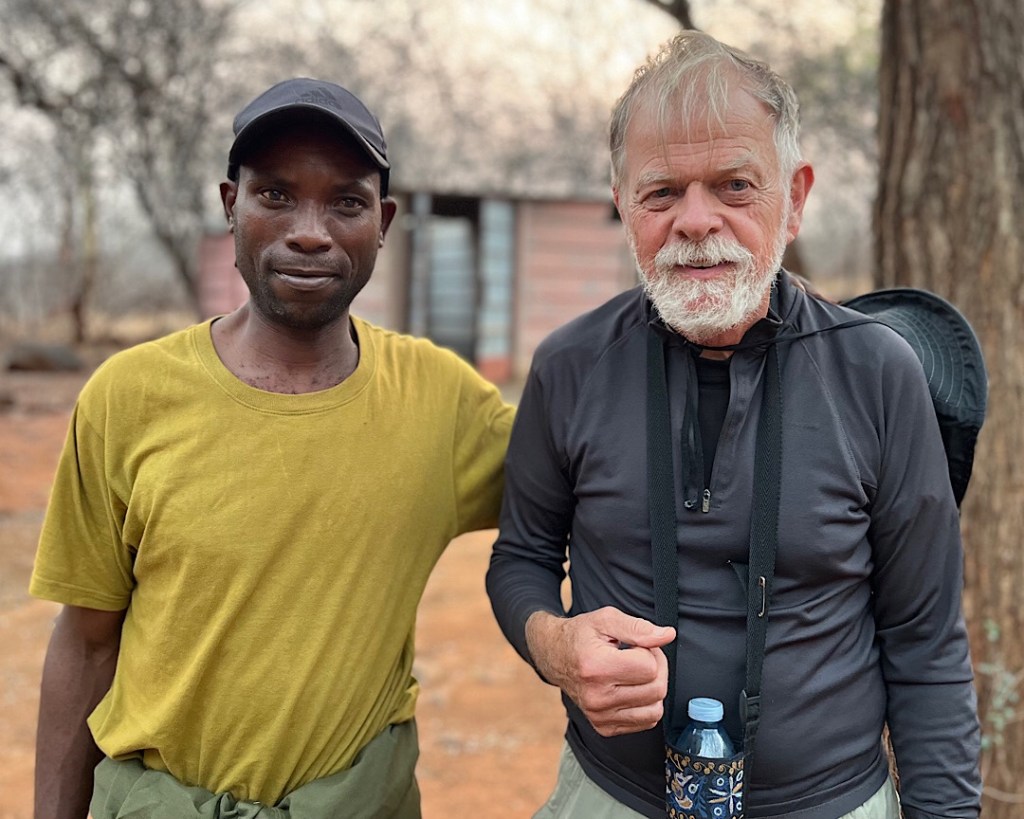
Justice and Steve

Throughout the course of our travels, Steve and I have stayed in a handful of places that felt like the ends of the earth. Our time in the Save Valley Conservancy adds another to that short list. After turning off the Mutare-Masvingo highway, we had to jounce for almost two hours over fawn-colored dirt washboard. Steve had to drive the Cruiser through the Turgwe River. During the dry winter and spring, it shrinks to a fraction of its high-water levels, but enough water still flows through it to get my adrenaline pumping.
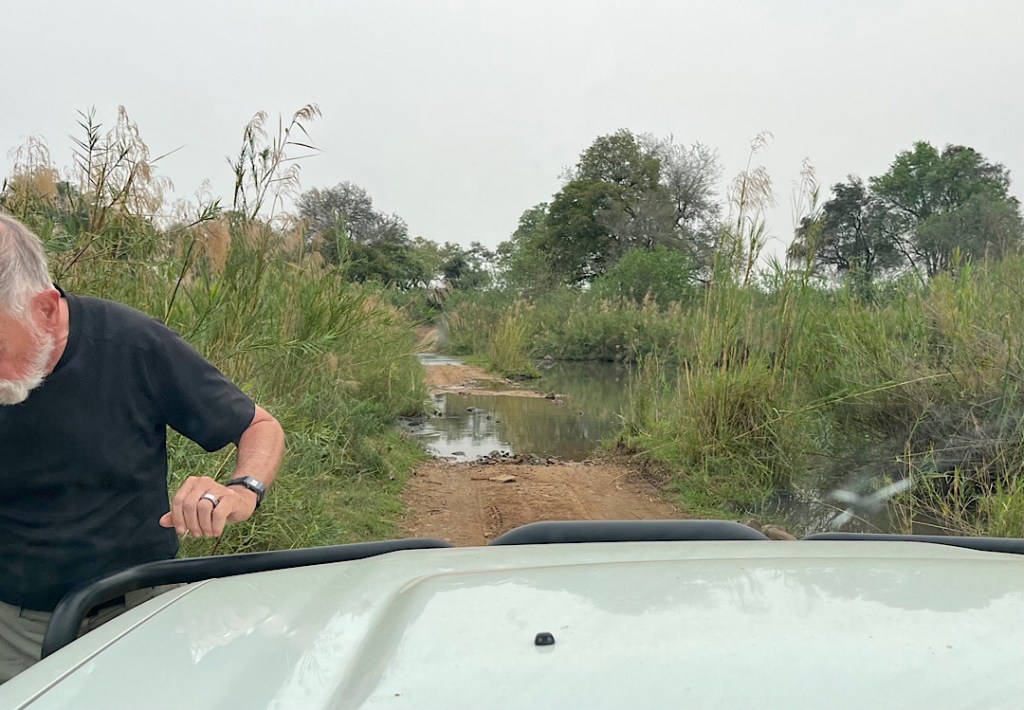
Steve locking the hubs to engage the 4WD, to help us get through the water ahead.

The guard at the gate off the main road had radioed that we were on the way, so a guy on a motorcycle was waiting to lead us to our lodging on the Humani Ranch: “Goma 2.” It’s very clean and comfortable, and after a delicious dinner, I felt cozy and relaxed. Around 7:30, a sound shattered the night. A growl verging on a roar exploded close enough to be on our porch. This lion sounded murderous. He (or she) emitted its blood-curdling threats 3 o 4 more times. Then another scream pierced the night. The shrieks went on and on, terrified and pleading (if an animal can plead). I don’t know what it was (maybe a bush pig someone suggested the next day) except that it was prey about to be eaten alive.

I felt astounded to be so close to such noisy exotic violence but not particularly scared. Goma 2 was built from stout concrete blocks. It has big windows, but a lion would only crash through one of them in a Hollywood movie. And soon this would not be a hungry lion. I did feel a bit nervous the next morning, as Steve and I set out on a walk led by a 32-year-old guide named Justice. He wore a green uniform and had a handheld radio but brandished no weapon.
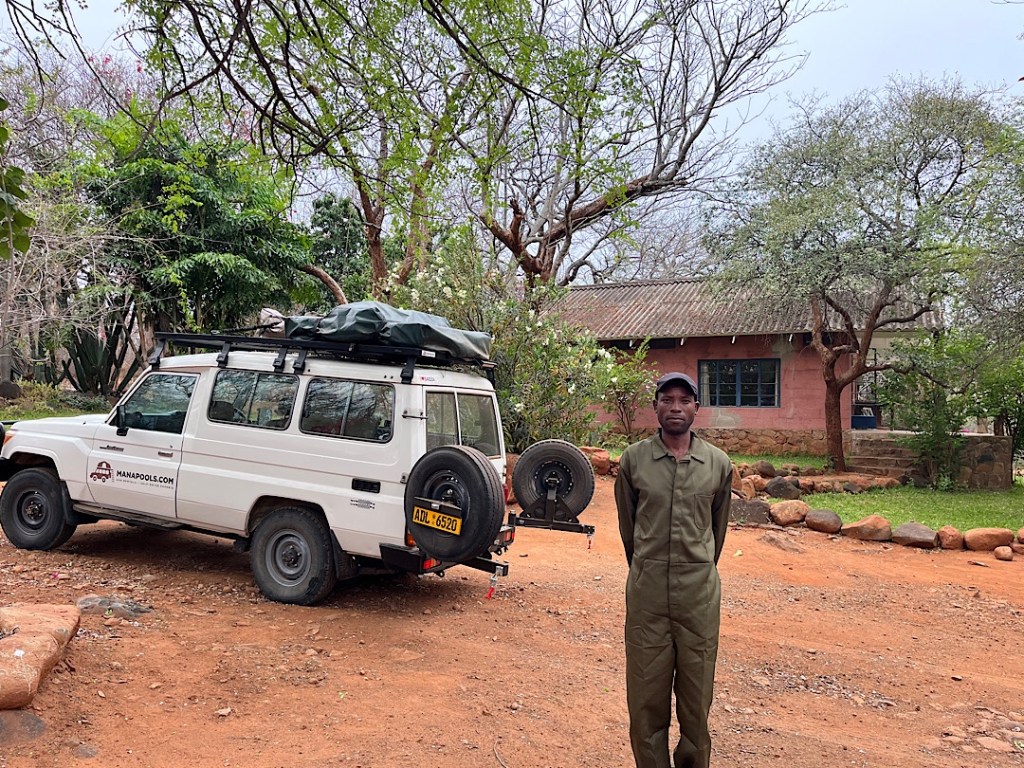
It soon became clear his English was minimal. He knew the word “lions” but didn’t understand my question: “Are they dangerous?” I tried “Will they hurt us?” He still looked uncomprehending. I went for something simpler: “Will they eat us?” He said they wouldn’t.
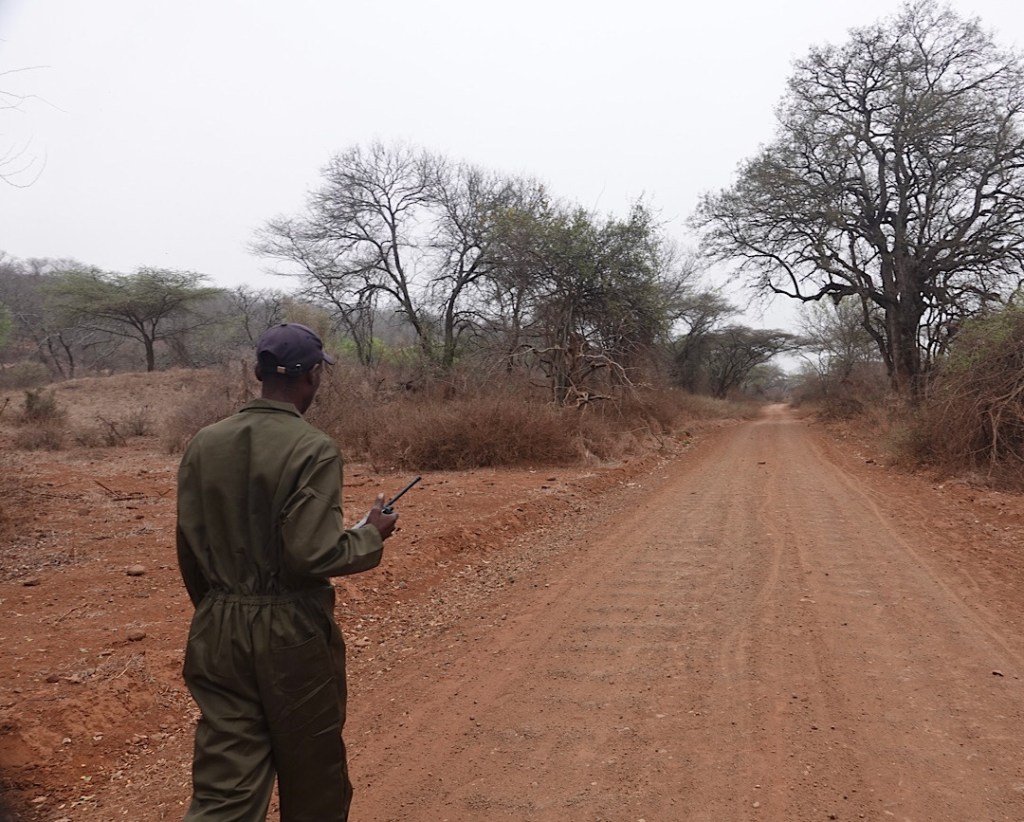
We walked for awhile alone a broad dirt road, and at one point passed a gaggle of kids of various ages heading to the ranch’s school complex. If little kids could be out by themselves, I figured, we three grownups would probably be okay ambling through Lion Country.

After a half hour or so, we left the main road and struck off through a lightly wooded area toward the Turgwe. Descending into the riverbed, the terrain was so open, it seemed clear no killer animals were close enough to menace us. Soon, however, Justice pointed out a buffalo far in the distance.
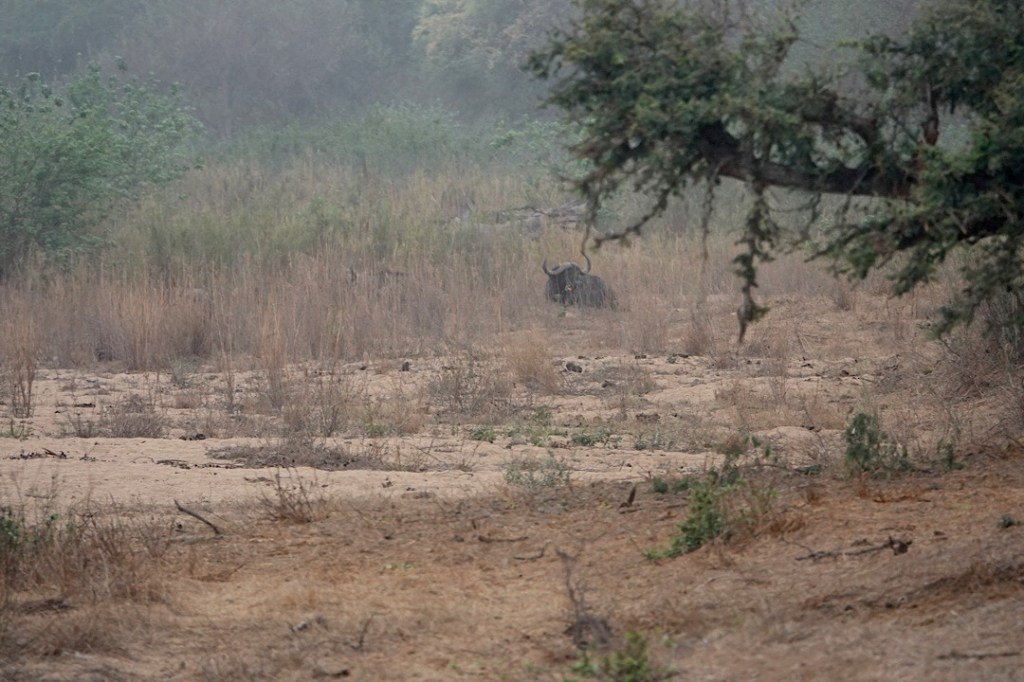
We advanced toward it, and I realized it was part of a group.
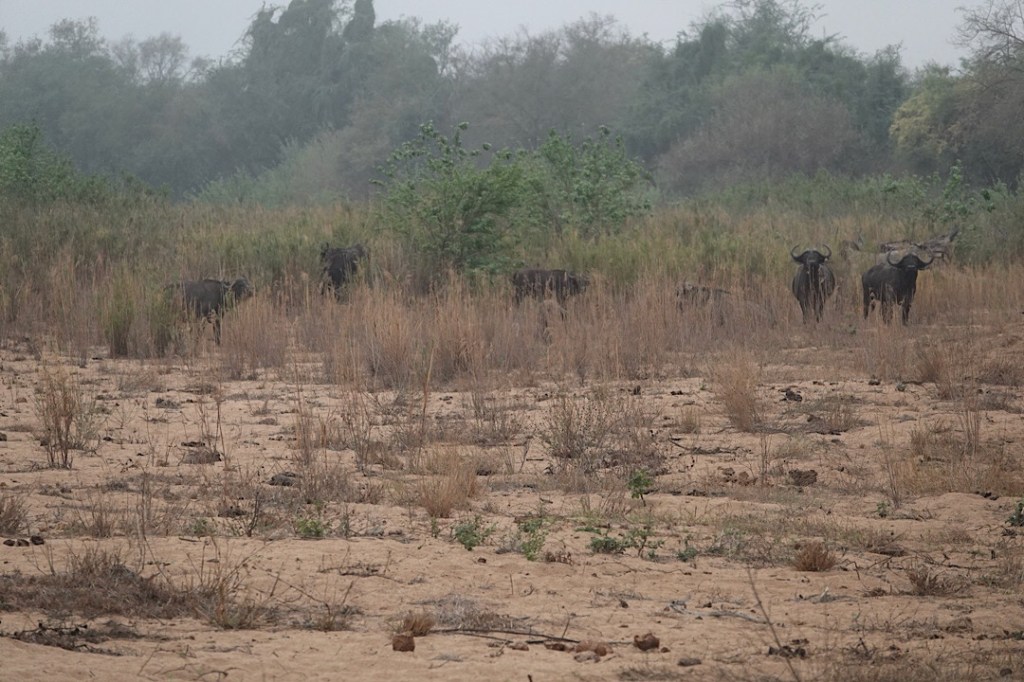
Closer still, we could see them watching us, wary.
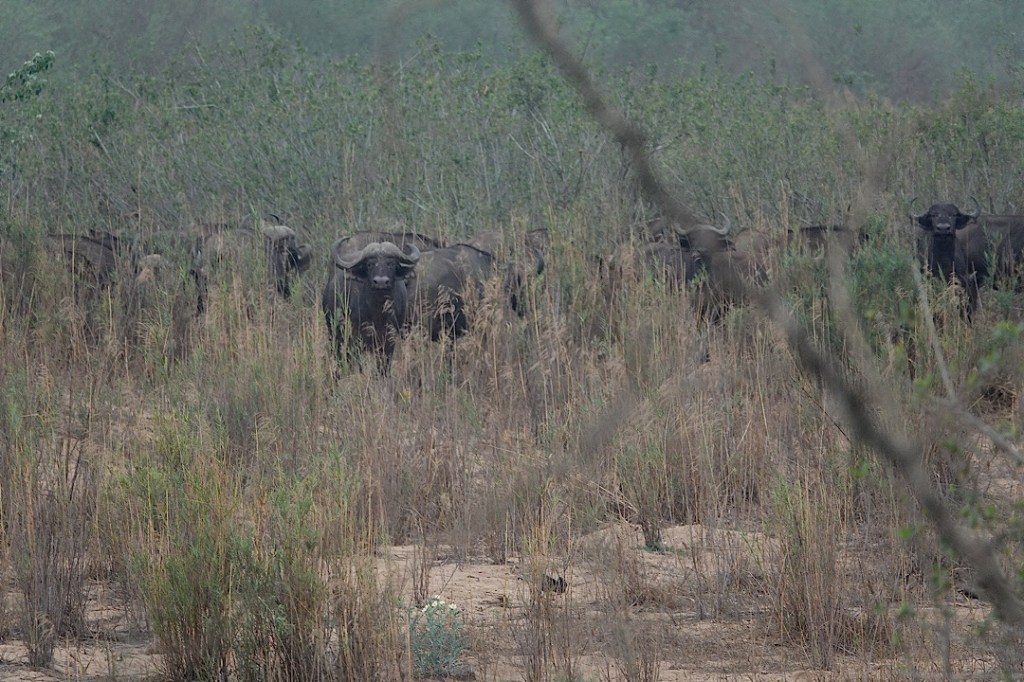
We’ve read, recently, that African buffalo aren’t as dangerous as their reputation. Only the cranky old solitary males are life-threatening, Justice told us. But he didn’t imply the rest were petting-zoo animals, and we soon left the riverbed. The buffalo herd thundered off, surprisingly fast. Over the course of the next few hours, Justice pointed out bushbuck, eland, kudu, and the always charming impala.
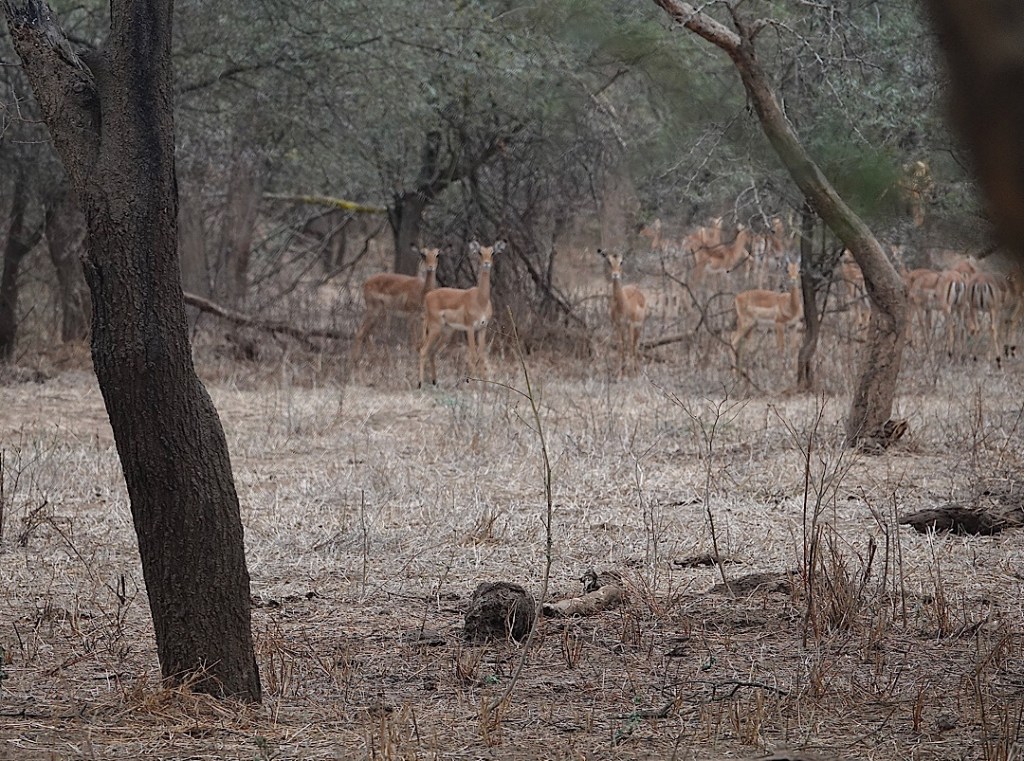
Shocking fast, they also leap higher than you can imagine.

He spotted some kind of monkey high in a tree (I only saw the branches swaying.) We noted a pair of warthogs trotting across a field, and we laughed at baboons stealing oranges from the farm’s huge grove.

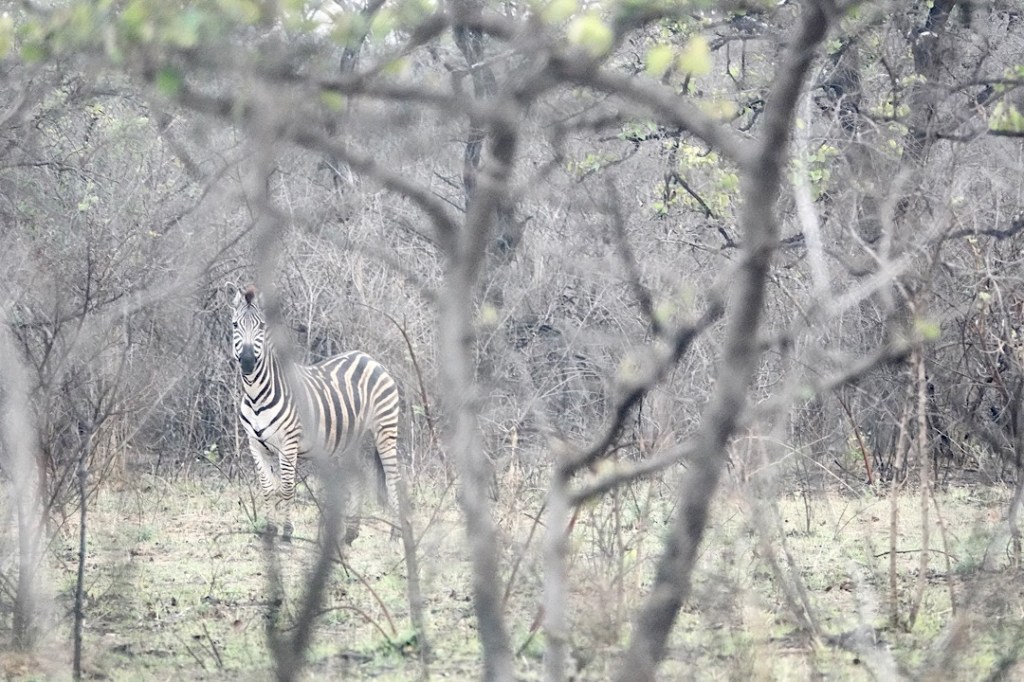
Toward the end of our walk, our guide directed our attention to a solitary zebra, camouflaged by the thicket of branches.
We saw no lions or black rhino or elephants, all of which live here. What flabbergasted me about the game walk, though, was how present all those big animals felt too. There! A fresh black rhino track.

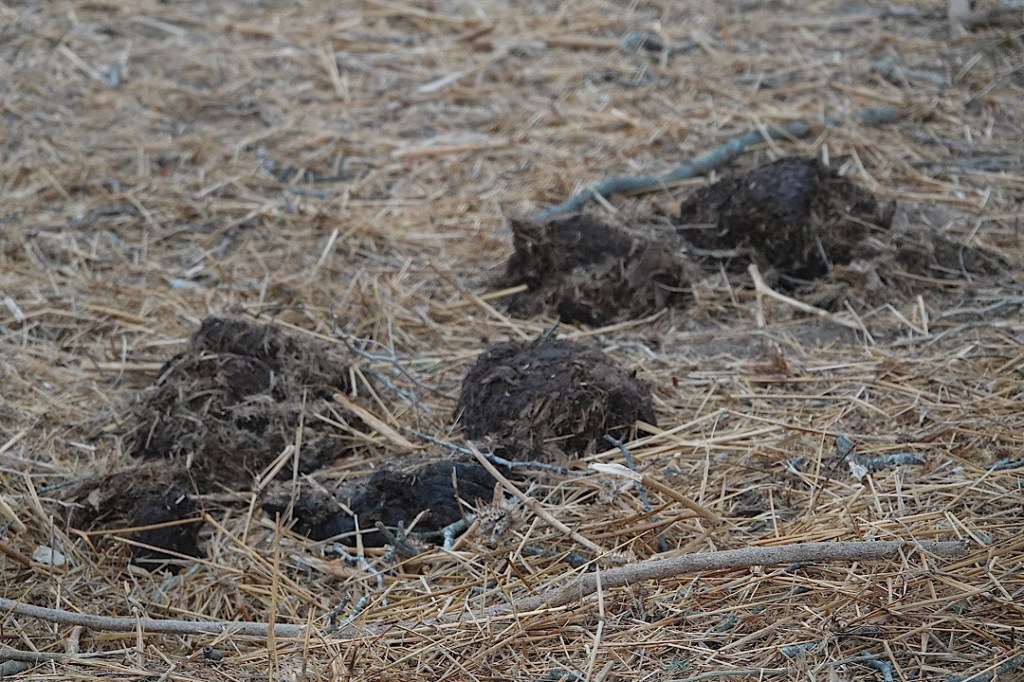
Enough elephant poop to fertilize a substantial organic garden.
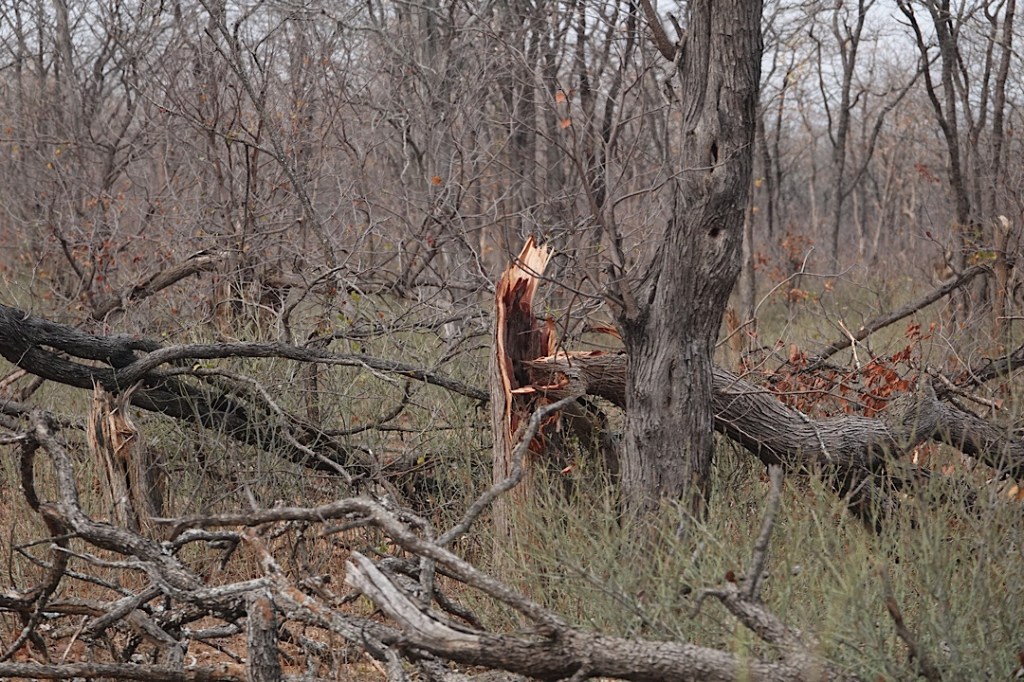
Trees smashed up in the unmistakable manner of elephants. (SUCH messy eaters.)
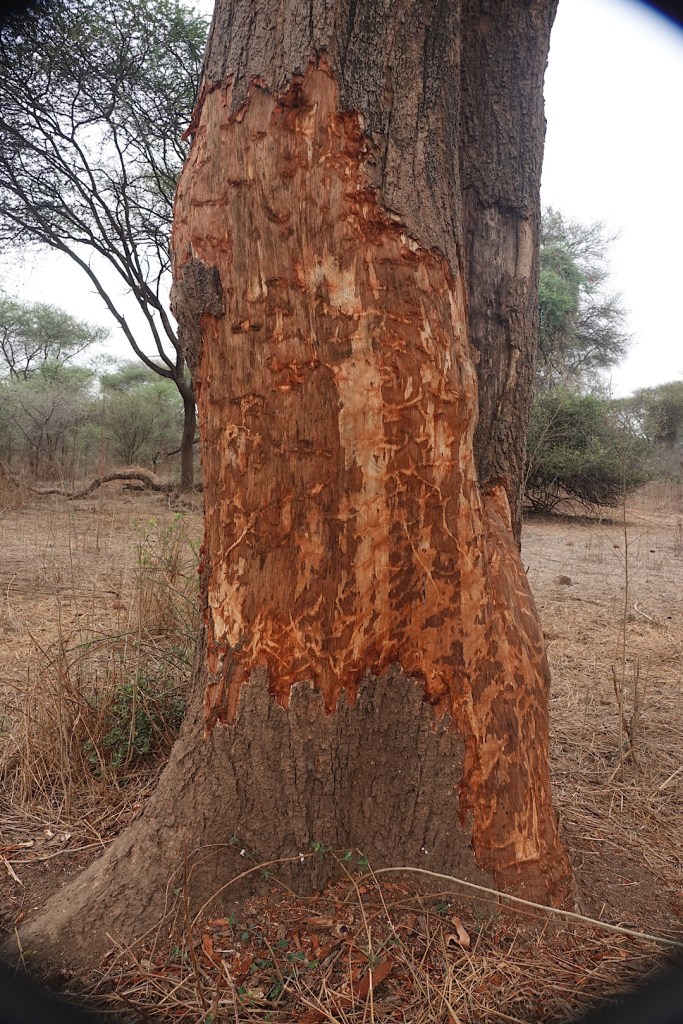
Our guide explained that a hungry elephant had stripped the bark off this tree (which would die as a result.)

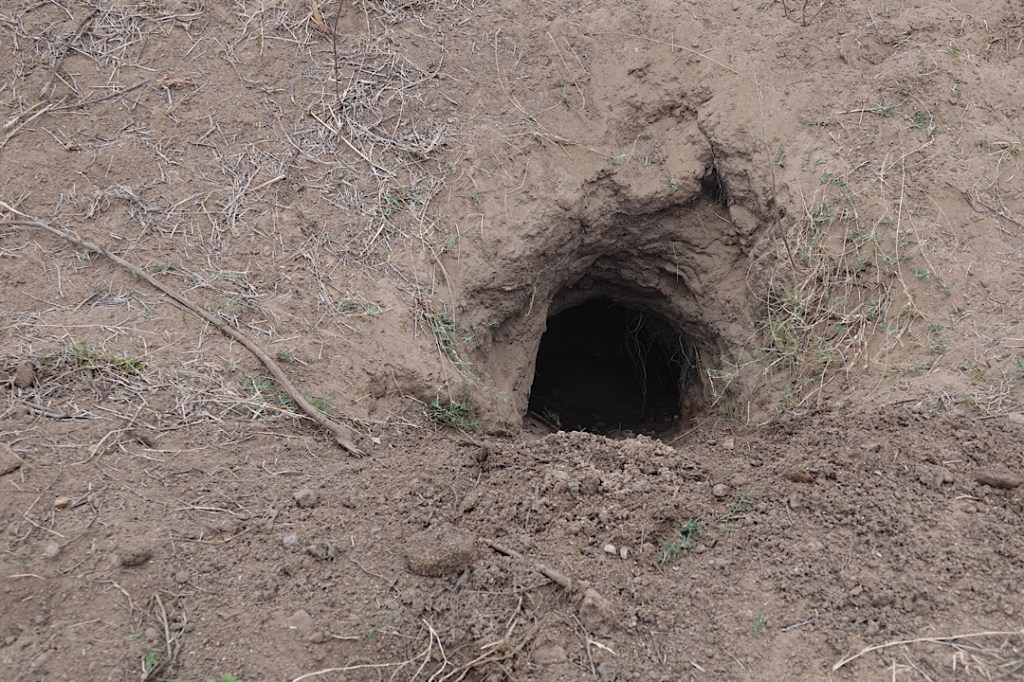
Justice said the mysterious holes in the ground were the work of “antbears” (later clarified for us by Google as aardvarks.)
When we found this single elephant bone…
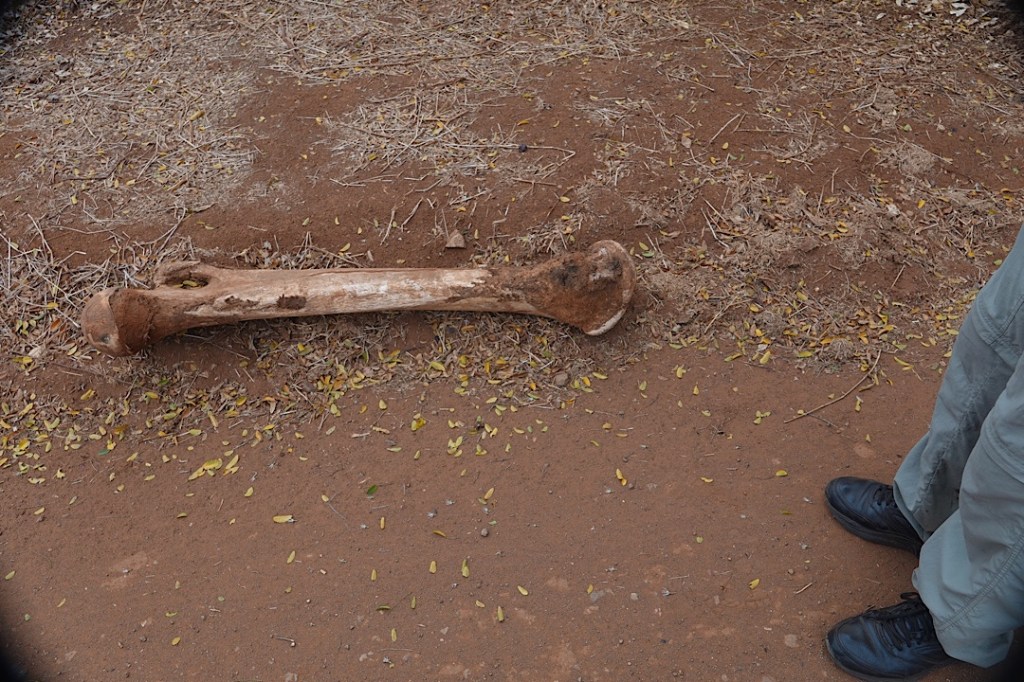
…Steve asked, “Where’s the rest of him?” Justice replied, “Hyenas.”

On foot we drank in the sight of things we would have missed entirely in a vehicle: spring blossoms…
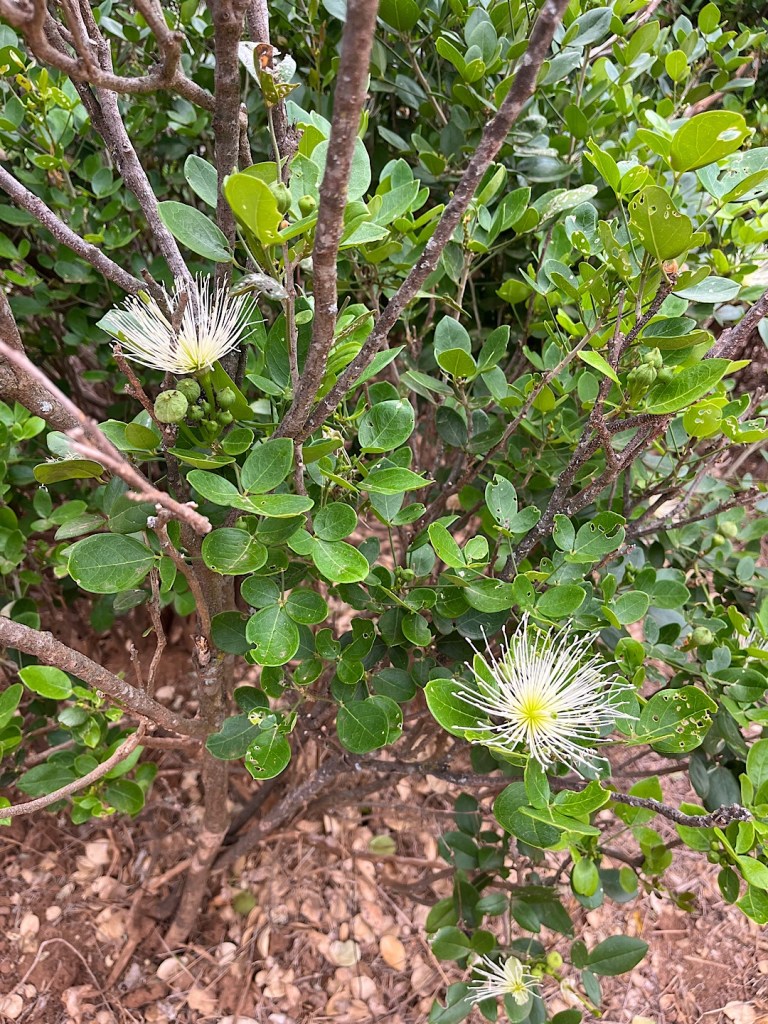
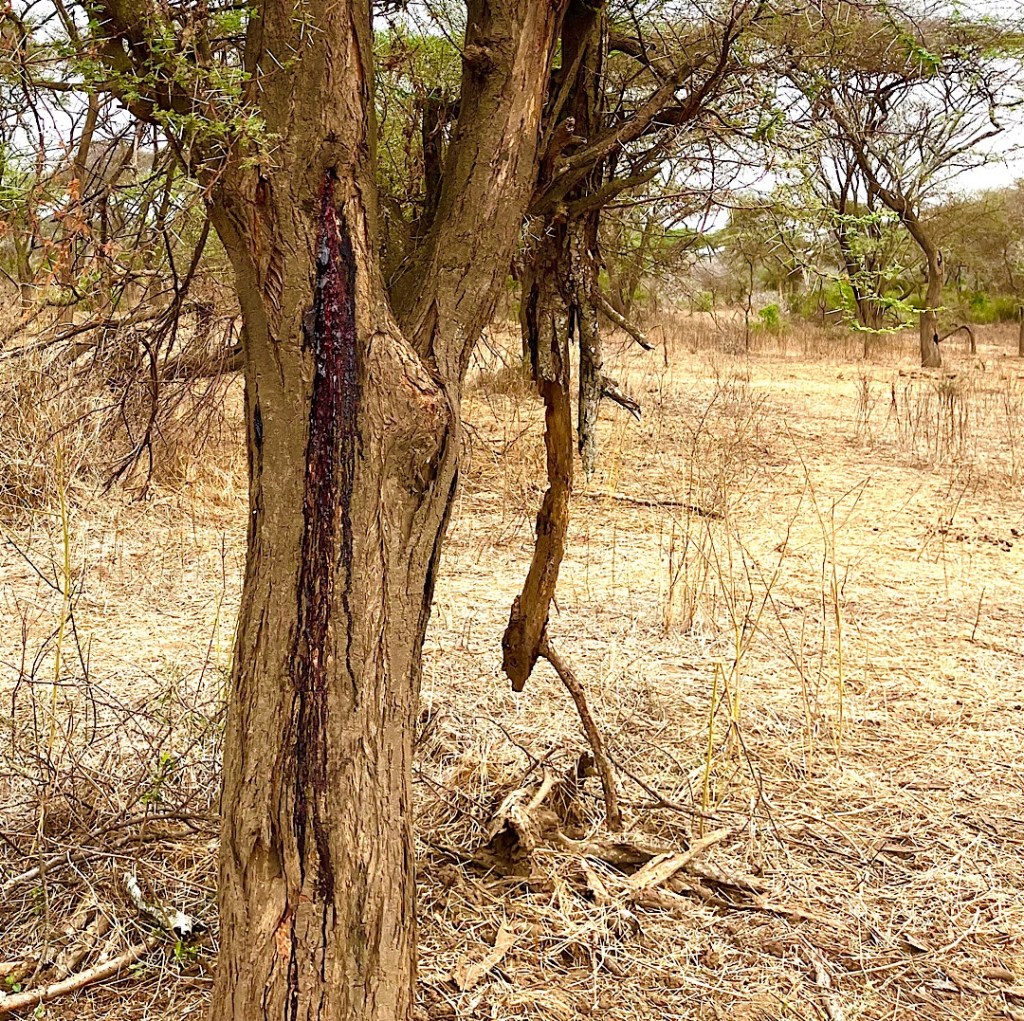
Wine-colored sap bleeding from a tree…
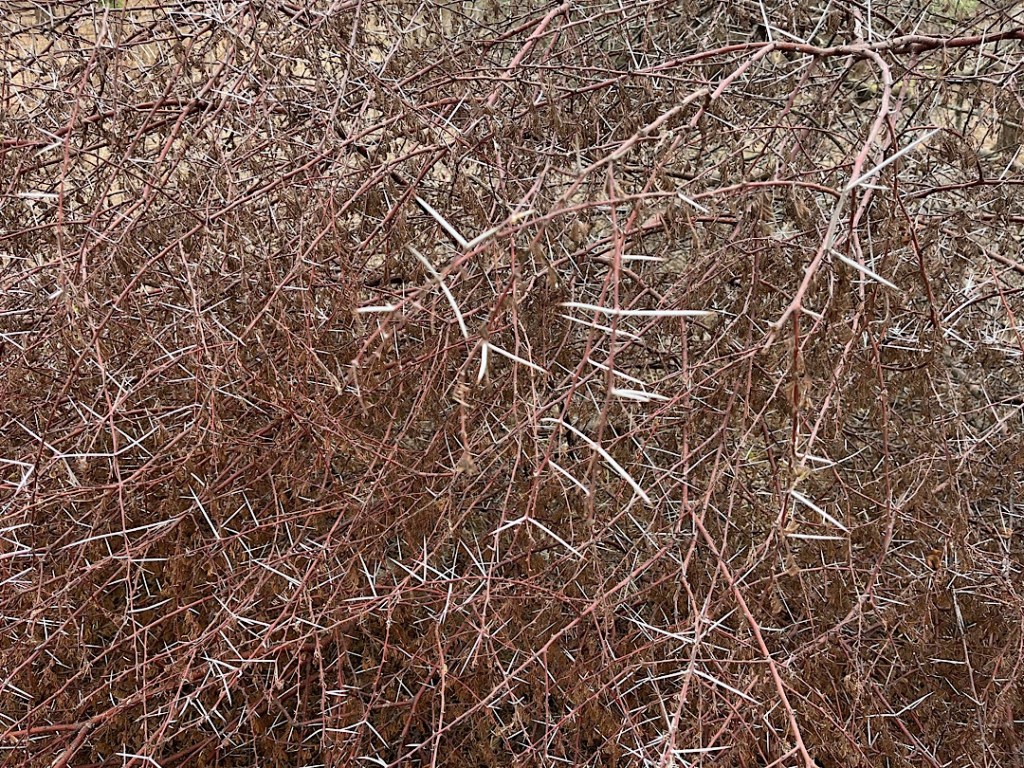
The beauty of thorn-tree needles up close…
By the end of our walk, I felt completely at ease. My epiphany was: of course! Humans evolved living with these animals for tens of thousands of years. Long ago we got established as the top predator along with a couple of others. (That lion!) But in a game reserve, we don’t compete with lions or leopards or buffalo for resources. That doesn’t mean we can blunder into their spaces or threaten them. But if we’re careful and respectful we can walk among them without fear.

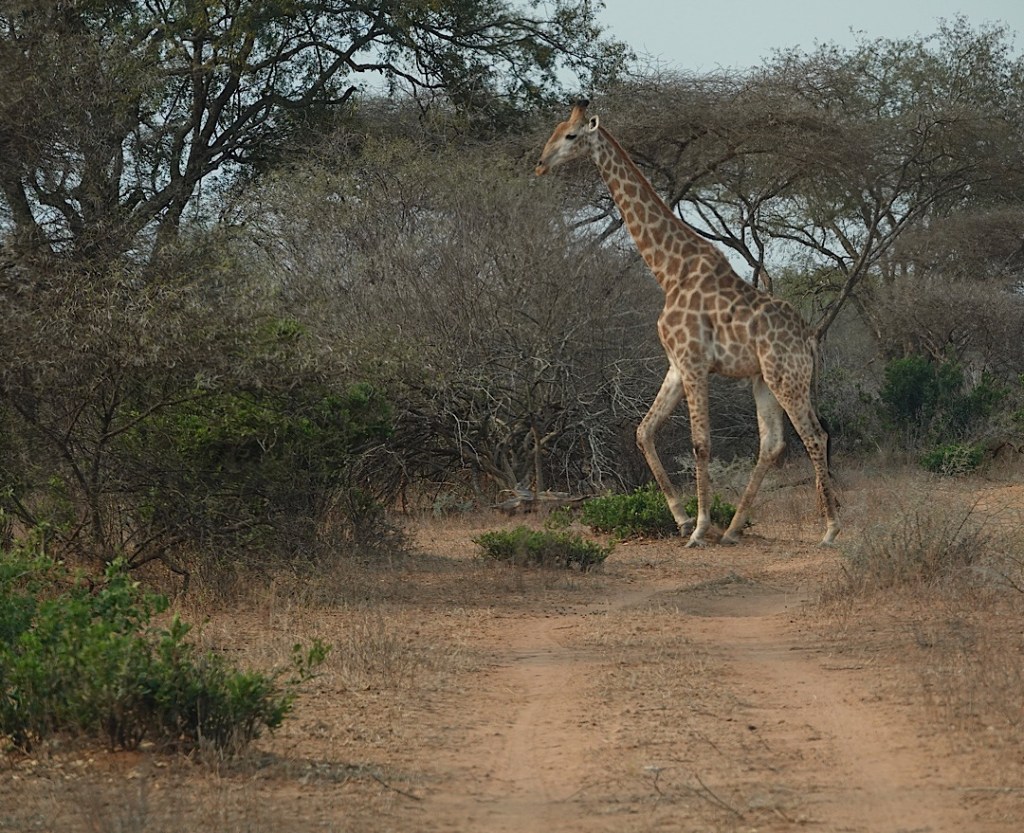
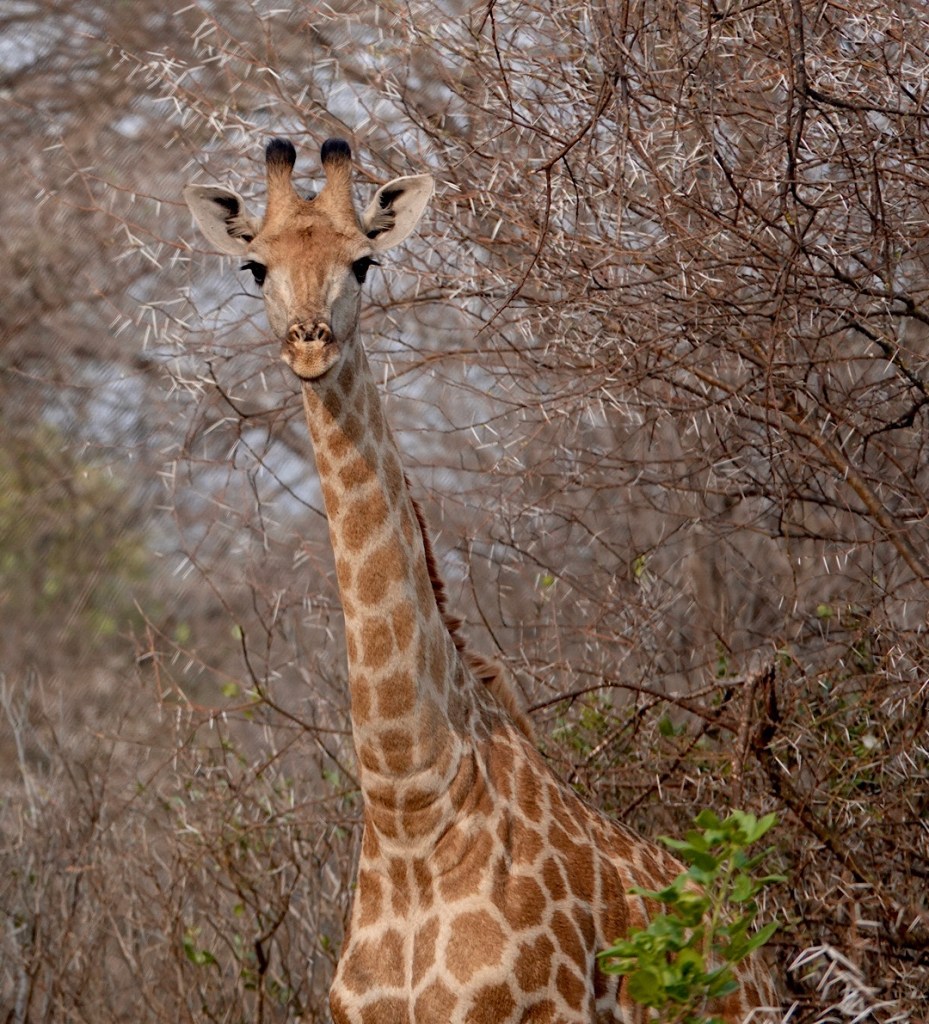
After a break for lunch and a rest, Justice came back around 2:30 to accompany us on another outing, this one in our Land Cruiser, with Steve at the wheel. Crashing through the bush, we filled in some gaps in what we’d seen. We passed giraffe that reminded me how much I love those guys.
We watched a solitary elephant bull happily chowing down on dinner.
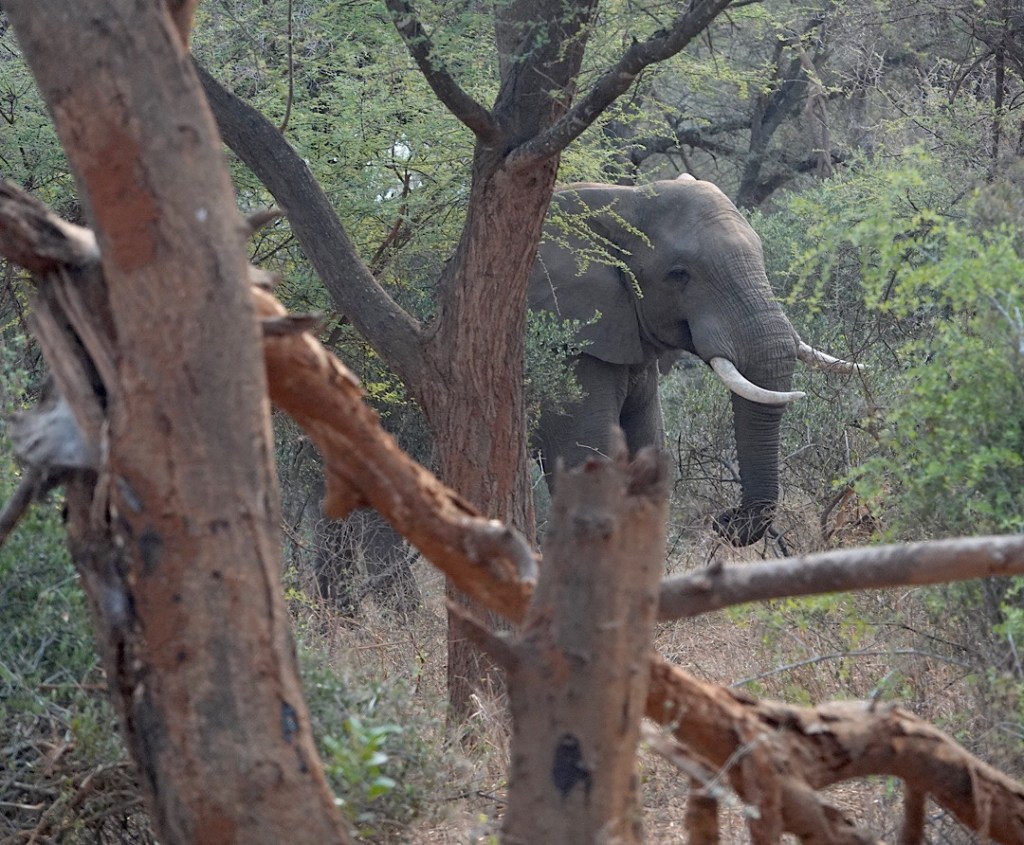
And at the wheel, Steve had a wildly macho experience that he loved.

Throughout our time together, Justice never grew more talkative. At first, his lack of English disappointed me. I would have asked so many questions, if he could just understand them! By the end of the day, however, I was happy about his linguistic limitations. If he’d been more fluent, we would have spent a lot more time yakking. Being quiet forced me to see more,

My one big regret was that we never met the owners of the Humani Ranch. Everything I know about the ranch and Conservancy comes from my guide book and the Conservancy’s website. The Whittal family sounds larger than life: former cattle ranchers and legendary big-game hunters who were leaders in getting their neighbors to tear down their fences, fencing only the perimeter and creating what the guidebook says is the largest private game reserve in the world. I had hoped to write more about all this but it’s too complicated. I give up. I can just say I’m happy to have glimpsed the life there.
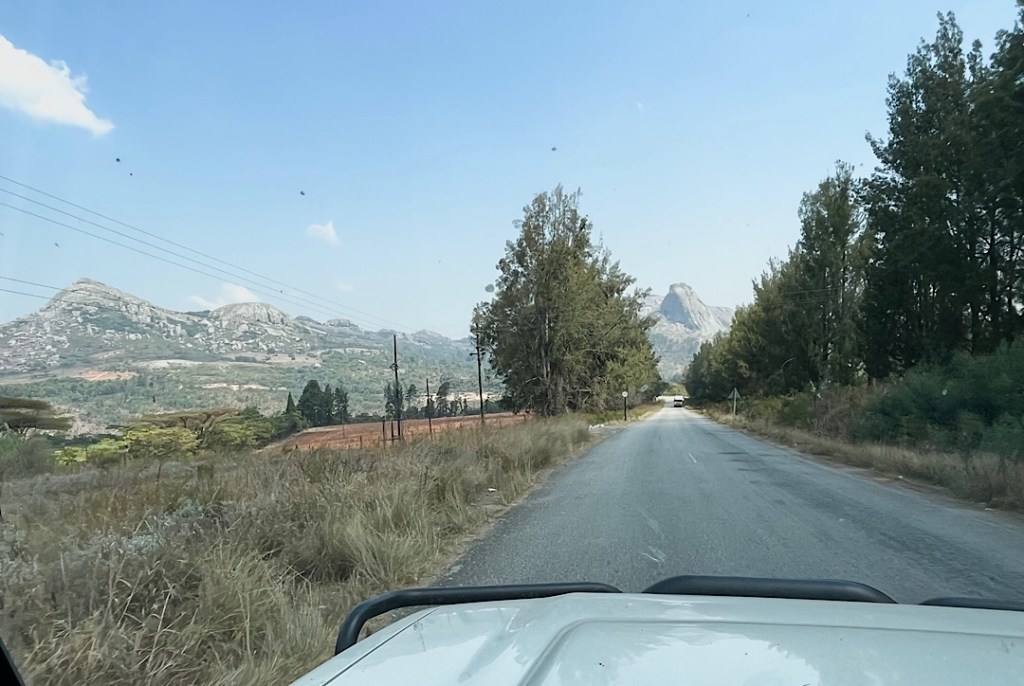
The scary highways of Zimbabwe

I was nervous about the driving part of our “self-drive” Zimbabwean safari. Steve also was worried. We’d heard the roads haven’t been maintained for 30 years. That drivers were almost suicidal in their obliviousness while speeding through intersections. That potholes and other obstructions turned traveling on rural roads into a potentially deadly game of Chicken.

As we approached the start of our trip here, I awoke on a couple of nights thinking about how easy it would be to die. But we’d heard from several sources that we’d be fine if we just took it easy. Were they right?

Now that we’re two long drives into the adventure, I’m think they were. A little before 9 Monday morning (9/25) we climbed into our loaded Land Cruiser and drove east from Ant’s guesthouse, heading away from the heart of Harare. The few stoplights we encountered seemed to be working, a rarity, according to what Ant had said. Traffic was light and no one did anything crazy. Soon we paid our two dollars at a toll booth and were passing fields and wooded areas. The further east we went, the lighter the traffic got, and I can tell you I this: When you’re almost alone on the road in a bruiser of a vehicle that can blow over potholes and other rough patches with ease, you begin to relax.

That’s not to say driving in Zim is just like driving in La Jolla. Paved roads are narrow but shrinking, the edges nibbled away by rain and wear. Those ragged fringes often are an inch or two above the adjoining dirt, and if one went over such a mini-escarpment at high speed (say, to avoid a head-on collision with a bus trying to pass someone), one could flip one’s vehicle and come to a messy end.

But Steve never drove at high speed, and the sights and landscapes entertained us: folks unloading huge truckloads of oranges…

,,,or making bricks or selling wooden sheds (or were they tiny homes?)

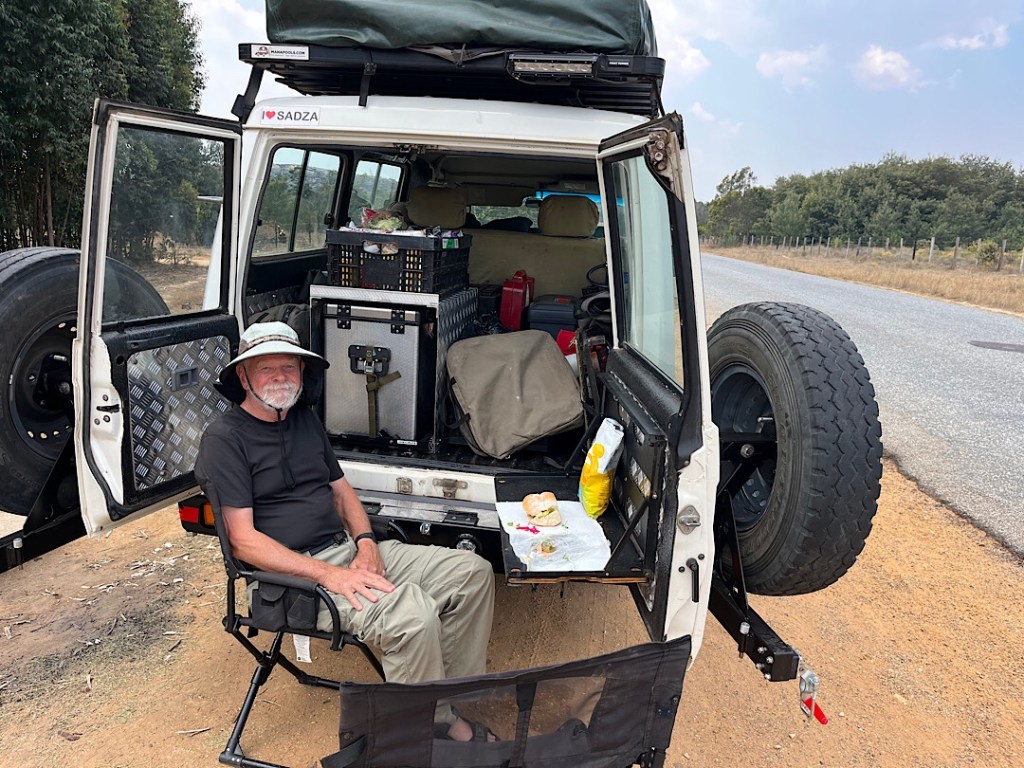
When we got hungry, we lumbered off the tarmac and parked on a dirt stretch near an informal bus stop. We opened up the Cruiser’s back, unfolded two chairs, let down our cooking shelf, made ourselves cheese and tomato and avocado sandwiches, and gobbled them down with chips.

To reach our destination in the northern highlands we had to pull off the main road and bounce over dirt and boulders for more than an hour. That wasn’t pleasant, but I don’t think we saw any other vehicle along the entire punishing stretch. We had that night and another full day to relax and enjoy the glorious countryside.

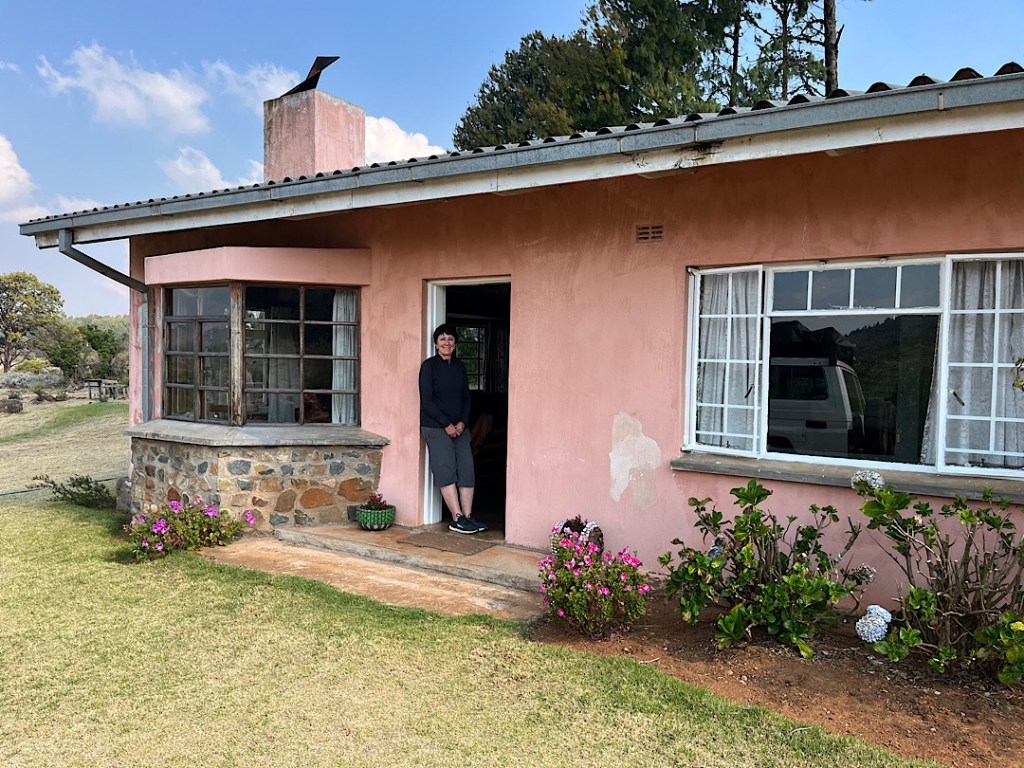
This self-catering “cottage” where we stayed was actually a four-bedroom house.
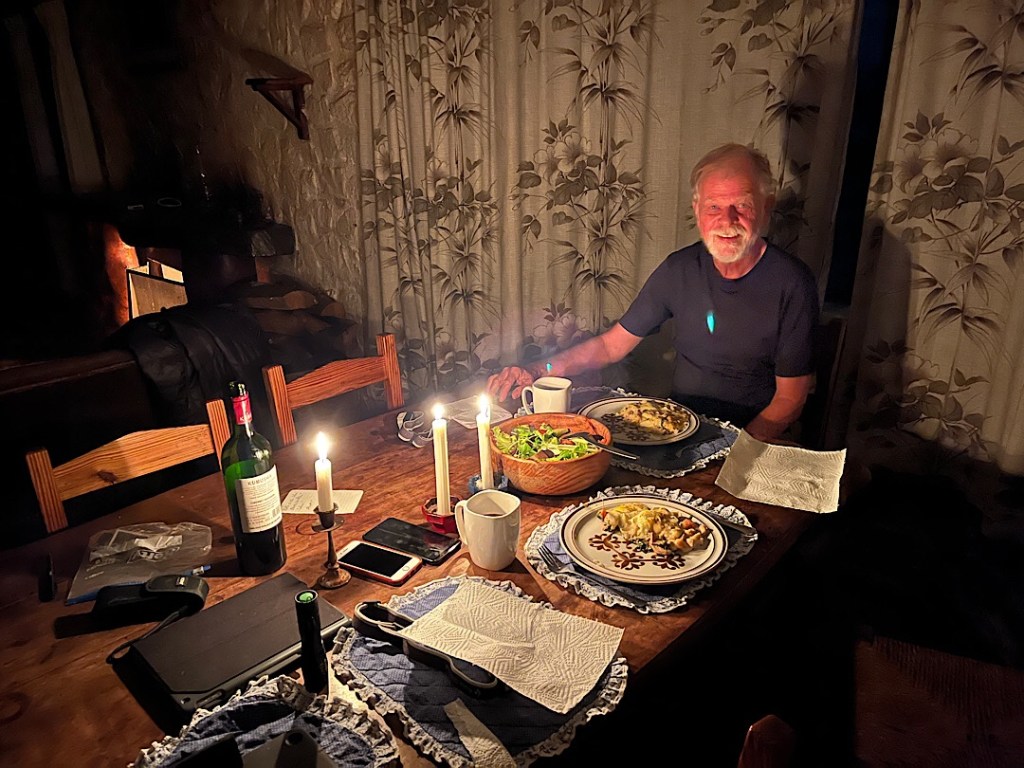
Although we had only candlepower our first night there, we still enjoyed a delicious dinner of chicken lasagna (pre-cooked and frozen and packed into our Cruiser’s freezer by Ant’s team), a nice salad, and brownies.
Tuesday morning we hiked for five miles around the lovely lakes down the hill from our cottage.
It was one of the most peaceful walks I’ve taken in memory. I think we saw one other person the whole time.
Pines like this scented the air.
That pink house in the distance is our cottage, with the Cruiser parked next to it.

Wednesday we drove eight and a half hours, stopping midway to refuel at a Total Station. For 13 gallons of diesel, we paid $88 (plus a dollar tipto the friendly guy who cleaned our windshield) — more than the price at home. But it was still a relief to see confirmation we wouldn’t be dealing with fuel shortages (another Zimbabwean thing, at least occasionally).

Descending out of the mountains, we dodged more animal traffic…

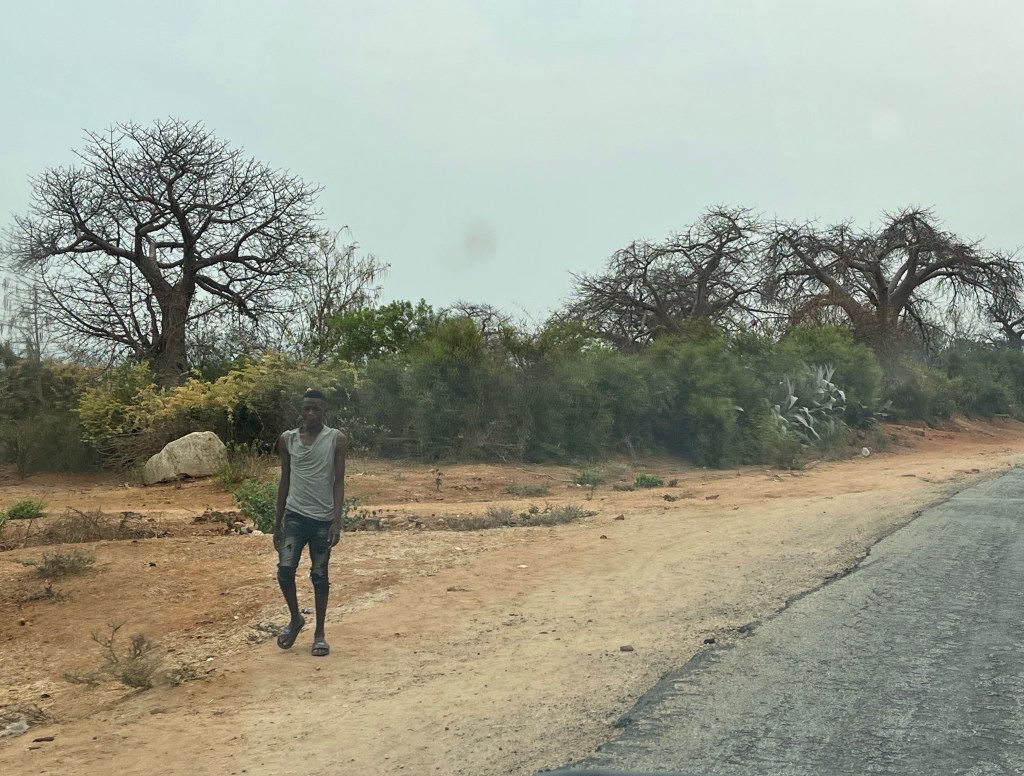
And I thrilled to this sight of our first baobab trees on this trip.

I bought that large colorful rug from the lady on the right, who made it.

Human automotive competition for the road remained light, and it disappeared entirely once we turned onto the washboard lane leading to our destination in the amazing Save (pronounced Sah-vay) Valley Conservancy.

The other scary byway in Zimbabwe is the Internet highway. If good paved roads are scarce, access to the global information stream is rarer. Here our beloved T-Mobile phone service, which gives us instant connectivity in more than 100 countries, provides only text and phone coverage, No data. Ant’s guest house was equipped with good WiFi but we haven’t been anywhere else that has had it.

As part of his services, Ant did provide us with an aging Galaxy Android phone, and we bought $20 of air time from a roadside vendor near Ant’s Sunbird Guest House. It took some work, but Steve finally figured out how to use the Android as a hotspot for all our devices. That’s how I was able to publish my Zimborientation post from our remote mountain shelter Monday night. It felt miraculous.

Since we left there, however, we haven’t had any phone signal most of the time (and if the Galaxy can’t get a signal, we get nothing.) If you’re reading these words, that means I finally found a spot of service. In the meantime, we’ll have to make do with focusing on the actual world around us. That’s not a bad thing.

Will bonobos survive?

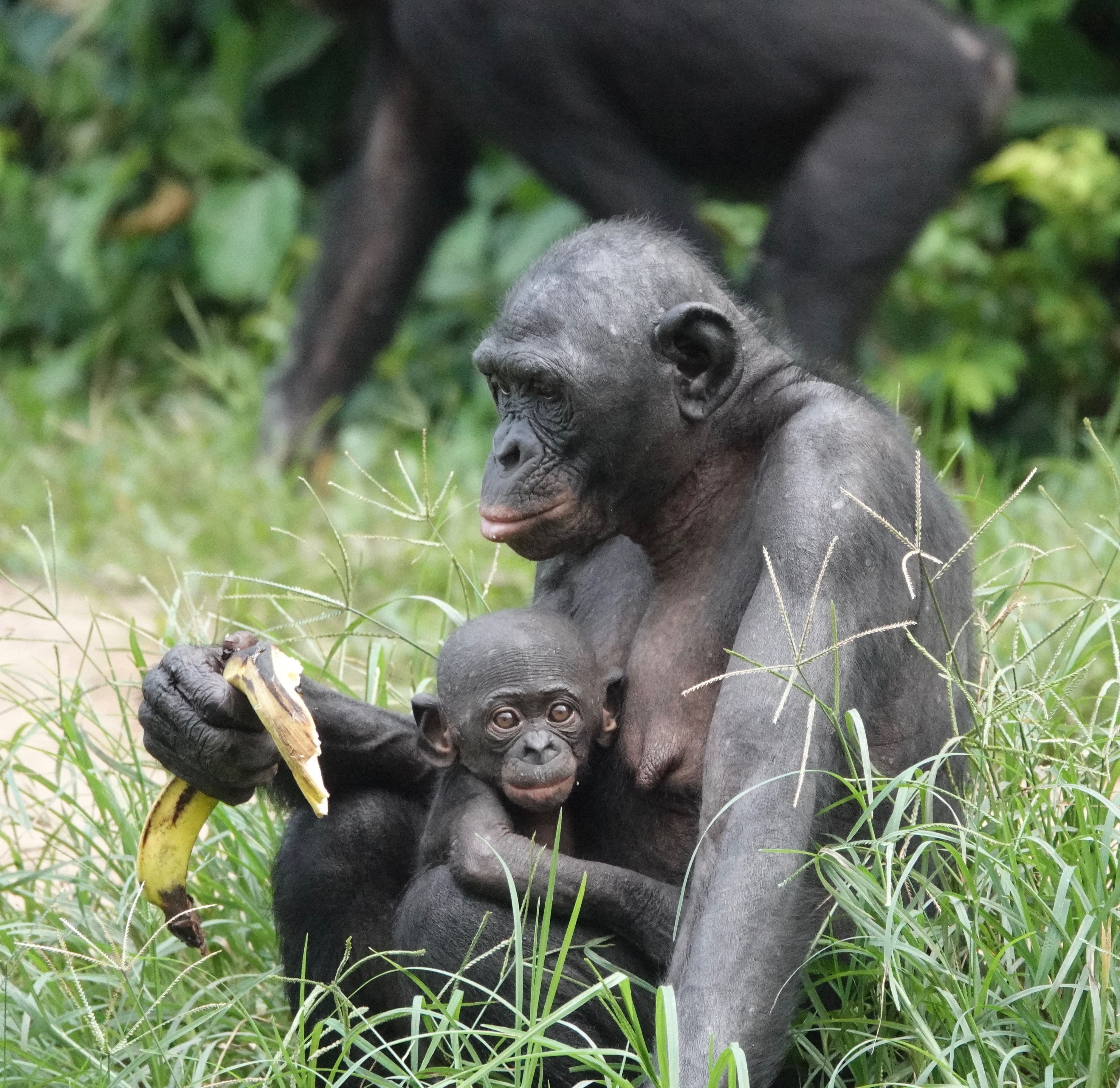
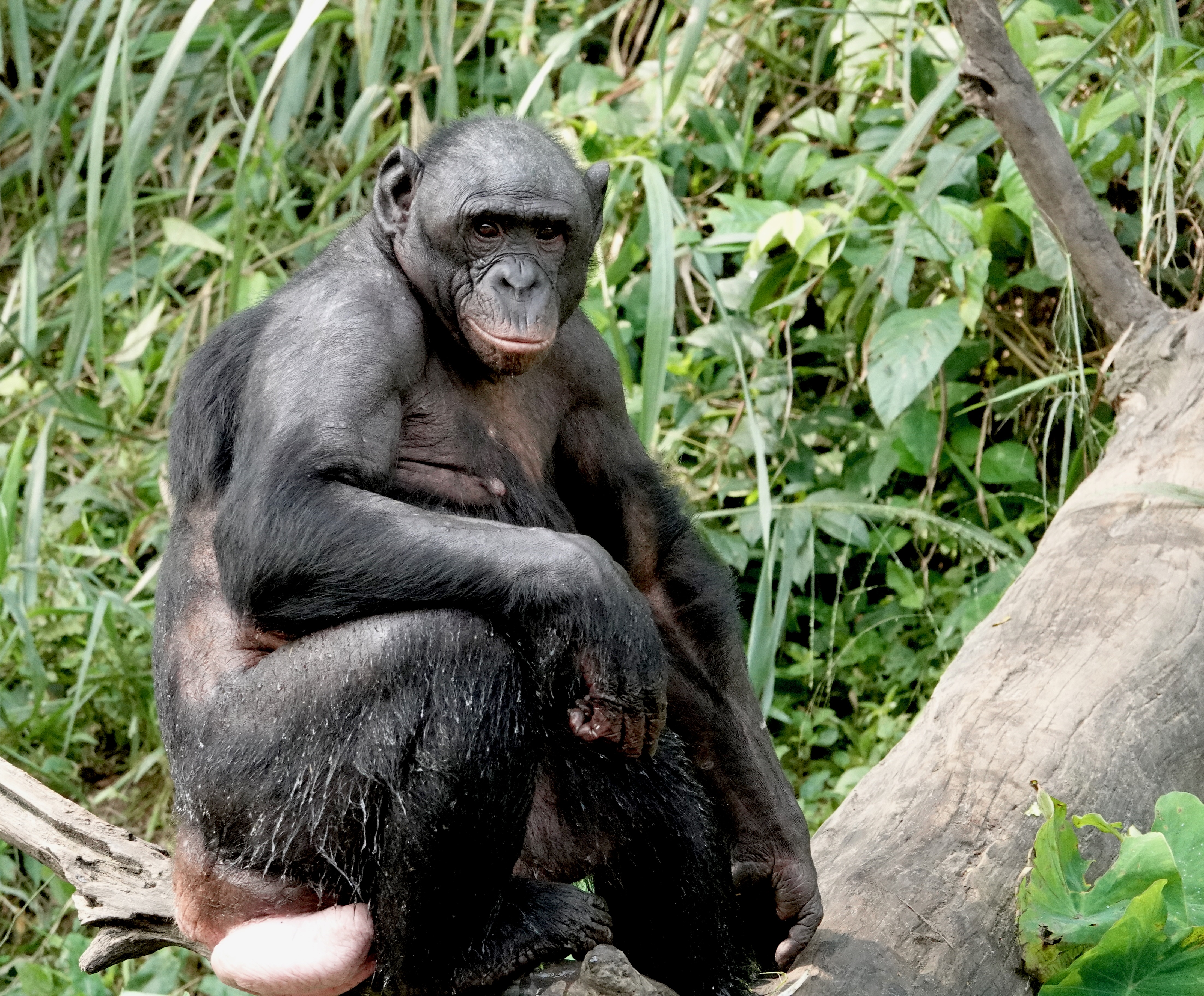
DSC07830 2.jpegI’m not a wildlife expert, and maybe even the experts don’t know what the future holds for bonobos. But what I want to say is: after visiting the Congo, I feel optimistic.
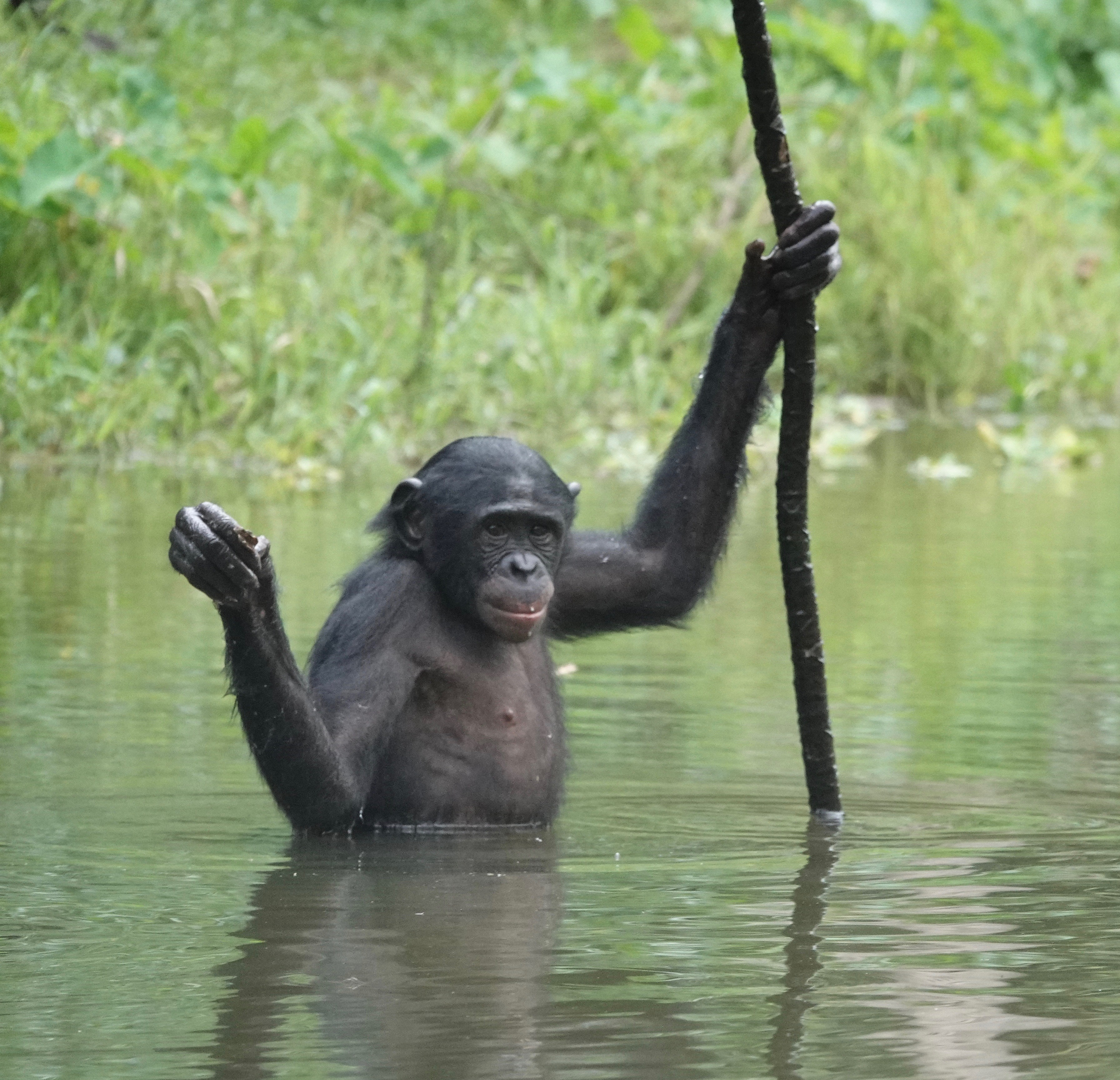
That may be naive. The DRC is one of the most corrupt countries on earth. Its national politics are still in turmoil. Atrocities continue to unfold in the war-torn east, where Ebola has broken out again. And yet… the biggest threat to bonobos isn’t habitat loss, as it is for so many animals in so many places. Congo still has plenty of equatorial rainforest where bonobos can thrive. The bonobo population has plunged because Congolese people eat them.  And even that isn’t as bad as it sounds. People don’t think bonobos are endowed with any magical properties (like rhinos, for example, burdened with their theoretically aphrodisiacal horns.) Bonobos are just meat, for which Africans have a big appetite.

Still, just as most humans (even hungry ones) don’t eat other humans, when people learn how similar bonobos are to humans, they can change their minds about bonobos’ place on the menu. And if protecting bonobos instead of eating them can make communities more prosperous, folks can be marshaled to protect them.

DSC07853.jpegSuzy Kwetuenda at Lola ya Bonobo has spent countless hours talking to Congolese villagers in the rainforest about why bonobos deserve protection. She says some of them bristle at the notion of outsiders trying to stop them from eating their bush meat. But she retorts, “You know, we are lucky to be the only ones in the world to have bonobos! They are very precious. The BIG value of bonobos is not in your stomach! It’s very important to have bonobos for development. If you protect them, this area will have more and more visitors. They will come and help you!”
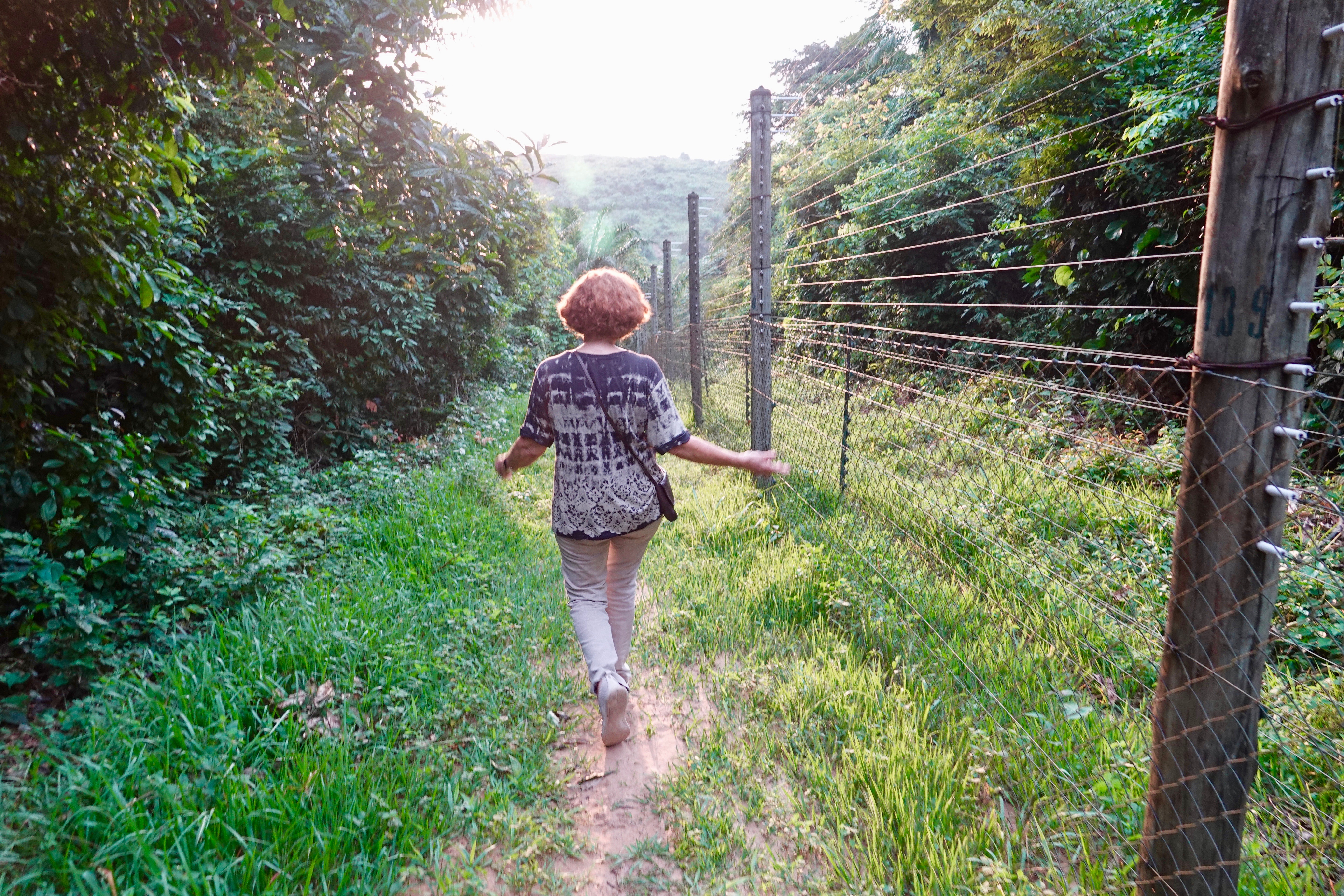
This has always been a core premise of the Lola team: that the communities surrounding any bonobo release site must see concrete benefits from fighting against the hunters and poachers. Les Amies des Bonobos du Congo and its US-based fundraising arm, Friends of Bonobos, don’t have huge budgets. The money has come mostly from small and medium-sized donors. But a part of those limited resources has been devoted to improving the schools, infrastructure, health care and other services near the Ekola ya Bonobo release site. In the ten years since the Lola team began releasing bonobos back into the wilderness, more and more of the bonobos’ neighbors have become believers.

I’ve seen first-hand how a similar approach has worked in Uganda. There tourists who come from around the world to see mountain gorillas have become an engine of prosperity. Ugandan communities that have benefited now see the animals as a priceless resource. It’s possible to imagine something similar unfolding in the Congo.

DSC07666.jpeg
Claudine has led the way.

What Claudine Andre has accomplished in the last 25 years also fills me with admiration and awe. Starting from nothing, she’s built a team that’s adept at saving baby bonobos on the verge of death. These survivors now routinely thrive in the garden that is Lola. The team also now knows what’s required to successfully reintroduce these very special creatures into the wild. (Only one of the 60-odd reintroduced bonobos has died, a youngster who was bitten by a poisonous snake.) And back at Lola more than 30,000 Congolese school kids already have visited Lola and been inspired by these stories.

It saddens me that so many people still don’t know what bonobos are. (I’ve gotten a lot of blank stares when I’ve mentioned our recent travel plans.) But that can change. A hundred years ago no one had heard of pandas. DSC07716.jpeg

A hundred years from now our closest animal relatives could be thriving in the African rainforests, showing us a different model for primate behavior than that demonstrated by chimpanzees and us. If that happens, a lot of things will have made it happen.

Some have already unfolded. Claudine has already dedicated a big chunk of her life to the bonobos’ preservation. Field researchers and veterinarians and the sanctuary crew and others have already learned a lot about what it takes to keep bonobos flourishing. But more will be required. Humans all over the planet will need to recognize bonobos as readily as they do pandas, and many will donate money to help them out. Congolese people will have to learn to treasure them.

That would be the happy ending to the bonobos’ story. Maybe it won’t come to pass, but it should. I’m hoping it will.


A barrel of baby bonobos

On this trip, I have learned it’s more fun to watch baby bonobos play than it is to watch many movies. The action is almost nonstop. They sock each other; pounce. One chases another, catches up, and smashes into him. They tickle each other and make a noise that sounds like panting, but it’s not; it’s the sound of bonobo laughter. Sometimes they go too far and someone gets hurt. Ear-piercing shrieks erupt. Others may beat up the bully in retaliation. The smallest ones never stray far from their surrogate mothers. Older ones sometimes mimic copulation. They’re far too young to actually have sex. It’s just instinctive, practice with the tool they will use soon use daily to diffuse social tensions.
Here’s a glimpse:

img_08175-10

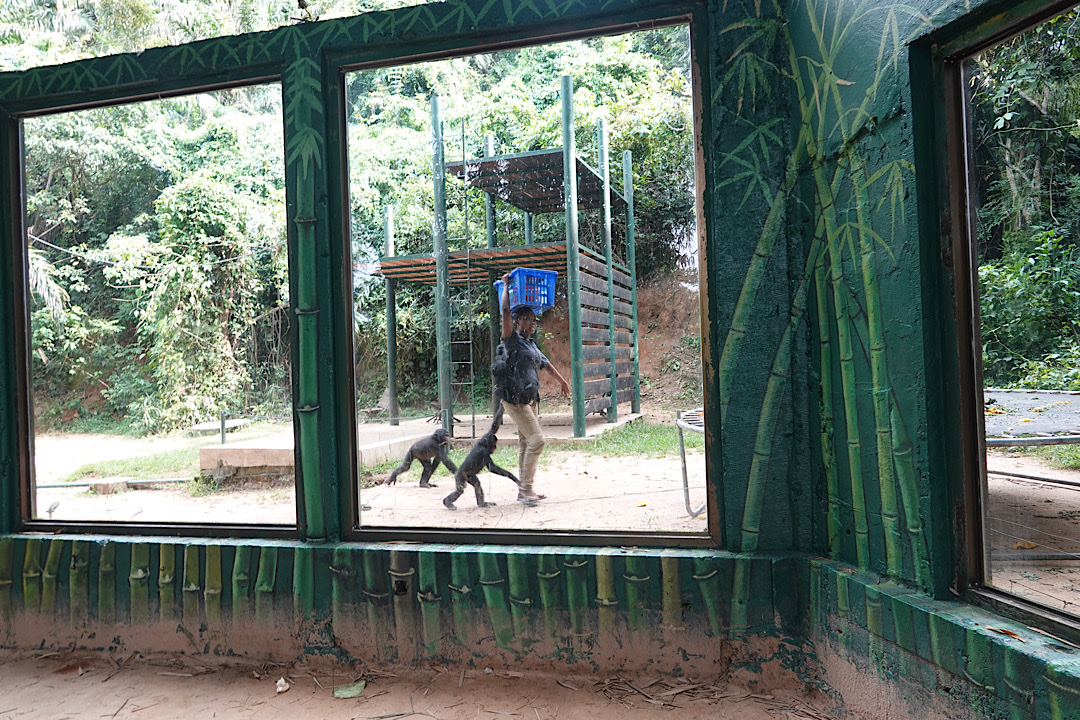
I don’t think there’s anywhere else on earth where you can watch a whole pack of young bonobos play, by themselves. Seven little ones were living in Lola’s nursery during Steve’s and my stay. They ranged in age from two to five, and they all had shiny black fur and boundless energy. Most (if not all) had arrived malnourished, ill, and so traumatized they were close to death.

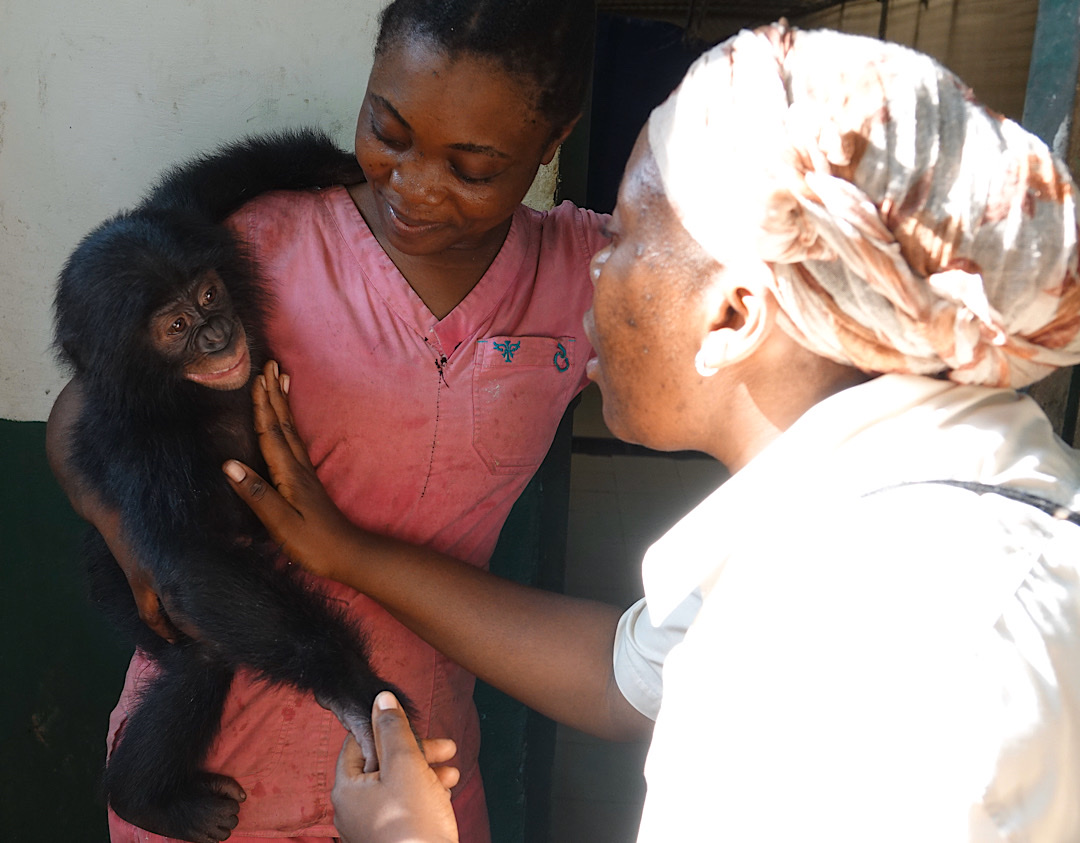
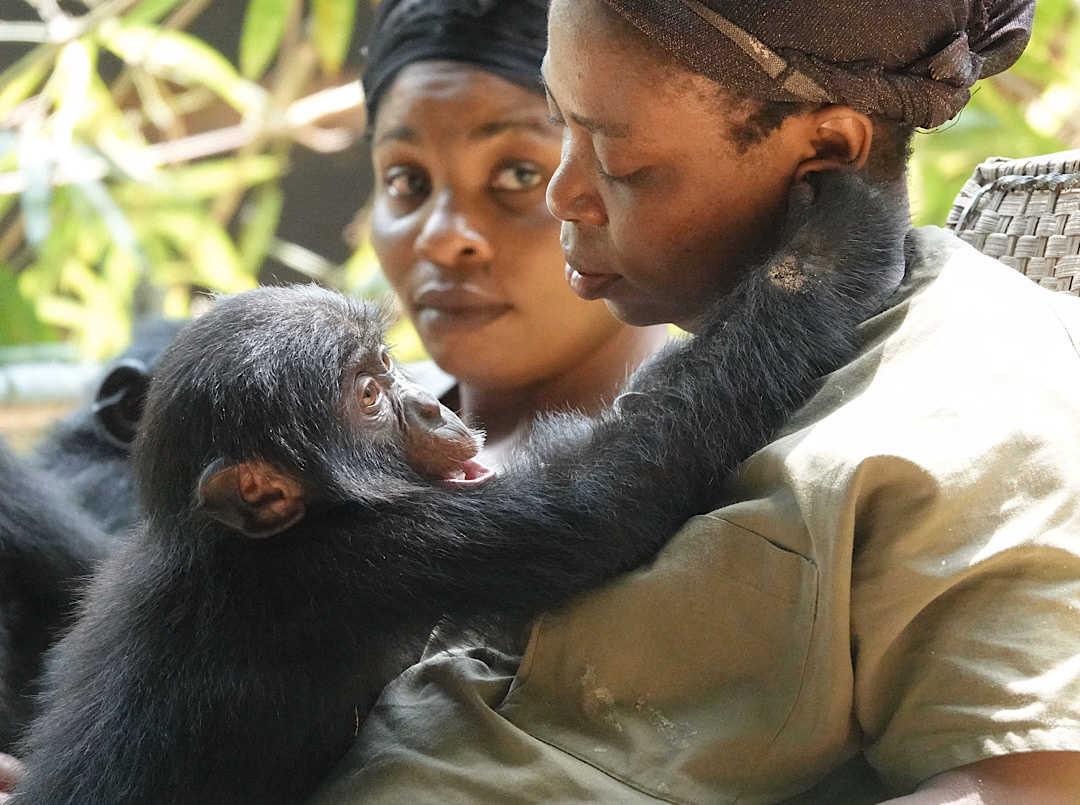
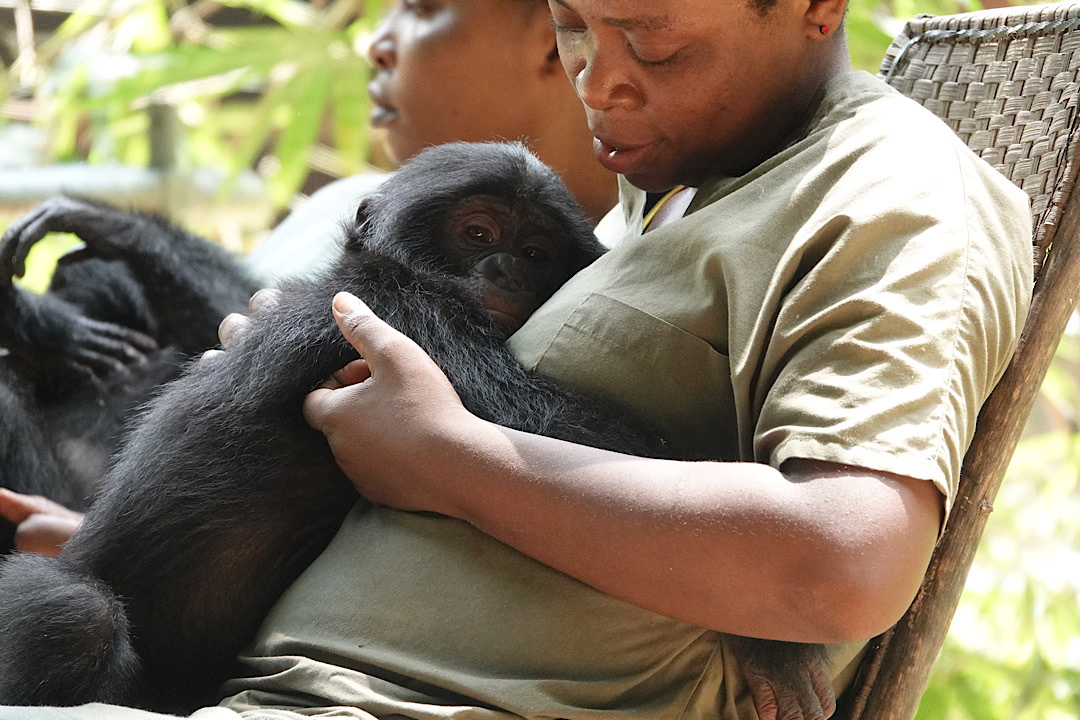
Over the years, Claudine and her team have developed a detailed protocol for caring for the tiny victims, many of whom have seen poachers shoot their mother before their eyes, then hack her into pieces to be sold as meat. After a thorough medical screening and treatment for any critical health problems, the orphan must be quarantined for six weeks to ensure it’s not carrying any disease that could decimate Lola’s entire bonobo population. But you can’t confine a young bonobo to a cage, all alone. It would die from the absence of love and physical contact. Instead at Lola, each newly arrived youngster is assigned a human surrogate mother who rocks and cuddles it, feeding and caring for the little one in a way that’s looks even more challenging than caring for a human toddler.

The Lola team says love is just as important as food.

I can’t imagine what the surrogate moms go through during this quarantine period. Claudine says usually it takes about two weeks before the newcomer begins to accept and trust the human female. The mom has to try everything she can think of to get the orphan to eat. The poacher/trafficker may have fed it beer or tainted water or scraps of offal or handfuls of rice. The Lola staff says Coke is often the thing that will entice a baby into taking its first sips before transitioning to a more nutritious formula. During a quarantine, the mom returns to her own home at night, but then she got back to work each day without any break until the baby at last can be integrated into the larger group.

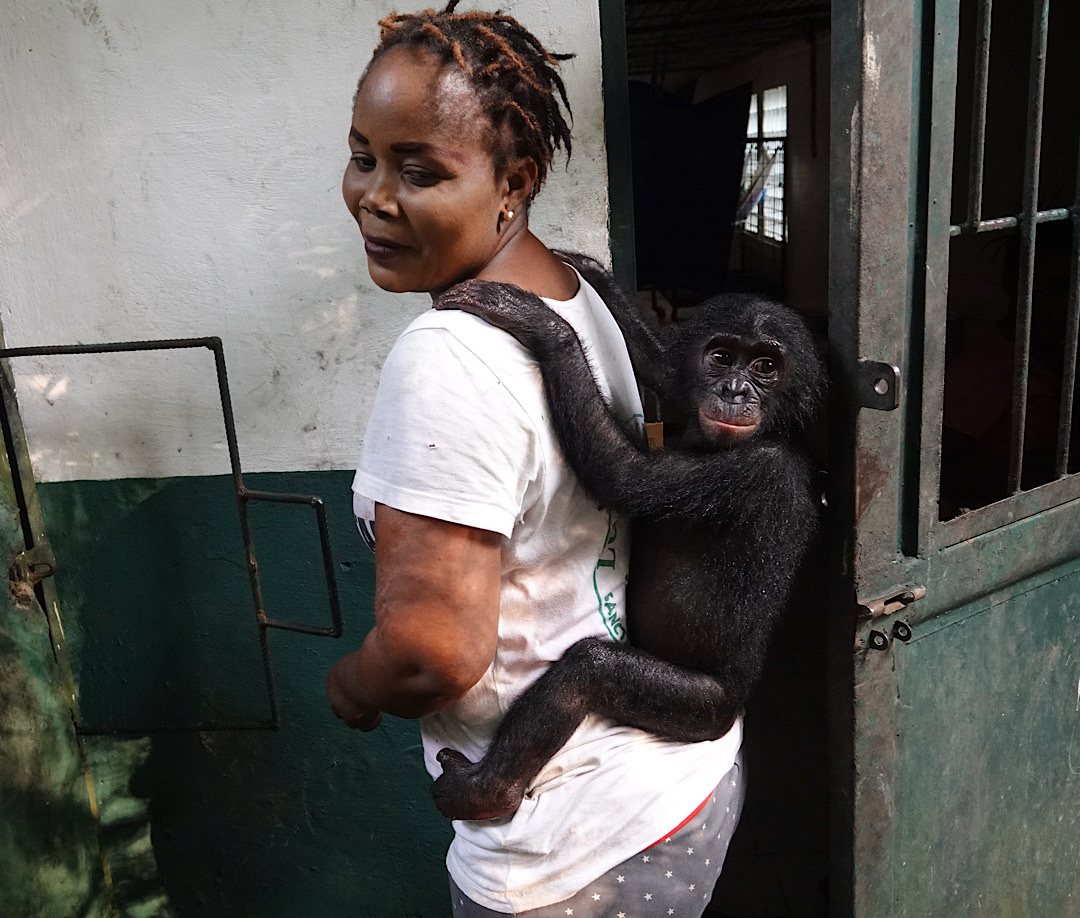
Being a surrogate mom to one or more bonobos may get easier after that, but it’s still hard work. The youngsters cling to the women. They climb (or pounce) on their backs and arms. They tug at their pant legs. It’s intensely physical and also essential to the youngsters’ survival.

If you don’t like being alone, a job as a bonobo surrogate mother might be just the thing for you!

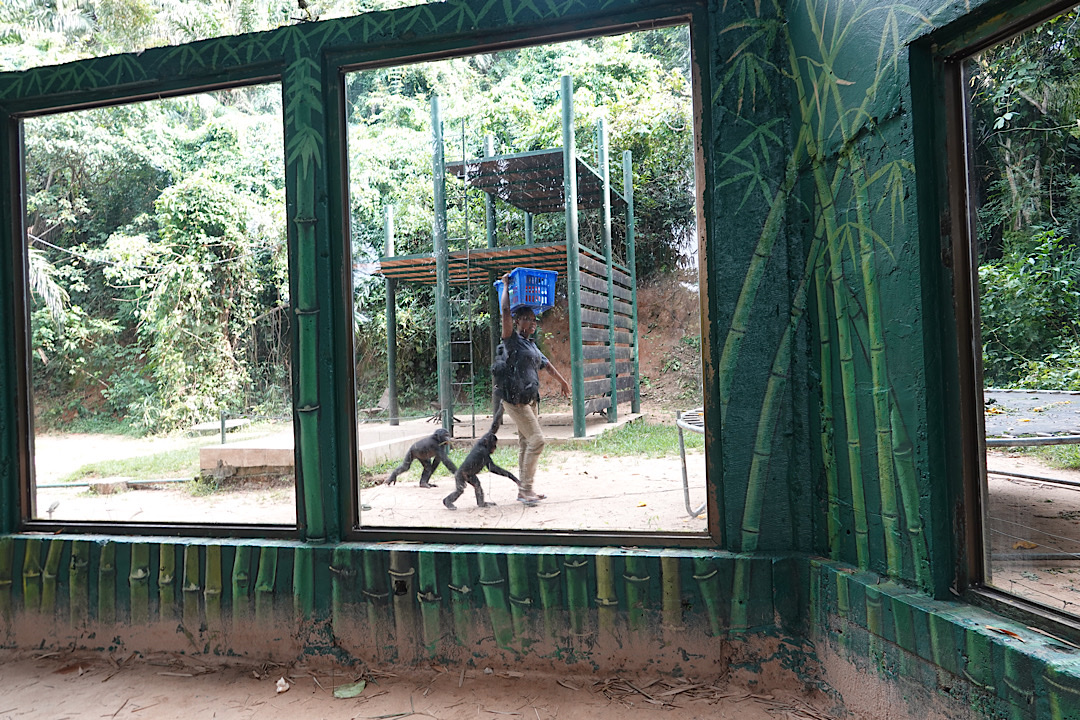
Day visitors to the sanctuary must view the youngsters through this glass. As resident visitors, Steve and I got to go a bit closer. But to lessen the chances of the youngsters catching some germ, only the surrogate mothers get to hold them.

Steve and I visited the nursery several times. We went early one morning to observe the morning ritual: a daily bath.

Fresh from his bath, this little one hangs on effortlessly, as do all the babies to their human or bonobo moms.

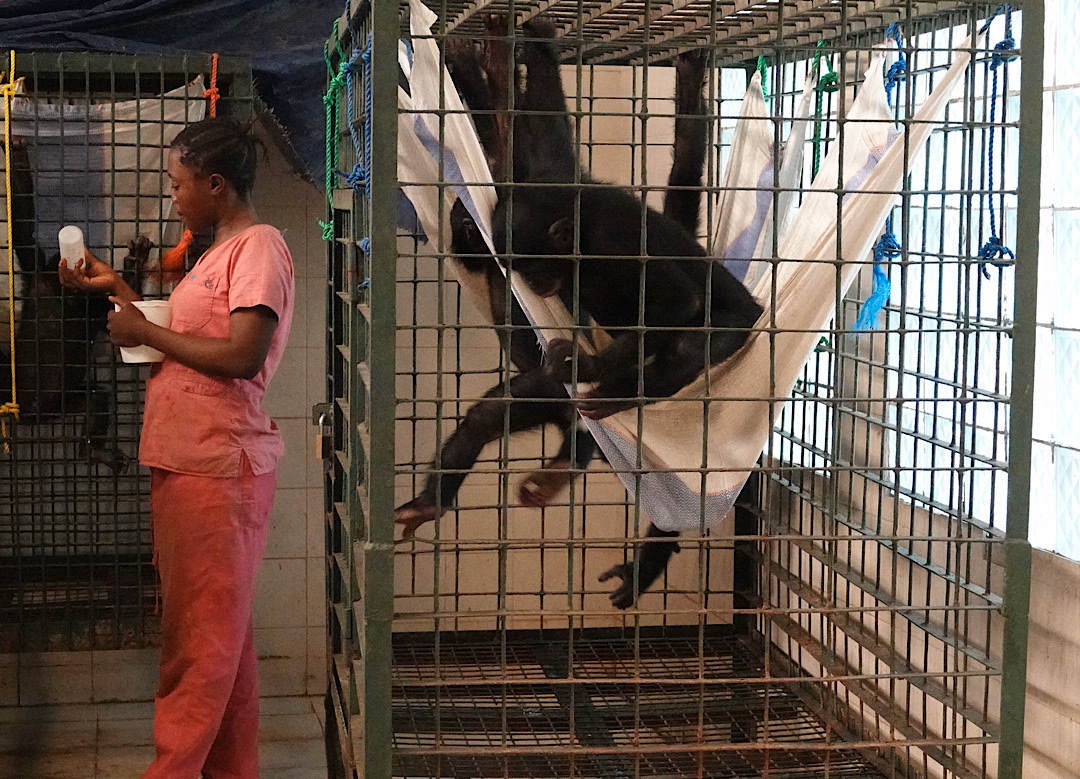
Twice we also returned late in the afternoon to watch the bedtime preparations. (The residents sleep in hammocks in a couple of large cages.)

We heard all their names, but we only memorized one: Balangala, that of a 5-year-old male, the most confident member of the gang. One morning we watched him climb a large bamboo stalk that was growing into the enclosure. His weight bent it over, and he jumped from it onto a trampoline. After a while he lured most of the younger ones up onto it with him. Eventually the stalk broke, and the moms had to call for a staff member to cut and haul it away.
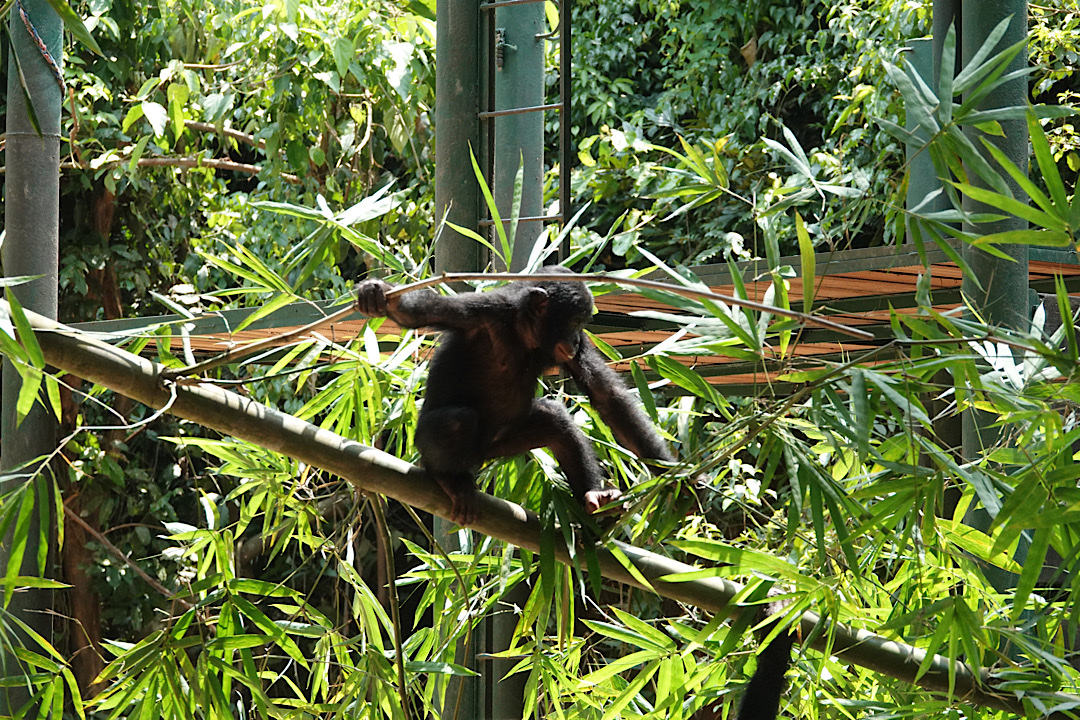
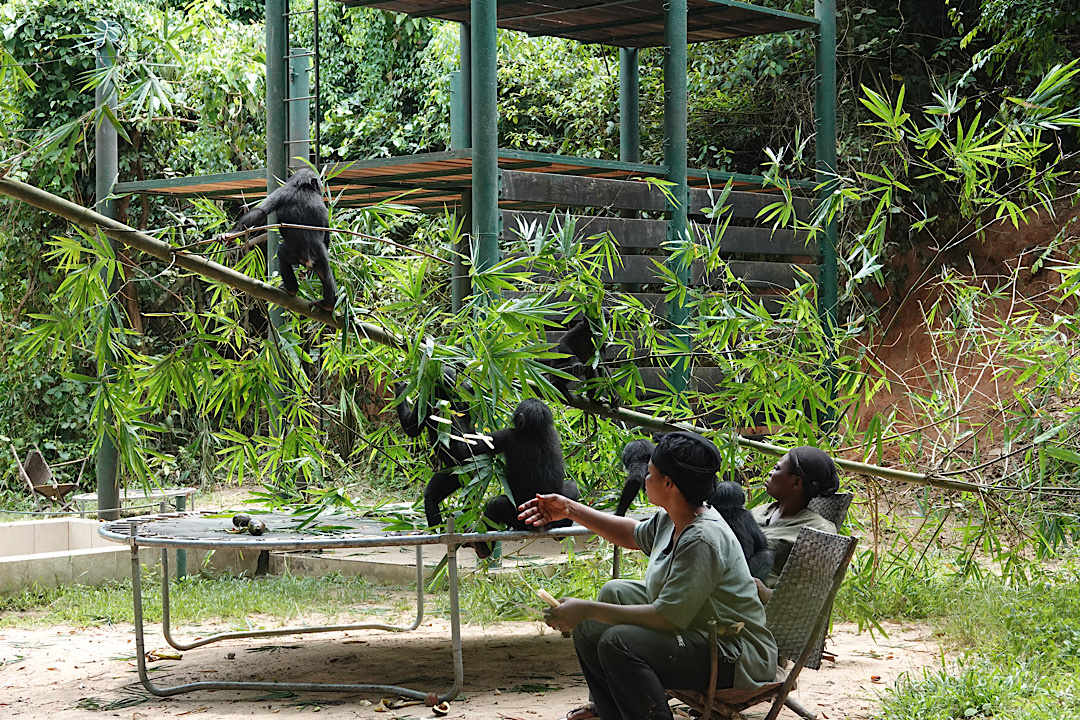
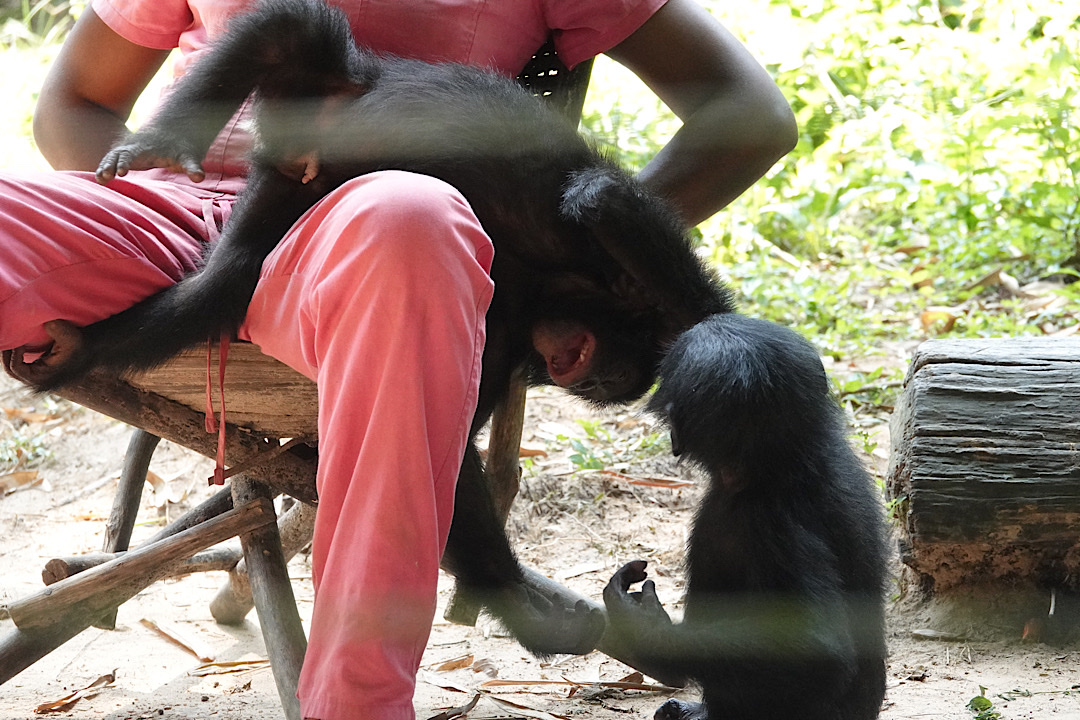
Balangala came right up to the fence where we were observing. He threw dust at us, demanding our attention. He reached through the the bars to grab Steve’s ear. He bullied the little guys.

But when everyone was annoyed with him, he needed a cuddle.

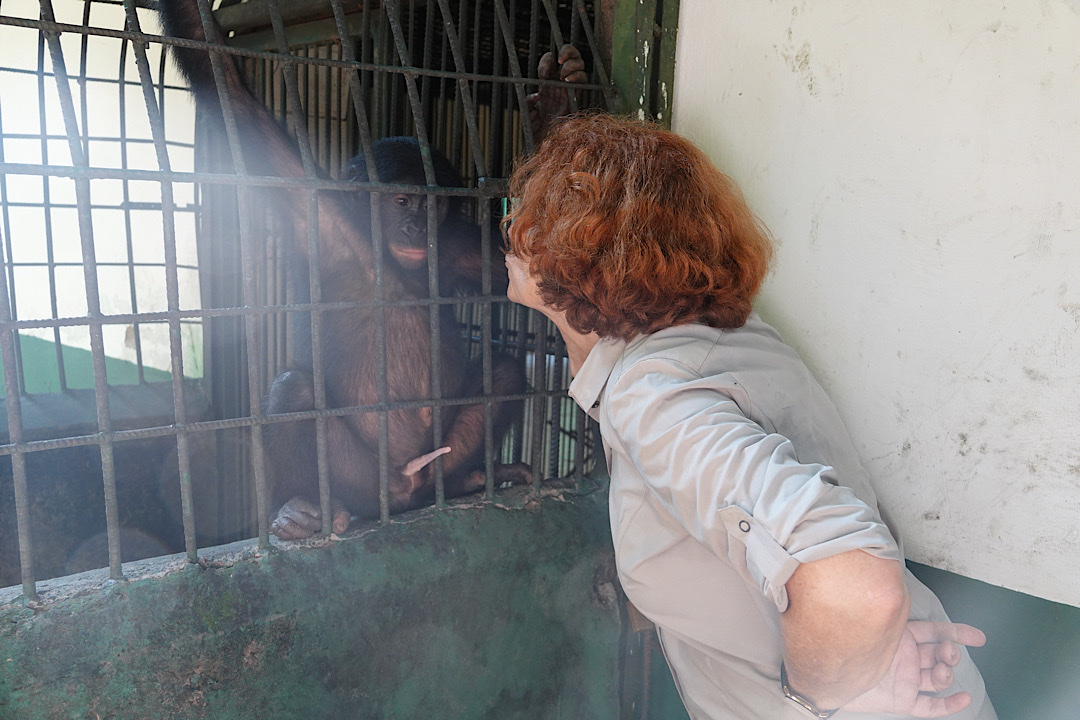
At the end of the day, he swung through the tunnel that leads to the nursery’s night enclosure, then stopped when he reached the place where we were standing. Penis erect, he thrust his hand through the grating: the classic bonobo handshake (the title of Vanessa Woods’ entrancing book).

Balangala was clearly excited to see Claudine.

A gentle smile also signals pleasure.

Staff members say Balangala is probably ready to join one of the troupes outside the nursery. But he’ll do better if he can go with another youngster, and none of the others was quite ready yet. Bonobo societies are complicated. Before we arrived at Lola, Steve and I already knew that. But our time observing the older primates underscored that.

How we found sanitary pads on the way to the Congo

Rabson, talking to us on Lake Bunyonyi

As I explained in my last post, Steve and I made this trek to Africa because of the Ugandan grannies. But after flying here via Qatar (and stopping there for three nights), the granny research consumed only four days. It seemed a shame to come halfway around the world, then turn around and go home after such a short time. Also, another adventure called to us.

Several years ago, Steve and I became aware of the plight of the bonobo (along with chimpanzees, Homo sapiens’ closest relative left on earth). There’s a bonobo sanctuary in the heart of Africa that is doing great work for this crucially important but highly threatened species. After visiting the grandmother project, Steve and I wanted to visit that sanctuary.

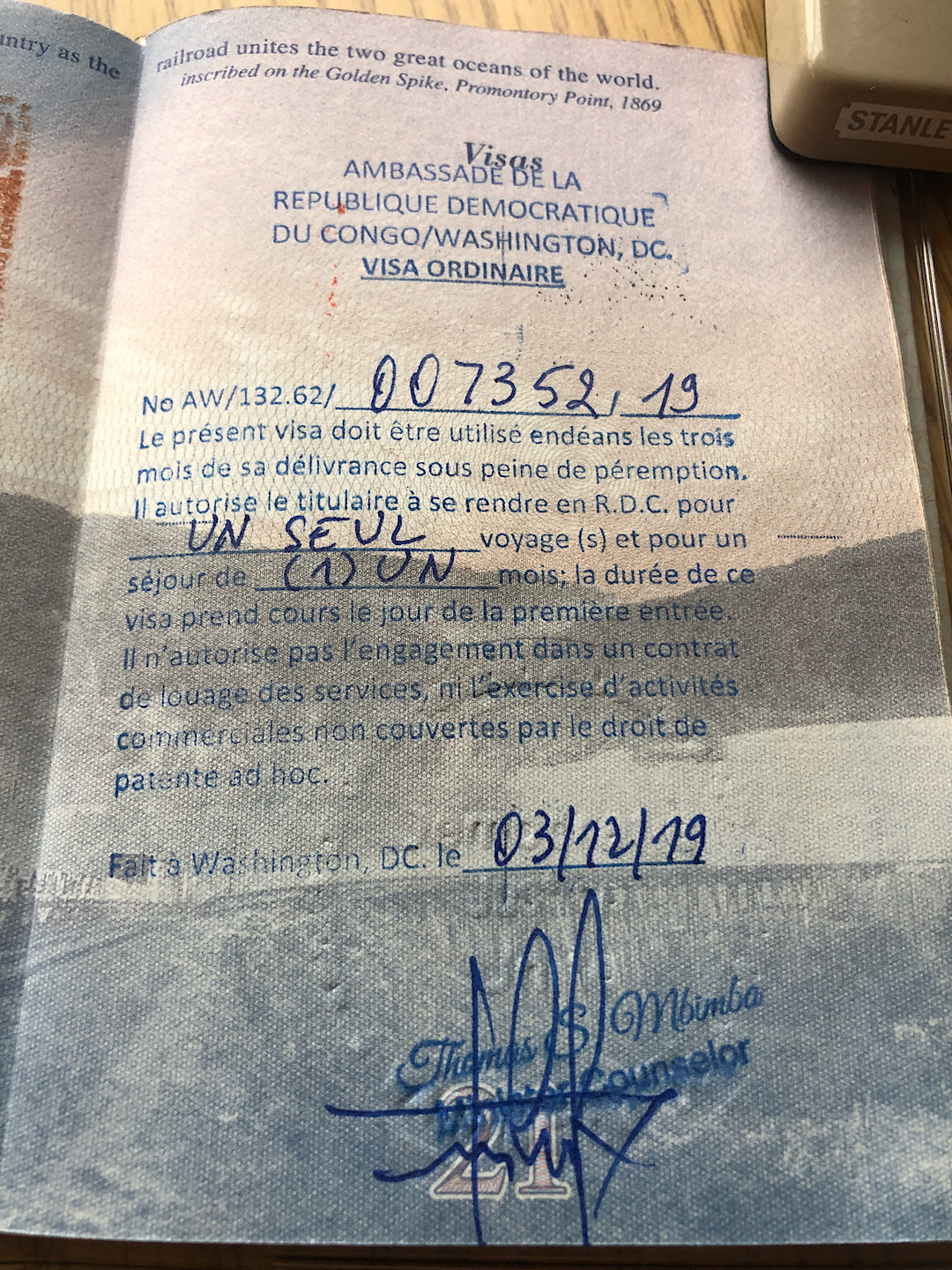
This isn’t easy. Lola Ya Bonobo (literally “Paradise for Bonobos”) is located outside the city of Kinshasa in the Democratic Republic of Congo. The second largest country in Africa, the DRC is also one of the most tragic. It’s ridiculously rich in resources, mineral and physical, yet it’s one of the poorest countries in the world, with one of the bloodiest histories. It does not welcome tourists. As far as I could make out, it has no tourist industry. To go there, someone has to invite you, the invitation has to be approved by multiple ministries in the Congolese capital, and you have to send your passport to the DRC’s embassy in Washington DC to receive the crucial stamp.

Here’s the one in my passport, acquired after Lola Ya Bonobo invited us and all the bureaucratic hoops were jumped through.

Transportation options are limited, but the Rwandan airline does fly to Kinshasa nonstop from the capital of Rwanda, Kigali. The flight is only two and a half hours long, and Rwandair has an excellent reputation. The only problem (for us) was that this flight only operates a couple of times of week. Steve and I couldn’t get to Kigali from Nyaka (the Ugandan village where the granny program is based) on Sunday, and the next nonstop wasn’t until Wednesday (i.e. tomorrow).

Happily what initially looked like an irritating delay turned out to be a pleasure. I learned that we could be driven from Nyaka to Kigali via the site of Uganda’s most beautiful lake, Lake Bunyonyi. We planned to hole up there for two nights, review the work we’d done in Nyaka, and write about it. But yesterday morning, we couldn’t resist spending a few hours in a boat on the lake.

For $20 a person, the hotel where we were staying arranged for a motorboat, a guy to drive it, and a soft-spoken 23-year-old guide named Rabson. Rabson looked very young, but he’s been guiding for about three years, and I quickly found him to be quick-witted, conscientious, and knowledgeable.

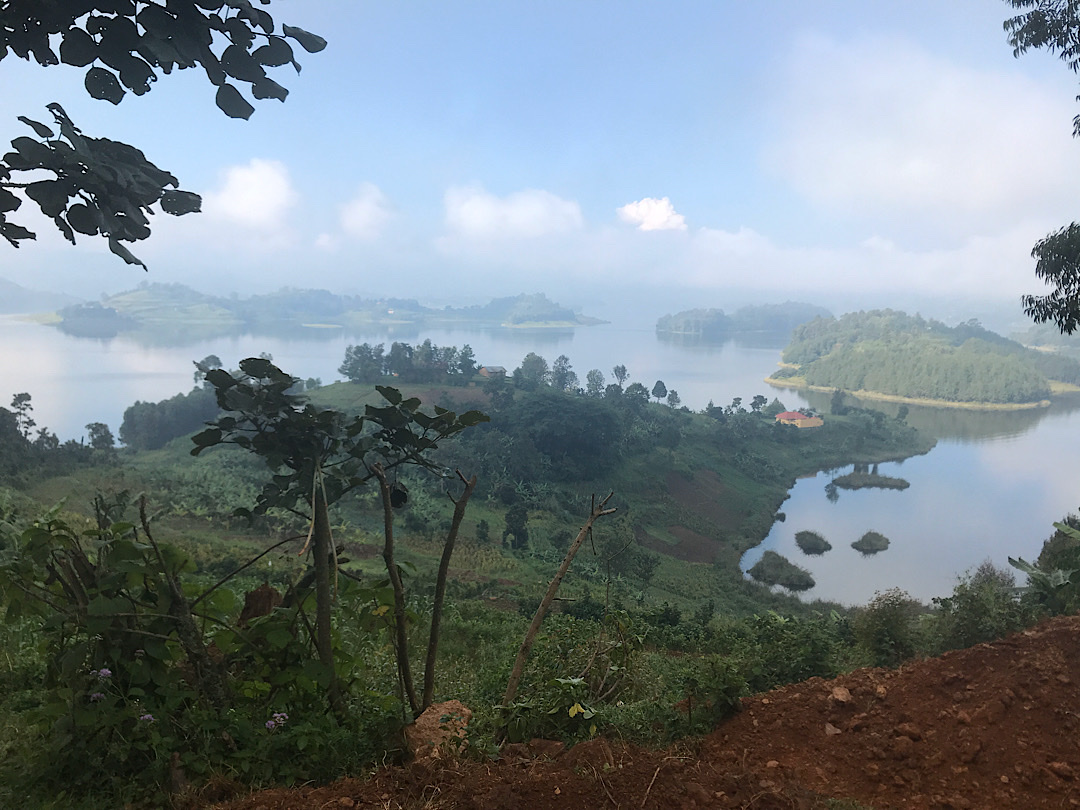
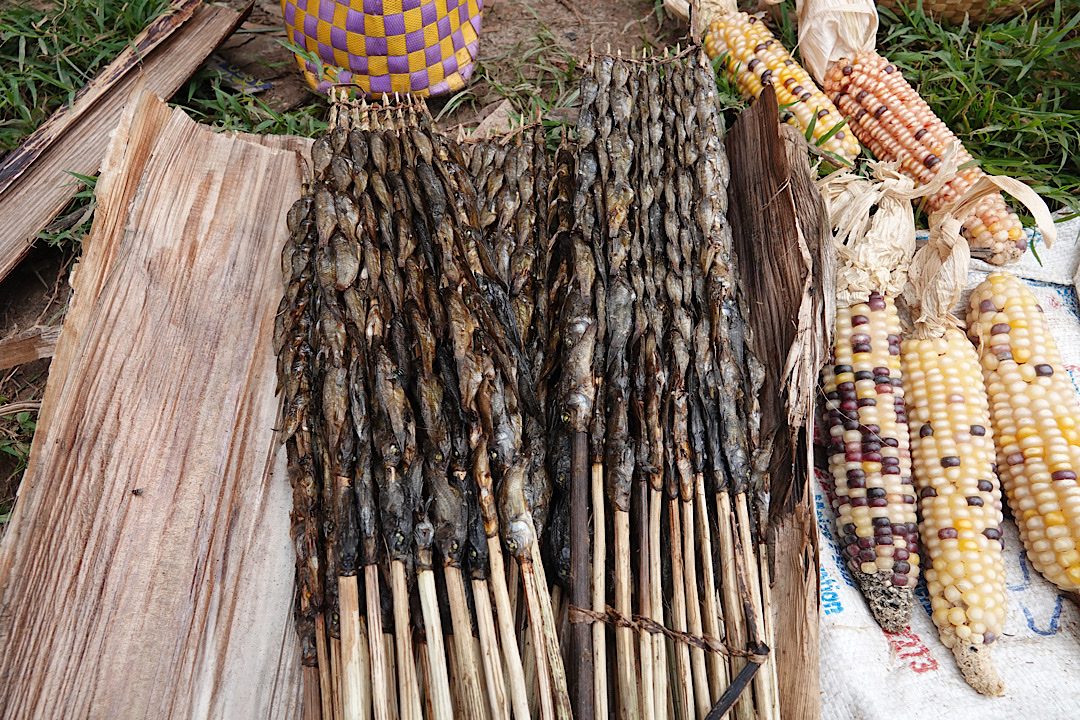
The morning had started off a little drizzly, but as we putted along, the sky cleared. Lake Bunyonyi is the deepest lake in Uganda, and it’s filled with 29 islands, most uninhabited. It has no dangerous animals like crocodiles or hippos, and almost no fish.

Only tiny ones like these, skewered for sale at the local market.

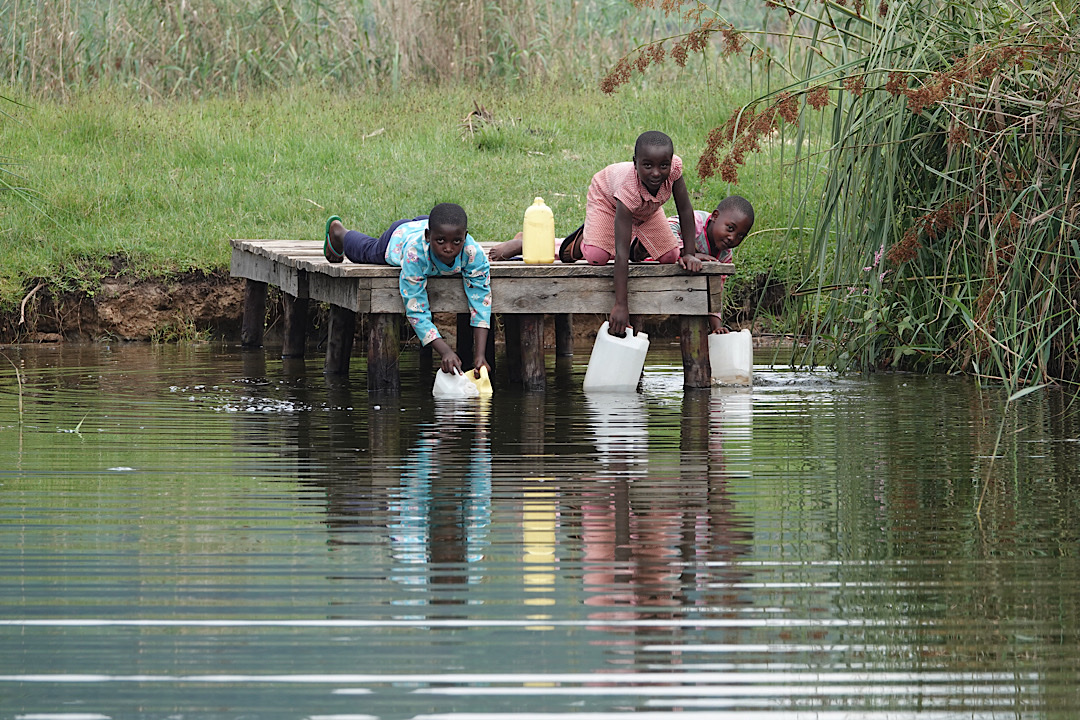
The islands create a landscape that reminded me a bit of the New Zealand fiordlands. But the steep hillsides surrounding the water are an intense tropical green, dotted with banana groves. People swim in the lake, and it provides drinking water to the local villagers.

As in so much of Africa, kids were gathering it here.

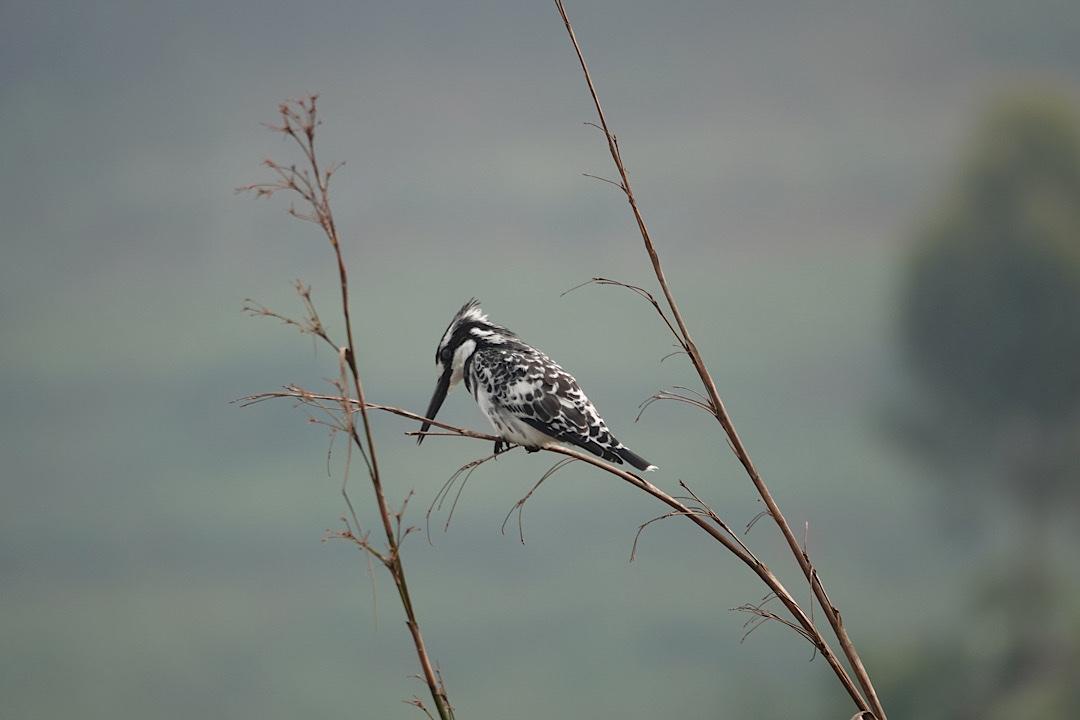
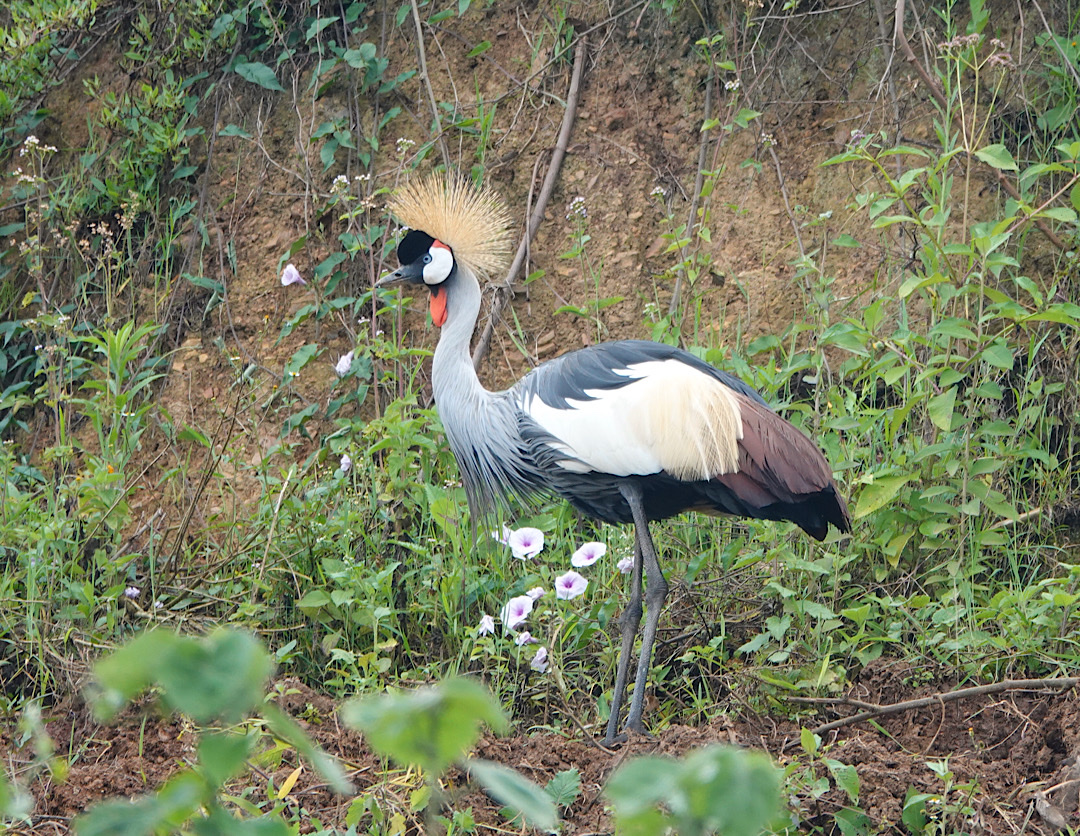
Rabson loves birds, and he pointed out many interesting specimens to us, including these.

A pied kingfisher

Uganda’s national bird, the grey crowned crane

He recounted the history of some of the islands. Then he began talking about something that startled me: namely, how most kids in Uganda reach puberty without knowing anything about menstruation.

When girls suddenly begin to bleed, it shocks and horrifies their classmates. Girls have no access to sanitary pads, so they use torn-up t-shirts or leaves or other crude substitutes for sanitary pads that sometimes trigger infections. But Rabson had met someone who was trying to do something to change that and he wanted to take us to meet her.

Steve and I had seen so many African marketplaces over the past few days, I wasn’t dying to see another, but we held our tongues. We sensed it was important to Rabson to share this.

Our boatman pulled up to a dock on the mainland. We disembarked and walked into the jumble of stalls and food sellers that takes shape there every Monday and Friday. We followed Rabson up the dirt path to a compact wooden shack, where a friendly face beamed at us from a window, welcoming us. Rabson pointed out the poster on the front of the building, explaining the project, then his friend Harriet Rwosa stepped out and invited us inside.
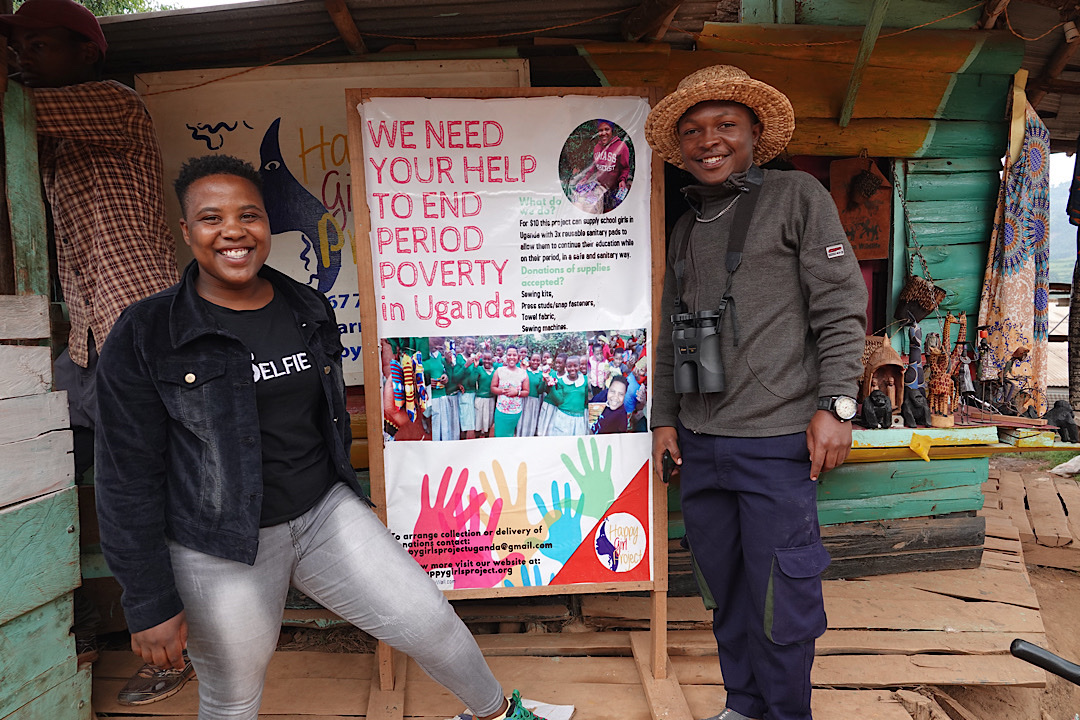
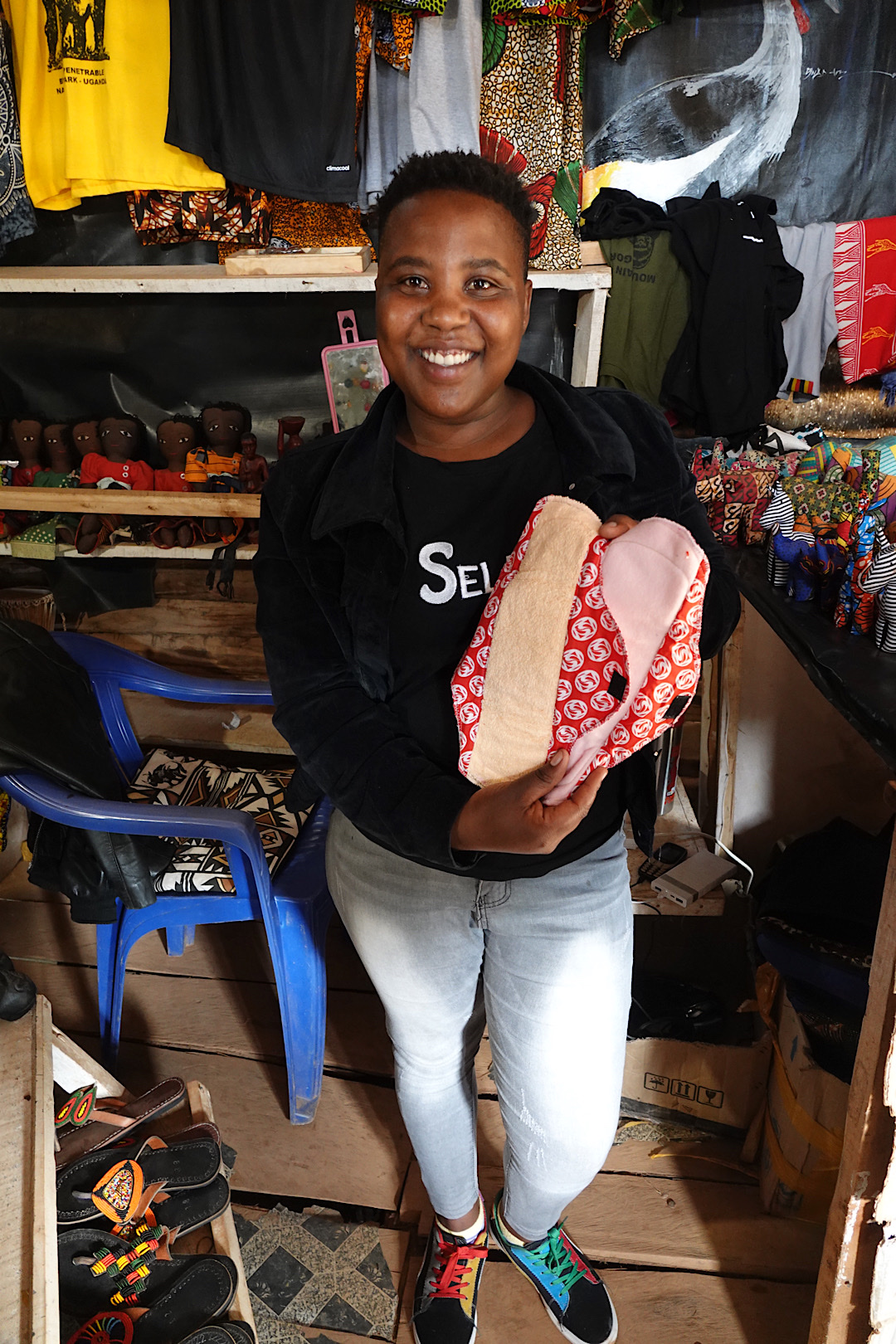
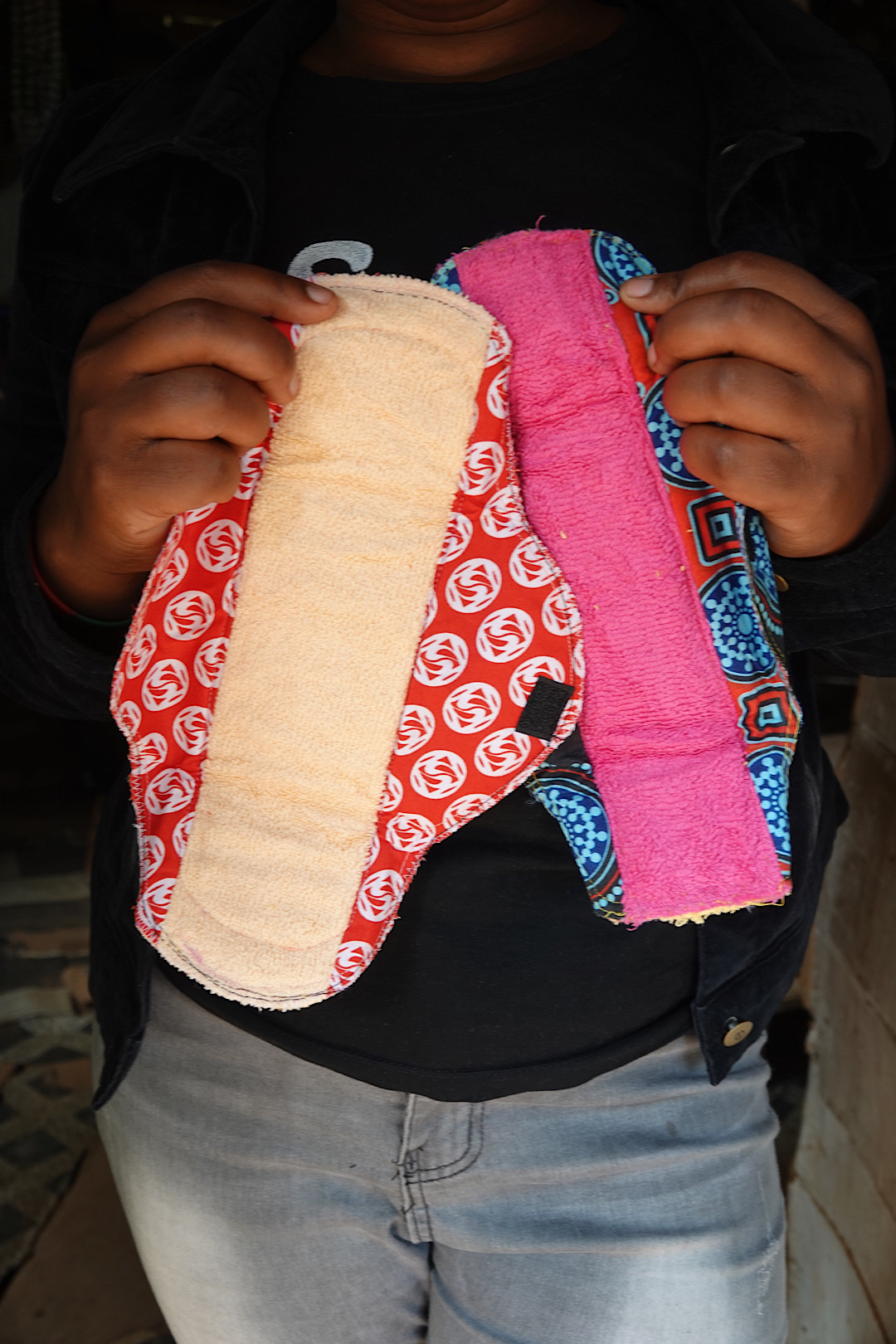
If someone told me Harriet was educated in England, I would have believed them; her English is excellent, an ebullient flood of words. But she’s lived all her life in this village. We learned that she’s 27 and married. But she only went through the local high school. Although she yearned to continue on at a university, her parents lacked the money to send her. Like most girls, in her school years Harriet had experienced menstruation as a curse. Every month it kept her out of class, causing her to to fall behind her male peers, a new experience for her. Time had passed, and somehow she’d gotten the idea to design and market cheap, reusable sanitary pads that would enable girls to continue their education, even while menstruating. About a year and a half ago, she’d made her first pads on a little foot-powered Singer sewing machine, and she had marshaled the funds to create a little craft shop to support the purchase of materials to make more pads. Some were lined with a soft toweling. For others Harriet uses a local fabric that resembles flannel. It costs more, she told us, but it’s also more absorbent.

For $10, you can buy 3 pads for a girl. I gave her $20.

As inspiring as Harriet was, I felt equally moved by Rabson, who believes in what Harriet is doing and is trying to help any way he can. As we walked back to the motorboat, he told us he had been bird-watching on one of the bigger islands when he happened to meet Harriet, there to pass out pads at the island high school. She told him about the project, and Rabson immediately understood its importance. One day when he was in the fifth grade of primary school, he had shared a bench with a 13-year-old girl. When she stood up at the end of class, blood stained her clothing and the bench. Today Rabson mimes the reaction of the other kids; their shock at the sight of this frightening blood. They jeered, hooted, cruelly mocked their classmate. She was so mortified and humiliated, she never came back to school. Rabson says not long after this incident, she was married and had a child, but her husband later left her. Her life was ruined for lack of a sanitary pad, something that Rabson still clearly finds appalling today.

He disapproves of giving out free condoms, without also handing out pads to girls. Having sex is something you choose, he declared. But you don’t have a choice about menstruating.

This is true. Hearing Ugandan 20-somethings testify to it, seeing some moved to action by it, inspired me and touched my heart. It made me wish I could return to make a documentary about passionate, energetic Harriet and the lives she’s already changing.

I almost certainly won’t have a chance to do that; it’s not my talent. But I’m grateful to be able to write about her here. I’m thrilled to be spending the night in a really nice hotel in central Kigali, overlooking the Hotel Mille Collines (the inspiration for the cinematic Hotel Rwanda.) I’m happy to have a good fast internet connection to publish this post. In just a few hours, we’ll take that flight to the Congo, where it’s unlikely we’ll have much in the way of WiFi or phone service. But I plan to write every day about our experience in the bonobo sanctuary, and I’ll post the results as soon as possible.

Ugandan grannies: better than any tourist attraction?

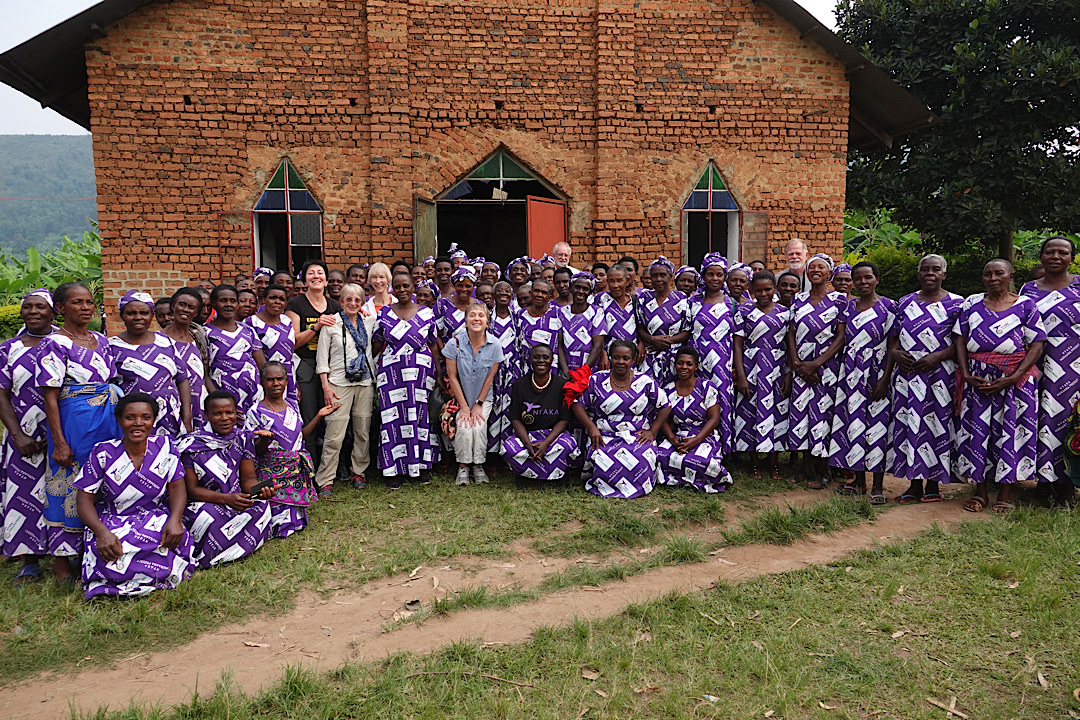
Can you spot the San Diegans amongst the valiant Ugandan grannies?

The world is a big place, and Steve and I hunger to see as much of it as possible before we die. That’s why we rarely go back after an initial visit to most countries outside North America. The list of places we’ve traveled to repeatedly has been short: France, Italy, Japan. I’m thinking, however, that I need to add Uganda.

Before our first trip here, in 2013, I would have bet it would be our only one. That was our first (and I would have predicted only ever) visit to East Africa. In the course of it we also swept through Rwanda, Tanzania, and Kenya. But just a few months before we went, something extra got tacked on.

We have a close friend, Leigh Fenly, who in 2006 co-founded a San Diego organization called Women’s Empowerment (WE) International. Its goal is to improve the lives of some of the poorest women in the world. In the spring of 2013, WE had been approached by a group with a project in southwestern Uganda that was providing tiny but invaluable loans to older women who were raising grandchildren orphaned by AIDS. Amazingly, Steve’s and my itinerary would be taking us not far from Nyaka (the central village), and we managed to adjust it to allow for a one-day visit. We came away so moved and impressed that WE began a partnership early in 2014 with the Nyaka AIDS Orphans Foundation’s granny-group project.

Steve and I also agreed to be the liaisons between the San Diego folks and the Ugandans, a job we’ve continued to fill ever since. In that role, we returned to Nyaka accompanied by another WE member in 2017, and our current travels (this time with 6 WE leaders in tow) were driven by the desire to go back for another on-the-ground assessment of how the Ugandan “micro finance” project has been playing out.

We’ve been dazzled. In our two days in the field, the 8 of us interviewed more than a dozen individual grandmothers, learning about what they’ve done with the loans they’ve received from their groups. We also met with two large granny groups located near the Bwindi Impenetrable Forest (home to some of the last mountain gorillas in the world).

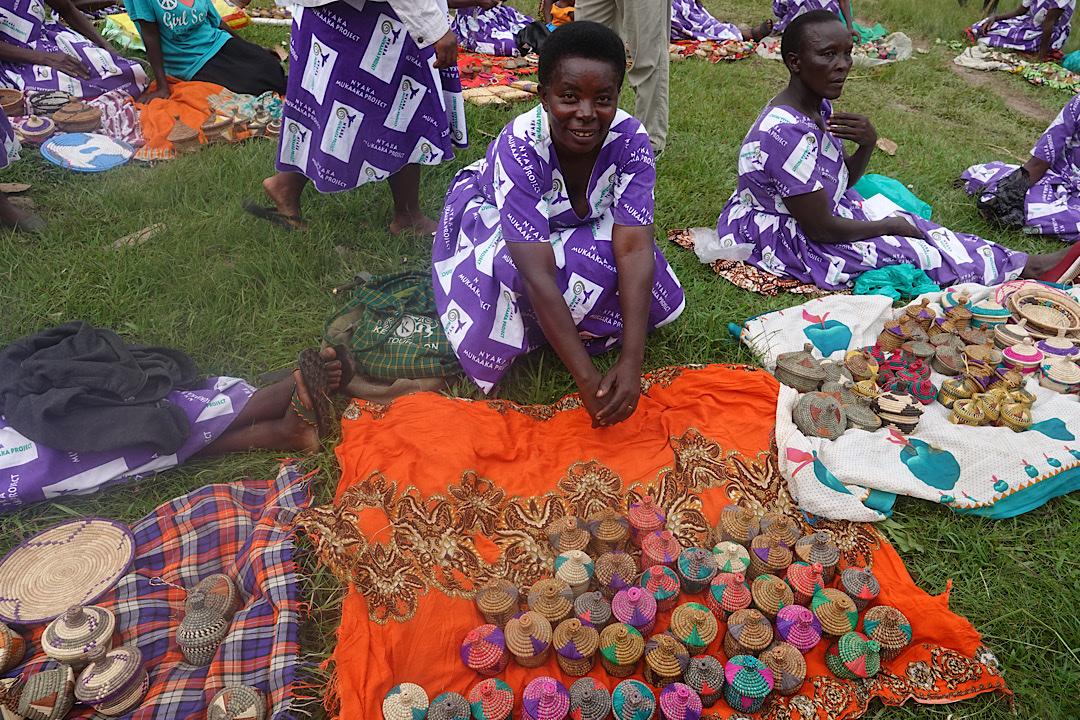
One of the groups we visited has developed a robust business making handicrafts and selling them to the foreigners who come for the gorilla tracking.

Progress that was already starting to be evident three years ago has continued and seems to be accelerating.

For example, the first one-year loan ever granted (back around 2007) to one of the two groups we visited Saturday was for 200,000 Ugandan shillings — about $75. The group then made tiny loans — the equivalent of $5 to $10 — to individual members. Each woman would have the money for three months, then she would have to pay it back, along with about 15% interest. With so little money, a granny might only be able to buy a chicken or two. But she could hatch some of the eggs, sell others, and come away with a bit of extra cash — money that more often than not she would use to pay her grandkids’ school fees.

Over the last six years, as WE has donated money raised in San Diego, the Nyakans’ central revolving fund has grown from just $7,000 to almost $250,000 (including profits from the interest on the group loans and about $175,000 from WE). That’s meant granny groups have been able to receive bigger and bigger annual loans. The group that began with a $75 loan now has a loan of more than $4000.

Virtually all the grannies grow crops that their families eat, as shown here by the hands.

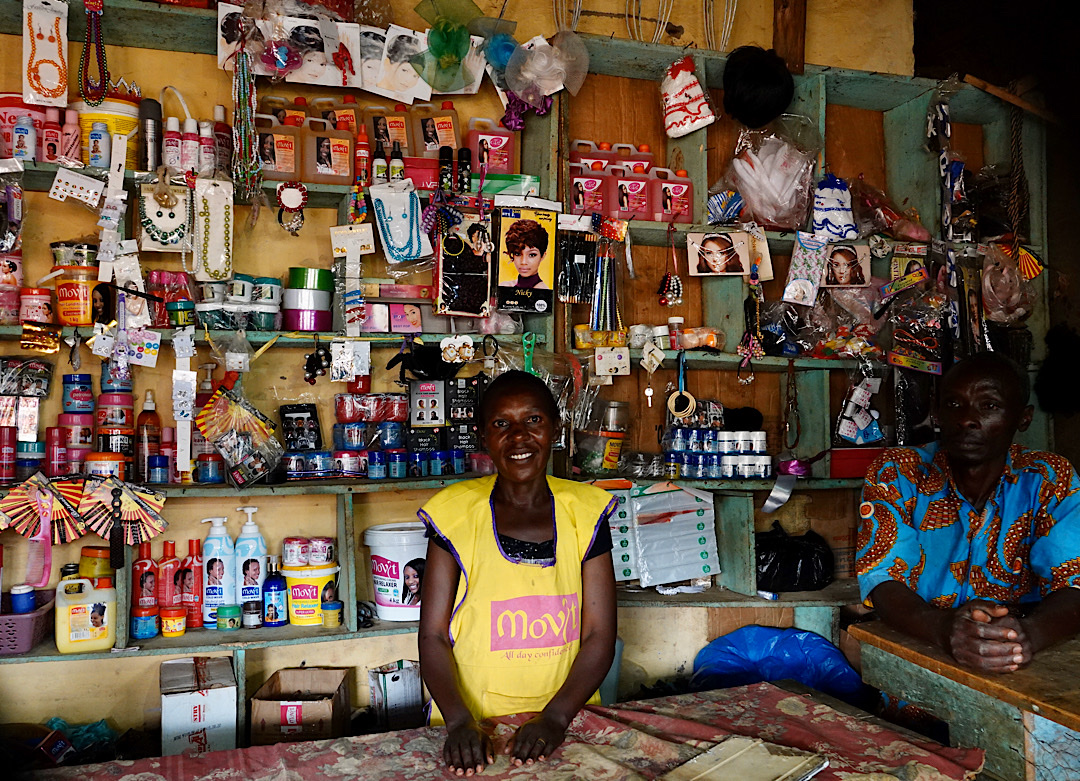
Grannies with bigger ideas have been able to get bigger and bigger loans to help them realize their dreams. Take Meleth, for example. She’s 52, currently raising 6 grandchildren (one disabled).

Meleth at the counter in her salon/beauty product store

She joined her granny group just a few years ago and has since become its treasurer. She’s gotten two substantial loans, first one for the equivalent of about $82, then another for almost $200. She’s used that money to build up a beauty salon that would be respectable even by Kampala standards. She’s installed a hair dryer and a wash basin; has diversified into providing decorations for weddings and other celebrations, as well as catering. She told us she currently serves 25-30 clients during her typical six-day week. (A Seventh-Day Adventist, she closes Saturdays.)

Because of her loan money, 54-year-old Robinah started a restaurant that she estimates feeds 40-50 customers a day. Business is good, but she thinks it would be even better if she could buy a refrigerator and sell cold drinks. (That would cost between 1 and 1.5 million shillings, about $275-$400.)

Robinah

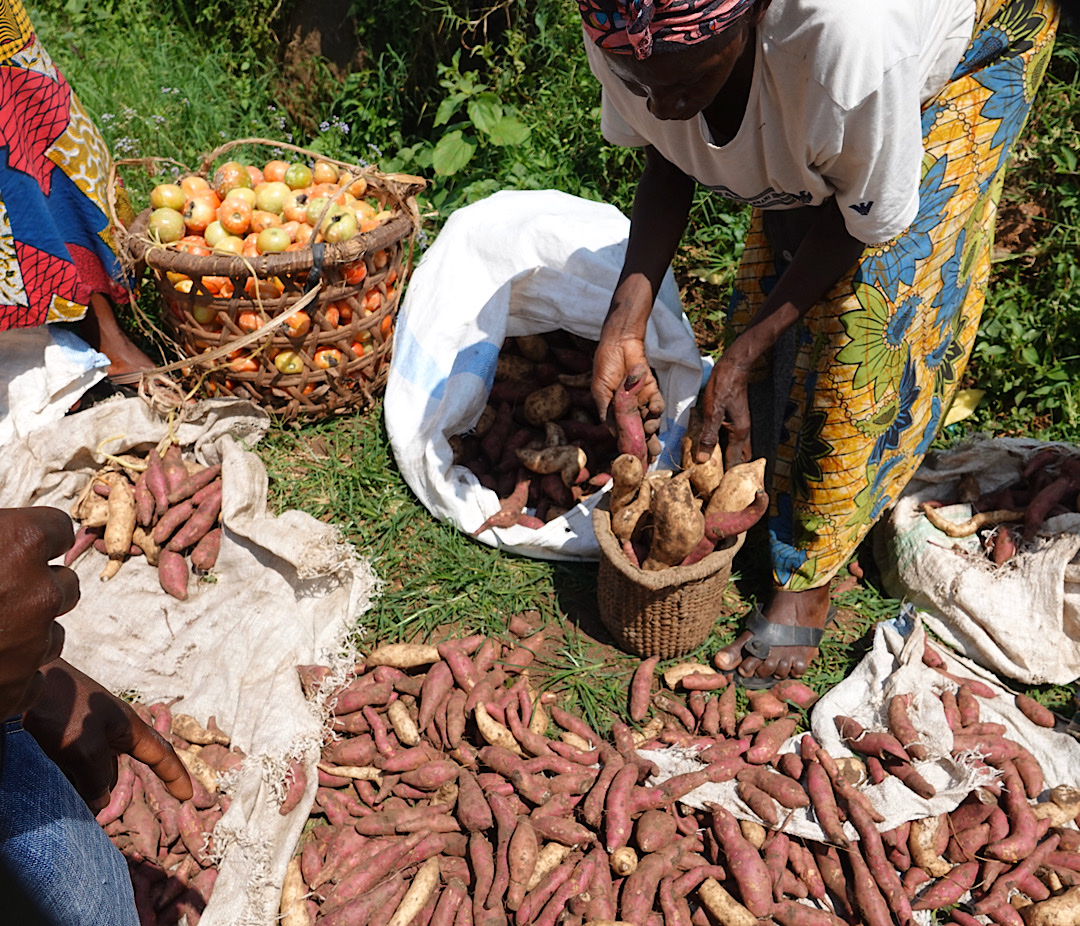
Many grannies still do simpler things: acquire goats or chickens or pigs; hire help to grow more cash crops like coffee. We met 65-year-old Ketty Turiyatunga at the Friday market in the little village of Nyamirama. She was filling baskets with sweet potatoes that she hoped to sell for about a dollar. Her loan was for less than $14, but she seemed happy to have it.

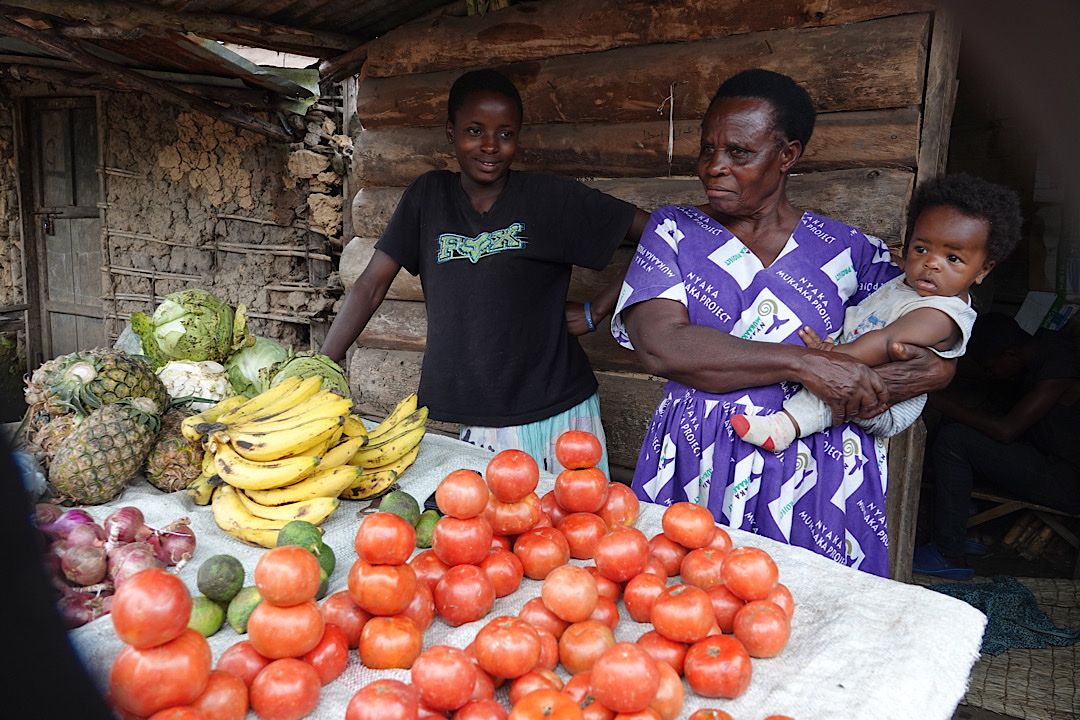
Margaret Tumuhimbise, 67, has a small loan too, but she uses it to buy products like tomatoes to supplement the pineapples, sweet bananas, and maize she grows and sells at a stand in the local market.

Margaret currently cares for 4 grandchildren and a great-grandchild, whom she’s holding in this photo.

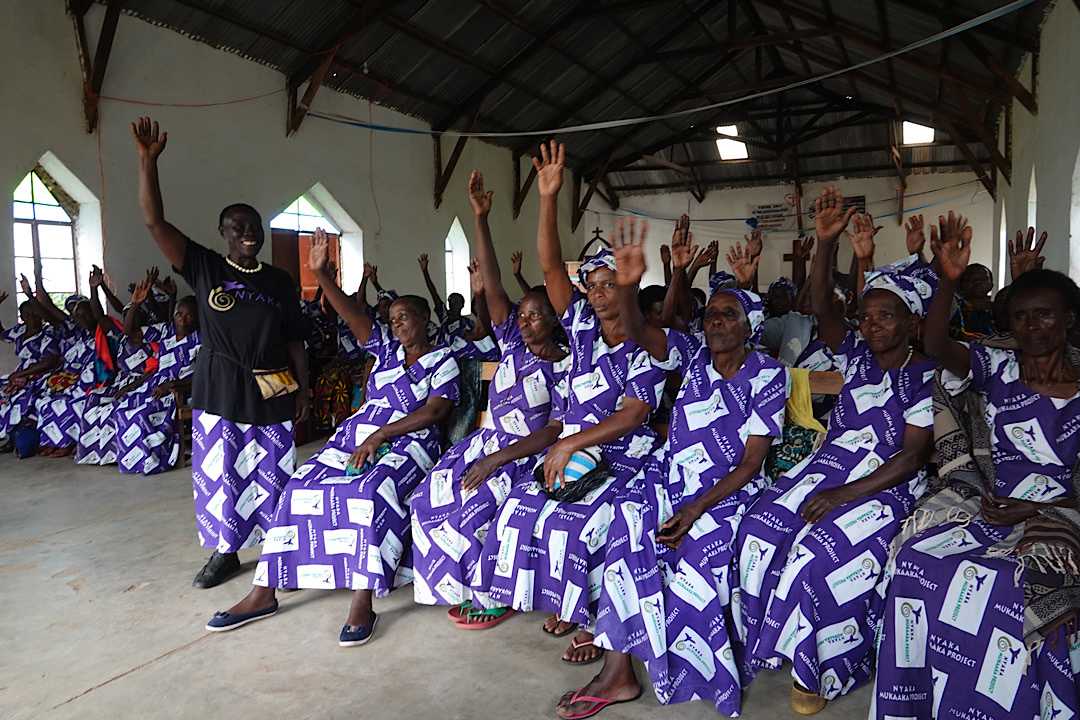
Note the uniform Margaret is wearing. On our first visit, no grandmothers had uniforms, but by 2017, one large group had had some made. Since then more and more groups, maybe 60% of the 10,000 grandmothers who are currently Nyaka granny-group members, have used their profits to buy the distinctive outfits. They wear them with pride. Folks respect and admire and even envy them now, whereas just a few years ago, they were despised for being dirty and poor and old and bad-smelling. Now they all have soap and toothbrushes. Now they have hope they won’t ever have to beg again.

The Nyaka group’s leaders are talking about getting another 10,000 grandmothers organized into groups that will receive loan money. They envision doing this within just a few years. Some dream of expanding still further, going country-wide.

I have to confess that Steve and I were skeptical seven years ago. Billions have gone into aid for Africa over the course of our lives, and much of that money has been squandered. But, started by a Ugandan, run by Ugandans, decentralized and shaped by leadership at the village level, this program looks like success to us. Even if Uganda didn’t have any great natural beauty and touristic pleasures, I might be tempted to return some day to see if the human thrills continue.

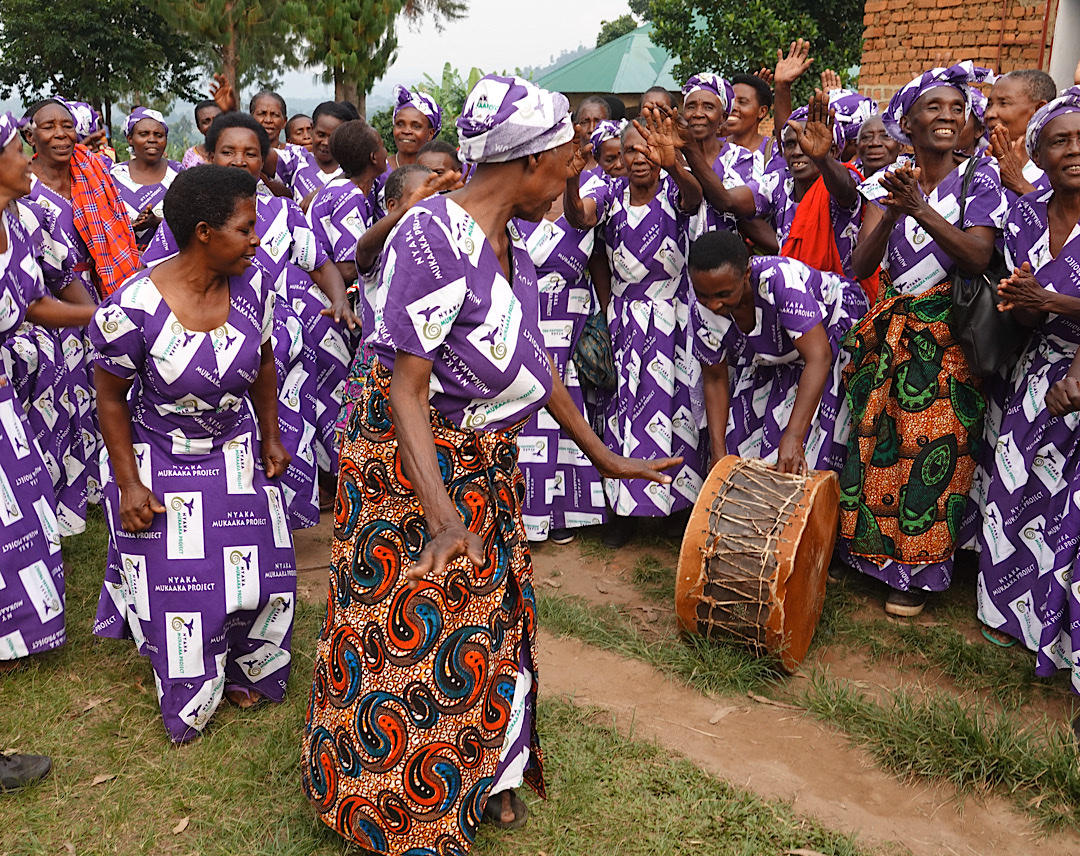
As in the past, the granny group members greeted us with joyous dancing. This is an electrifying experience.

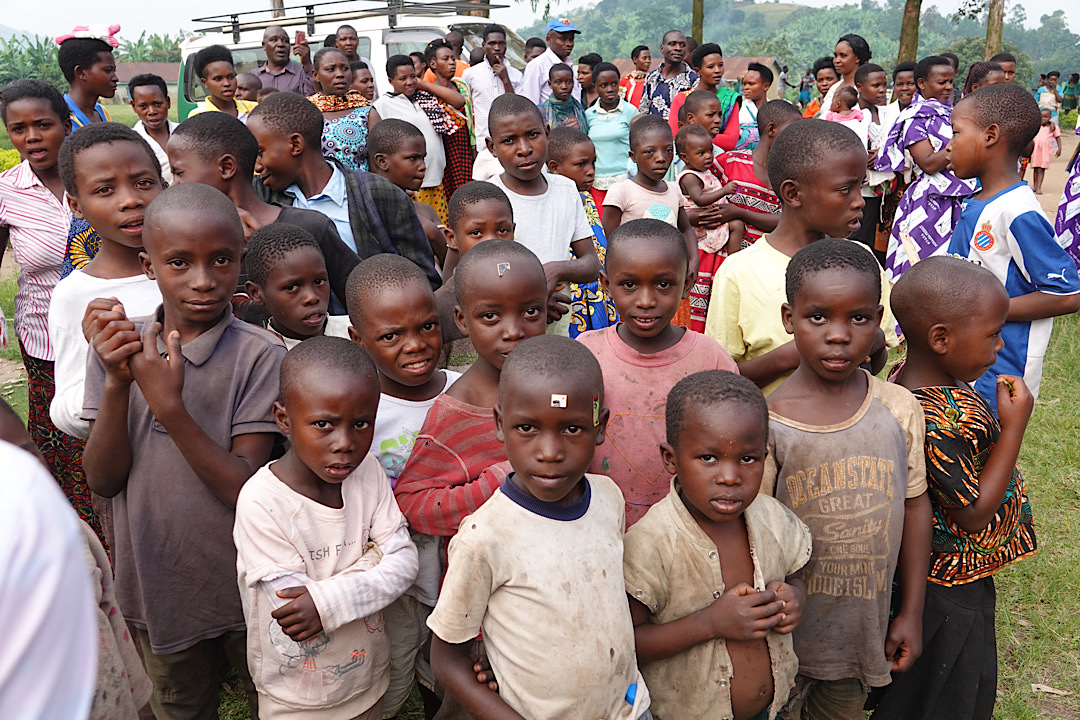
The village kids look on, curious and somewhat amazed.

On the road in Uganda

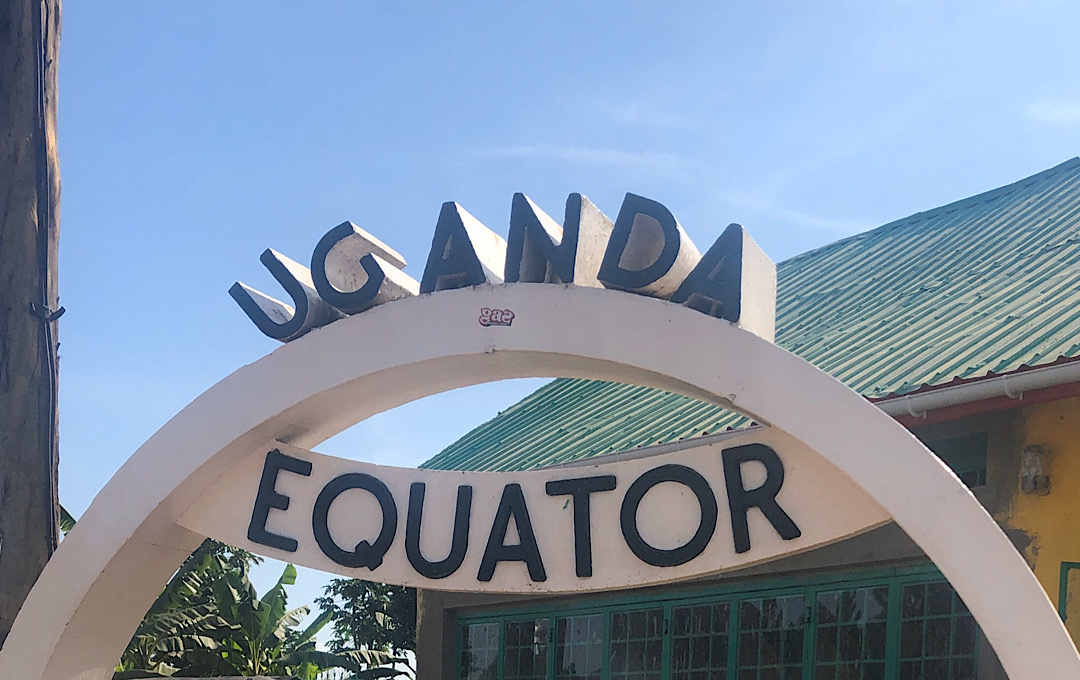
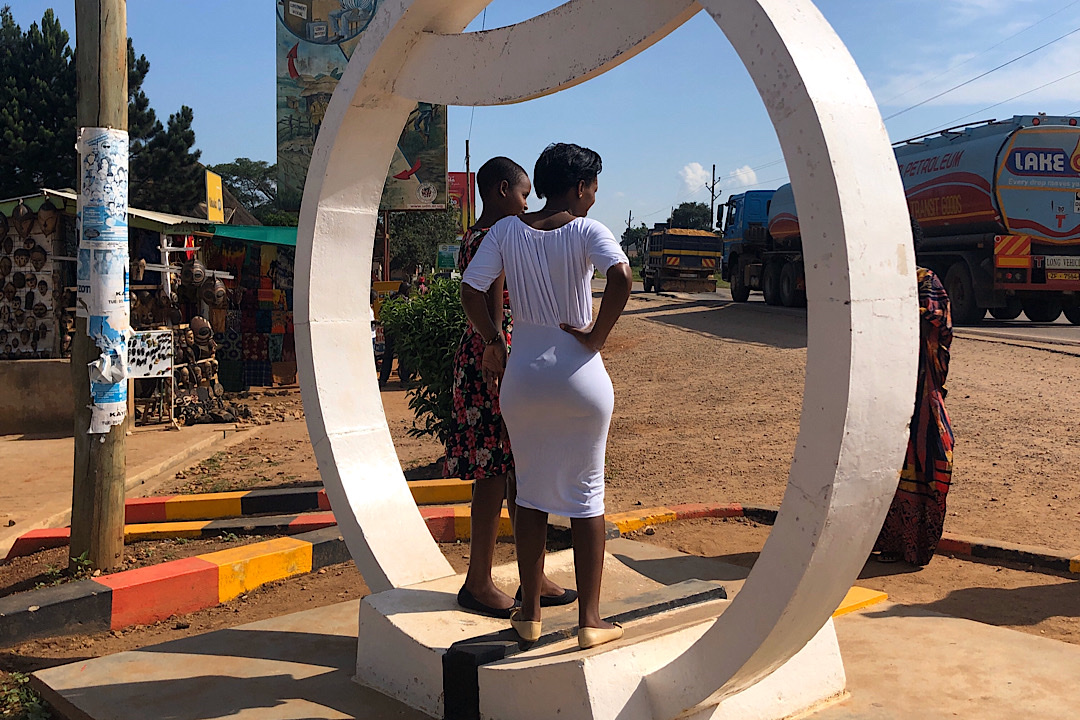
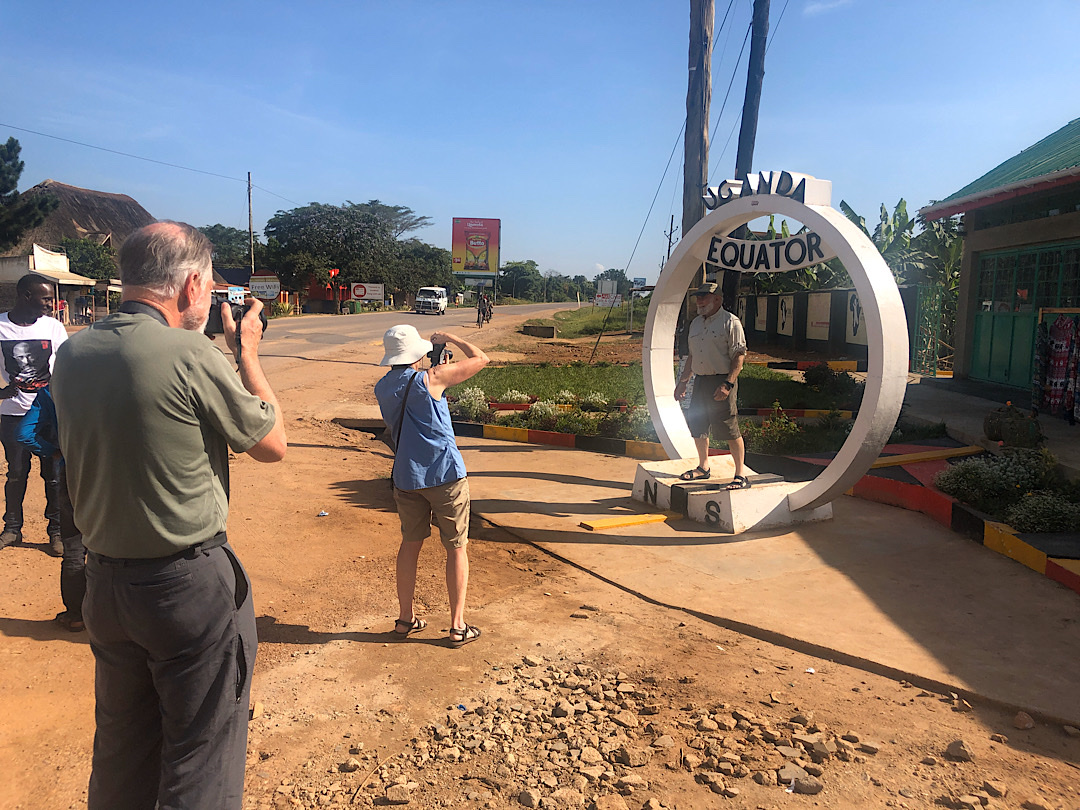
When you drive west from Kampala along the Masaka Road, heading in the general direction of Rwanda and the Congo, about two hours outside the Ugandan capital you cross the equator. I’ve done this twice, and both times it’s been a jolly experience.The Ugandans have erected circular structures on both sides of the highway, to mark the invisible line that divides the northern hemisphere from the southern one. Both Africans and visitors from other continents get a kick out of standing with one foot on each side of the line. Folks queue up to get their pictures taken.You can buy coffee or a snack or a host of souvenirs.
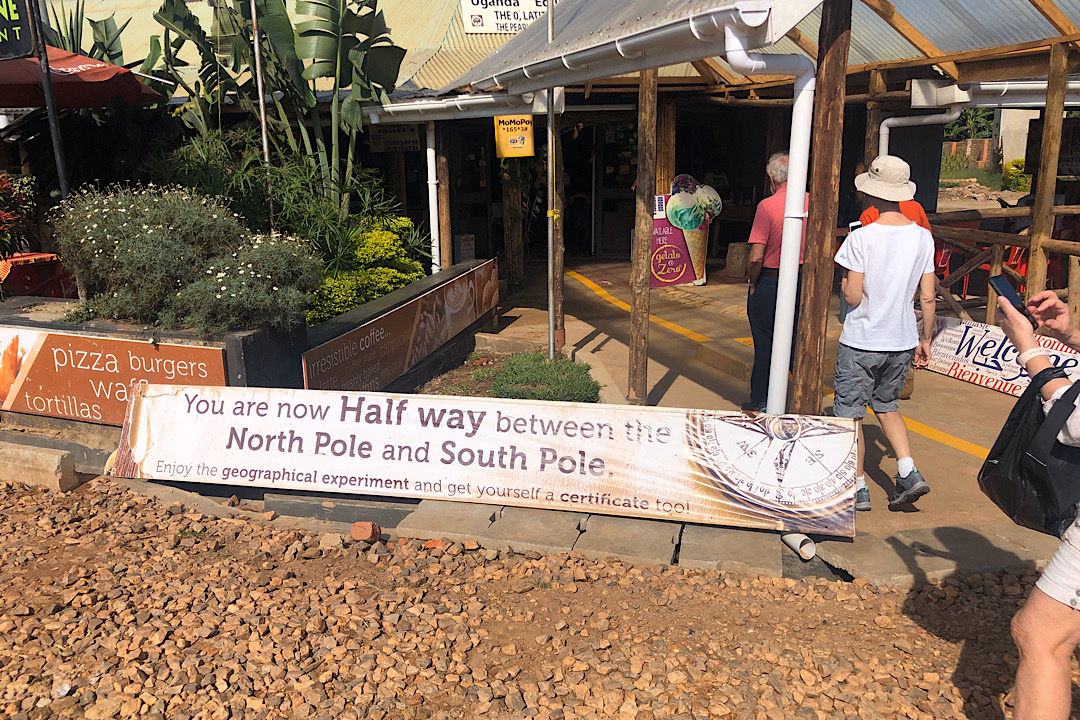
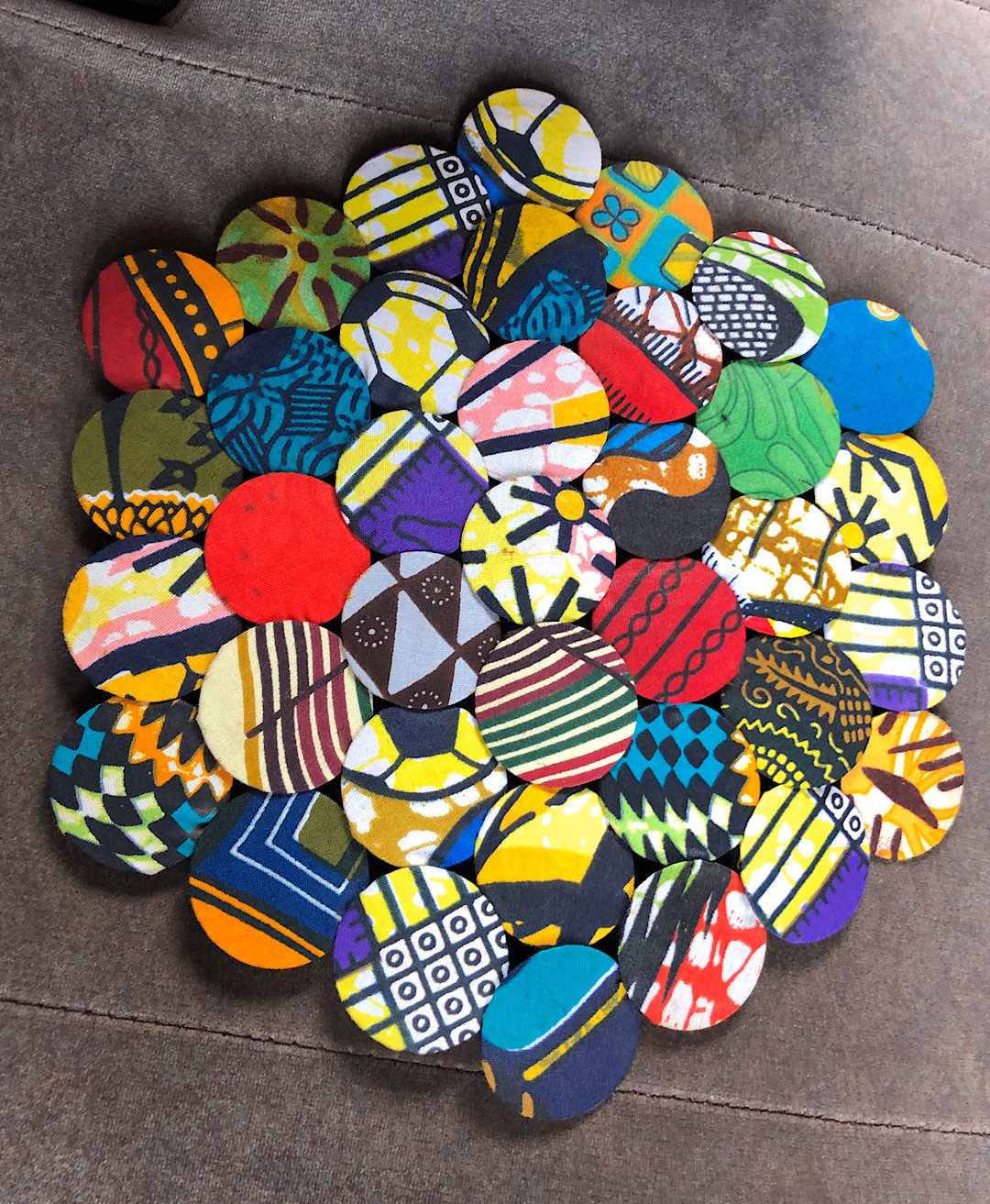
For less than $5, I got this table mat, made from bottle caps that have been flattened, covered with cloth, and stitched together.

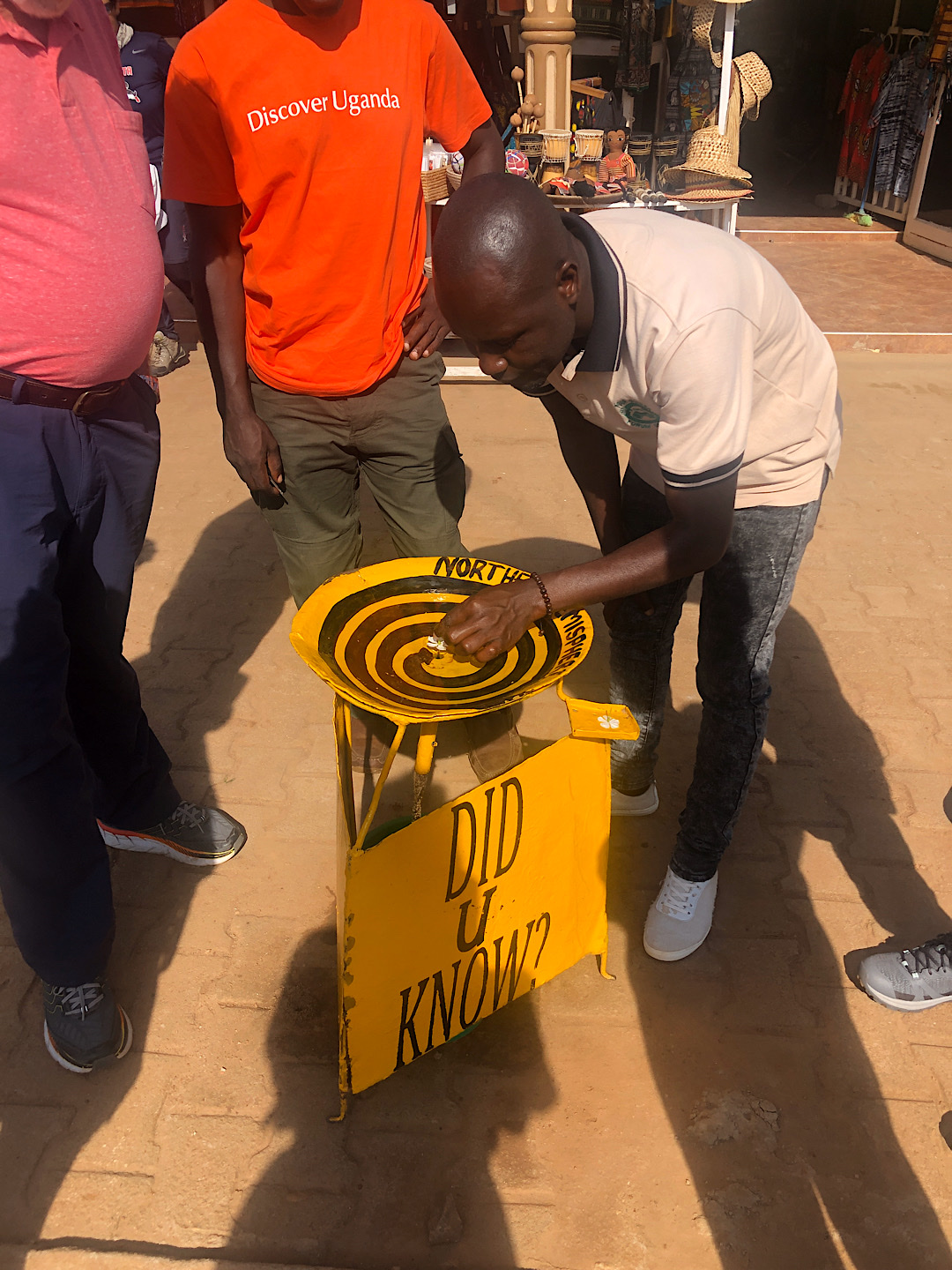
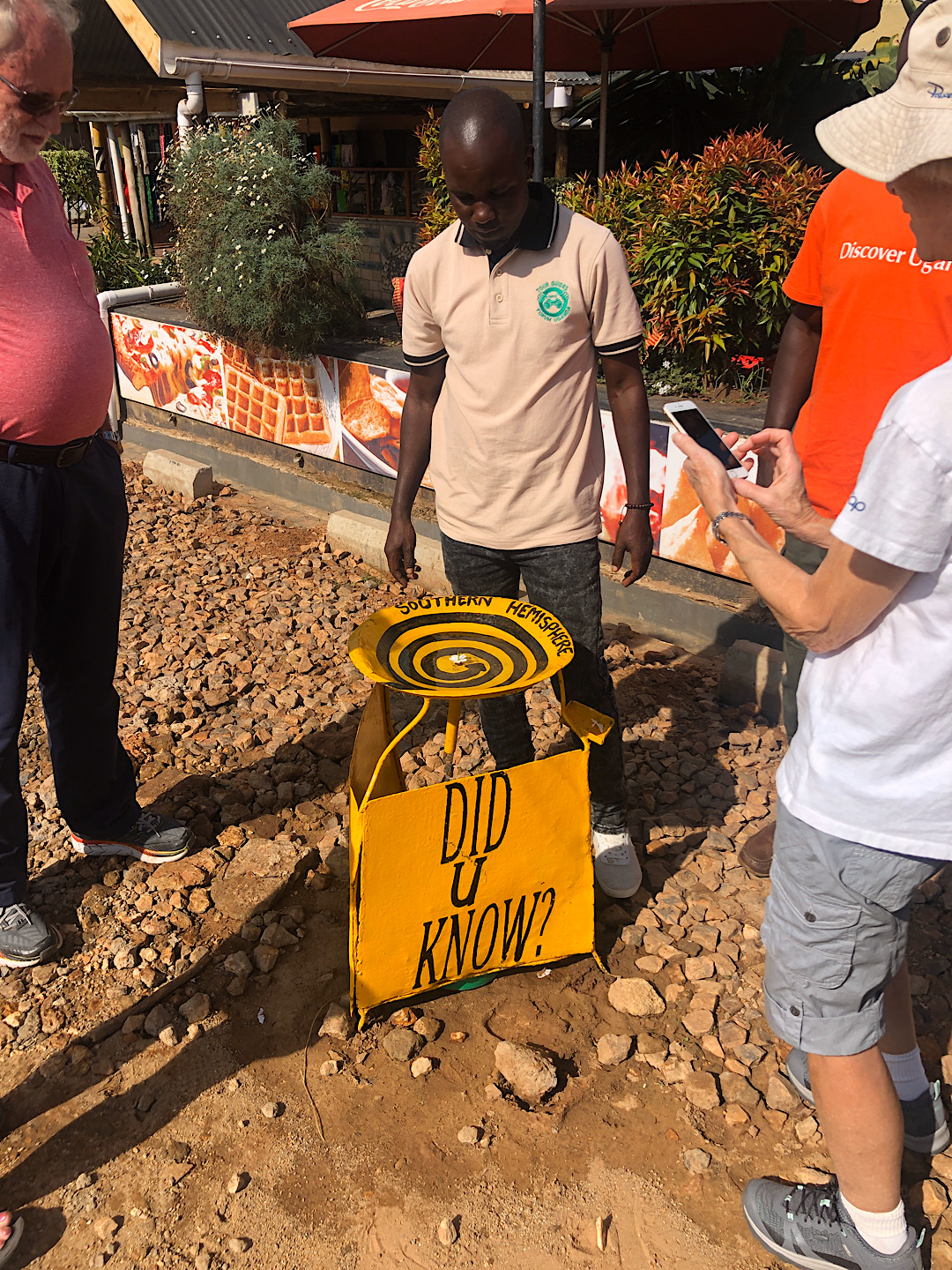
For a small fee, you can get a demonstration of the alleged Coriolus effect.

It involves pouring water down a drain and watching it swirl down in different directions on each side of the line. But Steve whispered to me that this was hokum.

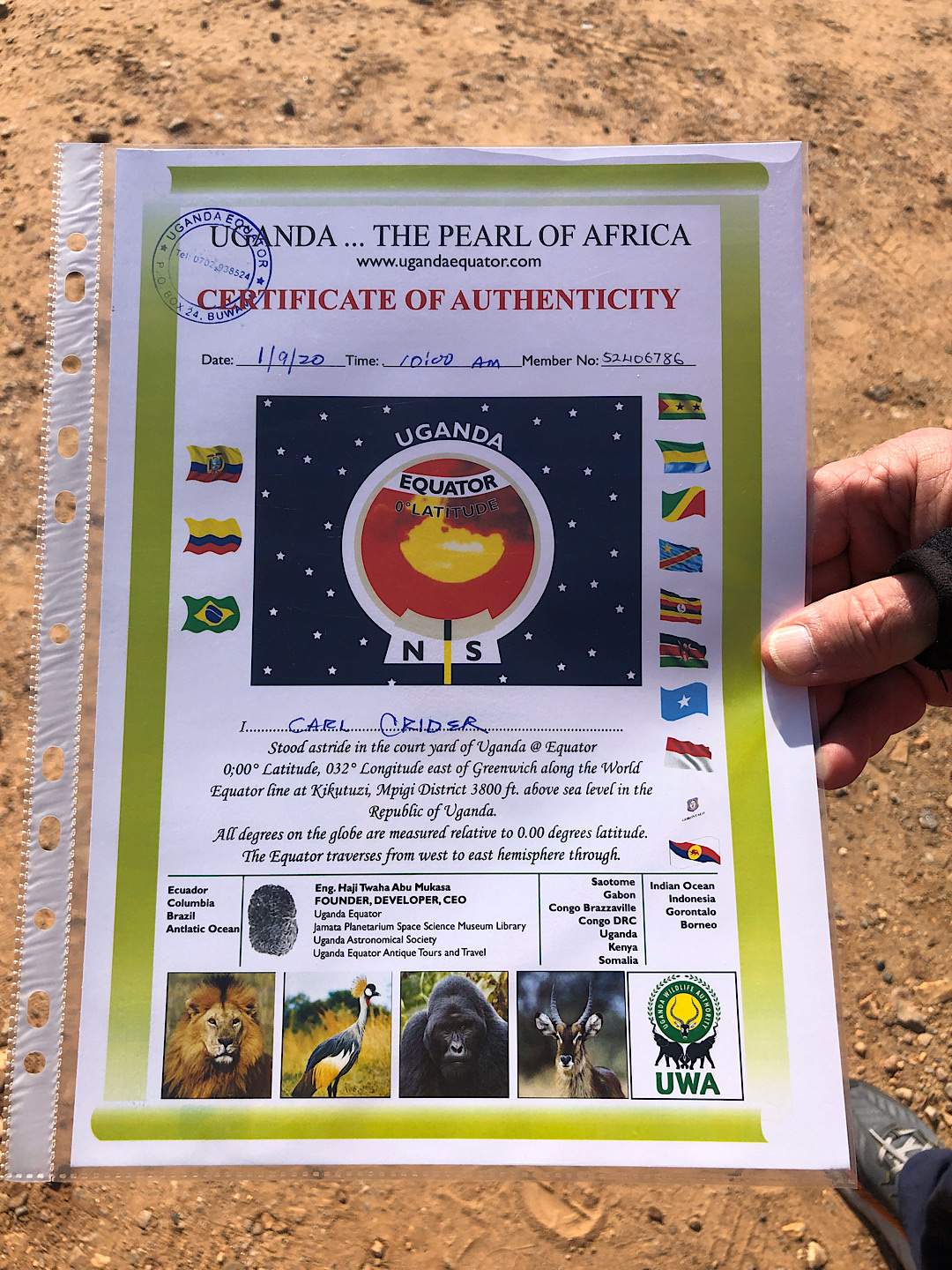
And whether it’s true of not, you can get a certificate attesting you have witnessed it in person.
Steve and I did not come to Uganda for any of this. We’re not here as tourists nor as religious missionaries, though we are on something of a mission. For years, we’ve been enthusiastic members of a San Diego-based group called Women’s Empowerment (WE). Founded about 14 years ago by two friends of ours, it is dedicated to raising funds to help impoverished women, primarily through a variety of “micro-loan” programs. Seven years ago Steve and I checked out a Uganda organization with which WE subsequently became partners. Since then, we’ve served as the liaisons between the San Diegans and the Africans. We returned in 2017 to see firsthand how the program was developing. Now we’ve returned for another close-up look, this time with six other WE members accompanying us.

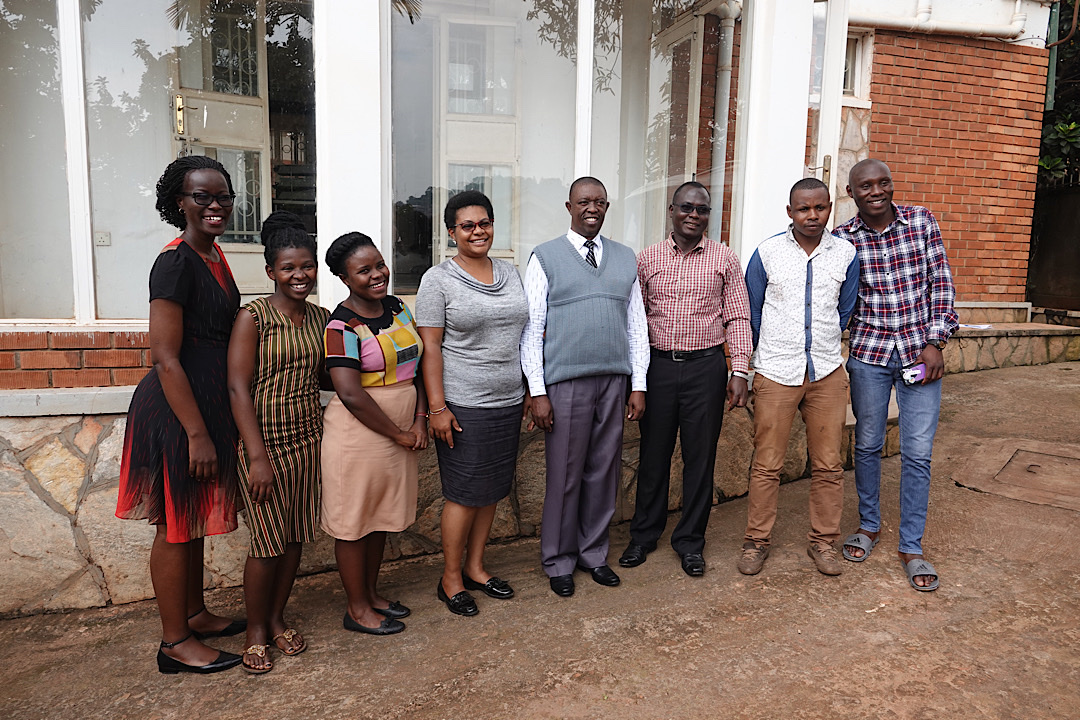
The hardworking crew in Kampala.

Yesterday we had a great meeting in Kampala with the Uganda organization’s administrators who are based there. But the group’s main work takes place in and around the village of Nyaka, in the far southwestern corner of the country. We’ll spend 8-10 hours on the road today getting there. Then we’ll be traveling around visiting a number of the grandmother groups that are the primary beneficiaries of the loan program. I doubt that I’ll have any time for blogging until Sunday, when we’ll depart for the next phase of our adventure.

That will take place south of the equator. (The next time we cross that line we’ll be airborne, flying home.)

Don’t try to get to Africa this way

It’s not the easiest thing to get from San Diego to anywhere in Africa. But this time Steve and I appear to be doing it the hard way. The irony is, it seemed to start so well.

We had scored inexpensive tickets traveling on Alaska Airlines from San Diego to Boston, and then continuing on Qatar Airways to Doha, the capital of Qatar. These tickets would enable us to stay in Doha (a place we’ve never visited before) for three nights before continuing on to Entebbe in Uganda.
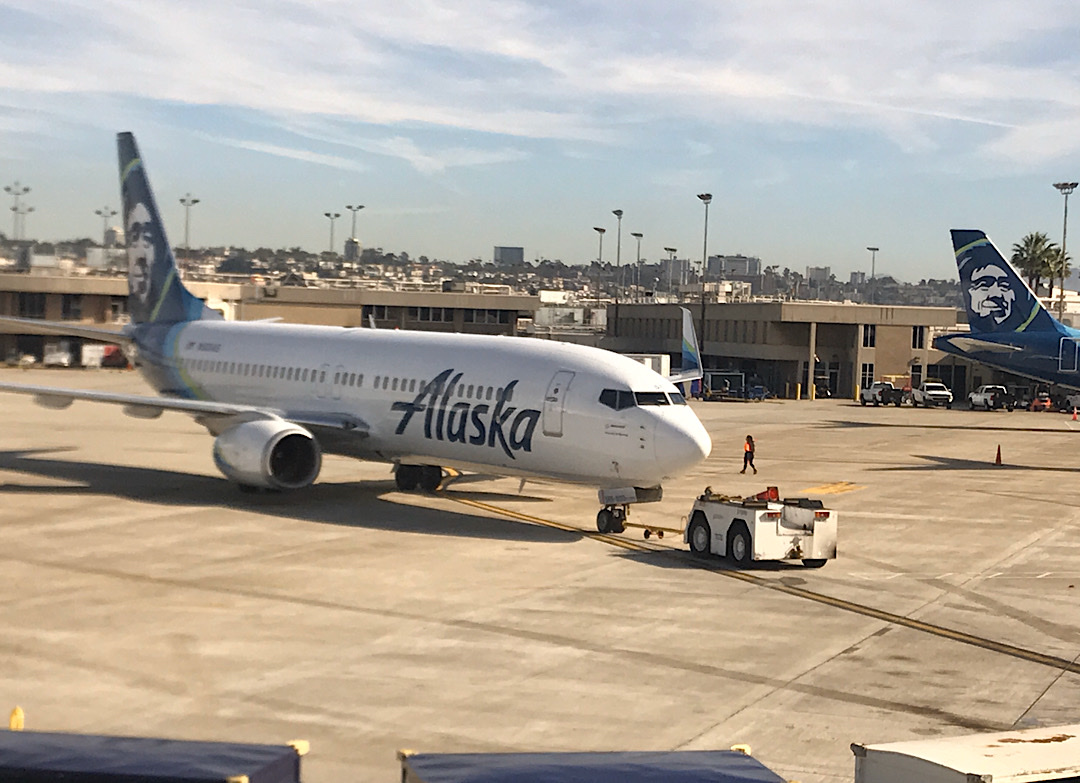
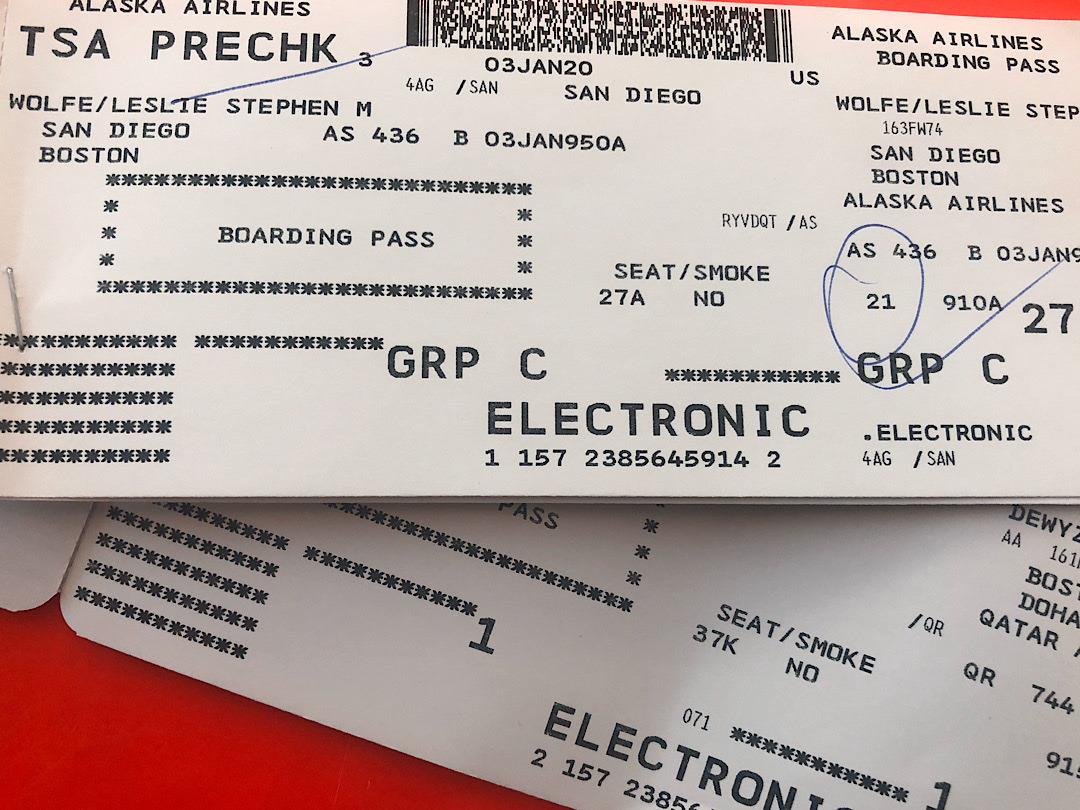
The first flight was at 9:50 am and we were inside the terminal by 7:44. We had our boarding passes by 8, and the signs all said we’d be on time. Outside, the sun gleamed off the plane parked at our gate. We went for coffee and doughnuts and returned around boarding time, when the first creepy thing happened: a tug began pushing “our” plane away from the gate. “Wait, stop!” I wanted to shout. “We’re not aboard yet!”

But no one was, and a minute later, the sign changed to Delayed — first to 10:20, then 10:30, then 10:40 am. Our spirits dipped, but when we returned to the gate around 10 and saw another plane parked next to “our” jetway, they rose again. Boarding started soon after, and by 10:40, everyone was seated, ready for take-off.

The captain’s voice over the loudspeaker smashed everyone’s good mood. He sounded annoyed, not with us, but with whichever imbecilic manager had decreed that our plane was needed to fly to Lihue on the island of Kauai, a route on which Alaska is aggressively competing. Everyone and their luggage would have to get off this plane and onto some other one.

The infants on the plane (and there were a bunch of them) all began screaming, an apoplectic chorus, and many of the grownups looked almost as unhappy. I was aghast, but I wasn’t panicking. Our flight from Boston wouldn’t depart until 10:15 pm. We had been facing a long wait at Logan, so this would shorten it a bit, but not catastrophically. Then the ground crew announced that a replacement place wouldn’t arrive until after 1 pm; it wouldn’t reach Boston until around 10:30 pm.

Here’s the Alaska plane we all had to get off, to free it for a lucky Hawaii-borne group. Aloha!

Poof! went our visions of a swift easy transit to the Middle East. We could barely see the Alaska gate staff, the line of querulous customers trying to reach them was so long. I jumped on my cell phone; called Qatar’s customer service. The guy I talked with made what sounded like a intense effort to find some other path to Doha for us. But the flight from LA was leaving in three and a half hours. There were no flights, so we’d have to cover the distance on the ground in two and a half — not something we felt like gambling could be done. Other Qatar flights from other cities all were leaving earlier than the one from Boston. The guy on the phone finally told me Alaska would have to fix the problem.

It took some gal on Alaska’s International desk in Iowa almost an hour to figure something out for us. She said she could get us on a nonstop flight from San Diego to London that was leaving San Diego at 2:50 pm. Once in London, we could connect to a nonstop Qatar flight. It wouldn’t arrive in Doha until after midnight Saturday night (versus the 5:30 pm we had originally been scheduled for). But in our beggarly positions, we didn’t feel we could be picky. We searched for the British Airways check-in counters, where we would have to go to get our boarding passes.

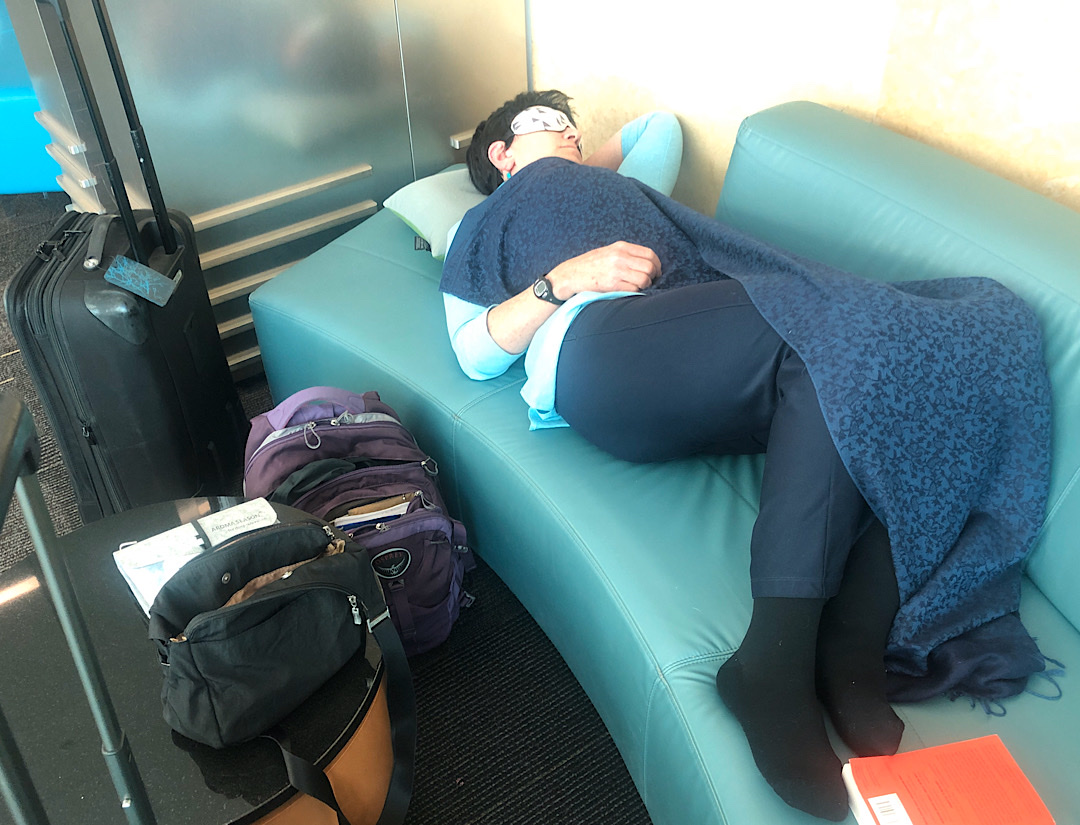
Somehow the young lady in Iowa had gotten the time of the flight wrong. It turned out to be 6:35 pm, not 2:50. Waiting for the check-in counters to open, we considered getting Lyfted home and back, since home was the only place we could think of to nap in. (We couldn’t get into the secure part of the airport until we got our boarding passes. But we couldn’t get our passes until the BA counters opened. I’m here to tell you, the NON-secure part of San Diego’s Terminal Two has no place where any normal person would consider napping.) Reluctantly, we decided against trying to go home and then return. The likelihood of meeting up with some other problem that would keep us from catching our flight (a traffic accident? a Lyft strike?) seemed all too real. The hours dragged by. We finally got those boarding passes; moved to another gate area. I tried to rest, but sleep eluded me. More than eleven and a half hours after we’d entered the airport, our 747 lifted off from the tarmac.
I’m writing this onboard now, with about 17 hours left to go. Our connection in London is short. That might get screwed up too. But if it doesn’t, and we reach Doha, I’ll post this, maybe in the morning.

With any kind of GOOD luck, we could even still have a day and a half to see Doha’s sights. Then we’ll move on to Africa, where bigger adventures loom.

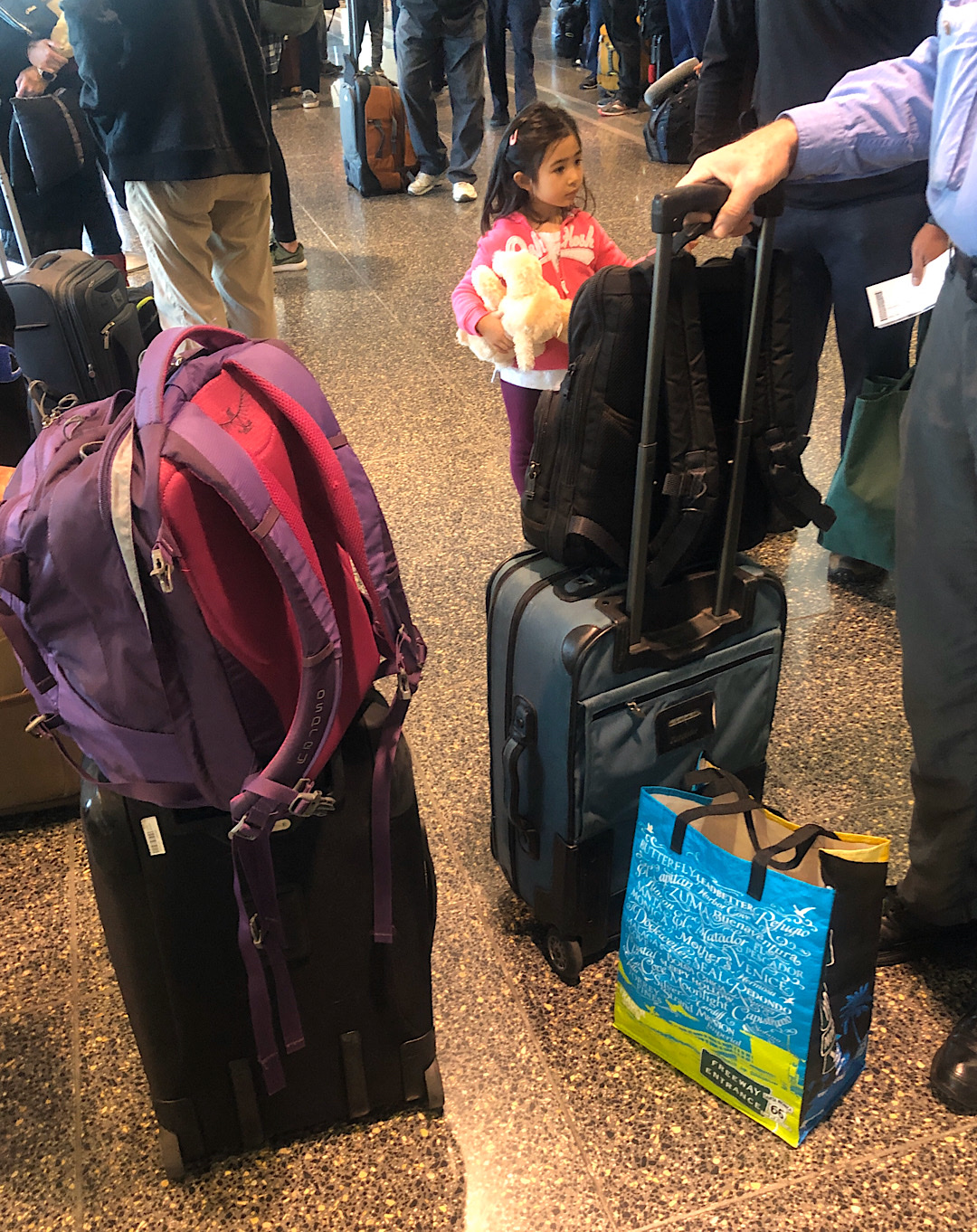
More than once, we were thankful we travel with carry-ons. (Here are our four, plus our lunch bag. Checked luggage would have significantly complicated the nightmare.

Detroit of Giraltar

Travel is educational. Among the lessons I learned Saturday:

— There’s a French word, which I presume is pronounced “de-TWA,” that means “straight” (in the sense of a narrow water passage between two bodies of land). On our French-language (Michelin) map of Morocco, the watery passage off the coast of Tangier is identified as “Detroit de Gibraltar.” The lightning-bulb moment came when we realized how the American city once known as Mo-town got its name. It too is located on a straight (across from Canada). Americans call it “dee-TROIT” instead of “de-TWA” for the same reason they call the Chicago suburb “dess PLAINS” instead of “day-PLEN.” (Because we don’t speak no stinkin’ French in America?)

— Getting from Morocco to Gibraltar is not as simple as it might seem it should be. Ferries, it turns out, depart from two terminals, one on the water in Tangier and the other at a new terminal about 18 miles away. Consultation with Idriss (the front desk guy at our guest house) convinced us we’d be better leaving from the Tangier terminal; getting to it — a short, $3.30 taxi ride — was easy. We arrived about 9:20 a.m., and several Moroccan guys who looked like longshoremen told us we had time to buy our tickets and make it on the 9:30 ferry. They were right, but figuring that out and getting aboard (with our SIX pieces of luggage — including the bag with our rugs and the one with our ceiling lamps!) made me think it probably was best that I never was selected to be on The Amazing Race. (At one point, my blood pressure was clocking what felt like 1000 over 500.)

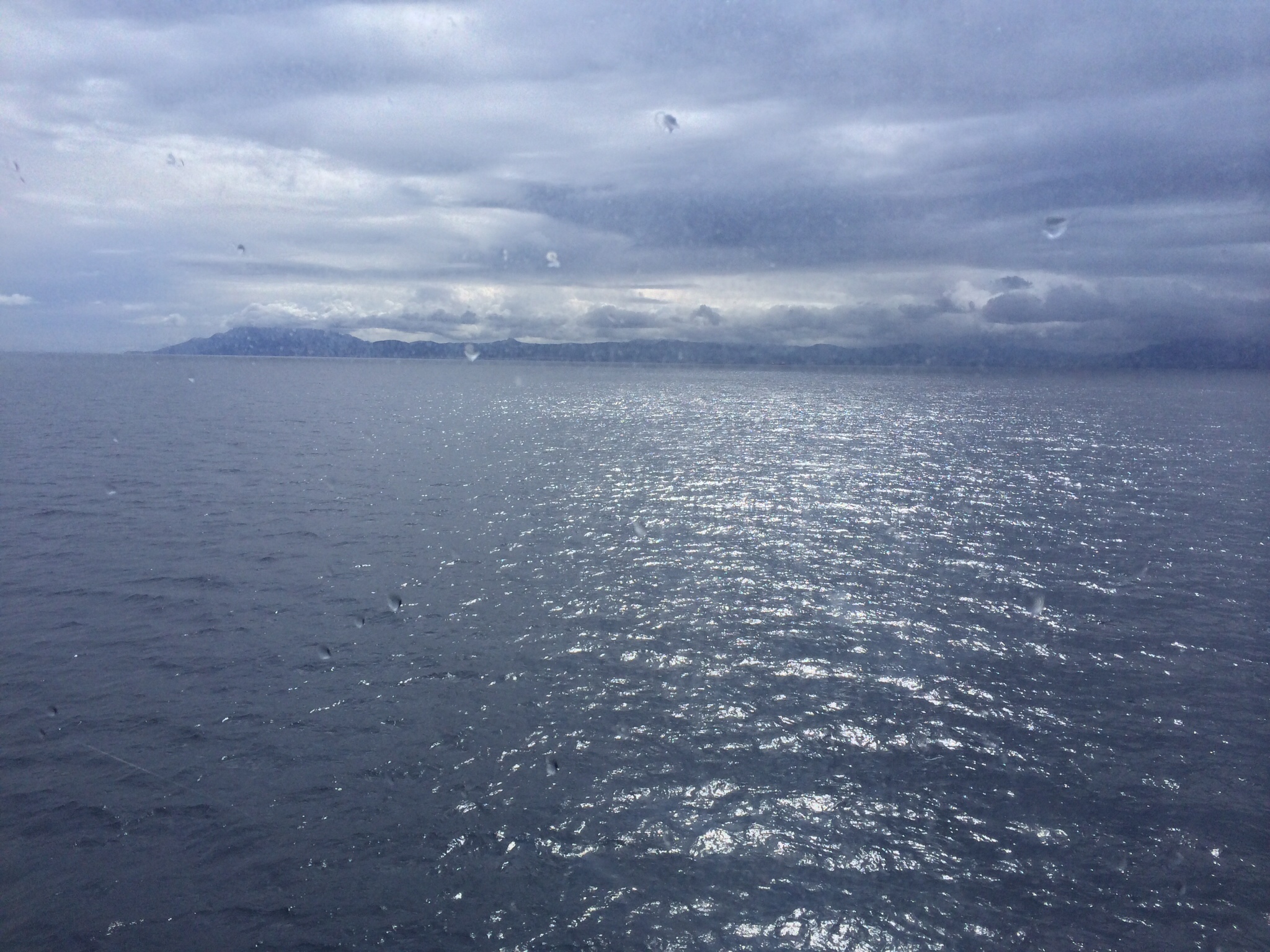
It was a gray, blustery, showery day, but that didn’t dampen our spirits, once underway. Steve and I both are such suckers for geography we felt like four-year-olds about to sit on Santa’s lap, as we entered that famous channel between the Atlantic Ocean and the Mediterranean Sea. Steve marveled over its historic significance (“The most strategically important waterway in human history!”) while I goggled over the misty coasts — Africa on my right, Europe on my left, both easily visible. On that right-hand coast, I could disembark and WALK to the pyramids of Egypt, the mountain gorillas of Uganda, the gold mines of Johannesburg (if I were crazy, and the logistics weren’t an issue.) Ranging out from other side would take me back to Paris and beyond.

Africa to the starboard

We landed in the Spanish town of Tarifa, where we followed many of our fellow passengers onto a free shuttle bus bound for Alcegiras (the town where ferries from the farther Moroccan ferry terminal wind up.) By this point, the sun had emerged, and the hilly green countryside looked beautiful. The Alcegiras ferry terminal seemed relatively empty, but there was a lady in the information booth, and she assured us we could walk to the town bus station in about 10 minutes and there find a local bus to La Linea de la Concepcion (the Spanish town that actually DOES butt up against the British possession of Gibraltar.)

Lugging all that stuff and needing to find someplace to buy euros and having trouble finding the actual entrance into the bus depot, we took more like 30 minutes to reach the slot where the local bus would arrive. Arrive it did, and we stowed our bigger baggage in a compartment on the side and took off. Clean and modern, the bus was filled with folks gabbing away in Spanish, and as it followed the little route map we’d picked up in the terminal, we told each other it almost felt like we were back in San Diego.

But the bus then did something I’ve never seen an American city bus do — it pulled off the road and into a gas station. “Is he seriously going to fill up?” we wondered. Instead the driver turned off the engine, donned a pair of yellow gloves, and walked out the front door. For a couple of minutes, nothing seemed to happen. Then a burly fellow got out of his seat and disembarked, a cell phone clamped to his ear. A couple of other guys soon followed and out the window we could see them lighting up. A guy with no arms followed them, and a women fished out a cigarette from her purse, lighted it, and stuck it in his mouth. A little boy went out and peed. A toddler girl started howling with irritation. The more time passed, the more it felt like we were caught in an Aldomovar movie. Eventually I looked out the back of the bus, where I could see that the engine cover was open, and a gaggle of passengers was watching the driver work.

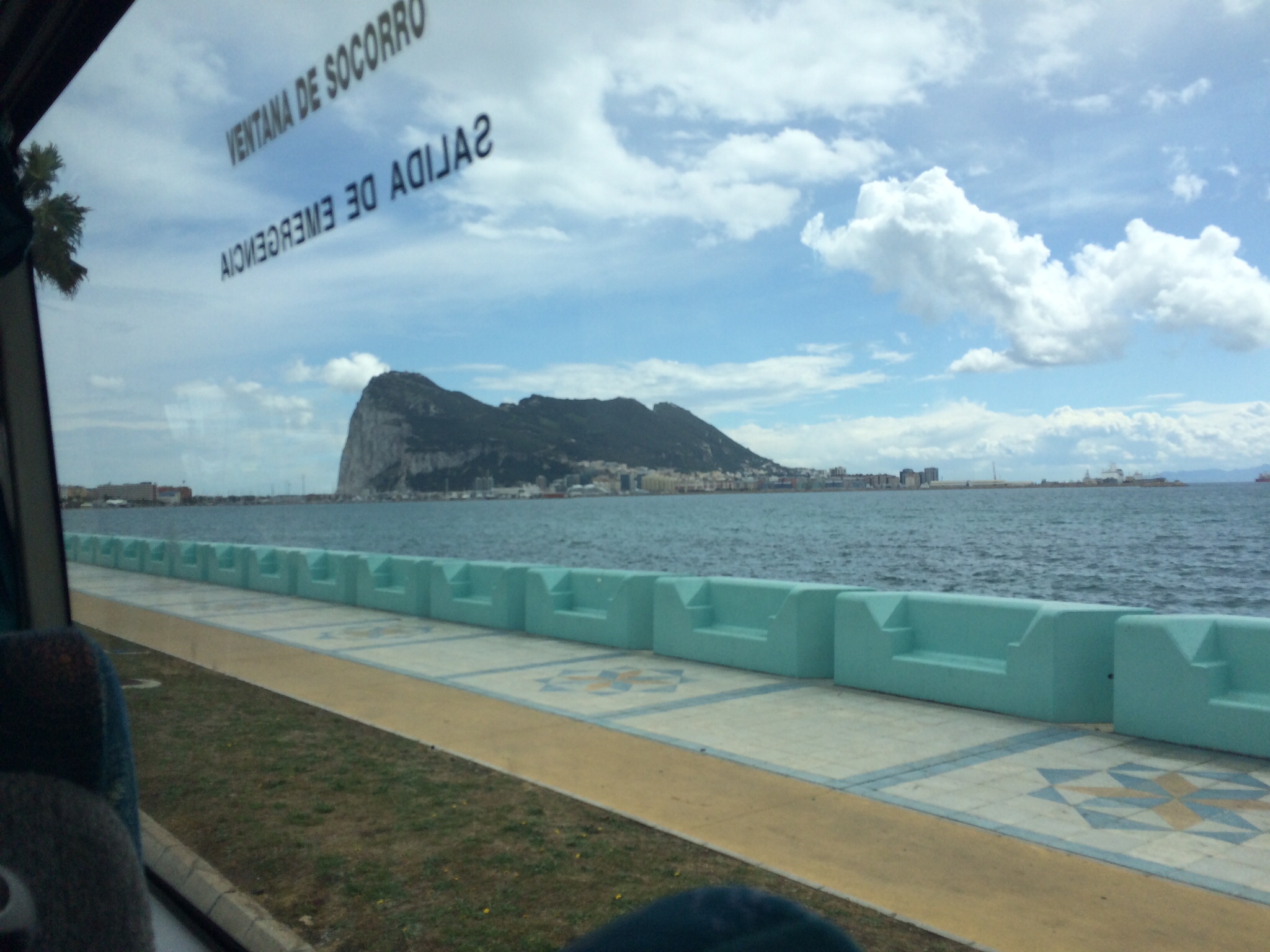
Then the driver shut the cover with a clunk, and everyone raced back on board. The driver removed his gloves, now filthy, started up the engine, and we moved on. Maybe 45 minutes after climbing on the bus, Gibraltar finally came into view:

As seen from the bus

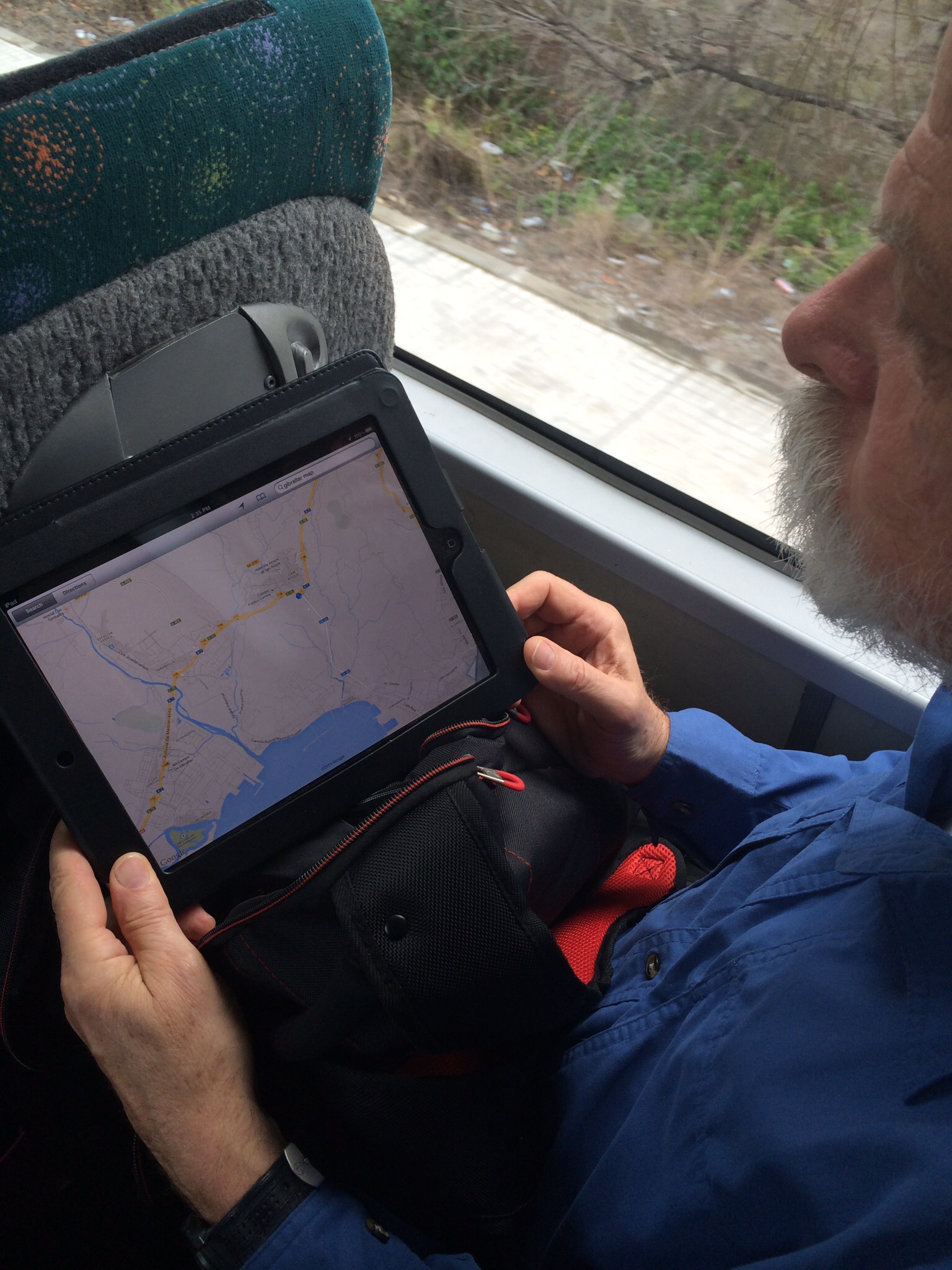
To Steve’s delight, he was able to track our progress using Google Maps on his iPad. (We think it was picking up random wi-fi hot spots as we drove along.)

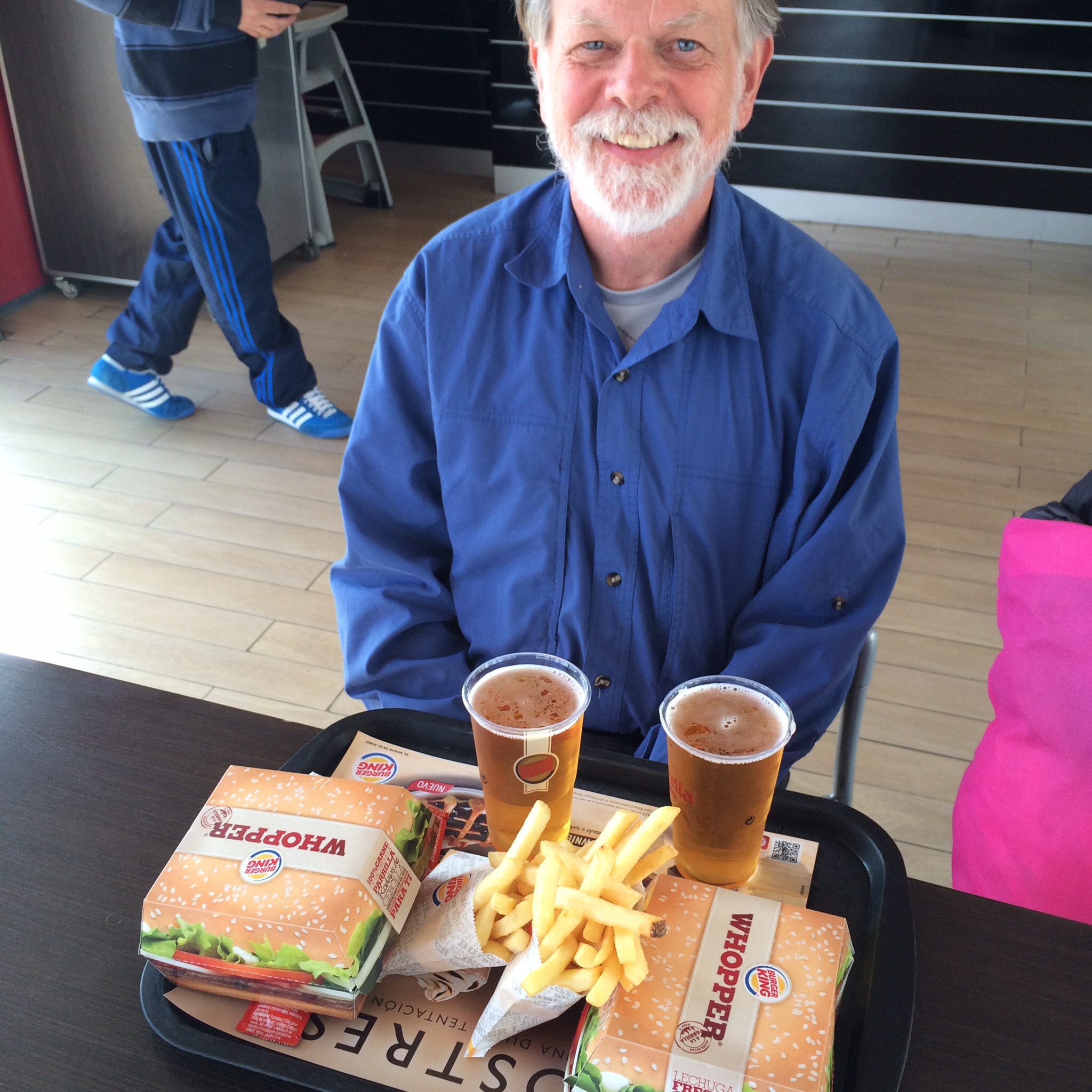
— Spaniards have happier fast-food options than Americans do. Among the drink options was beer, available in three sizes. I tried to order two Whoppers, one small fries, and two small beers, and the girls behind the counter advised that it would be cheaper to order two of the 6-euro ($8.50) meal deals. “Those come with beers?” I was incredulous. They did indeed.

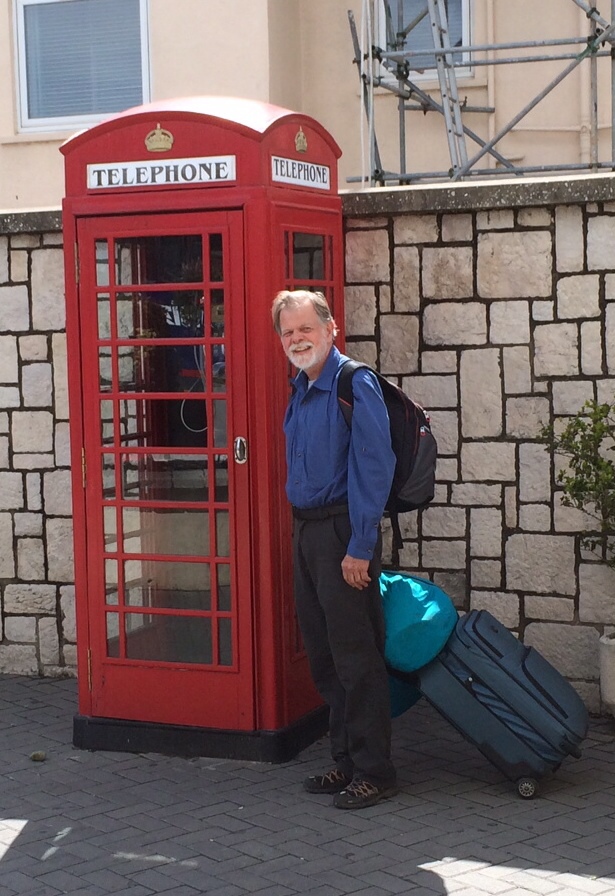
The rest was easy again. I changed dollars to British pounds (the currency of Gibraltar) just outside the crossing, then we breezed through; the solitary policeman barely glancing at our passports. A few steps further, and we confronted a bright red, classic British telephone booth. We found similar phone booths at many places in Gibraltar, despite the fact that almost everyone in the world now uses cell phones. I guess they symbolize the old Gibraltar — and maybe the present one too.


Moroccan blues

Another bend in the road, another surprising facet of this country. Our bus from Fes took us through verdant, bountiful farm country, but finally we approached the Rif Mountains, a brawny land that made Steve and me feel we were deep within the Rockies. After about 90 minutes, we pulled into a rest stop, where everyone rushed out to use the toilets but then dawdled to smoke and buy snacks and gab. When the driver finally climbed back aboard, he discovered that one passenger was missing. He tooted the horn (and tooted and tooted) and then searched the rest stop for him. Then he gave up and we trundled onto the road again. It struck me that the TSA would be more suspicious of a passenger who simply disappeared. But the bus didn’t blow up, and we reached Chefchaouen only about 40 minutes late.

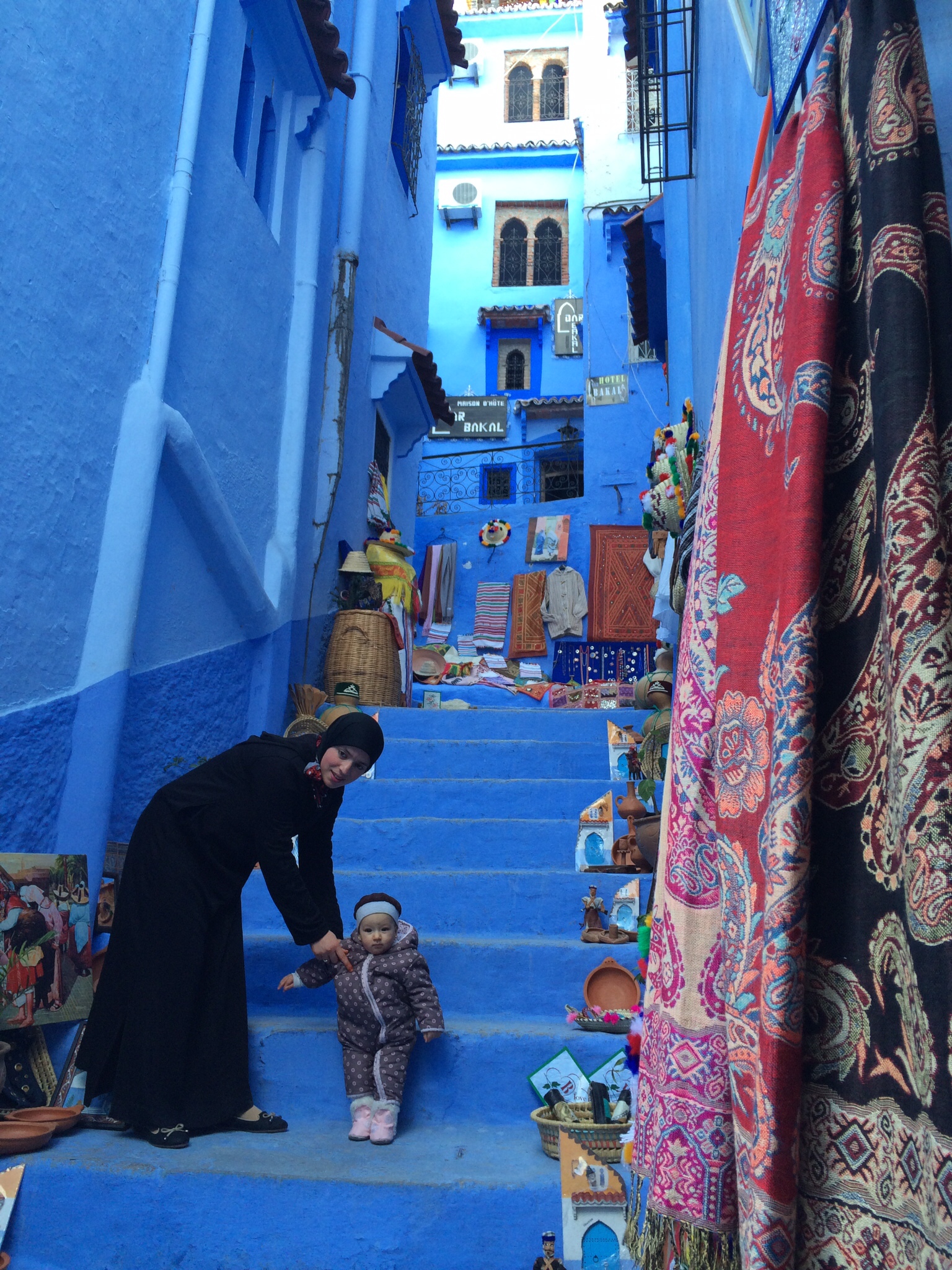
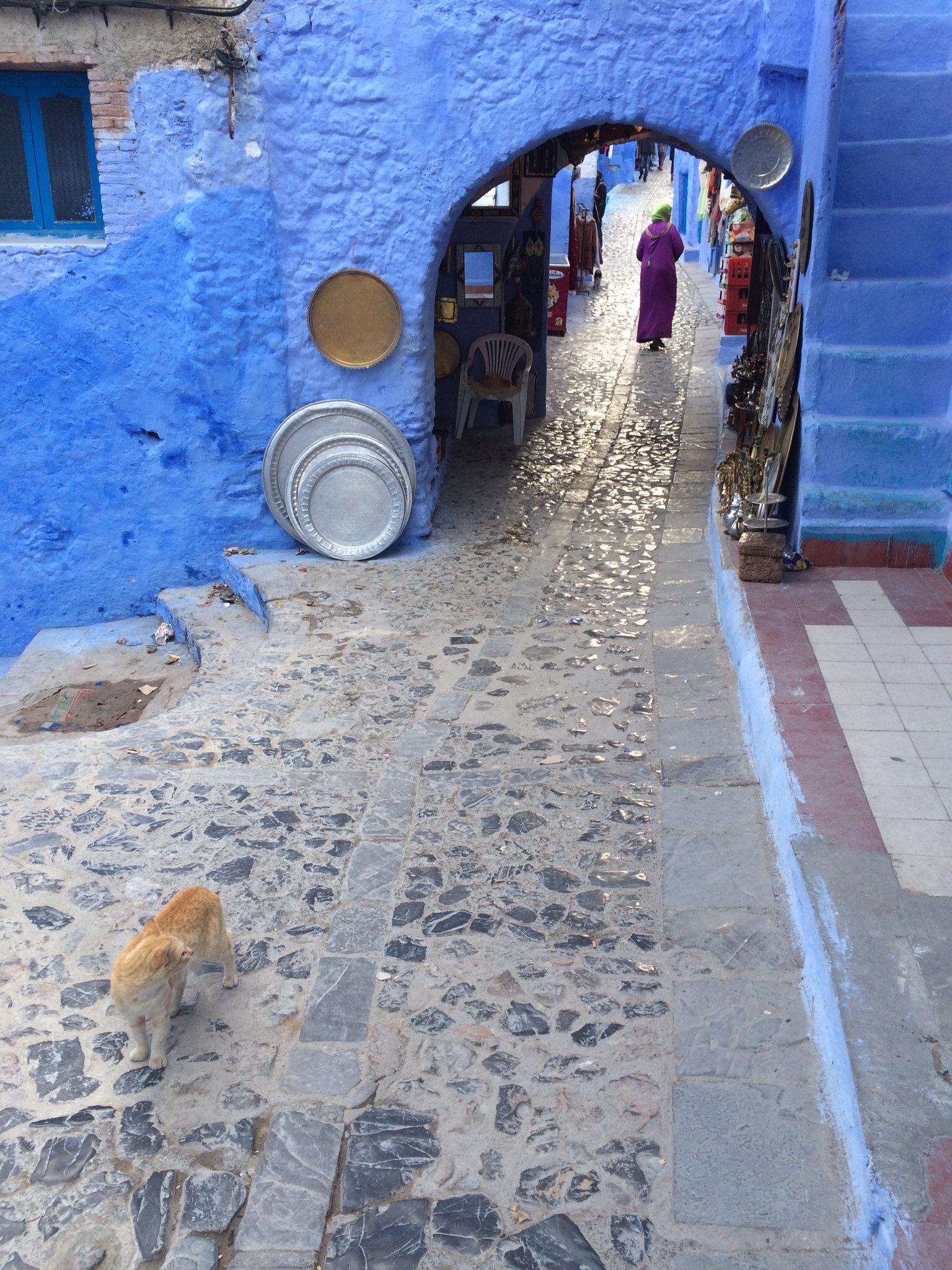
We took a local taxi to the gate of the walled city to which our B&B had directed us, and I telephoned the proprietor from the the taxi. Carlos, originally from Malaga (Spain), awaited us at the gate. He took some of our bags and led us through the steep, narrow, very blue passages leading to his place, the Casa La Palma.

Most of Chefchaouen is blue — it’s the town’s signature, begun around 85 years ago, when a community of Moroccan Jews moved in and chose that color to contrast with the green tones of Islam. (In the centuries before then, this was a holy city, closed to all but Muslims.) The blue tones have spread, and today Chefchaouen is a UNESCO World Heritage Site and one of the fastest-growing tourist destinations in Morocco. I had thought nothing could be more picturesque than Fes, but this was picturesque in a completely different (clean! bucolic!) way. I commented to Carlos that I was sorry we had only one night here. He shrugged. The town was a good base for trekking in the mountains, he said. But a day or a day and a half was plenty of time to see Chefchaouen.

In the guesthouse, he took our passports and filled out the official forms, then he offered to show us the way to the center of the village. He had to go there anyway, he said, to turn in the forms that day (required for Americans and certain categories of suspicious Arabs). He didn’t know about our backgrounds, but he mentioned that if a guest was a journalist, the police required that he call them immediately. (Fortunately, Steve’s an Engineer, and I’m a Technical Writer.) Police paranoia was running even higher than normal because the queen of Morocco was coming to visit the next day with some dignitary from Qatar in tow.

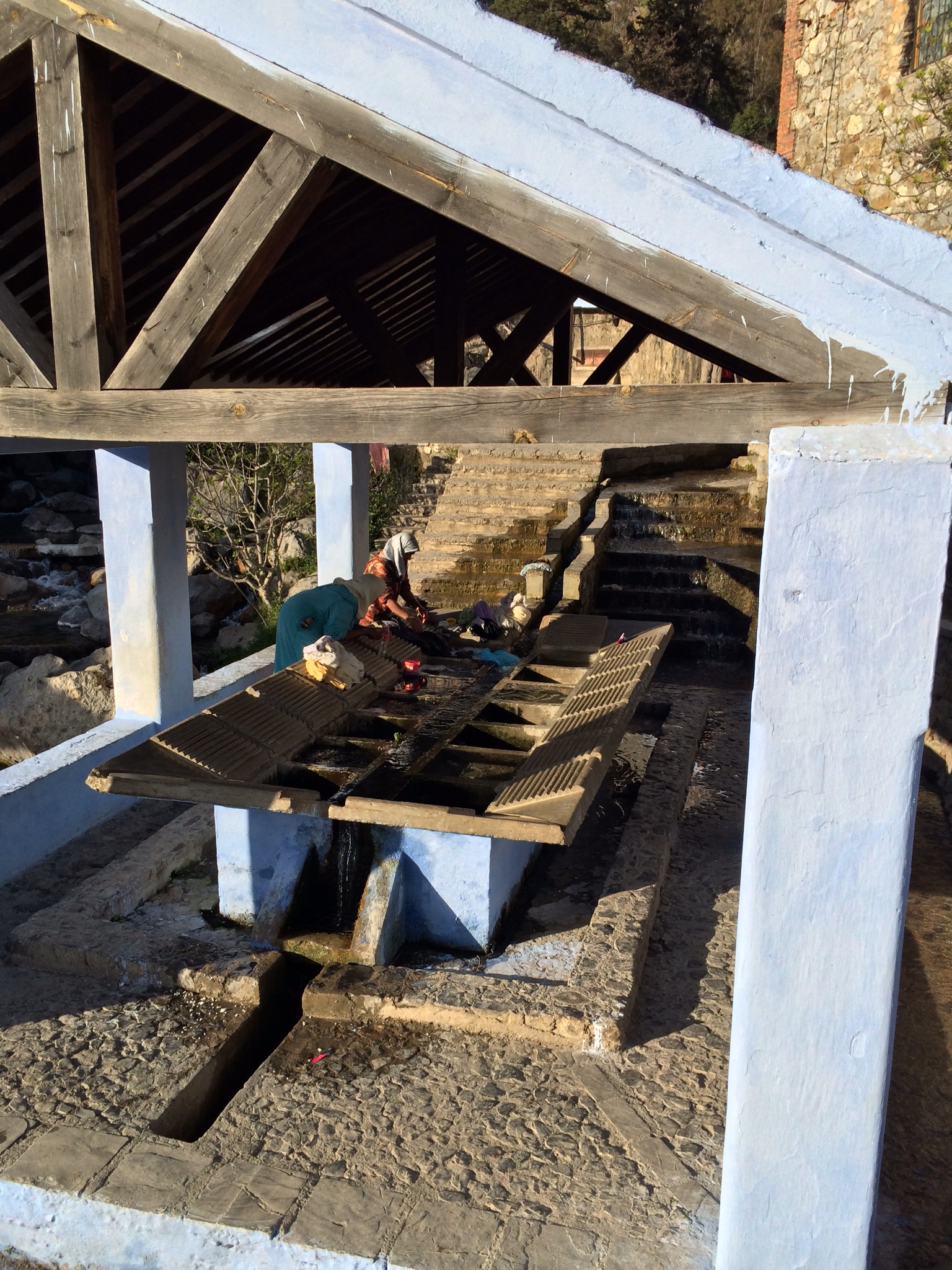
For the next two hours Steve and I followed Carlos’ helpful advice. We walked to the river and admired the ingenious stations there for doing laundry. (If you’ve gota wash your clothes in a river, I can tell you: Chefchaouen’s the place to live.)

We climbed up to a monastery with a panoramic view:

Carlos had said there were three restaurants in the town where we were unlikely to get food poisoning. We asked if we could bring the bottle of wine that we had bought back in Marrakesh (and were tired of lugging around). He told us we’d have no problem drinking it at one of the restaurants, so we went to that one around 7:45 p.m.

No one was in the joint, and we smelled nothing to suggest anyone was cooking. But a girl led us to a table and gave us menus. After a long time, the friendly proprietor finally appeared to take our orders. He didn’t bat an eye when we asked if we could drink our wine. But he went away and didn’t reappear with a corkscrew. Another long, long interval elapsed before he finally brought Steve’s soup and my green pepper and tomato salad. We asked about the corkscrew and he looked alarmed; tourists who brought wine usually brought the corkscrew too. (We couldn’t because the TSA doesn’t permit them in carry-ons.) The restaurateur offered to check with a neighbor. Ten minutes later, he reported having no luck. But he called a friend who offered to bring the corkscrew from across town.

That’s what finally happened. The food wasn’t great. The wine was pretty bad. But even a bad bottle of wine is a tonic for a small dose of travel blues. (And so far, we’ve felt no signs of food poisoning.)

Now we’re on our final bus, heading for our final stop in Morocco: Tangier.