Al Ula

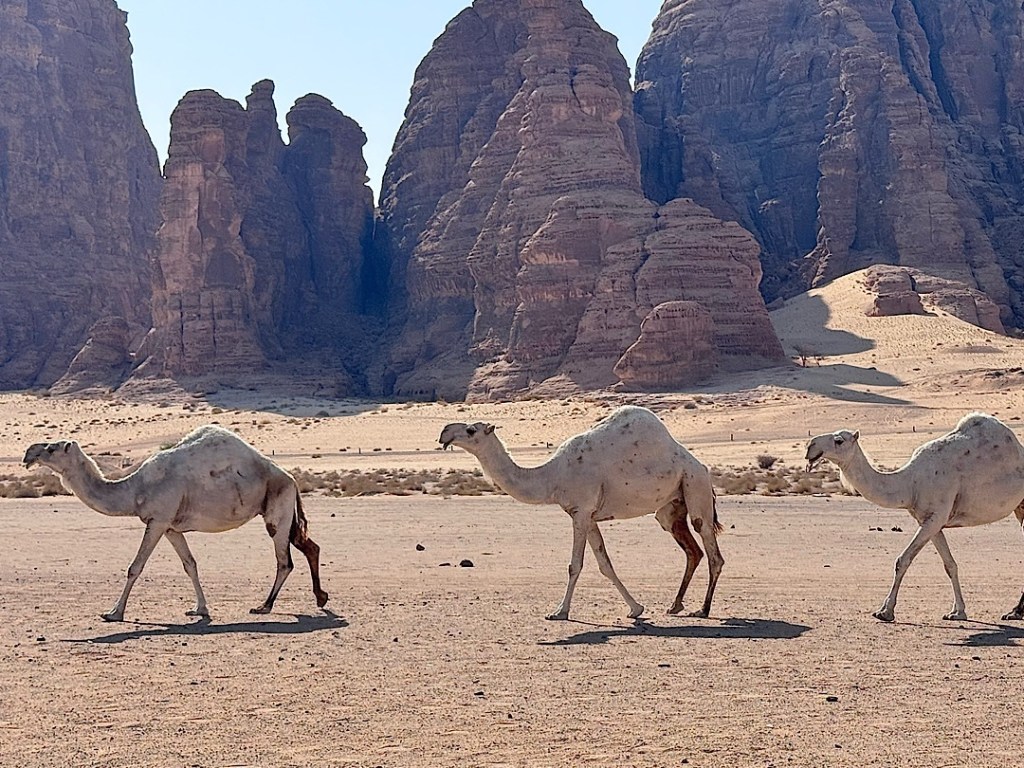
In the ancient world, camel trains carrying spices from India and the Persian Gulf to the Mediterranean passed through the Al Ula oasis and made it an important point on maps. Humans have been living in the valley for at least 7000 years. Camels for less — but you still see them around today.

Abu-Faisal was supposed to give us a full-day tour of Al Ula for $400. I wasn’t sure how he defined “full day.” I imagined Steve and I probably would spend most of Saturday (Aug 22) being driven around the highlights of the ancient Arabian crossroads. That would be it.

Didn’t turn out that way. Here I should probably confess how little I knew about what we were getting ourselves into. Planning our Saudi stay, I’d read that less than 500 miles north of Jeddah, you could visit a site where people more than 2000 years ago had carved magnificent tombs into the tawny sandstone cliffs. The people were the Nabateans, who created the world-renowned complex at Petra in Jordan. That had dazzled Steve and me when we visited it in 2008. The chance to see another Nabatean marvel was all it took to inspire me to build Al Ula into our itinerary.

A bit of online research indicated we could get there by taking a train to Medina and then a bus to Al Ula. When I researched accommodations, I was taken aback by what it cost to stay at the opulent desert resorts — hundreds of dollars per night for a room in low season. (In the high season you pay $1000 or more at Our Habitas or the Banyan Tree or The Chedi.) Then I read about a B&B (without the breakfast) called the Friday Suites. Located in town, it had glowing reviews and cost $90 a night. The reviewers on booking.com seemed particularly besotted by the proprietor, Abu-Faisel.
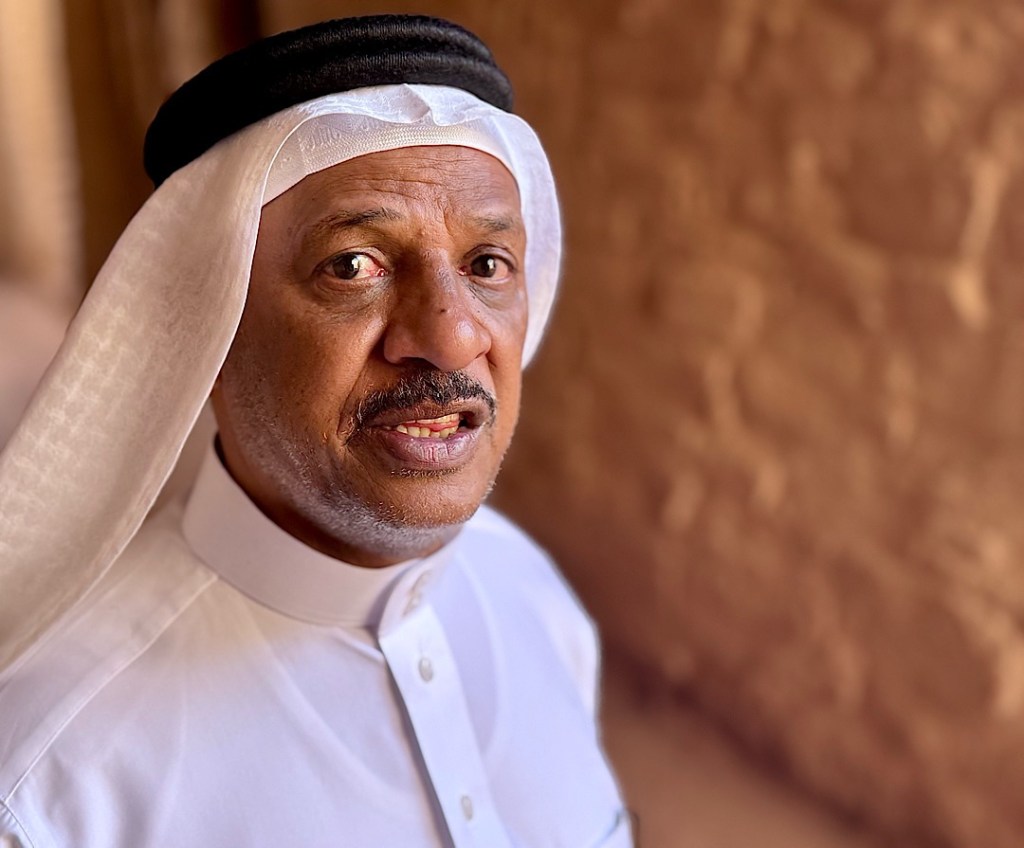
Abu-Faisel

I made a reservation and asked if we could hire Abu-Faisel to show us around. He said we could. He wrote that it was just a short walk from the Northwest Bus station to his place.

When our bus pulled into the station a little after 1 that Friday afternoon, we stepped down into pizza-oven heat. Taking a taxi or Uber wasn’t an option; none operate in Al Ula’s off-season. Before we could hoist our backpacks and set off, my watch buzzed with a Whatsapp from Abu-Faisel. To save us from trudging under the merciless sun, he would come get us, he declared.

Five minutes later, he was loading us into his GMC Yukon Denali. As short as the ride was, it gave us time to start learning his story. He’s 63, a native of Al Ula, and has lived in the village all his life except for when he was studying pharmacology in Riyadh. He returned home to work as a pharmacist and later as a hospital administrator. He retired from all that five years ago and started the tourist business, having decided he would rather be outdoors, enjoying the natural beauty and dishing up a heaping dose of Arab hospitality to visitors from around the world.

A short, vigorous fellow, Abu-Faisel dresses in the traditional long white thobe and white headscarf crowned with a circle of rope. In short order, we also learned how strong his opinions were about what we ought to do, and when, and how. Many of his suggestions took into account factors about which we had no clue, e.g. which businesses were closed during this hottest time of the year, when the locals ate, what were the best spots for him to drop us off and pick us up, and so on.

We balked at a few things, but almost always he actually did know best. We learned to submit as we spent long hours of not one but three days seeing the area’s highlights under his direction. These included:

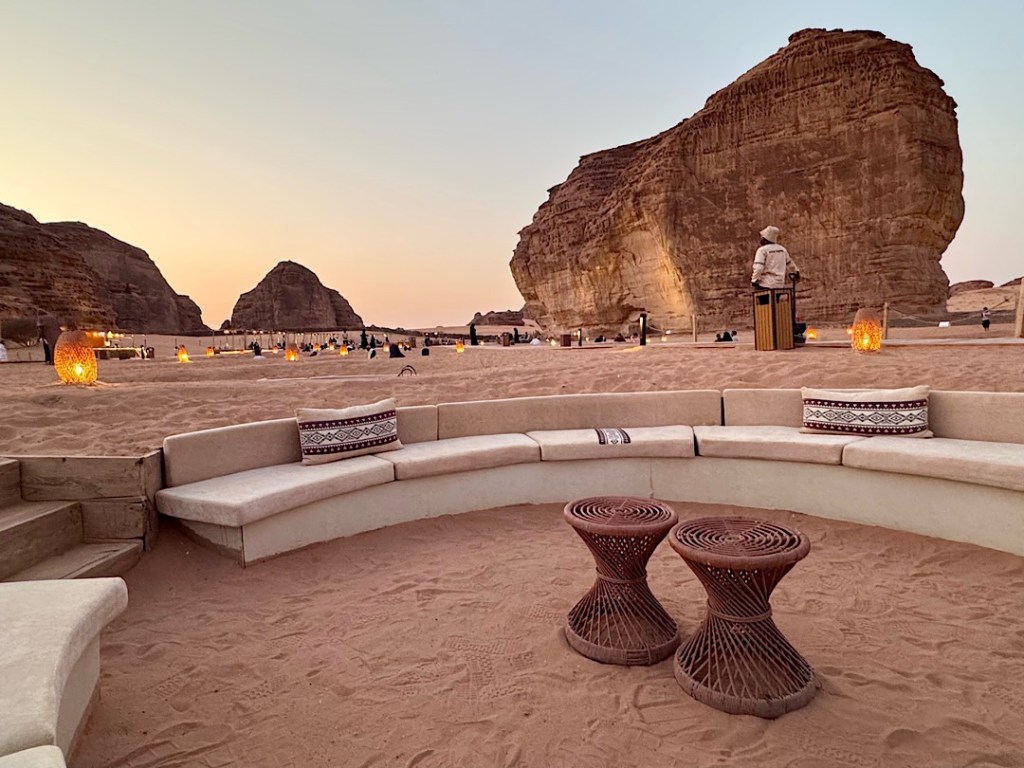
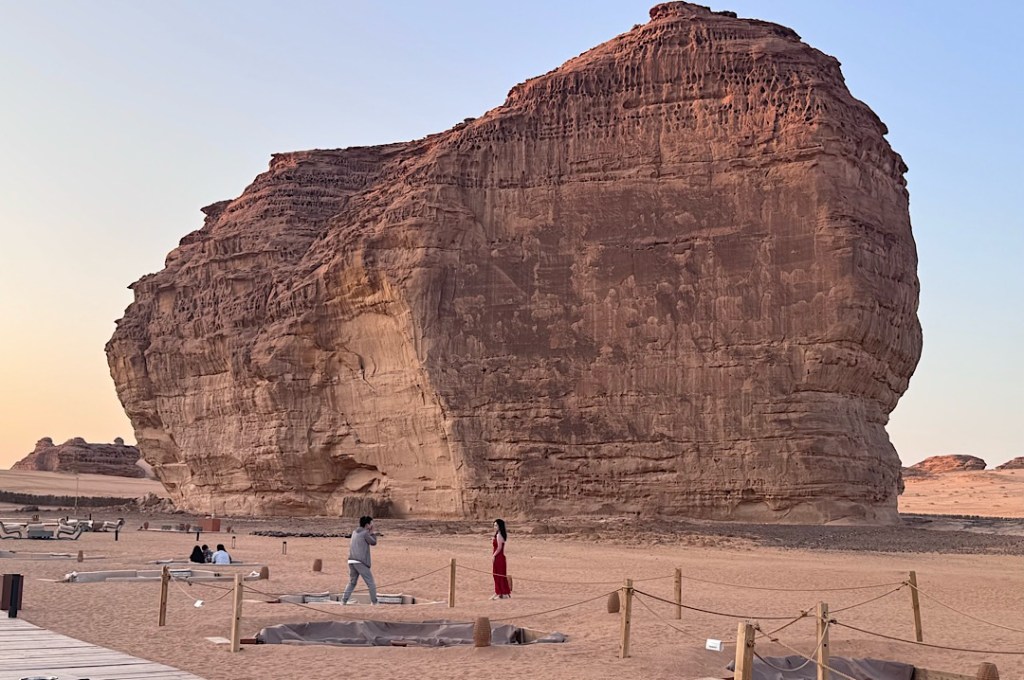
— Elephant Rock at sunset Friday night
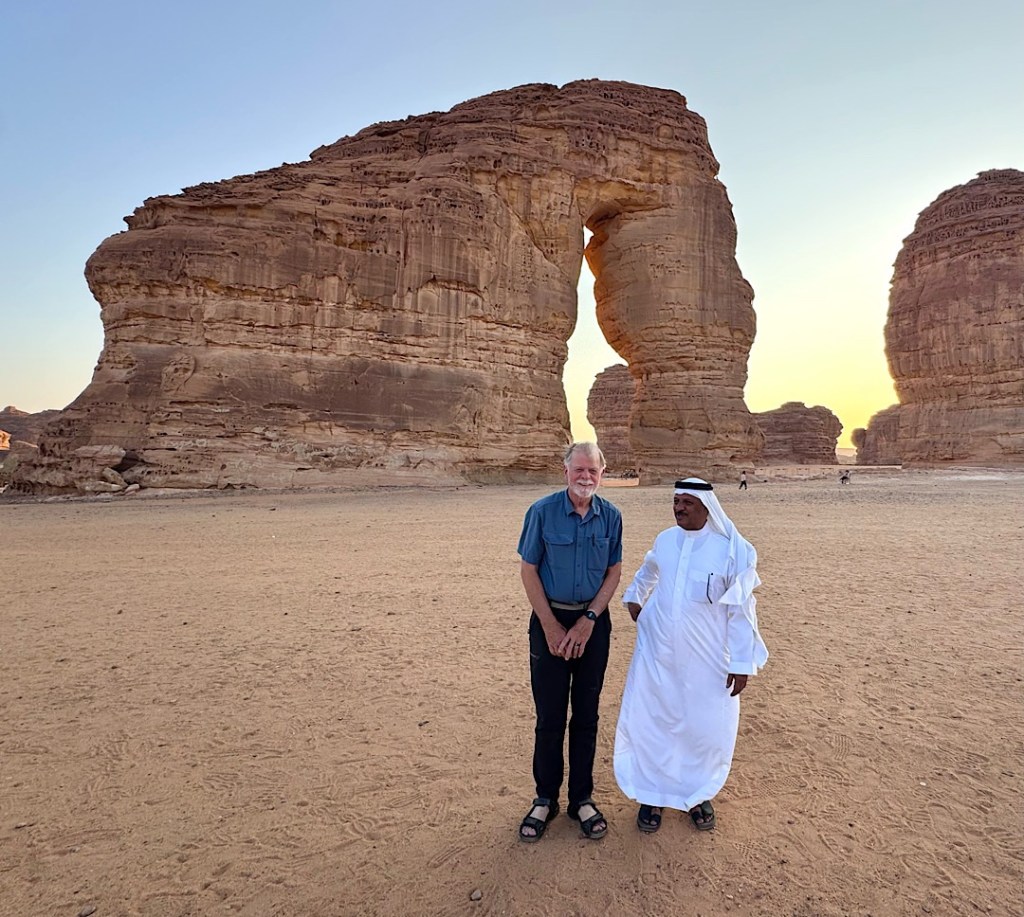
Al Ula is filled with striking rock formations. This is one of the most iconic.
The authorities have filled the Elephant Rock site with circular sunken sitting spaces, delightful spots for taking in the sunset.

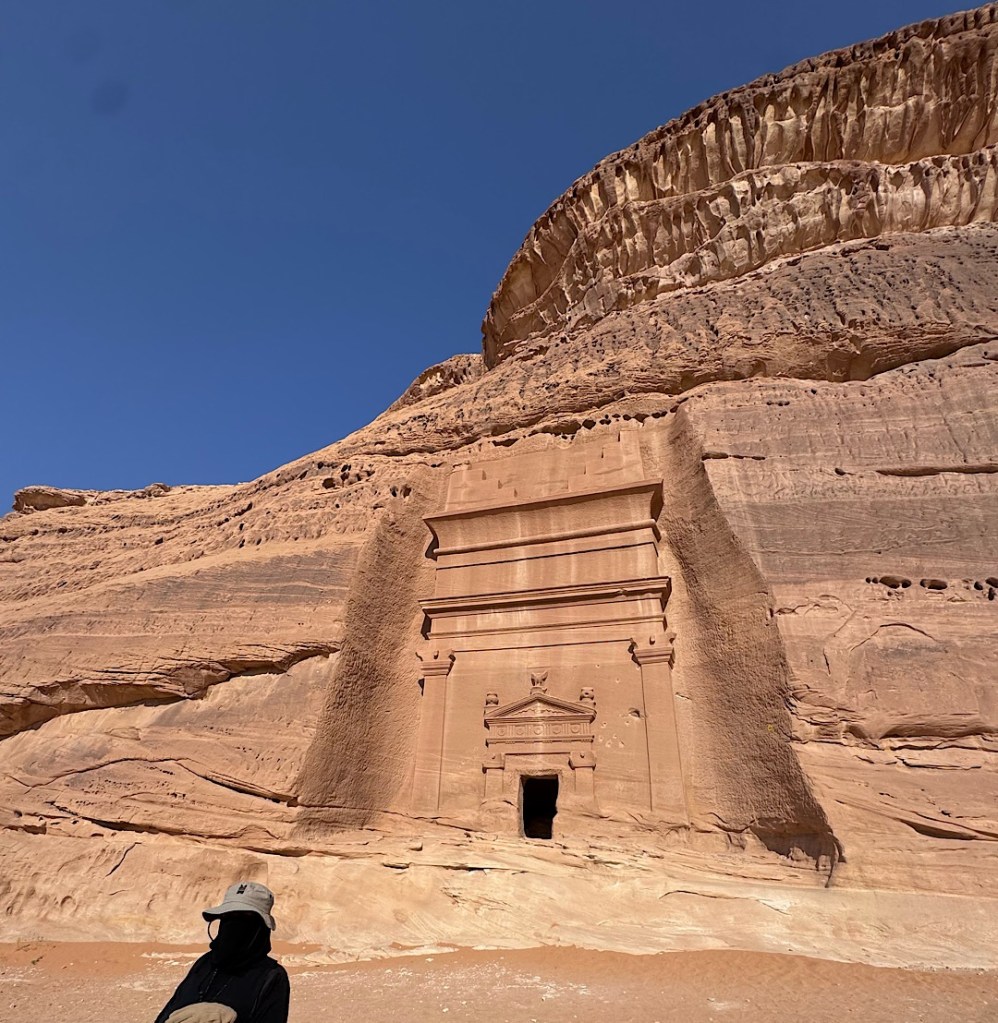
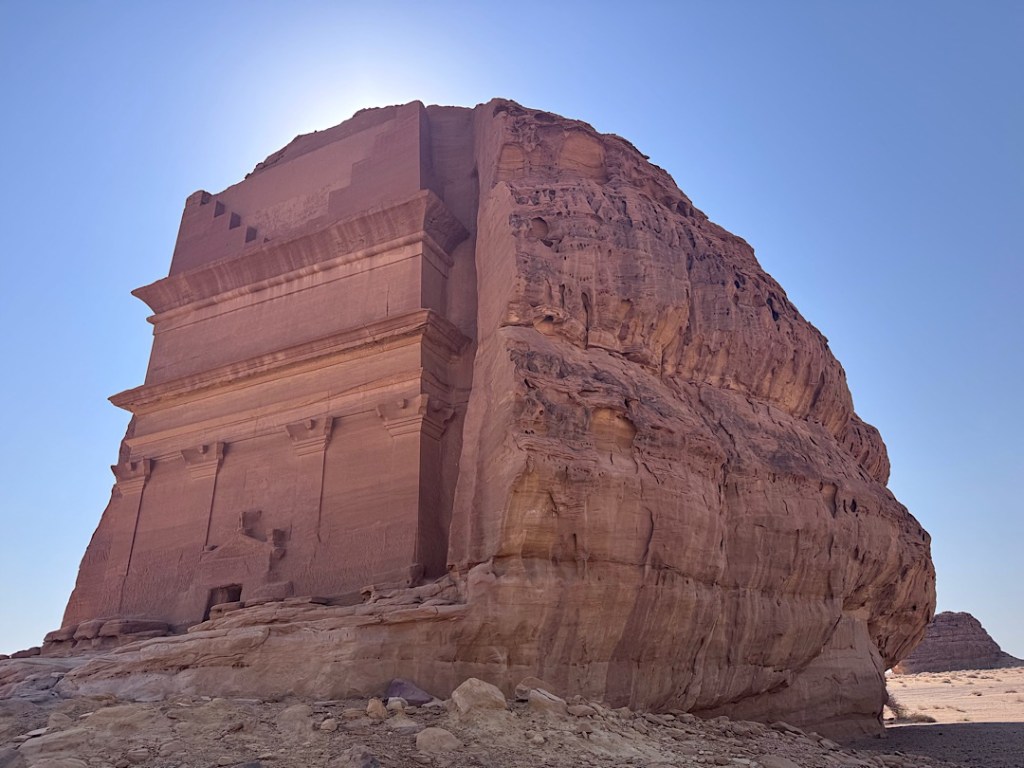
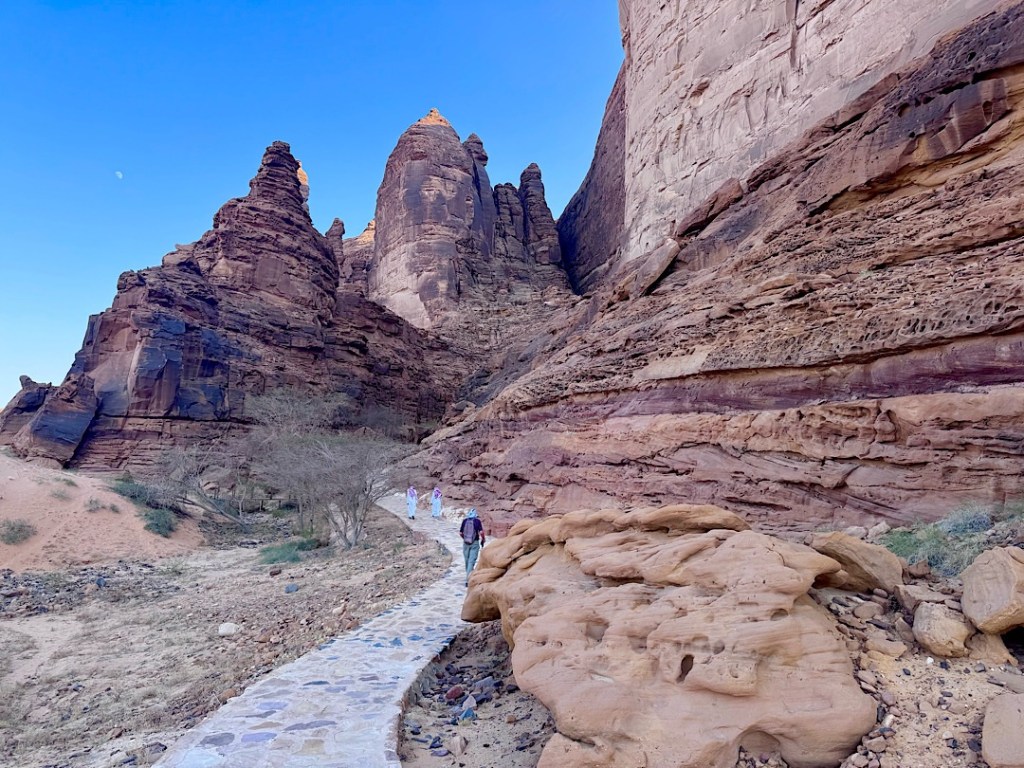
— Saturday morning we joined a ranger-led tour of the most spectacular Nabatean tombs (at Hegra).
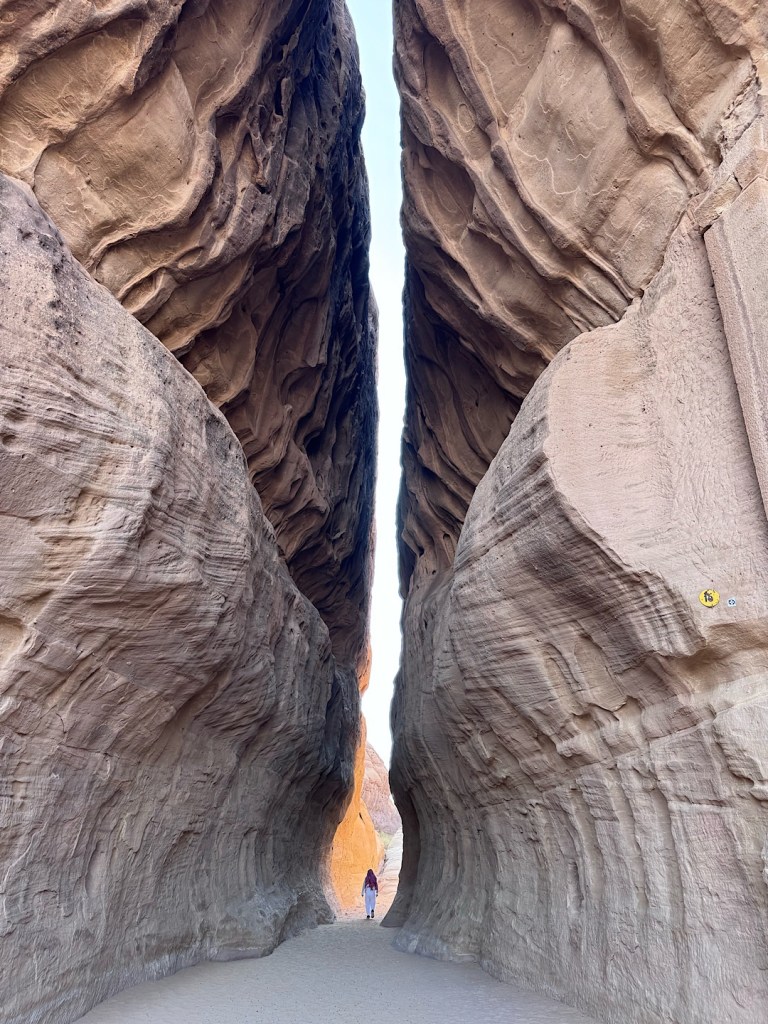
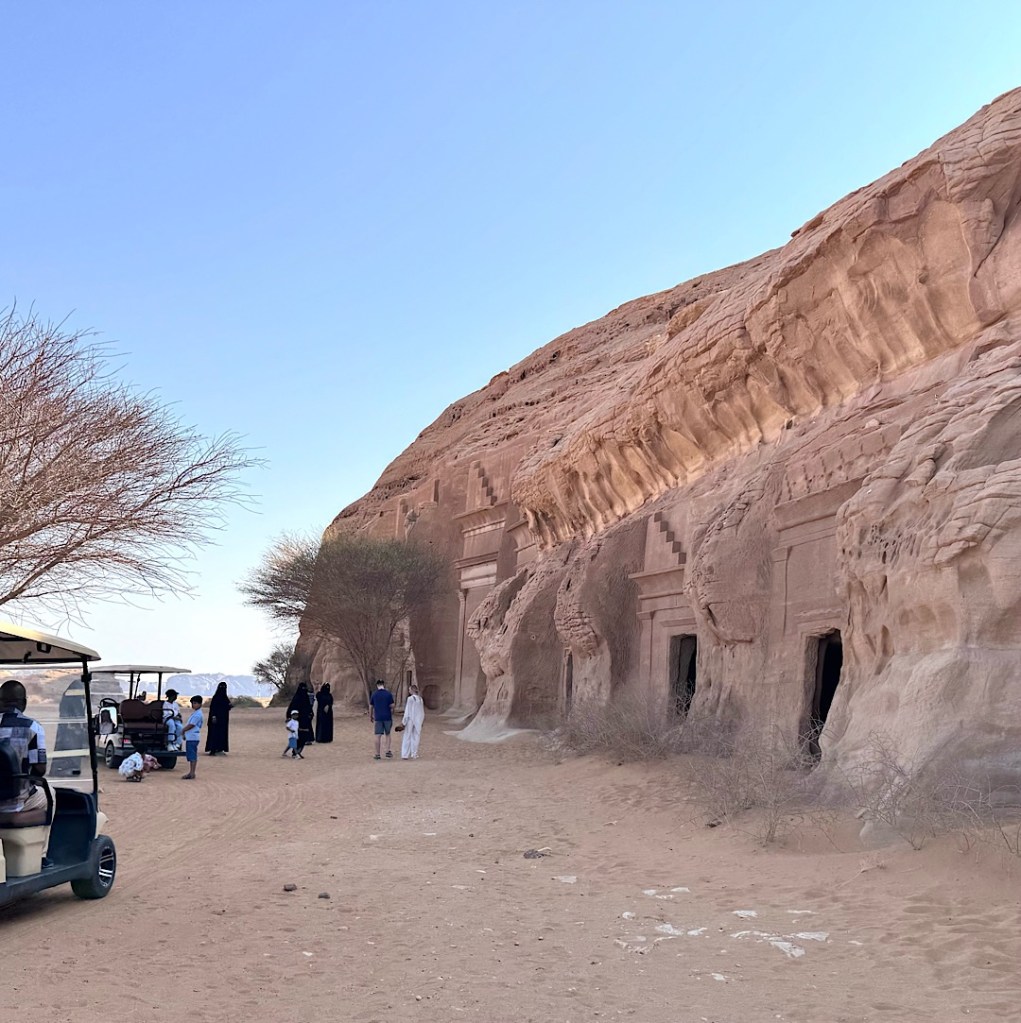
The rocks alone are very impressive
Some of the Nabatean tombs are modest and housed many bodies.
This one was grander.
Grandest of all, this tomb ironically wasn’t finished in time for the man who commissioned it to use it as his final resting place.

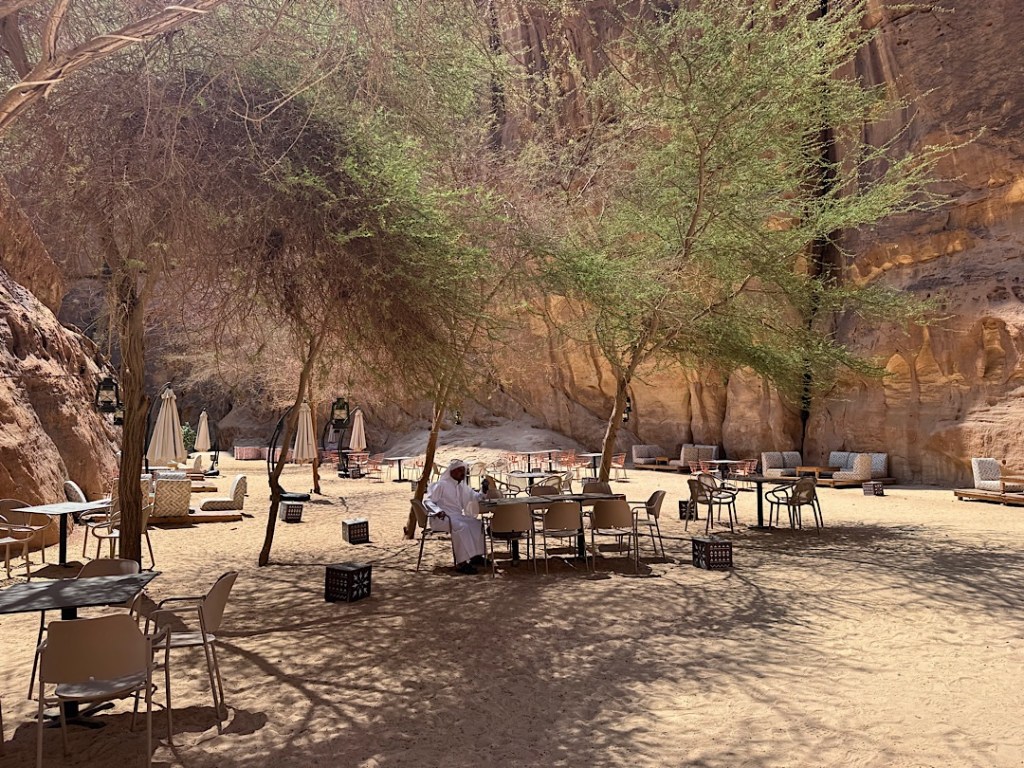
— After Hegra, Abu-Faisel drove us to a hike through a slot canyon that opened up to a pleasant outdoor cafe.
— We grabbed lunch, enjoyed a brief nap back at the Friday Suites, then took another ranger-led tour of Dadan.
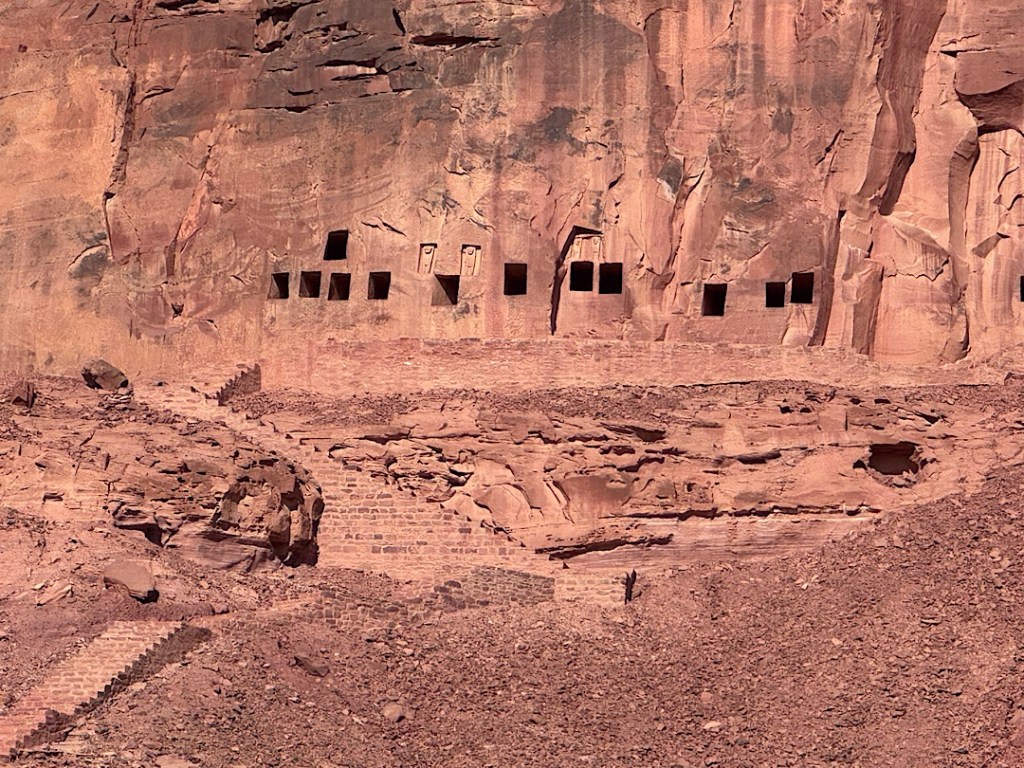
Contemporaries of the ancient Greeks and Romans, the Dadanites also created tombs in the walls of the cliffs.
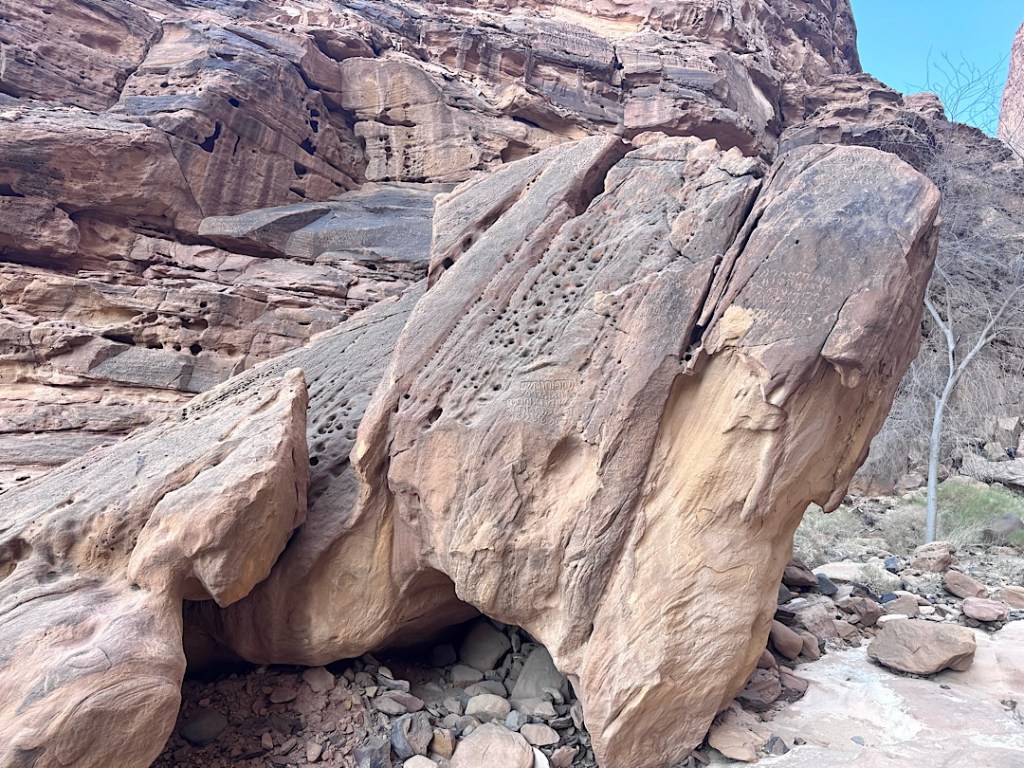
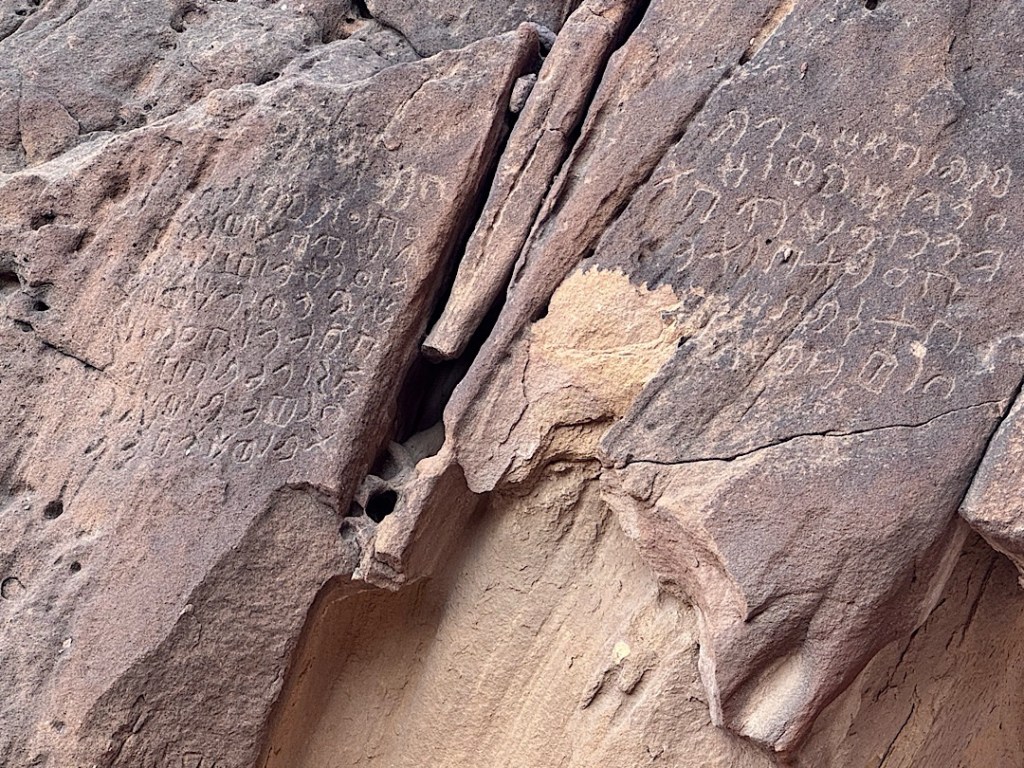
Their nearby site of Jabal Ikmah is called The Library because of the hundreds of inscriptions carved into the rock here.
You might overlook them or dismiss them as modern graffiti.
But they preserve an important record of several ancient languages.

— Shortly before sunset Saturday night, Abu-Faisel drove us up to a viewpoint overlooking the whole valley. We sipped Arab coffee and munched on green dates.
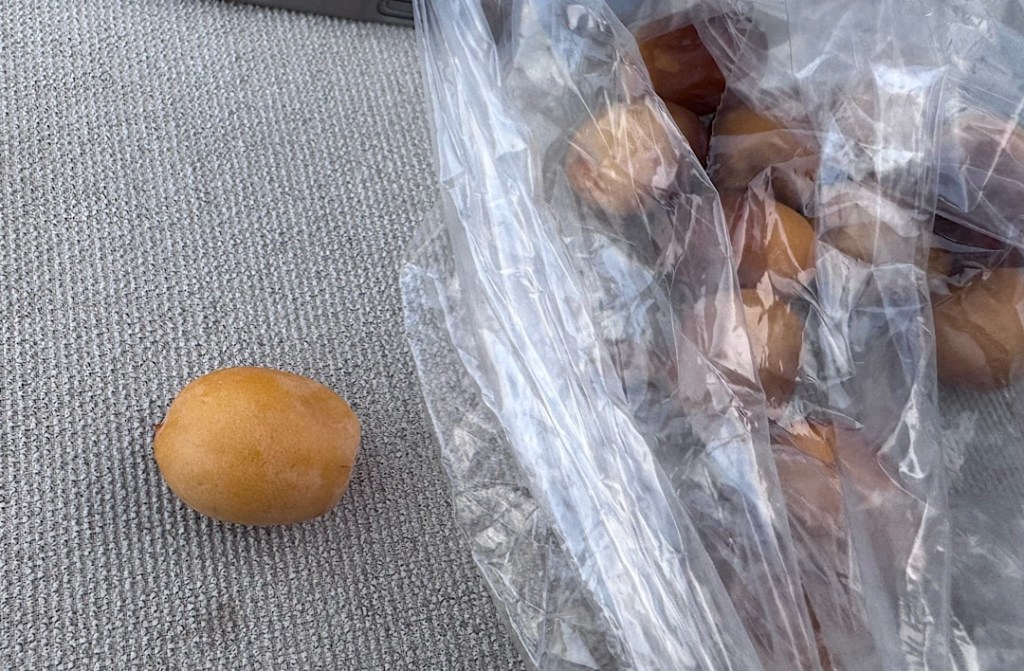
The green dates taste quite different from the dried ones we see in the US. Some 3 million date trees grow in Al Ula.

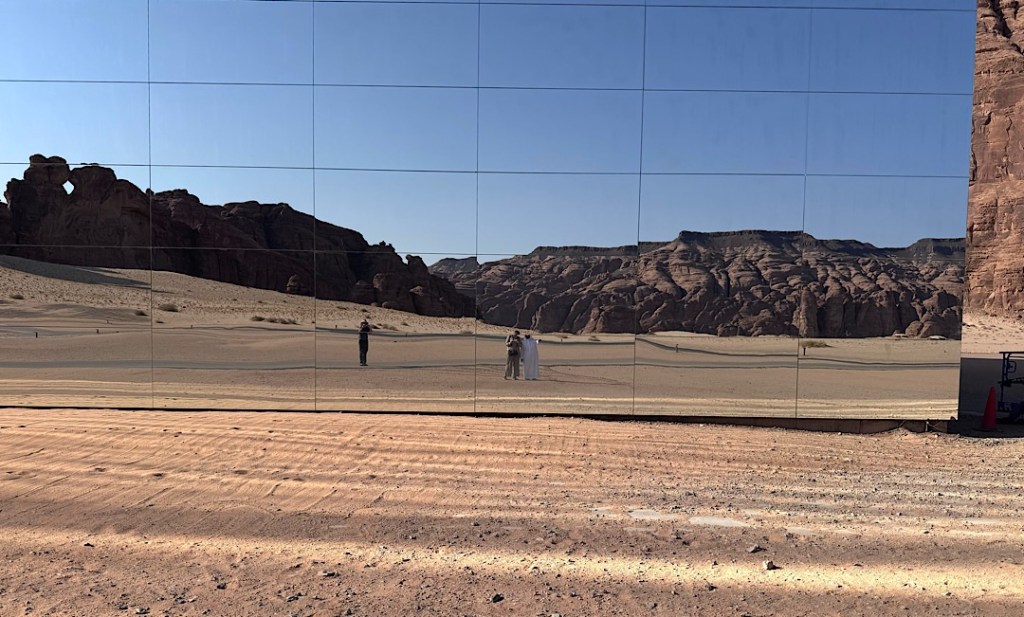
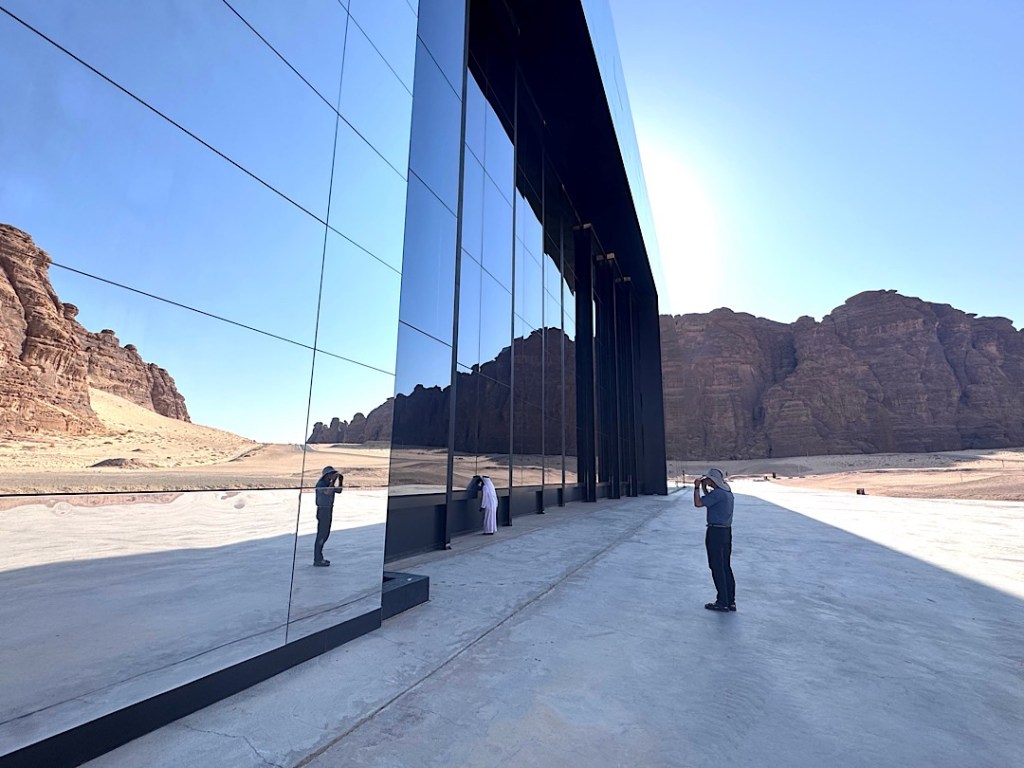
— Early Sunday morning we drove to the stunning glass-clad Maraya Auditorium, then walked around its exterior.
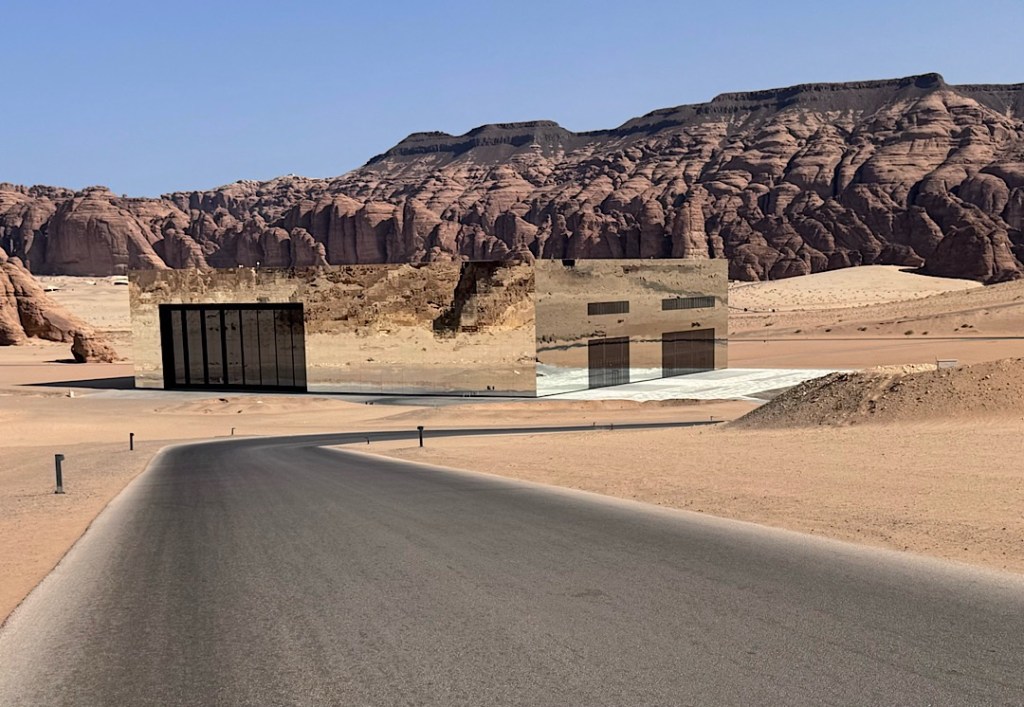
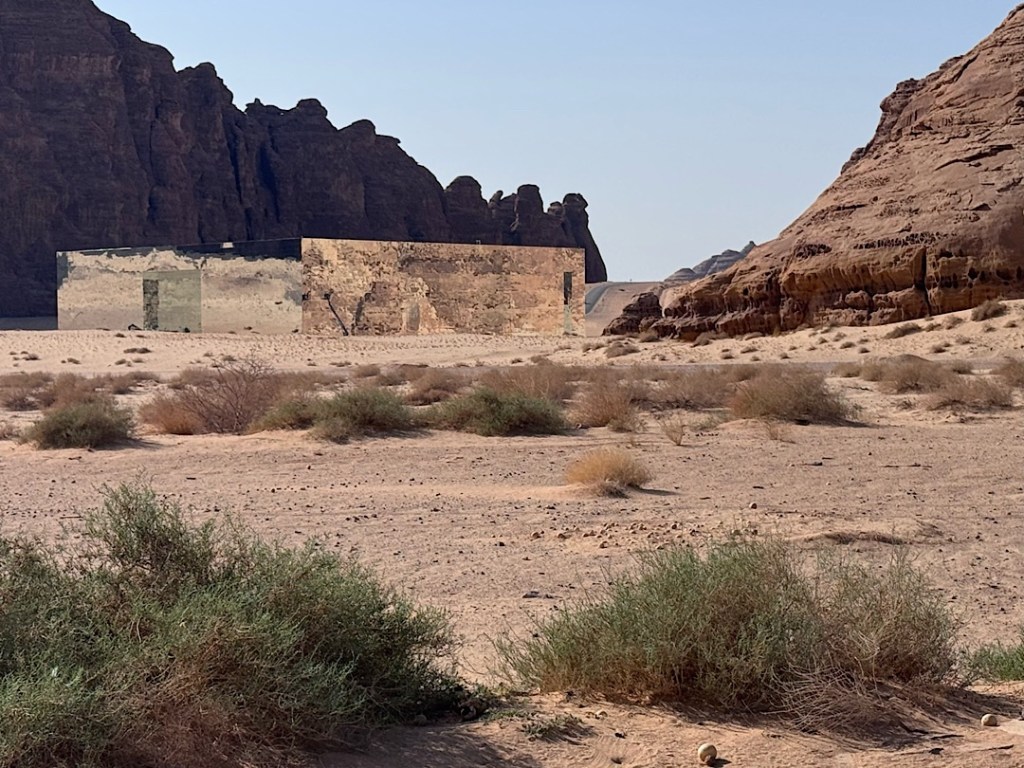
It’s said to be covered with more glass panels than any other building on earth. The beautiful surrounding landscape thus becomes all the ornamentation needed on the building’s simple form.
For lack of time, we didn’t take the tour of the interior. It would have been awesome to see a performance, but they don’t happen in the low season.

We enjoyed all these activities, but the one that impressed me most was walking through the residential section of Al Ula’s Old Town. Abu Faisel tacked this on Sunday morning — after our visit to Maraya and before he took us to lunch and then drove us to the airport. Built in the 12th Century, the warren of mud-brick dwellings was Abu-Faisel’s home for his first 11 years. Then in the early 1980s, the community got tired of living without electricity and plumbing and abandoned the quarter. Abu-Faisel’s family moved to the nearby 500-tree date farm owned by his father.
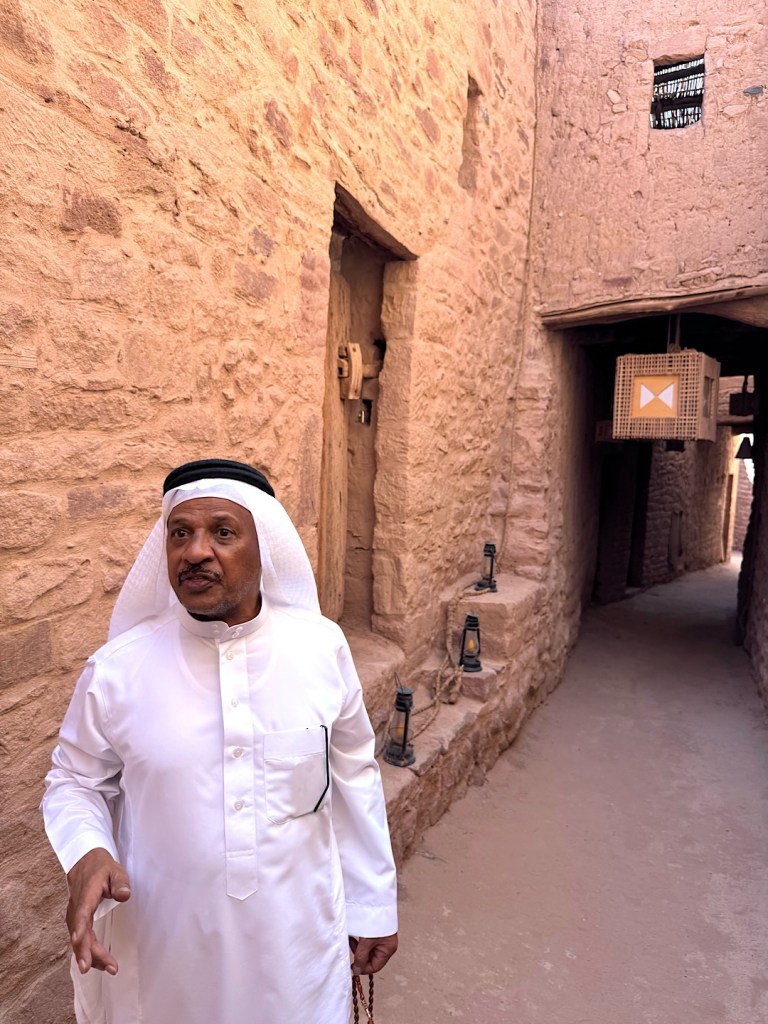
Abu Faisel showed us the building where he was born and the well from which he and his brothers fetched the family’s water.
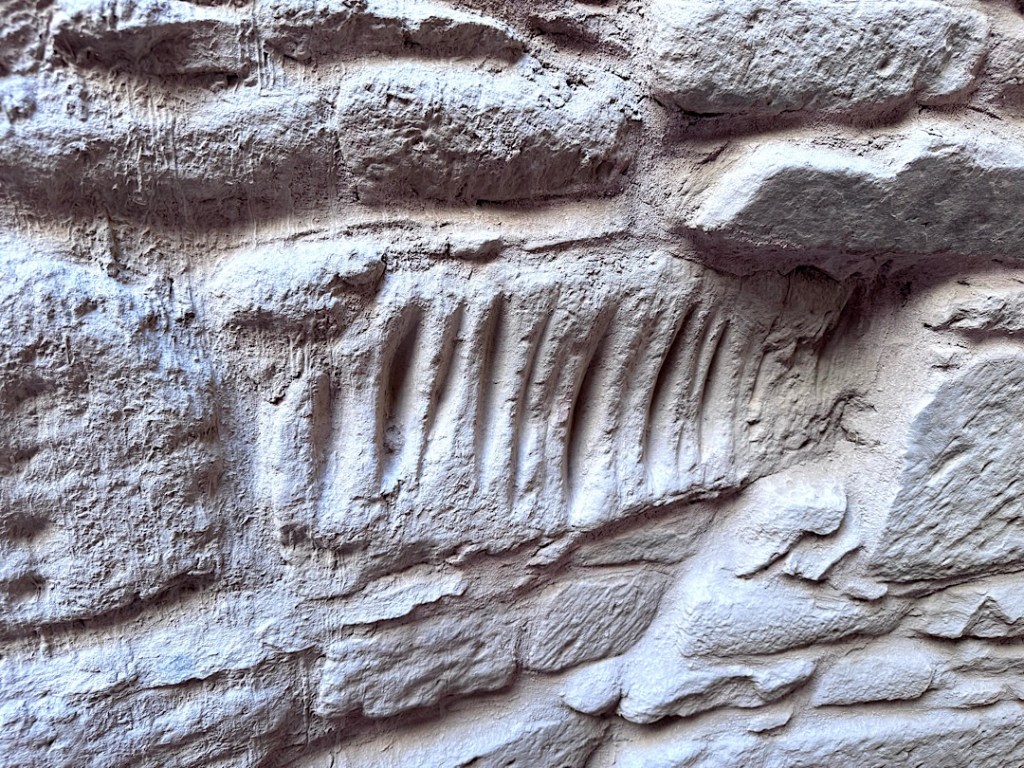
He could explain every mystifying detail, like these marks on the wall. This is where folks sharpened their kitchen knives, he told us..

Since UNESCO (in 2008) declared Hegra to be a World Heritage Site (Saudi Arabia’s first), Al Ula’s Old Town has come within the sights of the crown prince and his planners. Today many of the structures have been renovated. Some are filled with interesting educational displays. More reconstruction and ornamentation is planned.
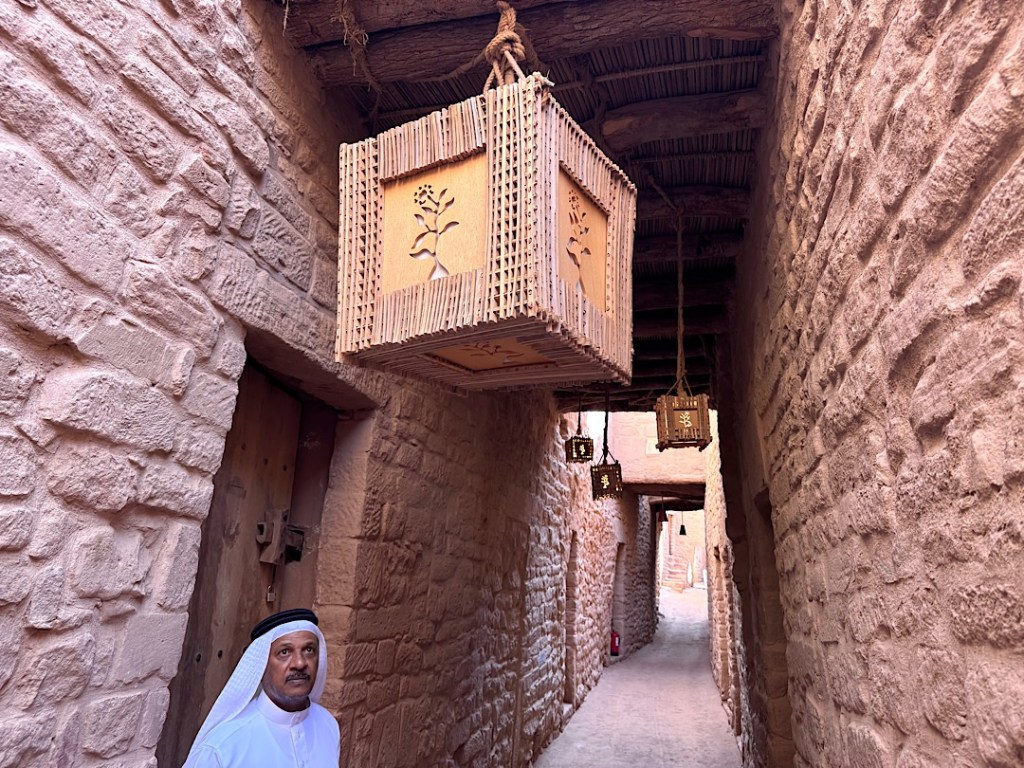
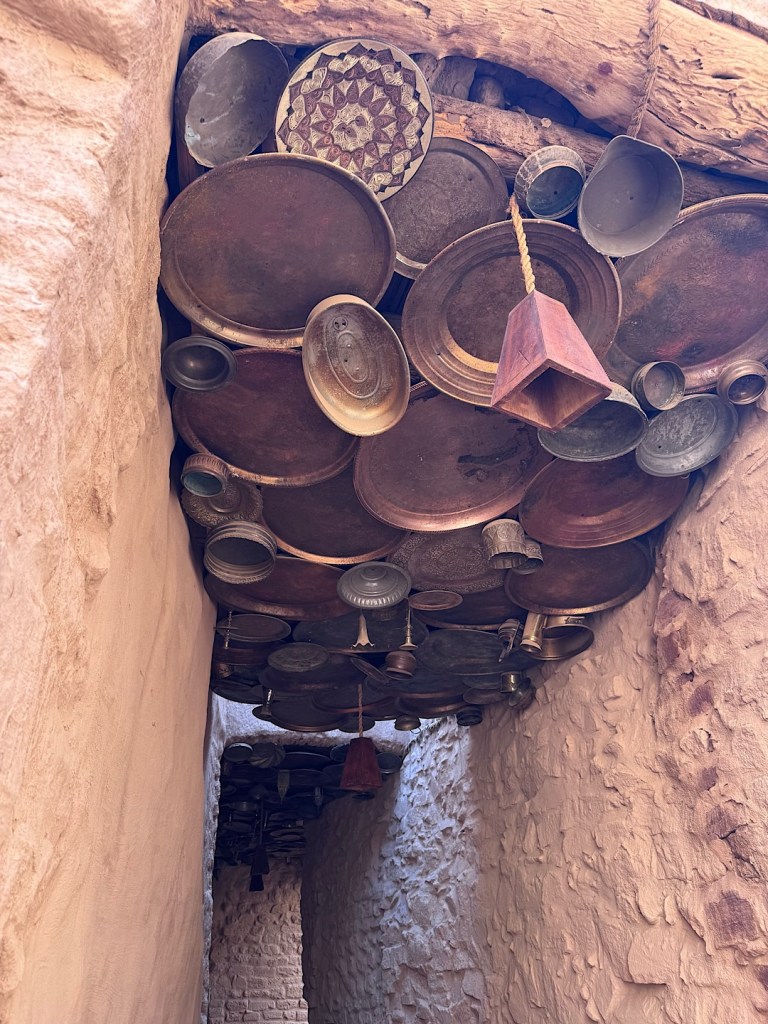
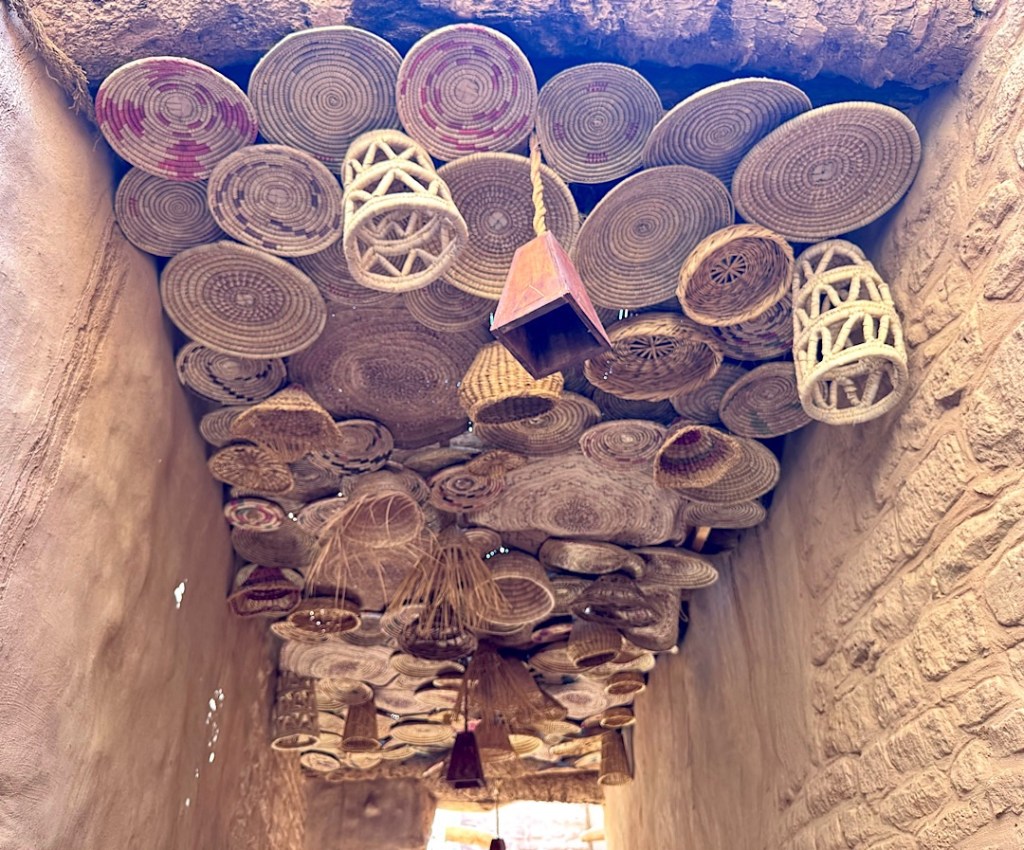
Amazing wooden lights hang from some corridors.

As this has happened, the Saudi government has condemned and demolished big chunks of the adjoining parts of the central city. Five years ago, they took Abu-Faisel’s family farm through eminent domain. Before this whole process started, Al Ula had 85,000 residents. Now the number is around 50,000, and the Powers That Be plan to continue making longtime residents move out of town until the population is down to about 25,000. Abu-Faisel couldn’t (or wouldn’t?) say why, but Steve and I noted that as the number of tourists expands, this plan will limit the number of Saudis exposed to corrupting foreign influences. (All those bikini-clad women lounging around the fancy resort pools! Alcohol! We heard a rumor it was already available at one of the resorts — the only source in the whole kingdom, except for certain secret sources in Riyadh. But how can more bars not be on the horizon?)

Abu Faisel never ranted or expressed anger about any of this. For the most part he sounded philosophical. Saudi citizens aren’t allowed to protest.

As for us, we were grateful for the insight into how things worked. The crazy heat was a small price to pay for having one attraction after another almost to ourselves. In the winter, all the parking lots are full, Abu-Faisel says. Food stands have long lines; at some restaurants you need a reservation.

Being in Al Ula at this time of year, at this stage in its development felt like being in Sedona or Petra before anyone ever heard of them. The changes already taking place only deepened my sense of enchantment.

By the way, Abu-Faisel wouldn’t tell us how much we owed him for all the extra hours — the extra days! — of guide service until it was time to head to the airport. Then he stuck with his initial $400 price. He said if we didn’t feel we had gotten good value, we didn’t even have to pay that. I laughed.
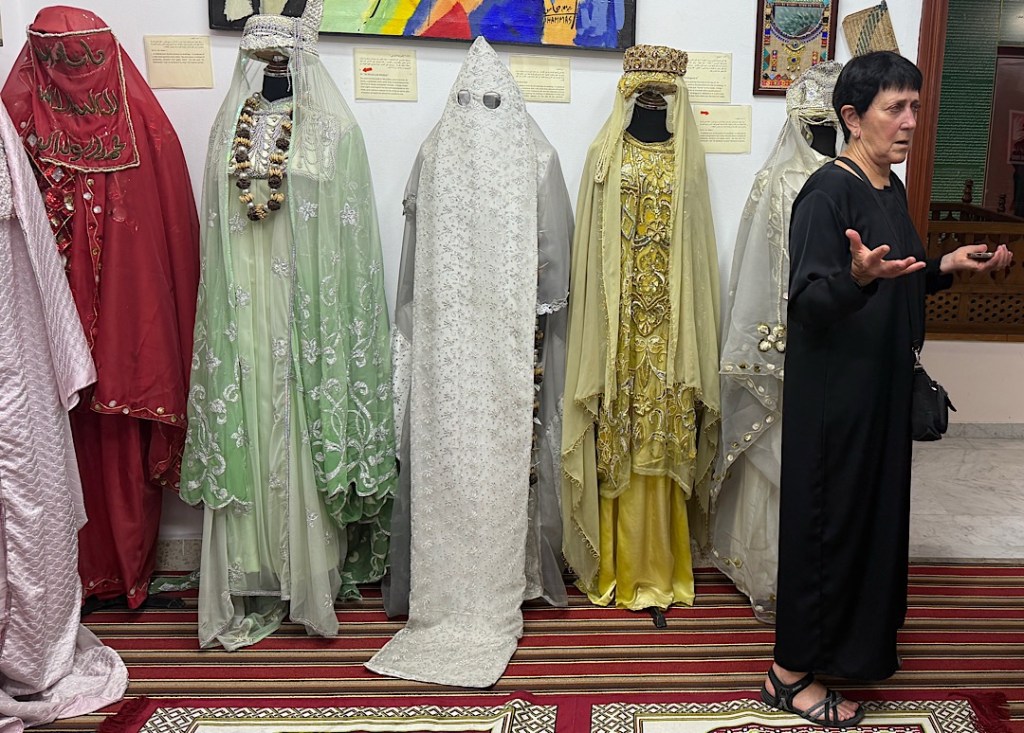
Me and my abaya — an Arabian diary

Tuesday, August 18

Lots of women in Paris wear abayas. Not me. I board our flight from Charles De Gaulle to Jeddah on Tuesday, August 18, wearing the green pantsuit in which I crossed the Atlantic the day before. All the advice to female visitors says the key to proper Saudi Arabian attire is dressing modestly. Cover your arms and torso and everything from mid-shin up, and you’re good. Although almost all of our fellow passengers, male and female, are be-robed, I don’t feel like anyone is staring at me either on the plane or once we land in the airport.

I don my abaya only after we’ve checked into our hotel room, a Holiday Inn on Jeddah’s waterfront. Although I’d worn it in San Diego several times over the years, here its thin synthetic fabric and loose fit startle me. With only a bra and underpants beneath it, I feel like I’m in a flimsy nightgown. Uneasy, I stand in front of our window overlooking the Red Sea and order Steve to check its transparency. He insists he can’t see anything beyond the black, so we sally forth.

The sun is minutes from setting and there’s a nice breeze off the water, and it’s still close to 100 degrees. But dressed this way feels almost like wearing nothing. Steve and I stroll along the corniche, taking in the sight of families picnicking near the water. We catch an Uber to a good seafood restaurant adjoining the municipal aquarium, and I’m comfortable throughout the meal. I decide wearing an abaya is fine with me.

Wednesday, August 19

Getting out of bed, it hits me: I don’t have to give any thought to what to wear. Score another point for abaya-wear!

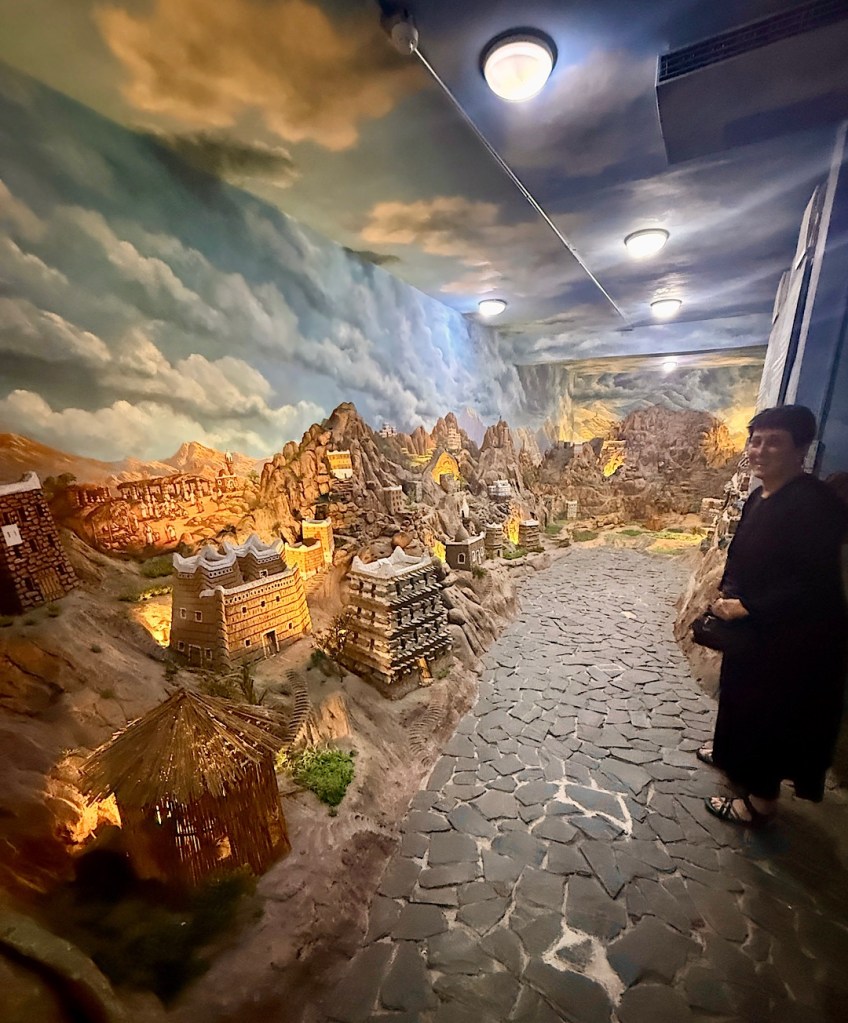
We’ve allotted this full day to exploring Jeddah. We start by Ubering to Al Tayibat City Museum for International Civilization, a private institution we’d read about. Built by a local businessman who spent almost 50 years collecting tens of thousands of rare cultural and historic artifacts, it opened in 1999. Steve and I walk inside and are stunned by the richness of its collections. Hundreds of rooms on multiple levels fill at least a dozen buildings, many built in the exquisite traditional style.

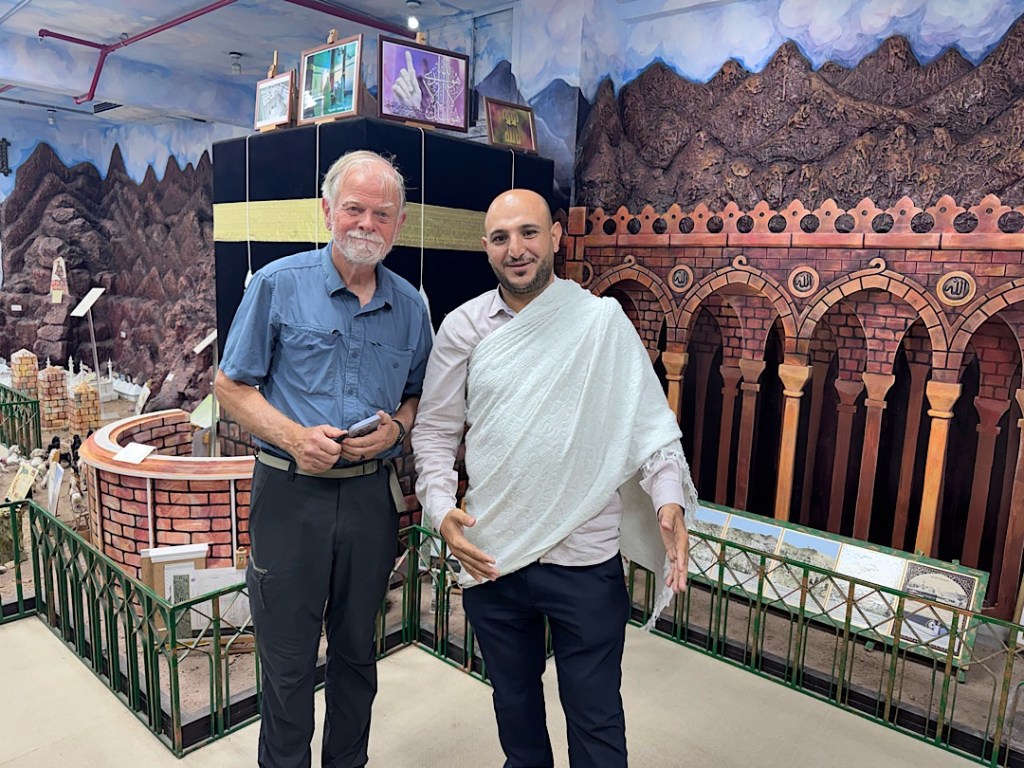
We seem to be the only visitors, and it turns out the massive complex will close at 1 pm, giving us only about two hours to explore it. A charming Egyptian ex-pat archeologist emerges to show us around. He’s amazingly knowledgable and teaches us a lot before we have to go.

He demonstrated how to put on the male pilgrim’s traditional outfit.
He explained some of the many fantastic dioramas.

After leaving the museum, Steve and I eat a quick sandwich near our hotel, take a nap, and devise a plan for the rest of the day. To my dismay, I’ve realized that I’ve lost the pretty black head scarf I packed for this trip; probably dropped it in the Paris airport, where it was too hot for a scarf. Not having any scarf is a problem. The one place all women must cover their hair is in mosques, and Steve and I want to visit a one nearby, the Al Rahmah Mosque, famous for being built so that at high tide it appears to be floating on the water. Fortunately, it’s close to one of the best shopping malls in Jeddah.

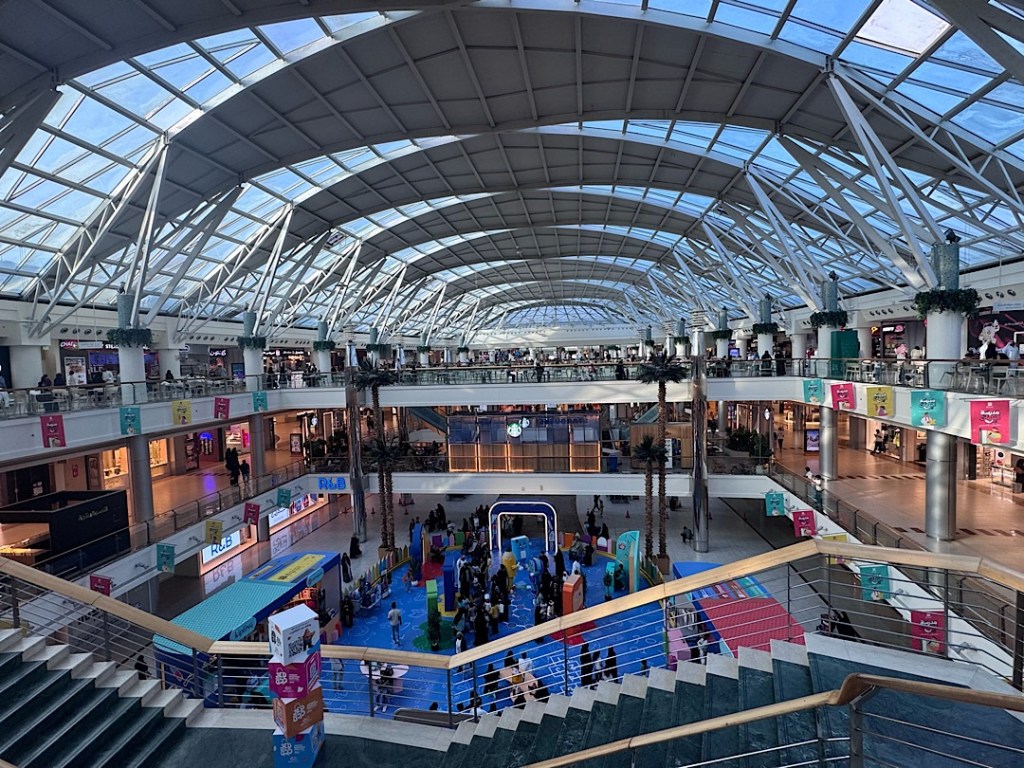
Malls are also a big attraction in this city, where the heat shuts down almost everything else for half of every day. They’re social centers where people can shop and graze and mingle in air-conditioned comfort. Steve and I resolve to find me a replacement scarf at the Red Sea Mall.

It’s three stories of apparently endless commercial possibilities, gleaming and seductive.

Perhaps because of its enormity, we struggle to find a place that sells scarves, but we finally make our way to the right level and section. The ladies in one shop pluck out a simple black one and in seconds whip it into a tidy containment apparatus for my (admittedly minimal) hair. I remove it, pay the 25-riyal price (about $6.65). Then Steve and I get a cup of coffee nearby and watch the shoppers stream by.

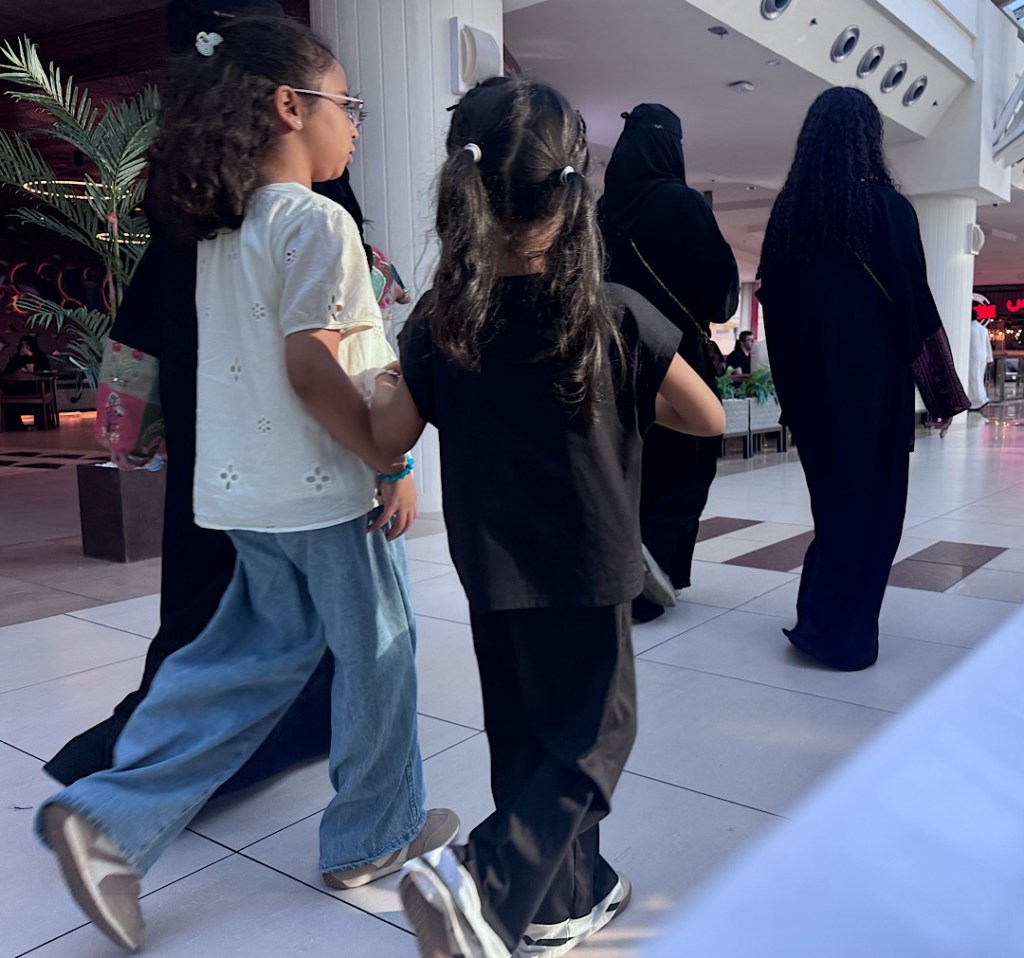
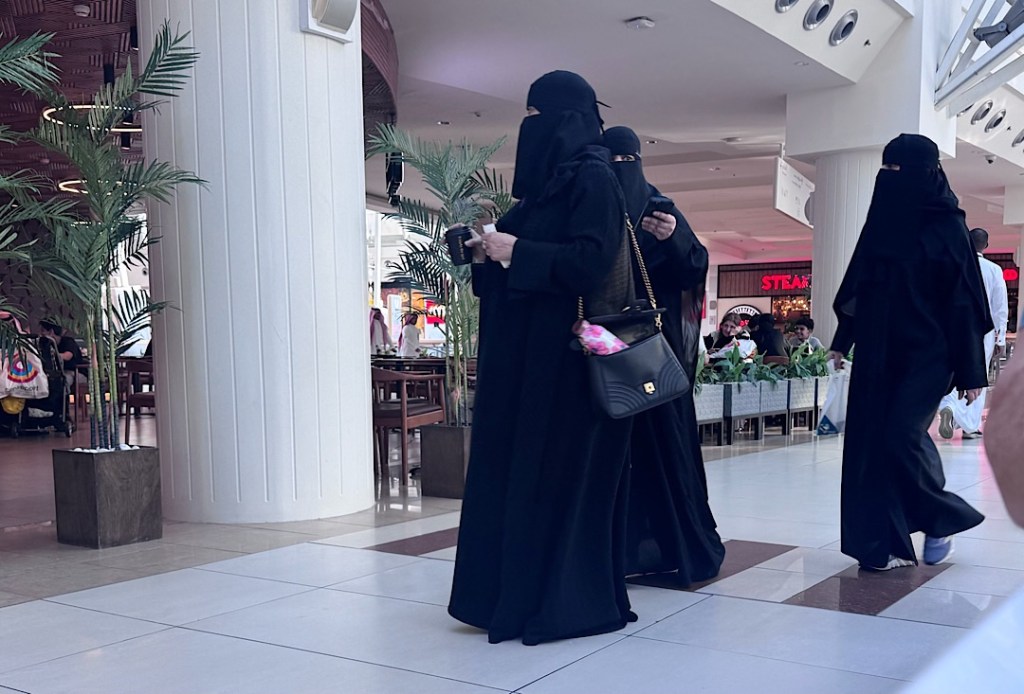
We note that Saudi girls dress just like they do in the US.
It’s their moms who cover up so much.

The guidebooks say women in Jeddah don’t have to cover their hair, but we see almost none who are bare-headed (as I am). The vast majority also are wearing athletic shoes. It makes me resolve to start using my single pair of trainers instead of the sandals I have been wearing. Maybe I’ll fit in better. I’ve begun to feel self-conscious about the mousiness of my abaya. The gowns of the women in the mall and on Jeddah’s streets are pleated or tailored or inset with panels of embroidered black fabric or adorned with other subtle refinements. I’ve also begun to wonder what’s under their robes. I’m starting to suspect it’s not almost nothing, like I’m wearing. I stew over this.

When we leave the mall, I avoid direct sunlight and keep my legs closer together as I walk. At the mosque, I fail to cover my hair with anywhere near the efficiency of the shop ladies.

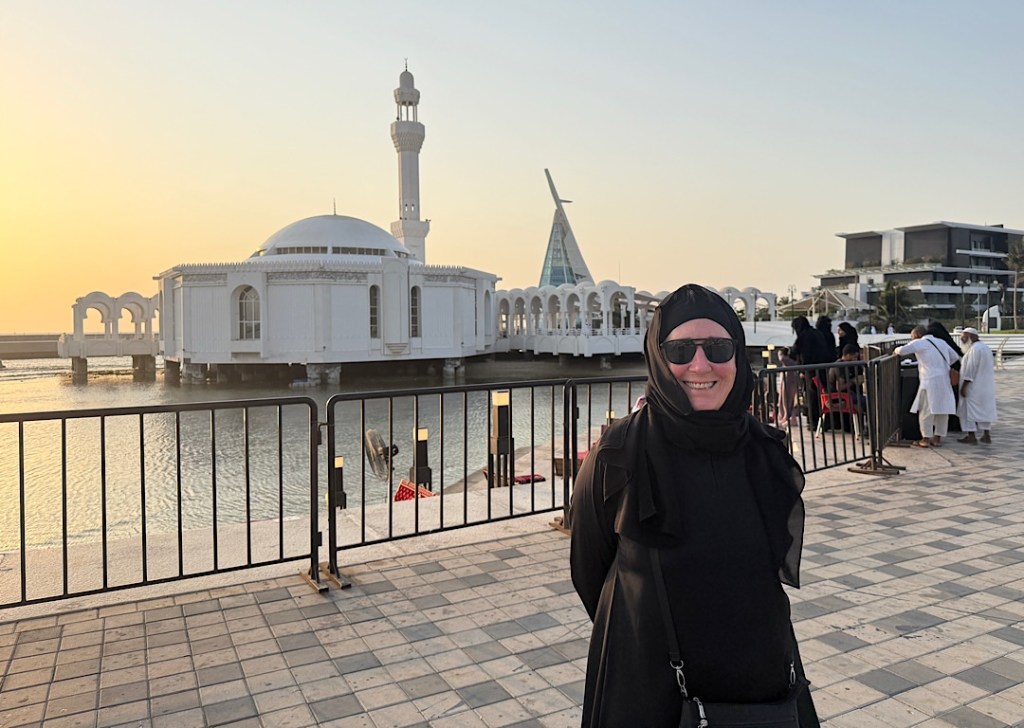
That’s the so-called Floating Mosque. (But it wasn’t high tide so it didn’t look like it was floating.)

As it turns out, the mosque is closed. So is the nearby Jeddah Yacht Club, which looks to us like it may still be under construction. We get luckier on the restaurant front and eat good seafood for a second night.

Thursday, August 20

Because we are not Muslims, Steve and I cannot visit the city of Mecca, the holiest city in Islam. Until 2021 we also would have been prohibited from entering large parts of the second-holiest city, Medina. Then as part of Saudi Arabia’s modernization, the rules changed. In Medina, non-Muslims still may not enter the inner hallways of the Prophet Muhammed’s Mosque (the first he ever established), nor may they visit his grave. But now they can get pretty close to both, and we want to do that.

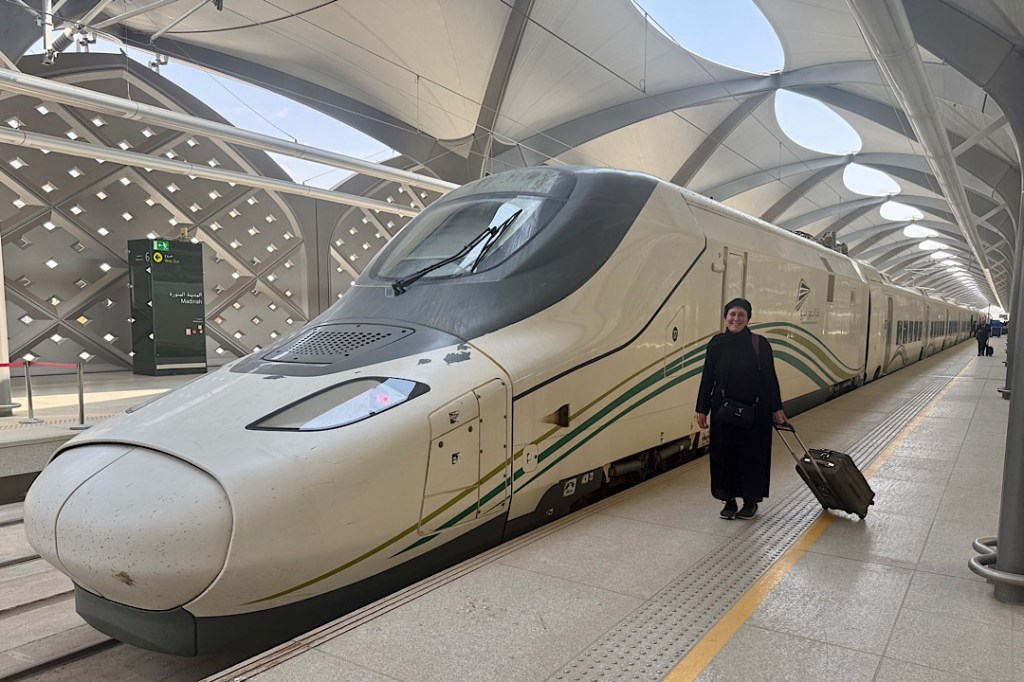
We have seats on a 1:30 pm high-speed train that will take us from Jeddah to Medina. That gives me time in the morning to ask Gemini: is it okay to wear only underwear under my abaya? The AI bot’s answer shakes me. It advises me to consider my abaya as “an outerwear layer” only, rather than my “primary garment.” Accidental exposure of my unclothed person in public could “result in fines, detention, or significant distress.”

This doesn’t quite make sense. My abaya has no snaps or bottoms. It can’t accidentally open, and it’s too narrow to get blown up by some unexpected breeze. Still, I once again badger Steve to scrutinize its transparency. He sticks to his insistence no one can see through it.

Gemini also alerts me that even though Saudi law says women don’t have to cover their hair, Medina is such a conservative and religious city, hiding one’s hair is highly recommended for all women. I’ve come up with a new plan for using my scarf to do that.

I don’t implement it until after we pull into the station (after a fast and comfortable ride).

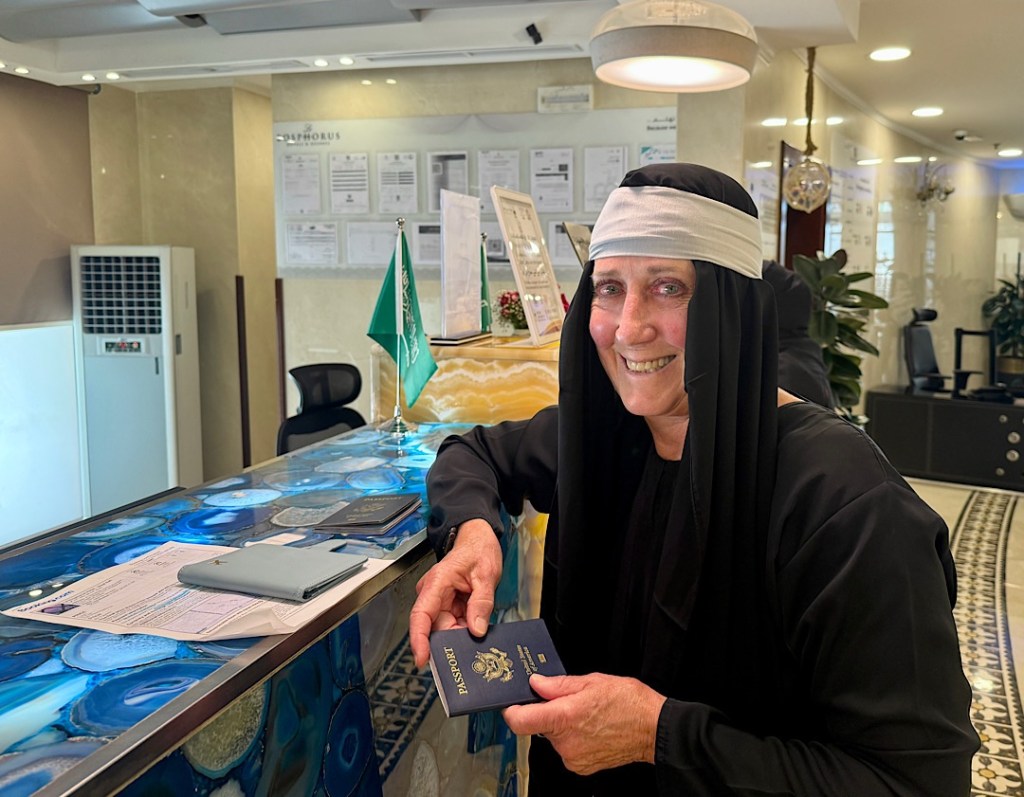
In one of the train station’s women’s washrooms, I put the scarf over my head, then over that secure the gray headband I got in the two-headband pack I bought at my CVS back in La Jolla. (I’ve somehow already lost the black one I used in the photo above.) The result makes me feel like I should be be starring in some Christmas pageant, but at least it’s secure and reasonably comfortable.

Here I am, checking in to our hotel in Medina.
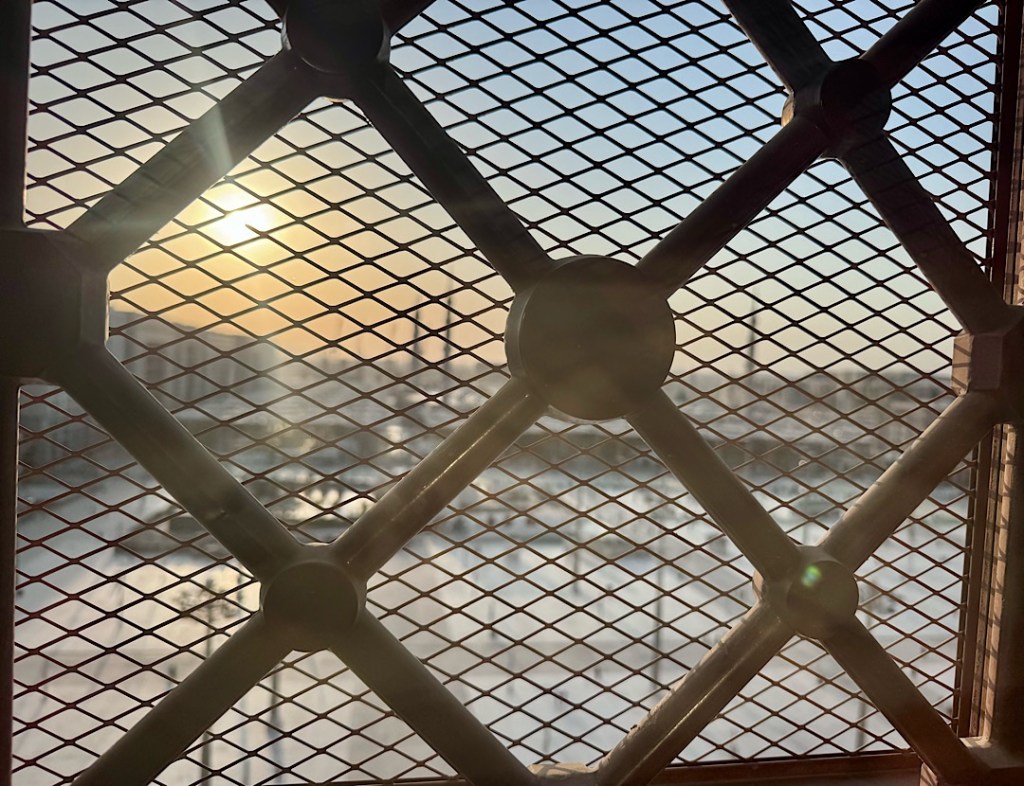
Our room overlooks the enormous plaza in front of the Prophet’s Mosque. If I had better focused this photo out the window, you would also be able to see the green dome under which the founder of Islam is buried.
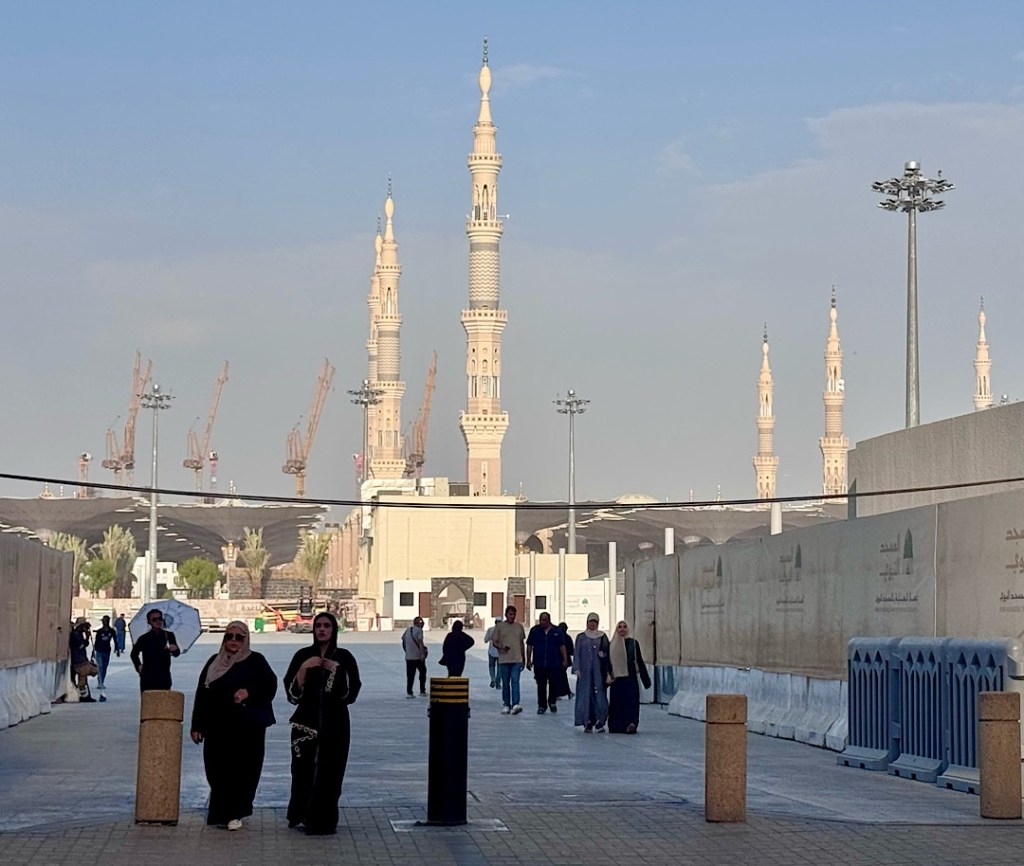
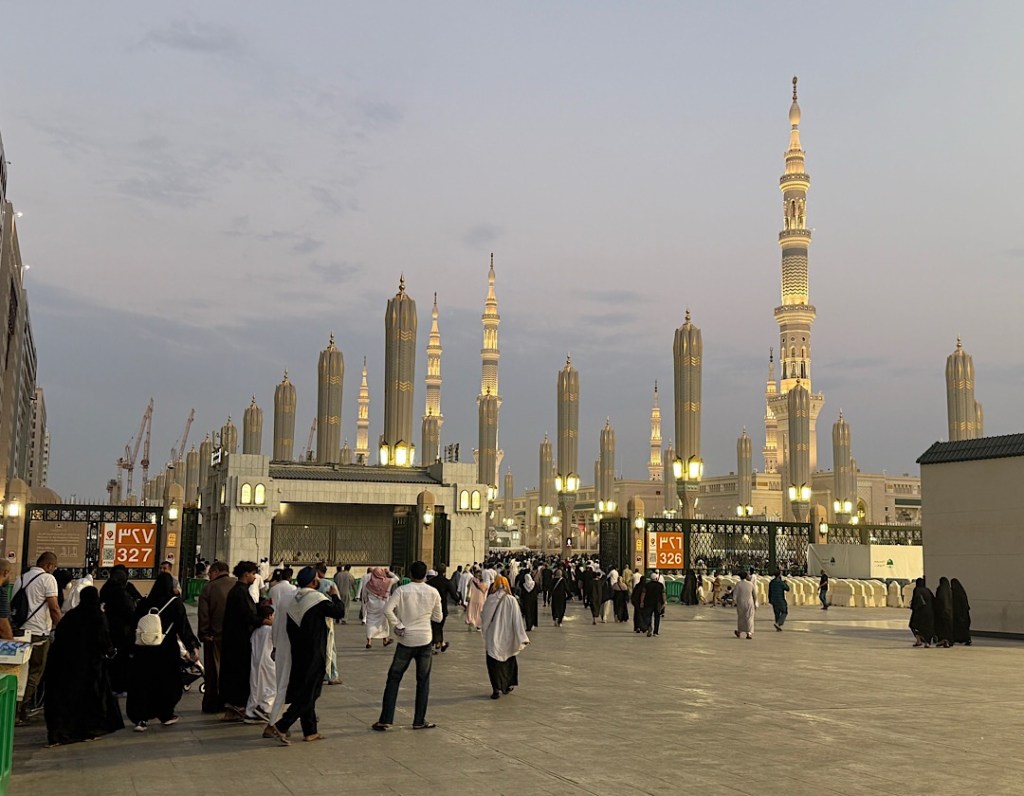
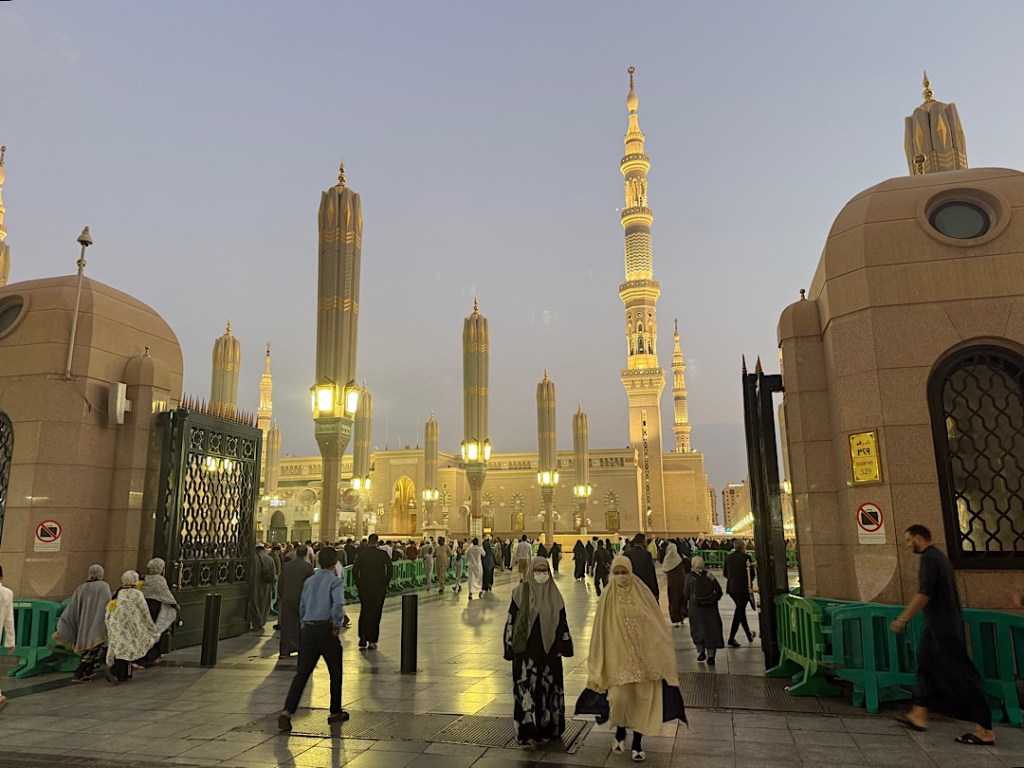
Visitors can enter this plaza (but can’t go into the inner complex.)
Even from the outside, the sunset call to prayers is mesmerizing.
We watch the huge crowd of men beginning their devotions. (Female worshipers are somewhere else.)

Friday, August 21

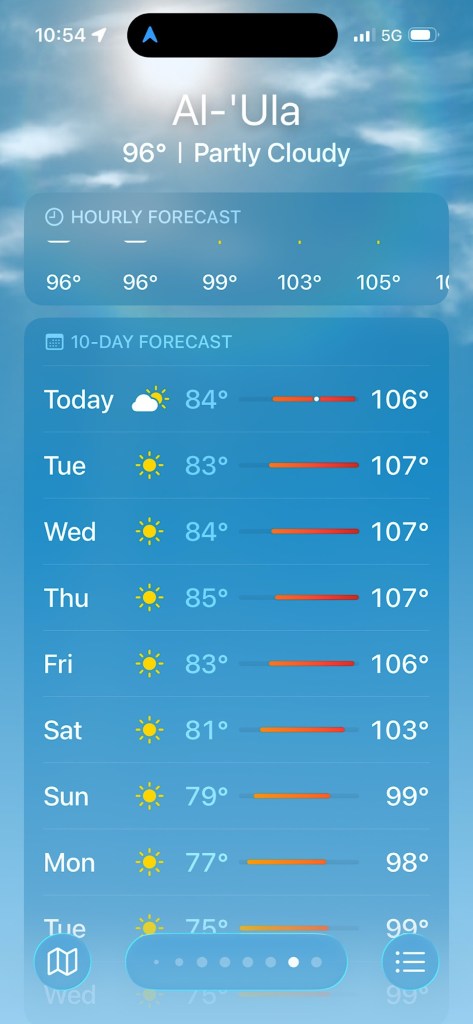
Today we’re heading north to the archeological and geological wonderland that is Al Ula. Our experience there deserves its own post; I’ll try to write that next. Here I’ll just say I’m still wearing both my abaya and my improvised head covering when I get on our 8 am bus from Medina.

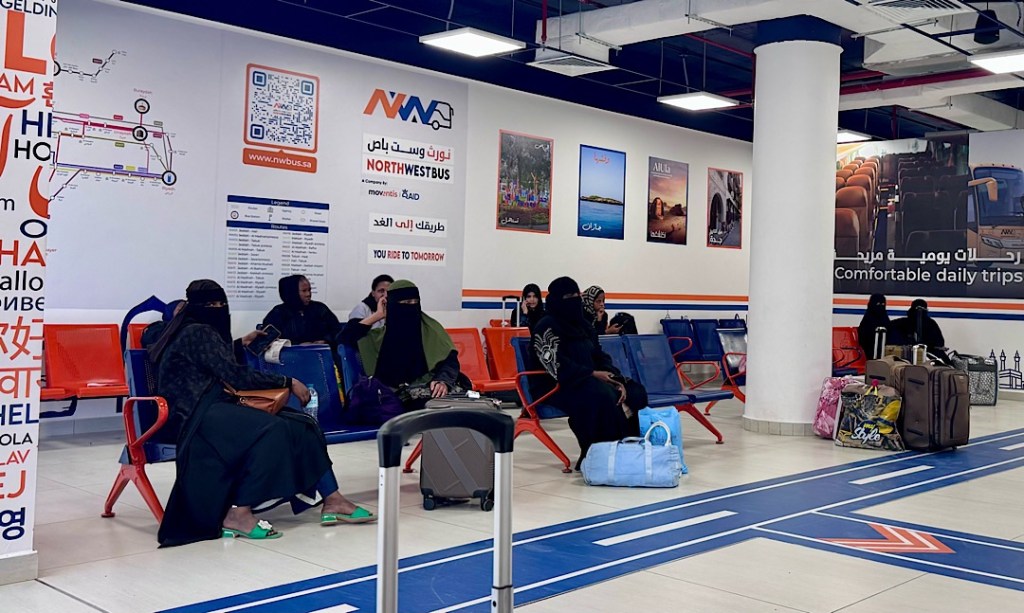
Almost all the other ladies waiting for the bus are heavily veiled.
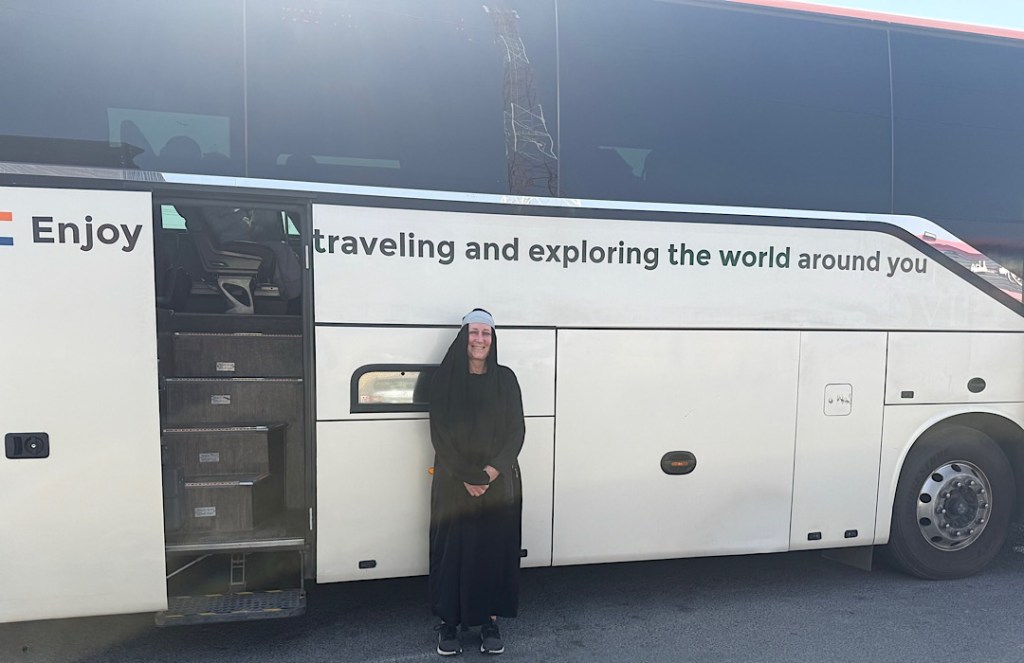
Our bus

Steve has read that Al Ula is one of the most permissive places in the kingdom. So when we arrive, I ask our innkeeper-cum-tour guide Abu Faisal if it’s okay for me to switch to Western garb. He is effusive in his assurance that lady visitors can wear almost anything here. Shortly before sunset, when he takes us to the town’s most famous formation, Elephant Rock, there’s instant confirmation of the sartorial laxity.

See the Chinese lady tourist dressed in the skimpy evening gown being photographed by her male companion.

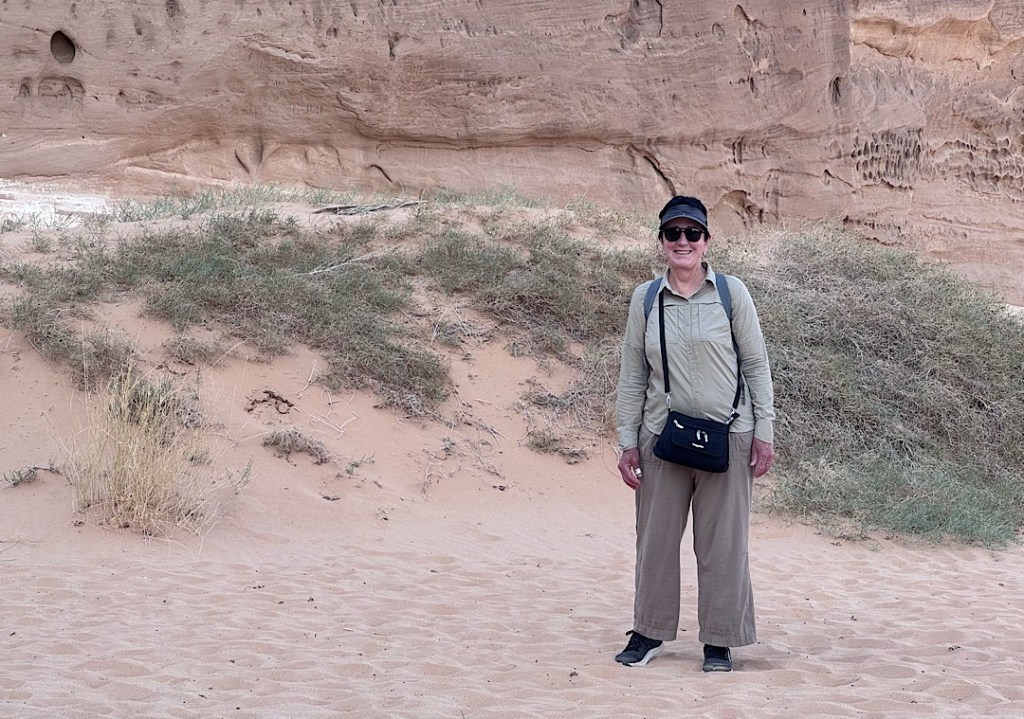
Over the next two days, I switch to drab safari pants, a long-sleeve shirt, and my visor. I’m more constricted than I would be in my abaya, but I never once worry about getting fined or embarrassed by what might show as I’m scrambling over the rocks.

Sunday, August 23

Flying back to Jeddah from Al Ula, I wear my Western clothes on the plane, then switch back into the abaya when Steve and I head out for dinner. At first the familiar black robe feels like a welcome reprieve from the constrictions of my pants and long-sleeve shirt. But over the course of the next two days, our last ones in the kingdom, I finally hit the limits of the August heat and my offbeat costume.

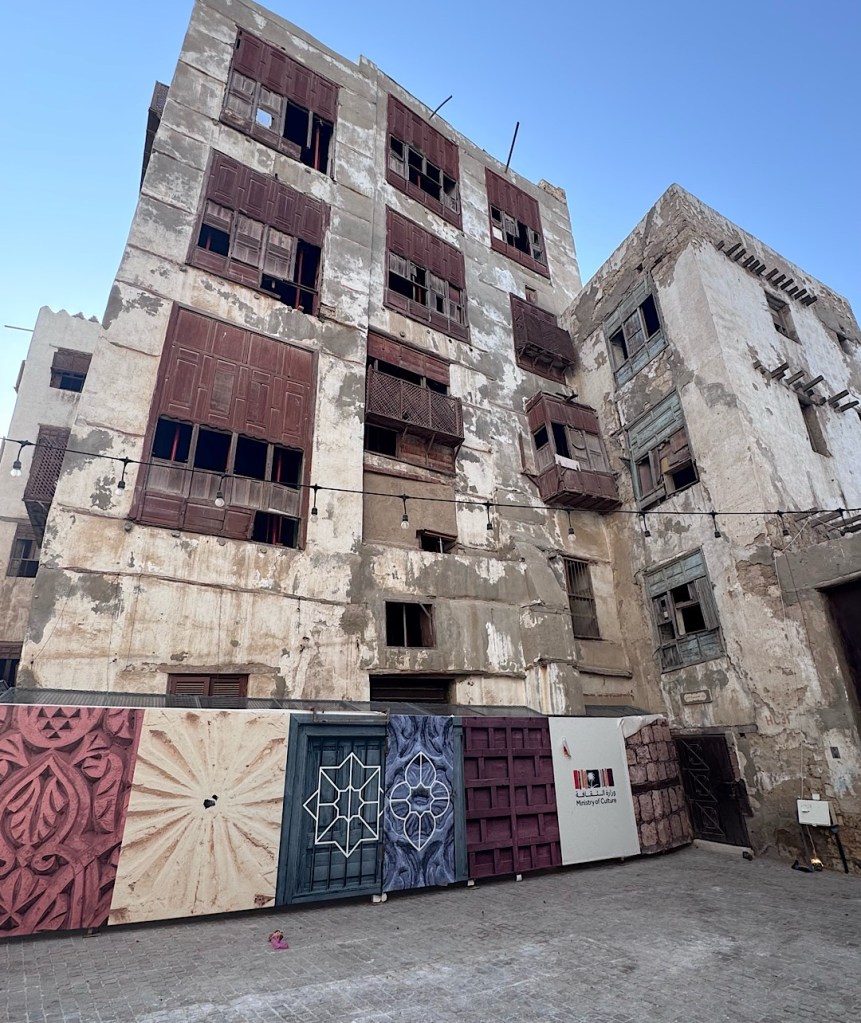
We’re staying in the oldest part of the city, Al Balad. At the core of the Old Town are narrow twisting lanes dating back to the Middle Ages. Many are in ruins.

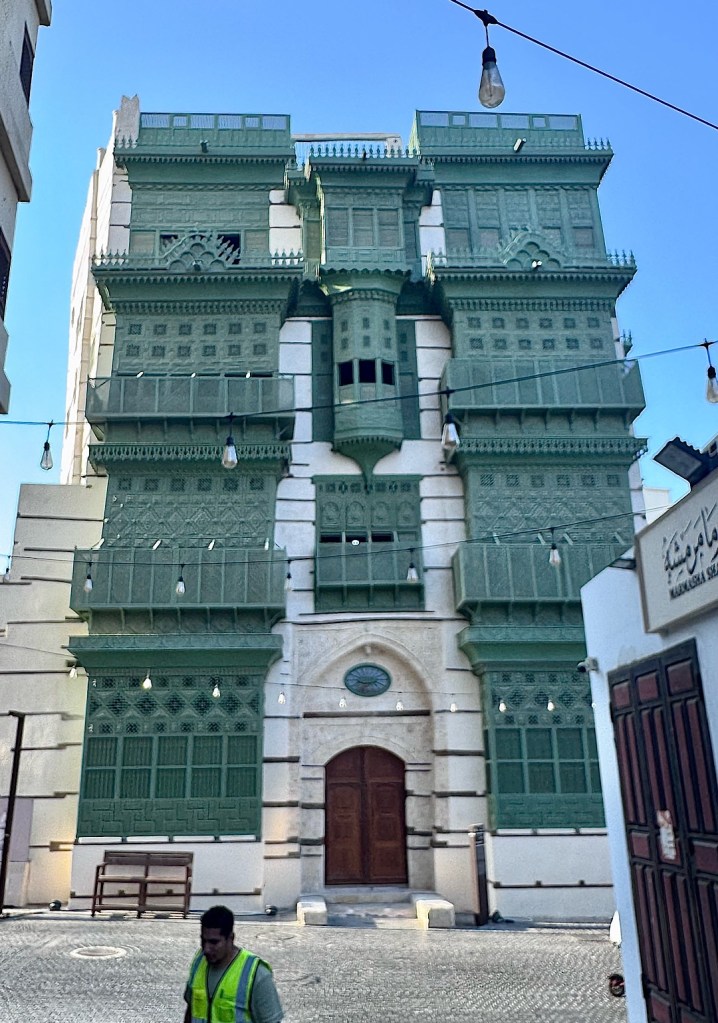
Others that have been renovated and look magnificent.

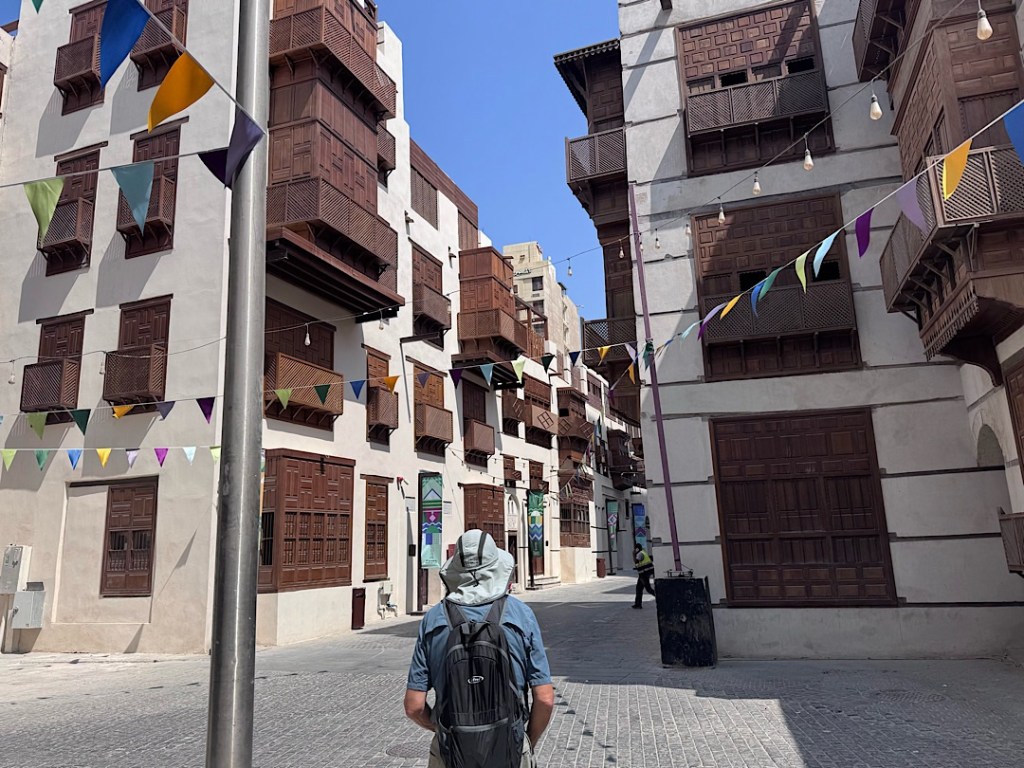
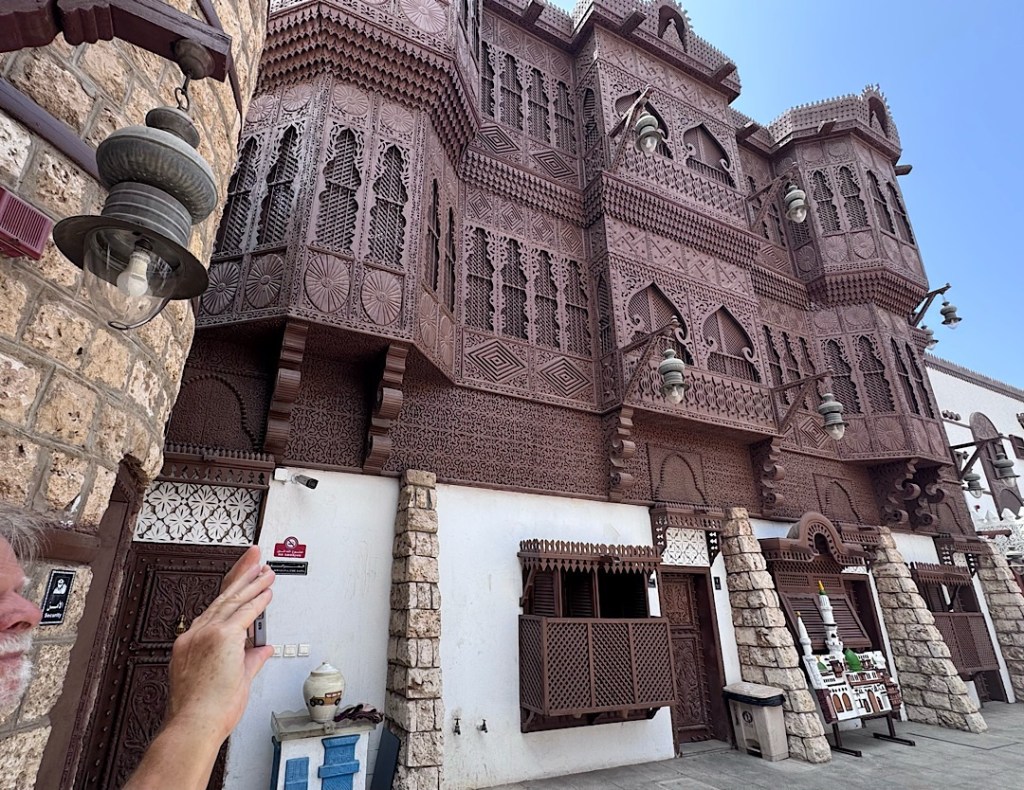
Some appear to be new but dressed up with the traditional wooden balconies.

After dark, the market streets fill with shoppers and pulse with commerce and convivial interactions. If the quarter were all fixed up, I think it could be enchanting, a vision apparently held by the crown prince (MBS). In recent years, the urban authorities have gobbled up large blocks of the properties inside and adjoining the old city, forcing longtime residents to move. Within the heart of the Old Town, the Ministry of Culture has blocked off so many of the passages it’s hard to get around.

Deterred by all the construction roadblocks on Sunday night, Steve and I walk Monday morning to a museum that sounds like it should be fascinating. (The restored home of a wealthy merchant, it reportedly includes a ramp that enabled his camels to have access to the rooftop.) One site has told us it will be open until noon; another says 11. So we arrive around 10, but it’s closed up with no signs hinting it will ever be open. We look for a couple of other restored mansions, but can’t find any.

During our week in Saudi Arabia, we don’t see a single dog. But the streets are full of skinny cats and kittens.

We finally give up and spend the rest of Monday relaxing in our air-conditioned hotel room. On our final morning in the kingdom, we try sightseeing one more time, setting out a bit before 7 am. We hope it will be easier to meander before the sun gets too high.

Wrong again. We last only 45 minutes before dragging back to the hotel. So much sweat is pouring from me, it makes my abaya stick to my arms, turning it skin-tight. Back in our room I strip it off and hope it will dry out before we have to pack and leave for our flight to Africa.

You may be wondering what shape it was in after the week of almost-constant service. Before we left San Diego I had hand-washed it and noted with delight that it dried in just a few hours. I had planned to wash it every night I wore it in Saudi Arabia. To my amazement, however, it never seemed to need laundering. It still looked impeccable just before I packed it back into my suitcase — spotless and unwrinkled. I detected just a hint of my Dove Advanced Care Deodorant.

So I guess that’s another point in favorite of my abaya. I’d wear it again any Halloween.

Jeannette of Arabia

For most of my life, I assumed I would never get to Saudi Arabia. I’m not Muslim, nor have I ever worked in the oil industry. I am an avid traveler, but the Saudi government never permitted any tourism. Things changed with the rise to power of Crown Prince Mohammed bin Salman (aka MBS).

It’s MBS who has pushed the kingdom’s recent liberalization, allowing Saudi women at last to drive (as of 2018). It’s he who envisions Saudi Arabia developing into a major tourist magnet, generating revenues that could supplement the oil revenue when that resource inevitably dwindles.

The government began granting the first tourist visas in 2019, but the overture didn’t make me rush online to book my Air Saudia tickets. For one thing, Covid was about to shut everything down. Other destinations in the Middle East also seemed more interesting. In the years that Steve and I have worked as volunteer liaisons between Women’s Empowerment International in San Diego and the Nyaka organization in Uganda, we’ve made several trips to visit our Ugandan partners. To break up the long journey to central Africa, we’ve stopped and spent some days in Dubai and Abu Dhabi, Oman and Qatar. Now, before we head south to embark on our Madagascar adventure, we’ll be visiting Uganda once again. This time a stopover in Saudi Arabia finally beckoned.

And why not spend at least one week of our lives with one of the three biggest dogs in the region? Steve and I have already traveled in Israel. Sadly, we missed the chance to visit Iran during that brief window a few years ago when it was safe and practical for Americans to go there. That leaves Saudi Arabia, a wellspring for so many creations — astronomical, mathematical, architectural, literary, religious — that have shaped modern human civilization.

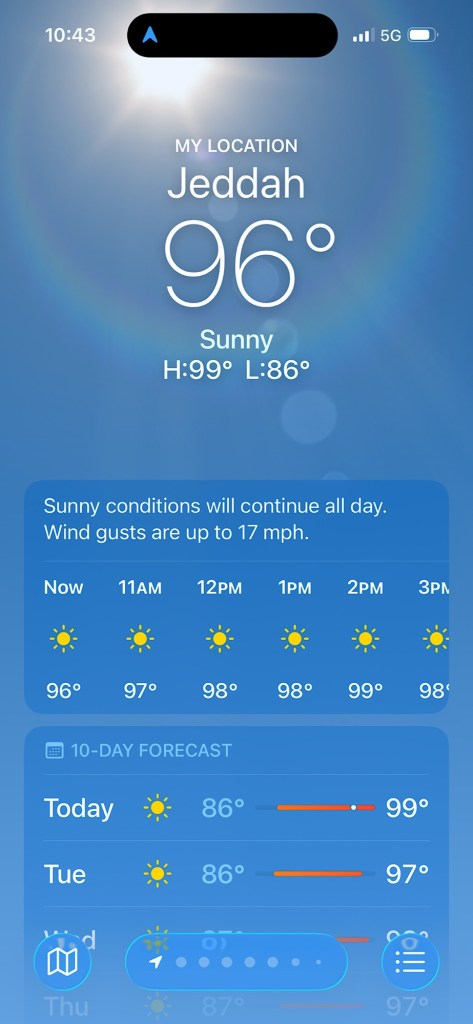
I did think of a few arguments against going. For one thing, the relentless August heat, around 100 degrees for most of every day, might be overwhelming.

In that oven, I also would be wearing strange garb. I wouldn’t be expected to cover my face. Saudi law no longer forces women to do that anywhere in the kingdom. But informed sources advise that wearing an abaya (the long Saudi woman’s robe) is considered a sign of respect. Nowadays, abayas don’t even have to be black; ladies can venture out in public in other colors.

I just happened, however, to have a simple black abaya that I picked up in Oman in 2017. For this trip, I resolved, my abaya would rise above its status as a mere costume. I would see if I could wear it exclusively every day for a week. In my next post, I’ll report on how my abaya and I fared.

The strangest plane ride of my life

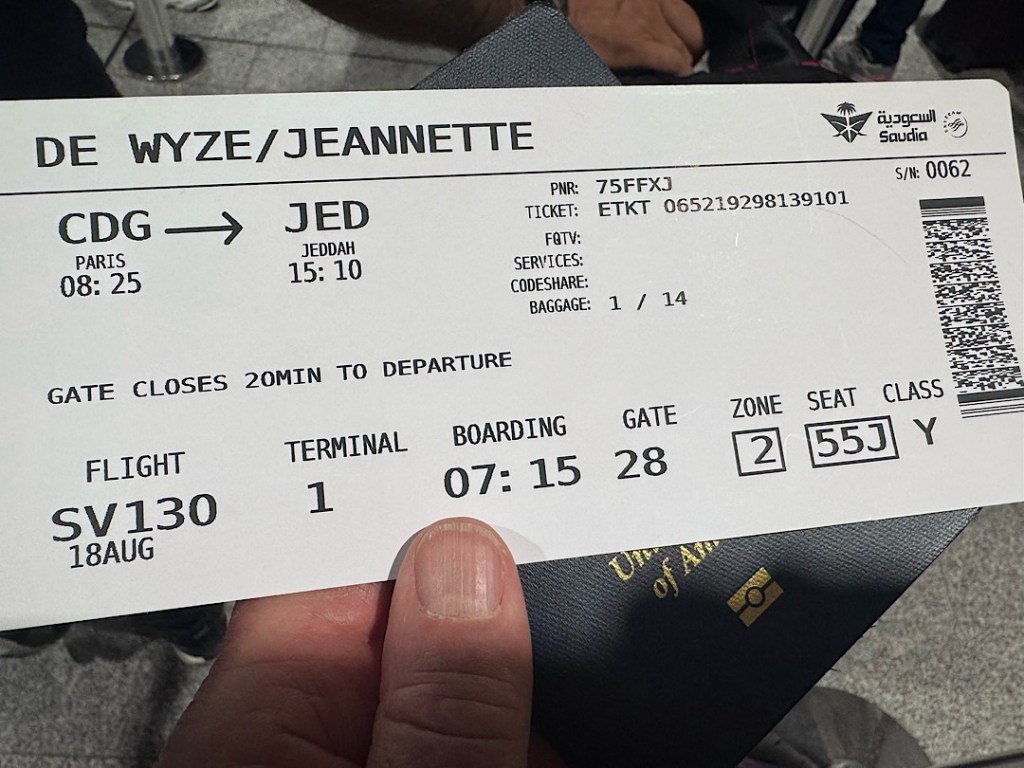
To start this trip, we flew Delta from San Diego to Salt Lake City, changed planes and continued on to Paris, then slept in a hotel at Charles De Gaulle airport. The next morning Air Saudia transported us to Jeddah.

In many ways, the Arabian flight felt very normal, actually better than normal. Our Economy seats in Row 55 of the Boeing 787 gave us a surprising amount of leg room, and no one showed up to fill the middle seat between Steve and me. We pushed back on time, and the crew seemed to include more than twice the number of attendants we’d had on our Delta rides, so we got served quickly. The breakfast was fresher and tastier than Delta’s.

The exotic bits began as we were taxiing to the runway. The safety instructions, played on our seatback screens first in Arabic then in English, were the usual spiel about life vests and oxygen masks and smoking prohibitions. Then just before we started our roll, a voice announced the favorite prayer of the Prophet Muhammed whenever he was starting a journey. As a deep bass speaker intoned them, the words in Arabic and English rolled down our screens — nothing that any Lutheran minister might not say. I assume a ton of people silently voice a prayer right before takeoff, but this was the first time an airline provided one for me over the loudspeaker.

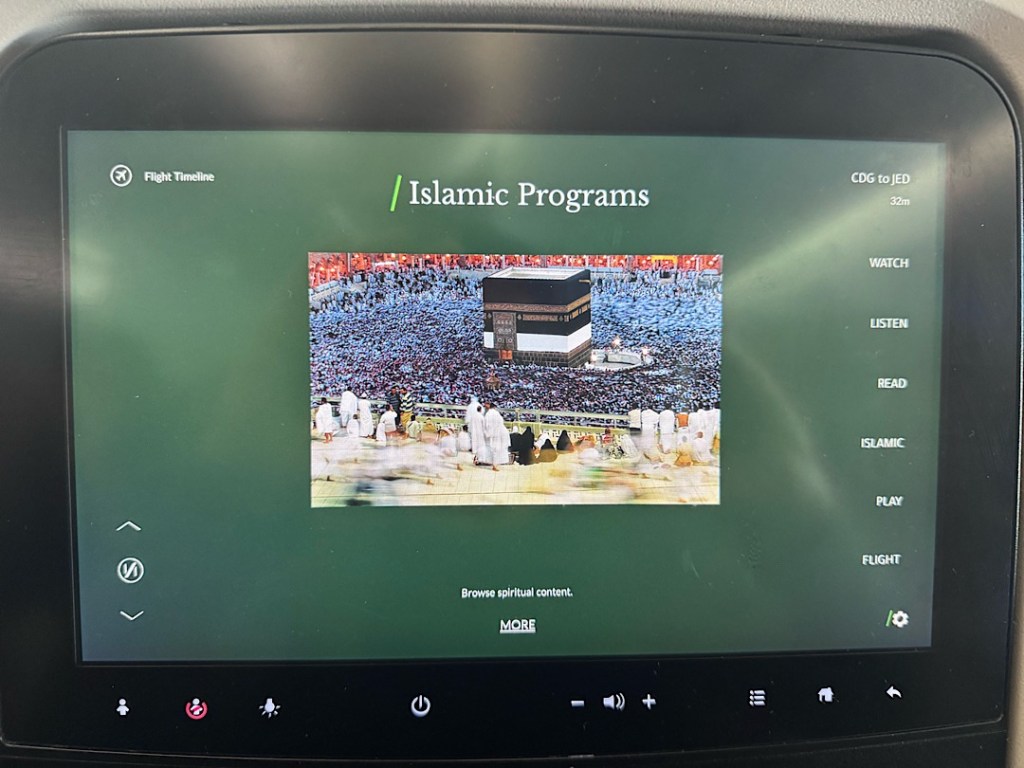
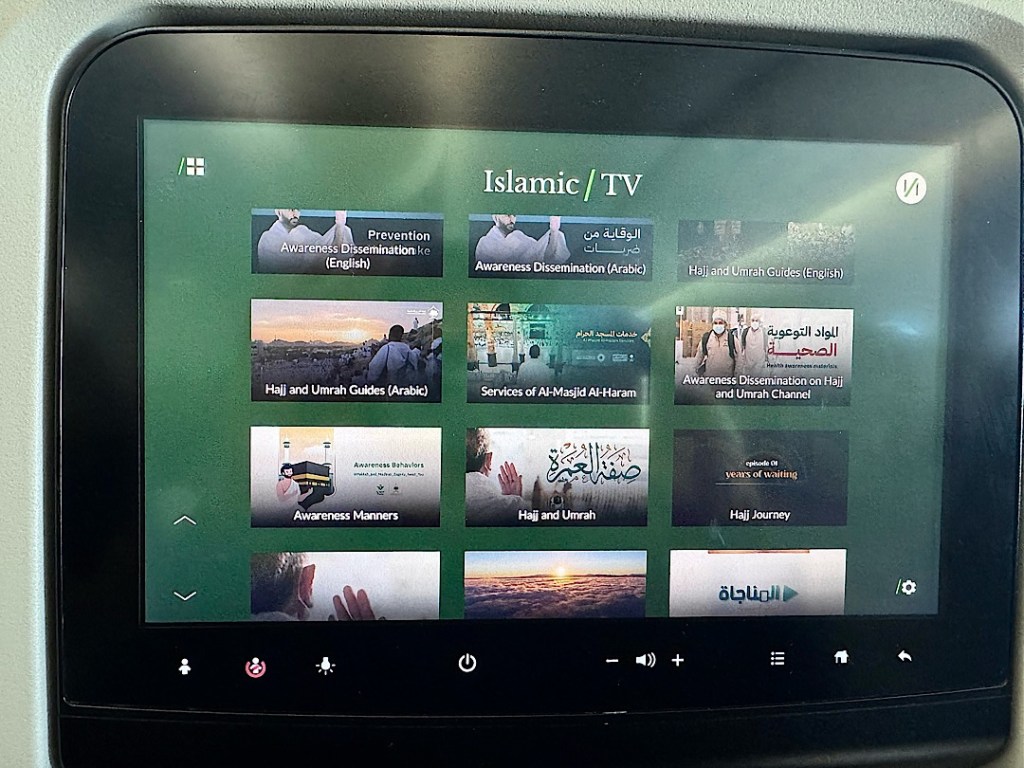
Our screens had an Entertainment option, but if you wanted to watch a mainstream movie, the only choices were The Devil Wears Prada 2, Lee Cronin’s The Mummy, Lurker, or The Super Mario Galaxy Movie. On the other hand, you could view many short instructional Islamic videos explaining aspects of the Hajj and Umrah.

The Hajj is the big multi-day pilgrimage during a certain period that changes every year. It draws millions of Muslim devotees from all over the world. Umrah, I learned, is Hajj Lite — a shorter, cheaper, less arduous visit to the holy land that pilgrims can make year-round. It was obvious our flight was filled with Umrah pilgrims. Many ladies wore little purple capes emblazoned with the name of their Umrah travel agency. The men’s intentions only became obvious after we’d crossed the miqat line.

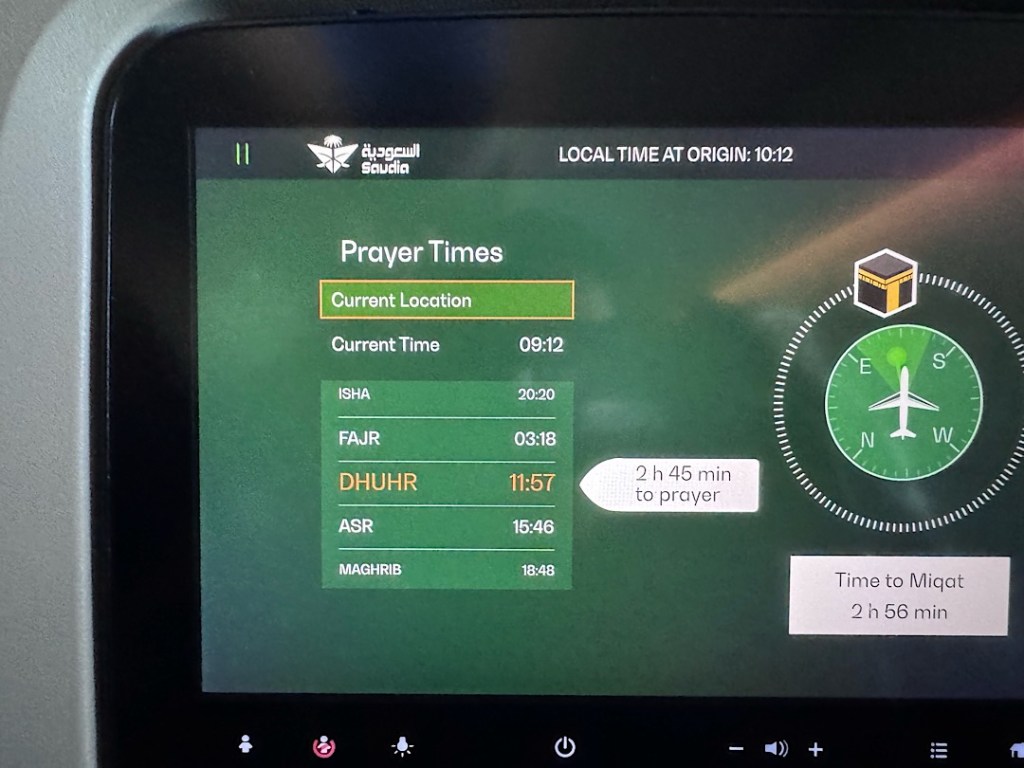
What’s miqat? I certainly wondered when I noticed that word on my screen. It began appearing periodically, interspersed with more mundane information about our altitude, time to destination, and so forth.

On the left were the prayer times for the day, with the one coming up next highlighted. And on the right, the mysterious “Time to Miqat”.

As soon as I got access to the internet, I learned that miqat is a geographic boundary surrounding the Hajj and Umrah pilgrimage zone, including not just Mecca but also Jeddah and Medina. Muslim pilgrims aren’t supposed to cross that border without first entering a sacred spiritual state known as ihram. Basically, they have to shift into high purification gear — saying certain prayers and declarations; abstaining from swearing, arguing, hunting, sex, cutting their nails or hair; and so on. After our plane had crossed the line, many of our fellow male passengers were wearing white towels secured to their bodies with simple tucks and rolls; no buttons or zippers or other modern contrivances such as safety pins are allowed. I’m not sure whether the guys effected this costume change by slipping off their outer robes in their seats or changing in the lavatories.

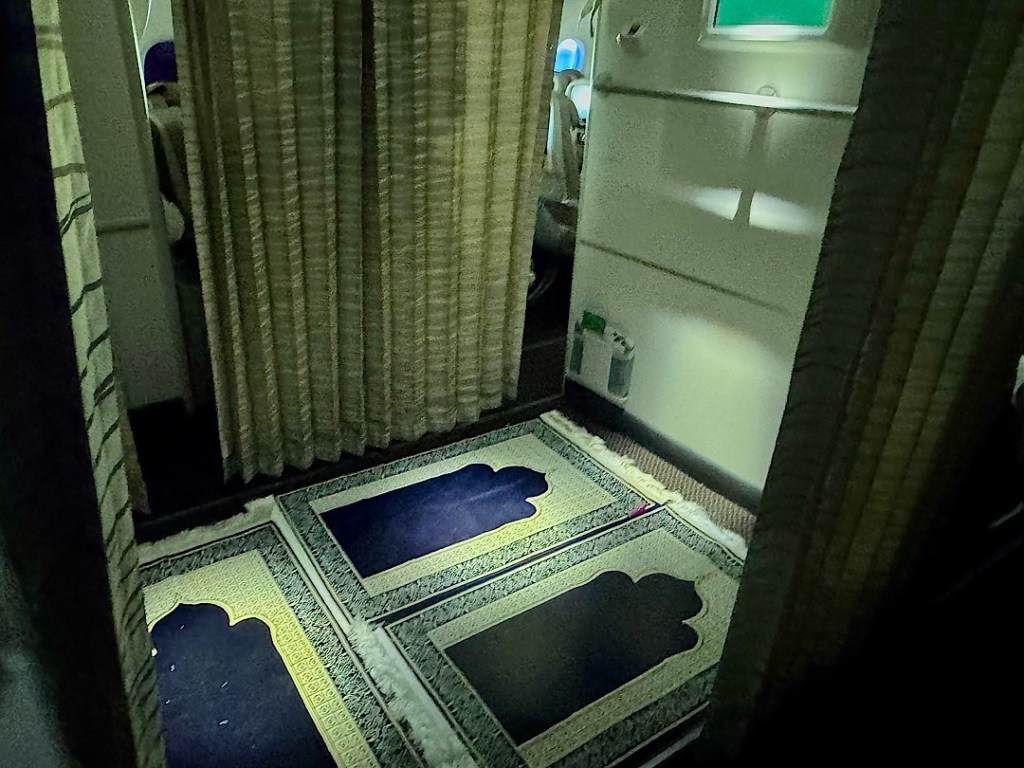
When I headed for one of those, I was startled by another first: a small open area adjoining the bathrooms that was lined with prayer mats.

I briefly glimpsed one man on a mat, forehead to the ground, but I didn’t lurk to find out what happened at the actual mid-day worship hour.

By then I was immersed in my own little ihram — preparing mentally for more extraordinary sights in this kingdom that until so recently was forbidden to infidels like me.