We’ve wrapped up our fifth trip to Uganda. What drew us back over and over was our work as liaisons between Women’s Empowerment (womenempowerment.org) in San Diego and the Nyaka organization, started 25 years ago by a Ugandan to help AIDS orphans and the grandmothers raising them. In the course of those visits, we’ve come to love the Pearl of Africa and its inhabitants. Once again, on this visit we learned a lot.
This time, along with the liaison work, we included two days of pure tourism. I got the best news of the trip on the first of those two days. On the morning of Friday, August 28, we crawled through Kampala traffic (among the worst in the world) and drove north. A few hours later, we pulled into the Ziwa Rhino Sanctuary and were assigned an exuberant guide named Simon. He recounted the amazing comeback story of Uganda’s rhinos.
Once, rhinos roamed the Ugandan bush. But during the bloody turmoil that unfolded in the 1960s, 70s, and 80s, poachers exterminated them. With the dawn of the 21st Century, as peace returned, Uganda could boast that its national parks contained four of the Big Five (lions, elephants, leopards, and Cape buffalo). To see a rhino, however, you had to safari in one of the neighboring countries.
Eventually some dedicated rhino lovers resolved to change that. They found a splendid property, and the Brit who owned it agreed to sell the 70,000 cattle he’d been running on the land, fence the perimeter, and make the place a rhino haven. In 2004, two males and two females from Kenya moved in, and the folks at a Disney property in Florida soon contributed a third pair.
Rhinos don’t reproduce fast. They have only one baby at a time; females give birth only every two to three years. So I was astounded to hear that just 22 years later, Ziwa now counts 53 rhino inhabitants, with all but the original 6 born in the park. The breeding has been so successful the park has sent 8 rhinos to other Uganda preserves.
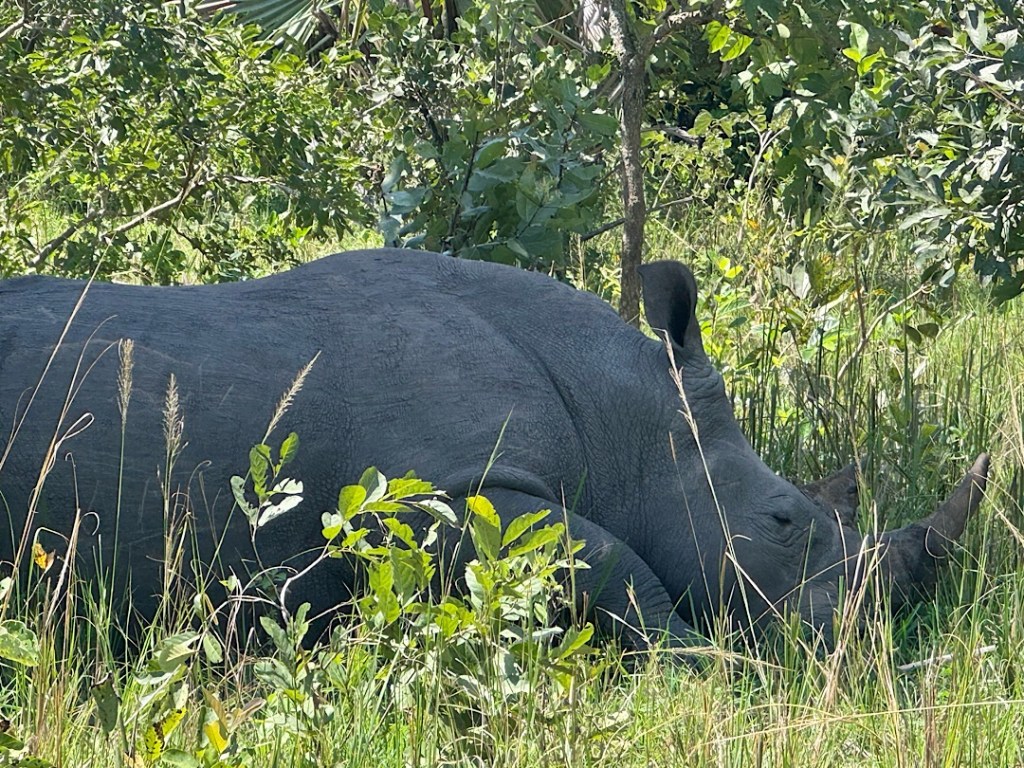
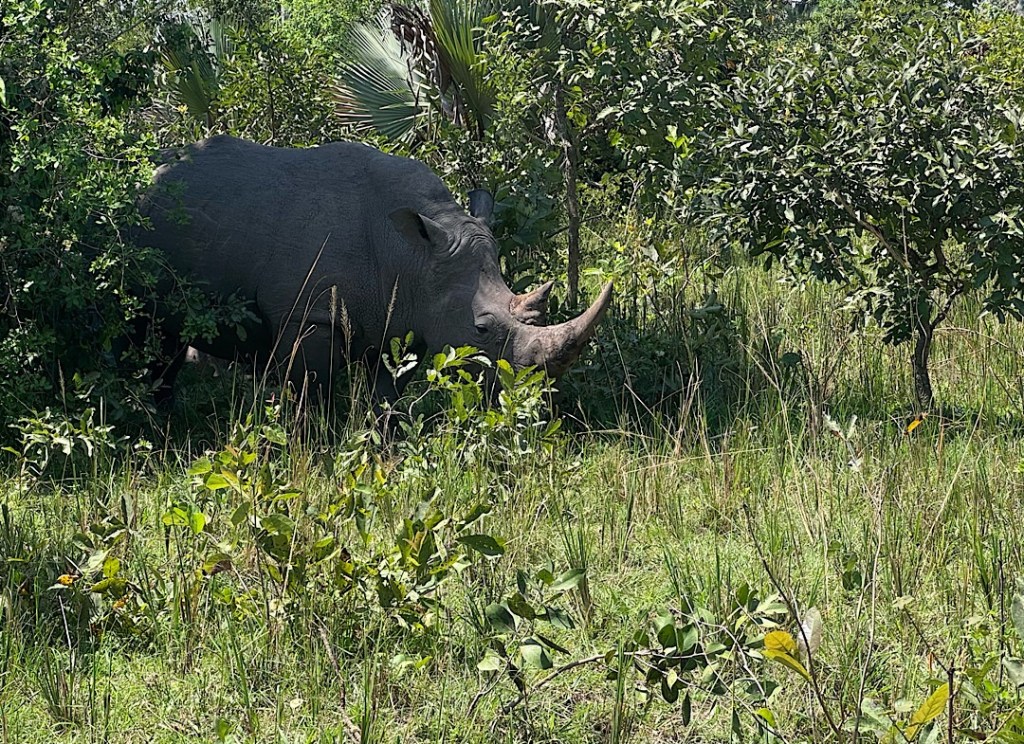
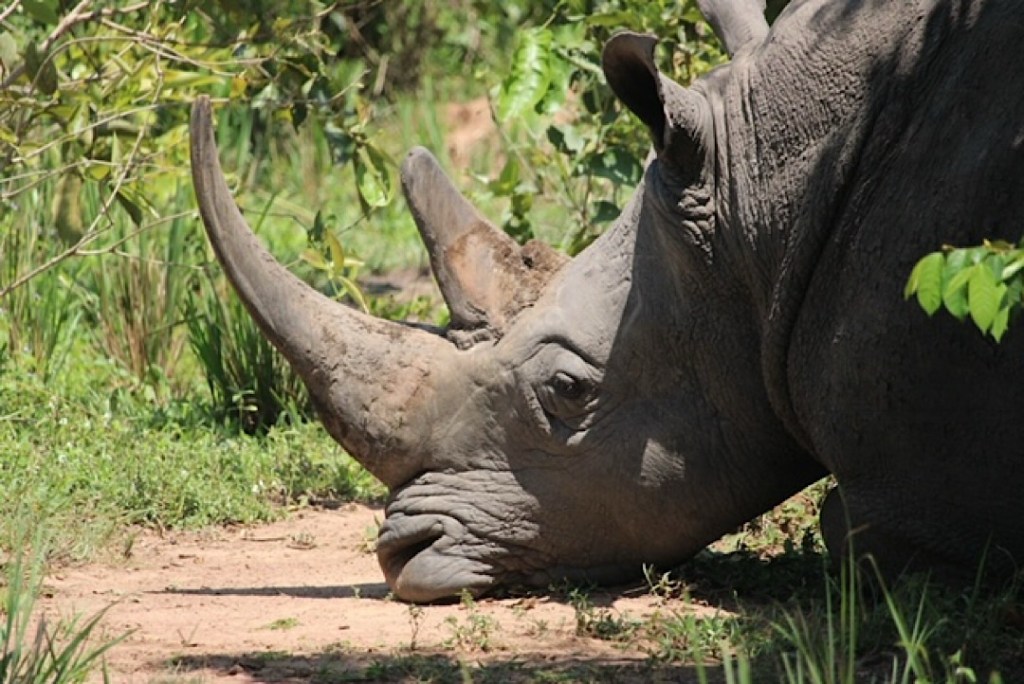
The return of Uganda’s rhino was inspiring news to me. We heard more the next morning in Murchison Falls National Park, Uganda’s largest and most-visited nature preserve. The southernmost contributory to the Nile River cuts through the middle of it, at one point squeezing through a 23-foot-wide gorge before plunging more than 140 feet downward. The immense hydraulic force generated by the passage has inspired Ugandans to boast that Murchison Falls is the most powerful waterfall on earth.
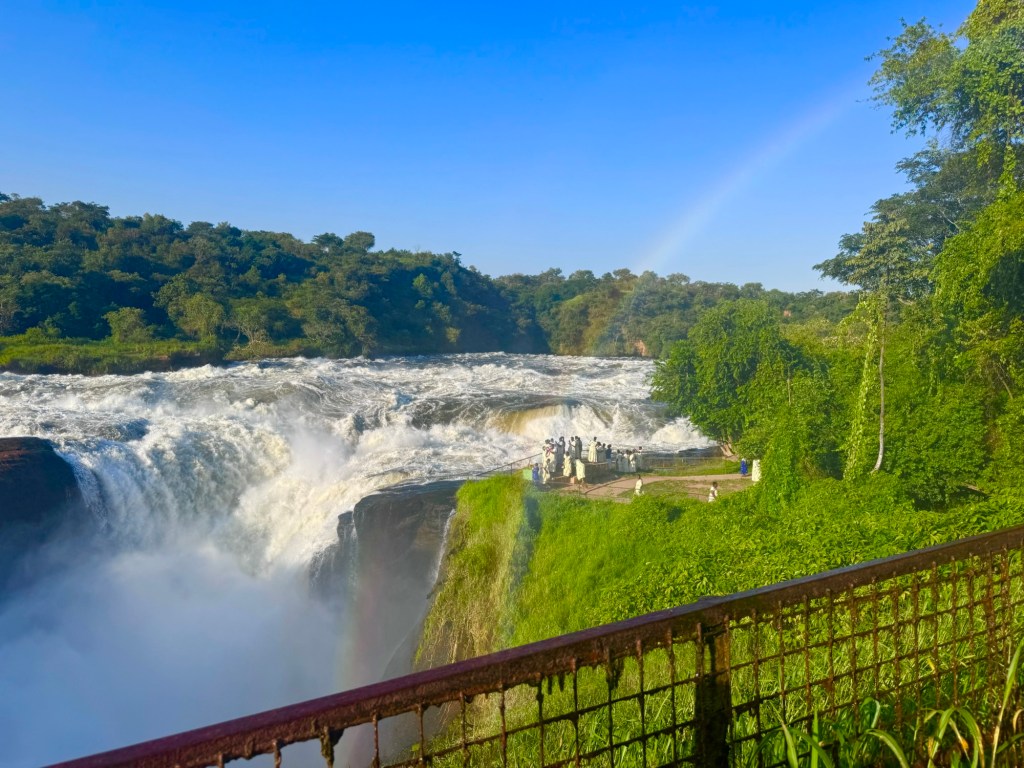
The next day, we took a boat ride on the Nile to a point near the bottom, another splendid viewpoint.
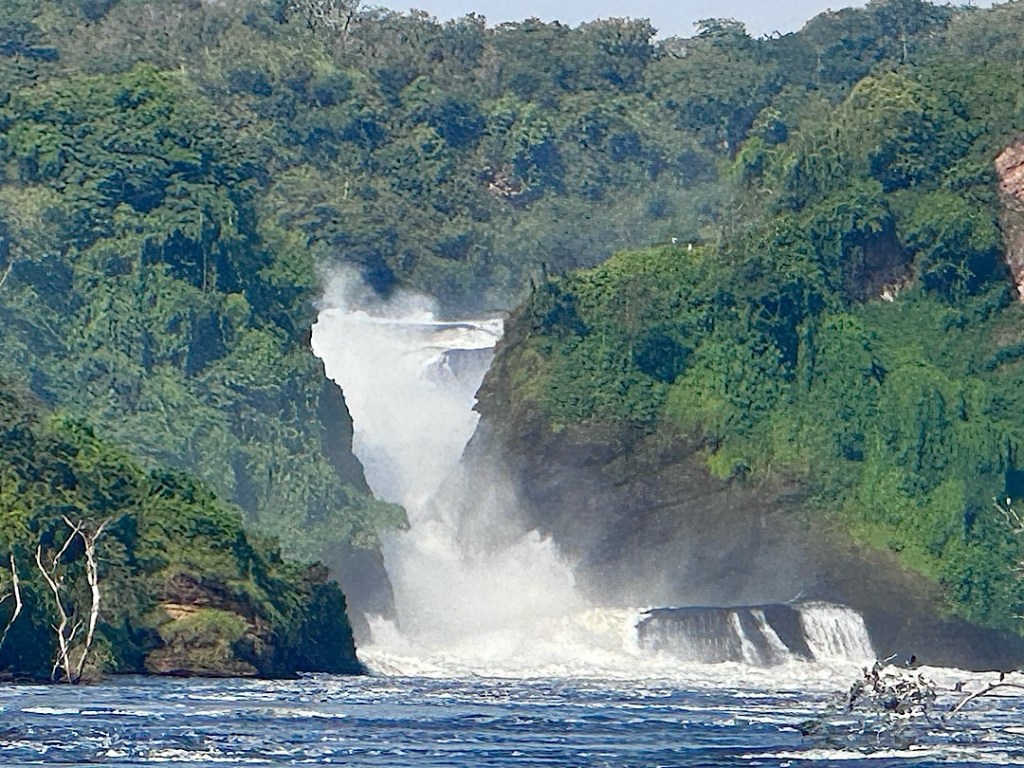
In the course of our ride on The African Queen, we passed so many hippos and crocodiles I lost count. On our game drive, too, we had wonderful luck seeing elephants, giraffes, warthogs, and a variety of monkeys and antelope. We struck out with lions, but I got closer than I ever have been to a leopard (notoriously elusive.)
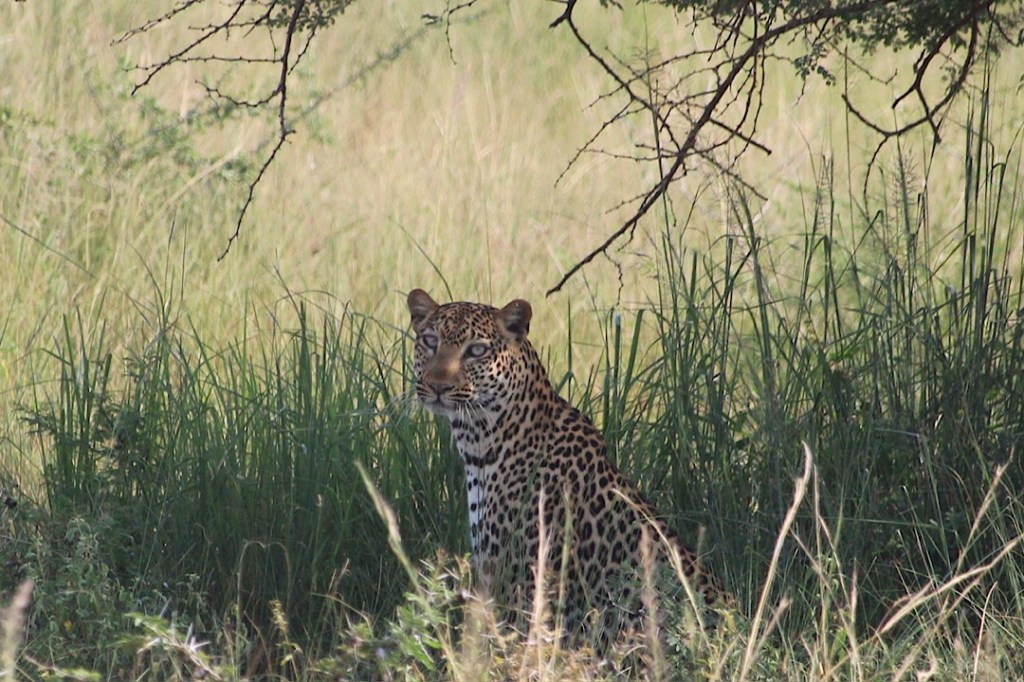
Seeing all those animals was delightful, but better still was hearing from our guides that poaching in and around the park has all but disappeared, partly as the Uganda Wildlife Association has persuaded former poachers to switch sides — paying them more to protect the animals than they’d earn from killing them. Surrounding communities have also learned that conserving wildlife can enrich the humans living near them.
The continuing growth of the grandmother groups was not news to us. When Steve and I first learned about it 13 years, the Nyaka AIDS Orphans Foundation had organized about 7000 women over the age of 50 into 124 groups. Every time we’ve visited, those numbers have increased. Today more than 24,000 grandmothers belong to 273 groups.
What blew us away, however, was seeing the new model for further expansion Nyaka has begun implementing. Instead of setting up and administrating new groups by itself, the organization has begun partnering with grandmother-support groups started by other entities. Nyaka is teaching them how to add a microfinance component — giving the women a way to borrow small amounts of money to start projects that will generate more family income. We visited two of the new groups and came away thinking this model has real potential to spread throughout the country. If it does, it will improve a multitude of lives.
As for the bad new, it wasn’t terrible. We were reminded that Yoweri Museveni, the heavy-handed autocrat who’s been in power forever, is now almost 82 and growing more and more feeble. His son seems poised to seize power when the old man shuffles off. And the son is unlikely to be any Nelson Mandela.
Neither the son nor his father dreamed up the Trade Order that Ugandans learned about this past February It’s been very bad news for a staggering number of folks. That order abruptly banned street vendors and hawkers from selling their wares along sidewalks, streets, and other public thoroughfares. I couldn’t believe my ears when I heard this. The vendors who line Ugandan’s byways are as much an emblem of the country as huge banana-bunches strapped to the backs of boys peddling down the roads. Selling produce or used clothes or other small goods has long been one of the lowest rungs on the ladder of economic opportunity here. Yet police and other government officials across the country have been smashing the little stands and confiscating the goods. They’re telling people they must reconstitute them in tidier spaces approved by the government.
We’ll see how well that works out. Or maybe Steve and I won’t. We’re not sure we’ll ever get back. We still have a long list of places we haven’t yet gotten to. Madagascar was one of them, but Sunday that changed. For the next 11 days, we’ll be bouncing over the roads of the land of the lemurs.


Thanks, again! Reminded me of my trip to Kenya, many years ago, with the Ornithological Society guide. It was a small group, landrover, trip that allowed us off the beaten trail. I will never forget it.
Ann
>
Jenny, Donna, and I were just commenting