To start this trip, we flew Delta from San Diego to Salt Lake City, changed planes and continued on to Paris, then slept in a hotel at Charles De Gaulle airport. The next morning Air Saudia transported us to Jeddah.
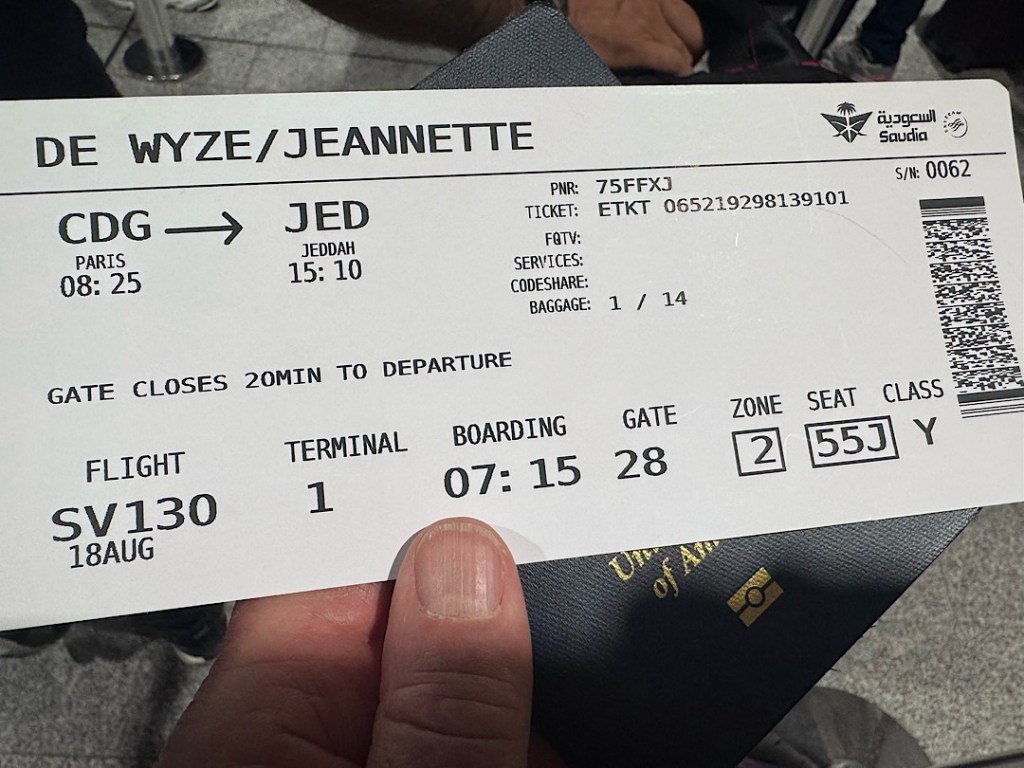
In many ways, the Arabian flight felt very normal, actually better than normal. Our Economy seats in Row 55 of the Boeing 787 gave us a surprising amount of leg room, and no one showed up to fill the middle seat between Steve and me. We pushed back on time, and the crew seemed to include more than twice the number of attendants we’d had on our Delta rides, so we got served quickly. The breakfast was fresher and tastier than Delta’s.
The exotic bits began as we were taxiing to the runway. The safety instructions, played on our seatback screens first in Arabic then in English, were the usual spiel about life vests and oxygen masks and smoking prohibitions. Then just before we started our roll, a voice announced the favorite prayer of the Prophet Muhammed whenever he was starting a journey. As a deep bass speaker intoned them, the words in Arabic and English rolled down our screens — nothing that any Lutheran minister might not say. I assume a ton of people silently voice a prayer right before takeoff, but this was the first time an airline provided one for me over the loudspeaker.
Our screens had an Entertainment option, but if you wanted to watch a mainstream movie, the only choices were The Devil Wears Prada 2, Lee Cronin’s The Mummy, Lurker, or The Super Mario Galaxy Movie. On the other hand, you could view many short instructional Islamic videos explaining aspects of the Hajj and Umrah.
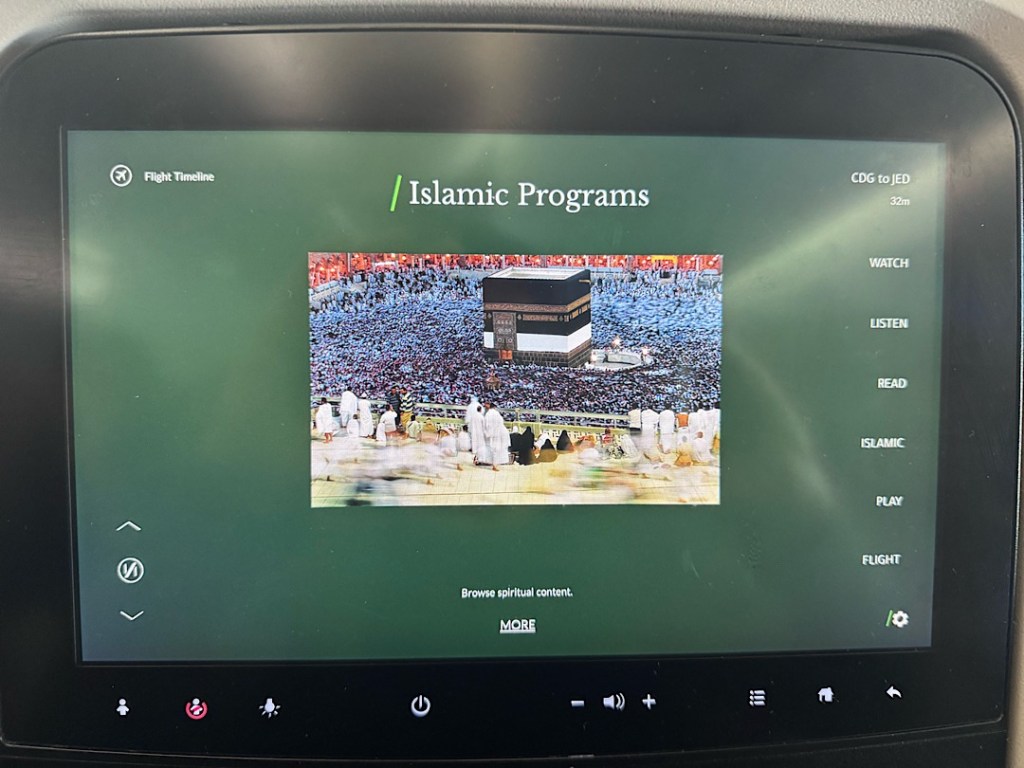
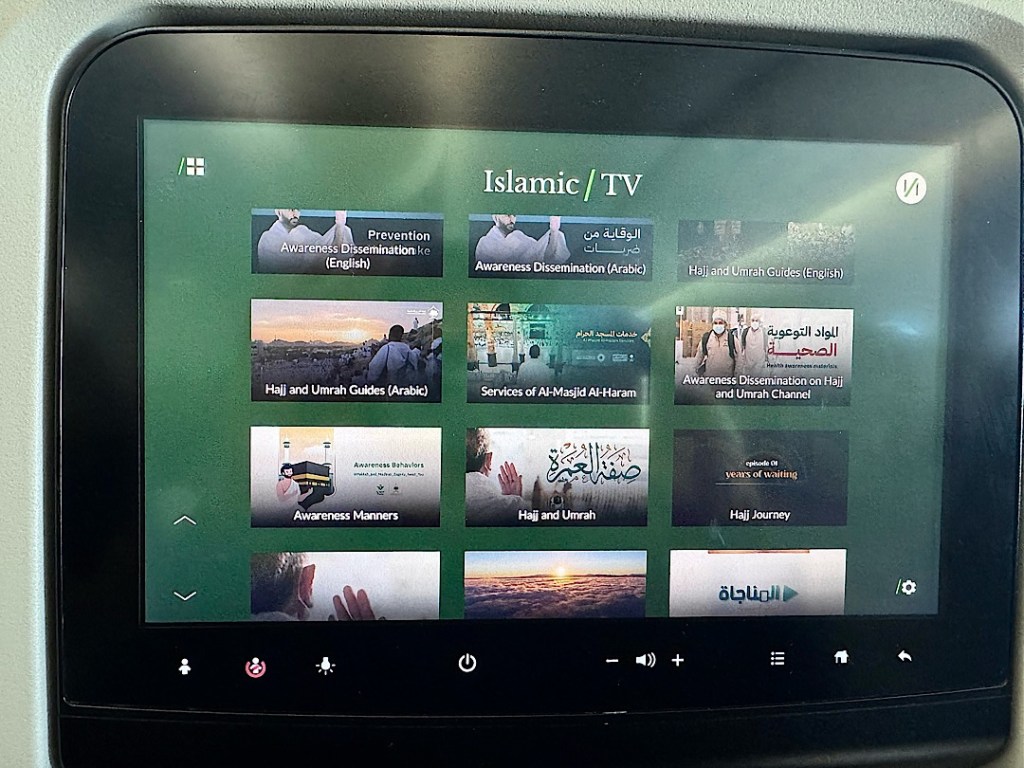
The Hajj is the big multi-day pilgrimage during a certain period that changes every year. It draws millions of Muslim devotees from all over the world. Umrah, I learned, is Hajj Lite — a shorter, cheaper, less arduous visit to the holy land that pilgrims can make year-round. It was obvious our flight was filled with Umrah pilgrims. Many ladies wore little purple capes emblazoned with the name of their Umrah travel agency. The men’s intentions only became obvious after we’d crossed the miqat line.
What’s miqat? I certainly wondered when I noticed that word on my screen. It began appearing periodically, interspersed with more mundane information about our altitude, time to destination, and so forth.
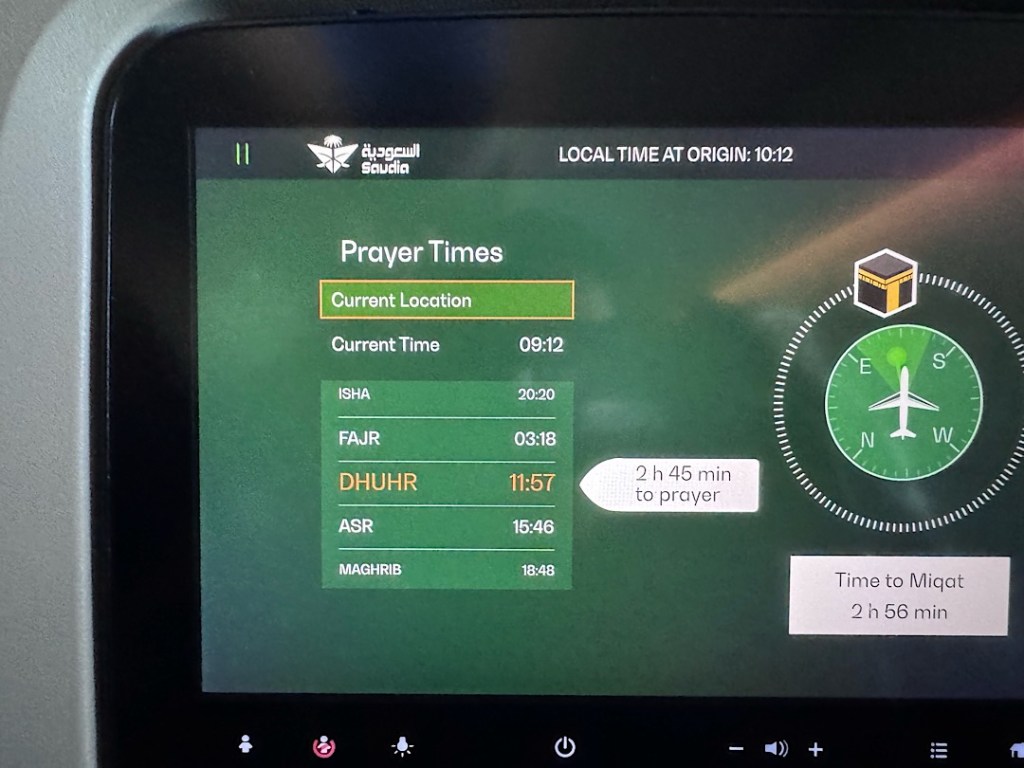
On the left were the prayer times for the day, with the one coming up next highlighted. And on the right, the mysterious “Time to Miqat”.
As soon as I got access to the internet, I learned that miqat is a geographic boundary surrounding the Hajj and Umrah pilgrimage zone, including not just Mecca but also Jeddah and Medina. Muslim pilgrims aren’t supposed to cross that border without first entering a sacred spiritual state known as ihram. Basically, they have to shift into high purification gear — saying certain prayers and declarations; abstaining from swearing, arguing, hunting, sex, cutting their nails or hair; and so on. After our plane had crossed the line, many of our fellow male passengers were wearing white towels secured to their bodies with simple tucks and rolls; no buttons or zippers or other modern contrivances such as safety pins are allowed. I’m not sure whether the guys effected this costume change by slipping off their outer robes in their seats or changing in the lavatories.
When I headed for one of those, I was startled by another first: a small open area adjoining the bathrooms that was lined with prayer mats.
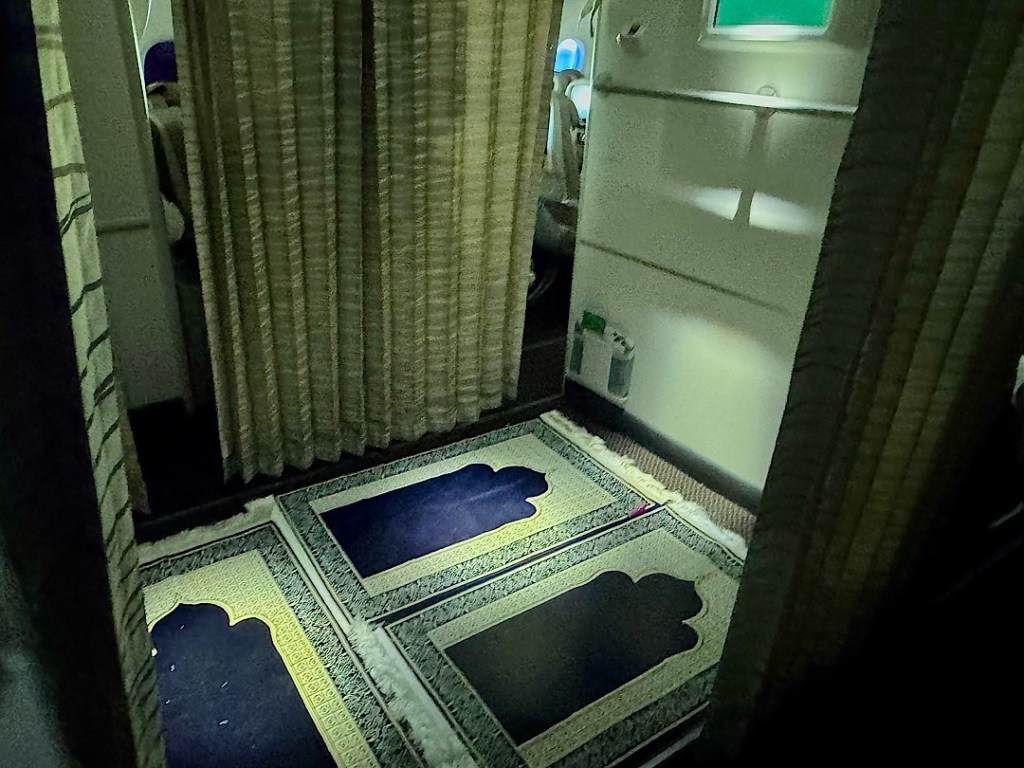
I briefly glimpsed one man on a mat, forehead to the ground, but I didn’t lurk to find out what happened at the actual mid-day worship hour.
By then I was immersed in my own little ihram — preparing mentally for more extraordinary sights in this kingdom that until so recently was forbidden to infidels like me.

