In praise of insider tours

Saturday, January 8

The Hotel Hobbe wound up costing about $51 a night, but the delicious three-course dinners we enjoyed there (including substantial amounts of alcohol) came in at about $20 per person. So no grumbling from me. According to Laura, the Hobbe is the best hotel in Kolda, and although Kolda doesn’t even rate a mention in the Rough Guide, Steve and I wouldn’t have missed it.
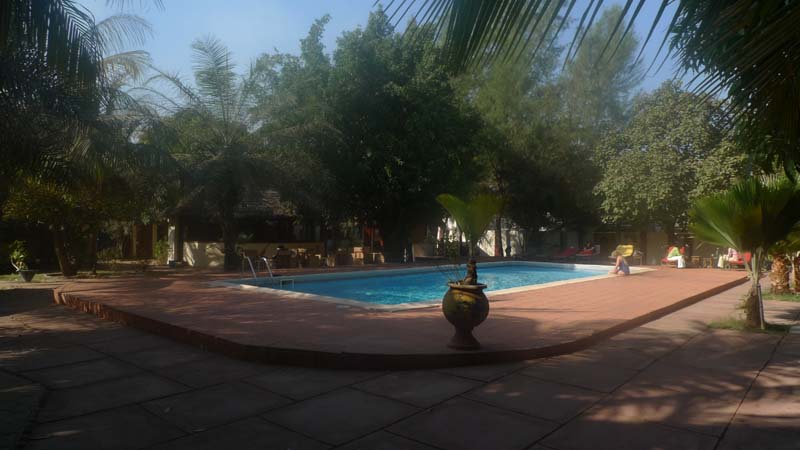
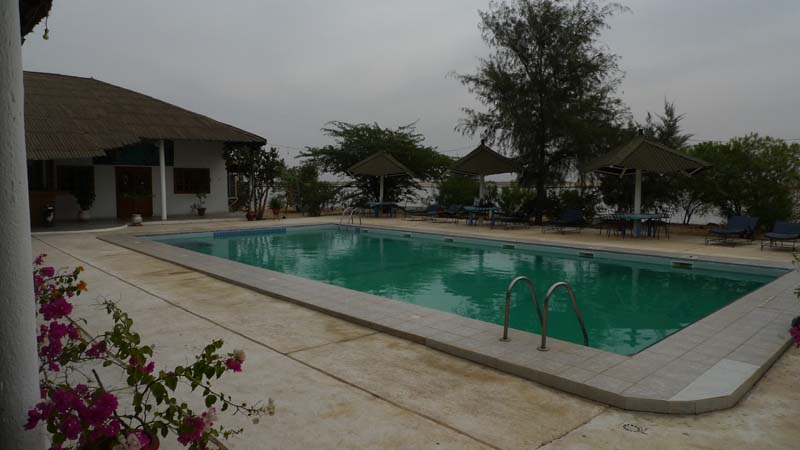
Hobbe hotel pool

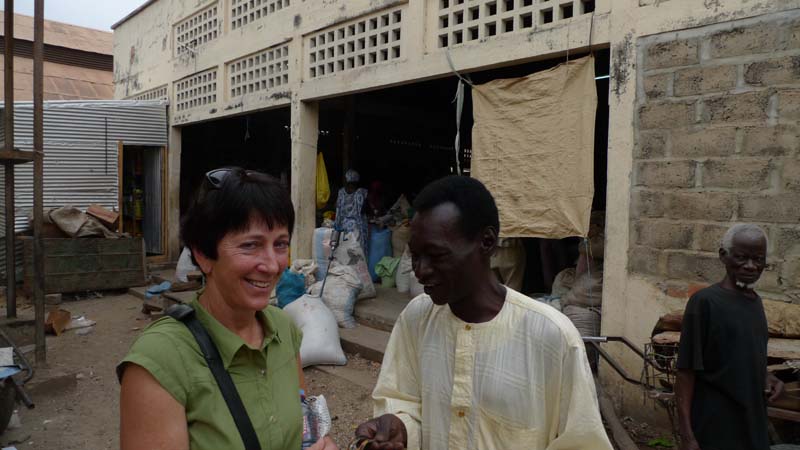
Having Laura as our insider guide made all the difference.  The Hobbe’s just a few blocks off the main drag, and yesterday morning, she met us there and led us on foot to the commercial action. Unlike the Kaolack market (much of which is covered and dark), Kolda’s vendors line both sides of block after block of the paved central street. Hawkers of flip-flops, sunglasses, oranges and bananas and lettuce, hair straightening concoctions, bike parts, colanders, cola nuts, peanuts, baobab and palm oil seeds, SIM cards, and more make up a jolly jumble, Laura helped me buy several pieces of the gorgeous Senegalese fabric and then led me to a tailor who promised to transform them into aprons by the end of the afternoon.
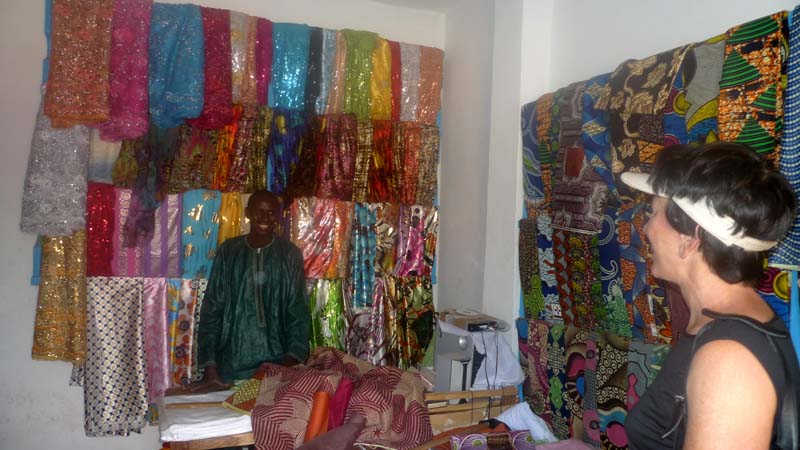
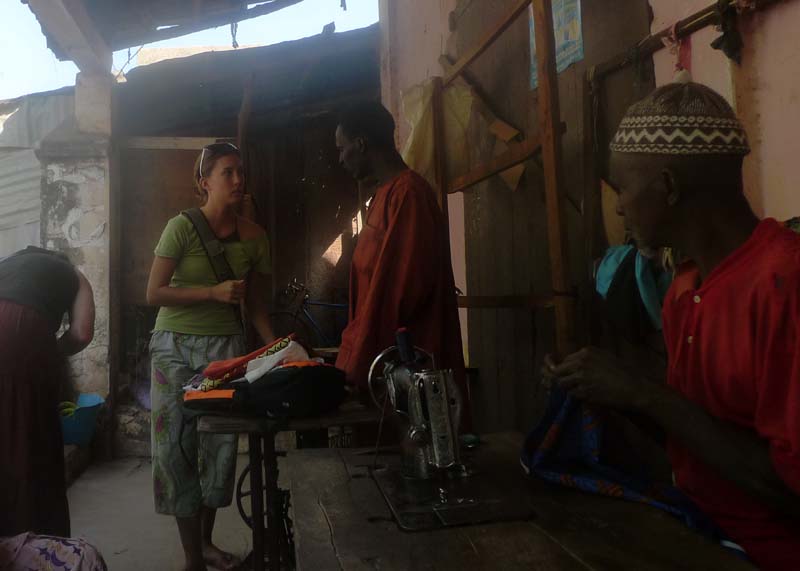
Fabric shop in Kolda
At the tailors in Kolda

Then we visited the used-clothing market. It IS covered, and dark, and filled with stuff that’s been donated by Americans to organizations like the Salvation Army, packed into huge shrink-wrapped bundles, loaded onto container ships, sailed to Africa, trucked here and carefully hung up or folded and laid out on tables. One t-shirt caught my eye. In good condition, it bore an image that I thought a friend back home might appreciate. Try though she did to procure it for me for 500 CFA (about $1), Laura couldn’t get the seller to budge from his final price (700). So I paid that and will transport the shirt once again across the ocean to San Diego (where my friend may send it jetting back again!)
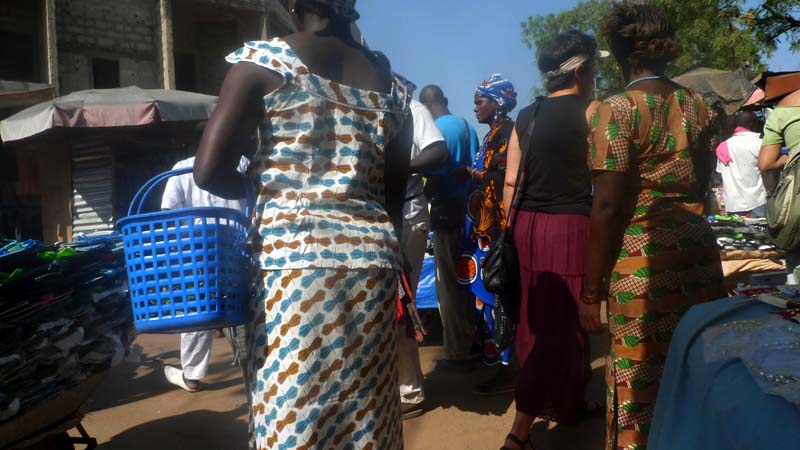
Kolda street market

We bought liters of water for $1 at the Mauritanian grocery store and popped into the local liquor wholesaler (who will sell you a single Gazelle or cases of it, the Muslim majority here notwithstanding.) We stopped at Kolda’s little post office where Laura picked up her most recent issues of the New Yorker (only a few weeks late) and joked in her fluent Pulaar with the kindly postmaster. We strolled past the town brothel, and then wandered past the town woodworkers and their creations (mostly bed stands and dressers made of a gleaming golden wood).
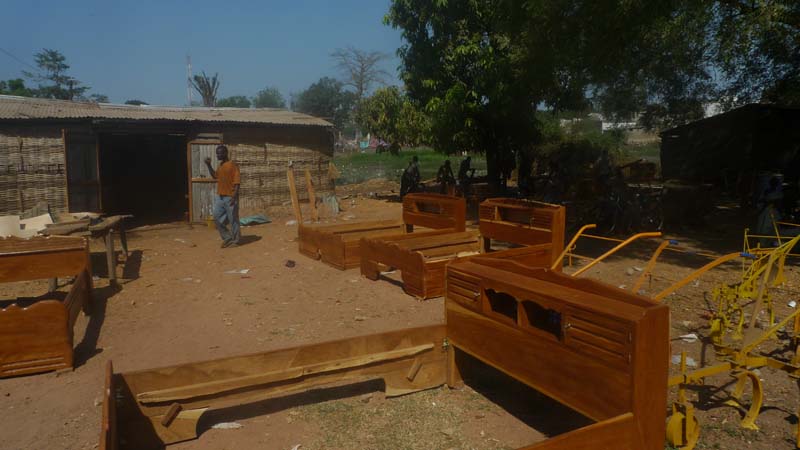
Kolda craftsmen carve wooden bed frames from African hardwoods.

Not far beyond them, blacksmiths hammered metal creations using skills that average Americans haven’t used for 150 years. I was mesmerized by the enclave where sweating men were pounding discarded 50-gallon drums into flat pieces of steel, then shaping those into storage chests. Initially ugly, these were painted bright colors. We watched one stolid fellow dip a wood block covered with raised bumps into a can of white paint, then press that in patterns over a chest that had been painted bright blue. Later, he added yellow sections to the pattern. When he was finished, the chest looked as pretty as something you’d find at IKEA.
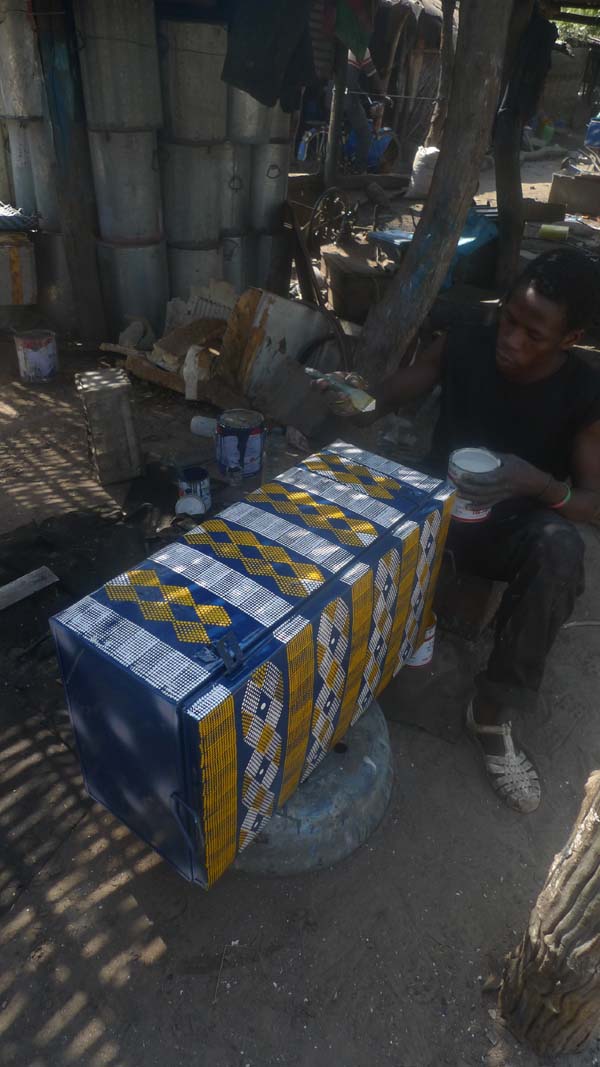
Kolda metal worker paints a storage chest.

In the afternoon, we visited the well-swept compound where Laura boards with a local Senegalese family. She showed us the family’s large vegetable garden, the well that’s the sole source of their water, and her private sleeping and bathing quarters. Around 2:30, while other family members and neighbors ate in other small clusters, Laura, her host mother, Steve, and I shared a huge dish of broken rice cooked with grilled fish, fish balls, eggplant, peppers, and other vegetables. The three of us white folk ate with spoons, but our hostess manipulated her food in the traditional manner — squeezing the rice into bite-sized pieces with her right hand. It seemed to me, though, that she spent most of her time not eating but rather breaking off pieces of fish and other tasty morsels and distributing them to our various quadrants of the platter. Laura says Senegalese mothers typically do this to ensure that their children get equal shares.
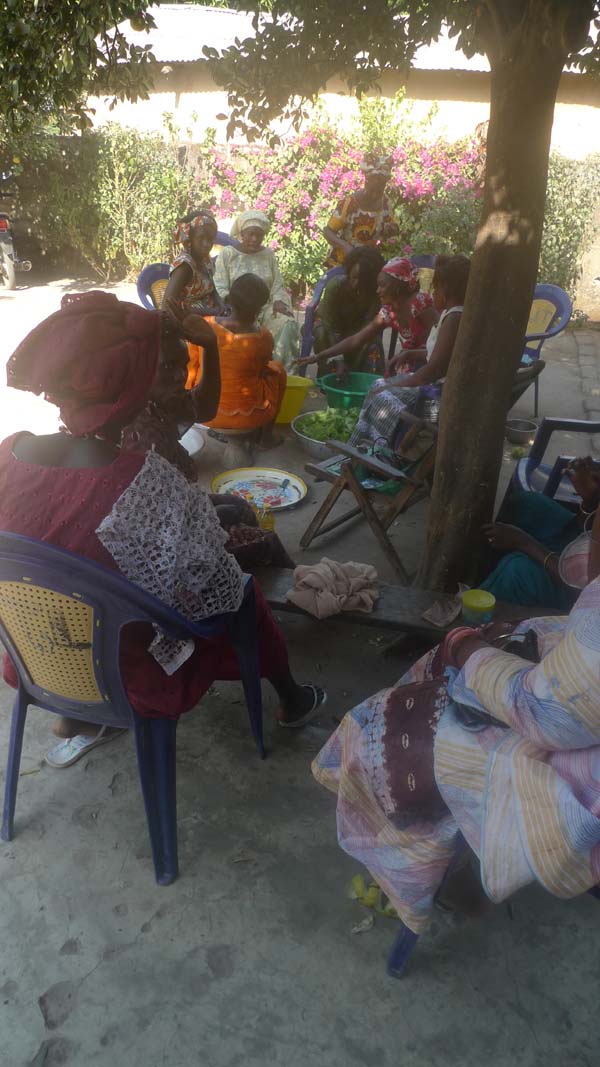
Kolda Ladies Group prepares vegetables for dinner in the shade of a tree in the family compound.

In the late afternoon, we visited some gardens overseen by local Peace Corps volunteers, then we walked back to dinner at the Hobbe through the soft twilight. It felt like rush hour, with us swept along with the streams of ladies bearing bundles on their heads, boys zooming by on crazily laden bikes, ancient battered taxis threatening the meandering livestock (and occasionally pedestrians) and transforming the dirt street into minor dust storms.
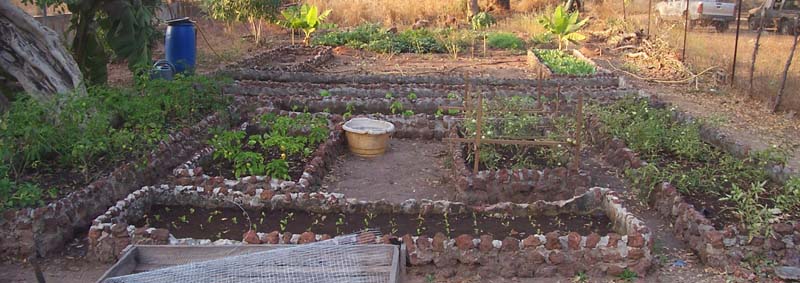
Peace Corpts volunteers organized this demonstration garden Kolda.

As always, as everywhere in the towns and villages, piles of garbage lined our paths. But it struck me as we walked that my relationship with the ubiquitous Afro-garbage is subtly changing. It seemed so ugly and squalid when I was first exposed to it. On some of our bush-taxi rides I’ve almost laughed out loud at the sight of one of our fellow travelers polishing off a can of soda or a cookie package and blithely tossing it out the window — so taboo back home (and yet ringing distant bells from my own childhood.)

It’s tempting to harrumph that the Africans have no system for dealing with all the garbage. But Steve and I have noted that in fact there is a system: you throw your trash willy-nilly on the ground, goats and other animals eat everything that’s remotely edible, and every so often someone burns the inorganic piles when they get too large. It’s not a very good system, but it’s cheap and in its own way, it works. Bottom line: it’s the way things work here — the way the subways are jam-packed in Tokyo or graffiti covers many building facades in Detroit. After just one long day of glimpsing quotidian life in Kolda, the complex nuances of the town had claimed the forefront of my brain, while the garbage had sunk so far into the background that I barely noticed it.
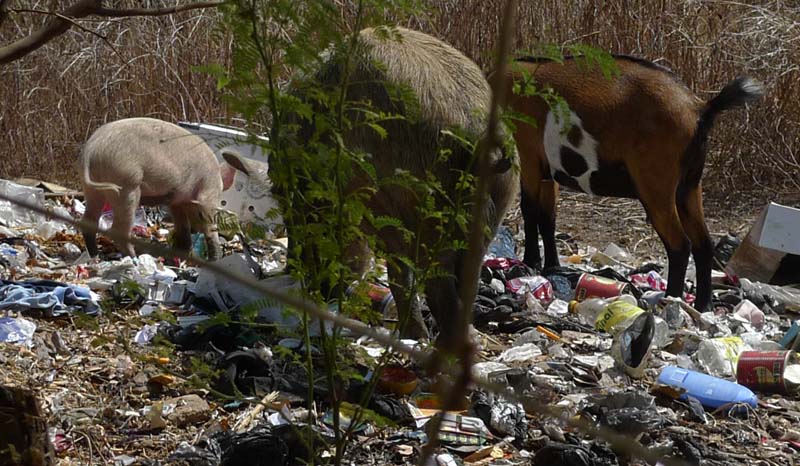
Livestock perform the first sorting of municipal trash in West Africa. The proliferation of plastic bags and bottle contributes to the waste problem.

Bedbugs and bribes

Friday, January 7
Two lifetime firsts for me yesterday — first bribe and first bedbug!  Both somewhat disgusting, if only mildly so. 

The bribe came as we were returning from Guinea Bissau.  We’d had two choices of travel routes back to Senegal: 1) returning to Ziguinchor and then heading east to Kolda, or 2) traveling east to a town called Bafata and from thence north to Kolda.  We’d had such a dreadful time with all the checkpoints on the way from Zig that we decided to try the second, even though we’d been warned that the roads were dreadful. Happily, they actually weren’t all that bad, although once again, the travel was pricy.  Despite hard bargaining, we’d had to pay about $100 for a bush taxi to get us from Bissau to the border (for that, we got the whole vehicle.) Bizarrely, all the taxis in GB were in hugely better condition than those in Senegal and the Gambia. In Bissau, they were all Mercedes Benzes, not that ancient, and our sept-place to the border was a remarkably clean and comfortable Renault.  (Steve suspects there’s some convoluted explanation involving foreign aid and government contracts to explain this.) 

The bribe came after we’d gone through customs and gotten our GB exit stamp.  We’d had to stop in front of a stand where a sullen looking guy told Laura he was in need of tea, so we would have to pay him 2000 CFA (about $4).  She protested and argued, but he was malevolently implacable.  Item by item, she started taking everything out of her backpack, even though we were all snickering at how ridiculous this was.  The African who would be traveling with us in the bush taxi to Kolda jumped in, pointing out that even HE had had to pay the tea bribe. So we threw up out hands and dug out the money.  It was all so brazen. I’m a little sorry we didn’t carry through and take out every item in all our bags. But we sensed that might have backed the guy into a corner that could have resulted in our spending many hours at that roadside. 

I spotted the bedbug this morning, as he was about to crawl into the crack between the sheet and the headboard.  I probably wouldn’t have recognized him, were it not for the 3 little smears of blood on my pillow.  Ugh!!!!  (I know they’re not harmful.  Just gross.) 

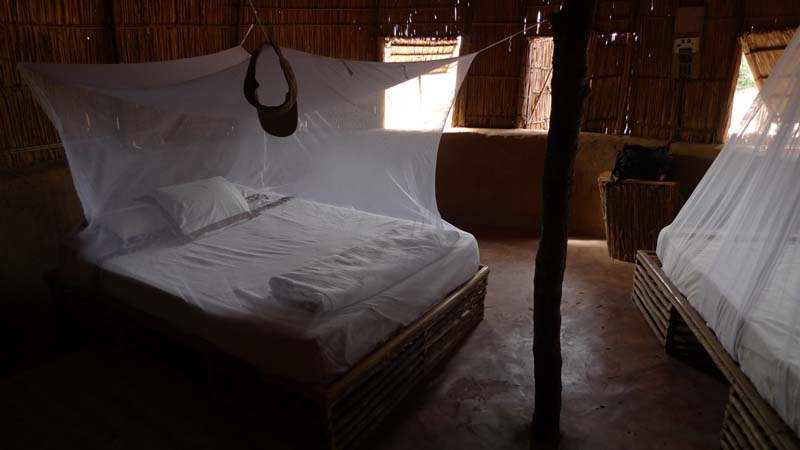
The Hotel Hobbe, where we’re staying, does have its charms.  The pool is large and sparkling clean.  Most of the rooms are located in African-style rondavals (and everything has thatched roofs).  The wifi’s superb, and our dinner here last night was topnotch.  Even the beds are comfy (if infested).

I’m not exactly sure how much the rooms are (as Laura made the reservation for us).  I’ve decided that if we have to pay $40 or less, I’ll be satisfied.  At $60 or more, you’ll hear me grumbling. 

Gille’s Gulch

Wednesday, January 5

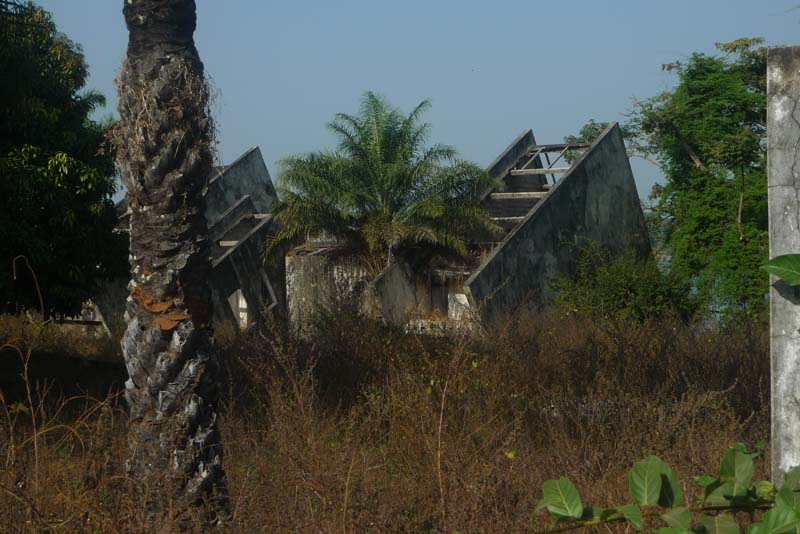
I read Ayn Rand’s Atlas Shrugged when I was 17, and among the marks it left on me was a romantic vision of secret havens (like Galt’s Gulch, named after Rand’s hero, John Galt) created in the midst of societal chaos and decay. Our taxi ride through Bissau Monday afternoon was brief and yet long enough to make me think this country is worse off than anything in Rand’s worst nightmares. It ranks among the poorest countries on earth, and its capital city is a shattered, dusty place. The last civil war ended about a dozen years ago, but one corrupt president was just assassinated last year. Reportedly Bissau has only a few hours of electricity per day. At night it’s said to be eerily black. In the countryside, land mines remain unexploded. Warns the Rough Guide, “Don’t use footpaths on the mainland unless you see other people doing so or you’re accompanied by a competent guide.”

Ruins of Guinea-Bissau's former president's vacation home

Why travel here?  I’d heard that a Frenchman named Gilles Develay had created the best hotel in the entire country on Bubaque, one of the islands in the Bijagos archipelago, located two hours (by speedboat) southeast of Bissau. The Kasa Afrikana was reported to be pleasant not only when judged by the abysmal standards of Guinea Bissau, but also by those of the New York Times West Africa correspondent who wrote about it in late 2009. 

Gilles Develay

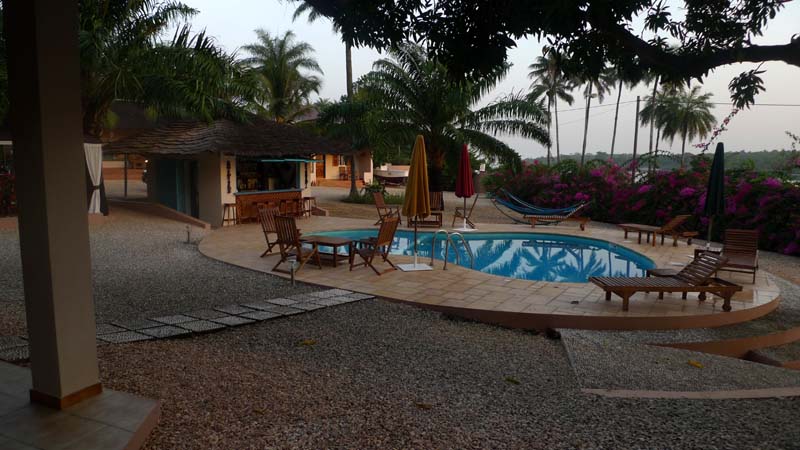
I yearned to see it, and now I can report that it’s every bit as lovely as described. The rooms and grounds are immaculate, and from where I’m sitting I can identify plantings of baobab, various palms, cashew, and exuberantly blooming canna, ginger, marigolds, bougainvillea. The pool isn’t big, but Gilles told us last night he dug the hole for it and built it by hand, covering its interior with little turquoise tiles. The water in it, pumped from a deep well, is pristine. A generator provides abundant electricity for all the compound, but when we asked him last night how he gets the fuel to run it, Gilles shook his head and said it was too complicated to explain. (I understood that the problem wasn’t his English but the enormous complexity of the answer; that it would take a book rather than a blog post to begin to explain how he’s created everything in this place where every tool, every nail, every fixture or piece of furniture must either be built or brought from far, far away.)

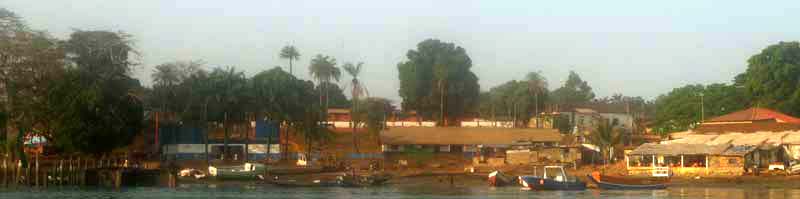
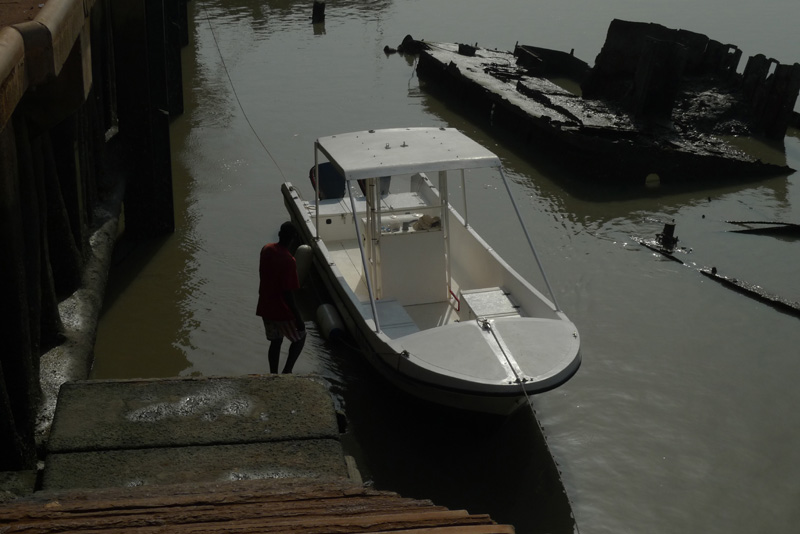
The port at Bubaque has seen better days.
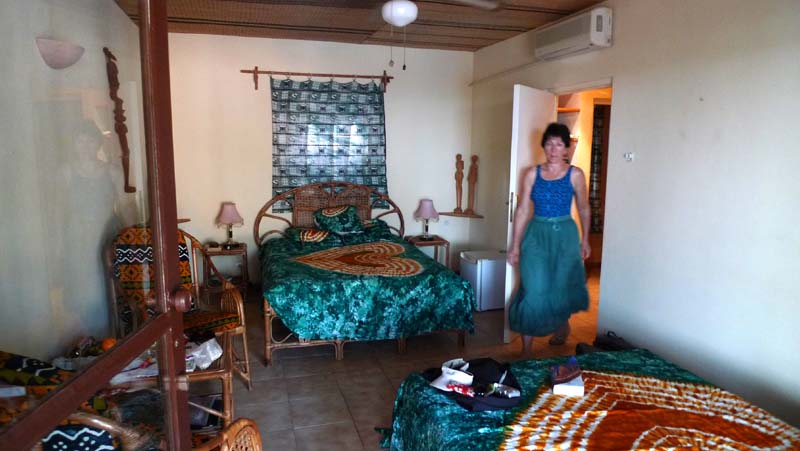
Kasa Afrikana room
Kasa Afrikana pool

Why is Gilles here?  We got snatches of an answer to that. Now 55, he and 3 buddies somehow rejected their futures as cogs in the machinery of bourgeoise suburban life in Lyons when they were 17.  All four traveled the world (whether together or independently or both, I’m not sure), and when Gilles arrived on this island (“the end of the world”) 16 years ago, he was ready at last to settle down. He bought a piece of property, camped on it, started a ferry service to Bissau, slowly expanded his land holdings. Although the civil war at the end of the 1990s never brought actual fighting to Bubaque, all tourism to the country collapsed. Yet he continued building, solving the hundred and one daily puzzles generated by the challenge of creating an idyll in this unlikely location. He says now his main clients during the rainy season are officials or business people who come here for meetings, while in the dry season, its sport fishermen.

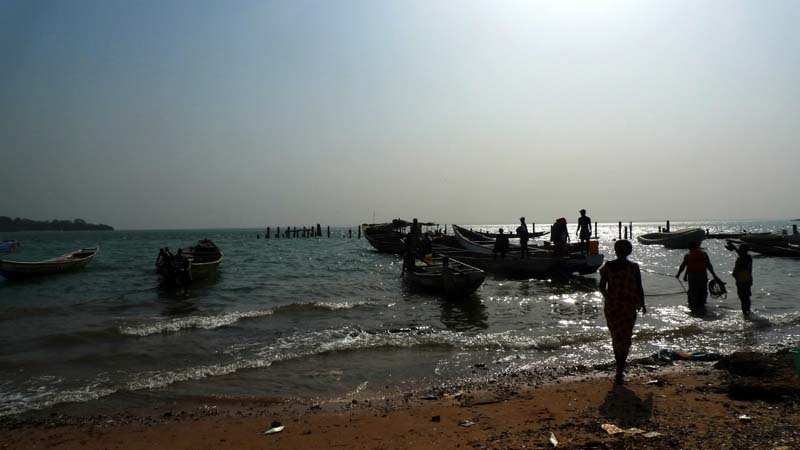
Unloading the catch at Bubaque

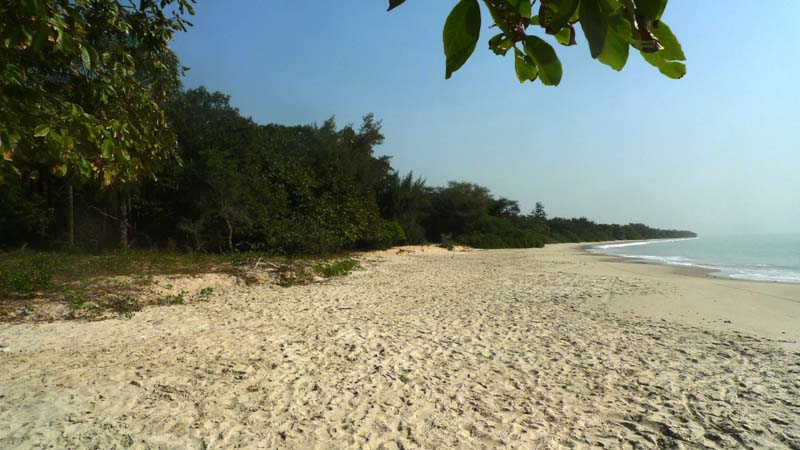
If we’d had one extra day here, I might have wanted to go out in pursuit of some of the magnificent fish inhabiting these waters.  Or perhaps we would have tried a day excursion to the nearby island of Orango, where saltwater hippos congregate. But with only two days, we were content to stay on the island — exploring the squalid central village, lounging by Gille’s pool, napping, reading, writing.  Today we biked (10 miles each way) to the endless unspoiled beach at the south end of the island. We’ll have one more excellent meal tonight, then we depart on the speedboat early tomorrow, rested up for another chaotic travel day, destination Kolda.

Road to Praia de Bruce on Bubaque: Most islanders live in mud-brick houses with thatched or sheet metal roofs.
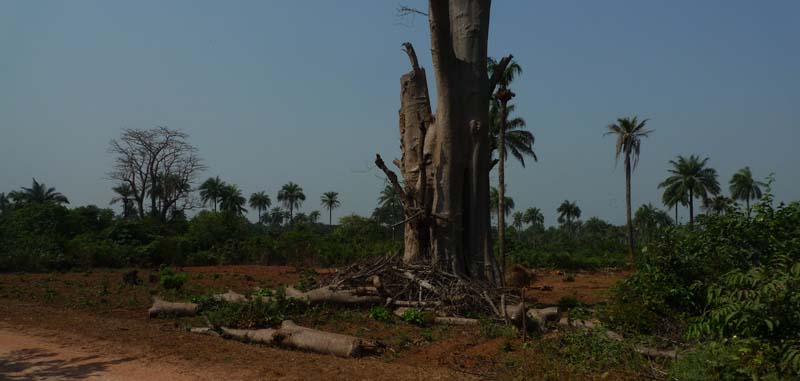
Centuries old trees are being cleared for cashew orchards.
Praia de Bruce on Bubaque remains pristine, but for how long?

Life’s little essentials

Tuesday, January 4 (posted 1/6/2011)

The only sign of any rebel threat on our two-day journey from Keur Bamboung to Bissau were the burly guys wearing camo suits and toting AK 47s that we saw occasionally along the roadside. They appeared to be Senegalese Army regulars on routine patrols.

In the absence of any violent incidents, I had plenty of time to chew on this one: Assuming you have a clean water source and enough food to keep hunger at bay and clothes to keep warm, and assuming people aren’t trying to rob or kill you, does reliable electricity or good transportation come next on the hierarchy of my own personal needs?

We’d experienced a lack of both during the last week, so the question was fresh for me, and I thought my answer was unequivocal: I’d choose light. Bad roads slow you down and coat you with layers of sweat and fine grit and induce otherwise responsible drivers to zoom into the path of oncoming traffic to avoid hitting deadly potholes. They cripple commerce and condemn sick folk to dying because they can’t get to medical care. But the lack of reliable electricity crushes my spirit nightly.  The impenetrable darkness might hold hungry hyenas or harmful bugs, and even when you’re in the sphere of dim warm kerosene lanternglow or the funereal pallor of a solar-powered fluorescent, you can’t do much more than talk or drink (or both). Or you can turn everything off and gaze at the magnificent starscape, as we did for a while on the beach on New Year’s Eve.

That’s peachy for a camping trip or vacation jaunt, but no way to live long-term. Still, I now think there may be something even worse. For decades, I’d read in travel literature and fiction about the dreaded African police and militiamen and drug inspectors and customs agents who transform overland travel on this continent into an extended nightmare. Now that I’ve experienced it, I have to at least add them to my short list of human plagues.

Unless you DO personally experience this, it’s hard to imagine how it could take almost 14 hours to cover roughly 200 miles, over the course of two days. This trip for us was broken into 11 different travel segments (donkey cart, pirogue, river ferry, sept-place, and multiple taxis). It also included stops to get visas to travel through The Gambia (about $13 each) and into Guinea Bissau ($21.50 apiece).  For Steve and me, the visa-getting was tedious but routine, requiring filling out forms and getting stamps and auxiliary stamps and having the blank lines on those stamps filled in by official hands. (All this activity has already consumed about 3 pages of each of our passports.) But Laura also had to endure a private interrogation with a glowering Gambian official who discovered her failure to get yet another Gambian visa when she passed through a month or two ago on her return from Sierra Leone.  “You KNEW what you were doing was wrong, and you did it anyway!” he browbeat her, his expression that of an angry parent. I was sure he would try to extort at least a bribe from her, but she says all she had to do was act humble and contrite, feeding his officious ego and patiently enduring the waste of time.

We all got hassled, but she again the worst of all of us, at the sleepy Senegal/Guinea Bissau border. When an official waved our sept-place over to the side of the road, we had to pry ourselves out of the vehicle and extract every piece of our baggage, then haul it over to the back of an unmarked pickup truck parked under a huge tree.  There, a guy wearing a Police baseball cap made us put each piece, one by one, on the tailgate.  He opened every single bag, and every single receptacle within; all our medicine/first aid bags, my makeup case, all the inner pockets of my purse, even the box of matches within one of those. Heavy-lidded, he studied each item, neither polite nor surly, an automaton going through the motions. Finally we repacked and loaded all the luggage and he returned each of our passports, except for Laura’s; he said he was going to detain her. She acted exasperated, then disgusted. She called our driver over to intercede.  Eventually, the official relinquished her passport with a leer.  “They just want to flirt,” she said to us with a roll of her eyes.  “They have nothing else to do all day.”

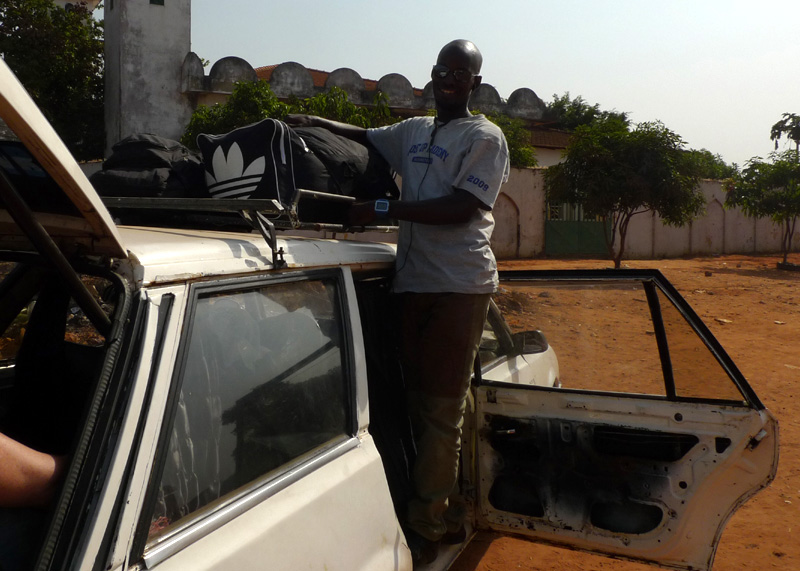
Our sept-place driver who endured so many checkpoints

Having to stop and go through one of these bureaucratic exercises at each of the three borders (Senegal/Gambia, Gambia/Senegal, Senegal Guinea Bissau) didn’t surprise me. What I wasn’t prepared for was how many times beyond that we were forced to halt — three or four separate detentions at each of the latter two frontiers, then more stops at checkpoints along the way. Sometimes only our driver had to get out (and once I think a “fee” was extorted); sometimes we all had to hand over our passports for furrowed-brow thumb-throughs. Each stop stole time.

For Steve and me, slumming as we are, most of this activity was actively entertaining for its cartoon quality and obvious absurdities. Tiny human dramas abounded.

But around 3:30 p.m. — when we were a full 90 minutes late for meeting the speedboat in Bissau that we’d hired to take us out to Bubaque Island — it began to grate on our nerves as it had been irritating Laura and our three African fellow passengers all along. Two of the latter were natives of Bissau (and speakers of English as well as Wolof, Portuguese, and some French). Friendly folks, they helped us find a taxi and direct the driver to the container port where Gilles had said we’d find the speedboat.

Helpful passengers who helped us find a taxi.

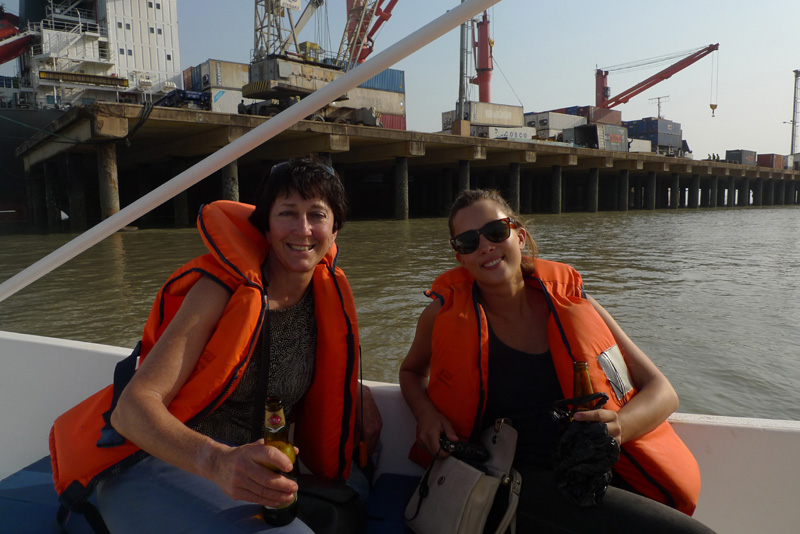
Miraculously, it was still waiting for us (and supposedly for an English threesome).  Laura and I found some beers at a shanty bar across the street from the port, and from then on the afternoon got more and more golden.  With sunset approaching, we left Bissau (sans Englishmen) around 4:30.  We zoomed through glassy seas toward a misty paradise without borders or the rascals who harass those who would cross them.

A Kasa Afrikana speedboat awaited us in Bisau harbor
Cristal Time

Camping in Senegal

Saturday, January 1, 2011

Hyenas ate one of the camp dogs last night. (We only learned this at breakfast this morning.) It was the only shadow on our 3-night stay at Keur Bamboung (Chez Bamboung).  

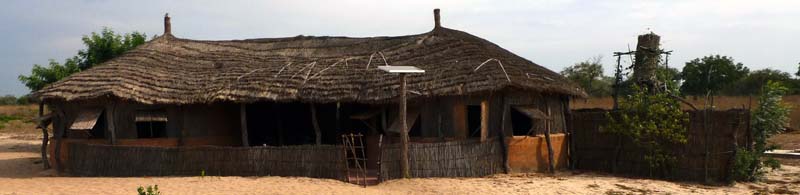
This has been a high-level camping experience.  The camp has 9 rooms scattered around the sandy grounds; they can accommodate up to around 30 people. We’re in a double: two ample rooms made entirely of reeds and grasses and bark and logs.  A comfortable lounging area separates the two sleeping quarters. Each room has its private open-air bathroom, complete with porcelain toilet, sink, mirror, and shower.  Solar panels provide all the electricity (not much) and power the pumps that bring water up from underground. We gather for meals in a large communal pavilion, open on two sides to the marsh and mangrove forests all around us.

Two bedroom reed hut at Keur Bamboung
Bedroom at Keur Bamboung

The camp’s a French project, the heart of a large marine reserve started in 2004. Proceeds from it fund the guardians who prevent anyone from fishing within the protected area.  We’re told that close to 30 new fish species have been found here since the reserve was created. Good news for the fish world, but hardly the most remarkable aspect of the place, in my opinion. 

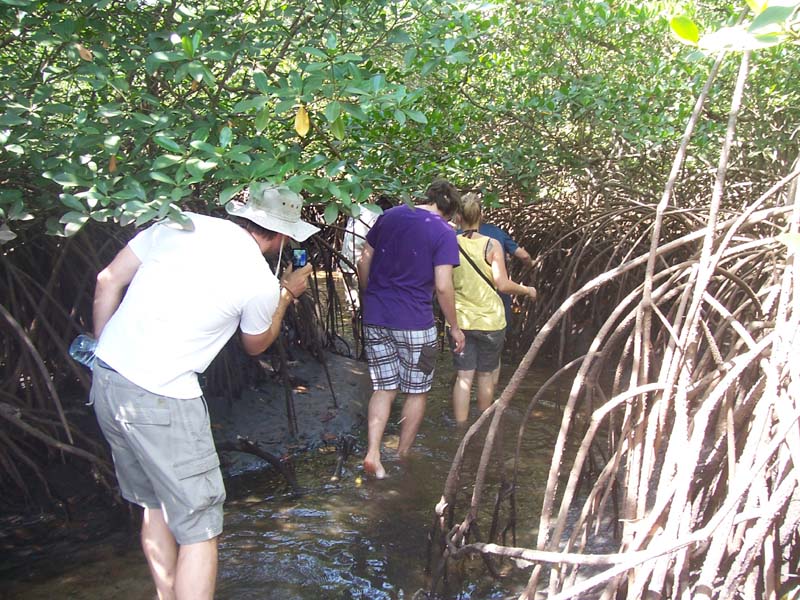
Other animals that live here include warthogs, bats, red and green monkeys, antelope, and those pesky hyenas. But I think the greatest stars are the mangroves — those magnificent plants that have adapted to live in salt water, creating new land as the silt builds up around their roots. Yesterday morning, a guide led a small group of us on an hour-long trek through some of their inner recesses. Barefoot, we followed serpentine streams through the shady green vegetational tunnels. The plants have evolved to filter out the salt; they excrete it on their leaves, which are crusty with the stuff. In places, we sunk up to our ankles in the ooze, taking care not to scratch our arms and legs on the knobby thickets of roots. Because our guide, Famara, had declared that the groves harbored no poisonous snakes (and because I tried not to look too closely for spides and insects), it was a magical world — one I never dreamed I would penetrate. 

Entering the mangrove forest.

High tide came around sunset, and we set out again then to kayak through some of the same places we had sloshed through on foot just hours earlier. The opalescent light and the glassy waters made this a serene and glorious excursion (although we all agreed that the foot-trek was even more thrilling.) The true highlight of the night turned out to be the New Year’s Eve feast prepared by the staff. It started with baskets full of fresh oysters — harvested earlier that day from the mangrove roots on which they grow. These were tossed on a roaring bonfire and roasted. (We squeezed lemon on them, and washed them down with fresh palm wine.)

We moved into the pavilion to eat the fish terrine with mayo/ketchup sauce. Visiting friends and relatives of Charles, the French resident manager, had spent part of the afternoon peeling potatoes for the pommes frites that accompanied braised chicken and green beans wrapped in bacon. There was even a cheese course — a most uncommon luxury in this part of Africa (and doubtless imported by the French contingent.) 

I’m happy to report that Laura and Albie’s foresight provided the piece de resistance. They had stocked up on fireworks in St. Louis, and as midnight approached, I helped Laura distribute them to everyone in the dining room (lit, by then, by  just a few kerosene lanterns). As we counted down, people lighted their Roman candles and waved them, while Laura and I set up the bottle rockets and she used a lighter to ignite their fuses.  The grand finale was a monstrous and scary looking creation that had cost them $20, and of which I would normally have been terrified, had I not drunk as much I had.  It proved to be worth every penny, rocketing hundreds of feet into the air and exploding in a huge shower of lights and colors. 

The gooey chocolate dessert and bad sparkling wine that was served a  bit later was a clear anticlimax. Now halfway through our final day here, we’ll depart early tomorrow. Alberto will be driven back to Dakar, while Laura, Steve, and I will head south through a part of Senegal where just days ago a dozen or so separatist rebels (or drug thugs) and the military reportedly killed each other. This is part of an old on-going conflict, and by other reports tourist transit should be safe. Still, mindful of the fate of that camp dog, our aim is to arrive in Ziguinchor long before the time when the predators come out.

Travel Quiz

Friday, December 31, 2010

One of the marks of travel competence, in my opinion, is being able to figure out how to have fun, even when circumstances change and the setting is unlikely.  We had a small test of that ability yesterday, and we passed.

To simplify our journey into the Saloum Delta, we had decided to leave Popenguine Wednesday morning, travel to Kaolack, and spend the night there. We knew Laura and Albie expected to pass through Kaolack around 3 p.m. Thursday, and arriving the night before would relieve us of any stress about missing that connection. 

The only problem was this meant we would have to spend most of the day in Kaolack, a great crossroads of Senegal but by all accounts a singularly lackluster town. (The French proprietress of the Balafon, our hotel in Popenguine, had wrinkled her nose when asked how long it would take to travel there. She never went, she said, because why would anyone want to?)

You might not travel to Kaolack to stay at Le Relais.  But apart from the unpleasant smell that permeated the town upon our arrival, the hotel seemed to us an excellent way station.  Well-tended gardens filled much of the grounds, and the pool was large and welcoming, if a bit murky. Our room, which cost about $65 a night boasted air conditioning, a TV, and hot water, and a shower that worked well.  Although the power went out almost immediately after our arrival, the sound of a generator kicked in around dusk, and we ate excellent fish and surfed the internet on our laptops in the huge, well-lighted dining room. 

We’d read in the Rough Guide that Kaolack’s two principal “sights” were its covered central market (“one of the largest in all of West Africa,”) and its mosque.  So the next morning we asked the friendly receptionist if he could help us secure a taxi to drive us to them and wait while we visited both.  He called a young man named Moussa who arrived in a clean, well-maintained Toyota Echo and said he’d serve as our chauffeur for 10,000 CFA (roughly $21). We bargained this price down to half, then set off. 

Although we’d told Moussa he didn’t have to act as a guide, when we arrived at the central market, he seemed eager to accompany us, and as it turned out, we were happy to let him lead us the dark, crowded, fetid labyrinth. On Moussa’s heels, we both felt relaxed scanning the tiny stalls filled with fabulous fabrics, flip-flips, recycled glass bottles, live poultry, spices, grains, fruit, jewelry, and a thousand other goods. Some of the vendors assailed us, but far less aggressively than the touts in Egypt.

We did make two purchases — several oranges, tangerines, and bananas (for just under $3), and 3 small but charming necklaces.  Asked a ridiculous 10,000 for the latter we refused, but when I got the price down to 3500, I accepted. High drama erupted, however, when I started to pay: violent shouting between Moussa and the seller, culminating in Moussa snatching the money and signaling us to stomp off behind him. A bit further on, he found identical necklaces being sold by some ladies — for which I paid 1500. (Apparently the injustice of the first price was too intolerable for him to bear.) 

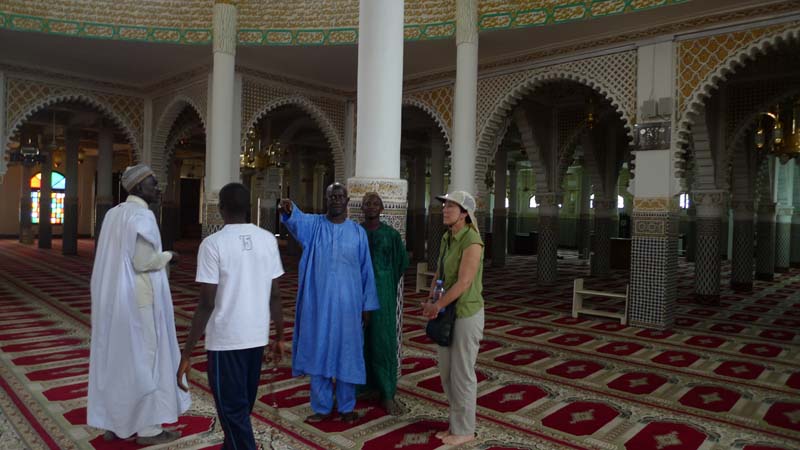
Our visit to the mosque played out differently. Moussa quickly found two guides to lead us through it — one tall and haughty and French-speaking and the other with an ebullient command of English. I was stunned by the beauty of the interior — as vast, I think, as the great mosques in central Cairo, and ornamented with glowing stained glass, huge ornate chandeliers, intricate Moroccan woodwork, and acres of pristine Persian-style carpeting. We left our shoes at the door and I wore Steve’s safari hat, but that’s where the formality ended. They seemed proud to be showing off the place, and they insisted we photograph one detail after another. Here are two:

African public transportation

Wednesday, December 29

According to my nose, the smell surrounding the Relais de Kaolack  (where we’re staying tonight) is the first unpleasant one of this trip.  Mostly, I detect l’air de burning garbage (a smell I know well from Latin America), but there’s a putrid subnote mixed in with it. That may come from the giant marsh that surrounds this area.  It’s not that bad; doesn’t bother me that much. Rather, it surprises me that we didn’t encounter any other revolting smells on our trip from Popenguine to here.

On that trip, we traveled for the first time like ordinary Africans. (In South Africa it was all white-guy transport: planes, rental cars, backpacker buses, the Bulungula shuttle.) Today was one of the only times on this trip when, despite having planned most details pretty extensively, I had no clear idea how we’d get from Point A (Popenguine) to Point B (Kaolack).

We started asking around the day before yesterday about the best way to do that. Got some conflicting advice but finally concluded we had to call a taxi to get out of Popenguine (which, though a tourist magnet, is quite small). Sineta, the B&B operator in Dakar, had given me the number for a good driver in Popenguine, and when I called it this morning, he said he could pick us up in 15 minutes.  

My rusty French has proven more serviceable than I expected; we agreed to pay about $15 for the 45-minute ride to the gare routiere in Mbour, where we would be able to catch a bush taxi. The driver, Elhadji, was a friendly fellow who pointed out sights (in French) all the way and promised to help us find a good “sept-place” to Kaolack.

We appreciated that, as the Mbour gare routiere was the first of its type we’d experienced in West Africa. Some people call these places “taxi parks” but that name might give you the wrong idea: a mental image of something orderly. Mbour isn’t a large town, but its gare routiere felt enormous to me: a sort of outdoor grand central station of chaos. Dozens upon dozens of taxis, station wagons, huge vans — each more crazily decrepit than the next — filled the concourse, and teaming streams of people flowed among them. Most cheerful and eye-catching were the women, dressed in their gorgeous Senegalese dresses and head-gear and bearing (in many cases) baskets or trays filled with oranges, eggs, candies, French rolls, and other wares on their heads. But there was a head-spinning assortment of other sights: touts beseeching us to ride in their vehicles, boys bearing frosty quart bottles of Kirene-brand water, a pack of very young kids who surrounded us, called us toubabs (a somewhat pejorative term for white folks), and asked us to give them money. When we ignored them, they disappeared, and Elhadji had returned with advice.

He pointed to a cluster of station wagons and said the two-hour ride to Kaolack in one of them would cost us and our bags 4500 CFA (roughly $9.75).  Another cheaper ($4.30) option seemed to be in a larger vehicle, but Elhadji looked nervous even mentioning this, so we chose the “sept-place” (seven-place, in French). 

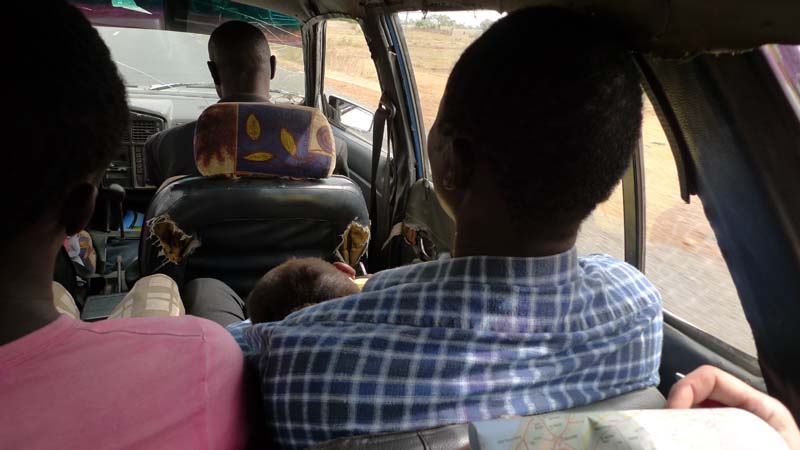
The one we wound up riding in probably wasn’t any filthier or more macerated than its peers, but the sensory overload prevented us from doing much comparing. An old Peugeot station wagon, it was in the worst shape of any vehicle in Steve’s experience (which is vaster than mine when it comes to beaters.) Neither the speedometer, nor the tachometer, nor the starter worked, so when we finally started moving, it was a human touch (or rather, push) that got us going.  The front window was spiderwebbed with cracks (though intact.) From the time we threw our bags into the back to the time we started, 30 minutes passed. During that time, as the driver scouted five other passengers (to utilize every cubic centimeter of flesh-hauling capacity), a steady parade of vendors came by, thrusting into the windows rings, oranges, candy bars, cell phone cards, little plastic bags of allegedly sterilized water, and other offerings. “You know,” I whispered to Steve, “This is the sort of place which if it doesn’t scare the shit out of you is really quite fascinating.” He agreed.

View from the 3rd row

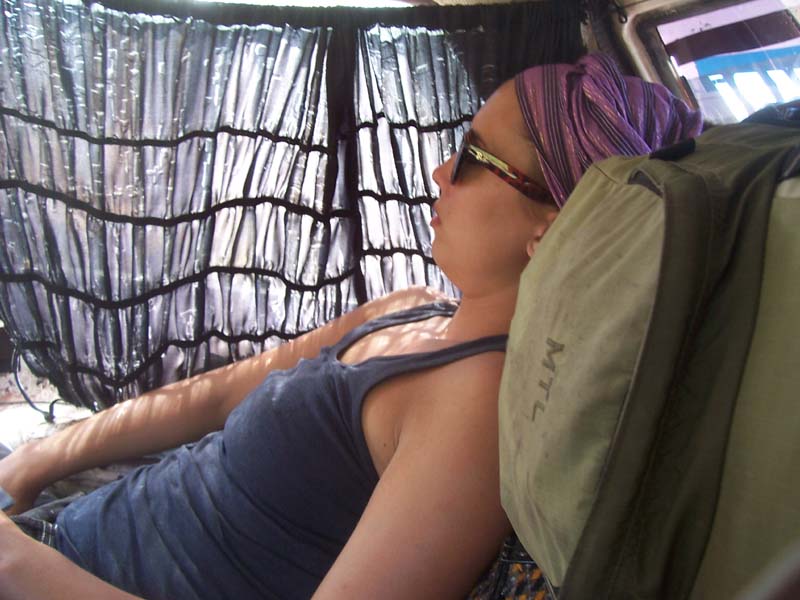
Certainly we would have found it too daunting even a few years ago, but for whatever reason, we both felt at ease and consequently hugely enjoyed most of the ride — even though we had chosen to sit in the rear-most seat. This we shared with a silent young man so tall he could only accommodate his knees by opening them at a 45-degree angle. This meant his right thigh, side, and arm were fused to mine in the manner of a Siamese twin. The row in front of us held a middle-aged guy who incredibly was wearing a leather jacket, a somnolent younger man whose lolling head kept falling back over the seat top onto my knees, and a broad-shouldered man holding the best-behaved 18-month-old (a tiny girl, dressed with care and attention) I’ve ever observed.  Another lucky passenger got the shotgun seat. 

Despite the dry heat and close quarters, the only thing I smelled was the diesel fumes. The road was excellent for the first hour, and we made good time. Our driver passed larger vehicles with care and good judgment. 

But after the town of Fatick, as we entered a lowland area that frequently floods, all the drivers on the road began zooming from side to side like slalom skiers to avoid the enormous potholes. Since this requires using every part of the roadway, the ride at that point began to feel like a huge, high-speed chicken game. Although we only saw mechanical breakdowns and flat tires, I’m sure worse things happen.

Passenger holding his well-behaved and fashionably dressed daughter.

For that reason,  and because future rides mostly will be longer than 2 hours, and because the novelty is gone, our future rides will probably be more expensive.  And the one tomorrow is certain to be more sociable. After Albie and Laura arrive from Kolda, the four of us will share a taxi to Toubacouta, where a boat will take us to an island in the delta. From there a horse-drawn cart will take us to the place on the delta (Keur Bamboung) that will be our lodging for the next three nights. I think it’s probable we won’t have an Internet connection there, so there may be a communication blackout during that period.

A warning about the Senegalese safari experience…

If you’re thinking of trying it, keep your expectations modest! Steve and I paid $178 for a “package” organized by our B&B that included sharing the 70-minute taxi ride to Bandia National Park, the park entrance fee, rental of the safari truck (which we shared with the above-mentioned Ardyce and her mom, an Italian guy, three African-American ladies who’d come to Dakar for the black African arts festival, the B&B owner’s 16-year-old son, and a guide), plus the guide’s services.

A converted pickup hauls tourists around Bandia National Park.

In French, the guide dutifully recited the gestational period and age of every species we saw — but not much more.  The experience reminded me a lot of going to Orange County’s Lion Country Safari, back in the days when it was operating.  Only briefer and more expensive. 

Who doesn't like giraffes?

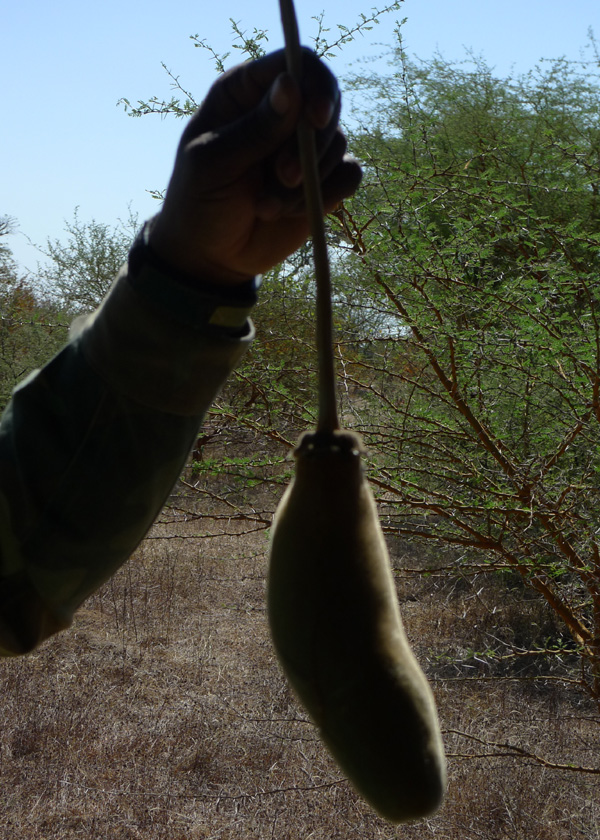
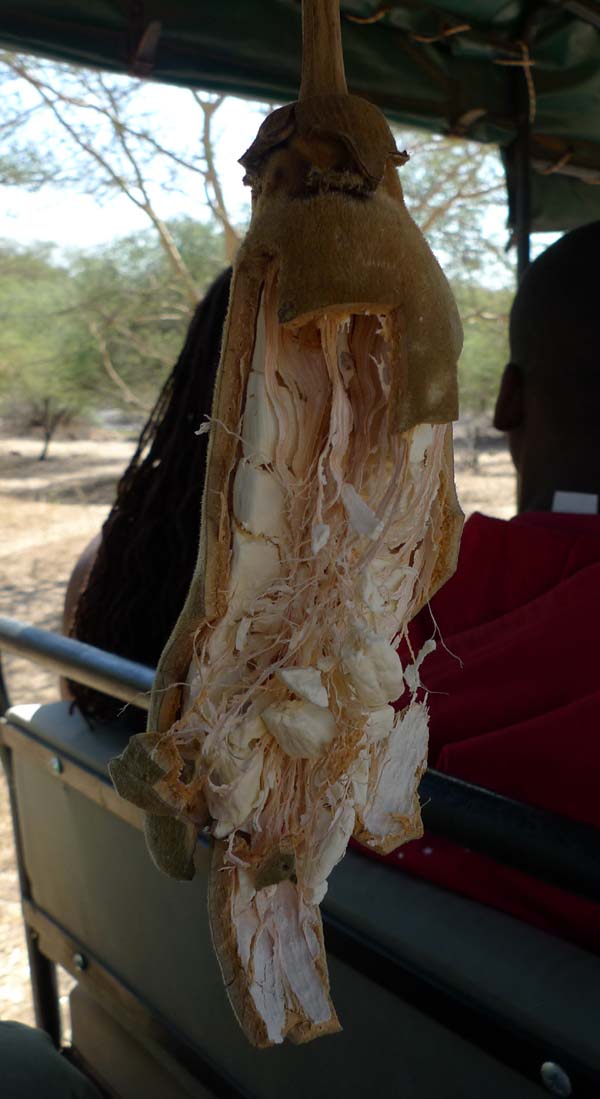
On the other hand, it’s churlish to complain about a two-hour outing with the breeze blowing through the safari truck and sightings of impala and sable antelope, savannah buffalo, eland, zebra, ostrich, giraffe, monkeys. (No predators; they’re long gone.) The animals posed and munched among dense acacia and thorn trees, and — thrilling to me — forests of baobabs.  The best thing our guide did was to spot a fallen baobab fruit (not so easy to find!  Monkeys love them so much that the Senegalese call them the “monkey’s bread.”  He let us photograph the long oblong fruit, then smashed it against the side of the truck to reveal a fractured white interior. He passed it around to let us extract fragments, which looked like pieces of white packing material. Inside each piece was a huge seed (the malevolent invaders that Le Petit Prince had to ceaselessly prevent rooting in his beloved planet!)  The big surprise was the taste of the white stuff around the seed — refreshingly citrusy.

Now we’re happily settled into the Relais in Kaolack — by all reports a dreary town despite being the crossroads of Senegal. But our trip here was a personal triumph, and Laura and Alberto will meet us here tomorrow afternoon so we can continue on into the delta paradise where we’ll ring in the New Year.

Moving to Senegal

Tuesday, December 28
One of the first characters we met here yesterday morning was a young woman named Ardyce (I may be misspelling her name). She was a member of the group of 8 who made the trip yesterday morning from Dakar to Bandia National Park (a 70-minute ride from the capital, and billed as a cheap and easy way to sample an African safari in Senegal.) Steve and I sat with her in the back of our taxi: Ardyce’s mom, visiting from Florida, got the front seat. I think Ardyce was about 24, graduated with a masters in journalism last summer and now on a Rotary scholarship to work and study in Senegal. She wants to be a foreign correspondent and told me Dakar wasn’t a bad place to try to launch such a career. She acknowledged that the city had many awful, trying aspects; in her first weeks, she had called home every day weeping and ready to return to the US.  But now, after just 4 months of living in it, she had grown so attached to the place that it was painful to think of leaving.  The only complication was that she had a boyfriend back in the US, and she wasn’t sure how he’d feel about settling down in Africa. 

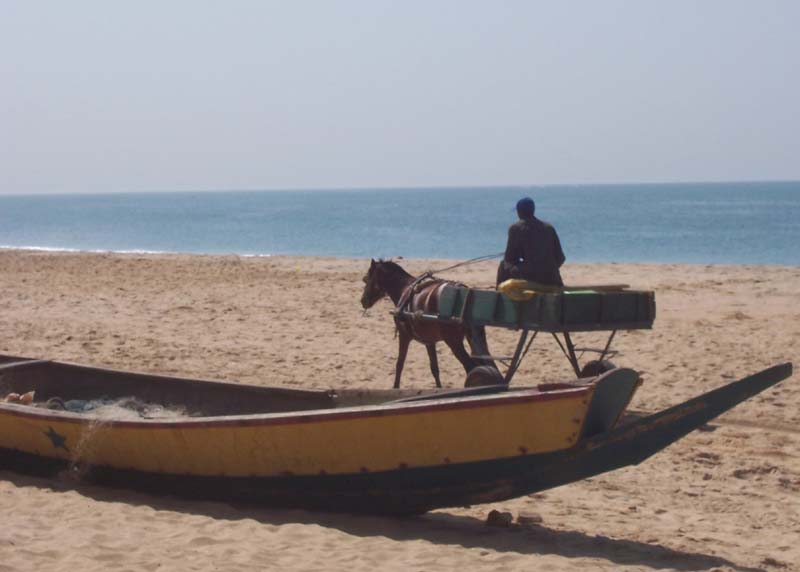
Horse cart on the beach at Popenguine, Senegal

Ironically, Steve got into a conversation today with a young African that touched upon the same theme.  After visiting the park yesterday, we moved on to Popenguine, the nearby beach town on Senegal’s “Little Coast.” We’re happily installed at the Balafon lodge ($32 a night), and after a long breakfast this morning at the wifi cafe on the beach below our hotel, Steve took off alone to stroll around the tiny village.  His young conversational partner (who spoke French and bits of English) asked Steve why he didn’t move here. Steve later recounted that he had answered that Popenguine was just like his home back in the US.  I snorted that that was ludicrous.  I knew Steve was thinking that this place is hot and sunny and lush with many of the same plants that have been transplanted to San Diego (rampant bougainvillea!).  But the streets are also dirt, and boys deliver bottles of water driving horse drawn carts, and the girls and women walk around with baskets on their heads. The power went out about 9 last night, so when we got back to our room after dinner (fish caught with nets from the beach, earlier that afternoon), we had to shower by kerosene lantern.  The water was unheated.

It struck me that just those sorts of differences, added together, constitute culture shock. On your first trip to Paris, the fact that everyone speaks French and the elevators are tiny might make you experience it. But the more you travel and the greater the part of the world you see, the areas of culture shock shrink. I’ve spent so much time in Europe over the years, I imagine I’d feel only a shadow of it were I to visit Hungary (even though I’ve never been there.)

Still, even though Steve and I were hiking on the Wild Coast of South Africa only 10 months ago, I’m once again experiencing the shock of being in Africa. It’s not unpleasant. On the contrary, for me, one of the greatest pleasures of travel is being jolted by sights and sounds and smells that are shockingly new to me — they sharpen my senses and bring me most fully into the present moment.

They burn experiences into my memory such as our arrival at Dakar Airport. After touching down about 9:30, we moved hassle-free through customs and immediately found our luggage wheeling around on the carousel.  Then we had to go through a bizarre drill of hoisting it onto a conveyor belt. Our suitcases traveled through a large black box and emerged past a fat guy in a security uniform who was paying no attention at all to any of it or us.  But apparently someone in Senegal felt this charade was necessary before tourist could be allowed into the arrivals hall. 

I couldn’t figure out how to get my I-phone to either text OR phone our B&B, so I finally mustered the courage to approach an enormous policeman who looked like he could have been Idi Amin’s bodyguard and ask if I could borrow his cell phone. Looking disgusted, he dialed for me but at almost the same moment, our pre-arranged driver materialized.  

Bada turned out to be warm, welcoming fellow, and after helping us change money and buy a SIM card, he led us to a scarily dark and run-down parking lot and ushered us into a cab.  Then he climbed on his motorscooter and drove off. Our taxi driver followed his single taillight through the crumbling streets of major thoroughfares, then turned into narrower creepier streets. It was pitch-black when we arrived at the B&B, unloaded our suitcases from the trunk, and hefted them through the fine dust of the street and into the pitch-black building. 

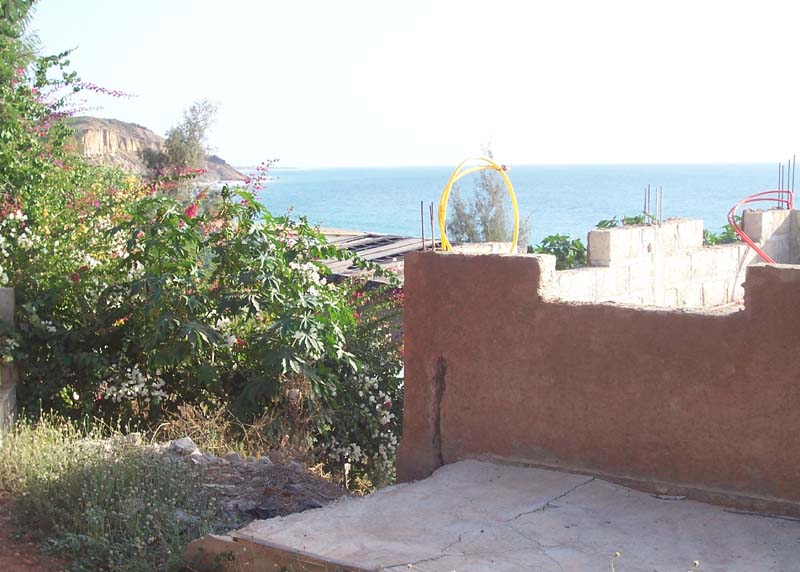
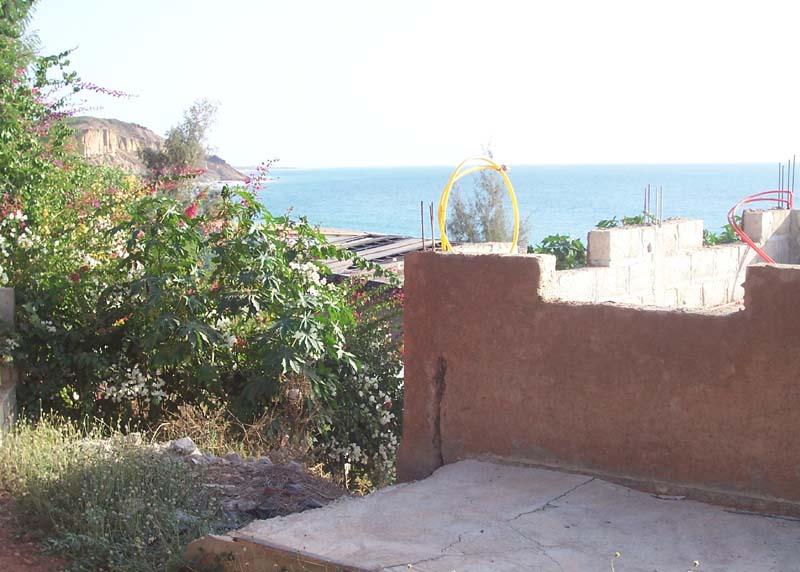
It turned out that Dakar was also experiencing yet another power outage. In the morning the world was sunny and warm and everything looked much more welcoming. Now, sitting in the cool breeze of Popenguine and typing these words to the sound of the surf below, I’m already so comfortable I’ve started to take for granted things like the adjoining unfinished rooftop, bristling with rebar and unconnected power lines. That’s a bit of a shame, but I think we’ll get to experience more novelties in the coming days. Enough, I trust, to keep us awake.Popenguine work in progress

In the War Against Bugs

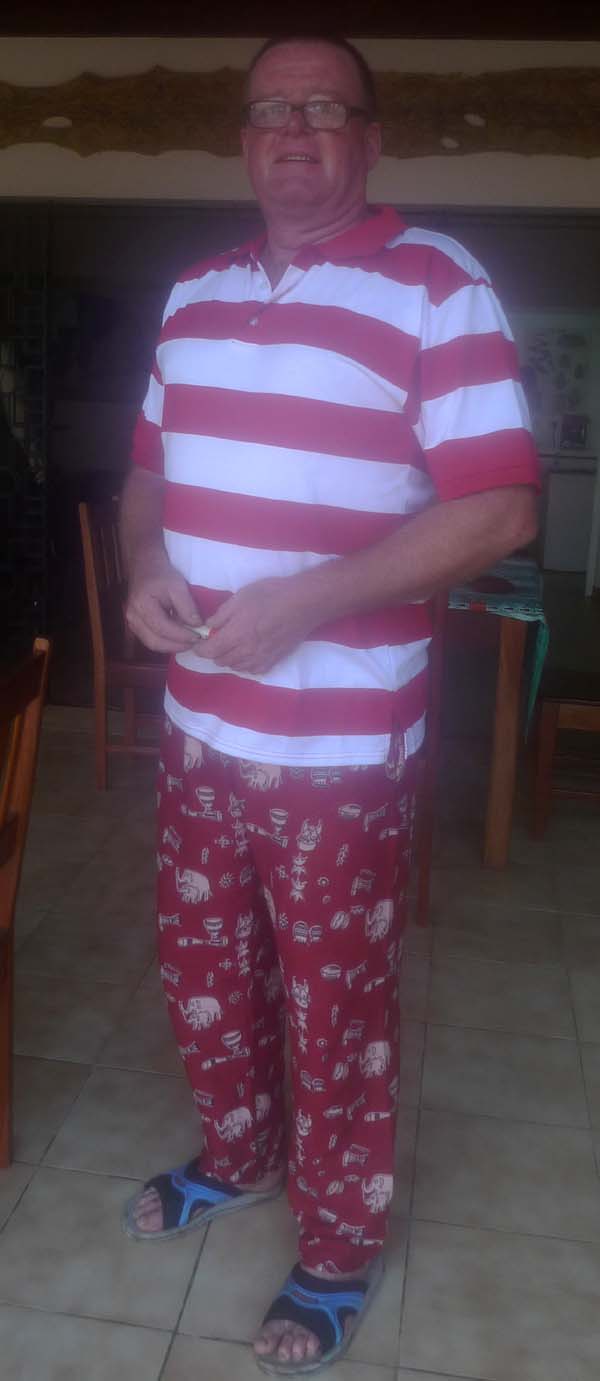
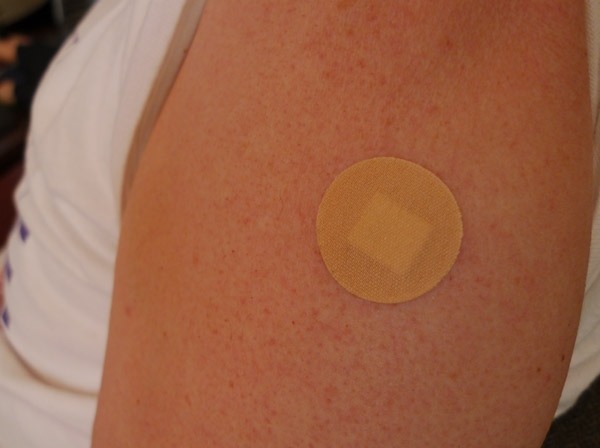
Steve's still wearing at least one of his bandaids. Our arms ached, but that was our only reaction.

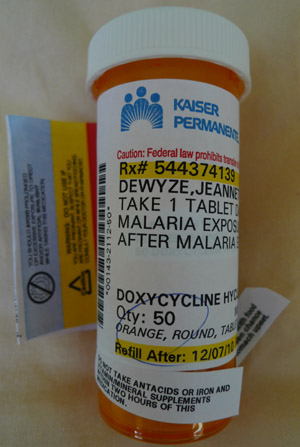
We got our immunizations yesterday — typhoid, flu, meningococcus, tdap(typhoid/diphtheria/pertussis), along with the pills we will take to protect us against malaria during our upcoming trip to West Africa. For previous trips in recent years, we’ve gotten shots for yellow fever, hepatitis A and B, and polio.  Surely we’re ready to go anywhere on earth now…