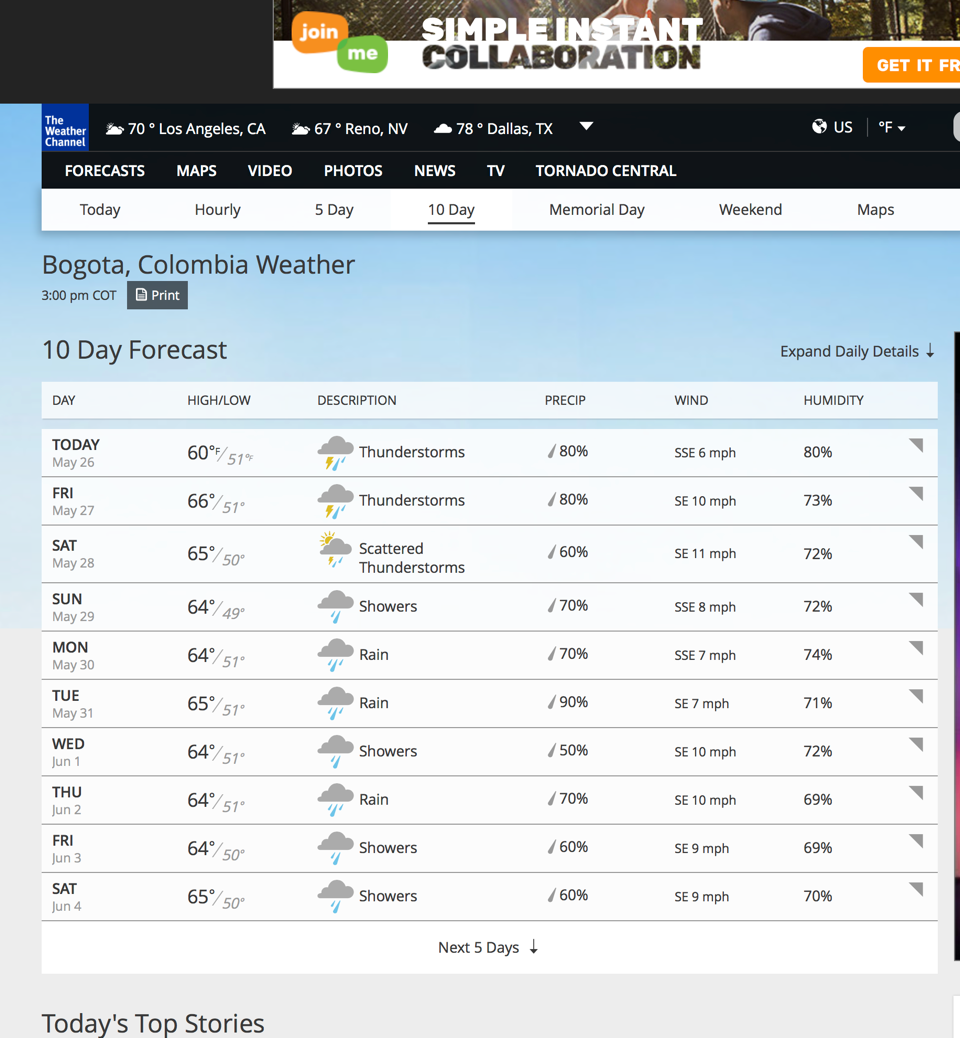
I started checking weather forecasts for Colombia a few weeks ago, and what I saw made my spirits sink. It looked like this for the foreseeable future in Bogota — and pretty much everywhere else we were planning to travel:
How could this be?!?! When settling on the dates for this trip (LAST summer!), I’d consulted guidebooks about the best time to travel in Colombia. What I vaguely remember of their advice was that the answer to that varied dramatically from one part of the country to the other (since the country’ geography is so varied). But I think the guidebooks agreed that early June was a mostly good time — one rainy season would be ending and it wouldn’t be too hot anywhere.
And now the weather sites seemed to be promising endless rain. Was this the fault of El Niño? In Bogota, the activity to which I’ve been looking forward most Bogota was a bike tour of the city about which I’d heard rave reviews. A few days before our departure, I emailed the bike tour company to ask if they operated in the rain. Their reply conforted me. “It hasn’t rained much, unfortunately, as we’ve had a drought,” a guy named Mike wrote me back. (It makes me wonder if Mike and Accuweather might want to talk to one another.).
When we landed at Bogota’s El Dorado Airport last night, it felt like Accuweather had a better read on the situation. Cold and blustery, the night felt more like dead winter in San Diego than summer in South America (NOT very far from the equator!) But this morning, it’s cool but dry outside.
Not that I’ve seen much of the outside world. It’s already 10:15, and we haven’t yet seen Michael and Stephanie. We’ve read that Bogota’s famous Gold Museum is not open at all on Mondays, so I don’t think we’ll be squeezing in the bike tour today. Still, we have a full day tomorrow too, and I’m reminding myself that a focus on the present moment makes weather forecasting a silly activity.
Saturday we’re flying to Colombia. When I’ve mentioned our destination to a few people, I’ve been asked if I was referring to the city in Ohio. That’s probably a nice place to go, too, but instead we’ll be traveling in the large nation that’s the first country you get to in South America, as you leave behind Panama and the rest of Central America. (We’re flying there, not driving, although that would doubtless be even more interesting.) I’ve also been asked why Colombia, a land that in the 1990s and early 2000s was plagued by shocking violence that flowed from left-wing guerillas, right-wing paramilitarists, and assorted other thugs. But by all reports, the violence has abated and tourism is surging. Several friends and acquaintances have traveled there in the last few years, and their accounts have been enthusiastic.
Now we get to see for ourselves this land of dramatic contrasts. For me, Colombia will be the 51st country I’ve made it to (assuming that one counts Tibet and Palestine as countries. Which I do.)
At least one of the things that will made this trip special is the fact that Steve and I will be traveling for most of it with our son Michael and his girlfriend Stephanie. What could be better?
On a darker note, the blogging software that I’ve used so happily for years on the road has, sadly, gone off the market. I’ll try to make the technology work using other tools. But that could get ugly.
We arrived back in San Diego late Saturday night and since then have been immersed in attending to the health crisis of Steve’s mother that prompted us to cut our trip short, along with the messy task of filing a “Trip Interruption” insurance claim and dealing with other re-entry issues. With every hour that passes, the memory of our all-too-brief visit to Tibet fades further. The way it’s going, in another week or so, any memory that I was ever there will have vanished.
But we were there, in a land that, as Steve observed at one point, has less in common with modern American culture than perhaps anywhere else we’ve ever been. To help preserve some shred of what we experienced, let me describe what seemed to me to be the Three Most Un-American Tibetan Things.
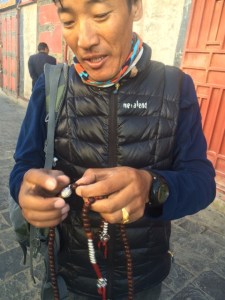
Our guide Tashi disclosed that he was working on saying his favorite mantra 100,000 times. His set of beads helps him keep track of how close he is to achieving that goal.
— Mass ritualized walking. The former sovereign country (and current Chinese “autonomous region”) of Tibet contains a staggering number of places considered by Tibetan Buddhists to be sacred. The faithful believe that as a result of visiting these places and doing certain things at them, good things will happen. For example, by journeying to specific peaks, one can make amends for specific sins. To boost the power of the visit, an almost universal tactic is to walk in a clockwise direction around the sacred thing. This is known as making a kora (or circumambulating), and you can do it around something as small as a prayer wheel or as large as a mountain. Most people recite mantras as they walk, Om Mani Padme Hum being the most famous one. But there are bunches of others. Tibetans use complicated prayer beads to keep track of how many times they say their particular mantra.
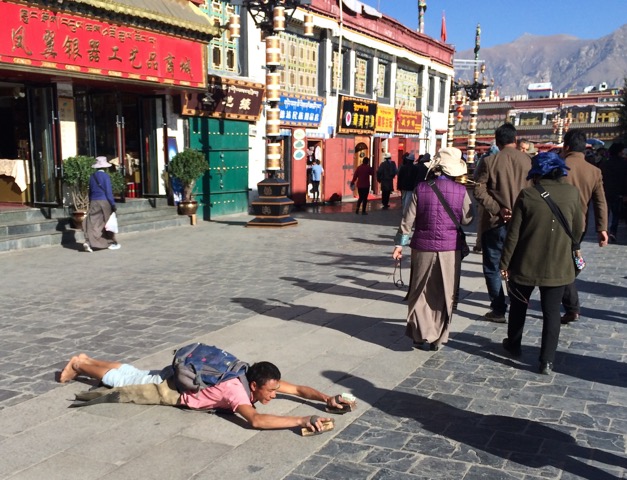
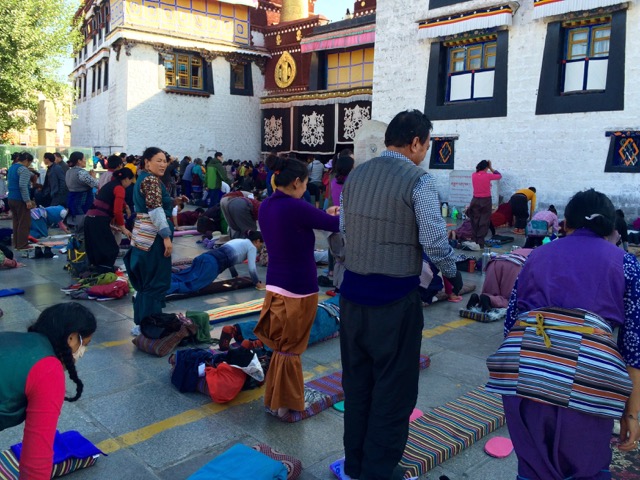
The most devout folks also engage in elaborate prostrations in which they go from standing to lying face-down flat on the ground, then back up again, over and over. Some combine prostrating with circumambulating, then taking a step or two sidewise between each trip to the ground. They do this hour upon hour.
This fellow was prostrating himself around the kora route. People use various devices to protect their hands as they slide they forward and downward and back up again.This large group of people was prostrating in one place, en masse.
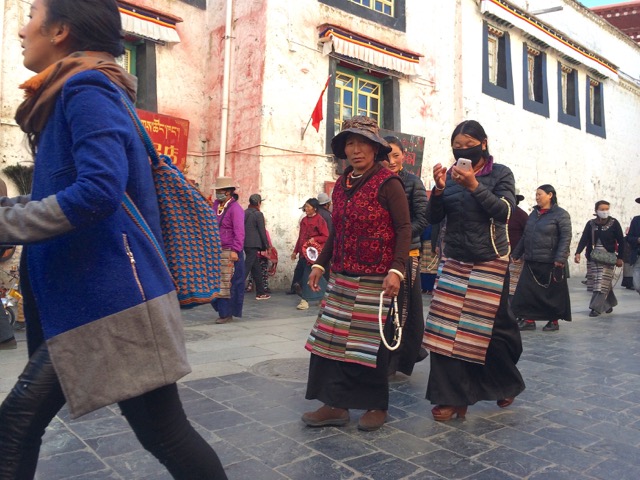
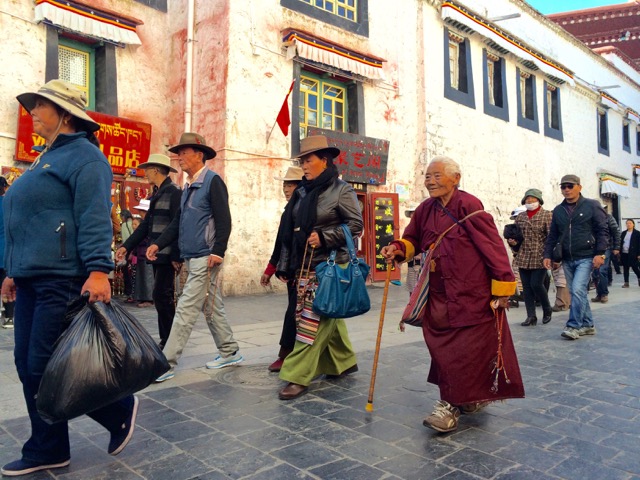
We’d seen one mass circumambulation around a stupa in Bhutan, but it hardly prepared us for the Tibetan kora culture. We saw koras all over Lhasa, some encircling whole neighborhoods. The procession we came to know best follows the outer perimeter of the part of the Old City containing the Jokhang Temple and takes maybe 15-20 minutes to complete. It’s a fascinating parade to watch, so dense at certain times it can be tough to cut across it. You see a sprinkling of monks and a goodly portion of elders amidst the walkers, but we also noted many young people. I was struck by how many people dress in the traditional style, women in long dresses topped with colorfully striped aprons, men in sheepskin cloaks, both sexes wearing felt cowboy hats. (And here they’re not wearing the folk garb because of some governmental edict, as is the case in Bhutan.)
Most people walk and pray, but some walk and check their cell phones.
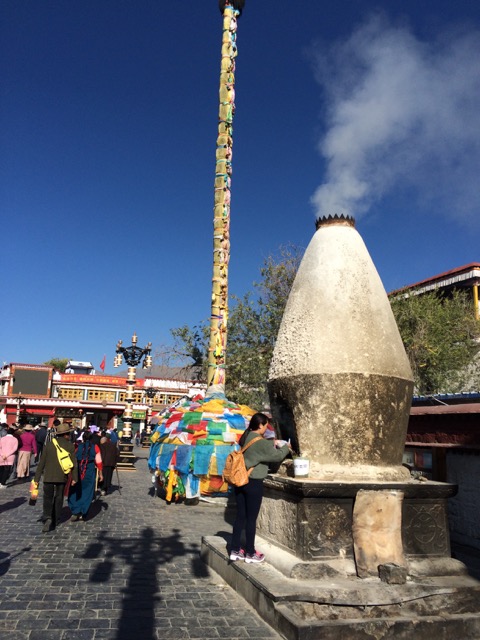
Pilgrims circumambulating the Jokhang Temple often stop to add damp juniper sprigs to these offertory ovens. The result is a lot of fragrant smoke that make the normally clear air of Lhasa much more closely resemble that of other Chinese cities.
— Yaks R Us. Considering that wild yaks are almost extinct (down from a million 50 years ago to only 15,000 or so today), the yakly presence Tibet is pretty amazing. The animals are cultivated (and often cross-bred with cows), and virtually every part of them (from their milk to their skin and hair to their dung) is used enthusiastically.
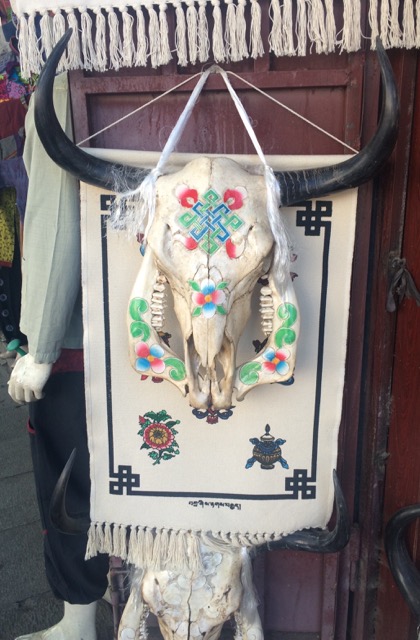
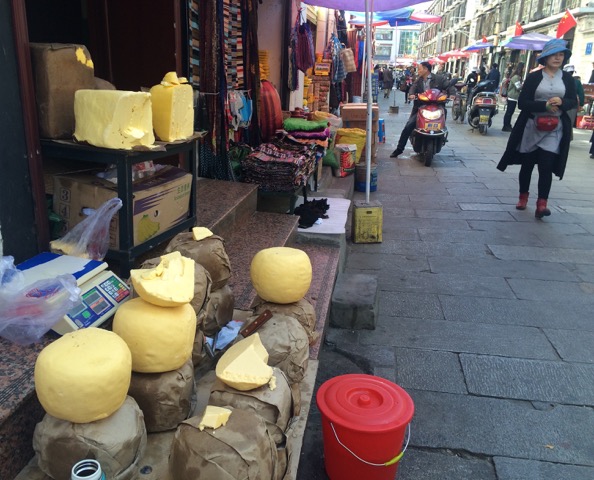
Yak skulls make nifty home decorations!We saw great lumps of yak butter in the stores…
People use the butter for many things, most notably yak-butter tea, which we tried once and found to taste like slightly rancid melted butter mixed with warm water. Yak meat was on every menu in forms ranging from yak burgers to stir fries, and our guide insisted Tibetans much prefer the flavor to beef. We, in contrast, were struck by its tough texture and gamy flavors. “It tastes like Tucker,” Steve declared of the principal ingredient in his yak stew one day. (Not that he would know. Tucker is our aging labrador retriever.)
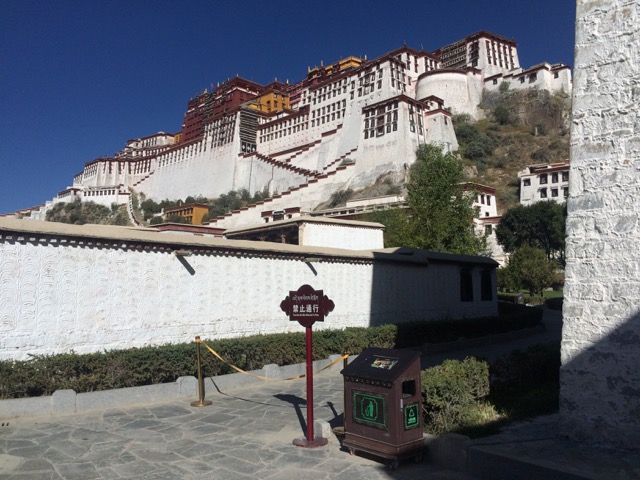
— The Potala Palace. During our abbreviated stay in Lhasa, we managed to visit four of the city’s major landmarks (two palaces, the most important Buddhist temple in the country, and a monastery.) All were interesting, but the Potala Palace is in a special class. It’s the class that includes the Great Pyramid, Eiffel Tower, and Angkor Wat — the most striking buildings erected over the course of human history.
Note the view from our hotel rooftop of the Potala Palace on the hillside in the distance.The view of the palace from the base of the hill.
Situated on a hillside that dominates the entire city, the Potala served as home to every Dalai Lama from the 5th to the 14th; 8 of the former rulers are entombed in sepulchers adorned not only with precious gems but (literally) tons of gold. The whole complex includes more than 1000 rooms, and even though today it’s a somewhat sterile museum, rather than the pulsing, vibrant, devotional center that the Jokhang Temple is, it’s actually hard for me to imagine I could ever forget the sight of it.
Had we not cut the trip short, we would have visited at least one more temple and another monastery. But perhaps it’s just as well we missed them. I’m pretty interested in Buddhism, but after only two weeks in Buddhaland, all the various orders and bodhisattvas and protective deities and other key historical figures were starting to overwhelm me. Toward the end I sometimes pretended to be meditating, just to escape the explanatory litanies about the over-the-top ornamentation.
On the other hand, had we not cut the trip short, we would have made that legendary cross-China train journey. On a third hand (something you see a lot of in Buddhist temples), we’re already in the midst of a different sort of journey back here at home. As with all journeys, all we can do it buckle up and appreciate the present moment.


 d in Buddhism, but after only two weeks in Buddhaland, all the various orders and bodhisattvas and protective deities and other key historical figures were starting to overwhelm me. Toward the end I sometimes pretended to be meditating, just to escape the explanatory litanies about the over-the-top ornamentation.
 At home and abroad