Reconsider travel to Papua New Guinea

Steve thinks weather can color first impressions of wherever you’ve landed. That was true of our arrival in Papua New Guinea Sunday morning. We had a pleasant two-hour flight from Honiara to Pt. Moresby, PNG’s capital. But we descended to the airport through skies filled with menacing clouds. On the ground, gusty winds matched the evil reputation of this city, which regularly ranks among the most dangerous in the world. 

We reached our hotel around 3 and were assigned a room on the fifth floor. It had huge windows overlooking the nearby beach, but the wind was shaking them so violently I could imagine them shattering. The racket continued all evening and was still so loud when I went to bed I had to wear earplugs.

Everything I’d ever read about Pt. Moresby suggested it was not safe to go out and walk around. So even though Monday morning dawned bright and calm, both Steve and I were content to hang out in our room. He worked on his travel journal; I wrote my last blog post. At 2 pm we were supposed to meet up with our tour leader, Christopher Bartlett, in the hotel bar. But mid-morning, a disturbing message popped up on our WhatsApp group chat: Christopher and a half-dozen other tour members were delayed in New Britain, where they’d been scuba diving. With luck, they might land around 4:30. A while later, Christopher Whatsapped again, suggesting we get a ride from the hotel down to Ela Beach, where festive activities celebrating the 50th anniversary of PNG’s independence from Australia were supposed to unfold.

This took a while to organize, but Steve and I and five other members of our 20-person group eventually piled in a van and drove down the hill. It occurred to me that the US State Department wouldn’t approve. PNG is already on their “Reconsider Travel” list because of the crime, particularly in Pt. Moresby, and political unrest in the western highlands. The anniversary celebrations would draw large crowds that might become violent, one bulletin advised, so they should be avoided.

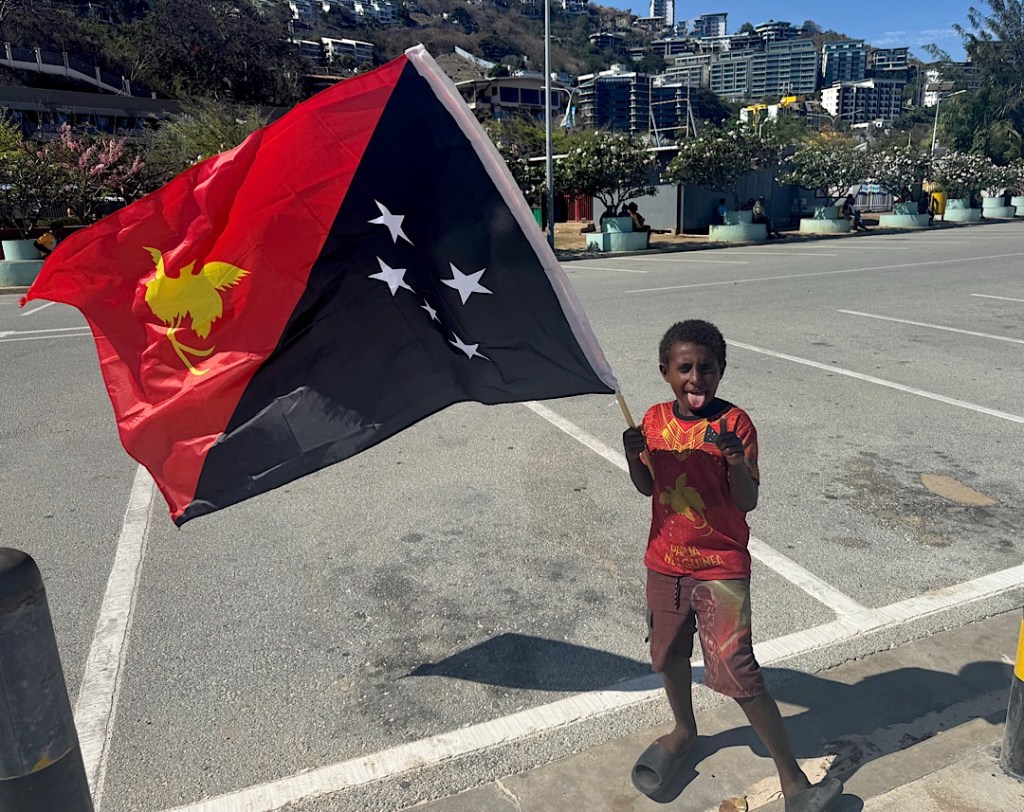
When the van disgorged us next to the beach, however, it was obvious little to no danger lurked here. The balmy day and cool breeze off the ocean would have made anyone feel cheerful, and the women and children and families we encountered on the boardwalk were in an extra ebullient mood. Everyone smiled at us and returned our “hellos” and most were dressed in the red, black and gold national colors, Many waved large PNG flags. They sang out “Happy Independence Day!”and we chorused back the same.
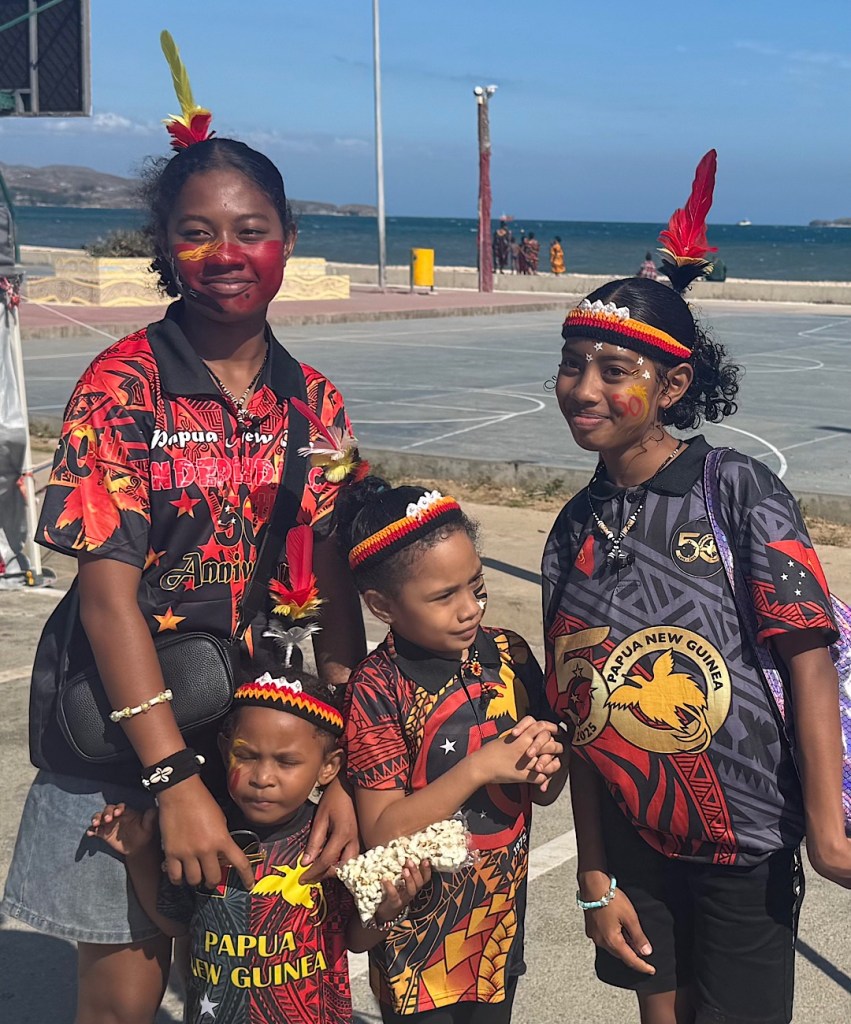
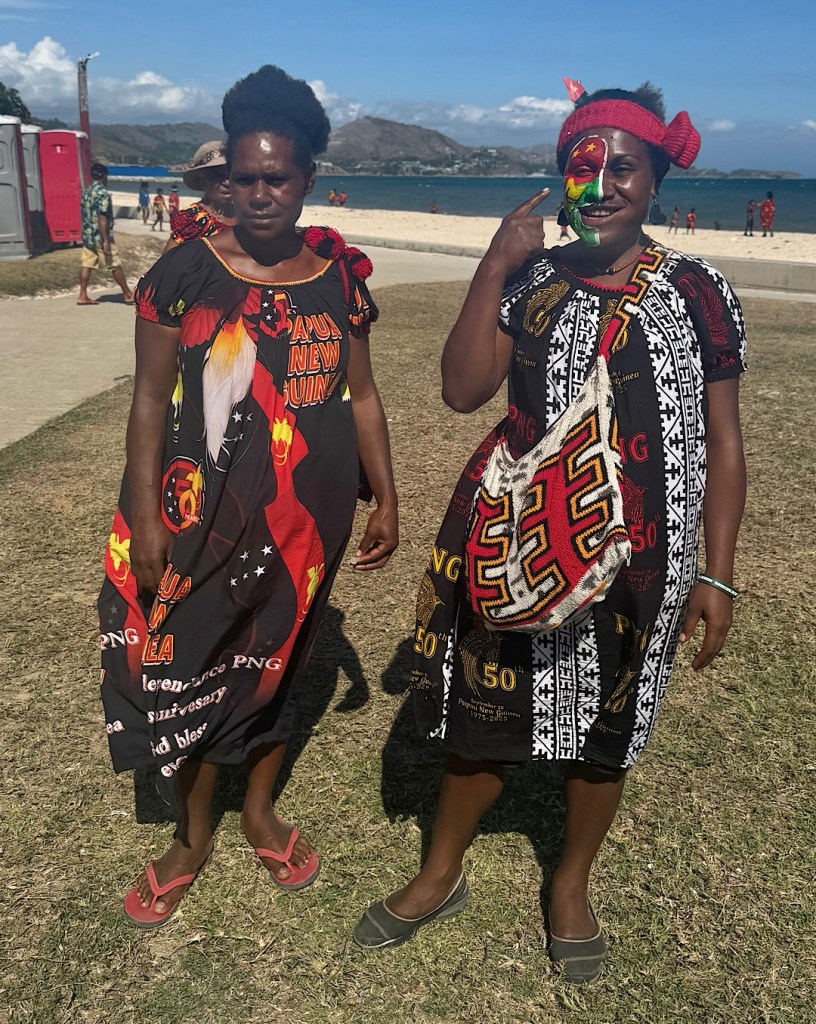
Kate, the only English member of our group, charmed everyone with her enthusiasm. My photo doesn’t show it well, but this guy had painted half his body coal black and the other half red, with a gold bird of paradise on his left chest.

Along the busiest part of the boardwalk, vendors had set up tidy booths where they were selling clothing and jewelry and other crafts. So we shopped and took pictures and made our way to a stage where we caught a few music and dance performances. Then Steve and I and Kate decided to walk back up the hill to our hotel, rather than catch a taxi. No harm befell us. 

I don’t doubt that visitors to Pt. Moresby routinely get robbed or even worse. Still, my experience that afternoon and in the next few days made me think anyone who wouldn’t dream of visiting Papua New Guinea because it’s too dangerous should reconsider their travel plans. 

PS — I’m writing this in the Eastern Highlands. We’ve been on the road for three days, and we’re immersed in the cultural experiences at the heart of this part of our itinerary. Internet connections are getting worse and worse. I’ve decided to keep my posts short, limit the number of photos, and send them whenever I catch a good, brief online connection. But that’s likely to be sporadic for the next few days. 
Safety

Thursday afternoon, March 18, 2010
The single biggest question I had before we left for South Africa had to do with safety. Would concerns about crime limit our ability to move around freely; to enjoy beng here? Now that we’re about to leave I can answer: that hasn’t been a problem.

I know the least about Johannesburg, as we had so little time there, and all of it came right after our arrival. The stories about crime are worst there (and indeed the morning we left, one of the employees at our B&B didn’t show up for work because a close friend of hers had been robbed and stabbed (not fatally)). Likewise, we had so little time in Durban, I can’t really judge it.

But from that point on, it’s been fine. Out on the Wild Coast and on the Dolphin Trail, I felt safer than I do at home (where I wouldn’t think of leaving my doors unlocked at night). And when we arrived in Cape Town last Saturday, we asked Hannes (the co-owner of our B&B) where we could safely walk in Cape Town. Anywhere in Green Point (their neighborhood) at any hour day or night, was his answer. Anywhere in the rest of central Cape Town during the day, he continued, though we might want to be a bit more cautious after dark.

Hannes, a collector of fine china and antique silver who looked to be in his late 50s, seemed a prudent fellow. His romantic partner, David, once worked in the perfume industry. The rooms of the B&B are all named after famous perfumes. It seemed unlikely he would steer his guests into the jaws of death. So for two nights in a row, we dined at the Waterfront, and on the 25-minute walk home we shared the dark streets with so many other pedestrians, I felt very comfortable.
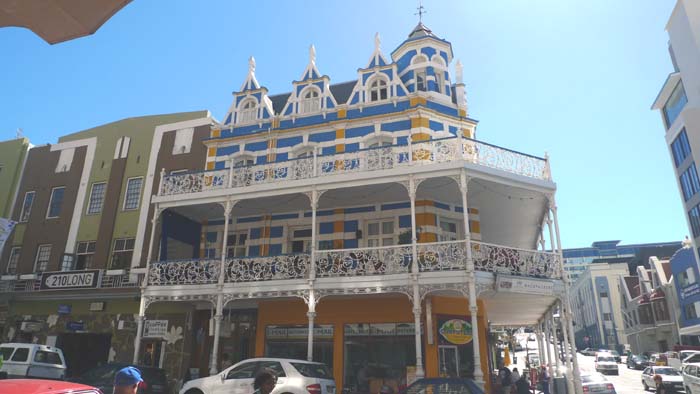
Yesterday we got even more ambitious on foot. We’d moved out to the suburbs by then (staying in the home of a very generous house-trading contact), so we drove our car to the Bo-Kaap district in the center of town, parked it, and set out on what turned out to an almost-6-hour-long meander. The Bo-Kaap is the very old Muslim quarter, now in the grip of gentrification, but still distinguished by its colorful and distinctive architectural signature. While it was interesting to explore, I enjoyed even more walking the length of Long Street, an amazing medley of restaurants, boutiques, bookstores, record stores, porn shops, bars, backpacker hotels, surf shops, locksmiths. Many buildings have balconies, and that, along with wrought-iron work, made it feel a bit like New Orleans.

We also visited two museums, both excellent. One focused on the gold treasures of West Africa and the other presented the infamous history of Cape Town’s District 6 (whose name probably inspired the title of the recent sci-fi movie). This was once a seedy but vibrant enclave near the heart of the old city filled with immigrants. Unusually multiracial, it must have been a lot like New York’s Lower East Side early in the 20th Century: grubby and raucous and zesty. But in the early 60s, the South African government re-classified it as a White district and began ordering the vast majority of the residents to move out. Hundreds of thousands of people had their property confiscated; their homes bulldozed. Most were relocated to a grim, sand-blasted and barren plain a half-hour from their former homes. The museum beautifully captures how traumatic this was for most of those affected.

We also strolled through the beautiful Company Gardens park, and we picked our way through a couple of open-air craft markets (where I was intrigued to note that almost none of the vendors harangued us to patronize them — de riguer for Egyptian street hawkers — nor did anyone seem inclined to bargain.) When we paused once to study our map, a passerby asked if we needed help. At another point, when we really were disoriented and asked a security guard for directions, he led us for several blocks to get us pointed toward where we needed to go.

These were clean, busy streets, filled with commerce. The vast majority of the people moving through them (90%? 95%?) were black. It was a pleasure to share the cityscape with them, at ease.

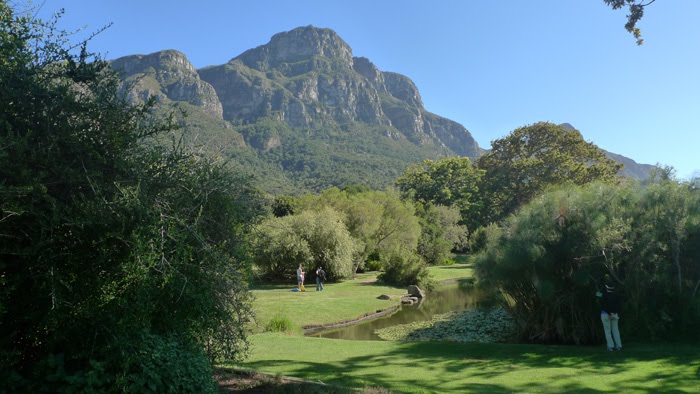
This morning we throttled back even further. Anticipating the grueling flight to come (at 9 p.m. tonight we start what will amount to almost 24 hours of straight air travel), we’d saved a visit to the Kirstenbosch Gardens for last. This is a World Heritage Site, and deservedly so. Located on an enormous spread of land not far from where we’re staying, it’s one of the great gardens of the world, celebrating the incredibly diverse plant life of this region. I learned that that diversity puts San Diego’s to shame (with something like 94 species per 1000 square kilometers here, versus 14 in Australia, and a puny 12 in California!) We walked through arboreal tunnels formed by gigantic trees: camphors, yellowwood, podocarpus, emerging onto huge lawns edged by African heathers and protea and grasses. At least, the weather was perfect: mid-70s, no trace of the demonic wind that’s tormented us every other day. I lay down on the grass at one point, listening to the birdsong, thinking about how much more pleasurable it was than sitting in a coach seat on an airplane, savoring one of those moments when it really WAS about the destination, rather than the journey.

But now it’s time to head for the airport, to journey again.