El Valle de Cocora

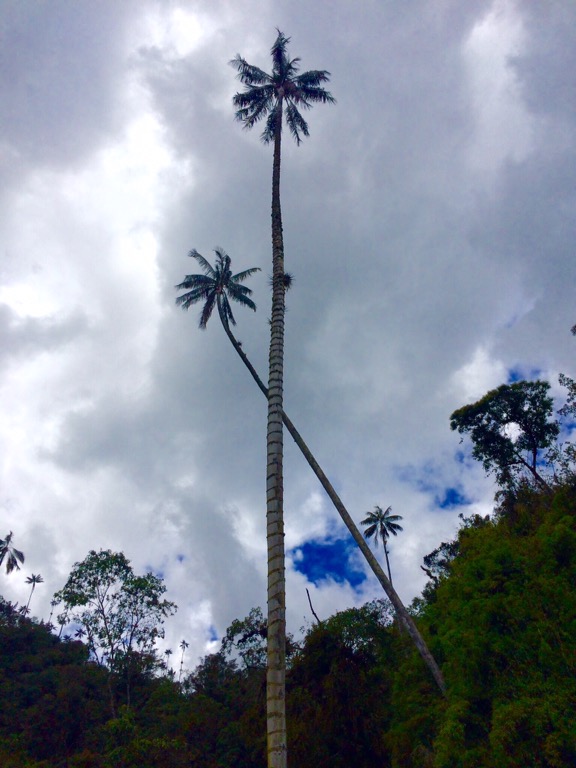
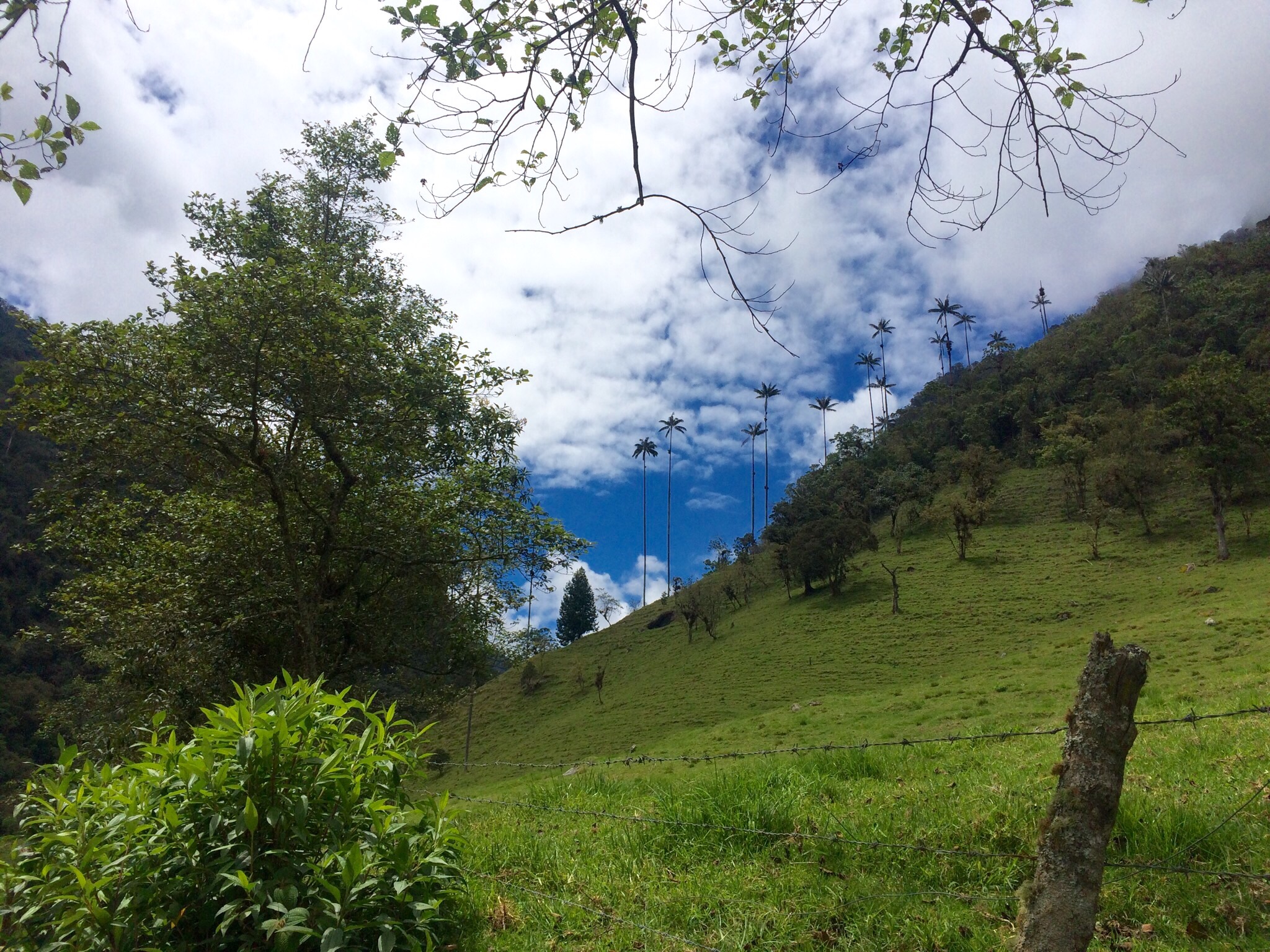
There’s a tree in the central Andes of Colombia and Peru (and almost nowhere else) that grows higher than any other palm on earth — up to almost 200 feet. The national tree of Colombia, it’s known as the wax palm because a waxy substance covers its trunk. People used to cut the trees down to make candles. Stripping off its leaves for Palm Sunday services also killed a lot of them, and the fact that it takes 80 years for wax palms to reach a reproductive age hasn’t exactly enhanced their survival. In the Cocora Valley, however, not far from the hacienda where we stayed, the palms are protected, and they make the already glorious landscape even more beautiful.


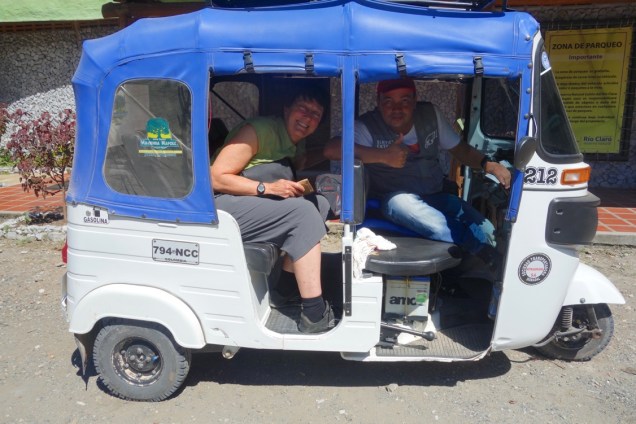
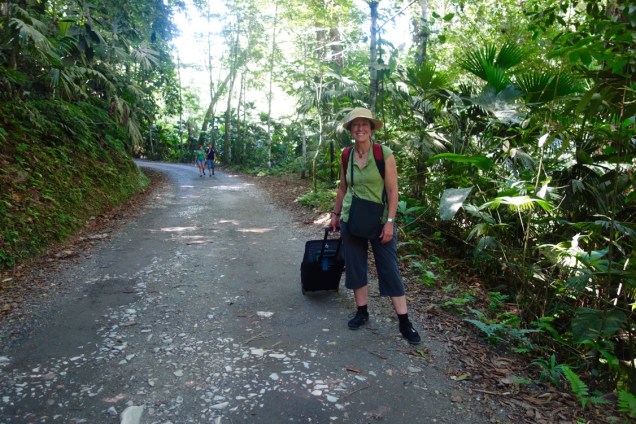
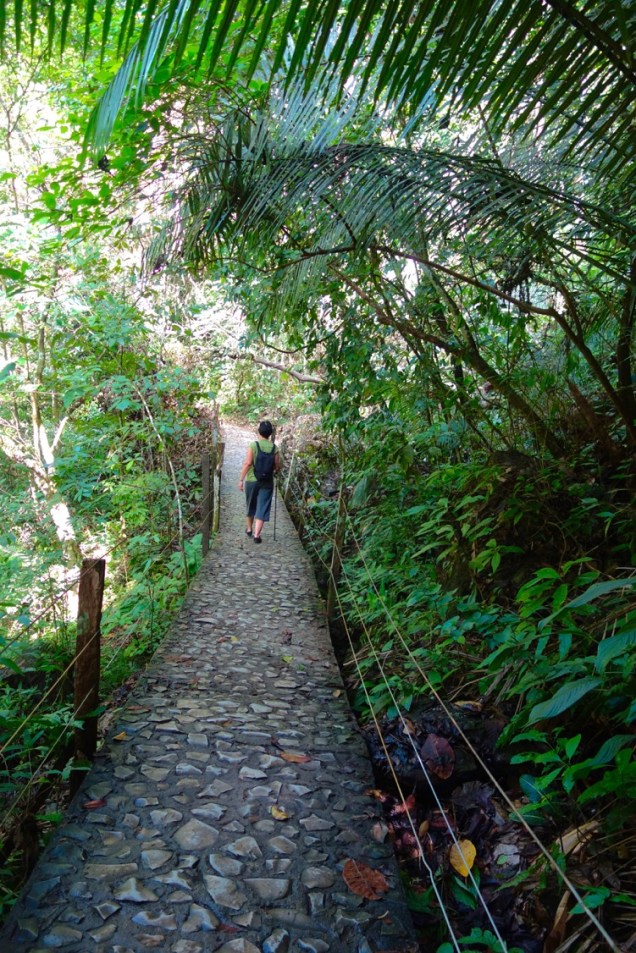
We devoted much of yesterday to a pilgrimage there, hiring the same driver who picked us up at the airport Sunday. Because Stephanie unfortunately had tweaked her back, she opted against a hike into the valley. Instead she and Michael enjoyed it briefly and then were driven to the picturesque nearby town of Salento, while Steve and I struck off on a two-hour hike.

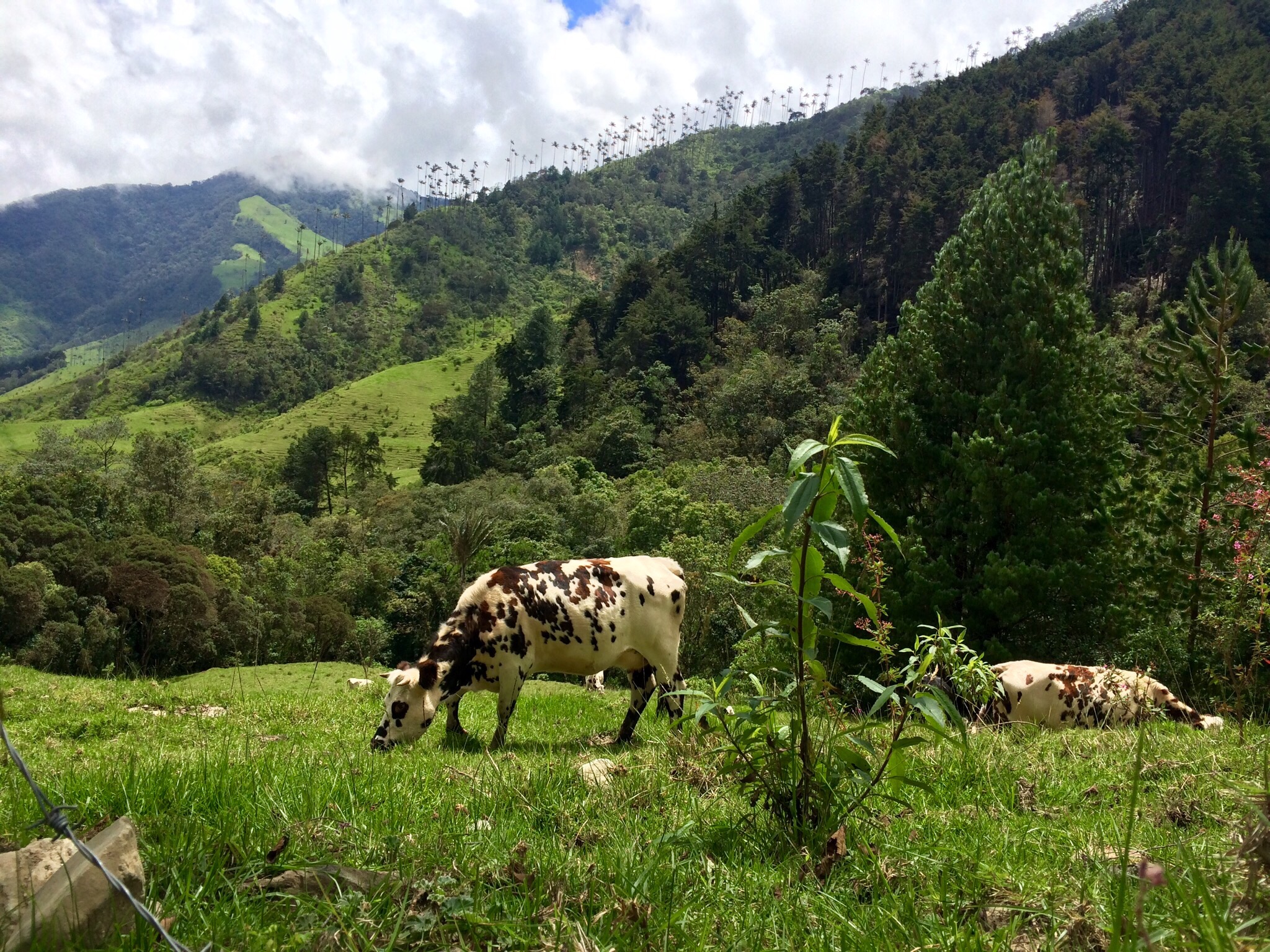
I felt inordinately happy. It wasn’t raining (once again contradicting forecasts), and the air temperature was perfect. The path cut through private farms that mostly seemed to grow happy cows.

How could they not be ecstatic in this bovine paradise?

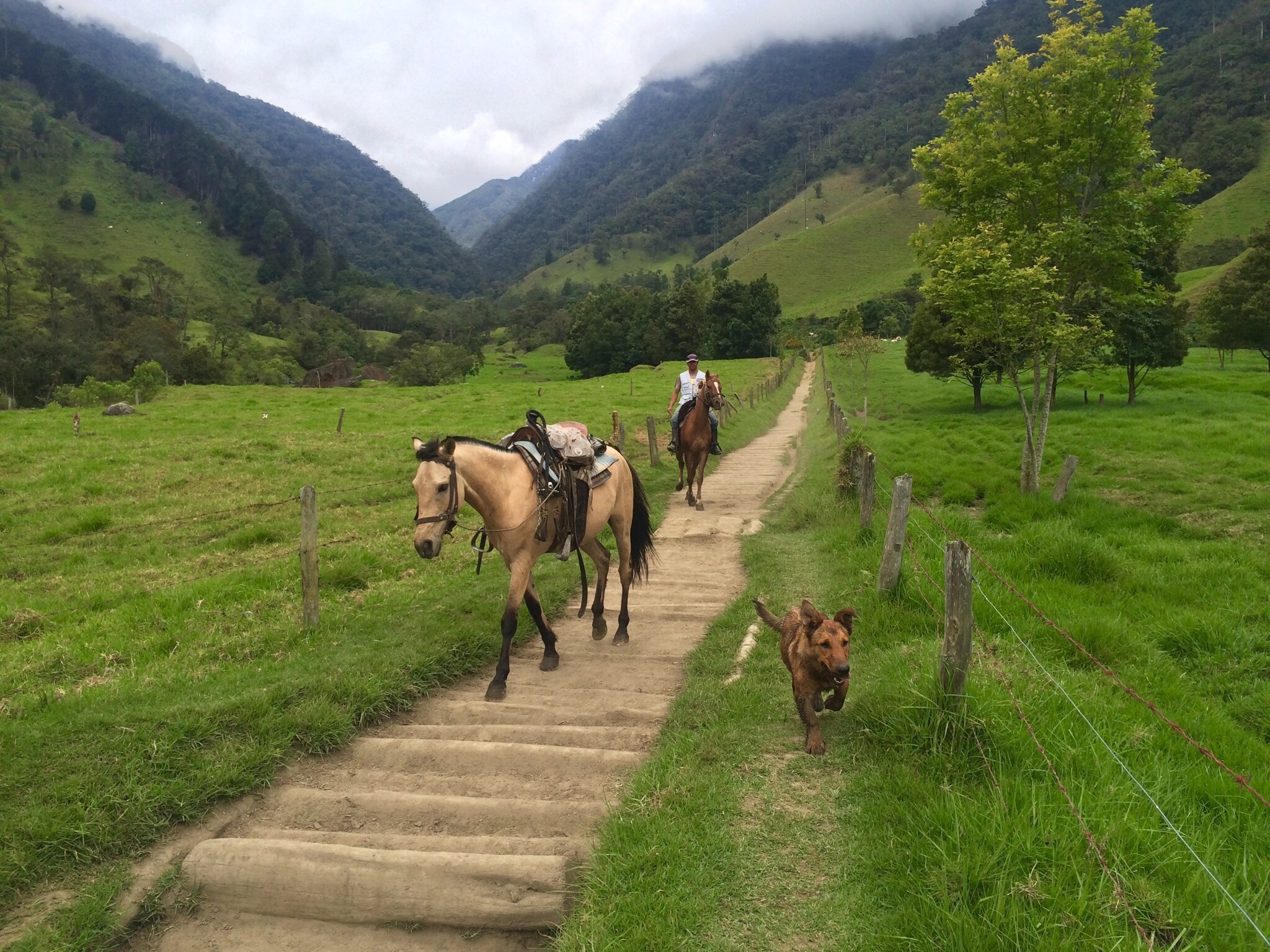
For most of the hike, we saw no one, though several groups of horseback riders and/or local horse wranglers passed us. 


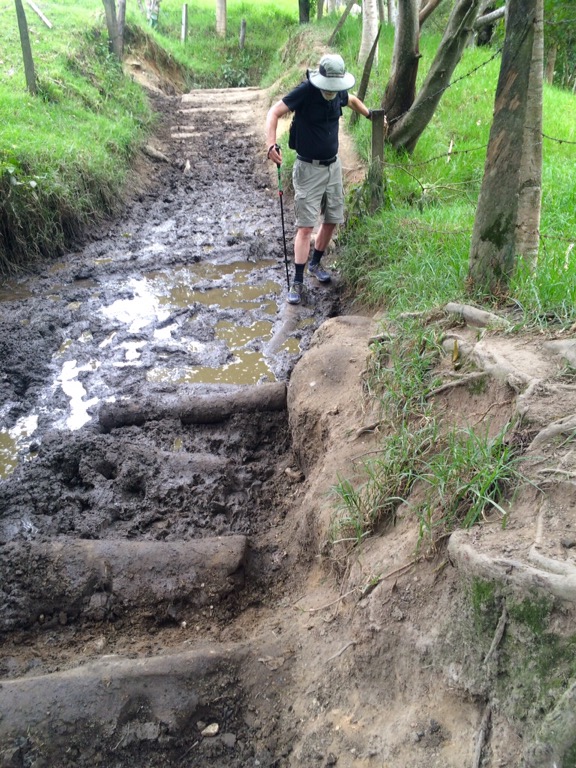
The path ascended and descended at times, but the only real challenge was edging our way around the streams and mud holes that blocked our way a number of times. Once again I felt like kissing the portable walking sticks we bought last summer in preparation for our trip to the Himalayas. (They collapse to a size small enough to fit inconspicuously in a carry-on and cost only $20-$40 apiece on Amazon.)

Holding onto the barbed wire fencing also helped.

I could have happily gone on to do a longer loop, and the hiking possibilities all around this place are bountiful. But the two-hour excursion was satisfying (and Steve still is battling some minor tumult in his guts.) So Orlando, our driver, picked us up and drove us back to Salento, where the five us of us (Steve, Mike, Stephanie, Orlando, and I) enjoyed more homey Colombian cooking. 

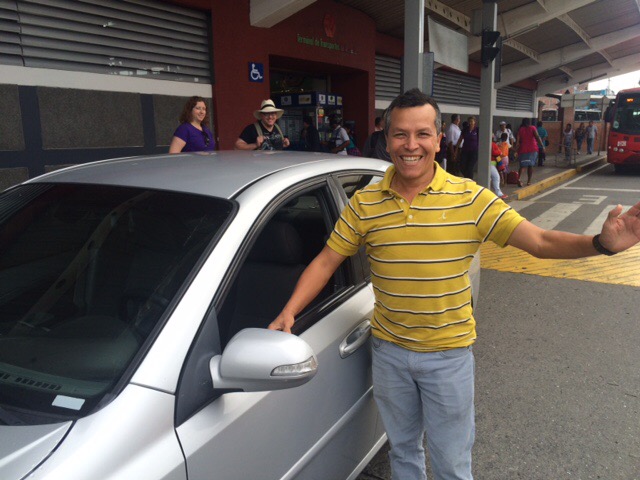
Any account of this day would be incomplete without adding a few words about Orlando. A compact bundle of energy and unquenchable curiosity, he spoke almost no English, but I could understand most of his slow, clear Spanish, and he was extravagant in his praise of my command of the language. I’m happiest in this sort of linguistic situation, conversing with someone who has no choice but to rely on my imperfect Spanish and flatters me about its serviceability. So I gamely babbled away in response to Orlando’s constant comments and questions. The latter ranged widely. What kind of cars did we drive? (and which brand was better: Fords or Chevrolets?) What did we normally eat for lunch? How much did meat cost in America? (staggeringly more, we learned, than it costs in the Colombia’s coffee country, which also happens to be cattle country. Orlando said a kilo of excellent beef typically retails for about $2). Was it true that it cost SeaWorld a ton of money to maintain its orcas? What religions were we? And why? At a certain point, in answer to queries from Orlando, I found myself struggling to explain in Spanish the teachings of Buddhism! I felt like my brain was melting and dribbling out my ears, but a good night’s sleep was restorative, and the irresistible Orlando was in a great help this morning in getting us to the transportation terminal in Armenia and packed onto the non-stop bus to Medellin. 

Orlando

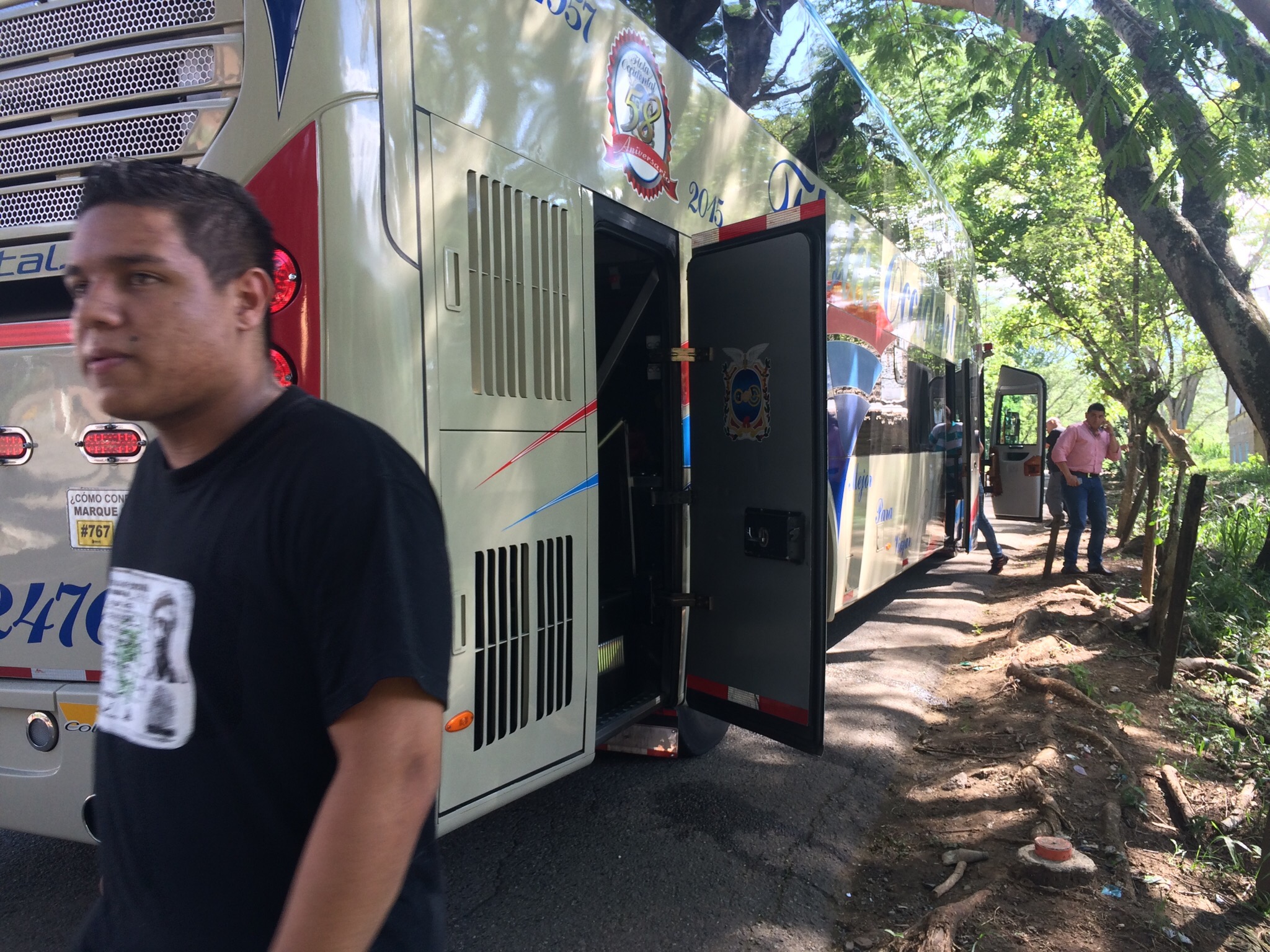
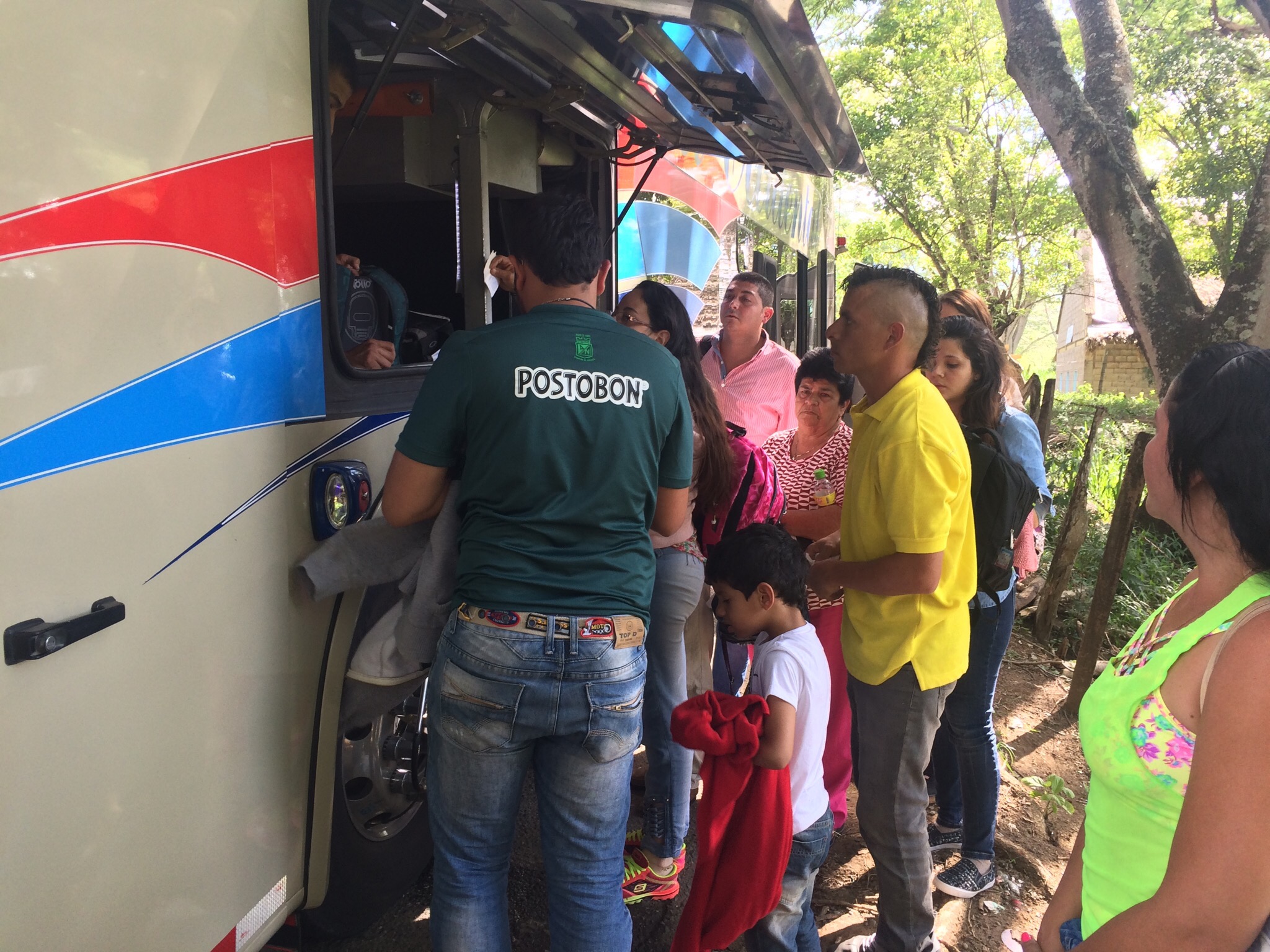
I’m now writing this post from the first class lower level of the Occidental Fleet’s double-decker “Emperor Elite.” It should theoretically pull into Medellin around 3:30 pm. Steve and I can’t ever remember being on a nicer long-distance bus. For less than $20 a person, we’ve got free wifi, head phones, blankets, electrical charging stations, games, movies, and hot lunch (that’s an extra $2.25.) And, oh yeah, fantastic views of the Andes out the windows.

Mike and Stephanie think the Emperor is WAY more comfy than the back of Orlando’s car.

Caffeination

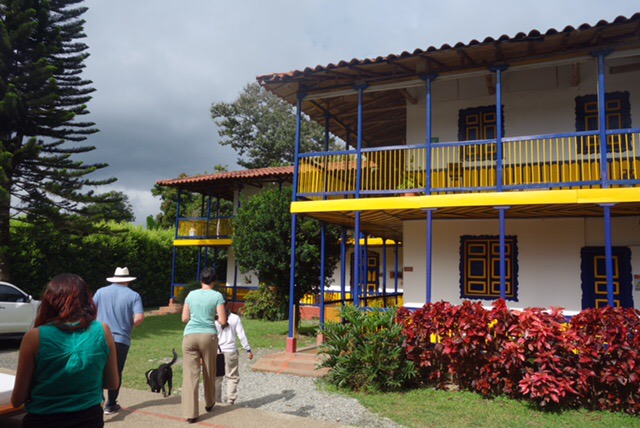
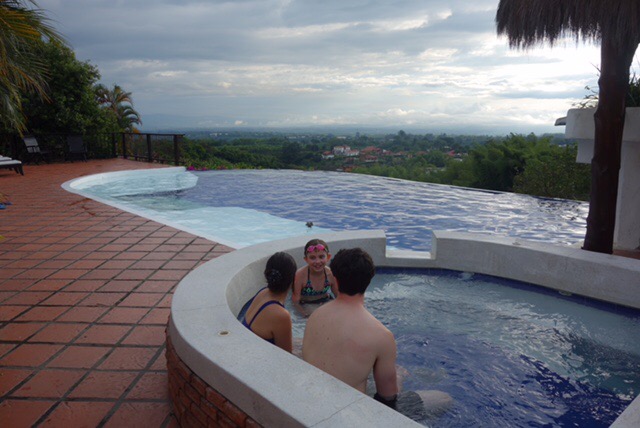
Ironically, Steve and I spent all morning soaking up Colombian coffee culture, and part of the afternoon… napping. In Steve’s case, he’s feeling a tiny bit under the weather. I don’t have that excuse; I just got sleepy after lunch, and if there’s anyplace in the world better suited to a postprandial siesta, I haven’t seen it. We’re staying on a 36-hectare working coffee farm, in the 133-year-old hacienda built by the family that still runs the farm (after four generations). 

The old family home has been converted to a guesthouse…

With a beautiful disappearing edge pool.

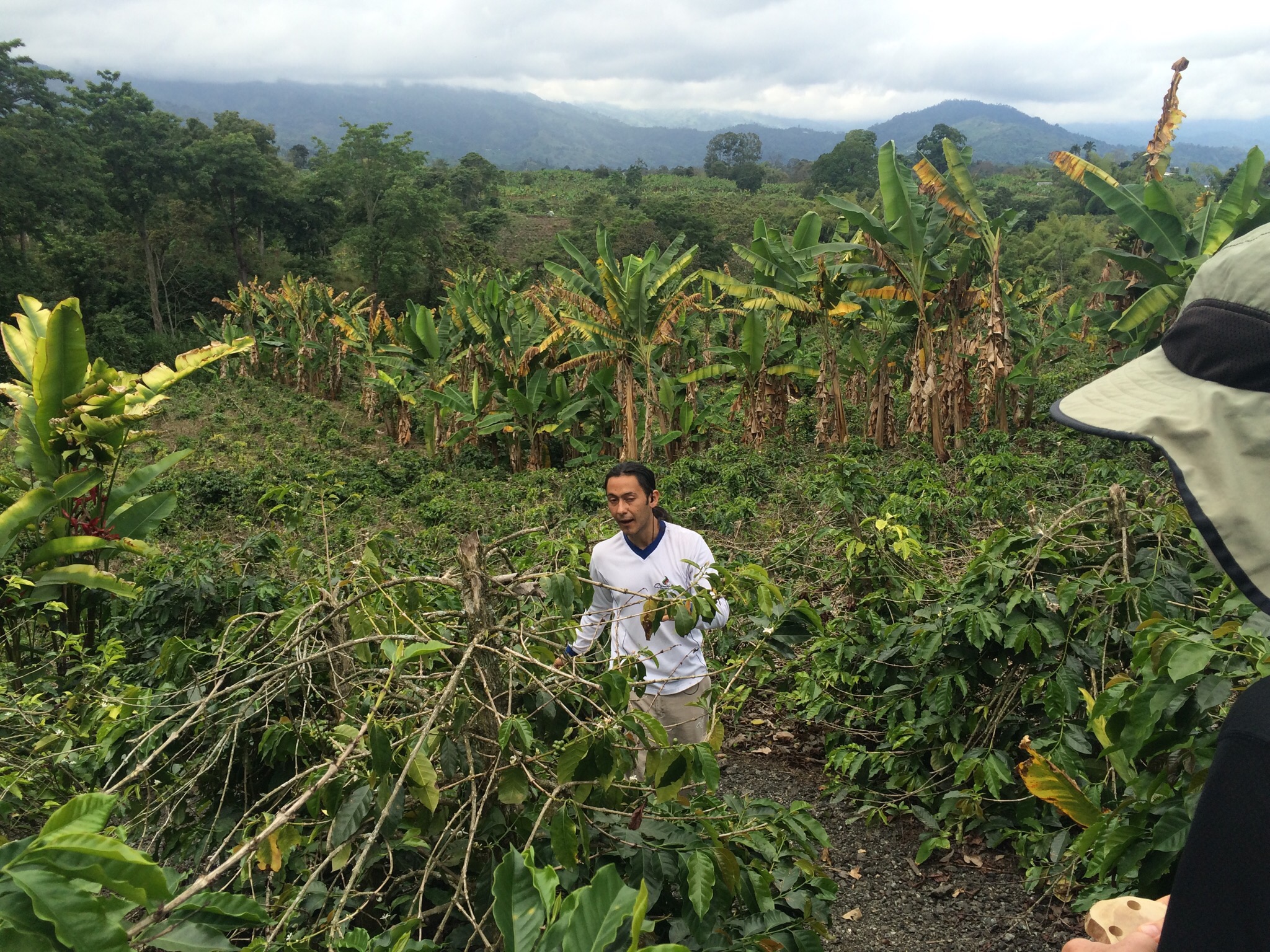
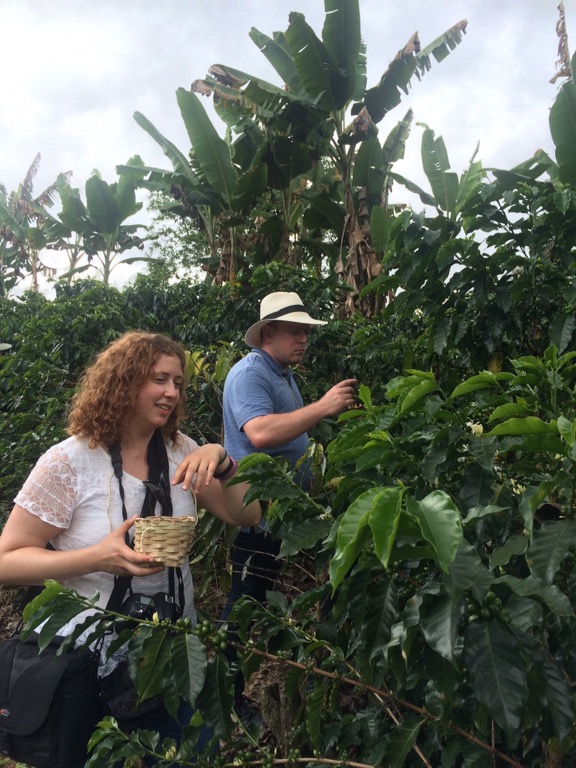
Coffee is the dominant component of the local economy, but tourism has come on strong in recent years, and this morning we had an outing that splendidly illustrated how much fun it can be to stroll up and down the hills see what grows here, and how. 
This was not the first coffee tour Steve and I have taken. We’ve visited growing operations in Kona (Hawaii) and in central Africa (Tanzania and Rwanda). Nonetheless, I found these Colombian highlands to be the most beautiful. The Andes rise darkly in the distance, and closer at hand, the undulating hillsides are densely green with not only Arabica but also plantains, bamboo, coffee walnut, and a headspinning variety of fruit trees.


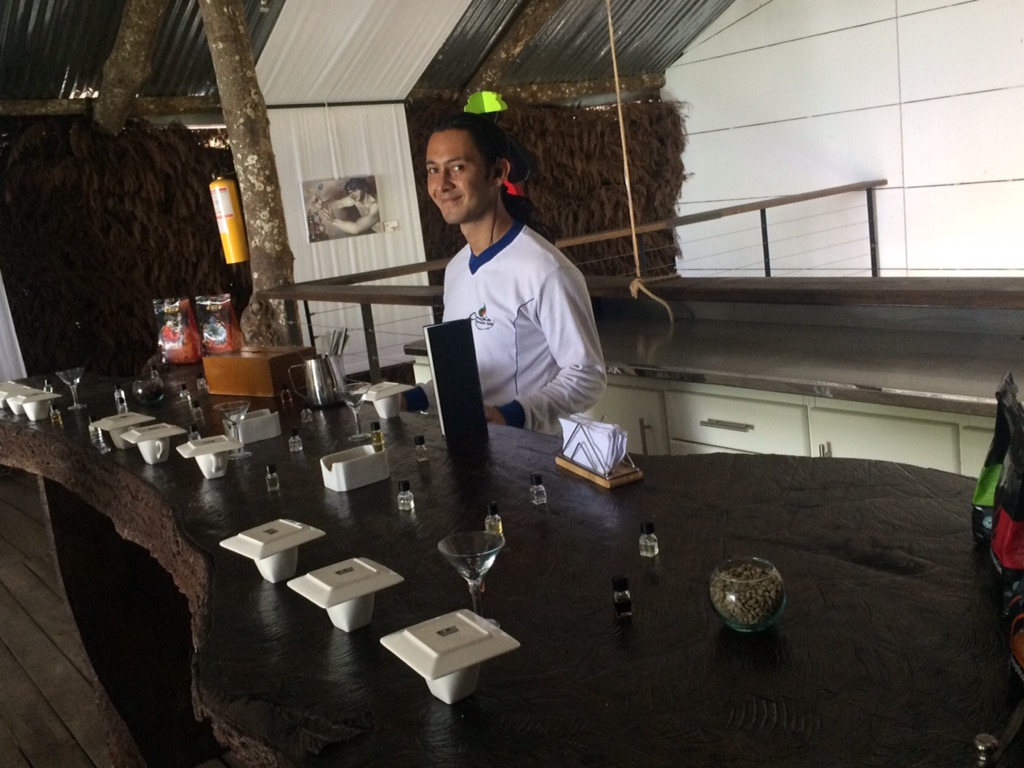
 Our charming 24-year-old guide, Andres, led us through 10 stages of coffee instruction that included a long stop at a tasting bar in which we took turns guessing at some of the 36 fragrances commonly found in coffee, sniffing grounds, and slurping spoonfuls of the hot brew.


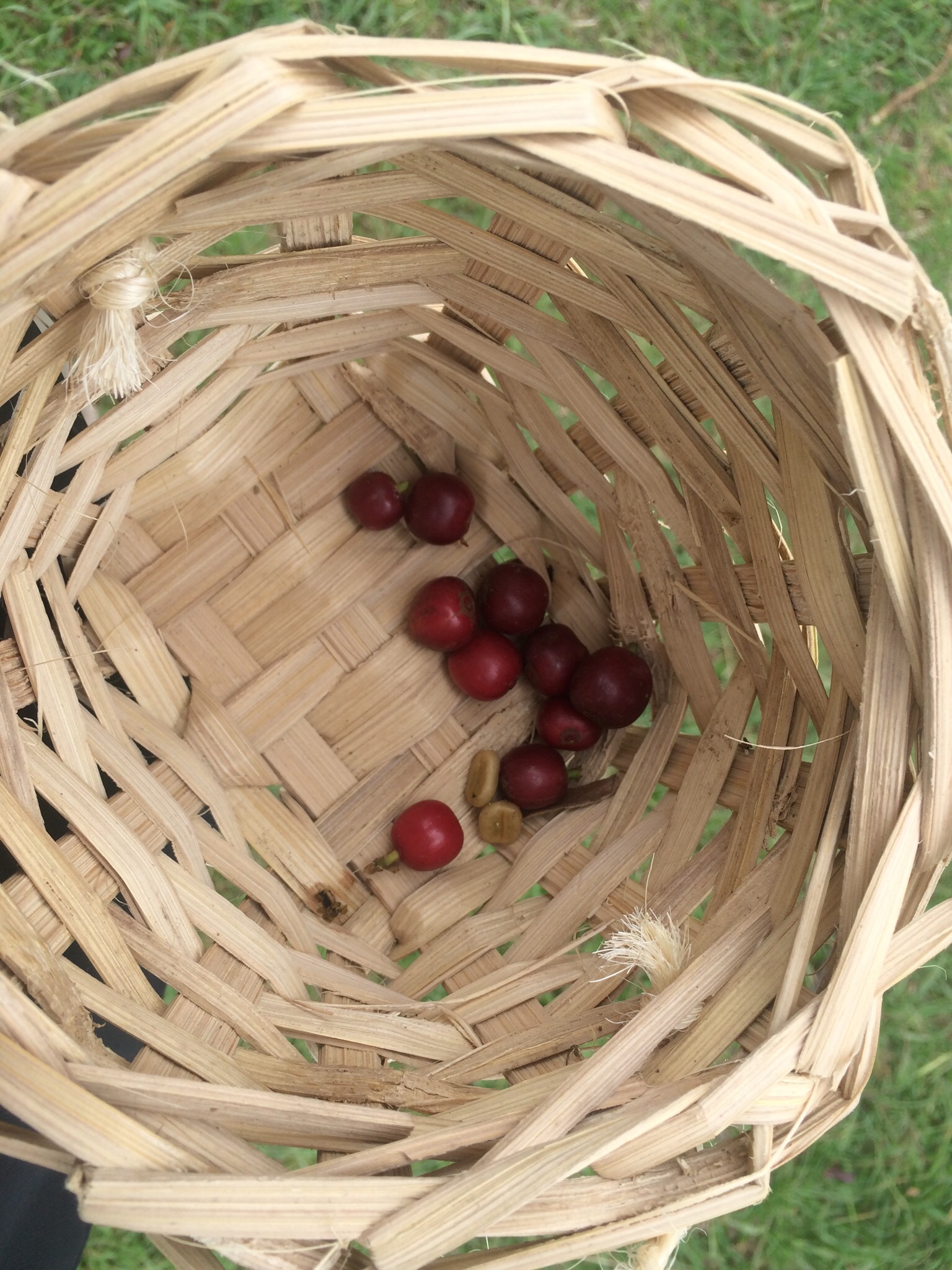
We walked for 90 minutes, learning about the soil and water and nutritional needs of coffee and it’s harvest. (During the peak picking seasons, the workers in these parts can collect some 200 kilos of beans per person per day — for which they’re paid about 15 cents a kilo.) We picked ripe beans ourselves and tasted them, surprised to find they they’re pleasantly sweet. 


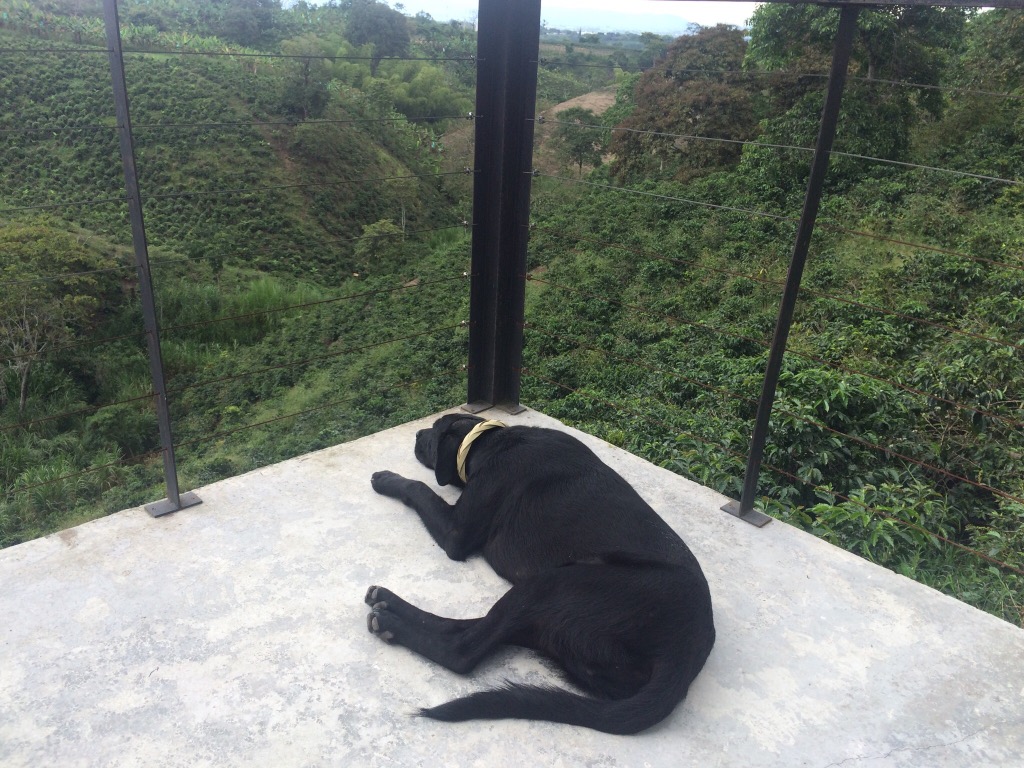
Andres told us that he often sees Lukas, the resident hound, sniffing them out and munching on them. (“He gets all hyper!”) Finally, we drank in the vista at a beautiful outdoor lounge where Andres brewed us some of the freshest coffee imaginable.

Sadly, those cups were in stark contrast to most of the coffee we’ve consumed on this trip. Almost all the good stuff gets exported, while Colombians drink the (literal) dregs. Our experiences with Colombian food have been happier, though Although my guidebook warns that “Colombia is not a safe haven for gourmands,” and wryly points out that you don’t see many Colombian restaurants outside the country, we’ve had a number of memorable meals. 
Despite all the hysteria about Zika earlier this year, I haven’t seen a single mosquito, not even in swampy, hot Cartagena. We know they’re around, though, so we’ve been applying liberal amounts of bug repellant. After today, Mike and Stephanie will only have to fend off predatory insects for four more days. (Steve and I will stay on for four days after they depart.)

Lukas, resting after one of his coffee buzzes has worn off.

Cartagena vision

I awoke at 4:30 Saturday morning, feeling that my left eye was glued shut. This was the same eye in which Steve had splashed a droplet of the volcanic goo on Friday — the obvious cause of my distress. I lay in the dark, wondering if the resulting infection would blind me permanently. After a long, long time, I fell asleep again. But when I woke up for good, around 6:30, the eye seemed mildly improved, and it continued to get better throughout this day that we devoted to seeing Cartagena’s sights.

The old section of Cartagena acquired a wall centuries ago to protect it from the wave after wave of Caribbean pirates who attacked the city over time. Today sections of that protective structure have been lost, but a lot remains, and you can walk along the top of most of it. Steve and I had resolved to do that first, partly because the day dawned sunny and hot and promised to get hotter later. The receptionist at our hotel had assured us it was safe, but almost immediately we had reason to doubt her, when we passed a gaunt young man who looked high on drugs and was holding the leash of an animal that appeared to be part retriever, part Rottweiler. At least 30 feet separated us from them, but the dog suddenly sprang to its feet, and made straight for Steve’s leg. “NO!” Steve bellowed at it, in his best dog-training voice. More effective at protecting him was the muzzle around the dog’s jaws; also the fact that its master stumbled over to collect it. 

After that exciting start, the rest of the day was unremarkable, albeit pleasant. Steve and I circuited the wall and bought Colombian headgear. We ambled up and down the picturesque narrow passages in the Old City, today filled with trendy shops and restaurants and bars and energetic street life.


Back in our more residential neighborhood (Getsemani) we had a superb lunch prepared by a culinary historian, then we went back to our hotel to escape the stunning heat and humidity (105 degrees and 80% humidity, according to my phone). We ventured out again with Mike and Stephanie for sunset cocktails at a bar on the wall and more excellent seafood in the centro. After that, we headed to one of the most famous salsa bars in Cartagena (La Habana), where depressingly, the bouncers let Steve and me in without paying the cover charge (about $9 per person.) Doubtless they guessed we were such geezers we wouldn’t stay for long, and more depressingly, they were right. When we learned that the live band wouldn’t start playing until 10:30, we headed home, though Mike and Stephanie remained and got in an hour or two of (extremely crowded) salsa.

Because Steve and I were asleep so early (10:30 pm in a town where many folks stay up till 3 or 4!), we were able to squeeze in an early morning walk this morning to the great fort of San Felipe de Barajas.

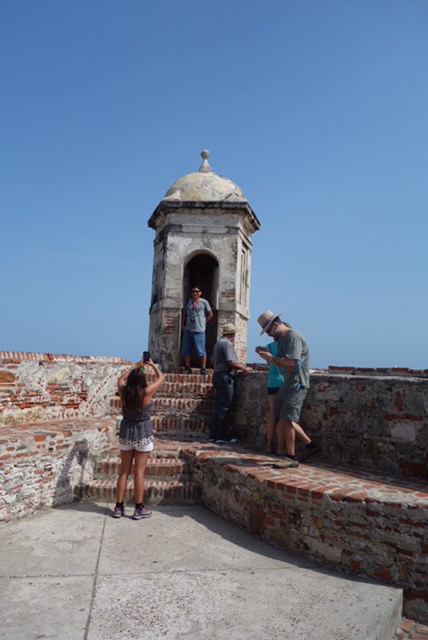
One of the watcgh towers within the fort.

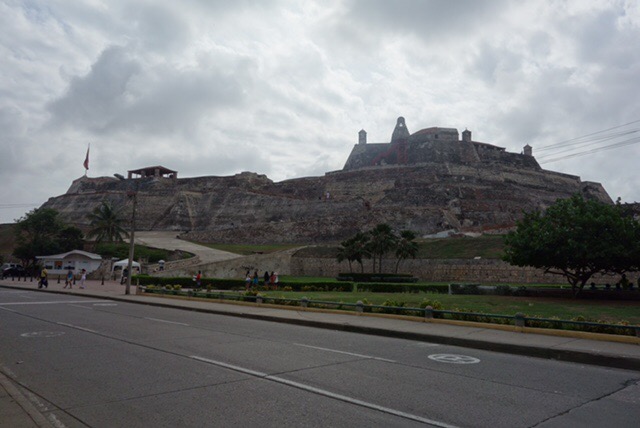
It occupies the heights across from the Old City, and the guidebooks claim it was the largest and most effective fort ever built anywhere on earth by the Spaniards during their long colonial hegemony. We used the audio guides and were genuinely impressed. Pretty much all the gold looted by the Spaniards from South America must have passed through this city. The fort enabled Spanish soldiers to blast would-be looters from any direction. 

Once again, the day was astoundingly, breathtakingly hot — rivers of sweat poured down me, and it made me think (in retrospect) that Vietnam was cool in comparison. After two hours of walking around, I couldn’t take any more, and besides, it was time to pack up and get to the airport for our 12:45 pm flight to Pereira in Colombia’s coffee country. 

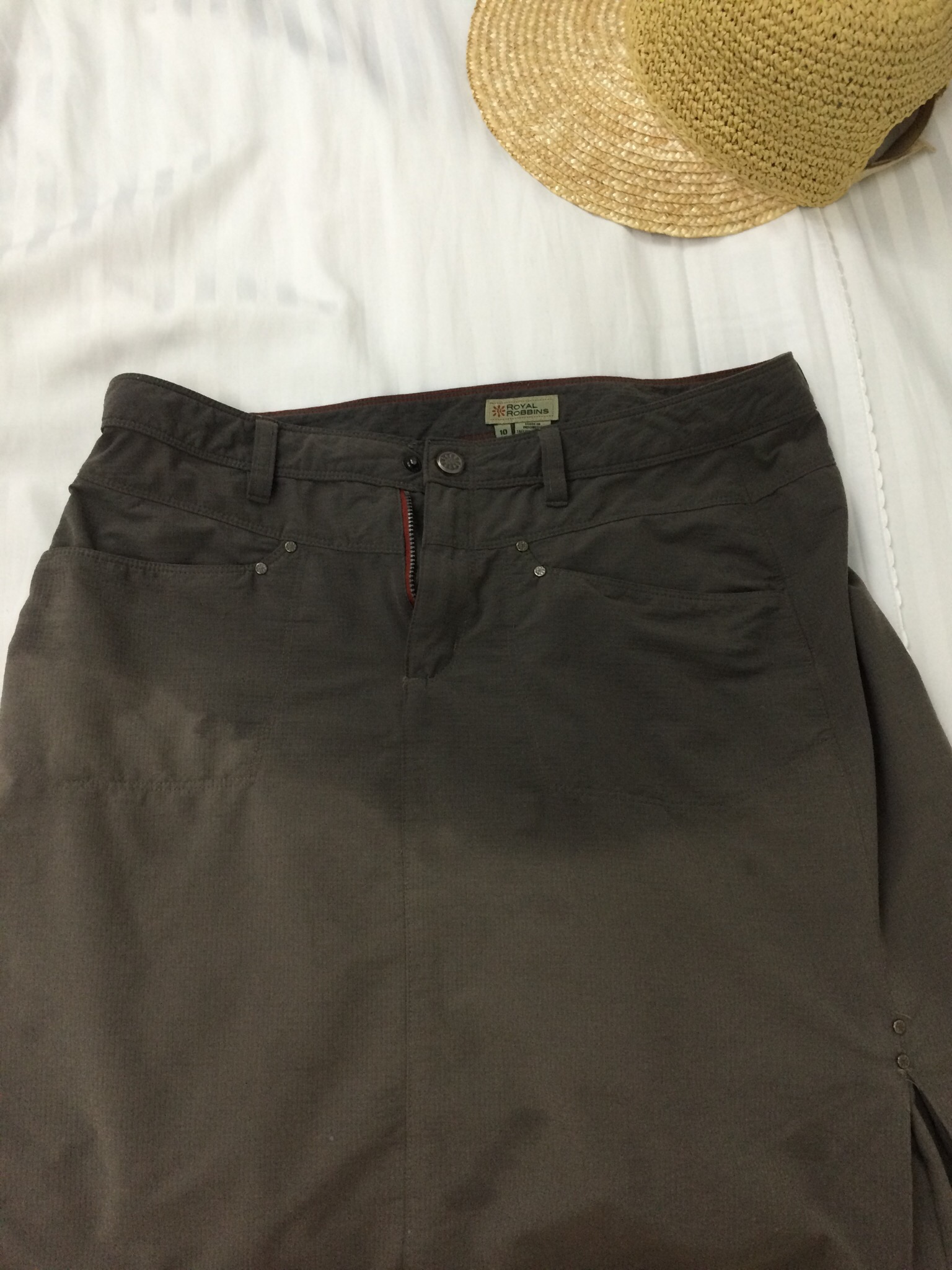
What the top of my skirt looked like after walking around from 8:45 to 10:45 am in Cartagena. That’s sweat, drenching the fabric.

Now we’re checked into our hacienda on the grounds of a big coffee plantation in Juan Valdez country. We’ll get the coffee culture tour tomorrow.

Going native

Since our arrival in Cartagena Thursday night, I haven’t actually seen any big groups of gringos who looked like they arrived on a cruise ship. But I know they do come here, and I imagine when they arrive, they’re loaded on a bus at the cruise-ship terminal, then driven to the city’s Old Town, where they’re led around to engage in shopping and some sightseeing. Certainly everyone must enjoy that. The ancient, walled city here is a World Heritage Site, and deservedly so. 

For the first of our two full days in Cartagena, however, we engaged in a couple of Latin American diversions. One was an outing to the mud volcano of El Totumo. Truth be told, I had heard about this activity from our (norteamericano) friend Howard Zatkin, who ranks among the world’s most intrepid travelers. Howard traveled around Colombia last year with an adventure-travel group that mainly caters to young Europeans. During their visit to Cartagena, Howard signed up for an excursion, seemed to greatly enjoy it, and recommended that we do it too. You can also find it listed on the TripAdvisor app, where you can buy tickets for an excursion priced at $93 a person. We instead, upon arrival, simply asked the receptionist at our boutique hotel, the Zana, if we could make a reservation with a group for the next day (Friday). She made a call and said we could get the guided excursion (including lunch) for 60,000 pesos a person (about $20 each).
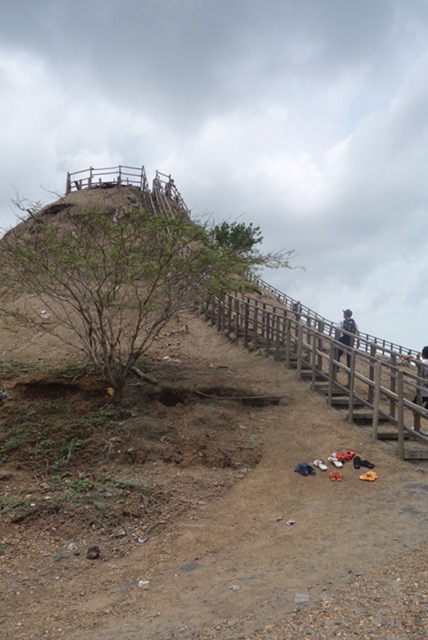
An aging mini-bus picked us up promptly at 8:30 the next morning and spent a good hour driving around and collecting other customers: Mexicans, Bolivians, Peruvians, Brazilians, and Colombians. Except for two adventurous girls from Savannah, Georgia and a tubercular looking German, Steve, Mike, Stephanie and I were the only Anglos on board.  Finally, we all loaded onto a full-size bus and trundled north along the swampy coastline, past mangroves and rugged hills. After more than another hour, we finally arrived at the star attraction: a 50-foot mound that looks like a miniature volcano but contains liquid mud rather than lava. 


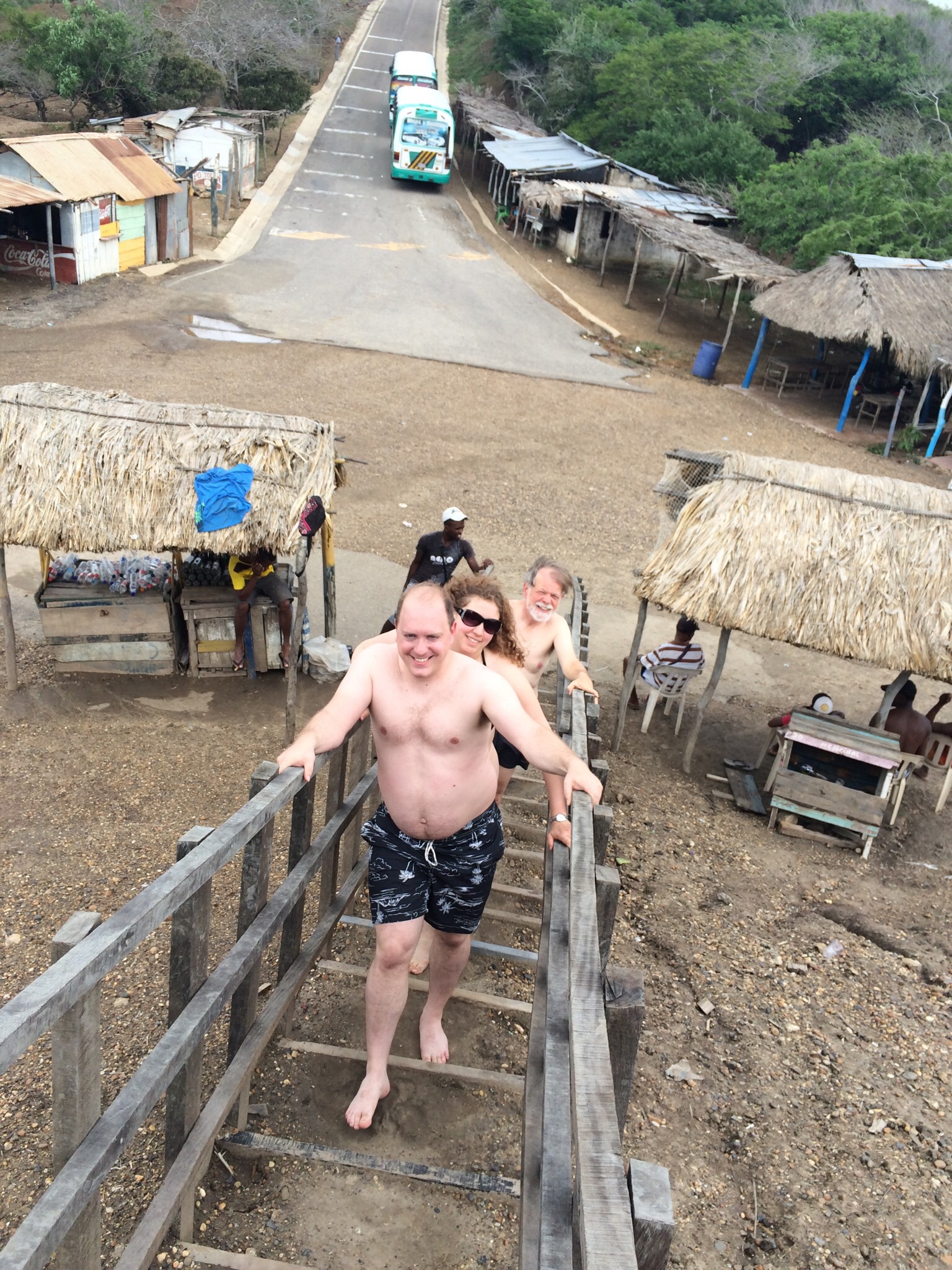
Part of what was fascinating about this experience was how impromptu its organization felt. No one told us what to bring (or not bring), so Steve and I packed our bathing suits (while M & S wore theirs under their clothes — the smarter choice). We borrowed a couple of towels from our hotel, but had no idea what we actually would do at the volcano site — where we disembarked to find a chaotic scene packed with what felt like was a thousand rambunctious Colombian school kids. Still, our calm and happy guide, Eliana, somehow managed to direct all 25 of the folks in our group. You gave her your towels to guard, gave your phone or camera to a guy with a fanny pack (Enrique), chucked your shoes in a pile at the base of a steep wooden staircase, and then climbed up it. 


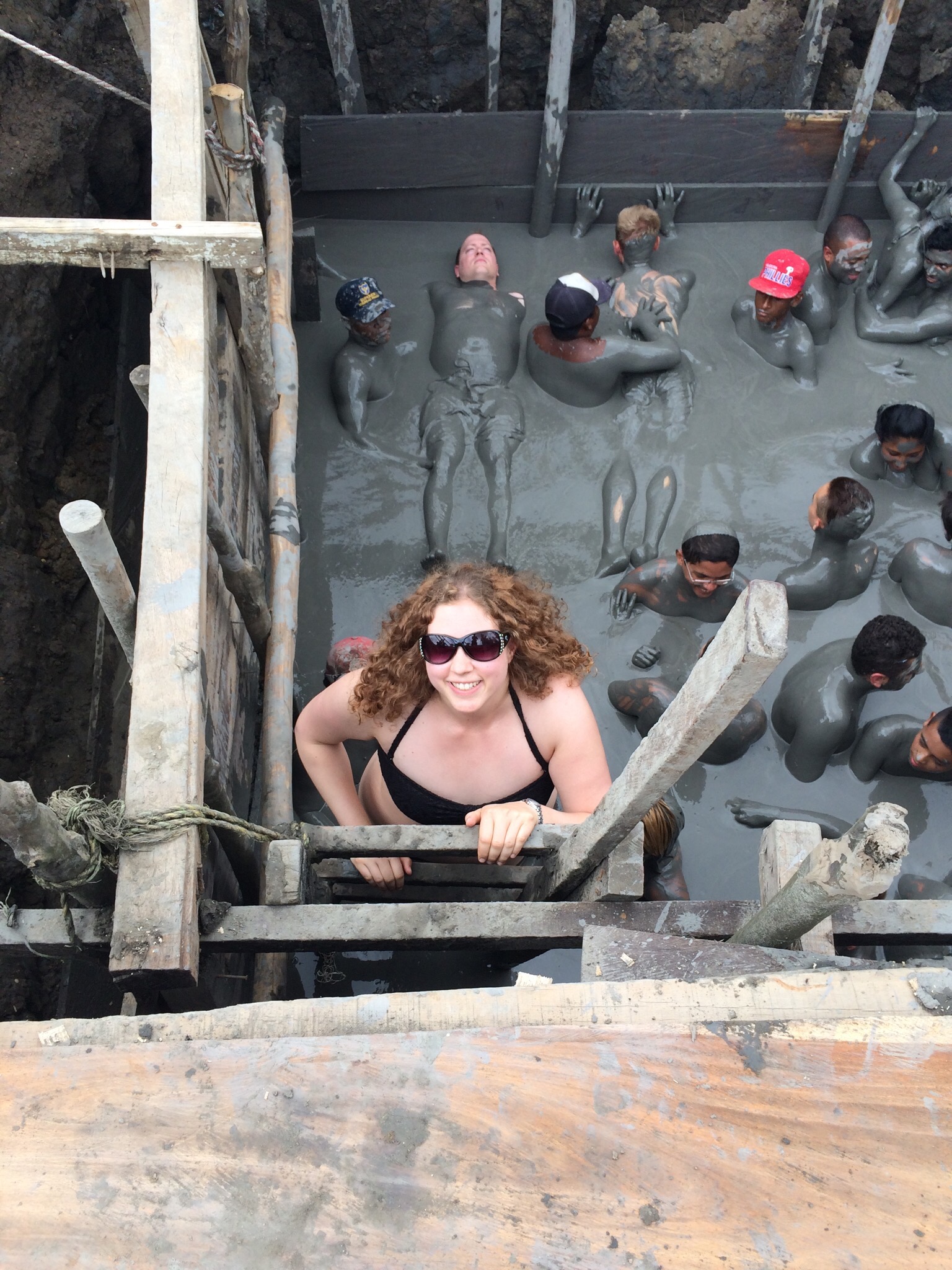
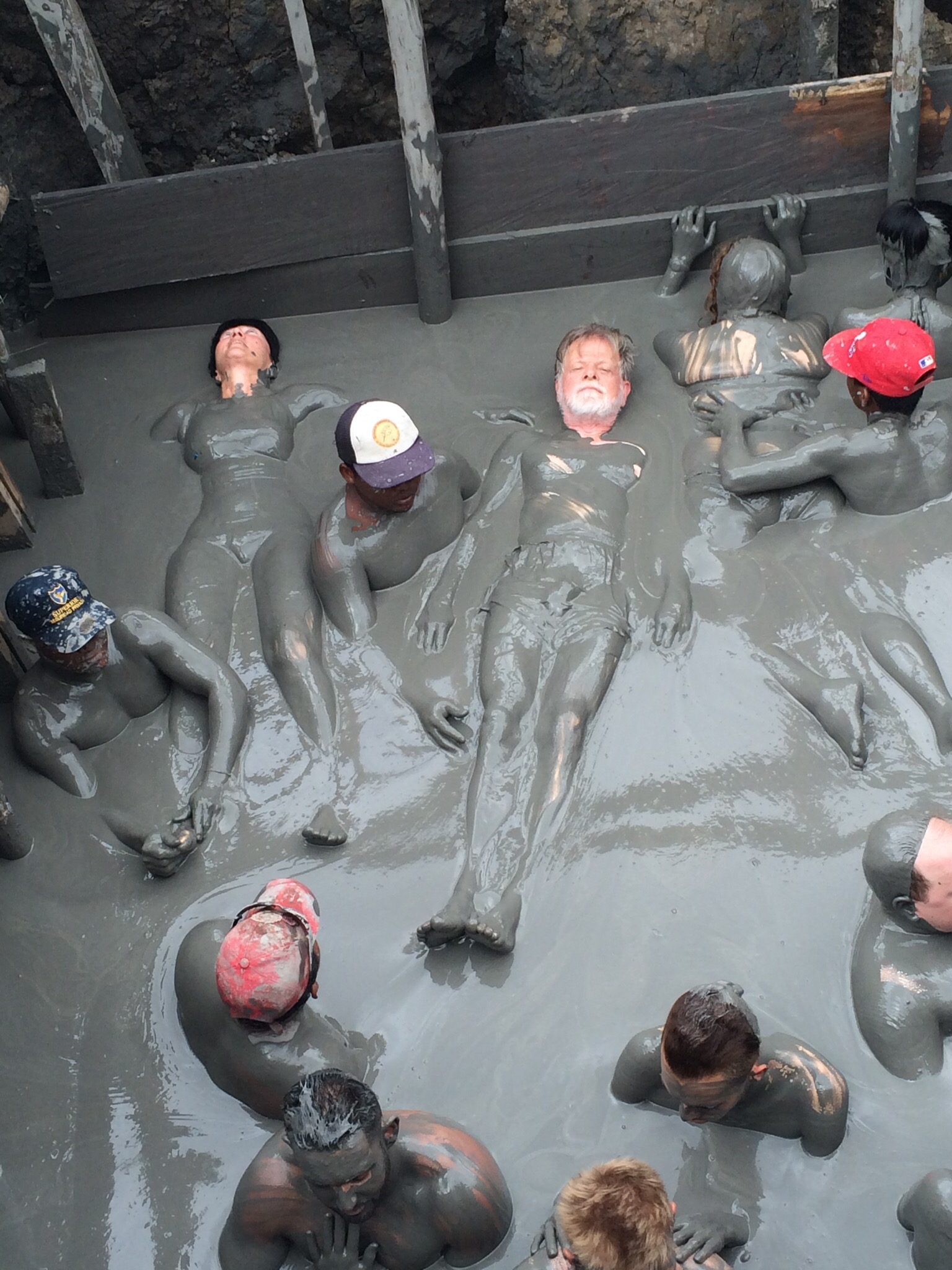
At the top, the full scope of the weirdness of this experience became clear. The pool of mud was only maybe 15-feet square, so a limited number of folks could enter it at any given moment. Once inside, a crew of 5 or 6 men worked helping each tourist down the ladder into the pool, guiding them into a prone position, and vigorously massaging their legs and arms and neck and back. Eliana had told us all that the mud had medicinal and aesthetic properties that would enable us to return home healthier and more beautiful. 

I felt dubious, but the idea of turning back at this point seemed unthinkable. Mike descended first, foll0wed by Stephanie. 


I went third. It felt like stepping into melted chocolate, except that it was only lukewarm and smelled vaguely sulfurous, rather than chocolatey and delicious. Although the massaging had looked vaguely pervy at a distance, by the time I was floating, I had lost all sense of normalcy and just yielded to the man-handling (which never actually felt inoffensive.)


After a minute or two, my massager launched me off like some kayak. I struggled to right myself. The mud is even more weirdly buoyant than the Dead Sea (which Steve and I floated in last year). I learned that it worked best to hold my legs rigidly straight. Then I could just kind of bob there, upright. Any move toward a fetal position was disastrous, though, making you unstable — in a place where any splashing was downright anti-social.

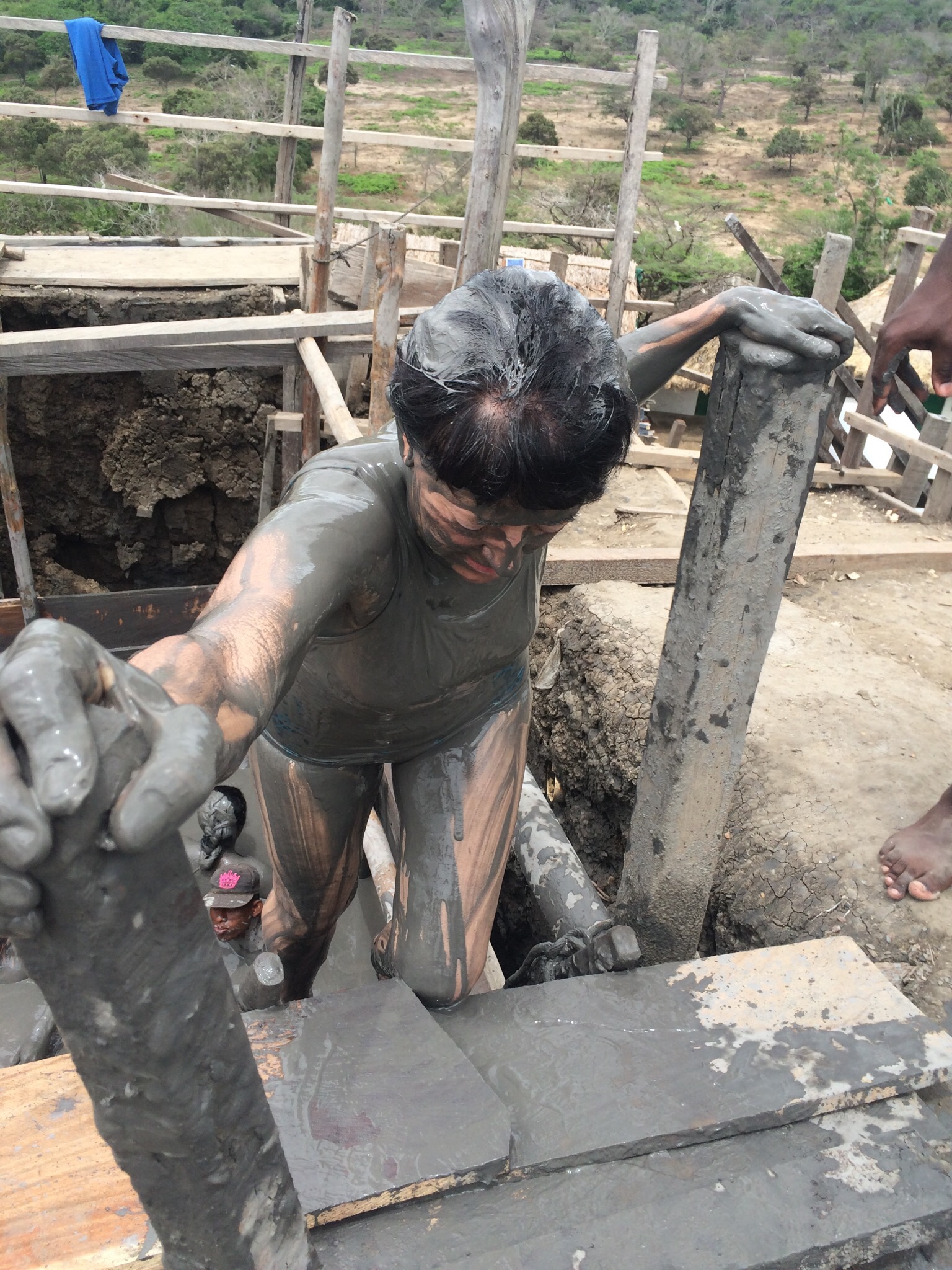
Steve climbed out almost immediately, but Mike, Stephanie, and I hung out for a few minutes before asscending the decrepit and slippery exit ladder. 


That was scary, but only a fraction as terrifying as the main ladder leading down to the ground below. Its every tread was as slippery as if greased; even the railings had treacherous patches. Somehow, I muscled my way down (trying not to think about Michael and Stephanie in my wake but reflecting that if OSHA ever learned about this place, it would probably order the US military to invade and put an immediate stop to it.)

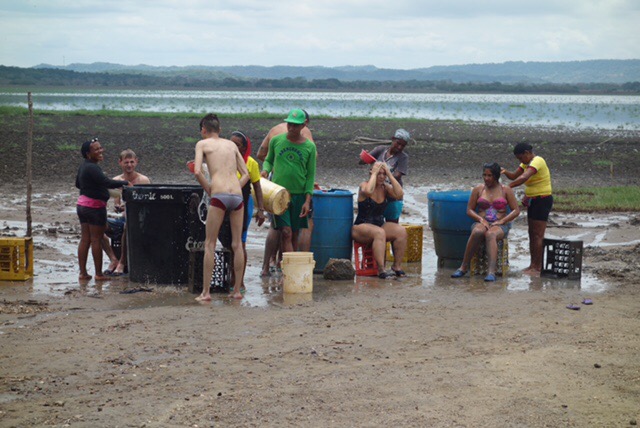
At the bottom, I followed more instructions and made my way down a pathway to some distant tubs and ladies. This turned out to be the only “shower” in the place. Grim indigenous women poured cupful after cupful of dirty looking water over every mud adventurer, roughly rubbing and tugging the bathing suits and body parts. Amazingly, it seemed to get us more or less clean — or clean enough to pack up and climb on the bus again.


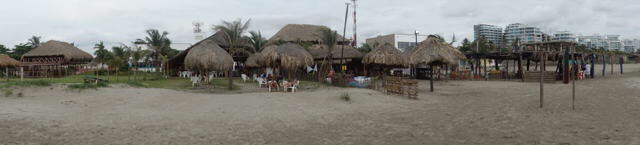
The rest of the afternoon was far less interesting. We drove for about an hour, then stopped for a mediocre lunch at a low-rent private beach. That was bad enough, but then Eliana announced that everyone would have an hour to “disfrutar” (“enjoy”) the beach. Steve and I tried to go for a stroll on it, but a life-guardish fellow stopped us and told us it would be dangerous to continue on. He said we could walk for a bit in the other direction. But soon he was chasing after us again and ordering us to return to the group. 

Not exactly the La Jolla Beach and Tennis Club

We finally got back to the hotel and had real showers that yielded amazing amounts of additional mud. Later last night we soaked up some of the street life exploding because of the opening game of the America Cup soccer games, in which Colombia was playing the US. The sounds of vuvuzuelas and honking cars and chanting fans filled the air, and we walked for a while trying to find a good place to watch the game. We wound up in a quiet bar, stayed for an hour or so in which the American defeat came to look inevitable. Then Steve and I headed for bed, exhausted by all the native action. 

A short sojourn in Paradise

Besides Bogota and Cartagena, the village of Villa de Leyva invariably ends up on short lists of places to which first-time visitors to Colombia should head. Founded by the Spaniards not long after they took over the place in the 1500s, the town boomed for more than a century because wheat grew so well in its environs. But monoculture eventually destroyed the soil, and almost everyone left; what remained of life in the village was frozen in time. By 1950, only 3000 or so farmers inhabited the town. Then in a happy twist of fate, a Colombian president (who owned land locally) declared it a cultural heritage site. Since then increasing numbers of tourists, expats, and wealthy Colombians seeking vacation homes have flocked here to soak up the colonial color.

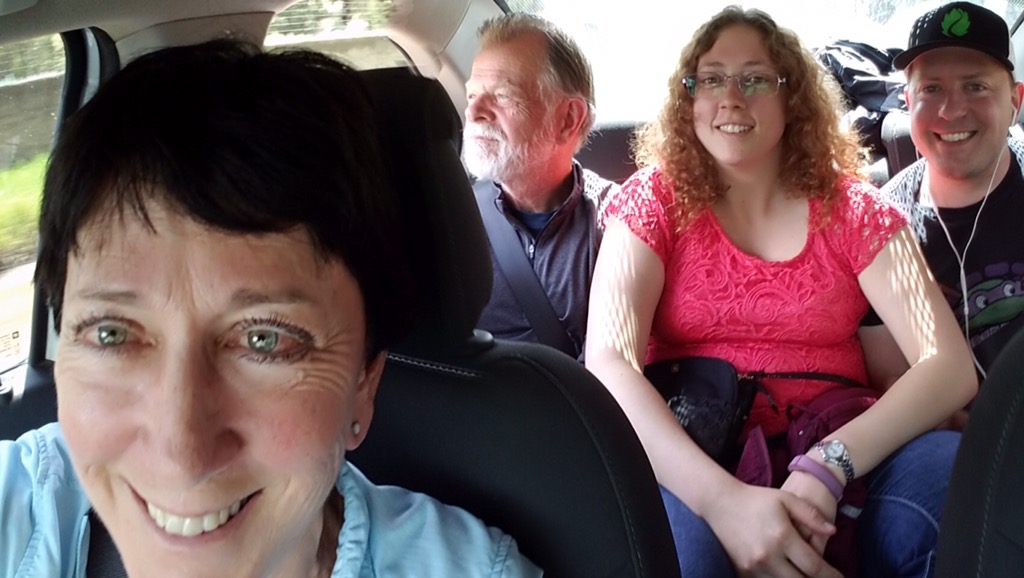
It seemed to me that we should follow in their footsteps. But how? It is possible to board an intercity bus in Bogota and take it to Villa de Leyva, but there are sights worth visiting along the way. Instead we splurged and hired a driver to transport us Tuesday morning. The good news was that our driver, Paulina, was careful and never once scared me. On the downside, our Chevrolet was muy compacto. Although our carry-ones fit in the trunk, cramming three of us in the back seat took family togetherness to a whole new level. Because it was my birthday, my fellow travelers kindly ceded me the one commodious (front) seat for most of the ride.


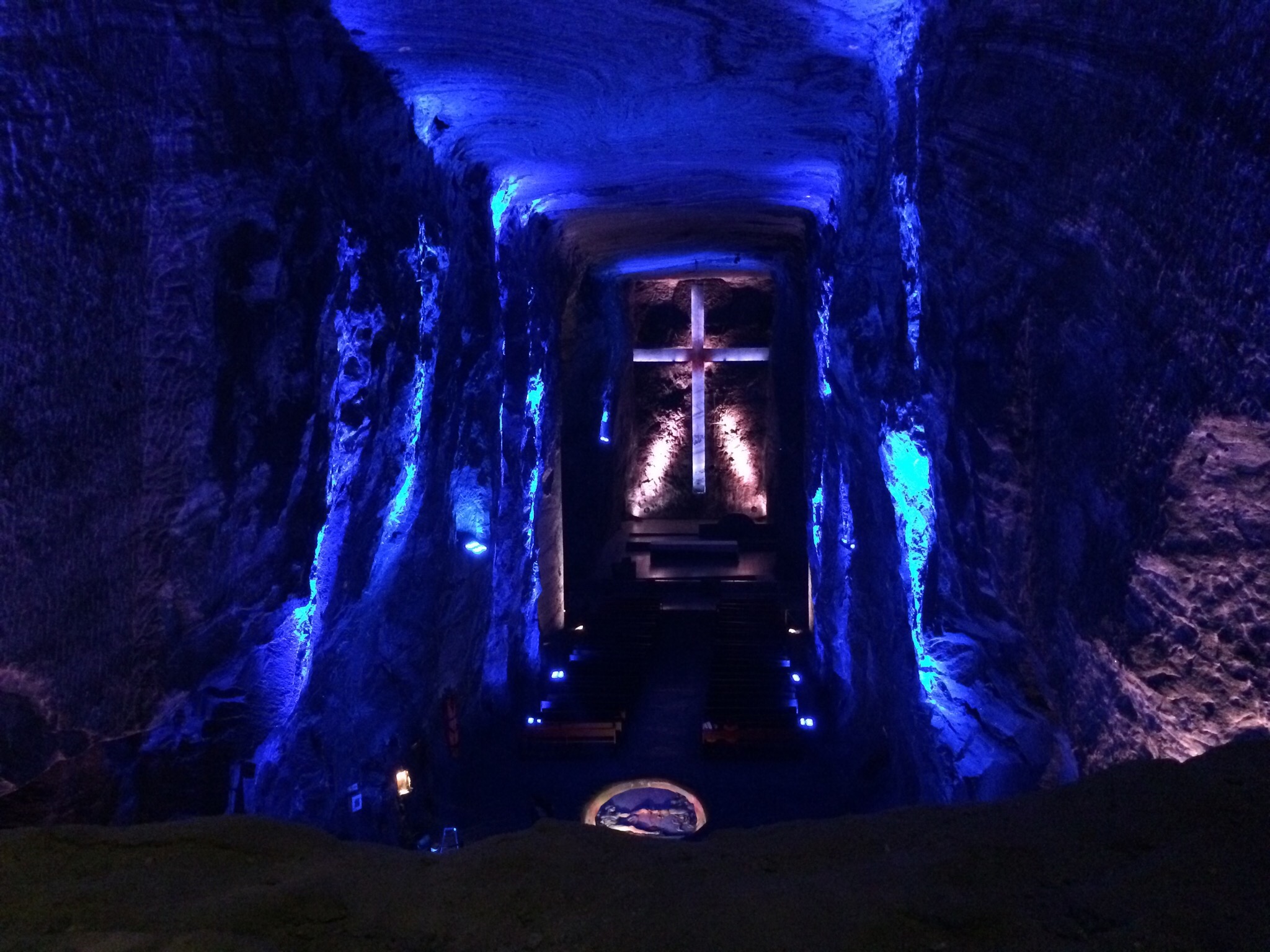
I had figured that if we left Bogota at 9 a.m we might reach Villa de Leyva by 3 p.m and still have time to do a 2.5-hour hike. This proved to be a pipe dream. We got to the principal sight en route — the “Salt Cathedral” of Zipaquira — around 10:20 but had to wait for the start of the English-language tour, which wound up taking a full hour and a half. The cathedral’s pretty interesting. About 25 years ago, local miners carved huge stations of the cross and a full church into the gloomy tunnels and caverns of the salt mine. People claim it’s now the third largest such work in the world (albeit dwarfed by two colossal ones in Poland.)  Steve and I were particularly charmed to learn that the church and the admission fees collected belong to the town (rather than the federal government which owns all mineral rights to the salt). Since it opened, it has grown into a huge tourist attraction, that now generates some $5 million a year. Profits are reportedly being used for schools, hospitals, and other local bounty. The miners never expected their artistic impulse and religious devotion to have any material consequences, but sometimes miracles do happen.


What with visiting the salt works and making another stop for lunch and being blocked repeatedly by road construction, it was past 5 p.m by the time we reached our hostel in Villa de Leyva. And then we spent a bunch more time deciding what to do the next day and booking a tour and figuring out where to eat dinner (many places were closed) and waiting for a taxi to arrive and take us to one that was still open. It was raining and chilly and once at the restaurant, we learned it was basically a sandwich shop, and the only tables available were outside (though, happily, protected by umbrellas big enough to block the drizzle).

Such are the times that can try travelers’ souls. But once again, good luck was with us. It soon became clear that the reason this restaurant is so highly rated online is because the cook and owner are artists. Their canapés and smoked meats and soups were the stuff of culinary headlines. They adorned my tomato soup with birthday wishes and presented me with a piece of delicious cake. By the time we’d consumed it (and finished up a third bottle of the good Chilean Cabernet), we had invited Eduardo and Pilar to visit us any time in San Diego. And I was counting the day among my most memorable birthdays.

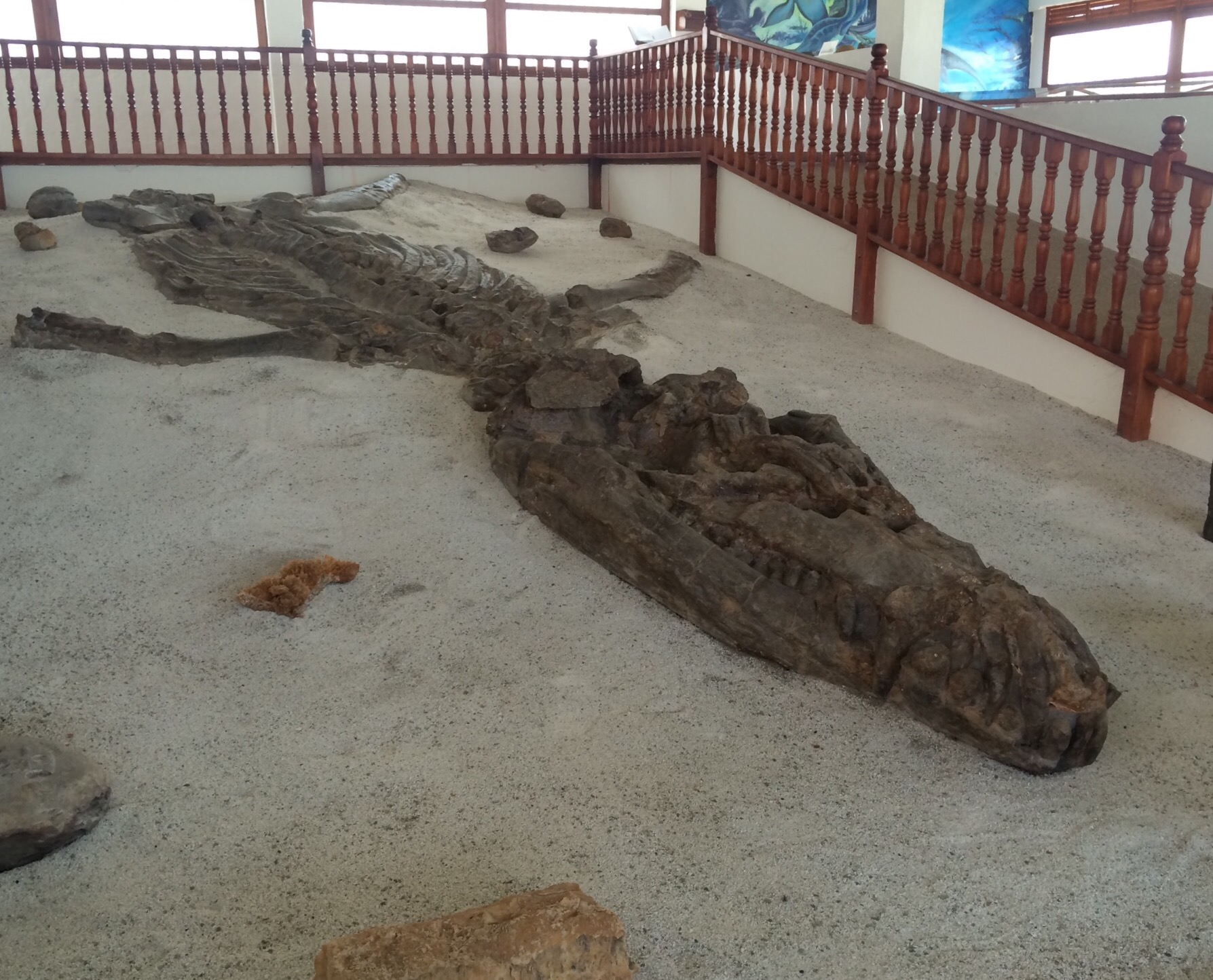
Our one full day in Villa de Leyva (yesterday) dawned warm and sunny, and the 5-hour private tour we’d booked while tired and tense turned out to be excellent. Our guide took us to an impressive fossil museum…


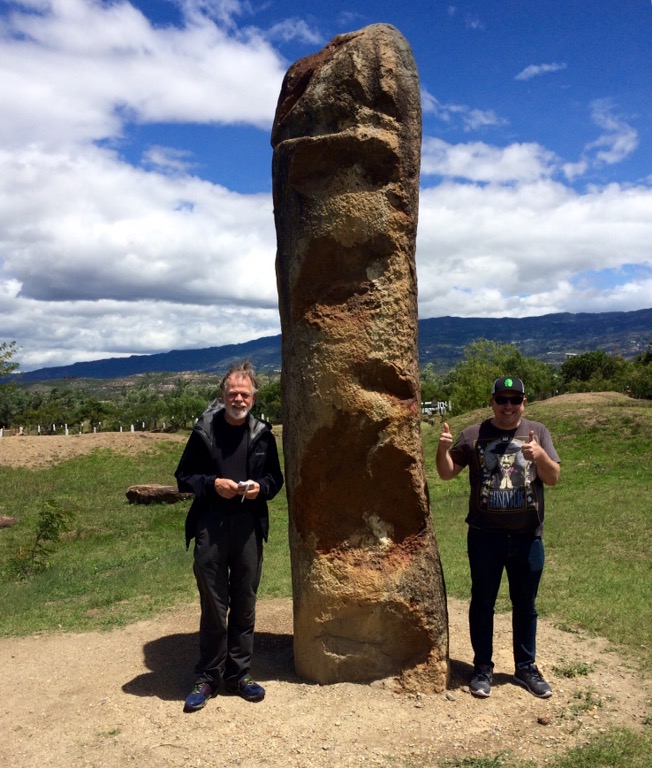
…a field filled with a 4000-year-old astronomical calendar, that adjoined another field holding thousand-year-old giant stone phalluses…


…a lovely old monastery…

…and then a vineyard.


Our guide, Angela, also did a terrific job of filling us in on current life in the town, which she insisted has the best weather in the world. “Es un paraiso,” she declared. (It’s a paradise.)

After the tour, we had time to stroll around the time-frozen center of town, and later, to consume another very good meal. It seemed easy to understand what pulls people here. 

And yet we’re moving on. I’m writing this post on our ride to the Bogota Airport, where we’ll catch our flight to steamy Cartagena. I’m hoping to upload it there, or failing that, at our next hotel.

The streets of Bogota

Steve and I woke around 7 and opened our wooden shutters to see actual blue skies and sun! We strolled around our neighborhood before breakfast and felt increasingly confident our bike tour would not be rained out (as the online weather forecasts made it seem would be a certainty.)

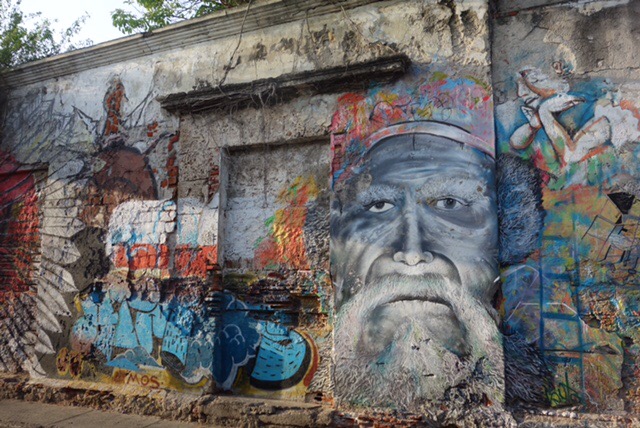
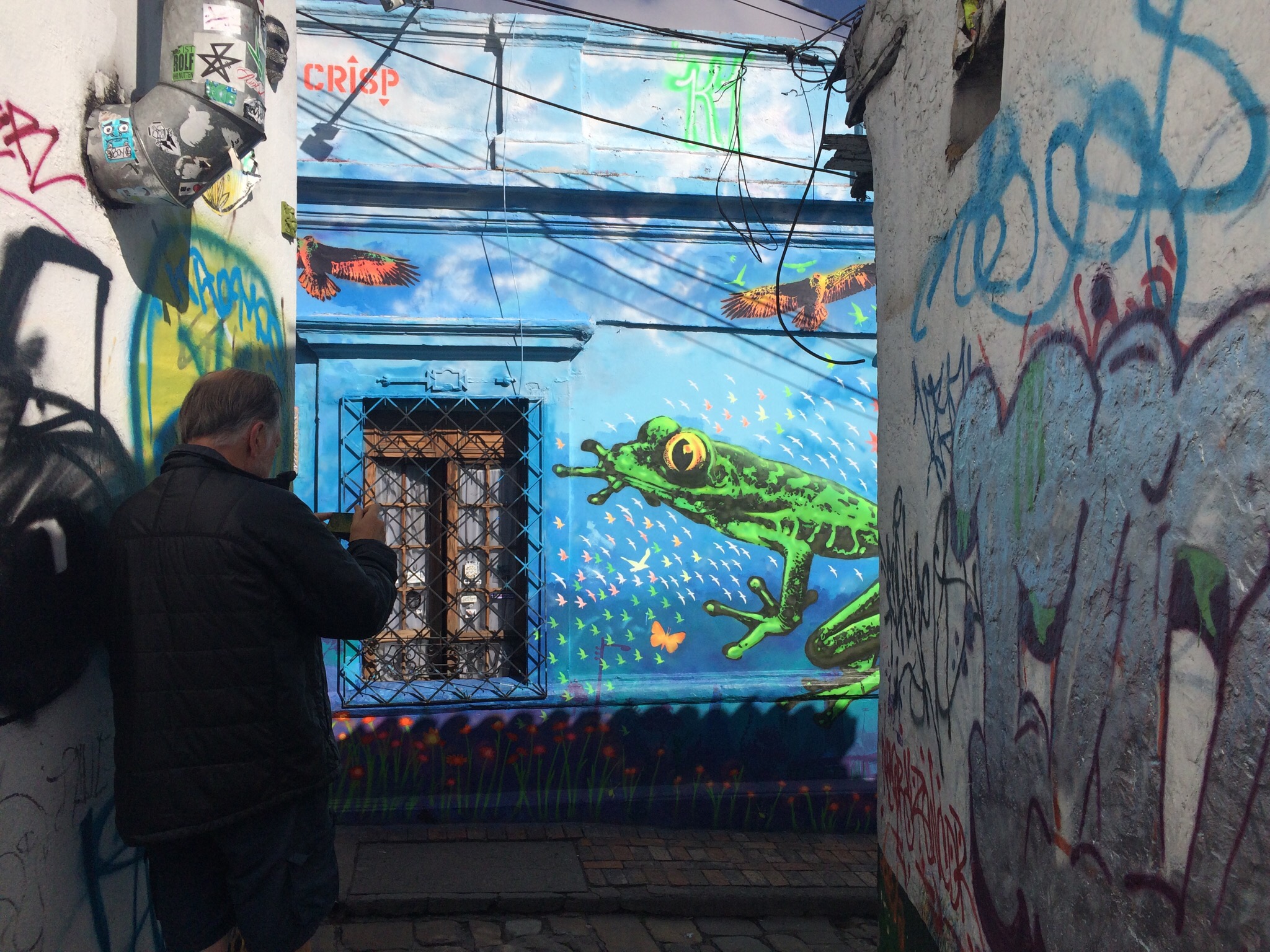
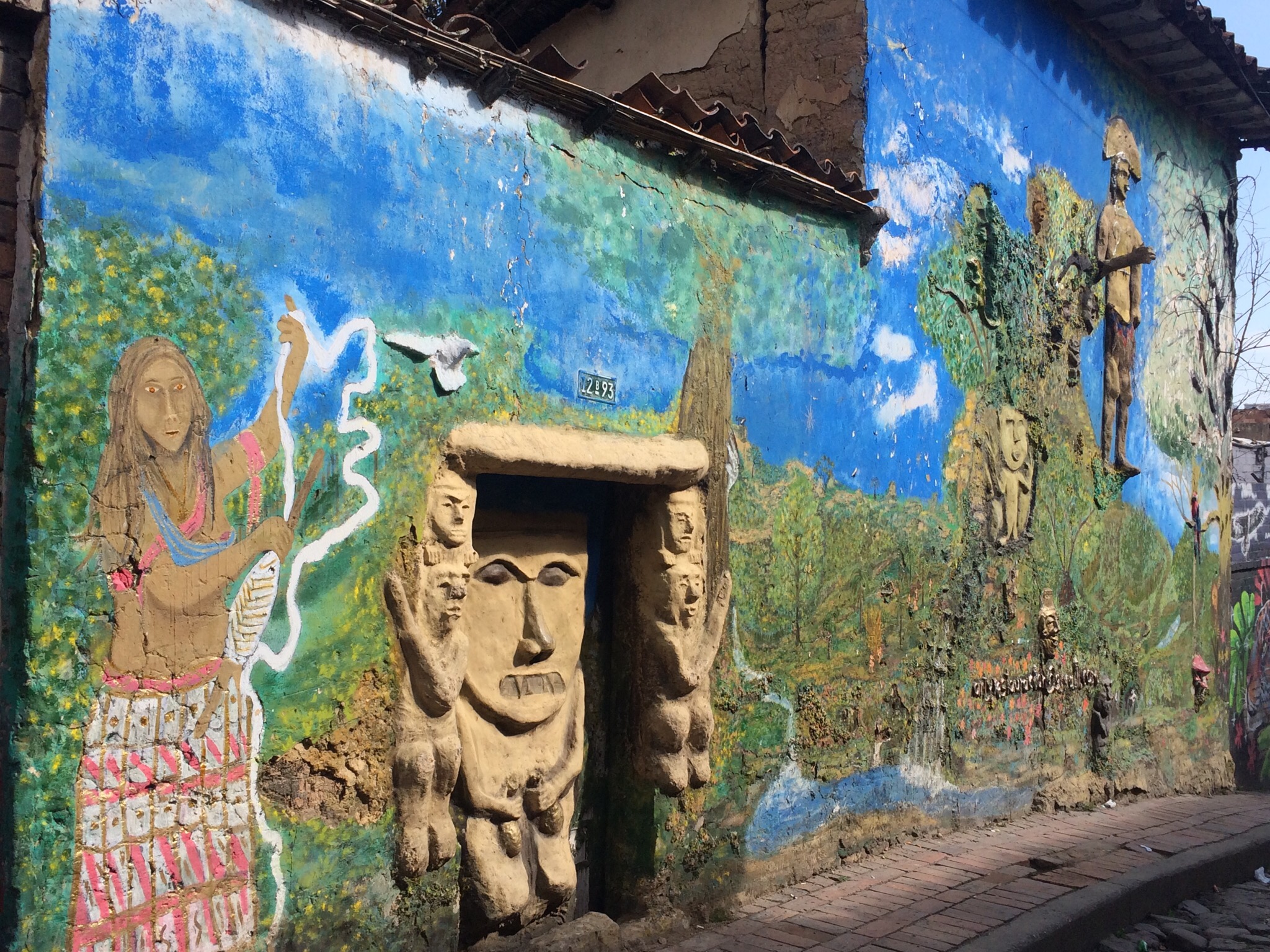
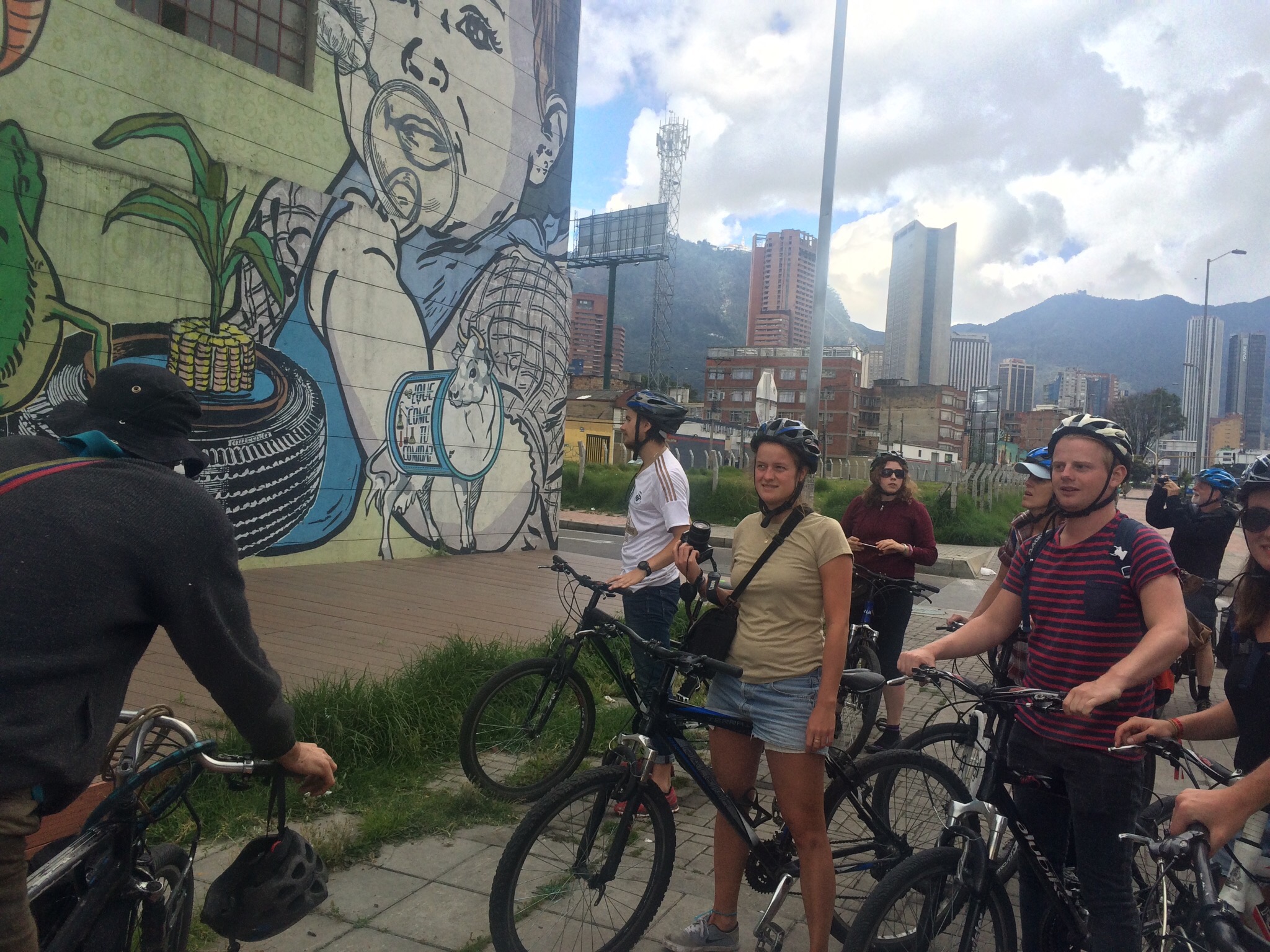
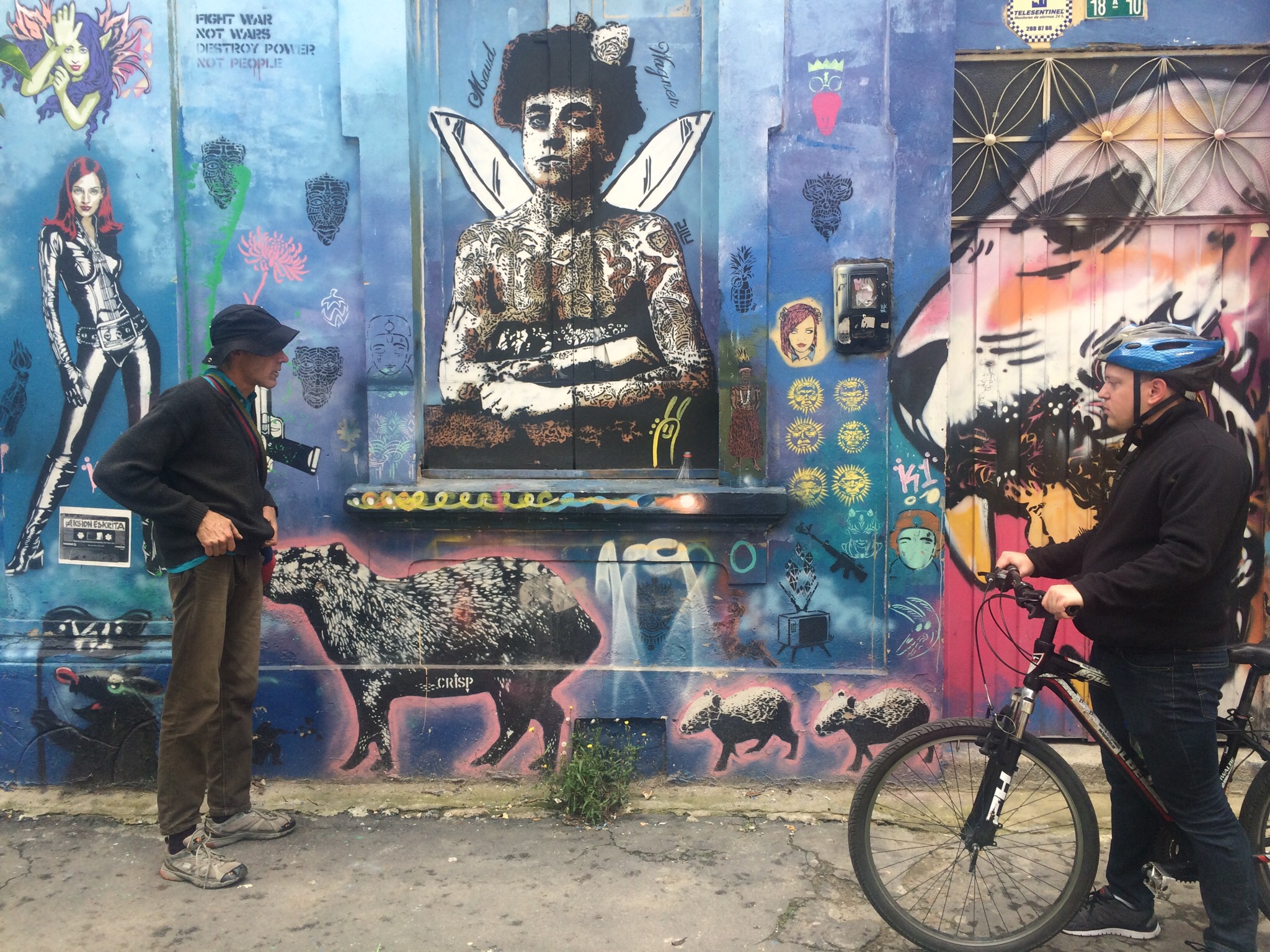
Our neighborhood, La Calendaria, is filled with narrow passages adorned with vibrant street art.

This mural was elaborate three-dimensionally.

That proved to be the case. We took the 10:30 a.m. Bogota Bike Tour (highly recommended by a friend who did it last year), and throughout the five-plus hours, I never felt more than a sprinkle or two. Other things, too, made me feel we had lucked out. 

The tour company, which was started 9 years ago by an American journalist named Mike and which today routinely gets listed on the best things to do in Bogota, was amazingly well organized. We showed up at the company’s shop at 10:15, and by 10:30 our group of 18 was pedaling off. We quickly learned that although today was a Monday, it also happened to be a national holiday — the feast of Corpus Christi. (Mike the guide pointed out that Colombia has more paid national holidays than any other country.) Because it was a holiday, that meant a huge number of streets were closed to car traffic, which made the biking vastly easier than it otherwise might have been. 

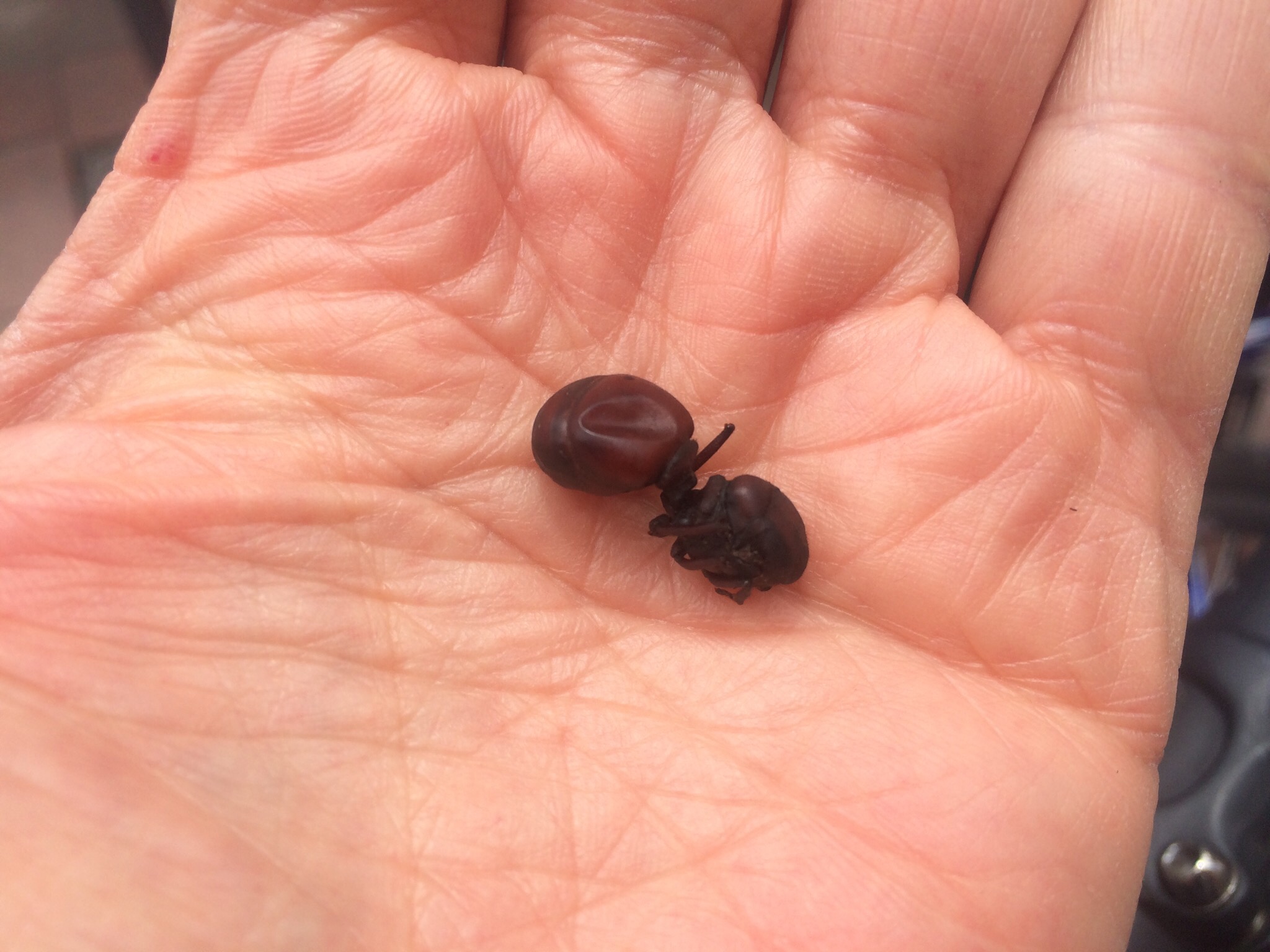
Over the five-plus hours that followed, Mike led us to all sorts of experiences we would never  have had otherwise. He passed around the “big-assed ants” (hormigas culonas) that people eat fried and salted.

I ate this guy, which at first tasted like a salty snack but had a creepy aftertaste.

Mike had us stop in one of the city’s big parks to watch Colombian kids play roller hockey with speed and ferocity. In another park, we listened to two neighborhood kids rap against violence and plea for more opportunity for common folk. We paused near a large group of people protesting against the government’s recent decision to sell off the state phone company to a private operator. And we watched another crowd, almost as big, dance en masse to Zumba-style exercise moves led by a pair of local exercise gurus.
Throughout the day, we rolled by canvas after canvas of street art, some works privately initiated and others commissioned by the government.


Mid-afternoon, we took a break at a coffee-roasting shop that served up excellent cappuccinos and pastries. Then we pedaled through the Santa Fe neighborhood, one of the areas of Bogota designated as an official “Tolerance Zone” for “high-impact public activities” (translation: this was one of Bogota’s legal prostitution areas, one or perhaps the only one in which the sex workers can flaunt their offerings on the street, rather than just in discreet bordellos.) Mike warned us not to take any photos; he said it made the hookers angry. 
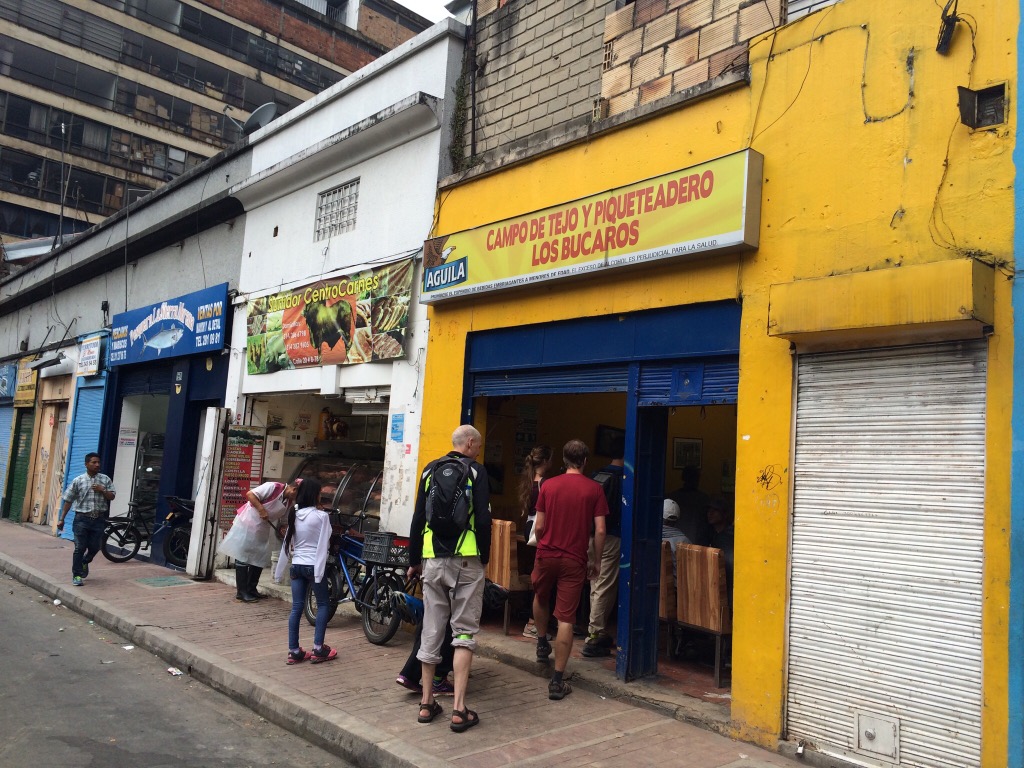
We finished up with two more stops: one at the Macarena fruit market where Mike introduced us to some of the many exotic crops grown in this country.  (Ever hear of tree tomatoes?) 

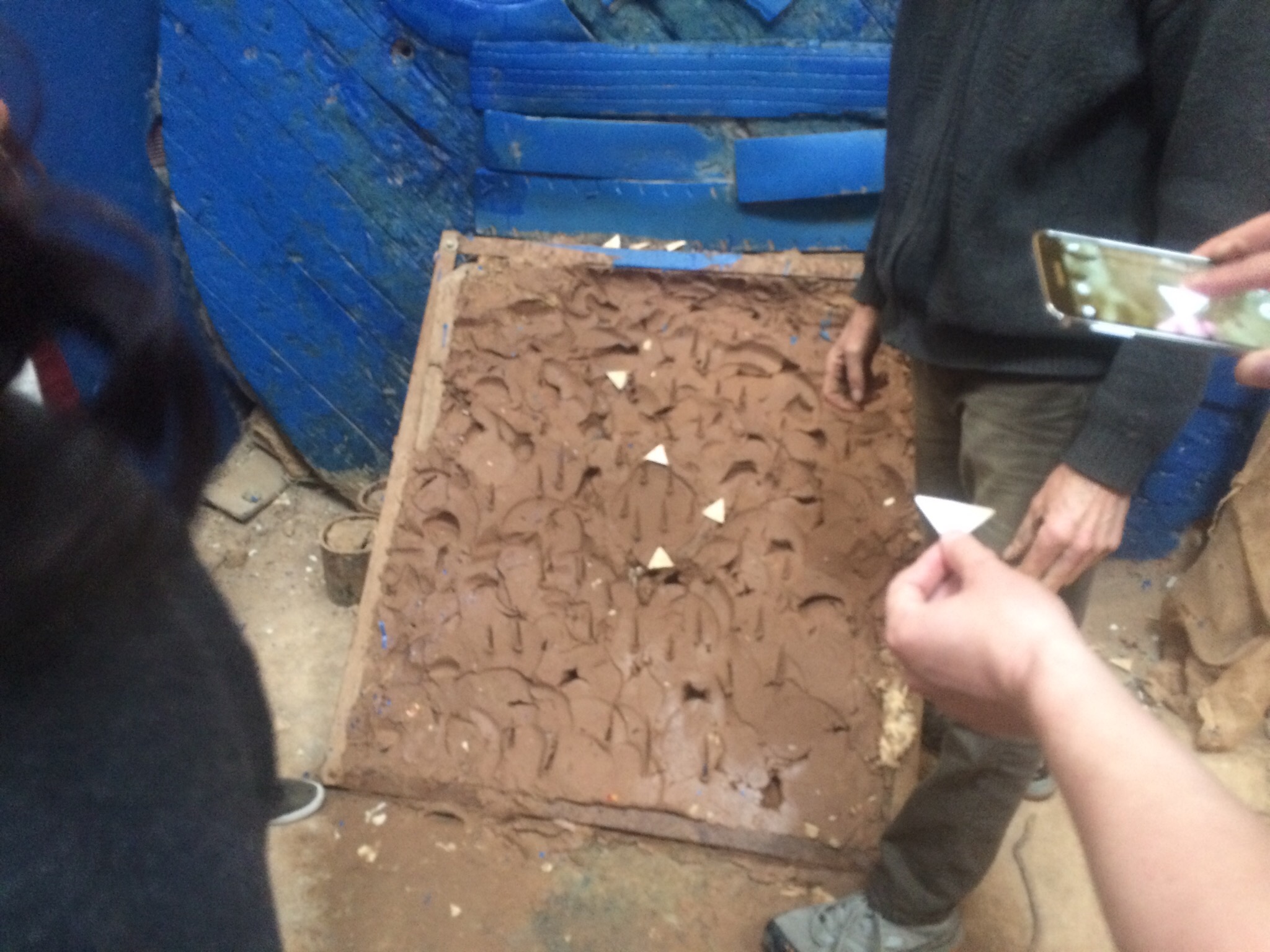
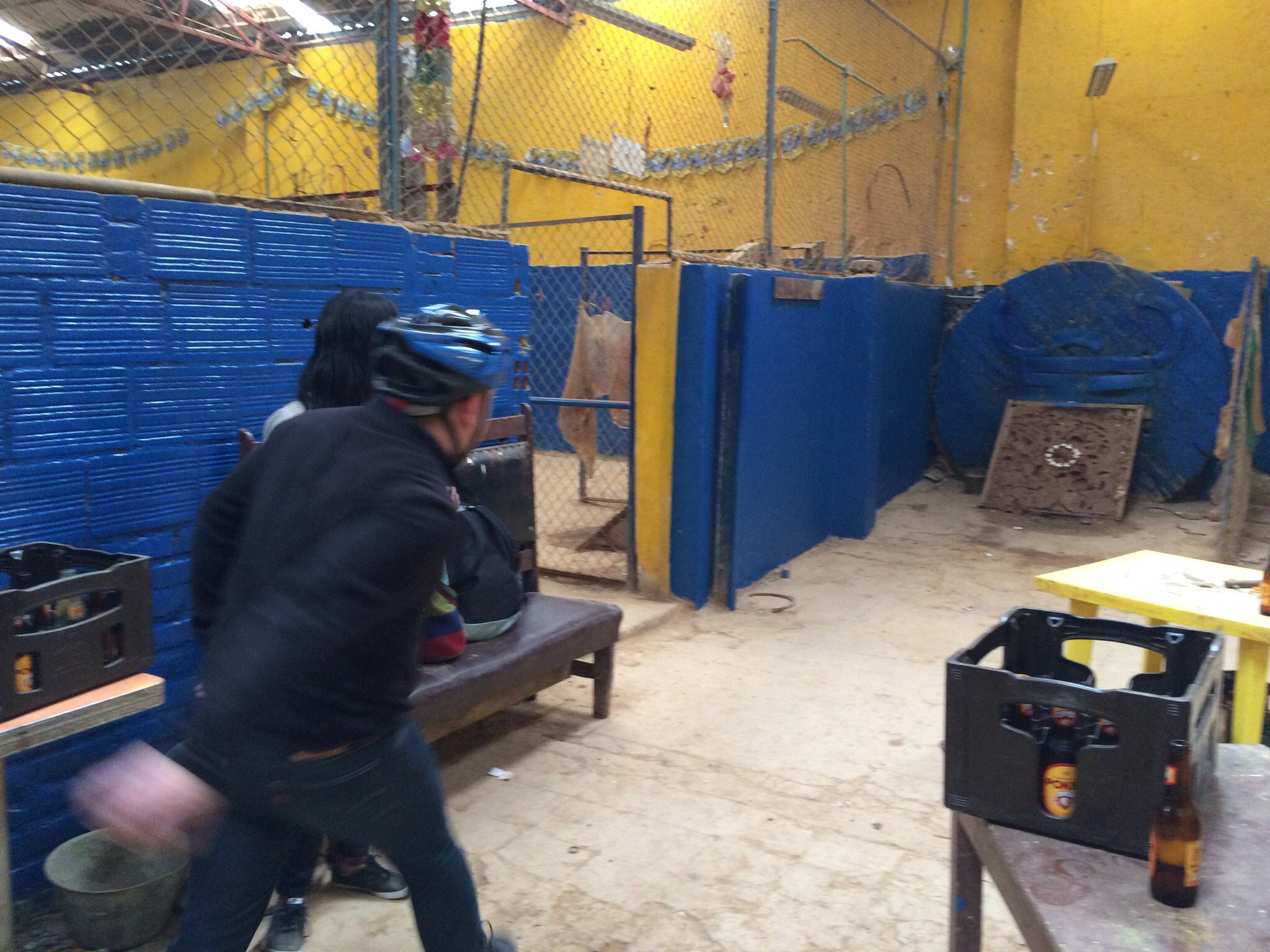
But it was the final stop that will probably linger longest in my memory. It was a place where Bogotanos play “tejo.” Tejo is the official national sport of this country, so designated by the Colombian legislature. 


The paper triangles are filled with gunpowder.

Michael takes a shot

Basically, you toss metal disks at a target made of clay. But attached to the target are little package of gunpowder. If you hit the gunpowder, it triggers an ear-shattering boom and you get a point. If your disk also lodges in the innermost circle, you get 2 more points. All this is done while the player swig bottles of Poker brand beer.
Steve and Mike and Stephanie all took a turn throwing, but they all missed. One member of our group did hit the bullseye, accompanied by a deafening explosion. I never tried; the booms made me too nervous. But I later reflected that it was kind of fun to be in a place which makes Americans look like pacifists. 

We may have only had two days in Bogota, but I feel like we learned a lot about it. Tomorrow we’ll say goodbye, heading for a taste of the colonial countryside.

A damp start

I started checking weather forecasts for Colombia a few weeks ago, and what I saw made my spirits sink. It looked like this for the foreseeable future in Bogota — and pretty much everywhere else we were planning to travel:


How could this be?!?!  When settling on the dates for this trip (LAST summer!), I’d consulted guidebooks about the best time to travel in Colombia. What I vaguely remember of their advice was that the answer to that varied dramatically from one part of the country to the other (since the country’ geography is so varied). But I think the guidebooks agreed that early June was a mostly good time — one rainy season would be ending and it wouldn’t be too hot anywhere.

And now the weather sites seemed to be promising endless rain. Was this the fault of El Niño? In Bogota, the activity to which I’ve been looking forward most Bogota was a bike tour of the city about which I’d heard rave reviews. A few days before our departure, I emailed the bike tour company to ask if they operated in the rain. Their reply conforted me. “It  hasn’t rained much, unfortunately, as we’ve had a drought,” a guy named Mike wrote me back. (It makes me wonder if Mike and Accuweather might want to talk to one another.).        

When we landed at Bogota’s El Dorado Airport last night, it felt like Accuweather had a better read on the situation. Cold and blustery, the night felt more like dead winter in San Diego than summer in South America (NOT very far from the equator!) But this morning, it’s cool but dry outside. 


Not that I’ve seen much of the outside world. It’s already 10:15, and we haven’t yet seen Michael and Stephanie. We’ve read that Bogota’s famous Gold Museum is not open at all on Mondays, so I don’t think we’ll be squeezing in the bike tour today. Still, we have a full day tomorrow too, and I’m reminding myself that a focus on the present moment makes weather forecasting a silly activity.

Hail, Colombia!

Saturday we’re flying to Colombia. When I’ve mentioned our destination to a few people, I’ve been asked if I was referring to the city in Ohio. That’s probably a nice place to go, too, but instead we’ll be traveling in the large nation that’s the first country you get to in South America, as you leave behind Panama and the rest of Central America. (We’re flying there, not driving, although that would doubtless be even more interesting.) I’ve also been asked why Colombia, a land that in the 1990s and early 2000s was plagued by shocking violence that flowed from left-wing guerillas, right-wing paramilitarists, and assorted other thugs. But by all reports, the violence has abated and tourism is surging. Several friends and acquaintances have traveled there in the last few years, and their accounts have been enthusiastic.
Now we get to see for ourselves this land of dramatic contrasts. For me, Colombia will be the 51st country I’ve made it to (assuming that one counts Tibet and Palestine as countries. Which I do.)

At least one of the things that will made this trip special is the fact that Steve and I will be traveling for most of it with our son Michael and his girlfriend Stephanie. What could be better?
On a darker note, the blogging software that I’ve used so happily for years on the road has, sadly, gone off the market. I’ll try to make the technology work using other tools. But that could get ugly.


Un-American Tibet

Tibet sign

We arrived back in San Diego late Saturday night and since then have been immersed in attending to the health crisis of Steve’s mother that prompted us to cut our trip short, along with the messy task of filing a “Trip Interruption” insurance claim and dealing with other re-entry issues. With every hour that passes, the memory of our all-too-brief visit to Tibet fades further. The way it’s going, in another week or so, any memory that I was ever there will have vanished.

But we were there, in a land that, as Steve observed at one point, has less in common with modern American culture than perhaps anywhere else we’ve ever been. To help preserve some shred of what we experienced, let me describe what seemed to me to be the Three Most Un-American Tibetan Things.

Tibet Tashi and beads
Our guide Tashi disclosed that he was working on saying his favorite mantra 100,000 times. His set of beads helps him keep track of how close he is to achieving that goal.

Mass ritualized walking. The former sovereign country (and current Chinese “autonomous region”) of Tibet contains a staggering number of places considered by Tibetan Buddhists to be sacred. The faithful believe that as a result of visiting these places and doing certain things at them, good things will happen. For example, by journeying to specific peaks, one can make amends for specific sins. To boost the power of the visit, an almost universal tactic is to walk in a clockwise direction around the sacred thing. This is known as making a kora (or circumambulating), and you can do it around something as small as a prayer wheel or as large as a mountain. Most people recite mantras as they walk, Om Mani Padme Hum being the most famous one. But there are bunches of others. Tibetans use complicated prayer beads to keep track of how many times they say their particular mantra.
The most devout folks also engage in elaborate prostrations in which they go from standing to lying face-down flat on the ground, then back up again, over and over. Some combine prostrating with circumambulating, then taking a step or two sidewise between each trip to the ground. They do this hour upon hour.

Tibet single prostration
This fellow was prostrating himself around the kora route. People use various devices to protect their hands as they slide they forward and downward and back up again.
Tibet more prostration
This large group of people was prostrating in one place, en masse.

We’d seen one mass circumambulation around a stupa in Bhutan, but it hardly prepared us for the Tibetan kora culture. We saw koras all over Lhasa, some encircling whole neighborhoods. The procession we came to know best follows the outer perimeter of the part of the Old City containing the Jokhang Temple and takes maybe 15-20 minutes to complete. It’s a fascinating parade to watch, so dense at certain times it can be tough to cut across it. You see a sprinkling of monks and a goodly portion of elders amidst the walkers, but we also noted many young people. I was struck by how many people dress in the traditional style, women in long dresses topped with colorfully striped aprons, men in sheepskin cloaks, both sexes wearing felt cowboy hats. (And here they’re not wearing the folk garb because of some governmental edict, as is the case in Bhutan.)
Tibet kora 3
Most people walk and pray, but some walk and check their cell phones.

Tibet kora 2

Tibet kora 1

Tibet juniper smoke
Pilgrims circumambulating the Jokhang Temple often stop to add damp juniper sprigs to these offertory ovens. The result is a lot of fragrant smoke that make the normally clear air of Lhasa much more closely resemble that of other Chinese cities.

Yaks R Us. Considering that wild yaks are almost extinct (down from a million 50 years ago to only 15,000 or so today), the yakly presence Tibet is pretty amazing. The animals are cultivated (and often cross-bred with cows), and virtually every part of them (from their milk to their skin and hair to their dung) is used enthusiastically.

Tibet yak skull
Yak skulls make nifty home decorations!
Tibet yak butter
We saw great lumps of yak butter in the stores…

People use the butter for many things, most notably yak-butter tea, which we tried once and found to taste like slightly rancid melted butter mixed with warm water. Yak meat was on every menu in forms ranging from yak burgers to stir fries, and our guide insisted Tibetans much prefer the flavor to beef. We, in contrast, were struck by its tough texture and gamy flavors. “It tastes like Tucker,” Steve declared of the principal ingredient in his yak stew one day. (Not that he would know. Tucker is our aging labrador retriever.)

The Potala Palace. During our abbreviated stay in Lhasa, we managed to visit four of the city’s major landmarks (two palaces, the most important Buddhist temple in the country, and a monastery.) All were interesting, but the Potala Palace is in a special class. It’s the class that includes the Great Pyramid, Eiffel Tower, and Angkor Wat —  the most striking buildings erected over the course of human history.

Tibet distant Potala
Note the view from our hotel rooftop of the Potala Palace on the hillside in the distance.
Tibet Potala close
The view of the palace from the base of the hill.

Situated on a hillside that dominates the entire city, the Potala served as home to every Dalai Lama from the 5th to the 14th; 8 of the former rulers are entombed in sepulchers adorned not only with precious gems but (literally) tons of gold. The whole complex includes more than 1000 rooms, and even though today it’s a somewhat sterile museum, rather than the pulsing, vibrant, devotional center that the Jokhang Temple is, it’s actually hard for me to imagine I could ever forget the sight of it.

Had we not cut the trip short, we would have visited at least one more temple and another monastery. But perhaps it’s just as well we missed them. I’m pretty interesteTibet prayer flagsd in Buddhism, but after only two weeks in Buddhaland, all the various orders and bodhisattvas and protective deities and other key historical figures were starting to overwhelm me. Toward the end I sometimes pretended to be meditating, just to escape the explanatory litanies about the over-the-top ornamentation.

On the other hand, had we not cut the trip short, we would have made that legendary cross-China train journey. On a third hand (something you see a lot of in Buddhist temples), we’re already in the midst of a different sort of journey back here at home. As with all journeys, all we can do it buckle up and appreciate the present moment.

Mission aborted!

Events have shoved us off the Roof of the World. Never before have Steve and I had to cut short a journey and return home. But in the present case, it seemed unavoidable.

We were supposed to get from Lhasa to Beijing by train! But we were grateful to get the last two seats on a plane, since we needed them.

We first learned that an emergency was brewing around 2 a.m. Tuesday morning, when the ringing of Steve’s phone woke us up. (Or rather, woke Steve up. I was awake, struggling to breathe in enough oxygen.) It was a call from the retirement complex where his 98-year-old mother, Carol, resides. Although increasingly frail, Carol has been able to live independently at the White Sands, just 10 minutes from our house. Although Steve failed to get to his phone in time to answer the call, he almost immediately received a text message from our older son, Michael, who also had been contacted by the facilty staff. Eventually, we figured out that Carol had been unable to get out of bed and was being taken to the hospital for evaluation.

Trying to discern what was going on over the course of the next few days was challenging. China is 15 hours ahead of the US, so the only reasonable time to converse with San Diego was early in the morning, China time (when it was late afternoon back home.) Our younger son and a close family friend finally determined where Carol was and managed to visit her, and for a day or two, she seemed to be doing okay. But Thursday morning we heard she would be undergoing surgery the next day. This seemed drastic enough that we decided we had to return home, as quickly as possible.

Now that I’ve done it, I can report that if you have to make a bunch of last-minute travel arrangements, Tibet should not be your first choice to do it from. When you can get access to the Internet, it’s slow, and the Chinese government limits what you can see (no Google! no Facebook! no gmail! etc.). When we informed Tashi, our guide, and Woeser, the tour company director, that we needed to cut our trip short, they were sad but understanding. Caring for one’s parents is still a pretty serious duty in China. They said there was no way to try to book the flights online, and Woeser seemed to be saying that if we went to a travel agent, we wouldn’t be treated professionally; that it was better to go to the individual airline offices. That sounded strange, but we were game. Tashi, Steve, and I hailed a taxi and went to the intersection where Tashi thought the Air China offices were located. We got out and scrutinized the millions of Chinese characters on the nearby buildings but saw no clue to what we were looking for. We tried all four corners of the intersection. Finally Tashi talked to a local shopkeeper who assured him Air China was nowhere in the vicinity. We hailed another cab; drove to another part of Lhasa, and when we got out, we spotted the offices of both Air China and China Eastern, not far from each other.

Inside the large Air China office, only 2 employees were evident. One was assisting a customer. The woman next to her sat behind a large sign saying “Manager.” But she didn’t even glance at us, standing in front of her desk, until Tashi asked her a direct question. No seats on any Air China flight to Beijing were available that day or the next, she proclaimed curtly. We walked out, crossed the street, entered the China Eastern office, took the elevator up to the 6th floor and found a single bored looking employee behind a computer terminal. He too declined to look at us. Once again, when prodded by Tashi, without so much as looking at his screen, he also said no China Eastern seats were available.

It was about this time that it dawned on us we were trying to travel at the end of one of those monster Chinese national holiday weeks, when a substantial number of the country’s billion inhabitants all take to the road simultaneously. Also about this time, Woeser called and suggested we try the travel agent he works with, someone skilled at finding seats on domestic flights. By then Steve and I had managed to use my American Airlines app and ascertained that seats from Beijing to San Diego seemed to be available on Saturday. We happily told Woeser to go ahead and secure a flight to Beijing, if possible. A few minutes later, he called back and said she had snagged the last two seats for us on an Air China flight leaving Lhasa at 4 p.m. Friday. They were expensive — almost $600 each. On the other hand, to our amazement, the American Airlines Beijing-to-San Diego tickets we bought online cost less than that.

If it wasn't what we had planned, the flights from Lhasa to Beijing (via Chengdu) were pretty interesting, nonetheless.

For this trip, we bought travel insurance that’s supposed to cover “trip interruption,” so we think we’ll be reimbursed for the costs of changing our plans. What we’ve lost and cannot recover is the opportunity to drive southeast through the harsh Tibetan landscape (which we were supposed to do Friday), see those Himalayans foothills that were on Steve’s bucket list, sleep at the foot of Mt. Everest (scheduled for today), and take the two-day cross-China train trip from Lhasa to Xian next Tuesday, stopping there to see the fabled army of clay warriors created for China’s first emperor.

We’re very sad about that, but we don’t have any doubts this was the right thing to do. Even though Carol sounded better Friday morning (and never had to undergo any surgery), she appears to be facing critical decisions about her living situation, and as her only child, Steve is the person best situated to help her with those. Also, we keep reminding ourselves that the week we spent in Bhutan was wonderful. Our brief visit to Nepal made us long to return there. If like Heinrich Harrar, we had to leave Tibet earlier than we would have wished, what we saw during our short time there was incomparable. On the plane ride home tomorrow, I’ll try to describe what our Three and a Half Days in Tibet were like.