Reconsider travel to Papua New Guinea

Steve thinks weather can color first impressions of wherever you’ve landed. That was true of our arrival in Papua New Guinea Sunday morning. We had a pleasant two-hour flight from Honiara to Pt. Moresby, PNG’s capital. But we descended to the airport through skies filled with menacing clouds. On the ground, gusty winds matched the evil reputation of this city, which regularly ranks among the most dangerous in the world. 

We reached our hotel around 3 and were assigned a room on the fifth floor. It had huge windows overlooking the nearby beach, but the wind was shaking them so violently I could imagine them shattering. The racket continued all evening and was still so loud when I went to bed I had to wear earplugs.

Everything I’d ever read about Pt. Moresby suggested it was not safe to go out and walk around. So even though Monday morning dawned bright and calm, both Steve and I were content to hang out in our room. He worked on his travel journal; I wrote my last blog post. At 2 pm we were supposed to meet up with our tour leader, Christopher Bartlett, in the hotel bar. But mid-morning, a disturbing message popped up on our WhatsApp group chat: Christopher and a half-dozen other tour members were delayed in New Britain, where they’d been scuba diving. With luck, they might land around 4:30. A while later, Christopher Whatsapped again, suggesting we get a ride from the hotel down to Ela Beach, where festive activities celebrating the 50th anniversary of PNG’s independence from Australia were supposed to unfold.

This took a while to organize, but Steve and I and five other members of our 20-person group eventually piled in a van and drove down the hill. It occurred to me that the US State Department wouldn’t approve. PNG is already on their “Reconsider Travel” list because of the crime, particularly in Pt. Moresby, and political unrest in the western highlands. The anniversary celebrations would draw large crowds that might become violent, one bulletin advised, so they should be avoided.

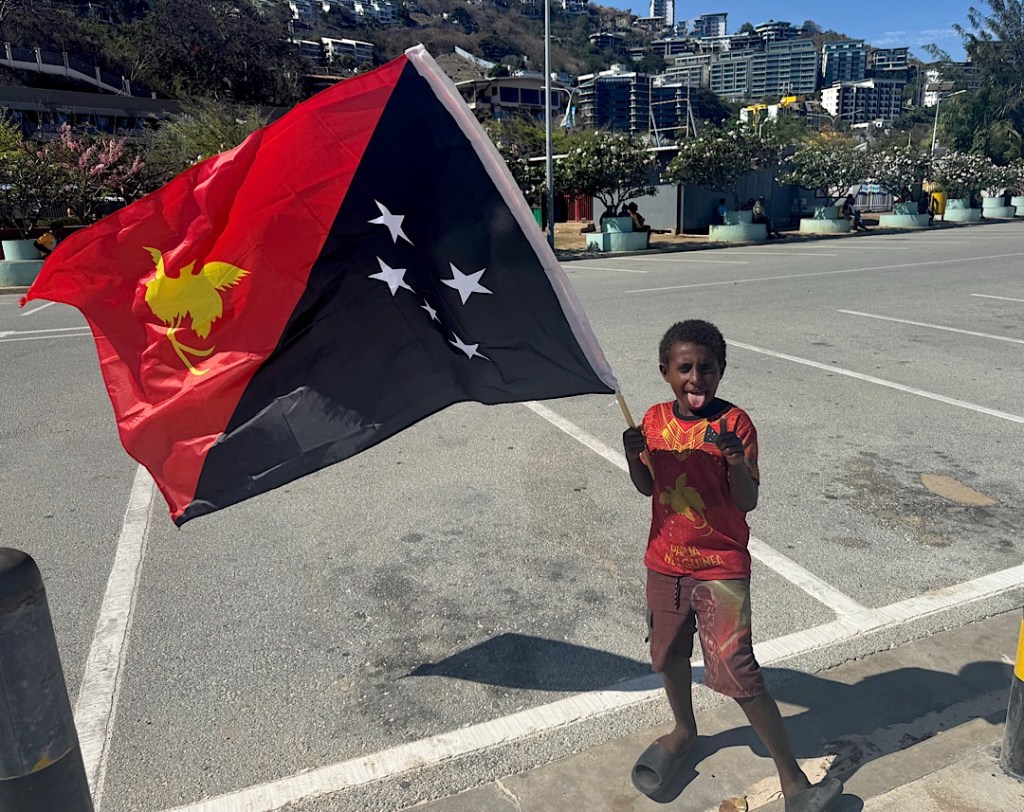
When the van disgorged us next to the beach, however, it was obvious little to no danger lurked here. The balmy day and cool breeze off the ocean would have made anyone feel cheerful, and the women and children and families we encountered on the boardwalk were in an extra ebullient mood. Everyone smiled at us and returned our “hellos” and most were dressed in the red, black and gold national colors, Many waved large PNG flags. They sang out “Happy Independence Day!”and we chorused back the same.
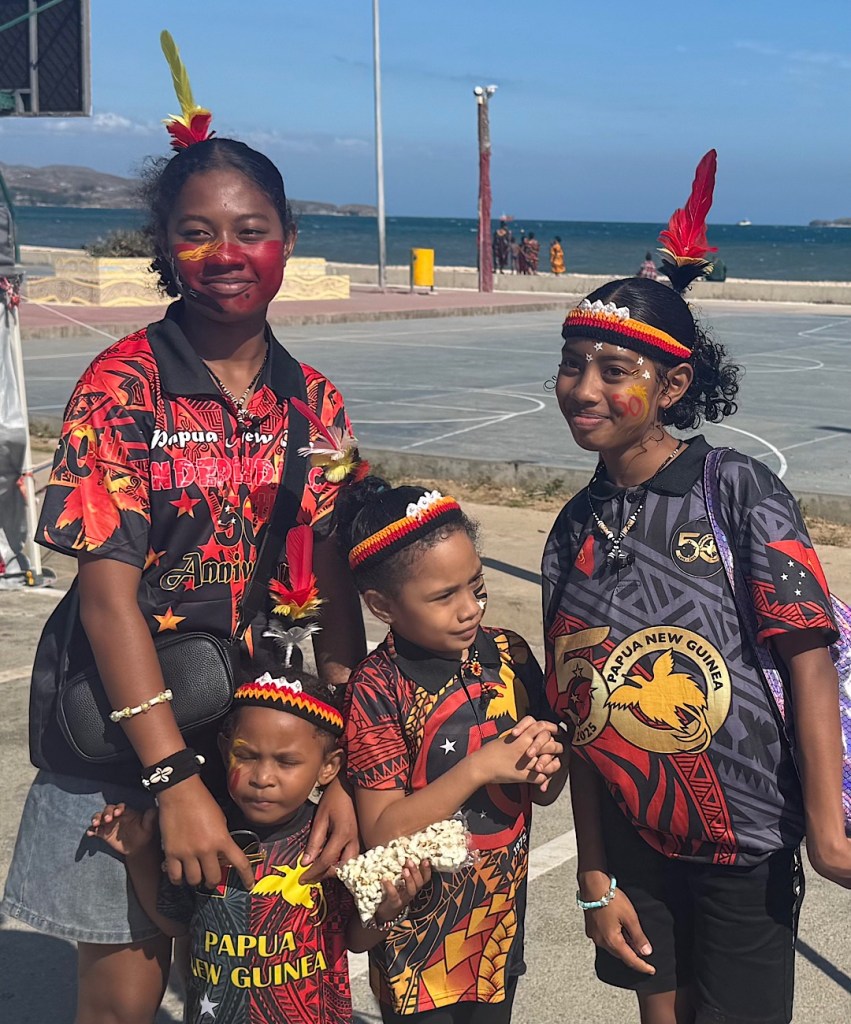
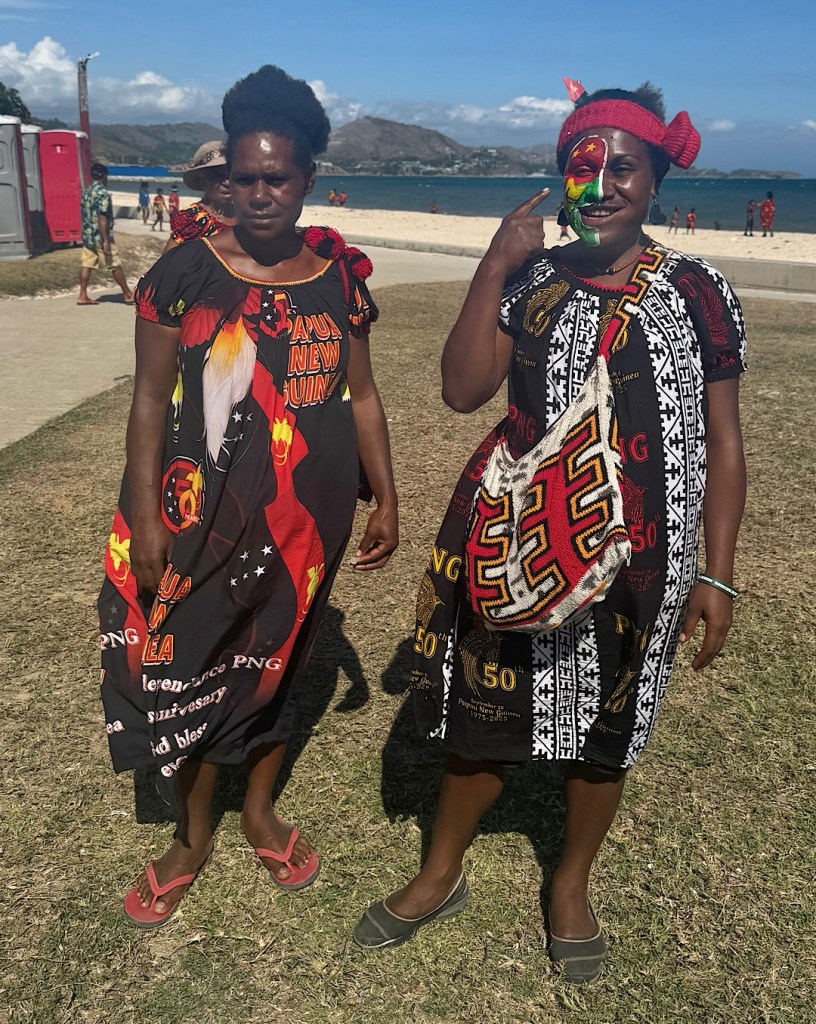
Kate, the only English member of our group, charmed everyone with her enthusiasm. My photo doesn’t show it well, but this guy had painted half his body coal black and the other half red, with a gold bird of paradise on his left chest.

Along the busiest part of the boardwalk, vendors had set up tidy booths where they were selling clothing and jewelry and other crafts. So we shopped and took pictures and made our way to a stage where we caught a few music and dance performances. Then Steve and I and Kate decided to walk back up the hill to our hotel, rather than catch a taxi. No harm befell us. 

I don’t doubt that visitors to Pt. Moresby routinely get robbed or even worse. Still, my experience that afternoon and in the next few days made me think anyone who wouldn’t dream of visiting Papua New Guinea because it’s too dangerous should reconsider their travel plans. 

PS — I’m writing this in the Eastern Highlands. We’ve been on the road for three days, and we’re immersed in the cultural experiences at the heart of this part of our itinerary. Internet connections are getting worse and worse. I’ve decided to keep my posts short, limit the number of photos, and send them whenever I catch a good, brief online connection. But that’s likely to be sporadic for the next few days. 
Phase 1: Samoa

As I said, our hop, skip, and jump approach to getting to the other side of the world is an experiment. I have preliminary results from Phase 1: Samoa. 

In premium economy seats on Fiji Airways, the 5 and 1/2 hour flight from Honolulu was unremarkable, except for its 3:15 a.m. arrival. We chose this awful connection only because options were so limited; our schedule so painfully constrained.

Outside the terminal, we clambered into a taxi and were driven for 45 minutes to our hotel, a Sheraton on the waterfront in the capital (Apia). Even in darkness, the tidy highway impressed me. I could see no trash. Instead my eye was drawn to the containers lining the roadside boundary of many homes. Made from stacked tires or metal cans painted and planted with flowers, the blooms would be pretty in the sunshine. 

Our taxi driver conformed to Samoan stereotypes. Everything about him was broad: his shoulders, his gut, the nose set in his wide golden face. It was he who alerted us to what would prove to be the worst thing about our quick pass through his country. We would be there only Saturday and Sunday. But Samoans take their weekends seriously. Toie warned us that the Robert Louis Stevenson museum — a fixture on lists of Top Things to Do in Apia — would close in about 7 hours (i.e. at noon Saturday) and would not reopen until Monday. On Sunday, he warned, everything else would shut down except for the multitude of churches.

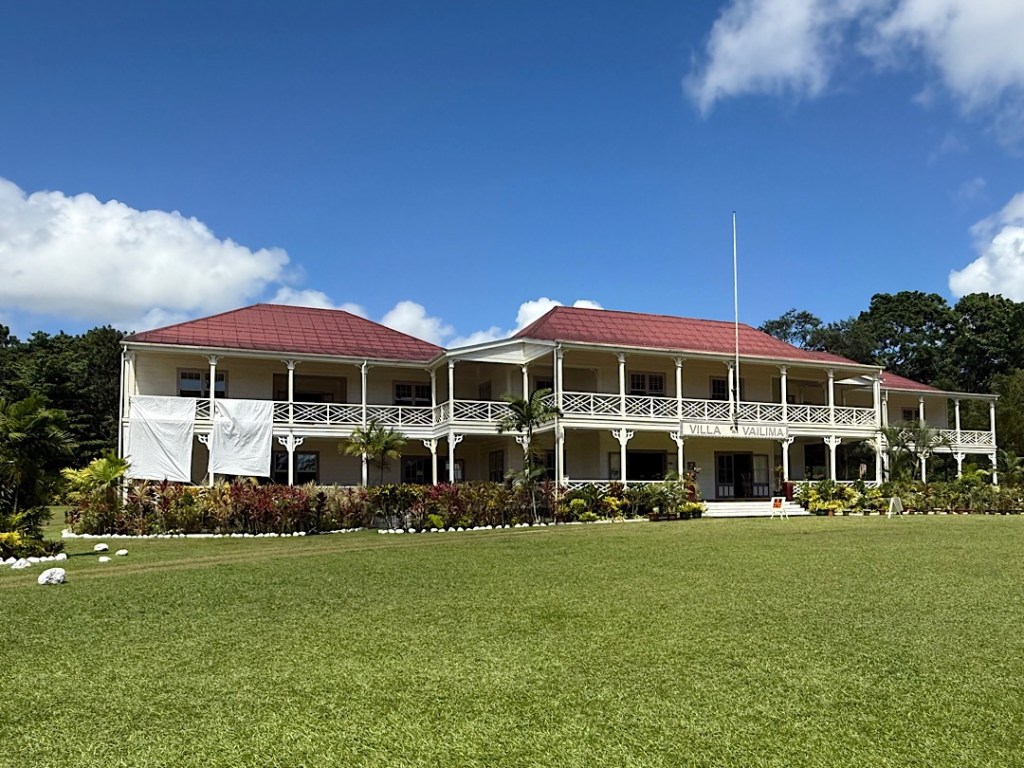
We checked into our room, napped for about 90 minutes, ate a quick breakfast, then took another taxi up a steep hillside to the property developed by the author of Kidnapped, Treasure Island, the Strange Case of Dr. Jekyll and Mr. Hyde, (and more). Robert Louis Stevenson and his wife Fanny came to live in Samoa in 1889. Besotted by the sunshine and tropical beauty, they hoped it would prove a tonic for Stevenson’s longterm lung disease and other ills. It worked but not for long. RLS died of a stroke in 1894, at 44. But in their five years on the island, Louis and Fanny oversaw construction of a beautiful villa and surrounding farms and gardens. Today the complex is a museum open to the public (but only till noon on Saturdays).

That was enough time for us to see why the place enchanted the Stevensons.

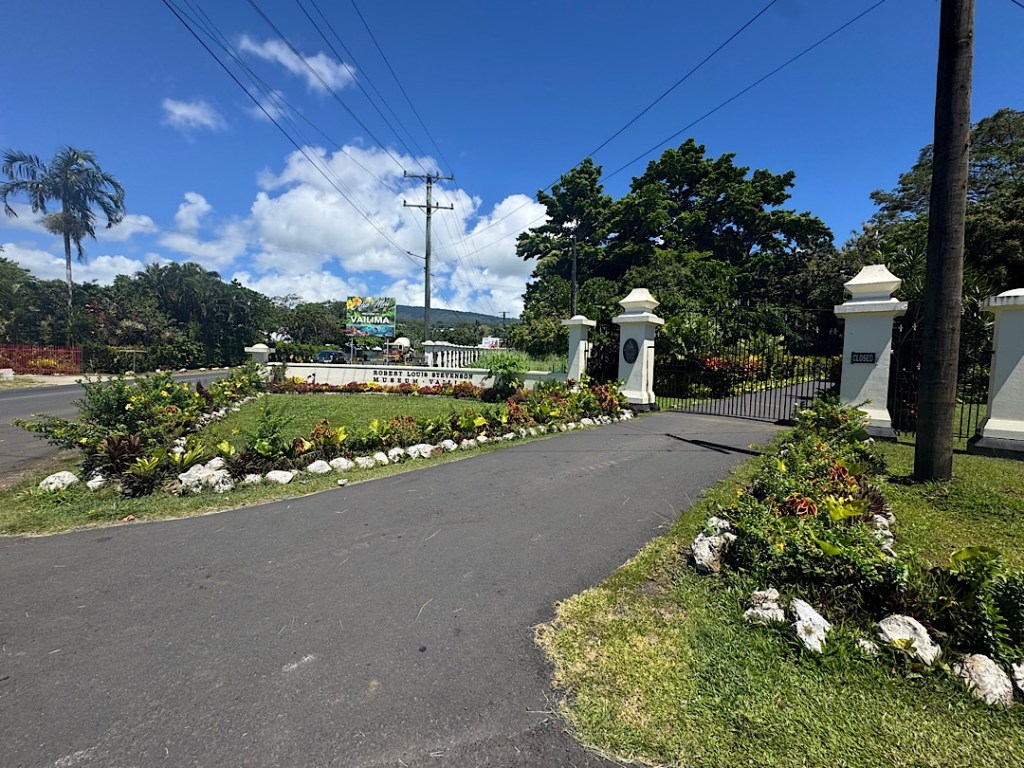
The entrance
A guide took us through the villa, which was as pretty and pleasant inside as out.
The view from the front porch

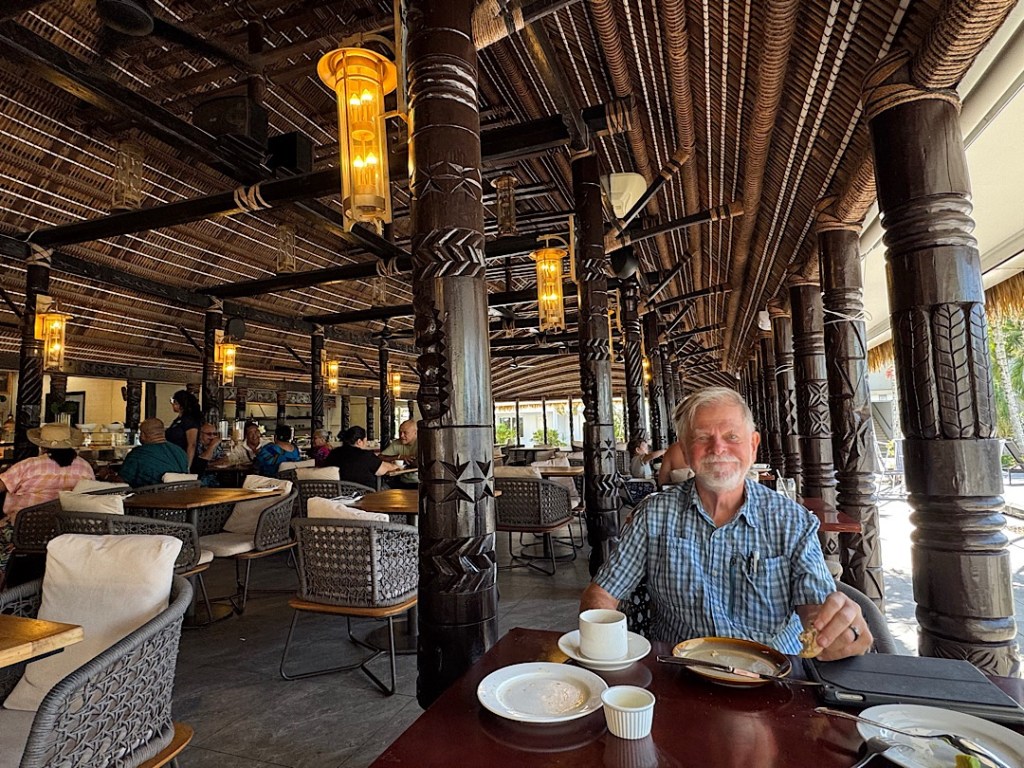
We returned to our hotel, with its beautiful open-air restaurant next to a pretty pool. It wasn’t a hardship to sit there, surf online, and confirm what Toie had said. Almost nothing would be open the next day.

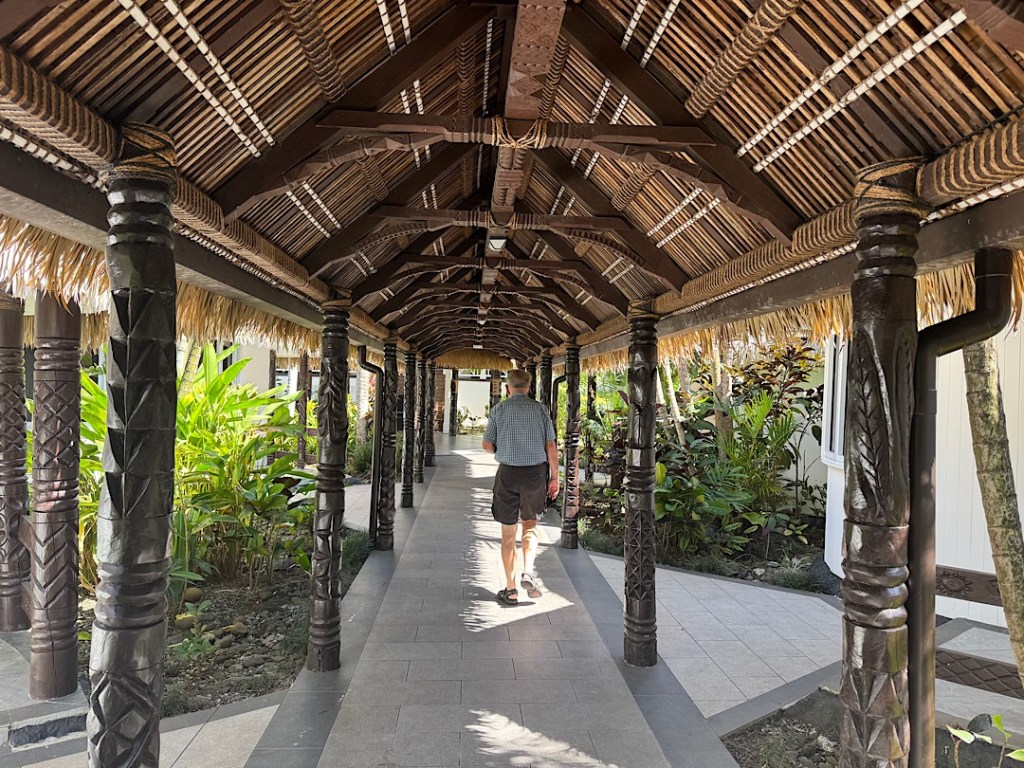
The food was just okay, but the Samoan wood work dazzled me.
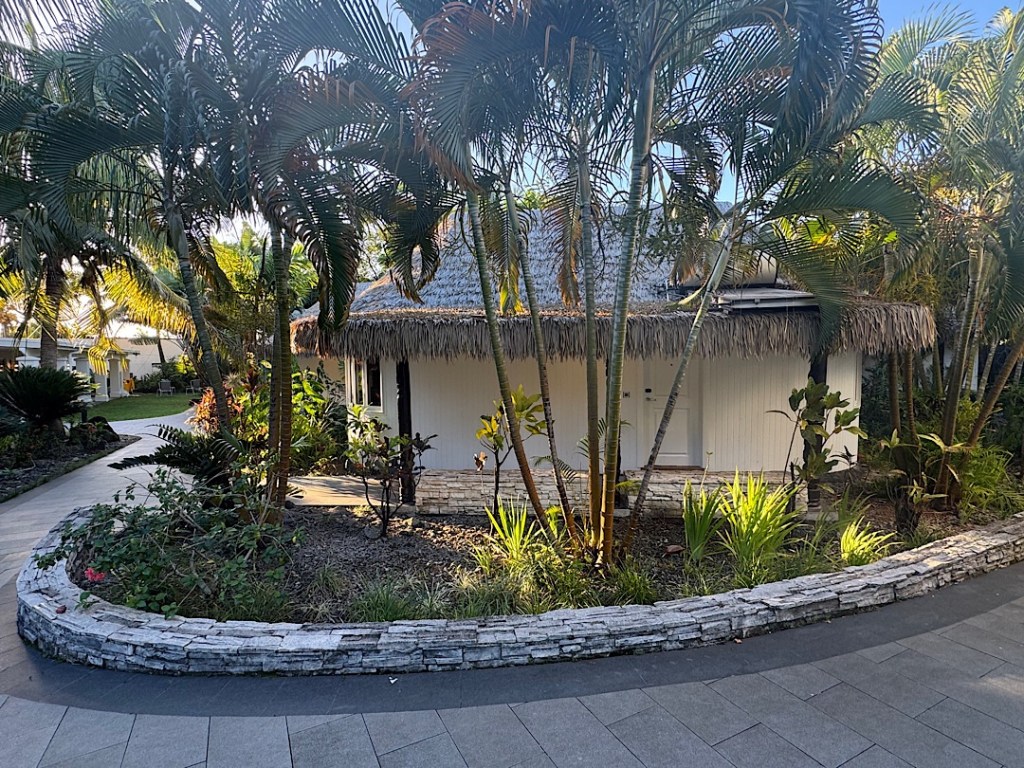
This was our bungalow.

Steve did find a promising restaurant just a few blocks away. We walked to it, arriving at Paddles just minutes after it had opened at 5:00. We got a table and our meal was so delicious and fun we tried to make a reservation for the next night. But oh yeah. Paddles also closed on Sundays.

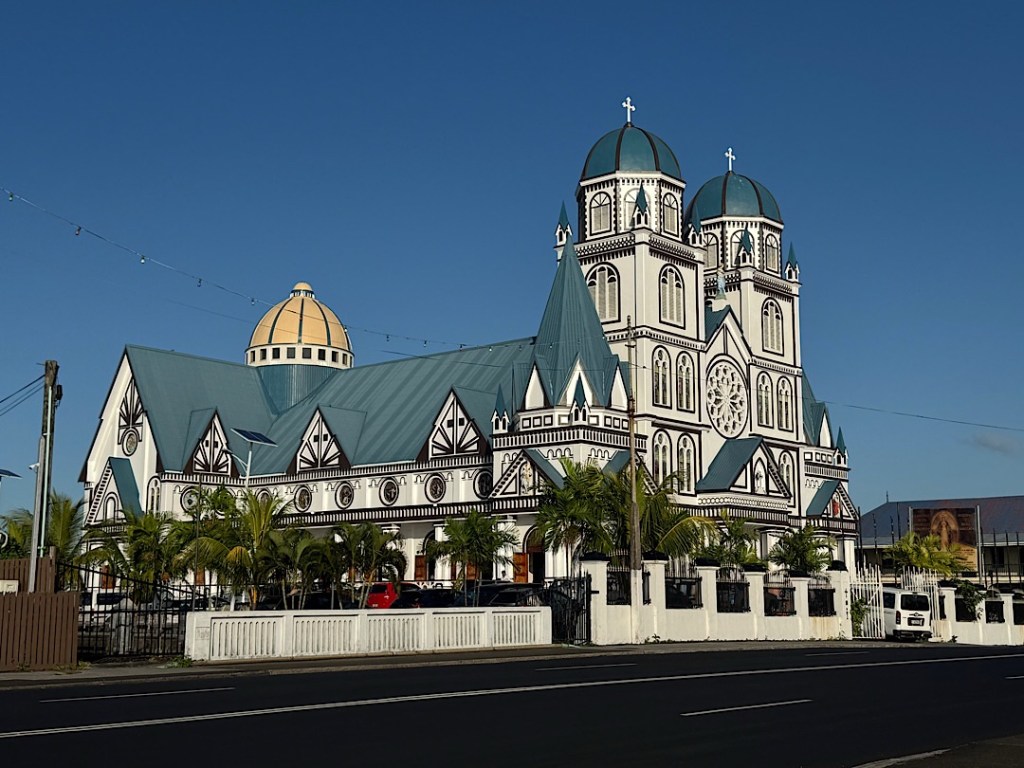
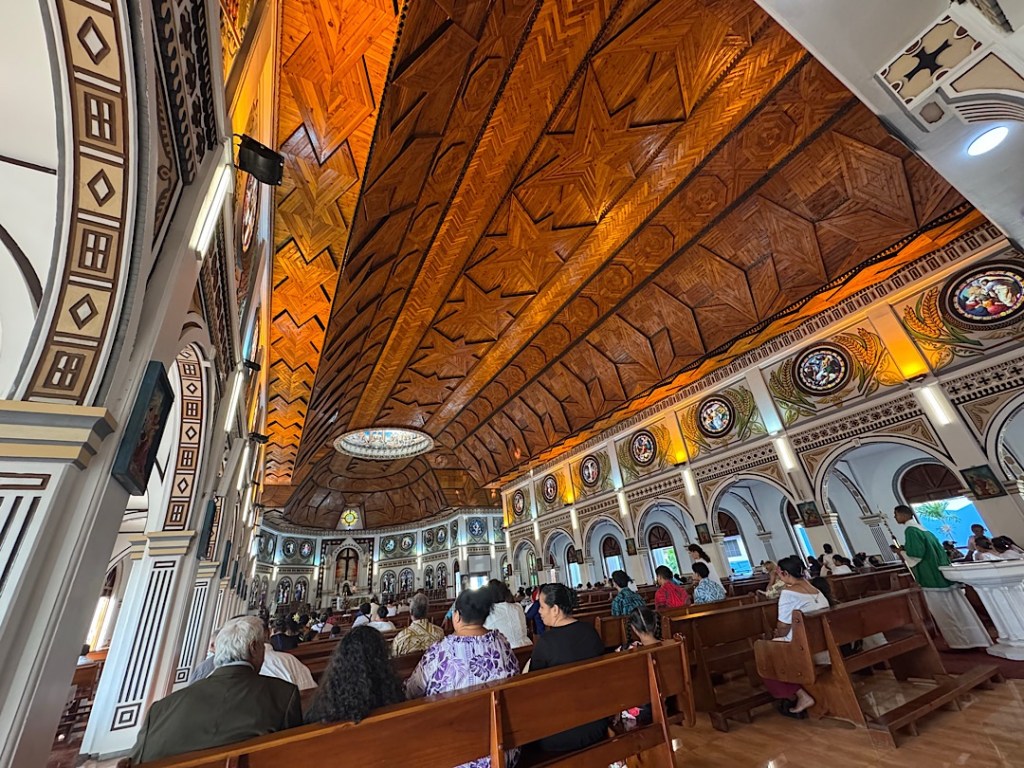
Happily, another Top Sight in Apia is the Catholic cathedral. The next morning Steve and I strolled there, arriving as the 7:45 Mass in Samoan was starting.

More stunning woodwork covered the ceiling.
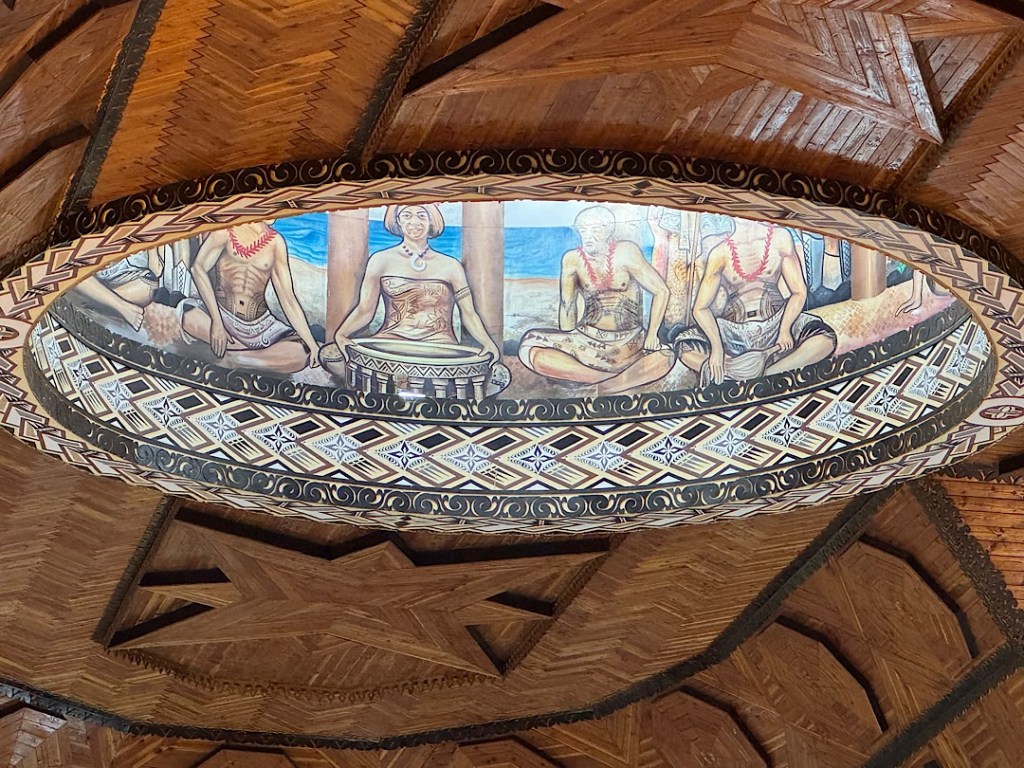
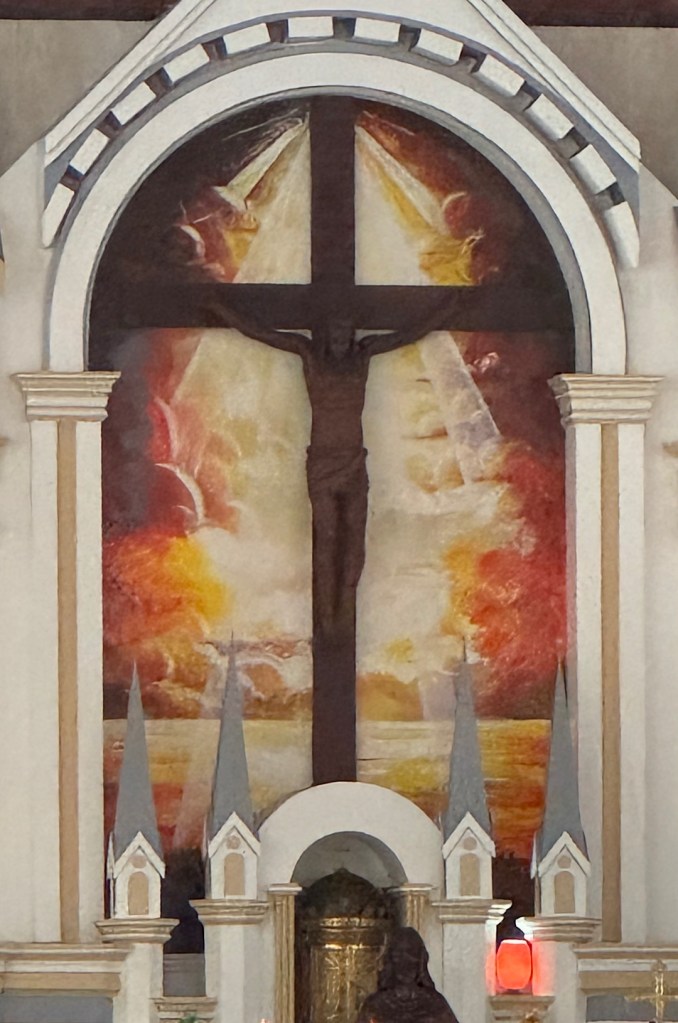
Because of the Mass, we couldn’t see more of the cupola. But what we saw of it was distinctive. So was the painting behind the altar (above).

Later in the morning, I got a hotel massage, Steve and I ate another lunch next to the pool. We swam a bit, napped a bit, consumed our dinners in the hotel restaurant. When we chatted with our waiter, he echoed what other Samoans had already told us: that Samoa is a paradise. Even without much money, you can live well; enjoy life. They wouldn’t want to leave it, they testified.

We had to go, however, at 5 am Monday morning, leaving in our wake a number of things we would have liked to see and do. I wished we’d had more time. But we’d had a good rest and at least gotten a glimpse of this beautiful, unpretentious, laidback idyll. It was worth the hop.

Next up: skipping along to Fiji.

A hop, a skip, and a jump

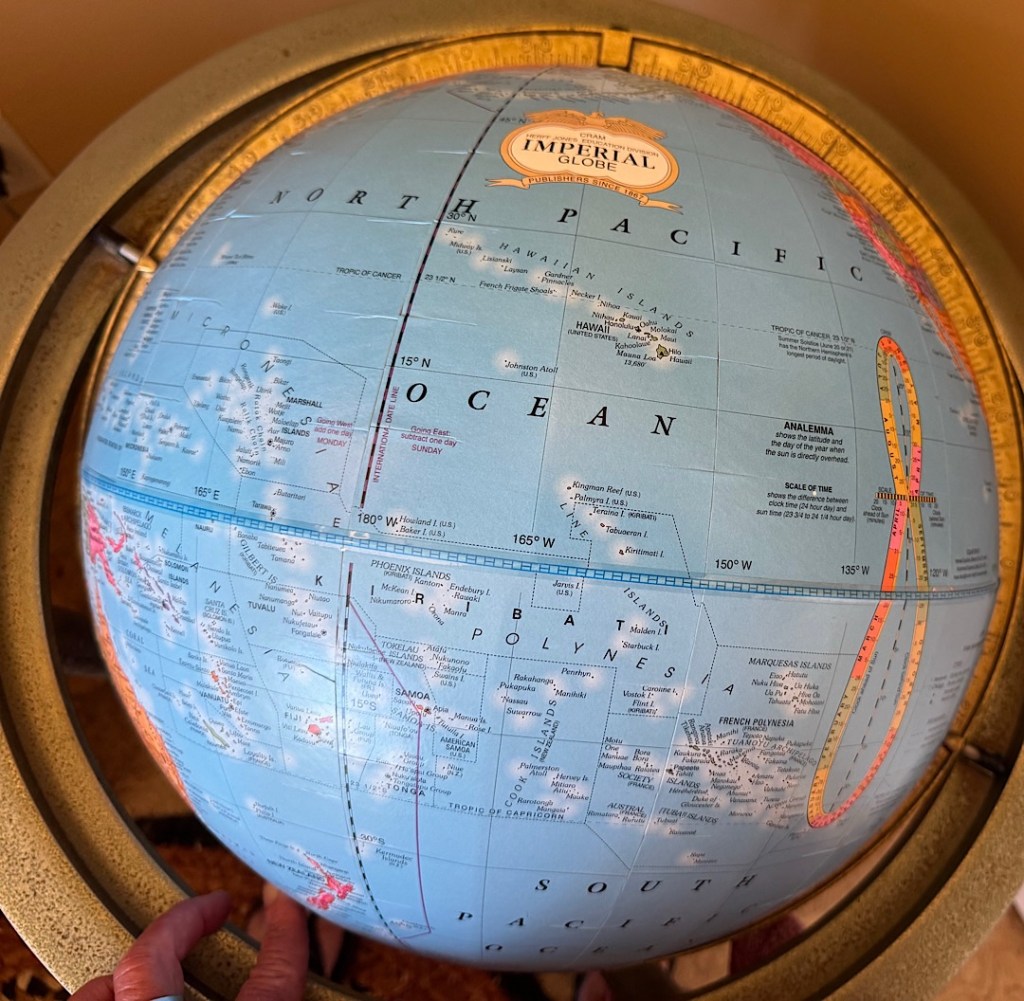
It’s not like I didn’t know the Pacific Ocean is big. I mean, duh. I was paying attention back in fifth grade geography. Since then, I’ve flown across the Pacific more times than I can count. And yet… just how big that ocean is somehow never sank in until I began preparing for this trip. 

As part of the preparations, Steve and I read a marvelous book called Sea People about how the Polynesians managed to spread throughout the vast expanses of water — more than 12,000 miles across and another 10,000 miles from north to south. As author Christina Thompson points out, you could fit all the earth’s land masses into the Pacific and still have room for another continent as big as North and South America. 

It fills up half the globe.

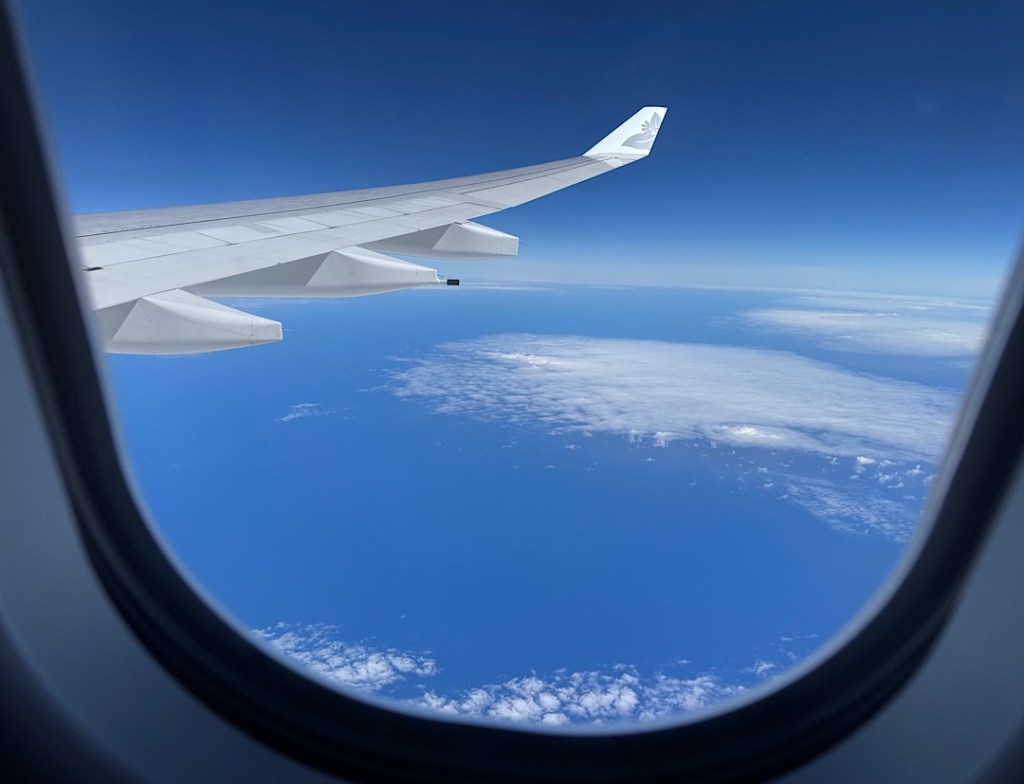
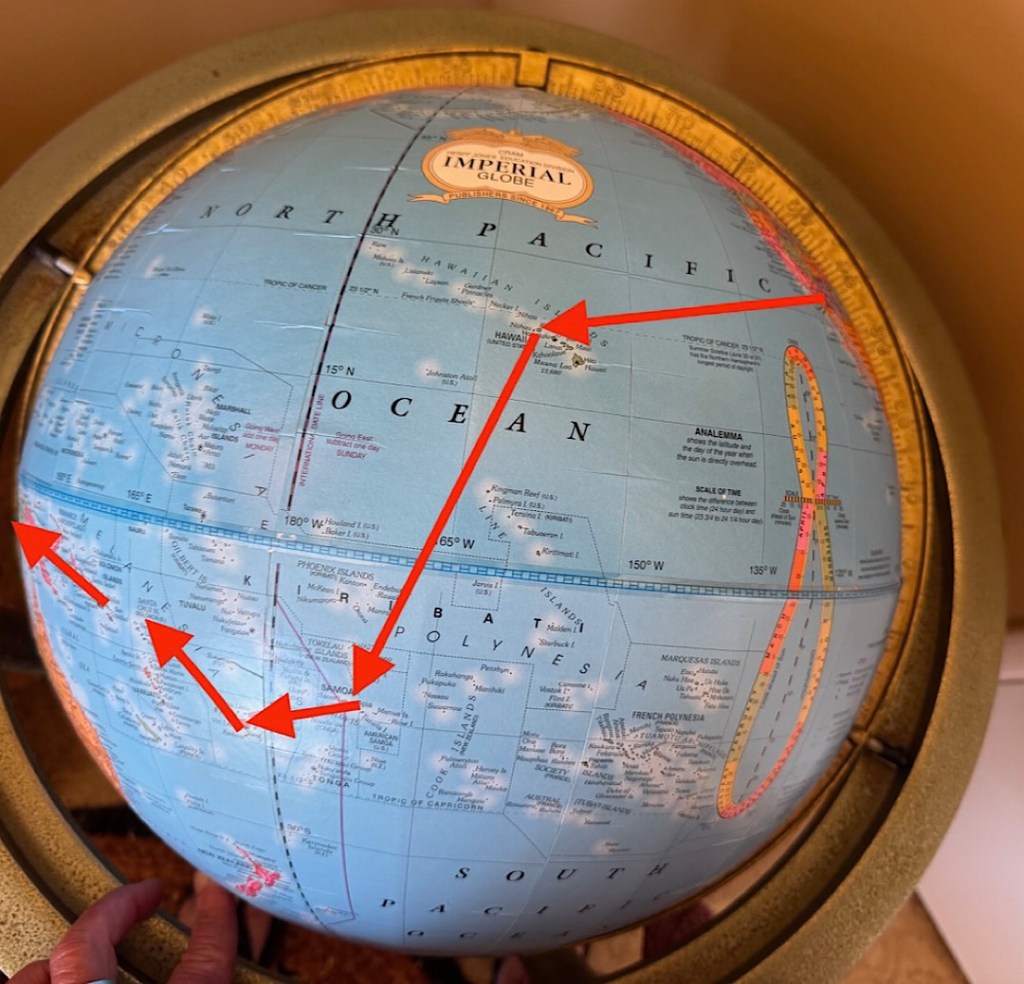
Getting from San Diego to Port Moresby (the capital of Papua New Guinea) takes more than 24 hours via the most direct connections. It’s either grueling (flying in Economy) or hellaciously expensive (in a lie-flat seat routing through somewhere like Singapore.) So we decided to try an offbeat alternative — what I’ve come to call my hop, skip, and jump approach. At the moment, as I’m writing this, we’re flying from San Diego to Honolulu. There we’ll rest in an airport hotel for a couple of hours, then continue southeast to Apia, the capital of Samoa.

We’ll sleep there for two nights, then make the short flight from Samoa to Fiji.  Sleep there for two more nights, then hop again to the Solomon Islands. These flights don’t run every day. Due to the quirky schedules, we have less time in Samoa and Fiji than I would have wanted, and more time (five days) in the Solomons. From there the jump to Port Moresby is another piece of cake — just two hours and 20 minutes. 

It’s an experiment. Maybe we’ll conclude it was nuts. We won’t be returning the same way. I have something else cooked up for that. At the moment, however, our return in five weeks feels almost unimaginably distant.