
Years ago when I was working as a journalist, I met a remarkable character named Bill Wheeler. Bill had abandoned his career as a San Diego anesthesiologist to devote his life to adventuring, mainly in Africa. He documented his travels using his prodigious photographic talents. In one interview, Bill recounted how he had spent his very first night on the continent: driving to a game park, getting out of his vehicle, and pitching a tent. He was terrified of being eaten alive, but all he could do was to take a couple aspirins, the strongest pain relievers he had with him.
I remember laughing and laughing at the thought of pitching a tent in an African game park. I couldn’t conceive of it. Now I know what it’s like, firsthand.
Steve and I self-drove and camped for a couple of nights because it made Zimbabwe affordable and accessible and because Ant Bown (of Manapools.com) convinced me we could do it safely. We did NOT do it because we love camping so much. Steve was a Boy Scout in his youth, and over the course of our long marriage, we’ve camped on a number of occasions. Still, given a choice between a cozy lodge and a sleeping bag on the ground, I’ll usually pick the indoor snooze every time.
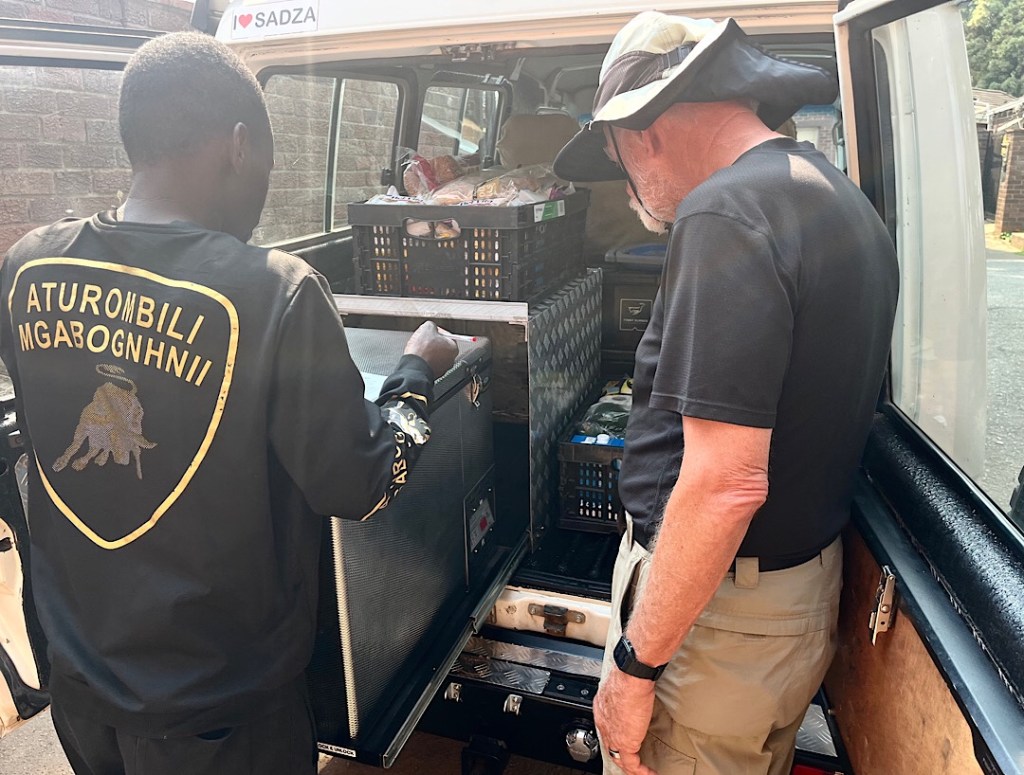
To say I was nervous about the camping portions of our Zimbabwe program is an understatement. Yet when we finally reached Ant’s base in Harare and had our 90-minute introduction to our vehicle, I felt exhilarated by the ingenuity of the Land Cruiser’s outfitting. It had AC and a two-person tent affixed to the rooftop. A sturdy freezer held the frozen meals and other supplies we had pre-ordered.
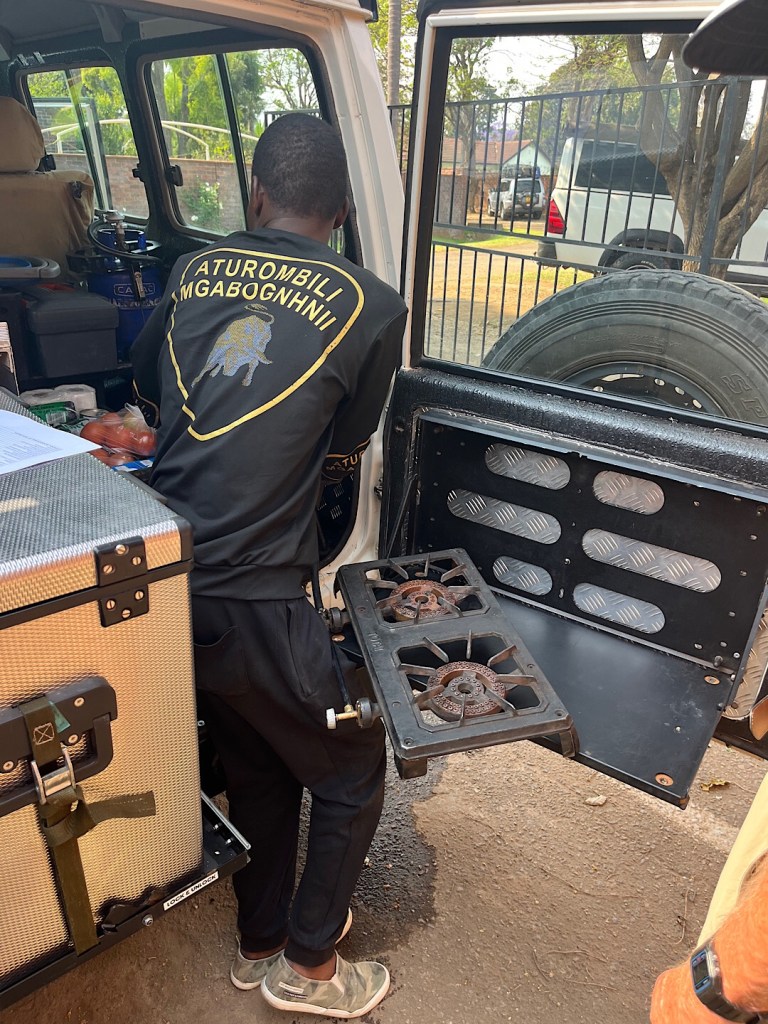
We could heat our meals and water for coffee on a cute little cooktop…
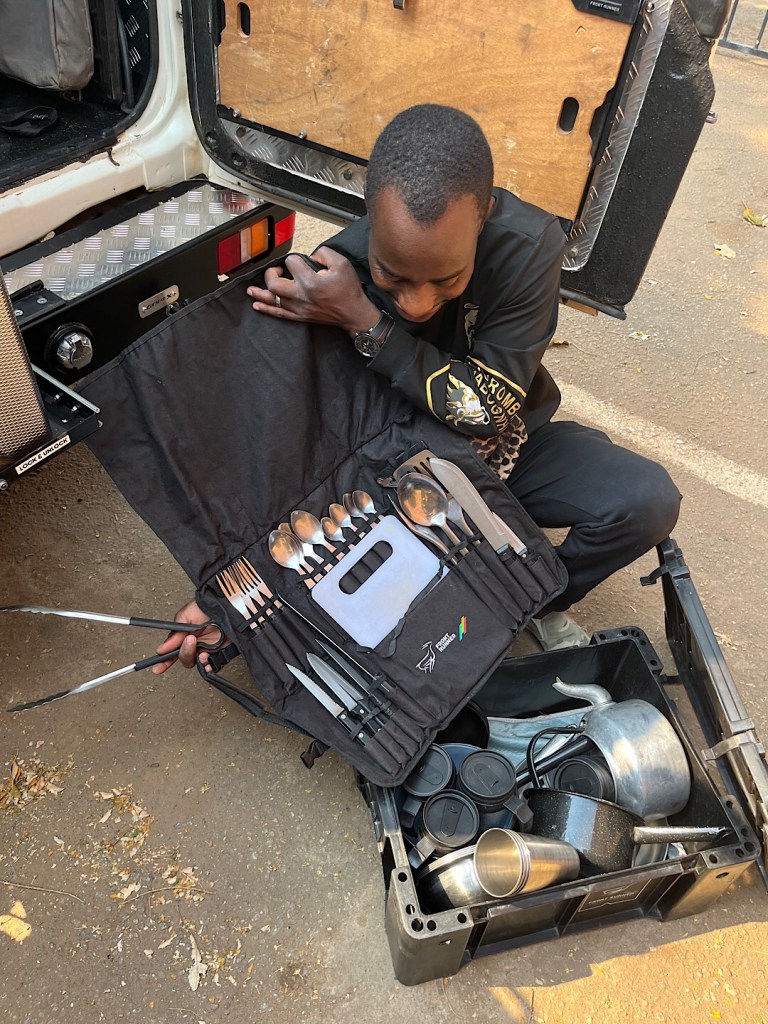
…using a compact armamentarium of kitchen tools.
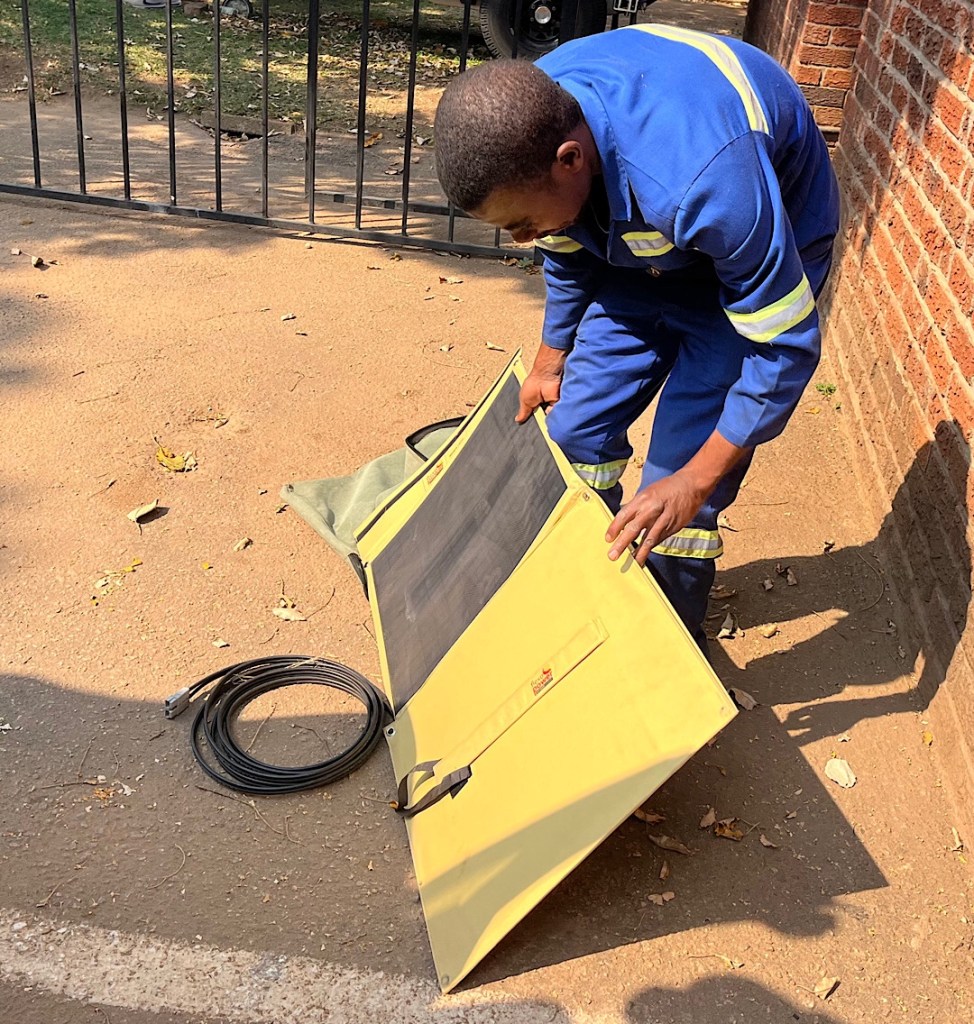
We’d be able to recharge our battery with solar panels, if necessary.
In such a rig, I could see how we might actually be comfortable.
We had four nights of cottage stays (first in the eastern highlands and then in the Save Valley Conservancy) before our first taste of tent life. By then, Steve had become convinced he didn’t want to sleep on the Cruiser’s roof but instead would use the ground tent with which we also were supplied. Our destination was the Lake Kyle Recreational Park, not far from the Great Zimbabwe archeological site (one of our top sightseeing goals.)
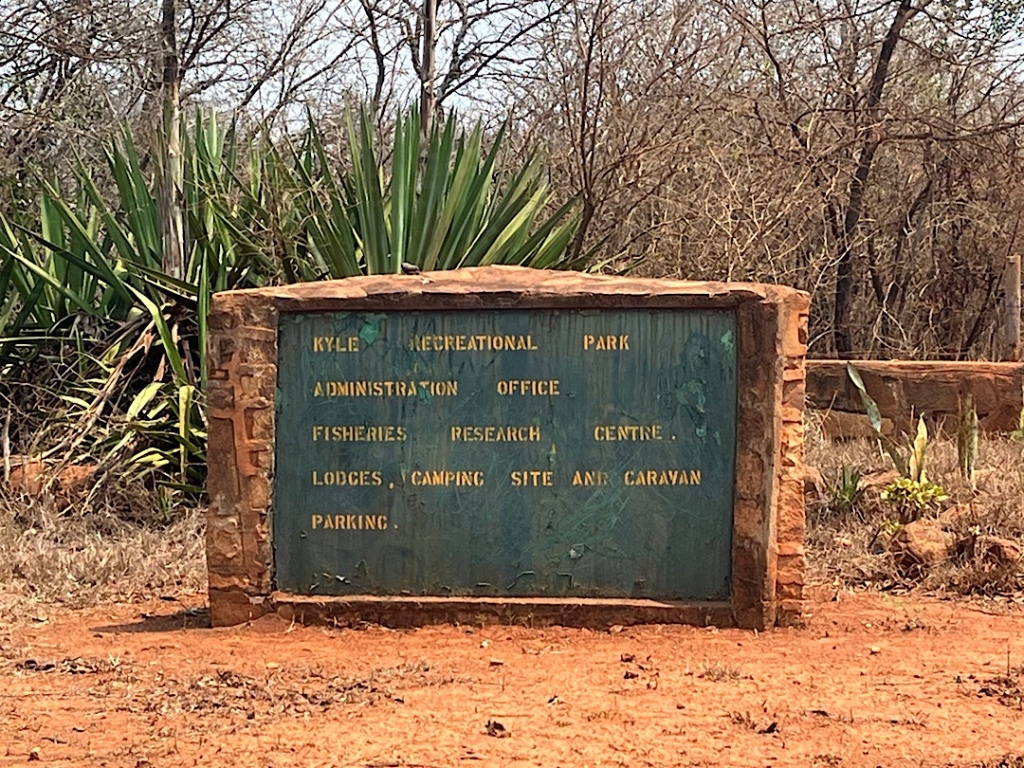
A commanding but friendly official at the park’s front gate toted up our fees — $29 for the park entrance and campsite. We also opted to pay an extra $50 a person to go on a 4 pm “rhino walk” with a ranger guide. The entrance official told us how to get to the campground, and he said we could pick any site; we’d be the only folks there. Since we had time, we decided to set up our tents so we wouldn’t have to do that after the game walk.
Nothing disastrous happened during the set-up, but it reminded me of the contrast between staying in a hotel and erecting a ground tent. Hotel: you sign the register, maybe show your passport, then you can walk in your room and flop down for a nap. Tent: you have to haul out the cumbersome tent bag out of the Cruiser, find and roll out the ground cloth. Unpack the tent. Stake down its corners, find the poles, fit them together, get them to stand up so you can clip the tent body to the framework, pound in more stakes. It’s a pain!
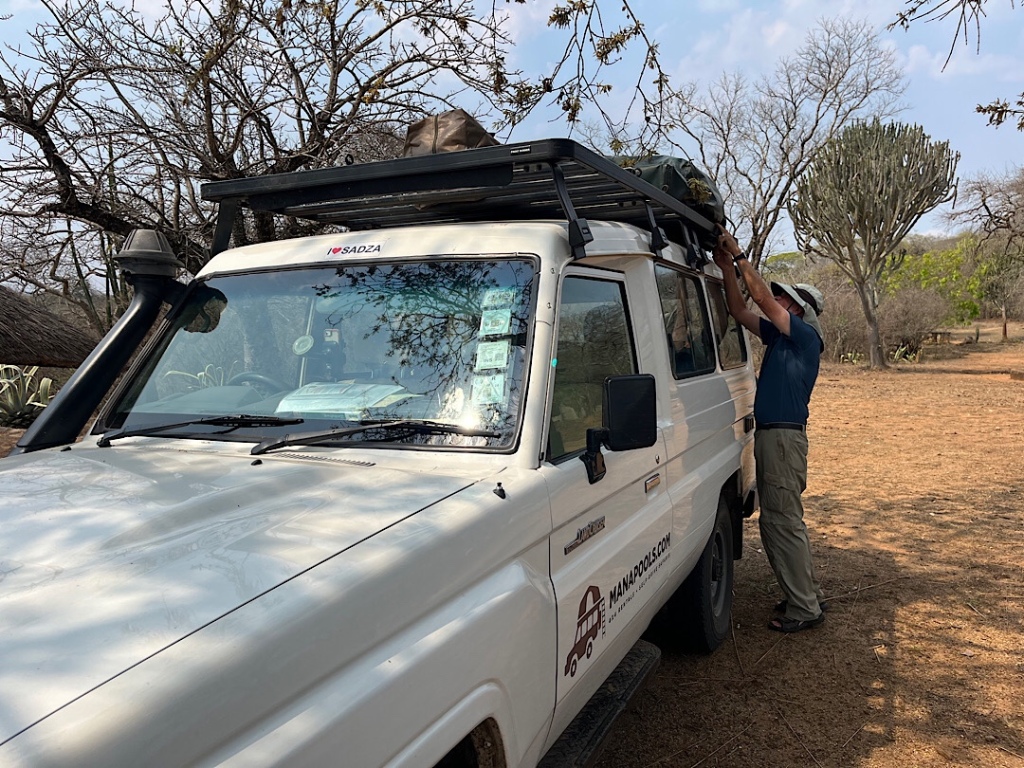
Opening up the roof tent presented different challenges. You had to start by wrestling off its straps and cover, very tough to do since it was so high and we had nothing to stand on.
Once it was uncovered, one of us had to get up on the tires to extend the ladder.
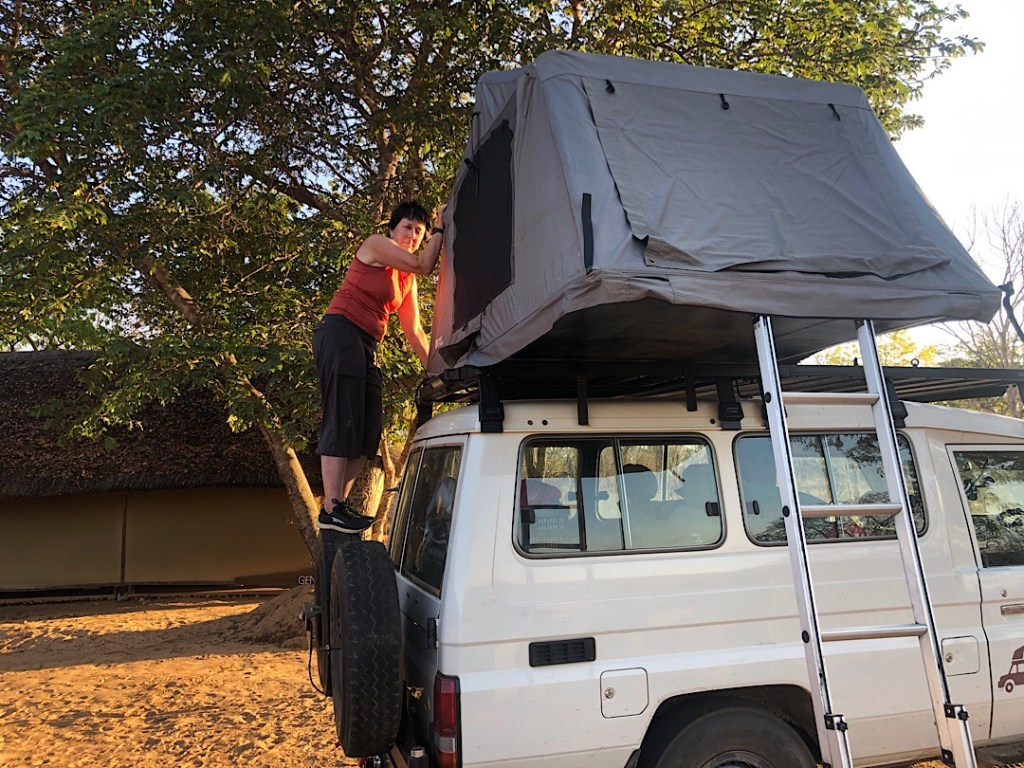
The other person then used the roof tent ladder as a lever to pop the structure open.
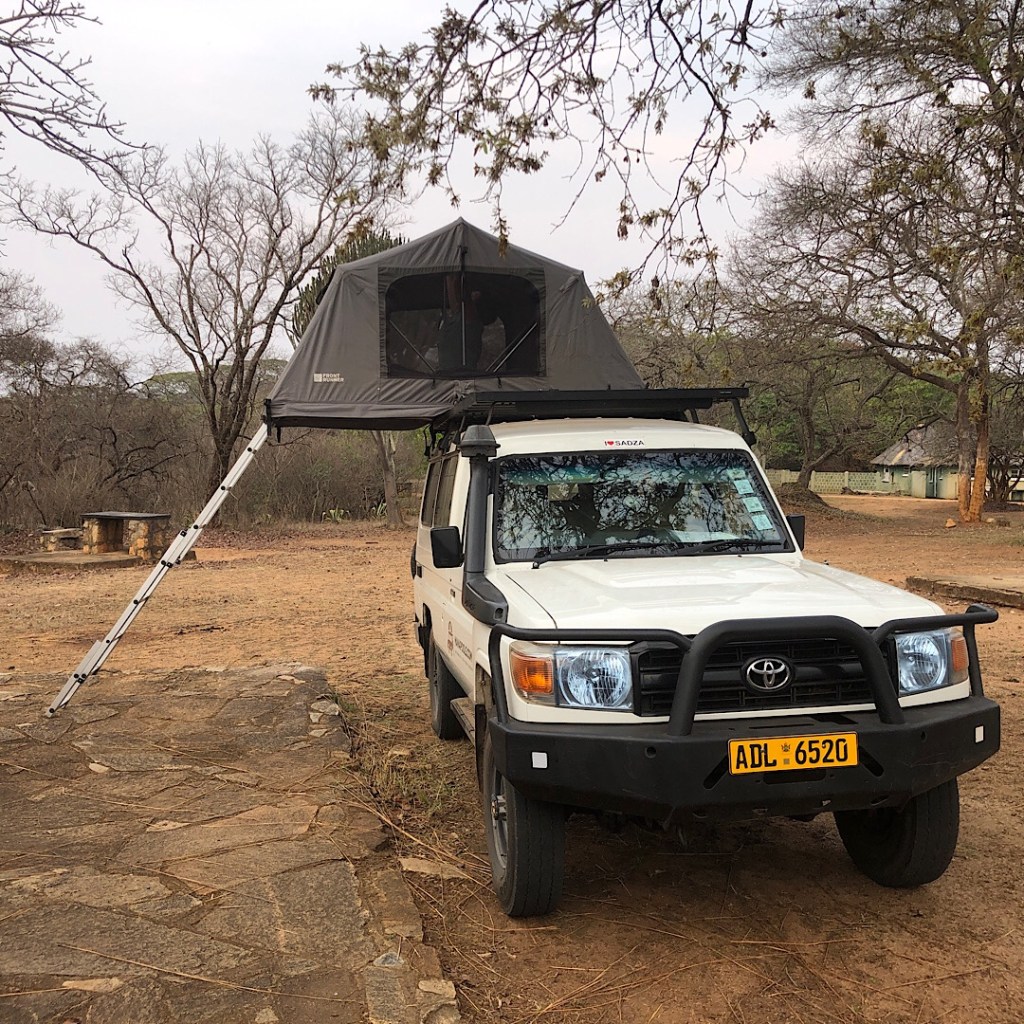
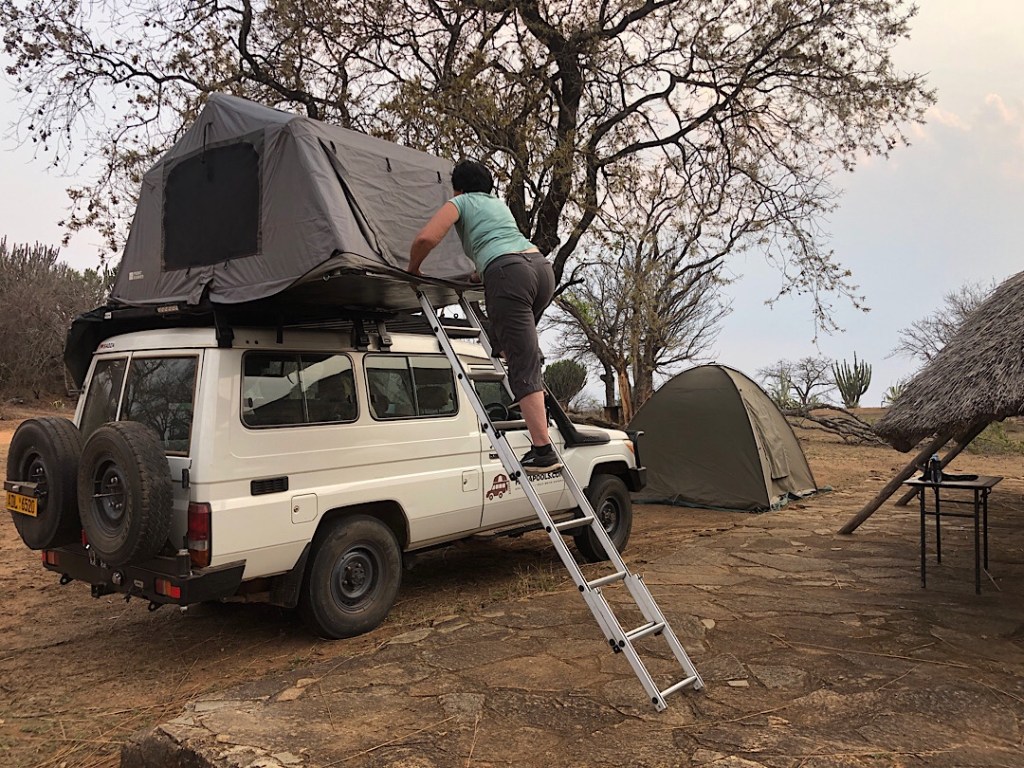
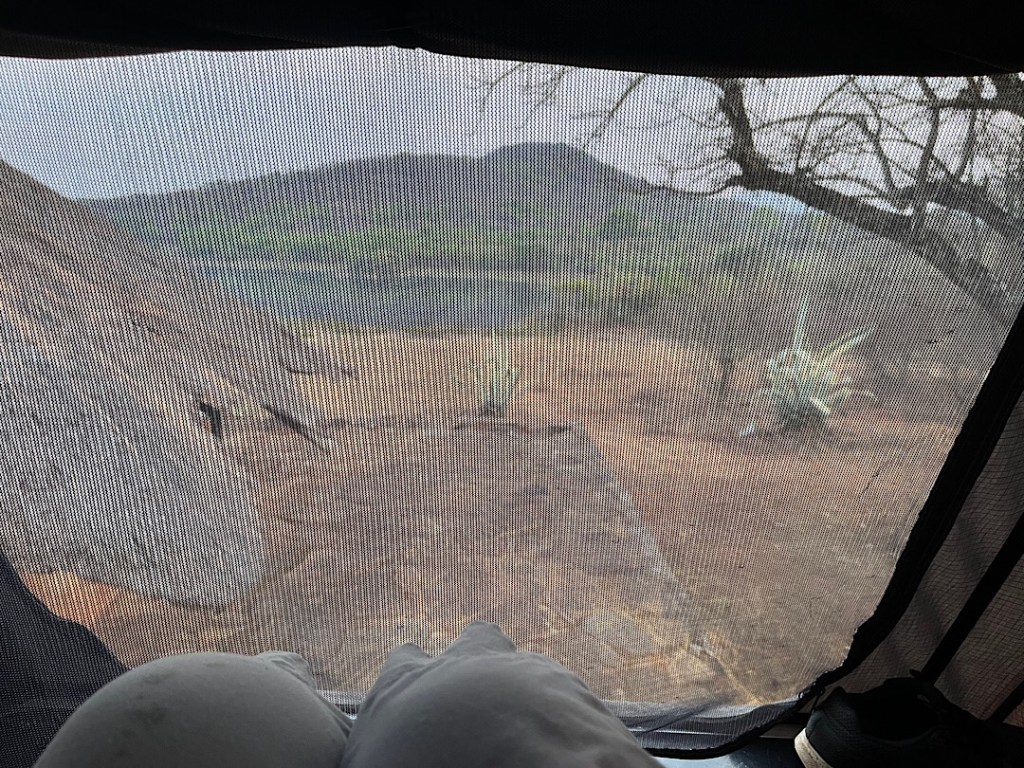
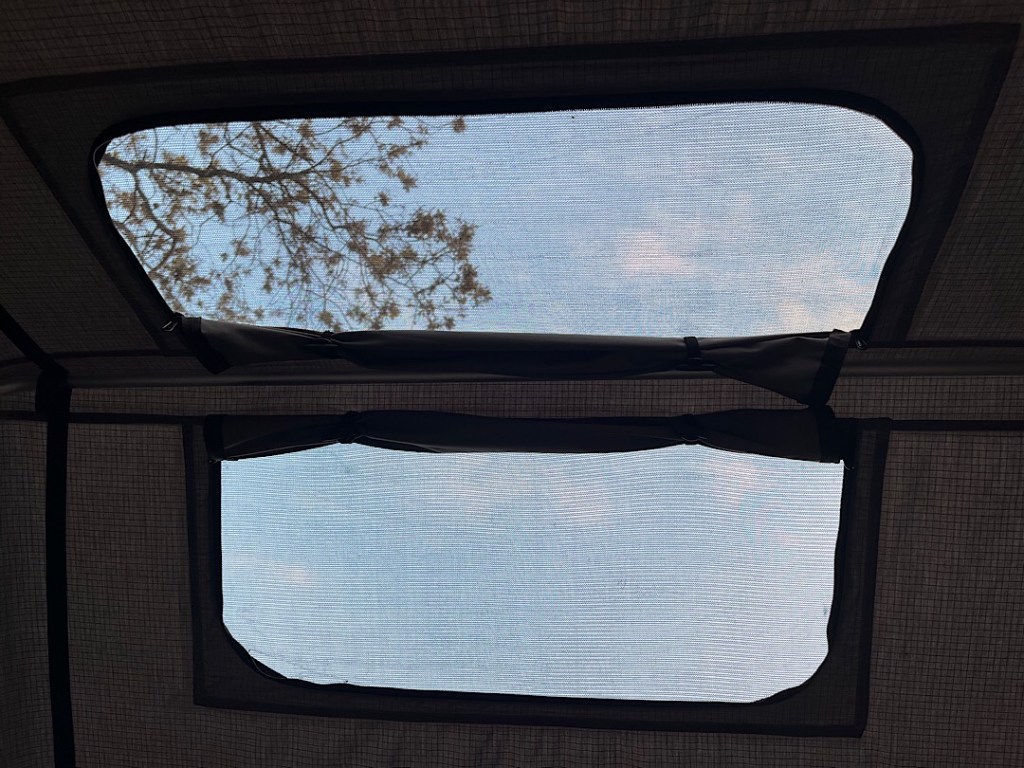
When I climbed up and into it, it felt solid enough, and unzippering the windows covers yielded some cool views.
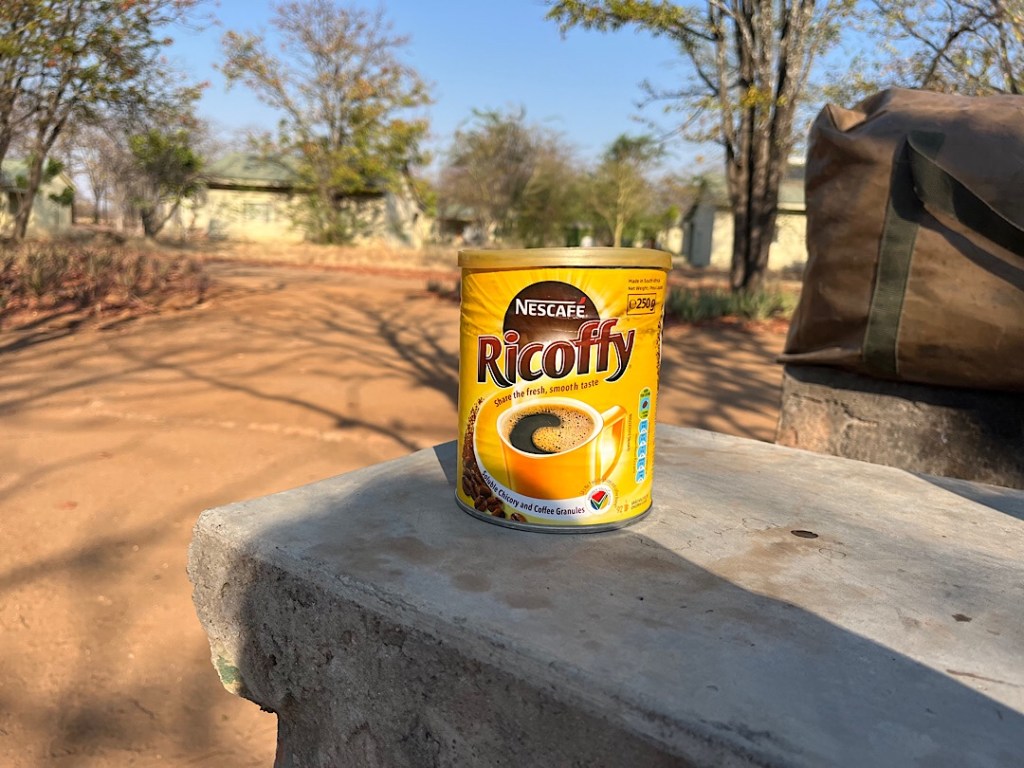
Later I would have to get my gear up and into it (including the instant-coffee canister I’d bought in Harare to serve as a chamber pot. No way was I planning to climb down that ladder and toddle off to the “ablutions” in the dark.)
After this setup, we had a splendid rhino walk with a gun-toting ranger who led us straight to two large groups of the massive herbivores.
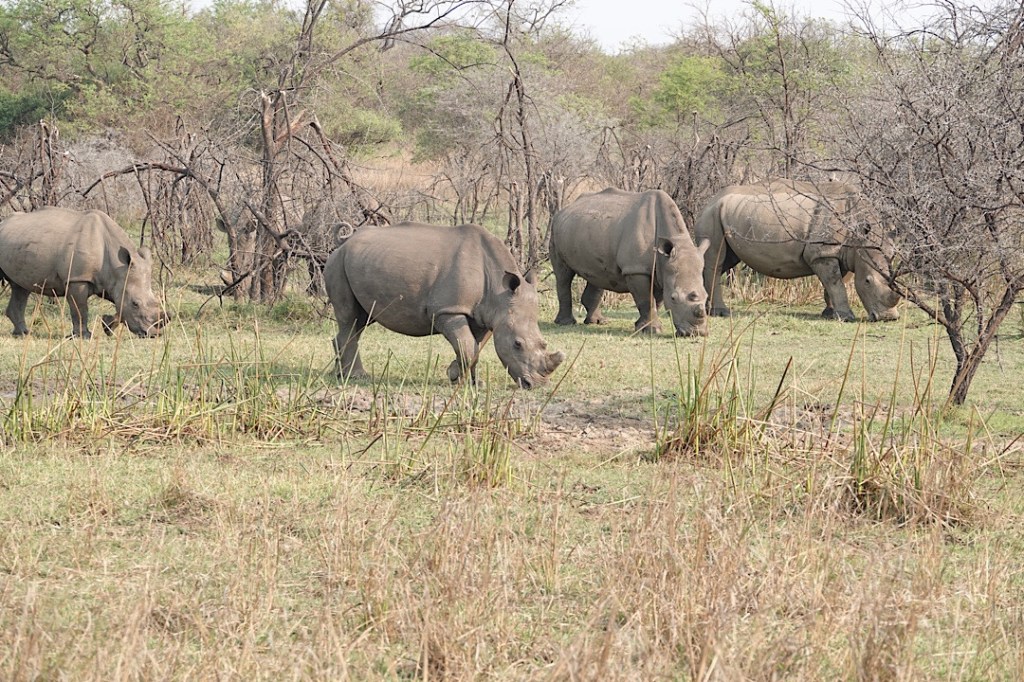
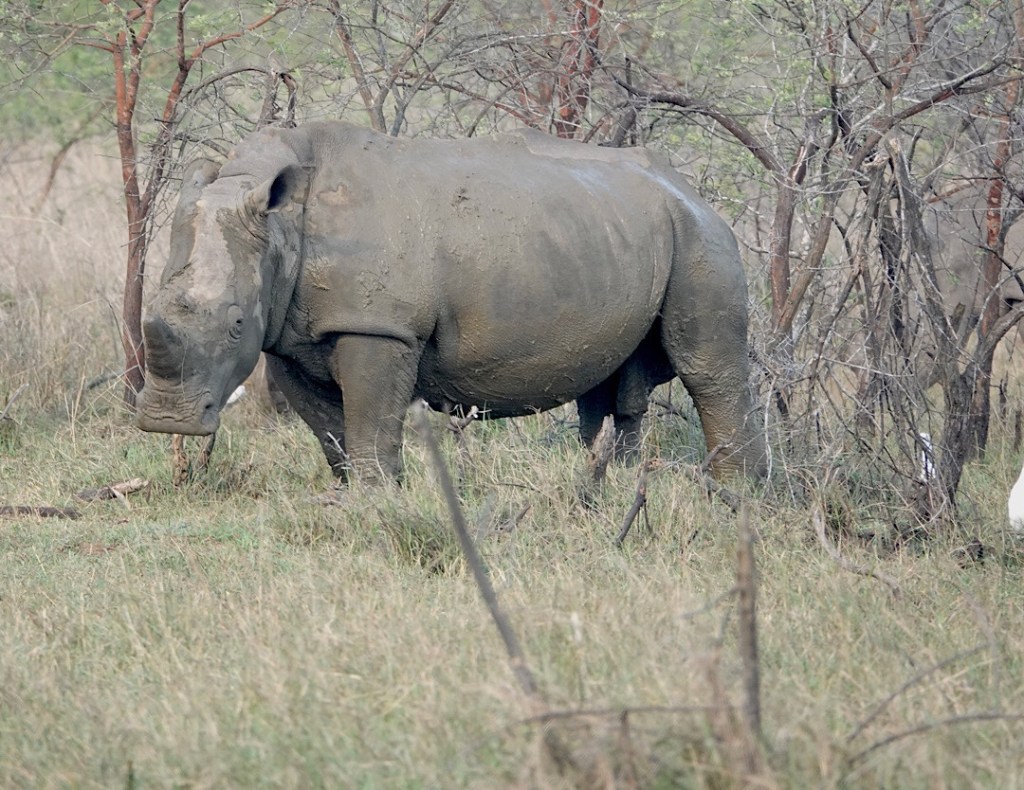
Back at our campsite, Steve and I made dinner, which included grilled burgers, a nice salad, and brownies washed down with cold milk.
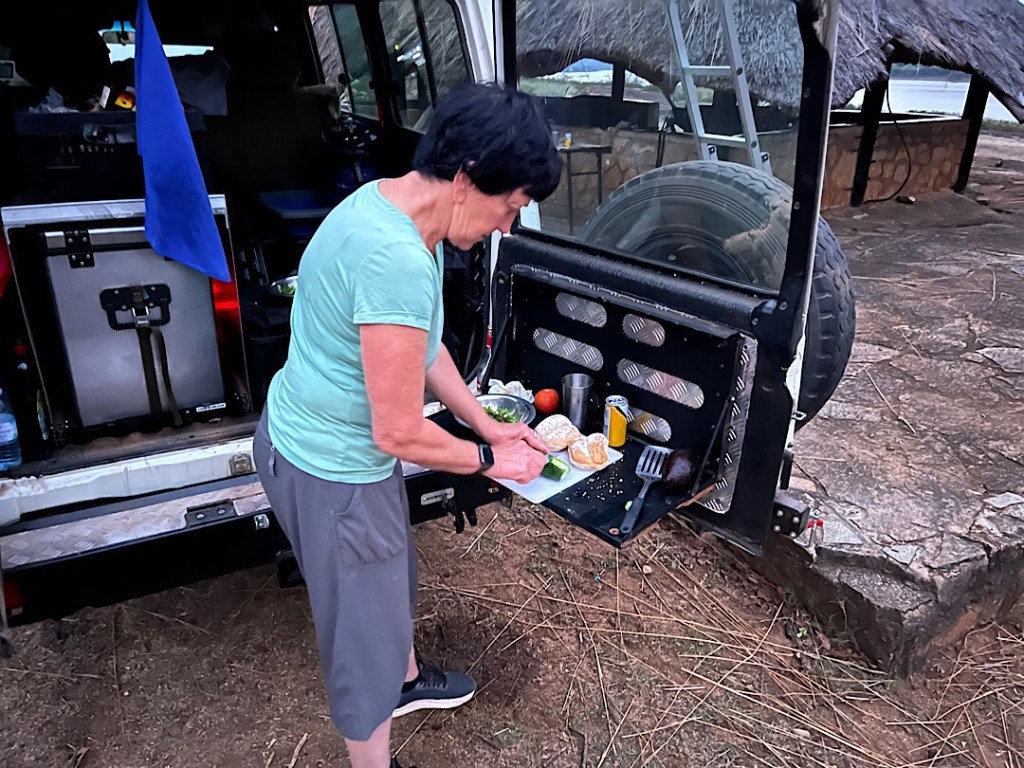
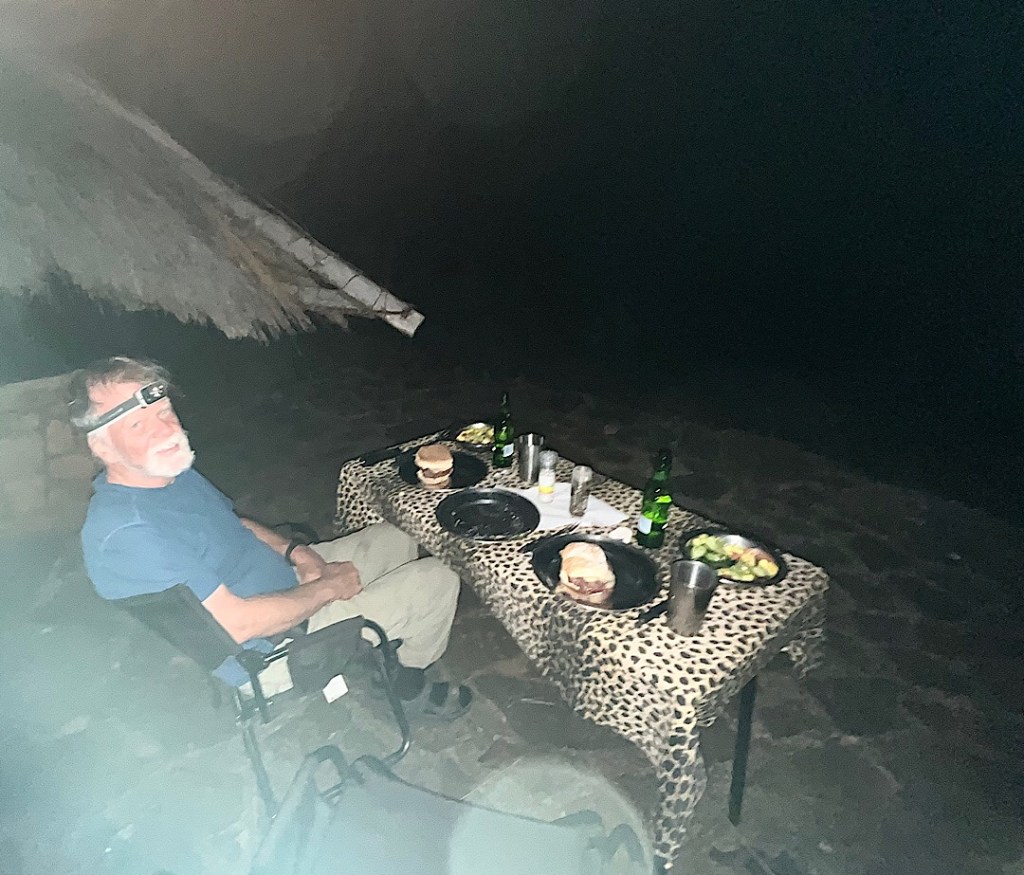
Both of us went to bed early, slept well, and woke at 5:30 to pack everything up and put it all away. Because we were clumsy, almost 3 hours passed before we cranked up the Cruiser and hit the road. I felt grubbier than I had in memory, but we were otherwise fine.
We stayed in hotels for the next four nights. Our final two nights of camping came in Hwange National Park, one of the biggest game preserves in all of Africa. Ant had booked us into two separate sites, and they couldn’t have been more different from each other. The first, Tusker’s Camp, is located in a forested area just outside the east side of the park.
It’s not far from the property occupied by the Painted Dog Conservation group, a non-profit devoted to helping this highly endangered predator (not a dog at all, although they look like they could be relatives.) We spent almost an hour learning about them and visiting the only current occupant of the rehab facility.

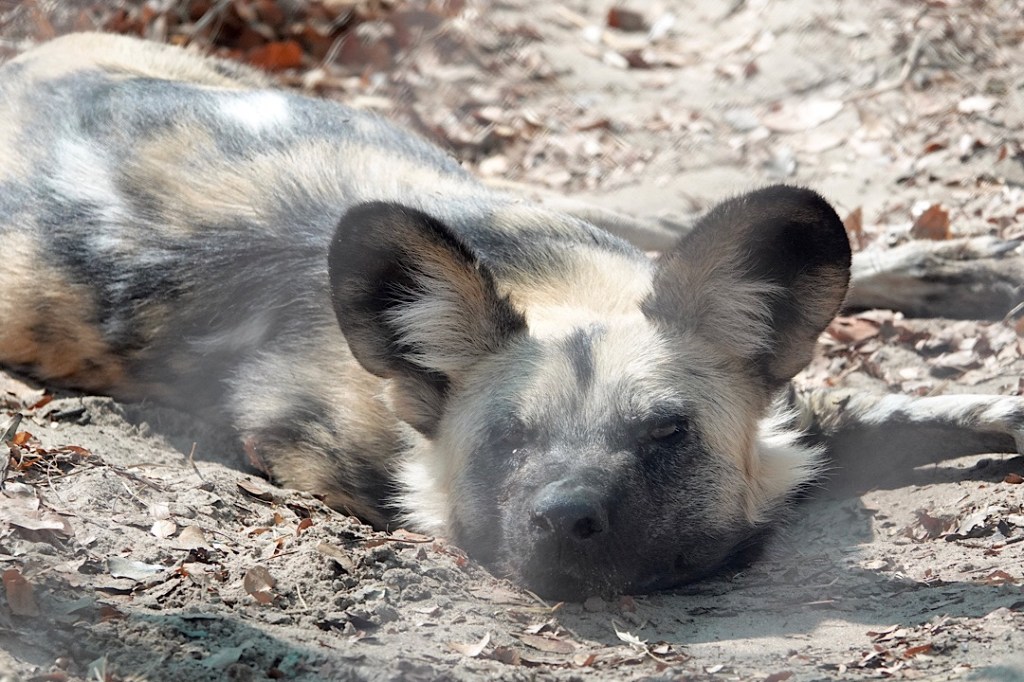
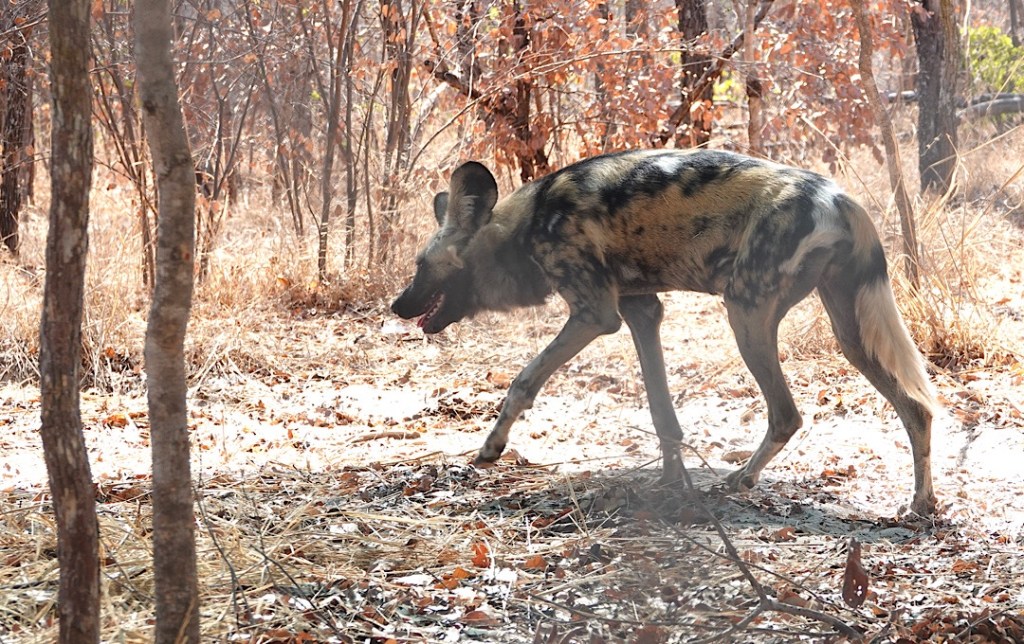
We then found the park administration office, booked a 7 am game walk for the next morning, and made our way down some truly awful roads to find Tusker’s.
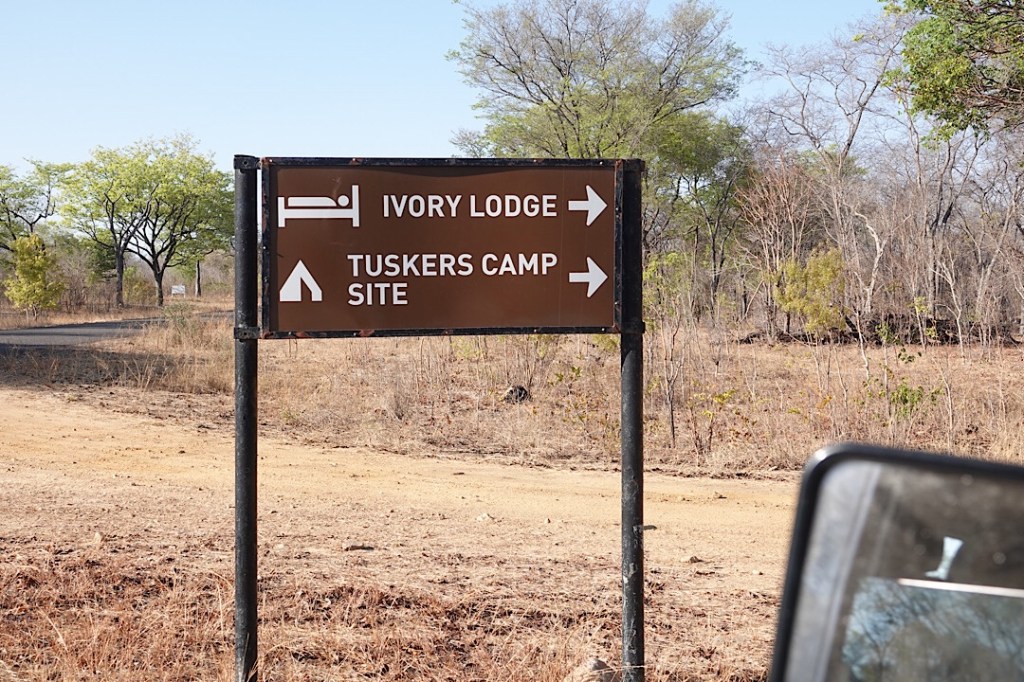
We never glimpsed the fancy Ivory Lodge that Tusker’s adjoins. Our home for the night was an unfenced piece of land overlooking a distant water hole lined with elephants.
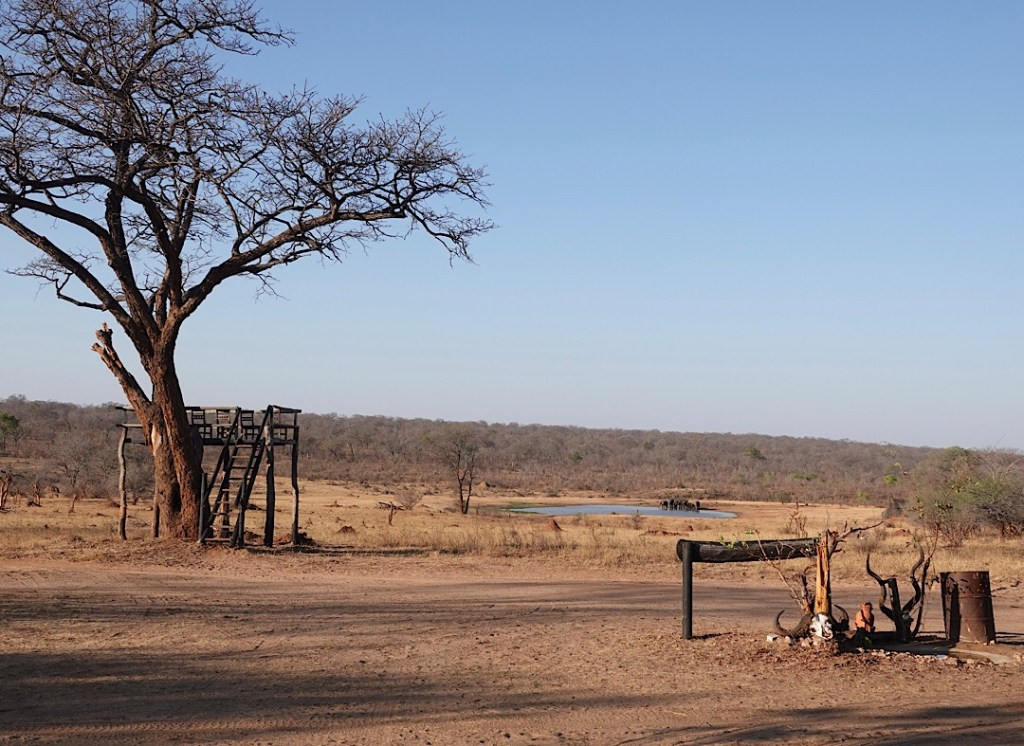
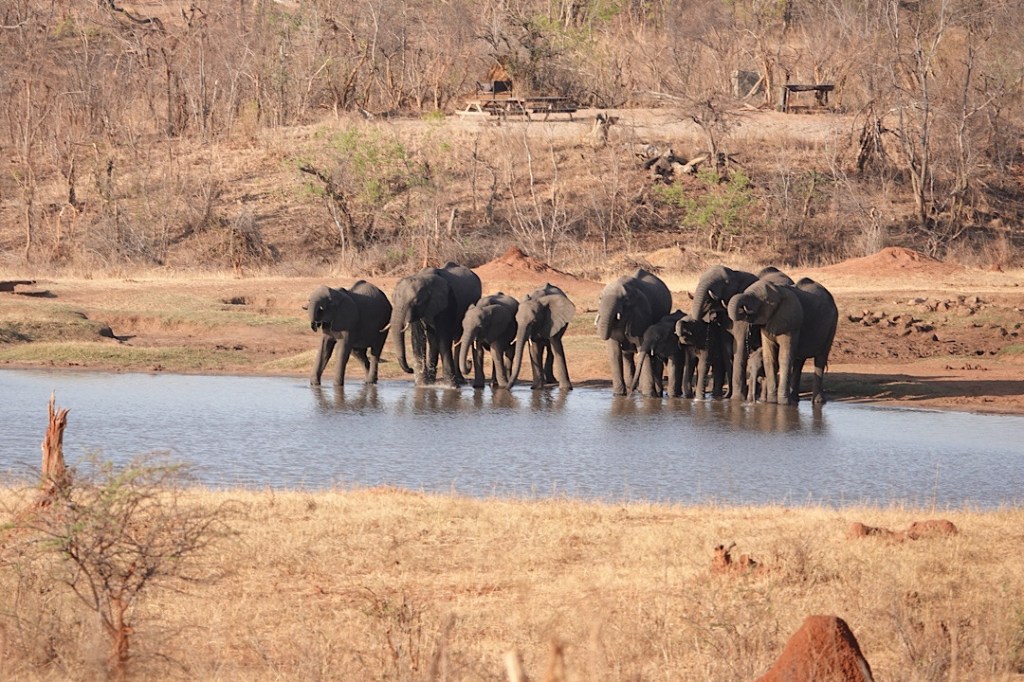
A solitary, laconic attendant named Reginald showed us the amenities — a clean bathroom close at hand; a pleasant dining platform. I asked if any dangerous animals were likely to put in an appearance, and he replied that they usually didn’t come to where we’d parked but tended to stay in the brushy area maybe 50 yards away. Reginald then chopped some wood, built a fire, and disappeared. We never saw him or any other human again during our stay.
Some parts of the hours that followed were sublime. We set up the tents more efficiently than we had done at Kyle Lake. Steve made gin and tonics, which we carried up the viewing platform.
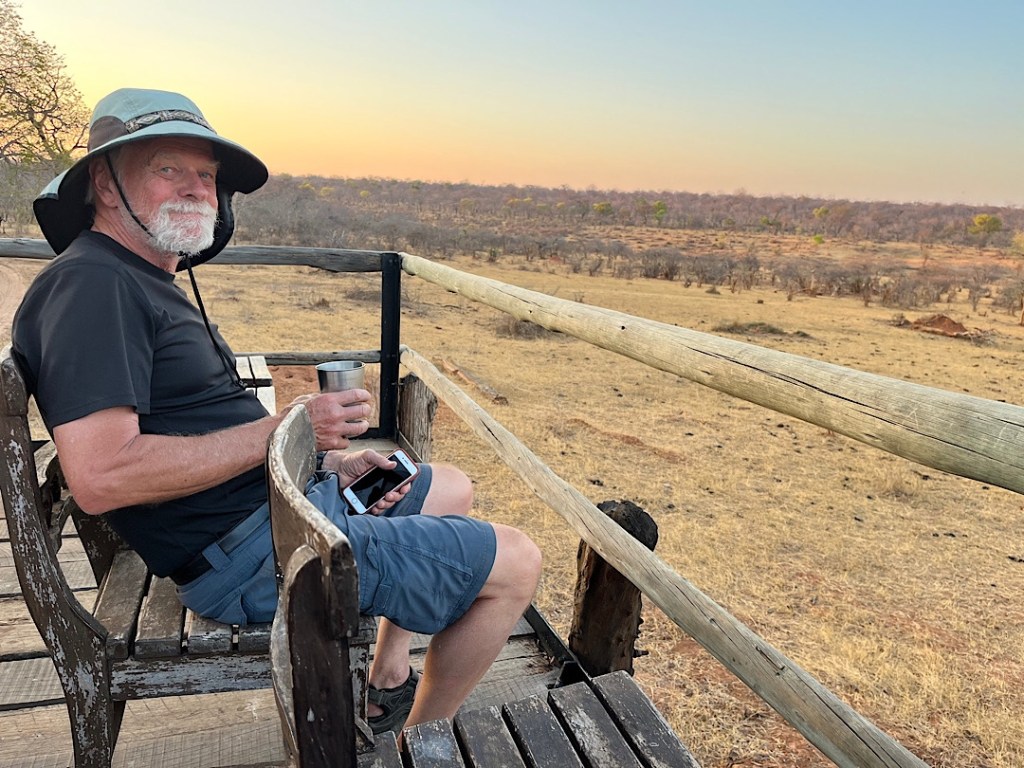
As the sun set, we sipped our cocktails and took in the action around the water hole. The elephants had tanked up and moved on, but dozens of baboons dashed in to get a drink, then retreated back into the woods. With the light fading, we dined on excellent beef stew (the last of our pre-ordered meals), and by 9 I had climbed up the stairs to my sleeping perch. Within 5 minutes, I was dreaming.
I awake with a jolt shortly after midnight to the sound of footsteps and soft rumbles below. Peering out my windows, I couldn’t see what was moving, but it felt very close. “Steve!” I hissed. “Do you hear that?”
“Mrmph,” I recognized Steve awakening. A moment later came the unmistakable sound of a big feline, growling.
“Oh my,” Steve said.
“Do you want to come up here?” My voice was pitched at least an octave higher than normal.
“No,” he said. “Go to sleep.”
But how could I? Given what Reginald had said, I didn’t really think the lion or leopard would make it up to the Cruiser’s roof to rip my tent apart. I was less sure about Steve’s fate, and more than anything, I felt flooded with adrenaline, on full alert.
We didn’t hear the big cat growl again, but for the next two hours, a wild panoply of noises surrounded the Cruiser: snorts and chuffles and lots of footsteps. They would disappear for a few minutes, then some new creepy noise would make me sit bolt upright. At one point, I heard the loud improbable whisper of rain. Outside it was still dry as a bone, and I realized I was hearing the shish, shish, shishing of what sounded like a large group of heavy-footed animals moving through the nearby stand of brush and trees. Elephants? Buffalo? I think it had to be one or the other, but I couldn’t see well enough to confirm that.
And then the noises all stopped. The animal party broke up. When I woke up around 5, my fitness device showed that I had finally gone back to sleep a little before 3. Comparing our sleep scores later that morning, mine was 66, “Fair,” according to my Oura ring. Steve, in contrast, snoozed for almost 7 and a half hours, bagging him an “Optimal” sleep score of 88 (one of his best for the trip.)
Somehow I got through our busy slate of activities for Friday. We packed up our stuff faster (practice does help) then went on yet another great walk with a sweet and patient ranger. We slogged over some of the worst roads of the trip to cross a blackened section of the national park that verges on the Kalahari Desert.
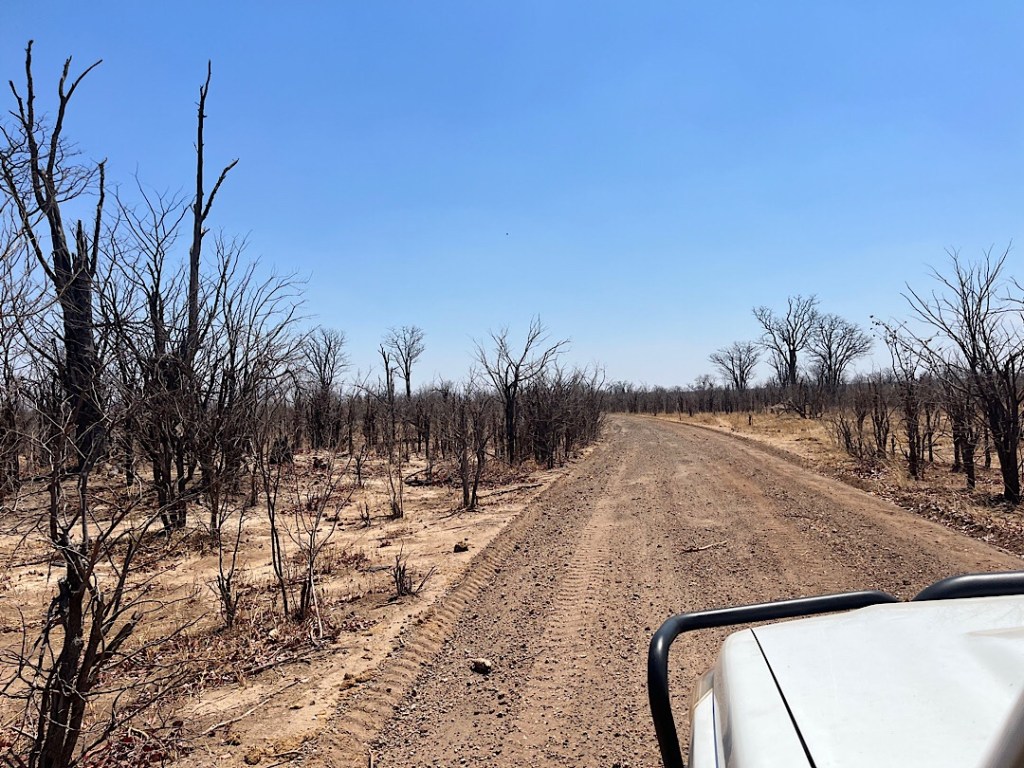
The ravaged landscape was so grim, we began to wonder if we would find any place to stop and eat our lunches. But we continued to spot bunches of elephants, including a large group near a place on the map labeled Shumba. The entry gates looked almost Gothic.
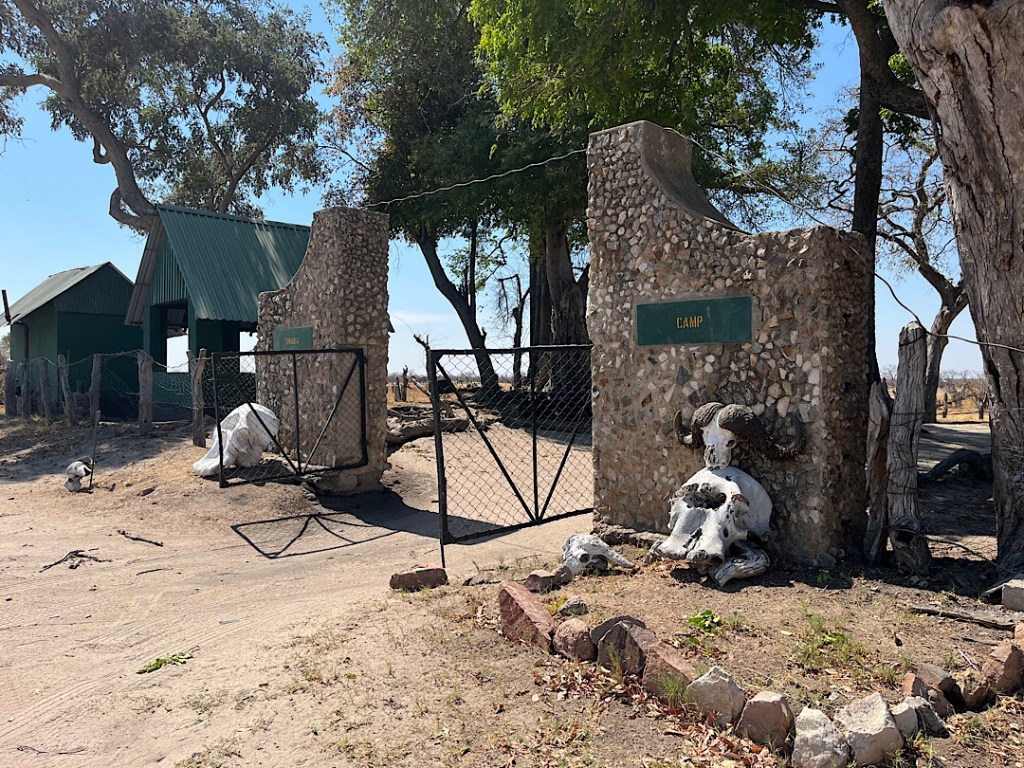
But a large tree provided welcome shade.
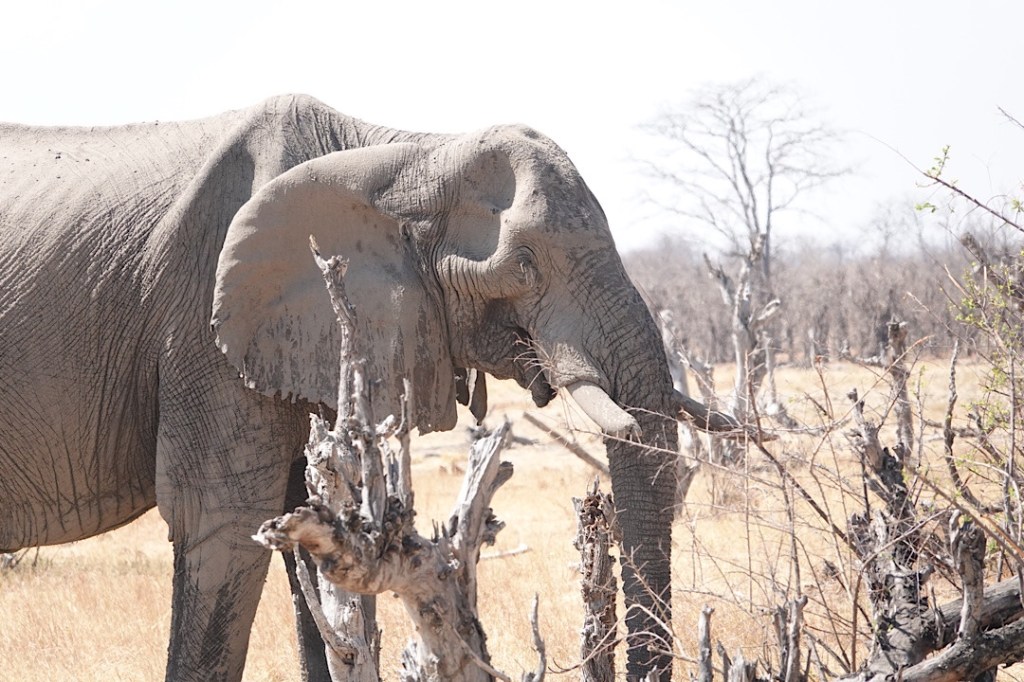
One old female elephant made her way from the herd to near us. Steve and I argued for days over whether she was checking us out (my theory) or just hoping for a spare banana (Steve’s.)
Robin’s Camp was our final campsite. When we reached it, we concurred it was nicer than many campgrounds we’ve visited in America. Like Tusker’s, Robin’s abuts a lovely lodge equipped with an inviting swimming pool we could have used, had we more time, but again we wanted to get the tents up before the sun set. Unlike Tusker’s, the Robin’s campground was fenced, and two of the other campsites were occupied by tourists. Inside the spotless lavatories, overhead rain-shower heads provided abundant hot water. Our spot had a picnic table, a grill, even electrical outlets for charging up our devices. Once again we ate well and I was asleep before 8:30. This night I didn’t hear a sound other than the buzz of insects.
It almost felt mundane. But two final encounters transformed our stay into something extraordinary. While we were sipping our morning coffee, a pair of red-billed hornbills landed on our Cruiser’s doors and seemed amazed to see their reflections in the windows.
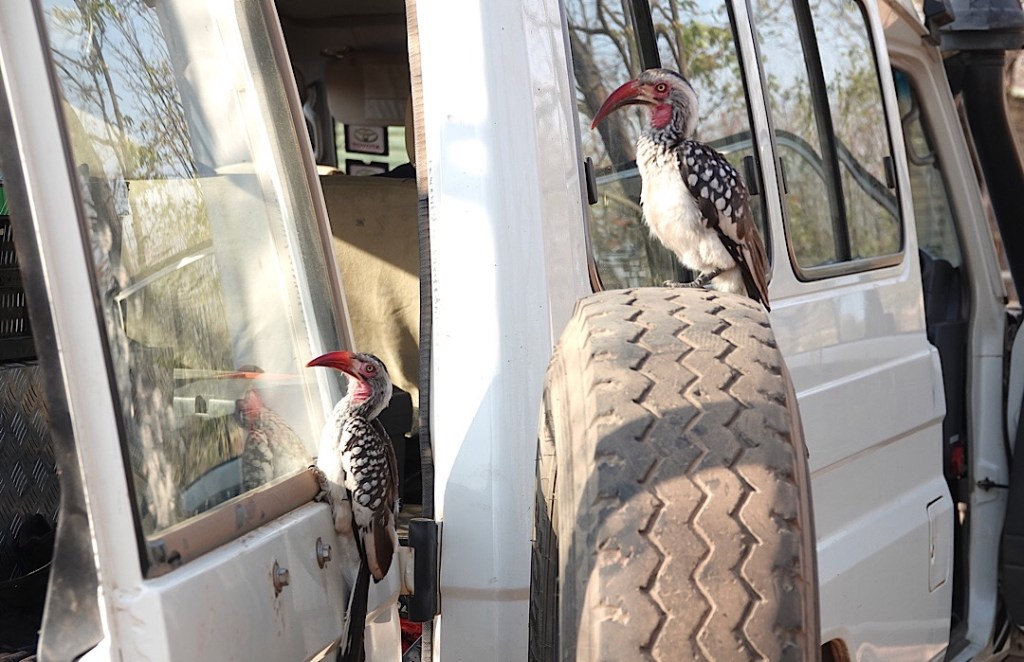
They acted fearless as they hung around, and when I tossed one of them seeds from my muesli, it gobbled them down.
Around sunset on Friday evening, I also had noticed a large group of what looked at first like squirrels — maybe 20 or 30 animals — bolting toward us. They came very close and then tumbled into several holes so close I could have tossed a pebble into one of them. A couple of them stood up on their back feet, and I gasped.
“Are they Timons?” I wondered, thinking of the Lion King’s comic meerkat.
Steve knew better. He exclaimed that they were mongoose. “I’ve never seen one before!” He sounded awestruck. (He now insists they are his favorite of all the animals we have ever seen in Africa.)
They didn’t reappear again until around 7 the next morning (Saturday), when one or two popped up. They looked around, clearly cautious.
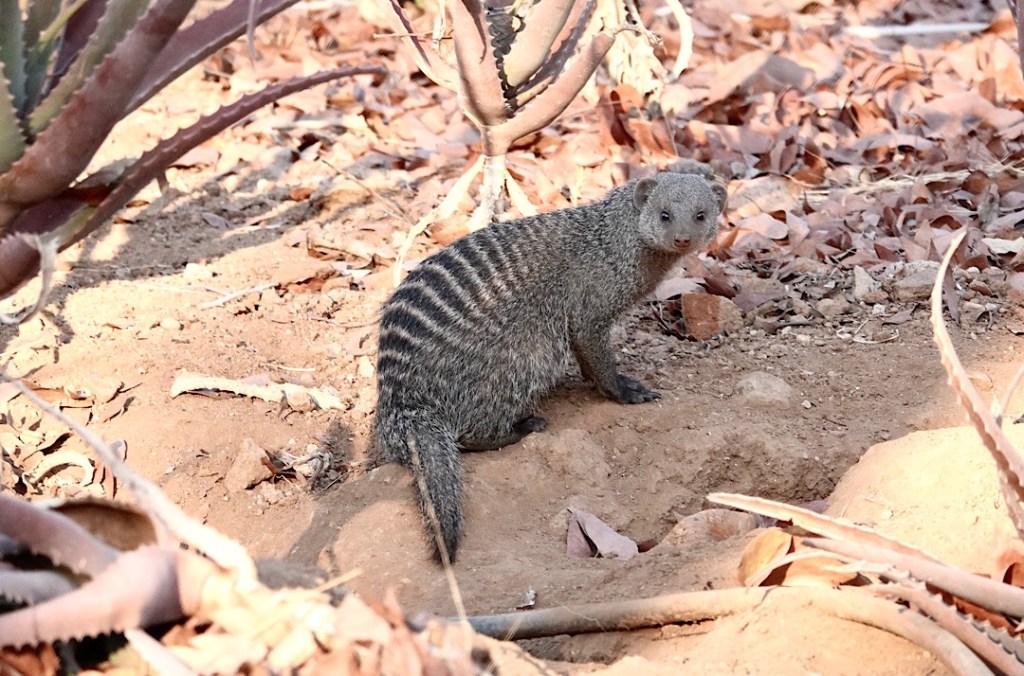
Within a moment or two, chirping noises erupted. The animals seemed to be discussing whether the coast was clear. They reached some consensus, and the whole group spilled out again and streaked away, shockingly fast.
I’d camp next to those guys any day.
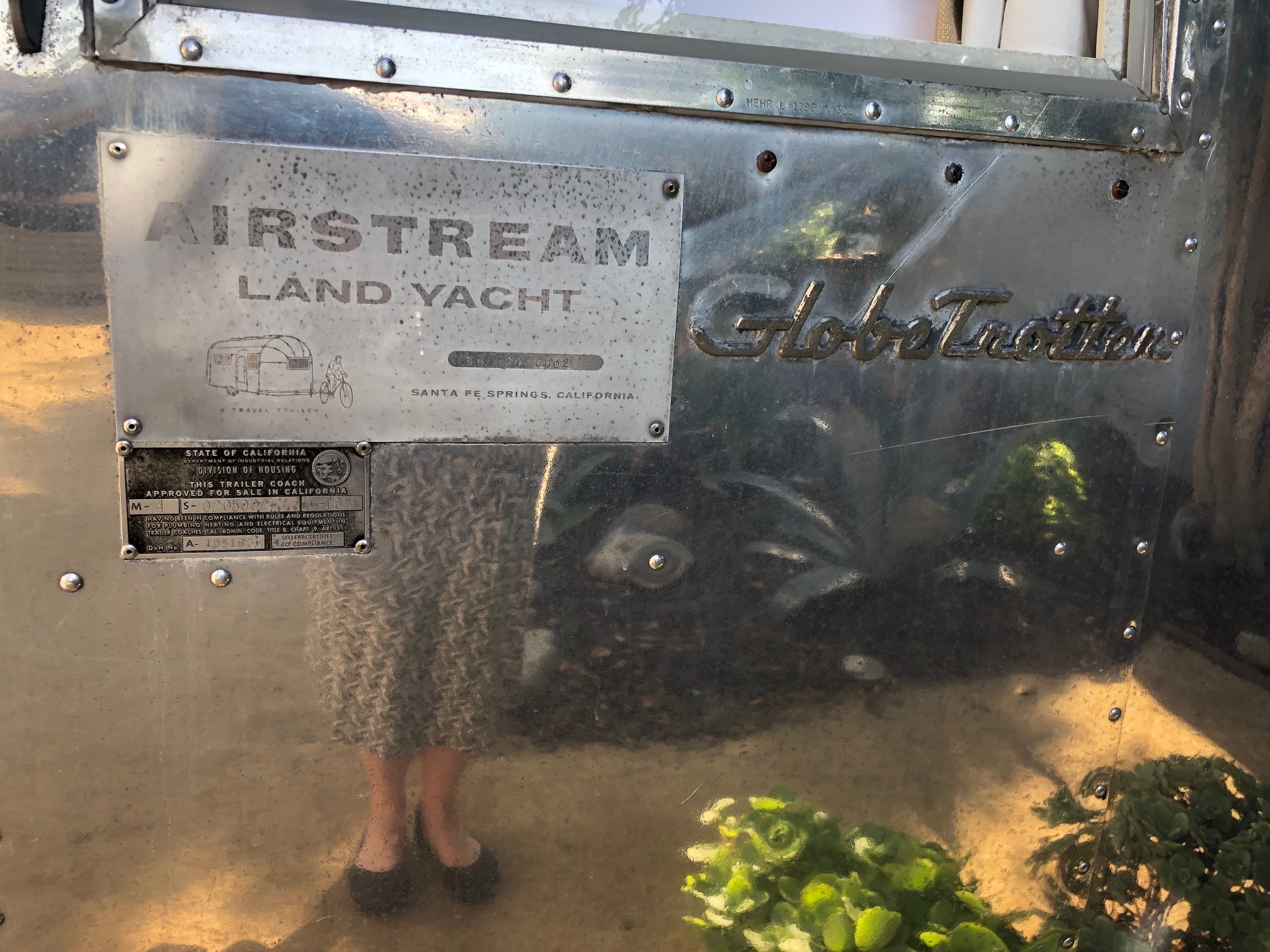 I can’t say it has always been my dream to sleep in an Airstream, one of those iconic shiny aluminum travel trailers. Still, every time time I notice one out and about, the stylish design tickles me. So when the opportunity arose to experience one on a recent night in greater Los Angeles, I couldn’t resist.
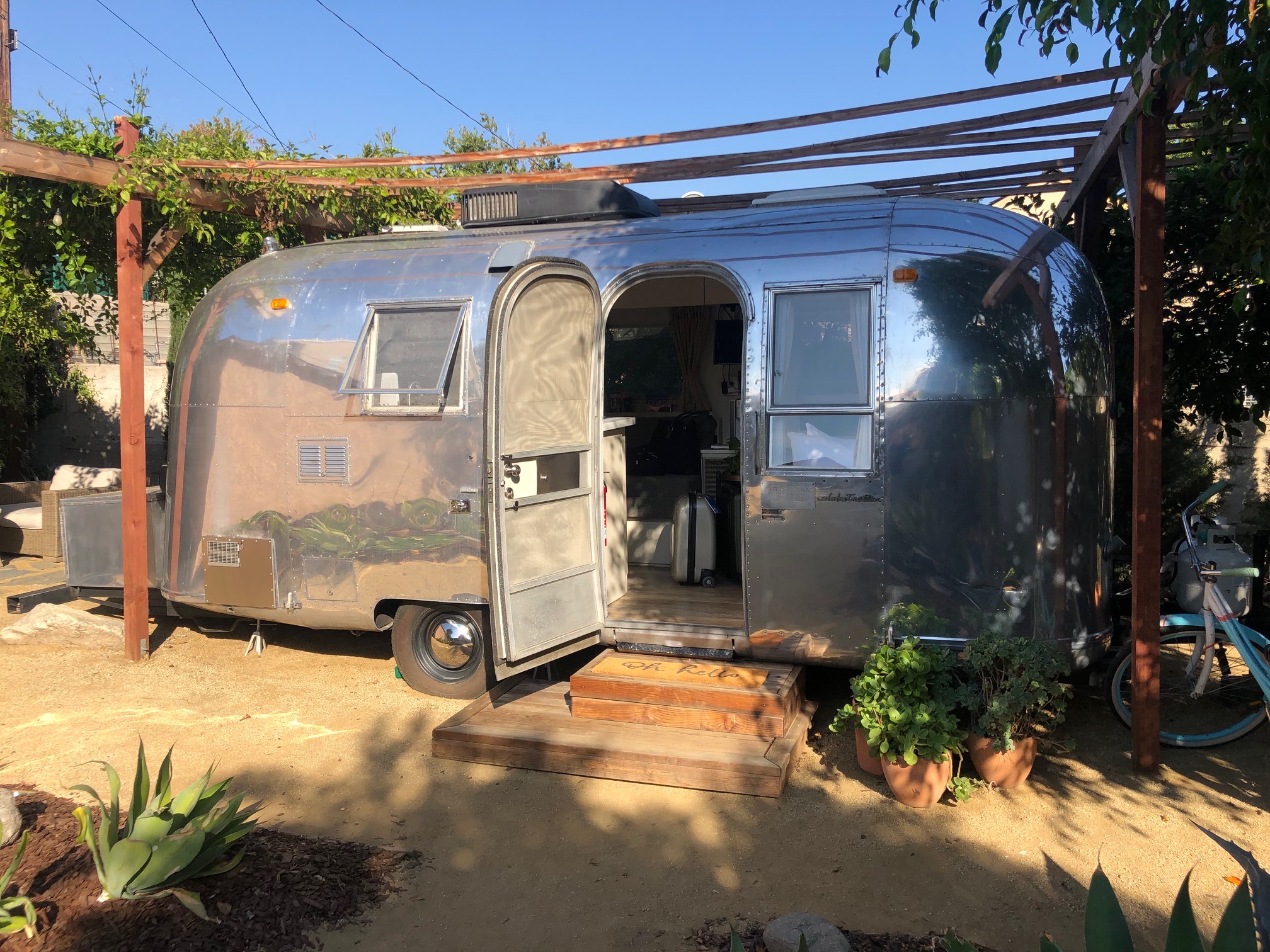 Restored to pristine condition, the interior seemed roomy enough, and when we slept on it later that night, the queen-size bed was surprisingly comfortable.
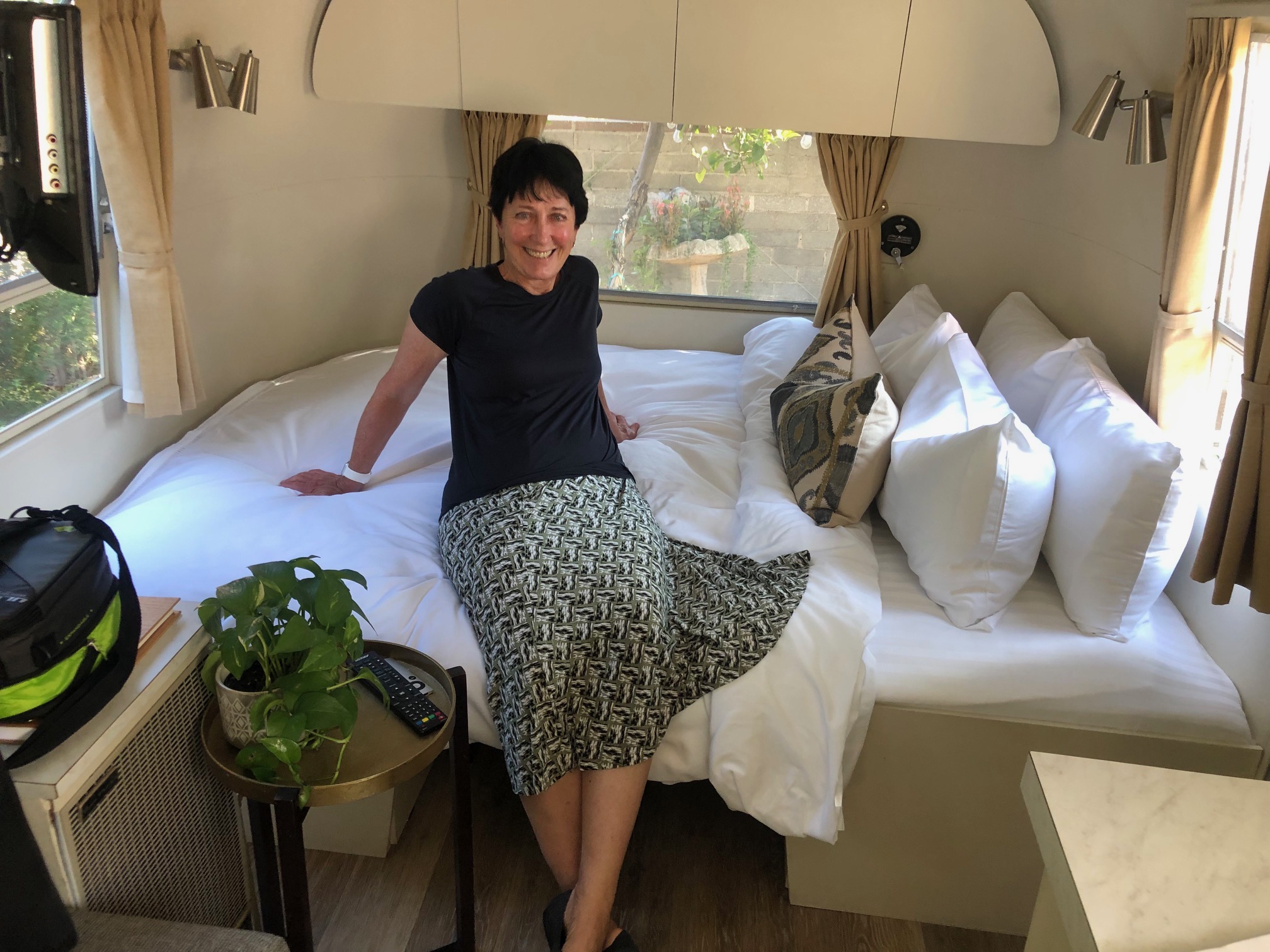 Still, I can now report that spending the night in a nice, clean Airstream felt pretty indistinguishable (to me) from spending the night in any nice, clean garden-variety trailer. I’ll probably continue to admire the zoomy exterior design whenever I see one, but I won’t be shopping for an Airstream of my own any time soon.
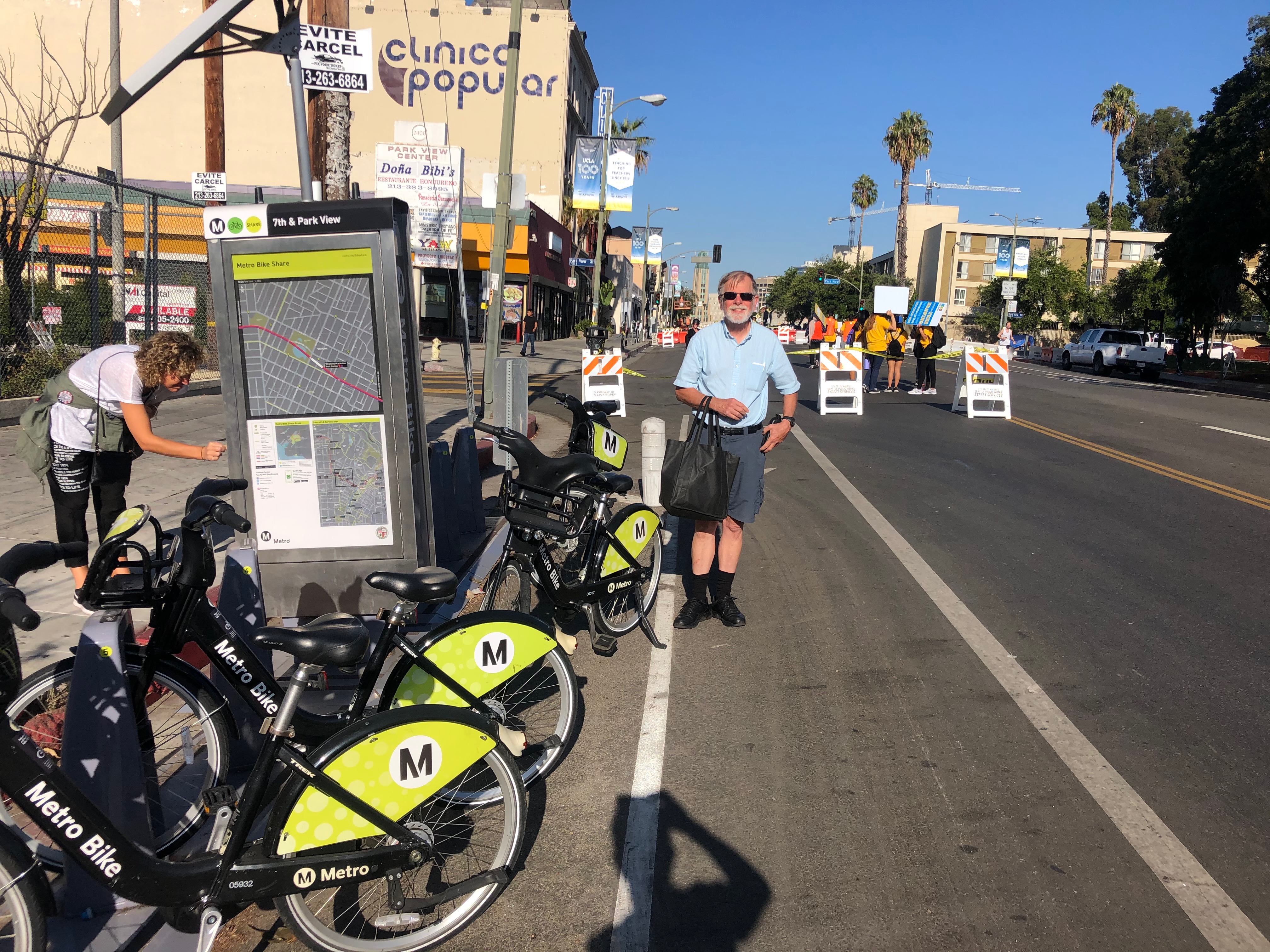
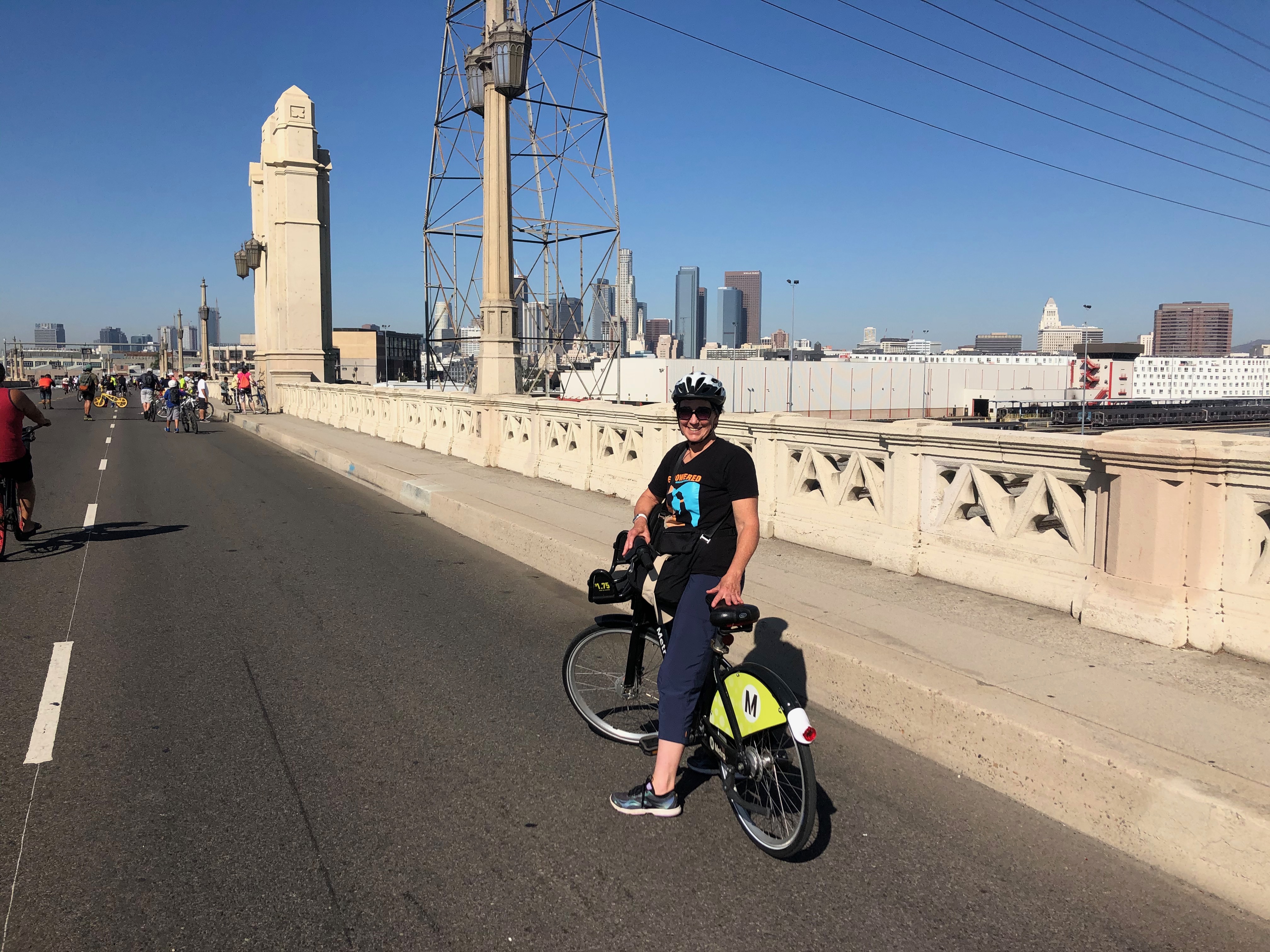 Sadly, we ran out of time and had to turn back before making it to Mariachi Plaza in Boyle Heights. We missed altogether the arm that went to Chinatown.
 At home and abroad