Nervous fliers

Tell people you’re going to Papua New Guinea, and you’re likely to hear expressions of concern. It may come from folks who know about the cannibalism and headhunting practiced here well into the 20th Century. Or the violence in the western provinces resulting from abuses by the mining companies. Maybe that region is something to avoid, but cannibalism is now a thing of the past. What should send chills down the spine of any aspiring visitor is the prospect of flying around this country. 

I don’t think Air Niugini planes are particularly unsafe or its pilots incompetent. We’ve flown them now three times, and all the aircraft looked well-maintained.  Because of the daunting geography and weather patterns, pilots must be able to land without relying on instruments; they have a reputation for being highly skilled. PNG’s air infrastructure, however, has provided Steve and me with one of the worst flying days of our lives.

For our flight from Goroka back to Pt. Moresby Tuesday morning, the 20 people in our group piled into the bus shortly after 7. We arrived at Goroka’s pleasant, new airport about 7:45 to find a line of people out the terminal doors and wrapping around the building.
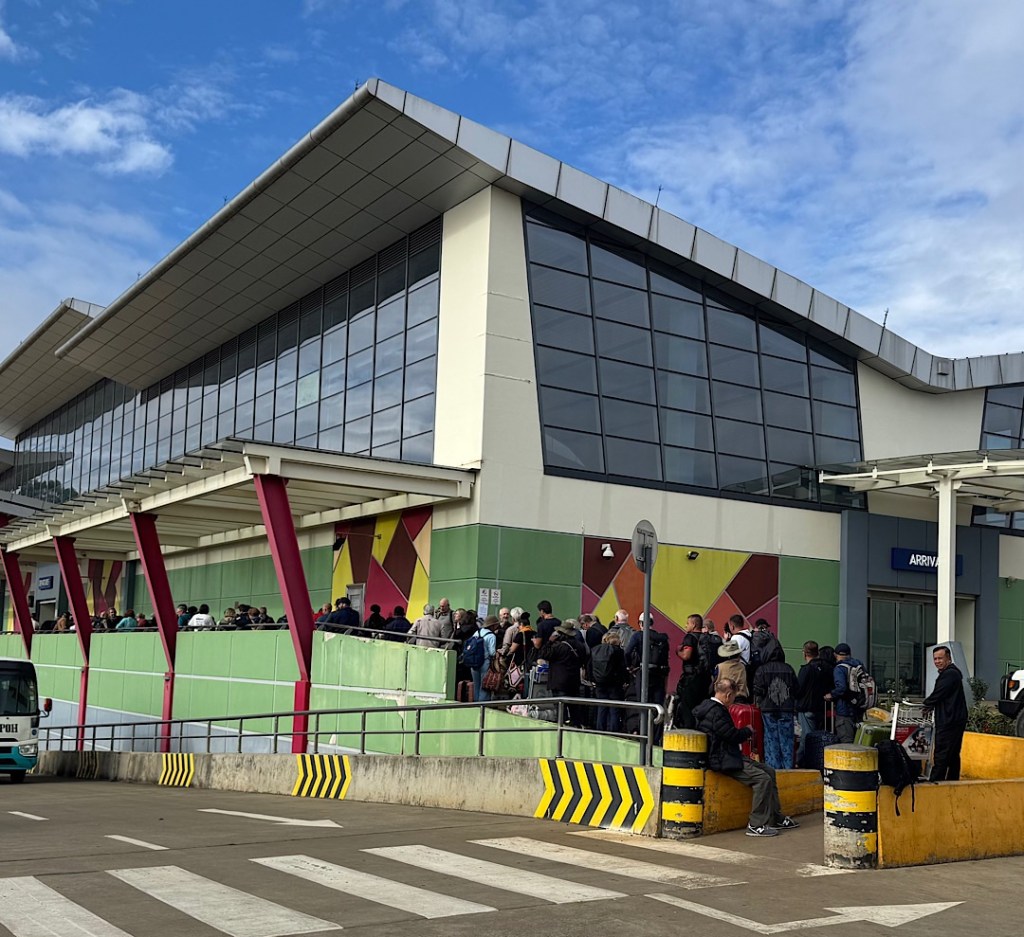
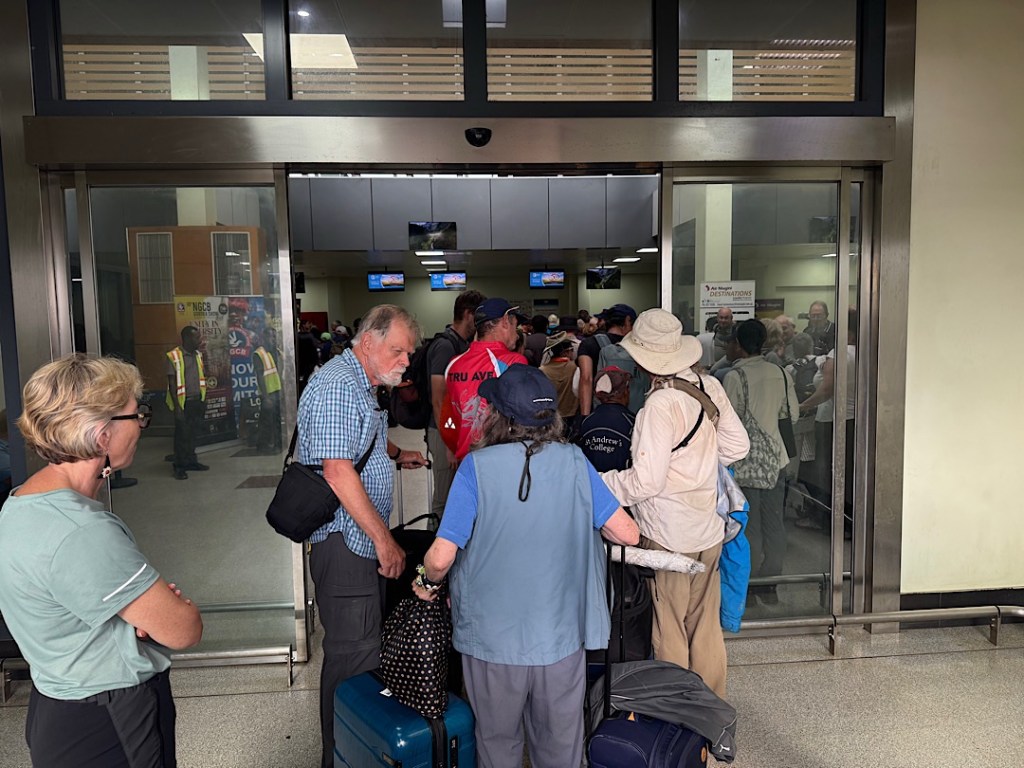
We joined the queue and reached the front door a little before 8:30. But more than two hours later, we still had not arrived at the check-in desk, where two harried workers faced something approaching a mob. As the wait stretched out, bits of explanation dribbled out.  

The computer system had gone down, we heard, so the check-in guys were having to hand-write every boarding pass. Moreover thunderstorms had forced the cancellation of the previous day’s afternoon flight to the capital. Those passengers were supposed to be able to fly out this morning on a Fokker 100. But it had broken. The airline had replaced it with a Fokker 70, but it accommodated only 70 people instead of 100.

Steve and I got to within just a few steps of the check-in desk. It was then that one of the two check-in guys called for everyone from the previous day’s cancelled flight — a couple dozen people, as it turned out —to move in front of us.

Finally, shortly before 11, one of the two check-in agents announced that the morning flight — on which our group had been scheduled to travel — was full. We should be able to get out on another flight leaving at 4 pm, he indicated.

More hours passed. Christopher’s assistant, Caroline, collected all our passports and check-in baggage and waited to check in all of us and our bags at 1 pm. Steve chatted with Christopher, who said Air Niugini is owned and operated by the Papua New Guinean government, which chronically underfunds the airline and the country’s aviation system. The airline routinely fails to pay its fuel suppliers. The suppliers then stop providing fuel. Christopher said it was common for the airline to kick passengers off flights in order to take on more freight, which is more profitable, and thus generate income to get the cash flowing again.

I may have gotten some of these details wrong. I was tired and growing more so by the minute. I tried not to think about when or whether our plane would arrive. Happily, the airport has a pleasant coffee shop opening onto a terrace. Steve and I distracted ourselves there drinking cappuccinos and eating decent pizza and writing.
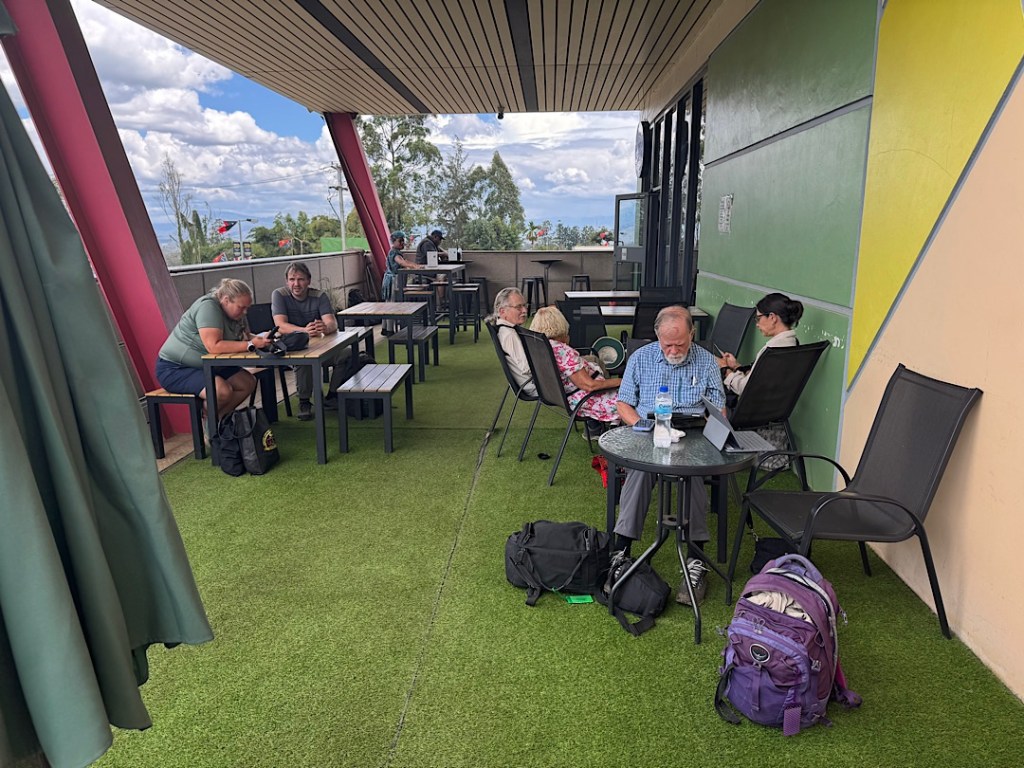
Everyone perked up with the news that around 2 pm, Caroline had managed to secure our boarding passes.

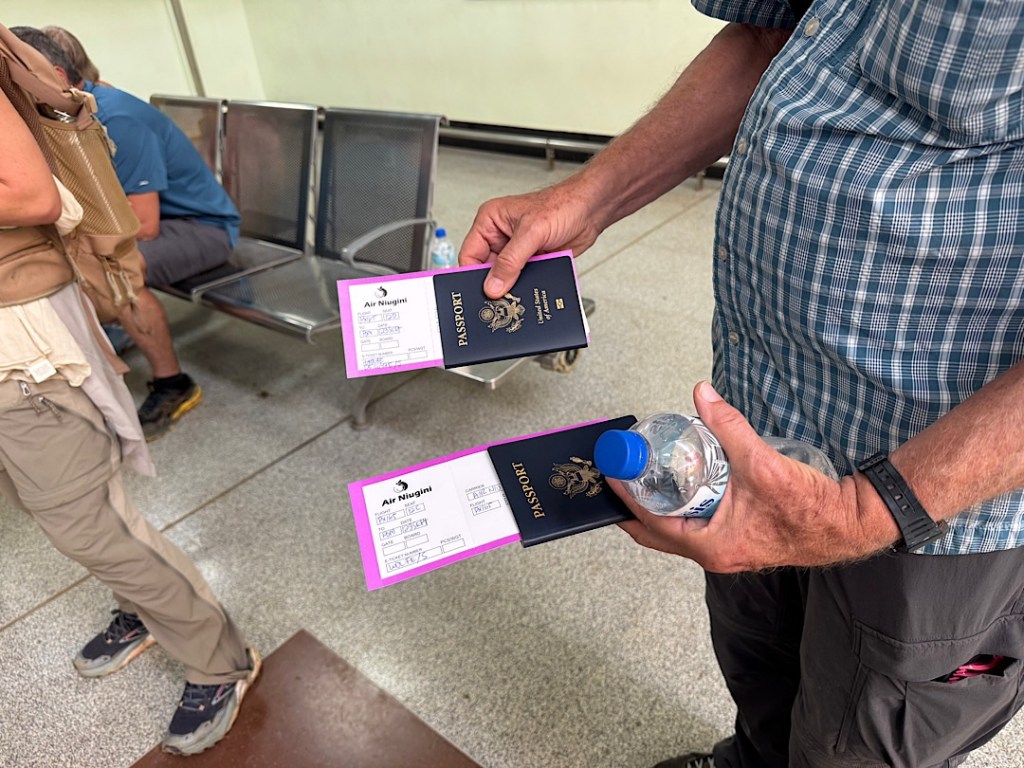
The passes being prepared.
Passes and passports back in hand!

Getting through security was a snap. Signs posted last April announced that because the x-ray machine was “faulty,” our carry-on bags would be searched by hand. But the the “search” was cursory, and we quickly settled into a lovely waiting area.
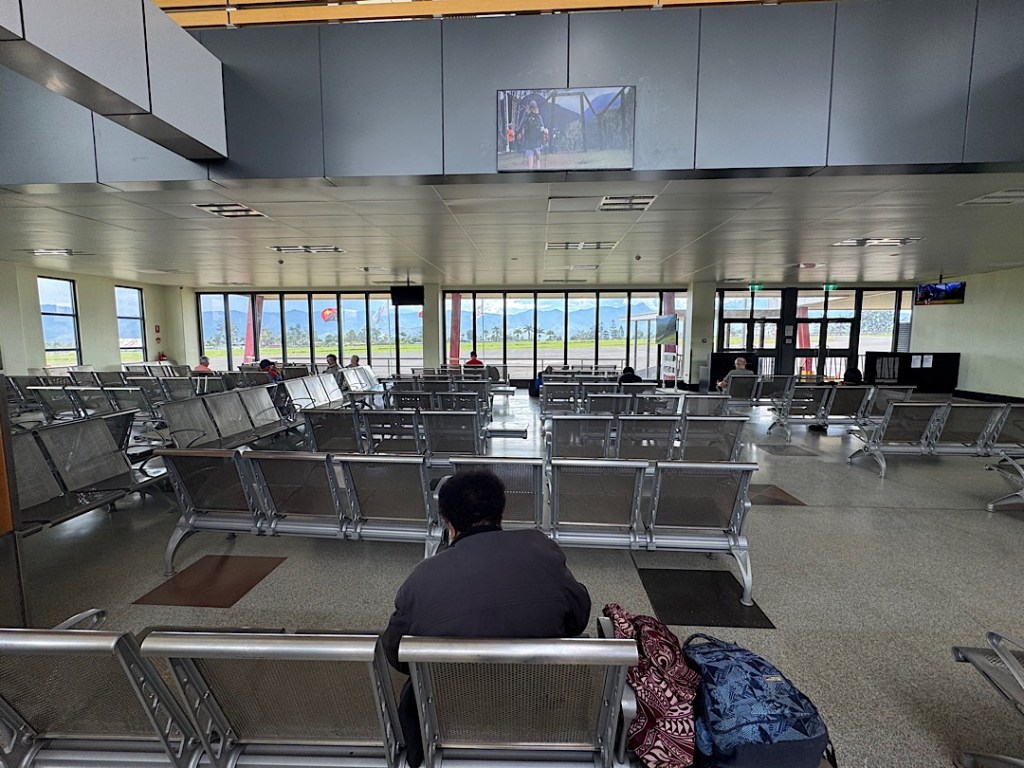
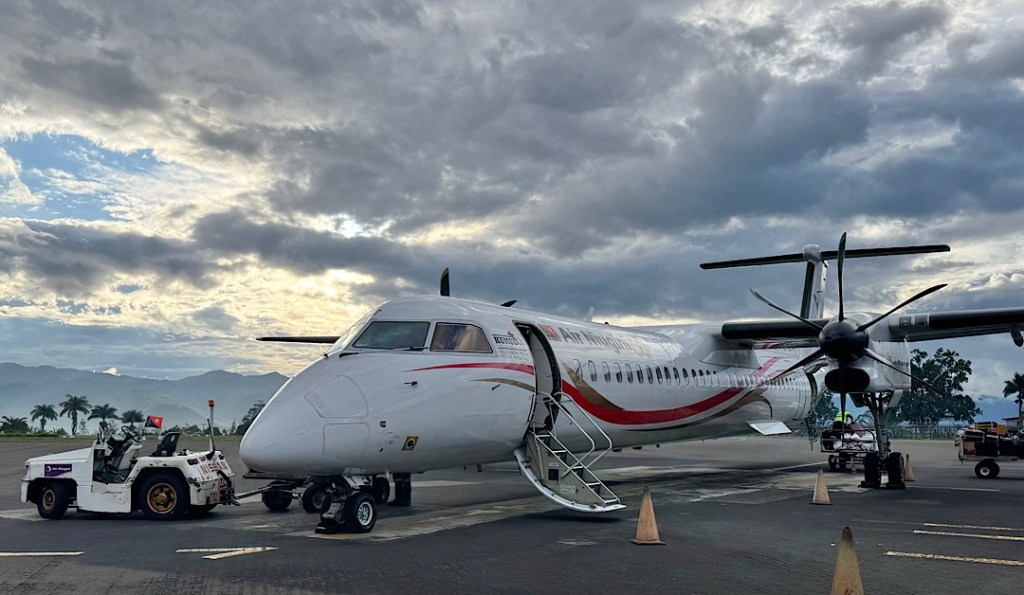
Four p.m. came and went with no sign of any plane, nor any officials who could provide any info on its whereabouts. But an hour later, the plane, a Bombardier turbojet with a female Papua New Guinean pilot, finally arrived. We hit a few turbulent patches, then 75 minutes after takeoff, our wheels touched the tarmac in Pt. Moresby.

At this point, you might be thinking: Why would anyone fly instead of driving? The other day we did drive the relatively short distance from Mt. Hagen to Goroka, But it took about 5 hours and patches of that road were dreadful. At first I assumed a drive from Goroka to Ft. Moresby, would be more grueling than flying. But then Christopher disabused me. There IS no road connecting Goroka with the capital. A mining company built the other road out of Mt. Hagen. “No mine, no road,” Christopher pointed out.

We have two more flights on Air Niugini, and I’m a bit nervous about both. The first, from Pt. Moresby to Wewak, was supposed to leave this morning (Wednesday, 9/24) at 9:30. We were up at 5:45 am to return to the airport in order to catch it. But then Christopher messaged that it was delayed until 12:30 pm. The good news is that this delay enabled me to finish and publish this post. We’ll see how the rest of the day works out.
A hop, a skip, and a jump

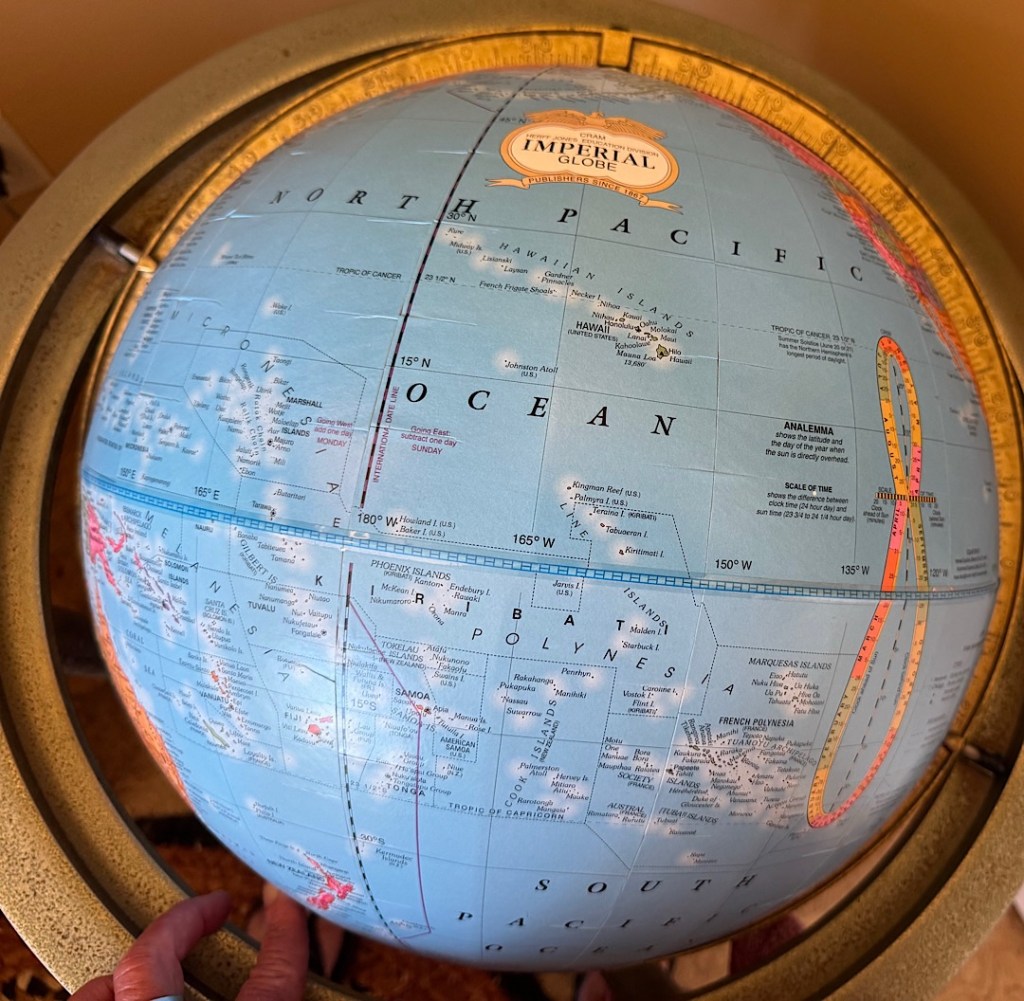
It’s not like I didn’t know the Pacific Ocean is big. I mean, duh. I was paying attention back in fifth grade geography. Since then, I’ve flown across the Pacific more times than I can count. And yet… just how big that ocean is somehow never sank in until I began preparing for this trip. 

As part of the preparations, Steve and I read a marvelous book called Sea People about how the Polynesians managed to spread throughout the vast expanses of water — more than 12,000 miles across and another 10,000 miles from north to south. As author Christina Thompson points out, you could fit all the earth’s land masses into the Pacific and still have room for another continent as big as North and South America. 

It fills up half the globe.

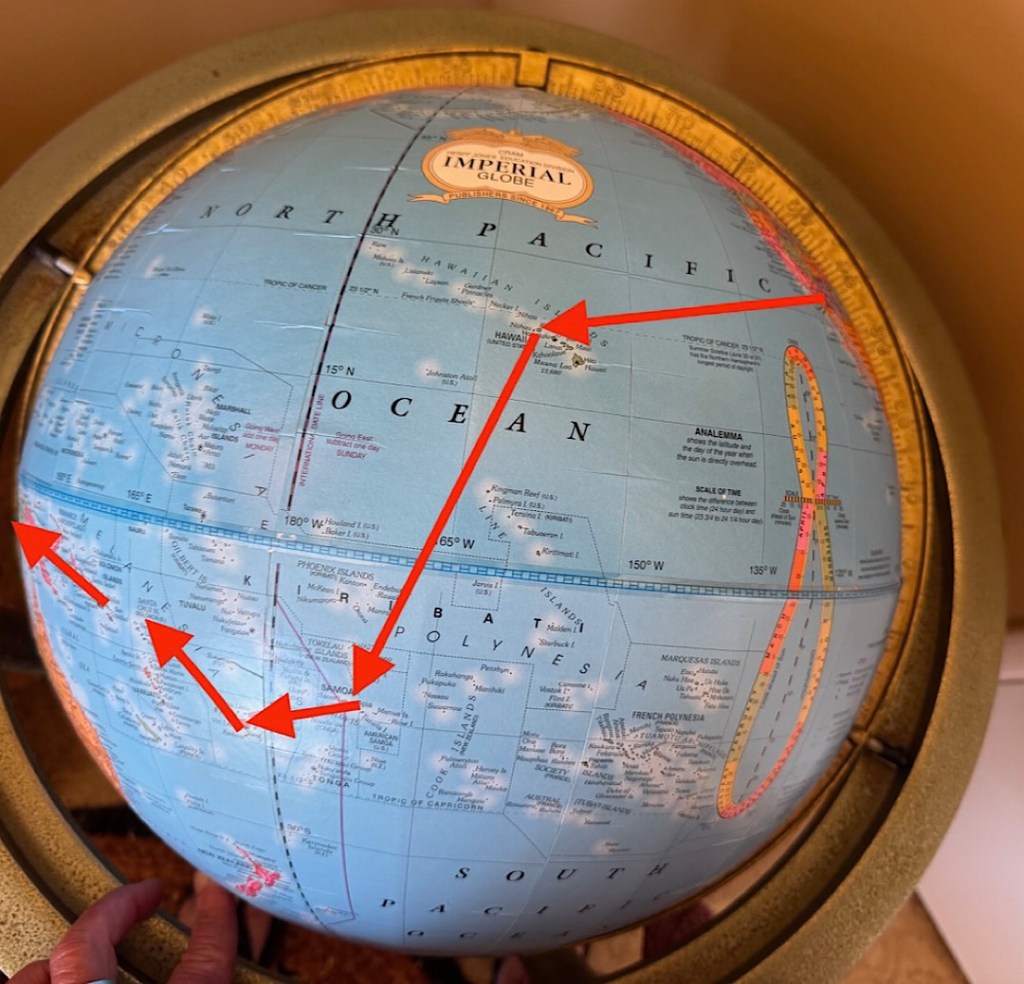
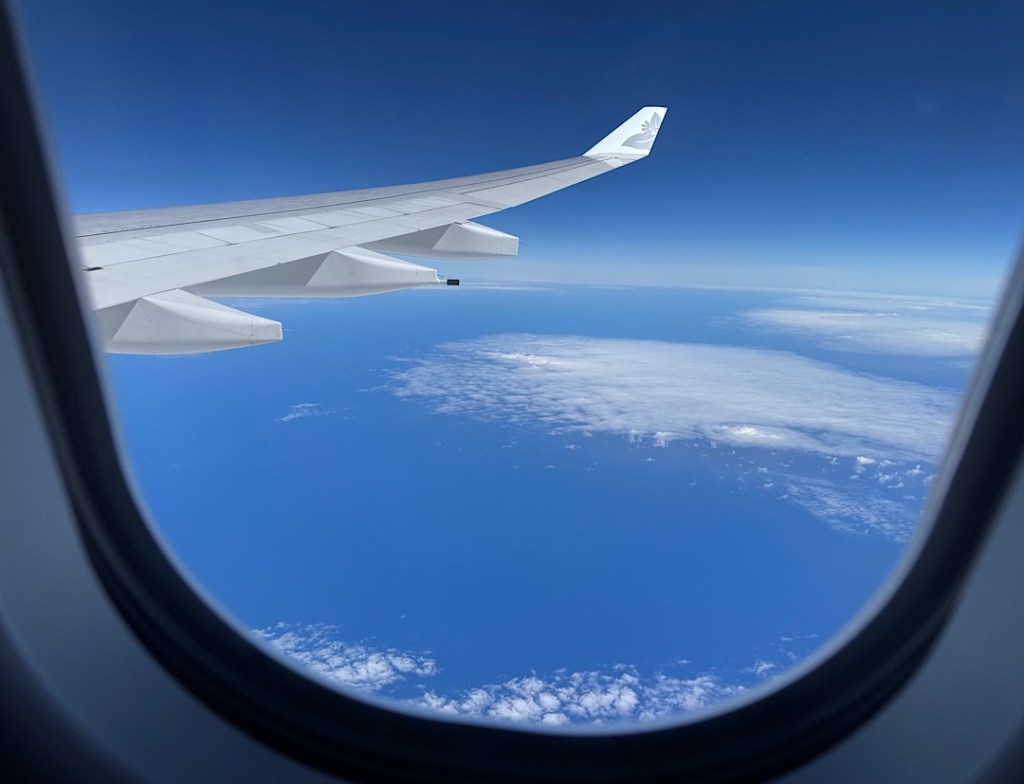
Getting from San Diego to Port Moresby (the capital of Papua New Guinea) takes more than 24 hours via the most direct connections. It’s either grueling (flying in Economy) or hellaciously expensive (in a lie-flat seat routing through somewhere like Singapore.) So we decided to try an offbeat alternative — what I’ve come to call my hop, skip, and jump approach. At the moment, as I’m writing this, we’re flying from San Diego to Honolulu. There we’ll rest in an airport hotel for a couple of hours, then continue southeast to Apia, the capital of Samoa.

We’ll sleep there for two nights, then make the short flight from Samoa to Fiji.  Sleep there for two more nights, then hop again to the Solomon Islands. These flights don’t run every day. Due to the quirky schedules, we have less time in Samoa and Fiji than I would have wanted, and more time (five days) in the Solomons. From there the jump to Port Moresby is another piece of cake — just two hours and 20 minutes. 

It’s an experiment. Maybe we’ll conclude it was nuts. We won’t be returning the same way. I have something else cooked up for that. At the moment, however, our return in five weeks feels almost unimaginably distant.

On the road — with both our iPads

Near the end of our recent Caribbean travels, I realized I had left my iPad on the Arajet flight from the Dominican Republic to Jamaica. I never got it back; had to buy a new one. So this morning when we climbed into our Lyft to the airport, the first words out of my mouth, after checking its spot in my backpack were, “I have my iPad.” It wasn’t until we had reached the airport that Steve realized he had forgotten his.

It was 7:25 a.m., an hour and 45 minutes before our scheduled departure for Honolulu. What to do?!? We made a split-second decision to pay the Lyft driver (Moe) cash to drive us back to retrieve it. On the way to the airport, we had chatted up Moe and learned that he grew up in Istanbul. Although he’d lived in San Diego for 24 years, we assumed he would still know a thing or two about hauling ass behind the wheel of a vehicle. Indeed he got us home in under 30 minutes (only running one red light) and back in about the same amount of time (pushing his Corolla up to 75 mph on I5 South).

One thing I learned from this experience is that, IF the gods are smiling, it’s still possible to arrive at the San Diego Airport just 5 minutes before one’s plane is scheduled to board and get to the gate with time enough to buy two cups of Peet’s coffee. (It’s helpful to be traveling only with carry-on luggage and to have TSA Pre-check status.)

Another insight is that if one of us verbally confirms that she or he has their iPad, it would probably be a good idea for the other one to follow suit.

Hopefully we can remember this lesson in the weeks ahead.

Could Steve survive a month-long trip without his iPad? It’s pretty unimaginable.

Don’t try to get to Africa this way

It’s not the easiest thing to get from San Diego to anywhere in Africa. But this time Steve and I appear to be doing it the hard way. The irony is, it seemed to start so well.

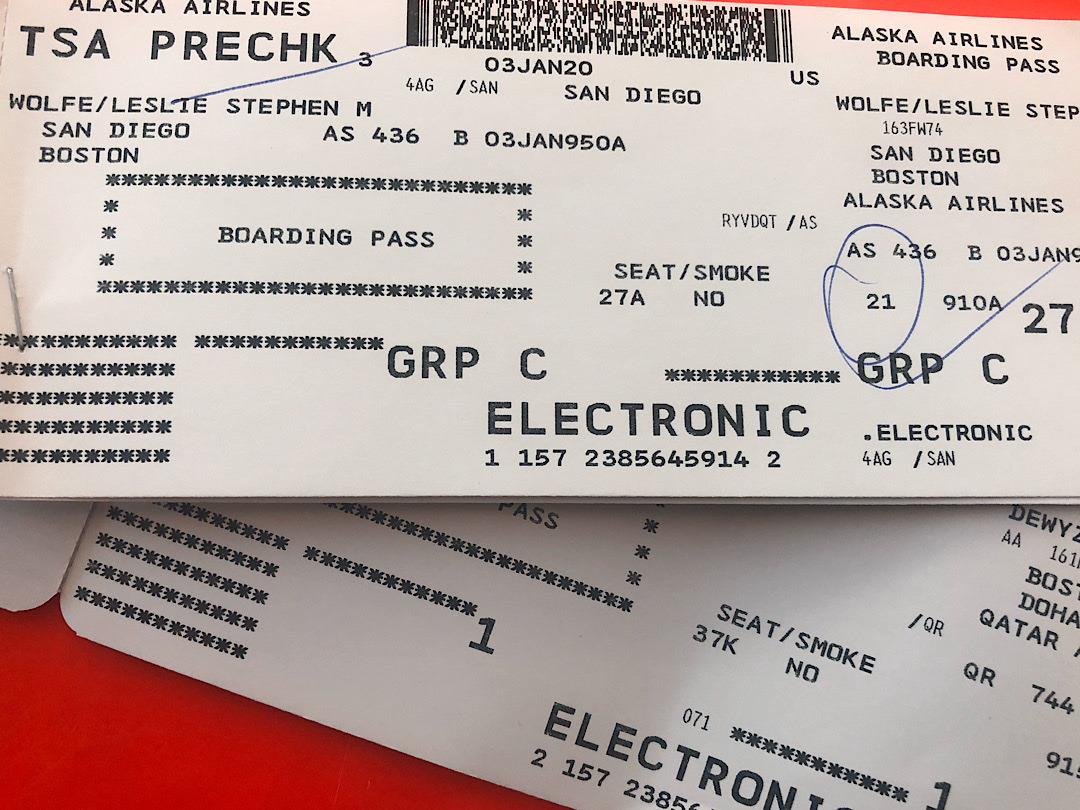
We had scored inexpensive tickets traveling on Alaska Airlines from San Diego to Boston, and then continuing on Qatar Airways to Doha, the capital of Qatar. These tickets would enable us to stay in Doha (a place we’ve never visited before) for three nights before continuing on to Entebbe in Uganda.
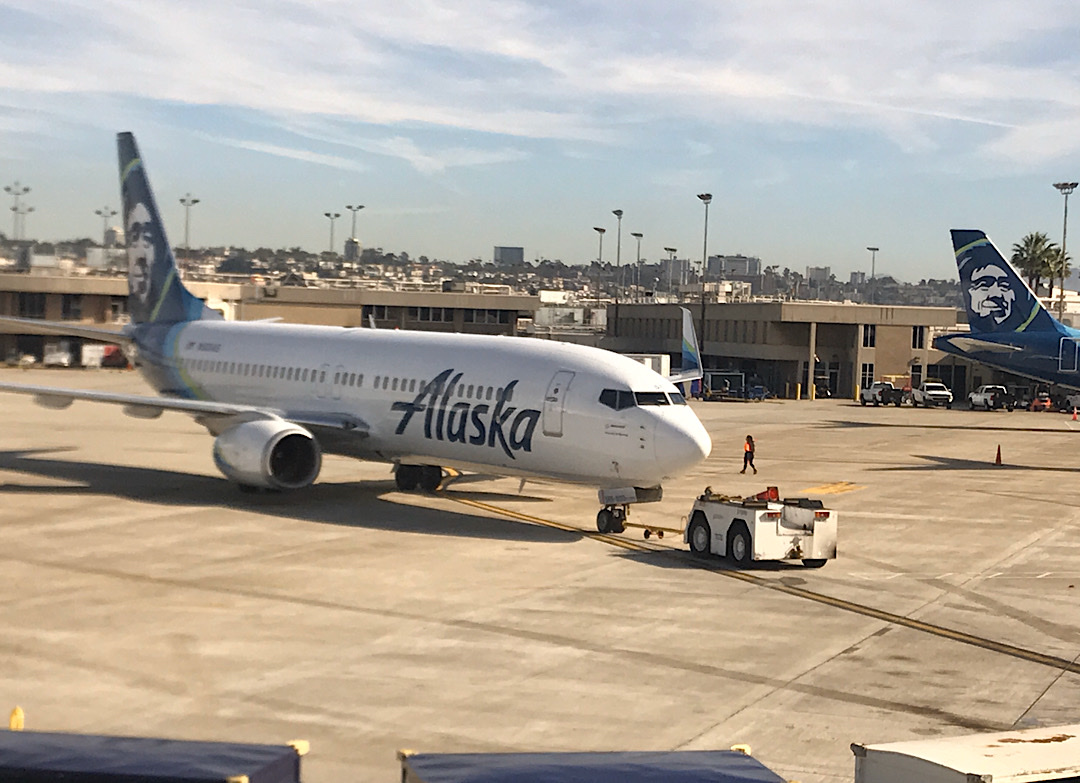
The first flight was at 9:50 am and we were inside the terminal by 7:44. We had our boarding passes by 8, and the signs all said we’d be on time. Outside, the sun gleamed off the plane parked at our gate. We went for coffee and doughnuts and returned around boarding time, when the first creepy thing happened: a tug began pushing “our” plane away from the gate. “Wait, stop!” I wanted to shout. “We’re not aboard yet!”

But no one was, and a minute later, the sign changed to Delayed — first to 10:20, then 10:30, then 10:40 am. Our spirits dipped, but when we returned to the gate around 10 and saw another plane parked next to “our” jetway, they rose again. Boarding started soon after, and by 10:40, everyone was seated, ready for take-off.

The captain’s voice over the loudspeaker smashed everyone’s good mood. He sounded annoyed, not with us, but with whichever imbecilic manager had decreed that our plane was needed to fly to Lihue on the island of Kauai, a route on which Alaska is aggressively competing. Everyone and their luggage would have to get off this plane and onto some other one.

The infants on the plane (and there were a bunch of them) all began screaming, an apoplectic chorus, and many of the grownups looked almost as unhappy. I was aghast, but I wasn’t panicking. Our flight from Boston wouldn’t depart until 10:15 pm. We had been facing a long wait at Logan, so this would shorten it a bit, but not catastrophically. Then the ground crew announced that a replacement place wouldn’t arrive until after 1 pm; it wouldn’t reach Boston until around 10:30 pm.

Here’s the Alaska plane we all had to get off, to free it for a lucky Hawaii-borne group. Aloha!

Poof! went our visions of a swift easy transit to the Middle East. We could barely see the Alaska gate staff, the line of querulous customers trying to reach them was so long. I jumped on my cell phone; called Qatar’s customer service. The guy I talked with made what sounded like a intense effort to find some other path to Doha for us. But the flight from LA was leaving in three and a half hours. There were no flights, so we’d have to cover the distance on the ground in two and a half — not something we felt like gambling could be done. Other Qatar flights from other cities all were leaving earlier than the one from Boston. The guy on the phone finally told me Alaska would have to fix the problem.

It took some gal on Alaska’s International desk in Iowa almost an hour to figure something out for us. She said she could get us on a nonstop flight from San Diego to London that was leaving San Diego at 2:50 pm. Once in London, we could connect to a nonstop Qatar flight. It wouldn’t arrive in Doha until after midnight Saturday night (versus the 5:30 pm we had originally been scheduled for). But in our beggarly positions, we didn’t feel we could be picky. We searched for the British Airways check-in counters, where we would have to go to get our boarding passes.

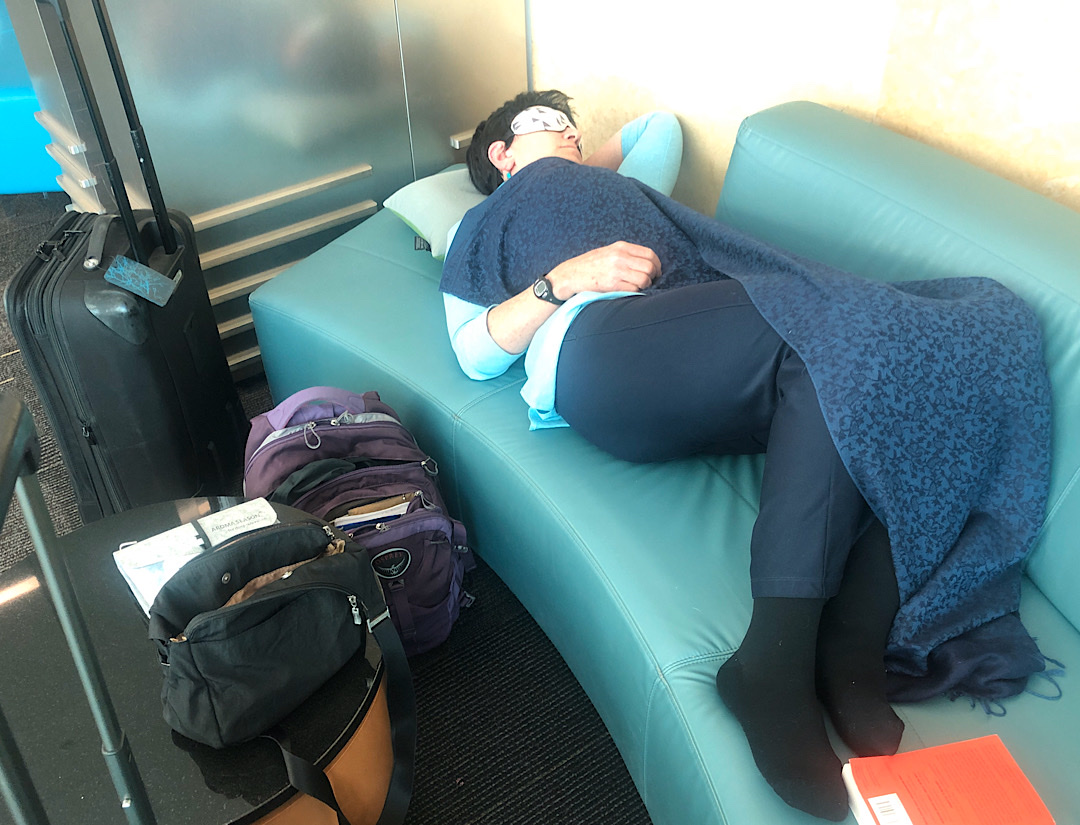
Somehow the young lady in Iowa had gotten the time of the flight wrong. It turned out to be 6:35 pm, not 2:50. Waiting for the check-in counters to open, we considered getting Lyfted home and back, since home was the only place we could think of to nap in. (We couldn’t get into the secure part of the airport until we got our boarding passes. But we couldn’t get our passes until the BA counters opened. I’m here to tell you, the NON-secure part of San Diego’s Terminal Two has no place where any normal person would consider napping.) Reluctantly, we decided against trying to go home and then return. The likelihood of meeting up with some other problem that would keep us from catching our flight (a traffic accident? a Lyft strike?) seemed all too real. The hours dragged by. We finally got those boarding passes; moved to another gate area. I tried to rest, but sleep eluded me. More than eleven and a half hours after we’d entered the airport, our 747 lifted off from the tarmac.
I’m writing this onboard now, with about 17 hours left to go. Our connection in London is short. That might get screwed up too. But if it doesn’t, and we reach Doha, I’ll post this, maybe in the morning.

With any kind of GOOD luck, we could even still have a day and a half to see Doha’s sights. Then we’ll move on to Africa, where bigger adventures loom.

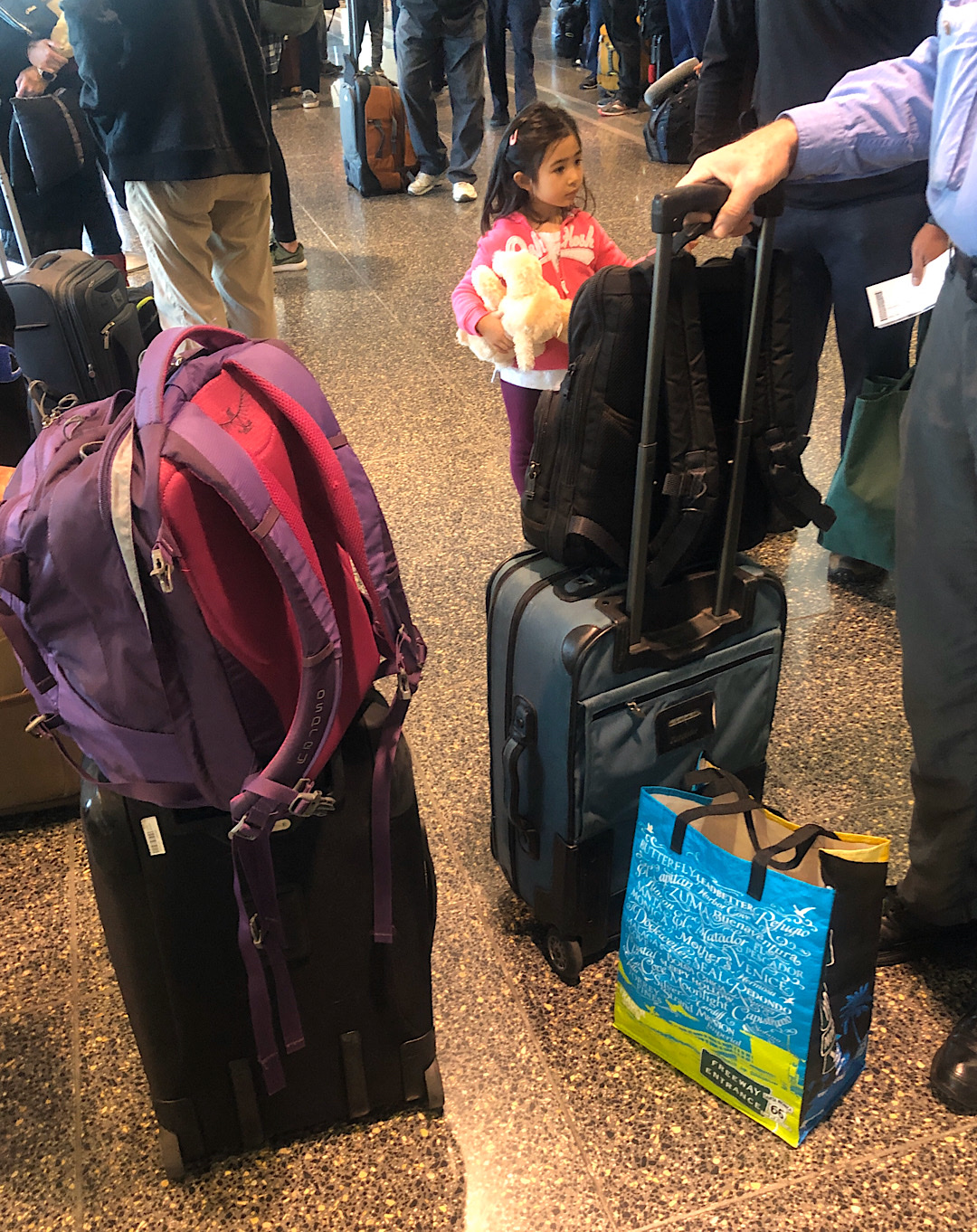
More than once, we were thankful we travel with carry-ons. (Here are our four, plus our lunch bag. Checked luggage would have significantly complicated the nightmare.

The De Wyze Wolfe seal of approval

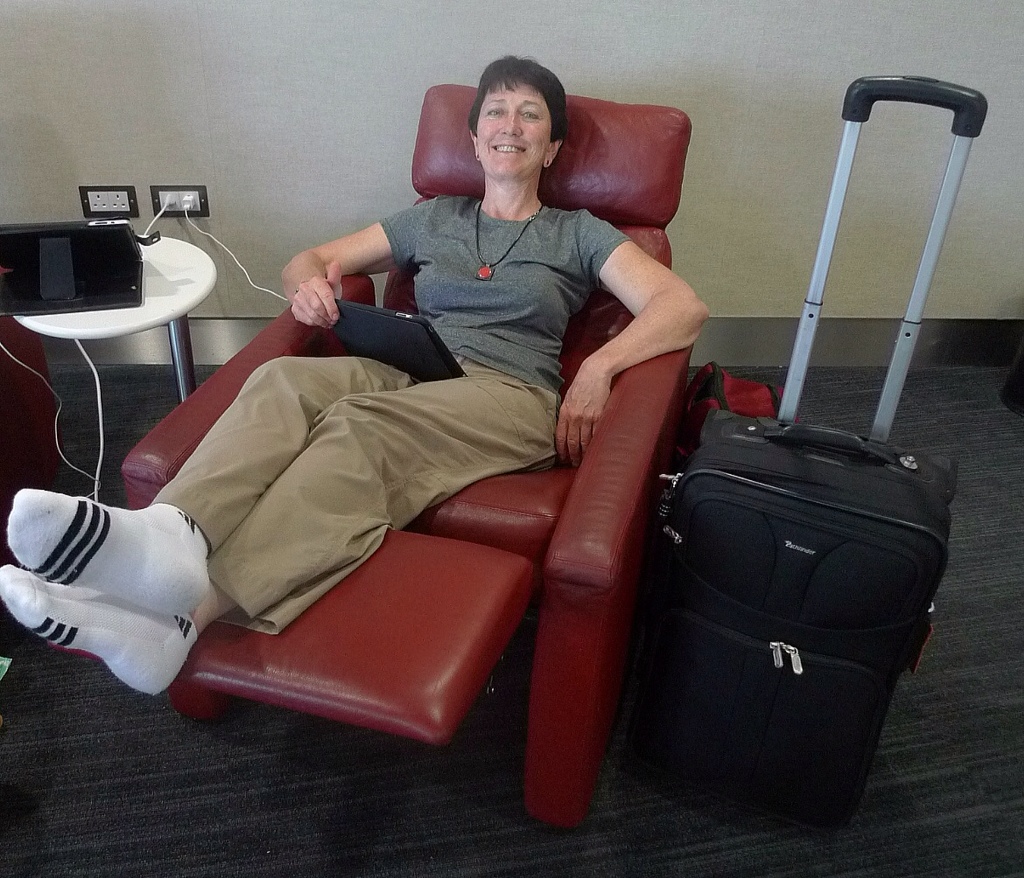
Because we have long layovers in London and Boston (on the way back), we’re trying something new: we bought a 30-day Admiral’s Club membership from American Airlines. Already we approve. In San Diego, we got to wait for our flight in a soothing room with comfy chairs, drinking, snacking, and using the wifi (all free.) Here at Heathrow, the AA lounge is vast, with an impressive open bar, many food choices, wifi, showers, and more.

What I like best, however, are the lounge chairs, in which I hope to nap. Our flight to Uganda departs in 4.25 hours, but I’ll be content camping out here for a long as possible.