A more accurate name for this post might be Lazy and Boring. After we reached the Zambian border and turned in our Land Cruiser, mostly what we did was luxuriate in a glorious setting. Great for us but not much to read about. Still, we did get wet and saw a couple of wild marvels.
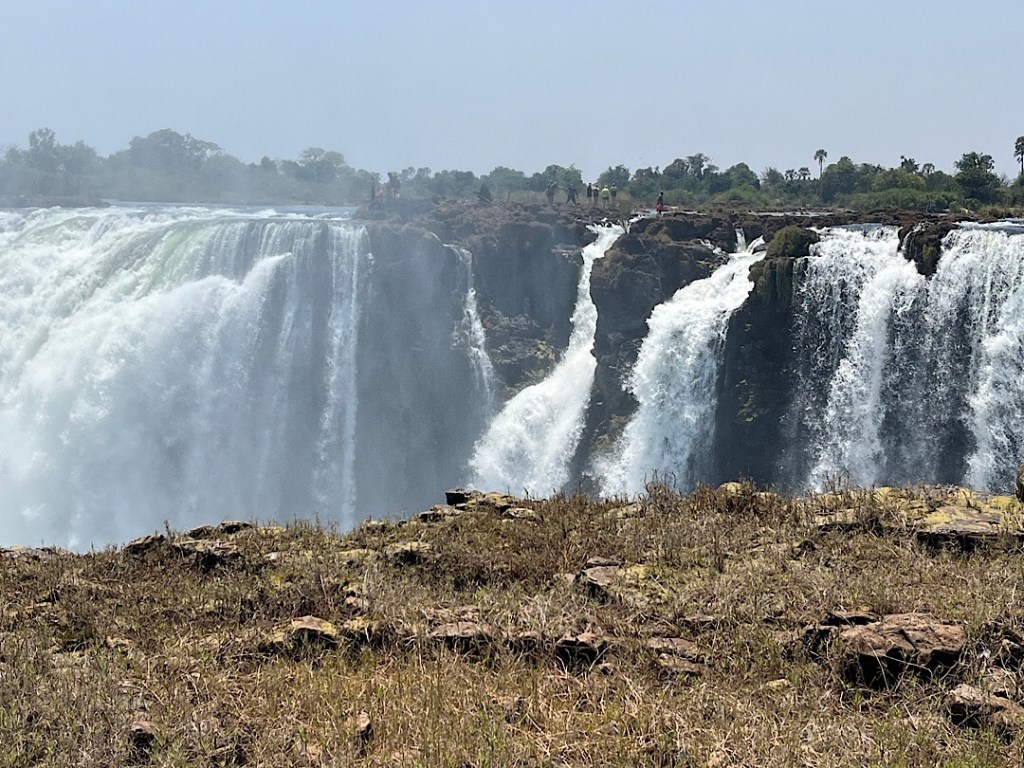
One of the great natural wonders of the world lies at the far northwest corner of where Zimbabwe meets Zambia, so the first thing we did upon driving there from Hwange National Park was to go to Victoria Falls National Park (on the Zimbabwe side). I’d been worrying for months that only a trickle of water might be pouring over the escarpment. The end of the dry season is an excellent time for seeing animals but six months off from when the water levels are highest.
I had nothing to worry about. A poster near the park entrance makes it clear that high and low season at the falls offer very different experiences.
At the peak-flow times, the mist is so dense it’s hard to see much. Instead we watched a breathtaking amount of water plunge over the cliff in some places…
…but also got clear views of the rocky geology. It was spectacular, and seeing it in person fulfilled a long-held dream.
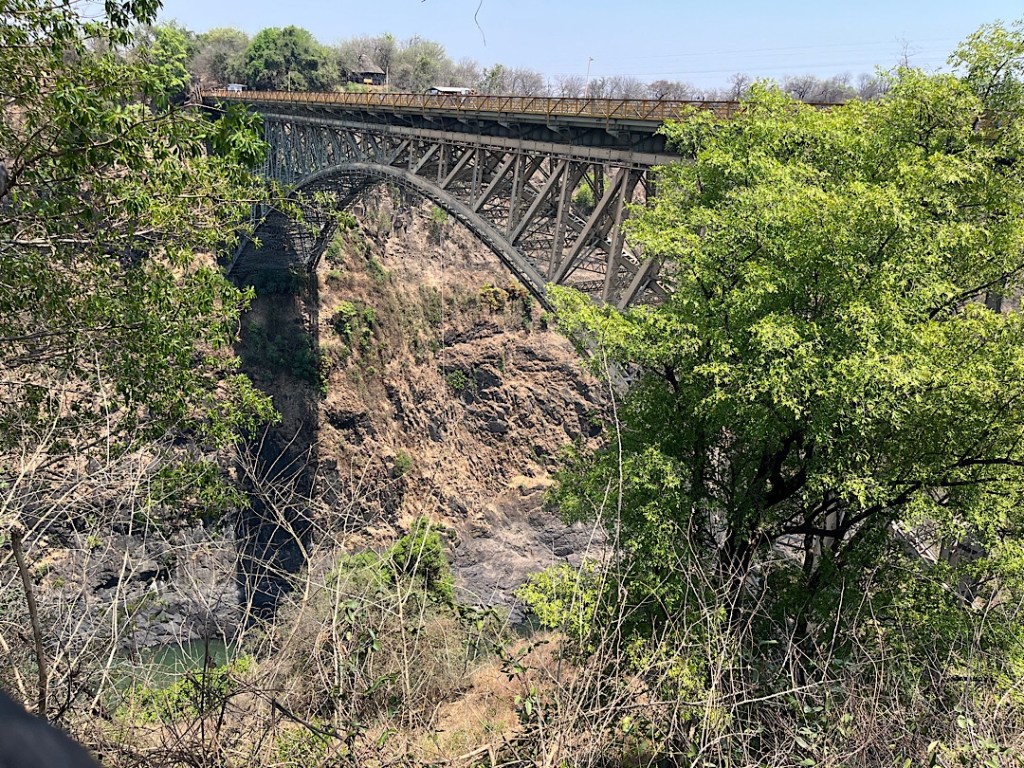
Friday night we ate crocodile croquettes and good pizza at the Vic Falls branch of The Three Monkeys then slept at the B&B where we dropped off the Land Cruiser. The next morning a local guy transported us to the Zambia border, where the passport-stamping formalities took only 20 minutes. A second driver drove us across the 118-year-old bridge financed by Cecil Rhodes…
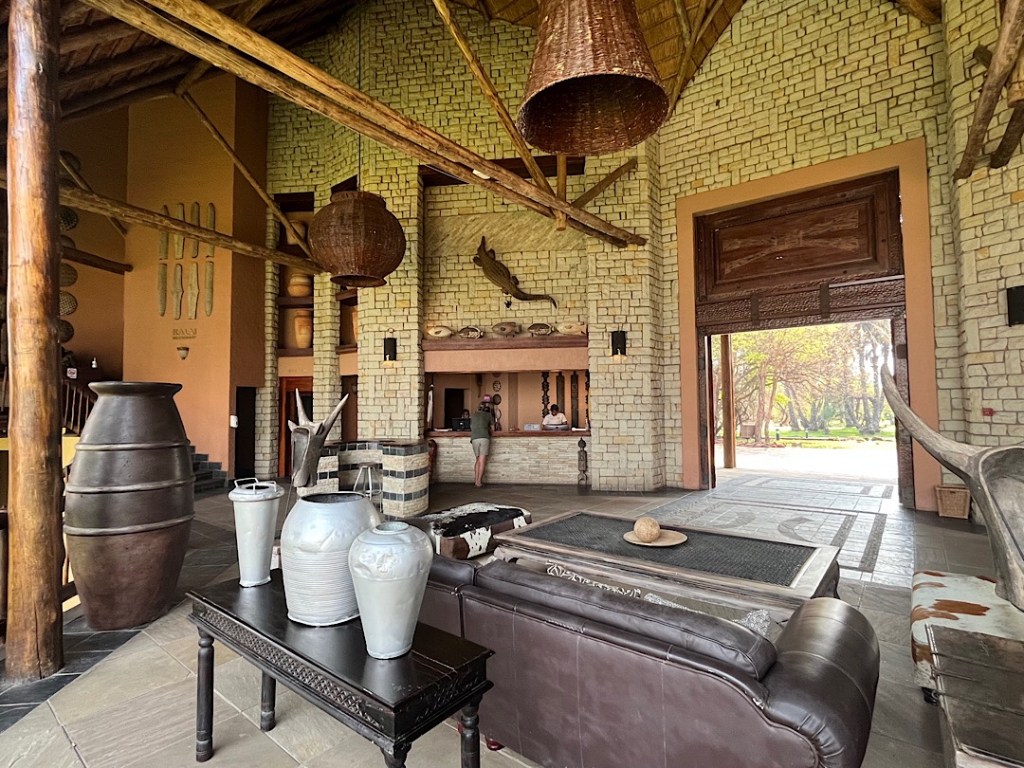
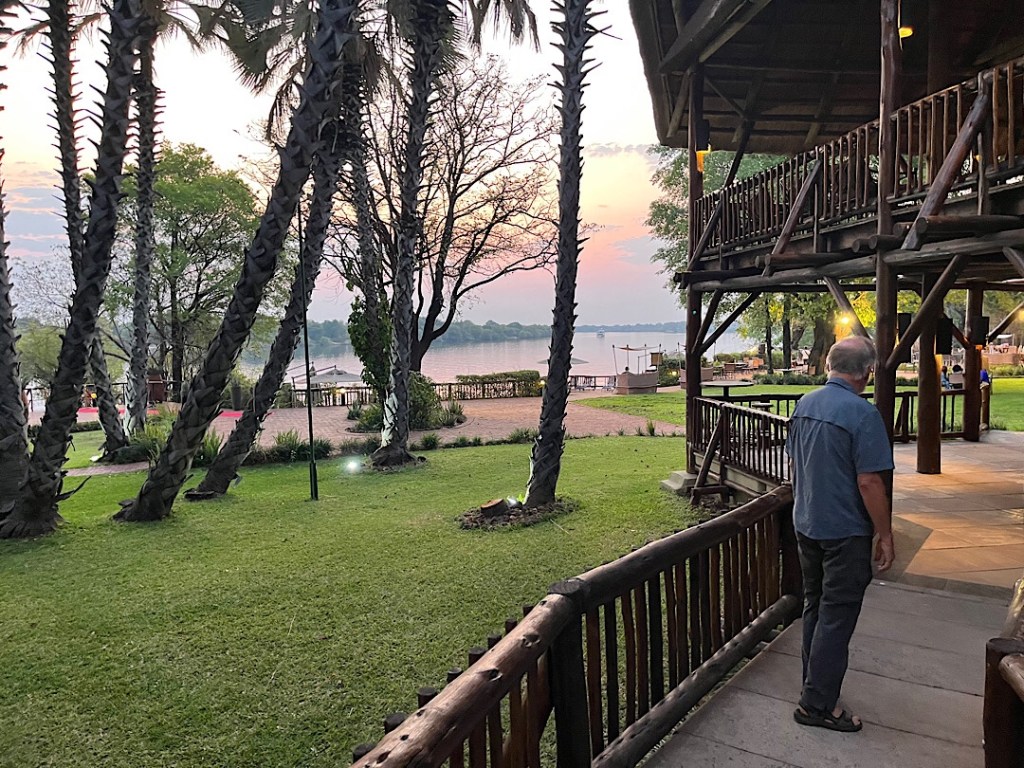
and then on to our splurge for the trip — a beautiful lodge on the banks of the Zambezi.
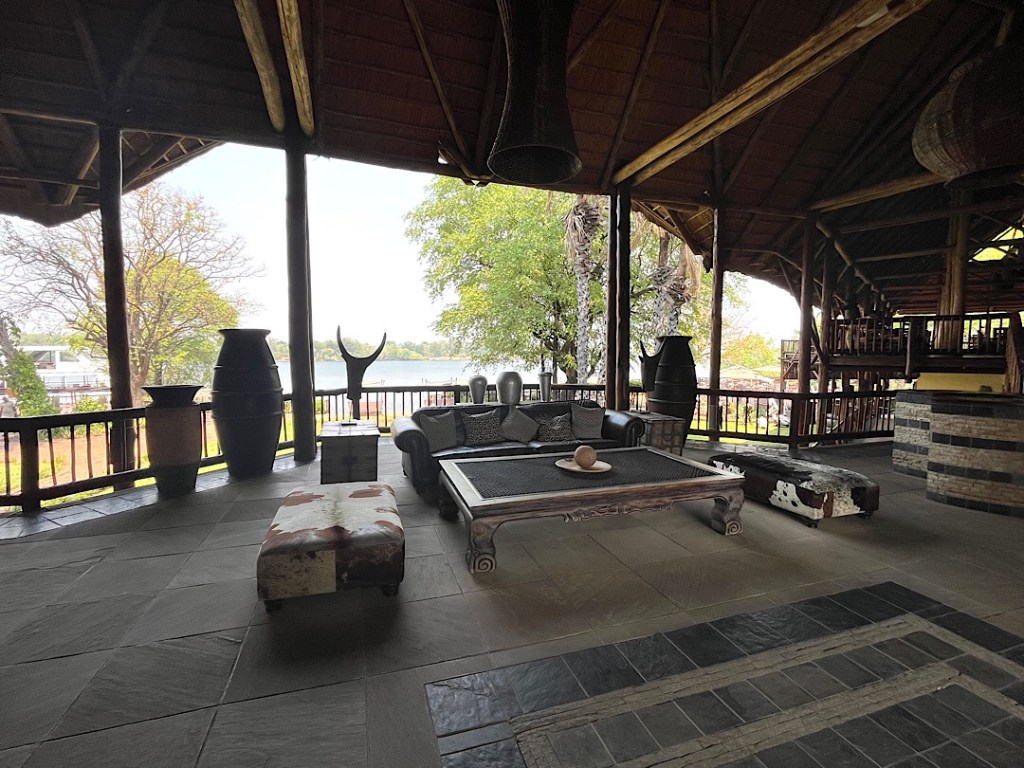
Both of us were tired, so it was pure pleasure to enjoy the river views, nap, and swim in the riverside pool.
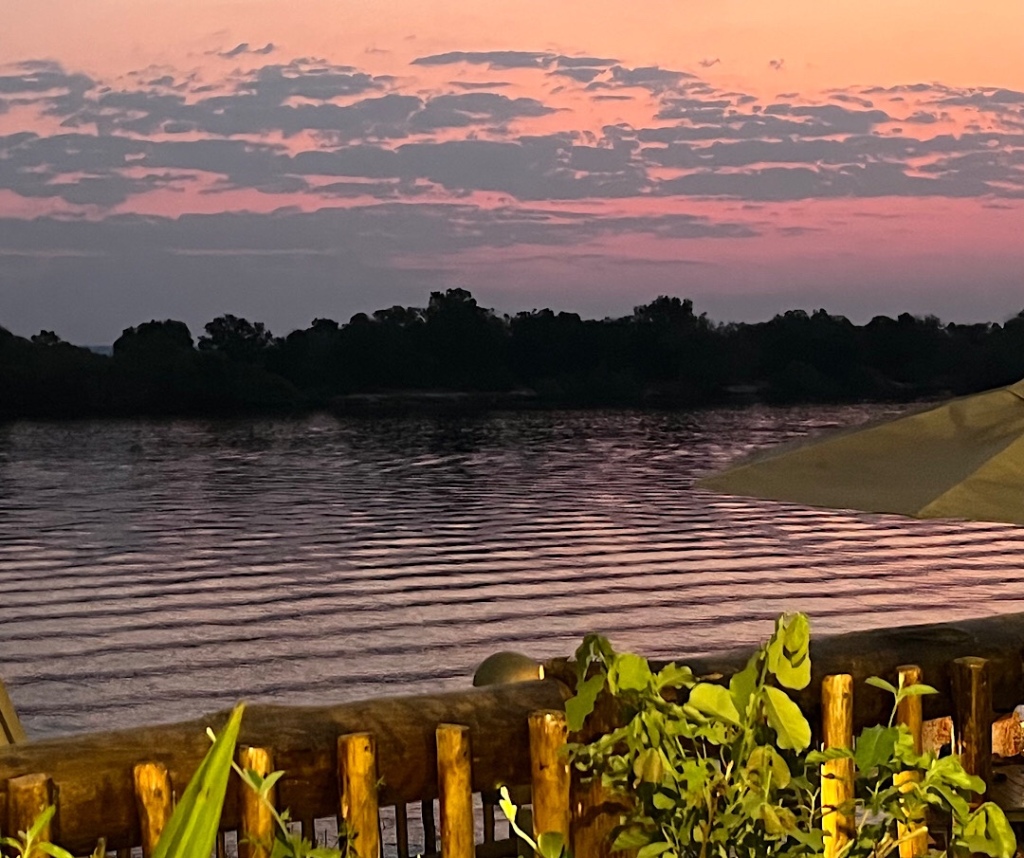
In the late afternoon of our full day at the lodge, we boarded a sunset cruise on the river.
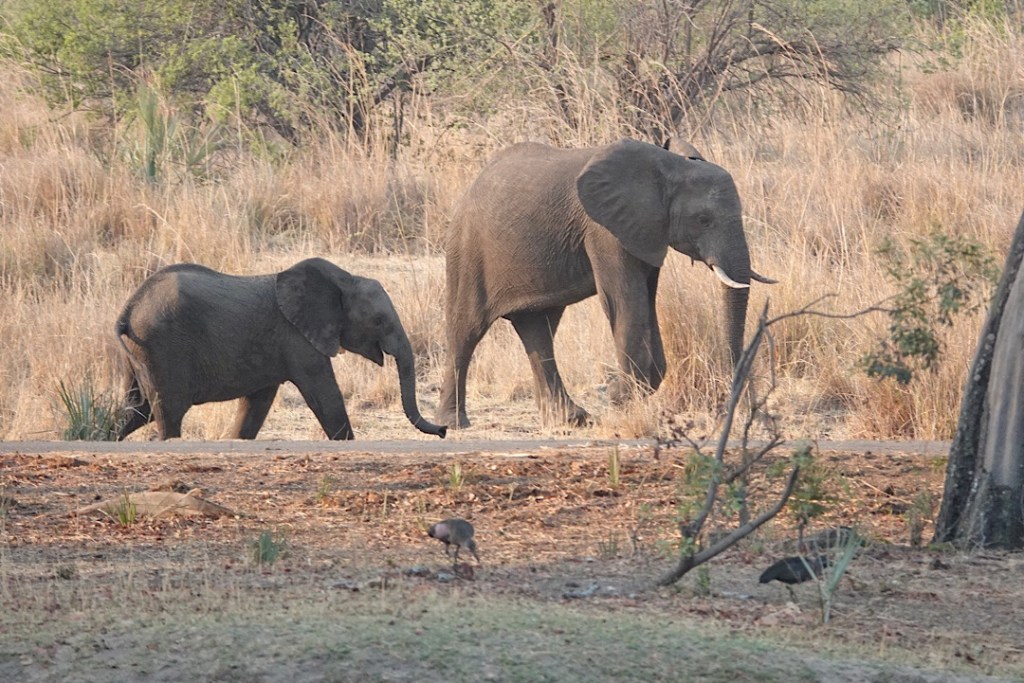
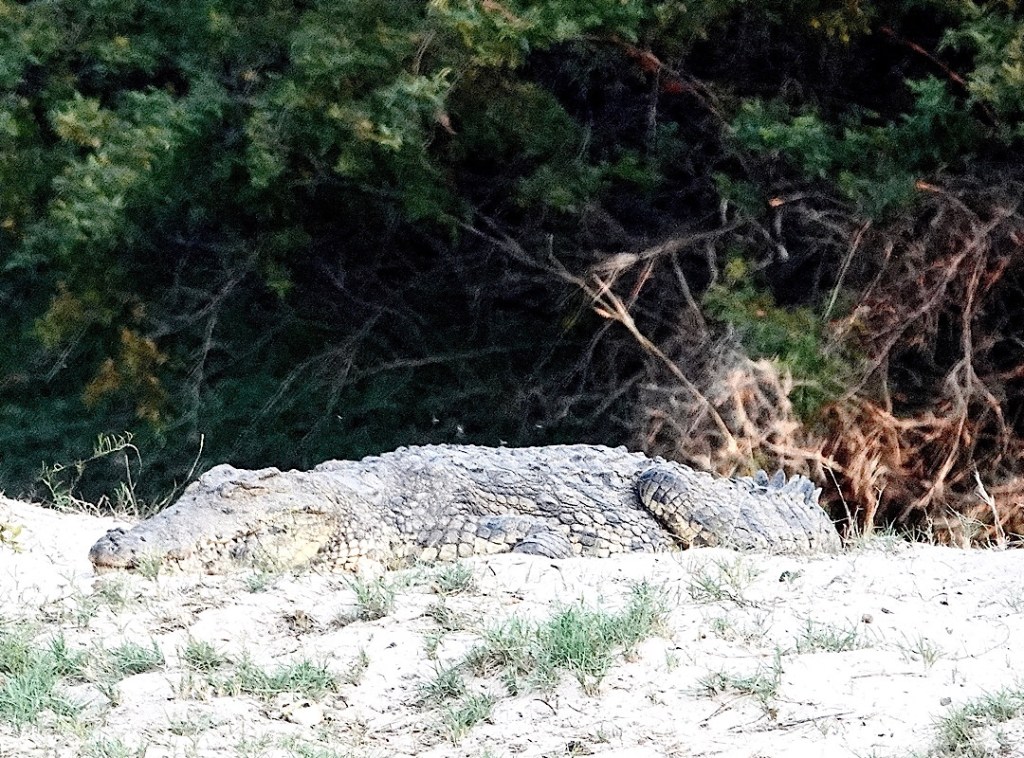
Along with drinks and hot hors d’oeuvres, it served up views of animals strolling or snoozing on the banks:
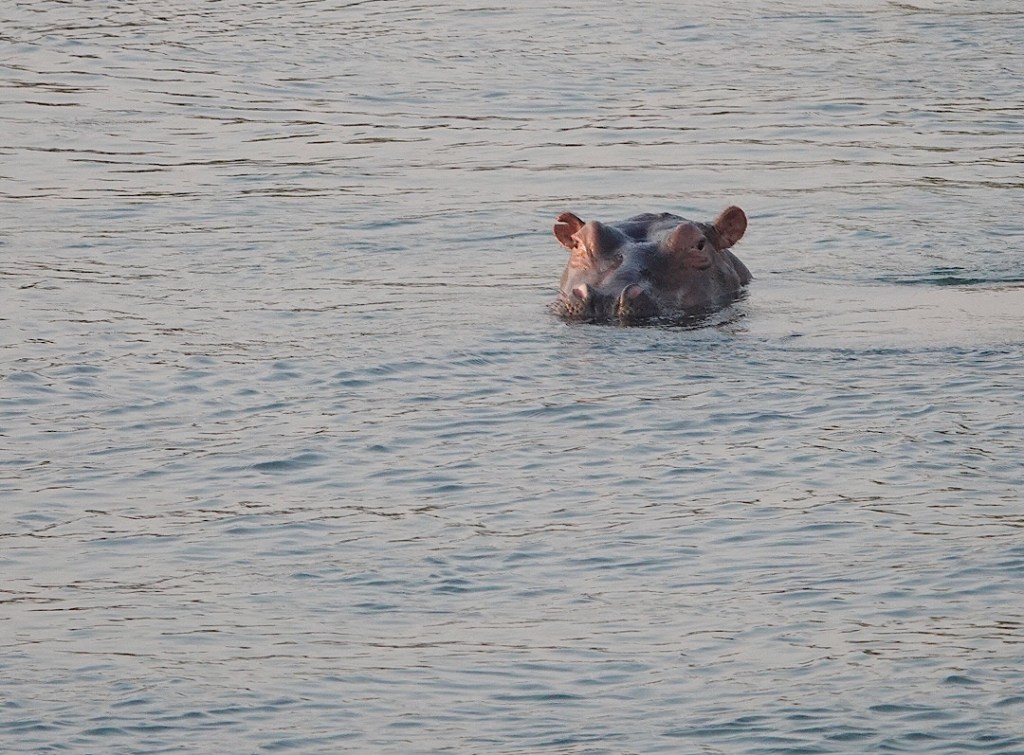
…as well as our first hippo of the trip…
In his or her element!
…and some startling views of an elephant orgy featuring both sex…
…and snuggles.
Then it was time to pack up, say goodbye to ZImbabwe and Zambia and head off on the last phase of this trip: South Africa, Lesotho, and eSwatini.
Years ago when I was working as a journalist, I met a remarkable character named Bill Wheeler. Bill had abandoned his career as a San Diego anesthesiologist to devote his life to adventuring, mainly in Africa. He documented his travels using his prodigious photographic talents. In one interview, Bill recounted how he had spent his very first night on the continent: driving to a game park, getting out of his vehicle, and pitching a tent. He was terrified of being eaten alive, but all he could do was to take a couple aspirins, the strongest pain relievers he had with him.
I remember laughing and laughing at the thought of pitching a tent in an African game park. I couldn’t conceive of it. Now I know what it’s like, firsthand.
Steve and I self-drove and camped for a couple of nights because it made Zimbabwe affordable and accessible and because Ant Bown (of Manapools.com) convinced me we could do it safely. We did NOT do it because we love camping so much. Steve was a Boy Scout in his youth, and over the course of our long marriage, we’ve camped on a number of occasions. Still, given a choice between a cozy lodge and a sleeping bag on the ground, I’ll usually pick the indoor snooze every time.
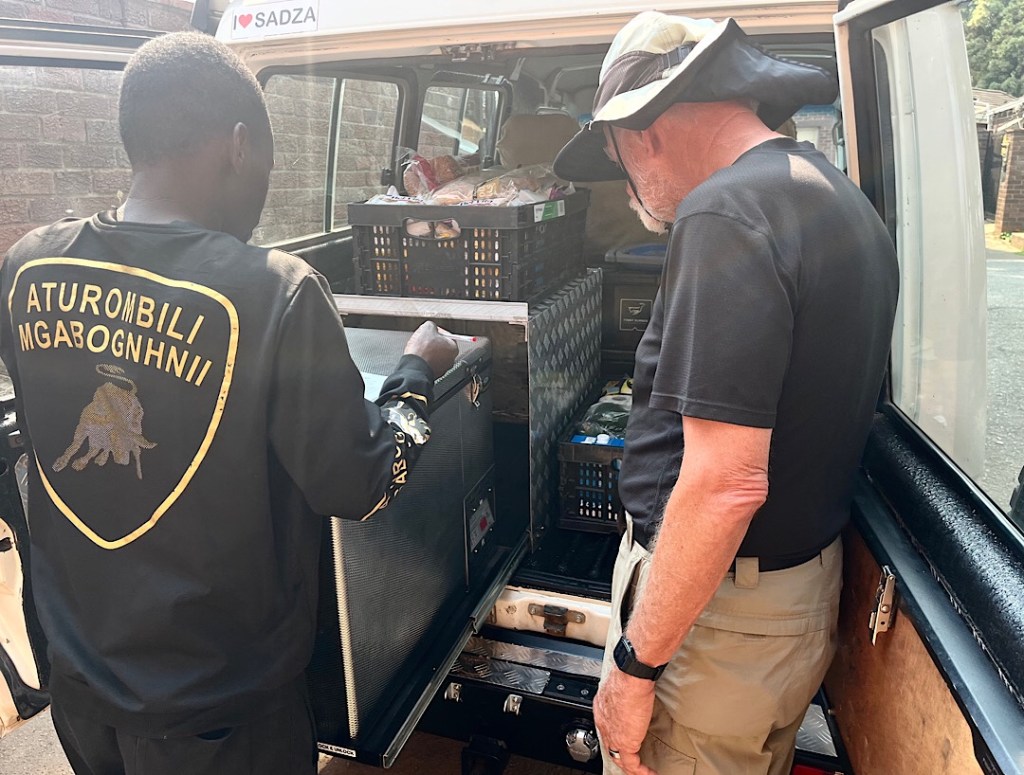
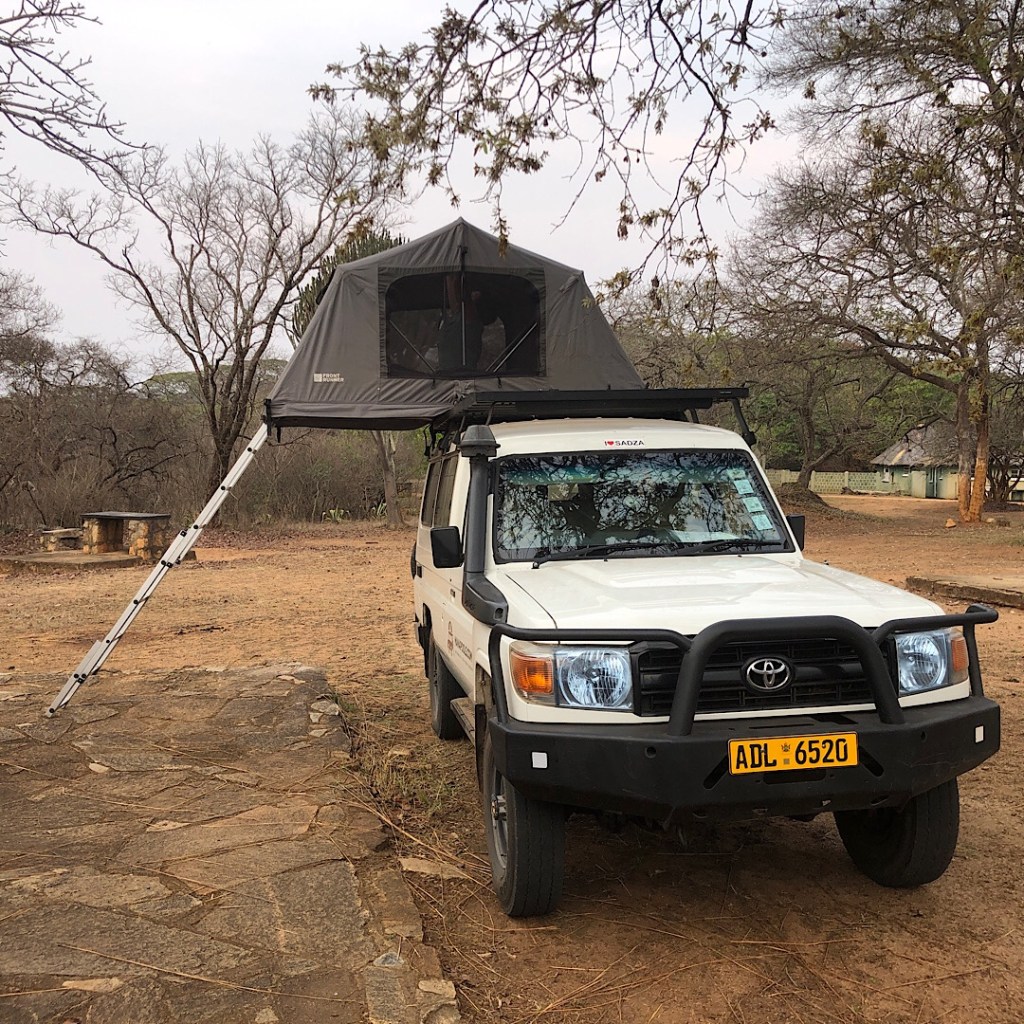
To say I was nervous about the camping portions of our Zimbabwe program is an understatement. Yet when we finally reached Ant’s base in Harare and had our 90-minute introduction to our vehicle, I felt exhilarated by the ingenuity of the Land Cruiser’s outfitting. It had AC and a two-person tent affixed to the rooftop. A sturdy freezer held the frozen meals and other supplies we had pre-ordered.
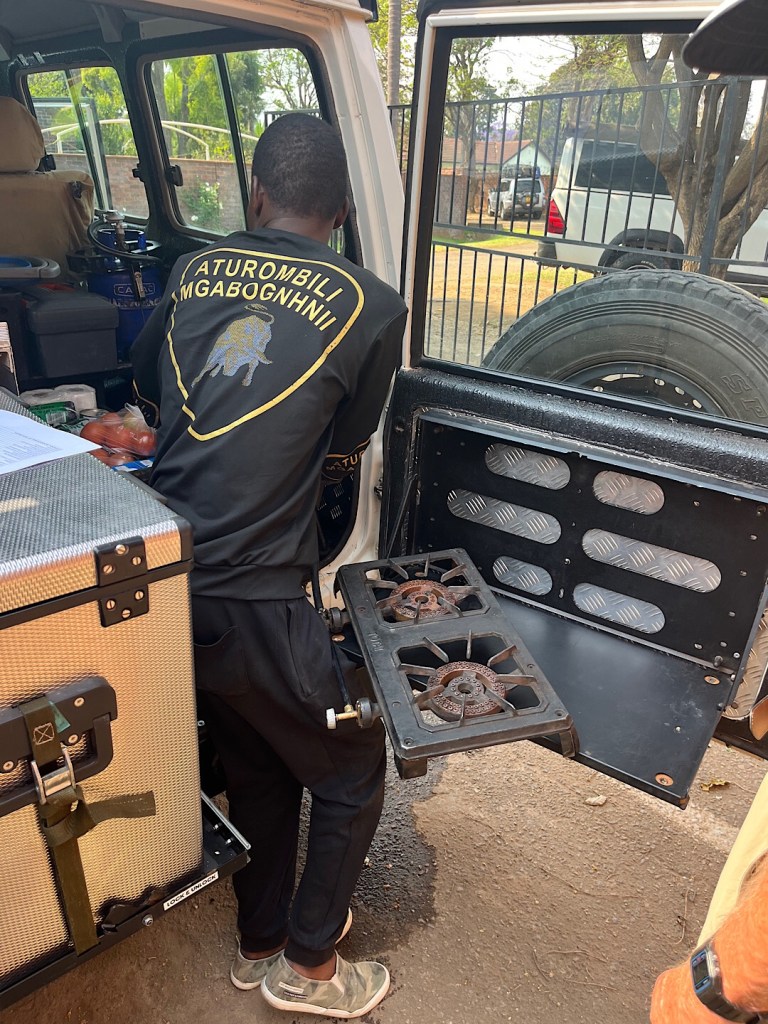
We could heat our meals and water for coffee on a cute little cooktop…
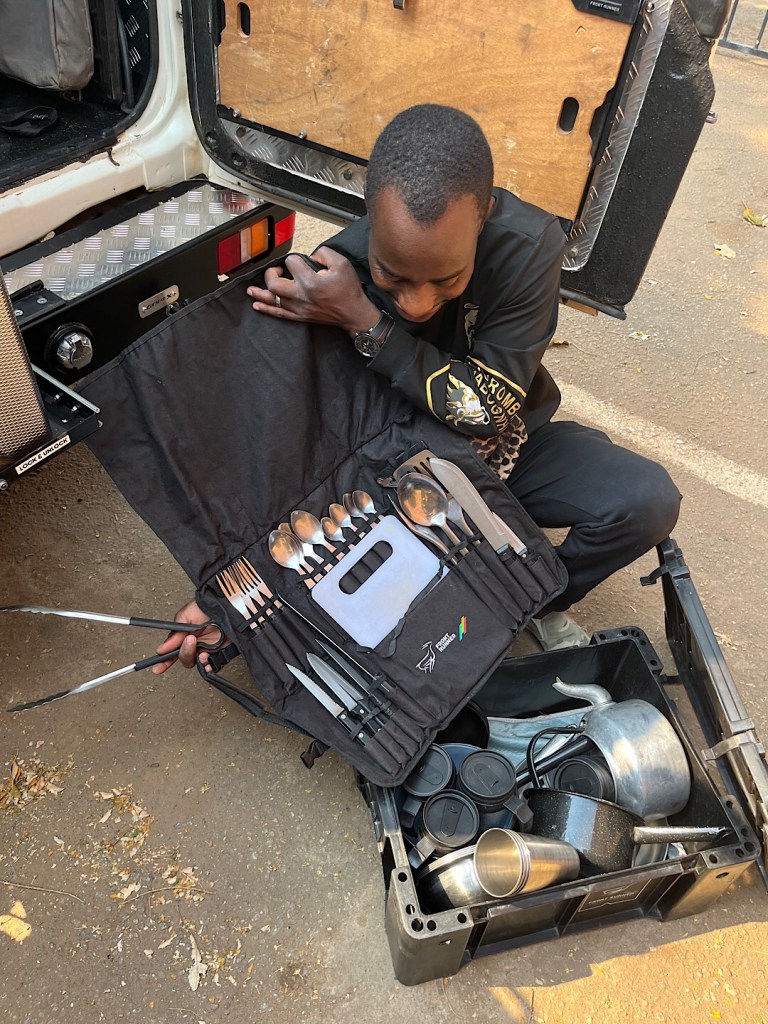
…using a compact armamentarium of kitchen tools.
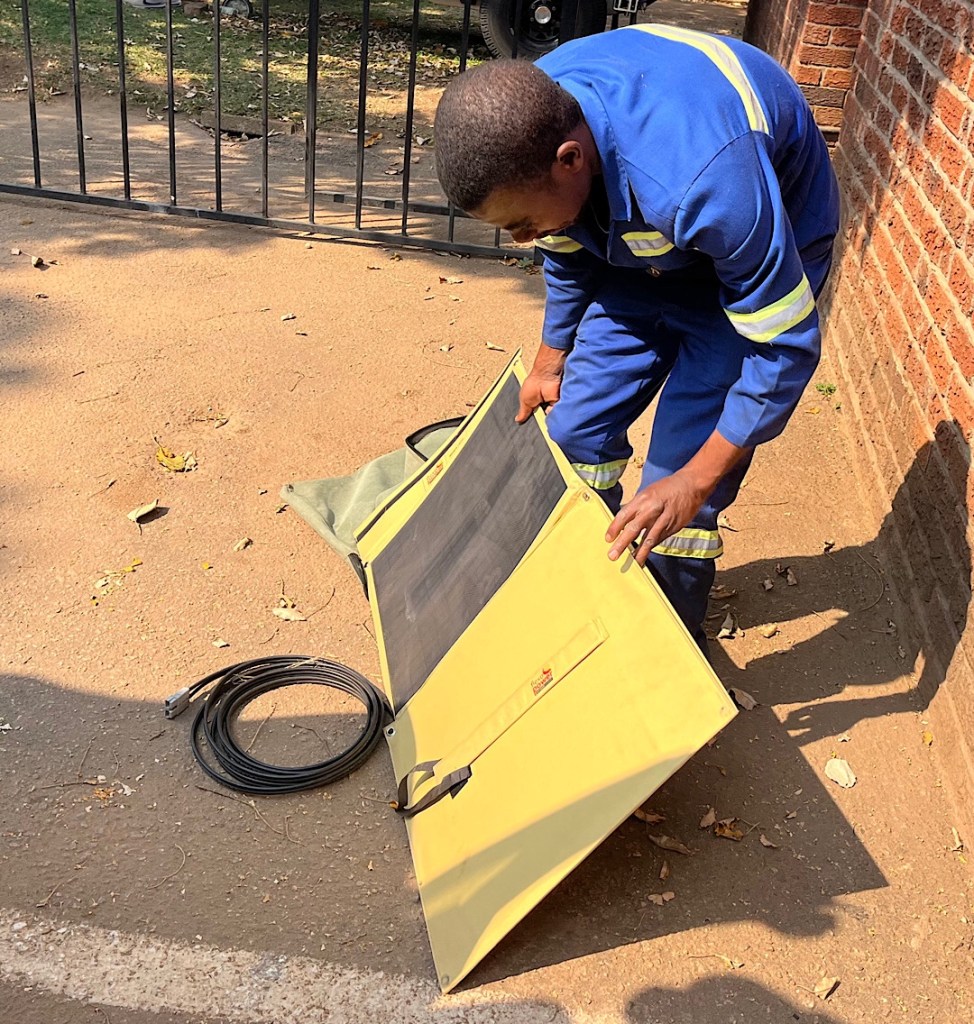
We’d be able to recharge our battery with solar panels, if necessary.
In such a rig, I could see how we might actually be comfortable.
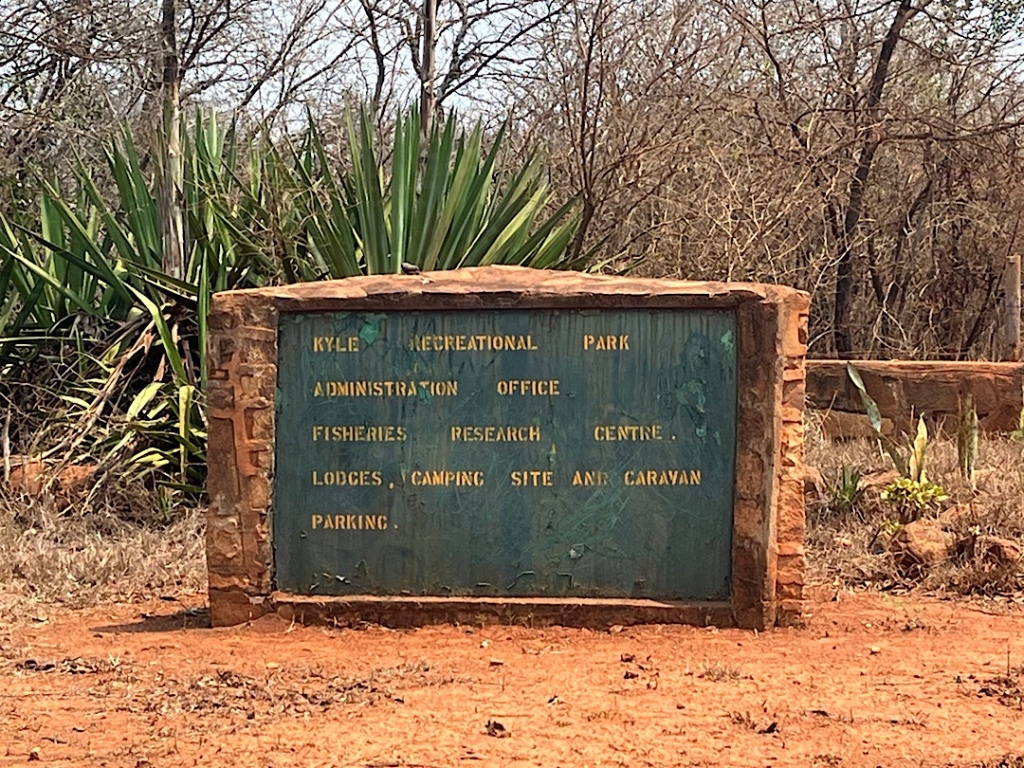
We had four nights of cottage stays (first in the eastern highlands and then in the Save Valley Conservancy) before our first taste of tent life. By then, Steve had become convinced he didn’t want to sleep on the Cruiser’s roof but instead would use the ground tent with which we also were supplied. Our destination was the Lake Kyle Recreational Park, not far from the Great Zimbabwe archeological site (one of our top sightseeing goals.)
A commanding but friendly official at the park’s front gate toted up our fees — $29 for the park entrance and campsite. We also opted to pay an extra $50 a person to go on a 4 pm “rhino walk” with a ranger guide. The entrance official told us how to get to the campground, and he said we could pick any site; we’d be the only folks there. Since we had time, we decided to set up our tents so we wouldn’t have to do that after the game walk.
Nothing disastrous happened during the set-up, but it reminded me of the contrast between staying in a hotel and erecting a ground tent. Hotel: you sign the register, maybe show your passport, then you can walk in your room and flop down for a nap. Tent: you have to haul out the cumbersome tent bag out of the Cruiser, find and roll out the ground cloth. Unpack the tent. Stake down its corners, find the poles, fit them together, get them to stand up so you can clip the tent body to the framework, pound in more stakes. It’s a pain!
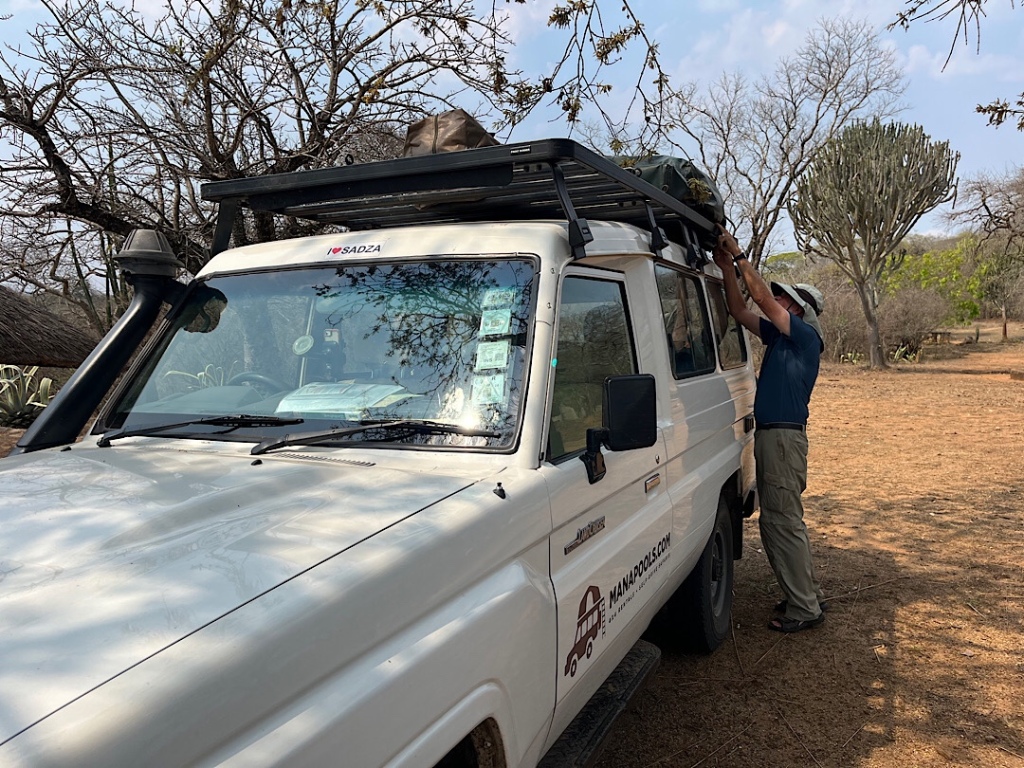
Opening up the roof tent presented different challenges. You had to start by wrestling off its straps and cover, very tough to do since it was so high and we had nothing to stand on.
Here’s a view of Steve struggling to do it.
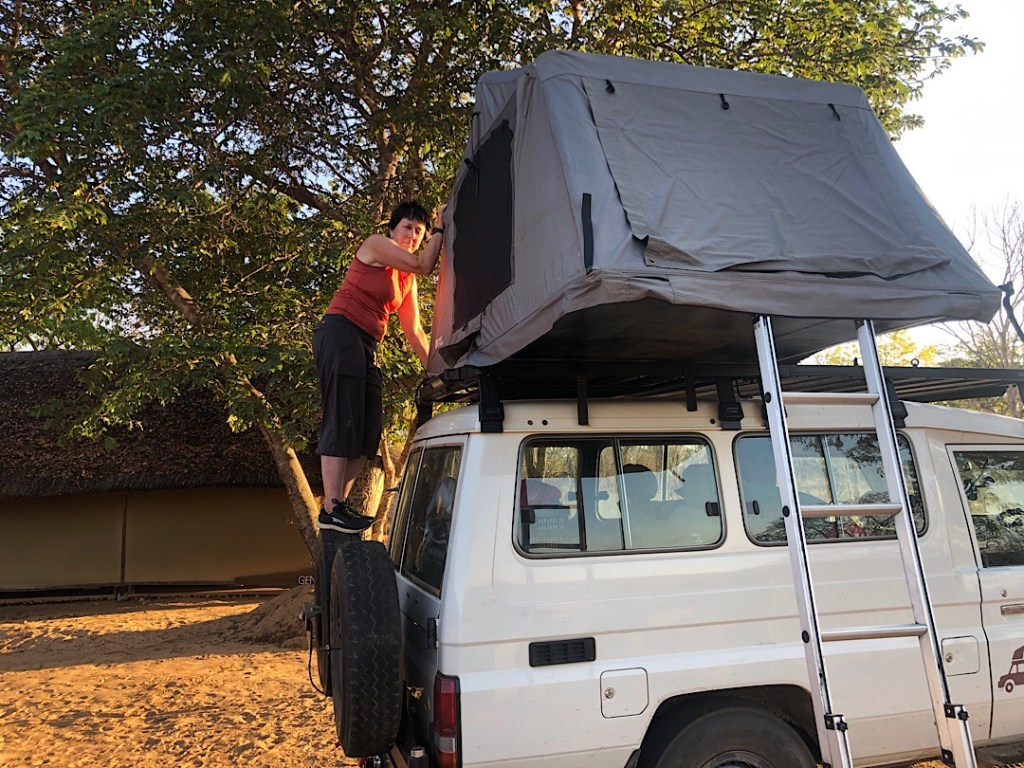
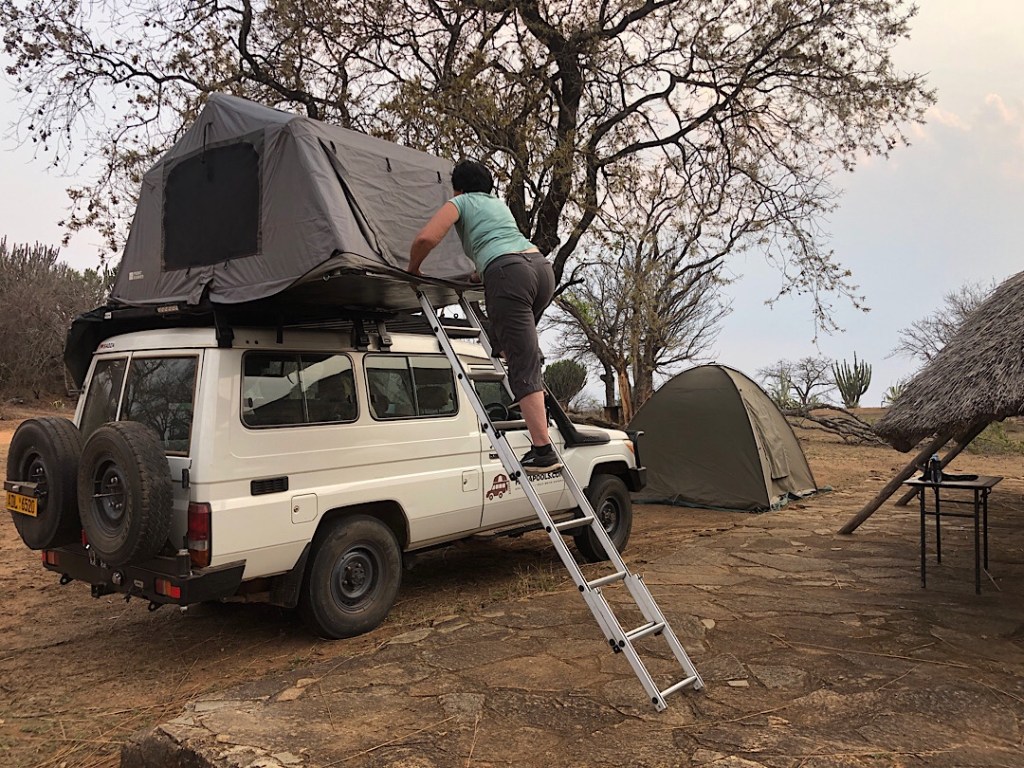
Once it was uncovered, one of us had to get up on the tires to extend the ladder.
Eventually I learned to scramble up there.
The other person then used the roof tent ladder as a lever to pop the structure open.
Ta-dah!!!
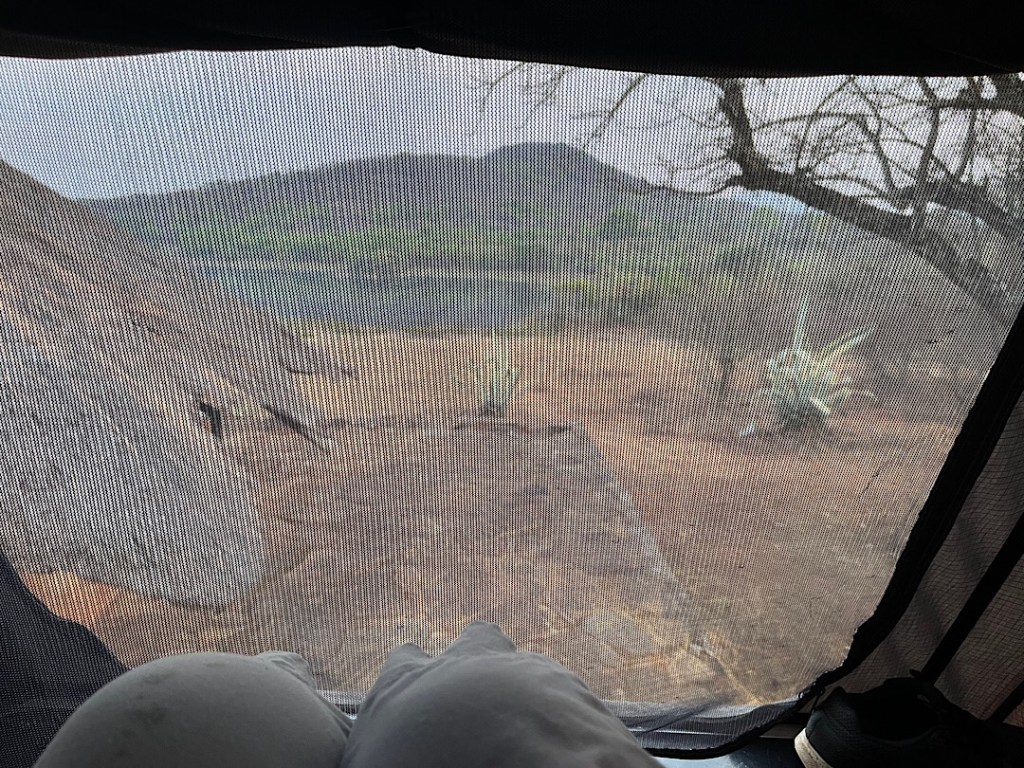
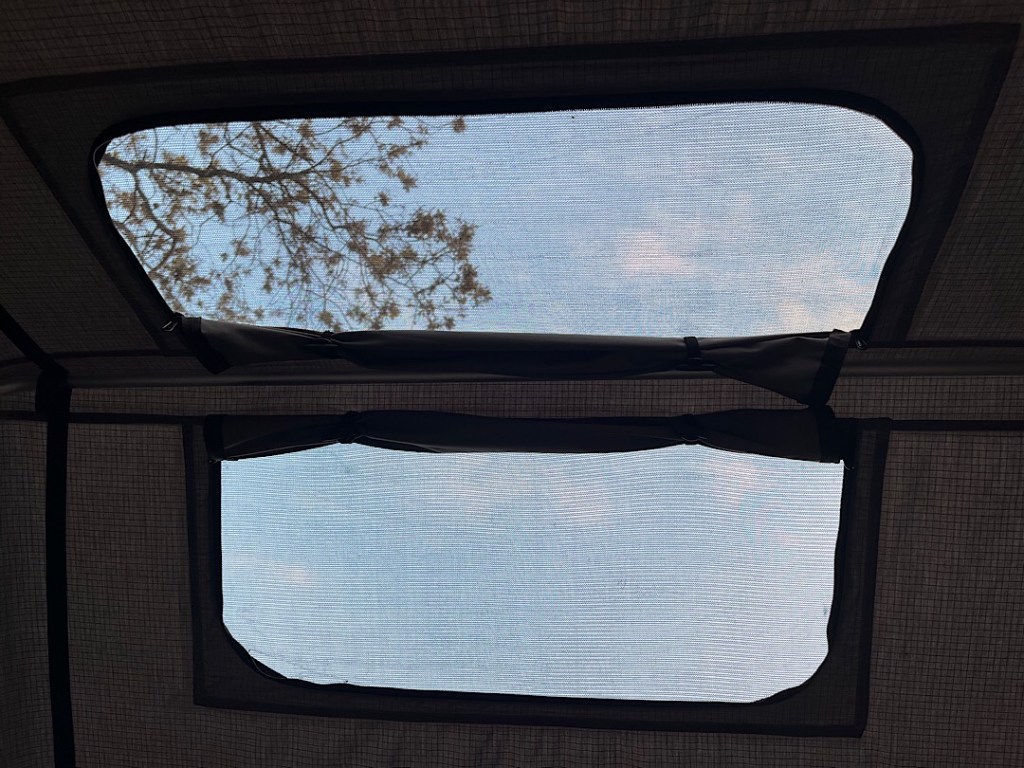
When I climbed up and into it, it felt solid enough, and unzippering the windows covers yielded some cool views.
There’s Lake Kyle.I particularly appreciated being able to see the sky.
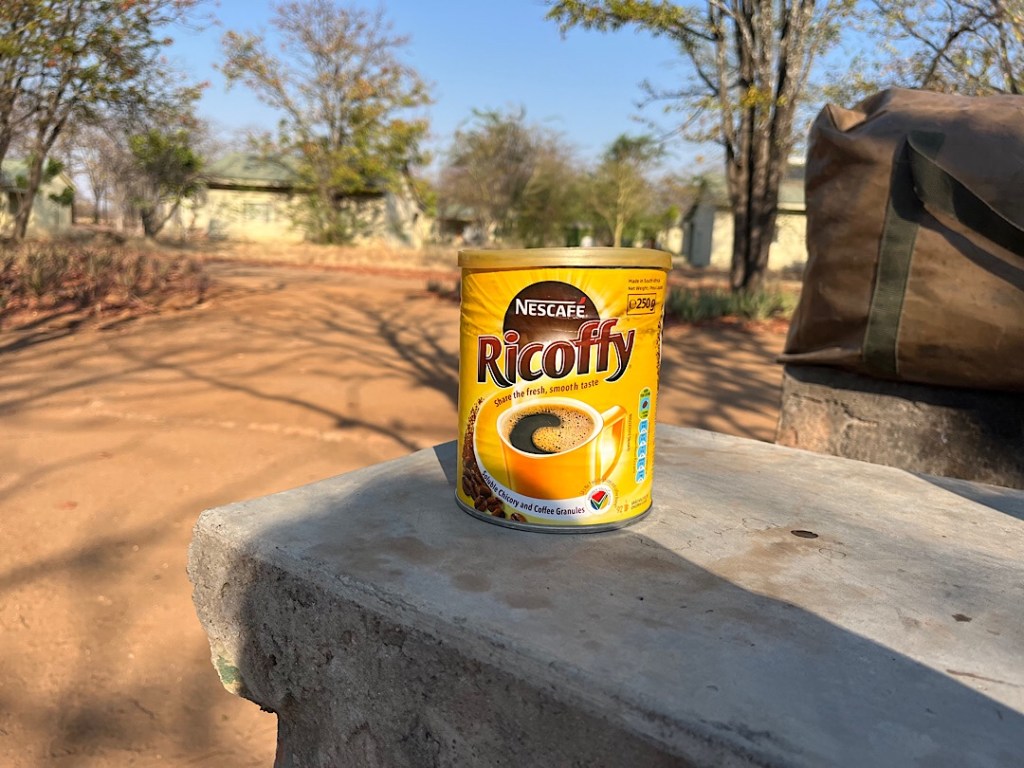
Later I would have to get my gear up and into it (including the instant-coffee canister I’d bought in Harare to serve as a chamber pot. No way was I planning to climb down that ladder and toddle off to the “ablutions” in the dark.)
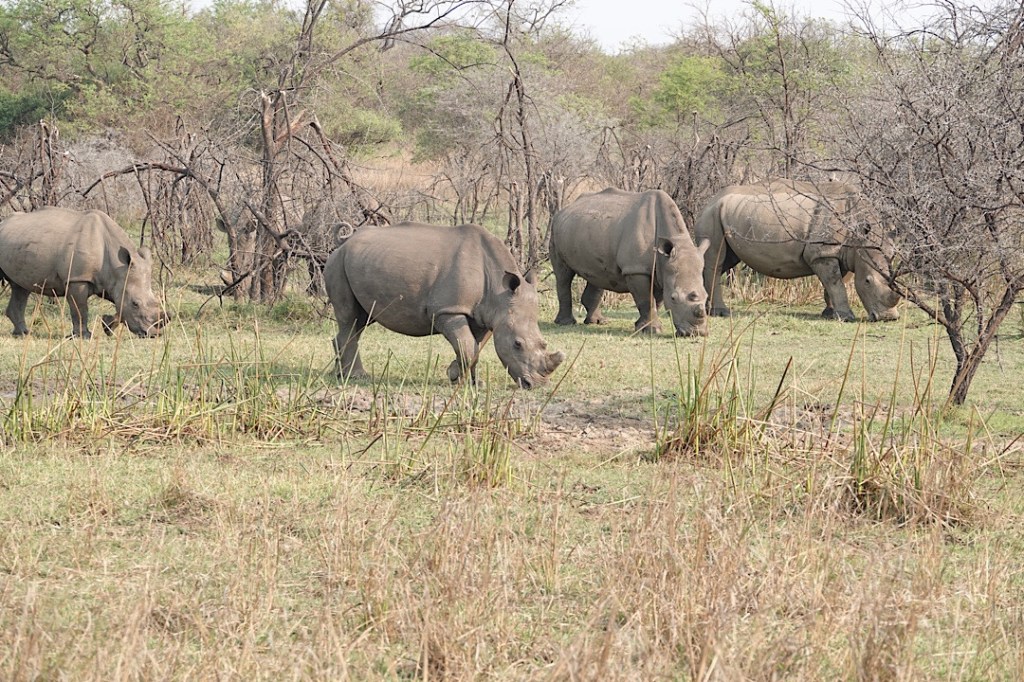
After this setup, we had a splendid rhino walk with a gun-toting ranger who led us straight to two large groups of the massive herbivores.
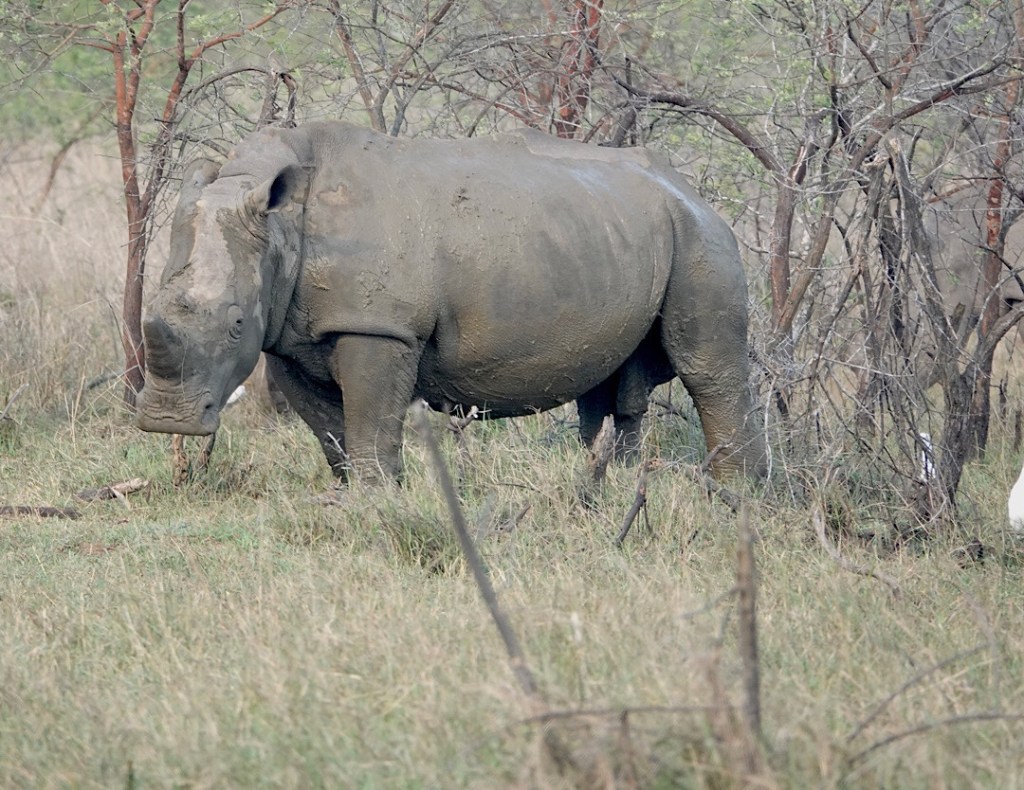
Shot with my long lens, these white rhino look closer than we actually got to them — but not by much.Although our guide said most white rhino were pretty chill, he didn’t like the stare we were getting from this big male. So we moved on.
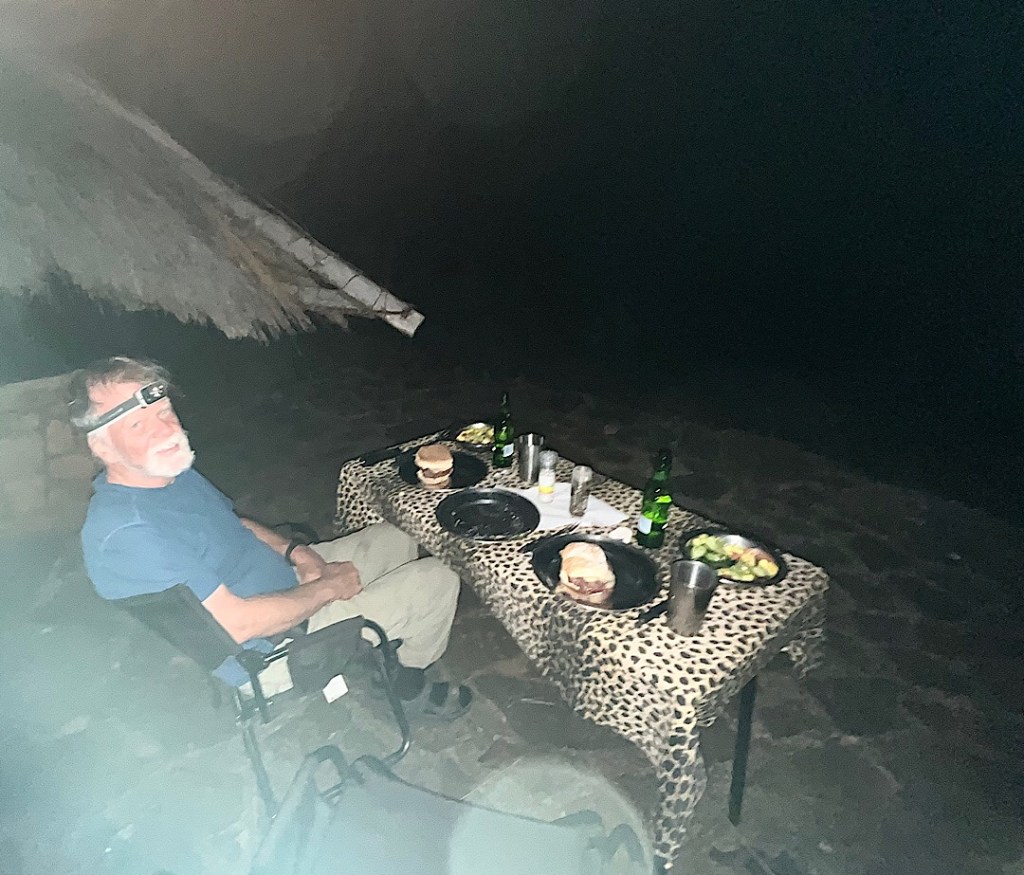
Back at our campsite, Steve and I made dinner, which included grilled burgers, a nice salad, and brownies washed down with cold milk.
I thought the table cloth, supplied by Ant, was a nice touch.
Both of us went to bed early, slept well, and woke at 5:30 to pack everything up and put it all away. Because we were clumsy, almost 3 hours passed before we cranked up the Cruiser and hit the road. I felt grubbier than I had in memory, but we were otherwise fine.
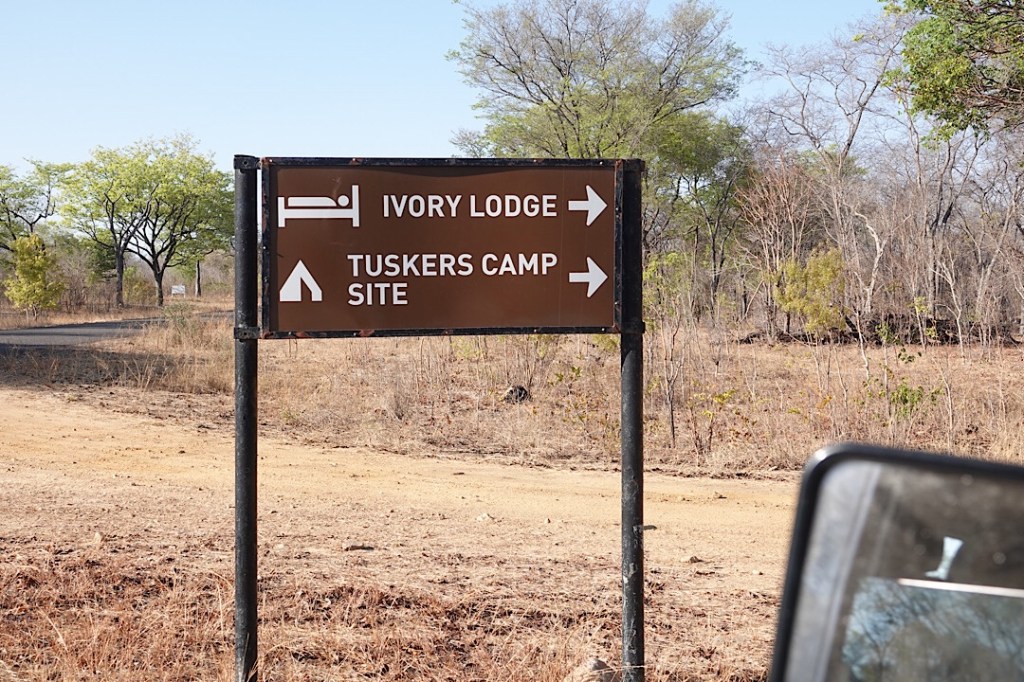
We stayed in hotels for the next four nights. Our final two nights of camping came in Hwange National Park, one of the biggest game preserves in all of Africa. Ant had booked us into two separate sites, and they couldn’t have been more different from each other. The first, Tusker’s Camp, is located in a forested area just outside the east side of the park.
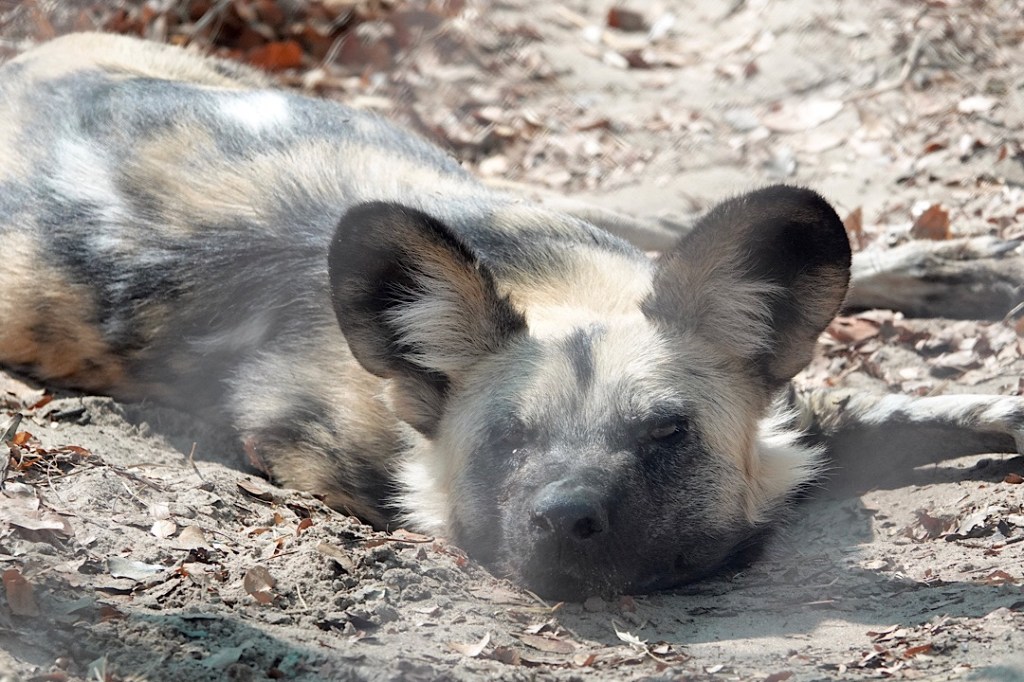
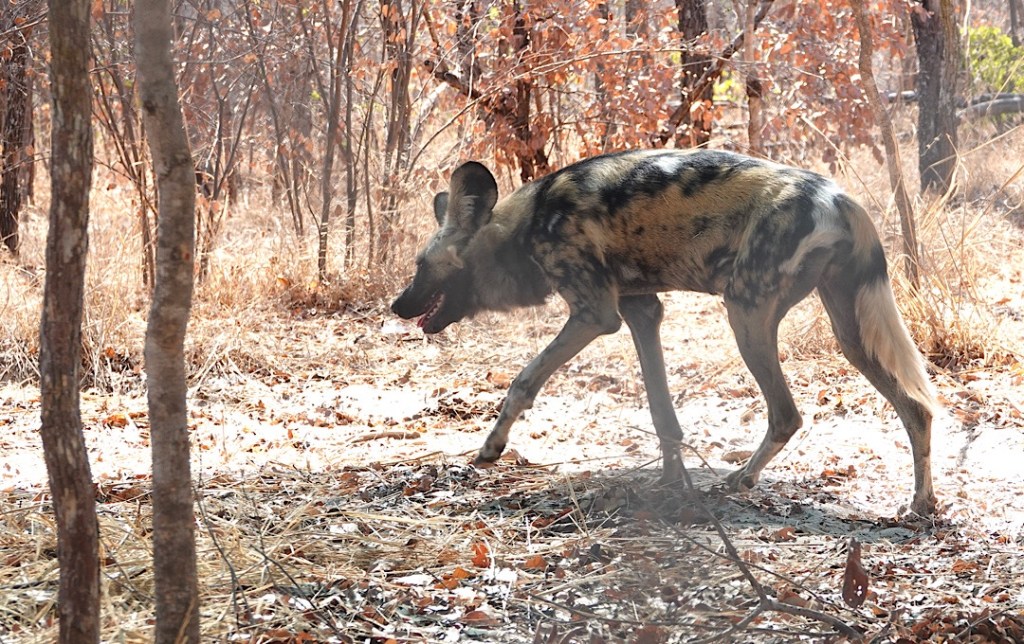
It’s not far from the property occupied by the Painted Dog Conservation group, a non-profit devoted to helping this highly endangered predator (not a dog at all, although they look like they could be relatives.) We spent almost an hour learning about them and visiting the only current occupant of the rehab facility.
After being attacked by a lion, Lucky (as she was named) was treated at the center. But she still limps too badly to return to the wild. So she’s a permanent resident.
We then found the park administration office, booked a 7 am game walk for the next morning, and made our way down some truly awful roads to find Tusker’s.
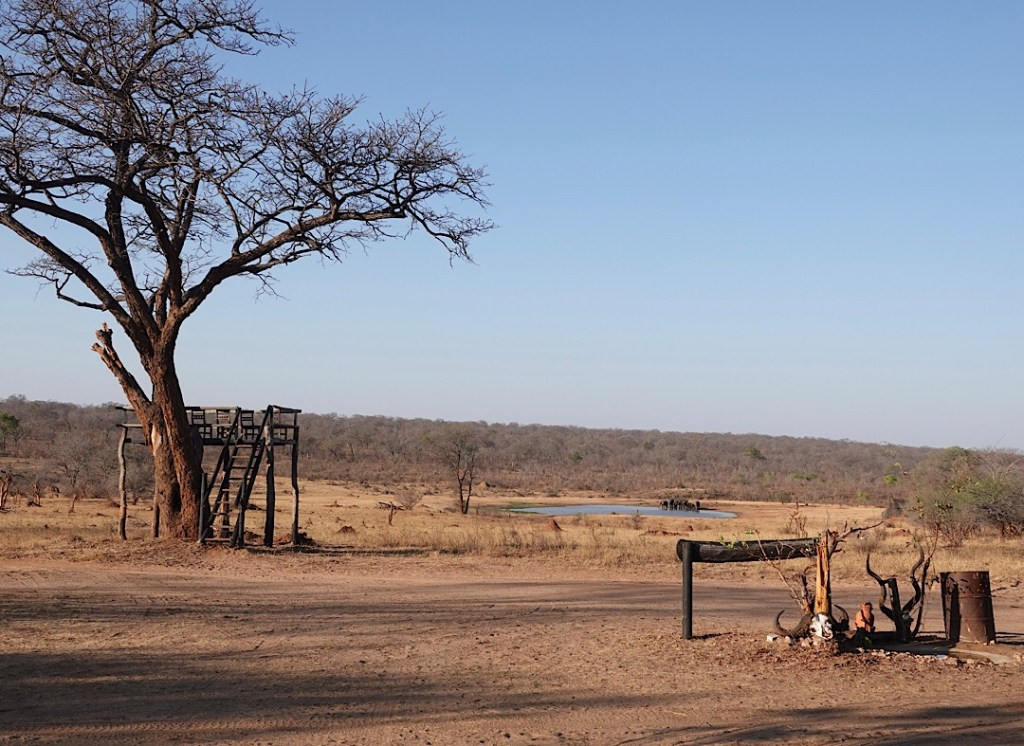
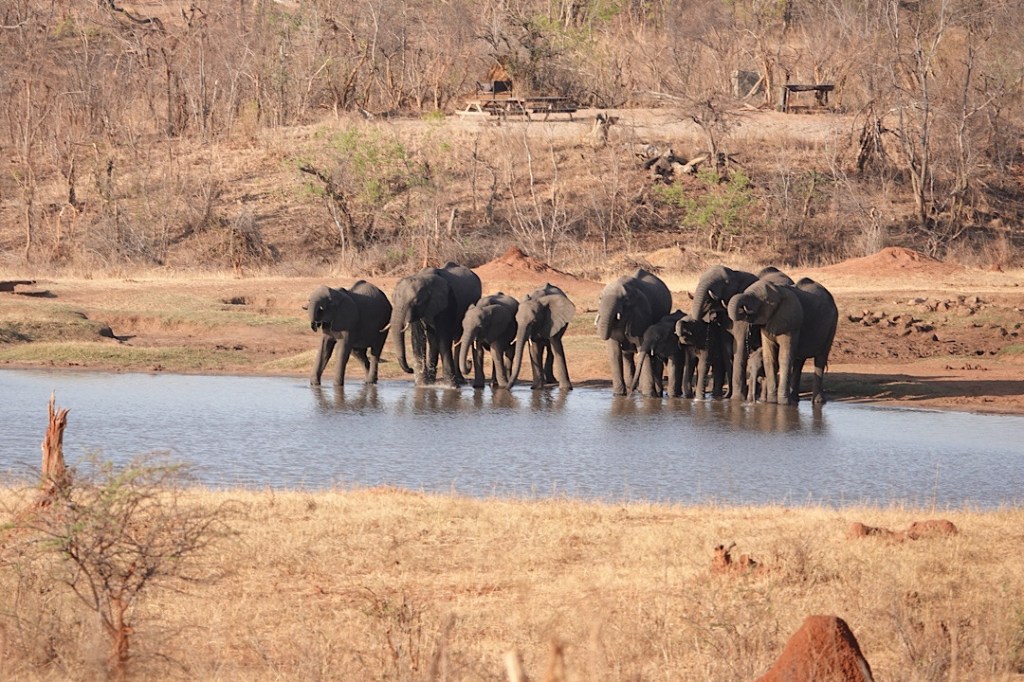
We never glimpsed the fancy Ivory Lodge that Tusker’s adjoins. Our home for the night was an unfenced piece of land overlooking a distant water hole lined with elephants.
That black clump at the water’s elephant consists of elephants…They looked like this through my telephoto lens.
A solitary, laconic attendant named Reginald showed us the amenities — a clean bathroom close at hand; a pleasant dining platform. I asked if any dangerous animals were likely to put in an appearance, and he replied that they usually didn’t come to where we’d parked but tended to stay in the brushy area maybe 50 yards away. Reginald then chopped some wood, built a fire, and disappeared. We never saw him or any other human again during our stay.
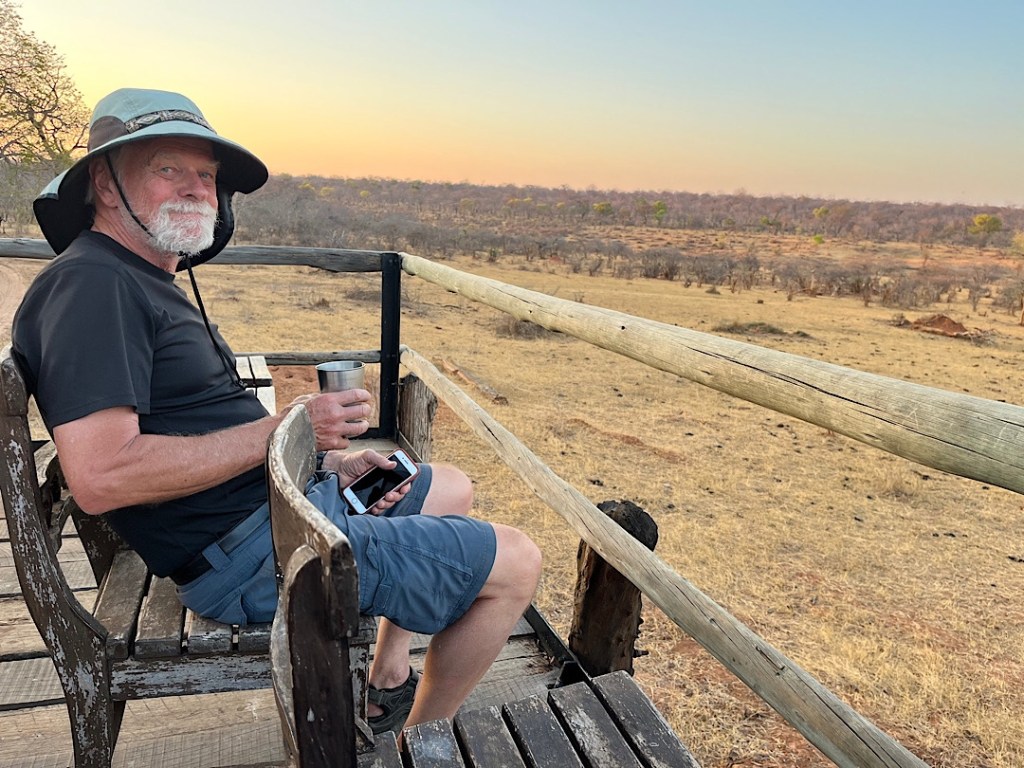
Some parts of the hours that followed were sublime. We set up the tents more efficiently than we had done at Kyle Lake. Steve made gin and tonics, which we carried up the viewing platform.
As the sun set, we sipped our cocktails and took in the action around the water hole. The elephants had tanked up and moved on, but dozens of baboons dashed in to get a drink, then retreated back into the woods. With the light fading, we dined on excellent beef stew (the last of our pre-ordered meals), and by 9 I had climbed up the stairs to my sleeping perch. Within 5 minutes, I was dreaming.
I awake with a jolt shortly after midnight to the sound of footsteps and soft rumbles below. Peering out my windows, I couldn’t see what was moving, but it felt very close. “Steve!” I hissed. “Do you hear that?”
“Mrmph,” I recognized Steve awakening. A moment later came the unmistakable sound of a big feline, growling.
“Oh my,” Steve said.
“Do you want to come up here?” My voice was pitched at least an octave higher than normal.
“No,” he said. “Go to sleep.”
But how could I? Given what Reginald had said, I didn’t really think the lion or leopard would make it up to the Cruiser’s roof to rip my tent apart. I was less sure about Steve’s fate, and more than anything, I felt flooded with adrenaline, on full alert.
We didn’t hear the big cat growl again, but for the next two hours, a wild panoply of noises surrounded the Cruiser: snorts and chuffles and lots of footsteps. They would disappear for a few minutes, then some new creepy noise would make me sit bolt upright. At one point, I heard the loud improbable whisper of rain. Outside it was still dry as a bone, and I realized I was hearing the shish, shish, shishing of what sounded like a large group of heavy-footed animals moving through the nearby stand of brush and trees. Elephants? Buffalo? I think it had to be one or the other, but I couldn’t see well enough to confirm that.
And then the noises all stopped. The animal party broke up. When I woke up around 5, my fitness device showed that I had finally gone back to sleep a little before 3. Comparing our sleep scores later that morning, mine was 66, “Fair,” according to my Oura ring. Steve, in contrast, snoozed for almost 7 and a half hours, bagging him an “Optimal” sleep score of 88 (one of his best for the trip.)
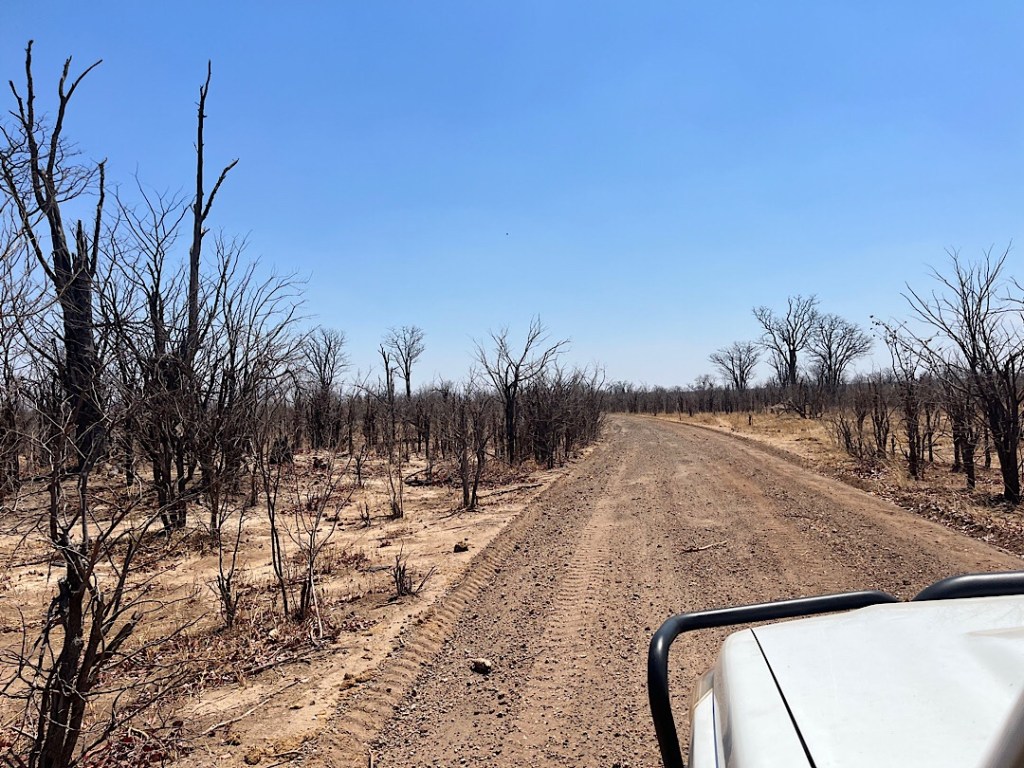
Somehow I got through our busy slate of activities for Friday. We packed up our stuff faster (practice does help) then went on yet another great walk with a sweet and patient ranger. We slogged over some of the worst roads of the trip to cross a blackened section of the national park that verges on the Kalahari Desert.
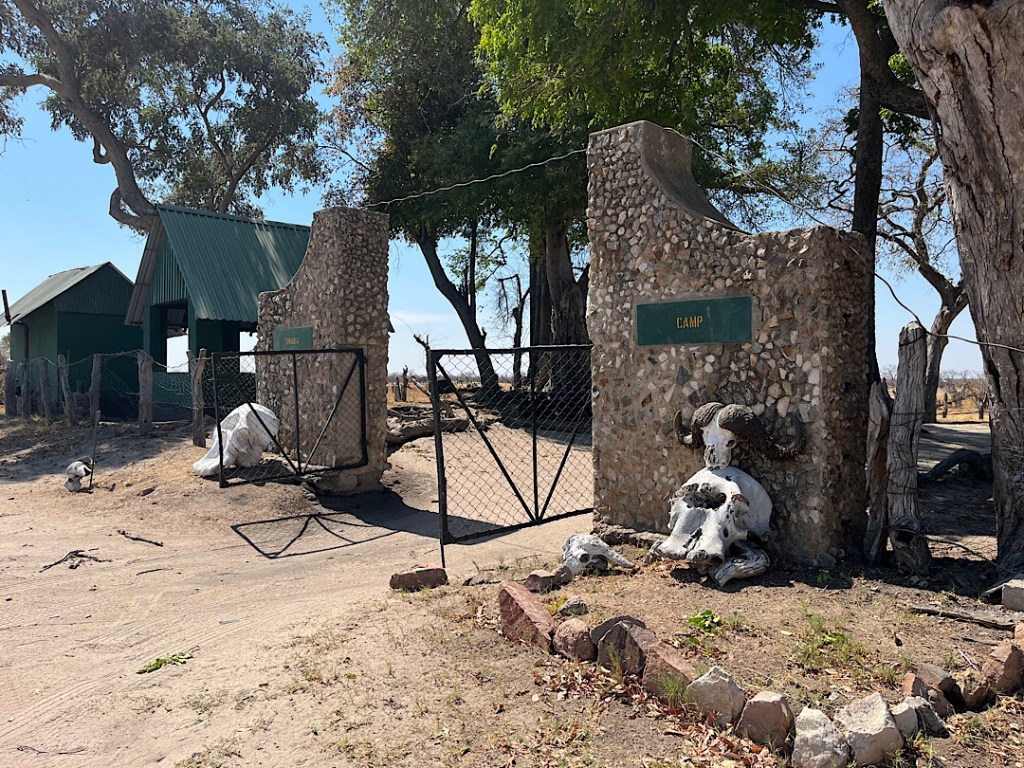
The ravaged landscape was so grim, we began to wonder if we would find any place to stop and eat our lunches. But we continued to spot bunches of elephants, including a large group near a place on the map labeled Shumba. The entry gates looked almost Gothic.
But a large tree provided welcome shade.
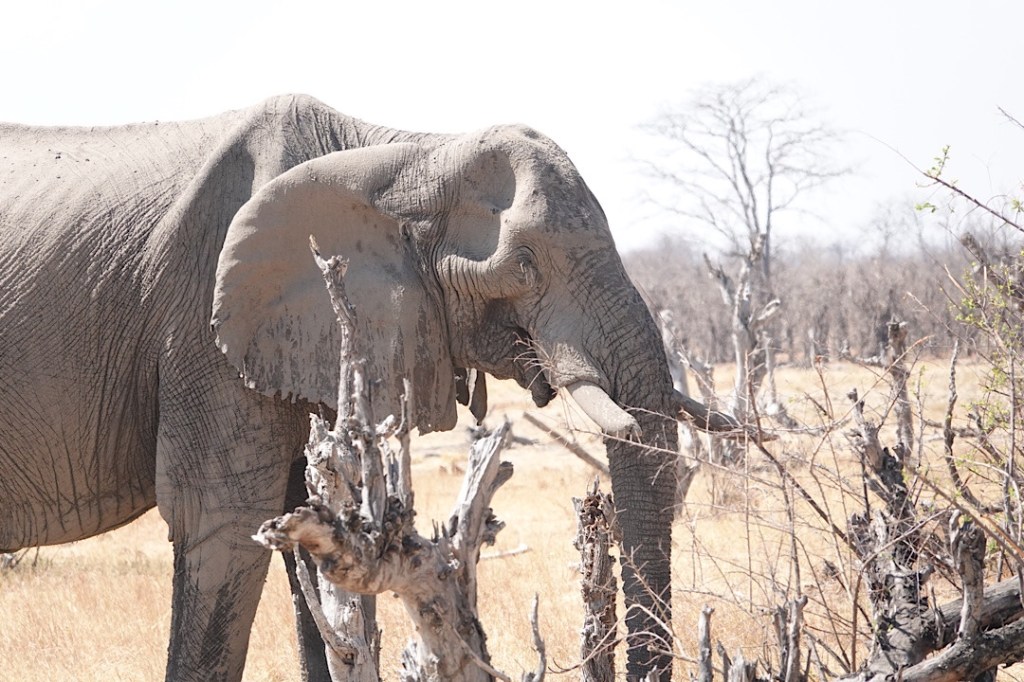
One old female elephant made her way from the herd to near us. Steve and I argued for days over whether she was checking us out (my theory) or just hoping for a spare banana (Steve’s.)
Robin’s Camp was our final campsite. When we reached it, we concurred it was nicer than many campgrounds we’ve visited in America. Like Tusker’s, Robin’s abuts a lovely lodge equipped with an inviting swimming pool we could have used, had we more time, but again we wanted to get the tents up before the sun set. Unlike Tusker’s, the Robin’s campground was fenced, and two of the other campsites were occupied by tourists. Inside the spotless lavatories, overhead rain-shower heads provided abundant hot water. Our spot had a picnic table, a grill, even electrical outlets for charging up our devices. Once again we ate well and I was asleep before 8:30. This night I didn’t hear a sound other than the buzz of insects.
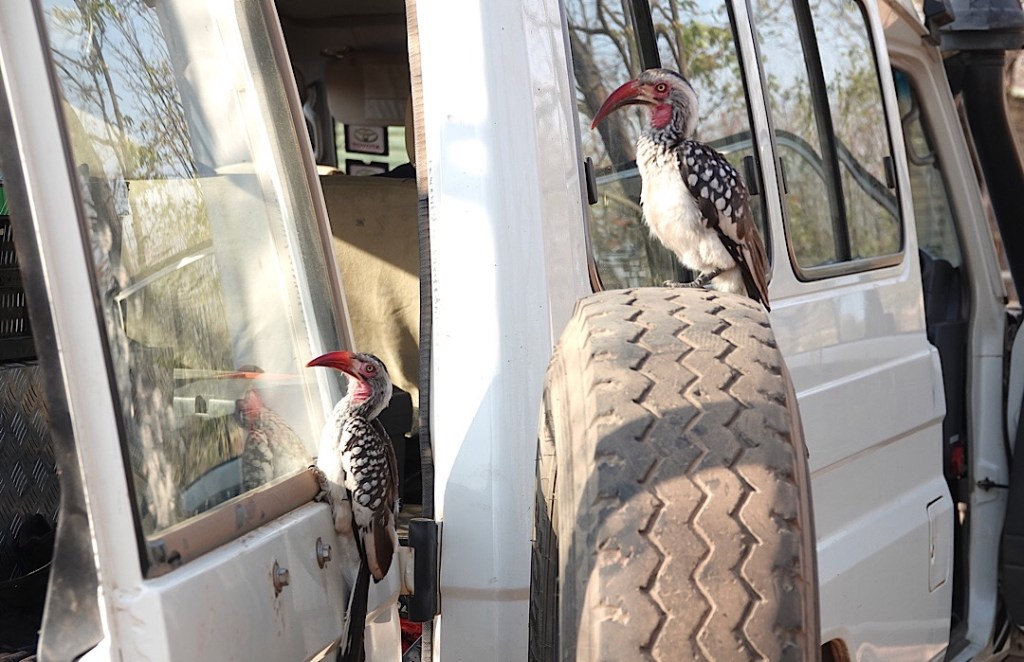
It almost felt mundane. But two final encounters transformed our stay into something extraordinary. While we were sipping our morning coffee, a pair of red-billed hornbills landed on our Cruiser’s doors and seemed amazed to see their reflections in the windows.
They acted fearless as they hung around, and when I tossed one of them seeds from my muesli, it gobbled them down.
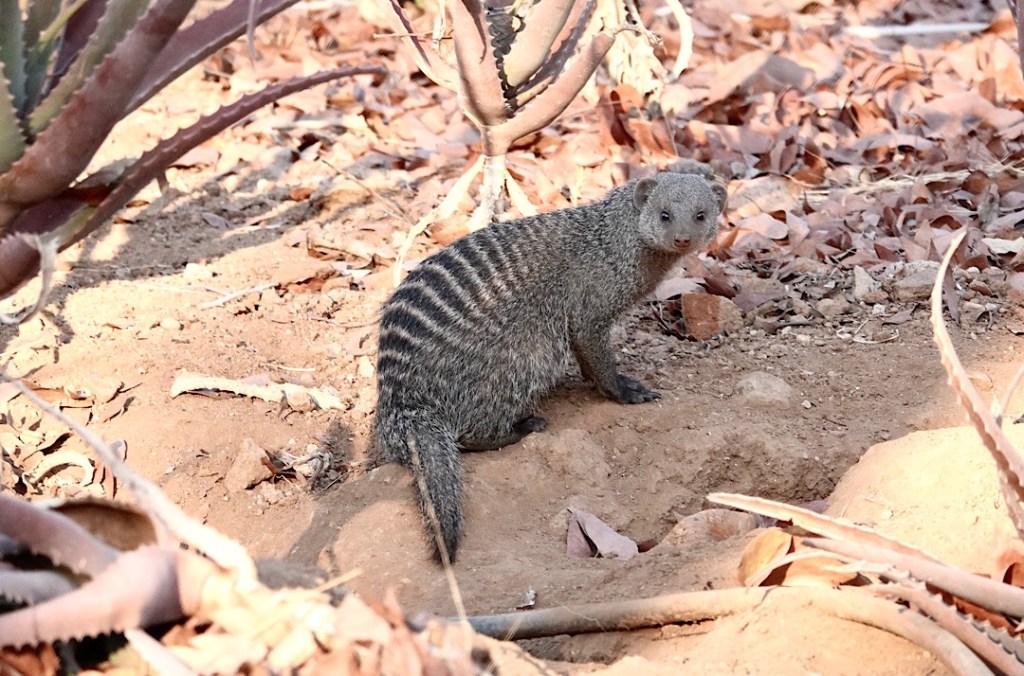
Around sunset on Friday evening, I also had noticed a large group of what looked at first like squirrels — maybe 20 or 30 animals — bolting toward us. They came very close and then tumbled into several holes so close I could have tossed a pebble into one of them. A couple of them stood up on their back feet, and I gasped.
“Are they Timons?” I wondered, thinking of the Lion King’s comic meerkat.
Steve knew better. He exclaimed that they were mongoose. “I’ve never seen one before!” He sounded awestruck. (He now insists they are his favorite of all the animals we have ever seen in Africa.)
They didn’t reappear again until around 7 the next morning (Saturday), when one or two popped up. They looked around, clearly cautious.
Our Zimbabwe guidebook later helped us identify them as banded mongoose.
Within a moment or two, chirping noises erupted. The animals seemed to be discussing whether the coast was clear. They reached some consensus, and the whole group spilled out again and streaked away, shockingly fast.
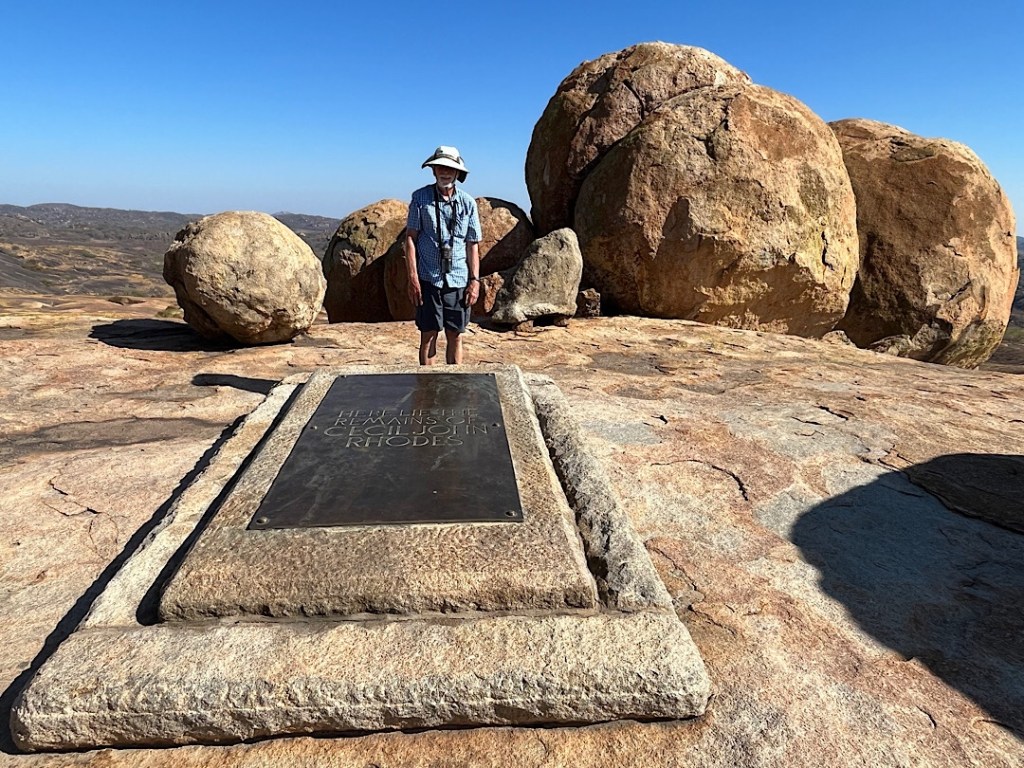
Last Tuesday as the afternoon sun lowered, Steve and I stood over the grave of Cecil Rhodes.
This guy, after whom the country of Zimbabwe once was named (Rhodesia), occupies one of the most dramatic final resting places I’ve ever seen.
I knew almost nothing about Rhodes before this trip, but now I can tell you: he was a ruthless, rapacious visionary. The son of an English minister, he was so sickly as a child, his family sent him as a teenager to Africa in the hope it would toughen him up. Once there, Rhodes heard about about the diamond action in Kimberly (in what’s now South Africa), moved there, and raised money (from the Rothchilds) to start buying up mine leases. He wound up essentially cornering the world diamond market and founded the De Beers Company (still a powerhouse in the diamond world.) He also resolved to build a rail line from Cape Town to Cairo through all the British possessions along the way. To do that, he needed to take the land ruled by the Ndebele king (basically today’s Zimbabwe and Zambia) and fill it with Englishmen, who would ride in comfort upon those Rhodesian rails.
Using lies, deception, and the muscle of the English crown, Rhodes succeeded so well that by the 1950s and 60s, white people held all the power in Rhodesia, and they transformed the place into something that warmed many Western hearts. At the same time, resentment among the natives built, and a vicious guerrilla war began in the 1970s. The insurgents triumphed in 1980, when the Brits relinquished their claim on the place, and the modern state of Zimbabwe was born. For most of the time since then, the black Zimbabwean elite, every bit as greedy as Rhodes, has done a pretty dreadful job of ruling. But personally, I can’t fault them any more than I blame Rhodes. He started the mess. I didn’t spit on his grave, but if anyone else had been there and done that, I wouldn’t have objected.
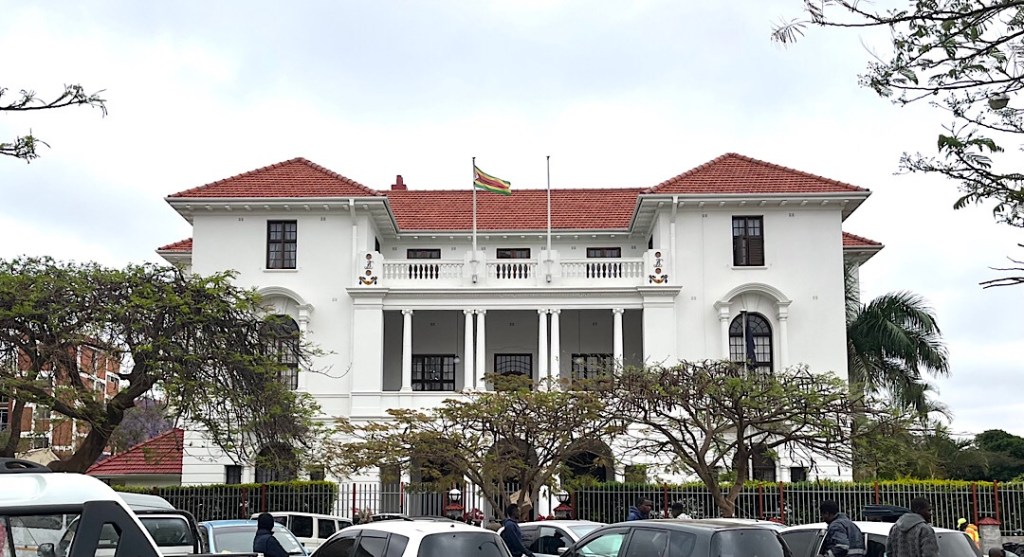
Nonetheless Monday through Wednesday nights, Steve and I stayed in an institution that symbolized the heart of white Rhodesian rule for 127 years, and if I’m honest I have to report: we enjoyed it.
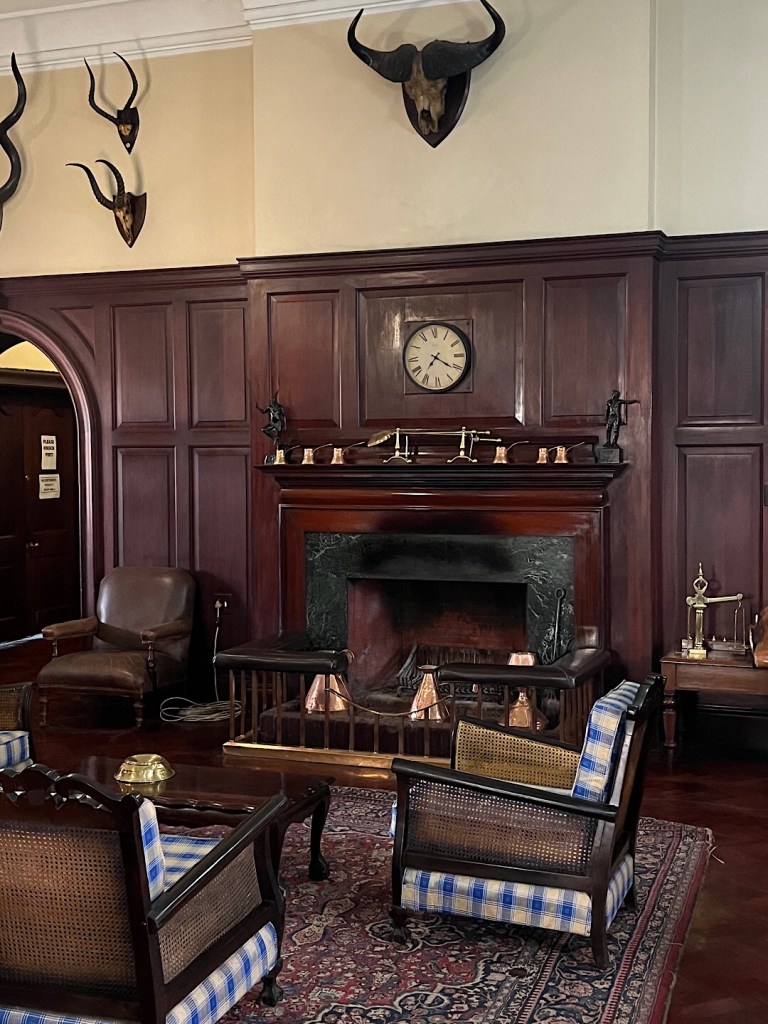
The Club Bulawayo, both a private social club and a hotel, today is still a grand old structure paneled in expanses of dark, very shiny wood.
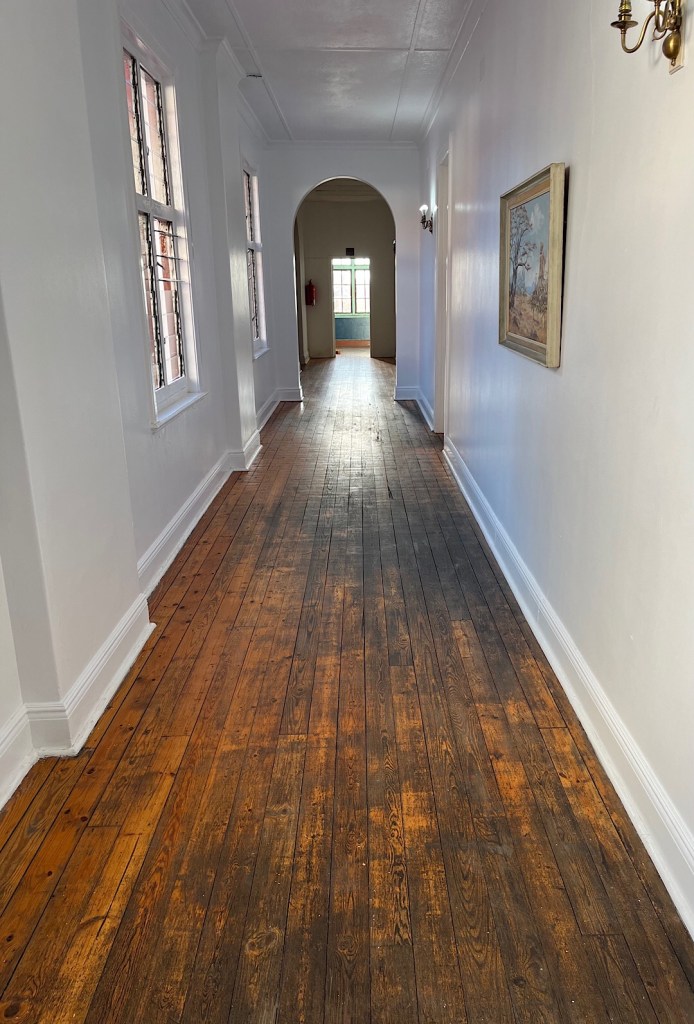
We were more than comfortable in our large room, spotless and equipped with comfy beds, a nice shower, and decent internet. Food served in the building’s central courtyard was good, and the handful of folks on the staff (all black) were uniformly warm and welcoming. In many ways, however, the Club is as broken as were Rhodes’ dreams of continental mastery. The 300-plus-year-old grandfather clock on the second floor still chimes, but the elevator doesn’t work (so we had to lug our bags up 62 grand steps to reach the second story). The parquet in the lobby gleams, but the corridor outside our door looked shabby.
We saw so few other guests that at times I felt like we had sneaked into and made ourself at home in a museum.
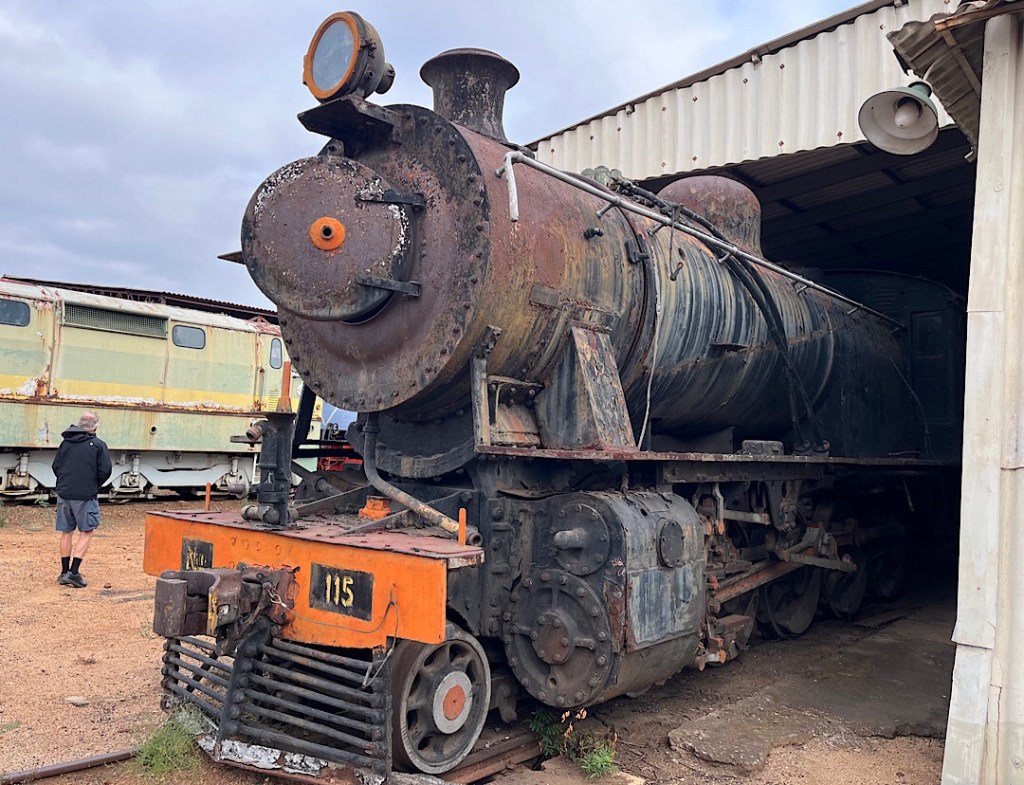
Steve and I devoted one of our two full days in Bulawayo (Zimbabwe’s second largest city) to urban amusements: visiting the national Museum of Natural History, the old railroad museum, the central public library, and more. Like our stay at the Club, these provided more tastes of lost imperial glory.
Rhodesia’s railroad system was once a marvel.
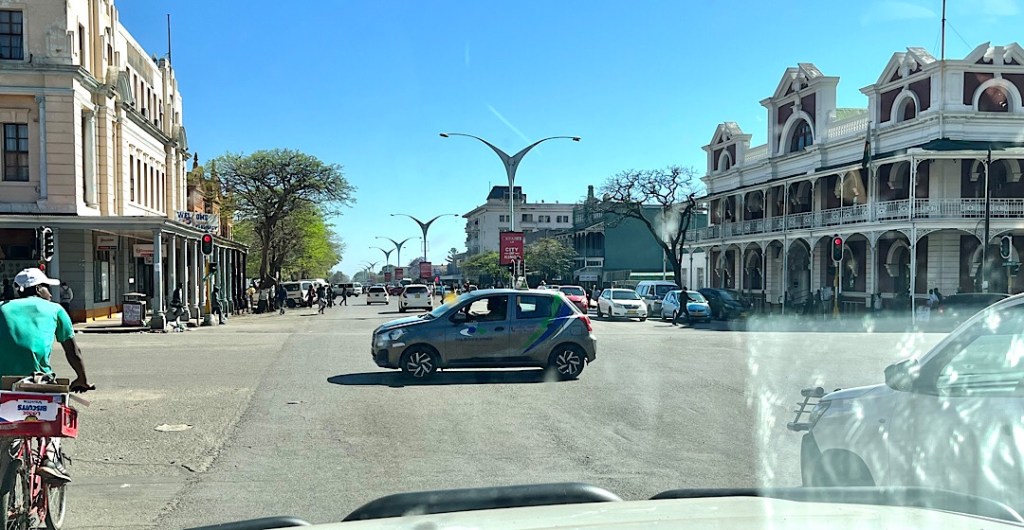
Rhodes had ordered that the streets of this city be built wide enough so a wagon pulled by 24 oxen could make a U-turn. When the ox teams disappeared, hordes of cars never replaced them, so today you can stroll around the central business district without fear of being mown down.
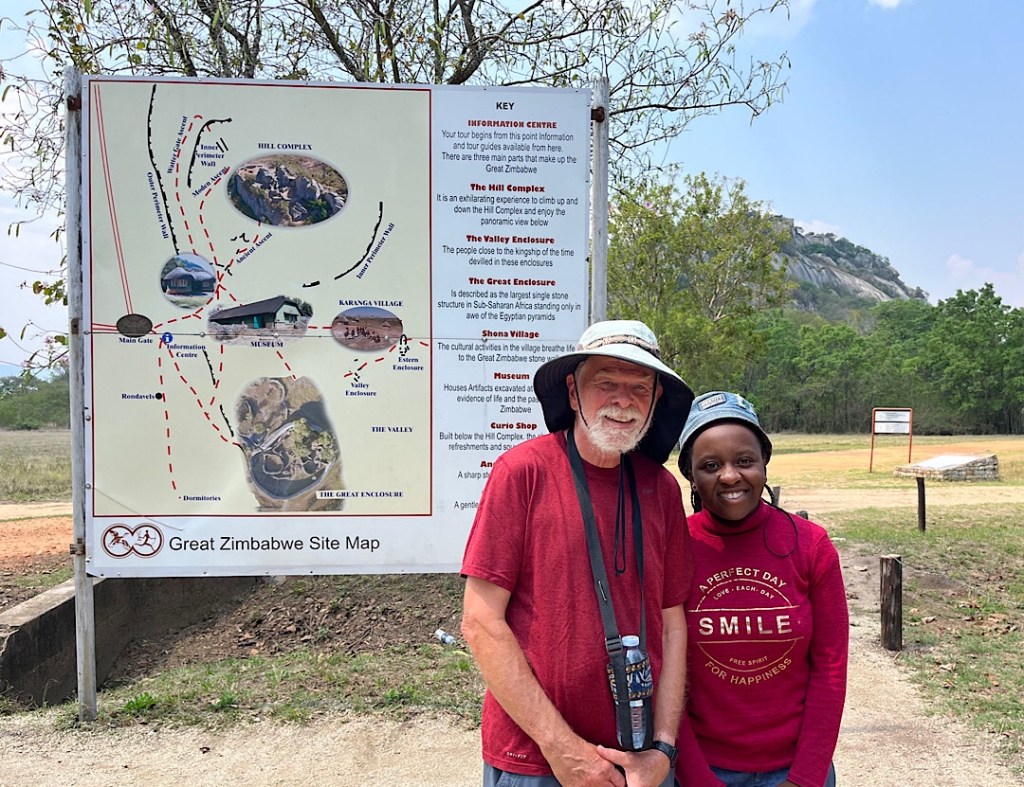
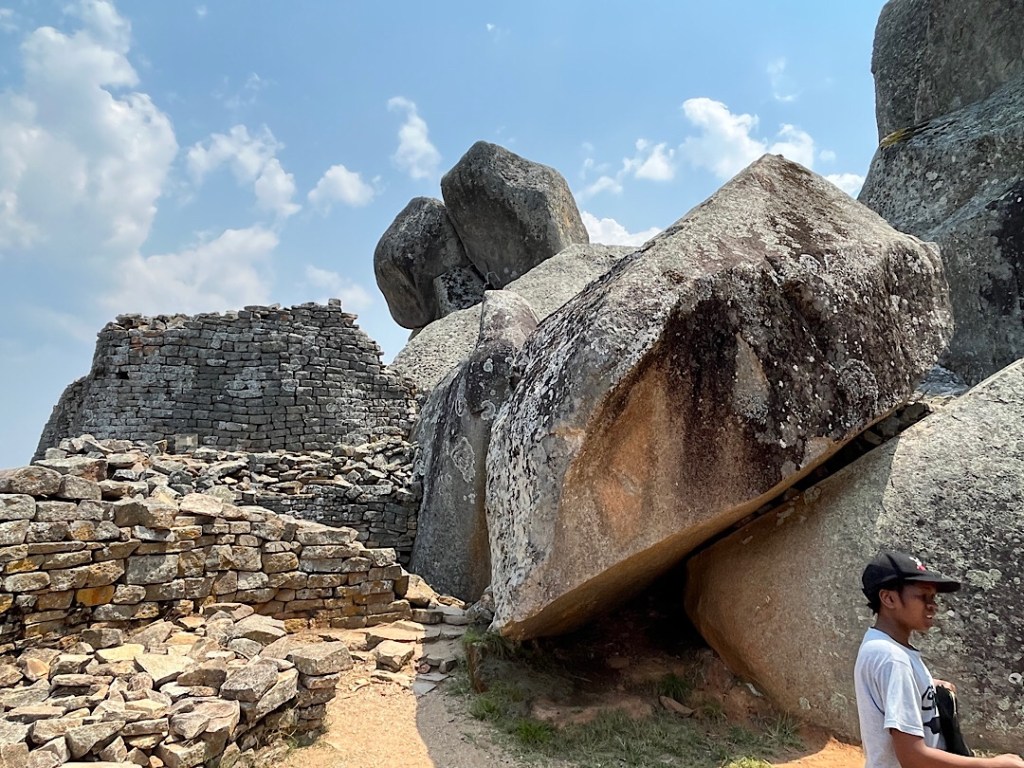
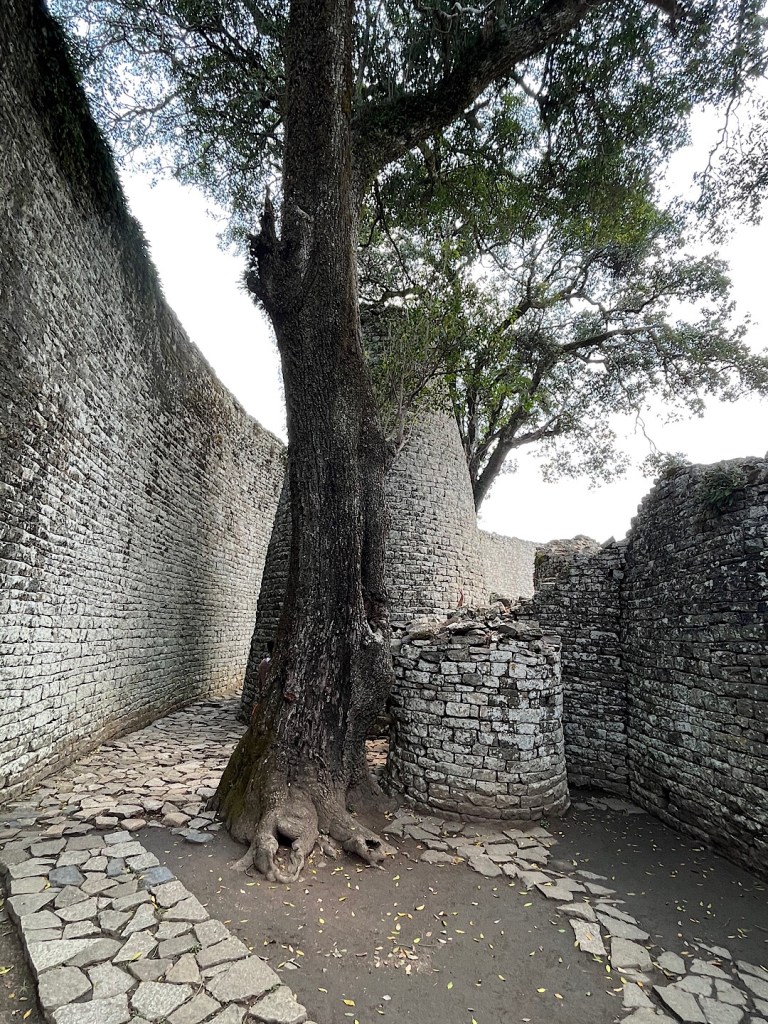
For our other full day, we had to choose between two excursions outside the city. We could have visited the Khami Ruins built about 600 years ago by people who had abandoned Great Zimbabwe after it collapsed. Steve and I had visited the Great Zimbabwe complex a few days earlier. Considered the greatest archeological site south of the Sahara, it met my (very high) expectations.
A young archeology student named Shylet was our excellent guide.Part of the site, where a series of kings lived, crowns a high vantage point.The king’s chief wife occupied this enormous lower complex.
But Great Zimbabwe is basically a medieval castle, and the Khami ruins would have been more of the same (only smaller and younger.)
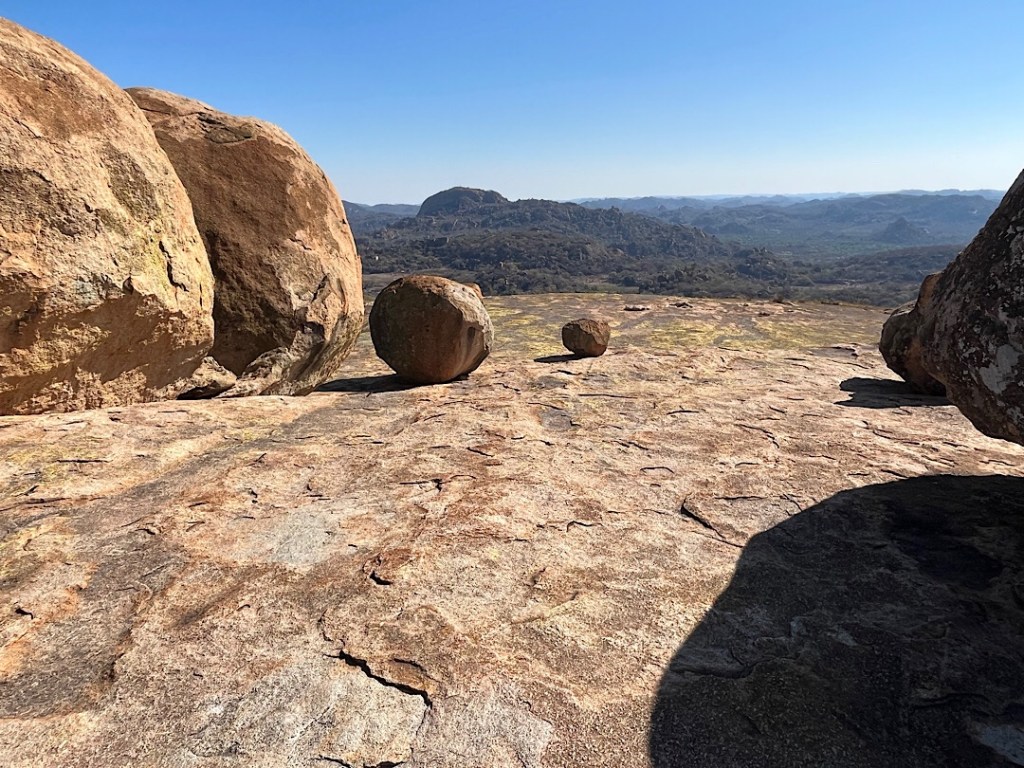
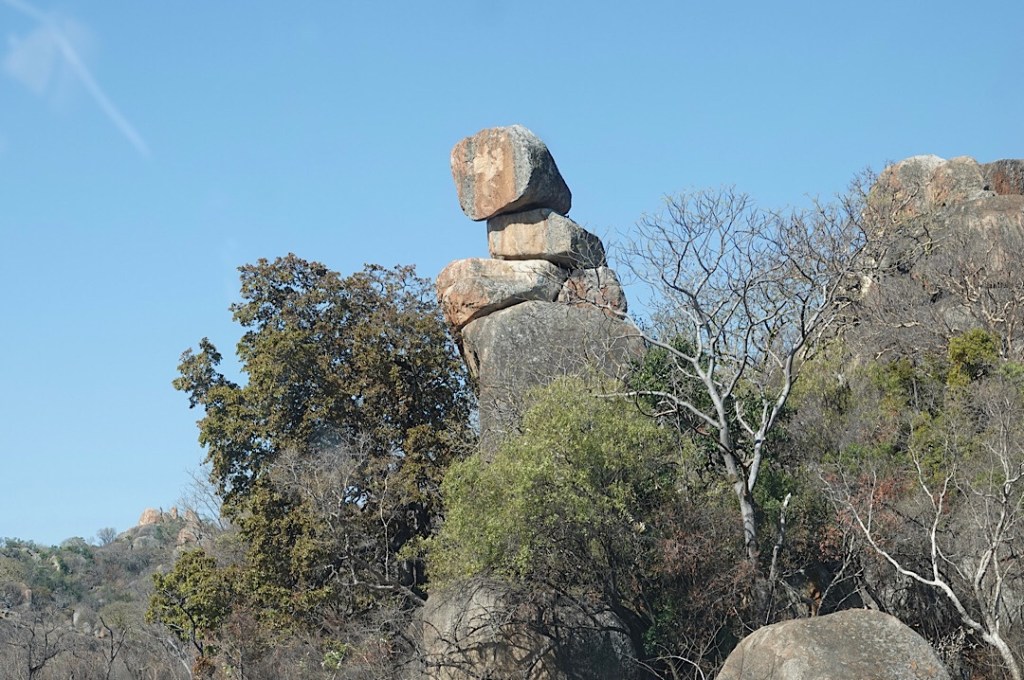
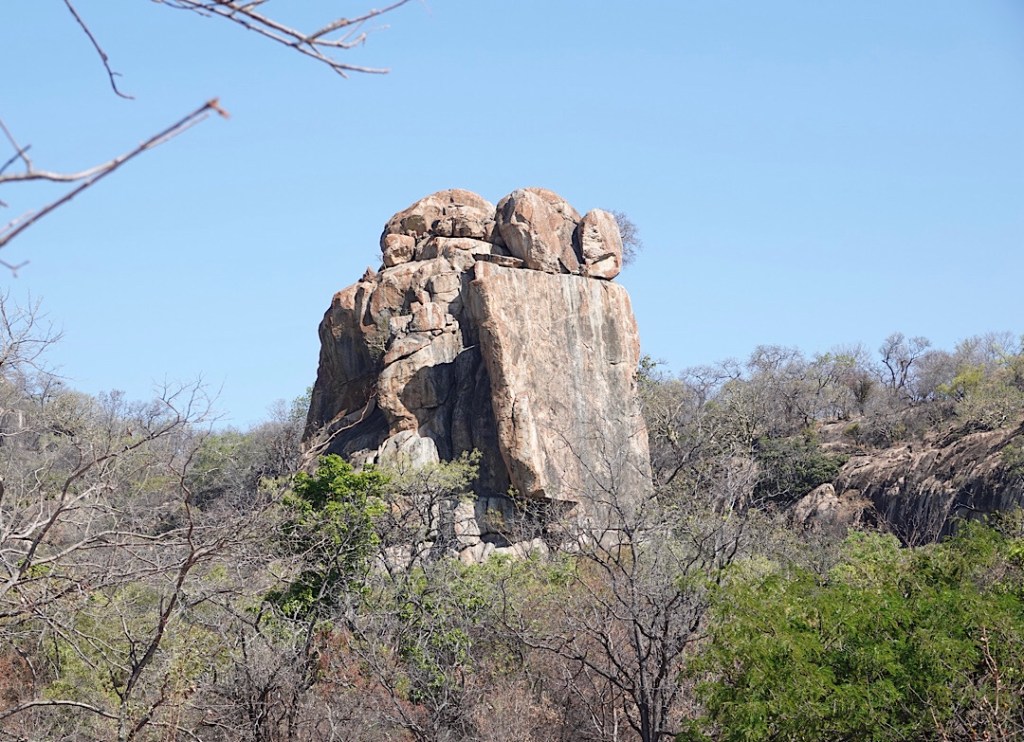
The alternative offered an experience of antiquity orders of magnitude older. So on Tuesday we drove about 30 minutes south of Bulawayo to the Matobo Hills. You could visit Matabo National Park just for the geology (or to see Rhodes’ grave, which lies within it.) Fantastic rock formations dominate the landscape, including gigantic boulders that look like they could crash down at any moment.
For us, however, the big draw was the rock paintings that line the walls of thousands of caves.
We visited two of them. The first was relatively easy to reach, down a shady dirt byway off the rocky main road. A friendly young museum attendant greeted us. His name was Knowledge. (“Yeah, seriously,” he said, aware of the humor in his parents’ choice.) He gave us a thorough, adept tour of the small but excellent museum, which filled us in on the humans who once lived in these rough shelters as long as 40,000 years ago.
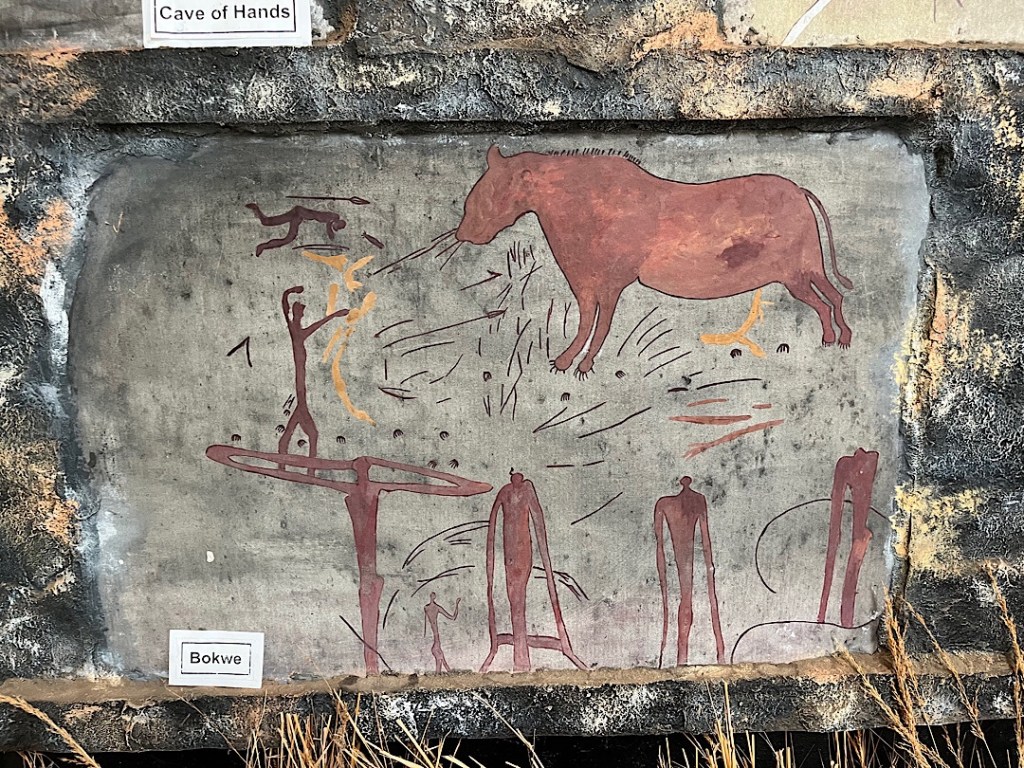
Some time around 13,000 years ago, they started decorating their caves with paintings of the world around them. (Actually, even older paintings may exist; the layers underlying the cave floors have not been conclusively excavated.) The little museum contains reproductions of some of the best — far more complex than any cave paintings I’ve ever seen before.
I can’t explain everything that’s in this reproduction of a painting in the Botwe cave, but the guy at the top left was trying to hunt the huge lion and got his arm bitten off. The person two rows below him, horrified by these happenings, has his arms on his head — a prehistoric Munchian Scream.
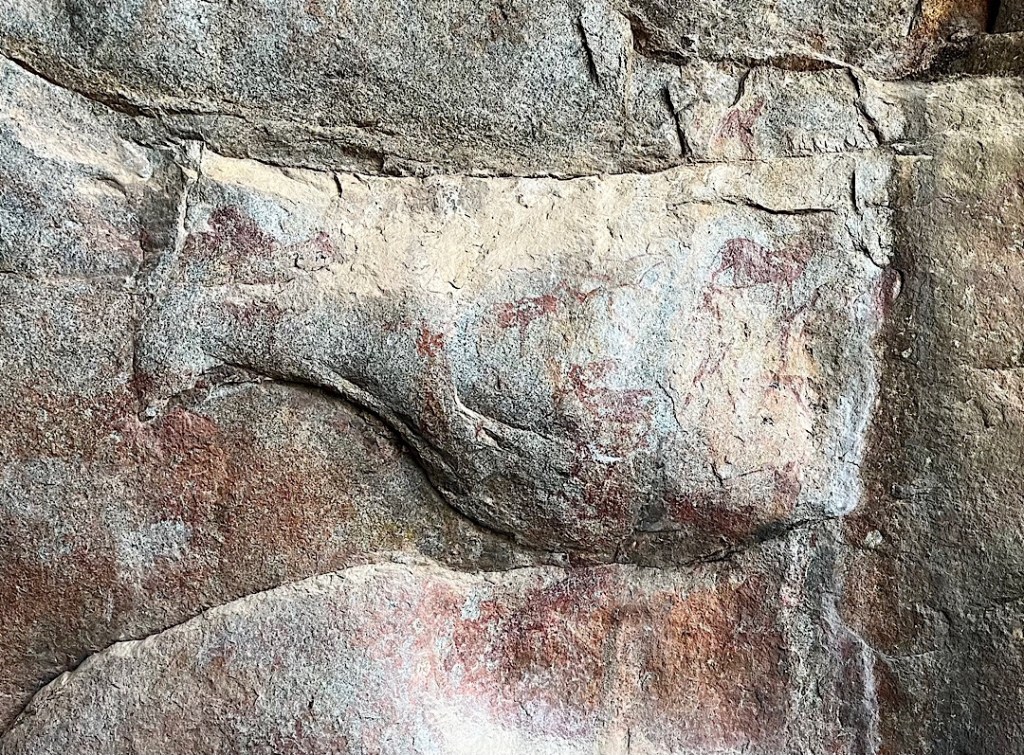
After our tour, Knowledge led us to the Pomongwe cave a bit further down the path. The space is lovely, big enough to have housed a clan of maybe 100 folks, but sadly, the paintings were damaged around 100 years ago, when inept curators tried brightening them up with linseed oil (in preparation for a visit from some British royalty). Still, we could see how extensive and impressive they once must have been.
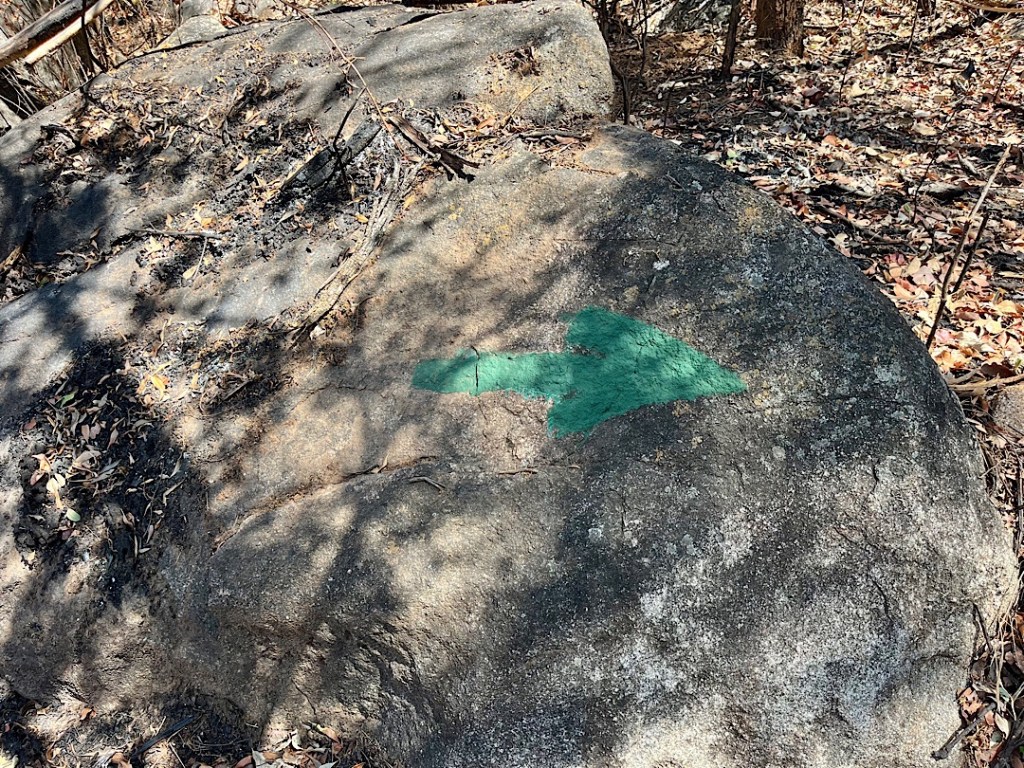
Knowledge urged us to visit Nswatugi Cave, less accessible but in much better condition. To get to it, we had to drive quite a bit further along dirt roads that were all but deserted. Then we had to find and follow a series of green arrows painted along the path.
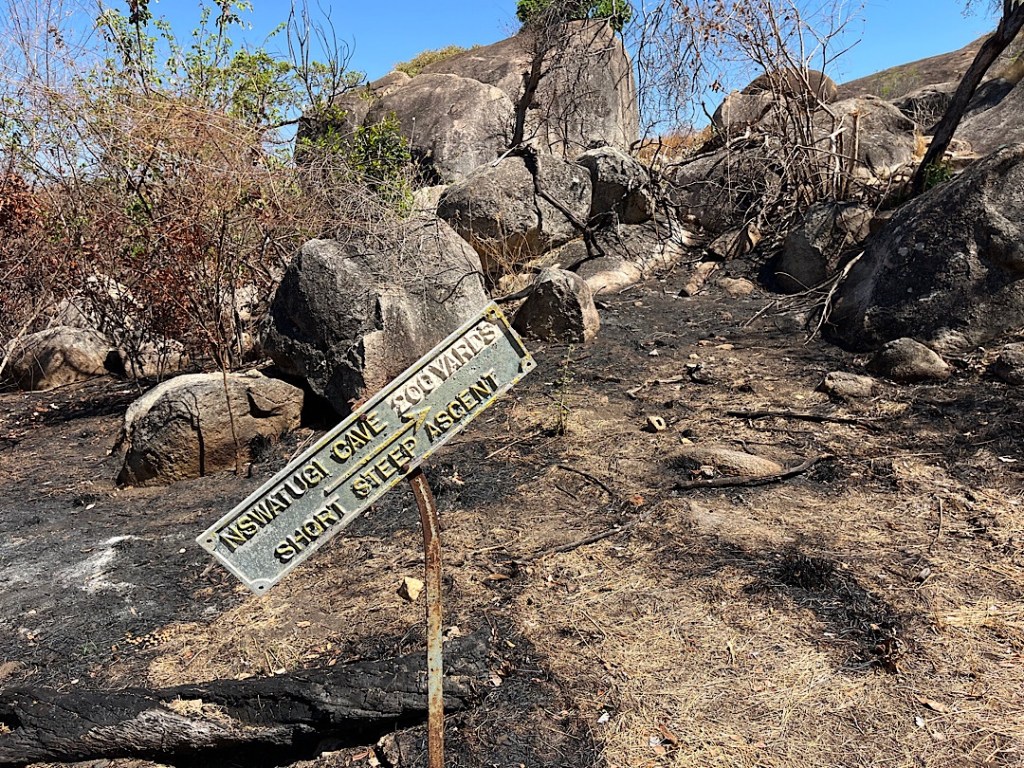
This sign refers to just the short final bit. The beginning part was much steeper.
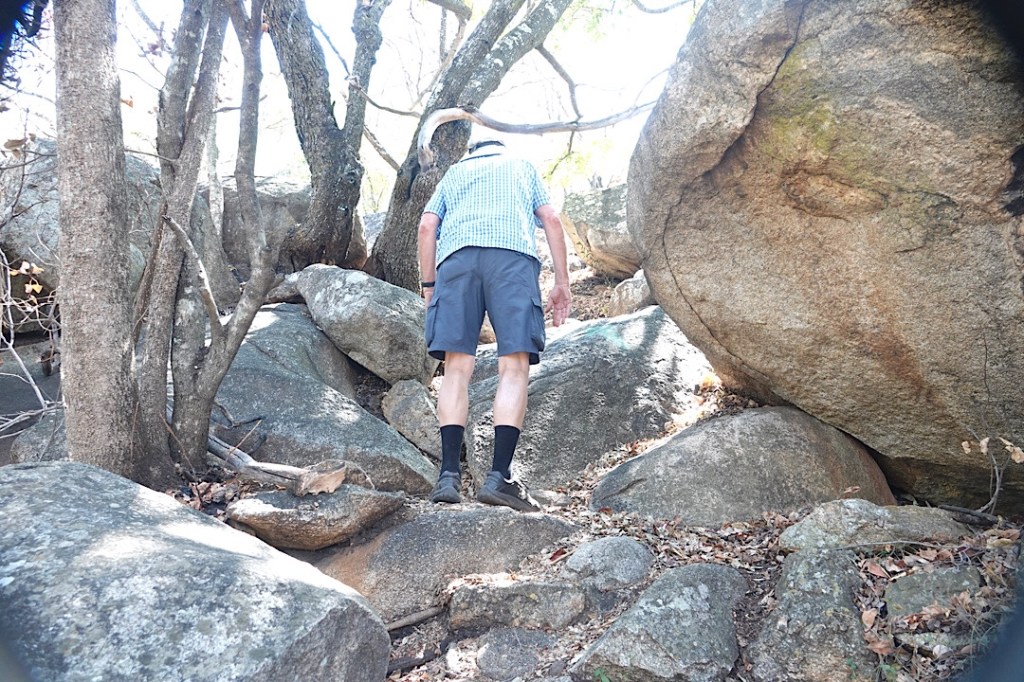
Parts of the hike required scrambling up steep rocky inclines lined with brush where black mambas and puff adders lurk; other sections went up stairs and across flats. What we found at the top was worth it all.
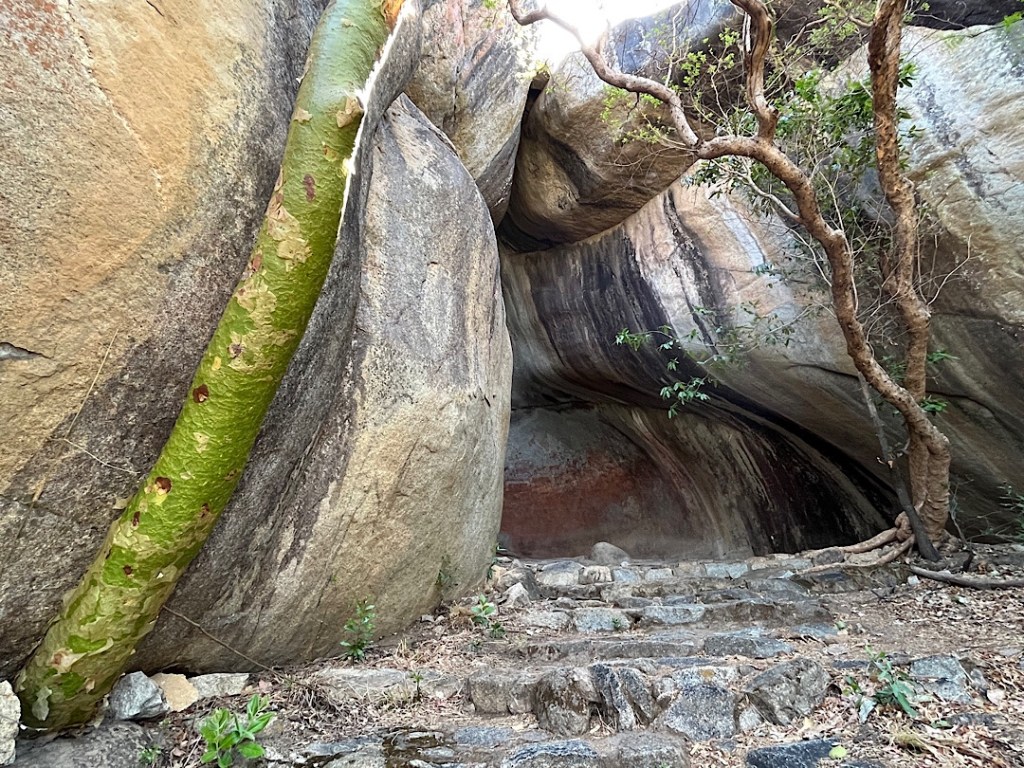
The entrance to the cave.
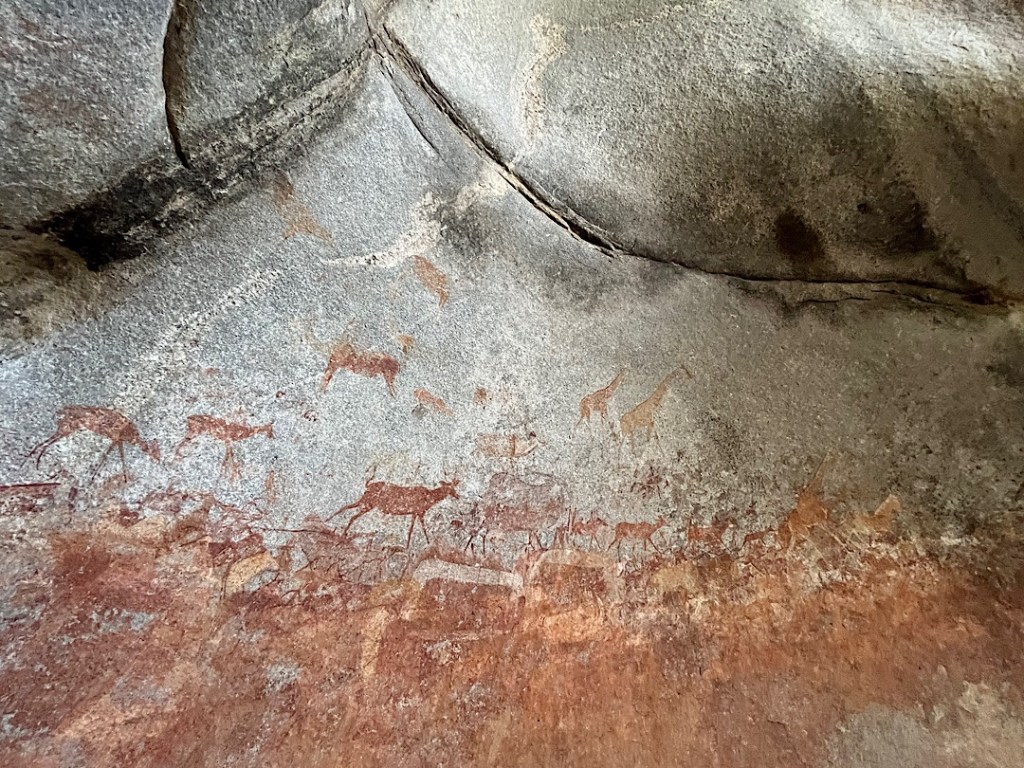
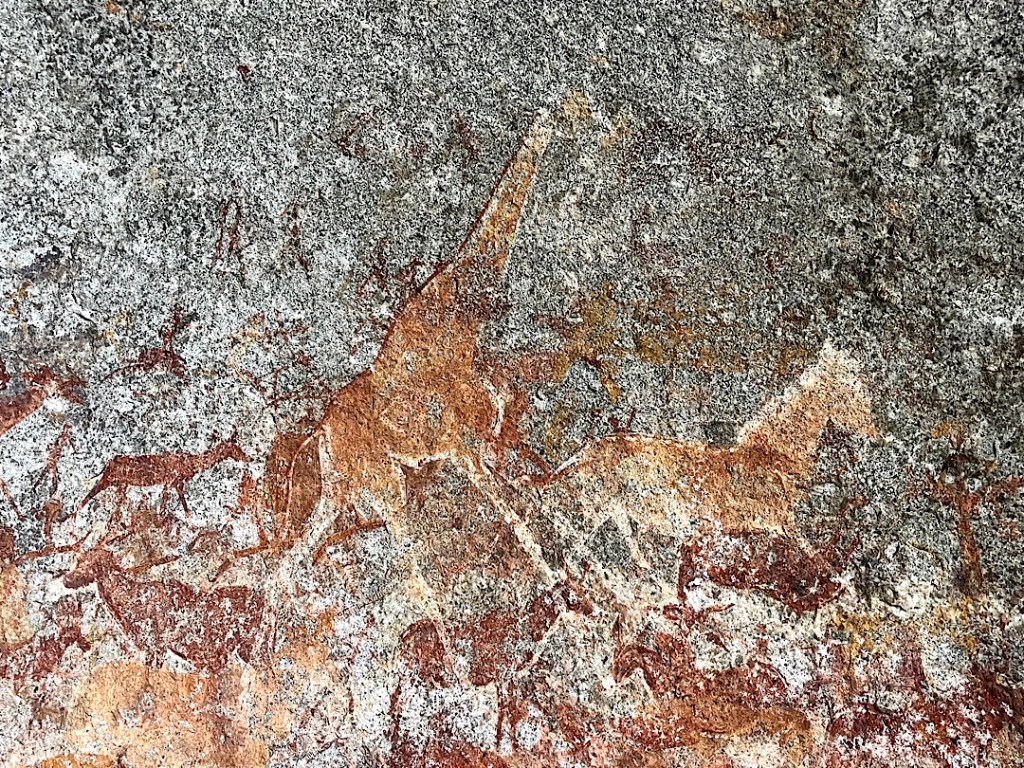
A wonderful menagerie parades across this cave’s walls…
The images moved me in a way I find hard to articulate. Thousands of years before the Egyptians began playing in their sands, these simple hunter-gatherers stood in this space, re-creating the world that surrounded them. One thing we’ve learned on this trip is that traditionally, Africans have seen their ancestors as a link with the divine. I’ve never been able to empathize with that. I’m not particularly interested in my own great-great-grandparents and certainly can’t conceive of worshipping them.
But it strikes me now that the San people who lived in and decorated Matoba’s caves are also my ancestors. Now that I’ve seen their art, it’s not that big a stretch to imagine kneeling before them.
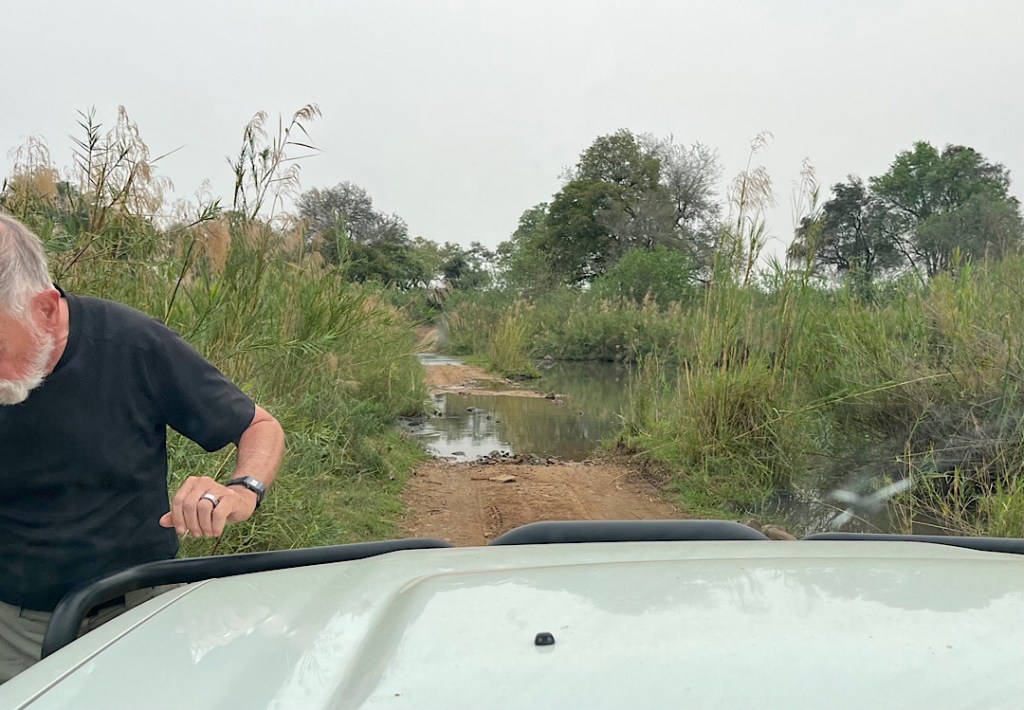
Throughout the course of our travels, Steve and I have stayed in a handful of places that felt like the ends of the earth. Our time in the Save Valley Conservancy adds another to that short list. After turning off the Mutare-Masvingo highway, we had to jounce for almost two hours over fawn-colored dirt washboard. Steve had to drive the Cruiser through the Turgwe River. During the dry winter and spring, it shrinks to a fraction of its high-water levels, but enough water still flows through it to get my adrenaline pumping.
Steve locking the hubs to engage the 4WD, to help us get through the water ahead.
The guard at the gate off the main road had radioed that we were on the way, so a guy on a motorcycle was waiting to lead us to our lodging on the Humani Ranch: “Goma 2.” It’s very clean and comfortable, and after a delicious dinner, I felt cozy and relaxed. Around 7:30, a sound shattered the night. A growl verging on a roar exploded close enough to be on our porch. This lion sounded murderous. He (or she) emitted its blood-curdling threats 3 o 4 more times. Then another scream pierced the night. The shrieks went on and on, terrified and pleading (if an animal can plead). I don’t know what it was (maybe a bush pig someone suggested the next day) except that it was prey about to be eaten alive.
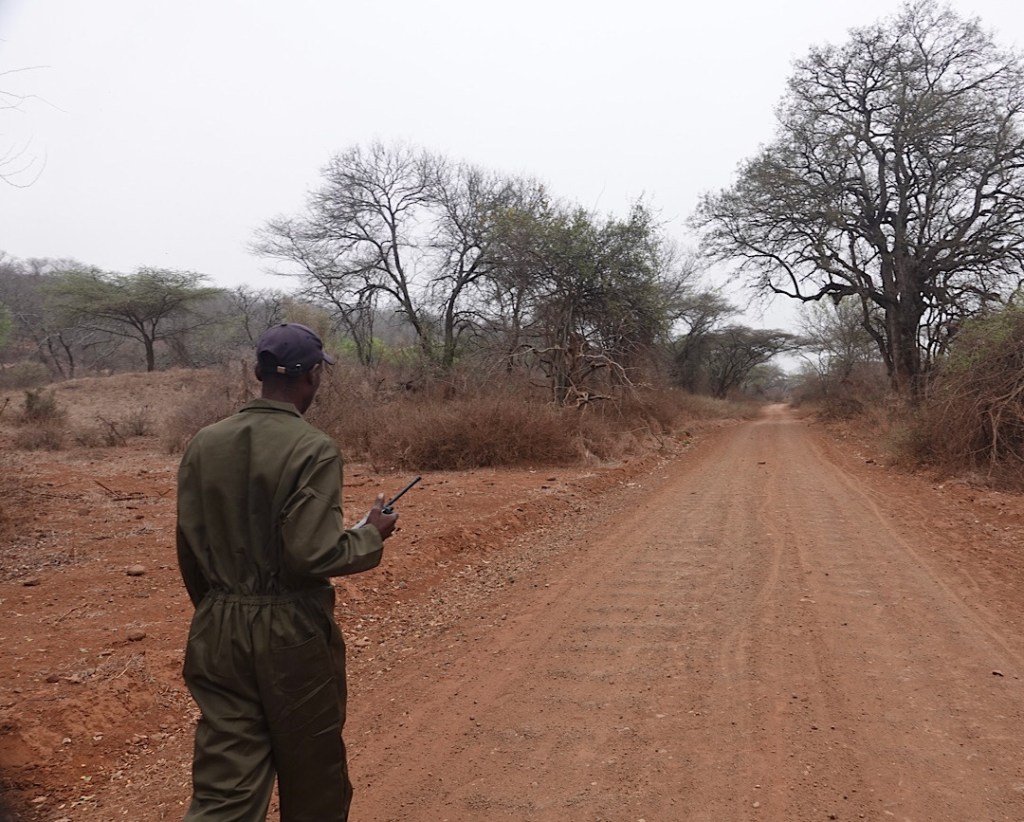
I felt astounded to be so close to such noisy exotic violence but not particularly scared. Goma 2 was built from stout concrete blocks. It has big windows, but a lion would only crash through one of them in a Hollywood movie. And soon this would not be a hungry lion. I did feel a bit nervous the next morning, as Steve and I set out on a walk led by a 32-year-old guide named Justice. He wore a green uniform and had a handheld radio but brandished no weapon.
It soon became clear his English was minimal. He knew the word “lions” but didn’t understand my question: “Are they dangerous?” I tried “Will they hurt us?” He still looked uncomprehending. I went for something simpler: “Will they eat us?” He said they wouldn’t.
We walked for awhile alone a broad dirt road, and at one point passed a gaggle of kids of various ages heading to the ranch’s school complex. If little kids could be out by themselves, I figured, we three grownups would probably be okay ambling through Lion Country.
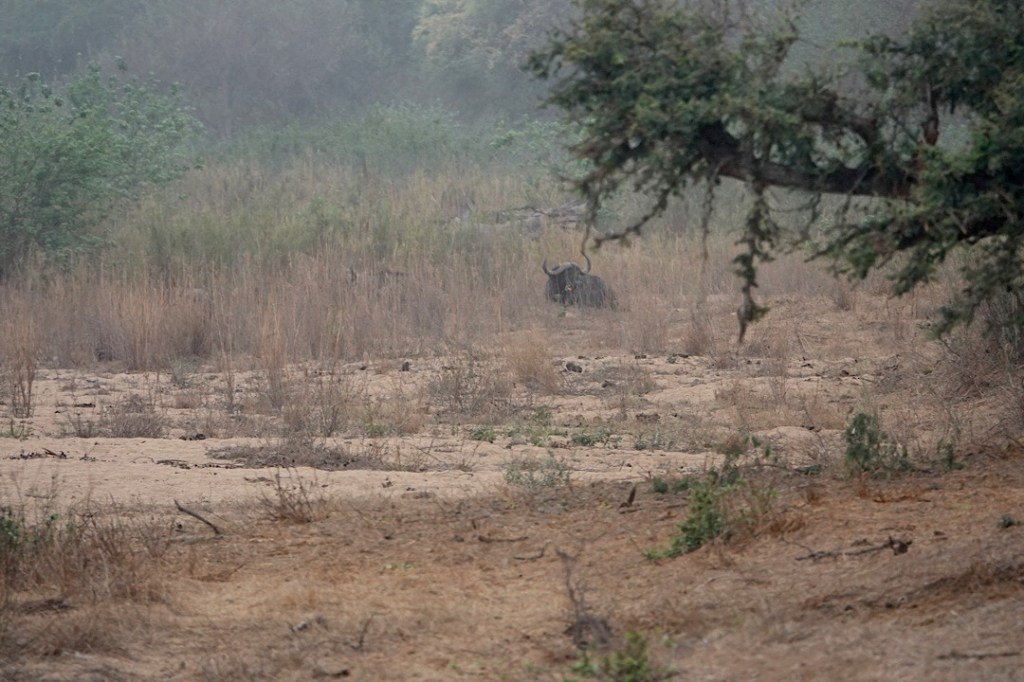
After a half hour or so, we left the main road and struck off through a lightly wooded area toward the Turgwe. Descending into the riverbed, the terrain was so open, it seemed clear no killer animals were close enough to menace us. Soon, however, Justice pointed out a buffalo far in the distance.
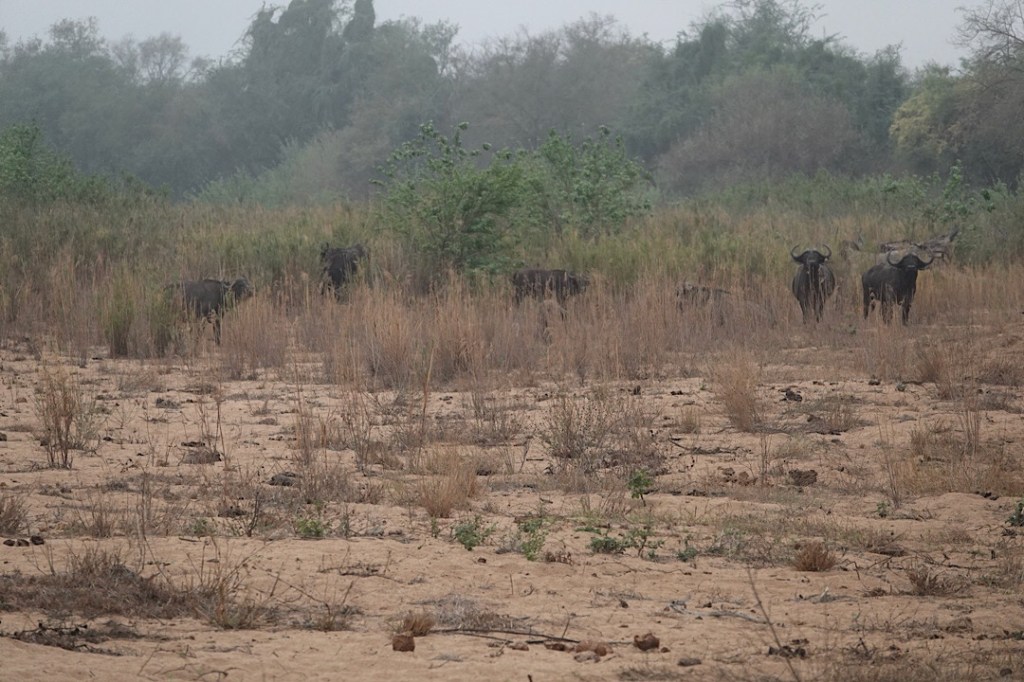
We advanced toward it, and I realized it was part of a group.
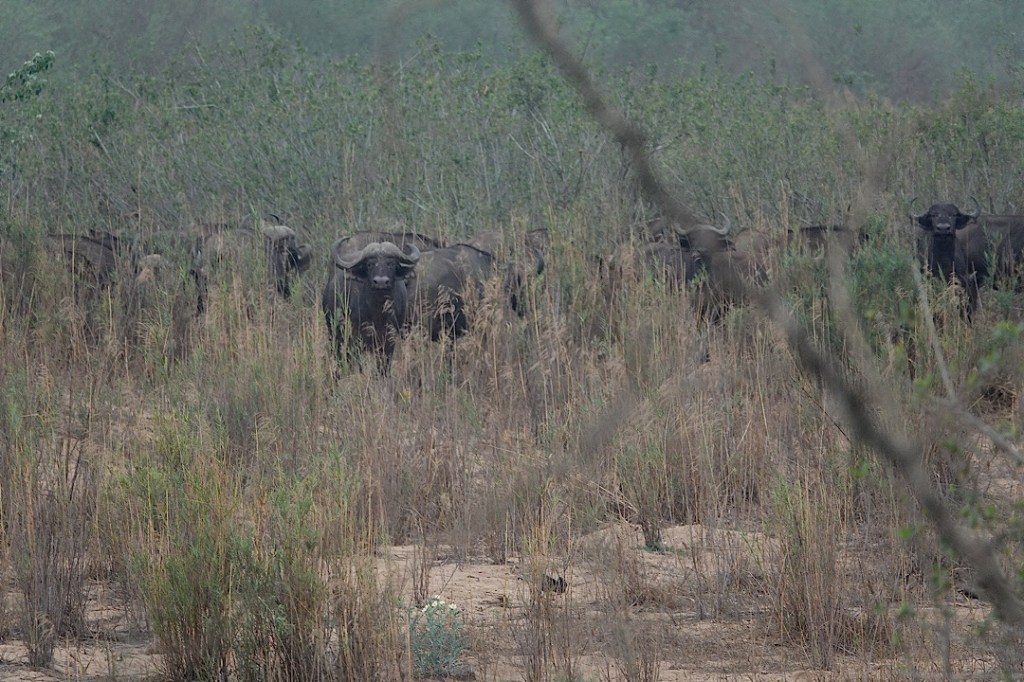
Closer still, we could see them watching us, wary.
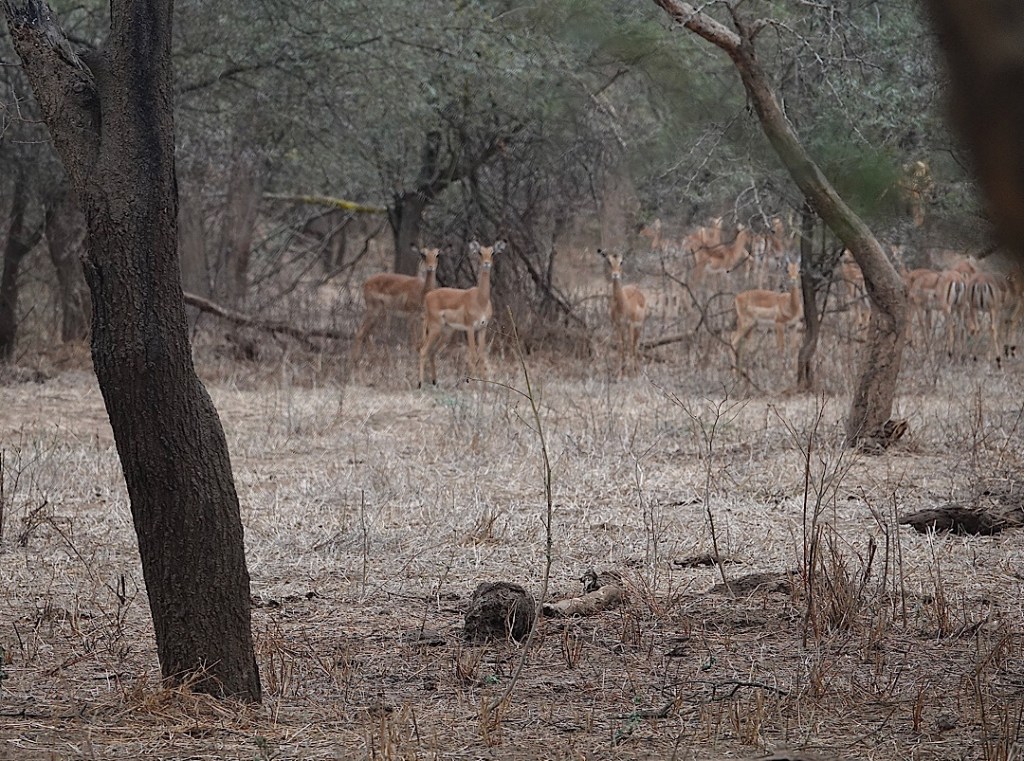
We’ve read, recently, that African buffalo aren’t as dangerous as their reputation. Only the cranky old solitary males are life-threatening, Justice told us. But he didn’t imply the rest were petting-zoo animals, and we soon left the riverbed. The buffalo herd thundered off, surprisingly fast. Over the course of the next few hours, Justice pointed out bushbuck, eland, kudu, and the always charming impala.
Shocking fast, they also leap higher than you can imagine.
He spotted some kind of monkey high in a tree (I only saw the branches swaying.) We noted a pair of warthogs trotting across a field, and we laughed at baboons stealing oranges from the farm’s huge grove.
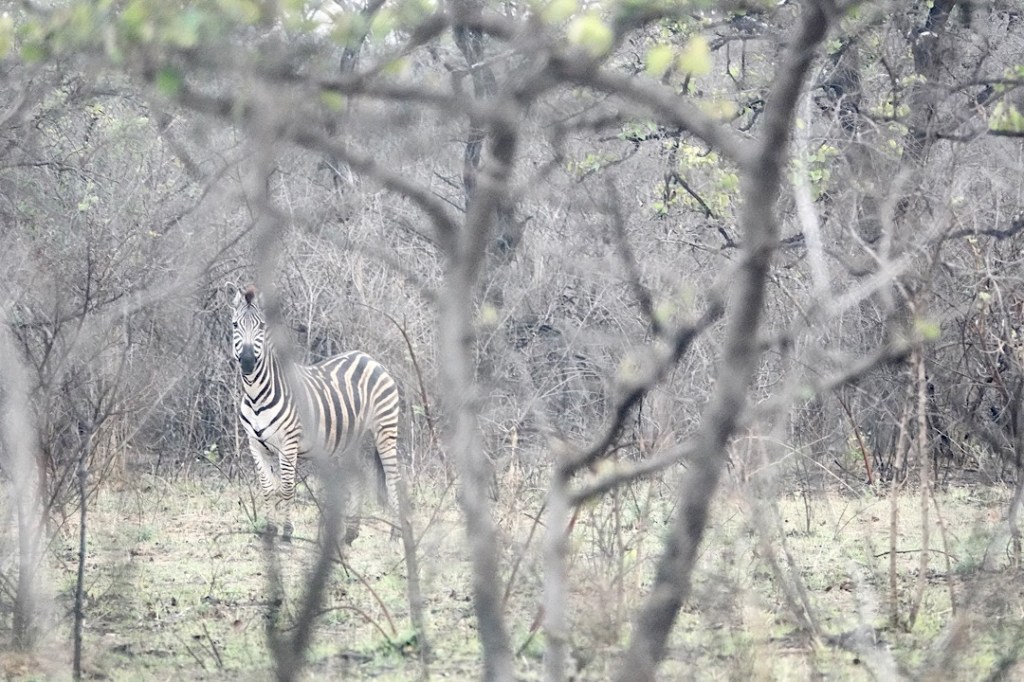
Toward the end of our walk, our guide directed our attention to a solitary zebra, camouflaged by the thicket of branches.
We saw no lions or black rhino or elephants, all of which live here. What flabbergasted me about the game walk, though, was how present all those big animals felt too. There! A fresh black rhino track.
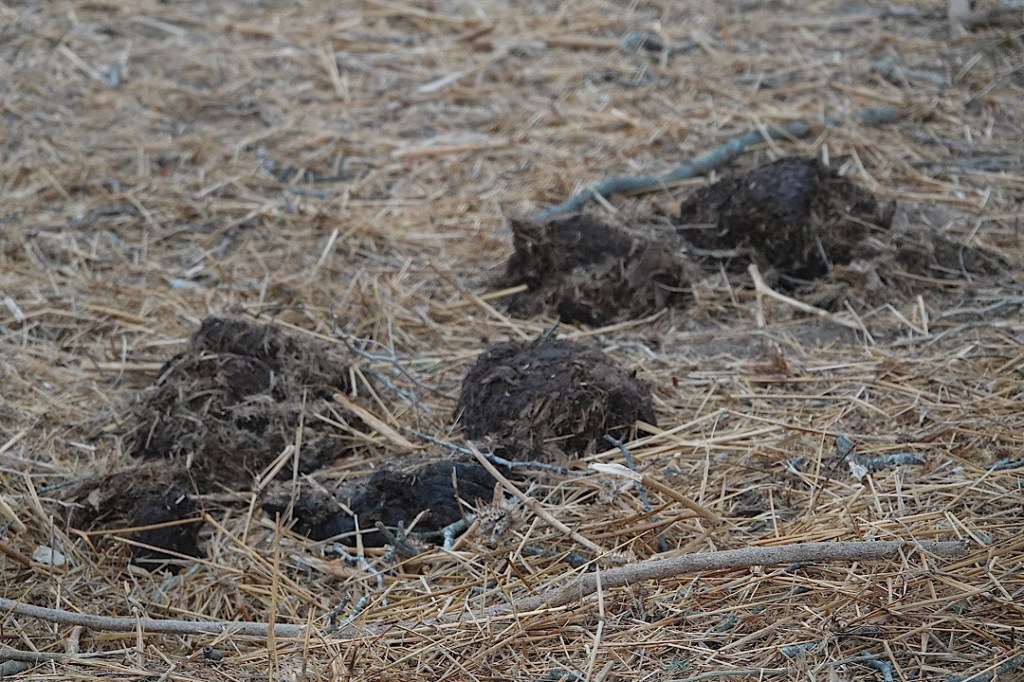
Enough elephant poop to fertilize a substantial organic garden.
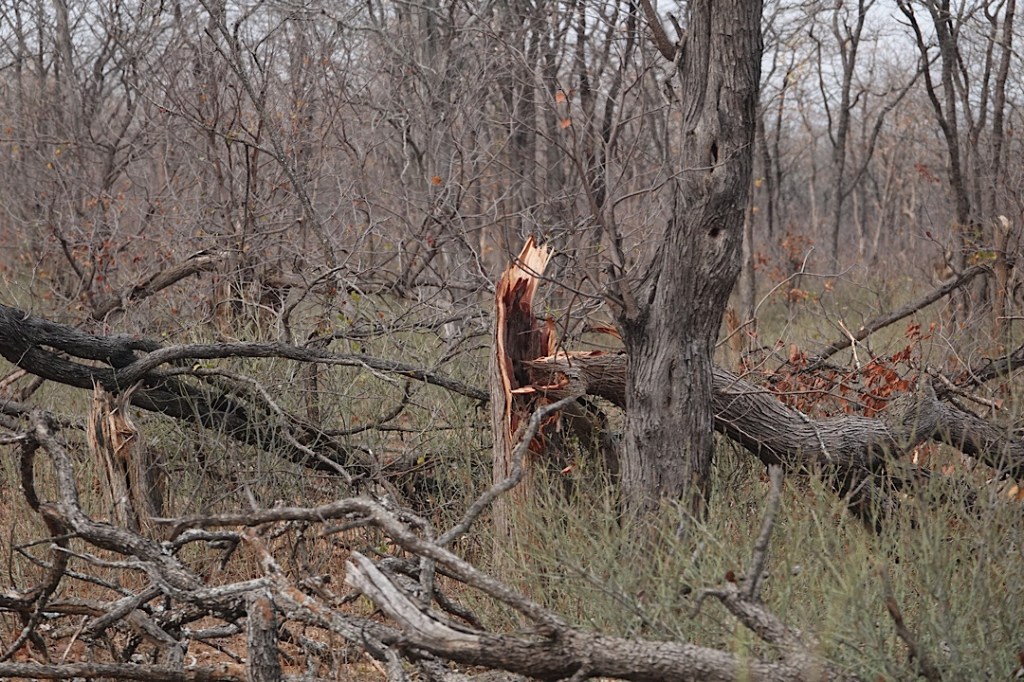
Trees smashed up in the unmistakable manner of elephants. (SUCH messy eaters.)
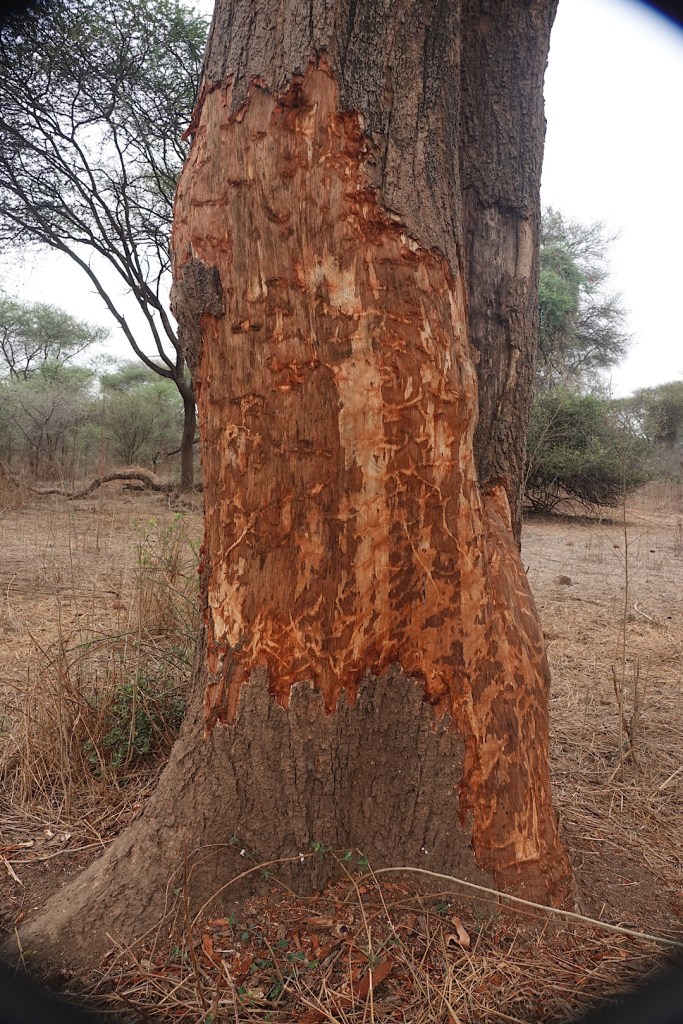
Our guide explained that a hungry elephant had stripped the bark off this tree (which would die as a result.)
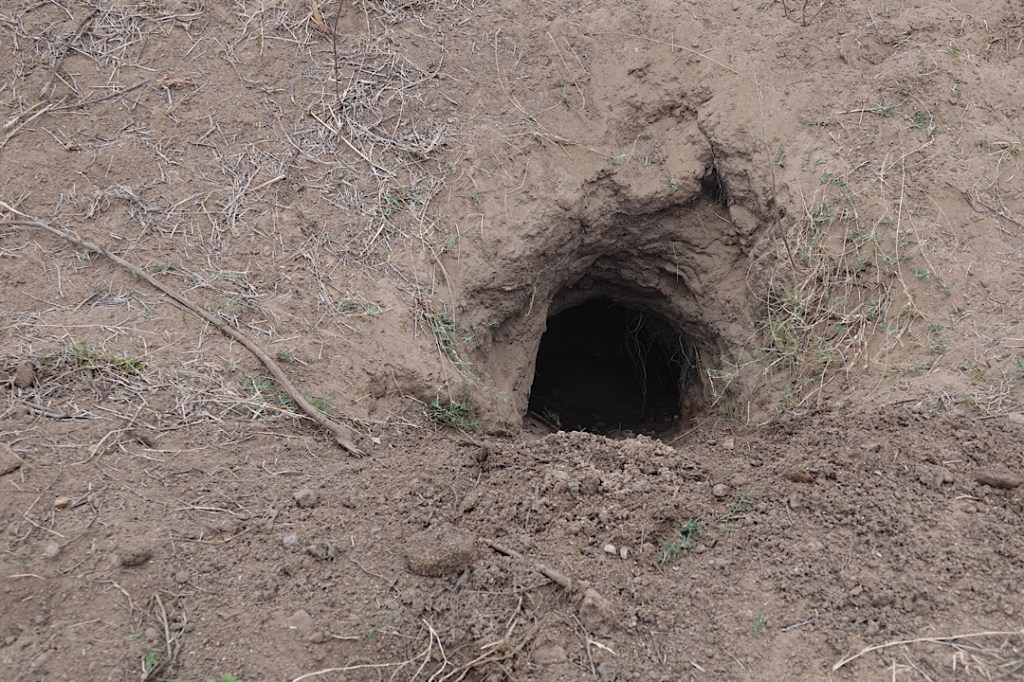
Justice said the mysterious holes in the ground were the work of “antbears” (later clarified for us by Google as aardvarks.)
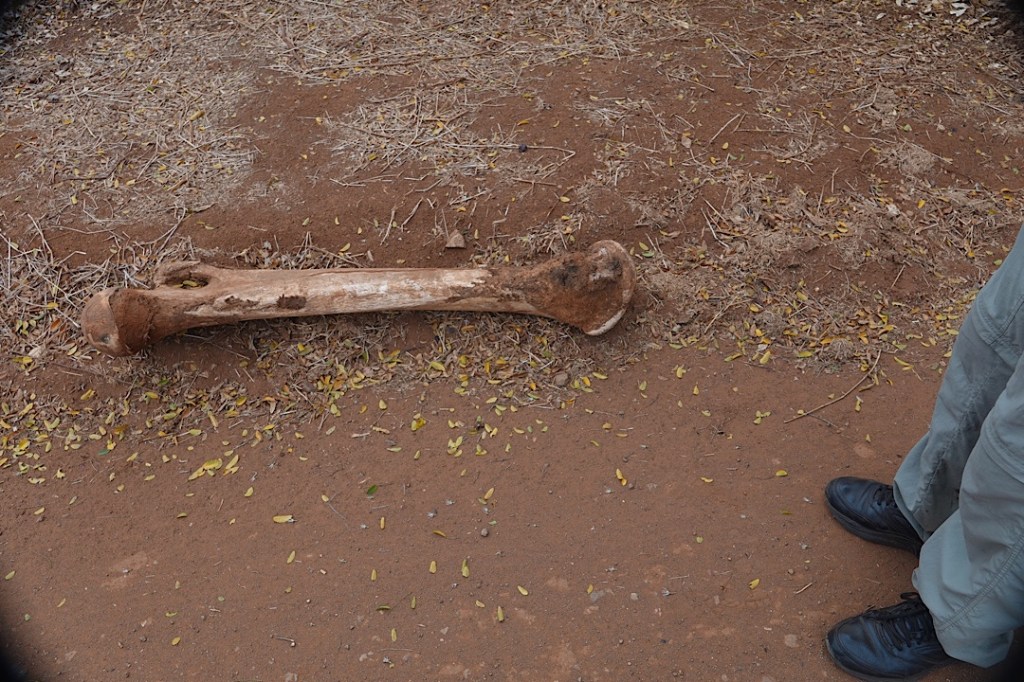
When we found this single elephant bone…
…Steve asked, “Where’s the rest of him?” Justice replied, “Hyenas.”
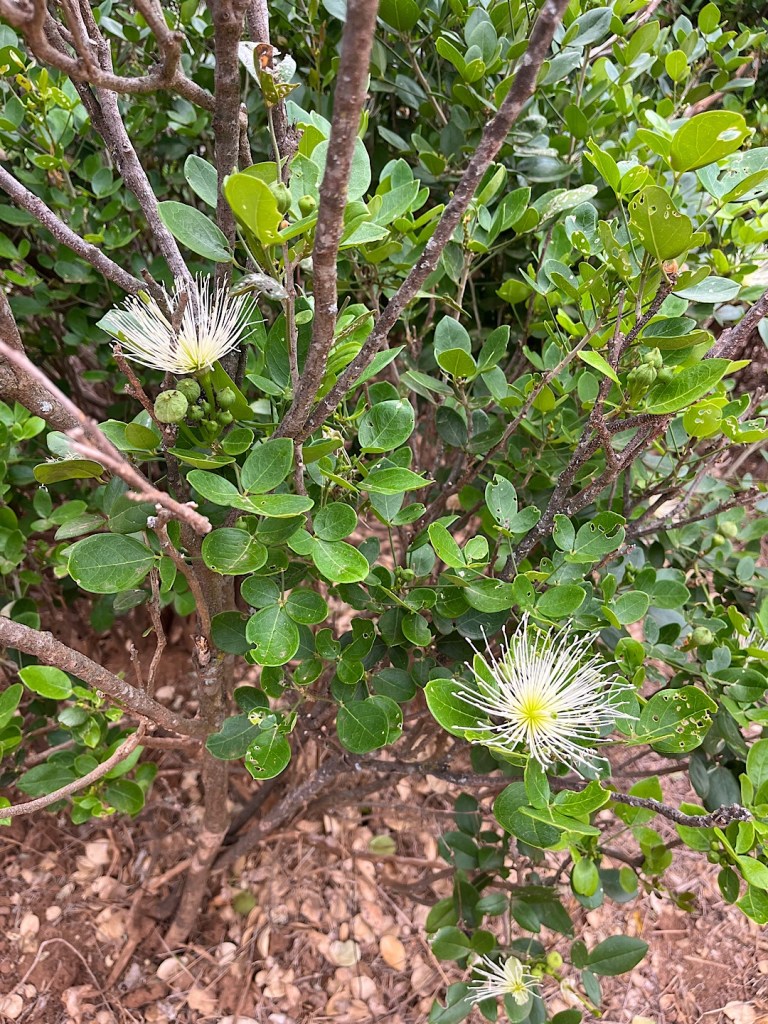
On foot we drank in the sight of things we would have missed entirely in a vehicle: spring blossoms…
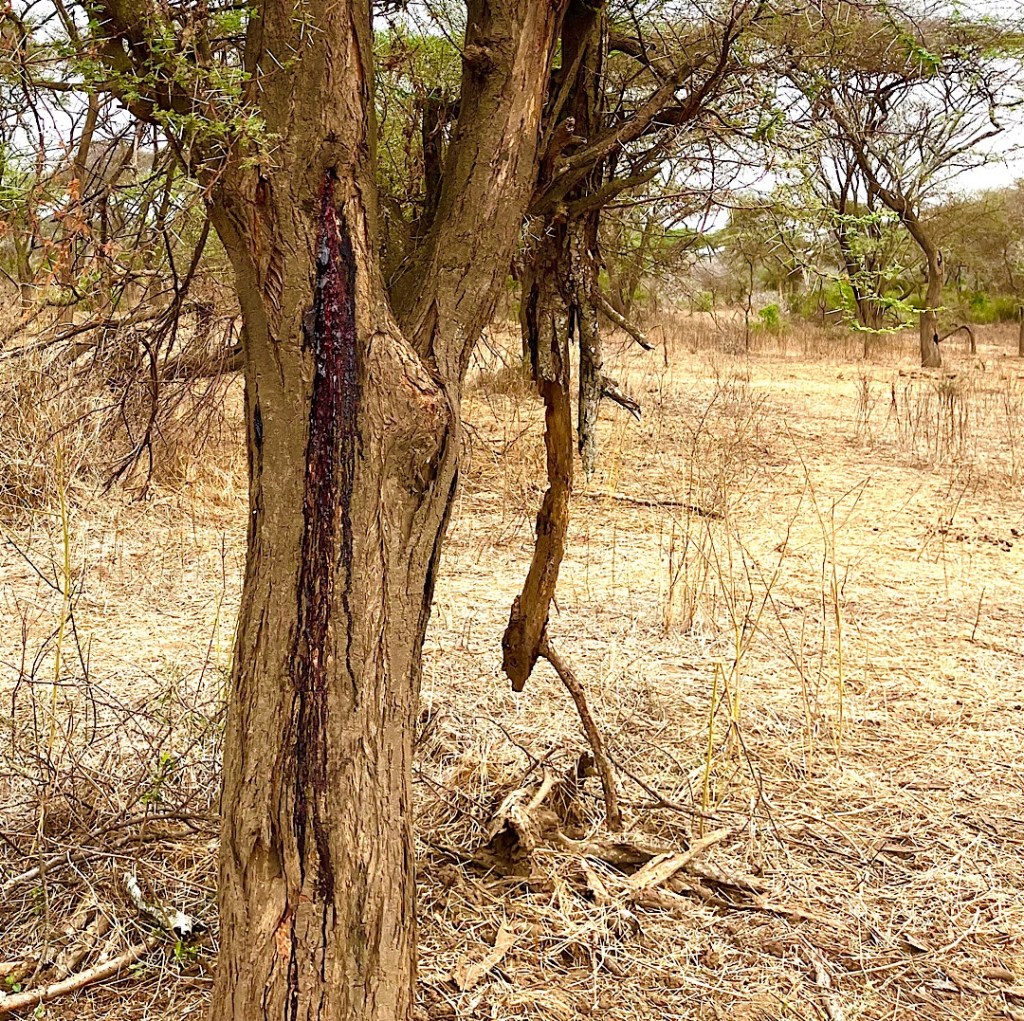
Wine-colored sap bleeding from a tree…
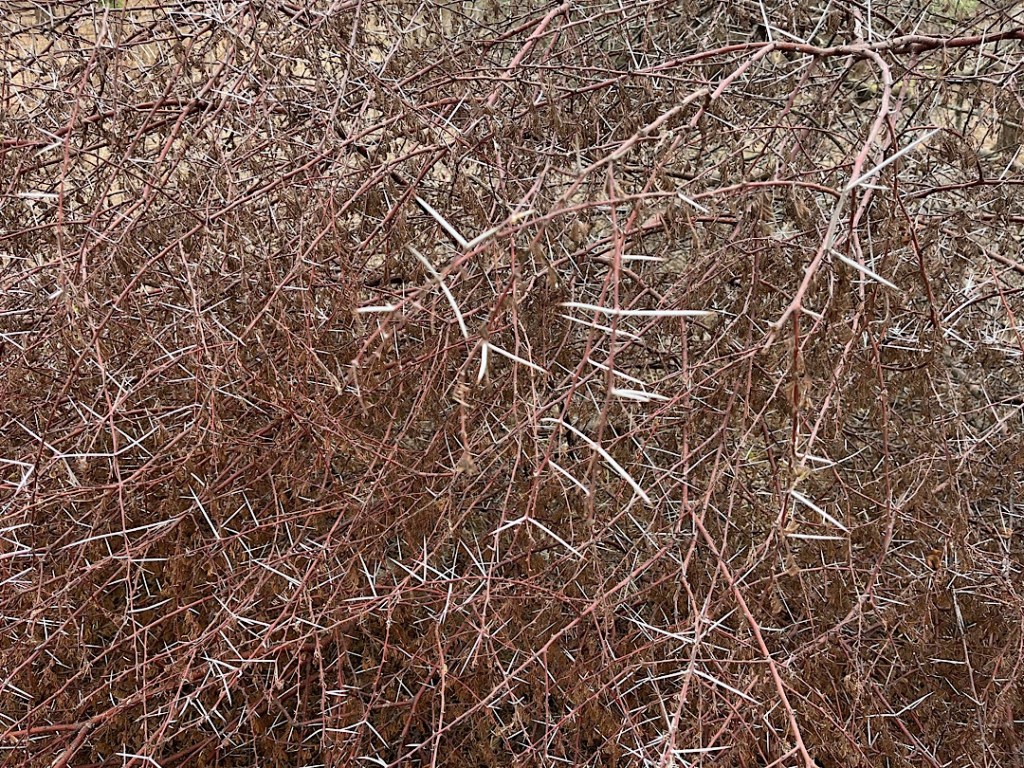
The beauty of thorn-tree needles up close…
By the end of our walk, I felt completely at ease. My epiphany was: of course! Humans evolved living with these animals for tens of thousands of years. Long ago we got established as the top predator along with a couple of others. (That lion!) But in a game reserve, we don’t compete with lions or leopards or buffalo for resources. That doesn’t mean we can blunder into their spaces or threaten them. But if we’re careful and respectful we can walk among them without fear.
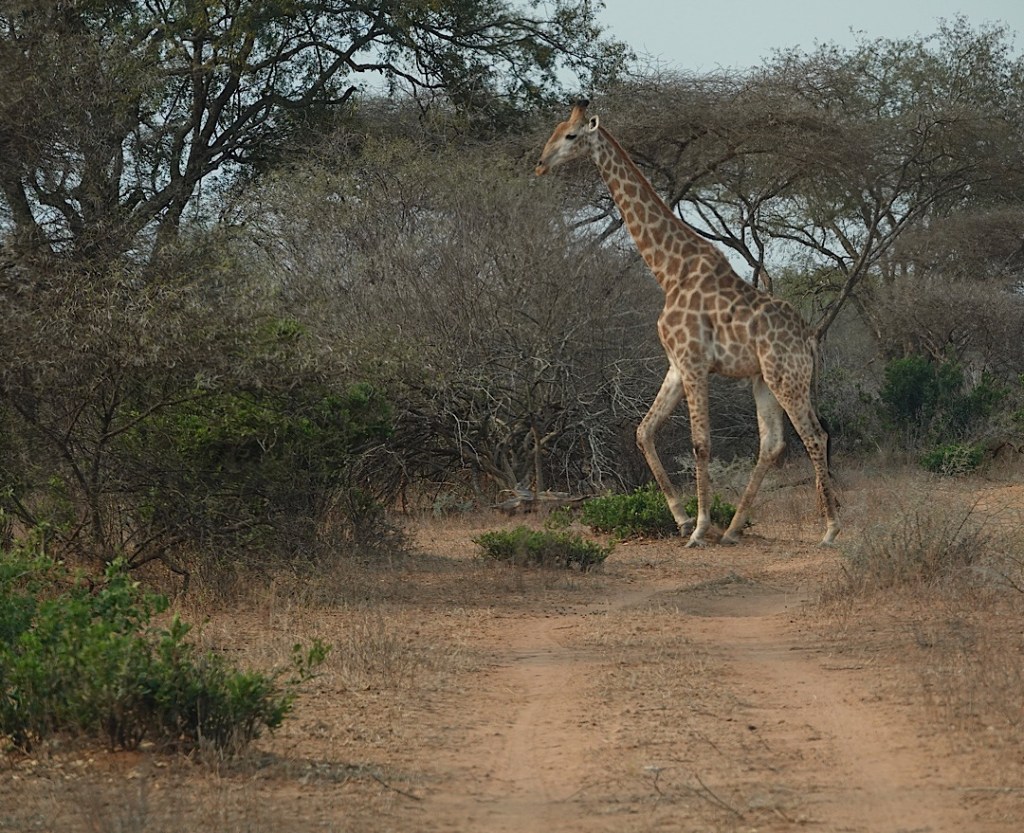
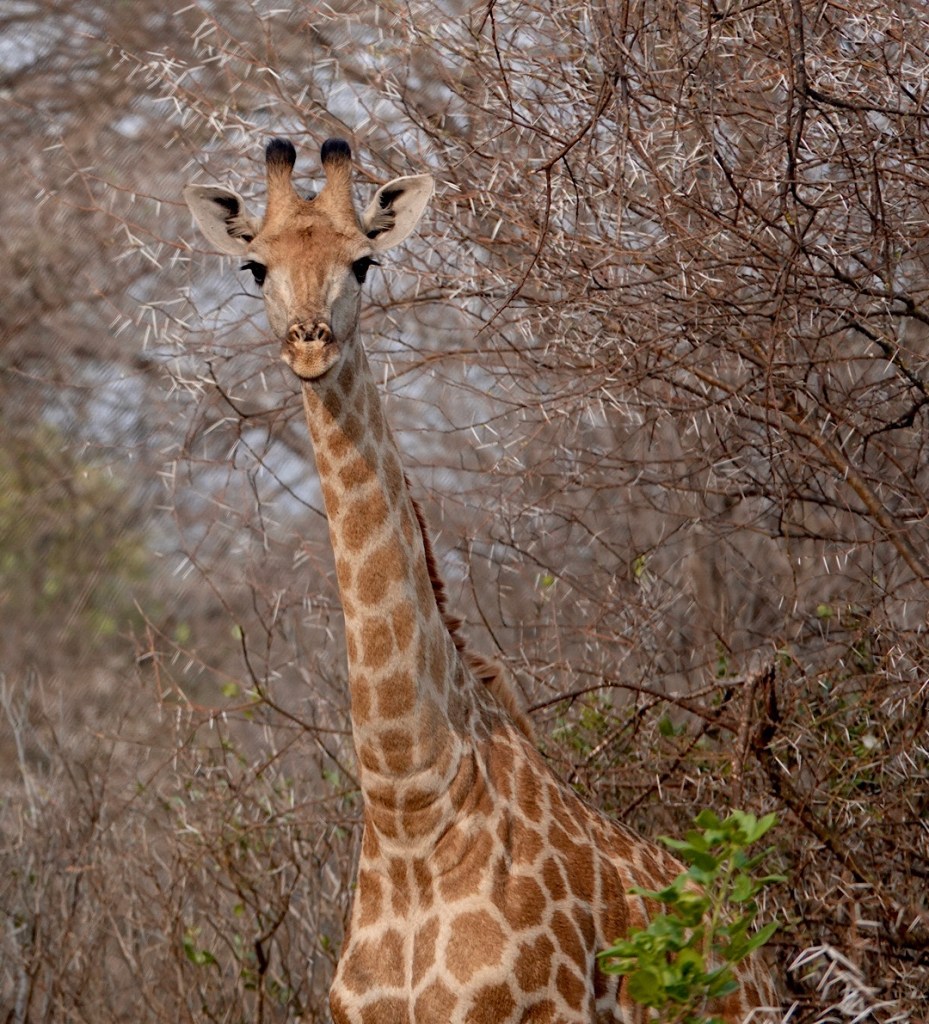
After a break for lunch and a rest, Justice came back around 2:30 to accompany us on another outing, this one in our Land Cruiser, with Steve at the wheel. Crashing through the bush, we filled in some gaps in what we’d seen. We passed giraffe that reminded me how much I love those guys.
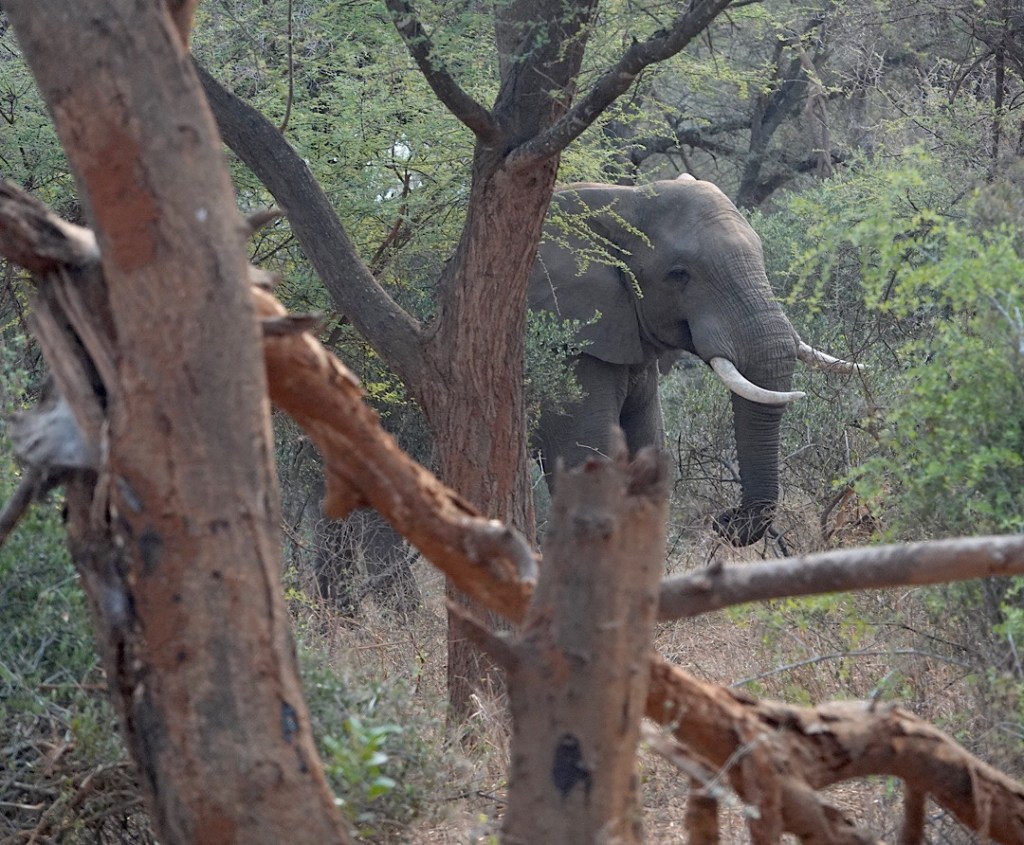
We watched a solitary elephant bull happily chowing down on dinner.
And at the wheel, Steve had a wildly macho experience that he loved.
Throughout our time together, Justice never grew more talkative. At first, his lack of English disappointed me. I would have asked so many questions, if he could just understand them! By the end of the day, however, I was happy about his linguistic limitations. If he’d been more fluent, we would have spent a lot more time yakking. Being quiet forced me to see more,
My one big regret was that we never met the owners of the Humani Ranch. Everything I know about the ranch and Conservancy comes from my guide book and the Conservancy’s website. The Whittal family sounds larger than life: former cattle ranchers and legendary big-game hunters who were leaders in getting their neighbors to tear down their fences, fencing only the perimeter and creating what the guidebook says is the largest private game reserve in the world. I had hoped to write more about all this but it’s too complicated. I give up. I can just say I’m happy to have glimpsed the life there.
I was nervous about the driving part of our “self-drive” Zimbabwean safari. Steve also was worried. We’d heard the roads haven’t been maintained for 30 years. That drivers were almost suicidal in their obliviousness while speeding through intersections. That potholes and other obstructions turned traveling on rural roads into a potentially deadly game of Chicken.
As we approached the start of our trip here, I awoke on a couple of nights thinking about how easy it would be to die. But we’d heard from several sources that we’d be fine if we just took it easy. Were they right?
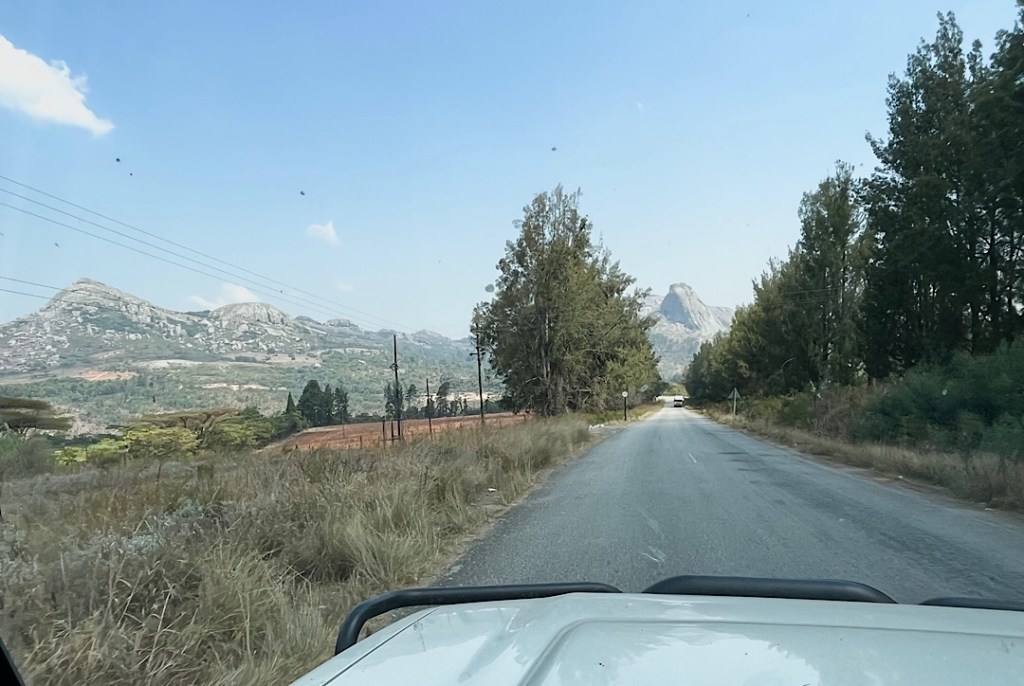
Now that we’re two long drives into the adventure, I’m think they were. A little before 9 Monday morning (9/25) we climbed into our loaded Land Cruiser and drove east from Ant’s guesthouse, heading away from the heart of Harare. The few stoplights we encountered seemed to be working, a rarity, according to what Ant had said. Traffic was light and no one did anything crazy. Soon we paid our two dollars at a toll booth and were passing fields and wooded areas. The further east we went, the lighter the traffic got, and I can tell you I this: When you’re almost alone on the road in a bruiser of a vehicle that can blow over potholes and other rough patches with ease, you begin to relax.
That’s not to say driving in Zim is just like driving in La Jolla. Paved roads are narrow but shrinking, the edges nibbled away by rain and wear. Those ragged fringes often are an inch or two above the adjoining dirt, and if one went over such a mini-escarpment at high speed (say, to avoid a head-on collision with a bus trying to pass someone), one could flip one’s vehicle and come to a messy end.
But Steve never drove at high speed, and the sights and landscapes entertained us: folks unloading huge truckloads of oranges…
,,,or making bricks or selling wooden sheds (or were they tiny homes?)
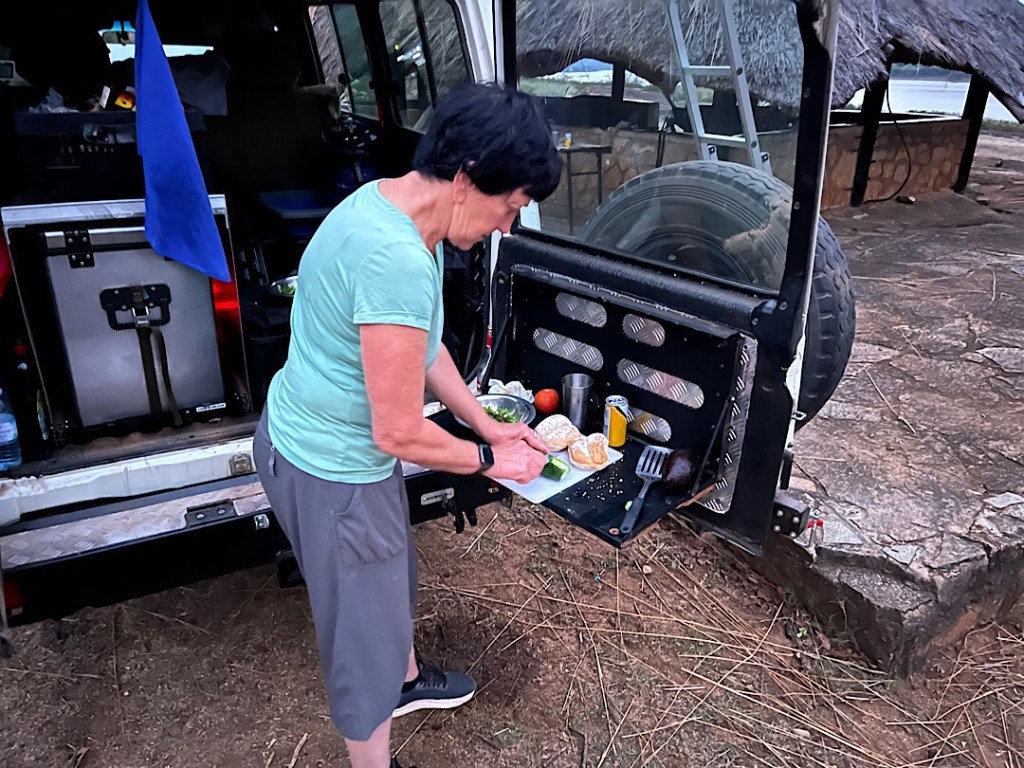
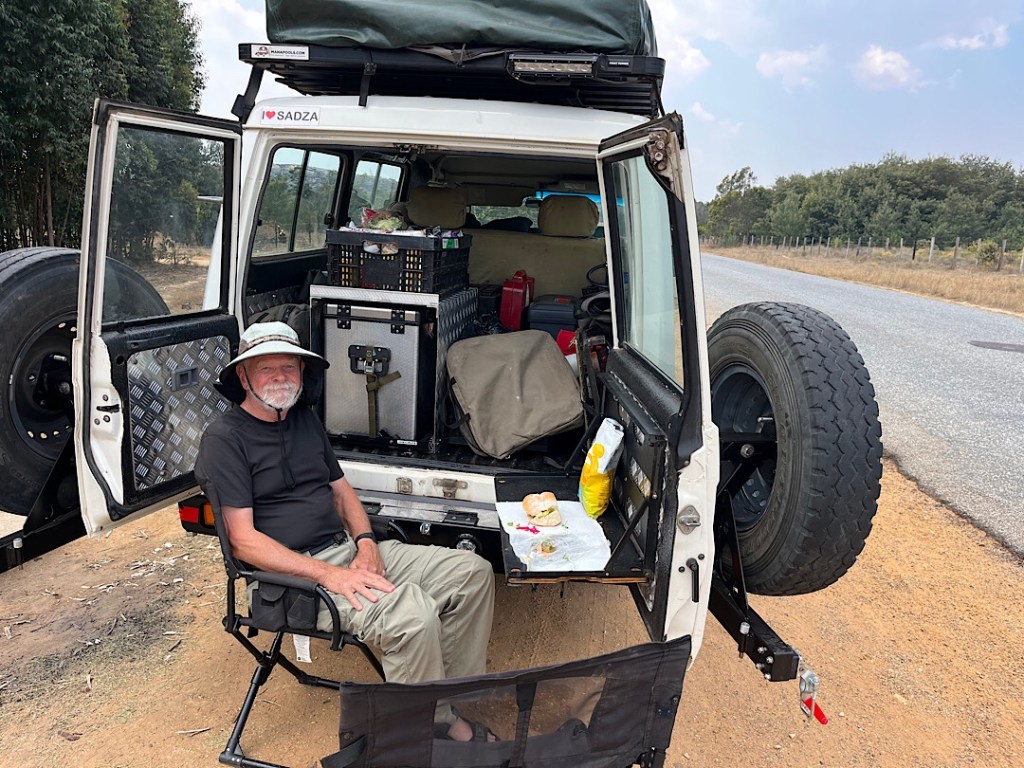
When we got hungry, we lumbered off the tarmac and parked on a dirt stretch near an informal bus stop. We opened up the Cruiser’s back, unfolded two chairs, let down our cooking shelf, made ourselves cheese and tomato and avocado sandwiches, and gobbled them down with chips.
To reach our destination in the northern highlands we had to pull off the main road and bounce over dirt and boulders for more than an hour. That wasn’t pleasant, but I don’t think we saw any other vehicle along the entire punishing stretch. We had that night and another full day to relax and enjoy the glorious countryside.
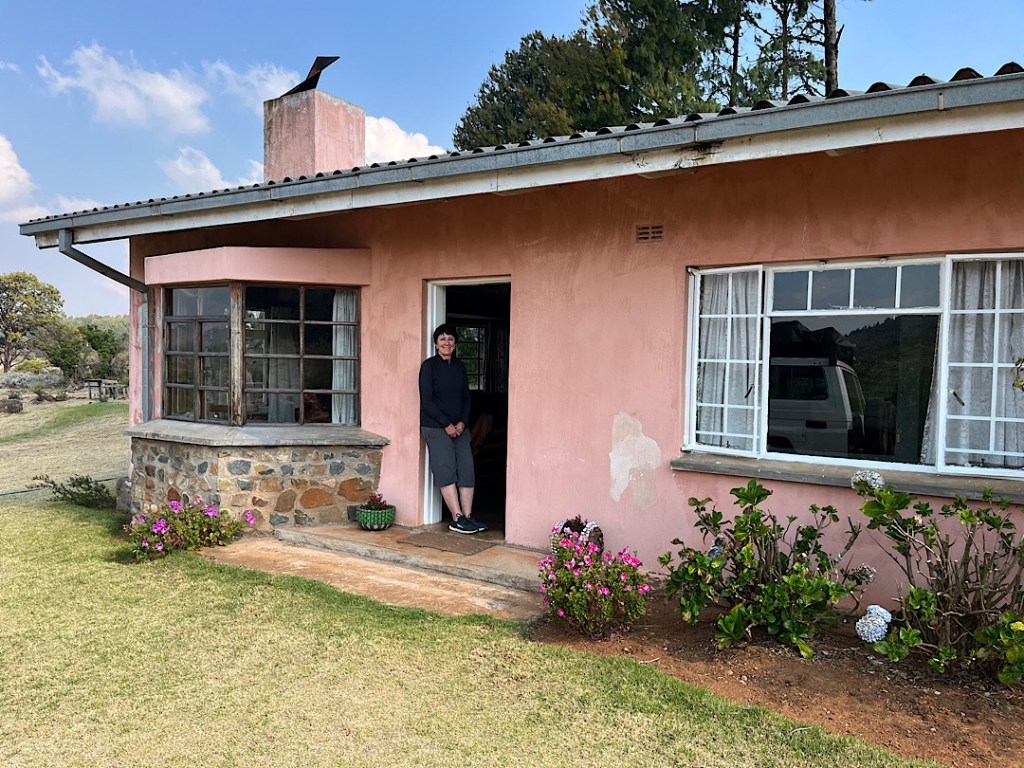
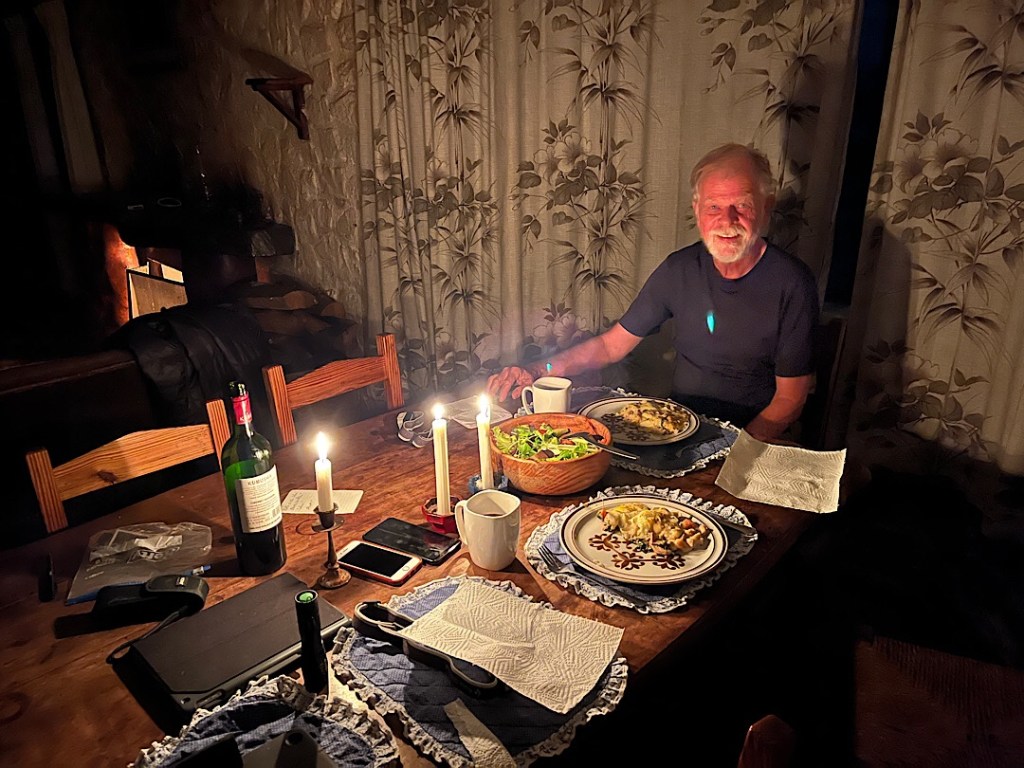
This self-catering “cottage” where we stayed was actually a four-bedroom house. Although we had only candlepower our first night there, we still enjoyed a delicious dinner of chicken lasagna (pre-cooked and frozen and packed into our Cruiser’s freezer by Ant’s team), a nice salad, and brownies.Tuesday morning we hiked for five miles around the lovely lakes down the hill from our cottage. It was one of the most peaceful walks I’ve taken in memory. I think we saw one other person the whole time.Pines like this scented the air.That pink house in the distance is our cottage, with the Cruiser parked next to it.
Wednesday we drove eight and a half hours, stopping midway to refuel at a Total Station. For 13 gallons of diesel, we paid $88 (plus a dollar tipto the friendly guy who cleaned our windshield) — more than the price at home. But it was still a relief to see confirmation we wouldn’t be dealing with fuel shortages (another Zimbabwean thing, at least occasionally).
Descending out of the mountains, we dodged more animal traffic…
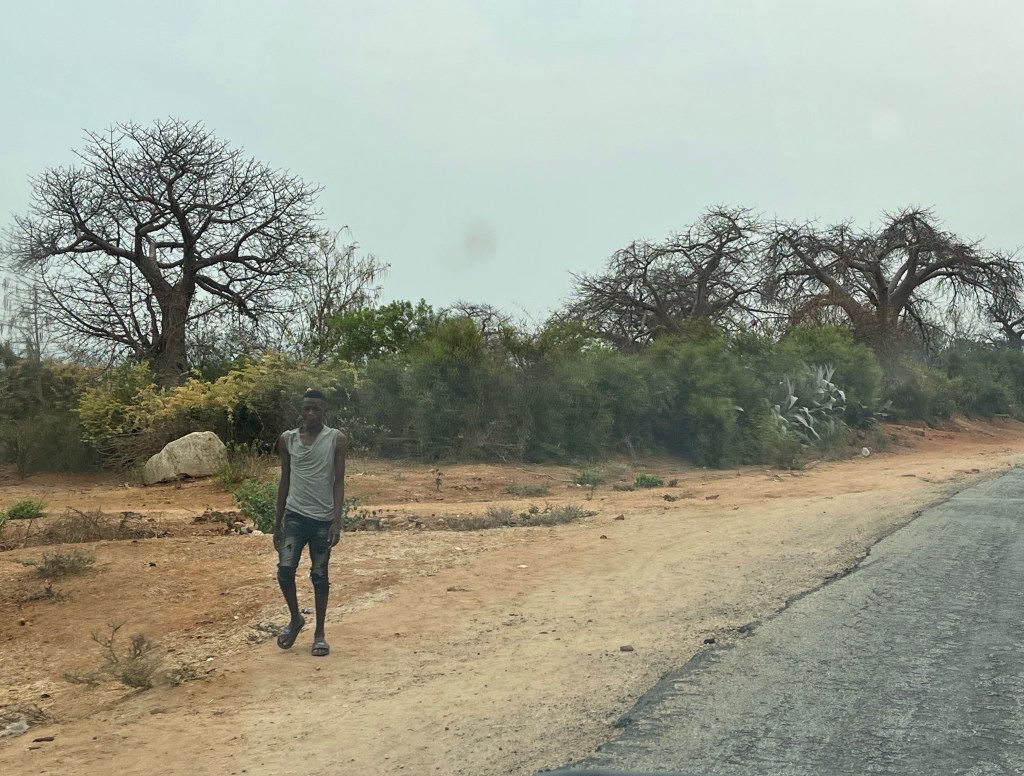
And I thrilled to this sight of our first baobab trees on this trip.
I bought that large colorful rug from the lady on the right, who made it.
Human automotive competition for the road remained light, and it disappeared entirely once we turned onto the washboard lane leading to our destination in the amazing Save (pronounced Sah-vay) Valley Conservancy.
The other scary byway in Zimbabwe is the Internet highway. If good paved roads are scarce, access to the global information stream is rarer. Here our beloved T-Mobile phone service, which gives us instant connectivity in more than 100 countries, provides only text and phone coverage, No data. Ant’s guest house was equipped with good WiFi but we haven’t been anywhere else that has had it.
As part of his services, Ant did provide us with an aging Galaxy Android phone, and we bought $20 of air time from a roadside vendor near Ant’s Sunbird Guest House. It took some work, but Steve finally figured out how to use the Android as a hotspot for all our devices. That’s how I was able to publish my Zimborientation post from our remote mountain shelter Monday night. It felt miraculous.
Since we left there, however, we haven’t had any phone signal most of the time (and if the Galaxy can’t get a signal, we get nothing.) If you’re reading these words, that means I finally found a spot of service. In the meantime, we’ll have to make do with focusing on the actual world around us. That’s not a bad thing.


















 At home and abroad