Our Airbus 340 looks almost full, and I wonder: why are we all going to Addis Ababa? We’re a motley crew. On the bus out to the jam-packed tarmac in Frankfurt, we traveled next to two young American couples and their four children, all under 6, all impossibly wholesome and American looking. Missionaries, was my guess. (Maybe Mormon? We didn’t have a chance to ask.) The pudgy gray-haired couple in the two seats in front of us are Swedes, and I count lots of obvious Germans and Africans, including many who look like they were sent by Central Casting to play Ethiopians. Other languages also float through the cabin. Are there coffee-traders among us? Arms dealers? Aid workers? Hydroelectrical engineers? How many are tourists, like us?
I recently read that something like 50 million people a year vacation in Africa, a drop in Las Vegas’s jumbo bucket, to be sure, but more than many Americans might guess. (This year, Steve and I would be double-counted, having started off the new year in Senegal and on track to finish it and start the next in Ethiopia.) In the months and weeks before our departure, countless people asked me, incredulous, why we were going.
I have many answers, but one that I don’t often express is that we’re going to have fun. We think it will be fascinating to step into the pages of the National Geographic (of our childhood) and visit some of the Stone Age tribes who inhabit the southern Omo Valley. We think the Guidebook Highlight experience of being in Lalibela’s submerged stone churches on the Ethiopian Christmas will be great fun (and I’m hoping our hotel room there will be halfway decent too.) We think trekking in the central highlands for four days among the breathtaking vistas and gelada baboons will be outdoorsy fun. And if I make it to feeding time for the hyenas of Harar, that will make me happy.
Of course pitfalls exist. The journey here (in coach, at least) is a brutal marathon for those of us who can’t sleep on planes (and even for those like Steve who can, a bit). I expect some abysmal roads and some barely tolerable hotels and unforeseen mishaps. So I suppose the big question of this trip is: will the fun parts outweigh the grubby, irritating, annoying ones? But that’s the question haunting all travel, isn’t it?
For the first time since our arrival in Ethiopia 18 days ago, we should have uninterrupted Internet until our departure from Frankfurt Wednesday morning. We bought a local SIM card for my phone on our very first morning, and our guide assured us we should be able to access the Internet on it. He did on his phone, routinely.
But although I’ve used the phone a lot to make calls and text people within Addis, it never would allow me to get online. Various folks told me I needed to call the central Ethiopian telecommunications office, to get them to turn that feature on. We dialed and dialed; were cut off and put on endless holds. Finally I gave up.
But I’ve been writing, almost every day. And we just arrived back at out guest house in Addis, where we’ll spend out last day and a half.What follows is what would have appeared, had we not encountered those road blocks on the Ethiopian information highway.
They’ll start boarding us for Frankfurt in a few minutes. Probably no wifi on board. Much as I love blogging about our adventures,our connections may be sketchier than we’ve ever before experienced. But I’ll do my best…
West Africa isn’t an easy place to travel. I’ve written a lot about the transportation challenges. The poverty and garbage and squalor are ugly; too depressing for most Americans to stomach, I imagine. Steve and I also got tired of constantly feeling grubby. When we reached our hotel in Madrid Saturday, anyone walking by our room right after we checked in probably mistook the moans and groans issuing from within, but in fact it was the sound of our pleasure at getting thoroughly clean and being able to expect that condition to last for more than an hour or two.
Still, I have to rank this trip among my best travel experiences. Hiking through the mangroves in the Saloum Delta, watching the misty form of the Bijagos islands take shape as we sped away from the coast of Guinea Bissau, bird-watching from that dugout in the croc-infested river in the Gambia, eating grilled oysters and later gazing at the incredible night sky from the beach on New Year’s Eve. These are intense, unforgettable memories, and we had others — more than I had time to write about.
We never got sick (unlike I did in Paris, where, incredibly, I lost weight.) The only time I ever felt unsafe was when we were on the road. The vast majority of people where we traveled are god-fearing Muslims, and with one or two exceptions (e.g. certain areas in Dakar at night), we heard no reports or warnings about personal crime. We gave up wearing the money belts we had packed, and I grew so lax I even walked off one night in Kolda leaving my purse at the table where I’d been working on my computer. I was halfway to our cottage when one of the waitresses came running after me with it.
The daily civility of the average West African also charmed us. In Senegal, common courtesy dictates that one greet people not only with a “Bonjour!” or “Salaam aleikhum,” but also to follow that with a “ca va?” (how’s it going?). “Fine,” you’re supposed to reply (in French). How’s it going for you? Often we were asked if we had slept well. If these are mere pleasantries, they do make daily life more pleasant.
Despite their difficult lives, despite their lack of many things that Americans couldn’t conceive of doing without, so many people we met exuded warmth and joie de vivre. Many expressed pride in their countries. When they asked us what WE thought, and we told them the truth, the invariable reaction was delight. It was mutual.
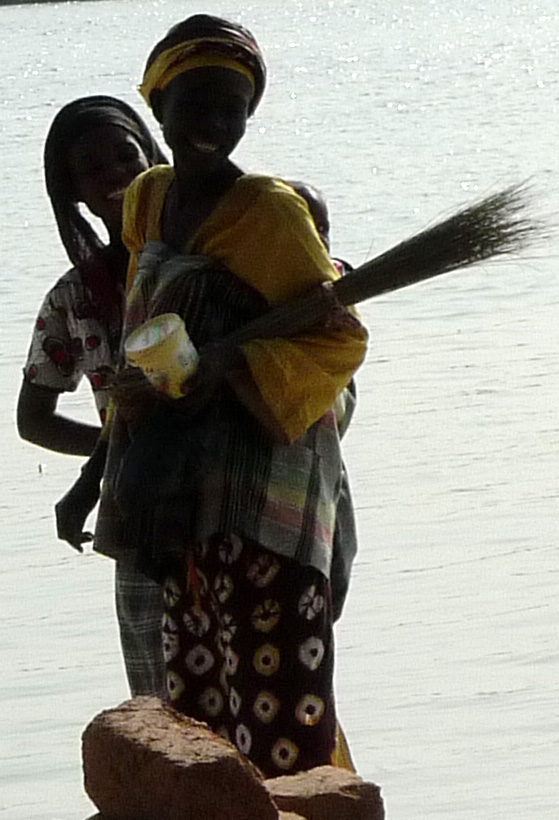
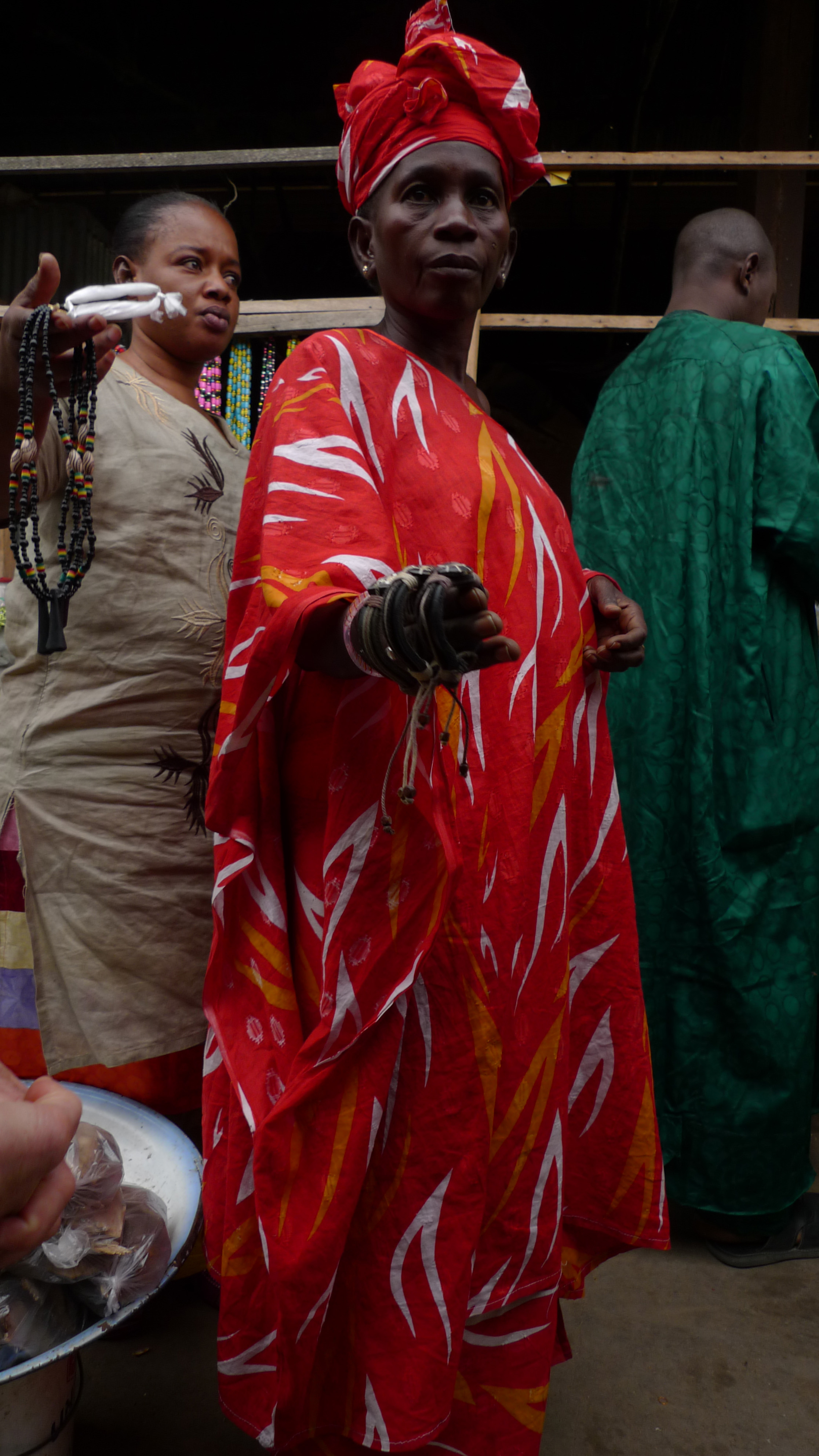
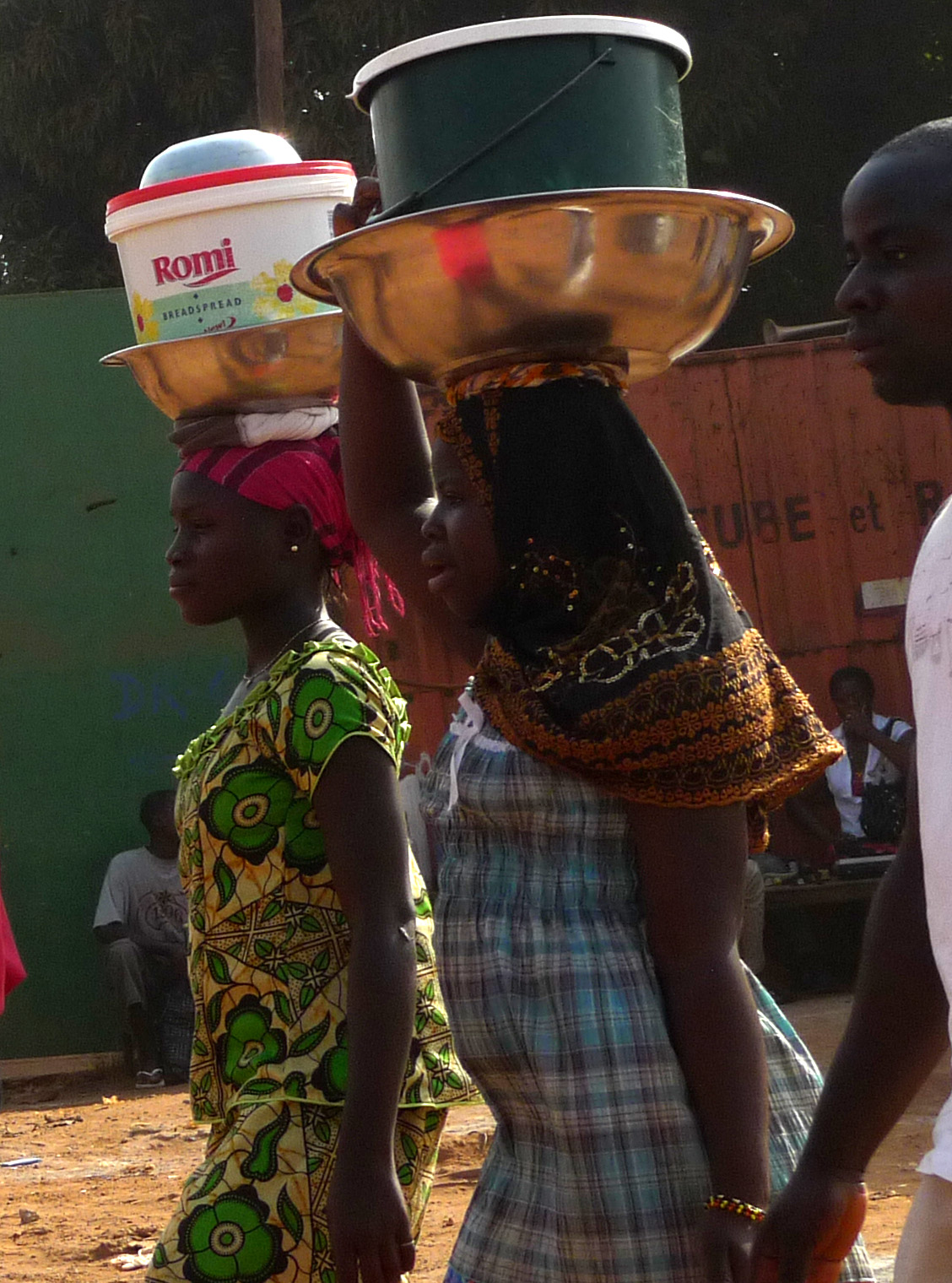
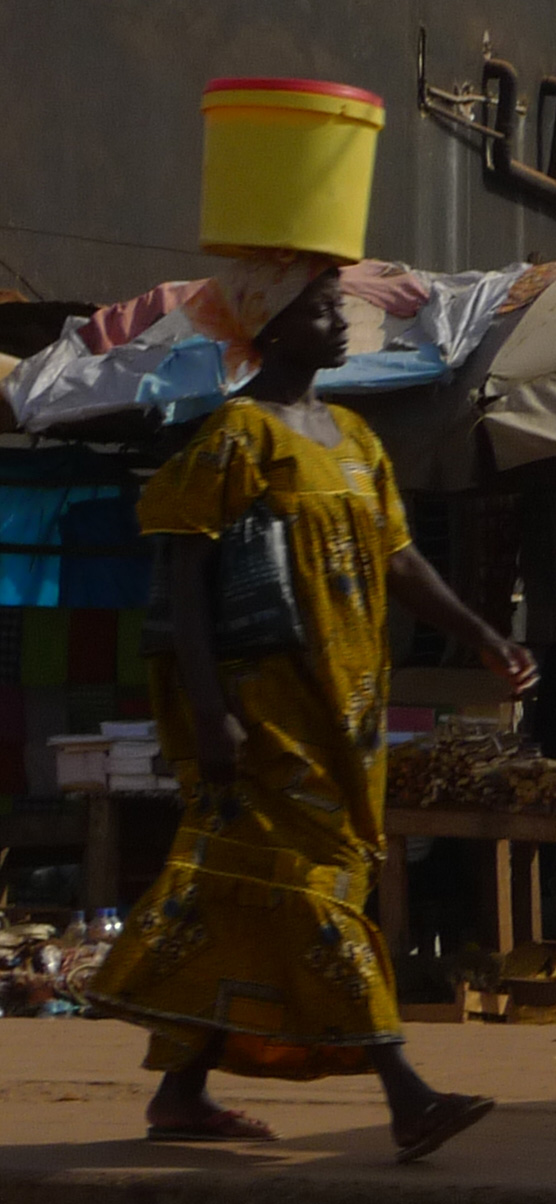
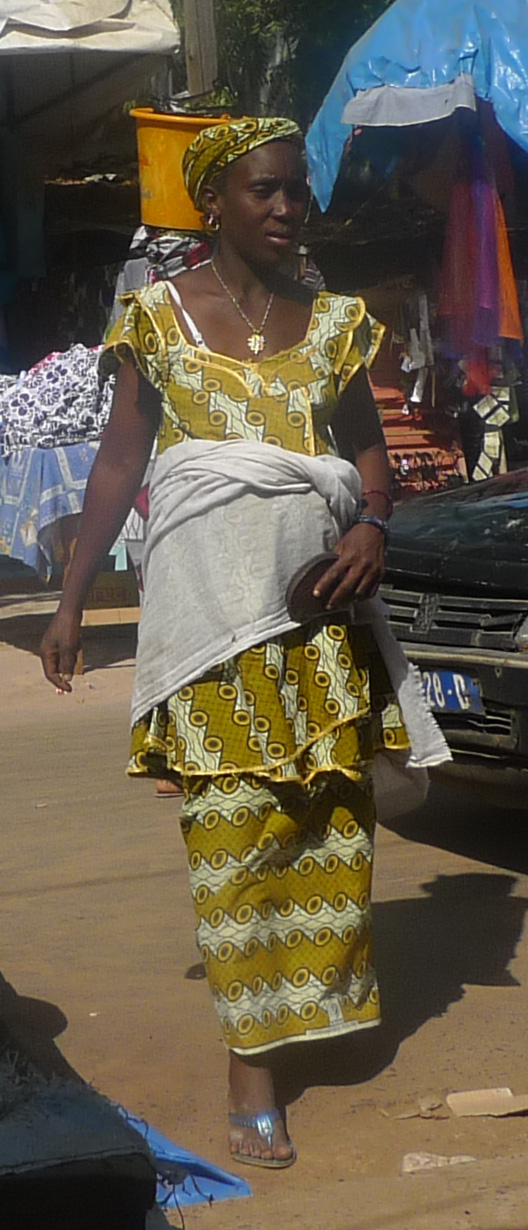
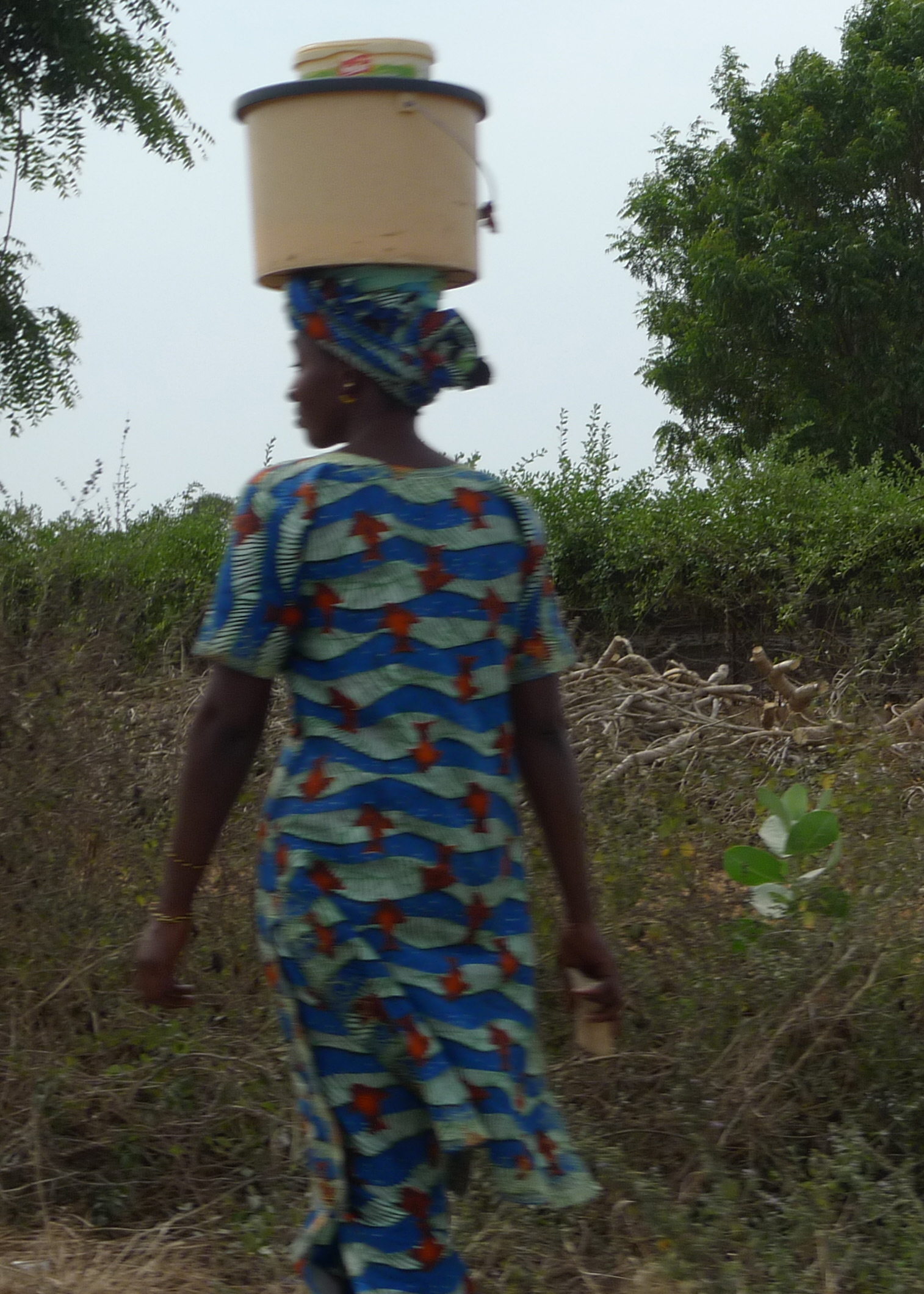
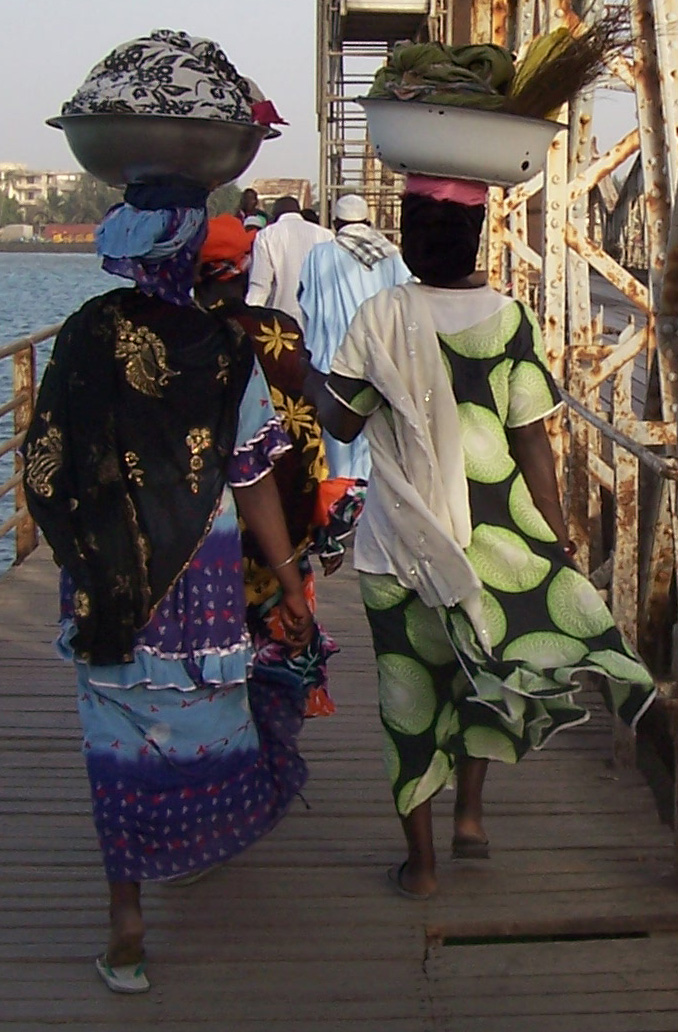
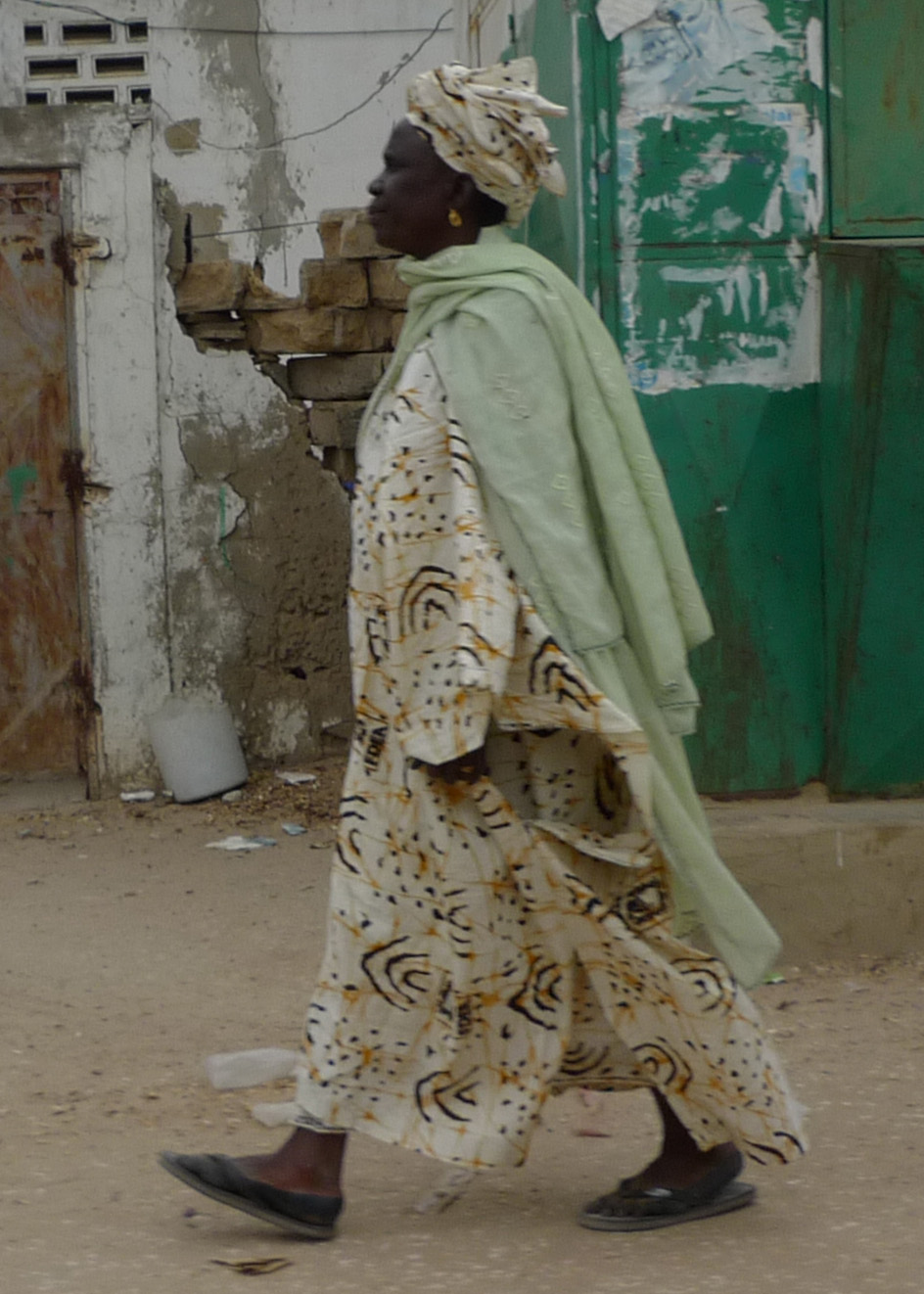
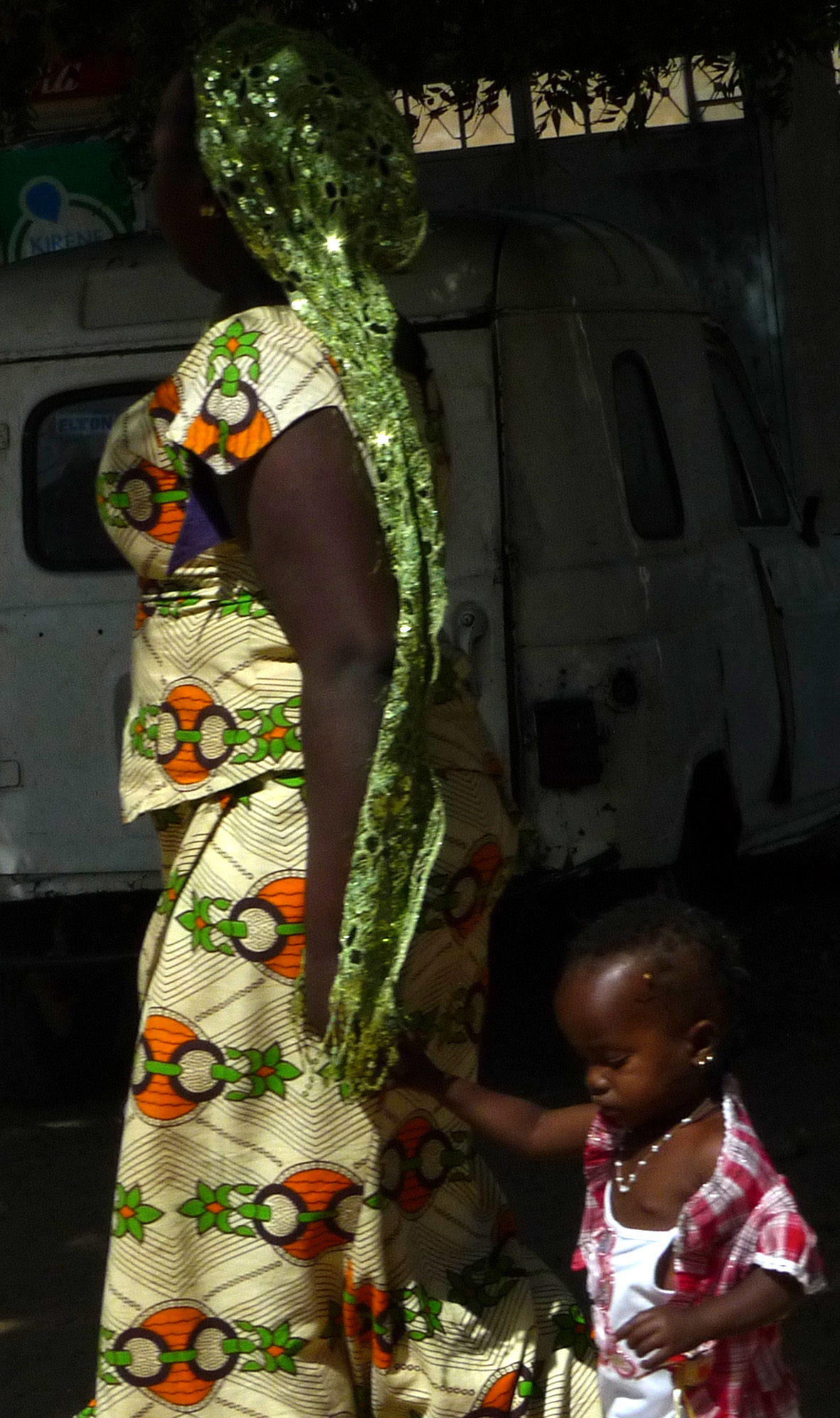
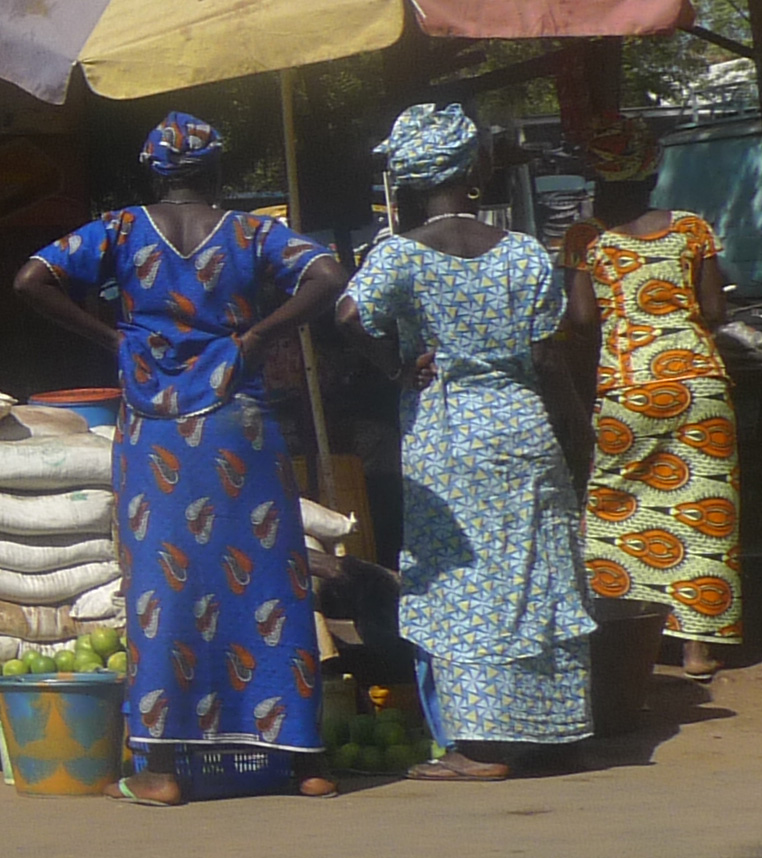
Although we’ve left Senegal (I’m writing this on the plane home), I feel remiss in not writing before about the Senegalese ladies’ attire. It consists of long flowing robes (which I believe can be assembled from various components) and a often matching head piece that can sometimes be a simple scarf but more commonly is a cloth tied up so that it looks more like a stylish hat — a nod to fashion rather than modesty. Most striking are the wonderfully colored and patterned fabrics. Often the women themselves are lovely, with high cheekbones and the elegant bearing of models (or people who’ve learned to carry all manner of items on their heads.) But even ordinary-looking women impressed us with their costumes. Men too have traditional outfits — long robes and the little hats whose shape I’m tempted to describe as pillbox. But only a small percentage of the men wear these, whereas it often seemed to us that 90 percent or more of the women dressed traditionally.
Our young friend Laura’s take on this difference between the sexes was nuanced. She felt the Senegalese women, like most human females, enjoyed looking good. But Laura had grown somewhat critical of the slavish devotion to using identical fabrics for one’s gown and headgear. The ladies virtually never tried anything more creative, she complained.
She also pointed out that wearing Western garb — even drab, prosaic clothes such as those worn by most men — was seen as a sign of sophistication. But in a male-dominant society such as Senegal, the men were most apt to have access to that. Laura suggested that many women dressed as they did because it was their only option.
How ironic, we thought. In their outfits, the ladies looked to us like tropical birds. In the dreary, desperate looking country villages or the post-apocalyptic urban settings, they added splashes of color and theater that we, at least, applauded. It’s a challenge to take good photos of people in West Africa, but Steve became obsessed with trying to capture good photos of the ladies, such as the following:
Okay, I’ll admit it. I booked a room at Sineta George’s SenegalStyle B&B (months ago) because I was nervous about arriving for the first time in Dakar with Steve to travel in West Africa on our own. Dakar has a reputation for being a rough, hyped-up city — a mecca for music but also a place where one might be mugged, or at least targeted by pickpockets. In the course of doing online research for this trip, I became aware that there was an American, a native Floridian, who had immigrated to Senegal 11 years ago and was operating a B&B and tour company. Her posts and comments on various forums charmed and intrigued me. By turns she sounded enthusiastic, jaunty, breezy, opinionated, funny. She charged about $60 a night for a room plus breakfast and dinner, and her descriptions of her cooking made me confident I’d enjoying dining there. I figured she could clue us in about life here.
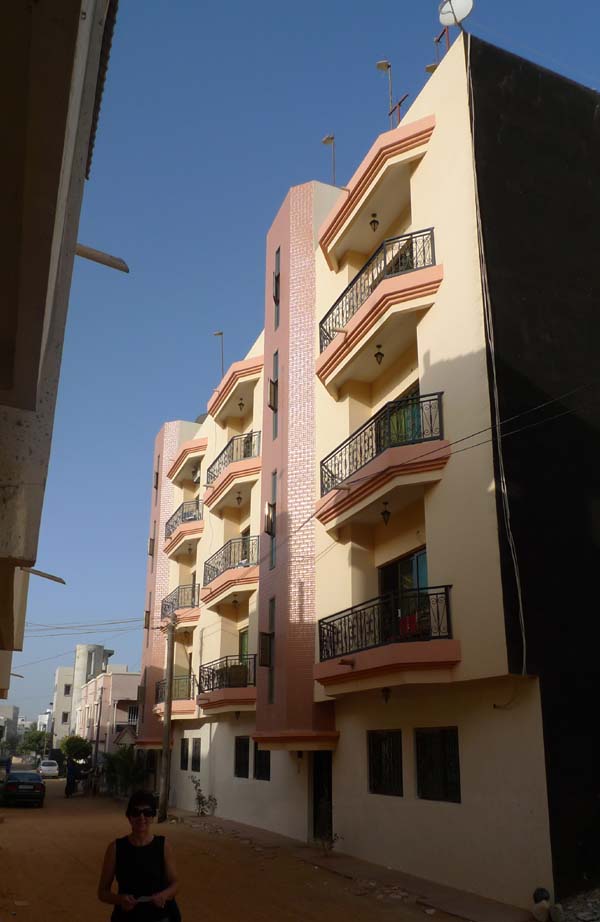
Sineta George's Senegal Style B&B occupies the first floor of this apartment building in the Dakkar suburb of Yoff.
So I reserved a room for our first two nights, along with airport pickup. I’ve earlier described how the power in her neighborhood was out when we arrived, and how she pressured us into signing up for an overpriced “safari” on the morning after our arrival. But our room that first night was clean, the bed was comfortable, and even though there was no power, hot water, or towels, and things seemed a bit chaotic, I still probably wouldn’t have felt that staying at Sineta’s was the biggest mistake of our trip — if it hadn’t been for what happened on our return.
I have to explain here that the reason I’d ALSO paid in advance for two and a half final nights at Sineta’s was she’d told me months ago we could leave our suitcases filled with winter (Paris) clothes at her place, while we traveled around tropical Senegal. So even though we’d begun to develop doubts about her, we had to go back to get our stuff. I e-mailed her from St. Louis, telling her we’d arranged our own transit back from there to Dakar, and she wrote back urging me to send her an SMS when we departed St. Louis and again when we were approaching Dakar “so I’m sure to be home!”
I did all that, but as we approached her neighborhood, we got a text from her, informing us that she was out giving a tour and wouldn’t be home until at least 5 or 6. I called her. What exactly did she suggest we do (with our SIX assorted bags, big and small)? Stand out out under the hot sun in the dirt street in front of her building? She offered no suggestions, but only complained that I wasn’t getting it — she was busy giving a tour! When I asked if she didn’t have a neighbor who could let us in, she lectured me, “Jeannette, you KNOW it’s a B&B!”
What we finally did, when we arrived, was to ask Sineta’s kindly Senegalese (French-speaking) next-door neighbor if we could put our bags in her apartment. (Why Sineta has failed to establish a relationship with this woman was mystifying, unless it’s because Sineta speaks little French or Wolof.) Steve and I headed to the nearby minimart to get a Coke and juice. We waited.
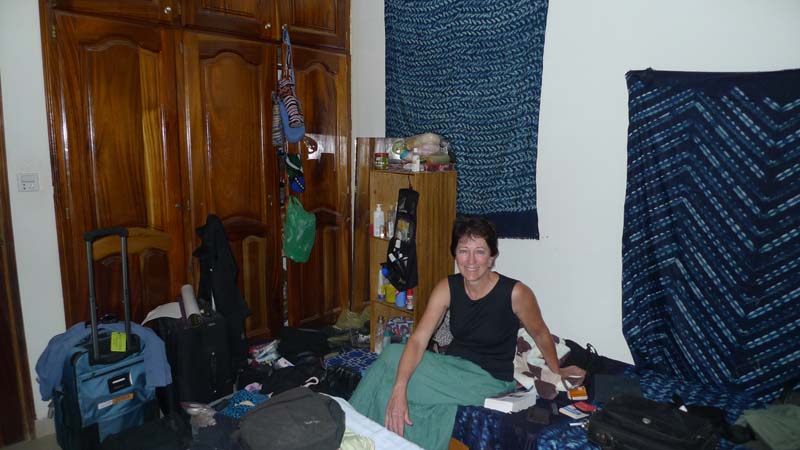
Perhaps prodded by my irritation, Sineta arrived back around 4:30. But once we’d collected our bags from the neighbor, she ushered us into a different bedroom from the one we’d occupied on our first night. The new one was tiny, and almost entirely filled by a double bed, a single bed, a bookshelf overflowing with the sort of junk that occupies some of my bathroom drawers, and an ironing board and iron. No private bathroom. No clean sheets. “But that’s no big deal,” she declared. “I’ll get to that.”
The small 3rd bedroom in Sineta's apartment has no closet space because cabinets and shelves are crammed with Sineta's personal effects.
She said dinner would be at 8 or 8:30. Steve asked if we could pick up a bottle of wine at the nearby package store and drink it with our dinner. “That’s fine,” she said. “As long as you don’t drink it in front of Jon,” (her 17-year-old son). “But he’ll be at dinner with us, right?” Steve persisted. “Yeah,” she said. “But I don’t want him exposed to drinking or smoking. We’re Muslims.”
Sineta, her son, and guests in two of her three double rooms share this cold-water bathroom.
“So I guess that means you don’t want us to have wine at dinner,” Steve said.
“Well, yeah,” she agreed.
Feeling that now we REALLY needed that wine, we set off on a dining adventure that involved a taxi driver who claimed to know the whereabouts of Chez Loutcha (a Cape Verdean joint recommended both by our friends and guidebook.) He drove for 20 minutes, deposited us in front of place called Pizza Katrina, and insisted this was the place. Suspicion from us! Dumb protests from him! Jumping out of the taxi with angry declarations he would get not one CFA from us for this outrageous deception!!! We quickly found a second guy who eventually got us to what turned out to be a good meal. When we returned to Sineta’s, she and Jon and her three other guests were only then (10:30 p.m.) forlornly tucking into their chicken in her living room. (She also sleeps there.)
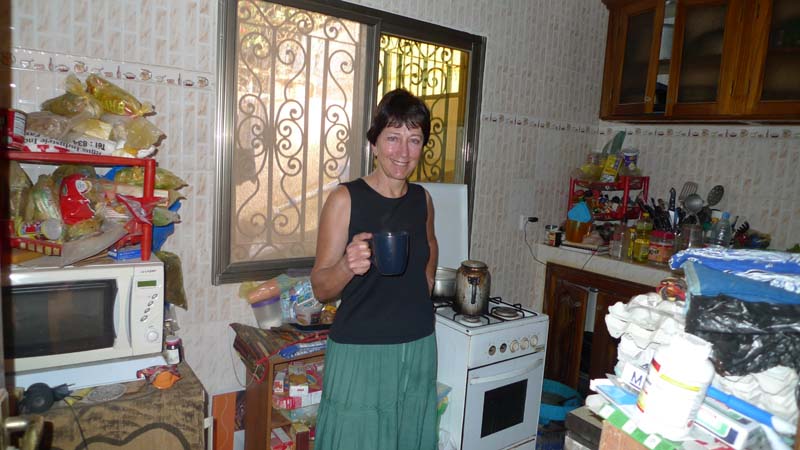
This morning, we awoke early, which was fortunate as Jon knocked on our door at 7:30 to retrieve the iron, which he needed to press his shirt for school. His mother wouldn’t wake till 9, he informed us, so we dug out a pan on our own in her tiny, cluttered, grimy kitchen and made two cups of our instant Starbucks.
Kitchen in Sineta George's B&B
When Sineta finally emerged as we headed out the door to search for breakfast, she looked a bit miffed. “Oh. You’re going out for breakfast? I could have slept in.”
Things got even worse. We fought with her over what she owed us and we her. She lectured us about how great Senegal is: no drugs or gangs to corrupt her kids (she moved her with three, but the elder two have since left). Every school in Senegal has an International Baccalaureate program, she insisted. I believe this about as much as I believe her claim that the city’s electric power almost never goes out. Or that no one is starving here. (I didn’t ask her why so many beggars had approached us over the three weeks of our visit, pleading for money to eat.)
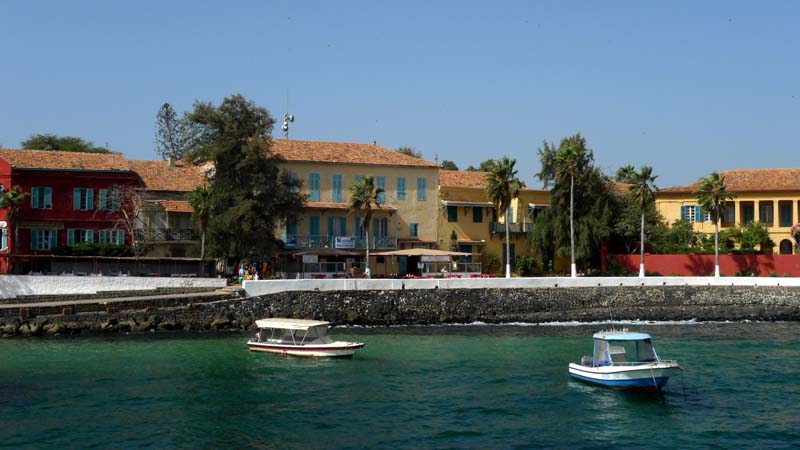
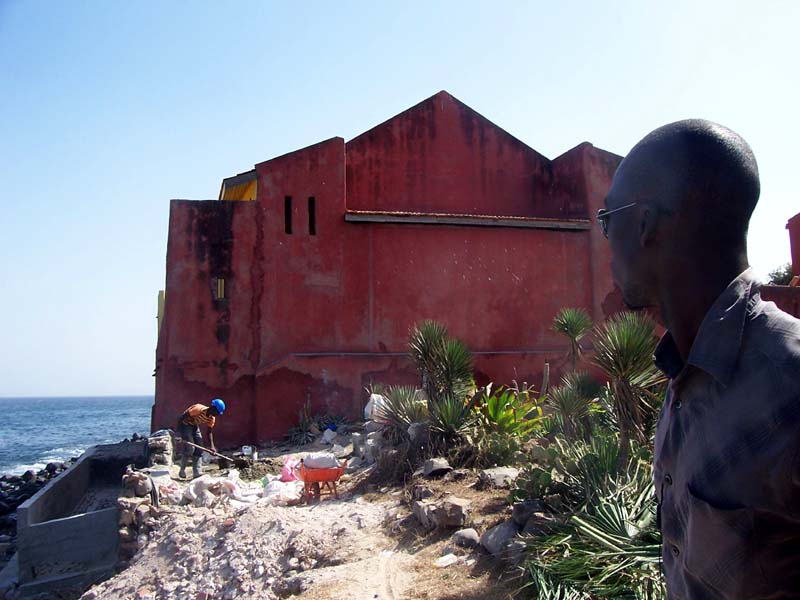
All this somewhat tainted my mood Friday morning when Steve and I and a Senegalese guide named Bada set off for Goree Island, the World Heritage Site located a brief ferry ride off the coast from Dakar. Like St. Louis, Goree is filled with colonial structures. Some date back to the 1500s. A good percentage are in fair to good shape, and the cloudless skies and cool breeze made it a perfect day for us to stroll among them. Time and again the light-saturated colors of the buildings and the bougainvillea and sea and sky made me take out my camera and try to capture their beauty. What Goree is most famous for, however, is that this was one of the more important holding places for the people who over the course of centuries were captured and chained and dragged, terrified, from their homes and families in the bush. They were forced into tiny cells in a building that today is painted vermillion. Admission to this Museum of Slavery costs about a dollar per person.
Were it not for its dark history, the villiage in Goree Island would seem a pleasant place to live.
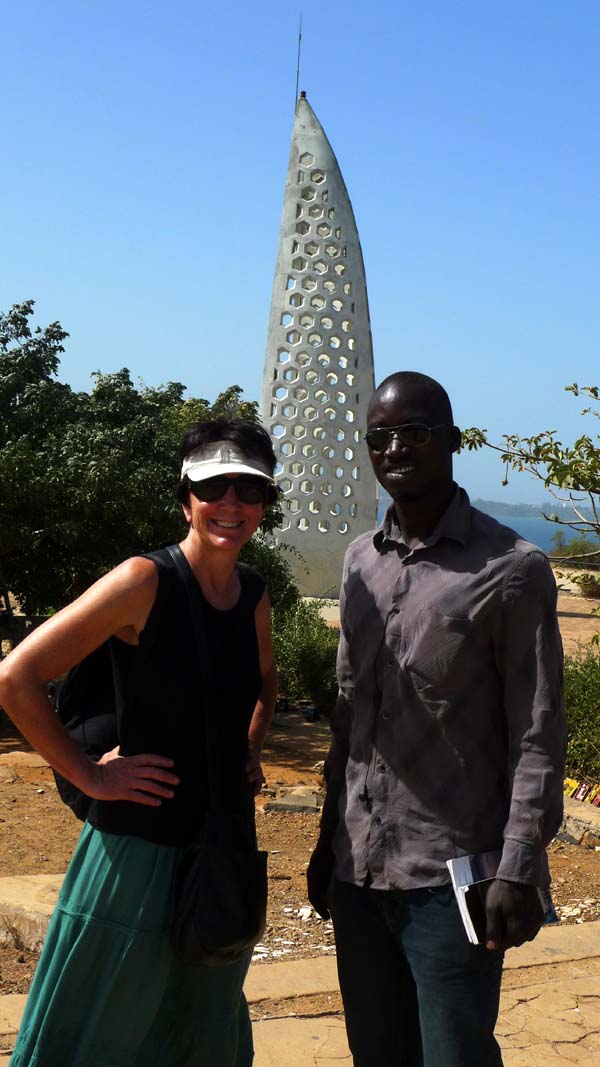
To our chagrin, just as we arrived, it closed for lunch, and there was no sign of it reopening two and a half hours later, when we were preparing to catch the return ferry. We never got to see the “Door of No Return” that the captured Africans walked through just before boarding the slave ships. However, we were able to peer through the long slitted windows at the tiny spaces into which suffering hordes were packed. Bada pointed out that the slave traders lived on the floor above the cells, so they must have lived with the daily sounds of men, women, children weeping, screaming, groaning, dying. The three of us stood there, reflecting on cruelty of this magnitude, and with the ghosts of the slaves hovering around us, I have to admit our travails with Sineta seemed trivial indeed.
Building where slaves were warehoused prior to sale and shipmen to European colonies and the US.
Jeannette & Bada, our guide, before the Goree Island monument
The worst thing about traveling in West Africa, as we’ve experienced it, is the difficulty of getting around. Although train service once existed between Dakar and St. Louis and Dakar and Bamako (the capital of Mali), it no longer operates. We’ve seen only a few big American-style buses (we just passed them on the road to Dakar, from where I’m writing this), but they stop at every village. I’ve described the drawbacks of the sept-place bush taxis — and we never tried the even cheaper and more impoverished minibuses.
But now I’ve finally figured out how the sensible Toubab travels: you hire a private car. We asked at our hotel in St. Louis about this and thus secured a ride in a clean, well-maintained vehicle (not a single crack in any of the windows! Perfect seat belts!) This is costing us $100, versus the $35 it would have cost to ride in a bush taxi with (at least) 5 other passengers, plus the regular taxis to and from the gare routiere. It looks like we’ll make this trip in just 4 hours, enjoying a MUCH higher level of comfort.
The problem with the private cars is negotiating a good price. The owner of our B&B in Dakar wanted to charge us $200 for this very same trip. I know it’s possible to hire a clean, air-conditioned vehicle to drive you all around Senegal for 11 days for about $600. Laura and her dad did that. But Laura arranged it, and she’s a bargaining genius. When S and I asked the very same driver how much he would charge to pick us up at the Gambian border and drive us to St. Louis (a one-day gig) he demanded $300 — and wouldn’t consider any counter offers.
As pleasant as this current transport is, I also don’t regret any of our sept-place trips; constant comfort has never been our top priority in traveling. When we want to be really comfortable and surrounded by familiar things, we go home.
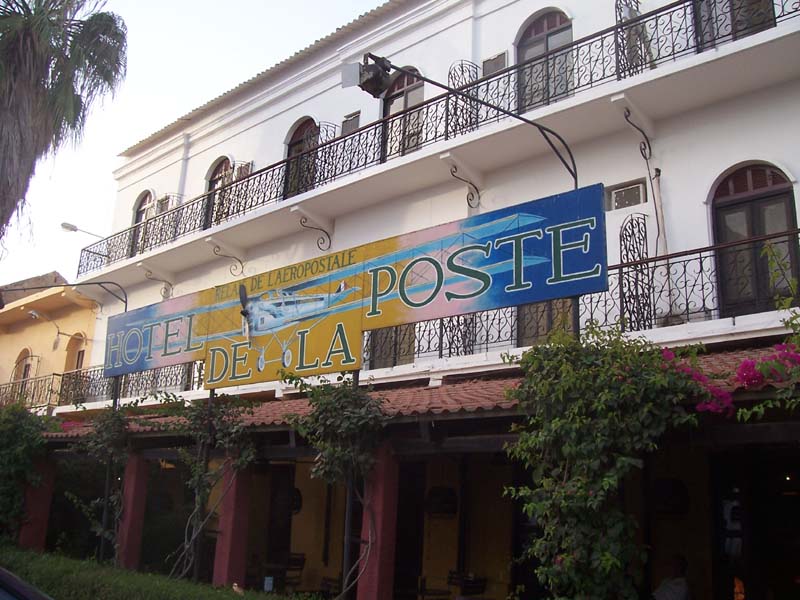
The city of St. Louis (pronounced San Loo-wee, of course) is a World Heritage Site that fills a narrow island in the mouth of the Senegal River. This was the first place Europeans established a settlement in West Africa, and for many years it served as the capital of both the Senegal and Mauritania colomies. Many of the old French colonial buildings survive, and a handful of them have been well-maintained — enough to make it easy to imagine how splendid this place could be (if most of the buildings weren’t peeling or crumbling or shattered.)
The Hotel de la Poste is a rare example of well preserved 19th century French architecture in St. Louis.
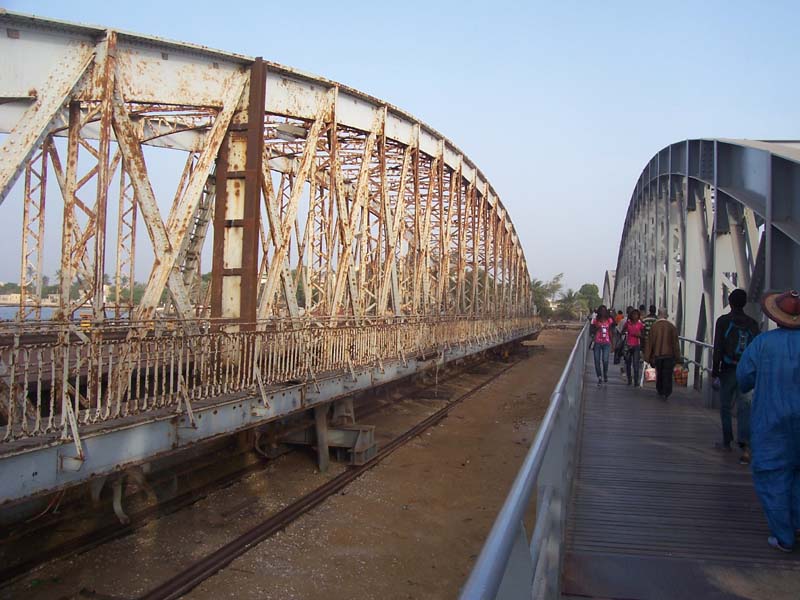
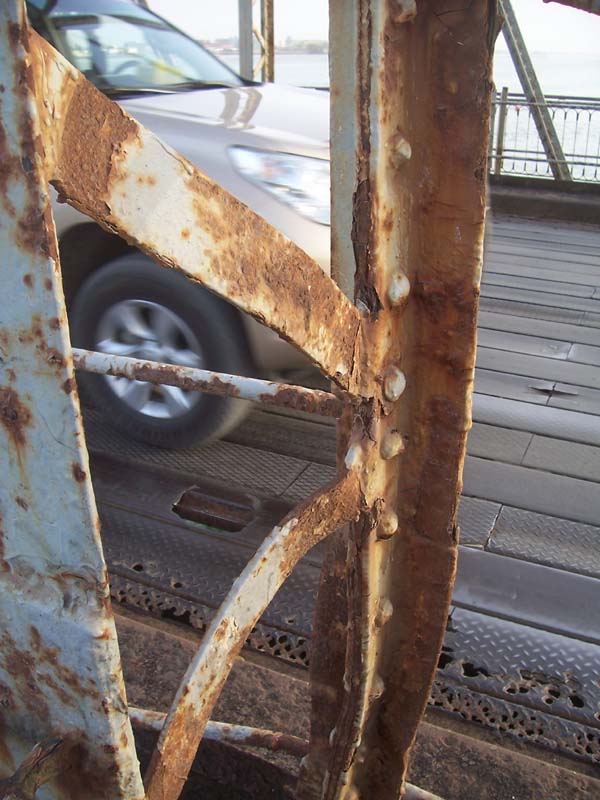
The architectural heritage includes a rotating bridge designed by Gustave Eiffel that spans the broader, eastern part of the river between the island and the mainland. (We’ve learned that it first served on the Danube but was relocated here at some point.) Today half the original structure is buckled and rusting, but amazingly, it’s being replaced, section by section, with new steel segments.
The elegant lines of Gustav Eiffel's bridge evoke his more famous tower in Paris.The bridge is being replaced in sections, each faithful to Eiffel's design but employing moden materials.Corroded and buckling, Eiffel's original iron bridge could not be expected to stand much longer.
Steve and I enjoyed walking over it and through the town, which reminded us of a miniature and Africanized Manhattan: the cool buildings, a couple of art galleries. There are even some tourists — almost all French. I think the only Americans who come here are Peace Corps workers or their parents. We were amused when one tall shop owner approached us in the street and asked if we were French, then Belgian? English? German? Swedish? Swiss? He finally gave up, and when we confessed our true nationality, he smiled hugely and showed us the image of Barack Obama on his backpack.
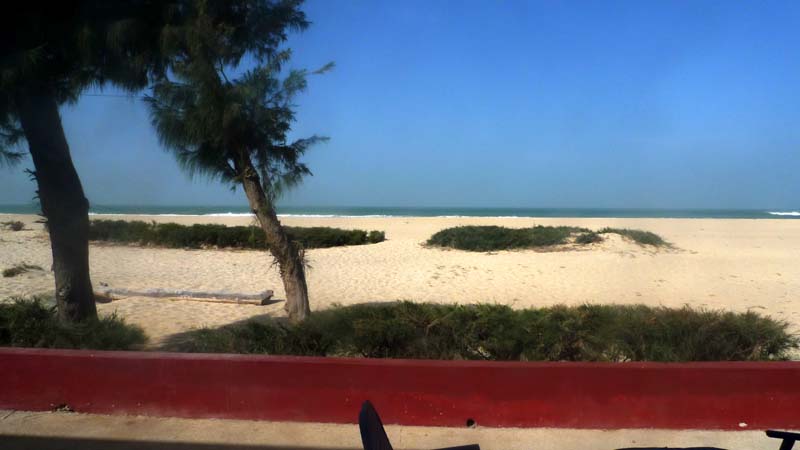
We’ve also loved our hotel here, the Mermoz (named after the French Charles Lindbergh, who in 1930 flew from a spot just down the street to Brazil.) The hotel isn’t located on the island, but rather on the long, narrow peninsula that separates the river from the Atlantic Ocean. After an initial night in one of the dark, noisy $50 “standard” rooms near the restaurant and reception area, we upgraded to a huge lovely room that cost around $100 but had a private patio facing a beach at least twice as wide as the one in front of the Hotel Del.
Beach at the Hotel Mermoz
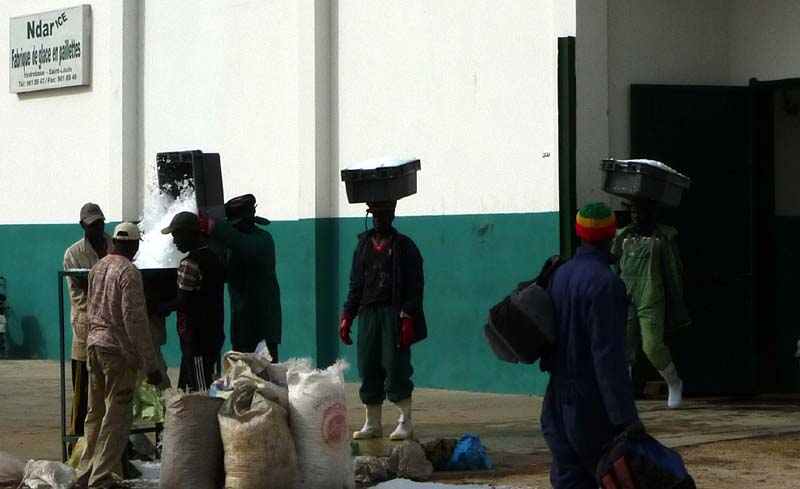
The hotel is a longish taxi ride or a 50-minute walk from the island/city. We walked it twice, and I think what we saw along the way will stick with us even more than the conventional sights here. We’ll remember the beachside cemeteries that stretch on and on, for maybe a quarter of a mile. Before them we passed the large, modern-looking Ndor ice plant where we watched young men carrying out large trays of ice on their heads, and transferring the trays into trucks.
Loading ice in St. Louis
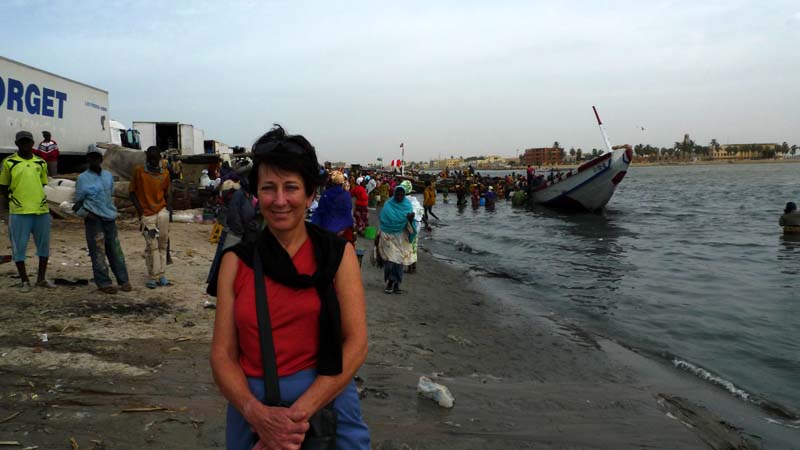
Yesterday morning, we saw the trucks in action. About 10:30, we came to the first of the wooden fishing boats pulled up close to the river’s edge. Every boat, new or old, is painted with bright colors and complex designs (a cheery counterpoint to the tough dangerous life these men who fish with nets must lead.) Strong young men were wading out to the boats and filling large bins with fish, then carrying the bins (again on their heads) to trucks parked nearby. They would dump one bin of fish into two empty bins, which were then filled with ice, later to be trucked to inland places like Kolda (so people like Laura’s host mother could serve us delicious fresh fish with our rice.)
Unloading the morning catch in St Louis
It was a crazy, bustling, fantastic scene: at least 100 boats and what looked like thousands of people — most of them purposeful, dealing with the catch of the day or selling items ranging from beignets to SIM cards to those who did. Some folks waited to spring into action, like the ladies in their amazing Senegalese gowns and headgear. Some of them would later carry buckets of the fish to markets or restaurants around town; others would dry or smoke fish on the riverfront. We threaded our way among them, and while a child here or there commented on our status (“Toubabs!”), for the most no one seemed to even notice our presence. I felt a bit like a time traveler wearing an invisibility cloak.
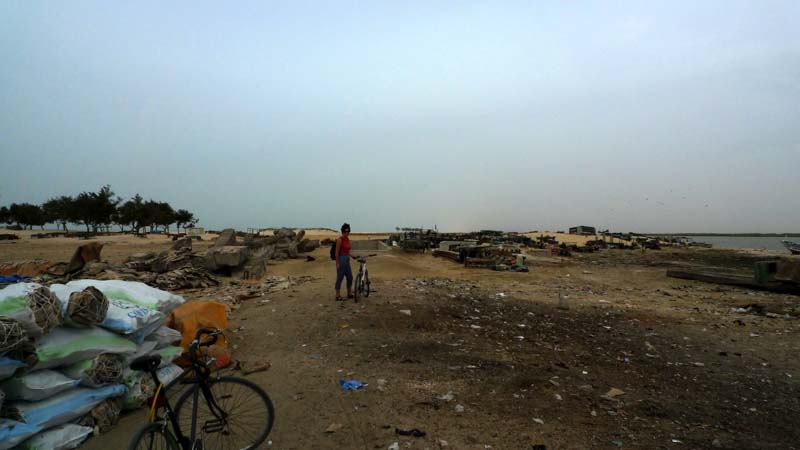
Finally, we made our way onto the island, where we rented bicycles for a couple of hours. We spent some time exploring the streets (not many) that we hadn’t already seen on foot. But I was most intrigued by the notion of biking to the old Mauritanian border.
The desert country of Mauritania lies just on the other side of the river, and I’d read that an old frontier post, no longer functional, could be found a few kilometers to the north on the peninsula where our hotel was located. So we headed there. For a while we rode on pavement, but then the road gave way to dirt and then sand.
Eventually, the buildings stopped and the sand was so deep we could no longer ride. We pushed our bikes through it for a while, but then decided if we want to get to Mauritania, we’ll have to find some other path.
The Mauritanian border lies a kilometer or so across the sand dunes.
Tuesday, January 14
I’ve been sleeping soundly everywhere on this trip, but Sunday night I barely got 4 hours. During dinner, Heather, the English owner of our lodge, got to talking about the ferry across the Gambia (the only way to cross this huge river that divides the country in two). She recalled how one of the last times she’d taken it, someone had loaded a truckful of cattle on board, and they’d broken loose. “It’s was awful. They panicked, and they were scratching the sides of all the cars with their horns. And one poor creature fell overboard. Don’t know what happened to it.”
I could only imagine how the passengers, many of whom share the same space with the cars and trucks, had reacted. But worse things have been known to occur, Heather continued, mentioning that at least one ferry had sunk since she moved to the Gambia in 2006. Most of the passengers had died (few Africans know how to swim). “The bodies were never recovered, but the awful thing was that later, hundreds of flip-flops washed up, not far from here.” At first she had found that weird, but then she’d realized they must have come from the drowning victims.
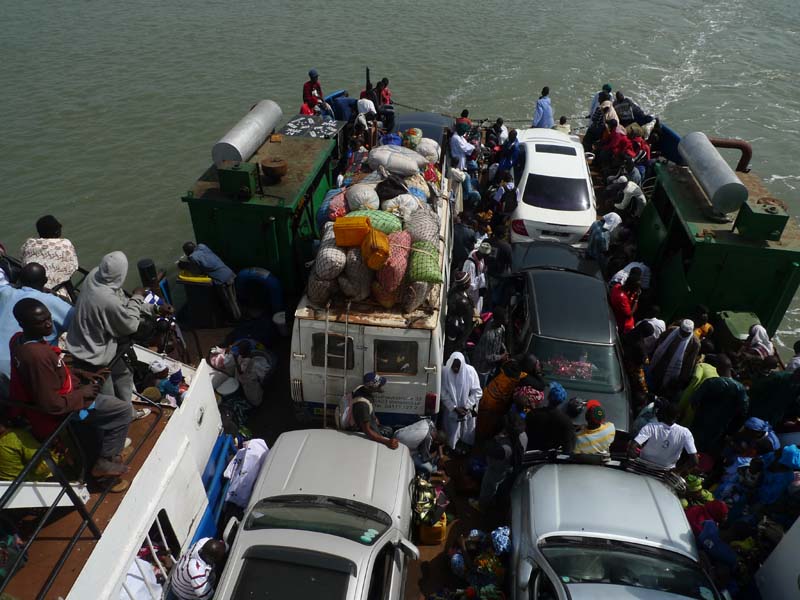
Afternoon crossings on the Gambia river ferry are more crowded and more colorful than early morning trips.
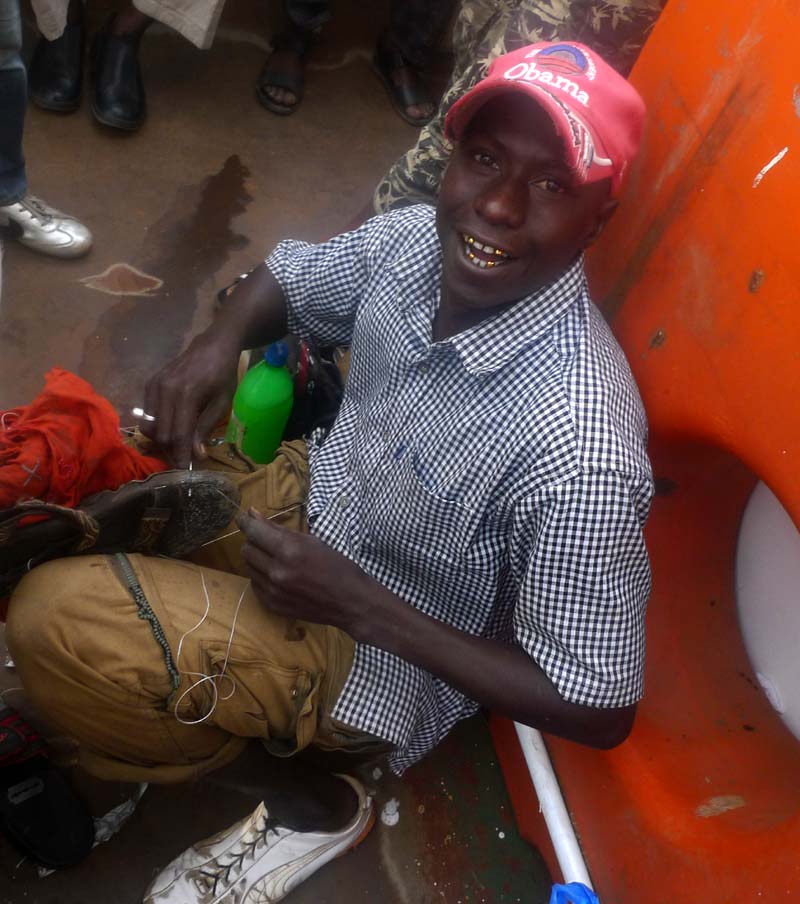
So I tossed and turned, thinking not only of our morning ferry ride but also of what we faced after it. As it turned out, the river crossing was great. Moses delivered us to the dock by 8 a.m., we bought tickets (30 cents apiece) from a delighted-looking man who asked me how we were enjoying our stay in the Gambia, we got a lovely spot at the rail of the upper deck (where the only farm animal I spotted on the main deck below was one woeful rooster), and the ferry turned out to be the fast one, making the passage in just 30 minutes. (The one we’d taken while traveling south was missing an engine and kept turning in circles. That trip took an hour.) Steve even had the fortune to stand next to a self-described Gambian “shoe doctor” who for $6 glued and stitched the soles of Steve’s failing Tevas before we reached the northern shore. (Only liberal applications of duck tape had been holding them together.)
Cobbler on the Gambia river ferry offered a 10-year warranty on repairs.
With little ado, we found a taxi to take us to the border and there got our passports stamped by inspectors from both governments. From the border we found a bush taxi heading for Thies, more than halfway to our ultimate destination (St. Louis). As during our first dewy-eyed ride in a sept-place (almost two weeks ago), we had to cram into the stuffy, filthy, shredded back seat along with a young woman passenger. But this ride took more than four hours (instead of two), and by the time we climbed out, we felt thoroughly sick of sept-place travel.
Still, I didn’t feel frightened during that ride, even though at times the road became so badly potholed, the drivers abandoned it altogether for the dirt shoulders or dirt tracks that paralleled the ruined road. In contrast, we felt like we were facing imminent death on the final segment of our journey (from Thies to St. Louis.)
The fixer who’d helped us buy our seats (all three middle ones, a much more comfortable ride) had assured me that our driver was exceptionally good. Middle-aged, he wore flowing Senegalese robes and a traditional cap. I noted with approval that he seemed to inspect our vehicle before we took off.
The road was excellent, if not terribly wide. Maybe that’s why he preferred driving down the center of it. The problem was it was one of the busiest routes we’ve traveled on yet. When we would approach the oncoming traffic, he would edge into our own lane clearing the vehicle ahead of us by a few feet. Time after time, I stifled screams. The most terrifying instant came with a huge bird (probably a vulture) swooped down and hit our windshield (fracturing it even more than it was to begin with). With traffic coming the other way, our driver swerved away from it and somehow retained control of the vehicle. I’ve had other scary rides in my travels (certain taxi drivers in Cairo and Shanghai come to mind). But they were relatively brief. This one lasted more than three hours.
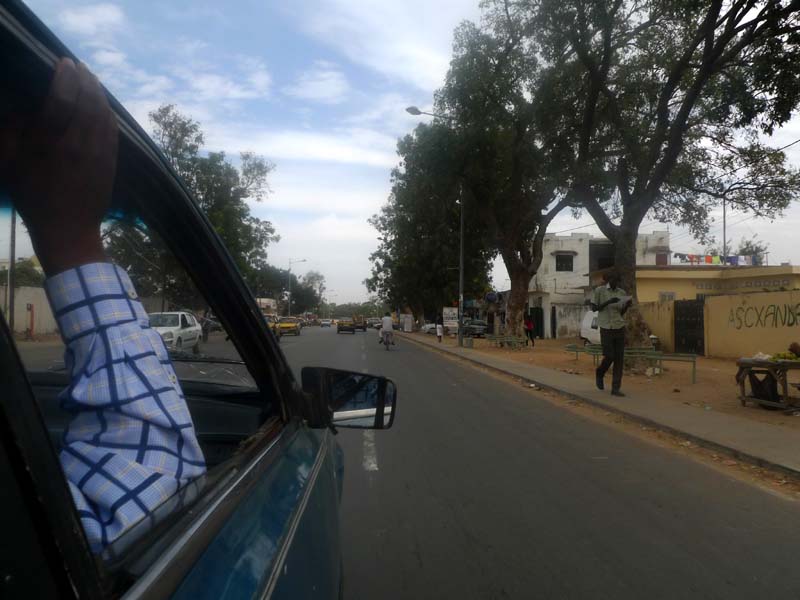
The broad, tree-lined main Boulevard of Thies as seen from the middle seat of a sept-place.
By the time we pulled into the St. Louis taxi park, more than 12 hours after leaving Heather and Moses’ elegant haven, both Steve and I were rigid with tension. But we reached our hotel just before dark, and our spacious room here opens onto a patio facing a huge, empty, glorious white beach. Last night we slept like the dead, today we’re taking it easy (writing and posting photos!). We’ll leave it till tomorrow to fully explore St. Louis.
Sunday, January 9
We met a man today who told us this popular synopsis of The Gambia’s genesis. It came in the early 1800s, he said, when the British had decided the slave trade was evil. Since they saw it as their mission to run the world, they sent warships up the Gambia River and claimed jurisdiction over the land that had been controlled by the French and Portuguese. Within the territory that could be bombarded by their weapons from the middle of the river, they prohibited slave-trading, and the eventual result was this funny little sliver of an English-speaking country in French West Africa, less than 30 miles wide in many places. Today it indescribably screws up commerce and transit through the western half of Senegal. The Gambia itself is even more of a mess. I’ve seen recent IMF figures that suggest the average GDP per person is only 500-some-dollars per year (less that half that of Senegal). The story made me think of current US foreign policy: well-intentioned but fraught with ghastly unintended consequences.
“The Gambia is hardly going to knock your socks off,” warns even the Rough Guide (which finds something nice to say about every country in West Africa.) The book did describe one retreat upriver that intrigued me: a chimpanzee rehabilitation and breeding center where one could stay in safari tents “with superb river views.” But when I tracked down the founder’s husband via e-mail, he shot me back a woeful tale that included his wife’s dying of cancer, the government kicking him out, and handing over the property to incompetents who had destroyed all that his wife had worked for.
I don’t remember how I heard about Farakunku, a lodge opened by an Anglo/African couple (Heather and Moses) at the beginning of 2009. Their website offered a two-night special I couldn’t resist. We had the first night here yesterday, and sadly, we’ll depart tomorrow before dawn.
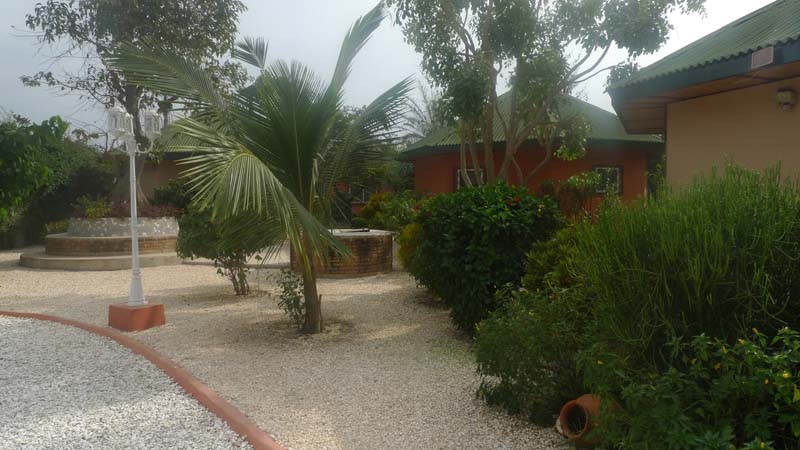
Garden at Farakunku lodge
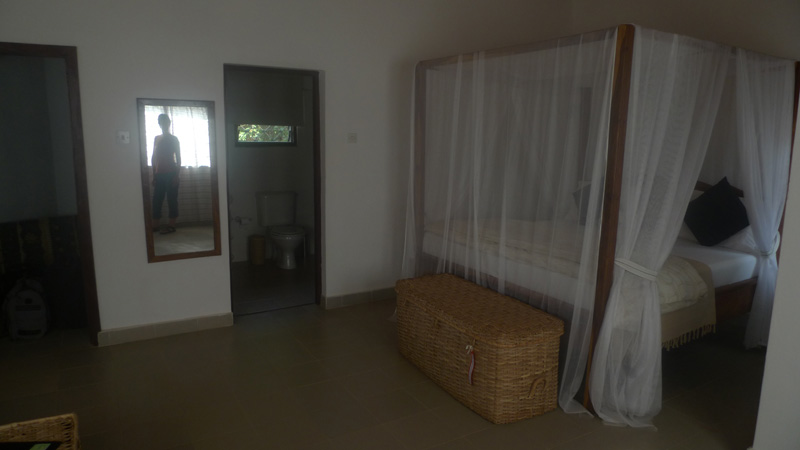
I find everything about this place charming: the immaculate and beautiful cottage where we’re staying (one of only four on the property), the luxurious bed (canopied in mosquito netting), our superb meal both nights, our hosts. But what dazzled me most was our outing this morning (part of the package).
Interior of a cottage at Farakunku lodge
We climbed into Moses’ diesel-powered SUV before dawn and drove for about 30 minutes to the property owned by Colin Cross (the British expat who recounted that history.) A passionate birder since the age of 7, Cross (now 55), began coming to the Gambia years ago to study the birdlife here. It ranks among the richest on the planet, with more than 500 species recorded. The eccentric fellow who mentored him, another Brit with a staggering knowledge of birds, finally decided he’d had enough of the place and offered to sell Colin his house. So Colin bought it, moved here a bit less than a year ago, and only recently married his African fiancee (a celebration for which his 80-year-old mum made the journey from England.)
View of the marsh by the bird observation station in Kartung, the GambiaChecking the nets for birds at the Kartung observation station
I felt an instant sense of rapport with Colin. Funny, iconoclastic, and friendly, he was generous with his knowledge in the way of all great teachers. Still, it was hard to absorb all he’s trying to achieve on his property, which the British Trust for Ornithology has declared an official bird observation site. Stupefyingly, it’s the only place in all of West Africa where anyone is banding birds — even though this flyway is crucial to the survival of some 50 European species. Colin has huge plans that include building quarters where ornithological volunteers will be able to help him with all manner of studies.
We only got the tiniest glimpse of the kind of work he does, but it was fascinating. We walked with him to the three nets he’s erected at various places on the property. When he’s lucky, birds fly into the nets and he can extract them and pop them into little bags that keep them calm. This morning he caught only two: an African mourning dove and a small brown variety of babbler. On his front porch, he removed each bird from its bag, placed a band around its leg, measured it, weighed it, meticulously recorded several pieces of data, and then released it. He sends all this information off to a computer in England, and over time the tiny pinpricks of information helped to fill in the picture of what’s happening to the birds in this part of the world.
Colin Cross examines a mourning dove's wing to help determine its age.
Every evening Colin climbs up onto his roof with three village children and they record what kind of birds are roosting and in what numbers. The ornithologist says he also gets good results by going out into the marsh at night with a flashlight. The light stuns the birds, and he can net them that way for banding. The only hazard is that crocodiles also inhabit the property. (People worship them in this neck of the woods. I’m not joking.)
It felt awful to have to leave after spending only two hours there, but our package also included a 90-minute birdwatching outing with a Gambian ornithologist on the Allehein River, down the road from Colin’s place. There we climbed into a canoe roughly hewn from a silk cotton tree. It tipped from side to side as we were paddled through the channels of mangroves. I thought about the crocodiles. But in the end, that part of our day was probably a lot safer than the journey we face tomorrow: traveling all the way from here to St. Louis, the Senegalese city on the border of Mauritania, far to north.
Data from each bird banded or recaptured is recorted in a log book for incorporation into an annual report compiled in Britain.







 At home and abroad