…we’re on the Great White Bwana safari. Here are just a few of the things we’ve seen since our arrival at Tarangire National Park, a few hours ago:

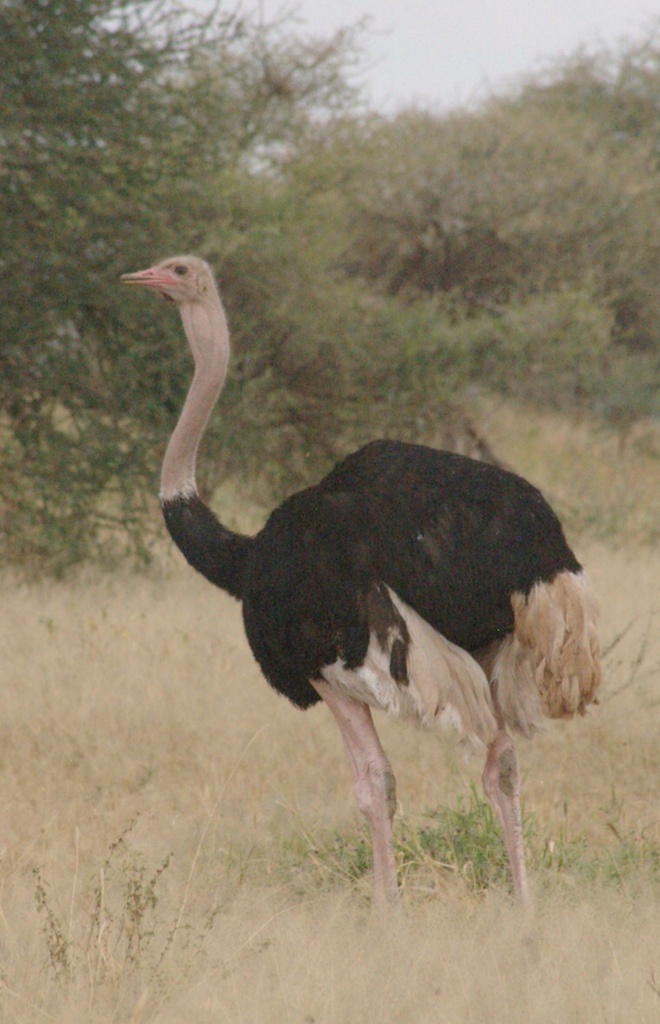
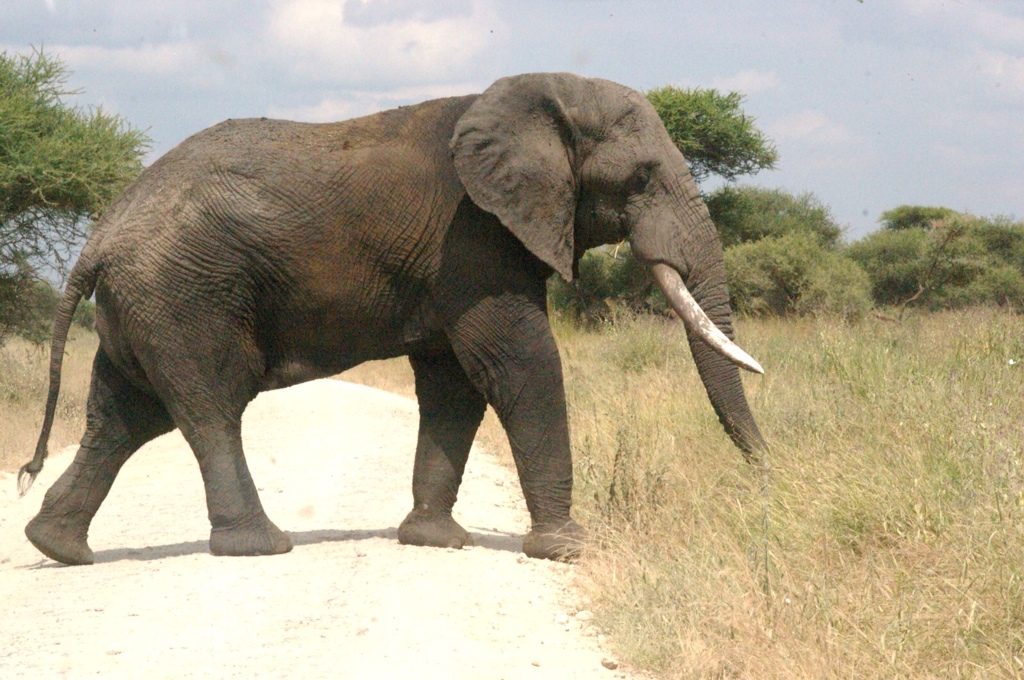
…we’re on the Great White Bwana safari. Here are just a few of the things we’ve seen since our arrival at Tarangire National Park, a few hours ago:
Despite my qualms, the creepiest thing that happened during our stay with the Maasai was that a huge black beetle started crawling across the floor of our hut, just before I climbed into bed. Part of my brain was thinking, “You should photograph that,” but a larger part was driving a shriek that I sincerely hope the Maasai did not hear. I smashed the bug with my sandal (sleeping under thatched roofs always makes me jumpy), and the more-interesting-than-creepy thing that happened this morning was that no trace of it remained. Steve is certain ants consumed or carried it off in the night, though there was no sign of them, nor of any other noxious insects.
Although I’d thought we would have to sleep in a tent, instead we were lodged in an engazi, one of the Maasai’s traditional round structures made of wood poles and sticks plastered with a mixture of termite clay, cow dung, water, and ash, and topped with a thick layer of thatching. Since it was an engazi reserved for tourist use, twin foam mattresses had been placed over the cowhide beds, and a big mosquito net cocooned the whole sleeping platform. We slept surprisingly well.
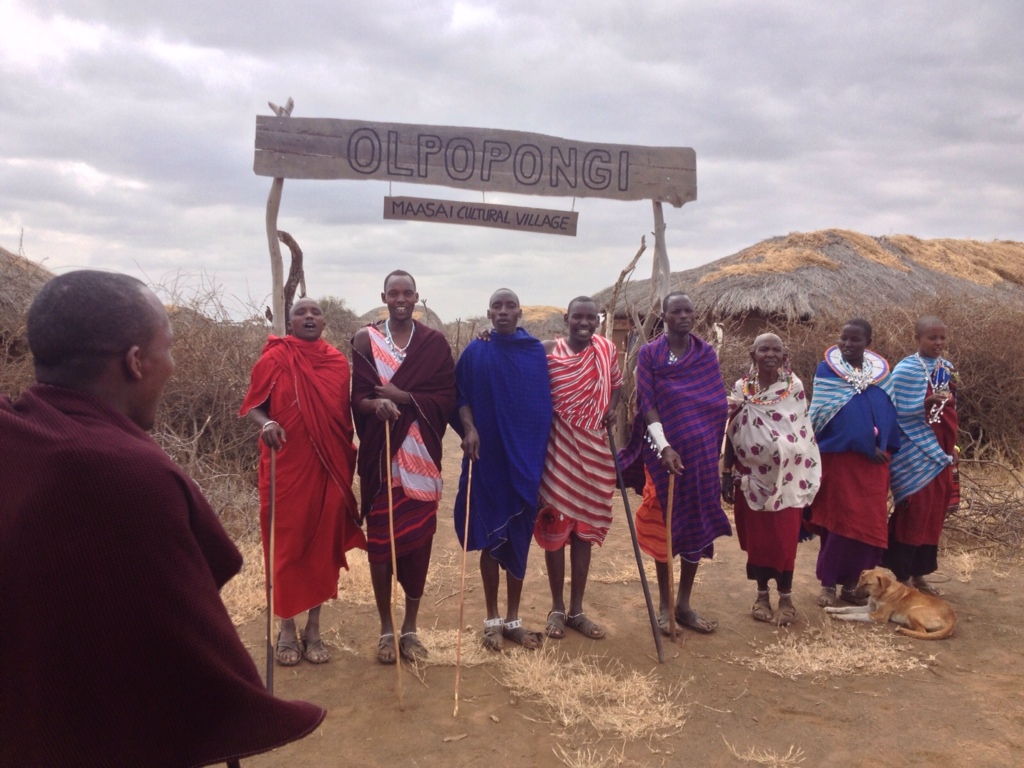
That was partly because yesterday was so full. The drive from Moshi to the village took about two hours, carrying us through endless fields of sunflowers that at first were tall and luxuriant but grew shorter and more and more withered as we drove northeast. Within 5 minutes after leaving the Tarmac road, the landscape changed abruptly, soon reminding me of the American desert, except for the multitudes of acacia trees and euphobia instead of cacti and yucca. Our entrance to the Olpopongi compound was a hoot; 9 Maasai, young and old, men and women, had assembled to give us a traditional welcome song and dance (complete with some of the incredible leaps traditionally made by the warriors when they kill a lion). Over the course of the afternoon, we came to understand how special this place is: offering the most comprehensive opportunity in all of Maasai-land to learn about this centuries-old culture.
Apparently the Olpopongi center was the brainchild of a German guy who wanted to see the local folk develop some supplemental income for the tough times. After long and exhausting deliberations, the tribal elders blessed the idea, and the tourist boma (compound) was built over 15 months and began receiving visitors in 2010. It looks like it’s all alone out in the bush, but in reality 30 or so other bomas (inhabited by Maasai, rather than visitors) are scattered about, constituting the village of Tinga-Tinga. We were told that the Olpopongi compound contained all the elements of the workaday bomas. An outermost circle of spiky brush barrier serves to keep out wild animals; scraggly little dogs are the alarm system. A similar inner circle of brush corrals the cows, sheep, and goats at night, but in our boma contained picnic tables and a campfire area. In between the 2 circles of brush, the huts are arranged, one for each wife and her children. (Maasai warriors can have bunches of both. For example, our 31-year-old Maasai guide, Freddy, already has 4 wives and 8 children, and he told us his father has 14 wives and 87 offspring.) One concession to the tourists was a free-standing building containing (gents’ and ladies’) Western toilets and hot showers, facilities that surpassed some I’ve seen in American parks.
The other main touristic element was a “museum” pavilion containing educational panels and all manner of items used by Maasai past and present. Freddy and two other guys spoke English well, and they shared the task of giving us a comprehensive show and tell. We all took a leisurely break to consume a yummy lunch of rice cooked with savory chunks of beef and accompanied by chapattis stuffed with cooked vegetables. In the late afternoon, as the distant clouds parted to reveal beautiful views of Kilimanjaro, Freddy and Kimoni led us on a bush walk in which they pointed out an amazing array of plants with medicinal and other uses.
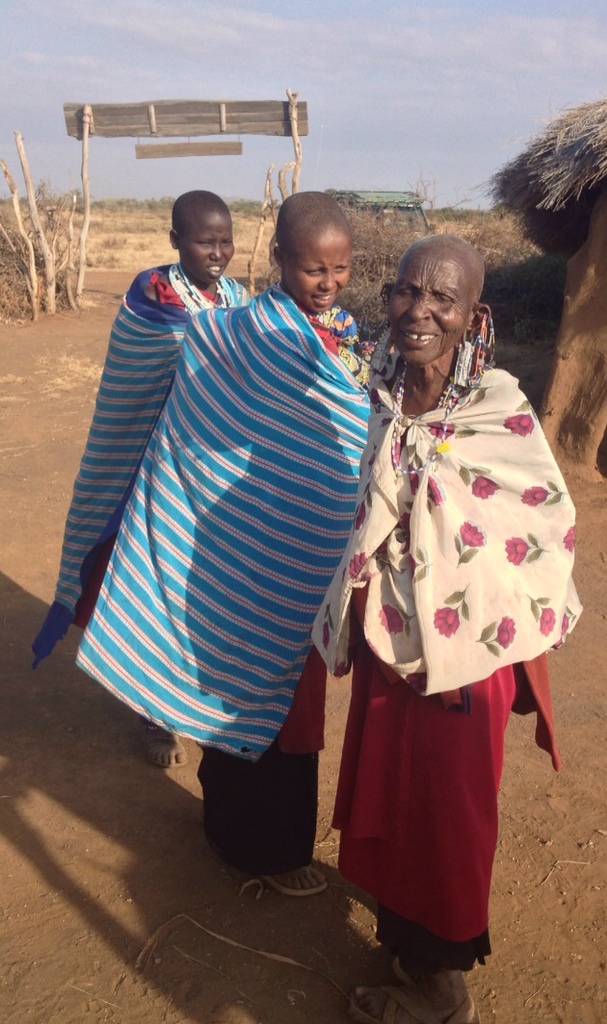
My favorite part of the experience, however, came before the bush walk, when Bibi (grandmother) invited us into one of the huts for Maasai tea. In the dim interior, we gathered around the little indoor fire, where Bibi was boiling the yummy mixture of leaves, milk, and spices. She filled our tin cups, and in short order, we learned that she’s 96. I pulled out my iPhone photo of Steve and his mom last August on her 95th birthday, and everyone thought it was great. Time disappeared for me as we sipped and chatted (with Freddy interpreting). I asked Bibi if life had changed much since she was a girl, and she discoursed at length, particularly noting (with disapproval) the advent of cell phones. I asked if Maasai co-wives got along well together or if jealousies ever divided them, and she had fascinating insights into that question. Freddy, too, held us spellbound, talking about what happens on a lion hunt, which the Maasai say they only do when one of the big cats has begun marauding on their cattle. In Maasai-land, only the warriors can hunt wild animals, and a boy becomes a warrior only after he’s had the foreskin of his penis sliced off publically, with a knife. This typically happens sometime between the ages of 12 and 22.
As luck would have it, a big circumcision ceremony was taking place somewhere in Tinga-Tinga yesterday. Because of that, fewer Maasai were present in the village than normally would be the case. Steve and I were the only tourists. So the campfire session was a bit subdued. No matter. I felt elated that somewhere nearby, new Maasai warriors had just been created; their family and neighbors were happy, singing and dancing. The newly circumcised might soon be toting (might already own!) cellphones that their grannies viewed with trepidation. For the moment, at least, the culture hung on.
Despite my qualms, the creepiest thing that happened during our stay with the Maasai was that a huge black beetle started crawling across the floor of our hut, just before I climbed into bed. Part of my brain was thinking, “You should photograph that,” but a larger part was driving a shriek that I sincerely hope the Maasai did not hear. I smashed the bug with my sandal (sleeping under thatched roofs always makes me jumpy), and the more-interesting-than-creepy thing that happened this morning was that no trace of it remained. Steve is certain ants consumed or carried it off in the night, though there was no sign of them, nor of any other noxious insects.
Although I’d thought we would have to sleep in a tent, instead we were lodged in an engazi, one of the Maasai’s traditional round structures made of wood poles and sticks plastered with a mixture of termite clay, cow dung, water, and ash, and topped with a thick layer of thatching. Since it was an engazi reserved for tourist use, twin foam mattresses had been placed over the cowhide beds, and a big mosquito net cocooned the whole sleeping platform. We slept surprisingly well.
That was partly because yesterday was so full. The drive from Moshi to the village took about two hours, carrying us through endless fields of sunflowers that at first were tall and luxuriant but grew shorter and more and more withered as we drove northeast. Within 5 minutes after leaving the Tarmac road, the landscape changed abruptly, soon reminding me of the American desert, except for the multitudes of acacia trees and euphobia instead of cacti and yucca. Our entrance to the Olpopongi compound was a hoot; 9 Maasai, young and old, men and women, had assembled to give us a traditional welcome song and dance (complete with some of the incredible leaps traditionally made by the warriors when they kill a lion). Over the course of the afternoon, we came to understand how special this place is: offering the most comprehensive opportunity in all of Maasai-land to learn about this centuries-old culture.
Apparently the Olpopongi center was the brainchild of a German guy who wanted to see the local folk develop some supplemental income for the tough times. After long and exhausting deliberations, the tribal elders blessed the idea, and the tourist boma (compound) was built over 15 months and began receiving visitors in 2010. It looks like it’s all alone out in the bush, but in reality 30 or so other bomas (inhabited by Maasai, rather than visitors) are scattered about, constituting the village of Tinga-Tinga. We were told that the Olpopongi compound contained all the elements of the workaday bomas. An outermost circle of spiky brush barrier serves to keep out wild animals; scraggly little dogs are the alarm system. A similar inner circle of brush corrals the cows, sheep, and goats at night, but in our boma contained picnic tables and a campfire area. In between the 2 circles of brush, the huts are arranged, one for each wife and her children. (Maasai warriors can have bunches of both. For example, our 31-year-old Maasai guide, Freddy, already has 4 wives and 8 children, and he told us his father has 14 wives and 87 offspring.) One concession to the tourists was a free-standing building containing (gents’ and ladies’) Western toilets and hot showers, facilities that surpassed some I’ve seen in American parks.
The other main touristic element was a “museum” pavilion containing educational panels and all manner of items used by Maasai past and present. Freddy and two other guys spoke English well, and they shared the task of giving us a comprehensive show and tell. We all took a leisurely break to consume a yummy lunch of rice cooked with savory chunks of beef and accompanied by chapattis stuffed with cooked vegetables. In the late afternoon, as the distant clouds parted to reveal beautiful views of Kilimanjaro, Freddy and Kimoni led us on a bush walk in which they pointed out an amazing array of plants with medicinal and other uses.
My favorite part of the experience, however, came before the bush walk, when Bibi (grandmother) invited us into one of the huts for Maasai tea. In the dim interior, we gathered around the little indoor fire, where Bibi was boiling the yummy mixture of leaves, milk, and spices. She filled our tin cups, and in short order, we learned that she’s 96. I pulled out my iPhone photo of Steve and his mom last August on her 95th birthday, and everyone thought it was great. Time disappeared for me as we sipped and chatted (with Freddy interpreting). I asked Bibi if life had changed much since she was a girl, and she discoursed at length, particularly noting (with disapproval) the advent of cell phones. I asked if Maasai co-wives got along well together or if jealousies ever divided them, and she had fascinating insights into that question. Freddy, too, held us spellbound, talking about what happens on a lion hunt, which the Maasai say they only do when one of the big cats has begun marauding on their cattle. In Maasai-land, only the warriors can hunt wild animals, and a boy becomes a warrior only after he’s had the foreskin of his penis sliced off publically, with a knife. This typically happens sometime between the ages of 12 and 22.
As luck would have it, a big circumcision ceremony was taking place somewhere in Tinga-Tinga yesterday. Because of that, fewer Maasai were present in the village than normally would be the case. Steve and I were the only tourists. So the campfire session was a bit subdued. No matter. I felt elated that somewhere nearby, new Maasai warriors had just been created; their family and neighbors were happy, singing and dancing. The newly circumcised might soon be toting (might already own!) cellphones that their grannies viewed with trepidation. For the moment, at least, the culture hung on.
I was going to title this post, “Slopes rule, summit drools!” but I decided that would be sophomoric. It’s probably quite wonderful to reach the summit of this perennially ice-covered 19,000-foot extinct volcano, highest mountain in Africa, to start the final ascent around 11 p.m. in the freezing dark, to reach the heights despite the sharp reduction in the ambient oxygen. But I decided long ago (after reading about what it was like) that it wasn’t for me — requiring more time (6 days) than I would be willing to devote to it and more fitness than I possess. Steve was not one to argue this point. So I figured I would never set foot on Kilimanjaro.
When I heard that a day hike was possible, however, I leapt at that. Now that we’ve done it, we think it was incomparably better than going the whole 9 yards (at least for wimps like us).
I’m sure I’ve seen photos of the lower slopes, but I probably didn’t pay any attention to them and certainly forgot that that part of the mountain is dense rainforest. I expected something harsh and rocky. What a magical surprise we got.
Our guide for the day, Manuel (short for Emmanuel), a veteran of more than 70 Kili summits, picked us up about 8:15 and we reached the national park and checked in about an hour later. The morning was gray, and thick fog pressed in. This gave the forest a mystical, primieval feel as we walked into it. Steve and I decided if Bwindi most reminded us of Jurassic Park, the forest at the base of Kilimanjaro recalled the home of Yoda (except that that was a swamp, instead of a mountain slope). They both shared that dense, exquisitely concentrated greenness, with every tree, every patch of ground, host to myriad ferns and mosses, tiny flowers, and other plants. In one spot, we watched a troupe of big fluffy monkeys feed, and in another, we chanced upon a chameleon. We watched him start to turn color as he passed from the road to the brush, but no insects bothered us (and Manuel said no snakes slither here; it’s too chilly for them.)

I feel like I’ve exhausted my supply of superlatives, and our photographs also don’t fully capture how beautiful the trail was. (We were on the well-maintained Marangu Route, easiest of the 6 that ascend the mountain, and known to the guides as Coca-Cola, in contrast to the various Whiskies.) So I won’t even try to describe it further, other than to note we spent a total of 6 hours hiking covering the 10-mile round trip (we were taking it slow to drink in the sights; passing from an elevation of 6,400 feet up to 8,200 and then descending.) Our destination was the Mandara campsite, where through-hikers can sleep in cozy huts, eat their grub in a spacious “dining hall,” and use clean toilets.
We ate our box lunches and then basked for a few minutes in the sun that by then had broken through. It was almost enough to tempt me to return some day, to go for the trophy. (Almost, but not quite.)
The day before yesterday (Thursday, 6/13), we had a completely different taste of hiking on the mountain, in its own way as pleasurable as the formal hike. Our Tanzanian outfitter, a local outfit called Pristine Trails, had offered me a “complimentary” day trip to a local coffee farm, and although Steve and I have seen coffee growing in a number of spots around the world, I opted to include it in our itinerary. I thought of it as a throw-away day, figuring if our luggage got lost en route from Nairobi or we were just feeling tired, we could bail at the last minute. If I expected anything, it was something somewhat canned and touristy.
Wrong again! Turns out this “coffee tour” is the only one of its kind and was started only two years ago by a young man (24, at the ime) named Oscar. We were picked up by the same Pristine Trails driver who got us at the airport (Kila) and driven out to Oscar’s village. I gather that pretty much everyone in the Kilimanjaro region belongs to the Chagga tribe, and Oscar and his village were no exceptions. (The valleys serve as boundaries between the Catholic and Lutheran Chaggas. But everyone’s Chagga.) The driver took off, and Oscar led us to the home where he lives with his aged parents, sister, and various nieces and nephews. There he gave us by far the best explanation of the growing and processing of coffee I’ve had anywhere: picking beans off the tree, peeling them, showing us how they cull out diseased beans, explaining the drying and roasting process (all by hand, or using simple hand implements). Finally, he threw a ladleful of ground (with a wooden mortar and pestle) coffee into a pot of boiling water, and we gathered around a low table to drink it. Delicious!
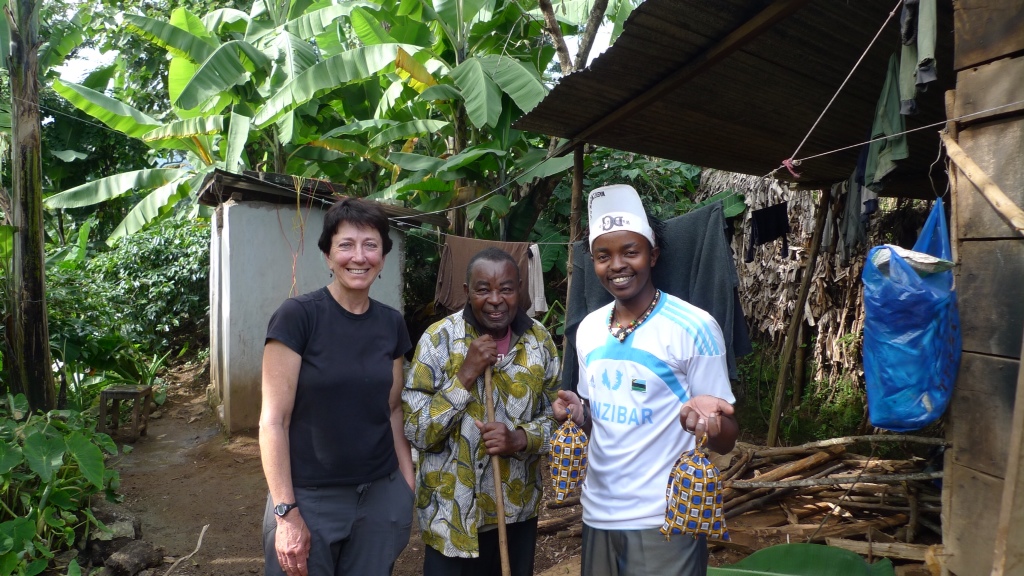
Every time I start to brood over how the human race is falling apart, I’ll try to remember Oscar. The 12th of 13 children, he only attended 6 years of primary school before he had to drop out. (His father, a schoolteacher who’s in his 80s today, had retired and didn’t have the money to pay the school fees.) Little Oscar helped to work the farm, but with time on his hands, he also occasionally shepherded tourists to the local waterfall and he was curious about their language. So he slowly, painstakingly taught himself English which today is fluent, nuanced, and funny. At 16 he worked as a porter on 4 excursions to the top of Kili, but decided that lugging the 45-pound loads up the mountain would kill him if he kept it up. Instead, he got the idea of starting the coffee tours. And now he’s got all sort of plans and has almost finished building a little wooden auditorium so he can accommodate groups. This head for business and native industriousness is apparently common among Chaggas. Oscar told us the first intra-African joke we’ve heard: If you find a Chagga lying in the road, how do you tell if he’s dead? Drop a coin.
After the coffee lesson, Oscar led us on a long (2-3-hour) hike to that local waterfall. Once again, we were hiking on the lower slopes of Kili (at one point, Oscar pointed out the national park boundary), and the waterfall turned out to be one of the most beautiful we’ve seen anywhere. But we were equally riveted by the ramble. Our path was a (mostly dry) mud byway that threaded the narrow passage between farms, affording glimpses of people’s lives. It was a bit like walking down an alley in Bird Rock — except that this felt densely jungly.
Unlike anywhere else we’ve seen in Africa, the Chagga haven’t cut down the native trees. Instead they’ve planted their bananas and coffee and avocadoes and other crops among the trees — which provide shade and help prevent erosion. They keep cattle, but as much for their manure (which they use as fertilizer) as for the meat and milk, and they confine those cattle and bring them grass to eat. (Many of the villagers we passed on the path had huge loads of fodder on their heads.) Oscar also told us that the Chagga tradition is to pass on the land to the youngest son (which in this case is him). The Chagga believe that’s the best way to keep family property intact for as long as possible.
We admired all of this. But this morning we’ll be leaving Chagga country and moving on. Our destination is a 24-hour adventure in a Maasai village in which we’re supposed to spend the day “learning the daily life of the Maasai children and adults, helping them with chores and other activities,” and sending “a unique and unforgettable evening at the campfire with a Maasai BBQ and traditional dancing ceremony” before returning to our cowhide bed in a tent.
This all sounded very cool to me when I signed us up for it back in January. Now I’m feeling a little nervous. I’ll report how it goes as soon as possible, but I’m not sure when I’ll next be able to upload. After leaving the village tomorrow morning, we’ll truly be on safari. If the lodges have wifi, you’ll hear from me sooner. If not, it may not be till Nairobi (a week from today). But I’ll also be tweeting (@jdewyze).
One souvenir of visiting Rwanda I’m unlikely to lose is that I finally get the difference between Tutsis and Hutus. It’s actually quite simple. The tiny Batwa (Pygmy) people were here forever. Then about 700 BC, medium-size farming people (Hutus) moved in and started kicking the Batwa out, chopping down their forest, and cultivating the land. A thousand or more years after that, tall, cattle-herding Tutsi people (aka Batutsi or Watutsi) arrived and immediately started lording it over the Hutus (and Batwa, tho there were so few of them and they were all out in the forest, so nobody really cared about them). The maltreatment (of Hutus by Tutsis) got worse in the early 20th C. under the Belgians, who made everyone carry passports identifying their ethnicity. But by the time Rwanda gained independence (in 1961), the tables had turned, and Hutus finally came into power. They then began exacting revenge on their former oppressors, instituting quotas for jobs, harassing and even killing Tutsis, and so on. This continued for 50 years, until resurgent Tutsi power and international pressure were poised to make Rwanda a more democratic and multinational place. But this didn’t sit very well with the ruling Hutu fanatics, who began planning a final solution to the Tutsi problem. In April of 1994, the (Hutu) president’s plane was shot down while landing at Kigali Airport, (where our plane for Tanzania took off). To this day, the identity of the shooters remains mysterious. Within an hour, barricades went up, and the killing began. By the time it ended, about 3 months later, a million people (primarily Tutsis but also some moderate and/or heroic Hutus) were dead, with millions more damaged in one way or another.
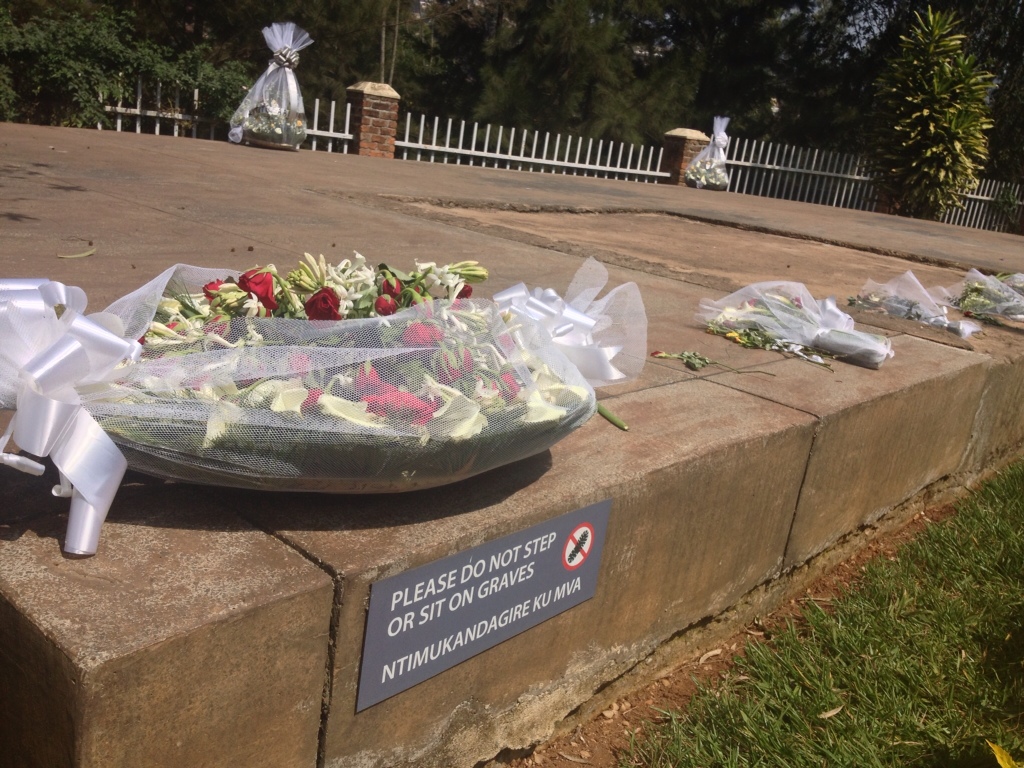
Today the biggest tourist attraction in Kigali is the Genocide Memorial. S and I visited it yesterday afternoon. It’s well done, forcefully conveying both the heartbreaking scope and the details of this disaster. I also admired the efforts made to put this genocide into perspective (as one among many) and to analyze the components shared by all genocides. The resolution that it must never happen again was a repeated motif — along with the acknowledgement that this resolution hasn’t fared too well over the past 100-plus years.
Talking to Tom Tofield, our biking guide at Lake Kivu, didn’t exactly fill us with hope that Rwanda was forever done with violence resulting from ethnic strife. Tom told us that large tracts of land in northeastern Rwanda had been granted to the family and friends of President Kagame (the Tutsi military hero who’s been president since April of 2000). Tom also talked about the involvement of the Rwandan elite in the illicit trade in Congolese coltan (that mineral ore critical to so many electronic products) and military arms fueling the continuing bloody upheaval in eastern Congo. Many of those arms, by the way, having been manufactured in the good old USA and Britain and donated to the Rwandan government.
It was depressing. But in Kigali, we heard more encouraging talk. This morning (6/12) we had coffee with the weathered British expat (long married to a Rwandan woman) who for almost 10 years has been working as the government’s chief advisor on science and technology. (A business associate of Steve’s had set up our meeting with him.) Mike ticked off one exciting development after another: the network of high-speed fiber-optic cable that now connects every region in the country, Carnegie-Mellon’s opening of a Kigali campus last August, MIT’s interest in establishing a climate-research station on top of the highest mountain in Rwanda, and the talk of building a cable car to get up to it, one which also might serve tourists. He spoke almost reverentially of President Kagame’s goal of transforming Rwanda into a knowledge/information economy, and the 5-year plans for achieving that.
Steve and I tend to be skeptical about grandiose industrial policies imposed by authoritarian governments. The sensibility of this one seems to us particularly dubious. It’s hard for us to imagine tiny Rwanda, still in need of basic things like decent roads and widespread access to clean water, competing successfully with the likes of China and India. But, as weird as it sounds, I can also imagine factors like the genocide and Rwanda’s current status as one of the cooler countries in Africa being wild cards that may affect how things play out, perhaps in unexpected ways.
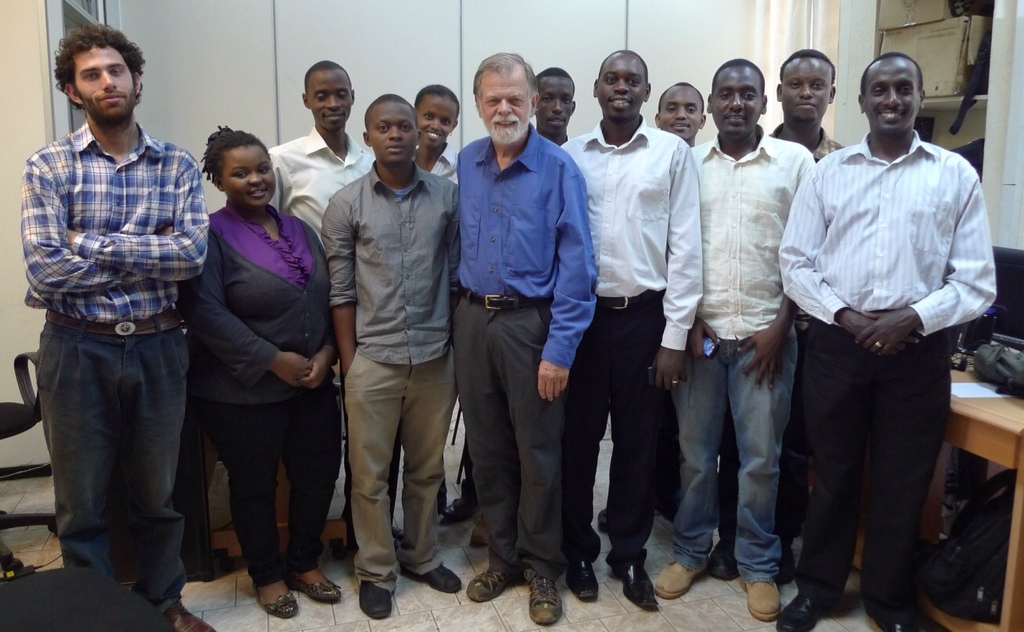
Our meeting yesterday morning with the team at Gasabo 3D was much more solidly reassuring. Gasabo was founded 5 years ago when a Rwandan engineer named John Rugamba began collaborating with Solidworks (one of America’s biggest CAD companies). Steve always harbored doubts about kthe original business plan (which had to do with converting drawings from 2D to 3D), and indeed it never amounted to much. But Gasabo’s still in business. They’ve evolved into doing architectural design and project management, plus they’ve also gotten some cool mechanical projects: designing components to make it easier to use biogas (generated principally from livestock excrement); creating a machine to crush Rwandan peat into pellets for heating. They’re still the only native mechanical design firm in the whole country, and they’re obviously not coining money. The crew of 10 was crammed into a room that’s not much bigger than my living room. But they have a vision and some forward momentum; we could imagine them surviving and eventually prospering.
Kigali, too, impressed us, living up to its reputation as the cleanest capital in Africa. People seemed honest, and no one hassled us. We felt safe strolling around. As we walked, I thought of something that Paul Theroux says in his latest travel book, The Last Train to Zona Verde: My Ultimate African Safari. He argues that one reason to travel, a good one, is to see how things have changed.
I’m almost tempted to return to Rwanda somewhere down the line, to see how it all works out. But now we’ve left it behind. Our flights from Kigali through Nairobi, then on to Tanzania landed early (both of them), and we glimpsed the legendary snows of Kilimanjaro in the soft light of sunset. Our bags were not lost; our prearranged driver showed up. We’re installed in our cheap hotel in Moshi, where dinner was delicious and cost $18 for to. Tomorrow we return to the Nature portion of the program.
I heard this morning from my friend Jenny that the tasty Rwandan coffee is still available at Costco, at least the one on Morena Boulevard in San Diego. Check it out!
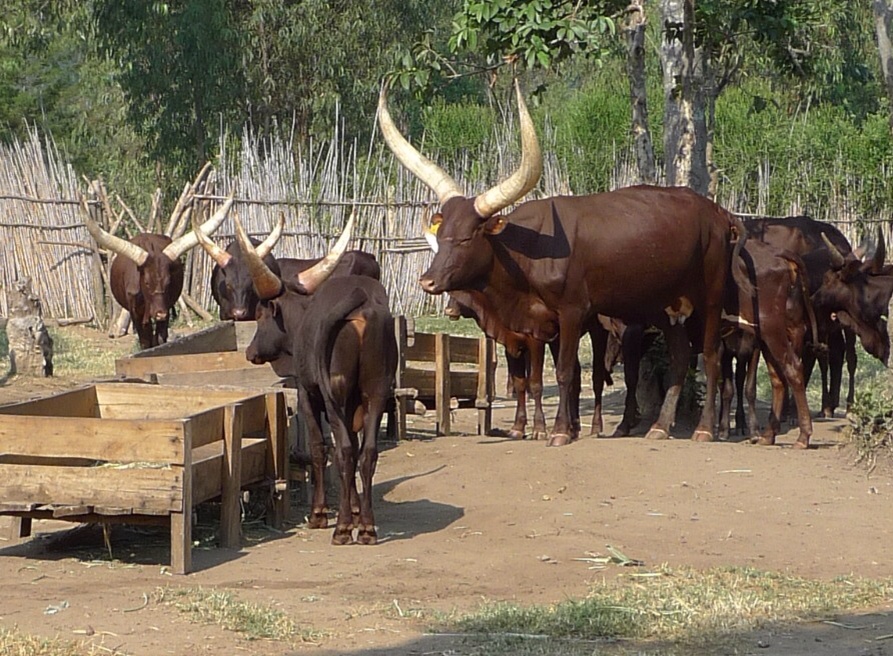
The driver showed up on time yesterday to transport us from Nyungwe to Rwanda’s capital, Kigali. The national museum in Huye, which we visited en route, was well done, and our stop at the palace of the former Rwandan kings was interesting. (I particularly loved the ceremonial cattle, whose enormous horns would give a Texas longhorn horn envy!)
For my money, though, our coolest experience yesterday came when we stopped at the Cafe Connexion in Huye. We’d heard about it during our hike in the forest Sunday. Our three hiking companions were expats in their early 30s, living and working in Kigali (an American woman architect, a British gal working for an NGO, and an American guy who was an ER doc working part-time for Paul Farmer’s Partners in Health.) The Brit was particularly chatty, and she said Cafe Connexion was serving the best coffee in all of Rwanda. She urged us to make the short detour.
That worked well, as we finished visiting the museum around 12:30 and quickly ate the picnic lunches the lodge had packed for us. While we were in the museum, our driver had figured out the cafe’s location (across the street from the university, biggest in the country, serving 24,000 students.) We walked in and were greeted by a tall, energetic man who looked to be in his 40s. Speaking perfect English with an unmistakable Latin-American accent, he told us the proprietor had stepped away, but he could serve us. He talked non-stop as he whipped up our cappucinos, blowing us away with his story and his enthusiasm.
Born in Panama, Mario had grown up on a coffee farm, then he’d gone to school in Hawaii, near Kona. Somehow, he’s wound up teaching biological pest-control methods to agronomy students at the Rwanda’s national university. But his main job was working for a small family coffee-roasting business based near Sacramento, and he was on a mission: to turn Rwanda into a true coffee culture.
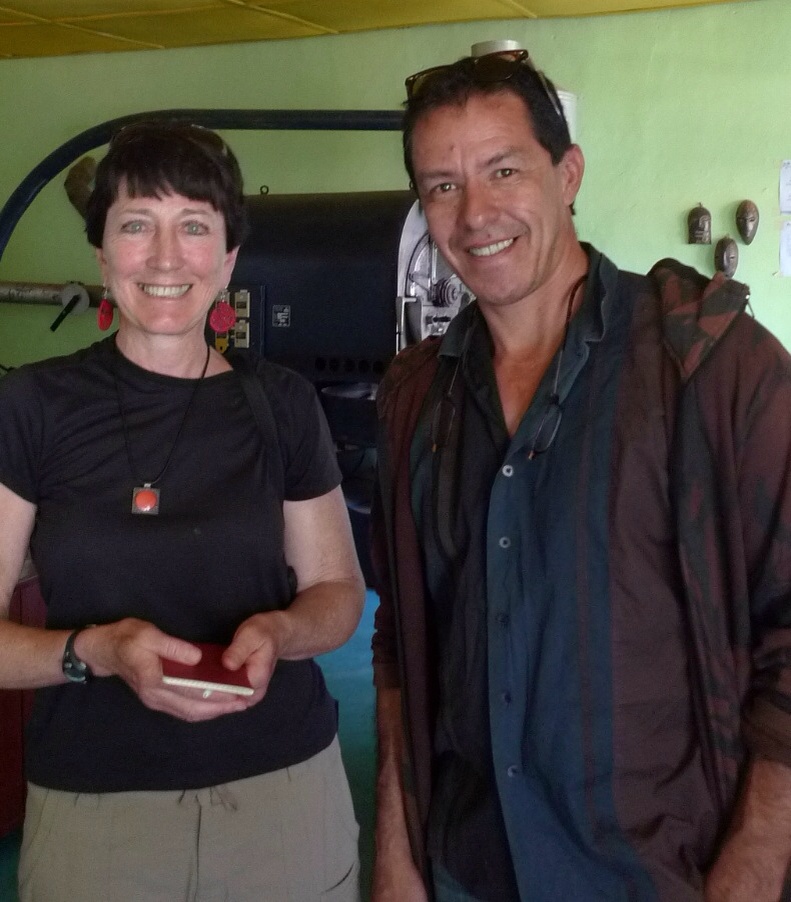
Coffee is already Rwanda’s biggest cash crop, and the country’s coffee farmers already have achieved some fame. They all grow a variety known as Bourbon (which Mario says originated on the island of La Reunion in the Indian Sea). Maraba Bourbon coffee, grown near Huye, has won international recognition for its flavor. But it was grown with pesticides and inadequate knowledge about the cultivation requirements, according to Mario. In his travels, he had found an organic coffee plantation near Lake Kivu (S and I grew excited when we realized we had walked and biked past those very trees while staying in Rubona and biking with Tom.) It was this organic Kigufi coffee that’s available at the coffee house — and very delicious, I can attest. Moreover, Mario was buying the whole crop, shipping it to California for roasting, and selling it all to Costco. This was great for the Lake Kivu coffee farmers, whose income had climbed from $300 to $1000 a year on average since Mario began buying from and advising them. But Mario wanted to spread a taste and appreciation for coffee within Rwanda, where the vast majority of people have nothing to do with it. (They drink tea with milk in it.) Hence the cafe, which opened one year ago. A couple of college students had been trained as barristas, and the prices were rock-bottom. (We paid about 85 cents for each of our excellent cappucinos.)
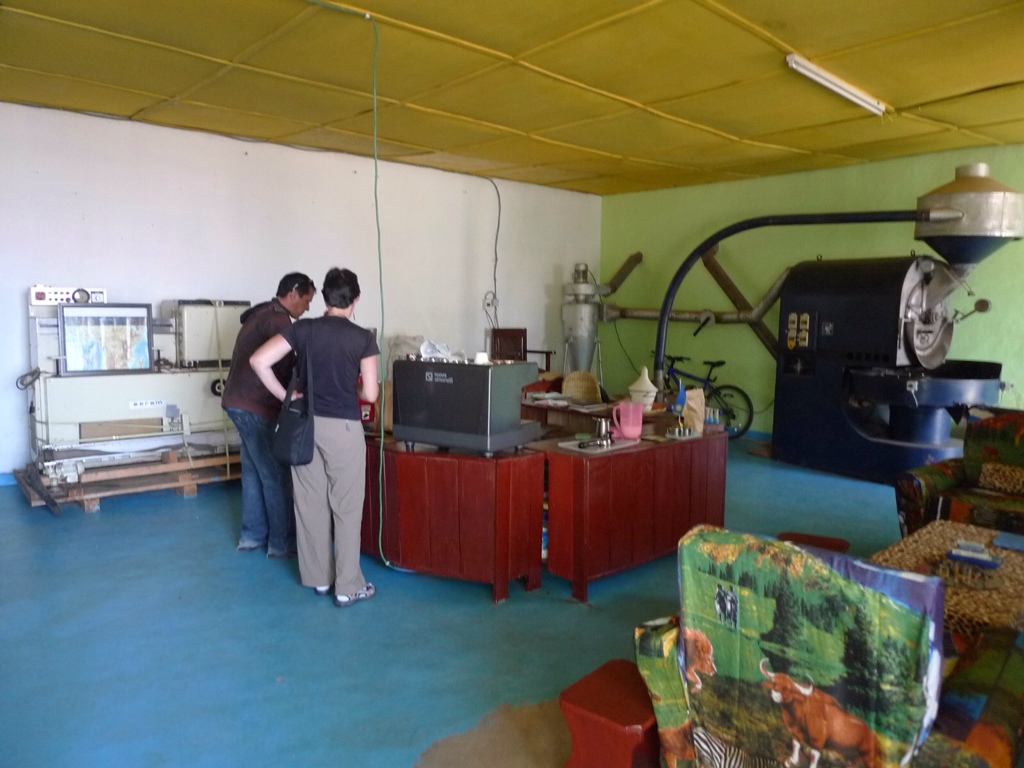
There were signs the plan was working. That very morning, at least 50 people had shown up, astonishing Mario. If I ever return to Rwanda, I expect to see a lot more coffee-drinking. And in the meantime, I’m going to be on high alert next February, when Mario says the Kirkland “Rwandan” begins showing up in Costcos. (It’s typically there through April or May, he says.)
For most of our trip so far, we’ve been staying in modest to budget places. The wonderful Airport Guesthouse in Entebbe, for example, was $60 a night (breakfast included). The lodge by the river near the tree-sleeping lions was $40. But here in the Nyungwe Forest, we’ve splurged. This place is widely considered to be the best in all Rwanda. Now that we’ve experienced it, we can’t imagine that’s not true.
The setting is stupendous: within a sprawling tea plantation that nestles up to the edge of the largest intact montane forest in Central and East Africa. The forest is one of the wettest places on this continent, and depending on which side of the mountains it falls, rain drains either to the Lake Tanganyika (and, at least theoretically, to the Congo River) or to the Nile. In this lushly primordial paradise, biologists have counted more than 300 species of birds, 13 species of primates, and more than 1300 species of trees and plants (including 140 types of orchids). Mountain elephants once foraged here too, but a poacher killed the last one 15 years ago.
This morning we hiked with a park ranger for four hours down to the spectacular Kamiranzovu waterfalls. Gilbert shook his head in wonder, reflecting on how much people’s attitudes have changed since that last elephant died. A healthy chunk of the park fees have been directed to the locals in this area, and they’ve really come to understand the connection, he says. Now, no one poaches in the park, or if the occasional scofflaw tries, people report him.
After the hike, Steve and I were the ones marveling — at how distinctive each of the three equatorial rainforests we’ve experienced has been. Like Bwindi, Nyungwe survived the Ice Age. Never logged, never burned, it’s virginal, uncorrupted. But unlike dense, jungly Bwindi, the forest we experienced this morning was cool (we were hiking between 5500 and 6000 feet) and ancient. Scenes from Jurassic Park kept bombarding me. It smelled wonderful — fresh and fecund. Everywhere we looked, things were growing on other things: moss and vines and aerial roots clinging on trees rootedon hillsides choked with a universe of plant life.
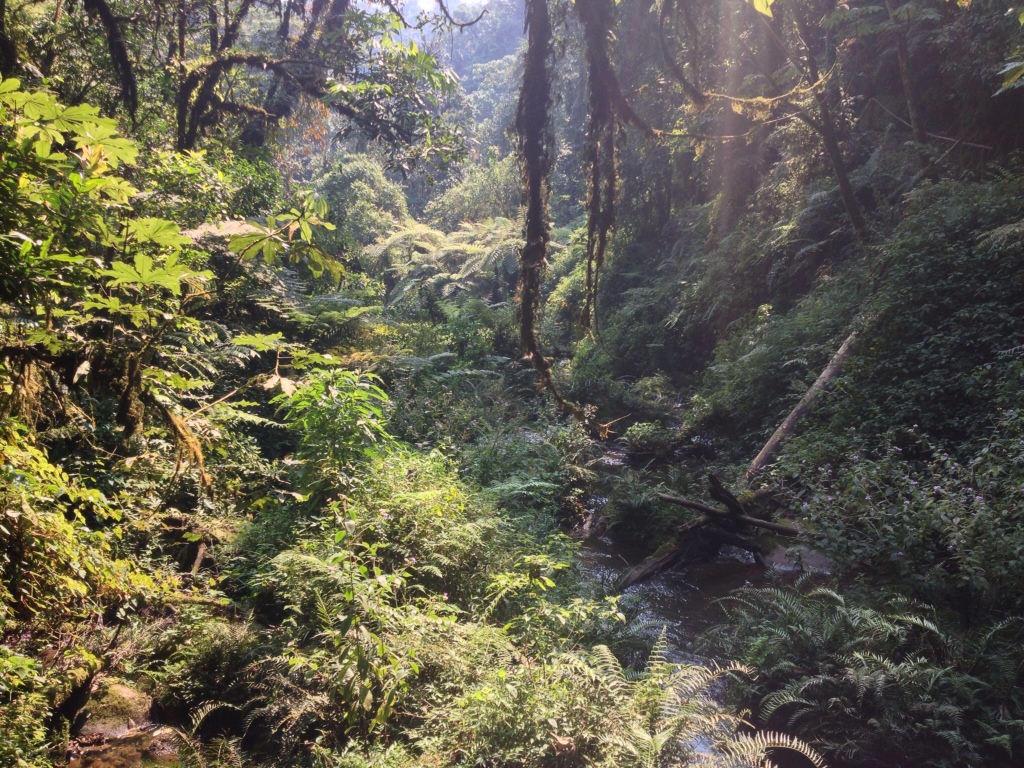
It was slightly surreal to emerge from that tangled wilderness back into the oh-so-civilized tea plantation. The managers cut all the tea plants to a uniform low height (maybe 3 feet tall) so that the much-prized fresh shoots can be easily harvested from the narrow paths that are almost hidden within the profusion of leaves. Those young leaves are lime green, so intense at times they glow like neon. Views from the lodge drink it all in: the tea plants and colossal forest beyond.
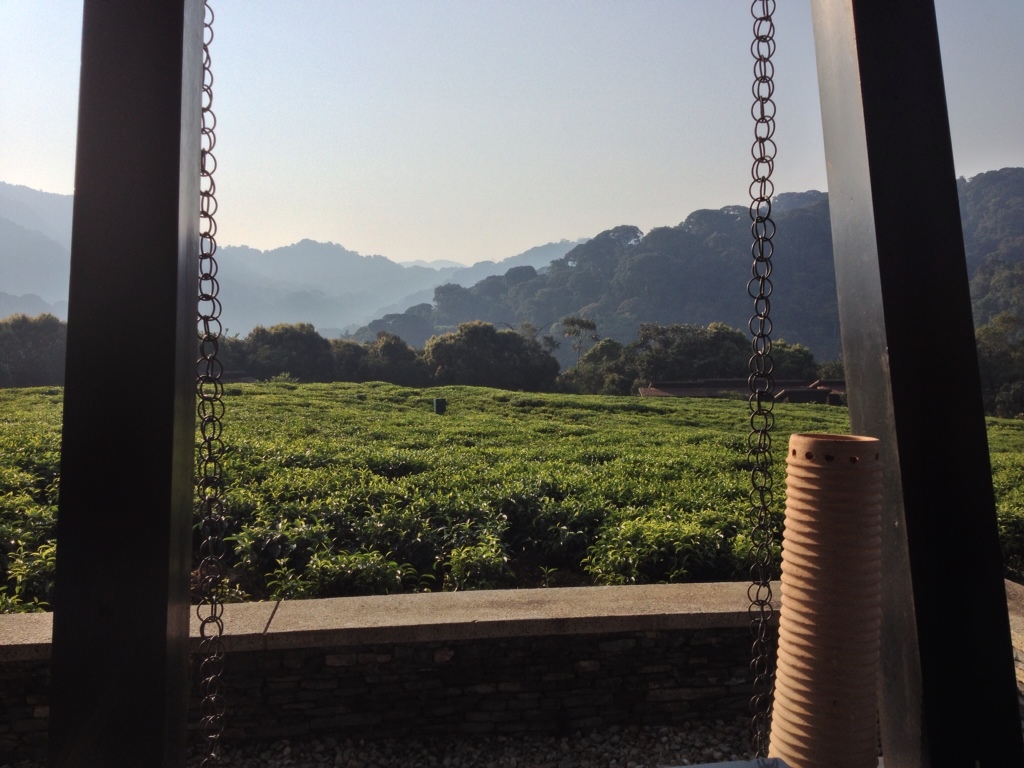
And, stepping into the lodge, you enter another universe: one where the profusion of soft lights never go out, where the water in the showers is hot and abundant, where the flat screen TVs come with Samsung remotes, and the staff provides pampering in the extreme. Here, fresh from the memory of those villages we biked through with Tom, I feel for the first time in my life, like a member of the 1%.
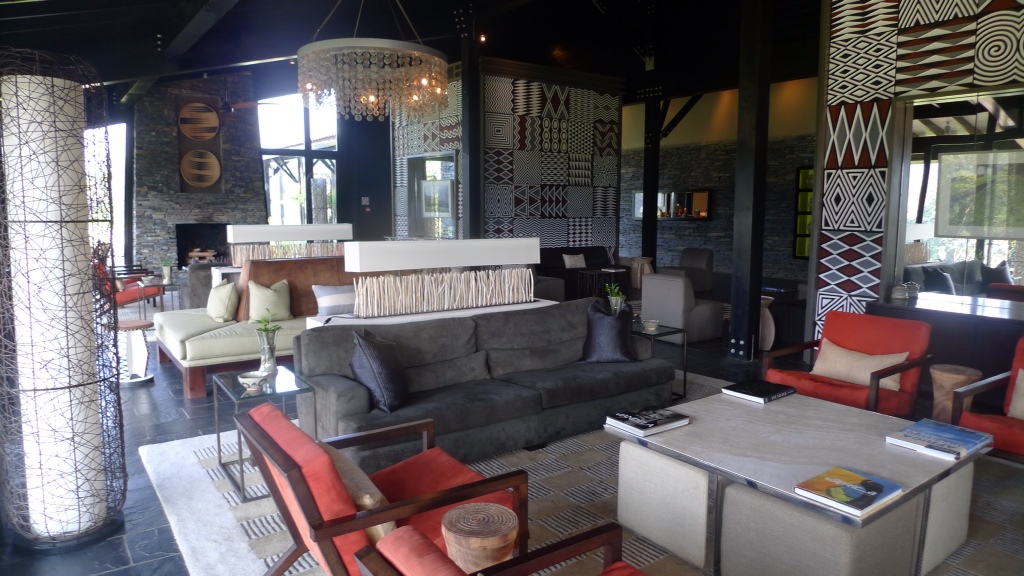
I’m not completely comfortable with that. I love being in Africa, but Africa also has these tiny privileged enclaves where you can feel richer than you feel anywhere in America. It’s a bit mind-boggling.
To be honest, it’s been deliciously pleasant. It ends tomorrow morning. We’ve hired a taxi to drive us to Rwanda’s capital, stopping for two major Cultural Experiences en route. Then we’ll have a day and a half of urban adventures (esconced once again in more humble accommodations), before flying off to Kilimanjaro Airport and our safari on the African savannah.
Because Steve loves boats so much, he wanted to write about our trip down Lake Kivu yesterday (Saturday). Here’s his report:
We had read that the road down the Eastern shore of Lake Kivu is so bad it takes two days to drive from Gisenyi to Nyungwe national park. So we’d arranged with Tom Tofield’s Rwandan Adventures to take a boat most of the distance, enabling us to get there in six hours.
Lake Kivu has given me the creeps ever since I read in the National Geographic that it contains a vast amount of dissolved methane and CO2. These greenhouse gasses are held at the bottom of the lake by the pressure of the water above. Because no seasonal thermal mixing occurs, as it does in most lakes, the gasses have not escaped. As organic matter enters the lake, it decomposes, adding to the layer of methane and CO2. At some point, scientists believe that the pressure of the dissolved gasses will exceed the pressure of the water on top of them, and the gasses will rush out the way bubbles rush out of a beer or Coke bottle that has been shaken before opening.
Because CO2 is heavier than air, it would remain near the ground, suffocating anyone near the lake shore. This sort of thing has happened before in smaller lakes, killing several thousands. But with well over a million people living in Gisenyi and neighboring Goma across the Congo border, the death toll from a gas release at Lake Kivu could number hundreds of thousands.
It turns out my fears were overblown. Tom’s wife, Natasha, has earned a doctorate studying the lake and says a gas release might not occur for 100 years. Moreover, efforts are underway to release gas from the lake artificially using new technology similar to that used to separate natural gas from oil. From the shore near our hotel, we could see a prototype production platform that’s recovering methane from the lake and sending it to the shore to fire electric generators. In the future, the natural gas may be bottled to use as cooking fuel, saving more trees from being turned into charcoal.

As we set off down the lake, the wind was out of the south and the boat pounded in the light chop. Later, as the wind shifted west, the spray came over the starboard gunnel, causing us to break out our raincoats and cover our cameras.
We saw larger wooden boats of similar design, each carrying several dozens of passengers. Because the roads are so bad, the lake is a cheap and convenient mode of transport for local people. Yet even so, boat traffic was light. Most of the boats on the lake are paddle-powered fishing craft that depart at dusk and return at dawn. Despite the breeze, we didn’t see one sailboat.
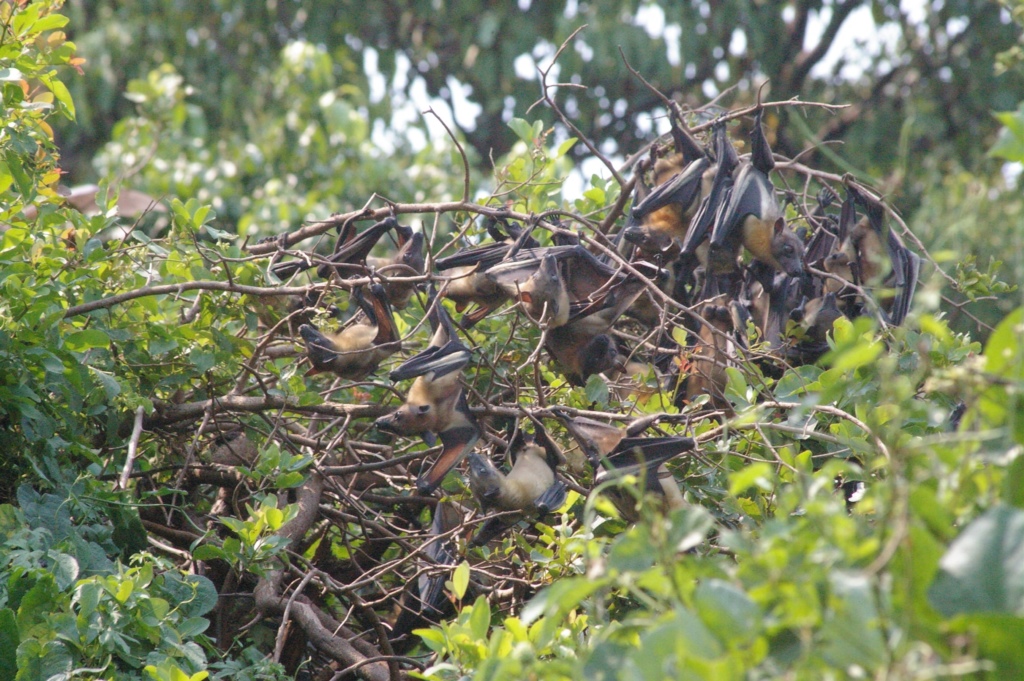
On our way south we stopped at a small, uninhabited island off the coast of Kibuye, a medium-sized town that marks the half-way point down the lake. Our mission was to view a colony of fruit bats that live only in this spot. Suleiman nosed the boat into a clear spot on the shore, and Jean Claude led us up a steep narrow path through thick low forest to see the bats. Unlike most insect-eating bats, these creatures are diurnal, and our approach startled them from their inverted perches in the trees. They circled overhead like flocks of crows or seagulls, their high-pitched barks sounding more like foxes than birds. The bats made an amazing sight, in their own way as unique and unusual as the chimps and gorillas, but completely unexpected.
After half an hour, we re-boarded the boat and continued south. The wind died and the waves shrank to tiny ripples. We took off our rain gear and had a lunch of beignets, cheese, and bananas that we shared with our boat men. We covered the rest of the distance to the tiny town of Nyamasheke on a small bay off the lake. There we were met by the driver of a Toyota RAV4 SUV who drive us to the Nyungwe Forest Lodge. We arrived by 3:15 pm, in time to enjoy the incredible views of the forest before sunset.
One of our only bad moments of this trip so far came at the little Cyanika border crossing station, after the guy who drove us there from the Traveler’s Rest had dropped us off. Steve and I got ourselves stamped out of Uganda and into Rwanda without a hitch. We opened our suitcases for the dim-witted looking Rwandan customs guy, and he did little more than grunt. We lugged them out into the road, looked around, and saw… Nothing. No driver holding a sign with our names. No taxi queue of any sort. Had Tom Tofield flaked out and forgotten us?
I’d read about Tom in the Bradt Guide to Rwanda. His mountain-biking tours sounded cool, so I emailed him and he wound up arranging three days of our travel here (including the car ride from the border to Lake Kivu). But when we’d tried calling and texting him our last night in Kisoro, he hadn’t responded. Had he died? In the road, Steve pulled out his cell phone and tried one more time. Miraculously, it rang and Tom answered. He pointed out that it was 20 minutes before the pickup time we’d agreed on, NOT 40 minutes after it. I’d been confused by the time change between the two countries. Five minutes later, a clean Toyota Corona pulled up, and we piled into it and sped off to the west.
Over the next two days, Tom’s reliability became evident. Now 42, he was born and raised just outside London, where he became a data-center specialist. While working in Zimbabwe, he’d met his future wife, a Swiss woman who subsequently got her Ph.D. in limnology (the science of lakes). Her work with Lake Kivu brought them to Rwanda 4 years ago, and Tom decided to start the biking company soon afterward.
Originally, Tom had suggested for our first day a bike tour of Gisenyi, the Rwandan town that adjoins the Congolese border and city of Goma. But a few weeks ago, he’d emailed me urging a change of plan. UN troops were arriving in droves, and a fierce confrontation between them and the infamous Congolese rebels looked imminent. Although Gisenyi was peaceful and safe at the moment, whenever the war started, Congolese refugees would flood across the border, and the city would become chaotic.
Instead, Tom had arranged for two young Rwandan assistants, Didier and Viateur, to take Steve and me on a walking tour and picnic. They led us past the biggest employer in Rwanda (a huge Heineken brewery), and we stopped at some natural springs so hot I couldn’t stick my fingertip in the water for more than a second or two. In a nearby pool that wasn’t as scalding, a young woman was scrubbing herself (clothed) and her baby (naked). The pools were a reminder of the geothermal turbulence in this neighborhood. Less than a dozen years ago the massive nearby Congolese volcano, Nyiragongo, erupted, pouring lava on Goma — though only 19 people died because the warnings and evacuation worked so well, according to Tom.
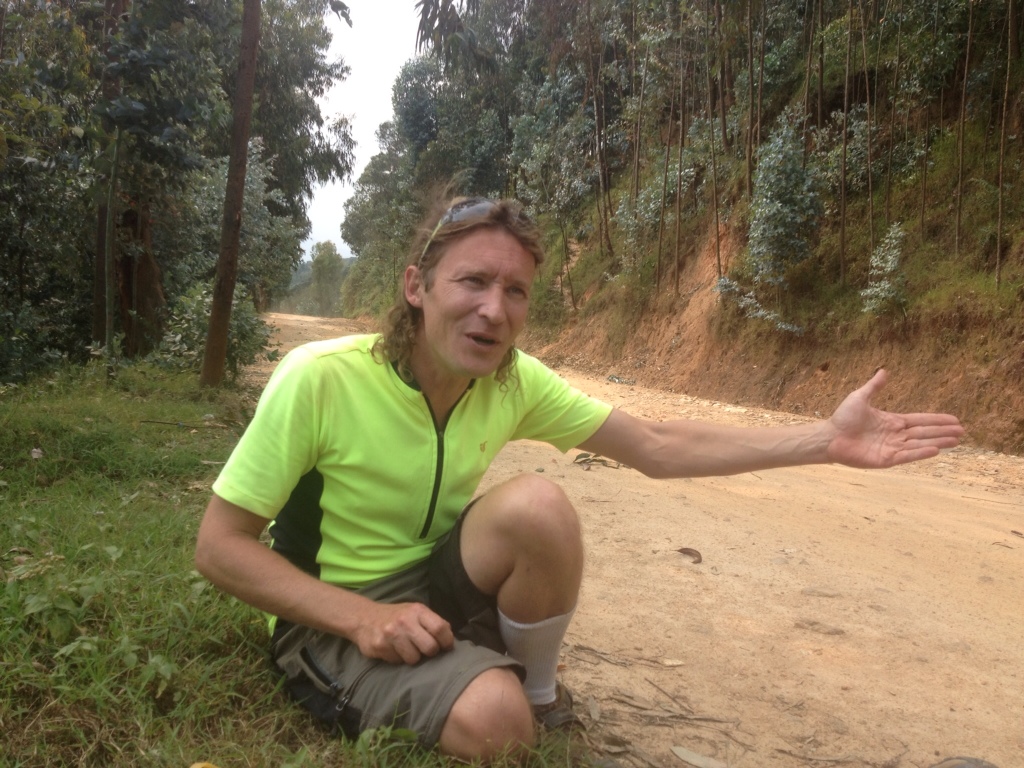
Our big adventure with him came yesterday (Friday). We walked the short distance from our hotel to his house and he outfitted us with mountain bikes much nicer than anything I’ve ridden before. At 9:30, Tom, Steve, and I pedaled off, also accompanied by Tuizaire (Tom’s chief assistant). Tom’s an excellent instructor, and he carefully explained how to use our 24 gears; how to safely go downhill; how to avoid ruts and rocks. This was great. At one point, it struck me that I had never actually done mountain biking before. Arguably, rural Rwanda is an odd place to start.
But what a grand day we had! Rwanda calls itself “the land of 1000 hills,” and there’s nothing like bicycling to convince one that’s probably an understatement. I doubt we spent more than 30 minutes on flat ground in the course of our 8 hours together. We weren’t pedaling every minute. We stopped for photos. We stopped to gab about one sight or another. On the side of the road, we gobbled down chapattis (think flour tortillas) smeared with ripe avocado and delicious local cheese, and twice we stopped to down soda out of bottles sold in tiny shops in dirt-poor villages. Tom shared what felt like an encyclopedic knowledge of Rwanda’s culture, politics, history, botany, and sociology. If I’d taped everything he told us and transcribed the most interesting bits, it would probably fill 20 pages. And, oh yeah, I haven’t mentioned the scenery — mile after mile of plunging mountains, verdant valleys, exquisite bays.
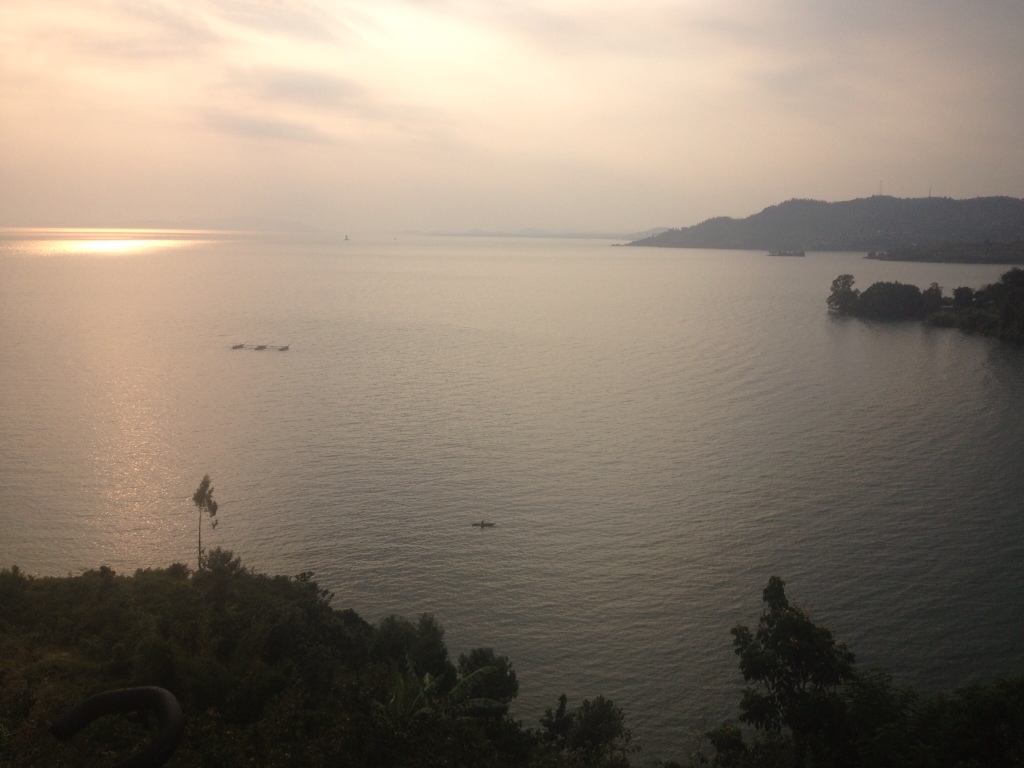
For years, this was the poorest region in Rwanda, but Tom says coffee recently has boosted the standard of living a bit (taking over many fields once devoted to fruit and vegetables). He also says it’s one of the most densely populated rural areas in Africa, with about 450 people per square kilometer. This became palpable almost every time we rolled through a village. Legions of toddlers and young children would stream out, calling to us and often chasing, until Tom and Tuizaire scolded them away.
I found that fascinating rather than annoying. It was the physical demands of the ride itself that drove me to my limits. We only covered about 20 miles, according to Tom, but the total elevation gain was almost 3000 feet. Steve did great throughout, but I’m ashamed to confess I had to climb off my bike and walk a couple of times during the brutal uphill stretches at the end of the afternoon. And more than once I froze with fear when confronted with vertiginous descents over sand, loose scree, and deep ruts. But no one held it against me, including myself. It was such a pleasure to experience, a small dose of mortification seemed a cheap price.
Mercifully, the shower had hot water on our return. We dined on grilled chicken and were about to stagger off to bed when a small troupe of dancers — 2 young women and 2 young men dressed in traditional garb and wearing wild leonine wigs — came into the dining area and performed. We stayed to watch. It was Friday night in a place not far from where troops were massing, a place where people routinely smuggle in coltan and other minerals that make them rich beyond American dreams. Usually Steve and I gather with friends to share a potluck and watch a DVD together every Friday night. I love that. But on this Friday night I was glad to be here instead.
 Posted with Blogsy
 At home and abroad