Happy New Year

New Year’s Day, 2012
Last night, sitting in our dreary room in dusty Jinka, head throbbing, eyes burning, stomach on the verge of heaving again, I wrote a post commenting on how sharply this New Year’s Eve contrasted to our experience last year. I reckoned it was just the hellish yang to last year’s amazing yin-fest on the beach in the Saloum Delta in Senegal, and I ranked it with any of a number of other bad New Year’s Eves I’ve experienced. Then it got worse.

Earlier, I had blamed myself for my tummy problems (my first ever in Africa). I had broken a cardinal rule Friday night in Arba Minch and eaten the raw shredded carrots, cabbage, and tomatoes that looked so tempting on my plate. Frankly, most of what we’ve eaten here so far has fueled my expectation that this trip would be not only a great adventure, but also a sort of countrywide weight-loss clinic, with food that was edible but unexciting. I didn’t start feeling queasy until early afternoon Saturday, when we had stopped in broiling malaria-infested Weito. After touring the scruffy tiny market (where I bought a skirt), Endalk, Sharom (our driver), Steve, and I retired into one of the shaded patios for lunch. The only choices were injera (the universal Ethiopian pancake/bread/eating utensil) and fried lamb, or injera and spiced beans, or macaroni a la Tsemay (the Tsemay being the tribe that occupy Weito and its environs). S and I opted for the beans combo, and it wasn’t bad. I should have been alerted by my lack of appetite, but I chalked that up to the heat and hours of jouncing over gravel roads. An hour or so later, I had to get out of our aged Land Cruiser and vomit in the bush.

But my Blame-the-Veggies theory evaporated minutes before 2012 began, when Steve (who had virtuously resisted eating anything resembling raw salad) bolted out of bed for the first of two rounds of violent vomiting and diarrhea. This is not a happy experience under the best of conditions, but the conditions in our bathroom included the floor being flooded (due to the toilet leaking) and no toilet paper (nor even a holder for it). Steve claimed at one point this morning that he noted a small dragon or bird embryo in his barf. The rest of the night was similarly hallucinogenic. I don’t remember a great deal of noise outside upon Steve’s first episode, understandably; the Ethiopians don’t consider Dec. 31 to be New Year’s Eve. (They celebrate that in September, and think the current year is 2004, just as they use a different system for naming the hours, with 0 starting at 6 a.m. (the theoretical dawn).

Still, sometime around 3 a.m., something that sounded like a call to prayer woke me up — the haranguing nasal voice, the amplified minor-key melodies. Multitudes of roosters responded to this, adding to the cacophony. At times the singing sounded more like drunken Christmas carolers, or misplaced karaoke performers; at other times demented howling. I’ve never heard the like of it anywhere, but it and the roosters and the muted musical accompaniment continued until dawn. A New Year’s Eve to remember.

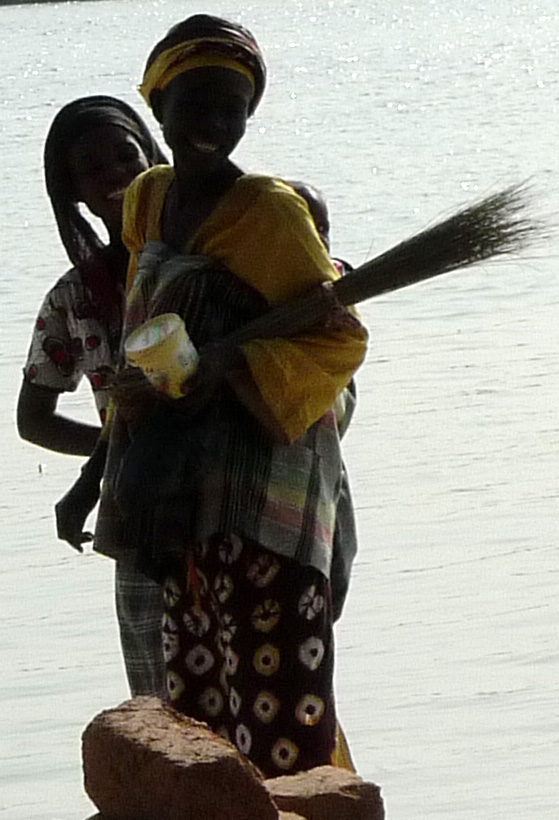
Now Endalk is arriving (it’s 8:20 a.m.), and Steve and I are feeling recovered enough to imagine getting through the day. Jinka will be our launching point for visiting several of the tribes that have made this area “literally fantastic,” in the words of Bradt Guide author Philip Briggs, “as close as one can come to an Africa untouched by outside influences.” Sixteen tribes occupy the region, some scarifying their bodies, others grotesquely stretching their women’s lower lips, still others practicing bizarre coming-of-age rituals. At Endalk’s recommendation, we’ve bought $55 worth of razor blades, Obama-brand pens, and hard candies to distribute in exchange for photo ops. How could we fail to be in top form for THAT?

Welcome to Ethiopia

Saturday morning, December 31
This year I read a New Yorker article about a scientist who’s studying the human experience of time, and is specifically interested in how time seems to pass slowly when you’re young and then steadily accelerates. Or why near-death experiences make time slow so much that people feel they’re seeing their whole life flash by. His research made him conclude that it doesn’t actually slow, but being hyper-alert makes it seem like time is passing glacially. I think that’s true to some extent in traveling. When you’re in an alien place, you notice everything — vastly more than when you’re sitting down to your work desk in the morning. So maybe another reason to travel is that it lengthens your life — or seems to.

Certainly it feels like we’ve been here much longer than 48 hours. Our Omo Valley expedition leader, Endalk Bezawork, called a little after 10 Wednesday night (minutes after our arrival at the guest house) to confirm we were there. Thursday morning, he showed up precisely at 8, as promised. But we had to go to a bank for an ATM and to make a deposit for our trek later on. And we wanted SIM cards and air time for our phones. All these chores gave us our first glimpse of Addis, which struck me as being a rather more appealing African capital than Dakar or Bissau or Banjul. (Or maybe I’m just getting used to African capitals.) It was 10:15 a.m. by the time we finally broke free of the traffic (jammed worse than usual by the vast throngs of Orthodox Christians being disgorged from churches where they had celebrated the feast of St. Gabriel.)

The open road — where we spent the majority of the day — proved delightful. With few potholes and little other vehicular traffic, it took us past vast farmlands rimmed by rugged mountains that reminded me of California or South Africa, only greener. From time to time, we wove through boys shepherding cows or goats or dodged gaggles of children streaming to or from school. So the drive, though long, felt fun to us, if a quiet, dusty, bouncy form of fun.

Because we’d gotten such a late start, Endalk changed the plan and decided we should spend the night in Sodo, rather than going all the way to Arba Minch, our original goal. But we would still be able to see everything in our travel plan. By the time he assured us of this, I trusted him. My initial impressions make it clear he’s one of the better guides we’ve ever had anywhere. He’s almost 26, has a mind like a trap, a seemingly encyclopedic knowledge of this area, and the organizational skills of a Manhattan wedding planner. Moreover, he displays a natural social grace and charm so powerful that everyone we meet everywhere seems to love him. One of the best things is that he was born and raised in the Omo Valley, in a tribe that lives near the Hamar tribe (one of our destinations). So he’s more of an insider here than I am in San Diego.

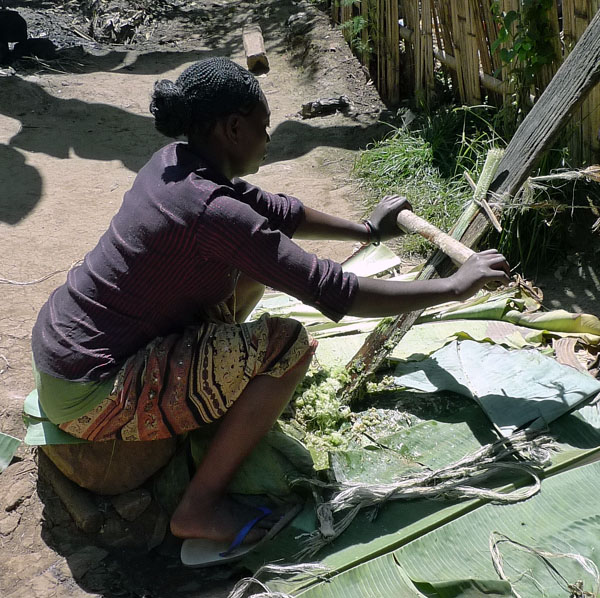
Dorze woman grating the enset meat
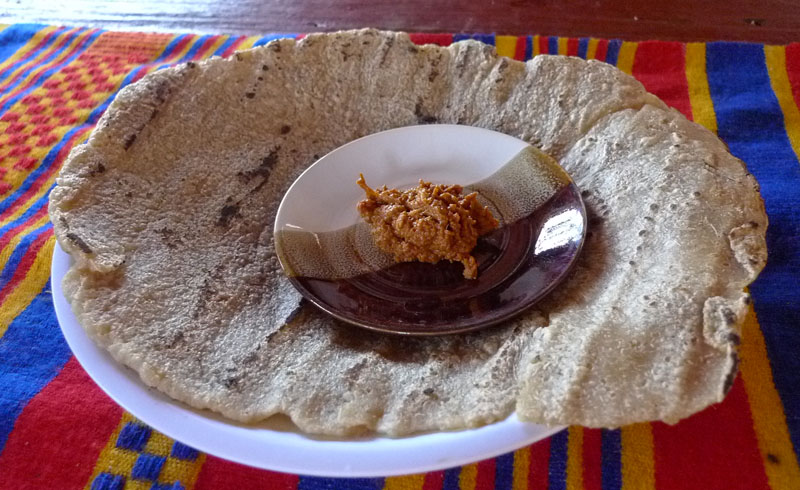
The final product: false banana (enset) bread
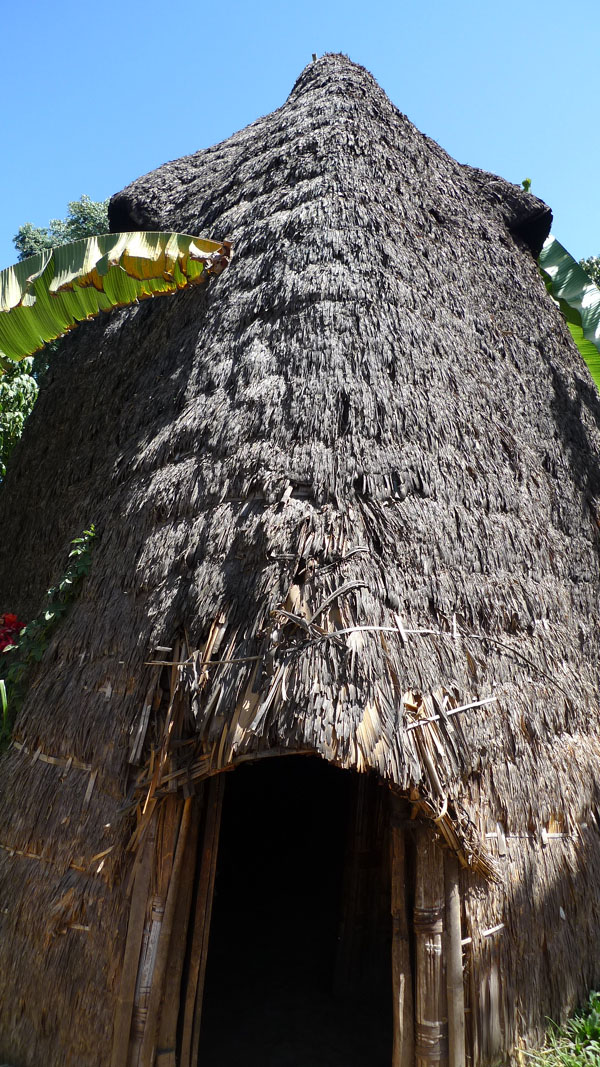
A Dorze elephant house

Yesterday, the value of all those skills become increasingly evident, as we drove up a high mountain to visit the Dorze people, renowned for their houses reminiscent of elephants, for their pottery and weaving, for the way they use the “false banana” tree to supply most of their needs in life (except bananas — which grow on a cousin tree). We got to see every step of the cloth-making process — from the cotton balls in the fields, to the girls spinning them (by hand, rather than on spinning wheels), to the men weaving the thread into cloth, to the beautiful final products for sale in the village center. In our stroll through the village, we chanced upon two neighboring families, creating a great clamor of disagreement. But among them were three village elders (all men), and we learned it was a mediation session. Once the elders had made their judgment, the falling-out would be a thing of the past, we were told. We drank liquor made from the village corn and ate the weird bread-like substance baked from the fermented (4 months!) meat of the false banana leaves. The elephantine houses are built largely from those same trees, and we got to enter and see what was inside a venerable old one.

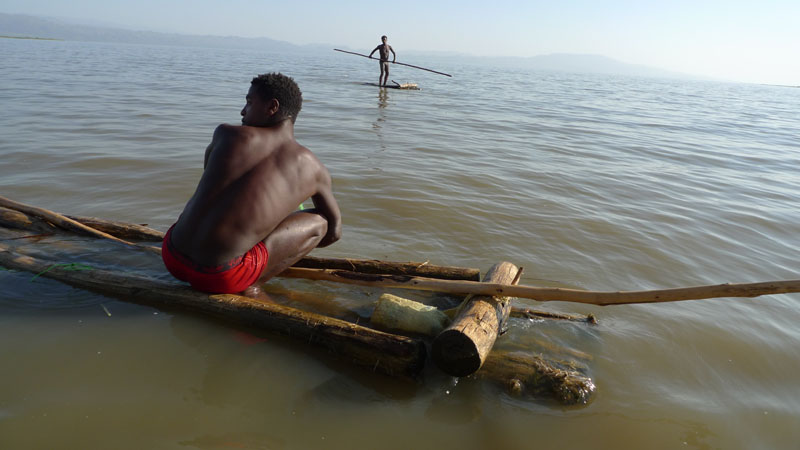
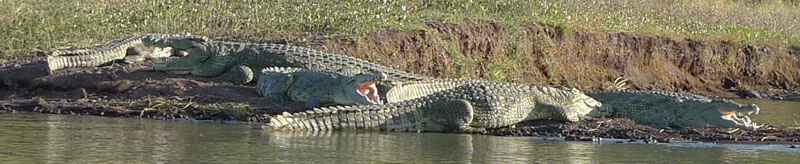
It was a riveting visit, and the afternoon, though different, was no less exotic. After a leisurely lunch in the center of Arba Minch, we headed into the nearby national park for a two-hour boat ride on Lake Chama. It’s a beautiful place, home to families of hippos and gigantic crocodiles and flotillas of birds. Most of the birds were away at another Ethiopian lake where they hatch their eggs and tend the babies till they’re fledglings. But the huge hippo heads popped up repeatedly during our ride. At the “Crocodile Market” (a sunny bank so named by the locals), we found 6 or 8 monsters, mouths agape in order to warm their tongues in the setting sun’s light (according to Endalk.) In a few minutes, we’ll start our descent into the Omo Valley, where by all accounts the human residents make all of the foregoing ho-hum.

Fishermen on Lake Chamo routinely get eaten by the crocs.

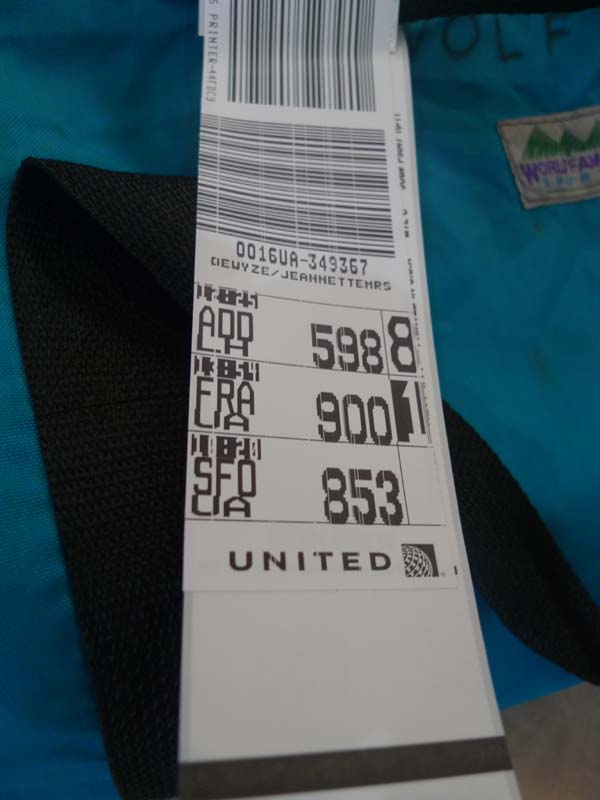
Descent into Addis

December 28, 2011

Our Airbus 340 looks almost full, and I wonder: why are we all going to Addis Ababa? We’re a motley crew. On the bus out to the jam-packed tarmac in Frankfurt, we traveled next to two young American couples and their four children, all under 6, all impossibly wholesome and American looking. Missionaries, was my guess. (Maybe Mormon? We didn’t have a chance to ask.) The pudgy gray-haired couple in the two seats in front of us are Swedes, and I count lots of obvious Germans and Africans, including many who look like they were sent by Central Casting to play Ethiopians. Other languages also float through the cabin. Are there coffee-traders among us? Arms dealers? Aid workers? Hydroelectrical engineers? How many are tourists, like us?

I recently read that something like 50 million people a year vacation in Africa, a drop in Las Vegas’s jumbo bucket, to be sure, but more than many Americans might guess. (This year, Steve and I would be double-counted, having started off the new year in Senegal and on track to finish it and start the next in Ethiopia.) In the months and weeks before our departure, countless people asked me, incredulous, why we were going.

I have many answers, but one that I don’t often express is that we’re going to have fun. We think it will be fascinating to step into the pages of the National Geographic (of our childhood) and visit some of the Stone Age tribes who inhabit the southern Omo Valley. We think the Guidebook Highlight experience of being in Lalibela’s submerged stone churches on the Ethiopian Christmas will be great fun (and I’m hoping our hotel room there will be halfway decent too.) We think trekking in the central highlands for four days among the breathtaking vistas and gelada baboons will be outdoorsy fun. And if I make it to feeding time for the hyenas of Harar, that will make me happy.

Of course pitfalls exist. The journey here (in coach, at least) is a brutal marathon for those of us who can’t sleep on planes (and even for those like Steve who can, a bit). I expect some abysmal roads and some barely tolerable hotels and unforeseen mishaps. So I suppose the big question of this trip is: will the fun parts outweigh the grubby, irritating, annoying ones? But that’s the question haunting all travel, isn’t it?

On and off the grid

Sunday, January 15

For the first time since our arrival in Ethiopia 18 days ago, we should have uninterrupted Internet until our departure from Frankfurt Wednesday morning. We bought a local SIM card for my phone on our very first morning, and our guide assured us we should be able to access the Internet on it. He did on his phone, routinely.

But although I’ve used the phone a lot to make calls and text people within Addis, it never would allow me to get online. Various folks told me I needed to call the central Ethiopian telecommunications office, to get them to turn that feature on. We dialed and dialed; were cut off and put on endless holds. Finally I gave up.

But I’ve been writing, almost every day. And we just arrived back at out guest house in Addis, where we’ll spend out last day and a half.What follows is what would have appeared, had we not encountered those road blocks on the Ethiopian information highway.