My usual reaction to getting sick on the road is, initially, denial. When I felt the subtle tightness in my upper chest more than two weeks ago, I dismissed it as irritation caused by the dust churned up on Uganda’s unpaved roads. My occasional coughs the next day had to be merely my body’s attempt to expel the residue, I told myself. But the coughs increased in frequency; Steve began coughing with me.
I switched to optimism. If this was a virus, surely it would be one of those quick-moving upper-respiratory squalls — here one day and gone the next! Our hacking intensified; worsened. Neither Steve nor I ever spiked a fever, and our throats and noses seemed fine. By the time we landed in Johannesburg, however, I was coughing so hard I could imagine cracking a rib. My torso ached from the unrelenting battering.
At the South African hotel, after getting our key-card and the password for wifi, I asked the desk clerk (between coughs) if she could recommend a nearby pharmacy. She advised that if we dropped our bags quickly in our rooms and dashed out the door, we could make it to a branch of Click’s just minutes away.
I’m telling you all this not because I think my minor medical issues are interesting. They’re not. But getting sick on the road does have one significant upside: the experience can give you insights into how folks handle such problems outside the US. At the Click’s, I was happy to find only two people in line before me at the pharmacy. In minutes I was standing before a young pharmacist who seemed both sympathetic and confident she could fix me up. She fetched a bottle of effervescent expectorant tablets (to break up the chest mucus) and a bottle of codeine-based cough syrup. The two of them cost just under $8.
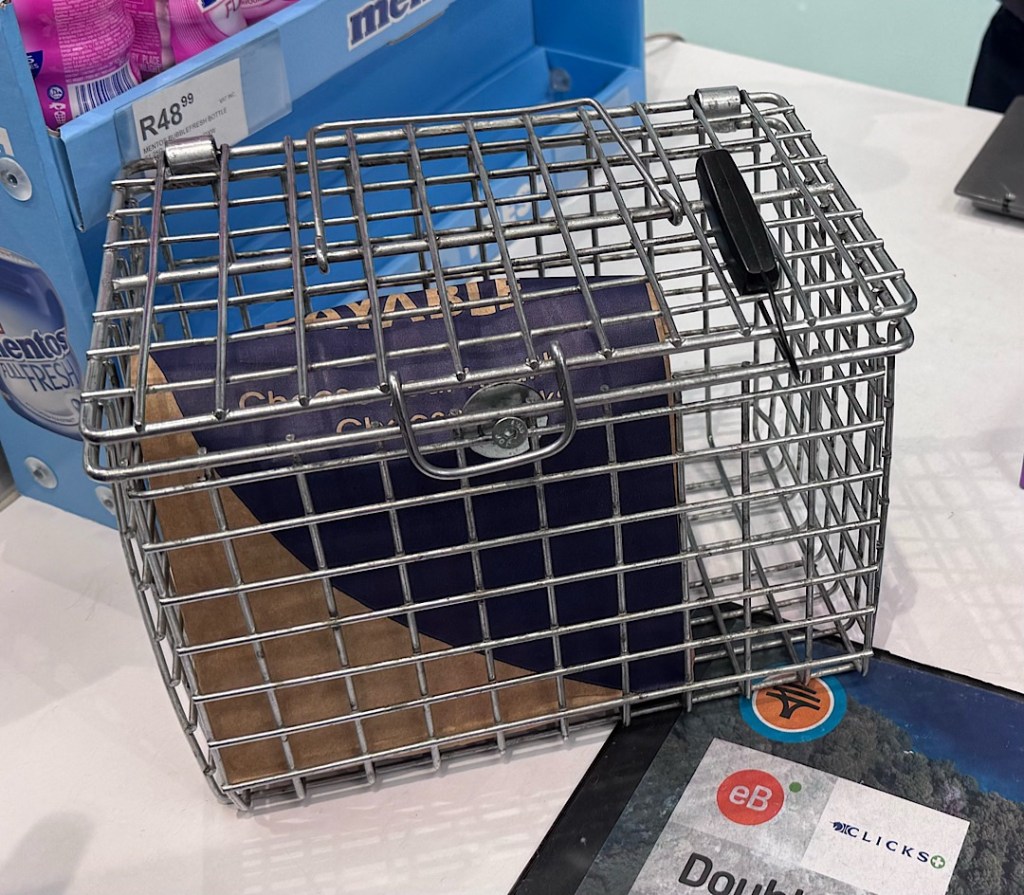
After bagging up the drugs, the pharmacist locks them in something resembling a hamster cage. Then the customer takes the cage up to the cashier to pay.
I’ve long been a fan of codeine in cough syrup, though I rarely score any at home, now that a doctor’s visit and a prescription and probably pre-enrollment in Narcotics Anonymous is required. I also can dependably rely on the placebo effect. So by every right, I should have bounced back to robust health after I downed my teaspoon of Tussilinct Linctus cough syrup and got a halfway decent sleep that night.
Sadly, I still felt awful the next morning.
The next day, the narrow-bodied Embraer jet that carried us from Joburg to Madagascar’s capital (Antantanarivo, aka Tana) enabled Steve and me to sit together without a third passenger squeezed in between us. This was good because by this point our coughs were so ear-shattering and frequent other passengers were eyeing us with concern, if not loathing. At times my bronchial passages seemed to be seizing up. This freaked me out: I was poised to head out into the Malagasy hinterland. Would some freak asthma attack finish me off there? I worried about this through Sunday night and when Steve awoke I broke the news: I thought we should try to see a doctor before hitting the road. He agreed.
An hour or two later, we met (for the first time) the man who would be our driver/guide for nine days on the road, an unflappable 45-year-old Tana native named Haja (pronounced “Hazza”). Haja has a charming French accent (French is ubiquitous here.) But his English comprehension was excellent. I felt bad disrupting our program for the day. Our schedule had called for us to drive east for about 5 hours to Andasibe, where we were supposed to hunt for lemurs in the chilly, dripping rainforest for several hours, then check into our hotel, then go on a “night walk.”
By my count, Haja took about 20 seconds to digest our near-non-stop barking fits. He shifted mental gears and said he’d check with his office to find the best clinic for us. He was back in short order, announcing that one near the center of Tana had said they could fit us in.
Battling morning rush hour traffic into the city center is probably the last thing Haja wanted to do, but he gave no hint he found it other than a splendid idea. Along the way, we encountered streets so constipated we didn’t move an inch for 15 minutes. But we finally arrived at the small private medical center and took seats in a clean but spartan waiting room.
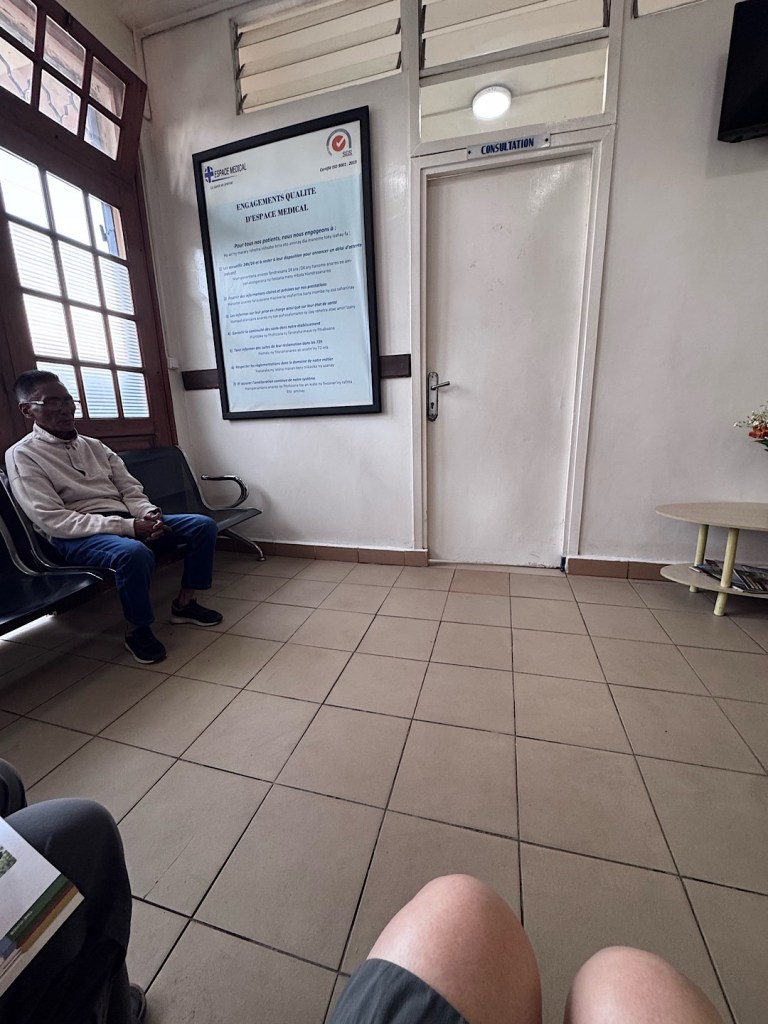
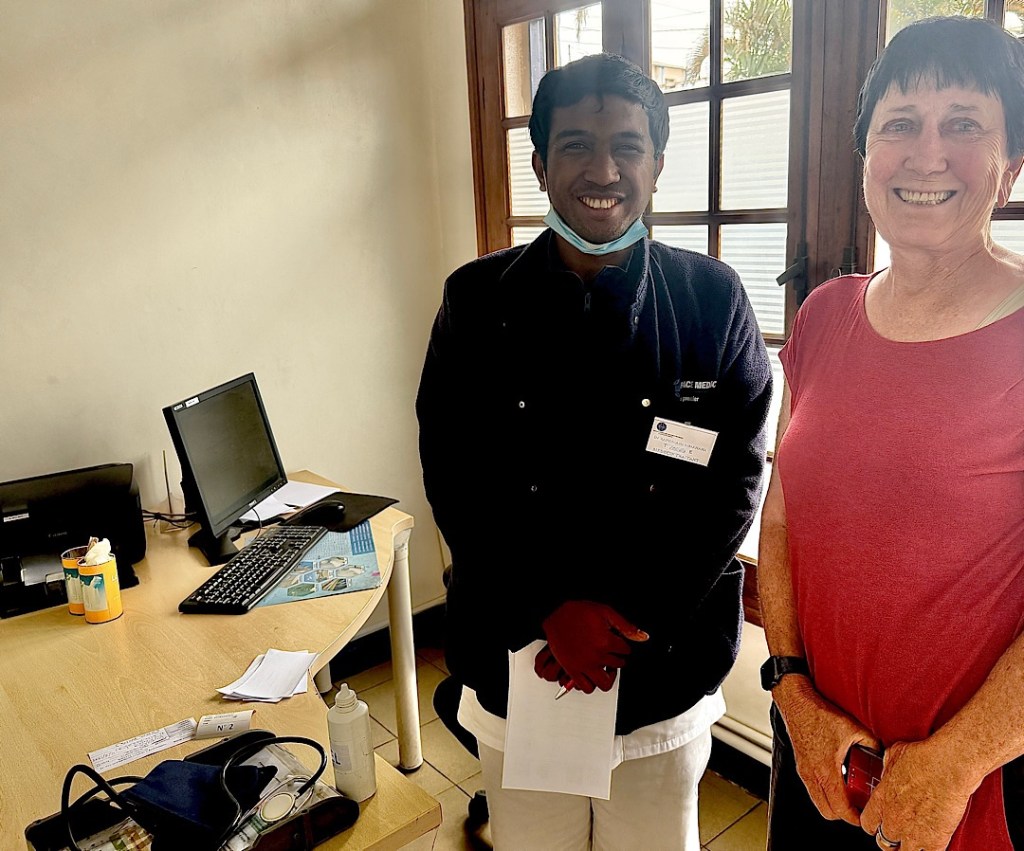
I think we waited about 15 minutes before a very young man wearing a dark jacket over a white tunic and trousers came to lead us to a small private office. A name tag pinned to his chest proclaimed he was Dr. R. E. Randrianamana. He took a seat behind the only significant piece of furniture, an uncluttered desk, then handed me a slip of paper and asked me to fill in my name and date of birth. Using a combination of his limited English and my limited French, I explained our concerns.
He sprang to his feet, picked up a stethoscope and applied it to first my back and then Steve’s. Our lungs were fine, he declared, which I took to mean I didn’t have to worry through the coming night about asthma OR pneumonia.
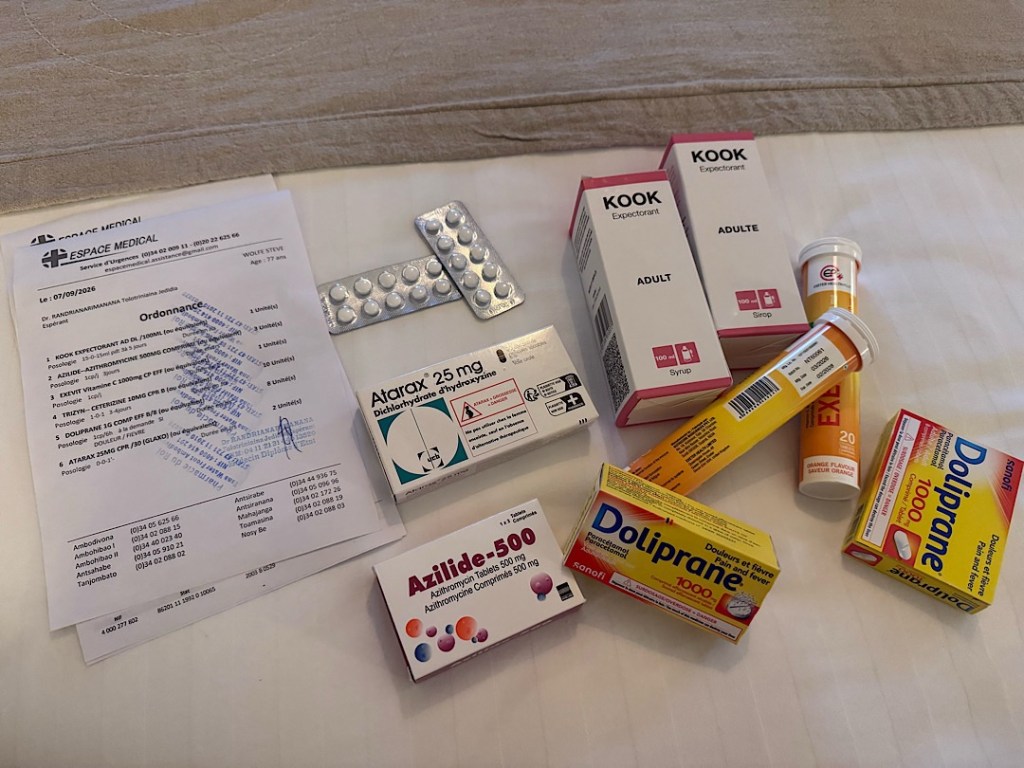
Dr. R then started typing at a small monitor — prescriptions for both of us for a short course of antibiotics, fizzy zinc/vitamin C pills we could dissolve in water twice a day, pain pills (if we felt the need), Kooks brand expectorant syrup, and two kinds of antihistamines (one drowiness-inducing, one not). He pushed a button and a miniature printer rolled out an impressive list of our prescriptions, including the dosages. He posed for a picture with me, then bade us farewell.
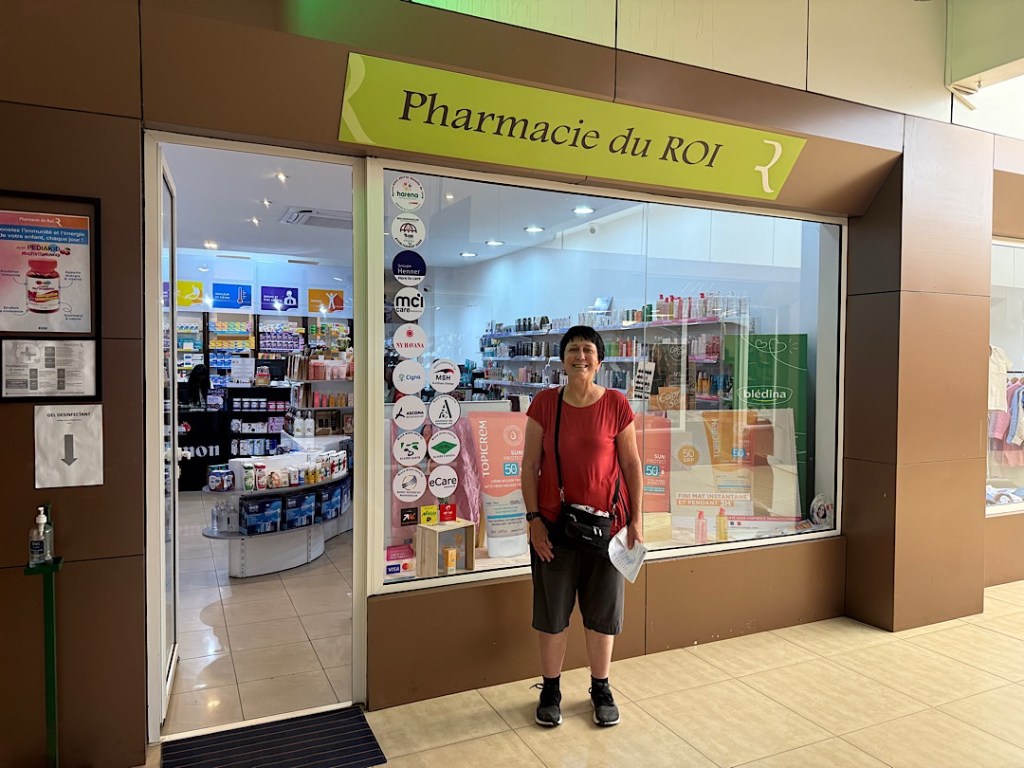
We waited briefly then were told the fee for our medical consultations was 34,000 ariary per person, about $7.85. We couldn’t get the medicines from the health center but had to go to a nearby pharmacy, where the tab to fill everything amounted to $31.18. I calculated that getting checked by Dr. R and picking up the prescriptions took about two hours. We were barreling off to the rainforest well before noon.
I was impressed. Of course if I had a brain tumor or a stroke or mysterious fainting spells, my first choice would be to go to the UCSD Medical Center, where I’d be treated by some of the best specialists in the world (at staggering cost).But for a nasty cough, I think Dr. R gave us no less than I would have gotten from any American doctor I could have seen back home (for just pennies more than I pay for parking at UCSD.)
It’s now been four days since we left that clinic, and we’ve improved a lot. My bronchial spasms have vanished, and coughs are no longer interrupting our sleeping. We both are still emitting minor chest-clearing coughs every now and then, but I expect those will soon disappear. Then again, I tend to be optimistic about such things.

