If you’re reading this, it means Steve and I have managed to cross the Atlantic Ocean, enter France, and make our way to the apartment of our friend Olivia in Neuilly, just outside the Paris city limits. We will have begun an adventure I began planning two years ago, inspired by an invitation to the wedding of Olivia’s older daughter, Annabelle. Originally, we expected to fly to Europe in May of 2020, but the Covid lockdowns forced everyone to cancel all their plans. When the wedding was rescheduled and a second wedding (of Annabelle’s sister, Marguerite) was set for May/June 2021, I rebooked everything. But a surge in case levels led the sisters to postpone their celebrations again.
Now we’ve made it into the country and are just four days from the first nuptials, which will take place in Bordeaux. The second event takes place October 9 in the south of France. In between Steve and I have planned a wide-ranging tour through some of the smallest countries on earth: Andorra, Luxembourg, Liechtenstein, San Marino, Vatican City, Malta, and Monaco.
We’ve both been to Vatican City before, and Steve made a lightning visit to Liechtenstein in 1974, but the rest will be new to us. The micro states stand out in other ways beyond their limited size. They rank among the wealthiest countries on Earth, and their citizens live longer than almost anywhere else (because prosperity and physical well-being go hand in hand?) They have oddball forms of government. Three are principalities, one’s a Grand Duchy, Vatican City is a city-state (Malta and San Marino are humdrum republics.)
We have to fly into and out of Malta (an island). But mostly we expect to get around on trains and buses and in a couple of rented cars. We smile at how this trip reminds us of our honeymoon 47 years ago. Then we tore around Europe’s Big Bruisers — France, Germany, Switzerland, Yugoslavia, Greece, Italy. How different will it be to visit the pipsqueaks? We don’t know. But we are optimistic it will be interesting.
Yesterday I reported on Steve’s and my half-baked effort to compare the cost of living abroad in four countries — Guatemala, Panama, Costa Rica, and Nicaragua, all which we visited in May and June. My friend Anne read the post and emailed me an excellent question: What would a similar basket of goods cost here?
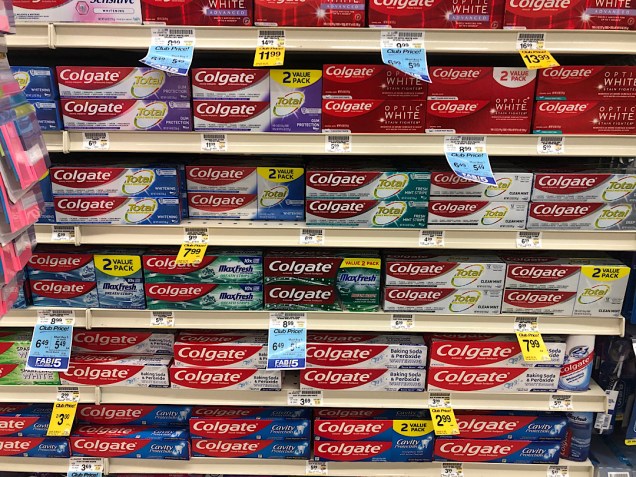
I didn’t know. Curiosity thus drove me this morning to my local Vons, where I was reminded again what a messy, imprecise experiment we had cobbled up. Still, I was intrigued by what I found. It was cheaper to buy the overall basket of goods in Pacific Beach ($24.04) than in any of the four Latin American countries except Guatemala, where it had been $21.94, as compared to $25.20 in Panama; $27.42 in Costa Rica; and $32.76 in Nicaragua. The booze made the Nicaraguan basket cost so much, but when I removed that from all the baskets, the total for the other American products ($11.83) still came to just a bit more than that for Guatemala ($10.85) and Nicaragua ($10.90) and was cheaper than Costa Rica ($14.88) and Panama ($15.70).
I found it even more interesting to focus on some of the individual items. The Colgate toothpaste from my Vons was cheaper than that we found in any of the other countries, $1.50 for a 113-gram tube versus between $1.68 to $2.90 for quantities between 90 and 100 grams. Coke cost the least here too, if not by a big margin.
On the road, Steve and I heard more than one complaint about how expensive life was. Our little comparisons sure confirm that and make it tangible. The gross domestic product per person in Guatemala is $4,619.99. It’s less than $2,000 per capita in Nicaragua — versus more than $65,000 per person in the US. Yet it costs almost as much to buy those eight products in all three places.
On the other hand, nowhere in the four Central American supermarkets did I find the range of products that confronted me in my Vons. Should I include the Optic White variety in my basket? The Baking Soda and Peroxide? The Cavity Protection? One of the dizzying array of other choices? If time is money, should I have added the decision-making into the cost?
It almost makes me want to stay out of supermarkets when I travel — or at least not to think so much about what I find there.
I thought I was done with blogging about our trip to Central America but then I remembered our cost-of-living experiment. I want to share that.
Early on, it struck me that Steve and I would be making lots of comparisons among the four countries we would be visiting (Guatemala, Panama, Costa Rica, and Nicaragua). We expected the costs of traveling in them to vary. But would we get a good sense of how much it costs to live in each? We decided to be Scientific.
Our idea was to create a theoretical “market basket” of common grocery items. We would record the prices starting in Antigua (Guatemala) and later at supermarkets in the three countries to follow, then compare them. Would this give us insight into the daily challenge of keeping a Panamanian household versus a Nicaraguan one? We would see!
We had the most fun the first time we did it. Strolling up and down the aisles of a big supermercado we found near Antigua’s artisanal market, we scanned for essentials of modern living. The selection we came up with was:
Toothpaste
A bar of soap
Toilet paper
Powdered laundry detergent
A can of Coke
A bottle of vodka
Bananas
Kellogg’s cornflakes
Please note I’m NOT saying Steve and I are daily consumers of all those things. (I personally only indulge in Coke on the rarest of occasions.) But they seemed like reasonable representations of stuff folks everywhere buy often. And note that we did not actually buy these items — just wrote down what they cost.
The minute we started recording the prices, it became obvious we needed to be at least somewhat specific if we expected to make comparisons down the road. So we noted that 90 grams of Colgate toothpaste in the Guatemalan store cost 13 quetzals (roughly $1.68). We picked a brand-name bar soap (Dove, 135 grams for 14.5 quetzals/$1.87) and vodka (Skyy, .75 liter for 85.95 quetzals/$11.09), Coke (4.45 quetzals/57 cents for a 354 ml can) and Kellogg’s cornflakes (19 quetzals/$2.45 for a 530-gram box). But we decided to go with generic-looking toilet paper and detergent. Oh yeah, and bananas. How complicated could bananas be?
More than you might think — at least in Central America, where bananas come in multiple incarnations. For our Guatemalan “basket,” we recorded that the price of “criollo” bananas was 1.95 quetzals per pound.
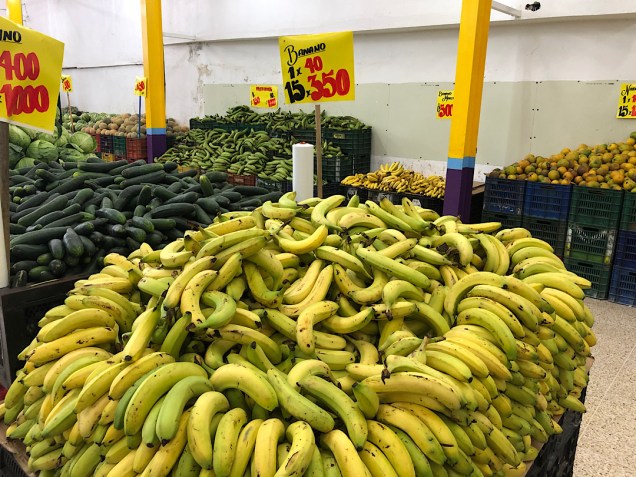
A few days later, when we got to Panama and (eventually) found a large, modern supermarket, we saw that bananas (just one type, thank God) were priced both per pound (45 cents) and per kilo (.99 cents). But the Costa Rican supermercado we later visited in San Juan offered its customers a choice of banana types and, even worse, the prices were per banana. One for 40 colones/6.5 cents or 15 bananas for 350/56 cents) were the prices for the variety we arbitrarily selected. In Granada, Nicaragua, the price was 2.5 cordobas (7 cents) — again per banana.
Other challenges soon were making me feel grateful I don’t make my living collecting data for the Bureau of Labor Statistics and its Consumer Price Index. For example in Panama we found 530-gram boxes of Kellogg’s Cornflakes on the shelf — but ONLY packaged with 67-gram cans of Pringles potato chips! If you hated Pringles but loved your flakes, you were out of luck. Skyy vodka could be swigged all over Guatemala and Panama, but it was absent from the shelves of the Costa Rican and Nicaraguan markets we targeted, so we settled on Smirnoff. That only came in liter (versus three-quarter-liter) bottles, and it was labeled 35% (a lower alcohol content than the 40% of Skyy). While we could price a 354 ml can of Coke in Guatemala, Panama, and Nicaragua, in our Costa Rican market it exclusively came in 600mm plastic bottles.
Despite this jumble, I finally (last week) added up the prices in each “basket” and converted the total to US dollars. I can report that (including their admitted inconsistencies), the Guatemalan basket came to $21.94, the Panamanian to $25.20, the Costa Rican one to $27.42, and the Nicaraguan to $32.76. That shocked us given the fact that Nicaragua is so much poorer than the other three, even Guatemala. But then we realized that the Nicaraguan liter of Smirnoff’s was a whopping $21.86 (compared to $12.54 for the very same bottle in Costa Rica and less for the smaller bottles of Skyy). Subtracting the alcohol put the basket totals more in line with the economic stature of the countries (Guatemala $10.85, Panama $15.70, Costa Rica $14.88, and Nicaragua $10.90).
For me the bottom line is that these numbers aren’t very interesting — certainly not enough to justify the work involved in collecting them. That’s not to say I regret doing it. The whole exercise forced Steve and me to interact with supermarkets in a more focused way than we normally do while traveling. It also probably made me a bit more skeptical of the BLS’s Consumer Price Index (just because I’ve seen how daunting it is to try and make such comparisons.) Still, I have no intention of trying to duplicate our experiment on our next trip that takes us across the borders of many diverse countries. We’re scheduled to depart on that one August 30.
So why would you choose to travel around Central America during the pandemic?
Both Steve and I have confidence in the efficacy of the vaccines we received (Pfizer and Moderna) months ago. We had never been to Guatemala, Panama, Costa Rica, or Nicaragua before and were curious about all of them. And they were all welcoming visitors.
You’ve traveled a lot (to approximately 65 other countries, before these). How different was this trip?
In many ways, it felt like all our trips. We enjoyed it all, some things immensely. But some aspects were different — some better, some worse, and some just… different.
What was better?
Fewer crowds! In Guatemala’s spectacular Mayan ruins at Tikal, we had the place almost to ourselves. We never had to think about making a restaurant reservation anywhere. That was pleasant.
What was worse?
Having to be tested over and over to prove we didn’t have Covid. These tests aren’t cheap. The two of us spent almost $200 for the antigen tests required by Panama and the United States. The PCR test demanded by Nicaragua was almost $100 apiece. Guatemala was the only place that let us in with no hoop-jumping other than showing our vaccination cards. (Gracias, Guatemalans!) Costa Rica required neither testing nor proof of vaccination, but it made us get certain insurance coverage in addition to filling out a complicated electronic form.
What fell into the Just Different category?
Seeing almost everyone wearing masks outdoors, virtually all the time, at least in Guatemala, Panama, and Costa Rica. In Nicaragua, maybe 60% of people on the street were masked. Steve and I almost never wore masks outdoors, and the only time we were ever chastised for this was by a bossy American lady tourist in the central park in Antigua.
We couldn’t discern whether the almost-universal mask-wearing was required by law or simply driven by people’s fear of getting Covid. Vaccination rates are low everywhere we visited, and we sensed that many people are scared.
We were fascinated by the requirement in Guatemala, Costa Rica, and Panama that businesses take the temperature of everyone entering their premises and make them wash their hands. This has spawned an entire industry of automatic temperature-taking and hand-washing stations, though many places instead had a worker aim a temperature-taking instrument at every entering arm. In most places, no one seemed to be paying attention to the numbers displayed by the alleged thermometers. But it may have made some folks feel safer.
One version of a hand-sanitation station. There were hundreds of variations.
Did anything surprise you?
Over and over we asked hotel workers and tour guides and other people in the travel industry what they did when their governments closed the borders and tourism evaporated overnight. One hotel manager started going out to work with his fisherman father. A tour guide at Lake Atitlan started picking coffee beans. Another dusted off his carpentry skills and made furniture. Almost everyone tried to adapt. They sounded shell-shocked.
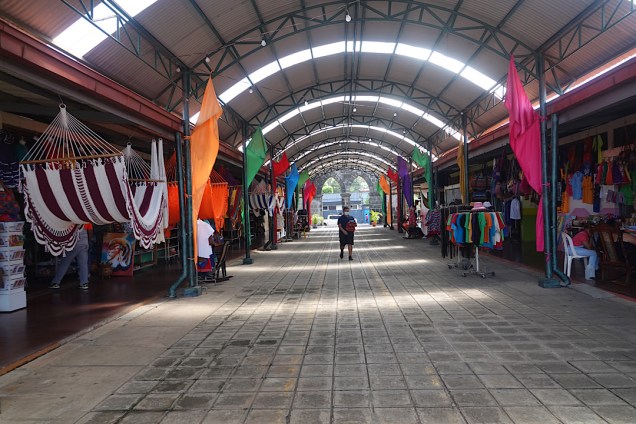
The artesanal handicrafts market in Masaya, Nicaragua. In normal times it is jammed with tourists. Now the vendors have a haunted look in their eyes. We felt a bit like ghosts, an apparition from happier times.
Did you ever come close to dying?
Maybe. It happened when we were being driven to Guatemala’s Caribbean coast. We had a good driver (Alfredo) and made good time from the cloud-forest where we spotted the quetzal. Only once did we encounter bad traffic, passing through a market town.
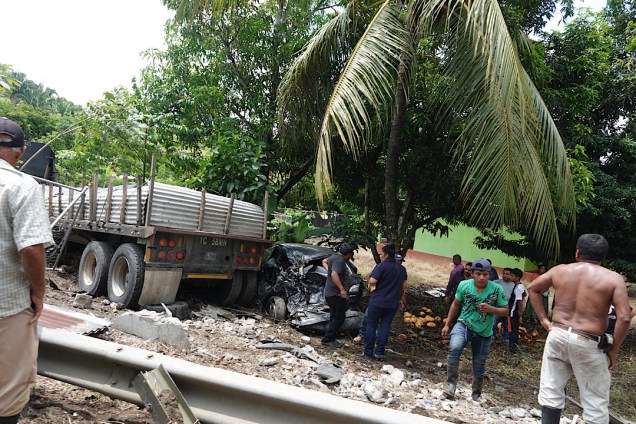
We were less than an hour from Rio Dulce when the cars in front of us stopped abruptly. Uh-oh. After a while, we got out of our air-conditioned vehicle; it felt like a muggy 100 degrees outside.We realized that a six-car crash had just occurred about three cars in front of us; people were still being extracted from the wreckage. Steve and Alfredo and I all shook our heads and cringed at the thought of how long we would likely be stuck in it.But minutes passed, and no police or emergency vehicles arrived, and cars in both directions began creeping past it.
We sneaked by too and arrived in Rio Dulce having been delayed by less than a half hour. At some point it occurred to me that we missed being in that terrible accident by less than a minute — probably closer than I’ve ever come to dying in a car accident in a foreign country. That’s a risk that scares me. But I’m not willing to stay home to avoid it.
On our last night in Nicaragua, Steve and I sat next to the pool in the house where we were staying. Every few minutes the sky flashed with approaching lightning. The thought struck me, “This is a violent country.” It’s dotted with volcanoes and riven with earthquake faults primed to wreck human infrastructure, like one that in 1972 destroyed 80% of the buildings in Managua, the capital. Hurricanes sometimes batter its Caribbean coast and fierce thunderstorms are a summer commonplace. People have done a lot of bloodletting here, at least since the Spanish arrived 500 years ago. Pirates sacked Nicaragua’s cities. An unhinged American named William Walker invaded and got himself elected president in the 1850s (before going on to die before a Honduran firing squad). A long line of Latin-American dictators followed, until left- wing revolutionaries who called themselves Sandinistas toppled the outrageously corrupt Anastasio Somoza. Their war ended in 1987 but Sandinista leader Daniel Ortega, now almost as rich and corrupt and vicious as Somoza, has positioned his family members to carry on a dark new dynasty.
None of this violence diminished the pleasure of our week in Granada (the oldest city in Latin America, residents boast.) Founded in 1524, its large, leafy central plaza anchors an orderly grid of streets lined with Spanish haciendas painted in hot tropical colors. I found a house-trading partner willing to accept guest points from us in exchange for a week’s stay in a building erected about 125 years ago. Its American owners restored it to pristine condition about five years ago. From the street it doesn’t look like much. But once beyond the metal gates and heavy wooden doors, we reveled in a 5,200-square-foot patch of paradise, configured around two open-air courtyards. The baronial master bedroom suite opened to them both. At the center of one was a beautiful garden surrounding a fountain……while the other held the swimming pool and adjoined a spacious kitchen.When we arrived (Wednesday, June 9), Steve and I felt tempted never to step outside this sanctuary.
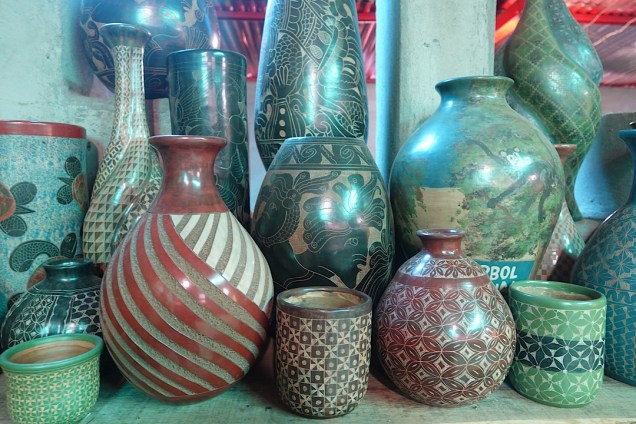
We relented, of course, and were rewarded. One day we visited the potters in one of the indigenous villages not far outside of town. They demonstrated every step in the process of kneading local clay… …spinning it into various shapes on a foot-driven potter’s wheel…… dipping it in colored muds that are allowed to dry before being polished and engraved.They fire the end products in wood-fueled kilns that they heat to 900 degrees. The results were splendid.
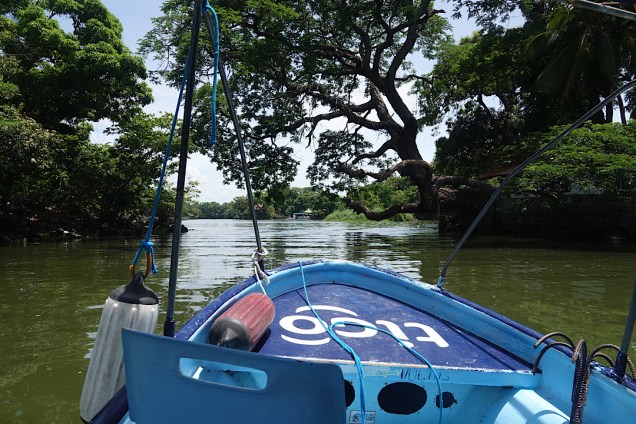
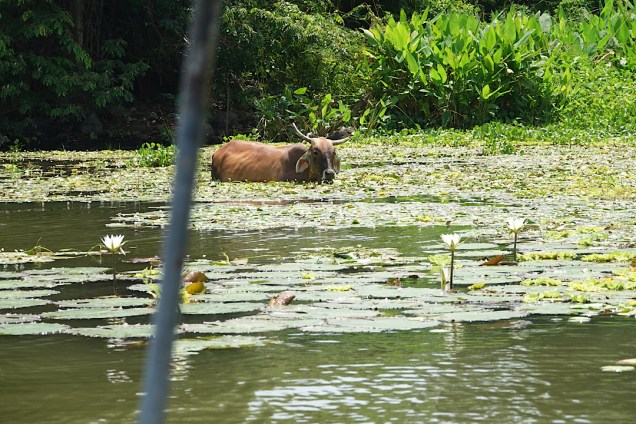
Another morning we hired a motorboat to putter among the little islands sprinkled near Granada on Lake Nicaragua. Nicaraguan millionaires and billionaires as well as ex-pats have built mansions on them, which makes the outing part Lives of the Rich and Famous and part nature documentary.
Most of the mansions are hidden behind lush gardens, but this one, belonging to the family of a former president, was an exception.
Sunday afternoon we took a class at Granada’s Chocolate Museum. Cacao trees originated in this part of the world, and today Nicaragua is a major exporter of the beans. I’ve seen the pods before (in Peru and in the Amazon); I’ve sucked the delicious creamy white gel that covers the seeds that grow within the pods. But the class filled in the many steps involved in transforming those bitter seeds into creamy dark deliciousness: fermenting and drying them, then roasting them till they turn dark and aromatic. Steve and I each removed the husks from a dozen or so of them, then pulverized the innards. You get a buttery chocolate mash when you do this. We mixed ours with honey and other liquids to make yummy chocolate drinks and with additional flavorings (salt! rum! bananas!) to make bars that we ate for dessert for three days.
It was all great fun, but I’m not sure I’ll remember it five years from now. What I doubt I will ever forget is the evening we visited Masaya Volcano. Several volcanos dominate the landscape near Granada. Masaya is the closest. It last erupted hugely in 1772, but it certainly cannot be called dormant today. We hired Carlos Medal, a tour guide and jack of all trades (he works for the couple who own the home we were staying in) to drive us out to the national park in which the volcano is located. We paid a quick visit to the informative little museum… …then motored up to one of the craters at the top. Steam was rising from a precipice.
We approached and peered in. At first we could detect only a faint glow within the steam…
…but as the sun set, it didn’t take long for the orange-red color to intensify…and grow hellish. For seconds at a time, the smoke cleared and we could see the magma churning barely 1000 feet below. It felt creepy and thrilling and mind-boggling, like glimpsing the inferno… before driving back to our lovely hacienda 45 minutes away.
It’s tempting for me to see the volcano as metaphorical. Nicaragua is beautiful but it ranks among the poorest countries in the world; some sources place it second-poorest in the Western Hemisphere, after Haiti. The suffering is obvious: shacks in the countryside rival those we’ve seen in Africa. Beggars hold out their hands on every other corner. Men on the street sell single cigarettes all day long, every day. Meanwhile the Ortega family members live better than the Spanish kings and queens of old. They’ve murdered some political rivals; put others under house arrest.
Over the weekend we heard so many loud explosions we wondered if another revolution was starting. We asked what was going on, and people told us the noise is humdrum; that Nicaraguans set off firecrackers to honor saints, celebrate weddings, and otherwise express themselves. On Saturday night, we saw more evidence of auditory extremism when we walked down a pedestrian street filled with open-air diners. For at least a block or two, speakers as big as refrigerators were blasting music at volumes guaranteed to cause hearing loss. Yet the locals were tossing back beers and bouncing kids on their laps and acting like they were surrounded by Muzak.
As I noted sitting next to the pool, it all seems violent — violent in a way that makes the US feel like Switzerland. But what do I know… about thunderstorms or Latin American politics? Not much. The storm we thought was coming that night never materialized. The lightning faded away. I hope sunny days are ahead for Nicaragua. But I wouldn’t bet on it.
You’ve heard, no doubt, about the desperate Nicaraguans massed in Tijuana, trying to get into the US. I can relate.
Why it should be difficult for Steve and me to get into Nicaragua as tourists I don’t understand. Nicaragua is one of the poorest countries in all the Western Hemisphere; the poorest in Central America. You would think the government would be panting for US dollars, particularly when their international image is so tarnished. Their dictatorial president, Danial Ortega, has been ruthlessly smashing (indeed killing) political opponents and protesters since a wave of criticism of him crested three years ago. He’s been a Covid bad boy, accused of concealing the extent of deaths here and failing to organize any lockdown action in response to it.
What the country has done is to enact the strictest regulations in the region for incoming visitors. Only Nicaragua requires a negative PCR test obtained within the 72 hours before arrival. And that’s not all they ask for.
It took me a while to realize that Nicaragua’s particularly strict testing requirement complicated our plans. Months ago my research made me feel confident we could get Covid-tested near Nita and Marty’s house (where we were staying in Costa Rica). But it typically takes about 24 hours to get PCR results, and it finally dawned on me that because of the weekend, if we tried to go to Nicaragua on a Monday (our plan), we wouldn’t be able to get tested, pick up the results, and have them for the Nicaraguans within the required time frame. Argh!
I finally changed the plan and cut two days from our scheduled stay in Nicaragua. That allowed us to move from Nita and Marty’s to a beach near the airport in Liberia, Costa Rica’s second largest city. I made an online appointment for us to get the PCR test offered at the Liberia airport Monday at 1 pm.
That went just fine. We arrived at our appointments almost two hours early and joined a line of gringos waiting in a big white tent next to the Arrivals terminal. Lab Echandi, the outfit running the operation, seemed extremely efficient and well-organized.They let us get tested despite our having shown up early and said the results would be emailed to us sometime the next day. Less than 24 hours later, they showed up in my inbox — signed by a doctor, QR-coded, and, happily, Negative. The clerk at our hotel’s reception desk printed them out for us.
Only one wrinkle remained. The Nicaraguan government’s website stated clearly that in addition to showing proof of the negative PCR test, all visitors had to fill out an online form from the Ministry of Interior, “an agile, orderly, and secure application for admission, which must be submitted at least seven days before entering Nicaragua.”
A week earlier, I had found that form online, filled it in and submitted it, and within a day received a colorful email back (entirely in Spanish). It seemed to be saying that I had to email the negative test results to the email sender. In yellow-highlighted letters it also said that after sending in the test results, “you must wait for notification to enter the country.”
Of course we emailed them the test results as soon as we got them Tuesday. Within an hour, I received a reply… telling me I had to also submit the health form. I fired back another salvo, reminding them I had already submitted it. I attached a pdf as proof. Then we heard…..nothing. Nothing Tuesday, nor Wednesday morning, nor by the time the driver we had hired dropped us off at the land crossing.
With some trepidation, Steve and I hauled our roller bags across the invisible line separating Costa Rica and its neighbor to the north. The sun was blazing; it felt like it had to be over 90 degrees. Outside the immigration office, some white-uniformed women at a health station signaled for us to hand over our passports and Covid test results. A few minutes later, they returned them to us with stamped slips of paper that suggested the tests had been reviewed and approved. Then we entered the immigration office to find a sleepy scene: a booth manned by two officers and no would-be visitors other than us. One of the officials, a burly, round-faced man, motioned for us to approach and asked me cheerily in Spanish how I was. In the minutes that followed, he examined and stamped our passports, photographed each of us in turn, had us pay a lady a municipality tax of $1 apiece, asked for an additional $13 federal entry fee per person… but never said a peep about the online health form.
So did we technically sneak in? It didn’t feel like it. But this morning, after being here in Granada for almost 24 hours, another email from the Nicaraguan government popped up in my inbox. It was exactly the same email I had received three or four times before: telling me to submit the Covid tests; stressing (with the same yellow highlighting) that we must not enter until we’d heard back from them. I suppose it’s theoretically possible a knock could come on our door. We might be hauled off for questioning.
I’m not losing sleep over the possibility.
And I have to note: taking the two days at the beach turned out to be a blissful payoff for slogging through the bureaucratic quagmire. Steve and I rarely spend time at beaches during our travels. We declare, too archly, that we live at the beach so we don’t need to seek them out on vacation. But this beach on the north-central Costa Rican coast was nothing like our hometown San Diego beaches.
We walked for miles, seeing almost no one but crabs……and a showy while egret.
Along with two or three other people, we were almost the only guests at the beautiful resort that I had found online for about the same price as a Rodeway Inn at home. It was sort of creepy but also really cool to have it almost all to ourselves.
Call it the yin and the yang of traveling in the time of Covid.
When Steve and I left behind San Jose last Wednesday (6/2), weeks had passed since I watched a television show or movie. That morning we drove in our rented SUV to El Castillo, a tiny village (pop. 250) that clings to the slopes of Volcano Arenal in northwest Costa Rica. I had traded more of my HomeExchange.com guest points to arrange a five-night stay in a delightful two-bedroom bungalow owned by a couple of American ex-pats there.
That’s the roof of our house with its view of the lake in the distance.
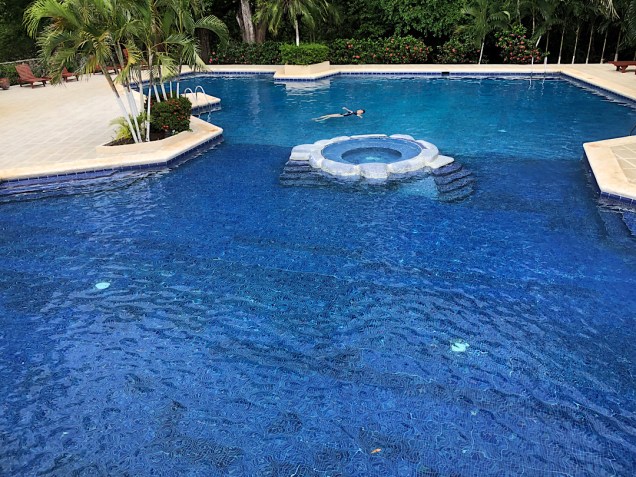
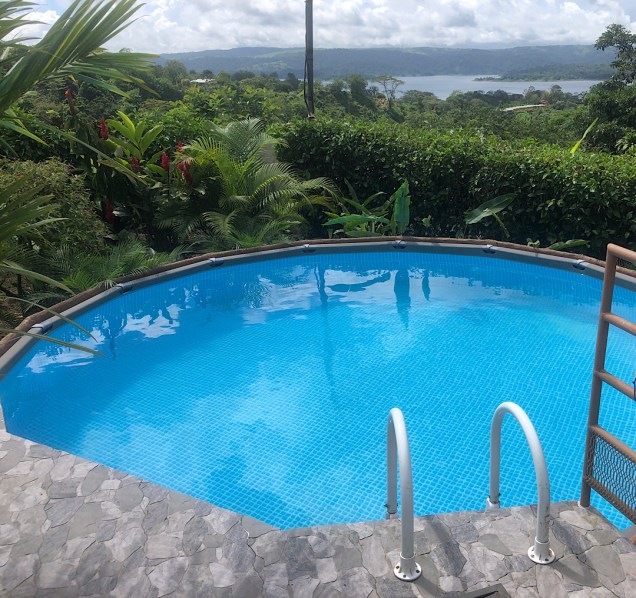
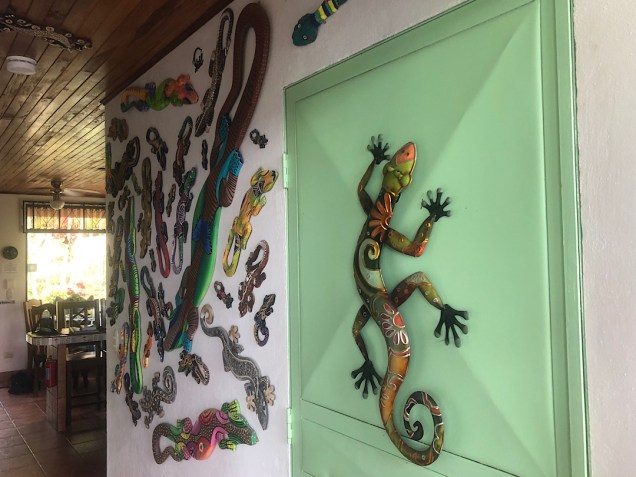
A moon gate on the grounds led to a private trail into the rainforest. We had our own little private swimming pool… ,,,hand-carved doors and other colorful decorations.We also found an extensive collection of DVD movies, through which Steve and I leafed Thursday night after dining on excellent burgers at a local joint named after the monkeys that serenaded us every morning with their barks and moans (Howlers). Craving some electronic entertainment, we decided to watch Soylent Green.
Somehow we missed this movie when it came out in 1973. Turns out it’s set in the year 2022 in New York City, where the population has reached 40 million, a hellhole so insanely crowded that people sleep in stairwells, piled up like trash bags in a garbage strike. But it’s home to a buff young city cop: Charlton Heston. He and everyone else in the throngs are sweating because global warming has gone critical. We see people wearing masks (yikes!). In the end Charlton figures out that dead humans are being transformed into green wafers (Soylent Green) because that’s the only food left on the planet; even the plankton in the seas has all been eaten. Shortly before this climax, we watch him bust into the creepy facility where his old friend Edward G. Robinson, dispirited and hopeless, has gone to be euthanized. Because Edward G is so old, he remembers what the world used to be like, and as he’s dying, he gets to watch images from the pre-apocalyptic days on a giant screen. Tears well up in Charlton’s eyes when he sees deer eating grass in a flower-filled meadow; schools of fish swimming in the sea. “How could I have known?” he chokes out.
Pretty corny stuff. But also wildly comforting to be watching in 2021. New York City’s population, Wikipedia tells me, is actually just 8.3 million (and that was before the Great Covid Exodus). In the movie, no one mentions Costa Rica, but anyone paying attention in the 1970s would have likely predicted a worse future than New York’s 50 years down the road. More than 75% of Costa Rica had been covered by forests in the 1940s, but by the 50s and 60s, people were chopping down ancient giants as if they were weeds, clearing land for cattle and pineapple farms whose produce could be hollowed out and used to hide bags of cocaine. By 1987, more than two-thirds of the forests were gone.
And then the Costa Ricans miraculously changed course. By 1998, the deforestation had not merely stopped; the forested areas began expanding. Costa Rica is the only tropical country in the world where that’s happened. According to one estimate, 53% of the country was again covered by trees in 2019, up from 21% at the nadir.
Today the money from ecotourists and adventurers drawn by the tropical splendor makes up a big part of the economy. And now I understand why. If Charlton and Edward G could have seen what Steve and I experienced over our five days in El Castillo, they would have stocked a backpack with Soylent Green and headed south.
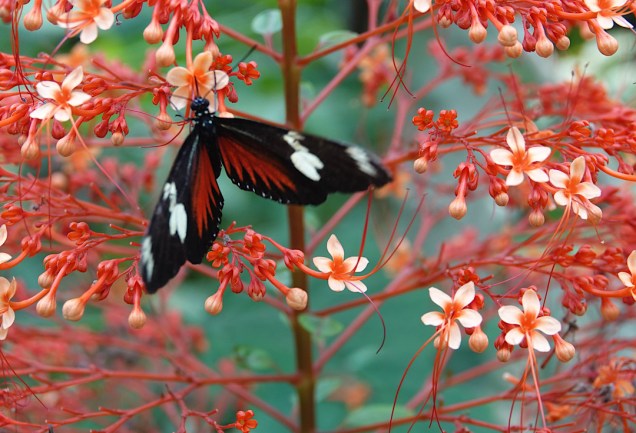
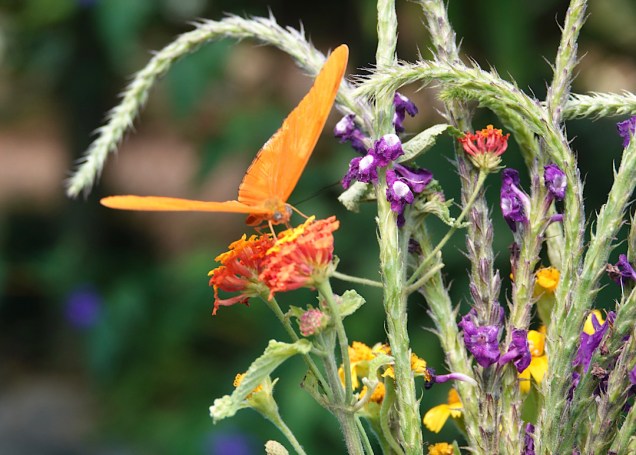
At least 1200 species of butterflies live in Costa Rica, and we saw a couple dozen types of these beauties on a visit to a butterfly conservatory located in El Castillo.
These two are mating.
We went on several long hikes, through dripping rainforests…Across suspension bridges…
…and over lava fields created by Volcan Arenal.
The volcano had been quiet for 400 years before bursting into life in 1968. It put on a spectacular show for 42 years, then it abruptly stopped in 2010. So we didn’t see any lava flowing, but the mountain is still a powerful presence.
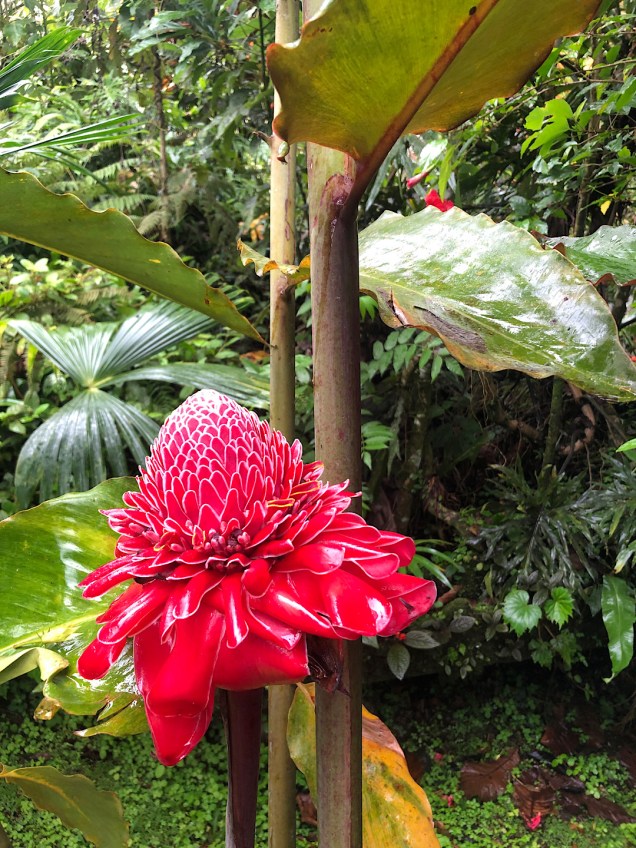
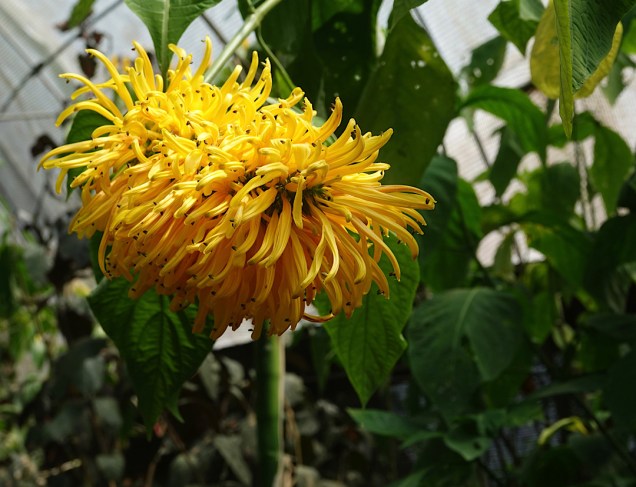
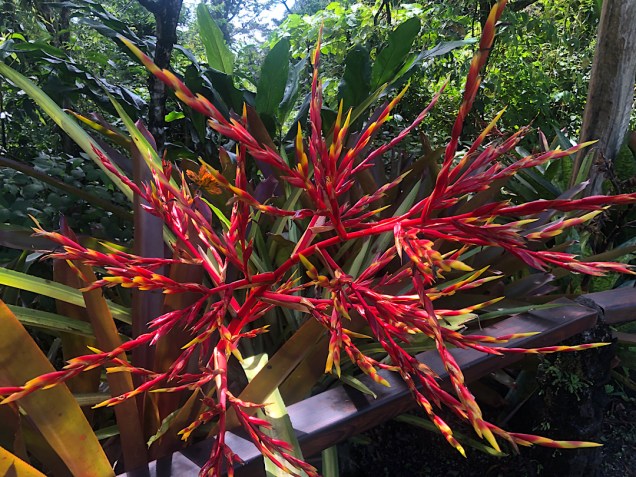
Its magma heats an extensive network of hot springs throughout the area; frolicking in them is a popular tourist activity. Steve and I spent a couple of hours in one resort, and I thought soaking in the hot water was pleasant. But finding otherworldly flowers like these in the garden mesmerized me.
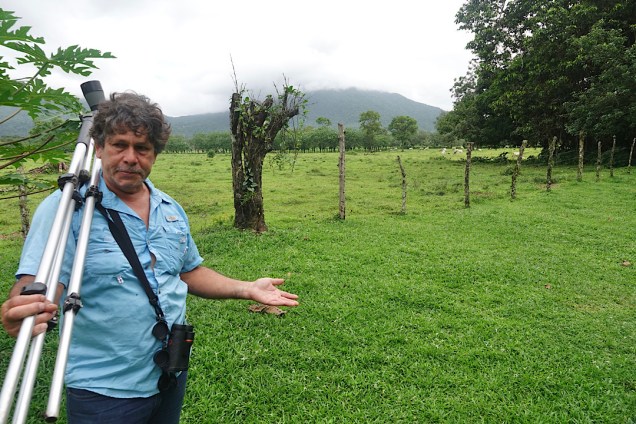
Even more mind-boggling was the guided walk we took yesterday morning on the Bogarin Trial. We’d been told this was a great place to see both wild sloths and local birds. We wound up getting that and something even more magical: more than three hours in the presence of Marvin “Geovani” Bogarin.
Geovani told us he was one of 11 children born to poor parents; their small house didn’t even have electricity. He was named Marvin (god knows why), but he always hated that, and as we learned quickly, he is not a fellow to passively accept what fate doles out.
Now 58, by the time he reached his late 20s, he somehow found his way to a career in guiding biological research teams and tourists. He worked at that for 10 years, and then around 2000, he was seized by a crazy vision. He wanted to take 300 acres near the center of La Fortuna (the larger and more touristy town near El Castillo) and transform it from grassland for cattle into a nature preserve. He had no money. But somehow he struck a deal with the land’s owner: if Geovani would do all the work to effect this transformation, he could use the land in exchange for splitting any eventual revenue.
Somehow he turned a landscape like this…
…into this:
In the early years, he dug deep trenches and built up trails made of gravel and clay — flat and smooth enough that blind people and folks in wheelchairs could use them, as they do regularly today. (Giovanni thinks access to nature shouldn’t be limited to the able bodied.) He planted everything except for the handful of old-growth trees that still dotted the pastures. For long intervals, he slept on a platform open to the elements. Everyone in town thought he was crazy, even his siblings. But he persisted and by 2010 he had accomplished enough to begin shepherding tourists around the place. Today he welcomes visitors from all over the world, and if they see it through his eyes, as we did, it’s a wonderland.
A green basilisk (known as the Jesus Christ Lizard because of its ability to walk on water) greeted us near the entrance, but we soon moved into the forest where Geovani scanned the canopy like someone taking in the headlines on Apple News. He pointed out a large male sloth that I would never in a million years have spotted in the leaves above us. For several happy minutes we watched him hang there, scratching at the parasites infesting his fur.Then Geovani heard a toucan, and we scurried after him to find and photograph it.
At another point, we called a broad-billed motmot to us. Or rather Geovani did. He commands at least 100 bird calls, an achievement that has gotten him onto the pages of the New York Times. For us, he not only whistled the motmot’s pretty song, but got an answer back.
Eventually the bird alighted not far away. As much as it looked like the two of them were engaged in a conversation, Geovani said the bird and his mate had a nest nearby, and this guy probably had mistaken Geovani for another motmot who might be moving in on his territory.
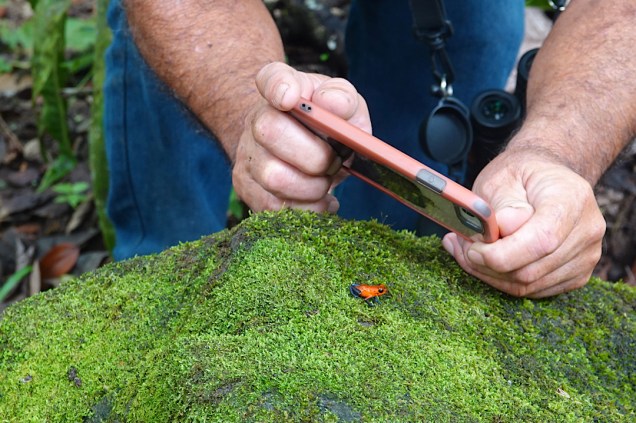
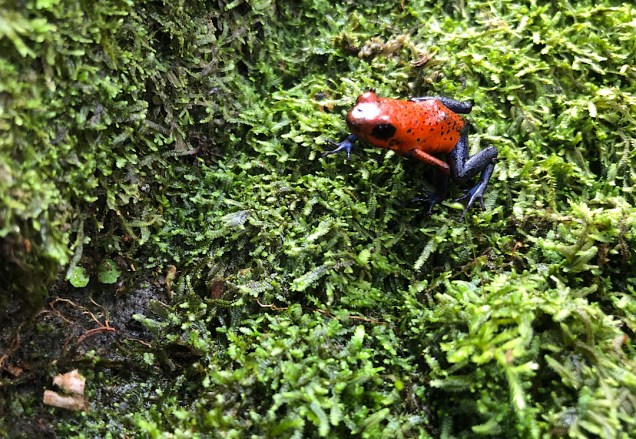
There was more. Just three days before, Geovani been bitten for the first time in his life by the fearsome bullet ant, a denizen of these parts, and we wanted to hear the gory details (“24 hours of excruciating pain.”) Another grisly story involved a close friend who a few months before had died from the bite of a fer-de-lance, a highly venomous pit viper that lives in these woods (along with coral snakes and several other deadly serpents.) Compared to them, the tiny poisonous frogs (provider of the poison for blow darts) look childish, like something Fisher-Price would make. Geovani told us how he once had gotten careless after handling one, touched his eyes, and went blind for three days.
He was careful not to touch this guy, whose charming name is the Blue Jeans Frog. You can see why.
It wasn’t all horror stories. Geovani’s a thoughtful guy with a passion for studying geopolitics. So we talked about next year’s race for Costa Rica’s presidency. And we asked him how Costa Rica had been able to turn things around; how it had avoided becoming Soylent Green South. His thoughtful answer was too long and detailed for me to fully reprise here, but he cited many factors: the realization that struck many of his countrymen in the 1980s that tourism could be more profitable than farming, proselytizing on the part of some key environmental visionaries, the country’s high education level (something like 97% of the population is literate, an achievement Geovani attributes to not having to spend money on a military); some sensible laws protecting key resources.
He didn’t say it, but we left thinking we’d just met another piece in the puzzle: the existence of people like him. Tough, generous, brave, inspired, intelligent, unbelievably hard working. As long as individuals like that keep popping up on the planet, I don’t feel terrified about its future.
San Jose (SJO) may live, but these days it lacks a certain vivaciousness.
I have no personal interest in sex tourism. Never have; never will. It was instead a journalistic impulse that drove Steve and me to the Hotel del Rey Tuesday night. Costa Rica is one of the few countries in the world where women are allowed to legally sell their sexual services, though pimping and other forms of promoting prostitution are illegal, as is having sex with minors. Trying to wrap our heads around these extraordinary facts, we’d stumbled on wild online descriptions of the bawdy offerings to be found in “Gringo Gulch,” just a block off one of the main avenues in the heart of San Jose (Costa Rica’s capital city). Could this still be going on in the midst of what appears to be continuing Covid panic? Curiosity nibbled.
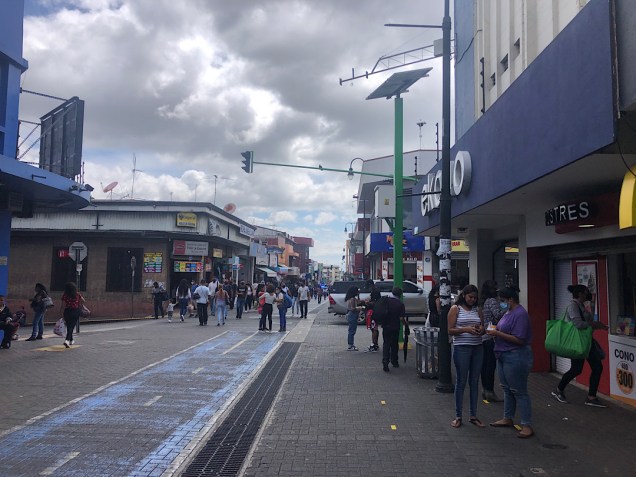
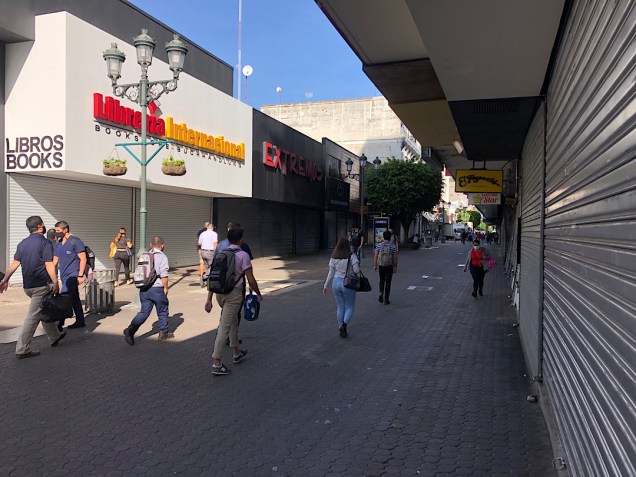
Nothing else about San Jose has seemed spicy — or even particularly attractive — since our arrival late Monday morning. The 91-year-old Gran Hotel where we’re staying in the city center is very nice, and it’s been fun to look out our window and see the people strolling across the Plaza de la Cultura. Almost every one is masked. But before 9 am, after about 7 pm, and at times in between, the streets radiating out from here have been depressingly empty.
This was mid-afternoonAnd this was shortly before 8 am this morning.
The buildings lining those streets for the most part are forgettable, a mix of tacky strip mall and architectural brutalism. The national theater adjoining our plaza is an exception, and the post office building is so pretty we stopped to admire it. But where was the Spanish colonial heritage so evident in other Latin American capitals? The guidebook suggested an explanation: early Spaniards came here but when they found few natives to enslave and no gold, they lost interest and never left much of a footprint. “It’s kind of like Panama!” Steve exclaimed. “Only with volcanos and earthquakes.” (And of course no Canal.)
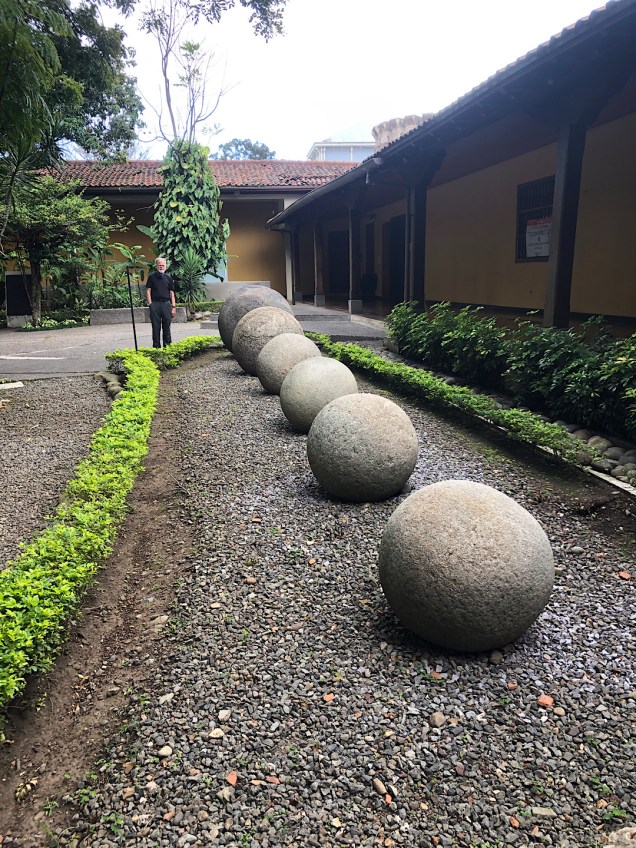
We spent most of yesterday giving San Jose our touristic best shot. Visited the Cathedral. Spent time in the national museum.
Some of the coolest things there were these samples of the mysterious pre-Columbian stone balls that have been found in the south.
We should have done the jade museum, but after two exhausting hours of Costa Rican history, tromping up and down 5 stories to look at 7000 objects made of pretty green stone didn’t push my buttons.
In the afternoon we returned to the central market area (which had been lifeless at 8 am). It was crowded and colorful and studded with what seemed like the highest concentration of cripples and old ladies and other folks hawking lottery tickets I’ve seen anywhere in memory. I went Full Tourist and bought t-shirts that seemed to represent some of Costa Rica’s greatest charms.
Sloths are native and iconic.
And one of their presidents in 1948 dismantled the country’s military. Costa Rica still doesn’t have one!
Then it felt like we were out of things to do except study Lonely Planet for dinner options.
For my birthday Monday night, we’d had a great score — an Argentine joint featuring beef. Every table was filled, and we spent a couple of hours swooning over the food and loving the all-tango musical background. But even though Nuestra Tierra (our choice last night) had hundreds of enthusiastic online reviews, we and two saggy business types were the only customers, apparently for the night. Our waiter looked sad when we said we only wanted one beer apiece. When we turned down the free dessert, he looked almost desperate. The manager, sitting at the bar, may have been thinking of heading for the US border. It was then we resolved to stroll by the notorious Hotel del Rey, den of iniquity par excellence. Could some hilarity at least be found there?
We turned off the pedestrian-only Avenida Central…… which looked like this a little before 8 pm and walked the short block to Avenida 1, where the already-dim streets were darker and creepier. Almost all the storefronts were shuttered. Almost no one was out walking. But Google Maps insisted the Del Rey was just a block or two away. An online report had described the massive pink structure as sticking out like a sore thumb. This was true enough that we easily spotted it, but this thumb looked more dead than sore. Dark and lifeless, it made us wonder if it was yet another victim of Covid. Or had we simply been misinformed about its heyday?
We scuttled back to the main street, where a lighted storefront caught our eye: clearly a casino. Such gambling also is legal here. Lest our brief stab at vice-detecting fail utterly, we let the guy at the front door take our temperatures, and we squirted yet more sanitizer on our hands (the universal drill) and wandered throughout the two-story establishment. The light was gray and metallic. A few dozen patrons, each shielded by plexiglass barriers between their slot machines, slumped in front of the whirling mechanical images. In the far rear of the place, we found an electronic roulette wheel, so deserted that I managed to sneak a photo.
We didn’t feel particularly lucky, so we hurried back to the plaza of culture and were asleep well before 10. Now it’s morning, and we’ll say goodbye to San Jose in a few minutes and drive ourselves to the north. There the true Costa Rican experience reportedly awaits.
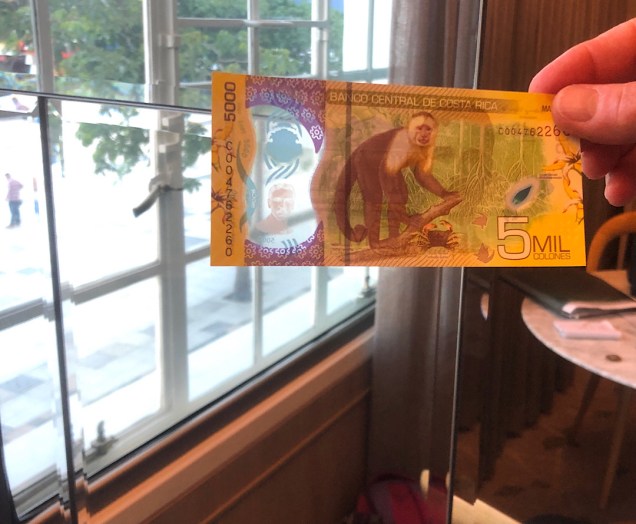
Costa Rica does have marvelous money. Their 5000-colon note (about $8) is beautifully colored and includes plastic see-through areas. In the distance is the view from our hotel window.
On our first-ever visit to Panama of course we would want to see the Panama Canal — vaunted 8th wonder of the world, 107-year-old shortcut between Earth’s two greatest oceans, Number Two on Lonely Planet’s “15 Top Panama Experiences.” And for Steve and me, experiencing the Canal had turned into something more; it had become a quest; a semi-sacred mission.
Weeks ago, in preparation for our travels, Steve began reading The Path Between the Seas, David McCullough’s splendid and definitive chronicle of what it took to create this engineering marvel. Steve immediately became besotted by it, declaring it was the best business story he had ever read. He couldn’t stop sharing the details with me and anyone else who would listen. I haven’t had time to read the book yet but I intend to. Listening to Steve convinced me I must.
Our guidebook and various online authorities assured me there were many ways of seeing and learning about the canal. A museum in Panama City was dedicated to it. A highly recommended activity was to visit one of the lock sites; at least two (at both ends of the canal) had fancy visitor centers. We could ride in a historical passenger train that ran alongside the canal, or pay for a boat ride through all or part of it. I fretted we would have trouble fitting in all the options.
When I discovered there was a home-exchange option in Gamboa, I got more excited. Gamboa is a tiny hamlet situated about mid-way across the peninsula. When the United States built the canal, it received a strip of land five miles on either side of it which it was supposed to be owned by America “in perpetuity.” Jimmy Carter ultimately decided (correctly, Steve and I think) the Canal and the Zone would be better off in the hands of Panamanians. That changeover happened in 1999, but in the 1940s, the US military built housing for the American canal administrators in Gamboa, and it was one of these elegant buildings that Jorge L (a Panamanian) acquired and now uses as a weekend retreat. He also rents out the place via Airbnb and trades it on homeexchange.com, a site that lets you arrange direct house trades OR receive “Guest Points” for letting other folks stay in your home while you’re away. You can then “spend” those points to stay elsewhere.
I thus arranged for Steve and me to spend three nights at Jorge’s Gamboa house. We were a little nervous about landing at Panama City’s airport at 4:30 pm, picking up our rental car, and having to make the 45-minute drive with night approaching. But luck was with us, and we arrived in Gamboa under thick clouds around sunset. Jorge had only sent GPS coordinates for the center of the town plus a photo of his house (apparently addresses are not a thing in Panama.) We were feeling pretty irritable driving around the rapidly darkening streets, trying to figure out which dwelling place might belong to Jorge, when we spotted a guy watching us with apparent bemusement. This turned out to be Omar, a sort of caretaker who confirmed that we had reached our destination.
The building contained two living units. Ours was on the left; our rental car was the blue one on the right.
Jorge had never mentioned him. Omar let us in and it felt a bit like stepping into a time machine; I tried to conceal my mixed feelings.
Two stories tall, both levels of the house had high ceilings and a gracious layout. It appeared to be more or less clean, but any 70-plus-year-old building set on the edge of a steamy jungle is bound to look and feel a bit grimy. I wondered how many exotic spiders and snakes and centipedes might be staying there with us. Omar gave us vague directions to the only eatery in town, and somehow we made our way to it in what by then was complete darkness. My heart sank at the sight of the garishly lit storefront, open to the street, no customers evident.
A tiny grocery store run by a Vietnamese couple adjoined it, however, and we bought enough supplies to return to the house and throw together a pasta dinner. The house was sweltering, but a floor fan made it bearable. Still I felt beyond sticky, and my mood dipped further when we discovered the shower taps in the only full bathroom appeared to be rusted into inoperability. I WhatsApped Jorge but heard nothing from him that night.
In the morning, Jorge responded that he would have Omar check the shower, and when he appeared moments later Omar somehow muscled the taps into life. Steve brewed the ground Duran Cafe Puro (“Panama 1907”) that we had bought the night before into something that tasted actually delicious. I cracked four thick brown eggshells and scrambled the whites and deep orange yolks in melted butter. With sunshine streaming through the windows, the house looked substantially more charming; its character outweighing the mild grubbiness.In high spirits, we set out for the Gamboa Rainforest Resort about 2 kilometers away. There we hoped to sign up for a tour or two and if necessary make a reservation for dinner in the fancy restaurant there.
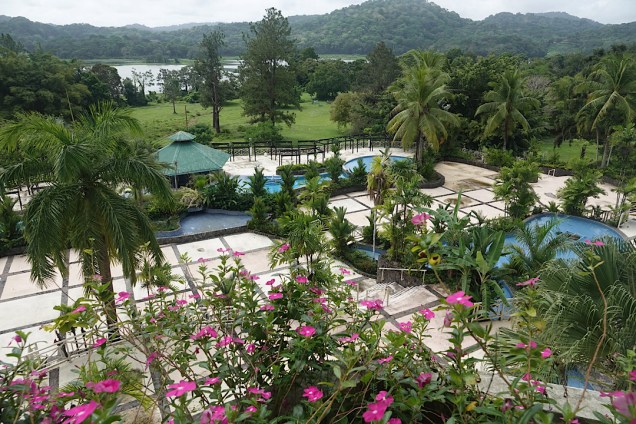
I had read (and Jorge had confirmed) that this $30 million, 5-star hotel complex could be enjoyed not just by guests but also day visitors like Steve and me. It was less than a mile and a half from Jorge’s. We drove and found the parking lot almost empty. Still the grandiose entryway gave no indication it was closed. We walked in and gaped at one of the strangest sights I’ve ever seen.
The lobby was enormous, immaculate, and elegant, and the views breathtaking.
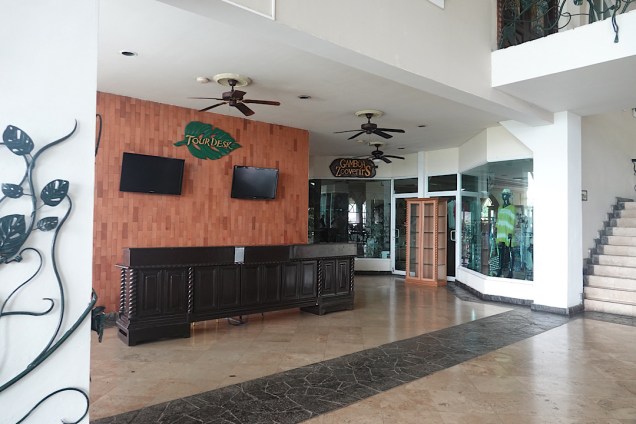
But where were the people?
Not staffing the Tour Desk or the gift shop.Nor at the reception desk.
Slightly dazed, we wandered around for a while and spotted one distant gardener and one guy cleaning the pool. We thought we heard the voice of maids in one of the guest wings. But we detected no other sign of humans. Indeed it looked like aliens had just departed after herding everyone onto the spaceship.
Clearly, we wouldn’t be booking spots on the the 11 am Gamboa Tree Trek. Or any of the Gatun Lake Expedition boat rides. Still, Gamboa is situated on the Canal, so we left the resort and did some poking around the town and the banks of the famous waterway. Parts of the town also looked abandoned.
What you see when you peer in the windows of the post officeBut there was action on the canal.
From the Puente de Gamboa, it would be easy to mistake the Canal for a workaday river. But Steve was all too keenly aware of what went into creating this portion of the waterway — the infamous Culebra Cut. The cut passes through Panama’s continental divide and the highest point on the canal route. It’s excavation bankrupted the French company that made the first attempt to dig an isthmian canal and cost the USA twice what was originally expected.
Steve was dying to get a better look at the Cut, so later that afternoon we drove across the snazzy Puente Centenario and caught this view.We also looked forward to our visit the next day to the Miraflores Locks near Panama City. Steve was understandably crushed when he checked for directions on Google Maps Wednesday night and read that the its visitor center was closed because of the pandemic.
I double-checked and confirmed the closure. But I also saw that the Agua Clara Visitor Center, near Colon, had just re-opened to tourists on May 1. I had to make a reservation online, but almost all the slots were available.
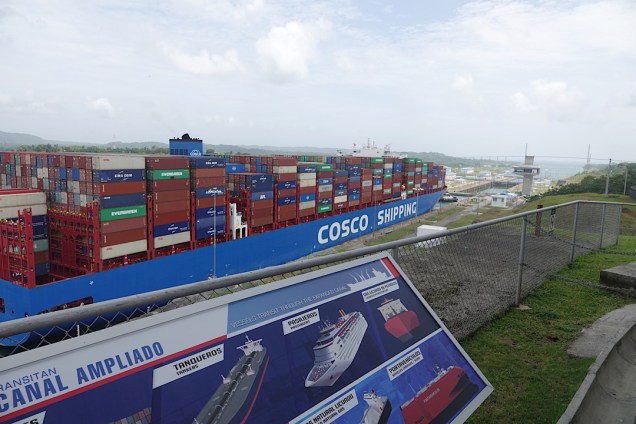
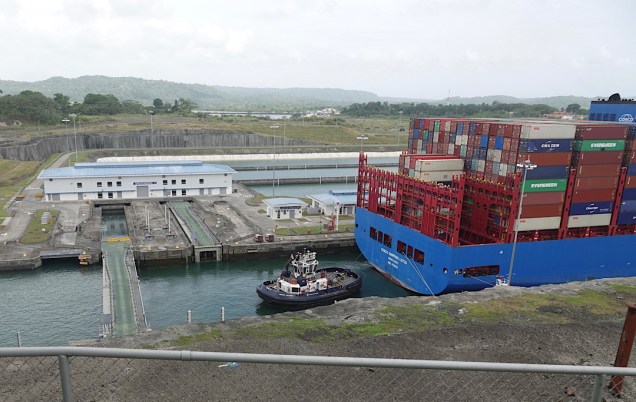
When we arrived there Thursday morning, we learned that a big part of this center also was still closed (our entrance tickets were discounted, as a result.) But we were able to enter the huge, modern observation platform, where we watched a gigantic container ship from Hong Kong approach and enter the first of the three sets of locks that step boats down to the level of the Caribbean Sea.
In this last photo, you see the gate has closed, and the water level has started to go down. We didn’t stay to watch the whole process, which reportedly takes about two hours.
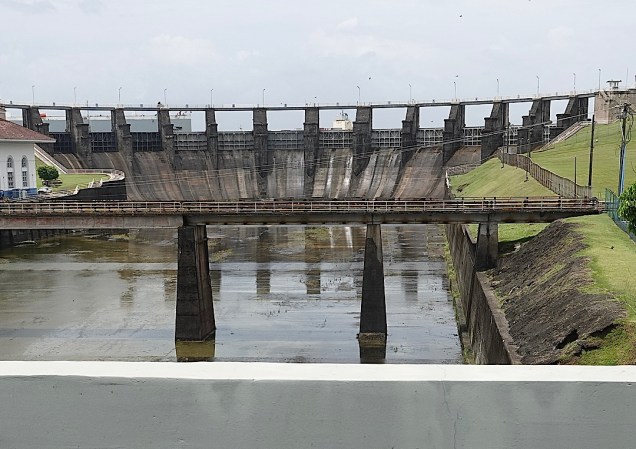
These were the new locks opened in 2016, financed in part by Japanese and Europeans, that accommodate ships far larger than the original locks. Those are still operating, and about two dozen tankers and car carriers and smaller container vessels and other ships pass through each day. Although we couldn’t get close to the old locks, after we left Agua Clara we drove around some more and eventually found the nearby dam that created one of the essential components of the canal, Gatun Lake, at the time of its creation the largest man-made body of water in the world.
Making it all work in the face of unimaginable obstacles and challenges, “This was the greatest engineering effort in the history of mankind,” Steve declared. “Greater than the pyramids at Giza. Greater than landing a man on the moon.”
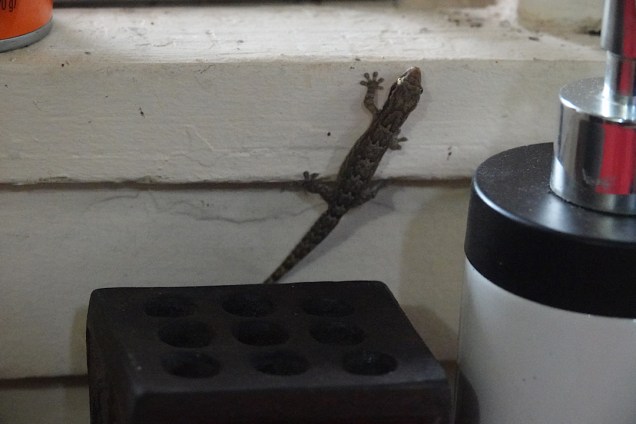
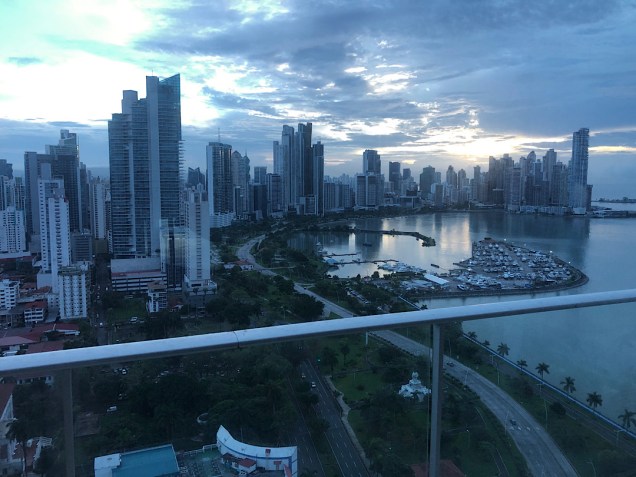
Friday we packed up and left Jorge’s place, happy in the end to have had our three nights there. (As it turned out, the only jungly creature who joined us was this two-inch-long lizard, who seemed to live in the kitchen.)We drove to Panama City, turned in our rental car, and took a taxi to The Sexiest Condo in Panama, which is how Vicki Marie S bills her unit on the 31st story of a high-rise overlooking Panama Bay. I used more of our home-exchange Guest Points to secure three nights for us here, and I have to say it is pretty sexy. Here’s the view of the city skyline from the balcony outside our bedroom with its king-sized bed.And the view of me wondering: how DOES one pole-dance, anyway?
Our immersion in Panamanian Canal arcana wasn’t quite over. This morning (Saturday, May 29) we spent a couple of hours at the gleaming Panama Canal Museum in the gentrified Casco Viejo neighborhood. If not great, it’s respectable, and I think at last Steve feels sated. We’ll have all day tomorrow to participate in the Sunday morning Ciclovia, visit the natural history museum housed in a particularly colorful Frank Gehry structure, and eat more of the excellent local fish. Probably it will all be fun. Still, I think we’ll depart for Costa Rica Monday most impressed by how much luck we had in understanding the greatest engineering achievement of all time.
Getting into Guatemala was easy. After deplaning, I merely had to stop for a moment to show my vaccination card to a young woman (she looked about 14) in a nurse’s uniform. She glanced at it for perhaps 3 seconds. Then I was in!
We knew that the next stop on our itinerary — Panama — would not be so frictionless. The government there has been requiring either a PCR test or an antigen test administered no more than 48 hours before arrival. (I kept checking to see if that would change, but it didn’t.) Our first Guatemalan driver, Alfredo, said we could easily get either at the Guatemala City airport before our departure. But that sounded potentially stressful, so we also asked the person manning the front desk at our hotel if tests were readily available in Antigua. He gave us a couple of options: two places that would send someone over to test us or another just down the street. Laboratorio La Merced was administering both tests in its clinic, he said.
We figured the onsite service was bound to be cheaper. But which one to get?
I was a little afraid the PCR test might so sensitive it could pick up some trivial, asymptomatic exposure. Charming as Antigua was, I didn’t want to be stuck there inadvertently.
On the other hand, neither Steve nor I have been tested for antibodies since we got our second vaccine doses back in February. (I assumed antigens were some variation on antibodies.) We agreed it would be interesting to be tested for them. We were virtually certain to have lots, but if the test for some reason came back negative, we could follow up with a PCR test, either in town or at the airport.
Monday morning promptly at 7, we walked the few blocks to the clinic. Iron bars blocked entrance into its unprepossessing foyer, and for a moment we wondered if it was closed. Then I noticed a cord attached to a bell behind the bars. I reached through and yanked. A moment later, the gate buzzed. We pushed our way in.
A taciturn young woman behind the desk listened to what we wanted. She said we would have to make an appointment, and the test would cost 375 quetzales (about $48.50) per person). Happily, her appointment book appeared to be empty for most of the afternoon, so we secured a spot at 1 pm.
The desk of the unfriendly receptionist
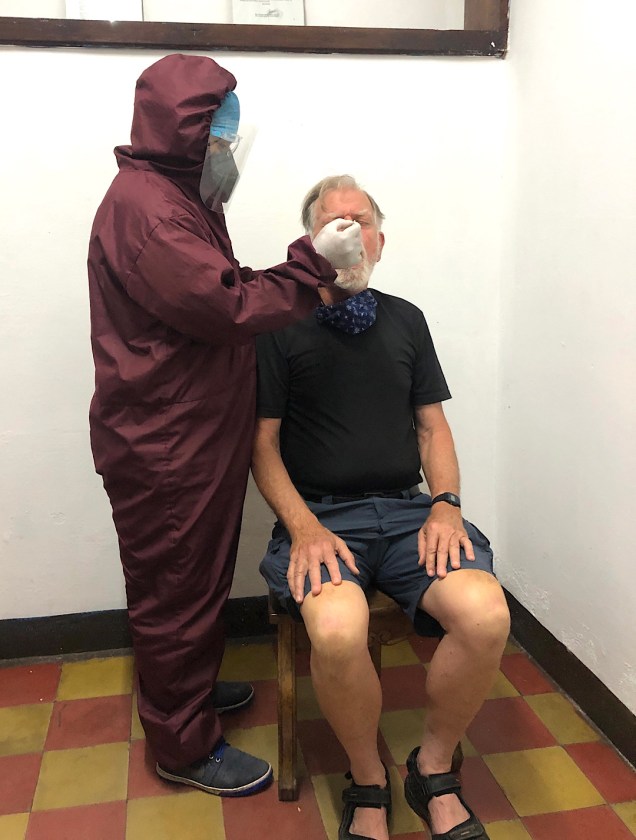
We returned at that hour, gave the receptionist our passport numbers, and in a moment, I was called into a small exam room nearby. The hazmat-suited technician in it asked me to fill out a more detailed form. Then he had me take a seat on a wooden chair against the wall. He extracted a long cotton swab from a kit and inserted it deep, deep up each nostril. I’ve had a couple of PCR tests in San Diego (required before minor medical procedures), but those probes were lightning quick; they didn’t bother me. This swab was thicker, and the guy twisted it for a second or two. It felt a mixture of ticklish and creepy; I half-laughed, half-moaned.
Steve was next, and the technician allowed me to stay in the room while he was processed.We were instructed to return in a half-hour for the results. We got coffee at a nearby cafe, then went back. Another tug on the bell; another confrontation with the inhospitable receptionist. She didn’t say a word but pulled out two pieces of paper and began folding them.
“Que paso?” I squeaked.
She opened them for us to see, and the word “Negativo” leapt from the pages. I think we groaned. No antibodies? How could that be?
The receptionist frowned. She seemed taken back by our reaction. “You don’t have Covid,” she declared in Spanish. For a second, I wondered if we had somehow gotten the wrong test. Then the light began to dawn. “Es bueno, este resultado?” I asked her. Would they let us travel to Panama with this result? Looking annoyed, she called another guy from the back of the clinic. He spoke no English either but made it clear: a negative antigen test was what everyone wanted.
Later that afternoon, a Google search educated me: antigens (bad) result from the presence of pathogens in the host; they in turn trigger the body to start making antibodies (good) to fight the illness. How could I — formerly science and medical writer? — missed learning this? I felt deep chagrin. Still, Steve and I were relieved to have what the Panamanians appeared to be demanding.
On the very elaborate government website, the Panamanians seemed to be saying we also needed to create online accounts with their Covid-tracking software. We struggled for at least a half-hour with page after page of questions, including a security one. (“In what city did your parents meet?” was the one I chose.) We rolled our eyes at the thought that ordinary Panamanians were all filling this thing out. And indeed, at the airport yesterday afternoon, no one mentioned it, and we’ve heard nothing about it since.
We did have to pass through a slightly more formal gauntlet than we had encountered in Guatemala. As we came down an escalator to the immigration portal, we first had to walk up to one of three plump ladies wearing masks and what looked like plastic raincoats. (I tried to take their photo but instantly got yelled at.) One of them looked at each of our tests and compared them to our passports. She nodded and said the magic words: welcome to Panama.
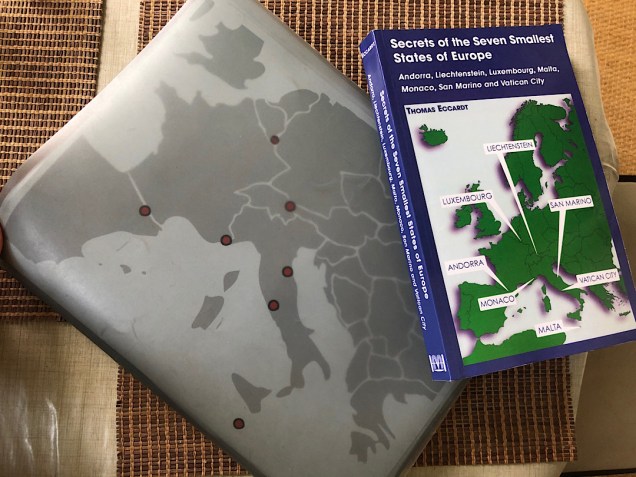 We’ve both been to Vatican City before, and Steve made a lightning visit to Liechtenstein in 1974, but the rest will be new to us. The micro states stand out in other ways beyond their limited size. They rank among the wealthiest countries on Earth, and their citizens live longer than almost anywhere else (because prosperity and physical well-being go hand in hand?) They have oddball forms of government. Three are principalities, one’s a Grand Duchy, Vatican City is a city-state (Malta and San Marino are humdrum republics.)
 Yesterday I reported on Steve’s and my half-baked effort to compare the cost of living abroad in four countries — Guatemala, Panama, Costa Rica, and Nicaragua, all which we visited in May and June. My friend Anne read the post and emailed me an excellent question: What would a similar basket of goods cost here?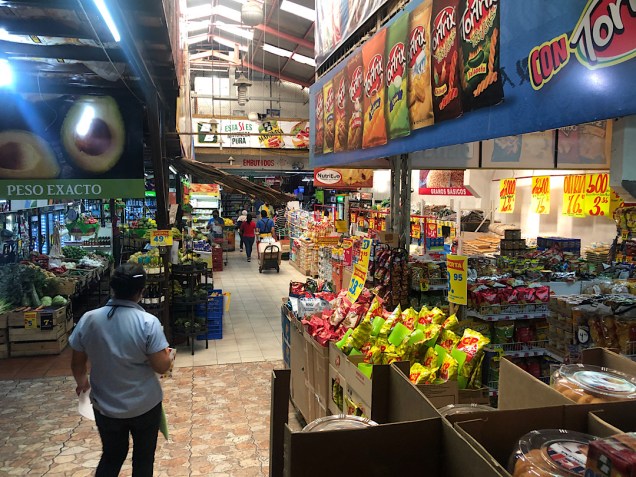
 So why would you choose to travel around Central America during the pandemic?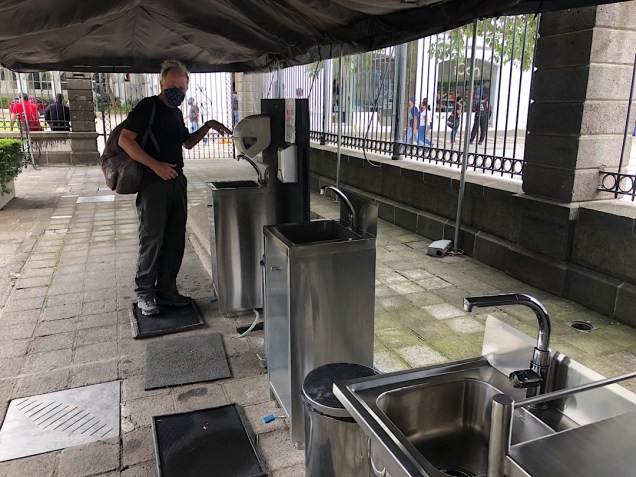
 We realized that a six-car crash had just occurred about three cars in front of us; people were still being extracted from the wreckage. Steve and Alfredo and I all shook our heads and cringed at the thought of how long we would likely be stuck in it.
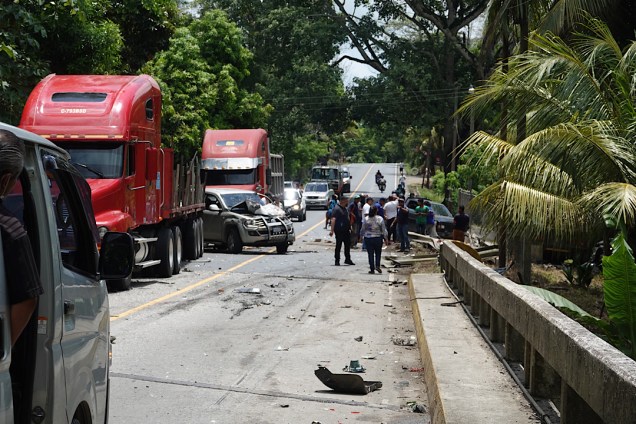 But minutes passed, and no police or emergency vehicles arrived, and cars in both directions began creeping past it.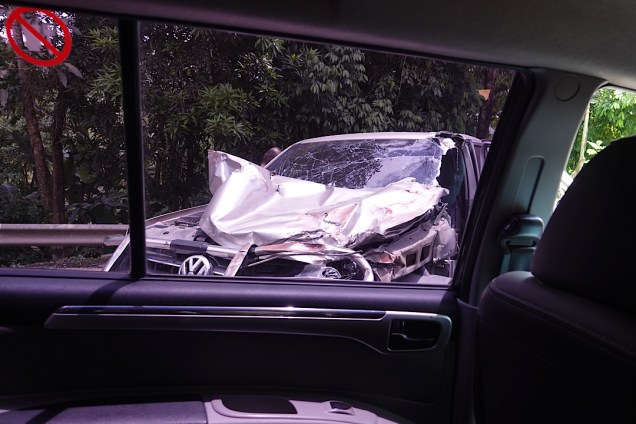
 I found a house-trading partner willing to accept guest points from us in exchange for a week’s stay in a building erected about 125 years ago. Its American owners restored it to pristine condition about five years ago. From the street it doesn’t look like much.
  But once beyond the metal gates and heavy wooden doors, we reveled in a 5,200-square-foot patch of paradise, configured around two open-air courtyards. The baronial master bedroom suite opened to them both. At the center of one was a beautiful garden surrounding a fountain…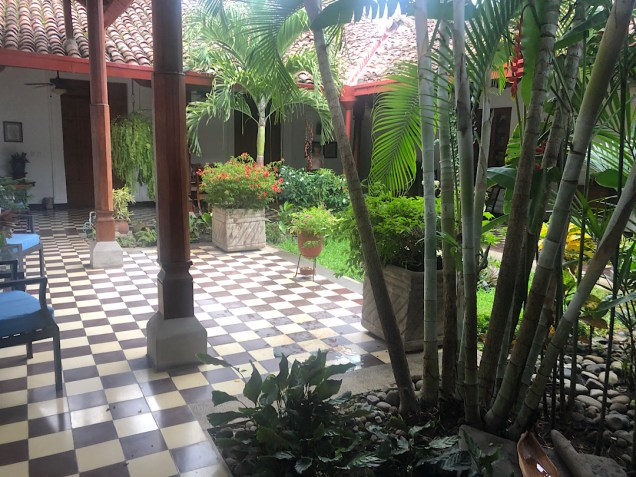
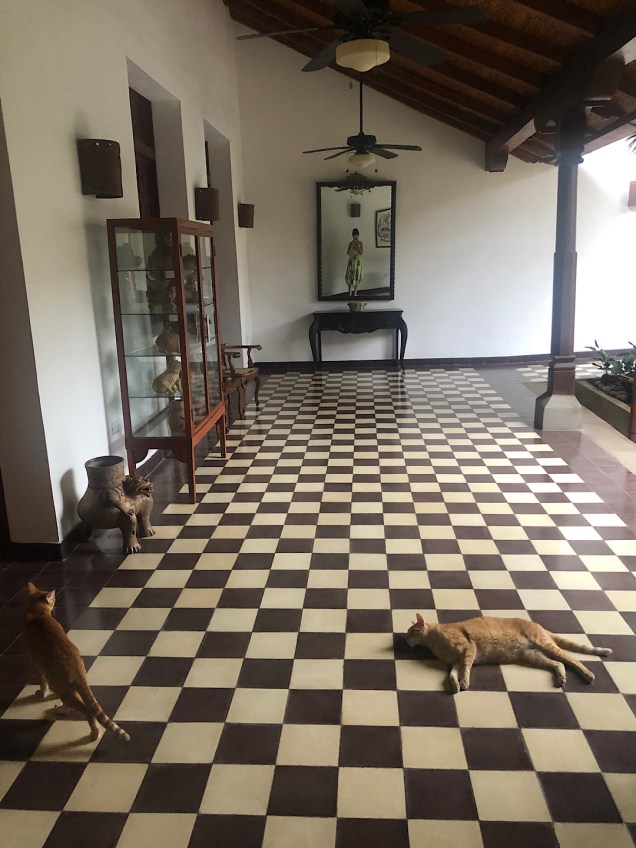 …while the other held the swimming pool and adjoined a spacious kitchen.
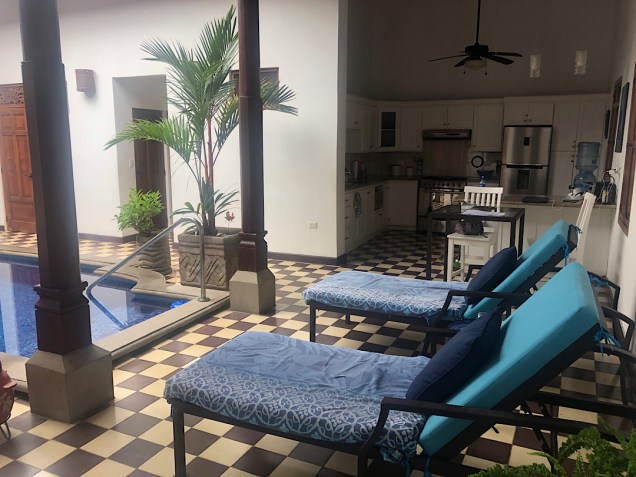 When we arrived (Wednesday, June 9), Steve and I felt tempted never to step outside this sanctuary.
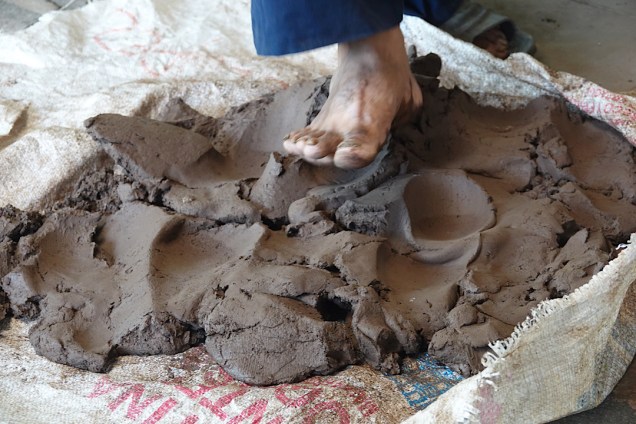 …spinning it into various shapes on a foot-driven potter’s wheel…
 … dipping it in colored muds that are allowed to dry before being polished and engraved.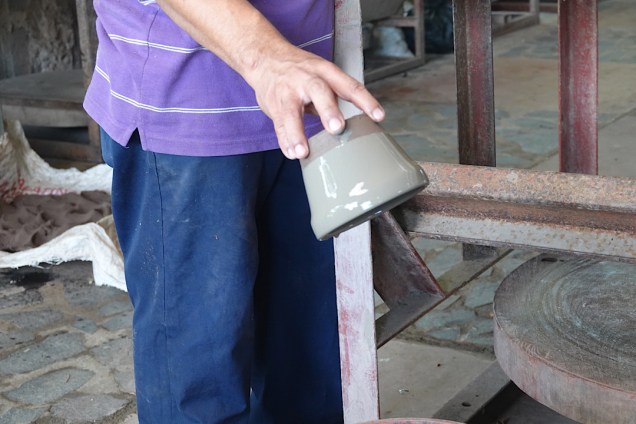
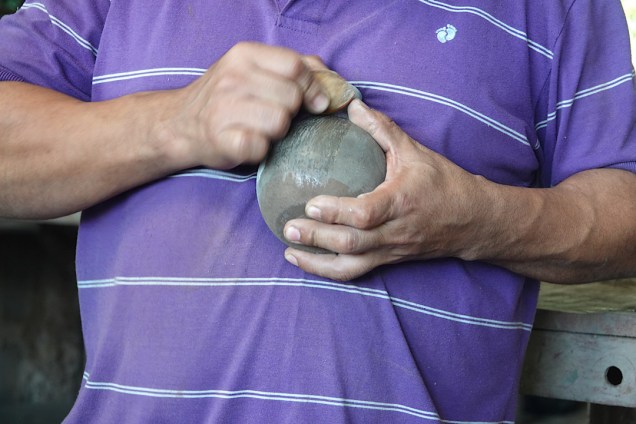
 They fire the end products in wood-fueled kilns that they heat to 900 degrees. The results were splendid.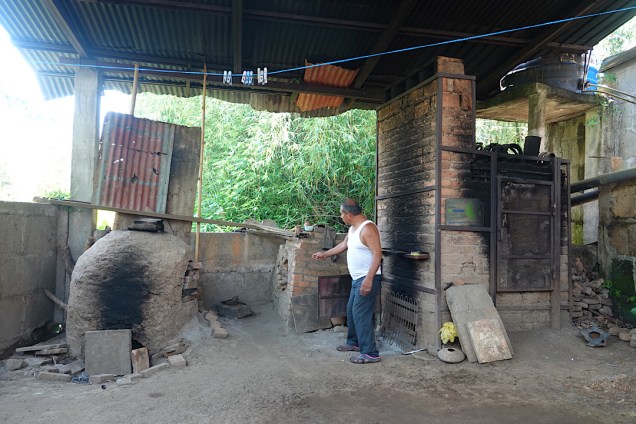



 …then motored up to one of the craters at the top. Steam was rising from a precipice.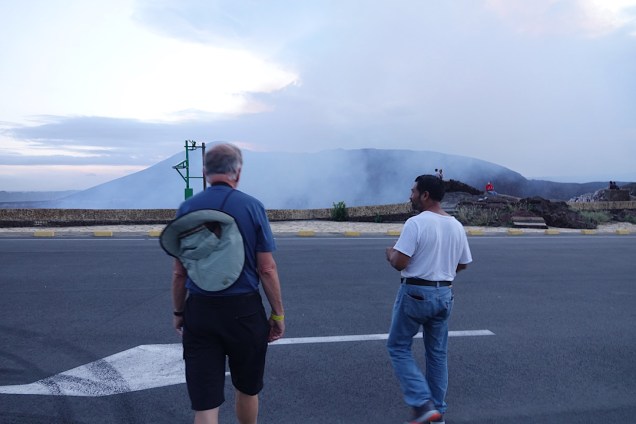
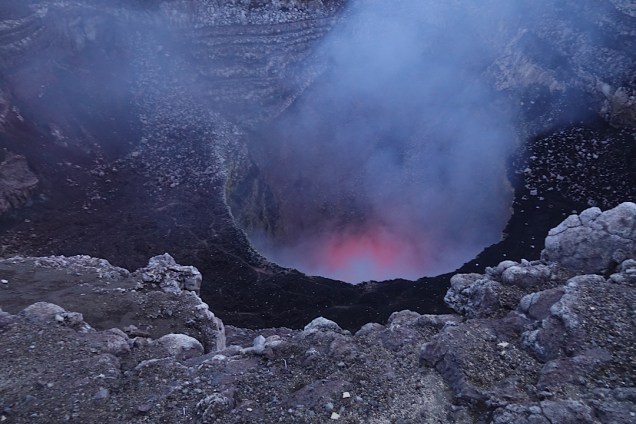
 and grow hellish.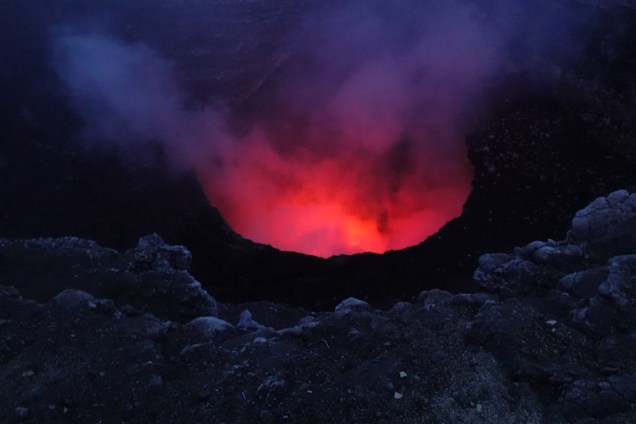
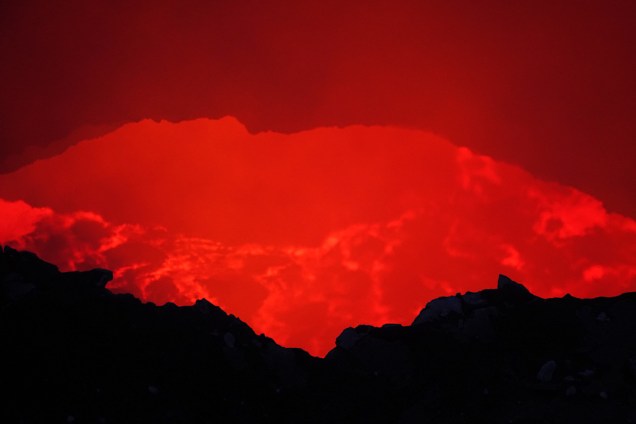 For seconds at a time, the smoke cleared and we could see the magma churning barely 1000 feet below. It felt creepy and thrilling and mind-boggling, like glimpsing the inferno… before driving back to our lovely hacienda 45 minutes away.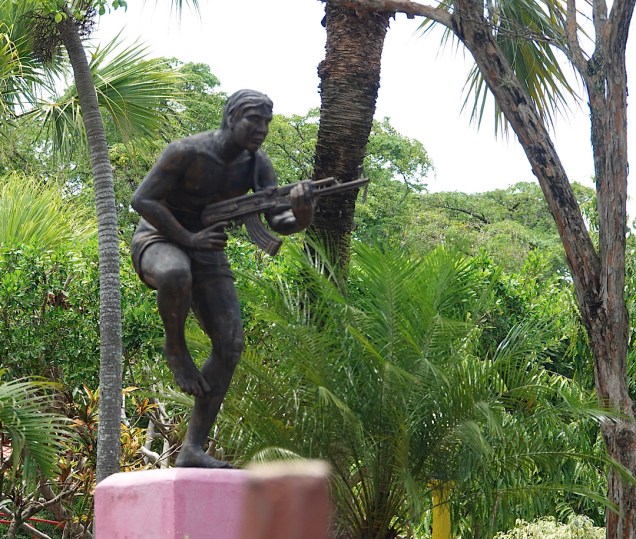

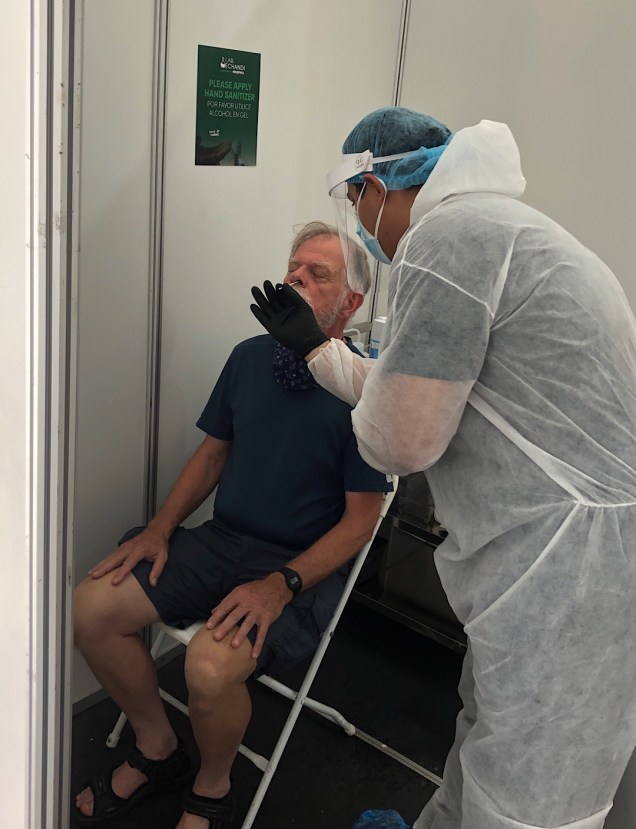 They let us get tested despite our having shown up early and said the results would be emailed to us sometime the next day. Less than 24 hours later, they showed up in my inbox — signed by a doctor, QR-coded, and, happily, Negative. The clerk at our hotel’s reception desk printed them out for us.
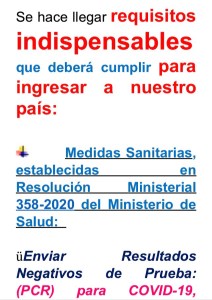 Of course we emailed them the test results as soon as we got them Tuesday. Within an hour, I received a reply… telling me I had to also submit the health form. I fired back another salvo, reminding them I had already submitted it. I attached a pdf as proof. Then we heard…..nothing. Nothing Tuesday, nor Wednesday morning, nor by the time the driver we had hired dropped us off at the land crossing.
 …and a showy while egret.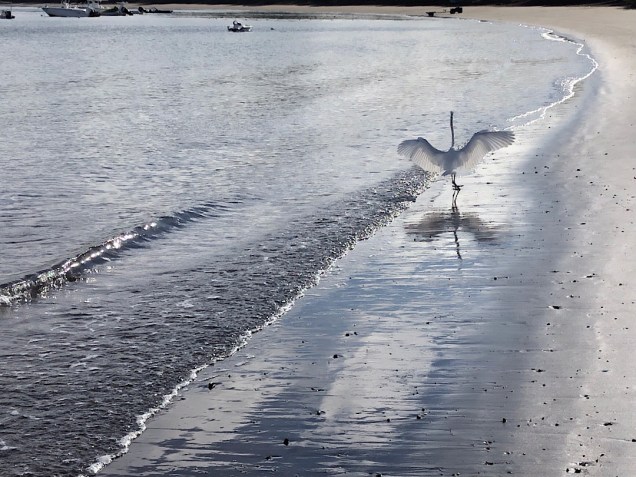

 When Steve and I left behind San Jose last Wednesday (6/2), weeks had passed since I watched a television show or movie. That morning we drove in our rented SUV to El Castillo, a tiny village (pop. 250) that clings to the slopes of Volcano Arenal in northwest Costa Rica. I had traded more of my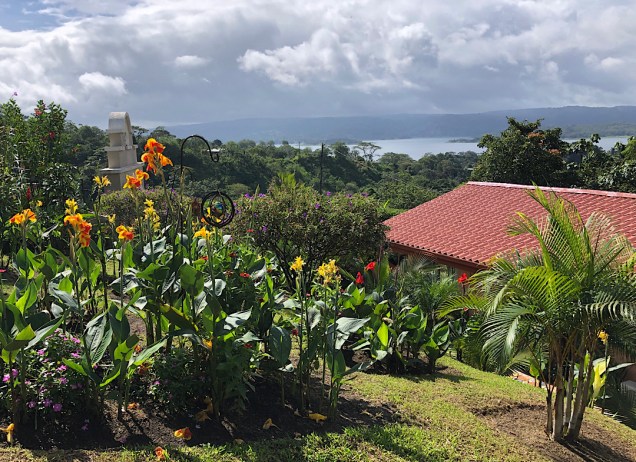
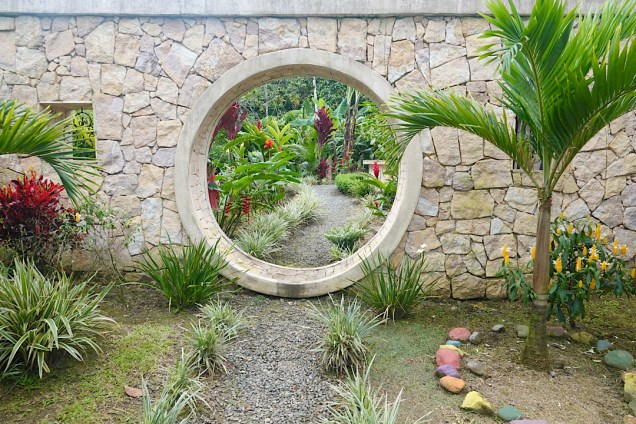 A moon gate on the grounds led to a private trail into the rainforest. We had our own little private swimming pool…
 ,,,hand-carved doors and other colorful decorations.
 We also found an extensive collection of DVD movies, through which Steve and I leafed Thursday night after dining on excellent burgers at a local joint named after the monkeys that serenaded us every morning with their barks and moans (Howlers). Craving some electronic entertainment, we decided to watch Soylent Green.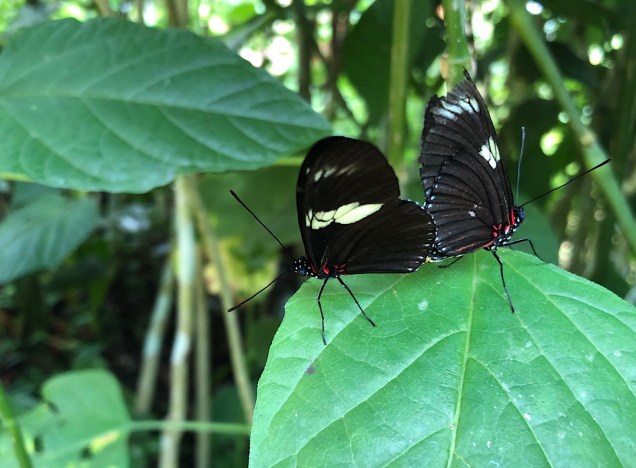
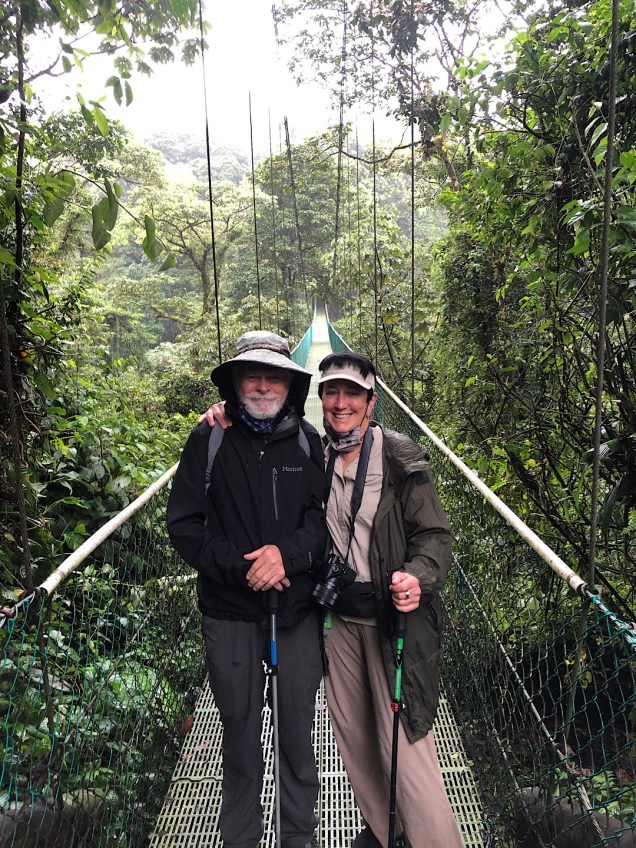 Across suspension bridges…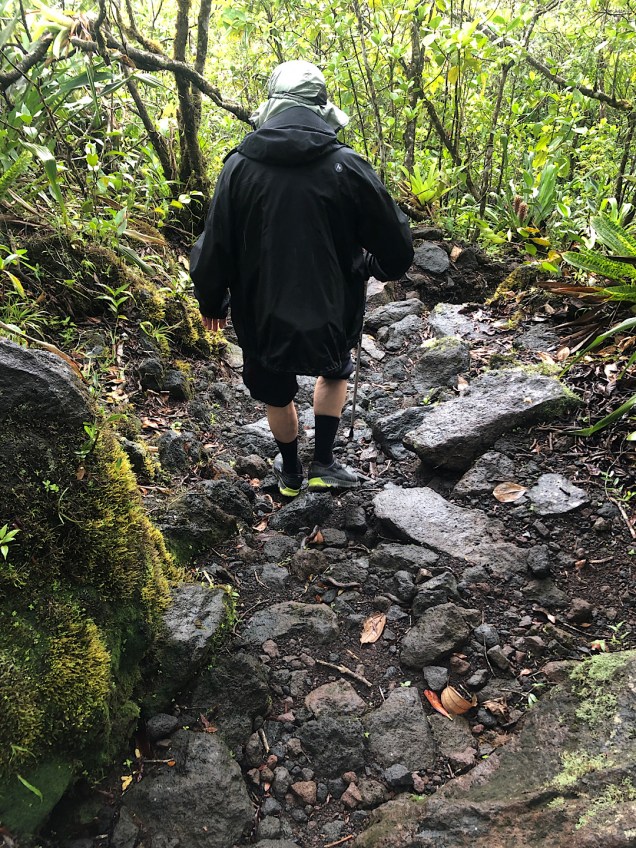


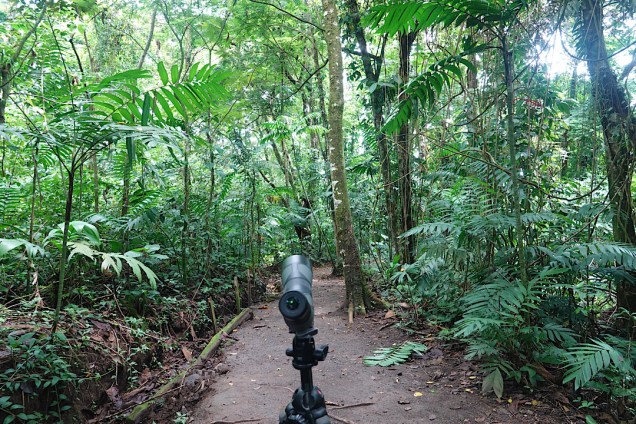
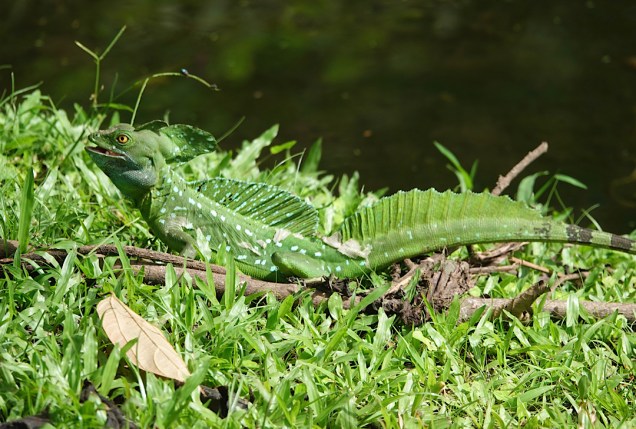 A green basilisk (known as the Jesus Christ Lizard because of its ability to walk on water) greeted us near the entrance, but we soon moved into the forest where Geovani scanned the canopy like someone taking in the headlines on Apple News. He pointed out a large male sloth that I would never in a million years have spotted in the leaves above us. For several happy minutes we watched him hang there, scratching at the parasites infesting his fur.
 Then Geovani heard a toucan, and we scurried after him to find and photograph it.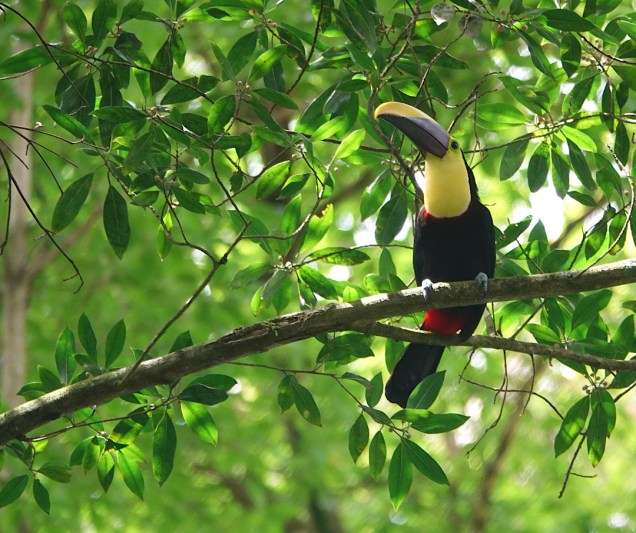
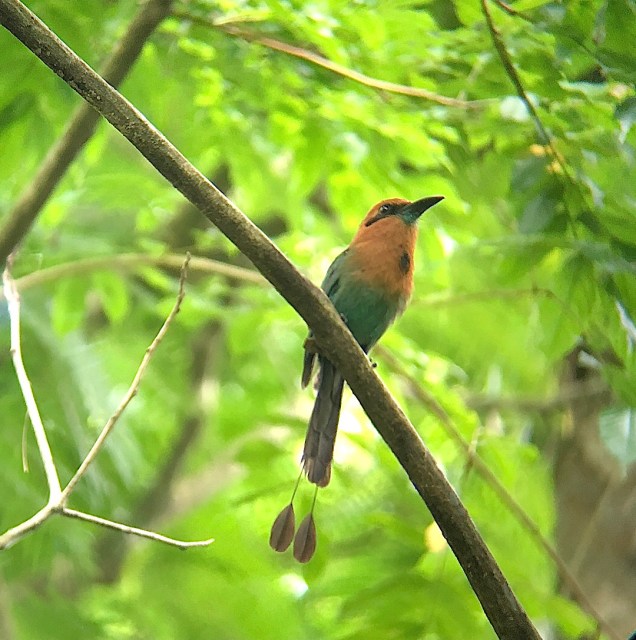

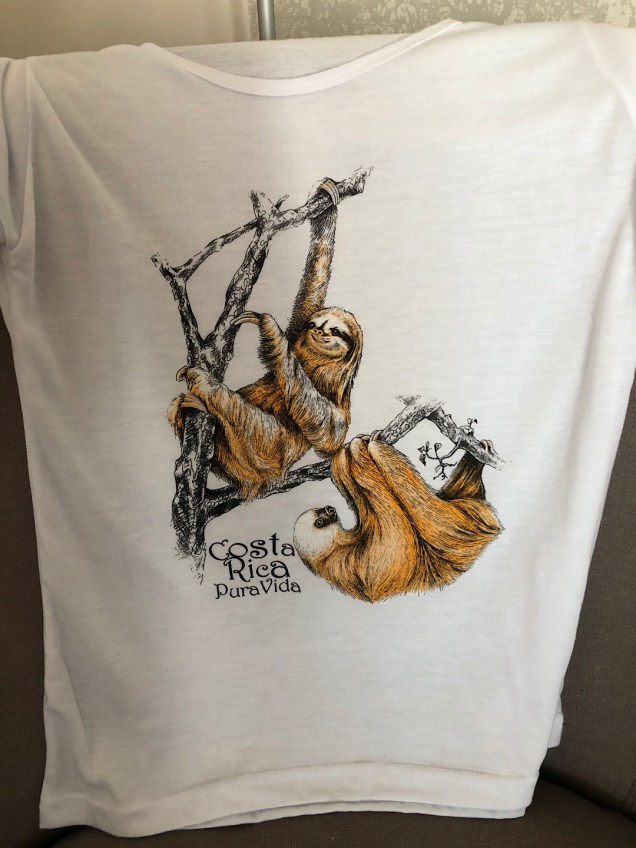 Sloths are native and iconic.
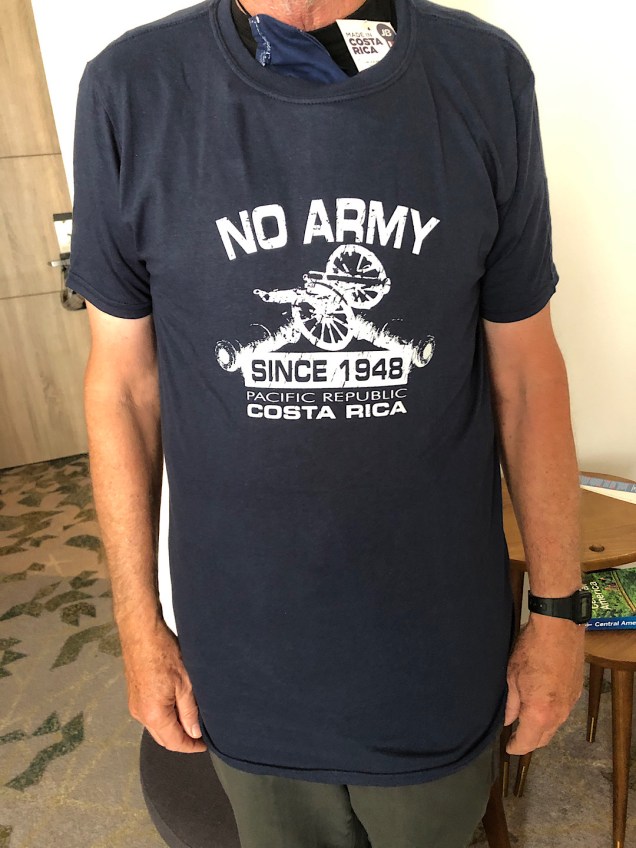 And one of their presidents in 1948 dismantled the country’s military. Costa Rica still doesn’t have one!
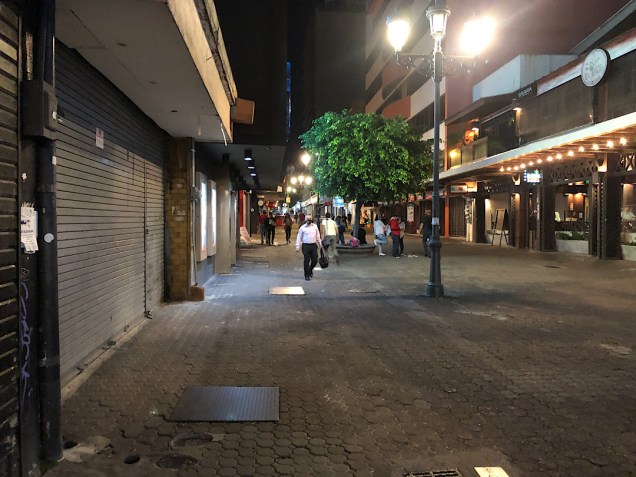 … which looked like this a little before 8 pm and walked the short block to Avenida 1, where the already-dim streets were darker and creepier. Almost all the storefronts were shuttered. Almost no one was out walking. But Google Maps insisted the Del Rey was just a block or two away. An online report had described the massive pink structure as sticking out like a sore thumb. This was true enough that we easily spotted it, but this thumb looked more dead than sore. Dark and lifeless, it made us wonder if it was yet another victim of Covid. Or had we simply been misinformed about its heyday?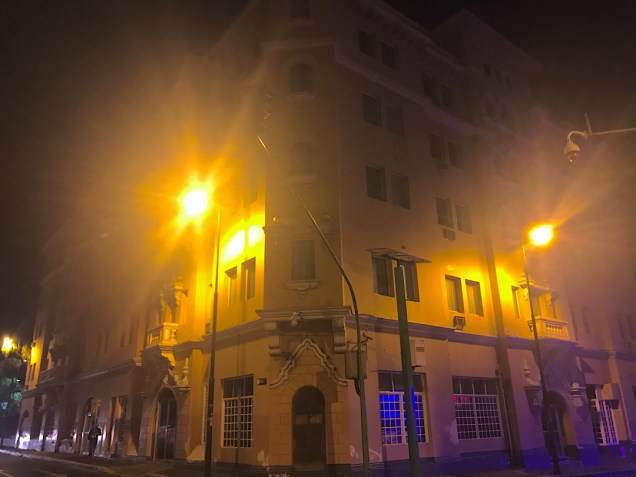

 On our first-ever visit to Panama of course we would want to see the Panama Canal — vaunted 8th wonder of the world, 107-year-old shortcut between Earth’s two greatest oceans, Number Two on Lonely Planet’s “15 Top Panama Experiences.” And for Steve and me, experiencing the Canal had turned into something more; it had become a quest; a semi-sacred mission.
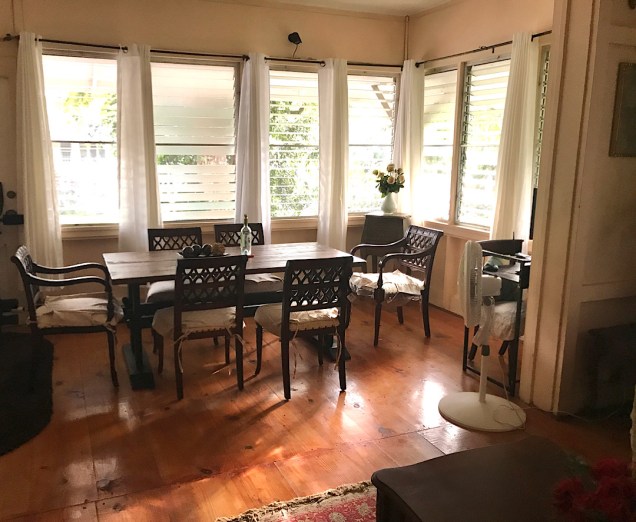
 In high spirits, we set out for the Gamboa Rainforest Resort about 2 kilometers away. There we hoped to sign up for a tour or two and if necessary make a reservation for dinner in the fancy restaurant there.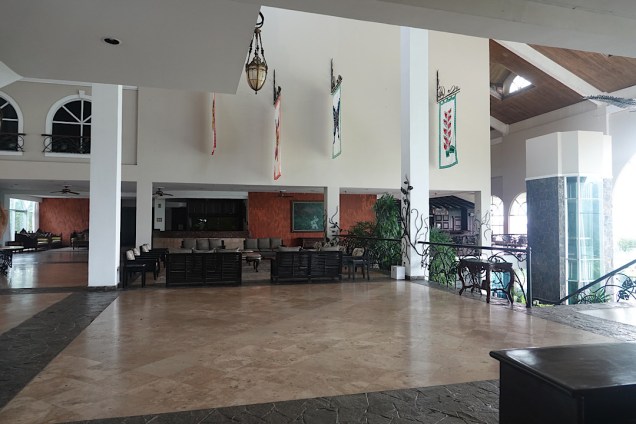



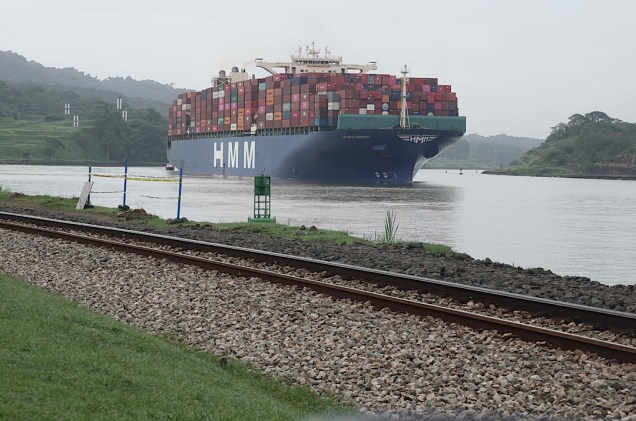 From the Puente de Gamboa, it would be easy to mistake the Canal for a workaday river. But Steve was all too keenly aware of what went into creating this portion of the waterway — the infamous Culebra Cut. The cut passes through Panama’s continental divide and the highest point on the canal route. It’s excavation bankrupted the French company that made the first attempt to dig an isthmian canal and cost the USA twice what was originally expected.
 We also looked forward to our visit the next day to the Miraflores Locks near Panama City. Steve was understandably crushed when he checked for directions on Google Maps Wednesday night and read that the its visitor center was closed because of the pandemic.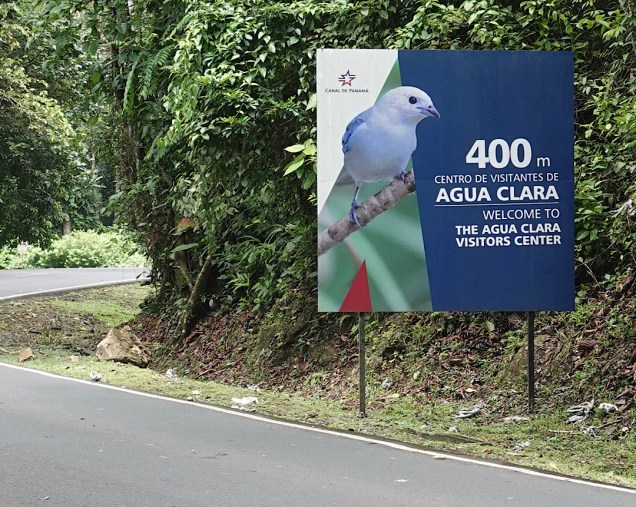
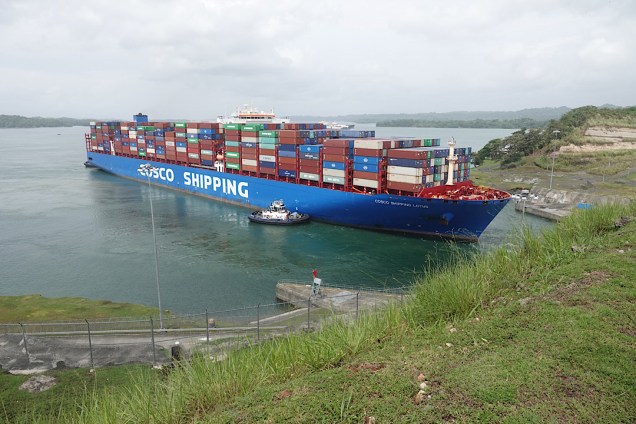
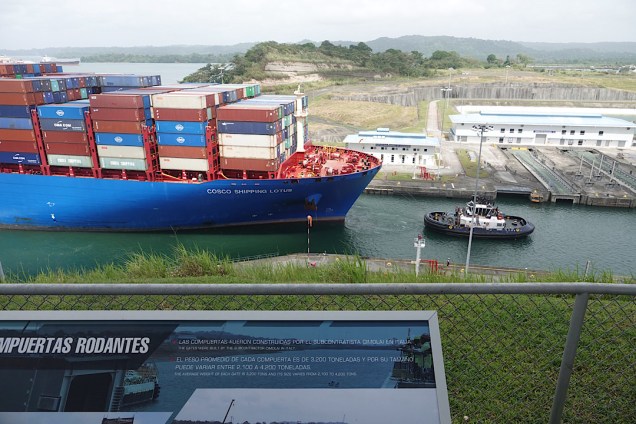
 We drove to Panama City, turned in our rental car, and took a taxi to The Sexiest Condo in Panama, which is how Vicki Marie S bills her unit on the 31st story of a high-rise overlooking Panama Bay. I used more of our home-exchange Guest Points to secure three nights for us here, and I have to say it is pretty sexy. Here’s the view of the city skyline from the balcony outside our bedroom with its king-sized bed.
 And the view of me wondering: how DOES one pole-dance, anyway?
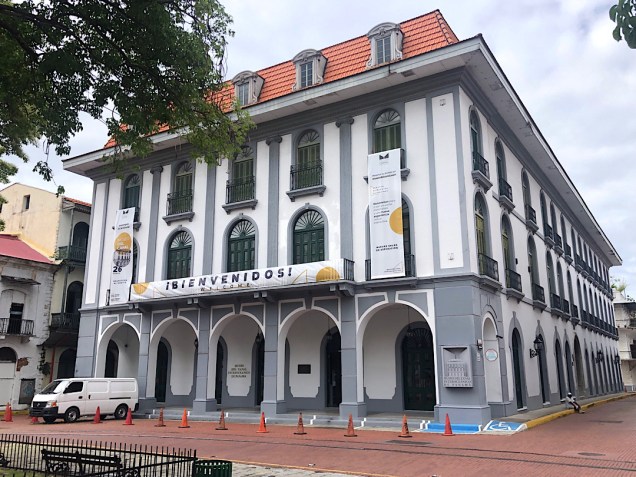 If not great, it’s respectable, and I think at last Steve feels sated. We’ll have all day tomorrow to participate in the Sunday morning Ciclovia, visit the natural history museum housed in a particularly colorful Frank Gehry structure, and eat more of the excellent local fish. Probably it will all be fun. Still, I think we’ll depart for Costa Rica Monday most impressed by how much luck we had in understanding the greatest engineering achievement of all time.
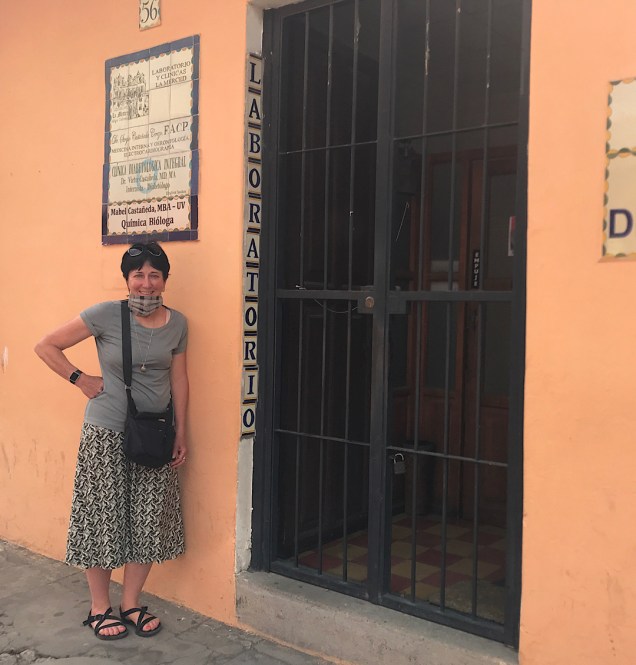 Monday morning promptly at 7, we walked the few blocks to the clinic. Iron bars blocked entrance into its unprepossessing foyer, and for a moment we wondered if it was closed. Then I noticed a cord attached to a bell behind the bars. I reached through and yanked. A moment later, the gate buzzed. We pushed our way in.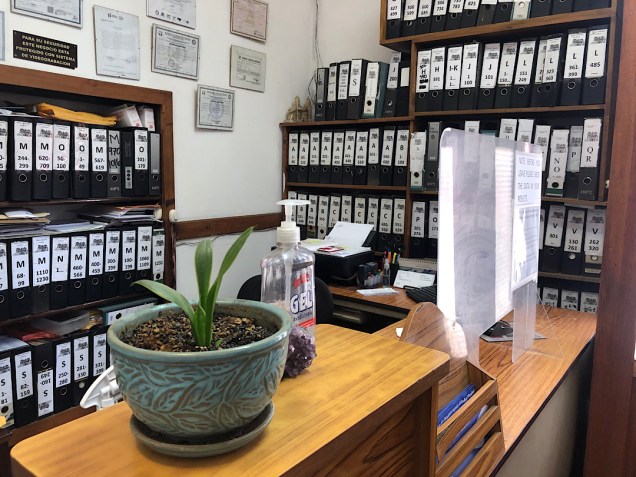
 We were instructed to return in a half-hour for the results. We got coffee at a nearby cafe, then went back. Another tug on the bell; another confrontation with the inhospitable receptionist. She didn’t say a word but pulled out two pieces of paper and began folding them.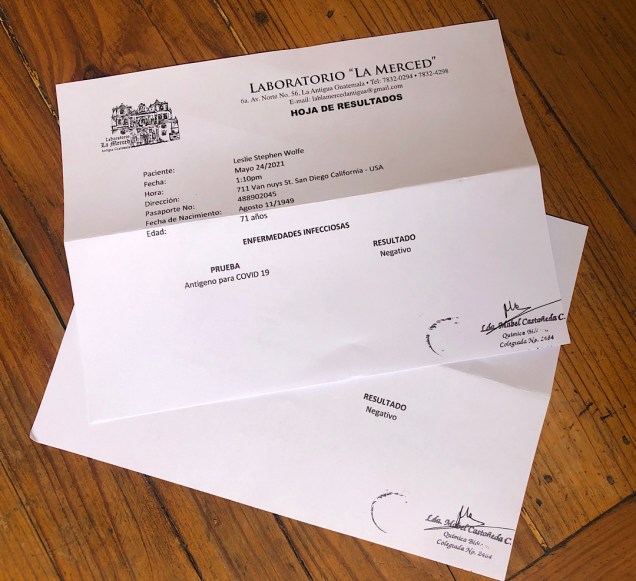
 At home and abroad