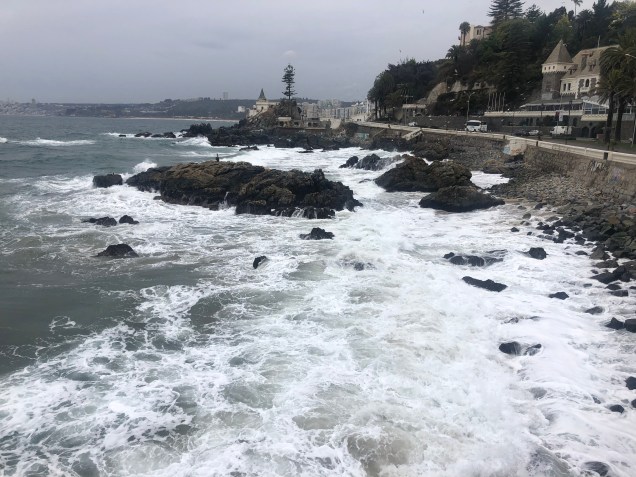
This is what the street in front of our hotel Saturday morning looked like.
We travel so rarely to wintry places it’s hard for me to remember the risk involved in doing so: the weather may be too cold or rainy to enjoy the destination. In the case of our current adventure, there was no avoiding winter if we wanted to see the total eclipse that will occur here tomorrow, July 2. July is winter in the Southern Hemisphere. Since the whole of the continent (from north of Santiago in Chile to Buenos Aires in Argentina) falls within the path of totality, we did have to choose where to try and experience it. We’d never visited Chile before, so that made us want to go there. But the weather west of the Andes is notorious for being gray and rainy in winter. We finally decided to start out in Chile but then make the short flight to Mendoza, Argentina on the eastern side, where the skies were much more likely to be clear. Still, with weather, any choice made months ahead is a gamble.
As I wrote in the last post, we lucked out in Santiago when the rain that had been forecast didn’t materialize on Monday until late in the afternoon, then Tuesday turned bright and sunny. Clouds moved in again on Wednesday, the day we drove into the countryside to see the wine country (an experience I hope to report on later). The gloom there never turned into rain, but my spirits sank when I saw my Apple Weather app was predicting downpours for both Friday and Saturday, the days I had earmarked for taking walking tours around Valparaiso and its tony neighbor, Vina Del Mar.
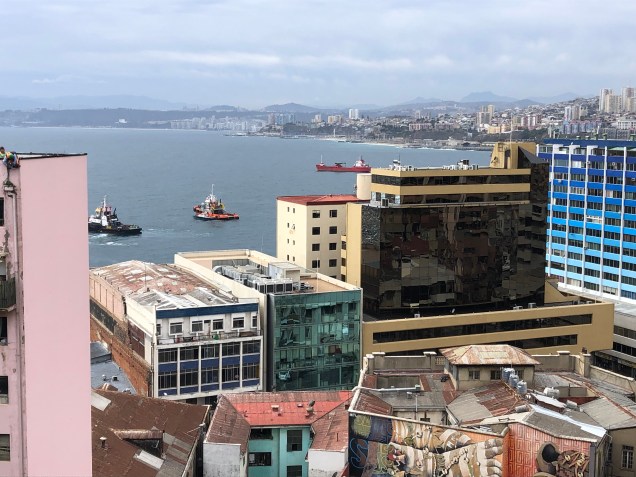
Happily, apps sometimes get it wrong. All day and into Friday evening, the sky only looked threatening. Steve and I spent hours enjoying a guided “free” (i.e. tips-supported) walking tour, while Michael and Stephanie roamed the city on their own. All of us enjoyed the place. Valpo (as it’s known) has had it’s share of hard knocks over the past 100-plus years. It developed on the shores of a fabulous natural harbor, but one so plagued by pirates in the 1500s that the original Spanish rulers decided to build their capital (Santiago) about 60 miles inland.
Looking down from one of the hillsides in Valparaiso. Vina Del Mar can be seen in the distance, across the bay.
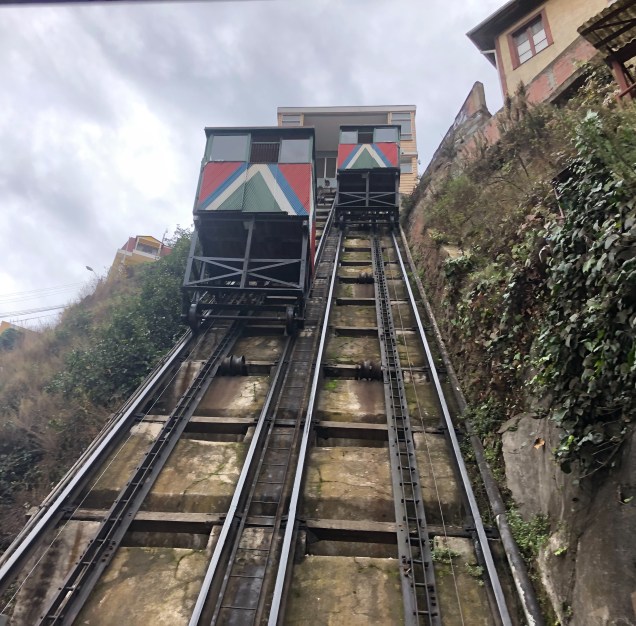
Mining and seafaring activities made the coastal city boom in the late 1800s, when more than 30 steep funicular elevators were built to help locals ascend and descend the town’s vertiginous hills.
Sadly, only 8 are still working.
But then a quake in 1906 devastated the place, and the opening of the Panama Canal in 1915 took more wind out of its sails. When the Germans invented a way to make a synthetic substitute for saltpeter chemically, that decimated the mining that had fueled the city’s short-lived boom. Valpo declined steeply throughout most of the 20th century, earning a reputation as a place of crime and decay.
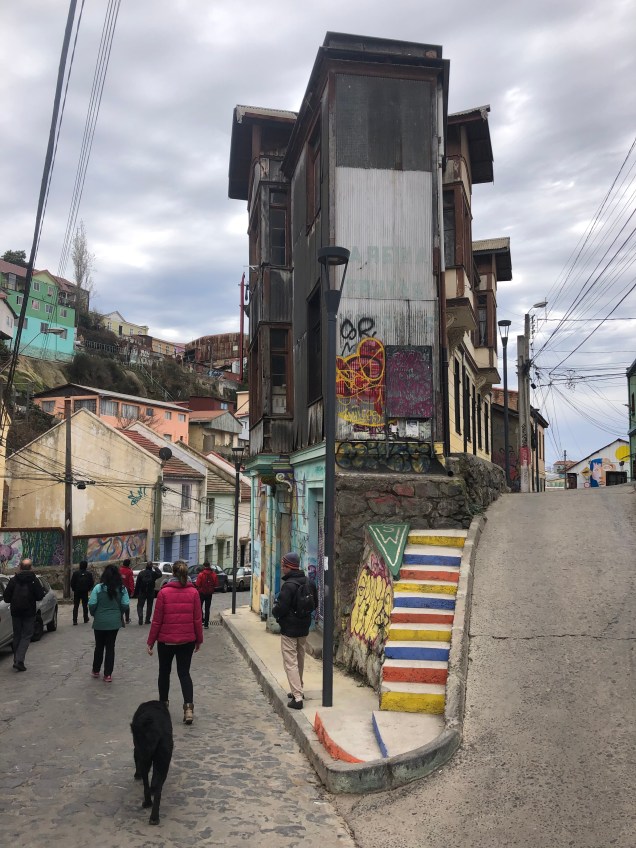
When several of its oldest neighborhoods were declared a UN World Heritage Site in 2003, that attracted tourists whose presence has helped to turn things around. It also imposed a thicket of bureaucratic regulation, and we heard that local property owners have been divided over whether the UN designation has been worth it. From the visitor’s viewpoint, the wild architectural jumble that now exists is lots of fun to look at.
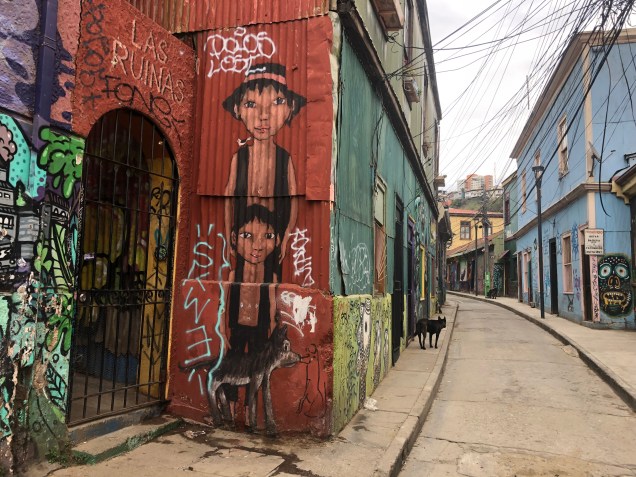
Some buildings have been beautifully restored, while some have been abandoned because the costs of fixing them up are now so prohibitive. Most buildings are brightly painted, and a burgeoning mural scene has added to the eye candy.
We met up with Mike and Stephanie after lunch, planning to take a walking tour of Vina del Mar together, but it wound up being canceled (because, we were told, the guide’s home had been broken into and burglarized), so we wound up seeing some of the sights on our own.
Parts of Vina reminded us of La Jolla, while other parts looked more like Rio.
Only by late afternoon did light sprinkles (and tired feet) drive us back to our hostel for a break.
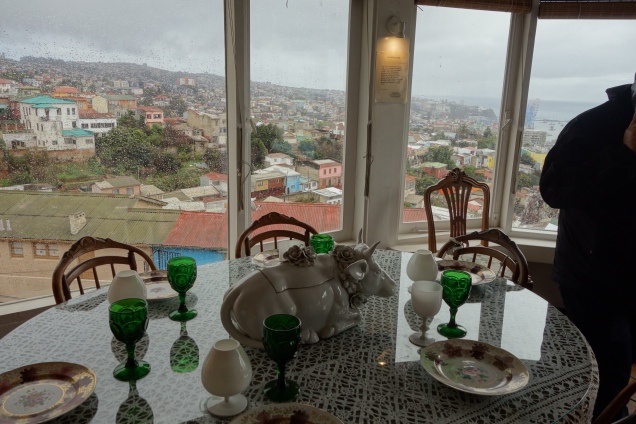
The rain started in earnest Friday night and we woke Saturday morning to the sound of such a deafening downpour it made me want to snuggle down in bed and stay there all morning. Instead we checked out of our rooms, left our bags at the hostel’s front desk, and took an Uber to the one-time home (now museum) in Valparaiso of Chilean poet/diplomat/politician Pablo Neruda. La Sebastiana, as it’s known, is an enchanting place, full of color and art and interesting insights into Neruda’s large life.
The cow on the table was a punch bowl. Neruda hosted lots of parties.
Like magic, when we left the house, the rain had cleared, and we were able to walk for a while before catching another Uber, returning to the hostel, and hitting the road back to Santiago’s airport.
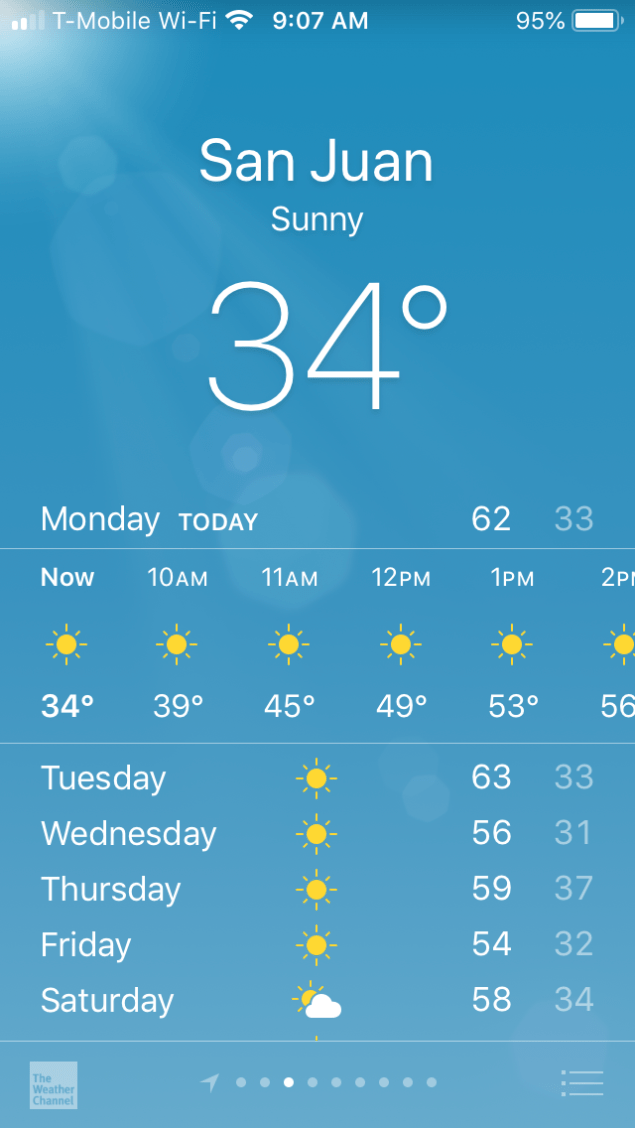
The weather’s been good since we landed in Mendoza Saturday night. Lots of clouds yesterday, but they cleared by Sunday evening, and today the weather app prediction for San Juan looks like this:
We plan to drive to San Juan, a few hours north of Mendoza, this afternoon. We’ll use it as our launchpad tomorrow: Eclipse Day. If the weather stays clear, that’ll be great, since it will let us concentrate on the other big looming challenge: figuring out where to go to watch the celestial drama.
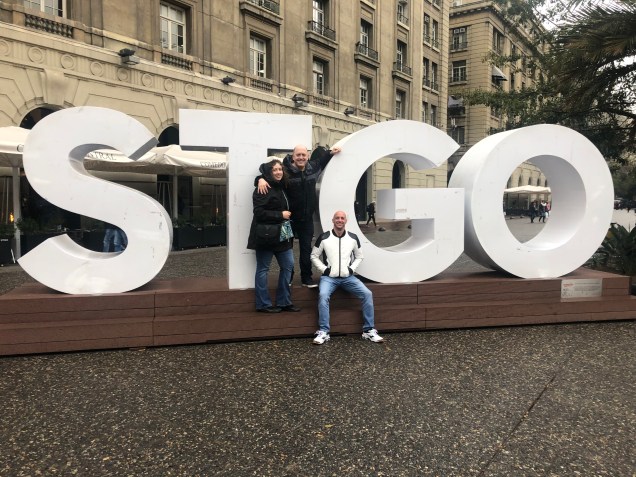
I came to Santiago (Chile) packing a 2017 New York Times article entitled “36 Hours in Santiago.” Steve and I actually had more than 50 hours in the Chilean capital, so I never intended to follow the Times itinerary to the letter. Still I like the 36- (or often 48- or 72-hours) in Wherever format; it suggests sightseeing highlights and often gives me ideas for where to eat. I borrowed the format last fall when I blogged about our 31 hours in Seoul, a stopover during which I concluded that Seoul deserves to be included on any list of the great cities on the planet. Fifty hours in Chile’s biggest city made me think Santiago doesn’t. But it also reminded me that any attempt to make snap judgments about a brief stop anywhere is fraught with peril.
Our first 24 hours in Santiago started off uncomfortably and then went downhill. I felt elated when our Avianca flight from Mexico City arrived about 8:20 pm Sunday — a bit early. But then we had to spend 40 minutes in line to get a simple entry stamp in our passports. We felt happy again to find our bags (which we checked, due to their weight) waiting for us on a moving carousel. After collecting them, we made our way through a gauntlet of some of the most aggressive taxi drivers I’ve confronted anywhere. I had studied up on the best way to take an Uber from the airport into the city, a move reported to be difficult because the taxi drivers hate the Uberfolk so much they sometimes physically attack them. I’d found (and photocopied) one detailed blog post that counseled going to the short-term parking lot next to the Holiday Inn across the street from the airport. Uber drivers could pick up passengers there without being harassed, this writer reported. But when Steve and I tried to follow his directions, we failed epically. The driver we were connected with texted us (in Spanish) that he could not get into that parking lot. He suggested meeting us elsewhere, but we couldn’t figure out where he was talking about. Finally, 20 minutes later, exhausted and irritated, we gave up and instead paid for a pre-paid taxi that turned out to be fast and efficient (if $10 more expensive than an Uber ride probably would have been.)
Our Airbnb apartment was fine, but by the time we reached it (around 10:30 pm), we were starving. (My advice: do not ever count on Avianca to feed you over the course of a long day.) Happily, a Japanese-Peruvian restaurant across the street was still open, and we gobbled down some excellent seafood and Pisco sours before climbing into bed.
The doorbell buzzing at 6 am Monday morning surprised us awake. It was our son Michael and his girlfriend Stephanie, arriving two hours earlier than we expected them, and with a friend in tow whose hotel wasn’t accessible until 2 pm. They all collapsed with exhaustion, and Steve and I took to the street to do some exploring.
It was barely 40 degrees, the sky a dismal steely gray, rain clearly on the way. Looking for a coffee shop, we passed countless giant apartment buildings, most of them ranging in style from plain to ugly. Graffiti covered a lot of the facades, some of it muralistic but much simple tagging.
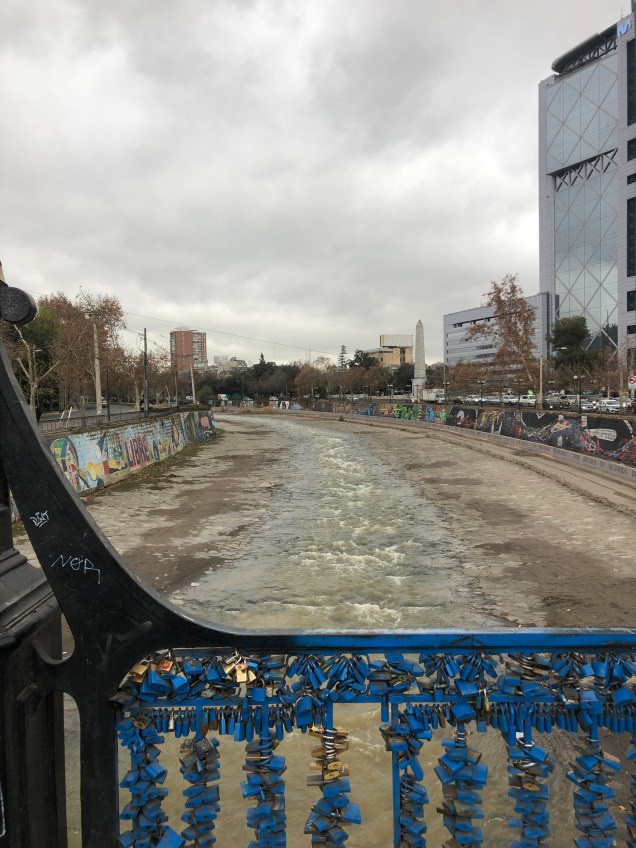
The Malpocho riverbed is a bit lacking in charm too.
On one corner a small knot of riot police appeared to be massing (though we saw nothing remotely riotous looking in the surrounding area.) We passed a number of dogs being walked, and I was charmed by how many were dressed, either in winter coats or raincoats. Still they didn’t look much happier than many of the people.
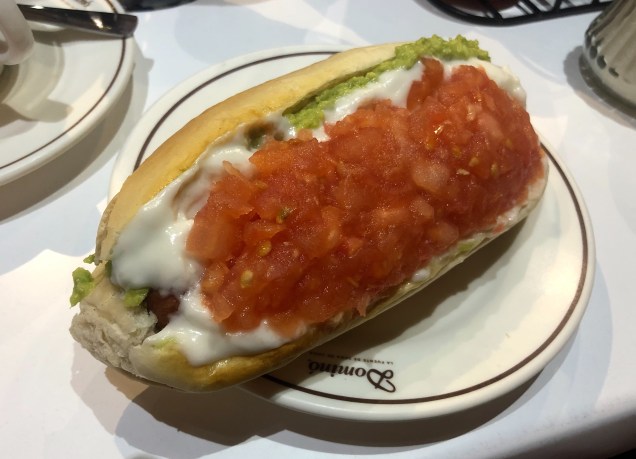
My spirits bounced up later, when we had collected Michael and Stephanie and Devin and headed to the historic heart of the city for a Chilean staple known as the “completo” — a hot dog laden with any of a host of toppings.
I chose the Italiano, so named for its colors.
After lunch we strolled around the huge central plaza, popping into the cathedral and central post office. It started drizzling, but we plowed on, visiting the central market and a old train station that’s been converted to a social center. By then the cold rain was strengthening; the sky darker. By the time we reached the central library, a vast structure that reminded me of New York City’s, I was too cold and tired to want to go in (though Steve, Mike, and Stephanie soldiered on). Once back in the apartment, I took some pleasure in my phone’s report that I had covered 8.8 miles and climbed 20 floors.
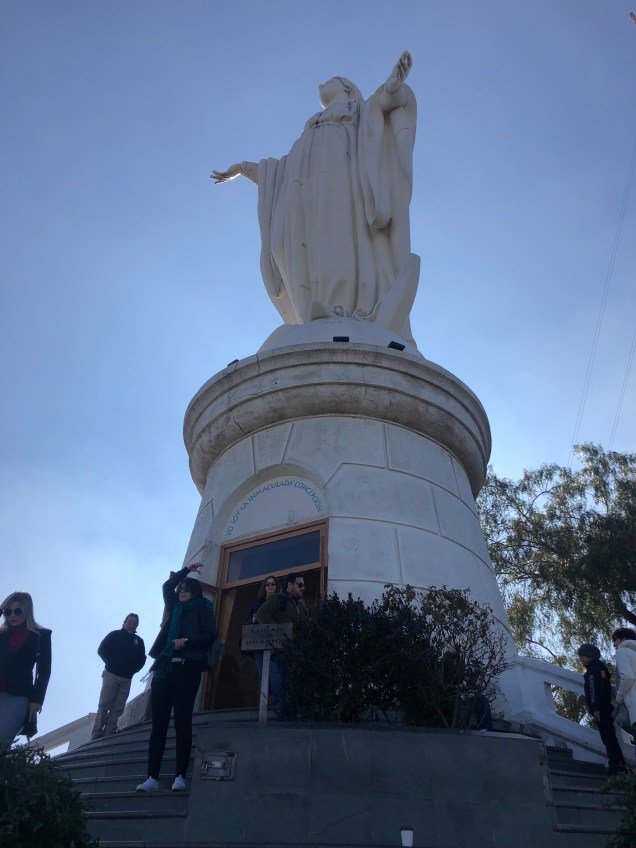
Saturday morning, Santiago felt like a different city. The rain was gone, and patches of sunny blue sky flirted with light clouds. It took us a while to get organized, but by late morning, the five of us had walked to the foot of Cerro San Cristobal, a spur of the Andes that’s one of the city’s most prominent landmarks. An ancient funicular carries passengers up to the top, near the site of a tower Virgin Mary. She looks quite strikingbut even more dazzling were the line of snow-laden nearby Andes that she overlooks.
The sight of them energized all of us. After a nearby lunch, we covered a lot more ground, walking to a huge central food market……a striking arts complex… and more. We also had a fantastic meal that night (almost 30 separates tastes showcasing the ancestral foods of Chile).
The day made me feel we could easily have enjoyed at least a few more days in Santiago. But we wanted at least a glimpse of the vast Chilean wine country. We’re in the midst of it now. Outside my Santa Cruz hotel window, the sky looks awfully threatening. At least we have a rental car to (mostly) get us around.
Mexico City impressed me when I first went there, around the end of 1978. It was the first non-European capital I’d ever visited, and it felt exotic. It was the Third World, as we called developing nations back then. On our taxi ride from the airport to our Zona Rosa hotel, I remember eyeing shanties; smelling burning garbage. That visit also exposed me to world-class marvels: the pyramids of Teotihuacan, the city’s huge central plaza, its marvelous anthropology museum, Chapultepec Park. We hung out mostly in the chic neighborhoods, and I recall concluding that the city seemed a wild mixture of Paris and Tijuana.
I liked it a lot, and Steve and I returned several times over the next few years, but the worst things about Mexico City — its choking air pollution and awful traffic — loomed larger and larger over time. Returning from Oaxaca in 1984, we passed through briefly but then didn’t go back for almost 35 years.
Seeing Mexico City again over the last two days made me feel like I had napped and awakened in a world that was familiar but also different in startling ways. Driving from the airport into town I noticed nothing like those old-school Latin American slums. (They must still exist, but in less obvious areas.) We smelled no burning garbage. When we rode the metro, the cars were packed and humid but cleaner and less odiferous than some crowded American subways I’ve endured.
Even the name has changed. Traditionally known as the Distrito Federal (Federal District) or simply DF, the city three years ago became more jurisdictionally independent, at the same time getting rechristened as La Ciudad de Mexico. CDMX (part acronym, part brand?) is now emblazoned on everything from buses to garbage cans (three classes for trash, organic, and recyclables). The moniker made me think of a computer operating system; made the urban center it represents seem somehow jazzier. Indeed everyone has cell phones; Bird scooters and Uber drivers are ubiquitous. Over and over I was struck by how comfortable I was; how much Mexico City now feels like home, if more brightly painted and stylish than San Diego.
Because of our previous visits here, we had told ourselves we need not be frenetic about sightseeing, but in the end we couldn’t resist slipping into our old hyperactive ways. We covered almost 9 miles on foot Friday; more than 10 yesterday. We walked from our Airbnb apartment in the elegant old Condesa neighborhood to visit a new museum downtown dedicated to pulque (the mildly alcoholic ancient Mexican drink of the masses that has gotten trendy in recent years.) The museum proved underwhelming, but admission included tastes, so I can now report that both peanut- and red-wine-flavored pulque are delicious.
Other flavor choices included cheese, honey, pineapple, pine nut, and more.
We spent time in two different art museums, one filled with the staggeringly huge collection of Mexican billionaire Carlos Slim.
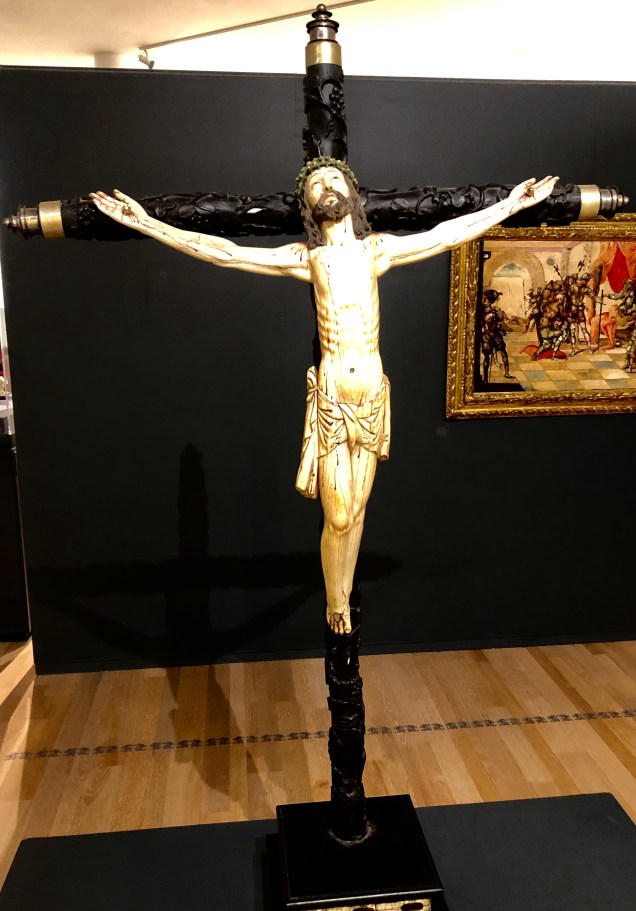
A crucified Christ made from an elephant tusk (or maybe several?) is just one of the 66,000 art objects on display.
Adjoining the Slim’s Museo Soumaya, the newish Museo Jumex, dedicated to contemporary art, was hosting a brainy exhibition focusing on the work of artists Marcel Duchamp and Jeff Koons. Besides us, it drew a throng of Mexicans of all ages.
Koons’ gigantic Play-doh pile (made of interlocking aluminum pieces rather than actual Play-doh) amazed me with its beauty and complex craftsmanship.
During our two days, we ate several meals at red-hot restaurants where we only lucked into tables because we arrived so much earlier than the locals.
We didn’t eat any street snacks, though they have to rank among the most colorful in the world.
What excited us more than anything was our experience in the city’s historic center. We decided to run down there on the spur of the moment, catching a metro from the Chapultepec station (5 minutes from our apartment) to the Zócalo. When I’d first seen it more than 40 years ago, that plaza blew my mind with its vastness. On Saturday afternoon, it seemed to have shrunk (probably in comparison with some of the other vast plazas I’ve tramped through over the years). Mexico City’s zocalo once was the site of a great pyramid in the heart of the Aztecs’ capital, Teotihuacan. But the Spanish conquistadors had torn the pyramid down and used the stones to create the plaza and cathedral and the other grand buildings that still surround it today.
The Spaniards’ willingness, even insouciance, about obliterating every trace of another civilization horrified Steve and me on our first visit. Back then we were intrigued by news of a recent discovery by some electricians working on metro construction. They had found a huge disk honoring the Aztec moon goddess that suggested part of the original temple might still exist, buried under the city that developed over it. Work on investigatory excavation had started, but it looked pretty puny. Still, it held promise.
My biggest Rip Van Winkle moment was seeing what has happened since. The Templo Mayor complex, as it’s now known, today covers a huge area behind the Cathedral.The biggest outer pyramid, which honored the war god Huitzilopochtli and the rain god Tlaloc, is gone. But you can clearly see the remains of what it once sheltered: about a dozen levels of construction dating from 1375 to 1519. You can stare at the double staircase where the bodies of human sacrificial victims were thrown down the steps after their hearts were ripped out. An impressive museum fills in a lot of the details, gory and otherwise. The power and scale of what once filled this space are unmistakable. It made me happy to see two of the main cultures that shaped this country co-existing more equitably.
The Zócalo metro station has a nice model of what once filled the area.
I should add a brief mention of the biggest disappointment of this visit. According to our iPhone weather apps, the air quality was still “Unhealthy” (in the 150-200 range — compared to the 20-50 that’s more the norm in San Diego). It wasn’t as stratospherically bad as the air in India last fall. It didn’t seem as bad as the air I remember from my early forays here, but that’s probably because summer is the rainy season, which washes out some of the pollution (and we used to visit in the wintertime). I wish I could return in another 35 years. Even sooner. It seems possible more good changes may be evident.
But I’m posting this now from our Airbnb in Santiago, where we arrived last night. We’ll have about 6 days in Chile, and throughout that time we’ll be filling a blank slate.
Steve and I finally got to use the new(ish) cross-border footbridge that enables pedestrians to walk from San Diego (Otay Mesa) to Tijuana’s international airport, and what a pleasure that was. The last time we flew out of TJ was decades ago, and I’m sure we did it because the fares on Aeromexico were cheaper. I remember the whole experience as nightmarish. First you had to drive to the border and cross it, then grind on for what felt like ages through bad slums and poorly designed roads. The terminal itself was dingy and jammed with endless lines of travelers schlepping gigantic suitcases and other paraphernalia. Steve remembers seeing ripe, discarded baby diapers and other trash strewn on the terminal floor.
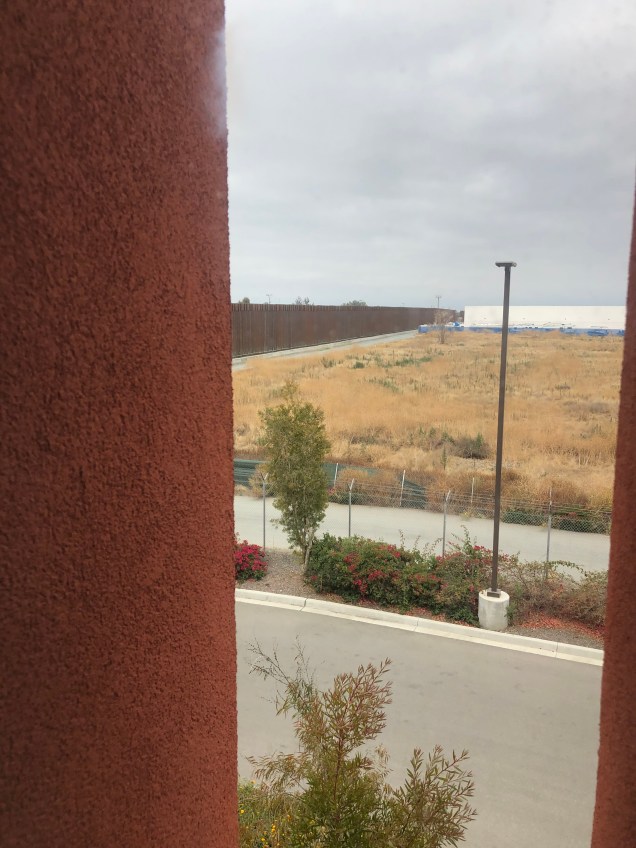
What we saw on this departure was almost unimaginably different — spotless marble floors, good lighting, comfy waiting areas, tempting food choices. Best of all was getting to the Tijuana terminal. Our friend Alberto gave us a lift from our house to the clean modern building on the US side of the border (quite close to where Trump’s big, beautiful, wall prototypes were erected.) It took us just minutes to buy our one-way tickets ($20 per person) to walk across the bridge and obtain our Mexican visas (from a high-tech kiosk). We scanned the bridge ticket and our boarding pass at a gate that opened for us automatically. Then we strolled over and above that pesky border between the two countries. The passage couldn’t have taken even five minutes.
In the photo above, you see the actual bridge. It looks like any corridor in any modern airport. Through the window in it, we could glimpse that bothersome wall.
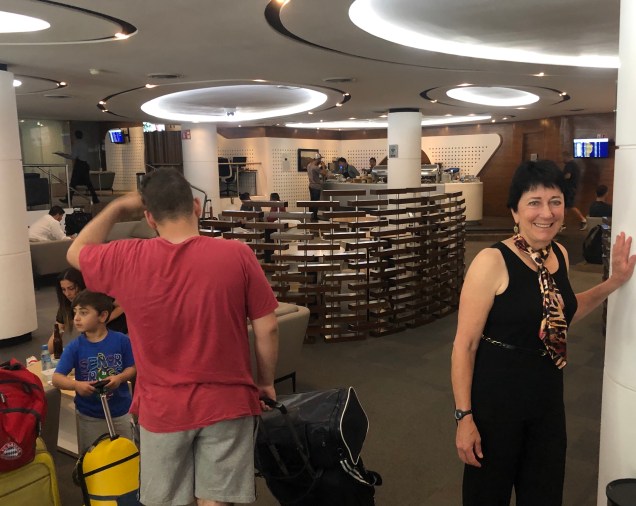
Emerging into the Mexican facility, we joined a line that briskly moved through immigration and customs to emerge in the spiffy terminal, steps away from the VIP Lounge. We could use it because we get free Priority Passes with our Chase Sapphire credit cards.
It was a pleasant place to wait for the hour before we boarded.
When I was shopping for flights to Mexico City, I was startled to learn that NONE depart from San Diego. Now I understand why. The carriers out of Tijuana compete ferociously. (We paid just $67 per person for the three-hour-plus flight, and I have friends who’ve snagged $70 round-trip bargains occasionally.) Even adding on the bridge-crossing fee, it feels like a great deal. Being able to saunter across the border as we did, one could almost glimpse a different, brighter future.
If only the rest of our transits on this trip are as smooth and stress-free….
Someone at the gym this morning asked me, “Why are you going to Chile and Argentina in the middle of [their] winter?” It’s a fair question, and we have a clear answer: the trip Steve and I are setting off on tomorrow was inspired by the total eclipse of the sun that will be visible all across southern South America on the afternoon of July 2. We’ve seen two total eclipses before: our first in Germany on Steve’s birthday in 1999, and then the one that swept across the entire US mainland in August of 2017. We caught that event near Portland, Oregon, and like the first, it dazzled us. I wouldn’t say we’ve exactly joined the ranks of total-solar-eclipse fanatics. But we’ve edged close enough to them to plan an entire trip around seeing the world go dark once again.
We will start by flying tomorrow to Mexico City, a capital we once knew pretty well but haven’t visited in decades. After two days of remedial sightseeing, we’ll head to the capital of Chile (a country we’ve never been to before). In Santiago, we’ll meet up with our son Michael and his girlfriend Stephanie, who joined us for the Portland eclipse adventure two summers ago. Because the skies on the other side of the Andes, in western Argentina, are more likely to cloud-free, we will fly to Mendoza for the actual eclipse, after which Mike and Stephanie have to return home to their jobs immediately.
But Steve and I, being freer birds, will go on to explore Ecuador for about two weeks. (We’ve never been there either, so those two will be my 61st and 62nd countries.)
We’re excited about this itinerary, but it has posed one of the biggest packing challenges I’ve ever faced. As my gym-mate noted, it’s winter in the southern hemisphere. We may see snow, and temperatures at night may approach freezing. Ecuador, on the other hand, is named after the equator because that balmy line passes right through it.
I’ve now got everything for the next four weeks crammed into my carry-on and backpack (save those eclipse glasses. I’ll tuck them in a side pocket.) My fingers are crossed it will be enough.
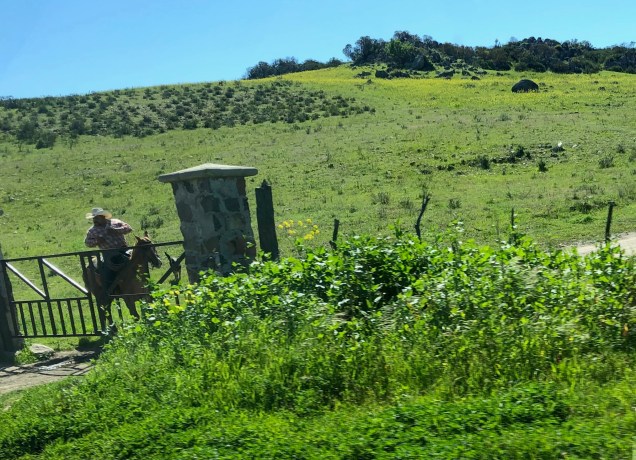
I still remember my first glimpse of the Guadalupe Valley in Baja California, years before it became well known as the Napa Valley of Mexico. I had turned off the coast highway about a mile and a half south of the last tollway, about 20 miles north of Ensenada. I’d driven east on Highway 3, past the city’s shanty outskirts and then past homey looking ranchos. After a while, the road climbed and cut through a dramatic rocky pass. The vista on the other side took my breath away; it opened to a pastoral paradise.
This was in 1988. More wine grapes were being grown in the valley at the time than anywhere else in Mexico, but they were only being used by a handful of growers. For complex historical reasons, the country had never developed much of a wine culture. But a few small newcomers had recently opened wineries, and I wound up writing a cover story about this activity for the Reader. The new growers were beginning to make decent wine, and the hope was palpable that this activity might turn into something bigger.
Somehow I didn’t return to check on the subsequent developments for more than 25 years. By then more than 50 additional wineries had joined the fiesta. Some had built chic tasting rooms reminiscent of their cousins in the Northern California wine country. Not only that: the Valle de Guadalupe by then had also attracted top-notch chefs who were cooking food of astonishing sophistication and quality. When Steve and I visited in February of 2014, we ate a couple of the best meals of our lives (and they cost a fraction of the price they would have in New York or even San Diego).
As thrilling as that idyll was, we didn’t make it back until just two weeks ago, when we spent a Saturday night in the valley to celebrate a big anniversary. Here’s a quick and dirty update on what we found.
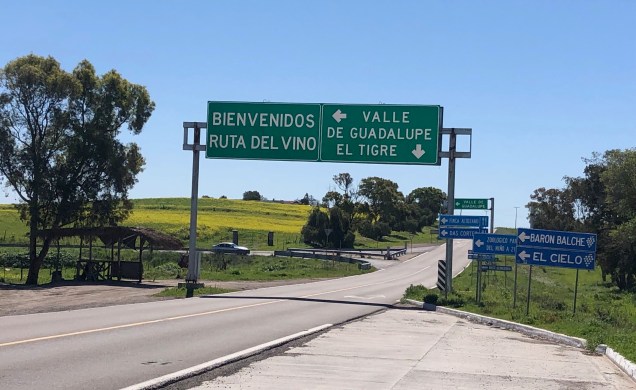
Getting there: We left from near UCSD a little after 10 am Saturday morning, and not long after noon, we were pulling up to our hotel. We took the coastal road south. For some reason, its toll booths seemed to be non-operational, although folks were asking for donations for something. (It was confusing.) The day was glorious; the ocean views as spectacular as ever. We turned off the coast road near La Mision and drove through a sublime, almost-empty landscape.
Getting around: When I had looked for a good map of the valley online before the weekend, I’d been disappointed by what I’d found. But Sunday morning, we obtained an excellent (free) map from the visitor’s office in front of the 7-year-old Museo de la Vid y el Vino (Museum of the Vine and Wine), located on Highway 3. Admission to the museum is just $3 a person. We hadn’t expected much but were impressed both by the architecture and the displays. We could have spent two or three times the 20 minutes we allotted.
The front of the museum
The girl in the tourist office told us the map had recently been updated. It lists 100 wineries in and around the valley, plus three dozen hotels and more than 50 places to eat. Other folks told us there were 150 wineries; some said there were more than that. Although there’s talk about the water table dropping as a result of this explosive growth, threatening the entire industry, after this winter’s rain, the valley looks lush and verdant.
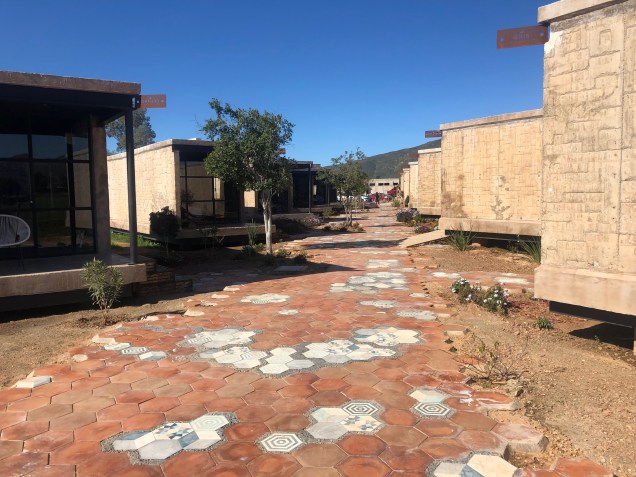
Lodging: I searched for a hotel more than a month before we planned to go, and I was taken aback both by how many places were already full and by their prices. We wound up staying at Agua de Vid. It’s nothing if not stylish.
Here’s the frontEach room is a separate compartment about the size of a mobile home.
Here’s what I wrote for TripAdvisor (where I try to review as much as I can of our travel stays):
Wine-tasting: I’m a little embarrassed to admit we only did two tastings, one at Vina de Frannes (recommended by a friend) and one at the Magoni winery (whose 2017 Sangiovese Cabernet we had enjoyed at dinner on Saturday night). We didn’t need a reservation to get into either. But when I’d tried on Friday to make a reservation at Monte Xanic (one of the oldest and best respected wineries in the valley), I received an emailed reply saying all the tasting times were fully booked for the weekend. We tried to drive in anyway to see if this was true, but a guard stopped us. Both at the wineries and the restaurants where we ate, we found all the wine to be drinkable, but in general the offerings seemed pricier than what we buy routinely at the San Diego Wine & Beer Co. (on Miramar Road).
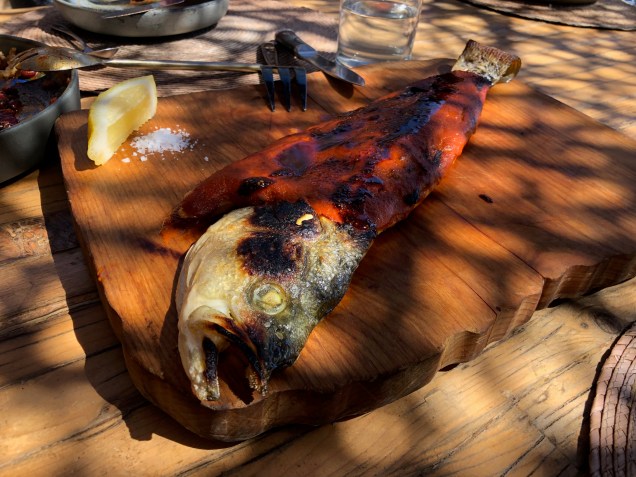
Food: This was the highlight of the weekend. We had three terrific meals (2 lunches and a dinner), each in a beautiful and lively setting. They included:
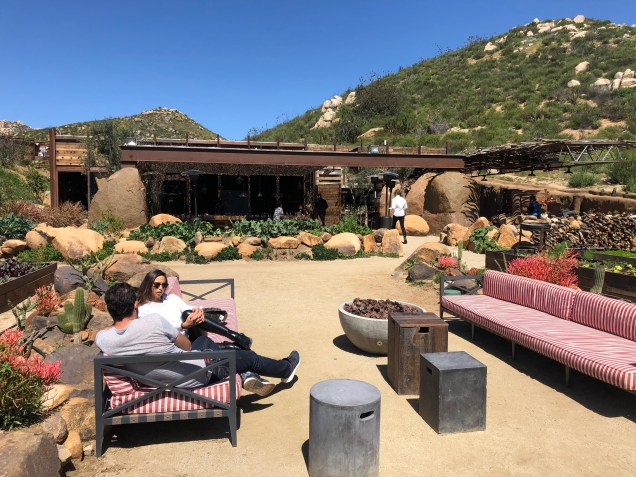
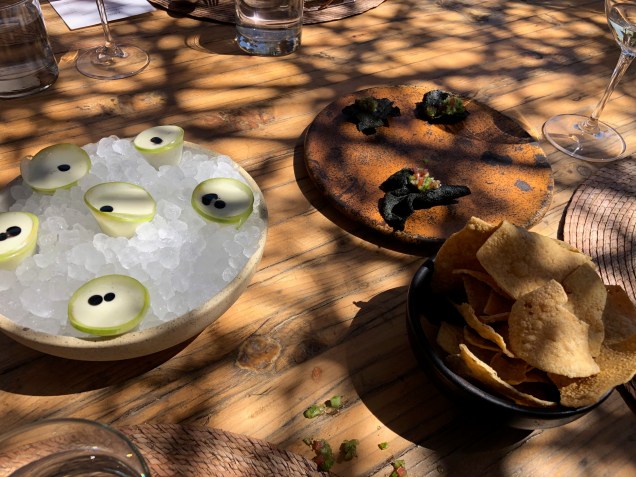
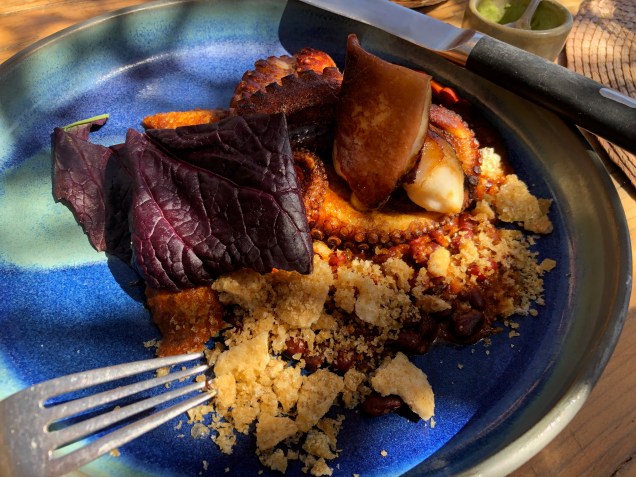
The grounds made me feel like I was in a movie.Those objects on the left are delicious oysters, served in cups made of apple slices.Local octopusAnd a wonderful fish
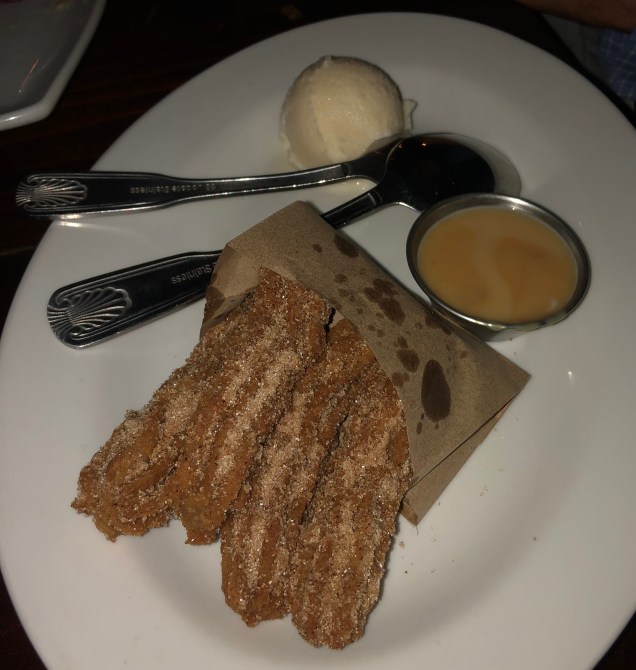
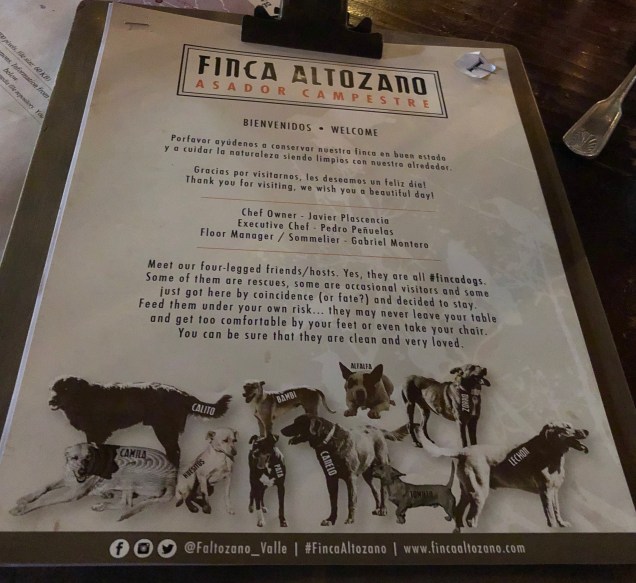
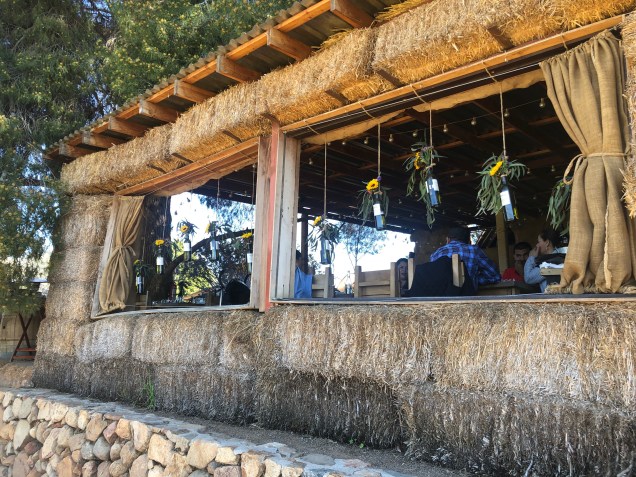
We dined at Finca Altozano, yet another success for legendary Baja super chef Javier Plascencia. Its giant dining room is open to the outdoors, evoking the spirit of a great jolly ranch house, and we regretted not bringing more to keep us warm. But everything tasted good, particularly the homemade churros, sauce, and ice cream…
I was charmed that the menu includes a guide to all the resident perros.Our final lunch was at Deckman’s, perhaps my favorite of all.
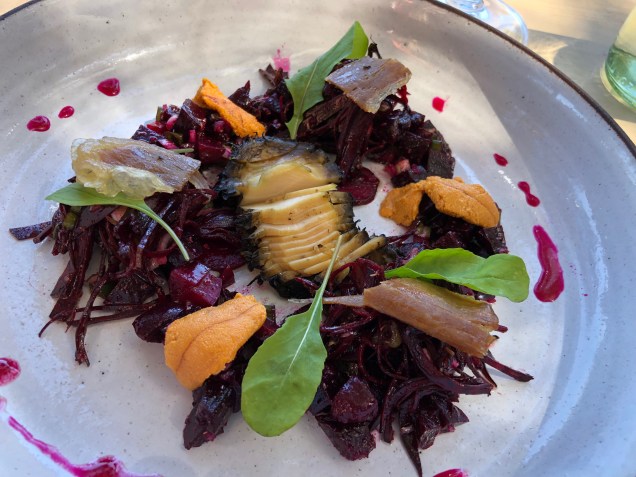
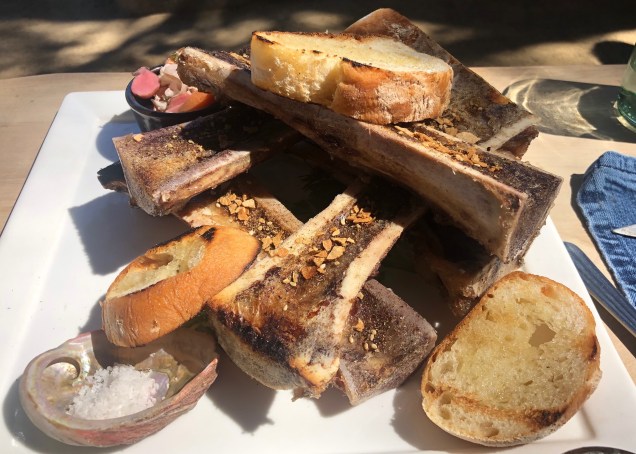
Abalone, sea urchin, smoked fish, beets, and more…Roasted beef marrow and wonderful bread
The nightmare: When we’d visited the valley 5 years ago, it was during the week, and we returned through the little town of Tecate. Then we breezed across the border in minutes. But trying that trick on a Sunday afternoon was imbecilic. We arrived at the line around 4 pm only to find that it was already a mile long. It took us two and a half hours to cover the distance to the checkpoint (only two lanes, neither of which expedited SENTRI pass holders.) We should have driven to Otay Mesa. Now we know better… for our next visit.
I’ve long been curious about Burning Man, the anarchic arts festival that has taken place for decades during the week before Labor Day in the harsh northern Nevada desert. At one point, Steve and I thought maybe the time was right for us to check it out. This was about 5 years after our older son moved to Reno (located about 100 miles southwest of the event). Alas by then its popularity had exploded. In 2010 more than 50,000 people attended Burning Man; in 2011 for the first time ever, tickets sold out about a month before the festivities started. In an attempt to curb the madness, the organizers created a complicated ticket lottery for the 2012 festival — the very year we targeted to attend. To our chagrin, we could only secure one ticket, so we gave up and resold it.
After that, the organizers abandoned the lottery system, but Steve and I were busy with other projects. Ironically, our younger son, Elliot, in the fall of 2017, independently happened to participate in a regional Burning Man event (YOUtopia) held on the La Jolla Indian Reservation in northern San Diego County. It engaged him so much he subsequently became involved with the local (San Diego) “burner” community (which has both formal and informal meetups throughout the year). Los Angeles also is home to a similar community, which organizes a 3- to 4-day campout called BEquinox. Elliot made plans to attend BEquinox this year with a friend, but then the friend couldn’t make it, so he needed to unload the ticket. Steve and I looked at each other 11 days ago and had the same thought: if we could find a second available ticket, maybe we should seize the opportunity to go. Elliot encouraged us to join him.
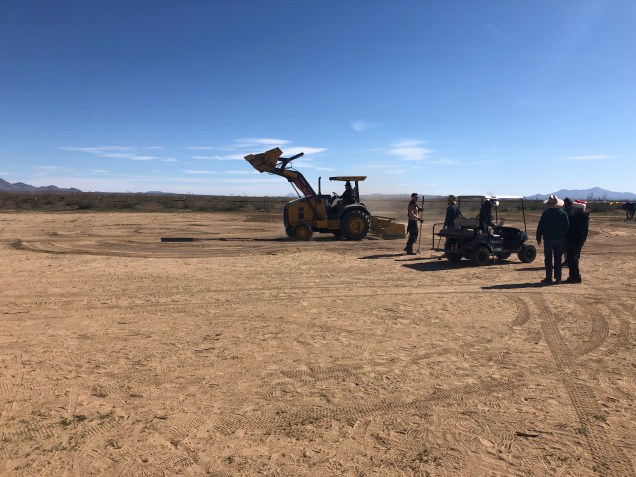
Amazingly, in short order we got the extra ticket, rented an RV, found sitters for the puppy we’re currently raising for Canine Companions for Independence, rescheduled appointments we had made for the five days we would need to be away (Wednesday, March 20, through Sunday, the 24th). Elliot planned to ride up and back with us in our rented motor home but sleep in his own tent. Instead of taking place near Joshua Tree National Park, as it has in years past, this would unfold on land the LA burner community recently acquired in the Mojave Desert, not far from Edwards Air Force Base.
Our cozy RV
At the end of winter, that patch of California is far more congenial than Black Rock in Nevada (site of the main Burning Man event) in late August. But the nights would be near freezing, we knew, and although we’ve done our share of tent camping over the years, we’re not crazy about it.
Now that we’re back, I can report that even with a nice RV, the environmental challenges were what I liked least about the experience. A rainstorm that preceded us had just blown out by the time we arrived about 4:30 pm last Wednesday. Every day after that was sunny, but fierce, dusty, bone-chilling winds whipped through the complex on most of Thursday and again on Saturday. After sunset the temperature plunged to the mid-30s. The BEquinox organizers had set up plenty of (very well-maintained) porta-potties to serve those of the 1500 attendees who lacked RVs, but that was the only utility provided. All attendees had to transport in all their own water and power and pack out every trace of refuse (“Leaving No Trace” on the natural environment is one of the ten sacred burner guiding principles). In our RV, Steve and I were so comfortable it was tempting at times to stay inside and cocoon. But each time we resisted that temptation, we were rewarded.
I still can’t report on what the big famous Burning Man is like, but after participating in a lite version, I can much better imagine it. Here are the three biggest insights I gained:
No one should attend Burning Man (or one of its regional offspring) unless the guiding principles appeal to them.
Steve and I enjoyed seeing how those principles animated this evanescent community. But someone who disliked the sound of any of them would be unlikely to enjoy the experience; might hate it. As expressed by the BEquinox literature, those principles are:
Radical Inclusion. “Anyone may be a part of our community. We welcome and respect the stranger. No prerequisites exist for participation in our community.” I took this to mean participants do have to respect the core principles. I didn’t notice any Nazis in the crowd. But attendees ranged from toddlers to octagenarians, and they had a variety of skin colors and sexual orientations.
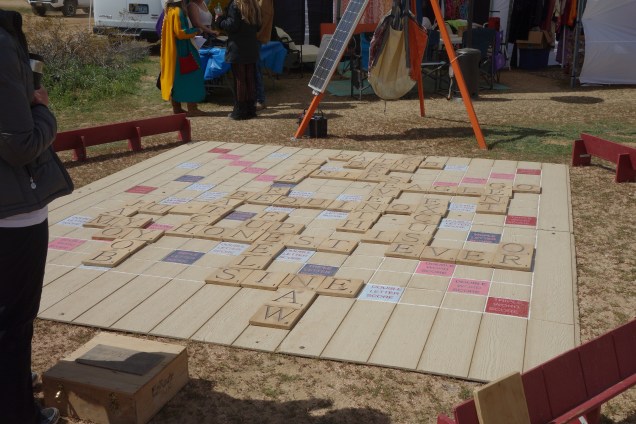
Gifting. “Our community is devoted to acts of giving. The value of a gift is unconditional. Gifting does not contemplate a return or an exchange for something of equal value.” Over the three days and four nights, we were given many things, including jewelry, alcoholic drinks (bars offering free liquor are plentiful), a lesson in tie-dying, 5 minutes (each) to talk about anything we wanted. (Steve discussed his ongoing science-fiction project, and I talked about raising puppies to be service dogs. At this event we also heard discourses on mountain-climbing, desert tortoises, cosmology, parenting, city planning, how to write a novel in 3 days, and more.) Free food was ubiquitous (though we had brought our own meals.) We could have gotten ukelele lessons, made jewelry and puzzles and buttons, been massaged, gotten a fire-spinning lesson, played a giant game of Scrabble, and done more that we missed. In turn, Steve and I gave away sweet, juicy, organically home-grown oranges. Folks seemed to appreciate them.
The board at the Scrabble Camp
Decommodification. “In order to preserve the spirit of gifting, our community seeks to create social environments that are unmediated by commercial sponsorships, transactions, or advertising…” Steve and I have nothing against capitalism, but it was interesting to spend a few days in a community where nothing could be bought or sold.
Radical Self-Reliance. “Our community encourages the individual to discover, exercise and rely on his or her inner resources.” What’s not to like about that?
Radical Self-Expression. “Radical self-expression arises from the unique gifts of the individual. No one other than the individual or a collaborating group can determine its content. It is offered as a gift to others. In this spirit, the giver should respect the rights and liberties of the recipient.” This is the one I imagine might be most difficult for some folks to swallow. If some members of the community are expressing themselves by playing loud music or taking psychedelic drugs or walking around topless or naked (a small minority of the crowd, but a definite part of the scene), that’s part of the ethos. Consent, “the cornerstone of a healthy community,” helps to buffer some of the potential friction, but it seemed clear that by participating at all, one was consenting to at least being exposed to unconventional behavior.
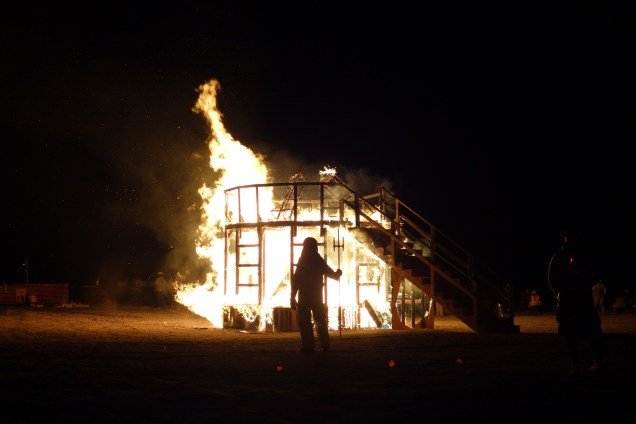
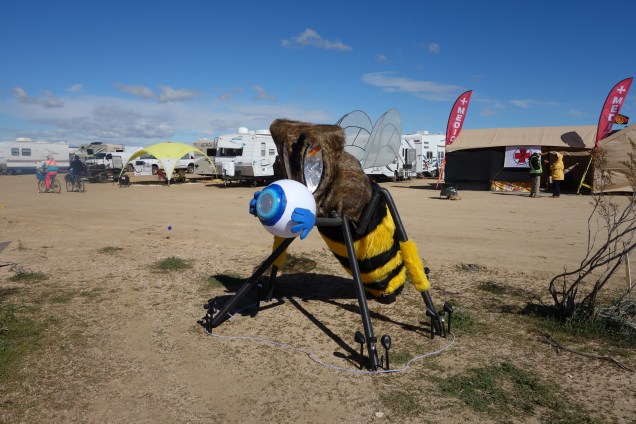
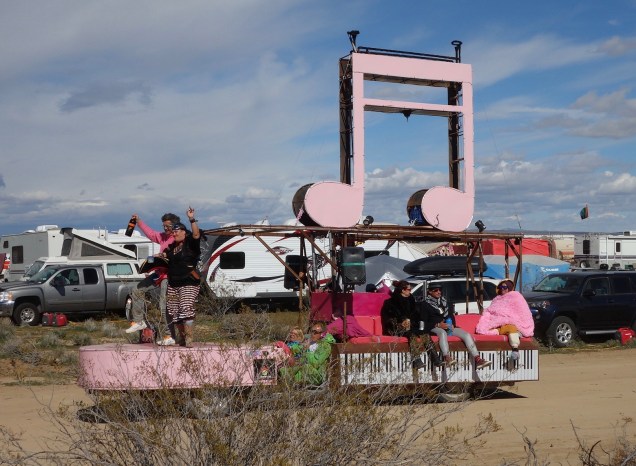
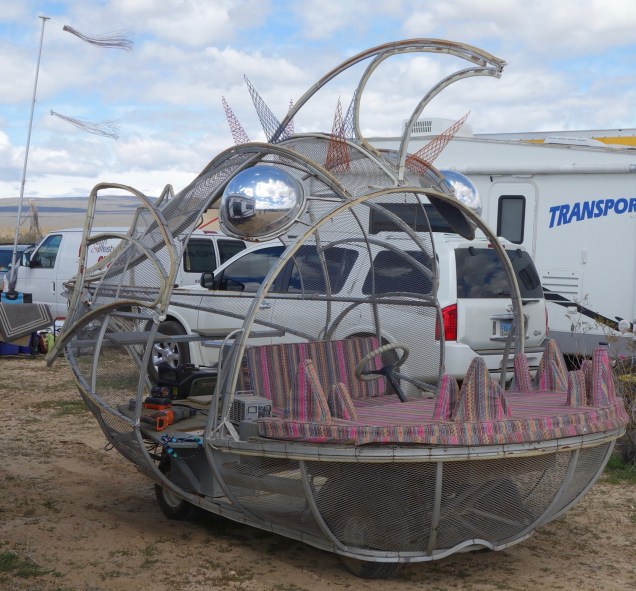
Communal Effort. “Our community values creative cooperation and collaboration. We strive to produce, promote, and protect social networks, public spaces, works of art, and methods of communication that enable such interaction.” Seeing what this relatively small (less than 1500 people) and brief (three-day) community produced made me think the big Burning Man event must be staggering. Besides the huge wooden structure (the “effigy”) that was burned on Saturday night (top image), the BEquinoxers set up art works like this throughout the grounds.
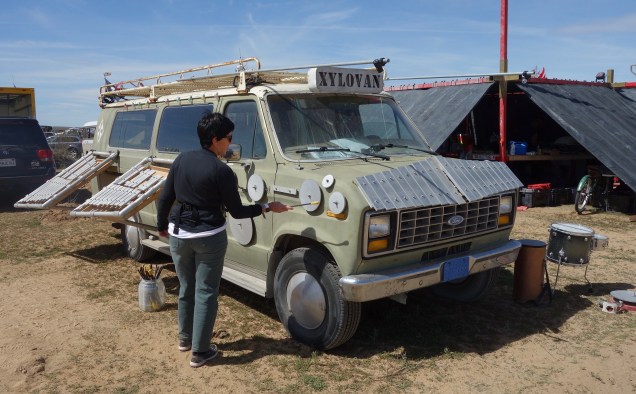
Look inside the eye and you see the word “BEAUTY”The “Xylovan” was another interactive art piece
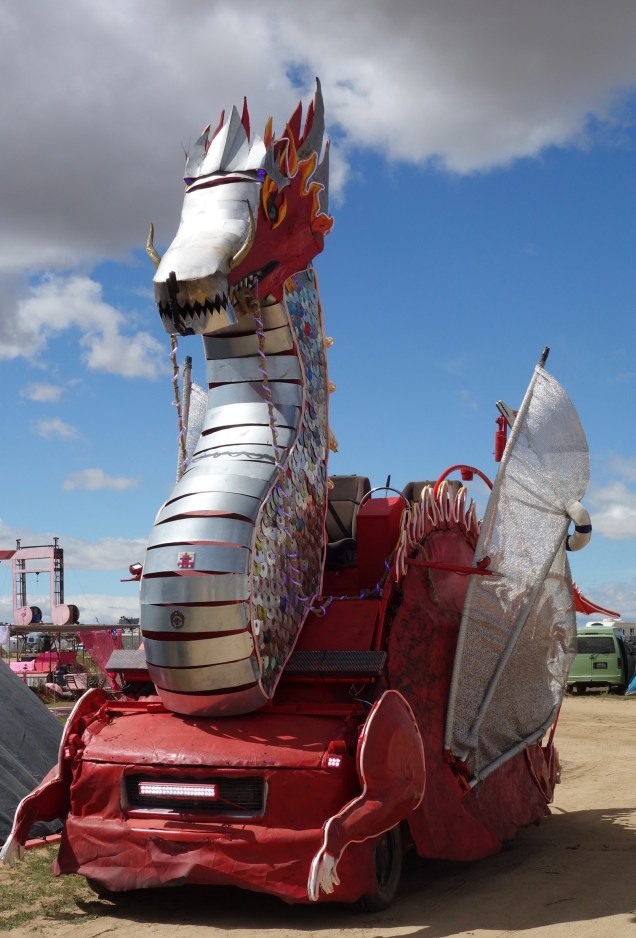
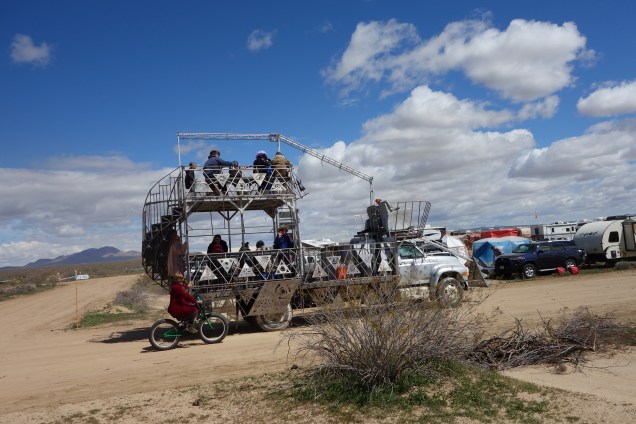
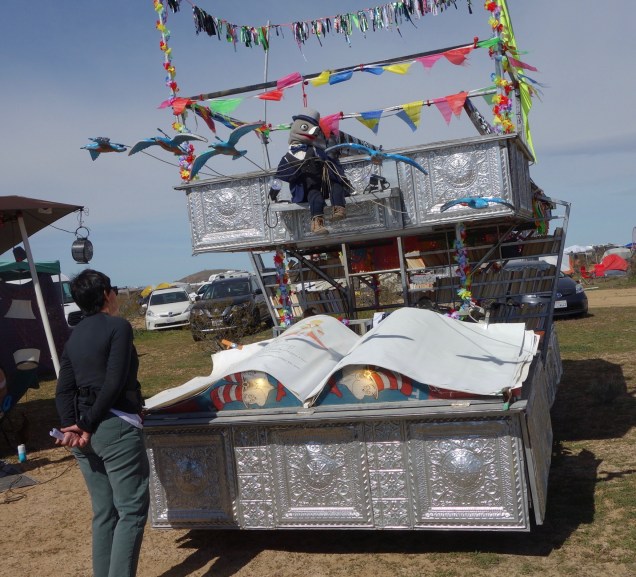
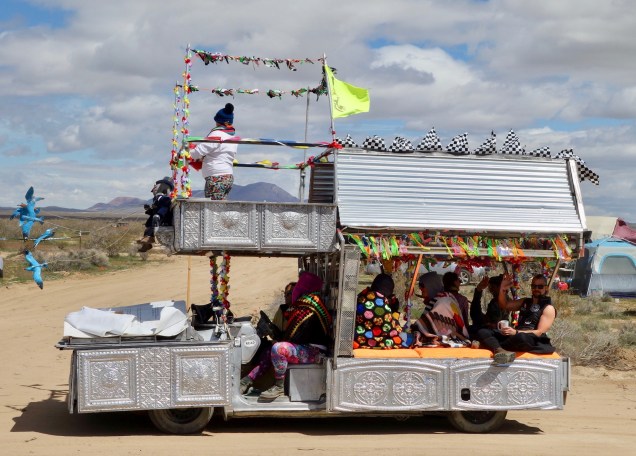
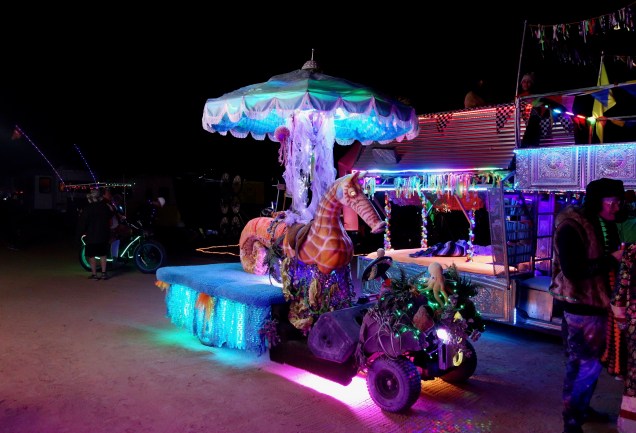
They brought in wonderful “art cars” that roamed the dirt streets offering hop-on hop-off rides.
Some vehicles were tall…
And some were small.You could ride in this “bookmobile”Either up top or in the back.Many of the art cars lighted up at night
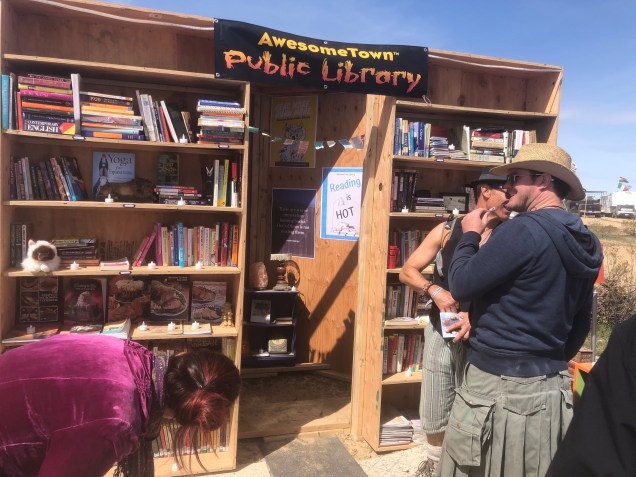
One group set up an “Awesome Town” library, complete with potentially offensive books that participants were encouraged to burn on Friday night (after the effigy burning and before a dance party).
Civic Responsibility. “We value civil society. Community members who organize events should assume responsibility for public welfare and endeavor to communicate civic responsibilities to participants. They must assume responsibility for conducting events in accordance with local, state and federal laws.”
Leaving No Trace. “Our community respects the environment. We are committed to leaving no physical trace of our activities wherever we gather. We clean up after ourselves and endeavor, whenever possible, to leave such places in a better state than when we found them.”
Participation. “Our community is committed to a radically participatory ethic. We believe that transformative change, whether in the individual or in society, can occur only through the medium of deeply personal participation. We achieve being through doing. Everyone is invited to work. Everyone is invited to play. We make the world real through actions that open the heart.”
Immediacy. “Immediate experience is, in many ways, the most important touchstone of value within our culture. We seek to overcome barriers that stand between us and a recognition of our inner selves, the reality of those around us, participation in society, and contact with a natural world exceeding human powers. No idea can substitute for this experience.”
A High Hippie sartorial aesthetic infuses the burner culture.
I never came close to being a hippie in the late ’60s and early ’70s. I was too young and way too straight-laced and conservative then. I had been vaguely aware that the costumes worn at Burning Man events were offbeat, but I was startled by how… uniformly most participants participated. Giant velvet Mad Hatter top hats, kilts and tutus, neon fur shin warmers, glitter, tie-dye, and onesies are the norm. Dressed in our jeans and t-shirts, Steve and I stuck out. That seemed okay too; no one appeared judgmental. But it was strange to feel a bit freakish by not dressing freakishly.
Everyone I talked with was interesting and likable. This event was like being at a giant three-day cocktail party filled with smart and interesting people who were ready to engage in conversation — chitchat that often quickly turned deep. We met doctors and lawyers and space engineers and software entrepreneurs and movie location scouts and covered topics ranging from camping skills to relationships. Of course we only talked to a tiny fraction of the attendees; maybe some would have been obnoxious. We’d have to return to another Burning Man event some day to learn more. We’re at least talking about that.
The effigy under constructionNo trace of it was left the morning after the burning. Even the nails were collected with magnets.
On December 20, five days after Steve and I returned from our nine-week Asian adventure, the New York Times published an article by its Frugal Traveler entitled “9 Things You Should Know Before You Go to India.” A friend forwarded it to me with the question, “Did all these make your list too?” Now that I’ve dug my way down to that level of my in-box, I have to say: sure. The items in the article were practical tips having to do with credit cards, visas, phone service, street food, and the like. But I’ve also been reflecting on some bigger things that caught us unawares. Five stand out.
The Pollution — I knew the air in India might be bad, but I was unprepared for the depths of its wretchedness. In the course of our trip, I discovered that the weather app on my iPhone includes an “air quality index.” Since we’ve gotten back, I’ve been checking it and have learned that San Diego’s air typically falls in the 20-50 range (“Good”), occasionally dipping up to moderate pollution levels. When we arrived in Bengal, however, the index number was about 150 (“Unhealthy for sensitive groups”), and it got worse city by city after that, through “Unhealthy” then “Very Unhealthy” then “Hazardous” (in the 300-500 range). By the time we hit Jaipur in Rajasthan, it was over 500, literally off the chart. (“Don’t Even Think about What This is Doing to Your Lungs!!!”) I started coughing maybe a week after our arrival October 15 and still haven’t totally stopped (though I feel 99% better).Beyond the physical ill effects, the environmental despoliation was depressing. The air was foul not just here and there but every single place throughout the north and at least down to Mumbai (Bombay). Kerala in the far south was slightly better, though hardly pristine. Seen through clean air, much of the Indian landscape would be beautiful. Its absence is heartbreaking.
Could I have done anything differently? Maybe. October and November have a reputation for being the worst months for Indian air pollution. Summer is supposed to be somewhat better. But the heat and humidity then are legendarily staggering.
A simpler solution might be to pack air-filtering masks. I actually considered this but rejected it on the grounds they would take up too much space, and the locals might think we were bizarre. If I were doing it again, I wouldn’t hesitate to take masks.
Not quite as awful as the air was the noise pollution in the streets, caused by every vehicle honking at every other one, incessantly. It frayed our nerves far more than I anticipated (but it probably didn’t do as much permanent damage to our bodies). Here’s a small sample, which sounds way less noisy than many of our rides.
Crime and other street hassles — We never felt menaced by street criminals, a nice discovery. We never felt unsafe, and we walked a lot, even at night in poor neighborhoods. I know some single women travelers have had grim experiences in India, and maybe we just got lucky. Still, no locals ever warned us not to venture into certain areas, as was common last spring when we traveled in Brazil. If there are muggings in India, we sensed they are rare. That’s liberating, and we appreciated it daily.
We loved being able to stroll down byways like this one in Kolkata, where so much life unfolds.
We also never were overwhelmed by beggars. They exist, of course, some with hideous deformities. But we never felt besieged by them. More ubiquitous, and often irritating, were the hustlers and street hawkers. To the latter I could smile and say “No thanks,” or “Maybe later!” But the friendly young fellows who called out, “Where are you from?” presented us with more of a dilemma (usually several times daily). To ignore them felt rude but to answer always entangled us in arguments about why we didn’t want to buy whatever they were selling.
The Indian trains were not romantic — I had hoped they would be. Just a little. I think they once were, the traces of imperial glory lingering even when Paul Theroux wrote The Great Railway Bazaar 45 years ago.
We chose to primarily get around on trains hoping for a glimpse of that past and also figuring it would be safer to ride the rails than brave the insanity on the streets and highways or fly on regional airlines. According to global rail guru Mark Smith (aka The Man in Seat 61), the Indian passenger rail network is the biggest on earth in terms of passenger kilometers, as well as the world’s largest employer (with a staff of 1.5 million). Smith states unequivocally that the best way to see Indian is on its trains. So I followed his advice.
The results were mixed. I had a devil of a time obtaining an online account with the Indian rail system. I tried for weeks, following the instructions on their website, sending emails when the instructions didn’t work, trying to call someone, starting all over again. Only when I used a VPN on my desktop computer — connected to an Indian server that made it appear I was located in India — did the system finally let me register.
With an account, it was relatively easy to book tickets in advance, and that was great, since the train stations tend to be overcrowded and chaotic. On several occasions I was able to cancel or rebook tickets once we were on the road. We started doing this after it dawned on us that trains departing early in the morning and originating at or near the departure station had a greater chance of running on time.
We only booked passage in air-conditioned cars, so we always had reserved seats. Sometimes our compartments were filled with more fellow passengers; sometimes fewer (depending on the class of ticket available). None of our trains came close to being luxurious, but they weren’t squalid. The best thing about them was the opportunity they provided to chat with Indian travelers. We had some entertaining and educational conversations, and when the talk wasn’t flowing, we drank in great views of the countryside.
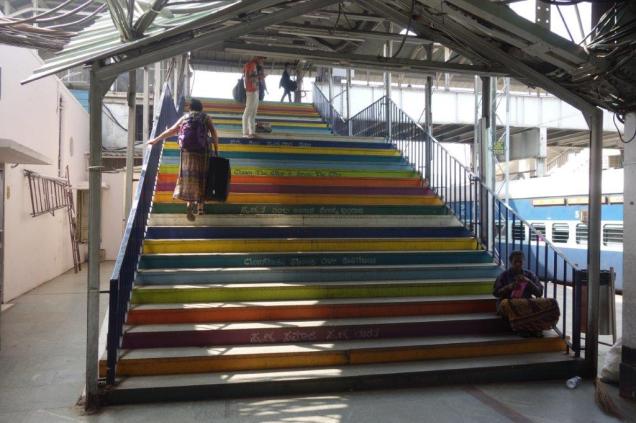
One other less than pleasant surprise was that the design of most stations requires passengers to climb up (and down) really high staircases to get up to walkways that let you cross from one track to another. Usually there are no escalators. We eventually figured out that many (most?) of the Indians hire porters to haul their suitcases over this obstacle course. Steve and I bristled at this, and not because of the (trivial) cost. “Why don’t we use the porters?” I wondered aloud one day. “Because it’s un-American!” he snapped. I knew what he meant.
In the end, we concluded that for trips longer than 5-6 hours, it would have been better to take regional planes (the few we flew on appeared to be well run). But for shorter trips, we would still choose the trains instead of hiring private cars and drivers, not only because the latter is so much more expensive. It felt like our chances of dying in transit, while not negligible, were lower on the trains than on the road. Moreover, even the fanciest private vehicles can’t avoid awful traffic and potholes, which in the end are more common and nerve-wracking than being stopped on a railroad siding.
Food was so inexpensive — We weren’t brave enough to eat the street food. But we also had no intestinal problems and could count on one hand the number of mediocre meals we consumed over the course of 9 weeks eating in various hotels and restaurants. Including our three days in South Korea and 10 days in Sri Lanka, for the most part we spent less than $15 per day per person for tasty food, drinks, and all snacks. We splurged on a dozen occasions, paying $45 or more for the two of us, but what we got for those meals was amazing. I’ll never forget the Bengali banquet that included about 75 different dishes plus drinks and cost about $100 for two.
Just few of those dishesWe learned that Bengali desserts can be amazing
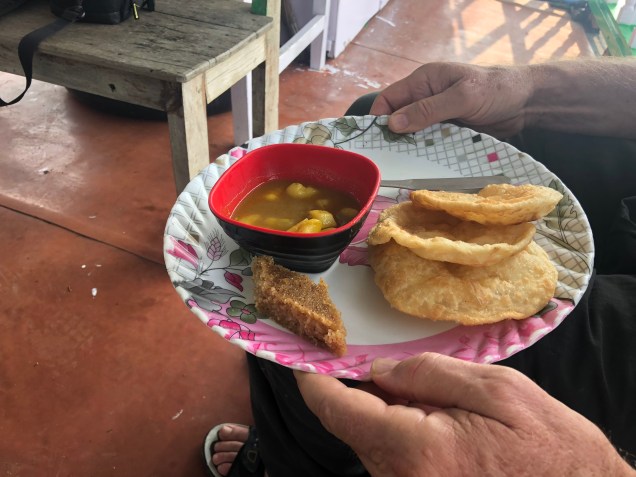
Even very simple meals were usually delicious.
Hindus aren’t pacifists — I suppose I knew this before we went to India. But I had no clue how deep and vicious the antipathy runs between some of India’s Hindu majority members and its Muslim citizens, an ancient tension that is currently being stoked by Indian prime minister Narendra Modi and his cronies in the Bharatiya Janata Party (BJP) and the even more hate-filled Rashtriya Swayamsevak Sangh (RSS). We got many earfuls of this antipathy, talking to people. The Hindu extremists don’t just target their Islamic fellow countrymen. In Agra we heard about one young couple who had been murdered on their wedding day (the week before) by Hindus angered by the fact that the (Hindu) bride was marrying a Christian.
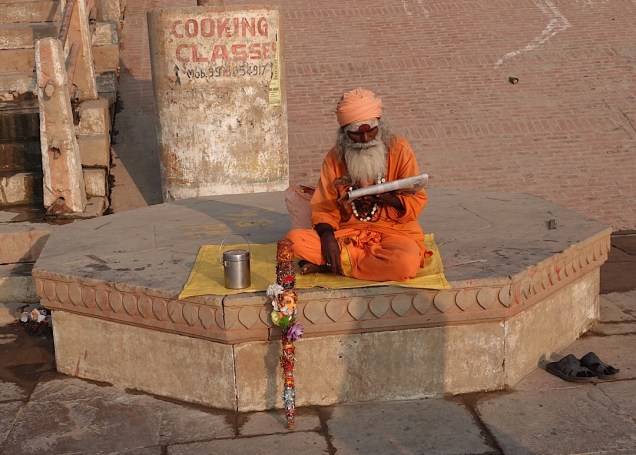
We know there are many nice Hindus, like this fellow. But we were less aware of the rough edges before our travels in India.
A monumental rock formation rises almost straight up from the heart of Sri Lanka. It’s known as Lion Rock — Sigiriya. Archeologists think humans have been living on and around it for more than 10,000 years, and many believe that in the late 400s (AD), a king named Kasyapa built a garden and palace at the summit after overthrowing and murdering his father. No buildings remain, but the ruins and fortifications are mind-boggling, considering the height and verticality of the site.One small area on top of the formation. How DID the workers get all those bricks up the sheer walls?
Steve and I climbed Sigiriya toward the end of our stay in Sri Lanka, and we spent some time gazing out at the views in every direction. “What strikes me,” Steve commented, “is that the guy who built this had to have been one of the greatest assholes in history.”
I knew he wasn’t thinking of the patricide, but rather the staggering expense and unimaginable suffering it must have cost — all to satisfy this one paranoiac’s miserable thirst for glory and security. We stood there, despising Kasyapa for a moment. Then we went back to enjoying our time up so high.
Visiting Sigiriya was one of the best things we did in Sri Lanka (the island south of India formerly known as Ceylon). The climb up to the top — around 1200 steps — wasn’t as hard as I’d feared. All those stairs were fenced so well the ascent never felt too frightening.We entered the grounds shortly after 7:30 am, when the day was still cool, and the hordes of Chinese tourists had not yet arrived. About halfway up, we shook our heads in wonder at the frescoes painted in one long gallery in the sheer rock face. A parade of women with Barbie bodies — tiny waists and beautiful naked breasts — decorate the wall. (Scholars suppose them to be either heavenly nymphs or a depiction of Kasyapa’s concubines.) A little further on, we passed graffiti dating back to the 6th to 14th centuries. Awestruck visitors scratched the comments, mostly noting how hot the ladies were.Guards stopped us from taking any pictures of the frescoes, but the lion’s paws carved into a plateau near the top are a popular photo op.
Although climbing Sigiriya ranked among our favorite activities in Sri Lanka, it was one of several. I’ve already written about our time in Colombo and Galle Fort and the idyllic southern coast.One of the views from Galle Fort.
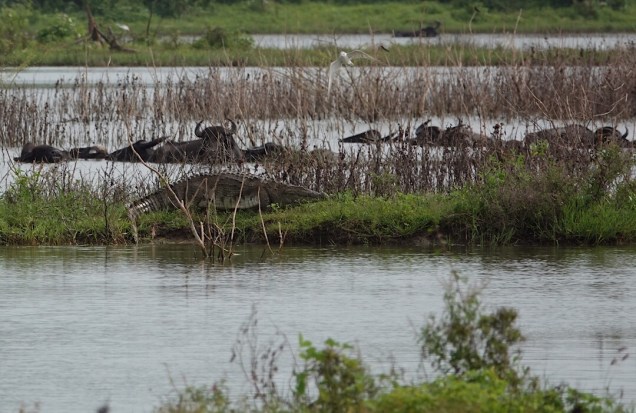
After our one-night stay on the beach, we traveled north and stopped along the way at one of the country’s national parks where, to our amazement, we had one of the best game drives of our lives. We counted more than 25 elephants during the two hours our Jeep bounced over the park’s dirt paths. Not just elephants, but crocodiles, wild buffalo and boar, monitor lizards, monkeys, snakes, other mammals, and a host of birds live in the park.Next we traveled to the cool, misty highlands; spent a morning hiking and loving the green-drenched vistas at every turn.Old trains that run over single tracks built by the British colonialists in the early 1800s are a part of the tea-country landscape.
We took a train from Ella through the emerald tea plantations……where Steve proved remarkably adept at picking tea leaves…
and we wound up in the city of Kandy. At a temple complex there, Buddhists revere a fragment of one of the Buddha’s teeth.It’s never shown to the public, but the ardor of the pilgrims is evident.
The final phase of our Sri Lankan journey took us to remnants of the ancient world, not just Sigiriya but also… …the Royal Rock Temple complex in Dambulla, filled with about 150 statues of the Buddha that followers began creating about 2000 years ago.Painted designs and images make it look like the cave ceilings are covered with exquisite Oriental rugs.
The vast spiritual complex at Anuradhapura was founded in the 4th century BC and contains three of the biggest monuments ever built in the ancient world, inferior only to the pyramids at Giza.This one was made from more than 90 million bricks and stood at the center of a monastery complex that once housed 3000 monks.
And nearby grows one of the oldest and most venerated trees in the world — a bodhi tree believed to have been grown from a cutting of the original one in Bodhgaya, India under which the Buddha achieved enlightenment.
We had some bad moments. A couple of dismal hotels depressed us. We inched and lurched through too many hours of awful traffic. We had a heartbreaking experience with the first of two driver/guides we hired. But I had to fight back tears when we said goodbye to the second of the two; our time together was so richly meaningful.
Besides sharing his encyclopedic knowledge of Sri Lanka with us, Omar also took us to the house where he was born and some of his extended family lives today. We stopped at his own home too; chatted with his wife and sister-in-law, met a son and daughter, admired his two-year-old grandson.For most of his life, Omar’s been a driver — of cars and trucks and tuk-tuks — but he also has worked for a number of NGOs, including a journalism team that did some fine reporting toward the end of Sri Lanka’s bloody civil war. Belying his sweet, even humble, demeanor, he seemed resourceful and astute to us. He didn’t hide his voracious appetite for breaking news. We talked a lot about the political uproar that’s been roiling Sri Lanka since late October, when the current president shocked everyone by firing the prime minister and replacing him with the strong man who ended the war (in 2009) but at the cost of abysmal human-rights abuses.
Since the war, Sri Lanka has become a superstar travel destination, but this turn of events was scary. It raised the specter of instability and even violence breaking out again. While Steve and I were tromping around India, tourist bookings all over Sri Lanka were evaporating. The Sri Lankan rupee fell even further than it did earlier in the year — good for us but bad for the Sri Lankans. We sensed gloom, even a touch of desperation, in the almost-empty hotels and restaurants.We saw this demonstration near the Parliament building in Colombo. Omar sounded optimistic; he said he thought the fracas would turn out to be just a rat’s nest of political scheming and ego, rather than a tinder pile that could explode into a conflict in which a lot of people would die. He knows a lot more about Sri Lanka than me; I hope he’s right. The country is packed with more beautiful and interesting areas than other places many times its size. But when thuggish narcissists play games, they can cause a lot of pain for the common folk.Newspapers still appear to be thriving, and people were scanning them anxiously.
Stilt fishermen — guys perched high on poles in the ocean to get a better view of their prey — are one of the most iconic images associated with Sri Lanka. The men look striking, but the only problem is no one actually fishes that way any more. The island’s remaining “stilt fishermen”only scramble up the poles for tourists, then browbeat them into paying for any images they take. “The stilt fishermen nowadays are actors,” one Sri Lankan told us.
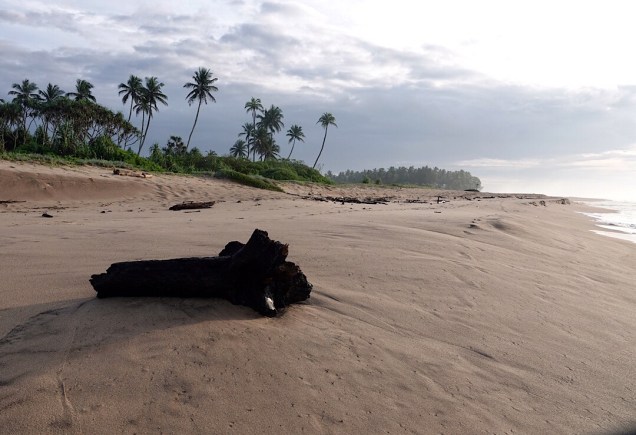
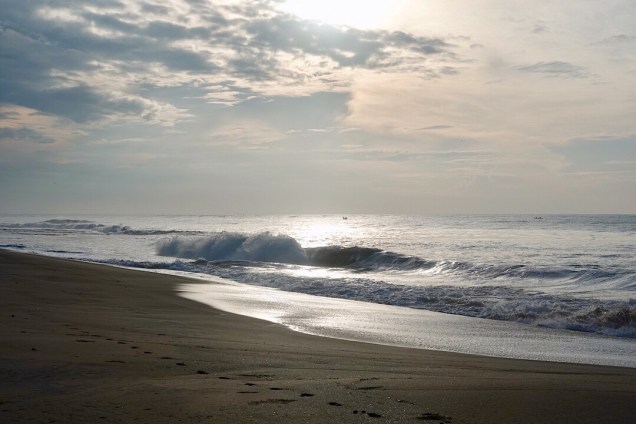
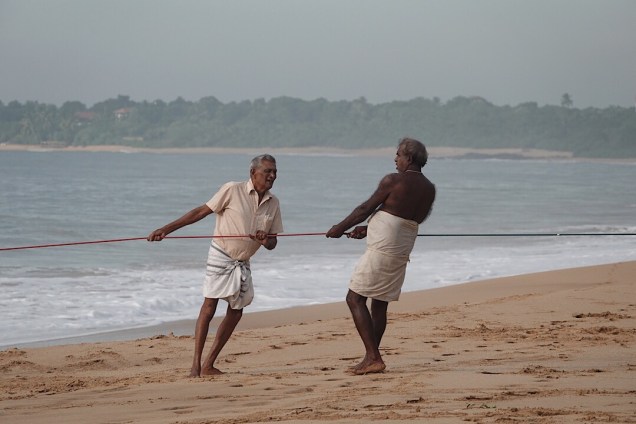
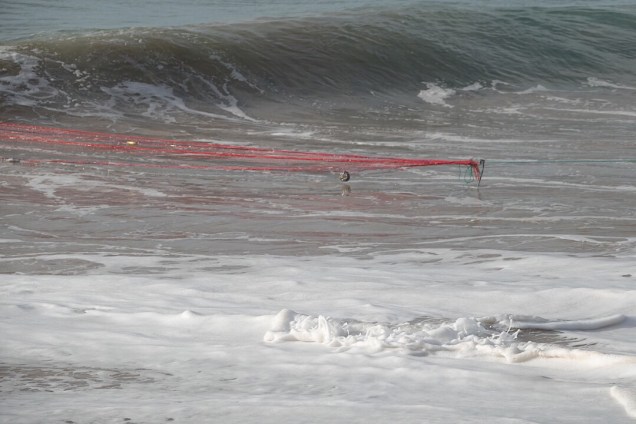
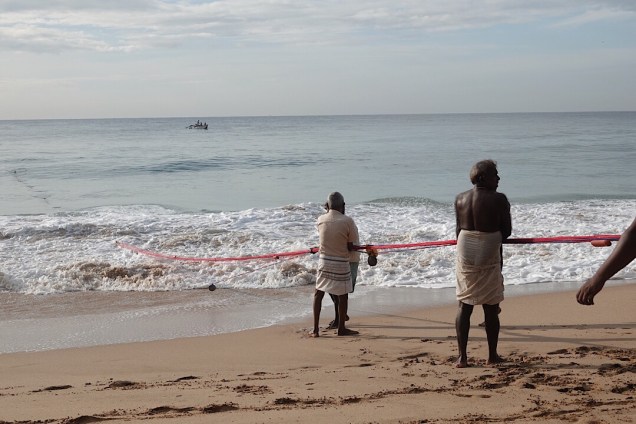
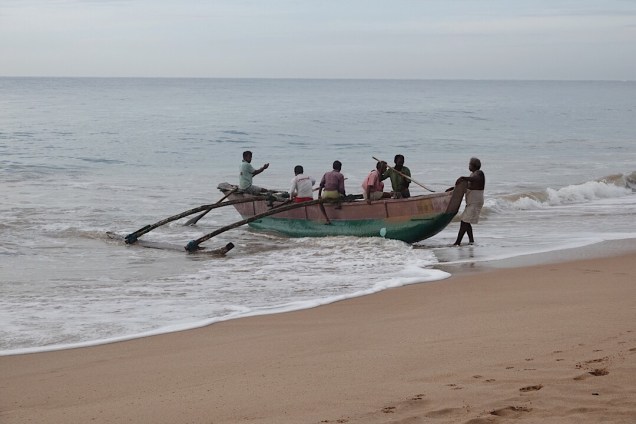
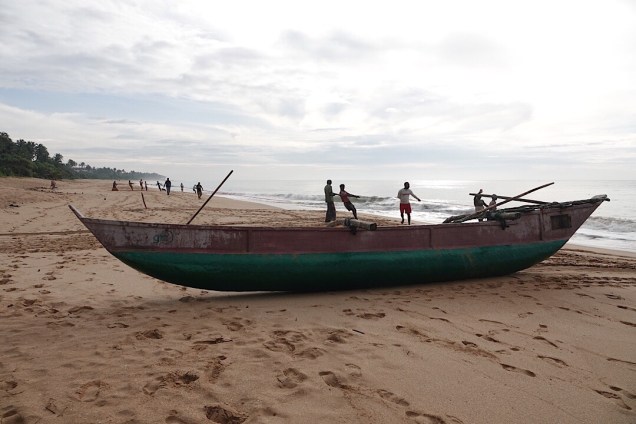
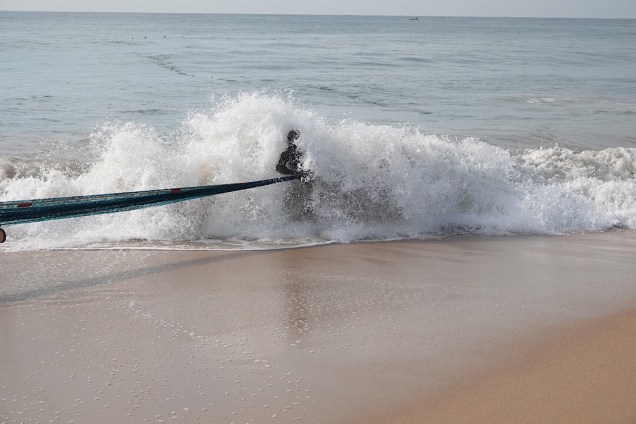
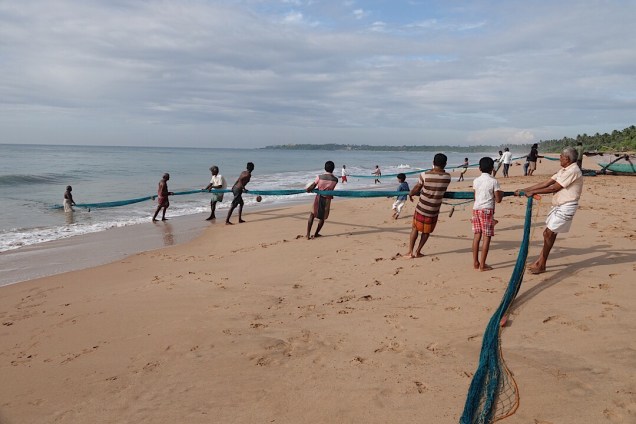
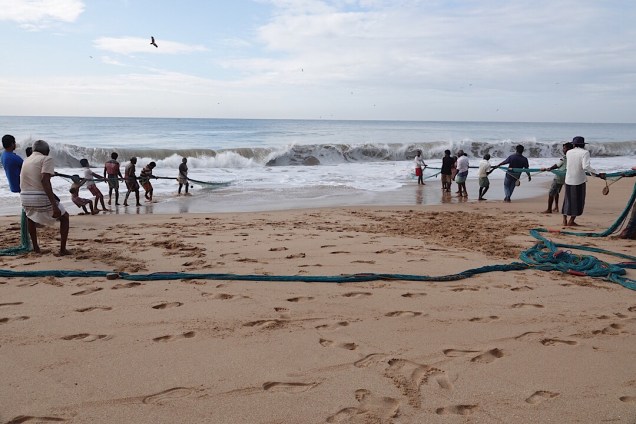
But men on Sri Lanka’s southern coastline do continue to fish in an ancient way that’s photogenic. Steve and I stumbled upon them on our walk shortly after dawn yesterday morning. The beach in front of our resort stretched farther than we could see and looked empty….…but we spotted a few fishing boats on the water……and then some guys in the distance, pulling a rope.The channel was too deep for us to wade across, but we found more men pulling hard on another line when we walked back in the direction of our hotel.The work looked strenuous, but sociable.Nothing happened suddenly, but eventually the net attached to the rope emerged from the water.The men were careful in its management.Eventurally the distant boat that had been somehow positioning the net approached the shore.It’s occupants first rowed, then lugged it onto the beach…Then they began to pull on another line that had been staked to a pole in the sand.As the net drew closer and the surf increased, the work could be rough.But the two wings of the team edged ever closer to each other.In the final stages, a host of birds swirled ahead. I felt nervous. What if, after all this work, the net was empty?No worries. As the haul emerged, there was bounty in the strands.The air was filled with the frantic flipping of dying fish.One of the fishermen told us it wasn’t a fantastic catch, but much better than it had been for the past few days. This guy asked if we wanted to go on an evening tour of the lagoon, but we had to decline. We had other fish to fry (metaphorically). I’m posting this now from the misty highland tea country. It’s a little hard to believe we’re in the same country.




 I came to Santiago (Chile) packing a 2017 New York Times article entitled “36 Hours in Santiago.” Steve and I actually had more than 50 hours in the Chilean capital, so I never intended to follow the Times itinerary to the letter. Still I like the 36- (or often 48- or 72-hours) in Wherever format; it suggests sightseeing highlights and often gives me ideas for where to eat. I borrowed the format last fall when I blogged about our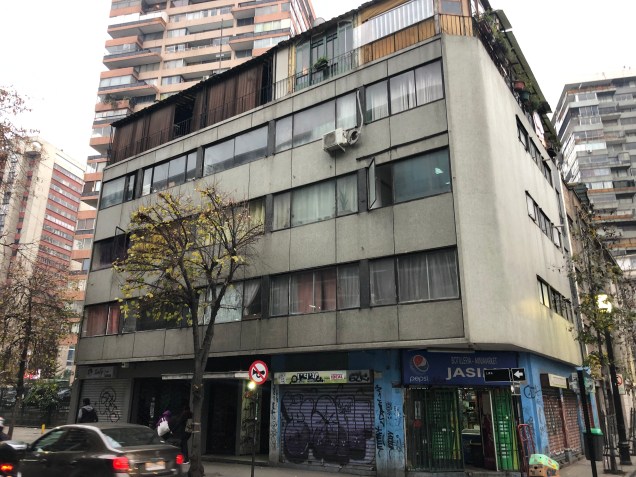

 but even more dazzling were the line of snow-laden nearby Andes that she overlooks.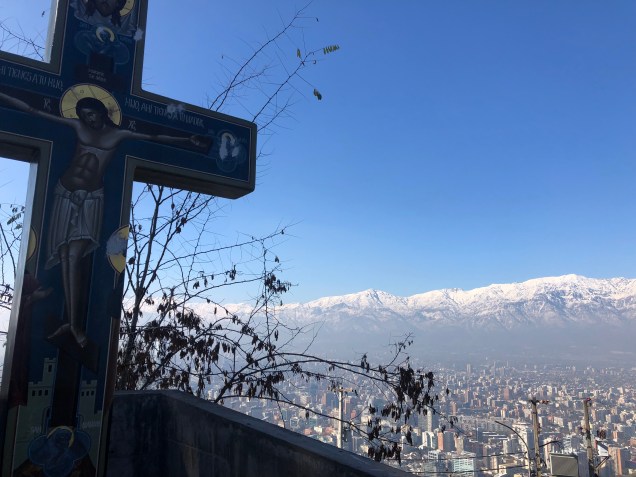
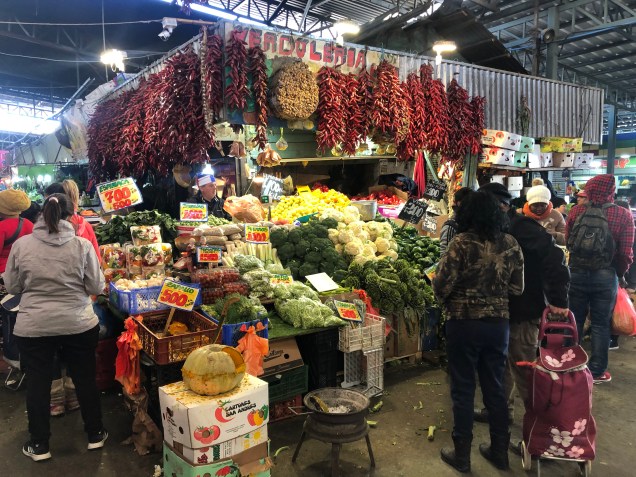 …a striking arts complex
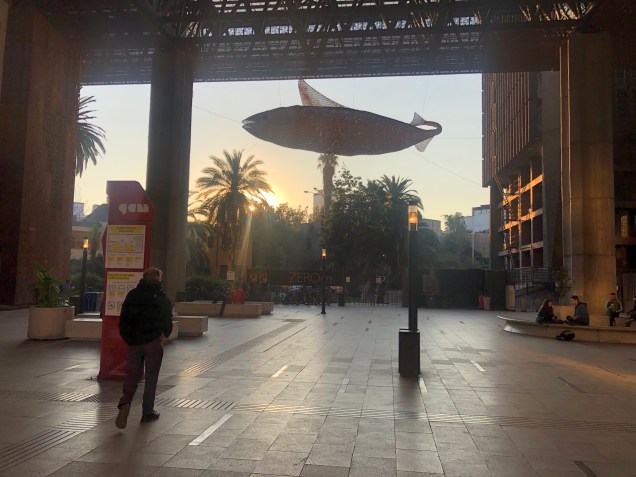 … and more. We also had a fantastic meal that night (almost 30 separates tastes showcasing the ancestral foods of Chile).
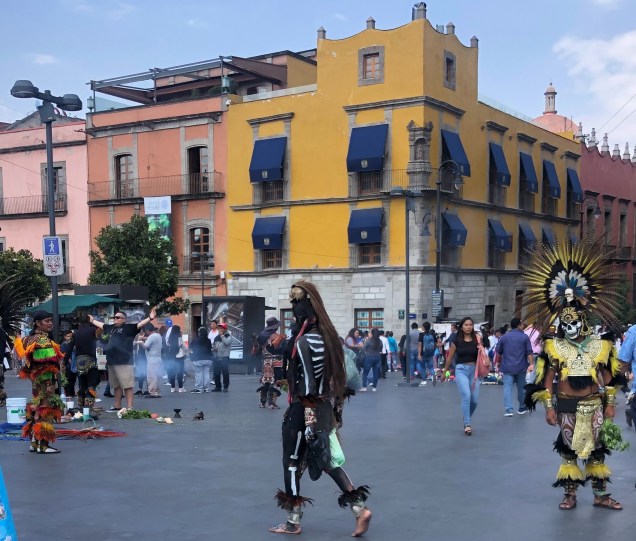 Mexico City impressed me when I first went there, around the end of 1978. It was the first non-European capital I’d ever visited, and it felt exotic. It was the Third World, as we called developing nations back then. On our taxi ride from the airport to our Zona Rosa hotel, I remember eyeing shanties; smelling burning garbage. That visit also exposed me to world-class marvels: the pyramids of Teotihuacan, the city’s huge central plaza, its marvelous anthropology museum, Chapultepec Park. We hung out mostly in the chic neighborhoods, and I recall concluding that the city seemed a wild mixture of Paris and Tijuana.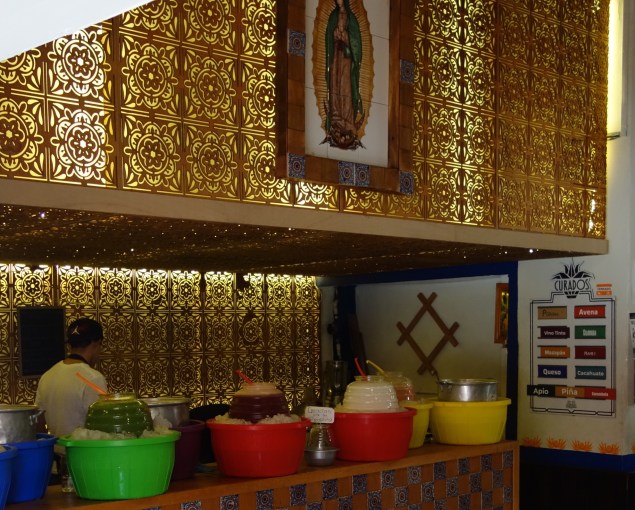

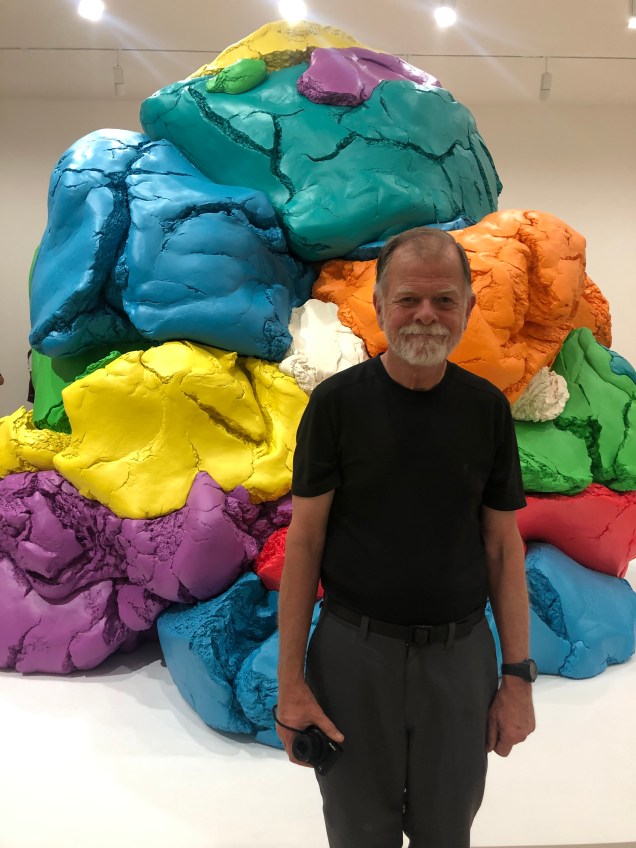 Koons’ gigantic Play-doh pile (made of interlocking aluminum pieces rather than actual Play-doh) amazed me with its beauty and complex craftsmanship.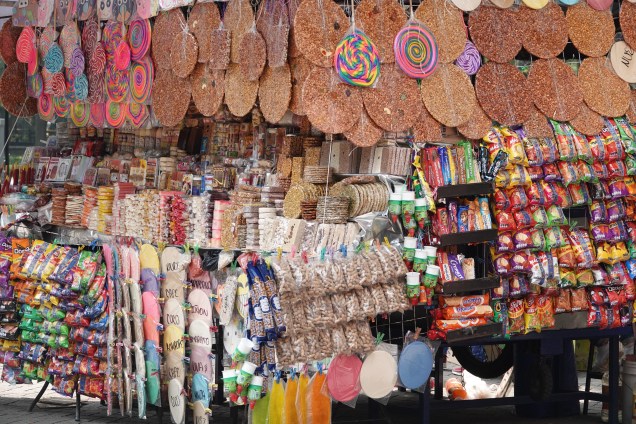
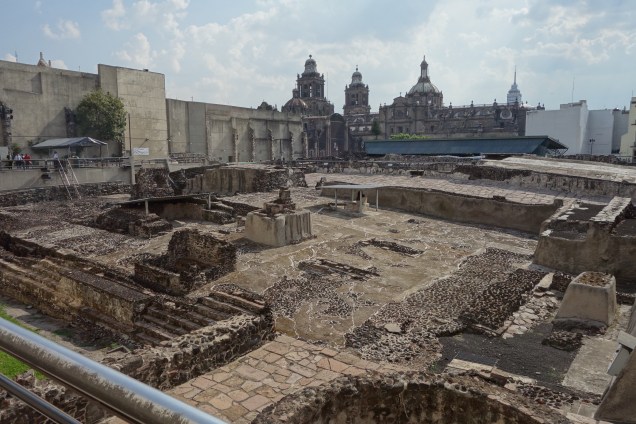 The biggest outer pyramid, which honored the war god Huitzilopochtli and the rain god Tlaloc, is gone. But you can clearly see the remains of what it once sheltered: about a dozen levels of construction dating from 1375 to 1519. You can stare at the double staircase where the bodies of human sacrificial victims were thrown down the steps after their hearts were ripped out. An impressive museum fills in a lot of the details, gory and otherwise. The power and scale of what once filled this space are unmistakable. It made me happy to see two of the main cultures that shaped this country co-existing more equitably.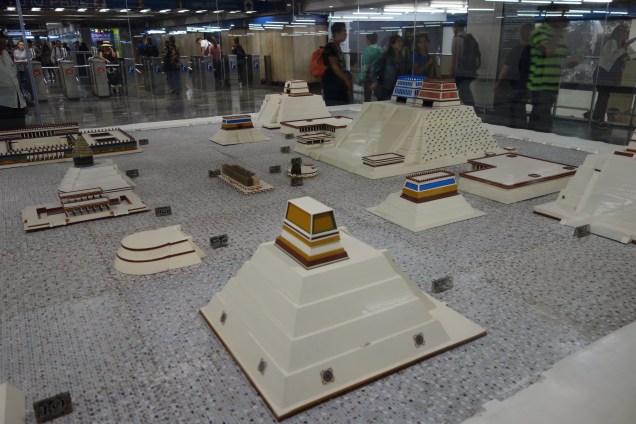
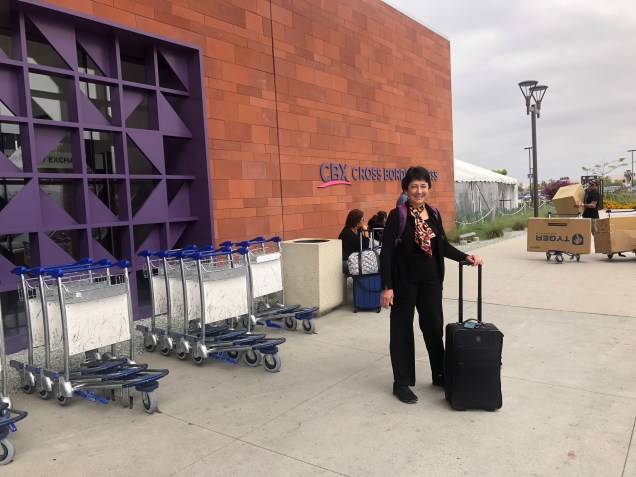 It took us just minutes to buy our one-way tickets ($20 per person) to walk across the bridge and obtain our Mexican visas (from a high-tech kiosk). We scanned the bridge ticket and our boarding pass at a gate that opened for us automatically. Then we strolled over and above that pesky border between the two countries. The passage couldn’t have taken even five minutes.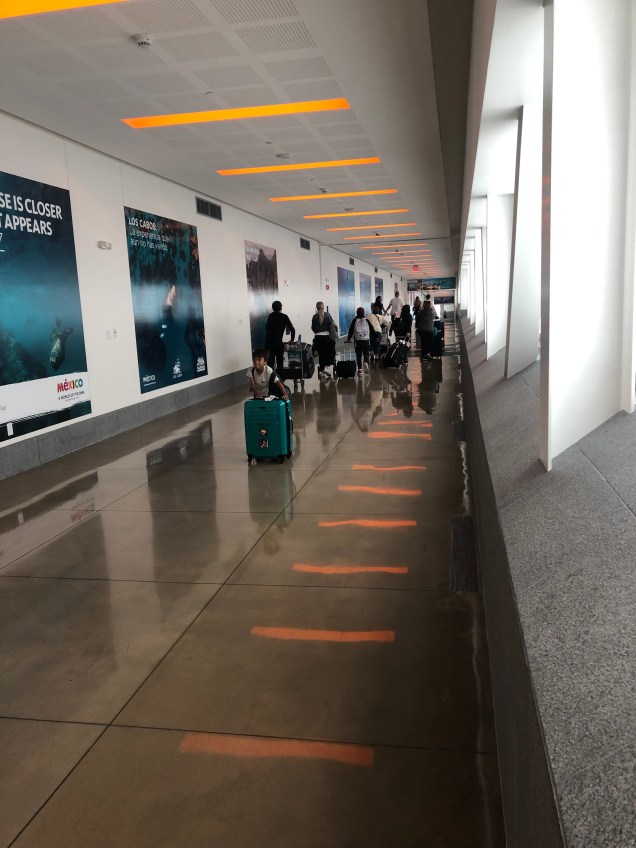

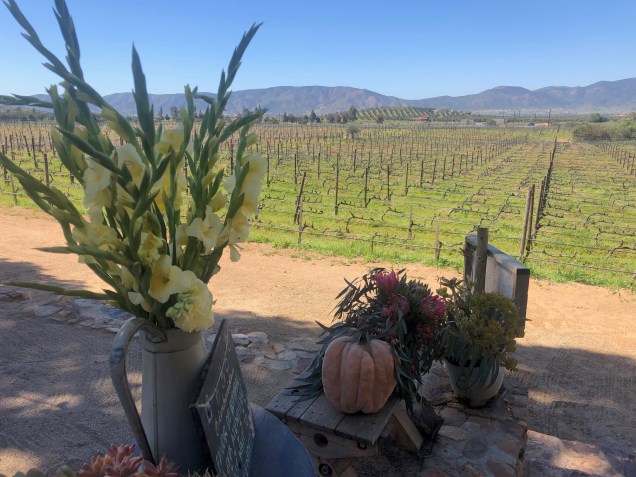 I still remember my first glimpse of the Guadalupe Valley in Baja California, years before it became well known as the Napa Valley of Mexico. I had turned off the coast highway about a mile and a half south of the last tollway, about 20 miles north of Ensenada. I’d driven east on Highway 3, past the city’s shanty outskirts and then past homey looking ranchos. After a while, the road climbed and cut through a dramatic rocky pass. The vista on the other side took my breath away; it opened to a pastoral paradise.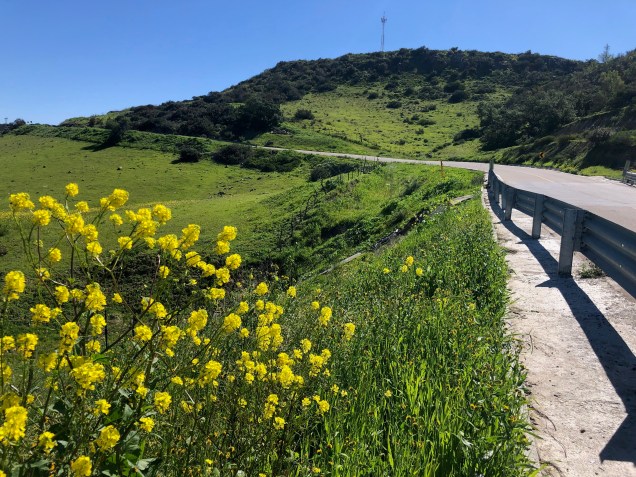
 Getting around: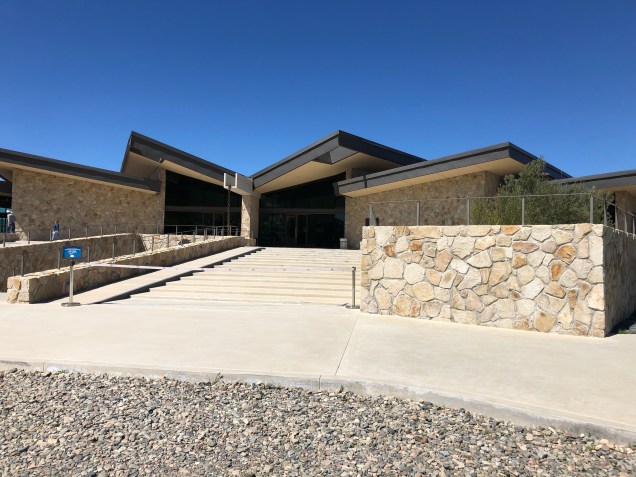
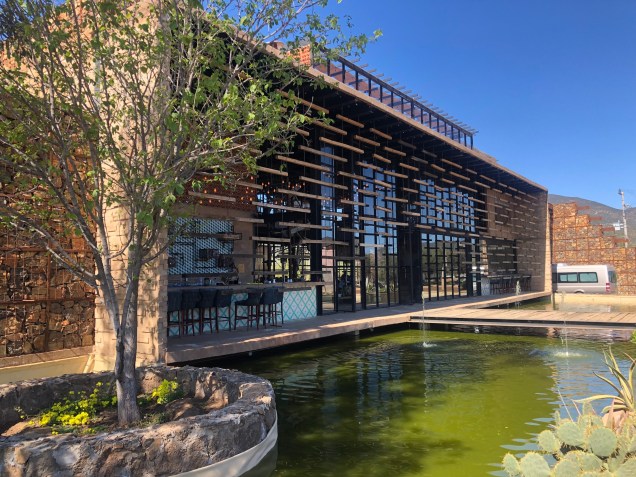

 Our final lunch was at Deckman’s, perhaps my favorite of all.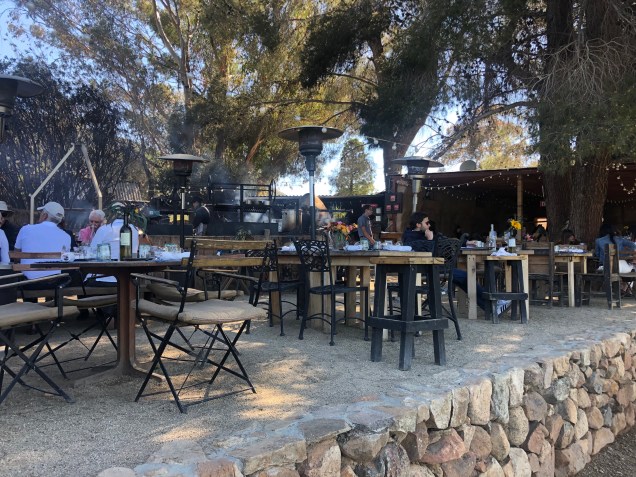
 I’ve long been curious about Burning Man, the anarchic arts festival that has taken place for decades during the week before Labor Day in the harsh northern Nevada desert. At one point, Steve and I thought maybe the time was right for us to check it out. This was about 5 years after our older son moved to Reno (located about 100 miles southwest of the event). Alas by then its popularity had exploded. In 2010 more than 50,000 people attended Burning Man; in 2011 for the first time ever, tickets sold out about a month before the festivities started. In an attempt to curb the madness, the organizers created a complicated ticket lottery for the 2012 festival — the very year we targeted to attend. To our chagrin, we could only secure one ticket, so we gave up and resold it.
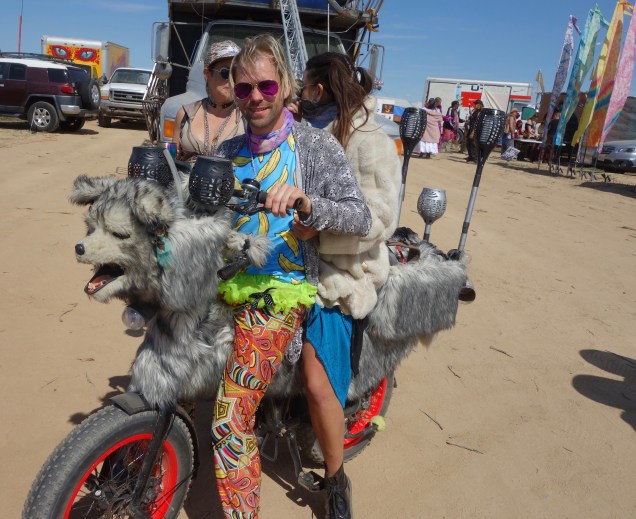

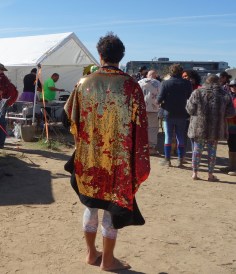 tutus, neon fur shin warmers, glitter, tie-dye, and onesies are the norm. Dressed in our jeans and t-shirts, Steve and I stuck out. That seemed okay too; no one appeared judgmental. But it was strange to feel a bit freakish by not dressing freakishly.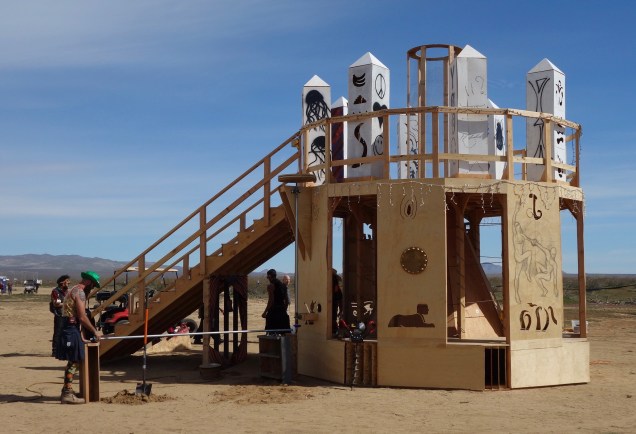
 On December 20, five days after Steve and I returned from our nine-week Asian adventure, the New York Times published an article by its Frugal Traveler entitled “
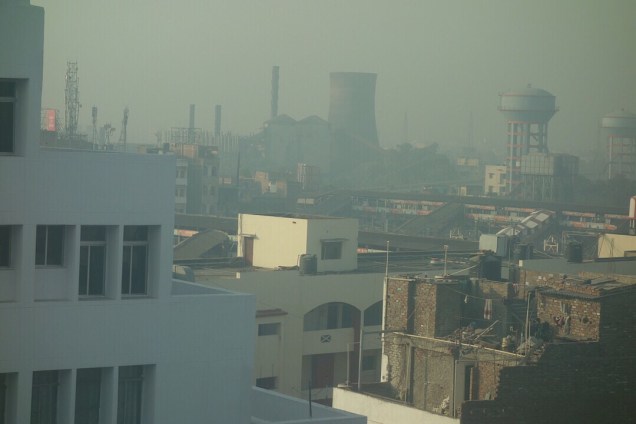 The Pollution — I knew the air in India might be bad, but I was unprepared for the depths of its wretchedness. In the course of our trip, I discovered that the weather app on my iPhone includes an “air quality index.” Since we’ve gotten back, I’ve been checking it and have learned that San Diego’s air typically falls in the 20-50 range (“Good”), occasionally dipping up to moderate pollution levels. When we arrived in Bengal, however, the index number was about 150 (“Unhealthy for sensitive groups”), and it got worse city by city after that, through “Unhealthy” then “Very Unhealthy” then “Hazardous” (in the 300-500 range). By the time we hit Jaipur in Rajasthan, it was over 500, literally off the chart. (“Don’t Even Think about What This is Doing to Your Lungs!!!”) I started coughing maybe a week after our arrival October 15 and still haven’t totally stopped (though I feel 99% better).
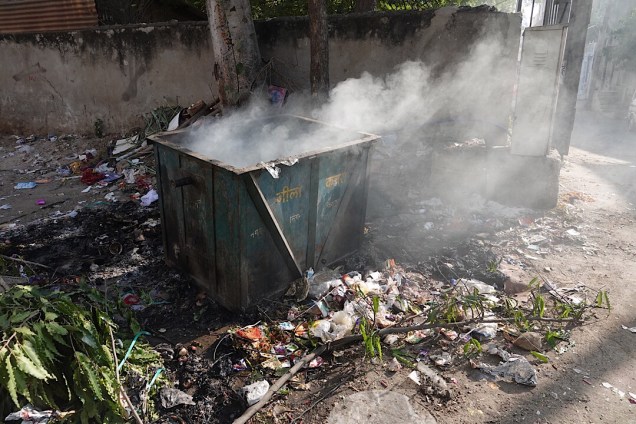 Beyond the physical ill effects, the environmental despoliation was depressing. The air was foul not just here and there but every single place throughout the north and at least down to Mumbai (Bombay). Kerala in the far south was slightly better, though hardly pristine. Seen through clean air, much of the Indian landscape would be beautiful. Its absence is heartbreaking.



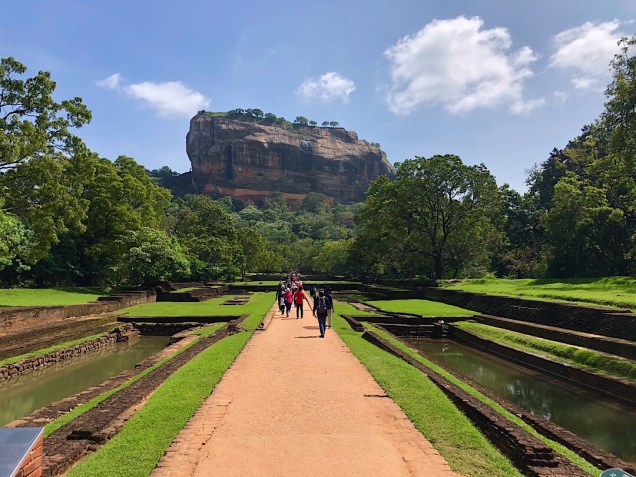 A monumental rock formation rises almost straight up from the heart of Sri Lanka. It’s known as Lion Rock — Sigiriya. Archeologists think humans have been living on and around it for more than 10,000 years, and many believe that in the late 400s (AD), a king named Kasyapa built a garden and palace at the summit after overthrowing and murdering his father. No buildings remain, but the ruins and fortifications are mind-boggling, considering the height and verticality of the site.
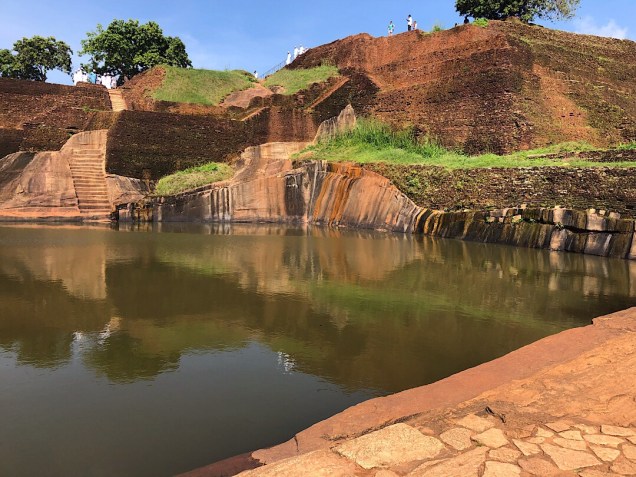 One small area on top of the formation. How DID the workers get all those bricks up the sheer walls?
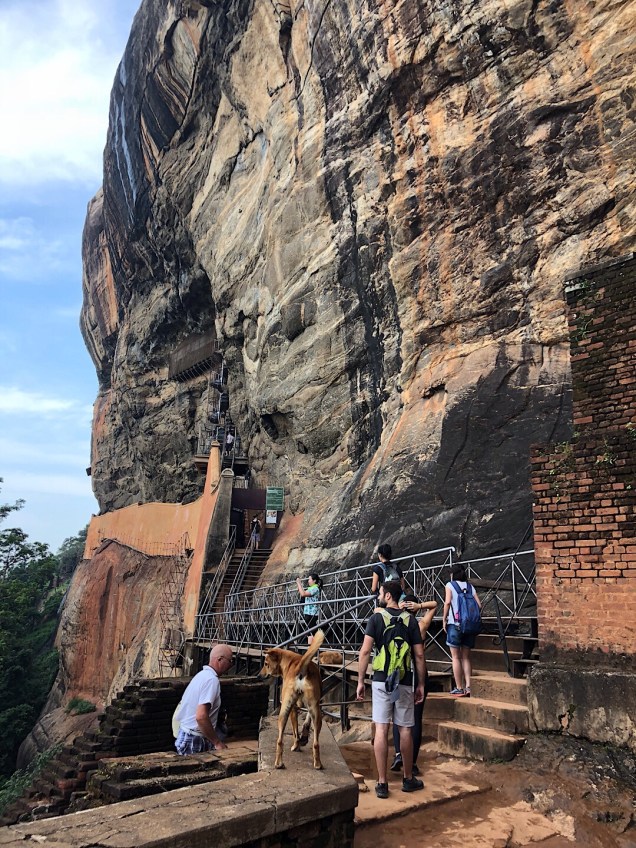 We entered the grounds shortly after 7:30 am, when the day was still cool, and the hordes of Chinese tourists had not yet arrived. About halfway up, we shook our heads in wonder at the frescoes painted in one long gallery in the sheer rock face. A parade of women with Barbie bodies — tiny waists and beautiful naked breasts — decorate the wall. (Scholars suppose them to be either heavenly nymphs or a depiction of Kasyapa’s concubines.) A little further on, we passed graffiti dating back to the 6th to 14th centuries. Awestruck visitors scratched the comments, mostly noting how hot the ladies were.
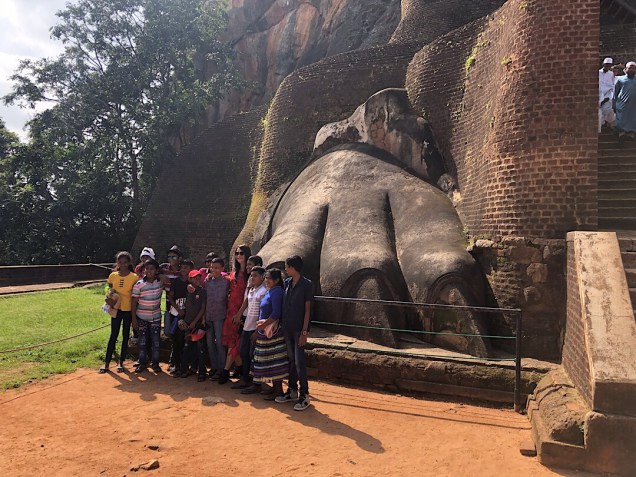 Guards stopped us from taking any pictures of the frescoes, but the lion’s paws carved into a plateau near the top are a popular photo op.
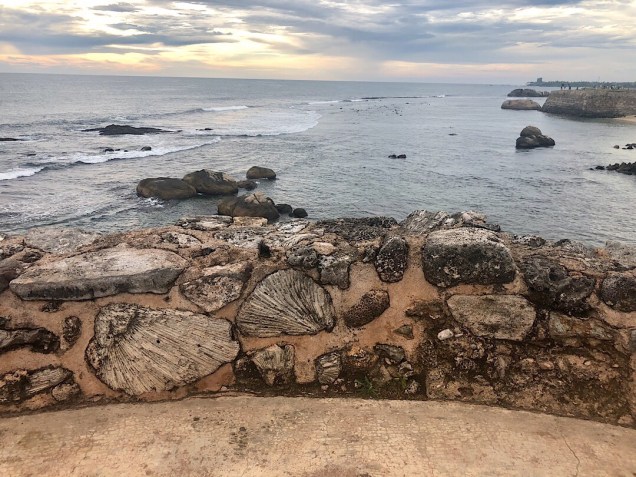 One of the views from Galle Fort.
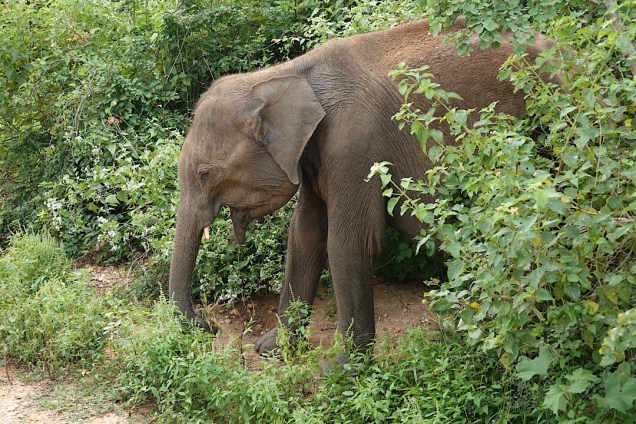
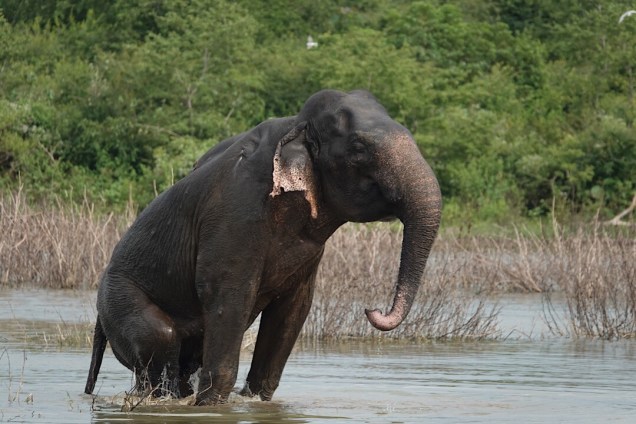
 Next we traveled to the cool, misty highlands; spent a morning hiking and loving the green-drenched vistas at every turn.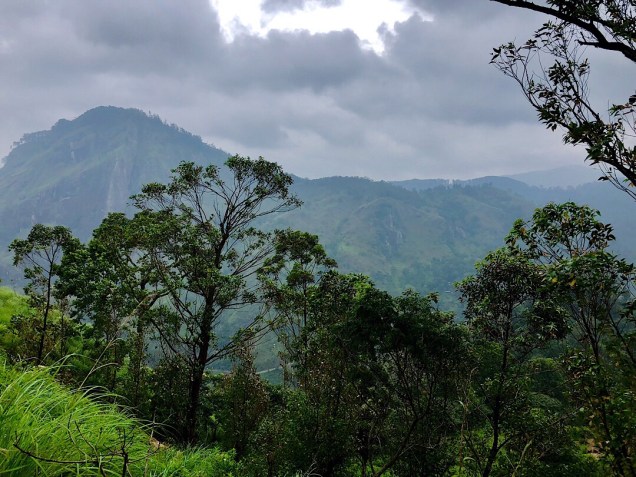
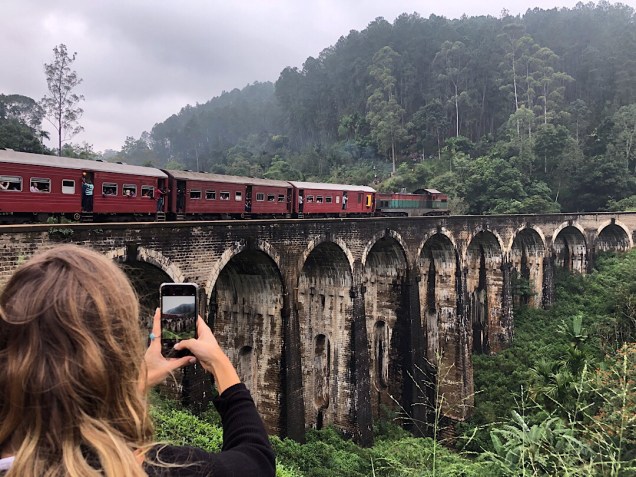 Old trains that run over single tracks built by the British colonialists in the early 1800s are a part of the tea-country landscape.
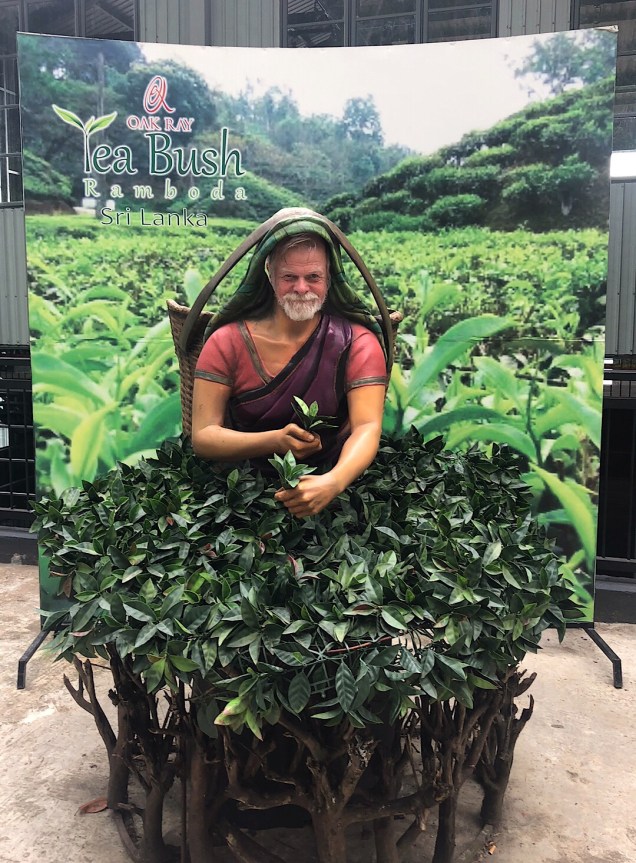 …where Steve proved remarkably adept at picking tea leaves…
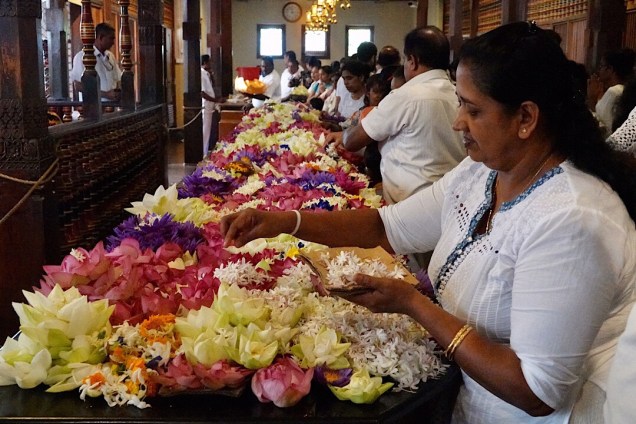 It’s never shown to the public, but the ardor of the pilgrims is evident.
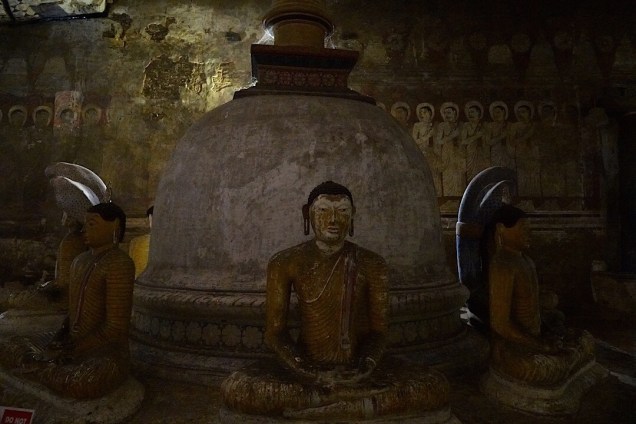 …the Royal Rock Temple complex in Dambulla, filled with about 150 statues of the Buddha that followers began creating about 2000 years ago.
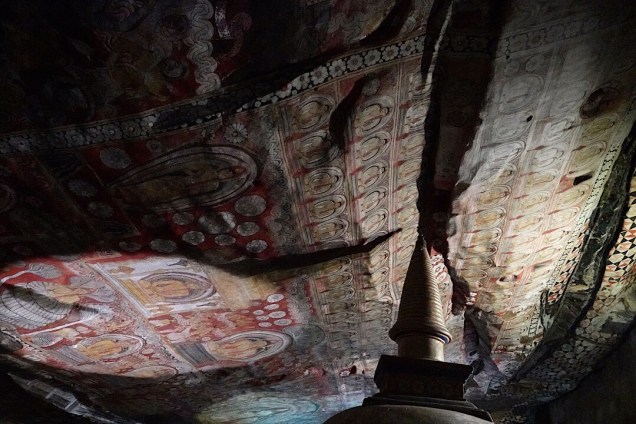 Painted designs and images make it look like the cave ceilings are covered with exquisite Oriental rugs.
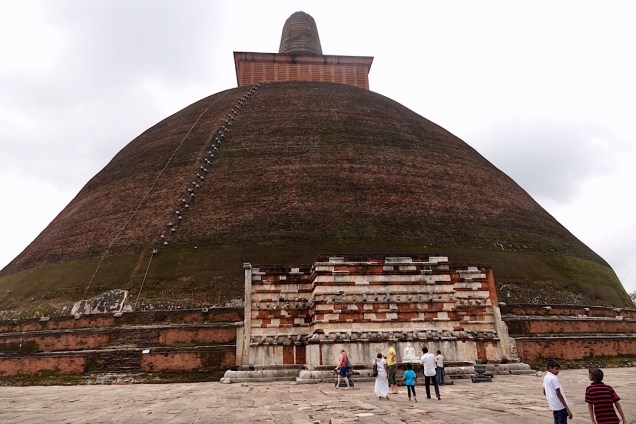 This one was made from more than 90 million bricks and stood at the center of a monastery complex that once housed 3000 monks.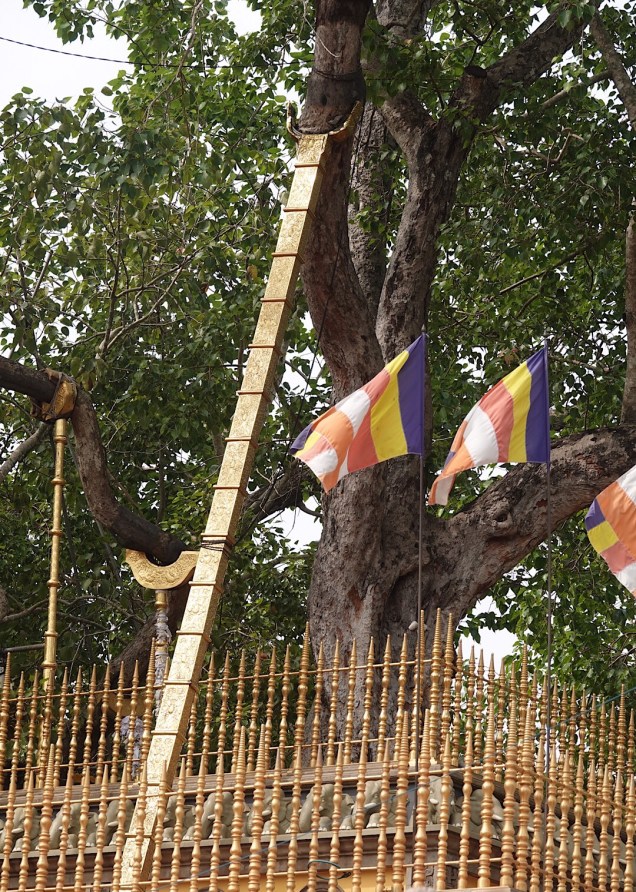
 For most of his life, Omar’s been a driver — of cars and trucks and tuk-tuks — but he also has worked for a number of NGOs, including a journalism team that did some fine reporting toward the end of Sri Lanka’s bloody civil war. Belying his sweet, even humble, demeanor, he seemed resourceful and astute to us. He didn’t hide his voracious appetite for breaking news. We talked a lot about the political uproar that’s been roiling Sri Lanka since late October, when the current president shocked everyone by firing the prime minister and replacing him with the strong man who ended the war (in 2009) but at the cost of abysmal human-rights abuses.
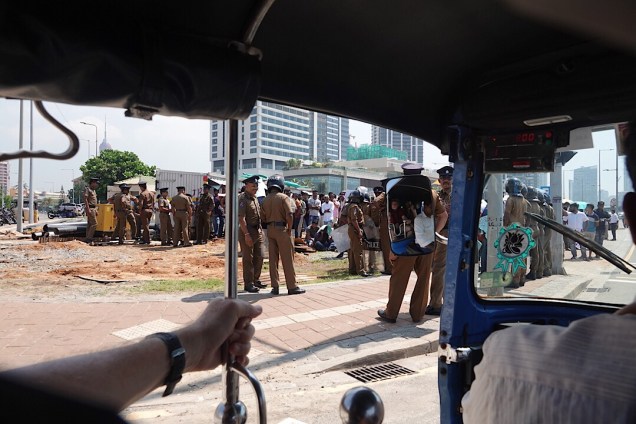 We saw this demonstration near the Parliament building in Colombo. Omar sounded optimistic; he said he thought the fracas would turn out to be just a rat’s nest of political scheming and ego, rather than a tinder pile that could explode into a conflict in which a lot of people would die. He knows a lot more about Sri Lanka than me; I hope he’s right. The country is packed with more beautiful and interesting areas than other places many times its size. But when thuggish narcissists play games, they can cause a lot of pain for the common folk.
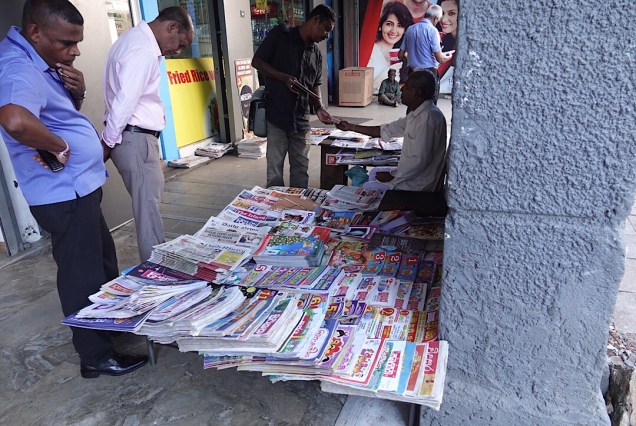 Newspapers still appear to be thriving, and people were scanning them anxiously.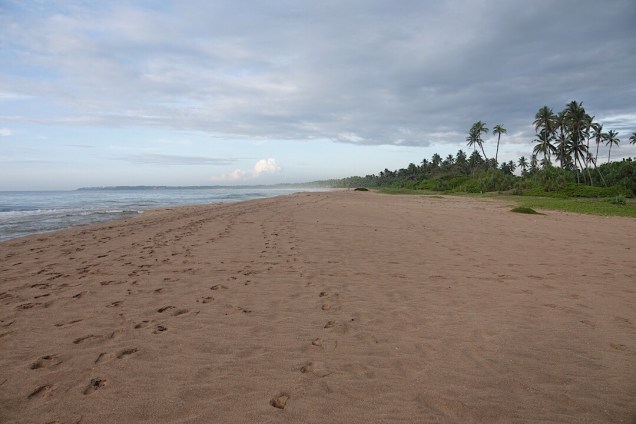
 …but we spotted a few fishing boats on the water…
 …and then some guys in the distance, pulling a rope.
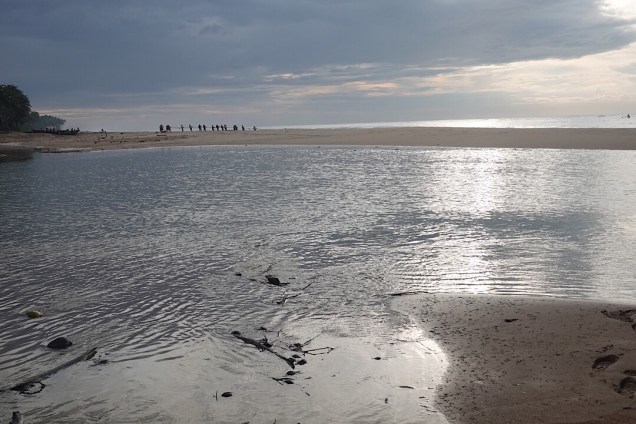 The channel was too deep for us to wade across, but we found more men pulling hard on another line when we walked back in the direction of our hotel.
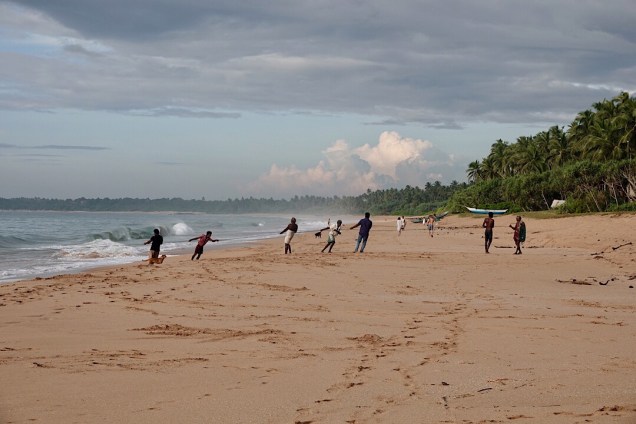 The work looked strenuous, but sociable.
 Nothing happened suddenly, but eventually the net attached to the rope emerged from the water.
 The men were careful in its management.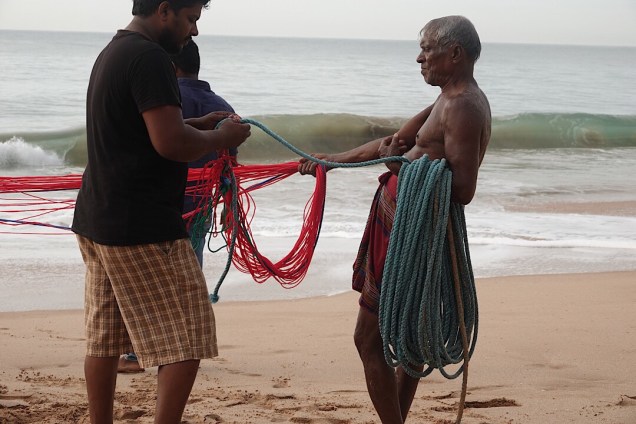
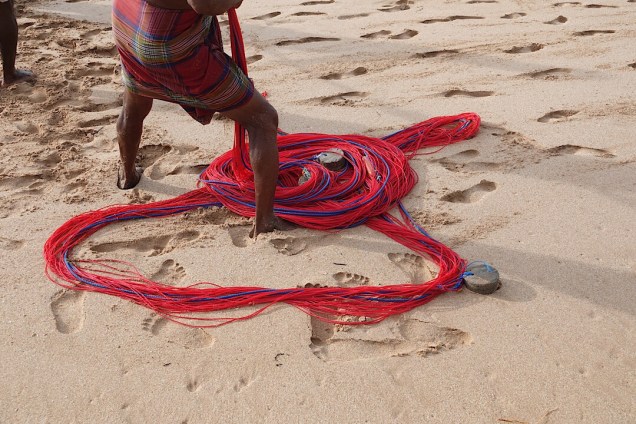 Eventurally the distant boat that had been somehow positioning the net approached the shore.
 It’s occupants first rowed, then lugged it onto the beach…
 Then they began to pull on another line that had been staked to a pole in the sand.
 As the net drew closer and the surf increased, the work could be rough.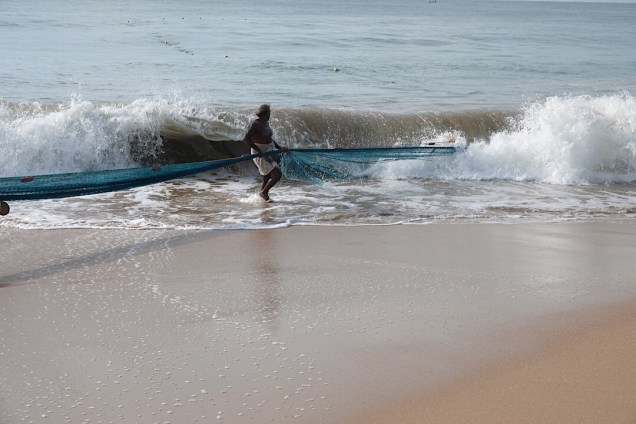
 But the two wings of the team edged ever closer to each other.
 In the final stages, a host of birds swirled ahead. I felt nervous. What if, after all this work, the net was empty?
 No worries. As the haul emerged, there was bounty in the strands.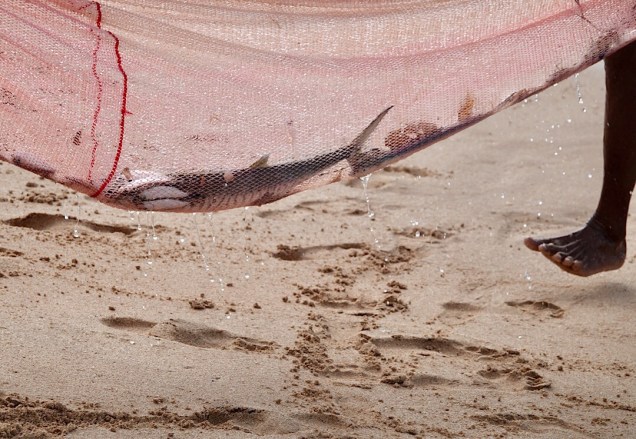
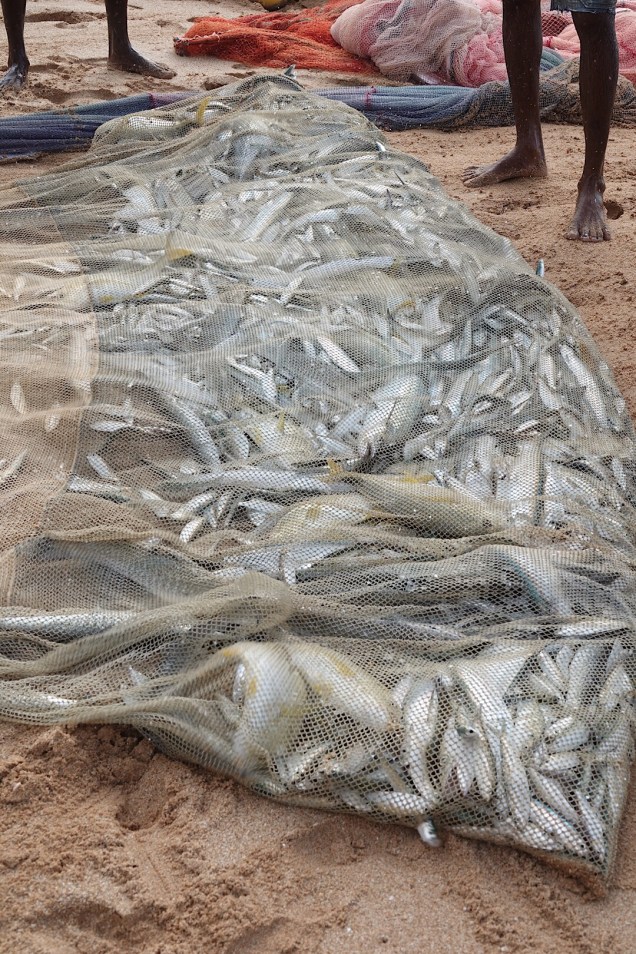 The air was filled with the frantic flipping of dying fish.
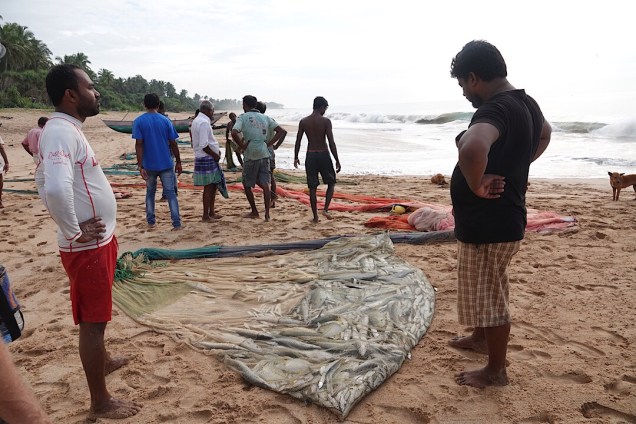 One of the fishermen told us it wasn’t a fantastic catch, but much better than it had been for the past few days.
 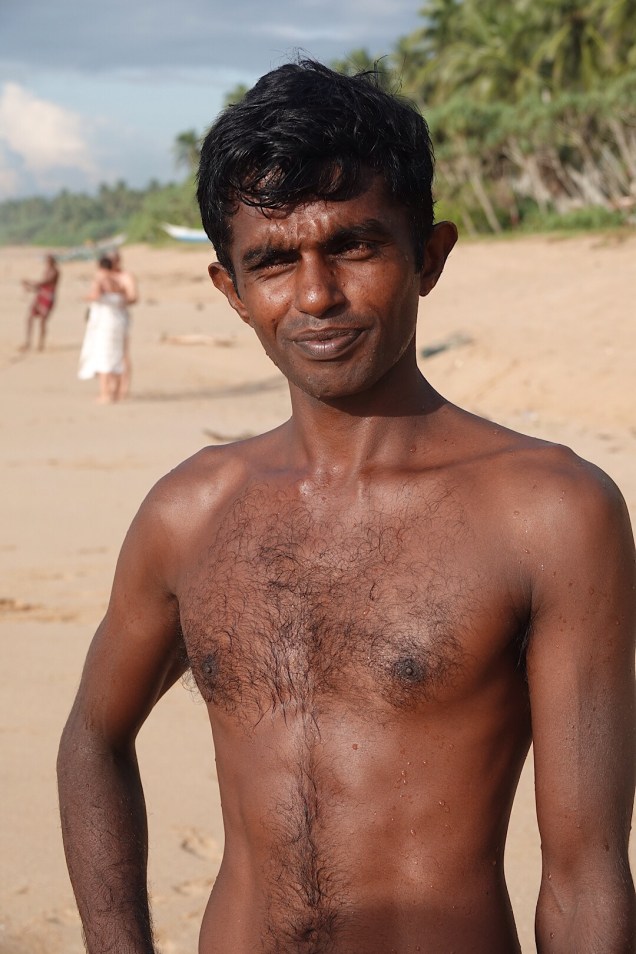 This guy asked if we wanted to go on an evening tour of the lagoon, but we had to decline. We had other fish to fry (metaphorically). I’m posting this now from the misty highland tea country. It’s a little hard to believe we’re in the same country.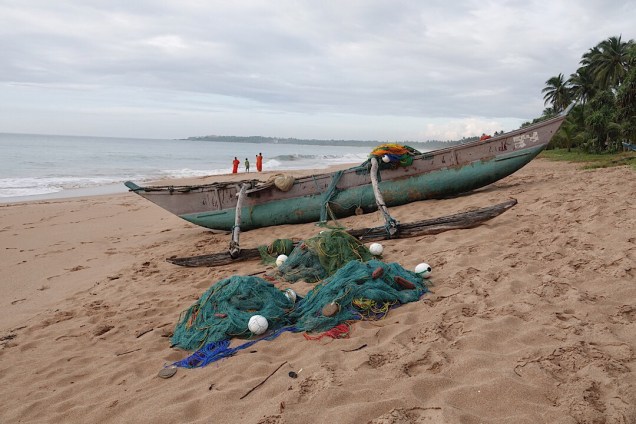
 At home and abroad