I heard this morning from my friend Jenny that the tasty Rwandan coffee is still available at Costco, at least the one on Morena Boulevard in San Diego. Check it out!
Month: June 2013
 Posted with Blogsy
Travel serendipity
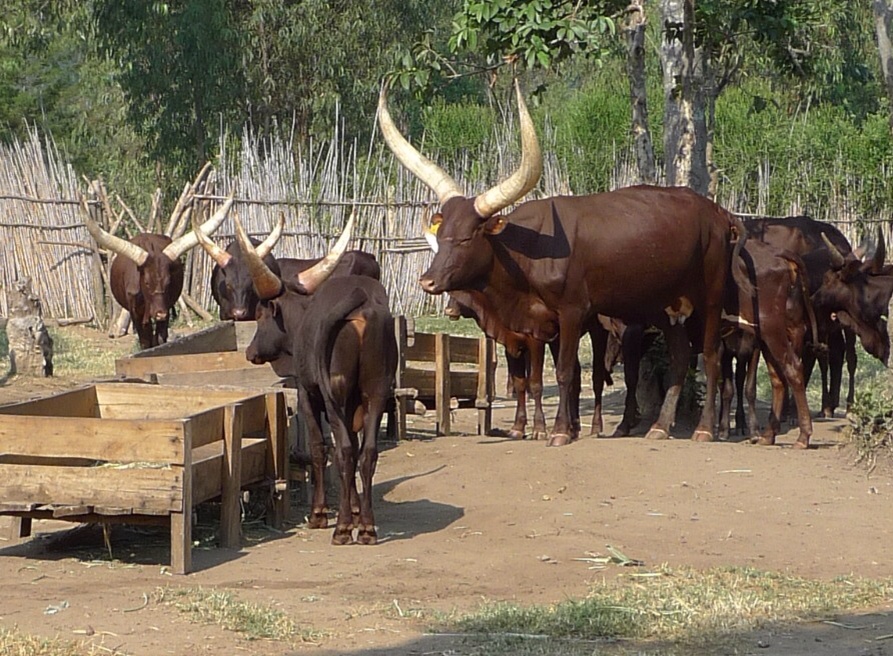
The driver showed up on time yesterday to transport us from Nyungwe to Rwanda’s capital, Kigali. The national museum in Huye, which we visited en route, was well done, and our stop at the palace of the former Rwandan kings was interesting. (I particularly loved the ceremonial cattle, whose enormous horns would give a Texas longhorn horn envy!)
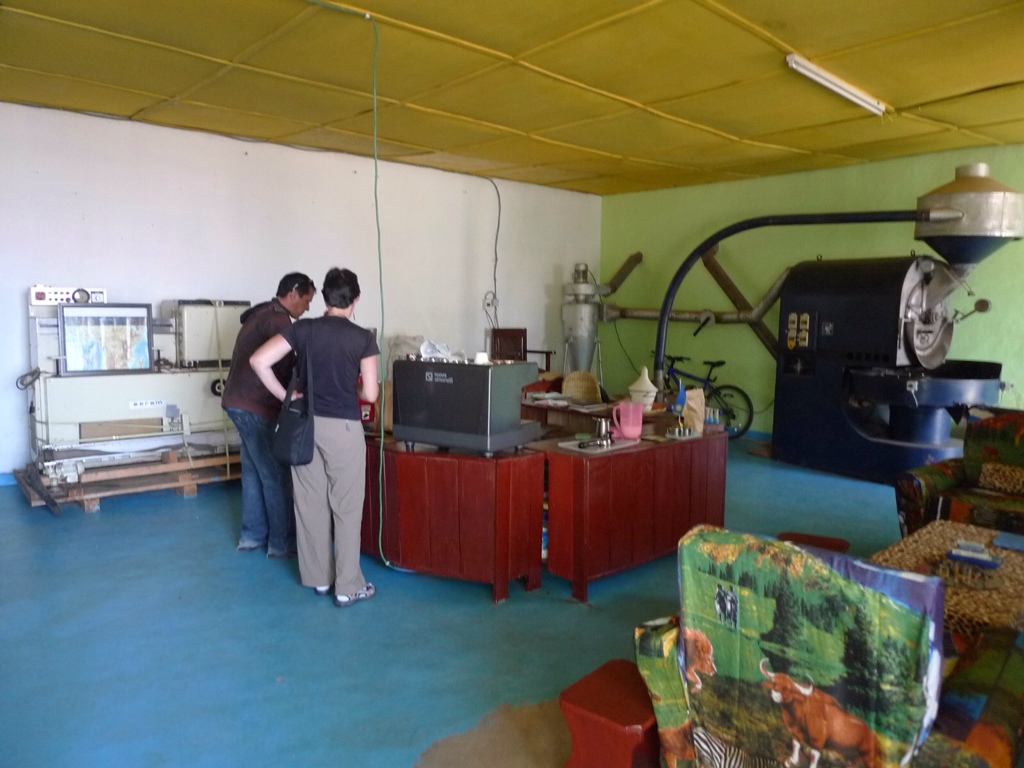
For my money, though, our coolest experience yesterday came when we stopped at the Cafe Connexion in Huye. We’d heard about it during our hike in the forest Sunday. Our three hiking companions were expats in their early 30s, living and working in Kigali (an American woman architect, a British gal working for an NGO, and an American guy who was an ER doc working part-time for Paul Farmer’s Partners in Health.) The Brit was particularly chatty, and she said Cafe Connexion was serving the best coffee in all of Rwanda. She urged us to make the short detour.
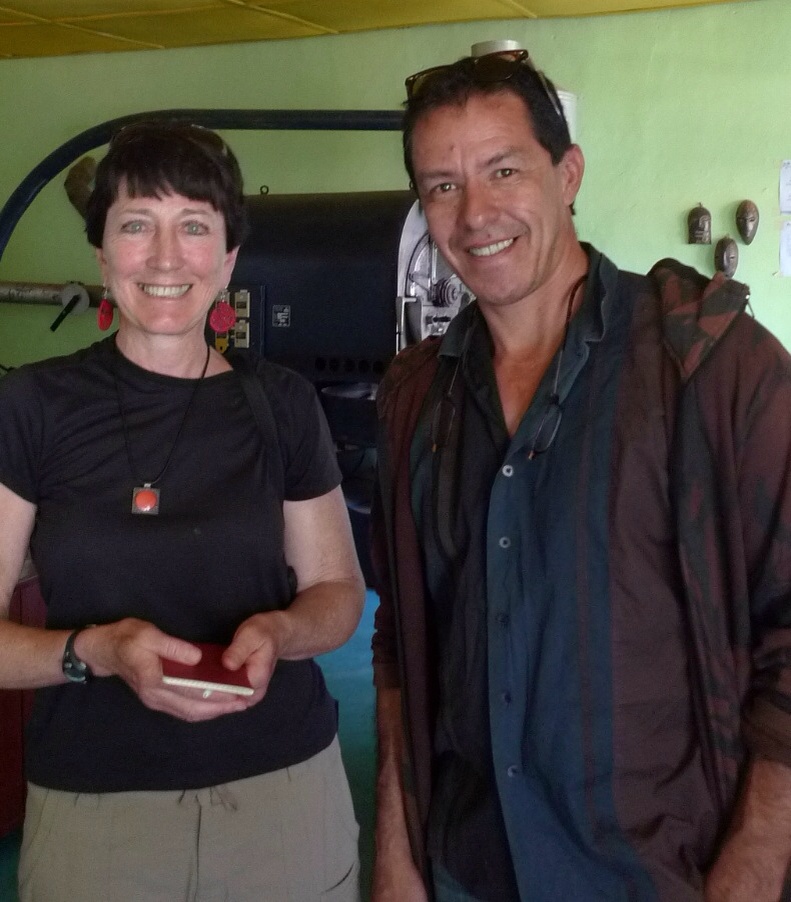
That worked well, as we finished visiting the museum around 12:30 and quickly ate the picnic lunches the lodge had packed for us. While we were in the museum, our driver had figured out the cafe’s location (across the street from the university, biggest in the country, serving 24,000 students.) We walked in and were greeted by a tall, energetic man who looked to be in his 40s. Speaking perfect English with an unmistakable Latin-American accent, he told us the proprietor had stepped away, but he could serve us. He talked non-stop as he whipped up our cappucinos, blowing us away with his story and his enthusiasm.
Born in Panama, Mario had grown up on a coffee farm, then he’d gone to school in Hawaii, near Kona. Somehow, he’s wound up teaching biological pest-control methods to agronomy students at the Rwanda’s national university. But his main job was working for a small family coffee-roasting business based near Sacramento, and he was on a mission: to turn Rwanda into a true coffee culture.
Coffee is already Rwanda’s biggest cash crop, and the country’s coffee farmers already have achieved some fame. They all grow a variety known as Bourbon (which Mario says originated on the island of La Reunion in the Indian Sea). Maraba Bourbon coffee, grown near Huye, has won international recognition for its flavor. But it was grown with pesticides and inadequate knowledge about the cultivation requirements, according to Mario. In his travels, he had found an organic coffee plantation near Lake Kivu (S and I grew excited when we realized we had walked and biked past those very trees while staying in Rubona and biking with Tom.) It was this organic Kigufi coffee that’s available at the coffee house — and very delicious, I can attest. Moreover, Mario was buying the whole crop, shipping it to California for roasting, and selling it all to Costco. This was great for the Lake Kivu coffee farmers, whose income had climbed from $300 to $1000 a year on average since Mario began buying from and advising them. But Mario wanted to spread a taste and appreciation for coffee within Rwanda, where the vast majority of people have nothing to do with it. (They drink tea with milk in it.) Hence the cafe, which opened one year ago. A couple of college students had been trained as barristas, and the prices were rock-bottom. (We paid about 85 cents for each of our excellent cappucinos.)
There were signs the plan was working. That very morning, at least 50 people had shown up, astonishing Mario. If I ever return to Rwanda, I expect to see a lot more coffee-drinking. And in the meantime, I’m going to be on high alert next February, when Mario says the Kirkland “Rwandan” begins showing up in Costcos. (It’s typically there through April or May, he says.)
Nyungwe, the enchanted bubble
For most of our trip so far, we’ve been staying in modest to budget places. The wonderful Airport Guesthouse in Entebbe, for example, was $60 a night (breakfast included). The lodge by the river near the tree-sleeping lions was $40. But here in the Nyungwe Forest, we’ve splurged. This place is widely considered to be the best in all Rwanda. Now that we’ve experienced it, we can’t imagine that’s not true.
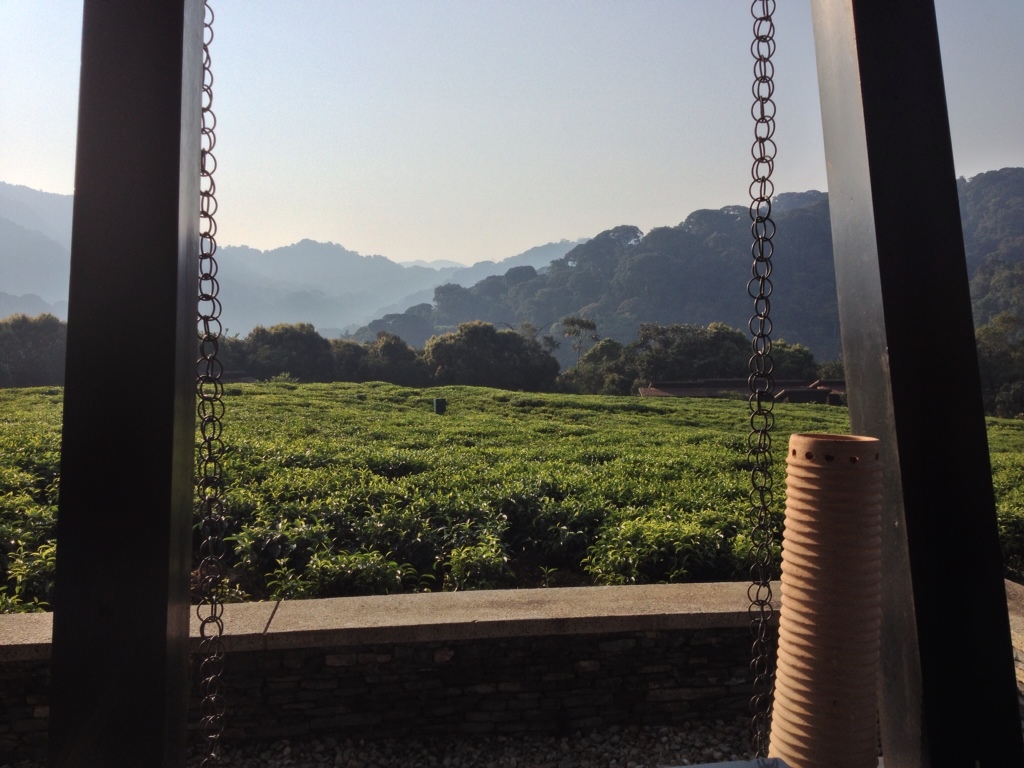
The setting is stupendous: within a sprawling tea plantation that nestles up to the edge of the largest intact montane forest in Central and East Africa. The forest is one of the wettest places on this continent, and depending on which side of the mountains it falls, rain drains either to the Lake Tanganyika (and, at least theoretically, to the Congo River) or to the Nile. In this lushly primordial paradise, biologists have counted more than 300 species of birds, 13 species of primates, and more than 1300 species of trees and plants (including 140 types of orchids). Mountain elephants once foraged here too, but a poacher killed the last one 15 years ago.
This morning we hiked with a park ranger for four hours down to the spectacular Kamiranzovu waterfalls. Gilbert shook his head in wonder, reflecting on how much people’s attitudes have changed since that last elephant died. A healthy chunk of the park fees have been directed to the locals in this area, and they’ve really come to understand the connection, he says. Now, no one poaches in the park, or if the occasional scofflaw tries, people report him.
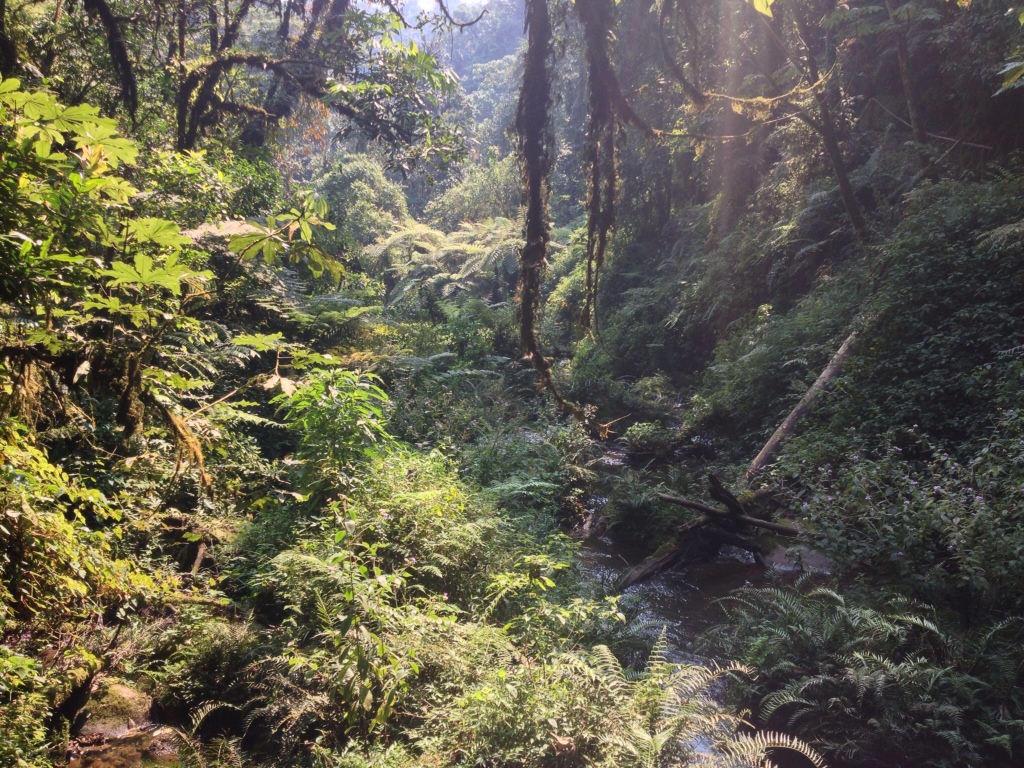
After the hike, Steve and I were the ones marveling — at how distinctive each of the three equatorial rainforests we’ve experienced has been. Like Bwindi, Nyungwe survived the Ice Age. Never logged, never burned, it’s virginal, uncorrupted. But unlike dense, jungly Bwindi, the forest we experienced this morning was cool (we were hiking between 5500 and 6000 feet) and ancient. Scenes from Jurassic Park kept bombarding me. It smelled wonderful — fresh and fecund. Everywhere we looked, things were growing on other things: moss and vines and aerial roots clinging on trees rootedon hillsides choked with a universe of plant life.
It was slightly surreal to emerge from that tangled wilderness back into the oh-so-civilized tea plantation. The managers cut all the tea plants to a uniform low height (maybe 3 feet tall) so that the much-prized fresh shoots can be easily harvested from the narrow paths that are almost hidden within the profusion of leaves. Those young leaves are lime green, so intense at times they glow like neon. Views from the lodge drink it all in: the tea plants and colossal forest beyond.
And, stepping into the lodge, you enter another universe: one where the profusion of soft lights never go out, where the water in the showers is hot and abundant, where the flat screen TVs come with Samsung remotes, and the staff provides pampering in the extreme. Here, fresh from the memory of those villages we biked through with Tom, I feel for the first time in my life, like a member of the 1%.
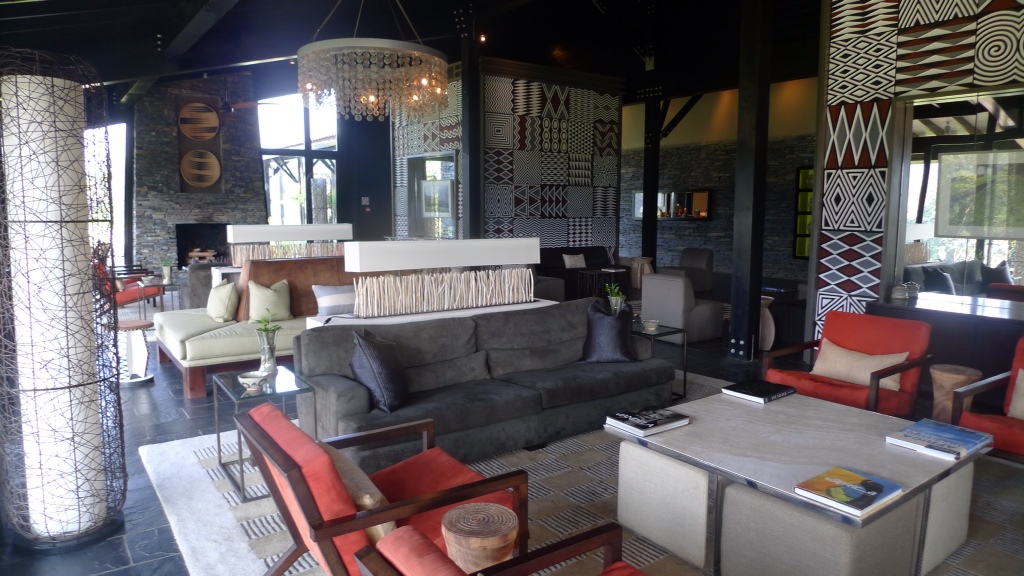
I’m not completely comfortable with that. I love being in Africa, but Africa also has these tiny privileged enclaves where you can feel richer than you feel anywhere in America. It’s a bit mind-boggling.
To be honest, it’s been deliciously pleasant. It ends tomorrow morning. We’ve hired a taxi to drive us to Rwanda’s capital, stopping for two major Cultural Experiences en route. Then we’ll have a day and a half of urban adventures (esconced once again in more humble accommodations), before flying off to Kilimanjaro Airport and our safari on the African savannah.
By boat down Lake Kivu
Because Steve loves boats so much, he wanted to write about our trip down Lake Kivu yesterday (Saturday). Here’s his report:
We had read that the road down the Eastern shore of Lake Kivu is so bad it takes two days to drive from Gisenyi to Nyungwe national park. So we’d arranged with Tom Tofield’s Rwandan Adventures to take a boat most of the distance, enabling us to get there in six hours.
Lake Kivu has given me the creeps ever since I read in the National Geographic that it contains a vast amount of dissolved methane and CO2. These greenhouse gasses are held at the bottom of the lake by the pressure of the water above. Because no seasonal thermal mixing occurs, as it does in most lakes, the gasses have not escaped. As organic matter enters the lake, it decomposes, adding to the layer of methane and CO2. At some point, scientists believe that the pressure of the dissolved gasses will exceed the pressure of the water on top of them, and the gasses will rush out the way bubbles rush out of a beer or Coke bottle that has been shaken before opening.
Because CO2 is heavier than air, it would remain near the ground, suffocating anyone near the lake shore. This sort of thing has happened before in smaller lakes, killing several thousands. But with well over a million people living in Gisenyi and neighboring Goma across the Congo border, the death toll from a gas release at Lake Kivu could number hundreds of thousands.
It turns out my fears were overblown. Tom’s wife, Natasha, has earned a doctorate studying the lake and says a gas release might not occur for 100 years. Moreover, efforts are underway to release gas from the lake artificially using new technology similar to that used to separate natural gas from oil. From the shore near our hotel, we could see a prototype production platform that’s recovering methane from the lake and sending it to the shore to fire electric generators. In the future, the natural gas may be bottled to use as cooking fuel, saving more trees from being turned into charcoal.

On Saturday morning, Tom’s boat man, Suleiman and his crew man, Jean Claude, showed up at 8:30 am. We departed at 9:10. Suleiman’s family’s boat is a double-ended skiff about 30 feet long fashioned from wooden planks about one inch thick and eight inches wide. These are caulked with local fibers and some sort of tar, much the way Christopher Columbus’s ships were. Equipped with a late model 35-horsepower Honda outboard motor bolted to a well in the stern, the boat has a sun shade fashioned from tents scavenged from the UN High Commissioner for Refugees. Some fake leather seats completed our creature comforts.
As we set off down the lake, the wind was out of the south and the boat pounded in the light chop. Later, as the wind shifted west, the spray came over the starboard gunnel, causing us to break out our raincoats and cover our cameras.
We saw larger wooden boats of similar design, each carrying several dozens of passengers. Because the roads are so bad, the lake is a cheap and convenient mode of transport for local people. Yet even so, boat traffic was light. Most of the boats on the lake are paddle-powered fishing craft that depart at dusk and return at dawn. Despite the breeze, we didn’t see one sailboat.
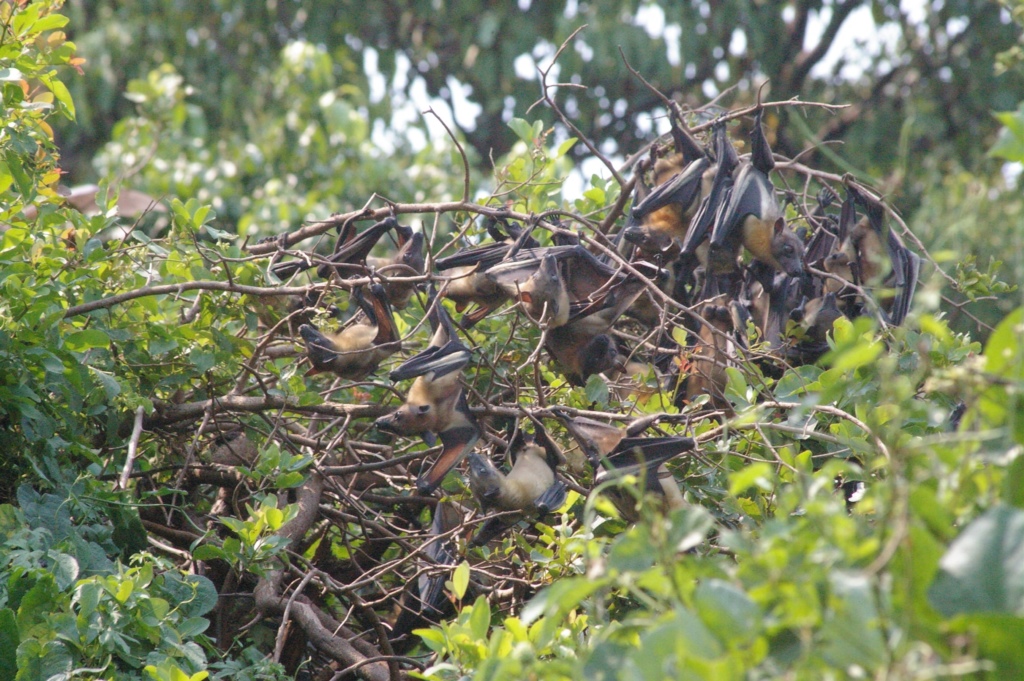
On our way south we stopped at a small, uninhabited island off the coast of Kibuye, a medium-sized town that marks the half-way point down the lake. Our mission was to view a colony of fruit bats that live only in this spot. Suleiman nosed the boat into a clear spot on the shore, and Jean Claude led us up a steep narrow path through thick low forest to see the bats. Unlike most insect-eating bats, these creatures are diurnal, and our approach startled them from their inverted perches in the trees. They circled overhead like flocks of crows or seagulls, their high-pitched barks sounding more like foxes than birds. The bats made an amazing sight, in their own way as unique and unusual as the chimps and gorillas, but completely unexpected.
After half an hour, we re-boarded the boat and continued south. The wind died and the waves shrank to tiny ripples. We took off our rain gear and had a lunch of beignets, cheese, and bananas that we shared with our boat men. We covered the rest of the distance to the tiny town of Nyamasheke on a small bay off the lake. There we were met by the driver of a Toyota RAV4 SUV who drive us to the Nyungwe Forest Lodge. We arrived by 3:15 pm, in time to enjoy the incredible views of the forest before sunset.
Rwanda through the back door
One of our only bad moments of this trip so far came at the little Cyanika border crossing station, after the guy who drove us there from the Traveler’s Rest had dropped us off. Steve and I got ourselves stamped out of Uganda and into Rwanda without a hitch. We opened our suitcases for the dim-witted looking Rwandan customs guy, and he did little more than grunt. We lugged them out into the road, looked around, and saw… Nothing. No driver holding a sign with our names. No taxi queue of any sort. Had Tom Tofield flaked out and forgotten us?
I’d read about Tom in the Bradt Guide to Rwanda. His mountain-biking tours sounded cool, so I emailed him and he wound up arranging three days of our travel here (including the car ride from the border to Lake Kivu). But when we’d tried calling and texting him our last night in Kisoro, he hadn’t responded. Had he died? In the road, Steve pulled out his cell phone and tried one more time. Miraculously, it rang and Tom answered. He pointed out that it was 20 minutes before the pickup time we’d agreed on, NOT 40 minutes after it. I’d been confused by the time change between the two countries. Five minutes later, a clean Toyota Corona pulled up, and we piled into it and sped off to the west.
Over the next two days, Tom’s reliability became evident. Now 42, he was born and raised just outside London, where he became a data-center specialist. While working in Zimbabwe, he’d met his future wife, a Swiss woman who subsequently got her Ph.D. in limnology (the science of lakes). Her work with Lake Kivu brought them to Rwanda 4 years ago, and Tom decided to start the biking company soon afterward.
Originally, Tom had suggested for our first day a bike tour of Gisenyi, the Rwandan town that adjoins the Congolese border and city of Goma. But a few weeks ago, he’d emailed me urging a change of plan. UN troops were arriving in droves, and a fierce confrontation between them and the infamous Congolese rebels looked imminent. Although Gisenyi was peaceful and safe at the moment, whenever the war started, Congolese refugees would flood across the border, and the city would become chaotic.
Instead, Tom had arranged for two young Rwandan assistants, Didier and Viateur, to take Steve and me on a walking tour and picnic. They led us past the biggest employer in Rwanda (a huge Heineken brewery), and we stopped at some natural springs so hot I couldn’t stick my fingertip in the water for more than a second or two. In a nearby pool that wasn’t as scalding, a young woman was scrubbing herself (clothed) and her baby (naked). The pools were a reminder of the geothermal turbulence in this neighborhood. Less than a dozen years ago the massive nearby Congolese volcano, Nyiragongo, erupted, pouring lava on Goma — though only 19 people died because the warnings and evacuation worked so well, according to Tom.
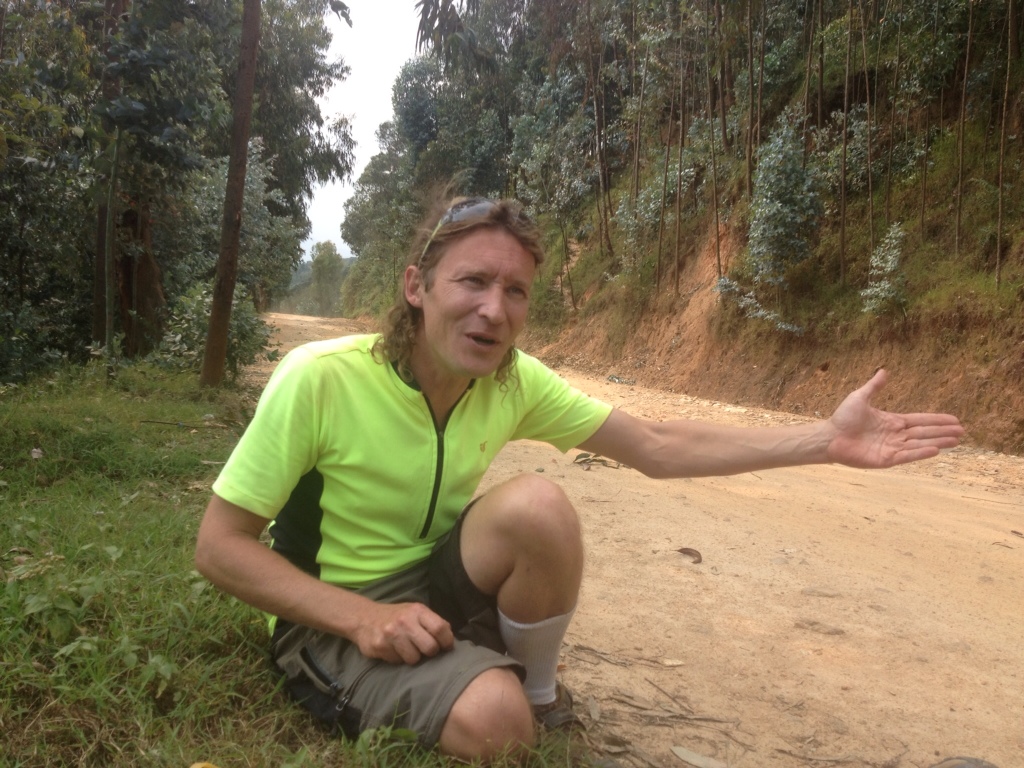
Our big adventure with him came yesterday (Friday). We walked the short distance from our hotel to his house and he outfitted us with mountain bikes much nicer than anything I’ve ridden before. At 9:30, Tom, Steve, and I pedaled off, also accompanied by Tuizaire (Tom’s chief assistant). Tom’s an excellent instructor, and he carefully explained how to use our 24 gears; how to safely go downhill; how to avoid ruts and rocks. This was great. At one point, it struck me that I had never actually done mountain biking before. Arguably, rural Rwanda is an odd place to start.
But what a grand day we had! Rwanda calls itself “the land of 1000 hills,” and there’s nothing like bicycling to convince one that’s probably an understatement. I doubt we spent more than 30 minutes on flat ground in the course of our 8 hours together. We weren’t pedaling every minute. We stopped for photos. We stopped to gab about one sight or another. On the side of the road, we gobbled down chapattis (think flour tortillas) smeared with ripe avocado and delicious local cheese, and twice we stopped to down soda out of bottles sold in tiny shops in dirt-poor villages. Tom shared what felt like an encyclopedic knowledge of Rwanda’s culture, politics, history, botany, and sociology. If I’d taped everything he told us and transcribed the most interesting bits, it would probably fill 20 pages. And, oh yeah, I haven’t mentioned the scenery — mile after mile of plunging mountains, verdant valleys, exquisite bays.
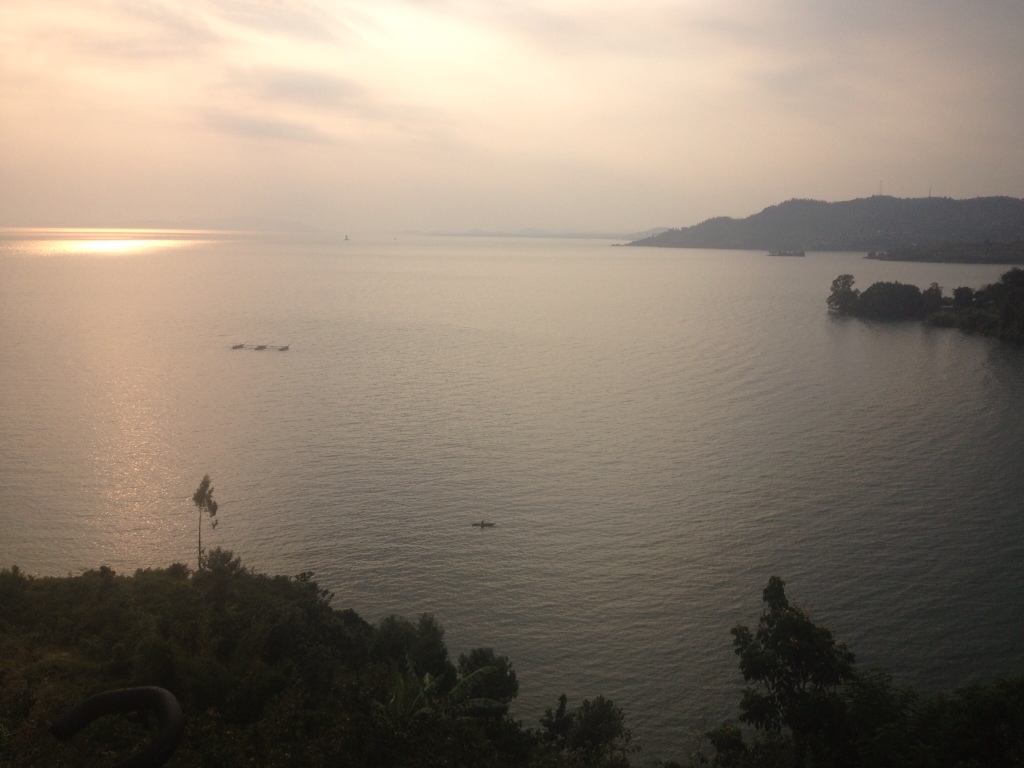
For years, this was the poorest region in Rwanda, but Tom says coffee recently has boosted the standard of living a bit (taking over many fields once devoted to fruit and vegetables). He also says it’s one of the most densely populated rural areas in Africa, with about 450 people per square kilometer. This became palpable almost every time we rolled through a village. Legions of toddlers and young children would stream out, calling to us and often chasing, until Tom and Tuizaire scolded them away.
I found that fascinating rather than annoying. It was the physical demands of the ride itself that drove me to my limits. We only covered about 20 miles, according to Tom, but the total elevation gain was almost 3000 feet. Steve did great throughout, but I’m ashamed to confess I had to climb off my bike and walk a couple of times during the brutal uphill stretches at the end of the afternoon. And more than once I froze with fear when confronted with vertiginous descents over sand, loose scree, and deep ruts. But no one held it against me, including myself. It was such a pleasure to experience, a small dose of mortification seemed a cheap price.
Mercifully, the shower had hot water on our return. We dined on grilled chicken and were about to stagger off to bed when a small troupe of dancers — 2 young women and 2 young men dressed in traditional garb and wearing wild leonine wigs — came into the dining area and performed. We stayed to watch. It was Friday night in a place not far from where troops were massing, a place where people routinely smuggle in coltan and other minerals that make them rich beyond American dreams. Usually Steve and I gather with friends to share a potluck and watch a DVD together every Friday night. I love that. But on this Friday night I was glad to be here instead.
Trekking with pygmies
Our epic gorilla trek took place Tuesday. Wednesday we met some of the people whom the gorillas displaced. Of course, it wasn’t the gorillas who did it, but about 20 years ago, the Ugandan government ordered all the pygmies to move out of the forests that had been their home for millennia. The last of the hunter-gatherers in this part of the world, the Batwa (as they call themselves; pygmy is the word the English applied to them) had always co-existed with the forest creatures. But as an exploding human population drove more and more people to cut down forests and farm, and the once boundless rainforest was reduced to mere islands, it was felt that the Batwa were putting too much pressure on what was left. So they were kicked out and forced onto the African equivalent of reservations. It was probably good for the gorillas and other forest animals and good for the non-Batwa Ugandans. Gorilla tourism is an economic engine, benefitting many ordinary folks. But it’s been devastating for the remaining Batwa.
One effort intended to help them preserve some remnant of their culture (and earn money) has been the creation of what’s called the Batwa Trail. This is what S and I signed up for.After a bit of a muddle over where we would start (there are two trail heads), we all assembled at the one withIn Mugahinga National Park. We set off with a ranger/translator (Benjamin), the two standard AK47-toting guards, and four Batwa ranging in age from 36 to 51. They had all grown up in this non-materialist culture (where you built your home from sticks and leaves and inhabited it for just a few months before moving on with just what you could carry.)

They all wore clothes made of animal-skins. Two of the four carried weapons (a spear and bow and arrow). To my surprise, they weren’t terribly small — maybe in the low 5-foot range. They led us briskly down a trail strewn with fresh-looking Cape Buffalo dung. I found myself thinking that it would be exciting to encounter one (and have one of the guards scare it away!) But the most menacing creatures we saw were legions of safari (aka fire) ants. We both avoided being bitten by any, thanks to the solicitous warnings of the Batwa.
They proved even better at entertaining us. Steven, the leader, had enormous presence, and in the course of frequent stops, he and the other fellows explained the use of various plants both for sustenance and medicine. Much more unexpected (and entertaining) was the way his comrades acted out various scenarios from their former life: setting a snare (and accidentally getting caught in it – har-har!); using a dog bedecked with bells (played by one of the guys) to catch a wild animals (played by a carved wooden hippo). “They’re like the Marx Brothers!” Steve whispered to me at one point.
The grand finale took us into a huge underground lava tube where the Batwa king used to hang out and his subjects stored crops plundered from surrounding farms. Normally, Batwa ladies hidden in the cave’s inky inner recesses surprise visitors by singing, softly at first and then building to a rousing conclusion. But they weren’t there on this particular day; someone said something about their having to go get food instead. I was a little disappointed, but 6 ladies were assembled when we emerged from the cave and they gave us at least a taste of what we had missed.
The guys and we also had shared our own magic moment a little earlier, when we had stopped in a clearing. They gave us a wildly animated demonstration of how they started fires, using two sticks. Then we all flopped down in an ant-free patch of ground to eat our picnic lunches. Steve and I asked lots of questions, and they seemed happy to answer. Then it occurred to me that they might enjoy hearing how we had learned about them. Benjamin translated as I described driving in my car one day several months ago and listening to an NPR reporter who also had experienced the Batwa Trail. Intrigued, I had googled them when I got home. What I read had made me resolve to find them. We all laughed at the crazy connections. “You’re famous!” I told them. Their eyes shone. I promised to tell other people about them, and they liked that a lot.
Gorilla country
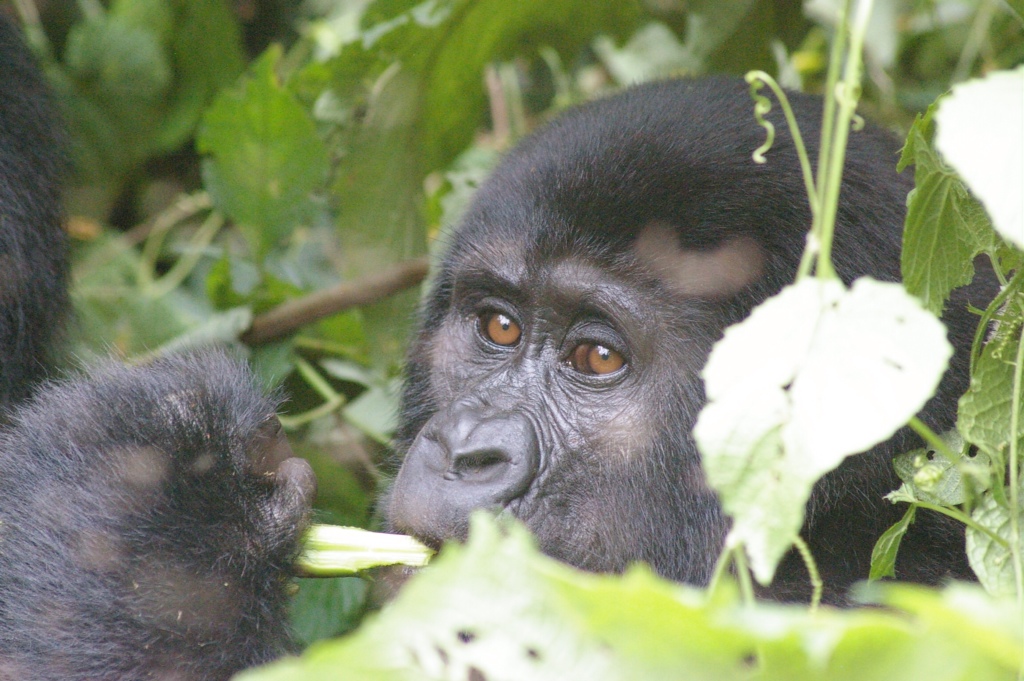
When we got back to the Uganda Wildlife Authority office Tuesday afternoon (6/5), after a grueling but satisfying 7 hours of tracking 14 of the remaining 700 mountain gorillas left in the world, one of our ranger/guides conducted a brief, corny ceremony in which she read each of our names and handed out ornate gorilla-tracking certificates. Steve and I and the 50-year-old Dutchman and his lanky 18-year-old son had finished the trek earlier than the 4 Sri Lankans who were the other members of our party. We stood up and applauded each other as we received our certificates. It was cute. Then the Dutchman spoke, and somewhat to my surprise, I almost burst into tears. He thanked the guides not only for doing such a good job in leading us to the gorillas, but also for the work they’re doing to preserve this place: the Bwindi Impenetrable Forest. It is one of the rarest and most beautiful places on earth, and having the chance to walk in it was profoundly moving.
For Steve and me, the chance to see the forest was at least half of what made the day so spectacular. Probably for more folks, it’s all about the gorillas. I’ve never been ga-ga about them; never found them as enchanting, for example, as bonobos (pygmy chimps) or chimpanzees. But even for us, the chance to see these animals in the wild was intoxicating enough to make us want to pay for the permits required of anyone tracking them. Those permits not only are expensive, but securing them was daunting. I wired off the (non-refundable!) money for ours back in February, and then the date was set in stone. Had anything gone wrong, we simply would have been out of luck. Once we’d gotten ourselves to this distant (southwesternmost) corner of Uganda, the challenge was hardly over.
Here’s the way the tracking works: mountain gorillas live in two of Uganda’s national parks, but Bwindi has the largest concentration (about 300). They live in family groups, and about 10 of those have been habituated to humans. But only four of the 10 can be visited by tourists (I guess only scientists get access to the others). Moreover only 8 tourists are allowed in any group at a time, and they can only spend one hour with the troupe. Which means that — at most — 32 tourists may interact with Bwindi’s gorillas on any given day — IF they find the gorillas at all.
In our case, we were reasonably confident we’d find them. We’d been assigned to the Nkuringo family — 14 animals (8 male and 4 female), one of the troupes most accustomed to humans, and one with a reputation for being tolerant and even curious about visitors. I think we were designated to track them partly because I got my permit so early and partly because we’re old (for once, that felt like a delicious advantage!) Still finding any troupe is never a certainty. Our lead guide (named, comically, Modern), told us once he didn’t find them till 2:30 in the afternoon; he and his group didn’t get back to the base camp till 11 p.m. (something I find almost unimaginable, given that by 7 p.m., it’s always dark in this forest, which is also home to elephants, unhabituated gorillas, jaguars, pythons, and other deadly vipers.) Modern said just 6 months ago the rains were so torrential the gorillas were virtually invisible, hiding in the underbrush. Visitors slipped in the muck; they broke bones.
At the other extreme, Modern told us he’s found the gorillas 40 minutes down the trail. In such cases, the visitors still can only spend one hour with the troupe; they never get to see the forest at all.
Steve and I were gloriously lucky. We set our alarm for 5 a.m., ate breakfast at 5:30, then set off from the Traveler’s Rest by 6. We reached the park headquarters (elevation: 6,850 feet) around 7:45, where our group assembled and was briefed. At 8:30, we departed: not only the 8 tourists in our group, but also Modern, two guards armed with AK-47s (to scare off any random elephants!) and several porters. I felt a bit like Deborah Kerr setting off with Stewart Granger in search of King Soloman’s mine’s.
The weather was cool and cloudy at first, perfect for hiking. Almost immediately, we began descending into a deep, deep valley, as green as anything I’ve seen in Ireland. Modern was communicating with two tracker-rangers who’d preceded us and gone to where the gorillas had been the day before. (They usually don’t move more than a kilometer or two per day.) Very soon, the trail become not only steep but encrusted with treacherously slippery pebbles. Over and over again, I thought about how peeved I would be if I fell off a ledge or twisted an ankle or otherwise screwed up, now that we were finally so close. Rarely have I been so grateful to have my hiking poles.
After an hour and a half of this, we turned off the path that skirts the forest, to enter Bwindi itself. If our chimp tracking in Kibale last week didn’t feel like a jungle adventure, this more than made up for it. The “impenetrable” in Bwindi’s name is no exaggeration. This is as thickly tangled, buzzing, twittering greenly amazing a place as I’ve ever seen (except perhaps courtesy of Hollywood.) Instead of pebbles underfoot, there was oozy muck. Two and a half hours after leaving the trailhead, we reached the spot where our trackers had homed in on the group. We left the muddy trail. Underfoot was springy, compressed vegetation, the like of which I’ve never walked on before.
The next hour was magical, though our first gorilla was a recalcitrant young silverback known as Stubborn. He was lying on the ground with his back to us, and he never so much as turned to look at us, despite our noisiness and the fact that we were close enough to reach out and tickle his toes. We ventured on, with the rangers directing us where to go and how to behave. Ultimately we were able to approach 12 of the 14 members of the family. Two of the smallest ones even came out into the open, cuddling and grooming each other.
I could go on, but I’m afraid only a Jane Goodall would be interested in reading much more. I’ll wrap up with just a few final observations. At one point, the number of mountain gorillas in the world had plunged to 200. It has more than tripled since then, but their future survival is far from assured. At this moment, though, they’re out there, foraging, sleeping, playing, mating, giving birth. I’m a witness, and a deeply grateful one.
A brief interruption for whining about the Internet
I don’t really want to whine. Just to note that once again, I feel like Charlie Brown, year after year believing Lucy when she promised not to take away the football. Somehow, I really thought Internet access would be easier on this trip. But once again, it’s been amazingly challenging to get online. Our hotel in Kisoro, the Traveler’s Rest (which gorillista Dian Fossey reportedly considered to be her second home), claims on their website to have wifi. But we didn’t even have electricity for parts of our stay there. There was a decent Internet cafe 5 minutes from the hotel. But both full days that we were in Kisoro were crammed with hiking — one day tracking gorillas and the other trekking with local pygmies.
Both those experiences deserve posts of their own, and I’m going to try to write them now from the Hotel Paradis Malahide. It’s about 90 minutes from the border crossing where we passed from Uganda into Rwanda this morning. The hotel is a rustic place on the shore of Lake Kivu. They say that early in the morning, when the air is clear, we’ll be able to see the Congo on the far side of the lake. Tomorrow we’ll go biking in the Rwanda hills with Tom Tofield, an expat Englishman who runs a tour company. But this afternoon it feels delicious to hunker down and catch up — with e-mail, blog posts, and photo organization.
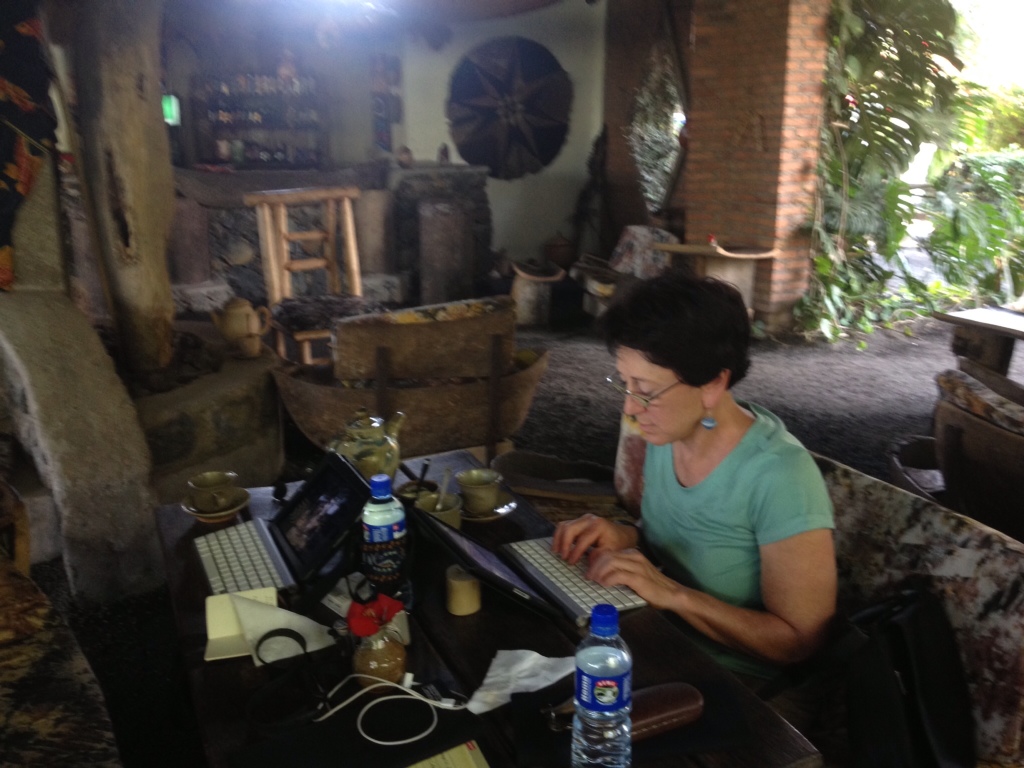
With luck, our good Internet access should continue for at least another week or so. But here (NOW I remember!) you never know. When we can’t get online, I’ve also been tweeting (@jdewyze) with my Twitter feed linking to the blog page (though now that we’re in Rwanda, we’re having trouble with our cell phones.)
Big game country
Who associates Uganda with big game? I never did. Mountain gorillas, maybe. But sweeping savannah dotted with grazing elephants and antelope? We were startled when yesterday we saw all that and more.
I had expected the day to be somewhat tedious, one in which our main objective would be to travel from our lodging near the chimpanzee forest down to the southern end of Queen Elizabeth National Park. Originally, I’d planned an itinerary that would have had us stop in the middle of the park and then enjoy a day of game driving. But an opportunity arose to be useful to Women’s Empowerment (WE) International — the San Diego-based microlending organization we’ve admired since its inception — so we jumped at it and cancelled the park day. We would only stop at the southern end to break up the long journey to Nyaka village and its grannies who were potential recipients of WE’s micro-loan funds.
The Land Cruiser carried us down from the mountains and southward, taking us across the equator (photo op!) a bit after 11. Lunch was at the tent camp adjoining a large channel between two lakes where we’d originally planned to stay. It looked lovely, and it would have been thrilling to watch the hippos come into the camp for their nightly grazing session (reportedly they don’t bother humans who don’t threaten them.) But we pushed on, and it was then that we began spotting the elephants, antelopes, cape buffalo, baboons, and monkeys.
Before making the final approach to the simple camp where we were staying, Robert surprised us by announcing we’d make a quick sweep of one area of the national park to look for lions lounging in fig trees –the most sought-after tourist attraction in this area. It was a long shot; Robert said he’d spent days on some previous trips looking for them with no success.
All lions can climb trees, he pointed out. But what makes the Ishasha area of the national park famous for its tree-climbing lions is that a few huge fig trees are scattered (widely) amidst the legions of acacia. And, unlike the short acacias, the mature fig trees grow stout horizontal branches that make wonderful resting places for lions. High off the ground, they’re well-positioned to catch a cool breeze, escape attack from the tsetse flies that infest this area, and spot the most likely direction in which dinner might lie, come the evening hunting session.
Robert had popped up the top of the Land Cruiser, and Steve and I stood up, finding it not unlike jogging through the savannah — without having to exert any more effort than that required to avoid being jounced out. We’d driven for maybe 20 minutes, and I had just muttered to Steve that I didn’t see ANY fig trees, when he retorted, “There’s one!” The path took us around a bend and up to the tree — which was occupied by three beautiful lions.
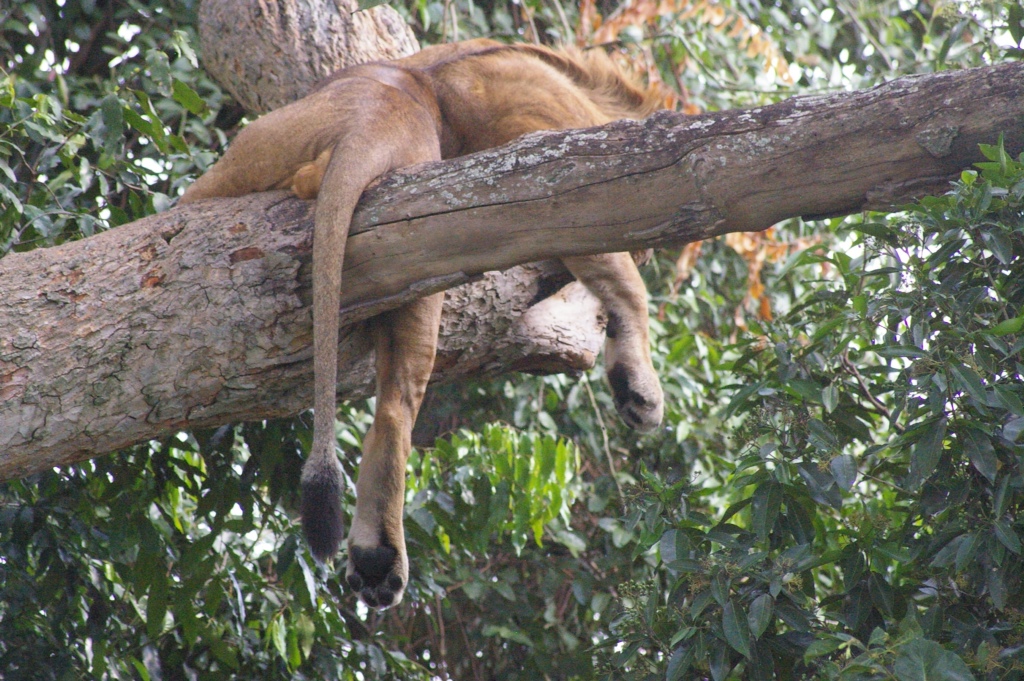
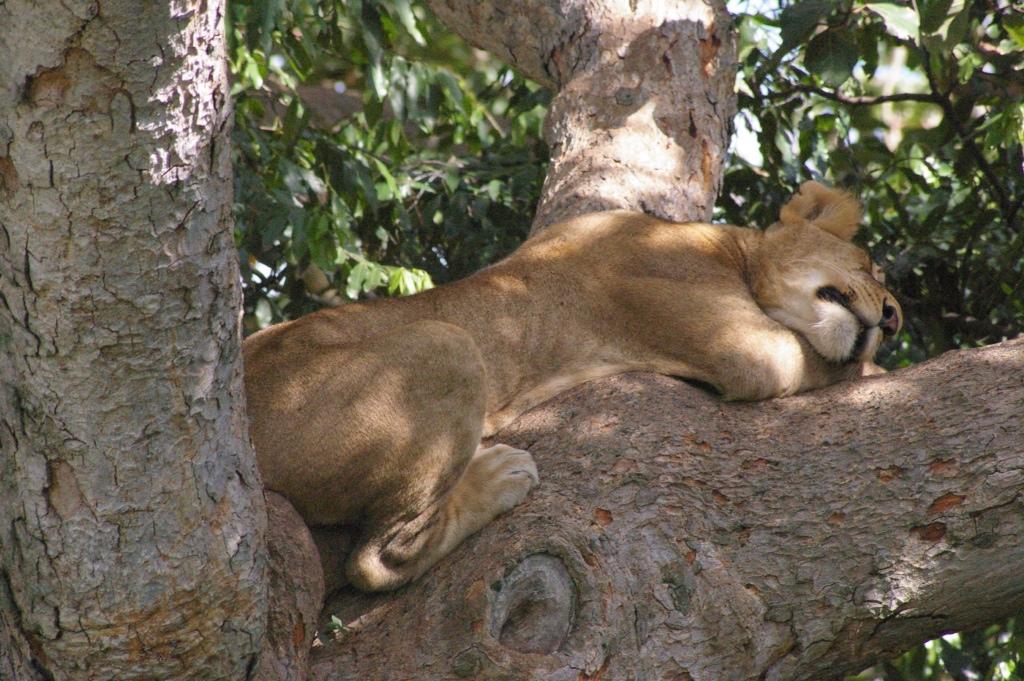

I’m sorry, but if there’s anything cuter than drowsy giant cats draped over fig branches, I don’t know what. Robert told us these were a mom and her two youngsters, male and female. They all were dozing, loose-limbed and looking so comfy I imagined if we could just get a bit closer, we’d hear the purring (assuming that lions purr.) we spent a long time drinking in the sight, while Robert shared some lion lore, asserting, for example, that they’ll never attack, as long as you’re staring in the eyes. (Conversely, you NEVER want to run.)
Finally, we pulled away, and Robert drove us to the banks of the Ishasa River, where on the far bank, the Democratic Republic of the Congo looked close enough to be hittable by someone with a good arm and a pebble. Hippos often play on these banks, but all we could see were two hippo head tops and four pairs of ears that emerged and then re-submerged in the distance.
So we pushed on to our rest stop for the night, a homely but well-tended collection of tents and “chalets” overlooking another nearby river, the Ntungwe. The only guests, we sat in an elevated pavilion, drinking in the splendid countryside and, after sunset, dining on excellent roast goat, assorted vegetables, rice, and the most delicious banana dessert I’ve ever tasted.
I slept well, though I had my earplugs in. I never heard the chomping noises or the raucous cries of young men. I only heard about them from the plump young American property manager. A recent international studies graduate, she recently took this gig after completing a 6-month stint with a Kampala-based NGO. She thought the chomping was a hippo, and commented, “It sounded close!” I was just as happy to have missed it. I prefer for my encounters with wild animals to be during the day — and for the wild animals to be exclusively non-human.
Wild chimpanzees
I could tell you that my favorite moment yesterday was watching Steve, his head lathered up in the shower of our guest cottage, singing (to the tune from South Pacific), “I’m gonna wash that chimp pee outta my hair, I’m gonna wash that chimp pee outta my hair, I’m gonna wash that chimp pee outta my hair, and send it down the drain!” But I’d be lying. It was only one highlight of many.
I understand that chimpanzees live in 6 of Uganda’s 10 national parks, but the one where Steve got his head peed on was Kibale. It boasts having one of the densest concentrations of primates in the world — not only chimps but a dozen or so other species. Moreover, our chimp-tracking guide, Bosco, made the case that Kibale provides the best opportunity in the world to interact with wild chimps. Some 1450 individuals (living in 13 areas) were counted in the last census three and a half years ago. One of the groups, containing about 120 animals, has been habituated to humans for years. As a result, 90% of the time, chimp-trackers wind up seeing what they came for.
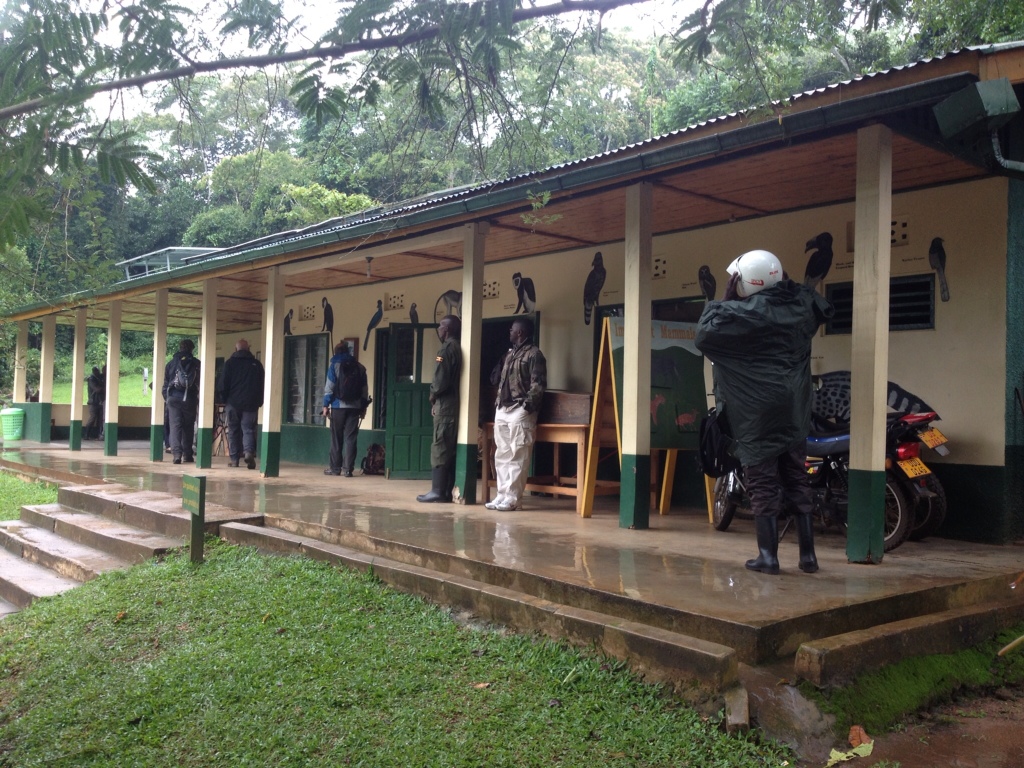
We arrived at the park headquarters around 8. I was already in an exultant mood, thrilled to be in my first true African rainforest. It wasn’t at all steamy and jungly. It had rained in the night, and a cool mist continued to drizzle down. Along with a dozen or so other tourists, we assembled for a briefing by Bosco. Among other safety tips, he warned us not to make noises imitating the chimps. We might inadvertently make the wrong call, with negative consequences
One factor working against us was the rain, he said. Like people, chimps prefer not to sit on wet ground. But we would try our best to get as close as possible. We split into three smaller groups, and i felt happy to be in the one led by Bosco, who exuded a calm confidence.
Then we were off! We drove on little more than trails, and Bosco explained that chimp-tracking begins by trying to pinpoint where they’ve been heard. Chimpanzees are a raucous crew, and their vocalizations carry far. We stopped at one place where Bosco gathered information, then we pushed on, into an area of the rainforest where the trees at the top of the canopy reached at least 80-100 feet tall. In a clearing, we all got out, and the vehicles disappeared, taking their diesel clatter with them. In the ensuing relative silence, we listened to the insect chatter and bird calls.
And then — a hooting. Bosco motioned us down the road. He pointed to a dark shape, high overhead. It took a minute or two, but gradually, the simian form emerged. Branches shook, an arm emerged. And then more hooting, unmistakable, hair-raising. Screams, more hoots, movement.
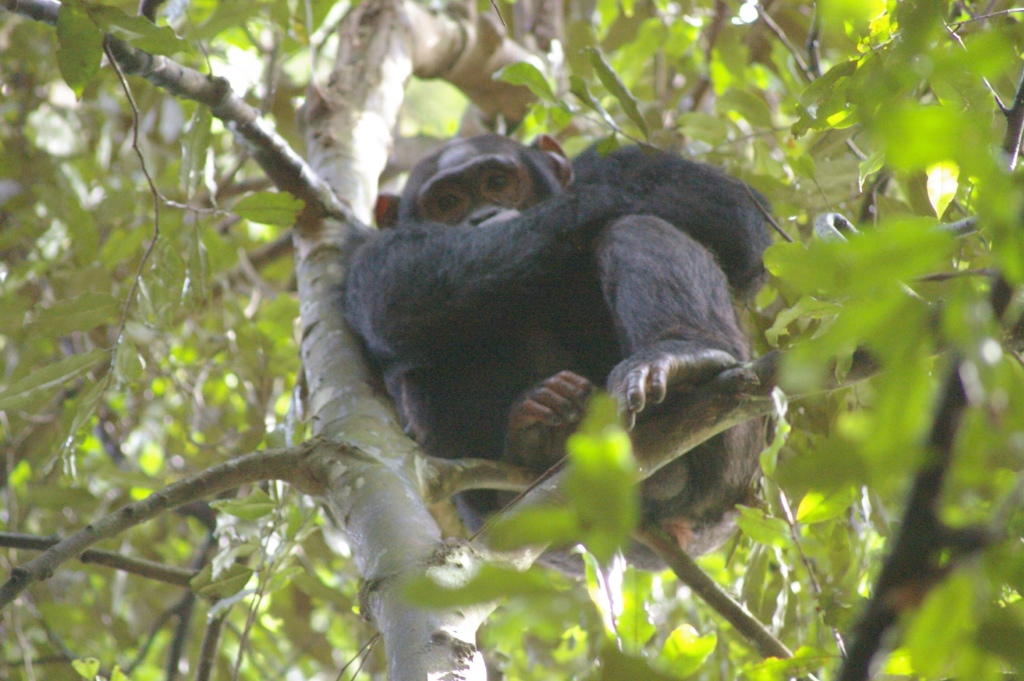
Of all the things we saw over the course of the next two hours, nothing surprised me more than the way chimpanzees sound in the forest. The screams are the wild, deranged noises only emitted by insane humans, but there are so many other noises: hoots and whoops and booming grunts that I would have thought required electronics to achieve such amplification. The cacophony sends a clear message: these guys live near the top of the food chain. (Their only predators are the park’s leopards and an occasional lucky eagle.)
When the chimps moved, we moved, bushwacking through the undergrowth and pausing periodically to observe one thing or another overhead. We watched the apes feeding on berries, then saw a female breaking off branches, high above, to swiftly make her day nest. Bosco explained that each chimp makes a night nest too, typically making a new set of both every day (or else relining an pre-existing one.) A few minutes later, he made a comment about a chimp’s erection. “You can see his erection?” I exclaimed, incredulous. (I couldn’t see the whole damned animal, let alone his diminutive sexual member.)
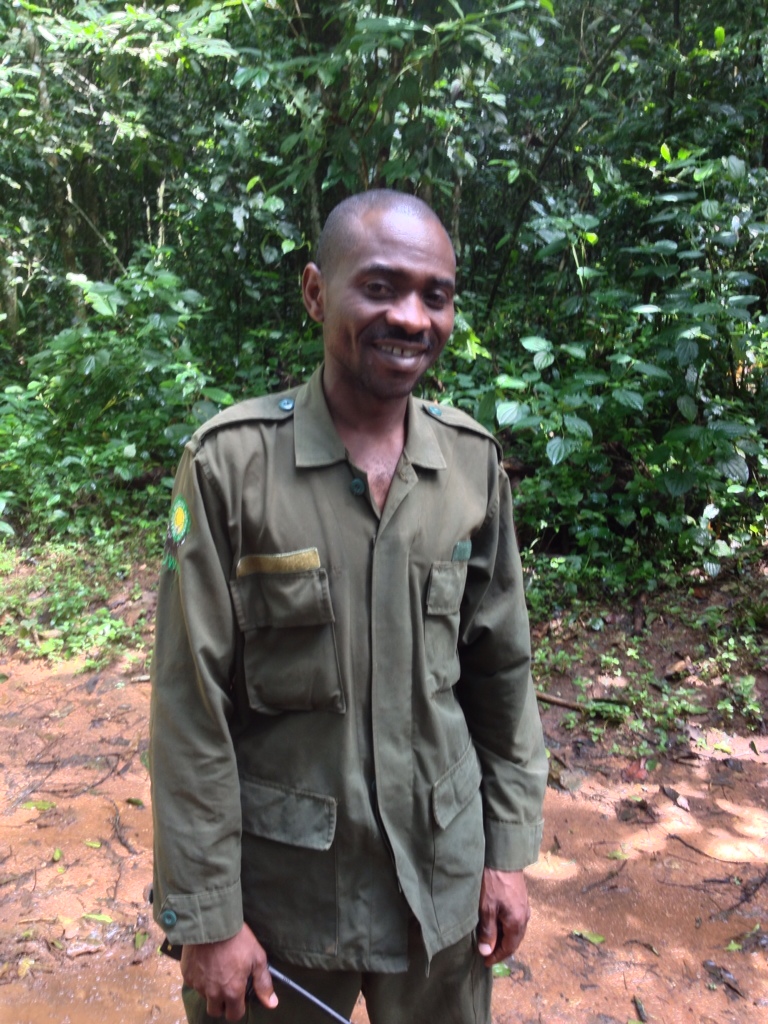
But most of the fellows overhead had erections, according to Bosco, who also pointed out the reason: a female whose swollen volva so obviously invited attention that even I could see it, 200 feet away. One set of the tourists were able to watch this gal and one of the males copulate. But I missed that (easy enough; the whole interaction lasting only about 6 seconds). If short, sex for the chimpanzee ladies is frequent. They can mate up to 20 times a day. Because of the possibility of getting lucky, the males were lingering up in the trees, Bosco told us. We settled in to try and wait them out, and it was during this interval that the dousings with chimp pee occurred.
Finallly the troupe clambered down, some of the males no more than 20 feet away. We hustled after them, hoping they would finally stop to chill out on the ground, ignoring us (as apparently they commonly do around tourists.) This never happened, though, and Bosco finally announced that we needed to head back to our vehicles. Rather than feeling disappointed, I was grateful to have come as close and see as much as we had.
It was only noon. We drove to a lodge for lunch, then continued on to 3-plus hour guided hike around a swamp that’s part of an inspiring community-development project. Steve and I loved it, and ordinarily I’d be happy to report the details in depth.
But the chimp-tracking was one of the most exciting natural adventures I’ve ever head, and I’ve run on about it too much already. I can’t imagine how the gorilla-tracking will compare. But that’s 2 and a half days away. Between now and then Steve and I have another mission that promises to be both challenging and fascinating, in other ways.
 At home and abroad