Ugandan grannies: better than any tourist attraction?

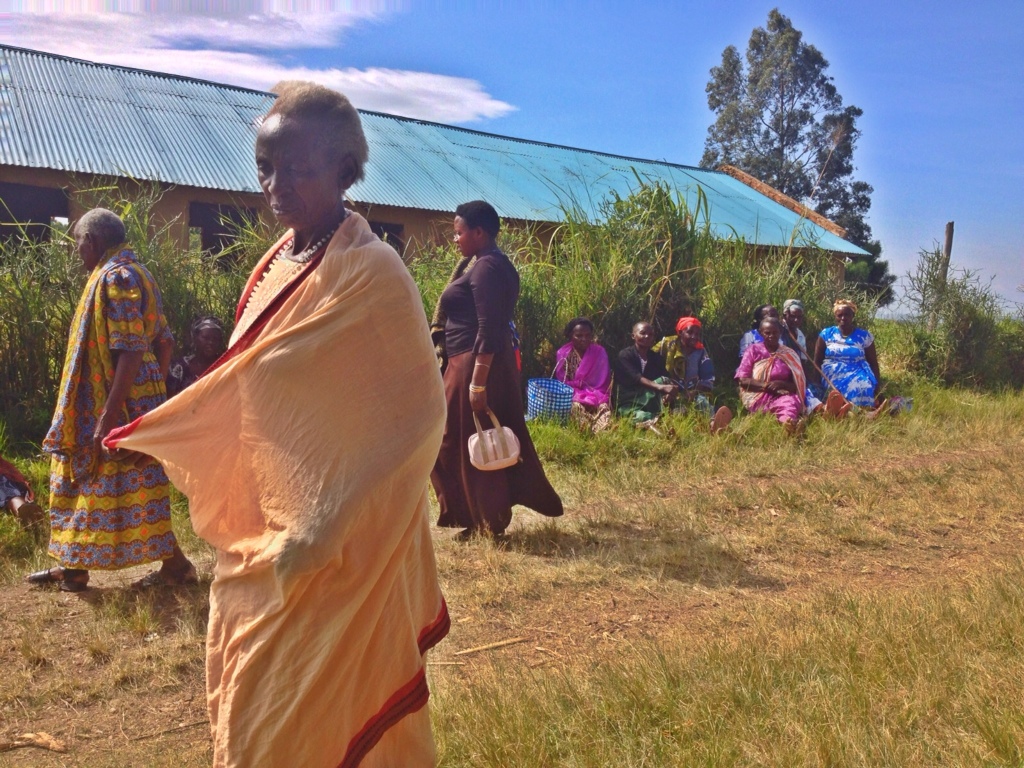
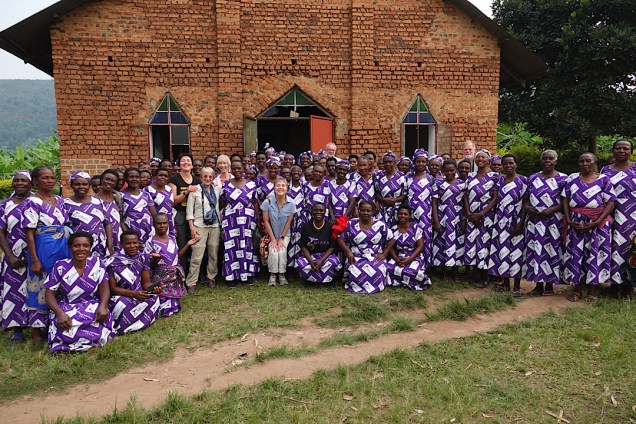
Can you spot the San Diegans amongst the valiant Ugandan grannies?

The world is a big place, and Steve and I hunger to see as much of it as possible before we die. That’s why we rarely go back after an initial visit to most countries outside North America. The list of places we’ve traveled to repeatedly has been short: France, Italy, Japan. I’m thinking, however, that I need to add Uganda.

Before our first trip here, in 2013, I would have bet it would be our only one. That was our first (and I would have predicted only ever) visit to East Africa. In the course of it we also swept through Rwanda, Tanzania, and Kenya. But just a few months before we went, something extra got tacked on.

We have a close friend, Leigh Fenly, who in 2006 co-founded a San Diego organization called Women’s Empowerment (WE) International. Its goal is to improve the lives of some of the poorest women in the world. In the spring of 2013, WE had been approached by a group with a project in southwestern Uganda that was providing tiny but invaluable loans to older women who were raising grandchildren orphaned by AIDS. Amazingly, Steve’s and my itinerary would be taking us not far from Nyaka (the central village), and we managed to adjust it to allow for a one-day visit. We came away so moved and impressed that WE began a partnership early in 2014 with the Nyaka AIDS Orphans Foundation’s granny-group project.

Steve and I also agreed to be the liaisons between the San Diego folks and the Ugandans, a job we’ve continued to fill ever since. In that role, we returned to Nyaka accompanied by another WE member in 2017, and our current travels (this time with 6 WE leaders in tow) were driven by the desire to go back for another on-the-ground assessment of how the Ugandan “micro finance” project has been playing out.

We’ve been dazzled. In our two days in the field, the 8 of us interviewed more than a dozen individual grandmothers, learning about what they’ve done with the loans they’ve received from their groups. We also met with two large granny groups located near the Bwindi Impenetrable Forest (home to some of the last mountain gorillas in the world).
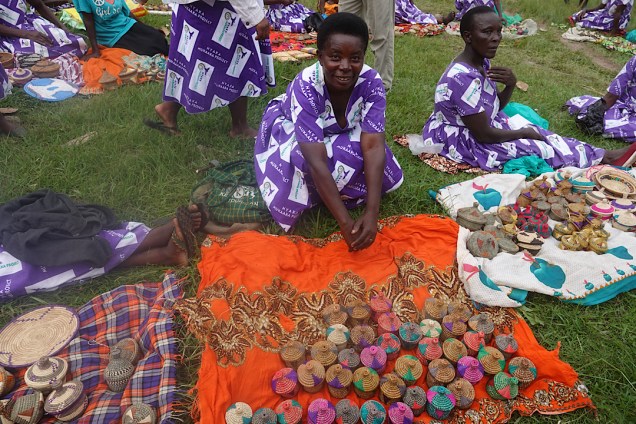
One of the groups we visited has developed a robust business making handicrafts and selling them to the foreigners who come for the gorilla tracking.

Progress that was already starting to be evident three years ago has continued and seems to be accelerating.

For example, the first one-year loan ever granted (back around 2007) to one of the two groups we visited Saturday was for 200,000 Ugandan shillings — about $75. The group then made tiny loans — the equivalent of $5 to $10 — to individual members. Each woman would have the money for three months, then she would have to pay it back, along with about 15% interest. With so little money, a granny might only be able to buy a chicken or two. But she could hatch some of the eggs, sell others, and come away with a bit of extra cash — money that more often than not she would use to pay her grandkids’ school fees.

Over the last six years, as WE has donated money raised in San Diego, the Nyakans’ central revolving fund has grown from just $7,000 to almost $250,000 (including profits from the interest on the group loans and about $175,000 from WE). That’s meant granny groups have been able to receive bigger and bigger annual loans. The group that began with a $75 loan now has a loan of more than $4000.
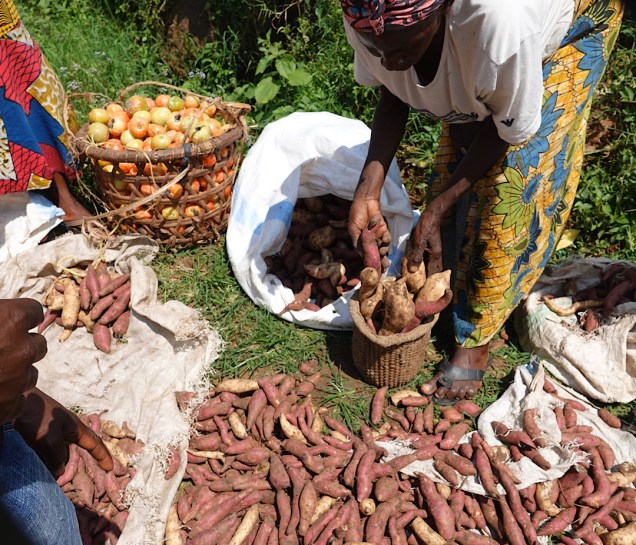
Virtually all the grannies grow crops that their families eat, as shown here by the hands.

Grannies with bigger ideas have been able to get bigger and bigger loans to help them realize their dreams. Take Meleth, for example. She’s 52, currently raising 6 grandchildren (one disabled).
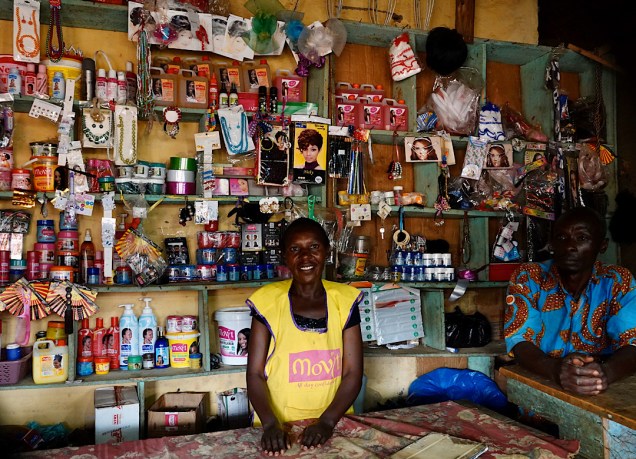
Meleth at the counter in her salon/beauty product store

She joined her granny group just a few years ago and has since become its treasurer. She’s gotten two substantial loans, first one for the equivalent of about $82, then another for almost $200. She’s used that money to build up a beauty salon that would be respectable even by Kampala standards. She’s installed a hair dryer and a wash basin; has diversified into providing decorations for weddings and other celebrations, as well as catering. She told us she currently serves 25-30 clients during her typical six-day week. (A Seventh-Day Adventist, she closes Saturdays.)

Because of her loan money, 54-year-old Robinah started a restaurant that she estimates feeds 40-50 customers a day. Business is good, but she thinks it would be even better if she could buy a refrigerator and sell cold drinks. (That would cost between 1 and 1.5 million shillings, about $275-$400.)
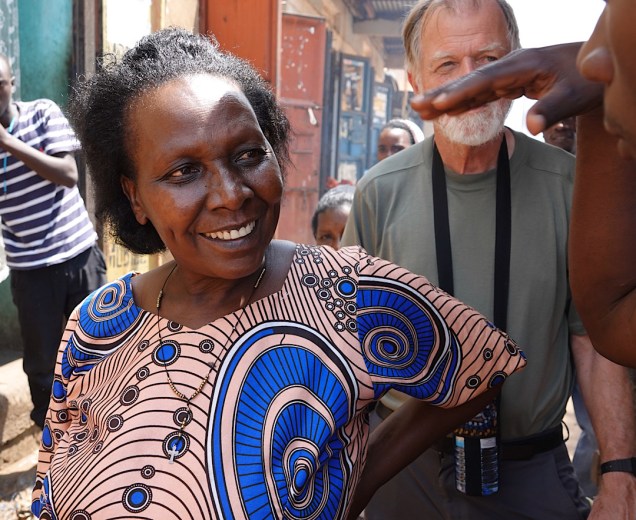
Robinah

Many grannies still do simpler things: acquire goats or chickens or pigs; hire help to grow more cash crops like coffee. We met 65-year-old Ketty Turiyatunga at the Friday market in the little village of Nyamirama. She was filling baskets with sweet potatoes that she hoped to sell for about a dollar. Her loan was for less than $14, but she seemed happy to have it.
Margaret Tumuhimbise, 67, has a small loan too, but she uses it to buy products like tomatoes to supplement the pineapples, sweet bananas, and maize she grows and sells at a stand in the local market.
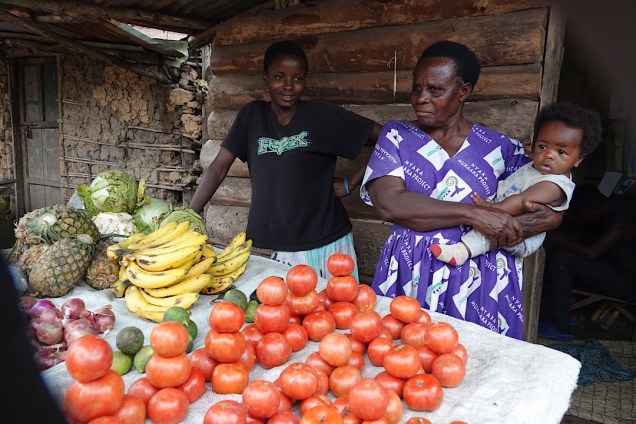
Margaret currently cares for 4 grandchildren and a great-grandchild, whom she’s holding in this photo.

Note the uniform Margaret is wearing. On our first visit, no grandmothers had uniforms, but by 2017, one large group had had some made. Since then more and more groups, maybe 60% of the 10,000 grandmothers who are currently Nyaka granny-group members, have used their profits to buy the distinctive outfits. They wear them with pride. Folks respect and admire and even envy them now, whereas just a few years ago, they were despised for being dirty and poor and old and bad-smelling. Now they all have soap and toothbrushes. Now they have hope they won’t ever have to beg again.

The Nyaka group’s leaders are talking about getting another 10,000 grandmothers organized into groups that will receive loan money. They envision doing this within just a few years. Some dream of expanding still further, going country-wide.

I have to confess that Steve and I were skeptical seven years ago. Billions have gone into aid for Africa over the course of our lives, and much of that money has been squandered. But, started by a Ugandan, run by Ugandans, decentralized and shaped by leadership at the village level, this program looks like success to us. Even if Uganda didn’t have any great natural beauty and touristic pleasures, I might be tempted to return some day to see if the human thrills continue.
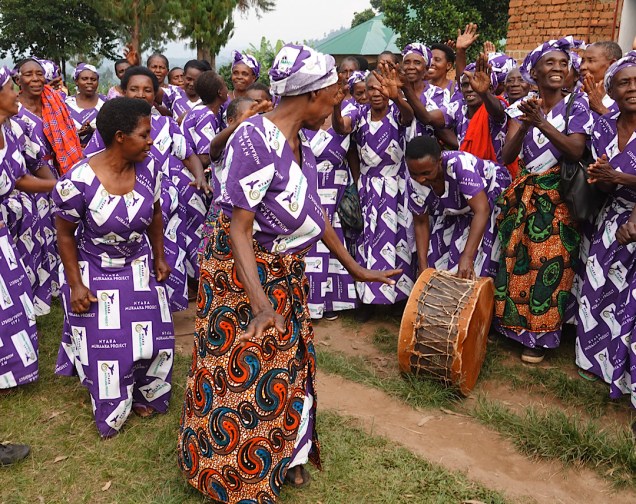
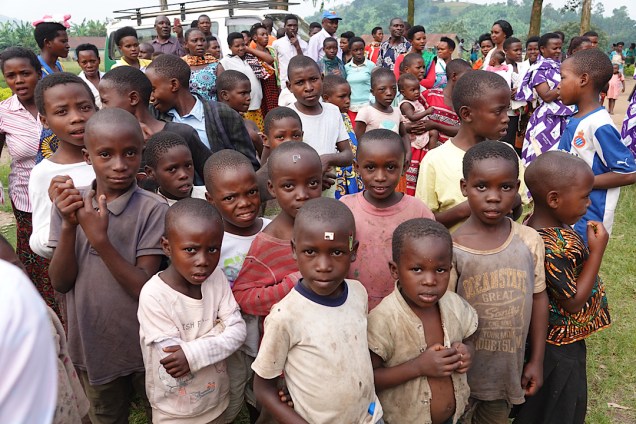
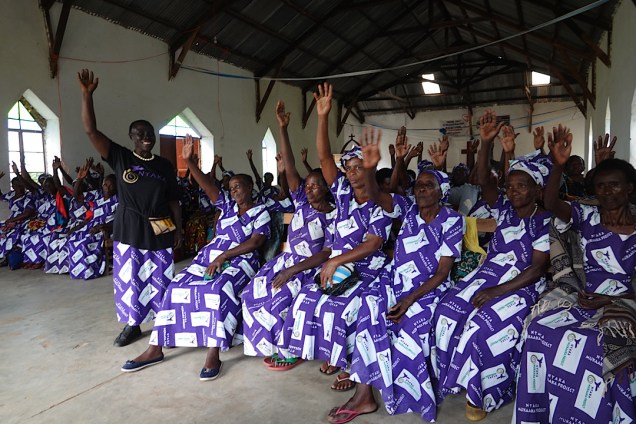
As in the past, the granny group members greeted us with joyous dancing. This is an electrifying experience.
The village kids look on, curious and somewhat amazed.

Great grannies

I’m writing this from back home in San Diego, where I’m feeling guilty that I still haven’t written about what Steve and I agree was the most remarkable experience of this most amazing trip: our visit to the village of Nyaka in western Uganda.

It wasn’t originally on our itinerary. But back in early February, I happened to be at a social gathering with Leigh Fenly, an old friend who also was the co-founder of Women’s Empowerment (WE). Based in San Diego, WE was formed to provide low-interest “microloans” to poor women to help them start or expand their small (minuscule) enterprises. In Mexico, Honduras, San Diego, and other parts of Africa, WE’s lending has helped many women improve their economic conditions and develop pride in what they can accomplish. Leigh mentioned that the organization had been approached a few months earlier by the Nyaka AIDS Foundation about lending money to some Ugandan women who are the sole support of their grandchildren, youngsters who’ve lost their parents to AIDS. Although WE had gathered information about this group from a distance, Leigh felt it would be valuable to have us check it out in person.

Grannies arriving at a meeting

It’s hard for those who haven’t traveled in the developing world to imagine how remote Nyaka is. I myself couldn’t believe the village would be so very hard to reach, when I looked at its approximate location on my Uganda map. But the map doesn’t show how mountainous the area is. Road lines neatly rendered on paper in reality are rutted dirt tracks studded with rocks and other impediments. Occasional holes help to make driving on them hellish. There are no road signs. Our Ugandan driver/guide, Robert, was born and raised in this region, but he’d never heard of Nyaka. He got us there by following rough directions from one of our contacts over the phone — and then stopping to ask bystanders for details as we homed in on our destination.

Bizarrely, Uganda’s long-time president grew up around here; why he hasn’t doled out more patronage in the form of road work is a mystery. But another former son of Nyaka has been more loyal. Jackson Kaguri was a bright boy who studied hard and won a scholarship to attend a university in Uganda’s capital, Kampala. He went to the US for graduate work and there met and married an African-American woman. They were on a trajectory to a comfortable middle-class life in Indiana, but Kaguri continued to visit his family back in Africa. His older brother had died from AIDS, and Jackson had committed to helping educate his nieces and nephews. On his first visit back with his new wife, the two were struck by the plight of the other AIDS orphans in the village. They resolved to build a school that would provide free education for at least some of the orphans. (All the “public” schools in Uganda require parents to pay fees that often are significant enough to be unaffordable.)

Kaguri subsequently published a memoir of how the school project unfolded, and one of the best things about it is how clearly it communicates his mental state. He didn’t set out to try and change the whole country. He simply wanted to build a couple of primary-level classrooms, despite his pretty much total lack for preparation for any such undertaking. But he was determined, and he did eventually get those first classrooms built. Over time, the school expanded. The need for a health-care center became clear and eventually got built The lack of clean, easily accessible water led to creation of a drinking water system for part of the village. Jackson did none of this on his own; he got help from folks both in America and Uganda. But a dozen years after that first vision of a few classrooms took shape, a remarkable amount has been accomplished.

The Nyaka Granny Project was yet another outgrowth of this work. Around 2007, the school staff began to focus on the fact that many children were suffering from malnutrition and sleep deprivation due to inadequate food, water, and shelter. Somehow, the staff found the resources to begin organizing support groups for the grandmothers struggling to raise those children — not only the few lucky enough to attend the Nyaka school, but many others whose kids are in public schools. When Steve and I finally reached Nyaka, we could scarcely believe our ears when the two program coordinators told us there are now 91 such groups, including 7,000 women providing sole support to something like 35,000 kids.

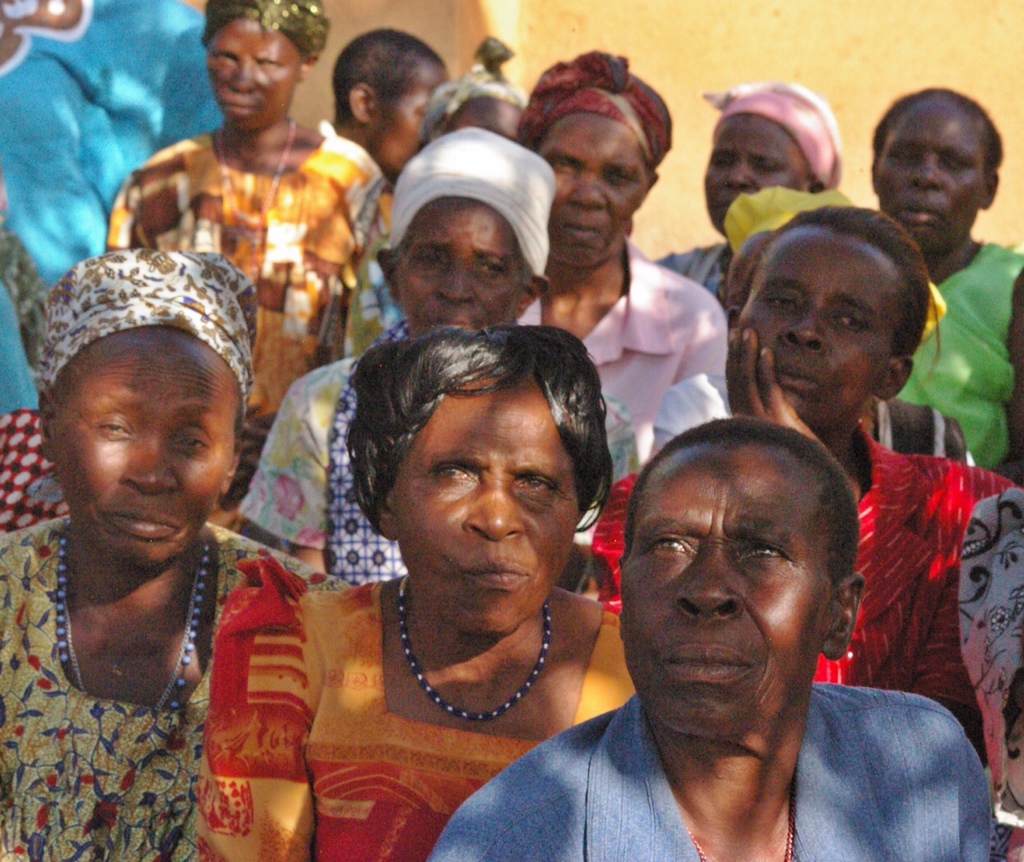
Some of the grannies with whom we met

Within short order, the reality of those numbers became clearer. After depositing our bags in the little house that’s been built (and is run by Jackson’s sister) to accommodate visitors, Martin and Godfrey (the Granny Project coordinators) led us to a nearby building where one of the groups had assembled to meet us. Dressed in their finest Sunday clothes — brightly colored and patterned dresses and wraps that left no doubt we were in Africa — the women, including one 91-year-old member, were singing and dancing. It was an infectious, boisterously joyful greeting, and it instantly won our hearts. We all gathered in a big circle under a tree. Most of the grannies sat on the ground, while we as the guests were offered chairs. Jackson and Martin introduced us, and Steve (bravely) responded to a request to explain why we were there. Then for most of the multi-hour session, we asked questions.

We took pages and pages of notes, which Steve patiently transcribed in spare moments throughout the rest of our travels. What we learned in the first group was echoed in the two others with which we met (one later that first afternoon and the other the next morning.) The grannies told us about the many benefits they’d gained from participating. First and foremost, the groups provided fellowship. It’s misleading to talk about African “villages.” For me that term conjures up some compact community in England where everyone can walk to everyone else’s home. But in rural Africa, communities are typically far-flung. While some of the grannies lived within a half-kilometer of each other, others walked two or three hours to attend the twice-monthly meetings.

Each time they attended, they paid a small amount (ranging from $.75 to $1.50) into a fund, knowing that every 15 months or so they would receive all or part (arrangements varied) of the pot collected that meeting. This simple system provides a way for the poor to save for needed items — a blanket, say, or a saucepan –instead of seeing any savings dribble away to friends or relatives needing help. The Nyaka coordinators also provided some educational programs (farming tips; AIDS prevention), and the groups gave the women a chance to share their troubles and pray together “for our homes and our families” (as one English speaker put it). Finally, a small microloan program that began in 2008 was offering some of the women a chance to borrow tiny amounts of money and pay it back within a few months at interest rates that might seem high to Westerners (3% a month), but were far more reasonable than the 10 to 20% monthly interest charged by other African lenders.

JoAnn, 52, caring for 3 grandchildren, had borrowed a little under $20 and used $7.75 to buy a piglet and the rest to build a pigsty for the animal. Jacqueline, 53, had used her $4 loan to hire someone to prepare some ground for her to plant. Her subsequent peanut and sweet-potato harvest had been good enough to help cover her grandchildren’s school fees. Maria, supporting 6 grandchildren, had combined her $19 loan with another $7.75 she’d saved and bought a goat that she bred with a neighbor’s billy. She’d sold the resulting twins and since had built her herd up to 6. When I asked if she and her grandkids drank the milk, the group burst out laughing. If she did that, someone pointed out the obvious, the baby goats would die of malnutrition.

A scene from the play

Our meetings included other light moments. The second group put on a play for us fashioned after the Biblical story of King Solomon’s trial of two women who both claimed the same infant. The actors were equipped with props that included a fake sub-machine gun fashioned from banana-tree branches. It was unforgettable. But so was the women’s response when we asked if they had any complaints about the Nyaka micro finance program.

They did indeed: there wasn’t enough money to be borrowed. They had ideas. They were willing — eager! — to muster the energy to raise piglets and goats and chickens; plant sweet potatoes, roast them, and sell them to passing travelers; sew, weave baskets, make bracelets and other handicrafts. They were confident they could pay back the money with interest. Indeed the repayment rates do approach 100%. “How many of you would borrow more money if there was more available to borrow,” I asked. Here’s how they answered: