Oops

Friday, January 14, 2011

Okay, I’ll admit it. I booked a room at Sineta George’s SenegalStyle B&B (months ago) because I was nervous about arriving for the first time in Dakar with Steve to travel in West Africa on our own.  Dakar has a reputation for being a rough, hyped-up city — a mecca for music but also a place where one might be mugged, or at least targeted by pickpockets. In the course of doing online research for this trip, I became aware that there was an American, a native Floridian, who had immigrated to Senegal 11 years ago and was operating a B&B and tour company. Her posts and comments on various forums charmed and intrigued me. By turns she sounded enthusiastic, jaunty, breezy, opinionated, funny.  She charged about $60 a night for a room plus breakfast and dinner, and her descriptions of her cooking made me confident I’d enjoying dining there. I figured she could clue us in about life here.
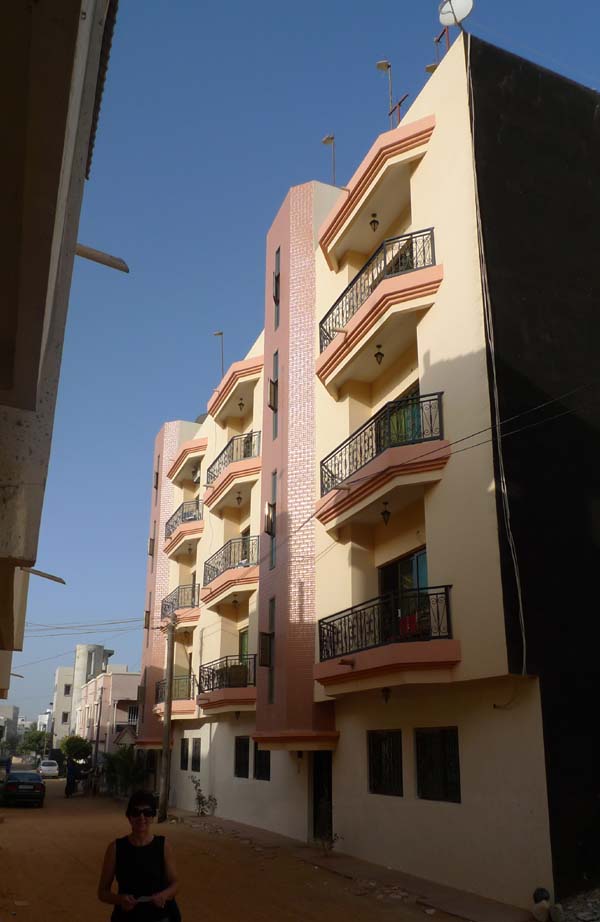
Sineta George's Senegal Style B&B occupies the first floor of this apartment building in the Dakkar suburb of Yoff.

So I reserved a room for our first two nights, along with airport pickup. I’ve earlier described how the power in her neighborhood was out when we arrived, and how she pressured us into signing up for an overpriced “safari” on the morning after our arrival.  But our room that first night was clean, the bed was comfortable, and even though there was no power, hot water, or towels, and things seemed a bit chaotic, I still probably wouldn’t have felt that staying at Sineta’s was the biggest mistake of our trip — if it hadn’t been for what happened on our return. 

I have to explain here that the reason I’d ALSO paid in advance for two and a half final nights at Sineta’s was she’d told me months ago we could leave our suitcases filled with winter (Paris) clothes at her place, while we traveled around tropical Senegal.  So even though we’d begun to develop doubts about her, we had to go back to get our stuff. I e-mailed her from St. Louis, telling her we’d arranged our own transit back from there to Dakar, and she wrote back urging me to send her an SMS when we departed St. Louis and again when we were approaching Dakar “so I’m sure to be home!”

I did all that, but as we approached her neighborhood, we got a text from her, informing us that she was out giving a tour and wouldn’t be home until at least 5 or 6.  I called her. What exactly did she suggest we do (with our SIX assorted bags, big and small)?  Stand out out under the hot sun in the dirt street in front of her building?  She offered no suggestions, but only complained that I wasn’t getting it — she was busy giving a tour! When I asked if she didn’t have a neighbor who could let us in, she lectured me, “Jeannette, you KNOW it’s a B&B!”

What we finally did, when we arrived, was to ask Sineta’s kindly Senegalese (French-speaking) next-door neighbor if we could put our bags in her apartment. (Why Sineta has failed to establish a relationship with this woman was mystifying, unless it’s because Sineta speaks little French or Wolof.) Steve and I headed to the nearby minimart to get a Coke and juice. We waited. 

Perhaps prodded by my irritation, Sineta arrived back around 4:30. But once we’d collected our bags from the neighbor, she ushered us into a different bedroom from the one we’d occupied on our first night. The new one was tiny, and almost entirely filled by a double bed, a single bed, a bookshelf overflowing with the sort of junk that occupies some of my bathroom drawers, and an ironing board and iron.  No private bathroom.  No clean sheets.  “But that’s no big deal,” she declared. “I’ll get to that.”
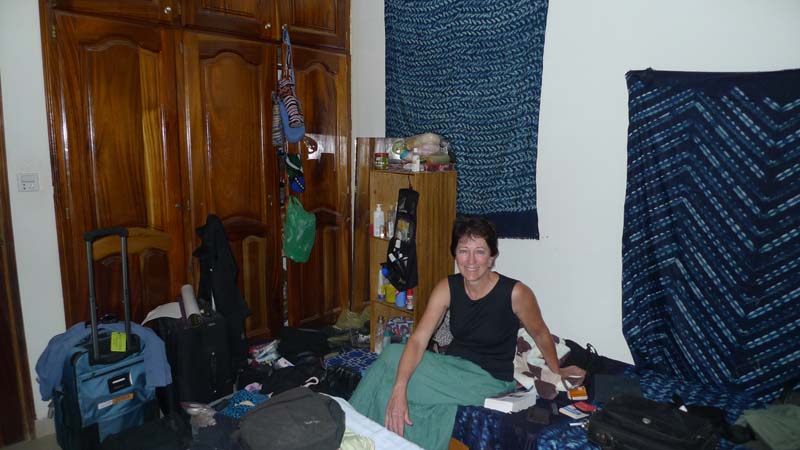
The small 3rd bedroom in Sineta's apartment has no closet space because cabinets and shelves are crammed with Sineta's personal effects.

She said dinner would be at 8 or 8:30. Steve asked if we could pick up a bottle of wine at the nearby package store and drink it with our dinner. “That’s fine,” she said.  “As long as you don’t drink it in front of Jon,” (her 17-year-old son). “But he’ll be at dinner with us, right?” Steve persisted. “Yeah,” she said. “But I don’t want him exposed to drinking or smoking. We’re Muslims.”

Sineta, her son, and guests in two of her three double rooms share this cold-water bathroom.

“So I guess that means you don’t want us to have wine at dinner,” Steve said. 

“Well, yeah,” she agreed.

Feeling that now we REALLY needed that wine, we set off on a dining adventure that involved a taxi driver who claimed to know the whereabouts of Chez Loutcha (a Cape Verdean joint recommended both by our friends and guidebook.) He drove for 20 minutes, deposited us in front of place called Pizza Katrina, and insisted this was the place. Suspicion from us! Dumb protests from him! Jumping out of the taxi with angry declarations he would get not one CFA from us for this outrageous deception!!! We quickly found a second guy who eventually got us to what turned out to be a good meal. When we returned to Sineta’s, she and Jon and her three other guests were only then (10:30 p.m.) forlornly tucking into their chicken in her living room. (She also sleeps there.)

This morning, we awoke early, which was fortunate as Jon knocked on our door at 7:30 to retrieve the iron, which he needed to press his shirt for school. His mother wouldn’t wake till 9, he informed us, so we dug out a pan on our own in her tiny, cluttered, grimy kitchen and made two cups of our instant Starbucks.
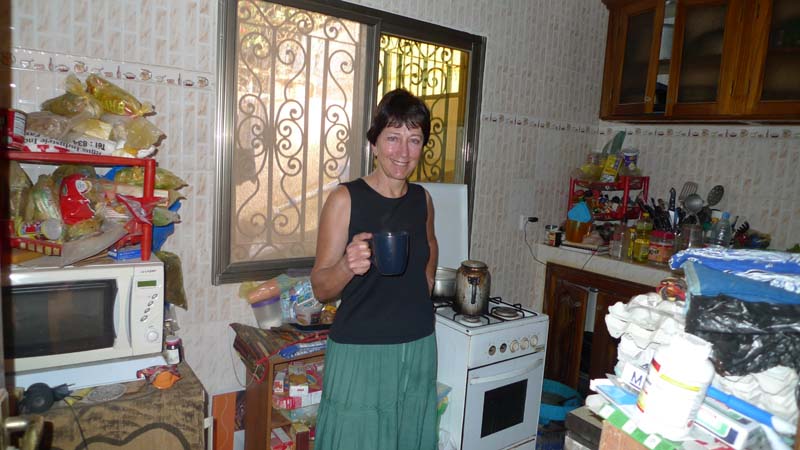
Kitchen in Sineta George's B&B

When Sineta finally emerged as we headed out the door to search for breakfast, she looked a bit miffed. “Oh. You’re going out for breakfast? I could have slept in.”

Things got even worse. We fought with her over what she owed us and we her. She lectured us about how great Senegal is: no drugs or gangs to corrupt her kids (she moved her with three, but the elder two have since left).  Every school in Senegal has an International Baccalaureate program, she insisted.  I believe this about as much as I believe her claim that the city’s electric power almost never goes out.  Or that no one is starving here. (I didn’t ask her why so many beggars had approached us over the three weeks of our visit, pleading for money to eat.)

All this somewhat tainted my mood Friday morning when Steve and I and a Senegalese guide named Bada set off for Goree Island, the World Heritage Site located a brief ferry ride off the coast from Dakar. Like St. Louis, Goree is filled with colonial structures.  Some date back to the 1500s. A good percentage are in fair to good shape, and the cloudless skies and cool breeze made it a perfect day for us to stroll among them. Time and again the light-saturated colors of the buildings and the bougainvillea and sea and sky made me take out my camera and try to capture their beauty. What Goree is most famous for, however, is that this was one of the more important holding places for the people who over the course of centuries were captured and chained and dragged, terrified, from their homes and families in the bush. They were forced into tiny cells in a building that today is painted vermillion. Admission to this Museum of Slavery costs about a dollar per person.
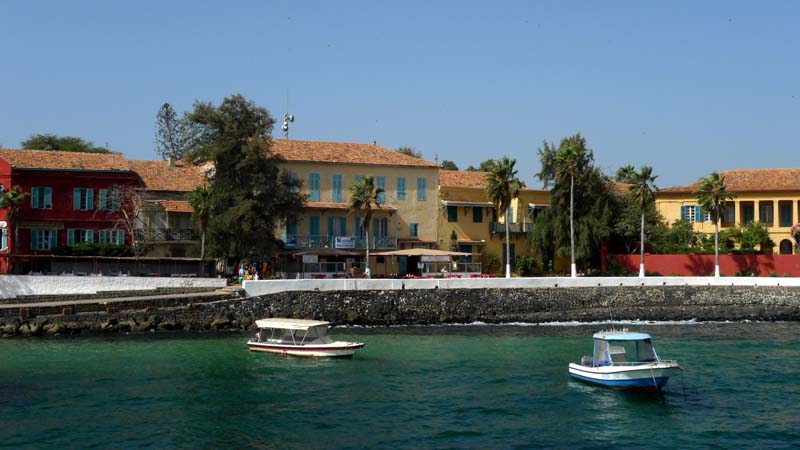
Were it not for its dark history, the villiage in Goree Island would seem a pleasant place to live.

To our chagrin, just as we arrived, it closed for lunch, and there was no sign of it reopening two and a half hours later, when we were preparing to catch the return ferry. We never got to see the “Door of No Return” that the captured Africans walked through just before boarding the slave ships. However, we were able to peer through the long slitted windows at the tiny spaces into which suffering hordes were packed. Bada pointed out that the slave traders lived on the floor above the cells, so they must have lived with the daily sounds of men, women, children weeping, screaming, groaning, dying. The three of us stood there, reflecting on cruelty of this magnitude, and with the ghosts of the slaves hovering around us, I have to admit our travails with Sineta seemed trivial indeed.
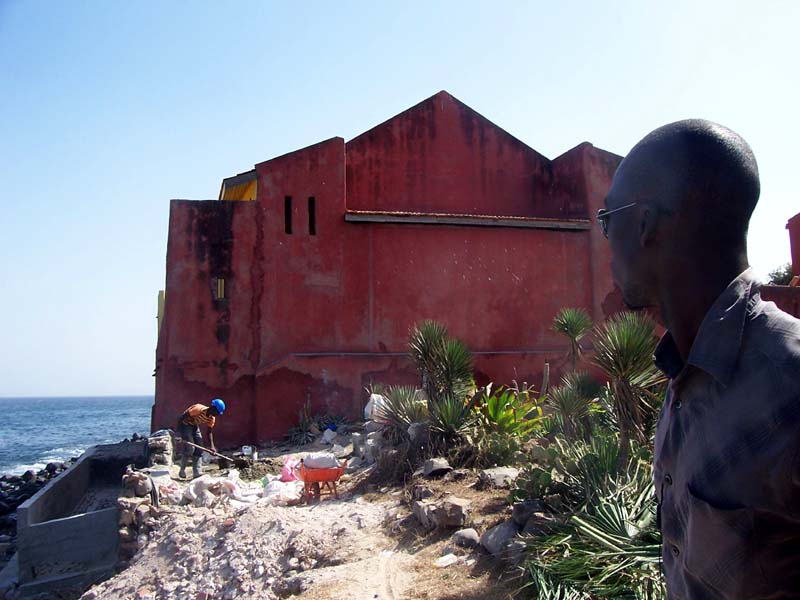
Building where slaves were warehoused prior to sale and shipmen to European colonies and the US.
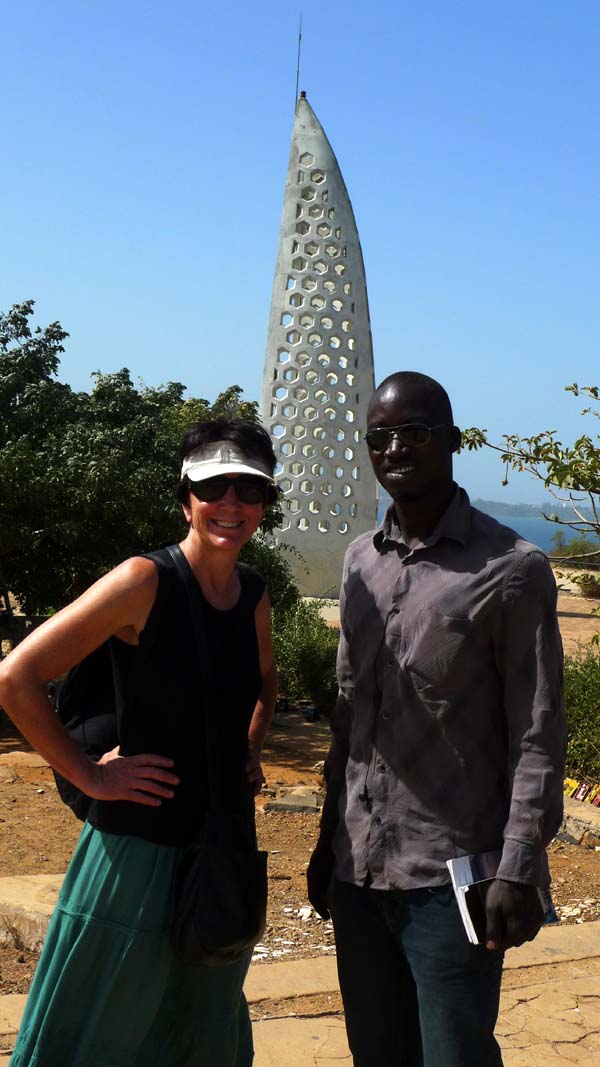
Jeannette & Bada, our guide, before the Goree Island monument

Toubab Transit

Thursday, January 13

The worst thing about traveling in West Africa, as we’ve experienced it, is the difficulty of getting around.  Although train service once existed between Dakar and St. Louis and Dakar and Bamako (the capital of Mali), it no longer operates. We’ve seen only a few big American-style buses (we just passed them on the road to Dakar, from where I’m writing this), but they stop at every village. I’ve described the drawbacks of the sept-place bush taxis — and we never tried the even cheaper and more impoverished minibuses.

But now I’ve finally figured out how the sensible Toubab travels: you hire a private car.  We asked at our hotel in St. Louis about this and thus secured a ride in a clean, well-maintained vehicle (not a single crack in any of the windows! Perfect seat belts!)  This is costing us $100, versus the $35 it would have cost to ride in a bush taxi with (at least) 5 other passengers, plus the regular taxis to and from the gare routiere.  It looks like we’ll make this trip in just 4 hours, enjoying a MUCH higher level of comfort. 

The problem with the private cars is negotiating a good price. The owner of our B&B in Dakar wanted to charge us $200 for this very same trip.  I know it’s possible to hire a clean, air-conditioned vehicle to drive you all around Senegal for 11 days for about $600. Laura and her dad did that. But Laura arranged it, and she’s a bargaining genius. When S and I asked the very same driver how much he would charge to pick us up at the Gambian border and drive us to St. Louis (a one-day gig) he demanded $300 — and wouldn’t consider any counter offers.

As pleasant as this current transport is, I also don’t regret any of our sept-place trips; constant comfort has never been our top priority in traveling. When we want to be really comfortable and surrounded by familiar things, we go home.

A warning about the Senegalese safari experience…

If you’re thinking of trying it, keep your expectations modest! Steve and I paid $178 for a “package” organized by our B&B that included sharing the 70-minute taxi ride to Bandia National Park, the park entrance fee, rental of the safari truck (which we shared with the above-mentioned Ardyce and her mom, an Italian guy, three African-American ladies who’d come to Dakar for the black African arts festival, the B&B owner’s 16-year-old son, and a guide), plus the guide’s services.

A converted pickup hauls tourists around Bandia National Park.

In French, the guide dutifully recited the gestational period and age of every species we saw — but not much more.  The experience reminded me a lot of going to Orange County’s Lion Country Safari, back in the days when it was operating.  Only briefer and more expensive. 

Who doesn't like giraffes?

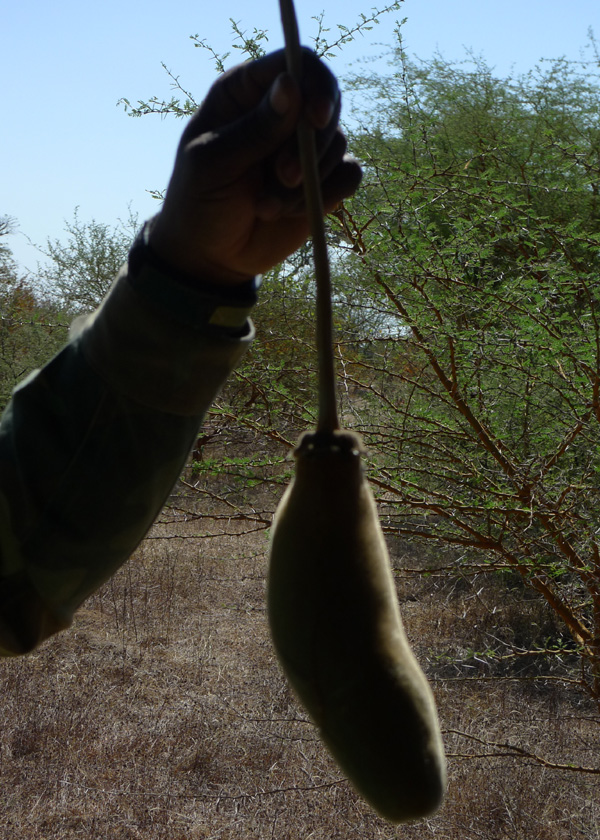
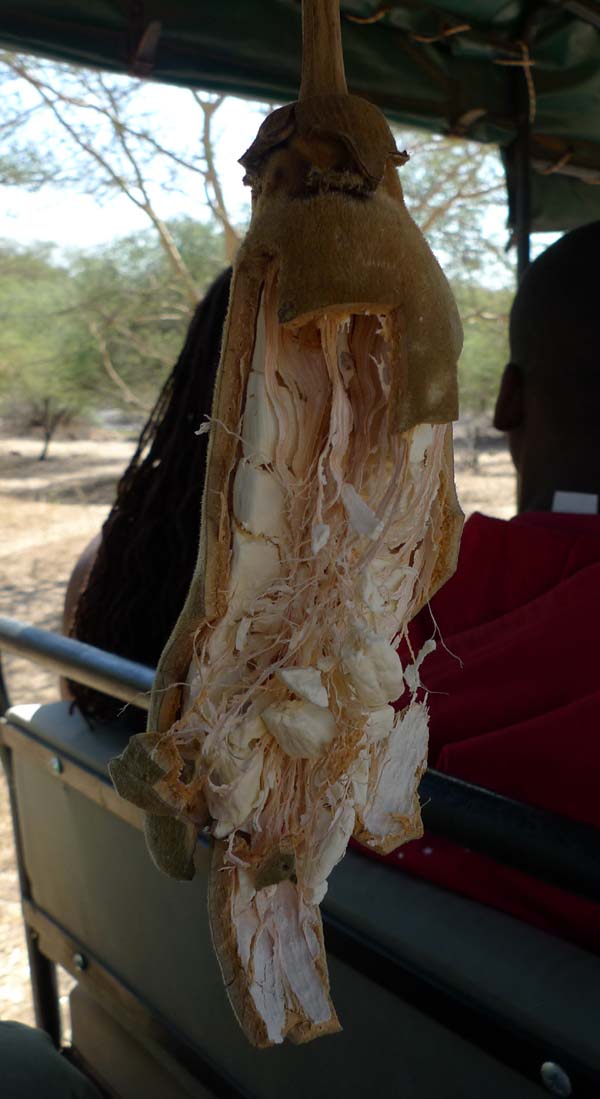
On the other hand, it’s churlish to complain about a two-hour outing with the breeze blowing through the safari truck and sightings of impala and sable antelope, savannah buffalo, eland, zebra, ostrich, giraffe, monkeys. (No predators; they’re long gone.) The animals posed and munched among dense acacia and thorn trees, and — thrilling to me — forests of baobabs.  The best thing our guide did was to spot a fallen baobab fruit (not so easy to find!  Monkeys love them so much that the Senegalese call them the “monkey’s bread.”  He let us photograph the long oblong fruit, then smashed it against the side of the truck to reveal a fractured white interior. He passed it around to let us extract fragments, which looked like pieces of white packing material. Inside each piece was a huge seed (the malevolent invaders that Le Petit Prince had to ceaselessly prevent rooting in his beloved planet!)  The big surprise was the taste of the white stuff around the seed — refreshingly citrusy.

Now we’re happily settled into the Relais in Kaolack — by all reports a dreary town despite being the crossroads of Senegal. But our trip here was a personal triumph, and Laura and Alberto will meet us here tomorrow afternoon so we can continue on into the delta paradise where we’ll ring in the New Year.

Moving to Senegal

Tuesday, December 28
One of the first characters we met here yesterday morning was a young woman named Ardyce (I may be misspelling her name). She was a member of the group of 8 who made the trip yesterday morning from Dakar to Bandia National Park (a 70-minute ride from the capital, and billed as a cheap and easy way to sample an African safari in Senegal.) Steve and I sat with her in the back of our taxi: Ardyce’s mom, visiting from Florida, got the front seat. I think Ardyce was about 24, graduated with a masters in journalism last summer and now on a Rotary scholarship to work and study in Senegal. She wants to be a foreign correspondent and told me Dakar wasn’t a bad place to try to launch such a career. She acknowledged that the city had many awful, trying aspects; in her first weeks, she had called home every day weeping and ready to return to the US.  But now, after just 4 months of living in it, she had grown so attached to the place that it was painful to think of leaving.  The only complication was that she had a boyfriend back in the US, and she wasn’t sure how he’d feel about settling down in Africa. 

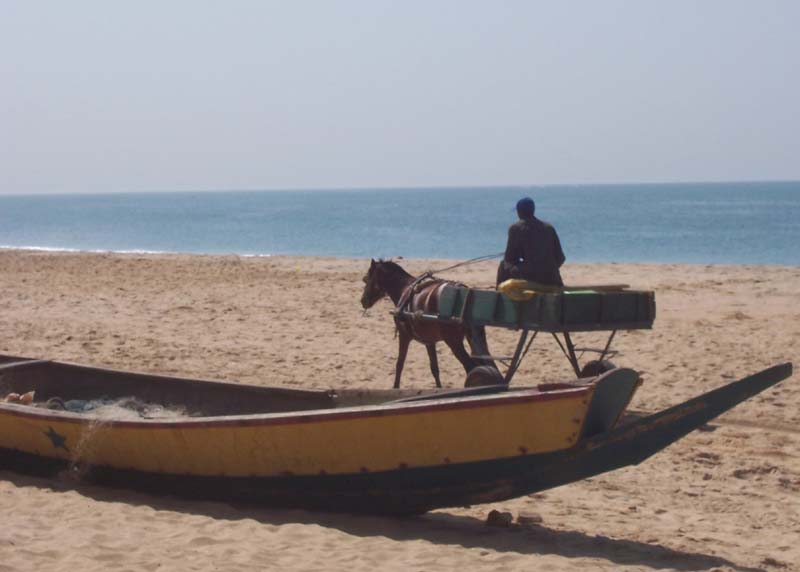
Horse cart on the beach at Popenguine, Senegal

Ironically, Steve got into a conversation today with a young African that touched upon the same theme.  After visiting the park yesterday, we moved on to Popenguine, the nearby beach town on Senegal’s “Little Coast.” We’re happily installed at the Balafon lodge ($32 a night), and after a long breakfast this morning at the wifi cafe on the beach below our hotel, Steve took off alone to stroll around the tiny village.  His young conversational partner (who spoke French and bits of English) asked Steve why he didn’t move here. Steve later recounted that he had answered that Popenguine was just like his home back in the US.  I snorted that that was ludicrous.  I knew Steve was thinking that this place is hot and sunny and lush with many of the same plants that have been transplanted to San Diego (rampant bougainvillea!).  But the streets are also dirt, and boys deliver bottles of water driving horse drawn carts, and the girls and women walk around with baskets on their heads. The power went out about 9 last night, so when we got back to our room after dinner (fish caught with nets from the beach, earlier that afternoon), we had to shower by kerosene lantern.  The water was unheated.

It struck me that just those sorts of differences, added together, constitute culture shock. On your first trip to Paris, the fact that everyone speaks French and the elevators are tiny might make you experience it. But the more you travel and the greater the part of the world you see, the areas of culture shock shrink. I’ve spent so much time in Europe over the years, I imagine I’d feel only a shadow of it were I to visit Hungary (even though I’ve never been there.)

Still, even though Steve and I were hiking on the Wild Coast of South Africa only 10 months ago, I’m once again experiencing the shock of being in Africa. It’s not unpleasant. On the contrary, for me, one of the greatest pleasures of travel is being jolted by sights and sounds and smells that are shockingly new to me — they sharpen my senses and bring me most fully into the present moment.

They burn experiences into my memory such as our arrival at Dakar Airport. After touching down about 9:30, we moved hassle-free through customs and immediately found our luggage wheeling around on the carousel.  Then we had to go through a bizarre drill of hoisting it onto a conveyor belt. Our suitcases traveled through a large black box and emerged past a fat guy in a security uniform who was paying no attention at all to any of it or us.  But apparently someone in Senegal felt this charade was necessary before tourist could be allowed into the arrivals hall. 

I couldn’t figure out how to get my I-phone to either text OR phone our B&B, so I finally mustered the courage to approach an enormous policeman who looked like he could have been Idi Amin’s bodyguard and ask if I could borrow his cell phone. Looking disgusted, he dialed for me but at almost the same moment, our pre-arranged driver materialized.  

Bada turned out to be warm, welcoming fellow, and after helping us change money and buy a SIM card, he led us to a scarily dark and run-down parking lot and ushered us into a cab.  Then he climbed on his motorscooter and drove off. Our taxi driver followed his single taillight through the crumbling streets of major thoroughfares, then turned into narrower creepier streets. It was pitch-black when we arrived at the B&B, unloaded our suitcases from the trunk, and hefted them through the fine dust of the street and into the pitch-black building. 

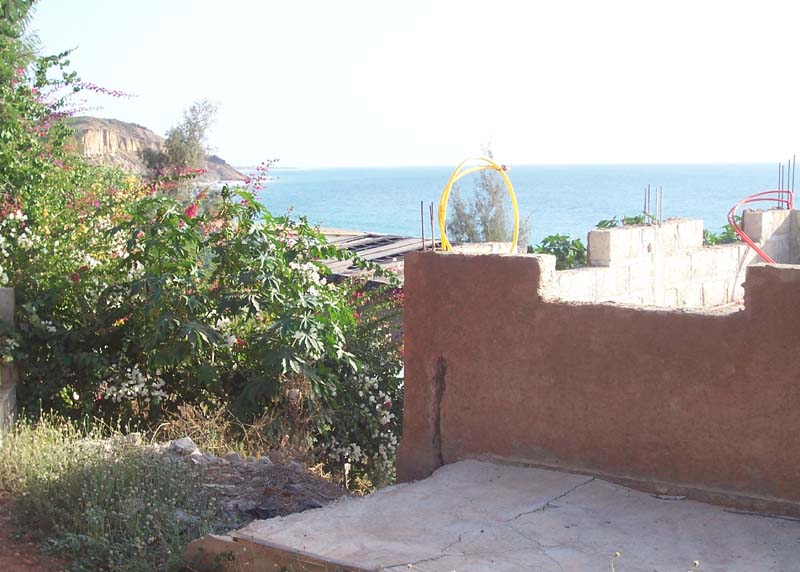
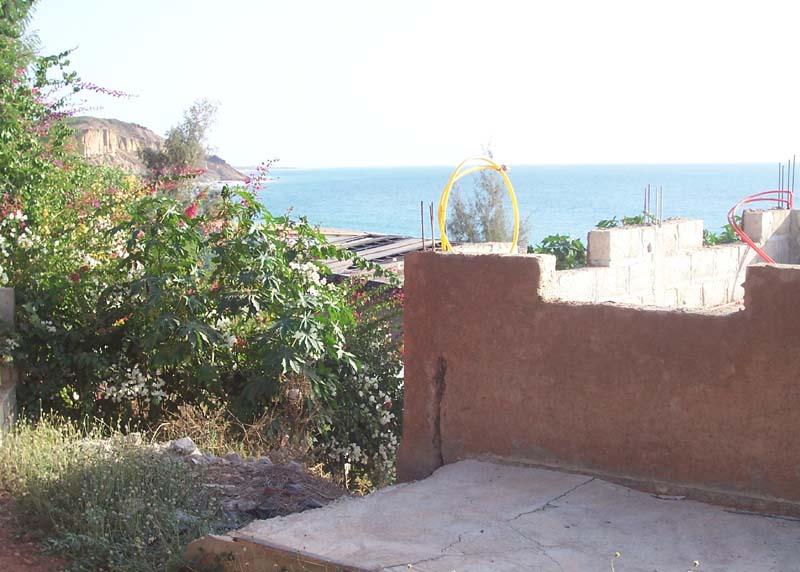
It turned out that Dakar was also experiencing yet another power outage. In the morning the world was sunny and warm and everything looked much more welcoming. Now, sitting in the cool breeze of Popenguine and typing these words to the sound of the surf below, I’m already so comfortable I’ve started to take for granted things like the adjoining unfinished rooftop, bristling with rebar and unconnected power lines. That’s a bit of a shame, but I think we’ll get to experience more novelties in the coming days. Enough, I trust, to keep us awake.Popenguine work in progress