The idea for this road trip was to see the great sights of the Southwest we’d somehow missed. To make our drive to Austin for the eclipse a kind of mop-up tour. We might undertake other road trips elsewhere sometime, but we could close the atlas on at least this quadrant of America.
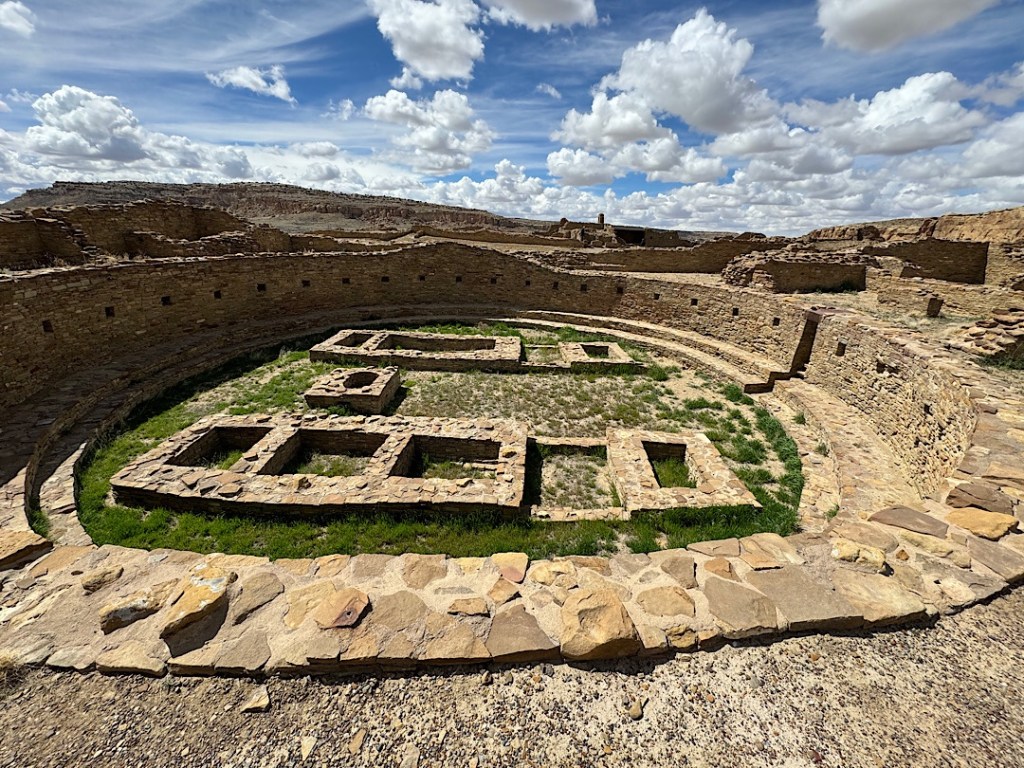
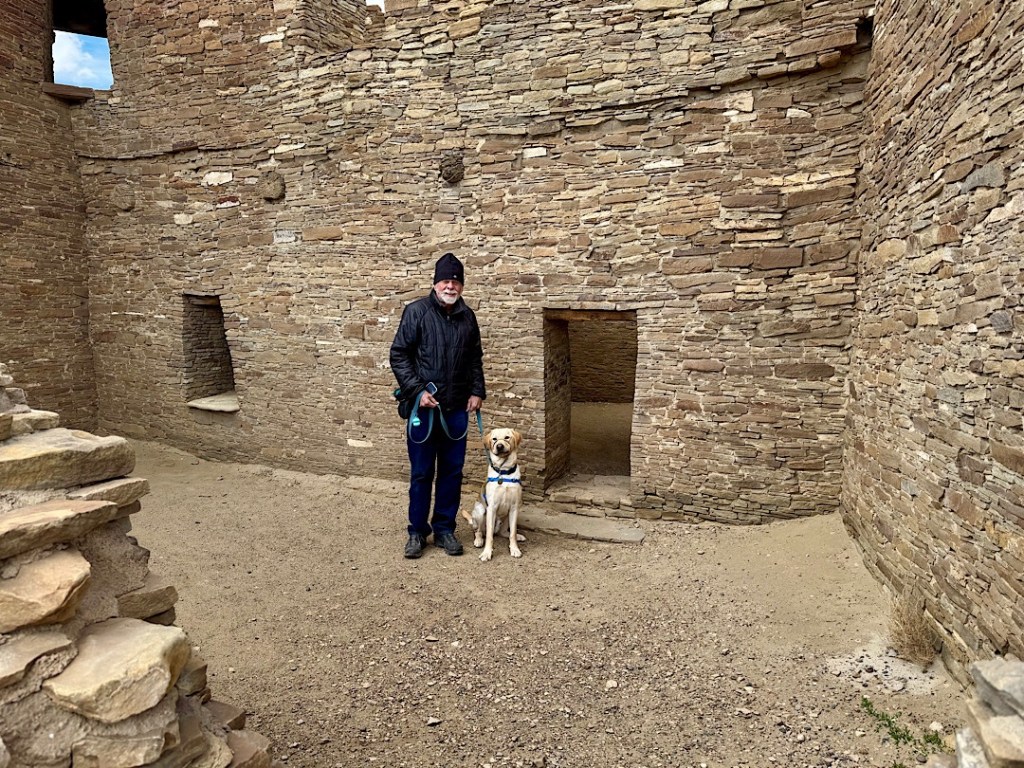
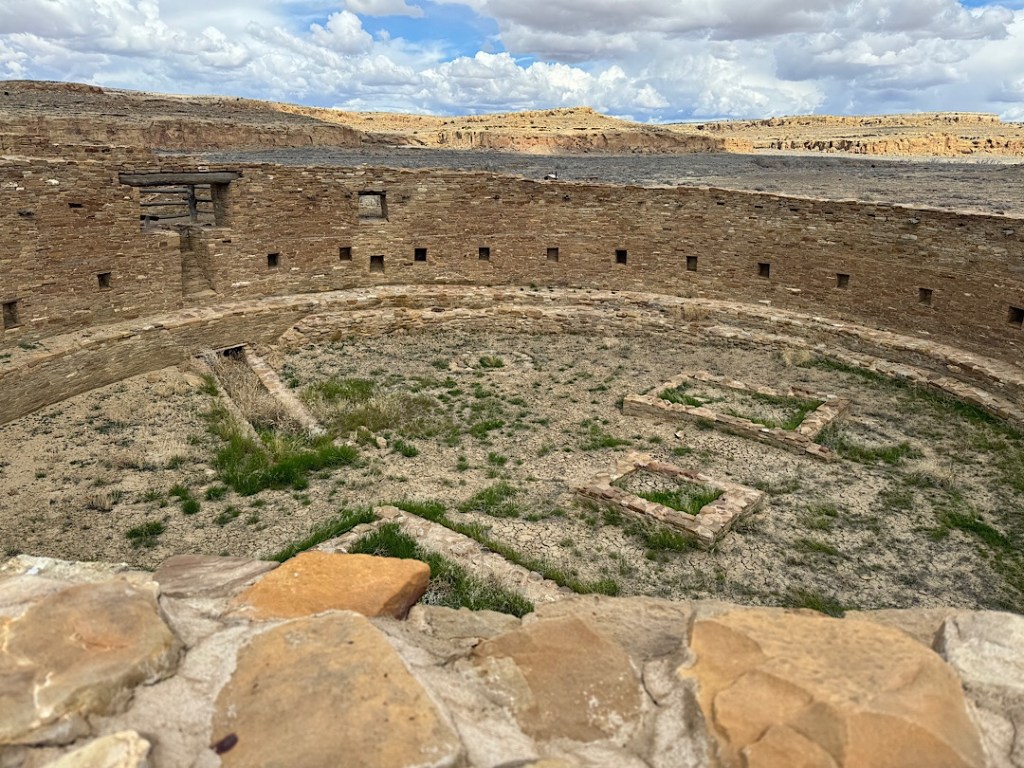
Nice try. Spending time in the ruins of Chaco Canyon (above) and among Sedona’s red rocks; jouncing through Canyon de Chelly and ogling fake aliens in Roswell all rewarded us richly (as I recorded in my earlier posts.) We also fared well on the drive back, even if White Sands National Park somewhat underwhelmed me.
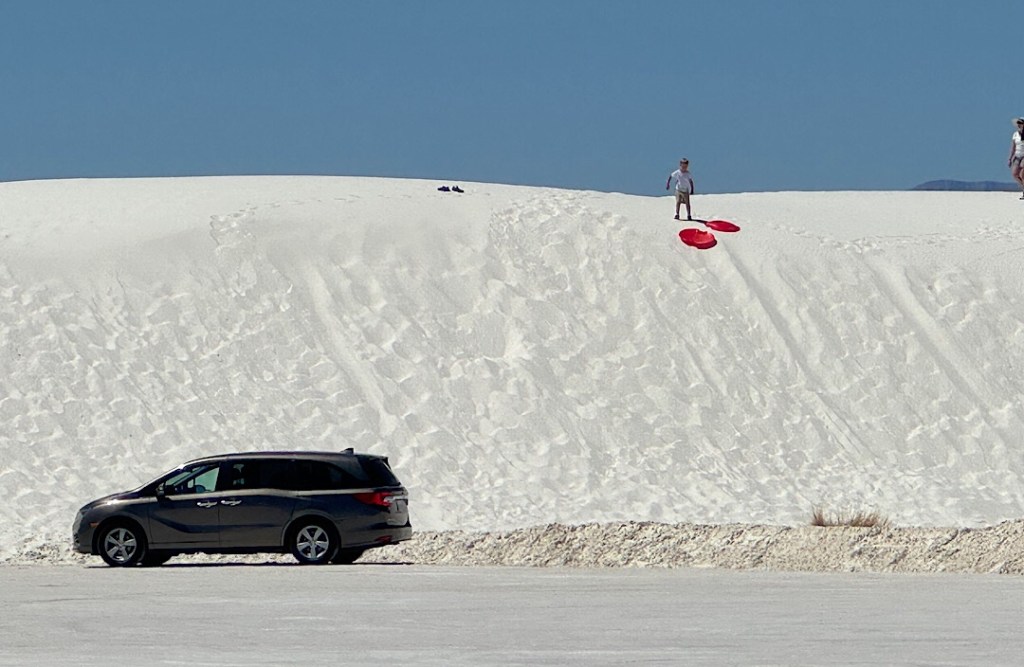
Hiking in the blinding white landscape made me want to dig out the eclipse glasses.Still, it was interesting to see all that snow-white powdered quartzite even if the dunes’ size didn’t match others Steve and i have visited in the Sahara or Colorado or even just west of Yuma.
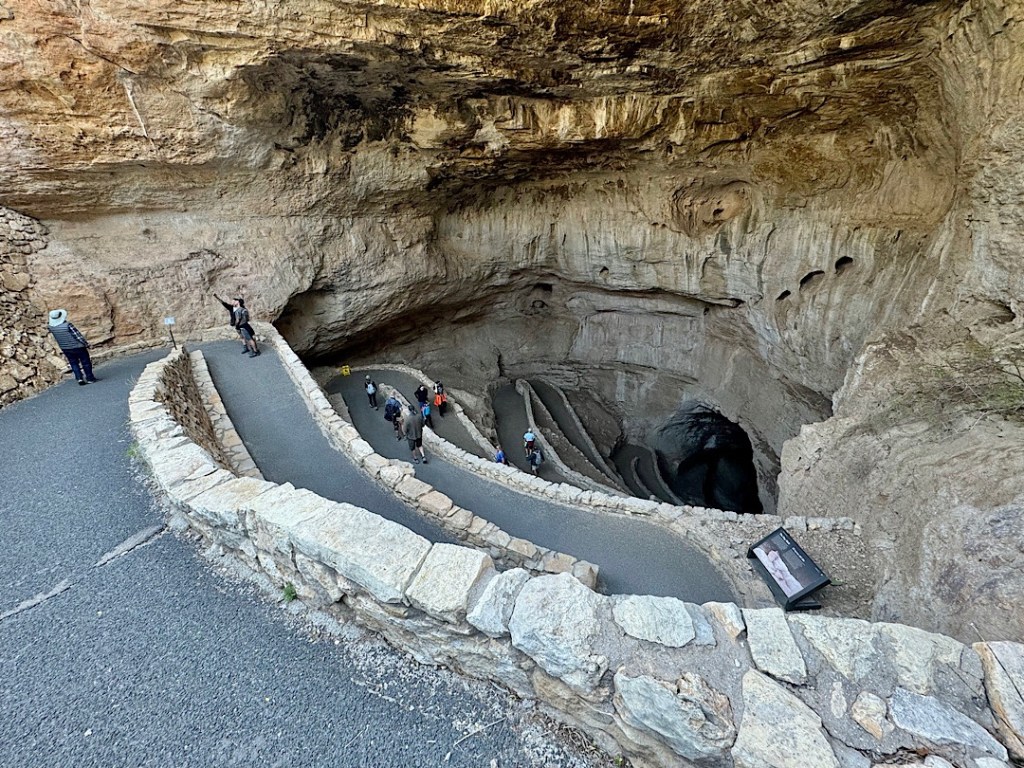
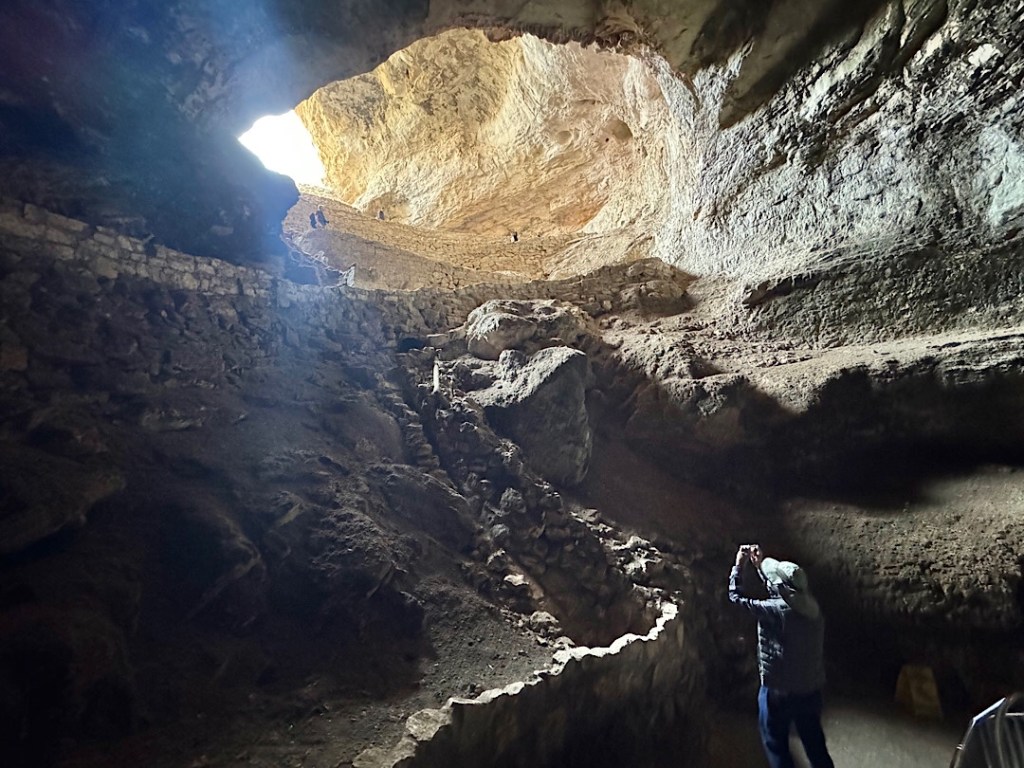
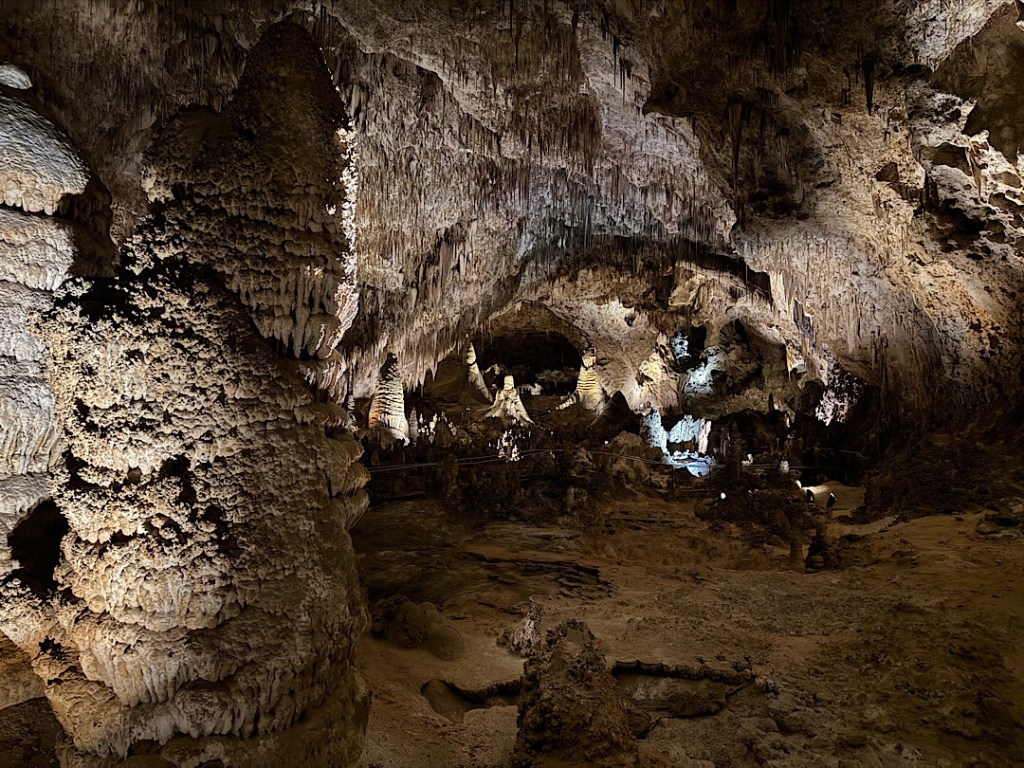
In contrast, our morning in Carlsbad Canyon far exceeded my expectations.
We hiked in through the cave’s original opening, following a path that went down 75 stories.It may not be as colorful as some caverns, but the vast size and baroque variety of its decorations dazzled me.
What wrecked our “Adios, Southwest!” Plan was listening to the audio version of House of Rain, a kind of detective story written by a naturalist/adventurer/desert ecologist named Craig Childs. Driving east through the Indian reservations, we’d consumed a more classic mystery – one of the Hillerman stories starring Navajo tribal police officers. But I had also downloaded House of Rain hoping finally to learn about the Anasazi people (aka Ancient Puebloans). I knew vaguely they had lived in cliff dwellings in the area where Arizona, New Mexico, Colorado, and Utah come together. The subject of House of Rain was who they were and what became of them – just what I wanted to know.
Visiting the Heard Museum in Phoenix and Flagstaff’s Museum of Northern Arizona and Canyon de Chelly and Chaco gave us droplets of the answer. But listening to Childs on the drive home was like jumping into a roaring flood.
He starts with Chaco. We’d just been there – barely a week before, and yeah, the scale and the height of its elaborate complexes had impressed us. But Childs is as familiar with the place as if he’d grown up there, and he made it come alive, explaining what it must have been like when under construction, more than a thousand years ago. He communicates the wonderment of what these folks accomplished, chopping down trees from forests more than 50 miles away and erecting buildings that remained the tallest in North America until skyscrapers began to sprout in Chicago. Then they built a dazzling network of roads radiating out from the heart of it, and they communicated over long distances with a complex signaling system. All these things happened at a time and place that in my mind had always been just…. blank. Childs filled it.
The Anasazi disappeared from Chaco around 1200 A.D., and what happened to them is the mystery explored by the book. It’s a dense, complex story I’m glad I listened to for all those hours – reading it on paper would have been daunting. I won’t try to summarize, just say that what Steve and I heard made us marvel at our ignorance and stoked a curiosity to see more: Mesa Verde or Aztec Ruins or the pueblos where the Anasazis’ descendants still live today.
Will we get there? Not soon. In less than a month, we’ll fly to Miami, a launching point for a visit to a region Steve has begun referring to as Ground Zero for Where All the Trouble in North America Began: the Caribbean. Our plan is to spend time staying mostly in exchange houses and Airbnbs on Grenada, St. Lucia, Dominica, Puerto Rico, the Dominican Republic, and Jamaica. Stay tuned for details of how that one works out.
Day 17. Austin to Carlsbad, New Mexico. 454 miles, 8 hours, 55 minutes (including stops).
Our Austin stay lasted almost a week, and we packed in a lot, enough to get a real feel for the place. Not counting the eclipse, which seemed more celestial than tied to any spot on earth, my favorite Austin experiences were…
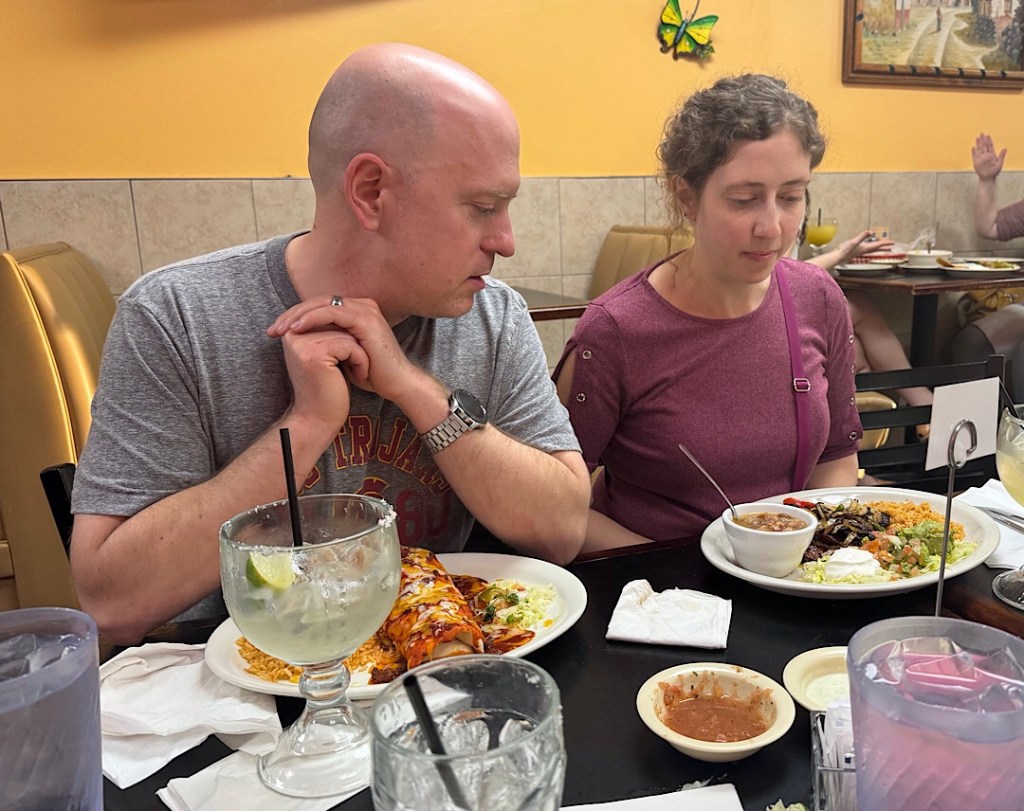
1) the barbecue (see above). It was a shock to realized I’d never had Texas barbecue before. And a bigger shock to learn how delicious it is. How did it take me so long to discover this?
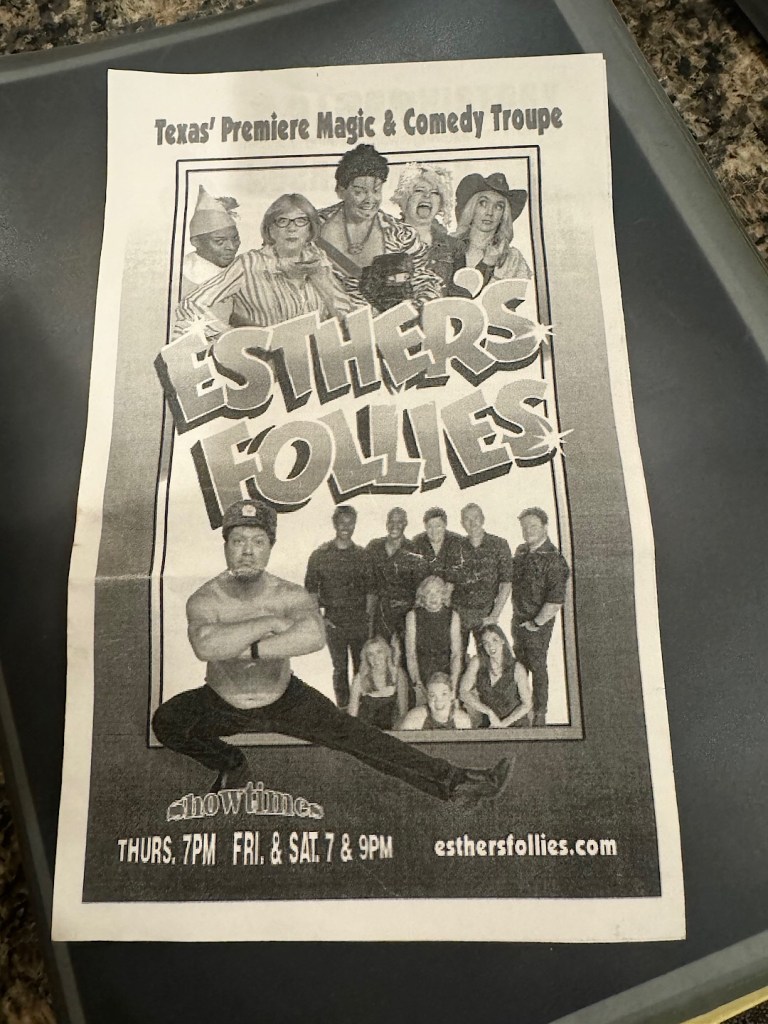
2) Catching a performance at Esther’s Follies, an institution on the ultra-lively Sixth Street. Mixing fast-paced extremely topical comedy skits, music, and big-stage magic, it felt like a weird combination of vaudeville and Saturday Night Live. We laughed a lot.
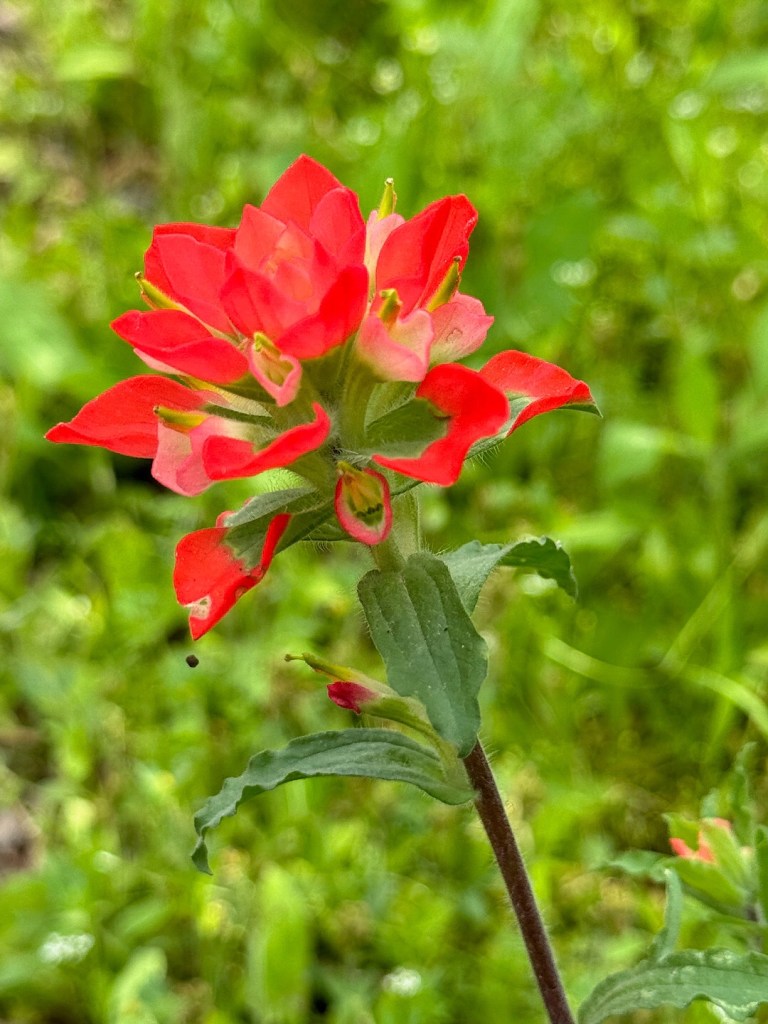
3) On Sunday morning, we visited the wildflower reserve established by Lady Bird Johnson. Its big vistas…
… dazzling close-ups…
… and everything in between filled me with happiness.
But now we’ve left Texas behind and will tackle two national parks in the next two days. Up tomorrow: a visit to the largest underground chamber in North America.
Chasing eclipses is dangerous. The risks aren’t physical but emotional. Traveling anywhere to experience this particular outdoor activity — brief as it is — requires planning and making commitments months or even years ahead of the actual event. If after all that the weather doesn’t cooperate, you can wind up seeing only a fraction of what you’d dreamed about. You could feel devastated.
Steve and I chose to chase Monday’s big American eclipse in Austin mainly because this part of Texas is reputed to have something like 300 days of annual sunshine. (Also, neither of us had ever been to Austin before.) When my iPhone weather app began forecasting Austin’s eclipse-day conditions 10 days ago, my heart sank to see all the clouds. I told myself conditions could change and did my best to put it all out of my mind.
The forecasts got harder to ignore once we arrived here. We’d decided to view the eclipse at a big organized site in Waco (about an hour and a half away, on the centerline, with a consequently long span of total darkness.) But rain had appeared in Waco’s forecasts for Monday and Tuesdays, and by Sunday afternoon, it looked like violent weather — thunder and lightning, huge hail, maybe even a tornado or two — could rip through the area some time Monday afternoon. (Totality would begin at 1:38.) The thought of getting stuck on a freeway in post-eclipse traffic with a Texas tornado spinning toward us was scary enough to make us all consider staying in Austin, even though the moon would cover the sun for only a minute or so (versus more than 4 minutes in Waco). We finally resolved to wait and see what Monday morning brought.
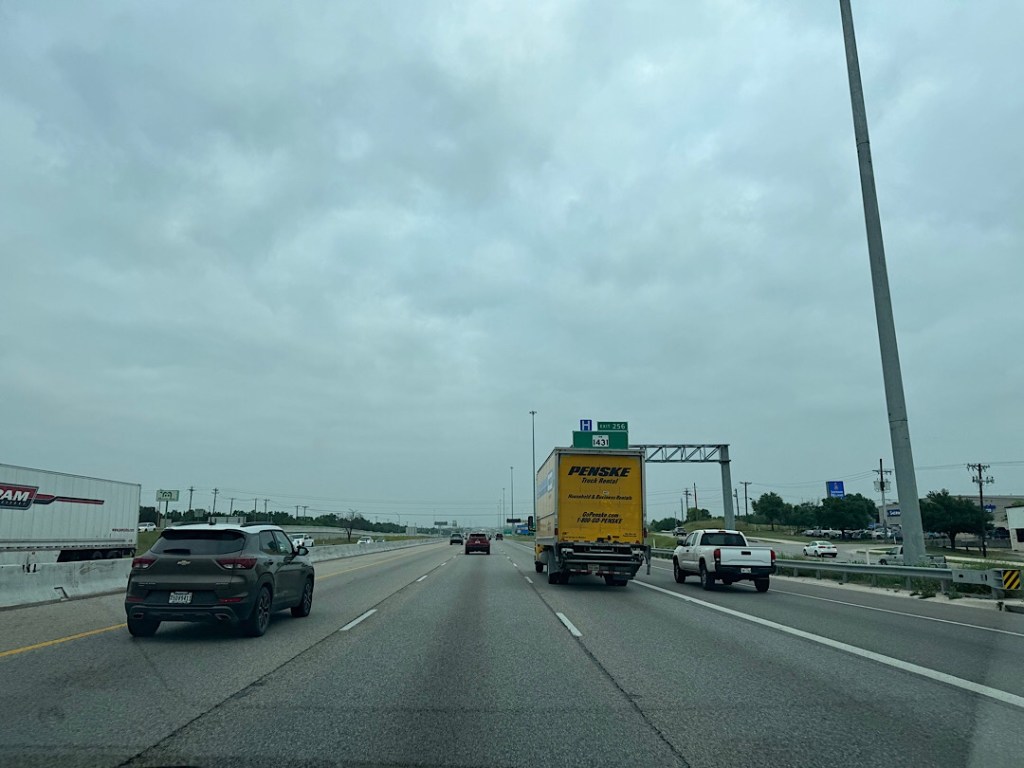
By then, the weather predictors seemed to be suggesting any violent storms would not take shape until late afternoon. So we piled into our van and headed north, under skies that still looked unfriendly.
The outlook began to brighten about a half hour later. Tiny patches of blue sky appeared, illuminated by glimpses of sun.
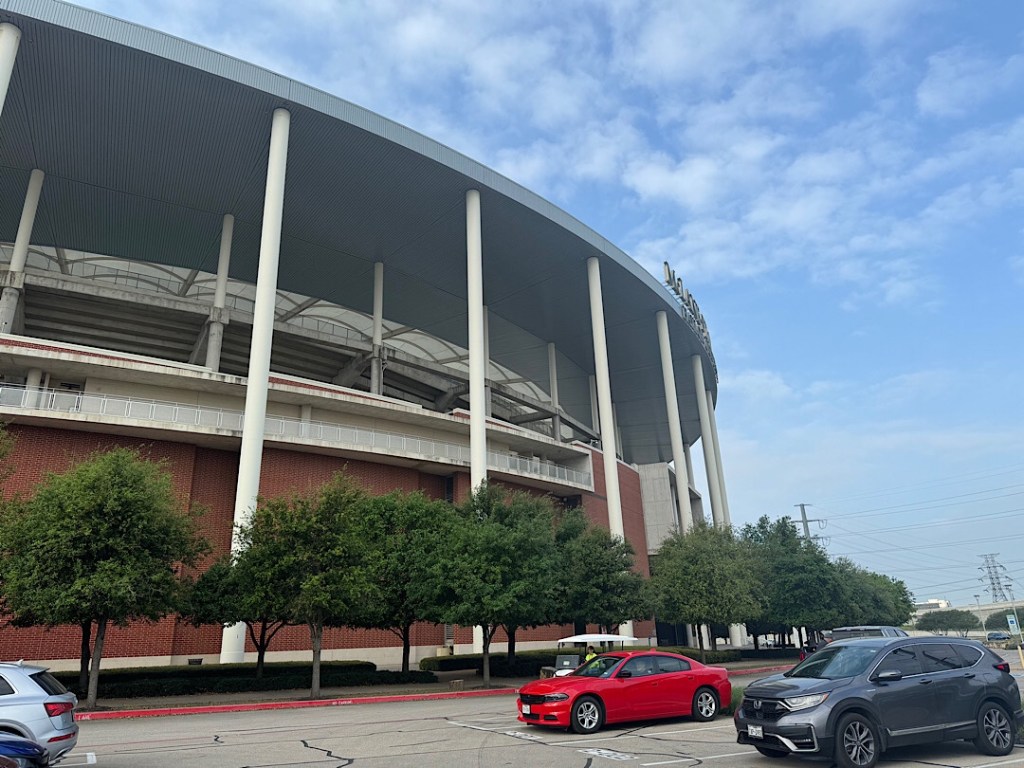
By the time we reached the parking lot at Baylor University, site of our Eclipse Over Texas tickets, it almost felt like a sunny day.
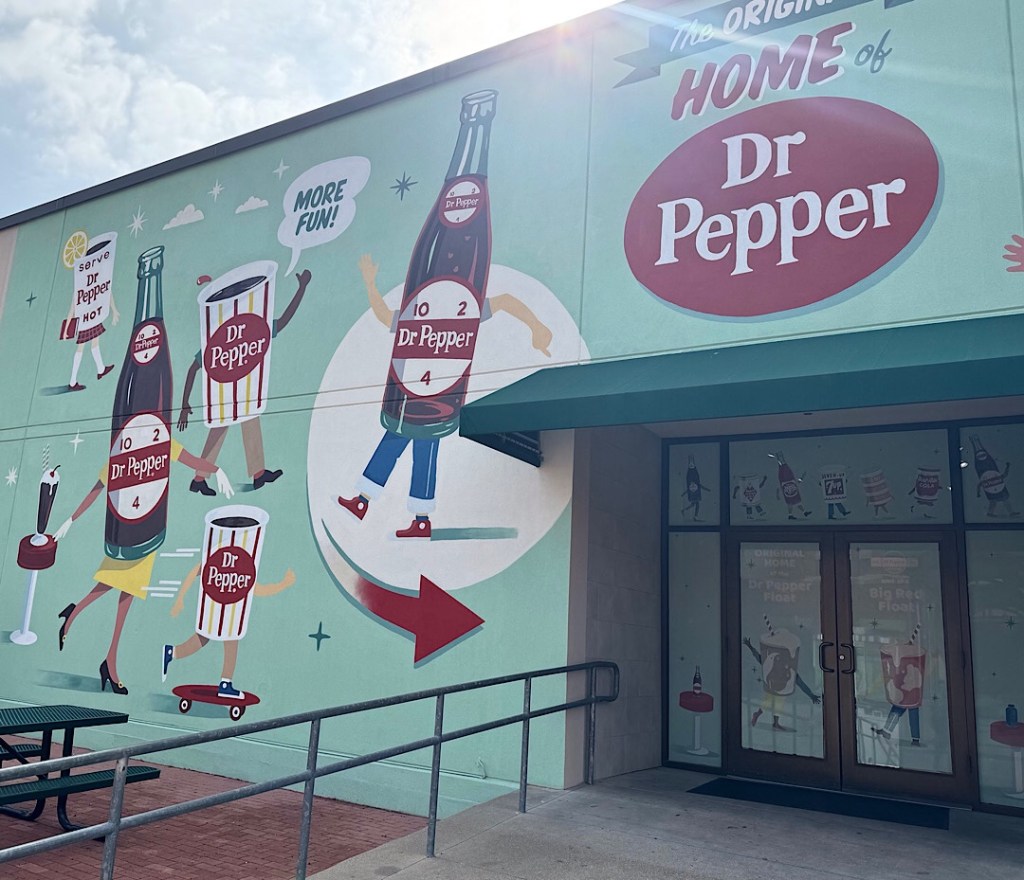
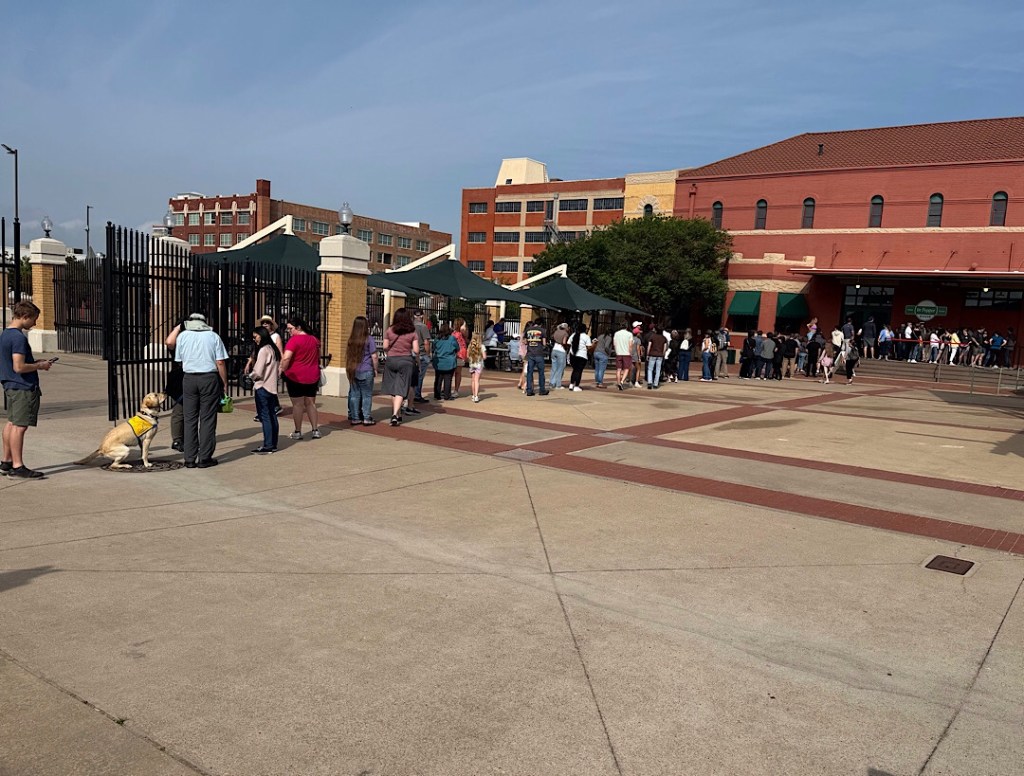
With four hours to go until totality, we walked a little over a mile to the Dr. Pepper Museum in the center of town, where we learned that too many other eclipse-chasers had had the same idea.
The sun was blazing by then, but the line crawled. After a while, we gave up and returned to Baylor’s eclipse-viewing area. The crowd was growing.
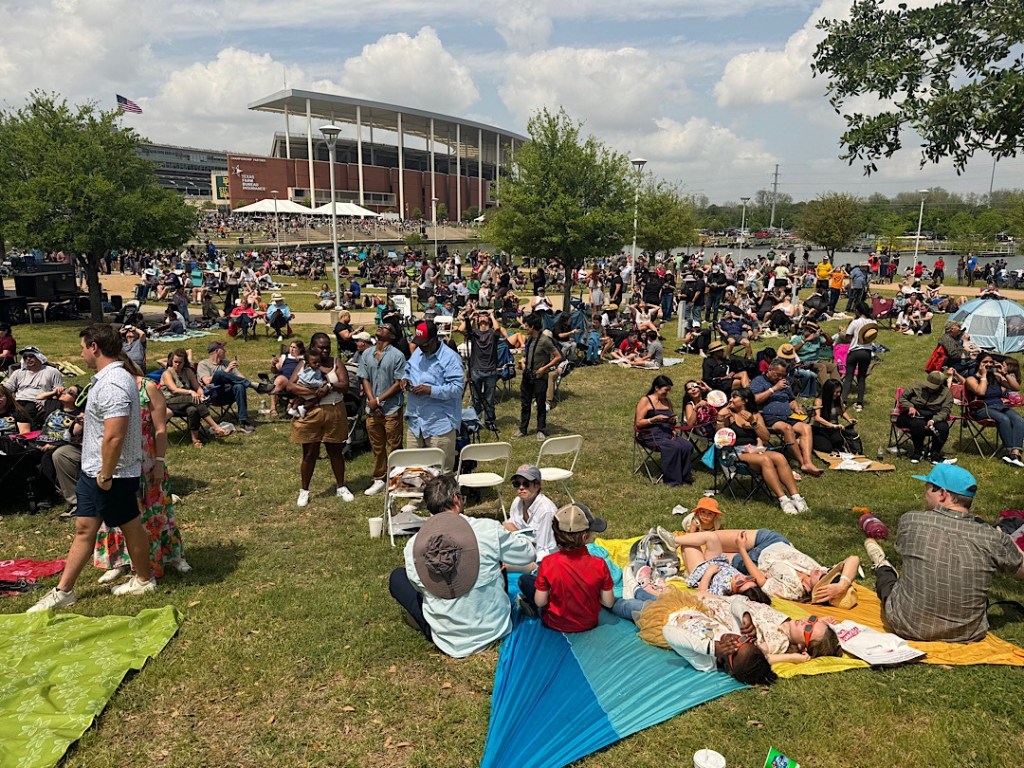
We found our friends Donna and Mike, who had driven in from Colorado.The sky still held promise.
I didn’t mind the two-hour wait for totality. Steve and our friend Leigh braved horrendous lines to buy some of the overpriced food-truck offerings. (Event organizers had forbidden bringing in any picnic fare.) I chatted with Donna and Mike; the people-watching also was amusing.
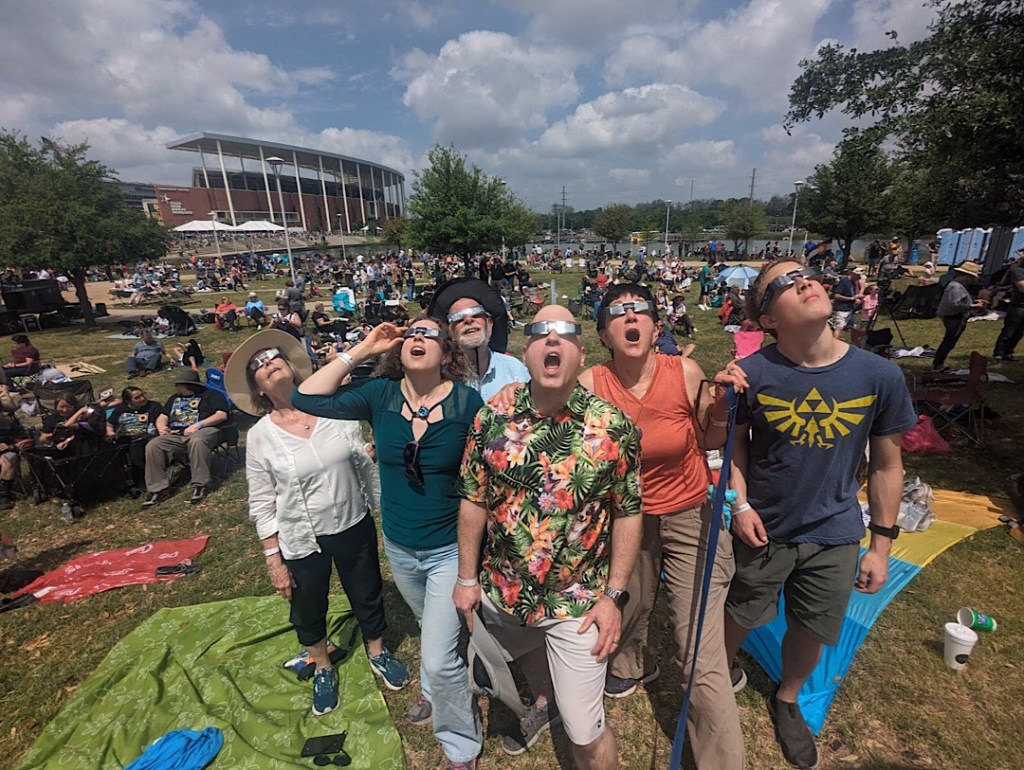
Like so many others in the crowd, I kept an anxious eye on the sky.
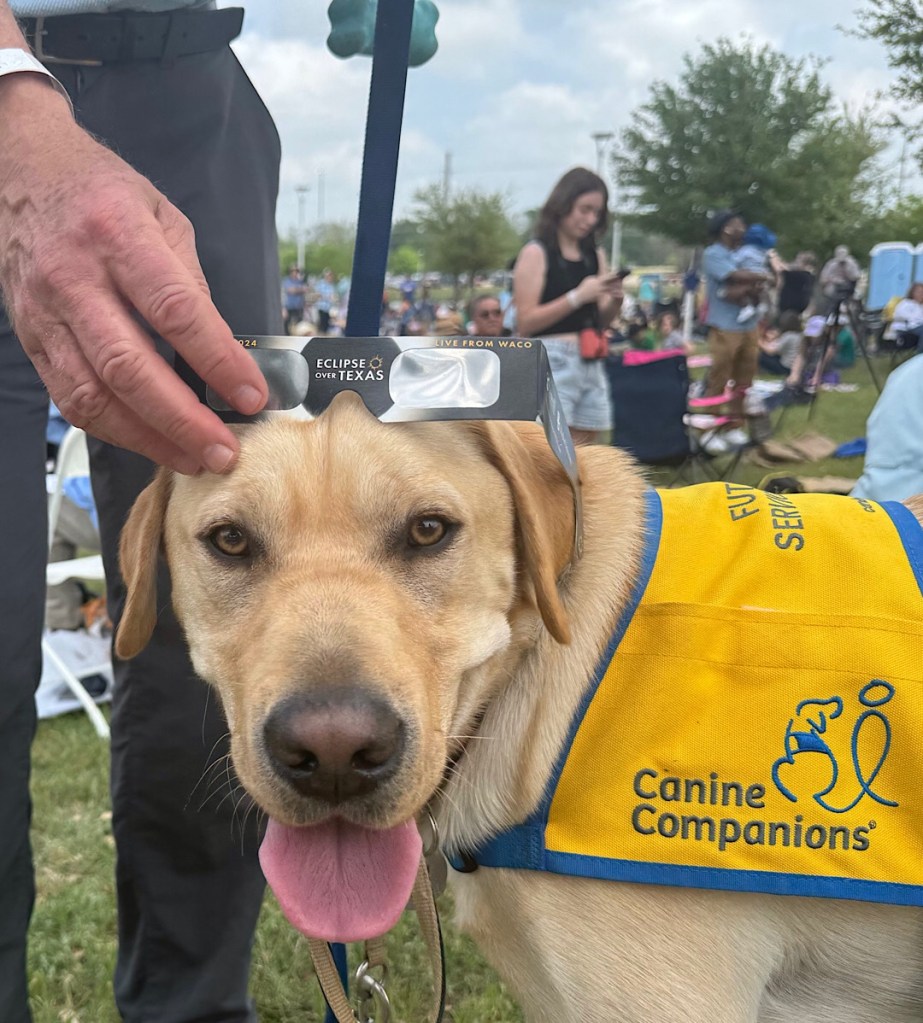
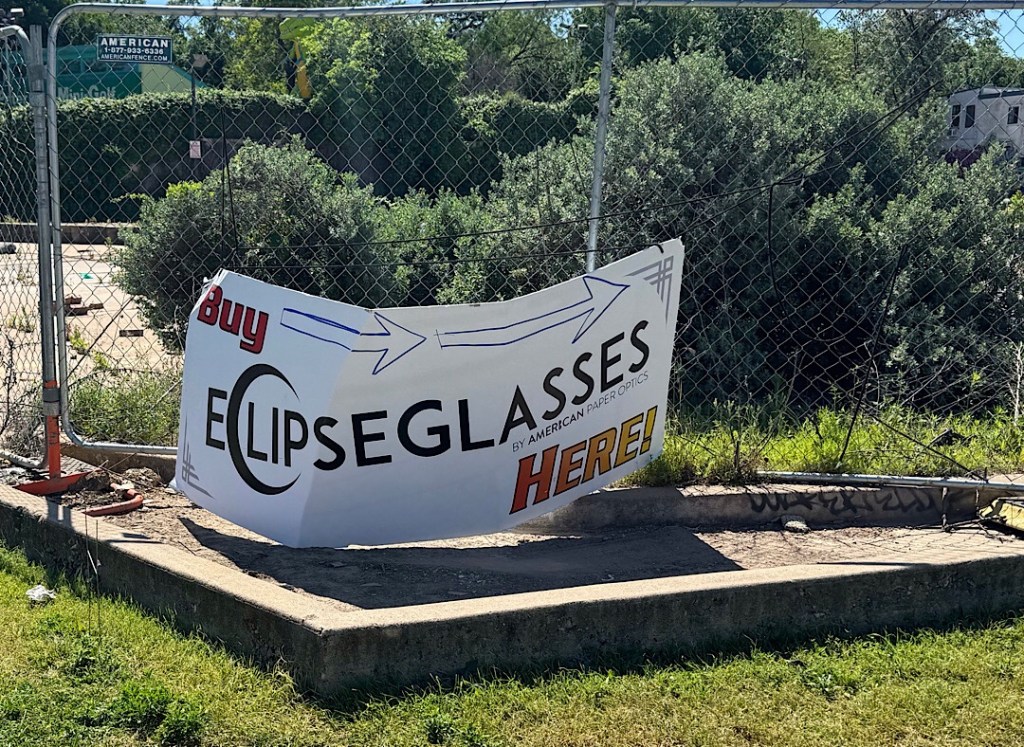
The moon sliced its first thin piece out of the sun around 12:20. You could see this marvel through your eclipse glasses, but as I’ve learned from previous total eclipses, no immediate impact on the earthscape is detectable. On Monday, it took at least another 30 minutes for the light to strike my eye as colder, somehow deader than normal. This sense intensified as more and more of the sun was lost.
The scene went from looking like this……to this.
In those last few minutes, I felt a surge of pure joy. Forecasts be damned! The fragile crescent of remaining sun faced no threat of obliteration from mere clouds. We would see everything as it slipped behind the moon and the world chilled and dimmed, abruptly. Thousands of us simultaneously dropped our cardboard glasses, tilted our heads back, and gaped. People cheered. Some of us screamed.
I noticed different things, this fourth time of viewing a total eclipse. Dark as the sky became, I saw no stars, only Venus and Jupiter. (I have no idea why it would have appeared less dark in Texas than in some of my previous total eclipses.) Even without a telescope or fancy camera and lens, we all could see a glowing orange protuberance at about the 4 o’clock position of the orb: solar flares that someone later said were likely the size of a couple of Earths and more than 10 million degrees.
Something about that perfect alignment — the sun, the moon, my brain, surrounding by the cold gloom of space — electrified me. Then the burst of the first bit of sun re-emerging, more dazzling than anything on earth.
En mass, the crowd scrambled to gather our possessions and begin streaming to the parking lot and shuttle buses. Even though the sun would continue to be uncovered for another hour, mundanity was fully restored.
We tore back to Austin at 70 miles an hour; no traffic ever materialized. It was just one more miracle, one more thing to add to the deep sense of wonder and gratitude.
Trent slept through totality. He didn’t understand what all the fuss was about.
Day 7: Chinle to Chaco Canyon to Gallup. 265 miles; 8.5 hours.
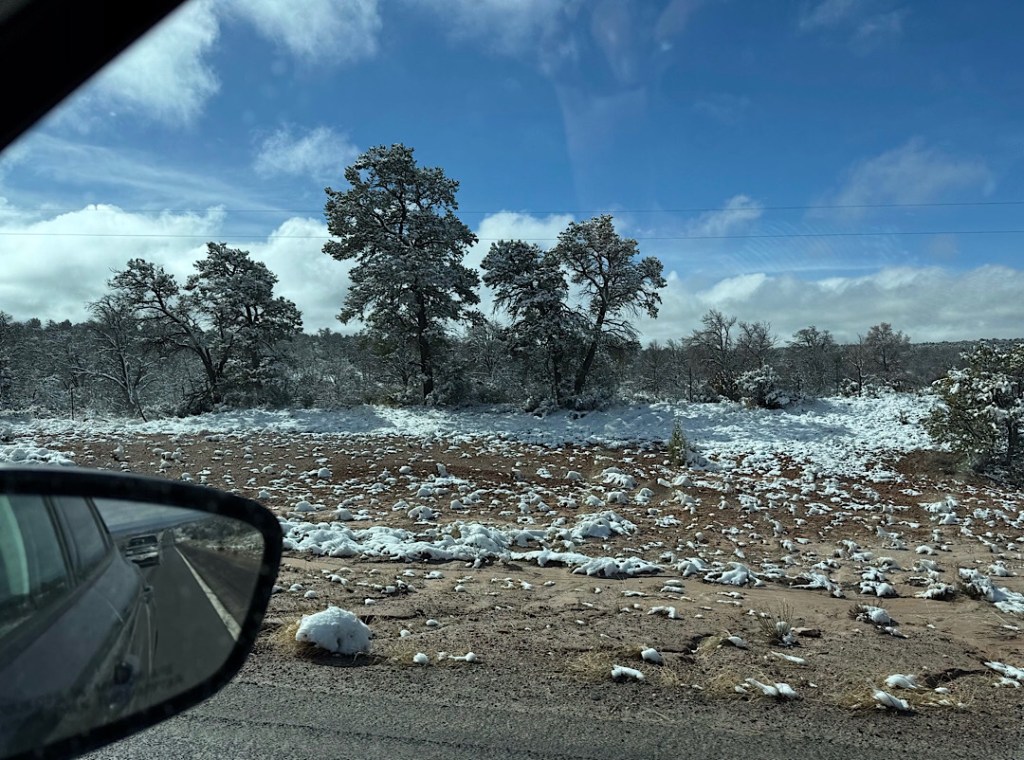
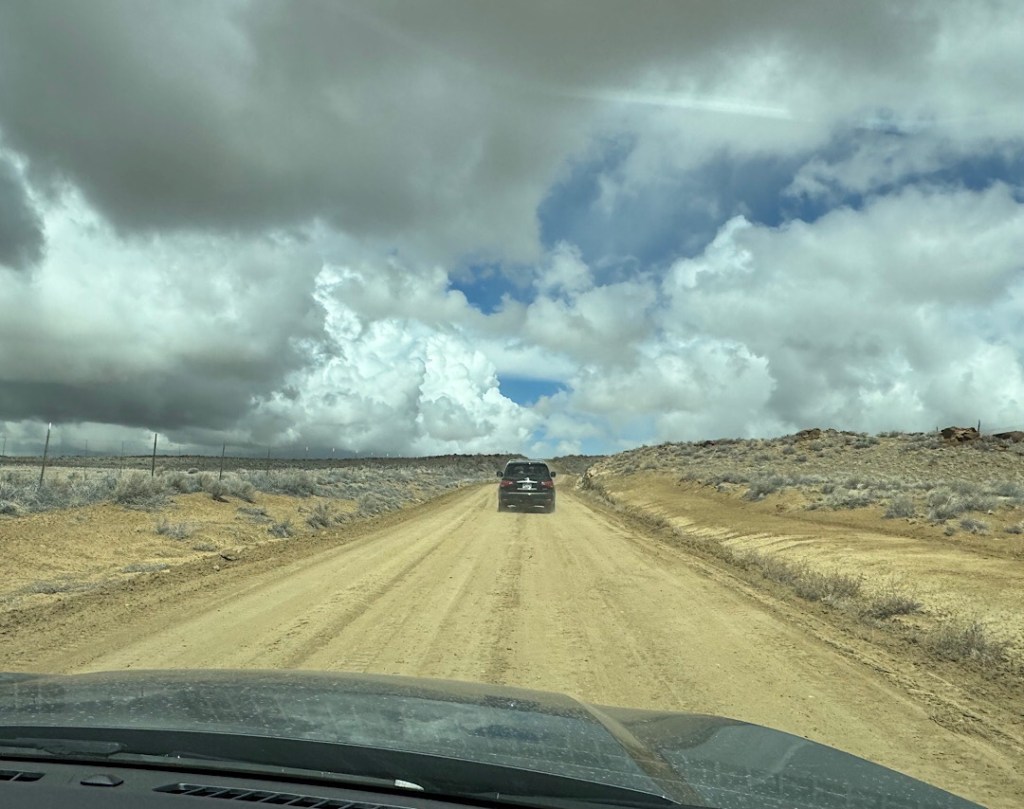
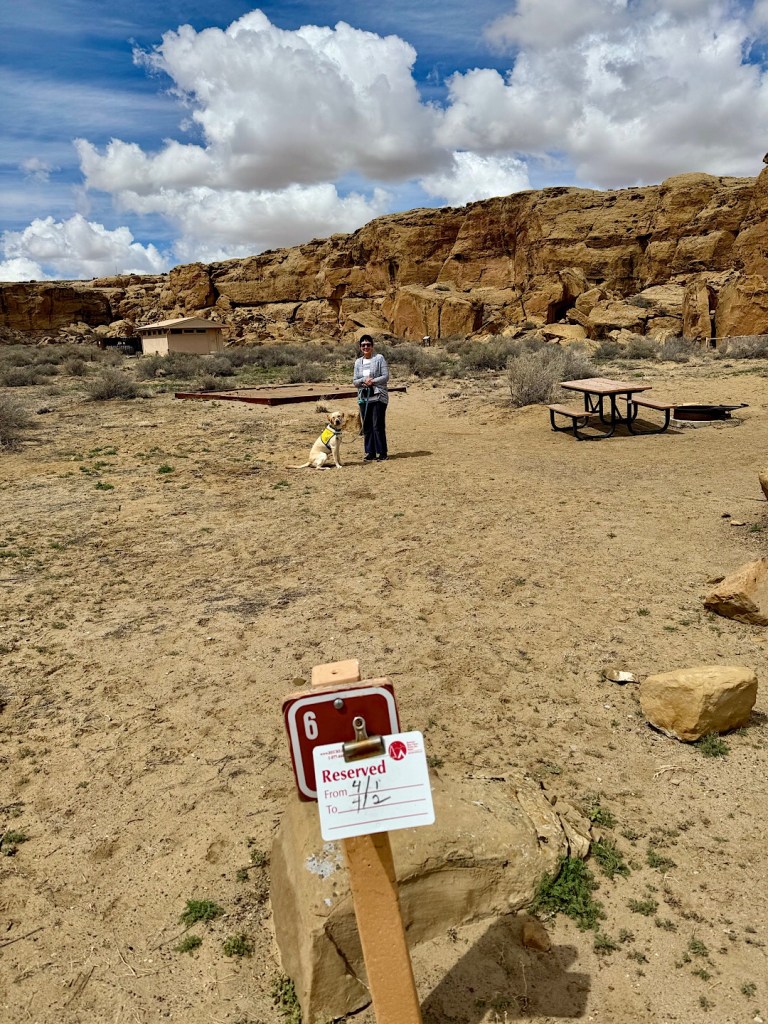
The Navajo Nation can be wintry in early April. We worried that more rain Monday morning might close the roads to Chaco Canyon, which we really wanted to visit.Although it was almost 12:30 by the time we reached the 20-mile dirt track leading in to the park, we decided to chance it, and reached the visitor center a little after 1. I couldn’t resist visiting “our” campsite — where we would have slept Monday night were it not for the frigid forecast.Visitors access most of the park’s trails and major sites by driving on a paved loop road. Then you park and walk to sites like Pueblo Bonito, the largest building site in the broad shallow canyon.People started living here and building complex free-standing brick structures almost 1200 years ago.The Pueblo Bonito complex covered three acres and contained around 600 rooms four stories tall.Archaeologists think much of this site was ceremonial. The Chaco residents also built an impressive network of wide roads, and people trekked here from afar to trade all manner of goods.We saw enough to get a sense of what’s here, then made it out over the dirt road to head for the section of the old Route 66 that passes through Gallup.
Day 8: Gallup to Zuni Pueblo to Albuquerque. 199 miles, 7 hours, 10 minutes.
We were sad to miss the Hopi Pueblo in Arizona, but decided we could pop into the ancestral lands of another tribe: the Zuni, whose primary village is just 45 minutes south of Gallup. We visited a private museum, a trading post, and the visitor center there but were not supposed to take any photos. All very interesting, but with nothing to share in the way of images.
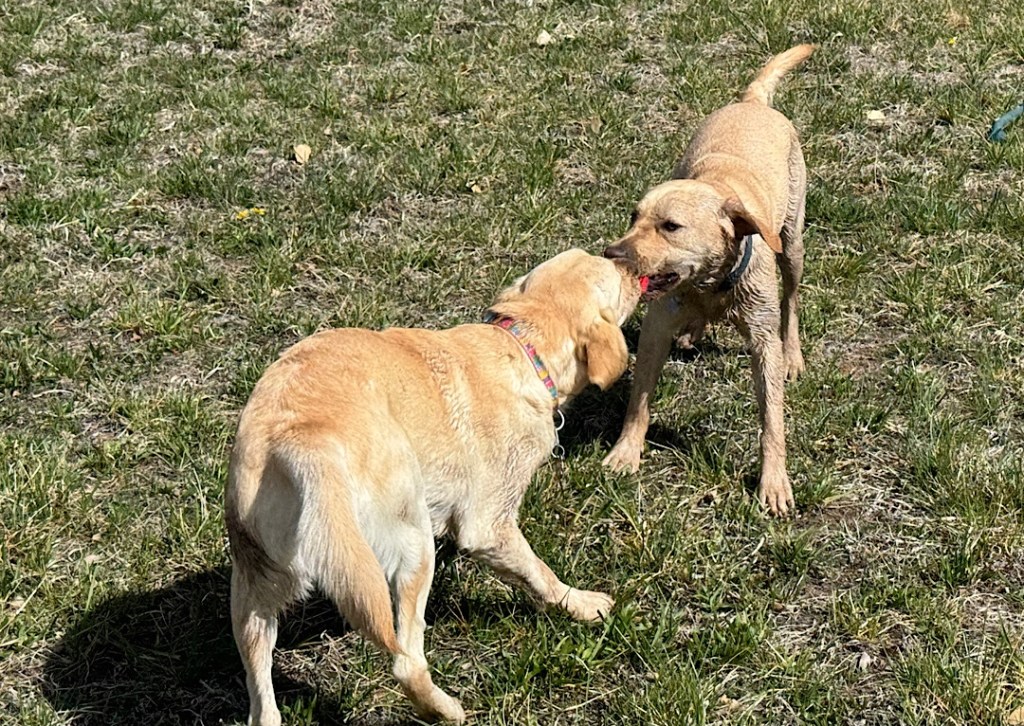
The other highlight of our day was an afternoon stop at the Albuquerque home of the couple who are raising one of Trent’s litter mates, Tex. They have a huge, fenced pasture behind their home, where the brothers romped ecstatically.
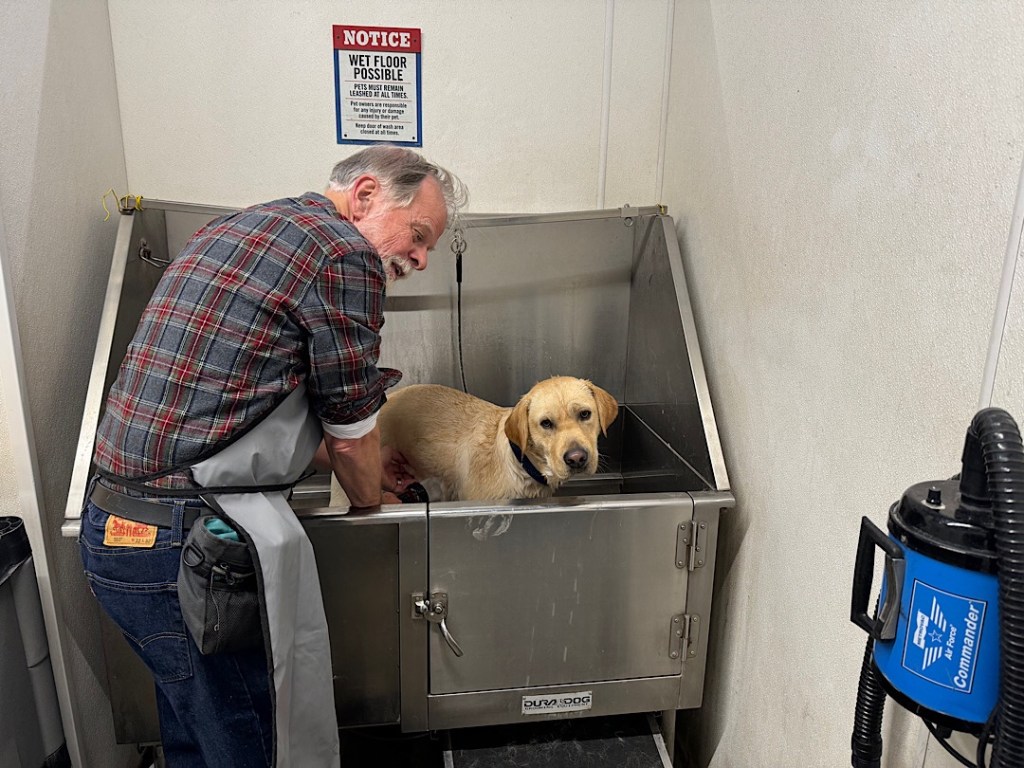
Equally thrilling to Trent was his discovery of the muddy drainage ditch coming off the irrigation channel at the back of the property. In it, he transformed himself from a lab/golden mix into something more closely resembling a chocolate lab. (Or a pig?)
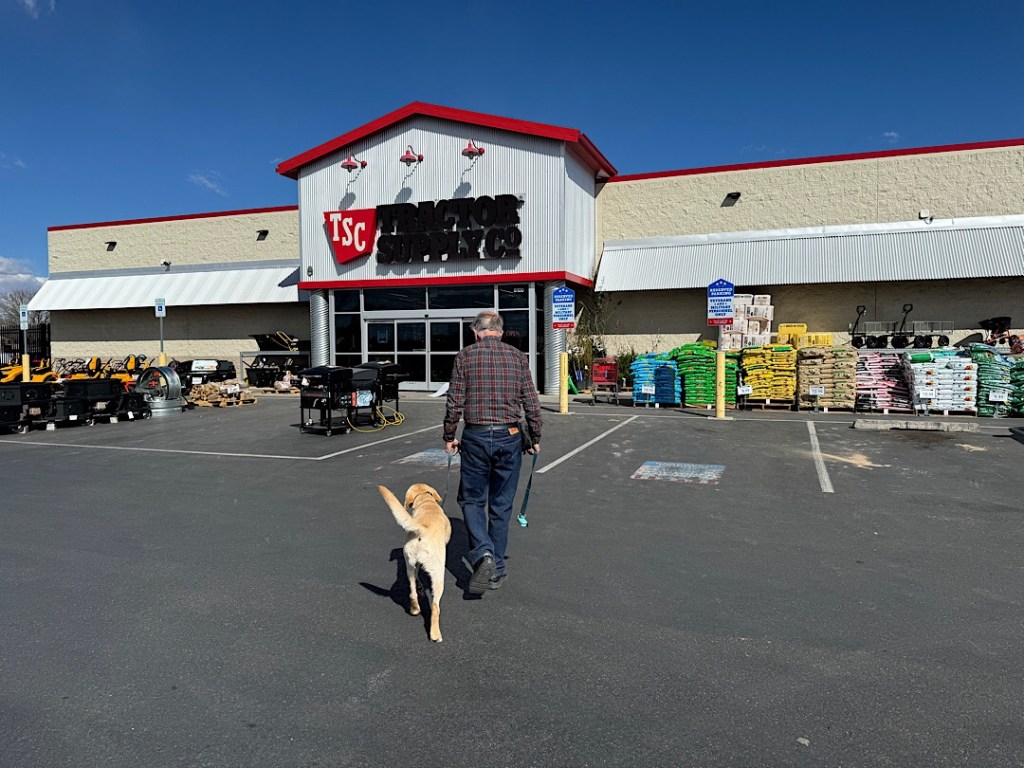
We hosed some of the mud off but still needed to take him to a nearby doggy self-wash facility to make him presentable again.
Day 9: Albuquerque to Roswell to Lamesa, Texas. 170 miles, 8 hours, 45 minutes, including stops.
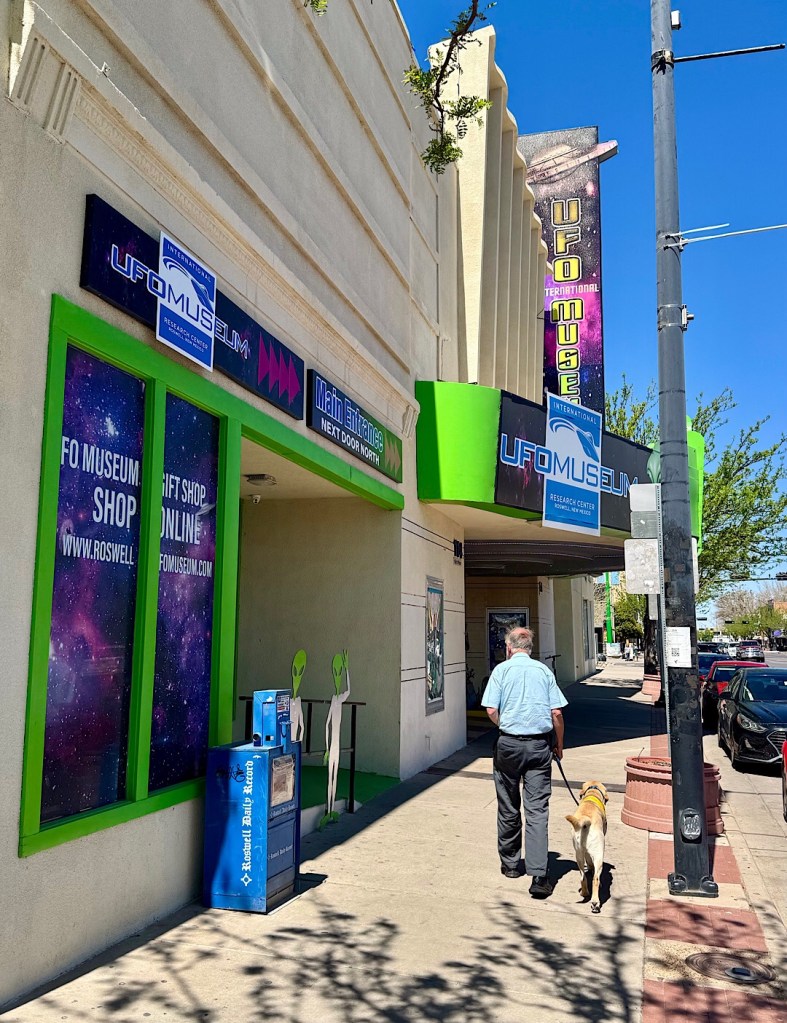
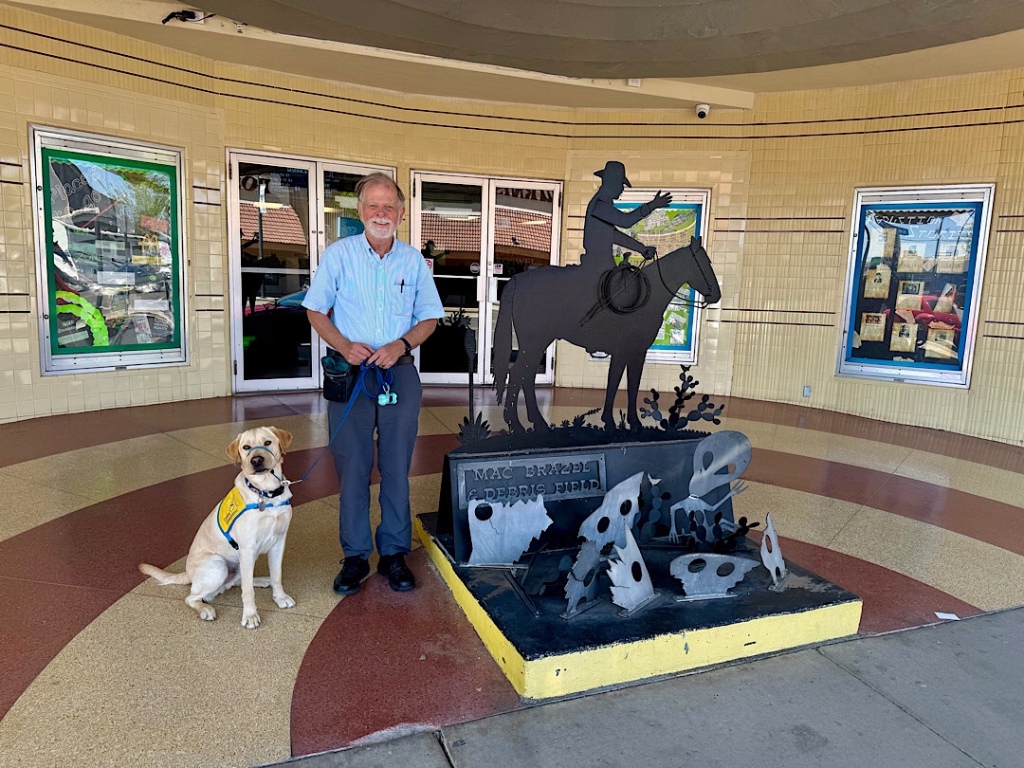
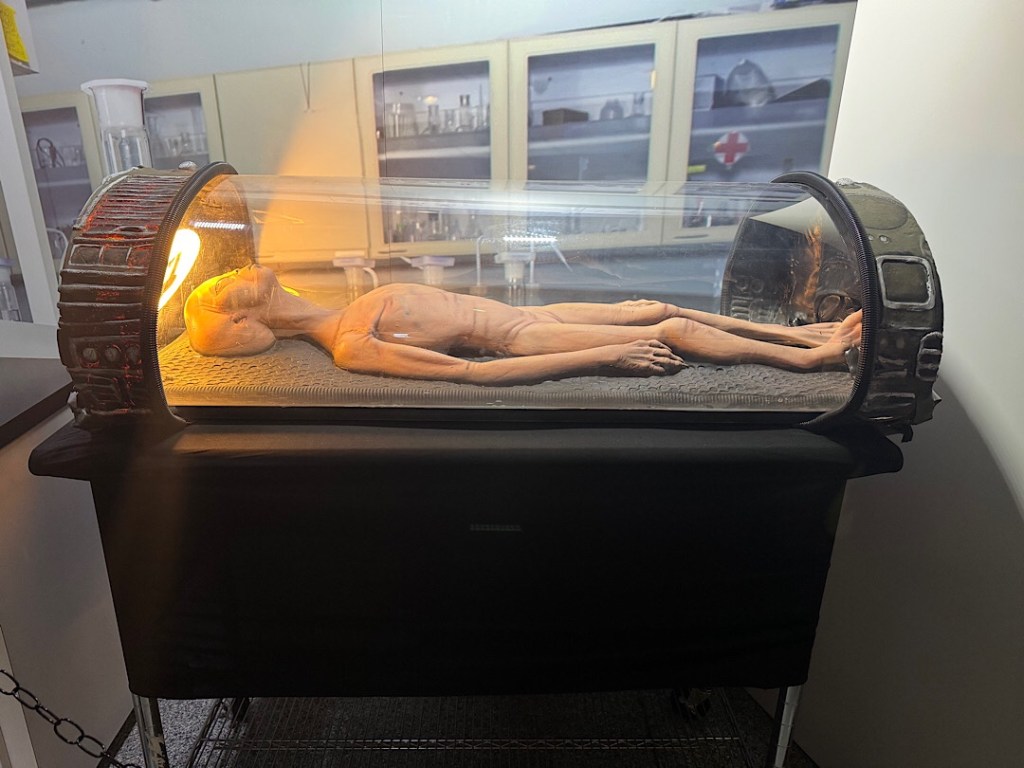
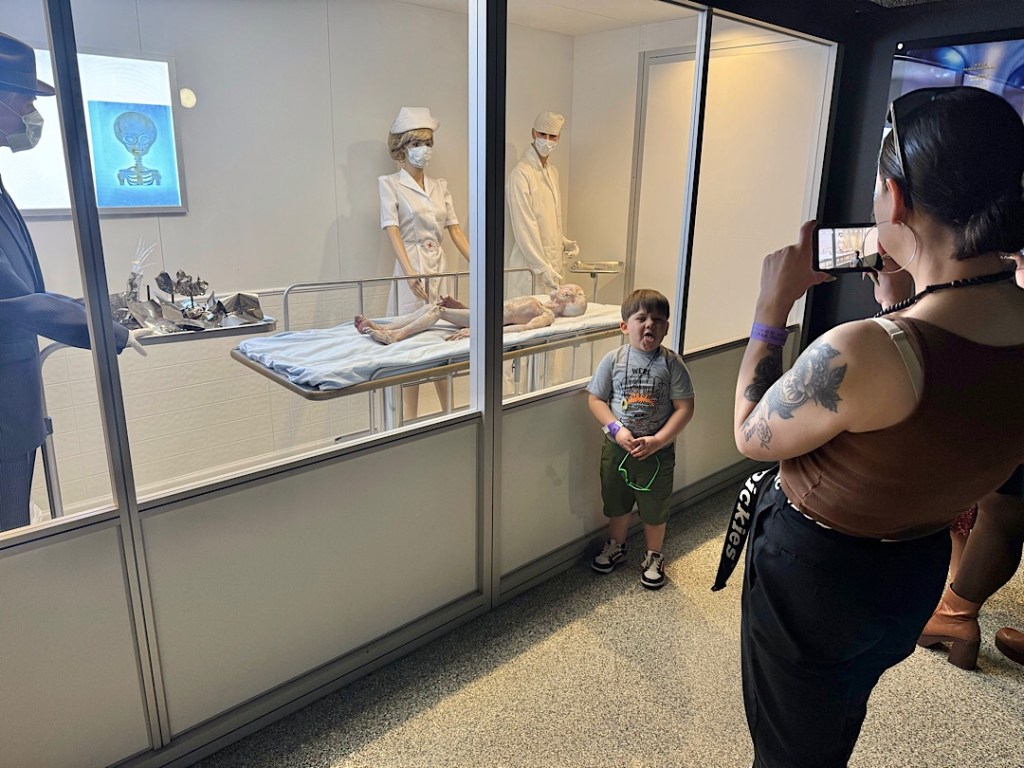
Roswell, New Mexico is the town that many people believe was the site of an alien spaceship crash in 1947. The incident and subsequent theories about the US government’s attempts to cover it up have created a substantial tourist industry in Roswell, a town that otherwise wouldn’t get a lot of attention.
We had expected the UFO Museum to be cheesy, but it surprised us by how large and complex it was. Trent seems to be sneering — but is it because of the alien presence… or the hype
To break up the journey, we spent the night in the small but friendly town of Lamesa, Texas.
Day 10: Lamesa to Austin. 348.8 miles, 6 hours 10 minutes.
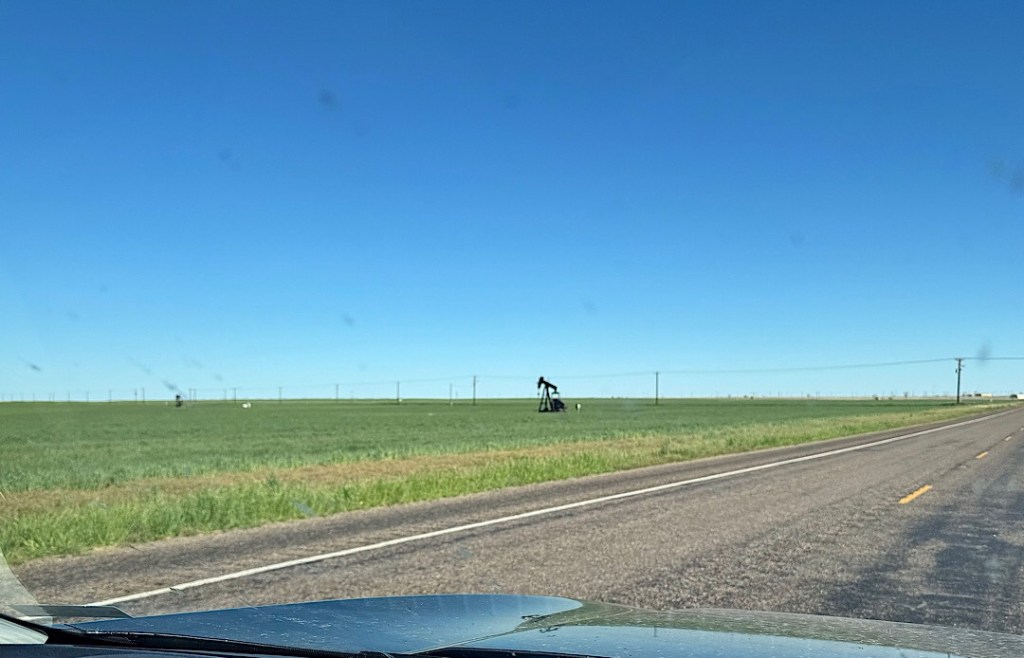
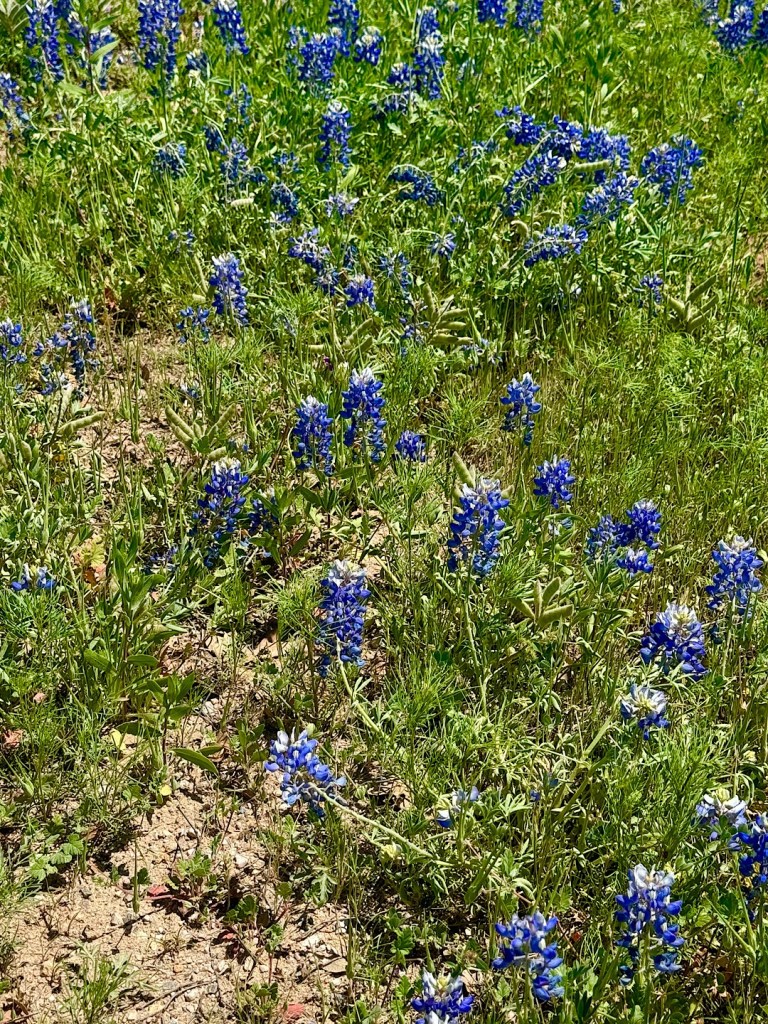
Almost immediately after crossing into Texas, the landscape changed. I’d never seen that combination or enormous fields, dotted with oil wells. Even more impressive was the bloom of bluebonnets and Indian Paintbrush and other wildflowers once we hit the hill country west of Austin.The bluebonnet is the official state flower of Texas.
We arrived at our home-exchange base in Austin a little after 2, having covered 2,034 since leaving our garage. Our son and his family from Reno landed at the airport a few hours later. Now the next phase of this adventure has begun.
Lots of eating,A bit of sightseeing.Mounting anxiety over the question hovering over Monday’s big event: will the building clouds obscure it?
A few days before we set off on this road trip, my friend Kris told me a story about how she almost died in Canyon de Chelly. On their first visit to the renowned Navajo landmark, she and her husband had journeyed to the tourist office and hired an official guide, then had a marvelous experience being driven by him through both Canyon de Chelly and its extension, Canyon del Muerto (Canyon of Death), a name dating back to when the Navajos endured great suffering as the US government seized their lands.
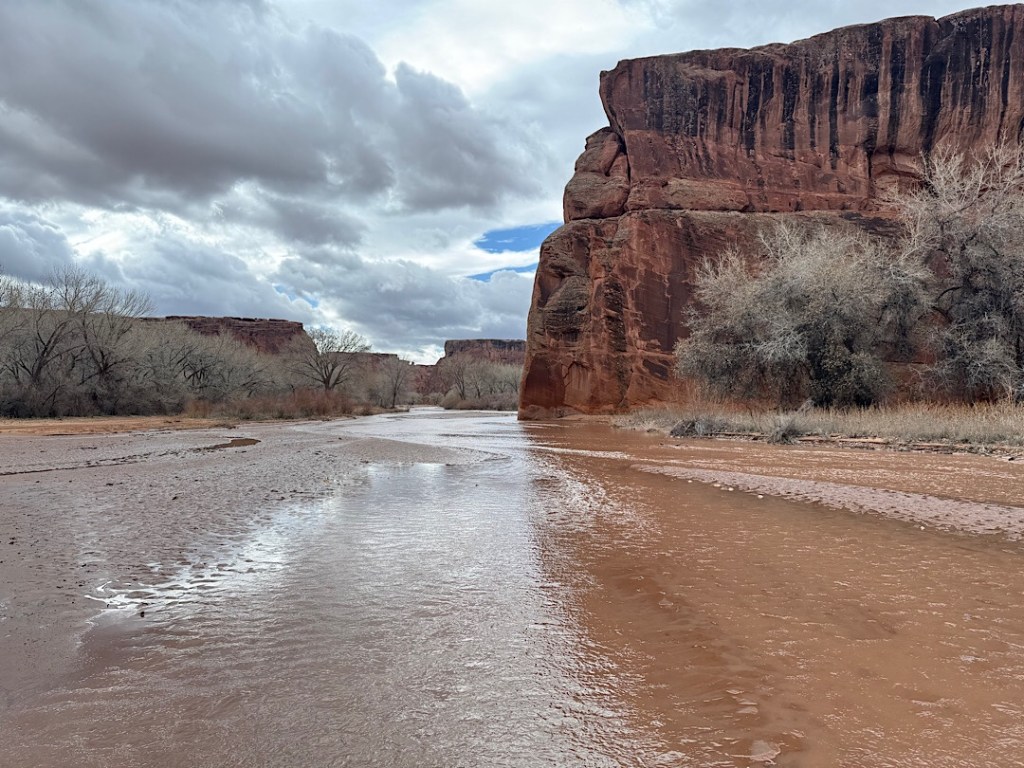
On a return trip to the canyon, Kris and Rich found the tourist office closed. So they hired a freelance guide who picked them up in a battered Suburban and drove them into the canyon, where the vehicle promptly stalled in a river crossing. Its reverse gears appeared to be broken, and the driver/guide eventually shouted that everyone had to abandon ship through the few doors that functioned. Kris said it wasn’t difficult to slog through the water to dry land, where they watched the Suburban sink — and disappear — into the quicksand in which it had bogged down.
The moral of her story, Kris told me, was that we should only hire a trustworthy guide. But because Steve and I had arrived in Chinle so late Saturday afternoon, we settled for arranging a four-hour tour through our hotel. I reflected that we might be doing what Kris had warned us against. But we’d had little choice.
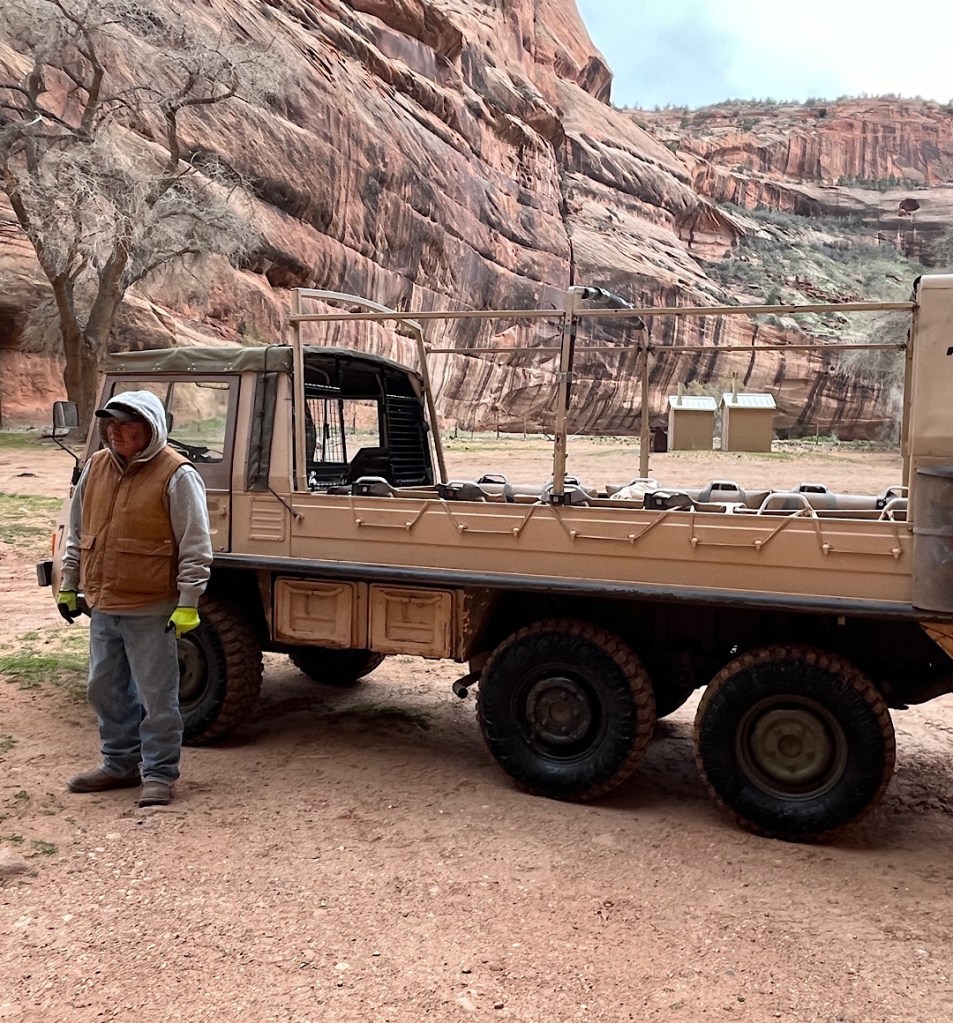
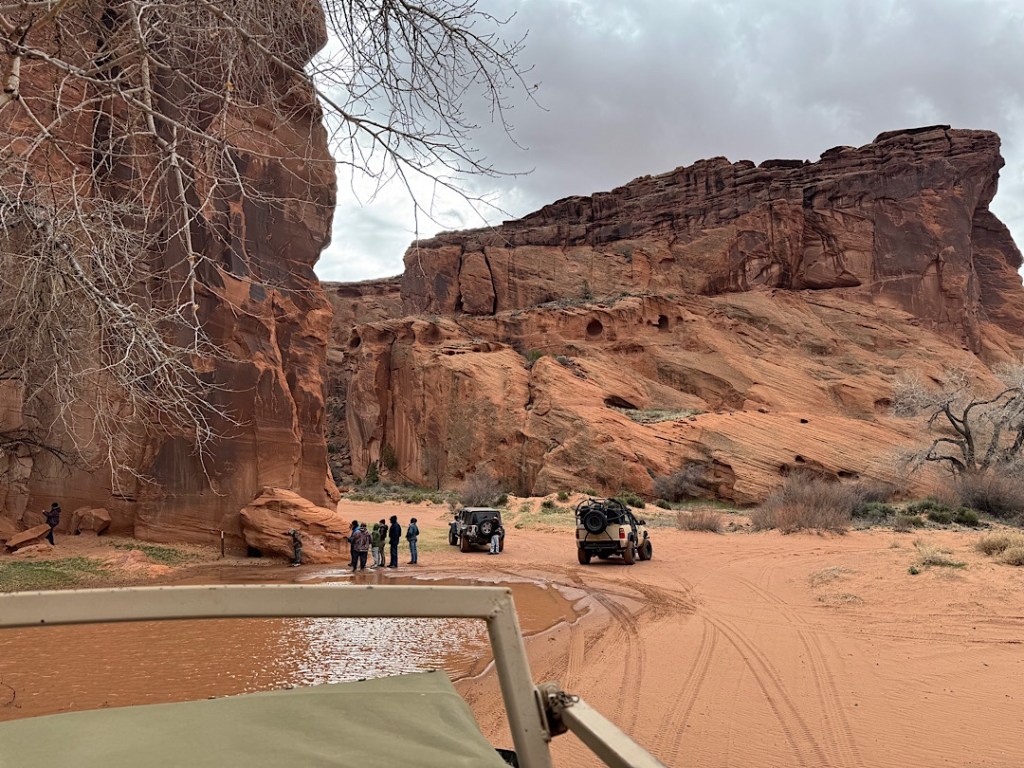
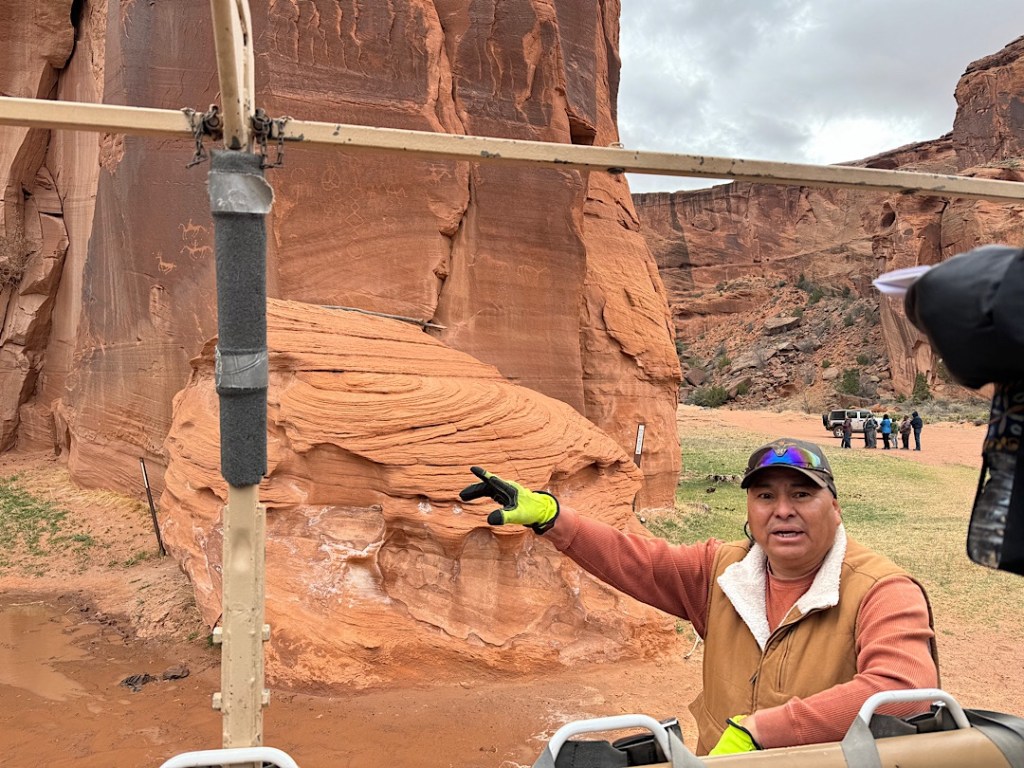
Sunday (Easter) morning, I’d felt reassured by the sight of our vehicle, a 10-passenger Pinzgauer army troop carrier built in Austria with 6WD and three locking axles. With only one other passenger besides us in the vehicle, there was plenty of room for Trent (garbed in his cape, of course.) The driver/guide, Fernando, had grown up in his grandparents’ hogan, deep within the canyon, so that also reassured me. Scattered clouds hinted that rain might be coming, but as we entered the canyon, it was still dry and bright.
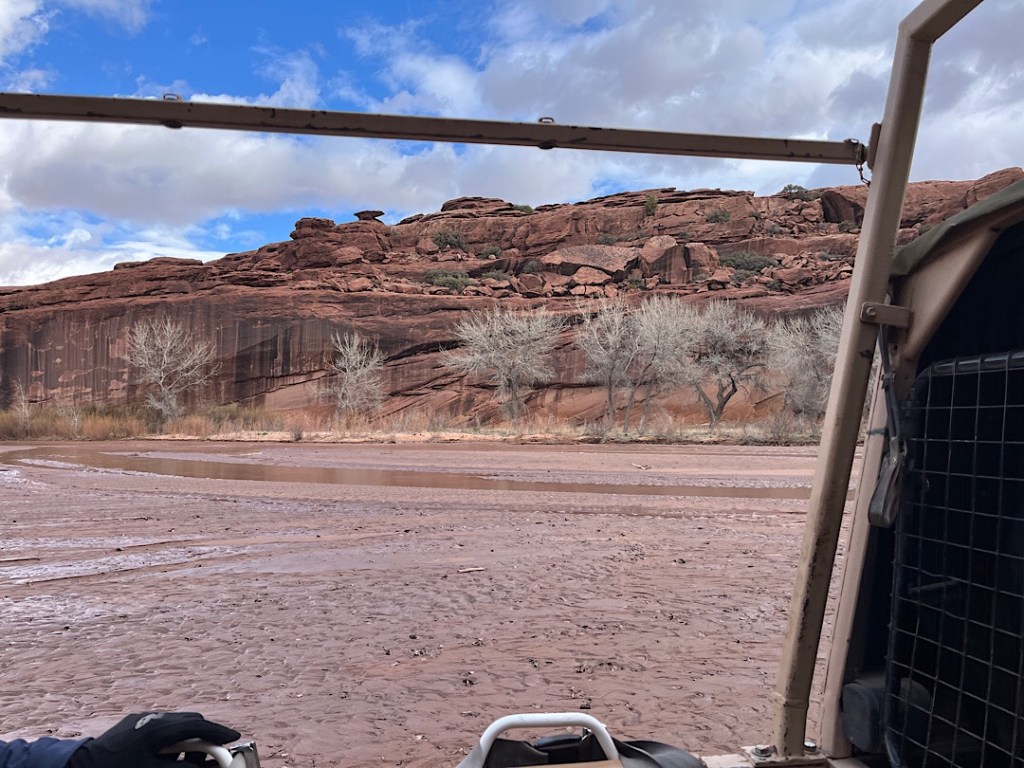
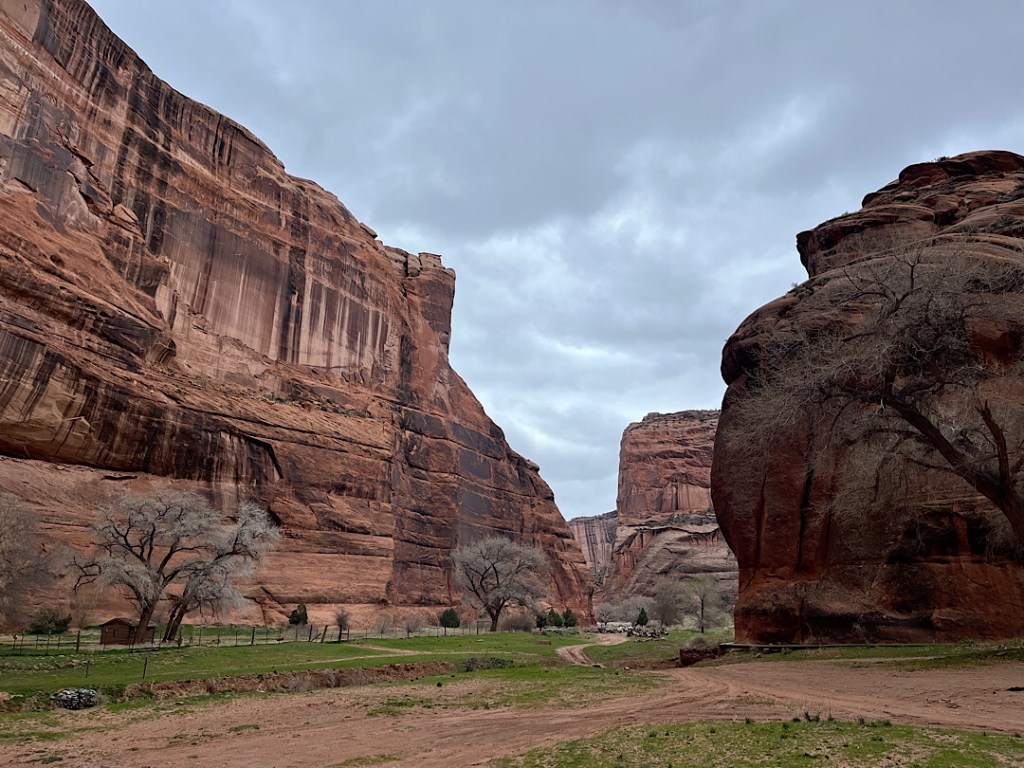
Canyon de Chelly isn’t as overwhelming as the Grand Canyon (what is?), but it quickly became clear its sandstone walls present an extraordinary mixture of color and form. Near the entrance, they start out low…
…but they soon rise to a thousand feet in height.
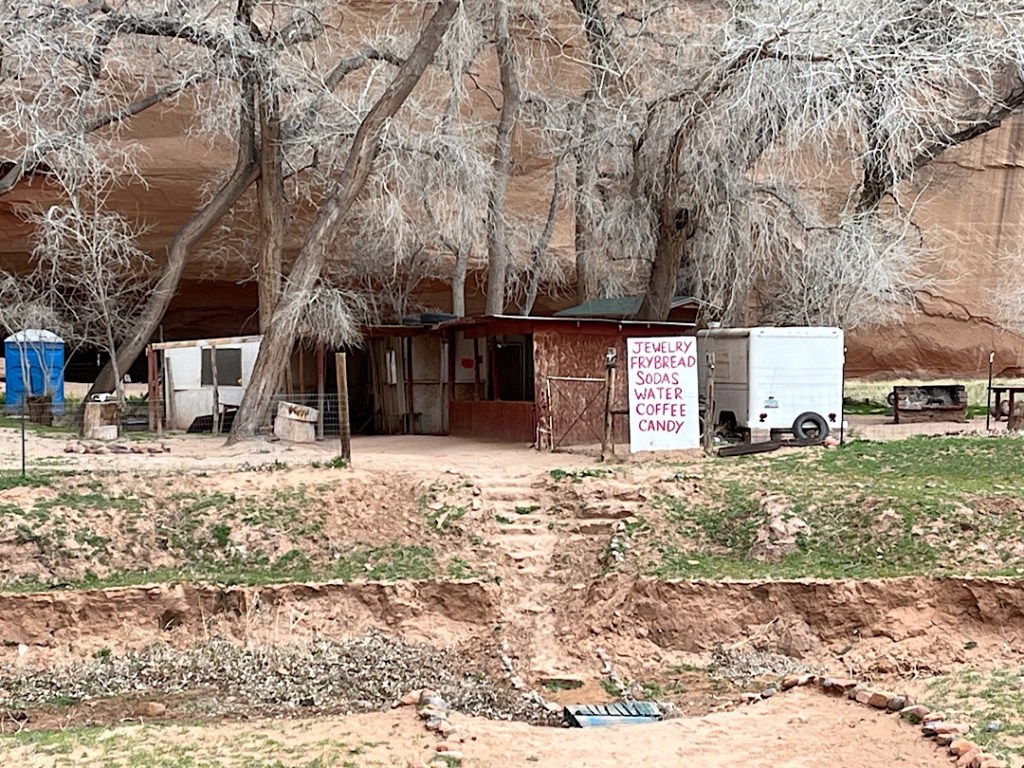
Moreover, this is very much a living landscape. Fernando told us only one family lives in it year-round.
This is their home.
But members of another 70-80 households return each spring to their properties. Somehow they coax crops of corn, beans, squash, melons, stone fruit, and more from the riverbed.
Here’s another homestead. But nobody was there on Easter Sunday morning.
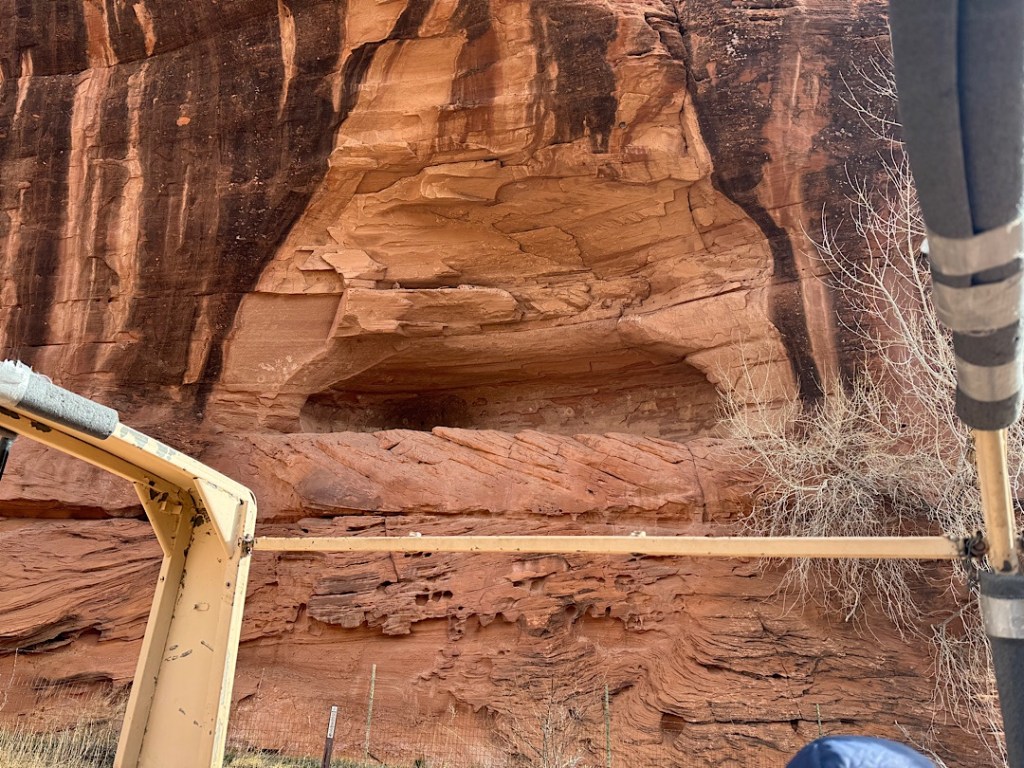
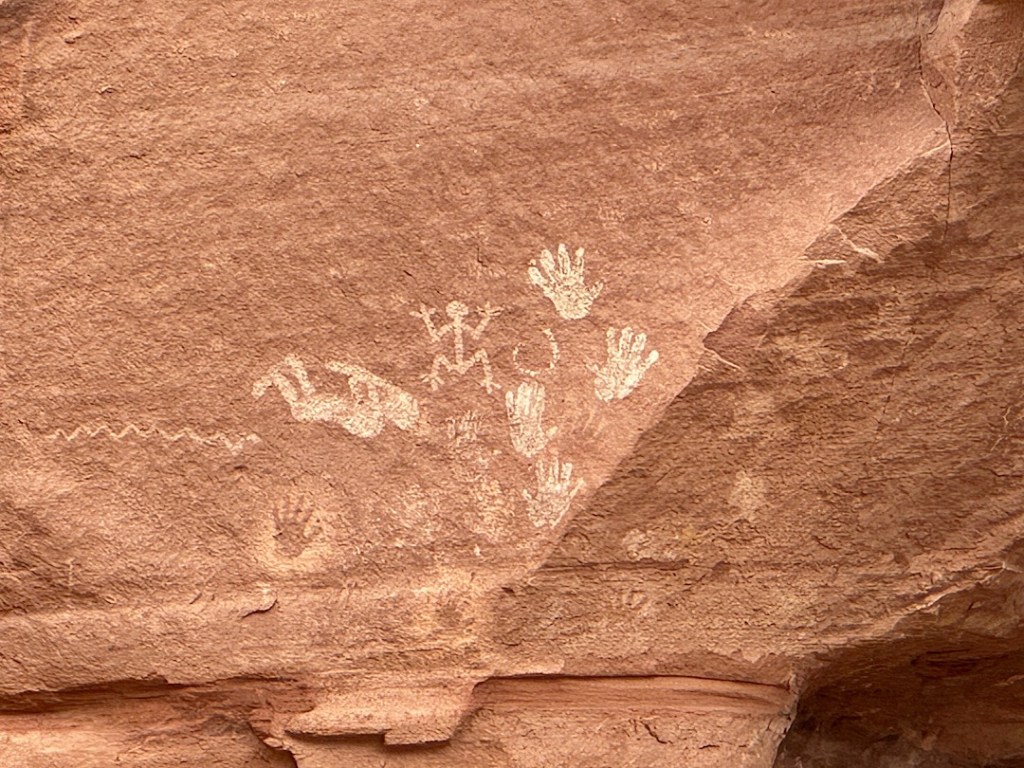
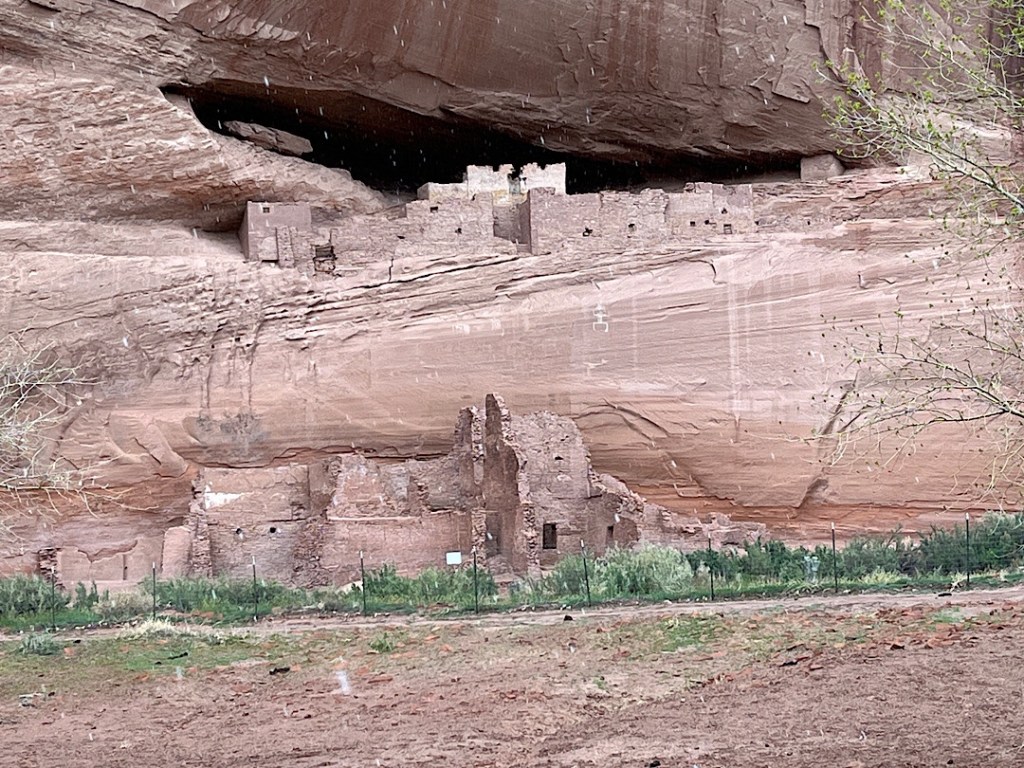
Beyond the current inhabitants, the canyon also holds fascinating evidence of the Old Puebloan peoples who lived here until roughly a thousand years ago. Fernando stopped at at least a half-dozen spots to point out the remnants of dwellings and paintings and other rock art left by the Anasazi ancestors.
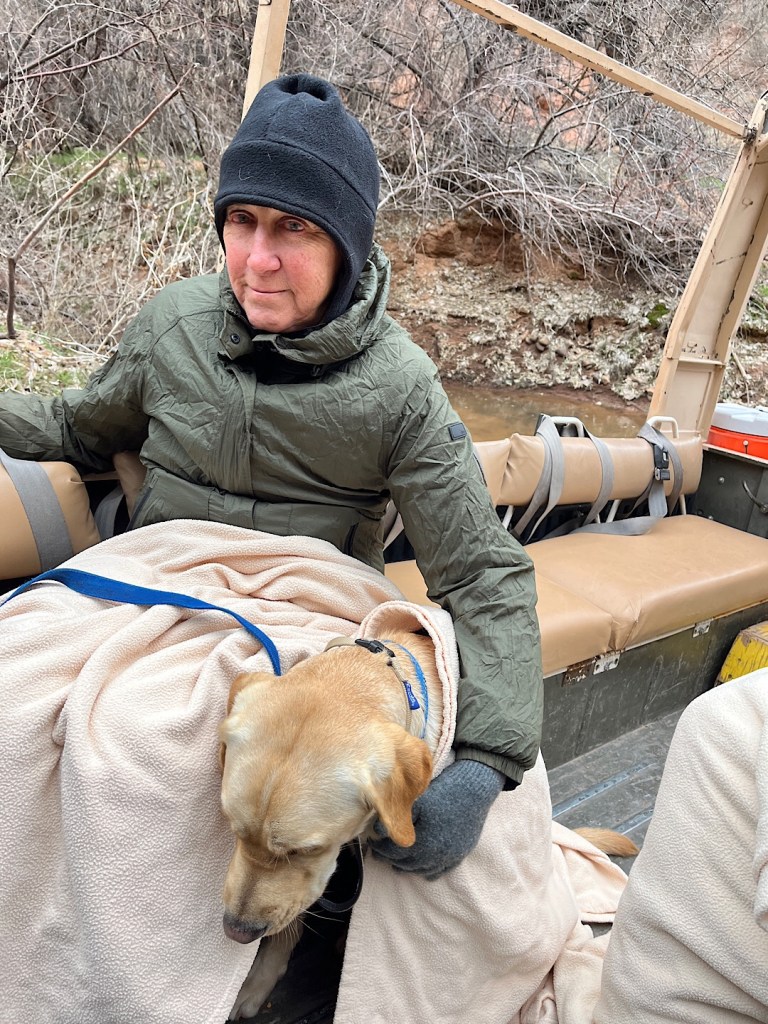
We penetrated deeper into the rough terrain, and around noon the sprinkles started. The temperature dropped and the wind intensified, so soon the sprinkles turned into sleet. Or was it snow? It was hard to tell. Most of my attention was focused on staying as warm as possible. Fernando handed out blankets, and I tried to get Trent to snuggle up to me under one. He looked pretty miserable.
On a nice day, we all might have hiked more, taking time to savor the fantastic landscape and all the history that had unfolded within it. But as we headed back, all I could focus on was how little feeling I had left in my fingers or toes.
Fernando dropped us off at the hotel a little after 1, and I staggered to our room on what felt like lifeless stumps. Stripping off my boots and socks and gloves, I remember puffing out little breaths and doing a fair amount of moaning as I soaked my feet and warmed my hands in the tub. I shivered hard for an extraordinarily long time.
When the shivering had mostly subsided, Steve and I downed hot pozole and coffee in the lodge’s cafeteria and agreed we wouldn’t have missed seeing the canyon. I wouldn’t say the price was almost dying of hypothermia. But I’d come closer to that than I ever hope to get again.
Road trips have their drawbacks. You assume all the work of moving yourself through the world, work that you would otherwise delegate to taxi or Lyft or Uber or bus or private drivers. Or tour companies. Or airline pilots. Or train engineers. Doing it all yourself is tiring.
The greatest allure of road trips, however, is that it frees you up to shape your itinerary, literally moment by moment. Need a bathroom break? Stop for the next one down the road. Want to check out that funky museum? Put on the brakes and pull over.
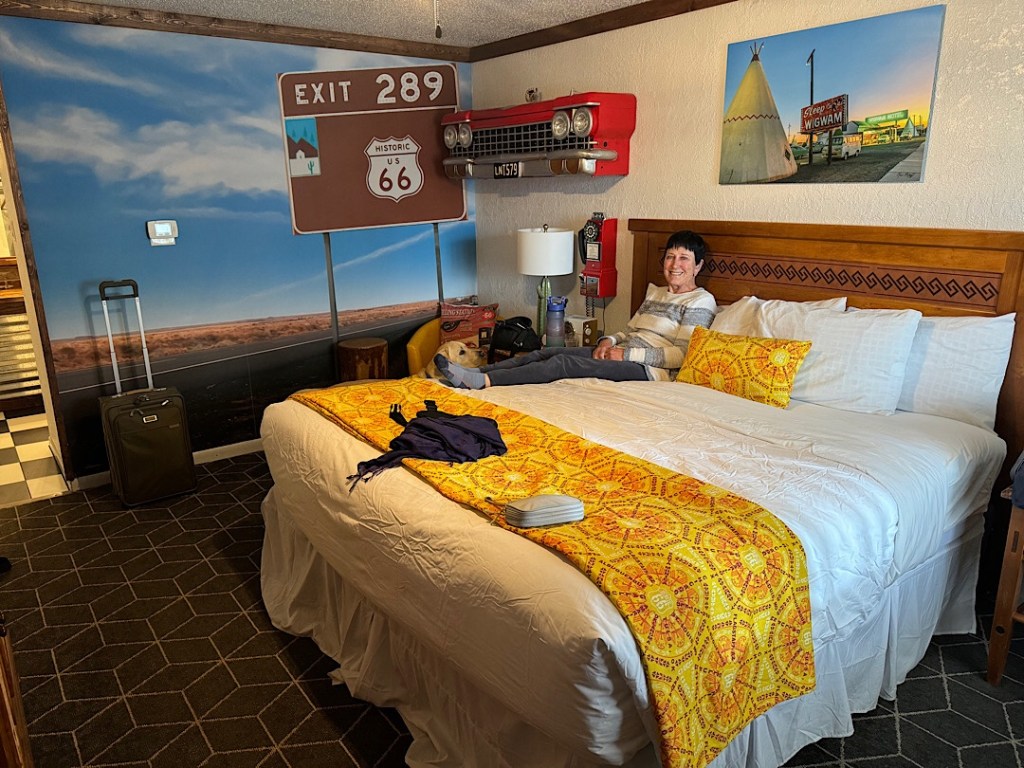
In the last few days, I’ve had several reminders of how valuable this flexibility can be. First, it enabled us to wimp out on our plan to camp in Chaco Canyon. In order to have more time in the canyon, I really had wanted to camp in it because there are no hotels within a couple of hours of the canyon floor. But by this past Wednesday afternoon, our Weather apps were telling us that heavy winds would be howling through Chaco Canyon Monday night, and the temperature would plummet to 30 F. Nightmarish visions troubled both Steve and me. He saw us dying of hypothermia. I didn’t think that was likely, but a miserable evening and night seemed certain. In the morning, we agreed we should make alternative plans, as bad as we felt about hauling all that camping gear with us FOR NOTHING! Our only other fixed investment was the $10 fee for our spot at the Gallo Campground. I could cancel that reservation online, and it was easy to develop an alternative plan: Monday we could drive to Chaco, see as much as possible, then spend the night at a hotel on Route 66 in Gallup, New Mexico.
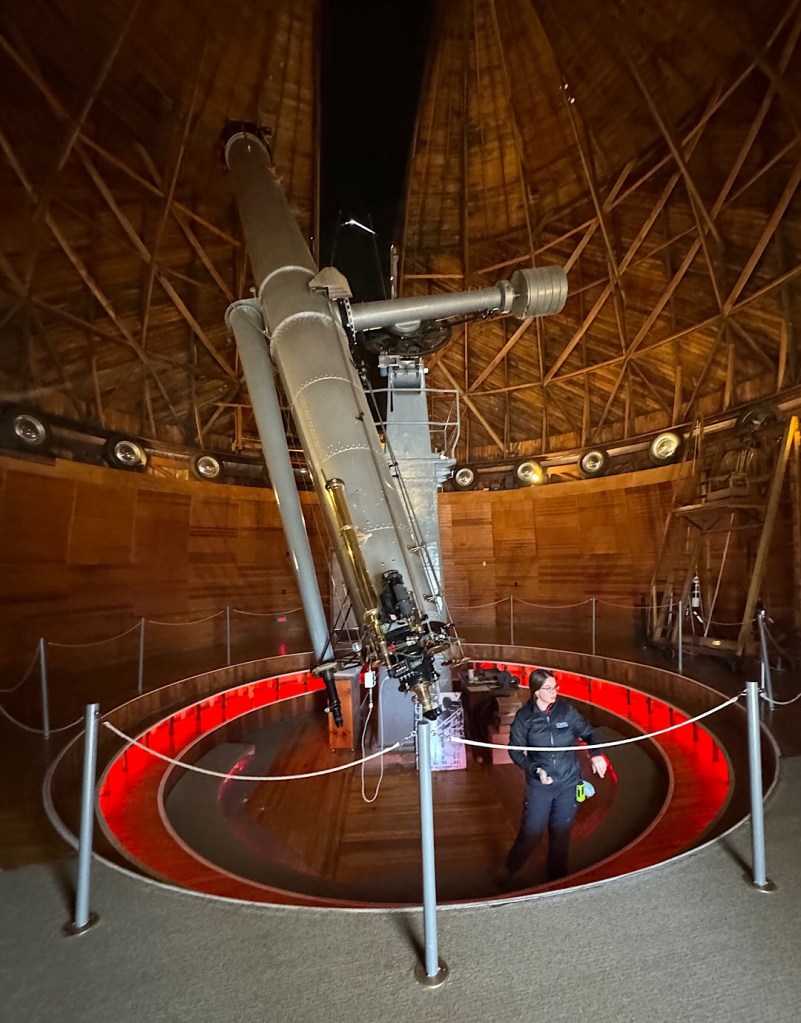
Saturday morning gave me another reminder. We spent Friday night in the breathtaking Flagstaff second home of friends from San Diego. Sadly, they weren’t there, but staying in their place was a wonderful base for visiting the Museum of Northern Arizona (impressive!) and then taking a quick tour of the 128-year-old Lowell Observatory.
Yesterday morning we didn’t pull out of our friends’ Flagstaff driveway until 9 am. And once on the highway, it quickly became clear my plans for the day were…. naive.
Months ago, sitting at my desktop computer, looking at maps of places I’d never been, I’d imagined it would be reasonable to drive from Flagstaff onto the Navajo reservation (bigger than all of West Virginia), then take a detour onto the 2,532-square-mile Hopi reservation contained within the Navajo lands before continuing on to Monument Valley, then finishing up the day in Chinle, located within the reputedly magical Canyon de Chelly.
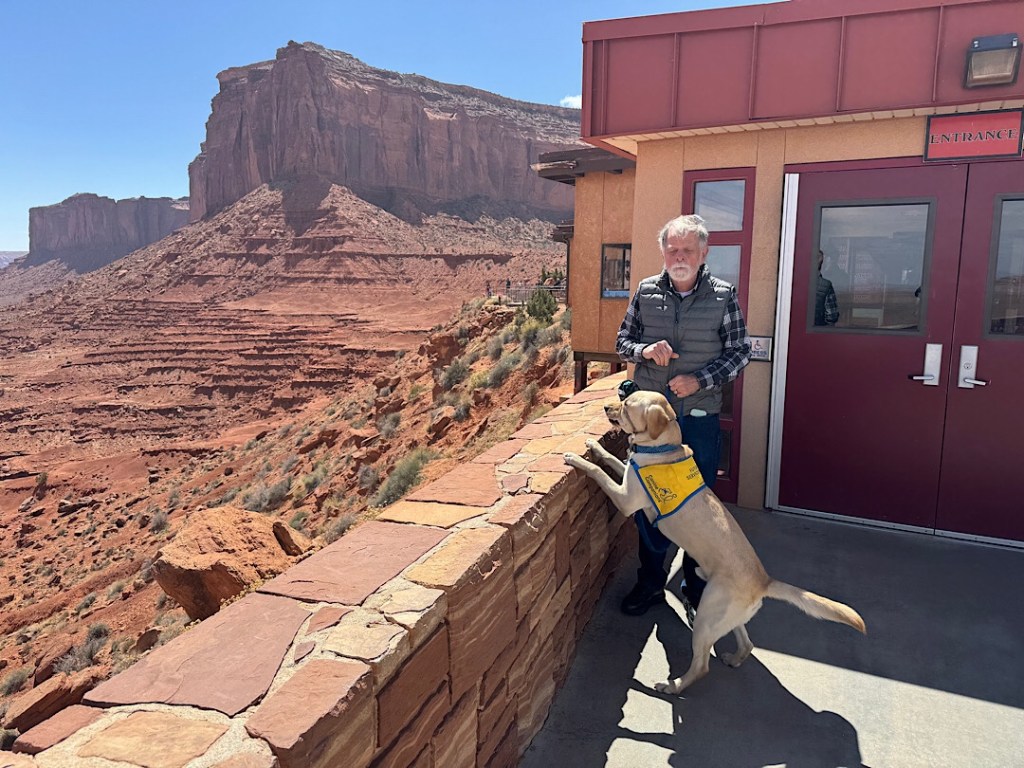
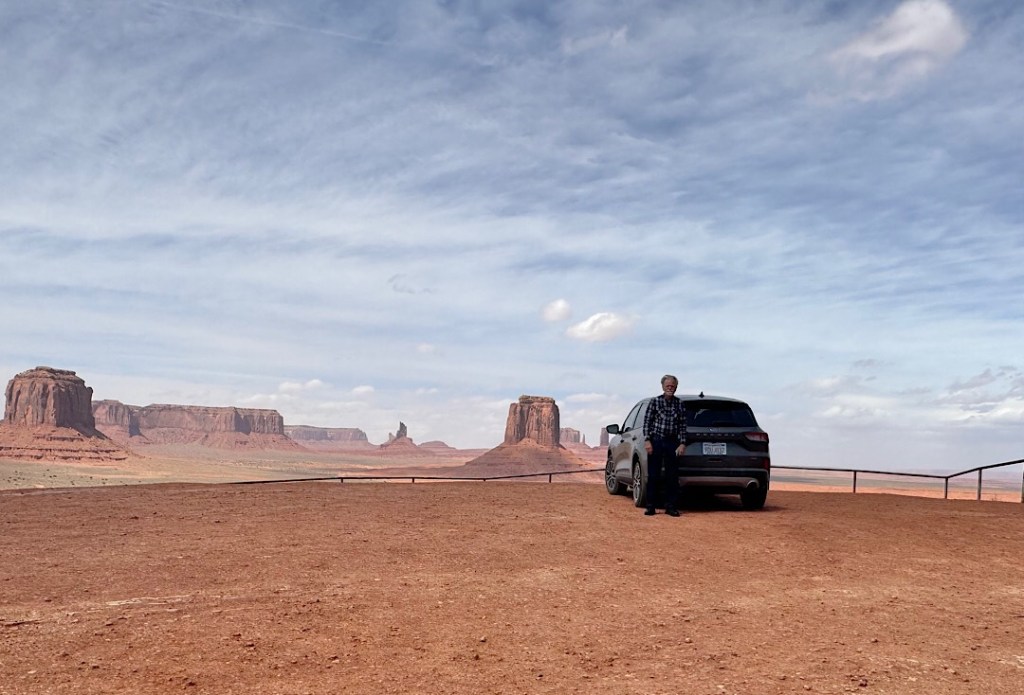
But this is staggering country: huge skies; huge stretches of open scrubby land. Once we were rolling, it quickly became clear no one could squeeze all that activity into a day. We made a quick decision to abandon the Hopi side trip and head straight for Monument Valley. We arrived at its visitor center around 1 pm, gobbled down the sandwiches we’d brought with us, then set off on the driving tour through one of the world’s most famous landscapes.
Had we never seen it before? Of course we had! In countless Westerns! But never before in person, we realized, incredulous. In fact, Steve and I struggled to accept we’d never been in this Indian nation before. How had we overlooked it? Even if you’d never seen one of those Westerns, the sight of Monument Valley’s weird monoliths sculpted by time from the red rock, was commanding. The unpaved road on the touristic loop drive made the 15-mph speed limit seem aspirational, still after jouncing over it for an hour and a half, all I felt was gratitude.
But once again we’d miscalculated. We had planned to drive from Monument Valley to the Canyon de Chelly visitor’s center and there book a tour of the canyon for tomorrow. We’d forgotten, however, about the one-hour time-zone diference between Arizona and the Navajo Nation. The wind was also whipping the dust into a frothy curtain that at times forced us to drive as if we were in a heavy fog.
By the time I walked up to the reception desk of our hotel, the Thunderbird Resort, it was already after 5 pm.
To my relief, I was still able to book a 9 am tour through the canyon for today — Easter Sunday! More crazy wind is scheduled, and my phone says there’s a 20% chance we’ll get rain. But a trained Navajo guide will be behind the wheel. That should be a nice change of pace.
Day 2: Phoenix to Sedona. 118 miles; 2 hours, 12 minutes (including a stop for gas).
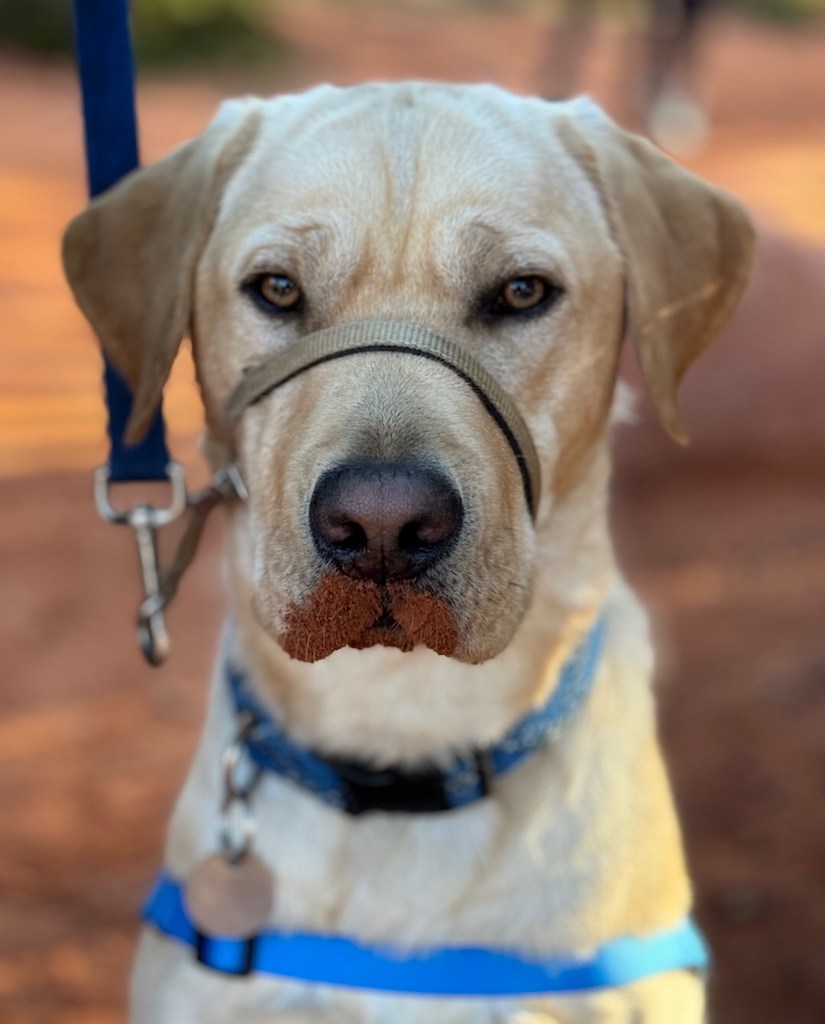
“This red earth is tantalizing, with a hint of mystery,” Trent seemed to think.
Day 3: Sedona. Not a lot of miles but 16,851 steps.
Sometime after 8 pm last night I tried to draft a blog post about our second day on the road. Exhausted and cranky, I churned out a couple of tedious paragraphs, but when I showed them to Steve, he enjoined me, “Don’t publish that.” Too tired to argue, I yielded to his judgment.
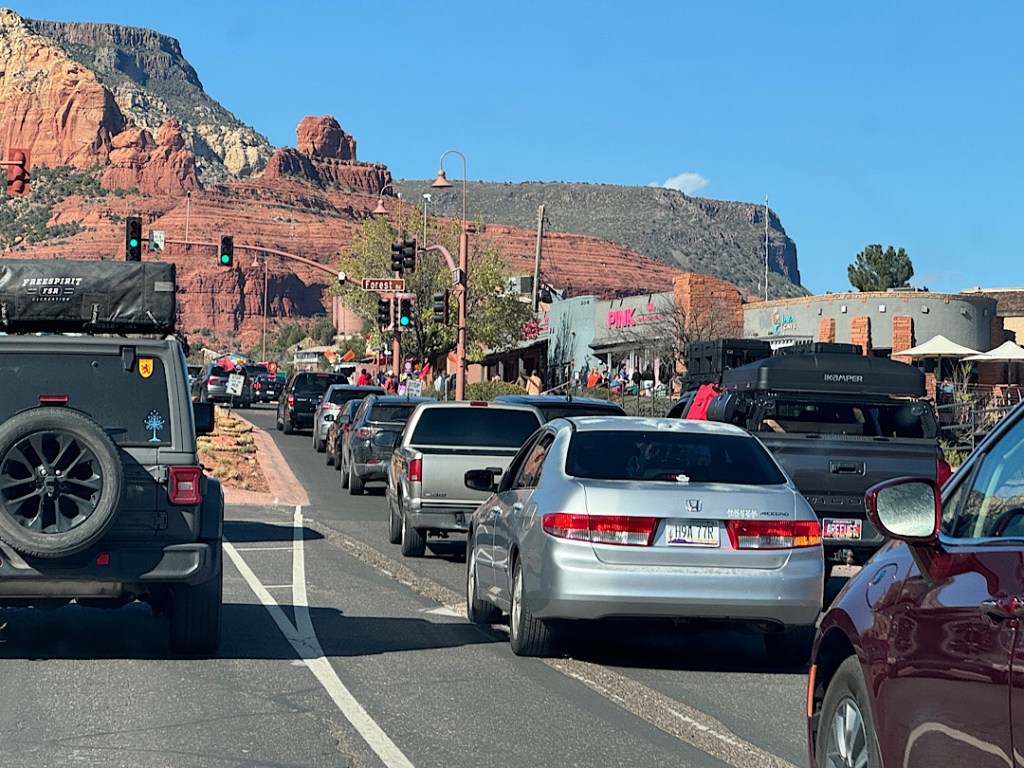
I awoke at 5:20 this morning and had a flash of insight. If we got up then and made it out the door quickly, we would have a shot at getting a parking spot at the trailhead for the Boynton Canyon Trail, which a close friend had recommended most strongly for a hike. Steve went along, and we whizzed from our lodge through central Sedona on streets that had been choked with traffic upon our arrival Wednesday.
The tacky Uptown areas, with its overpriced restaurants, had helped to sour my mood Wednesday night.
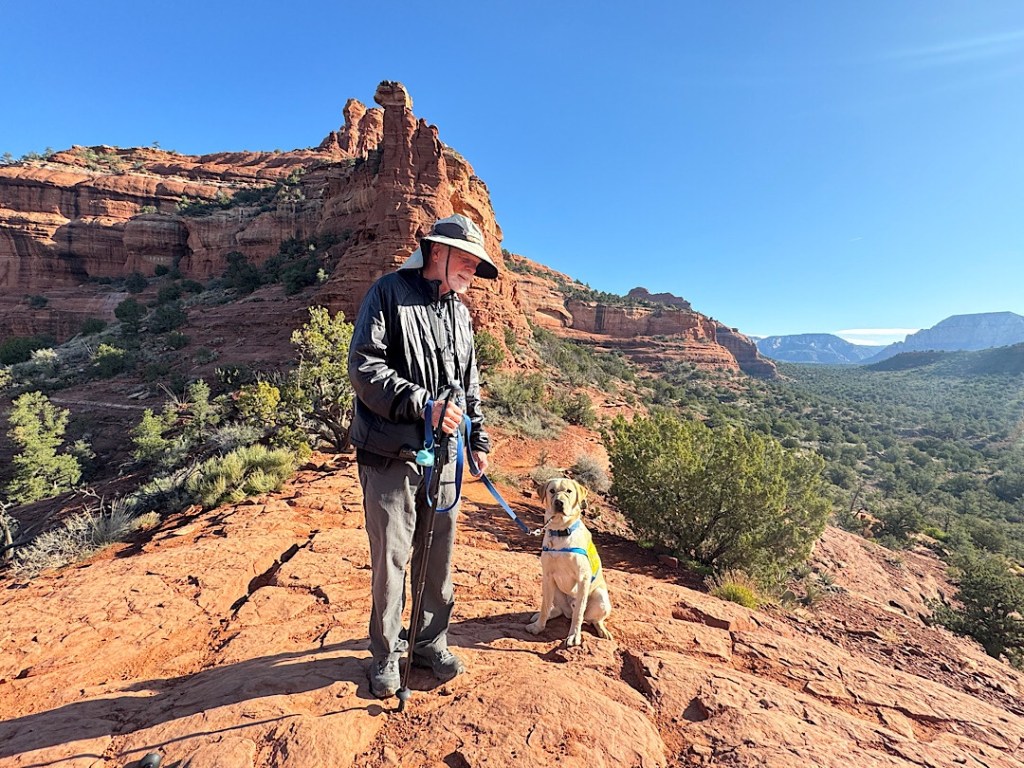
But everything went splendidly this morning. We arrived at the trailhead at 7:06 am and got the last parking space. (Yesterday we’d learned that because of the Easter and spring break combo, this is the busiest week of the year, and the cause of the agonizing traffic jams that contributed substantially to my crankiness yesterday.) Getting out the car, I found the extra room key I thought I’d lost. (Bracing myself for a hefty key-replacement fee also had upset me.) The morning was chilly, but the skies were crystal clear and sunny, and the landscape (which neither Steve nor I had seen before) explained why so many of our friends are wild about Sedona.
Sedona’s soaring red rock, so architecturally monumental, lies at the heart of their devotion. But guidebooks and other hypesters also talk about this area harboring mysterious vortexes, “swirling centers of energy that are conducive to healing, meditation and self-exploration….places where the earth seems especially alive with energy.” Boynton Canyon is supposedly a vortex hotbed, one of the reasons I’d wanted to hike there. The visitsedona.com website had promised, “It is virtually guaranteed that you will leave feeling better than when you arrived.”
I wouldn’t have bet money that would prove true. But it did.
Day 1. San Diego to Phoenix. 357.7 miles; 6 hours, 55 min (including all our stops along the way.)
I’ve done a lot of reporting from Abroad in recent years, but it’s always been my intention to include adventures At Home too, and today we set off on a big one. Steve and I hope to see the upcoming total eclipse that will slice across a big part of North America April 8. Because of its perennial sunniness, northern Mexico is probably the best place to chase it, but we figured the logistics of traveling there might be too complex. So we opted instead to head to Austin, Texas, a city neither of us has ever visited, and a reasonably sunny place most of the time.
We could have flown. But we wanted to include Trent, the 16-month-old pup we’re raising for Canine Companions for Independence. We’ll have to send him off to CCI’s professional trainers on May 10, and we’re already dreading saying goodbye to him. Emboldened by our recent driving/camping experience in Zimbabwe, we decided to reach Austin by driving (and even camping one night, in Chaco Canyon, New Mexico). That would allow us to visit American wonders we’ve heretofore missed — and take Trent along for the ride.
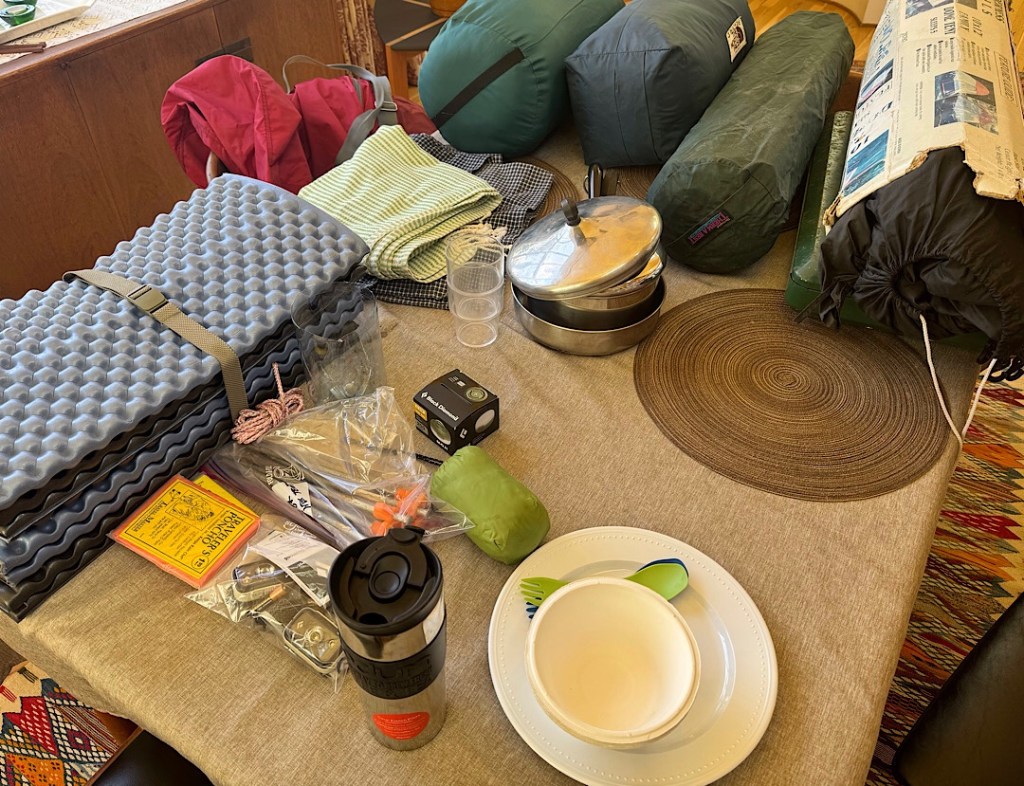
Preparing for three weeks on the road was more complicated than I initially expected. Steve and I got our clothes into the carry-on suitcases we take everywhere. But we have also crammed a duffel full of canine gear — NOT including Trent’s portable kennel. Or his 20-pound bag of dogfood. Or the dog bed on which Trent is napping at the moment in the back of our Ford Escape, as I write this in the front passenger seat. We have another duffel full of gear for our camping night. That bag is much bigger than the doggy duffel, but it’s not big enough to hold our tent and two sleeping bags. They take up their own space.
Here’s most of the camping gear, laid out on our dining room table.
Being that it’s a road trip, I also filled a separate bag with shoes and knee braces and other miscellany. And another one packed with all our bathroom supplies (nice BIG containers of shampoo and conditioner and toothpaste instead of those measly 3-ounce TSA-approved ones.) We have not one but two picnic cooler bags AND a grocery bag full of essential food (ground coffee! food for Chaco Canyon!) AND a shopping bag full of our oranges. And a case of wine. (It could get pretty cold and windy in that canyon.) There’s more I can’t remember but hopefully won’t forget to reload along the way.
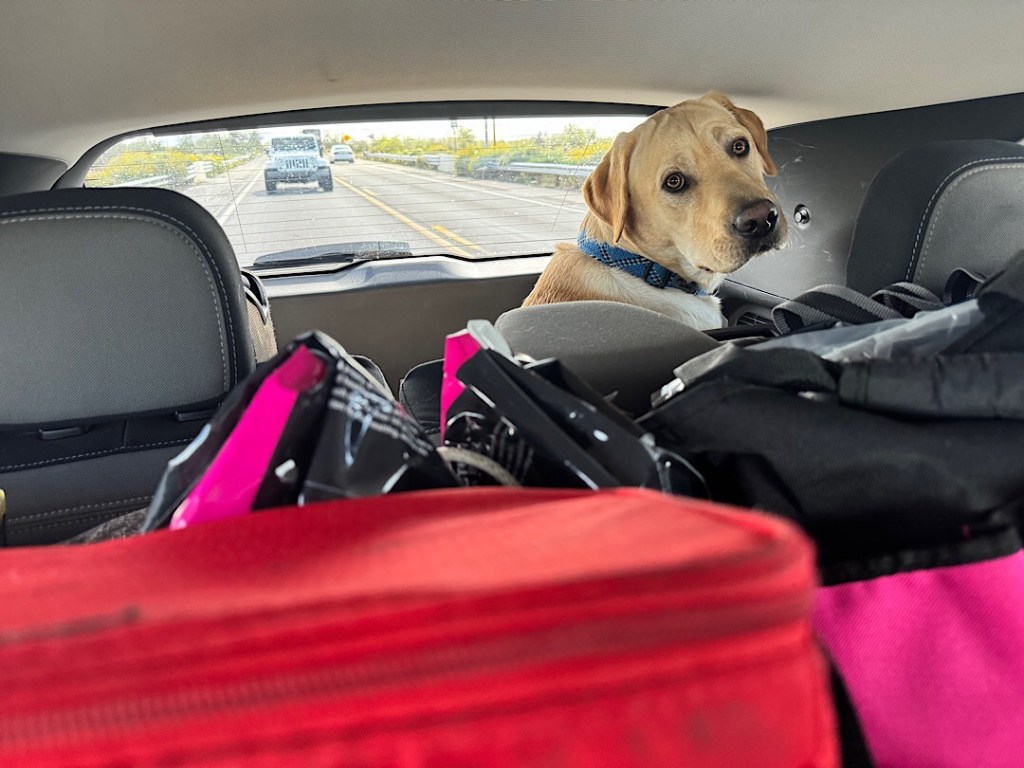
Here’s part of it this morning, ready for loading in the vehicle.The view looking in one of the rear doors, after loading.
We keep reminding each other this is America. If we’ve forgotten something, there are Walmarts and CVSs and Family Dollar stores where we can get whatever we need. I’m a little more worried I may not acquire as many stories as I have found in more exotic locales. Today’s a good example. We’ve covered this ground many times before, and it wasn’t exciting on our maiden drive many years ago.
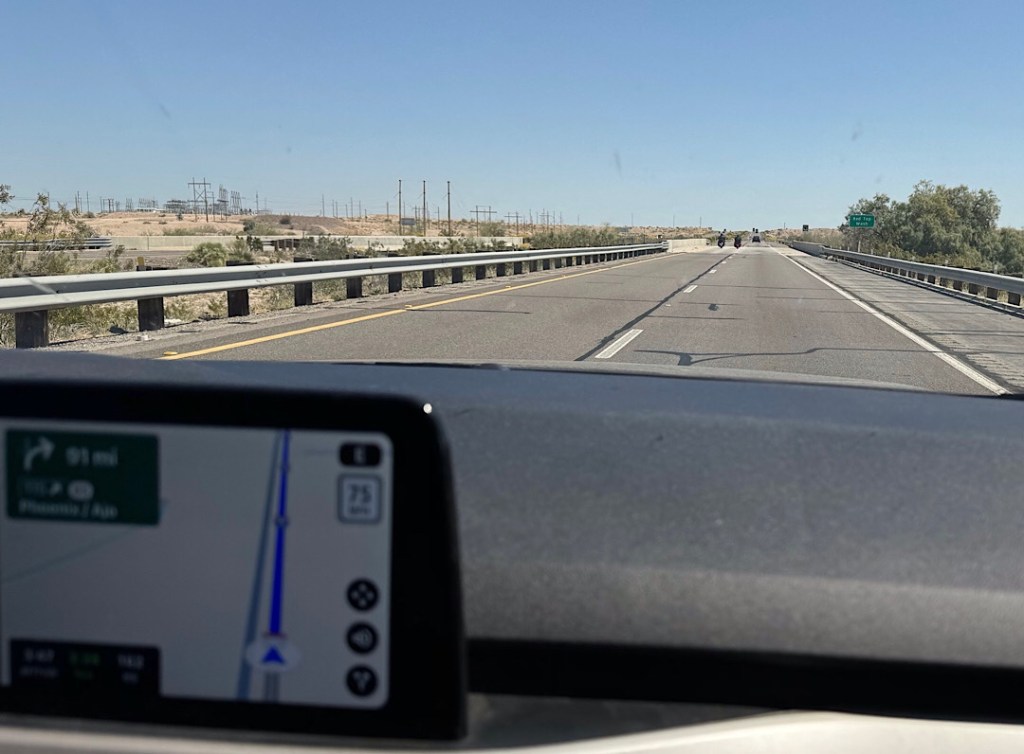
Lots of freight trains and pretty clouds.Mostly road views like this.
My posts in the upcoming three weeks may be terser than normal. I’ve resolved to write more only when we run into something extraordinary. How often will that happen? Finding out is a big part of why we travel, both abroad and at home.
Riding in an Uber car on modern four-lane freeways from Johannesburg’s airport to our Airbnb flat, both Steve and I reeled from the culture shock. After the squalor of Kampala and the poverty in rural Uganda (and everywhere in Zimbabwe), what we saw of the South African megalopolis reminded us of LA. Except maybe glossier and more prosperous.
The Airbnb turned out to be the best I’ve ever booked.
It had two bedrooms, two baths, a washer/dryer, complementary granola and milk, and impeccable design and decor. All for $62 a night.
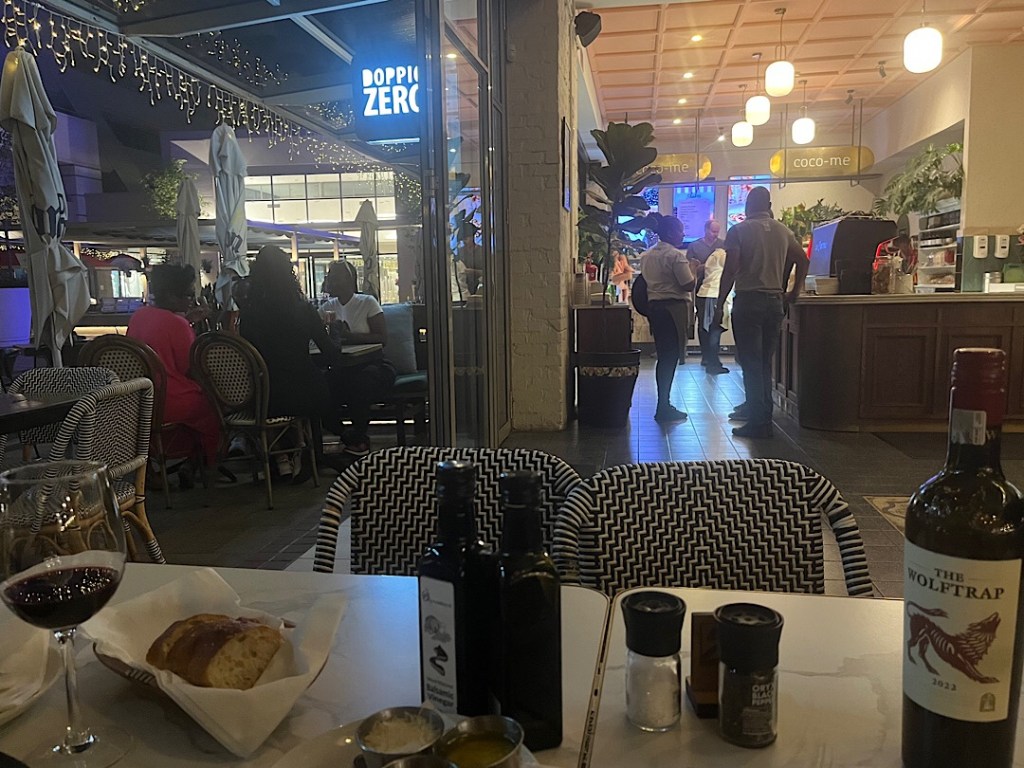
After settling into it, we walked past fancy commercial buildings and apartments to an Italian restaurant recommended by our Airbnb host. We ate delicious pasta (accompanied by a good pinotage wine and yummy ice cream.)
I felt like I was in a dream. I’d expected the city to be worse than when we whizzed through it in 2010. Instead it seemed better.
Before that trip 13 years ago (our first to sub-Saharan Africa), Steve had declared Joburg was so dangerous he never wanted to go there. He had relented but we’d only stayed for two nights, and what we saw suggested crime indeed was nightmarish. More recently we’d read about daily power outages (“load-sharing”) and the battered economy. Some of the white South Africans we met last year cruising in Turkey seemed tensely, almost desperately, eager to evacuate.
Yet the neighborhood we stayed in this time, Rosebank, appeared to be an order of magnitude posher than La Jolla. A multiracial mix of pedestrians strolled its tree-lined streets alongside us (at least during the day).
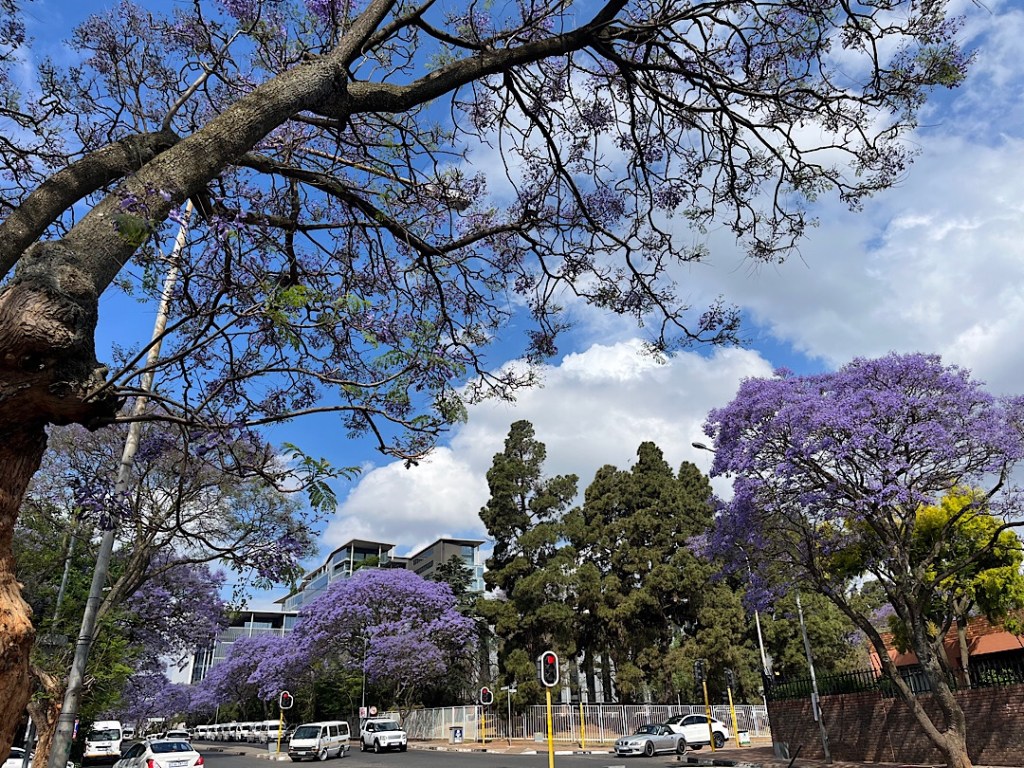
The jacarandas had just bloomed. They’re magnificent.
We dined at a top-notch restaurant on the top floor of this building.
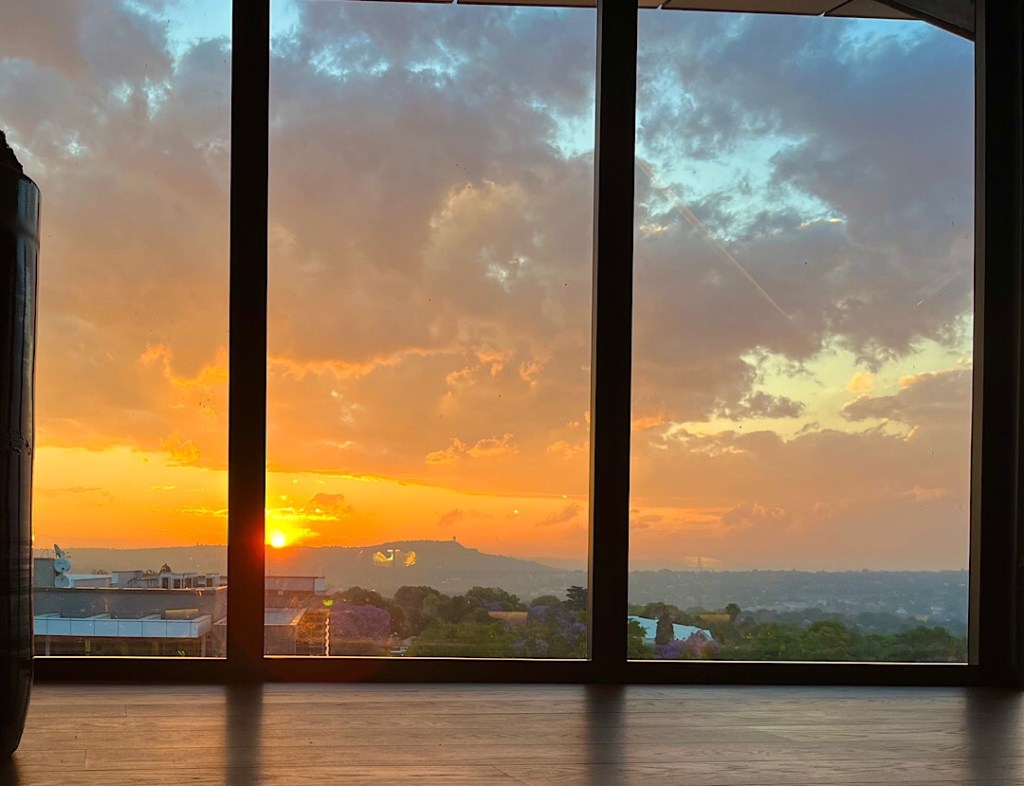
The view of the sunset from the bar was as delightful as the food.
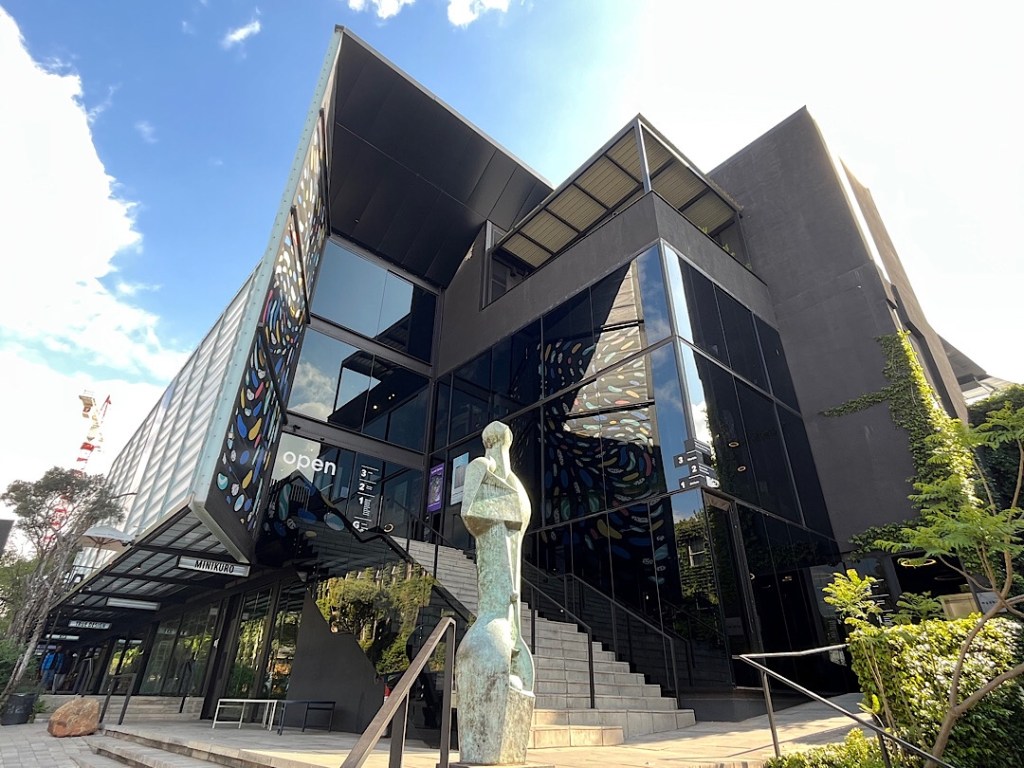
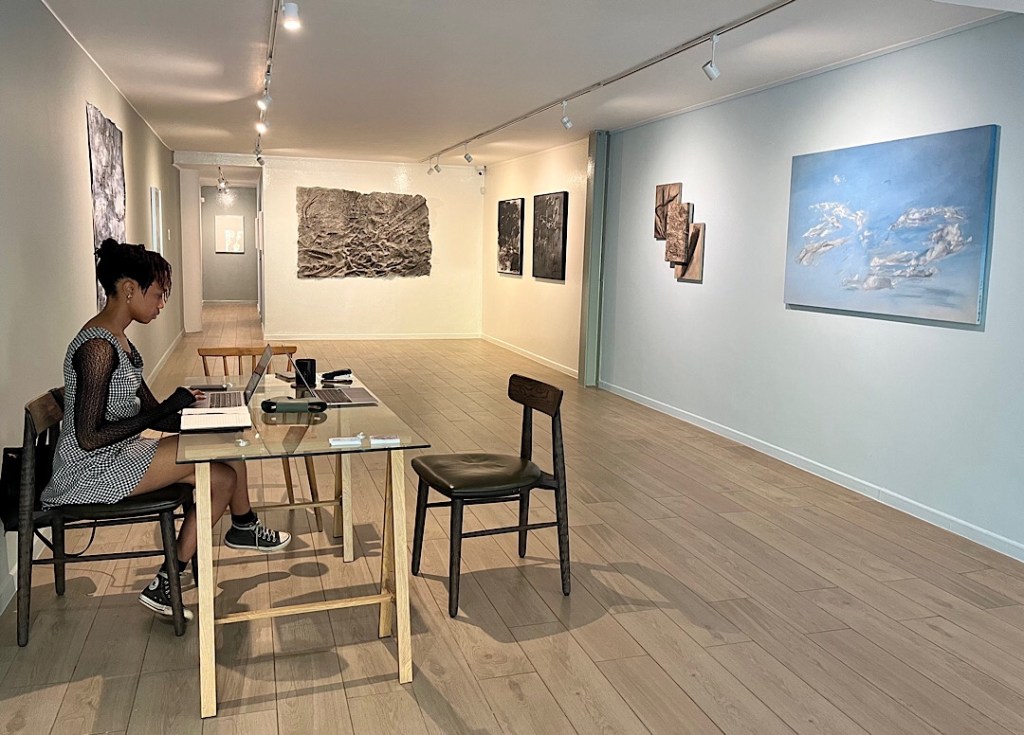
The next day we went back to visit a ground-floor gallery that a New York Times reporter recently praised as the best in the city.
This past Tuesday (10/17), we took the impressive Gautrain (subway) one stop north of Rosebank to the even fancier Sandton area.
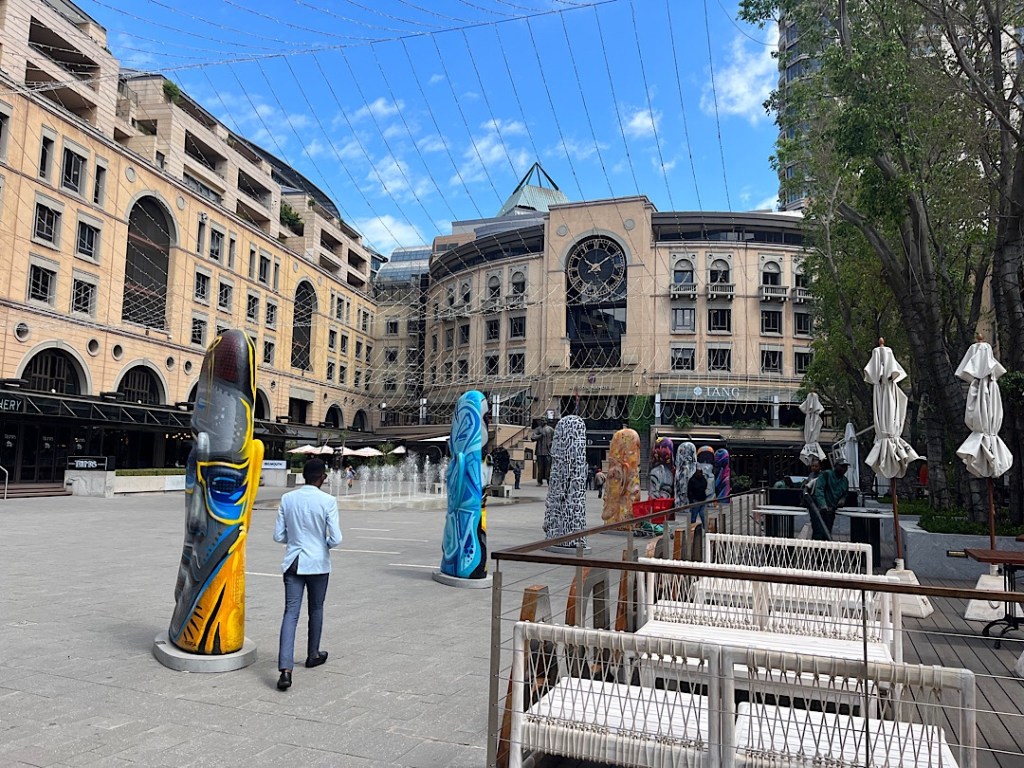
A short walk from the station took us to Nelson Mandela Square.
It’s both a tribute to South Africa’s great leader and former president…
…as well as a luxe indoor shopping mall.
It connects to the near-legendary Sandton City, a shopping Mecca so over-the-top all we could compare it to were some malls in Las Vegas or Dubai.
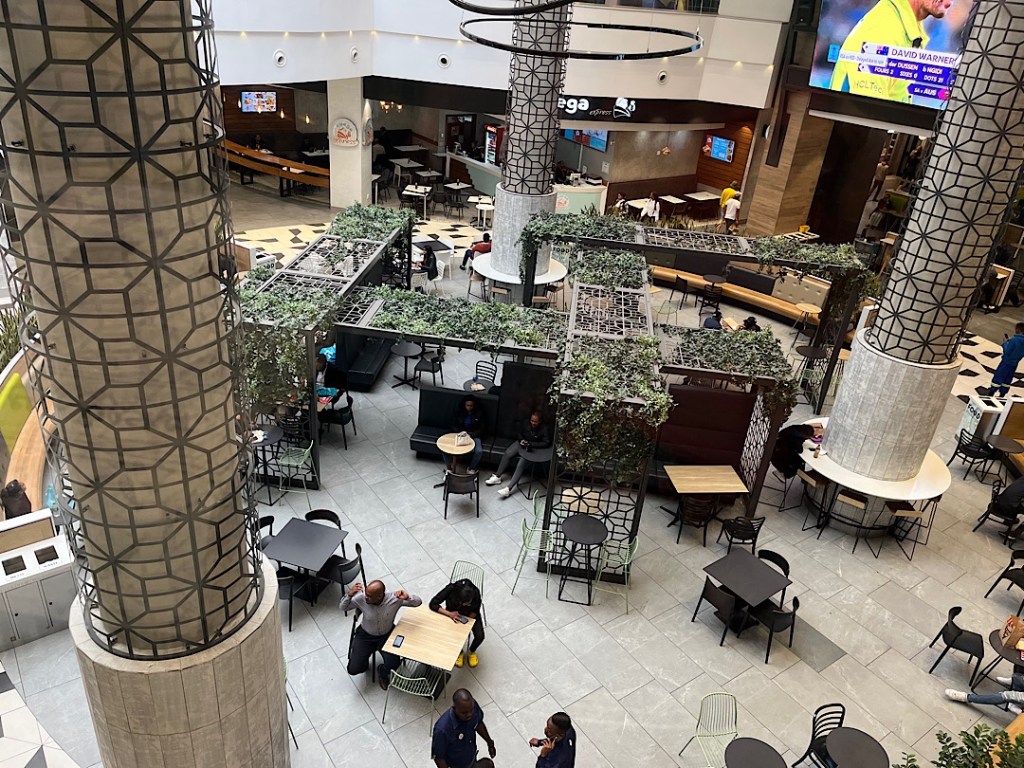
We were looking down here from the sushi joint where we had lunch to the “food court” below.
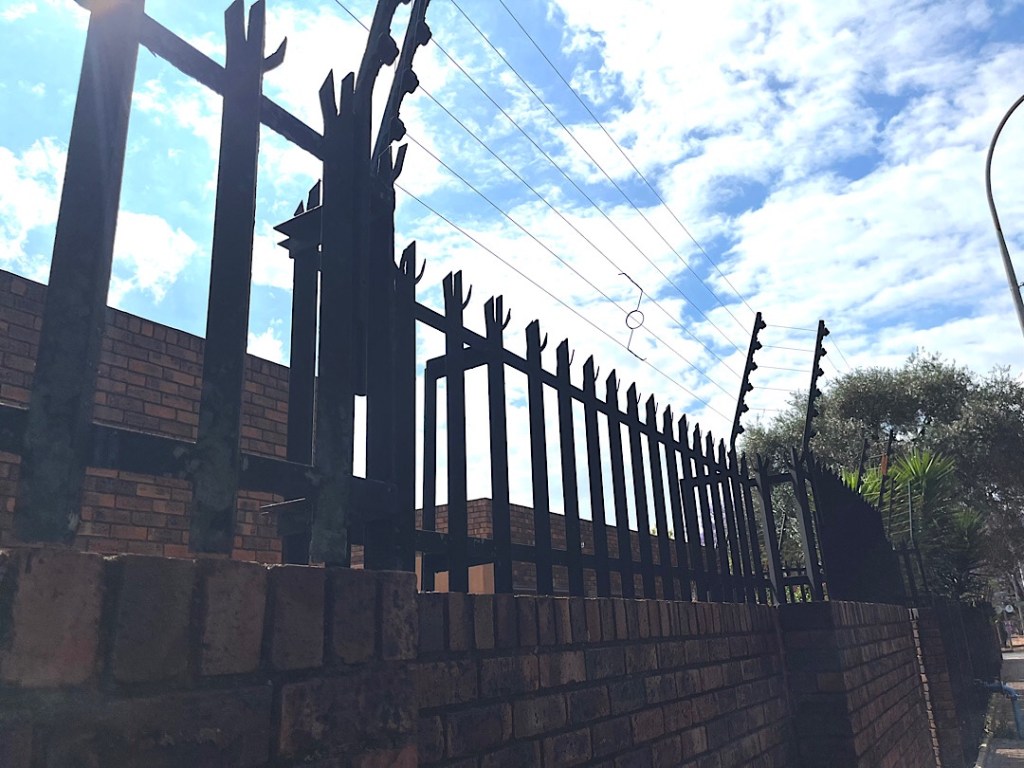
All this was interesting, but it didn’t make either of us yearn to move to Jozi (the city’s more affectionate nickname). Luxury window-shopping might be entertaining for an hour or two, but the ubiquitous security cameras and guards and electrified fencing make it clear almost everyone here feels they have to protect themselves from local bad guys.
The protection around the local Catholic Church combined old-fashioned metal spikes with the electrified fencing.
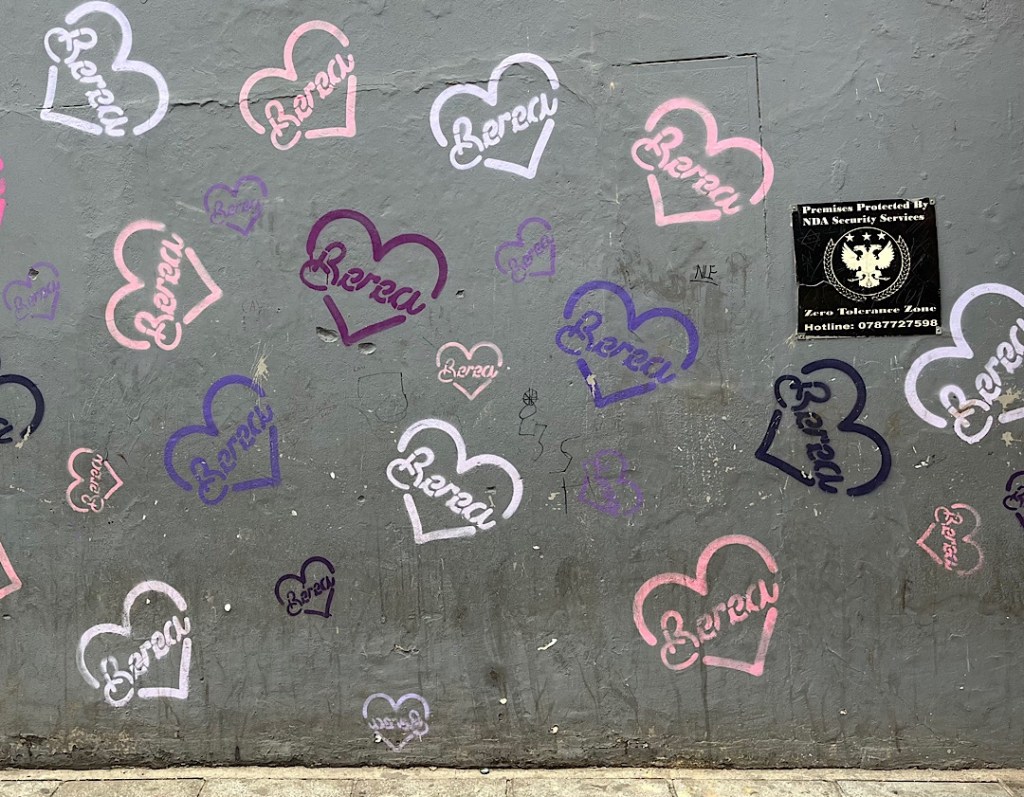
That’s also the case in Hillbrow and Berea, but I felt much more alive and engaged throughout our three-hour excursion there. My old friend Megan and her husband Andrew were in Jozi a few months ago, and they had taken and loved the tour organized by an 11-year-old nonprofit called Dlala Nje. I looked at the organization’s website and signed Steve and me up for an outing offered on the day after we flew in from Victoria Falls. From Rosebank, we took an Uber, which is super-cheap and (along with Bolt) works superbly throughout the city. Our black driver looked dubious as we approached our destination.
“What are you guys doing here?” he asked, concerned.
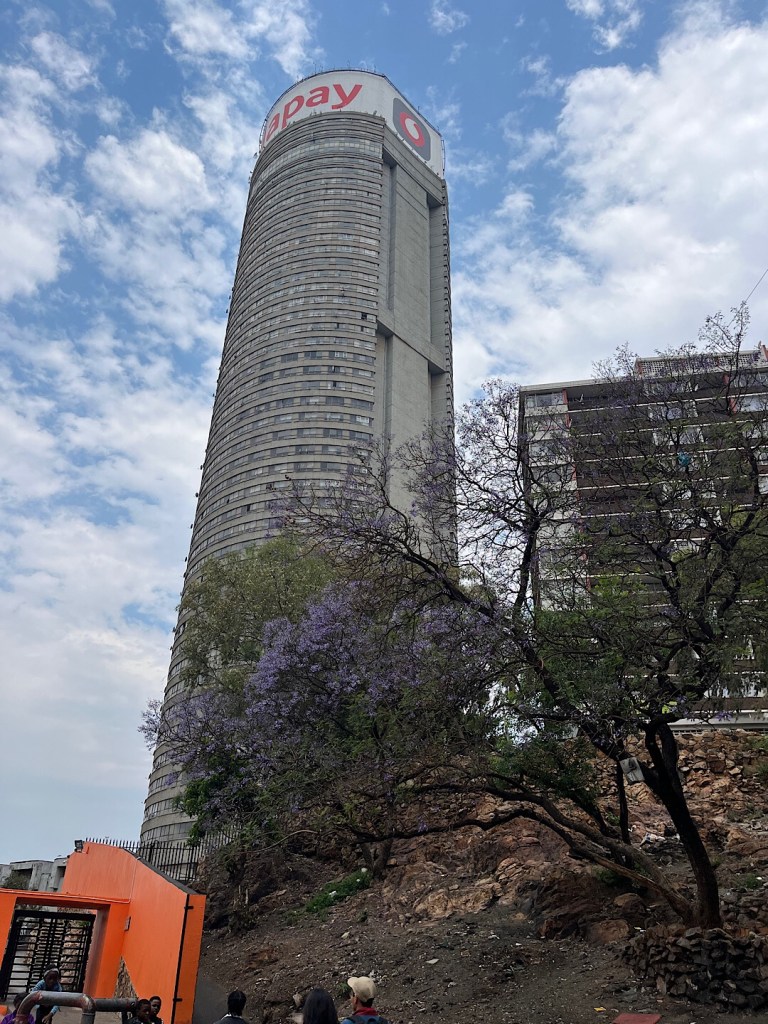
We told him we were there for a walking tour, and he seemed dumbfounded. “Are you sure you want me to let you out here?” he pressed when we reached the Ponte City tower. We told him it was okay.
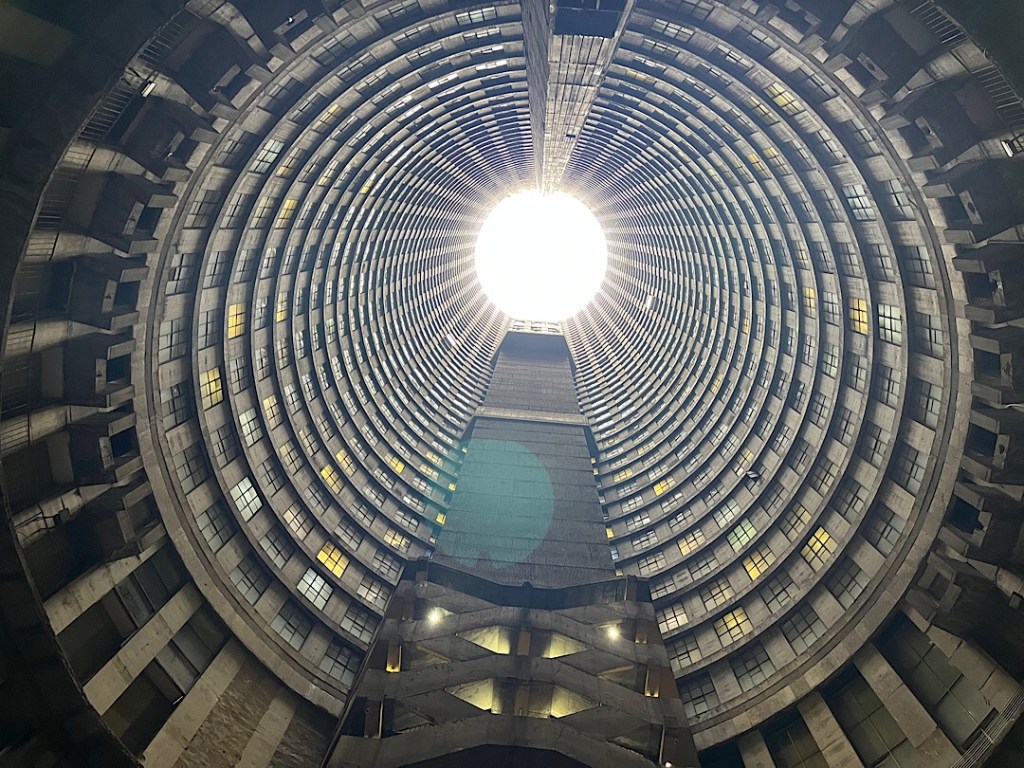
And it was — delightfully! I hadn’t realized it, but not that long ago, residents considered Hillbrow and the adjoining Berea neighborhood to be the scariest communities in the city. That hadn’t always been the case. Once upon a time (circa 1970), the area was an enclave of the white elite, the most elegant part of town. But in the late 1980s, as the apartheid system began to crumble, it became a magnet for artists where people of different races ignored the rules and interacted. Trevor Noah’s Swiss father and Khosa mother played out their relationship (and conceived their famous son) in an apartment in the neighborhood. The white powers-that-were found this intolerable and retaliated by cutting off all city services, including police protection and maintenance. White property owners fled to areas like Rosebank and Sandton, and Hillbrow degenerated. Squatter landlords took over some of the buildings, charging rent to folks desperate for shelter. Brutal, often violent muggings became commonplace. Hillbrow’s once-posh landmark, the cylindrical 50-plus-story Ponte City tower, filled with thousands of tenants willing to live without water or electricity. They tossed their trash into the central light well. At one point, the stinking pile reached the 14th story.
Two charming young men, Delight and Alvaro, guided our group of five (a pair of Chinese newlyweds from Sydney, a solo Japanese woman named Kimi, Steve, and me). The young South Africans acknowledged that in the late 90s and early 2000s, the area was dangerous. But things had improved, they insisted. We still needed to be on guard against phone-snatchers and pickpockets. But if we looked confident and stuck with them, we’d be fine.
Some of the streets we walked through reminded Steve and me of the bad parts of New York City during its most blighted years, or sections of the west side of Chicago in our youth: garbage strewn all over the broken pavement, hungry young men lurking like jackals. Delight warned us not to take any photos as we passed once-beautiful buildings that had been stripped of all their windows and metal innards by addicts who sold the material to buy cheap, bizarre heroin mixtures the likes of which I’d never heard.
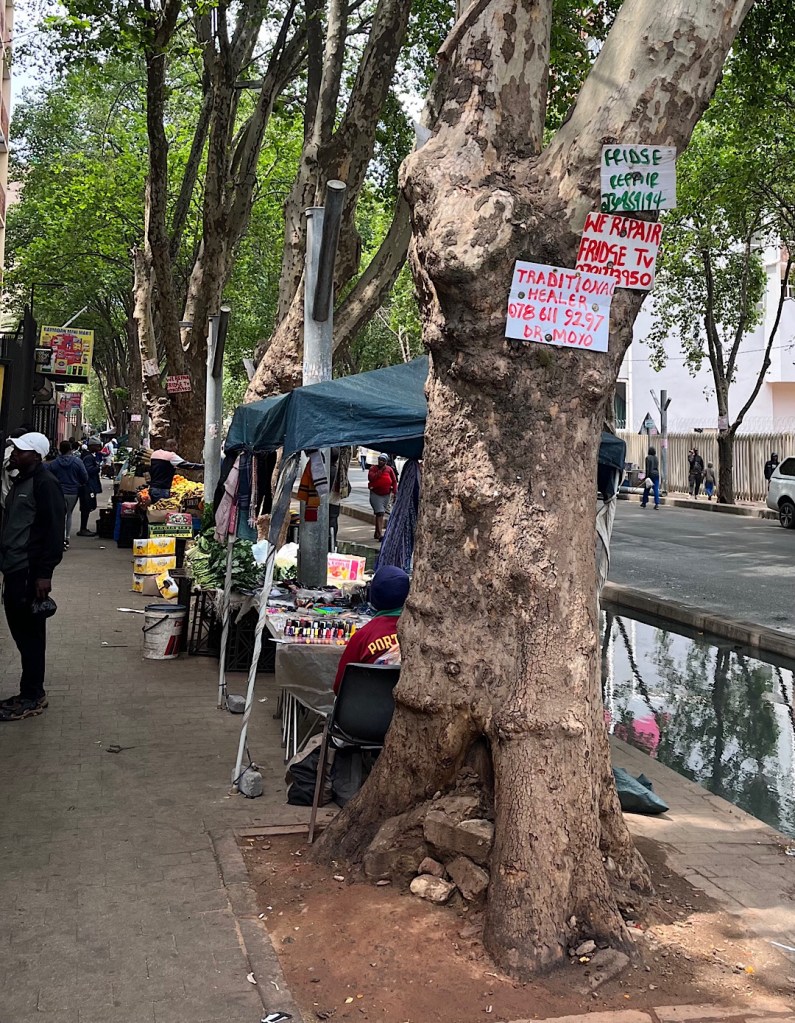
But in the very next block, the change was startling. I didn’t see as much as a gum wrapper on the well-kept sidewalks. A little grocery store stood on one corner, and we passed women who looked like middle-class housewives.
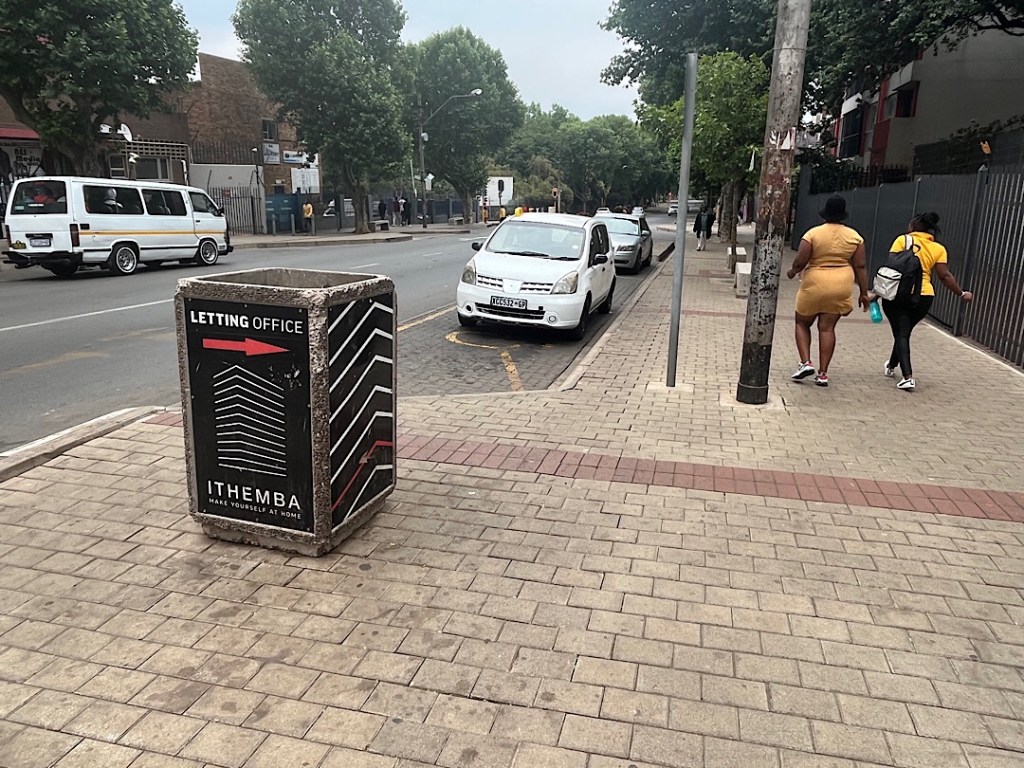
Delight explained that a Cape Town-based property developer named Ithemba had made a deal with the city government to take over several of the highjacked buildings, renovate them, and rent them out. (The developers still didn’t own the buildings, but it was clear to everyone their original owners could never reclaim them because of the back taxes they would owe.) Ithemba hires private contractors to clean and police the streets. Rents in their buildings are higher than the squatter landlords had been charging their tenants. But the city was now getting some revenue, neighboring buildings also were being upgraded, and a piece of the urban jungle was again a decent place to live.
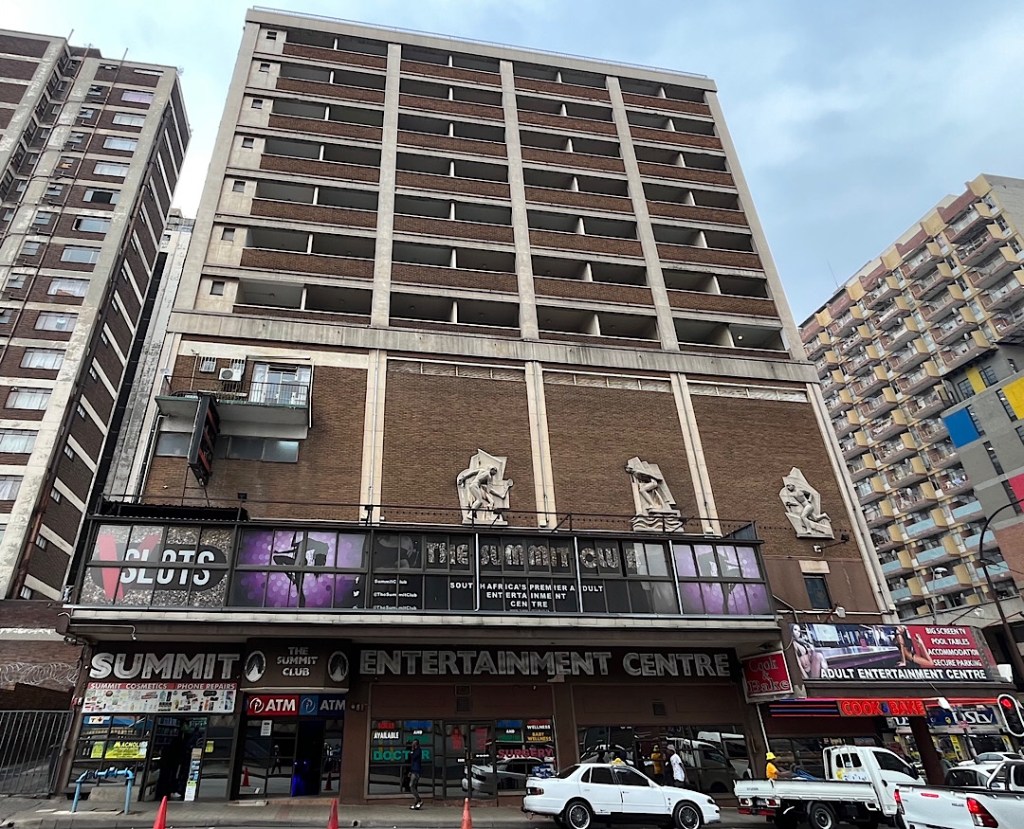
Along Hillbrow’s main commercial street, Delight pointed out a one-time athletic club that turned into a strip club and brothel decades ago.
The brothel occupied all the upper stories. Another building three times its size was also a brothel. Although prostitution is illegal, Delight said the cops turn a blind eye (for a price).
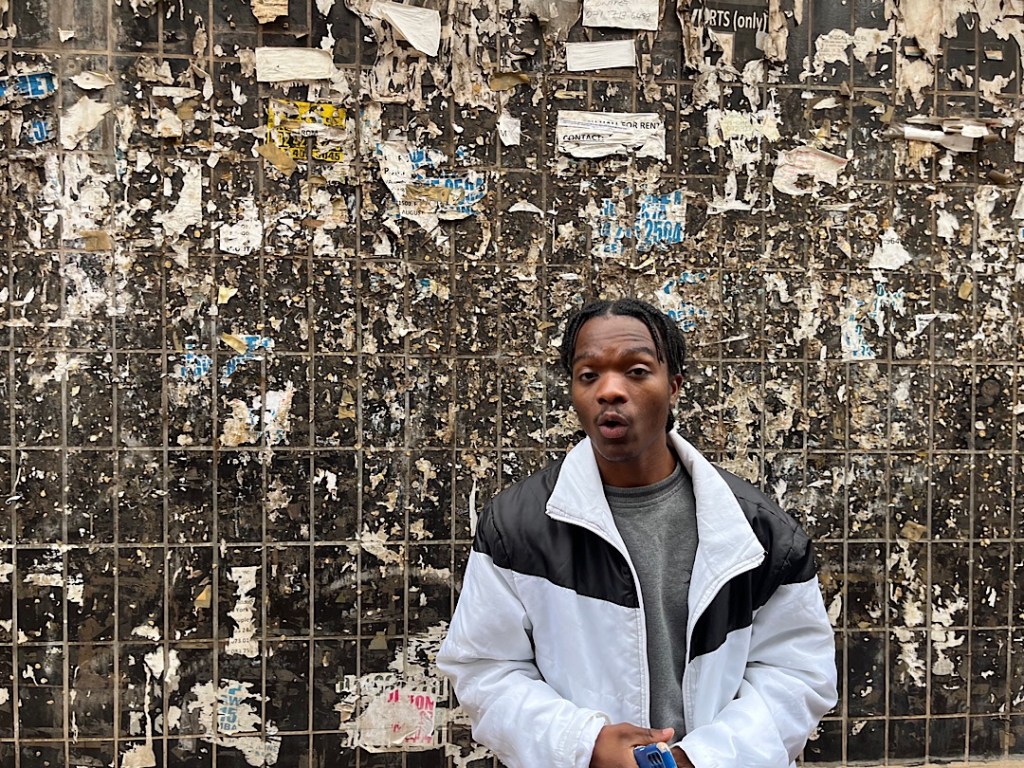
He stopped at the community’s version of eBay.
People seeking housing post notices here. This one was from a woman wanting to rent her bed while she wasn’t occupying it.
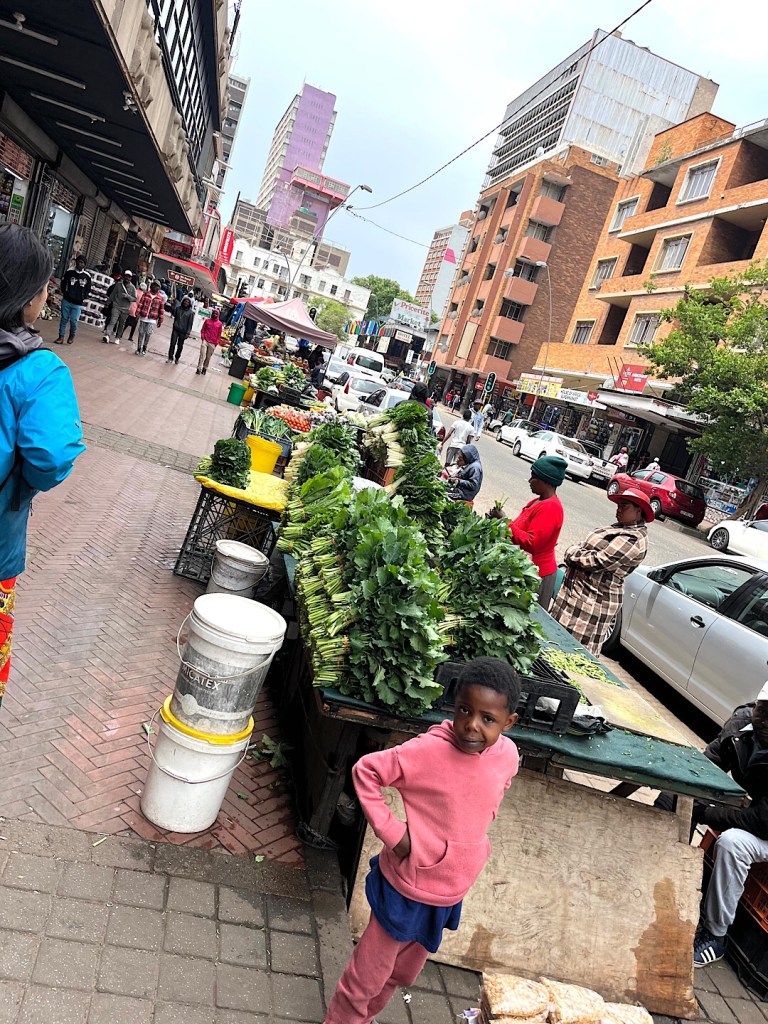
The energy and enterprise on the streets were palpable.
We wound up where we’d started — back at the Ponte City tower.
It’s been renovated too, and if not the gleaming showcase it once was, all the garbage has been cleared out. Once again it’s a decent place to live.
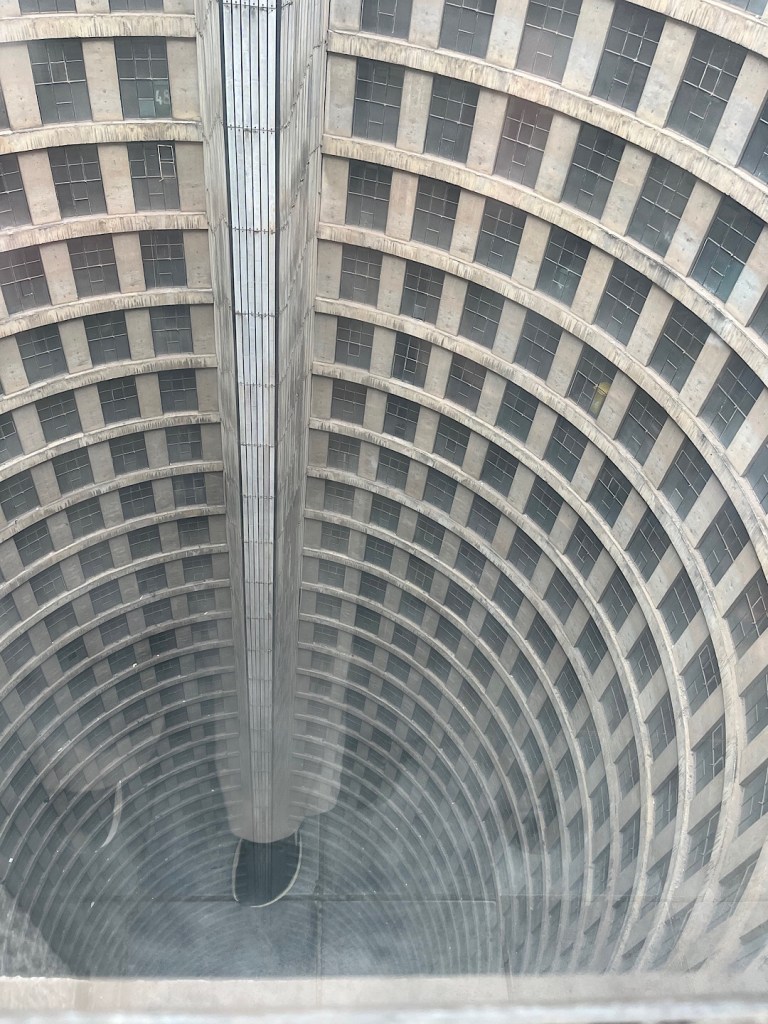
This is the view from the 51st floor, looking down the core of the building.We also went into the basement, from which all that garbage has been cleared.You can get an apartment these days for about $160 a month,
It didn’t tempt me to move there any more than Sandton’s luxury condos did. Still, for all South Africa’s problems, Hillbrow made me feel more optimistic about the future.
Imagine you have recently grown a pair of breasts, and it’s a beautiful spring day, and you can take off almost all your clothes, get together with your pals and thousands of other girls, and sing and dance for the king. This is a blast, I can report, having just observed eSwatini’s Umhlanga Red Dance Festival, where all this action unfolds. Attending it was one of the biggest strokes of luck of my travel life.
Months ago, I had read about the festival (which Lonely Planet describes as “one of Africa’s biggest cultural events.”) The main event is a week-long celebration in which girls from all over the country flock to the main royal palace in Lobamba bearing reeds to (symbolically) help repair the queen mother’s home. Traditionally the monarch of this tiny (still-polygamous) state also chose a wife every year from among the nubile young dancers. The political unacceptability of a 50-something-year-old man annually picking out a teen virgin to add to his harem ended the match-making aspects of the festival around a dozen years ago. But in other ways, the tradition remains unchanged from its inception. “It’s like your 4th of July. Or Thanksgiving.” A celebration of national identity, asserted our guide, Myxo Mdluli. (I thought: not quite. I’ve never been to any turkey-eating feast that was this much fun.)
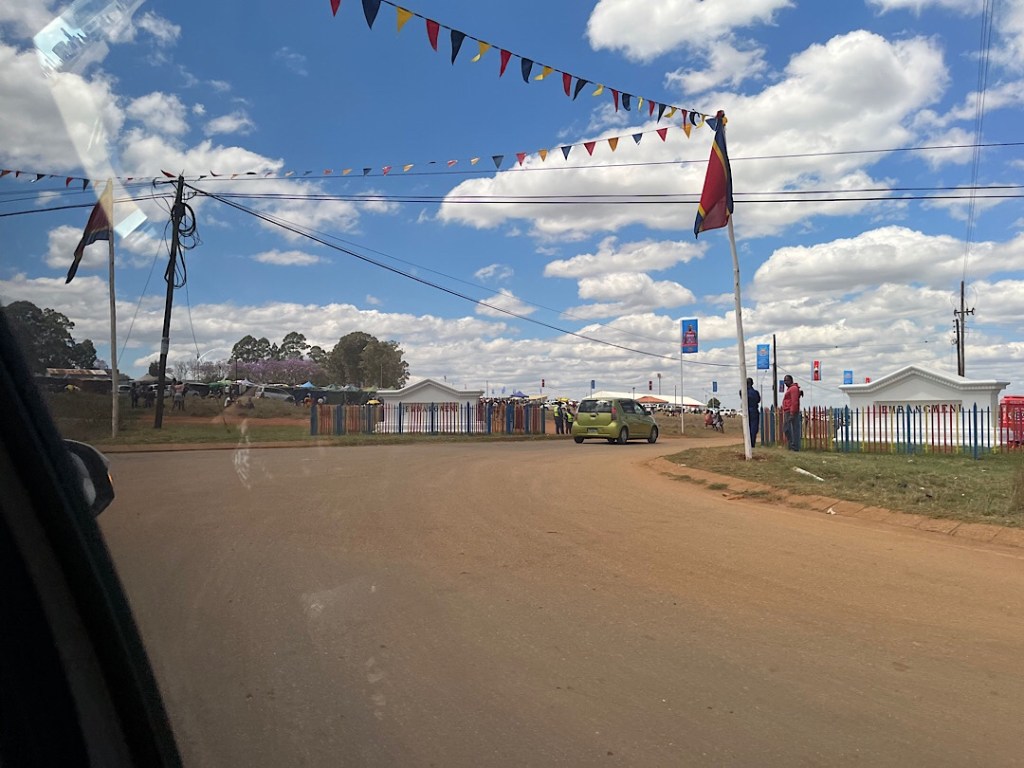
Back around May, I looked up the date of the festival, and any hope of attending it vanished when I learned it takes place sometime in August or September. What I didn’t know was that a one-day satellite reed-dance festival also happens at Embangweni, another of King Mswati III’s residences. At some point on Friday, during our seven and a half-hour drive from Pietermaritzburg (in South Africa) to a game park in southeastern eSwatini, Myxo mentioned the smaller event would be taking place the next day. Would we like to go?
Changing our itinerary and driving 90 minutes to get to Embangweni seemed a trivial price to pay for participating. We arrived a little before noon at what felt like a combination fairgrounds and sports field.
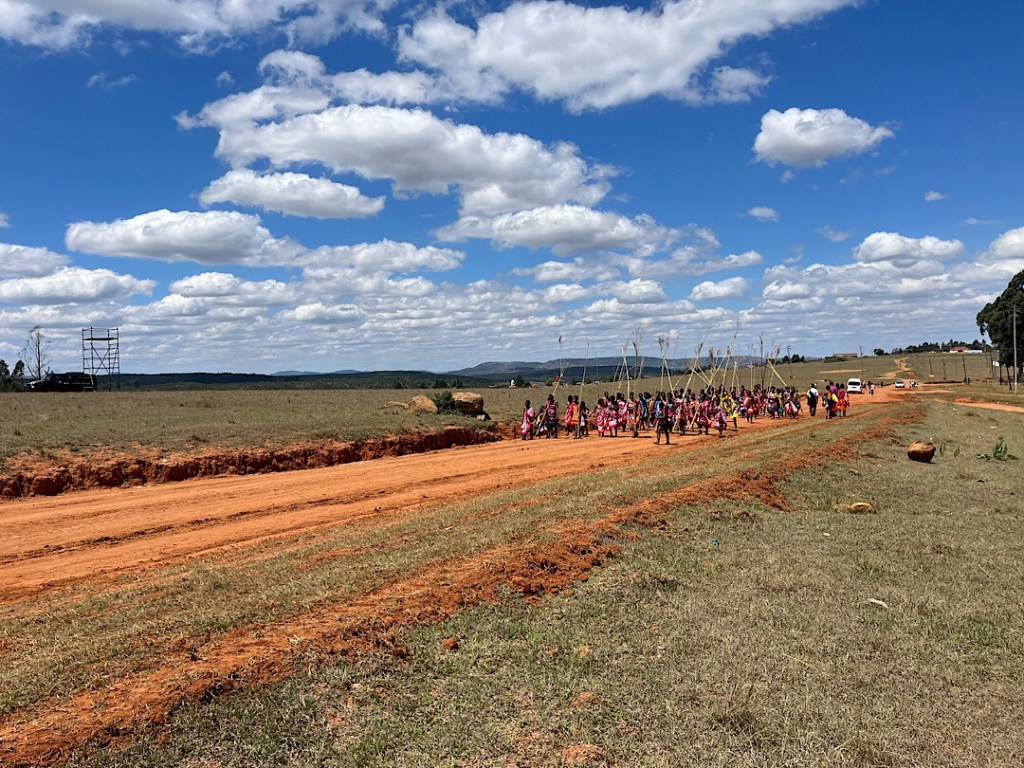
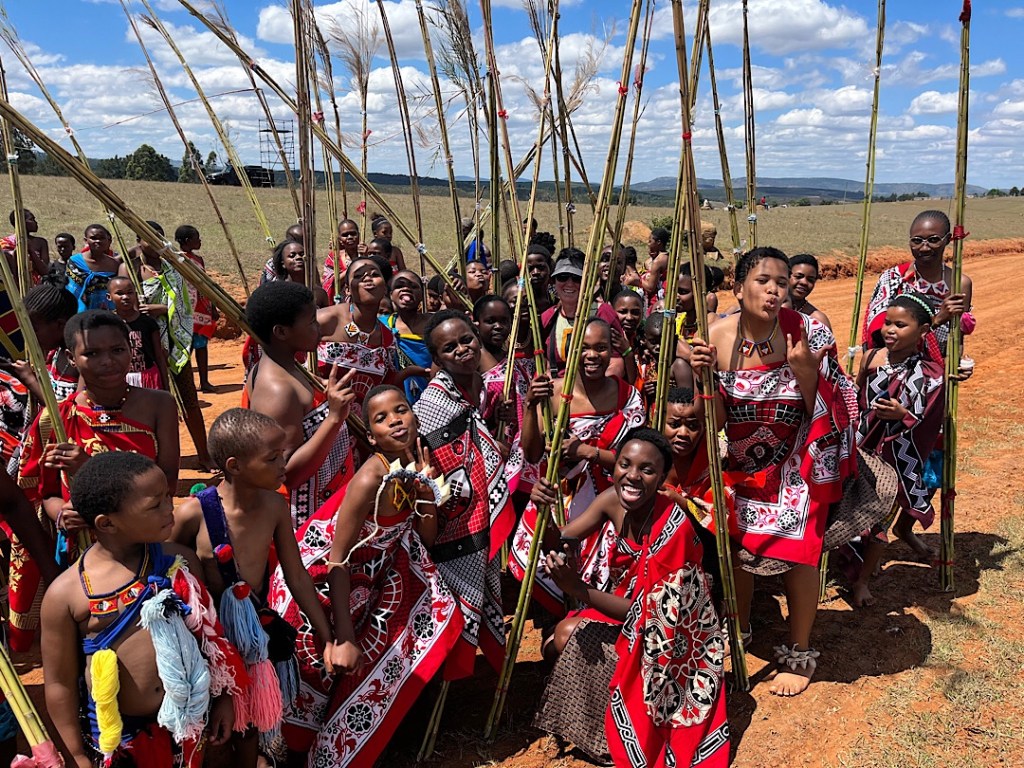
A large area for food vendors had popped up, and a gigantic VIP tent was serving a buffet lunch. Myxo spotted a cluster of colorful figures moving up a dirt path and urged us to get closer; it was a group of local girls arriving to participate.
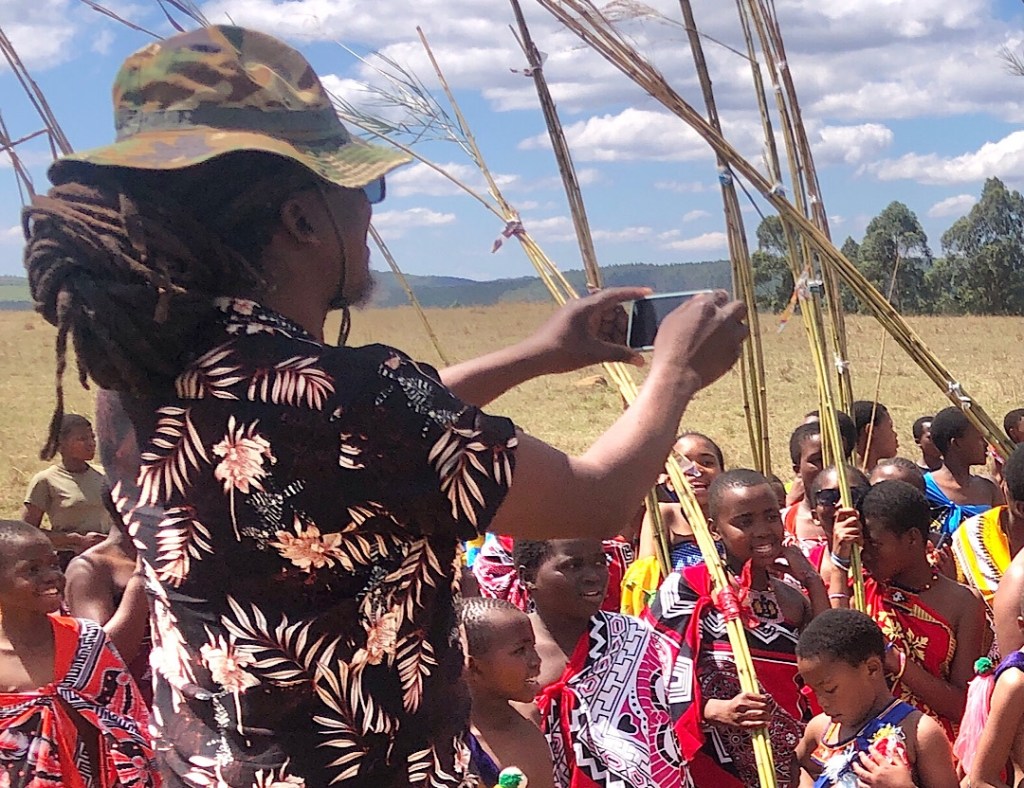
He prodded me to walk up and greet them, and I felt like an instant rock star. The girls exploded in grins. They threw their arms around me and began mugging for the camera.
Myxo captured the action on my phone.Can you spot me among the throng?
I should mention that they weren’t just strolling in, they also were singing, producing a marvel of complex harmonies and rhythms and solo counterpoints. We moved on and soon realized all the groups were singing, pretty much non-stop; floating among them took us through an archipelago of enchanting musical islands.
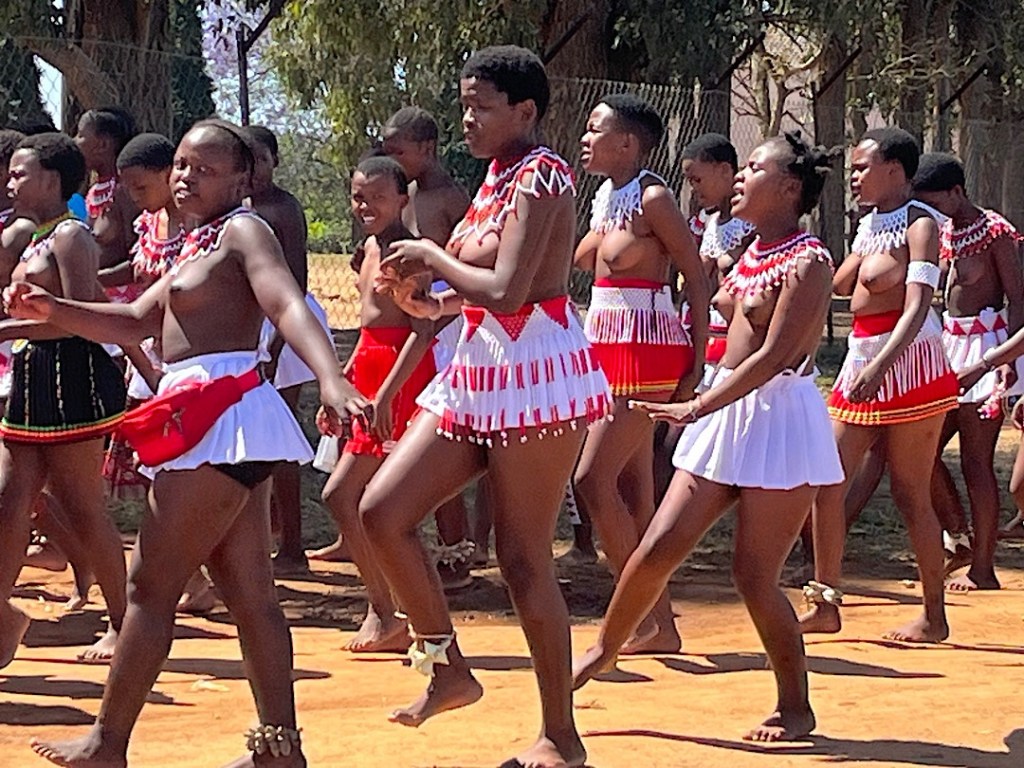
I also realized, with a jolt, that unlike that first group we encountered, most of the girls were topless and wearing beaded mini-skirts that covered either tiny black panties or simply their bare bottoms.
This group was composed of Zulu gals who came to dance (but couldn’t present reeds, that being reserved for the Swazi females.)
The Zulus gathered into a little group and individuals took the center ground to show off their stuff. The ability to deliver kicks very high and fiercely seemed to be a goal.
The range of ages was remarkable, from quite young…
To confident young women…
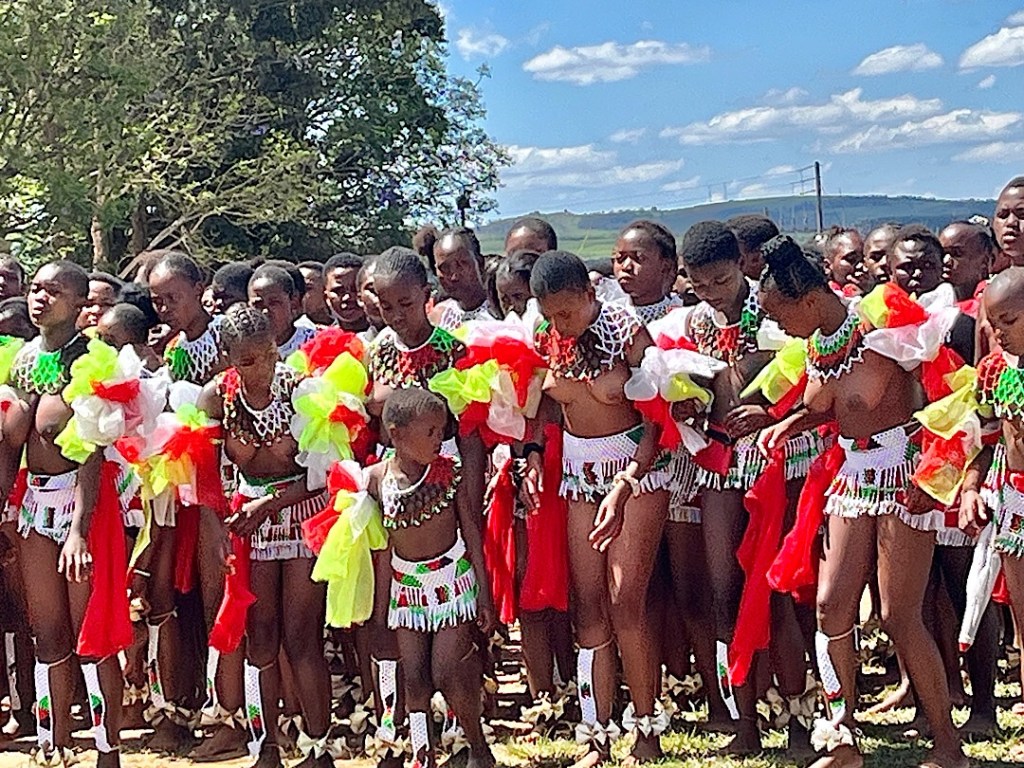
Though the costumes were skimpy, the stylistic variety was riveting.
We learned that participating royals (princesses and maybe their close cousins?) could be distinguished by the feathers they alone were entitled to wear.
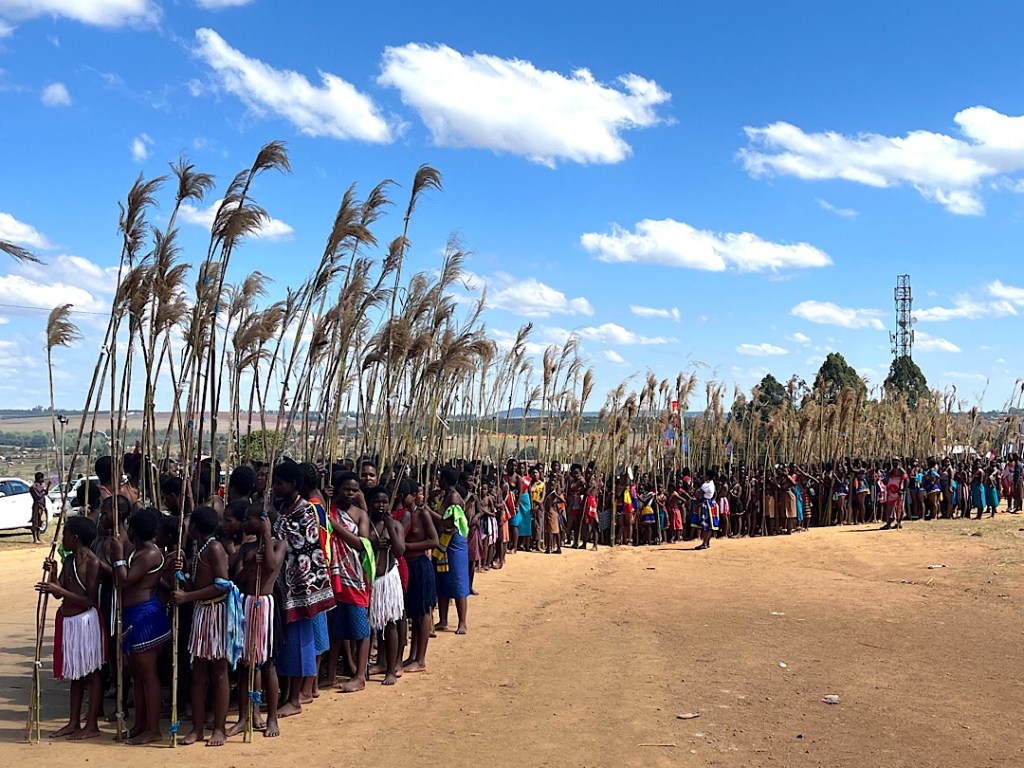
Around 1:30, phalanxes of Swazi girls began lining up at the palace gate to deliver their reeds.
The numbers were staggering. We never heard a count, but the dancers clearly numbered in the thousands. For a while we watched them entering the arena, a parade that looked more jubilant and exultant than anything Macy or the Rose Bowl organizers ever dreamed of.
With no end to the marching girls in sight, however, we sadly had to depart before the formal dancing ceremonies began.
We had to go because we knew it would take us two hours to drive to the cabin I had booked at Hlane Royal National Park. Indeed the sun was setting and the front-desk receptionist was closing up when we finally got there a little before 6 pm. Once again we lucked out. Myxo had suggested Steve and I see if we could join the 5:30 (“sunrise”) game drive the next morning, and for about the price of two movie tickets at The Lot, we were able to sign up for seats in one of the game-drive vehicles. We went to bed early in the cabin, illuminated only by two kerosene lanterns and a candle.
The nyala on our front lawn charmed me.
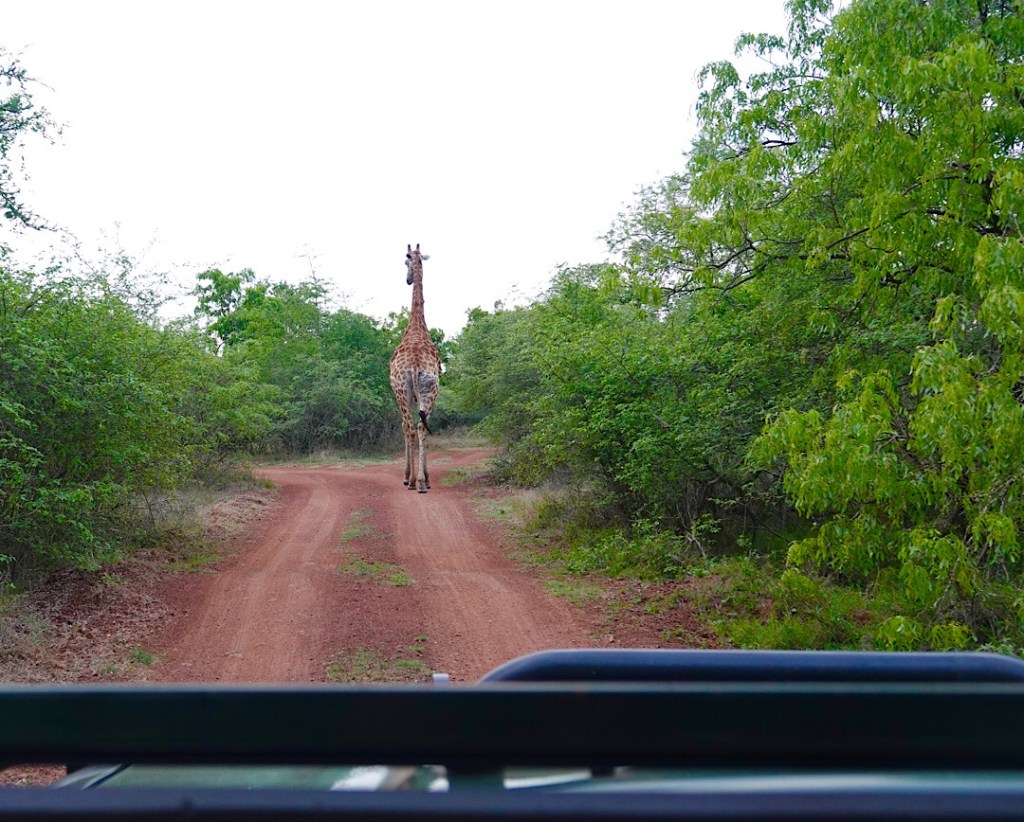
As if the reedy extravaganza hadn’t been enough, we wound up seeing more famous animals up close on the next morning’s game drive than anything I’ve experienced before.
Almost instantly a giraffe appeared in front of our vehicle, strolling along as if to say, “Follow me and I’ll show you some cool stuff.”
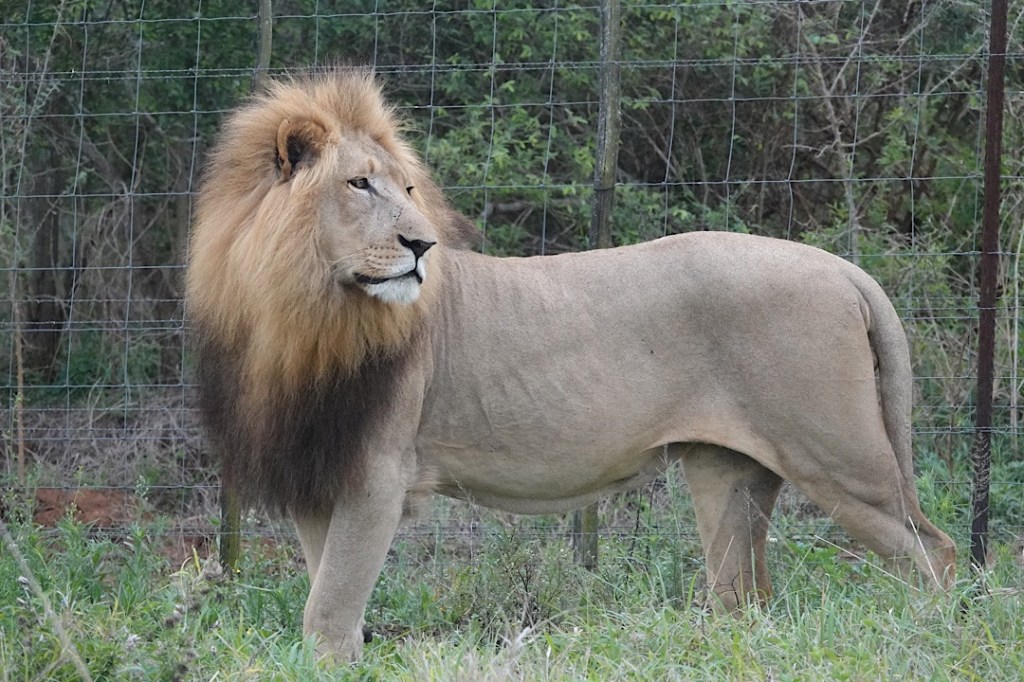
Everyone in our Cruiser wanted to see lions, so we drove into that section of the park and in less than 5 minutes came upon this guy, patrolling the perimeter of his domain.
Our driver-hide said the predator wouldn’t see us as individual potential snacks but rather would only register our lumbering Land Cruiser, smelling of diesel fuel.
If you’d never heard of lions, I think you’d still know this guy was dangerous, he’s so muscular and powerful. He looked indifferent to us, but a shiver ran down my spine as he passed.
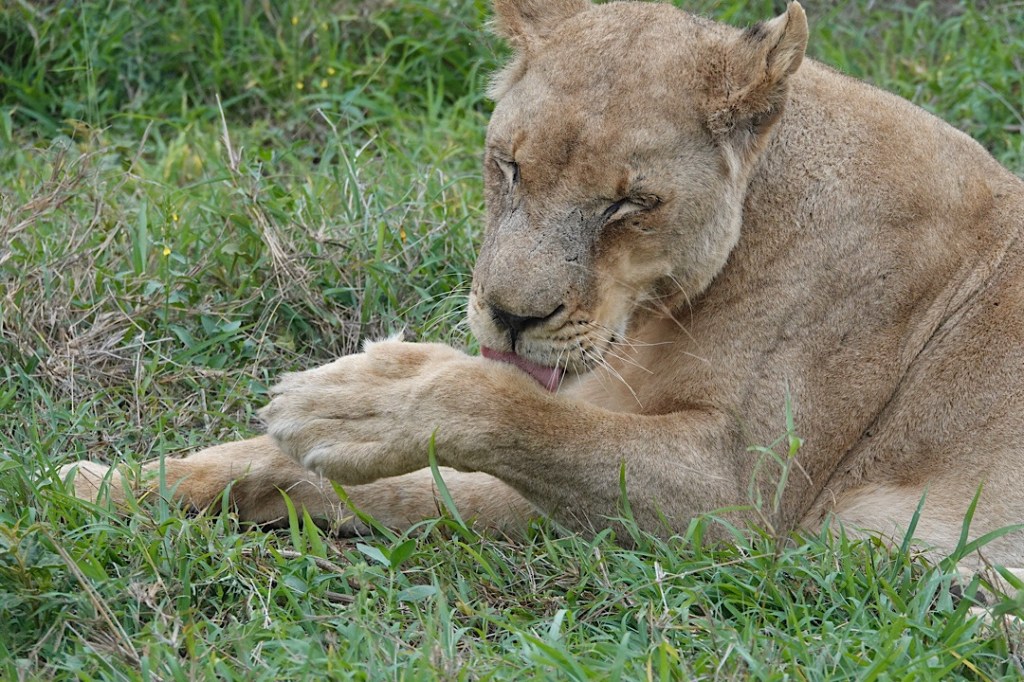
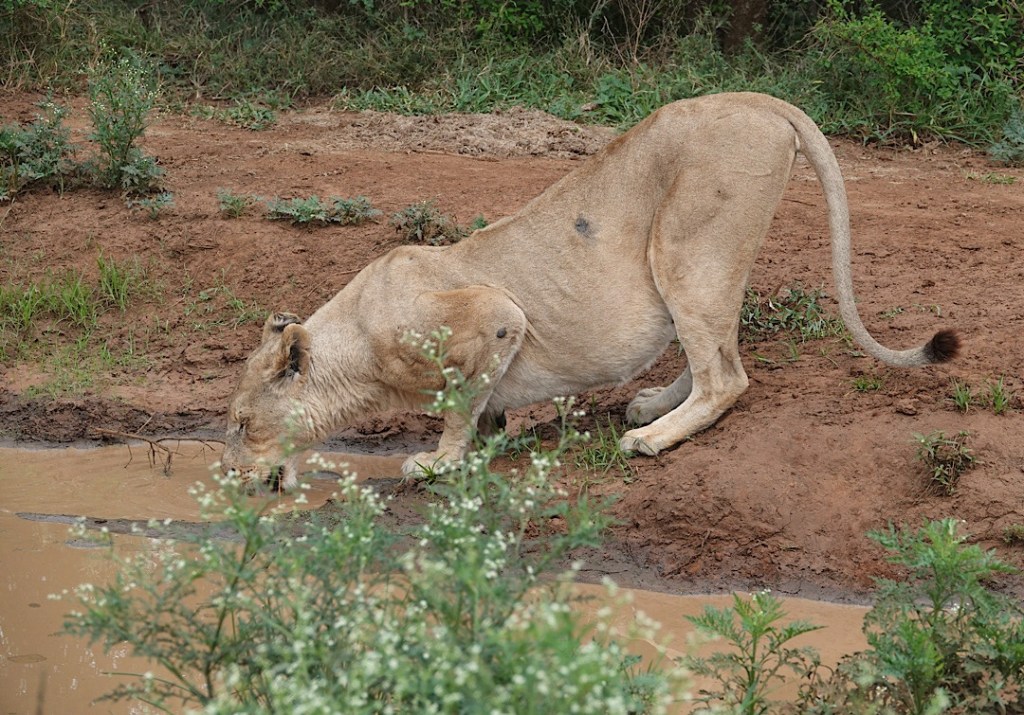
A bit later, we came across one of his lady friends…
…grooming herself……and lapping up a drink from the pond.
Then we almost drove into this mature female white rhino and her two-year-old offspring.
He tried to pester her into bestirring……but as mothers will do, she ignored him and he finally settled down to snooze beside her.
In any normal week of my life, encountering this many high-octane marvels in less than three hours would have been enough excitement to call it a day. But with Myxo, we spent the rest of Sunday doing more: visiting a cultural center and then the national museum, stopping at a craft center, seeing a bit of the capital city, Mbabane. By the time he dropped us off at our last hotel in eSwatini, we felt we had lucked out with him too.
I’ve reflected that the biggest roll of the dice for any independent traveler, like me, is who I hire to drive us around. For the Lesotho/eSwatini part of this trip, I didn’t have many choices. It’s not like mobs of people want to fly from Joburg to Maseru then be driven across Lesotho, then up to Swaziland and schlepped around there for several more days. In the end, I had to use two separate outfitters. Pretty much all I knew about Myxo came from his website, and while extensive, some details were sketchy.
Topping that was the fact he showed up in Pietermaritzburg with a young woman named Mazui whom we assumed was a girlfriend. (Myxo introduced her but never explained her presence in our vehicle.) It was an odd twist, but she was very nice and we didn’t mind buying her a burger and milkshake at the Wimpy’s where we stopped for lunch. (Myxo declined any food, saying he had some snacks to munch on.) When Steve asked if we’d fill up at the Wimpy’s stop, the guide said he wanted to wait until we crossed the border. Petrol would be 2 rands a liter (about 40 cents a gallon) cheaper on the Swazi side. The border crossing was a breeze and Myxo didn’t hide his relief at the fact we hadn’t run out of gas. He made a beeline for the town’s only fuel station only to find they had nothing to sell.
We continued on down the highway, and I must report, the situation felt pretty grim. The sun was setting. Myxo seemed unsure where he might be able to find another fuel source. I spent several long minutes wondering what would happen when we shuddered to a halt in the gloom, in this distant part of Swaziland near the border of Mozambique. Then miraculously, we saw a station up ahead. It had gas for sale.
Mazui also seemed relieved as the numbers mounted on the pump.
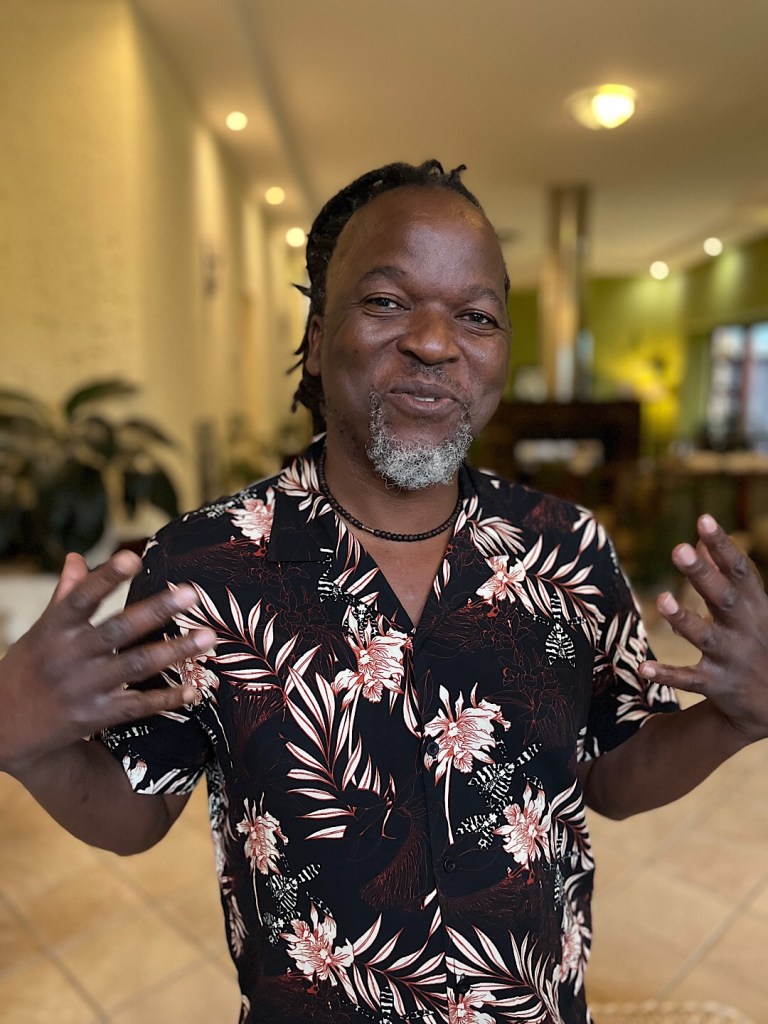
Luckily (again), that was the last flaky thing Myxo did. He always showed up on time. His vehicle was new and impeccable (and capable of operating on fumes!) We never would have seen the dancing virgins or those lions and other animals, had he not suggested those activities. He didn’t get us killed on the road (the biggest danger anywhere we travel, in my opinion.) And we had some of the most wide-ranging and provocative conversations we’ve had with any driver anywhere. Steve and I and Myxo talked about human origins and culture and whether he should start a blog to promote his business and Swazi politics and race relations and more. I’m not sure how long I’ll remember what we learned in the national museum. But I don’t expect to forgot how fortunate we were to spend three days of our lives with him.













































 At home and abroad