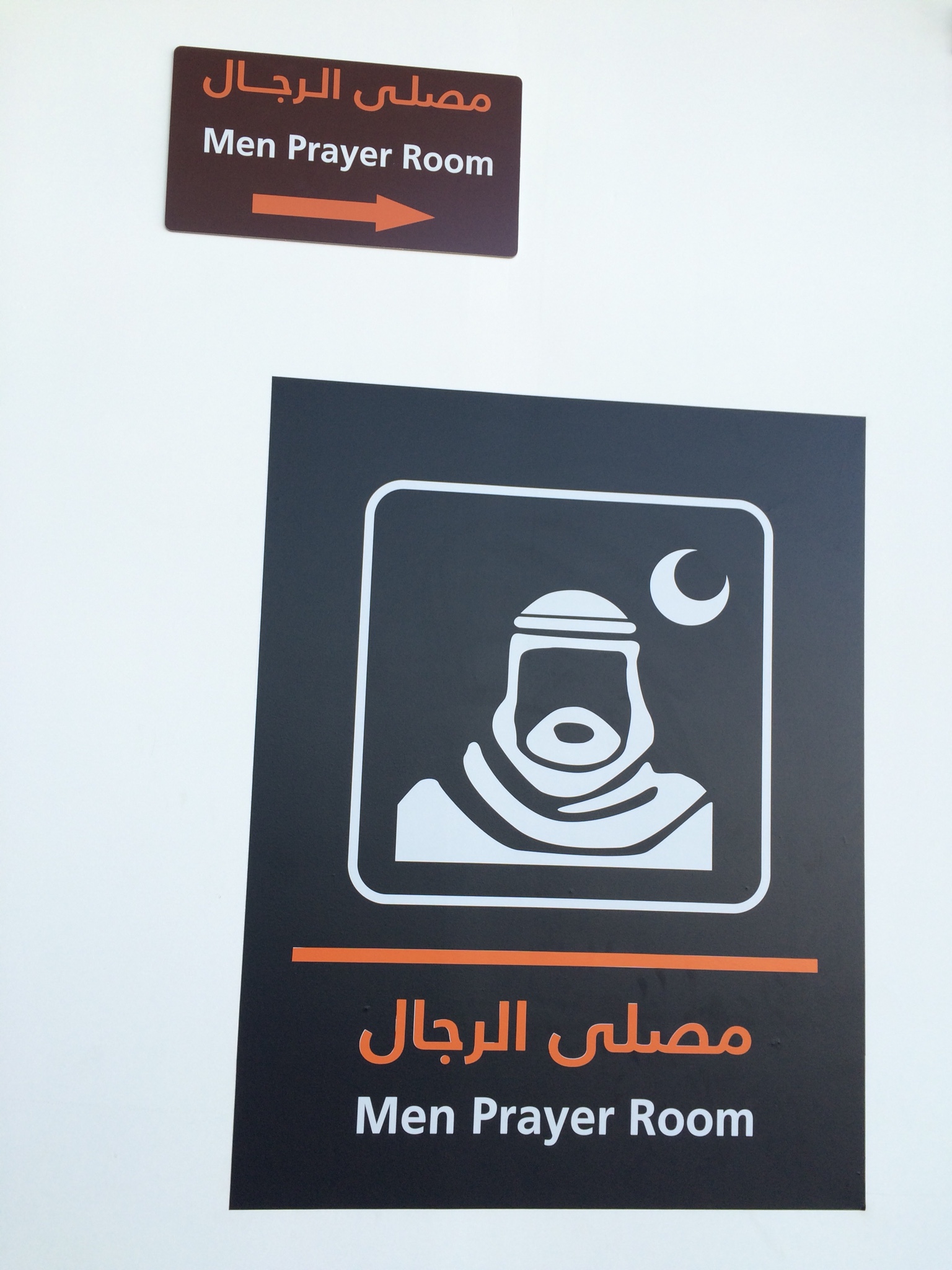
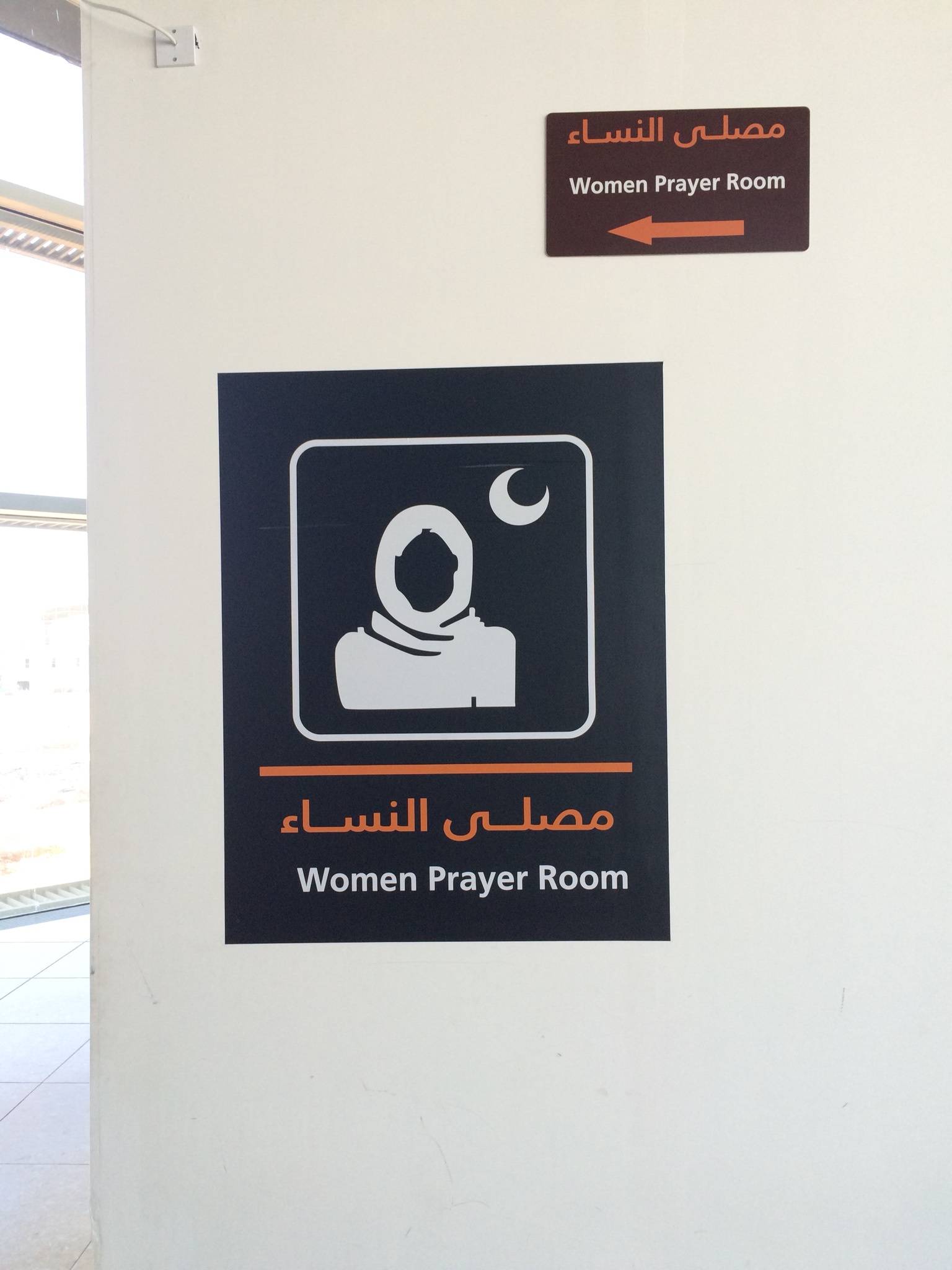
You know you’re in the Middle East when the airport has separate prayer rooms for men and women. And separate in-concourse mosque facilities.
We’re due to board our Royal Jordanian flight to Tel Aviv in an hour.
You know you’re in the Middle East when the airport has separate prayer rooms for men and women. And separate in-concourse mosque facilities.
We’re due to board our Royal Jordanian flight to Tel Aviv in an hour.

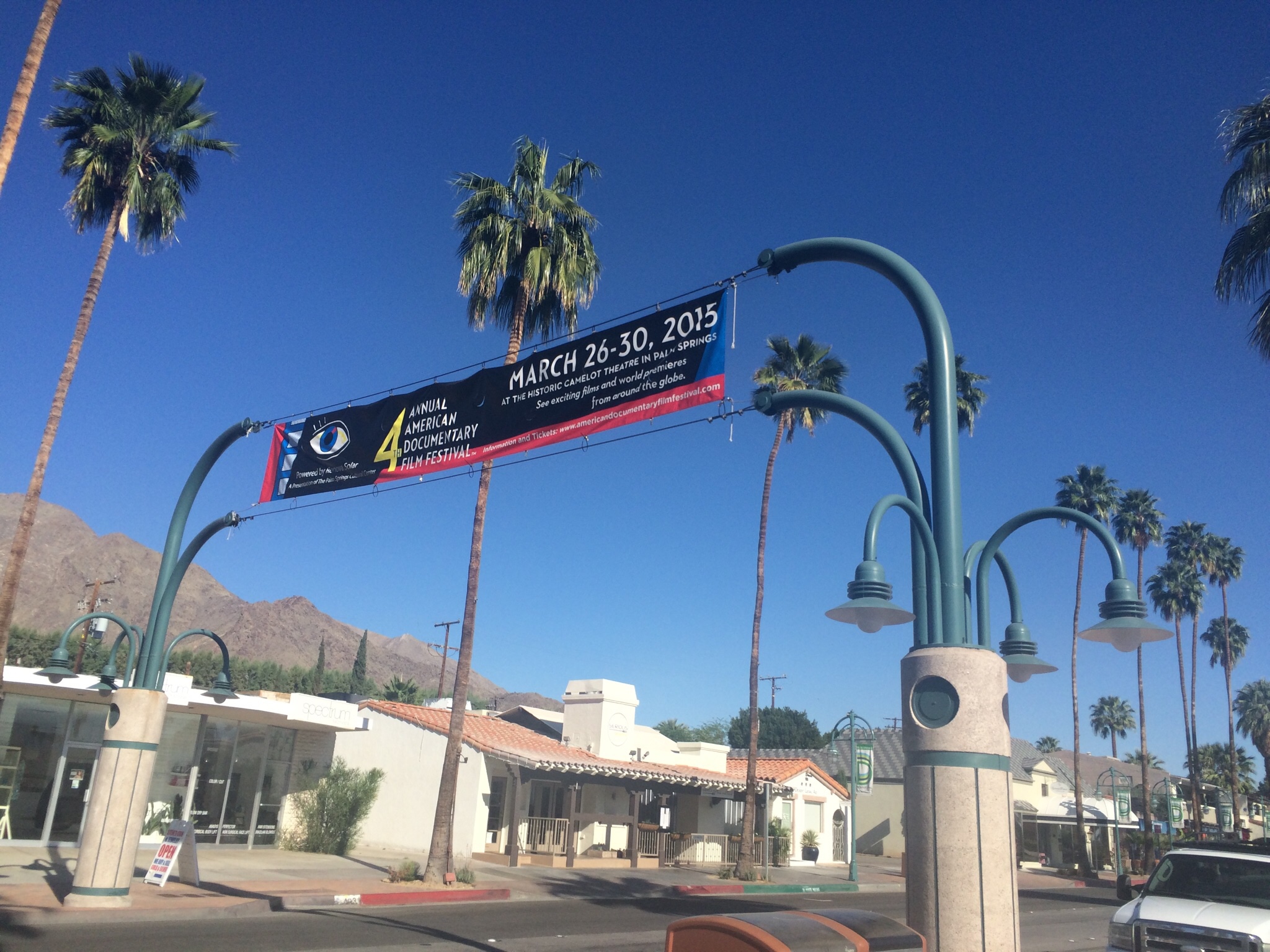
Twice in recent years I also had the chance to attend the superb Rocky Mountain Women’s Film Festival in Colorado Springs, almost entirely non-fiction. But even that’s an awfully long way to travel. So I was pleased and interested to learn that Palm Springs is the venue for the four-year-old American Documentary Film Festival. Its website said MovieMaker Magazine had declared it to be one of the “world’s top 25 film festivals worth the entry fee.” Intrigued, we decided to check it out.
In the months leading up to it, I got several hints that it might not be up to the level of professionalism of the North Carolina and Colorado events. For both of those, we’d had flex passes that made it easy to breeze in and out of the showings. AmDocs (as the Palm Springs event is known), offers one too, but by the time the discounted early fee ended, no schedule had yet appeared on the website.
We decided to gamble on a flex pass anyway. Still, weeks passed before we learned what it would allow us access to. Finally, the list appeared — more than 120 films ranging from 3-minute shorts to full-length features. Instead of being shown in a cluster of theaters that were easy to switch between, however, they appeared to be scattered over three separate cities (Palm Springs, Rancho Mirage, and Palm Desert). That didn’t seem promising.
It wasn’t until just days before the festival that I noticed the website had added a list of what was playing each day in each theater. With three screens, it was clear the Camelot Theater complex would be hosting most of the action. Still, all the programs weren’t offered in a graphic form that would enable any normal person to figure out what he or she could make it to and when. Not until we checked into the festival hotel (the Saguaro) last Thursday night and consulted a physical program left for us by some friends could we actually begin plotting what our schedules for the next three days should be.
Our experience at the other two festivals helped us figure out what to see. (I’ve learned that almost any subject can be interesting.) Even the far flung venues were less of a nightmare than I’d anticipated. We wound up making the 25-minute drive to Palm Desert on Thursday and basically camping out in and around it all day long in order to attend the four screening events (7 films in all, including the shorts). We returned the next morning for the first documentary of the day (a historical look at the events that launched Mark Twain to international stardom), then drove to the Camelot and made it our base for the rest of the festival.
Most importantly, the movies did what we were hoping for — the majority of them were excellent, and a few dazzled us. Of the 16 we saw, here’s my list of the most memorable (more or less in order of wonderfulness):

— Top Spin. Both beautiful and suspenseful, it told the story of three high school students vying to compete in 2012 for Olympic glory — in table tennis.
— 88 Days in the Mother Lode — Mark Twain Finds His Voice. A charming look at some California and literary history involving one of our greatest authors.
— No Problem: Six Months with the Barefoot Grannies. How to train some of the world’s poorest ladies to be solar engineers. Amazing.
— Cat Show. I was braced for this look at the world of cat shows to be tedious. But the filmmaker fortunately found a vivid, original, and inspiring protagonist. I felt fortunate to spend an hour in her company.
— Big Voice. Demanding Santa Monica high school choir director pushes his students to become “one big voice.” Watching the process was both moving and educational.
— J Street: The Art of the Possible. Now I know all about this influential new Israel lobby.
— Growing Home. Everything I wanted to know about what it’s like to live in a Syrian refugee camp. In just 23 minutes.
Saturday night we also watched an almost two-hour homage to the great American director John Ford. It was made by the less great Peter Bogdanovich, who was on hand to pontificate after the screening.
If the choice ever comes up for me again, I might skip Bogdanovitch. But AmDocs itself is young and promising. I’d be happy to return.
Sometimes you come across things that don’t fit into any proper blog post but still blow your mind. Our journey through SE Asia offered a bumper crop of those, so here I present my personal photo gallery of 10 assorted weird and wacky SE Asian sights:
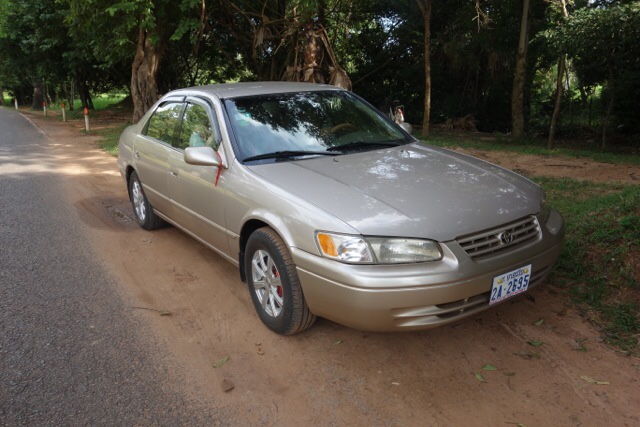
1) I probably never would have noticed this vehicle, which was UBIQUITOUS in Cambodia. But Steve, who’s astute about such things, immediately identified it as a Camry, a brand that Toyota has never sold outside the United States. Equally weird, the horde of Camrys plying the Cambodian streets and byways are all 10-15 years old, and they’re universally in mint condition. One of our Cambodian guides said they typically cost about $8,000 (and remember that Cambodia is one of the poorest countries on earth). In the US, a comparable one would run half that price or less.

2) The Southeast Asians aren’t the only ones posting bizarre images on toilet stalls. I’ve puzzled over this (lower) Japanese one before and only this trip, while passing through Narita International, did I learn it means the stall is equipped with a fancy toilet that can spray warm water “for cleansing of the buttock.” We had a short connecting time, so there was no way I was going to test it.
But I’ve added some new ones to my collection:
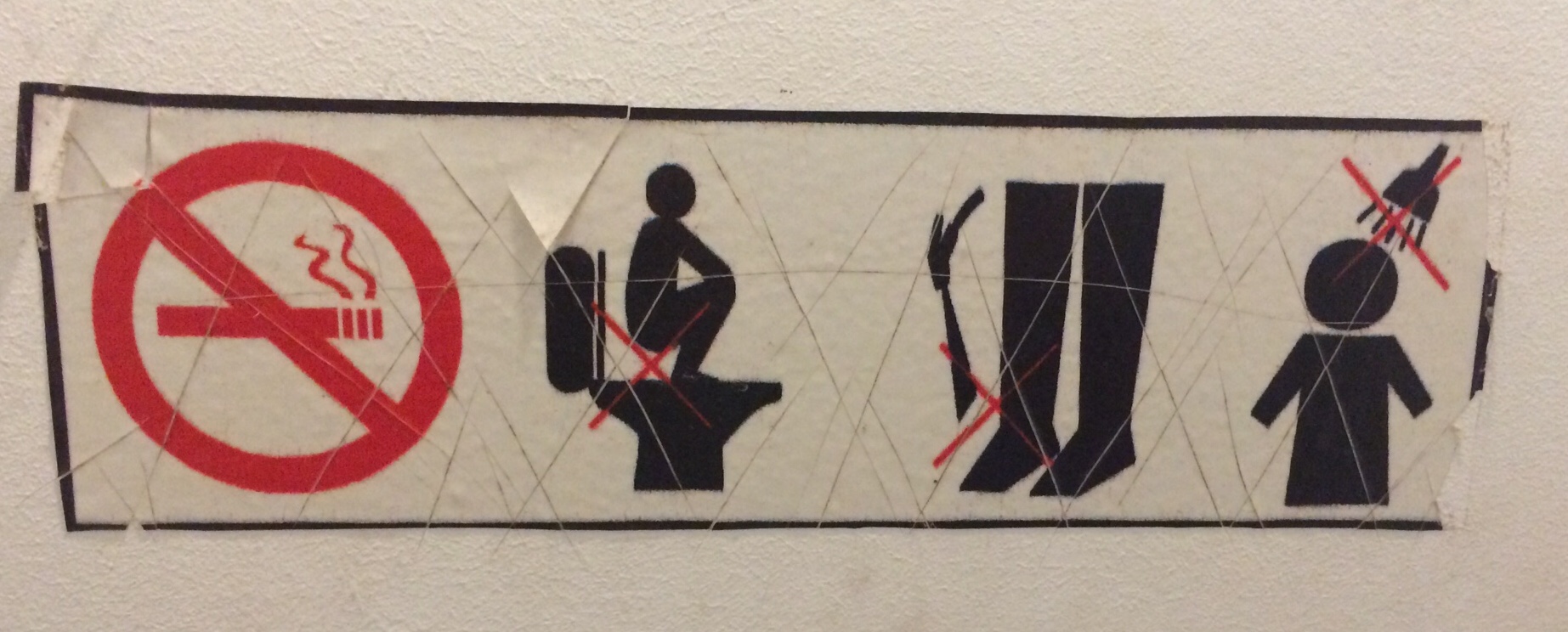
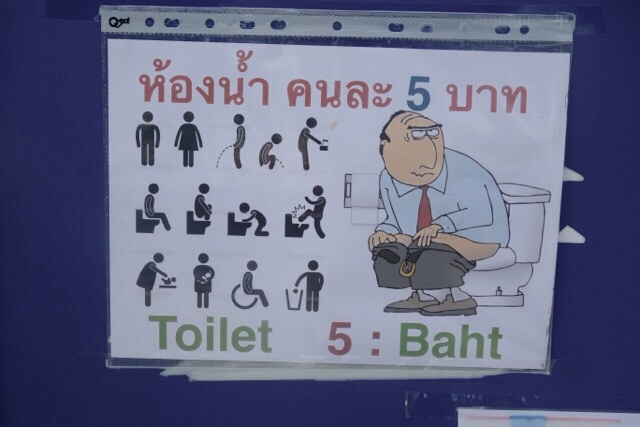
Men can use this toilet. Women can too. You can pee standing up. You can pee… squatting? You can wash your hands. Sit on the toilet. Squat on the toilet. (Really?) You can throw up in it? Kick it??? You can change your baby’s diaper or breast feed (…maybe?) You can take your wheelchair in? Throw something in a waste basket. And that huge image — perverts are allowed???
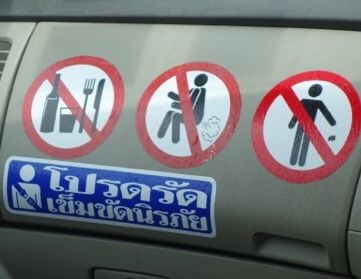
3) Not only bathrooms have that certain je ne sais quoi when it comes to scatological iconography. We captured this one attached to the dashboard of the taxi that picked us up at Bangkok’s Suvarnabhumi International Airport:
No doubt about its meaning.

4) The only way I can imagine any death-defying babies besting those in Vietnam is if the babies actually were driving the mopeds themselves. The wee one in this photo is hardly the youngest one we saw, but usually we were too slow to photograph them — because we first had to stifle our gasps and close our jaws, which were gaping open. Not only are these youngsters NOT riding in their National Highway Traffic Safety Administration-approved car seats, restrained by seat belts, but sometimes Mom was only holding on to them with a single hand, while Junior bounced up and down on the seat on his tiny toes. Some infants were too young to hold their heads up, let alone bounce.
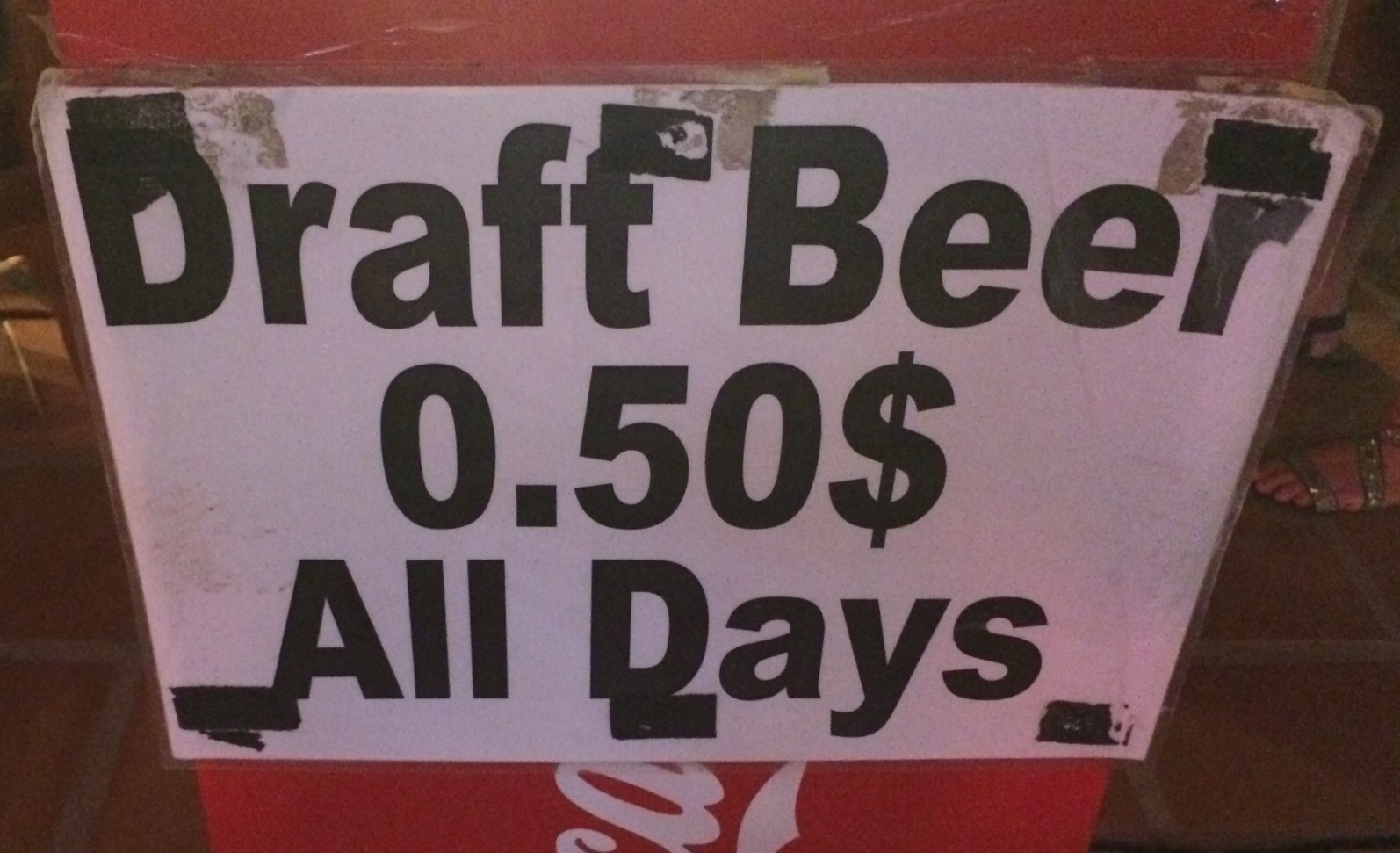

6) This is Tucker, my Labrador Retriever. We didn’t see him anywhere in SE Asia, but we did see a fellow who looked like his younger brother looking very sad in a very small cage in Hanoi. We also saw heartbreakingly tiny and pathetic puppies for sale on a market street. We had a very, very strong suspicion they weren’t destined to be canine companions; one restaurant not far from that street had a whole section of doggy dishes on the menu. I am aware that some people in China and SE Asia eat dogs, but when I saw that menu, I was too upset to try to photograph it. I felt almost as revolted as if the menu had a selection of delicacies prepared with human meat. I don’t know if this is weird or wacky, but it’s certainly one of those sights that tell you you’re no longer in Kansas (and it’s a good thing your friend Toto isn’t either!)
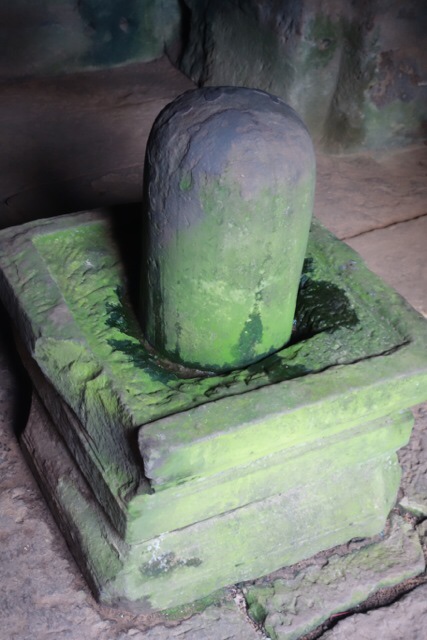
7) If I were less ignorant about world religions, I would doubtless be blase about this sight of a lingam, which we photographed in one of the Angkor temples. I’d think, ‘Well, duh! Of course it’s normal to have statues of penises inserted into vaginas all over your place of worship.” Actually, most of the phalluses (the linga) have been stolen by vandals over the centuries. But their female counterparts, the yonis

are still everywhere, looking very lonely and reminding you that these folks had a very different view of sex than most of the Christian churches and Muslim mosques I’ve visited recently.

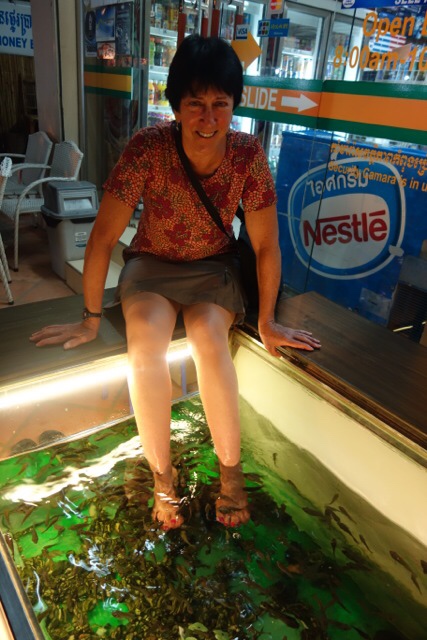
9) Central Siem Reap has a lot of fish tanks next to benches and adorned with signs offering a pedicure and foot massage all in one. The idea is you put your feet in the tank, and the creatures in it (“pepper fish” was one variety, we were told) instantly swarm around them and begin nibbling on the dead flesh. I paid $3 (“for as long as you want!”) and made something of a spectacle of myself whooping about how much it tickled. (It never hurt, but the feeling ranks very, very high on the weirdness scale.) In defense of the fish, I must say my feet did feel a bit smoother than normal when I got in bed that night.
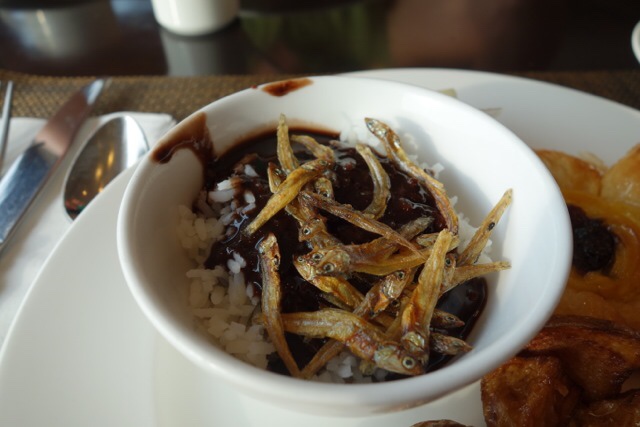
10) Some fish eat. Many, many get eaten, including this assembly on Steve’s fermented chocolate and rice porridge dish. Breakfast of champions, Filipino style!
[My blogging software wouldn’t allow me to add photos to my last post about Angkor Wat. Now that I’m home again, I’ve corrected that. I wrote the following post and a final one to come on the plane returning home yesterday.]
On this trip, we had a total of less than 15 hours to explore Bangkok. We did our best. We ranged around the city via taxi,
 tuk-tuk…
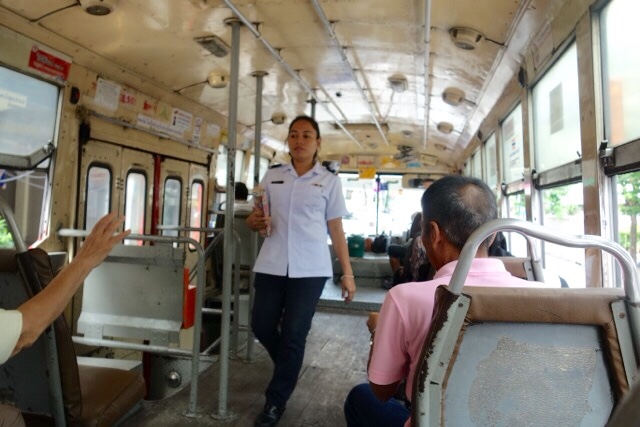 city bus…
 water bus…
 Skytrain…
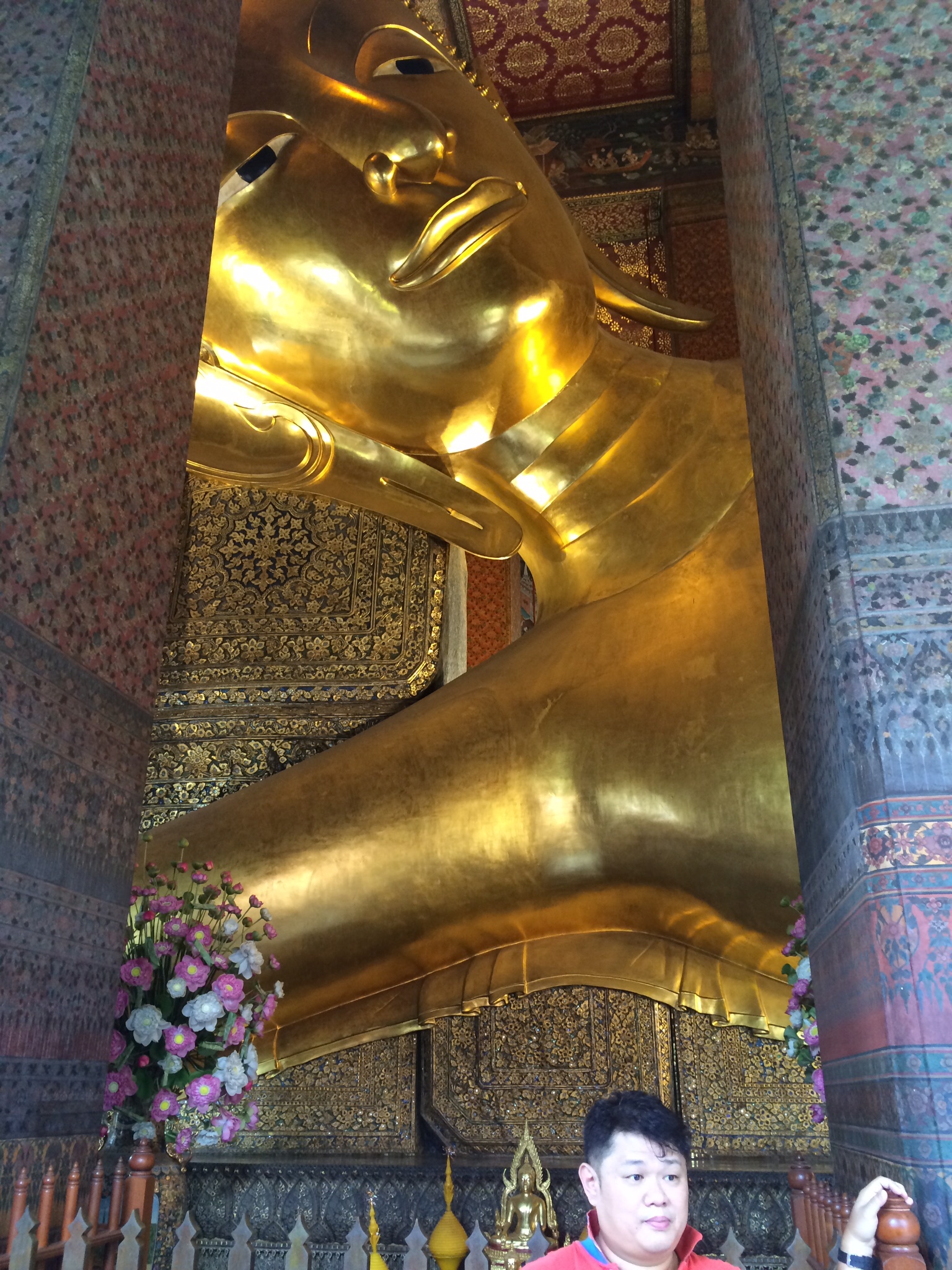
and foot. We saw at least 100 things that intrigued us. But the only one I’m certain we’ll both remember is the great reclining Buddha of Wat Pho.
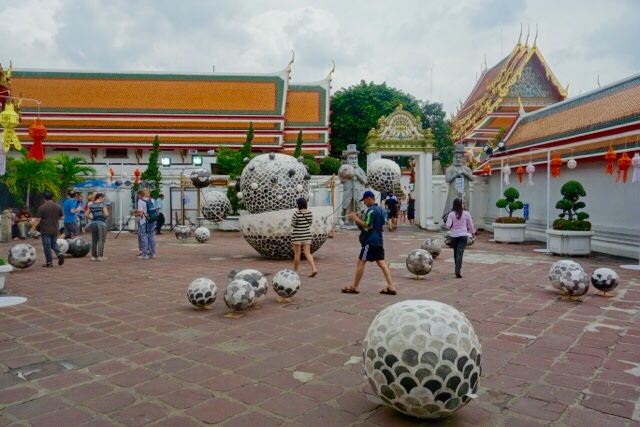
The Wat Pho temple complex is one of the oldest in Bangkok and contains the largest assortment of Buddhas assembled anywhere in Thailand. Some are really impressive…
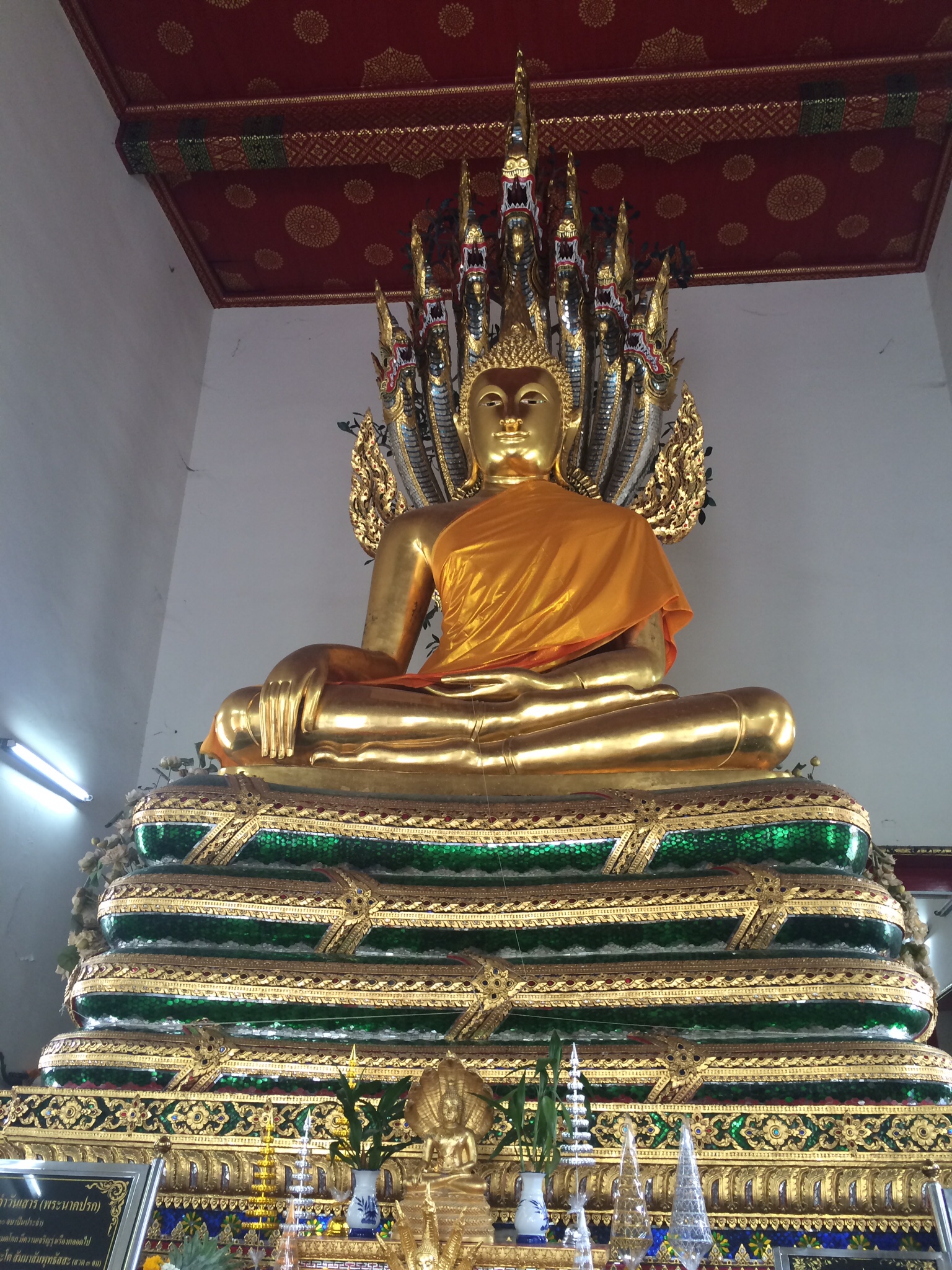 like him…
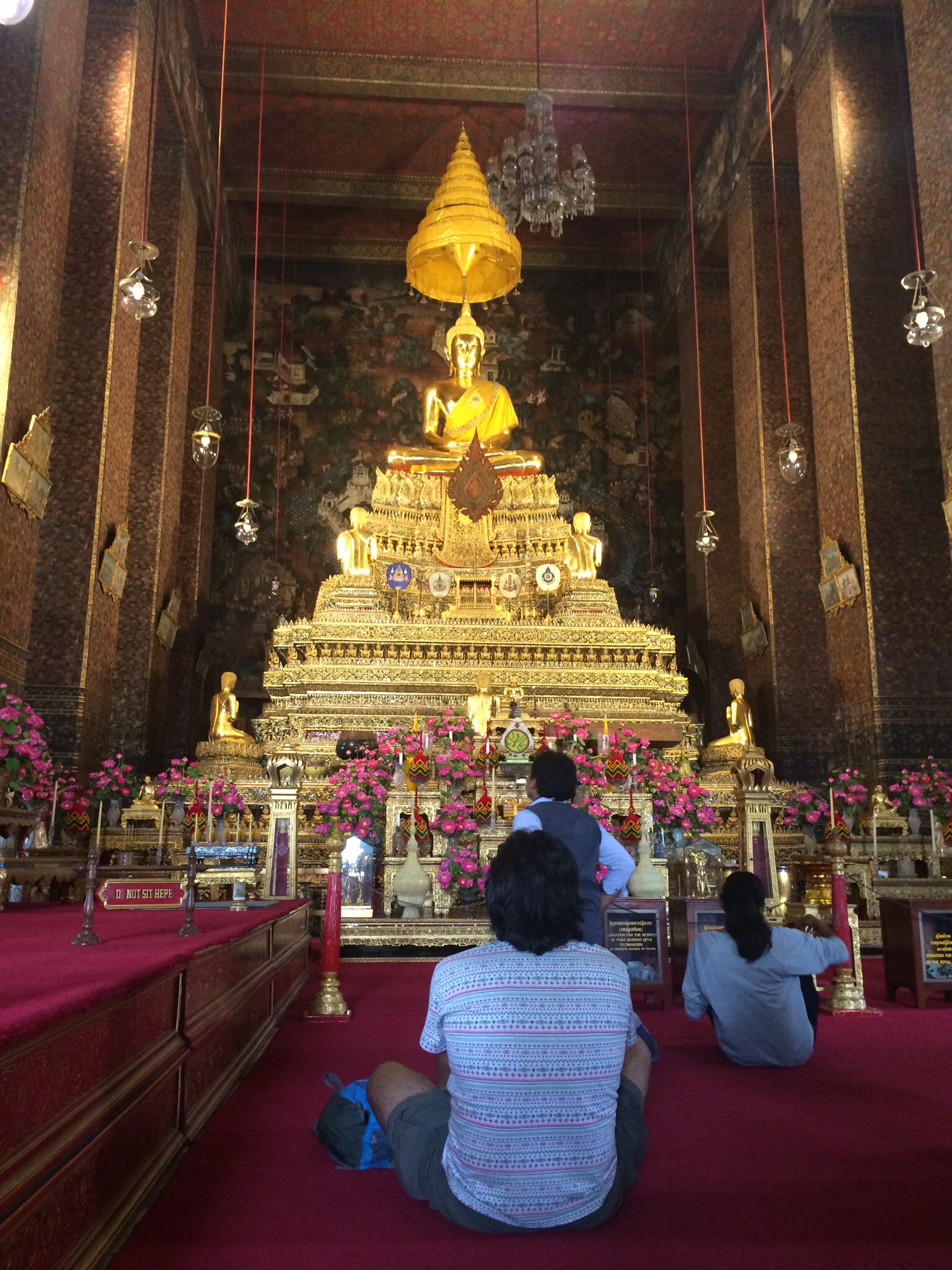 and him.
But the unforgettable one is the big, chiller Buddha. I think he was built about 200 years ago. (The informational signs aren’t very clear.) Steve first saw him in 1958, when he traveled around the world with his parents, and he’s been talking about him ever since. He recalls that on his first visit, only a handful of other tourists joined him and his parents in the enormous building the Buddha is crammed into. During our recent visit, there were hundreds, all jostling to try to capture him with their phones and cameras. That’s not so easy to do.
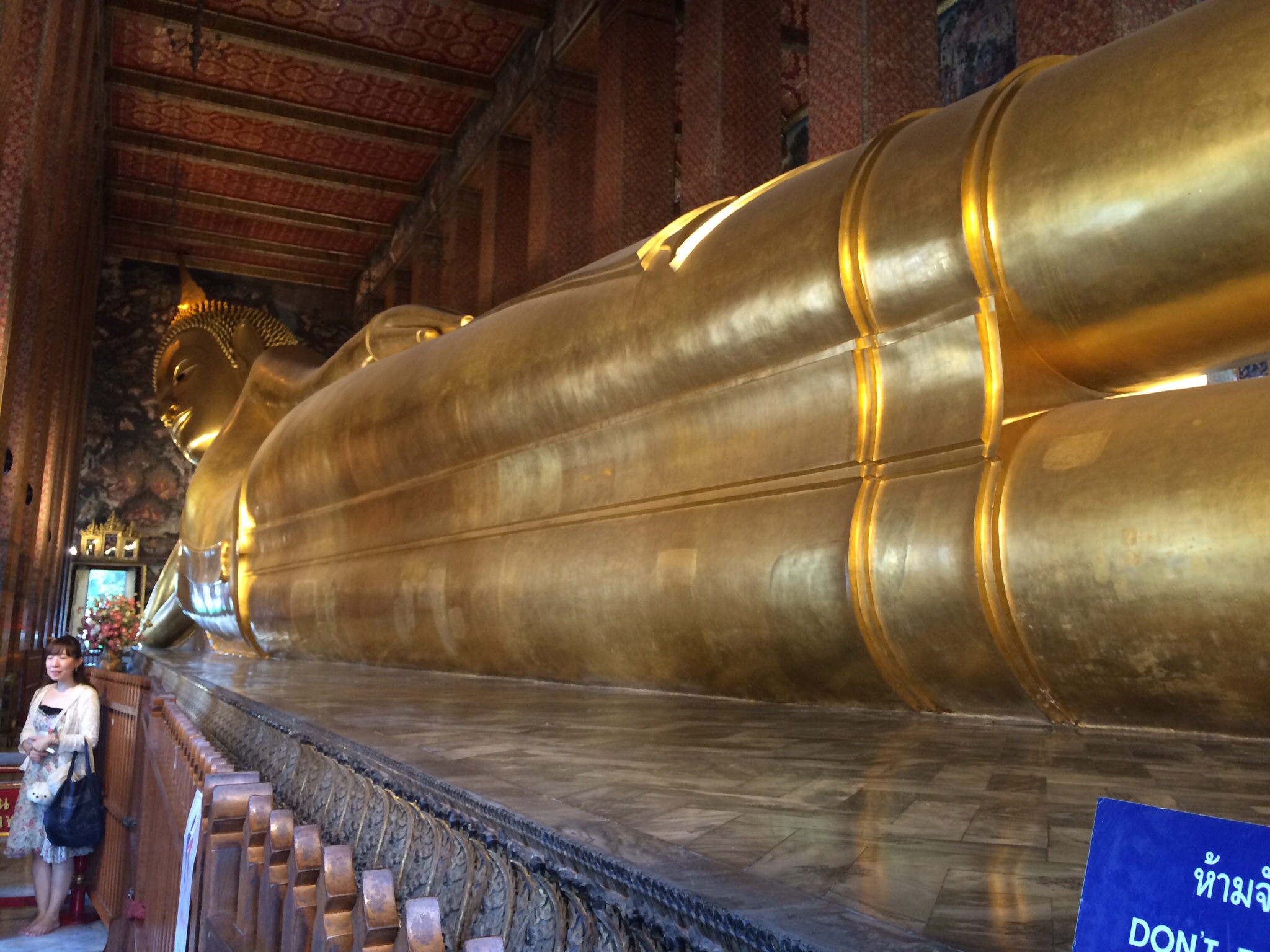
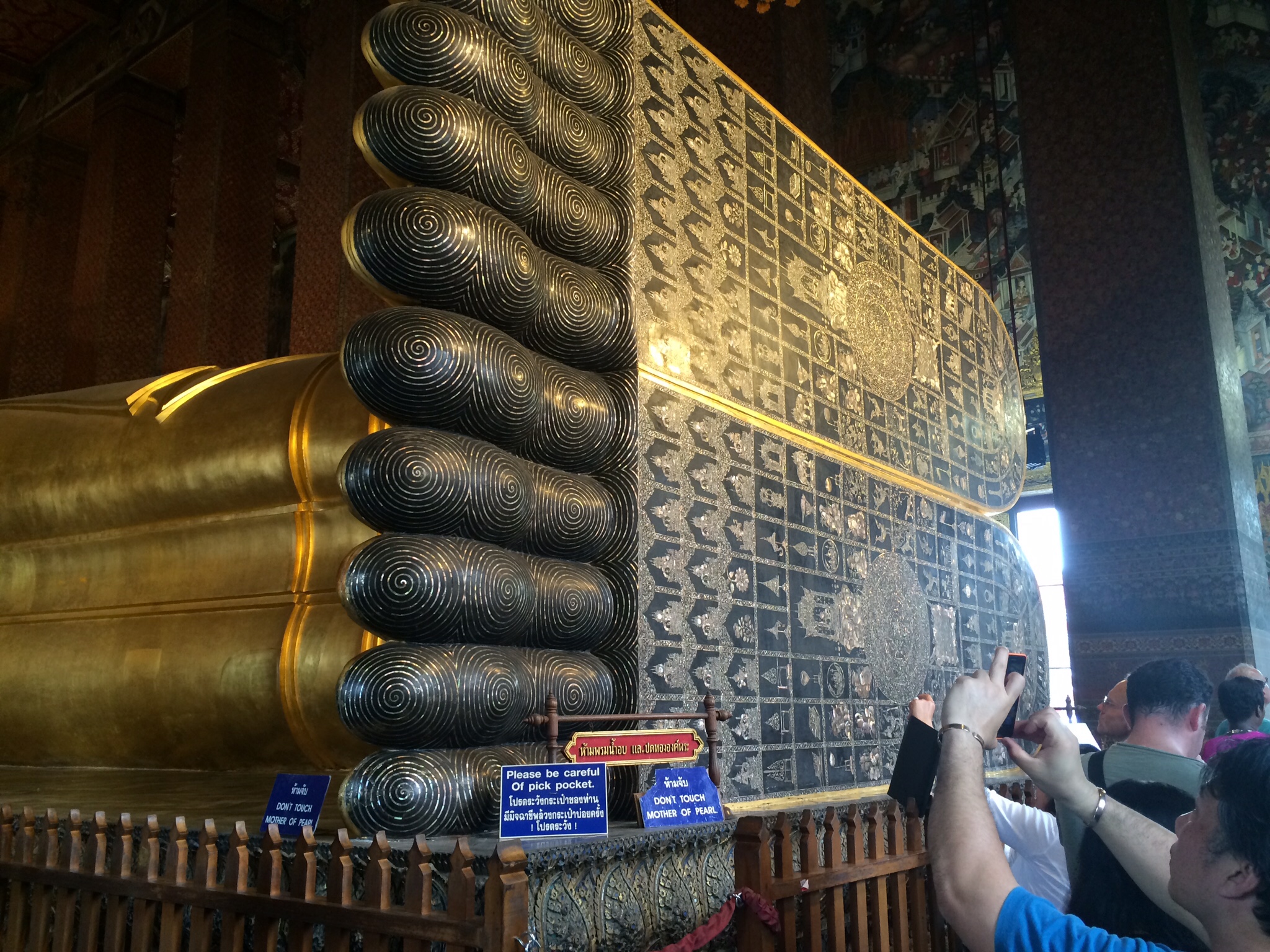
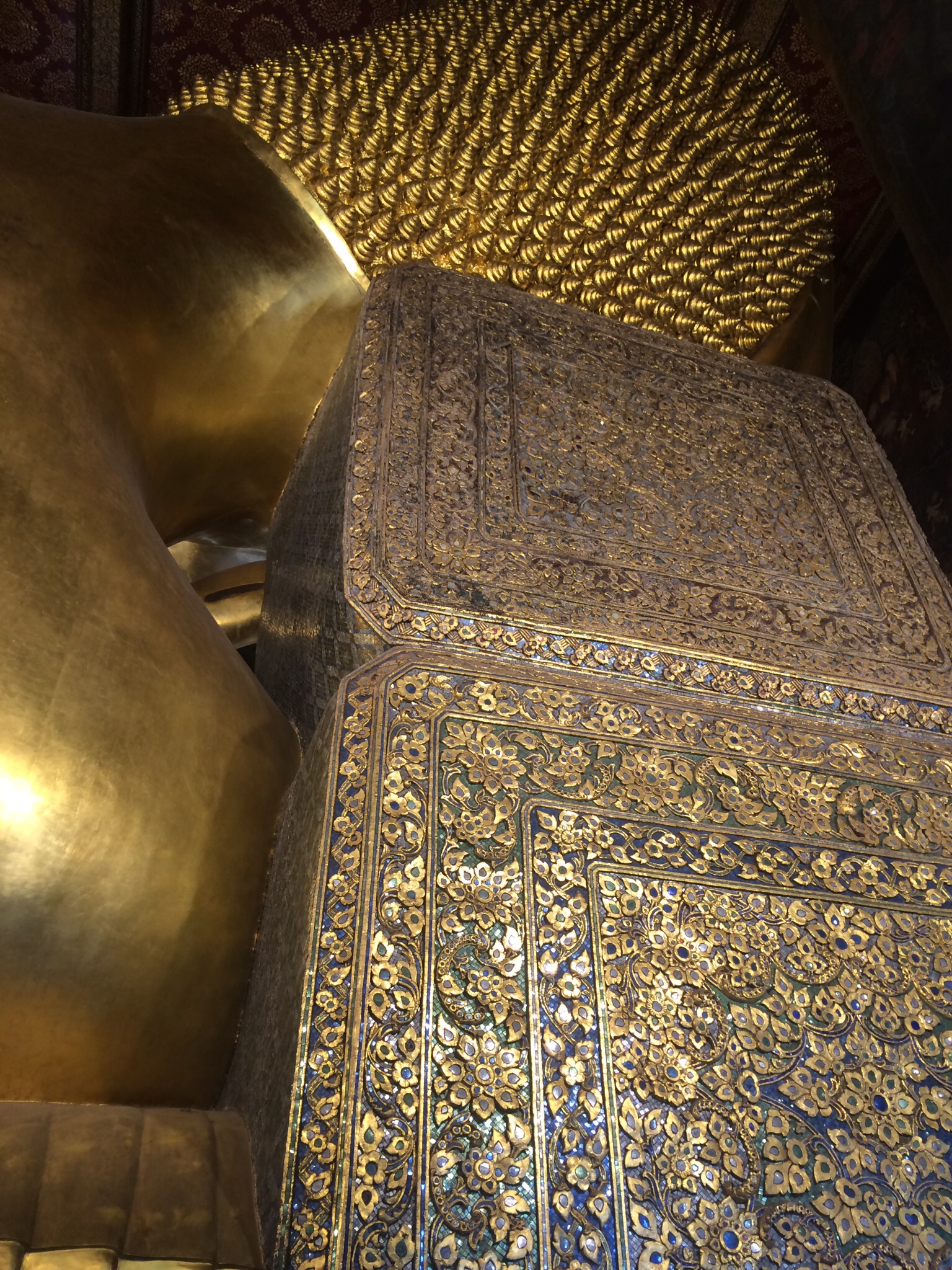
 Of course I say this with the ignorance of someone who’s only been in Bangkok for less than 15 hours. To speak more knowledgeably, I’d have to go back.
Say you’re an adult American who went to decent elementary and high schools; maybe even attended a good college. At some point during your life, you become aware there’s an amazing edifice in Egypt called the Great Pyramid of Giza. Although Egypt today is a pretty grubby, unstable place, you like to travel and resolve to see it. Only after arriving do you learn that Egypt once was the center of an advanced civilization, one that shaped a big portion of the ancient world. You might be shocked by the fact that somehow, you never heard of this.
That’s how I feel about Cambodia. Prior to this trip, I associated this little country only with American bombing raids toward the end of the war in Vietnam and the genocide that took place during Pol Pot’s regime. And, oh yeah. The largest religious building in the world was there, legendary for its beauty.
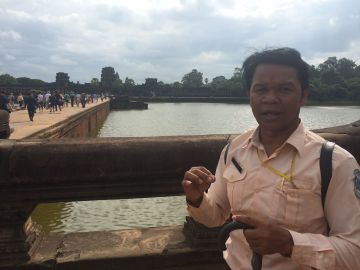
Travelers to Vietnam, like us, often tack on a side trip to this place, Angkor Wat. The closest Cambodian town to it is Siem Reap, which Steve and I reached Saturday via our speedboat up the river from Phnom Penh. With the help of our elegant Golden Butterfly guesthouse ($33 a night including a free half-hour transfer from the boat and two one-hour full massages), we arranged for a tuk-tuk driver and English-speaking guide to take us to the famous temple first thing Sunday morning. My first clue that this structure is more than just an building came when we drove along the man-made moat that surrounds it. As wide as 2 football fields, it forms a perfect rectangle almost a mile long in one direction by more than three/quarters of a mile in the other. Beyond the distant inner side of the moat, we could discern a great wall.
I’d seen plenty of pictures of Angkor Wat over the years, but none of them communicate the vast scale of the complex.After climbing out of the tuk-tuk, we crossed a long elevated causeway that took us over the moat. We passed through beautiful stone gates, then crossed an even longer, more majestic causeway spanning a vast green expanse. Only past a second gate does one truly behold the wat itself, composed of 5 separate towers, the central 100-foot-tall one built on three levels. We explored the first and second levels of the inner compou
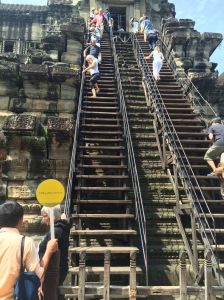 nd, then climbed a scarily vertical set of (modern) wooden stairs to get to the top of the central tower. There we surveyed the grand and beautiful composition surrounding us.
Not just the big picture is mind-boggling. The ancient Khmer laborers built most of these structures from big gray sandstone blocks that were quarried more than 30 miles away and floated down the river on rafts. Craftsman carved beautiful images on a staggering percent of their surfaces, images that tell elaborate stories from Hindu mythology.
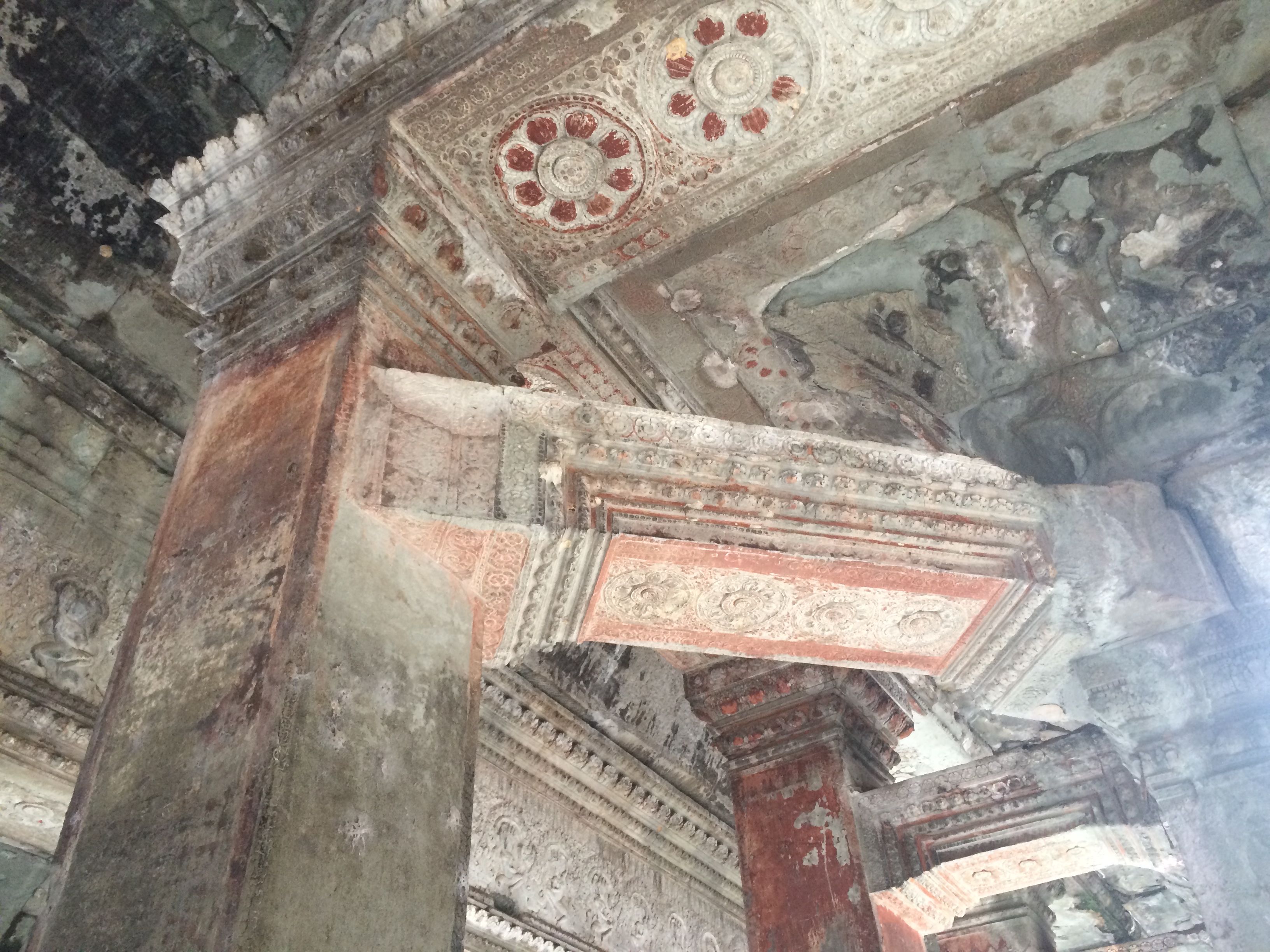
At some point, I realized this was the first time in my life I’d been in a country where Hinduism is practiced. The wat was built by Suryavarman VII (between 1113 and 1152) to honor the Hindu god Vishnu. This great Khmer king was renowned for his tolerance, however, and also revered the Buddha (just as many Cambodians today observe practices from both religions). He did this while reigning over the greatest expanse of territory in Khmer history, including big chunks of what today is Vietnam, Thailand, and southern Laos. Like the Romans, Khmer engineers created a far-flung, complex network of roads and irrigation channels that laced together the realm.

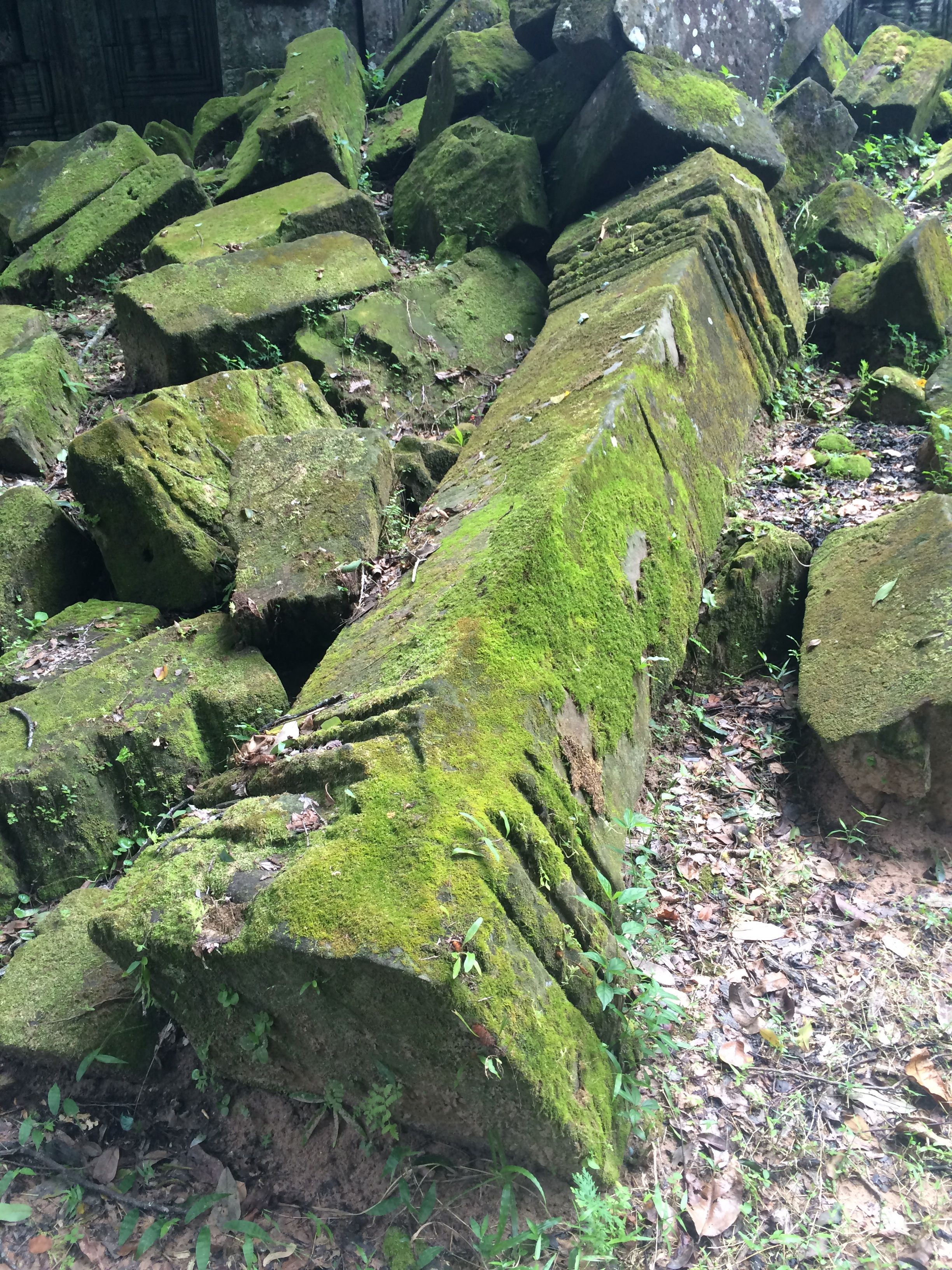
They also built temples; more than 1800 of them have been identified in what today is Cambodia, according to our excellent guide, Tep Nat. In the two days we spent with him, we didn’t get close to seeing any of the oldest Khmer temples (some go back to the 600s). But the guide took us to a few built in the mid-900s. He showed us the celebrated Ta Prohm temple, crumbling and literally being consumed by gigantic trees (the movie Tomb Raider was filmed there.) Although some sites were crowded with cocky young Chinese Beautiful People and boisterous Korean groups and a potpourri of other international visitors, Nat several times led us to back entrances and adjoining pathways through the fantastic green cathedral of jungle, where we were the solitary worshippers.

Like Varik, our guide to the 60s architecture in Phnom Penh, Nat a few times expressed regret at all that the Khmer people have lost over the centuries. Still, things sometimes improve. At one point, Nat mentioned he was keeping a written record of his life to pass on to his three young children. That memoir is already more than an inch thick. Just a baby when the Khmer Rouge took over in 1975, he lost his father, two brothers, and numerous other relatives during that dreadful period. Life as a subsistence farmer (how most Cambodians today survive) didn’t seem promising to him, so he worked for a while as a fisherman and then a waiter (in Phnom Penh). Civil war — between Cambodian government forces and the remnants of the Khmer Rouge — raged during most of his childhood and teenage years. That conflict killed around 5 million Cambodians (dwarfing Pol Pot’s toll of 2 million victims). But the war finally ended in 1998, and Nat moved to Siem Reap the next year, sensing opportunites there. He did odd jobs at first. Then he bought a motorbike to make a living with it, then moved on to tuk-tuk driving (struggling along the way to teach himself English). He finally saved up enough to go to guide school and got his guide license in 2007.
He confessed to us that his dream was to one day save up enough money to visit Singapore. He yearned to see what life in a modern country was like. I could have told him. But sometimes you have to go to a place yourself to get it.
“You want go to killing fields?” “Go to killing fields?” We must have heard that question 20 times during our brief stay in Phnom Penh. I found it repugnant — Cambodia’s ghastly genocide turned into the town’s biggest tourist attraction. As Steve points out, I shouldn’t blame the Cambodians. We’ve paid our entrance fees at plenty of other testaments to human barbarism around the globe. And I think visitors to Cambodia should know about what happened here (now almost 40 years ago). Almost everything I know about it comes from reading A Cambodian Odyssey, the memoir written by Haing Ngor — the Cambodian doctor-turned-actor who won an Academy Award for his performance in the famous movie. His book recounted the horrible events so vividly, I’ve never been able to shake the memory of them. It also made me aware that virtually the whole country became a killing field during the four bloody years during which the Khmer Rouge rampaged. So why go to one particular spot?
But what else to do on the single day we had to explore the city? (Although we arrived at mid-day Thursday, the heat was so stunning, we couldn’t drag ourselves away from our hotel’s awesome pool.) Fortunately, I had posed this question to the Goddess Google, and she had whispered back: take one of the Khmer Architecture Tours.
Online, I learned that Phnom Penh has a tiny private organization dedicated to educating visitors about the architectural innovation that flowered in the city during the 1960s. Its members give a couple of private tours; one concentrates on the work of the Vann Molyvann. I’d never heard of the guy, but the website made it sound like he was a major figure in architecture, designing at least 100 significant works between 1960 and 1972 (when the looming catastrophic political events prompted him to leave the country). Steve and I love looking at buildings, so we booked the Molyvann private tour ($30 per person, including the cost of hiring a tuk-tuk for half a day and a professional architect to serve as guide.)
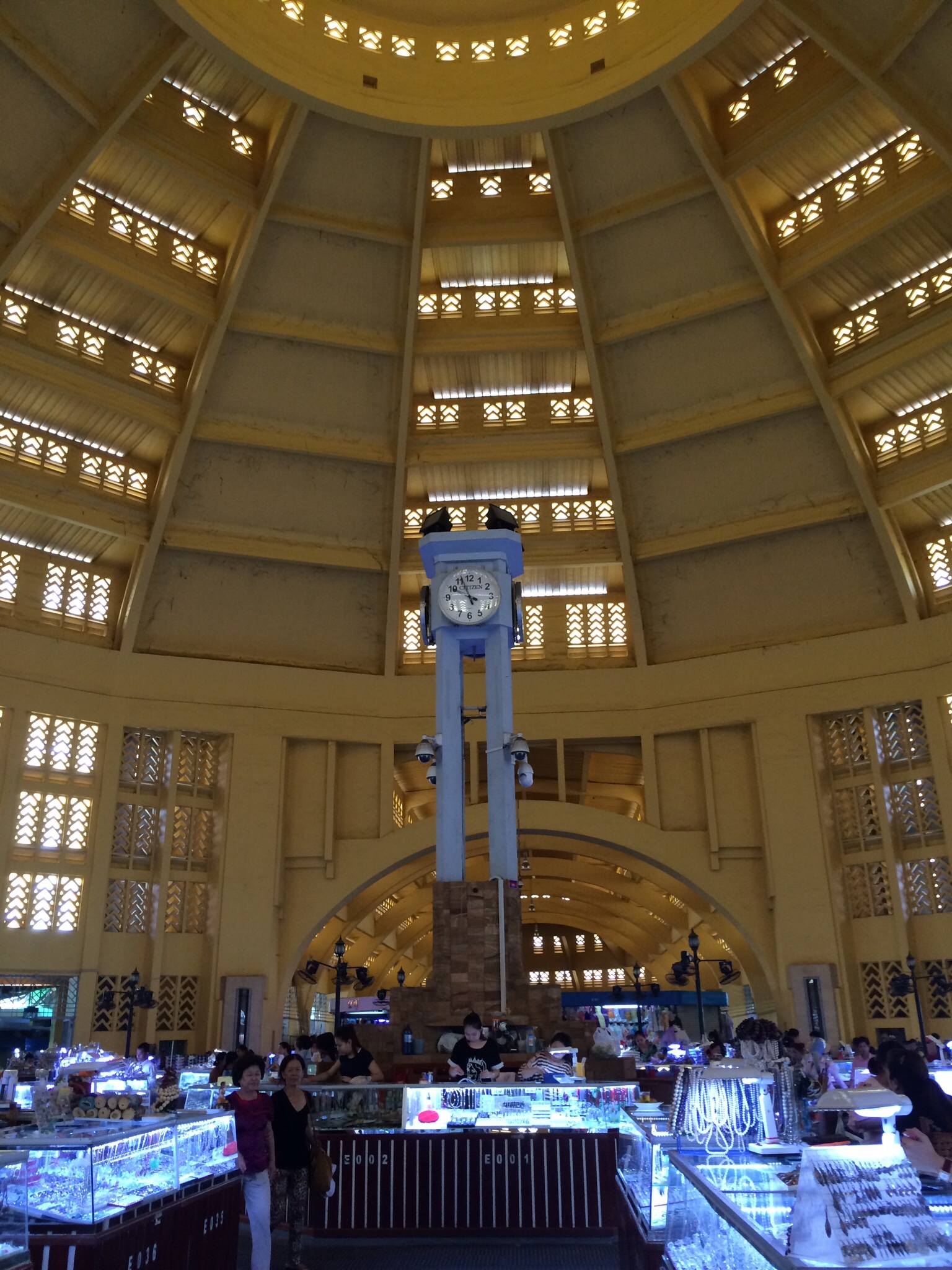
We were scheduled to do that at 2:30 in the afternoon. In the morning we caught a tuk-tuk and walked around the center of Phnom Penh for 3 hours, following the self-guided map published by the KAT organization. It rained for the first hour, so the heat didn’t feel lethal. Cambodia today is one of the poorest countries in the world, and its capital shows the strain. It has a couple of glitzy high-rises, and some upscale neighborhoods that look almost chic by American standards. It has coffee shops to rival Starbucks and fancy cosmetic stores and at least some gleaming supermarkets. But stinking heaps of garbage collect along plenty of streets, and the power goes out frequently. On our walking tour, we saw structures built at various points in the first half of the 20th century. Though we could see the former beauty of them, most looked sad and unkempt.
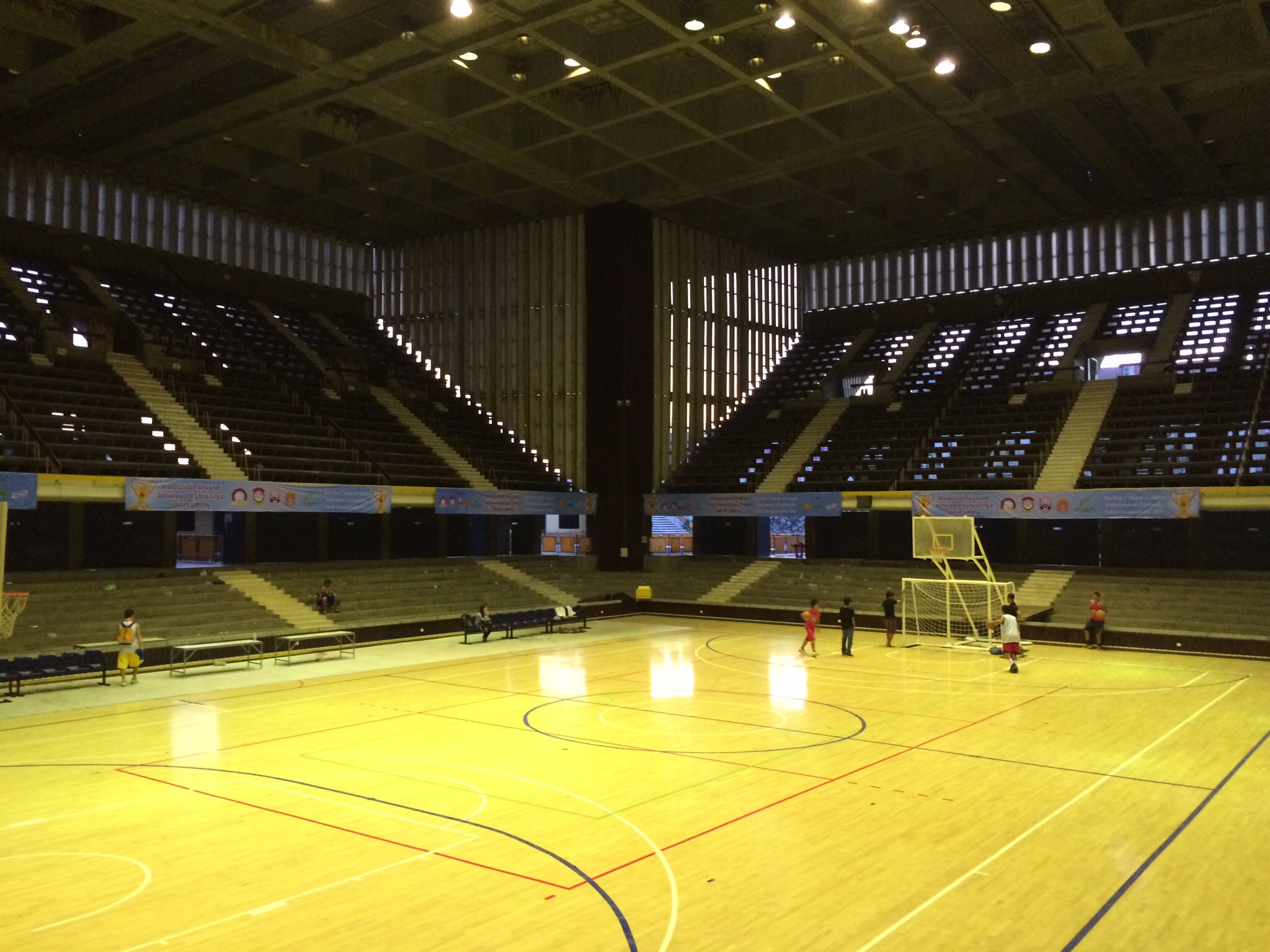
While the walking tour was interesting, the highlight of the day was our outing with Varik Roeum, our 23-year-old KAT guide. A charming fellow who just completed his architectural studies a few months ago, he spent almost 4 hours with us, during which we talked about topics ranging from Indochinese alphabets to the Khmer Rouge reign of terror. As we chatted, we drove to see three examples of Molyvann’s work: a low-income housing project built between 1965 and 1967, the Teachers Training College facility (now the Institute of Language) built on the Royal University of Phnom Penh campus and inaugurated in 1972, and the massive National Sport Complex dedicated in 1964.
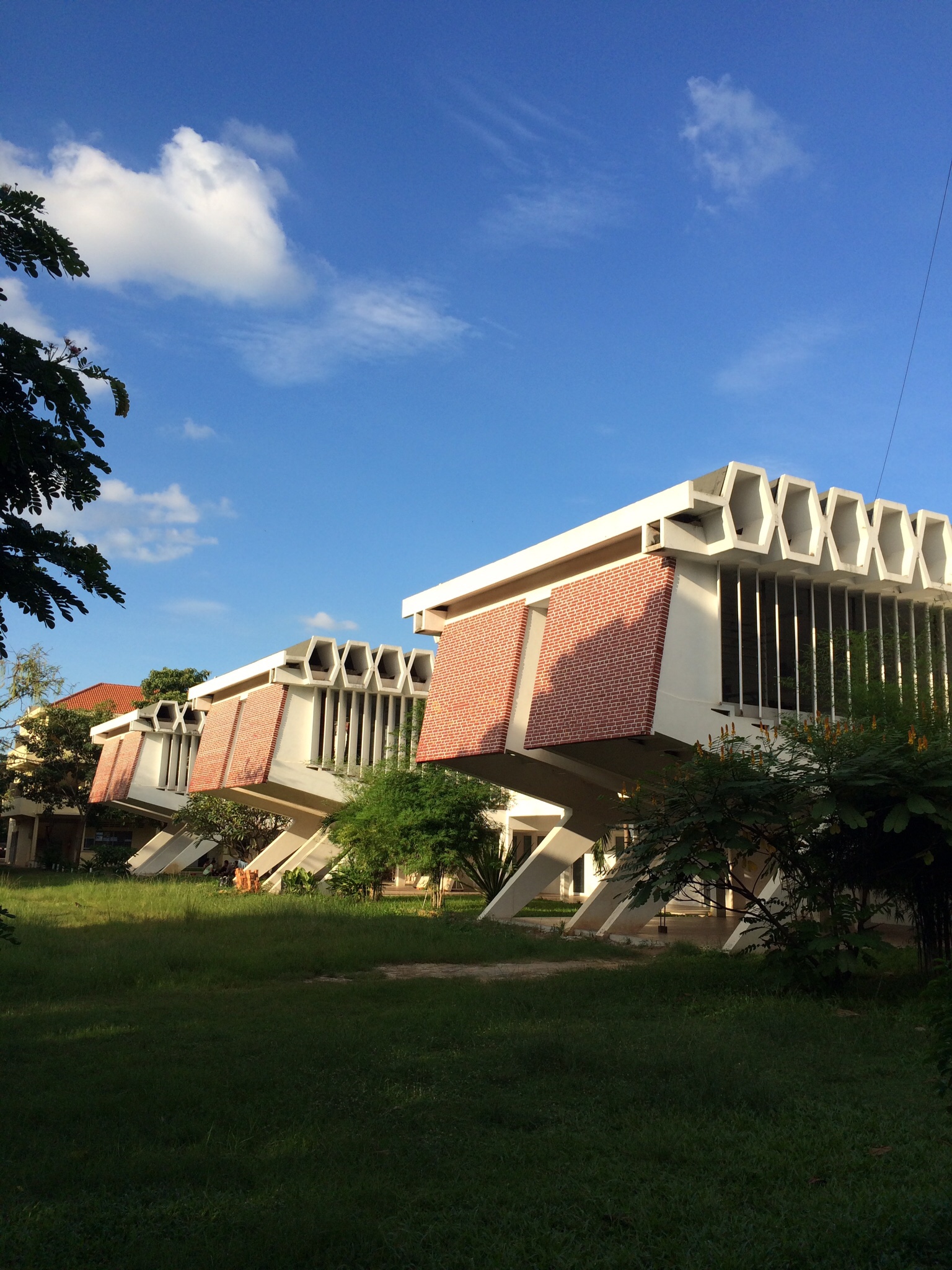


Seeing these buildings, learning from Varik about the innovations that went into their design, made us think: this guy really WAS a genius. His works have the look of the 60s about them — the use of concrete, the sharp geometries. But more than 50 years later, they’re still functioning well, letting in light and air in ways that make them both livable, beautiful, and economical. Molyvann at times pays subtle homage to classical Khmer detailing, but more than anything, we sensed an intelligence keenly attuned to the ever-important question: how can I create a sustainable building that these particular inhabitants at this particular site will be happy living and working in?
“No one is doing ANYTHING like this in Cambodia today!” Varik lamented. Architectural students don’t learn about Molyvann in school; Varik’s passionate enthusiasm only developed after he heard about the KAT group from a fellow student (the group itself was started by a knowledgeable British architect.) At the National Sports Complex, where we watched a horde of Cambodians using the stadium — jogging, strolling, playing soccer on the field — Varik said there were rumors it was scheduled to be demolished to make way for more gleaming, fast-money developments. “I hope it’s just a rumor,” he said. But other Molyvann masterpieces have already fallen victim to the wrecking ball.
I told him I hoped so too. Some Khmer masterpieces have long withstood the attack of brutes and barbarians. Right now we’re blasting up the Tonle Sap River toward the most famous one of all: Angkor Wat.
Coming from a place like San Diego, semi-desert, shriveling in the grip of our prolonged drought, the Mekong River and its gargantuan delta feel unreal. Intellectually we know how there could be so much water here; the rainy season is drawing to a close, but the skies still release drenching daily downpours. Still, making our way through this place where rivers function not just as superhighways but also as streets, as alleys, is unlike anything I’ve previously experienced.

So is the way people think about all this water. On Wednesday morning, we hired a boat and guide to take us out at dawn to see some of the impromptu markets that materialize every morning on the Can Tho river (a branch of the Mekong). Boat dwellers ply the backwaters, buying melons, beans, rice, pineapples, and the myriad other foods grown by people who live along the watery byways. The boat merchants then gather, hoisting poles to which they tie examples of what they have to sell that day. Retailers from the town take boats out to buy from the wholesalers. It’s a fascinating scene, and it provided us with several highly diverting hours.

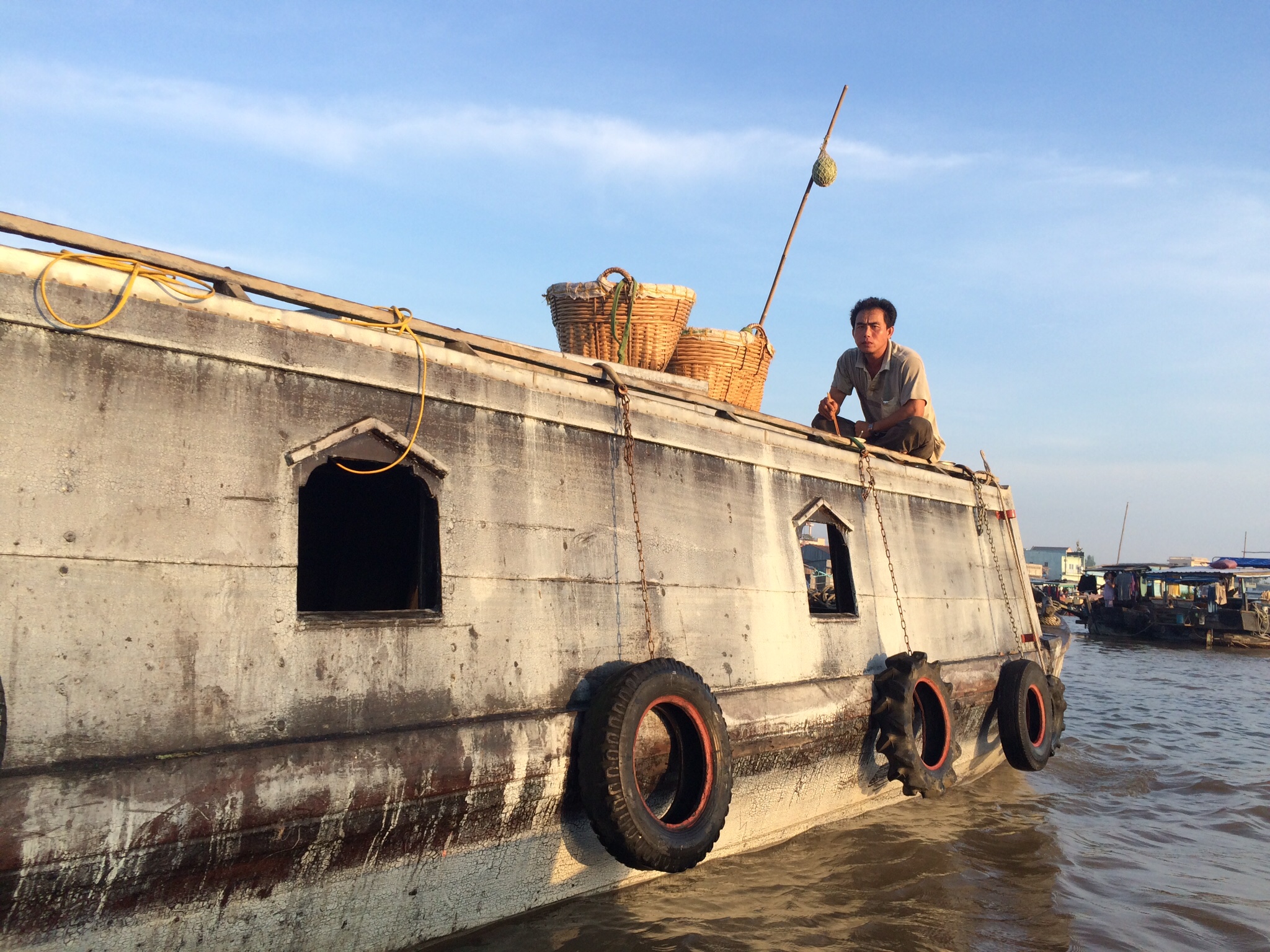
But none of what we saw astounded me as much as our guide’s comments about the rainy season. He mentioned that at this time of year, the town typically floods twice a day — with every high tide. Over and over, folks living near the water see it seep into their homes and rise to a height of one foot, two, sometimes more. My immediate thought was that this was a consequence of global warning, catastrophic. But Ca’s next comment suggested otherwise. “It very nice,” he said, looking serene. The floodwaters increased the supply of fish and brought in deposits of silt that made the rich soil even richer, he pointed out. Getting all their belongings up and away from the water’s reach might be a nuisance, but it only lasted for a few hours each day, part of the year, and folks were used to dealing with it.
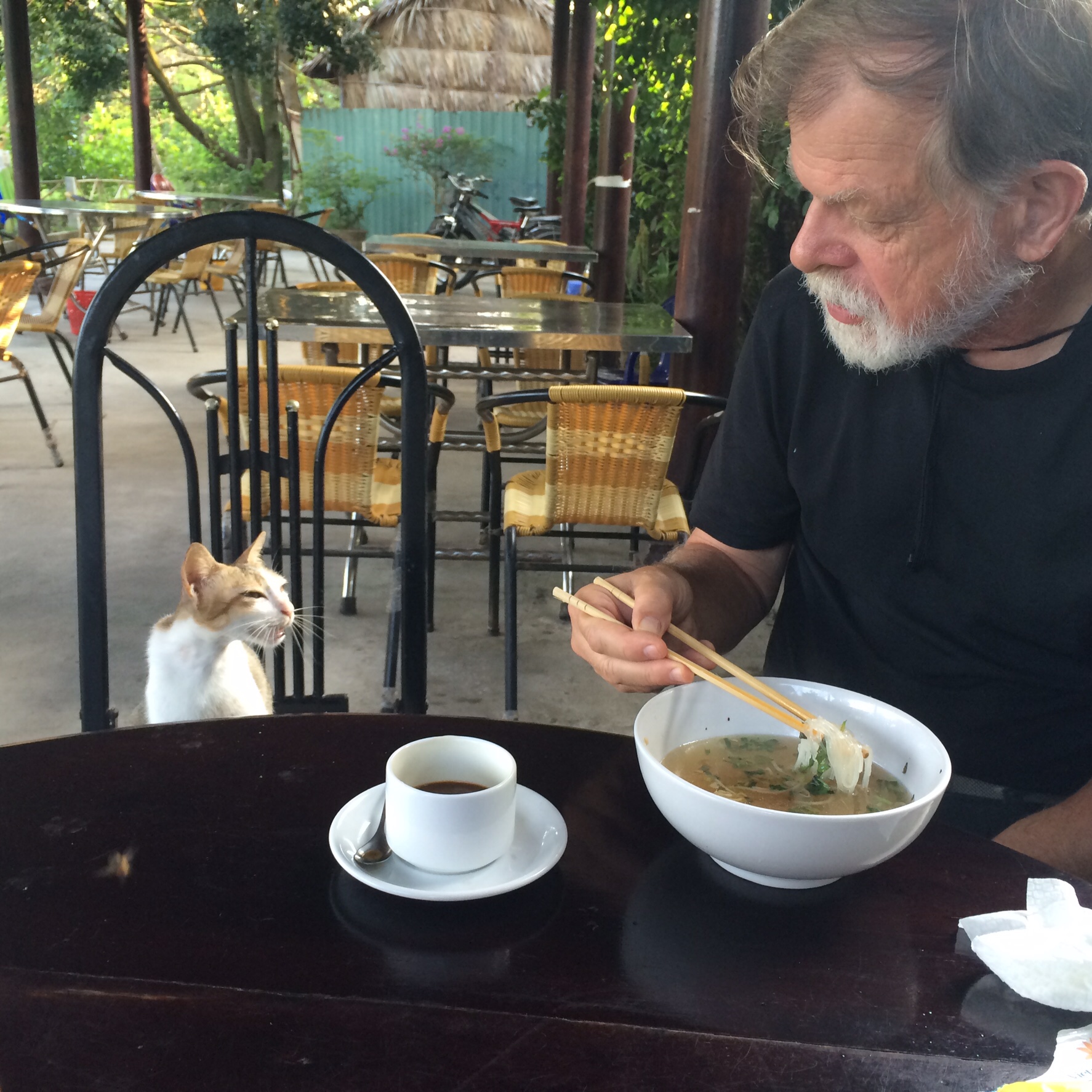
After our river tour with Ca, we caught a bus to transport us on the three-and-a-half-hour journey from Can Tho to the border town of Chau Doc. The ride was pretty ghastly. Our seats were directly behind the driver, who seemed to have a bad cold. Every few minutes, he made disgusting noises as he sucked mucus from his nasal passages, rolled down his window, and loudly spat a glob into the street. He also texted and talked on his cell phone frequently, while managing to honk several times per minute — warning the bicycles and motorbikers and cars and trucks and other buses jamming the bad roads that he was about to hit them (though he never did, despite coming very, very close). The honking irritated me, but its aggravational power paled compared to the braying nonstop programming on the big TV screen hanging from the ceiling next to us. Maybe Vietnamese sitcoms and propaganda music videos are more lovable if you speak Vietnamese. It’s possible.
Still, our trip to Chau Doc was neither about the journey nor the destination; we didn’t reach our guesthouse until almost 7 p.m., and we checked out barely 12 hours later. We came to catch the Hangchau Speed Boat, which would take us up the river, across the border between Vietnam and Cambodia, and on to the capital city of Phnom Penh. I’m writing this aboard the boat.
This ride is pretty noisy too, but it’s all the rush of water sounds mixed with the bass notes of the boat’s engine. We’re not bouncing and jerking, but rather barreling along as smoothly as if we were on a jet plane rocked by only the mildest of turbulence. The only air conditioning is the natural kind. The breeze magically makes you forget that it’s 90 degrees outside with 90 percent humidity. And how much more detailed and humane the views are than those available from 35,000 feet. Earlier, near Chau Doc, we saw boats of every sort: wooden skiffs and pirogues and junks and ferries and sampans. Not one single sailboat. One expensive looking cruise ship. Now the banks are lined with jungly greenery. Once in a while, a bizarrely exotic temple materializes.

Unlike another bus trip, which I would be dreading, I’m happy we’ll have one final ride on the Mekong. We’ll do that Saturday morning, when we travel from Phnom Penh up to Siam Reap, the site of Angkor Wat. But first we’ll get to see something of this capital of the one-time killing fields.

I’ve depended on guidebooks all my adult life. For this trip, I carried Lonely Planet’s guide to Southeast Asia with me, and in Saigon we followed its suggestions for a few things. All the sites we visited on our walking tour with the student were warmly recommended by the Lonely Planet writers. On our own Monday, Steve and I relaxed our aversion to Vietnam War tourism and visited Saigon’s War Remembrance Museum, which pretty savagely indicts the entire US involvement in the region. It’s an entirely one-sided view of those events, with no tolerance or understanding or attempt to present what the warriors or America’s leaders thought they were doing. Heavy attention is paid to the huge numbers of people who died, to the war atrocities (like My Lai), and to the spraying of millons of gallons of Agent Orange to destroy vast areas of cropland. (We have seen a number of hideously deformed folk in the streets, who may be part of that legacy.) Lonely Planet gives it a star.

In recent years, however, I’ve become more and more fond of finding travel suggestions online. The information in even the very best printed guidebook is typically several years old by the time it hits bookshelves (or becomes available on Amazon). Cognizant of this, I’ve started turning to the Internet for more up-to-date suggestions. There, for example, I found a New York Times travel piece published this past summer (“36 Hours in Ho Chi Minh City”) that led us to two phenomenal dinners (one about $12 and one about $25).
I perked up when I came upon the “Fly, Icarus, Fly” blog. It contained a post in which author “James” recently enumerated some of his favorite quirky things to do in Saigon. An intriguing list, it led me to the free student tour. It also advised that while tourists usually experience the Bitexco Tower (Saigon’s tallest building) by paying to go to the “Skydeck” on the 49th floor, locals head to the coffee shop on the 50th floor. We did that, and sipped delicious iced coffees with condensed milk while drinking in the mind-boggling skyline.
James also recommended seeing a show at the Saigon Opera House, and that turned out to be the impetus for me securing tickets to an amazing Cirque de Soleil-style performance (“AO”) that dazzled us Sunday night. He sung the praises of local barbers, and although neither of us got a haircut, we did spring for foot massages ($5 each for 30 minutes). Best of all was James’ advice to stroll over to Tao Dan Park to see the bird men of Saigon.

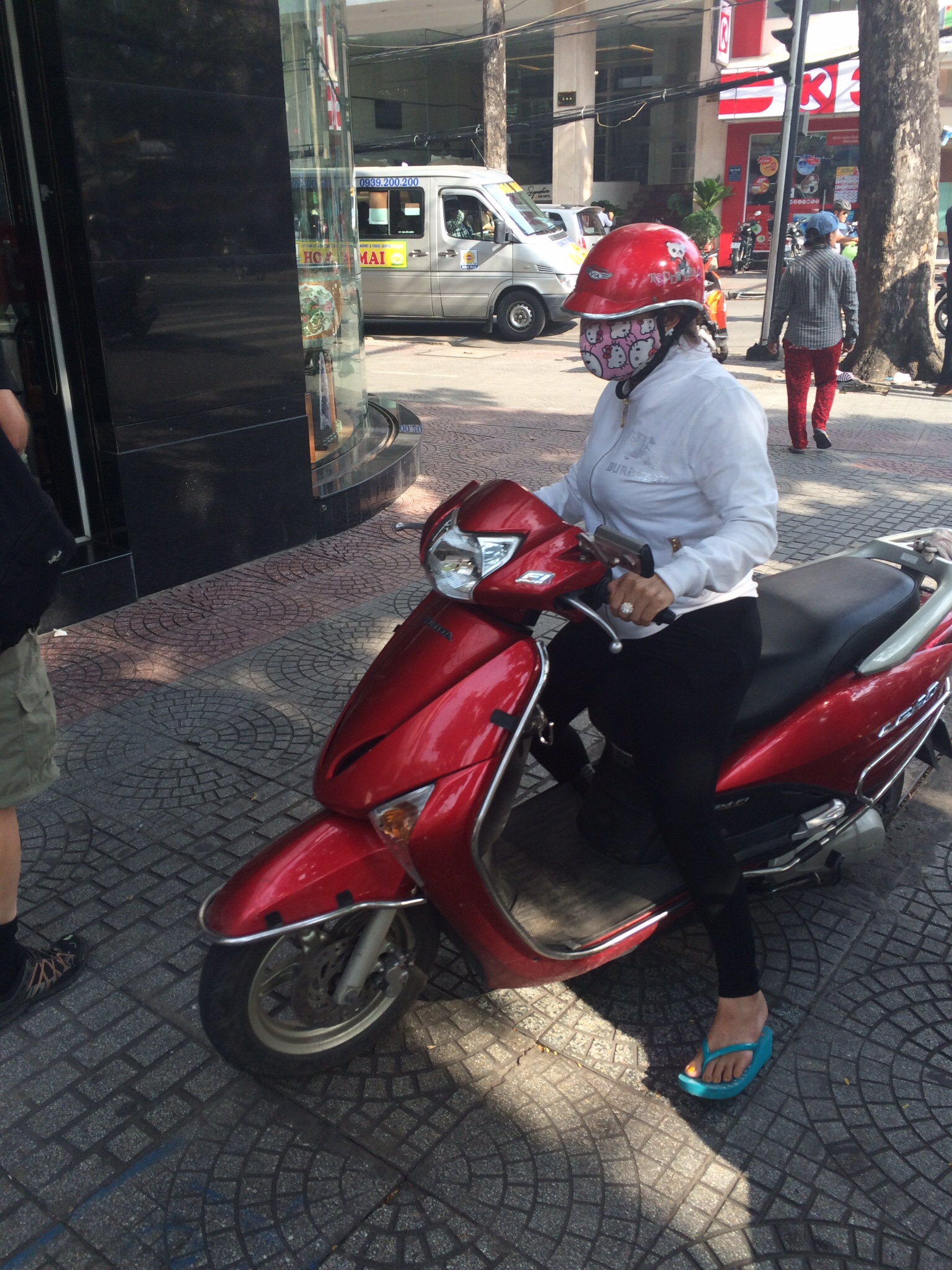
He said these were bird owners who every morning gathered in the park to provide their feathered friends with a play date. Intrigued, we set our alarm and were walking out of our hotel by a little after 6 a.m. (Tuesday). It was a pleasant time to walk in Saigon, warm, of course, but not the steamy blast furnace that it builds to by late morning. The streets were far from empty, but the cars and motorbikes seemed more like battalions than armies. Folks were setting up their wares and cooking grills on the street; carving hunks of meat, displaying vegetables for sale. The world felt calmer and quieter than it would be a few hours later in the workday.
The park was a haven of pathways winding in the shade provided by huge, old trees. We arrived shortly before 6:30 a.m. and gaped at the bustle of activity: young men And women clad in black practicing martial arts, joggers, ungainly middle-aged ladies jazzercising to Vietnamese pop music, couples playing badminton. But no bird men! Had we been duped? I pulled out the blog post and re-read it; noted that it mentioned the action occurring next to some kind of cafe. We saw a building like that, headed for it, and found what we were seeking.
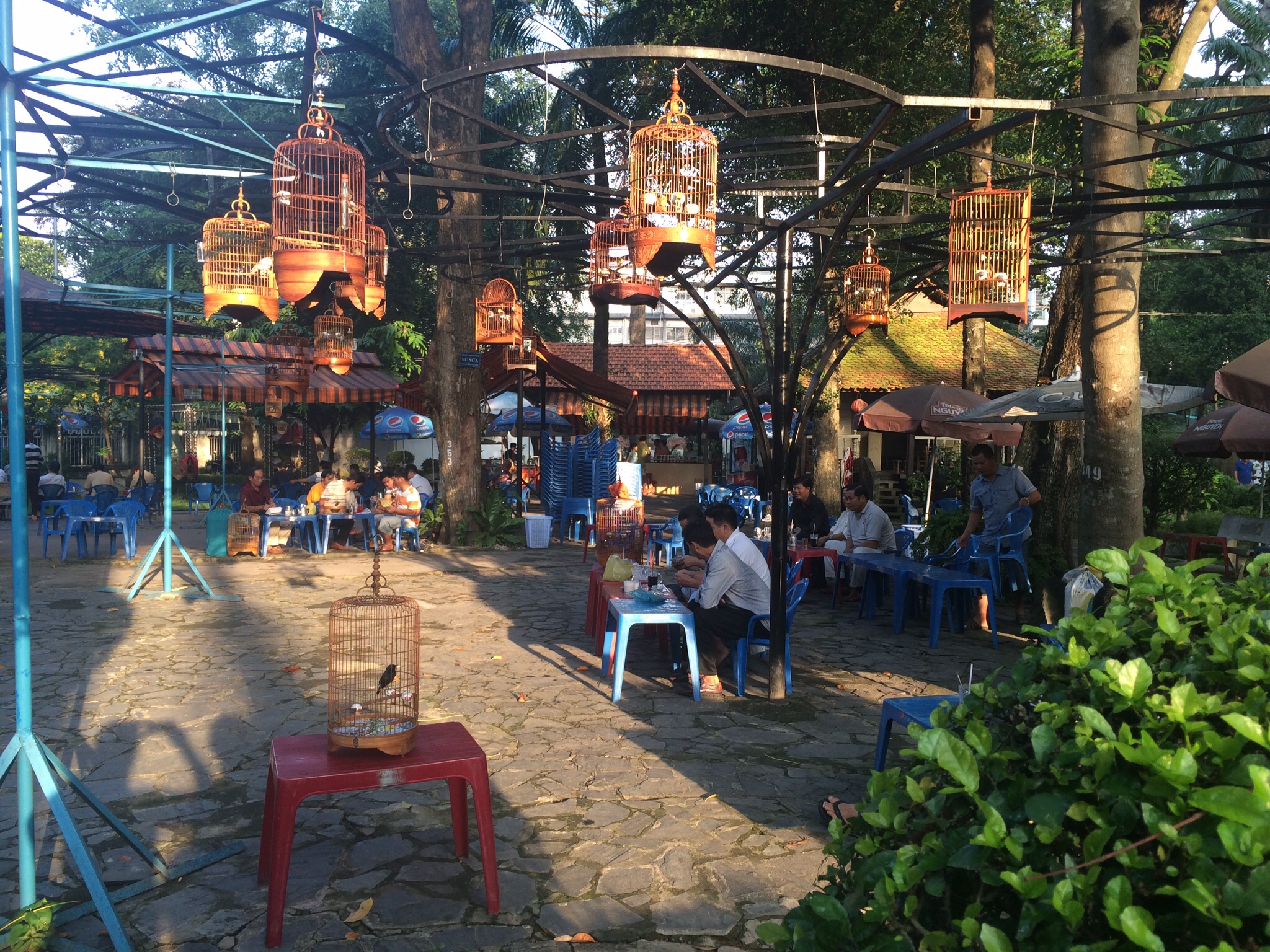
Men were sitting on blue plastic chairs at little plastic tables set under metal structures that looked like abstract representations of trees. From these, they’d hung the beautiful wooden cages housing their birds. From what we could see, the birds for the most part weren’t beauties. Some were the size of finches, while a few could have been mockingbirds. Most were singing in the dappled sunshine. In his post, James claimed that the birds actually learn new songs from each other.

He’d said that up to 100 bird owners sometimes gather, and indeed, in the 15 minutes or so in which we watched the scene, we saw at least a dozen more men (young and old) arrive, remove the colored cloth covering their cages, and hang them up to join the other birds. It was the kind of scene that makes you like a place, and we were sorry we had to leave it, to rush back to the hotel. But we had a bus to catch for a gathering of boats, rather than birds, in the Mekong Delta.
On our very first morning in Vietnam, when we strolling around Hoam Kiem Lake In the center of Hanoi, two groups of young people approached us and said they were students, seeking to improve their English. Both times they asked if we could spare 5-10 minutes to chat with them and give them some conversational practice. My hackles rose. I remembered all the students in Beijing who did the same thing, but there it invariably turned out to be a ruse to try to lure tourists into buying art. So I brushed them off. They didn’t react the way the Chinese students did, however. Instead of pushily pursuing us, they seemed embarassed and apologetic, and they immediately backed away. Steve later chastised me; said we should have talked to them.
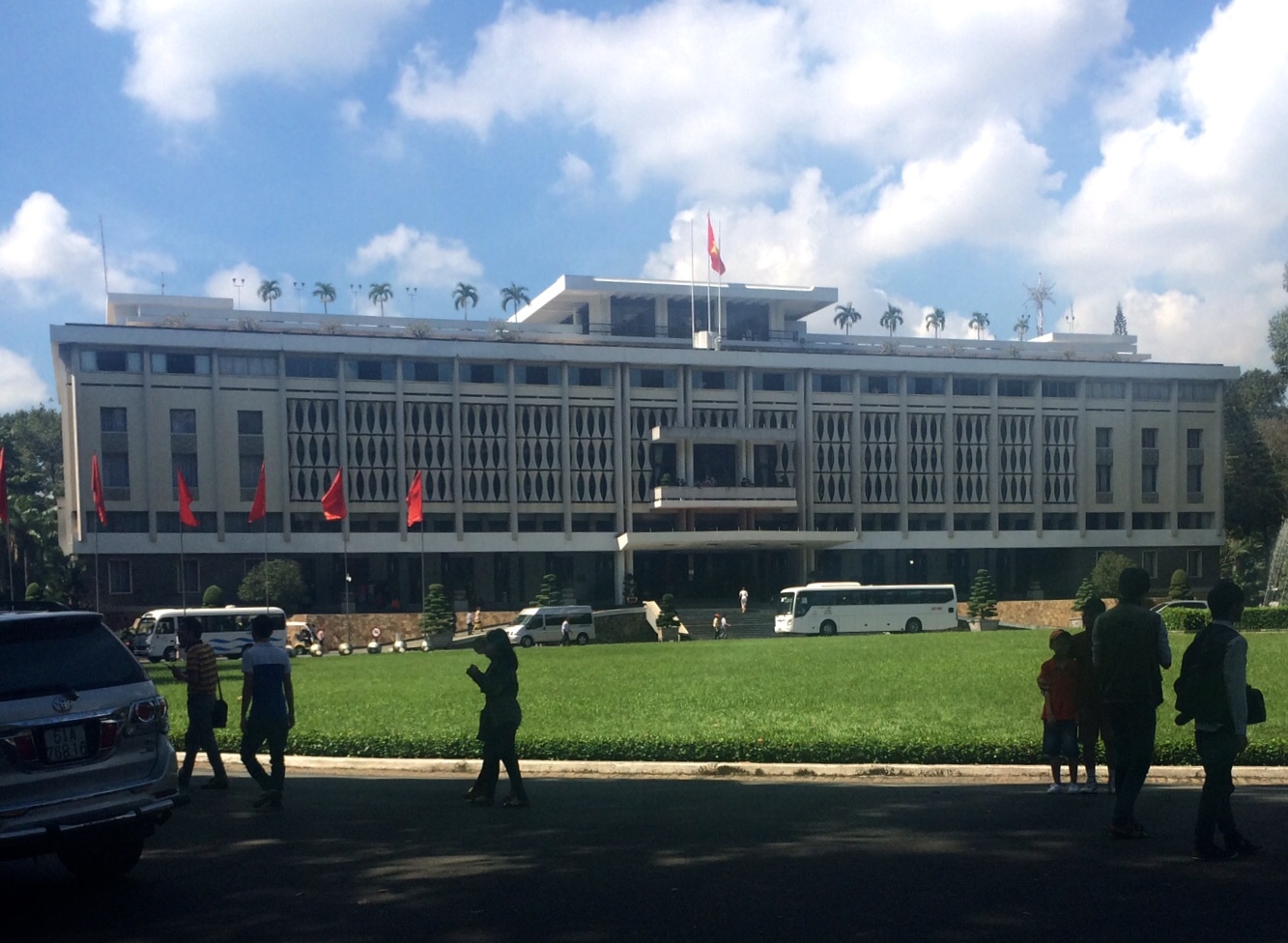
In Ho Chi Minh City (still aka Saigon), we got a second chance. While planning the trip, I had found a website for free tours organized by Vietnamese university students to give themselves some one-on-one time with native English speakers. It sounded too good to be true, but I emailed anyway and asked to sign up for such an excursion. I got no response at first. But 5 days after we left San Diego, I received an enthusiastic e-mail from one “Salmon Tranh,” offering to show us some of Saigon’s top sights. We made plans to meet at 10 a.m. Sunday morning (10/26) in front of the Independence Palace.
By that point, Steve and I had come to understand the desperate need for more and better English-language instruction in this country. We’ve been told that nowadays all Vietnamese children get English lessons in school. But we’ve also heard — and it’s obvious as one travels here — that this education is poor. It focuses on grammar and (some) written comprehension, but there’s little to no opportunity to converse. As a consequence, many shop folks cringe when you ask them anything in English. Others, particularly tour service providers (hotel and restaurant personnel, museum guides, etc.) speak it freely — but with such heavy accents it’s usually tough to understand them.
Twenty-year-old “Salmon” (who arrived right on time) turned out to be an exceptionally perky young Vietnamese woman whose accent was pretty good. Over and over, she exclaimed about how excited she was to be able to talk to native speakers. Although she’s studying accounting at one of the best universities in the city, she seemed to have a clear grasp of how important a strong command of English is (particularly for folks whose language is pretty much only spoken by their own fellow citizens.) She told us she’s only been a member of the free tours group for a month, but that we were the sixth set of visitors she’d taken around.
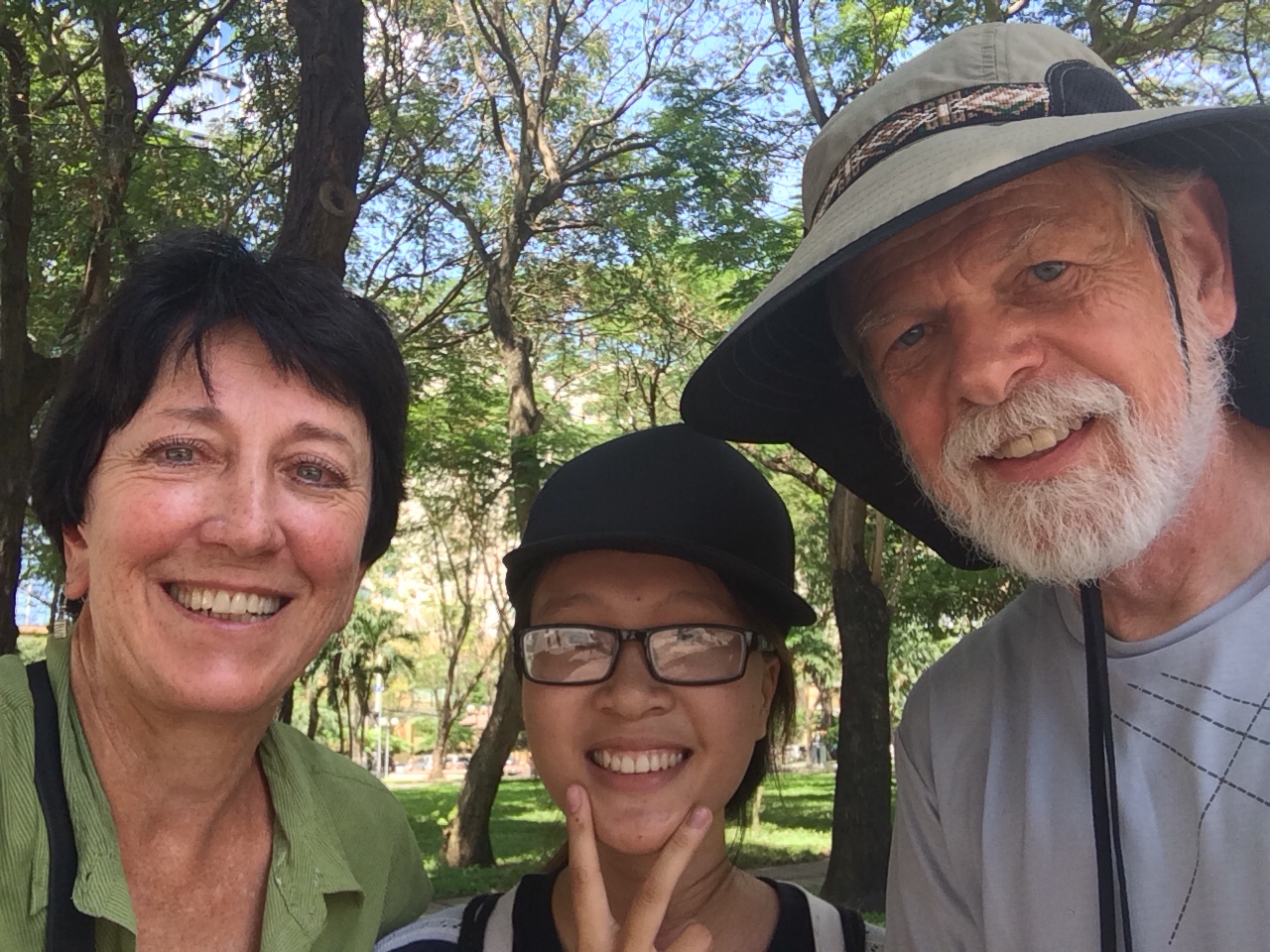

We spent a lively and entertaining two and a half hours with her. The palace, where we started out, is a fascinating place — the former home of Nguyen Van Thieu during all the bloody years when American warriors struggled to keep him in power as the head of an independent south. A tour of the place takes in everything from the sumptuous state rooms to the underground bunkers to the rooftop from which Thieu finally escaped in 1975. (Big red circles on the roof mark the two spots hit by North Vietnamese bombs, and the first two Communist tanks that crashed through the gates sit in a place of honor on the grounds.). Salmon also showed us the exquisite Cathedral and central Post Office and City Hall structures built by the French colonialists in Saigon, and we chattered away about everything from English-language pitfalls to where 20-somethings live (in both our countries). We paid for her admission to the palace, and pressed her to join us for lunch. But she demurred, hinting that she had to prepare for her next day’s classes.
For my part, I have to say my biggest regret of this trip is that I didn’t have the foresight to take a semester of Vietnamese. I love learning new languages and have spent a lot of time studying both Japanese and Mandarin. I think I failed to think of it because I knew we’d be passing through dozens of different language zones. Yet if I had concentrated just on Vietnamese, I would have gained a lot. I wouldn’t have become anywhere near fluent, but I would have mastered a lot more of the spoken language than just the “please,” “thank you,” “hello,” “yes,” “no,” and “OMG!” I got Manh on our Halong Bay cruise to teach me. Most importantly, I would have been able to read dozens or hundreds of words. Unlike the Japanese and Chinese and Thais and Cambodians and Laotians, the Vietnamese have long used a standard Latin alphabet (albeit embellished with a bunch of diacritical marks) to write their language. That makes it easy to get around town and find stuff.

We still managed to do a lot of that, but it would have been even more fun if I had had a bit more of Salmon’s gumption.
I didn’t try to buy our Vietnamese railway tickets from home. I’d read that they would be easy to secure just a few days in advance, so when we checked into our hotel in Hanoi, I told Ms. Julia in the lobby that we wanted berths on the sleeper from Hanoi to Hue, seats on the 3-hour morning train from Hue to Danang (the portal to Hoi An), and seats on the 7-hour train from Danang to Saigon. The first two were no problem; $55 a person for the sleeper and $15 for the second train ride. But I had misunderstood the mechanics of rail travel between Danang to Saigon. Instead of taking part of a day, we learned, it would require a much longer amount of time, leaving Danang in a sleeping car about 10 p.m. Friday and not arriving until late Saturday afternoon.

I think that would have cost around $80 per person. In contrast, Ms. Julia informed us we could get seats on the one-hour-long Vietnam Air flight leaving Danang at 11:05 a.m. Saturday for $115 per person. We agonized a bit over the decision. We’ve come to loathe the time and tedium involved in modern air transport, and we had looked forward to seeing the scenery en route. In the end, however,the thought of giving up our prepaid room in Hoi An to rattle through yet another night made us come to our senses and buy the plane seats.
Thank god! The Vietnamese train system doesn’t offer first-class sleepers, so instead of having our own cozy space from Hanoi to Hue, we shared our 4-berth compartment with 2 other Americans (a likable young couple from Washington DC). We all had working electrical outlets, which was nice (I could charge up my phone and iPad!), but in other ways, it seemed inferior to the Thai sleeper we took from Bangkok to the Laotian border — no dining car, for one thing. And Steve saw a cockroach and spiders lurking in the recesses near his upper berth, though he kindly kept that news from me until after we had arrived.
The morning train ride from Hue to Danang was pretty mesmerizing. We had two seats In a standard day coach on which we appeared to be the only foreigners. The train was probably 60 years old and exceedingly slow, but it hugged a mountainous coastline with jaw-droppingly spectacular views. The action inside our coach was almost as diverting. Across the aisle and two rows up from us, a woman slept on the floor at her husband’s feet. I’m not sure how, with car attendants periodically rolling carts up and down the aisle (at one point dishing up some kind of hot food). Someone’s very naughty two-year-old was on the rampage. And from the ceiling, screens displayed “Rail TV,” which among other things aired a Vietnamese (officially franchised) version of The Amazing Race.
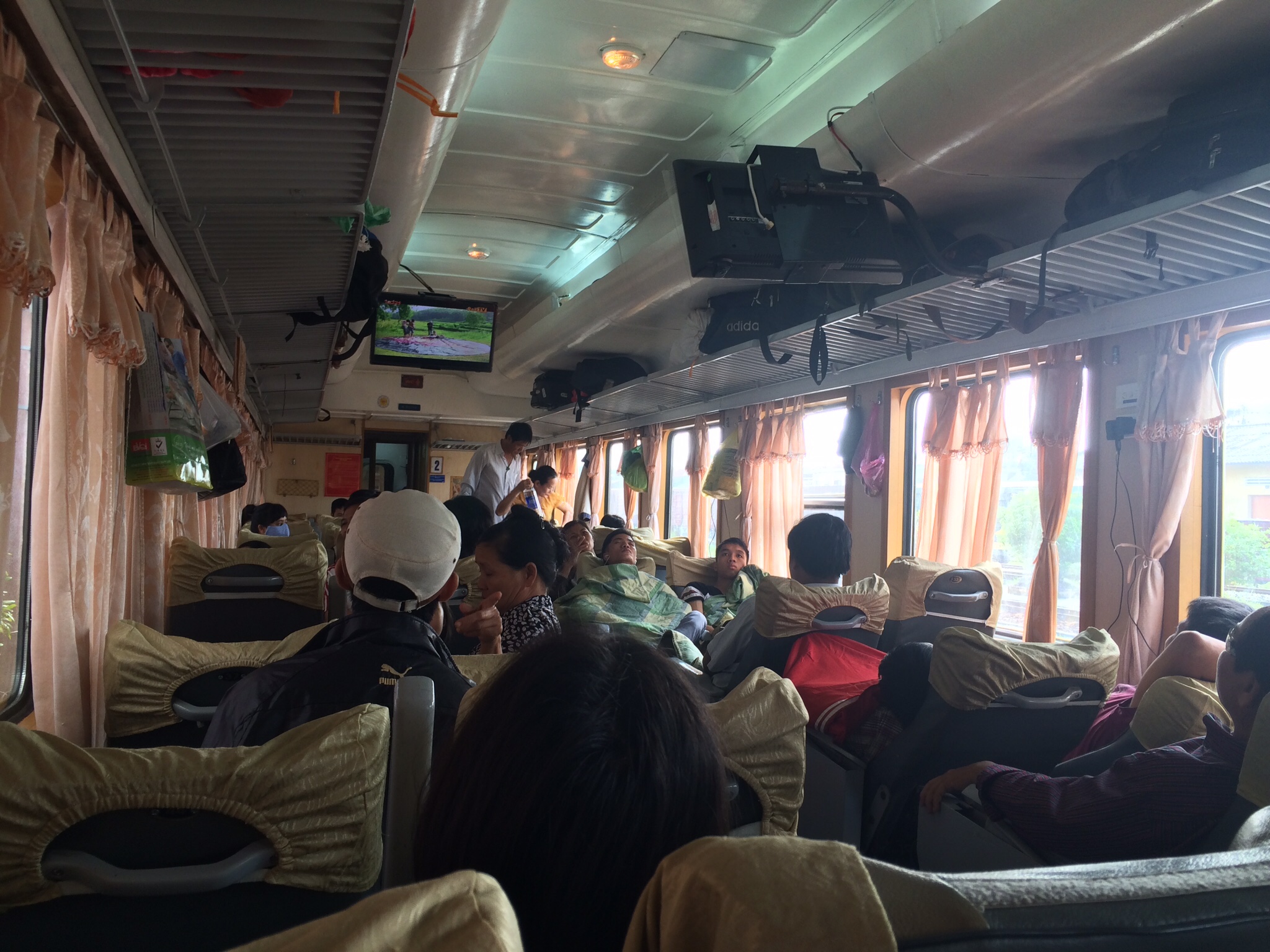
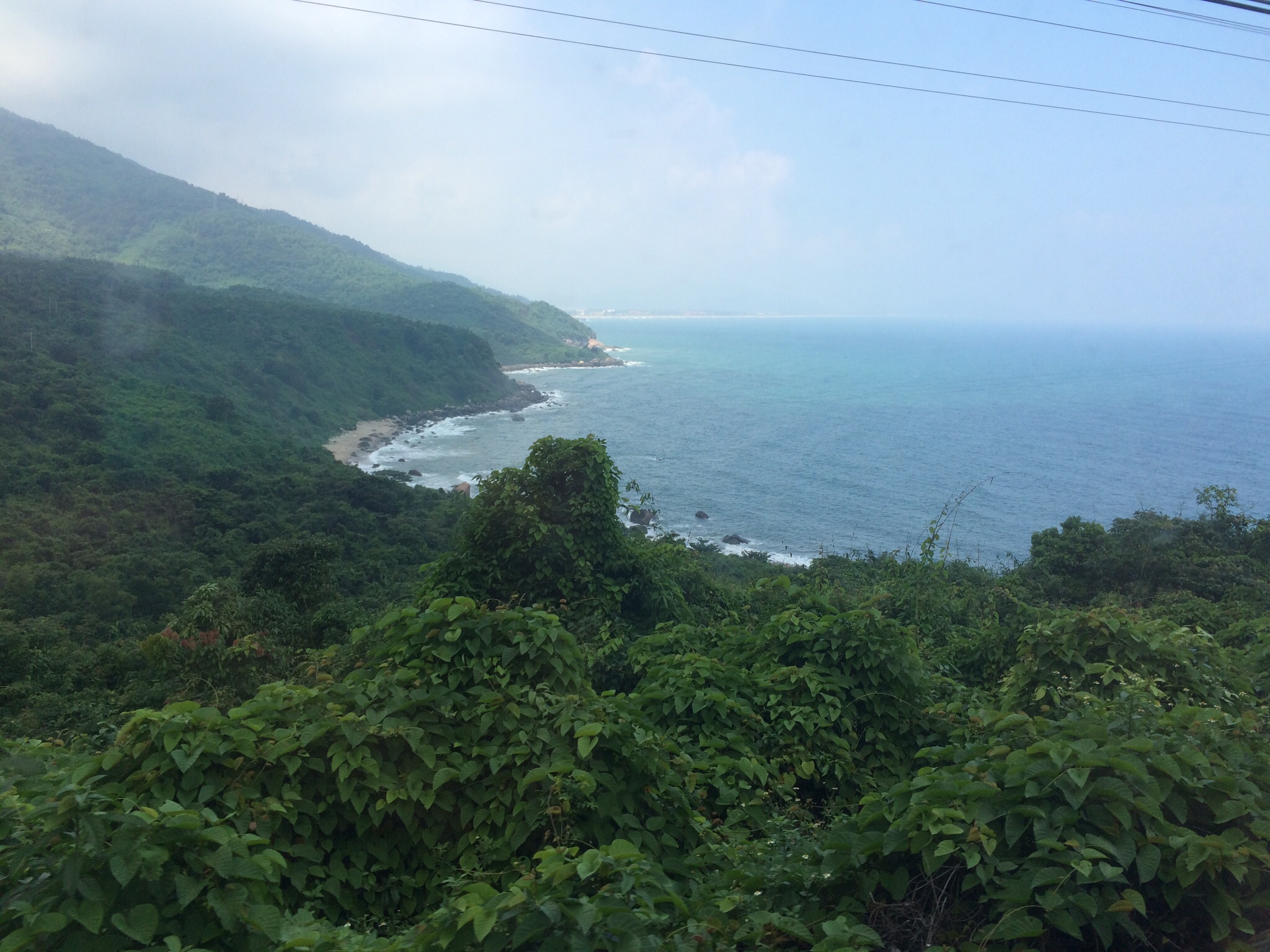

All pretty entertaining, but more than sufficient to satisfy the craving we’d had for rail time. Moreover, both of the short Vietnam Airlines flights we took (Luang Prabang to Hanoi and Danang to Saigon) felt like going back to a time when air travel was easy. All three airports were clean and uncrowded; the huge and gleaming one In Danang was only 2 years old. Hassles were minimal — no taking off of shoes nor long security lines. In fact, no one seemed to be paying much attention to what was rolling through the X-ray screeners. On board, the flight attendants didn’t patrol to check for seatbelt scofflaws, and no one seemed to care when I trturned on my electronic devices.
Now we’re in Saigon for two full days. I’ll probably wait until our Tuesday morning bus ride to the Mekong delta to write again. Between now and then, our schedule is pretty packed.
 Posted with Blogsy
 At home and abroad