Into the hammock and off the boat

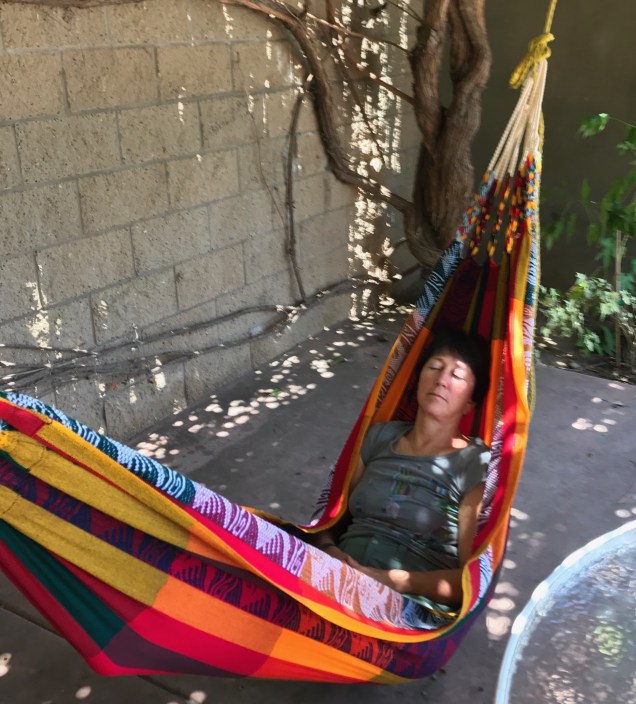
We were wrong about hammocks! When we tried our friend’s last year, we spent only a minute or two in it, climbed out, and concluded we could never get any rest in one. But on our second afternoon on the Monteiro, we strung up the one we bought in Leticia, and I committed myself to a longer confinement. I had slept badly our first night in the “suite,” not because there was anything wrong with its bed. Rather, my imagination plagued me with blood-curdling thoughts of what would happen if the Monteiro were to capsize in this trackless wilderness. So by the afternoon of the next day, I was drowsy, and I found that I could wriggle into several different positions in the hammock — all of which were comfy!
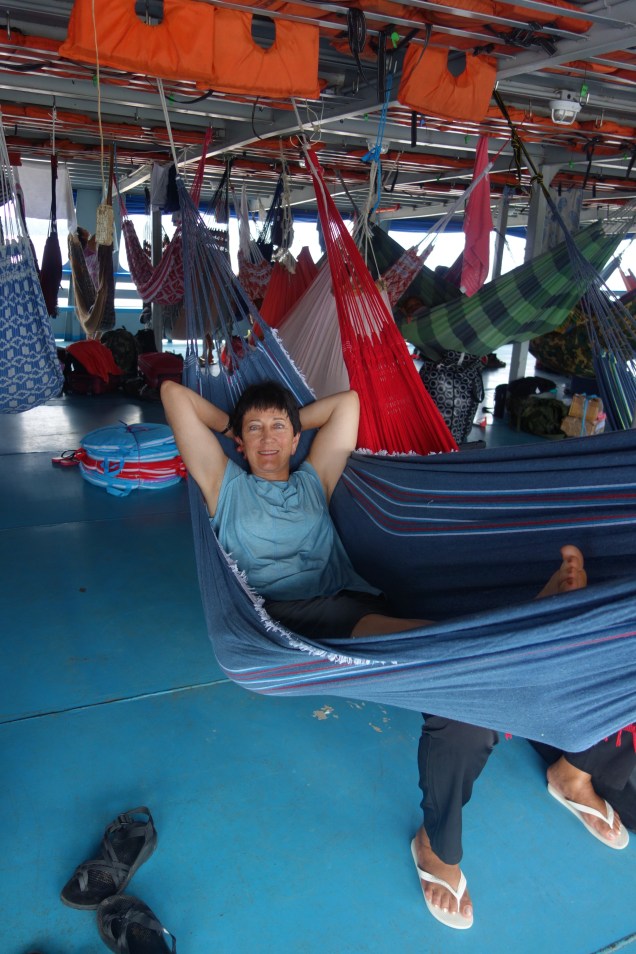
I dozed but didn’t quite sleep, pleased by the glimpses of the river beyond the ship’s railings; amused by the lively salsa lessons being given by a skinny Colombian guy to the two curvaceous redheads who had the hammocks to my left. I felt more awake after a while and found I could hoist myself up almost upright, supporting my back with my little inflatable pillow. I read for a while, felt lazy and dozed some more, and began to imagine how I could spend a day or two this way. Steve insisted he didn’t want to try it, but I finally persuaded him, and when I returned a half-hour later, he sheepishly confessed that he had napped.

We spent more time with our fellow traveler, Jen, last night at dinner. Upon boarding, she set up her hammock in the thick of the crowd on the second-level deck. After 24 hours, she’d learned enough to discourse to us about hammock life. She’d concluded that her cheap one was inferior to those of the natives. Rough to the touch, it was much smaller than her neighbors’. With a big enough hammock, one could stretch out at an angle, she’d observed, achieving something close to horizontality. Families tied their hammocks next to each other, creating a pendant microvillage. But even with her inferior rig and unfamiliarity with hammock customs, Jen claimed to have slept well both nights.

It makes Steve and me think that if necessary, we could tolerate sleeping in hammocks on the second of our upcoming boat journeys, the one bound for Manaus. We had hoped to secure tickets for another cabin immediately after disembarking from the Monteiro. We had thought we knew what that disembarcation would entail. We had no clue.

Our plan had been to take the ship from Tabatinga to Alvaraes, the closest village to the Mamiraua Sustainable Development Reserve. Lonely Planet describes this reserve as Brazil’s largest section of a unique forest ecosystem (the varzea) defined by seasonal flooding by sediment-rich “white water” rivers.It was said to offer visitors “pristine rainforest, abundant animal life, and fairly easy access.” It seemed worth seeing. Via email, we had reserved a room in a lodge in the reserve for two nights, and Choca, the owner, had promised to pick us up in Alvaraes in his speedboat.

In Tabatinga, we had bought passage to Alvaraes. “ALVARAES” was clearly written on our ticket. But what I knew — ONLY because I had read about it in a blog — was that the slow boats don’t stop at Alvaraes. I’d read about one unfortunate couple who didn’t realize this until well after their ship had steamed beyond the town. They hadn’t informed the captain they wanted to be dropped off, so their predicament was their fault, according to the crew, and couldn’t be reversed.

Wanting to avoid a similar fate, I had started telling various ship’s personnel on Wednesday that we would need to be let off the next day at Alvaraes. Each one seemed a little surprised to hear this, but each indicated we could do it. In the end I probably told a half-dozen folks, including the captain and pilot in the wheelhouse, where I barged in this morning. The times when everyone predicted we would arrive conflicted — but we’ve grown jaded about that. More surprising was the news that we would get to Alvaraes by taking a “lanche” from the Monteiro.

We assumed our informants were talking about the long, narrow, motorized wooden boat hanging off the back of the ship.Steve had pointed it out to me, joking that I needn’t worry about the Monteiro sinking because the captain would just lower it, get in, and putt-putt off to find someone to rescue us.

By noon on Thursday, it seemed clear we must be approaching Alvaraes. Jen’s maps.me map showed the town, and when Steve and I descended to the lowest deck, a strapping Brazilian guy soon joined us. “Are you going to Alvaraes too?” I asked him in Portuguese. He assented, which reassured me that the riverboat wasn’t about to pass the town without stopping.

But no one made any move to lower the launch from the back of the riverboat. Instead, two scruffy guys driving even scruffier looking crafts approached from the land. Aha! We realized THESE were the means by which we would get to shore.

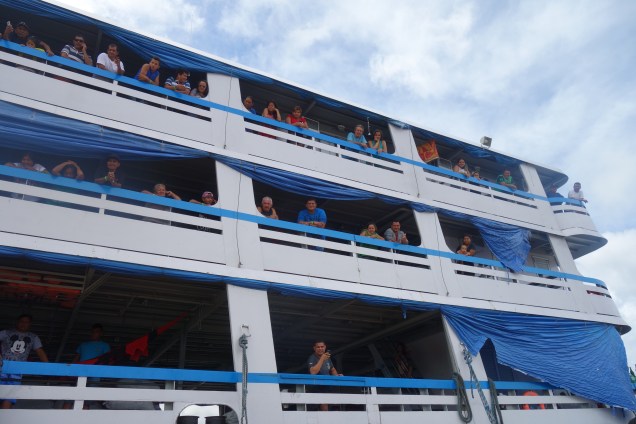
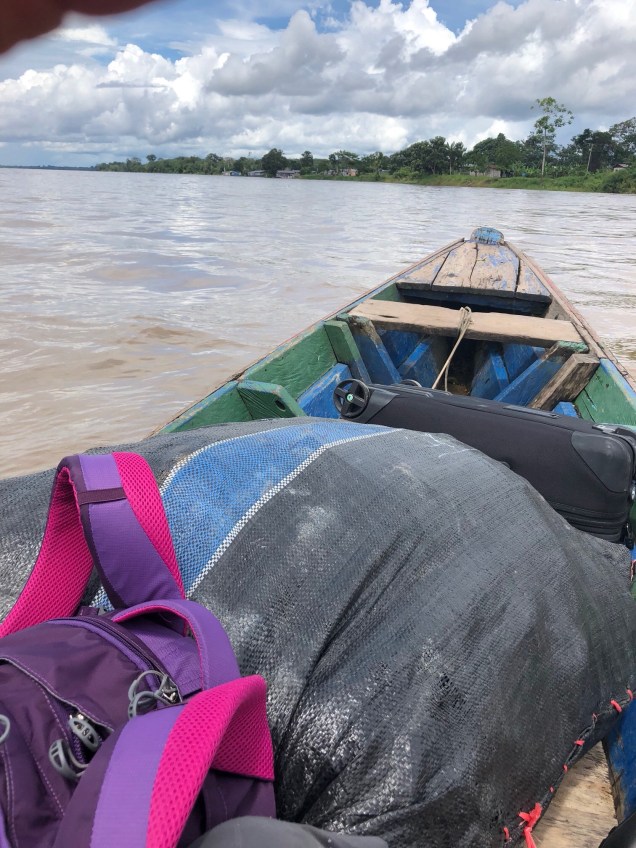
That’s when things got ugly. The burly Brazilian elbowed his way to where the boat’s railing had been opened. He hefted a huge sack crammed with Brazil nuts down into the bobbing motorized canoe which was about 5 feet below our feet. With aggressive determination, he grabbed another huge bag, and another, while not one soul made a move to help me and my suitcase and backpack from the deck down into the increasingly overladen little vessel. As it sank lower and lower, my temper flared. Swearing and pushing my way forward, I dropped my suitcase into the boat then descended (backpack and purse strapped to my body). Steve followed, and by the time he took his thwart, the middle of the boat rode just inches above the cafe-au-lait-colored river. (No life preservers added to the load. There were none.) Steve shot the following photo, testimony to the fact that at least our adventure amused many of the Monteiro’s passengers.Here’s what the view from our craft looked like:
Jen shot video during the most comedic moments and sent me a clip. Although I don’t usually try to insert video, I will give this a shot (and fix it at home if it’s unviewable now.)

In this fashion, we zoomed toward the town and arrived about 5 minutes later, where Choca awaited. So it all turned out fine, except we were too rattled to press Choca to help us buy our onward tickets. We hope to accomplish this soon. In the meantime, we’re in one of the strangest places we’ve ever visited. We expect to see a lot more of it tomorrow.
Aboard the M. Monteiro II

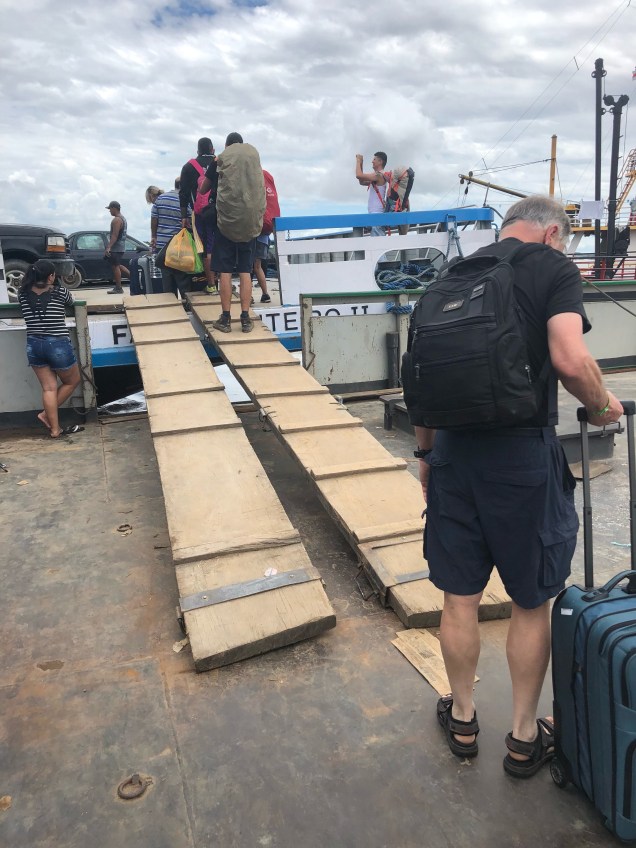
Our ship had literal gangplanks. I captured this image of Steve as he was going aboard.

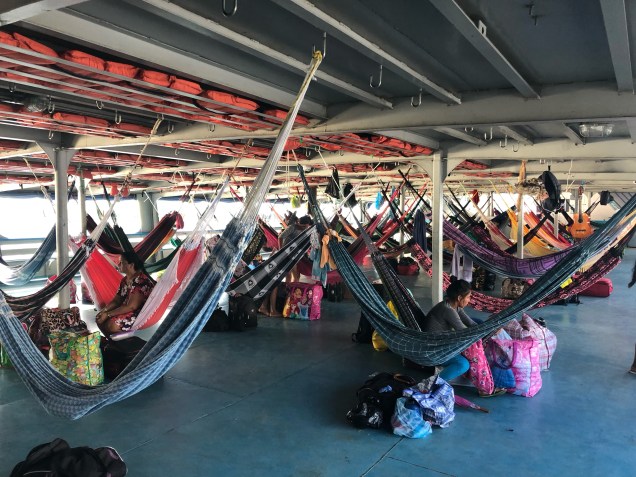
I just strolled around the ship and counted the hammocks. Passengers can string them up from sturdy hooks that stud the ceiling on two of the Monteiro’s three decks.

The middle deck is most popular, maybe because it’s more protected from the wind, maybe because it’s the deck that also contains the ship’s little dining room. Just now I noted about 75 hammocks hanging there, with another two dozen on the deck above. But the count changes as the ship docks at towns along the way. Since we departed about 20 hours ago, we’ve made four stops.

To our mutual surprise, there is one other American on board, an Asian-American named Jen. She spotted us early and introduced herself. Retired from a programming job in the Bay Area, she’s chatty and intrepid. She’s been traveling in South America for several weeks and wanted to save money, so booked hammock passage rather than a cabin. This morning she said she slept okay but woke when we docked at the tiny village of Sao Pablo de Olivenca around 1 am. It was pouring then, she told us, but a bunch of the passengers disembarked, while more, silent as mice, got on, strung up their hammocks, and climbed in them to sleep.

In contrast, Steve and I are enjoying what feels like outrageous luxury. Our little “suite” has a firm double bed, covered in a fresh floral-printed sheet.

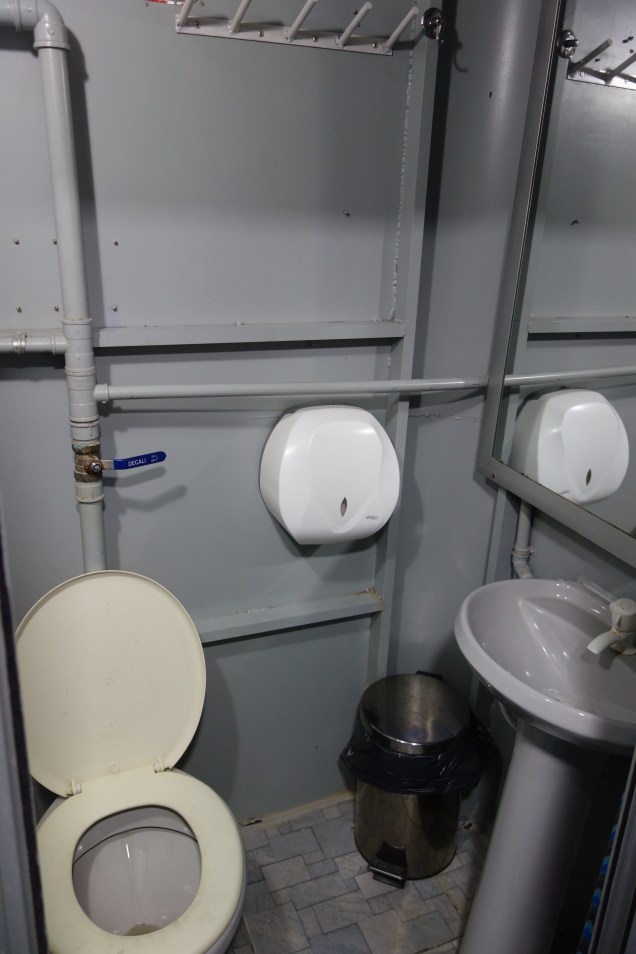
We have an air conditioner and even a working refrigerator, lots of electrical outlets, and a private bathroom that includes a shower head.

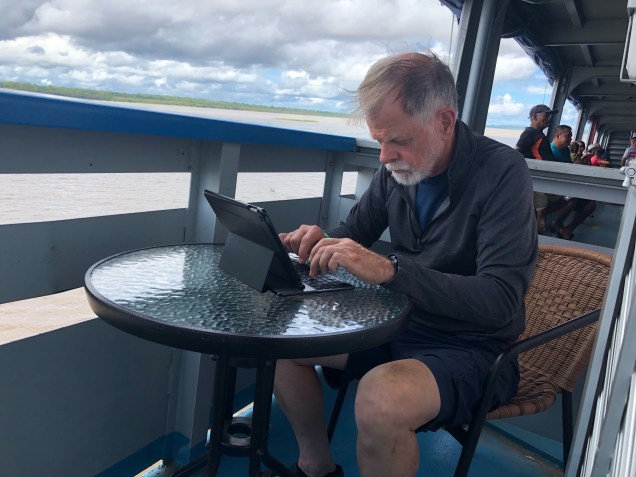
What we love most is our own little private deck space where we can move our table and chairs and write or take in the passing riverscape.

None of these fixtures are luxurious by US or European standards, but the place feels fairly clean and bug-free, and it’s great to have all the light and privacy we want, whenever we want it. It’s also nice not to have to worry about guarding our stuff. On the other hand, Steve and I hate looking or acting like rich, pampered Americans, and we’re missing out on more interaction with the locals than we would have had, were we traveling with them. We made the choice we did because we doubted we could sleep in hammocks.

Still, we bought one (for $12) in Leticia. This afternoon we plan to string it up and take turns trying it out.

How we got up the river without a paddle

Two days into this adventure, Steve and I feel ecstatic. But it’s also already clear this would not be everyone’s cup of tea. What got us here, in the deep psychological sense, was that we share a love of rivers; to us the great rivers of the world are grandly romantic. We’ve never cruised any European waterways (we’re saving that for our dotage), but we’ve sailed down the Nile from Aswan to Luxor. We took boats on the Mekong River from Vietnam to Phnom Penh, then on to Siem Reap to visit Angkor Wat. On our trip to Peru in 2003, we flew to the southern (Peruvian) reaches of the Amazon watershed, and that wondrous experience made us want to see the mother river herself. This spring seemed like the right time to do it.

A bit of research confirmed that plenty of tourists want to spend some time on the Amazon. But I learned that the vast majority of them do this by flying into Manaus (the metropolis in the middle of the region), then taking cruise ships that range from plain to luxurious and sailing around for a few days, often staying at jungle lodges before returning to Manaus to fly onward. This sounded okay to us, but not so exciting (having had our jungle-lodge experience in Peru). What excited us was the idea of using this greatest waterway as a transport artery. Local folks have done that for millenia and do it still. Almost no roads have been built through the region. The very first bridge across one of the Amazon’s tributaries (the Rio Negro) opened less than 10 years ago. There aren’t more mainly because there are no roads to connect the bridges.

The latest Lonely Planet guidebook to Brazil devotes 2 of its 734 pages to riverboat travel, and I eventually also found a half-dozen descriptions written by bloggers who’ve journeyed this way. From these accounts, it seemed clear to me it must be possible to travel the full length of the Amazon River across Brazil on ferry boats. I learned that the big slow ferries have decks where most travelers string up their hammocks, but that the boats usually also are equipped with a few private cabins. To assess whether we could stand the hammock option, we borrowed one from a friend last fall, strung it up on our pool deck, and climbed aboard.

Although swinging in it looked languid and inviting, it tormented both our backs, so we rejected that option. Bloggers said it wasn’t necessary to book the ferry tickets more than a day or so in advance. But most of the writer/travelers were on the road for open-ended amounts of time. Steve and I may be retired, but we still have responsibilities at home that make us book return tickets. To be comfortable, I wanted to book our ferry cabins in advance.

We finally decided we wanted to break up the cross-country river journey into four parts, stopping along the way to participate in different activities. And I eventually found agents in two of the big cities we would pass through toward the latter half of our journey who were able to book the cabins on two of the four segments for us (Manaus to Santarem and Santarem to Belem). I was astounded, however, by the dearth of options for booking cabins on the first two segments. I emailed the owner of the lodge in the reserve where we will stay two days from now and asked if he would help me. He was friendly but replied that it was normally not possible to make such a booking in advance.

For Tabatinga (on the Colombian border) where we would start our journey, I found no travel agents online, no boat companies nor hotels that appeared to offer this service. So we arrived Sunday afternoon with little more than the hope we would be able to figure out how to get ourselves to Alvaroes (the gateway to the reserve) by Thursday morning.

This is how our gamble played out: We got to our B&B too late Sunday afternoon to begin the search (Leticia and Tabatinga are tiny, scruffy South American border towns, so riddled by narcotics trafficking that the US State Department says Americans shouldn’t go near them. Now that we’ve seen them, they don’t seem bad at all, but we also didn’t want to go wandering around the docks around sundown alone.) We were on the hunt bright and early yesterday (Monday) morning, however. I thought I knew where to go. I’d read a blog post written by a guy in 2016 who traveled from Leticia to Iquitos in Peru by boat, and he detailed the street where all the boat ticket vendors were located.

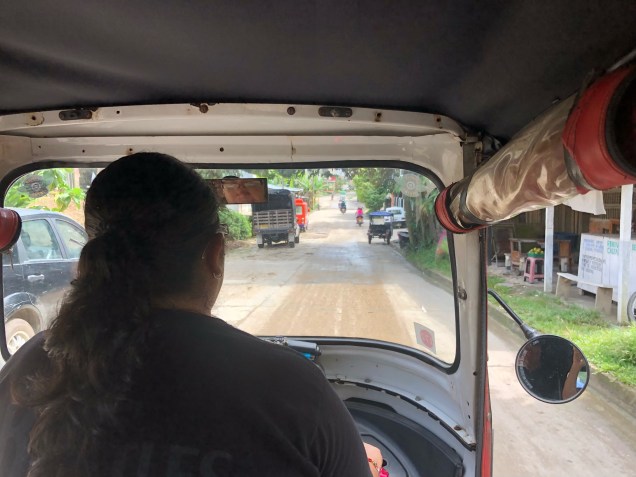
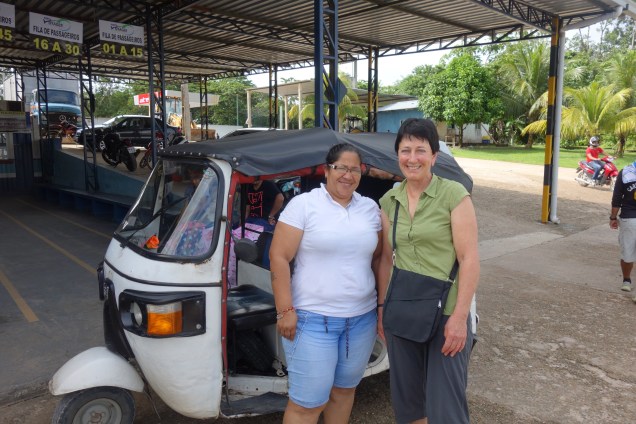
We walked out in search of a tuk-tuk (one of the motorcycle taxis ubiquitous in poor parts of the world). But we saw few and asked our receptionist to call one. Minutes later, a stout, middle-aged Colombian matron wearing a Beatles t-shirt pulled up in her growling little vehicle. Her name was Xiomara. I told her what we needed (she spoke no English, but my Spanish worked well enough and she seemed to have some grasp of Portuguese.) She said the street mentioned by the blogger was only for boats to Peru. Instead, she knew where we needed to go in Tabatinga. And so, yielding to Xiomara’s obvious competence, we put-putted south.

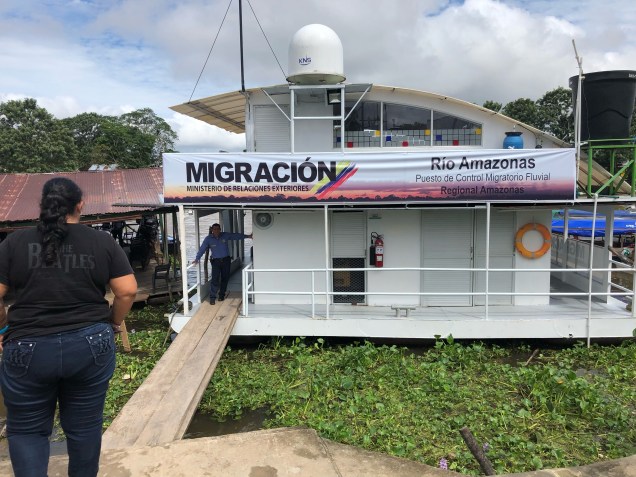
We had to ask her to point out when we were crossing the border; few obvious signs mark it. At the Brazilian boat docks, to our delight, we learned that a boat (the M. Monteira II) was departing the next day and was scheduled to reach Alvaroes on Thursday morning! A cabin was available for 1200 reales (about $338, which would include the two night’s lodging, boat fare, and all our meals and purified water.) Xiomara drove us to an ATM machine and then to money-changers who traded us Brazilian reales for Colombian pesos and dollars. She drove us back to the docks to buy our tickets (now that we had the necessary cash) then on to a Colombian immigration office (to get stamped out of Colombia)…

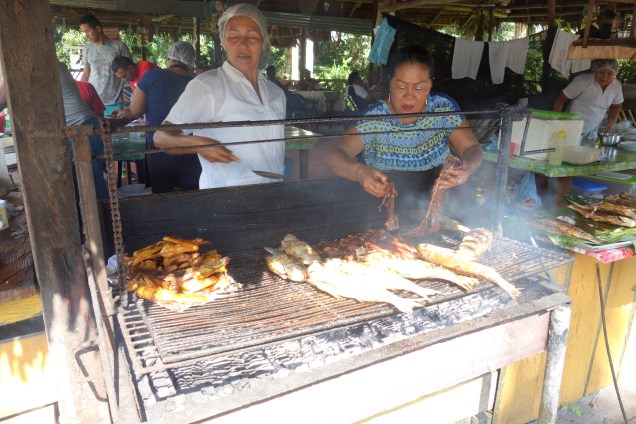
…and a Brazilian one (to have our visas inspected and secure our stamps for Brazil). We were done with it all by 10:30 am, then Xiomara drove us to an eco-park 7 kilometers out of town so we could take a hike through the jungle and learn a bit about the indigenous culture. Then she took us to a roadside restaurant for delicious grilled river fish.

She returned to our hotel to pick us up this morning and deposited us back at the boat dock by 9 am.

I think she probably should have known we didn’t need to be there that early (even though the boat folks said we did.) It took no more than 5 minutes to get our tickets stamped and passports inspected by the Brazilian police official. Then we had to wait until 10:30 before the line of passengers moved to board. Still, the wait was entertaining, and the payoff was rich. I’ll report more on that in my next post.

Hello Leticia, Adios Leticia

I’ve blogged from the foot of Mt. Everest. I’ve blogged from a walled Arab city near the border of Somalia, where wild hyenas roam the town at night. But Steve and I have never been in a city more isolated than Leticia (Colombia), and its sister town across the Brazilian border, Tabatinga. There is no road to this place from the outside world. We’re surrounded by vast impenetrable jungle. You can only get here by flying in (as we did Sunday afternoon) or by boat, as we expect to do in a few hours, for the first section of our journey down the Amazon River across Brazil to the Atlantic. 

The only way the Internet could be slower here is if it didn’t work at all. It’s as slow as the pace of the rubber oozing from the tree we saw on a walk through the jungle yesterday. It’s way too slow for me to hope to upload any blog posts with photos. 

Hence, my plan is to write as I normally would, almost daily describing our experience on the boat. But it may be almost a week before I can upload anything (in Manaus). I will try to upload this now. If it appears on my website, I succeeded! (I will also try to send photos via Twitter, which seems to work a bit better.)

To the Amazon!


My friends often laugh at me because I pack so early, often weeks in advance. For at least one or two trips, I’ve been known to have all my clothes stuffed into my little roller bag two months ahead of time. This makes me feel calmer, knowing that at least this task can be crossed off my To Do list. I also like being able to refine my choices as we draw closer to departure.

img_7796

For our current trip, however, to Brazil, I only loaded my gear in the suitcase on Thursday. That’s because we will spend most of our time in and around the Amazon River, a notoriously buggy place. We wanted to spray all of our apparel with Permethrin (an insect repellant), close to the departure date. Above you see almost everything I’m taking, hanging in the closet to dry. (Steve nobly sprayed it all outdoors, as it’s not great to breathe.)

Now we’re in Dallas, waiting to board our flight to Bogota in Colombia, where we’ll sleep tonight. Tomorrow afternoon we’ll fly south to the jungle town of Leticia. There the real adventure will begin.


On the big beautiful wall

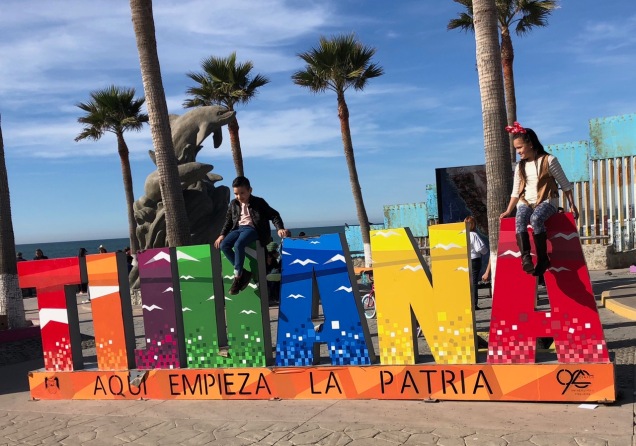
“Is San Diego a border city?” Derrik Chinn asked the 25 of us who set off with him on his Tijuana tour bus last Saturday morning. My first thought, like many of my fellow passengers, was sure. We live on the line separating the US from Mexico, as a glance at any map will confirm. But Derrik pressed, and we had to agree that many San Diegans rarely give a thought to the actual, physical geopolitical boundary.  In contrast, Derrik pointed out that if you asked any Mexican the same question about Tijuana, he or she would think you were crazy. In Tijuana, no one’s unaware of their proximity to la linea. Derrik wasn’t moralizing. I think his point was just to remind us that for different folks, the border can feel very different.

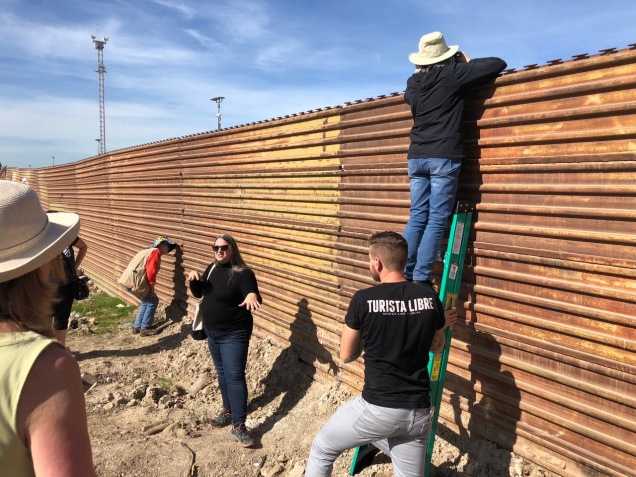
For a clearer understanding of the past and current physical barrier between San Diego and Mexico, Derek developed his new tour; he calls it “Against the Wall.” He was giving it for the first time Saturday. A former Union-Tribune staffer, Derek moved to Tijuana 10 years ago and eventually started an offbeat tour company (Turista Libre). Steve and I have gone on several of his outings over the years and found them all to be exceptional, but the wall tour was the best yet.

We met at the Pedwest border crossing. It just opened 6 months ago, and Steve and I hadn’t had an opportunity to cross there yet. We were impressed by not just its pristine condition but also by how much closer it delivers visitors on foot to Tijuana’s commercial center.

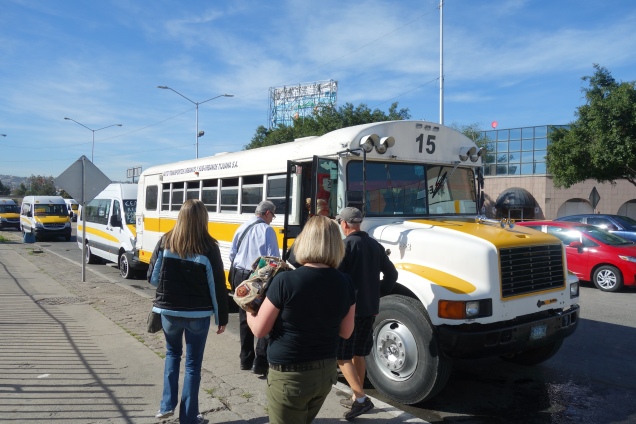
Once across, we boarded Derrik’s vehicle, which he rents out during the week to serve as a TJ city bus.bus boarding

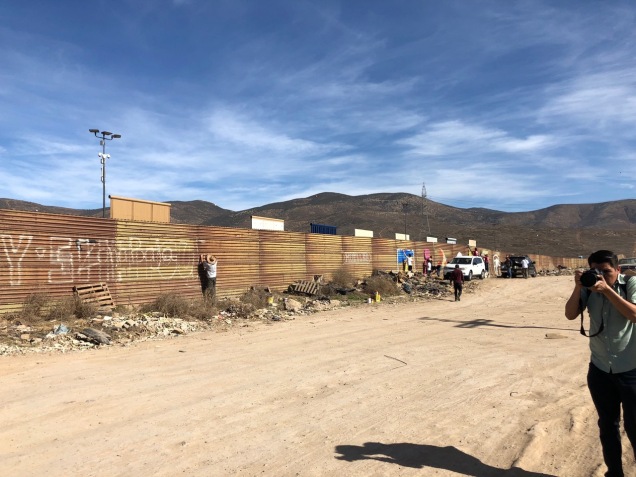
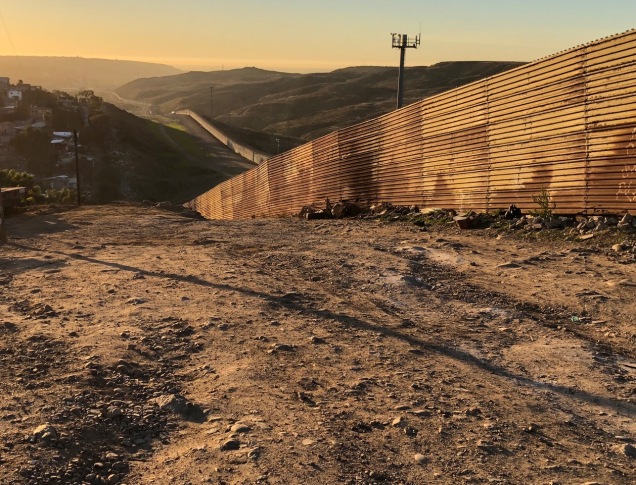
Our first stop was in the far northeastern part of the city, beyond the Otay Mesa border crossing. We had to bump for a bit down a dirt road through a largely industrial area to arrive at the area offering the best views of the prototypes for President Trump’s “big, beautiful wall” that were built last fall. Access to them on the north side of the border is strictly limited. But from the south, their 30-foot height makes them easy to see.

012918 border tour4
The guy on the right with a camera was a journalist from a Tijuana paper, documenting the rare phenomenon of American tourists in this part of town.
012918 border tour7
Jill Holslin, an American artist who’s been living in the neighborhood and documenting developments there, spoke to us briefly. She says people cross fairly routinely here, though we saw no sign of such activity in progress.
012918 border tour8
Locals have piled up tires, like the ones you can see Steve standing on just down the way.

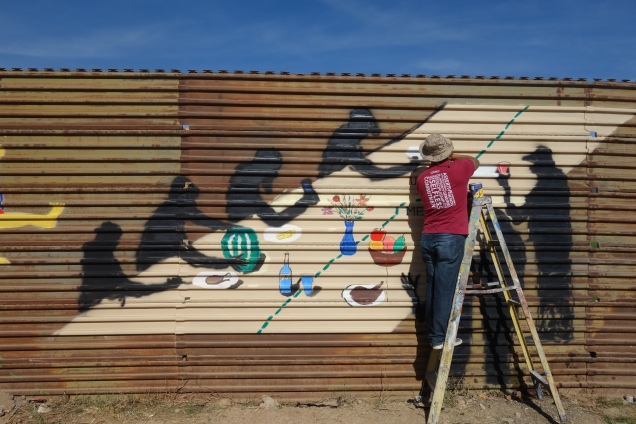
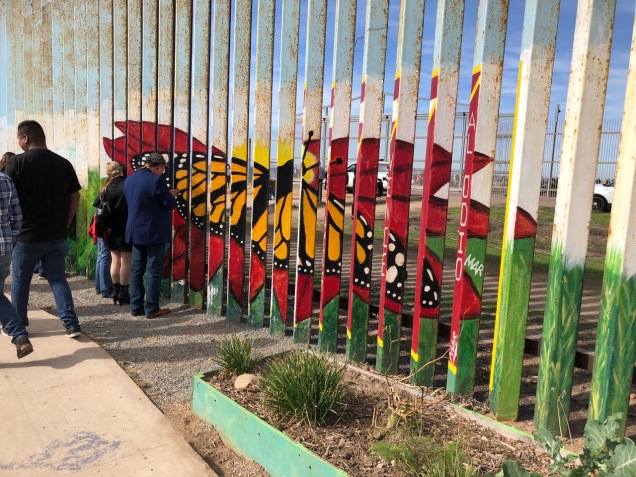
The prototypes make the area north of the border look like a theater set. Jill says some folks have suggested they be left in place permanently, as a sort of a monument.  Other art work was unfolding in the moment. A number of folks were using the corrugated iron as a canvas.

wall artists 2
Some were creating more generic statements…
012918 border tour6
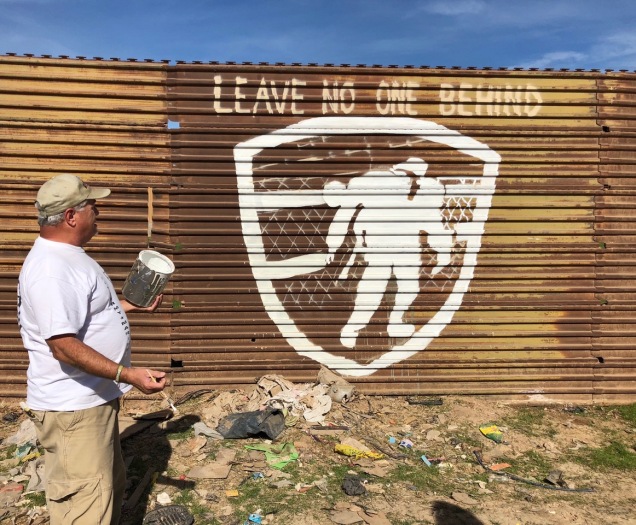
…while others were more pointedly protests, like this reference to the thousands of Mexicans who served in the US military and since have been refused the legal US residency they were promised.

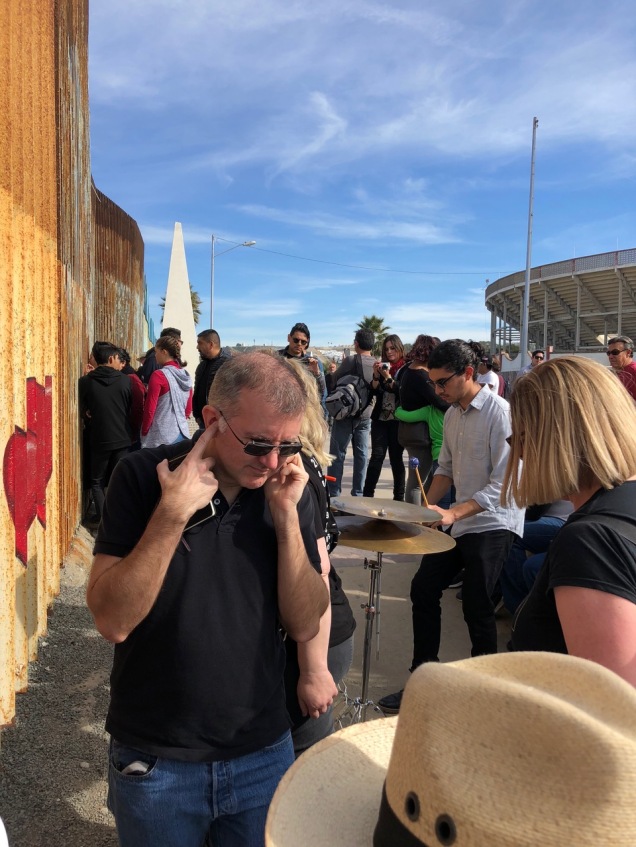
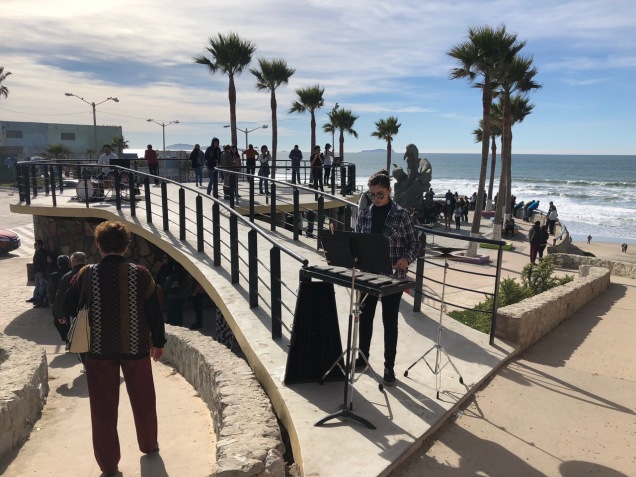
It was all very interesting, but we had to hustle back on the bus and drive to the beach. We were trying to get there in time for an extraordinary event taking place on both sides of the fence: a special binational percussion performance by about 70 American and Mexican musicians.

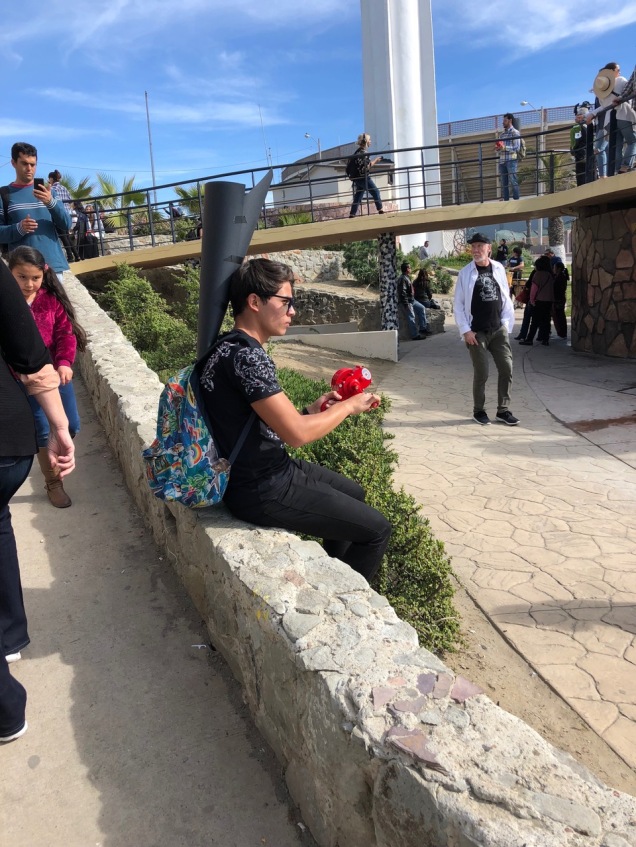
We arrived late and found the concert in progress at full volume. A wild cacophony of drums and other booming instruments were crashing and thumping.012918 border tour10

012918 border tour9
Several individuals had hand-held sirens that gave the tumult an apocalyptic undertone.

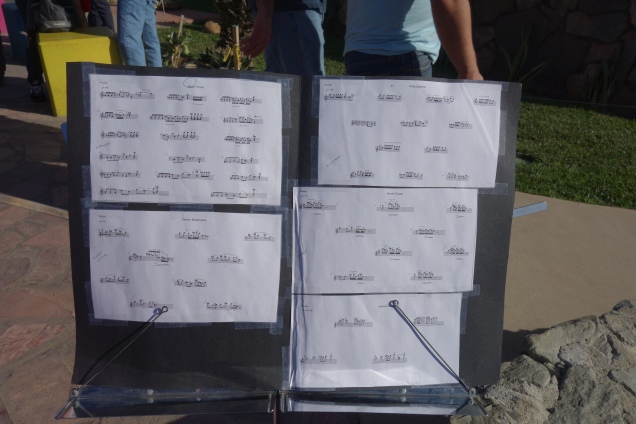
I found it hard to tell at first if the players were organized, but soon we realized that many musicians were following a printed score.

sheet musicGradually, the riotous sounds gave way to muted waves of chimes, gongs, and cymbals.012918 border tour13
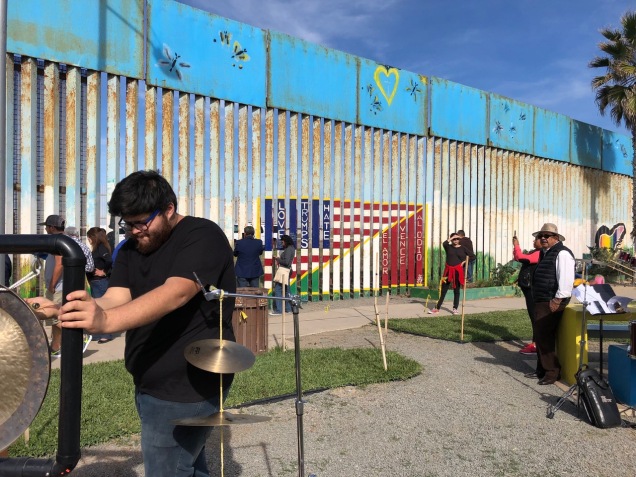
 

We could hear some musicians playing on the north side of the barrier, but it was hard to see much, other than the presence of a half-dozen or so percussionists in the no-man’s-land known, ironically, as Friendship Park. (The Border Patrol only allows a handful of folks to enter it at any time. Most of the American spectators had to stay on the far side of the second fence there.)

012918 border tour11
We could make out the shape of several Border Patrol trucks watching the musicians.

But on the Mexican side, we mingled with a jolly crowd. 012918 border tour14

012918 border tour15

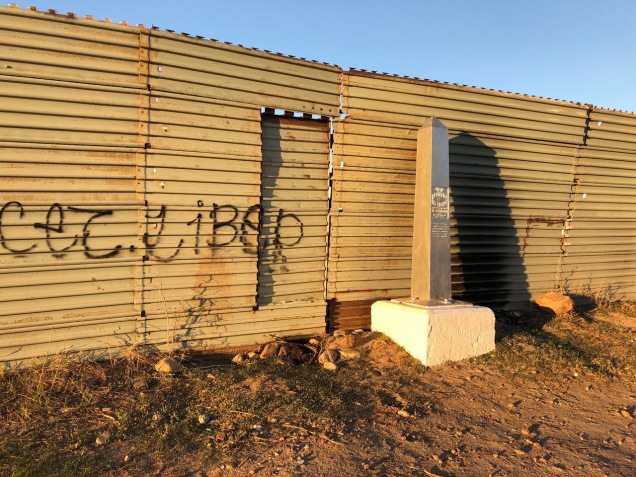
Again, it was tempting to linger, but Derrik herded us back on the bus again. Our next destination was the wonderful Telefonica gastropark, near the center of town. We stayed for more than an hour (three tacos and a craft beer were included in the tour price.) That place is worthy of a blog post all its own. But I’ll gloss over it now, to jump to our final border interaction of the day: another of the little-appreciated 276 “border monuments” that extend all the way from the Pacific Ocean to Ciudad Juarez.

Like most of the monuments, Monument 254 is made of metal, and like all of the monuments it stands on US soil. Both countries long ago agreed to share the annual maintenance work.

012918 border wall 18
That’s why there’s a door in the wall — so the Americans can come through to do their share of the upkeep, periodically.

This monument was in Colonia Libertad, an old neighborhood just west of the fence surrounding Tijuana’s international airport. 012918 border tour17

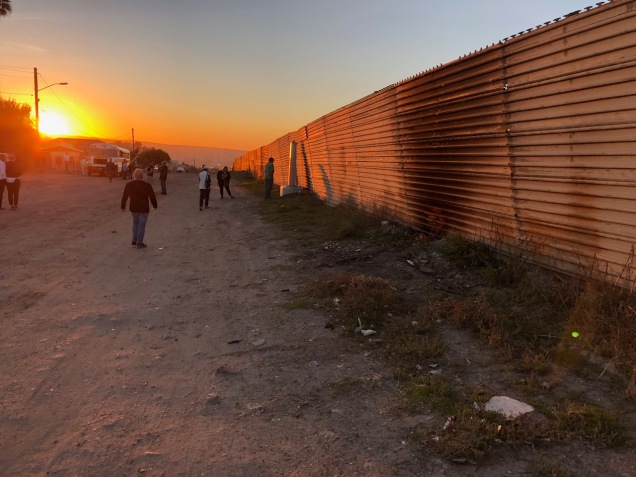
People’s houses, lower middle-class-looking to my eye, crowd up close to the border fence here. As we strolled along, roosters crowed and snatches of norteño music floated by on the breeze. A few locals ambled past us, but not many. It seemed a time to be home relaxing, near sundown on a Saturday with perfect weather in January.

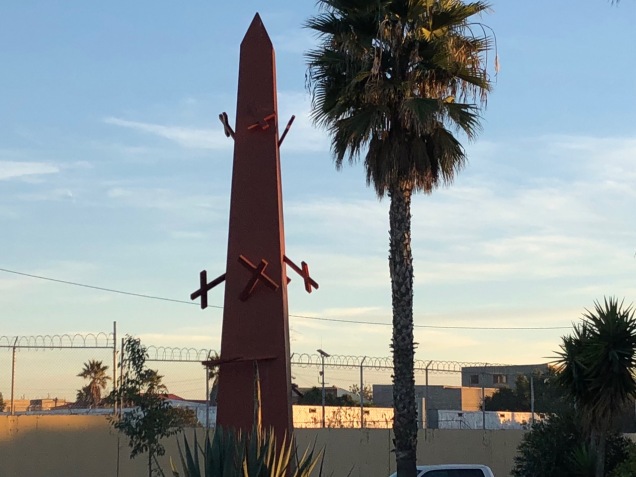
Most of us eventually drifted east along the fence for a while, in the direction of the airport. Across the street stands a bigger public artwork, a giant border monument. If the meaning of the crosses sticking out of it was unclear… 012918 border tour19

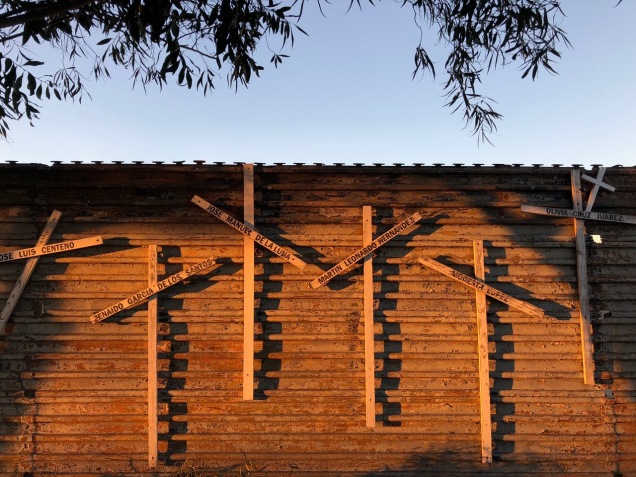
…the ones affixed to the actual fence left no doubt.

012918 border wall21
They mark the passing of some of the individuals who have died, trying to make their way north.

012918 border tour20

For all of us on the tour, though, that passage was both safe and easy. We boarded the bus, were dropped off next to the pedestrian crossing, and by-passed the long line (at least those of us with SENTRI passes did). The immigration officer didn’t ask me if I had anything to declare. Had he done so, I could have told him about the hunk of excellent sun-dried-tomato-studded cheese I bought at the gastropark. And the richer mental picture I acquired of the border next door.

Eclipsed

082217 eclipse1

I saw my first total solar eclipse on a hilltop in Germany 18 years ago. It took place on Steve’s 50th birthday. Months earlier, when I had heard that the two events would coincide, I had worked to arrange a house (and car) trade with a family in Bavaria, and on the big day, Steve and Michael and Elliot (then 14 and 10) and I piled into the Bauer’s little Ford and headed out, seeking a viewing site. It was a stormy day, and we had a wild time, trying to find clearer skies and a well-situated town from which to witness the spectacle. We found a town but had a terrible time parking. Still, we managed to work our way to a spot within the throng that had gathered to watch the sun disappearing between the passing storm clouds. The clouds parted right before the astronomical climax, and my family’s shouts of amazement and gasps of pleasure joined in the general chorus.

It felt electrifying, and when it was over, I vowed to travel to every other total solar eclipse viewable on the planet in my lifetime. That impulse was sincere but impractical, and my resolve was short-lived. Total eclipses aren’t that infrequent, but they’re far-flung and expensive to get to. I hadn’t made it to a single additional one when I heard about the coast-to-coast extravaganza that would take place in the United States on August 21st this year. That fired me up again.

It occurred to me that if I used our frequent-flier miles to transport us home from Europe to Portland, instead of San Diego, we could snag inexpensive tickets home to San Diego the day after the eclipse. Also, I have a niece who lives in Portland, a city I’d never visited. So we set eclipse-viewing plans in motion.

We refined them a bit in the late spring and early summer. Our son Michael and his girlfriend Stephanie decided to fly in from Reno to join us. We also began to rethink my original plan for where to view the event. Portland was just outside the zone of totality, and I knew that clear skies on the Oregon coast were not a sure thing. At first I reasoned that, if necessary, we could get up early and drive over the mountains to the hot, dry side of the state. But in June we began to hear stories about the huge crowds that would be flooding in. Authorities warned about the need to stockpile food and fuel and even water. Envisioning the nightmare of being stuck in a massive traffic jam on a small road through the Cascades, we resigned ourselves to accepting whatever the weather gods delivered for Salem (well within the totality zone and only a 75-minute freeway drive from Shannon and Jimmy’s house). As Steve and I traveled in Europe over the past few weeks, I sneaked peeks now and then at the upcoming Salem weather; mostly I found jolly yellow balls predicting sun, but at other times, partial clouds were forecast. That was depressing; by the time we landed in Portland Saturday night, I had decided to just stop thinking about it.

Sunday the skies in Portland teased us — clear part of the day but obscured by light clouds and haze at other times. The prediction for Monday in Salem, however, continued to be a bright yellow ball. When we walked outside around 5 am on Monday morning, Venus, shone brightly, almost directly overhead.

We started driving south at 5:30 and hit patches of traffic. Despite it, we reached Salem under azure skies by 7:15 — three solid hours before Totality. While driving, we’d read online that a huge eclipse party would be taking place at the state fairgrounds — but the tickets were all sold out. Another recommended spot, however, was a park not far from the center of town. We headed there.

Now that I’ve experienced two total eclipses, I have a pretty clear idea of my dream viewing spot for any future ones. It’s on a hilltop crowded with festive fellow eclipse-watchers, some playing guitars and clapping as the color drains almost imperceptibly from the landscape. The sweeping view of the surrounding countryside offers the chance of sensing the shadow of the moon streaking toward one at 1800 miles an hour, in the last fraction of a second before the sky turns black.

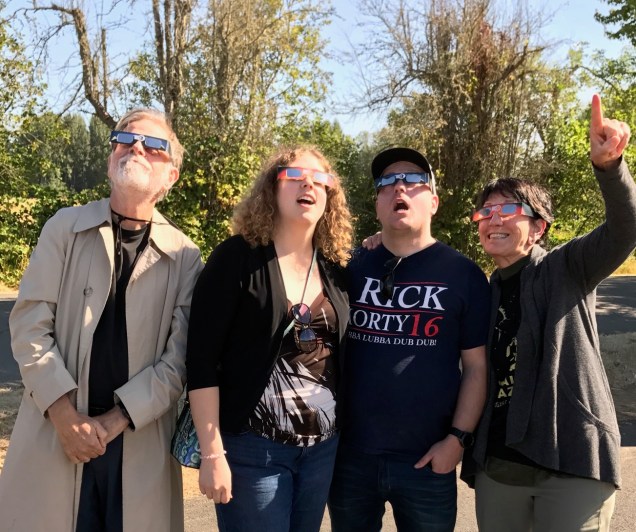
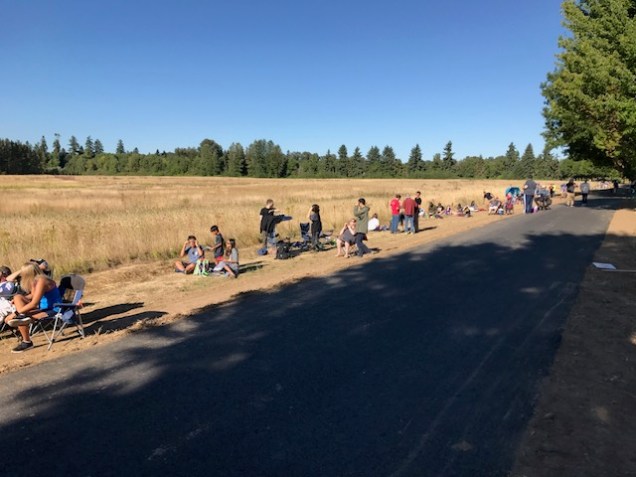
Our park in Salem wasn’t quite like that. It was flat, encompassing a couple of huge grassy meadows, but signs warned visitors against walking out on them. Instead people strolled in and arranged folding chairs or picnic blankets along the edges of the open areas. They chatted quietly within their little groups, relaxed as holiday-goers soaking up rays on a beach. I whooped loudly when, a little after 9, my eclipse glasses revealed the first small bite out of the disk, but if anyone else cheered, I didn’t hear them.

082217 eclipse2
Not exactly a mob scene.
082217 eclipse3
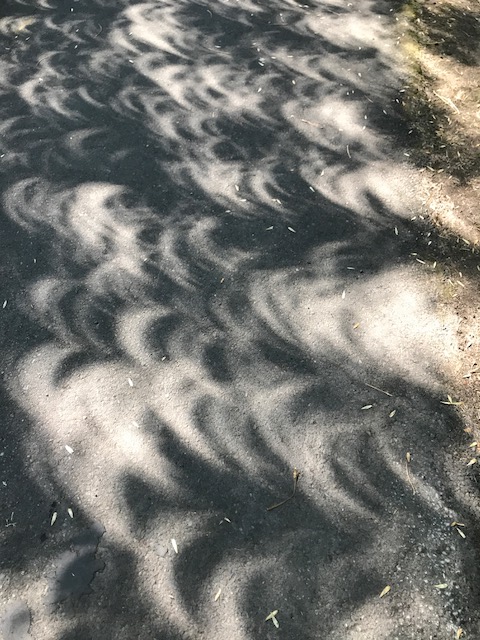
The shape of the sun, reduced by the moon to a slim crescent, captured through the pinholes cameras created by the tree leaves.

Tension built only slowly. By 9:40, the four of us agreed that the light had shifted into some subtly otherworldly spectrum: colder, weaker. Stephanie noticed that the chirr of insects was growing louder. By 10, a portly older man dragged his wife up the embankment next to us to show her a patch of the pavement where sunlight was filtering through the leaves. He couldn’t resist coming up to us to ask if we too had noticed the splatter of crescent shapes: the shape of the sun’s image projected on the ground. We hadn’t and thanked him for sharing the insight.


More people around us rose to their feet; more voiced comments addressed at large. Anticipation coiled us tighter and tighter as the light grew more surreal with every passing second.

Then it happened. Better writers than me have commented that the difference between experiencing any partial eclipse and a total eclipse is like the difference between riding in an airplane and falling out of an airplane. Or like the difference between seeing a lightning bug and seeing lightning. At the instant that the moon obliterates the sun, people shout, cry out. Tears sprang into Stephanie’s eyes. I know I screamed. Steve, more level-headed, was trying to capture it on his phone. Here’s what he recorded starting just before totality:


<p><a href=”https://vimeo.com/230680395″>Eclipse 2017</a> from <a href=”https://vimeo.com/user25079241″>Jeannette De Wyze</a> on <a href=”https://vimeo.com”>Vimeo</a&gt;.</p>

It lasted only a bit over two minutes. Then we gathered our things and straggled out of the park and slogged through almost four hours of horrific traffic, back to Portland. But we talked about those two minutes, off and on, the rest of the day and evening.

There’s another total eclipse coming in 2023 and another one in South America the following year. I’m wiser now, I’ve already put them on my calendar.

Still hungry in Florence

When we said goodbye to our French friend Olivia before heading to Turin and Florence, she warned that the beauty of Florence was so great it could be stupefying. She claimed that on her visits there, she couldn’t resist walking compulsively from one exquisite site to another, forgetting even to take breaks for food and drink.

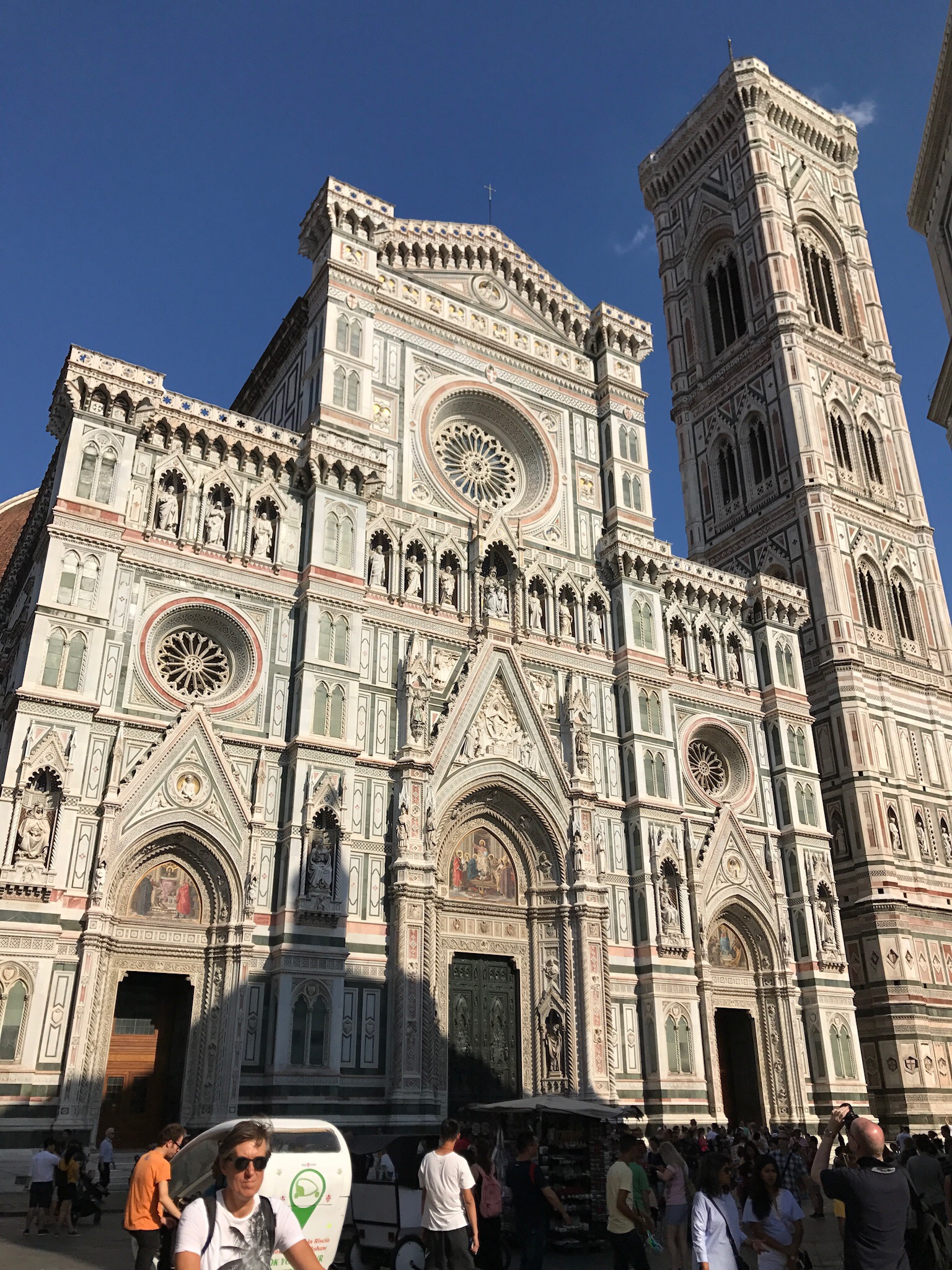
This did not happen to Steve and me. We got hungry at regular intervals, and we paused to eat wild boar, osso buco, gelato, roast suckling pig, pizza, deep-fried rabbit and eggplant, sea bass, more gelato, buffalo-milk mozzarella, flavorful tomatoes, poached codfish, gnocchi with crab, risotto with fresh truffles, more gelato, and other tasty dishes (in only three and a half days!) Every meal was extraordinary. Almost everything cost about half what comparable fare would cost back at home. I don’t know if we gained weight eating it. (I’ll find out soon, when we get home). But it’s possible we didn’t. Like Olivia, we walked obsessively — at least 8 or 9 miles every day. Thursday we also climbed the 38 floors to the top of Florence’s magnificent basilica.

If the beauty of the city didn’t stop us from enjoying its food, we nonetheless found it pretty much as wonderful as Olivia promised. It made us yearn to someday do a house trade here to savor it all at a slower pace.

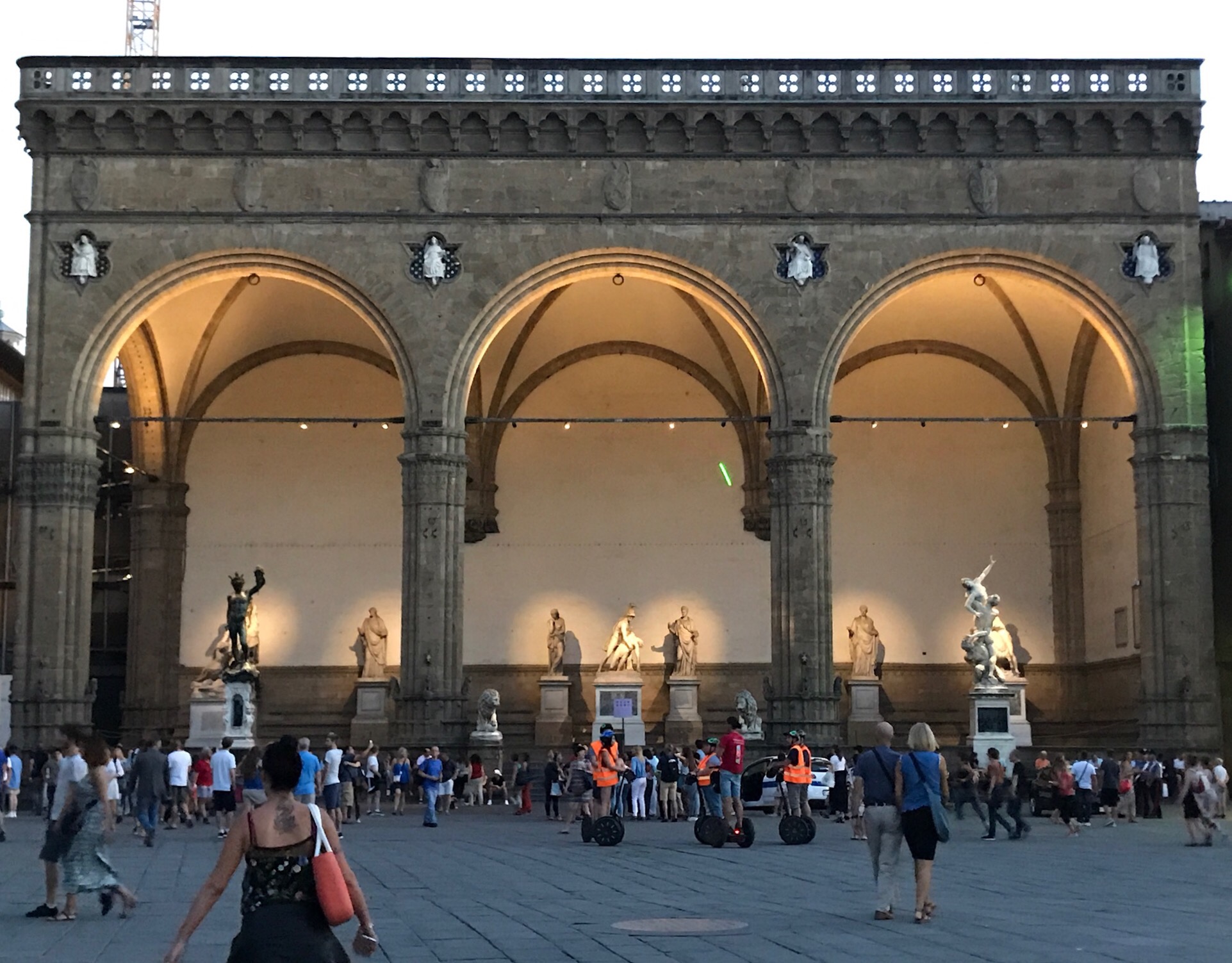
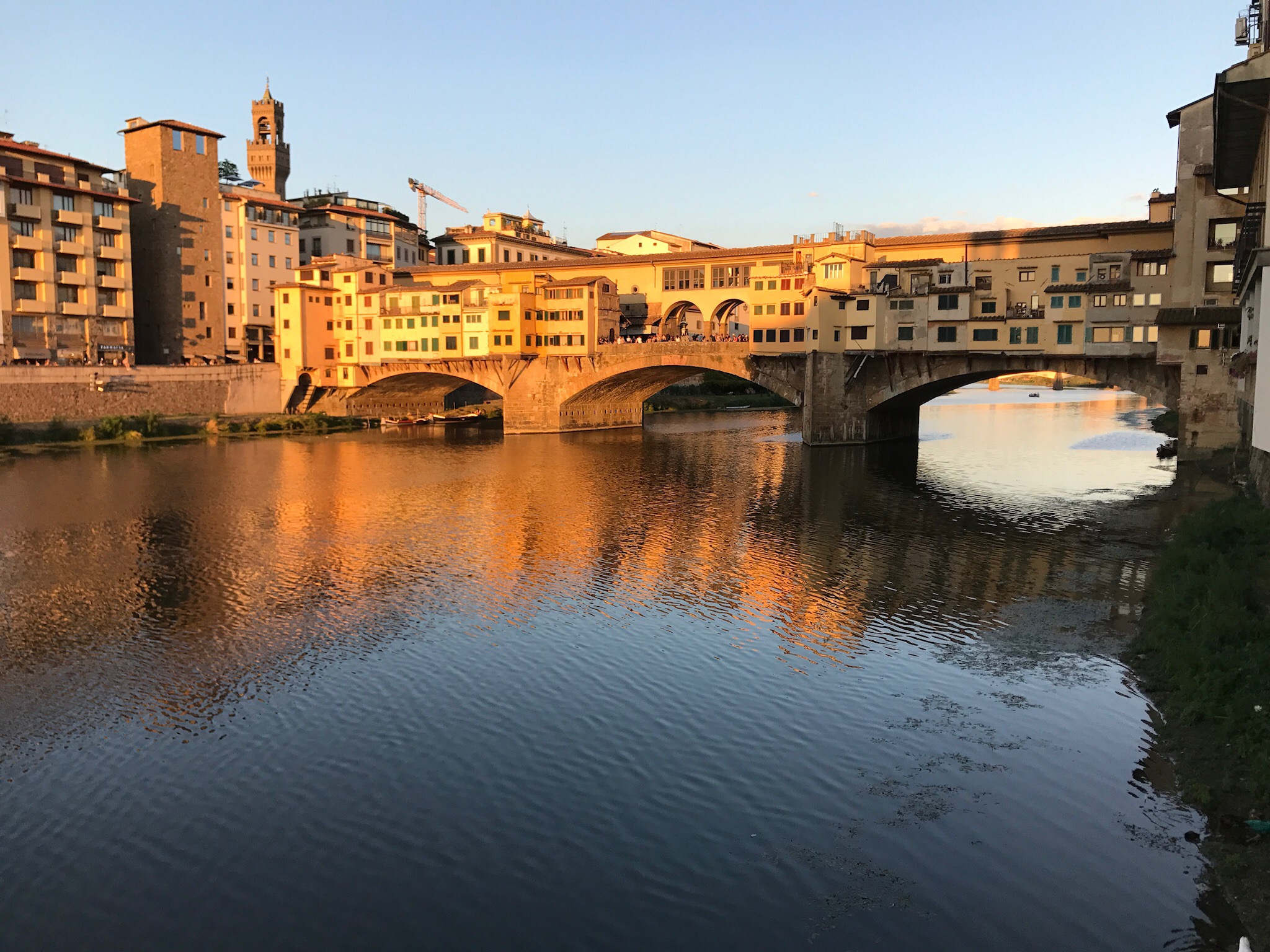
In the meantime, we’ll have to console ourselves with memories such as these:


Now we’re in Portland, trying to plan for a successful eclipse-viewing tomorrow!

Border-crossing, Italian style

Trump talks a lot about building border walls. Europe got rid of most of the ones it once had, but with more homeless and desperate folk seeking refuge throughout the continent, I wondered if more barriers would be evident in the course of our current visit to France to Italy. The answer is…mixed.

To get to Italy last Friday, we rolled our carry-on bags down the hill from Olivia’s flat in the French Alps to the little bus station on the main road through her village. We caught the 8:58 a.m. bus bound for Oulx (across the border in Italy); we’d bought the tickets ($8.85 per person) when we’d arrived in town a few days earlier. The bus was clean and pleasant and not very full The ride took only 95 minutes, and the views out the windows entertained us the whole way. We climbed through the beautiful alpine valleys, often well above the clouds.For a while, the road reversed itself, making one 180-degree turn after another.

Those cars weren’t going in the opposite direction. They were behind our bus, which had just rounded yet another bend.

I felt happy that I wasn’t powering myself upward like some of the warmly dressed cyclists we rumbled past.

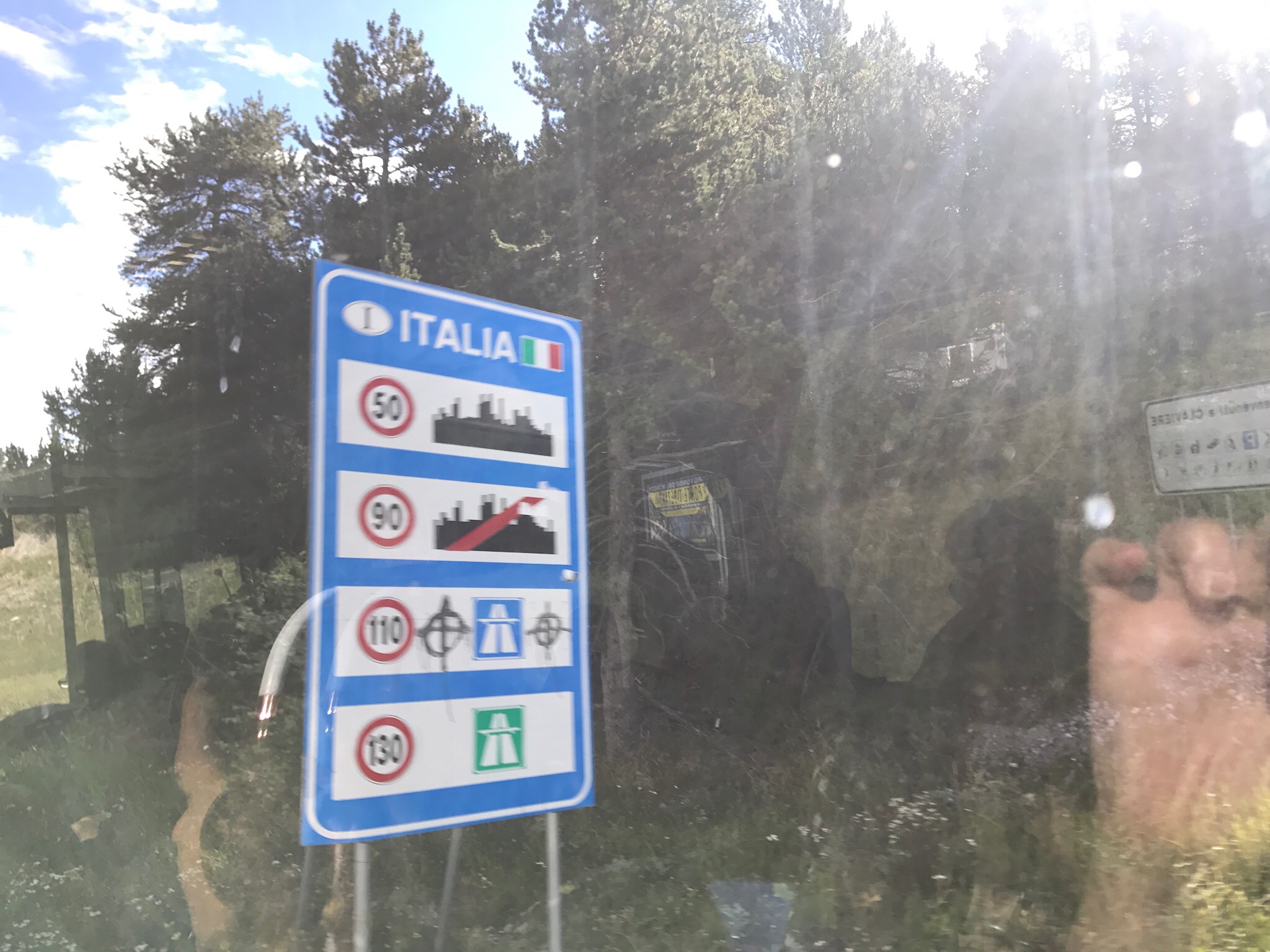
Near a high point, we stopped at a small French town where a few of our fellow passengers disembarked, and a little ways down the road, we passed a wood and glass structure where Steve caught sight of a couple of French officials seated at desks. They didn’t glance at our bus. A minute or so later, I snapped a photo of a sign welcoming us to Italy. Steve also spotted a little shack that he thought might once have served as a border-crossing inspection station, but it was abandoned.

That was it. No one ever asked if we even were carrying passports. The bus reached our destination on time, we dashed across the tracks at the station and caught the train leaving for Turin. (Although we’d bought tickets for the one leaving an hour later, no one seemed to care that we’d jumped on the early train.) We pulled into the Turin station on a cool, sunny morning, and rest of the weekend was filled with one pleasure after another.

I might conclude that European border-crossing was still innocent and hassle-free. But the old American friend with whom we spent the weekend had a different experience on his journey. His supposedly “express” bus got to Geneva (where he lives) more than two hours late, filled with passengers who reported being subjected to sniffer-dog inspections at the Swiss border. Going from Switzerland to France, his bus stopped again for more dog sniffing, and crossing from France into Italy, everyone was required to hand over his or her passport. Those were not returned for about a half hour.
It all reminded me: when it comes to border-crossing, you can’t count on anything. You just have to feel grateful when you get lucky, as Steve and I did.

Our French Wedding

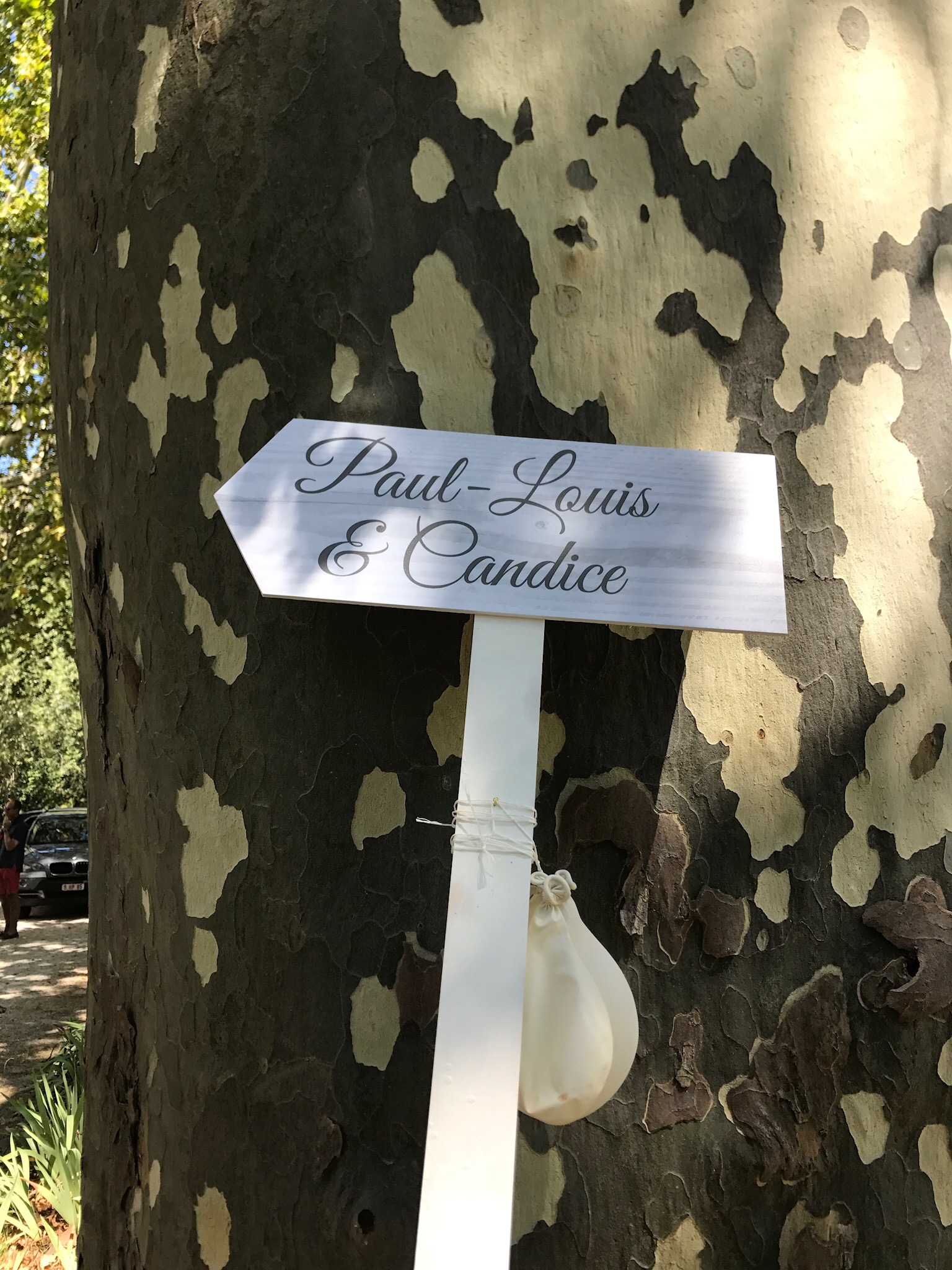
We came to France to attend a wedding. It’s a long way to travel, but we feel like we’ve known the groom since before he was born. His mother and I got pregnant almost simultaneously, and after decades of interactions, his family and ours feel as close as family. So Paul-Louis’s wedding stirred us and touched our hearts for many personal reasons. But it also was a fascinating intercultural experience.

Now that it’s over, I can report at least a dozen ways in which the marriage festivities were unlike their American cousins:

1) There were no night-before-the-wedding activities for those in the wedding party. This was great for us because it meant that our friend, the groom’s mother, was free to dine with us. Still, we marveled at the ability to stage such a complex dramatic event with no rehearsal.

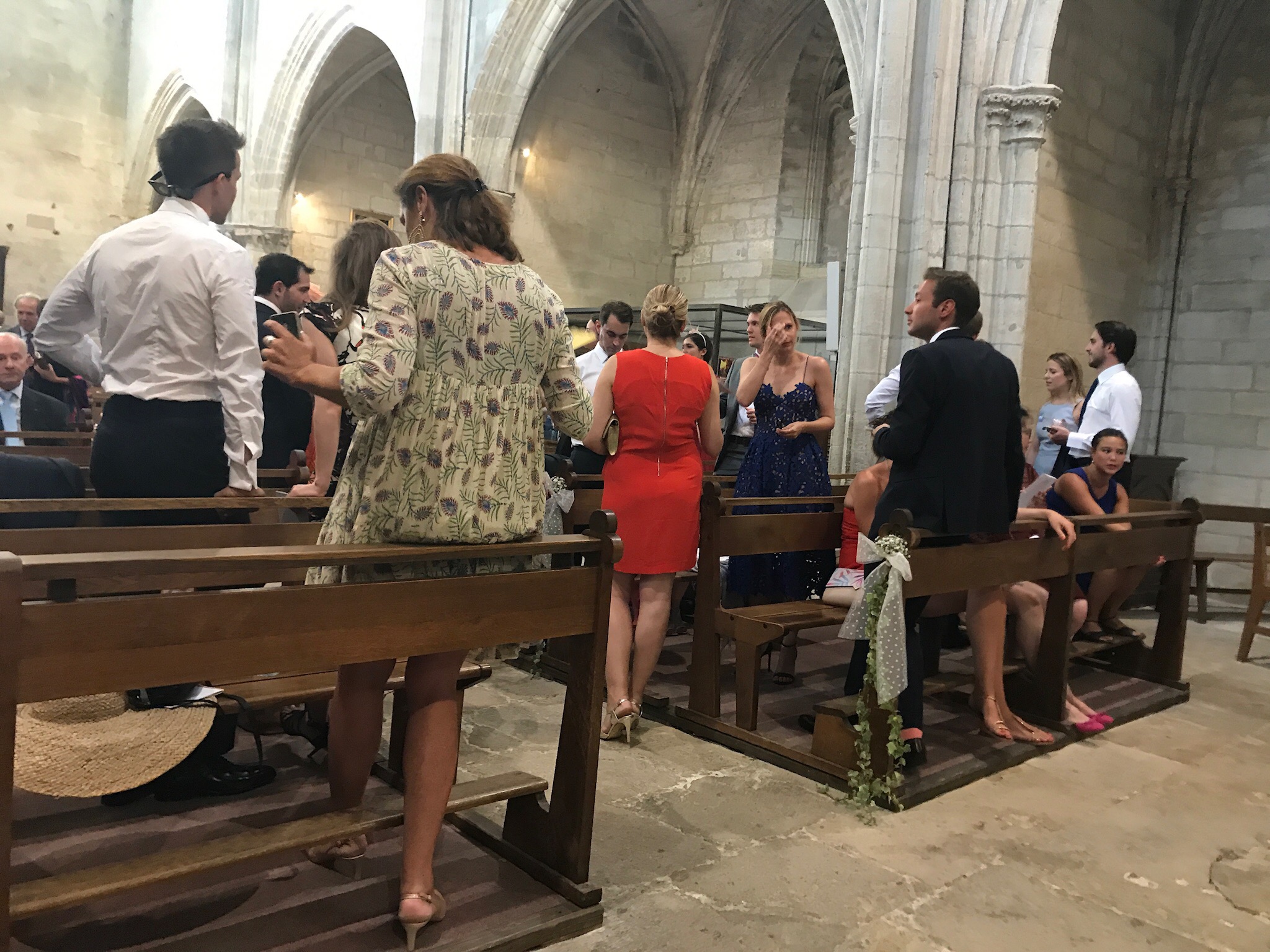
2) The bride and groom, like all married couples in France, were wed in a civil ceremony back in March. That was a much smaller affair, but still included immediate family members and godparents. It took place at the City Hall of Neuilly, the suburb just outside Paris where our friend Olivia lives. The bigger event (which we and about 175 other people were attending) was held in a church that is almost 700 years old, built back in the days when Roman Catholic popes lived and ruled from their palace in Avignon (just across the river) from the church town.

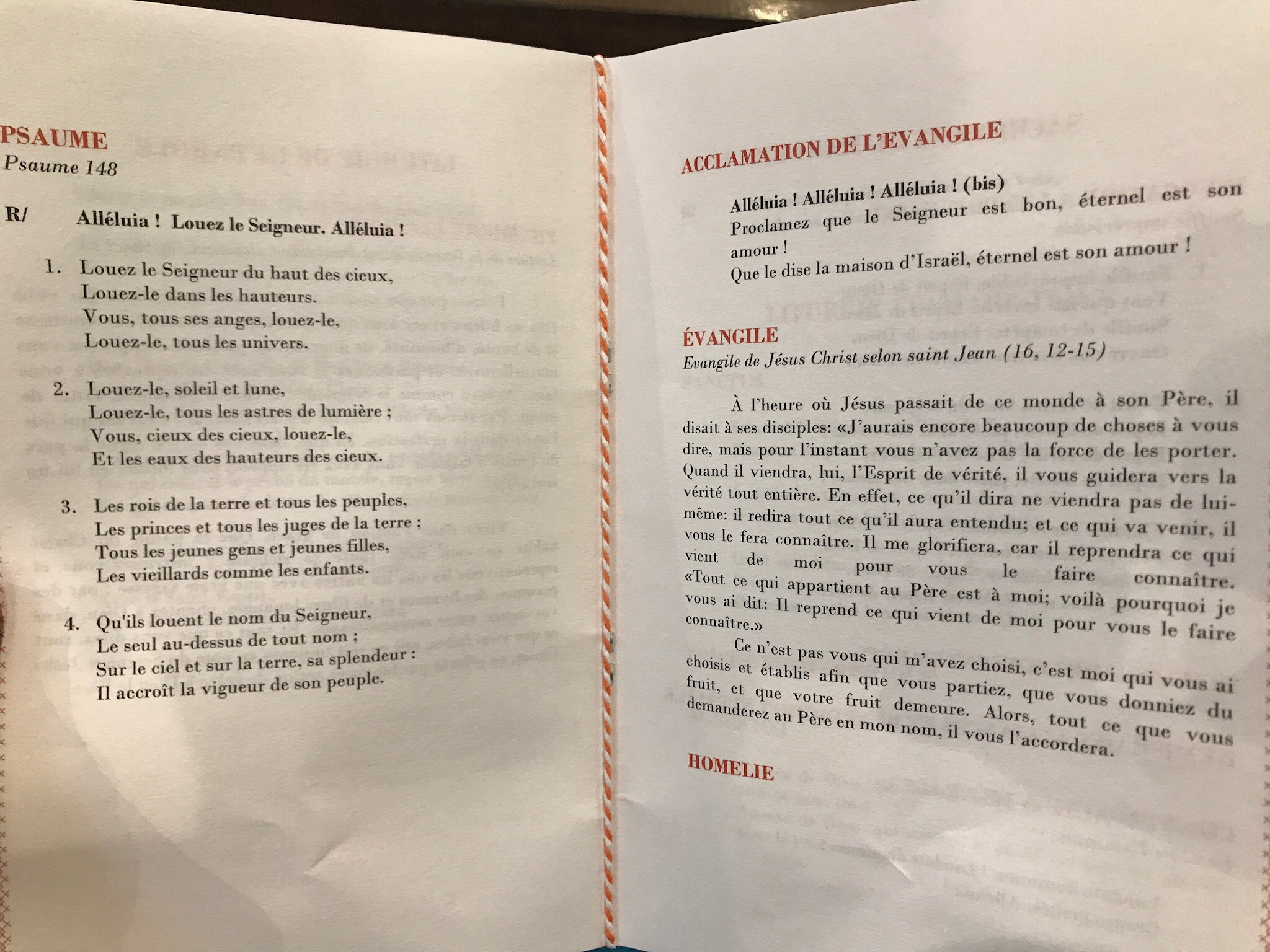
3) The church service, naturally, was entirely in French, and I didn’t recognize a single hymn.


4) Even though it was close to 100 degrees outside (and pretty toasty inside the church), the vast majority of the men (young and old) wore suits. Ladies got to wear much skimpier outfits.

5) The service was supposed to start at 3:30, but for 5 or 10 minutes past that hour, many guests stood in the main aisle and pews, socializing. (Some of the young guys took off their suit coats for this part.)


6) Most of the wedding party zoomed up the aisle briskly, paired up in ways that seemed eccentric to our American eyes: the groom escorting his mother to her seat in the first pew on the right side of the church; followed by the bride’s and groom’s sisters, escorted by their romantic partners also to seats in the first two pews; the groom’s father escorting the bride’s mother; two female and and two male “witnesses” each with escorts, and finally no less than seven adorable little boys (the offspring of the bride’s two sisters). In the program they were identified as enfants ‘d’honneur (literally, children of honor).


The bride and her father did move at a more stately pace, however.

7) There were NO flower girls (but many comments about how Paul-Louis and Candice need to make up for the dearth of family females).

8) Most alien to our eyes: after the marriage ceremony and Mass, no permission from the priest for the groom to kiss the bride, and no ceremonial striding of the couple down the aisle to the strains of Mendelssohn. Instead, the bride and groom had to sign some sort of register off one of the side aisles, and while they attending to this, the guests gradually got to their feet and straggled out the front door of the church.

9) The big finale instead came when the groom and bride walked down the aisle of the almost-empty church and emerged onto the front step, where almost everyone pelted them with white rose petals. (Everyone except for clueless Steve and me, still inside the church, confused about what was going on.)


10) The bride and groom drove off in a classic white French Deux Chevaux (their equivalent of our Model T).


A little while later, everyone converged on a domaine on the island in the middle of the Rhone River between Avignon and Villeneuve Les Avignons, and the reception festivities played out there. These were splendid: first cocktails on a huge lawn under enormous trees, then a very formal sit-down dinner, followed by dancing. The food and wine were superb. The speeches (as far as my French went in understanding them) were witty and articulate. And once again, we were fascinated by the cultural differences. Including:
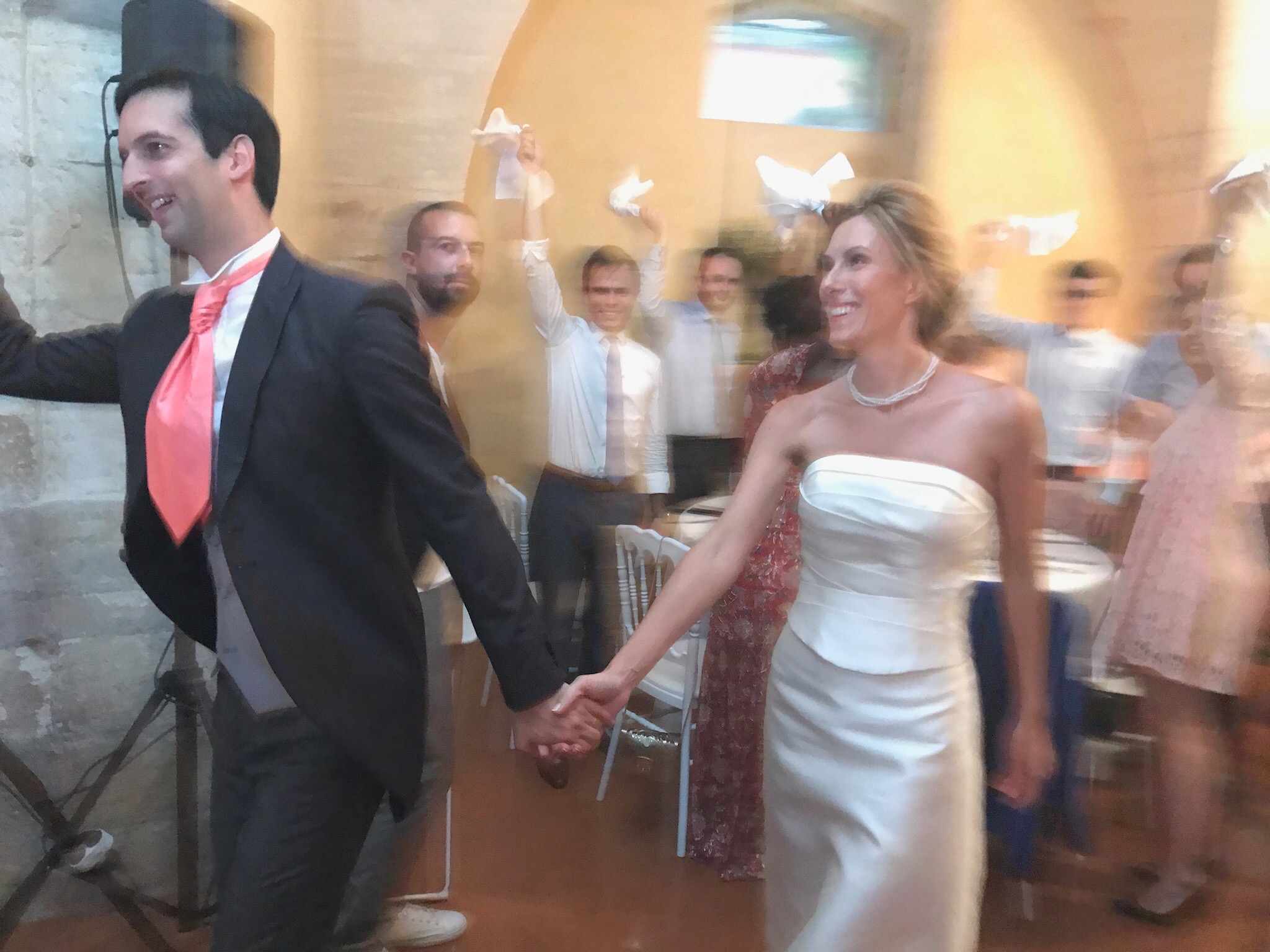
When Paul-Louis and Candice joined the party, the DJ in the room cued up music and everyone rose to their feet, twirling their napkins over their heads. This went on for quite a while.

The dinner and speeches lasted from 8 pm until about 12:30 am. Only THEN did the dancing begin!

I couldn’t resist joining in for 3 or 4, but Steve and I were pretty tired by then. We tumbled into bed about 1:30, but then arose again fairly early to join the brunch back at the domaine.

The grand lawn, where the cocktail party segment of the reception was held, along with the Sunday brunch.

All weddings are special. This was was sure no exception.