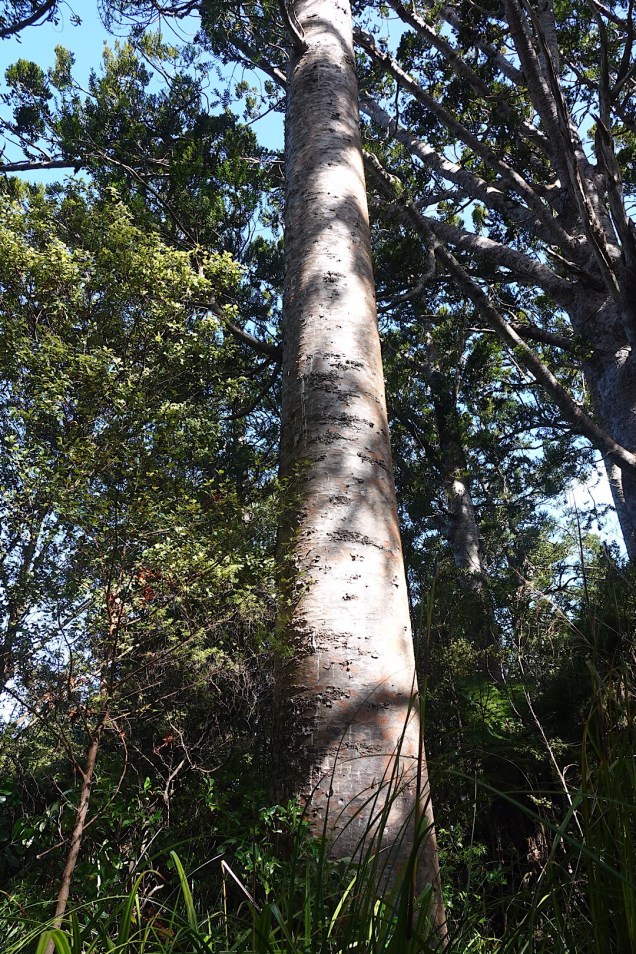
Years ago, an astute park ranger told me that perhaps the most valuable plant in all of Balboa Park was the kauri growing next to the Mingei Museum. This species (Agathis australus) is one of the most magnificent trees on the planet, capable of growing to massive size and living for more than 2000 years. Mature species are rarely found in the US. (The San Diego specimen is thought to be about 90 years old.) The Maori people considered kauris to be demigods; they cut one down only after reverent ceremony. However, when Captain Cook arrived in New Zealand, he judged them to be the finest sources of timber anywhere, and within a generation, something like 90% of New Zealand’s great kauri forests had been chopped down and carted off by Europeans.
Before this trip, I’d read that the Waipoua Forest on the northwest coast of New Zealand’s North Island is the largest remaining kauri sanctuary left on earth. Although Steve and I knew we’d have to drive for about three hours from Auckland to reach it, we decided to make the pilgrimage; that’s what we planned to do Wednesday (10/23). We confided our plan to some locals Tuesday, and they strongly advised us to instead head for a regional park an hour or so west of Auckland. The outing would be less grueling and we would see at least some kauris. We followed their suggestion and wound up being grateful we did.
We’re beginning to learn that a one-hour drive here FEELS like it took three hours. It’s not that the roads are bad; they’re in much better shape than most American thoroughfares. But people drive on the left side, and while Steve is competent at that, the switch still demands a lot of concentration, particularly when the streets are narrow and cars are parked along both sides or the curves are head-spinning, as they were over the mountains.
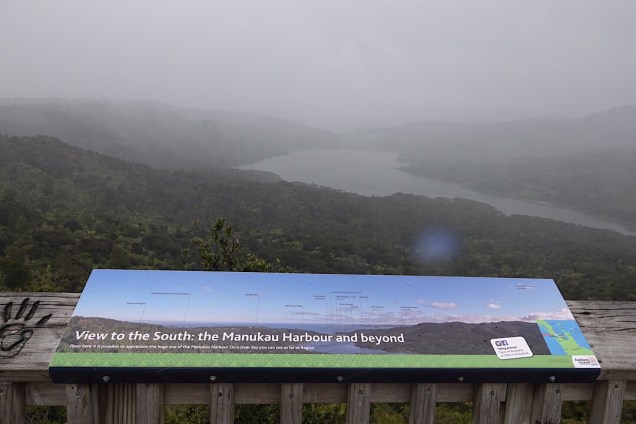
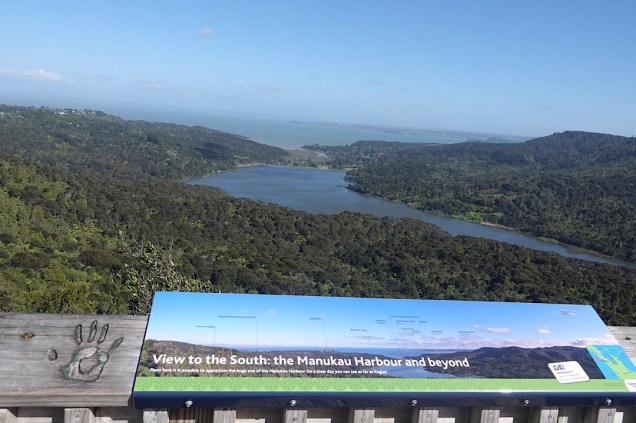
Moreover the weather Wednesday morning was wicked and tempestuous. When we checked in at the Arataki visitor center, this was the view to the south.
The friendly ladies at the center’s help desk suggested where we should go to see highlights of the area, and once again, the local knowledge was invaluable.
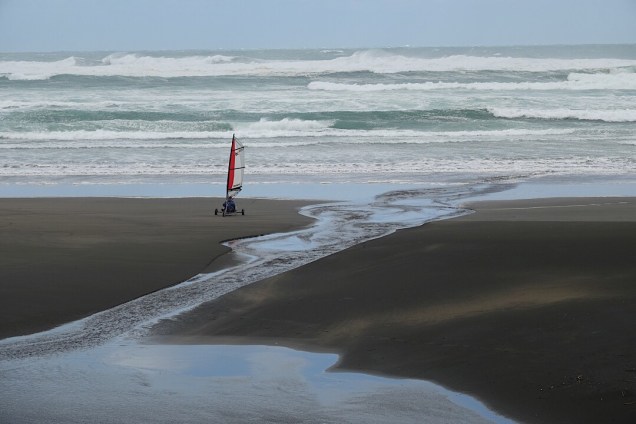
We drove west, to Piha, where the beach was almost empty, save for a land sailor harnessing the wind.
After lunch at the sole cafe in town, we took in the view of nearby Karekare falls…then hiked to the beach made famous by the movie The Piano.Grains of sand driven by the gale-force winds stung our faces, so we didn’t linger but instead drove back to the nature trail adjoining the Arataki visitor’s center.
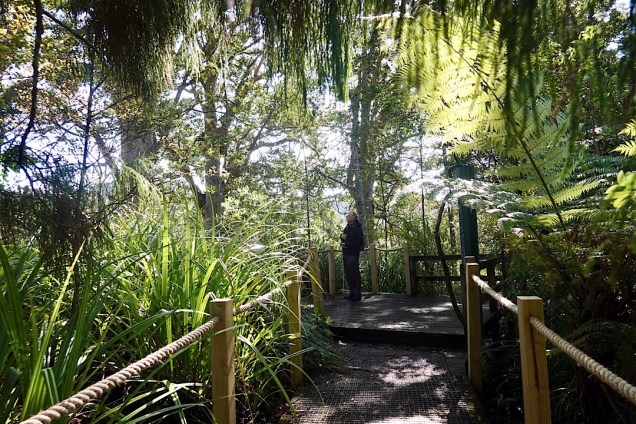
Present-day kauris are threatened, not by loggers, but by a virus that is killing many off, one by one. To combat it, forest managers have set up shoe-cleaning stations like this one.
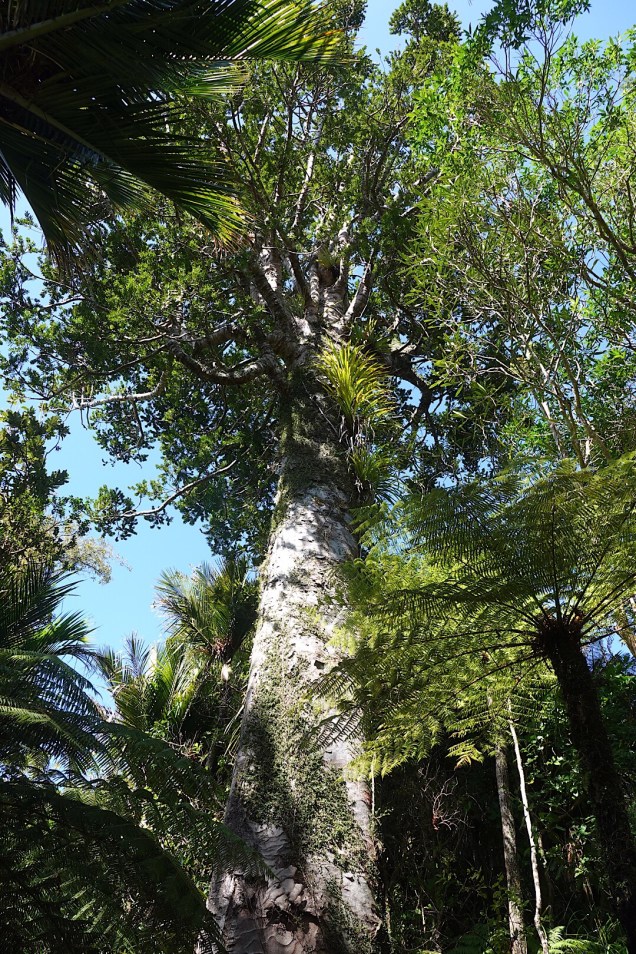
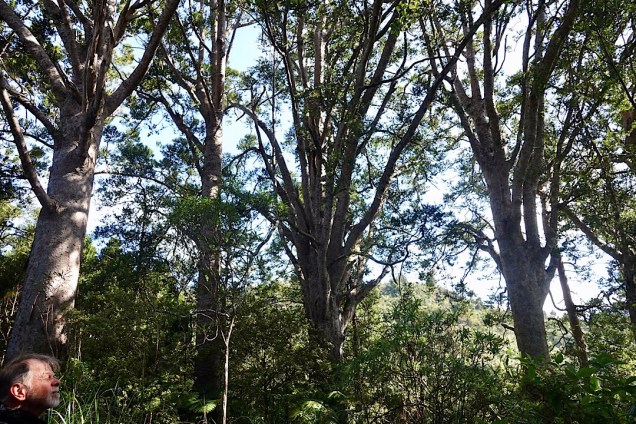
Dense forest pressed in. We saw just one other pair of hikers. The trail terminated in a spot that’s been designated the “Kauri Cathedral.” A dozen or so of the gigantic trees clustered there, looking as much as demigods as any plant could. We stood and looked at them for a long, long time before heading back to the visitor’s center.
Steve in the Kauri Cathedral
The wind was calming down. The sun was shining. That same view to the south which had been cloaked in gloom in the morning had changed to this.
I was sorry that we missed seeing the great kauri forest; that I almost certainly will never get to it. But we saw other soul-stirring sights and learned a lesson about the wisdom of being flexible about travel plans.
After barely 48 hours in New Zealand, we have learned one thing beyond doubt: this place is a meteorological wilderness. We who have lived all our lives in San Diego are like toddlers, lost in and bewildered by it.
We have weather in San Diego, of course. Some folks say it’s the second best in the world (after the Canary Islands). But it’s mostly the same weather. It varies from one part of San Diego County to another, and (in subtle ways) from one time of year to the next. But even in the winter, when the rain comes (if it comes), storms roll in slowly then often last for days. Weather unfolds in slow motion (when it’s not stuck in the loop of early-morning-clouds giving way to balmy late mornings.)
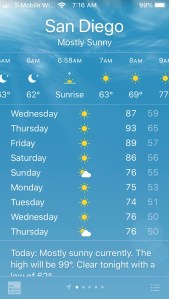
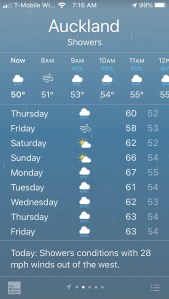
It is spring now in New Zealand, a season that travel guides recommend. But I’ve been dismayed in recent weeks by what I was seeing on my iPhone weather app for Auckland (our first stop). It’s looked a lot like this. Or worse (no sun of any sort). When we arrived, Monday, the icon was Rain.
However, when we emerged from the airport, the sight that greeted us lifted our tired spirits. Blue sky was interlaced with puffy white clouds. The weather app was wrong! I rejoiced. This would be a lovely day.
Now, two days later, we realize that the weather app is just hopelessly simplistic for weather the like of which they have in New Zealand. There is no icon for Many, Many Kinds of Weather, changing rapidly from one type to another. Monday morning after we got our rental car, drove to our home-exchange house, settled in, and made our way to the closest grocery store to stock up on basic supplies, it had started pouring. When we emerged from the grocery store, the rain had stopped, but the skies were dark and threatening
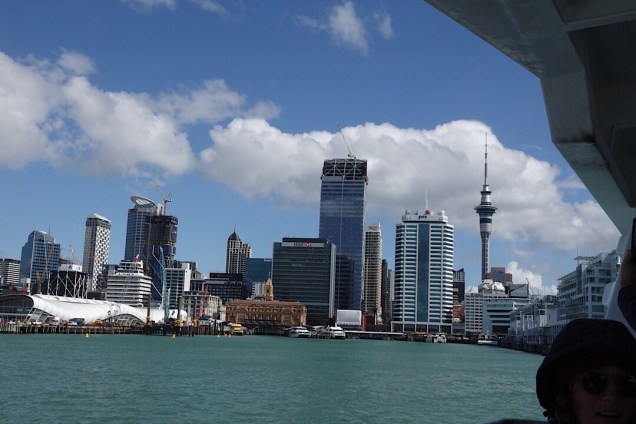
Back at the house, we ate lunch then napped for about an hour, before driving the 15 minutes to catch the ferry to downtown Auckland. Once aboard, the sun was out again, and the city looked glorious.
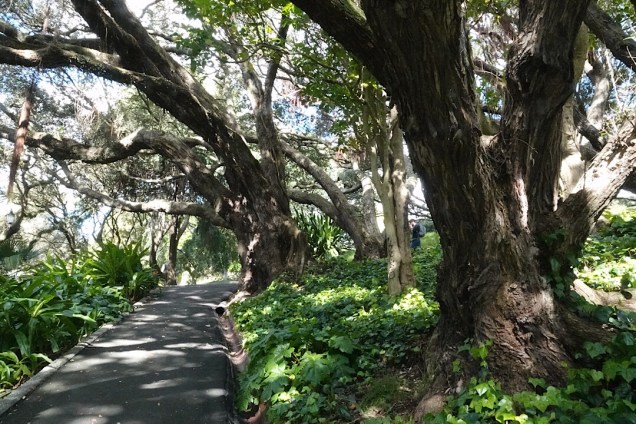
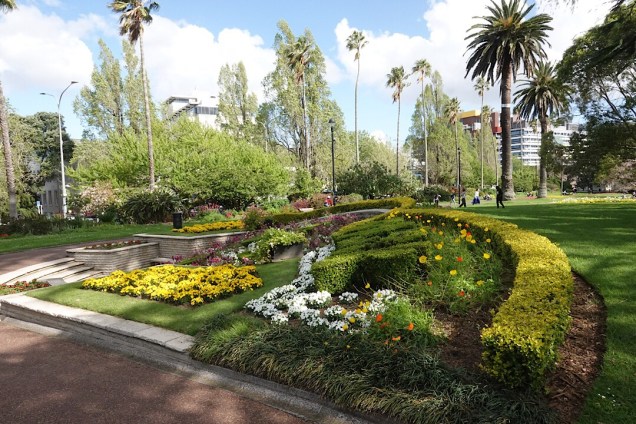
The boat ride took ten minutes, then we set off to follow a Lonely Planet walking tour of the Central Business District. This ramble took about two hours, and showed us a city radiant with spring: sunny and flowering and so warm I had to keep shedding layers and stuffing them into our daypack.
We caught the 5:45 ferry back to the north shore, at which point it was pouring rain again. When it rains with such intensity in San Diego, you know that it will last for at least 24 hours. Here, however, the deluge had stopped when we got back to Devonport, cozy under a full rainbow.
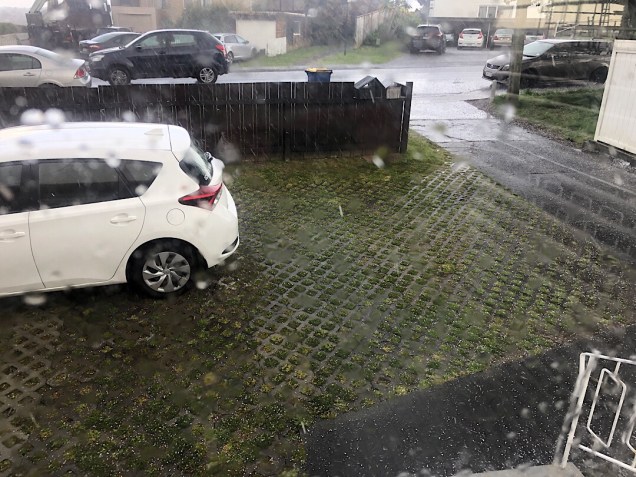
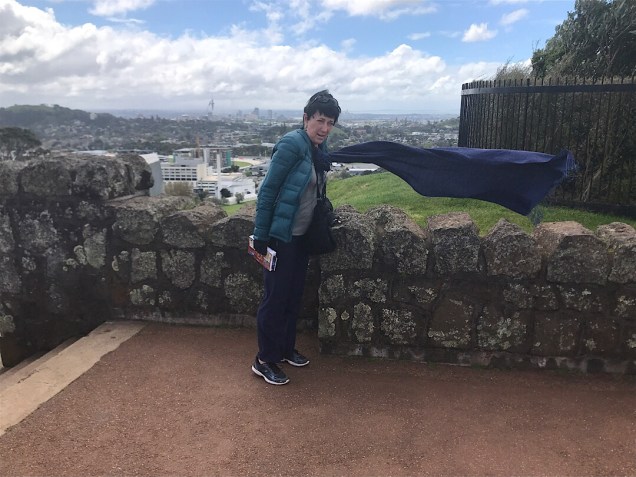
Things have continued in this vein since then. A half hour ago, a mixture of hard rain and hail was pelting our front yard. Now the wind is blowing in an excessively noisy manner, and all the trees are whipping about violently.
You can’t see the rain slamming down, but all those white spots on the ground are tiny balls of ice (aka hail).
We are slowly adjusting to the idea that we simply must take all our layers and rain gear and be prepared for the world around us to transform itself within minutes. As Steve points out, he and I do not travel to experience places that are just like home. By that standard, this trip is already a raging success.
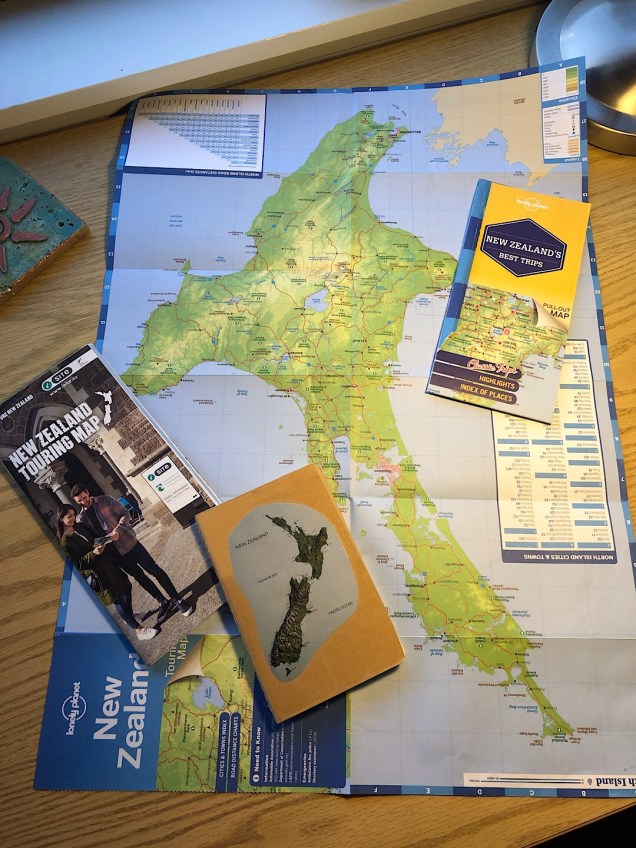
Tomorrow we depart for Middle Earth (aka New Zealand), a part of the world (Oceania?) to which we’ve never gotten close before. It’s not that we lack interest in the land of the kiwis or in Australia (where we’ve also never visited). Rather, we’re trying to be strategic in our travels, visiting more difficult places first and saving the safer and more developed destinations for when we’re more infirm.
What prompted us to target New Zealand now is not increased infirmity, but the realization that hiking and trekking in New Zealand is a great attraction (at least for us.) We figured we should do that before our joints rebel.
So it is that we will trek for three days on the Routeburn Track, considered to be one of the greatest of New Zealand’s “Great Walks.” That’s in the South Island, but we’ll start our touring in the north, renting vehicles to cover as much ground as possible. We’ll stay in a home in Auckland, where spring has sprung (at least according to the calendar). As usual, I’ll try to report on our adventures. It may feel different not to be taking anti-malarial medication. But we should be able to handle that.
The US/Mexico border has spawned a lot of anguished stories over the past few years, so I’m happy to report that something jolly took place at the very southwestern-most point of the continental United States the other day. Several hundred Americans and Mexicans gathered on the beach where the border meets the Pacific, and we practiced singing a song (the Beatles’s “A Little Help From My Friends”) together. The end result wasn’t the most polished choral effort in history. But surely it must rank among the most offbeat.
Back in early September, Steve and I had learned that ArtPower, the UCSD performing arts series, was sponsoring this special event featuring Choir! Choir! Choir! — a Toronto-based singing group run by two musicians who take the non-traditional approach of including anyone who wants to participate (usually for an admission fee, though the UCSD event was free). They often tour, teaching each audience an arrangement of a well-loved song. This time, however, they would be adding a twist: doing it with folks situated on both sides of the angsty international line.
We signed up immediately and heard the US crowd would be limited to 500; got word some registrants were put on a waiting list. A few weeks later, we learned of a change in plans: state park officials were suddenly demanding that ArtPower submit the names of all registrants in advance. They would not be able to drive into the park on their own but rather would need to be shuttled in from an outside location.
More directives trickled in: we would have to meet at Southwest High School, be checked in, and allow ourselves to be wristbanded. We could bring in no weapons; plastic replicas of weapons; knives of any size; explosives; fireworks; umbrellas; poles or sticks; laser lights or pointers; coolers; containers of any type (except for water bottles); aerosols; mace or pepper spray; camera tripods; sharp objects such as scissors or knitting needles; Leatherman or similar tools; bullhorns or similar “voice-enhancement devices;” noisemakers such as air horns, whistles, or drums; banners, signs, or placards; animals; or backpacks larger then 12x12x20.
Undeterred, Steve, our visiting friend Megan, and I headed for the high school around 1 pm Sunday (October 13). We checked in, sizing up our fellow singers, a range of ages but mostly white folks who all looked like NPR listeners. Before long, our bus set off southward, and it didn’t take long to reach the park. We disembarked, trying to scope out what the heck we would be doing. In January of 2018, Steve and I attended another cross-border performance. That one was a percussion concert that we watched from the Tijuana side. For it, some of the US musicians were allowed inside “Friendship Park,” that no-man’s-land created inside the double American fencing built in the late 90s and early 2000s. Nowadays it’s only opened for special occasions.
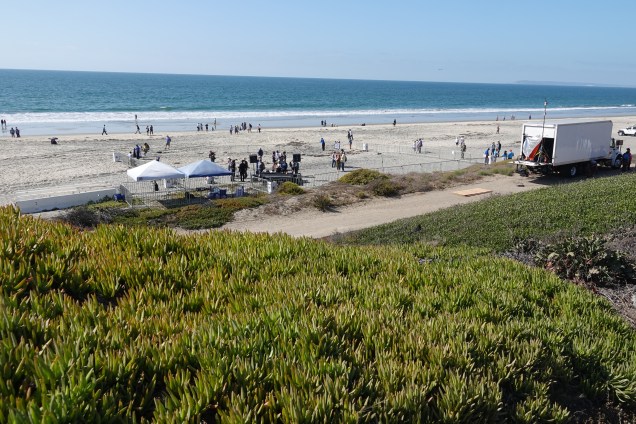
But the inner park was locked. Instead we were directed onto the beach, where we could see a small stage and a sound truck. Stern signs, police tape, and an intimidating roll of coiled razor wire prohibited us from approaching the barrier there. Beyond it, a sea of beach umbrellas and people were barely visible. I’m pretty sure there was beer on that side. And tacos. Probably music too.
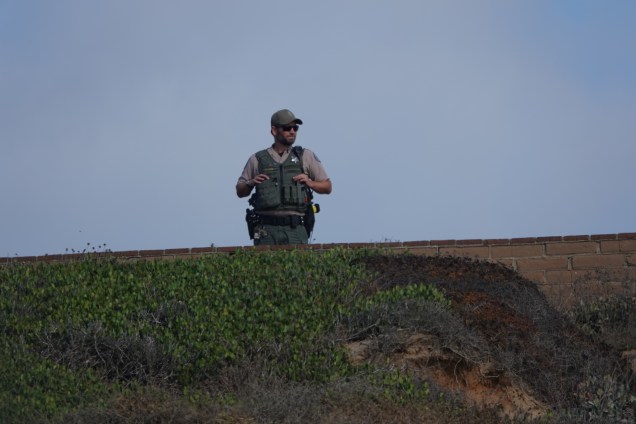
We, on the other hand, were herded into a metal enclosure, where we waited for the program to begin. Up above us, armed guards, some with dogs, looked down, stony-faced. “This is kind of interesting,” commented the guy standing next to me. “I’ve been to the beach before. But never in a cage.”
If the setting on our side of the border had some grim elements, the activity, once it got started, included lots of laughs. Daveed Goldman, the Choir! Choir! Choir! director leading the American contingent, is quite a comedian (as well as a competent guitar-player). His cohort who was working the Mexican side, Nobu Adilman, seemed a bit stricter a task master. Both guys wore microphones, so we could hear everything said by each. The Mexican wannabe choraleers yelled and applauded when they were introduced, and of course we responded in turn. (There seemed to be a lot more of them.) We waved our sheets of lyrics at each other in the distance, and that made the fence and the distance between us feel a bit less dreary.
The actual song practice was more serious than I expected. We gringos sang the first lines —What would you think if I sang out of tune? — and the Mexicans sang back in Spanish: Levantarte y marcharte, quizás? (Would you stand up and walk out on me?). We practiced certain sections again and again. At first, the Mexicans’ voices sounded faint and distant, but over the course of the next hour we all grew louder and more confident. By the final run-throughs, I think everyone was singing more or less together. There were nice harmonic flourishes. The final cheers were robust.
From time to time throughout the experience Daveed chastised American participants for holding up their cell phones and recording what was going on. “We are recording all of this for Youtube — and we will do a better job!” he bellowed. “You should be living in the moment.” I’m not sure when the official Choir! Choir! Choir! video will be posted to the group’s Youtube site. When it is, I’ll add a link here. In the meantime, here’s a link to some video shot on the Mexican side of the border. I expect the final Choir! Choir! Choir! product will look more polished than it felt when we were singing it. But I bet it won’t feel as depressing and uplifting and fun as it did in person there.
I can’t say it has always been my dream to sleep in an Airstream, one of those iconic shiny aluminum travel trailers. Still, every time time I notice one out and about, the stylish design tickles me. So when the opportunity arose to experience one on a recent night in greater Los Angeles, I couldn’t resist.
We were going to LA to attend an 8 pm concert at the Hollywood Bowl, meeting our son and his family there. At the moment I am flush, if not with cash, with Guest Points acquired through one of the oldest and largest home-exchanging organizations (homeexchange.com). Looking for options on their site, I spotted the Airstream permanently parked in the Burbank backyard of a couple, Eva and Lars, and their four children. It “cost” only 150 Guest Points and looked charming, in the photos. And it appeared to be only a skip and a jump from the family’s quiet neighborhood to Hollywood. Steve was skeptical, but he acquiesced. I set up the exchange (of the points for the one-night stay), and last Saturday morning, we packed small bags and headed north.
First we stopped at the newly renovated Beverly Center mall in Beverly Hills, where I wanted to visit the large outpost of Uniqlo (the Japanese clothing maker whose casual wear several friends have raved about, but which I had never seen first-hand since the chain has no stores south of Orange County). The mall felt a bit like a spaceship, and the Uniqlo was very interesting. I bought a few $15 t-shirts made of a high-tech material that supposedly heats up any moisture you emit to keep you warmer. We’ll see how that works.
But then we had to hustle on to Burbank, which felt like it was about three times farther from Hollywood in reality than it had been in my head. Eva and Lars greeted us and showed us the trailer. If anything, it felt more attractive than it looked online, being surrounded by a nicely landscaped backyard and sitting area. Restored to pristine condition, the interior seemed roomy enough, and when we slept on it later that night, the queen-size bed was surprisingly comfortable. Still, I can now report that spending the night in a nice, clean Airstream felt pretty indistinguishable (to me) from spending the night in any nice, clean garden-variety trailer. I’ll probably continue to admire the zoomy exterior design whenever I see one, but I won’t be shopping for an Airstream of my own any time soon.
If that aspect of the weekend proved underwhelming, the other main elements exceeded expectation. To avoid the hellish traffic and parking nightmares around the Hollywood Bowl, we drove our van to the North Hollywood Metro station and parked on the street nearby. Then we rode the metro two stops to Hollywood and Highland, walked the mile or so to the Bowl, and dined on the picnic dinner we had packed and carried with us. The transit part all took more than an hour, but doing it by car would have taken at least as long and been much more stressful.
Furthermore the people-watching on the metro and the walk through Hollywood was unsurpassed, as it was inside the Bowl (which neither Steve nor I had ever seen, in all our years of living in Southern California.) Genial and head-spinningly multicultural, the huge crowd seemed to be in a great mood.
The program featured the music of “Game of Thrones,” performed by the show’s original orchestra and directed by composer Ramin Djawadi. Once the concert got underway, we were blown away both by the sound and beautiful setting. I’m not sure if we’ll ever get back for another concert, but (unlike the Airstream Experience), I would like to.
By the time we tumbled into bed (around midnight), it felt like we’d surveyed a broad swathe of LA Life. But the next morning we got more when we left Eva and Lars’ place and drove to MacArthur Park, hoping to participate in the “Heart of LA” CicLAvia event taking place from 9 to 4 pm Sunday. Inspired by a venerable bicycling event that began decades ago in Bogotá, Colombia, LA versions of it began 9 years ago and have since attracted more than a million and a half people. The idea is to close key streets in a given area and turn them over to pedestrians, bikers, and other folks on wheels (skates, boards, pedicabs, and more) for use as a public park throughout the better part of a day. I participated in one several years ago in San Clemente, but I’d never done one of the LA versions.
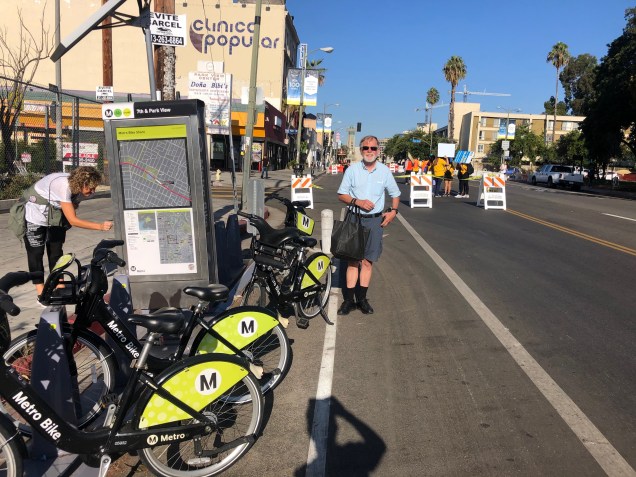
One problem was: we couldn’t bring our bikes (because we knew we would be transporting our son and his family and their luggage back to San Diego). But a savvy friend had alerted us to the Smart Metro Bike program that’s part of the LA metro system. I’ll confess Steve and I were skeptical we could find two of those bikes and get access to it. But after very few minor hassles, we succeeded!
Total cost of renting two of them for almost two hours: $10.50.
We biked from the park down 7th Street to the heart of downtown, then turned onto Broadway, passing iconic gems like the Bradbury Building and Clifton’s Cafeteria and the LA Times Building as well as monstrous new public edifices such as the police department headquarters. We took the arm of the route that headed southeast, skirting Little Tokyo and crossing the marvelous 4th Street Bridge over the railway lines. Sadly, we ran out of time and had to turn back before making it to Mariachi Plaza in Boyle Heights. We missed altogether the arm that went to Chinatown.
If we’d had the whole day, we could have easily spent it stopping to view the art and architecture along the route, listening to music, eating at many dozens of options. We didn’t. But it makes me happy to know it’s not that far away. We can go back.
Considering what a small (and little-visited) country Ecuador is, I wouldn’t have been surprisedto find it pleasant but unmemorable (apart from the Galapagos Islands, which are unique.)
Parts of our short stay were like that. But four experiences electrified me.
Watching the changing of the government-palace guard in Quito
I’ve seen the changing of the guard at Buckingham Palace, but the ceremony at Quito’s government palace (the Ecuadorian equivalent of the White House) makes the British version seem dull. Commentators trace its origins back more than 200 years, to shortly after Ecuador won its independence from Spain. In recent years, it has taken place every Monday, though the start time has shifted around a bit. We’d heard it was worth seeing. That’s an understatement.
We got to Plaza Grande, the city’s most iconic square, shortly before 8:30 am a week ago Monday. The presence of cops and a few brightly dressed palace guards milling around on the second-story balcony made us think something was afoot, but the action coalesced gradually. Guards astride flashy horses appeared, bearing flags. More guards with lances positioned themselves near the rooftop.Precisely at 9:00 the strains of stately, grandiose music became discernible, first faintly, then louder and louder, as almost two dozen trumpet- and clarinet- and trombone- and tuba- and bass-drum- and other instrument-playing guards emerged from the inner recesses of the palace. It was music with the power to raise the hairs on the back of necks; music that made me wish I could leave my viewing spot and march along.What followed went on for close to a half an hour, and it was too complicated to describe in detail: parading horses and solemn proclamations over a loudspeaker and marching lance-bearers and more and more of the thrilling music. (One missing element was the Ecuadorian president’s appearance on the uppermost balcony, another long-time part of the show. Whether he was just on vacation or worried about his plummeting popularity, I can’t tell you.)
Still it was most entertaining, and I couldn’t help chuckling at this small, not-very-prosperous country putting on such a flamboyant display of stately pomp. (I also thought: better them than us.)
Getting caught in the demonstrationWe happened upon our first Ecuadorian political demonstration, a small group protesting in front of the presidential palace, during our free walking tour of the city. “We Ecuadorians love demonstrations,” our guide declared. “You’re going to see a lot of them.” She got that right. During our four days in Quito, we witnessed at least three or four public protests, and I got a text from the US State Department warning that several big ones were expected on one of the days we were there. We should avoid them, the message ordered, but this wasn’t possible during our hop-off, hop-on bus tour of the city’s major sights.
The bus was a double-decker, and Steve and I were sitting on the open second level. From blocks away, we could see a large crowd down the street. We assumed the bus would detour around it, but instead, we headed straight for the protesters and the police and their snarling canines.
Within short order, the mob surrounded the bus. People chanted. Vuvuzelas blared. Despite the signs, it was unclear what was angering the protesters (though cutbacks to healthcare subsidies seemed to be involved.)I suspected the State Department wonk who sent out the text message wouldn’t have approved of our being in the thick of it. But the crowd seemed more high-spirited than menacing, and the cops looked chill.
After a few minutes, the mob parted and the bus rolled along its way. None of our other stops were anywhere near as thrilling.
Meeting the man behind the hacienda
We spent one night in the Ecuadorian countryside, in what Lonely Planet described as a “fairy-tale 17th-century hacienda.” Our friends had stayed there for a night, and we could see why they loved it. The gardens were exquisite.
And the interiors felt like a museum.
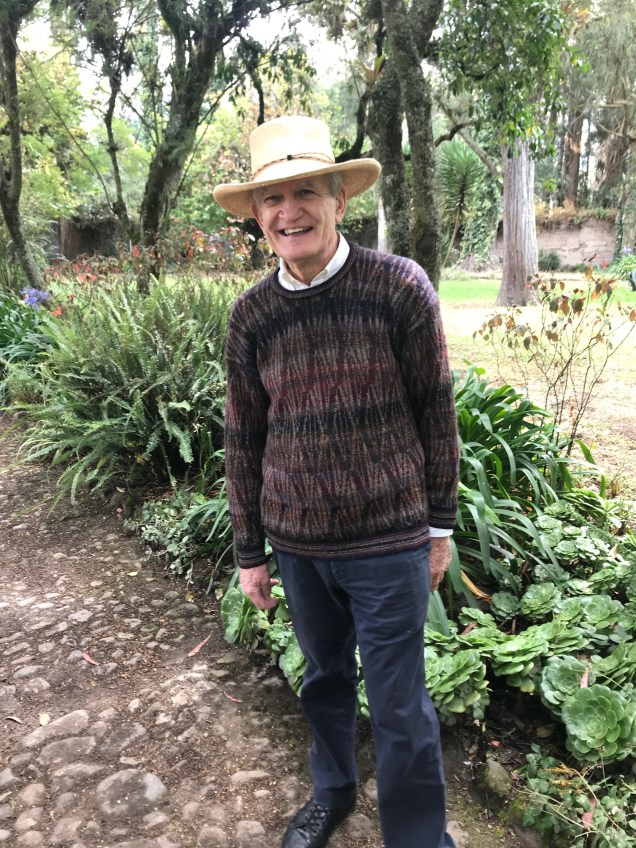
The spine-tingling moment for us came when a distinguished looking gentlemen approached us while we were dining in the grand salon (above). He introduced himself as the owner, Nicholas Millhouse, and over the course of the next hour or so, he shared a small part of the saga that began when he bought the hacienda in 1990 and undertook the gigantic art project of restoring it from near ruin to its current glory.
An Englishman who spent his career teaching at a tony private school in Manhattan, he had early developed a passion for South America. For decades, he roamed the continent, collecting exquisite textiles and other works of art.
The next morning, we spent more time in his company, enjoying his sense of humor…
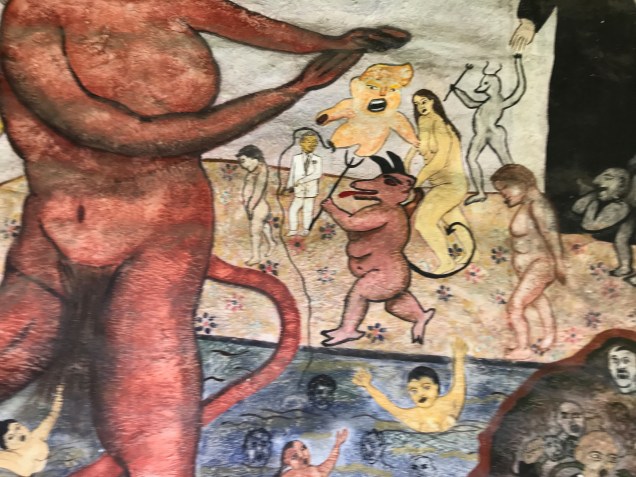
Note the political statement in this mural (part of a vast array of them commissioned by Millhouse)
…and learning a little about indigenous art and beliefs.
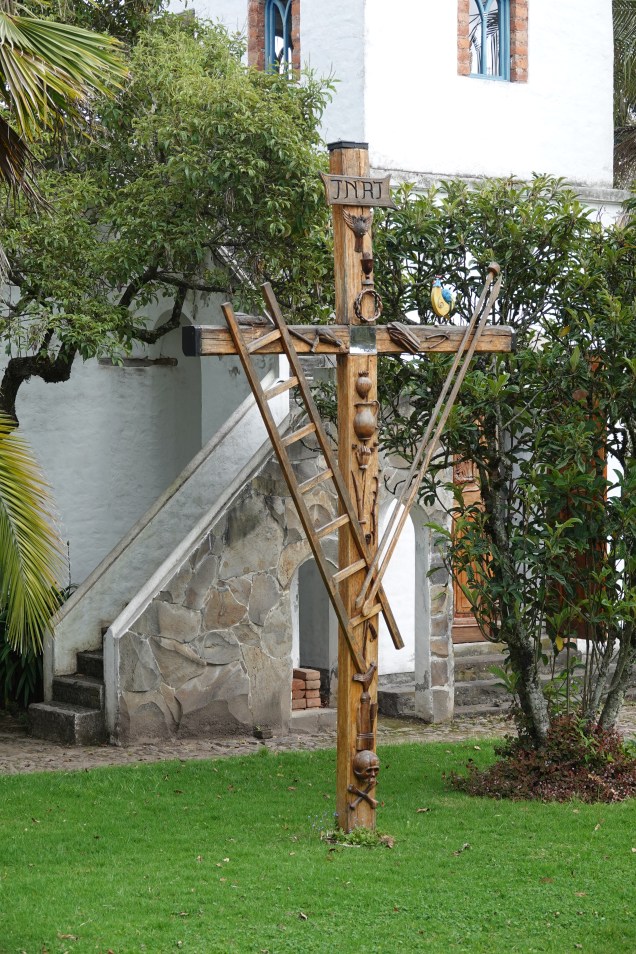
Millhouse also commissioned this cross, which incorporates important indigenous elements, such as substituting a mirror for the figure of the crucified Christ.
Millhouse still spends most of the year in Manhattan, so it was pure chance that we happened to be at the hacienda when he was in residence there. That blew our minds.
Walking into La Compañia
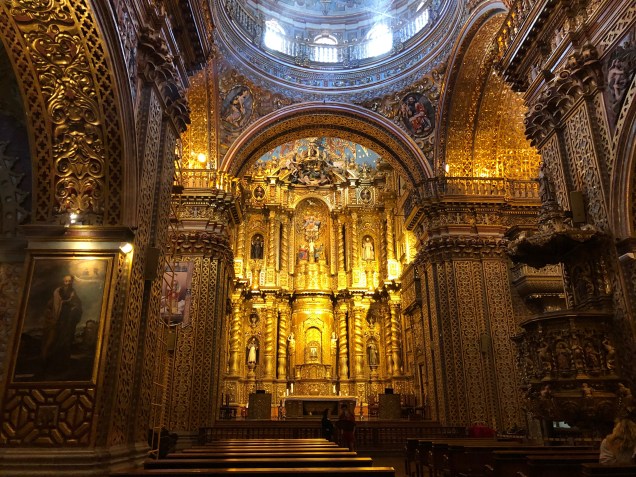
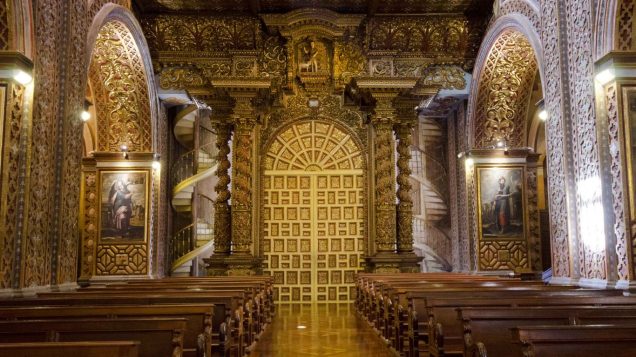
I’ve seen a lot of churches in my time, but few, if any, have struck me as being as beautiful as the Jesuit one in the heart of Ecuador’s capital. Somehow all the gold makes the place feel cheery and inviting, rather than garish.
The trompe l’oeil staircase to the right of the doors was painted to preserve the almost-perfect symmetry.
Supposedly, the Jesuits wanted the worshipping natives to feel like they had died and gone to heaven. Surely they must have succeeded.
Taking in the heartbreaking natural beauty
There’s no single moment I was poleaxed by Ecuador’s physical beauty. Instead it bowled me over and over: upon landing in Quito. Or horseback riding at the hacienda. Or drinking in the viewpoint, reached via cable car, near one of the city’s volcanos.
It’s one of the most beautiful natural landscapes I’ve encountered, and one of the reasons Ecuador should rank among the richest countries in the world, a South American Switzerland. The land also is fertile, blessed with so many microclimates almost everything can be grown here. Ecuador has more oil than anywhere on the continent except for Venezuela and Brazil. It contains vast gold reserves, not to mention the natural wonder of the Galapagos.
Instead, Ecuadorians struggle with strangling regulation, corrupt politicians, and almost-constant turmoil. (They’ve had 20 Constitutions since independence; 17 presidents between 1930 and 1940). That’s the heartbreaking part.
Will all those demonstrations lead to a better future for folks like her? Will some other force? If the creativity and energy latent in the Ecuadoreans could be unloosed, that would be truly electrifying.
I’ve dreaded writing this post. I’m afraid anyone who reads it will think I’m the sort of airhead who travels in order to buy stuff, when almost the opposite is true. I don’t buy much on the road, and Steve loathes shopping. Anything you buy has to be transported home, which is tough if you limit yourself to carry-ones (as we do). If the purchase requires bargaining, that adds to the stress. Then when you get home, you have to decide what to do with those quirky knick-knacks.
So many choices. So many potential bad decisions.
I found a partial answer to the last question a few years go, when I was puzzling over what to do with a beautiful piece of cloth I couldn’t resist buying for a few dollars in Senegal, a country renowned for its striking fabrics. Coincidentally, our youngest son had recently moved out, and I wanted to transform the battered bedroom of his boyhood into a guest room. A friend suggested I use the cloth as a wall hanging, and add additional African details. The room-renovation thus turned into a Project. It gave me a place to print and hang some of our many photos from Africa. Online I found a mosquito net and installed that over the bed. And I had an instant home for the other African souvenirs I had picked up in spite of myself.
Our own bedroom already was Asian. Decades ago Steve and I fell in love with Japan and built a Japanese-style master bed, along with sliding Japanese-style window coverings. So I suppose it was inevitable a Latin-American decorational fever eventually might seize me.
A room on a lower level from the main floor of our house is the closest thing we have to a living room. But it was pretty dumpy (having previously been incarnated as a home office and then a kids’ playroom). It had a few Latin touches (a papier-mâché parrot I picked up in Tijuana ages ago; a couple of tango posters from Buenos Aires.) When planning our trip for the eclipse in Chile and Argentina, I started toying with the idea of jazzing up this room by further South Americanizing it.
The toughest thing, I confided in email to my friend Doris, traveling in Ecuador at the time, would be to find a rug to replace the aging one in the room, handed down to us by some friends. Doris had a suggestion. In the Andean highlands, she and her partner Louis had just been dazzled by the beautiful textiles still being produced by master weavers. A few were still working with “backstrap” looms, an ancient art once practiced in various places around the world, using sticks, rope, and a strap worn around the weaver’s waist. Others created striking objects using more traditional hand looms. Why not spend a little time in Ecuador on our way home from the eclipse, and buy a rug from one of those guys?
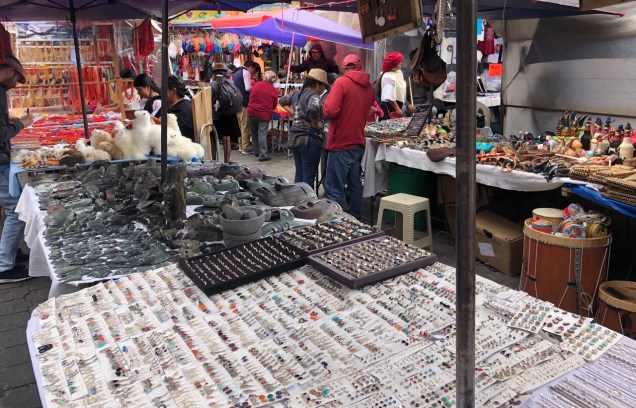
Her suggestion wound up profoundly influencing our plans. Besides visiting the Galápagos Islands on the cheap and having four nights in Quito (the first cultural UN World Heritage site, so designated for its striking and well-preserved colonial architecture), we would spend all the rest of our available time in Ecuador (three nights) in the town of Otavalo, renowned for having one of the largest and most famous craft markets in South America. At the town’s weekly Saturday fair, I should find some small decorations for my downstairs room, I figured. But my central mission would be to get a great rug and buy a colorful box to replace the ugly Tupperware container housing our puppy-grooming gear (which we use in that downstairs room).
I emailed the small hotel where we would be staying in Otavalo to ask if they could recommend anyone who might drive us to visit the local master weavers. Wendy, the owner of the Doña Esther, wrote me back that Luis, their regular taxi driver, would be happy to take us around for $10 an hour.
Luis made up for his lack of English with his deep local knowledge and eagerness to be helpful. First he drove us to a hillside village inhabited entirely by indigenous Andeans, where we parked… …and walked to the workshop of Don José Cotacachi.
That’s Luis and Don José’s garden.
Within the compound where Don José lives, a young woman demonstrated how the natural dyes are made. Some start with the scale insect that grows on prickly pear cactus pads. When squished, these creatures (known as cochineal) turn into a brilliant scarlet goo; mixing in other substances such as lemon juice produces other hues.
That crusty stuff on the cactus pad turns into the most brilliant carmine color.
Browns and tans are are derived from walnuts. The artists use such substances to color the alpaca and woolen yarns they weave into patterns both subtle and bold.
I fell in love with Don José’s work.But Steve and I were struck by a problem with using any of it to cover our floor. The largest pieces were less than four by five feet, smaller than what we were seeking. Furthermore, they weren’t very thick but rather more suitable for hanging on a wall or covering a bed. They’d be a bitch to vacuum, and we could all too readily imagine our dogs turning them into a rumpled pile of cloth.
We felt similar misgivings in the workshop of Don Miguel Andrango, an octogenarian famous for his preservation of Ecuadorian backstrap-weaving techniques.
The Andrango workshop
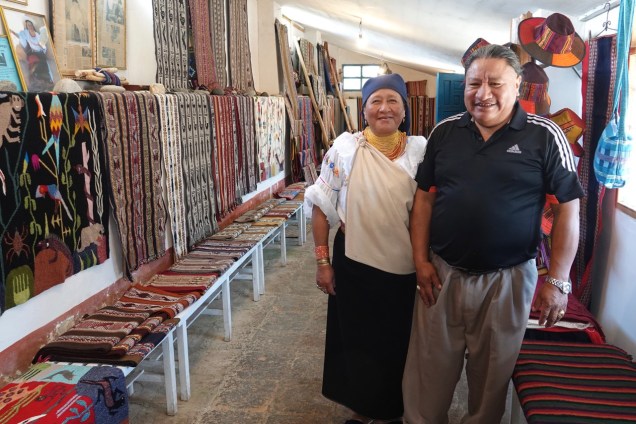
Although Don Miguel himself was ailing on the morning of our visit, three younger generations of the family are still producing beautiful work.
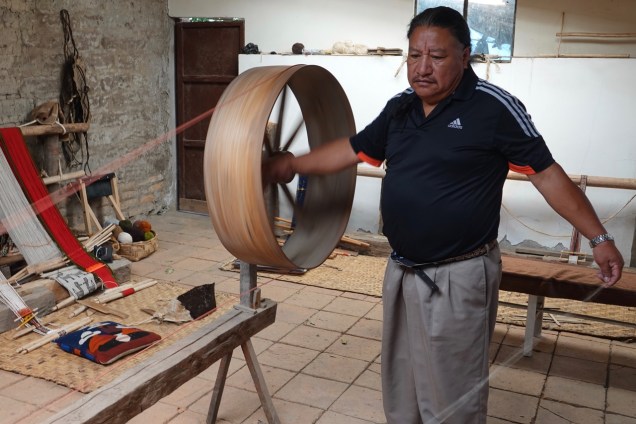
One of his son-in-laws showed us how they spin the yarn.Don Miguel’s daughter and her husband.
Once again, I loved their creations. I lusted to own one. But nothing seemed suitable for life on the ground. This time I broke down and bought a 6-foot-long by 1.5-foot wide weaving for $150 to use as a table runner. But my rug quest remained unfulfilled.
By the end of that day, Steve and I had formulated a new plan. We would visit the market in town the next day (Friday) and check out the carpets there. They might not be as beautiful as those produced by the master weavers, but they should cost less, and if they looked South American… well, we could live with that.
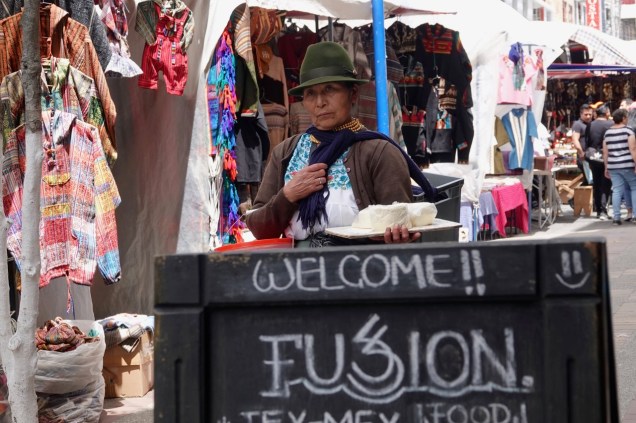
We must have spent close to two hours combing the Friday marketplace. Once again, we were dismayed by the absence of anything one might call a carpet. We found cloth that would make beautiful blankets; that might transform a couch. But nothing that resembled the South American carpet of my dreams.
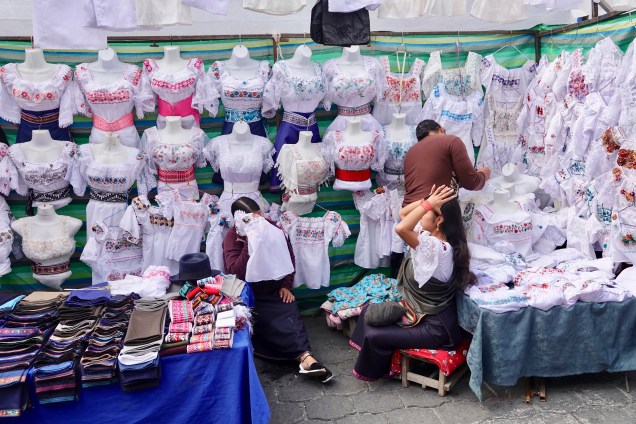
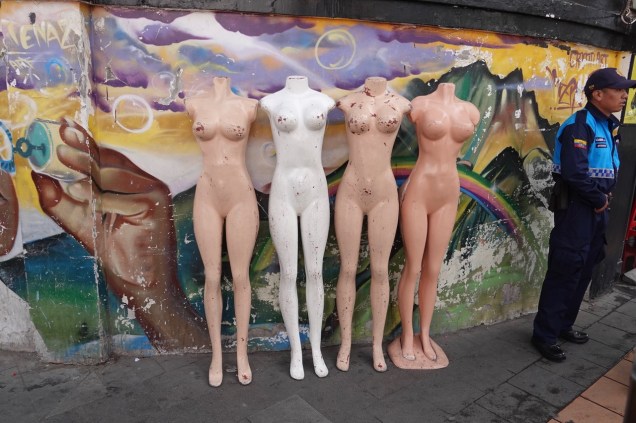
It’s a good thing I wasn’t looking for an embroidered blouse, like all the indigenous ladies wear.Or a busty mannikin. All the choices would have driven me crazy.
Sometime that afternoon we had an epiphany: we’d gotten it wrong. In our ignorance, we’d imagined a role for carpets in this culture similar to what we’d seen in Morocco or India. But now it dawned on us there wasn’t a single carpet anywhere in our hotel. Or in other public buildings we visited. The Spanish conquistadors had made lovely stone floor tiles that had become ubiquitous in this part of the world. But the local folk didn’t adorn them.
I’d been so intent, so sure, I would find what I wanted. In the end, though, we yielded to what seemed to be the evidence. On Saturday we returned to Don José’s and bought a weaving that will occupy a place of honor on our downstairs wall. But we’ll live with our hand-me-down rug (which, if produced in a factory, does look vaguely indigenous.)
The story of my hunt for a box almost turned out the same way. I was certain such boxes, eye-catchingly Latin, must exist. Vendors in the market would badger me to buy them, I fantasized. And when we looked for them at the gigantic Saturday market, we did find lively painted wood trays. We found a few plain wood boxes, and a handful of painted boxes — but only in sizes way too small to hold the doggy toothbrush and toothpaste and toenail file and cotton balls I wanted to conceal.
I felt sad as we hurried back to the hotel to catch our ride out of town. A few blocks away from the end of all our shopping, I stopped at one last stand specializing in painted wooden objects. If I couldn’t find my box, I decided, at least I could buy a tray. We negotiated a price ($35). And then I spotted a handful of similarly painted boxes in one corner of the stall — exactly the size I had been seeking.
The painted wooden vendor who had a big enough box to suit us.
So I got my box, along with a lesson: when you hit the road, you never know what you’re going to find. Forgetting that can lead to disappointment. On the other hand, I’m delighted with most of our purchases. We got to dive into the life of the market, a wonderful place. I also had five electrifying Ecuadorian experiences. I hope to share them in one more final, brief post.
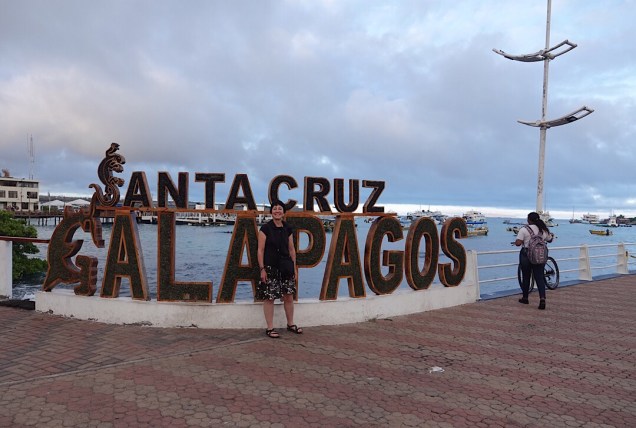
I was long baffled that Steve was never eager to visit the Galápagos. Both natural history and evolutionary biology have always fascinated him. There’s a lot of both in the island chain 600 miles off the coast of Ecuador. The place intrigued me, but the price of visiting always discouraged both of us. No tourism of any sort existed before the mid-1960s, and then for many years, the only way to see the place was to take the almost two-hour flight out, then board a ship that would likely cost at least $2500 per person for a basic five-day cruise and many thousands more for a longer or posher experience. For that kind of money, we typically cover a lot of ground.
What finally got us there was a combination of factors. The path from Santiago (our gateway to and from the eclipse) to San Diego lies almost directly over Ecuador, a country we had never visited. In early spring, our good friends Doris and Louis spent six weeks there (publishing vivid dispatches in their blog, Louis and Doris Partout.) Privately Doris urged me to consider stopping over in Ecuador on our return north. About the same time, I read a New York Times article about the surge in land-based travel in the Galapagos. This could be accomplished at a fraction of the price of cruising, according to the Times writer. I did a lot of quick, compressed research and we wound up deciding to spend two weeks in Ecuador, sandwiching in a 6-day, 5-night visit to two of the islands.
Now that we’re back on the Ecuadorian mainland, we feel completely satisfied with the way this worked out. We didn’t see as much as we surely would have had we cruised for two weeks and visited 5 or 10 of the islands. We didn’t see every animal visitors try to check off their lists; missed sighting any whales or hammerhead sharks, and never came within sight of a red-footed boobie.
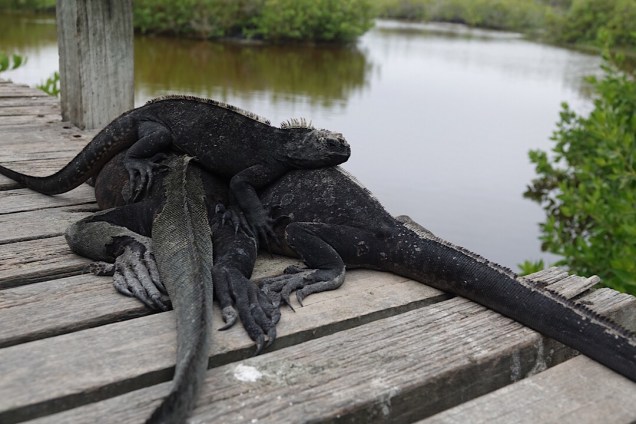
But we did observe a wondrous assortment of creatures: the eponymous giant tortoises and amazing swimming (marine) iguanas.
It was hatching season for the marine iguanas, so we saw hundreds of the babies, like these.
Marine iguanas seem a sociable lot.
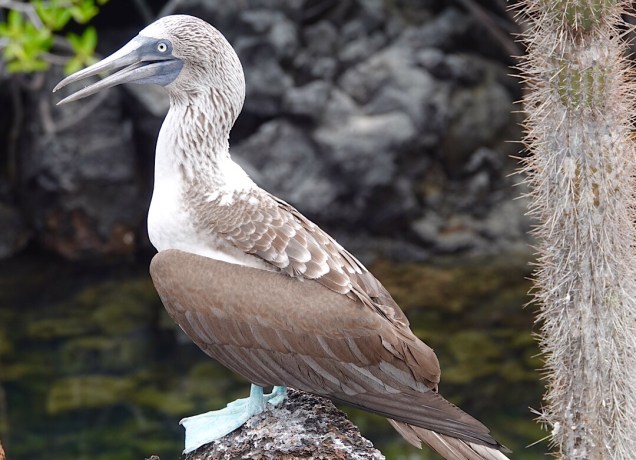
We saw plenty of blue-footed boobies.
Those feet are pretty dashing.
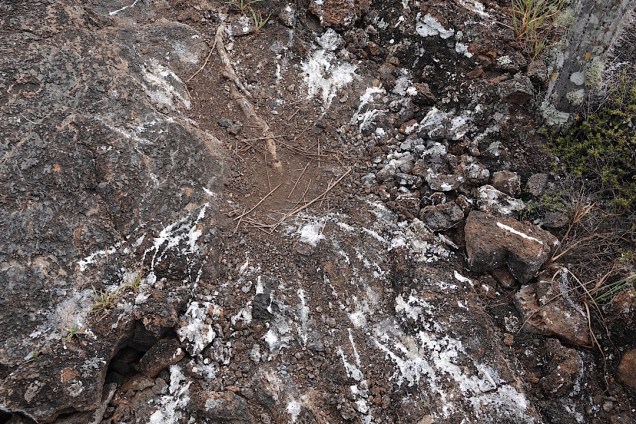
That fellow had just built this lovely nest and was trying to attract a girlfriend.
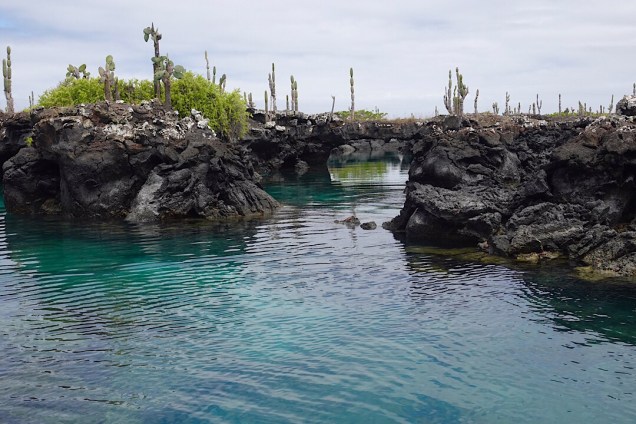
We swam with huge sea turtles and brilliant reef fish and schools of rays and 6-inch-tall seahorses, spotted amidst a seascape studded with starfish and coral and urchins. We hiked to and boated by striking lava formations and came away feeling we’d gotten a good taste of the place.
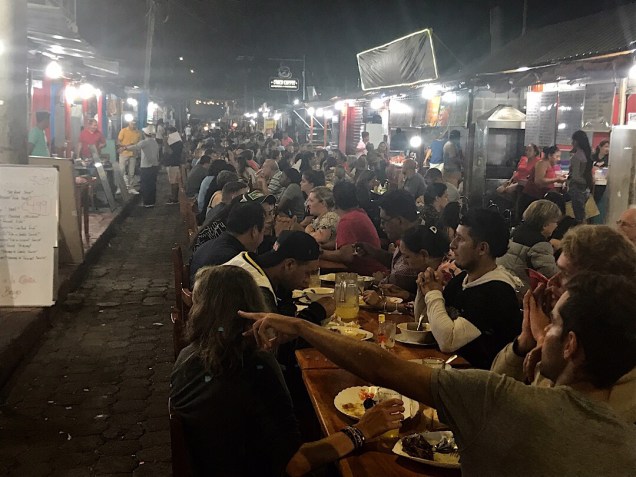
Doing it on the cheap required that we make all our own arrangements and get ourselves around, but that wasn’t hard. The little hotels where we stayed were clean and comfy enough, if not luxe, and they cost less than $50 a night on average. The food ranged from good to excellent. Our favorite meals included the two we ate on the jolly Santa Cruz street that closes to cars at night. The restaurants set up long wooden tables and chairs at which you can tuck into tasty lobster and fish meals (with beer) for about $50 per couple.In the end, our stay (including the $180 required per person in permits) cost us about $800 each, rather than the $2,500-$5000 per person the cruising probably would have. And we learned a lot.
Here’s my take on the best and worst things about experiencing the islands this way:
The Worst
We only spent time on two islands, Santa Cruz and Isabela. To get back and forth between them, we took inter-island ferries, which cost $60 per person round-trip. I hated both rides. The ferries are basically speedboats seating around 30 passengers, most of whom can see almost nothing along the way. The vessels blast through the water, rolling and bucking — too rough a ride to do much of anything besides count the minutes (around 120) till the torture ends. Chugging around on a big old yacht would doubtless be far more pleasant. (Some inter-island plane service also exists, but it’s five or six times more expensive than the speedboats.)
The Best
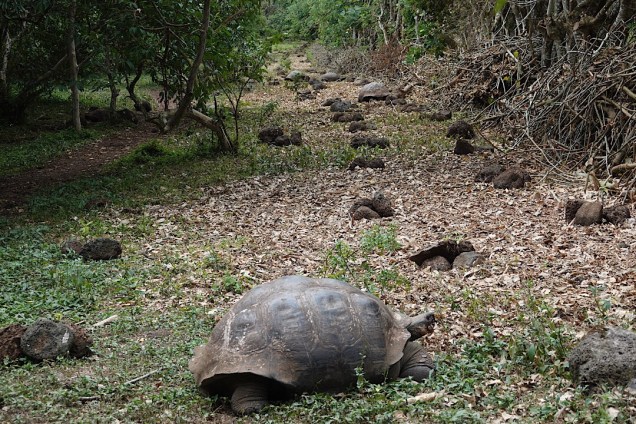
Our first morning on Santa Cruz, we hired a local taxi driver to take us around for three and a half hours. We visited the interesting Darwin research center, checked out some of the geological wonders (craters and lava tunnels), and spent at least an hour strolling around a private nature reserve where the giant tortoises are thriving. The San Diego Zoo has a large, old Galapagos tortoise colony, but they live in a sterile enclosure, a universe away from the lush vegetation in the reserve.
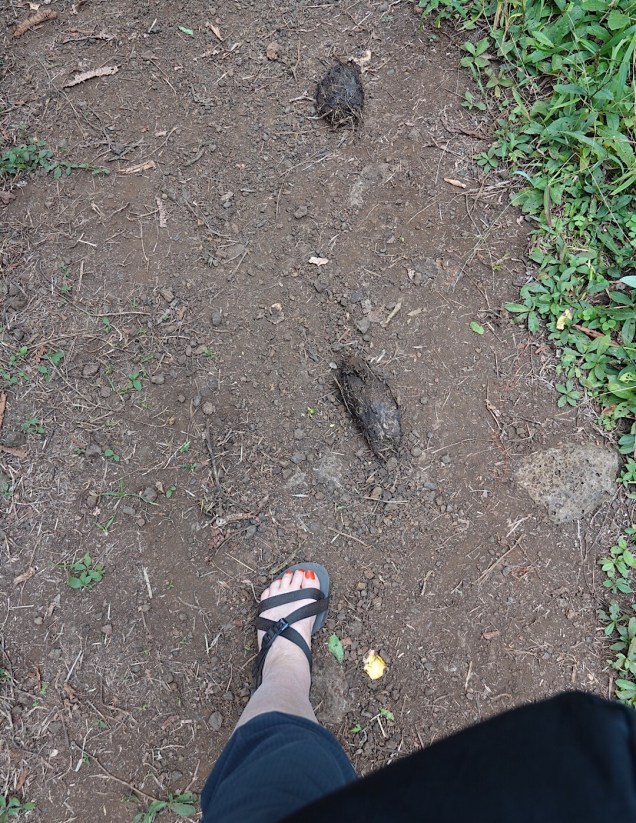
It was strange to be dodging turtle poop, rather than dog poop.At times it was tricky to distinguish the tortoises from the boulders.
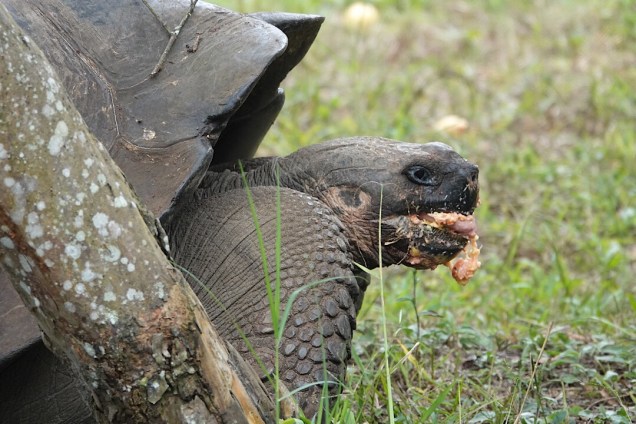
It felt magical to come upon the giant reptiles blocking the paths, munching on (non-native) guavas (which eco-volunteers are trying to eradicate), and otherwise looking cranky and enigmatic.
We suspect the tortoises won’t be happy if the volunteers succeed. Guavas are delicious!
Steve and I also marveled at how chilly the Galapagan waters are, despite the fact that the island chain lies on the equator. The cold nutrient-rich Humboldt Current, which flows north from Antarctica, makes the weather temperate and fosters the abundance of land and sea life. On the days we snorkeled, the water was somewhere around 70, cool enough that, even protected in short wetsuits, we couldn’t stand being in the water for more than about an hour. Still, the beautiful things we saw made the mild discomfort tolerable.
The Interesting
Staying onshore rather than cruising gave us more opportunity to interact with the native humans. Several commented on how relaxed and pleasant life on the islands can be. (Strict laws limit the inflow of mainlanders.) It seems a simpler life. Everywhere the Internet was glacial. Many folks get around on bikes. At our hotel, we asked how we might launder a small pile of dirty clothes. The proprietress pointed us to the bright turquoise house a short distance from her place. If we dropped off our load in the morning, it should be ready to retrieve by evening, she said,
We strolled down the dirt road and peered into the open door of the turquoise house. The front room was filled with a half-dozen washing machines, several dryers heated by bottle gas, and little else. A family member finally noticed our arrival, weighed our bundle, and said it would cost $3 to wash and dry everything.
When I returned hours later to collect it, no one was in the laundry area, so I called out, “Hola!” In the back of the house, I could glimpse a middle-aged man with a large gut, sprawled in a rumpled bed. He collected himself, came to the front, and took my money in exchange for the clean and neatly folded items. He was less exotic than a giant tortoise, but interesting enough that I was glad I hadn’t missed meeting him too.
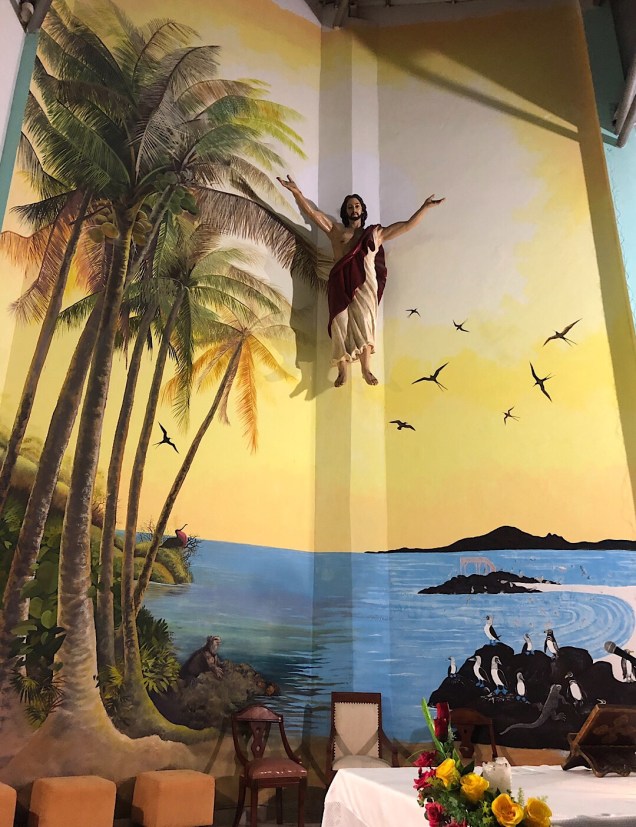
In this Galapagos church, Jesus hangs out at the beach, instead of on the cross.
Our good friend Howard still shakes his head in amazement when he recalls his attempt to visit Argentinean wineries back in 1990. He and another friend were in western Argentina to climb Mt. Aconcagua, but they had some extra time and figured they could just get a taxi driver to take them around. Argentina today is the fifth biggest wine producer in the world, and the industry was already big back then. But their request confounded the taxi driver. He’d never heard of anyone visiting local wineries for tastings.
Things have changed a lot. Beautiful tasting rooms have been built since then, and companies to shepherd tourists to them have prospered. I knew we’d have our own car both in Chile and Argentina, so I figured I could devise a little tasting tour on our own. I did some research and created an itinerary. We had a little success but mostly struck out, if in a more sophisticated way than Howard and Wes.
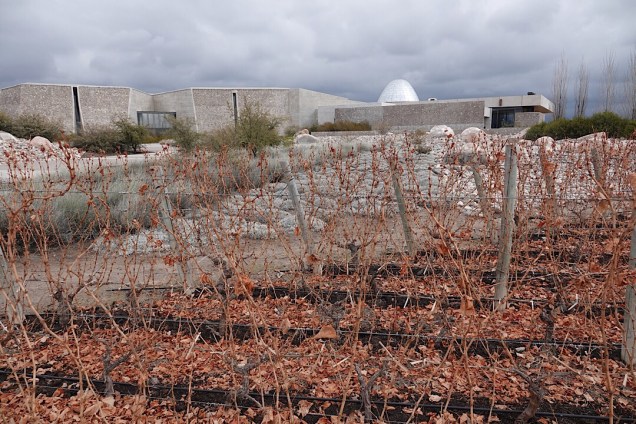
I know now it was dumb of me not to try emailing the wineries I’d targeted and making reservations. But it’s the dead of winter! All the vines look dead and shriveled. We planned to visit most of these places on weekdays. And at the Concha y Toro winery south of Santiago, our first oenophilic destination, everything did go just as I’d planned. We parked, bought tickets ($23 each) for the 11:30 English-language tour I’d read about online, and had a pleasant time strolling the august grounds, hearing winey factoids, and tasting four local varieties.
Concha y Toro boasts it’s now the second biggest winery in the world, with around 27,000 acres under cultivation. So I probably should have guessed other wineries might not be so well organized. We were organized enough to drive to our hotel in Santa Cruz, check in, then head out to visit one of the best-reputed wineries on the famous Colchagua Valley’s “Ruta de Vino.” The website for Montes had said they were open until 5:30, and we arrived around 4:30, seeking only a tasting, not another a full tour. At the gate, however, a guard brusquely informed us this was impossible. The only option was to do a combined tour and tasting, and we’d missed the English-language one by hours. If we wanted to be allowed on the Montes grounds, we’d have to return the next day.
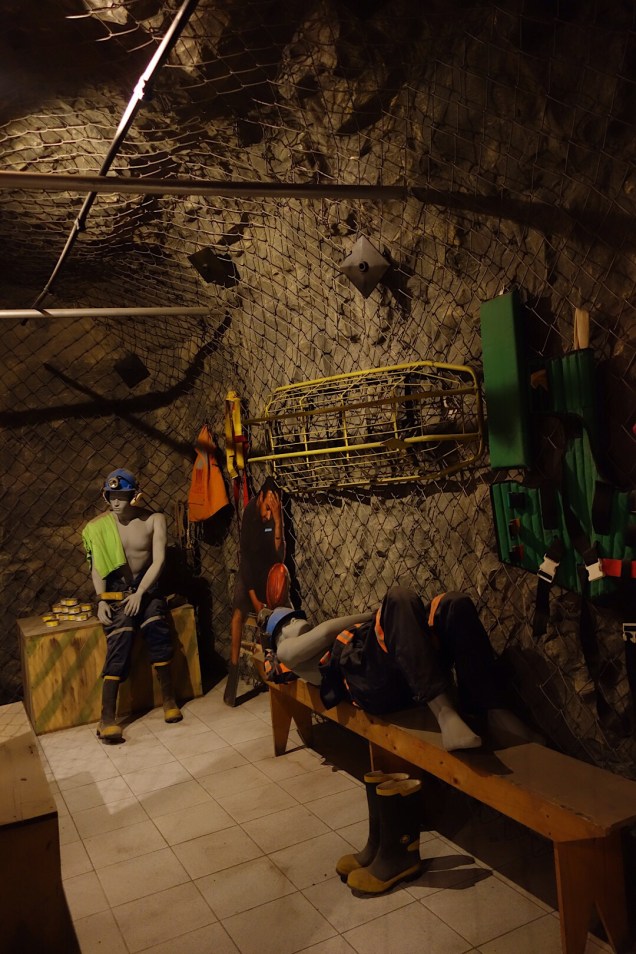
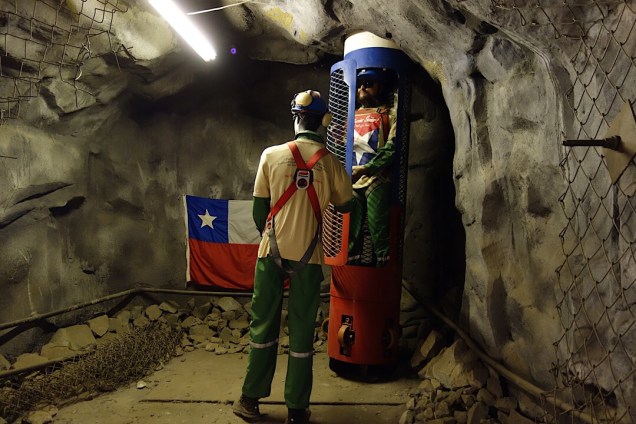
Our route the next day led in the opposition direction. On consulting with our host at the hotel, he recommended we instead head for one of the wineries in the Casablanca Valley, close to Valparaiso, our next destination. We spent a chunk of that morning visiting an outstanding Santa Cruz attraction, a private museum built by a Chilean whom our guidebook referred to as “the king of the cluster bomb.” Attractive and well-designed, the Colchagua Museum covered an amazing span of Chilean history and culture, but I think all four of us were most wowed by the multimedia pavilion that recounts the story of the 33 Chilean miners trapped almost a mile underground and rescued after two months (in late 2010).
The miners’ underground refugeThe capsule that took them up to the surface
We felt confident pulling into the Vinamar winery a little after 4:10. It was supposed to be open for at least another hour. But once again a guard barred our way. Tastings were over at 4 pm, he declared.
I allowed the expression on my face to crumple. “But we drove all the way here from Santa Cruz!” I exclaimed, That took him aback; I think he was afraid I was about to cry. He telephoned his boss, and after some back and forth, we were admitted and told we could purchase a few glasses of wine.
Somehow, by the time we climbed the stairs into the grandiose facilities, we were offered a standard tasting of sparkling wines (cost: $9.50 per person). They were pleasant, and it made the day feel like less than catastrophic.
Our tasting attempts when we got to Argentina went less well.
There, I had worked out an elaborate plan, drawing heavily from a 2018 New York Times article about spending 36 hours in Mendoza. Almost instantly it got thrown out of whack. The evening we arrived, we stayed up late eating a wonderful dinner (and feeling the effects of the one-hour time change between Argentina and Chile, from where we’d flown that afternoon). So we got off to a slow start Sunday morning and scrapped the late-morning tasting I had planned not far from Mendoza. Instead we headed south to the Uco Valley, Argentina’s Napa. Zuccardi, one of the country’s most respected vintners, had built a facility there in 2016 that sounded worth the roughly 2 hours it would take to get to it. We found the drive moderately interesting, and as we approached it, the winery itself looked striking.
Once again a gate barred our entry, but we managed to slip in behind another car whose occupants had made reservations. Once inside, however, we were informed that the only tasting worth taking would cost 3,500 Argentine pesos per person — about $84 each. We could hardly believe our ears. The Times article had said tastings started at 400 pesos per person ($9.55) and included “a tour that goes from vines to vat to a gorgeous tasting room…” We questioned and counter-questioned the hostess, but she remained firm. Seeing our consternation, she suggested we drink a complimentary glass of sparkling wine while we decided what we wanted to do. We drank the bubbly, but then dejectedly trudged back to our car. (No way were we prepared to pay $336 for a wine tasting.)
As I type this, I can’t help wondering whether we didn’t misunderstand something. The hostess didn’t speak much English and my Spanish is hardly that of a native. At the time, however, it certainly seemed we were at an impasse. Tears actually did feel my eyes. I’d subjected my family to 4-5 hours of driving through only moderately interesting countryside in exchange for…a small free glass of sparkling wine?
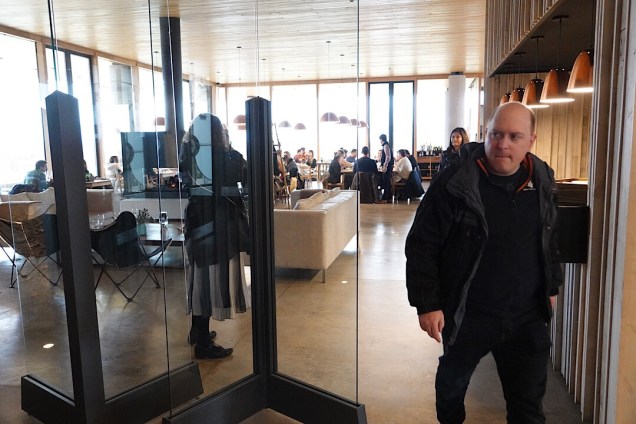
The restaurant looked great too, but we couldn’t get a table
Worse, we were all now ravenous but it was approaching 3 pm, the “witching hour,” as Stephanie referred to that period every afternoon when almost everything in Argentina closes. The whole ride back to Mendoza, every eatery that Google Maps pointed us to was shuttered. Near the city, we stopped at one final winery (much praised by the Times writer), where we only were allowed through its closed gate in order to inquire about making a reservation. The hostess told me no spaces were available for lunch the next day (a Monday), but she would email me if they had a cancellation. I never heard from her again.
Typical Argentine countryside near the Uco Valley
As grimly as this all played out, we did enjoy some great meals (accompanied by good, astonishingly inexpensive wine) in Mendoza, where we probably should have just hung out for our short time there. Steve and I also weren’t unhappy to have gotten the limited insight into the landscapes in that part of Argentina and central Chile.
We did a few other touristic things, pleasant, but not all that interesting. Two observations from the Chile-Argentina portion of our trip will probably linger longest in my memory.
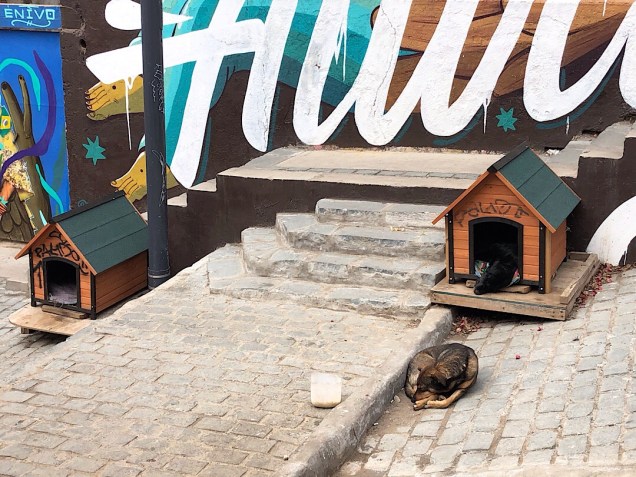
— A dog’s life, Chilean-style. I mentioned in an earlier post what a startling portion of the Santiago dogs were clad in coats. We saw coat-wearing dogs in Valparaiso, too, but they were walked by their owners amidst a virtually army of homeless dogs. “People here say they’re not homeless,” our guide on the walking tour told us. “They belong to everyone.” He may have been joking, but he said there were 300,000 human residents of the city and 100,000 dogs. “Every tourist has to take one with you at the end of the tour.” The free-spirited Chilean canines break into and snack on garbage or feast on the scraps that locals put out for them. Lucky ones get to snooze in free-standing dog houses.
That same guide showed us a mural depicting various animal icons. The dog was the most heroic among them. “If someone’s your best friend, you call him your dog. He’s always got your back.”
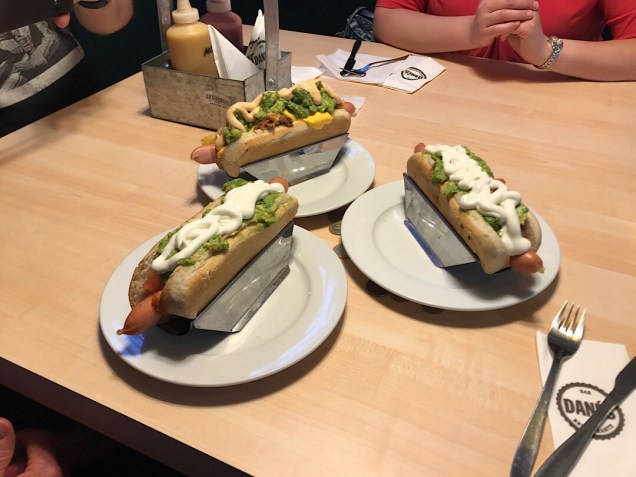
It’s a little ironic, then, that the most memorable of all the delicious food we ate in Chile was… a hot dog! They don’t call them that, but rather completos. For almost 100 years, Chileans have been loading up their bun-cradled sausages with a panoply of ingredients: tomatoes, avocados, sauerkraut, French fries, fried eggs, and more, usually topped with an ocean of fluffy mayonnaise. We ate them in a venerable old restaurant near the historic center, and we ate them in the airport, shortly before we left.
If they’re lucky, some of my friends will soon be served them back in San Diego.
In the Mendoza Airport yesterday, I heard a woman talking about someone she knew who had seen 20 total solar eclipses. I know such people exist; they more or less dedicate their lives to traveling the world to wherever it is the sun will next be totally blocked out by the moon. (This happens only once every year or two.) When I saw my first total solar eclipse in 1999, it affected me so powerfully I vowed to see as many as I could for the rest of my lifetime. I’ve since decided this requires a level of nuttiness that, nutty as I may be, I lack. Seeing only three has taught me how many decisions you have to make, any one of which can turn out to be disastrous.
Solar eclipses follow an arc, so first you have to pick which point along the arc you want to aim for. The eclipse that just took place sliced across southern South America from (roughly) La Serena in Chile to Buenos Aires in Argentina. Steve and I have already explored Buenos Aires, plus we knew the eclipse there would take place almost at sunset. We’d never been to Chile, so that was most attractive to us.
On the other hand, this is winter in Chile, when rain and fog (the arch-enemies of eclipse-viewers) plague the coastline west of the Andes. That happens less as you move north of Santiago (where La Serena is), but if the weather wasn’t good, it wouldn’t be possible to drive to somewhere better, given how the mountains and the sea constrain this long, skinny country. That’s why we chose to spend a few days sightseeing in Santiago, then fly the short hop across the Andes to Mendoza in Argentina. If the weather looked ominous, we might have a few more options.
As it turned out, everyone lucked out. Days ago, the weather forecast for everywhere along the ecliptic path predicted sun. But there were still decisions to be made.
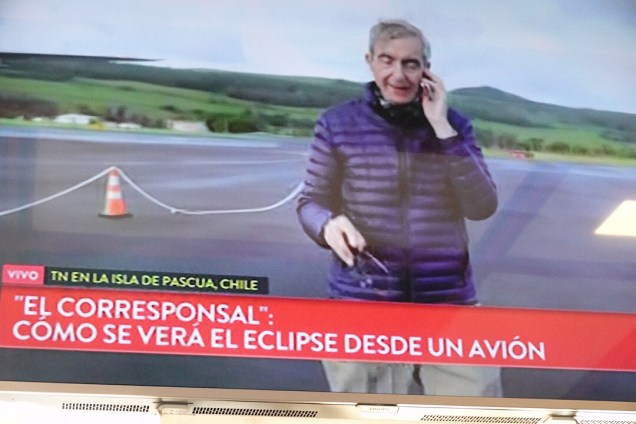
In Mendoza, we got our first sense of the excitement building. At dinner Sunday a fellow at the next table turned to us and asked in English if we had come for the big event. He was an amateur astronomer from Montreal, and we traded information and good wishes. Monday afternoon, we made the drive to San Juan (north of Mendoza) in just under two hours, and we saw non-stop TV coverage that evening and the next day at lunch. San Juan would be on the far southern edge of the eclipse arc, we knew, but the sun would only be totally covered there for about 30 seconds. In contrast, if we drove north to the center of the path, the eclipse would last close to two and a half minutes. Totality is so spectacular, you want it to last for as long as possible. But what I learned as I researched all this (months ago) is that there aren’t a lot of options for getting around in this part of western Argentina. Professional astronomy sites said the towns of Rodeo and Bellavista were likely to be best, but I had trouble finding them on any map (even Google’s). The only roads leading to them from San Juan crossed a mountain spur, and I could find no clue to what their condition would be.
We finally figured out that if we drove north from San Juan on the main highway (Ruta 40) for about an hour, we would come to a tiny settlement called Talacasto where totality would last two minutes and 11 seconds. We decided to trade the extra 20 seconds we would lose by NOT going to Bellavista for the extra hour or two it would take to get there (and drive back, probably in heavy traffic, after dark.)
With our destination settled, and the weather looking good, one additional concern bothered me. At the two previous eclipses I’ve seen (in Bavaria in 1999 and Oregon in 2017), part of what thrilled me was the reaction unfolding all around. We weren’t in a huge crowd either time, but there were enough fellow viewers to make the experience collective; to hear the chorus of exultation and wonder; to see the tears, the upraised fists. I fretted we might wind up in a lonely place where we four were the only spectators. Steve and Mike couldn’t imagine this, but Mike had a solution: “We’ll pick up some wine, make a sign, and invite anyone who sees it to join our eclipse party.”
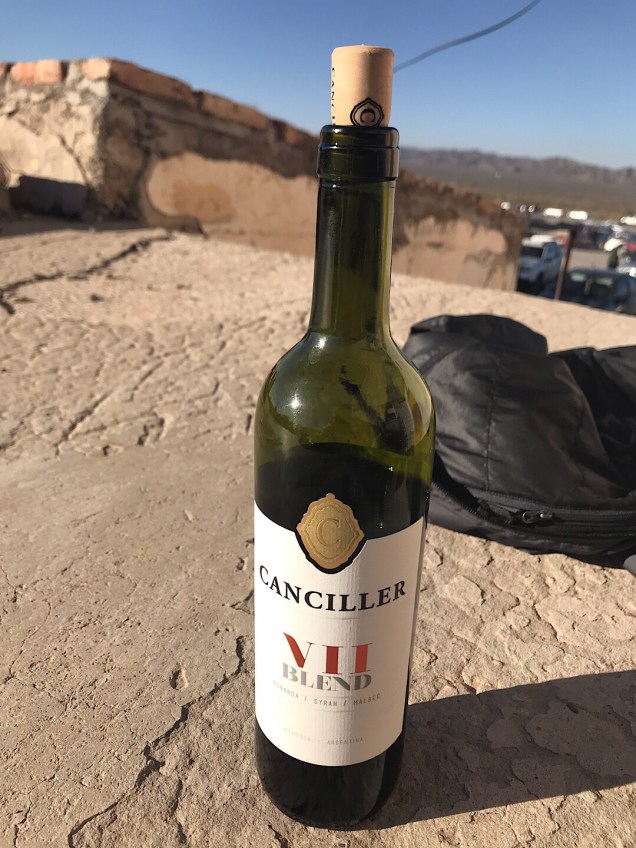
So it was that we stopped at the Carrefour in central San Juan, where we bought several bottles, disposable glasses, paper, and a marker. Michael worked on the sign…
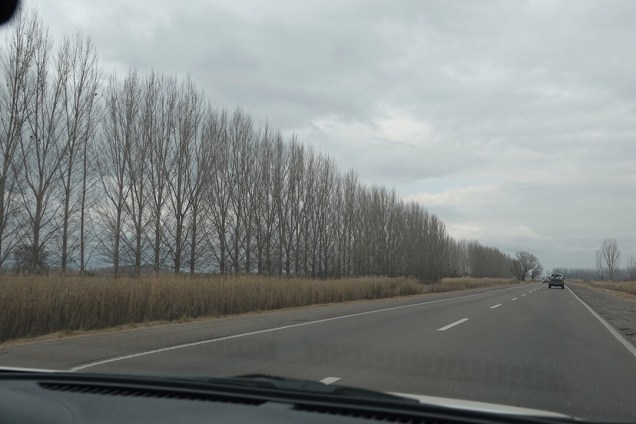
…while we drove north through countryside that surprised us by its resemblance to Southern California: the Mojave desert (in places) and Anza Borrego (in others).Along the road, we spotted the first of a series of signs announcing a “Punto de Observacion” (eclipse observation point) ahead, which in itself reassured me. (If there was an official observation point, clearly we wouldn’t be alone.)It also dispelled another worry: If the road led us to a point too close to the Andean foothills to the west of us, the sun might actually be behind them by 5:39 pm (when totality would start). But if locals had picked an observation point and then created and posted glossy signs leading to it, surely they must have chosen a site where the mountains wouldn’t block our view.
We got to Talacasto around 3:30 and found a large area already filled with at least 100 cars, yet still containing plenty of room for more..We had no folding chairs like most of the local folks, but Michael scouted out a spot behind a half-built stone building that sheltered us from the wind.Climbing up on its roof offered excellent views both of the sinking sun…and the surrounding crowd.We anchored our sign with a cinder block and uncorked one of the bottles, poured ourselves a glass, and settled in to wait.
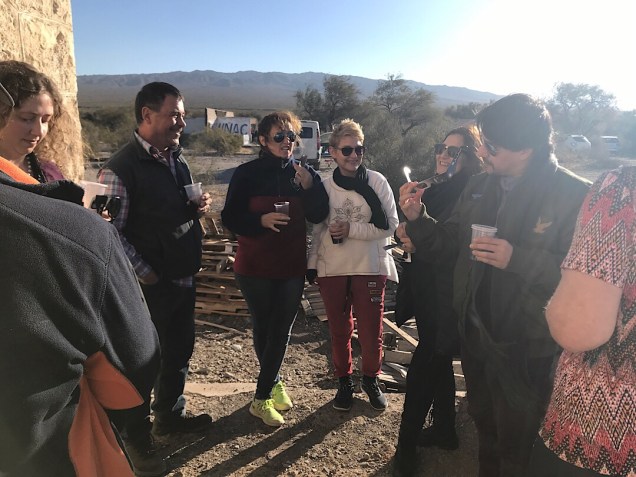
It didn’t take long for an Argentine couple to stroll by. I asked if they had eclipse glasses. (We had extra because I’d bought a 10-pack from Amazon.) They were thrilled by the offer, since they’d forgotten to get some. At first they demurred accepting the wine, but they broke down after a while, and we had a lot of fun chatting in English and Spanish with Edgardo (a CPA and aspiring website developer) and Nancy (a painter and art teacher). I offered more glasses (and wine) to a family of three from San Juan encamped nearby us, and they too accepted with delight. They eventually left their rig and brought mate (Argentine herbal tea) and cookies to share with our fiesta. We toasted the eclipse, toasted being alive in this enchanted spot to share this amazing experience together.
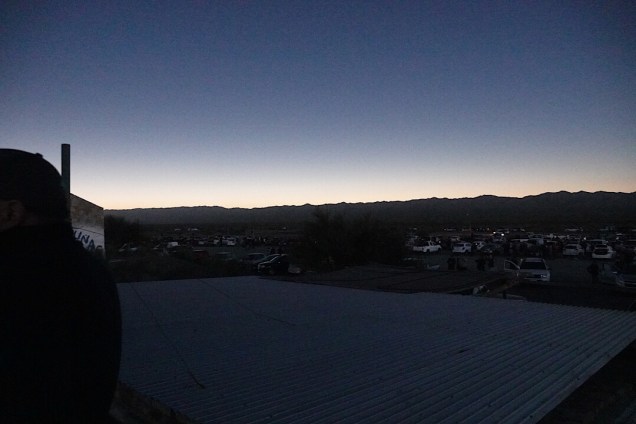
Because it was so late in the day, the light shortly before totality may have looked a bit more weirdly gray. But almost everything else echoed what I remember from Bavaria and Oregon. There was that same awe as the crescent seen through my glasses grew thinner and thinner then shrank to the magnificent jewel in what folks call “the wedding ring.” I took my glasses off just as its jewel of light blinked out and the sky turned from azure to navy. I remember seeing at least a few stars. But I was also drinking in the sunset glow at the horizon — not just in the west but for 360 degrees around us. I was making incoherent noises, at least one or two full-throated screams, and laughing.
Why do humans make so much noise during total eclipses? Birds grow silent. They sing when the sun re-emerges and the light comes back. Humans make noise then too. It’s time to celebrate. The sun is not lost forever. Life on Earth will go on.
After that, everything else was mundane and not worth writing about. Except one curious detail. No one seemed to be making any money off the eclipse (except the hotels and restaurants back in the towns and the tour operators who brought in large groups of gringos). The single restaurant in Talacasto (around which we all parked) was selling more drinks and snacks than it will ever again in all its lifetime, but no one was charging for parking or to use the restaurant’s bathrooms. Not one soul had created eclipse t-shirts or other eclipse-themed souvenirs (nor had they in Bellavista, according to other folks we talked to who had traveled there). I can’t explain this. It seemed amazing, though nothing, of course, as amazing as those two minutes and 11 seconds.
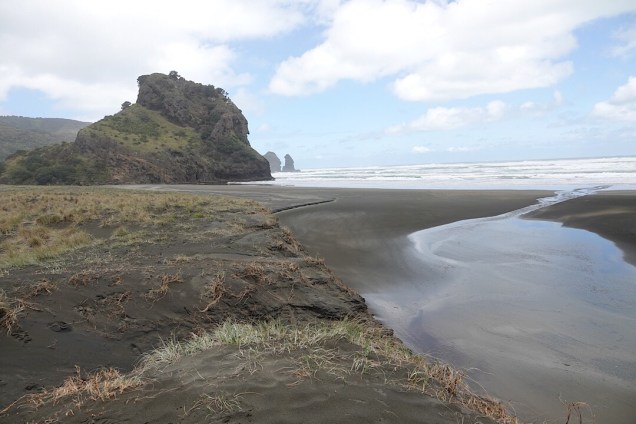
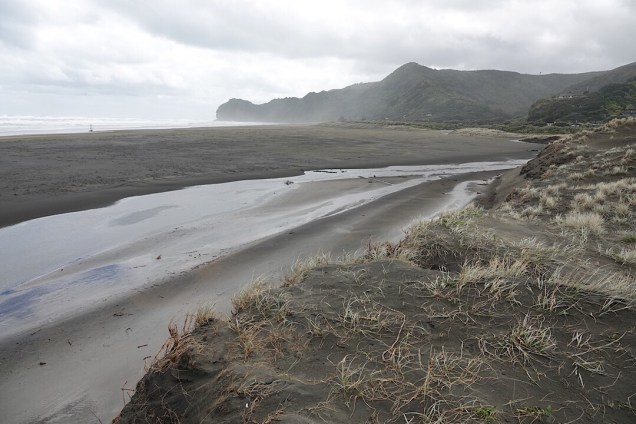
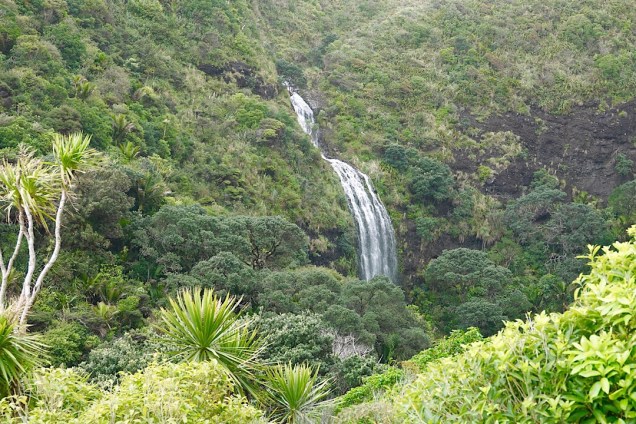 then hiked to the beach made famous by the movie The Piano.
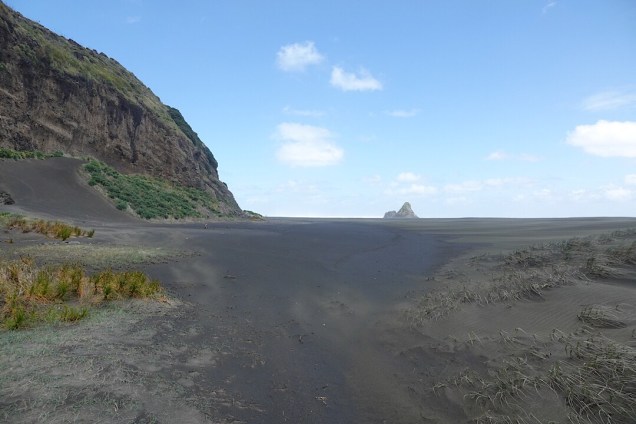 Grains of sand driven by the gale-force winds stung our faces, so we didn’t linger but instead drove back to the nature trail adjoining the Arataki visitor’s center.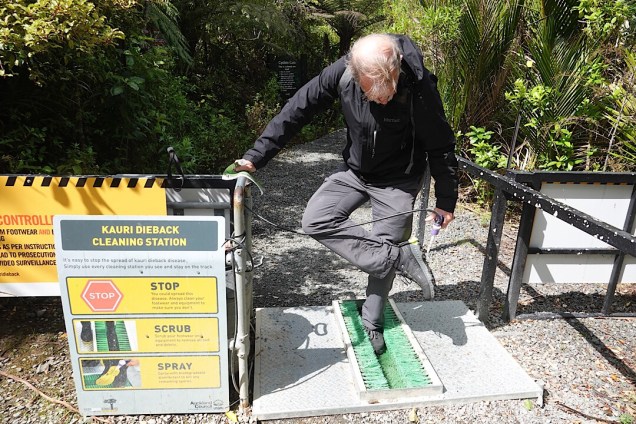


 We checked in, sizing up our fellow singers, a range of ages but mostly white folks who all looked like NPR listeners. Before long, our bus set off southward, and it didn’t take long to reach the park. We disembarked, trying to scope out what the heck we would be doing. In January of 2018, Steve and I attended another cross-border performance. That one was
 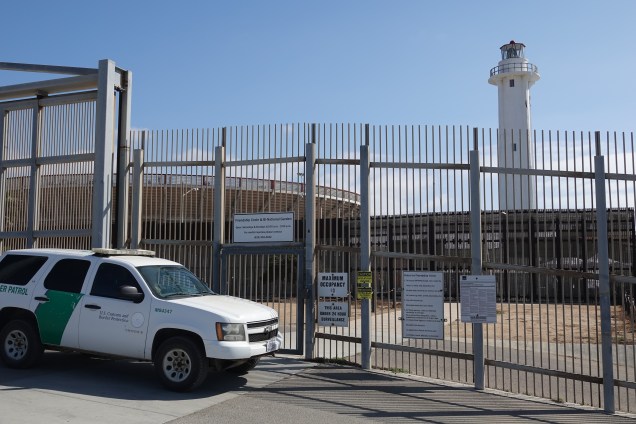 Instead we were directed onto the beach, where we could see a small stage and a sound truck.
  Stern signs, police tape, and an intimidating roll of coiled razor wire prohibited us from approaching the barrier there.
 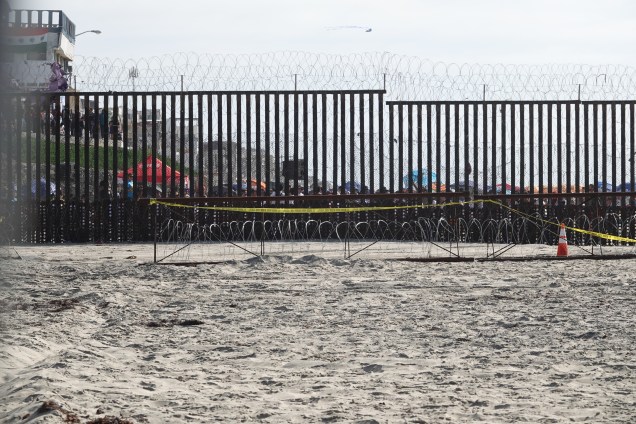 Beyond it, a sea of beach umbrellas and people were barely visible. I’m pretty sure there was beer on that side. And tacos. Probably music too.
 Up above us, armed guards, some with dogs, looked down, stony-faced.
 “This is kind of interesting,” commented the guy standing next to me. “I’ve been to the beach before. But never in a cage.”
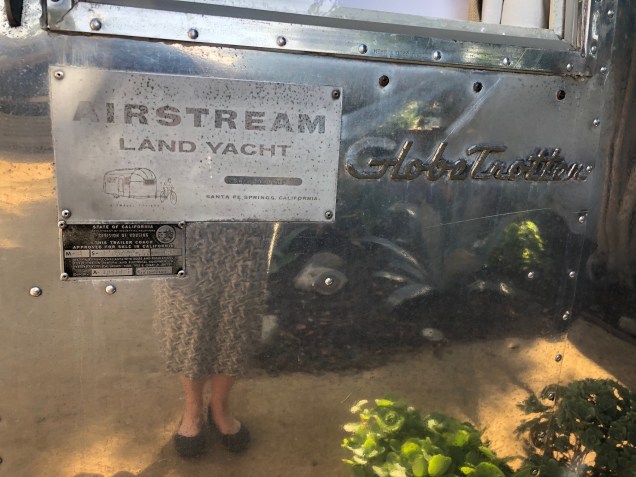 I can’t say it has always been my dream to sleep in an Airstream, one of those iconic shiny aluminum travel trailers. Still, every time time I notice one out and about, the stylish design tickles me. So when the opportunity arose to experience one on a recent night in greater Los Angeles, I couldn’t resist.
 Restored to pristine condition, the interior seemed roomy enough, and when we slept on it later that night, the queen-size bed was surprisingly comfortable.
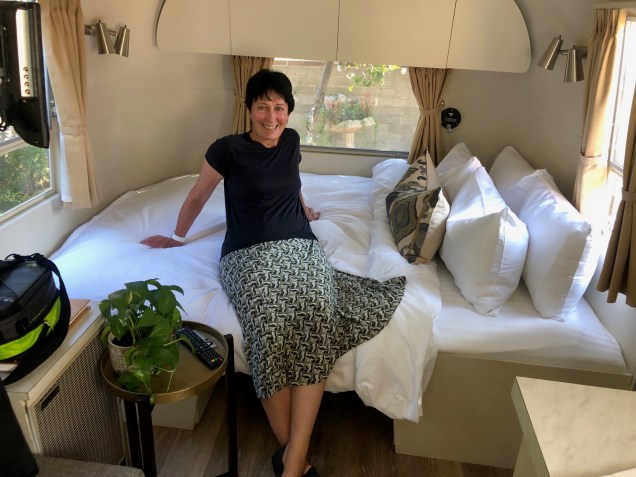 Still, I can now report that spending the night in a nice, clean Airstream felt pretty indistinguishable (to me) from spending the night in any nice, clean garden-variety trailer. I’ll probably continue to admire the zoomy exterior design whenever I see one, but I won’t be shopping for an Airstream of my own any time soon.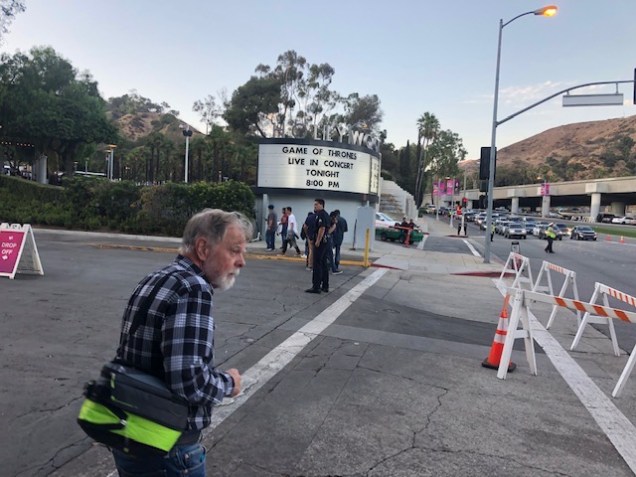

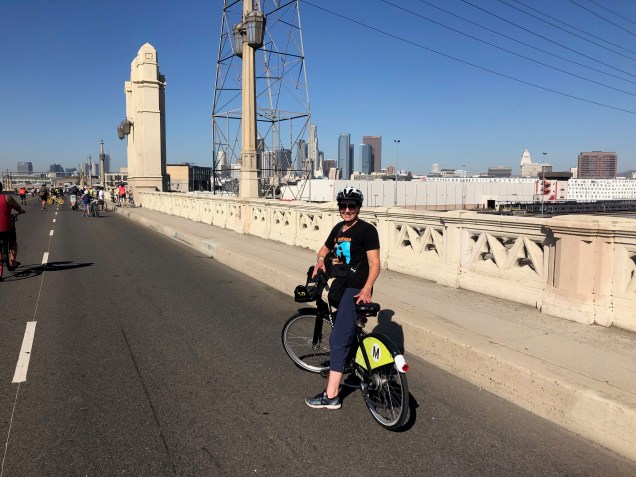 Sadly, we ran out of time and had to turn back before making it to Mariachi Plaza in Boyle Heights. We missed altogether the arm that went to Chinatown.
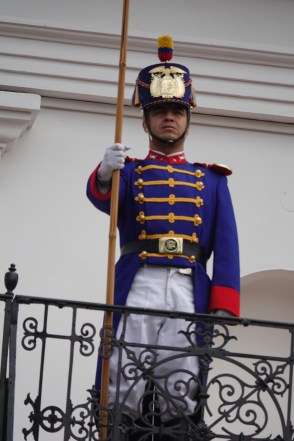 government palace (the Ecuadorian equivalent of the White House) makes the British version seem dull. Commentators trace its origins back more than 200 years, to shortly after Ecuador won its independence from Spain. In recent years, it has taken place every Monday, though the start time has shifted around a bit. We’d heard it was worth seeing. That’s an understatement.
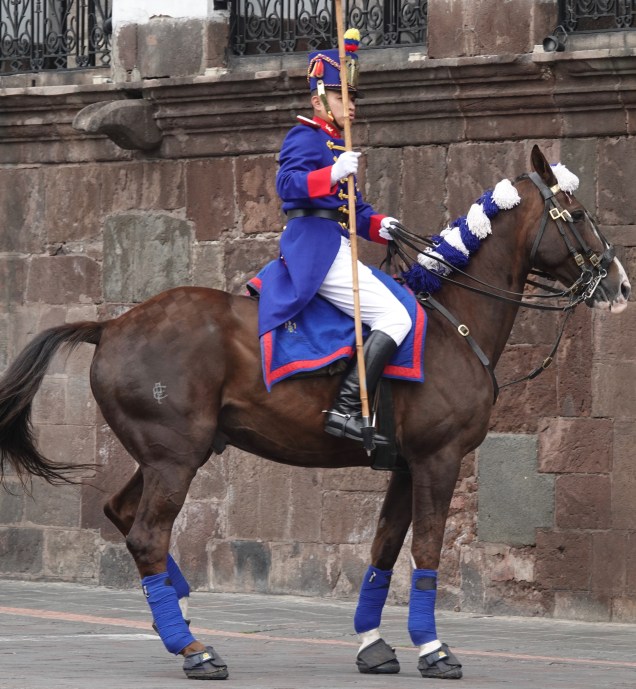 Precisely at 9:00 the strains of stately, grandiose music became discernible, first faintly, then louder and louder, as almost two dozen trumpet- and clarinet- and trombone- and tuba- and bass-drum- and other instrument-playing guards emerged from the inner recesses of the palace. It was music with the power to raise the hairs on the back of necks; music that made me wish I could leave my viewing spot and march along.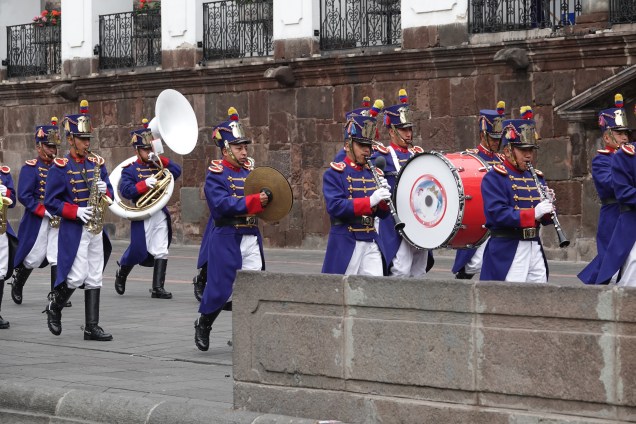
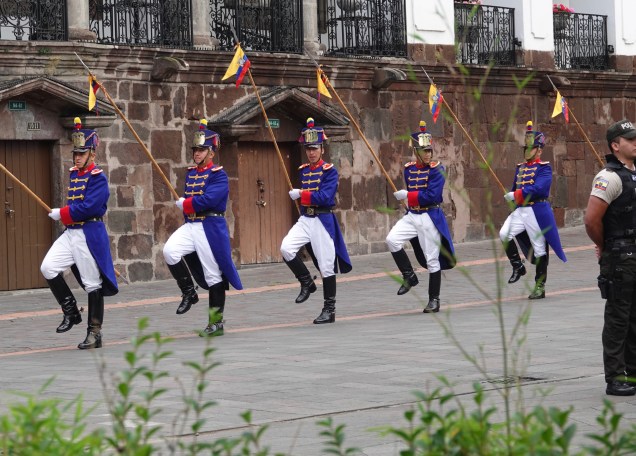 What followed went on for close to a half an hour, and it was too complicated to describe in detail: parading horses and solemn proclamations over a loudspeaker and marching lance-bearers and more and more of the thrilling music. (One missing element was the Ecuadorian president’s appearance on the uppermost balcony, another long-time part of the show. Whether he was just on vacation or worried about his plummeting popularity, I can’t tell you.)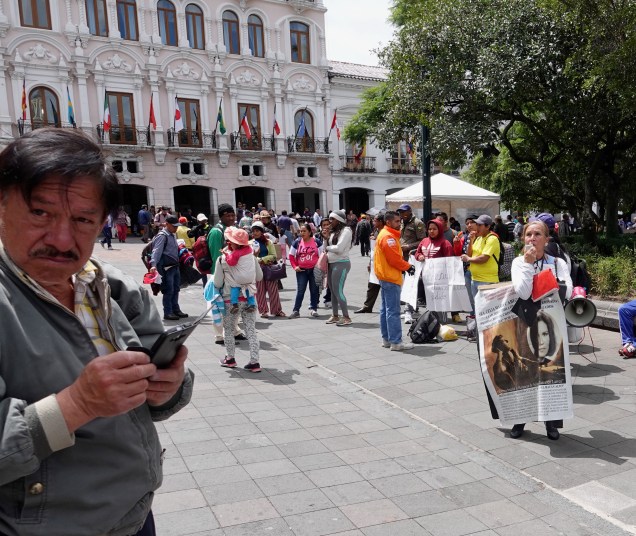
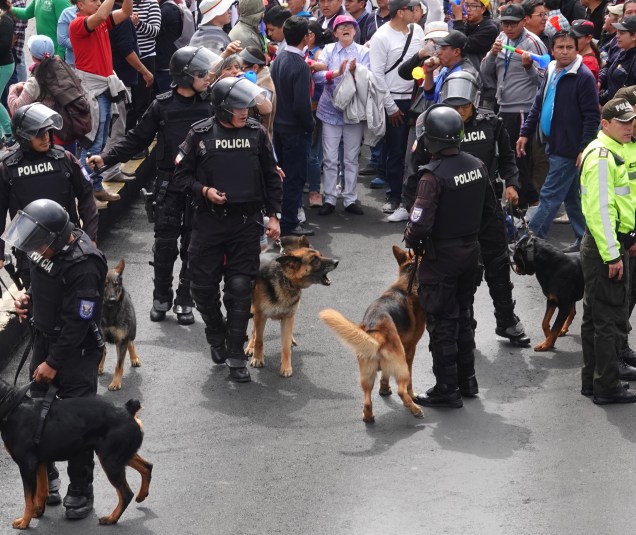
 I suspected the State Department wonk who sent out the text message wouldn’t have approved of our being in the thick of it. But the crowd seemed more high-spirited than menacing, and the cops looked chill.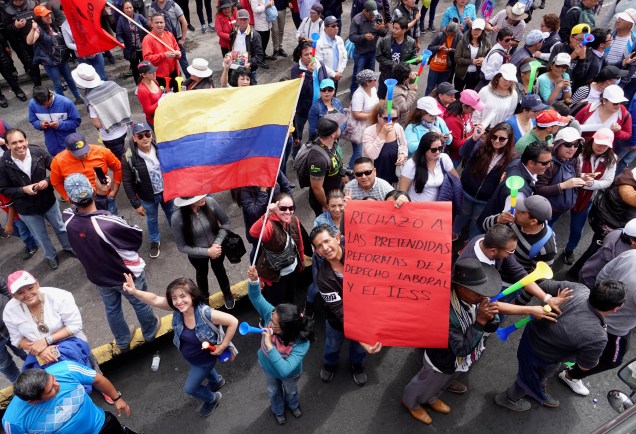


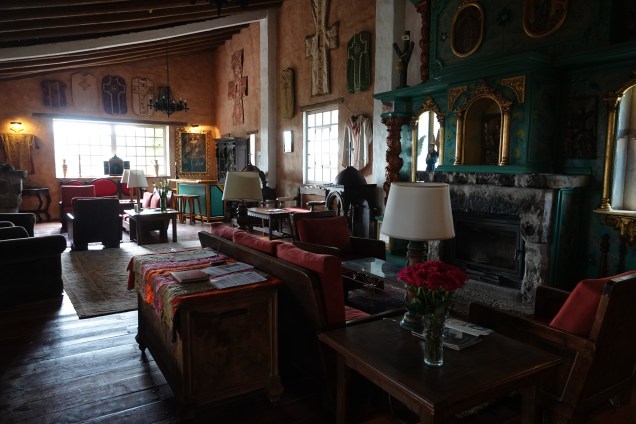
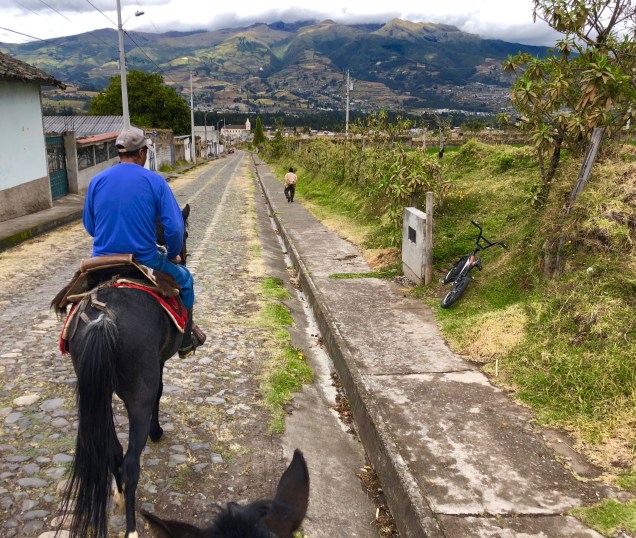 Or drinking in the viewpoint, reached via cable car, near one of the city’s volcanos.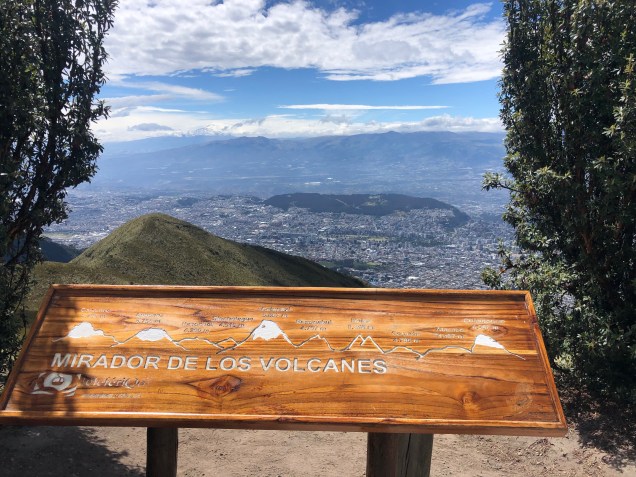

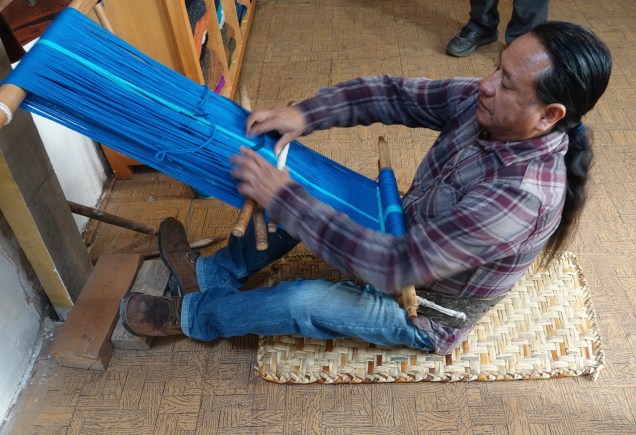 Others created striking objects using more traditional hand looms. Why not spend a little time in Ecuador on our way home from the eclipse, and buy a rug from one of those guys?
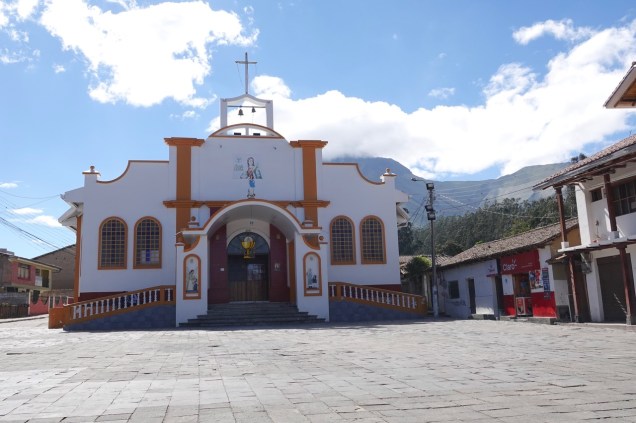 …and walked to the workshop of Don José Cotacachi.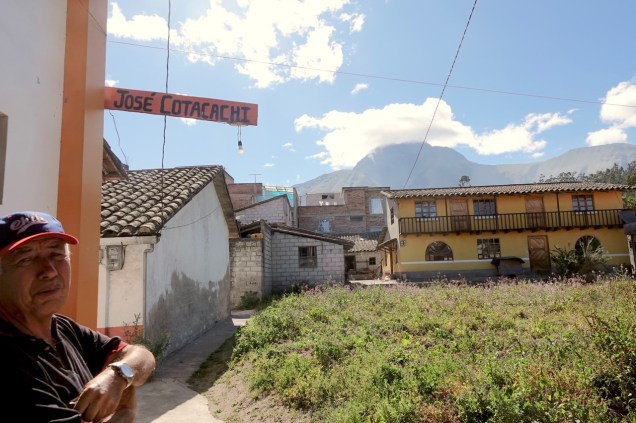
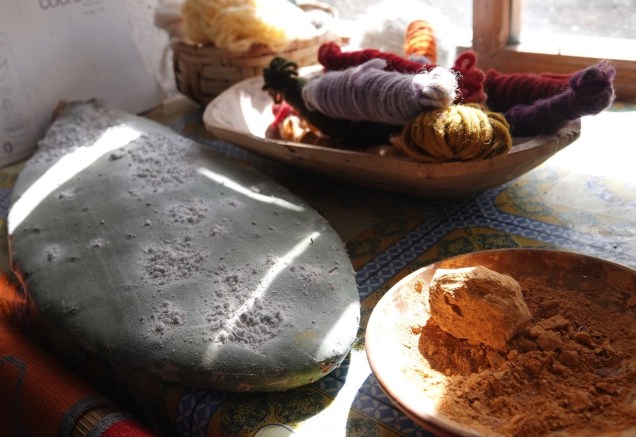
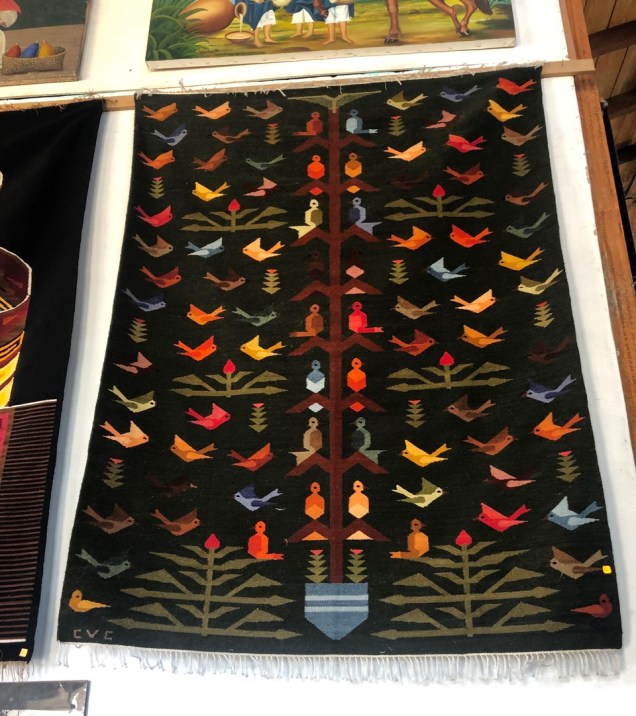 But Steve and I were struck by a problem with using any of it to cover our floor. The largest pieces were less than four by five feet, smaller than what we were seeking. Furthermore, they weren’t very thick but rather more suitable for hanging on a wall or covering a bed. They’d be a bitch to vacuum, and we could all too readily imagine our dogs turning them into a rumpled pile of cloth.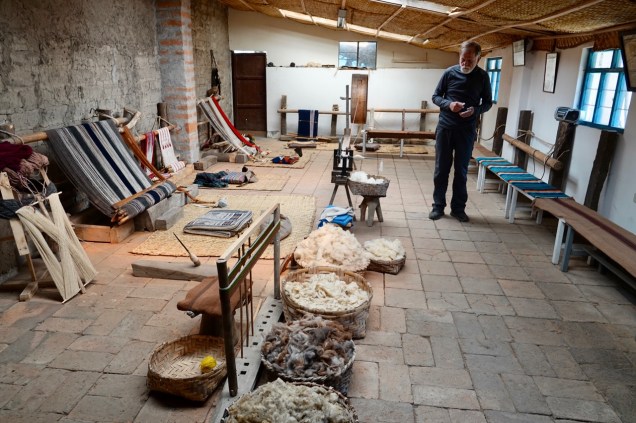

 I also had five electrifying Ecuadorian experiences. I hope to share them in one more final, brief post.
 I was long baffled that Steve was never eager to visit the Galápagos. Both natural history and evolutionary biology have always fascinated him. There’s a lot of both in the island chain 600 miles off the coast of Ecuador. The place intrigued me, but the price of visiting always discouraged both of us. No tourism of any sort existed before the mid-1960s, and then for many years, the only way to see the place was to take the almost two-hour flight out, then board a ship that would likely cost at least $2500 per person for a basic five-day cruise and many thousands more for a longer or posher experience. For that kind of money, we typically cover a lot of ground.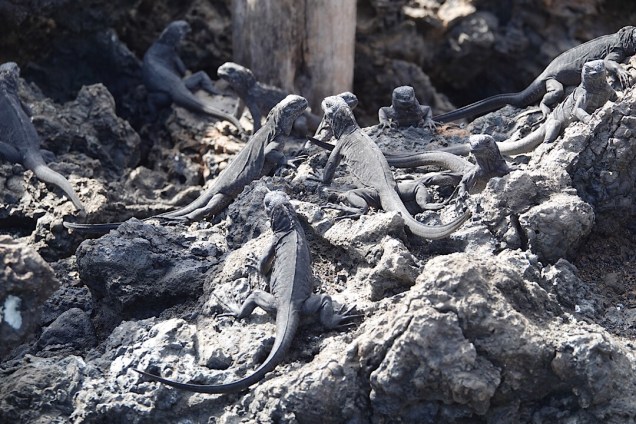
 In the end, our stay (including the $180 required per person in permits) cost us about $800 each, rather than the $2,500-$5000 per person the cruising probably would have. And we learned a lot.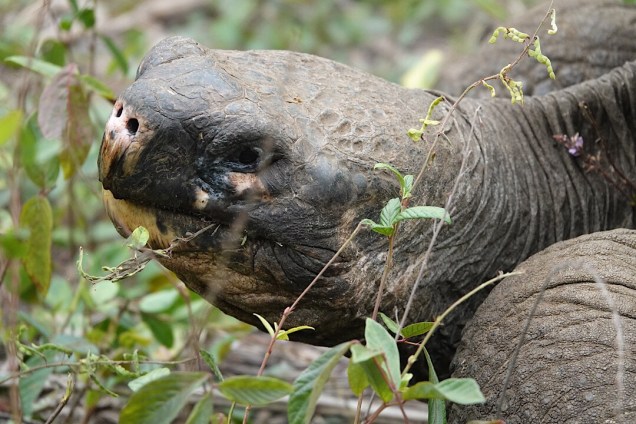

 In the Mendoza Airport yesterday, I heard a woman talking about someone she knew who had seen 20 total solar eclipses. I know such people exist; they more or less dedicate their lives to traveling the world to wherever it is the sun will next be totally blocked out by the moon. (This happens only once every year or two.) When I saw my first total solar eclipse in 1999, it affected me so powerfully I vowed to see as many as I could for the rest of my lifetime. I’ve since decided this requires a level of nuttiness that, nutty as I may be, I lack. Seeing only three has taught me how many decisions you have to make, any one of which can turn out to be disastrous.
 San Juan would be on the far southern edge of the eclipse arc, we knew, but the sun would only be totally covered there for about 30 seconds. In contrast, if we drove north to the center of the path, the eclipse would last close to two and a half minutes. Totality is so spectacular, you want it to last for as long as possible. But what I learned as I researched all this (months ago) is that there aren’t a lot of options for getting around in this part of western Argentina. Professional astronomy sites said the towns of Rodeo and Bellavista were likely to be best, but I had trouble finding them on any map (even Google’s). The only roads leading to them from San Juan crossed a mountain spur, and I could find no clue to what their condition would be.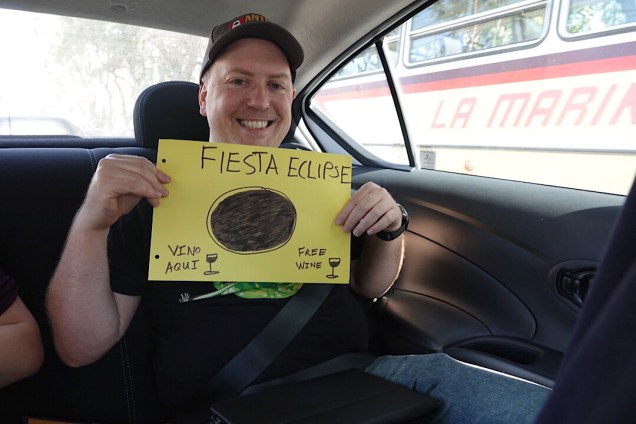
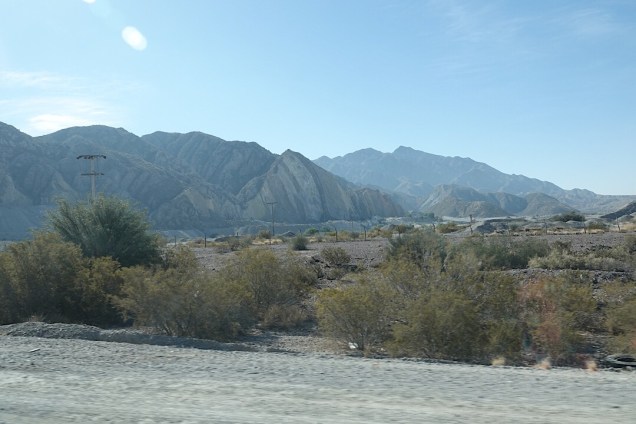 Along the road, we spotted the first of a series of signs announcing a “Punto de Observacion” (eclipse observation point) ahead, which in itself reassured me. (If there was an official observation point, clearly we wouldn’t be alone.)
 It also dispelled another worry: If the road led us to a point too close to the Andean foothills to the west of us, the sun might actually be behind them by 5:39 pm (when totality would start). But if locals had picked an observation point and then created and posted glossy signs leading to it, surely they must have chosen a site where the mountains wouldn’t block our view.
 .
. We had no folding chairs like most of the local folks, but Michael scouted out a spot behind a half-built stone building that sheltered us from the wind.
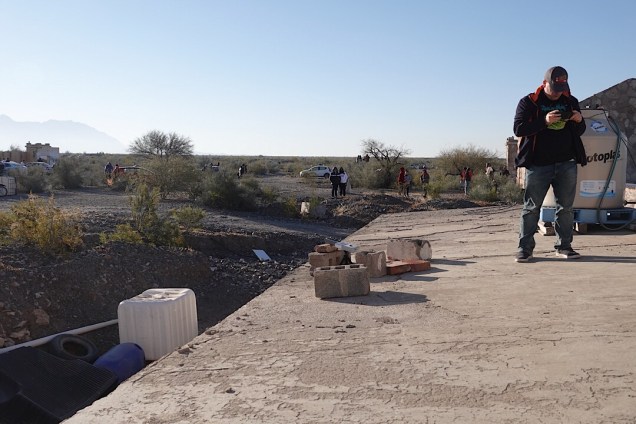 Climbing up on its roof offered excellent views both of the sinking sun…
 and the surrounding crowd.
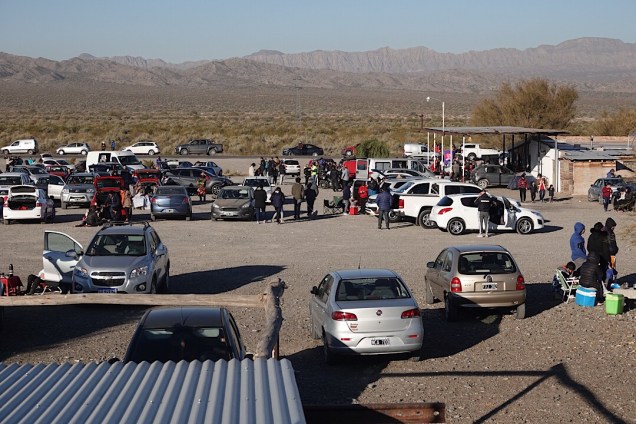 We anchored our sign with a cinder block and uncorked one of the bottles, poured ourselves a glass, and settled in to wait.