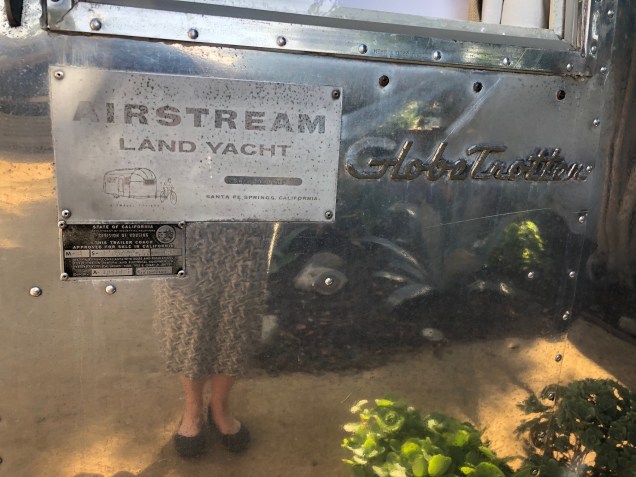
 I can’t say it has always been my dream to sleep in an Airstream, one of those iconic shiny aluminum travel trailers. Still, every time time I notice one out and about, the stylish design tickles me. So when the opportunity arose to experience one on a recent night in greater Los Angeles, I couldn’t resist.
We were going to LA to attend an 8 pm concert at the Hollywood Bowl, meeting our son and his family there. At the moment I am flush, if not with cash, with Guest Points acquired through one of the oldest and largest home-exchanging organizations (homeexchange.com). Looking for options on their site, I spotted the Airstream permanently parked in the Burbank backyard of a couple, Eva and Lars, and their four children. It “cost” only 150 Guest Points and looked charming, in the photos. And it appeared to be only a skip and a jump from the family’s quiet neighborhood to Hollywood. Steve was skeptical, but he acquiesced. I set up the exchange (of the points for the one-night stay), and last Saturday morning, we packed small bags and headed north.
First we stopped at the newly renovated Beverly Center mall in Beverly Hills, where I wanted to visit the large outpost of Uniqlo (the Japanese clothing maker whose casual wear several friends have raved about, but which I had never seen first-hand since the chain has no stores south of Orange County). The mall felt a bit like a spaceship, and the Uniqlo was very interesting. I bought a few $15 t-shirts made of a high-tech material that supposedly heats up any moisture you emit to keep you warmer. We’ll see how that works.
But then we had to hustle on to Burbank, which felt like it was about three times farther from Hollywood in reality than it had been in my head. Eva and Lars greeted us and showed us the trailer. If anything, it felt more attractive than it looked online, being surrounded by a nicely landscaped backyard and sitting area.  Restored to pristine condition, the interior seemed roomy enough, and when we slept on it later that night, the queen-size bed was surprisingly comfortable.
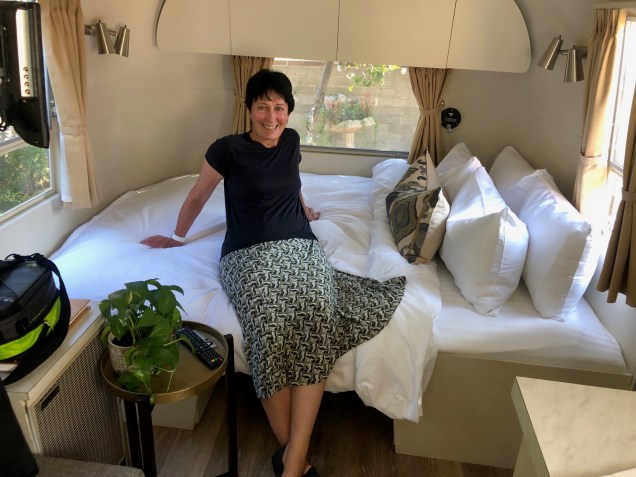 Still, I can now report that spending the night in a nice, clean Airstream felt pretty indistinguishable (to me) from spending the night in any nice, clean garden-variety trailer. I’ll probably continue to admire the zoomy exterior design whenever I see one, but I won’t be shopping for an Airstream of my own any time soon.
If that aspect of the weekend proved underwhelming, the other main elements exceeded expectation. To avoid the hellish traffic and parking nightmares around the Hollywood Bowl, we drove our van to the North Hollywood Metro station and parked on the street nearby. Then we rode the metro two stops to Hollywood and Highland, walked the mile or so to the Bowl, and dined on the picnic dinner we had packed and carried with us. The transit part all took more than an hour, but doing it by car would have taken at least as long and been much more stressful.
Furthermore the people-watching on the metro and the walk through Hollywood was unsurpassed, as it was inside the Bowl (which neither Steve nor I had ever seen, in all our years of living in Southern California.) Genial and head-spinningly multicultural, the huge crowd seemed to be in a great mood. 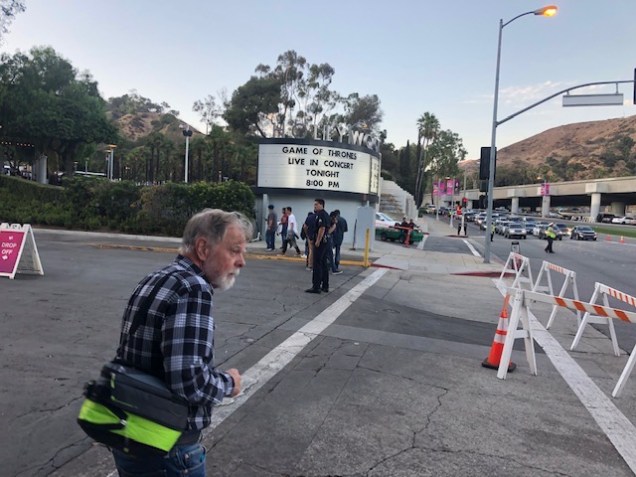
The program featured the music of “Game of Thrones,” performed by the show’s original orchestra and directed by composer Ramin Djawadi. Once the concert got underway, we were blown away both by the sound and beautiful setting. I’m not sure if we’ll ever get back for another concert, but (unlike the Airstream Experience), I would like to.
By the time we tumbled into bed (around midnight), it felt like we’d surveyed a broad swathe of LA Life. But the next morning we got more when we left Eva and Lars’ place and drove to MacArthur Park, hoping to participate in the “Heart of LA” CicLAvia event taking place from 9 to 4 pm Sunday. Inspired by a venerable bicycling event that began decades ago in Bogotá, Colombia, LA versions of it began 9 years ago and have since attracted more than a million and a half people. The idea is to close key streets in a given area and turn them over to pedestrians, bikers, and other folks on wheels (skates, boards, pedicabs, and more) for use as a public park throughout the better part of a day. I participated in one several years ago in San Clemente, but I’d never done one of the LA versions.
One problem was: we couldn’t bring our bikes (because we knew we would be transporting our son and his family and their luggage back to San Diego). But a savvy friend had alerted us to the Smart Metro Bike program that’s part of the LA metro system. I’ll confess Steve and I were skeptical we could find two of those bikes and get access to it. But after very few minor hassles, we succeeded!
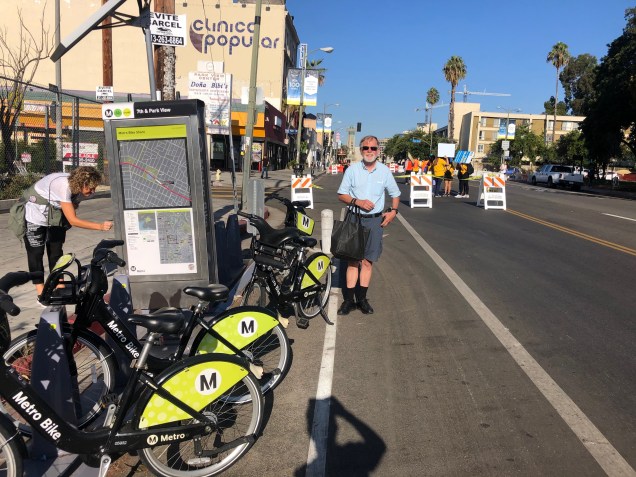
We biked from the park down 7th Street to the heart of downtown, then turned onto Broadway, passing iconic gems like the Bradbury Building and Clifton’s Cafeteria and the LA Times Building as well as monstrous new public edifices such as the police department headquarters. We took the arm of the route that headed southeast, skirting Little Tokyo and crossing the marvelous 4th Street Bridge over the railway lines. 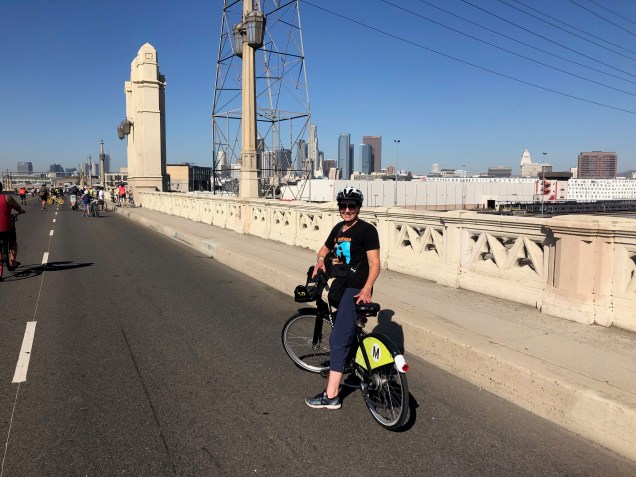 Sadly, we ran out of time and had to turn back before making it to Mariachi Plaza in Boyle Heights. We missed altogether the arm that went to Chinatown.
If we’d had the whole day, we could have easily spent it stopping to view the art and architecture along the route, listening to music, eating at many dozens of options. We didn’t. But it makes me happy to know it’s not that far away. We can go back.
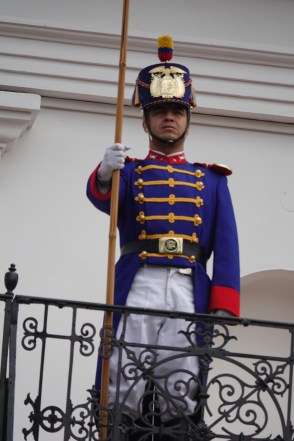 government palace (the Ecuadorian equivalent of the White House) makes the British version seem dull. Commentators trace its origins back more than 200 years, to shortly after Ecuador won its independence from Spain. In recent years, it has taken place every Monday, though the start time has shifted around a bit. We’d heard it was worth seeing. That’s an understatement.
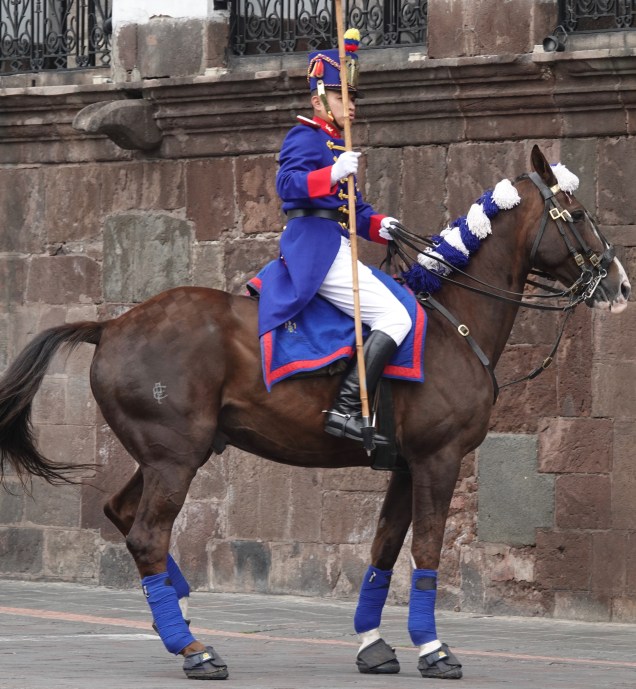 Precisely at 9:00 the strains of stately, grandiose music became discernible, first faintly, then louder and louder, as almost two dozen trumpet- and clarinet- and trombone- and tuba- and bass-drum- and other instrument-playing guards emerged from the inner recesses of the palace. It was music with the power to raise the hairs on the back of necks; music that made me wish I could leave my viewing spot and march along.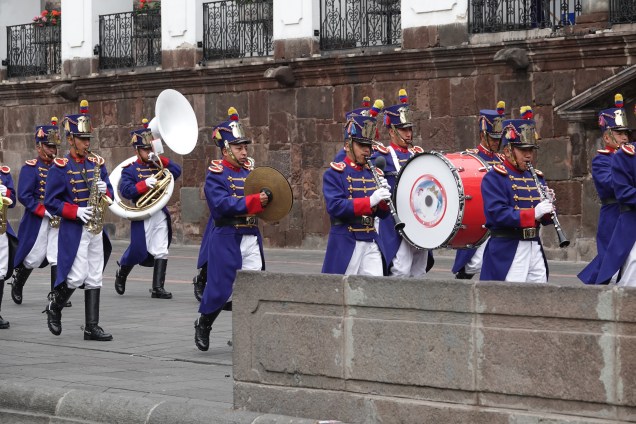
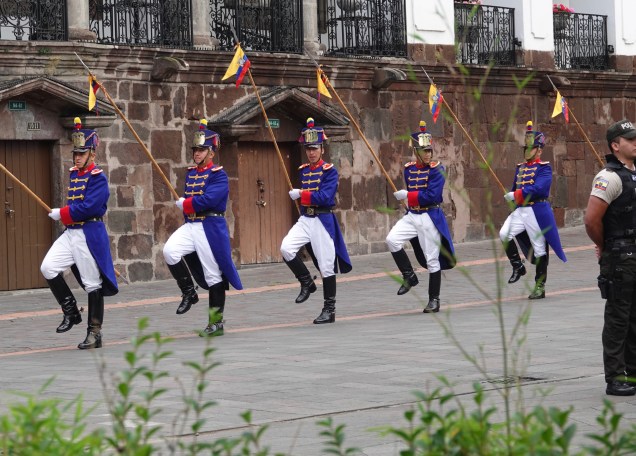 What followed went on for close to a half an hour, and it was too complicated to describe in detail: parading horses and solemn proclamations over a loudspeaker and marching lance-bearers and more and more of the thrilling music. (One missing element was the Ecuadorian president’s appearance on the uppermost balcony, another long-time part of the show. Whether he was just on vacation or worried about his plummeting popularity, I can’t tell you.)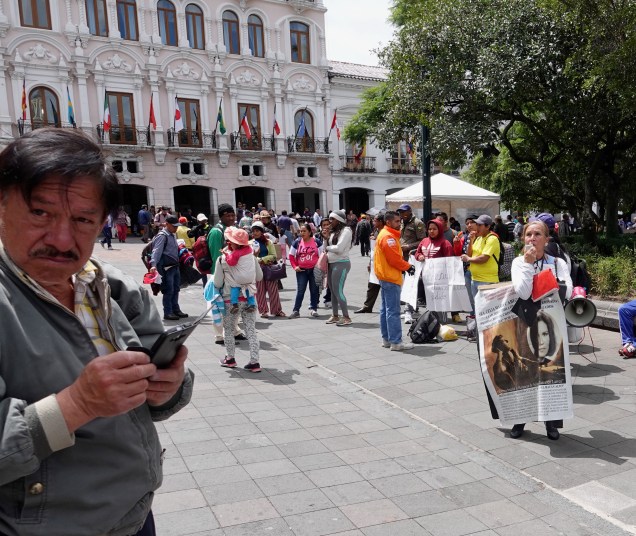
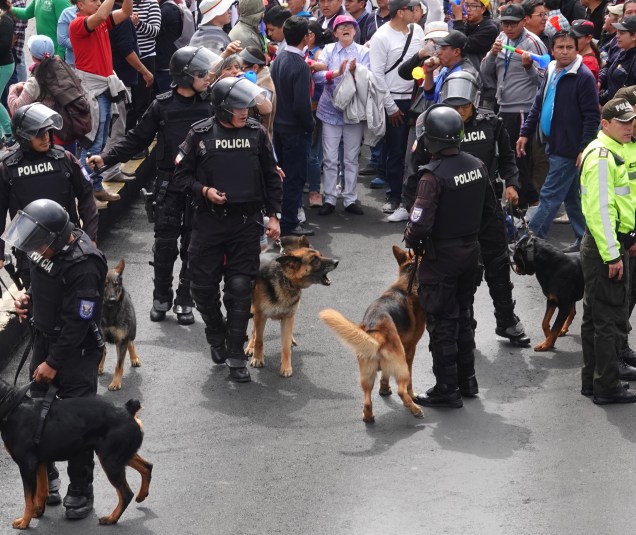
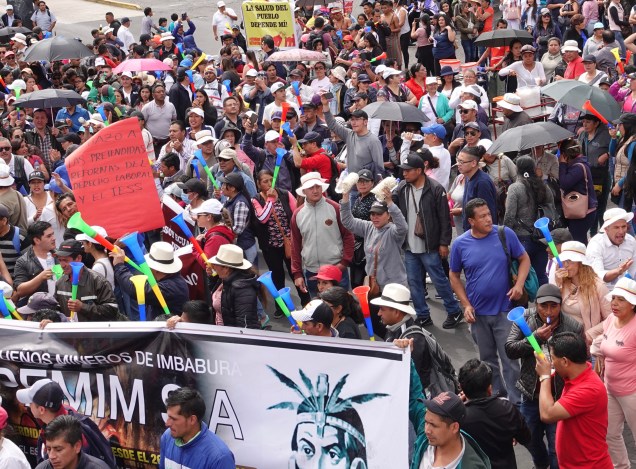 I suspected the State Department wonk who sent out the text message wouldn’t have approved of our being in the thick of it. But the crowd seemed more high-spirited than menacing, and the cops looked chill.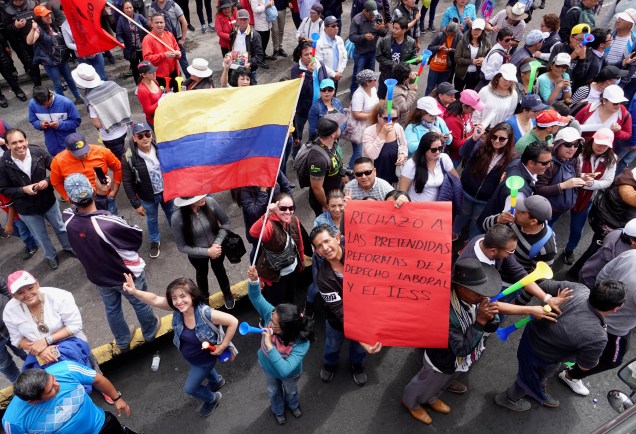


 Or drinking in the viewpoint, reached via cable car, near one of the city’s volcanos.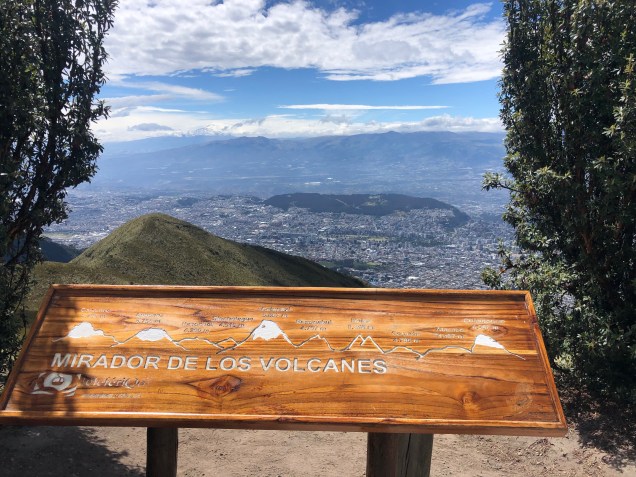

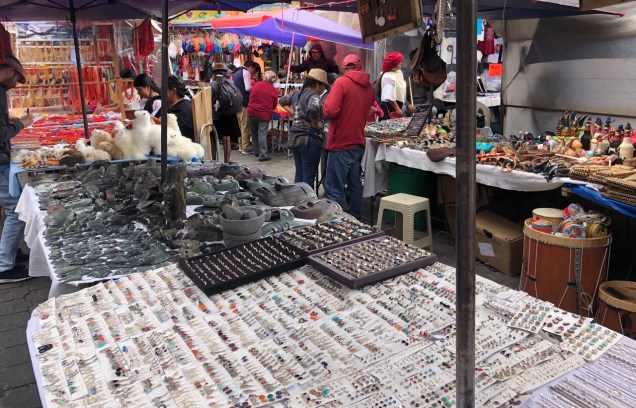
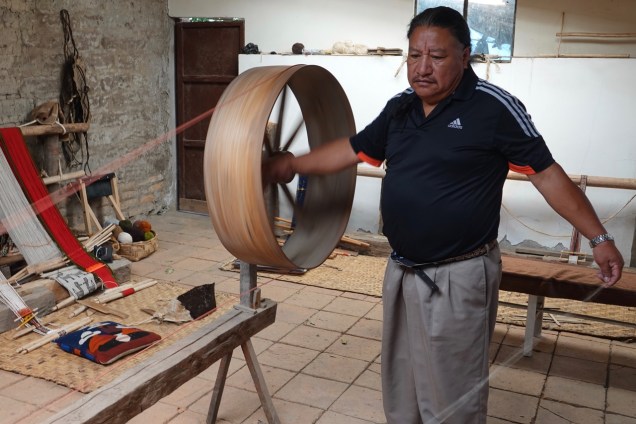
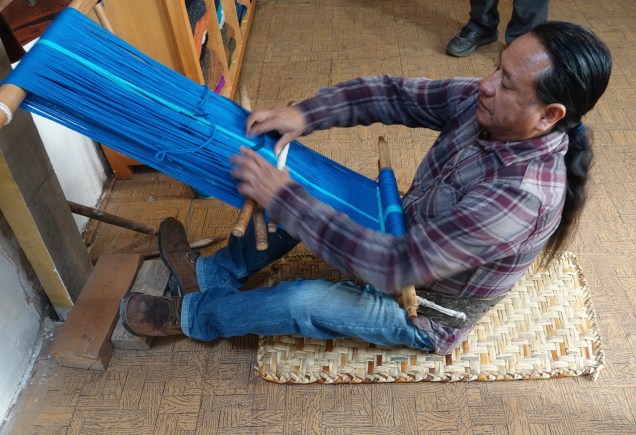 Others created striking objects using more traditional hand looms. Why not spend a little time in Ecuador on our way home from the eclipse, and buy a rug from one of those guys?
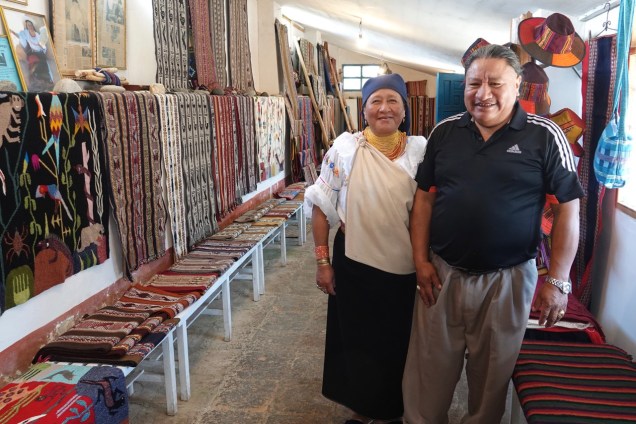
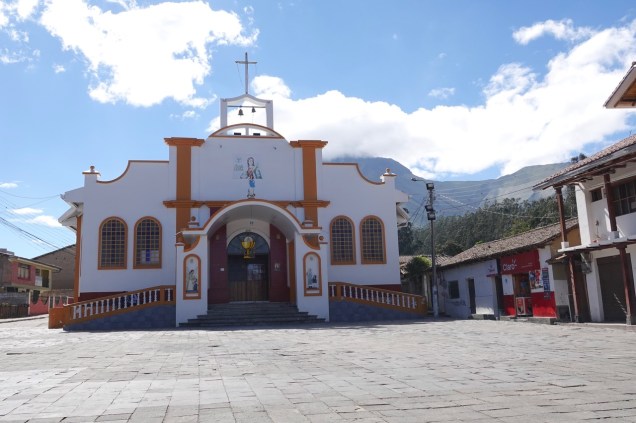 …and walked to the workshop of Don José Cotacachi.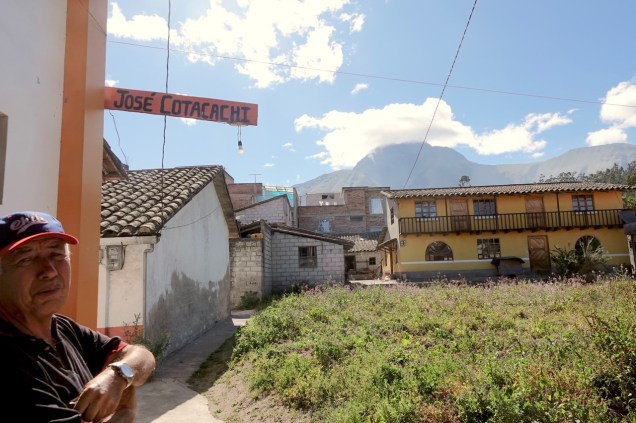
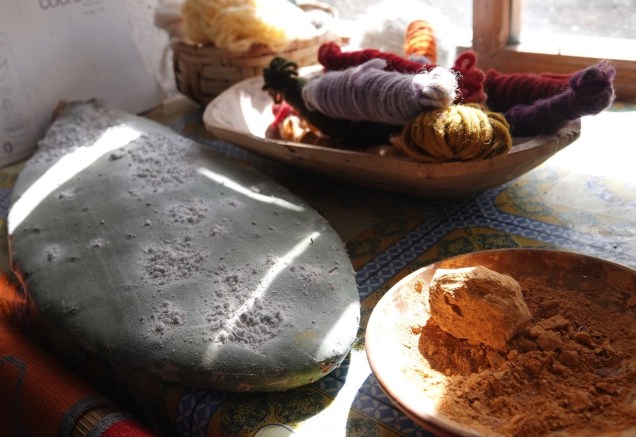
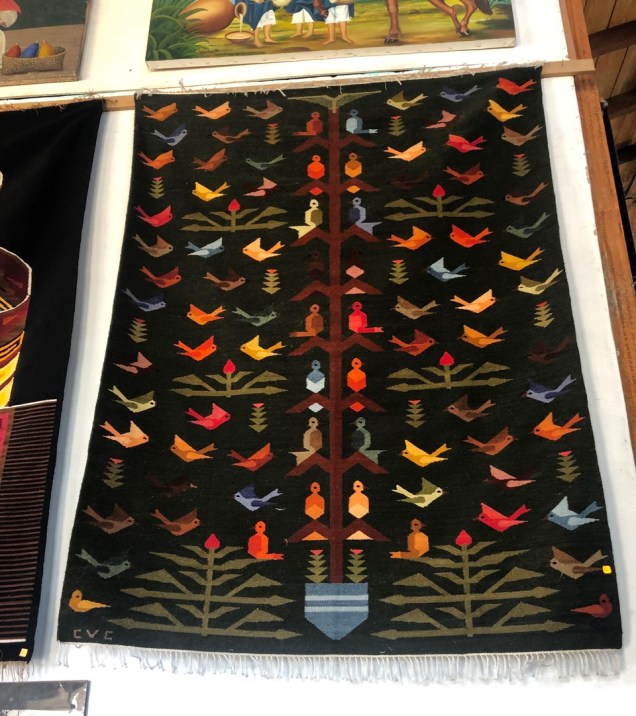 But Steve and I were struck by a problem with using any of it to cover our floor. The largest pieces were less than four by five feet, smaller than what we were seeking. Furthermore, they weren’t very thick but rather more suitable for hanging on a wall or covering a bed. They’d be a bitch to vacuum, and we could all too readily imagine our dogs turning them into a rumpled pile of cloth.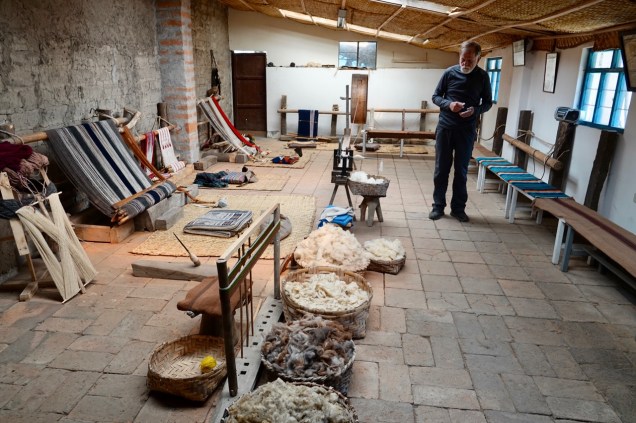

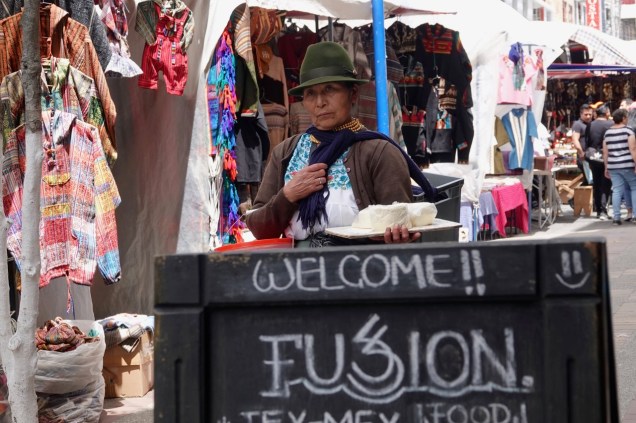 I also had five electrifying Ecuadorian experiences. I hope to share them in one more final, brief post.
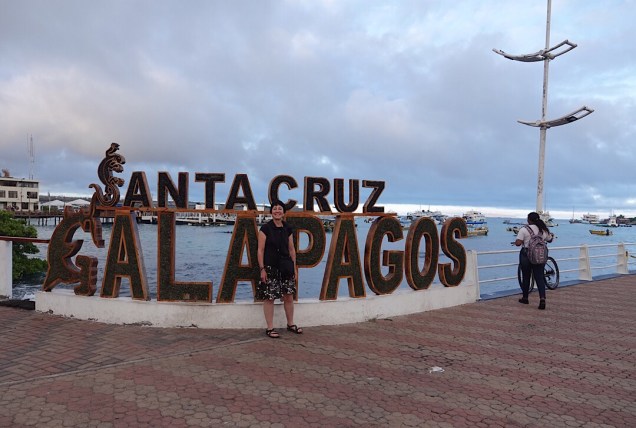 I was long baffled that Steve was never eager to visit the Galápagos. Both natural history and evolutionary biology have always fascinated him. There’s a lot of both in the island chain 600 miles off the coast of Ecuador. The place intrigued me, but the price of visiting always discouraged both of us. No tourism of any sort existed before the mid-1960s, and then for many years, the only way to see the place was to take the almost two-hour flight out, then board a ship that would likely cost at least $2500 per person for a basic five-day cruise and many thousands more for a longer or posher experience. For that kind of money, we typically cover a lot of ground.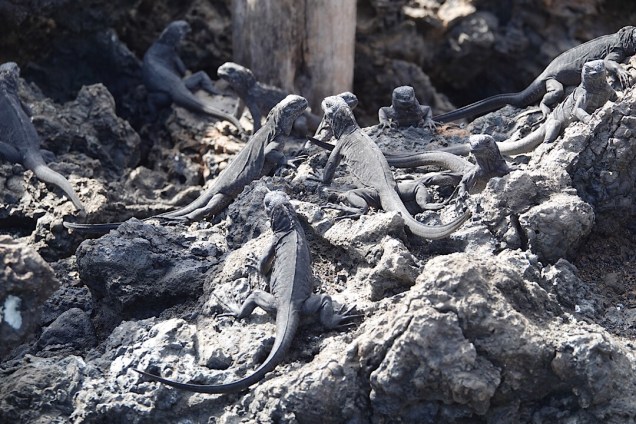
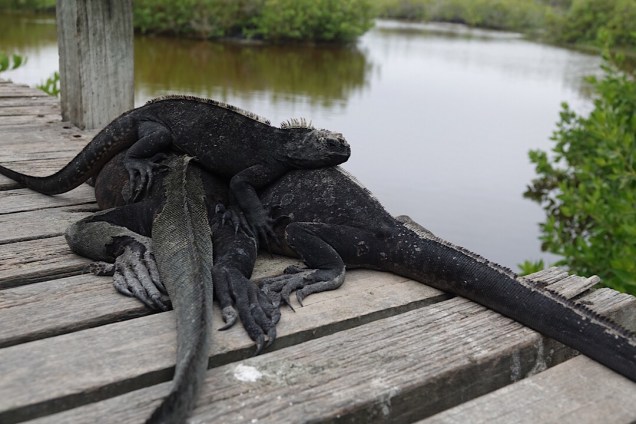
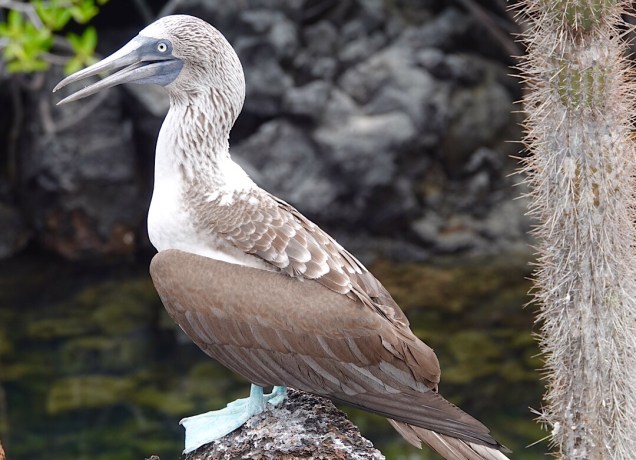
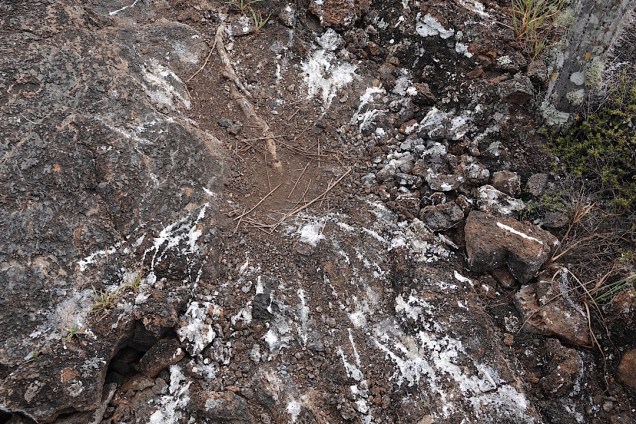
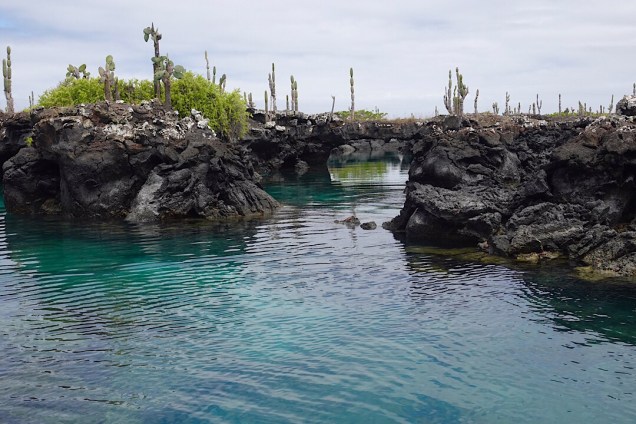
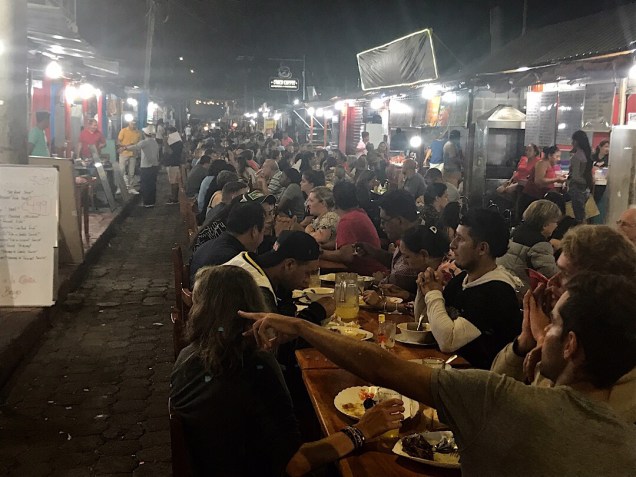 In the end, our stay (including the $180 required per person in permits) cost us about $800 each, rather than the $2,500-$5000 per person the cruising probably would have. And we learned a lot.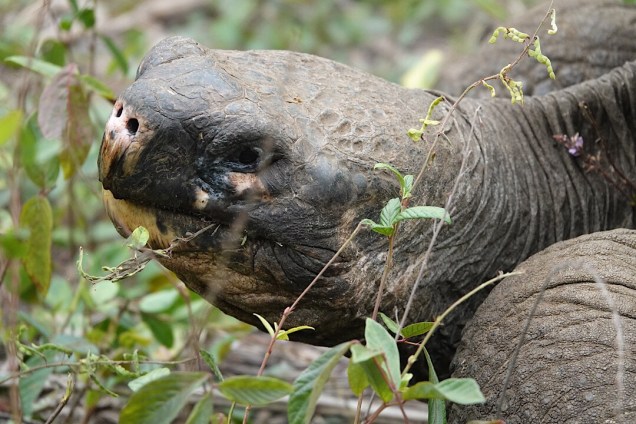

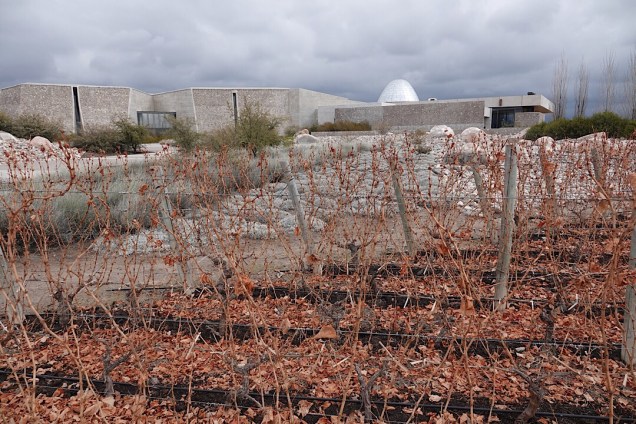
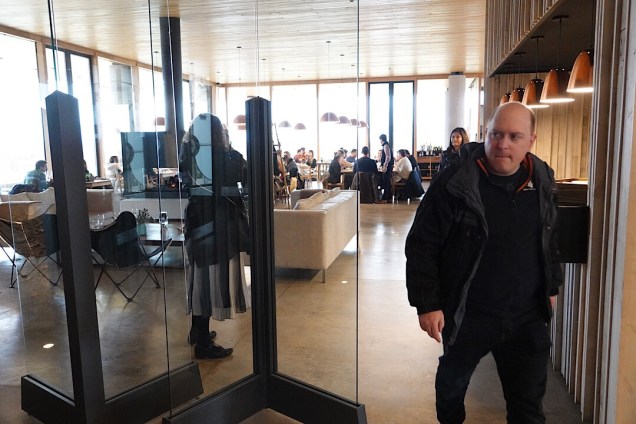
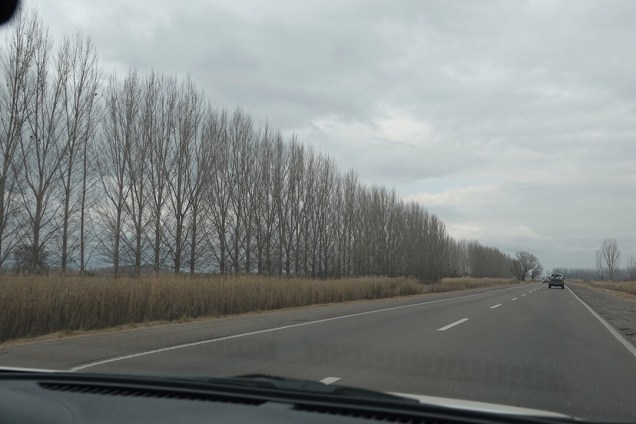
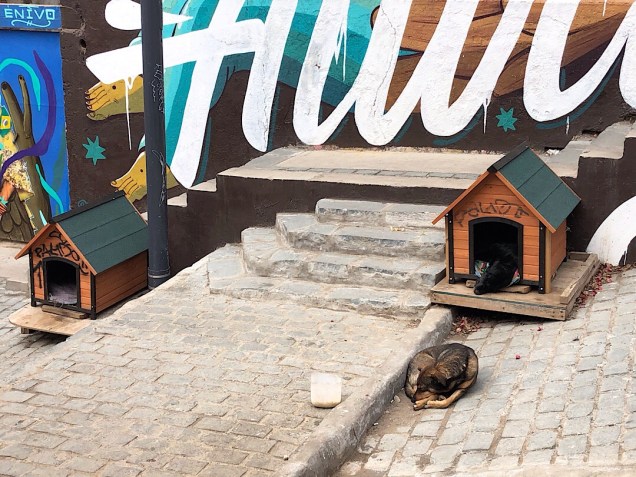
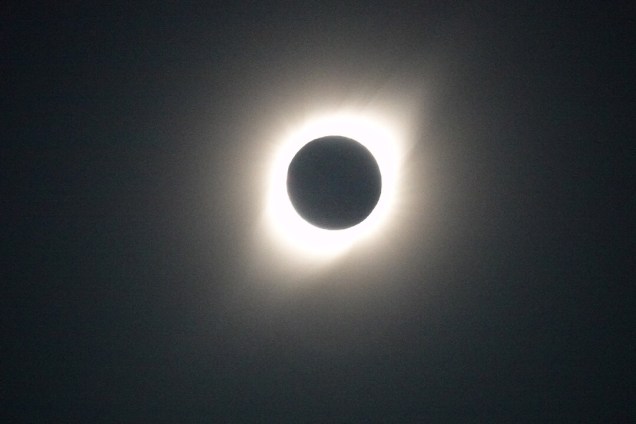 In the Mendoza Airport yesterday, I heard a woman talking about someone she knew who had seen 20 total solar eclipses. I know such people exist; they more or less dedicate their lives to traveling the world to wherever it is the sun will next be totally blocked out by the moon. (This happens only once every year or two.) When I saw my first total solar eclipse in 1999, it affected me so powerfully I vowed to see as many as I could for the rest of my lifetime. I’ve since decided this requires a level of nuttiness that, nutty as I may be, I lack. Seeing only three has taught me how many decisions you have to make, any one of which can turn out to be disastrous.
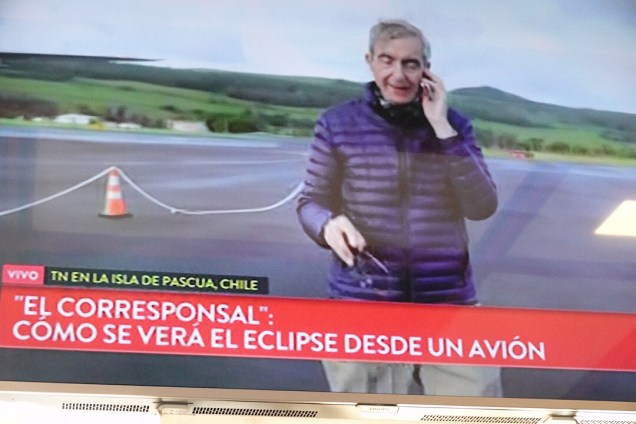 San Juan would be on the far southern edge of the eclipse arc, we knew, but the sun would only be totally covered there for about 30 seconds. In contrast, if we drove north to the center of the path, the eclipse would last close to two and a half minutes. Totality is so spectacular, you want it to last for as long as possible. But what I learned as I researched all this (months ago) is that there aren’t a lot of options for getting around in this part of western Argentina. Professional astronomy sites said the towns of Rodeo and Bellavista were likely to be best, but I had trouble finding them on any map (even Google’s). The only roads leading to them from San Juan crossed a mountain spur, and I could find no clue to what their condition would be.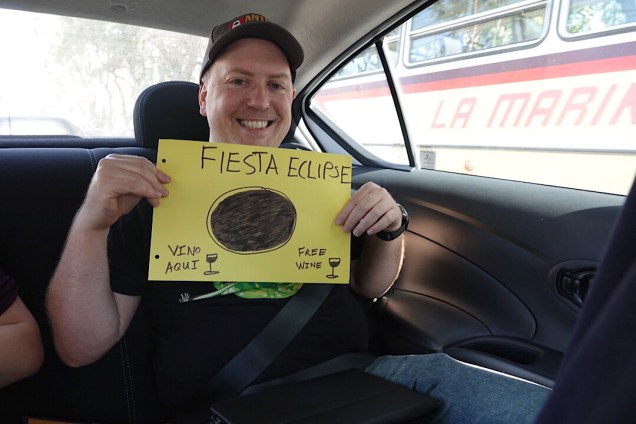
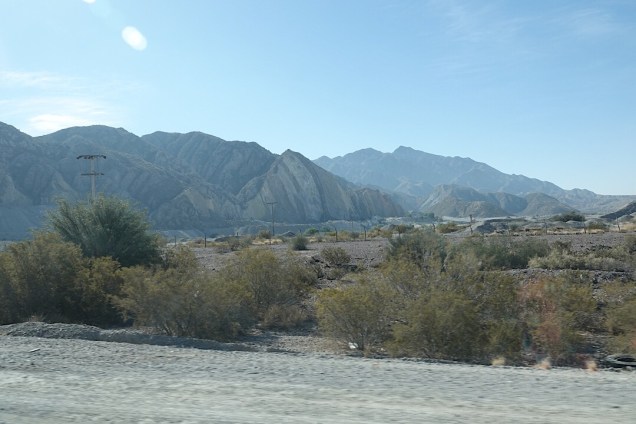 Along the road, we spotted the first of a series of signs announcing a “Punto de Observacion” (eclipse observation point) ahead, which in itself reassured me. (If there was an official observation point, clearly we wouldn’t be alone.)
 It also dispelled another worry: If the road led us to a point too close to the Andean foothills to the west of us, the sun might actually be behind them by 5:39 pm (when totality would start). But if locals had picked an observation point and then created and posted glossy signs leading to it, surely they must have chosen a site where the mountains wouldn’t block our view.
 .
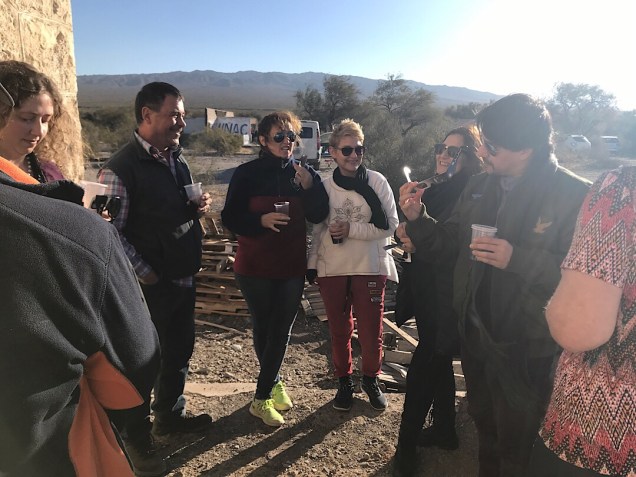
. We had no folding chairs like most of the local folks, but Michael scouted out a spot behind a half-built stone building that sheltered us from the wind.
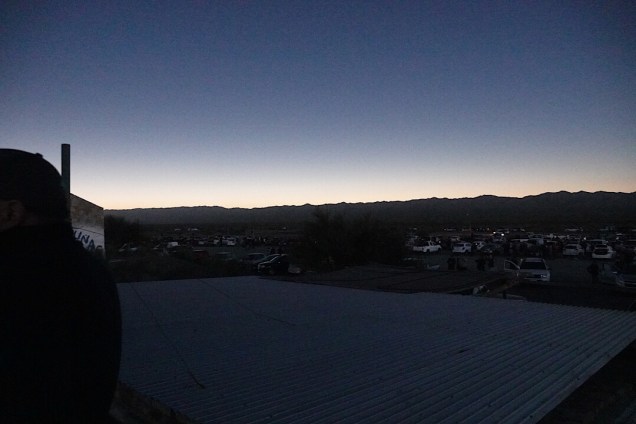
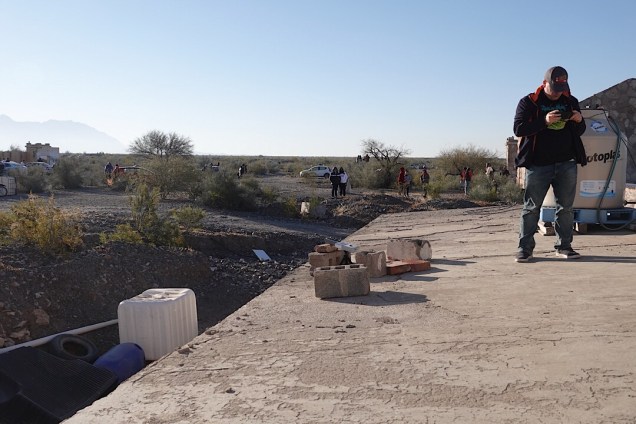 Climbing up on its roof offered excellent views both of the sinking sun…
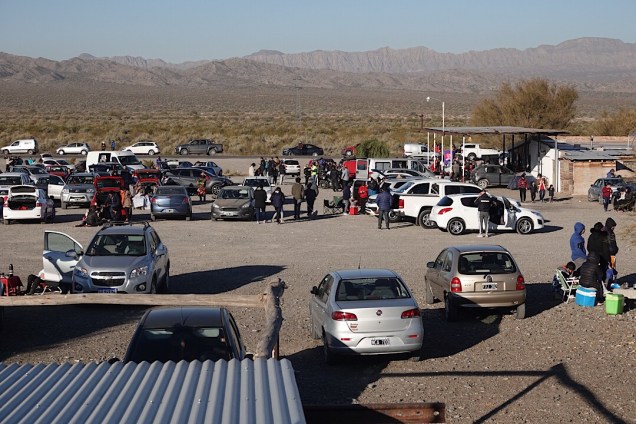
 and the surrounding crowd.
 We anchored our sign with a cinder block and uncorked one of the bottles, poured ourselves a glass, and settled in to wait.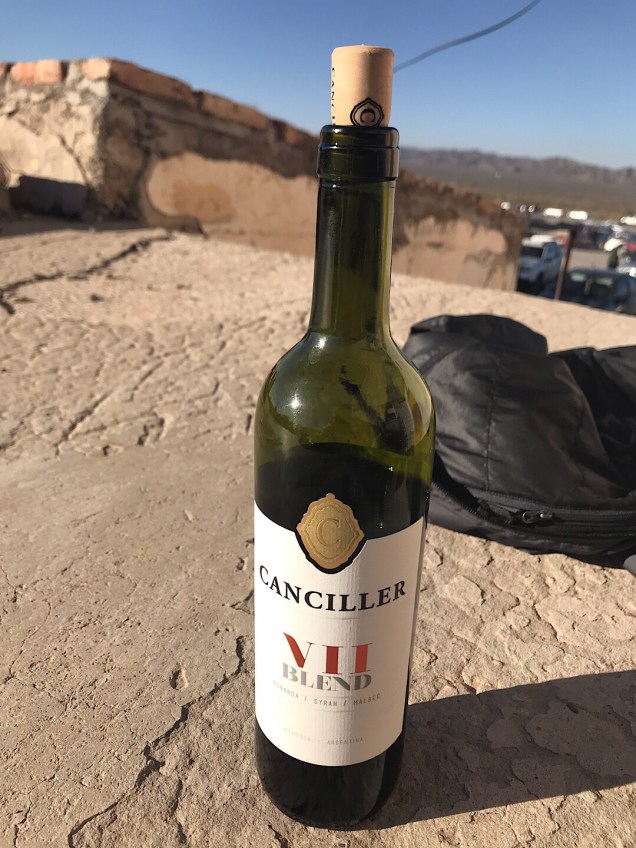

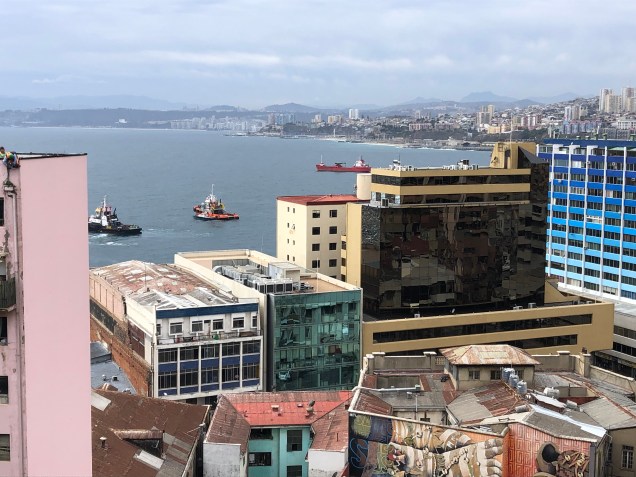
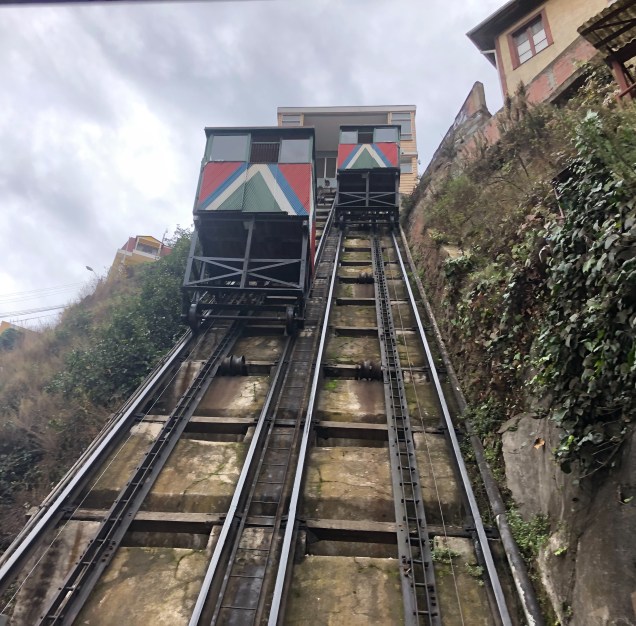


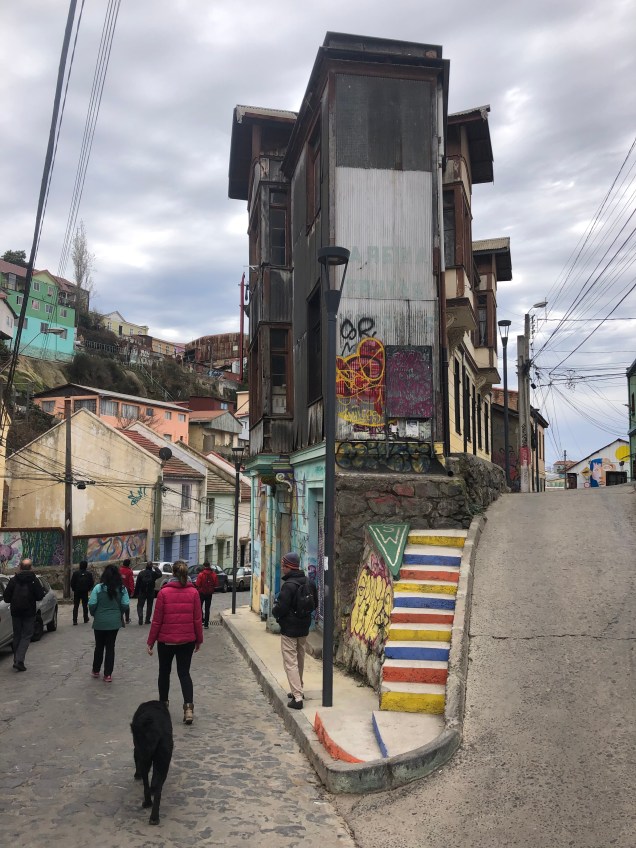

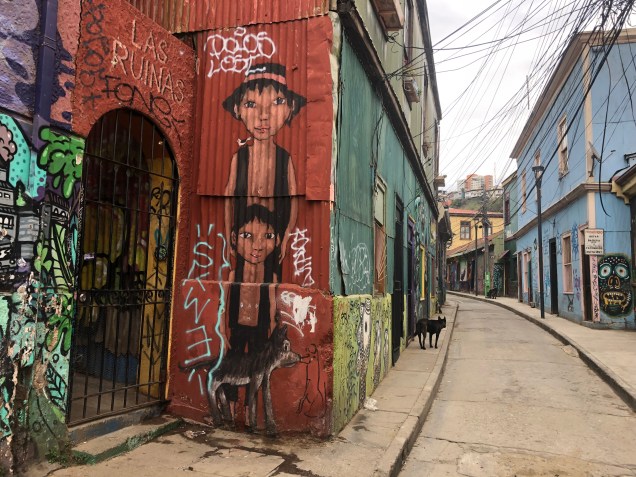
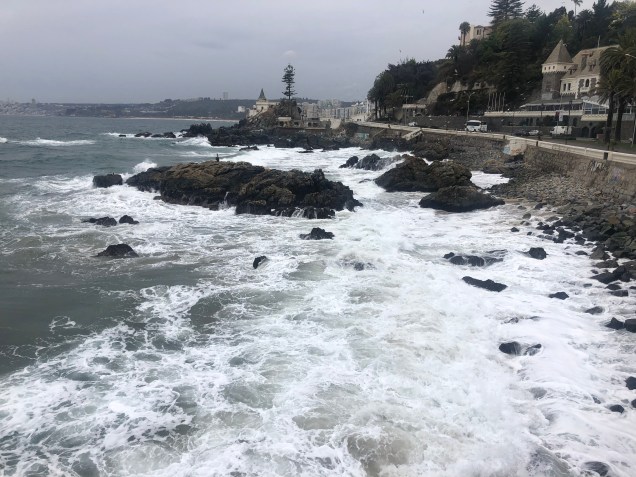
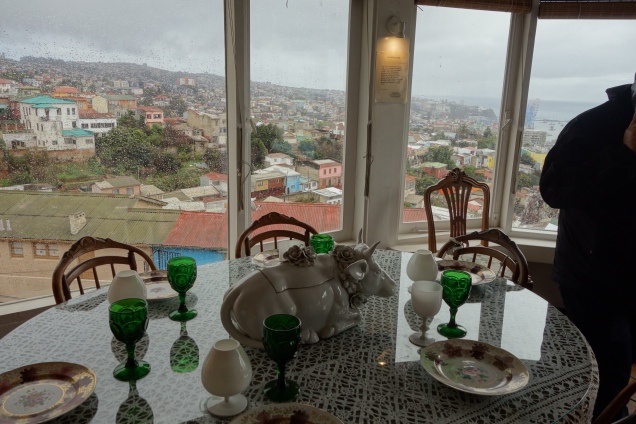
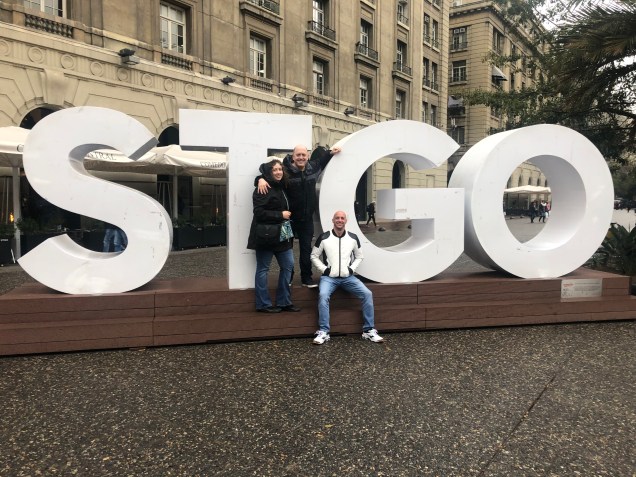 I came to Santiago (Chile) packing a 2017 New York Times article entitled “36 Hours in Santiago.” Steve and I actually had more than 50 hours in the Chilean capital, so I never intended to follow the Times itinerary to the letter. Still I like the 36- (or often 48- or 72-hours) in Wherever format; it suggests sightseeing highlights and often gives me ideas for where to eat. I borrowed the format last fall when I blogged about our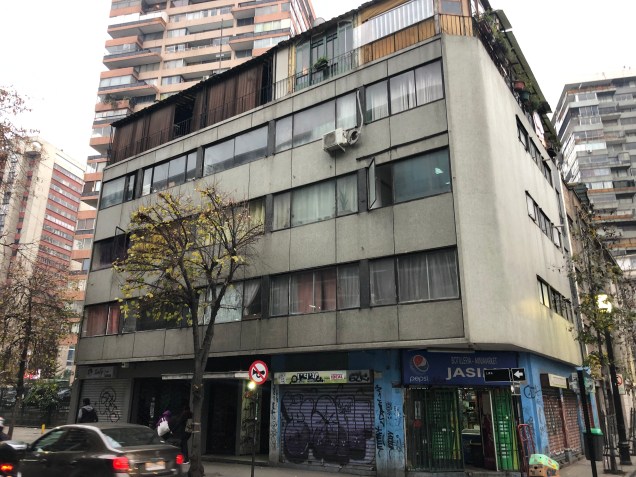
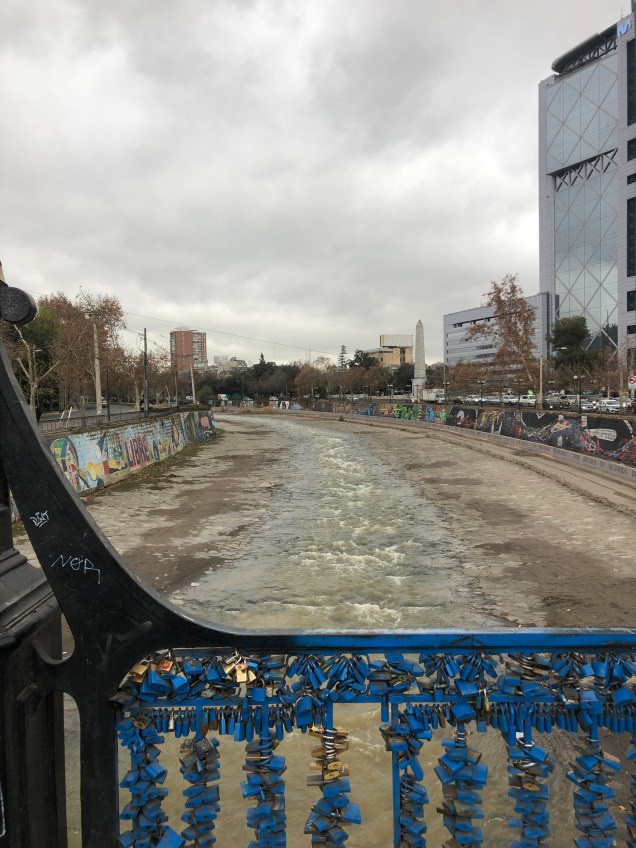
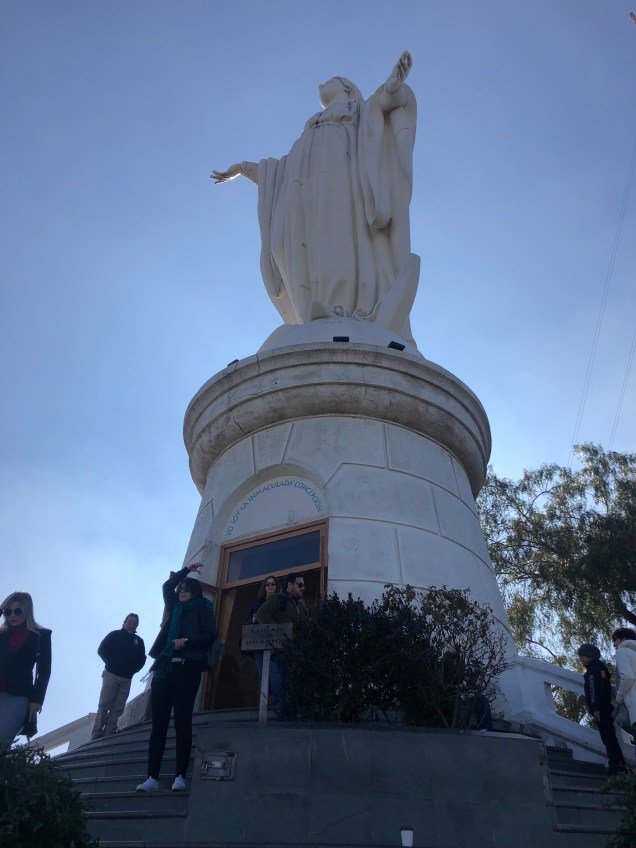 but even more dazzling were the line of snow-laden nearby Andes that she overlooks.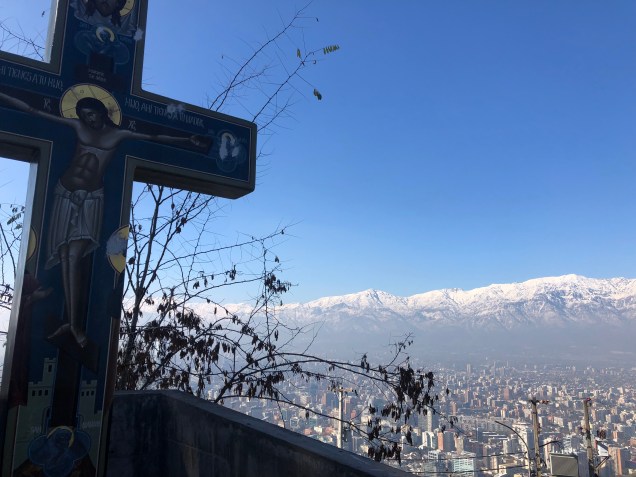
 …a striking arts complex
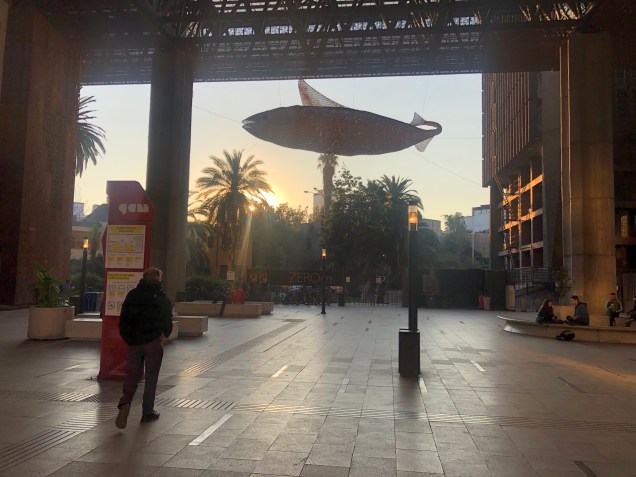 … and more. We also had a fantastic meal that night (almost 30 separates tastes showcasing the ancestral foods of Chile).
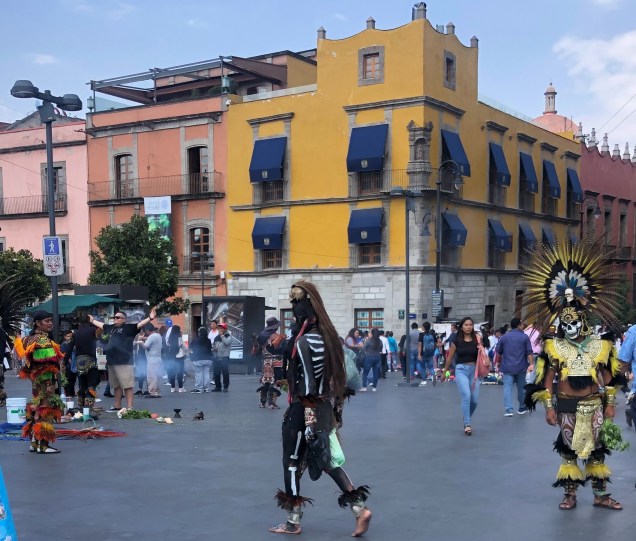 Mexico City impressed me when I first went there, around the end of 1978. It was the first non-European capital I’d ever visited, and it felt exotic. It was the Third World, as we called developing nations back then. On our taxi ride from the airport to our Zona Rosa hotel, I remember eyeing shanties; smelling burning garbage. That visit also exposed me to world-class marvels: the pyramids of Teotihuacan, the city’s huge central plaza, its marvelous anthropology museum, Chapultepec Park. We hung out mostly in the chic neighborhoods, and I recall concluding that the city seemed a wild mixture of Paris and Tijuana.
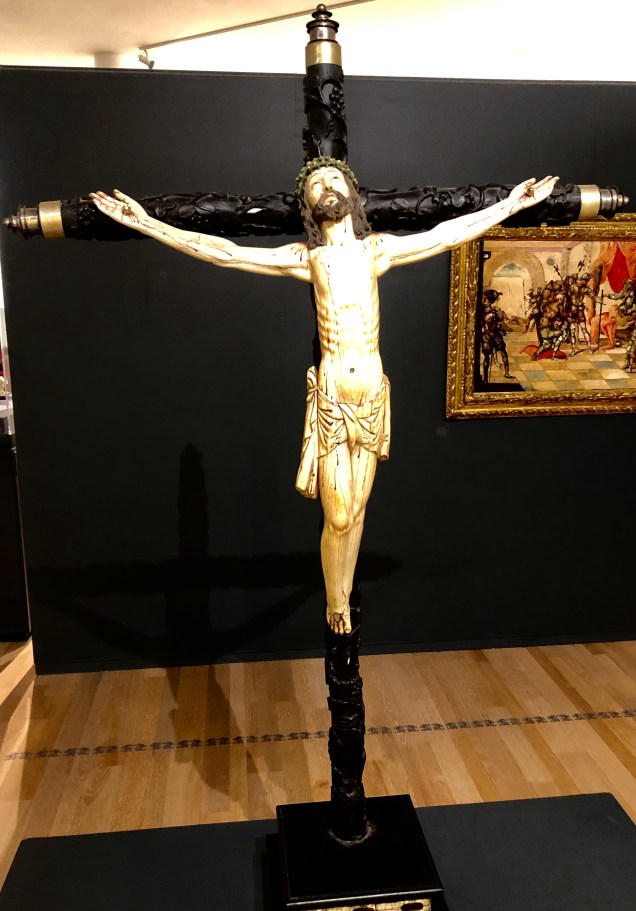

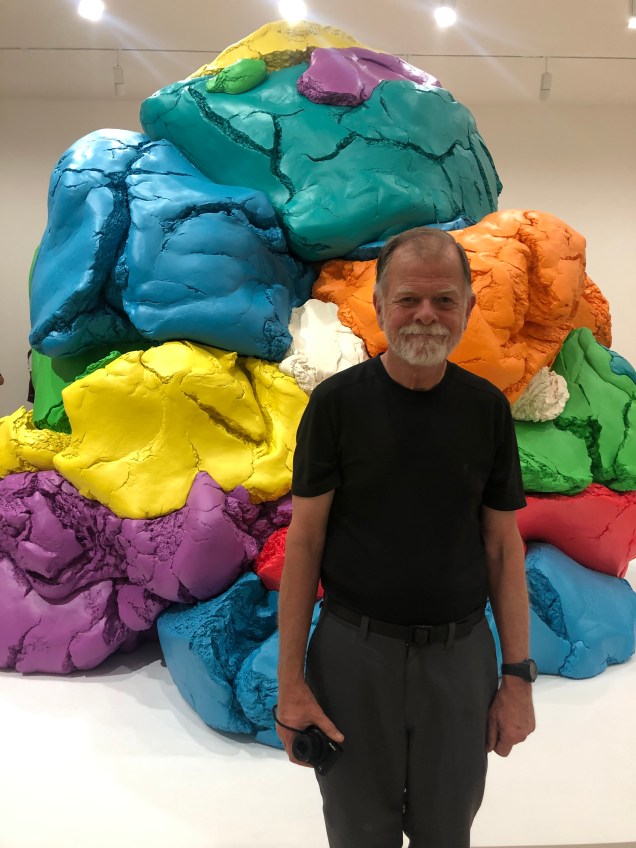 Koons’ gigantic Play-doh pile (made of interlocking aluminum pieces rather than actual Play-doh) amazed me with its beauty and complex craftsmanship.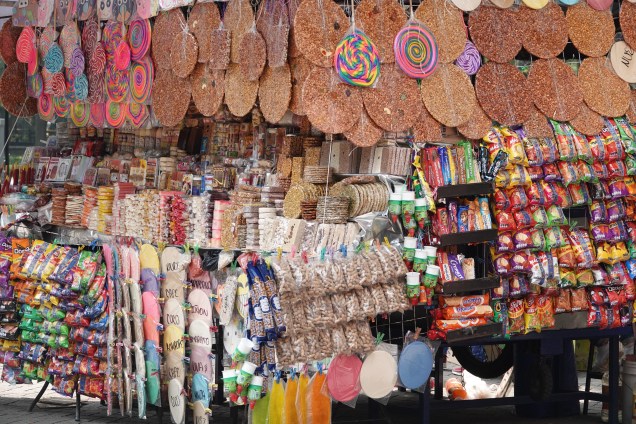
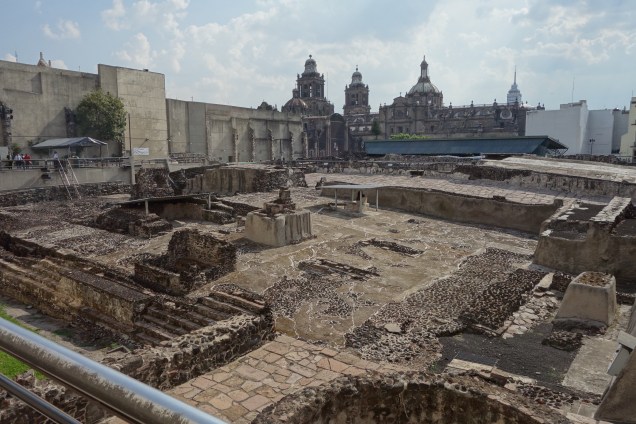 The biggest outer pyramid, which honored the war god Huitzilopochtli and the rain god Tlaloc, is gone. But you can clearly see the remains of what it once sheltered: about a dozen levels of construction dating from 1375 to 1519. You can stare at the double staircase where the bodies of human sacrificial victims were thrown down the steps after their hearts were ripped out. An impressive museum fills in a lot of the details, gory and otherwise. The power and scale of what once filled this space are unmistakable. It made me happy to see two of the main cultures that shaped this country co-existing more equitably.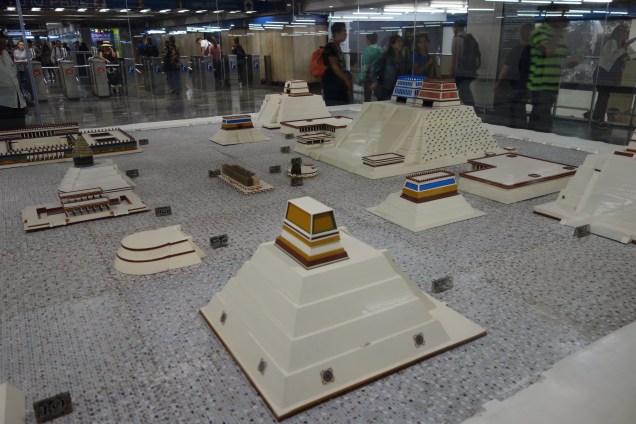
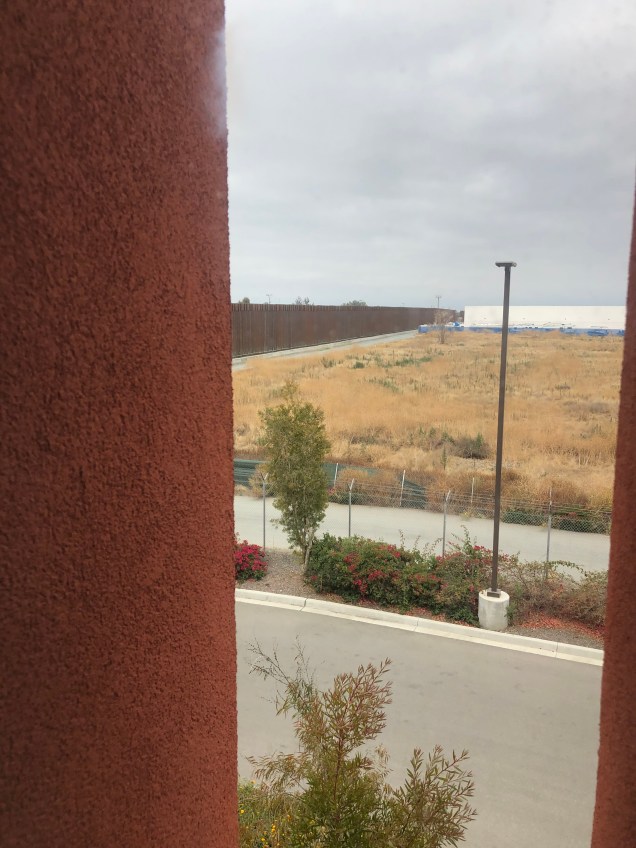
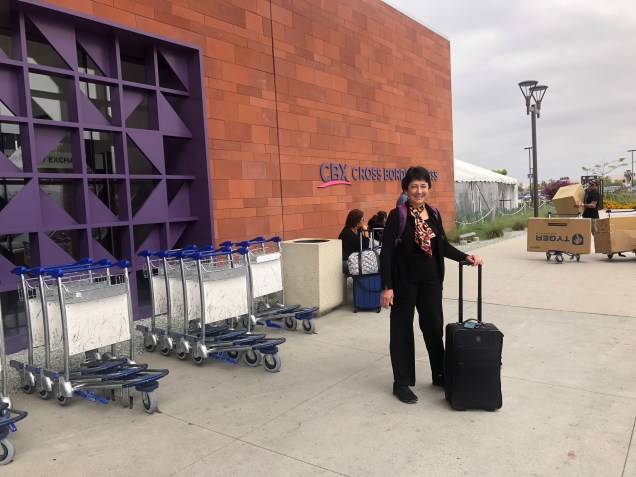 It took us just minutes to buy our one-way tickets ($20 per person) to walk across the bridge and obtain our Mexican visas (from a high-tech kiosk). We scanned the bridge ticket and our boarding pass at a gate that opened for us automatically. Then we strolled over and above that pesky border between the two countries. The passage couldn’t have taken even five minutes.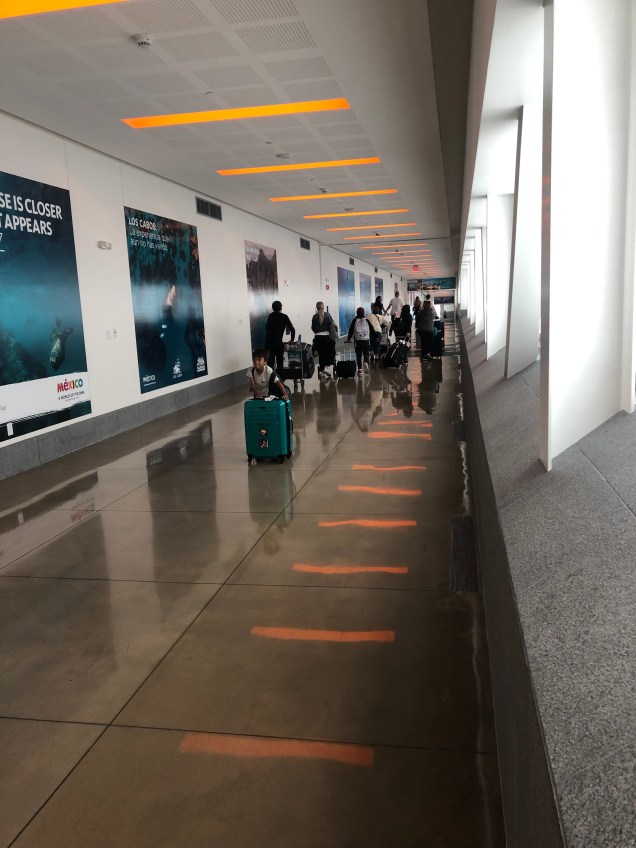
 At home and abroad