Dining with Ecological Disaster

Wednesday morning, March 10,2010

Paul Theroux, in his Dark Star Safari (which I’m enjoying hugely), comments on how he kept meeting Jobergers with amazing tales to tell. His friend the novelist Nadine Gordimer responds that this is a characteristic of South Africans generally, that their lives have been full of events.

We’re seeing the same thing. Last night after we finished our homemade ice cream and apricot panna cotta, the resident manager at Misty Mountain Reserve, Frank Machetto, regaled us with stories about his experiences leading tourists on camping trips (in tents!) in the bush near Kruger National Park. (“Only had to use my gun once. Never had to kill an animal, thank God. But I’d never take anyone who was nervous. Couldn’t have that.”) An Afrikaner, Frank also discoursed with passion and bitterness about ecological disruptions that have occurred near and far. “They kill the puff adders but then you get an explosion in the population of mice! Or the do-do bird! There are trees that have almost disappeared because the seeds have to be germinated in the gut of the do-do bird. But they’ve been gone for 100 years!”

This place is even more upscale than our forest cabin in the park: Even NICER linens on a king-size bed in a space as big as a living room, with a deck commanding a 150-degree view of the Indian Ocean. Circumstances have also conspired to make it feelas homey as our B&Bs in Joburg. The preparation of our excellent meal last night (spinach soup, tuna roulade and home-made bread, medallions of kudu shoulder with a pepper sauce, curried chicken, roasted potatos and squash, broccoli au gratin, salad, and that awesome dessert) was supervised by Val Lane, the wife of the man who dreamed up the idea for the Dolphin Trail hike. The Lanes for a couple dozen years had run a dairy farm on this site, but Dave Lane was a passionate fisherman and hiker who believed there had to be a market for a less arduous way of experiencing this incredible coastline than the Otter Trail backpacking. He and the owner of the Fernery (our lodging tonight) worked out a partnership arrangement with the national park, and the Dolphin Trail hikes were inaugurated in 2001. Tragically, Dave died suddenly four years ago, and when Val concluded she wasn’t up to running the operation by herself, she hired Frank and his wife Rose as resident managers.

Misty Mountain Reserve, as this place is now known, can accommodate 18 guests, but we were the only ones in the dining room last night. A group of five arrived sometime after us last night, but they were staying in a the family quarters and “self-catering.” So Steve and I were again the only guests at breakfast today. Frank announced that he had “slept like a baby. Woke up every hour and cried for my mama!” He jokes a lot. Yet soon he was talking again about the ominous current drought and wildebeest-borne diseases and advancing desertification. “As soon as cattle were brought into Africa, unfortunately that was the end of Africa,” he said. But we’re about to hike for a second day in at least an island of the Africa that has existed for millenia.

Hiking with Puff Adders

Tuesday, March 9

As I commented to Steve yesterday, we’ve now begun the luxury portion of the program. I had mixed feelings about this, after we’d checked into Tsitsikamma National Park (on the southern coast several hundred kilometers east of Cape Town.) Sure the views from the deck of the park restaurant and from our wood cabin — azure ocean with huge breakers crashing on the dark jagged rocks and shooting white spray high into the air — were the stuff of postcards. And our queen-size bed was clad in a much higher grade of linen than we’ve yet seen on this trip. But I felt like we’d left Africa. Except for the workers in the restaurant and shop, everyone was white, and a very high percentage were old, overweight, and Northern European, folks who obviously took pride in (and spent a lot of money on) their elaborate encampments — not merely tents but also lanais and shaded patios and barbecuing areas. Near at hand were scullery rooms where they could clean their dishes in comfort and self-service machines for washing their laundry.

Today my ambivalence resolved. As luck would have it, Steve and I were the only tourists starting the Dolphin Trail hike this morning, and our guide for the three-day adventure is a black African named Stanley. For more than four hours, he led us up steep escarpments and through primieval forests and along paths that hugged precipices plunging to the sea. Spend that much time hiking with anyone and you can learn a thing or ten. Our conversation was at least as varied as the terrain we hiked through. We learned that Stan is 37, married with four kids ranging from 4 to 14, a fluent speaker of Xhosa, Afrikans, and English. He’s worked in tourism for 8 years and yesterday celebrated his first anniversary of leading hikers along the Dolphin Trail. He confided that his dream was to become a guide on big-game safaris; the obstacle in that path was the tuition. (Schooling to acquire the Class 4 certification needed to do such guiding would be close to $10,000.) We talked about what it means to be “colored” in South Africa (as Stan’s wife is). Tomorrow I’m hoping to probe his view of South Africa’s future.

I also learned that I lucked into the best possible hiking choice for us. The most famous hike in South Africa is a 5-day trek along something called the Otter Trail which starts near the Tsitsikamma park administration building and can require reservations almost a year in advance. It’s also quite basic — full-on backpacking in which you have to carry and prepare all your own meals. While much more expensive, our Dolphin Trail trek allows us to carry only a small daypack. Our other suitcases are transported each night to our lodging, which on this second night is even nicer than our “Forest Cabin” last night. In a few minutes, we’ll go to dinner in the main building and (with any luck) have our best meal so far in South Africa. (Up to now, we’ve consumed a lot of stews, curries, and barbecue. Decent food but unspectacular.)

Stan will collect us tomorrow morning at 9 a.m. and he says it’ll take us almost 9 hours to cover the 10 kilometers to our final destination, set amidst a forest of ferns. Perhaps at some point we’ll swim in a natural stone pool next to the sea. With luck we’ll see dolphins and otters, though I don’t know that either one would thrill me as much as the baboons we encountered this morning, including a solitary male, just off the path and not 5 feet away from where we passed. Hopefully, we won’t run into any puff adders or boom slags, the highly poisonous snakes which Stan says are common in these parts. But even if one bit us, we’d have a 24-hour window in which to seek antivenin. “I think most people who die from snakebites, die because of the fear and stress of being bitten,” Stan declared this afternoon. He sounded confident.

ER-South African style

Written Monday, March 8 about events that transpired the night before…

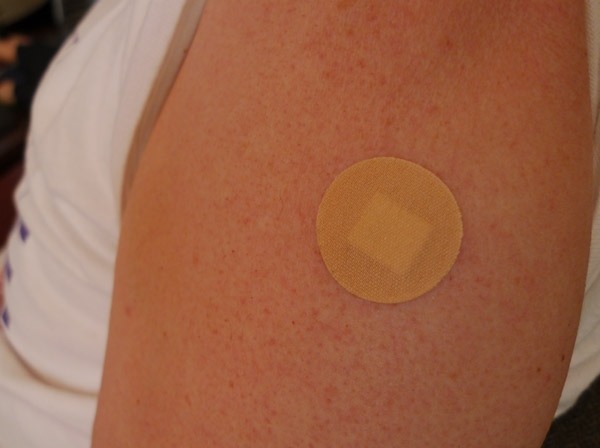
If you have to seek emergency care at 10 p.m. in a foreign city, I can recommend Pt. Elizabeth, South Africa. Concerned about my spreading red forehead welts, we’d asked the manager of the Hippo (backpacker’s lodge) where I could get medical advice, and both she and the lodge owner (whom she telephoned and woke up at 9:30 p.m.) recommended the Greenacres Hospital, a private operation about 5 minutes away by taxi. “For us (meaning black South Africans), medical care is free, so the only people you will see there are white people.”

In the waiting room, it was true that no black Africans appeared to be seeking treatment, but one family looked to be Middle Eastern, and there may have been a couple of Indians. (South African racial nomenclature can be confusing.) Probably 80 percent of the staff was dark-skinned, including the rotund lady who approached and asked sympathetically what we required. Hearing my explanation, she warned us that the list of others ahead of me was fairly long and it might take an 60-90 minutes to be seen. When we said we’d wait, she added my name to the bottom of her hand-written list.

How quaint, I thought. No jungle of bureaucracy to hack one’s way through, as in any American ER. After 40 minutes I was escorted to a curtained room where my temperature, pulse, and blood pressure (sky-high!) were recorded with very modern instruments. (Indeed, everything about this facility looked clean, well-organized, and technologically up-to-date.) A nurse soon appeared and logged the details of my complaint and history into a computer. Then we were sent out into the waiting room again, where at last, a lady at the front desk prepared a billing chart for me (a 10-minute operation, including the hole-punching, stapling, and photocopying steps.)

I finally was called to an examining room perhaps and hour and a quarter after we walked in, and shortly, the friendly, energetic (white) doctor walked in. Minutes into my recounting of how my symptoms had developed, a look of confident recognition dawned on his face. His verdict: shingles (which he suspected might have been triggered by the sun exposure I got in the game reserve.)

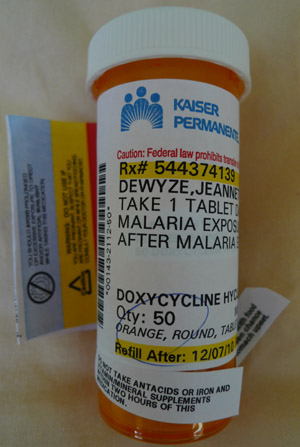
Since I’ve never before had shingles (but did as a child have chicken pox), I’m bereft without my trusty companion, the Internet, to fill me in on everything I now would like to know about this malady. I have to trust that the anti-viral medication the doctor prescribed will make the welts and pain disappear within a week or so. We filled the prescription the next day in Pt. E, which has a small-town feeling — most of the homes in the areas we drove through looked as innocently unprotected as those in Clairemont — no barbed wires, no fences. And when the first pharmacy didn’t have the Zelitrex in stock, they sent me down the road to another. There, Penny the pharmacist, only had 17 pills, but she gave me those and printed out a tidy label, explaining what had been dispensed so that I could get the balance at another pharmacy down the road.

Most fascinating to Steve: the entire ER experience cost 420 rands (about $56), and that appeared to be the doctor’s fee. I have no idea why we were charged nothing for the use of the private hospital facilities. About half of the Zelitrex prescription cost $65.

Whether because of the Zelitrex or the pain medication also prescribed for me, the shingles haven’t been much of a nuisance. There’s some pain, but it’s tolerable. Sadly, though, I’ve also finally caught Steve’s cough/laryngitis.

Still, I’m so excited by the prospect of a day of hiking in this beautiful place and confident I can power through the afllictions. We depart for breakfast and then the trailhead in 5 minutes.

Still more whining about the Internet in South Africa

Thursday, March 11
Can the Internet in Nigeria possibly be so much better than it is in South Africa? But if it isn’t, how could all those scammers possibly operate, without dying of frustration??@!! As I’ve been doing.

I’m now sitting in the lounge of the most expensive hotel we will enjoy on this trip, one of the nicest hotels, in fact, I’ve ever stayed at. The Internet actually WORKS here, unlike the very nice place we stayed last night, where it theoretically works, except when it’s raining. Which it was, when I tried to use it. The quite nice place where we stayed the night before had no wi-fi. Frank, the manager, used it only via some card he plugged into his computer. Very confusing.

My problem now is that I THOUGHT I just uploaded four posts, written over the past three days. But I don’t see them yet. Can they be lost in cyberspace? Is blogspot aging them, like fine bourbon?

Stay tuned.

More good and bad news

Monday, March 8
Good news: the Baz bus arrived early, driver barreled through the night at maniacal speed, we didn’t crash, and arrived 45 minutes early. Early enough so that we decided to go to the nearby emergency room and have my splotchy red painful patch looked at.

Bad news: I have shingles!!! The legacy of childhood chickenpox, I presume.

Good news: I don’t have some tropical pest worming around under my skin, preparing to penetrate my brain (my worst nightmare.)

More good news: I was able to get online at the Hippo Backpackers — just 20 rand for 30 minutes.

Bad news: The Internet is so painfully slow (as usual), my time is almost up. Plus it’s time for us to head to the airport, pick up our car, drive to Tstitsikamma National Park and start our 3-day hiking adventure on the Dolphin Trail.

Backpacker Paradise

Sunday, March 7
There’s no easy way to get to and from Bulungula, but the best of a bad lot is to take the Baz Bus to Mthatha and then the Bulungula shuttle from there. Once we committed to that, we were committing ourselves to the backpacker’s trail along the Wild Coast. It’s the path of least resistance. You buy a ticket for a week and then you can get on and off the bus at any number of backpacking lodges. The bus picks you up and drops you off at your destinations. I’m not sure we would have wound up otherwise at Buccaneers. But then we would have missed perhaps the most famous backpacker lodge in all Souith Africa.

It was once an overgrazed cattle ranch. But at some point, it came to someone’s attention that the hillside spread commanded the kind of view that would gladden the hearts of young adventurers fleeing the rigors of winter in England or Germany or Holland, or really anyone with a soft spot for idyllic beachy paradises. So starting in 1981 they built a series of cottages and dorms and planted palms and succulents and other dense native vegetation. Today Buccaneers has the soul of an old pilgrimage spot, revered by free spirits and hippie throwbacks and penny-pinching geezers. The walls around the front reception desk (which is built of corrugated zinc topped with a slab of wood) are plastered with notices for surfing lessons, trips to the nearby village market, sporting and cultural outings, rides wanted. The rooms like ours (a double with a bath) are cheap; the dorms and camping spots even cheaper. The vibe is funky tropical, more backpacker’s resort than youth hostel.

Our room was clean (if worn), the bed comfortable, the enormous beachscape from our wooden deck the sort that would command a multimillion-dollar price tag in La Jolla. The pitter-patter of little gecko feet (the resident pest, along with ants) creeped me out for a few minutes after we turned out the light. But we’d been reasured they don’t bite.

Alas, something DID apparently bite me at some point in our travels, and I’m beginning to suspect that the bite somehow got infected. That would explain the red raised welts that seem to be spreading along the hairline on the left side of my face. They hurt too, so we’re going to try to seek some medical attention tomorrow in Port Elizabeth, after we pick up our car.

The bad news is that in order to get to PE, our Baz Bus ride tonight will take five hours (from 5 to 10 p.m.) The good news is that after enduring one hypertensive frustration after another, I finally got online last night and again this morning. (Internet connectivity has been shockingly bad so far, in our experience.) Online, I learned that my nephew Lee has now survived to be one of the last 8 guys and 8 girls competing on American Idol. That’s almost exciting enough to make me want to fly home. Almost, but not quite.

Village Life

Saturday, March 6
I woke up well before dawn this morning and lay in bed thinking about why Steve and I have cherished this time at Bulungula. We’ve appreciated the staggering physical beauty. I finally got out of bed when I couldn’t sleep and made my way down to watch the sun rise over the Indian Ocean. Alone on a beach that stretched for miles, I witnessed changes in the sky and land that came close to being a religious experience.

But the unspoiled beauty alone wouldn’t justify the harrowing journey and general grubbiness. The facilities aren’t awful. But if the clever design of Mosetlha made camping truly comfortable, in this place, it feels just tolerable. The mattresses on the beds in our rondeval are thinner, and the sea air dampens everything and makes the room smell of mildew at times. I never detect the stink of cow manure, which amazes me, because that’s what the floors are made of. Dried, it produces no dust and feels comfortable under the bare foot. The composting toilets at the lodge do stink, though, and the kerosene-heated showers produce water that you can bear to stand in naked. But it’s hardly pleasurable.

Instead, what’s fantastic about Bulungula is the way that it has allowed us to get to know a few black Africans in a context that feels respectful and mutually beneficial. The lodge is located on communal land, and villagers make up the vast majority of the staff. Moreover, the village works almost as an extension of the lodge. This is a village unlike the image I associate with that word. There’s no central cluster of buildings. Instead the 100 or so dwellings that constitute it are scattered over the hillsides, close enough to be companionable, but separated sufficiently so that you probably can’t hear even screaming arguments among your neighbors. The 800 or so people who live here are scrupulously honest, and violence against strangers is unheard of. There are no locks anywhere, and we leave our valuables out in the open. We’ve heard that this works, in part, because everyone knows everything about every person here. If someone suddenly showed up with a new cell phone or a lot of money, questions would be asked, sanctions meted out (the worst imaginable being banishment from the community.)

Although encouraged, ranging out and wandering throughout the community presents the problem that most of the villagers speak only Xhosa. But the lodge has devised activities to facilitate contact. Steve and I have participated in several. On the first day, 2 young German guys, a young “colored” South African girl, and we were led by an English-speaking 23-year-old woman named Khunjulwa to meet with the village herbalist. The seven of us trooped through the forest, where the herbalist showed us plant after plant that he uses to cure people of ailments ranging from skin rashes to toothache to mental disease. (My favorite was the little root he dug up that supposedly comes in handy when a husband is beating his wife and causing trouble within the family. We were told that if you boil it and both spouses wash with the product, domestic harmony will be restored.)

The second day, while Steve went canoeing on the river, Eva, our Swedish fellow traveler from the first day, and I set off to experience “women power” in the village. For this we had two principal guides named Khululwa and Akhoba (both in their 20s and unmarried, and each the mother of one young child. Apparently, both were able to persuade their parents to let them work (as guides) instead of getting married to whichever local guy could come up with the 10 cows that’s the standard bride price in these parts.) The women took us to Khululwa’s house, where they painted our faces with clay mixed with water in the style considered to be fashionable among women hereabouts. They also tied scarves on our heads and led us down to the stream, where we scooped some water into the plastic containers they gave us, and then tried to walk with these balanced on our heads (the way local women do). This is TOTALLY as hard to do as it looks, and predictably, I sucked at it. (Eva did better.) We also gathered wood from the nearby woods and carried those back to K’s house, where she cooked a tasty lunch of peap (the local version of polenta) topped with chicken and cabbage broth. To eat that, the women threw a bamboo mat on the floor, heaped two plates with the food, and then bade the four of us to join them on the ground and dig in, using our hands.

If these activities sound corny, it wasn’t the specific content of what we did that mattered. What counted was just having an excuse to spend some time together, having the opportunity to ask them questions about themselves and their lives, to see their day unwind as they see it. This meant a lot of time of just hanging out. Sitting on the ground and watching the animals jockey for the bits we dropped. (I was fascinated to see how the big fat hen and her chicks kept the two wistful dogs in their place; she’s lightning fast when she tries to peck out their eyes, Khululwa told me.) Watching various children wander in and pile on the single grimy bed in this room (the family’s kitchen), and watch us back, jostling each other, joking, complaining. Eva and I at times wandered into the other building where Khululwa’s mother was sewing two bags for us (made of cloth printed with images of Nelson Mandela). She worked on an ancient hand-cranked Singer. She spoke a little English and told me she was 48, the mother of 9.

Later, it struck me that I’d made a breakthrough as a traveler. In that village, I was able to flip some kind of mental switch and feel content, even serene, just being with the people there, with no real agenda and no firm sense of when the next thing would happen. And I was pleased by how quickly I could begin to discern their personalities; how quickly the generic Black African Village Women become Khululwa and Ahkoba and Khunjulwa.

This despite the fact that their lives are almost unimaginably harder than mine. All their water comes from those wells (which in recent memory killed 6 children in one bad 18-month period). They live with no electricity, which means every piece of dirty clothing has to be carried to a stream and washed there. The kids (boys, I assume) have to range out over the hills every night to round up the family’s sheep and goats and cows and corral them. It’s easy to believe the villagers are genuinely delighted to have the lodge and its visitors among them, asking silly questions, perhaps, but bringing in desperately needed cash. (Still, the main source of that comes from the men who travel up north to the gold mines. Most of the men of the village do that, the women say.)

There’s talk circulating at the moment that the government has plans to approve that hellacious road to Mthatha. It’s easy to imagine that when that happens the most appealing aspect of life here — the tight family ties and rigorous honesty of the people and freedom that comes from physical safety — may begin to break down. But a better road would mean that it won’t take 2-3 hours to get to a hospital when a child is critically ill. I feel fortunate beyond words to have visited Bulungula now, but if it’s changed in the future, who am I to complain about that?

Welcome to Bulungula

Wednesday March 3
My scariest travel moment up to now was the time George Jemott led us to a point near the City of the Dead in Cairo where we had to run across an Egyptian freeway at rush hour. Now I’ve got a rival: the moment our Land Cruiser almost tipped over on the way to Bulungula.

The day had started out so well. The backpacker bus had picked us up in Durban as planned, and more or less on time. Although the driver must have been doing 75 miles an hour at times, he seemed sensible enough about passing other vehicles on the road. We stopped twice at roadside complexes that were shiny clean and stocked with chips flavored with chutney and tomato and other exotic flavors. And we arrived ahead of schedule at the Shell Ultra Station in Mthatha, where we debarked from the Baz Bus to look for our shuttle to Bulungula.

On the way to Mthatha, I re-read the materials that had convinced me we had to devote several days to visiting this eco-lodge. The Lonely Planet guide had called it “spectacular,” and the Rough Guide included it among the top 28 Things You Must Do in South Africa. The latter explained that the inaccessible area known as the Wild Coast (in the Transkei region) was one of the only places left in South Africa where traditional African village life still unfolded, with people living in simple round thatch-roofed buildings called rondavels. A Cape Towner by the name of Dave Martin who had worked on a variety of community-development projects had launched the Bulungula Lodge in 2005 in partnership with the Xhosa village of Nqleni. Not only was the lodge located on a cliff overlooking a breathtaking stretch of river and beach, but a stay there could also give you a unique chance to interact with black Africans living in a traditional society.

That sounded great to us, and when the Bulungula shuttle showed up around 3:15 p.m., two friendly Bulungula staffers introduced themselves and ushered Steve and me into the battered rear compartment of the Land Cruiser, along with a Swedish couple around our age, a thin young African man named Pumzileh, various backpacks and bundles and boxes of groceries and other supplies. Then we were off, jouncing over brutal terrain that we couldn’t see because the windows were all too caked with mud to allow any view of the landscape. The thought that this might last for more than 4 hours might have made me quail, but Pumzileh distracted us. He works for the Bulungula Incubator, the companion program started by Dave to launch projects to improve the village’s standard of living. One was to build a primary and preschool. Pumzileh was working on a new one having to do with planting lemongrass as a cash crop.
Since he was moving up in the organization, he had to find a replacement to fill his current job of acting as a liaison between the village and the Incubator. He favored hiring a young man working at the Shell Ultra Station in Mthatha. “I know that he is very responsible. He won the award for top cashier! Just as I did. I trained him!” But there were two other candidates, and Pumzileh said the elders in the village also needed to be consulted, as their view of the candidates might differ from his. He talked in such detail and with such earnestness about every topic that surfaced, it could have been tedious in a less talented story-teller. But he held us spellbound, describing how his gold miner father had disdained education for his children (with two wives); how his mother was surviving since his dad had died (at 56); how proud he was to be he first person from his village ever to fly (to Cape Town) and how poignantly he yearns to someday travel beyond South Africa. At one point, another turn of the conversation led him to recount for us the story of Shakespeare’s Macbeth. “I will never in my life forget how he could not wash out that blood on his hands!”

After two hours, we halted. We were at the end of the “good” road, the point behind which a 4×4 vehicle becomes essential. The owner of the grocery store there lives in a big fancy gated house, and allows travelers to park their cars within its locked premises. A young Dutch couple was supposed to be joining us there, but they’d gotten lost, so we piled out into the fading daylight to wait for them. A half dozen barefoot local kids, ranging in age from maybe 8 to 16, joked with Liesl, the Bulungula staffer, until a strengthening drizzle drove us all back into the Cruiser.

The Dutch couple finally showed up, and we set off again on a drive that Liesl said might take 45 minutes if we were lucky. We weren’t. We jounced up and down and sideways with a violence that I joked should be studied by the folks at Disney. At times, I felt us skidding, out of control, on the slick mud, and for me, the worst of it was not knowing how far we were from the edge of a precipice as the Cruiser tilted this way and that. (By then it was black outside the impenetrable windows.) When we did finally tip over farther than at any point before and then stop, and Liesl scurried back to open the door and urgently order us out, I saw that we weren’t near the edge of any cliff, a relief. Still it was cold and dark and the ground was slick, as we scrambled away from the truck to give Rufus the driver a chance to extricate it.

Somehow he succeeded. We climbed back in and maybe 15 minutes later, we pulled up at the candlelit lodge. The bad news there was that someone had forgotten to fill up the water tanks, so there would be no running water this evening. But dinner, a tasty beef stew, was ready in the large building that serves as Bulungula’s communal center. I’m sitting in it now, a day and a half later, typing. The landscape out the windows probably didn’t look any different 150 years ago. I see beach and cliffs that are at least as pretty as anything in La Jolla. But the only human structures are the few rondavels that dot the emerald hills. The interior of this room feels a bit like a time warp too — back to the 60s. The walls are painted bright salmon and rose hues and they’re decorated with images of cattle and flowers and rainbows. Mobiles made from driftwood and shells and brightly colors glass twist slowly. A driving African soundtrack plays softly. In just a few moments, Eva, the Swedish traveler with whom we shared the Land Cruiser Ride of Death, and I are doing the “women power” outing that supposedly will teach us how to carry water from the well on our heads. That’s how people get their drinking water in the village, but here at the lodge it sometimes comes out of taps.

East from Durban

March 3, 2010
The 24 hours after our departure from Madikwe have to rank among the most stressful ones I’ve lived through in some years. Like the drive there, the return was hair-raising due to the narrow, decaying roads, speeding fellow drivers, and left-hand driving, but it got worse as we entered Joburg, where we were scheduled to meet a prosthodontist I’ve worked for (and hope to do more for in the future). Athough we met him in an over-the-top shopping mall that rivals anything in Vegas for showy ostentatiousness, we were flabbergasted by the huge potholes, lack of shoulders, and crumbling edges of the roads even quite nearby his tony enclave, as well as by how close it was (a 15-minute drive?) to shanty cities (towns is WAY too small a word) that looked straight out of the recent movie, District Nine.

Our B&B in Joburg that night was a sweet respite — quiet, immaculate, comfortable, with an enormous breakfast and excellent dinner with wine, all included in the $120 tab. And we got the car safely back to the airport without incident. But there we got the news about missing our flight. And once onboard the replacement flight, I realized I’d lost my beloved LL Bean jacket (either swiped by a larcenous security screener as it passed through the x-ray machine or simply forgotten by me on a chair, I’m not sure which.)

Because of the delays, we didn’t reach our backpacker lodge in Durban till 1 p.m. But the guide I’d found online and had arranged to give us a tour of the city wasn’t free till 2:30, so that was fine.

More disappointing was the fact that it was bucketing rain. And our guide, a professor of biochemistry at the University of Kwa-Zulu Natal who apparently enjoys moonlighting as a tour guide, proved to be a mixed bag. Originally from Bangladesh (via Japan and Korea, where he got his Ph.D. and started his teaching career), he was a sneering fellow who lacked a lot in the guiding department, talking with a heavy accent and in a voice so soft Steve in the backseat couldn’t hear parts of what he said. He also was no expert on Durban, having lived there for only about 18 months. Worst of all, he wound up charging us about 3 times what he’d seemed to promise online, an annoying turn of events.

Still, thanks to him we did at least get glimpses of the city’s highpoints (through the pouriing rain). Otherwise we would hae had to hole up in our hotel and see nothing.
The hotel itself had only two black spots, in our book. One was the lack of wireless Internet and the other the fact that our room had no en suite bathroom, a detail I’d missed in making the reservation (and a level of basic service we haven’t stooped to in years.)

On the plus side, it felt like staying in someone’s home — a brightly colored and pleasantly decorated one with a lovely garden. Everything was immaculate, and Cyril, the (black) resident manager, was friendly and helpful. He even set out breakfast early so we could grab a bite before boarding the Baz Bus at 7:15.

The fact that the Baz Bus comes right to the front door of the Gibela Lodge was the reason I wanted to stay there. And the Baz Bus is one of the only ways to get to Bulungula, our next destination. The bus will drop us off at the Shell Ultra Station in Mthatha, and there we are promised that the Bulungula shuttle will pick us up for the 60 miles drive to the Wild Coast. Even though Bulungula is reputed to be the closest one can come to Paradise, it may have limited electricity (and if there’s wi-fi Internet, you’ll hear my whoop all the way in San Diego.)

Keep your ears open.

Bush memories

Goodby to Mosetlha
March 2, 2010
We’re airborne again, en route to Durban, the biggest port in Africa and South African’s most Indian city. It will be the launching point for our next adventure. But up here at 37,000 feet, I’m still thinking about our stay at Mosetlha.

I can’t help comparing one aspect to it to our visit last year to the cattle ranch in Argentina. That was a magical place, and from the instant we arrived, I regretted that we only had one night to experience it.

In contrast, three nights at Mosetlha felt just about right. In addition to the congenial (occasionally electrifying) conversations we enjoyed over meals with Chris and June and the other guests, it gave us six separate game drives. We left every day on the morning ones at 5:30 a.m. and didn’t return until 9:30 a.m. or a bit later. Then we departed again at 4:30 and usually returned around 8-ish. So that meant we spent almost 8 hours a day in the Land Rovers. (In the middle of the day, we ate big breaksfasts (at 945) and lunches (2-ish), showered, napped, read, or hung out in the communal room and chatted with the other guests.)

Although 24 hours of game driving felt like enough to have really experienced it, I never once felt bored, even though most of the time we were searching for animals, rather than actually viewing them. But Madikwe includes multiple landscapes — grasslands, mountainsides, acacia forests, a river — and their appearance changed throughout the long days. I loved dawn the most, watching the sky go from charcoal opacity through shades of navy and then neon streaked violet, then lightening to a luminous opal. The juxtaposition of that sky with the verdant emerald bush and hillsides, the red earth, the distant purple wilderness and the black tree forms in the foreground impressed me as one of the most beautiful landscapes I’d ever seen.

Driving through it hypnotized and soothed me, and every encounter with an animal woke me up. Some flooded us all with adrenaline, as when we screenched to a halt to gape at a huge white rhihno staring at us not more than 20 feet from the road. We studied each other in cautious silence for a while, then (apparently reassured that our Land Rover was neither another male rhino, nor a likely competitor for his grass), he lowered himself to the ground, flopped over and started to snooze. That made him look comical, until a few minutes later someone prompted him to leapt to his feet faster than I would have dreamed possible. If he had wanted to reach us and drive his murderously sharp horn through our vehicle, I have no doubt he could have done so even though Andrew had already started the engine. But he didn’t.

Another unforgettable moiment came one evening just before sunset, as we were making our way over a narrow track. The tall dense bush pressed in on each side. We’d been looking for elephants with no success, when suddenly Andrew spotted a big matriarch 200 feet away. A few seconds later, we could see that she was leading a youngster who in turn preceded a tiny (as elephants go) baby. More elephants followed in the line — not so such a herd as a parade of elephants. We stopped countng when we got to about two dozen, but by then the impeturbable Andrew was looking worried. Although the animals seemed to be moving in the opposite direction from us, and on a parallel track, I knew he feared that they might swing over and double back, which would trap us. (And the elephants in the south part of Madikwe have historically been the most aggressive animals in the park, many of them refugees from areas of Mozambique where years of civil war taught them a lot about the human capacity for atrocities. Nothing bad happened; Andrew reversed the Landie and we withdrew. But it was thrilling to suddenly feel so vulnerable and small.

We never did see a leopard (the final member of the Big Five),but we did encounter the extremely rare and endangered African wild dogs, as well as hyenas, jackals, a wild cat, bunches of wildebeest, impala, zebra, giraffes, kudu, a mongoose and more — almost 20 mammals in all. I also checked off almost 40 species of birds on the list of 350-plus supplied by the camp. And the giant millipedes, leopard tortoise, and puff adder felt like special gifts, each in their own way.

But in the end, by the time we departed, I had begun to understand the viewpoint of our fellow guests Rene and Mandy, veterans of countless game drives throughout the years. While you might start out by checking animals off a list, seeing them for a second time turned out to be just as interesting, if a little bit different. Their behavior and demeanor, rather than their mere existence, started to command your attention. Do this enough, like Rene and Mandy, and I could imagine coming, like them, to revere the dung beetle as much as the Cape buffalo, for that matter, to simply delight in spending time in the wondrous place that serves as home to them all.