Trekking in Ethiopia

January 9, 2011

What an amazing series of contrasts this trip is providing us with! We’re halfway through the next installment, our four-day trek through the Ethiopian highlands. We’re using the services of a non-profit organization called TESFA which is dedicated to organizing touristic experiences that will benefit the local populations. The idea is to hike through the countryside, moving from one to another of ten camps in rural villages. The camps contain little huts (tukuls) made of rocks and a mixture of brown mud and straw (an African version of adobe) like those in which the locals live. So it’s an opportunity to meet people, while savoring the magnificent landscapes.

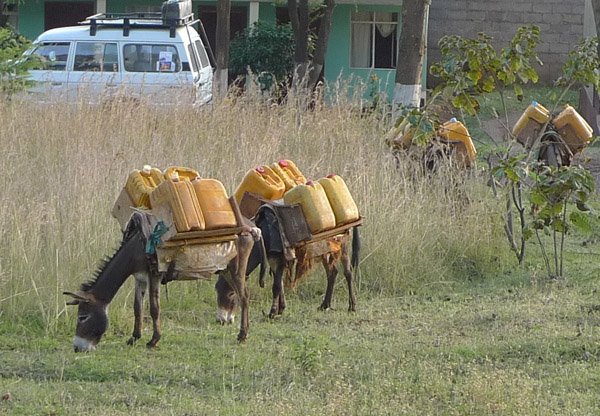
After the Christmas morning services in Lalibela, we ate breakfast and met our TESFA guide, Belay, and two fellow trekkers: a San Francisco photographer named David Page and his buddy Steve Maltby. We all loaded into a minivan for the two-hour drive to Gashena, breathing in more of the devilish dust and diesel fumes. Lunch, when we finally stopped, was injera and shiro — a bubbling pot of spiced garbanzo beans. Three ragged guys tied our bags onto a couple of doughty little donkeys.  Then we were off!

It felt splendid to be walking in the quiet countryside, where the air was clean. For an hour or so, we hiked down rocky lanes past fields of newly sheared wheat, the grain-bearing stalks piled into huge stacks, awaiting threshing. Blue-gray eucalyptus has been planted extensively, replacing the stately junipers that once covered this land. Farmers plant the cuttings in a grid, as if they were broccoli seedlings, to be harvested later for firewood and building materials. They may not be native, but the eucs do contrast nicely with the ambers and browns of the farms. Parts of the rolling landscape made me think of a dryer version of southern France.

There’s nothing in France, however, to my knowledge, that resembles the landscape at the edge of the escarpment where our first camp was located. Just a few yards from the tukuls, the ground dropped away, revealing an enormous panorama that reminded us more than anything of the Grand Canyon, though the colors may have been a bit more muted. Another difference was the complex terracing cut into many hillsides and the grid of tiny farms lining much of the bottomland. But the scale was fantastic. Just as the rock churches would give Egypt’s tombs a run for the tourist traffic, if only more people knew about them, so these sights could compete with the canyonlands of the American West.

 **************

Two more days have passed; I’m writing this from our tukul in our third and last campsite: Mequat Mariam.  If anything, the vistas outside this one are more magnificent than the previous two, even vaster and wilder. To reach this site, we hiked for some 12 miles.  As on the previous two days, the going has been more or less flat, though lots of it has required stepping carefully in boulder-strewn creekbeds. Altitudes have ranged between 8,500 and 9,000 feet. 

A typical lunch: injera topped with lentils and garbanzo glop.
In Brad's bed...

At the rest stops along the way and in the camps at night, the food we’ve been served has been edible, if plain and vegetarian, and everywhere we’ve been offered good beer and excellent coffee (roasted on a tin griddle, ground with a mortar and pestle, and boiled in a pot, right before we’ve drunk it). No electric lines reach these villages, nor do any generators provide light in exchange for diesel. So when the sun has set, our world has been illuminated only by moonlight and candles and wood fires built by the camp staff.  The women who cook do so squatting on the ground, while we’ve gathered around a larger fire, to drink our beers and swap our stories. The smoke from these indoor fires makes them a lot less pleasant than they would be outdoors. But on the whole, I’ve found this more pleasant than actual camping. The beds in our tukuls are comfortable (foam on concrete platforms), and I learned in the last camp that I was sleeping in the same bed that Brad Pitt occupied, when he visited here in 2004.

During the days, Steve and I both have savored the pleasant monotony of trekking. You get into a comfortable rhythm, at times taking in your surroundings, at times chatting with your guide or fellow trekkers, at times simply concentrating on putting one foot carefully in front of the other, taking care not to twist an ankle. Interruptions in this simple routine stand out: coming upon tribes of gelada baboons raiding farmers’ fields (to munch the tasty grass roots) and being chased away by stone-throwing kids. Or watching, transfixed by the sight of men and boys threshing the wheat that we saw that first afternoon.  They toss a bunch of it on the ground, then drive teams of 4 or 6 or 8 donkeys or horses or cows, tied together, over it in a circle, so that their hooves will separate the wheat from the chaff.

 *******

January 11, 2012

Now the trek’s behind us. Our final hike this morning lasted about two and a half hours and took us from Mequat Marian to a field where a mini-bus awaited us, as pre-arranged. At one point, we passed men tooting horns made from goats and striking drums, and our guide explained that this was a new scheme: calling together the whole community (of men and boys, at least) to work on a communal project, one day per month. I thought I detected a festive air in some of the villagers, as they gathered. There might be work in store, but at least it was a break from the routine drudgery.

Piling into the vehicle, I couldn’t help thinking of the story we’d heard on our first full day from a young family from the Boston area: mom, dad, and two cute little girls, who’d hiked from the opposite direction. They described something that had happened to them on their way to Lalibela. The minivan in front of them hit and killed a 70-year-old man, a tragedy that could carry a sentence of up to 15 years for the guilty driver. The owner of van, who’d only had his driver’s license for two weeks, came to take over the driving, but he’d quickly developed a flat tire that he didn’t know how to fix.  So, the couple told us, their driver had helped out and offered him their spare tire. A little further down the road, however, the van owner had lost control of his vehicle on a curve, going over the embankment and rolling it several times. Wearing the only seatbelt, the driver had walked away unscathed. But 4 of the 12 or so passengers died — one on the scene, another in the van, and at least a couple of others in the hospital in Lalibela.

Clearly, the Ethiopian roads hold many hazards, but we’ve dodged them all so far.  Now we’re in the small city of Bahir Dar, looking forward to our boat ride to a monastery tomorrow.

Merry Christmas (or is it Christmas Eve?)

January 8, 2012

Both the Lonely Planet and Bradt guides to Ethiopia agree: if there is one thing no visitor to Ethiopia should miss, it’s Lalibela. Now that we’ve spent the last two days here, I have to concur: this place is amazing. It is the town where, sometime in the 1100s, a Christian Ethiopian king conceived of creating a “new Jerusalem” in the rugged, dry highlands.  To that end, he assembled a crew of master stone carvers and other artisans and had them chisel 11 churches out of the basalt, underfoot.  In essence, they sculpted these large and richly ornamented structures out of the rocky ground.

St. George's church (one of Lalibela's 11 stone marvels)
The view of St. George's from near the bottom

What I can only imagine is what it must be like to visit Lalibela under normal circumstances. The town’s population is somewhere around 30,000 people. Almost inaccessible for most of its history, it still isn’t easy to get to. One or two flights come in per day, but none of the roads here is paved, and the drive to or from Addis takes two long, hard days.

Every Christmas (which comes about two weeks later than our Western one), however, something like 200,000 religious pilgrims make the town their destination. This year Steve and I were among them. Being here to witness their celebrations transformed the experience, making the stunning otherworldly stone churches merely the setting for the spectacle unfolding in and around them.

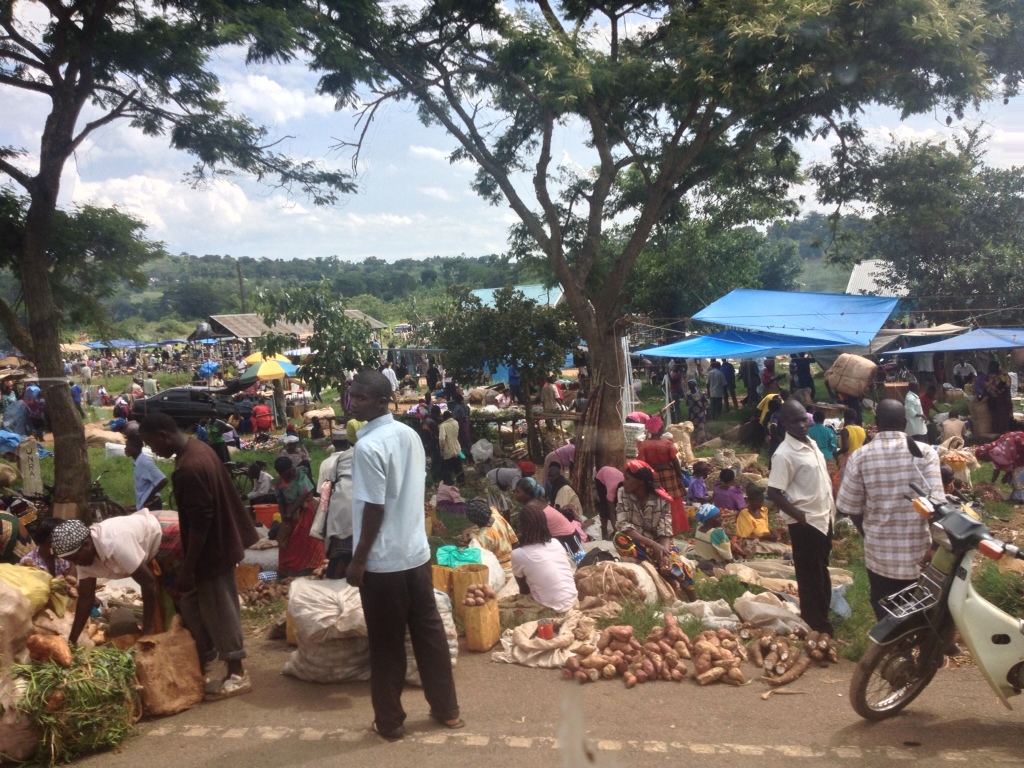
The bus that took us from the airport to our hotel nosed its way through a dense throng of men, women, and children heading to the market. Lalibela’s weekly market always takes place on Saturday, but this one was special, because of the holiday. Most people carried their sales goods tied up in cloth bundles, but some drove goats or sheep or cattle or donkeys; some bore crates of potatoes on their heads. If we had traveled back in time to the stone age in the Omo Valley, here we had moved up to a medieval world.

From our hotel room, the Alief Paradise, floor-to-ceiling windows and a little balcony offered us views of the market teaming in the distance. But the churches called us, and we quickly found a guide who also happened to be a deacon for the monolithic church known as the House of Mary.  Daniel lacked Endalk’s charm and command of English, but he knew his churches. He hired us a shoe man, who for the stratospherically high holiday price of 100 birr ($6) would guard our shoes every time we entered a church and help us quickly get back into them. Then Daniel led us through the churches as best as possible, explaining the complex symbolism of the paintings and architectural elements and helping us to thread our way through the crowds of pilgrims who jammed every corridor and every chamber. Neither Steve nor I are particularly claustrophobic; only at the underground passage known to the faithful as Purgatory, did we demur. It looked to be little more than shoulder wide, and jammed solid with human bodies.

I’m writing this now on Sunday morning, and having spent almost two days among the pilgrims, I’ve come to admire their astounding strength. Most have walked for days or weeks to be here, surviving on scraps of food and questionable water. They wear long white robes, and I’m mystified by how clean they look, since they’re sleeping in the open air on mats spread over the rocky ground, peeing in bushes and against fences, and defecating God knows where. For all these trials, for all the staggering crowds here, most seem patient and good-humored and even solicitous of the oddball ferengis among them. We’ve seen countless clusters of them singing, dancing, clapping, ululating; they believe that having made it to Lalibela, they’ve secured themselves eternal happiness after death.

The priests and deacons — hundreds of them — look successful too. Older ones wear sumptuous robes and, sometimes bejeweled headpieces. The oldest could be African incarnations of Santa — fat black men with huge black beards, wearing huge gold crosses and hats shaped like monstrous mushrooms. We’d heard there would be a procession of priests through the town, but we could find no sign of it Friday night (the night Endalk and other folks had told us was Christmas Eve). But that was wrong; almost everyone was confused, according to Daniel, the deacon. Because this was a leap year in the Ethiopian calendar, Christmas eve was really Saturday night, and Christmas morning on Sunday.

Happily we figured this all out by Sunday morning, when we rose before dawn.  We made our way to the church where, on Saturday, a young man told us 10,000 people would be camping out. We’d scouted out a back entrance to it but were prepared to be blocked by impenetrable crowds. To our amazement, we not only slipped in but also squeezed our way to an excellent viewing spot, as generous pilgrims stepped aside to let us through.

I’d like to report that the service built to a rousing African version of the Mormon Tabernacle Choir’s Hallelujah chorus, but it wasn’t anything at all like that. Hundreds of priests and deacons were assembled at one end of the church courtyard, and from their midst, amplified prayers droned on and on. Finally they began to file through the church to a stairway that took them up to the edge of the pit in which the church is situated. White-robed deacons and priests and bishops eventually lined the whole perimeter and began slowly shaking their metal noisemakers and swaying in unison to a dirge-like drum beat and singing — melodies that sounded like a mixture of Gregorian chants and something you’d hear issuing from a mosque. To me, it sounded nothing at all like a ticket to heaven. But it was a Christmas to remember.

Our best meal in Ethiopia?

Thursday, January 5

Today, for the first time since our arrival in Ethiopia 8 days ago, we had almost no fun at all. All we did was drive, starting a little before 8 a.m. and slogging our way north for almost 11 hours. Whereas the ride south had seemed novel and interesting, the return trip quickly grew tedious. We’d chosen a different route for the northern half of it, one that went past the celebrated Rift Valley lakes and through the creepy town of Shashamene (home to what’s left of Ethiopia’s Rastafarian community). But by the time we got to both, we felt so road-weary, we didn’t want to do any sightseeing. Steve and I concluded that we probably should have at least inquired about the possibility of flying home from Arba Minch. But the flights go only a few times a week, and somehow we never got around to looking into it.

On the other hand, we had such a wonderful time last night, it rather compensates for the dull day that followed. After visiting the Earbore tribe and leaving the Omo Valley, we’d arrived back in Arba Minch shortly before 4 p.m., made a quick stop in town for money and a coffee at the one hotel with wi-fi, then piled back in the Land Cruiser to drive for another 45 minutes or so, most of it a steep climb up a rutted dirt road. We’d slogged up that same road on the second day of our expedition, the morning we’d visited the elephant houses of the Dorze people and tasted their weird bread baked from the fermented false-banana (enset) pulp. This time, we didn’t go all the way into the village, but rather turned into the lodge that was created by a Dorze tribesman 4-5 years ago. It was splendid.

The Dorze Lodge is almost 10,000 feet high, situated on a cliff top with commanding view of both Lake Abaya and Lake Chamo (the one filled with hippos and crocs where we earlier had our boat ride). A half dozen or so elephant houses serve as the guest quarters, each containing little more than two double beds; simple but snug. An outdoor bar constructed from native materials occupies the highest part of the promontory, and Steve and I watched the sunset there while sipping cold St. George beers.  Then we moved into a large communal room where the staff served us what may turn out to be our best Ethiopian meal. It started with a bright and flavorful tomato soup that I could have made a meal of. But then came rice flecked with carrots, and tasty bread, and two excellent vegetable mixtures and a platter full of what I can only describe as Ethiochips — potatoes thinly sliced and deep-fried and salted. (I couldn’t stop eating them either!).  Of course there was also injera — the sour, spongy, pancakey stuff made from the uniquely Ethiopian grain, called teff. Although Ethiopians eat it morning, noon, and night, we’re already turned off by its sickly color and texture (a bit reminiscent of rolled-up dead flesh, in our not-so-humble farengi opinion.)

Although we were the only guests staying at the lodge that night, Endalk said the villagers were willing to come over and entertain us. We could hear the drum and singing as we were finishing our meal. Outside, someone had built a huge bonfire and surrounded it with chairs made of cowhide stretched over lengths of wood. The night was frigid, but lodge staffers bundled us up with blankets. Watching the festivities, I grew so warm that I eventually shed first the blanket and then my jacket. With a single drum, and maybe 20 voices, and a lot of clapping, the villagers created music so infectious I couldn’t resist joining in the dancing. (Steve could. And sadly, the altitude took such a toll on me that I only lasted for one song.) The best part was what a great time everyone seemed to be having. It occurred to me that we Americans may have our campfires. Some of us may even sing around them. But we don’t dance like this. What a shame.

Farewell to the Omo Valley

Wednesday, January 4

Because it’s the dry season and the road was not too swampy, we were able to take a different route out of the Omo Valley. The advantage of this was that we got to visit yet another tribe, the Earbore. Like most of our other tribal encounters, we spent no more than 45 minutes in the village.  We photographed several people; visited a hut.

These young Earbore ladies resisted smiling on-camera, though they smiled a lot otherwise.

 Having realized that my camera could inconspicuously capture video images, Endalk cavorted with a pack of children, teasing them with candies, to provide us with lots of lively action. Then we took to the road again.

The four hard hours to climb out of the valley and labor over the bad roads back to Arba Minch gave me plenty of opportunity to reflect on the whole peculiar experience of visiting the South Omo tribes. As a tourist, your interactions with these people are so limited. To view it in the worst light (as I suggested in an earlier post), it resembles hunting for photographic big game — human rather than bestial. It feels like there’s no real way to connect with any of the villagers, other than the smile exchanges that sometimes feel genuine and warm. Maybe if we camped in the villages, as I’ve heard some people do, it would be different. Certainly it would if you lived in one for months, conducting anthropological research. Neither of those options appealed to me, and while the limitations of what we did see and do are obvious, I feel satisfied.

Plenty of exchanges in the Western world are superficial. Walk into a hardware store or a hair salon or a movie theatre, and how deep is your encounter with the people in any of them? If you’re in a different country, outside your own culture, it’s even harder to discern the person beneath the functionary. And few cultures are more different from ours than those of the Omo Valley peoples.

The fact that they’ve learned to charge for serving as photographic subjects can heighten the sense that we’re using one another. I’ve heard other tourists comment on how tourism has “ruined” the tribes, making them rapacious and corrupting once-innocent interactions. I see it differently. As Steve observed at one point, the Omo Valley tribespeople own almost nothing EXCEPT for their intellectual property: the fantastic ways in which they dress and ornament their bodies. They have the means to defend that property (by banishing or even punishing those who refuse to pay up.) If they sell access to their designs to get things they want (be that razor blades or bullets or candies or cell phones), who am I to criticize them? How does their behavior differ from that of Lady Gaga or Justin Bieber?

Another topic that surfaces among Omo Valley travelers is how long these cultures will survive. The powers-that-be are building a dam on the upper Omo, and it may affect some of the tribal agricultural practices. A new (paved!) road heading south to Kenya is also in the works.  Cell phone towers are sprouting throughout the Valley, and some folks, like that Bodi chief, already have phones too. As the contact with outsiders increases, as they see images of how everyone else in the world dresses and acts, for how much longer will they cling to their harsh prehistoric lifestyles? As do others, I hear the clock ticking, counting down the time that’s left for the way they’ve lived for so long. But while it still exists, I feel fortunate to have seen it.

Through the gap

January 3, 2012

Young Hamer women

After saying farewell to the Goh Hotel yesterday (Monday), the drive from Jinka to Turmi took just under four hours, which didn’t seem bad, in light of the previous day’s extended car time. Turmi (aka Turumi) sits in the midst of the extensive territory inhibited by the Hamer tribe, and en route, Endalk described the bull-jumping ceremony which the Hamers use to mark their boys’ transition to manhood. For it, Hamer men round up a dozen or so bulls and line them up nose to tail, wrestling them into position and almost magically calming them to a surreal stillness. Then the naked, wild-haired initiate climbs up onto and dances over the animals’ backs, moving from one end of the line to the other several times, while Hamer girls who’ve bolstered their courage with alcohol for days beg to be beaten with sticks, a form of cheerleading that traditionally could get quite bloody. Times are changing, and the beatings are becoming more moderate. Endalk seemed to approve of that. His eyes shone when he described the celebration that would follow the completion of the initiate’s performance. We would have to pay a fee to attend, Endalk said, but once admitted we could photograph incessantly, and no one would ask for as much as a hard candy.

This was the season for bull-jumping, Endalk added, and he would use his network of contacts to learn whether one would be taking place either this day or the next. But when we checked into the Tourist Hotel, we got bad news on two fronts. None of Endalk’s friends at the hotel had heard of any taurine spectacles in the offing. And because our itinerary had changed (due to our late start the first morning), the room he had reserved for us, which had a shower, was unavailable. We would have to sleep in one of the rooms with neither toilet nor shower. But we could switch rooms the next day.

The upside to our scheduling changes was that it allowed us to arrive in Turmi on a Monday, the Hamers’ big market day. We strolled the few blocks over to that, and it was instantly clear why this weekly event gets glowing reviews from the guidebooks. The Hamers look fantastic. Men wear brightly colored miniskirts and special hair ornaments for recent braveries. But it’s the women who could step onto a runway in Paris and draw gasps of admiration. Most are either topless of they wear skimpy goatskins ornamented with shells, fur, and other beads. They soak their hair in ochre mixed with animal fat, and then work it into long thick strands (think of henna’d Raggedy Anns). The square teamed with people buying and selling tobacco, coffee beans and shells, pots, skins, produce, and grasses.

After the market, Steve and I consumed greasy pasta and tomato sauce in the Tourist’s shaded outdoor dining area, and Endalk continued scouting for bull-jumps.  But he returned in the late afternoon announcing defeat. He suggested we spend the rest of the day and evening resting, in preparation for our excursion to the Karo tribe in the morning.

For us, the best part of resting at the Turumi Tourist was spotting a tall young lonely- looking guy in the dining room whom I took to be Japanese.  We invited him to join us and found he was in fact Korean, with a sketchy command of English, a sweet personality, and an amazing itinerary: Seoul, Dubai, Cape Town, Namibia, Botswana, Zambia, Zimbabwe, Mozambique, Malawi, Kenya, Ethiopia, Cairo, Jordan, Israel, Iran, Pakistan, and India. Once he got back to Seoul he would be starting his university studies as a fashion major, he told us.

One section of our hotel room's ceiling. Other panels had holes knocked in them.

Steve and I returned to our room, where the bed linens looked clean enough and the mosquito nets were intact.  But that’s about the only nice thing I can say about this decrepit hovel, with its wasp nests, huge holes in the window screens and drop-ceiling tiles (revealing the dark creepy crawl space above us). Hip-hop and Afropop blared outside at least to midnight. The most dismal part became clear the next morning, when we found the solitary toilet with a commode to be locked. S and I trooped out in back past a tree where some men were butchering a goat. We used the squat toilet then tried to wash our hands, first from a water jug (empty) and then from the tap next to the locked commode (dry).

It didn’t help when Endalk arrived and got us into our room-to-be; it was even worse than the old one: one double bed instead of two, still no toilet, and with it’s shower located right next to the bed.  Some of my thoughts on the ride to the Karo were glum.

That trip took two and a half hours over boulder-choked ravines, powder-fine sand washes, and bone-jarring gravel beds. It wasn’t all bad; the road cut through virginal looking savannah (populated by cows instead of lions and elephants). We passed sections studded with phallic termite towers for as far as we could see, and we admired flocks of beautiful storks.

Moreover, when we arrived at the Karo village, my doubts about whether the ride would be worth it vanished. Most endangered of all the OV tribes, the Karo have been ravaged by malaria and sleeping sickness.  But their sense of style remains intact. Some of the topless young women sported yellow flowers stuck into their lips and noses.  One beauty adorned her shaved head with a pair of corn ears. The Karo are famous for the elaborate designs they paint on their bodies, but we’d read nothing about the rifles carried by all the men. Endalk said a rite of passage for boys in this tribe was to make the 4-5 day trek to Southern Sudan, along with a couple of cows to be traded for a weapon. Maybe part of this is machismo but Endalk also pointed out a large number of animals watering in the grand winding Omo River at the base of the cliffs on which the Karo village sits. He said the shepherds routinely fire a couple of rounds into the water, to scare off any crocs with a taste for boeuf tartare.

A tall sturdy man led us past one half-naked woman sorting sorghum seeds from their chaff and another grinding them on the African version of a metate, past crowing roosters and growling dogs and children imploring us to take their pictures.  I wondered about the single lower central incisor that was missing from our village guide’s mouth; most of the rest of his teeth looked so white and strong, and clearly this was not the land of refined sugars. As if reading my thoughts, Endalk said that removing a lower front tooth was another rite of passage for young men. The Karo believed that whenever misfortune befell them, they could use that small passage to take water into their mouths. The act of savoring it, drop by drop, would help distract them from whatever bad thing had happened.

That image returned to me several times after we returned the way we’d come and Endalk dropped us off for lunch at the Turmi Lodge, by most reports one of the two best hotels  in town. The gardens were quiet and pretty, the patio cool, and as we tucked into chicken noodle soup and beef goulash, Steve and I had the same idea. He slipped off to reception and soon returned with a thumb’s up: they did indeed have a room for the night for us ($75, including a breakfast buffet). We called Endalk and Sharom, who returned with all our luggage. 

I took TWO hot showers over the next few hours in our spotless, newly constructed room. The night was deeply silent when we slipped between the crisp clean sheets. Several times I pointed out to Steve that I was sipping it all through a newly created conceptual gap in my teeth.

On safari

January 2, 2012

Yesterday in Mago National Park, Ethiopia’s 780-square-mile preserve near the Kenyan border, we saw several dik-diks and maybe a half dozen olive baboons. We didn’t spot any of the 200 elephants and lions, 400 buffalo, or countless monkeys, antelope, and other mammals who reside there. But we weren’t looking for them. Our goal was to visit the Mursi and Ari tribes who make their homes within this vast jungly wilderness.

As so often happens to me, I was shocked by the difference between reading and intellectually understanding that these tribal regions are remote, and actually experiencing the difficulty of visiting them. We’d spent the better part of two long hard days on the road just to get to Jinka, maybe 18 hours of driving in all. When Endalk told us it would take about two more hours to reach the Mursi village, I was a little startled and then dismayed by the brutality of the ride over rock and gravel roads. And then maybe two and a quarter hours into the journey, Endalk and our driver had an exchange with a couple of camo-clad, machine-gun-toting park rangers who delivered bad news: the government (god only knows which) was concerned about the fact that tourists were only visiting the Mursi village closest to Jinka. This meant all those Mursis were getting rich, while their further-flung brethren were seething. To rectify this injustice, we were being ordered to continue on to Hana in the adjoining Omo National Park, a hot, dusty bone-jolting additional hour further down the “road.” The worst part about this was that it turned out Hana wasn’t a classic Mursi village at all, but rather a settlement of Mursis who had intermarried with the Bodi people, and the government had installed a number of administrative buildings. It didn’t look like Scarsdale, but it wasn’t the return to the Stone Age for which we had traveled so far.

We spent maybe 5 minutes walking around the village (which Endalk himself had only visited once several years ago). But the ranger who had accompanied us in our Land Cruiser relented and bade us goodbye, freeing us to return any way we wanted. So we stopped first at a Bodi village that seemed only to consist of 3-4 huts. Bodis, according to Endalk, are the second most warlike tribe in the Omo Valley (the Mursi being number one), but the two elders, lounging in a shady spot, naked except for long strategically positioned shawls, greeted us affably. The tall thin wife of one of the elders looked peeved, though. She wore a sort of toga made of animal hides that half-exposed only one of her breasts.

A younger wife of the Bodi chief, Endalk, and the chief's senior wife

All the negotiations with Omo Valley tribespeople regarding photographs bewilder me. Years ago, they learned to charge for serving as photo subjects, and typically villages also charge a fee simply for receiving visitors. (The standard rate for the latter seems to vary from about 200-450 birr (about $11.75-$25). But it’s all quite fluid and complicated. In this case, Endalk refused to pay a village fee. And while the chief’s wife wanted 100 birr for a photo of herself, he got her husband to agree that just 50 (about $3) was acceptable. The per-photo price tends to be for one single image (and the villagers are sensitive to detecting the sound of extra camera clicks!)

The Bodi chief on his cell phone

For the 50 birr, we also entered the chief’s hut, a dim and smoky den where a couple of younger wives were steeping moringa leaves, valued for their antimalarial properties. Outside in the bright sunshine, a weird sound intruded, and we saw it was the chief’s cell phone (stashed somewhere on his naked person). He stood to take the call, and the sight made even Endalk laugh. We bagged a photo or two of this, and I’m sure it will rank among my most cherished images.

We drove on and on, and around 2:30 we came to a cluster of huts where we finally scored a definitive Mursi/tourist interaction. Probably there are anthropologists who have spent months living with the Mursi, but their culture seems so alien, I’m sure many mysteries remain. We had less than an hour there, but it was enough to boggle my mind.

Part of the bafflement comes from extricating one’s impressions of the Mursi themselves from those of the Mursi in the presence of foreigners. The Omo Valley isn’t Disneyland; the Mursi live and dress as they do year-round, even in the rainy season when no tourists come. They survive mainly on the corn and sorghum they grow, along with an occasional goat or cow for special occasions such as weddings. But only for the tourists do they prepare rolls of 10 one-birr notes to serve as change (as the going rate for routine photos tends to be around 2-3 birr — 12-18 cents). The Mursis have no stores or shops of any kind, so to spend those birr, someone has to make the two-day walk to Jinka (which means overnighting in the bush along with the lions). That’s why they most avidly crave trade goods of the sort Endalk had us buy. So it was that we had the odd experience of handing out razor blades not only to our grown-up photo subjects, but also to kids as young as 3.

Mursi women with lip plates
Mursi kids

Still, the photos are irresistible. Their headgear is fantastic, and they create patterns of bumpy scars on their bodies. Most photogenic and famous, if freakish, are the lip plates worn by Mursi women. Supposedly this practice dates back to the days when slavers menaced African natives. To make their women repugnant to the raiders, or so the story goes, the Mursi began mutilating their women’s lower lips so that a series of larger and larger disks could be inserted into the space created. Over time, the Mursi came to see the practice as intrinsic to their tribal identity, part of what makes them Mursi and their women beautiful. The plates are heavy (I bought a medium-sized one for 10 birr, and it’s reminiscent of a condiment dish). So the women mostly wear them on ceremonial occasions such as weddings and tribal festivals. And of course they pop them in when the tourists arrive (the dangling undisked lower lips, if anything, look more grotesque than the adorned ones.) The women and children clustered around us, plucking at our arms, pinching my nipples, tugging at Steve’s beard and arm hair, murmuring “photo? photo?”

Mursi woman without her lip plate

Somehow, none of this bothered us, it was all so surreal. And Endalk’s leadership was a big help. He finally urged us to be on our way; it wasn’t a great idea to be in a Mursi village much past 3, when all the men and women would start drinking the alcohol they brew from sorghum and upon which they daily get drunk (and more irascible, I took it.)

We made one more stop, at an Ari village maybe 45 minutes further down the road. I think Endalk likes to take people there right after seeing the Mursis, because the two tribes live so close to each other but boast such different cultures (and interact little, if at all). The Ari huts looked more sophisticated than the Mursis’ shaggy grass ones. The Aris also are master farmers, raising not only corn and sorghum, but also coffee, tobacco, oranges and other fruits, various vegetables, chicken and goats. They’re potters too, though the potter where we stopped was away (which gave Endalk an excuse to avoid paying the standard village fee.)

As our Land Cruiser labored up the switchbacks leading out of the park, I felt exhausted from our sleepless night and the hours upon hours of long, rough driving, as well as the welter of alien impressions. But I still noticed the splendor of the vistas around us, as rugged as the American West but so much greener, a dozen or more shades of green. To the best of anyone’s knowledge, this is the real Garden of Eden — the place on earth where humans almost certainly originated. We’ve read that the oldest remains of homo sapiens — an estimated 195,000 years old — were found in the Omo Valley. (The famous Lucy, vastly older but a humanoid precursor, were found elsewhere in Ethiopia.) We’ve also read that DNA research suggests that every human being on earth today descended from a single woman who once lived here, a small band of her offspring having then departed through the Arabian peninsula to spread out and populate the globe.

So in a sense, the Omo Valley is home. It may not feel like home, but it was our first one, and somehow visiting it made me feel closer, emotionally, to the whole vast extended clan of us.

Happy New Year

New Year’s Day, 2012
Last night, sitting in our dreary room in dusty Jinka, head throbbing, eyes burning, stomach on the verge of heaving again, I wrote a post commenting on how sharply this New Year’s Eve contrasted to our experience last year. I reckoned it was just the hellish yang to last year’s amazing yin-fest on the beach in the Saloum Delta in Senegal, and I ranked it with any of a number of other bad New Year’s Eves I’ve experienced. Then it got worse.

Earlier, I had blamed myself for my tummy problems (my first ever in Africa). I had broken a cardinal rule Friday night in Arba Minch and eaten the raw shredded carrots, cabbage, and tomatoes that looked so tempting on my plate. Frankly, most of what we’ve eaten here so far has fueled my expectation that this trip would be not only a great adventure, but also a sort of countrywide weight-loss clinic, with food that was edible but unexciting. I didn’t start feeling queasy until early afternoon Saturday, when we had stopped in broiling malaria-infested Weito. After touring the scruffy tiny market (where I bought a skirt), Endalk, Sharom (our driver), Steve, and I retired into one of the shaded patios for lunch. The only choices were injera (the universal Ethiopian pancake/bread/eating utensil) and fried lamb, or injera and spiced beans, or macaroni a la Tsemay (the Tsemay being the tribe that occupy Weito and its environs). S and I opted for the beans combo, and it wasn’t bad. I should have been alerted by my lack of appetite, but I chalked that up to the heat and hours of jouncing over gravel roads. An hour or so later, I had to get out of our aged Land Cruiser and vomit in the bush.

But my Blame-the-Veggies theory evaporated minutes before 2012 began, when Steve (who had virtuously resisted eating anything resembling raw salad) bolted out of bed for the first of two rounds of violent vomiting and diarrhea. This is not a happy experience under the best of conditions, but the conditions in our bathroom included the floor being flooded (due to the toilet leaking) and no toilet paper (nor even a holder for it). Steve claimed at one point this morning that he noted a small dragon or bird embryo in his barf. The rest of the night was similarly hallucinogenic. I don’t remember a great deal of noise outside upon Steve’s first episode, understandably; the Ethiopians don’t consider Dec. 31 to be New Year’s Eve. (They celebrate that in September, and think the current year is 2004, just as they use a different system for naming the hours, with 0 starting at 6 a.m. (the theoretical dawn).

Still, sometime around 3 a.m., something that sounded like a call to prayer woke me up — the haranguing nasal voice, the amplified minor-key melodies. Multitudes of roosters responded to this, adding to the cacophony. At times the singing sounded more like drunken Christmas carolers, or misplaced karaoke performers; at other times demented howling. I’ve never heard the like of it anywhere, but it and the roosters and the muted musical accompaniment continued until dawn. A New Year’s Eve to remember.

Now Endalk is arriving (it’s 8:20 a.m.), and Steve and I are feeling recovered enough to imagine getting through the day. Jinka will be our launching point for visiting several of the tribes that have made this area “literally fantastic,” in the words of Bradt Guide author Philip Briggs, “as close as one can come to an Africa untouched by outside influences.” Sixteen tribes occupy the region, some scarifying their bodies, others grotesquely stretching their women’s lower lips, still others practicing bizarre coming-of-age rituals. At Endalk’s recommendation, we’ve bought $55 worth of razor blades, Obama-brand pens, and hard candies to distribute in exchange for photo ops. How could we fail to be in top form for THAT?

Welcome to Ethiopia

Saturday morning, December 31
This year I read a New Yorker article about a scientist who’s studying the human experience of time, and is specifically interested in how time seems to pass slowly when you’re young and then steadily accelerates. Or why near-death experiences make time slow so much that people feel they’re seeing their whole life flash by. His research made him conclude that it doesn’t actually slow, but being hyper-alert makes it seem like time is passing glacially. I think that’s true to some extent in traveling. When you’re in an alien place, you notice everything — vastly more than when you’re sitting down to your work desk in the morning. So maybe another reason to travel is that it lengthens your life — or seems to.

Certainly it feels like we’ve been here much longer than 48 hours. Our Omo Valley expedition leader, Endalk Bezawork, called a little after 10 Wednesday night (minutes after our arrival at the guest house) to confirm we were there. Thursday morning, he showed up precisely at 8, as promised. But we had to go to a bank for an ATM and to make a deposit for our trek later on. And we wanted SIM cards and air time for our phones. All these chores gave us our first glimpse of Addis, which struck me as being a rather more appealing African capital than Dakar or Bissau or Banjul. (Or maybe I’m just getting used to African capitals.) It was 10:15 a.m. by the time we finally broke free of the traffic (jammed worse than usual by the vast throngs of Orthodox Christians being disgorged from churches where they had celebrated the feast of St. Gabriel.)

The open road — where we spent the majority of the day — proved delightful. With few potholes and little other vehicular traffic, it took us past vast farmlands rimmed by rugged mountains that reminded me of California or South Africa, only greener. From time to time, we wove through boys shepherding cows or goats or dodged gaggles of children streaming to or from school. So the drive, though long, felt fun to us, if a quiet, dusty, bouncy form of fun.

Because we’d gotten such a late start, Endalk changed the plan and decided we should spend the night in Sodo, rather than going all the way to Arba Minch, our original goal. But we would still be able to see everything in our travel plan. By the time he assured us of this, I trusted him. My initial impressions make it clear he’s one of the better guides we’ve ever had anywhere. He’s almost 26, has a mind like a trap, a seemingly encyclopedic knowledge of this area, and the organizational skills of a Manhattan wedding planner. Moreover, he displays a natural social grace and charm so powerful that everyone we meet everywhere seems to love him. One of the best things is that he was born and raised in the Omo Valley, in a tribe that lives near the Hamar tribe (one of our destinations). So he’s more of an insider here than I am in San Diego.

Dorze woman grating the enset meat
The final product: false banana (enset) bread
A Dorze elephant house

Yesterday, the value of all those skills become increasingly evident, as we drove up a high mountain to visit the Dorze people, renowned for their houses reminiscent of elephants, for their pottery and weaving, for the way they use the “false banana” tree to supply most of their needs in life (except bananas — which grow on a cousin tree). We got to see every step of the cloth-making process — from the cotton balls in the fields, to the girls spinning them (by hand, rather than on spinning wheels), to the men weaving the thread into cloth, to the beautiful final products for sale in the village center. In our stroll through the village, we chanced upon two neighboring families, creating a great clamor of disagreement. But among them were three village elders (all men), and we learned it was a mediation session. Once the elders had made their judgment, the falling-out would be a thing of the past, we were told. We drank liquor made from the village corn and ate the weird bread-like substance baked from the fermented (4 months!) meat of the false banana leaves. The elephantine houses are built largely from those same trees, and we got to enter and see what was inside a venerable old one.

It was a riveting visit, and the afternoon, though different, was no less exotic. After a leisurely lunch in the center of Arba Minch, we headed into the nearby national park for a two-hour boat ride on Lake Chama. It’s a beautiful place, home to families of hippos and gigantic crocodiles and flotillas of birds. Most of the birds were away at another Ethiopian lake where they hatch their eggs and tend the babies till they’re fledglings. But the huge hippo heads popped up repeatedly during our ride. At the “Crocodile Market” (a sunny bank so named by the locals), we found 6 or 8 monsters, mouths agape in order to warm their tongues in the setting sun’s light (according to Endalk.) In a few minutes, we’ll start our descent into the Omo Valley, where by all accounts the human residents make all of the foregoing ho-hum.

Fishermen on Lake Chamo routinely get eaten by the crocs.

Descent into Addis

December 28, 2011

Our Airbus 340 looks almost full, and I wonder: why are we all going to Addis Ababa? We’re a motley crew. On the bus out to the jam-packed tarmac in Frankfurt, we traveled next to two young American couples and their four children, all under 6, all impossibly wholesome and American looking. Missionaries, was my guess. (Maybe Mormon? We didn’t have a chance to ask.) The pudgy gray-haired couple in the two seats in front of us are Swedes, and I count lots of obvious Germans and Africans, including many who look like they were sent by Central Casting to play Ethiopians. Other languages also float through the cabin. Are there coffee-traders among us? Arms dealers? Aid workers? Hydroelectrical engineers? How many are tourists, like us?

I recently read that something like 50 million people a year vacation in Africa, a drop in Las Vegas’s jumbo bucket, to be sure, but more than many Americans might guess. (This year, Steve and I would be double-counted, having started off the new year in Senegal and on track to finish it and start the next in Ethiopia.) In the months and weeks before our departure, countless people asked me, incredulous, why we were going.

I have many answers, but one that I don’t often express is that we’re going to have fun. We think it will be fascinating to step into the pages of the National Geographic (of our childhood) and visit some of the Stone Age tribes who inhabit the southern Omo Valley. We think the Guidebook Highlight experience of being in Lalibela’s submerged stone churches on the Ethiopian Christmas will be great fun (and I’m hoping our hotel room there will be halfway decent too.) We think trekking in the central highlands for four days among the breathtaking vistas and gelada baboons will be outdoorsy fun. And if I make it to feeding time for the hyenas of Harar, that will make me happy.

Of course pitfalls exist. The journey here (in coach, at least) is a brutal marathon for those of us who can’t sleep on planes (and even for those like Steve who can, a bit). I expect some abysmal roads and some barely tolerable hotels and unforeseen mishaps. So I suppose the big question of this trip is: will the fun parts outweigh the grubby, irritating, annoying ones? But that’s the question haunting all travel, isn’t it?

On and off the grid

Sunday, January 15

For the first time since our arrival in Ethiopia 18 days ago, we should have uninterrupted Internet until our departure from Frankfurt Wednesday morning. We bought a local SIM card for my phone on our very first morning, and our guide assured us we should be able to access the Internet on it. He did on his phone, routinely.

But although I’ve used the phone a lot to make calls and text people within Addis, it never would allow me to get online. Various folks told me I needed to call the central Ethiopian telecommunications office, to get them to turn that feature on. We dialed and dialed; were cut off and put on endless holds. Finally I gave up.

But I’ve been writing, almost every day. And we just arrived back at out guest house in Addis, where we’ll spend out last day and a half.What follows is what would have appeared, had we not encountered those road blocks on the Ethiopian information highway.