Ground v. air — part II

I didn’t try to buy our Vietnamese railway tickets from home. I’d read that they would be easy to secure just a few days in advance, so when we checked into our hotel in Hanoi, I told Ms. Julia in the lobby that we wanted berths on the sleeper from Hanoi to Hue, seats on the 3-hour morning train from Hue to Danang (the portal to Hoi An), and seats on the 7-hour train from Danang to Saigon. The first two were no problem; $55 a person for the sleeper and $15 for the second train ride. But I had misunderstood the mechanics of rail travel between Danang to Saigon. Instead of taking part of a day, we learned, it would require a much longer amount of time, leaving Danang in a sleeping car about 10 p.m. Friday and not arriving until late Saturday afternoon.

I think that would have cost around $80 per person. In contrast, Ms. Julia informed us we could get seats on the one-hour-long Vietnam Air flight leaving Danang at 11:05 a.m. Saturday for $115 per person. We agonized a bit over the decision. We’ve come to loathe the time and tedium involved in modern air transport, and we had looked forward to seeing the scenery en route. In the end, however,the thought of giving up our prepaid room in Hoi An to rattle through yet another night made us come to our senses and buy the plane seats.

Thank god! The Vietnamese train system doesn’t offer first-class sleepers, so instead of having our own cozy space from Hanoi to Hue, we shared our 4-berth compartment with 2 other Americans (a likable young couple from Washington DC). We all had working electrical outlets, which was nice (I could charge up my phone and iPad!), but in other ways, it seemed inferior to the Thai sleeper we took from Bangkok to the Laotian border — no dining car, for one thing. And Steve saw a cockroach and spiders lurking in the recesses near his upper berth, though he kindly kept that news from me until after we had arrived.

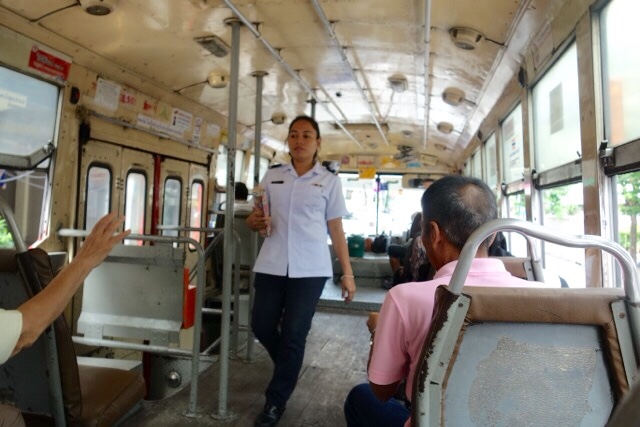
The morning train ride from Hue to Danang was pretty mesmerizing. We had two seats In a standard day coach on which we appeared to be the only foreigners. The train was probably 60 years old and exceedingly slow, but it hugged a mountainous coastline with jaw-droppingly spectacular views. The action inside our coach was almost as diverting. Across the aisle and two rows up from us, a woman slept on the floor at her husband’s feet. I’m not sure how, with car attendants periodically rolling carts up and down the aisle (at one point dishing up some kind of hot food). Someone’s very naughty two-year-old was on the rampage. And from the ceiling, screens displayed “Rail TV,” which among other things aired a Vietnamese (officially franchised) version of The Amazing Race.

On the day coach from Hue to Danang
A view from the train
Another

All pretty entertaining, but more than sufficient to satisfy the craving we’d had for rail time. Moreover, both of the short Vietnam Airlines flights we took (Luang Prabang to Hanoi and Danang to Saigon) felt like going back to a time when air travel was easy. All three airports were clean and uncrowded; the huge and gleaming one In Danang was only 2 years old. Hassles were minimal — no taking off of shoes nor long security lines. In fact, no one seemed to be paying much attention to what was rolling through the X-ray screeners. On board, the flight attendants didn’t patrol to check for seatbelt scofflaws, and no one seemed to care when I trturned on my electronic devices.

Now we’re in Saigon for two full days. I’ll probably wait until our Tuesday morning bus ride to the Mekong delta to write again. Between now and then, our schedule is pretty packed.

Forget me not the tailor

I’ve never owned clothes that were made by a tailor especially for me. I’ve never wanted any; ready-to-wear is fine. But I’d read an account by a friend of a friend of having some things made for her while on a trip to Vietnam. That was several years ago, but when I was researching this trip, it became clear that getting tailor-made clothes still ranks high on the agenda of many visitors.

Historic Hoi An

I’d read that Saigon and Hanoi both are places where you can have outfits whipped up in 24-48 hours. But Hoi An is a particular Mecca for clothes lovers, and there appeared to be plenty of other reasons to linger in this town on Vietnam’s central coast. A World Heritage Site, the old quarter was said to be both atmospheric and architecturally distinguished. Superb restaurants abound. So I planned for a two-night stay during which getting some clothes made would be our central mission.


To prepare, I did some online research and found one traveler’s fairly recent account of her interactions with a tailor who went by the name of “Ms. Forget-Me-Not.” She was not pushy, charged fair prices, and did excellent work, attested the writer (an exuberant looking blonde who included a photo of herself in Ms. FMN’s stall — #20 in the cloth market. Some recommendation seemed better than nothing.

After arriving in town, we ate lunch at the Mermaid Restaurant, Hoi An’s first restaurant (opened in 1992). Since then hundreds of others have opened, but the simple Mermaid ranks among the best. For $12 we got superb crispy wontons, thick noodles with pork, delicate seafood dumplings, and 2 16-ounce local beers. Then we walked the two blocks to the cavernous building labeled “Hoi An Cloth-Market.” From storefronts along the street, hawkers implored us to let them make our custom garments. We marched on, into the dimly lighted building, moving through narrow aisles, scanning, scanning for #20. “What number you looking for?” women shouted. “I make anything you want! Very good! very cheap!” We tried to ignore their siren cries (Come to me! To me!), but the stall numbering system was completely random. I broke down and confessed what we were looking for.

“She move,” a woman declared. Indeed in the vacant space where she led us, a sign taped to the wall announced that Ms. Forget-Me-Not could now be found at #37 Phan Chau Trinh. Our map indicated the street was just a few blocks away, so we exited, leaving a sea of disappointed seamstresses in our wake.

Within the open-front shop at #37, the walls were stuffed with thousands of fabric bolts. I recognized Ms. FMN from her photo online. She and her sister (“Rose”) and a third sister whose name I never learned greeted us warmly. I have to confess my heart sank to see they were already working with another customer, a chatty young blonde from Britain. She’d been there the year before, loved what she’d bought, and had returned for more. Within a few minutes, two more young Englishwomen joined us. I’m not sure what they wanted because by then we were immersed in the serious business of deciding what to order.

Interior of Ms. Forget-Me-Not's shop


Savvy shoppers bring photos, but all I had was the notion that I should get a couple of pairs of pants made (since it’s rare to find ones in any store that fit like a glove). Along the way, Steve had also persuaded me to order up an ao dai — the traditional Vietnamese slit-skirted top and pajama bottoms. I in turn insisted that he get a nice short-sleeved shirt or two. The ladies slapped big scrapbooks in front of us, filled with magazine images of all manner of clothing items. We fumbled a bit but found a couple styles we judged would do. Next we picked out fabrics — a gray checked cotton and regal jade green silk for Steve’s shirts; a pretty floral crepe for my ao dai top; solid black and turquoise blends for my two pairs of slacks. Rose prised the fabrics from the jam-packed shelves and Ms. FMN told us what it would cost: $32 for each of my pants, $15 for Steve’s cotton shirt and $20 for the silk one, and $55 for my complicated ao dai. That seemed fair.

Over the next hour, I began to feel like I was in a friend’s workroom. Outside, the threatening skies opened up with a deluge that filled the street with maybe half a foot of water, but we were busy being measured — chests, waists, neck and crotch, multiple points along my arms and torso. Informed that we were leaving town early Saturday, the sisters told us to return at 2 p.m. the next day (Friday). When we did, we were sticky from all the walking and bicyling we’d done in the heat and humidity. My pants and ao dai top were a little hard to pull on, and I worried: were they too small? But once in place, it was clear: both my outfits and Steve’s shirts fit just the way I’d hoped they would.

Ms. FMN checks the fit of Steve's silk shirt.


Ms. FMN wasn’t completely satisfied. She suggested letting out the black pants by a quarter inch; adjusting the torso of the ao dai top by a smidge. We agreed to return and pick up the final products later that evening. (The sisters live upstairs over the shop.)

And so we did. We covered a lot of ground in the 22 hours we had between our first and second visits to #37 Phan Chau Trinh: visited some glorious old houses and temples, strolled the pedestrian streets bedecked with silk lanterns and lined with a million and one tempting things to buy. We hired a motorboat for a 45-minute ride on the Thu Bon river, rode creaky old bicycles past flooded rice fields and water buffalo and cranes. Ate meals that ranked among the most delicious I’ve ever had. Swam in an exquisite disappearing-edge pool.

The pool at our hotel, with the river just beyond.

But when I think back to Hoi An, I’m pretty sure what will stand out is our time joking with Ms. FMN and her sisters. (“Nice ass!” she cracked as she and I surveyed how her handiwork fit me.) I’m impressed by what an intimate and personal thing it is to craft clothes for one particular body. I expect Steve and I will wear our clothes from Hoi An for years (except for maybe that ao dai top), and every time we do, we’ll feel the presence of the tailors.


In the shadow of the war

Yesterday (Wednesday, Oct 22), Steve and I arrived in Hue on the night train from Hanoi. We got in just after 8:30, so we had plenty of time to explore this pleasant, walkable little city.

Hue's famous citadel

Hue’s principal attraction is the sprawling imperial fortress built by one of the Nguyen emperors at the start of the 1800s. We spent a couple of hours strolling around the grounds. It was at least 90 degrees and humid, but when we could get out of the blazing sun and under some of the huge sheltering trees, it was tolerable. And the buildings that have been reconstructed within the citadel and “forbidden city” have a striking and graceful beauty.

The interior of one of the reconstructed buildings

Much of the grounds consist of open grassy fields, however, because so much of the citadel was destroyed — beginning in 1946 when the Vietnamese were battling the French imperial forces and more thoroughly in early 1968. During the “Tet offensive” that unfolded then, the North Vietnamese army stormed and occupied the fortress, and American forces launched a sustained and bloody effort to get it back. Thousands died during the battle (soldiers on both sides and civilians), and when it was over, the Americans had re-occupied it. But it lay in ruins.

After we left the citadel and were walking around the town, we got the clear impression that some of the Americans who participated in the fighting make a pilgrimage here. Hue is just 31 miles from the former “demilitarized zone” — the no man’s land that was set up between the north and south. All over town we saw ads for tours to the DMZ and to some of the tunnels the North Vietnamese lived in and from which they launched attacks. One of the maps we got from our guesthouse was marked with the sites of other American battles and bases. All this war tourism might have creeped us out more had it not been for what we’ve already heard about Vietnamese attitudes toward that sorry chapter in our shared history.

Typical war-tour offering

We got some insight from Manh, our young guide on Halong Bay. At one point, Steve and I were asking him about the influence of the Chinese language on the Vietnamese tongue, and he launched into a detailed presentation of the history of China’s 1000-plus-year-long occupation of Vietnam, its attempts to exterminate Vietnamese culture, its current aggressive actions in the South China Sea, and the generally unpleasant behavior of contemporary Chinese tourists. “French people and American people sometimes ask me how Vietnamese people feel about them, because of the wars,” he said. “To us that was a few seconds, compared to what the Chinese did.”

Ed, our friend who’s lived in Hanoi, says the Vietnamese government has always portrayed the “American War” as a dirty conflict that the American people rejected, so average folks blame the US government and not the people. Several ordinary folks here have confirmed that. “We like Americans now!”

Steve and I are glad to hear that. We’ve both felt our guts twisting when confronted with some of the war-touristic options. Back home, when planning this trip, we decided to forego visiting any of those famed tunnels. We saw them when, in preparation for our travels, we watched a 20-part PBS series on the war. That was enough. We decided we didn’t need to spend the better part of a day in order to see them in person. Similarly, we passed on a DMZ expedition. When we were in Hanoi, we declined to tour Hoa Lo Prison (the infamous “Hanoi Hilton,” where we knew we could see John McCain’s flight suit on display.) Here we have no desire to go on the 7- hour excursion to the infamous My Lai massacre site.

Frankly, I’m a little surprised by my squeamishness. I haven’t flinched from death camps and genocide museums in other places ranging from Dachau to Rwanda. But this was feels more personal; somehow, I feel more grief-stricken over the destruction, the waste. If the Vietnamese have managed to move beyond it, I’m happy to try to follow in their footsteps.


How to eat turtle

Turtles are one of the 4 sacred animals of Vietnam (along with the lion dog, dragon, and phoenix), but as Steve points out, they’re they the only ones people eat because they’re the only ones that are real. Real turtles are eaten all over Vietnam, particularly at significant times. Folks think they bring good luck. Steve and I wanted to try them because an American friend and long-term Hanoi resident recommended the experience. Here’s how it went.

Our friend Ed (who’s not in Hanoi at the moment), had introduced us to a dear friend of his whom I’ll call Thanh (to protect his privacy). When we told him we would love to have a turtle dinner, he seemed surprised but happy to arrange it.

At around 6:30 p.m. Monday, we assembled with Tranh, his wife, and three other associates outside the restaurant. The 7 of us were ushered to a doorway where we kicked off our shoes then entered a private dining room paneled in dark wood. It had a round table sunken into a deck on which we took seats. An instant later, a waitress appeared with shot glasses containing the first reptilian components: scarlet turtle blood mixed with vodka in some receptables and turtle bile that turned the vodka in other shotglasses jade green.

Tranh declared that we should start with the red. I was happy to discover that vodka with blood doesn’t taste any different from vodka without it. Another waitress appeared, bearing a large silver bowl containing a live turtle. At least I think it was alive. Tranh poked at him a few times with his chopsticks, but the poor creature was trying to hide in his shell (for all the good it would do).

The waitresses removed him, I assume to go to other diners, because just a moment later they brought us platters piled high with large chunks of fried turtle meat. Someone placed a knobby piece in each of our bowls: turtle feet, we were informed. A morsel like that you have to pick up with your hands. Then you do your best to gnaw off the soft bits.

The fried turtle (Not sure what the yellow thing was -- probably carved mango, but no one dug into it)

Over the next hour and a half, several more turtle feet were placed into the bowl in front of me, along with hard flat pieces that someone said were flippers. Not much meat was on the latter, and it was tricky to rip off what there was. I can tell you that the breading was tasty. The foot meat was slate-colored and chewy, not repulsive enough to ever make me feel like gagging (although the bile-infused vodka came close; I passed most of mine on to Steve.) The stewed turtle was more likable, bland and gelatinous.

The stewed turtle (served with the delicate white noodles)

But Steve and I later agreed no one is likely to make a fortune opening a tortugeria anywhere in America (except maybe Little Saigon in Westminster?)

If the meal was one of the least delicious we’ve had on this trip, the company was incomparable. Tranh is less than 2 months younger than me, but what different lives we’ve led. While I was studying and performing in high school plays, he was studying too — and dodging the American bombs aimed at his village. On a national mathematics exam, he scored among the highest in the country and was rewarded by being sent to Poland to learn the language and study computer programming at Warsaw University. He returned to Vietnam in 1977, two years after the war ended, and since then he’s become one of the country’s leading computer scientists. He’s also one of the most open and generous people I’ve ever met.

The day before our turtlefest, he took Steve and me to the excellent Museum of Ethnology. After we toured the exhibits and watched a water-puppet show, we strolled through Nghia Do Park, a vortex of jolliness, jammed with joggers, badminton players, lovers, old men smoking, children climbing on play structures and driving little electric cars. We wound up at Tranh’s home, where he showed us every room then led us to a table where he and his wife plied us with meat and veggie rolls and rice patties and beef pho, washed down with lots of local beer.

The city intoxicated me even more than the beer. Within minutes of walking around Sunday morning, I was blurting out, “I want to live here!”

“You always say that,” Steve dismissed me.

That’s unfair. It’s a craving that only seizes me in a select company of urban centers: Paris, Barcelona, Fes, Tokyo. But Hanoi makes Tokyo seem sleepy and sanitized in comparison. The raw energy of the place is as palpable as the heat and humidity (at least at this time of year; folks say the winters are chilly). But if it’s a cauldron of frenzied free enterprise, it also feels so homey. I lost count of all the men and women and teenagers I saw sitting out on little plastic stools in front of their homes or businesses, tickling or hugging or just holding happy-looking babies.

“Ho Chi Minh must be turning in his grave,” Steve commented. I don’t know about that. I know little about Uncle Ho. We couldn’t view his preserved body in its grandiose mausoleum because the 45-years-dead corpse is off in Russia for its annual spruce-up. And the Ho Chi Minh Museum, while artsy, was a total dud at providing insight into Ho’s character. If he was a rigid ideologue, intent on dictating every detail of his countrymen’s lives, then he would be appalled indeed. But if he mainly wanted to see the Vietnamese people out from under the heel of foreigners (the Chinese oppressed them for 1000 years; the French for about 100, the Americans (in the south) for the blink of an eye, then I think he must be sleeping soundly.


Battling the Vietnamese army

Our guide on Halong Bay, a charming 31-year-old named Manh, told us 7 million people now call Hanoi home. He also claimed there are 7 million motorbikes in the city. He insisted he wasn’t being hyperbolic. A bunch of those 7 million people are babies and school kids, and it’s hard to believe there’s a bike for every one of them — until you start driving and walking and driving through the streets of Vietnam’s capital.

Driving in from the airport last Wednesday night, Steve and I were slack-jawed, watching the army of vehicles surging around our taxi. There’s a swarming, free-form, chaotic pulse to the flow. Bikes suddenly veer off diagonally; once in a while you see them proceeding against the current. While cars and buses (mostly) stop at the occasional traffic lights, the motorbike riders for the most part ignore them. Everyone honks, often. (Manh told us this is considered a courtesy. “It tells other drivers, ‘Watch out!'”) Steve and I have previously awarded Cairo and Shanghai our award for scariest traffic. Now Hanoi surges to the top of our chart.

If I’ve had to stifle a scream a couple of times while riding in taxis, I’ve failed to keep my cool once or twice while out walking. Bikes parked on the sidewalks often make it impossible to walk on them. Instead, you have to edge around them, in the street. But that’s trivial, compared to the challenge of crossing streets. In the Old Quarter, where we’ve been staying, there are almost no traffic lights, and we’ve never been out and about at any time when the flow of vehicles abated, so getting across most streets requires steady nerves. We’ve used a couple of strategies. My favorite is waiting for a couple of locals who also want to cross, then positioning myself behind them, to use them as a shield. When no one else has been crossing, we’ve made each other hold hands before stepping in to the oncoming tide. People say that if you can refrain from panicking — never freezing or bolting — the motorbikes (and lowly bicycles) will always swerve around you. So far, at least, they always have. (Cars are another matter, but mercifully there are fewer than them.)

A rare quiet moment

As I write this, we’re at the end of our third full day of exploring Hanoi. By this end of this afternoon, I certainly wasn’t as blase as the locals, but at least I’d stopped being really frightened. I’d even come to appreciate a few aspects to the motorized insanity. To wit:

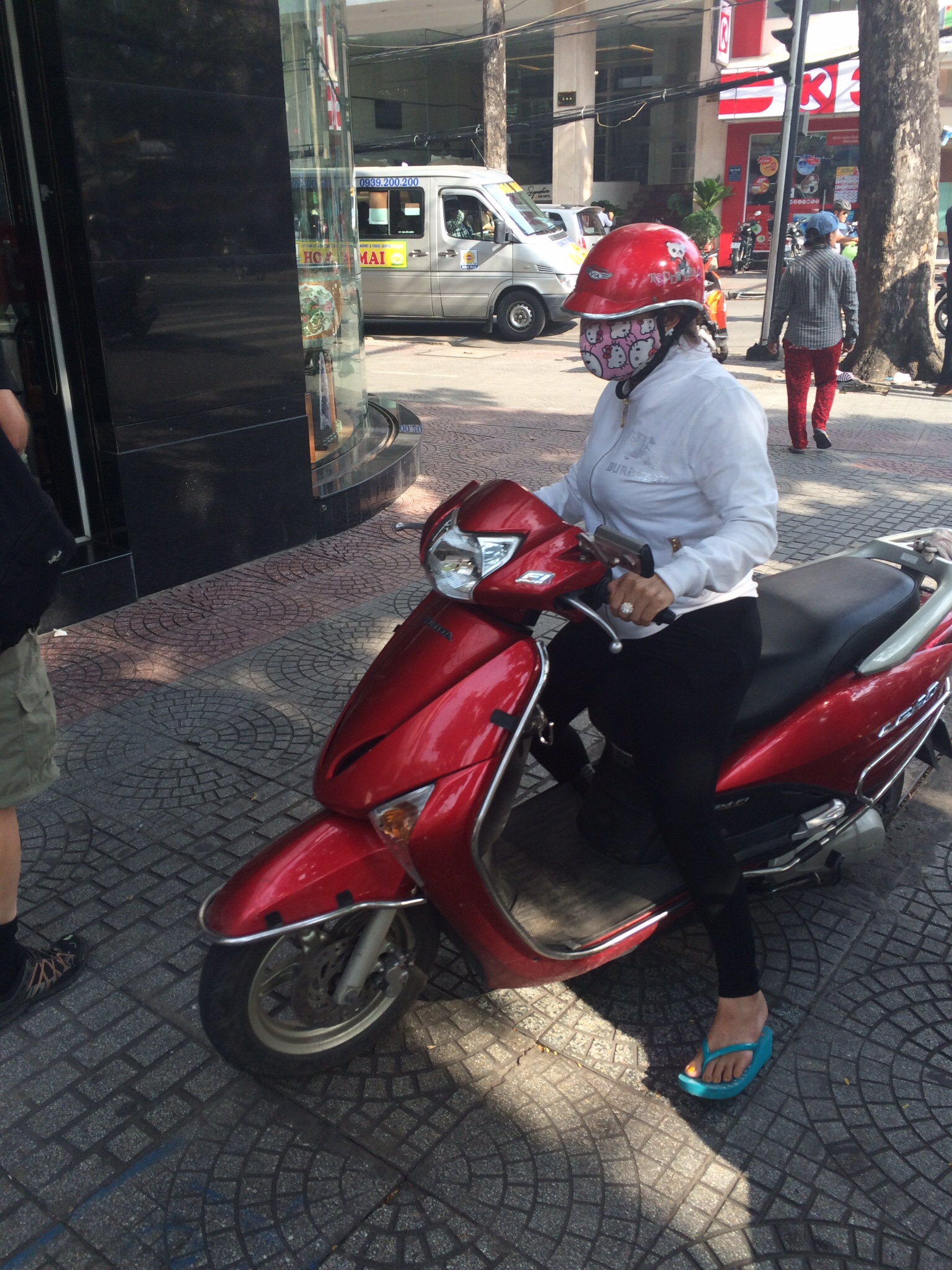
1) It can be extremely entertaining to watch. People of all ages ride the bikes. I’ve seen countless well-dressed middle-aged women at the controls, some wearing very high heels. A certain minority of them wear protective jumpsuits (to guard against the road grit) and decorative face masks (feeble protection against the gas fumes). I’ve seen guys simultaneously driving and texting and smoking. Many of the teenagers in the mix look to be no older than 14. Some folks are transporting cargo.

2) There’s an astounding fluidity to the madness. Watching the Hanoi traffic has made me think: these folks are so flexible, they could handle anything.

3) Many must enjoy the nutty drama, on some level. I say this based on what we saw last night. We’d gone out to dinner with Vietnamese friends, and we got back to our hotel around 8:30 p.m. We decided to take a short walk to the nearby Hoan Kiem Lake (“the spiritual heart of Vietnam”), to see what it looks like at night. As we got close to it, we found the streets not just busy, but jam-packed with a great mass of bikes — thousands and thousands of them. Most were couples or young families. I saw infants strapped to the backs of their mothers (who in turn were riding behind the dads). Other vehicles bore tiny toddlers — no helmets, no seatbelts, just clinging to mom.

The explanation turned out to be that it was Woman’s Day. All day long we’d marveled at the vast floral displays everywhere in the streets. That’s one way the ladies get honored. But apparently a whole gigantic bunch of them think it’s lovely to plunge into the throng — and cruise.

Cruising the enchanted bay

In 2008 Steve and I took the first cruise of our lives, down the Nile. There are other waterways we’d liked to cruise some day, but we’ve saving them until we’re older and infirm, unable to handle the rigors of more adventurous travel. We made an exception to that rule for Halong Bay; spent Thursday and Friday nights sleeping on the Treasure.


Our cruising home

It is possible to see the bay on a day boat, but that would be arduous. The bus ride from Hanoi takes more than three and a half hours. We boarded our bus at 8 a.m. Thursday, reached Halong City shortly before noon, and boarded a small pontoon boat that transported us to the junk, a handsome motorized sailing ship that sleeps about 30.

The Treasure was lovely: dark polished wood and rich upholstery, our cabin well-designed and comfortable. Meals consisted of multiple courses, many of them tasty sea creatures freshly harvested from the bay. Steve and I did all the activities: tai-chi lessons on the deck at dawn,

Vietnamese cooking lessons both evenings at 6 p.m. In between, we climbed into a sturdy double ocean kayak and paddled for hours, following our guide around the islands. We paddled to a deserted sand beach (one of the few left in the bay, we learned, due to shellfish farmers stealing the extraordinarily fine-grained sand to use in their aquacultural enterprises.) We toured a sea cave and a floating village, home to about 100 of the bay’s 500 resident fishermen. All of it was fun.
Getting into reed boats for a tour of the fishing village

None of that compared, however, to the pleasure of simply gazing at the staggering beauty surrounding us. Halong Bay has been included on at least one of those recent lists of Seven Natural Wonders of the World. It’s been declared a World Heritage Site on two counts — for nature and beauty. We couldn’t quibble with those designations. The place is as spectacular, in its own way, as the Grand Canyon or Table Mountain in South Africa. What makes it so special are the 1,969 islands that stud it. Composed of highly eroded limestone, what makes them so special, in turn, is their great height. The legend goes that they sprang up from seeds of jade spit out by dragons protecting the local folk from an invading army. Today they’re covered with jade-green plants, and they indeed look magical.

I was somewhat prepared by how splendid the bay would be. What was unexpected was how superbly our expedition company (Handspan Tours) managed to organize our itinerary to keep us out of sight of other cruisers. The first tours of Halong Bay began just 10 or 11 years ago. Steve and I have friends who visited in 2005 and were the only passengers on their junk. Now, however, some 500 tourist boats play the water daily — 300 for daytrippers and 200 for overnight cruisers. I’d read warnings online of how traffic-jammed the bay can seem, marred by the sight of garbage floating on the water. But the Treasure steamed to a relatively pristine section. Once moored, we often were the only visitors in sight.

I’m not a good enough writer to describe the bay and islands adequately. So here are a few digital impressions:

I’m hoping all these photos will upload because the Golden Sun Palace, our hotel in Hanoi’s Old Quarter, has very good wifi. We arrived back late yesterday afternoon and already my neurons are overloaded with the effort to take this place in. I’ll let them calm down, then I’ll try to describe some fraction of it.

Transported

Laos once was known as the land of a million elephants, but today authorities say only 1600 or so are left. About a third of them toil as slaves for the Laotian logging industry, hauling the heavy trees being taken from the forest. A handful of lucky pachyderms have been rescued from this servitude and transferred to sanctuaries. They still have to work for their keep, which is considerable (around 500 pounds of food per animal per day). But instead of 8-9 hours of daily heavy labor, they only have to put up with tourists for a part each day.

Steve and I got to meet some of these animals Wednesday, having impulsively signed up for the excursion the preceding day. An air conditioned van picked us up at 8:30 and drove us out into the country, where the Elephant Sanctuary leases land from the local authorities. The project we visited was started in 2003, we learned, brainchild of a visionary German. Over the years, the property has grown to encompass an exquisite cliff-top resort with manicured grounds and white-curtained cabanas that overlook the broad Nhom Khai river and fantastically dramatic distant mountains.

Some folks opted the ride their elephants across the river and give them baths. But the forest ride called to us..

We sat in one of the cabanas and sipped coffee while our guide, Cha Vang, told us a little of the history of the place. Then we walked down to the riverbank and hopped into a long-tail boat that ferried us to the other side.

One of the newer females in the compound gave birth 5 months ago to a mischievous little male christened Maksi. The two of them spend most of their time on long chains that give them a measure of freedom to enjoy the surrounding forest. But for a few hours every day they move to a small enclosure, There Steve and I and Londoners Dominic and Sophie (the two other members of our group) hand-fed small yellow bananas to the mother. She scarfed them down –skin, knobby stem, and all — like potato chips, but Maksi’s immature digestive system required that we peel the fruit before placing it in his eager, searching little trunk.

Maksi

After a while, Steve and I climbed up onto one of two nearby bamboo platforms. From it, we had to step out and onto the howdah, the wooden bench strapped onto the back of Mea Khammee, our ride for the morning. Every elephant here has her own mahout, the trainer/driver who directs and controls her. Mae Khammee’s mahout slipped in front of the howdah, wrapping his legs around her neck. And then we were off.

I’ve traveled on the backs of horses, mules, and camels; I’ve ridden in cars, boats, trains, buses, and planes, big and small. To my mind, nothing beats being transported by elephant. Granted, it would be impractical on Garnet Avenue, not to mention the 405 freeway. But for moving up a rugged mountainside through a teak forest, it’s quiet. Soothing. Majestic.

After about an hour, Cha asked if either of us wanted to switch places with our mahout, to ride on Mea Khammee’s bare neck and from that position do our best to control her. I had a sudden vision of losing my balance and tumbling from that 10-foot perch, breaking a leg or my back and being paralyzed for life. So at first I demurred. But 20-something Sophie was slipping onto her elephant’s neck, calling out that it wasn’t bad, and I couldn’t resist seeing for myself.

The view over our mahout's shoulder


I stretched out my legs then inched my butt off the polished wooden bench; eased my legs around the rough gray curve. Then Mea Khammee was bearing all my weight, and the Laotians were urging me to move forward; to tuck my knees behind her ears.

And we were off! Rocking a bit, yes, and there was no saddle or rope or pommel to grip. But I found that if I rested my palms on the great round knobs that constitute the back of the elephant’s head, that was sufficient to steady me. More remarkable than the motion was the way I could feel her huge muscles moving beneath my thighs. She flapped her great ears often, and when she did, they gently slapped my bare knees and calves.

At first I was most aware of the sinewy motion of her neck muscles. But after a while, I sensed her legs beneath me too, each stride fluid and sure. If there’s an elephantine version of a centaur, I seemed to become that — my pelvis fused to her upper back, her great legs become mine. We trod on that path through that impenetrable profusion of green, and it gave me a new goal in life: to lie on my deathbed years from now, ancient and fading, and remember when I strode through Laos, half-elephant, half me.

Eventually, I inched back into the howdah, to return to a more prosaic state for our final ascent up the mountain and give Steve a chance at the elephant ecstasy (he declined). From the top, we hiked down. Before we did, we fed a bunch of bananas to Mea Khammee. She seemed to enjoy them, but to me it felt like miserly thanks.

Air v. ground in Laos

Steve and I like visiting capitol cities. We feel they offer important insights into any country. That’s why we wanted to have at least a few hours in Vientiane in Laos. You can get to the Laotian capitol via a sleeper train from Bangkok. Thus we found ourselves pulling out of Hualamphong Station on the #69 Saturday night.

Somewhere deep within my psyche lies buried the delusion that night trains are romantic, which is why I keep taking them when I have a chance. At one point Sunday morning, in the Nong Khai station in Thailand, near the Laotion border, we actually saw such a train, incarnate. Elegantly labeled with raised golden letters, the Eastern & Oriental Express had dining car after dining car, and when they rolled by, we glimpsed tables set with linens and flowers. All the passengers looked to be plump and wealthy and Caucasian. I imagine their private compartments were plush and cozy.

The train we didn't take

The train we took, in contrast, had just one dining car, with six tables and battered plastic menus. The fluorescent lighting was blue-tinged and grim. A cheerful waiter served meals that were better than most of the fare we get on airlines (though those Eastern & Oriental Express passengers would have sneered at it). Steve and I also loved the fact that all the dining care windows were wide open, letting in the warm night breeze and giving us excellent views of the squalid conditions alongside the tracks that some of Bangkok’s residents somehow endure.

The train wasn’t the worst sleeper I’ve ever taken. It left precisely on time and arrived, 12 hours later, only about 20 minutes late. When the porter made up the bed in our car, the sheets looked reasonably clean, and the mattress wasn’t too hard. Still the clatter of the wheels penetrated my earplugs, and I’d have to be truly deluded to call the motion rocking, rather than jarring. When I have to pee in the middle of the night, I’d rather not have to walk through a corridor to a bad smelling little compartment with liquid on the floor, but we did enjoy waking up to stare at the fields of rice and sugarcane flashing by in the early morning light. After we pulled into Nong Khai, transferred to the shuttle train that takes you on the 8-minute ride across the Friendship Bridge over the Mekong River (the border between Thailand and Laos), then took a taxi to our guesthouse in town, it was about 11 a.m. and we both felt a little weary.

Still, we were game for doing Vientiane. I’d had the good fortune to find and print out a September travel article published in the LA Times, so we had up to date recommendations for restaurants (which we hunted down and which proved to be 1) excellent (Xang Phoo for lunch) and 2) superb (Lao Kitchen for dinner)). That writer’s 5 must-see sights were all within walking distance of our hotel and each other, and we found and enjoyed visiting them all. By dinner, we were passing our judgment: Vientiane (pop. about 250,000) feels sleepy and mellow by the standards of other world capitols. It’s worthy of a 7-8 hour tour, but not two whole days.

So we were happy to climb aboard the “VIP bus” to Luang Prabang at 8 the next morning. We could have taken a plane (Lao Air, less than an hour and not expensive), but we’d read that the scenery seen from the bus was splendid, and we told ourselves: we enjoy the occasional bus ride. Once again, we were forgetting the qualifiers: IF it isn’t 10 hours long and IF the bus has halfway decent shock absorbers and IF it doesn’t break down or go over the precipice of one of a zillion hairpin turns. Steve and I usually enjoy that. Our ride avoided death AND disaster. The scenery for at least half the ride was indeed surreally beautiful. We saw details we would never have glimpsed on the plane: posses of three years olds running down the road with no adult anywhere in sight, tiny flooded rice fields, chiles drying on tin roofs, preteens hauling sticks in bags slung their foreheads, and more. But the last few hours felt grueling.

The town it took us to, Luang Prabang, in contrast has exceeded the good reputation that drew us here. It’s one of those enchanted towns, a Brigadoon or Shangrila or at least a Santa Fe. The balcony of our guesthouse overlooks the Mekong, which even this far north is wider than the Colorado. Surrounding mountains are as comely as those features of classic Chinese paintings. The streets are filled with pretty restaurants serving great food, with glorious temples, with spas offering massage services so cheap that even massage-resistent Steve succumbed to the lure of a 60-minute Classic Lao session (and liked it!). Monks parade through the streets at dawn accepting crackers and balls of rice from tourists and locals alike, and an endless line of stalls set up along the main street every night selling wares that even shopping-averse Steve found beguiling.

Monks receiving alms at dawn

Typical Luang Prabang scene
We have another whole day here before we take off for our evening flight to Hanoi. We could easily do more strolling and grazing and body-pampering, with breaks for coffee or cocktails to people-watch. But one thing about that hellish bus ride: it gave us glimpses into lots of dense and mysterious and and misty mountainous jungle. It called to us, and as luck would have it, a small industry of folks in this town puts tourists on the backs of elephants who carry them into it. We’ve signed up and depart in just an hour for yet another adventure in ground transportion.


The mystery of the disappearing scammers

We left Manila early Sunday morning, landing at Bankgkok’s glitzy airport a little before noon. Our night train to Vientiane, the capital of Laos, would be leaving at 8 p.m. from downtown Bangkok. What to do in the 6 hours in between?

Happily, I had earlier found a solution. I had emailed Sukanya, the manager of the guesthouse where we’d booked two nights at the very end of our trip (its memorable name: the Loobchoob Homestay). She replied that for about $30, we could reserve the use of their day room. We could nap in it, shower, lock up our suitcases and explore the neighborhood. I jumped on this and even managed to have our train tickets (which I bought online) delivered to the hotel for pickup when we arrived.

It all worked beautifully. We caught a metered taxi from the airport that for about $12 transported us to the Loogchoob. We collected the train tickets; approved of the clean, pleasant day room. Following the helpful map Sukanya gave us, we set out to the nearby market to eat duck and visit a couple of the local temples.

The duck and noodles and Thai beer (less than $8 for the two of us) were delicious. In high spirits, we followed our map in the direction of the first temple. We were chattering and taking in the sights when a clean-cut young man asked if we were heading to the temple. When we assented, he warned us that a large crowd of demonstrators was gathering in that area; it wasn’t advisable to join them, he said. Seizing our map, he pointed out a couple of alternate temples not far from us. He added something about a special deal that could allow us to see both for just 30 baht (a bit less than a dollar)).

Now…. Steve and I have had a fair share of experience being approached by young men in foreign cities who want to take us under their wings and guide us, so our hackles lifted a bit. But this guy never suggested joining us. He just wished us well and sent us on our way. Changing course, we congratulated outselves on getting this friendly advice. Angry demonstrations have a way of becoming vortexes for violence that we’d just as soon avoid.

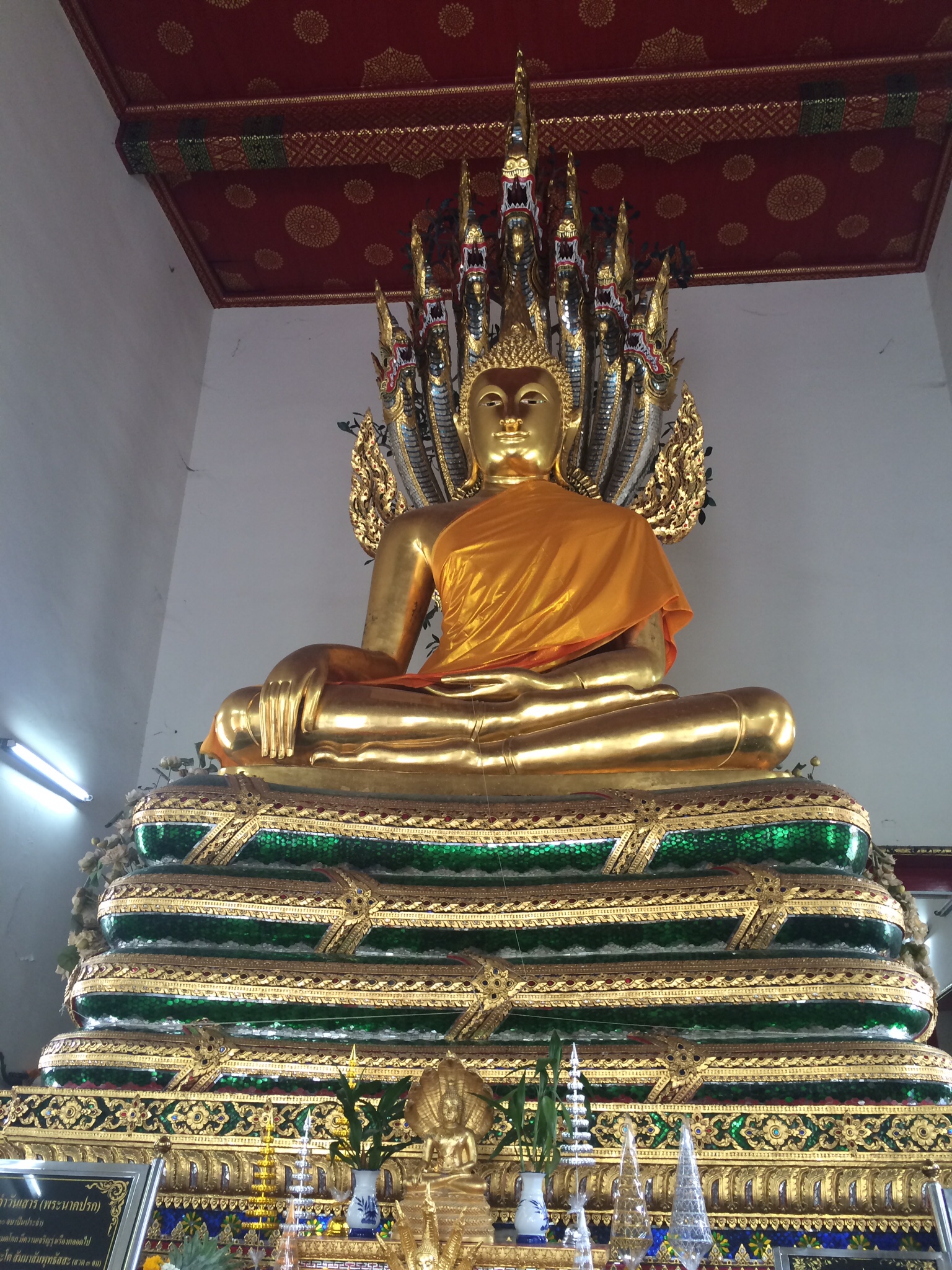
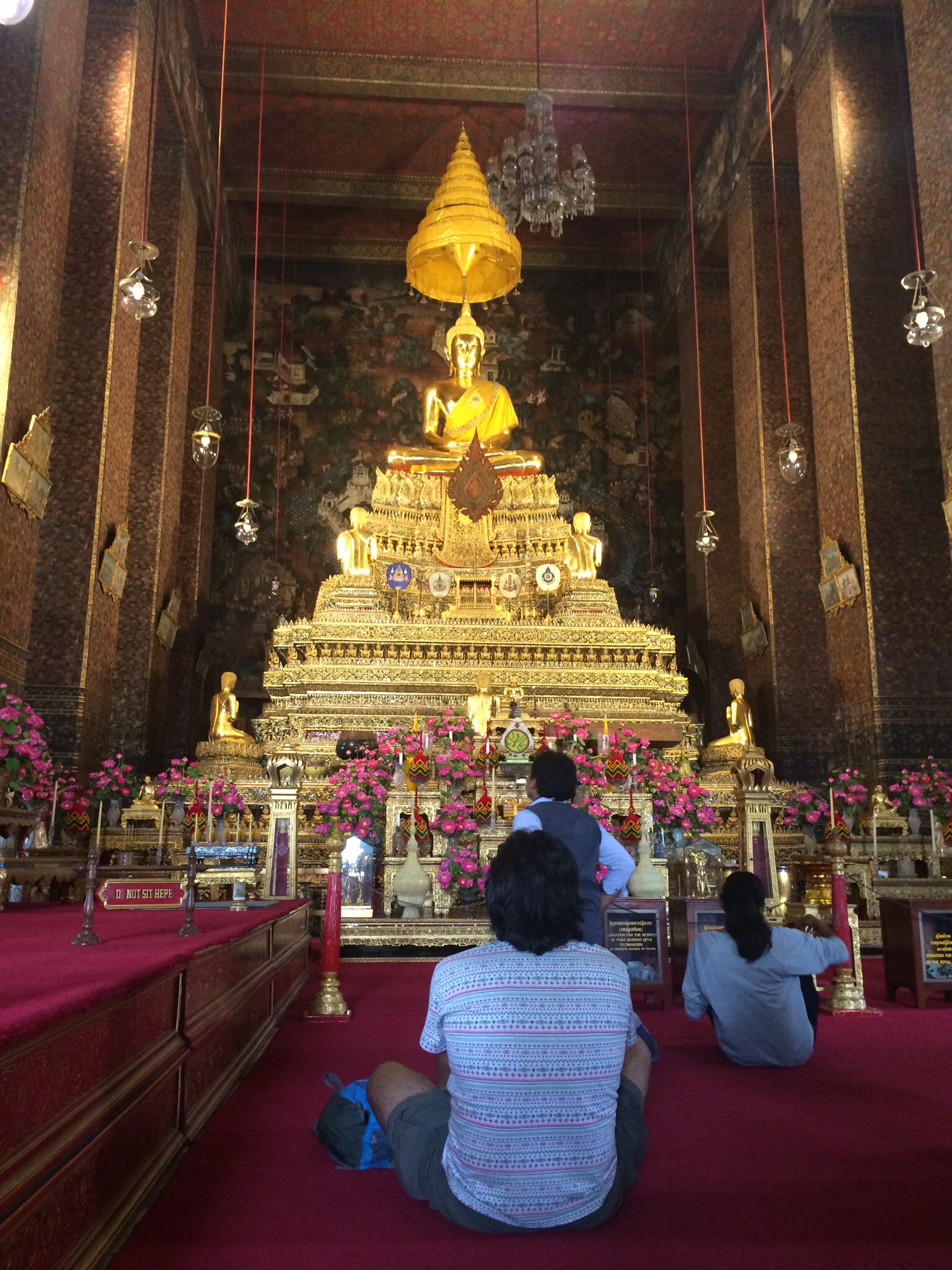
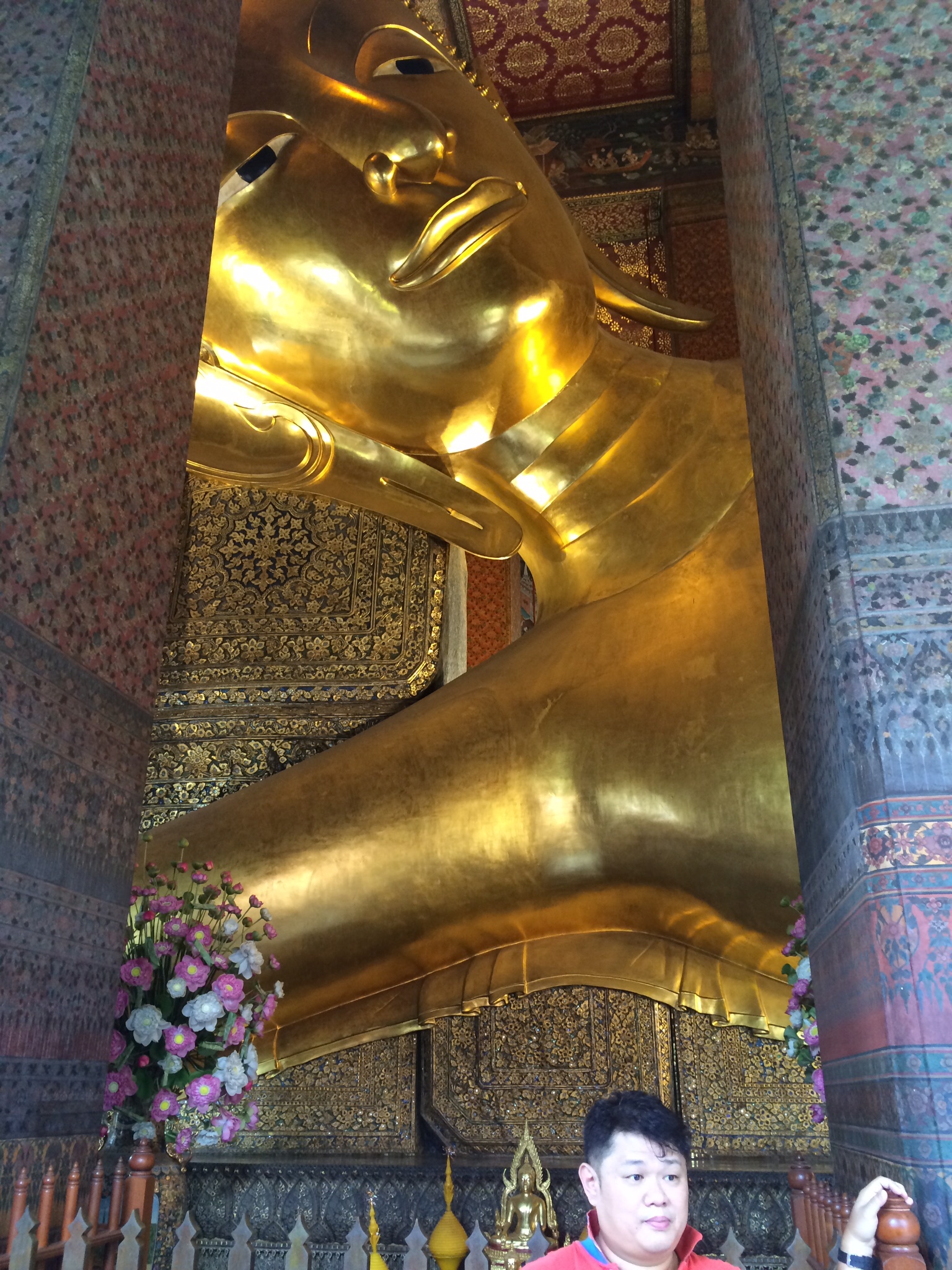
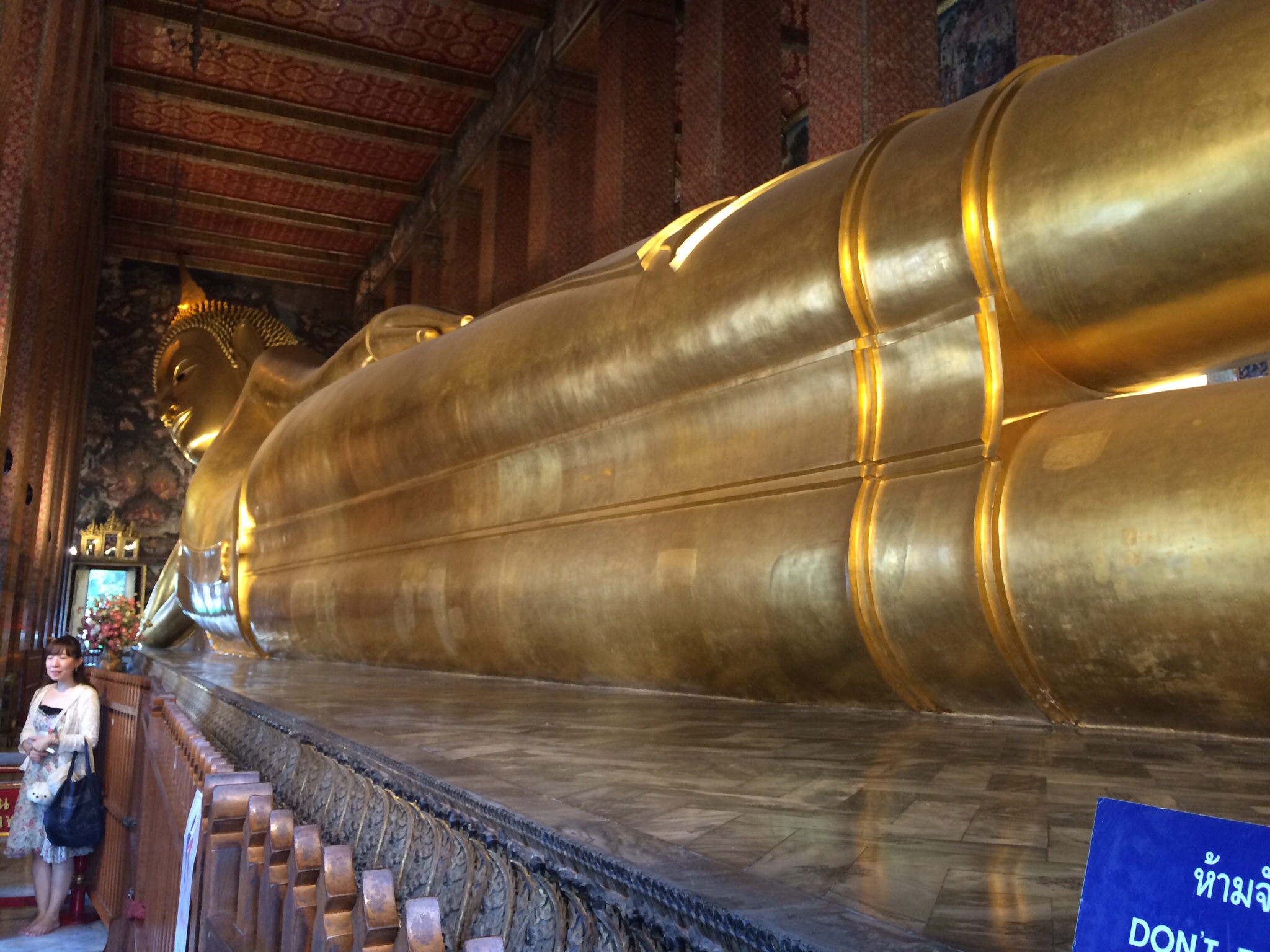
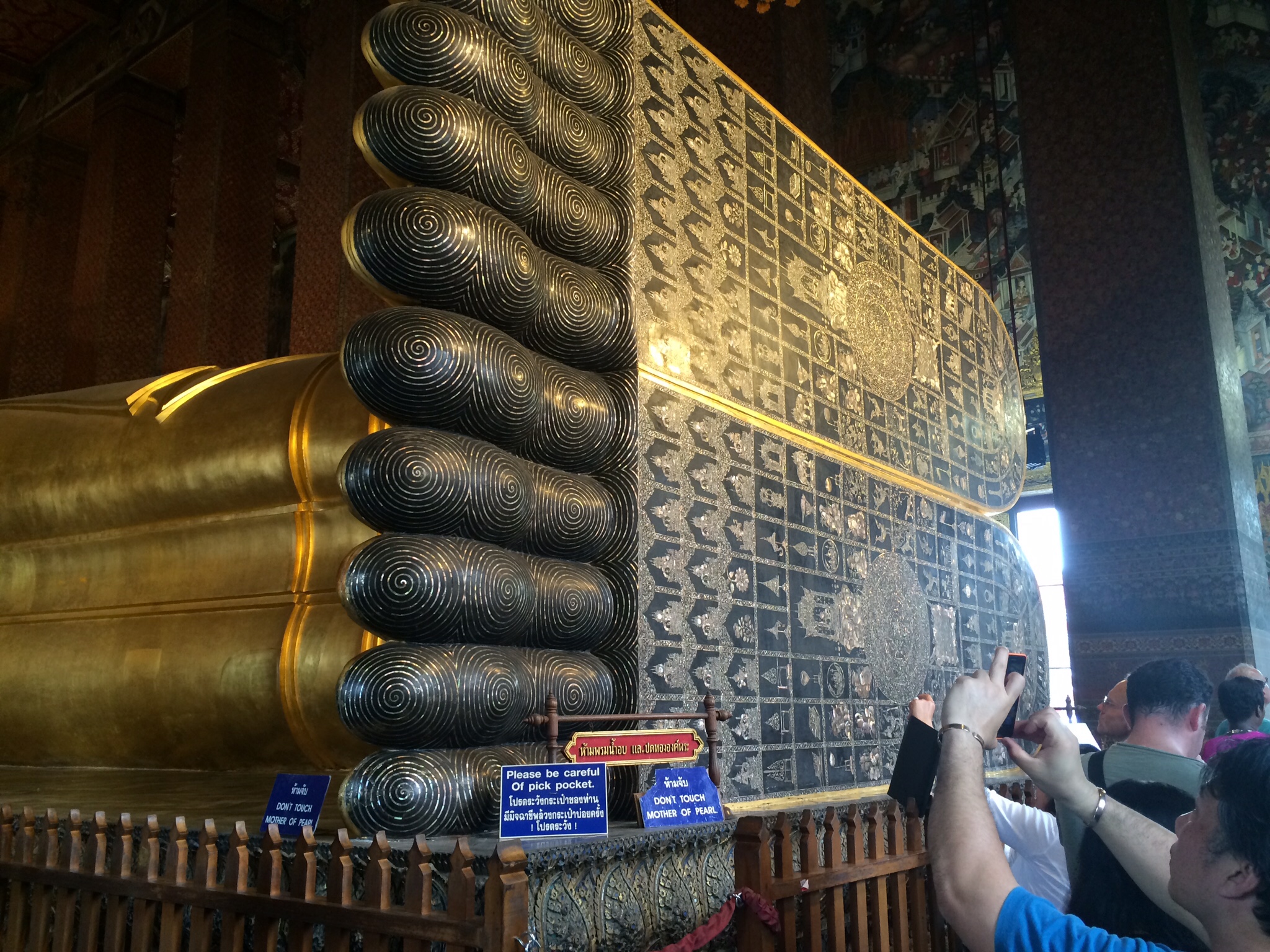
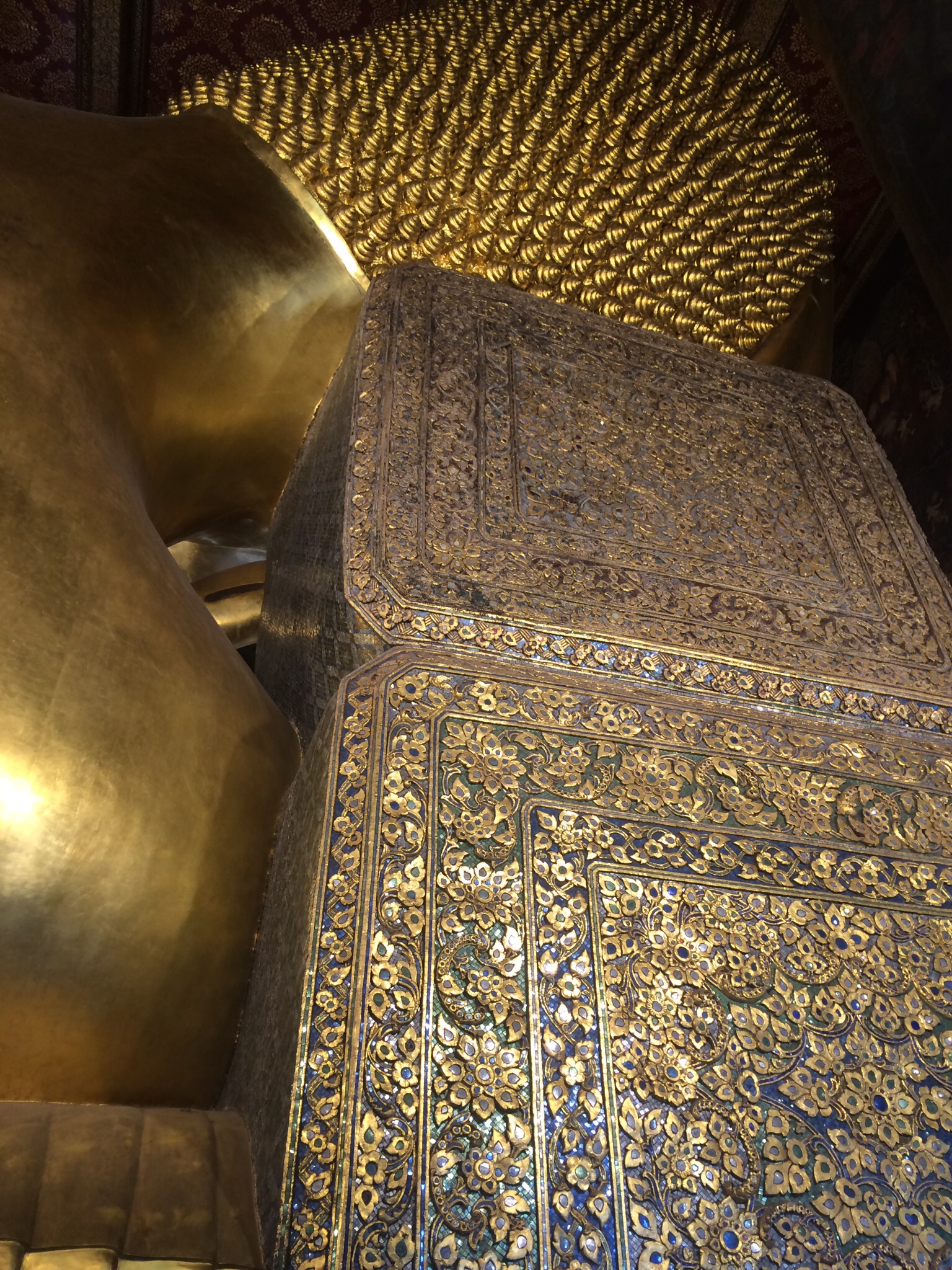
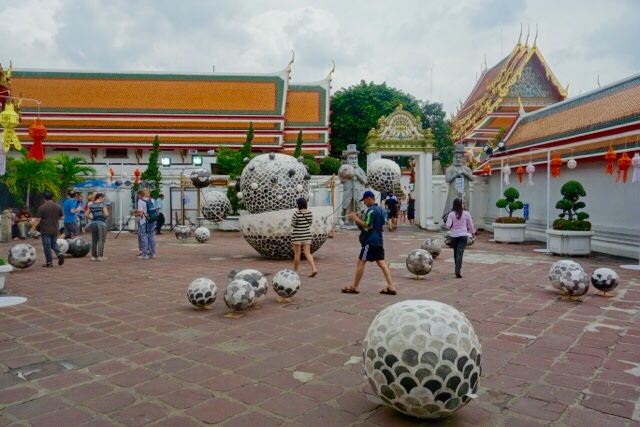
After a bit more walking, we found our way to one of the two temples recommended by our Samaritan. The grounds were huge, and we wandered past a Buddhist university; past monks with shaved heads wearing the iconic saffron robes. Eventually, we found the central compound, home to four giant golden Buddhas — sitting lotus, reclining, otherwise arranged. Not just the dazzling statuary but the structures sheltering them astounded me. I’ve seen a lot of churches and cathedrals and mosques and Japanese temples, but these flamboyant Bangkok creations rank with the most eye-catching anywhere. “See! Didn’t I tell you?” Steve demanded. He had. (He and his folks visited Bangkok too on their round-the-world trip when he was 8, and his memory of those Thai religious centers has never faded.)

Our map told us that the second one we’d targeted should be only a few blocks away, so we started for it. But once again a young man accosted us, asking if we’d liked the temple. He added that we were extremely lucky to be in Bangkok just then. “It big Buddha day!’ he told us excitedly. That’s why so many Thai people were there, paying homage. Temples were open that day that normally were closed to the public.

The famous black Buddha was only open one day per year — this very day! If we hurried, we could still see it before it closed for the afternoon, he urged. Due to a special government promotion, the yellow tuk-tuks were taking people to five temples for only 20 baht! (about 60 cents).

Once again, this seemed suspicious. But just then a yellow tuk-tuk (one of the open, 3-wheeled taxis) approached. Samaritan #2 hailed it, asked the driver if he would indeed take us to at least 4 temples for 20 baht, and marked on our map the order in which we should see them. (The reason the tuk-tuk drivers would accept this ridiculously low price was because the government and petroleum dealers were subsidizing this special celebration day, he explained.)

Once again, Sam2 wasn’t suggesting he should accompany us. I think that’s why my skepticism melted away. A once in a year, heck, once in a lifetime chance (for when would we ever be back again on the very same lucky day?) to see the black Buddha (whoever HE was)??? Steve and I looked at each other, nodded assent, then jumped in the tuk-tuk and we zoomed off, careening through the city streets at top speed.

We seemed to be driving for a long, long time. But just before we might have begun to worry about being kidnapped, we arrived at the temple, parked, and our driver said he’d wait for us. The black Buddha was nowhere near as impressive as the golden ones, but he was indeed black. And a Thai guy who was praying in front of him, turned to us and declared that he worked at the Thai consulate in NYC and would be flying back in just a few hours but had felt compelled to fit in this visit. “This is only open once a year!” he exclaimed. “You’re lucky!)

The black Buddha was small but supposedly quite special.

Short on time, we got back in the tuk-tuk and sped to the second destination — The Golden Mount. Yet another stunning complex, the central feature of this place seemed to be a huge building high on a hill. But we were worrying about the time, so we merely visited a ground floor Buddha, then returned to the street… where our tuk-tuk was nowhere to be found.

Two other drivers were at the curb. They spoke no English, but seemed to be clearly telling us our guy had abandoned us. We couldn’t understand their explanation for what had happened; for why he’d gone off without even being paid his measly 60 cents. Consulting our map, we were relieved to discover that we were within walking distance of the Loobchoob. As the skies opened with the showers that had been threatening for a while, we opened our umbrellas and raced back through the downpour.

Sukanya greeted us; asked how we’d done. “Well,” we said laughing, “we had quite an adventure!’ We launched into the details of what had happened, and as we did, she grimaced. “It was a scam.”

She pulled out the folder she gives all guests when they check in; opened to a page headlined, “The Top Ten Scams in Bangkok.” There was no Buddha Day, she gently disillusioned us. Though she wasn’t familiar with the black Buddha, she didn’t think it was open only today. And there had not been any major street protests since the military coup that took place in May. She continued that the scammers’ usual ploy was to ensnare tourists with such tales and then direct them into shopping centers where they could be cajoled into buying overpriced goods. Even if you didn’t get ripped off on the merch, the whole experience wasted your time.

But… but… we sputtered. We hadn’t been asked to buy anything! We’d been driven to at least the two temples, had paid nothing to visit them, and hadn’t even compensated the driver for the ride! What kind of scam was that?

Sukanya looked baffled. She couldn’t even venture a guess at the explanation.

We wonder if the driver got shooed away by police, or called to a sudden emergency at home. But… were they all in cahoots? Sams 1 and 2? The tuk-tuk driver? Was that “consular employee” a plant? It seemed unimaginable.

The “consular employee” did tell us one thing I suspect was true. He said we were lucky that day. Maybe we were.


Manila, a Roots Journey

Truth be told, the main reason we went to Manila is because it was the cheapest destination from Southern California. But we could have just changed planes and blasted onward to Bangkok. Instead we ventured into town to seek whatever shreds of Wolfe family history remained.

Steve’s grandfather packed up his wife and baby daughter and journeyed to Manila in 1913. His mission (for he was an official missionary) was to convert the natives to the teachings of the fundamentalist Church of Christ. Steve’s grandmother birthed two more daughters and a son in the Philippines. Steve’s dad, the youngest, was born in 1919, departed for college in the States in 1937, then joined the Navy. But the elder Wolfes remained in Manila and were interned during the Japanese occupation. The patriarch (Leslie Edwin) survived the ordeal but just barely; he died just days after Los Banos prison camp was liberated. Carrie (Steve’s grandmother) remained in the Phillipines for several years, continuing to serve the church.

Steve and his parents visited her during the summer of 1958, when Steve was just shy of 9. He has some vague memories of staying at her compound — chasing chickens in her yard; playing with some other missionaries’ kid. But nothing beyond that. Both of us had the impression that today — more than a 100 years after the Wolfes arrived in Manila — little of their life there remained.

Still, we found some clues to where it had unfolded. Two of Steve’s aunts wrote memoirs that mentioned addresses for family dwelling places. More encouraging was our discovery that the church Leslie helped to build in 1930 still existed; indeed its website made it sound like it was thriving. Our hotel within Manila’s old walled city wasn’t far from these sites, and with the help of Google maps, I created a little walking tour.

When we set out a little before 8:30 a.m. Friday, the air was already hot and so full of moisture it clearly had the potential to drench us. But the thunderstorms my i-Phone had been predicting every single day for Manila for weeks weren’t actively storming. We left the walled city, found a route that took us to a bridge across the filthy-looking Pasaig River, and proceeded deep into the neighborhood of Quiapo.

I’d read comments online about the thuggish behavior one might encounter in this part of town, though the consensus seemed to be it was safe enough to walk through in the day. Our snap judgment was: very very poor but so jam-packed with people that the only likely threat was being pickpocketed. (Indeed, at least two locals warned us to beware of that.) Manila is more densely packed with people than Calcutta, and on that walk yesterday morning, it was easy to believe. We stepped around people sleeping in the street, passed naked children and hundreds of vendors selling thousands (millions?) of items. Not just the ground, but the very air seemed crammed, dense with smells and soot and diesel fumes and a furious level of noise — jackhammering diesel engines and squealing motorcycle brakes being the biggest component. Among the jostling vehicles, Manila’s jeepneys stand out. I’ve never seen anything quite like them anywhere. They made me think of a mutant cross between an ambulance and a fire engine. Passengers climb in and out through the open back doors. The sides and front are gaudily decorated and most flaunt names. I jotted down: Nazareno, Speed Bird, Ramboy!

It was all most diverting, and we didn’t feel so bad when we found no trace on Recto Street of the lovely two-story house where the Wolfes first lived. The stretch of Gastambide Street where Steve’s dad was born was quieter, and we lingered quite a while at the intersection near which the family must have lived. Indeed two of the four corners held old wrecks of buildings that may have been the ghost of the building we were seeking, but there was no way to confirm it in the short span of our visit.

Finally, we headed for the Church of Christ at Cruzada, where Leslie’s church has grown into an imposing complex that fills most of a block. A padlocked gate barred the massive front door, and we were resigning ourselves to leaving with only photos when a lady from the neighborhood approached and told use to try a side gate. Not only was it open, but several staff members were toiling in an air-conditioned office. When the youth minister learned who Steve was, he toured us all around the premises. “Brother Wolfe was very helpful to many Christian churches in preserving our religion and our freedom,” he said solemnly. Then he packed us off with bottles of water and a firm injunction to come for services the next time we were in town.

It was close to 11:30. My clothes were so soaked, I think I could have wrung drops of sweat out of them. Rather than slog back to the hotel, we hailed a “tricycle” — one of the class of vehicles that competes with the jeepneys for most atrocious road behavior. Some are powered by bicycles and some by motorcycles, but in each case, they’re welded to little sidecars that bear the passengers. Our ride (motorcycle-powered) was the closest I’ve come to experiencing a real-world version of Mr. Toad’s Wild Ride. The driver went the wrong way down streets, wove his way in and out of crazy vehicular thickets, then finally stopped and turned off the engine when he came to an intersection where he said the police were doing something that he didn’t understand. Disgusted, we disembarked, paid him a tenth of what we’d agree on, and got no argument from him.

We walked back to the hotel, showered, and ate some pizza in the cool, elegant hotel restaurant. Then we set out on our last Roots-related mission: a visit to Leslie’s grave.

The concierge helped us find a taxi driver who agreed to take us to the American Cemetery, wait while we visited the gravesite, then transport us back. His name was Bong and he muttered dark warnings about how awful the traffic was likely to be. It might take an hour or an hour and a half each way, he predicted. But he agreed to be our chauffeur for a little under $30.

Bong turned out to be a talkative and sociable fellow, which is why I can tell you that he’s 64, has had four wives and 13 children, used to play drums in a rock band, and thinks Ferdinand Marcos was the best president the Philippines has ever had. These and other tidbits entertained us on the drive through mile after traffic-choked mile. As things turned out, it only took only 45 minutes to reach the enormous expanse of land where the cemetery and memorial are located. It took less than a minute for the cheerful young women at the visitor’s center to find Leslie in her computer and direct us to his resting place.

Like Arlington National Cemetery and Ft. Rosecrans in San Diego, Manila’s American Cemetery contains simple unormented white crosses (and occasional stars of David). Leslie’s in row 192 of Section D, maybe 20 graves in. I’m not a huge fan of military death displays, but I have to admit this was beautiful — the gently rolling sea of green grass dotted with the grid of pure white points. A few massive trees looked beautiful and serene, contrasting with the beast of a city encircling the distant perimeters.

Most of all, I liked my sons’ great-grandfather’s headstone. It lists his name, the day he died, and it says simply: Civilian. Although I never met the guy (indeed Steve never met him), I feel like I know him a little better.