The bird men of Saigon

I’ve depended on guidebooks all my adult life. For this trip, I carried Lonely Planet’s guide to Southeast Asia with me, and in Saigon we followed its suggestions for a few things. All the sites we visited on our walking tour with the student were warmly recommended by the Lonely Planet writers. On our own Monday, Steve and I relaxed our aversion to Vietnam War tourism and visited Saigon’s War Remembrance Museum, which pretty savagely indicts the entire US involvement in the region. It’s an entirely one-sided view of those events, with no tolerance or understanding or attempt to present what the warriors or America’s leaders thought they were doing. Heavy attention is paid to the huge numbers of people who died, to the war atrocities (like My Lai), and to the spraying of millons of gallons of Agent Orange to destroy vast areas of cropland. (We have seen a number of hideously deformed folk in the streets, who may be part of that legacy.) Lonely Planet gives it a star.

Bitexco Tower, Saigon's tallest

In recent years, however, I’ve become more and more fond of finding travel suggestions online. The information in even the very best printed guidebook is typically several years old by the time it hits bookshelves (or becomes available on Amazon). Cognizant of this, I’ve started turning to the Internet for more up-to-date suggestions. There, for example, I found a New York Times travel piece published this past summer (“36 Hours in Ho Chi Minh City”) that led us to two phenomenal dinners (one about $12 and one about $25).

I perked up when I came upon the “Fly, Icarus, Fly” blog. It contained a post in which author “James” recently enumerated some of his favorite quirky things to do in Saigon. An intriguing list, it led me to the free student tour. It also advised that while tourists usually experience the Bitexco Tower (Saigon’s tallest building) by paying to go to the “Skydeck” on the 49th floor, locals head to the coffee shop on the 50th floor. We did that, and sipped delicious iced coffees with condensed milk while drinking in the mind-boggling skyline.

James also recommended seeing a show at the Saigon Opera House, and that turned out to be the impetus for me securing tickets to an amazing Cirque de Soleil-style performance (“AO”) that dazzled us Sunday night. He sung the praises of local barbers, and although neither of us got a haircut, we did spring for foot massages ($5 each for 30 minutes). Best of all was James’ advice to stroll over to Tao Dan Park to see the bird men of Saigon.

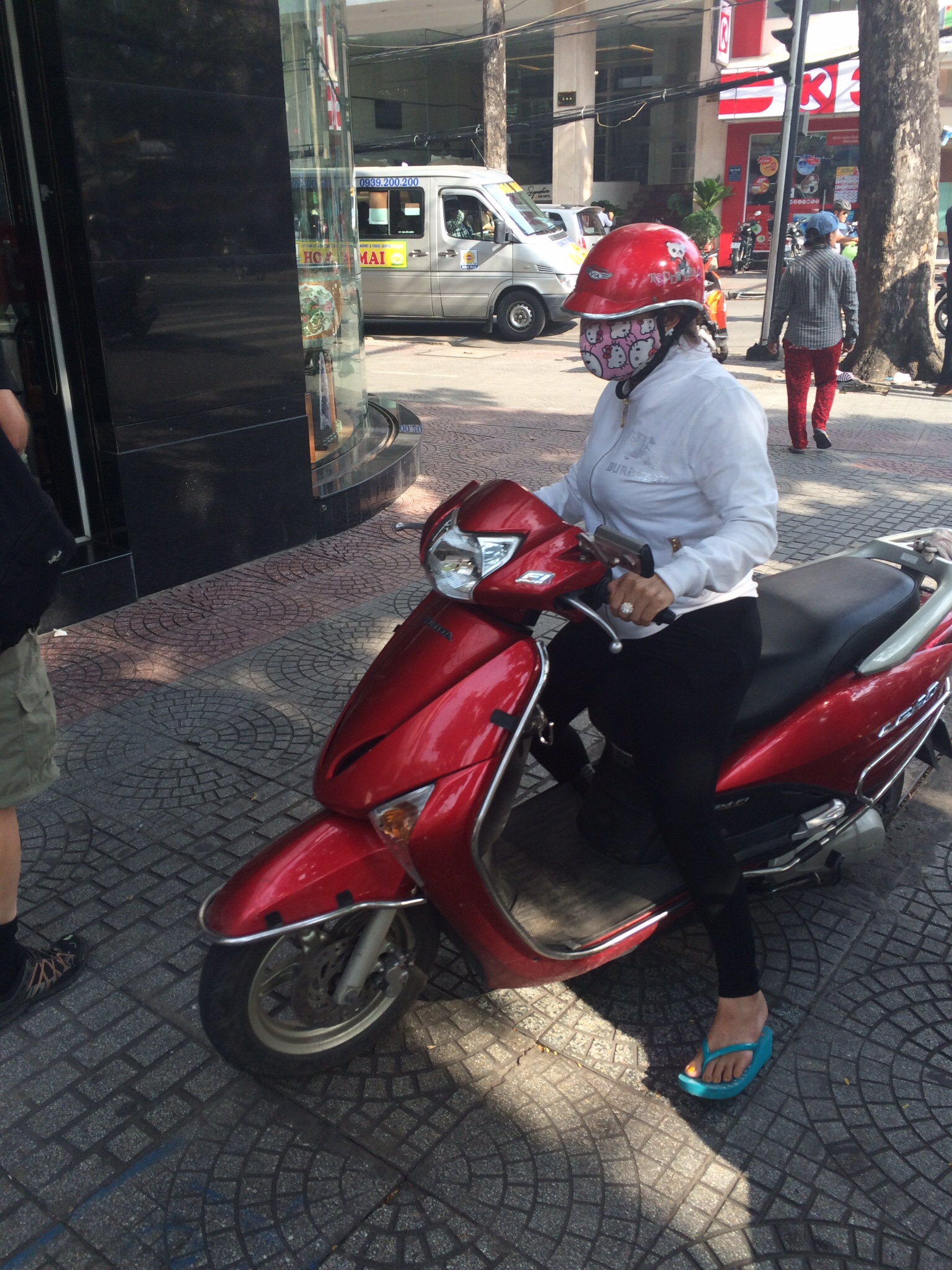
Vietnam still has plenty of ladies carrying shoulder poles, and they're up early..
Fewer motorbike riders take to the sidewalks in the early morning hours.

He said these were bird owners who every morning gathered in the park to provide their feathered friends with a play date. Intrigued, we set our alarm and were walking out of our hotel by a little after 6 a.m. (Tuesday). It was a pleasant time to walk in Saigon, warm, of course, but not the steamy blast furnace that it builds to by late morning. The streets were far from empty, but the cars and motorbikes seemed more like battalions than armies. Folks were setting up their wares and cooking grills on the street; carving hunks of meat, displaying vegetables for sale. The world felt calmer and quieter than it would be a few hours later in the workday.

The park was a haven of pathways winding in the shade provided by huge, old trees. We arrived shortly before 6:30 a.m. and gaped at the bustle of activity: young men And women clad in black practicing martial arts, joggers, ungainly middle-aged ladies jazzercising to Vietnamese pop music, couples playing badminton. But no bird men! Had we been duped? I pulled out the blog post and re-read it; noted that it mentioned the action occurring next to some kind of cafe. We saw a building like that, headed for it, and found what we were seeking.
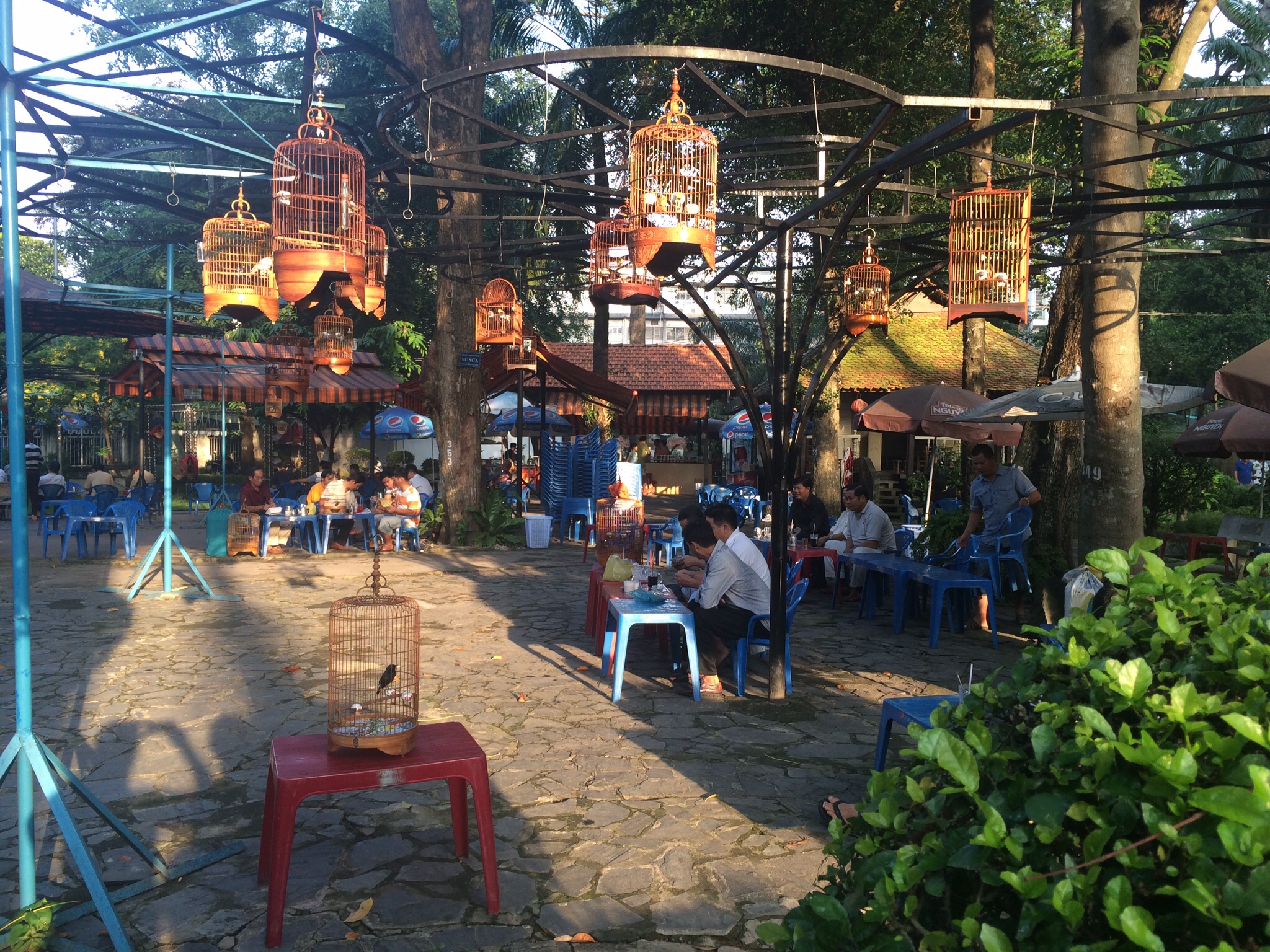
Men were sitting on blue plastic chairs at little plastic tables set under metal structures that looked like abstract representations of trees. From these, they’d hung the beautiful wooden cages housing their birds. From what we could see, the birds for the most part weren’t beauties. Some were the size of finches, while a few could have been mockingbirds. Most were singing in the dappled sunshine. In his post, James claimed that the birds actually learn new songs from each other.

The birds seemed happy

He’d said that up to 100 bird owners sometimes gather, and indeed, in the 15 minutes or so in which we watched the scene, we saw at least a dozen more men (young and old) arrive, remove the colored cloth covering their cages, and hang them up to join the other birds. It was the kind of scene that makes you like a place, and we were sorry we had to leave it, to rush back to the hotel. But we had a bus to catch for a gathering of boats, rather than birds, in the Mekong Delta.

Language lessons

On our very first morning in Vietnam, when we strolling around Hoam Kiem Lake In the center of Hanoi, two groups of young people approached us and said they were students, seeking to improve their English. Both times they asked if we could spare 5-10 minutes to chat with them and give them some conversational practice. My hackles rose. I remembered all the students in Beijing who did the same thing, but there it invariably turned out to be a ruse to try to lure tourists into buying art. So I brushed them off. They didn’t react the way the Chinese students did, however. Instead of pushily pursuing us, they seemed embarassed and apologetic, and they immediately backed away. Steve later chastised me; said we should have talked to them.

In Ho Chi Minh City (still aka Saigon), we got a second chance. While planning the trip, I had found a website for free tours organized by Vietnamese university students to give themselves some one-on-one time with native English speakers. It sounded too good to be true, but I emailed anyway and asked to sign up for such an excursion. I got no response at first. But 5 days after we left San Diego, I received an enthusiastic e-mail from one “Salmon Tranh,” offering to show us some of Saigon’s top sights. We made plans to meet at 10 a.m. Sunday morning (10/26) in front of the Independence Palace.

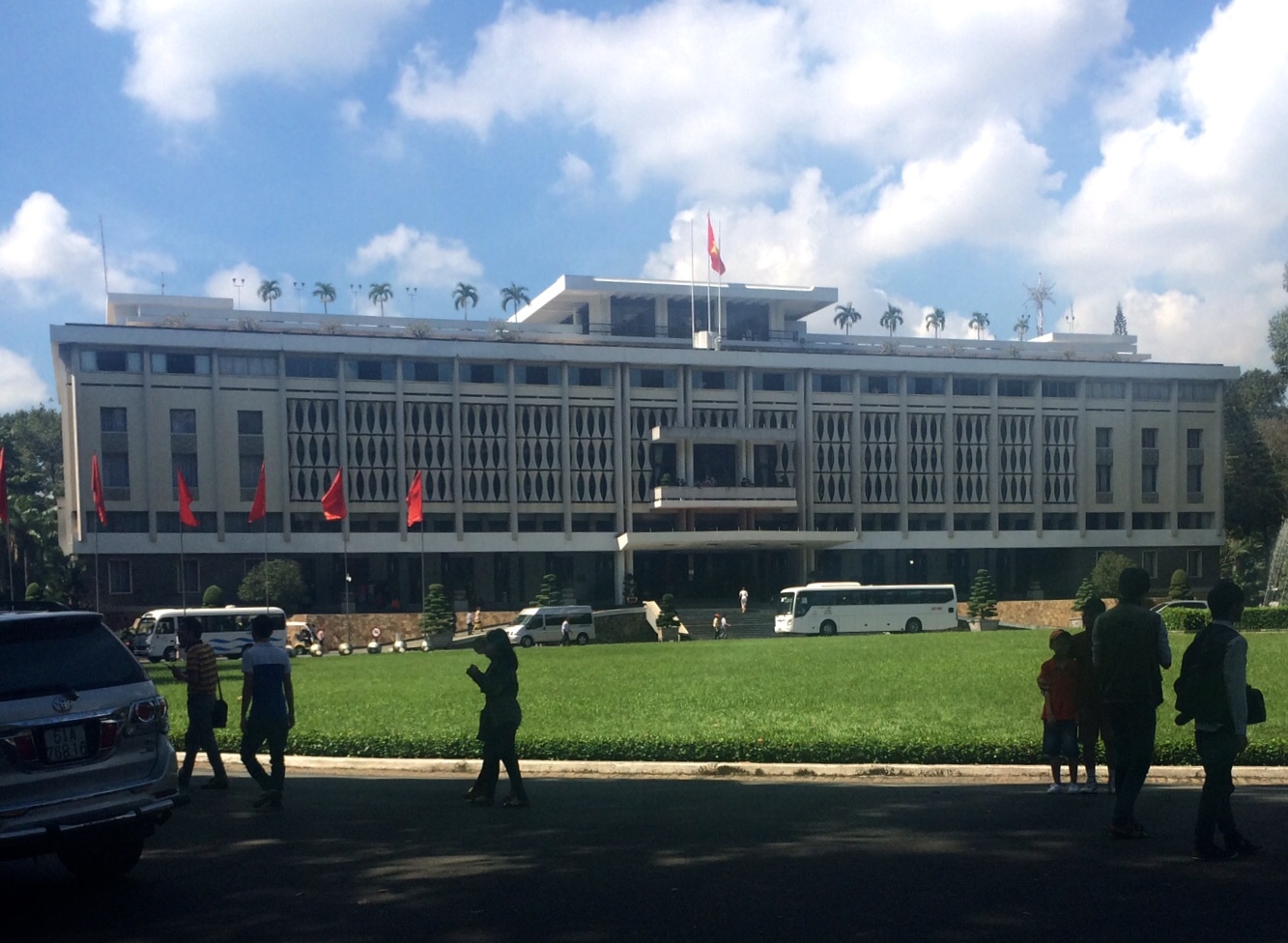
The Reunification Palace (aka Independence Palace)

By that point, Steve and I had come to understand the desperate need for more and better English-language instruction in this country. We’ve been told that nowadays all Vietnamese children get English lessons in school. But we’ve also heard — and it’s obvious as one travels here — that this education is poor. It focuses on grammar and (some) written comprehension, but there’s little to no opportunity to converse. As a consequence, many shop folks cringe when you ask them anything in English. Others, particularly tour service providers (hotel and restaurant personnel, museum guides, etc.) speak it freely — but with such heavy accents it’s usually tough to understand them.

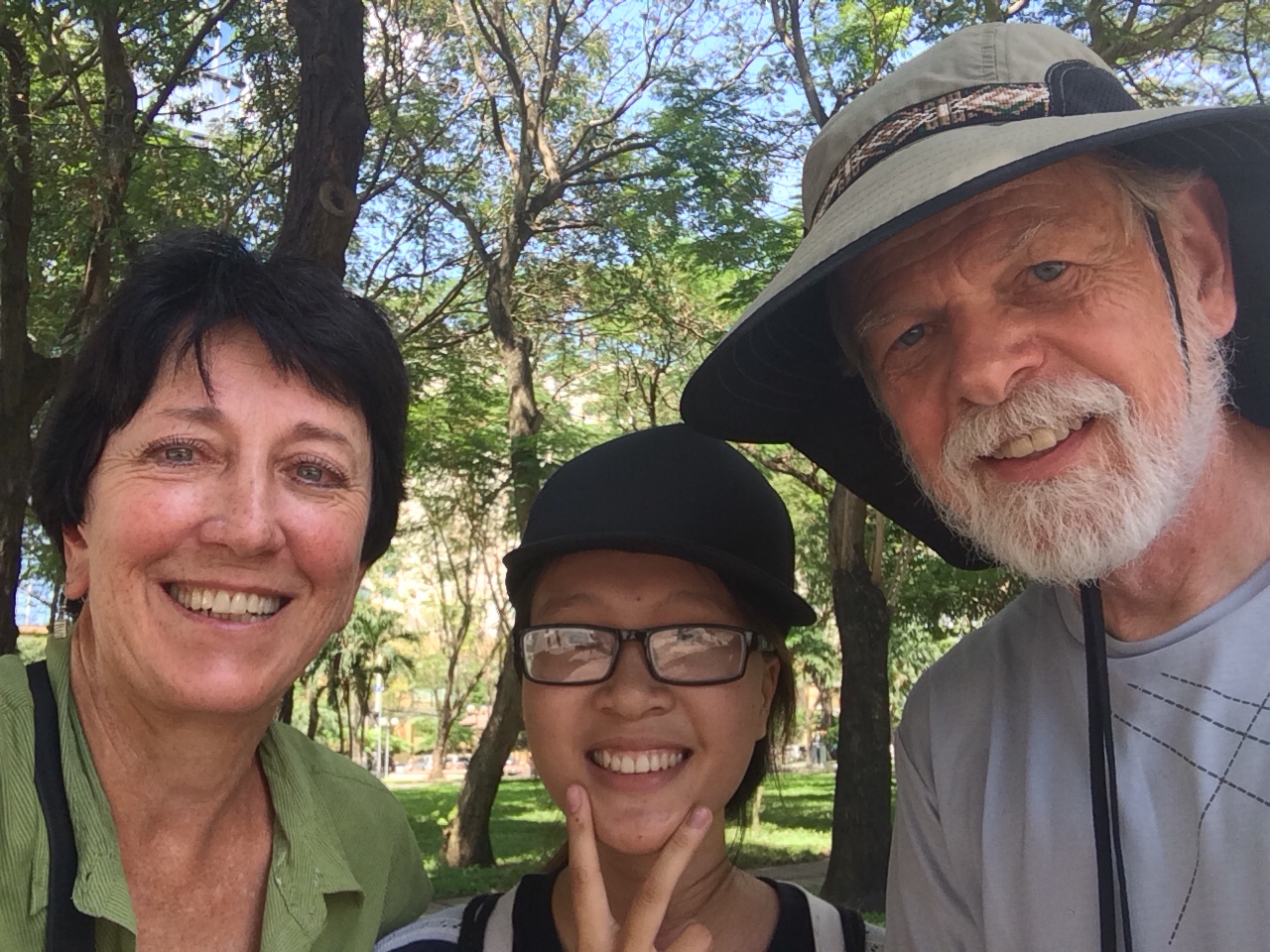
Twenty-year-old “Salmon” (who arrived right on time) turned out to be an exceptionally perky young Vietnamese woman whose accent was pretty good. Over and over, she exclaimed about how excited she was to be able to talk to native speakers. Although she’s studying accounting at one of the best universities in the city, she seemed to have a clear grasp of how important a strong command of English is (particularly for folks whose language is pretty much only spoken by their own fellow citizens.) She told us she’s only been a member of the free tours group for a month, but that we were the sixth set of visitors she’d taken around.

Salmon and friends
The red circles mark where the bombs hit

We spent a lively and entertaining two and a half hours with her. The palace, where we started out, is a fascinating place — the former home of Nguyen Van Thieu during all the bloody years when American warriors struggled to keep him in power as the head of an independent south. A tour of the place takes in everything from the sumptuous state rooms to the underground bunkers to the rooftop from which Thieu finally escaped in 1975. (Big red circles on the roof mark the two spots hit by North Vietnamese bombs, and the first two Communist tanks that crashed through the gates sit in a place of honor on the grounds.). Salmon also showed us the exquisite Cathedral and central Post Office and City Hall structures built by the French colonialists in Saigon, and we chattered away about everything from English-language pitfalls to where 20-somethings live (in both our countries). We paid for her admission to the palace, and pressed her to join us for lunch. But she demurred, hinting that she had to prepare for her next day’s classes.

For my part, I have to say my biggest regret of this trip is that I didn’t have the foresight to take a semester of Vietnamese. I love learning new languages and have spent a lot of time studying both Japanese and Mandarin. I think I failed to think of it because I knew we’d be passing through dozens of different language zones. Yet if I had concentrated just on Vietnamese, I would have gained a lot. I wouldn’t have become anywhere near fluent, but I would have mastered a lot more of the spoken language than just the “please,” “thank you,” “hello,” “yes,” “no,” and “OMG!” I got Manh on our Halong Bay cruise to teach me. Most importantly, I would have been able to read dozens or hundreds of words. Unlike the Japanese and Chinese and Thais and Cambodians and Laotians, the Vietnamese have long used a standard Latin alphabet (albeit embellished with a bunch of diacritical marks) to write their language. That makes it easy to get around town and find stuff.

If things are written in Roman letters, you at least can read them (even if you can't understand what the words mean.)

We still managed to do a lot of that, but it would have been even more fun if I had had a bit more of Salmon’s gumption.


Ground v. air — part II

I didn’t try to buy our Vietnamese railway tickets from home. I’d read that they would be easy to secure just a few days in advance, so when we checked into our hotel in Hanoi, I told Ms. Julia in the lobby that we wanted berths on the sleeper from Hanoi to Hue, seats on the 3-hour morning train from Hue to Danang (the portal to Hoi An), and seats on the 7-hour train from Danang to Saigon. The first two were no problem; $55 a person for the sleeper and $15 for the second train ride. But I had misunderstood the mechanics of rail travel between Danang to Saigon. Instead of taking part of a day, we learned, it would require a much longer amount of time, leaving Danang in a sleeping car about 10 p.m. Friday and not arriving until late Saturday afternoon.

I think that would have cost around $80 per person. In contrast, Ms. Julia informed us we could get seats on the one-hour-long Vietnam Air flight leaving Danang at 11:05 a.m. Saturday for $115 per person. We agonized a bit over the decision. We’ve come to loathe the time and tedium involved in modern air transport, and we had looked forward to seeing the scenery en route. In the end, however,the thought of giving up our prepaid room in Hoi An to rattle through yet another night made us come to our senses and buy the plane seats.

Thank god! The Vietnamese train system doesn’t offer first-class sleepers, so instead of having our own cozy space from Hanoi to Hue, we shared our 4-berth compartment with 2 other Americans (a likable young couple from Washington DC). We all had working electrical outlets, which was nice (I could charge up my phone and iPad!), but in other ways, it seemed inferior to the Thai sleeper we took from Bangkok to the Laotian border — no dining car, for one thing. And Steve saw a cockroach and spiders lurking in the recesses near his upper berth, though he kindly kept that news from me until after we had arrived.

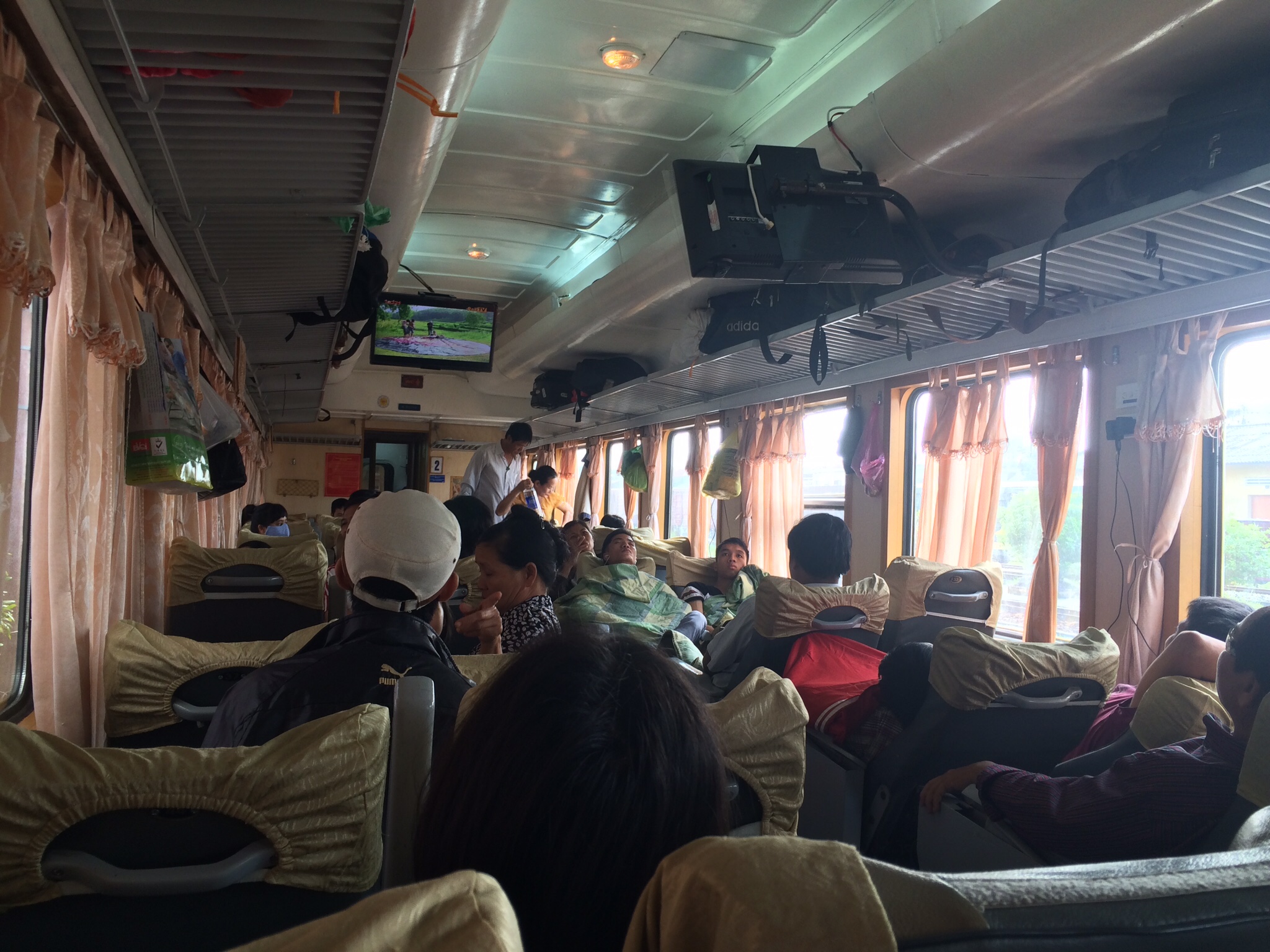
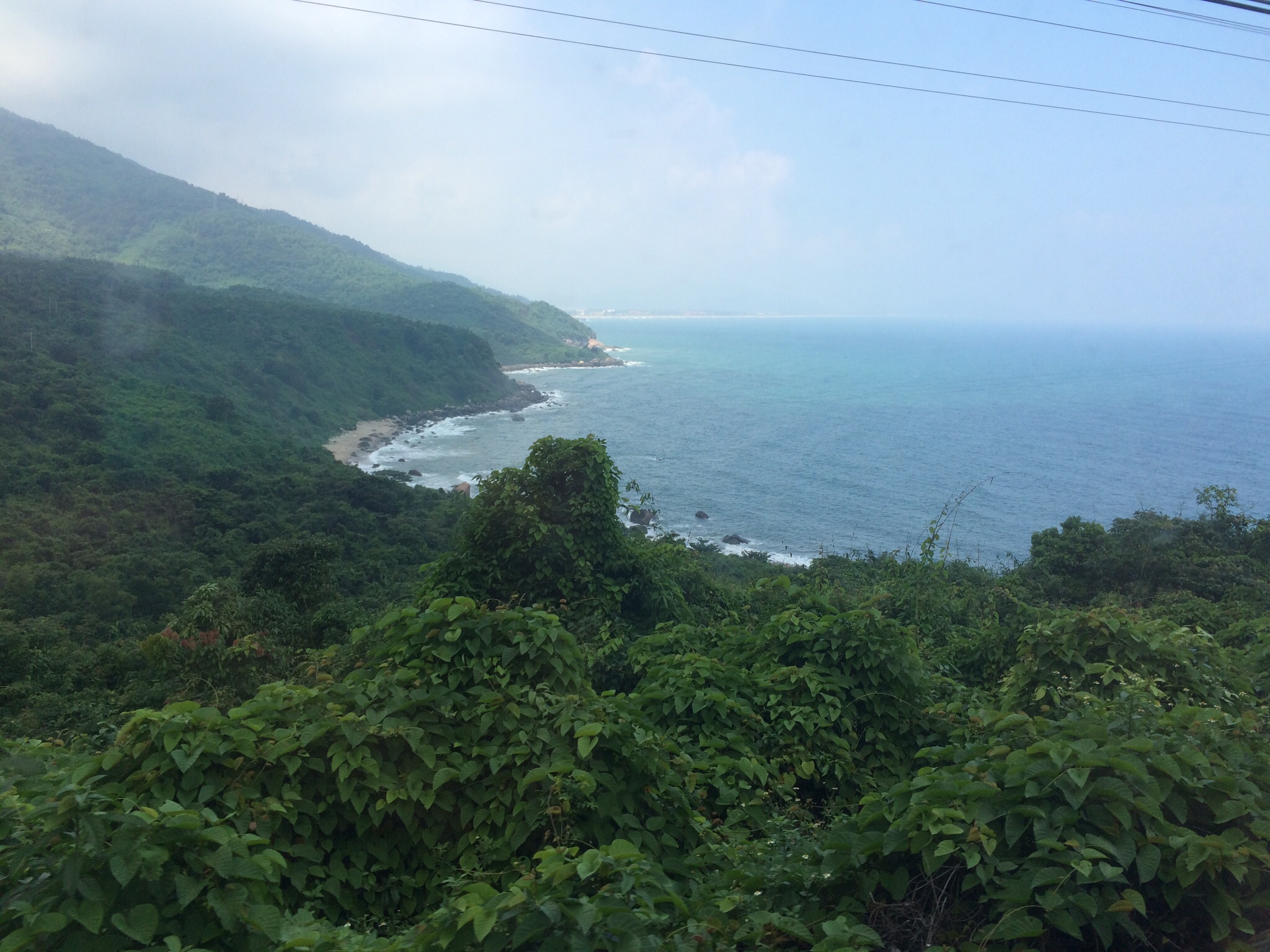
The morning train ride from Hue to Danang was pretty mesmerizing. We had two seats In a standard day coach on which we appeared to be the only foreigners. The train was probably 60 years old and exceedingly slow, but it hugged a mountainous coastline with jaw-droppingly spectacular views. The action inside our coach was almost as diverting. Across the aisle and two rows up from us, a woman slept on the floor at her husband’s feet. I’m not sure how, with car attendants periodically rolling carts up and down the aisle (at one point dishing up some kind of hot food). Someone’s very naughty two-year-old was on the rampage. And from the ceiling, screens displayed “Rail TV,” which among other things aired a Vietnamese (officially franchised) version of The Amazing Race.

On the day coach from Hue to Danang
A view from the train
Another

All pretty entertaining, but more than sufficient to satisfy the craving we’d had for rail time. Moreover, both of the short Vietnam Airlines flights we took (Luang Prabang to Hanoi and Danang to Saigon) felt like going back to a time when air travel was easy. All three airports were clean and uncrowded; the huge and gleaming one In Danang was only 2 years old. Hassles were minimal — no taking off of shoes nor long security lines. In fact, no one seemed to be paying much attention to what was rolling through the X-ray screeners. On board, the flight attendants didn’t patrol to check for seatbelt scofflaws, and no one seemed to care when I trturned on my electronic devices.

Now we’re in Saigon for two full days. I’ll probably wait until our Tuesday morning bus ride to the Mekong delta to write again. Between now and then, our schedule is pretty packed.