By boat down Lake Kivu

Because Steve loves boats so much, he wanted to write about our trip down Lake Kivu yesterday (Saturday). Here’s his report:

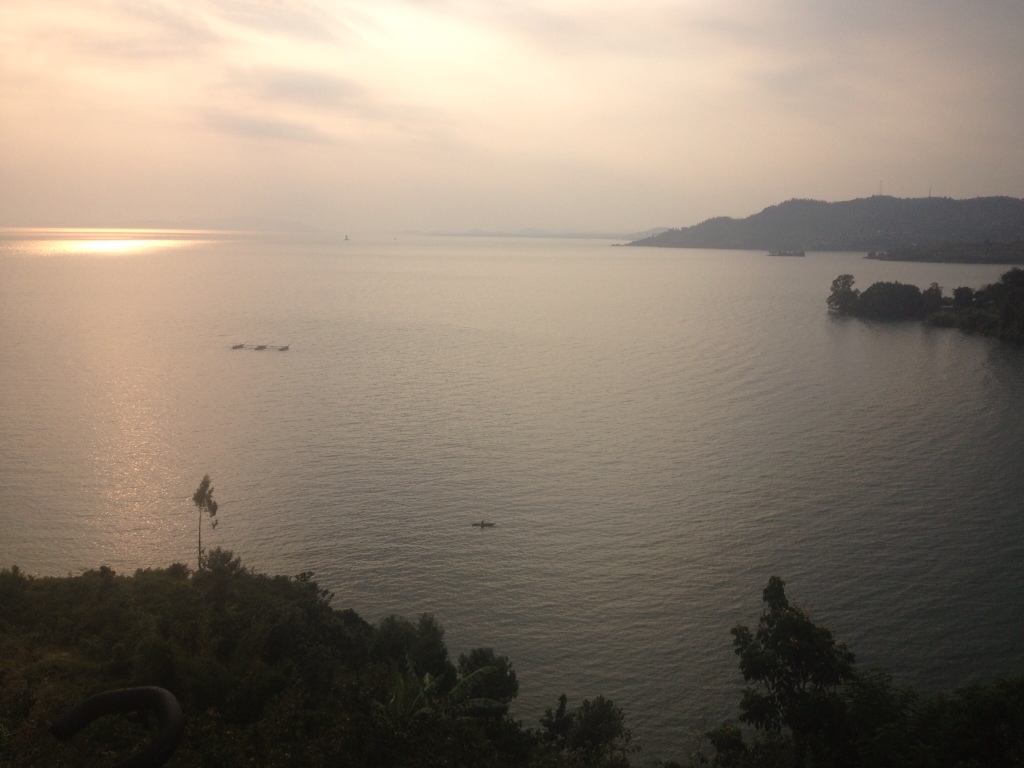
We had read that the road down the Eastern shore of Lake Kivu is so bad it takes two days to drive from Gisenyi to Nyungwe national park. So we’d arranged with Tom Tofield’s Rwandan Adventures to take a boat most of the distance, enabling us to get there in six hours.

Lake Kivu has given me the creeps ever since I read in the National Geographic that it contains a vast amount of dissolved methane and CO2. These greenhouse gasses are held at the bottom of the lake by the pressure of the water above. Because no seasonal thermal mixing occurs, as it does in most lakes, the gasses have not escaped. As organic matter enters the lake, it decomposes, adding to the layer of methane and CO2. At some point, scientists believe that the pressure of the dissolved gasses will exceed the pressure of the water on top of them, and the gasses will rush out the way bubbles rush out of a beer or Coke bottle that has been shaken before opening.

Because CO2 is heavier than air, it would remain near the ground, suffocating anyone near the lake shore. This sort of thing has happened before in smaller lakes, killing several thousands. But with well over a million people living in Gisenyi and neighboring Goma across the Congo border, the death toll from a gas release at Lake Kivu could number hundreds of thousands.

It turns out my fears were overblown. Tom’s wife, Natasha, has earned a doctorate studying the lake and says a gas release might not occur for 100 years. Moreover, efforts are underway to release gas from the lake artificially using new technology similar to that used to separate natural gas from oil. From the shore near our hotel, we could see a prototype production platform that’s recovering methane from the lake and sending it to the shore to fire electric generators. In the future, the natural gas may be bottled to use as cooking fuel, saving more trees from being turned into charcoal.

On Saturday morning, Tom’s boat man, Suleiman and his crew man, Jean Claude, showed up at 8:30 am. We departed at 9:10. Suleiman’s family’s boat is a double-ended skiff about 30 feet long fashioned from wooden planks about one inch thick and eight inches wide. These are caulked with local fibers and some sort of tar, much the way Christopher Columbus’s ships were. Equipped with a late model 35-horsepower Honda outboard motor bolted to a well in the stern, the boat has a sun shade fashioned from tents scavenged from the UN High Commissioner for Refugees. Some fake leather seats completed our creature comforts.

As we set off down the lake, the wind was out of the south and the boat pounded in the light chop. Later, as the wind shifted west, the spray came over the starboard gunnel, causing us to break out our raincoats and cover our cameras.

We saw larger wooden boats of similar design, each carrying several dozens of passengers. Because the roads are so bad, the lake is a cheap and convenient mode of transport for local people. Yet even so, boat traffic was light. Most of the boats on the lake are paddle-powered fishing craft that depart at dusk and return at dawn. Despite the breeze, we didn’t see one sailboat.

On our way south we stopped at a small, uninhabited island off the coast of Kibuye, a medium-sized town that marks the half-way point down the lake. Our mission was to view a colony of fruit bats that live only in this spot. Suleiman nosed the boat into a clear spot on the shore, and Jean Claude led us up a steep narrow path through thick low forest to see the bats. Unlike most insect-eating bats, these creatures are diurnal, and our approach startled them from their inverted perches in the trees. They circled overhead like flocks of crows or seagulls, their high-pitched barks sounding more like foxes than birds. The bats made an amazing sight, in their own way as unique and unusual as the chimps and gorillas, but completely unexpected.
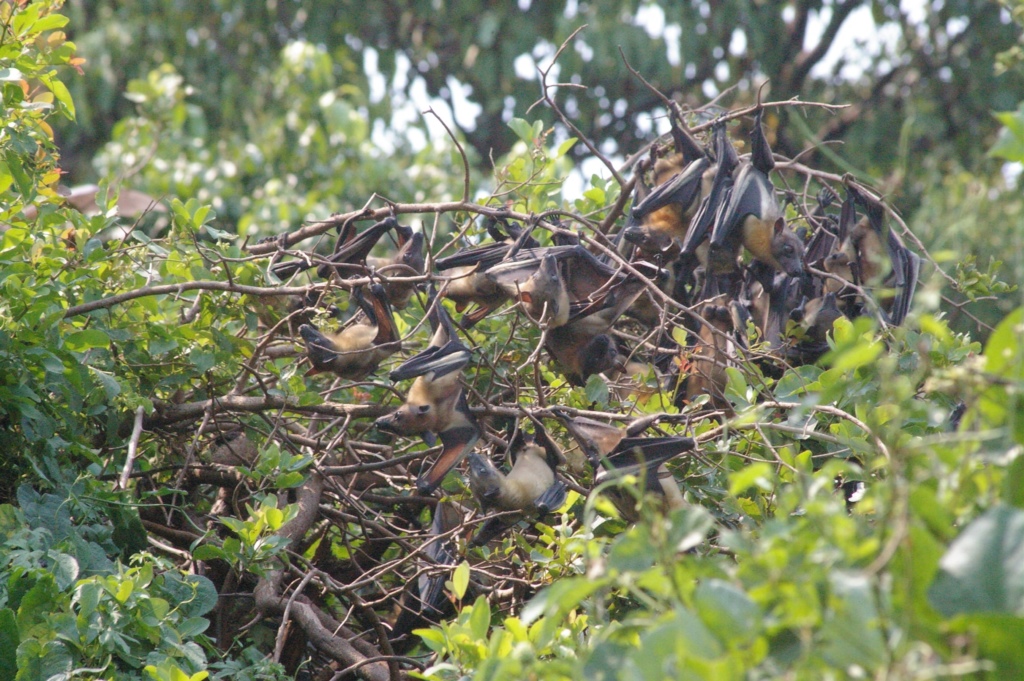
Fruit bats, hanging out

After half an hour, we re-boarded the boat and continued south. The wind died and the waves shrank to tiny ripples. We took off our rain gear and had a lunch of beignets, cheese, and bananas that we shared with our boat men. We covered the rest of the distance to the tiny town of Nyamasheke on a small bay off the lake. There we were met by the driver of a Toyota RAV4 SUV who drive us to the Nyungwe Forest Lodge. We arrived by 3:15 pm, in time to enjoy the incredible views of the forest before sunset.


Rwanda through the back door

One of our only bad moments of this trip so far came at the little Cyanika border crossing station, after the guy who drove us there from the Traveler’s Rest had dropped us off. Steve and I got ourselves stamped out of Uganda and into Rwanda without a hitch. We opened our suitcases for the dim-witted looking Rwandan customs guy, and he did little more than grunt. We lugged them out into the road, looked around, and saw… Nothing. No driver holding a sign with our names. No taxi queue of any sort. Had Tom Tofield flaked out and forgotten us?

I’d read about Tom in the Bradt Guide to Rwanda. His mountain-biking tours sounded cool, so I emailed him and he wound up arranging three days of our travel here (including the car ride from the border to Lake Kivu). But when we’d tried calling and texting him our last night in Kisoro, he hadn’t responded. Had he died? In the road, Steve pulled out his cell phone and tried one more time. Miraculously, it rang and Tom answered. He pointed out that it was 20 minutes before the pickup time we’d agreed on, NOT 40 minutes after it. I’d been confused by the time change between the two countries. Five minutes later, a clean Toyota Corona pulled up, and we piled into it and sped off to the west.

Over the next two days, Tom’s reliability became evident. Now 42, he was born and raised just outside London, where he became a data-center specialist. While working in Zimbabwe, he’d met his future wife, a Swiss woman who subsequently got her Ph.D. in limnology (the science of lakes). Her work with Lake Kivu brought them to Rwanda 4 years ago, and Tom decided to start the biking company soon afterward.

Originally, Tom had suggested for our first day a bike tour of Gisenyi, the Rwandan town that adjoins the Congolese border and city of Goma. But a few weeks ago, he’d emailed me urging a change of plan. UN troops were arriving in droves, and a fierce confrontation between them and the infamous Congolese rebels looked imminent. Although Gisenyi was peaceful and safe at the moment, whenever the war started, Congolese refugees would flood across the border, and the city would become chaotic.

Instead, Tom had arranged for two young Rwandan assistants, Didier and Viateur, to take Steve and me on a walking tour and picnic. They led us past the biggest employer in Rwanda (a huge Heineken brewery), and we stopped at some natural springs so hot I couldn’t stick my fingertip in the water for more than a second or two. In a nearby pool that wasn’t as scalding, a young woman was scrubbing herself (clothed) and her baby (naked). The pools were a reminder of the geothermal turbulence in this neighborhood. Less than a dozen years ago the massive nearby Congolese volcano, Nyiragongo, erupted, pouring lava on Goma — though only 19 people died because the warnings and evacuation worked so well, according to Tom.

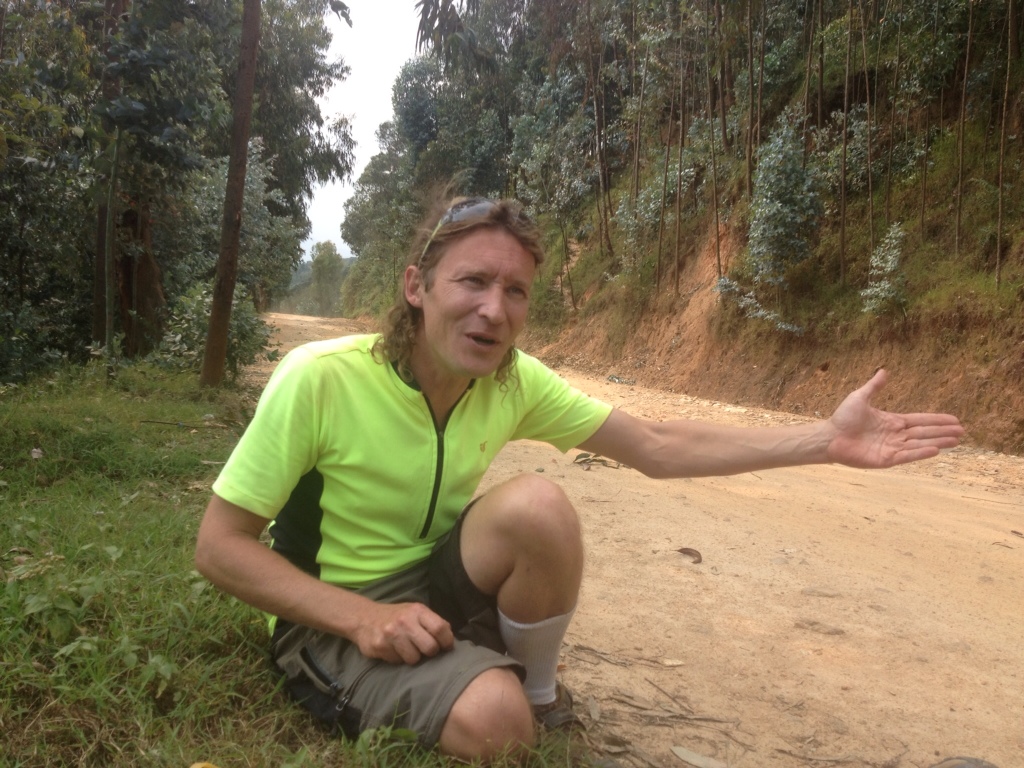
Tom, after our roadside picnic

Our big adventure with him came yesterday (Friday). We walked the short distance from our hotel to his house and he outfitted us with mountain bikes much nicer than anything I’ve ridden before. At 9:30, Tom, Steve, and I pedaled off, also accompanied by Tuizaire (Tom’s chief assistant). Tom’s an excellent instructor, and he carefully explained how to use our 24 gears; how to safely go downhill; how to avoid ruts and rocks. This was great. At one point, it struck me that I had never actually done mountain biking before. Arguably, rural Rwanda is an odd place to start.

But what a grand day we had! Rwanda calls itself “the land of 1000 hills,” and there’s nothing like bicycling to convince one that’s probably an understatement. I doubt we spent more than 30 minutes on flat ground in the course of our 8 hours together. We weren’t pedaling every minute. We stopped for photos. We stopped to gab about one sight or another. On the side of the road, we gobbled down chapattis (think flour tortillas) smeared with ripe avocado and delicious local cheese, and twice we stopped to down soda out of bottles sold in tiny shops in dirt-poor villages. Tom shared what felt like an encyclopedic knowledge of Rwanda’s culture, politics, history, botany, and sociology. If I’d taped everything he told us and transcribed the most interesting bits, it would probably fill 20 pages. And, oh yeah, I haven’t mentioned the scenery — mile after mile of plunging mountains, verdant valleys, exquisite bays.

For years, this was the poorest region in Rwanda, but Tom says coffee recently has boosted the standard of living a bit (taking over many fields once devoted to fruit and vegetables). He also says it’s one of the most densely populated rural areas in Africa, with about 450 people per square kilometer. This became palpable almost every time we rolled through a village. Legions of toddlers and young children would stream out, calling to us and often chasing, until Tom and Tuizaire scolded them away.

I found that fascinating rather than annoying. It was the physical demands of the ride itself that drove me to my limits. We only covered about 20 miles, according to Tom, but the total elevation gain was almost 3000 feet. Steve did great throughout, but I’m ashamed to confess I had to climb off my bike and walk a couple of times during the brutal uphill stretches at the end of the afternoon. And more than once I froze with fear when confronted with vertiginous descents over sand, loose scree, and deep ruts. But no one held it against me, including myself. It was such a pleasure to experience, a small dose of mortification seemed a cheap price.

Mercifully, the shower had hot water on our return. We dined on grilled chicken and were about to stagger off to bed when a small troupe of dancers — 2 young women and 2 young men dressed in traditional garb and wearing wild leonine wigs — came into the dining area and performed. We stayed to watch. It was Friday night in a place not far from where troops were massing, a place where people routinely smuggle in coltan and other minerals that make them rich beyond American dreams. Usually Steve and I gather with friends to share a potluck and watch a DVD together every Friday night. I love that. But on this Friday night I was glad to be here instead.