Saturday, January 8
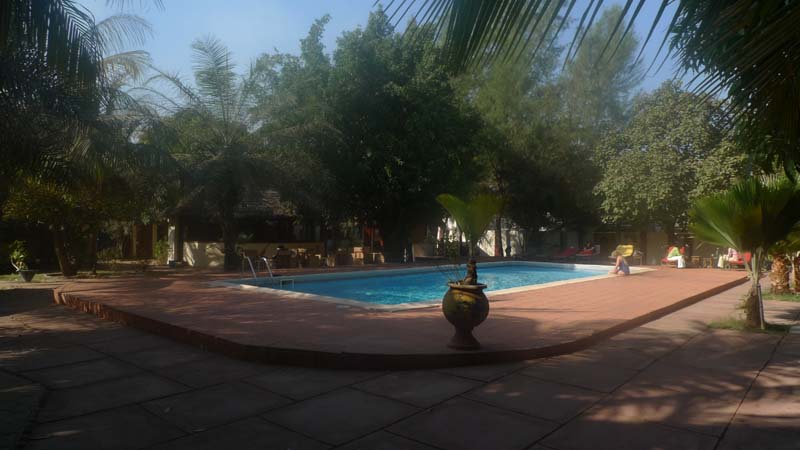
The Hotel Hobbe wound up costing about $51 a night, but the delicious three-course dinners we enjoyed there (including substantial amounts of alcohol) came in at about $20 per person. So no grumbling from me. According to Laura, the Hobbe is the best hotel in Kolda, and although Kolda doesn’t even rate a mention in the Rough Guide, Steve and I wouldn’t have missed it.
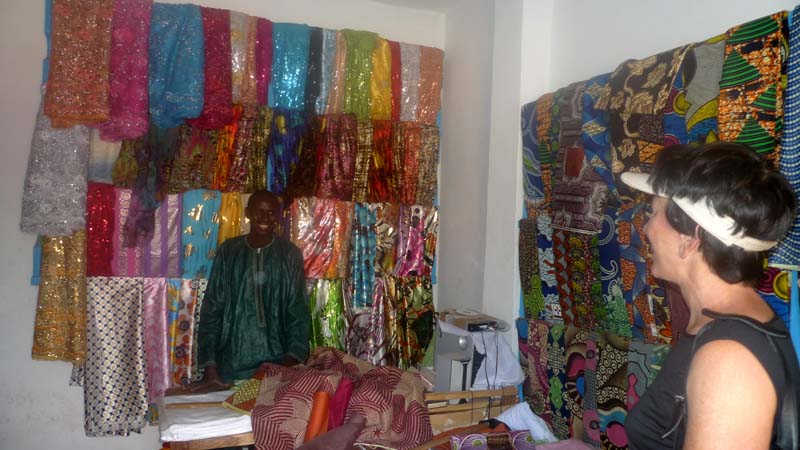
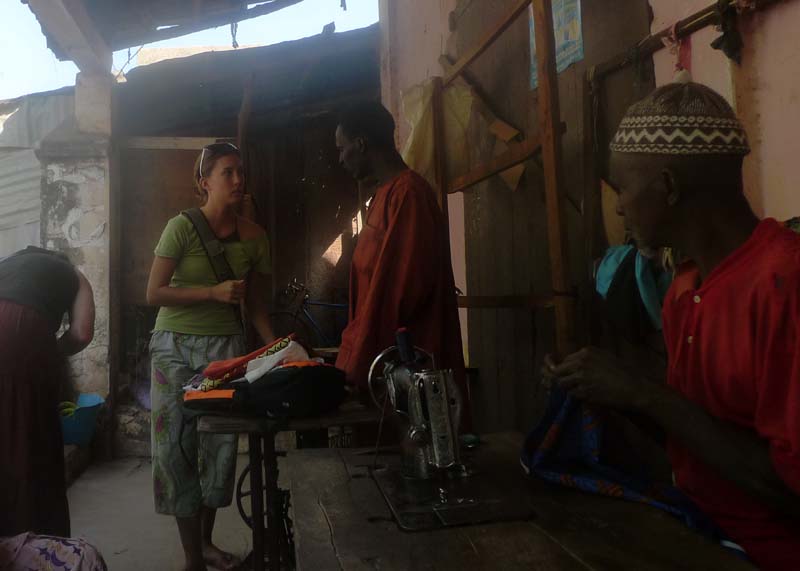
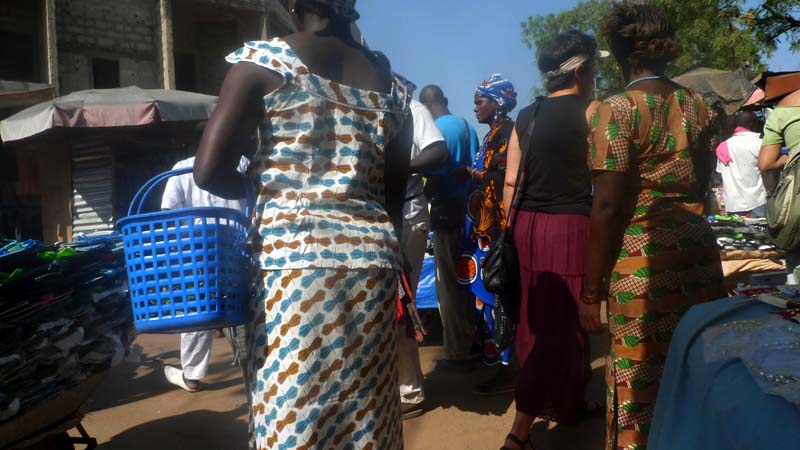
Having Laura as our insider guide made all the difference. The Hobbe’s just a few blocks off the main drag, and yesterday morning, she met us there and led us on foot to the commercial action. Unlike the Kaolack market (much of which is covered and dark), Kolda’s vendors line both sides of block after block of the paved central street. Hawkers of flip-flops, sunglasses, oranges and bananas and lettuce, hair straightening concoctions, bike parts, colanders, cola nuts, peanuts, baobab and palm oil seeds, SIM cards, and more make up a jolly jumble, Laura helped me buy several pieces of the gorgeous Senegalese fabric and then led me to a tailor who promised to transform them into aprons by the end of the afternoon.
Then we visited the used-clothing market. It IS covered, and dark, and filled with stuff that’s been donated by Americans to organizations like the Salvation Army, packed into huge shrink-wrapped bundles, loaded onto container ships, sailed to Africa, trucked here and carefully hung up or folded and laid out on tables. One t-shirt caught my eye. In good condition, it bore an image that I thought a friend back home might appreciate. Try though she did to procure it for me for 500 CFA (about $1), Laura couldn’t get the seller to budge from his final price (700). So I paid that and will transport the shirt once again across the ocean to San Diego (where my friend may send it jetting back again!)
We bought liters of water for $1 at the Mauritanian grocery store and popped into the local liquor wholesaler (who will sell you a single Gazelle or cases of it, the Muslim majority here notwithstanding.) We stopped at Kolda’s little post office where Laura picked up her most recent issues of the New Yorker (only a few weeks late) and joked in her fluent Pulaar with the kindly postmaster. We strolled past the town brothel, and then wandered past the town woodworkers and their creations (mostly bed stands and dressers made of a gleaming golden wood).
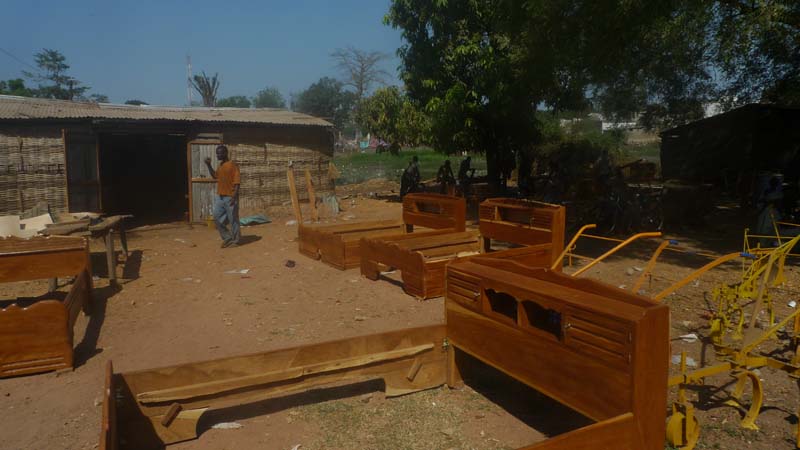
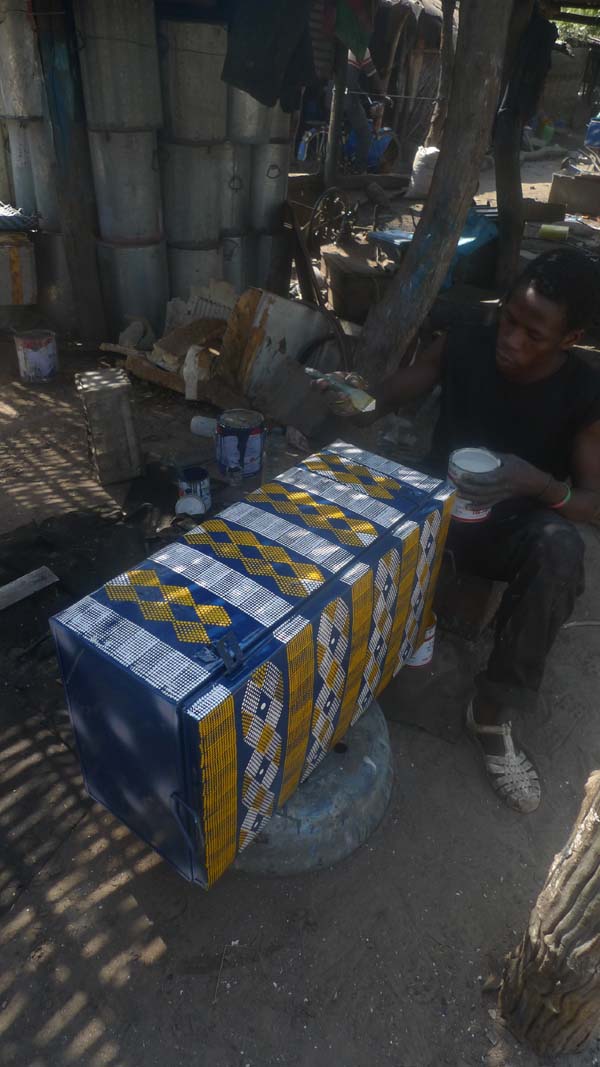
Not far beyond them, blacksmiths hammered metal creations using skills that average Americans haven’t used for 150 years. I was mesmerized by the enclave where sweating men were pounding discarded 50-gallon drums into flat pieces of steel, then shaping those into storage chests. Initially ugly, these were painted bright colors. We watched one stolid fellow dip a wood block covered with raised bumps into a can of white paint, then press that in patterns over a chest that had been painted bright blue. Later, he added yellow sections to the pattern. When he was finished, the chest looked as pretty as something you’d find at IKEA.
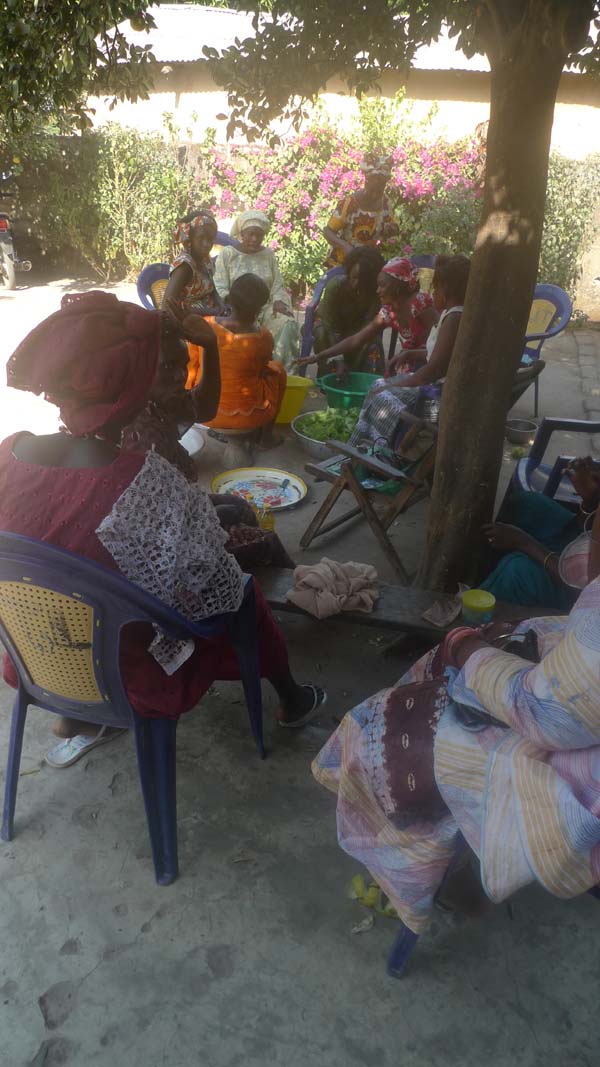
In the afternoon, we visited the well-swept compound where Laura boards with a local Senegalese family. She showed us the family’s large vegetable garden, the well that’s the sole source of their water, and her private sleeping and bathing quarters. Around 2:30, while other family members and neighbors ate in other small clusters, Laura, her host mother, Steve, and I shared a huge dish of broken rice cooked with grilled fish, fish balls, eggplant, peppers, and other vegetables. The three of us white folk ate with spoons, but our hostess manipulated her food in the traditional manner — squeezing the rice into bite-sized pieces with her right hand. It seemed to me, though, that she spent most of her time not eating but rather breaking off pieces of fish and other tasty morsels and distributing them to our various quadrants of the platter. Laura says Senegalese mothers typically do this to ensure that their children get equal shares.
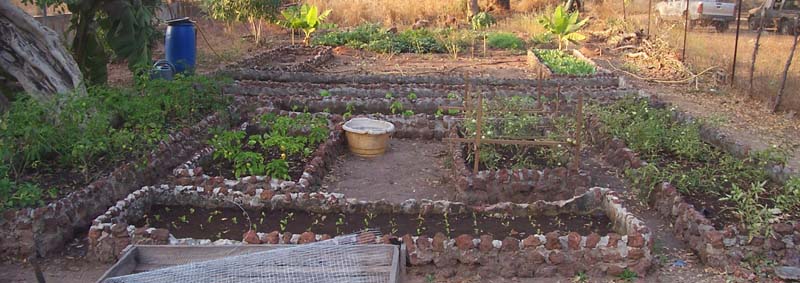
In the late afternoon, we visited some gardens overseen by local Peace Corps volunteers, then we walked back to dinner at the Hobbe through the soft twilight. It felt like rush hour, with us swept along with the streams of ladies bearing bundles on their heads, boys zooming by on crazily laden bikes, ancient battered taxis threatening the meandering livestock (and occasionally pedestrians) and transforming the dirt street into minor dust storms.
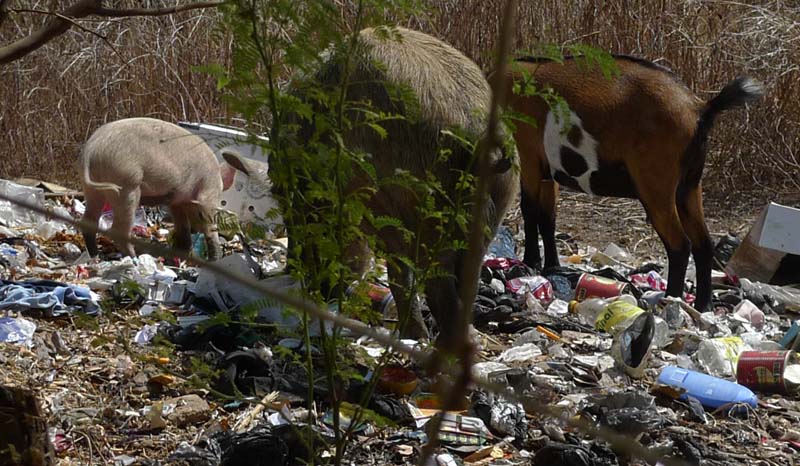
As always, as everywhere in the towns and villages, piles of garbage lined our paths. But it struck me as we walked that my relationship with the ubiquitous Afro-garbage is subtly changing. It seemed so ugly and squalid when I was first exposed to it. On some of our bush-taxi rides I’ve almost laughed out loud at the sight of one of our fellow travelers polishing off a can of soda or a cookie package and blithely tossing it out the window — so taboo back home (and yet ringing distant bells from my own childhood.)
It’s tempting to harrumph that the Africans have no system for dealing with all the garbage. But Steve and I have noted that in fact there is a system: you throw your trash willy-nilly on the ground, goats and other animals eat everything that’s remotely edible, and every so often someone burns the inorganic piles when they get too large. It’s not a very good system, but it’s cheap and in its own way, it works. Bottom line: it’s the way things work here — the way the subways are jam-packed in Tokyo or graffiti covers many building facades in Detroit. After just one long day of glimpsing quotidian life in Kolda, the complex nuances of the town had claimed the forefront of my brain, while the garbage had sunk so far into the background that I barely noticed it.
 At home and abroad