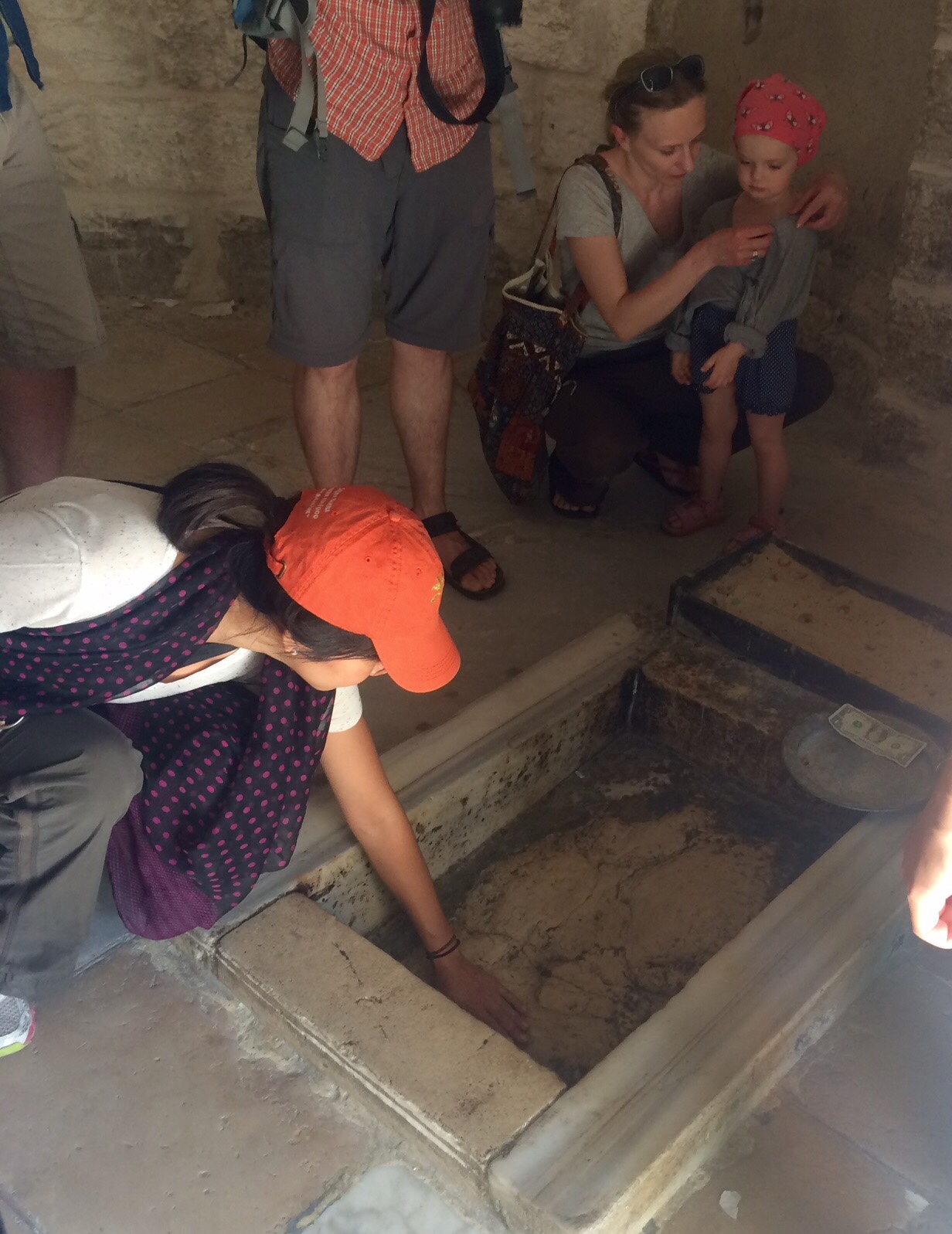
During our two final days in Israel, I stuck my fingers into the hole that held the cross on which Christ was nailed. (In order to touch it, you have to kneel before the little altar (see below) and reach in.
I rubbed my open palms over the stone slab on which his body was prepared for interment.
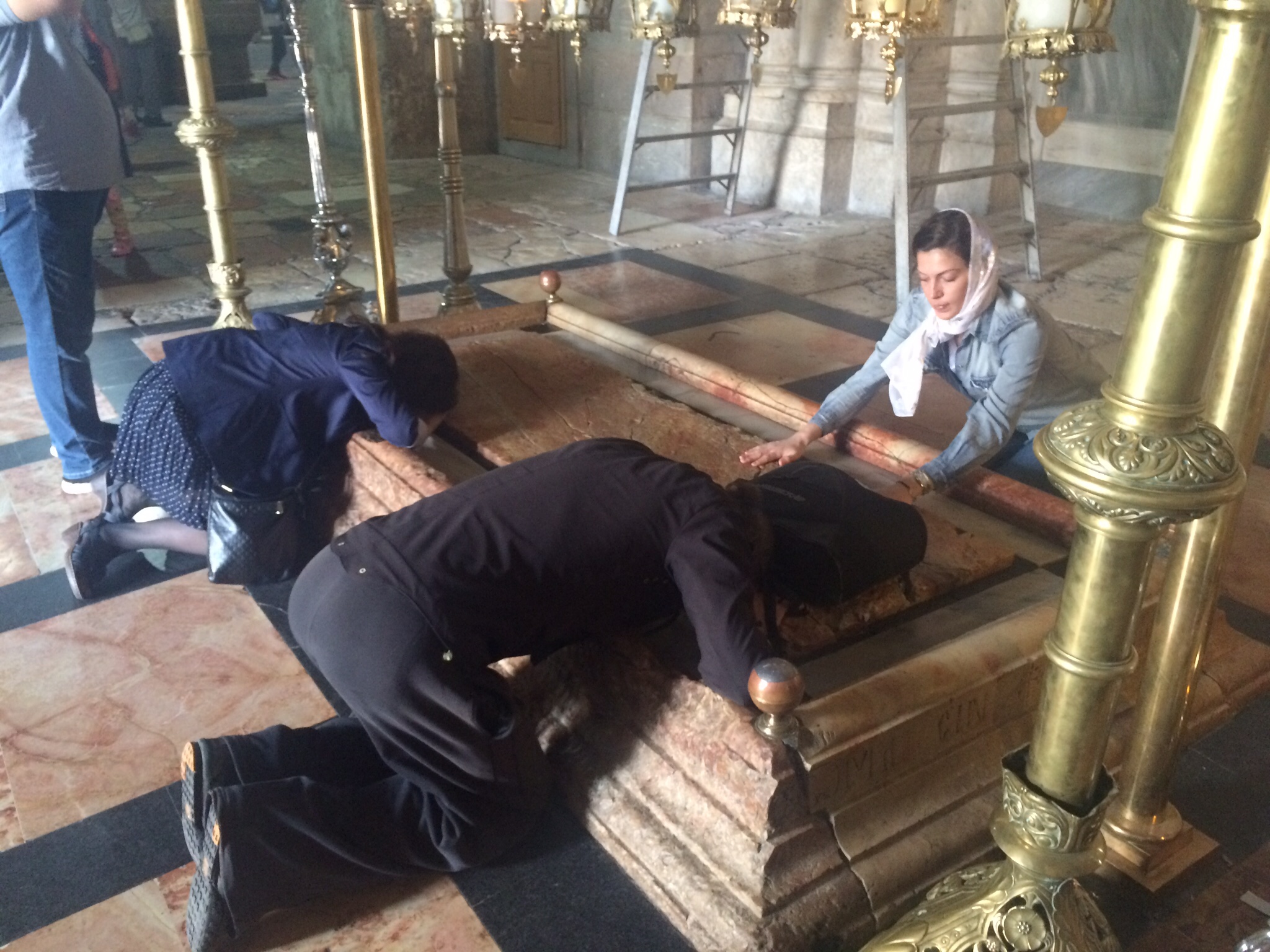
Some pilgrims merely pray at the stone on which Jesus's dead body was prepared. Others rub things on it to be sanctified.
We tried to go into the little chapel surrounding the cave into which his corpse was placed, and from which he was resurrected, but the line was so fiendishly long we reluctantly bailed.
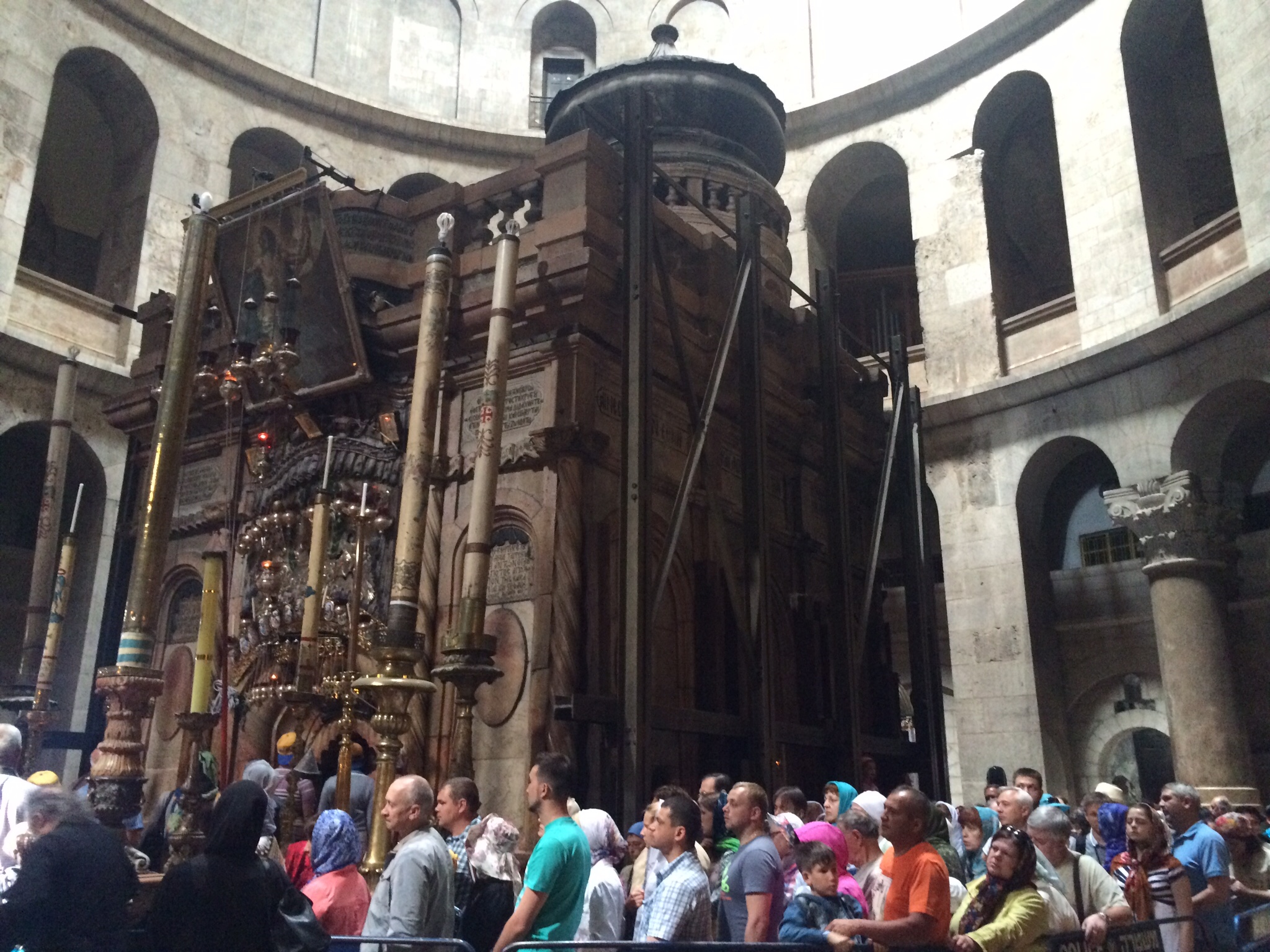
The marble chapel containing Jesus's tomb.
Instead we walked around to the back of the structure, a quiet place where I was astonished to find a tiny cave-like shop selling candles and a handful of other religious items (this less than 10 feet from where Jesus rose from the dead!) All these things are in the Church of the Holy Sepulcher, an enormous stone complex that encases the whole hillside known as Golgotha (or Calvary) where the foundational events of Christianity played out. We found it disconcerting to learn that what we always thought of as outdoors (that infamous hill) is now deep inside a structure at least as massive as the Cathedral of Notre Dame.
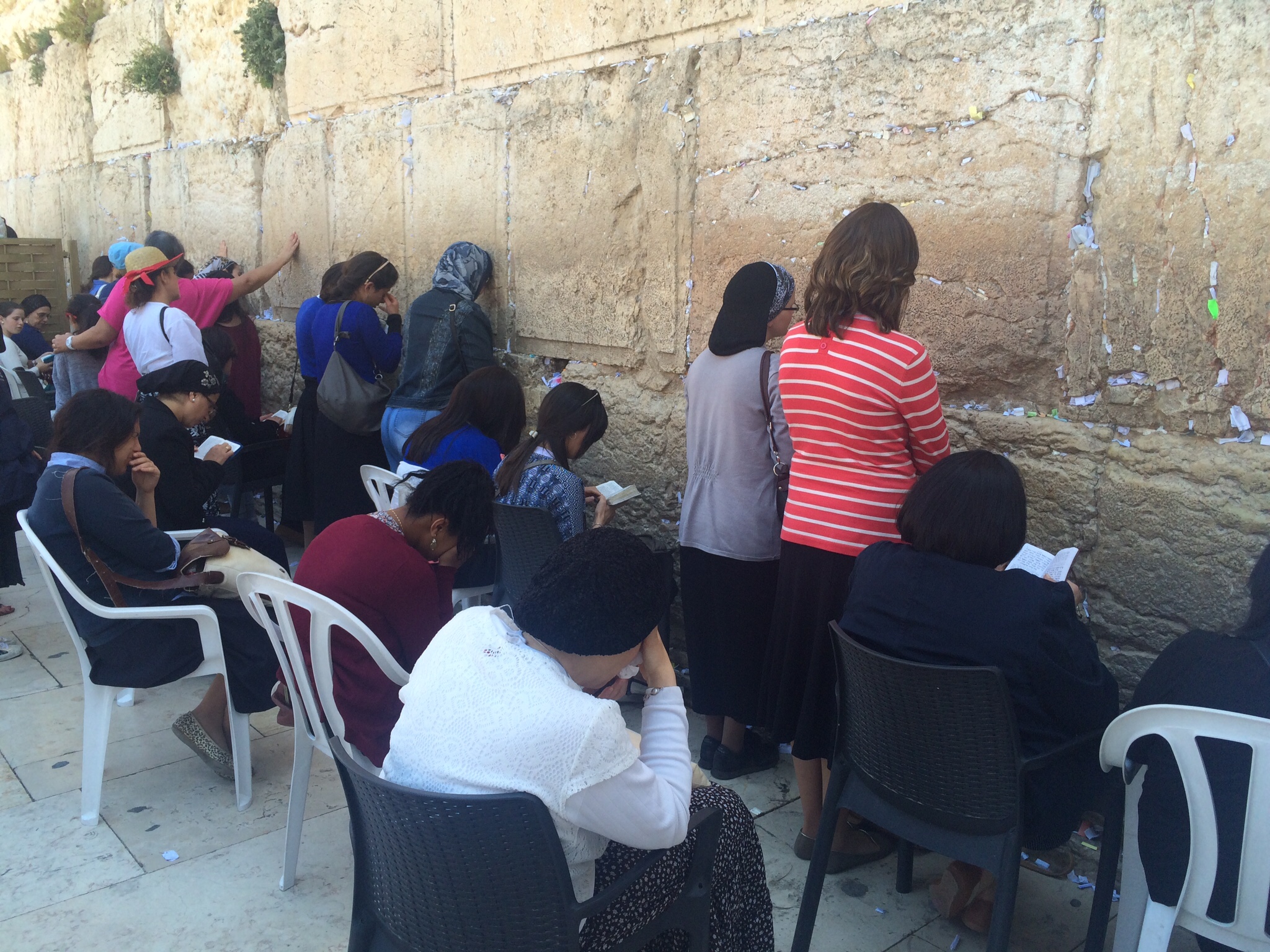
After leaving the church, we tried to walk along the Via Dolorosa, the “way of the cross” and follow the 10 famous “stations” that aren’t inside the church. But we got a little lost and wound up instead in the Western Wall plaza, one of the ultimate pilgrimage sites for religious Jews. They come to this particular section of the wall that once surrounded the second great Jewish temple (the one built by Herod and from which Jesus chased out the money-lenders) because it’s the closest point to the so-called “foundation stone” at which they can pray. (The foundation stone was the rock where God ordered Abraham to sacrifice his son Isaac, thus, in effect, founding the Jewish religion.) They can’t pray at the foundation stone itself because it’s inside the Dome of the Rock, which along with the whole area that the temple once filled has been controlled by Muslims (or Romans or Crusaders) for close to 2000 years.
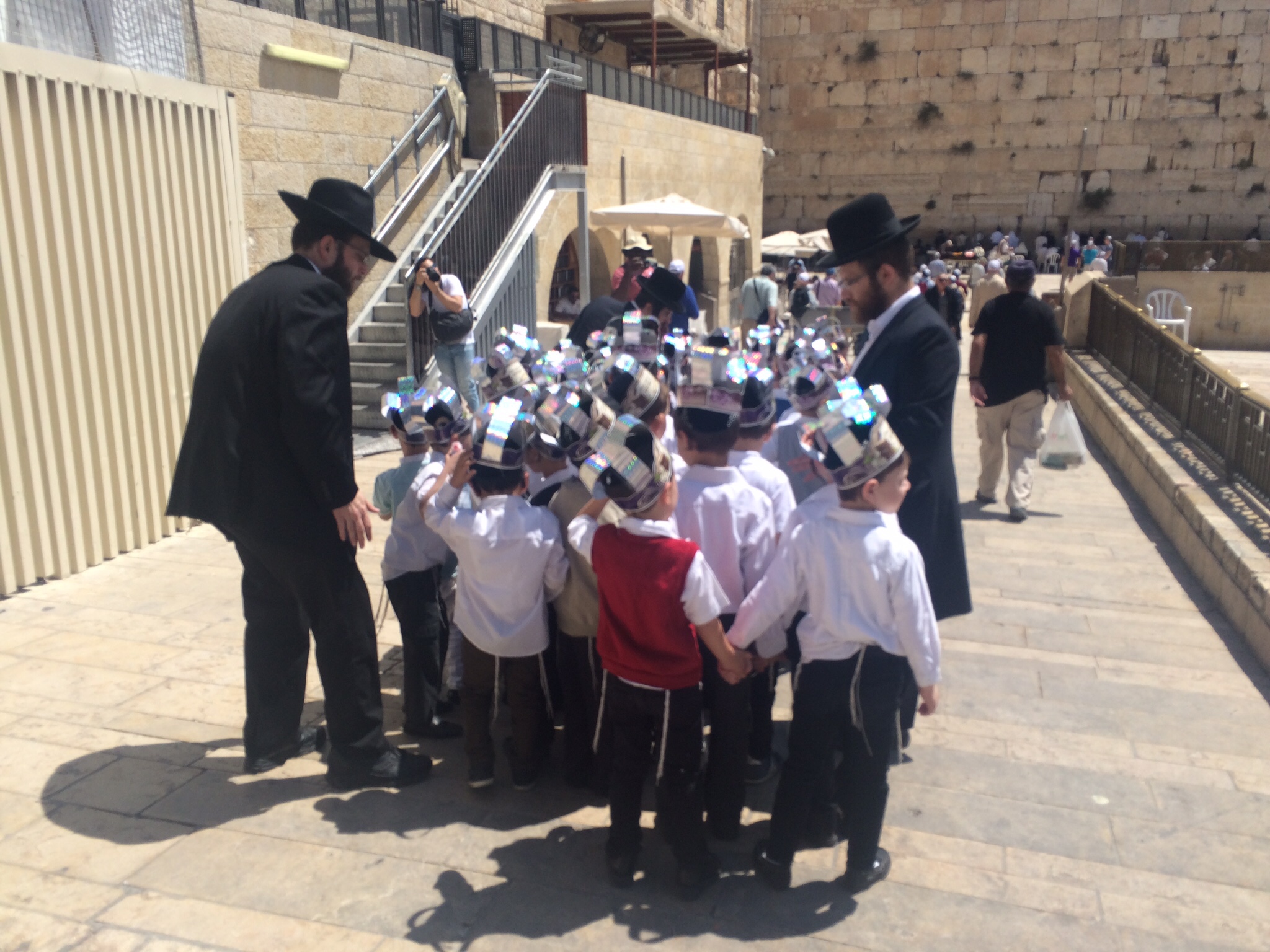
These Orthodox guys were escorting an adorable group of little guys to visit the men's side of the Western Wall. On the ladies side, some sit and pray, some pray with their heads pressed to the stone, and many stick little paper prayers into the cracks.
Both Jews and tourists can get into the former temple walls, but a) they can’t do any conspicuous praying and b) the visiting hours for non-Muslims are limited. Steve and I breezed in about 10:55 Tuesday morning, but 5 minutes later, the guards told us we had to leave, as the lunch-hour Faithful-Only period was starting. We tried returning at 1:30, when we knew that infidels would be allowed in for another hour-long period, but the line was so long it looked as if it might take an hour just to get through the security checkpoint. So we returned early the next morning (Wednesday) and strolled the enormous grounds (the size of 33 football fields), happy to have made the effort. Only Muslims are currently allowed inside the gold-topped, gorgeously tiled Dome of the Rock (from which Mohammed made his ascent to Heaven.) But just taking in its beauty was a sort of religious experience for me.
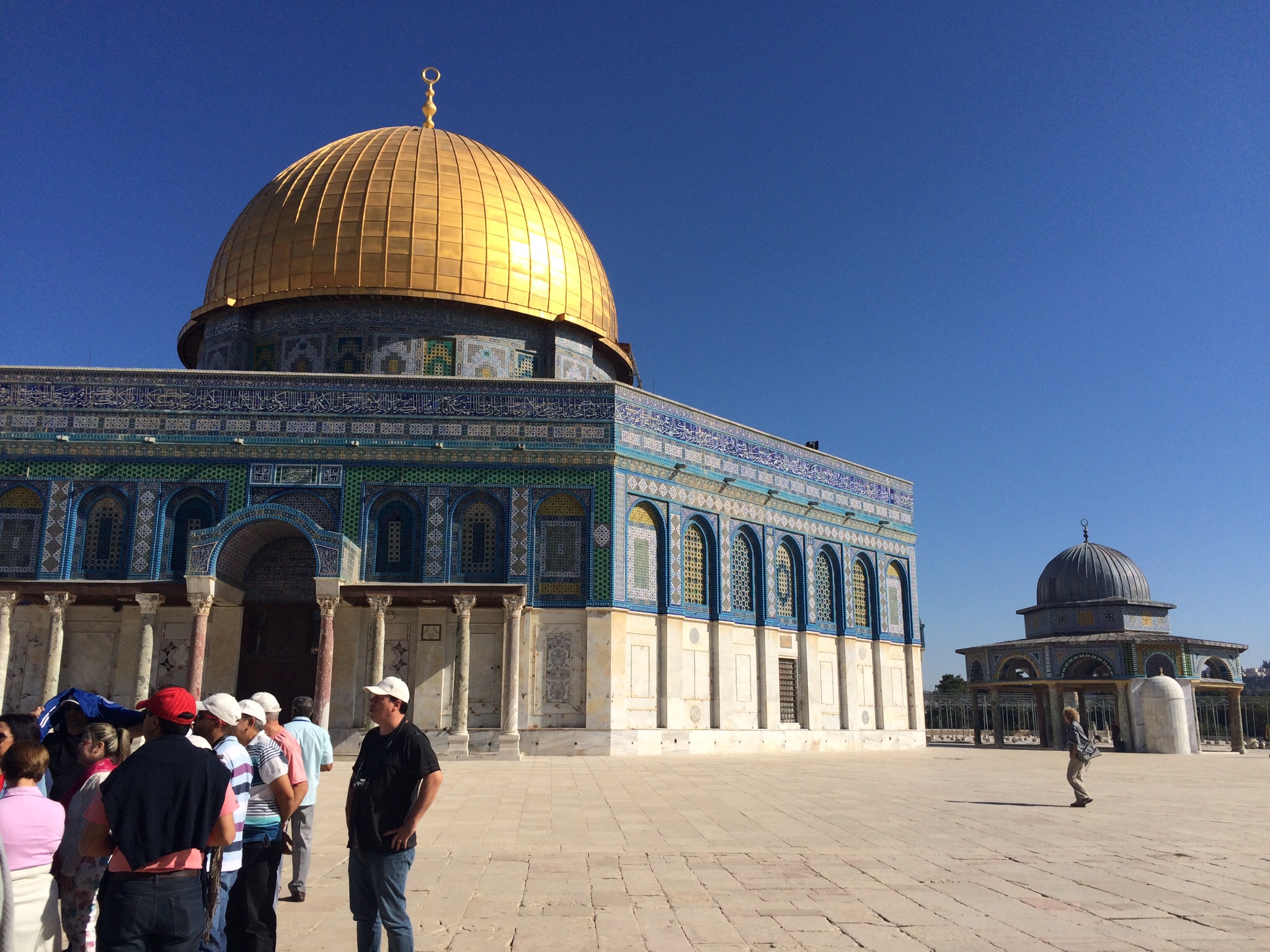
The Dome of the Rock
How much of a religious experience the Holy Sepulcher or the Western Wall or the Dome of the Rock is for anyone of course depends on what you believe and how strongly you believe the precise details (eg, did Mohammed really fly on a magical horse to this exact spot and is that divot in the rock really his footprint? Was Jesus really entombed and resurrected just a few yards away from where he was crucified?) However, Steve and I had three other Jerusalem experiences that, if not miraculous, would probably impress pretty much anyone.
— We went underground. We took the tour of the tunnels that archeologists have been excavating near the Temple Mount since 1967. Since Jerusalem has been built up in so many layers over the past 2000-plus years, this work has greatly illuminated the city’s complex past. And it once again makes you shake your head in awe at what a builder Herod was. The stones in the temple wall are some of the biggest ever used anywhere in human history. Here’s one, for example, that’s 45 feet long and is estimated to have weighed more than 625 tons.
The photos doesn't do justice to the size of this whopper.
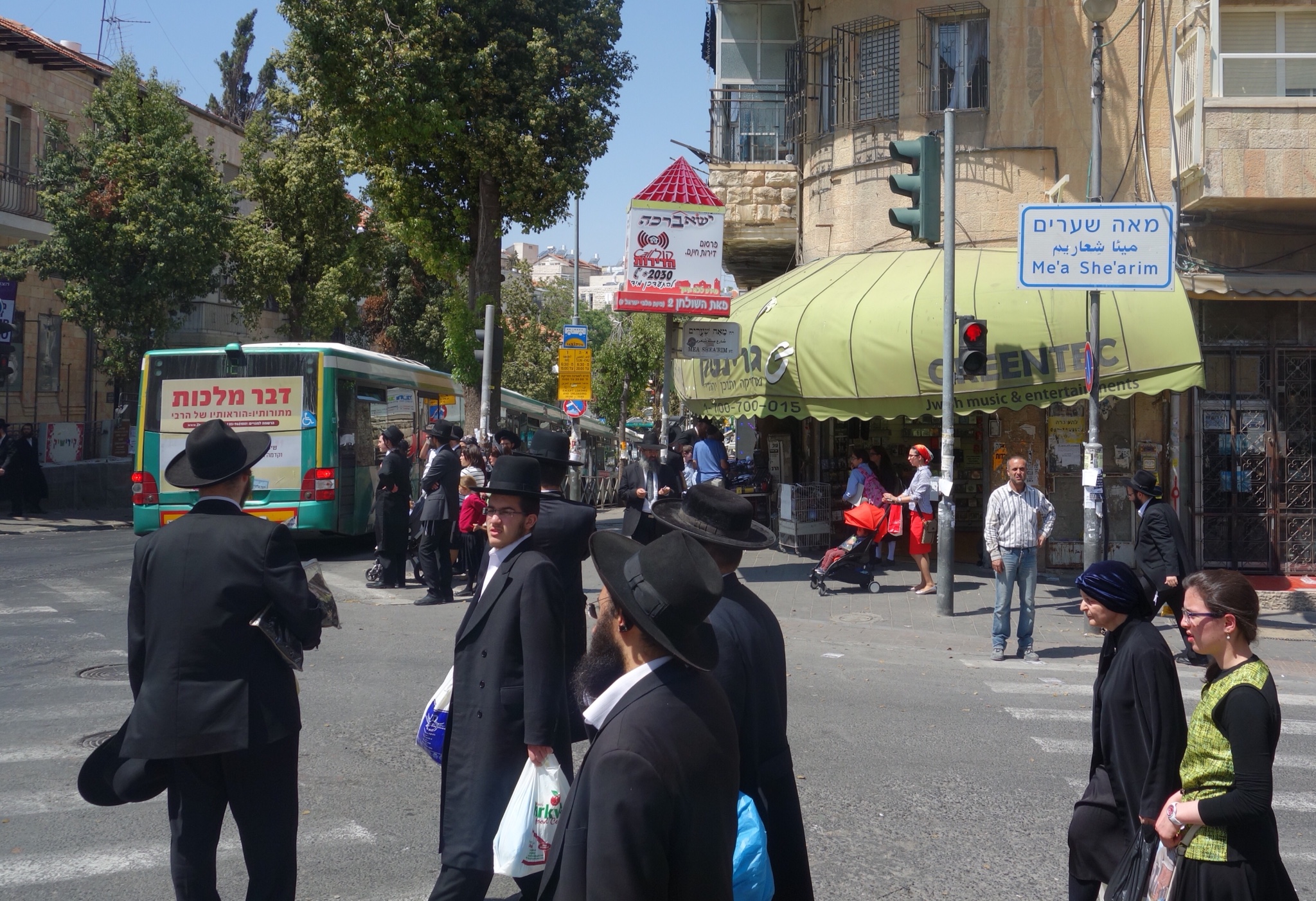
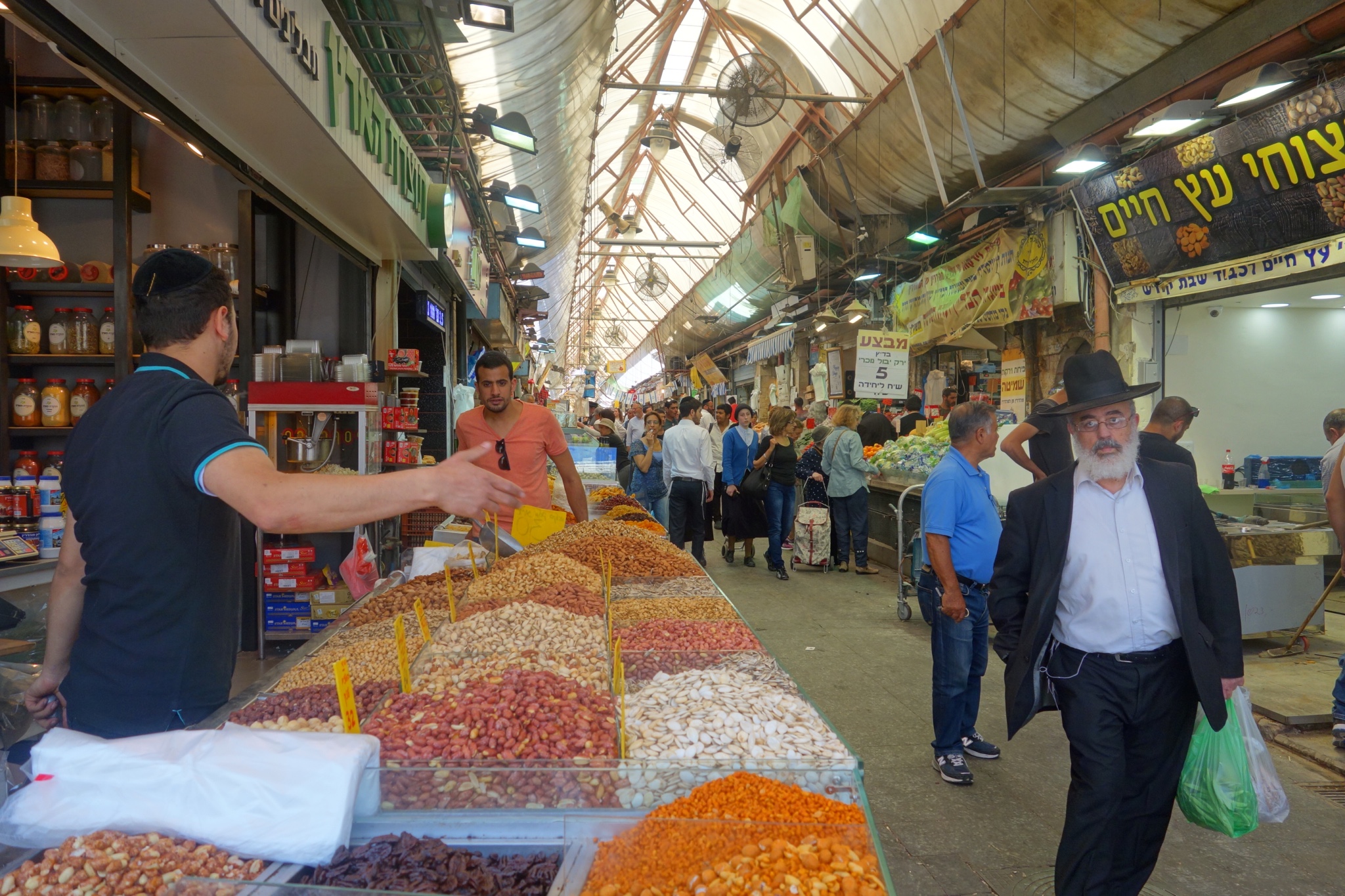
— We strolled through the neighborhood of Me’a She’arim, just a few blocks from our hostel. It’s long been one of the best-known enclaves for ultra-orthodox Jews. The men wear some of the stranger outfits remaining on our planet. Their most religious women shave their heads (for the sake of modesty) and then cover their bald pates with hats or wigs and berets. Just four years ago, the community wanted to designate separate sides of each street for men and women (apparently the Israeli supreme court nixed that.) I was too nervous to take many photographs, as the residents have been known to throw stones at gawkers who are dressed too immodestly or otherwise violate community norms. But no one so much as scolded, let alone stoned, us. Strolling in the ultra-orthodox 'hood.— We ate spectacularly well.The Abraham Hostel also is just around the corner from Mahane Yehuda, the vast central market area crammed with nuts, dates, olives, candies, bread, fish, meat, halvah, pastries, coffee, tea, spices, and a vast array of beautiful fruits and vegetables. Mahane Yehuda ranks with the greatest markets on earth, IMHO.
In recent years, the vitality of the market has also apparently sparked a culinary renaissance in Jerusalem. We ate five meals in and around it that ranged from excellent to electrifying. HaSchena was so wonderful we went back two nights in a row, during the first of which I embarrassed Steve by moaning so loudly over how good every single dish was.
It struck me that humans have developed ways to capture and share so many aspects of life — we reproduce sights with photos and videos. We record sounds with tape or digital recorders or our iPhones. But there’s no way to document and share physical tastes in a similar fashion. Some of the food we ate on this trip was so good I yearned to preserve it, both for myself and to pass along to others. As it is, you’ll just have to take it from me that it was fantastic. On faith.
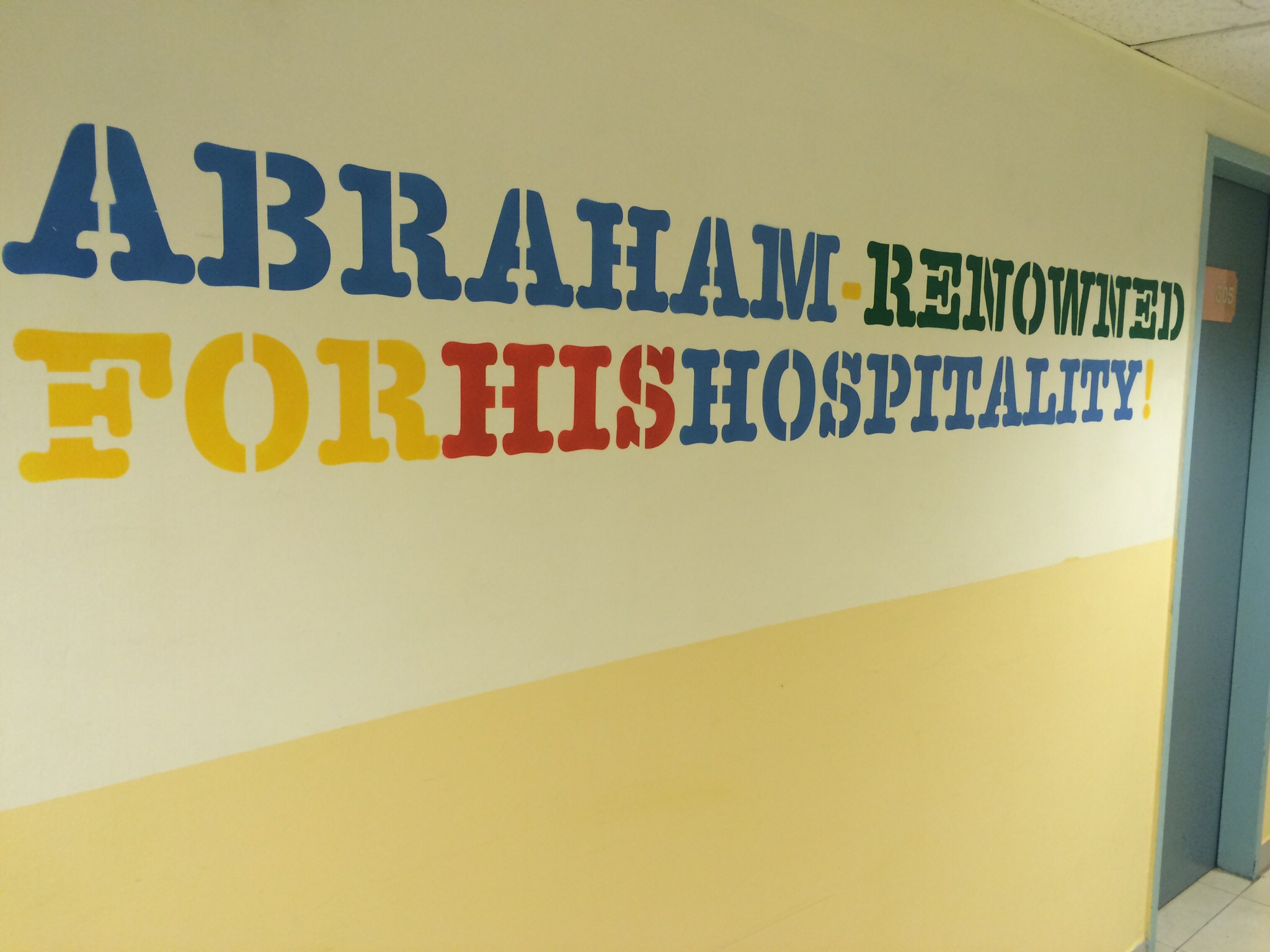
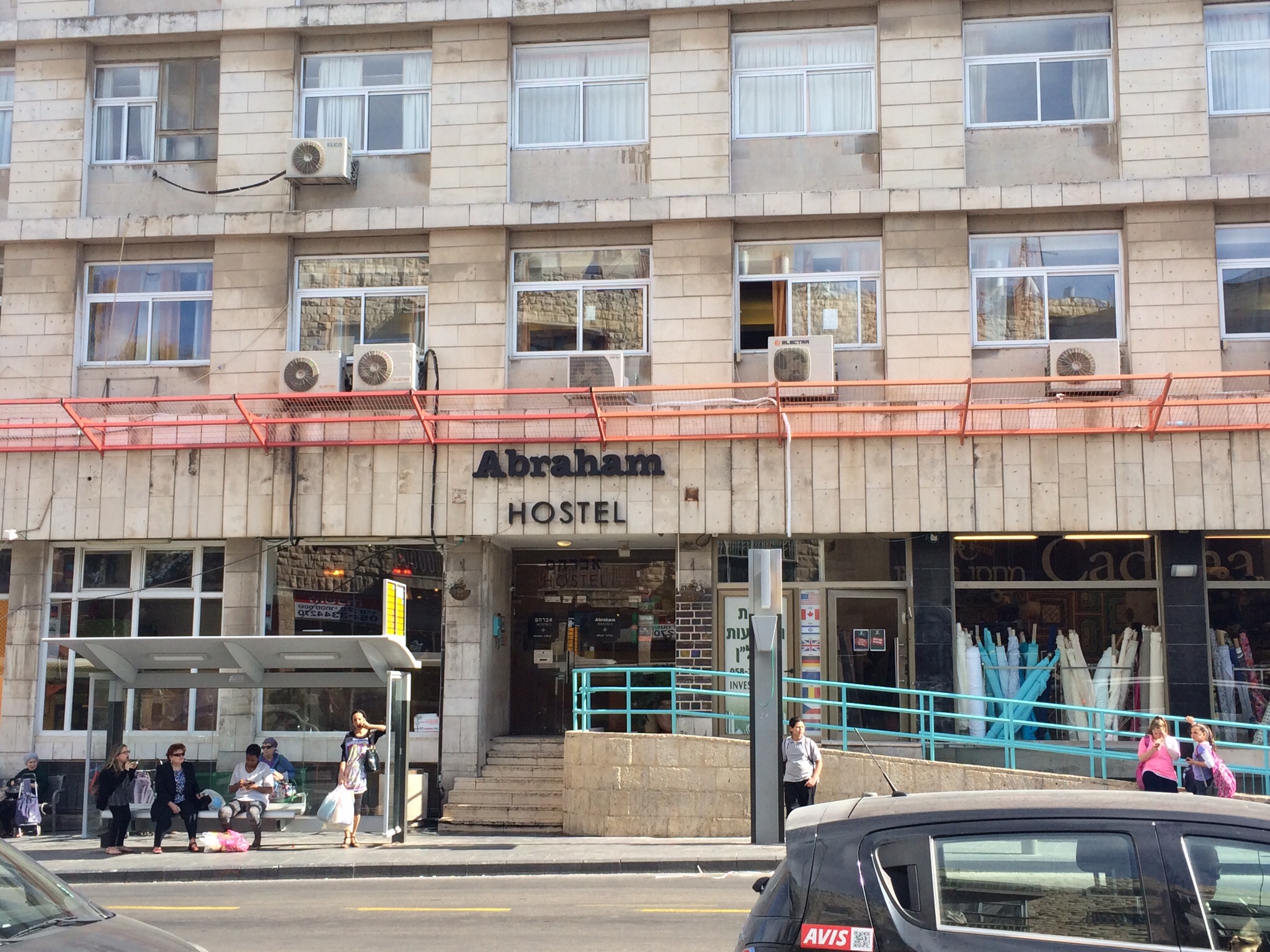
Steve and I haven’t been big hostel patrons. The idea of sharing a dorm room with 4 or 6 or more young revelers has never appealed to us. But in recent years we’ve become aware that many hostels offer private rooms, many with private bathrooms. I’ve also noticed they’re showing up more often in the search engines I use such as TripAdvisor and booking.com and in guidebooks like Lonely Planet. One such source made me aware of the Abraham Hostel in Jerusalem. The enthusiastic reviews of it, coupled with the high cost of hotel rooms in Israel, prompted me to book a private room for 6 nights there.
Not much to look at, but it's working for us.
When we checked in Thursday night, exhausted from our long day and high-adrenaline arrival, my first impression of our third-floor room was that it was plain, but serviceable. Since then, my admiration for the place has been growing daily. The location is excellent. A 20-minute stroll down a lively pedestrian street takes us to the Old City. Our room is not only clean and quiet, but the lighting is excellent, and the simple furnishings and room layout have made it easy for us to get organized (two things I can’t say about every hotel.) Breakfast is included in an Abraham stay, and again, it’s not a vast and varied spread, but what’s available is all good: excellent granola and cornflakes, hard-boiled eggs, decent cheese and yogurt, and a wondrously efficient Swiss espresso machine that makes excellent cappucinos. This you consume in the huge common room — part refectory, part lounge, part bar (where flights of local beers and daily mixed drink specials fuel the lively interaction.
Breakfast at the Abraham
One of the most likable things (to us, at least) is the range of ages in evidence — traveling 20-somethings mingling with young families and a handful of retirees ranging from early to almost geriatric. Last Friday night maybe 100 of us guests (many Jewish but some not) shared a traditional communal shabbat dinner that was delicious.
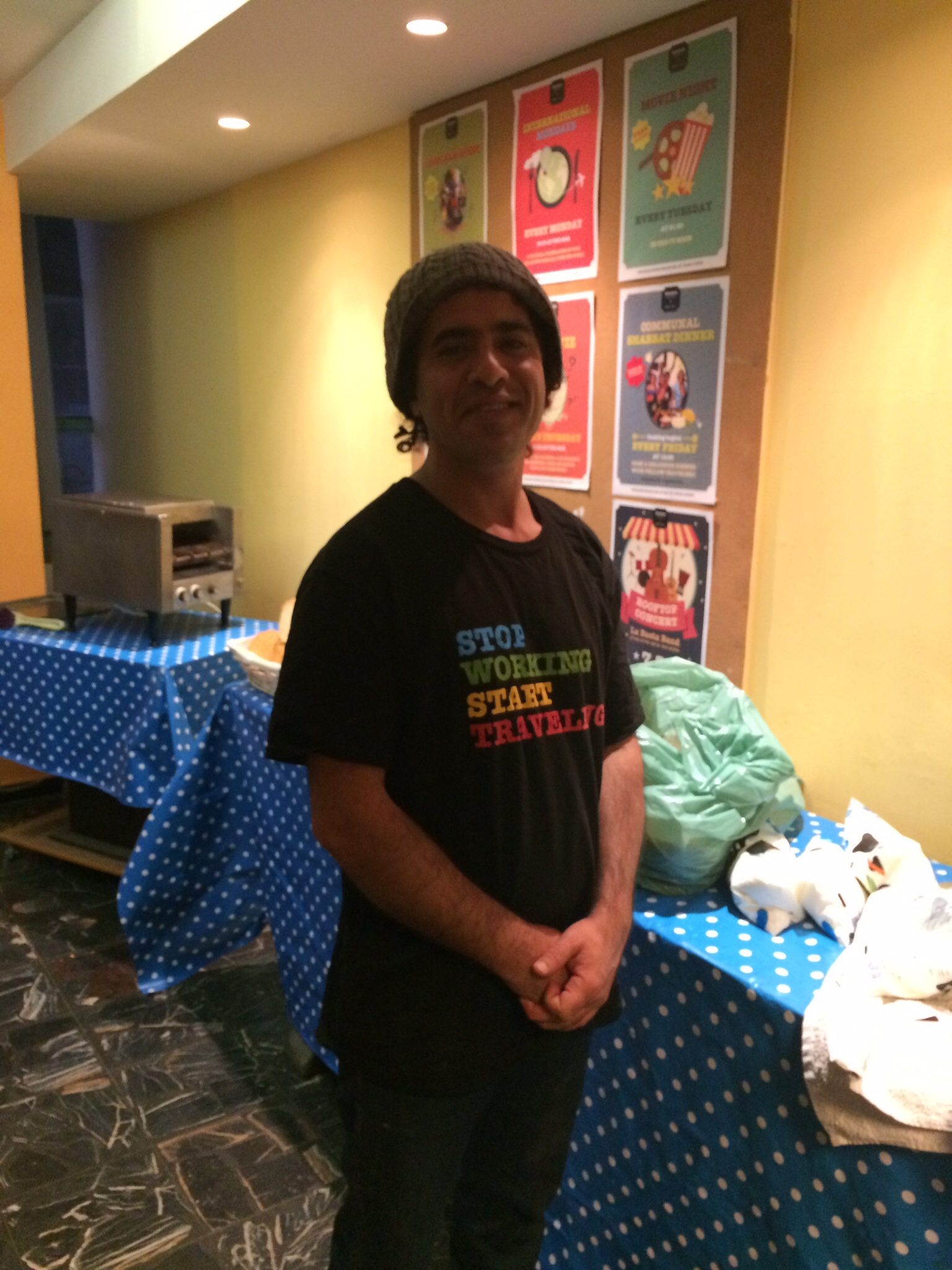
When I got up early Sunday morning to blog, I went down to the common room. It was empty, except for a guy who was setting up the breakfast. Although the Swiss Jura was still warming up, he invited me to help myself to hot water and instant coffee. We chatted a bit, and I learned he was the visionary behind the Abraham. He had opened it four years ago, and it was such a huge success, he would be opening a second one in Tel Aviv in about two months.
The founder of the Abraham
I told him that the thing I most admired, besides the jolly, homey atmosphere, was how efficient the hostel is at dispensing touristic information. Large maps given away at the front desk answer just about every question I can imagine: where are nearby restaurants? pharmacies? bars? How can you get from the Abraham to Ben Gurion Airport? More extraordinary is the Abraham Travel Center in the lobby, which offers an assortment of tours that sounded so interesting I booked several online in advance.
We’ve now devoted the last four days to them. Friday we spent pretty much the whole day touring the Old City and the pilgrimage sites that dot the nearby Mt. of Olives: the churches commemorating the spots where Jesus is believed to have ascended to heaven, and the Virgin Mary may be buried…
The place that folks believe is Mary's grave
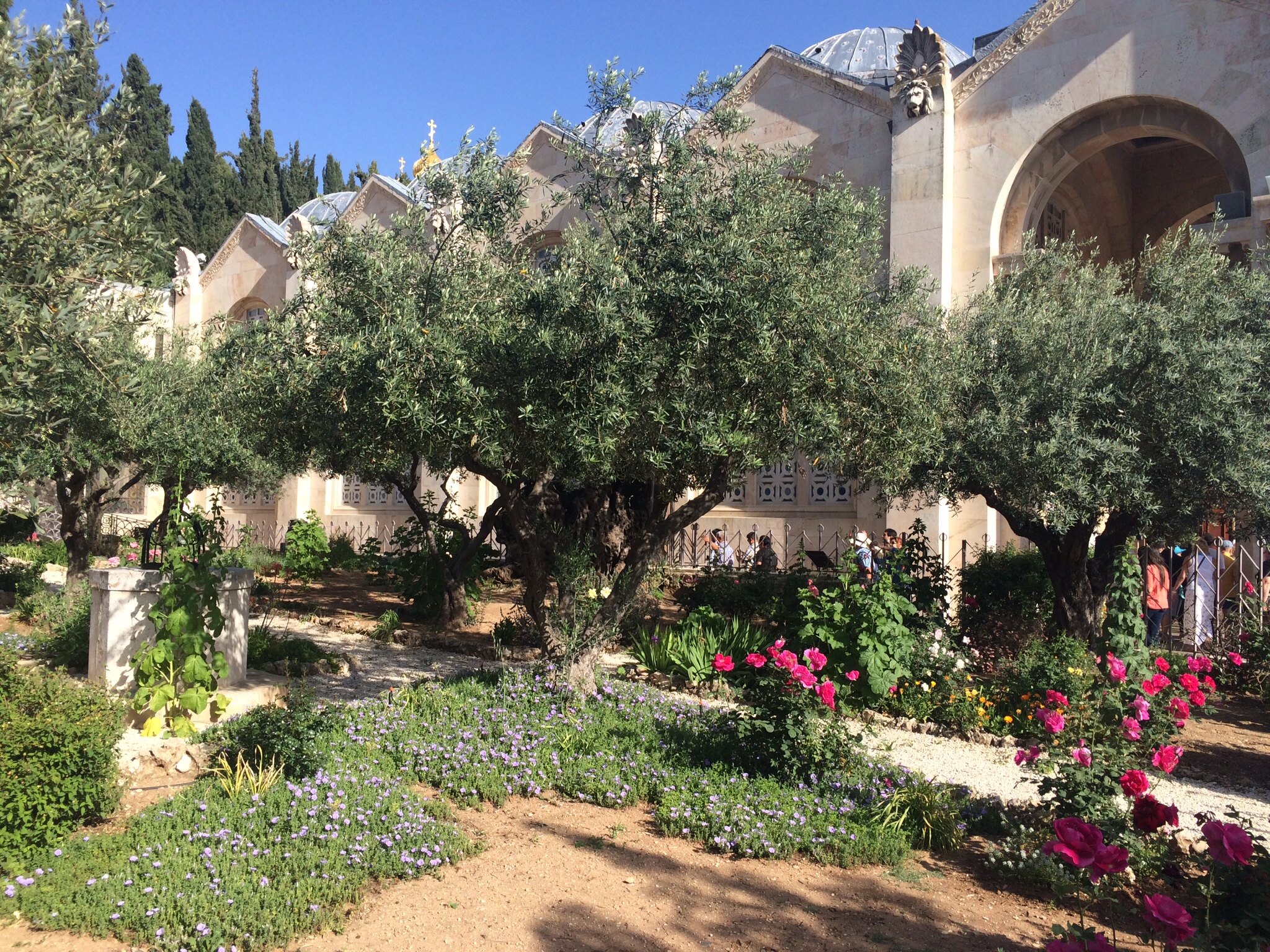
…the Garden of Gethsemene (where Jesus was arrested before being tried and crucified)…
The Garden of Gethsemene is so beautiful. Lonely Planet says scientists have established that some of the trees are 2000 years old. (And who knew the roses were so lovely?)
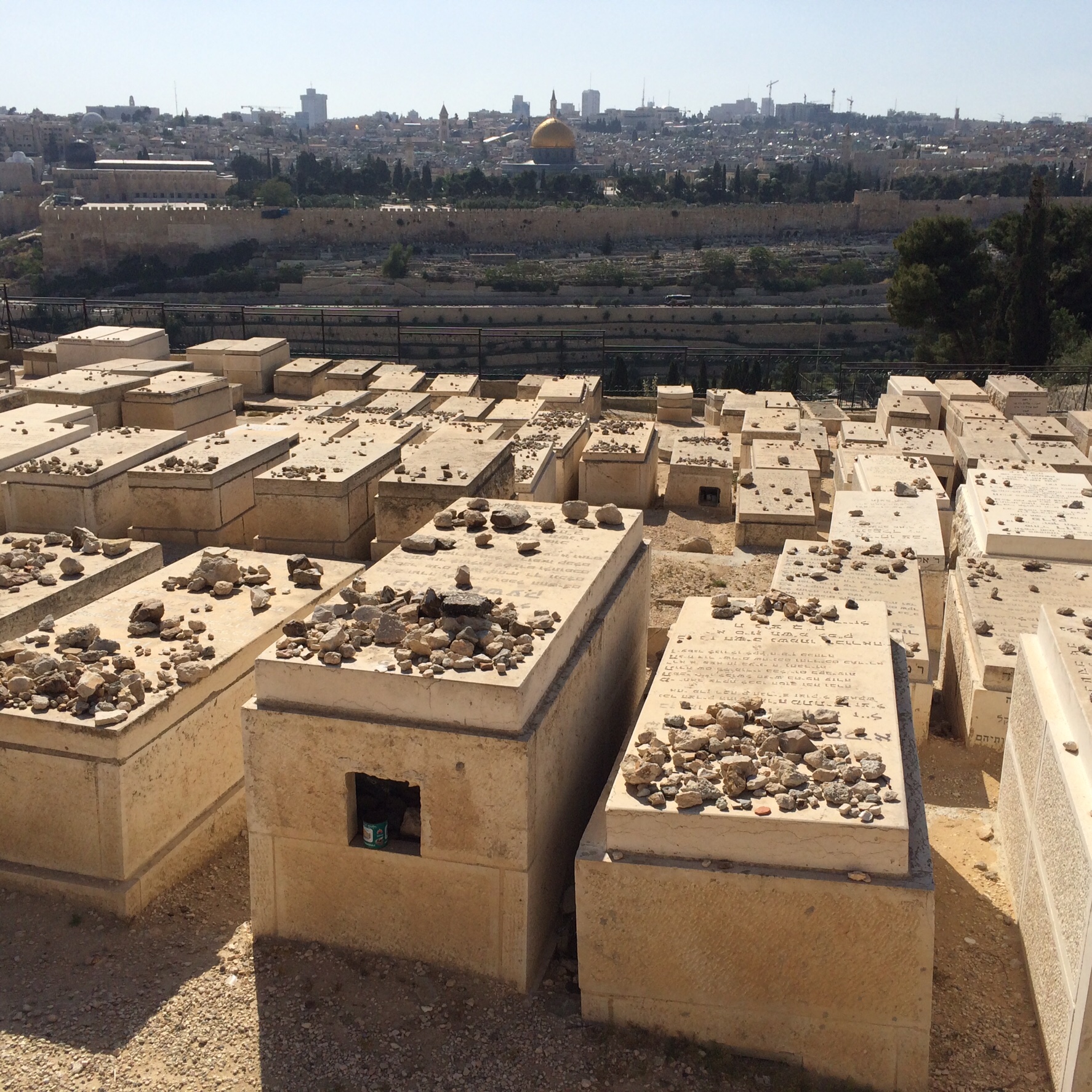
…the Jewish cemetery (largest in the world) where everyone reportedly is buried with their feet facing the temple wall (so they can pop right up and follow the Messiah into the temple, when he shows up and goes through the so-called Golden Gate.)
Some of the Jewish graves facing the temple (and the golden Dome of the Rock.) The stones on the graves are a sign of veneration.
My feelings about being here in Jerusalem changed noticeably throughout that day. I was raised a Catholic; taught by nuns throughout primary and secondary school. In a sense, I spent part of my childhood in the Holy Land (in my head). Later, in adulthood, I came to understand that all the stories I grew up with were situated in modern Israel, a real place. But it wasn’t until our flight from Amman was descending over Israel (9 days ago) that I realized how mythological the Holy Land felt to me. Shortly, I would be walking in the same streets where I’d envisioned Jesus walking, when I was a child. It seemed as weird as an imminent arrival at Mordor International Airport or the King’s Landing Hyatt.
When I got my first good look last Friday at the Dome of the Rock (revered by Muslims as one of the holiest places on earth because the Prophet ascended to heaven there) or the Western (aka Wailing) Wall (revered by Jews because of its proximity to where the second temple once stood), I felt that jolt that accompanies seeing a really famous sight for the first time with one’s own eyes. But those ancient olive trees in the Garden of Gethsemene affected me differently; they made the mythological garden in my mind melt away, and they took its place. All this has nothing to do with faith; I suspect that a lot of people, both believers and infidels, might react the same way.
It’s a progressive experience. A dozen or so mythic Christian sites have now transformed into real ones for me, and there are more to come. I’m starting to feel jaded. And we still haven’t been inside the Church of the Holy Sepulchre (where the crucifixion and resurrection are believed to have occurred.) We’ll do that tomorrow. In the last three days, we shifted our attention away from the Bible and to the Israeli-Palestinian conflict (first) and some of Israel’s most famous natural wonders (second). Those deserve posts of their own.