A warm and Fes-y feeling

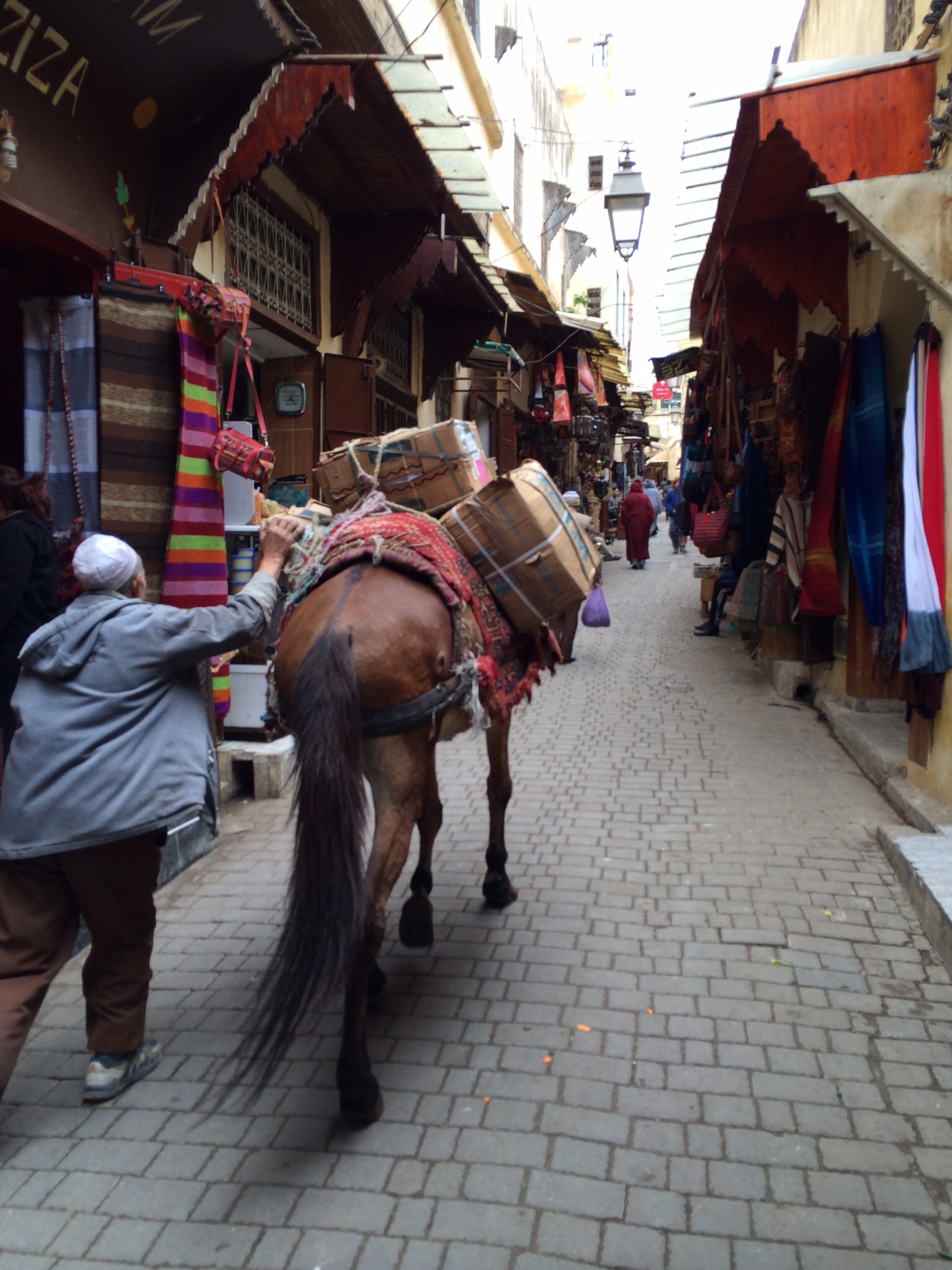
Fes wouldn’t appeal to everyone. But I liked it so much I felt sad to leave. As we bounced along on the bus out of town, heading to Chefchaouen, Steve and I agreed we’ve never experienced any place quite like the medina — in all our travels. The closest comparison we could make was with Venice, another ancient city that’s a maze of twisty narrow passages and a sanctuary from all forms of motorized traffic. I’ve read that Fes’s medina (where we spent almost all our time) is the largest pedestrian-only zone on Earth — home to something like half a million people. But unlike Barcelona’s old quarter or Venice, the Fes medina isn’t an enclave of monied professionals or trust-fund babies, but home to folks who sell live chickens and cure animals skins in reeking vats of urine and pigeon excrement and beat copper into beautiful bowls and drive donkeys laden with propane cannisters, eking out livings in those and a thousand other ways. It’s not really medieval. Today the streets are (mostly) lined with cobblestones, and pipes deliver running water. There’s electric light, and people use cell phones and ATM machines and wi-fi. But these things have arrived within just the past few decades, and the presence of the way life was for the thousand preceding years is palpable.


Part of the tanneries
If there’s a travel article or guidebook to Fes that avoids using the phrase “sensory overload,” I haven’t seen it. The cliche is understandable. In addition to all the mind-boggling sights, you have to process the five times daily calls to prayer issuing from the hundreds of mosques, the crowing roosters, barking dogs, clattering and banging and sawing of the artisans. Smells issue from the tanneries, from the sizzling donuts, from the hens and pigeons whose necks have just been wrung. As in Venice, there are things to buy for prices ranging from pennies to the equivalent of thousands of dollars. Some of it is beautiful; much interesting, and a thousand touts do their best to convince you to at least have a look.

Through our riad, Steve and I hired a guide Tuesday morning to help us get oriented. We regretted it. Rachid was a slick operator, one of the most manipulative people I’ve ever met, and I’m still fretting that he tricked us into paying too much for the ceiling lamps we never intended to buy (but which WILL look cool in our African-themed guest room, assuming they still work when we get them home.) After that, we wandered on our own, marveling at the chance to see full chains of production in the space of a short stroll: skins newly stripped from the goats on one block, the tanned and dyed hides on another, the pretty goat leather purses and wallets and soft slippers (by the thousands) a little further along the way. We loved watching weavers working at antique shuttle-fly looms and seeing their jewel-colored handiwork stacked up on the nearby shelves.

In two long days, we never got sick of it. But every time we returned to Dar Serrarine that brought a different kind of pleasure. At one point, we looked through an album full of photos of what the place looked like when Allah and Katie bought it back in the early 2000s. The walls were stained and dingy; tiles were missing, woodwork broken. Allah worked alongside the artisans whom he hired, and it took three years to make it presentable for the first guests. Seven years later, it occupies a very short list of the most sumptuous places we’ve ever slept in.
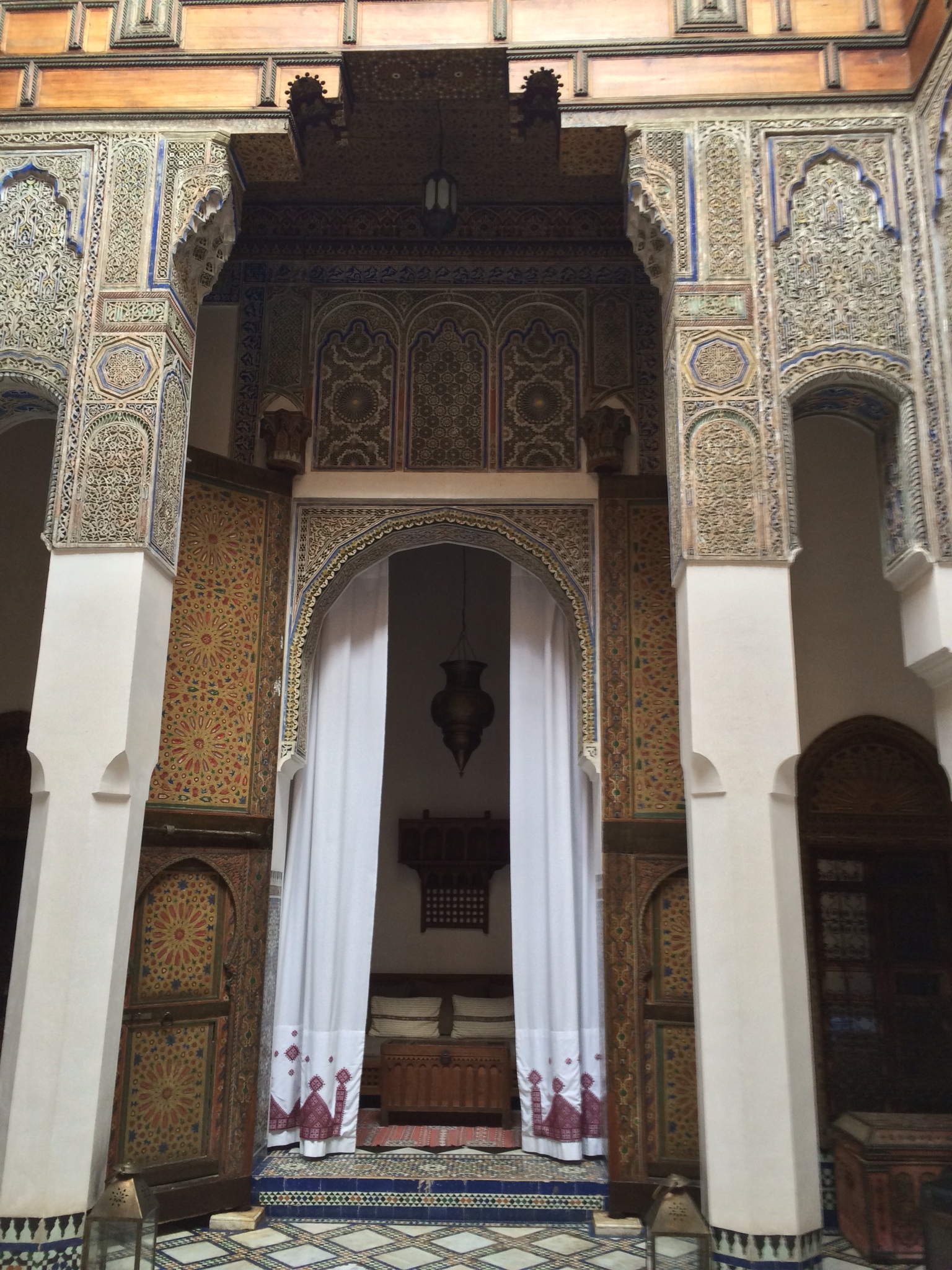
One of the rooms at Dar Seffarine


At the same time, it felt homey. The kitchen was a few steps from the grand inner courtyard, and several times I shuffled in to put a dirty glass in the sink. The high point came our first night, when Allah give a highly animated tour to us and the six middle-aged European pals (German, Polish, French) who were our fellow guests. Sometime after 8, when someone made a comment about being hungry, we all crammed into the kitchen to drink Moroccan beer and wine and smoke cigarettes (everyone except Steve and me). “In Iraq, you drink until 11 — and then you have dinner!” Allah exclaimed.

It wasn’t quite that late when we all climbed up to the rooftop dining room, but our dining companions by then somehow felt like old friends. The beef and lamb tagines were tasty; the conversation hugely entertaining. Chances are I’ll never get back to Fes or Dar Seffarine. (The world is big; there’s so much else to see.) But after a night like that, I was fantasizing about returning to rent my own furnished apartment in the medina and study Arabic. Rachid told us we could find one for around $400 a month.


Parking problem

I was feeling almost cocky as Steve and I pulled into the Fes airport yesterday afternoon. In our six days on the road, we had avoided getting into any of the trouble that I knew some visitors get into (breakdowns, collisions, vandalism, speeding fines, etc.) We had decided along the way to cut our stay in Merzouga short by one day so we could drive in more leisurely fashion to Fes (say, two four-hour drives instead of one grueling day). That had worked just as we hoped. We easily spotted the turn-off for the airport and arrived around 2:15 p.m.

We didn’t immediately see any sign for rental car returns, so I asked a guy in uniform and he waved me into the only parking lot in sight. But a little warning bell began to ring when no one there showed any recognition of the Malta Car name. To make matters worse, even though S and I had bought Moroccan SIM cards in Marrakech for our phones, we’d never mastered the task of figuring out how much time they had left on them (let alone buying minutes to recharge them). So both phones were out of minutes. But the guy in the parking-fee collection booth, seeing my obvious distress, dialed the number I had for Malta Car and handed his cell phone to me. I got Jawad, the owner, and it soon became clear what had gone wrong.

When we’d picked up the car in Marrakech, perky Karima and her colleague had asked us when we’d be returning the car in Fes. At first we’d said 4:30, but we’d thought better of that. Figuring they might be planning to turn it right around and rent it to someone else, we told them we would have it back by 6:30 (p.m.)

Uh, no.

That may be the way it works in America, but the reason Malta Car needed to know our arrival time so that they could have a return-driver driven the 290 miles from Marrakesh to Fes to pick up our car (and drive it back to Marrakech, I assume). We’d said 6:30 p.m., so the guy theoretically was supposed to arrive at that time! I pointed out to Jawad that we really hated the idea of having to wait for several hours in the airport parking lot. He said he’d call me back. (We then dashed into the terminal, where we did manage to buy more minutes and get our own phones operational again.)

Several more calls passed between us. Finally we suggested this solution: I would call our riad in Fes and have them send a car to pick up me and all our luggage. Steve would wait in the parking lot, reading our guidebook about Fes. He’d return the car to the driver, when he showed up. And then he’d try to talk the driver into taking him into town. If that failed, he’d get a taxi.

Happily, it all worked out. The riad found a reliable driver who was already at the airport, so I had to wait almost no time at all. He drove me to the walls of the enormous old city, when we transferred the bags to a guy with a wooden cart. We followed him on foot through passages that seemed darker and older and far more confusing than the ones in Marrakech. Finally, at the end of a dimly lighted dead end, we rang a bell next to an impressive wooden door, and I was admitted to Dar Seffarine.

We’re staying here because our good friends Treacy, Erin, and Maya Lau so warmly recommended it. They’d been guests 6 or 7 years ago, shortly after the couple that owns it (Allah’s an Iraqi and Kati is Norwegian) began welcoming visitors. The city of Fez is more than 1000 years old; it claims to have the oldest university in the world, founded about 700 years ago. The building that Allah and Kati bought is not far from the university, and for that reason it’s believed to be about the same age.

Allah’s an architect and he supervised a renovation that has brought it to its current magnificent state. He’s kept it as true as possible to its Islamic architectural purities. It’s one of the most beautiful and amazing buildings I’ve ever had the privilege to stay in (and in my mind a heck of a bargain, at $110 a night including munificent breakfasts.)

Steve arrived, driven by the kindly car-rental guy, who managed to find the right spot despite being unfamiliar with Fes and getting lost several times. On the rooftop, S and I overlooked the old city, and at sunset the call to prayer surrounded us. (The city has more than 300 mosques.)

In a few minutes, we’re scheduled to go out with a guide for few hours to begin to learn our way around town, then we’ll have all day tomorrow to continue on our own here. I don’t expect to have time to write again until we’re on the bus to Chefchaoun late Thursday morning. Fes is the kind of place that demands all of one’s attention, and then some

(No time to add photos now. Will do that when I can.)