I was going to title this post, “Slopes rule, summit drools!” but I decided that would be sophomoric. It’s probably quite wonderful to reach the summit of this perennially ice-covered 19,000-foot extinct volcano, highest mountain in Africa, to start the final ascent around 11 p.m. in the freezing dark, to reach the heights despite the sharp reduction in the ambient oxygen. But I decided long ago (after reading about what it was like) that it wasn’t for me — requiring more time (6 days) than I would be willing to devote to it and more fitness than I possess. Steve was not one to argue this point. So I figured I would never set foot on Kilimanjaro.
When I heard that a day hike was possible, however, I leapt at that. Now that we’ve done it, we think it was incomparably better than going the whole 9 yards (at least for wimps like us).
I’m sure I’ve seen photos of the lower slopes, but I probably didn’t pay any attention to them and certainly forgot that that part of the mountain is dense rainforest. I expected something harsh and rocky. What a magical surprise we got.
Our guide for the day, Manuel (short for Emmanuel), a veteran of more than 70 Kili summits, picked us up about 8:15 and we reached the national park and checked in about an hour later. The morning was gray, and thick fog pressed in. This gave the forest a mystical, primieval feel as we walked into it. Steve and I decided if Bwindi most reminded us of Jurassic Park, the forest at the base of Kilimanjaro recalled the home of Yoda (except that that was a swamp, instead of a mountain slope). They both shared that dense, exquisitely concentrated greenness, with every tree, every patch of ground, host to myriad ferns and mosses, tiny flowers, and other plants. In one spot, we watched a troupe of big fluffy monkeys feed, and in another, we chanced upon a chameleon. We watched him start to turn color as he passed from the road to the brush, but no insects bothered us (and Manuel said no snakes slither here; it’s too chilly for them.)

I feel like I’ve exhausted my supply of superlatives, and our photographs also don’t fully capture how beautiful the trail was. (We were on the well-maintained Marangu Route, easiest of the 6 that ascend the mountain, and known to the guides as Coca-Cola, in contrast to the various Whiskies.) So I won’t even try to describe it further, other than to note we spent a total of 6 hours hiking covering the 10-mile round trip (we were taking it slow to drink in the sights; passing from an elevation of 6,400 feet up to 8,200 and then descending.) Our destination was the Mandara campsite, where through-hikers can sleep in cozy huts, eat their grub in a spacious “dining hall,” and use clean toilets.
We ate our box lunches and then basked for a few minutes in the sun that by then had broken through. It was almost enough to tempt me to return some day, to go for the trophy. (Almost, but not quite.)
The day before yesterday (Thursday, 6/13), we had a completely different taste of hiking on the mountain, in its own way as pleasurable as the formal hike. Our Tanzanian outfitter, a local outfit called Pristine Trails, had offered me a “complimentary” day trip to a local coffee farm, and although Steve and I have seen coffee growing in a number of spots around the world, I opted to include it in our itinerary. I thought of it as a throw-away day, figuring if our luggage got lost en route from Nairobi or we were just feeling tired, we could bail at the last minute. If I expected anything, it was something somewhat canned and touristy.
Wrong again! Turns out this “coffee tour” is the only one of its kind and was started only two years ago by a young man (24, at the ime) named Oscar. We were picked up by the same Pristine Trails driver who got us at the airport (Kila) and driven out to Oscar’s village. I gather that pretty much everyone in the Kilimanjaro region belongs to the Chagga tribe, and Oscar and his village were no exceptions. (The valleys serve as boundaries between the Catholic and Lutheran Chaggas. But everyone’s Chagga.) The driver took off, and Oscar led us to the home where he lives with his aged parents, sister, and various nieces and nephews. There he gave us by far the best explanation of the growing and processing of coffee I’ve had anywhere: picking beans off the tree, peeling them, showing us how they cull out diseased beans, explaining the drying and roasting process (all by hand, or using simple hand implements). Finally, he threw a ladleful of ground (with a wooden mortar and pestle) coffee into a pot of boiling water, and we gathered around a low table to drink it. Delicious!
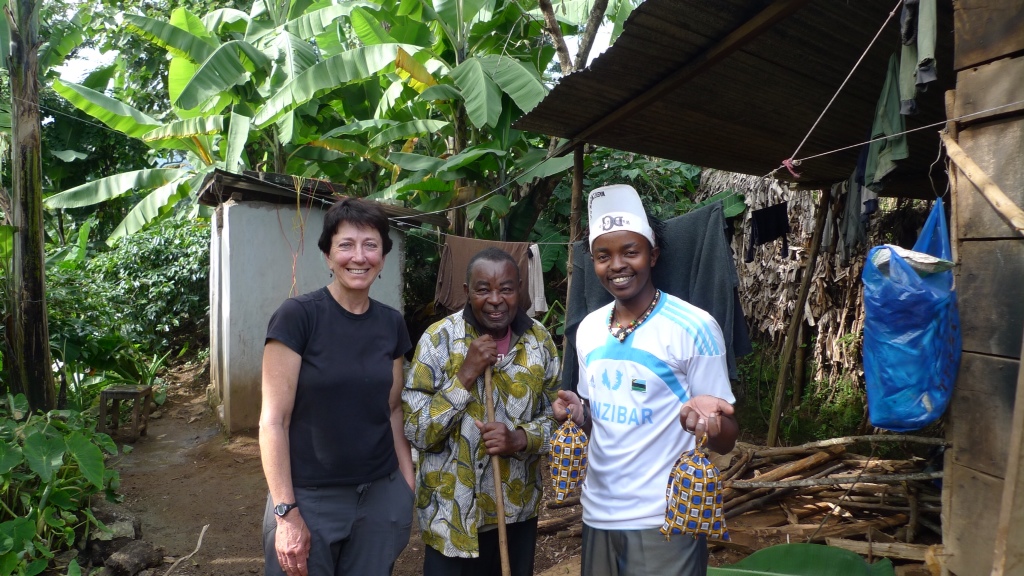
Every time I start to brood over how the human race is falling apart, I’ll try to remember Oscar. The 12th of 13 children, he only attended 6 years of primary school before he had to drop out. (His father, a schoolteacher who’s in his 80s today, had retired and didn’t have the money to pay the school fees.) Little Oscar helped to work the farm, but with time on his hands, he also occasionally shepherded tourists to the local waterfall and he was curious about their language. So he slowly, painstakingly taught himself English which today is fluent, nuanced, and funny. At 16 he worked as a porter on 4 excursions to the top of Kili, but decided that lugging the 45-pound loads up the mountain would kill him if he kept it up. Instead, he got the idea of starting the coffee tours. And now he’s got all sort of plans and has almost finished building a little wooden auditorium so he can accommodate groups. This head for business and native industriousness is apparently common among Chaggas. Oscar told us the first intra-African joke we’ve heard: If you find a Chagga lying in the road, how do you tell if he’s dead? Drop a coin.
After the coffee lesson, Oscar led us on a long (2-3-hour) hike to that local waterfall. Once again, we were hiking on the lower slopes of Kili (at one point, Oscar pointed out the national park boundary), and the waterfall turned out to be one of the most beautiful we’ve seen anywhere. But we were equally riveted by the ramble. Our path was a (mostly dry) mud byway that threaded the narrow passage between farms, affording glimpses of people’s lives. It was a bit like walking down an alley in Bird Rock — except that this felt densely jungly.
Unlike anywhere else we’ve seen in Africa, the Chagga haven’t cut down the native trees. Instead they’ve planted their bananas and coffee and avocadoes and other crops among the trees — which provide shade and help prevent erosion. They keep cattle, but as much for their manure (which they use as fertilizer) as for the meat and milk, and they confine those cattle and bring them grass to eat. (Many of the villagers we passed on the path had huge loads of fodder on their heads.) Oscar also told us that the Chagga tradition is to pass on the land to the youngest son (which in this case is him). The Chagga believe that’s the best way to keep family property intact for as long as possible.
We admired all of this. But this morning we’ll be leaving Chagga country and moving on. Our destination is a 24-hour adventure in a Maasai village in which we’re supposed to spend the day “learning the daily life of the Maasai children and adults, helping them with chores and other activities,” and sending “a unique and unforgettable evening at the campfire with a Maasai BBQ and traditional dancing ceremony” before returning to our cowhide bed in a tent.
This all sounded very cool to me when I signed us up for it back in January. Now I’m feeling a little nervous. I’ll report how it goes as soon as possible, but I’m not sure when I’ll next be able to upload. After leaving the village tomorrow morning, we’ll truly be on safari. If the lodges have wifi, you’ll hear from me sooner. If not, it may not be till Nairobi (a week from today). But I’ll also be tweeting (@jdewyze).
 Posted with Blogsy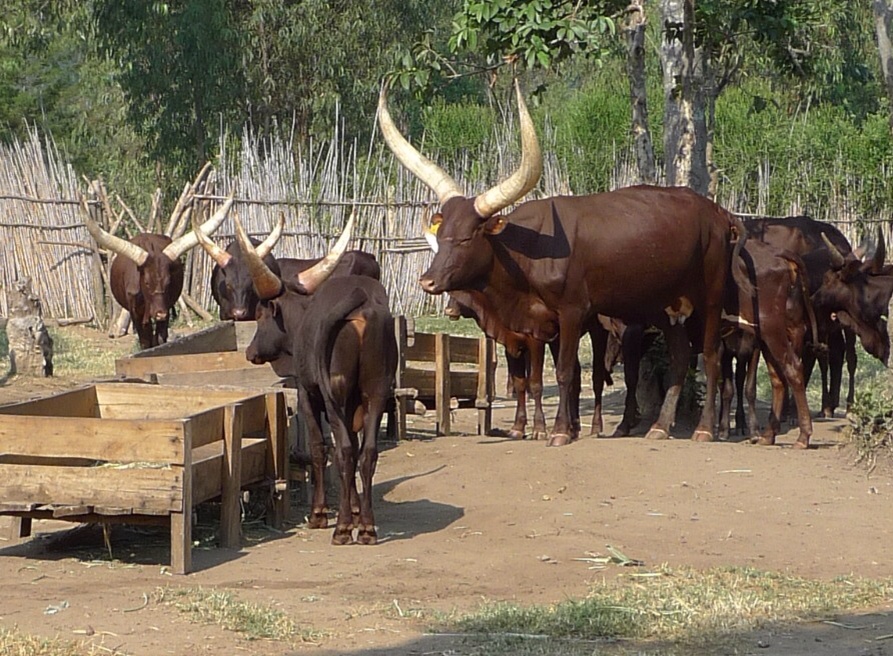
 At home and abroad