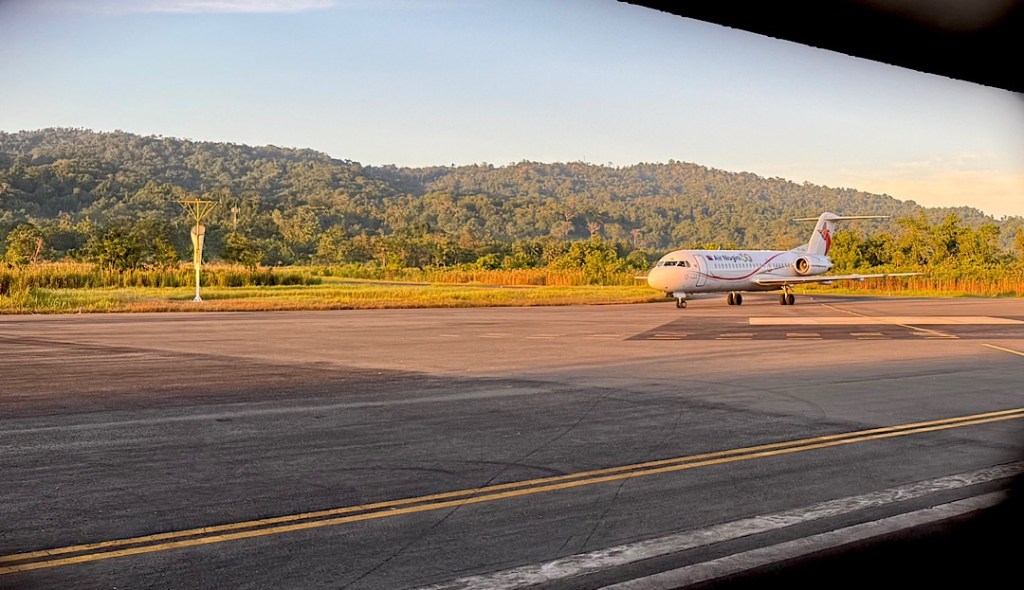
Our rescue vehicle: the Fokker that finally carried us from Wewak back to Port Moresby — on a beautiful day for flying. Note how nice and dry the ground is!
Thanks to everyone who expressed concern about Steve’s suspected TIA and our stranding in Wewak. We finally took off a little after 9:15 Sunday morning on a 70-seat Fokker and touched down in Port Moresby at 10:24. Unfortunately, that was almost an hour after our (rebooked) Philippine Airlines flights to Osaka (via Manila) had departed. Once definite word came Saturday that no plane would leave Wewak, we knew we’d never make the PAL flights, so I spent close to three hours on the phone Saturday afternoon, trying to rebook them yet again.
But I failed, and choking with frustration, we simply canceled them outright online. (I had paid extra for refundable tickets, though PAL tacks on so many hidden charges and fees we will get back only a bit more than half of what we originally paid.) If anyone out there is waffling over whether they should fly Philippine Airlines anywhere, call me and I’ll give you an earful.
This all meant when we landed in Port Moresby we had NO transport out of PNG, so we had to hustle to look for that. Happily, we found seats on an Air Niugini flight leaving for Manila at 4 pm that afternoon. We also booked a place to sleep in Manila. I’m writing these words from the heavenly bed there now.
As for continuing on to Japan, I was startled to find how few non-stops daily fly between Manila and Osaka — just three. None are good (e.g. Japanese). We finally chose the one (Cebu Pacific) that would allow us to SLEEP IN! Last night before collapsing in bed, we snagged seats on that 1:30 flight and got a hotel at the Osaka airport. If all goes well, we’ll check in there more than 24 hours ahead of when we’d planned.
Between now and then I’m hoping for time in which I can work on my report on the heart of our PNG experience: our travels in the highlands to the Goroka Festival.
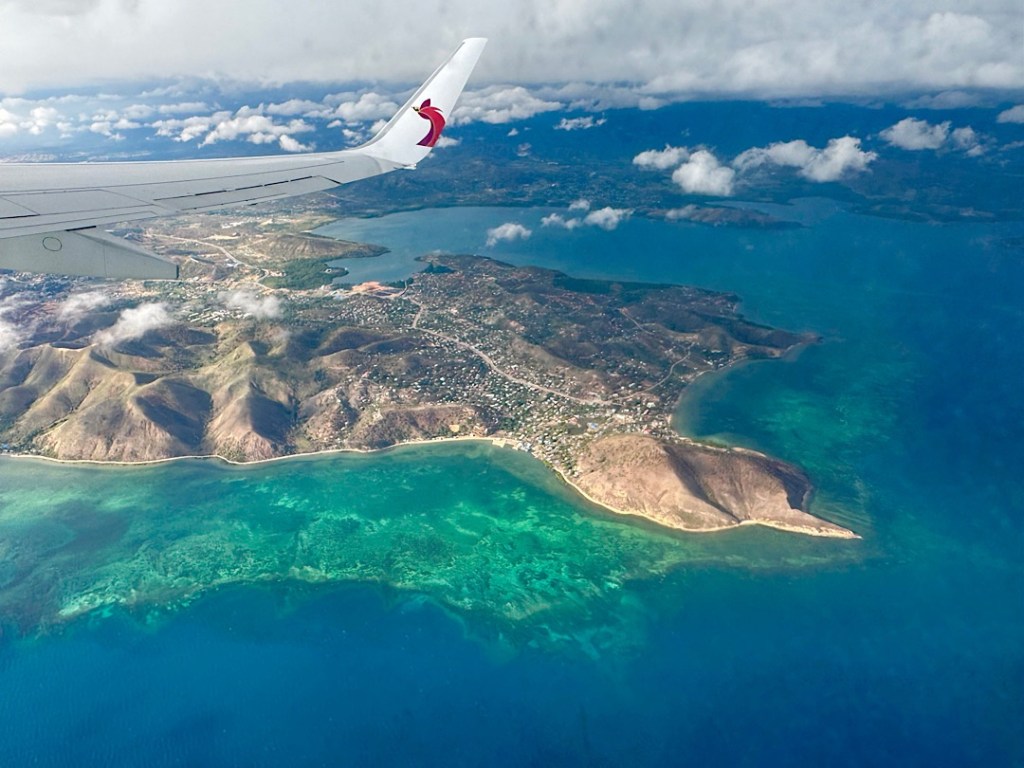
My last view of Port Moresby. I felt a little sad leaving Papua New Guinea, so beautiful, so wild.
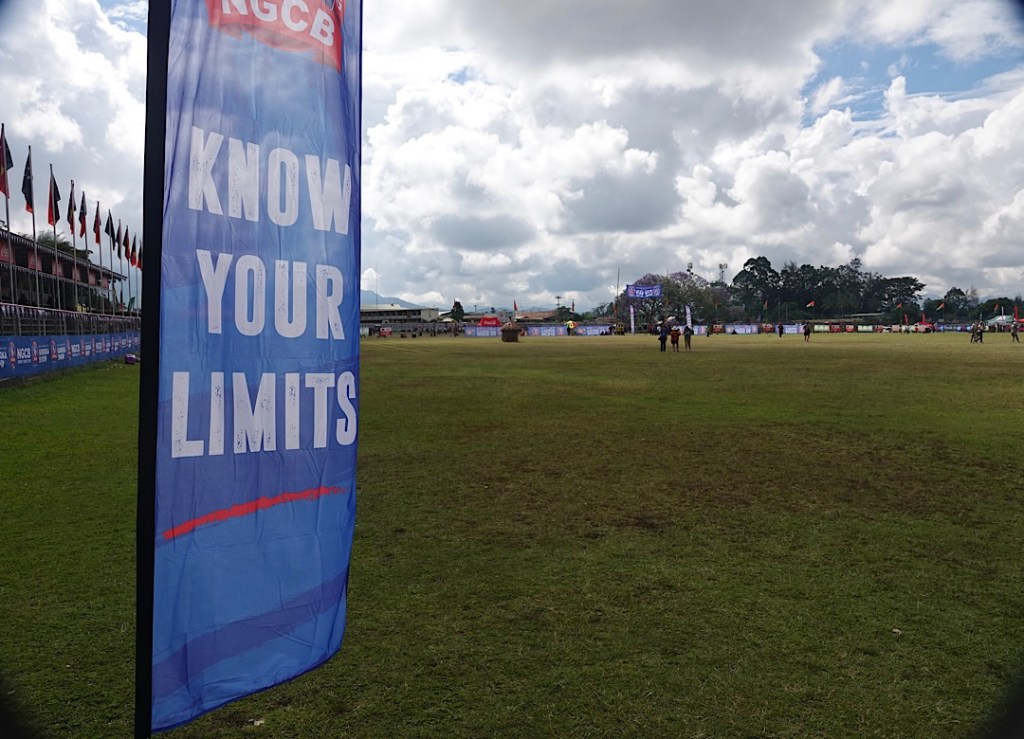
One of the main sponsors of this year’s Goroka Festival was PNG’s National Gaming Control Board; its banners declare, “Know Your Limits.” It’s a motto worth remembering.
Wednesday’s flying experience from Port Moresby to Wewak wasn’t great, but it didn’t seem bad enough to push either Steve or me beyond our limits. It wasn’t the ordeal we endured on Tuesday. That night we didn’t reach our hotel until 8 pm. Then once again we had to set our alarms for 5:00 the next morning. As we were packing to get out the door by 6, Christopher messaged the group that our plane’s departure had just been rescheduled, and we wouldn’t have to leave the hotel until 9:30 am. The damage was done, however. Both Steve and I were wide awake.
When we finally got to the airport, check-in was smooth, and we took off only about 45 minutes behind schedule. We didn’t crash. Climbing down the plane’s folding stairs into the blazing sun and air heavy with humidity felt like a full-body punch. But our bags came off the plane quickly, and the drive to our hotel was short. In the cool, elegant lobby I whispered to Steve, “Maybe you should go on the river trip and report back to me. I’ll just hang out here.”
Ah, be careful with your flippant remarks! I donned my bathing suit and went down to the saltwater pool. The water temperature must have been at least 90, almost too warm even for me. A few minutes later, Steve showed up and stepped down to join me at the shallow end. He started to tell me he’d found a shorter route between our room and the pool. But he couldn’t speak.
His vocal cords were working, but the words coming out of his mouth were strangely jumbled — a bit like a stutter, a bit like a sustained slip of the tongue. He tried again to talk and failed again. We both recognized something was very wrong. I immediately suspected a transient ischemic attack (TIA), also known as a mini-stroke. Or something worse about to unfold. I called to some of our group members at the deep end. Together we helped Steve to get out of the pool and sit down.
None of the others heard what Steve and I had just heard coming out of his mouth; the worst of the incident had already passed. He had no other symptoms: no weakness or pain in his limbs; no vision anomalies. Still he was speaking very slowly, taking obvious care to utter intact words. Someone gave him powdered electrolytes to mix with water, and we returned to our air-conditioned room where he drank the solution and lay down for half an hour. When he got up he was almost back to his normal self, and the two of us confronted the crocodile in the room: should we reconsider setting off for the Sepik River early the next day?
By this point it was close to 6 pm. As tough as the decision was, we had to make it fast. On the one hand, we’d paid a lot of money and endured a lot for the chance to travel in dugout canoes on the third-largest river system in the world. We would see an entirely different biome and meet completely different tribes. We’d probably chase some crocodiles, and Christopher wanted to devote a day to a “cultural exchange” within a village where Steve and I had planned to give local children a lesson in geography and astronomy. Not everyone’s cup of tea, but we both wanted to do all that.
On the other hand, it would require four more days of hard travel: three nights sleeping on the floor in spartan village “lodges” illuminated by minimal electricity, eating mostly root vegetables; sweating a lot and getting muddy and using outhouses to relieve ourselves. We’d have to swat away many more bugs than we’d seen anywhere previously on the trip. Most sobering, if Steve’s incident augured some bigger cerebral catastrophe, no medical resources would be at hand.
So we sought out our tour leader and explained what we’d decided and what we wanted: to stay behind and try to move up our return to Port Moresby and onward travel to Japan. Christopher had to act quickly. According to Air Niugini’s website there were no flights from Wewak to the capital either the next day (Thursday) or Friday. Only two seats were left on the 7:30 am flight on Saturday, and by some miracle he got Air Niugini’s agent in London on the line and booked them. At dinner I paid for them by typing my credit-card info into the form on Chris’s mobile phone.
As hard as it was to abandon the river trip, it was even harder to part so abruptly with the seven fellow travelers who remained in the group (which had started out at 20 for the festival). Steve and I have never been big fans of group travel, but our Best of PNG group was exceptional. Every single person was interesting or funny or kind; most were all three. At least one, an Estonian privacy attorney, had visited more than 130 countries (and she was only in her 40s). Others were close behind. Everyone was a good sport; at every turn they shared amazing travel stories. The final seven (besides us) included two French, two Colombians, a Swede, and two other Americans.
We said goodbye to Christopher Bartlett and his assistant Caroline.The diehards, about to drive off to the river
Shortly after 8 Wednesday morning they and their jokes and good fellowship all disappeared in a cloud of dust down the road. We turned our attention again to looking for a doctor who could evaluate Steve (who continued to look and act normal.) No doctor had been available the night before, and Sam, the hotel manager, explained that until recently an excellent one had been on call for guests with health problems. But she had recently died. A second possibility turned out to be away on holiday. Sam promised to keep trying to find someone who could help us.
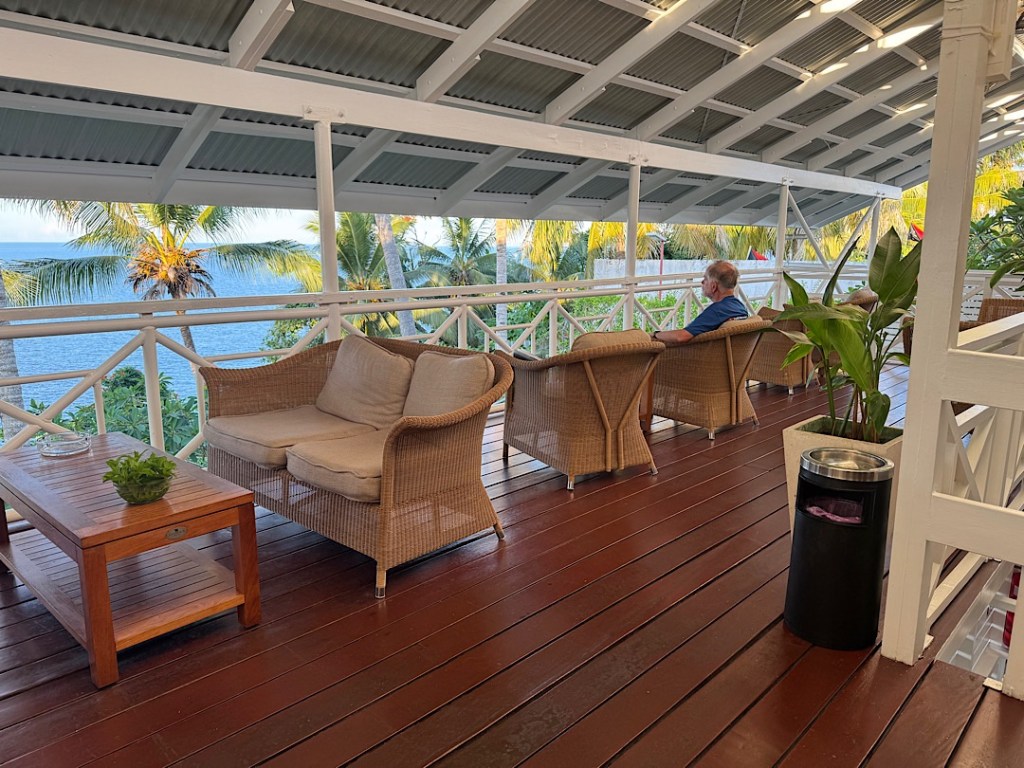
I spent the rest of Thursday morning working to untangle and reweave the web of connections between where we were and where we wanted to go: cancelling and rebooking hotels, changing our flight from Port Moresby to Osaka, calling our travel insurance company and opening a case file. Among its many virtues, the Wewak Boutique Hotel has an extensive menu of dishes that arrive quickly and taste delicious. We enjoyed crab spring rolls for lunch. We napped. We sat on the glorious veranda outside our room, gazing out at the cobalt Bismarck Sea, surfing the internet, catching up on email.
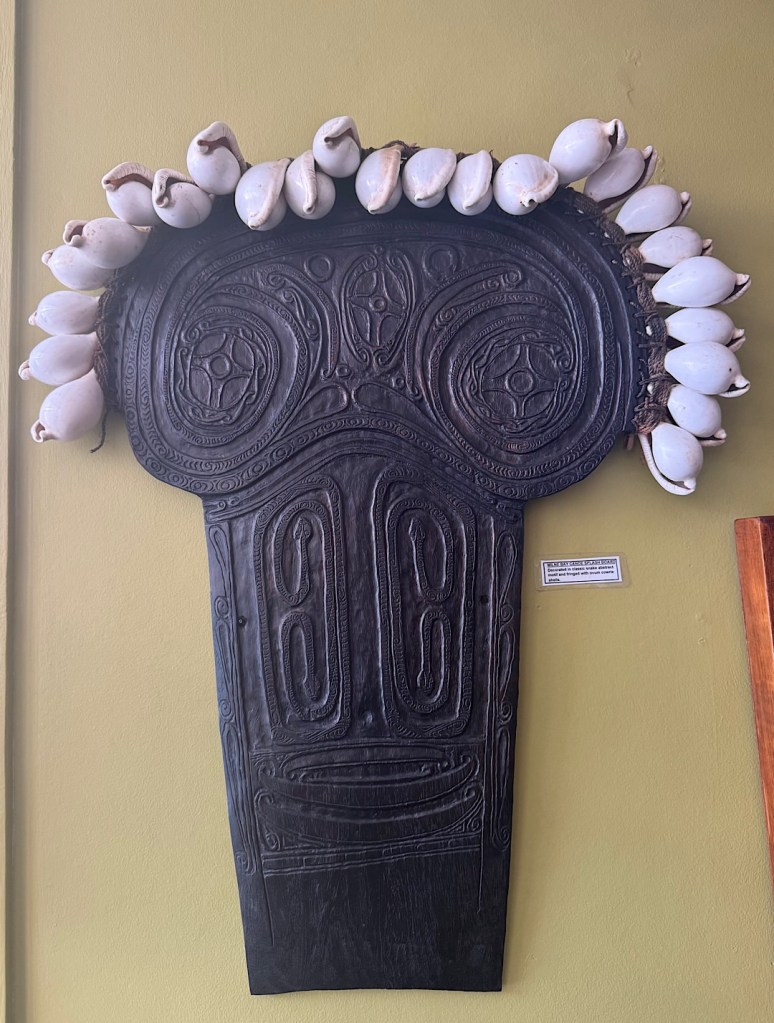
Steve relaxing on the veranda, viewed from one side….…and the other.Among its countless virtues, the Wewak Boutique Hotel has a cafe whose walls are filled with beautiful carved and decorated objects.
We took a dip in the pool; this time it was idyllic. After we showered and dressed, we were about to go down to dinner when a hotel worker knocked and said the doctor had arrived to check on Steve.
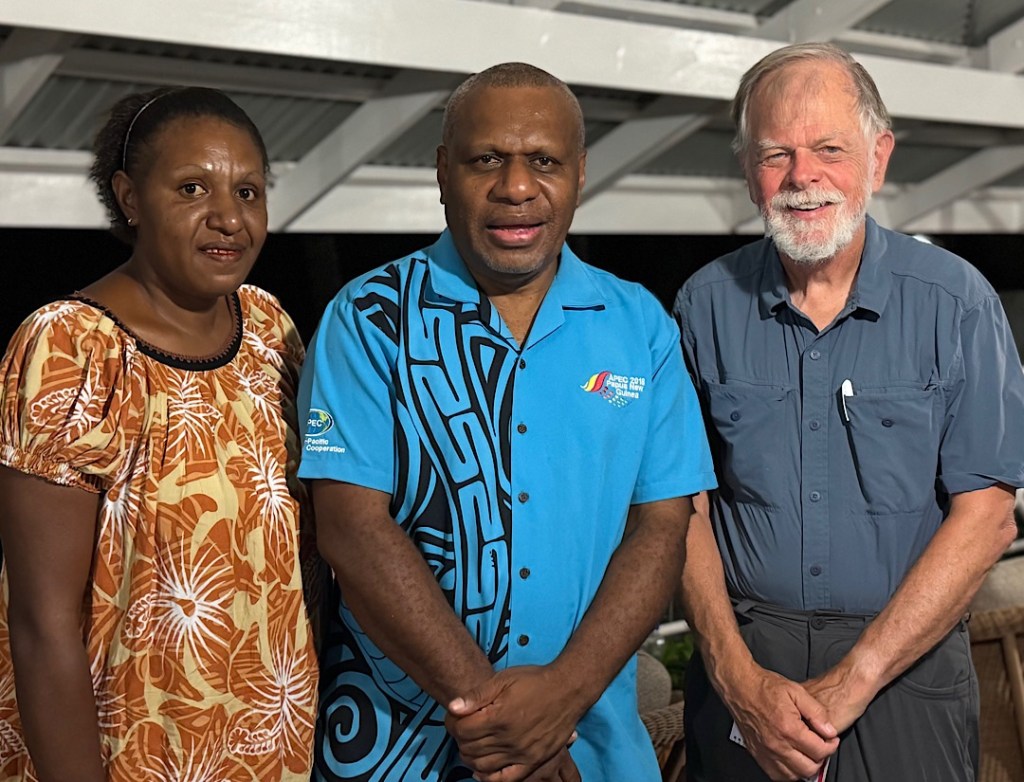
This was a surprise. But such a nice one! Dr. Julius Plinduo turned out to be a calm, patient man who sat down with us on one of the veranda couches. An emergency medicine specialist, he’s currently filling in for the doctor who died, serving as the administrator of the local hospital — and willing to help the occasional visitor with a medical problem. He listened to our story, then began asking a series of questions. Besides his gentle thoroughness, his methodical astuteness was evident.
Dr. Julius, flanked by his wife Ellem and the patient.
He pulled a scale out of his medical toolbox; weighed Steve then extracted a blood-pressure monitor to check Steve’s numbers. He had Steve write down his email address and phone number, closely observing his writing skills; eying his gait. After a full hour of such assessment, he told us he thought Steve probably had had a TIA, likely triggered by all the travel stress and sleep deprivation and heat and dehydration. He thought we’d been wise and prudent not to continue on with the river trip. But with some rest and relaxation (and eventual follow-up when we got home), he predicted Steve would be fine.
We paid him 200 kina (a little under $50) for all this advice and the report he promised to write and email to us. We were exchanging goodbyes with him and his wife (who had tagged along for some reason), when Steve thought to ask if they could recommend any place locally where we might find the crafts we had hoped to buy on the river.
Dr. Julius said there was such a place not far away. And if we wanted, he would have a driver arrive with his wife to take us to the market Friday morning and escort us while we shopped there. Flabbergasted by this generosity, we demurred, but he said they were happy to help us experience and enjoy their country.
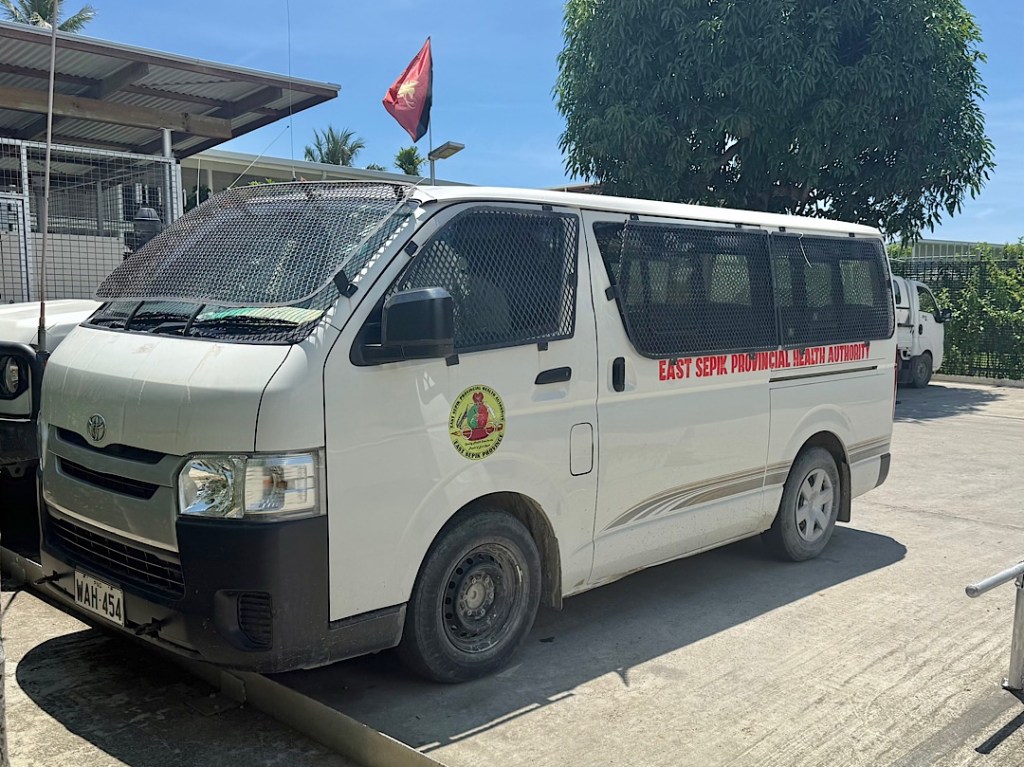
Both of us slept better Thursday night than we have in weeks, and around 10:15 the next morning, a driver pulled up in the hospital van.
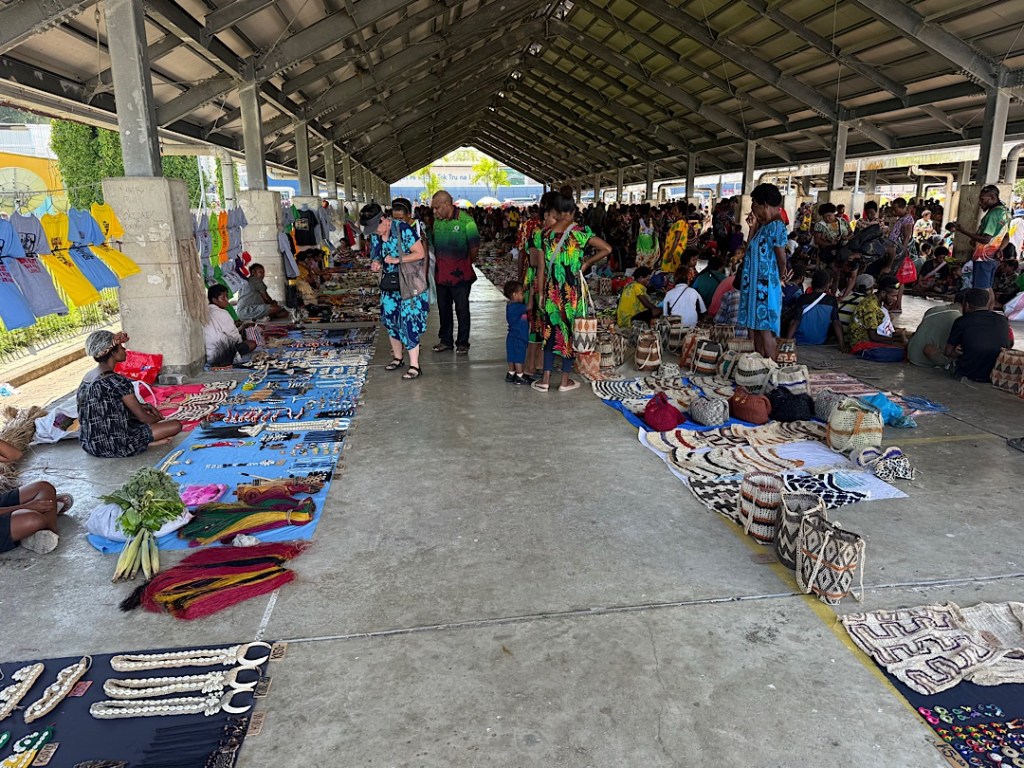
Dr. Julius and his wife sat inside. He had an errand to run near the market, he said, and she would accompany us on our shopping run. It wasn’t a large market, but it was stocked with a good variety of produce and crafts. We breezed through it, bought some things, and were back at the hotel before noon.
The marketThe kid was not for sale but lots of lovely basketry and carvings were.
I was hoping to be able to wrap up this post and publish it in Port Moresby. But at 1 pm Saturday, we’re still stuck in Wewak. Once again we were up before 5 and at the airport by 5:40 for a 7:40 flight that we were told had been delayed to 8:40. Then an incredible downpour began that continued for maybe 45 minutes. It finally played out, but only after flooding the runway. Someone announced that all flights out would be cancelled for 24 hours.
Now we’ve gotten word there’s some slight chance a plane from nearby Vanimo might land here later today and continue on to Port Moresby. This is all quite suspenseful, particularly since our flight out of the country is scheduled for 9:40 tomorrow morning.
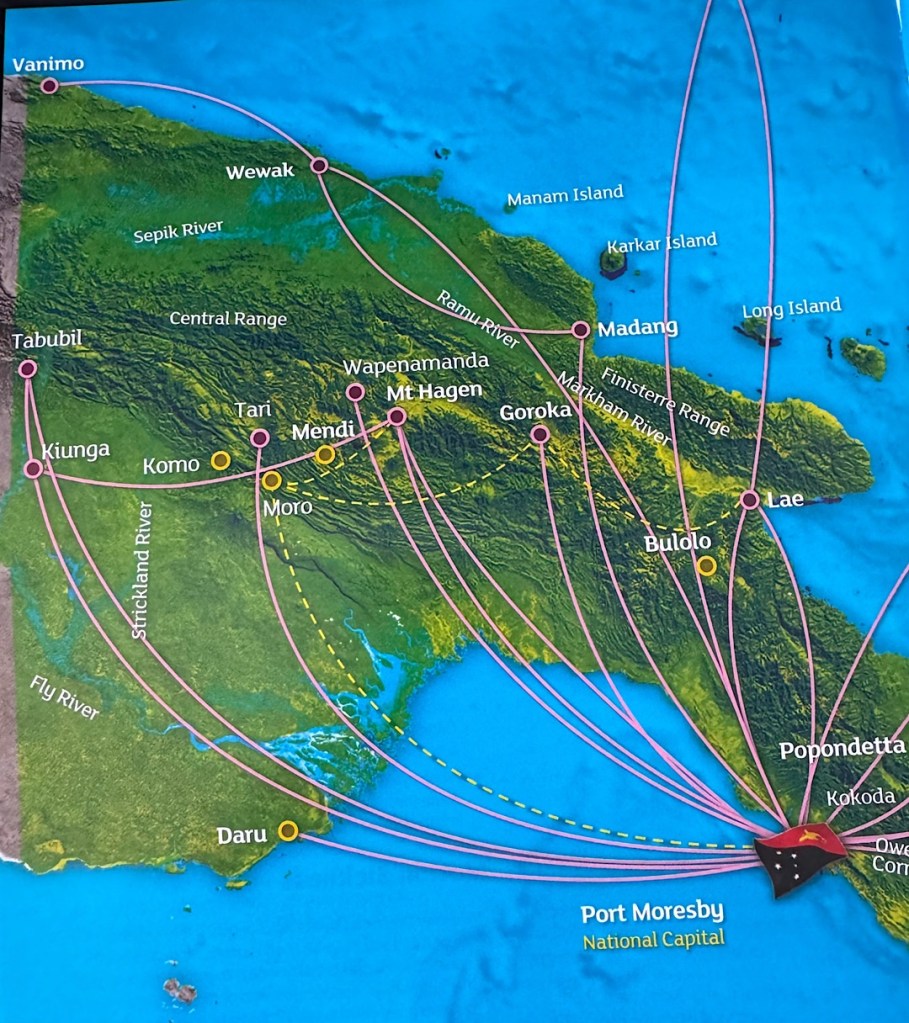
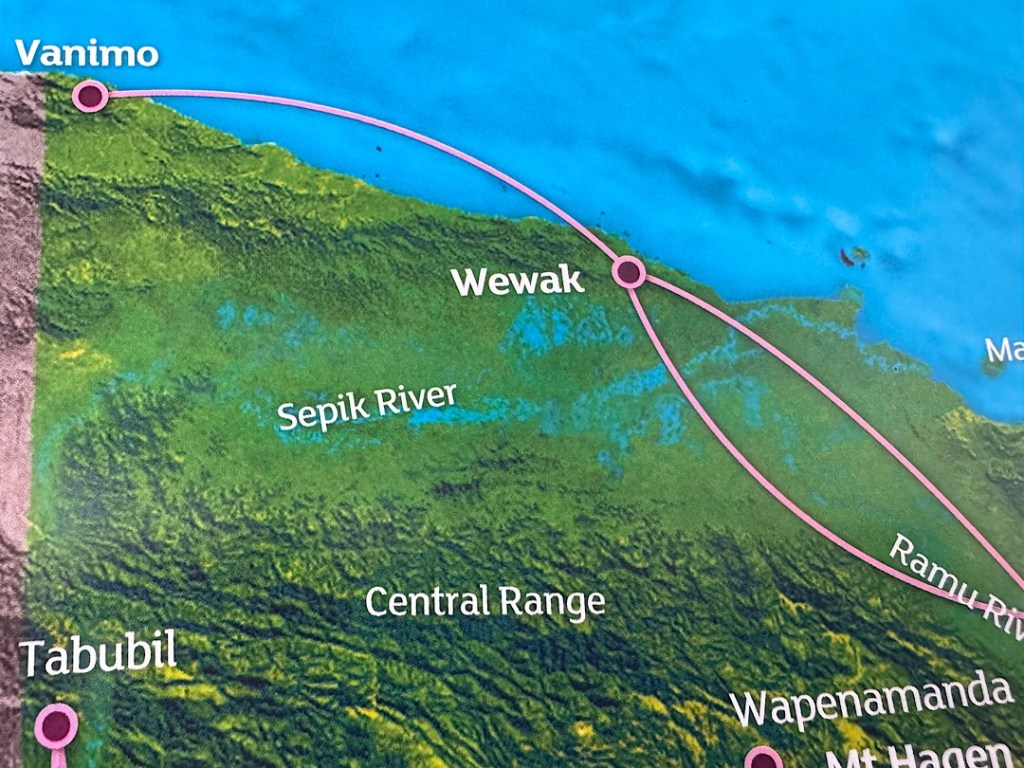
You can see Wewak up on the northern coast. Vanimo is also on the coast, but just across the border from the western half of New Guinea, the province of Indonesia known as Irian Jaya. (Map courtesy of the Air Niugini inflight magazine.)A closer look at the Sepik River. Now I don’t expect to ever see it.




 At home and abroad