A kasbah of our own

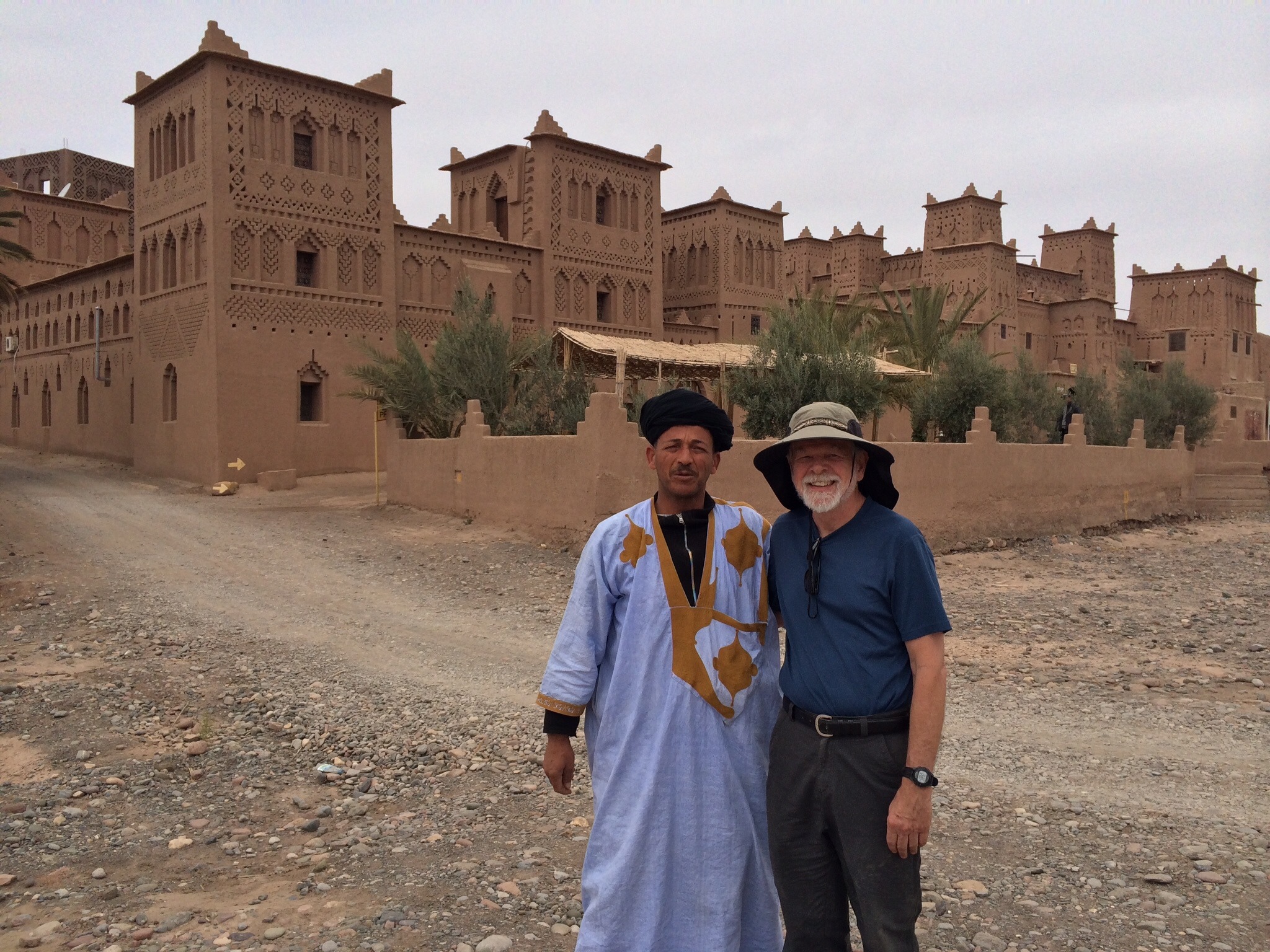
The first thing we did Thursday morning after eating breakfast and checking out of the Baghdad Cafe was to drive to Skoura, which is not only the site of a huge palm oasis, but also home to many notable kasbahs. (That term means a fortified residence — usually the one-time home of some big cheese.) We’d read in our guidebook that the most impressive one in Skoura could be reached via a footpath in back of another kasbah that has been converted to a hotel and was on the main road. We found it, and a hotel employee, very friendly, said we could park our car there. On a balcony, he pointed out our destination, looking magnificant in the distance. He led us to a low wooden gate in the hotel garden. We should go through it and follow the pathways. He explained the route in a loose and rather confusing fashion, but insisted it was “VERY easy! No problem at all!”

Maybe 10 minutes later, S and I were deep in an almost Irish green paradise. The palm trees were big, and there were olive and other tall trees. The paths twisted and turned, and the thought occurred to us that we could soon get very lost.

The view from inside the palm oasis

In the end we didn’t; the hotel guy proved to be right. We glimpsed our target, made our way it, and it lived up to its reputation. As we were leaving, we passed a couple dozen French tourists waddling in the wake of a Moroccan guide (later we saw their big fat bus out on the road.) It struck me that if you’re shepherded in a group, you never have adrenaline-charged moments where you don’t know if you’ll ever find your way out of the palmery. But for us, they’re part of the charm.

Steve and our guide to the most famous kasbah in Skoura


At other times throughout the day, we were happy to be independent and mobile, if occasionally stressed. When we got hungry, we stopped at a joint called Cafe Valentine. It didn’t look promising, but no better alternatives were at hand. The young guy behind the counter suggested that “Berber omelettes” could be a good light lunch. That sounded safe and fast, so we assented, but a half-hour later, we wondered if we hadn’t taken another (figurative) wrong turn. Our host finally reappeared with a basket of light and flavorful bread, however, and then he brought us two tagines filled with a bubbling mixture of baked eggs, tomato and onion sauce, a bit reminiscent of huevos rancheros, without the tortilla or beans. It was delicious, and with a plate of tasty tangerines, a tall bottle of water, and mint tea, the total tab, including tip, came to about $11.

After lunch, other highlights of our road trip included an initially baffling search for the Damascus roses for which the area around El Kelaa M’Gouna is famous. Each spring, the women of the area supposedly harvest the petals, which then are processed into rose oil and subsequent derivative beauty products. We saw plenty of the beauty product shops,

Rose products R Us!


but it took us a long time to identify the rose bushes (baffling because the guidebook had said there were more than 4000 km of hedges of them. We finally figured out that the large thornless shrubs covered with delicate pink blossoms were probably them. (They looked nothing like hybrid teas. But they were ubiquitous.)

Our last detour before heading to Tinghir and the riad I had booked near there was a gorge that cuts off from the Dades Valley (“Route of a Thousand Kasbahs”) and climbs up into the Atlas Mountains. The Dades Gorge turned out to be one of the more striking landscapes we’ve ever seen. At first it looked to be a cousin to some of the famous geological formations of the West — the Grand Canyon, say, or the national parks of Utah. But soon some striking differences became evident. The walls of the gorge are studded with kasbahs both ancient and new, some under construction. It’s not crammed with them. But it somehow made me think of the chalets you might see in the Alps. A third exotic note were the astounding profusions of greenery (fields, trees) on the floor of the gorge — like a splash of Louisiana in the midst of the arrid, rugged American West.

The gorge was so jaw-droppingly beautiful it should have been the highlight of the day. But there was one more wonder. I’d reserved our riad online because it had rave reviews on Trip Advisor and cost only 54 euros (including breakfast). Located outside the center of Tinghir, I could only consider it because I knew we’d have the car. I was hoping for a clean, pleasant room to sleep, but what we got felt like a true oasis kasbah. An aging Frenchman named Philippe completely renovated the old structure seven years ago. He told us he moves regularly between it and France. Thus it feels like his private home, impeccably decorated, graced with a courtyard garden, a rooftop viewing platform, a private jacuzzi and sauna and hammam that put the one in Marrakech to shame. S and I scrubbed up, using that amazing black soap, melted in the sauna, bubbled in the jacuzzi, then went on to a dinner that rivaled some we’ve had in Paris. We slept well.


The road to Ait ben Haddou

I was a little worried about our road trip yesterday (Wednesday. When you research the option of renting a car and driving around Morocco, you discover two very different schools of thought. One is dark: Moroccan drivers are terrible, the road-death toll is high, the pass over the mountains blood-curdling. On the other, sanguine, side of the fence, people attest that the roads are mostly well-surfaced and once you’re outside the cities, driving is no big deal. We weighed both, and after talking to a couple of friends who’ve driven here, we decided that the advantages of getting from Marrakech to Fes in our own (rented) vehicle outweighed the alleged drawbacks.

Arranging the rental was also not without its complications. Go online and google “Morocco car rentals” and you’ll find lots many choices. But the comments and reviews of most of them discouraged me. I finally posted a question on Lonely Planet’s Thorn Tree travel discussion forum, and I heard good things about Malta Car. I emailed the main contact person, Jawad, and arranged for a car to be delivered to our riad at 9 a.m. on Wednesday, March 19.

This was a good call. It’s possible I could have gotten a cheaper rental had we waited to arrange it until after we arrived here. But that would have required hours of work, and as it was, we didn’t have time to see at least a couple of key Marrakech attractions. Instead two young people showed up at our riad as arranged, shortly after 9 yesterday (Wednesday) morning, then they led us on foot out of the inner medina to the place where they had parked our gleaning white Dacia Logan (a type of Renault). The young woman was sweet and charming; her male colleague efficient. They pulled out forms for us to fill in…

...on the trunk.


and a credit-card-processing machine to log our deposit and vehicle-rental payment. They patiently answered all our silly questions (“Do the windshield wipers work?” “What are the rules for entering a traffic circle?” etc.) When we got to asking about the details of how we should get out of Marrakech, they gallantly offered to drive us to the road out of town. And so they did! (Another colleague then collected them and took them back to the city.)

It's not Kansas, but it wasn't Hell either.

This was a godsend; it made our day easy. The car is fine, the roads are indeed well-paved. The weather was glorious and the scenery spectacular. We did occasionally get trapped behind a Scandinavian hogging the road in an RV, and some of the hairpin turns and low guardrails in the Atlas Mountains made me hold my breath. But there simply wasn’t all that much traffic, and with a stop for lunch and a bit of roadside shopping and photo-shooting, we pulled into our B&B in Ait ben Haddou (the Cafe Baghdad) and around five hours after we bade Karima and her colleague goodbye.

We whiled away the rest of the day exploring the old fortified town (ksar) of Ait ben Haddou. It’s a spectacular place — a UNESCO World Heritage site that in centuries past figured prominently in the salt trade. For more than 50 years, moviemakers have flocked here to shoot scenes from Lawrence of Arabia, Cleopatra, Gladiator, Babel, and more. The ksar served as a set for the second season of Game of Thrones. And people told us that just five weeks ago Nicole Kidman was here, starring in something called The Queen of the Desert.


When Nicole was filming, the movie-makers closed the ksar to tourists. So we lucked out by not arriving here then. Being in the set feels like being in a movie fantasy set, and there’s more of the same on the road ahead of us — kasbahs, palm oases, and beyond, the beginning of the Sahara.


Good old-fashioned fun

One of the coolest things about the Jemaa el Fna — the enormous public space at the heart of the Marrakech medina — is how the action changes throughout the day. When S and I walked through it about 9 Tuesday morning, we saw more henna ladies than anything else. They’ll paint fancy designs on your hands and arms, supposedly with henna (but you have to watch out that they don’t use the black stuff that’s toxic.)

We saw only one or two snake charmers.But later that morning, when we walked through the plaza again on our way back from visiting the Artisanal Arts center and making a brief foray into the souks, I counted several more of the serpent guys, and I paid 10 dirham (about $1.25) to take this photo:

My photographic subject explained that the erect black snake (swaying cartoon-style to the accompanying piping) was a cobra. The other snakes (on another part of the rug) were vipers. “Oh like rattle snakes!” Steve exclaimed. He asked if they rattled. The snake charmer told us that they do not. Only American vipers do that.

These were real cobras and vipers, mind you. And other men had what looked to me to be real Barbary apes, wearing diapers and trained to pose with photographic subjects on demand. If the snakes and monkeys were clearly there for the tourists, almost everything else in the plaza seemed intended for local consumption. There are the “dentists,” for example, who sit at tables laden with dentures…and a pair of pliers. We paid another 10 dirhams to photograph this fellow:

He was kind enough to show us what was under the folded paper napkin in the lower right-hand corner of his table: still blood-stained teeth that he’d “extracted’ that very morning.

At 1 p.m. every day, the square becomes off-limits to cars and vans, though motor scooters can still zoom through, pumping out noise and air pollutants and threatening the limbs and lives of everyone on foot. Through the afternoon, the entertainment grows more and more diversified. We saw fortune-tellers and musicians, along with the restaurant touts and portrait painters and orange juicers and snack vendors. About 6 p.m. a huge section of the square begins to fill with tents under which dozens of “restaurants” operate. Once it’s dark, the smoke and enticing smells from them rise up and roil, a delicious miasma into which hawkers occasionally launch high-flying glow-in-the-dark toys.

On Monday night, Steve and I had walked about 10 minutes from the square to find a simple Moroccan restaurant recommended by a friend. But when we’d passed through the square, we’d been assailed by at least two dozen touts, each insisting that his employer’s restaurant was the best. We’d told everyone “Maybe later.” But we’d been struck by how the places that were jammed with mainly locals didn’t seem to have any touts — probably because their good reputations were pulled regular customers in.

So when we returned to the square around dinner time yesterday (Tuesday), we headed to one of those — #14, specializing in fish and chips. It looked like every seat was packed, but then one of the workers waved us to open spots way in the back, at one of the long picnic tables. He slapped rectangles of butcher’s paper in front of us both and tossed on them pieces of the Moroccan rolls that look like giant flattened hamburger buns.

We’d failed to study the little menu/sign in front of this stall, but the guy serving our section took command, delivering a little plate of tasty mashed roasted eggplant, then pureed fresh tomatoes, then a pile of fried fish chunks that, if bony, tasted very fresh. The pile of fries that he brought were good too. All that would have been enough, but he also dropped off a plate of fried calamari (which we later learned cost 30 dirhams — about $3.75 — by itself.)

The total tab was 70 dirhams (about $8.66) including the tip we left for our whirligig of a waiter. It seemed to me at least as good as any dinner S and I ever had at McDonalds — at least as fast (slapdash, even!), more gastronomically interesting, more sociable, cheaper.

Walking home I wished we spoke Arabic. I would have loved to understand what the storytellers were saying to enthrall the crowds that they were drawing. But with luck we’ll have our own tale of adventure to tell this evening. We’re off to eat breakfast now, then we’re supposed to meet Jawad from Morrococar to rent a vehicle that we’ll drive through the Atlas Mountains (today), then on to the oases and the desert beyond.

Marrakech express and local

Yesterday we set our alarms for 4:15 a.m. The wheels of our Airbus lifted off the runway shortly after 6, and the Moroccan immigration official stamped our passports about 4 hours later. Because Morocco is one hour earlier than France, we were installed in our guesthouse (aka riad) in the old city (aka medina) by not much after 10 a.m. — not much later than we had originally expected to be here.

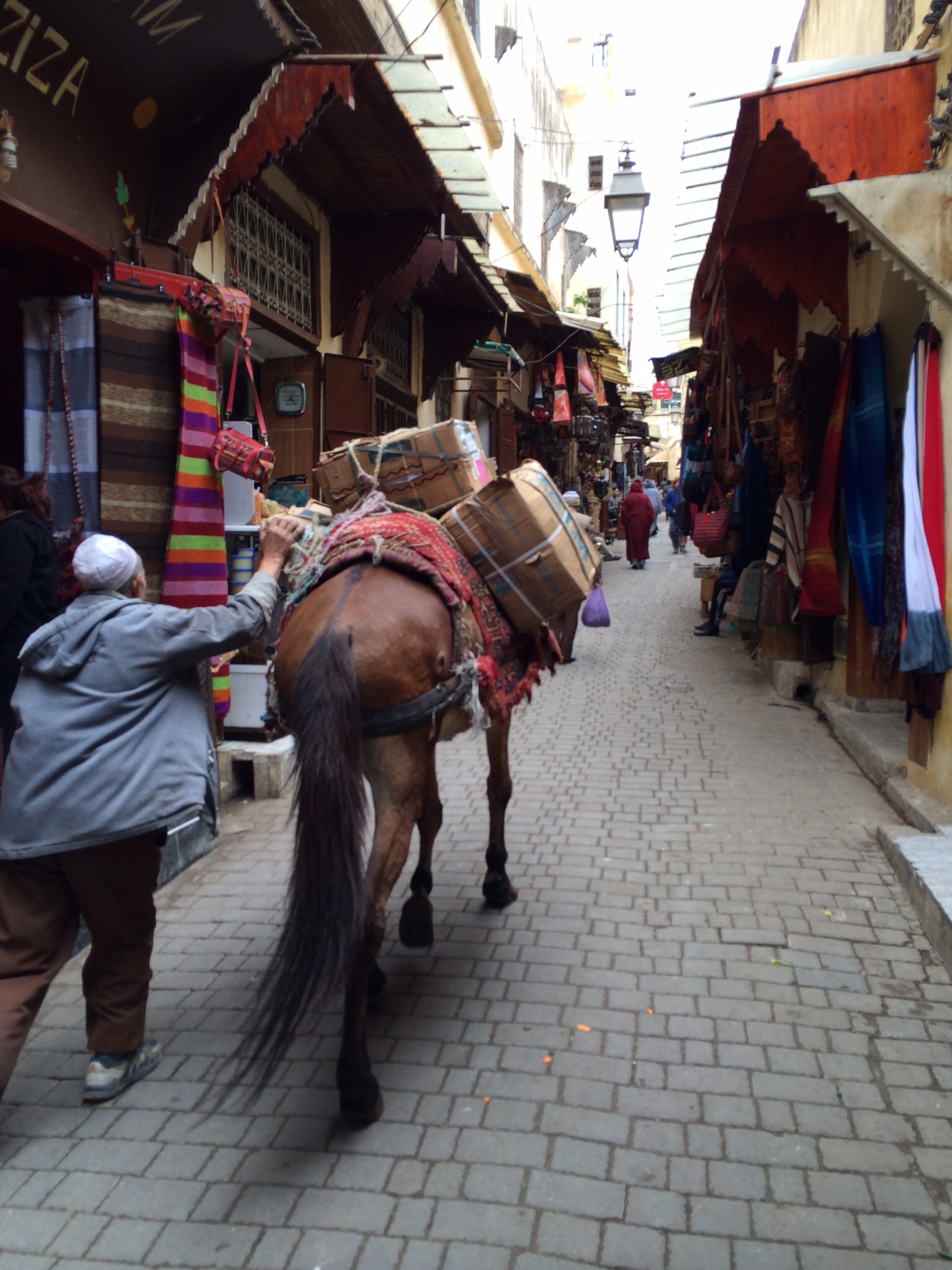
We’d arranged to be picked up by a driver from the riad, so that left us free to take in the sights, which evolved pretty dramatically along the way. Near the airport, the highway is wide and well-paved and lined with pleasant looking shops and familiar Mediterranean plants. I noted little trash or graffiti or ruination of the sort so common in Africa. We soon reached the walled inner city, and the wall looked to be in good shape too. Approaching the huge and famous central plaza, the Jemaa el Fna, the motorscooter traffic got crazier and crazier, and the ambient noise level cranked up. Larger motorized vehicles can’t travel in the innermost streets of the walled city, so we climbed out of the van and loaded our few bags into a hand-cart pulled by a half-toothless but friendly old guy. He led us through a Marrakech that felt 1000 years old (the approximate age of the city). It reminded us of Venice, but the passageways are filled with beautiful doorways that seem quintessentially Moorish.

Some are humble


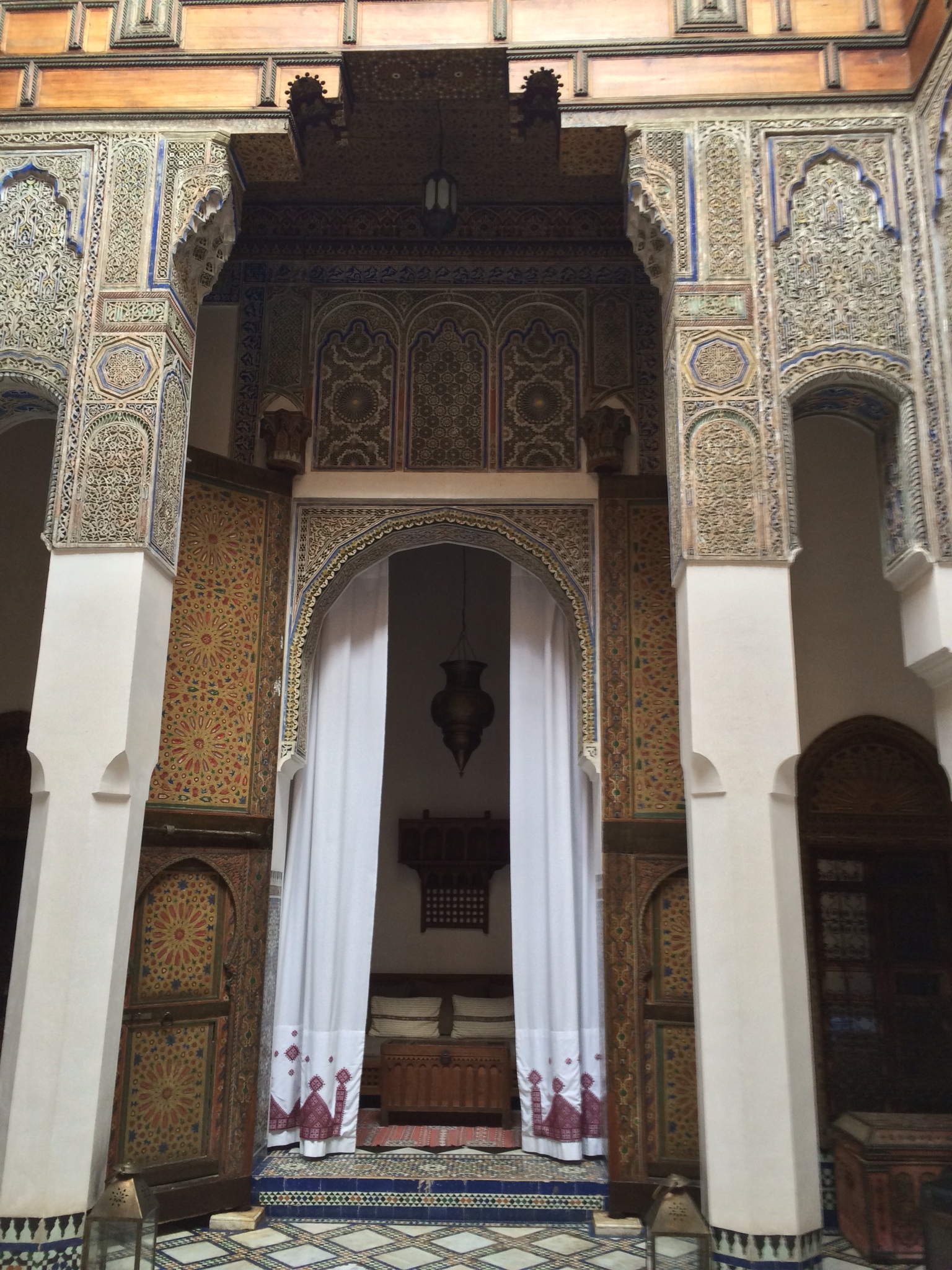
Some are grand...


We checked into the riad, which is great (one of the dozens upon dozens of old homes that Europeans (mostly) have bought and converted into guesthouses over the past 20 years.) We spent most of the rest of the day and evening exploring the center city on foot, except for the hour-long break I took in the mid-afternoon. That proved to be both interesting and restorative.
...with a bit of everything in between.

Hammams — Turkish-style baths — are a prominent feature of life in Marrakesh, and most guidebooks urge a visit. But being scrubbed and massaged by strangers holds little interest for Steve. Normally I’m not much of a spa patron either. But when I heard that our riad had its own little hammam offering spa services, the idea of a scrub and a rub for some reason called to me.

At 3 p.m. I showed up wearing only the flip-flops and thick white robe that had been deposited in our room. A sturdy woman wearing a long black tunic and a headband directed me to the room to the right. She pour a bucket of hot water over the plastic mat on the concrete table within it, then she had me take off the robe and lay down. For the next half hour or so, she poured cupfuls of warm water over me then went through an elaborate cleaning ritual that started with applying soft aromatic liquid soap and worked its way up to a vigorous whole-body scrub with an abrasive mitt and something she said was black soap. By the time she was done, she’d peeled off at least one (and maybe several) layers of my skin. She applied a facial mask too and she shampooed my hair and finished me off with more rinsing. I re-donned the robe, moved into the central sitting area for a cup of sweet mint tea then went on to be massaged by another young Moroccan women (deeply relaxing but much less weird.)

After our frenetic week in Paris, it felt great, and it reinvigorated me for venturing into the Jemaa el F’na at night. Marrakech’s central square is something else again — different from anything we’ve experienced anywhere. It deserves a separate post of its own.
My scrubber (left) and masseuse (right)