Yesterday we set our alarms for 4:15 a.m. The wheels of our Airbus lifted off the runway shortly after 6, and the Moroccan immigration official stamped our passports about 4 hours later. Because Morocco is one hour earlier than France, we were installed in our guesthouse (aka riad) in the old city (aka medina) by not much after 10 a.m. — not much later than we had originally expected to be here.
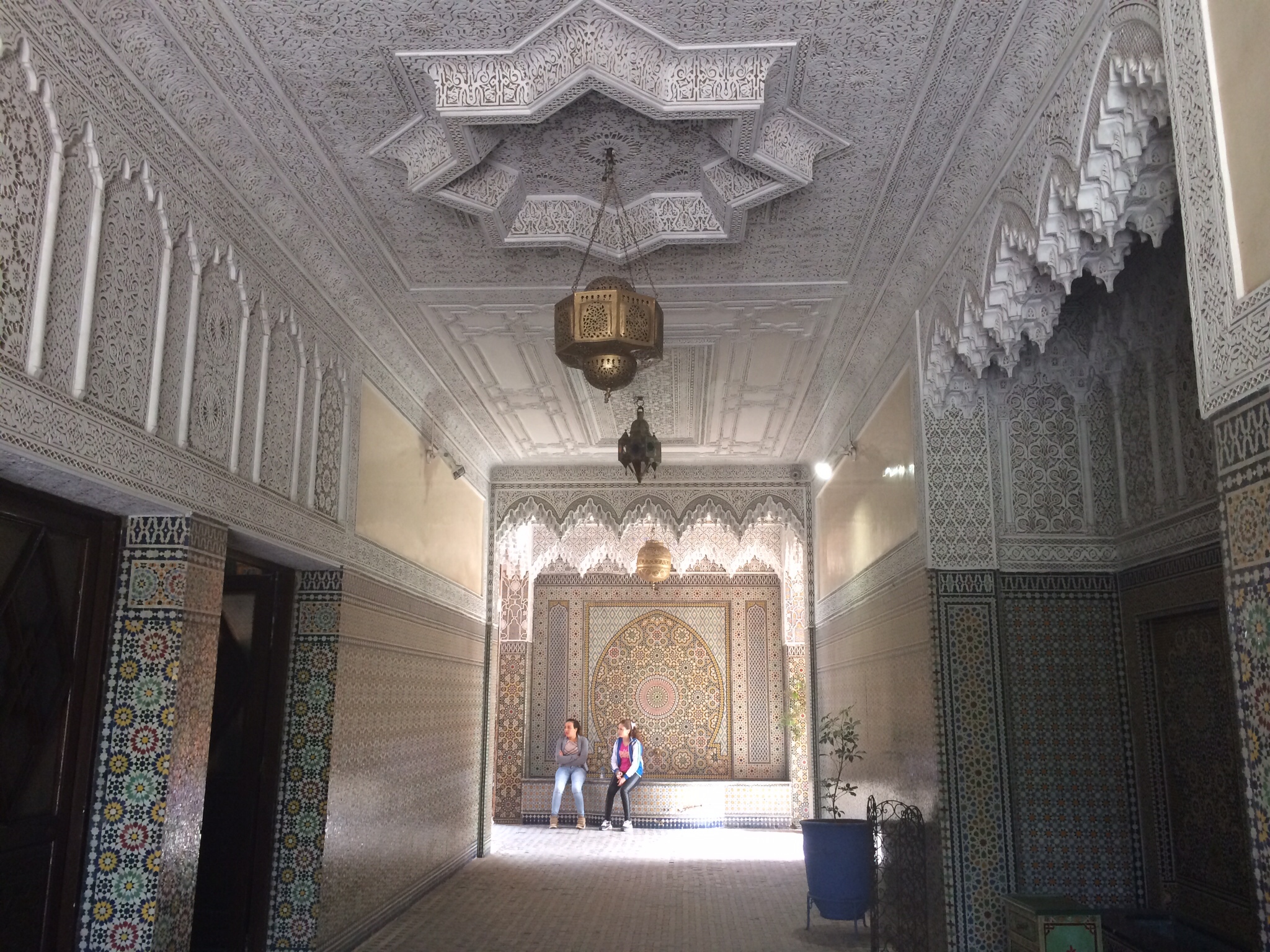
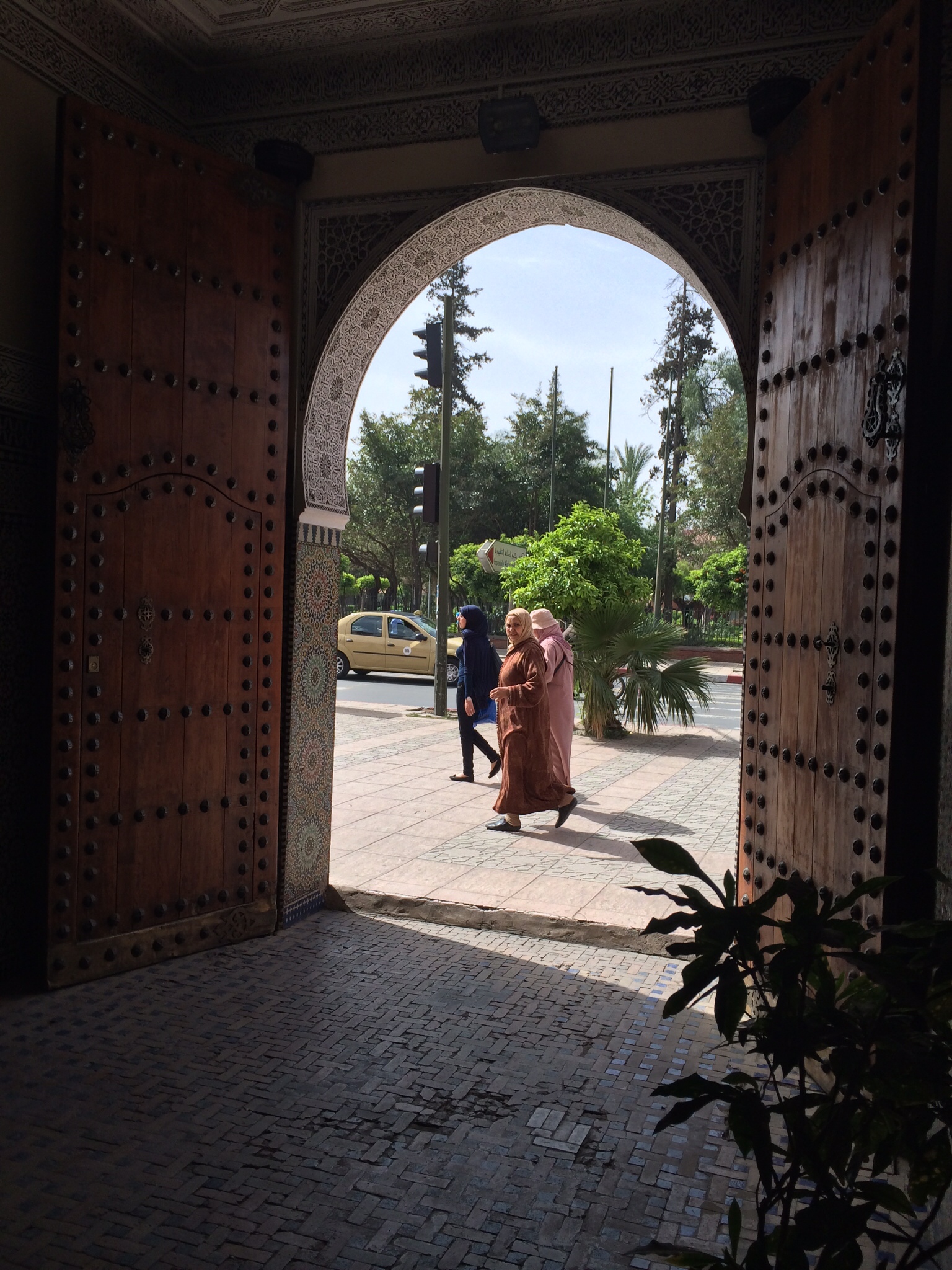
We’d arranged to be picked up by a driver from the riad, so that left us free to take in the sights, which evolved pretty dramatically along the way. Near the airport, the highway is wide and well-paved and lined with pleasant looking shops and familiar Mediterranean plants. I noted little trash or graffiti or ruination of the sort so common in Africa. We soon reached the walled inner city, and the wall looked to be in good shape too. Approaching the huge and famous central plaza, the Jemaa el Fna, the motorscooter traffic got crazier and crazier, and the ambient noise level cranked up. Larger motorized vehicles can’t travel in the innermost streets of the walled city, so we climbed out of the van and loaded our few bags into a hand-cart pulled by a half-toothless but friendly old guy. He led us through a Marrakech that felt 1000 years old (the approximate age of the city). It reminded us of Venice, but the passageways are filled with beautiful doorways that seem quintessentially Moorish.
Some are humble
Some are grand...
We checked into the riad, which is great (one of the dozens upon dozens of old homes that Europeans (mostly) have bought and converted into guesthouses over the past 20 years.) We spent most of the rest of the day and evening exploring the center city on foot, except for the hour-long break I took in the mid-afternoon. That proved to be both interesting and restorative....with a bit of everything in between.
Hammams — Turkish-style baths — are a prominent feature of life in Marrakesh, and most guidebooks urge a visit. But being scrubbed and massaged by strangers holds little interest for Steve. Normally I’m not much of a spa patron either. But when I heard that our riad had its own little hammam offering spa services, the idea of a scrub and a rub for some reason called to me.
At 3 p.m. I showed up wearing only the flip-flops and thick white robe that had been deposited in our room. A sturdy woman wearing a long black tunic and a headband directed me to the room to the right. She pour a bucket of hot water over the plastic mat on the concrete table within it, then she had me take off the robe and lay down. For the next half hour or so, she poured cupfuls of warm water over me then went through an elaborate cleaning ritual that started with applying soft aromatic liquid soap and worked its way up to a vigorous whole-body scrub with an abrasive mitt and something she said was black soap. By the time she was done, she’d peeled off at least one (and maybe several) layers of my skin. She applied a facial mask too and she shampooed my hair and finished me off with more rinsing. I re-donned the robe, moved into the central sitting area for a cup of sweet mint tea then went on to be massaged by another young Moroccan women (deeply relaxing but much less weird.)
After our frenetic week in Paris, it felt great, and it reinvigorated me for venturing into the Jemaa el F’na at night. Marrakech’s central square is something else again — different from anything we’ve experienced anywhere. It deserves a separate post of its own.My scrubber (left) and masseuse (right)
At the end of my last post, I noted that our flight for Marrakech was at 6:10. What I did not know then was that it was at 6:10 a.m., and when I typed those words it had already left. So Steve and I strolled, care-free, from Olivia’s apartment to the Grande Jatte, the island in the Seine painted most famously by pointillist George Seurat. Later, we sipped our cafe cremes in a leisurely manner, and still later we walked with Olivia in the Bois de Boulogne. We were feeling almost cocky when we got on the airport bus with what we thought was plenty of time and arrived at what we thought was 2.5 hours early. We even had another coffee in the airport before checking the Departures board and feeling our stomachs drop.
Instantly, it was clear there were no 6:10 PM flights to Marrakech. Rather, the next flight would be at 6 Monday morning. I’m to blame for this error. The only way I can explain it is that when I made the reservations alll those months ago and saw EasyJet’s one flight per day to Marrakech, it never crossed my mind that the 6:10 could refer to that cold dark hour before dawn, rather than the cilivized end-of-the afternoon alternative.
Such is the price of living in a country that uses a 12-hour clock rather than the 24-hour one so common elsewhere. Given the magnitude of this mistake (MISSING the flight! By 9 hours?!!?), what happened next was not all that bad. We were able to secure 2 of the remaining 7 seats for the flight early tomorrow, and EasyJet only charged us the difference between the price we’d paid before and the last-minute tab. We were able to Skype our hotel in Marrakech and reschedule our pickup from the airport. We took the free airport bus the two stops to the hotel center, and we got a room at the Ibis Hotel for 97 euros. It’s clean and well-designed. The pizza and French beer in its restaurant was pretty good.
It may not be the most romantic place to spend our 40th anniversary. But things could be a lot worse.
I was trying to scowl but that made me want to laugh.
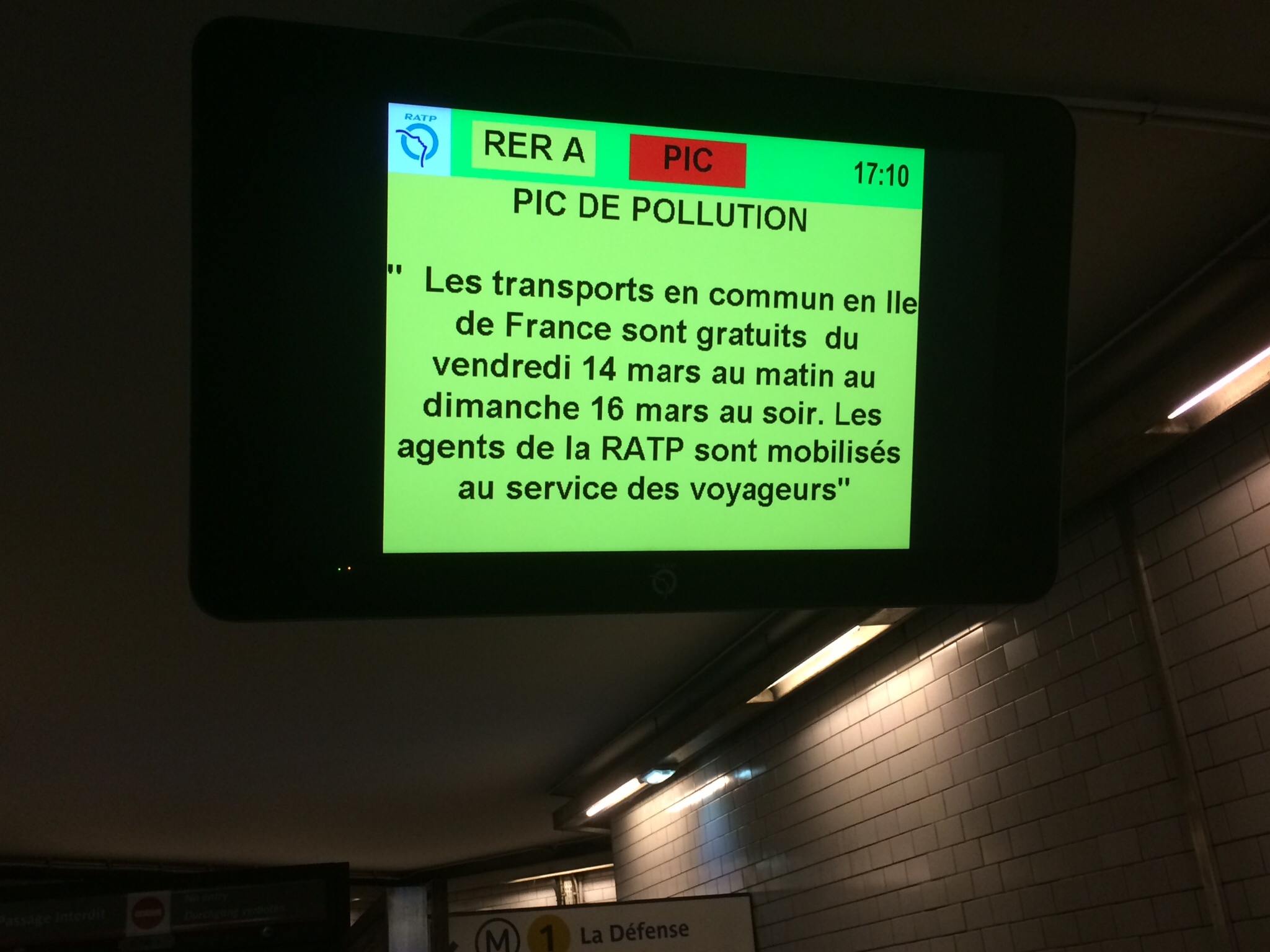
Three full days have passed, so jam-packed that there’s been no time to write. Now it’s early Sunday morning, sunny and clear. I caught a New York Times story yesterday about the fact that all the recent warm weather has generated unusual levels of smog. We noticed it vaguely, but it’s seems like nothing, compared to LA on a bad day. And in the plus column, the city fathers have made it free to ride on all the buses and metros in the city these past few days, in an effort to encourage people to abandon their automobiles. It’s certainly worked for Steve and me!
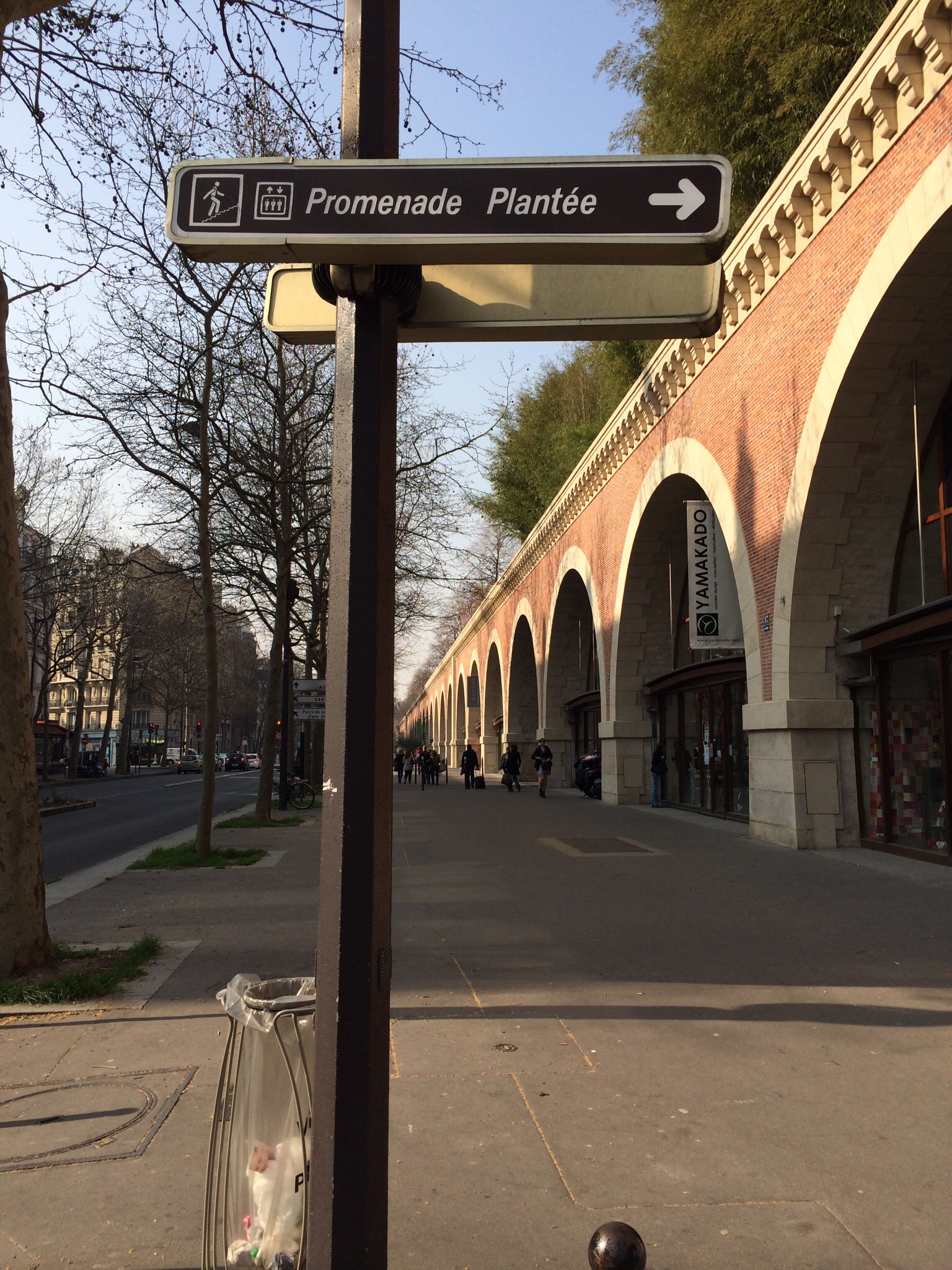
The Viaduc des Art with the Promenade Plantee above
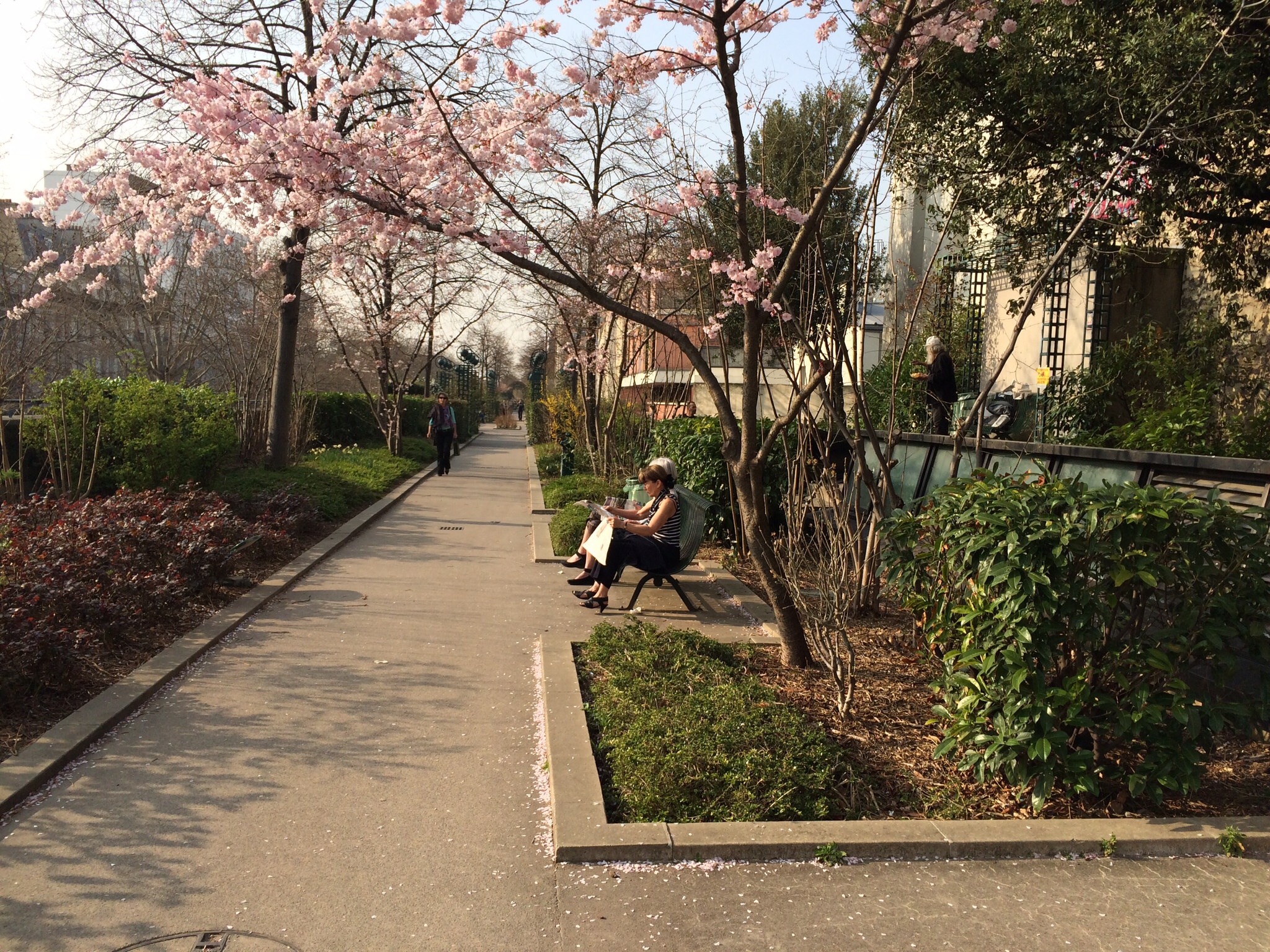
A beautiful section of the Promenade
On foot and transported gratis by the good taxpayers of Paris, we’ve experienced all manner of things we’d never seen or done before. Two photography shows (one on Brassai and a mind-boggling salute to Henri Cartier-Bresson at the Pompidou center) and a collection of 100 impressionist paintings that are normally in private collections but currently have been gathered here at the Musee Marmottan. That’s in the same neighborhood where we had our very first home-exchange house 34 years ago. As I cringed, Olivia tapped on the windows and got the gracious young resident (who was in the midst of preparing a dinner party for friends) to actually let us come in and gawk at how she and her husband have remodeled the place. Well done!
We also: checked out Paris’s Chinatown area, explored the artisans’ shops in the Viaduc des Arts (and then walked back on the Promenade Plantee — the one-time railroad tracks that were the first elevated park project in the world and since have inspired others elsewhere), and participated in a party (for 50 or so?) at Olivia’s Friday night that pretty much blew our minds (certainly the dancing that started around 11 and went to 2:30 in the morning.)
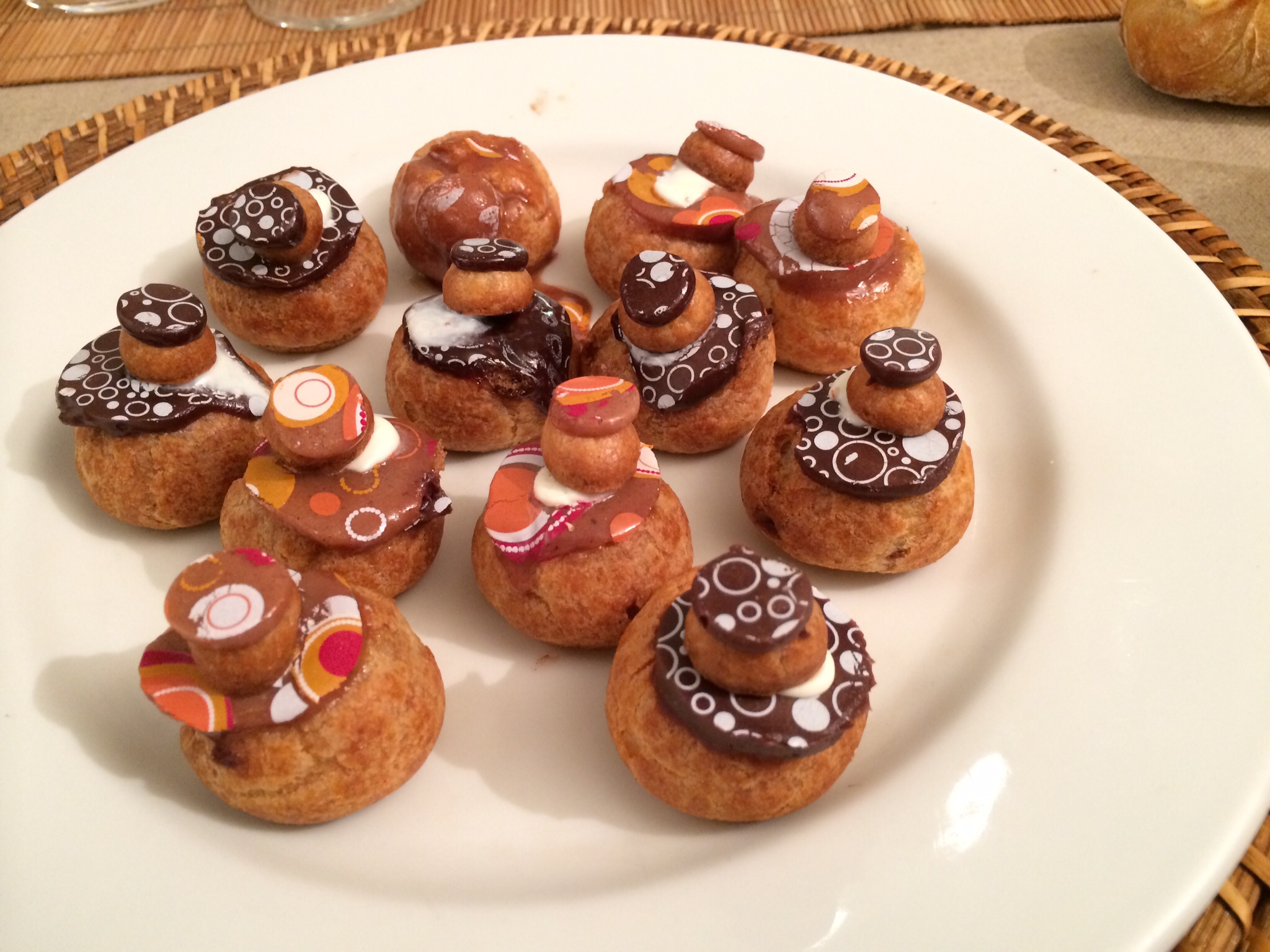
One of the desserts we've consumed chez Olivia. How cute (and delicious!) is that?
We depart for Marrakesh at 6:10 this evening. Once again, it’s going to be tough to say goodbye to this place.
What do you do when you arrive in Paris at 5:45 a.m. (11:45 p.m. SD time)? On the plane from NYC, Steve and I figured out that this is the 10th time we’ve been here together. So we’ve had some practice with those ghastly arrival times. It helped.
Olivia’s gracious guIdance also helped. After our arrival at her flat in Neuilly, she let us nap (from 9:30 to 11:30).
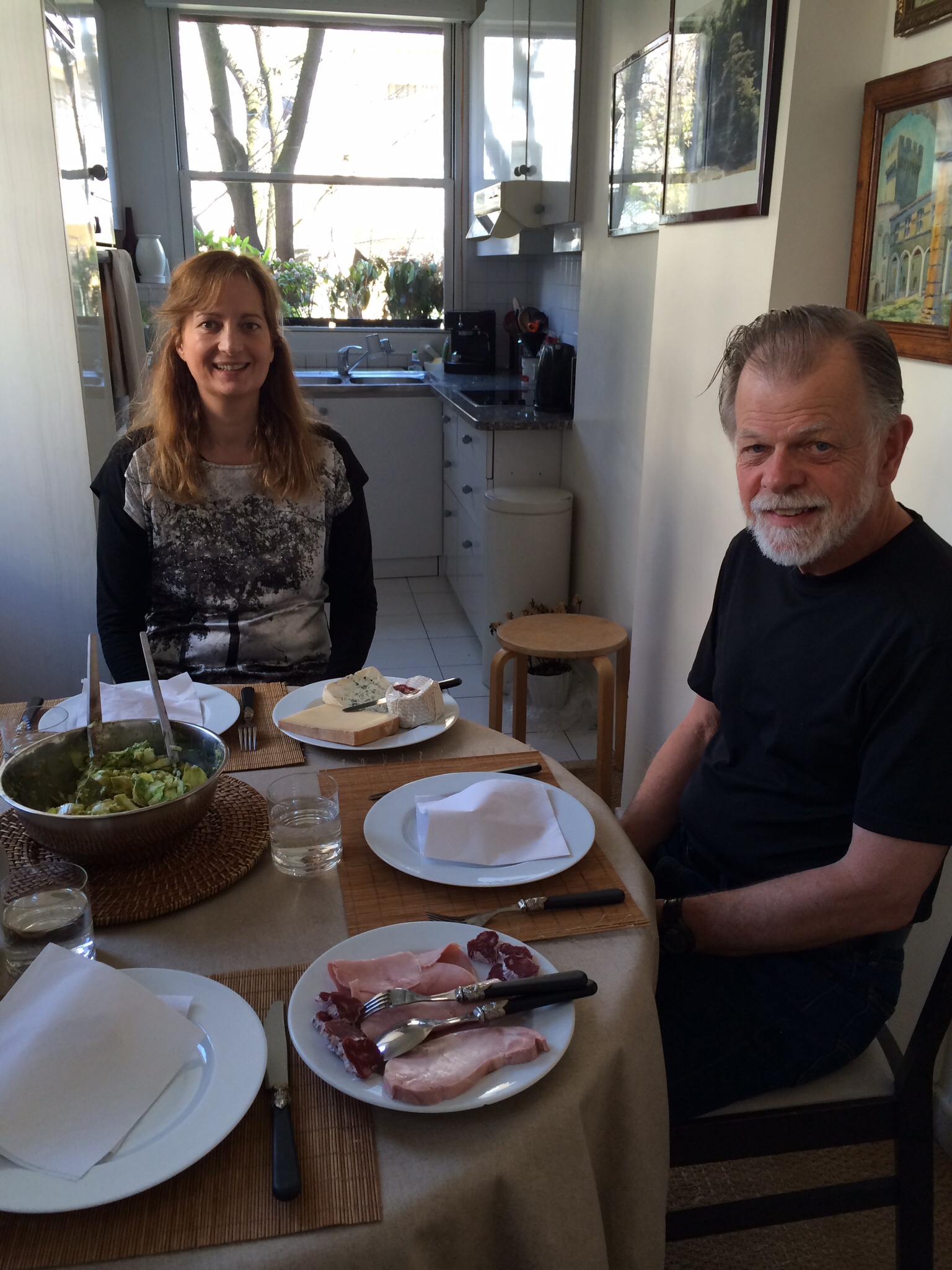
Then she served us a lovely lunch.
Then we walked around four five hours in glorious weather.
We were only faking sitting in the sun, but hordes of Parisians were basking in earnest.
Olivia fed us again after we got home. Now miraculously it’s 9:40. We’re nearly comatose, but with luck we won’t be jet lagged in Paris tomorrow..
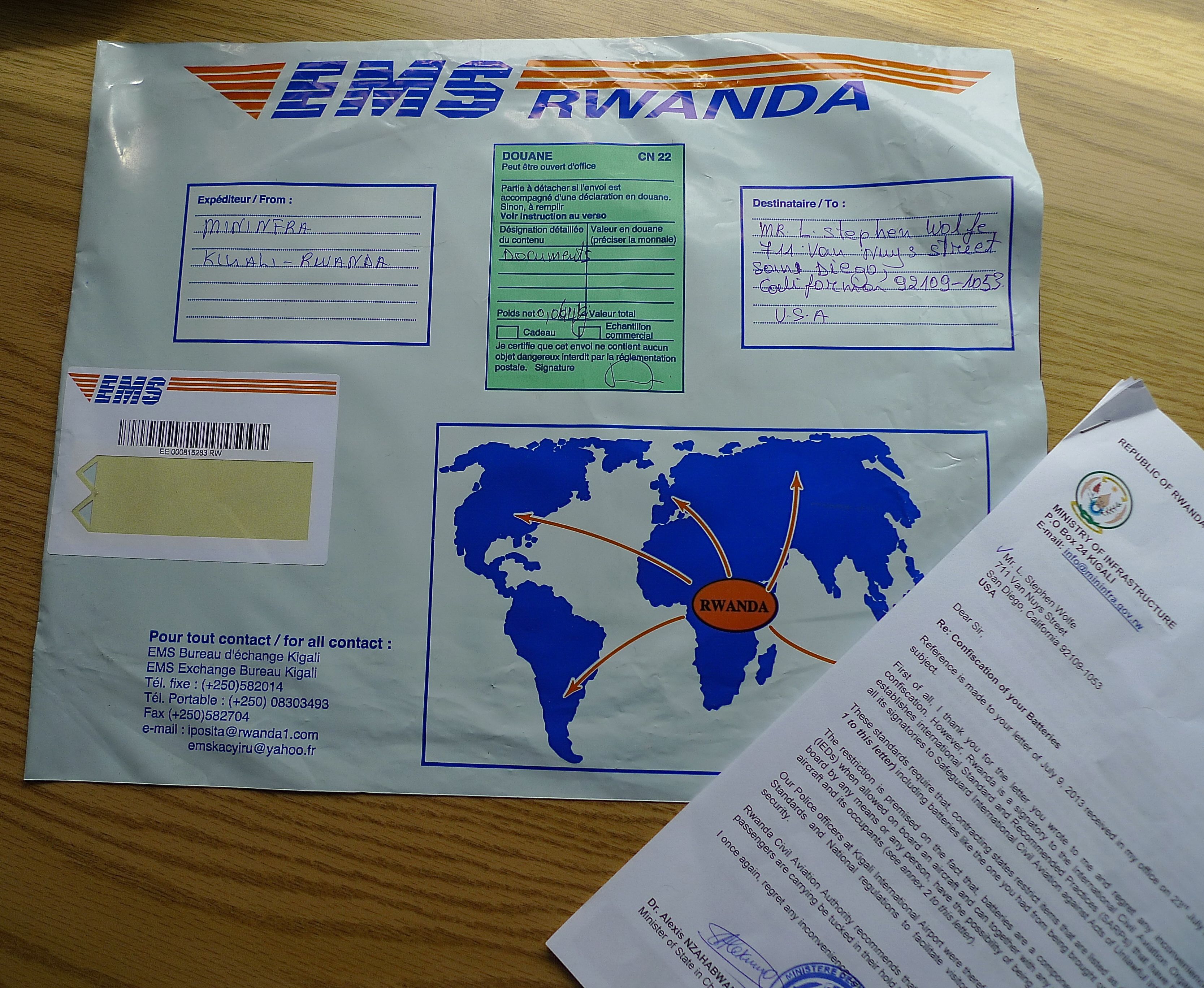
With our trip to East Africa fast receding behind us, I didn’t think there’d be anything more to write about it. Then the following showed up at our door the other day — an envelope from Rwanda! Sent in a very official plastic envelope, emblazoned “Securite assuree (Safe and secure).”
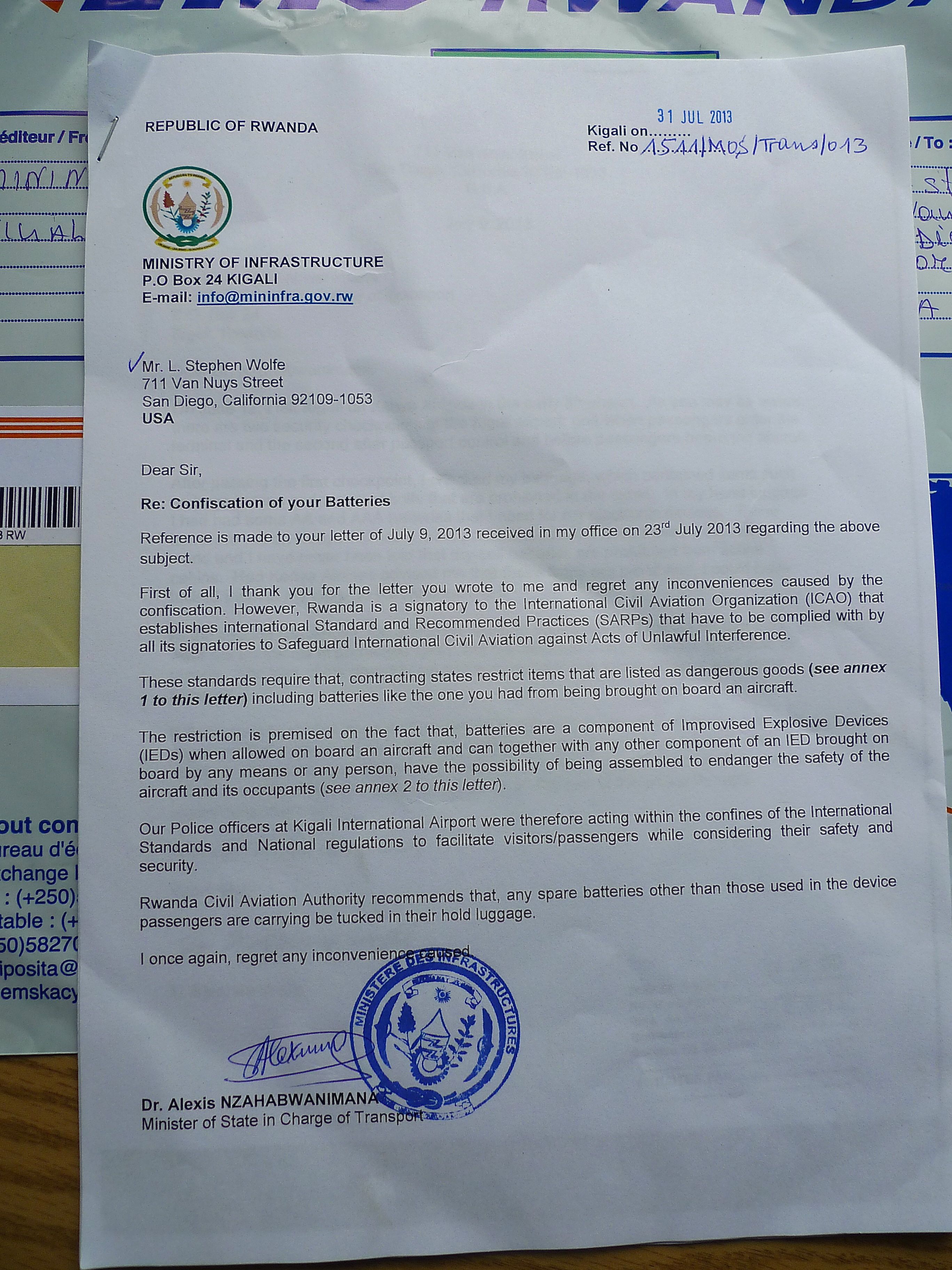
Inside Steve found an even more official looking letter from Dr. Alexis Nzahabwanimana, the “Minister of State in Charge of Transport,” who was responding to the letter Steve had written him.
Steve had been complaining about an incident that I didn’t report on in this blog. It occurred June 12, when we flew from Kigali (the capital of Rwanda) to Tanzania on Kenya Airlines. Here’s how Steve described what happened:
“After passing the first checkpoint, I checked my baggage, which contained items such as large bottles and a pocket knife that are prohibited in the cabin. In my hand luggage, I had some AA and AAA batteries that I need for my electronic devices. These items are not on Kenya Airlines’s list of prohibited items. I have traveled all over the world and I have never been told that dry-cell batteries are prohibited from airline cabins. Had Kenya Airlines advised me that these items are prohibited, I could have tucked them in my luggage before checking it.
“At the second checkpoint, the police confiscated my batteries. I explained that they were not on the list of prohibited items, but the officer in charge was not amenable to reason. The loss of my property caused me considerable inconvenience and some expense.
Steve wrapped up with a lecture: “If Rwanda is to realize its goal of becoming a high tech center of East Africa, it is important that visitors not have their property confiscated illegally, especially when it relates to their electronic equipment. I am bringing this matter to your attention because I hope you will correct this improper behavior on the part of the police through appropriate channels.”
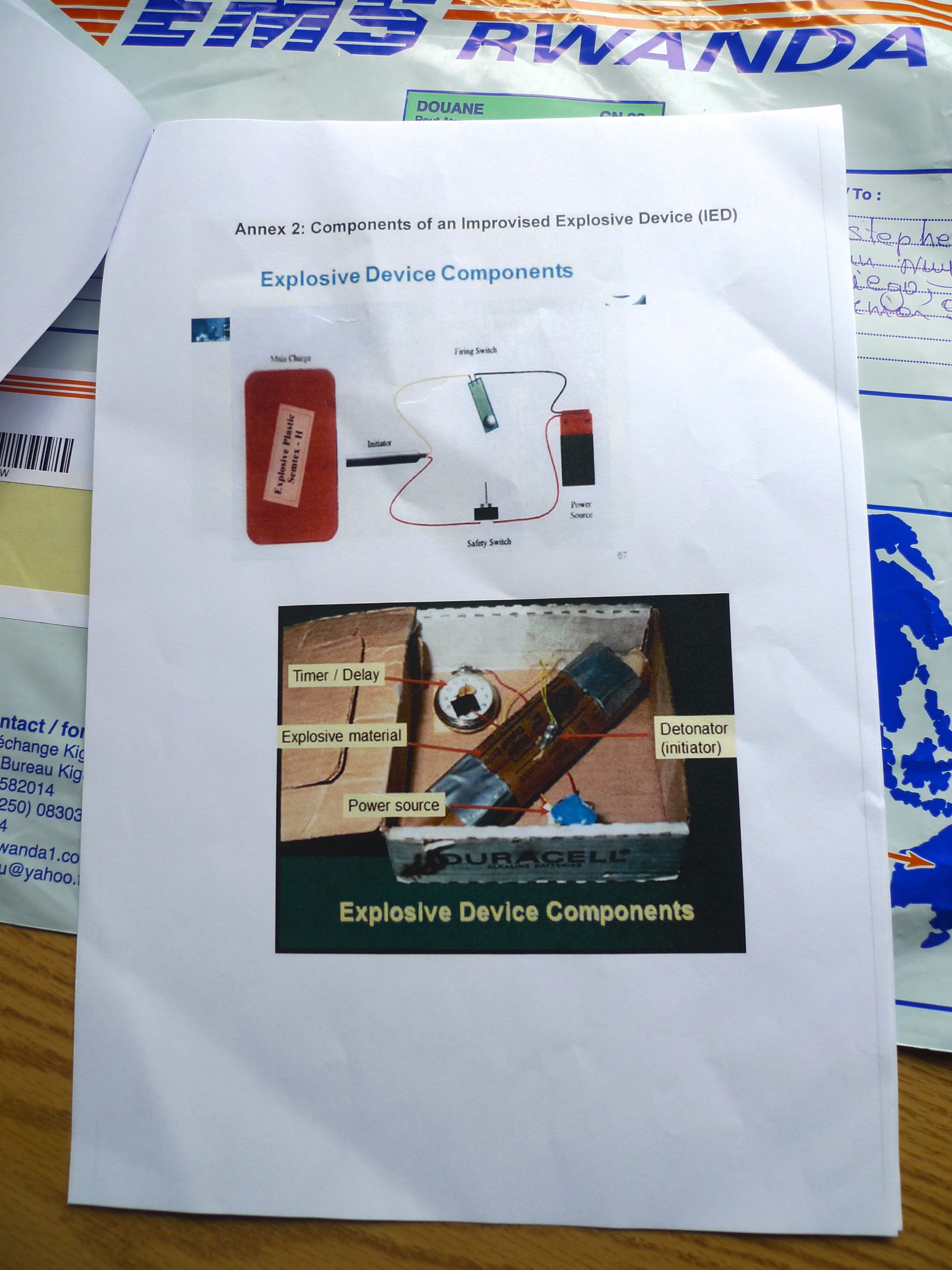
Dr. Nzahabwanimana begged to disagree. Batteries are a component of improvised explosive devices, he pointed out, helpfully including for our edification a diagram of how to build one.
As “a signatory to the International Civil Aviation Organization (ICAO) that establishes international Standard and Recommended Practices (SARPs) that have to be complied with by all its signatories to Safeguard International Civil Aviation against Acts of Unlawful Interference,” Rwanda had a duty to keep such potentially dangerous goods out of airline cabins. Hence, the police “were therefore acting within the confines of the International Standards and National regulations…”
Dr. Nzahabwanimana also included a “Dangerous Goods List” that included “Batteries, dry, containing potassium hydroxide solid, electric storage” on it. Steve jumped right on that, determining it to be part of an obscure UN document. He also researched the US Transportation Safety Administration (TSA) guidelines. We all know how lax they are — but they make it clear dry batteries for personal appliances can be transported in cabins.
Steve was threatening to write back and argue with the Africans some more. For my part, I’ve been urging him to spend the time instead earning some money that we might use for further travel to electrifying destinations.
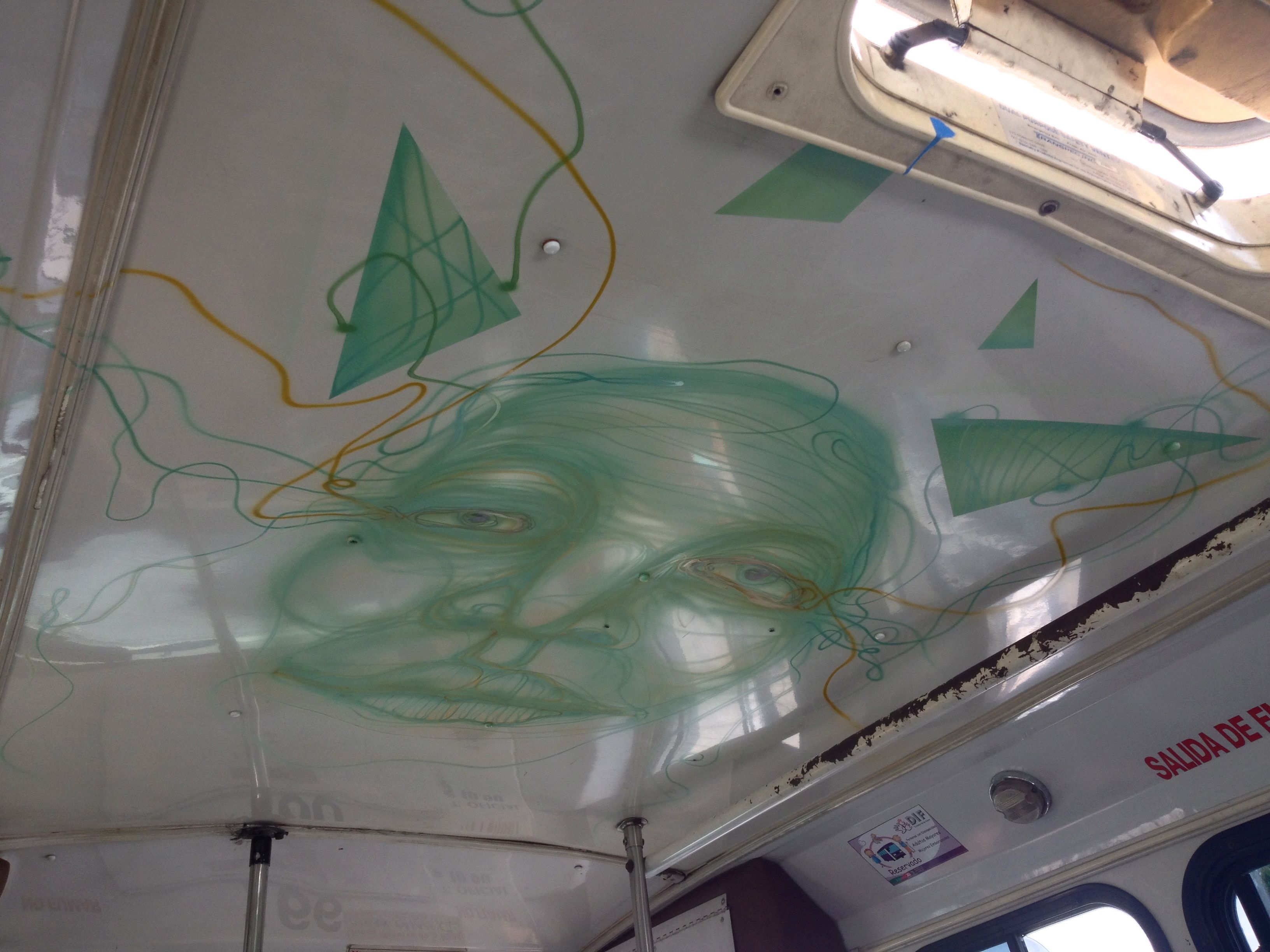
The sold-out event pulled together 35 tourists, transported in two buses. We were in the smaller one, which was adorned with art of its own.
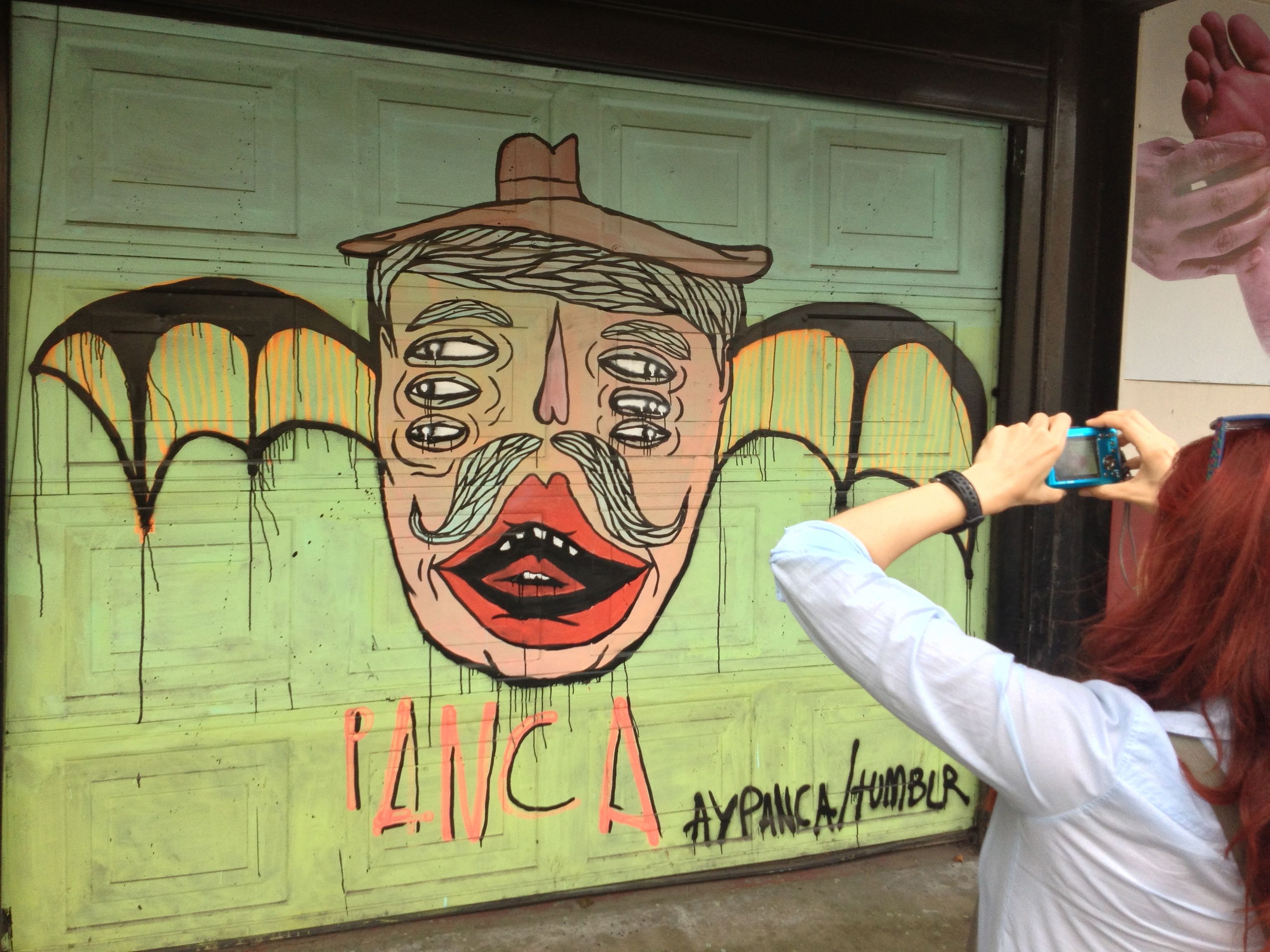
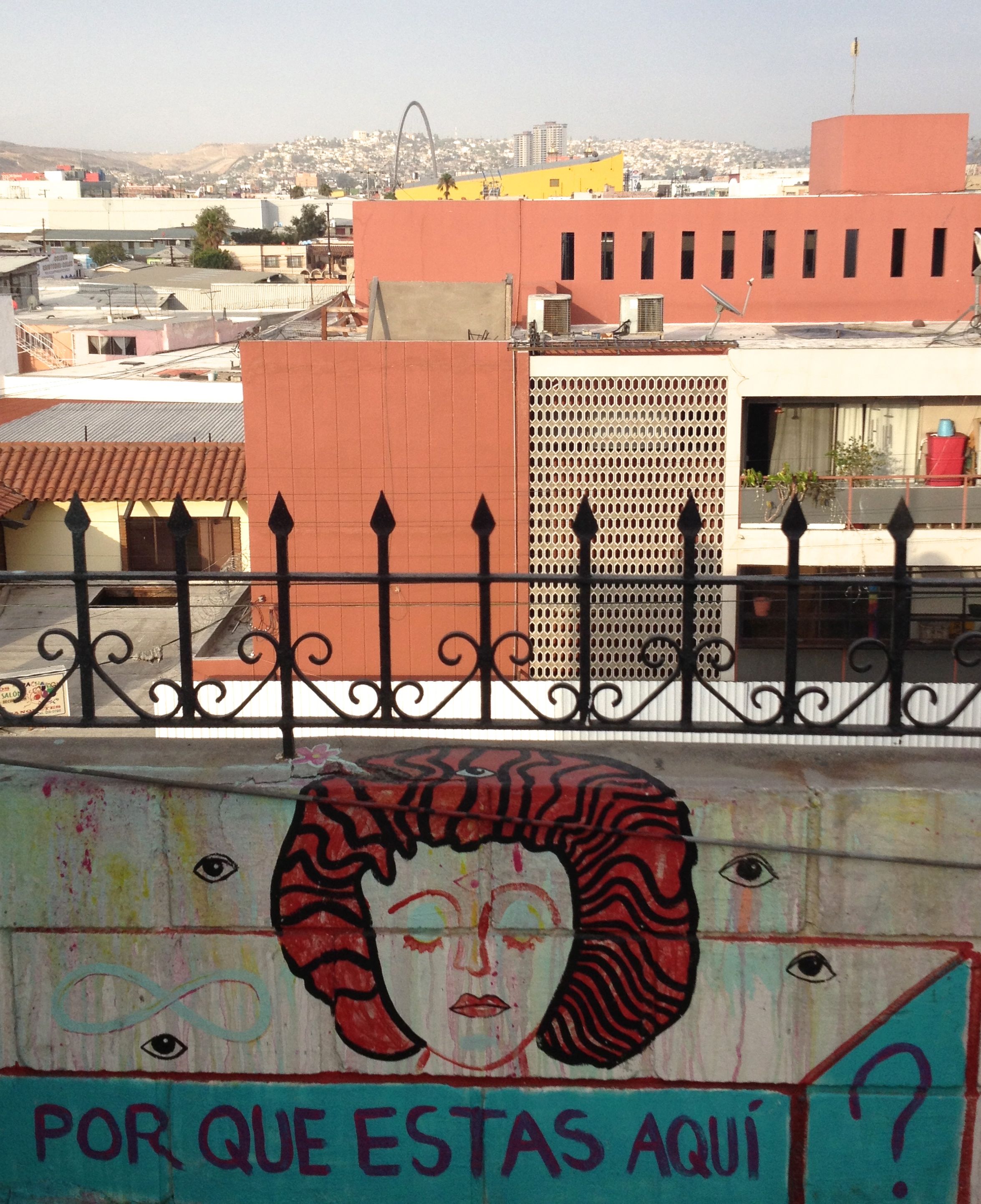
Last Saturday, Steve and I participated in another of Derrik Chinn’s Turista Libre tours — this one focusing on Tijuana’s street art. In some ways it was very different from the wacky Lucha Libre tour we took last summer. But there were also similarities. Derrik’s outings are as far from the canned Standard City Tour as one can imagine. They feel almost impromptu — a little chaotic, a lot genuine. They don’t always follow the script. Saturday’s event had been billed as winding up around 6 p.m., while in fact we didn’t actually get back to the border till 8. We never did reach Anulacion, a downtown building that supposedly has been tranformed into “a monumental work of minimalist sculpture.” Still, we covered an awful lot of ground.
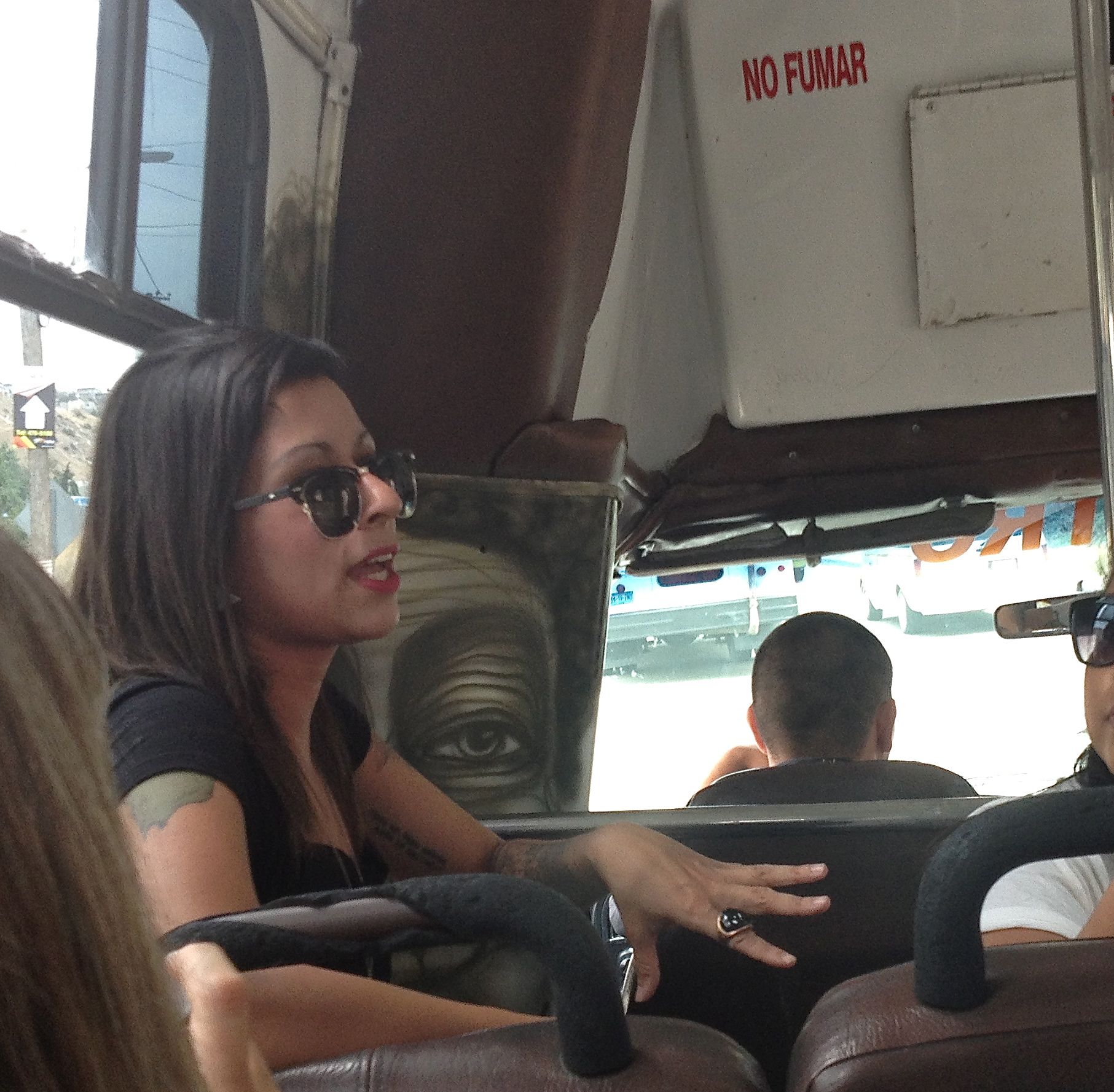
Panca, expounding on the bus
Sharing the guiding duties with Derrik for the day were the artists Paola Villasenor (aka Panca) and Once Cero Dos, a sweetly earnest young man who explained that his nom d’aerosol can was inspired by his passion for the Mexican Day of the Dead (which takes place on 11/02 — once cero dos in Spanish). We saw a number of the duo’s works — in a makeshift temporary gallery thrown up a partially completed house designed by rising architectural star Jorge Gracia, in an inner courtyard of the diviest of TJ dive bars, in Panca’s Zona Norte penthouse, and — of course — on the street.
Panca, who spent the most time on our bus, could have an alternate career as a stand-up comic. Her riffs were a highlight, as was our quick stop for tacos at Los Paisas (off Boulevard Aguascalientes and recently hailed by Anthony Bourdain). Most of all, I appreciated the chance to see things I’d have a hard time finding on my own.
Some of the images from our adventure:
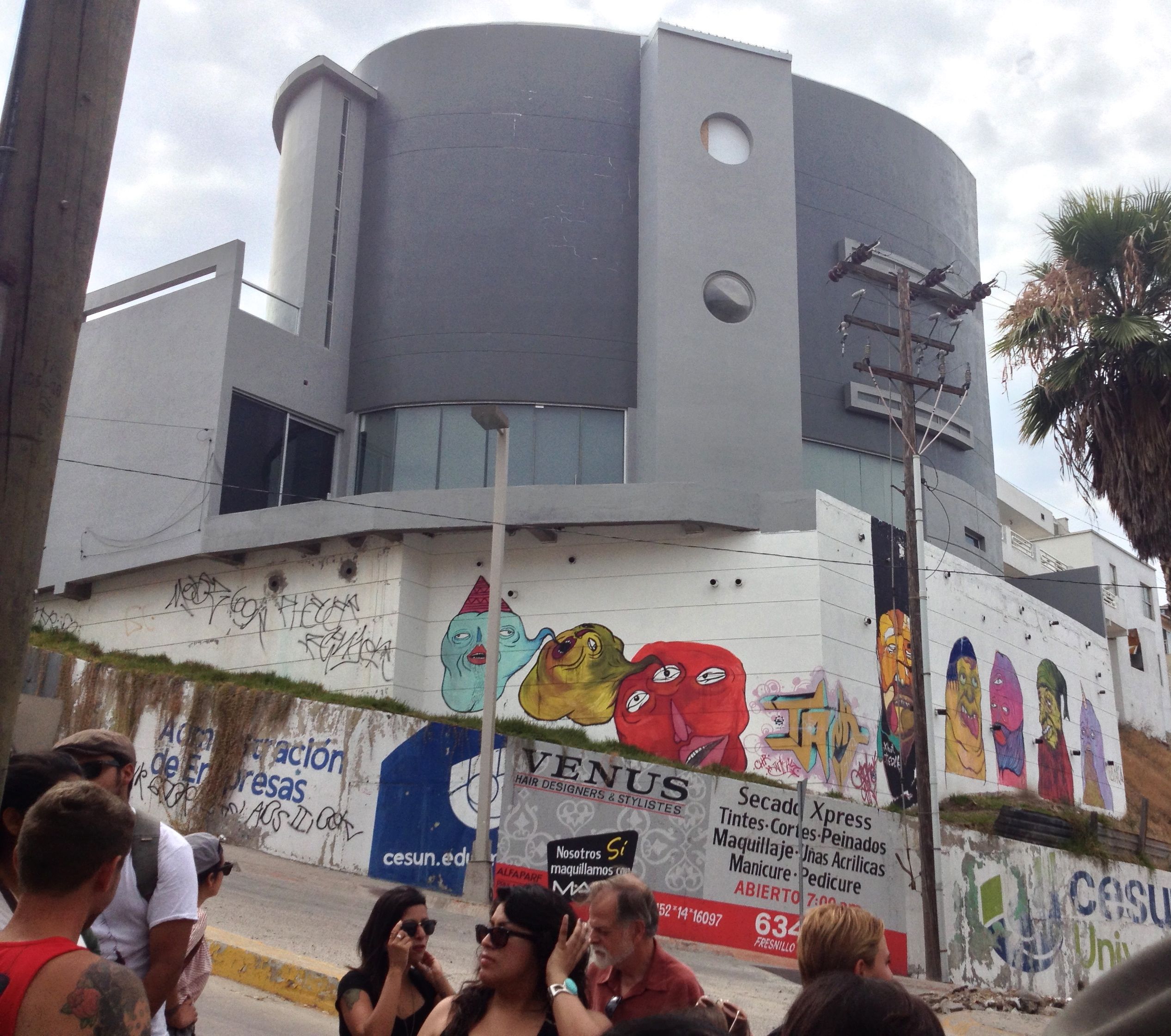
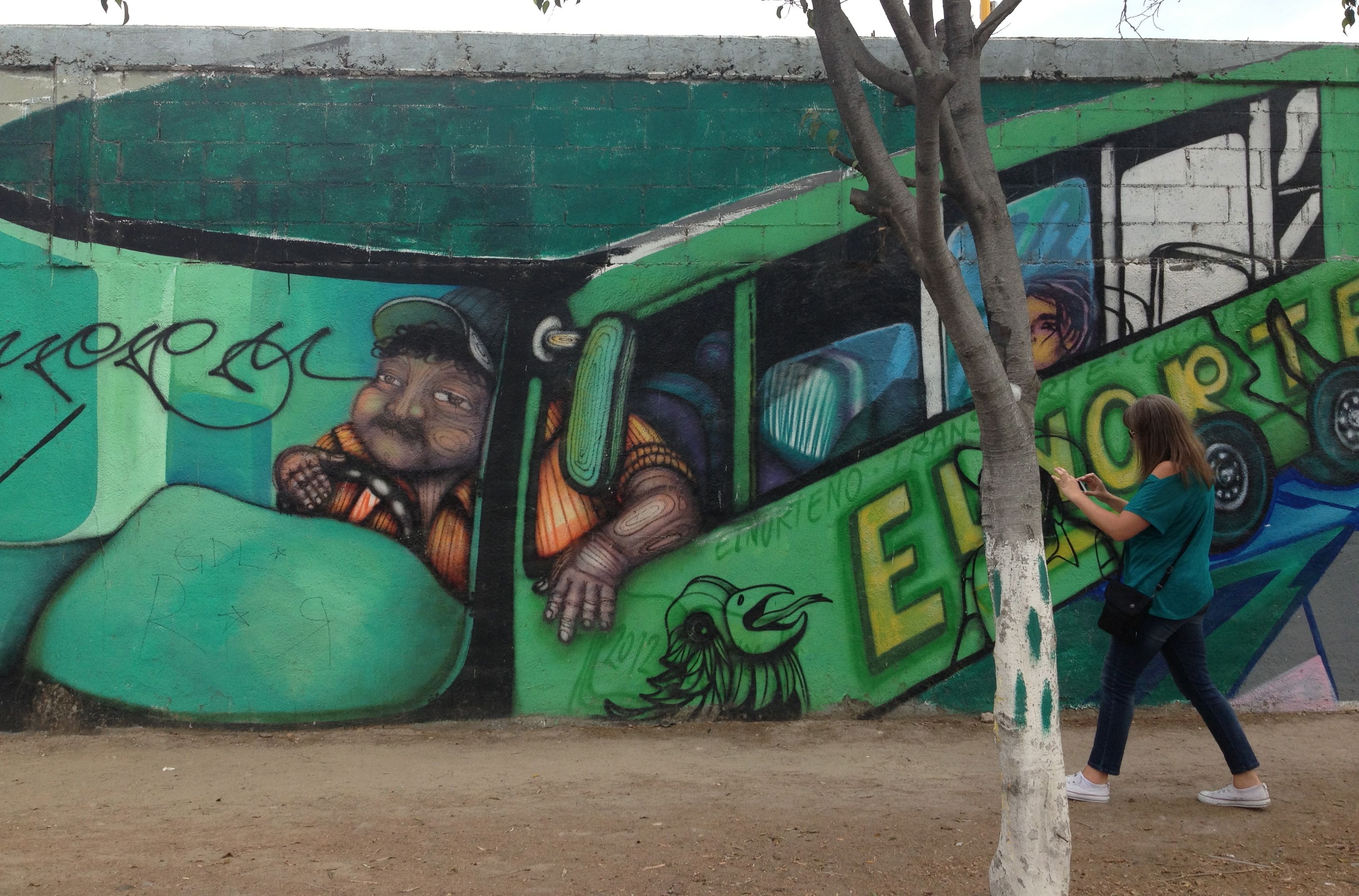
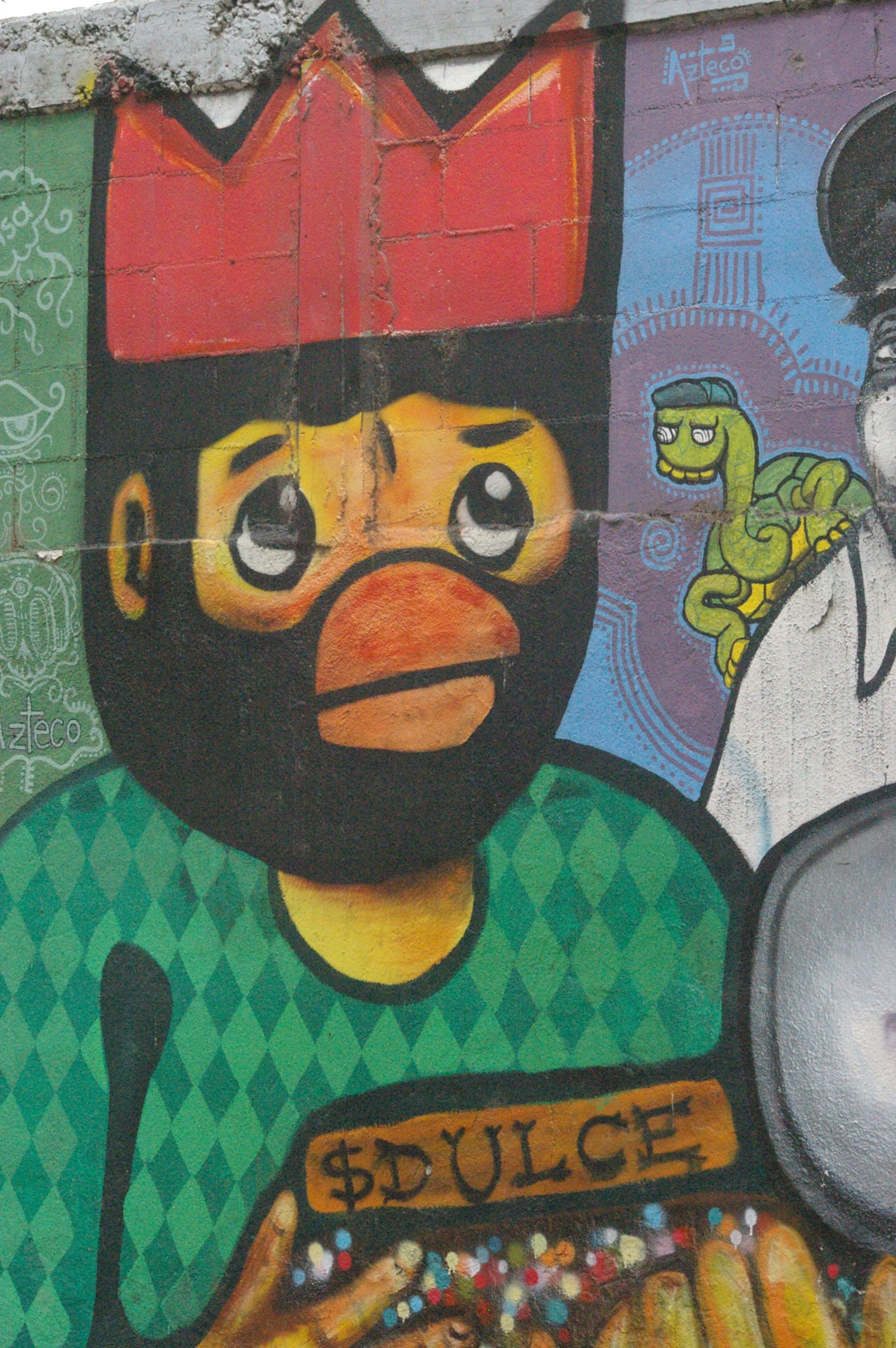
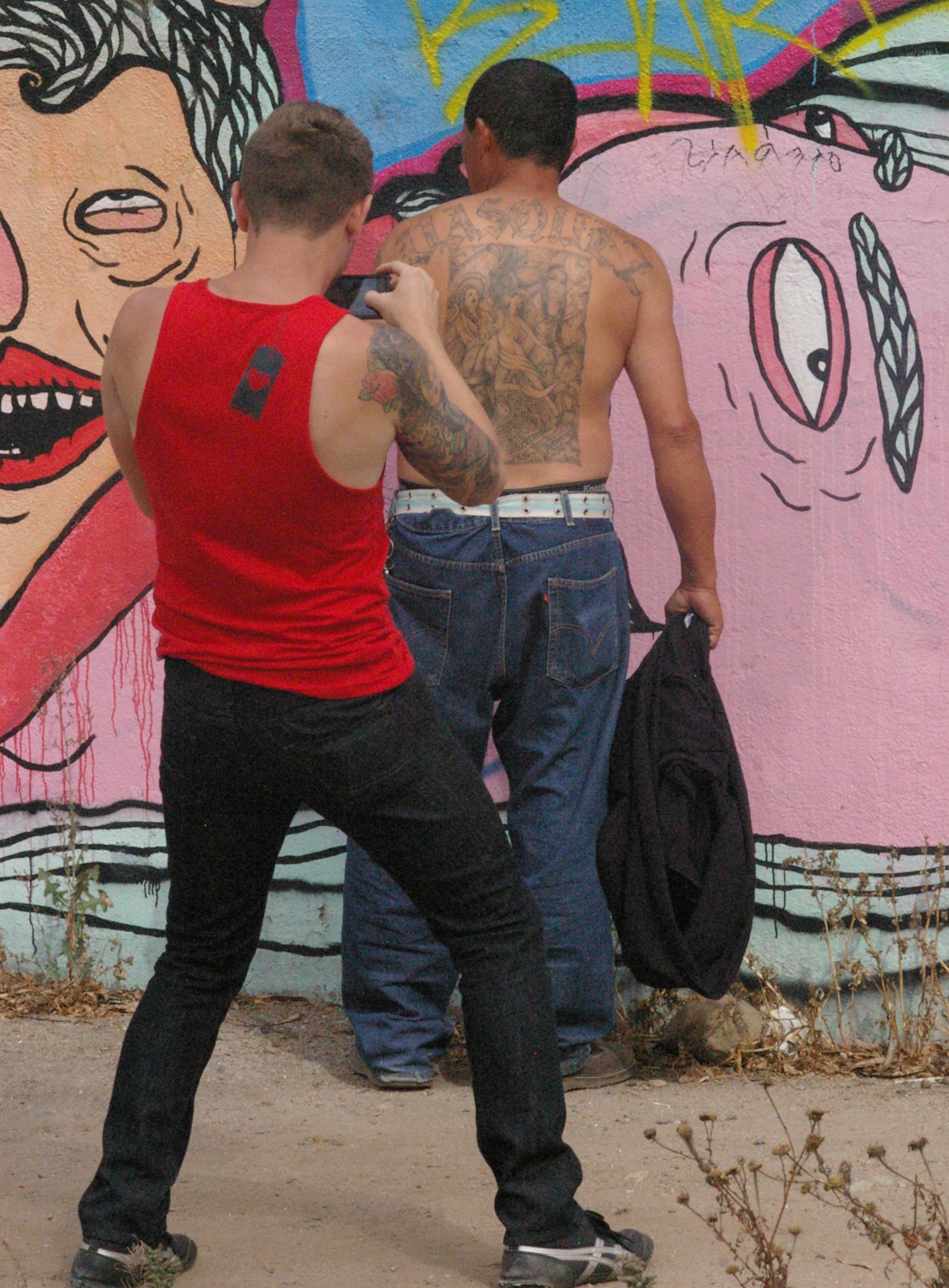
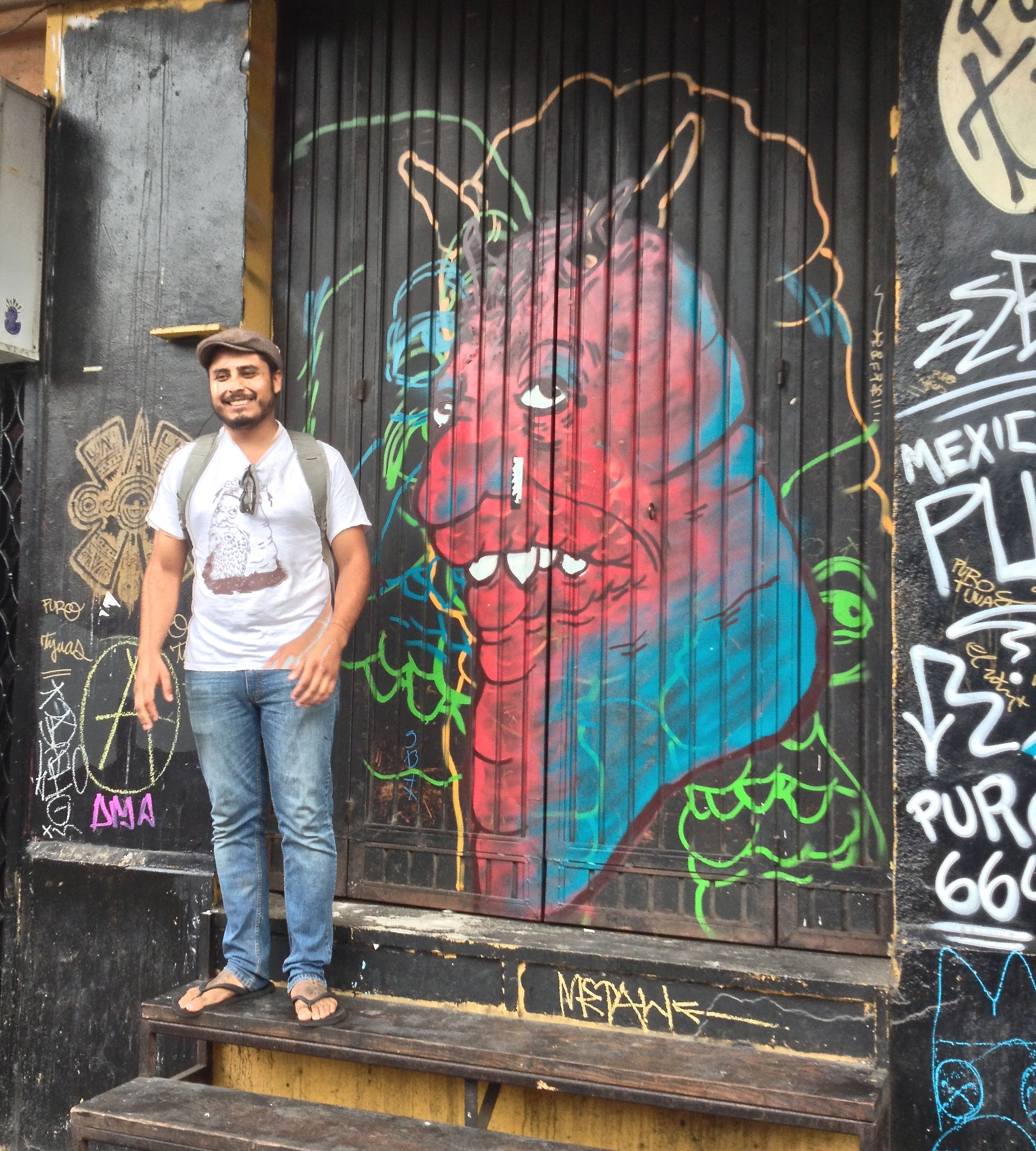
Both Panca and Once Cero Dos painted murals on the wall of this contemporary mansion, on the road to the Tijuana playas. The owner commissioned them to do the work (for free). More often, the street artists appropriate their canvases without getting formal permission.A mural by the artist known as El Norte, one of many painted on a very long fence near Tijuana’s long-distance bus terminal.Another mural from that same fence.Here tour leader Derrik Chinn captures another form of street art — on the back of a passerby near that wall near the bus terminal.A major work by Once Cero Dos. He got permission from this owner to paint it. The graffiti reflects tensions between Tijuana’s resident tagger community and the street artists. Once Cero Dos told us the tags don’t make him angry. “That’s just the way it is on the street.”Another work by Panca, on a building just off Revolucion.Once, posing next to one of his pieces, executed on a door in downtown Tijuana.La Pueblita is an amazingly derelict storefront on Revolucion — with an amazingly lively scene in its inner courtyard. When our group of 35 gringo tourists trooped in, the young Tijuanenses looked stunned but remained affable.Yet another work by Panca.The view from the rooftop deck of Panca’s penthouse apartment. With a bit of artistic philosophy to temper the view.
I’m writing this from back home in San Diego, where I’m feeling guilty that I still haven’t written about what Steve and I agree was the most remarkable experience of this most amazing trip: our visit to the village of Nyaka in western Uganda.
It wasn’t originally on our itinerary. But back in early February, I happened to be at a social gathering with Leigh Fenly, an old friend who also was the co-founder of Women’s Empowerment (WE). Based in San Diego, WE was formed to provide low-interest “microloans” to poor women to help them start or expand their small (minuscule) enterprises. In Mexico, Honduras, San Diego, and other parts of Africa, WE’s lending has helped many women improve their economic conditions and develop pride in what they can accomplish. Leigh mentioned that the organization had been approached a few months earlier by the Nyaka AIDS Foundation about lending money to some Ugandan women who are the sole support of their grandchildren, youngsters who’ve lost their parents to AIDS. Although WE had gathered information about this group from a distance, Leigh felt it would be valuable to have us check it out in person.
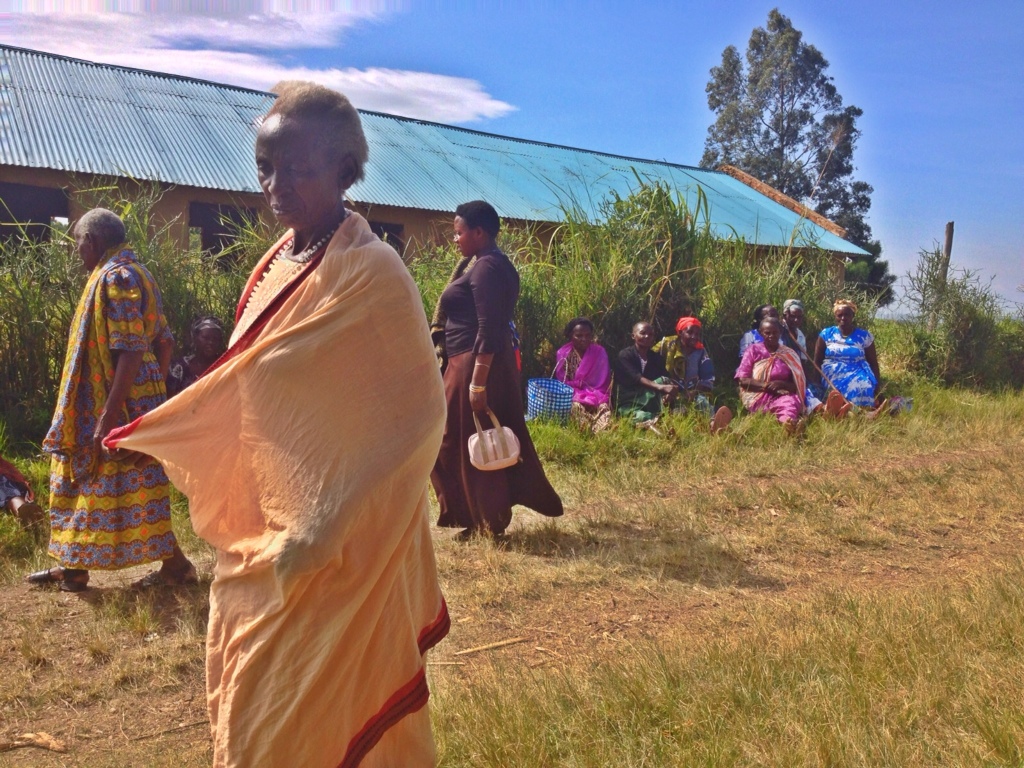
Grannies arriving at a meeting
It’s hard for those who haven’t traveled in the developing world to imagine how remote Nyaka is. I myself couldn’t believe the village would be so very hard to reach, when I looked at its approximate location on my Uganda map. But the map doesn’t show how mountainous the area is. Road lines neatly rendered on paper in reality are rutted dirt tracks studded with rocks and other impediments. Occasional holes help to make driving on them hellish. There are no road signs. Our Ugandan driver/guide, Robert, was born and raised in this region, but he’d never heard of Nyaka. He got us there by following rough directions from one of our contacts over the phone — and then stopping to ask bystanders for details as we homed in on our destination.
Bizarrely, Uganda’s long-time president grew up around here; why he hasn’t doled out more patronage in the form of road work is a mystery. But another former son of Nyaka has been more loyal. Jackson Kaguri was a bright boy who studied hard and won a scholarship to attend a university in Uganda’s capital, Kampala. He went to the US for graduate work and there met and married an African-American woman. They were on a trajectory to a comfortable middle-class life in Indiana, but Kaguri continued to visit his family back in Africa. His older brother had died from AIDS, and Jackson had committed to helping educate his nieces and nephews. On his first visit back with his new wife, the two were struck by the plight of the other AIDS orphans in the village. They resolved to build a school that would provide free education for at least some of the orphans. (All the “public” schools in Uganda require parents to pay fees that often are significant enough to be unaffordable.)
Kaguri subsequently published a memoir of how the school project unfolded, and one of the best things about it is how clearly it communicates his mental state. He didn’t set out to try and change the whole country. He simply wanted to build a couple of primary-level classrooms, despite his pretty much total lack for preparation for any such undertaking. But he was determined, and he did eventually get those first classrooms built. Over time, the school expanded. The need for a health-care center became clear and eventually got built The lack of clean, easily accessible water led to creation of a drinking water system for part of the village. Jackson did none of this on his own; he got help from folks both in America and Uganda. But a dozen years after that first vision of a few classrooms took shape, a remarkable amount has been accomplished.
The Nyaka Granny Project was yet another outgrowth of this work. Around 2007, the school staff began to focus on the fact that many children were suffering from malnutrition and sleep deprivation due to inadequate food, water, and shelter. Somehow, the staff found the resources to begin organizing support groups for the grandmothers struggling to raise those children — not only the few lucky enough to attend the Nyaka school, but many others whose kids are in public schools. When Steve and I finally reached Nyaka, we could scarcely believe our ears when the two program coordinators told us there are now 91 such groups, including 7,000 women providing sole support to something like 35,000 kids.
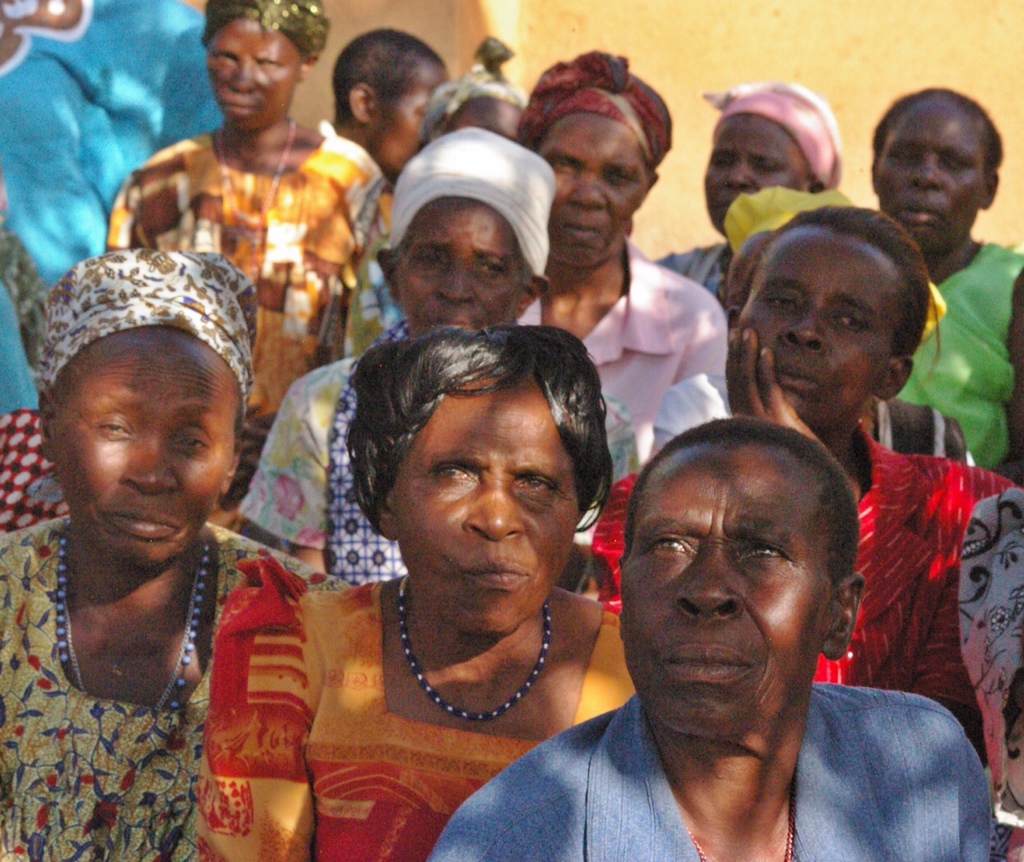
Some of the grannies with whom we met
Within short order, the reality of those numbers became clearer. After depositing our bags in the little house that’s been built (and is run by Jackson’s sister) to accommodate visitors, Martin and Godfrey (the Granny Project coordinators) led us to a nearby building where one of the groups had assembled to meet us. Dressed in their finest Sunday clothes — brightly colored and patterned dresses and wraps that left no doubt we were in Africa — the women, including one 91-year-old member, were singing and dancing. It was an infectious, boisterously joyful greeting, and it instantly won our hearts. We all gathered in a big circle under a tree. Most of the grannies sat on the ground, while we as the guests were offered chairs. Jackson and Martin introduced us, and Steve (bravely) responded to a request to explain why we were there. Then for most of the multi-hour session, we asked questions.
We took pages and pages of notes, which Steve patiently transcribed in spare moments throughout the rest of our travels. What we learned in the first group was echoed in the two others with which we met (one later that first afternoon and the other the next morning.) The grannies told us about the many benefits they’d gained from participating. First and foremost, the groups provided fellowship. It’s misleading to talk about African “villages.” For me that term conjures up some compact community in England where everyone can walk to everyone else’s home. But in rural Africa, communities are typically far-flung. While some of the grannies lived within a half-kilometer of each other, others walked two or three hours to attend the twice-monthly meetings.
Each time they attended, they paid a small amount (ranging from $.75 to $1.50) into a fund, knowing that every 15 months or so they would receive all or part (arrangements varied) of the pot collected that meeting. This simple system provides a way for the poor to save for needed items — a blanket, say, or a saucepan –instead of seeing any savings dribble away to friends or relatives needing help. The Nyaka coordinators also provided some educational programs (farming tips; AIDS prevention), and the groups gave the women a chance to share their troubles and pray together “for our homes and our families” (as one English speaker put it). Finally, a small microloan program that began in 2008 was offering some of the women a chance to borrow tiny amounts of money and pay it back within a few months at interest rates that might seem high to Westerners (3% a month), but were far more reasonable than the 10 to 20% monthly interest charged by other African lenders.
JoAnn, 52, caring for 3 grandchildren, had borrowed a little under $20 and used $7.75 to buy a piglet and the rest to build a pigsty for the animal. Jacqueline, 53, had used her $4 loan to hire someone to prepare some ground for her to plant. Her subsequent peanut and sweet-potato harvest had been good enough to help cover her grandchildren’s school fees. Maria, supporting 6 grandchildren, had combined her $19 loan with another $7.75 she’d saved and bought a goat that she bred with a neighbor’s billy. She’d sold the resulting twins and since had built her herd up to 6. When I asked if she and her grandkids drank the milk, the group burst out laughing. If she did that, someone pointed out the obvious, the baby goats would die of malnutrition.
A scene from the play
Our meetings included other light moments. The second group put on a play for us fashioned after the Biblical story of King Solomon’s trial of two women who both claimed the same infant. The actors were equipped with props that included a fake sub-machine gun fashioned from banana-tree branches. It was unforgettable. But so was the women’s response when we asked if they had any complaints about the Nyaka micro finance program.
They did indeed: there wasn’t enough money to be borrowed. They had ideas. They were willing — eager! — to muster the energy to raise piglets and goats and chickens; plant sweet potatoes, roast them, and sell them to passing travelers; sew, weave baskets, make bracelets and other handicrafts. They were confident they could pay back the money with interest. Indeed the repayment rates do approach 100%. “How many of you would borrow more money if there was more available to borrow,” I asked. Here’s how they answered:
What a journey we had Saturday (6/24). Woke up in a tent in a vast Tanzanian wilderness. Went to bed in downtown Nairobi (Kenya) — home to 6 million, famed for terrorist turmoil and more plebeian crime. Traveling from Point A to B began with two short flights in a Cessna designed to seat 12 but in practice seating 13, the extra space being the one next to the pilot. (I loved the Safety Instruction that directed any passenger in it “not to step on or interfere with the pedals on the floor.”)
At the Arusha airport, we were picked up by a pre-arranged driver who took us through insane Saturday morning traffic to the bus-shuttle depot. The subsequent bus ride took 5.5 hours, including the stop at the Tanzania/Kenya border crossing (reminiscent of San Diego/TJ’s maybe 75 years ago.) It was twilight by the time we reached the outskirts of Nairobi, and the sights out the windows were grim: decrepit buildings; more insane car and pedestrian traffic, choking diesel fumes, squalor. Full-on dark had descended when we finally pulled into the bus terminus, where another pre-arranged driver met us with our names on a hand-held whiteboard and transported us to our hotel. It occurred to me that we’d done a disservice to Kenya by planning to spend barely 50 hours in it, and all of that in its ominous capital. We would probably leave with unpleasant memories, vowing never to return.
But good impressions of Kenya started to accrue as soon as we checked into the Kahama Hotel. Spotless and stylish, it included an excellent breakfast buffet for the $50/day tab. The clientele looked to be mostly African businessmen with a sprinkling of white readers of Lonely Planet East Africa (where it’s a “TOP Choice!”). The free wifi was excellent, the customer service even better, the water in the shower hot and plentiful. One drawback was the noisy adjacent highway, but, eh, I had my lion’s-roar-blocking earplugs. And Steve sleeps like the dead.
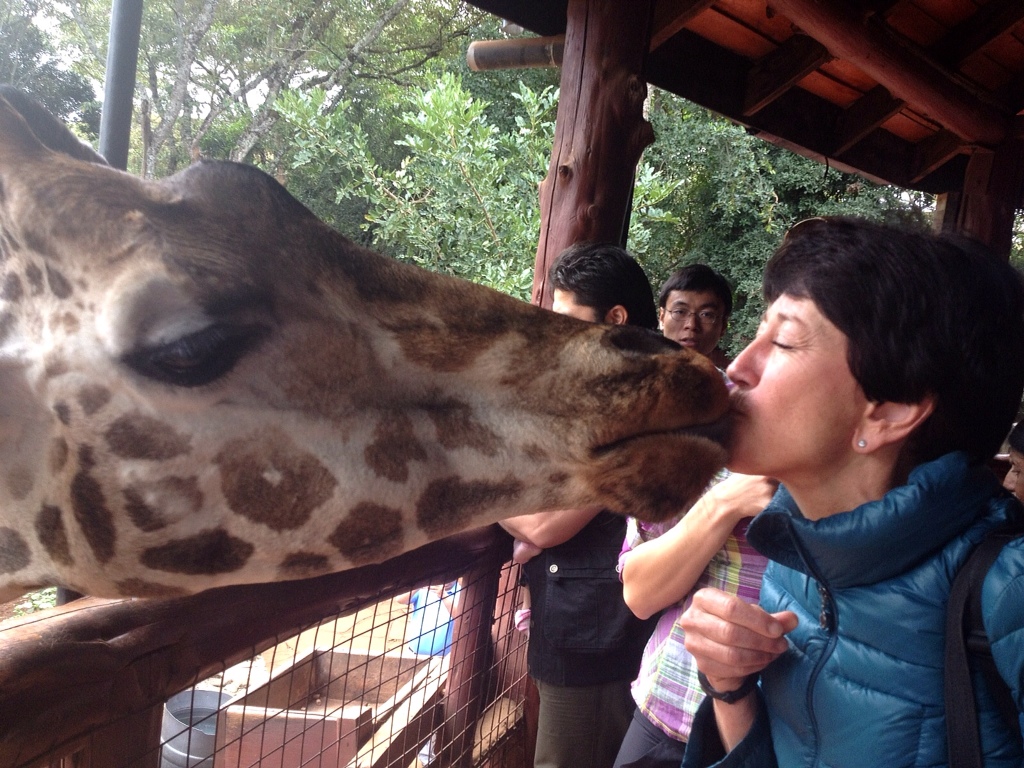
Our full day in Nairobi Sunday (6/25) piled on more pleasures. We drove out to the suburb of Karen, home to posh private academies and mansions, and lunched at the sophisticated restaurant that today operates on the land that Out of Africa author Isak Dinesen (aka Karen Blixon) once farmed. After lunch, we visited a nearby center celebrating Rothschild’s giraffes. In 1979, when the Kenyan grandson of a Scottish earl and his American wife began raising a baby giraffe in their home, the number of these animals in the wild had sunk to 120. Thanks in part to the subsequent work of the couple, the population of wild Rothschild’s has now climbed to 700 or so, and the center is devoted to both conservation and educational work. It combines this with the huge fun of giving visitors the chance to place tasty pellets on the amazingly long, liver-colored giraffe tongues from a raised platform that literally brings the humans nose to nose with the leggy beauties.
Giraffish love
All this was great. But our experience earlier that morning at the Sheldrick center for orphaned elephants was phenomenal. The trust that runs the center was started in 1979, shortly after the death of David Sheldrick, who served as the anti-poaching warden at Tsavo National Park. His formidable wife Daphne (and, now, their children) have carried on the work of rearing baby elephants whose mothers have been killed for their ivory (or, less commonly, by irritated farmers).
Killing elephants for their tusks continues to be a huge problem, perhaps worse today than it’s been for a while (because of corrupt officials in Kenya and Tanzania who turn a blind eye to this hideous trade). There are a lot of elephant orphans to care for. The Sheldricks years ago solved one huge problem by developing a formula the animals could tolerate (cow’s milk gives them fatal diarrhea), but they can thrive on a variant of human baby formula. Each animal needs a lot of it: about 6-12 pints every 3 hours, around the clock. During the days, each baby, under the watchful eye of a tender, is free to range into the wilds of Nairobi National Park, on which the Sheldrick trust leases land. When the youngsters get to be about 5, they move to an an advanced facility where they can venture out to begin spending time with various groups of wild elephants. Eventually, they find a group that’s a good fit and begin their independent lives in the wild. But it’s the elephants who decide when they’re ready to make this move, and with whom.
Until each orphan reaches that stage (some time between the ages of 5 and 10), it costs about $900 (per animal per month) to support this ambitious operation. All the money is privately raised. (In fact the trust has to pay the Kenyan government a hefty rent for the property it occupies, I was appalled to learn.) One source of income comes from the 500 shilling ($6) entry fee for visitors to the facility. It’s open daily, but for one hour only — from 11 to noon.
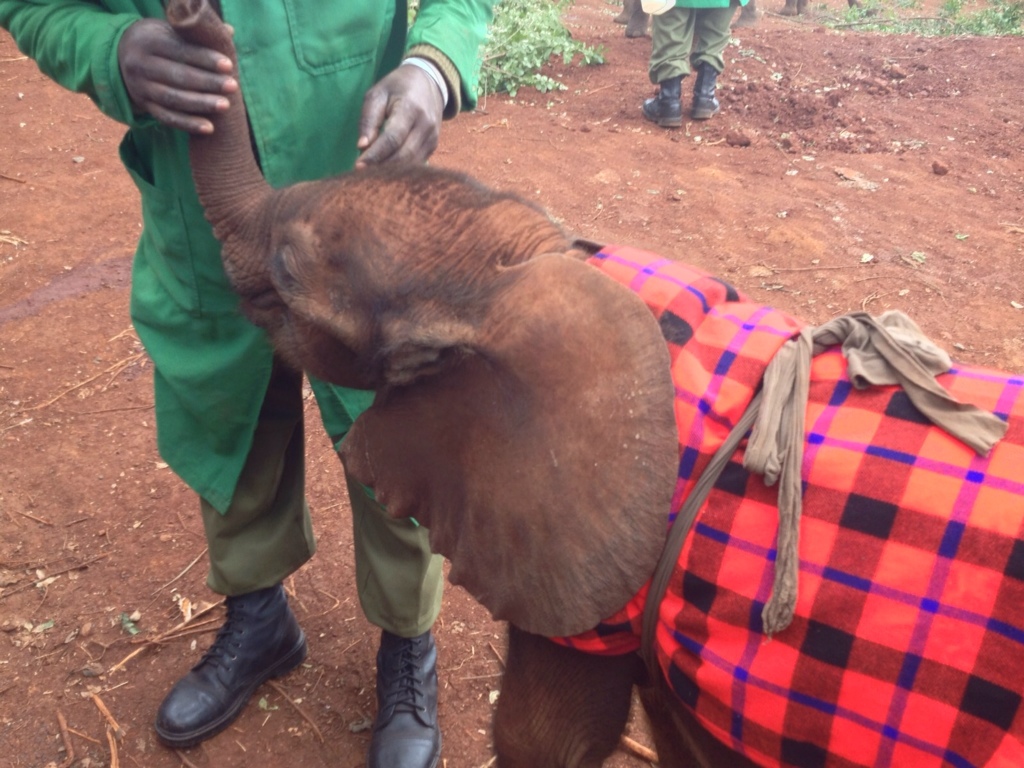
Steve and I arrived about 45 minutes early, and that was lucky. We sat waiting next to the rope admissions barrier, and almost immediately other tourists streamed in behind us. When the guards finally released the rope, a crowd of several hundred people had massed. We led the way down a path to a clearing with a small muddy pool in the center. Around the pool, giant milk bottles were positioned. We stood next to the encircling rope barrier, a prime position for watching an attendant emerge from the thick bush, walking next to a tiny elephant — just 2 and a half months old, we later learned. A bright red Maasai blanket covered the sensitive skin on her back.
I think human babies are cute and puppies give them a run for their money. But I’m sorry. In the Cosmic Cuteness competition, baby elephants leave them both in the dust. Tiny, hairy, with oversized ears, and long, long eyelashes, this little female was named Mystery (in Swahili) because she’d been found when she was just 3 days old, in good health but lying down in the middle of an airstrip with no trace of her mother.
She guzzled down the milk from the bottle held by her human attendant, then stroked him delicately with her trusting little trunk, provoking a concert of cooing. I felt almost as tickled by the reactions of the crowd: kids, women, and men from all over the globe, all enraptured.
The pachyderm-human love fest continued as more attendants led in a dozen more of the big babies for their feeding. There were comic moments, as when one little guy rushed up to his bottles, knocked them over, then trumpeted with amazing volume in his impatience to be fed. Another rambunctious character thought it funny when he or she bumped into the crowd pressing up against the rope, provoking shrieks and howls of laughter. Another baby, after feeding, played with a shovel in the enclosure, balancing the tool on its hairy head. There was pathos too, as a narrator/attendant introduced each orphan, detailing what had brought each to the center. So much murder and heartache — for the sake of tchotchkes.
A baby elephant joke: kick over your milk bottle!
Steve and I think with education and public pressure, the Asian appetite will dry up (and maybe sooner rather than later; Dame Daphne’s new autobiography is being translated into Mandarin and Cantonese). But other forces also threaten the world’s elephants and other great wild animals, most prominently the ravenous human appetite to exploit the wildernesses needed to support wildlife. When you see warriors like the Sheldricks fighting to protect and nurture the elephants, the battle feels epic.
Compared to that, our other final activities in Nairobi, while pleasant, were anticlimactic. We dined Sunday night at Carnivore, once legendary for serving up grilled zebra, giraffe, eland, and other antelope, but since 2004 restricted to more familiar meats (plus crocodile, which I found to combine the texture of chicken with a vaguely piscine taste.) Monday morning we toured an interesting enterprise that’s recycling old flip-flops into charming art. And for our final lunch in Africa, we had our taxi take us to the Stanley Hotel. We had to park several blocks away, but our taxi driver, Washira, guided us on foot, and we both enjoyed the chance to walk a bit in the center city. It’s run-down, but bustling with purposeful pedestrians, despite the strangling vehicular traffic. Happily, we never got robbed. (Surprisingly, Steve didn’t get his pocket picked.)
The Stanley is said to be the oldest hotel in the city. I wanted to eat there because of the thorn tree that grows in a courtyard. A predecessor tree was planted there in the late 50s, and travelers used to pin notes to it seeking rides, praising this hotel or that, and generally sharing information as they journeyed from Cairo to Capetown or elsewhere on the Dark Continent. Later this practice inspired the Lonely Planet guidesters to start the Thorn Tree online bulletin board. In recent years, I’ve increasingly turned to it in planning our travels. It helped me to organize the amazing African journey we’ve just completed. I feel grateful, and I wanted to give it my regards.
“Did you hear the lions last night,” our guide Frank asked us at breakfast Friday morning (6/21).
Incredibly, I didn’t. Knowing that we were going to rise before dawn, I had taken the first sleeping pill I’ve consumed since arriving in Africa, and I’d inserted my protection against Steve’s snoring: earplugs. When the SEVEN lionesses and their cubs strolled through the staff quarters, roaring (at least four times, loudly, according to the group of jolly Germans who provided details at the next evening’s campfire, I snoozed right through it, as did Steve, despite the fact that only a thin layer of canvas separated us from all the ruckus (which apparently was resolved when one of the staffers got in a truck and drove it toward the pride to scare them off.) The next night I slept both drug- and plug-free, but all was quiet. To my regret.
I’ve had some great experiences on camping trips, but in general, I’m not crazy about camping. The dark, the cramped quarters, the separation from washroom facilities — I can do without all that. When we’ve stayed in spartan little budget hotels on various continents, I frequently have reflected, “At least it’s a lot better than camping.”
But camping while on safari can be another world altogether, a dreamy, pleasure-filled realm. I’ve stayed at four such places in my life (one in South Africa and three here in Tanzania). The South African one and the first two here came close to my idea of paradise. All had huge tents erected on and/or around platforms that held big comfortable beds with soft linens, electric lighting, civilized toilets and wash-up areas, and auxiliary furniture. Because they were tents, you could zip down big expanses of the canvas, lie in bed, and take in the natural world through the mesh “windows.” Food in these places is always served in a central lodge or mess area, and our meals have ranged from okay to excellent.
For our last two nights on safari, I’d chosen the Serengeti Kati-Kati tented camp. It gets excellent reviews on Trip Advisor, and Frank, our guide, had expressed strong approval of it at the start of our trip. But when we arrived on Wednesday night, I felt a twinge of disappointment. This was the most basic of the tent camps we’ve experienced. Although the tents and their covered verandas were the size of modest California bungalows, the ceilings weren’t as high as in the other places. The floors were simple canvas, and after dark the only sickly light came from two bare LED bulbs suspended from the ceiling and powered by a car battery. Each tent had its own toilet, but it was situated over a chemically sanitized drum in the ground, and we were only able to shower after requesting that one of the staff members haul a 20-liter bucket of hot water to the rear of our tent, fill a receptacle, and hoist that up so that gravity would make it flow through a shower head controlled by a simple on/off valve..
Still, the Kati-Kati grew on me. Sitting around the bonfire before dinner gave us a chance to interact with other travelers, something we’ve had little of and have missed (perhaps my only complaint about this whole trip). The food was extremely good — some of the best we had anywhere. The simple camp beds were well padded, warm, and cozy. And the simplicity of the accommodations suited the location — close to the center of one of the biggest and most spectacular wilderness areas on the planet (Serengeti National Park).
Serengeti comes from a Maasai word meaning “endless plain.” At the park headquarters on the eastern side of the preserve, there’s a rock outcropping that visitors are encouraged to climb. From the top of it, it’s clear what those Maasai name-givers were thinking. In every direction stretched a featureless, flat expanse of grassland. It looked dry, the color of sand, as the rains stopped a good 6 weeks ago. But otherwise, it was indistinguishable from an ocean.
The only way visitors may explore the park is in a 4WD vehicle driven by a licensed guide. With Frank at the helm of our Land Cruiser, we only had a couple of hours of game-drive time on Thursday afternoon (6/20). But in short order, we came upon a couple hundred zebra grazing together. We stopped to photograph a solitary hippo ripping off great mouthfuls of tall grass; they usually do this only at night. We snapped at warthogs and giraffe and a huge group of elephants. And as the sun was sinking, Frank spotted a distant tree where a leopard was lounging — the last remaining member of the so-called Big Five that Steve and I still had not seen (the others that we’d already checked off being elephant, rhino, buffalo, and lion).
On our last day with Frank, we rose before dawn. Game driving is a strange pastime. You bounce and rattle over the dirt trails, and by afternoon, every encounter with another vehicle means immersion for several seconds In a thick cloud of yellow dust. For me, going out first thing in the morning feels thrilling and fresh, but after hours and hours, it can start to feel a little tiresome. To avoid that, I’ve found that the best approach is to surrender to the flow of it; turn off any thought of passing time; remind myself that it’s all about the journey (the safari), not any destination. Each time you come upon a particularly beautiful vista or a particularly arresting group of animals, if feels like a surprise gift.
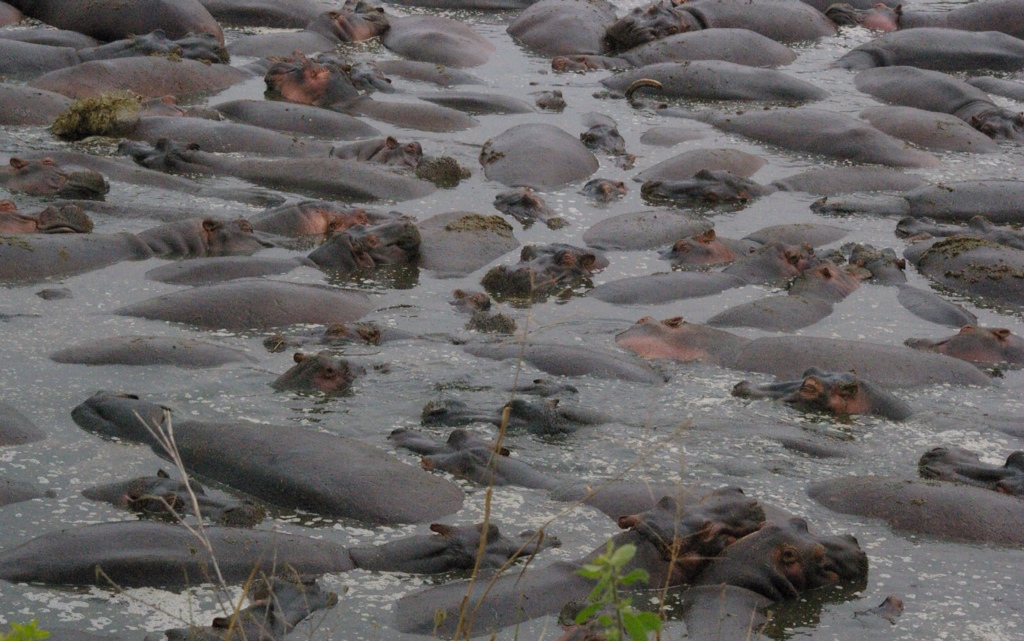
Hippos and wildebeest aren’t among the Big Five, but they were my biggest game-driving gifts Friday. Before this trip, I never associated hippos with the plains of the Serengeti, but it turns out there are bunches of them in the national park, and they’re easy to find en masse. Around lunchtime, Frank took us to a particularly notorious pool where what looked like several hundred hippos were crammed into a pool about the size of a football field. It was a staggering sight — a mega-mosh-pit of hippos sleeping not only side by side but on top of each other. The penetrating stench of concentrated hippo urine and dung hardly bothered me, I was so mesmerized by the animals’ comic postures; by the constant splash of water kicked up by their stubby tails; by their alien honks and growls and blurps.
A small section of the amazing hippo mosh pit
The wildebeest were another matter altogether. We weren’t just looking for any specimens but, rather, for wildebeest engaged in the great annual migration that the species is known for. These animals have made a stupendous recovery, increasing in the past 50 years from only about 125,000 to the 2 million estimated to exist today. The sight of hundreds of thousands of them moving across the Serengeti plains is said to be one of the greatest spectacles of nature.
The problem is that, because it’s a natural phenomenon, it doesn’t run like an airline. Where the mass of the herd may be in any given week may shift from year to year, depending on the rainfall. Knowing that, I months ago resigned myself to the possibility of seeing little during the two days we would be in the park. Still, my fingers were crossed.
The reason we rose so early Friday is because Frank had conferred with some of the other drive/guides, and he thought our best bet was to head west to an area known as the Musabi Plain. We drove and drove, and for a long time we saw only scattered clusters of wildebeests. But finally we turned a corner and came upon something that looked like a freight train but soon became recognizable as wildebeests, galloping in a line that stretched as far as the eye could see.
We watched them for a long time and continued to stop and see more as we drove on. In some spots, we found thousands of them, scattered in every direction, mostly grazing but in some cases kicking up their heels in frisky displays. Mixed among them were zebras, who tend to migrate alongside; apparently they have good memories and are gifted at remembering the migration routes, while the wildebeests have a mysterious genius for knowing when to move. At one point, we seemed to see this in action, as the pack of grazing wildebeests thickened and then began, once again, to surge onward.
It reminded both Steve and me of drawings we’ve seen of the American bison moving across the Great North American Plains. There were 20 million of them at one point, before our forebears wiped them out. Frank said what we were seeing this morning was the stragglers. The majority had passed through several weeks earlier, and had we been there then, we would barely have been able to see the grass for all the animals.

 After our frenetic week in Paris, it felt great, and it reinvigorated me for venturing into the Jemaa el F’na at night. Marrakech’s central square is something else again — different from anything we’ve experienced anywhere. It deserves a separate post of its own.
 Posted with Blogsy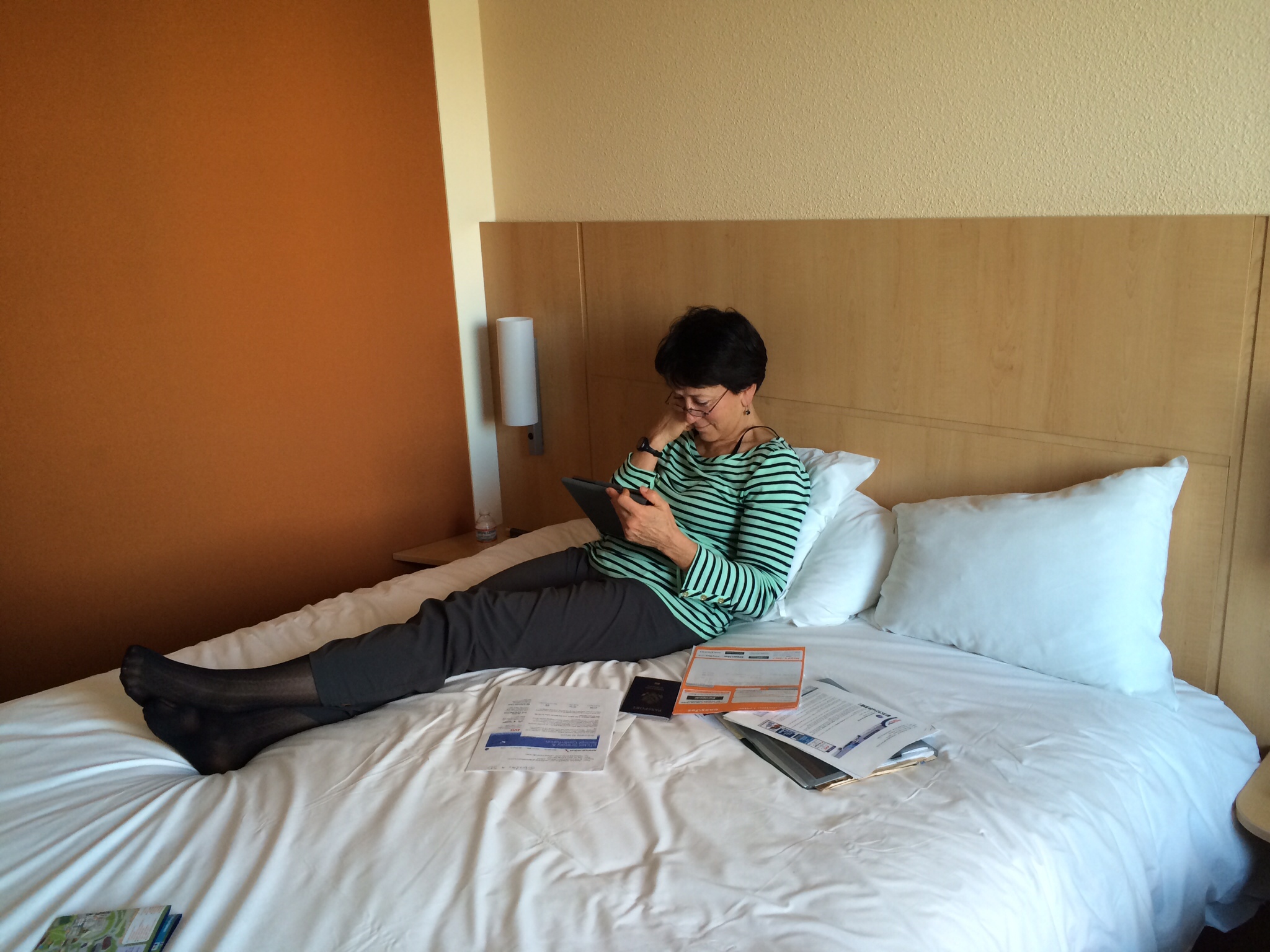








 At home and abroad