Steve thinks weather can color first impressions of wherever you’ve landed. That was true of our arrival in Papua New Guinea Sunday morning. We had a pleasant two-hour flight from Honiara to Pt. Moresby, PNG’s capital. But we descended to the airport through skies filled with menacing clouds. On the ground, gusty winds matched the evil reputation of this city, which regularly ranks among the most dangerous in the world.
We reached our hotel around 3 and were assigned a room on the fifth floor. It had huge windows overlooking the nearby beach, but the wind was shaking them so violently I could imagine them shattering. The racket continued all evening and was still so loud when I went to bed I had to wear earplugs.
Everything I’d ever read about Pt. Moresby suggested it was not safe to go out and walk around. So even though Monday morning dawned bright and calm, both Steve and I were content to hang out in our room. He worked on his travel journal; I wrote my last blog post. At 2 pm we were supposed to meet up with our tour leader, Christopher Bartlett, in the hotel bar. But mid-morning, a disturbing message popped up on our WhatsApp group chat: Christopher and a half-dozen other tour members were delayed in New Britain, where they’d been scuba diving. With luck, they might land around 4:30. A while later, Christopher Whatsapped again, suggesting we get a ride from the hotel down to Ela Beach, where festive activities celebrating the 50th anniversary of PNG’s independence from Australia were supposed to unfold.
This took a while to organize, but Steve and I and five other members of our 20-person group eventually piled in a van and drove down the hill. It occurred to me that the US State Department wouldn’t approve. PNG is already on their “Reconsider Travel” list because of the crime, particularly in Pt. Moresby, and political unrest in the western highlands. The anniversary celebrations would draw large crowds that might become violent, one bulletin advised, so they should be avoided.
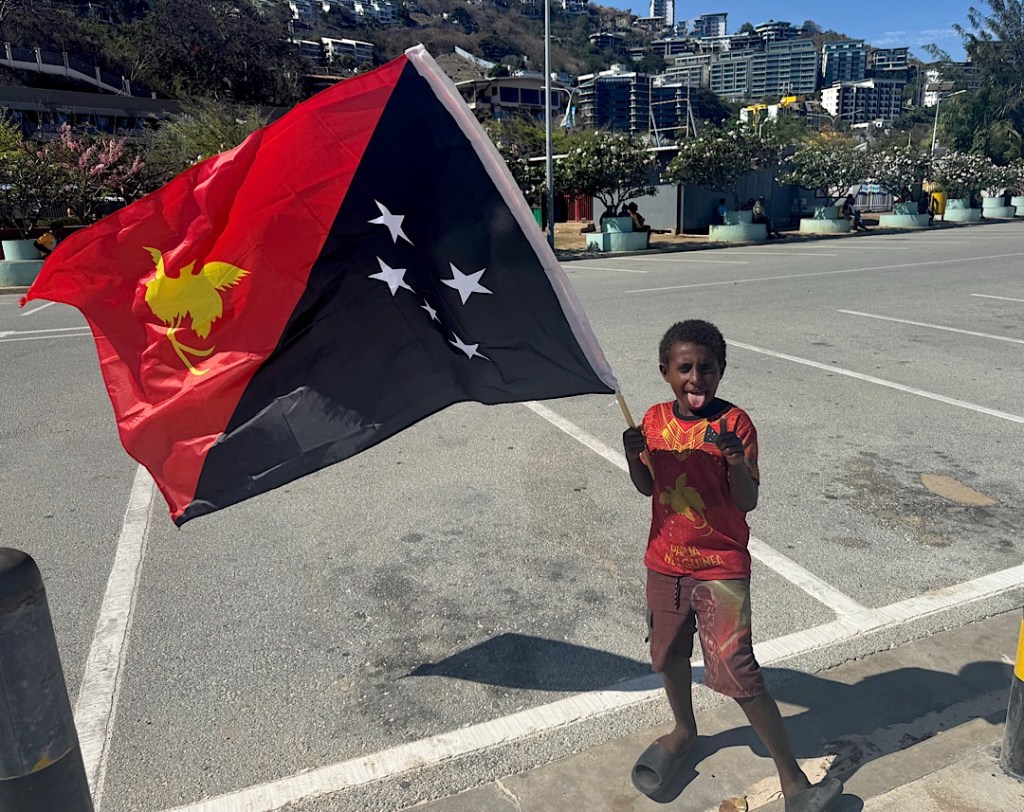
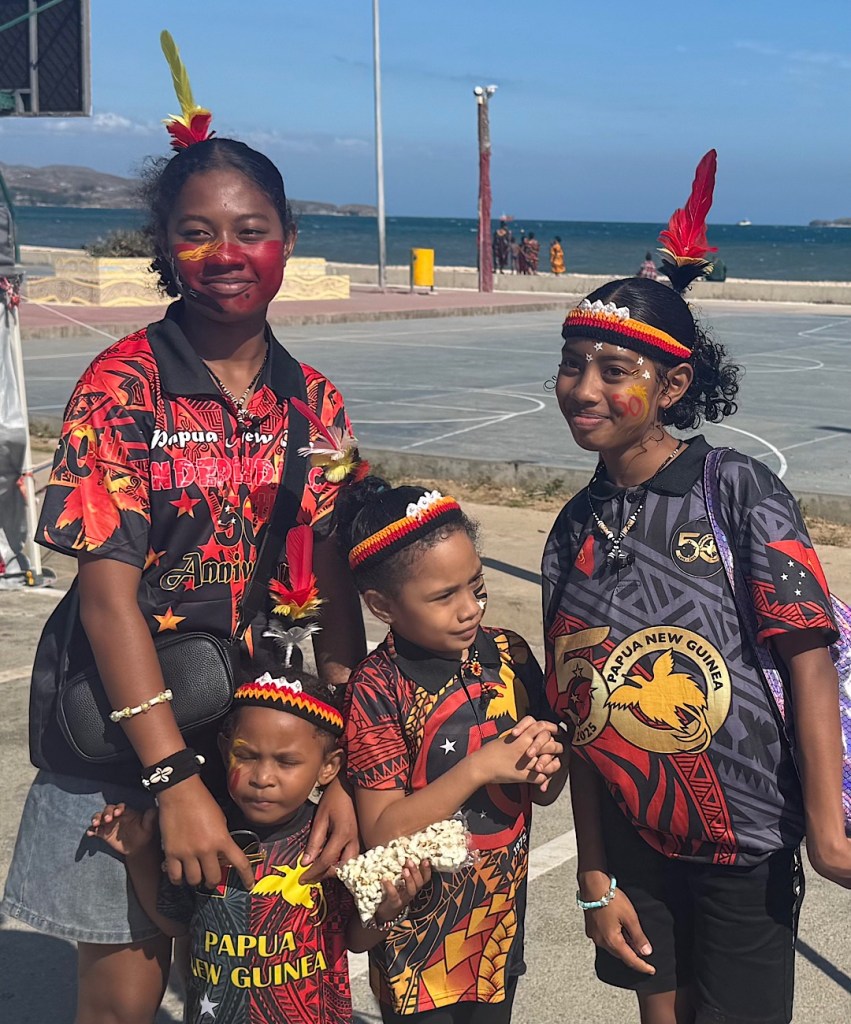
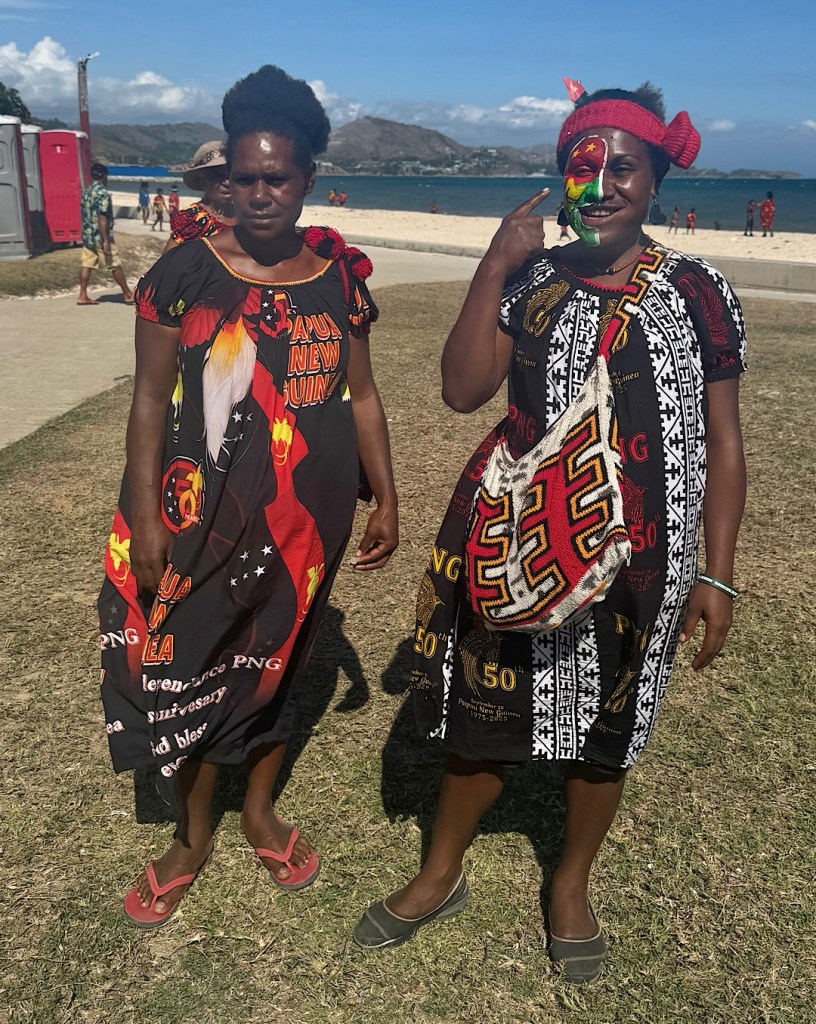
When the van disgorged us next to the beach, however, it was obvious little to no danger lurked here. The balmy day and cool breeze off the ocean would have made anyone feel cheerful, and the women and children and families we encountered on the boardwalk were in an extra ebullient mood. Everyone smiled at us and returned our “hellos” and most were dressed in the red, black and gold national colors, Many waved large PNG flags. They sang out “Happy Independence Day!”and we chorused back the same.
Kate, the only English member of our group, charmed everyone with her enthusiasm. My photo doesn’t show it well, but this guy had painted half his body coal black and the other half red, with a gold bird of paradise on his left chest.
Along the busiest part of the boardwalk, vendors had set up tidy booths where they were selling clothing and jewelry and other crafts. So we shopped and took pictures and made our way to a stage where we caught a few music and dance performances. Then Steve and I and Kate decided to walk back up the hill to our hotel, rather than catch a taxi. No harm befell us.
I don’t doubt that visitors to Pt. Moresby routinely get robbed or even worse. Still, my experience that afternoon and in the next few days made me think anyone who wouldn’t dream of visiting Papua New Guinea because it’s too dangerous should reconsider their travel plans.
PS — I’m writing this in the Eastern Highlands. We’ve been on the road for three days, and we’re immersed in the cultural experiences at the heart of this part of our itinerary. Internet connections are getting worse and worse. I’ve decided to keep my posts short, limit the number of photos, and send them whenever I catch a good, brief online connection. But that’s likely to be sporadic for the next few days.
Arriving in Honiara, capital of the Solomon Islands, last Wednesday afternoon, I felt a rare emotion: culture shock. It wasn’t triggered by the fact that all the people looked African. In Fiji we had already passed into the Melanesian sphere of influence. Melanesians are part of the enthnographic family that includes Australian aborigines. Their ancestors came from Africa (as did those of all Homo sapiens) but in the tens of thousands of years since humans arrived in this part of the globe, their faces have continued to reflect where they started out.
Instead, it was the airport that startled us. The terminal building is clean and big enough, but it contained almost nothing that airports in other capital cities hold. We found a single ATM machine and a little currency-exchange stand. But no gift shops were evident. No counters offered cars. No one was selling any SIM cards that would get you local phone service.
Taxis queued up outside seemed to be offering a flat rate to our destination, the Honiara Hotel. This had not been my first choice for accommodation. Back in January, when I was first planning this trip, my online sources made me want to stay at the Heritage Park Hotel, located in the center of this small but lively capital. To my bewilderment, the Heritage Park was already completely booked for our dates.
Understand that the Solomon Islands consistently ranks among the 10 least-visited countries in the world. How could any hotel on any of its 900 islands be sold out 9 months in advance?
I later learned we just happened to be arriving the week when, for the first time in ages, Honiara would be hosting the annual Pacific Islands Forum. The heads of 18 countries and territories would be gathering to discuss regional issues in Oceania; they and their aides had already gobbled up the best digs in town! So I reserved a room at the Honiara; it didn’t sound bad.
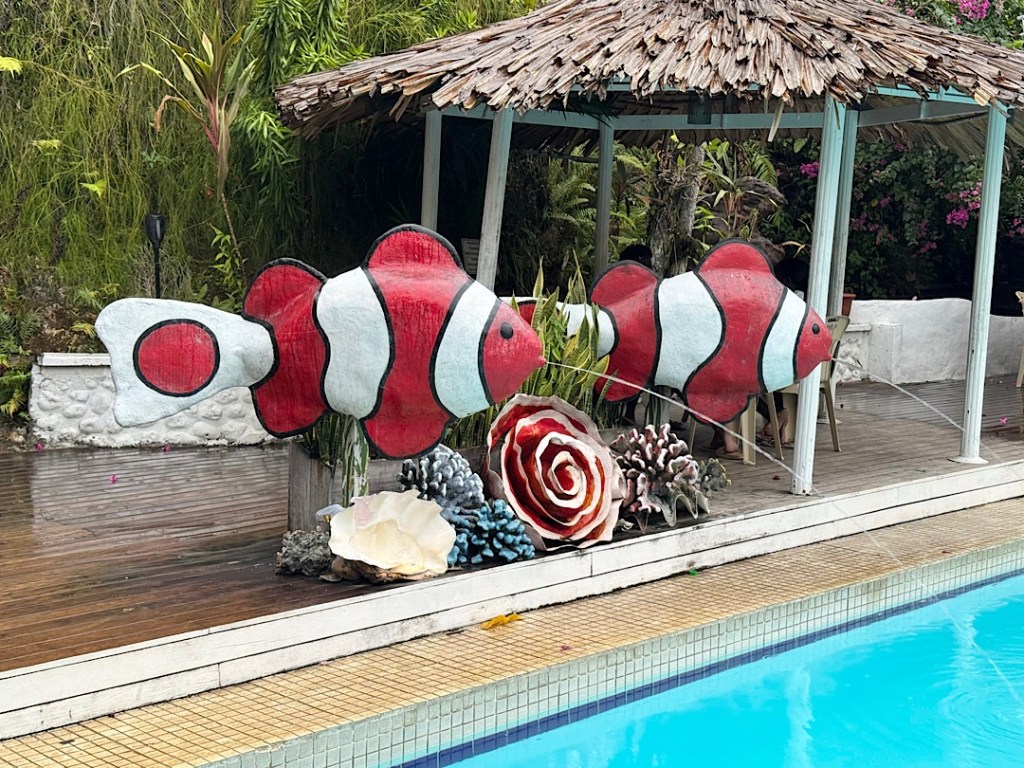
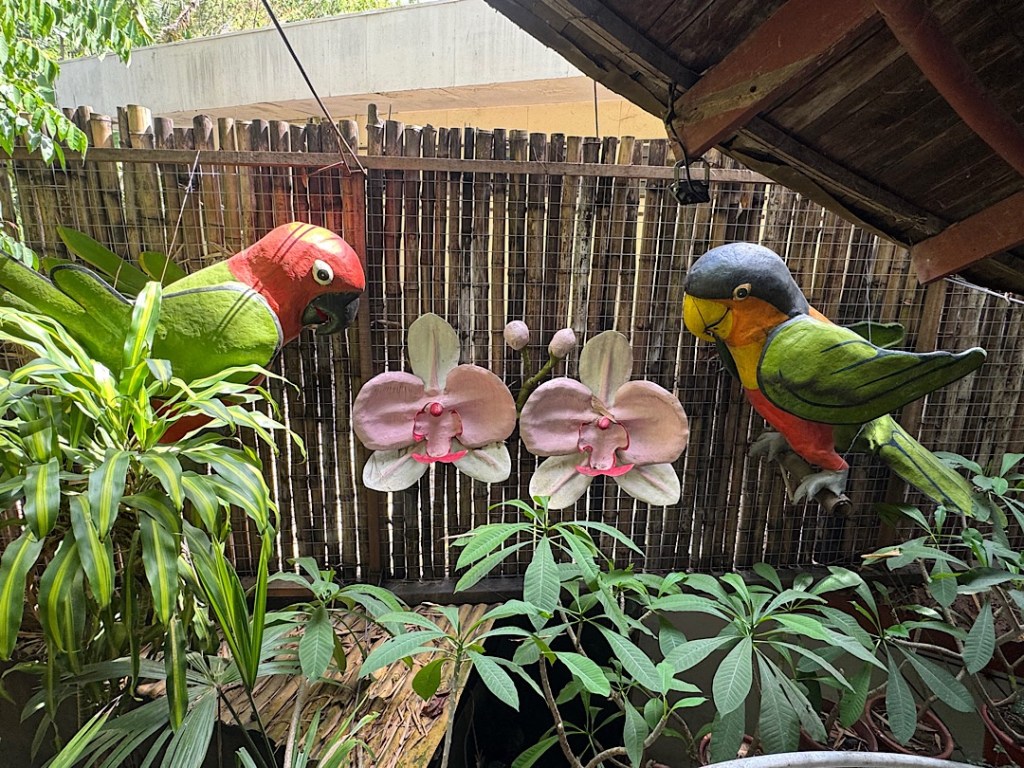
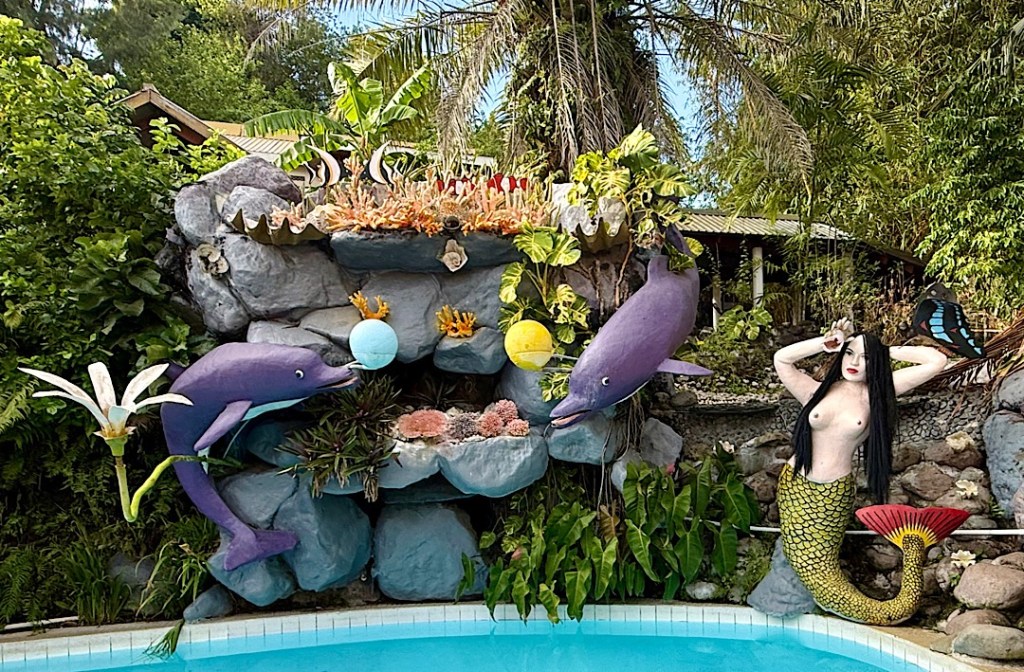
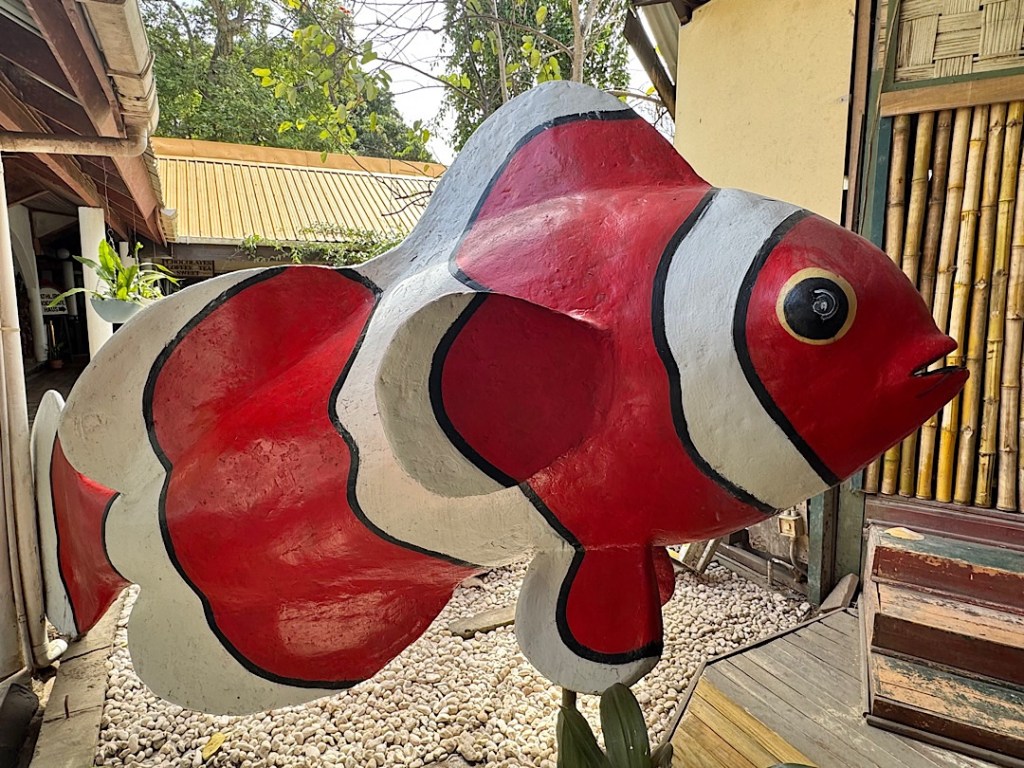
As it turned out, the Honiara was not to be missed. The buildings ramble over a hillside with good views of the water. Concrete staircases lead guests past a head-spinning assortment of giant wildly colorful sculptures. They make the place feel psychedelic.
Why, you might be wondering at this point, did we choose to visit the Solomon Islands? Call it an accident of the air-service network. Honiara is among the few cities in the world with nonstop flights to Pt. Moresby (the capital of Papua New Guinea, our ultimate destination.) And it’s only a three-hour jump via Fiji Airways from Nadi (Fiji) to Honiara. So I booked flights that allowed us to spend four nights in Fiji, followed by two in the Solomons. Then the airline changed its flight schedule, and we wound up with the longer stay in a place about which I knew virtually nothing.
I figured we’d wing it.
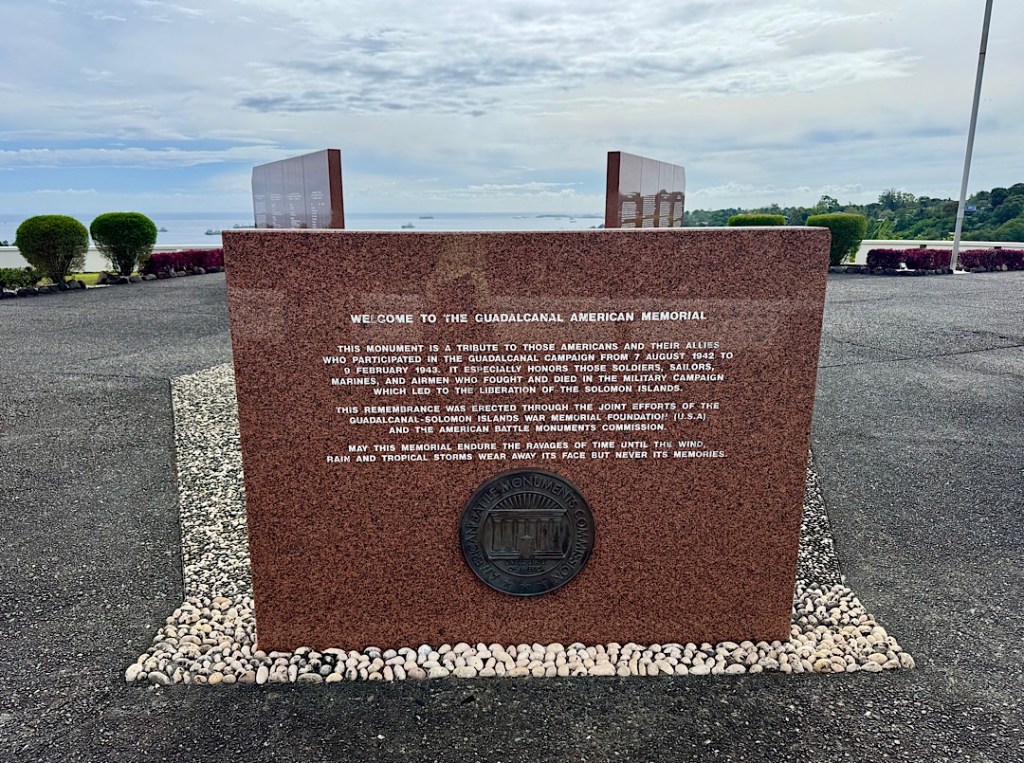
We asked George, the taxi driver who drove us from the airport to our hotel, to pick us up the next morning. He suggested we pay a quick visit to the Guadalcanal American Memorial just down the road. Set high on a hillside, it pays homage to a critical battle in the Pacific theater of World War II. (Honiara is located on Guadalcanal, the largest and most important of the islands that make up the Solomons.)
The outdoor memorial contains a host of granite monuments holding more historical information about the battle than I could ever absorb. WWII is one thing that draws some tourists here.
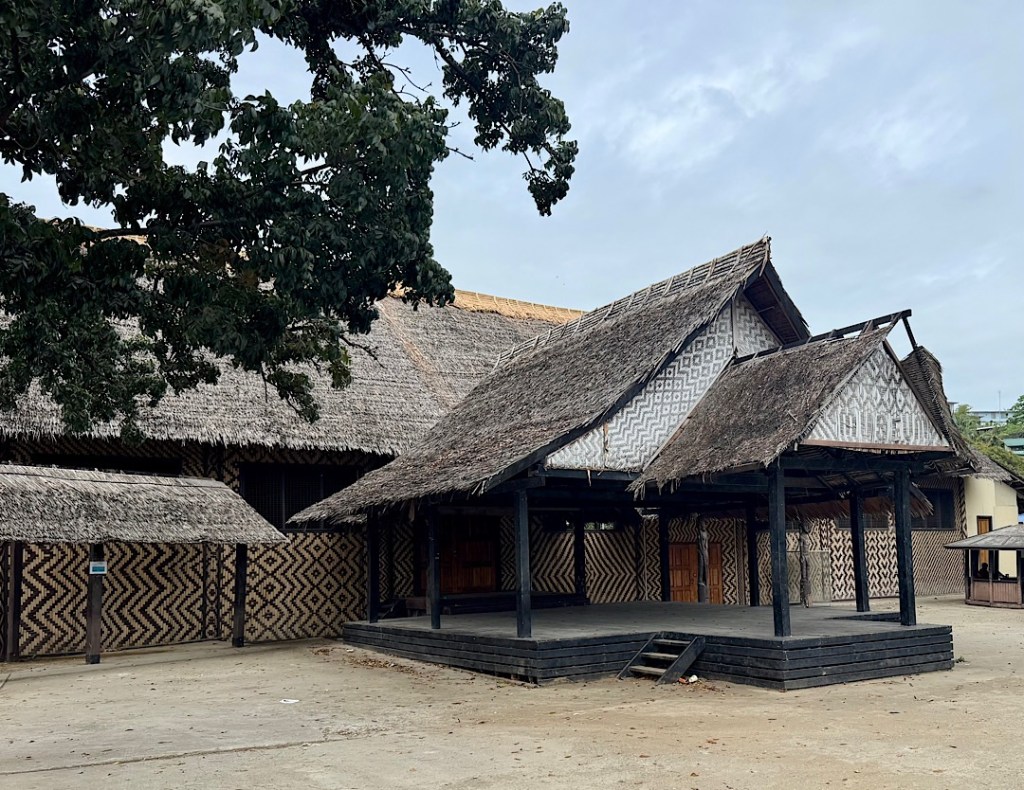
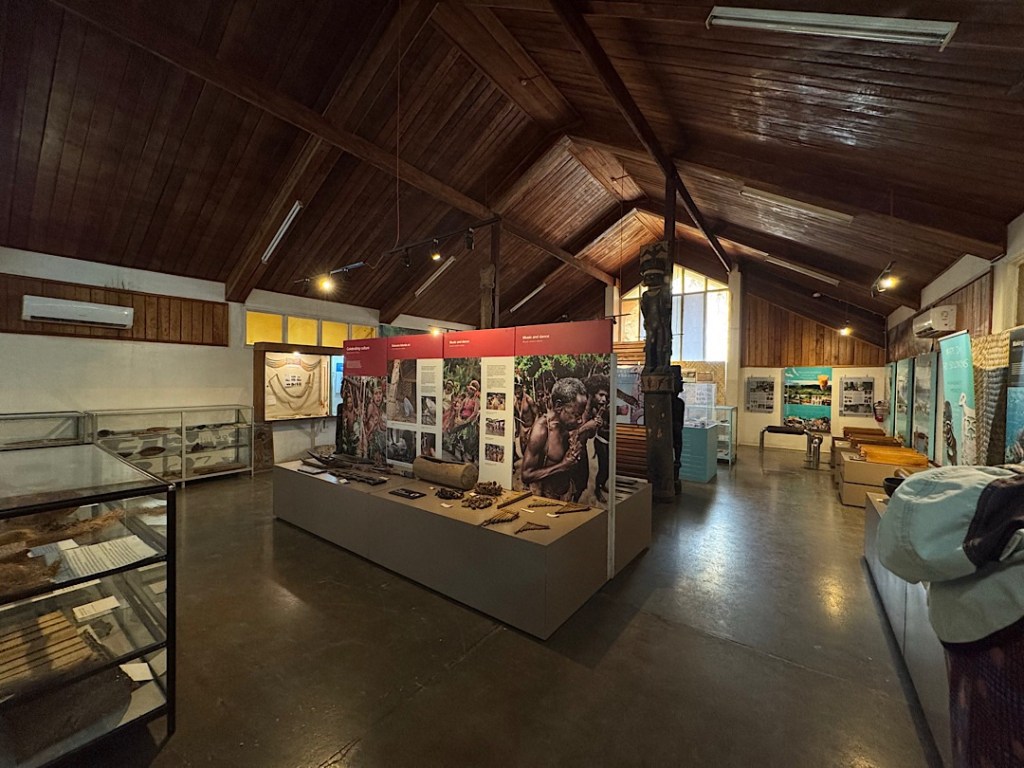
We then asked George to drop us off at the National Museum in the center of town, where we were the only visitors. That was no reflection on the quality of the exhibits.
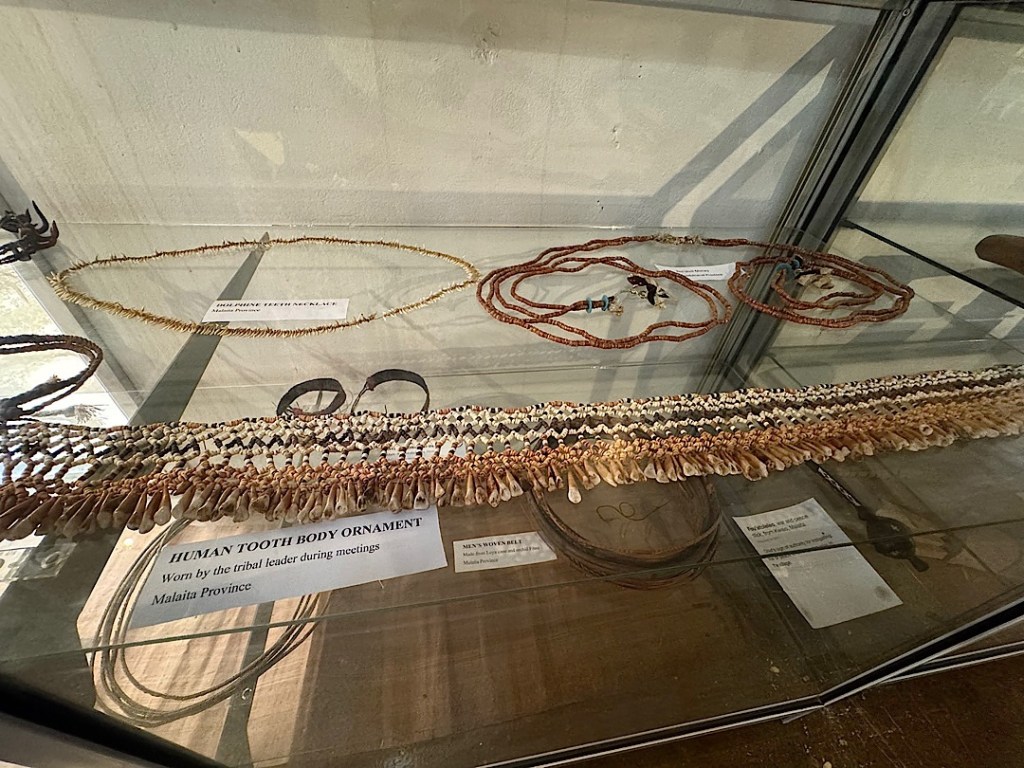
We didn’t go into this impressive structure.But we spent the better part of an hour in this exhibits hall, filled with many fascinating objects……like this belt made of human teeth. We saw lots of “bead money” and many bizarre weapons.
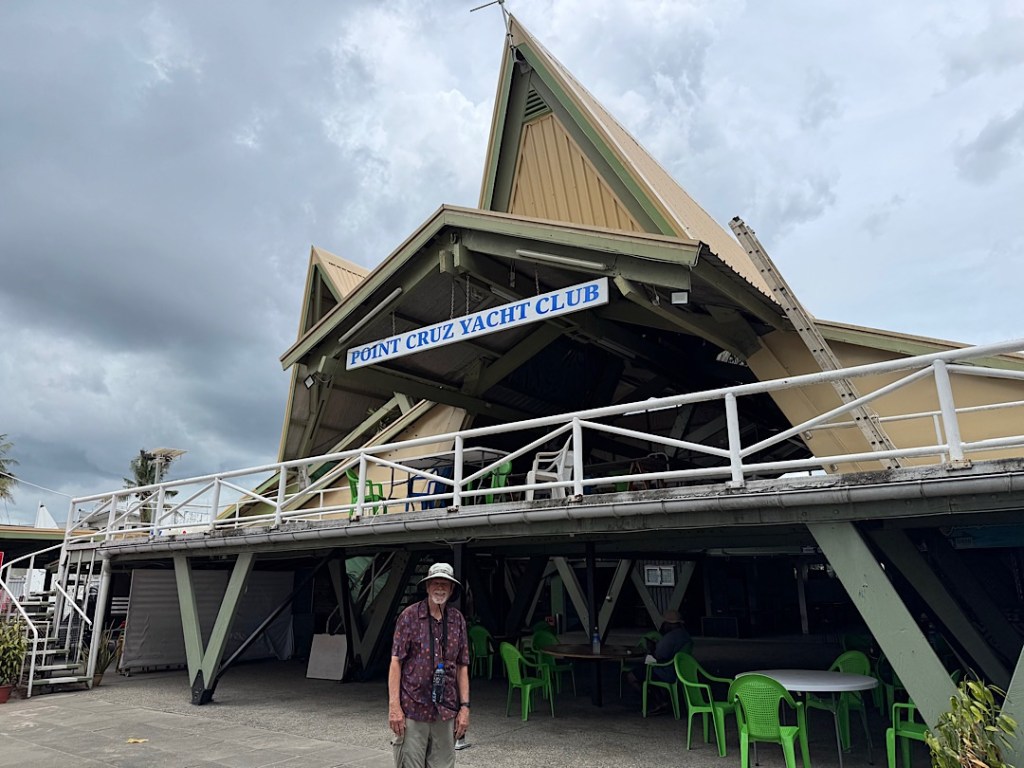
We popped into the nearby Solomon Islands visitor center then walked about a block to the Point Cruz Yacht Club to check out its restaurant; we’d heard it might be a place to eat.
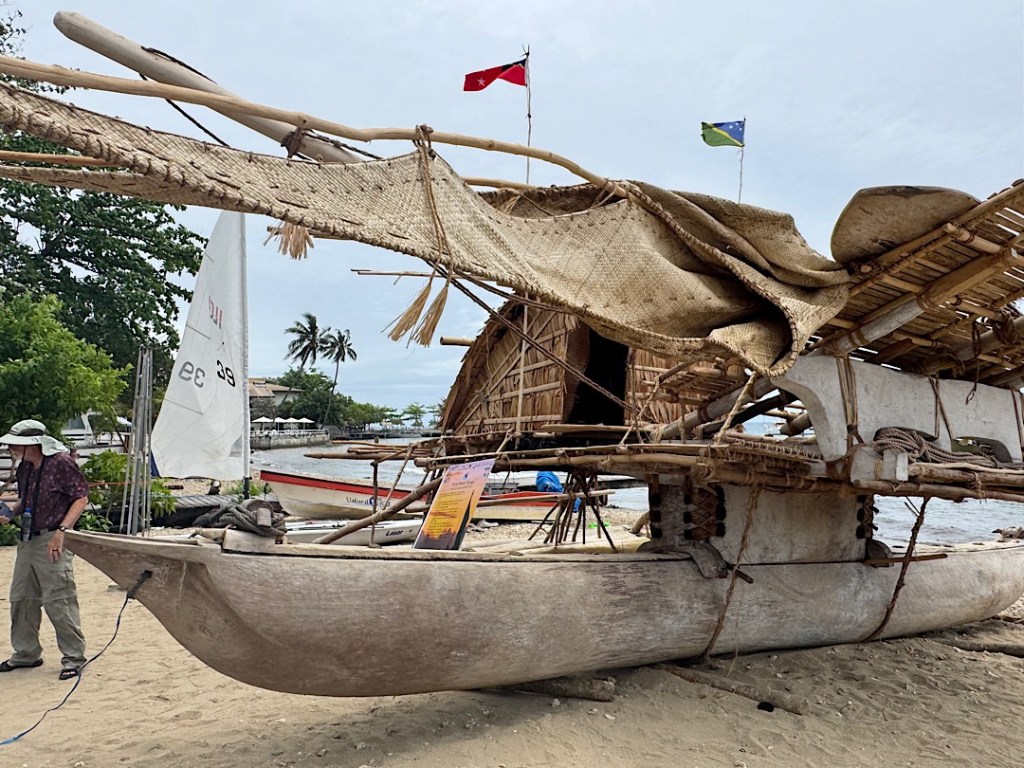
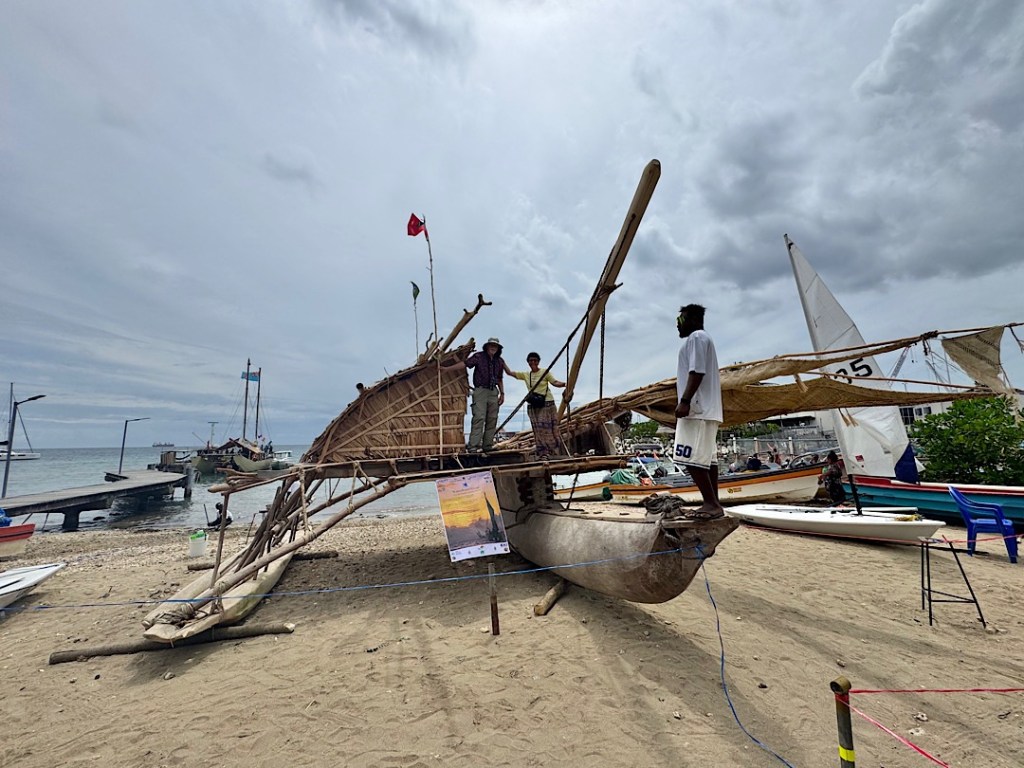
The dimly lighted central building looked like an okay place to shoot pool and drink beer with the guys. But on the beach out back, we found something quite extraordinary: a small “Tepuke”-style outrigger canoe built entirely from traditional materials in the traditional manner developed by ancient Pacific mariners.
This particular vessel had recently been constructed in the far easternmost part of the country; a six-person crew sailed it for 5 days from there, arriving in time to kick off the big political pow-wow. Steve and I had read about such sailing ships in the marvelous recent book, Sea People, and now here was one, steps away from us.
We chatted at length with a friendly, burly man who introduced himself as Bennett. He urged us to climb up so he could take our picture on the little outrigger.
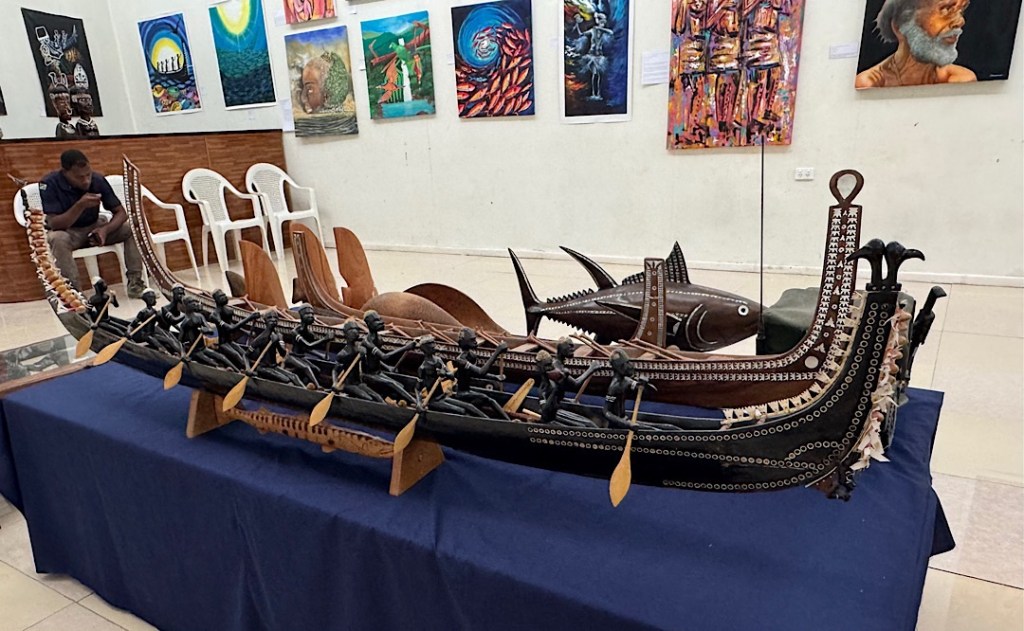
That afternoon we did several other things. We visited an art gallery that was small but filled with some interesting things.
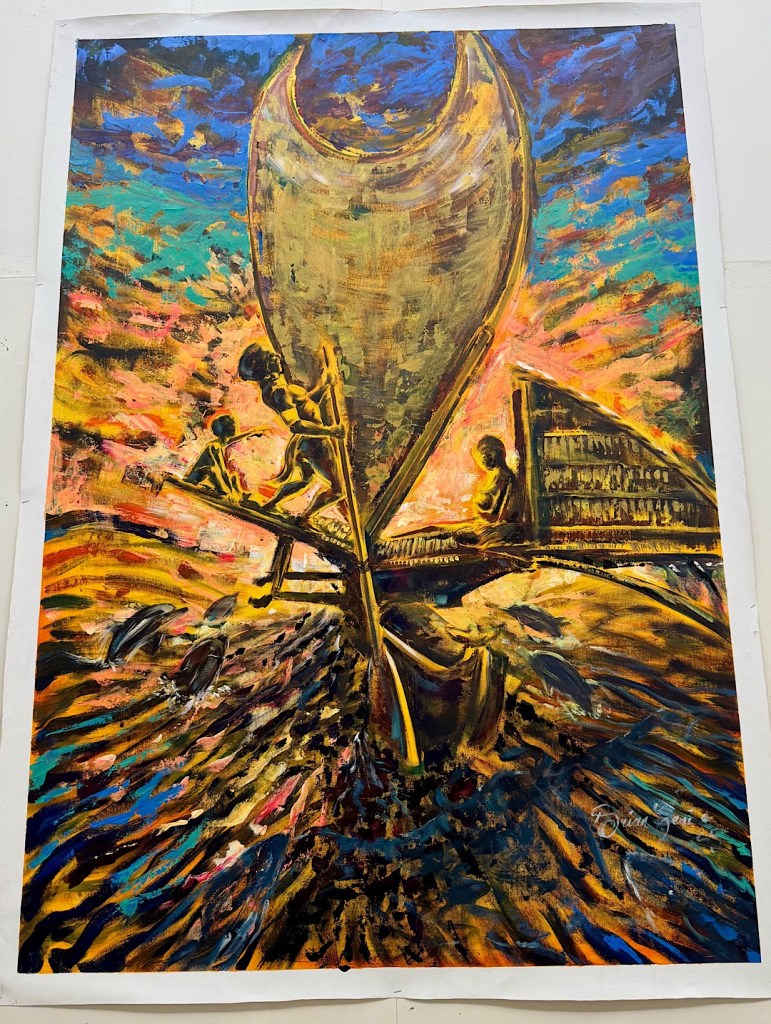
This painting captures what I imagine it must be like to sail an actual tepuke outrigger.We strolled through the central fish and produce market, which seemed to be extraordinarily clean and tidy.It’s a good place to buy ginger. These large ones were going for the equivalent of 60 US cents.
By mid-afternoon the heat and humidity had reached daunting levels, so we caught a taxi back to the hotel and, after a swim and a nap, began to fret in earnest about occupying ourselves for the next two days. The front-desk clerk had a suggestion. She knew someone with a little tour company who might be able to help. Lisa punched a number into her cell phone, and minutes later, Keren Fono’ota pulled into the Honiara’s parking lot.
Born on Vanuatu (another island country about 800 miles east of Honiara), Keren had moved to the Solomon Islands about 25 years ago. She went to school and worked for a few years as a journalist, but then she started Iumi Tour Solomons. Warm and charismatic, she didn’t have to work very hard to sign us up for two of her outings: a cultural visit to a village on Friday and a full-day beach excursion for Saturday.
It did not bother us that on Fiji we had just done BOTH a cultural village visit AND an island day trip. I’ve come to realize that in tropical tourist destinations, those are like fish and chips. It’s hard to avoid them. Moreover, we’d greatly enjoyed the Fijian offerings, and as luck would have it, Keren’s versions turned out to feel much less touristy and more authentic than their Fijian counterparts.
The village to which she drove us, Hotomai, was an offshoot of a larger community on the other side of Guadalcanal. Although the Birau people in the satellite village earned some money from welcoming the occasional visitors, they also grew subsistence crops and sent their kids to local schools. For our visit, some of the ladies gave us a musical greeting.
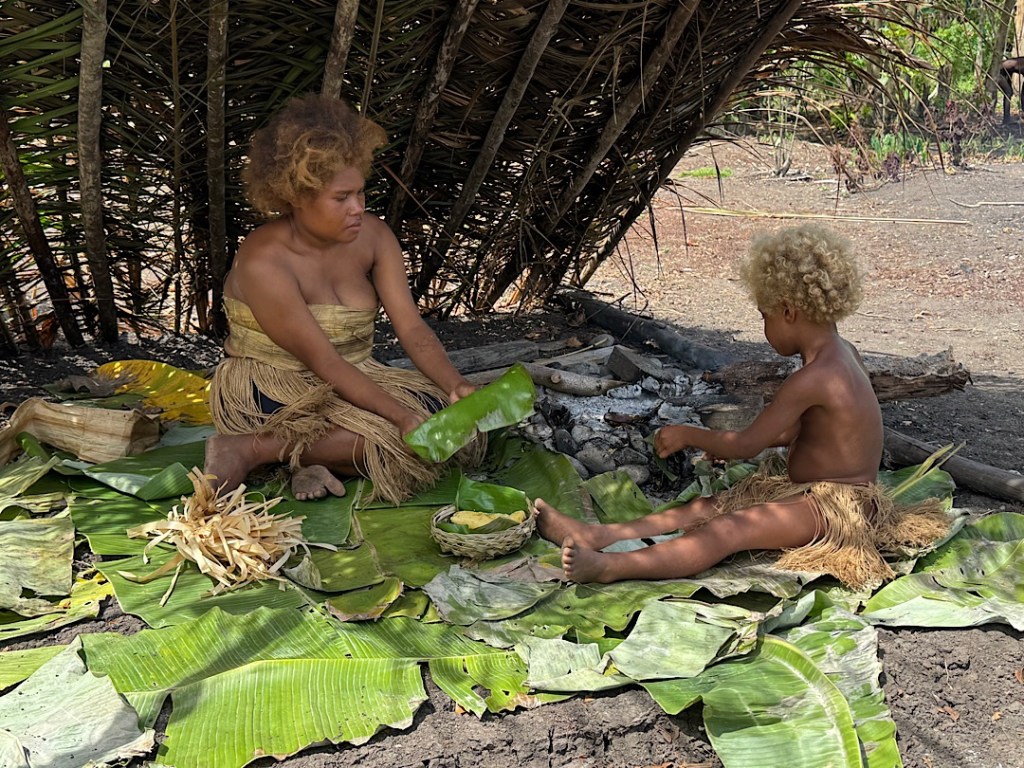
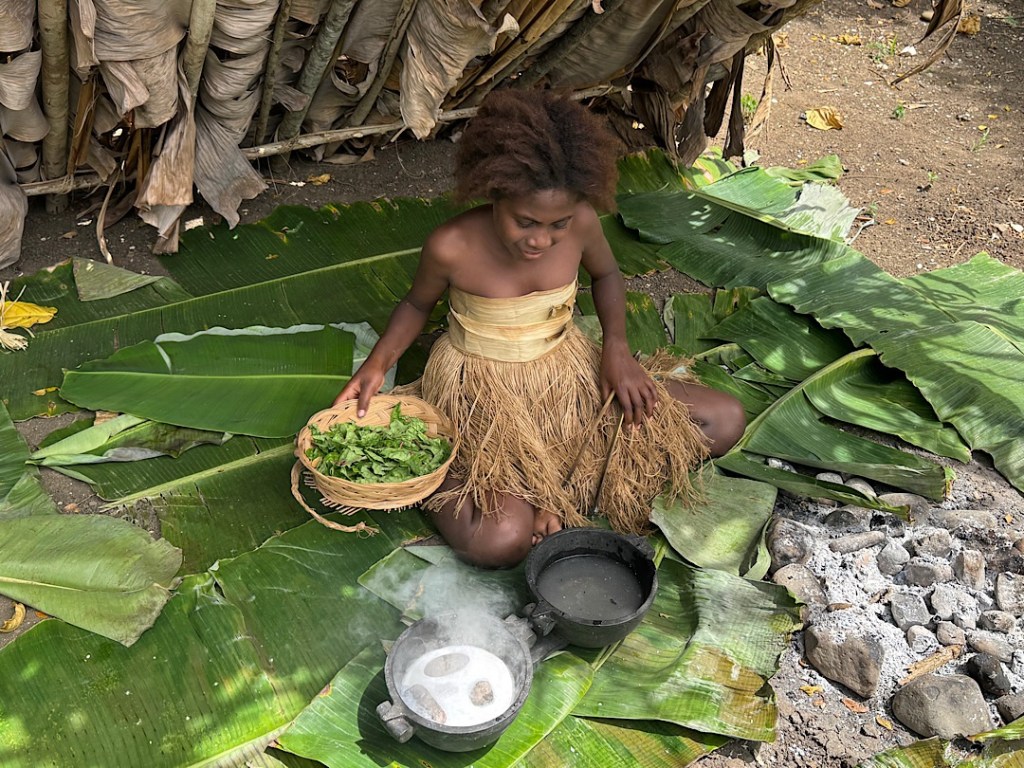
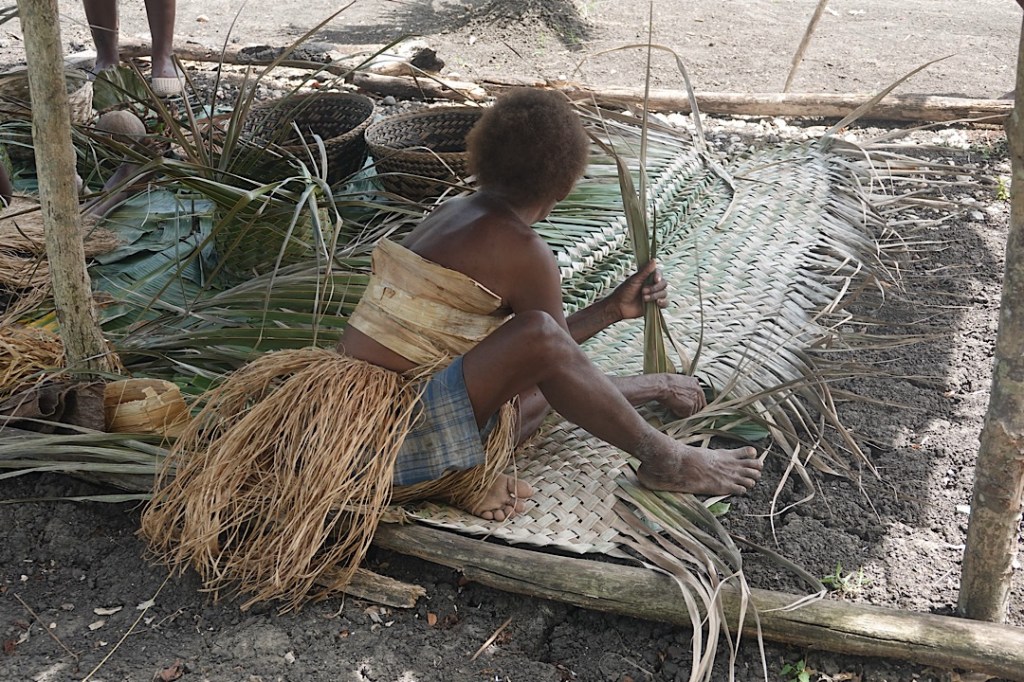
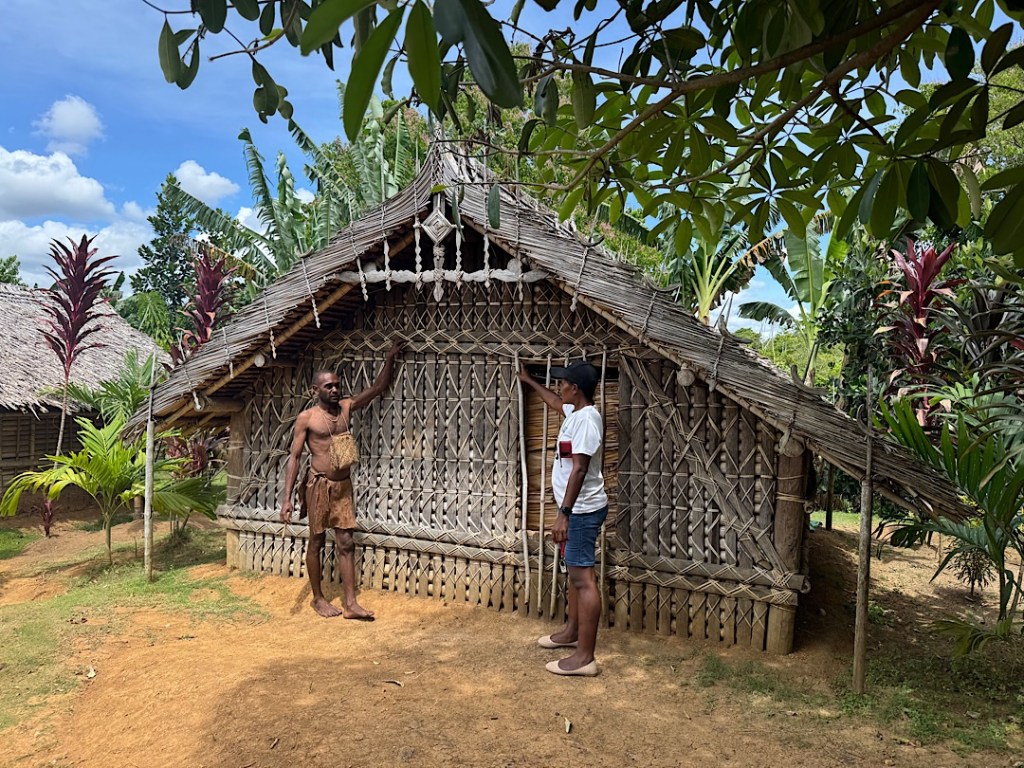
We got lessons in how to plant taro and cook traditional foods……such as bananas……and greens. The rocks in front of this young woman were red hot. She picked them up with her tongs, rinsed off the ashes, then put the hot rock in coconut milk. Then she simmered the cabbage-like greens in the hot milky stew.This lady is turning palm fronds into all sorts of useful objects.Here are Keren and one of the tribal leaders in from of a community room built without any nails.
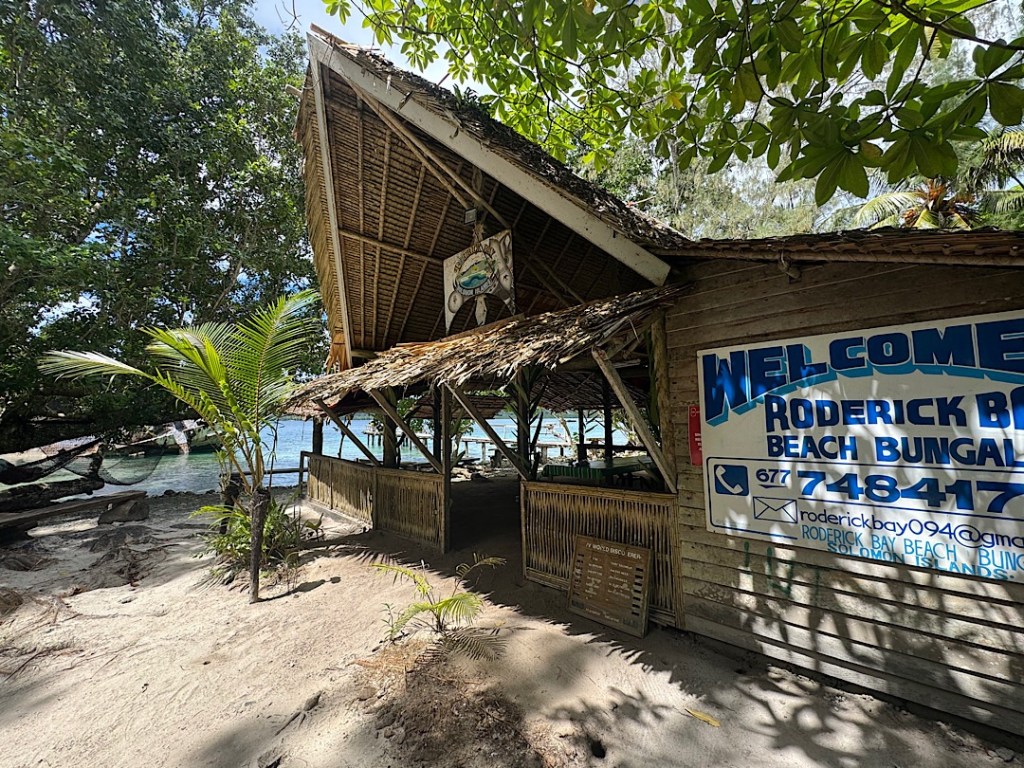
We took the village tour along with an Australian couple, but for Keren’s outing to Roderick Bay the next day, Steve and I were the only customers. Keren had told us we would travel in a speedboat for 90 minutes out to one of the Florida Islands.
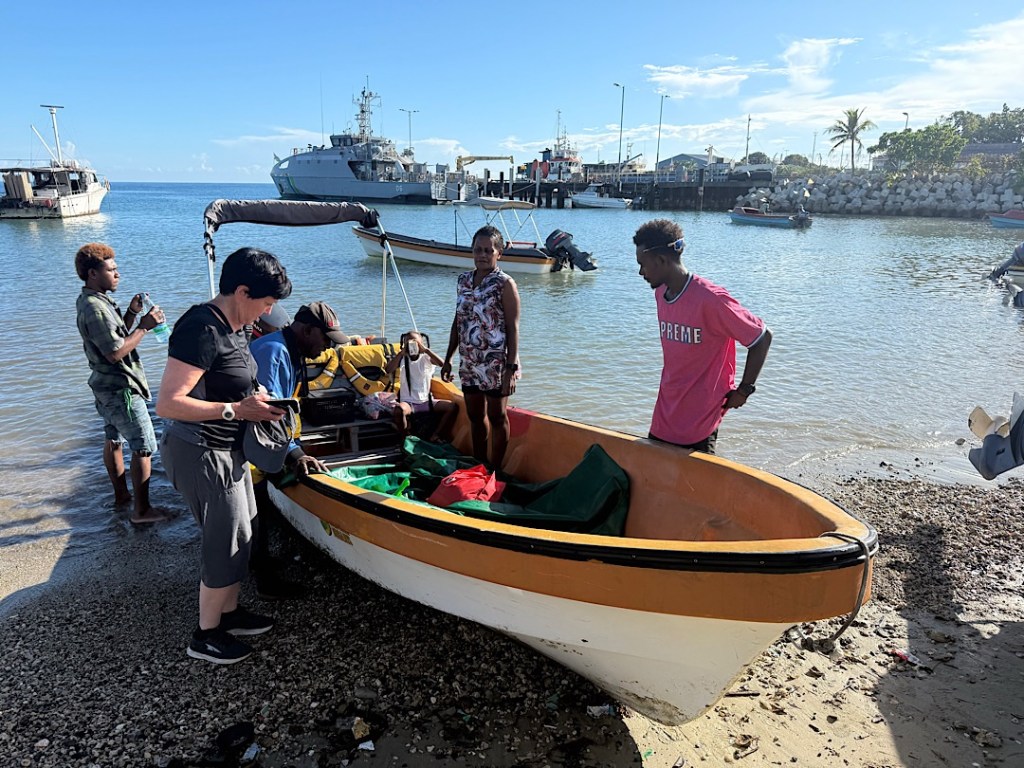
When we arrived at the yacht club Saturday morning, we realized the “speedboat” was what Solomon Islanders call a banana boat. In Baja California, folks know it as a panga: an open fiberglass motorboat about 25 feet long, powered by a Yamaha outboard motor.
Steve and I and Keren and her two kids, 6 and 8, piled in and the captain coaxed the motor into action. “Look at it this way,” Steve murmured to me, “You could be riding in this with 20 Mexicans. In the dark.”
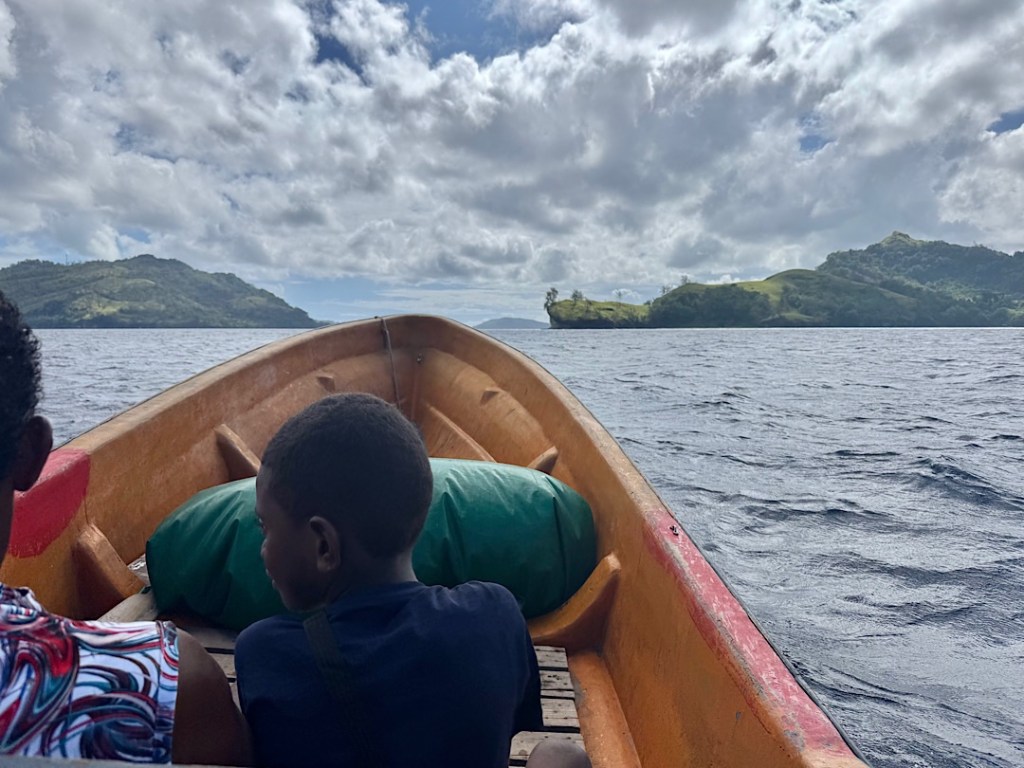
We roared out to sea, and I felt a rush of exuberance that lasted for maybe 10 minutes. Then the miserable part began. The wind stiffened, shattering the relatively flat sea surface into a million geometries that caught our little craft and made it bob this way and that. Frequently we were lifted up then slammed down with a force that made me worry about the impact on my spine. Soon we were out of sight of land. Swells rolled in that made us roll tilt even more, and I felt grateful neither Steve nor I get seasick. I soon was soaking wet, from the salt water that blew in over me.
I tried to distract myself by reflecting on our location: smack in the middle of “Iron Bottom Sound,” a nod to the Japanese and American ships that went to the bottom in the ferocious fighting that exploded here 83 years ago. Not far away, future US president John F. Kennedy’s PT boat was struck by Japanese fire and sank. Surely that must have been more unpleasant than this passage, I told myself.
I would have bet money that the destination wouldn’t justify the journey. But then we approached the entrance to the bay.
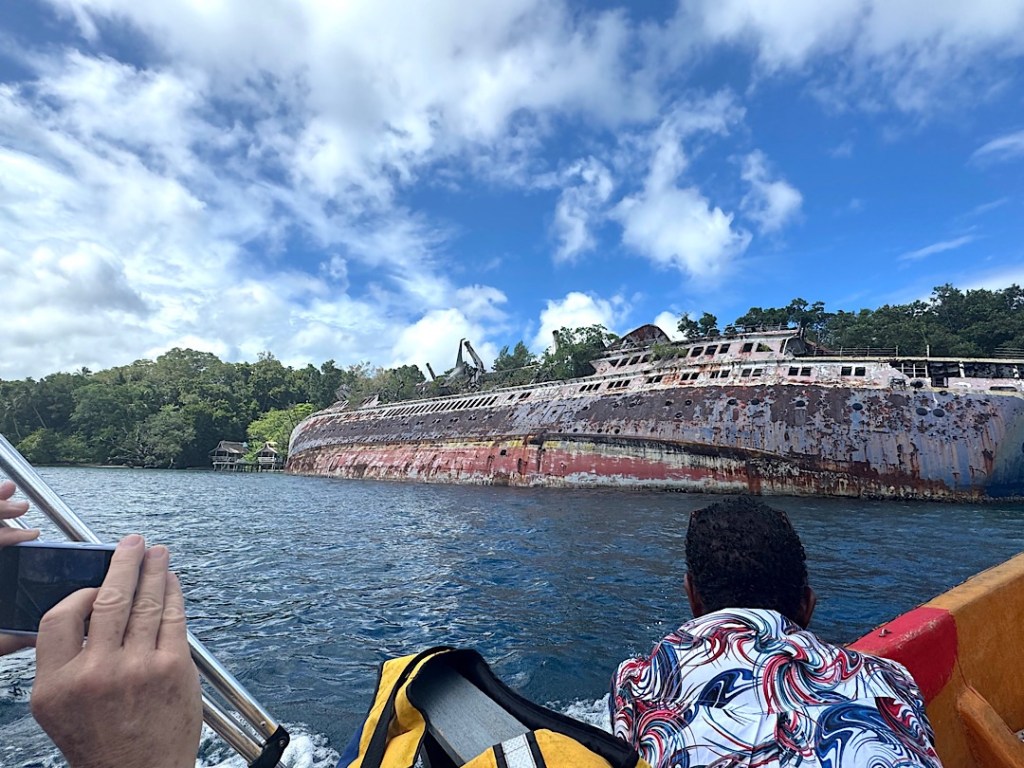
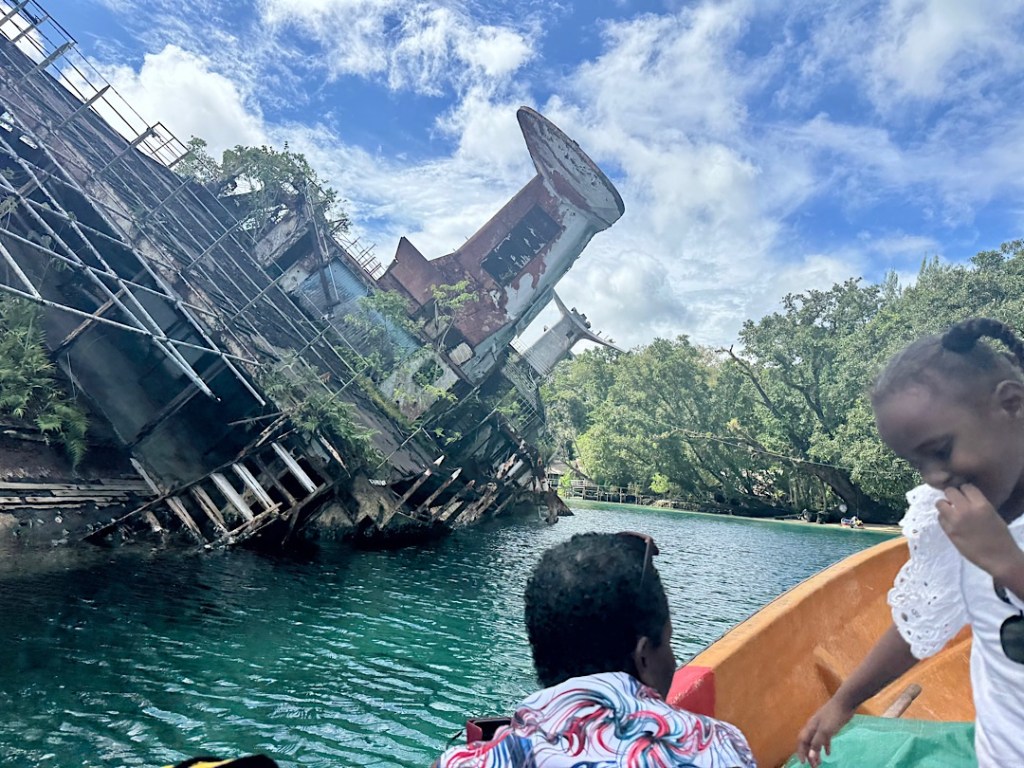
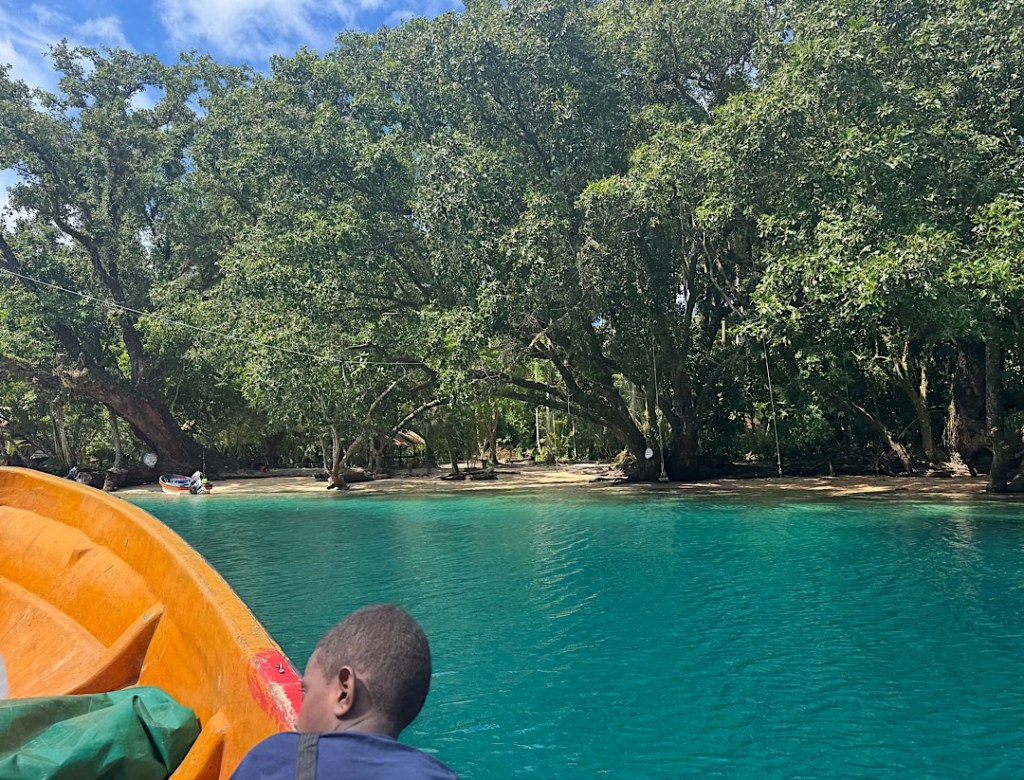
The world became calm again; the sun came out. After some moments we approached a bizarre sight: a German cruise ship that had hit a reef 25 years ago and limped into this inlet before sinking. Behind the wreck, a scene of extraordinary peace and beauty came into view.
A small tropical garden appeared to be growing on the wreck. We approached a sandy white beach under magnificent trees.
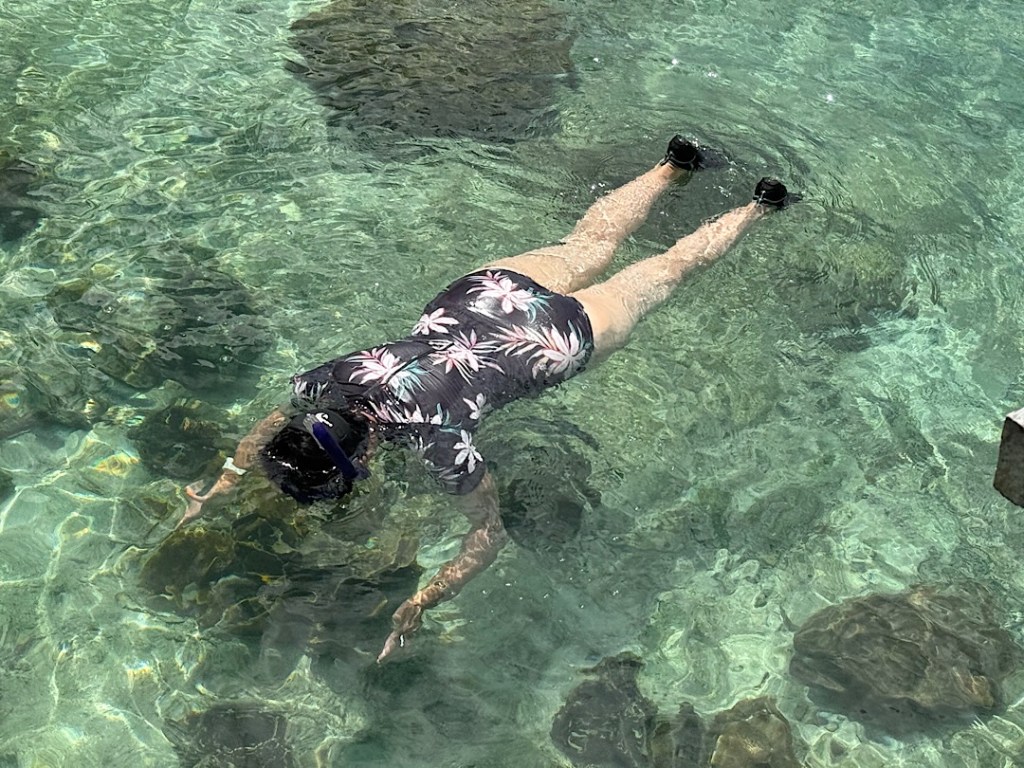
We rented snorkels and marveled at beautiful fish hanging out in the little reef off the beach . I spotted a clam as wide as my hands are apart in the photo below.
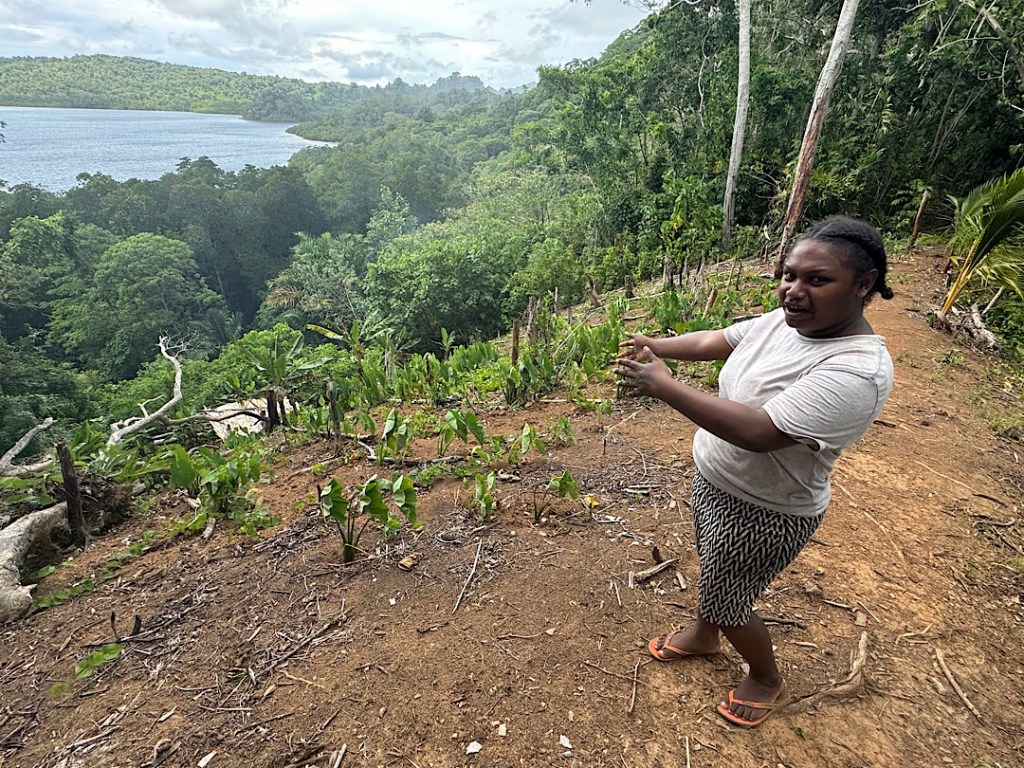
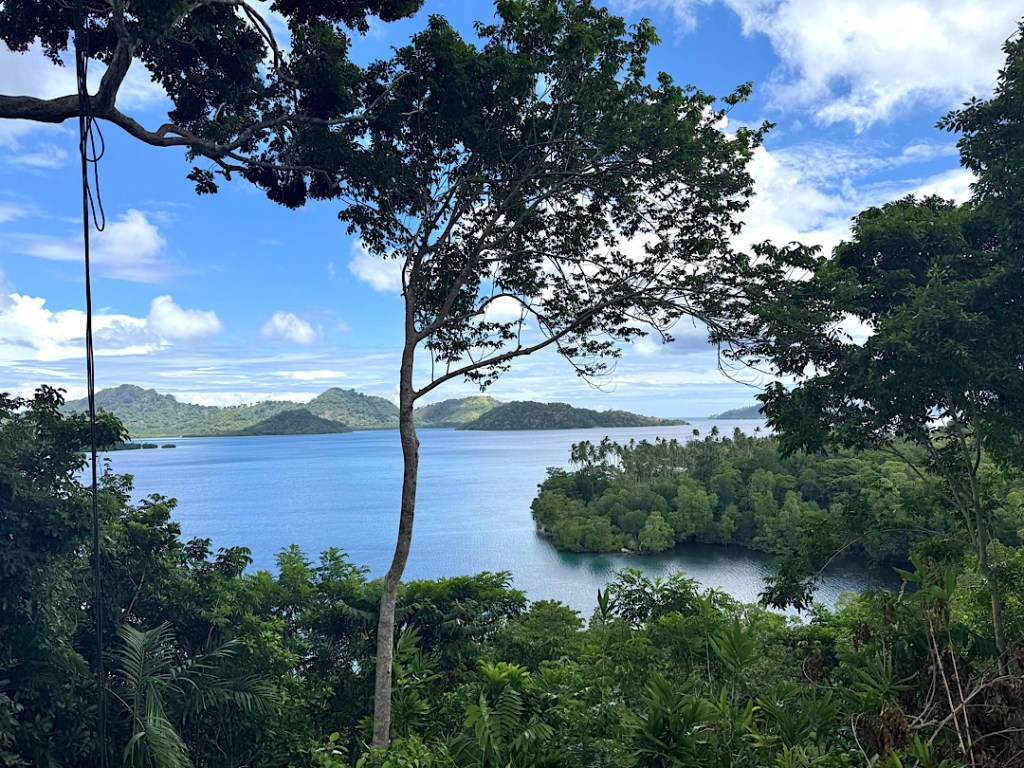
We had a simple lunch then hiked up to a lookout point on top of the ridge. Tracy, the daughter of the property owner was our guide.We could have stayed overnight in a primitive cabin. But we had a plane to catch the next morning.
So at 2 p.m. we piled back into the banana boat. The ride back wasn’t better but it wasn’t any worse and most importantly nothing catastrophic happened.
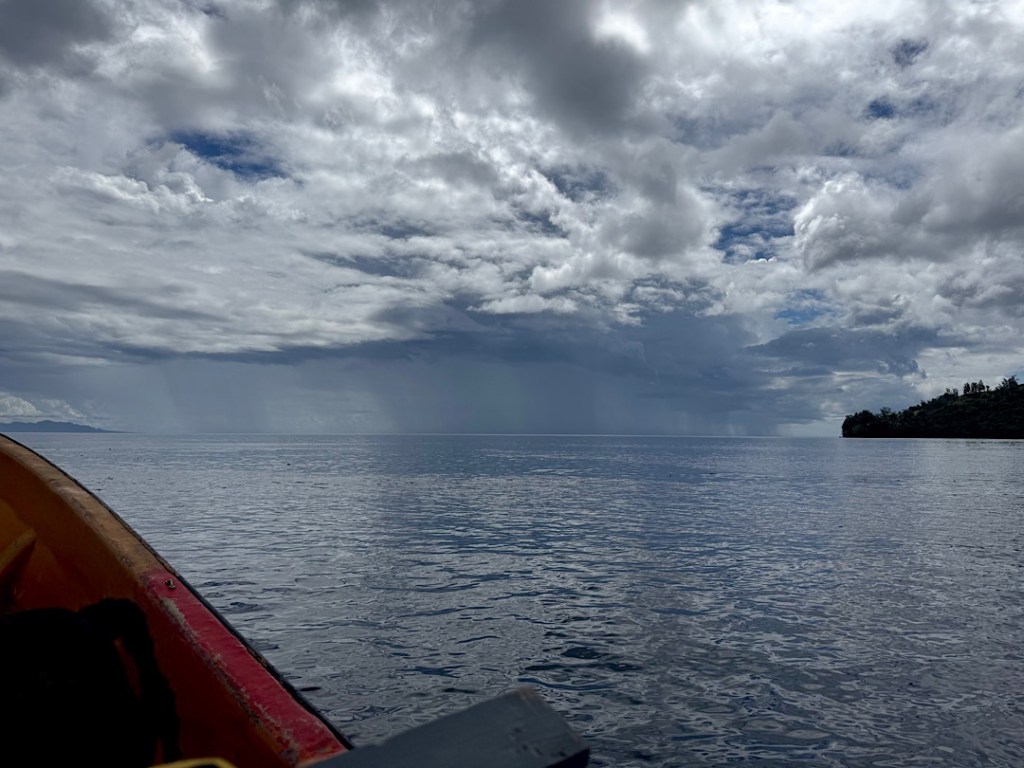
This rain in the distance looked ugly, but the downpour blew away from us.
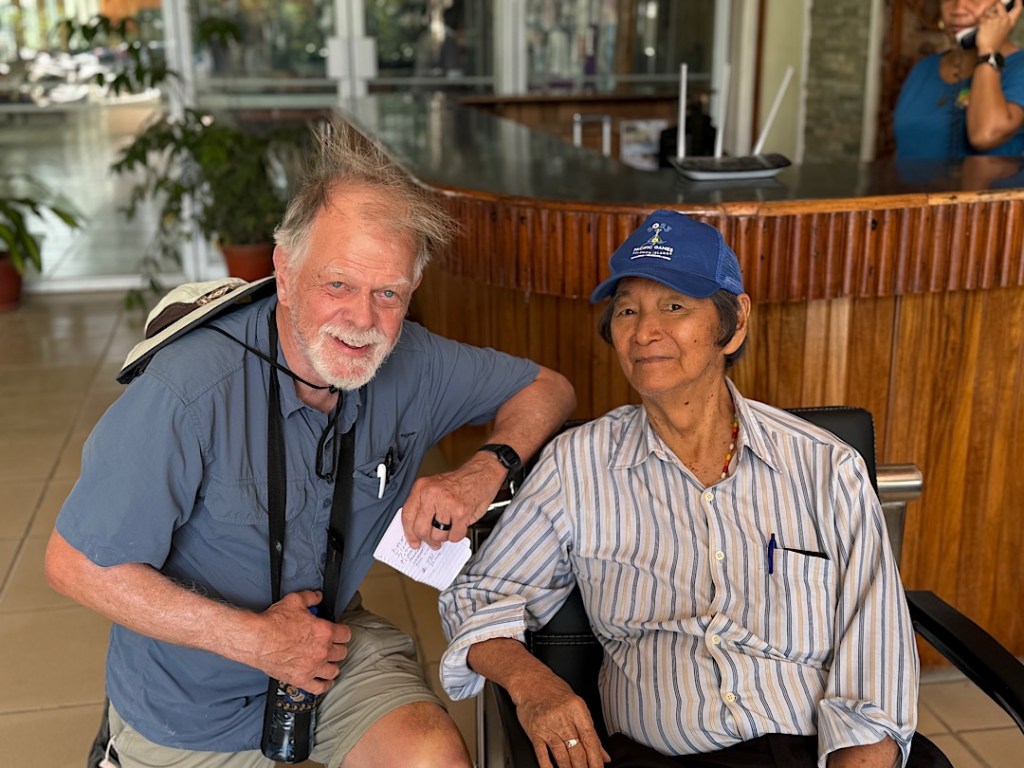
Steve and I had to pack up and check out by 9 yesterday morning, then head to the airport for our flight to Pt. Moresby in PNG. At breakfast, I had spotted Sir Thomas Chan in the dining room. A frail Asian gentleman, Sir Tommy (as folks call him) is the 82-year-old owner/creator of the hotel and the artist responsible for all the hallucinogenic art work. Photos and other memorabilia posted in the lobby provide flashbacks of his life.
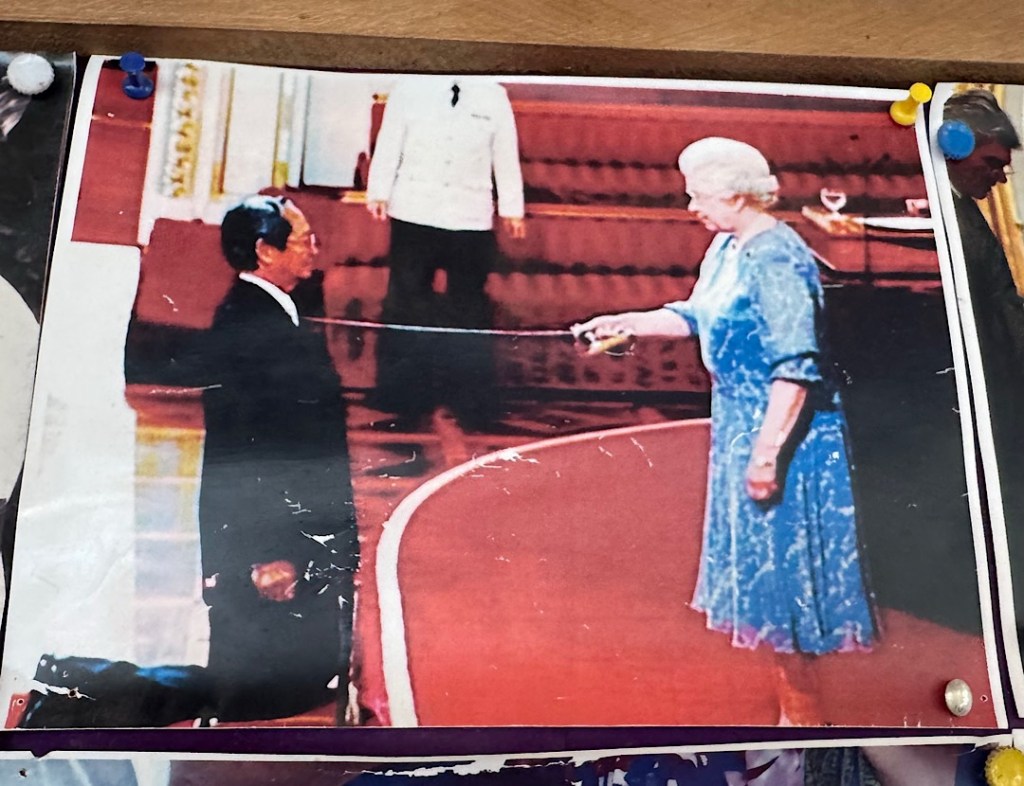
There he is waterskiing! Catching huge fish! Greeting dignitaries, including Prince William and Princess Kate back in 2012. In another photo, you see him kneeling before Queen Elizabeth as she touches a ceremonial sword to his shoulders (the title apparently granted in recognition of his charitable work.)
Steve and I had run into him in the lobby a few days earlier while waiting for Keren to pick us up. Sir Tommy told Steve a bit about his business career.
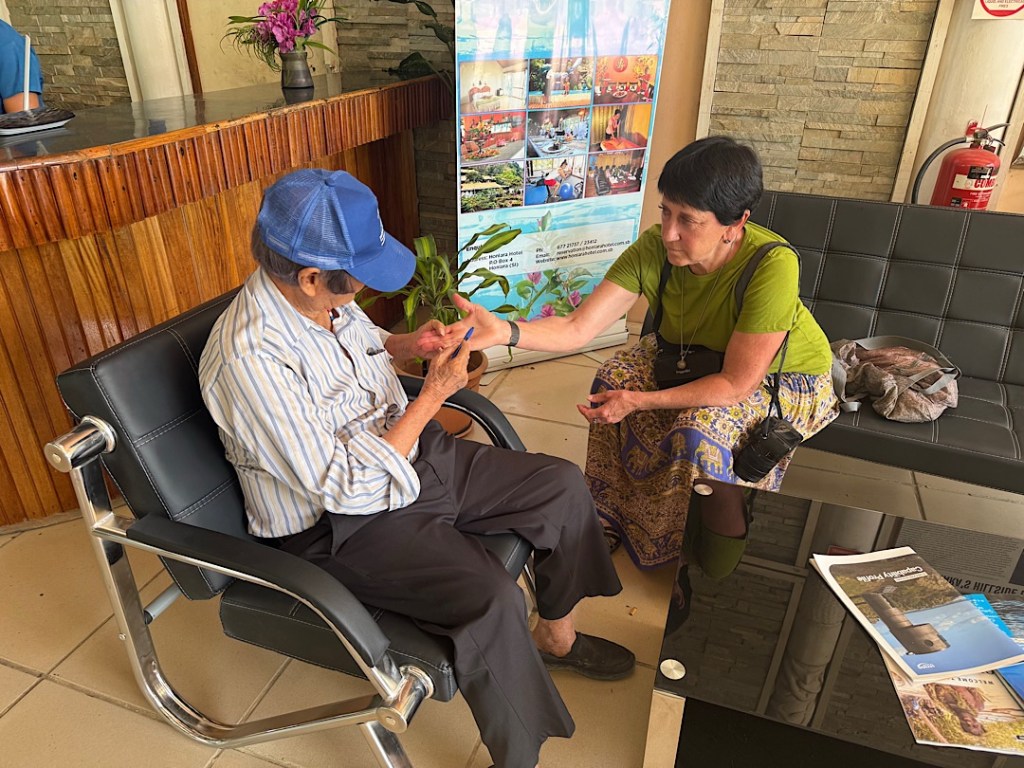
Then with a twinkle in his eye, the octogenarian asked if I would like him to read my fortune. How could I resist? He took my hand in his and studied my palm, noting that I have a long life line. I could keep going strong for another 10, 20, even 30 years, he declared, if I avoided fried foods, didn’t get fat, and engaged in a lot of exercise (the way he does.)
It crossed my mind to ask him about the travels that still lay before us, but I refrained. Sometimes you can have the most fun when you don’t know just what’s coming.
As I said, our hop, skip, and jump approach to getting to the other side of the world is an experiment. I have preliminary results from Phase 1: Samoa.
In premium economy seats on Fiji Airways, the 5 and 1/2 hour flight from Honolulu was unremarkable, except for its 3:15 a.m. arrival. We chose this awful connection only because options were so limited; our schedule so painfully constrained.
Outside the terminal, we clambered into a taxi and were driven for 45 minutes to our hotel, a Sheraton on the waterfront in the capital (Apia). Even in darkness, the tidy highway impressed me. I could see no trash. Instead my eye was drawn to the containers lining the roadside boundary of many homes. Made from stacked tires or metal cans painted and planted with flowers, the blooms would be pretty in the sunshine.
Our taxi driver conformed to Samoan stereotypes. Everything about him was broad: his shoulders, his gut, the nose set in his wide golden face. It was he who alerted us to what would prove to be the worst thing about our quick pass through his country. We would be there only Saturday and Sunday. But Samoans take their weekends seriously. Toie warned us that the Robert Louis Stevenson museum — a fixture on lists of Top Things to Do in Apia — would close in about 7 hours (i.e. at noon Saturday) and would not reopen until Monday. On Sunday, he warned, everything else would shut down except for the multitude of churches.
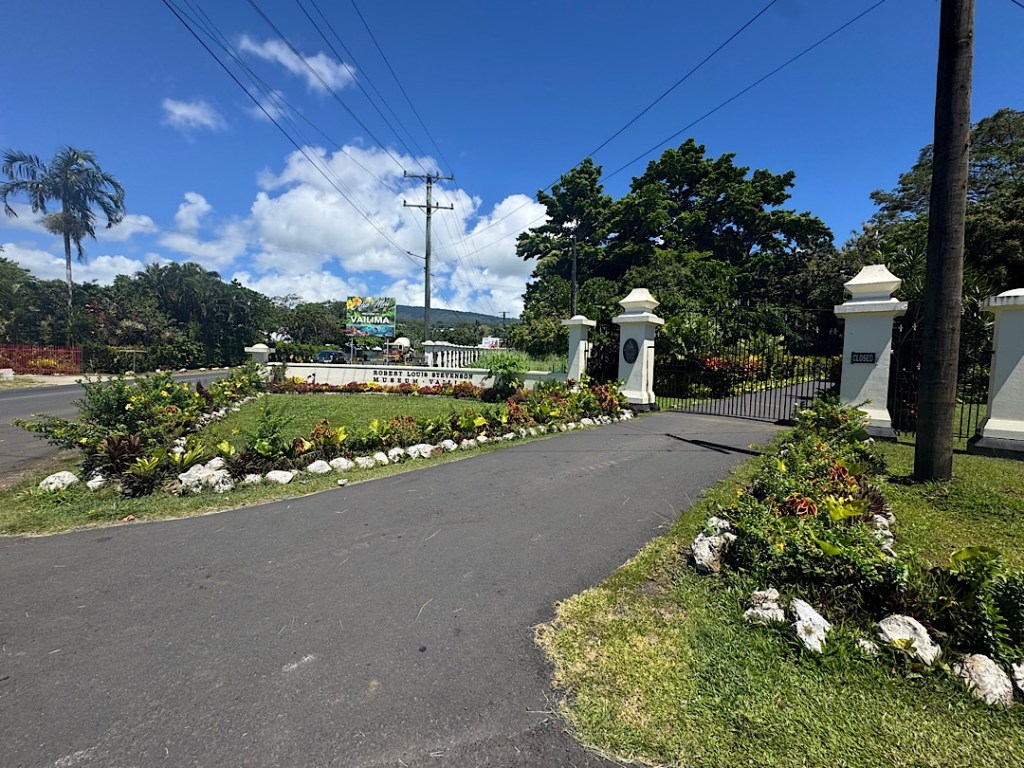
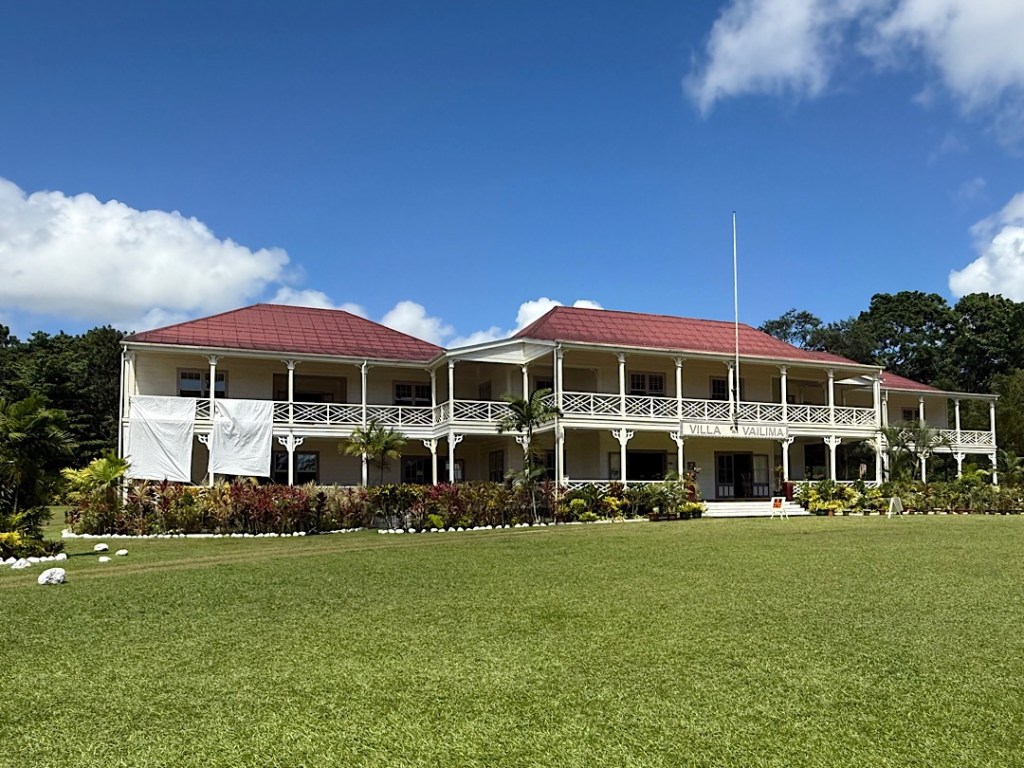
We checked into our room, napped for about 90 minutes, ate a quick breakfast, then took another taxi up a steep hillside to the property developed by the author of Kidnapped, Treasure Island, the Strange Case of Dr. Jekyll and Mr. Hyde, (and more). Robert Louis Stevenson and his wife Fanny came to live in Samoa in 1889. Besotted by the sunshine and tropical beauty, they hoped it would prove a tonic for Stevenson’s longterm lung disease and other ills. It worked but not for long. RLS died of a stroke in 1894, at 44. But in their five years on the island, Louis and Fanny oversaw construction of a beautiful villa and surrounding farms and gardens. Today the complex is a museum open to the public (but only till noon on Saturdays).
That was enough time for us to see why the place enchanted the Stevensons.
The entranceA guide took us through the villa, which was as pretty and pleasant inside as out.The view from the front porch
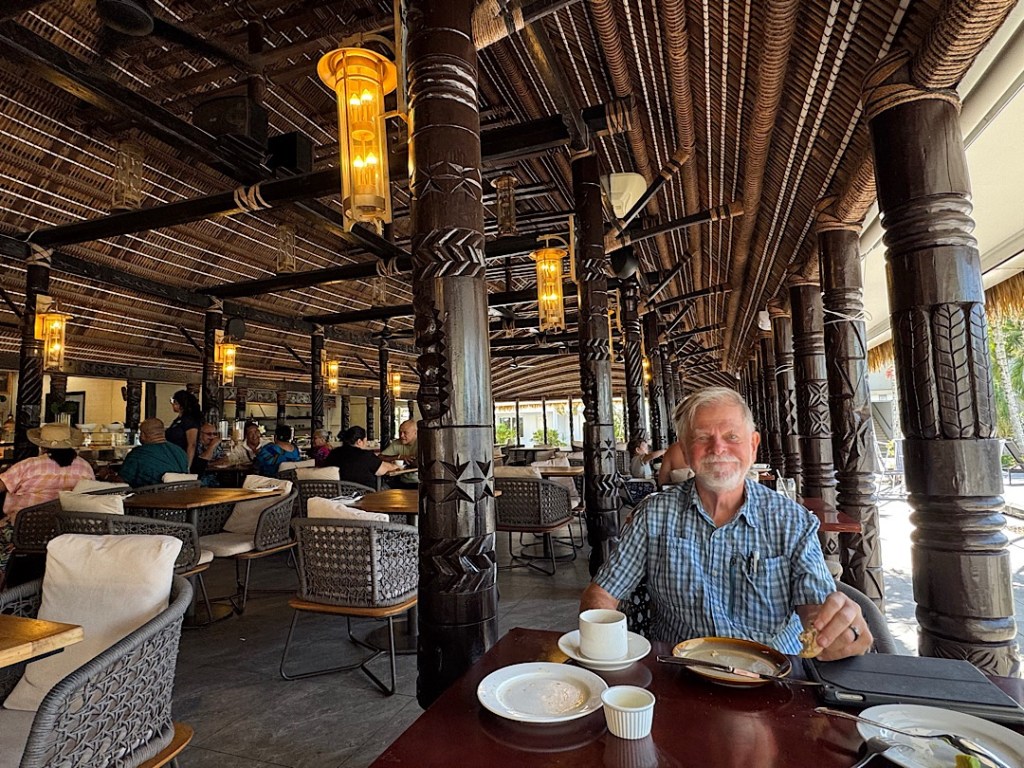
We returned to our hotel, with its beautiful open-air restaurant next to a pretty pool. It wasn’t a hardship to sit there, surf online, and confirm what Toie had said. Almost nothing would be open the next day.
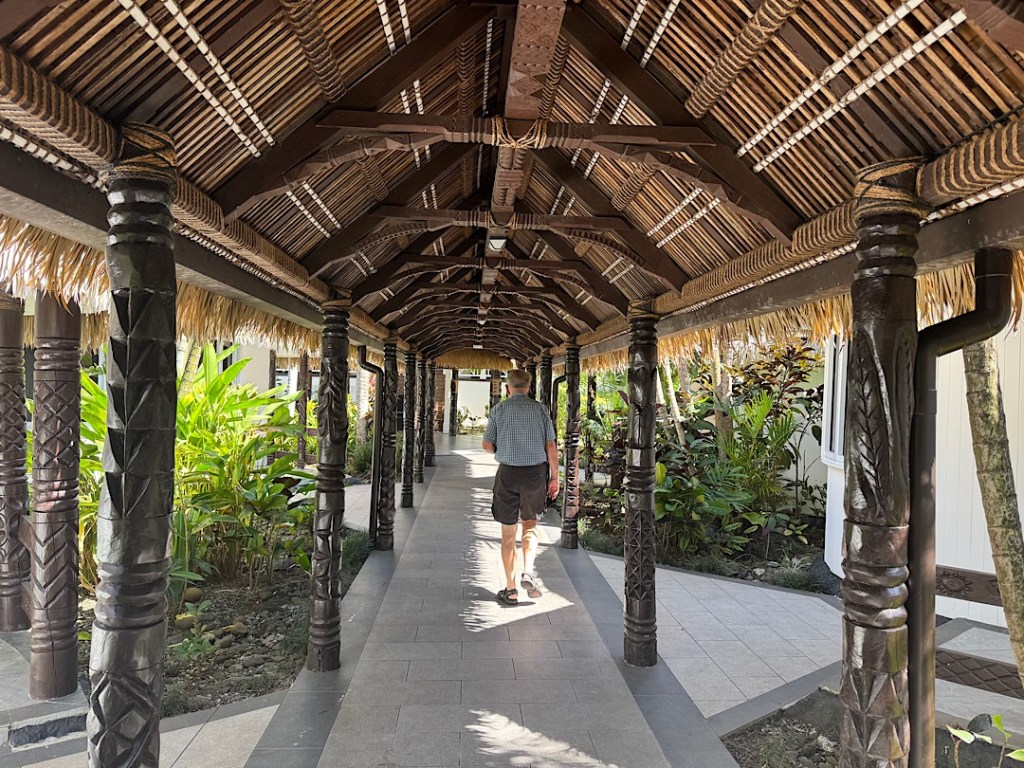
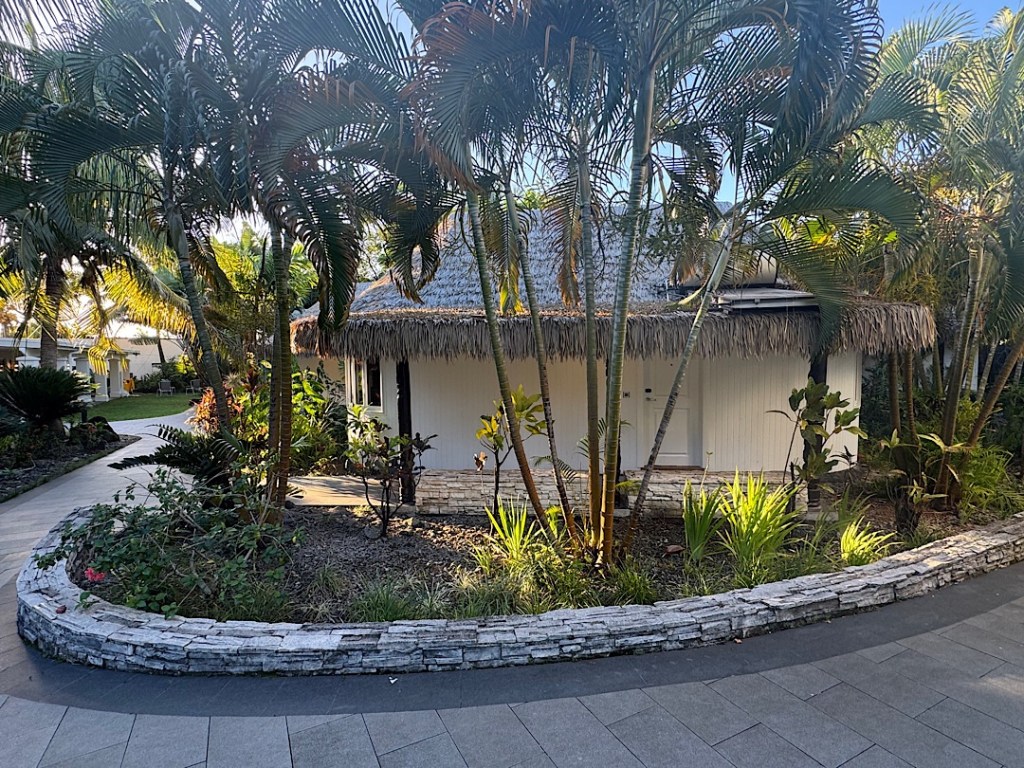
The food was just okay, but the Samoan wood work dazzled me.This was our bungalow.
Steve did find a promising restaurant just a few blocks away. We walked to it, arriving at Paddles just minutes after it had opened at 5:00. We got a table and our meal was so delicious and fun we tried to make a reservation for the next night. But oh yeah. Paddles also closed on Sundays.
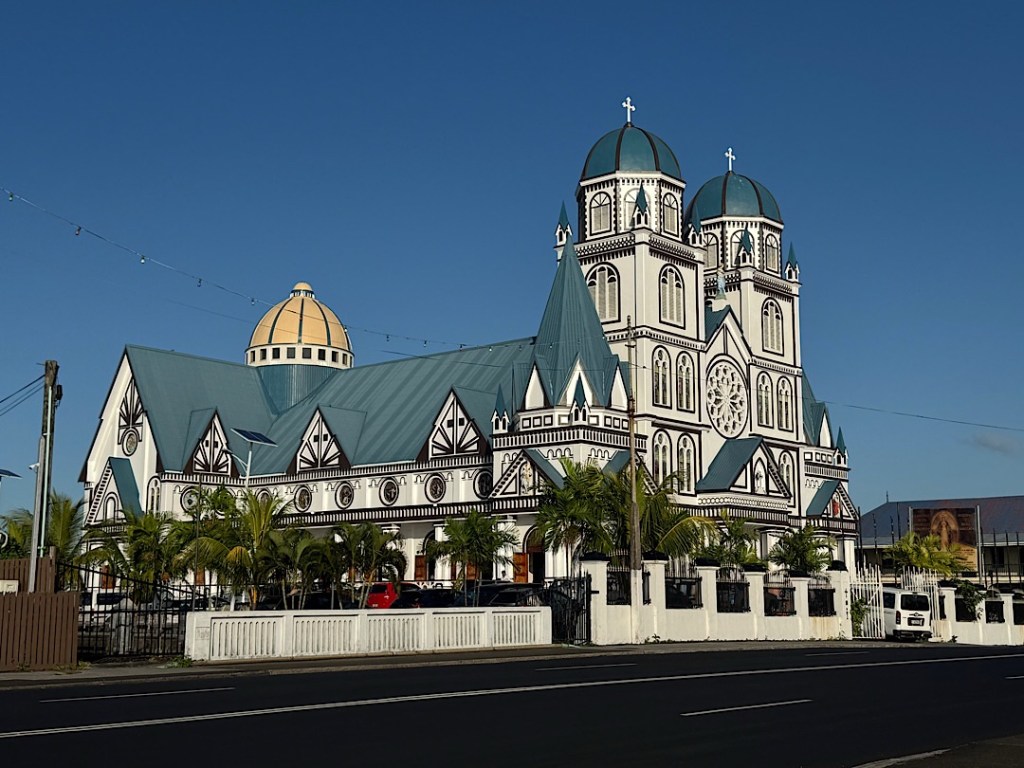
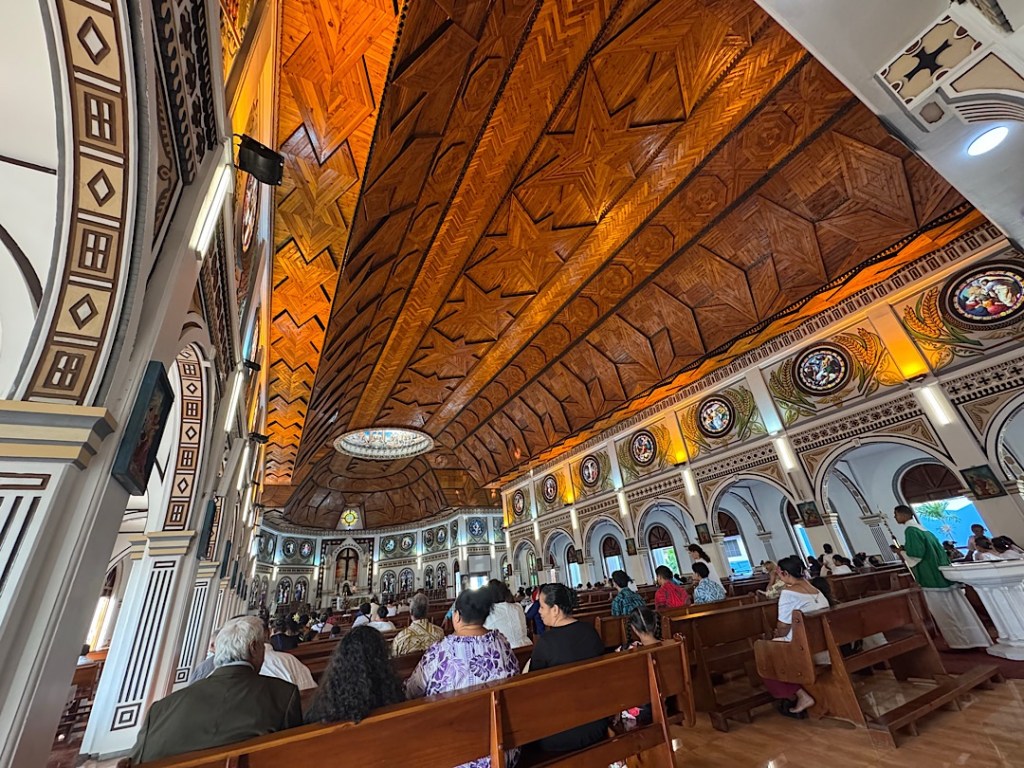
Happily, another Top Sight in Apia is the Catholic cathedral. The next morning Steve and I strolled there, arriving as the 7:45 Mass in Samoan was starting.
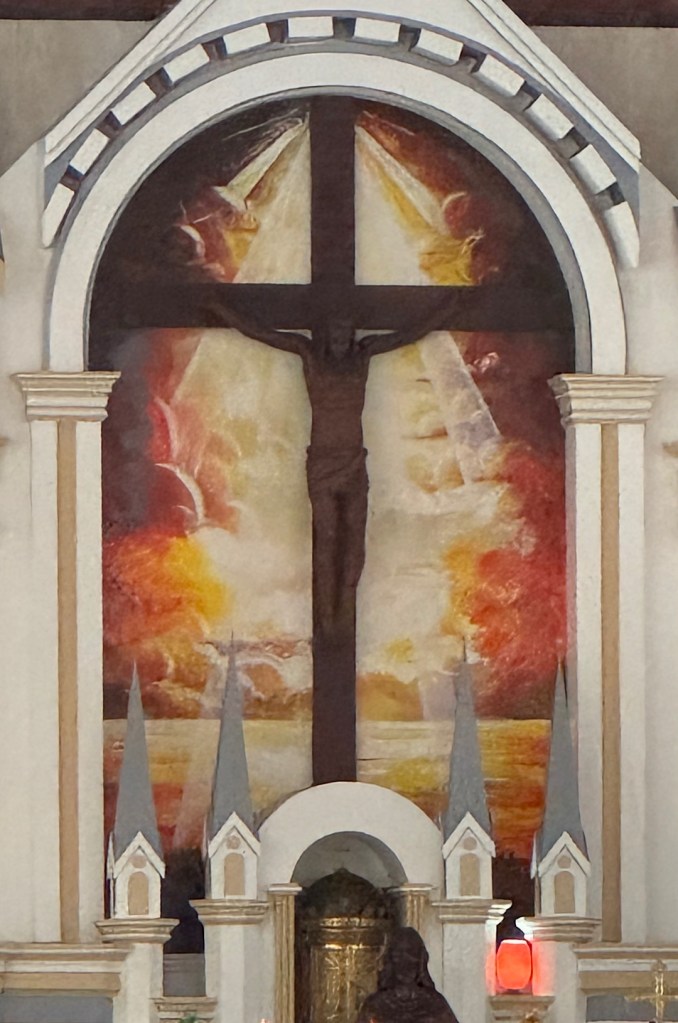
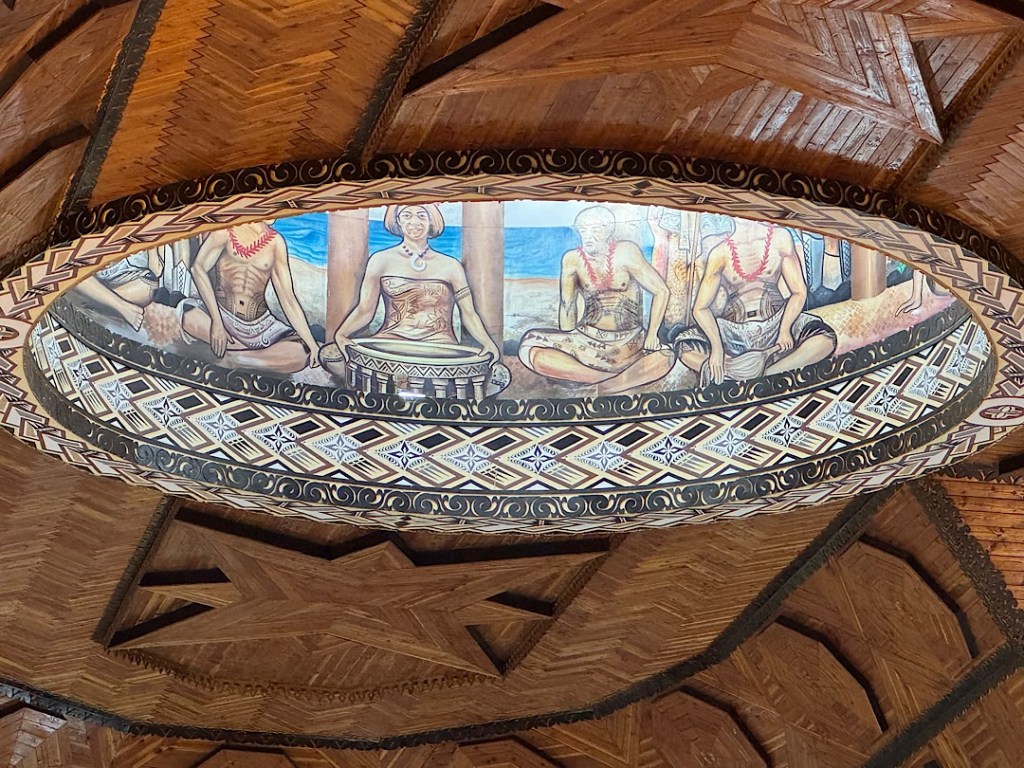
More stunning woodwork covered the ceiling.Because of the Mass, we couldn’t see more of the cupola. But what we saw of it was distinctive. So was the painting behind the altar (above).
Later in the morning, I got a hotel massage, Steve and I ate another lunch next to the pool. We swam a bit, napped a bit, consumed our dinners in the hotel restaurant. When we chatted with our waiter, he echoed what other Samoans had already told us: that Samoa is a paradise. Even without much money, you can live well; enjoy life. They wouldn’t want to leave it, they testified.
We had to go, however, at 5 am Monday morning, leaving in our wake a number of things we would have liked to see and do. I wished we’d had more time. But we’d had a good rest and at least gotten a glimpse of this beautiful, unpretentious, laidback idyll. It was worth the hop.
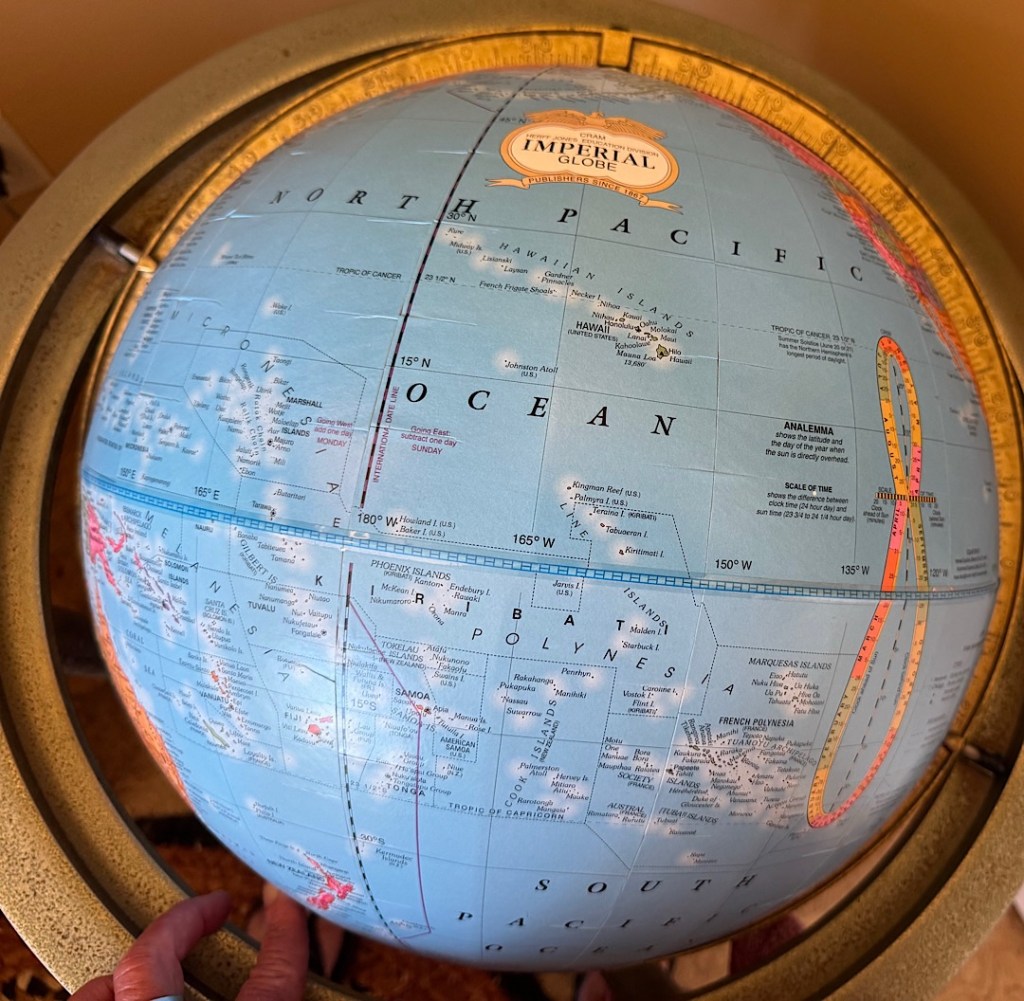
It’s not like I didn’t know the Pacific Ocean is big. I mean, duh. I was paying attention back in fifth grade geography. Since then, I’ve flown across the Pacific more times than I can count. And yet… just how big that ocean is somehow never sank in until I began preparing for this trip.
As part of the preparations, Steve and I read a marvelous book called SeaPeople about how the Polynesians managed to spread throughout the vast expanses of water — more than 12,000 miles across and another 10,000 miles from north to south. As author Christina Thompson points out, you could fit all the earth’s land masses into the Pacific and still have room for another continent as big as North and South America.
It fills up half the globe.
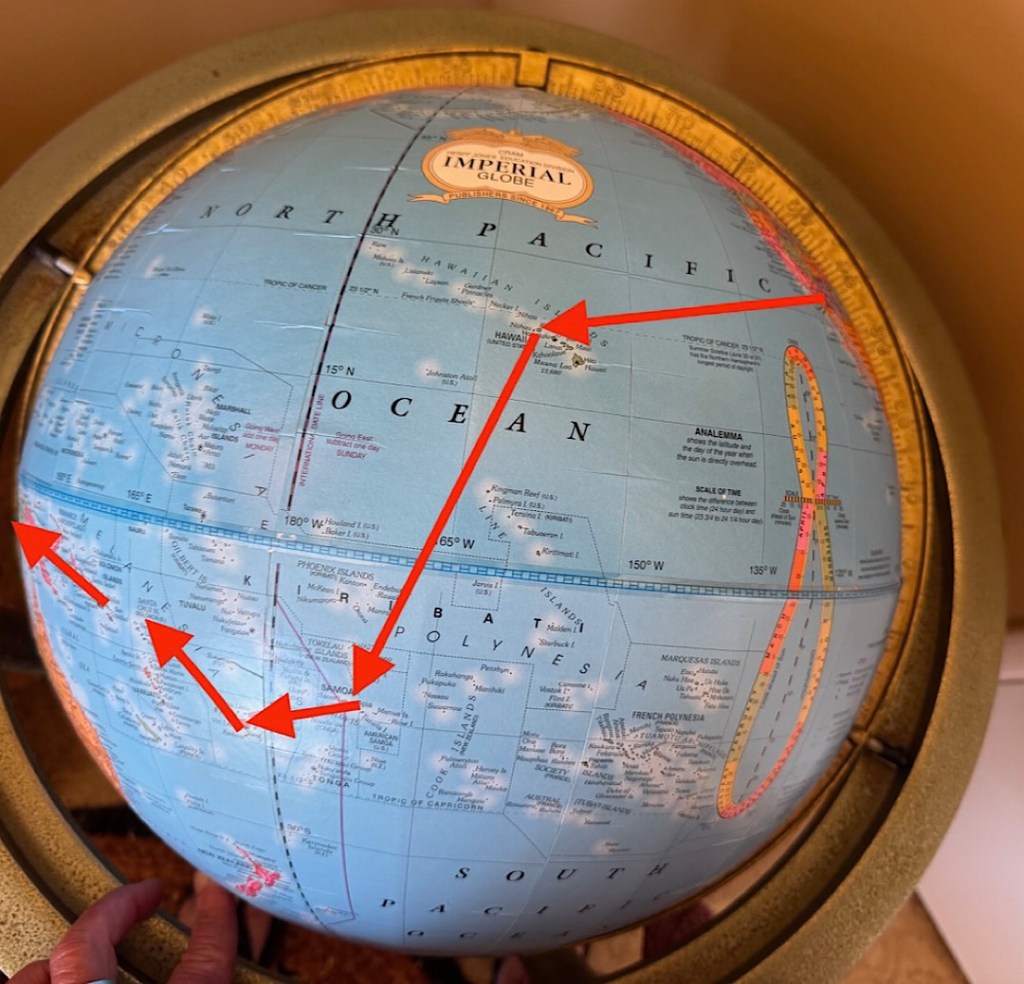
Getting from San Diego to Port Moresby (the capital of Papua New Guinea) takes more than 24 hours via the most direct connections. It’s either grueling (flying in Economy) or hellaciously expensive (in a lie-flat seat routing through somewhere like Singapore.) So we decided to try an offbeat alternative — what I’ve come to call my hop, skip, and jump approach. At the moment, as I’m writing this, we’re flying from San Diego to Honolulu. There we’ll rest in an airport hotel for a couple of hours, then continue southeast to Apia, the capital of Samoa.
We’ll sleep there for two nights, then make the short flight from Samoa to Fiji. Sleep there for two more nights, then hop again to the Solomon Islands. These flights don’t run every day. Due to the quirky schedules, we have less time in Samoa and Fiji than I would have wanted, and more time (five days) in the Solomons. From there the jump to Port Moresby is another piece of cake — just two hours and 20 minutes.
It’s an experiment. Maybe we’ll conclude it was nuts. We won’t be returning the same way. I have something else cooked up for that. At the moment, however, our return in five weeks feels almost unimaginably distant.
This year, improbably, I’m going to some of the most important places visited by the famous British explorer Captain James Cook on his third great voyage of discovery almost 250 years ago. In May and June Steve and I poked around Alaska. And next week we’ll fly to Hawaii, which Cook and his crew were the first Europeans to find (in 1778). Cook returned to these “Sandwich Islands” a year later and never left, not because the scenery enchanted him. Some angry natives killed him in a confrontation.
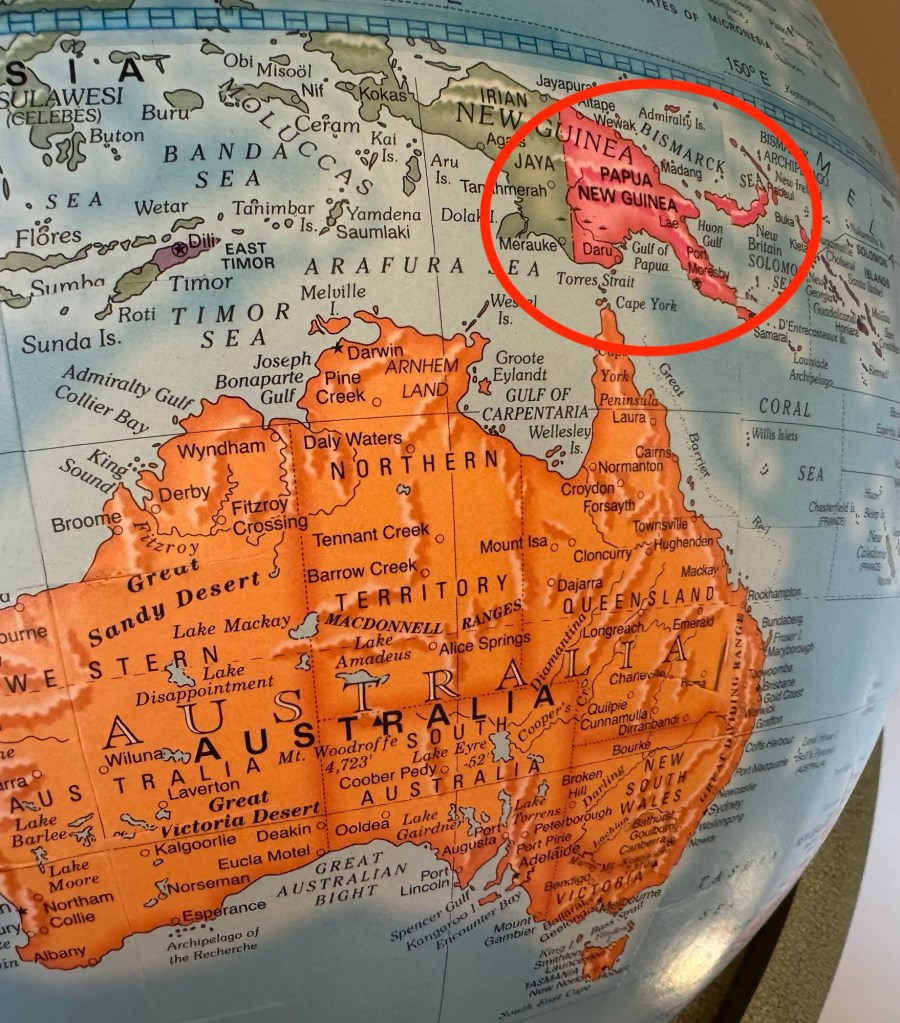
Steve and I are unlikely to irritate any of the locals on Oahu. We’ll only spend an afternoon and evening near the Honolulu airport, then we’ll get on the first of a series of flights that will eventually land us in Papua New Guinea (PNG for short). If you can’t instantly find New Guinea on a globe, don’t feel bad. Few Americans can. But you could find Australia, right? Hovering over its northeastern quadrant like some great ungainly bird is the second largest island on earth.
The western half of the island of New Guinea (Irian Jaya) is a province of Indonesia, while the eastern half, Papua New Guinea, became an independent country almost 50 years ago. We will be in the capital, Port Moresby, for the birthday celebrations. PNG ranks among the most exotic, most isolated places I will have ever been. I won’t be surprised to see it take the #1 slot.
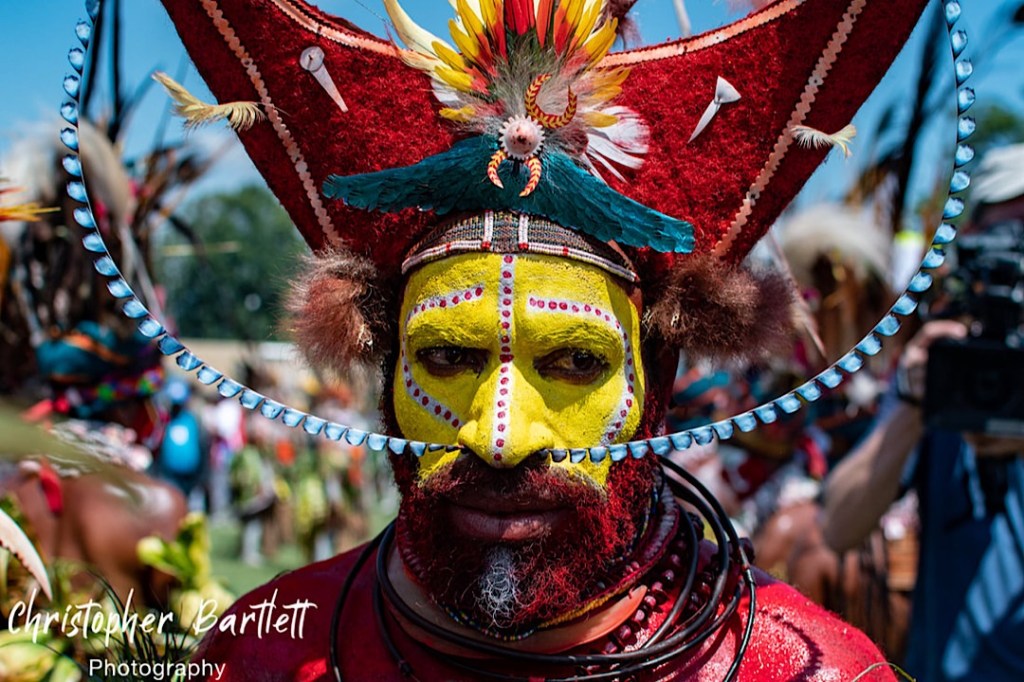
This is NOT Christopher but was taken by him for his website, bestofpng.com
It’s such a wild, undeveloped place, independent travel is tough, so we have uncharacteristically chosen to join a group of about a dozen other tourists. A British guy named Christopher Bartlett, who has led folks to PNG for more than a dozen years, will be our guide. In the highlands, he’ll show us around one of the splashiest cultural festivals on the planet. There and elsewhere, I also expect at least to glimpse some of the country’s stunning biodiversity. We’ll spend time in one of the world’s great river systems, the Sepik, and hike down some fairly unbeaten paths.
None of this will hold a candle to Captain Cook’s adventures, and it should be a bit more comfortable. I hope to write about some of the more interesting aspects, and when I find WiFi, I’ll do my best to send it along to here. With luck, our trip will all have a happier ending than Cook’s last voyage did.
Before we started this trip, I asked whether it would seem like we were visiting another country. In short order the question felt silly. For Alaska to feel foreign, it would have to be filled with something other than Americans. It is not. We met lots of folks who were either born in Alaska or had lived there for many years. To me they often seemed different, maybe even better, than residents of the other 49 states. But never did I feel like I was outside the US.
Steve commented that the locals made him think of the folks who would sign up to settle one of the exoplanets he invented in his science fictional Handbook for Space Pioneers, people happy to make a new life in a wild place filled with potential. To me it felt like time travel -– as if the locals (or I) had landed in another dimension, rather than just one hour off Pacific Standard Time.
I’ve been trying to untangle this impression because, to my surprise, what both Steve and I loved most about Alaska where the people we met.
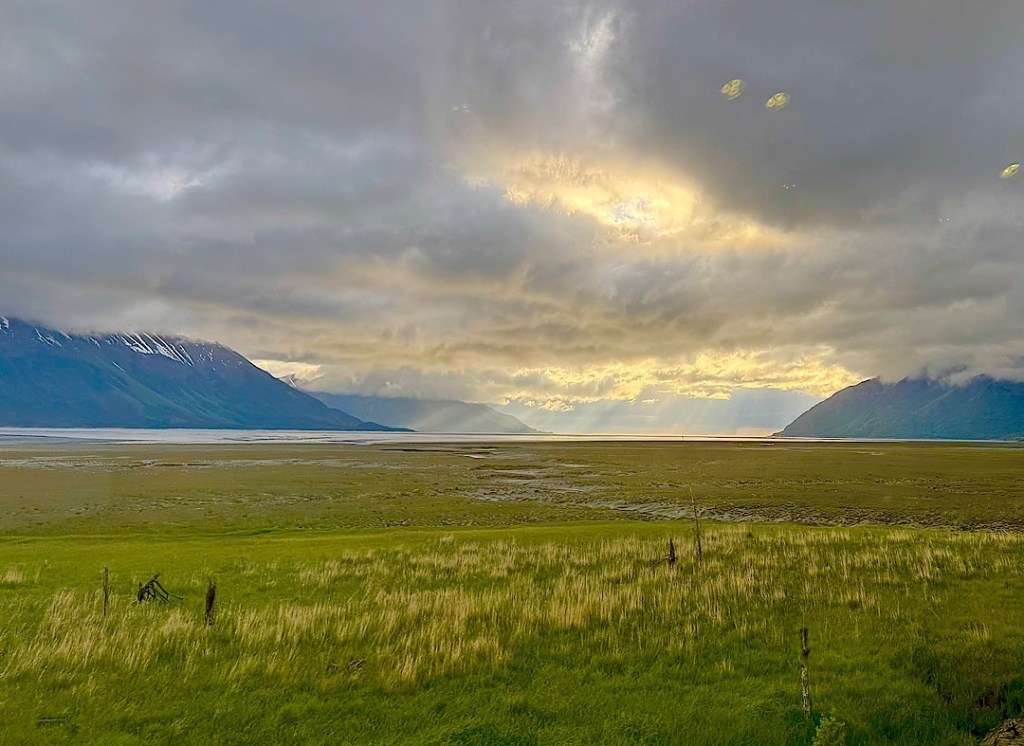
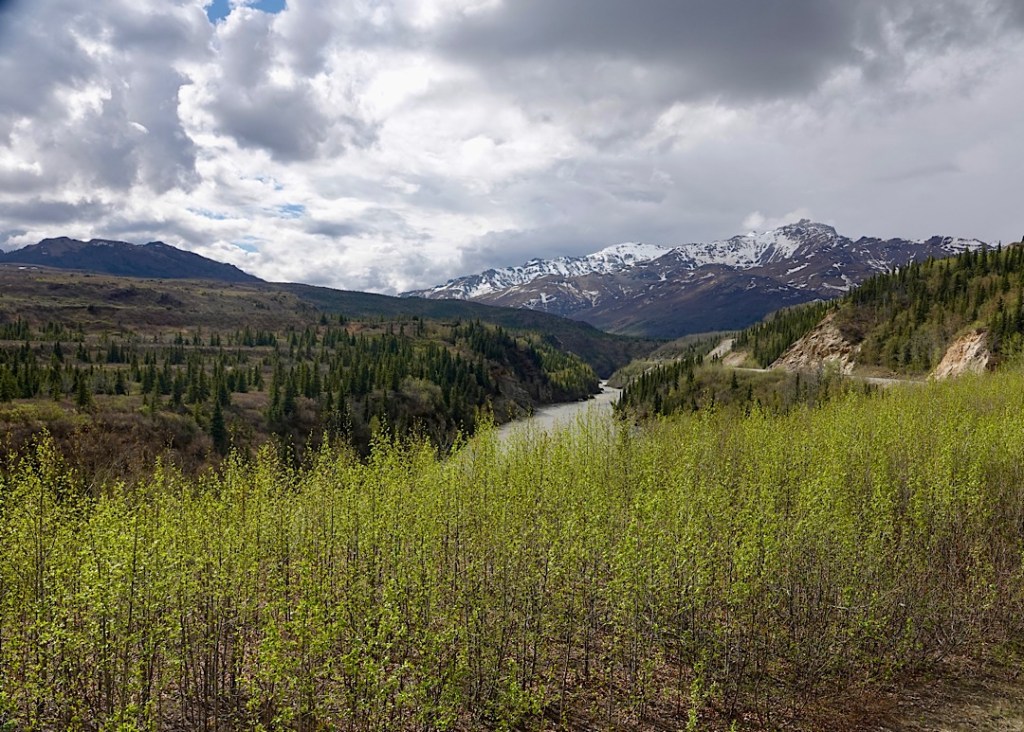
Not that other aspects of the state don’t live up to their billing. The landscapes are iconic.
The woods and waters and mountains team with charismatic wildlife.
But over and over, friendly encounters with local humans left us shaking our heads in amazement. One example: strolling around Sitka we ran into a woman I recognized from the previous night’s plane ride from Anchorage. She and I hadn’t spoken to one another on the plane, but she greeted me and told us all about the summer camp to which she was delivering her two youngsters. Somehow her little boy had forgotten to pack any extra pants for the week, so they were heading to the local white elephant store to do some shopping.
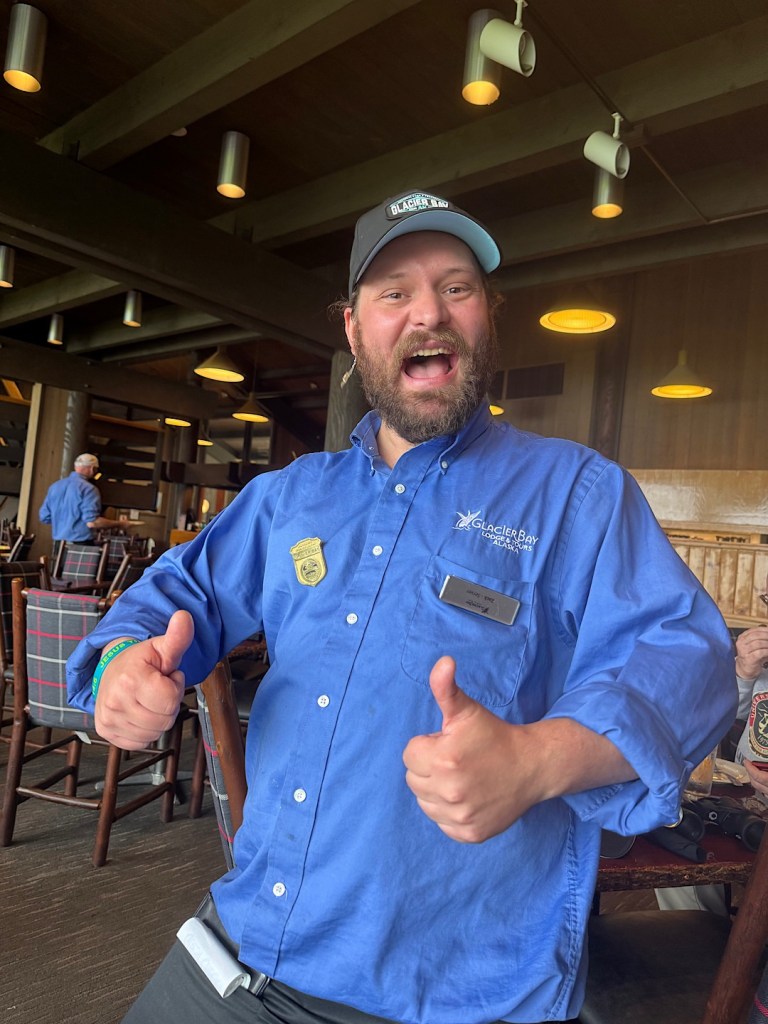
This is Zack, 31, originally from Florida, who’s working for the summer as a food server at the Glacier Bay Lodge. Zach shared so much about his life with us, I could tell you a LOT more. But I’ll refrain.
Of course Zack‘s not an Alaskan. He’s part of the legion of young people who flood in to work every summer, thrilled to be having such a big adventure. Some will return over and over. Some will wind up staying. Our home-exchange host in Juneau, Andy, did that. Now he and his wife have kids who grew up in Alaska and have already graduated from college. Andy’s had multiple careers over the years. The competition for jobs is low, he points out. If you want to find work and you can learn as you go, there are plenty of ways to make a living.
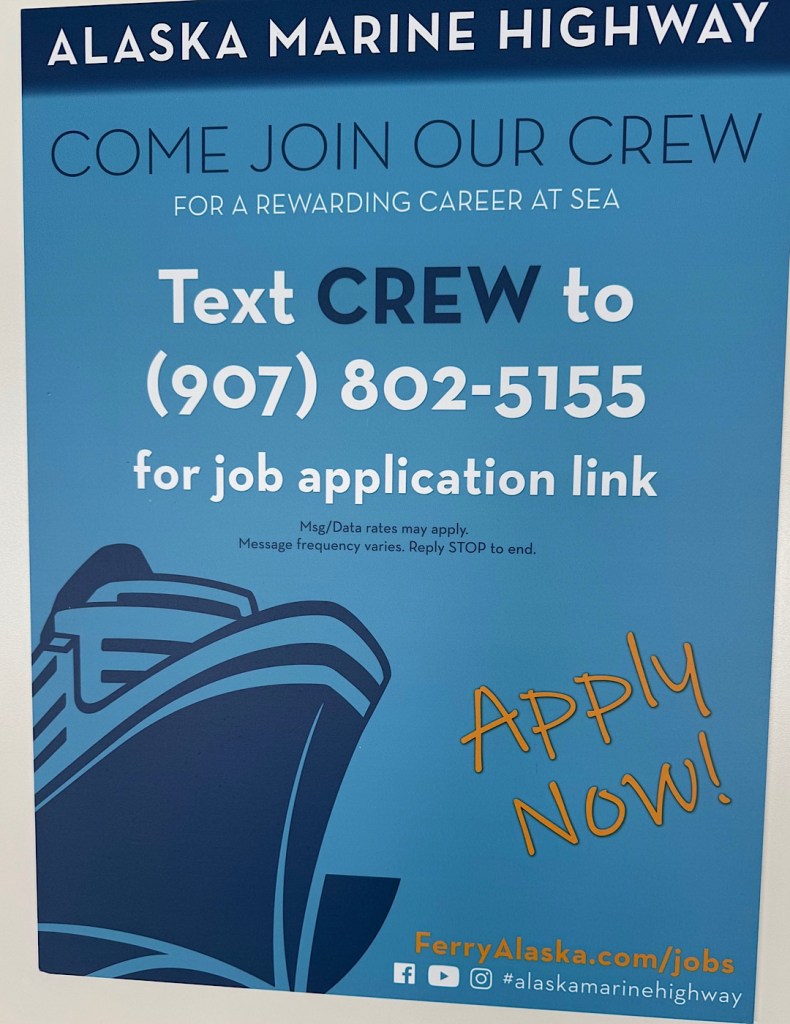
The ferry system is looking for some extra hands!
People seem to appreciate all that economic opportunity. Those who stay also have (or develop) a tolerance for a nasty weather and months of darkness.
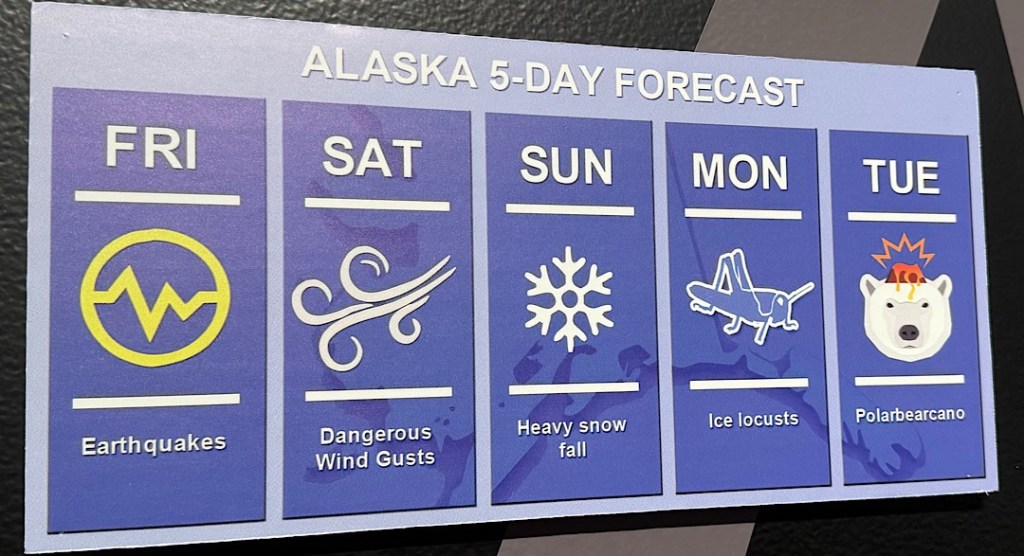
At any moment, an earthquake can wreck monstrous damage. Or it can trigger a dreadful tsunami. Volcanoes explode. Mountainsides or the snow piled up on them collapse and kill whatever’s in their paths. Go out for a run and you might meet up with an irritable mother bear. Because so much can go wrong, locals rely on helping out each other. They leaven that trust with humor.
It’s tempting to think about joining their ranks. If like Steve and me, you love growing baskets of fruits in your backyard year-round, that’s a bridge too far to cross. Still, it’s been fun to stand on the bridge for several happy weeks before returning to the sandals weather and sunny skies.
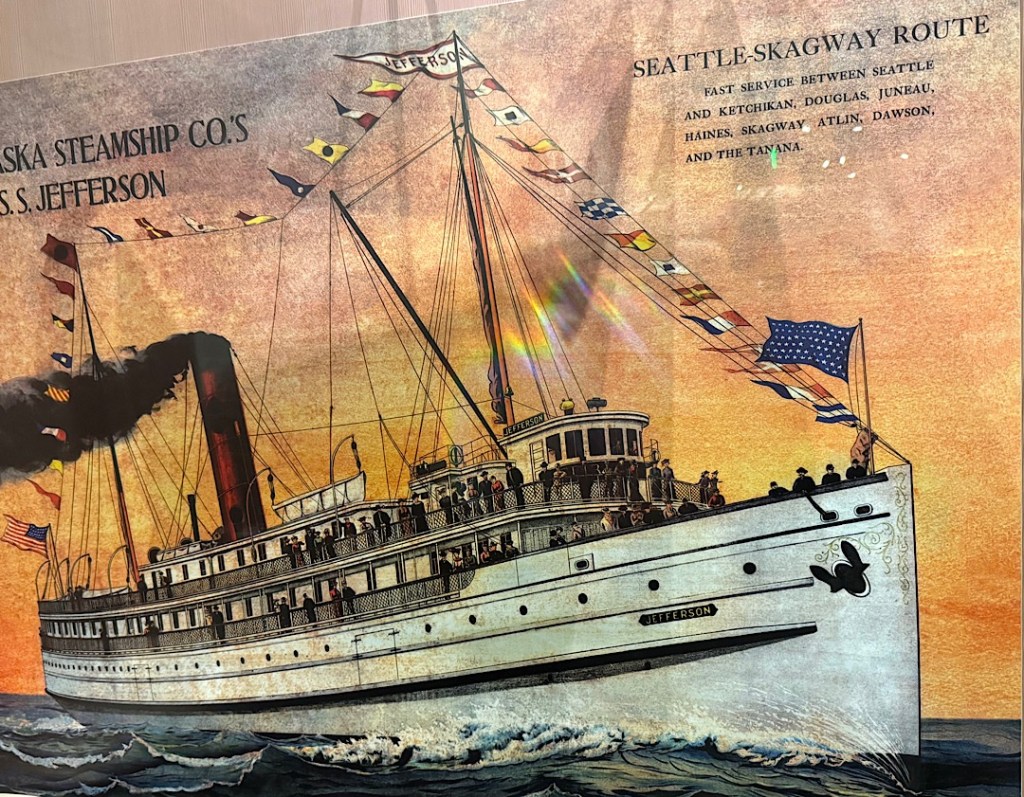
Almost 45 years ago, I rode a train I will never forget. Steve and I boarded it at night in London and settled into a sleeping car that was hauled to somewhere on the British coast. I remember waking up to a lot of clanging and banging as our car was uncoupled from the British engine and loaded on the vessel that would carry it across the English Channel. On the other side, the French hooked it up to another engine that pulled us all the way to Paris, where we disembarked. Although once an emblem of the glory days of rail, the “boat train” was being discontinued; I no longer remember how we managed to get tickets on its final run. But I’ve thought of it as we’ve ridden on an Alaskan ferry these last two and a half days.
No plans have been announced to end the the 62-year-old Alaska Marine Highway System — yet. But I had to wonder how much longer it will survive. Annual ridership reportedly has declined from 400,000 passengers (in the early ‘90s) to 185,000 (last year). The fleet has shrunk from 11 vessels to just 7, and many are rusting their way toward unseaworthiness. The state struggles to staff them and at times has had to cancel scheduled sailings for lack of officers and crew. The routes that do manage to operate are complex, and the boats don’t run often. I first became aware of all this when I was planning our trip six months ago. Trying to figure out a way to use the ferries to get where I wanted to go (and when) was one of the biggest touristic challenges I’ve tackled.
Alaskan politicians have been squabbling over funding for the system for ages. Some folks have argued the ferries should pay for more of their costs, while others retort that roads aren’t expected to do that (mostly). Yet the ferries do fill the role of roads here, sometimes the only connection to the outside world (besides planes or small water craft) for many communities.
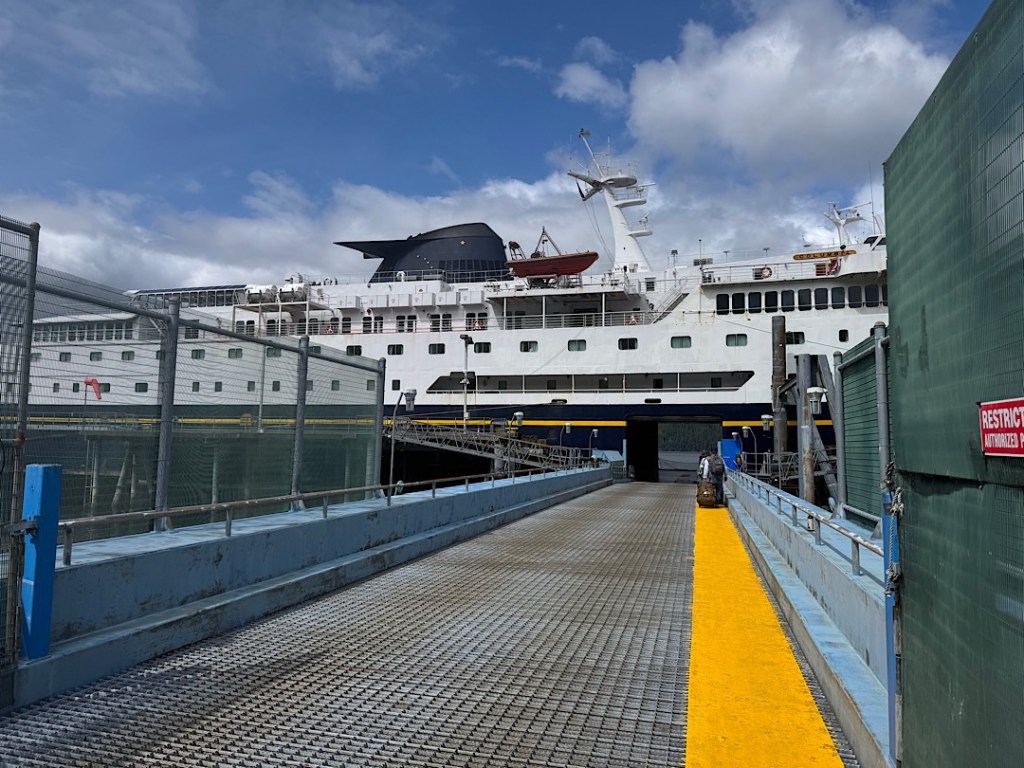
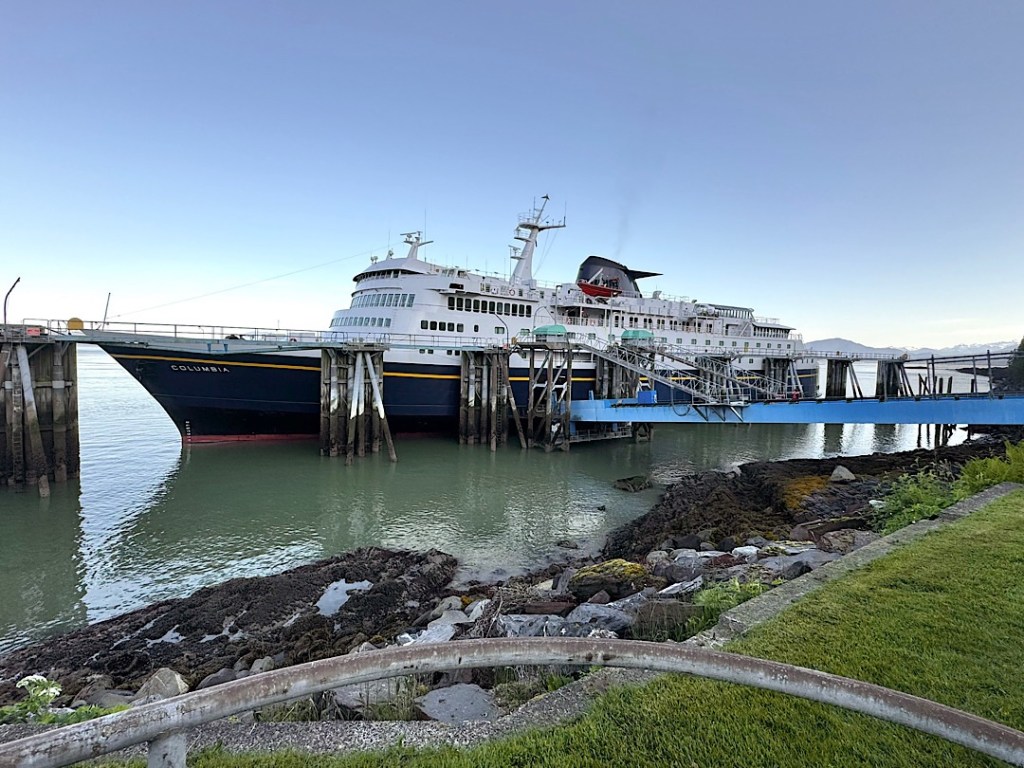
I’m not sure what could or should save the ferries. But I can — now — say IF Alaska’s ferries disappear I’ll be sad. Steve and I rode for 5 hours on the MV Hubbard from Juneau to Gustavus, then we wrapped up our Alaska adventure by spending almost 60 hours on the MV Columbia as it bore us almost 1000 miles from Sitka to Bellingham in Washington. Both rides were extraordinarily soothing.
We boarded shortly after 2 p.m. Tuesday afternoon at the Sitka ferry depot.Around 6 the next morning, we made a brief stop in Wrangell, where Steve and I strolled briefly through town.
We’d booked one of the Columbia’s 75 cabins, a plain, utilitarian space containing two sets of bunk beds and a private bathroom. Roomier than any train compartment, the lighting was decent, augmented by a big window. I slept well in my lower berth.
We used the upper bunks as clothing shelves.
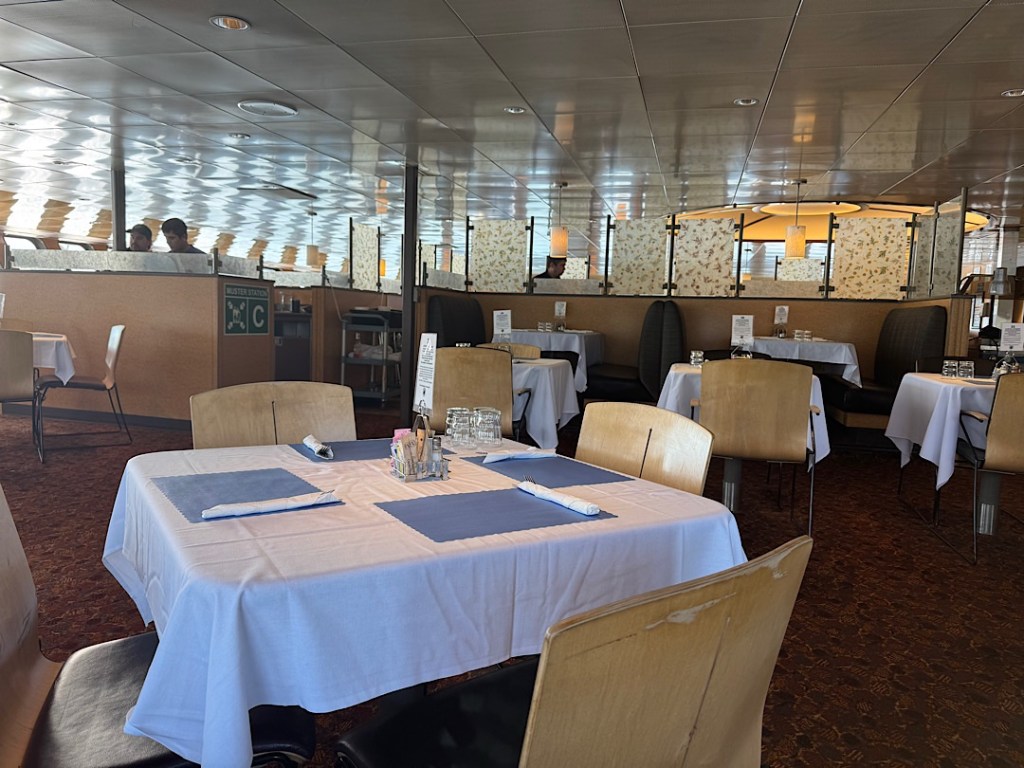
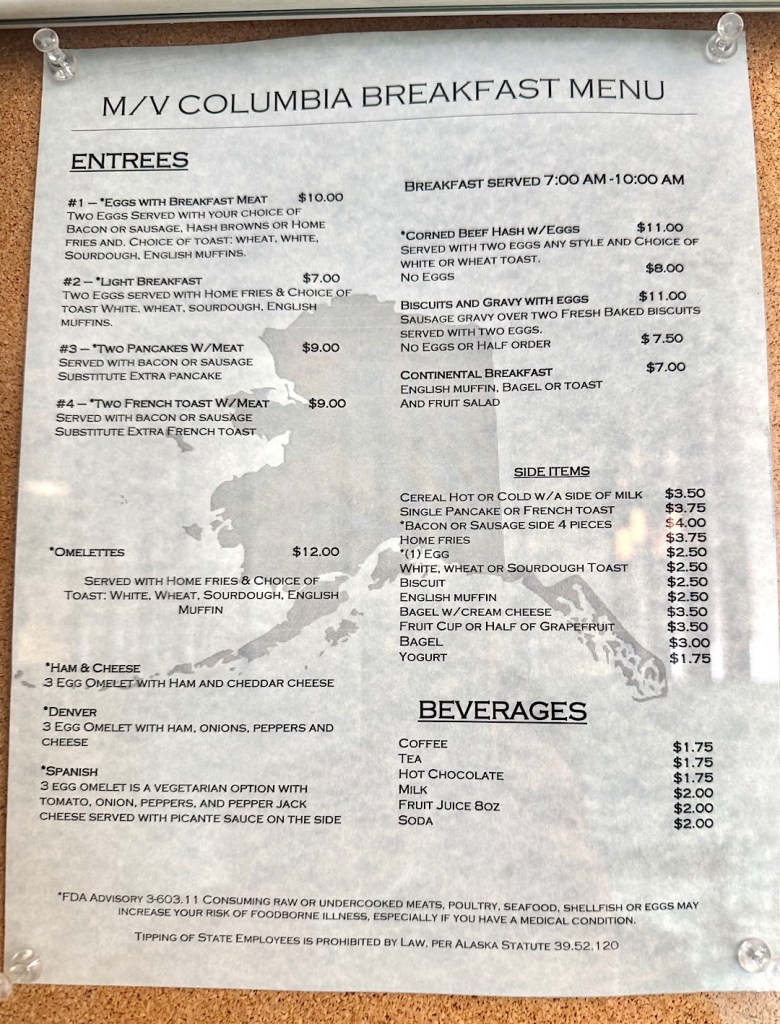
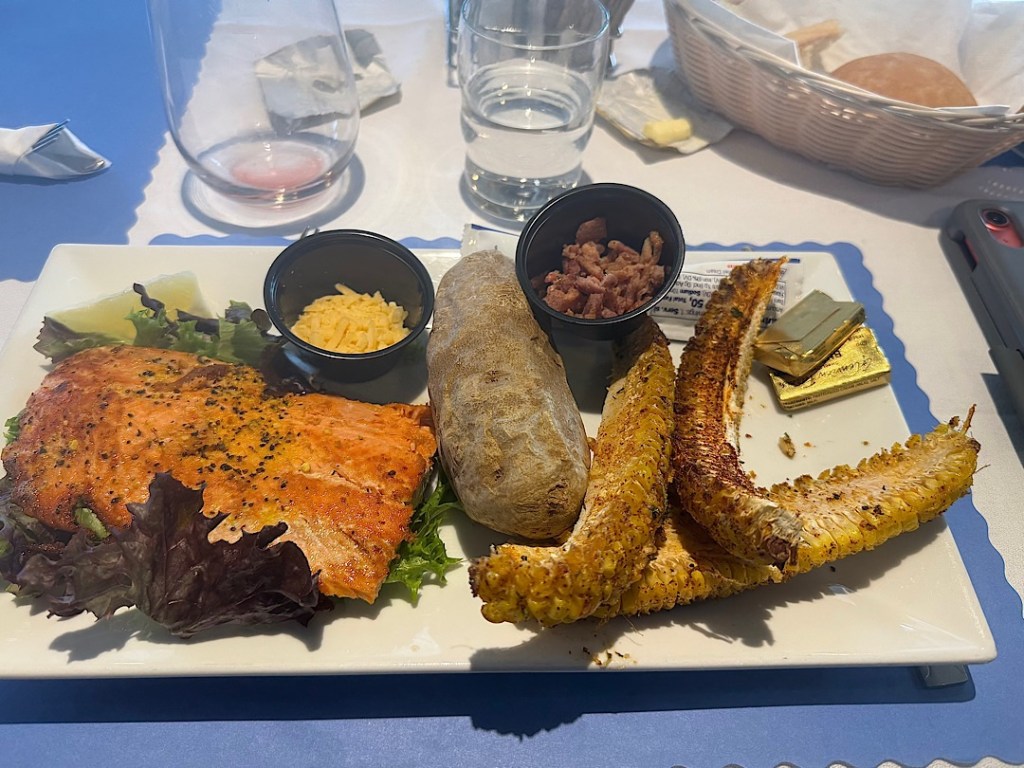
In the ship’s pretty, old-fashioned dining room, uniformed waiters served breakfast and dinner daily, and the prices were startling — roughly half what we’d seen anywhere else in Alaska.
The dining roomThe breakfast menuThe wild salmon dinner ($18)
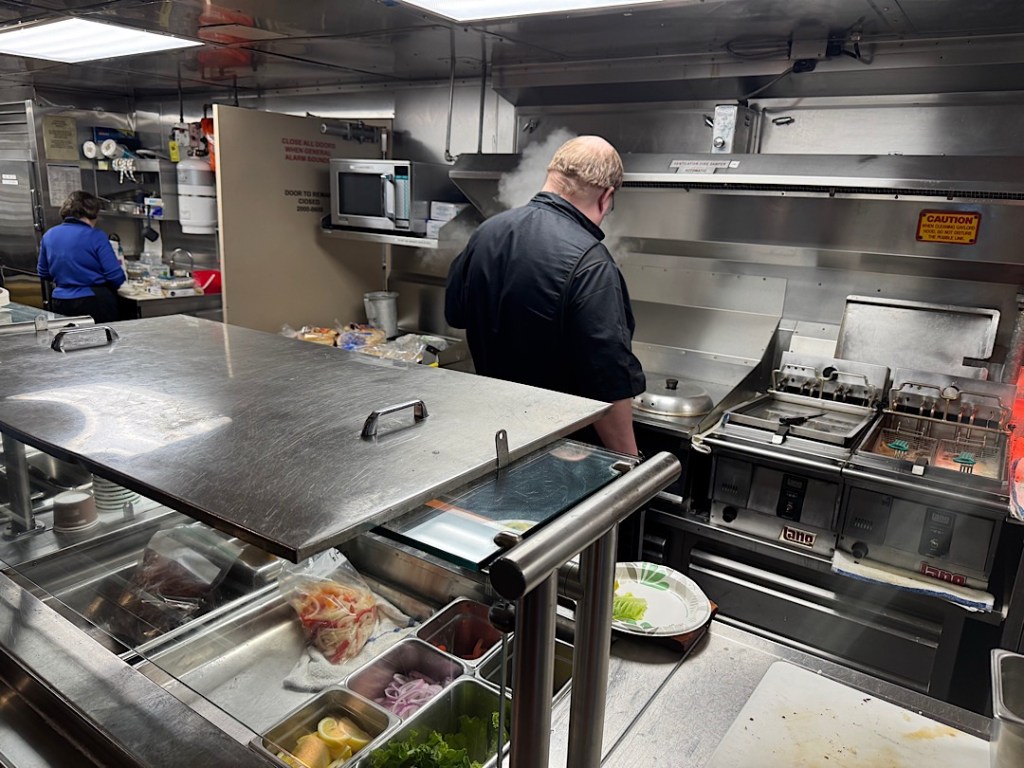
A more informal snack bar provided basic options: grab-and-go sandwiches; fish and chips and burgers served up by a burly old-school fry cook.
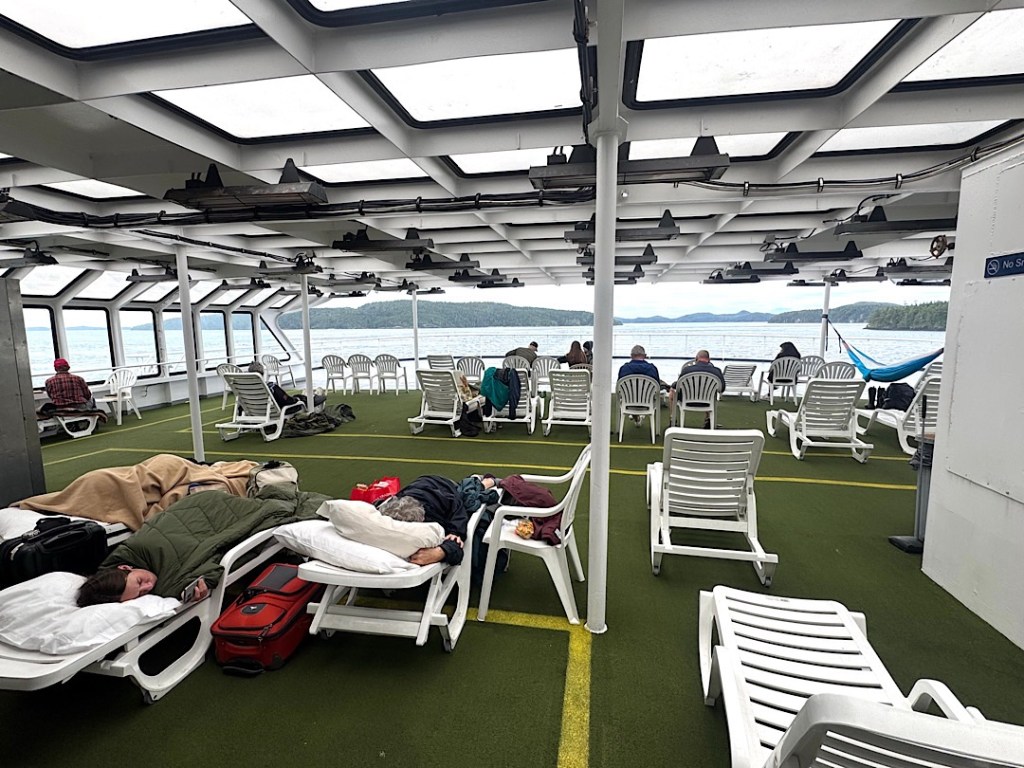
Budget travelers could also save money by forgoing a cabin and sleeping in a tent outside. Or you could put your sleeping bag on one of the Solarium’s lounge chairs where overhead heaters tempered the cold.
The only outdoor lover on our trip. Tents reportedly fill the space on some trips.The SolariumThe Forward Lounge
I learned we were sharing the boat with 170 other passengers, only a third of the Columbia’s capacity. It does fill up occasionally, the purser told me. “But,” she grimaced, “that gets ugly.”
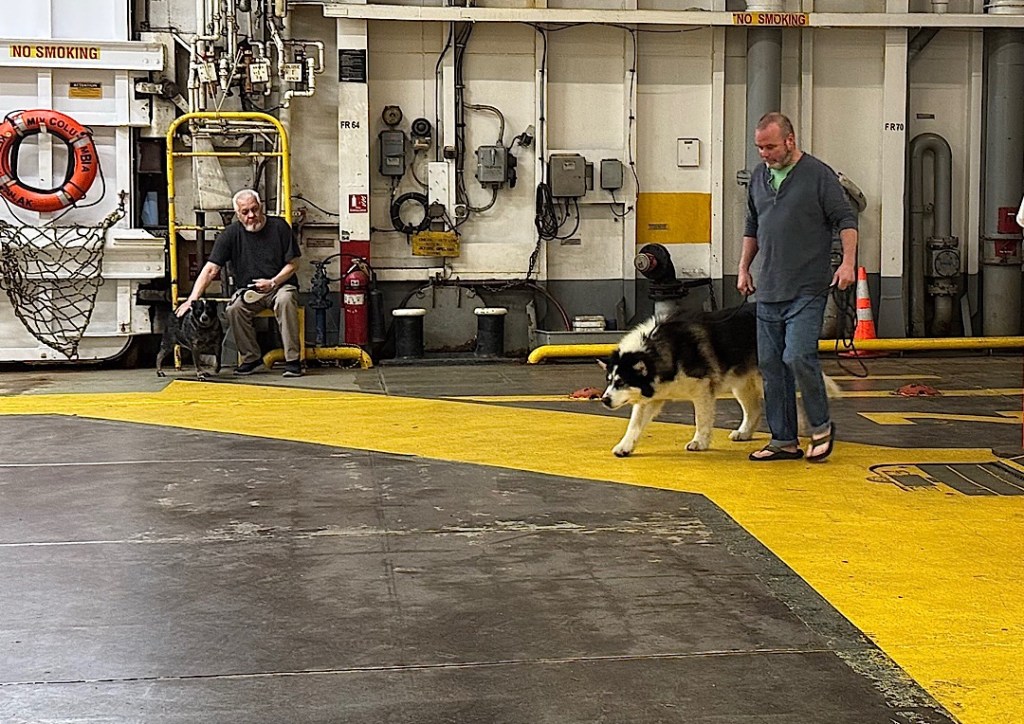
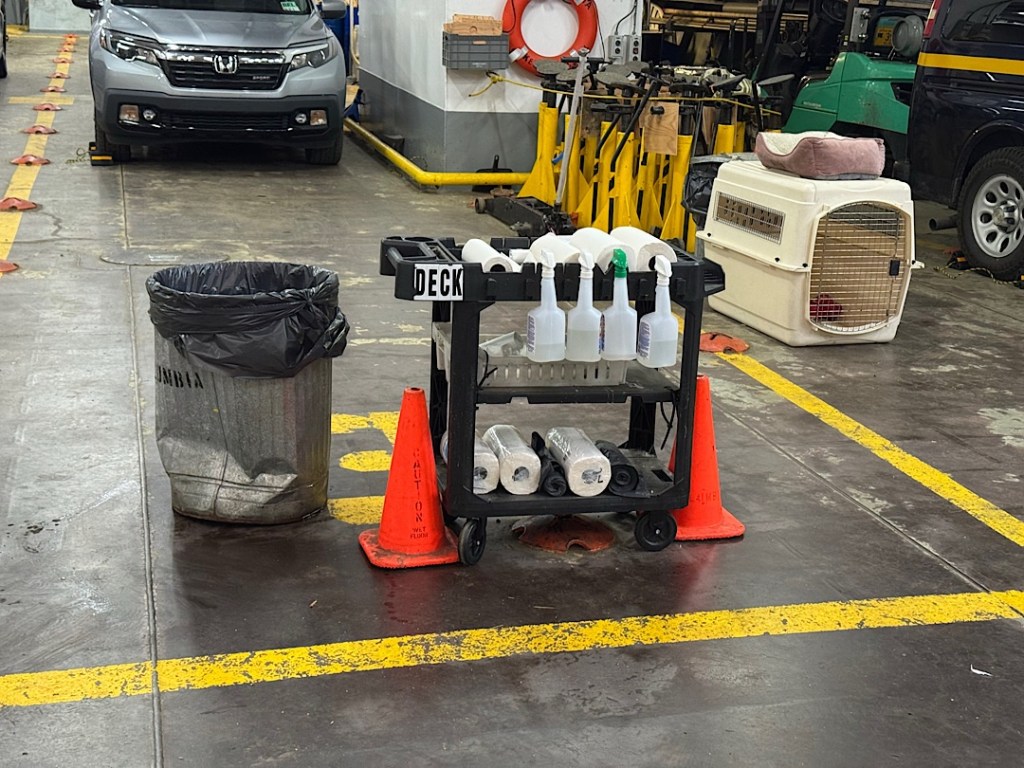
Other quirks enlivened the ride. At regular intervals, announcements informed us the car deck would be opening soon, so if you’d brought your dog and stowed it in your car or kennel, you could descend to walk (and clean up) after it for 20 minutes.
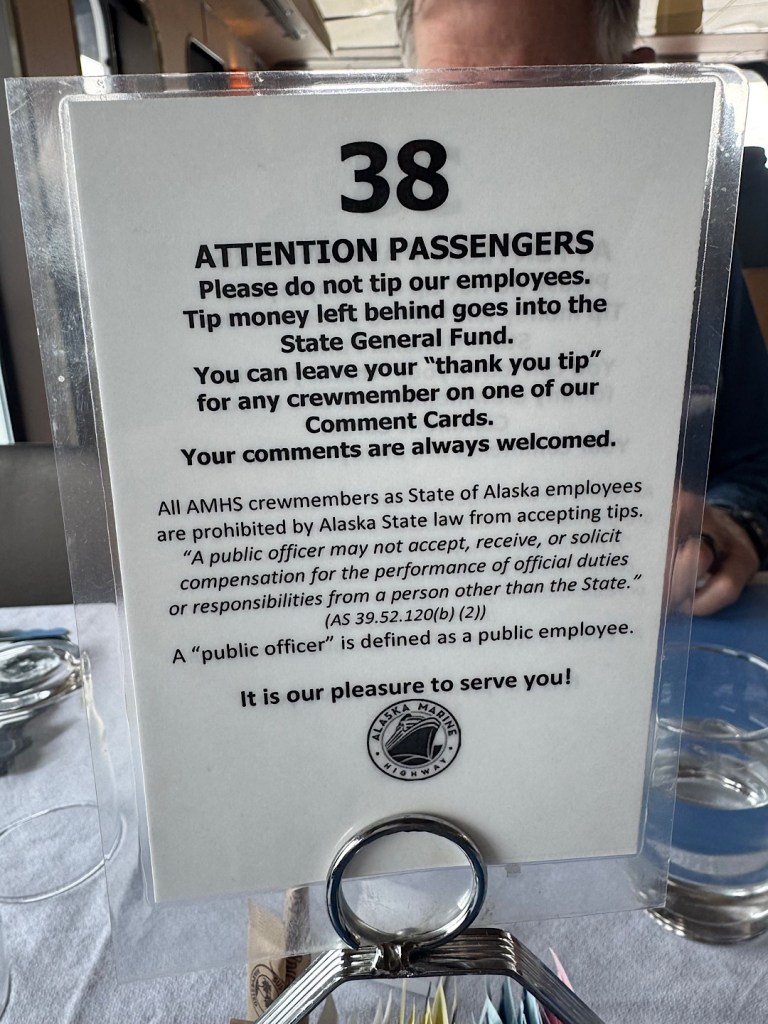
Between Deck 7’s forward lounge and the snack car, we found a bar that at first glance looked grand, filled with lights and mirrors; a real piano; a giant chess set. But the bartender only stocked canned cocktails, five-ounce bottles of bad wine, and beer. Behind her, a sign cautioned she could only sell each patron one drink per hour. Other onboard signs prohibited tipping.
Despite that, the large restaurant staff somehow exuded good spirits.They botched our orders and made mistakes on the checks. But they couldn’t have been more friendly or hospitable.
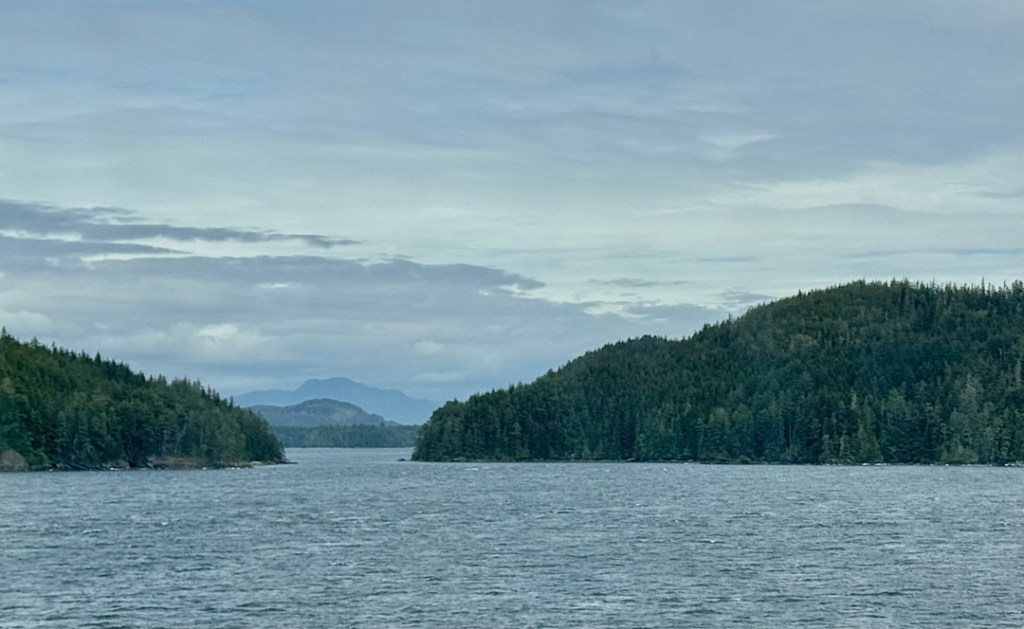
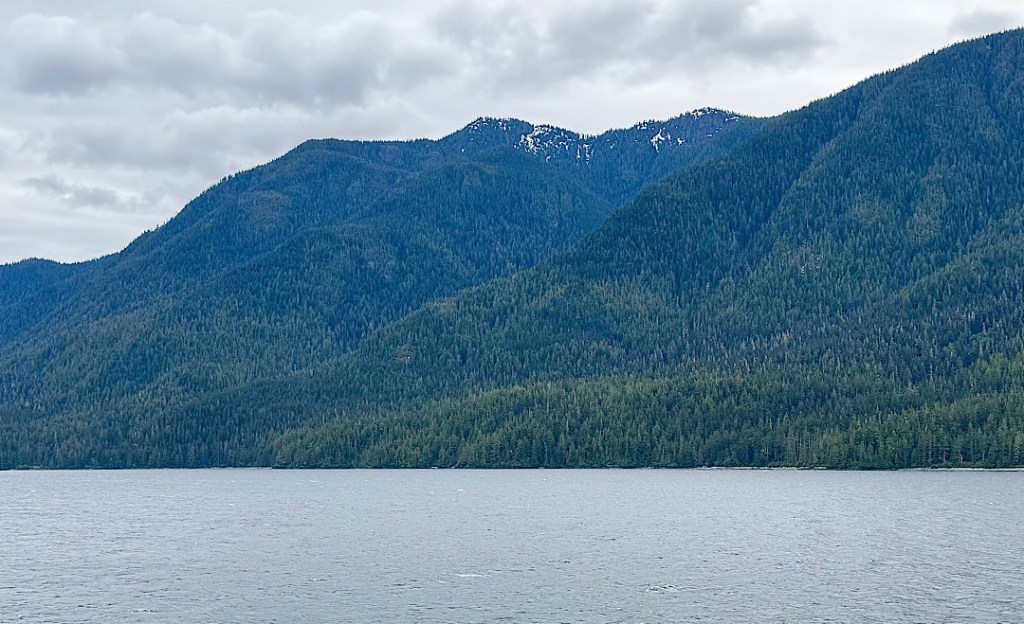
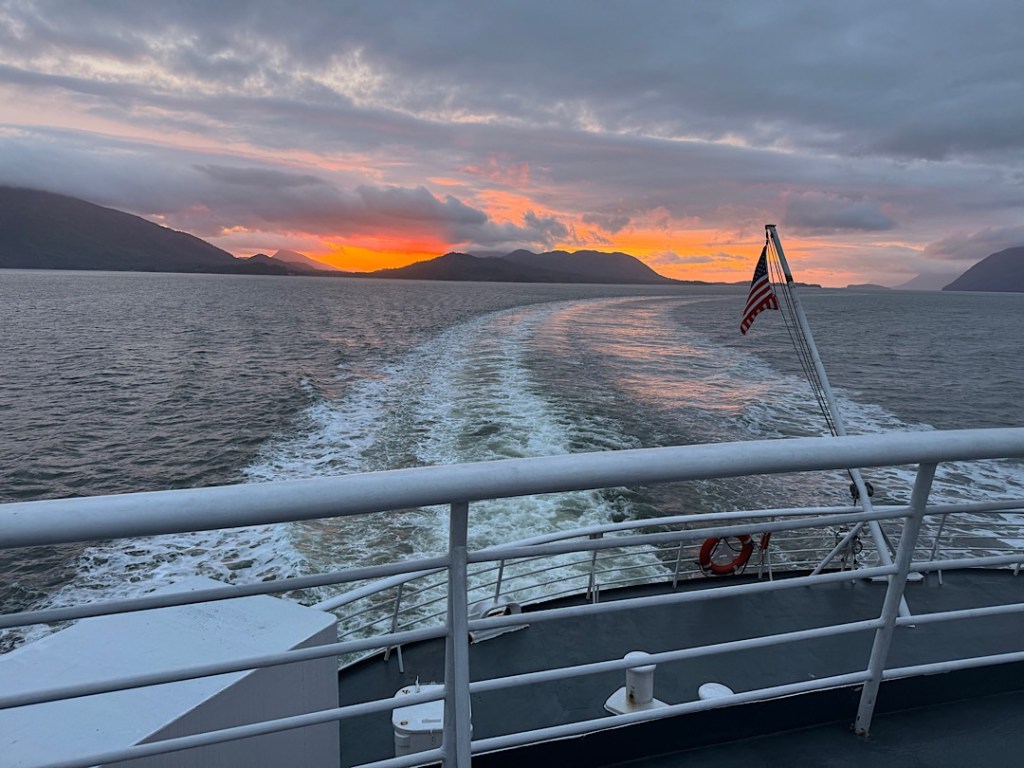
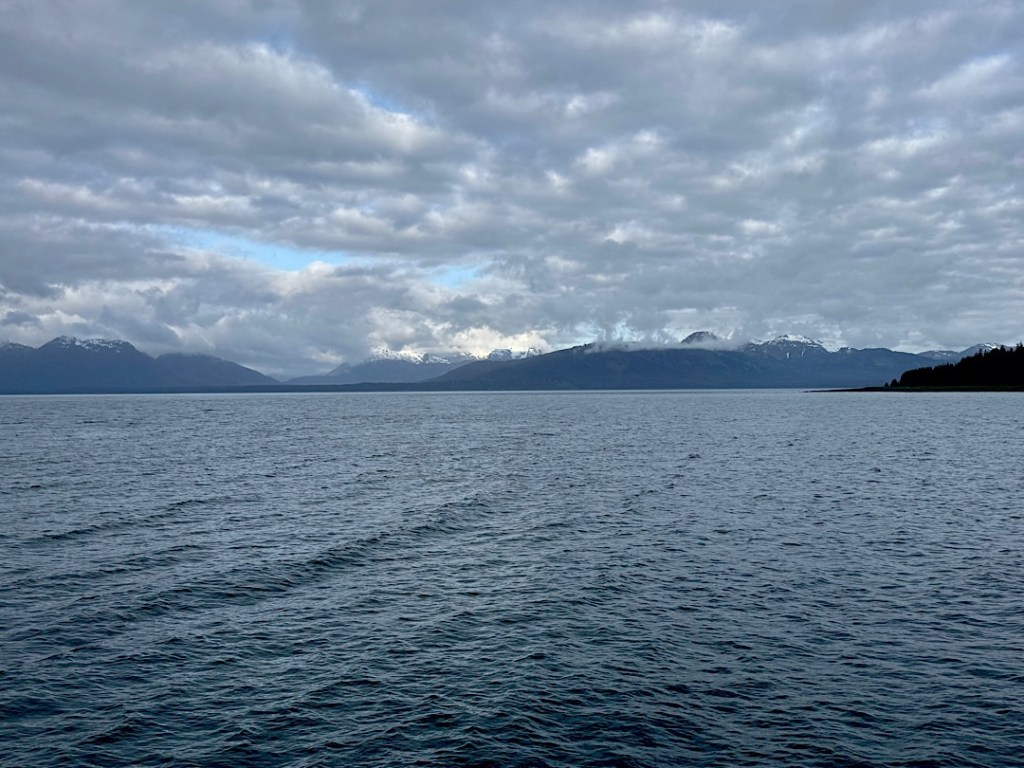
Most important: we tied up in Bellingham minutes before 8 am Friday, just as scheduled. If the occasional swells made anyone seasick, I wasn’t aware of it. I enjoyed hour after hour of views of the Inside Passage, a waterway that had intrigued me as long as I can remember. In my mind, it’s real now, a gift no flyover can bestow. If the Alaska ferries cease to exist, this ride will rank right up there with the boat train.
This trip has reminded me that going out in search of famous natural wonders can resemble playing poker in Vegas. You may be able to shift the odds of hitting travel targets in your favor: study weather patterns. Pick reputable guides. But for all the time and effort and money you put in, bad luck still can strike; you can bust or hit gold.
Our biggest, most challenging target here was Alaska’s great glaciers — those moving rivers of ice that are melting all over the planet. We aimed to see them in two places: Kenai Fjords and Glacier Bay national parks. Because of our train disaster, our arrival in Seward (Gateway to the Fjords!) was a bit frazzled, but our first afternoon there lifted my spirits. The sun broke through as Steve and I strolled around the town’s little core and a browsed an art fair in front of the Alaska SeaLife Center. Giant dandelions glowed in the sunshine along the waterfront.
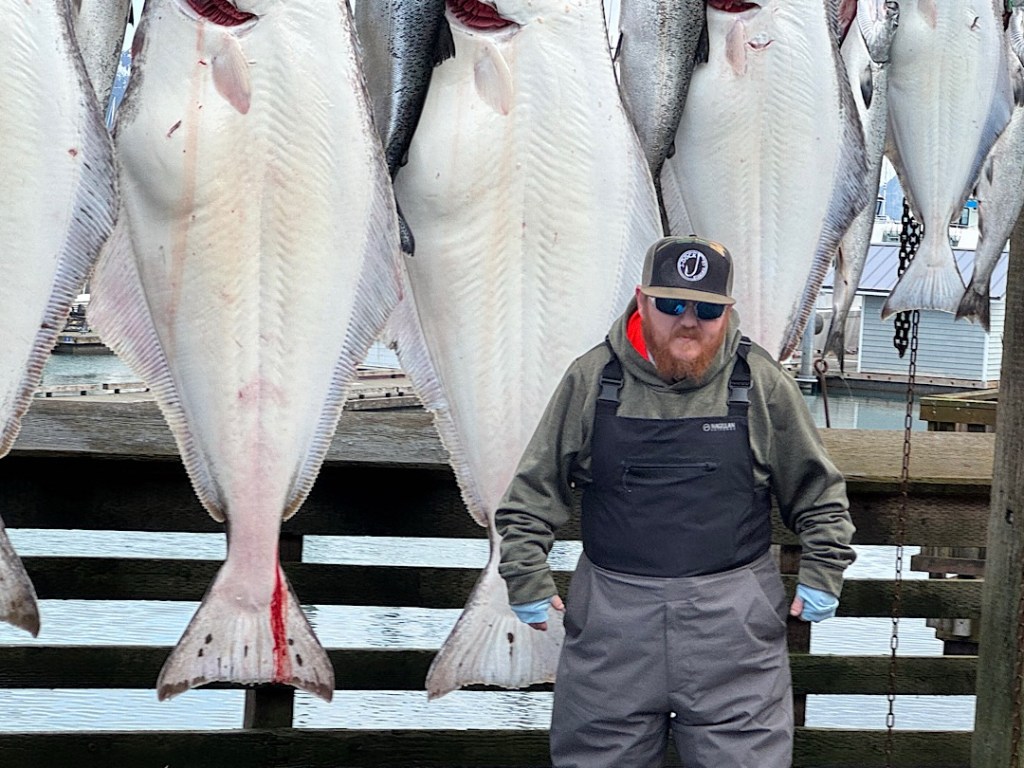
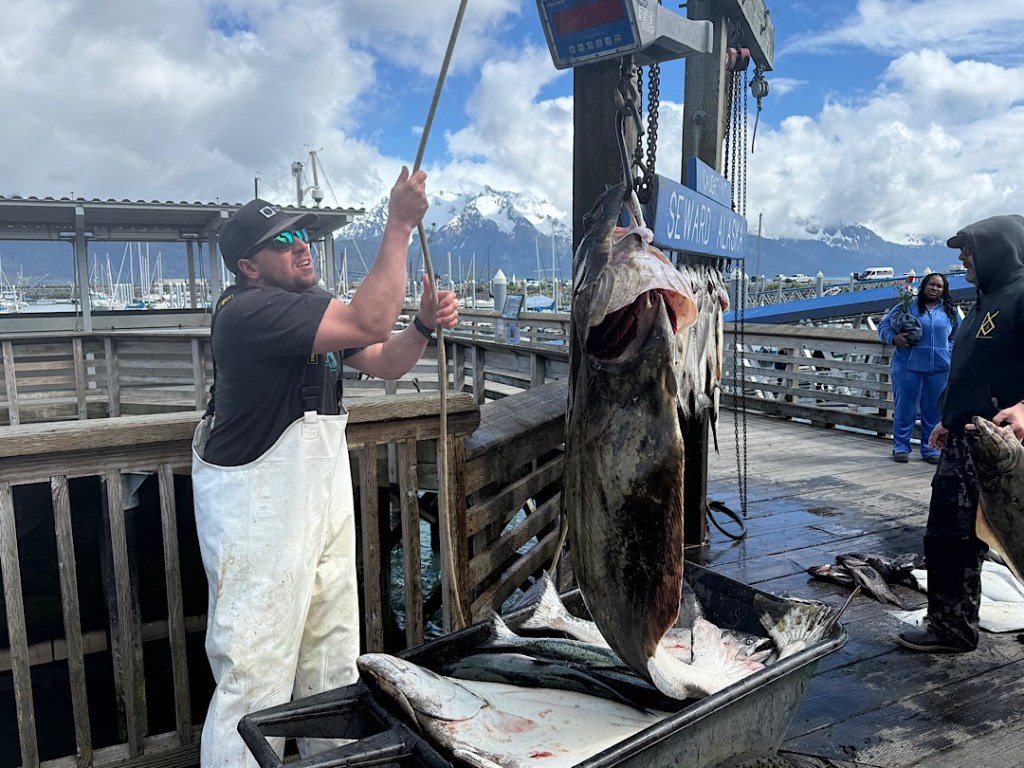
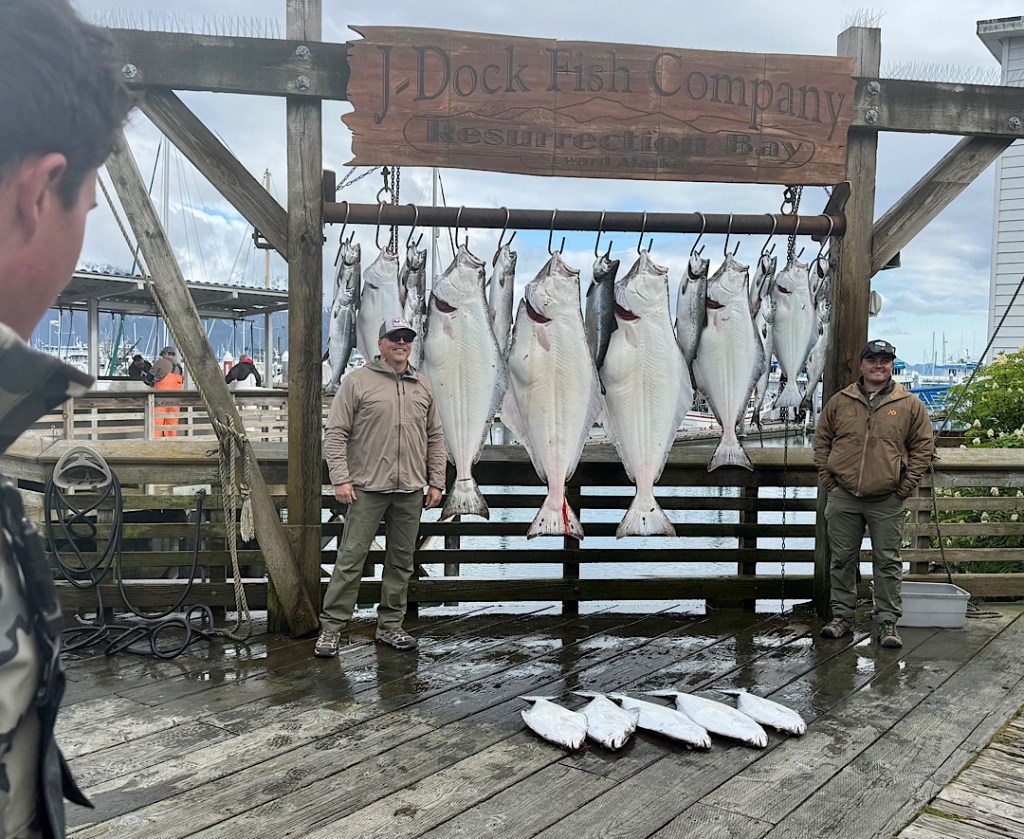
Ebullient fishermen weighed their catches.
This halibut topped 100 pounds
From our table at dinner, we watched a massive Stellars sea lion diving for his dinner among the boat slips.
The world looked darker and colder when we got up the next day (Sunday). I checked in for our 8.5-hour-long cruise to the glaciers, and the girls behind the counter wore pained expressions. They warned that if the sea got much rougher, our captain might have to cut our trip short. Things could possibly improve a bit the next day, they suggested, so we switched Sunday’s glacier tour for the four-hour orca cruise we’d been scheduled to take Monday.
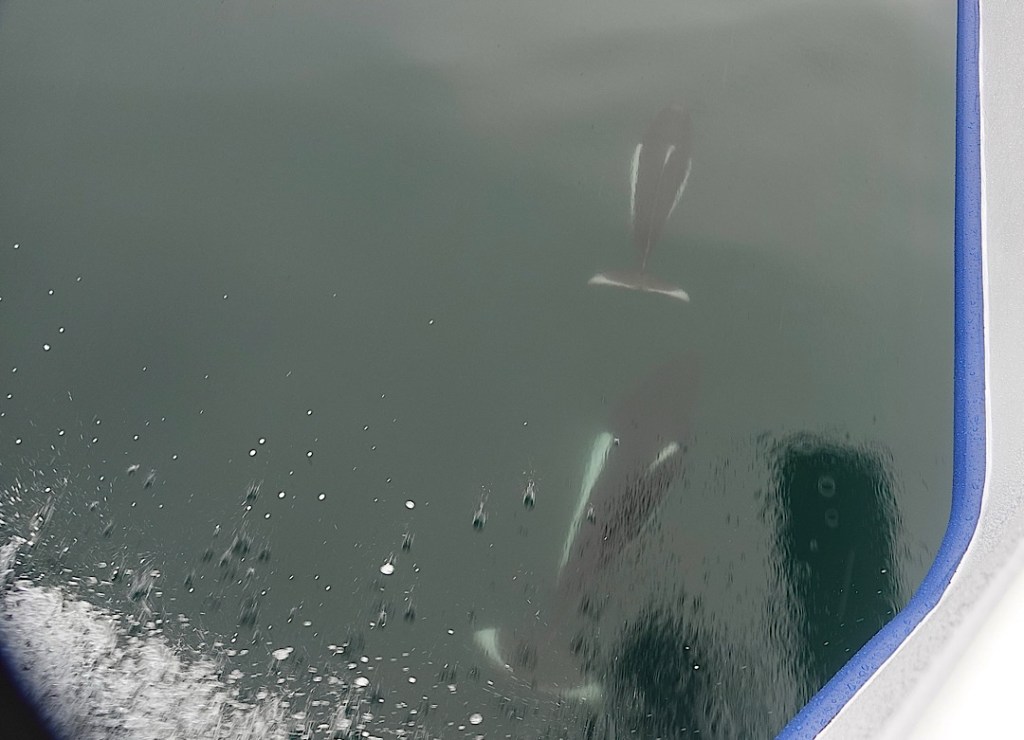
The whale-watching wasn’t a complete disaster. In short order, we found a pod of killer whales, their black and white coloring unmistakable. But the park rules dictated we stay so far away even the longest telephoto lenses couldn’t capture much. For anyone like Steve and me who at one point in our lives spent many hours at SeaWorld with our Shamu-besotted kids, it was underwhelming.
More entertaining were the Dall’s porpoises who surfed our bow wave for at least ten minutes.
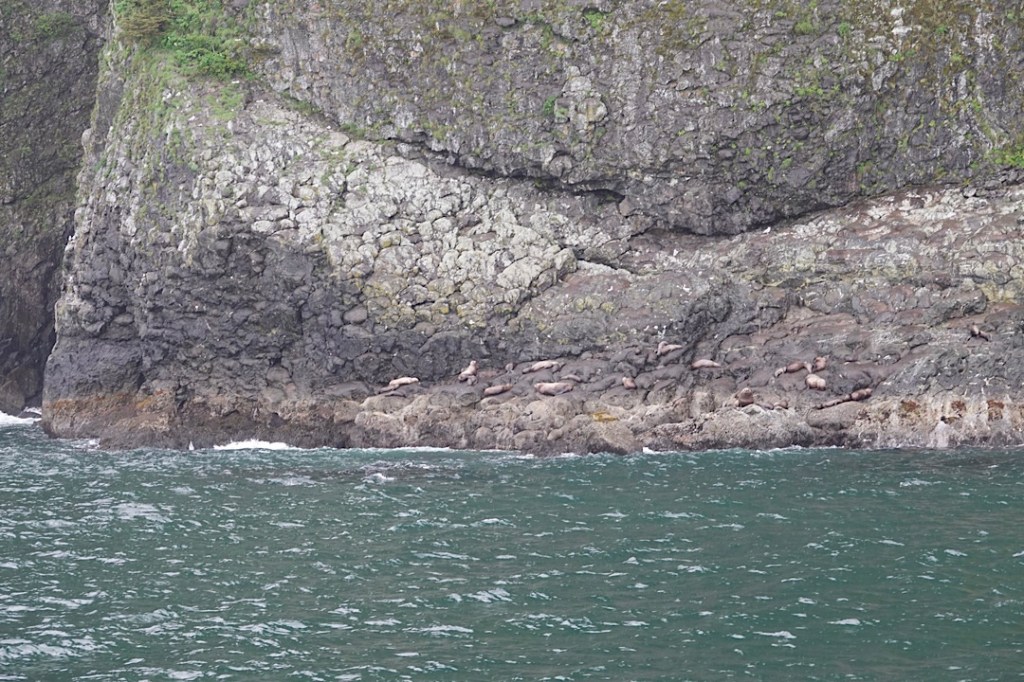
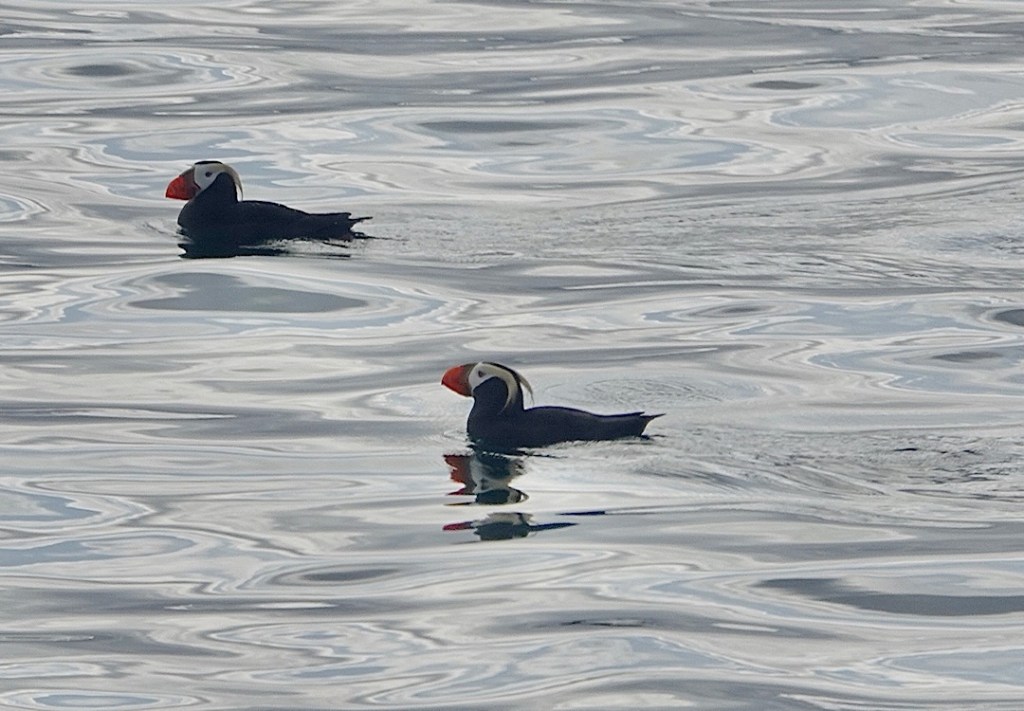
Our cheery captain found a few other things to show us: a sprawling sea lion colony; legions of birds.
But the rain never stopped, and icy winds stabbed us every time someone opened one of the doors leading into the enclosed second deck.
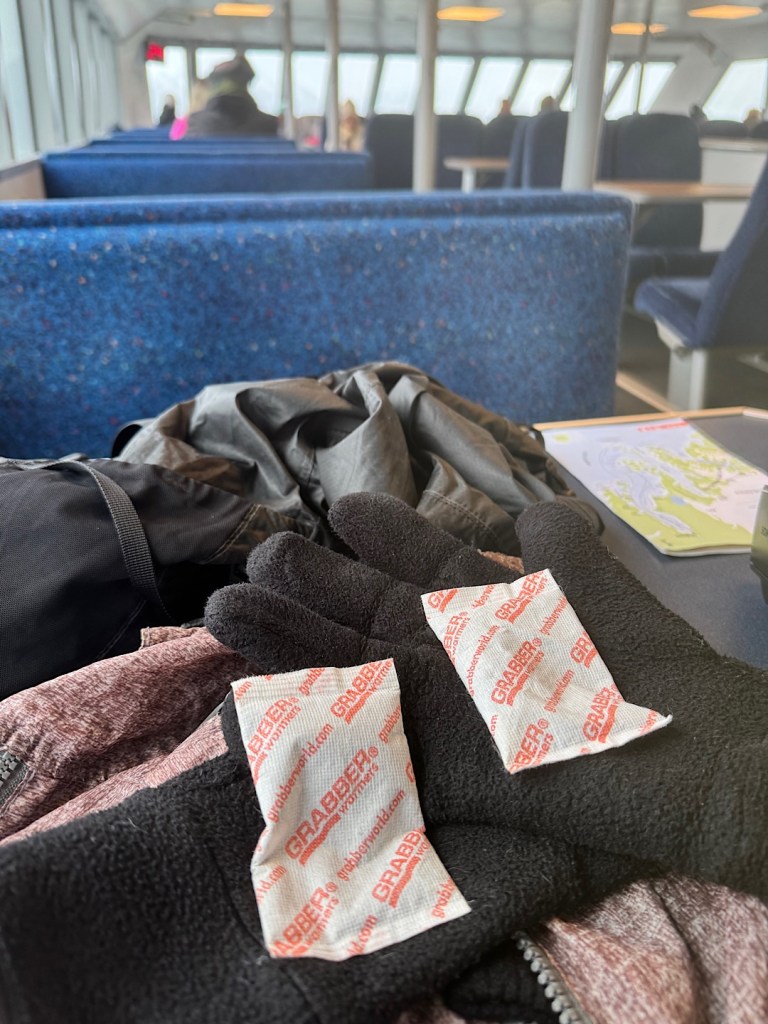
After four hours, I was chilled to the bone, despite all the layers I was wearing. Two pairs of gloves and chemical hand warmers kept me from losing all circulation in my fingers, but they still felt like ice.
The next day the Great Dealer in the Sky dealt us an even worse hand. At first the rain was light; the skies brighter. Our glacier-cruise captain reported that the winds seemed to be dropping. But it would take us a few hours to motor out of Resurrection Bay and through the stretch of the Gulf of Alaska that would take us to the fjord containing some of state’s most famous tidewater glaciers. By the time we reached the decision point at Pilot Rock, the sea was heaving; 15-foot swells made our boat tilt to unnerving angles. The folks who had started feeling queasy an hour before looked awful. (Happily, neither Steve nor I were among them.) But the wind was building, the captain reported, so prudence dictated he turn back.
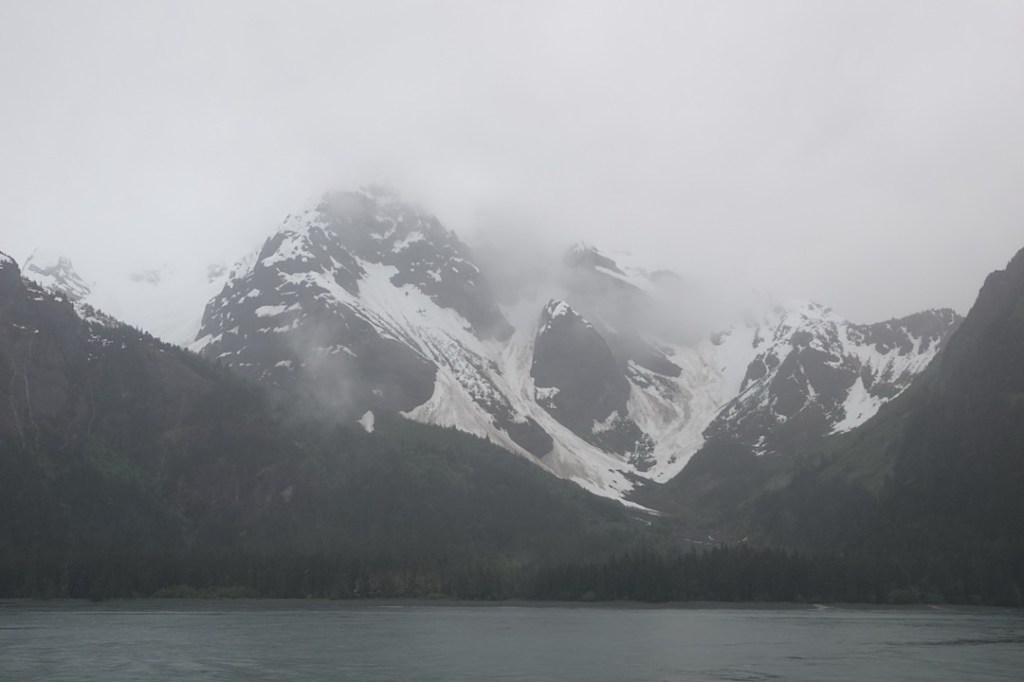
That’s how we missed seeing Discovery Glacier (or anything glacial other than smears of distant white glimpsed through the rain.) I felt philosophical. At least I’d learned what the Gulf of Alaska feels like on a nasty day (without suffering a whiff of seasickness). And we could still hope for better luck in Glacier Bay.
Glacier Bay’s “gateway” is the tiny town of Gustavus, which we reached by taking a mellow, uneventful five-hour ferry from Juneau. We checked into the national park lodge and strolled a bit under sullen gray skies.
Once again, I had booked an all-day outing on a high-speed catamaran for the next day (last Friday, 6/6). About 30 passengers had boarded it by 7 am. We shoved off. Wavelets covered the water, but overhead the clouds dispersed enough to show us promising patches of blue.
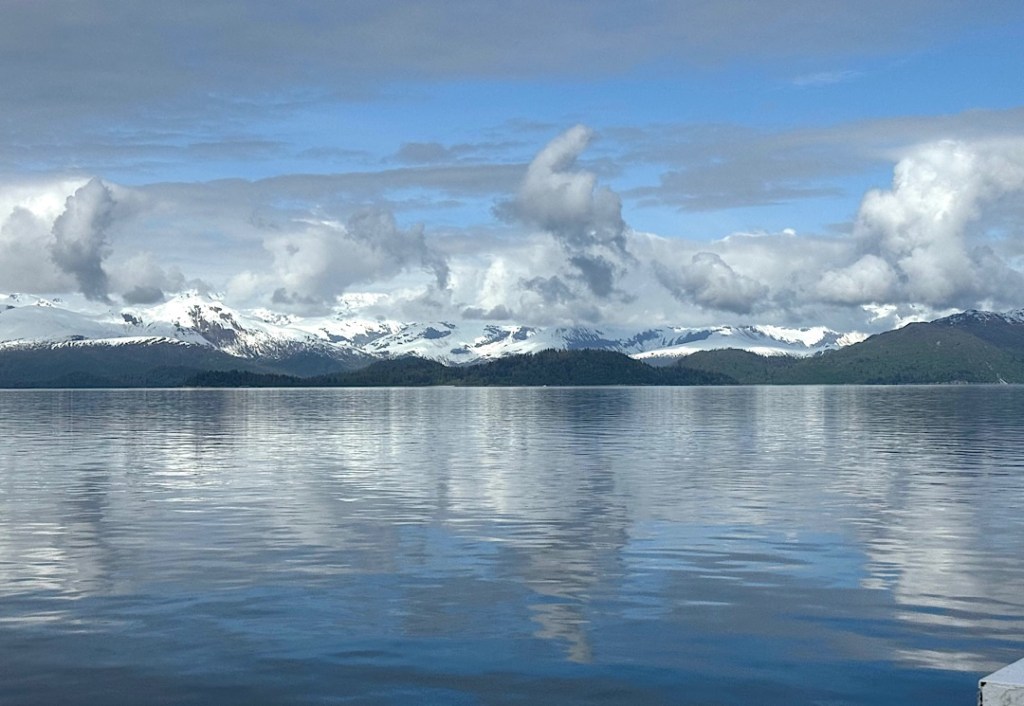
It wasn’t too cold to stand outside on the deck and admire the wildlife…
We glimpsed many humpback whales (who are protected in the national park). All these guys all rank among the world’s most charming animals, but soon I was feeling at least as awestruck by the vistas.
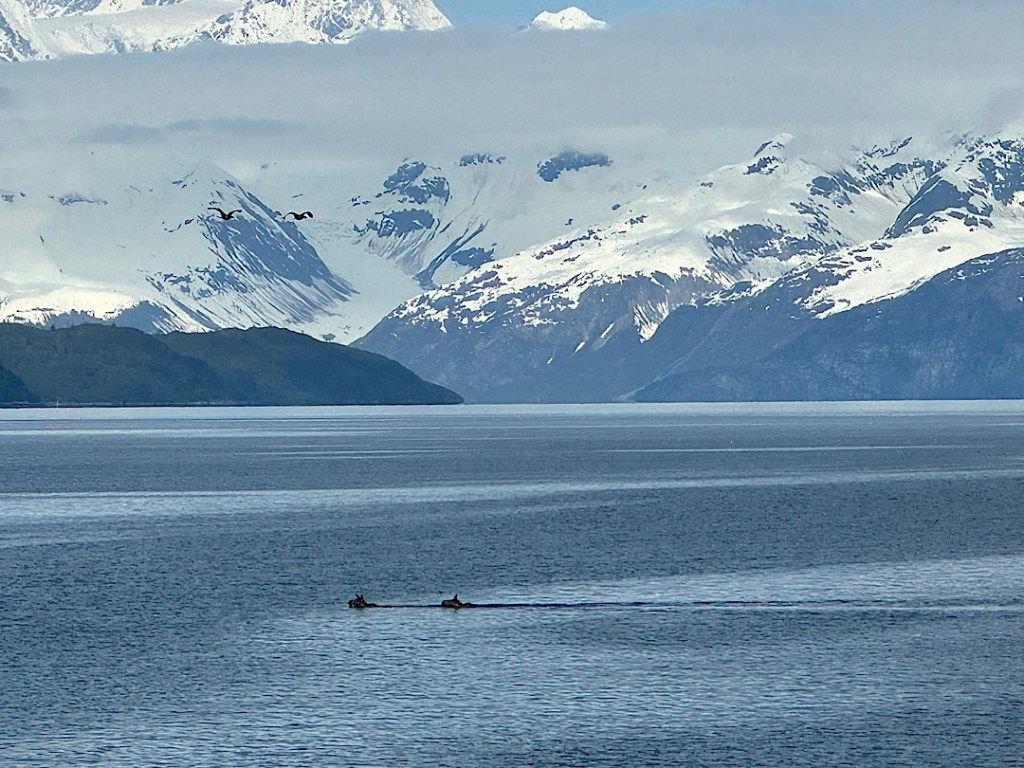
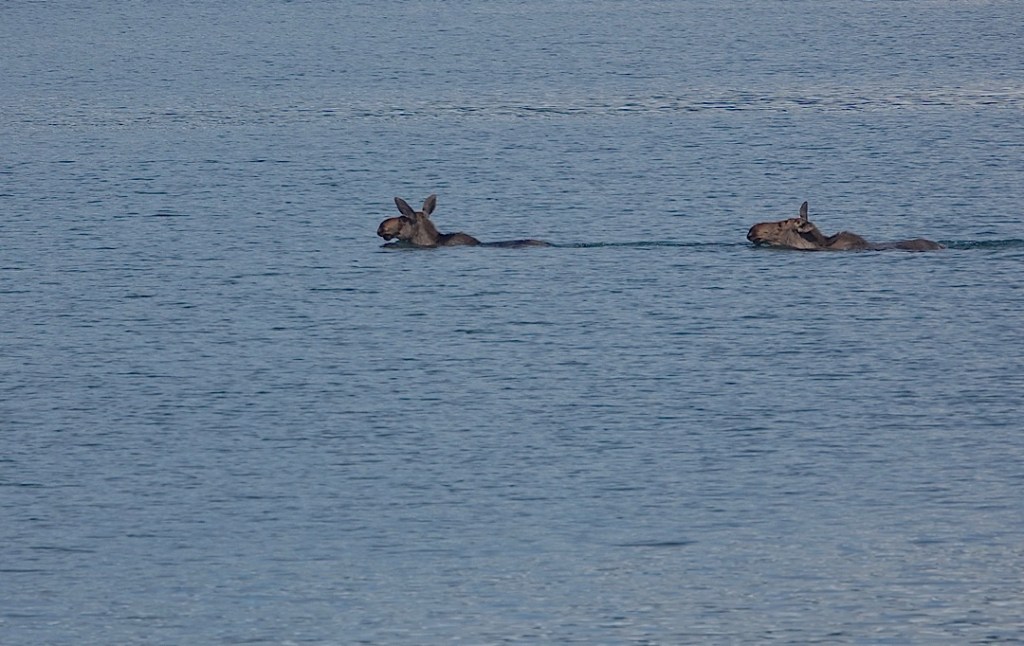
A bit after 9:30, someone shouted and pointed to two dots in the distance: two moose swimming across the fjord!
No mistaking those noses.
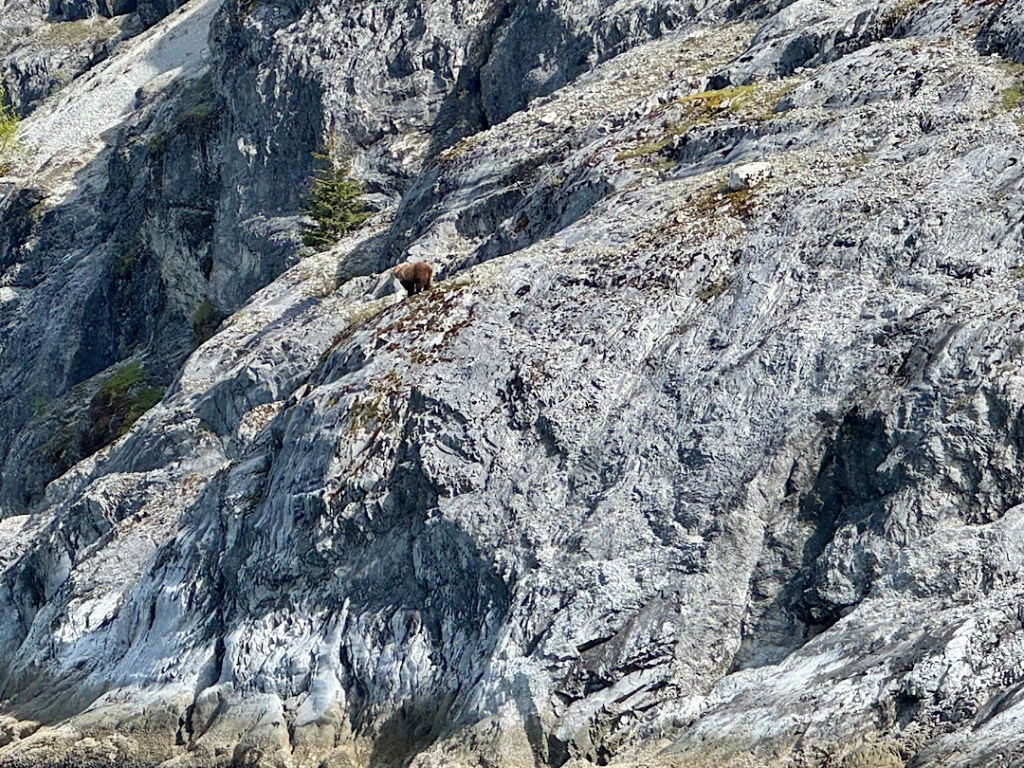
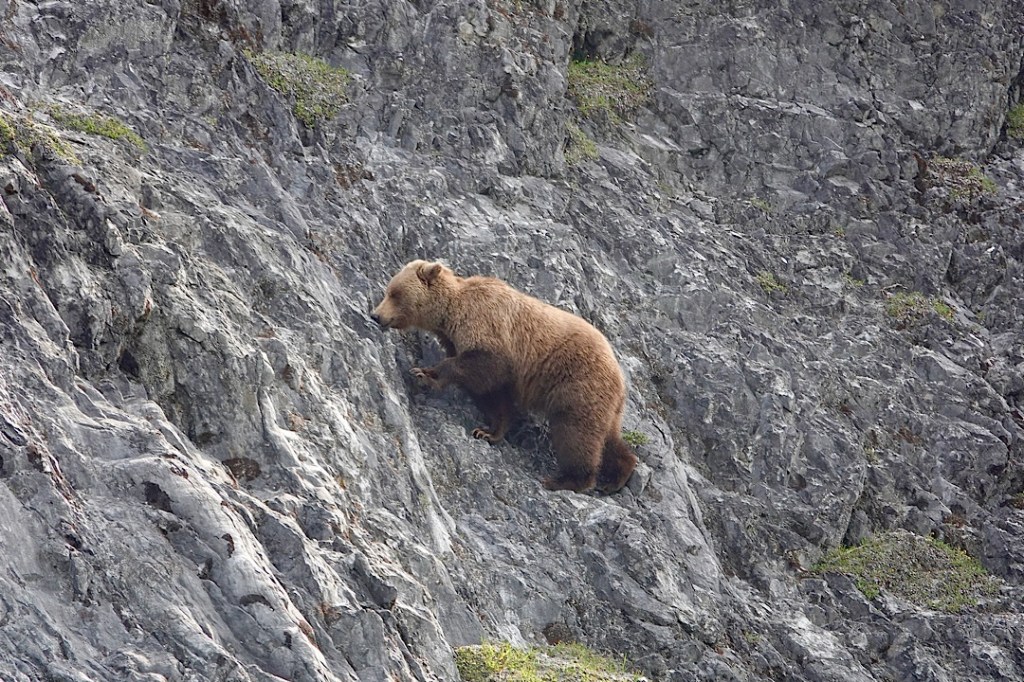
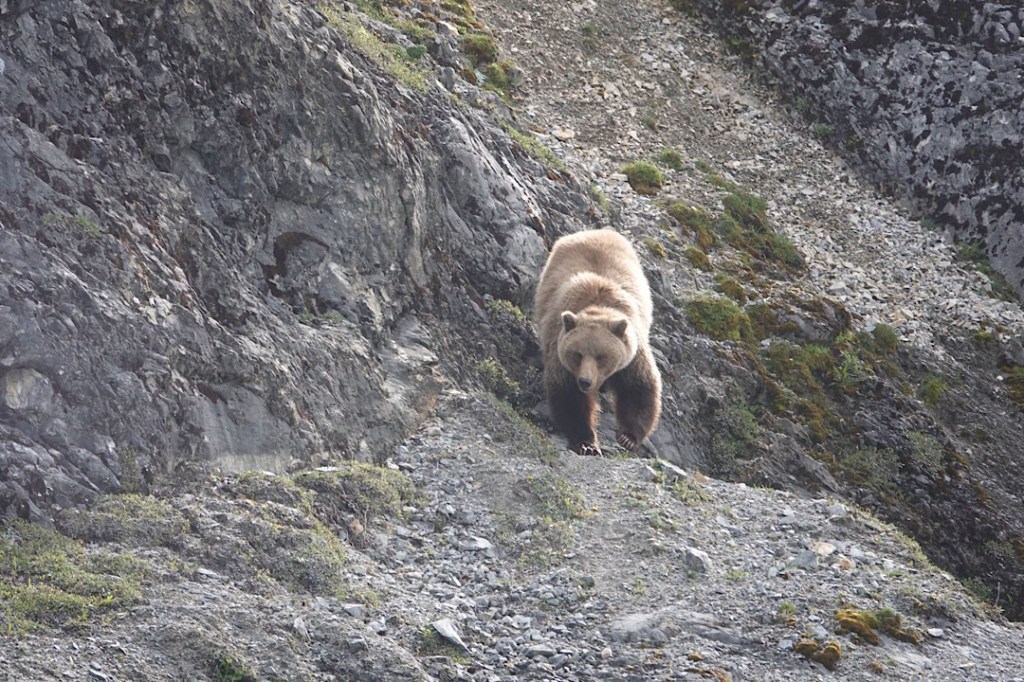
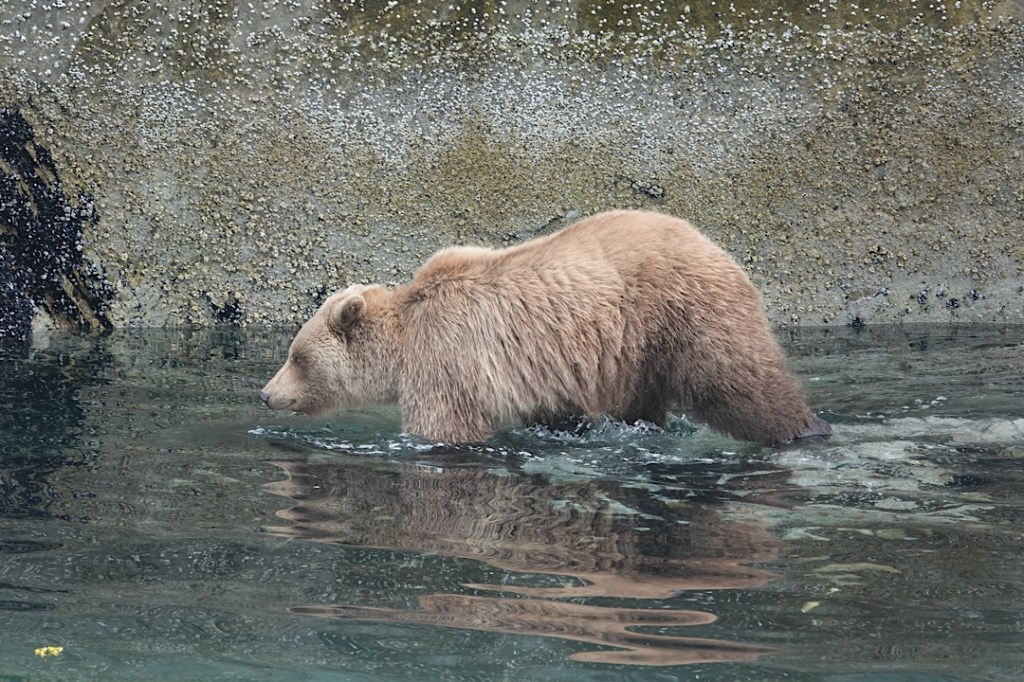
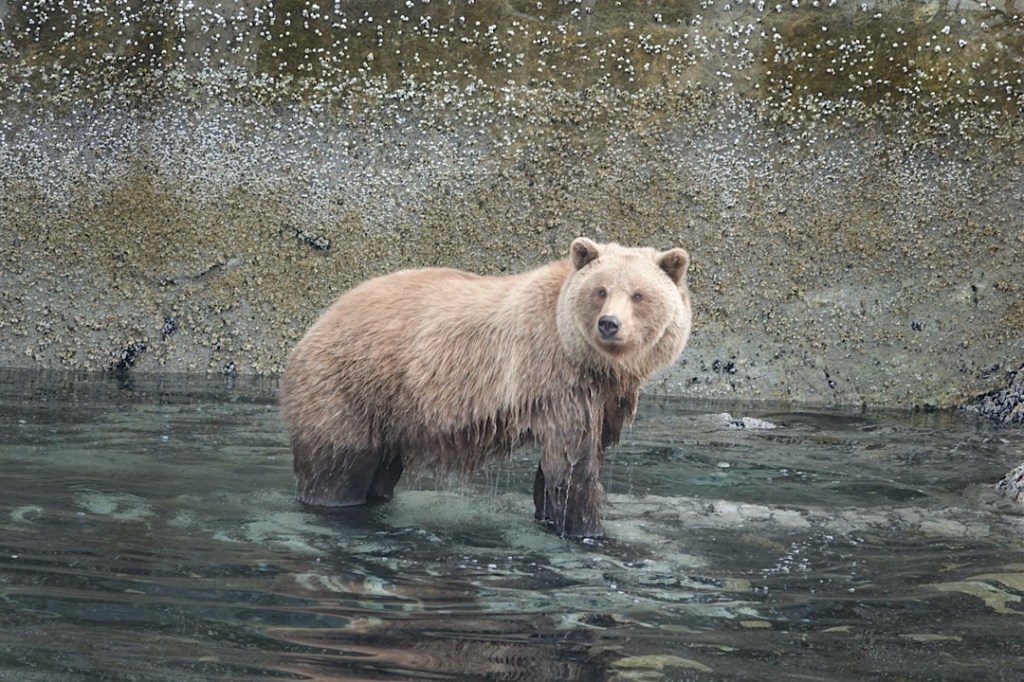
The boat’s crew members told us how rare this sight was. And mysterious! Moose lack heavy insulating coats or significant body fat. What would motivate them to cross the freezing channel? Even our onboard park ranger (Hailey) seemed mystified. The sight would have enthralled most boatloads of tourists for some time. But a new cry shifted our focus to the other side of the catamaran. On the cliffside ahead, the form of a brown (aka grizzly) bear was moving.
The captain maneuvered us closer and we watched the bear climb a remarkably steep rock face.He seemed to think better of that and descended. He stood just 25-30 yards from the boat. That’s just a quarter of the minimal distance humans are warned to keep between themselves and grizzlies. He seemed to be pondering the situation.Then he moved down and waded in.Again he seemed to change his mind. He stood there dripping.
When we finally moved on after almost 15 minutes, we rounded a bend and got a likely explanation of what the bear had been seeking.
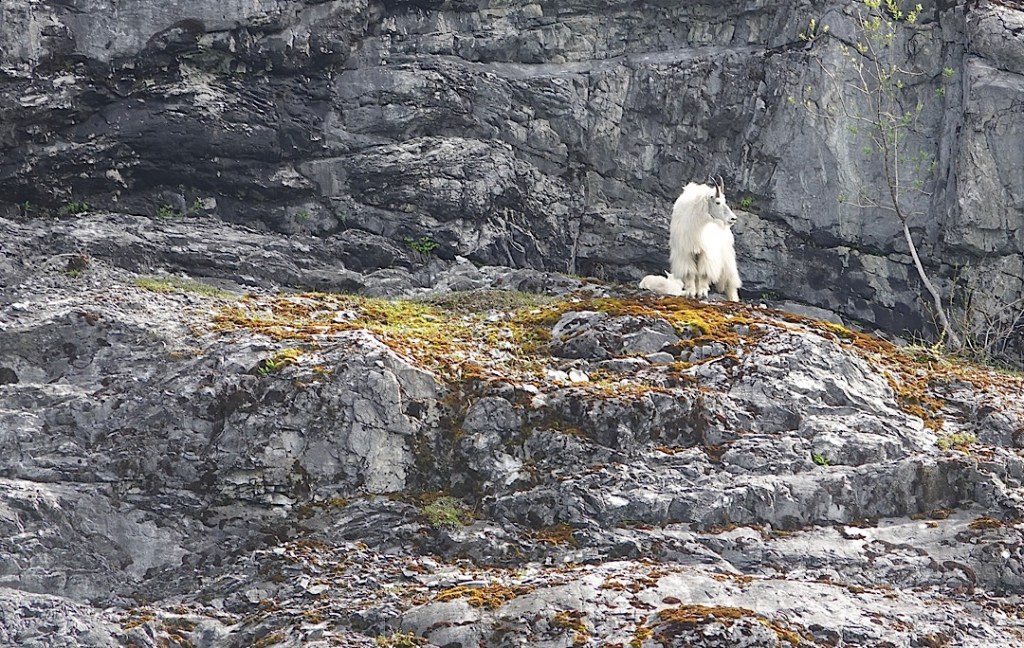
Dall sheep! With tender little newborn kids.
After all that drama, glaciers might have felt anticlimactic. But they weren’t.
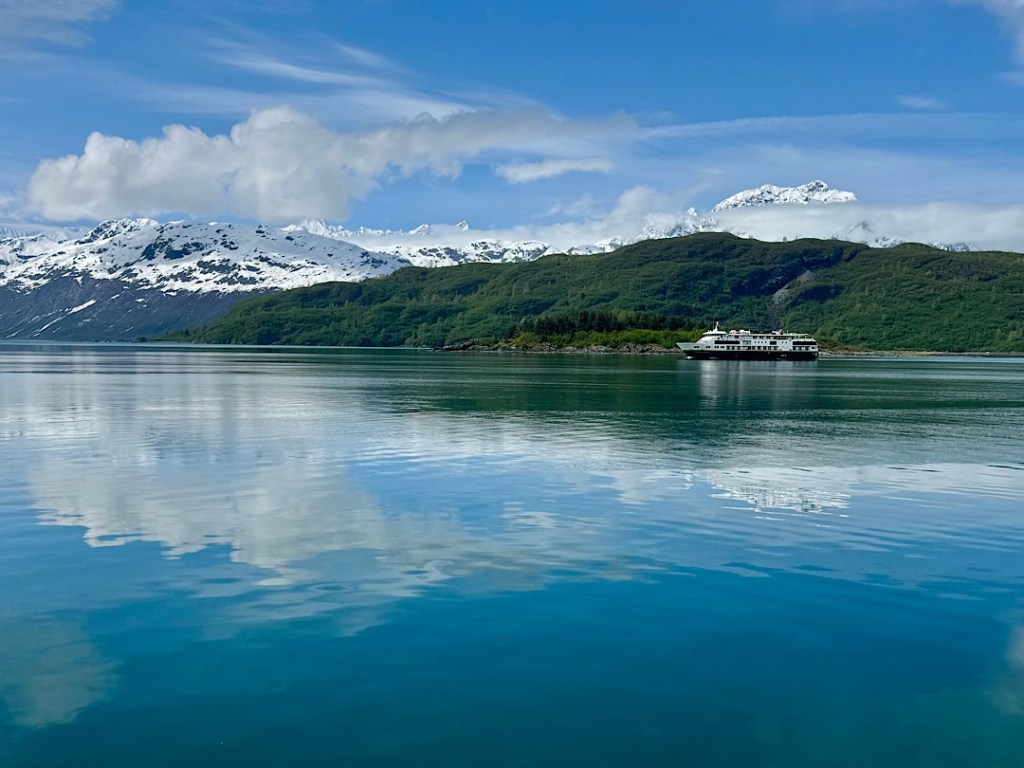
We entered the Tarr Inlet as a National Geographic tourist vessel was steaming out.Moments later we started seeing chunks of ice, floating on the water.
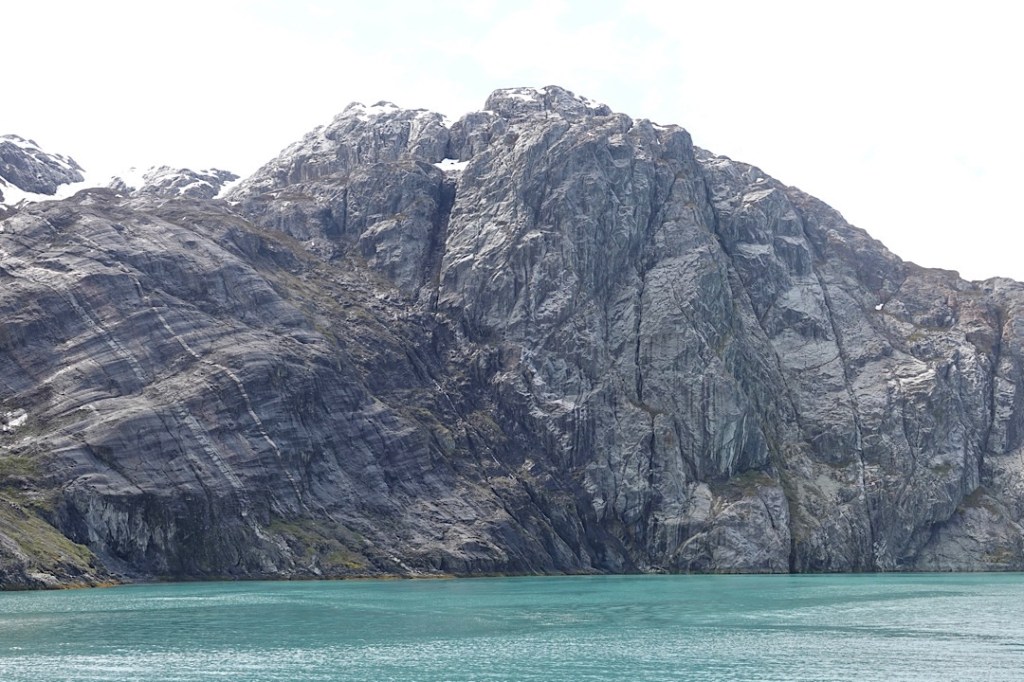
In any other place, the geology would have been riveting. We could literally see where the Pacific tectonic plate butted up against the North American plate.
This collision helps explain why Alaska has so many earthquakes.
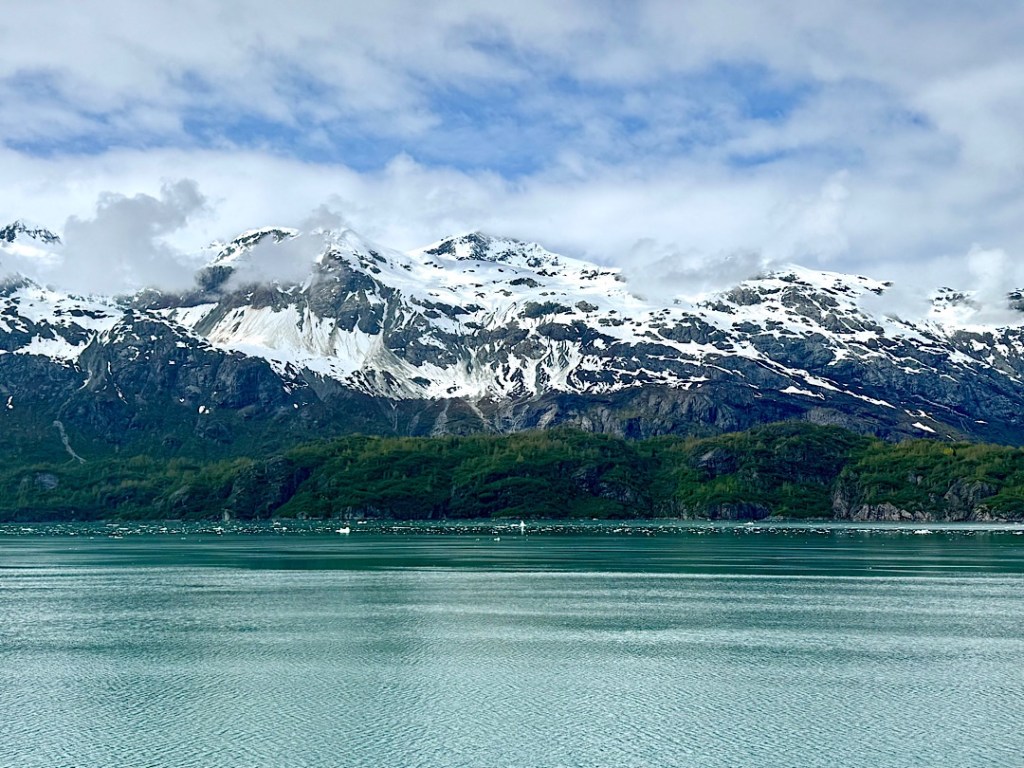
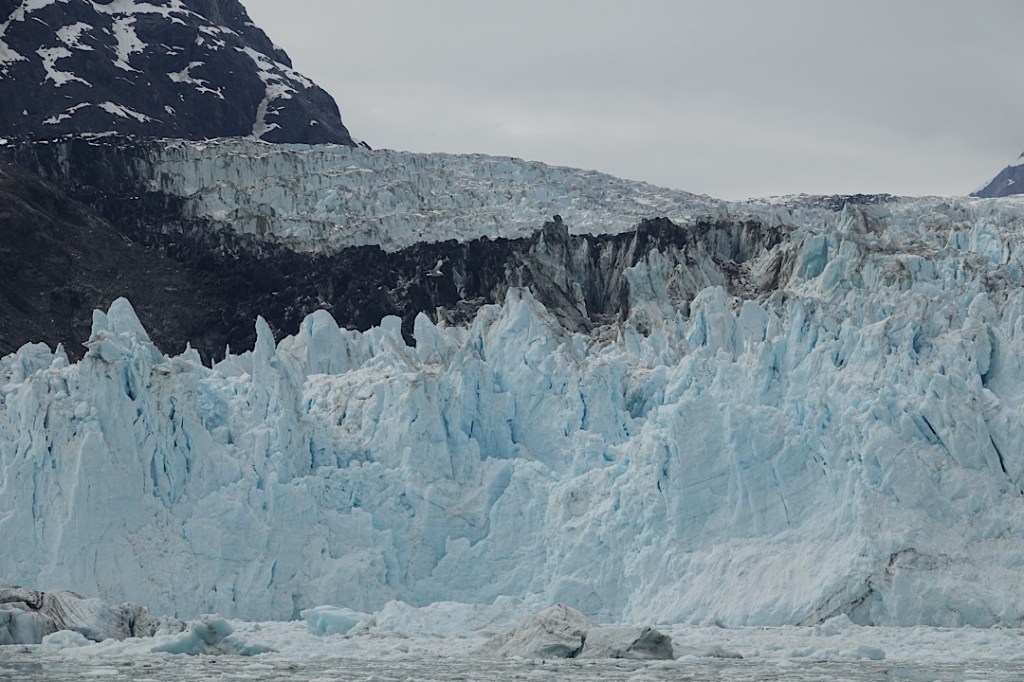
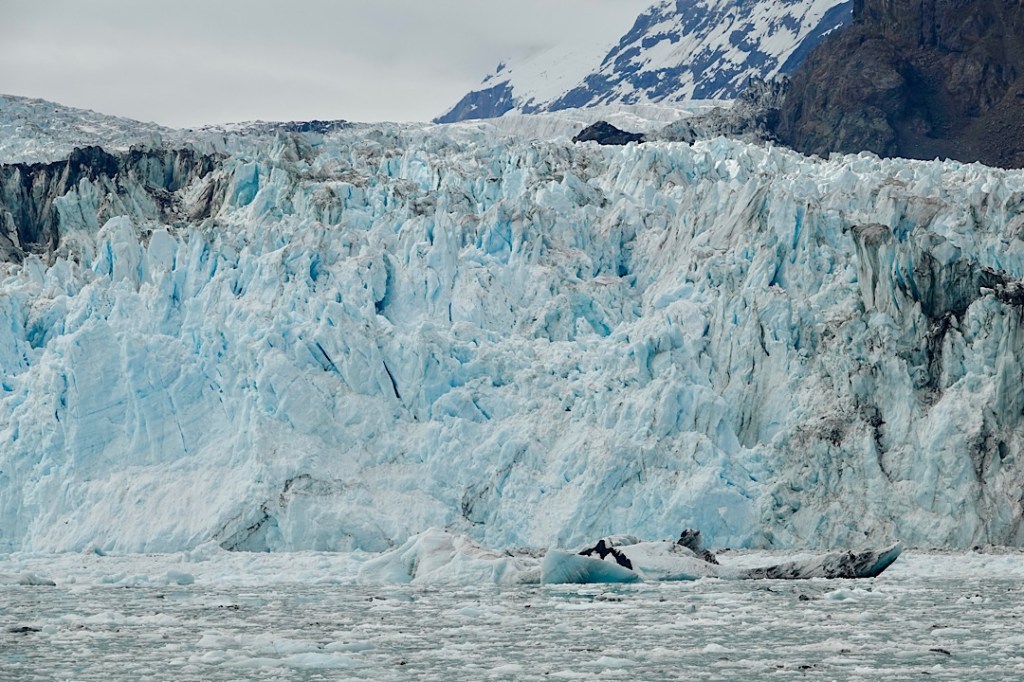
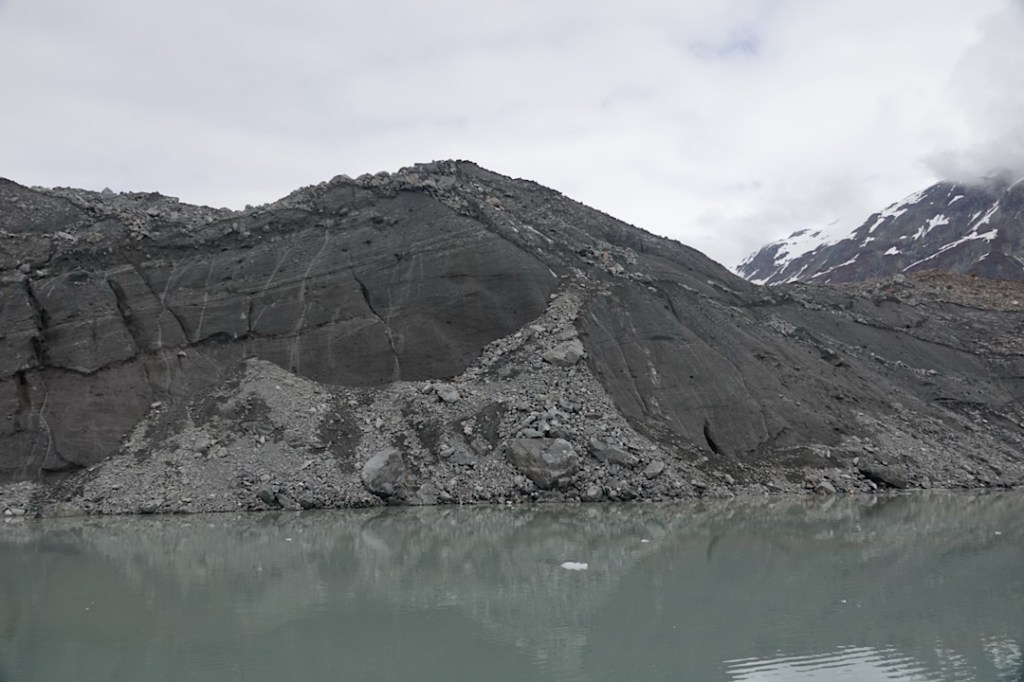
But the icy wonderland grabs most of the attention here. Over the next hour or so, moving slowly through it, I learned a lot about glaciers. The six we saw demonstrated how varied they can look.
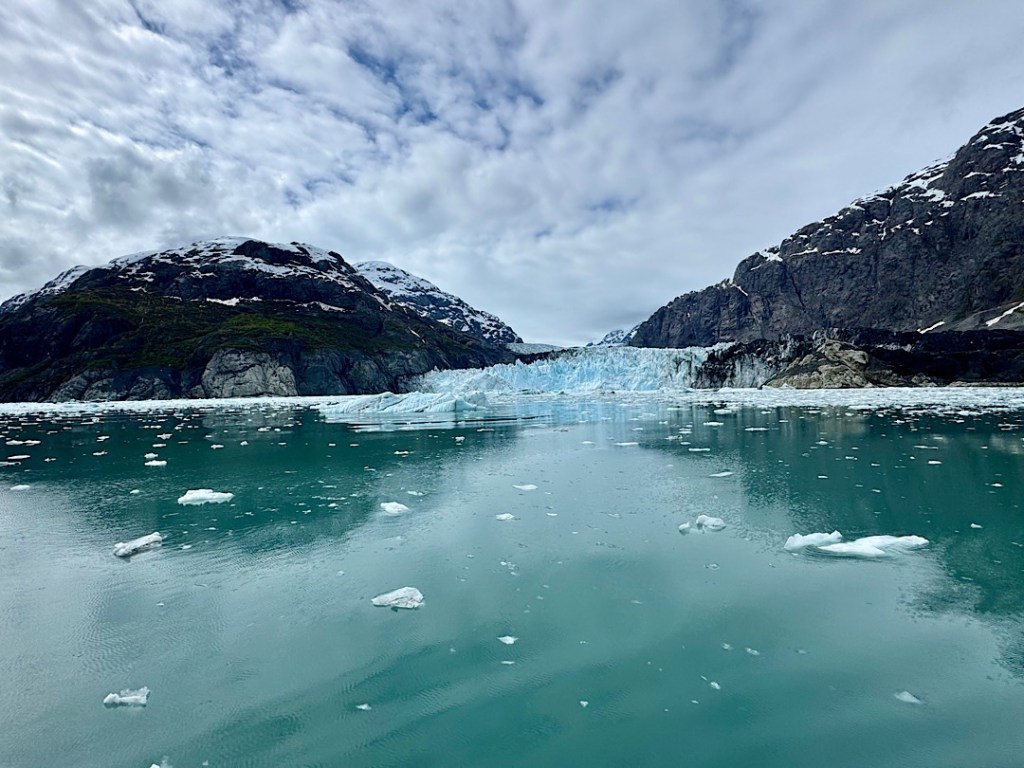
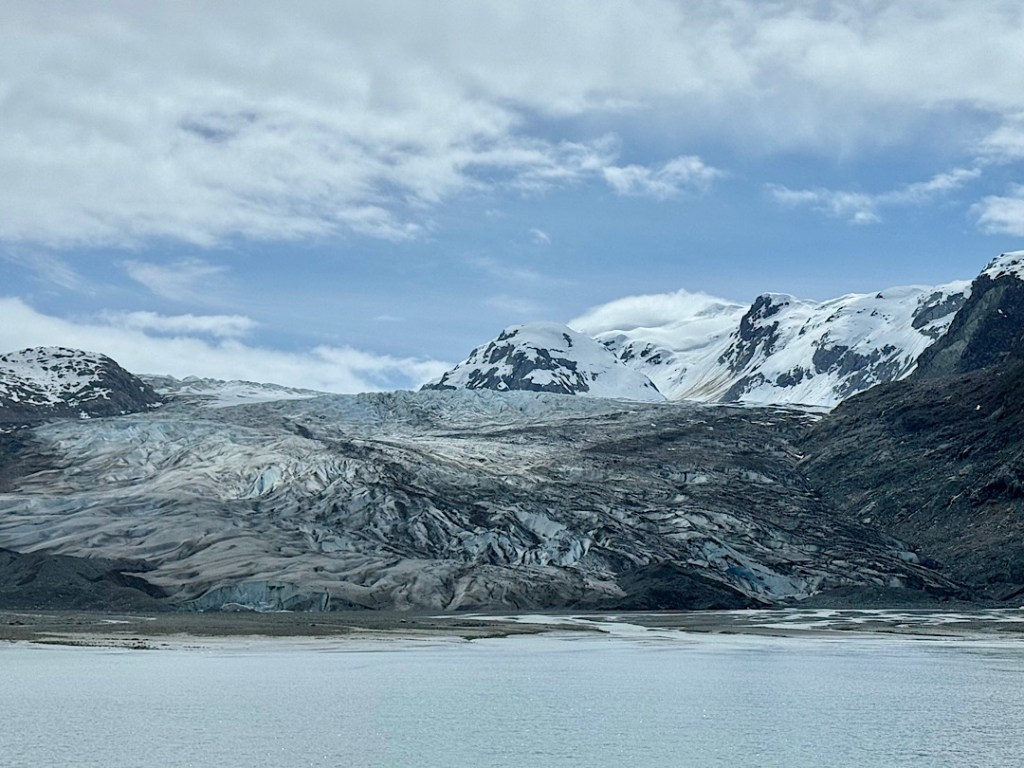
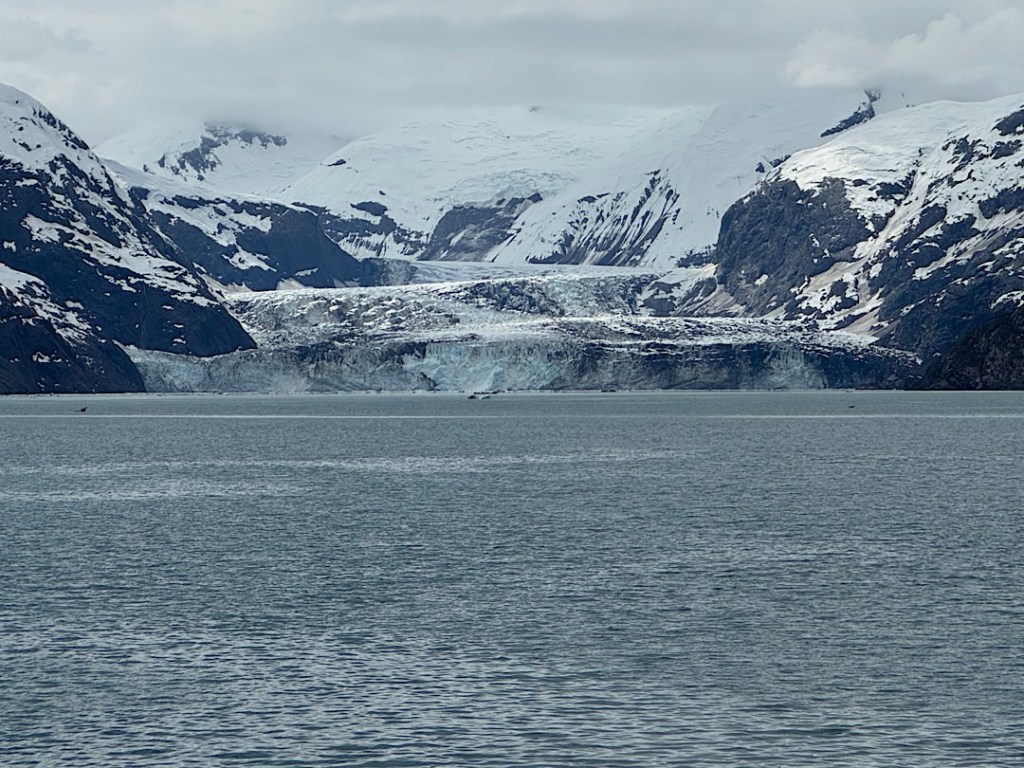
Some, like the Marjorie Glacier, are classically beautiful.The closer we got to it, the bluer it looked. Some, such as the Grand Pacific and Ferris glaciers don’t look like glaciers at all.The Reid Glacier no longer falls into the “tidewater glacier” category, having retreated from the water. The beautiful nearby John’s Hopkins Glacier is currently growing.
We spent the most time hovering in front of the Majorie Glacier. Ranger Hailey said it “calves” almost daily: huge chunks of ice can break off and smash into the water.
For us that didn’t happen. That would have like getting a royal straight flush. You can’t win ‘em all.
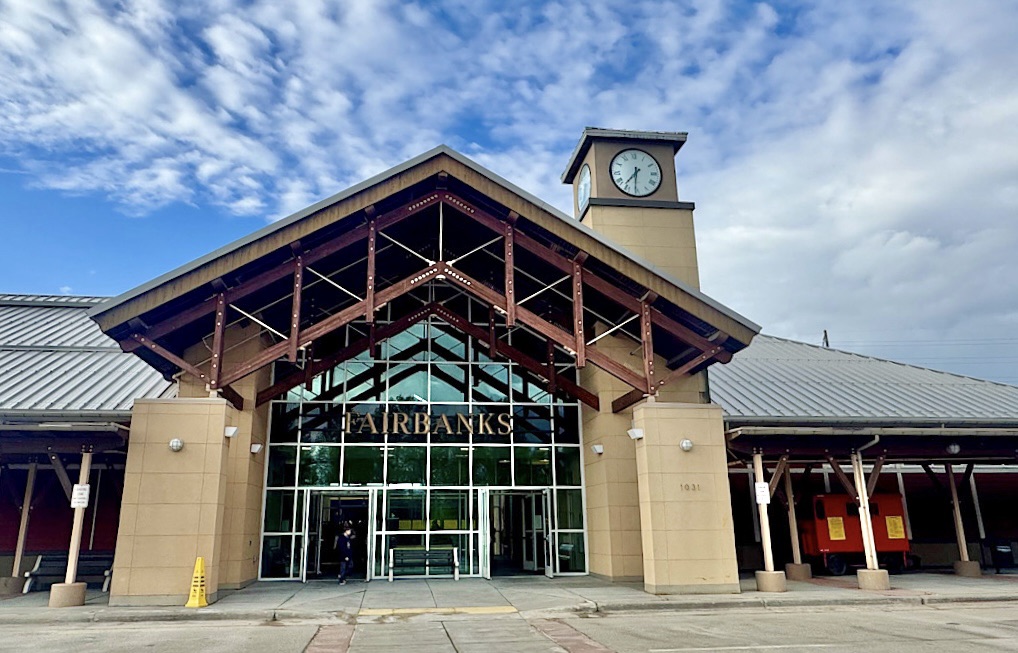
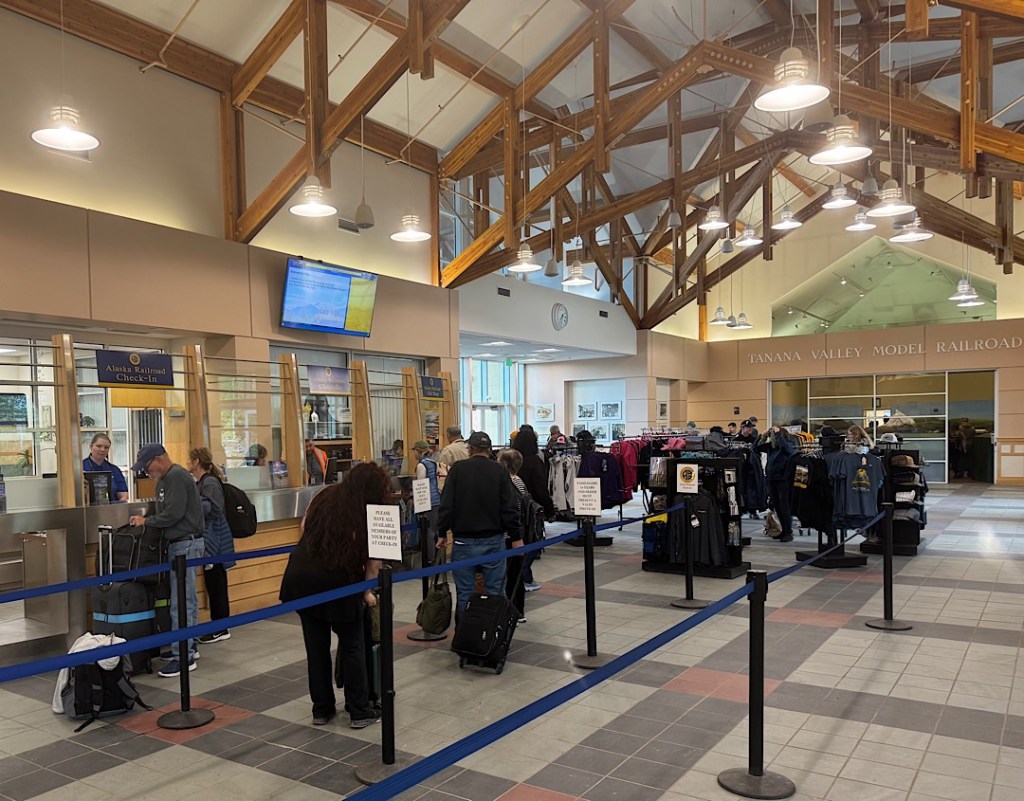
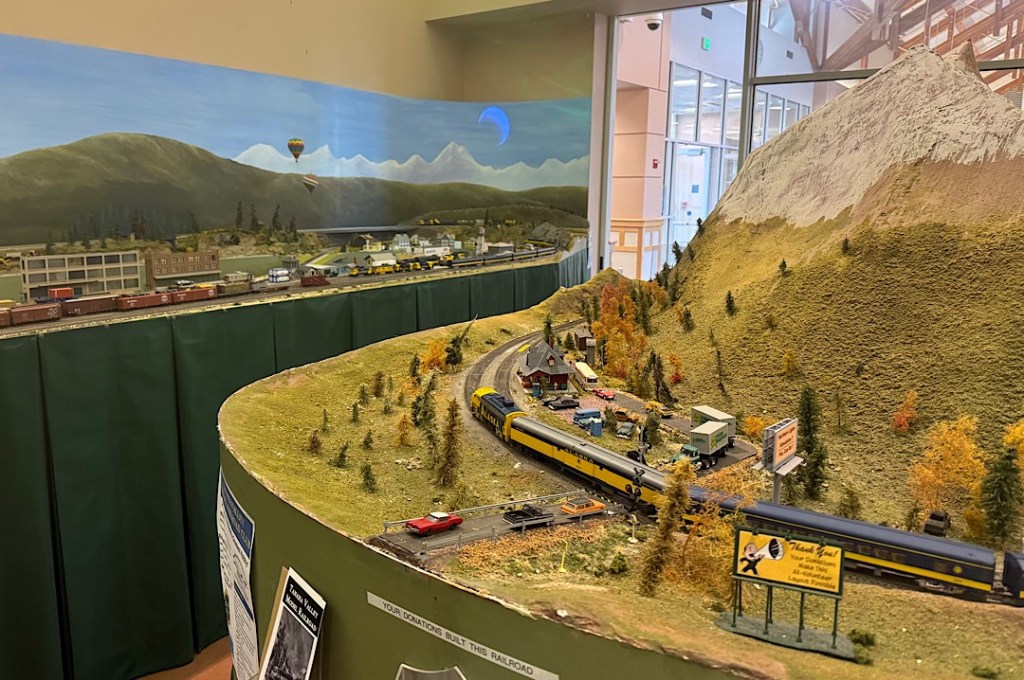
When Steve and I walked into the Fairbanks train depot (11 days ago) for the first leg of our Great Alaskan Railway adventure, we exclaimed almost in the same breath: this can’t be Amtrak. The depot was pretty and clean. The ticket sellers cheerful and efficient. To entertain waiting passengers, an elaborate model-train track had been set up in a side chamber. I wouldn’t say it all exceeded anything we saw in Japan last fall. But it wasn’t disgraceful.
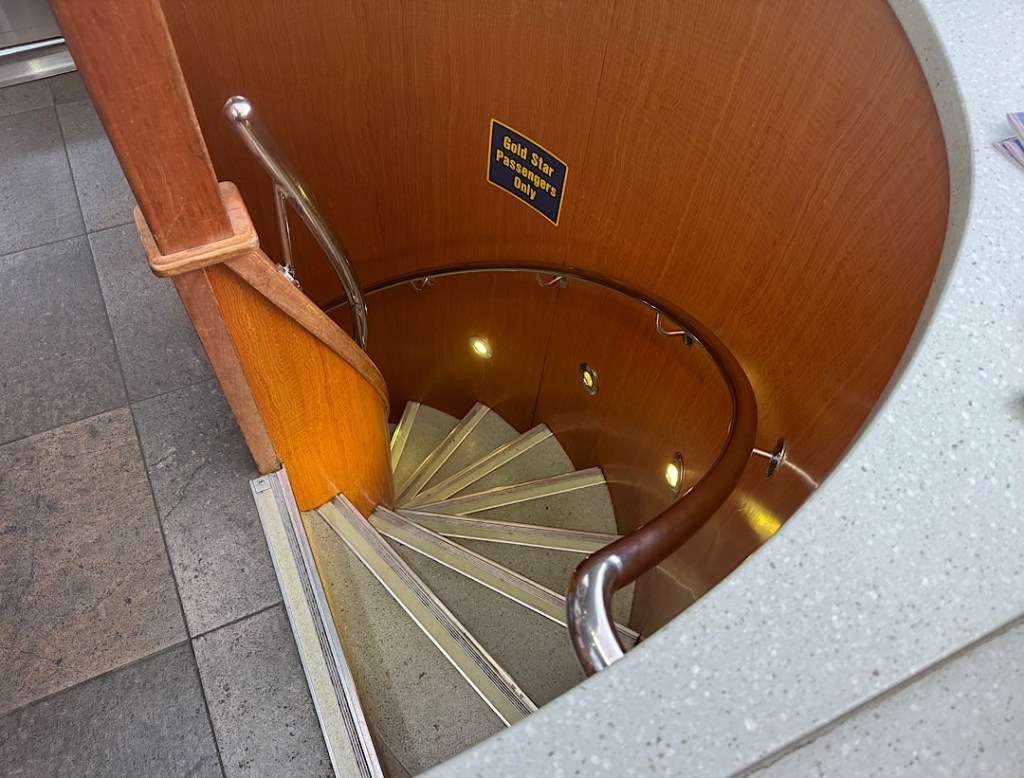
We soon learned that Amtrak does NOT run it; the Alaska state government does. Built 100 years ago to serve early gold miners, it’s now popular with travelers. Planning this trip, I wanted to ride almost all of it, from Fairbanks to Denali, then continuing on to Anchorage, stopping there, then taking the line that runs down to Seward (on the southern coast of the main Alaskan peninsula) and back. Because the scenery promised to be so beautiful, I splurged and got us “Gold Star” seats in double-decker cars with wrap-around views through the glass dome and meals (included) in the dining room below.
On the first two legs there was good news and bad. The good: our seats were not bad, and every time we were led down the winding brass-railed stairway…
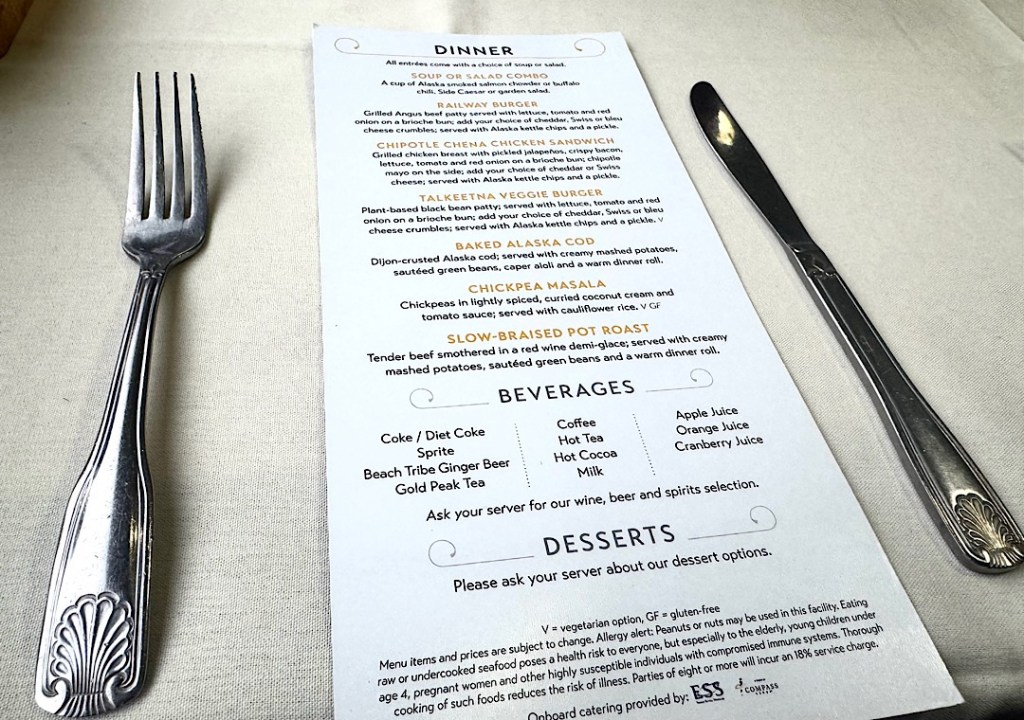
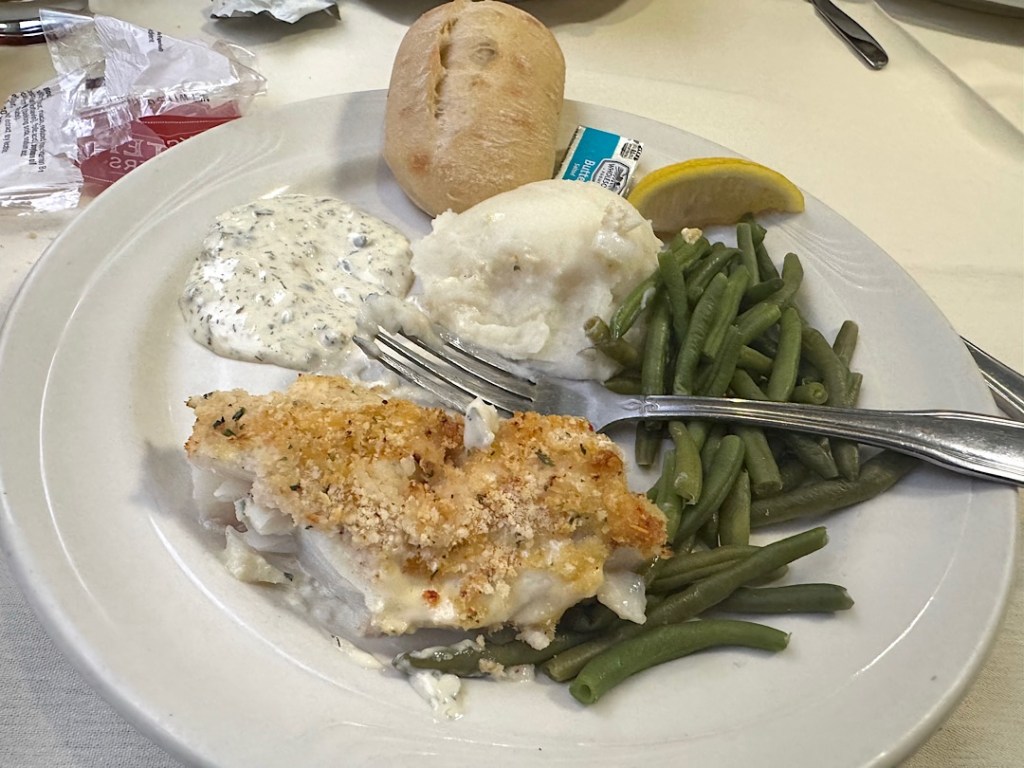
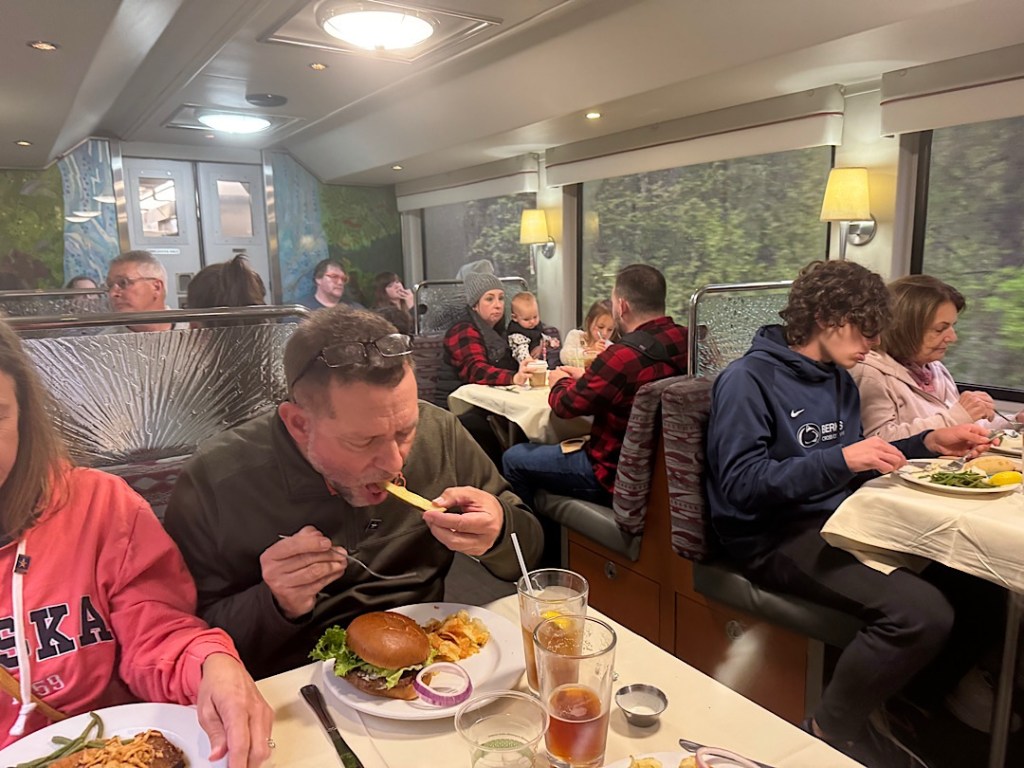
… we ate well (breakfast on the four-hour Fairbanks to Denali run; lunch and dinner on the seven and a half hours from Denali to Anchorage.)
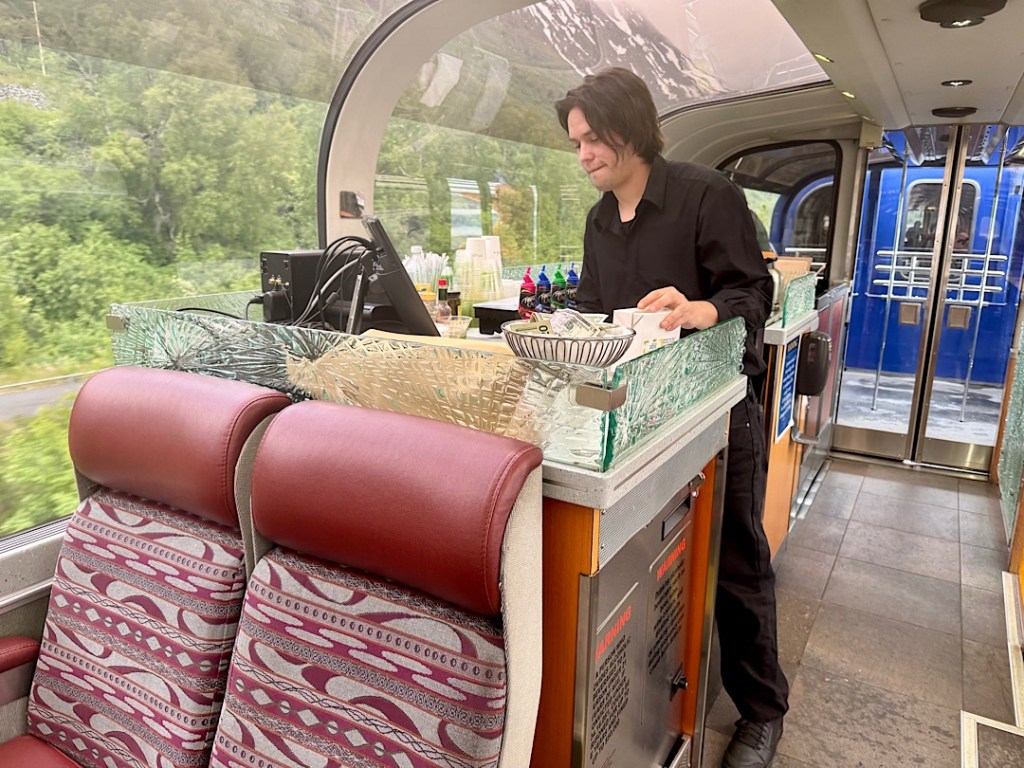
The dinner menuMy baked Alaska codThe bar, located upstairs. Our ticket included two alcohol drinks per meal. (We abstained at breakfast and lunch.)
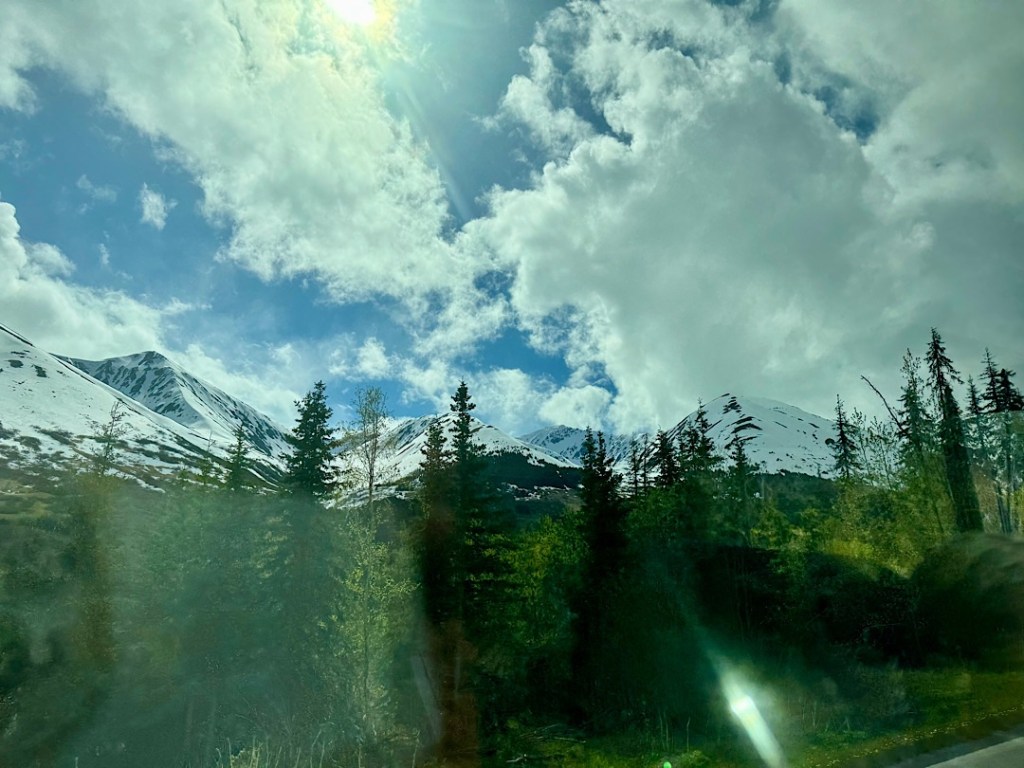
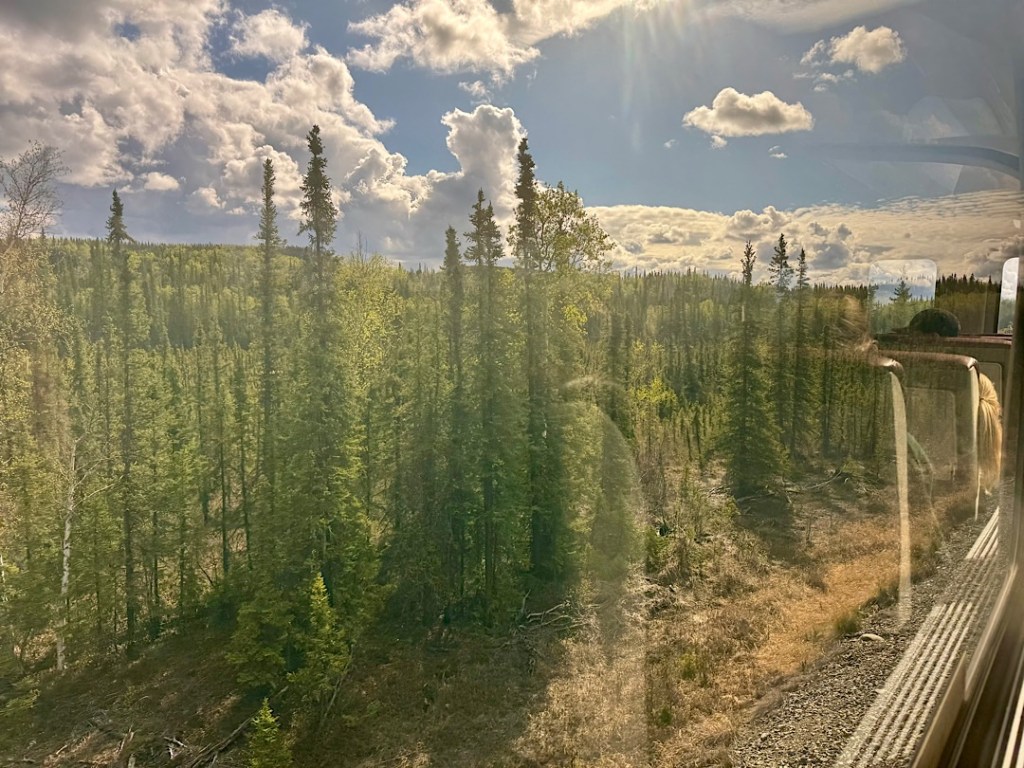
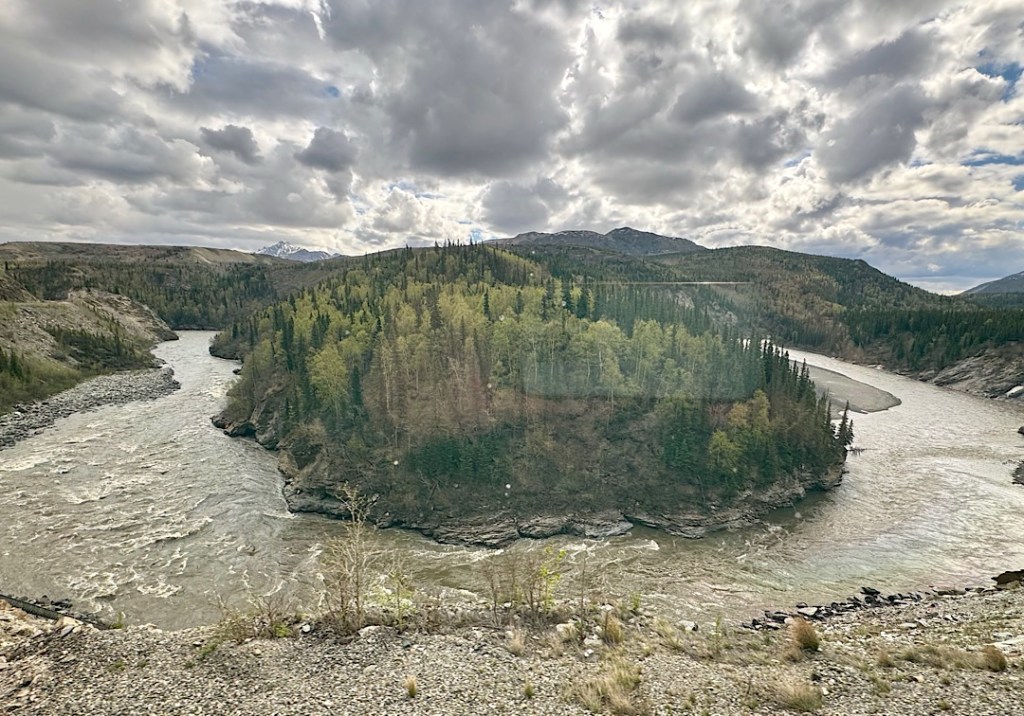
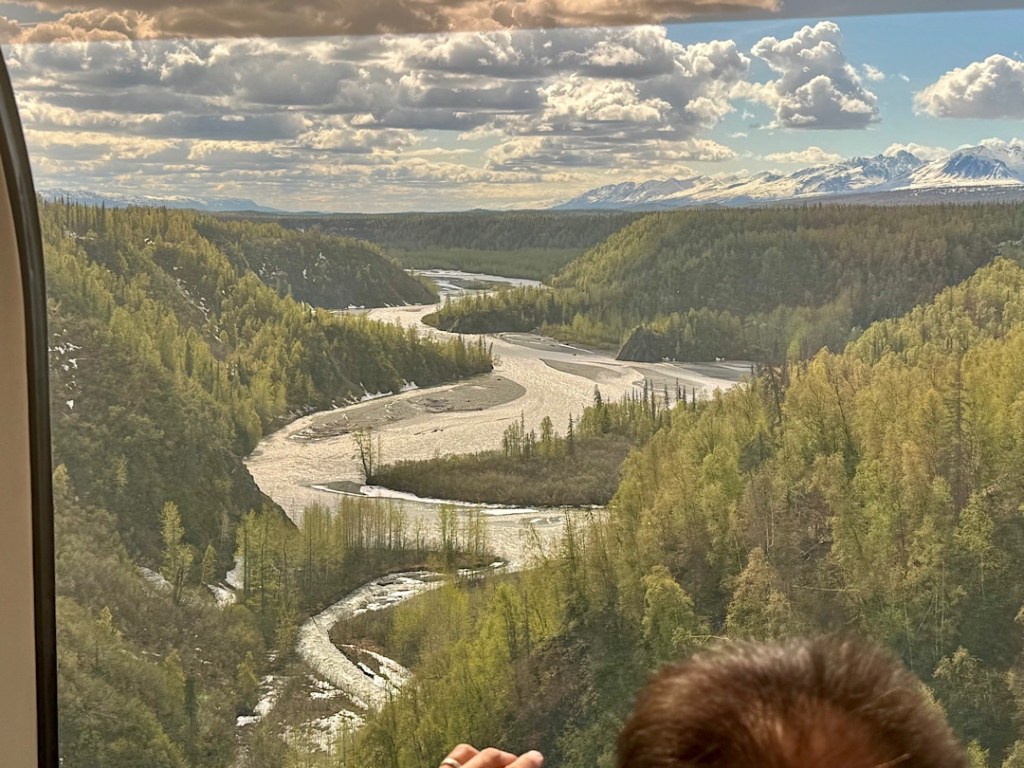
The scenery lived up to its billing.
We spotted some wildlife. Both those first two trains arrived on time. But how could this fill a blog post? Wallowing in middle-class comfort as you pass eye-catching wilderness is fun to experience but boring to read (or write). I wasn’t sure I was up to it.
Our third ride — from Anchorage to Seward — took a different turn, however. We boarded, went to the dining room, and shortly after Steve and I had ordered breakfast the train stopped. For a long while, nothing happened. Then very, very slowly, we began moving backward. Uh-oh.
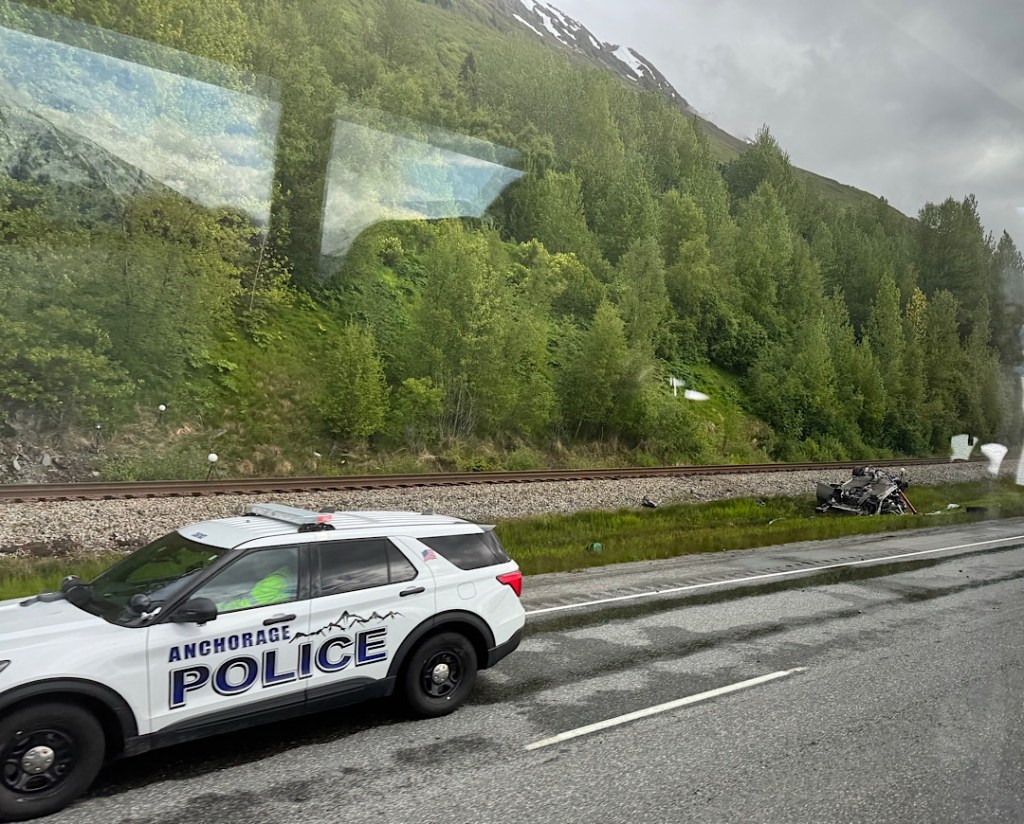
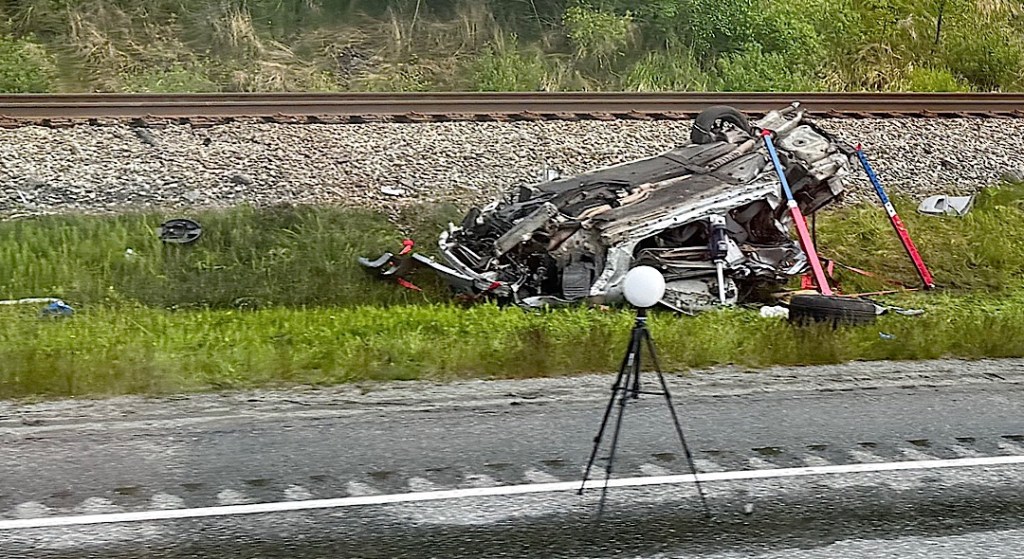
An hour passed and we finished breakfast. Gossip about what had happened began percolating throughout the cars. We learned that 40 miles or so down the track, near Girdwood, a motorist had lost control of his car and flipped (four times, we later heard). In the course of this thrill ride he bounced off the track before smashing to a halt and dying.
We glimpsed the scene when we later passed it.
Authorities were worried the disaster might have damaged the rails. It would take at least six hours for someone to inspect it, they finally announced.
Steve and I weighed our options. We could get off, return to our home-exchange house, and drive the Tundra to Seward and back (hoping to extract refunds from the train company.) Or we could get on a bus that we were told would arrive momentarily. We chose the bus.
As we waited for it to show up, I chatted with our car’s bartender, a thin young blonde who had worked for the railroad for more than a half-dozen years. She said it was the first time she’d known a car crash to block or interrupt a section of the line. But other things had done so: wildfires and avalanches and rock slides among them.
She was perky and earnest. She said every time one of these bad things had happened, something wonderful had compensated for it. Once the train had been scheduled to arrive at 10:15 pm but didn’t get in until two in the morning. In the midst of the delays, a magnificent display of the aurora borealis began lighting up the sky, thrilling everyone on board. Or, on this run, the bartender pointed out, as we’d waited just outside the Anchorage depot, we’d been treated to the sight of a nearby foraging black bear. (I saw him but didn’t manage to capture the sighting with my phone.)
For me another unexpected compensation was the chance to ride to Seward on a bus driven by a guy named Steve who claimed to have logged three million miles on the road. His bus did arrive fairly promptly at the depot, and since the train goes so slowly (roughly 25 miles an hour), we arrived in Seward on the bus less than an hour after we would have via a punctual train.
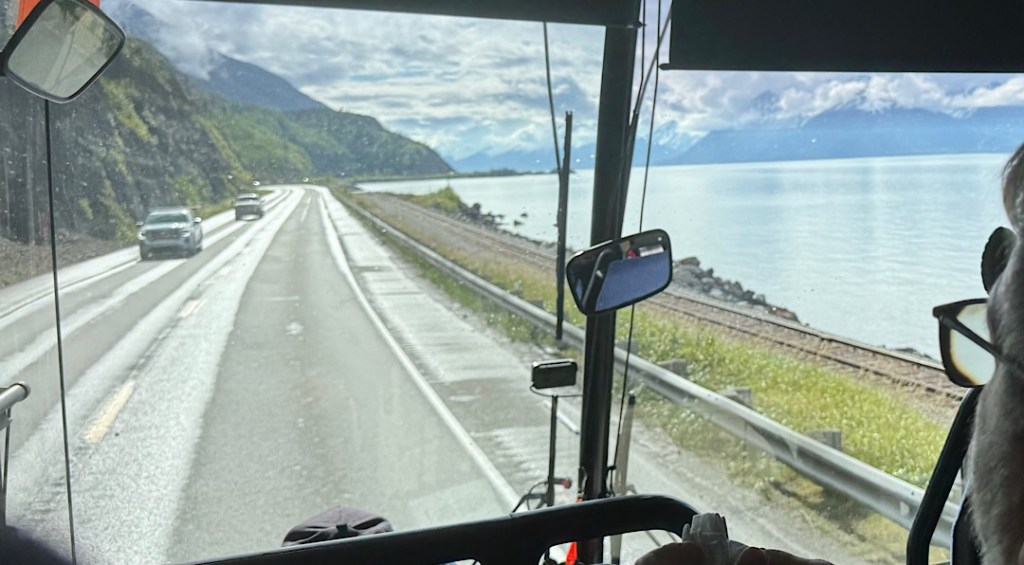
The views were similar. But the commentary was much more eccentric than we would have gotten on the train.
Bus Driver Steve started talking just a minute after leaving the Anchorage depot and paused for breath only rarely the whole way to Seward. We learned he was born in Miami, studied for the ministry, and visited Alaska almost 40 years ago en route to work in Indonesia. But then he married a local Alaskan girl and lived what sounded like a happy life: raising kids, white-water tubing, fishing for monster trout. He’d been a world-class weight-lifting champion, the co-owner of multiple car dealerships, a masseuse. He’d worked as Sarah Palin’s personal driver. He explained how rescuers extract those foolish enough to get trapped by the quicksand in the Turnagain Sound mud flats at low tide. He shared with us the secret of his happy 38-year marriage. Also his father’s foolproof business philosophy. Also the name of the best Texas barbecue joint in Seward.
My Steve and I decided to try it. Bus Driver Steve showed up as we were mopping up the remains of our brisket. He ordered ribs and a pile of pulled pork and sat down on the picnic-table bench next to us.
We talked about the way Alaska could obliterate plans in the blink of an eye. At 8:30 that morning, he’d been sitting on his couch at home savoring the start of three days off work. The phone had rung and someone from the office had told him they needed him. There’d been an emergency. When that happens here, you don’t hesitate, he said. You do what you can to help out. “That’s just Alaska.”
There came a moment Tuesday afternoon, our first full day in Anchorage, when the Huskies were being readied to tow an ATV and they could not contain themselves. The furry brindle-colored dog in the lead position let out a yip, and then a full-throated scream. His tail was wagging, as were those of his canine teammates. A cream-colored dog with a short coat keep leaping up, straining against his line to move forward. I wouldn’t say they were barking. It was more like yodeling with joy.
Spending some time at the Happy Trails kennels with these sled dogs and their humans was so much fun, I could have joined in the chorus. It was not a pleasure we’d anticipated. Steve and I had missed an opportunity to visit the sled dog kennels at Denali (the only national park in the United. States to maintain a dog team.) But we did watch a short film in the visitor’s center about them, and it inspired me to go online first thing Tuesday morning to see if we could visit a kennel in greater Anchorage. I saw that the Happy Trails staff would be giving a tour that afternoon, and we could still get tickets.
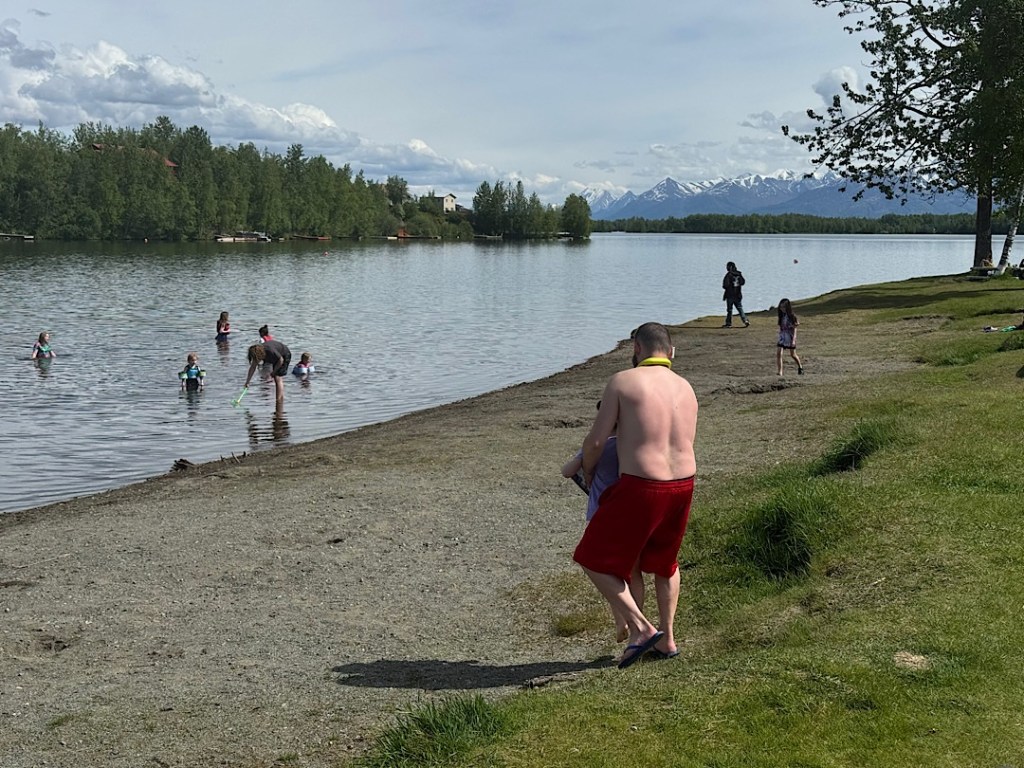
The kennels are located about an hour outside the city. Happily, our Anchorage house-trading partners also let us use their bright red Toyota Tundra. We climbed into it and drove north, stopping at an agricultural office in the Matanuska Valley. The friendly receptionist said it was too early to see any of the giant vegetables for which this region is famous. Nor were any farm tours being given. So we continued on to Wasilla (birthplace of Sarah Palin’s political career) and ate our picnic sandwiches on a pretty lake.
Summer beach season (at one of Wasilla’s lakes) was just beginning. Our Tundra
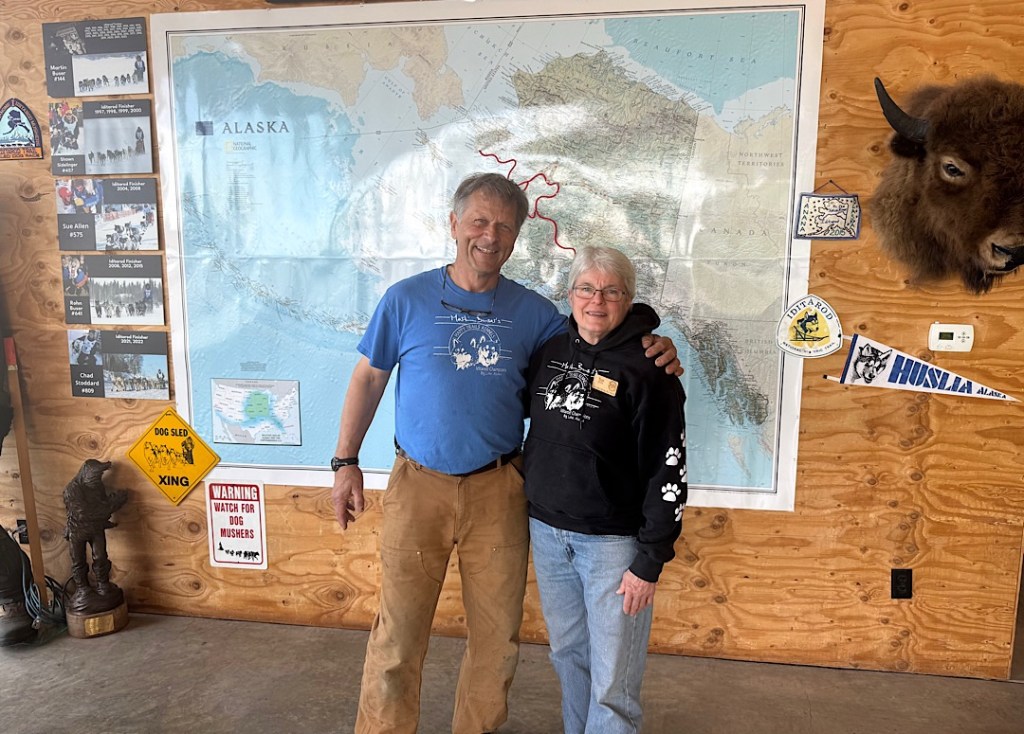
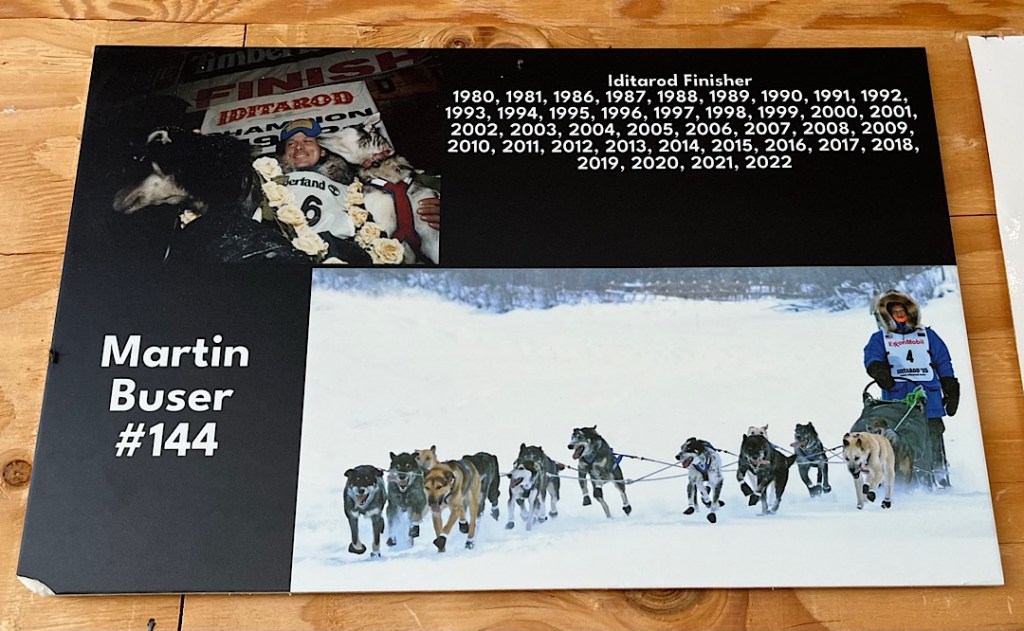
One of the folks who greeted us in the reception hall was a fit older guy with a roguish grin, who introduced himself as Martin Buser. Within minutes it was clear Martin is the charismatic heart of Happy Trails. He’s a 39-time finisher and four-time winner of the legendary Iditarod dogsled competition, that hellish 1,000-mile-long endurance race across some of the most difficult terrain on the planet.
Martin’s staff also includes Sue Allen, who entered and completed the race in 2004 and 2008 (while also holding down her full-time job as a schoolteacher). Another staffer, Chad Stoddard, did the race in 2021 and 2022 and hopes to compete again.
Martin Buser and Sue Allen
Martin, 67, completed his last race three years ago; he told us that after 39 runs he didn’t want to subject his body to more extreme ordeals. But he’s still very much at the center of the sport. He ran his first two races (in 1980 and ‘81) with purebred Siberian huskies — that super-furry dog with upright ears and (often) blue eyes. Then he began crossing them with other breeds known for their speed, e.g. Salukis and short-haired pointers. His cross-breeds proved so much faster that within short order, all the other leading dog-mushers were following suit. These “Alaskan Huskies” are a motley crew but Sue told us no one uses anything else for racing any more.
Martin doesn’t sell the puppies he breeds. Sue said one of Martin’s sons may compete with them again, as may Chad, plus Martin has developed his operation into a major showcase and tourist attraction, offering dog-powered sled rides to visitors in the winter and summer tours to folks like us (and big buses full of cruise ship passengers).
Happily, one of those buses had just departed so it was only Steve and me and two couples with their kids learning about dog-sledding Tuesday afternoon. We watched a film, then Chad connected five dogs to their pulling rig; that’s when they started yodeling with excitement.
Chad raced them around a gravel track…
… and Sue explained that in the summer, when there’s no snow, Martin and his assistants train the dogs on the ATV. Unlike the service dogs Steve and I raise (who learn 35-40 verbal commands from us before they move on to the professional trainers), these canine athletes basically must master just two: Gee (meaning go to the right) and Haw (left). They do most of the serious preparation in the winter, working with bigger teams and connected to sleds. In the summers, they mostly get their exercise by romping with their fellows in nearby meadows.
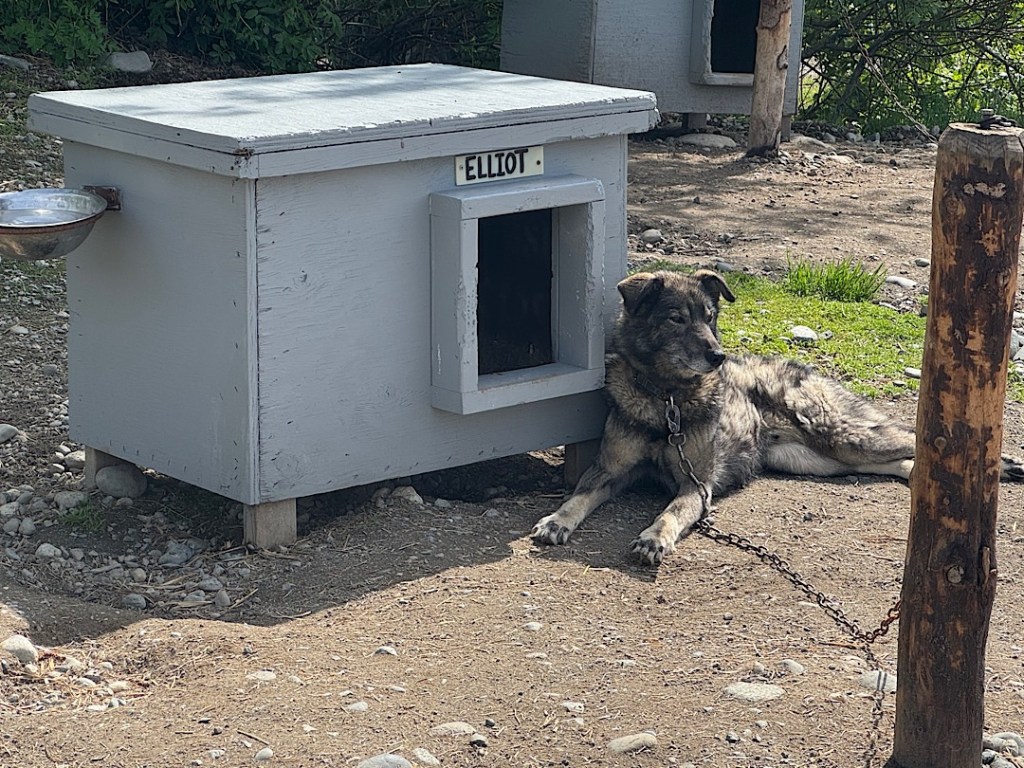
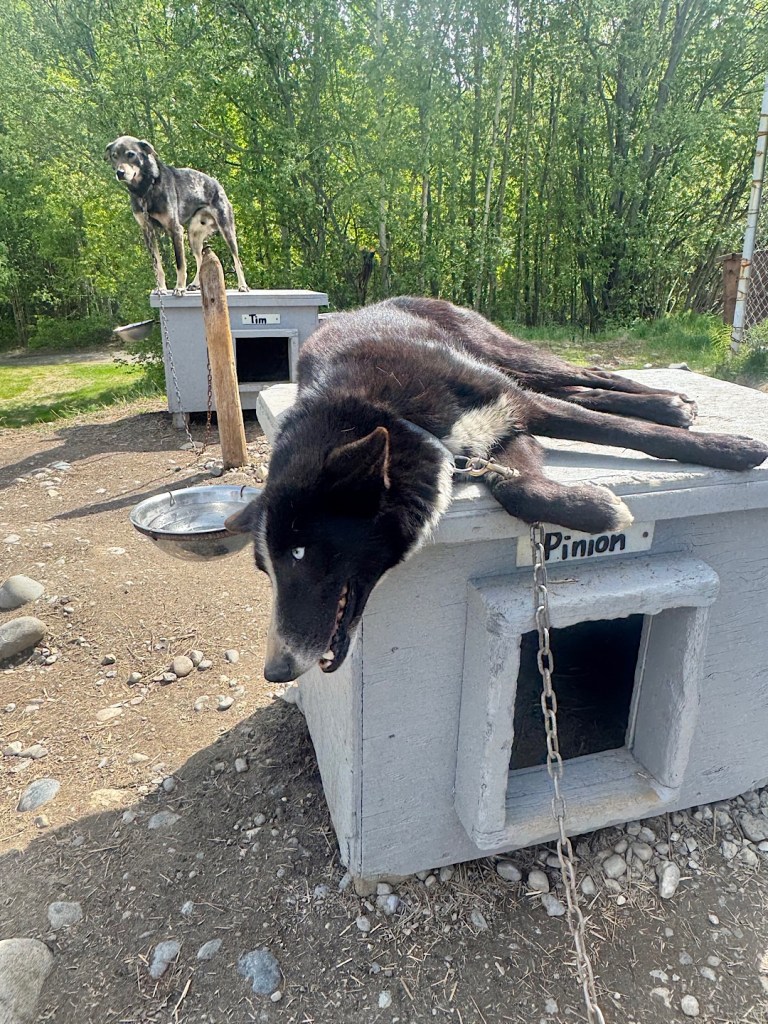
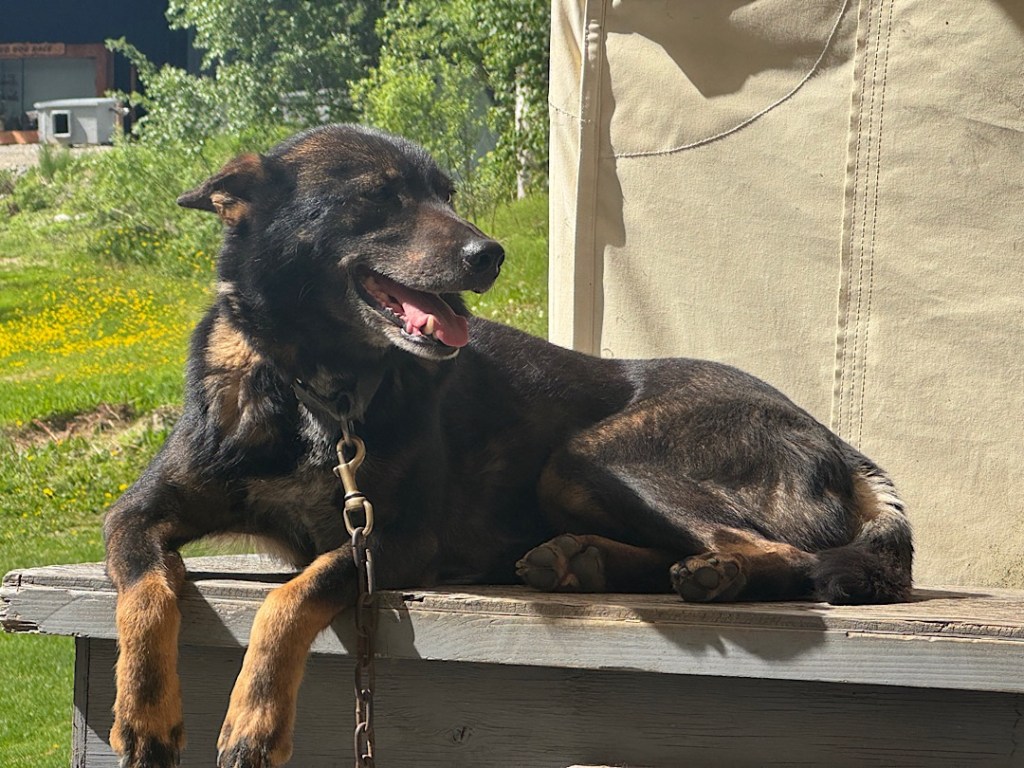
We meandered out to the Happy Trails housing tract, an array of something like 70 dog houses. I admired all the dogs but had mixed success petting them. Some basked in the attention, while others were more aloof.
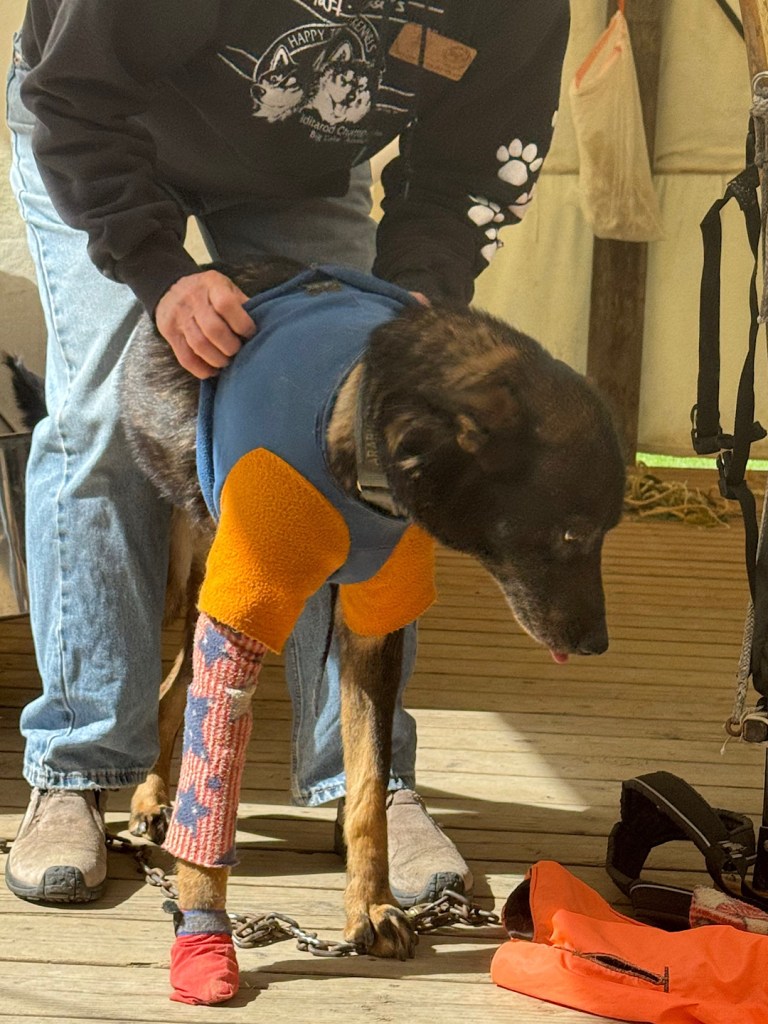
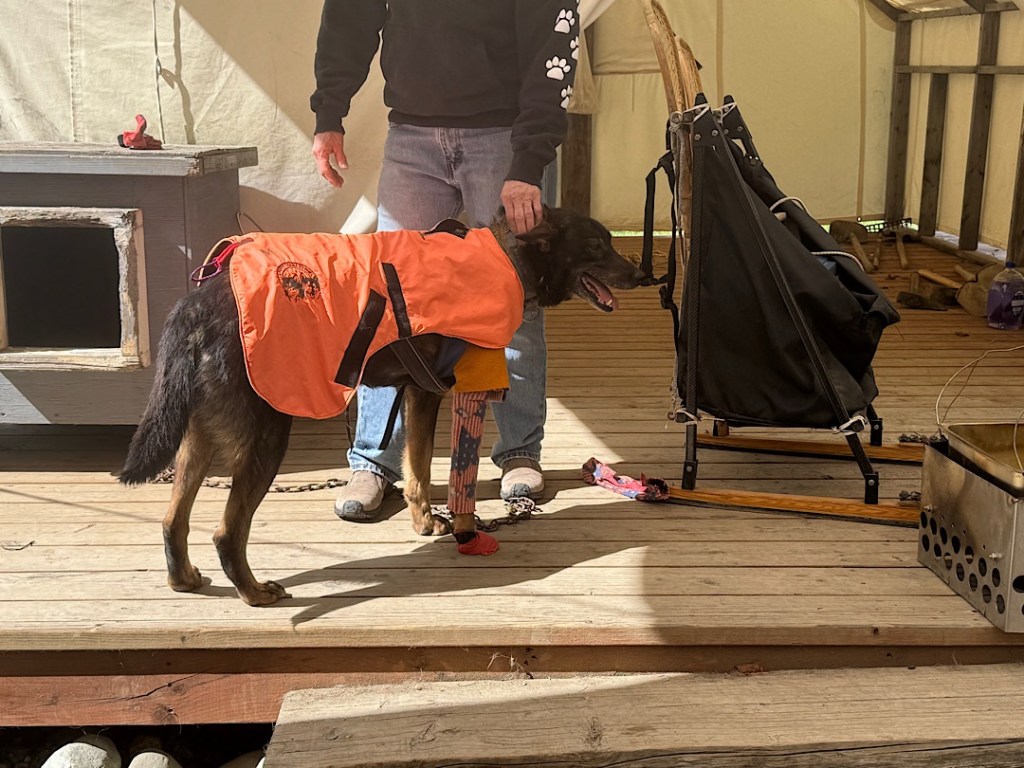
Sue led us to an amphitheater where she used a dark female named Arabica to demonstrate the gear that Iditarod competitors commonly wear.
ArabicaBooties to protect their feetLeggings and a shirt and coat to protect against the cold.Racing with teams of 12-16 dogs, the Iditarod competitors spend a great deal of time dressing and undressing their dogs.
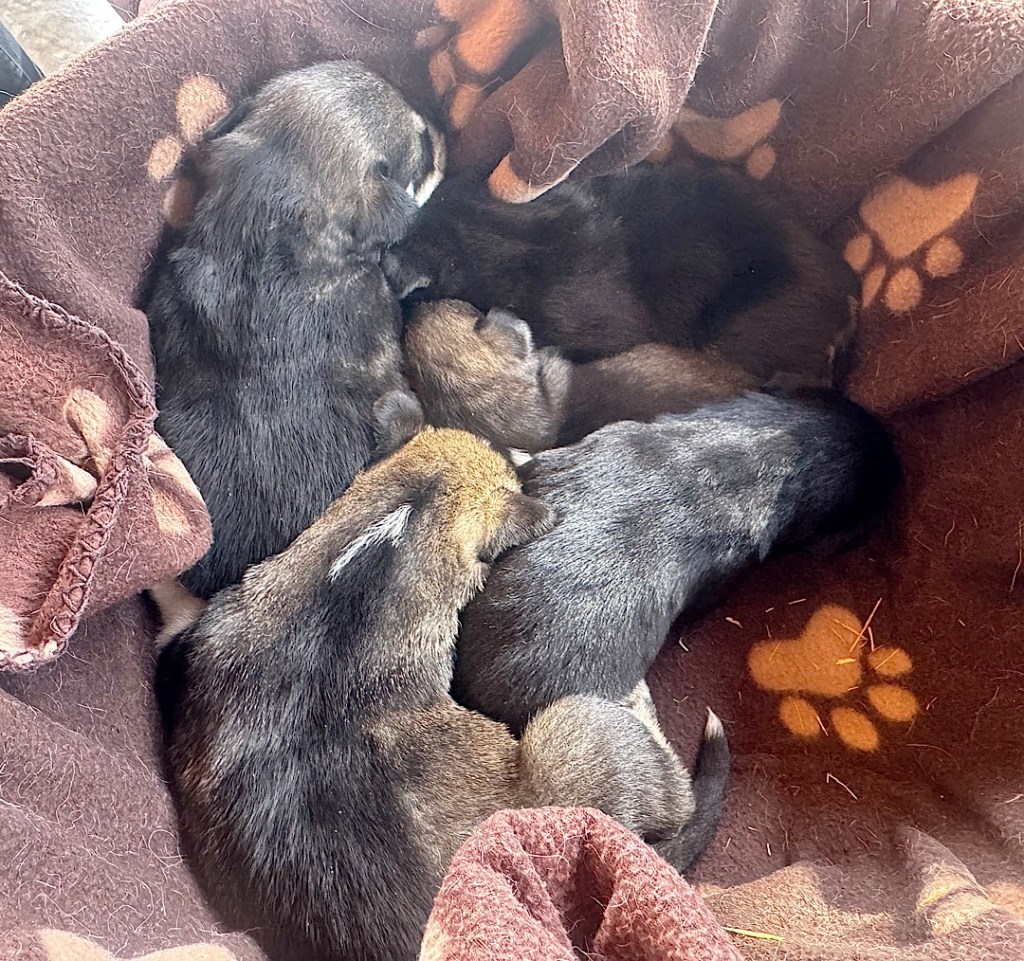
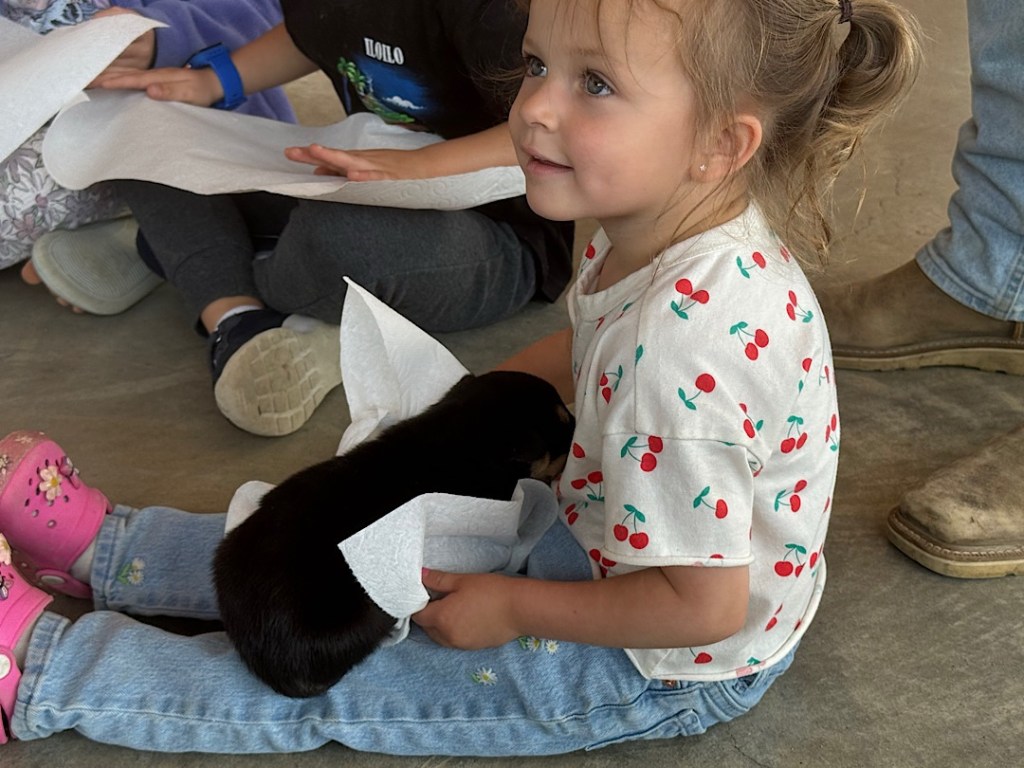
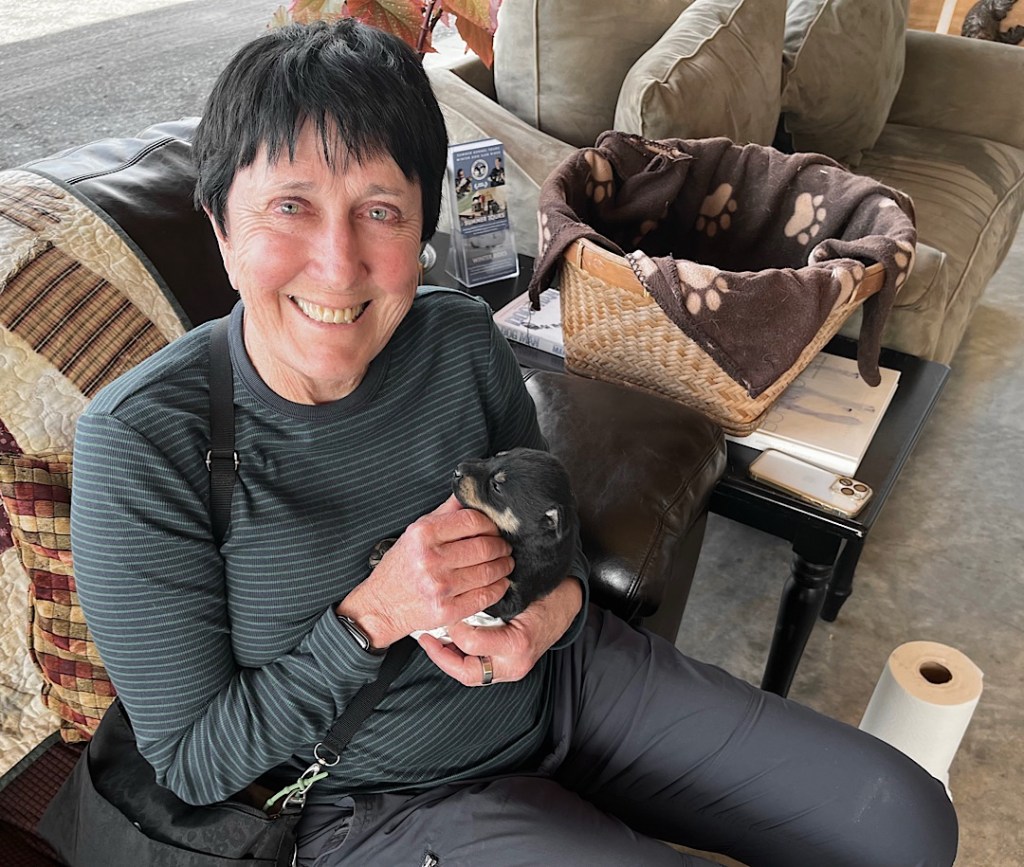
The grand finale, back in the entry hall, came when Sue brought out a basket of two-week-old puppies. We took turns cuddling them.
EVERYONE loves puppies!
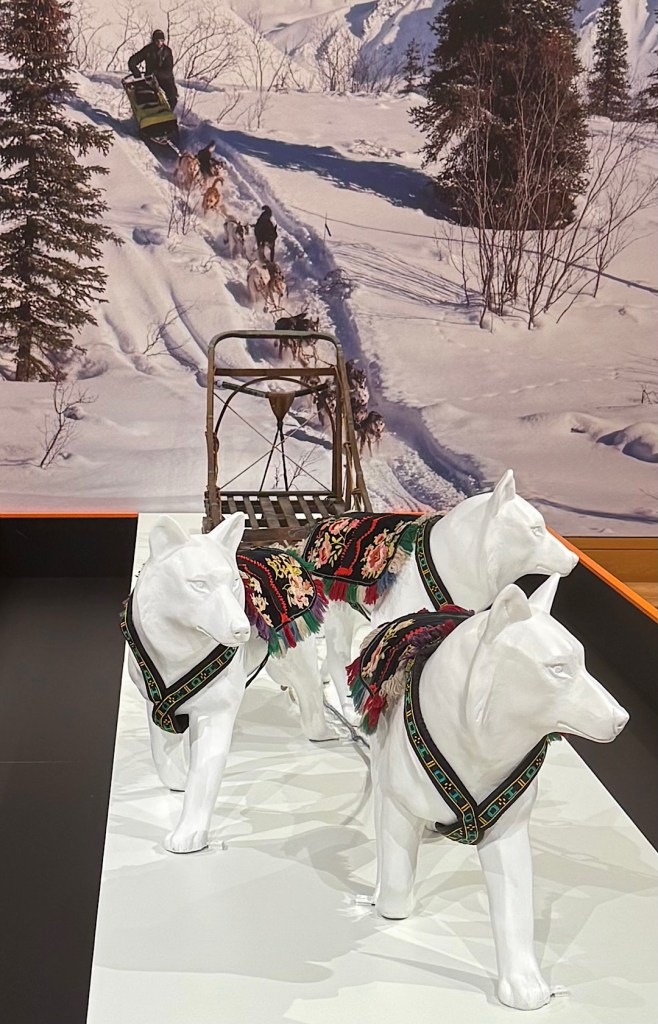
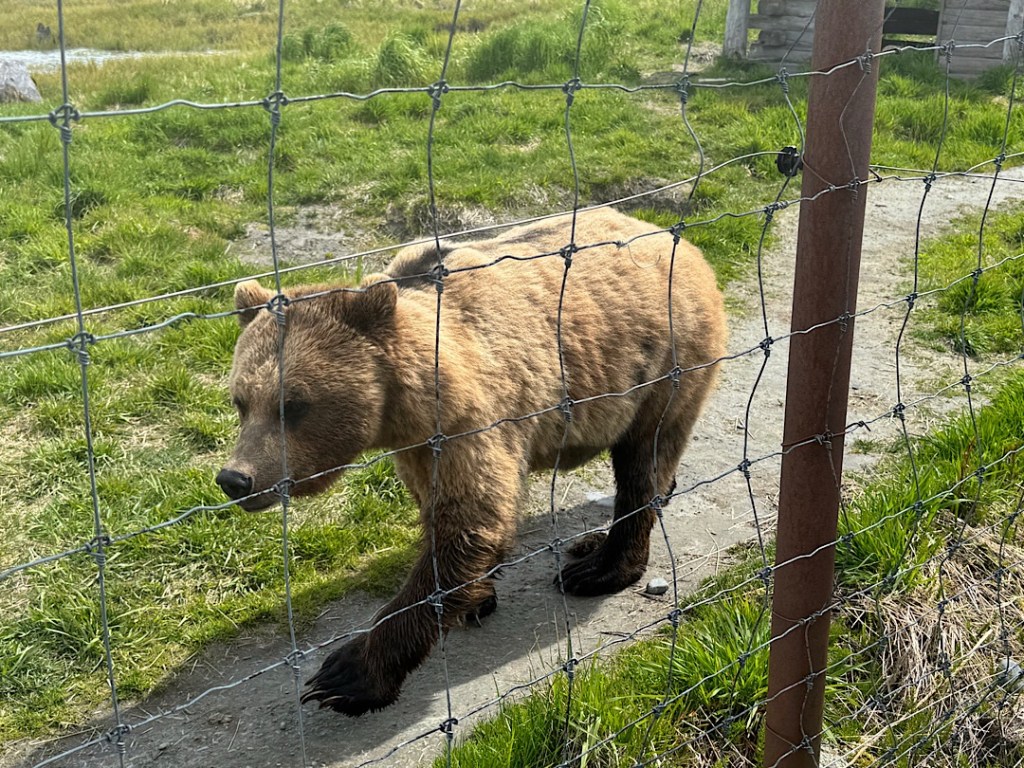
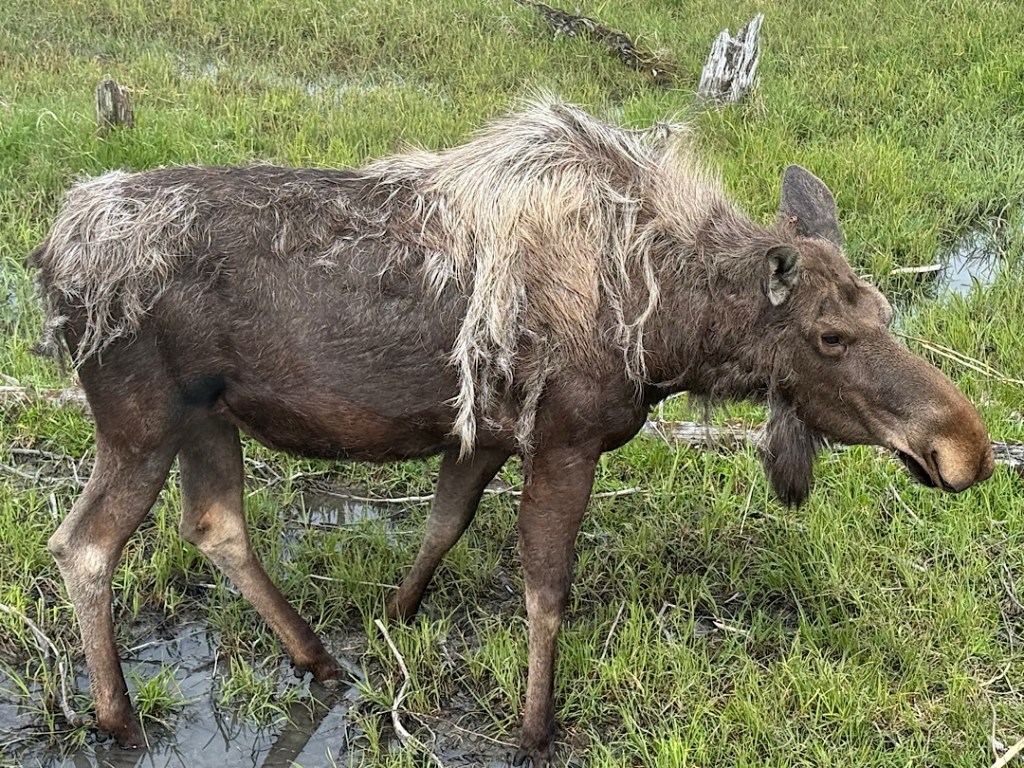
Over the next few days, Steve and I spent a lot of time at the Alaska Native Heritage Cultural Center and the Anchorage Museum. We drove to the an animal preserve where we took many pictures of Alaskan beasts that included…
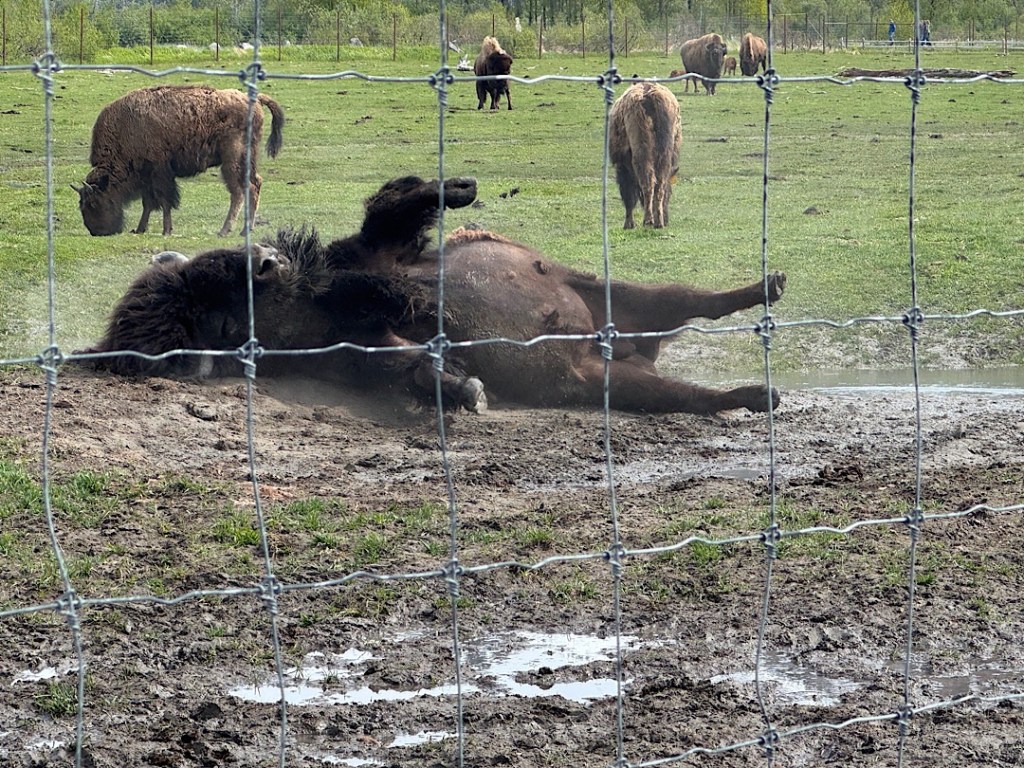
Wood bison…A grizzly bear…Moose (shedding the last of their winter coats)
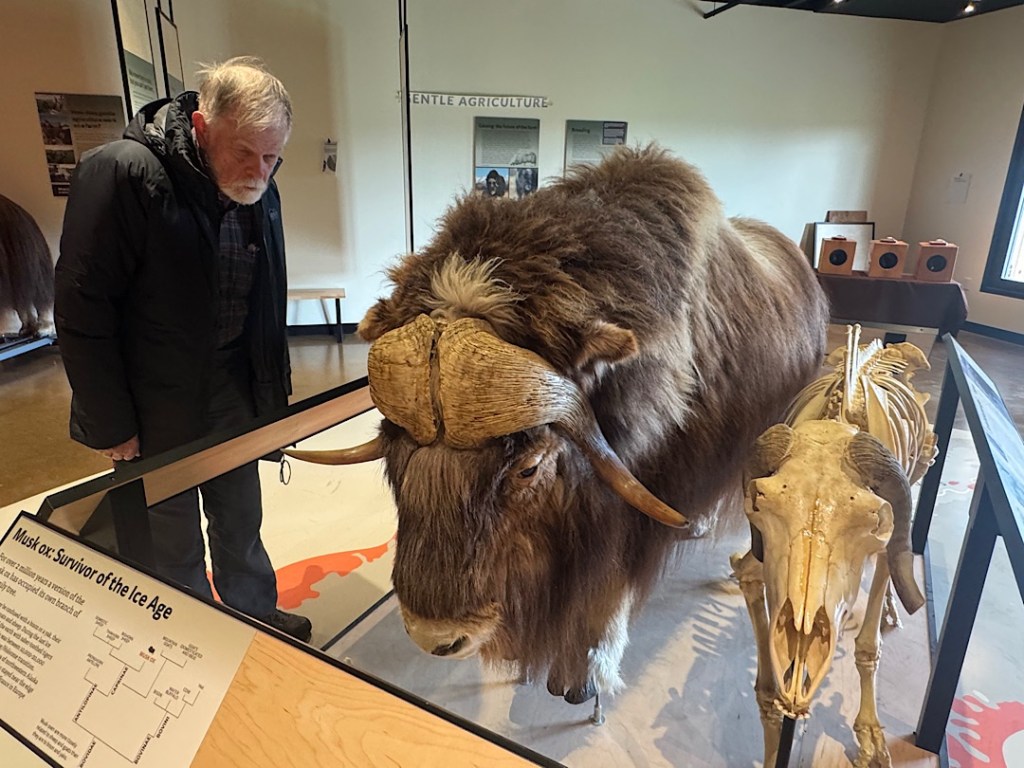
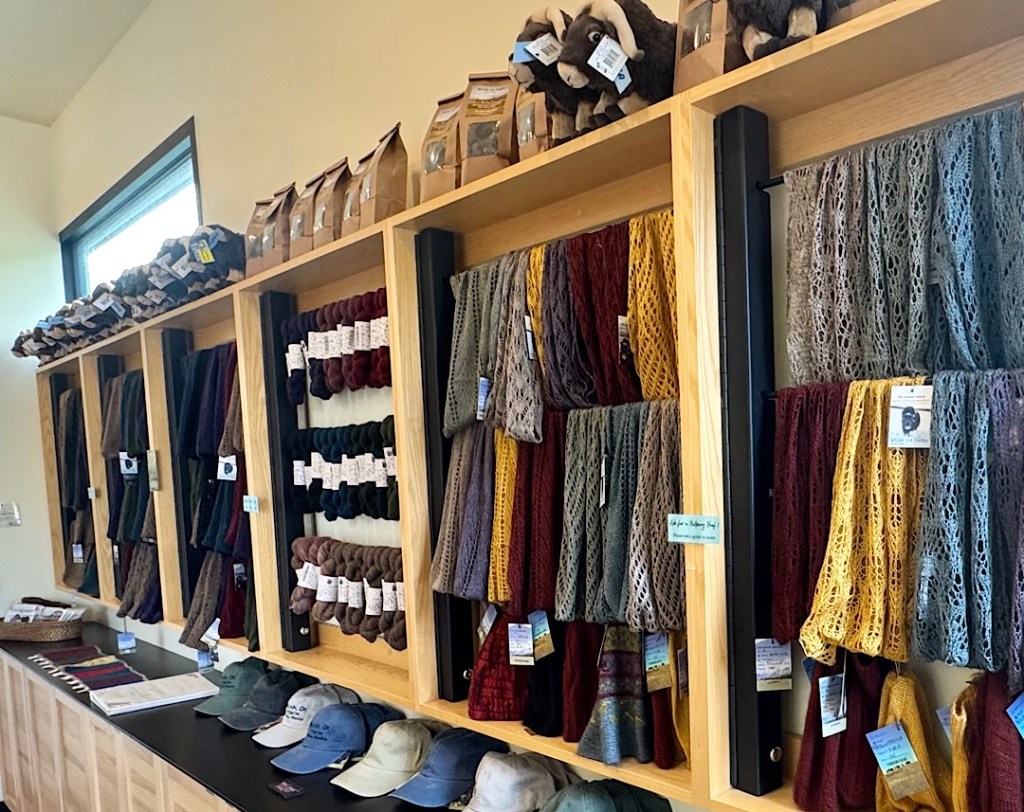
We visited another operation dedicated to bringing back musk oxen (who produce fabulous undercoats that can be turned into beautiful knitted goods.) We ate some terrific seafood.
Scarves and headbands made from the famous musk-ox hair.
For me, however, nothing compared with those sunny hours immersed in a culture of strong and heroic dogs. We’re now in Seward, where we’re about to move on to the next phase of this amazing adventure: glaciers!





















 At home and abroad