Still hungry in Florence

When we said goodbye to our French friend Olivia before heading to Turin and Florence, she warned that the beauty of Florence was so great it could be stupefying. She claimed that on her visits there, she couldn’t resist walking compulsively from one exquisite site to another, forgetting even to take breaks for food and drink.

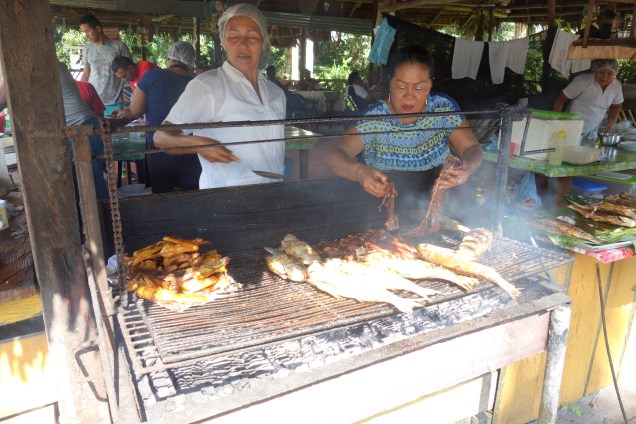
This did not happen to Steve and me. We got hungry at regular intervals, and we paused to eat wild boar, osso buco, gelato, roast suckling pig, pizza, deep-fried rabbit and eggplant, sea bass, more gelato, buffalo-milk mozzarella, flavorful tomatoes, poached codfish, gnocchi with crab, risotto with fresh truffles, more gelato, and other tasty dishes (in only three and a half days!) Every meal was extraordinary. Almost everything cost about half what comparable fare would cost back at home. I don’t know if we gained weight eating it. (I’ll find out soon, when we get home). But it’s possible we didn’t. Like Olivia, we walked obsessively — at least 8 or 9 miles every day. Thursday we also climbed the 38 floors to the top of Florence’s magnificent basilica.

If the beauty of the city didn’t stop us from enjoying its food, we nonetheless found it pretty much as wonderful as Olivia promised. It made us yearn to someday do a house trade here to savor it all at a slower pace.

In the meantime, we’ll have to console ourselves with memories such as these:


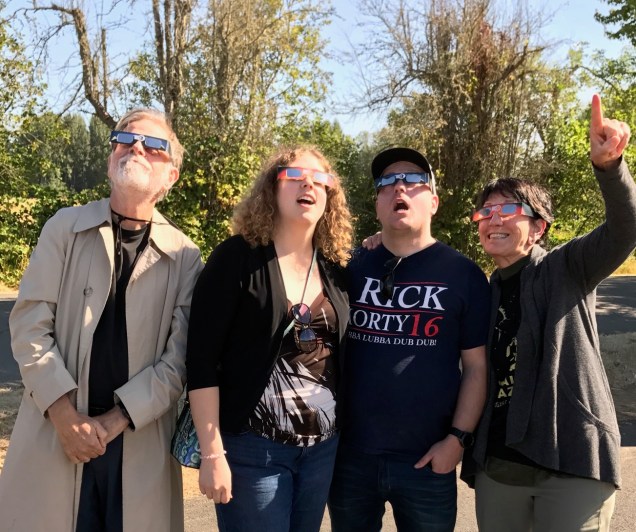
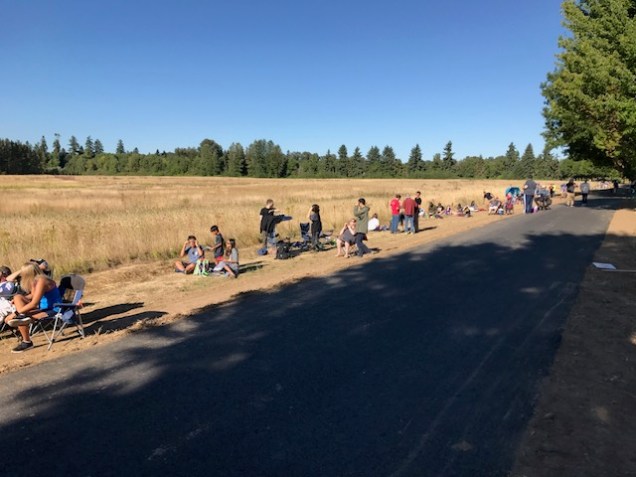
Now we’re in Portland, trying to plan for a successful eclipse-viewing tomorrow!

Border-crossing, Italian style

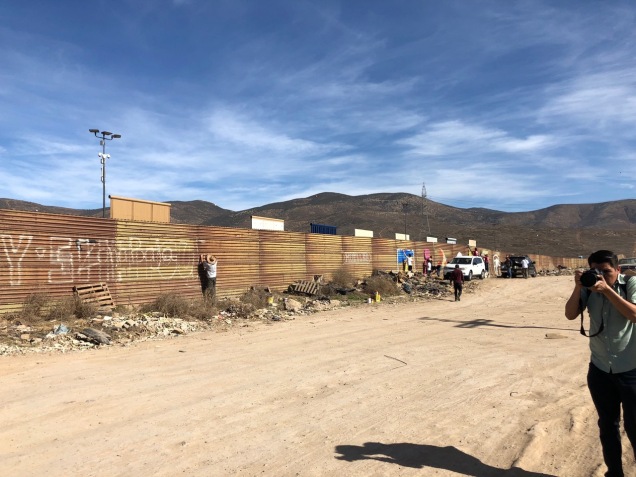
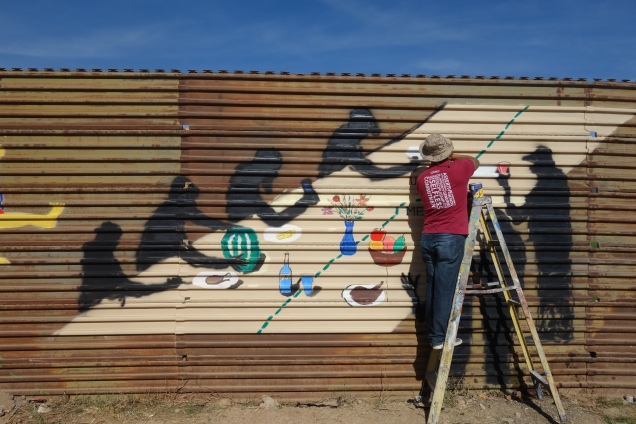
Trump talks a lot about building border walls. Europe got rid of most of the ones it once had, but with more homeless and desperate folk seeking refuge throughout the continent, I wondered if more barriers would be evident in the course of our current visit to France to Italy. The answer is…mixed.

To get to Italy last Friday, we rolled our carry-on bags down the hill from Olivia’s flat in the French Alps to the little bus station on the main road through her village. We caught the 8:58 a.m. bus bound for Oulx (across the border in Italy); we’d bought the tickets ($8.85 per person) when we’d arrived in town a few days earlier. The bus was clean and pleasant and not very full The ride took only 95 minutes, and the views out the windows entertained us the whole way. We climbed through the beautiful alpine valleys, often well above the clouds.For a while, the road reversed itself, making one 180-degree turn after another.

Those cars weren’t going in the opposite direction. They were behind our bus, which had just rounded yet another bend.

I felt happy that I wasn’t powering myself upward like some of the warmly dressed cyclists we rumbled past.

Near a high point, we stopped at a small French town where a few of our fellow passengers disembarked, and a little ways down the road, we passed a wood and glass structure where Steve caught sight of a couple of French officials seated at desks. They didn’t glance at our bus. A minute or so later, I snapped a photo of a sign welcoming us to Italy. Steve also spotted a little shack that he thought might once have served as a border-crossing inspection station, but it was abandoned.

That was it. No one ever asked if we even were carrying passports. The bus reached our destination on time, we dashed across the tracks at the station and caught the train leaving for Turin. (Although we’d bought tickets for the one leaving an hour later, no one seemed to care that we’d jumped on the early train.) We pulled into the Turin station on a cool, sunny morning, and rest of the weekend was filled with one pleasure after another.

I might conclude that European border-crossing was still innocent and hassle-free. But the old American friend with whom we spent the weekend had a different experience on his journey. His supposedly “express” bus got to Geneva (where he lives) more than two hours late, filled with passengers who reported being subjected to sniffer-dog inspections at the Swiss border. Going from Switzerland to France, his bus stopped again for more dog sniffing, and crossing from France into Italy, everyone was required to hand over his or her passport. Those were not returned for about a half hour.
It all reminded me: when it comes to border-crossing, you can’t count on anything. You just have to feel grateful when you get lucky, as Steve and I did.

Our French Wedding

We came to France to attend a wedding. It’s a long way to travel, but we feel like we’ve known the groom since before he was born. His mother and I got pregnant almost simultaneously, and after decades of interactions, his family and ours feel as close as family. So Paul-Louis’s wedding stirred us and touched our hearts for many personal reasons. But it also was a fascinating intercultural experience.

Now that it’s over, I can report at least a dozen ways in which the marriage festivities were unlike their American cousins:

1) There were no night-before-the-wedding activities for those in the wedding party. This was great for us because it meant that our friend, the groom’s mother, was free to dine with us. Still, we marveled at the ability to stage such a complex dramatic event with no rehearsal.

2) The bride and groom, like all married couples in France, were wed in a civil ceremony back in March. That was a much smaller affair, but still included immediate family members and godparents. It took place at the City Hall of Neuilly, the suburb just outside Paris where our friend Olivia lives. The bigger event (which we and about 175 other people were attending) was held in a church that is almost 700 years old, built back in the days when Roman Catholic popes lived and ruled from their palace in Avignon (just across the river) from the church town.

3) The church service, naturally, was entirely in French, and I didn’t recognize a single hymn.


4) Even though it was close to 100 degrees outside (and pretty toasty inside the church), the vast majority of the men (young and old) wore suits. Ladies got to wear much skimpier outfits.

5) The service was supposed to start at 3:30, but for 5 or 10 minutes past that hour, many guests stood in the main aisle and pews, socializing. (Some of the young guys took off their suit coats for this part.)


6) Most of the wedding party zoomed up the aisle briskly, paired up in ways that seemed eccentric to our American eyes: the groom escorting his mother to her seat in the first pew on the right side of the church; followed by the bride’s and groom’s sisters, escorted by their romantic partners also to seats in the first two pews; the groom’s father escorting the bride’s mother; two female and and two male “witnesses” each with escorts, and finally no less than seven adorable little boys (the offspring of the bride’s two sisters). In the program they were identified as enfants ‘d’honneur (literally, children of honor).


The bride and her father did move at a more stately pace, however.

7) There were NO flower girls (but many comments about how Paul-Louis and Candice need to make up for the dearth of family females).

8) Most alien to our eyes: after the marriage ceremony and Mass, no permission from the priest for the groom to kiss the bride, and no ceremonial striding of the couple down the aisle to the strains of Mendelssohn. Instead, the bride and groom had to sign some sort of register off one of the side aisles, and while they attending to this, the guests gradually got to their feet and straggled out the front door of the church.

9) The big finale instead came when the groom and bride walked down the aisle of the almost-empty church and emerged onto the front step, where almost everyone pelted them with white rose petals. (Everyone except for clueless Steve and me, still inside the church, confused about what was going on.)


10) The bride and groom drove off in a classic white French Deux Chevaux (their equivalent of our Model T).


A little while later, everyone converged on a domaine on the island in the middle of the Rhone River between Avignon and Villeneuve Les Avignons, and the reception festivities played out there. These were splendid: first cocktails on a huge lawn under enormous trees, then a very formal sit-down dinner, followed by dancing. The food and wine were superb. The speeches (as far as my French went in understanding them) were witty and articulate. And once again, we were fascinated by the cultural differences. Including:
When Paul-Louis and Candice joined the party, the DJ in the room cued up music and everyone rose to their feet, twirling their napkins over their heads. This went on for quite a while.

The dinner and speeches lasted from 8 pm until about 12:30 am. Only THEN did the dancing begin!

I couldn’t resist joining in for 3 or 4, but Steve and I were pretty tired by then. We tumbled into bed about 1:30, but then arose again fairly early to join the brunch back at the domaine.

The grand lawn, where the cocktail party segment of the reception was held, along with the Sunday brunch.

All weddings are special. This was was sure no exception.

Seven reasons we liked Marseille 

Steve expected Marseille to be grubby and disagreeable. But on our whirlwind visit, we had a great time. Among the more likable things:

1) Delicious seafood


2) Reminders of how close we were to North Africa (coupled with adamant assurances from our B&B operator that, unlike in Paris, here everyone gets along extremely well)


3) Some of the most intensely royal blue and azure and turquoise ocean I’ve ever seen


4) The oldest hardware store in France (where we found the bolts and screws we needed to repair my broken suitcase handle)


5) A church filled with dangling ship models


6) A lively, sun-drenched port.


7) Lots of great vistas

One of those little islands in the distance is the site of Chateau d’If, the fictional home of the Count of Monte Cristo

(Less likable was the intense heat. But now that we’ve moved inland, Marseille feels like a cool respite.)

A Visit to Frank in the Bois

Not so much to write about, as I expected, but a bunch of great sights crammed into our 48 hours in Paris, including sections of the Seine transformed into a beach-ish place…


…and our first visit to the wonderful new exhibit space by master architect Frank Gehry in the Bois de Boulogne. (Just a 20-minute walk from Olivia’s house, The Gehry-designed Fondation Louis Vuiton opened in late 2014). Both the building and the current exhibition (art by contemporary African artists) took my breath away. We had to tear ourselves away after more than three hours.


Now we’re in Marseilles, a much messier, grittier, more international kind of place.

The bonobos of Texas

Steve and I are mad at American Airlines. We’ve been frequent fliers with them for almost three decades, and our loyalty has enabled us to fly free to countless destinations, both domestic and abroad. But in recent years, it’s become harder and harder to use our miles to go where we want. The most recent example is my effort to use miles to get us to Europe for Paul-Louis’s wedding.

I started trying to find passage back in late December, but all I saw were flights that required us to fly through London’s Heathrow Airport. The problem with this routing is that Heathrow charges hundreds of dollars per passenger in taxes. In contrast, if we fly direct from a US airport to Paris, we pay only about $11 per person.

But the only choice the new (mean and stingy) American Airlines was offering me was to fly from San Diego to Dallas-Ft. Worth Airport one day, then continue on to Paris at 5:50 pm the next day. Repulsive as this choice was, I booked it.

I hoped that eventually better flights would become available (ones that wouldn’t require the Texas sleepover.) At one point, I was checking the AA website two or three times daily. But nothing opened up. Then one day it occurred to me that I had a good reason to spend a day in the Dallas/Ft. Worth area: Ft. Worth is one of the only zoos in the US that includes bonobos in its collection!

In recent years, I’ve become a fan of bonobos — our highly endangered primate cousins, so much more likable than chimpanzees. (We share more than 98 percent of our DNA with both.) Matriarchal in their social organization, bonobos are far more peaceful and sexy in their social interactions. This spring I wrote a cover story for the Reader about the colony at the San Diego Zoo — the first place bonobos were brought from Africa to the Western Hemisphere, and the place where the vast majority of groundbreaking research has occurred.

That reporting was a great experience, and it whetted my appetite to see the other bonobos in captivity in America. The Ft. Worth Zoo is one. So Friday after taking our flight to DFW, we rented an inexpensive car, slept at a cheap hotel, then set out Saturday morning for Ft. Worth (about 30 minutes west of the airport.)

It was instructive. Admission to the Ft. Worth institution only cost $24 for the two of us. (I think it’s close to $100 in San Diego.) Although the temperature was in the high 80s (and headed to the high 90s), the zoo was pleasant, shaded by mature trees.

It’s much smaller than the San Diego Zoo, and it seems much more fearless about promoting its ape collection. The great ape compound was highlighted at the entrance, where the Texans boasted that their primate center includes “all the great apes” — gorillas, orangutans, chimpanzees, and bonobos (who are mentioned by name. In contrast, for reasons that never were clear to me, the San Diego Zoo seems intent on almost hiding its bonobo collection.)

Despite the weird reticence of the San Diegans, I can now tell you this: if you want to have a close encounter with one of our closest animal relatives on the planet, the San Diego Zoo is a better place to do it than Ft. Worth. In San Diego, the bonobos enjoy a huge enclosure, and there are three or four windows into it that enable a lot of up close and personal interaction with these charming animals. We saw six bonobos at the Ft. Worth facility. Two were in an indoor enclosure, the size of which made me cringe. Steve had to remind me that the alternative for bonobos (living wild and free in the Congo) carries the constant risk of being killed and smoked by poachers.

In the Ft. Worth Zoo’s outdoor viewing area, we were able to catch a glimpse of four more bonobos (two females adults, one male, and a baby). Then, to my delight, the mother and baby moved right next to the only viewing window, near where we were standing.

.
The baby looked very young — less than a year? The mother settled into the corner near the glass, and the baby began nursing. We were inches away, albeit viewing all this through scratched, milky windows that made it hard to take good pictures. The baby sucked at one of its mother’s breasts. It moved to the other side and gazed at its mother adoringly, but also periodically focused its attention on Steve and me. We stared back. I tried to communicate some sense of solidarity with the pair, to project my respect and admiration.

I don’t think they got it. But I’m still glad we went.

Is France Too Boring to Blog About?

If there had been blogs back in 1974, and if I had been writing about my travels back then, I would have rapturously recounted my first trip to Paris. Everything on that trip was new and thrilling. Every day introduced me to things that charmed me. Steve and I loved it all so much we’ve broken our travel rule for France; we haven’t been able to resist returning. We did our first-ever home-exchange in Paris in 1990, and we’ve gone back on many other occasions.

We’ve never been to the south of France however. We wanted to go there some day but never, ever in August — the month when hordes of French people leave behind Paris, despite the sky-high temperatures that are common in the south then. But we’re about to start such a journey. What changed our minds was an invitation to a wedding in Avignon. The groom is the son of one of our closest and longest-tenured friends. Olivia and I were pregnant at the same time, and Paul-Louis traveled from Paris to San Diego to spend a month with us when he was only 10. Both his (younger) sisters followed suit. This feels in many ways like a family wedding.

I’ve never been interested in blogging just to report my location. I like sharing interesting things I’m learning. Also recounting adventures. I think this trip may not be jam-packed with either of those experiences, so I’m going to be restrained in what I write about. But I also don’t expect to be completely off the radar.

(Our new Chase Sapphire Reserve credit cards give us free access to a number of airport lounges. We tried out two of them at DFW, where we had a five-hour wait before our plane to Paris boarded, The “Minute Suites” option was kind of interesting: a very small private room with a work desk, wifi, and space to stretch out and snooze. Much nicer than the public gates!)

My kind of lama

Steve and I had never seen the Dalai Lama in person, so when someone offered us tickets to his appearance on the UCSD campus yesterday, we couldn’t resist. In Tibet, which we visited not once but twice over the last 18 months, you can be thrown in jail for having his picture on your cell phone. Many Tibetans consider him a living god. Even if he’s not divine (and he says he isn’t), he indisputably was the ruler of the country until fleeing into exile in advance of the Chinese occupation. He’ll turn 82 this year, and we didn’t want to miss the chance to see him while he’s still on the planet.

Our tickets said the event would start at 9 a.m, and they warned that everyone would have to go through strict security checks. So shortly after 8:30, we took our place among the thousands of folks lined up to have their bags and backpacks inspected and their water bottles emptied. 061717 DL1

At a certain point, I noticed that the couple in front of me was eying a small group of monks milling off to the side of the crowds queuing up to be inspected. Eventually, I realized that they seemed to think one of those monks was the Dalai Lama himself — a notion I dismissed as ridiculous. But the man was persistent. “We should go over and ask,” he declared. He looked at me. “Will you guys hold our place in line?”

“Go for it!” I encouraged them, thinking they’d soon be back, embarrassed by their error.

Minutes passed, and they returned — exultant.

“Yup,” they confirmed. “We shook his hand and thanked him for being here. He was great!”

Stunned, I slipped out of line myself and inched close to the monks.


061717 DL2

I felt too shy to try for a selfie or otherwise intrude on his holiness. But comparing the man 15 feet away from me with the picture of the Dalai Lama on my ticket, the two indeed looked identical. And the gesture matched even better the Buddhist leader’s mischievous sense of humor. What could be more fun than to slip out and turn your back on the huge apparatus of Security — guards and metal detectors and searches and tedious lines — and hang out with the folks?

A moment later he slipped away, to meet with the press and finally (around 10) get up before a crowd that may have exceeded 20,000. His speech was good. But I appreciated his actions even more.


How writers can get around the iPad ban (or at least how we did)

Steve and I had our first encounter with iPad-deprived travel on our return from this past trip, which required us first to fly from Entebbe (Uganda) to Dubai, and then from Dubai to Los Angeles. Dubai International Airport was on the first list of those that the US government targeted for restricting electronic devices in the passenger compartment (along with Amman, Jordan; Cairo; Istanbul; Jidda and Riyadh in Saudi Arabia; Kuwait City; Casablanca in Morocco; Doha in Qatar; and Abu Dhabi in the United Arab Emirates). This week there’s been talk that the ban is likely to be extended to flights from Europe to America. Maybe folks who use their laptops and tablets for entertainment don’t find all this too burdensome; the big jets typically offer so much in the way of movie and game choices these days. But Steve and I both typically spend a lot of air time writing, so to us it threatened to be a disaster. Happily, we found a way around it.

Although we always take only carry-on luggage, Emirates restricts the allowable weight to only 7 kilograms (a bit more than 15 pounds), so we were told in Entebbe that we had to check our suitcases through to LAX (even though we had a 10-hour layover in Dubai and were sleeping in a hotel near the airport.) We insisted that we needed our iPads on the flight to Dubai, however, and the agent assured us there’d be a way to check them by themselves on the flight from Dubai to the US.

This enabled me to write my final blog post (about our experience in Uganda) on that flight. So I was happy. At the Dubai airport on Tuesday morning, we waltzed through security with our iPads, but at the gate, we had to queue up to have our hand luggage inspected by guards who looked for the taboo electronic gear.

Eban1

We weren’t surprised that they told us we had to take our iPads and Steve’s camera to another table staffed by Emirates employees who filled out forms and carefully packed our gadgets in bubble wrap and put them into cardboard boxes.

What they did NOT impound, however, was the separate Apple keyboard that I had schlepped along for the whole trip. It can be synched (via Bluetooth) with Apple devices — including the iPhone. So that’s how Steve rigged up a writing system. Using the Notes app on his phone, he spent at least 10 of the 15.5 hours of the flight typing up all his thoughts and notes about our visit with the granny groups. He periodically backed up his work by Airdropping the file to my iPhone.

Eban4

We both had to admit that Emirates was remarkably efficient about getting the devices back to us in LA.  No more than 15 minutes after we reached the baggage claim area, there all the checked electronics were, our box among them.

Eban6

We’re still wondering if it’s really true that anyone can pack a bomb into an iPad that continues to be operational. And we wonder why a bomb in the luggage hold of an Airbus 380 would be less disastrous than one in the passenger compartment. But what do we know?

Eban happy Steve.jpeg


Ugandan depths

In planning and anticipating this trip, I had envisioned that our first two weeks (in Arabia) would be the fun part. In Uganda, I expected something more challenging and not always pleasant: two 8- to 10-hour driving days (between Kampala, the capital, and the remote western region where the granny project is located) sandwiched around three intense days of traveling over punishing dirt roads to get to hours of meetings in poor villages. But as we were packing Saturday night for our return trip home, I reflected with some surprise that the Ugandan part turned out to be the best.

As much as I love travel, I’m often struck by how superficial it can be. You blow through a city or a country in a day or two, and even if you’re paying close attention and asking tons of questions, you leave with only the slimmest understanding of how things work. Our sojourn in Uganda was an effort to go a bit deeper. We were returning to Nyaka, the village we visited four years ago as emissaries of Women’s Empowerment (WE) in San Diego. At that time, we were seeking to determine if the Nyaka AIDS Foundation’s granny project might be a good partner to receive some of the money WE raises for micro loans.

Steve and I fell in love with the Ugandan grannies the first time we were greeted by a group of them dancing to salute our arrival. These ladies range from 50 to 100 years old and face challenges we found almost unimaginable. Many have lost their husbands, yet all are raising grandchildren who’ve been orphaned or abandoned by their parents. They often look somber and stoic, but when they break into dance, they display astounding energy. Dancing transforms them; turns them exuberant, even joyous.

Four years ago, in talks with the Ugandans who run the project and visits with three granny groups, we also were impressed by their fledgling micro loan program. Upon our return to San Diego in June of 2013, the WE board approved a partnership; Steve and I since then have served as the liaisons between the Ugandans and the Americans. From informal emails and regular reports from the Ugandans, we’ve learned a bit more about them over the years. But we’ve also come to realize the many limits on our knowledge. If you’d asked me a month ago how a 75-year-old widow with no retirement income could not only survive but also raise young children, I would have had no idea.

Thanks to the time we spent in Kigezi, I glimpsed how at least a few of these ladies do it.

One afternoon, we visited the home of 64-year-old Paulina. She’s raising 4 grandchildren ranging in age from 7 to 14.

Paulina with Vian Owamani, the microloan coordinator


Her most recent loan was for 300,000 Ugandan shillings (about $82), and she used part of the money to buy two piglets, paying about $11 each for them. If she can keep them for about a year, until they weigh 45 to 55 pounds, she figures each should fetch somewhere between $55 and $70. Paulina also was using part of her loan to buy ripe coffee beans from neighbors. She dries the beans and sells them to a local coffee mill. Like most older women in rural Uganda, she doesn’t have to worry about paying for housing. She lives in a humble dwelling, with no electricity or water, but it’s been in her family for a long time. She also raises a variety of crops; it’s a way of life here. If the people are poor in this part of Uganda, the land is rich, enabling folks to grow corn, beans, peanuts, sweet and “Irish” potatoes, millet, cassava, rice, yams, vegetables, sorghum, tomatoes, and a head-spinning variety of bananas. Despite the hardships she’d endured, Paulina seemed hard-working and organized.
Fifty-six-year-old Jolly, also raising 4 grandkids, raised her hand to share her story with us but apologized for not standing. She suffers from a lot of back pain, she explained. Jolly was a pioneer — the first of the 7000 or so NAF grannies ever to be deemed by her group to be worthy of a one-million-shilling loan (a whopping $275). She got the money in January and used part of it to buy a foot-powered sewing machine. With the rest, she was renting a little storefront in the center of her town (Buyanja) — $22 a month for a 6-month term. Tailoring wasn’t something new for her. She had learned to do it more than 30 years ago, and at one time had owned 8 sewing machines and employed a crew of girls to make clothes that she sold in the market. But her husband had died in 1994, and she had had to sell all her machines to support her 5 children.

Although Buyanja had other tailors, Jolly had also created a tiny retail counter and a tea shop in the back of her space. A couple of customers were in it when we visited.


Jolly’s tailoring and tea shop. Phionah is the name of one of her daughers, who helps out. And people call all sorts of businesses “hotels.” Don’t ask me why.
Jolly showed us one of her recent creation.

Most of the granny loans are nowhere near the size of Jolly’s. Mauda, 72 and providing a home for three grandchildren, had recently borrowed 50,000 shillings (just under $14). She used the money to buy 2 hens, and she had allowed most of the eggs they laid to hatch. Now she has 12 hens, and besides looking forward to a handsome profit from selling some, she was also using their droppings to fertilize her garden. Although her loan was only a 20th the size of Jolly’s, she looked just as proud of what the money was helping her to achieve.


Over our three days upcountry, we met with 6 of NAF’s 98 granny groups, and sometimes it felt like we were hearing the same story, with minor variations, over and over: granny borrows $7. Or $27. Or $137. She uses it to buy a pair of rabbits. Or a goat. Or hens. Or she buys a bale of used clothing to resell at local markets. Or she rents a stall in the local market and sells vegetables in it. After four months, she repays the loan money (plus 14% to 20% in interest.) She feels extravagantly grateful, because that rate is so much lower than what she would pay to alternative lenders. Assuming she makes a profit (and most do), she usually directs it to paying what it costs to send a child to school. (Even the “public” ones in Uganda cost about $25 a year in fees, plus around $9 for a uniform and another $2-3 for books and supplies.)

Along with these common tales, I learned one thing after another that surprised me. One woman stood up and testified as to how grannies used to be despised in their villages, considered worthless because of their “boozing” and general lack of value. With the formation of her granny group, she and her comrades had acquired self-respect and hope; their status in the community had soared. Steve later asked one of the team members if this woman had been joking; the vision of drunken grannies seemed comic. But the NAF team members assured him she’d been serious; overwhelmed by the difficulty of their situation, the women often had succumbed to alcoholism and despair.

I was surprised every time the ring of a cell phone interrupted our discussions. Most grannies now have cheap ones that they use to communicate with family members.They also rely on battery-powered radios for daily announcements about deaths in the community — or word that a special granny group meeting was being called (to receive the likes of us, for example.)


I was surprised to hear how much the grannies worry about theft, even though in many ways, the rural communities are safe and honest places. When a small backpack belonging to our driver fell out of the van, unnoticed, a villager retrieved it, asked around for the phone number of one of the Nyaka team members, called, and carried the pack to us. But grannies also talked of having to defend against thugs who might steal their chickens, their crops, and their kitchen items. We asked if they used watchdogs. But dogs cost money to keep, and persistent thieves don’t shrink from poisoning them.
Not only the grannies told us things that astounded us. One day during lunch at a simple roadside joint, the topic of malaria came up. The Ugandans who work for the foundation are smart, well-educated, sophisticated. But every one of them was infected with malaria. Everyone is, they said. We pressed them, and they told us how they dealt with flare-ups. They shrugged it off, but it sounded a lot more painful than the common cold.

Ronald, our driver, was similarly matter of fact when we asked about his background. His father had been a doctor, but he had died when Ronald was 6 months old. Then his mother died a year and a half later. Rather than care for 2-year-old Ronald and his 8-year-old sister, the villagers treated them like pariahs (“ghosts” is the term Ronald used). If their parents had been cursed, the children were likely to be cursed also. So Ronald’s sister had somehow raised him. How does an 8-year-old do that? How did Ronald grow up, save money for driving school, and turn himself into the steady, sharp, and competent driver he is today?

On our final drive from Kampala to Entebbe to catch our flight Dubai Monday morning, gazing out the window of our taxi, I saw hundreds of reminders of how hard life is here: guys hawking packs of toilet paper to folks stuck in the hellish traffic, women carrying heavy loads of eggplants and other vegetables on their heads, a kid scrambling to drag in the furniture displayed on the lawn outside a shop before the rain got too heavy. So much more. But with all the evidence of struggle and suffering, there’s so much heroism — stories like Ronald’s of mind-boggling perseverance. You don’t have to dig very deep to find it.