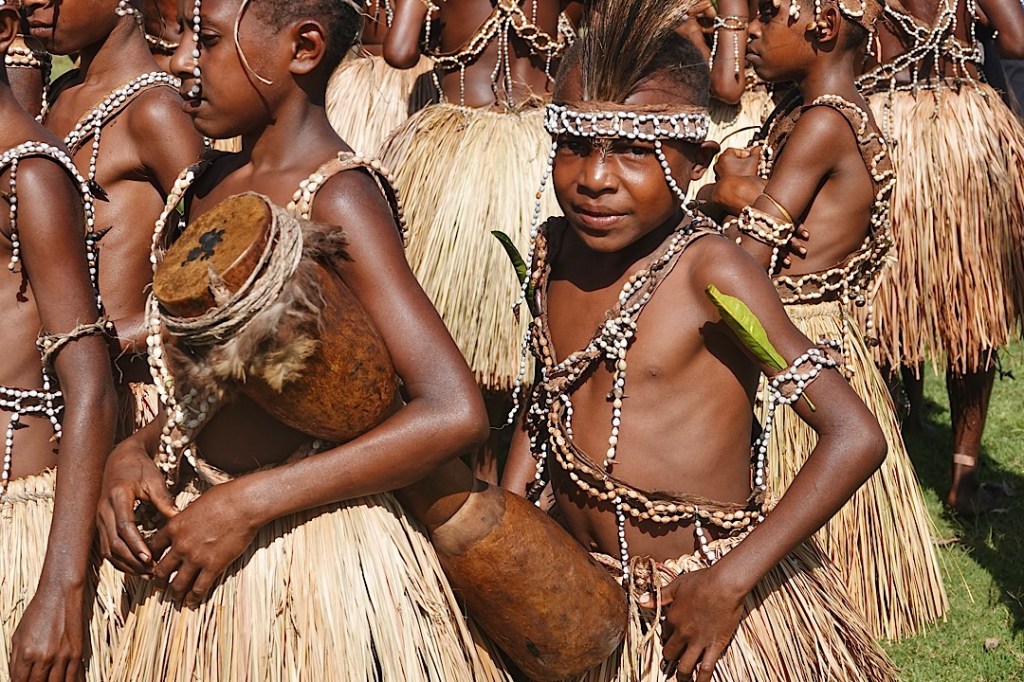
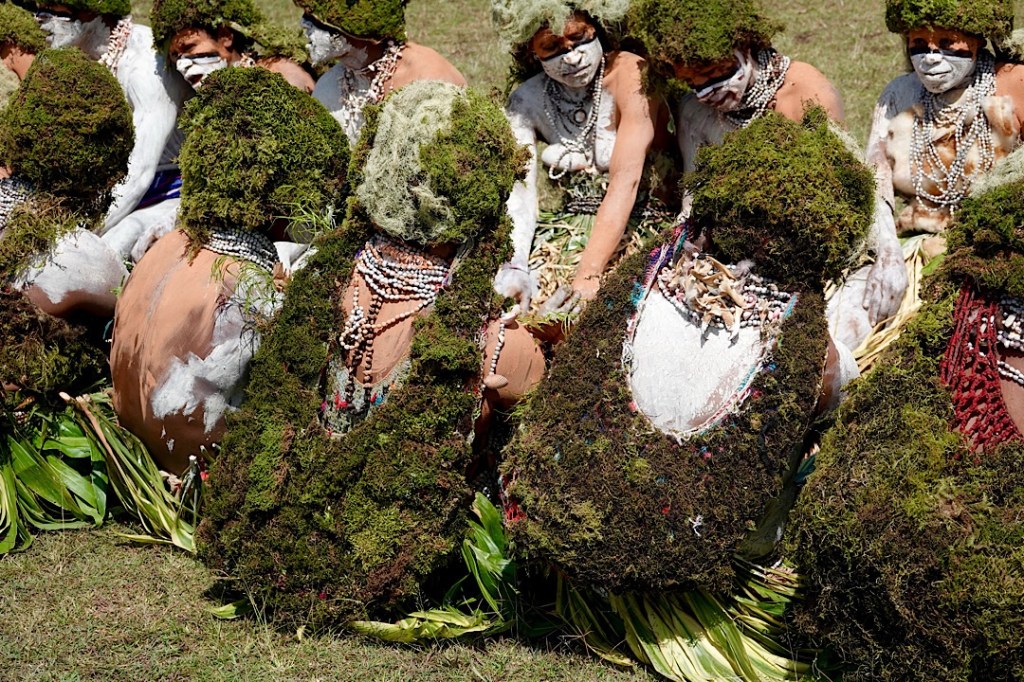
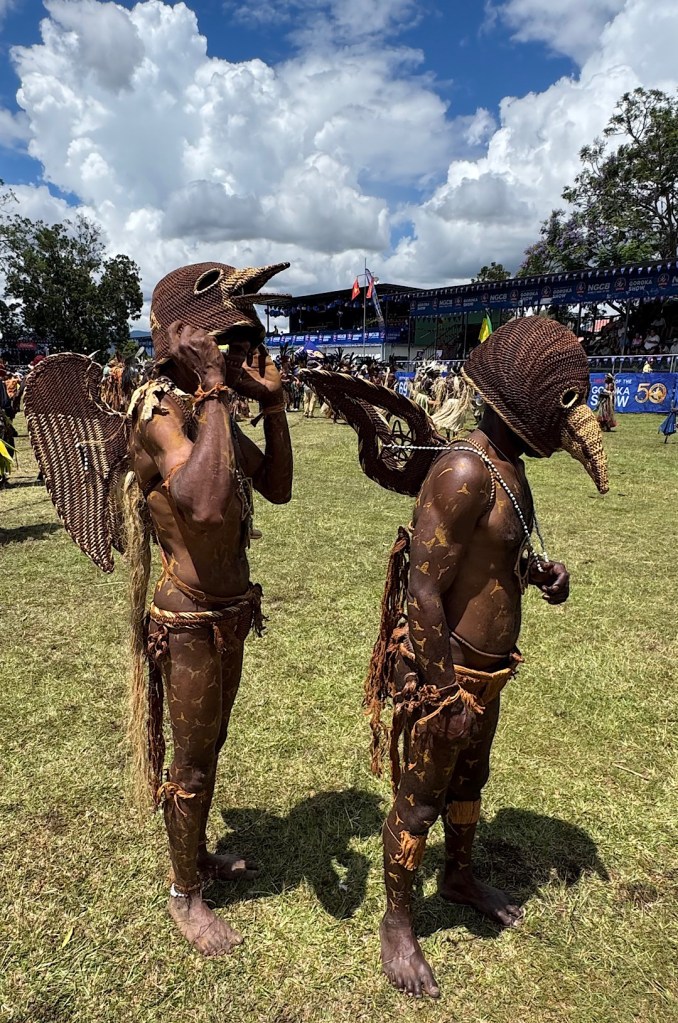
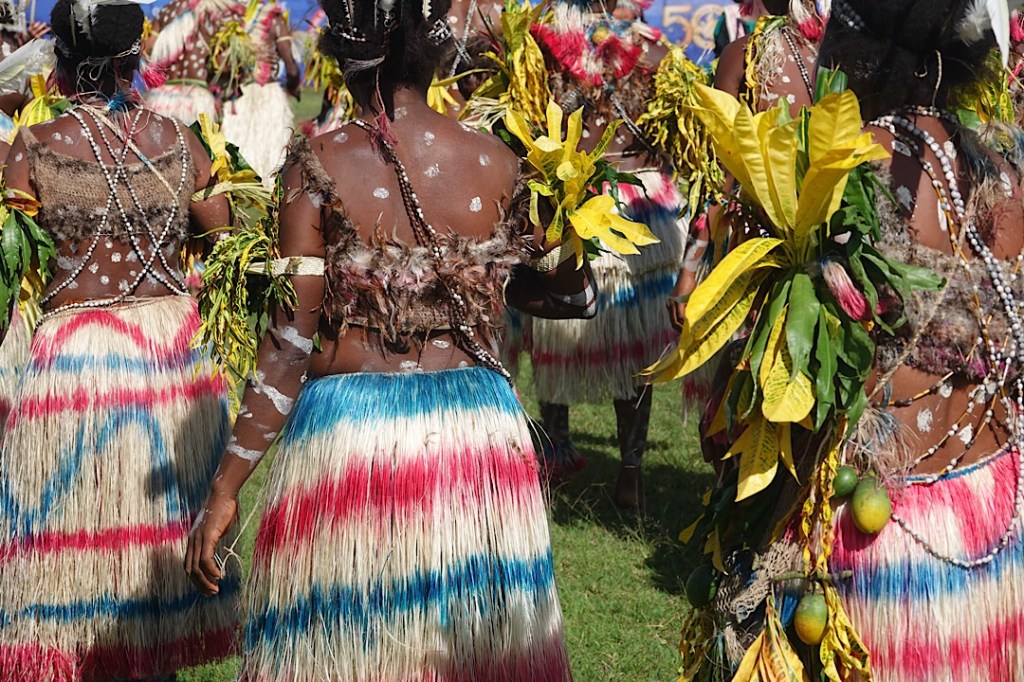
The Goroka Festival

Flying to Japan, I looked at all my photos of the Goroka Festival with mixed feelings. They resemble other images of PNG’s fantastic ceremonial costumes I’d seen online and elsewhere before this trip. 
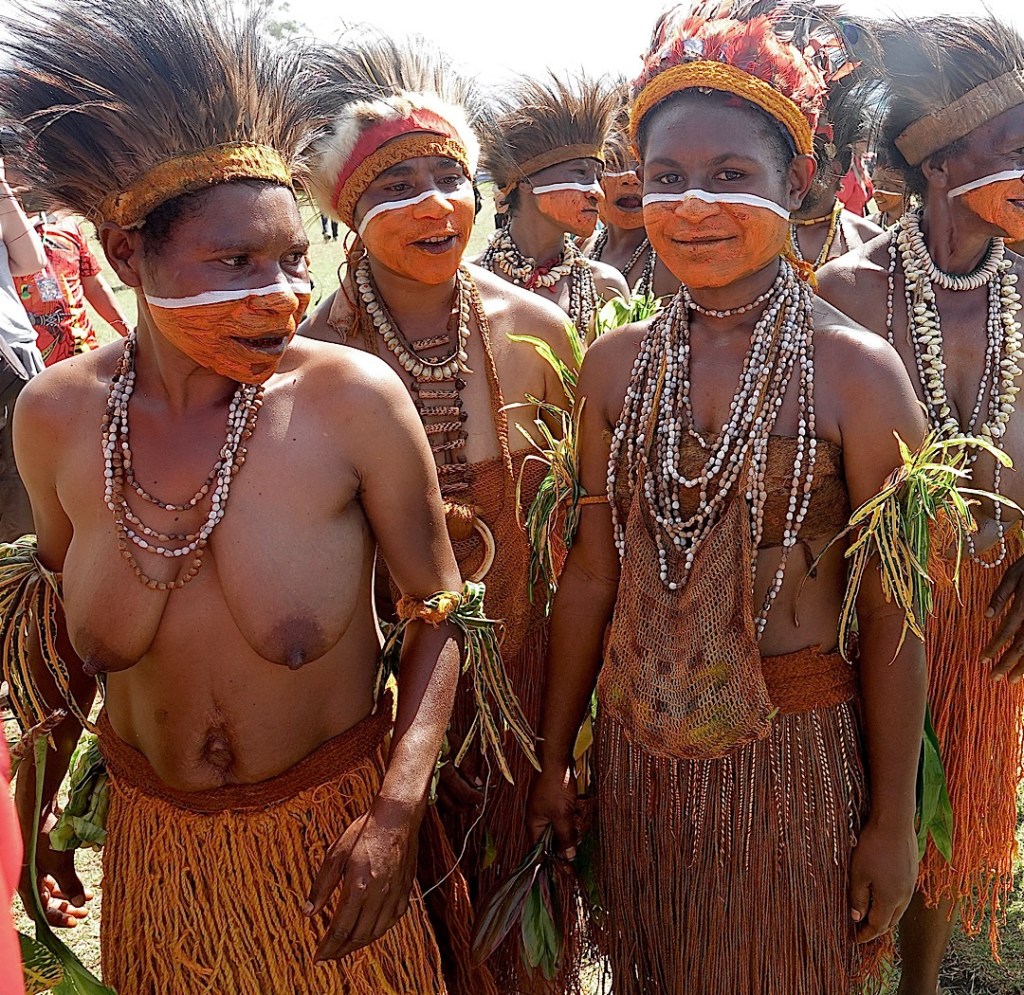
But they only partly convey the impact of what my eyes took in that weekend. Reviewing my pictures, I can still feel the adrenaline that flooded me when the first groups marched onto the festival grounds Saturday morning. It was beyond exhilarating. If you weren’t there, you can’t feel that.

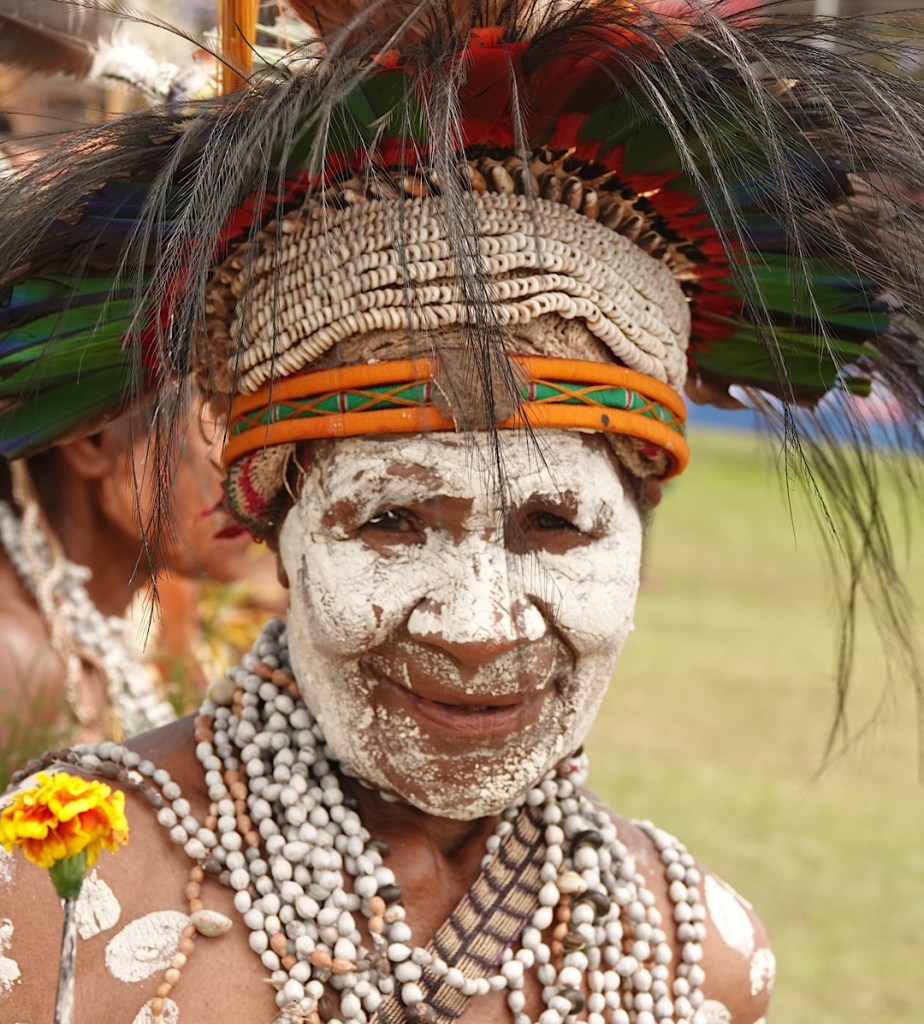
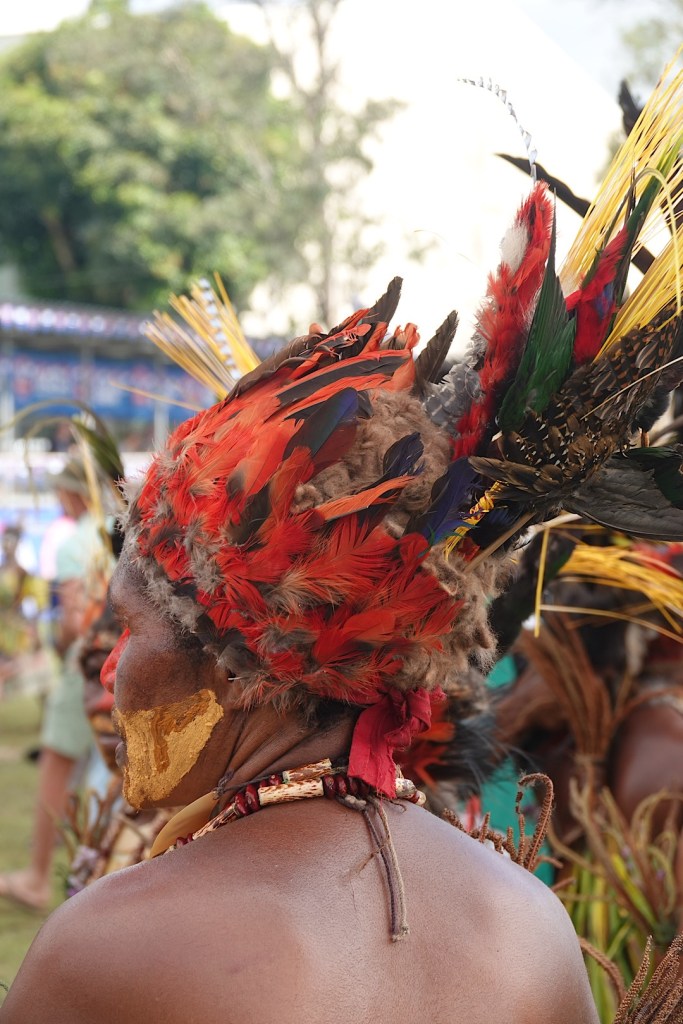
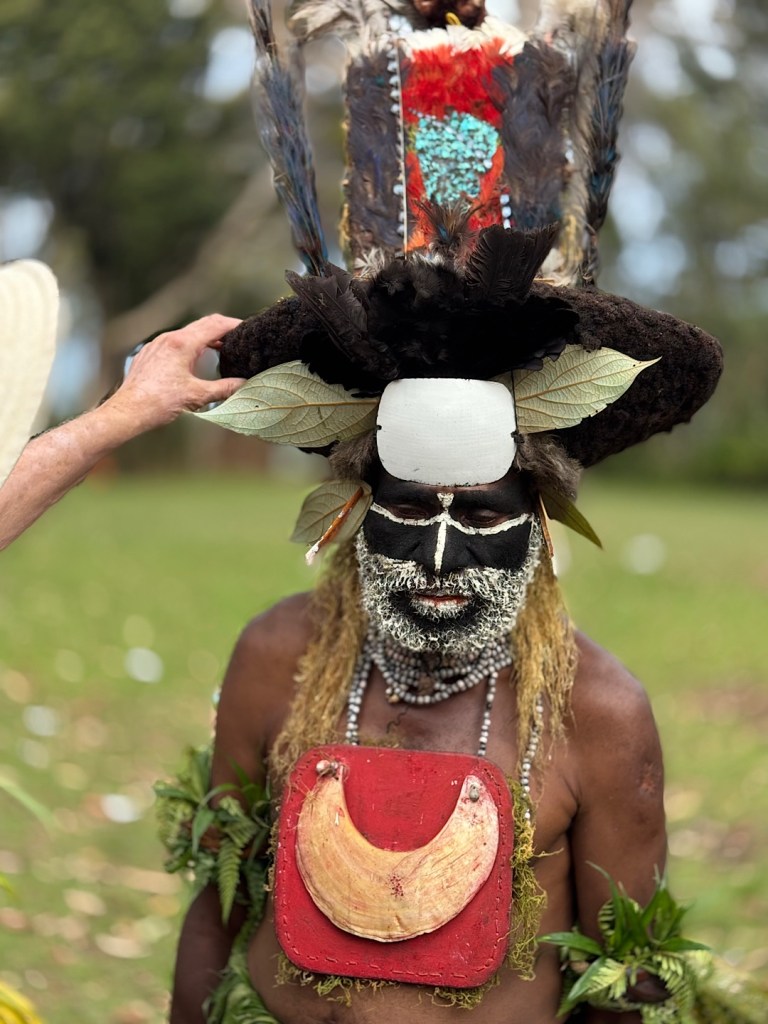
Throughout the weekend, I photographed jaw-dropping headdresses.
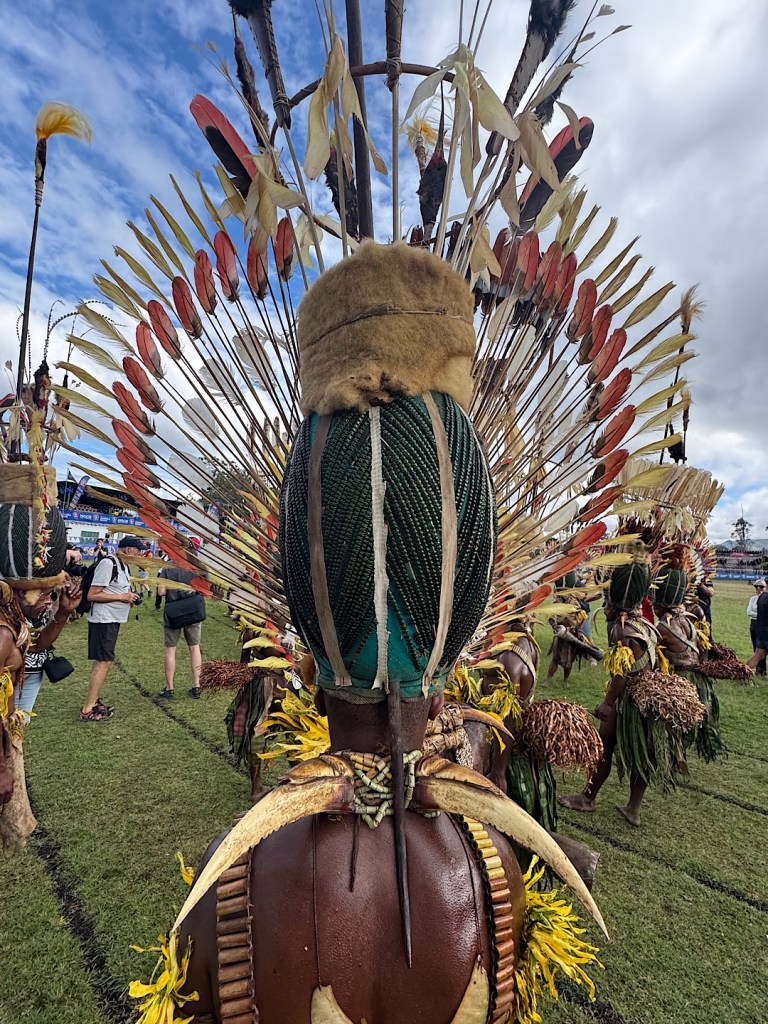
Those emerald “beads” on this one are the mandibles of a certain beetle. I forget how many tens of thousands of hours (and bugs!) required to make one headpiece.
At the festival, it’s best not to think about how many birds of paradise gave their lives for the sake of beauty.
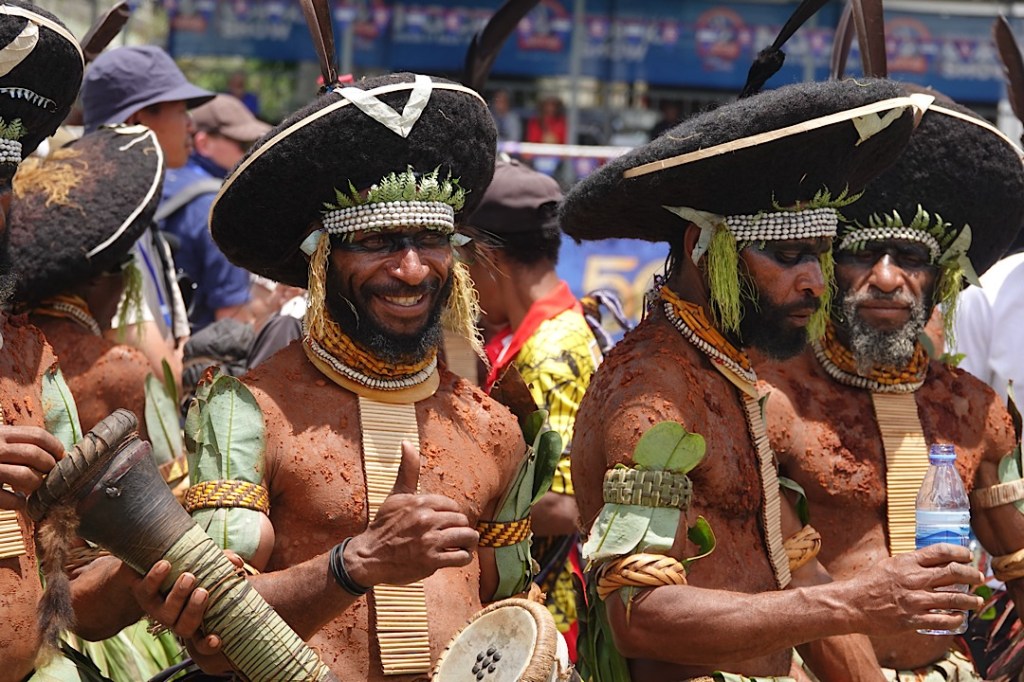
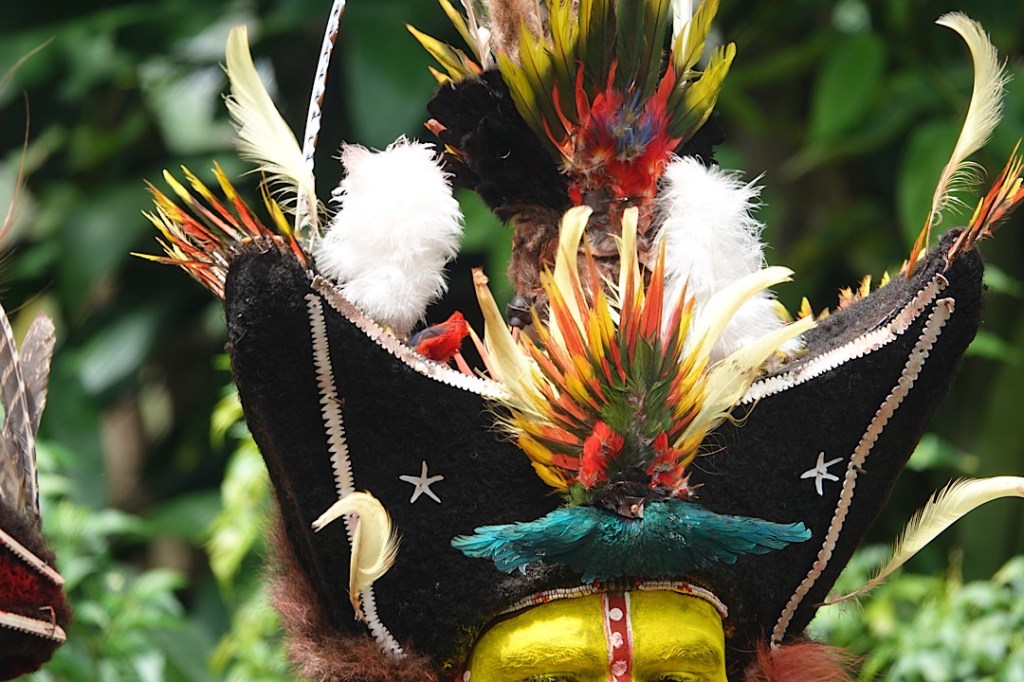
Those black hats are made of human hair.
Some headgear uses just feathers, but others incorporate whole birds.

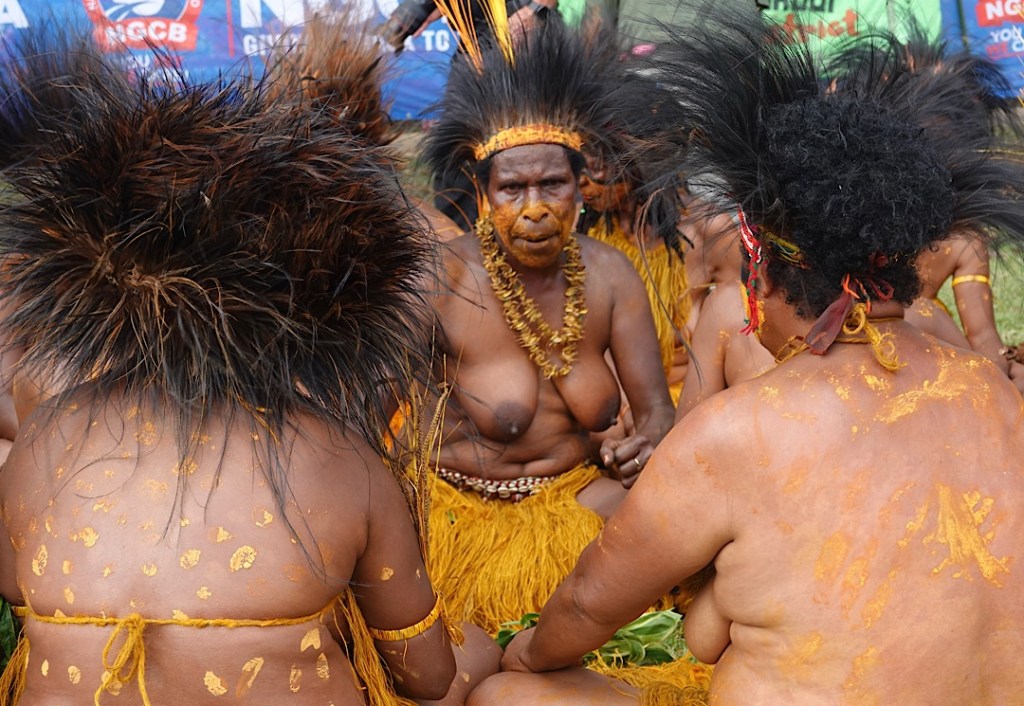
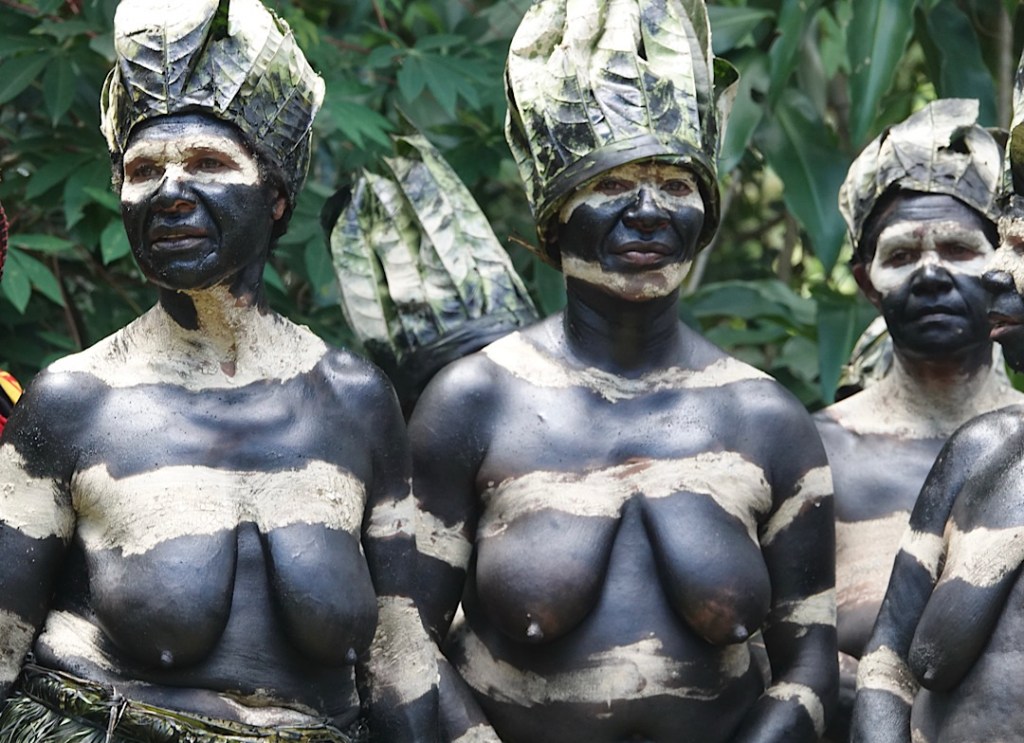
I captured lots of flesh, some naked, some painted.
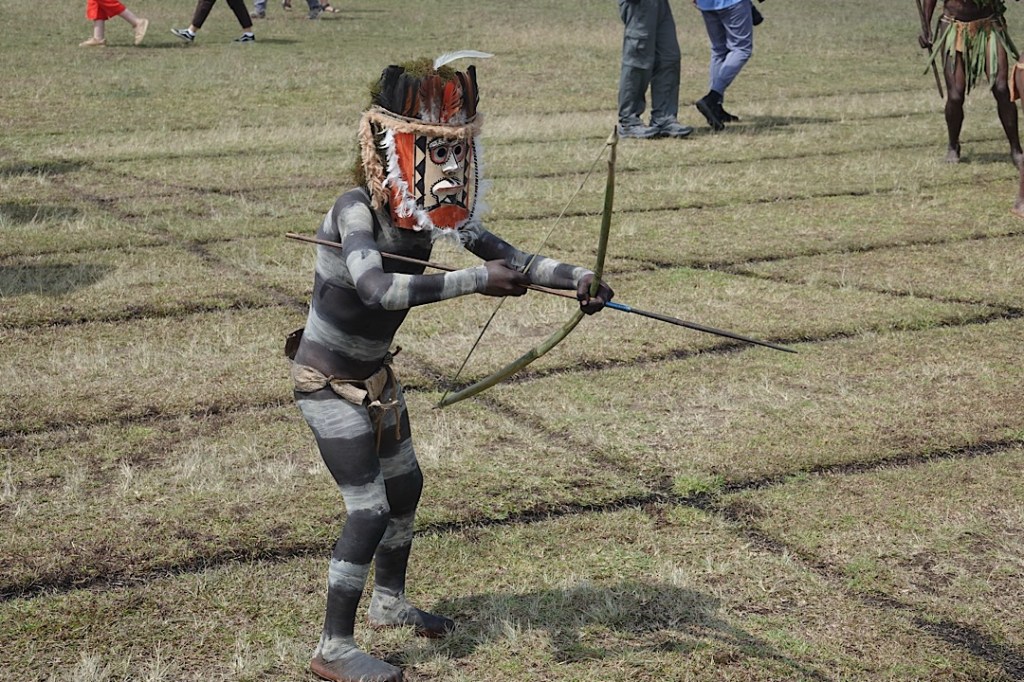
Some naked AND painted

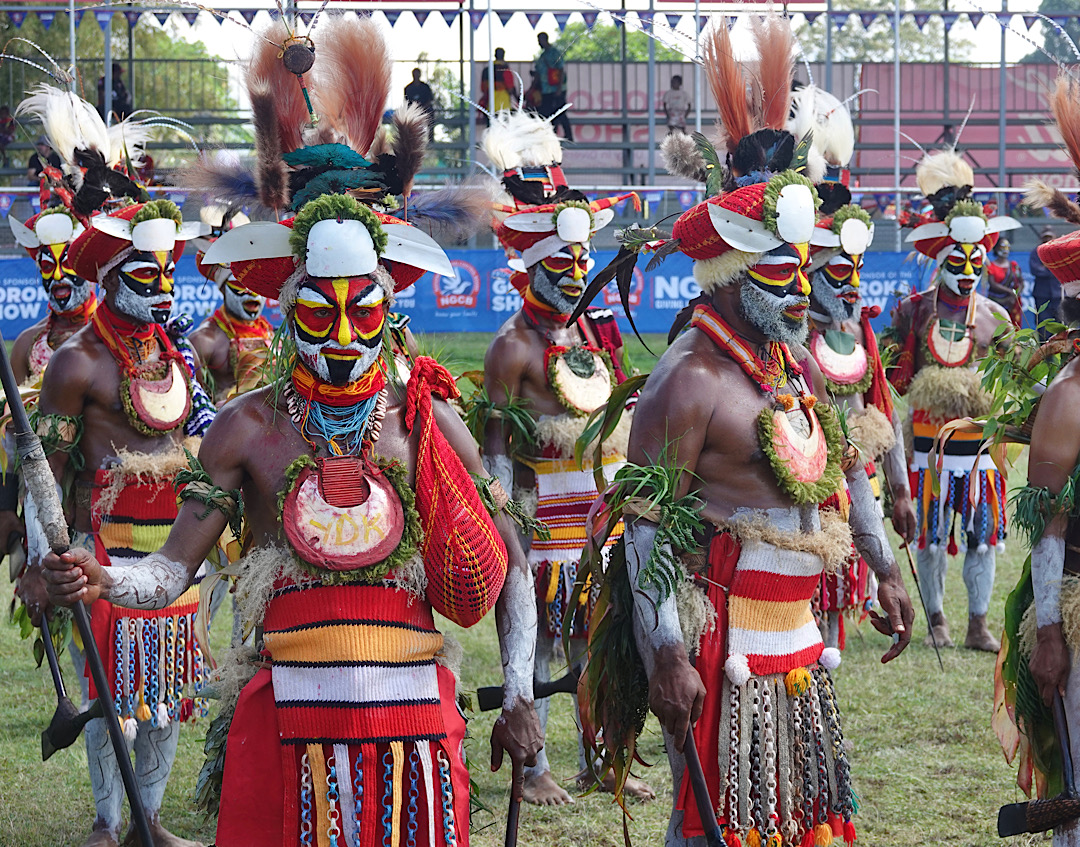
I marveled at group after group clad in costumes so wildly stylish they would make a Parisian couturier jealous.
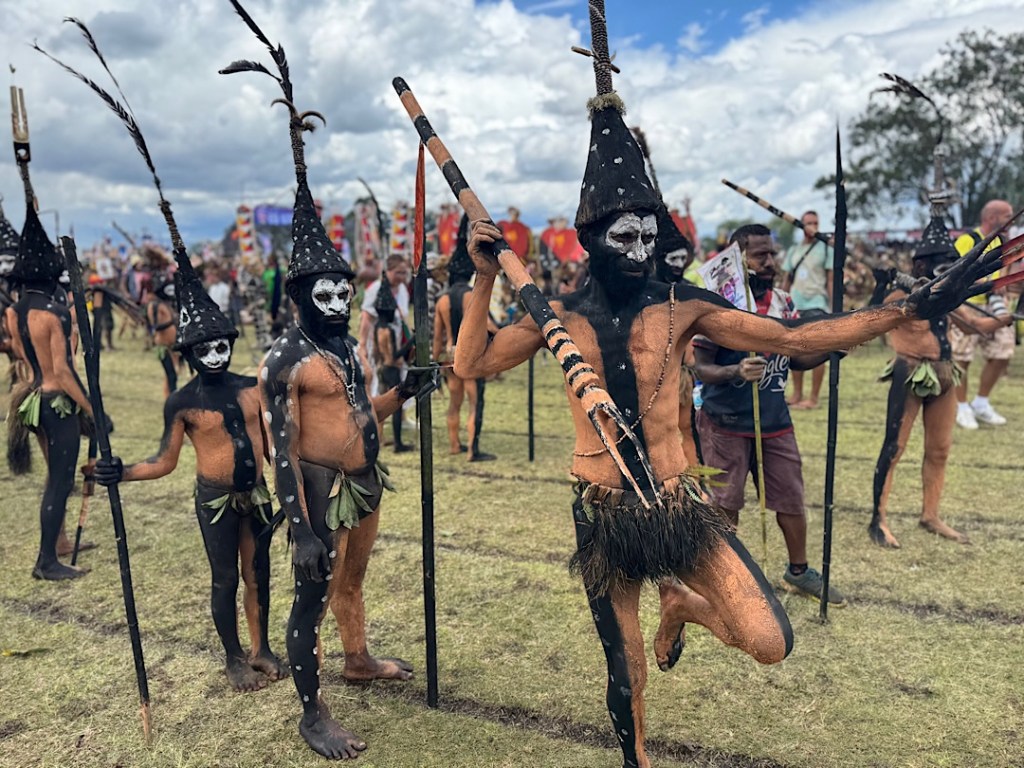
These ladies reminded me of exotic trees, bursting with leaves and laden with fruit.

But I didn’t even try to shoot the faces of the attendees, pale faces and Papuan ones, alight with pleasure and wonder. You can’t see them but I can’t forget them. 

The sights and sounds are part of what charms everyone. But I also loved aspects of this experience that are intangible. Foremost is why the festival exists. The first one was held in 1956. Back then the myriad tribes inhabiting the eastern half of the island of New Guinea seethed with mutual antipathies. Harsh topography had isolated one group from another for tens of thousands of years. They spoke almost 1000 different unique languages. Groups close enough to know of each other’s existence distrusted and often tried to kill (and sometimes even eat) each other. 

The Australians still occupied the place, and the story we heard was that some of them decided to organize an event that would bring tribes together, not to compete but to show off their traditional costumes and dances and songs. These performances, known by the pigeon term “sing-sings,” were and continue to be held in villages for all kinds of special occasions — weddings, harvest celebrations, and more.

Miraculously, the concept worked. Sing-sing groups came that first year, and the number participating has grown steadily over the years; some 150 or so of them took part this year. Private sponsors like the national gaming board put up money to defray the travel costs of the performers. Four hundred or so foreign visitors also pay substantial fees for VIP passes. Thousands of locals pay a far more modest admission price. 

The groups don’t compete; that might fan the old rivalries. Instead it’s a pure cultural exchange; a chance for one-time deadly rivals to party together. It’s a grand celebration and a demonstration of the fabulous creativity and inventiveness and natural splendor of this very special place.
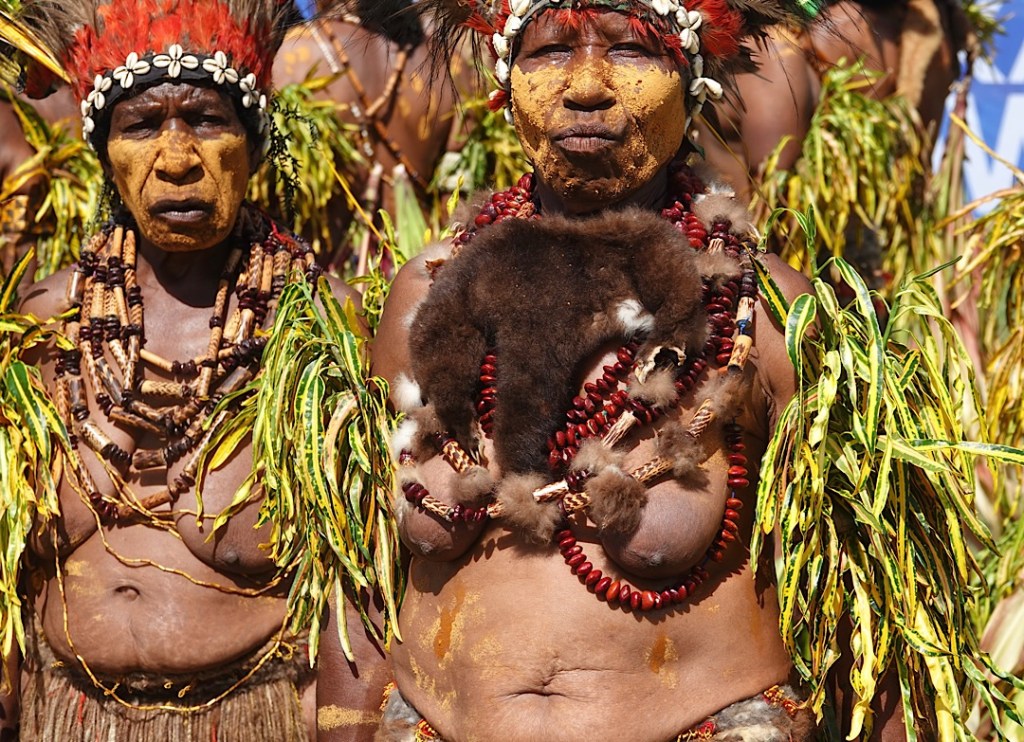
Yes, that lady is wearing a dead animal on her chest. I didn’t ask but I’m guessing it’s a tree kangaroo.
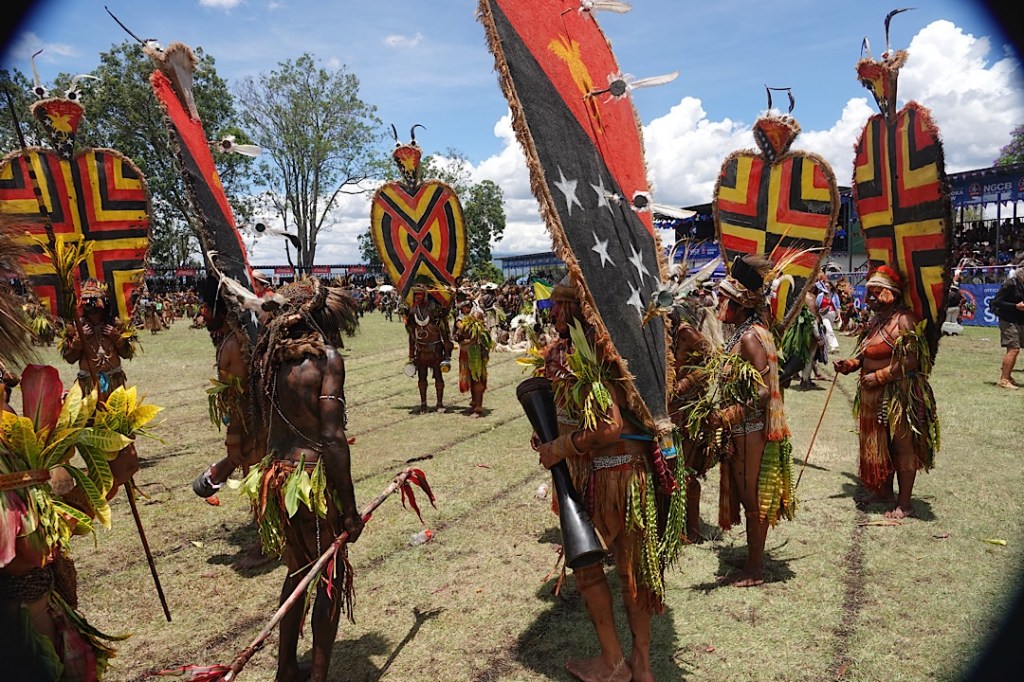
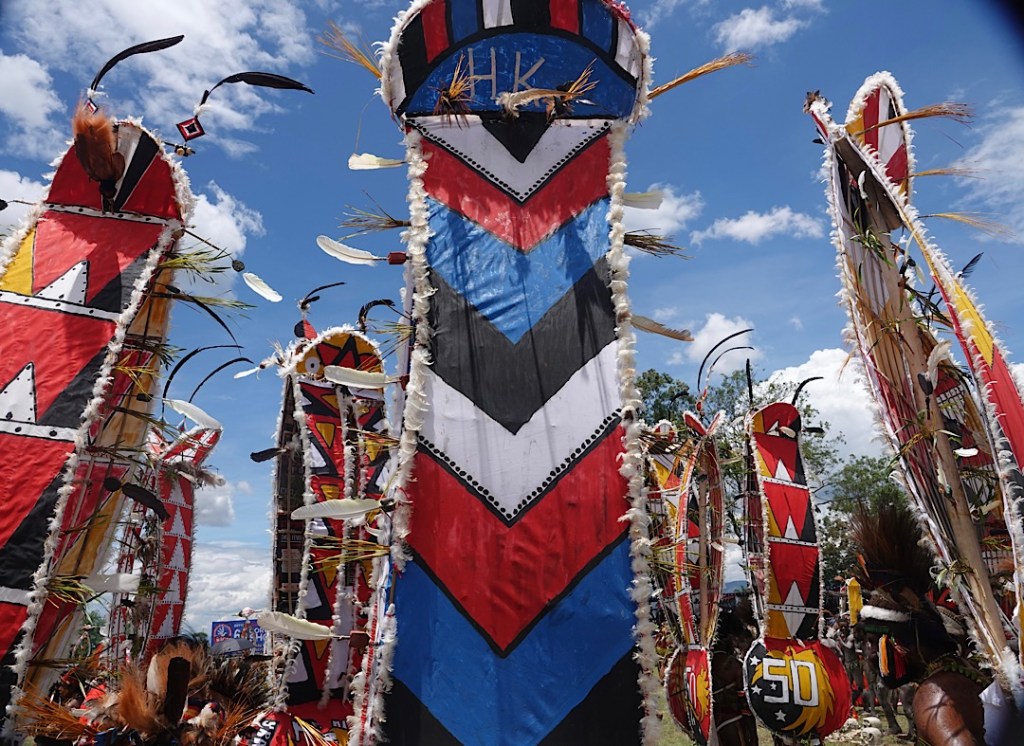
Some groups stand out most for their eye-catching banners.
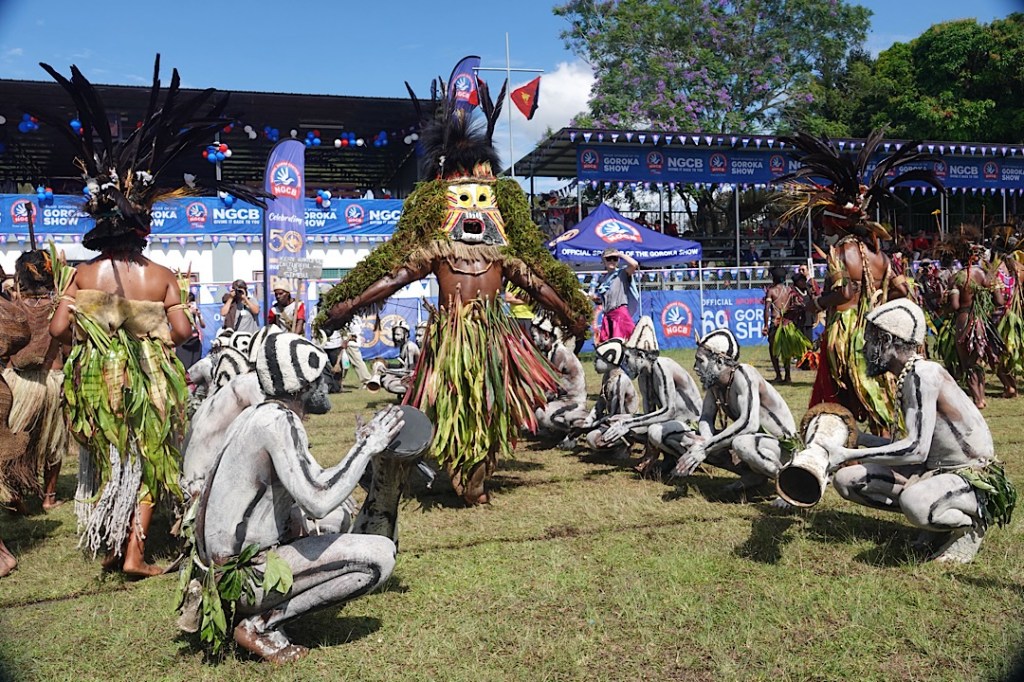
Some enacted mini-dramas. This one involved a monsters and hapless villagers.

I also was gratified by how well run and pleasant this jam-packed spectacle was. Mainly that’s because we VIP pass holders got to enter the festival grounds at 8:30 a.m. as the very first sing-sing groups began to march in. The grounds consist of three huge grassy fields owned by the national sports institute.
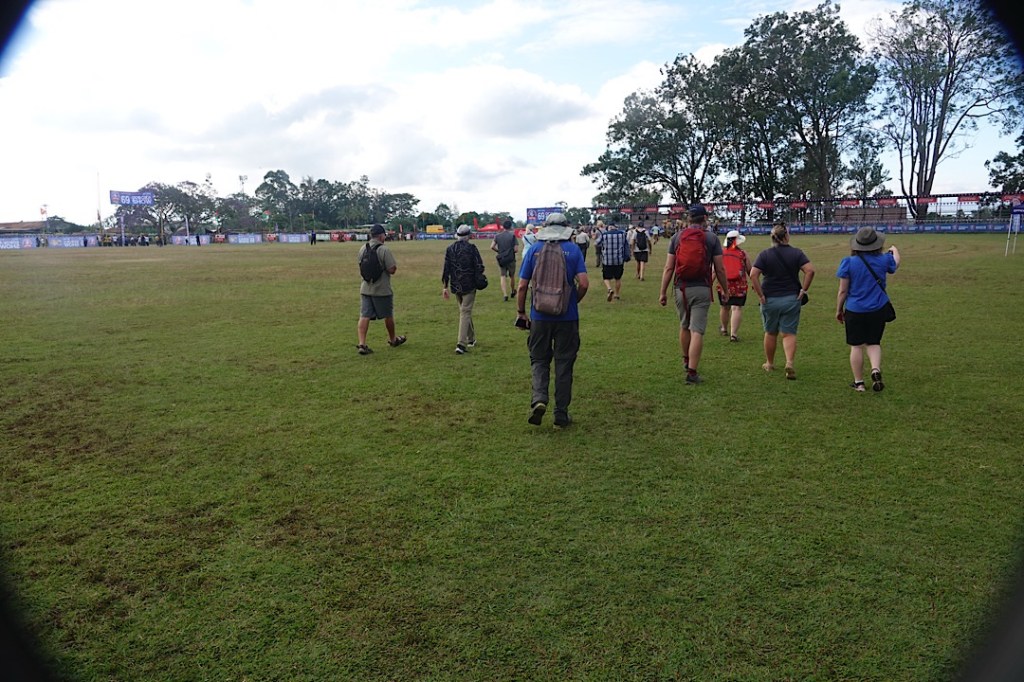
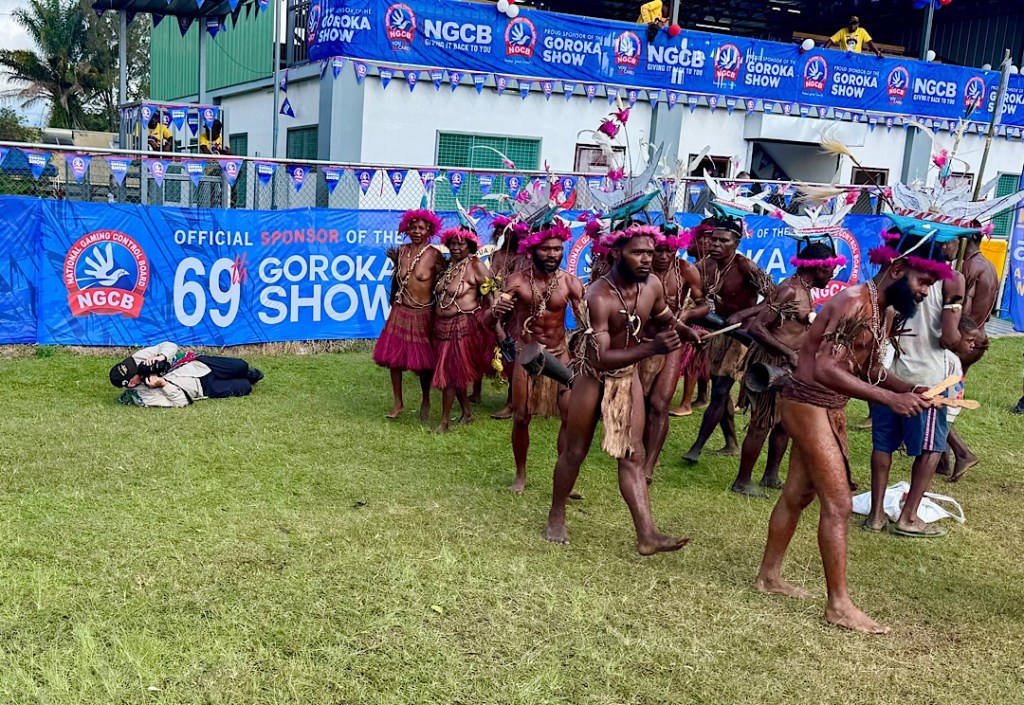
Photographers with very big lenses and very little inhibition had plenty of room to go for unusual angles.

For several hours we VIPs enjoyed what felt like private (simultaneous) performances by not just singers and dancers but also several musical groups.
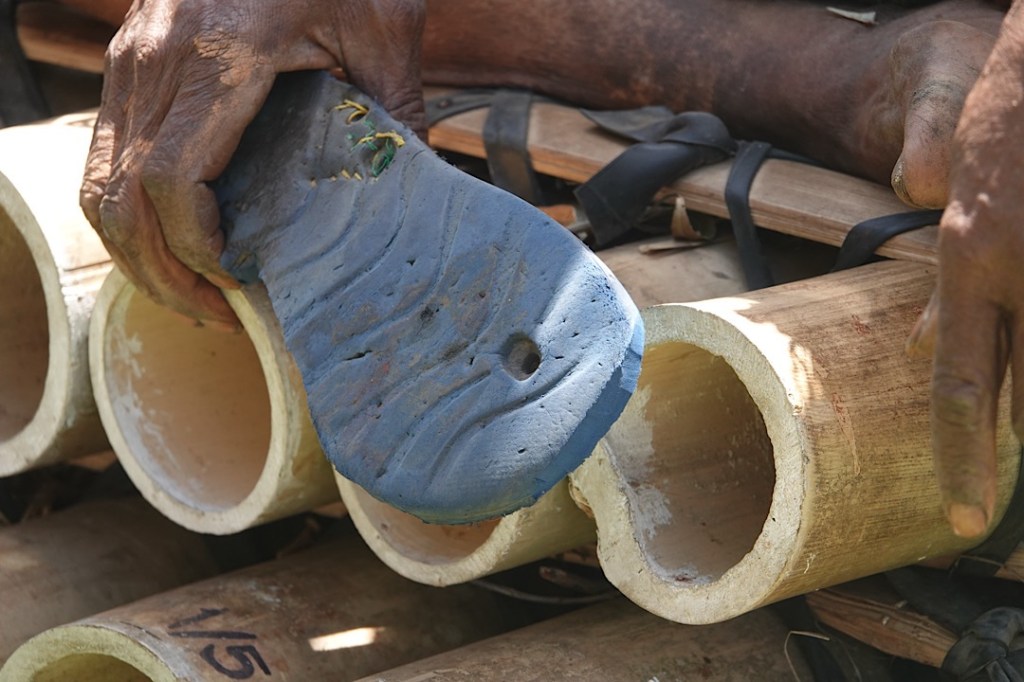
The percussion in this band was created using bamboo logs and flip-flops.

The general public began to stream in around 12:30, and after that the throng was thick. But any time you got too tired or hot, you could rest on bleachers sheltered from the sun. Or rain.
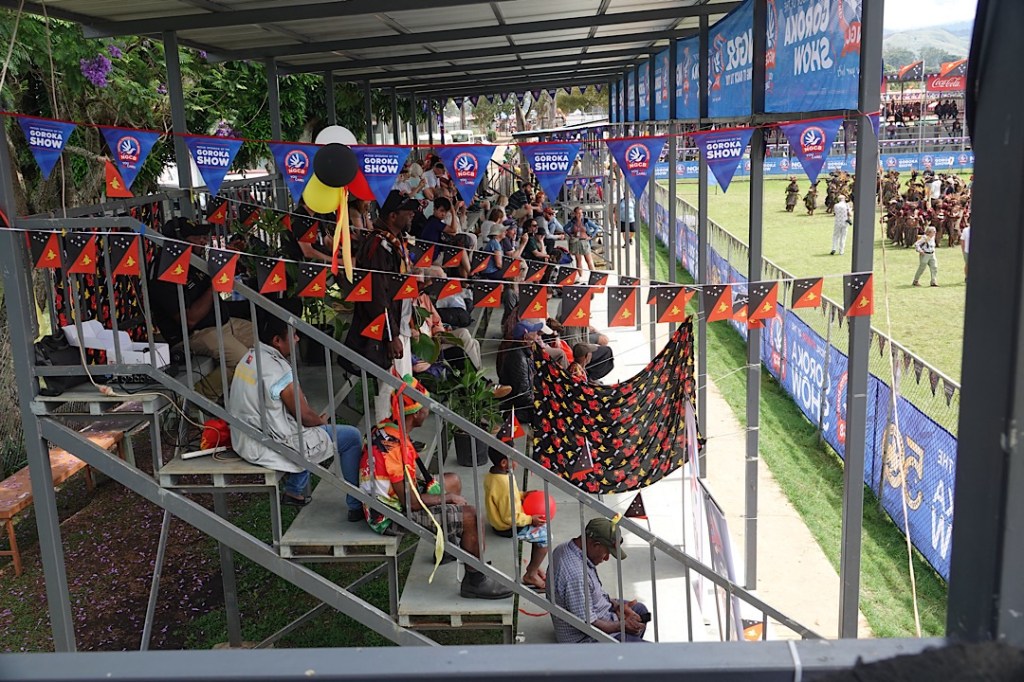
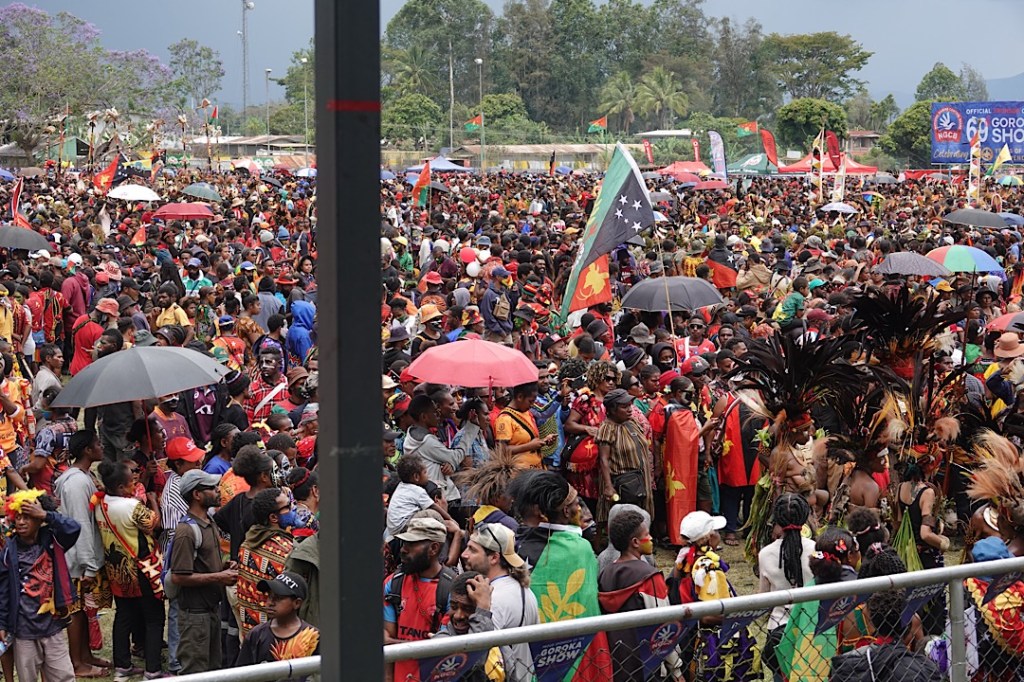
I took this photo on the second afternoon, the only time the skies clouded over and it threatened to rain.

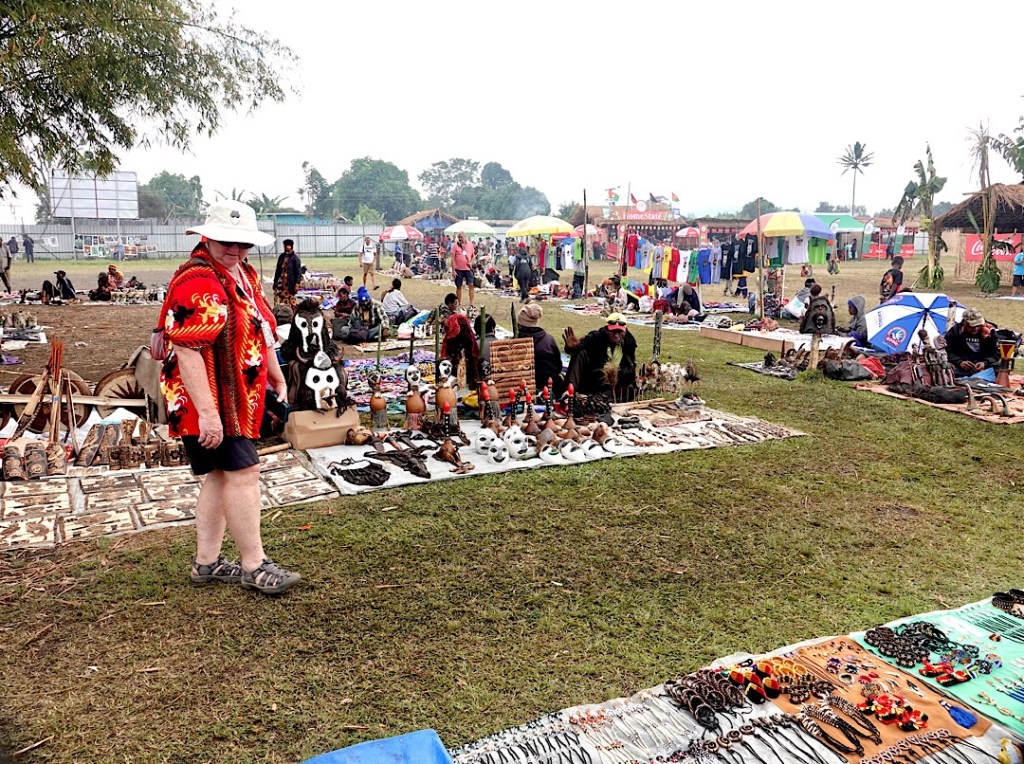
You could also meander onto the two adjoining fields.  Steve’s and my favorite was the upper one, which included not just wonderful handicrafts for sale but also an agricultural tent and educational booths.
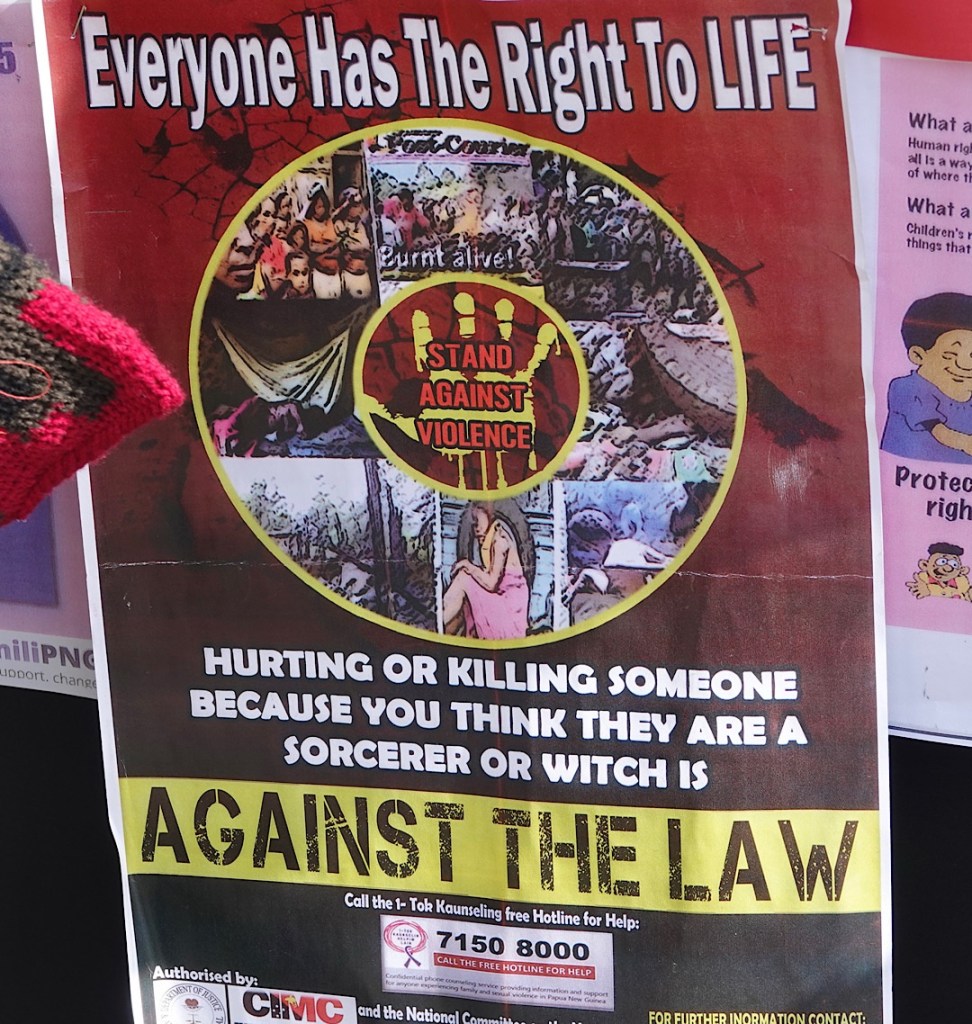
One booth instructed people not to harm suspected witches.
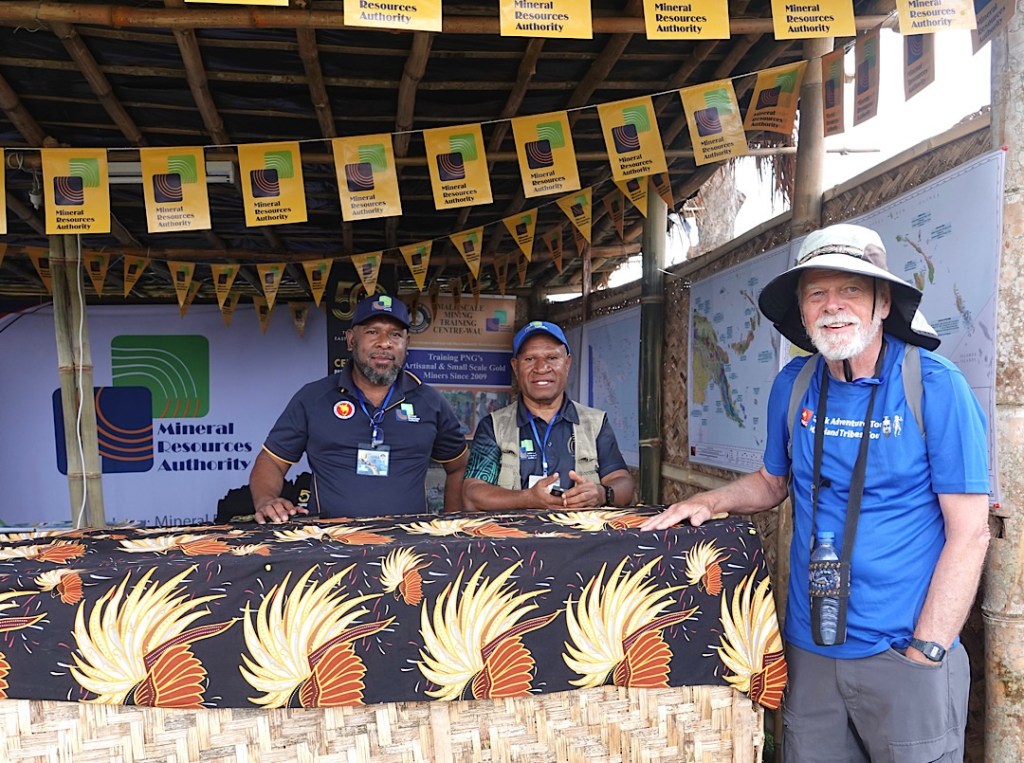
These guys from the Mineral Resources Authority were making a pitch for people to start their own gold-panning operations.

It was all pretty overwhelming but it would have been more so had it not been for our activities in the four days leading up to the festival. After our birding experience on Wednesday, we drove to the village of our main guide that day, Lucas.  He gave us a tour of the community’s fields, pointing out all the things folks were growing.  He introduced us to the chief.
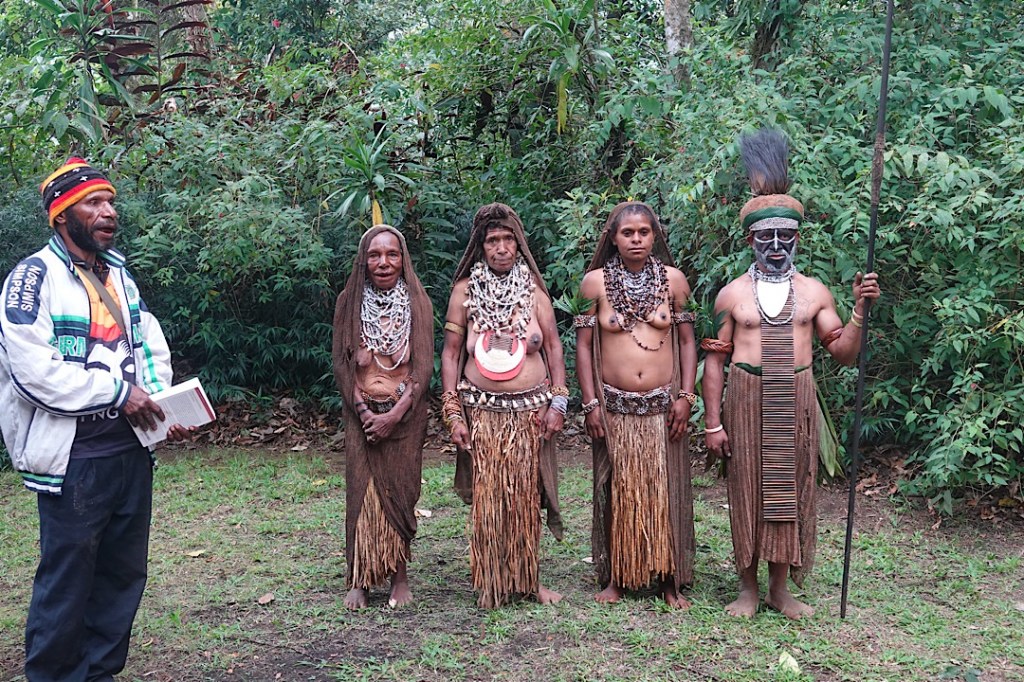
From right to left: the chief, his young second wife, his older wife, and his mom.

Most interesting was the opportunity to watch dancers transforming themselves for their imminent performance for us.
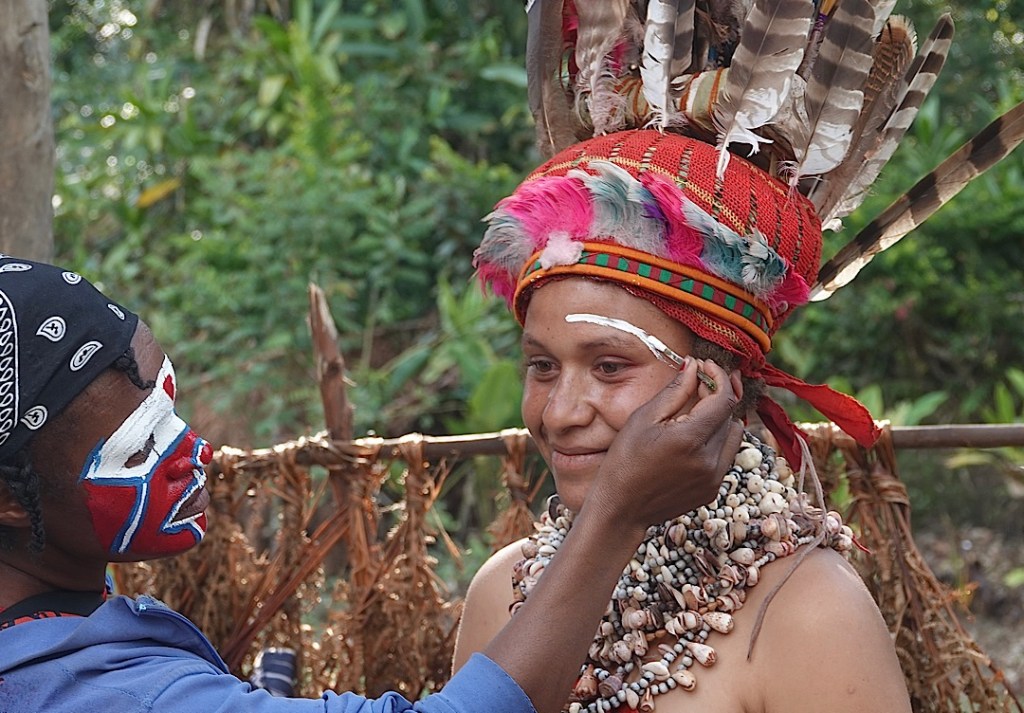
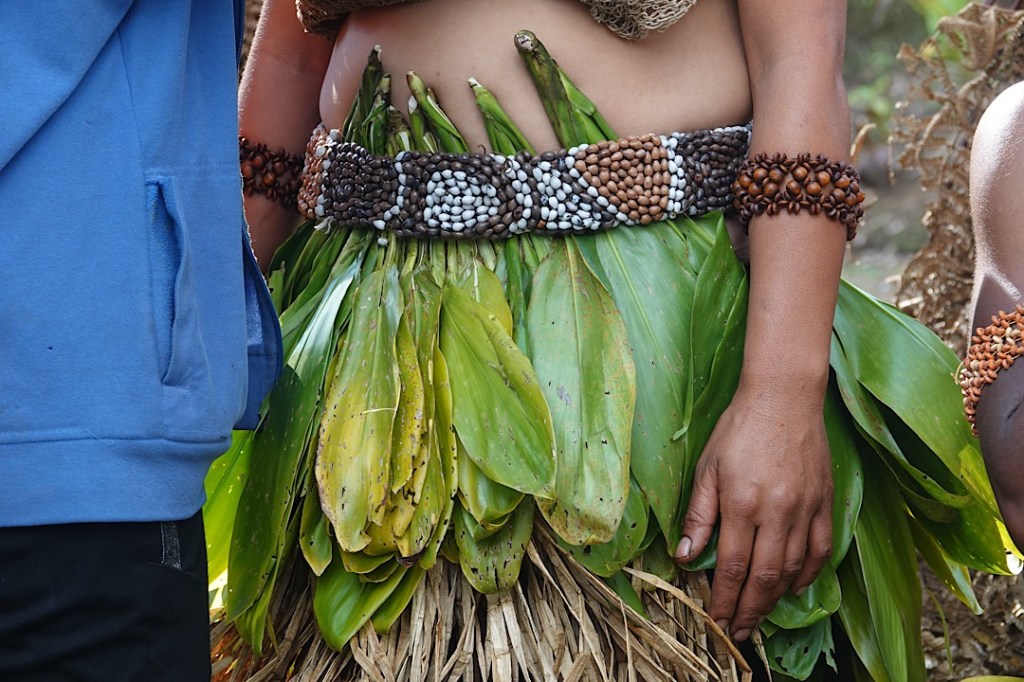
It’s very time-consuming to assemble the right look.
The final product
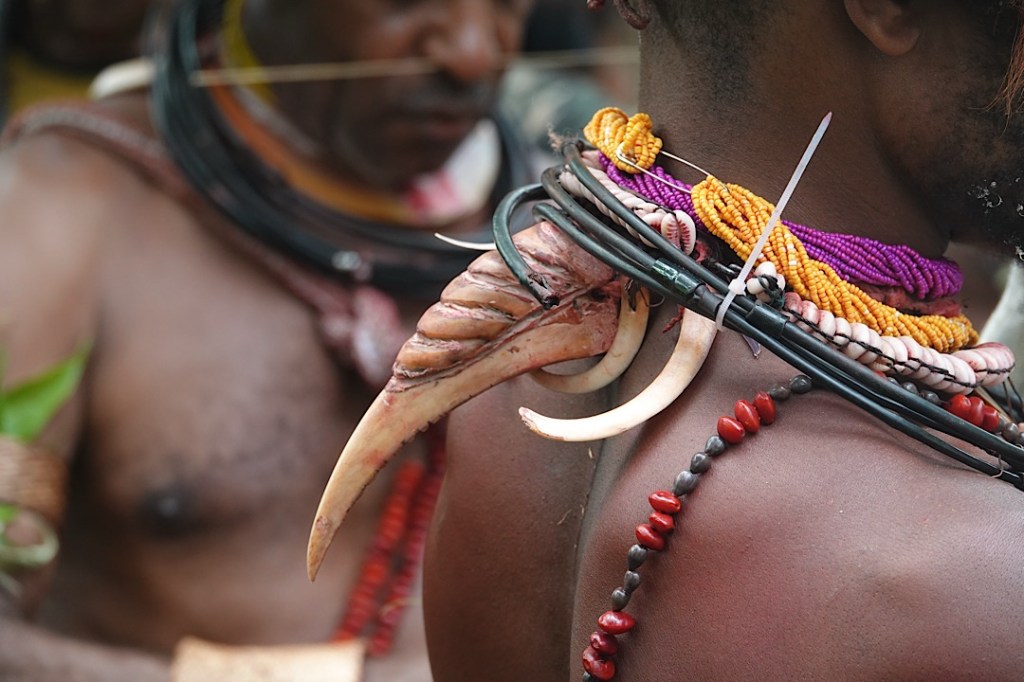
The man in this group wore another variation of a “wig” made from hair….
…and a very cool hornbill-beak necklace.

The next day, on our drive from the town of Mt. Hagen to Goroka, we stopped at a village inhabited by more of the men distinguished by their incredible “wigs.” Such “wig men” exist in a number of places throughout the highlands, with the wigs taking different shapes. They also can be ornamented in many different ways. What they have in common is that they’re made of human hair. 

In this village, we watched some of the men decorating their headgear, and we learned how the hair is grown. It must be done by young men who are virgins. They live in monastic quarters in the jungle and follow arcane spiritual practices for about a year and a half: eating a special diet, pouring holy water on their heads, sleeping in hair-friendly positions. The hair is finally removed intact (like shearing a sheep). To make a double wig, a fellow must continue on for another 18 months. All this only creates the foundation. All manner of feathers and whole birds and other pretty things are pulled out of storage bags and added before any given performance.
On Friday, the day before the festival, we spent a log day in a village inhabited by Asaro people. Two of the luckier inhabitants greeted us.
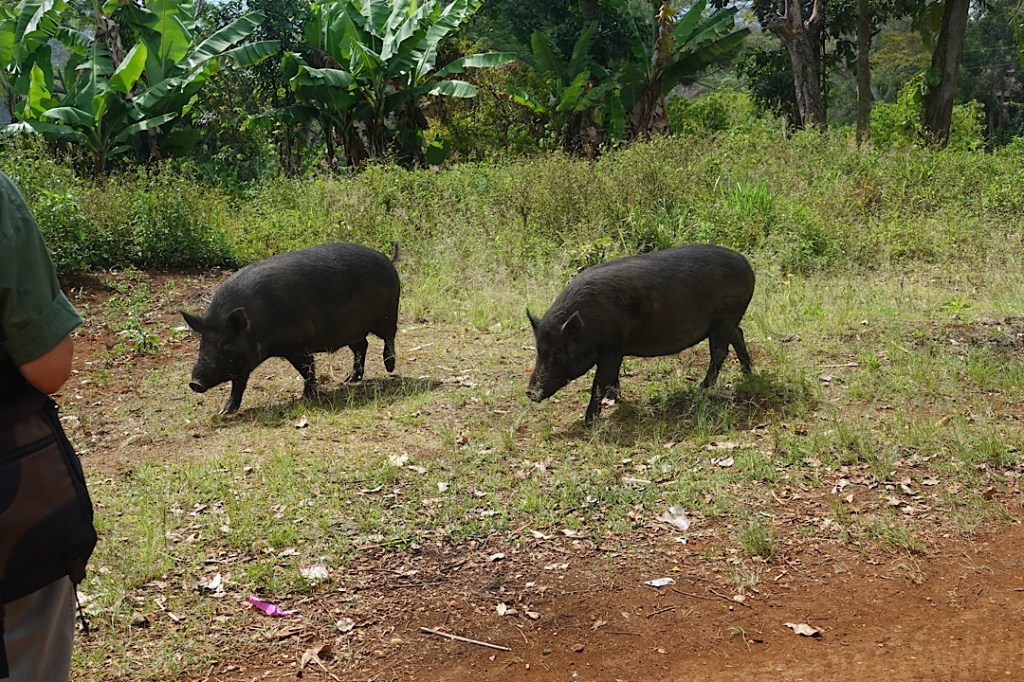
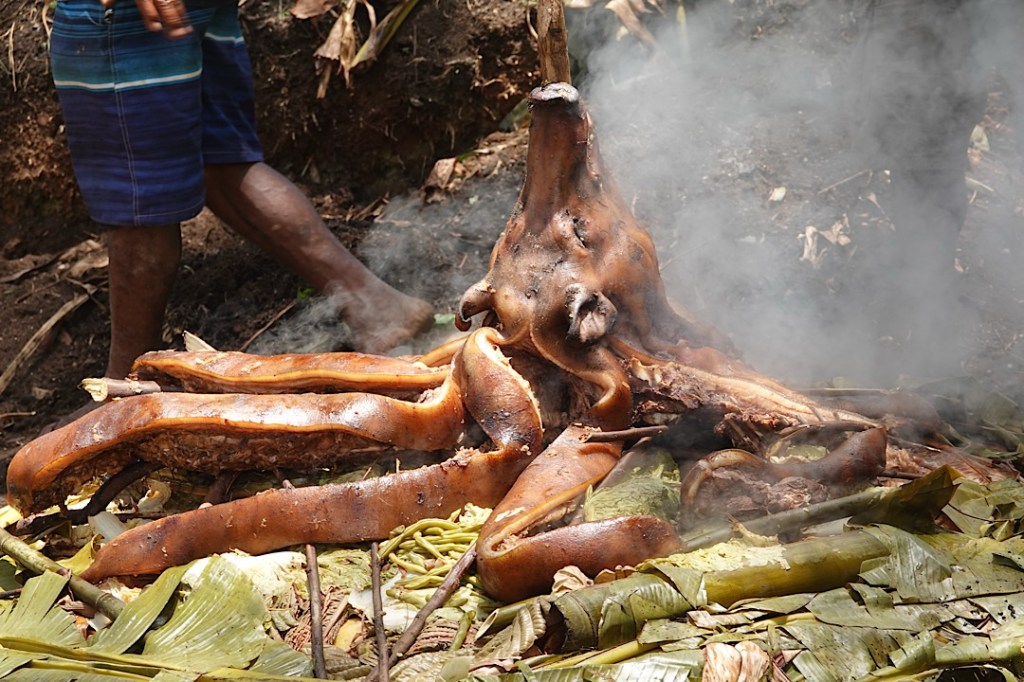
After touring the fields, we met the least lucky one.

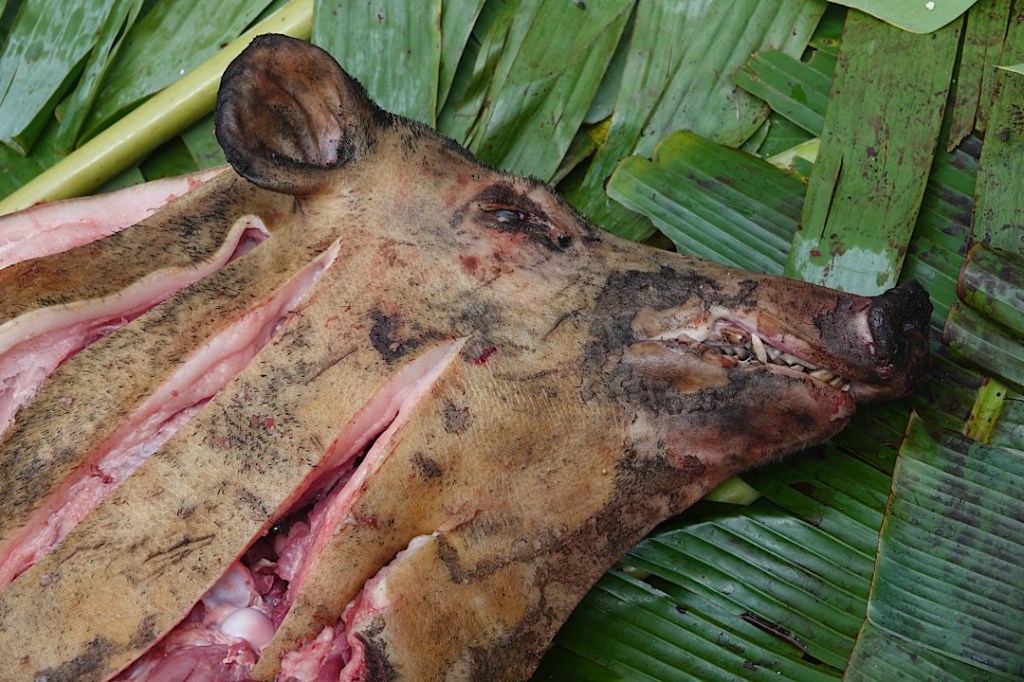
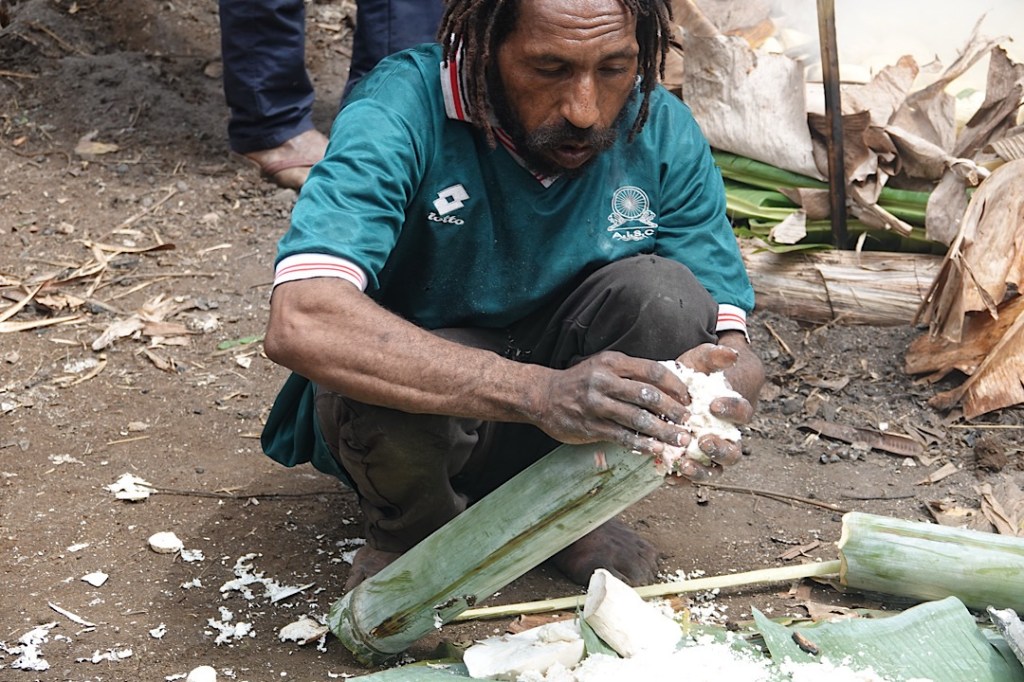
For the vegetarians in our group, there was grated taro stuffed into bamboo stalk segments. (A good thing because that dead pig really grossed them all out.)

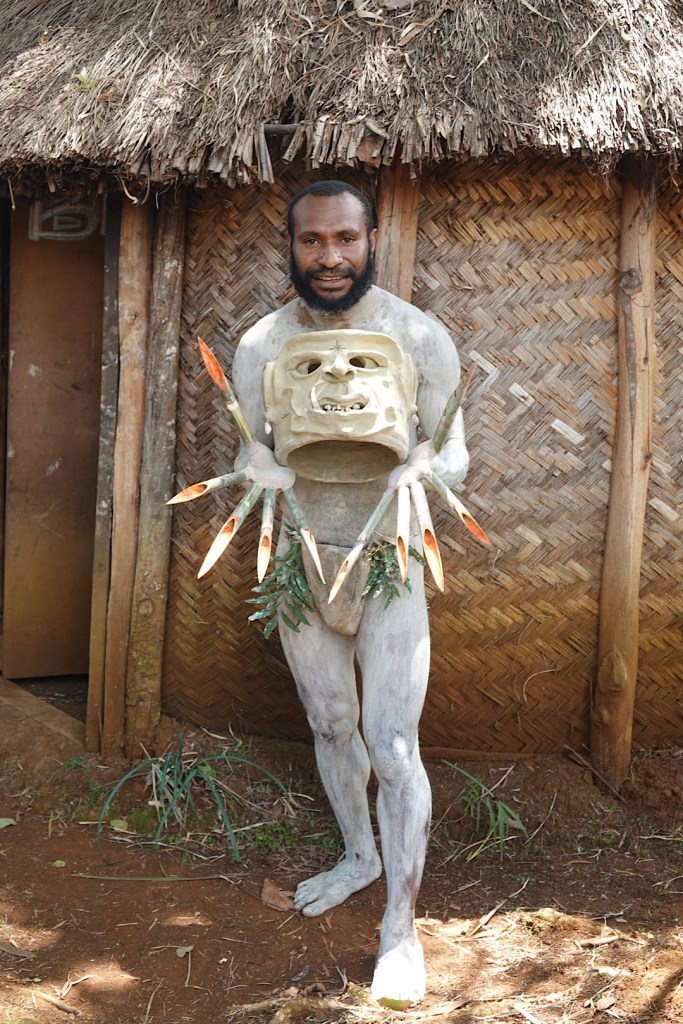
While the unfortunate porker and various veggies steamed over hot rocks, we got to watch a performance by the famed Asaro “mud men” and a couple of other groups visiting from other nearby villages.
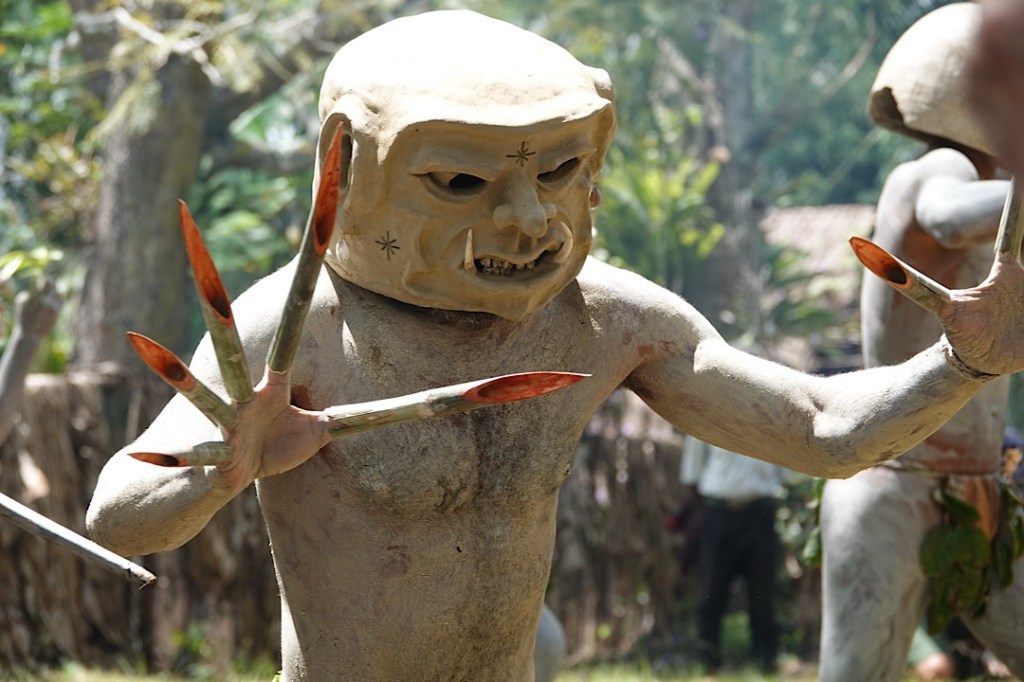
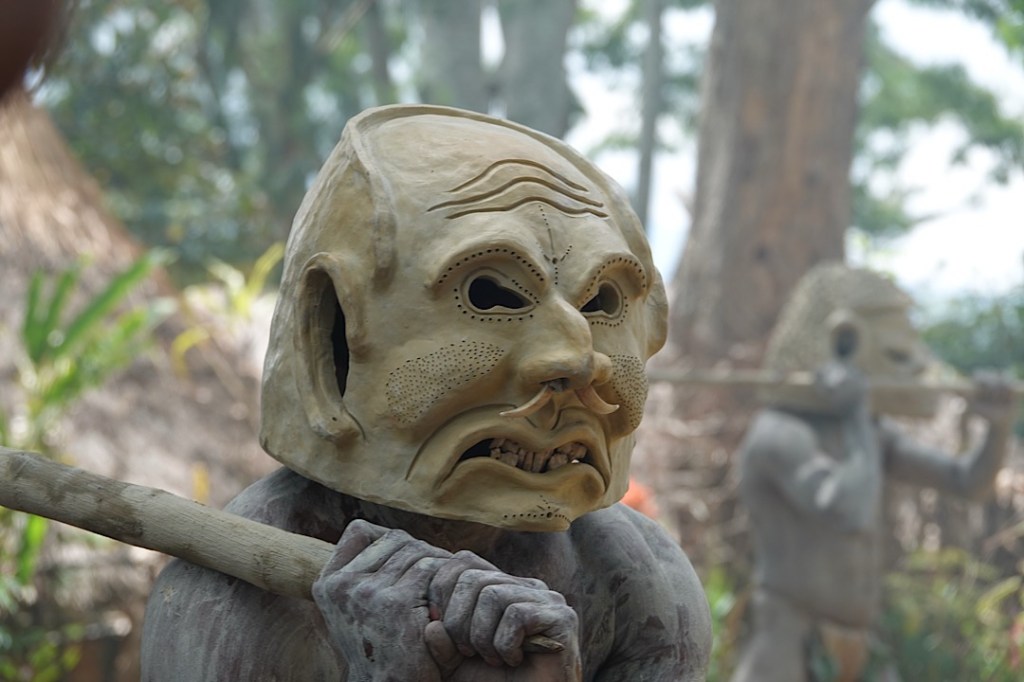
The mud men, meant to be scary, were much friendlier when they took their masks off.
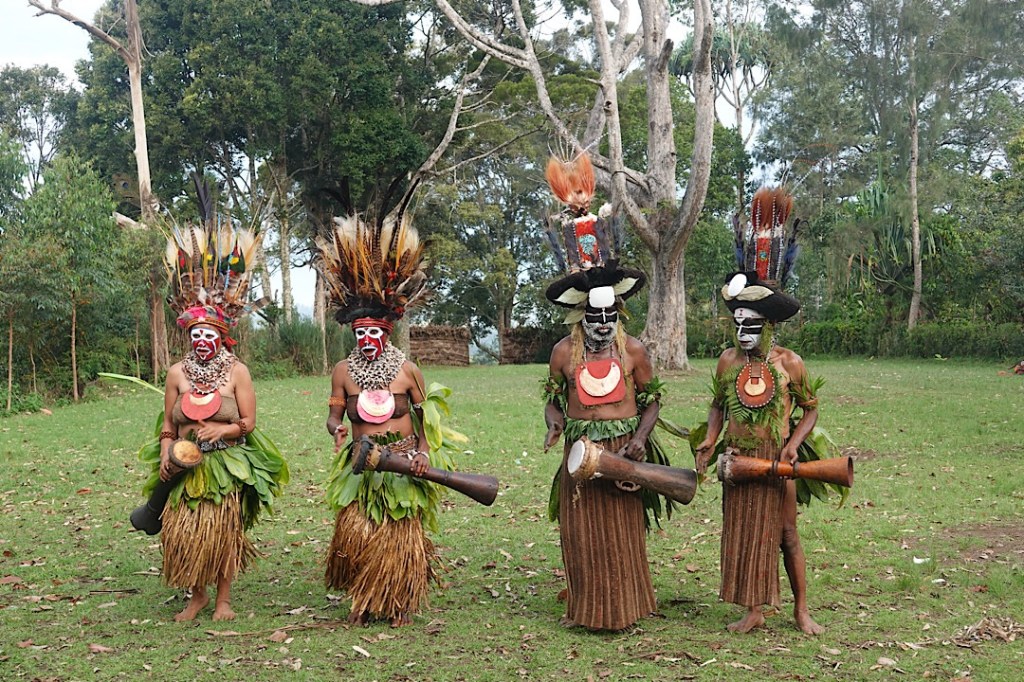
These ladies came from a nearby village to dance for us.

After a break for lunch…

…we watched a final performance, a sex dance traditionally performed after a battle (when replacement warriors were likely to be in high demand.) Lots of pelvic jiggling was involved.
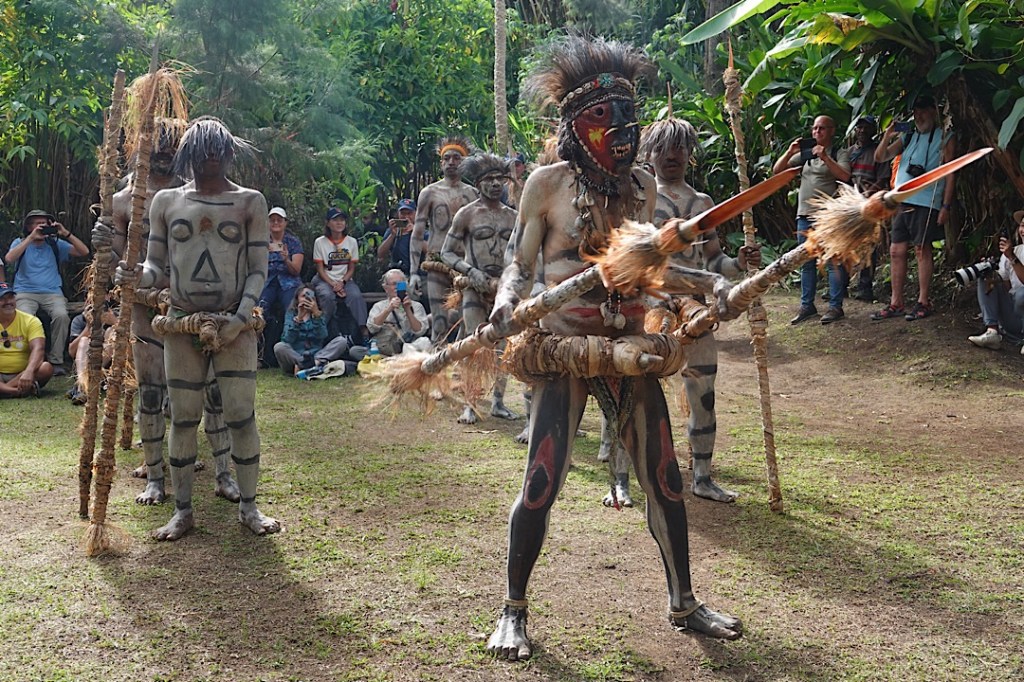
All the visits provided us with some needed background and context for what we would see at the big festival. It helped us get to know the performances a bit — like standing backstage for a moment. Nonetheless, if a thousand words are worth less than one picture, then I’d have to write tens of thousands of words to try to explain all the significances in the photos I’ve included just in this one post. Countless anthropological dissertations probably wouldn’t be sufficient.

So I’ll cut it short and simply say: you had to be there. We wouldn’t have missed it. 
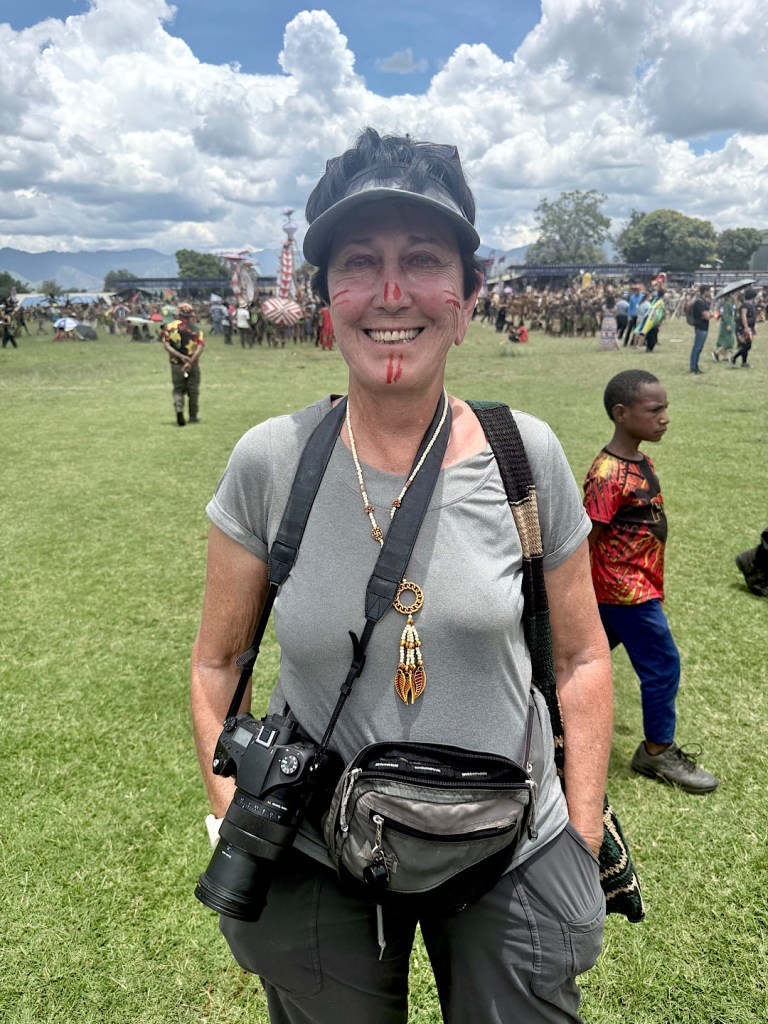
Pretty drab by Papua New Guinean standards

Thanks

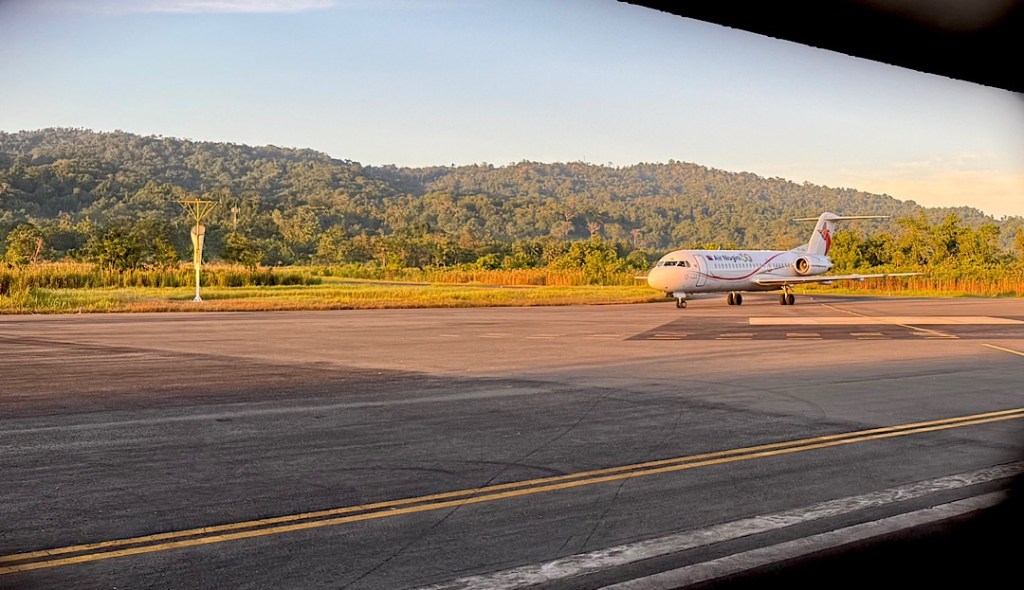
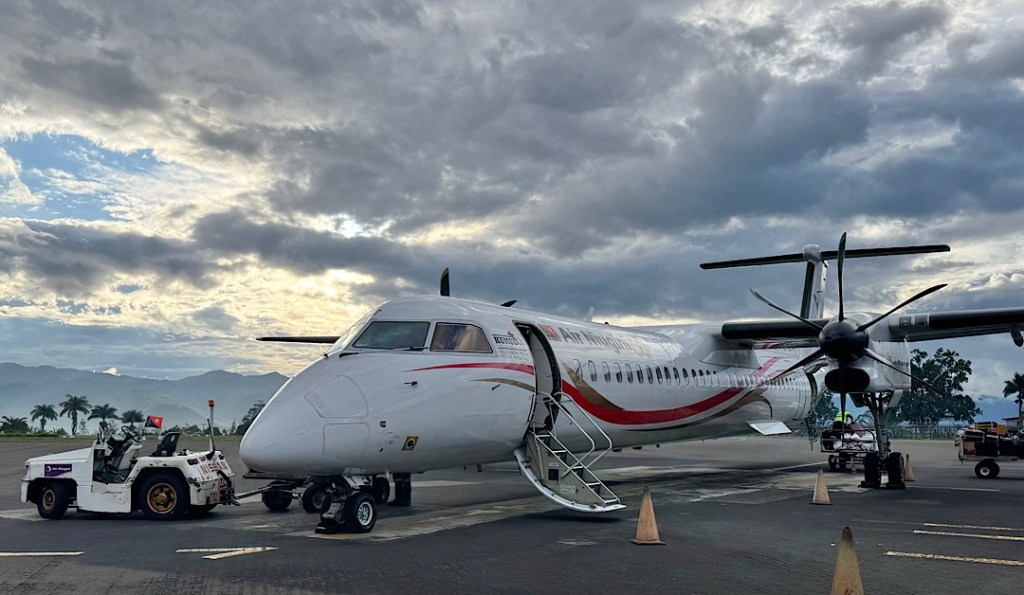
Our rescue vehicle: the Fokker that finally carried us from Wewak back to Port Moresby — on a beautiful day for flying. Note how nice and dry the ground is!

Thanks to everyone who expressed concern about Steve’s suspected TIA and our stranding in Wewak. We finally took off a little after 9:15 Sunday morning on a 70-seat Fokker and touched down in Port Moresby at 10:24.  Unfortunately, that was almost an hour after our (rebooked) Philippine Airlines flights to Osaka (via Manila) had departed. Once definite word came Saturday that no plane would leave Wewak, we knew we’d never make the PAL flights, so I spent close to three hours on the phone Saturday afternoon, trying to rebook them yet again. 

But I failed, and choking with frustration, we simply canceled them outright online. (I had paid extra for refundable tickets, though PAL tacks on so many hidden charges and fees we will get back only a bit more than half of what we originally paid.) If anyone out there is waffling over whether they should fly Philippine Airlines anywhere, call me and I’ll give you an earful.

This all meant when we landed in Port Moresby we had NO transport out of PNG, so we had to hustle to look for that. Happily, we found seats on an Air Niugini flight leaving for Manila at 4 pm that afternoon. We also booked a place to sleep in Manila. I’m writing these words from the heavenly bed there now.

As for continuing on to Japan, I was startled to find how few non-stops daily fly between Manila and Osaka — just three. None are good (e.g. Japanese). We finally chose the one (Cebu Pacific) that would allow us to SLEEP IN! Last night before collapsing in bed, we snagged seats on that 1:30 flight and got a hotel at the Osaka airport. If all goes well, we’ll check in there more than 24 hours ahead of when we’d planned. 

Between now and then I’m hoping for time in which I can work on my report on the heart of our PNG experience: our travels in the highlands to the Goroka Festival.

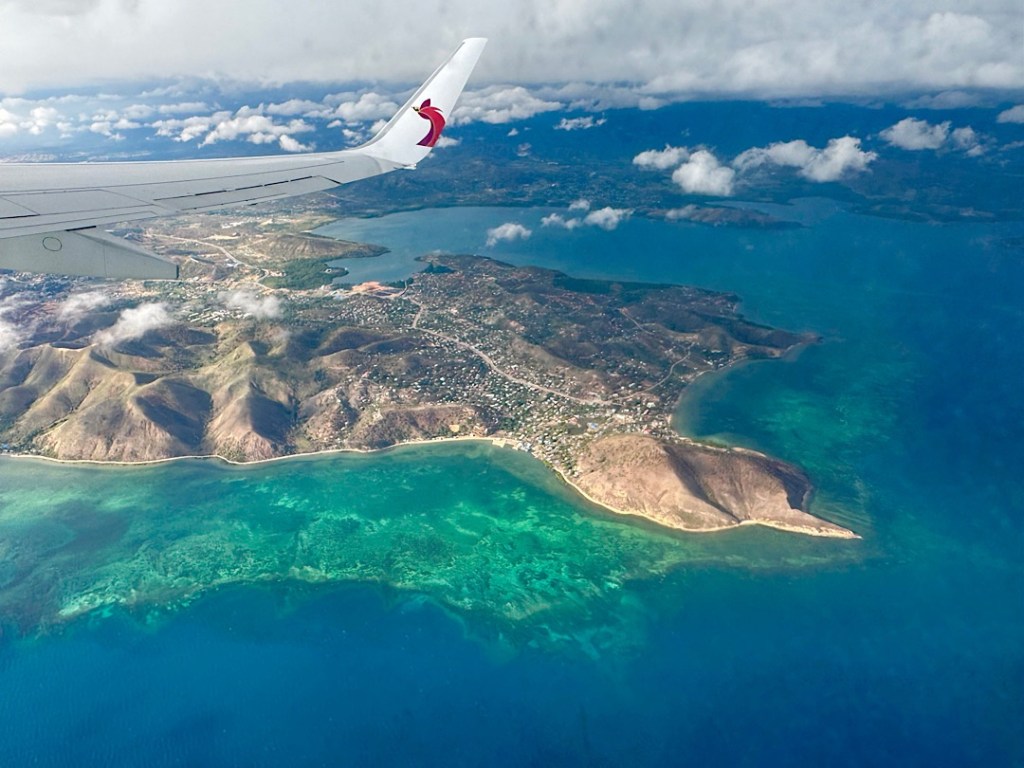
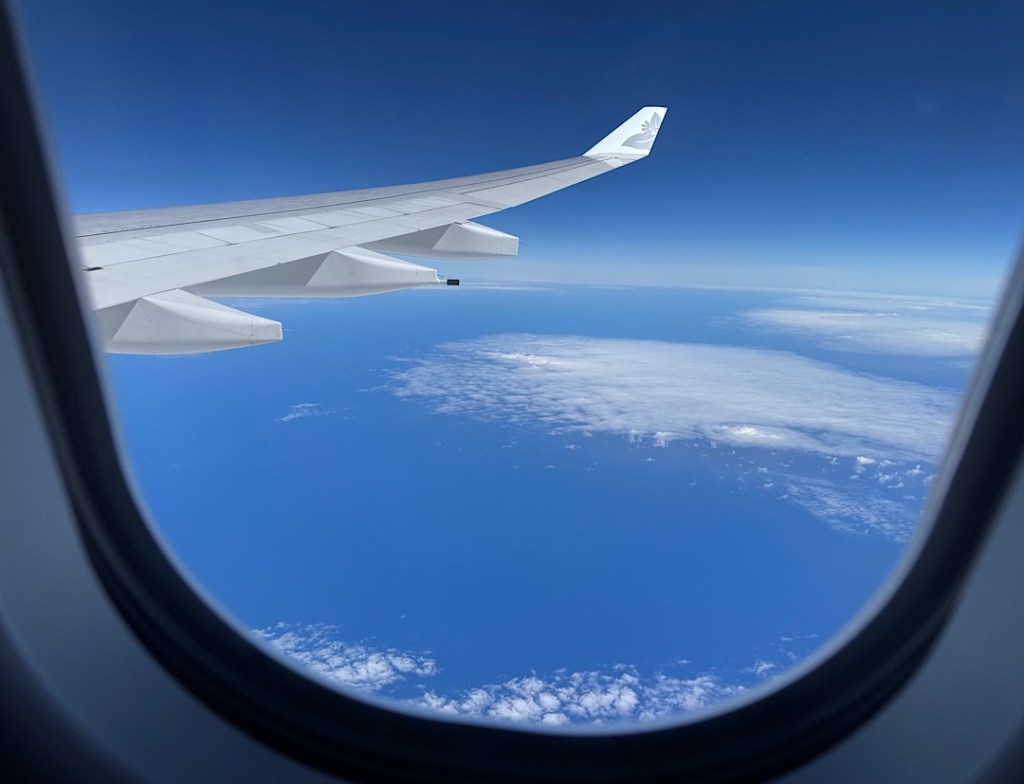
My last view of Port Moresby. I felt a little sad leaving Papua New Guinea, so beautiful, so wild.

Know your limits

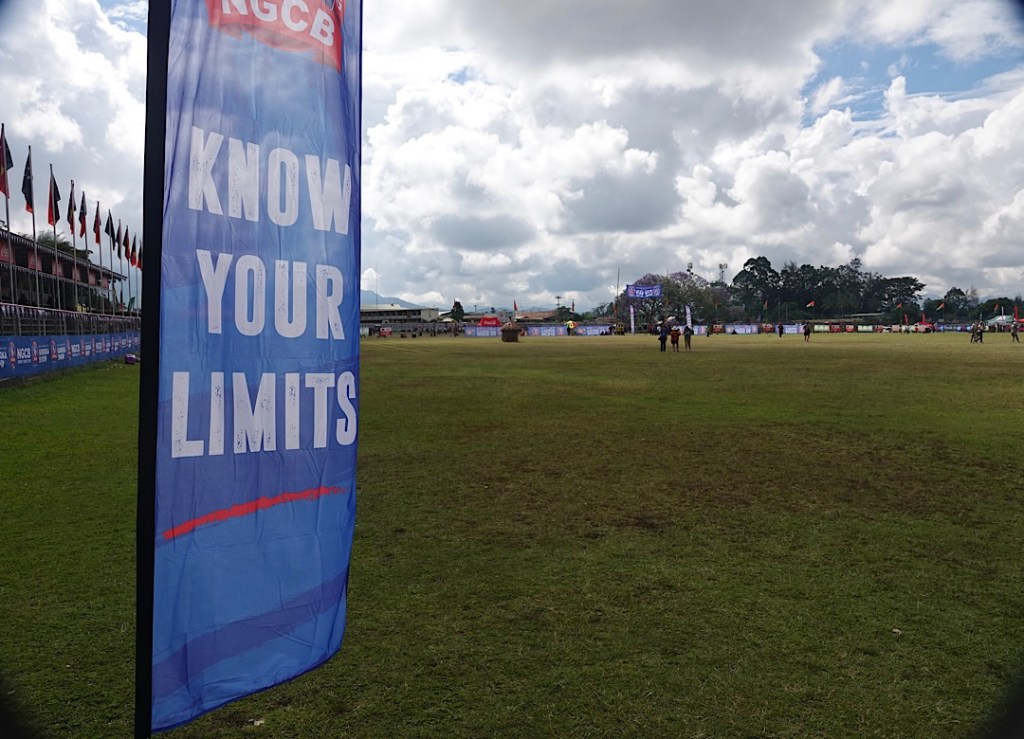
One of the main sponsors of this year’s Goroka Festival was PNG’s National Gaming Control Board; its banners declare, “Know Your Limits.” It’s a motto worth remembering.

Wednesday’s flying experience from Port Moresby to Wewak wasn’t great, but it didn’t seem bad enough to push either Steve or me beyond our limits. It wasn’t the ordeal we endured on Tuesday. That night we didn’t reach our hotel until 8 pm. Then once again we had to set our alarms for 5:00 the next morning. As we were packing to get out the door by 6, Christopher messaged the group that our plane’s departure had just been rescheduled, and we wouldn’t have to leave the hotel until 9:30 am. The damage was done, however. Both Steve and I were wide awake. 

When we finally got to the airport, check-in was smooth, and we took off only about 45 minutes behind schedule. We didn’t crash. Climbing down the plane’s folding stairs into the blazing sun and air heavy with humidity felt like a full-body punch. But our bags came off the plane quickly, and the drive to our hotel was short. In the cool, elegant lobby I whispered to Steve, “Maybe you should go on the river trip and report back to me. I’ll just hang out here.”

Ah, be careful with your flippant remarks! I donned my bathing suit and went down to the saltwater pool. The water temperature must have been at least 90, almost too warm even for me. A few minutes later, Steve showed up and stepped down to join me at the shallow end. He started to tell me he’d found a shorter route between our room and the pool. But he couldn’t speak.

His vocal cords were working, but the words coming out of his mouth were strangely jumbled — a bit like a stutter, a bit like a sustained slip of the tongue. He tried again to talk and failed again. We both recognized something was very wrong. I immediately suspected a transient ischemic attack (TIA), also known as a mini-stroke. Or something worse about to unfold. I called to some of our group members at the deep end. Together we helped Steve to get out of the pool and sit down. 

None of the others heard what Steve and I had just heard coming out of his mouth; the worst of the incident had already passed. He had no other symptoms: no weakness or pain in his limbs; no vision anomalies. Still he was speaking very slowly, taking obvious care to utter intact words. Someone gave him powdered electrolytes to mix with water, and we returned to our air-conditioned room where he drank the solution and lay down for half an hour. When he got up he was almost back to his normal self, and the two of us confronted the crocodile in the room: should we reconsider setting off for the Sepik River early the next day?

By this point it was close to 6 pm. As tough as the decision was, we had to make it fast. On the one hand, we’d paid a lot of money and endured a lot for the chance to travel in dugout canoes on the third-largest river system in the world. We would see an entirely different biome and meet completely different tribes. We’d probably chase some crocodiles, and Christopher wanted to devote a day to a “cultural exchange” within a village where Steve and I had planned to give local children a lesson in geography and astronomy. Not everyone’s cup of tea, but we both wanted to do all that. 

On the other hand, it would require four more days of hard travel: three nights sleeping on the floor in spartan village “lodges” illuminated by minimal electricity, eating mostly root vegetables; sweating a lot and getting muddy and using outhouses to relieve ourselves. We’d have to swat away many more bugs than we’d seen anywhere previously on the trip. Most sobering, if Steve’s incident augured some bigger cerebral catastrophe, no medical resources would be at hand.

So we sought out our tour leader and explained what we’d decided and what we wanted: to stay behind and try to move up our return to Port Moresby and onward travel to Japan. Christopher had to act quickly. According to Air Niugini’s website there were no flights from Wewak to the capital either the next day (Thursday) or Friday. Only two seats were left on the 7:30 am flight on Saturday, and by some miracle he got Air Niugini’s agent in London on the line and booked them. At dinner I paid for them by typing my credit-card info into the form on Chris’s mobile phone.

As hard as it was to abandon the river trip, it was even harder to part so abruptly with the seven fellow travelers who remained in the group (which had started out at 20 for the festival). Steve and I have never been big fans of group travel, but our Best of PNG group was exceptional. Every single person was interesting or funny or kind; most were all three. At least one, an Estonian privacy attorney, had visited more than 130 countries (and she was only in her 40s). Others were close behind. Everyone was a good sport; at every turn they shared amazing travel stories. The final seven (besides us) included two French, two Colombians, a Swede, and two other Americans.

We said goodbye to Christopher Bartlett and his assistant Caroline.
The diehards, about to drive off to the river

Shortly after 8 Wednesday morning they and their jokes and good fellowship all disappeared in a cloud of dust down the road. We turned our attention again to looking for a doctor who could evaluate Steve (who continued to look and act normal.) No doctor had been available the night before, and Sam, the hotel manager, explained that until recently an excellent one had been on call for guests with health problems. But she had recently died. A second possibility turned out to be away on holiday. Sam promised to keep trying to find someone who could help us. 

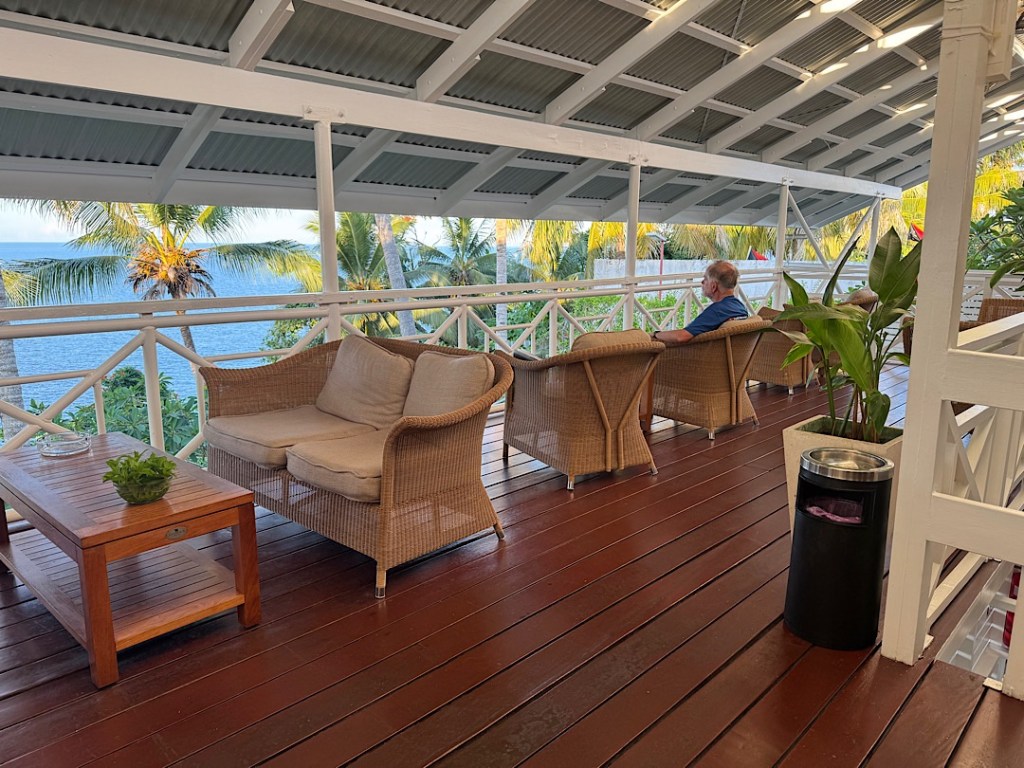
I spent the rest of Thursday morning working to untangle and reweave the web of connections between where we were and where we wanted to go: cancelling and rebooking hotels, changing our flight from Port Moresby to Osaka, calling our travel insurance company and opening a case file. Among its many virtues, the Wewak Boutique Hotel has an extensive menu of dishes that arrive quickly and taste delicious.  We enjoyed crab spring rolls for lunch. We napped.  We sat on the glorious veranda outside our room, gazing out at the cobalt Bismarck Sea, surfing the internet, catching up on email. 

Steve relaxing on the veranda, viewed from one side….
…and the other.
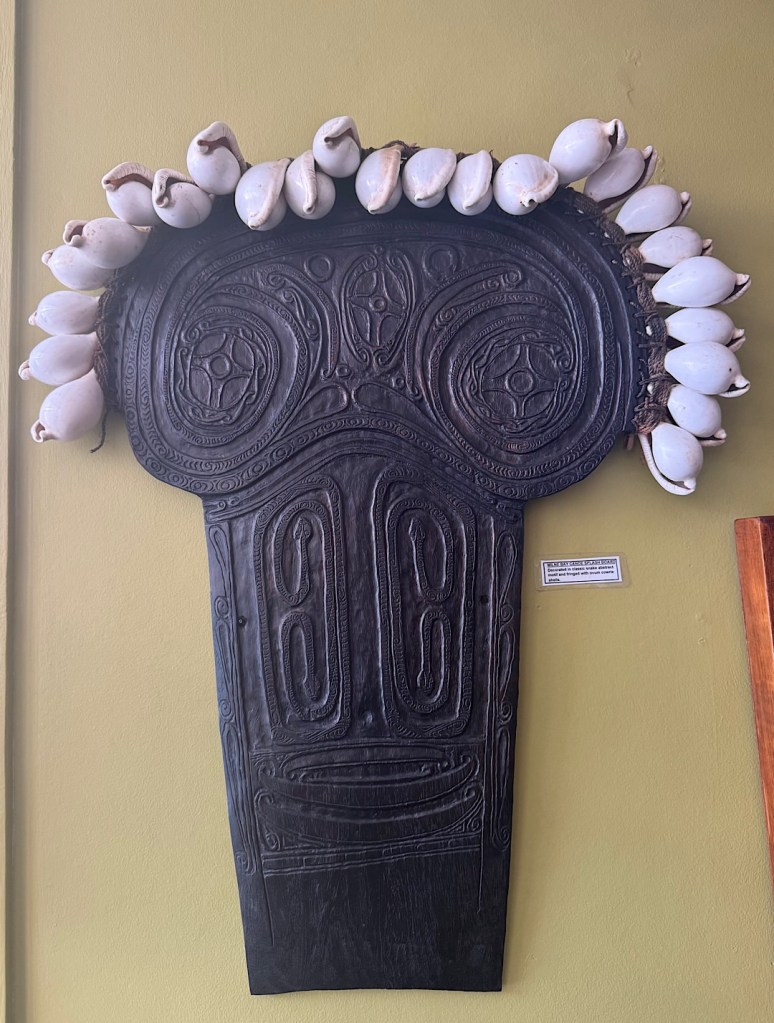
Among its countless virtues, the Wewak Boutique Hotel has a cafe whose walls are filled with beautiful carved and decorated objects.

We took a dip in the pool; this time it was idyllic. After we showered and dressed, we were about to go down to dinner when a hotel worker knocked and said the doctor had arrived to check on Steve. 

This was a surprise. But such a nice one! Dr. Julius Plinduo turned out to be a calm, patient man who sat down with us on one of the veranda couches. An emergency medicine specialist, he’s currently filling in for the doctor who died, serving as the administrator of the local hospital — and willing to help the occasional visitor with a medical problem. He listened to our story, then began asking a series of questions. Besides his gentle thoroughness, his methodical astuteness was evident.

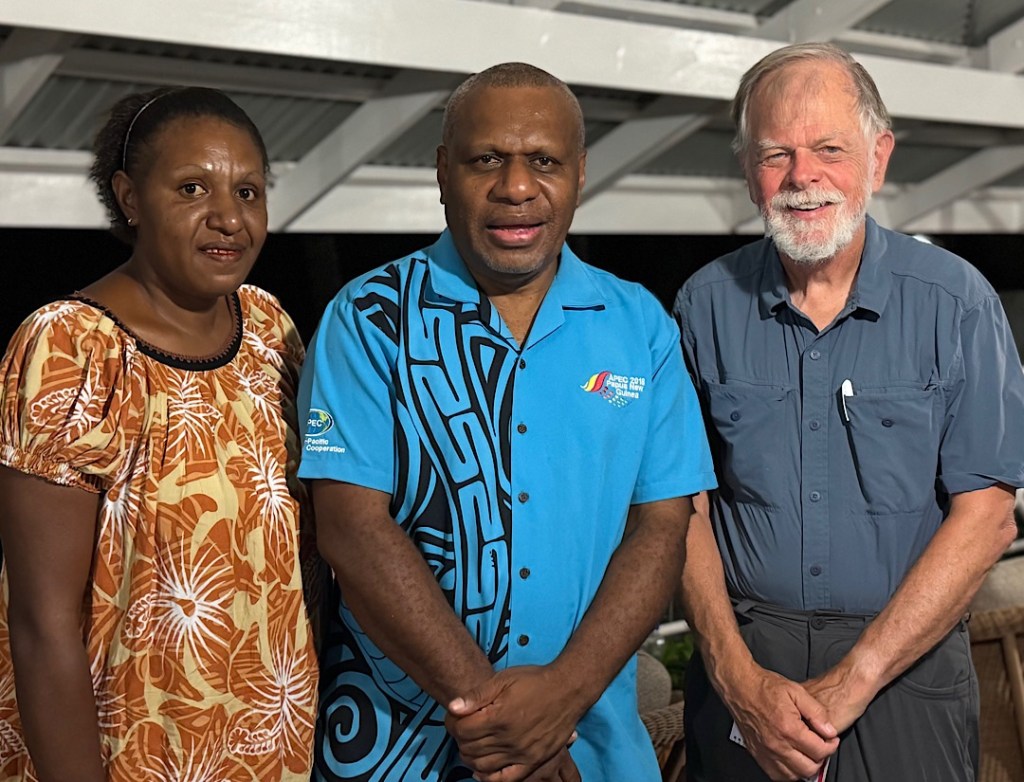
Dr. Julius, flanked by his wife Ellem and the patient.

He pulled a scale out of his medical toolbox; weighed Steve then extracted a blood-pressure monitor to check Steve’s numbers. He had Steve write down his email address and phone number, closely observing his writing skills; eying his gait. After a full hour of such assessment, he told us he thought Steve probably had had a TIA, likely triggered by all the travel stress and sleep deprivation and heat and dehydration. He thought we’d been wise and prudent not to continue on with the river trip. But with some rest and relaxation (and eventual follow-up when we got home), he predicted Steve would be fine.

We paid him 200 kina (a little under $50) for all this advice and the report he promised to write and email to us. We were exchanging goodbyes with him and his wife (who had tagged along for some reason), when Steve thought to ask if they could recommend any place locally where we might find the crafts we had hoped to buy on the river. 

Dr. Julius said there was such a place not far away. And if we wanted, he would have a driver arrive with his wife to take us to the market Friday morning and escort us while we shopped there. Flabbergasted by this generosity, we demurred, but he said they were happy to help us experience and enjoy their country.

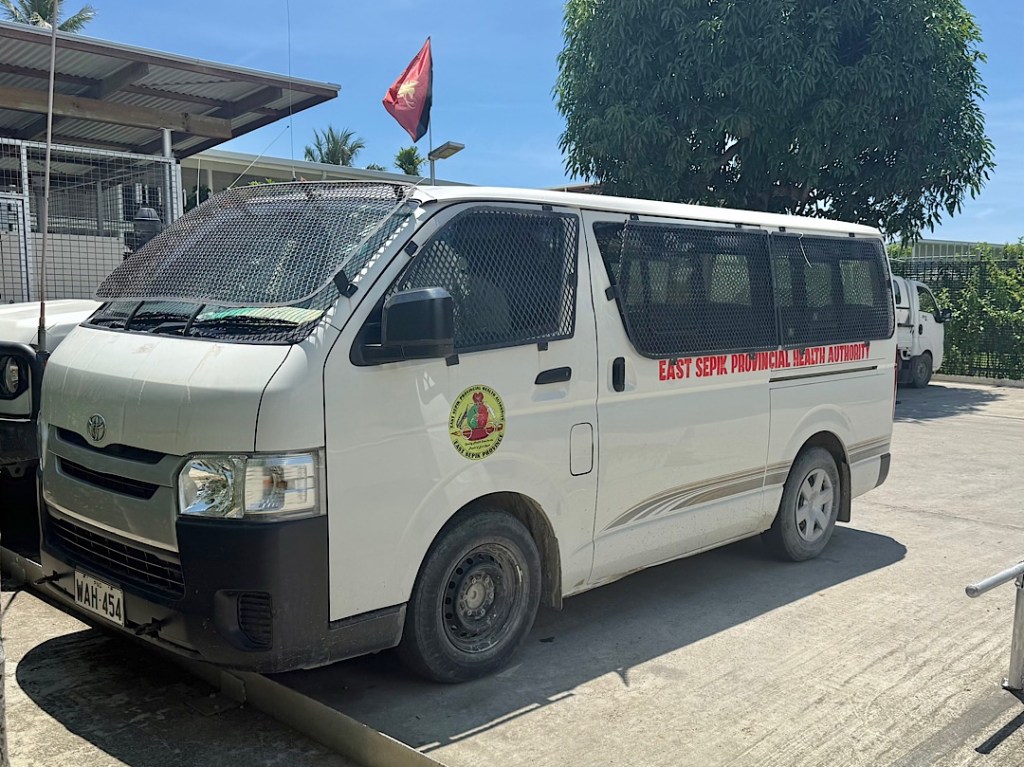
Both of us slept better Thursday night than we have in weeks, and around 10:15 the next morning, a driver pulled up in the hospital van.

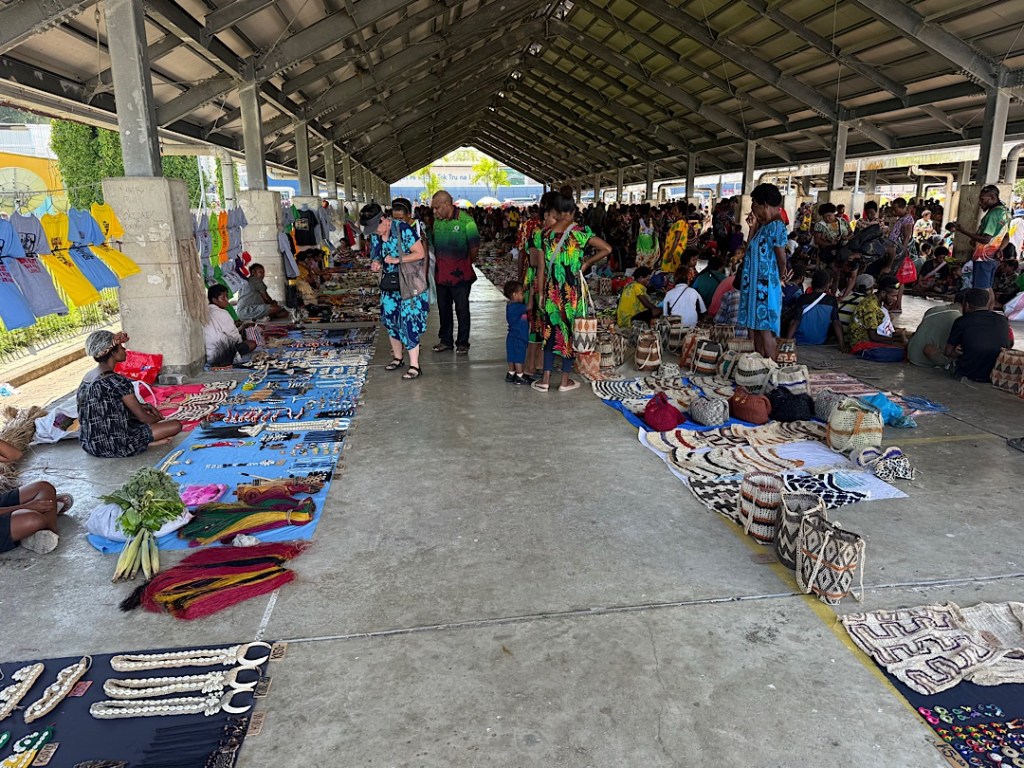
Dr. Julius and his wife sat inside. He had an errand to run near the market, he said, and she would accompany us on our shopping run. It wasn’t a large market, but it was stocked with a good variety of produce and crafts.  We breezed through it, bought some things, and were back at the hotel before noon.

The market
The kid was not for sale but lots of lovely basketry and carvings were.

I was hoping to be able to wrap up this post and publish it in Port Moresby. But at 1 pm Saturday, we’re still stuck in Wewak. Once again we were up before 5 and at the airport by 5:40 for a 7:40 flight that we were told had been delayed to 8:40. Then an incredible downpour began that continued for maybe 45 minutes. It finally played out, but only after flooding the runway. Someone announced that all flights out would be cancelled for 24 hours.

Now we’ve gotten word there’s some slight chance a plane from nearby Vanimo might land here later today and continue on to Port Moresby. This is all quite suspenseful, particularly since our flight out of the country is scheduled for 9:40 tomorrow morning.

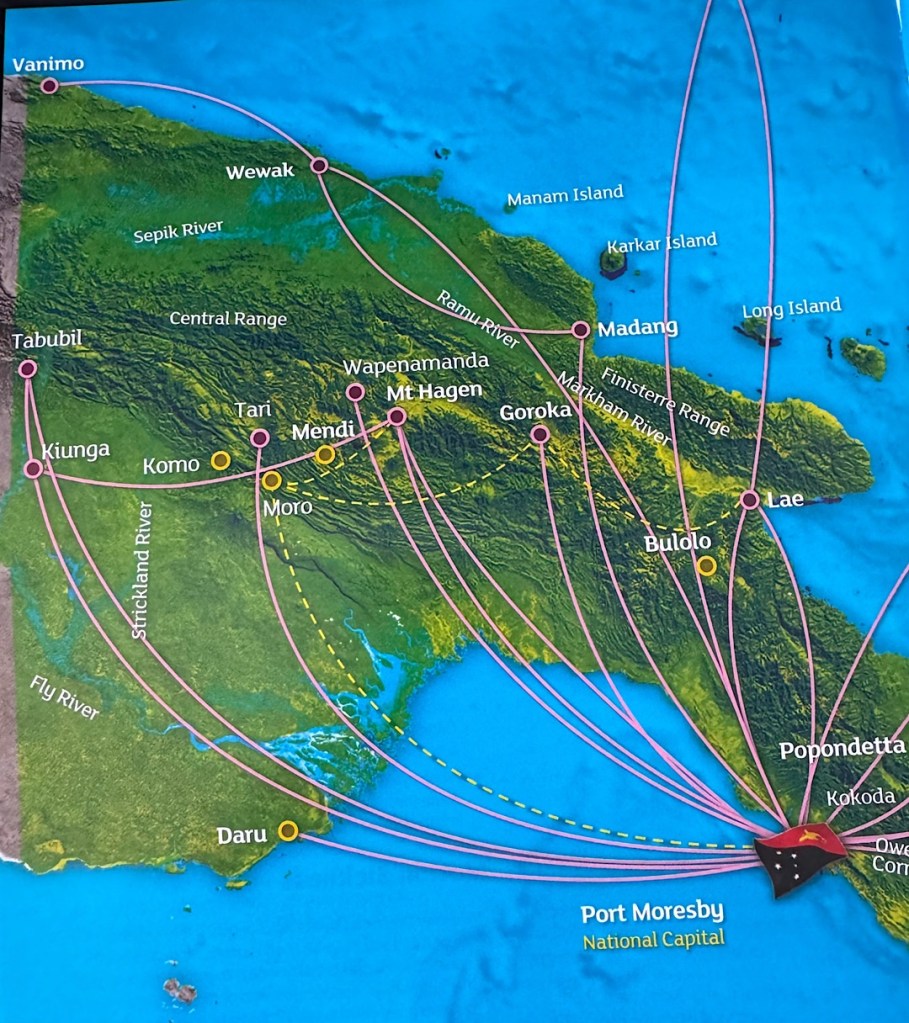
You can see Wewak up on the northern coast. Vanimo is also on the coast, but just across the border from the western half of New Guinea, the province of Indonesia known as Irian Jaya. (Map courtesy of the Air Niugini inflight magazine.)
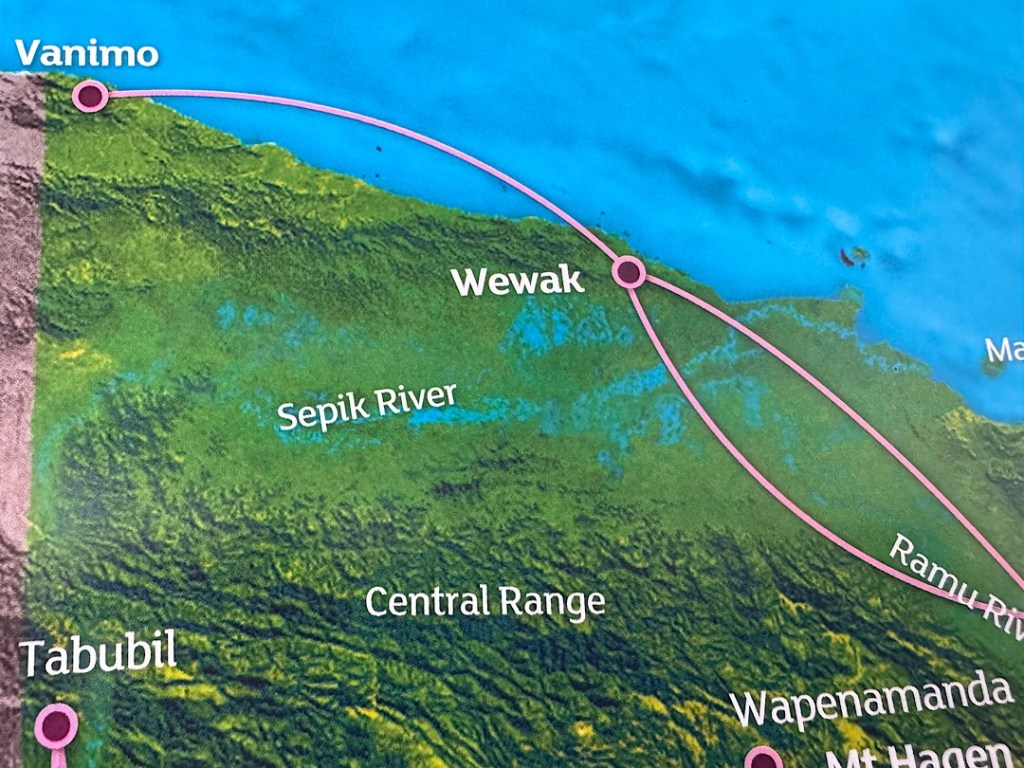
A closer look at the Sepik River. Now I don’t expect to ever see it.
Nervous fliers

Tell people you’re going to Papua New Guinea, and you’re likely to hear expressions of concern. It may come from folks who know about the cannibalism and headhunting practiced here well into the 20th Century. Or the violence in the western provinces resulting from abuses by the mining companies. Maybe that region is something to avoid, but cannibalism is now a thing of the past. What should send chills down the spine of any aspiring visitor is the prospect of flying around this country. 

I don’t think Air Niugini planes are particularly unsafe or its pilots incompetent. We’ve flown them now three times, and all the aircraft looked well-maintained.  Because of the daunting geography and weather patterns, pilots must be able to land without relying on instruments; they have a reputation for being highly skilled. PNG’s air infrastructure, however, has provided Steve and me with one of the worst flying days of our lives.

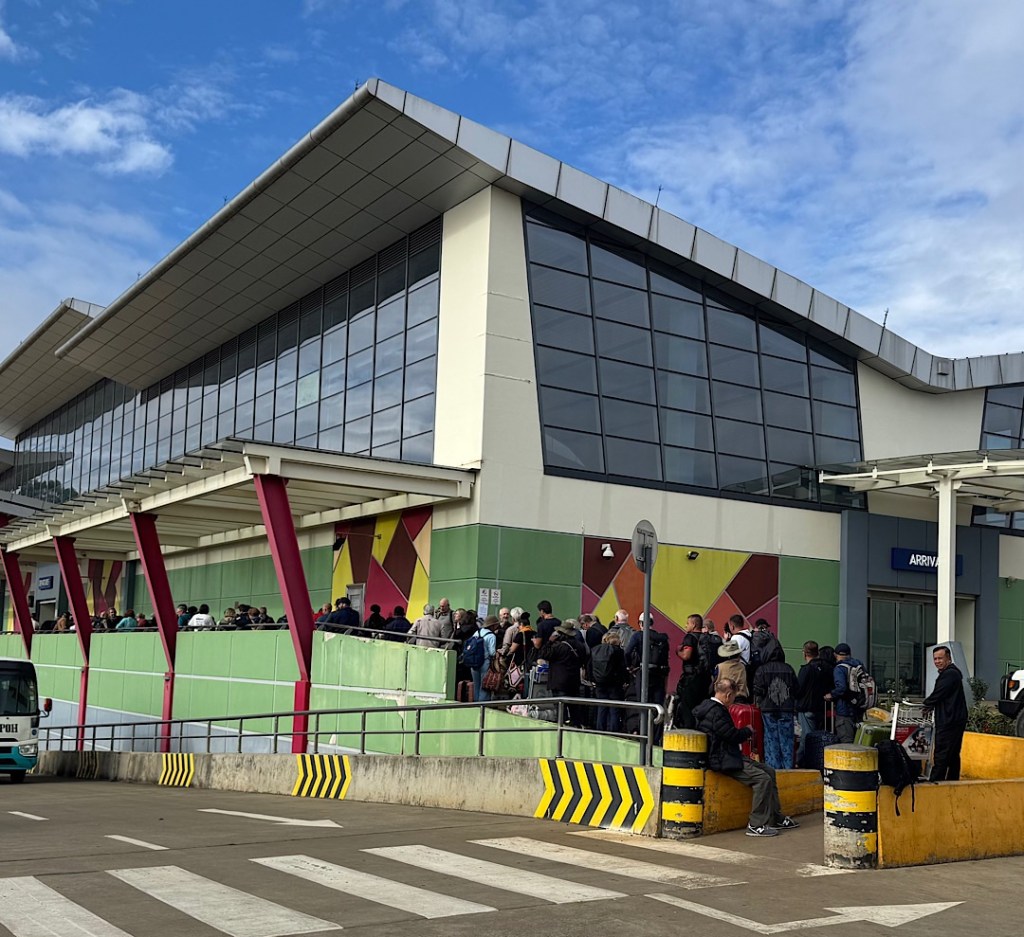
For our flight from Goroka back to Pt. Moresby Tuesday morning, the 20 people in our group piled into the bus shortly after 7. We arrived at Goroka’s pleasant, new airport about 7:45 to find a line of people out the terminal doors and wrapping around the building.

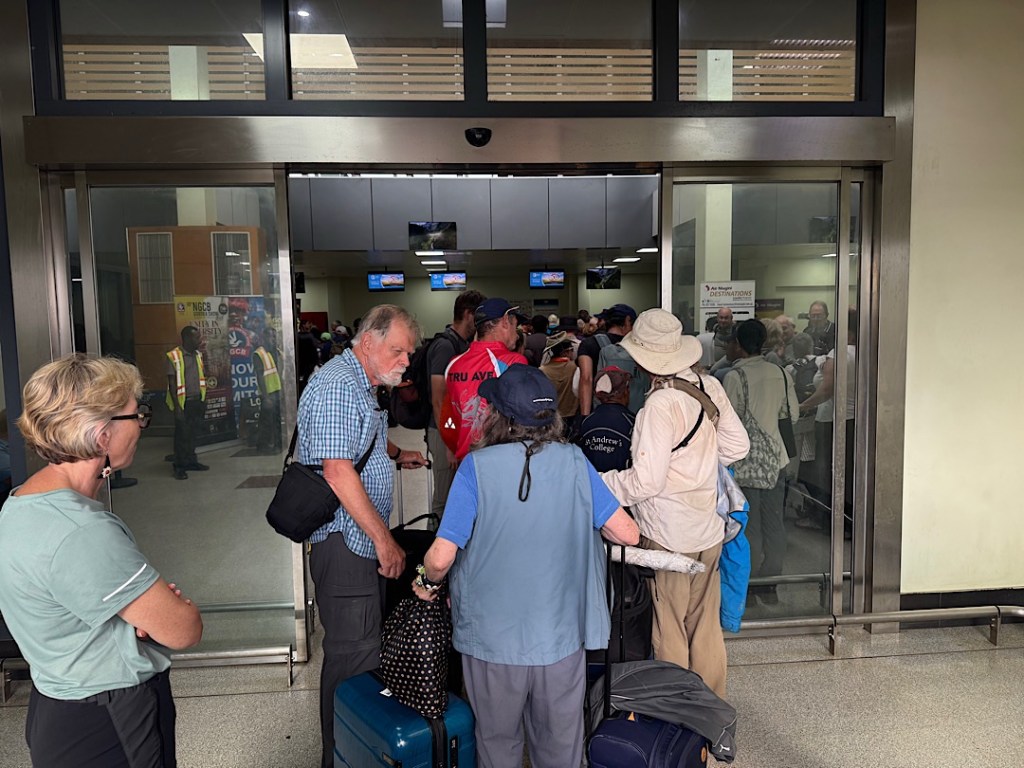
We joined the queue and reached the front door a little before 8:30. But more than two hours later, we still had not arrived at the check-in desk, where two harried workers faced something approaching a mob. As the wait stretched out, bits of explanation dribbled out.  

The computer system had gone down, we heard, so the check-in guys were having to hand-write every boarding pass. Moreover thunderstorms had forced the cancellation of the previous day’s afternoon flight to the capital. Those passengers were supposed to be able to fly out this morning on a Fokker 100. But it had broken. The airline had replaced it with a Fokker 70, but it accommodated only 70 people instead of 100.

Steve and I got to within just a few steps of the check-in desk. It was then that one of the two check-in guys called for everyone from the previous day’s cancelled flight — a couple dozen people, as it turned out —to move in front of us.

Finally, shortly before 11, one of the two check-in agents announced that the morning flight — on which our group had been scheduled to travel — was full. We should be able to get out on another flight leaving at 4 pm, he indicated.

More hours passed. Christopher’s assistant, Caroline, collected all our passports and check-in baggage and waited to check in all of us and our bags at 1 pm. Steve chatted with Christopher, who said Air Niugini is owned and operated by the Papua New Guinean government, which chronically underfunds the airline and the country’s aviation system. The airline routinely fails to pay its fuel suppliers. The suppliers then stop providing fuel. Christopher said it was common for the airline to kick passengers off flights in order to take on more freight, which is more profitable, and thus generate income to get the cash flowing again.

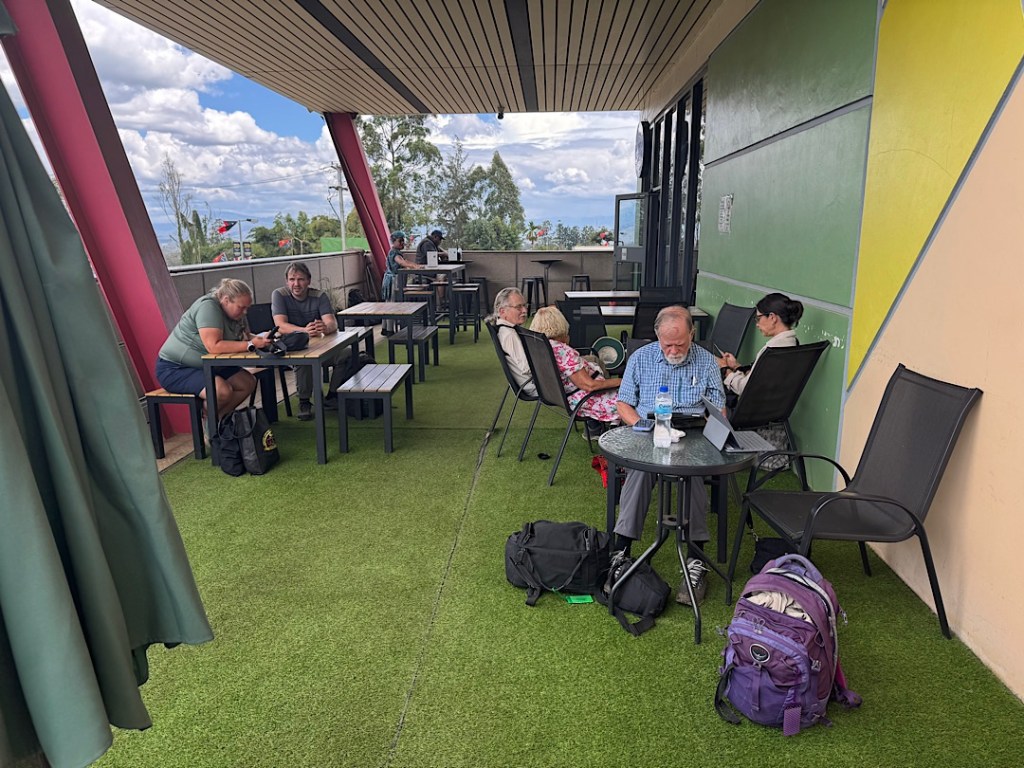
I may have gotten some of these details wrong. I was tired and growing more so by the minute. I tried not to think about when or whether our plane would arrive. Happily, the airport has a pleasant coffee shop opening onto a terrace. Steve and I distracted ourselves there drinking cappuccinos and eating decent pizza and writing.

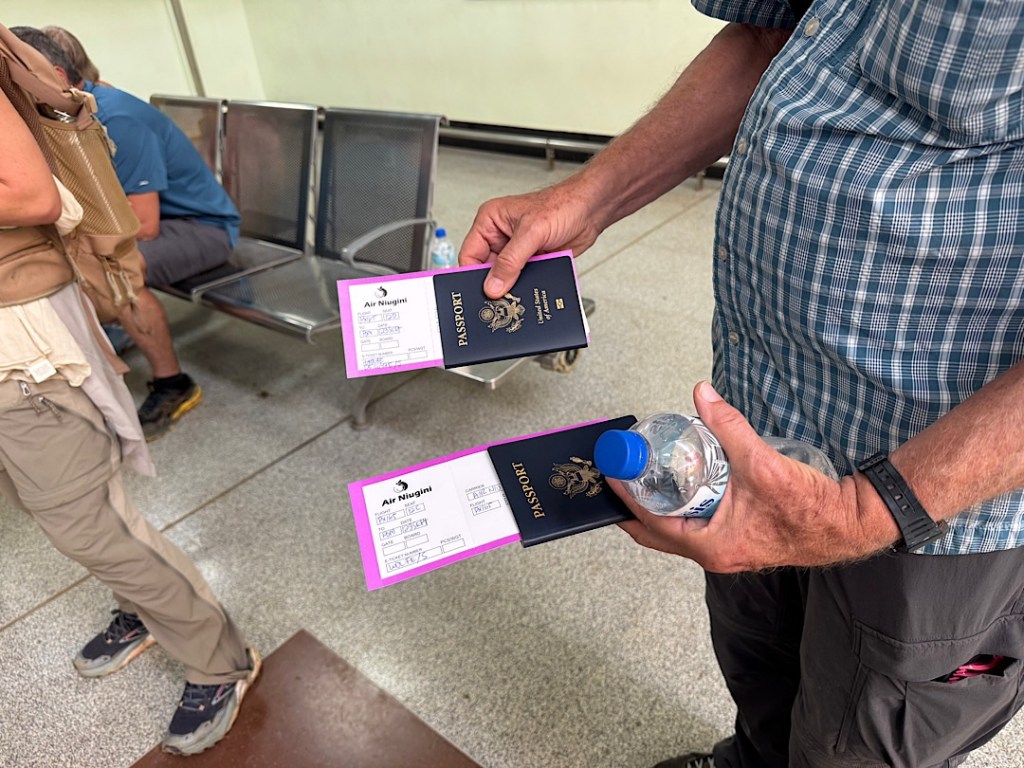
Everyone perked up with the news that around 2 pm, Caroline had managed to secure our boarding passes.

The passes being prepared.
Passes and passports back in hand!

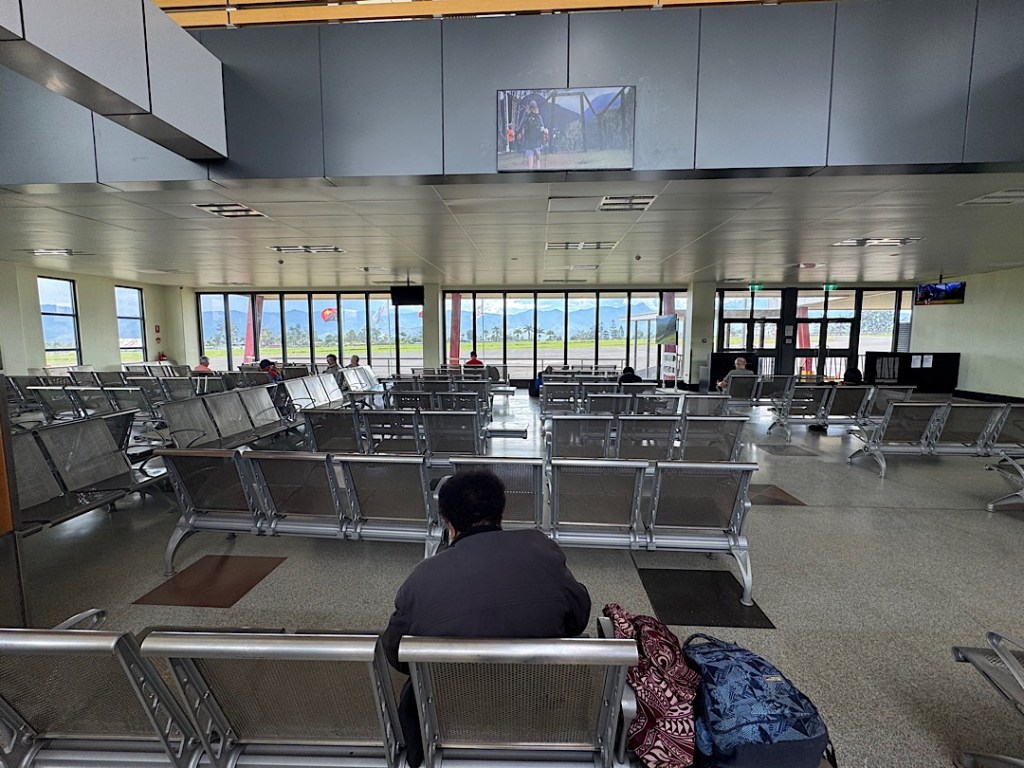
Getting through security was a snap. Signs posted last April announced that because the x-ray machine was “faulty,” our carry-on bags would be searched by hand. But the the “search” was cursory, and we quickly settled into a lovely waiting area.

Four p.m. came and went with no sign of any plane, nor any officials who could provide any info on its whereabouts. But an hour later, the plane, a Bombardier turbojet with a female Papua New Guinean pilot, finally arrived. We hit a few turbulent patches, then 75 minutes after takeoff, our wheels touched the tarmac in Pt. Moresby.

At this point, you might be thinking: Why would anyone fly instead of driving? The other day we did drive the relatively short distance from Mt. Hagen to Goroka, But it took about 5 hours and patches of that road were dreadful. At first I assumed a drive from Goroka to Ft. Moresby, would be more grueling than flying. But then Christopher disabused me. There IS no road connecting Goroka with the capital. A mining company built the other road out of Mt. Hagen. “No mine, no road,” Christopher pointed out.

We have two more flights on Air Niugini, and I’m a bit nervous about both. The first, from Pt. Moresby to Wewak, was supposed to leave this morning (Wednesday, 9/24) at 9:30. We were up at 5:45 am to return to the airport in order to catch it. But then Christopher messaged that it was delayed until 12:30 pm. The good news is that this delay enabled me to finish and publish this post. We’ll see how the rest of the day works out.
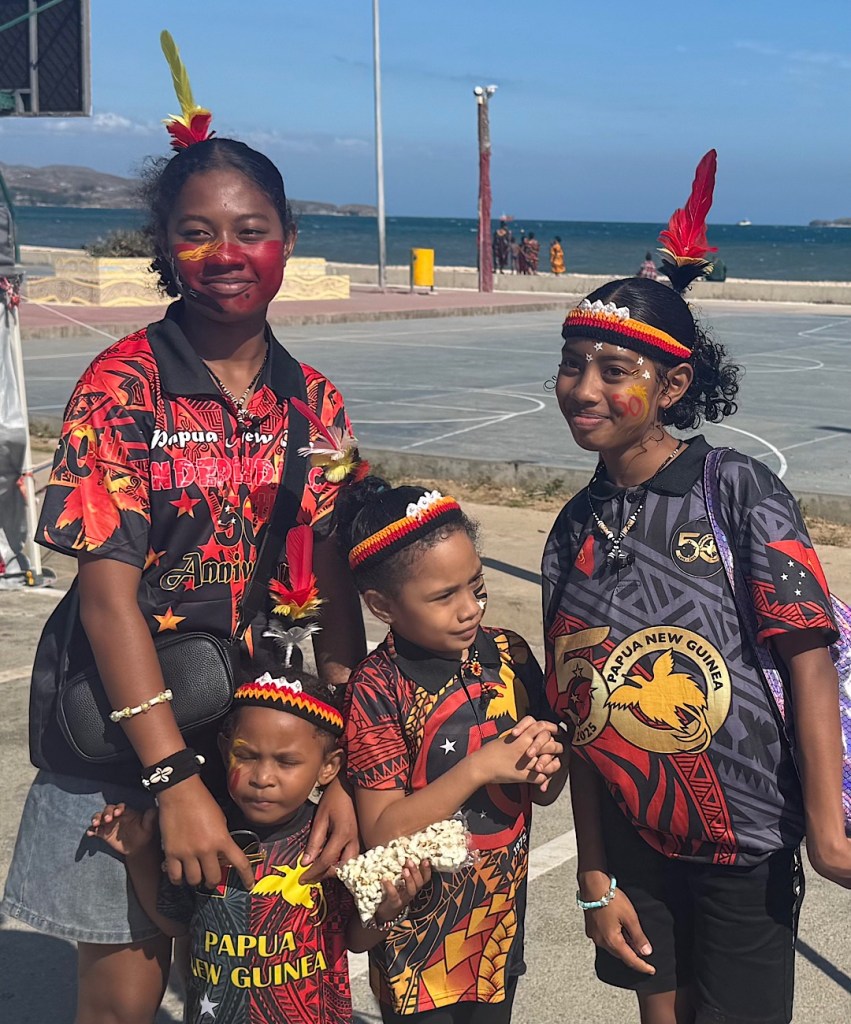
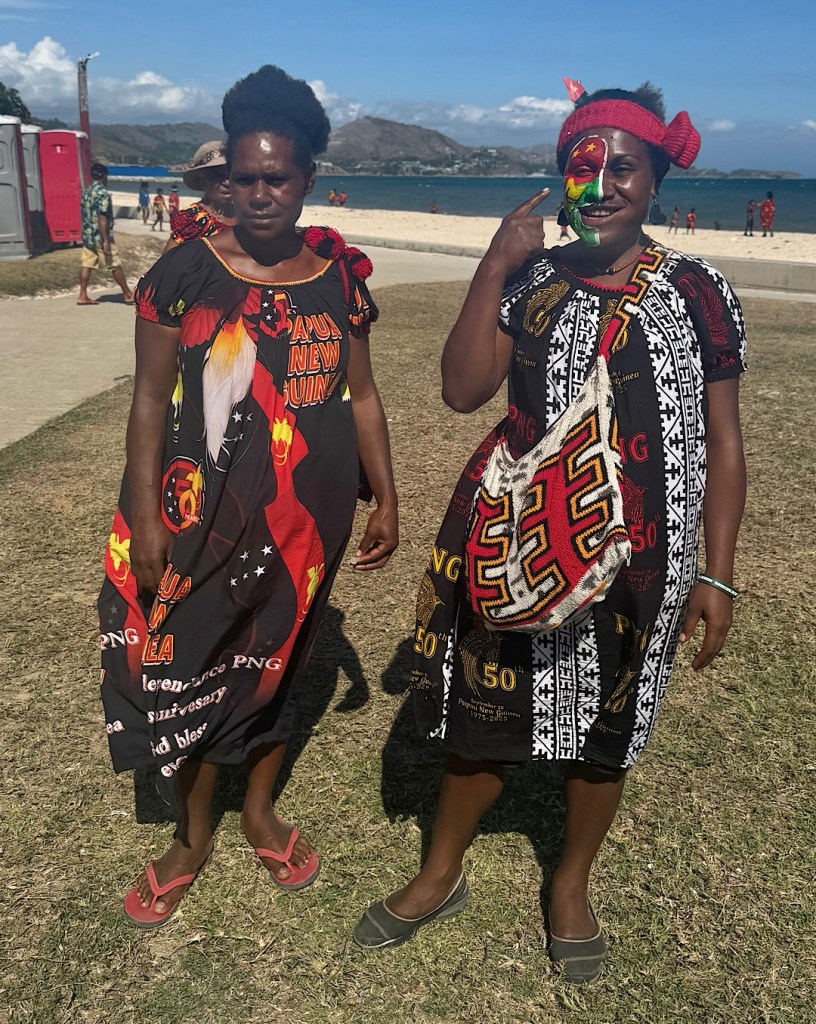
Preview of a remarkable attraction

I took this photo at the Goroka Festival, which we attended this past weekend. The color and design and weirdness is a tiny taste of what this event was like — unlike any I’ve ever had anywhere. I’d like to share some of my photos and what I learned and heard and felt, but the Internet is terrible in the highlands, and we suspect it will get worse Wednesday, when we fly up to the Sepik River region. 

So I plan to work on that post and pick out some of my favorite pictures and publish it after we fly to the land of lightning-fast internet (i.e. Japan) September 30. Between now and then, I’ll see if I can squeak out another shorter, less resource-intensive post or two. We’ve been seeing strange and wonderful things every day.

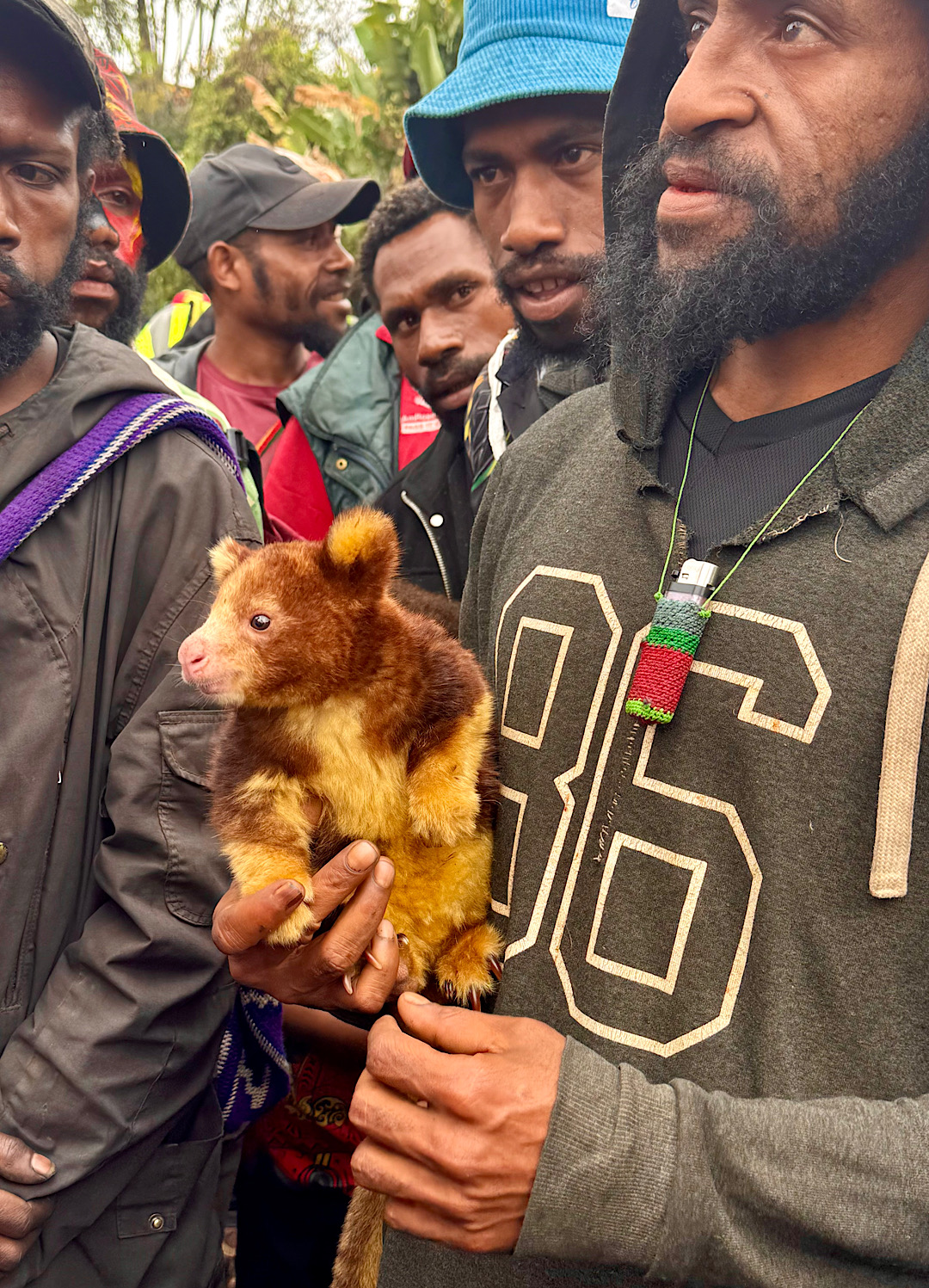
Monday morning as we were boarding our van to explore more of the highlands, this guy was standing next to it with his (apparently pet) tree kangaroo. (Usually we only see their fur, used on various ceremonial garments. And I’ve read they’re also very tasty.)


Birding in paradise

Some visitors come to PNG just for the natural wonders. Life here is fantastically diverse. The island contains about 5% of all the living species on the planet (a large percentage of which are found nowhere else). Its forests form the third-largest contiguous rainforest and contain more than 2000 species of orchids, some 2000 species of ferns, and more than 800 species of birds. Although our tour group’s focus is the human inhabitants, everyone was delighted to devote a chunk of one day this week to birds.

Because we’d had such a long day Tuesday (flying to Mt. Hagen in the Western Highlands, visiting its central market, driving to a village to attend the Independence Day celebrations there, and more), our group leader Christopher declared we would not try to depart well before dawn the next morning (the original plan). That would have allowed us to reach our first birding spot as the sun was coming up and the birds were at their liveliest. Instead we reached the Kumul Lodge around 10:30.

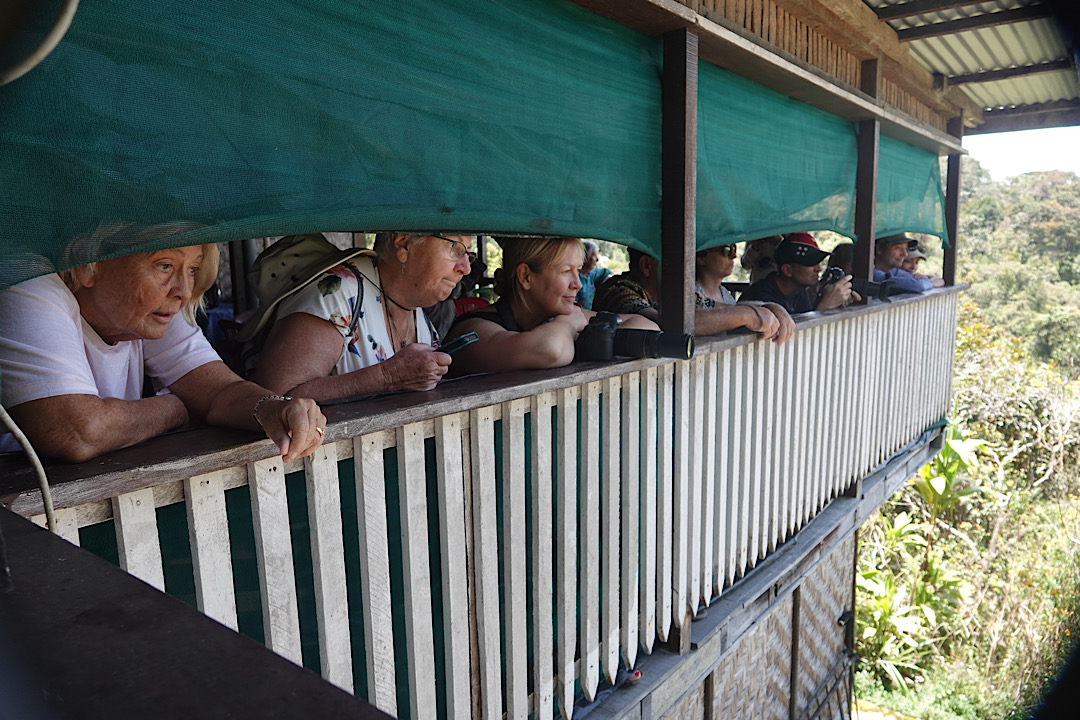
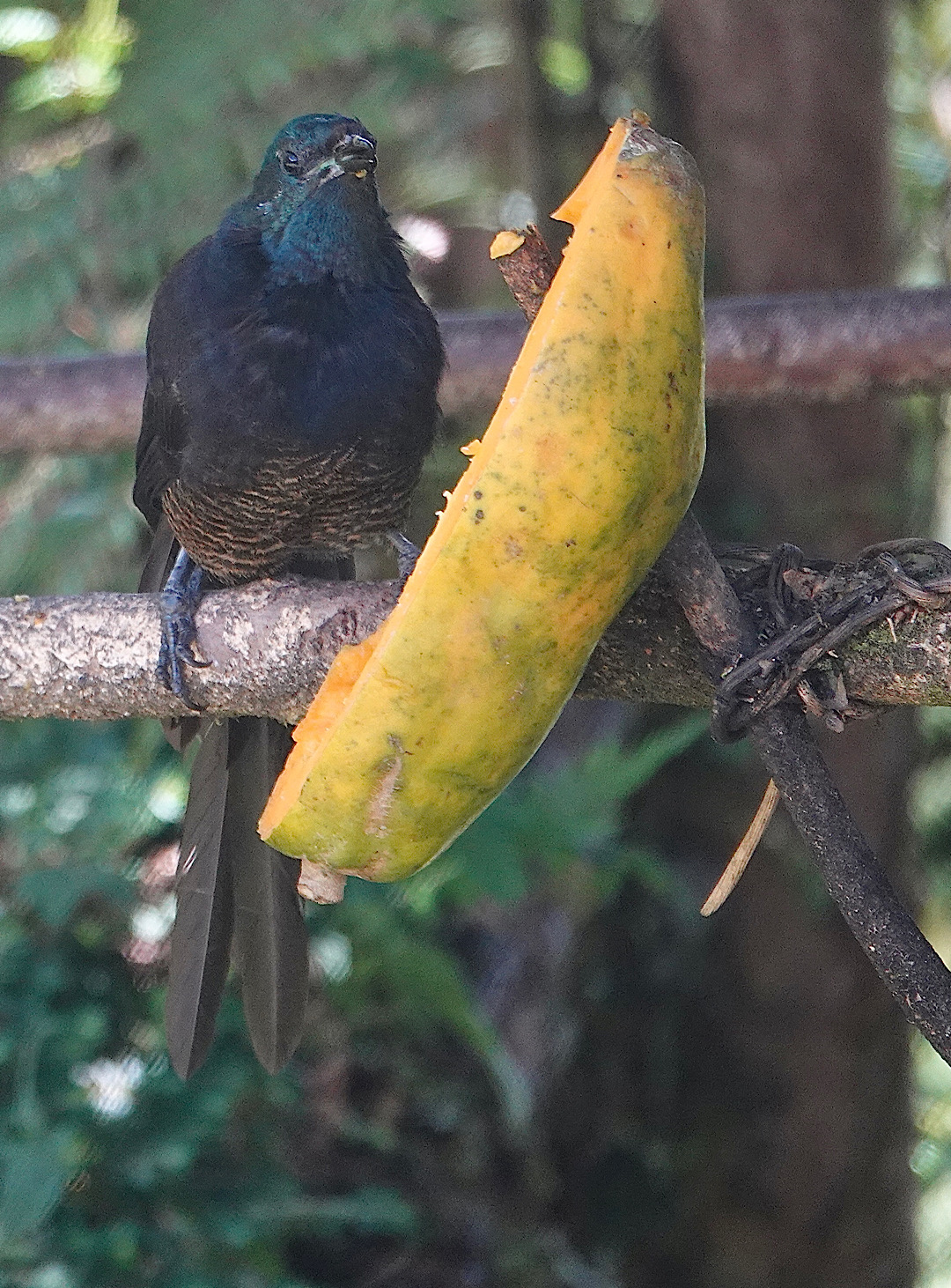
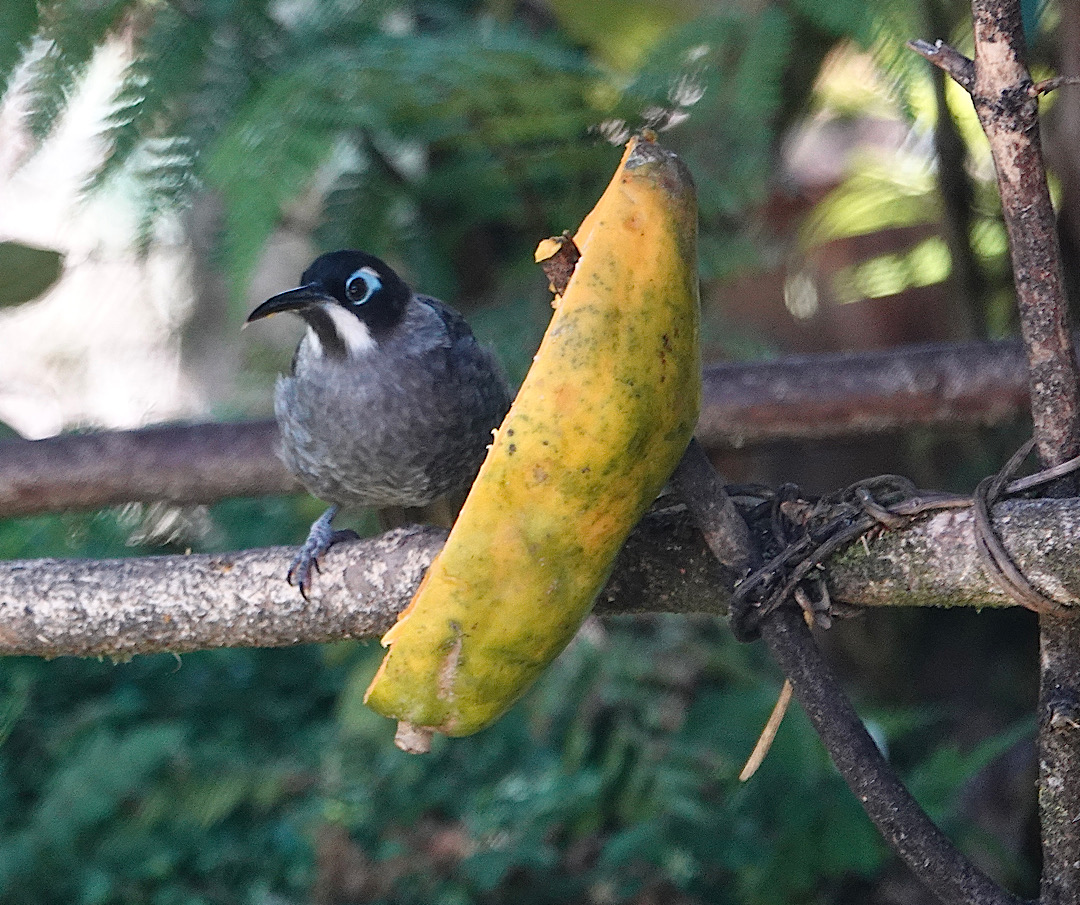
The lodge had two observation decks where guests could sit quietly, their lenses pointed at the fruit mounted on sticks set up near thick brush.

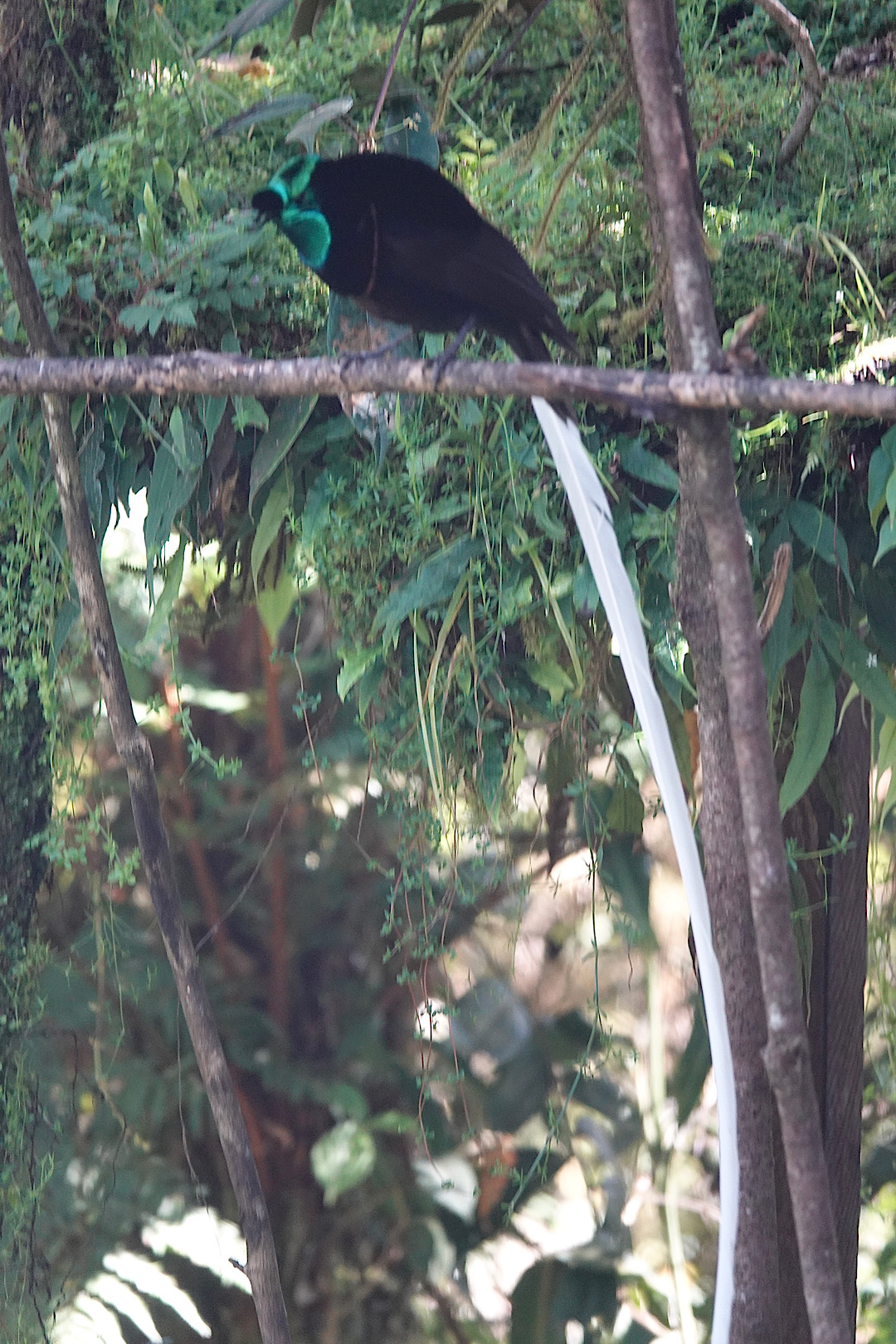
At once, shutters started clicking. Someone whispered that the long white object hanging from a perch across the yard was the tail of a Ribbon-Tailed Austrapia — one of the dozens of birds of paradise in PNG. There’s a case to be made that birds of paradise are the most amazing avians in the world. They perform fantastic dances when they’re courting mates. But they’re also very beautiful, even when not performing. 

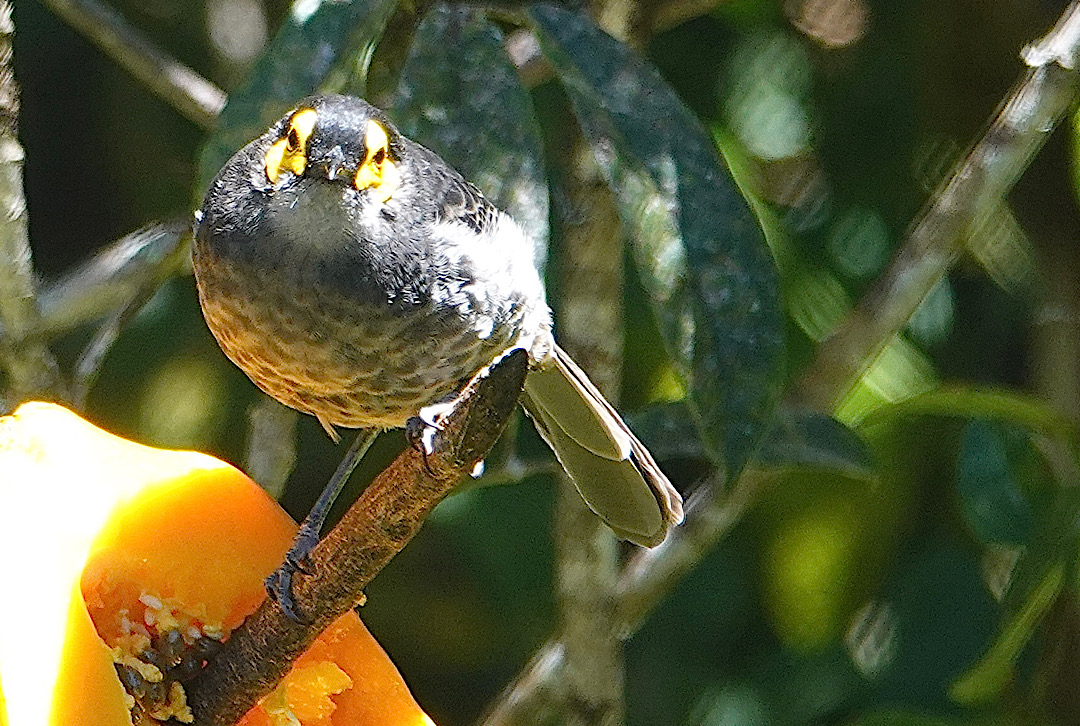
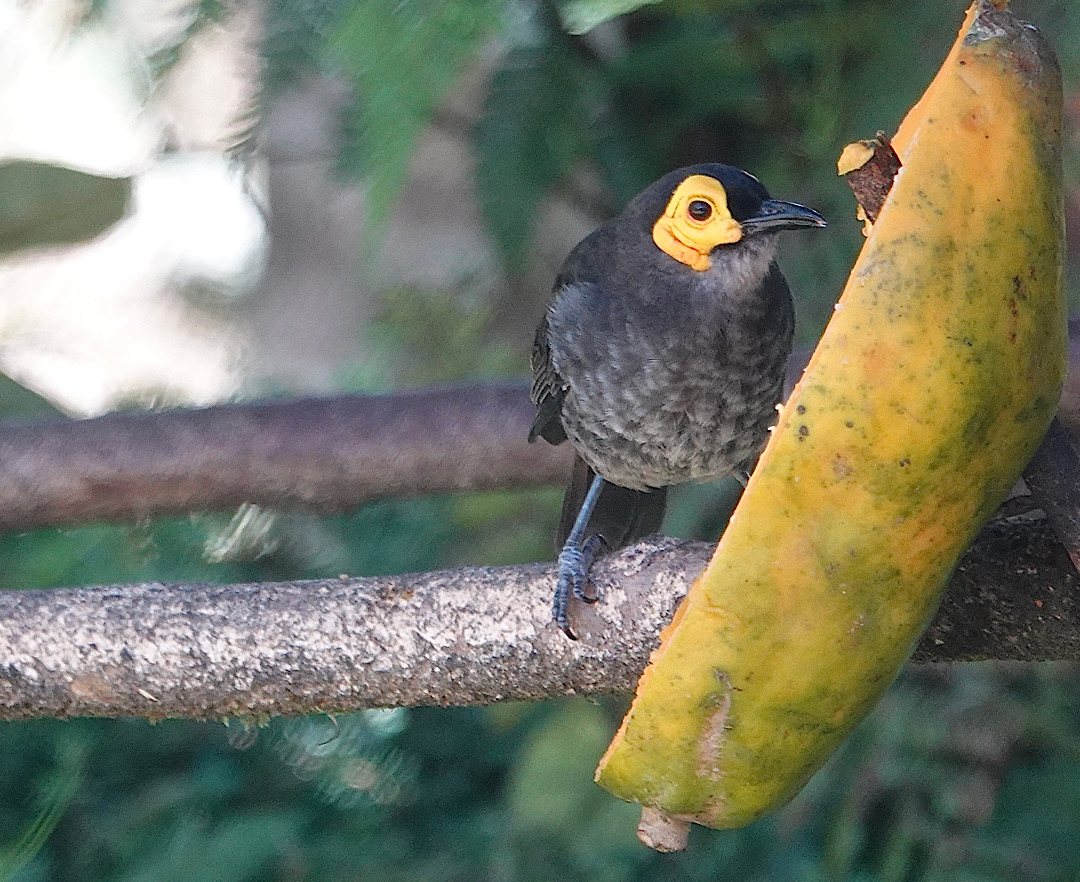
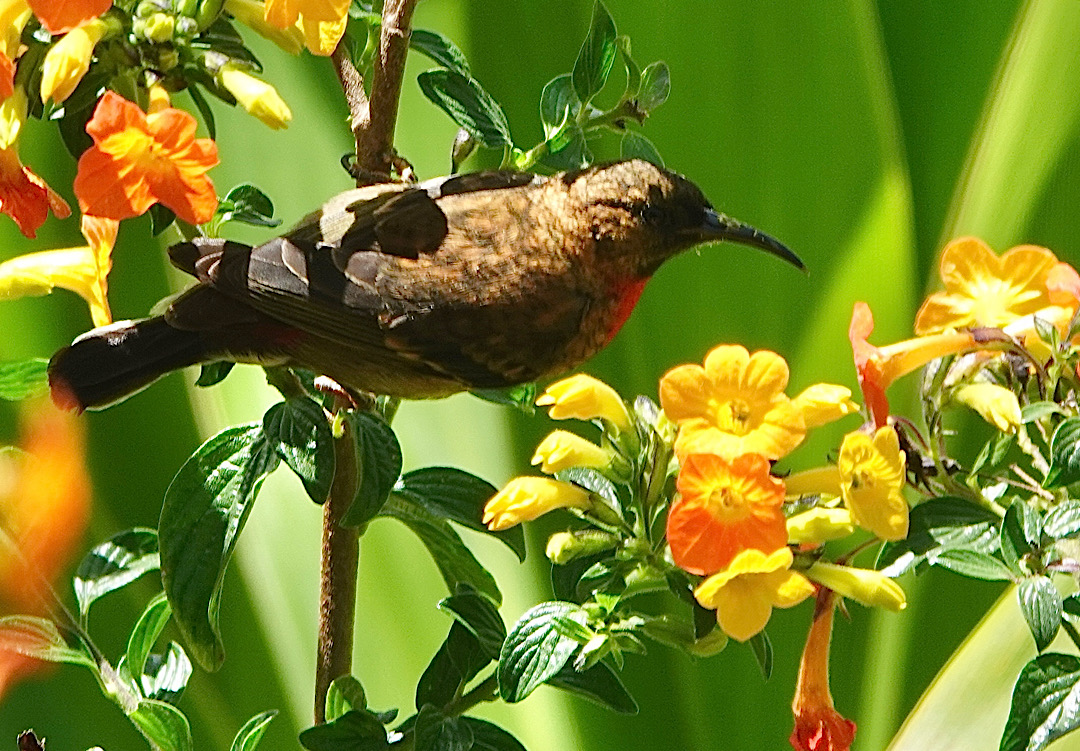
This fellow was very elusive; my best photo (above) wasn’t very good. But we saw many other beauties, including a couple different types of honeyeaters.

A female Ribbon-Tailed Austrapia…
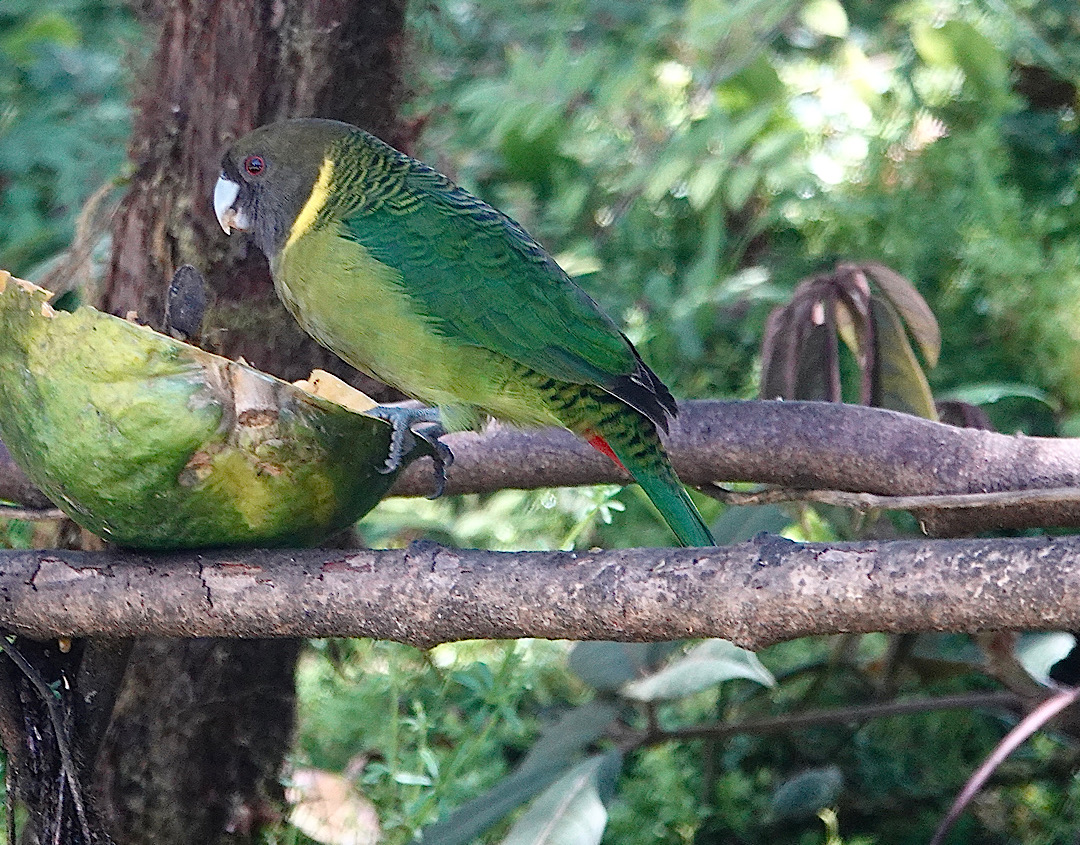
A male Brehm’s Tiger Parrot…
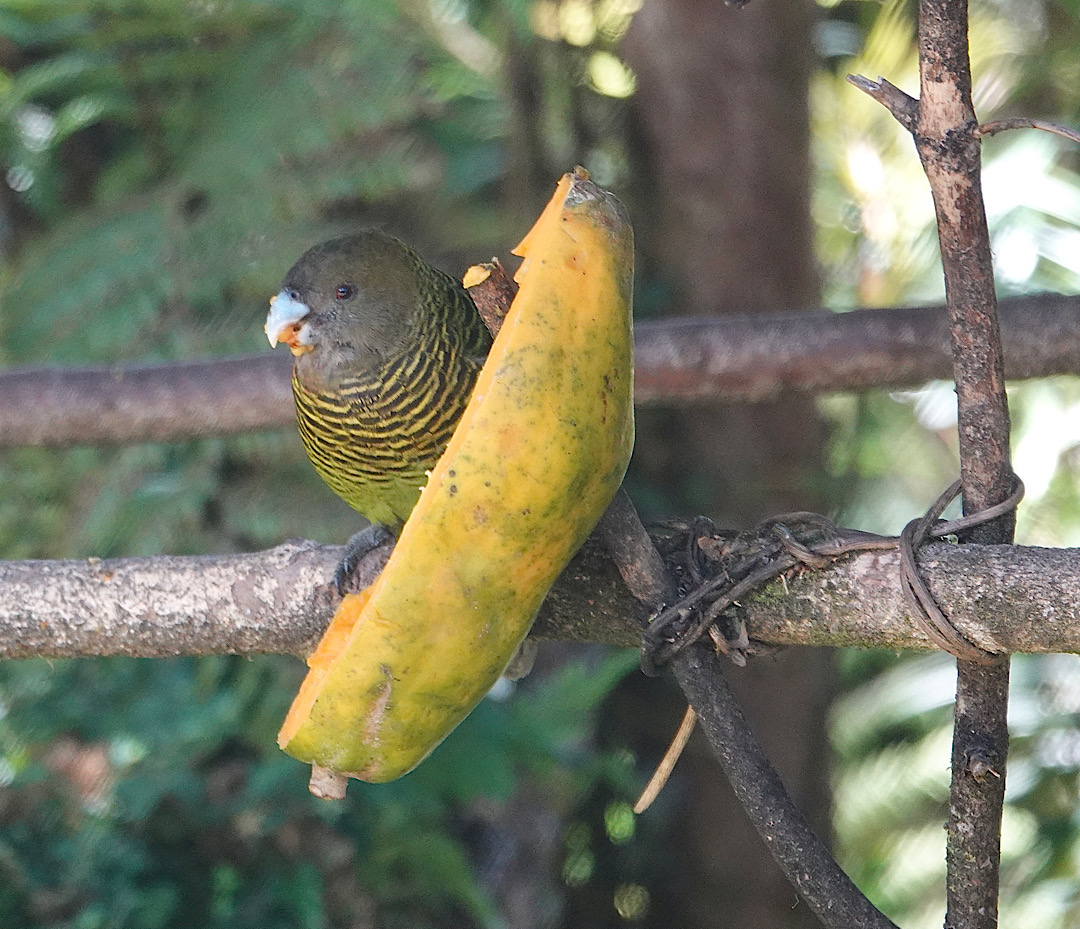
And a female one. (She was a messy eater.)
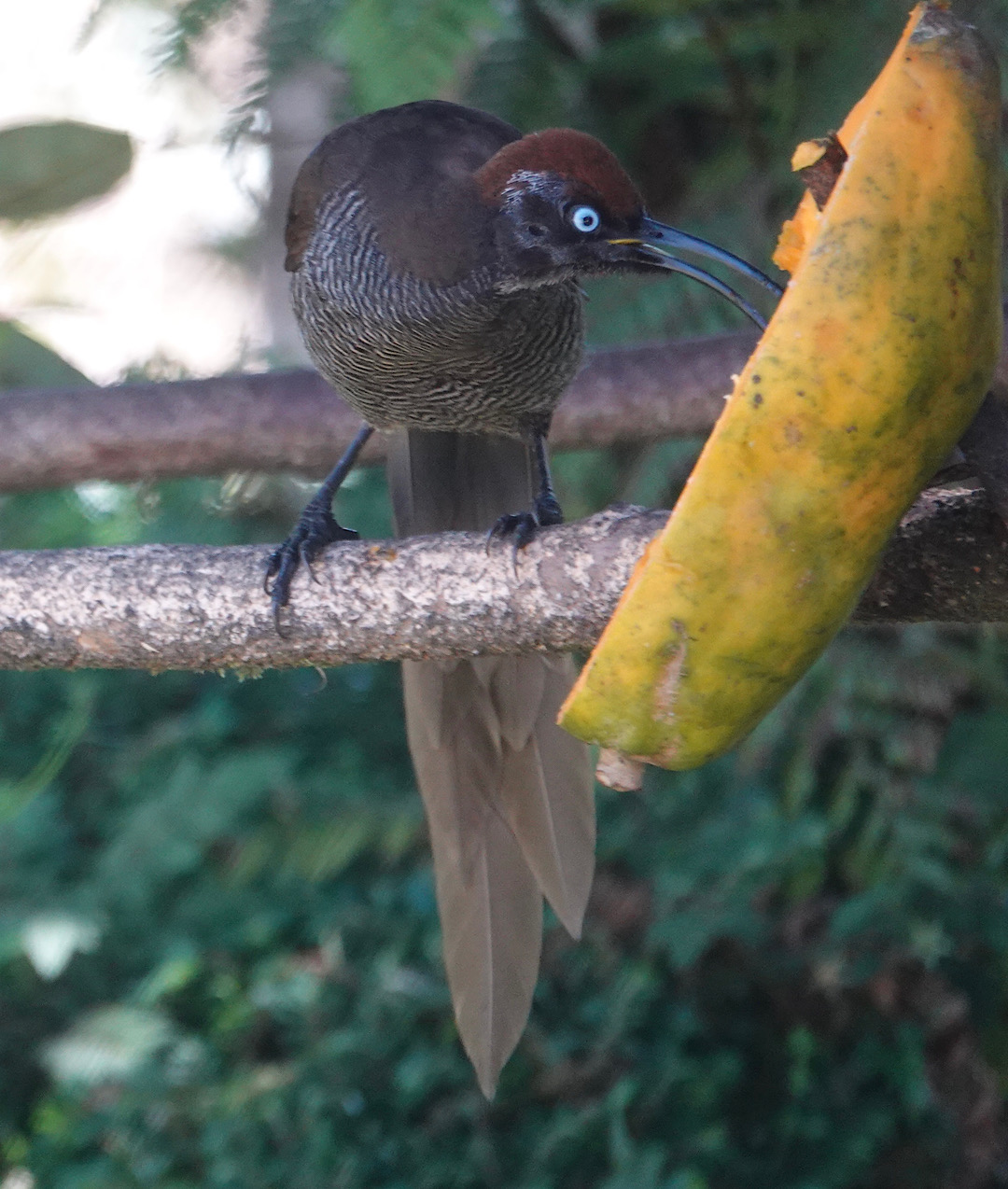
A female Brown Sicklebill. This is another species of bird of paradise.
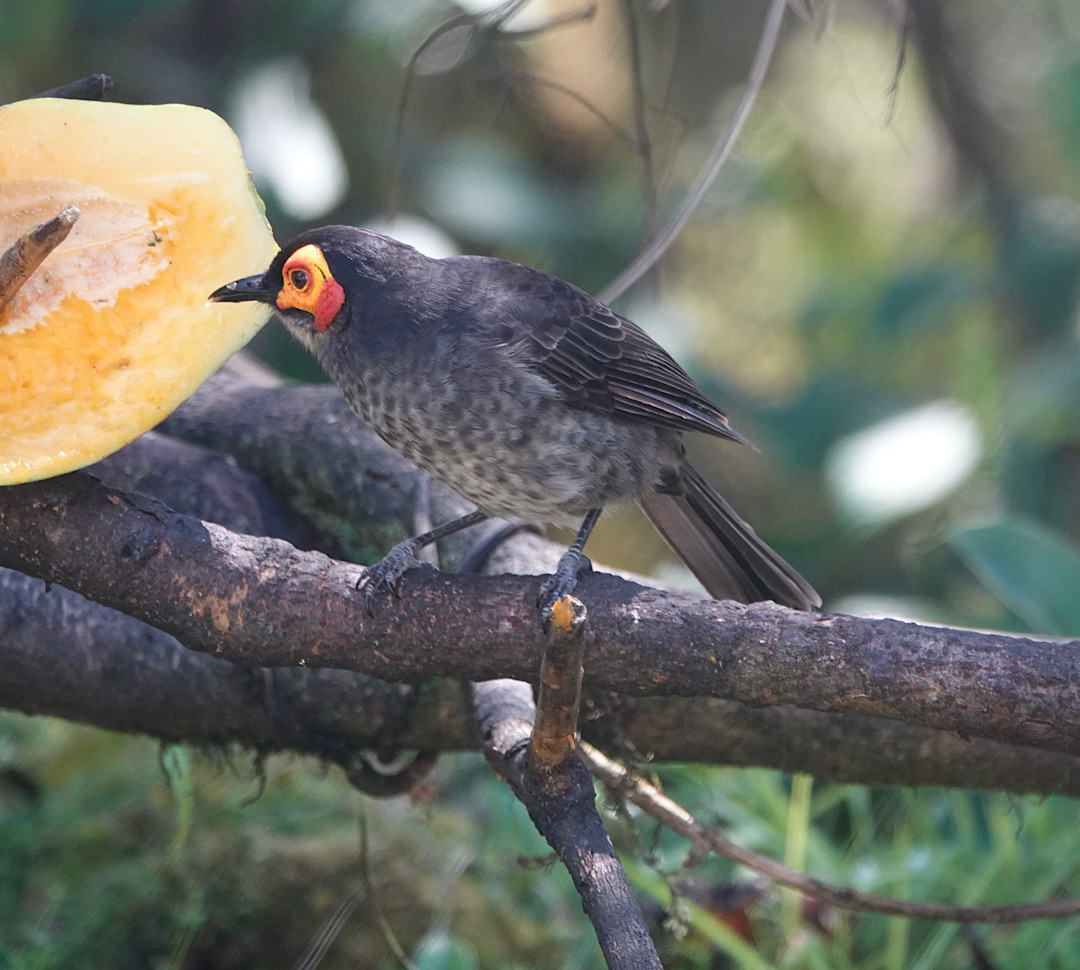
Belford’s Melidectes

We ate lunch at the Kumul, then drove to another birding lodge not far away. On its observation platform, no one saw much of anything, so Christopher led us on a short hike up a hill to a spot overlooking a stand of forest. In short order, someone spotted a King of Saxony bird of paradise hidden in a distant tree. For me this was a frustrating experience. As hard as I tried, I couldn’t see it. Other group members tried to direct my gaze. Only when we were about to leave and I looked through someone’s very expensive binoculars, did I finally locate it. So if I had a birding list, I could add the King of Saxony to it.

I’ve never been tempted to start or maintain such a list, but I should keep a log of days spent outdoors in beautiful country, dazzled by the world around me. I’d have to add this one for sure.

A Red-Collared Myzomela

Reconsider travel to Papua New Guinea

Steve thinks weather can color first impressions of wherever you’ve landed. That was true of our arrival in Papua New Guinea Sunday morning. We had a pleasant two-hour flight from Honiara to Pt. Moresby, PNG’s capital. But we descended to the airport through skies filled with menacing clouds. On the ground, gusty winds matched the evil reputation of this city, which regularly ranks among the most dangerous in the world. 

We reached our hotel around 3 and were assigned a room on the fifth floor. It had huge windows overlooking the nearby beach, but the wind was shaking them so violently I could imagine them shattering. The racket continued all evening and was still so loud when I went to bed I had to wear earplugs.

Everything I’d ever read about Pt. Moresby suggested it was not safe to go out and walk around. So even though Monday morning dawned bright and calm, both Steve and I were content to hang out in our room. He worked on his travel journal; I wrote my last blog post. At 2 pm we were supposed to meet up with our tour leader, Christopher Bartlett, in the hotel bar. But mid-morning, a disturbing message popped up on our WhatsApp group chat: Christopher and a half-dozen other tour members were delayed in New Britain, where they’d been scuba diving. With luck, they might land around 4:30. A while later, Christopher Whatsapped again, suggesting we get a ride from the hotel down to Ela Beach, where festive activities celebrating the 50th anniversary of PNG’s independence from Australia were supposed to unfold.

This took a while to organize, but Steve and I and five other members of our 20-person group eventually piled in a van and drove down the hill. It occurred to me that the US State Department wouldn’t approve. PNG is already on their “Reconsider Travel” list because of the crime, particularly in Pt. Moresby, and political unrest in the western highlands. The anniversary celebrations would draw large crowds that might become violent, one bulletin advised, so they should be avoided.

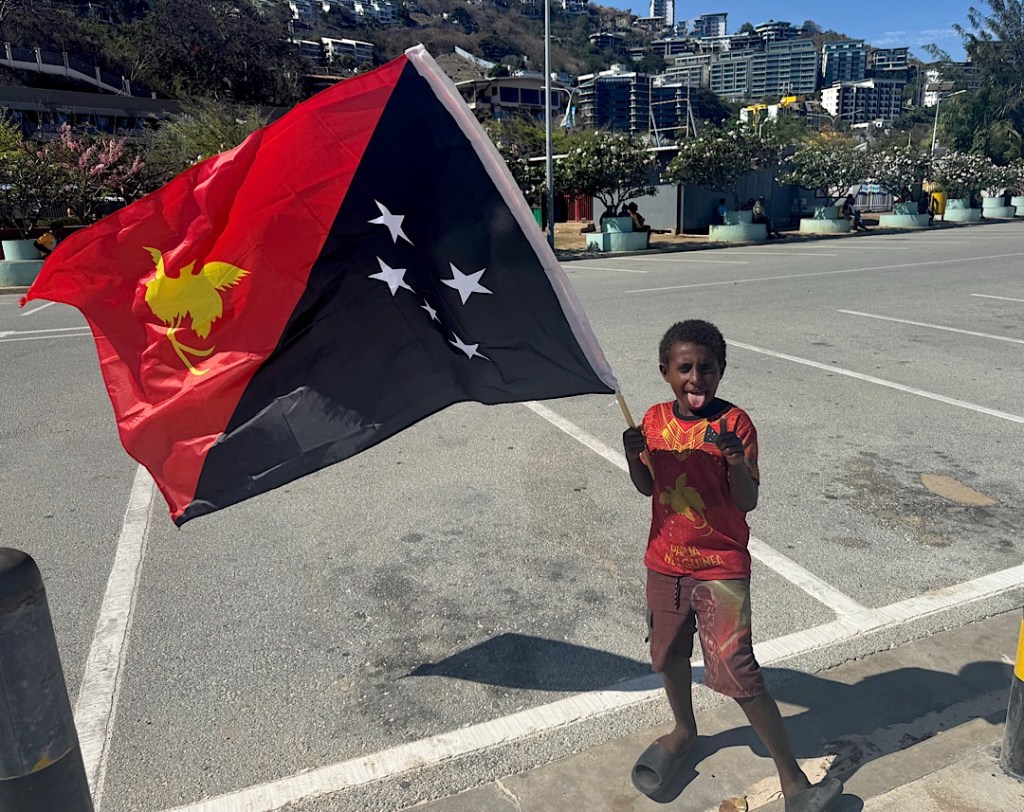
When the van disgorged us next to the beach, however, it was obvious little to no danger lurked here. The balmy day and cool breeze off the ocean would have made anyone feel cheerful, and the women and children and families we encountered on the boardwalk were in an extra ebullient mood. Everyone smiled at us and returned our “hellos” and most were dressed in the red, black and gold national colors, Many waved large PNG flags. They sang out “Happy Independence Day!”and we chorused back the same.

Kate, the only English member of our group, charmed everyone with her enthusiasm. My photo doesn’t show it well, but this guy had painted half his body coal black and the other half red, with a gold bird of paradise on his left chest.

Along the busiest part of the boardwalk, vendors had set up tidy booths where they were selling clothing and jewelry and other crafts. So we shopped and took pictures and made our way to a stage where we caught a few music and dance performances. Then Steve and I and Kate decided to walk back up the hill to our hotel, rather than catch a taxi. No harm befell us. 

I don’t doubt that visitors to Pt. Moresby routinely get robbed or even worse. Still, my experience that afternoon and in the next few days made me think anyone who wouldn’t dream of visiting Papua New Guinea because it’s too dangerous should reconsider their travel plans. 

PS — I’m writing this in the Eastern Highlands. We’ve been on the road for three days, and we’re immersed in the cultural experiences at the heart of this part of our itinerary. Internet connections are getting worse and worse. I’ve decided to keep my posts short, limit the number of photos, and send them whenever I catch a good, brief online connection. But that’s likely to be sporadic for the next few days. 

Winging it

Arriving in Honiara, capital of the Solomon Islands, last Wednesday afternoon, I felt a rare emotion: culture shock. It wasn’t triggered by the fact that all the people looked African. In Fiji we had already passed into the Melanesian sphere of influence. Melanesians are part of the enthnographic family that includes Australian aborigines. Their ancestors came from Africa (as did those of all Homo sapiens) but in the tens of thousands of years since humans arrived in this part of the globe, their faces have continued to reflect where they started out.

Instead, it was the airport that startled us. The terminal building is clean and big enough, but it contained almost nothing that airports in other capital cities hold. We found a single ATM machine and a little currency-exchange stand. But no gift shops were evident. No counters offered cars. No one was selling any SIM cards that would get you local phone service.

Taxis queued up outside seemed to be offering a flat rate to our destination, the Honiara Hotel. This had not been my first choice for accommodation. Back in January, when I was first planning this trip, my online sources made me want to stay at the Heritage Park Hotel, located in the center of this small but lively capital. To my bewilderment, the Heritage Park was already completely booked for our dates.

Understand that the Solomon Islands consistently ranks among the 10 least-visited countries in the world. How could any hotel on any of its 900 islands be sold out 9 months in advance?

I later learned we just happened to be arriving the week when, for the first time in ages, Honiara would be hosting the annual Pacific Islands Forum. The heads of 18 countries and territories would be gathering to discuss regional issues in Oceania; they and their aides had already gobbled up the best digs in town! So I reserved a room at the Honiara; it didn’t sound bad.

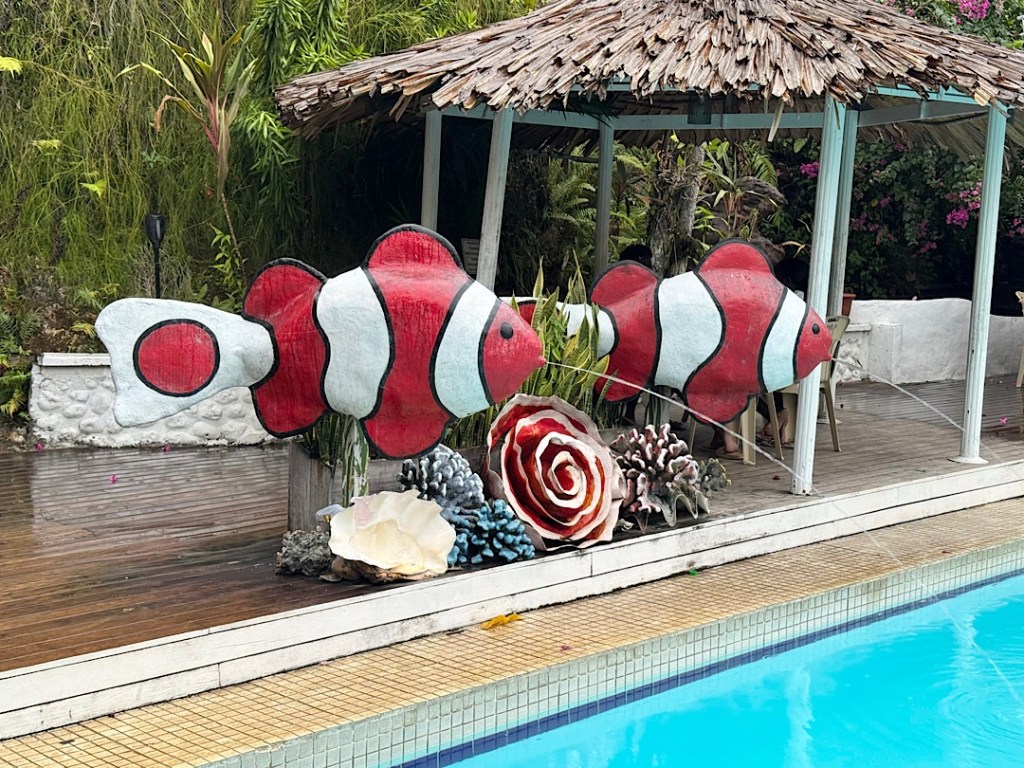
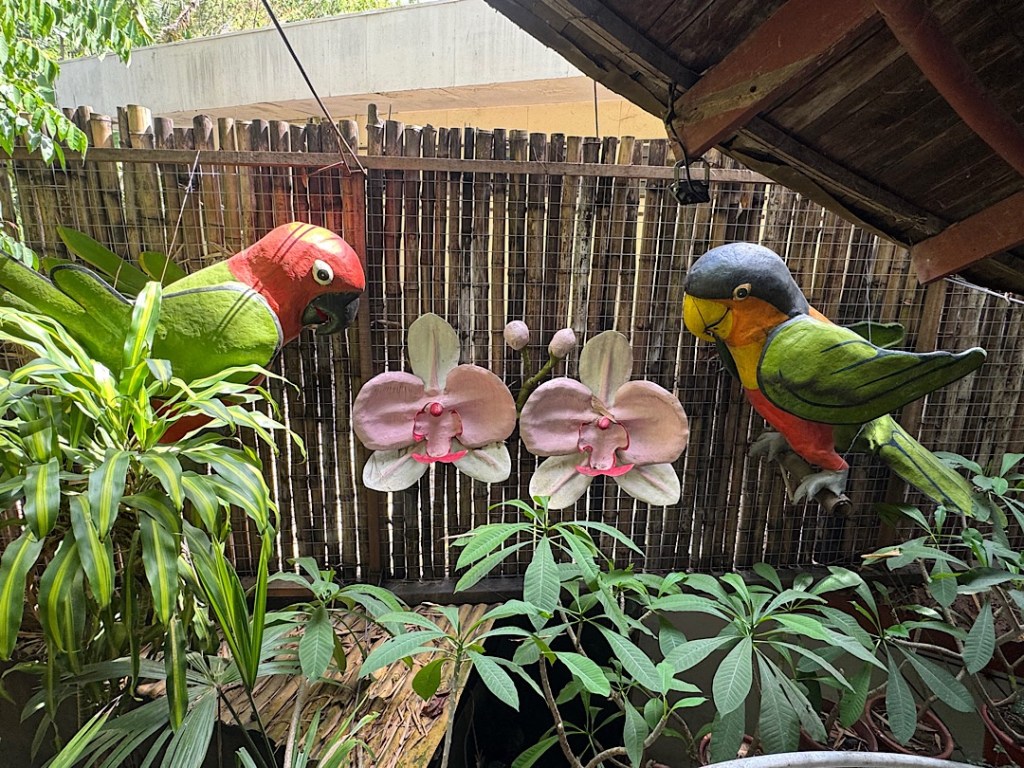
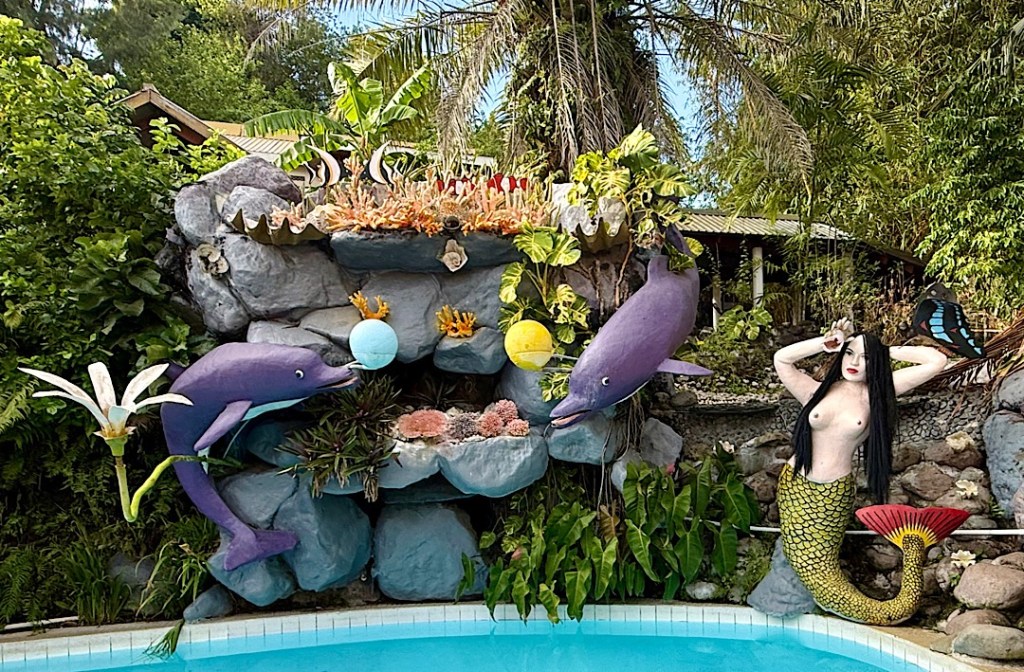
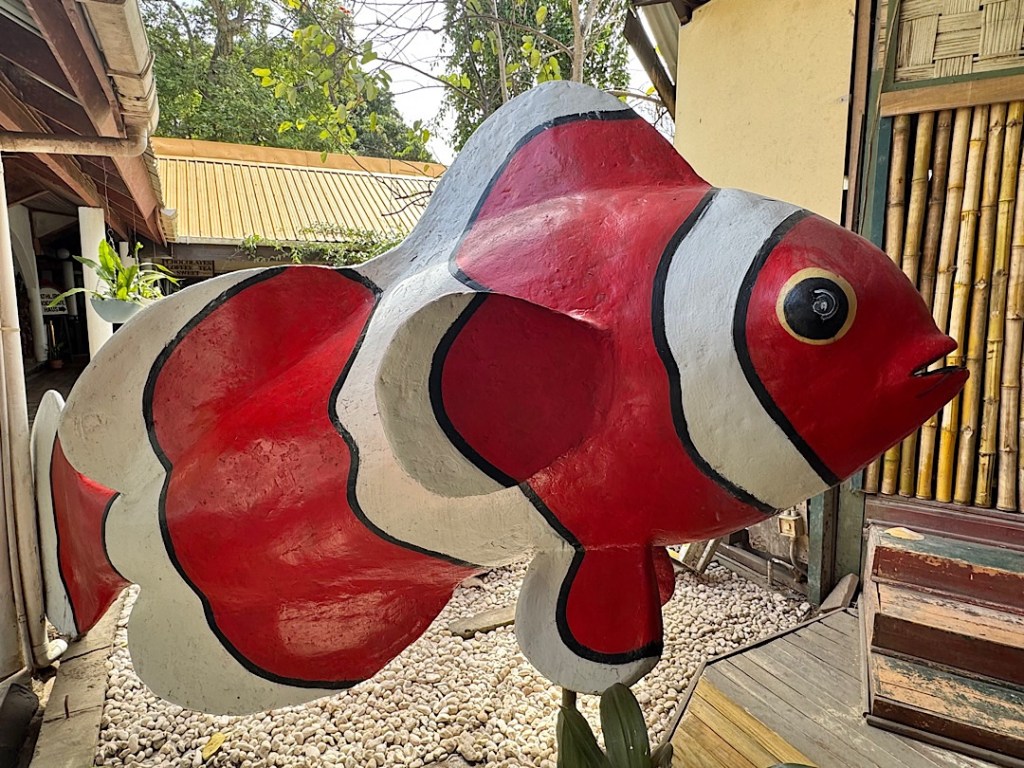
As it turned out, the Honiara was not to be missed. The buildings ramble over a hillside with good views of the water. Concrete staircases lead guests past a head-spinning assortment of giant wildly colorful sculptures. They make the place feel psychedelic.

Why, you might be wondering at this point, did we choose to visit the Solomon Islands? Call it an accident of the air-service network. Honiara is among the few cities in the world with nonstop flights to Pt. Moresby (the capital of Papua New Guinea, our ultimate destination.) And it’s only a three-hour jump via Fiji Airways from Nadi (Fiji) to Honiara. So I booked flights that allowed us to spend four nights in Fiji, followed by two in the Solomons. Then the airline changed its flight schedule, and we wound up with the longer stay in a place about which I knew virtually nothing.

I figured we’d wing it.

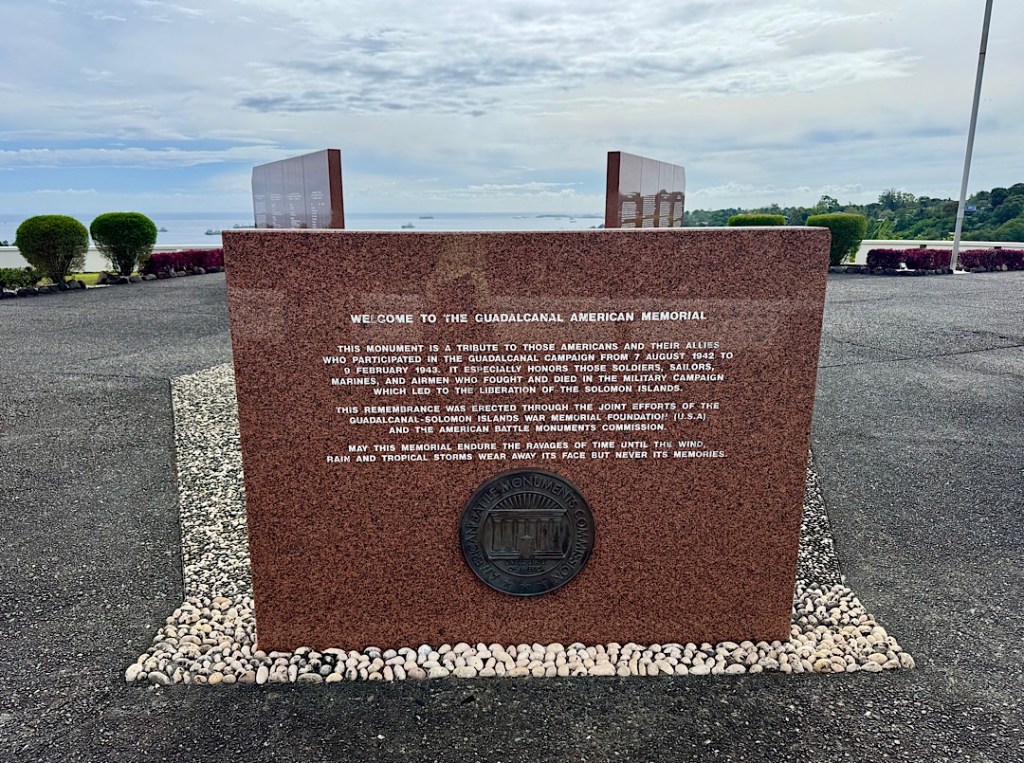
We asked George, the taxi driver who drove us from the airport to our hotel, to pick us up the next morning. He suggested we pay a quick visit to the Guadalcanal American Memorial just down the road. Set high on a hillside, it pays homage to a critical battle in the Pacific theater of World War II. (Honiara is located on Guadalcanal, the largest and most important of the islands that make up the Solomons.)

The outdoor memorial contains a host of granite monuments holding more historical information about the battle than I could ever absorb. WWII is one thing that draws some tourists here.

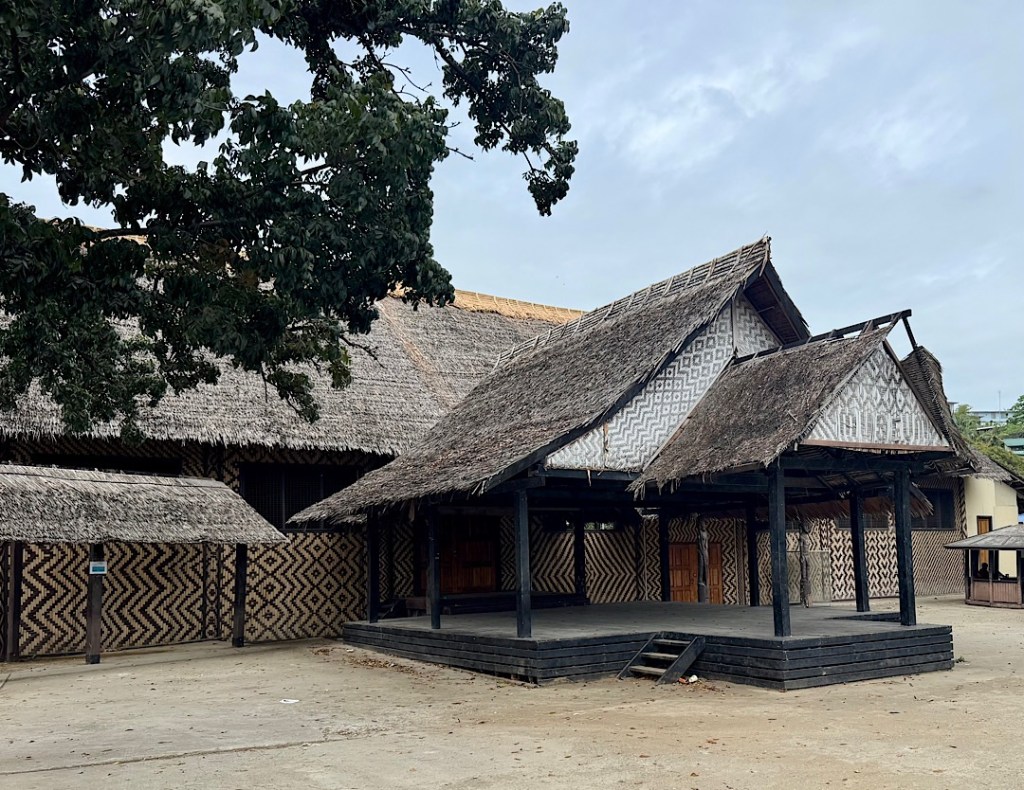
We then asked George to drop us off at the National Museum in the center of town, where we were the only visitors. That was no reflection on the quality of the exhibits.

We didn’t go into this impressive structure.
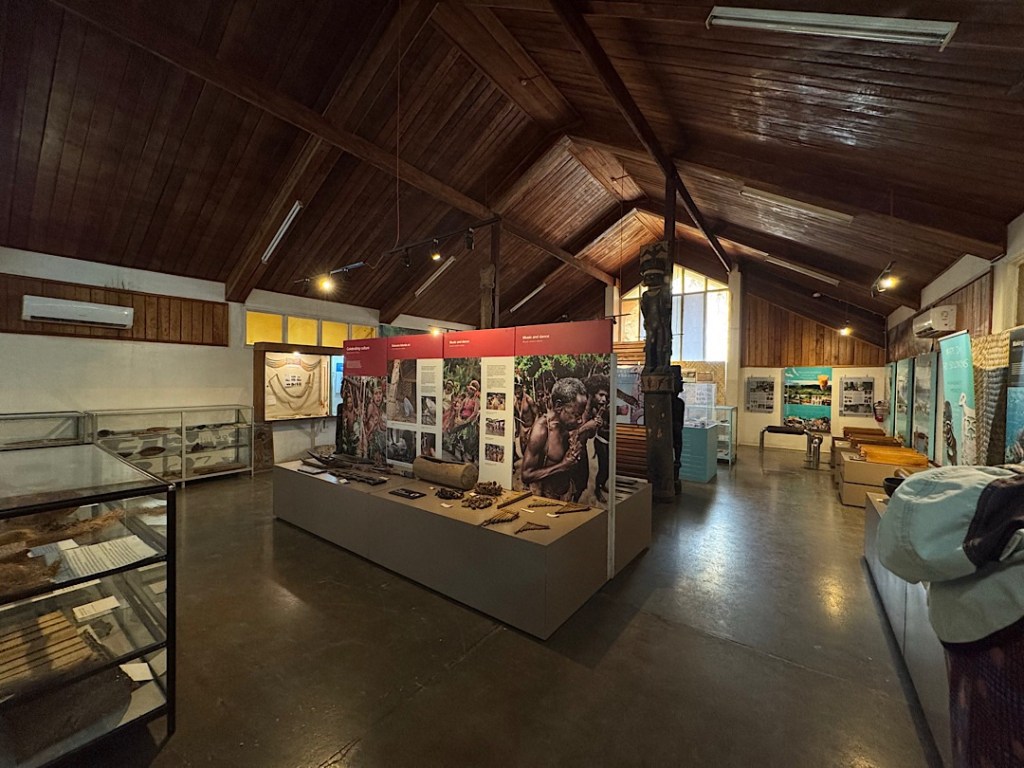
But we spent the better part of an hour in this exhibits hall, filled with many fascinating objects…
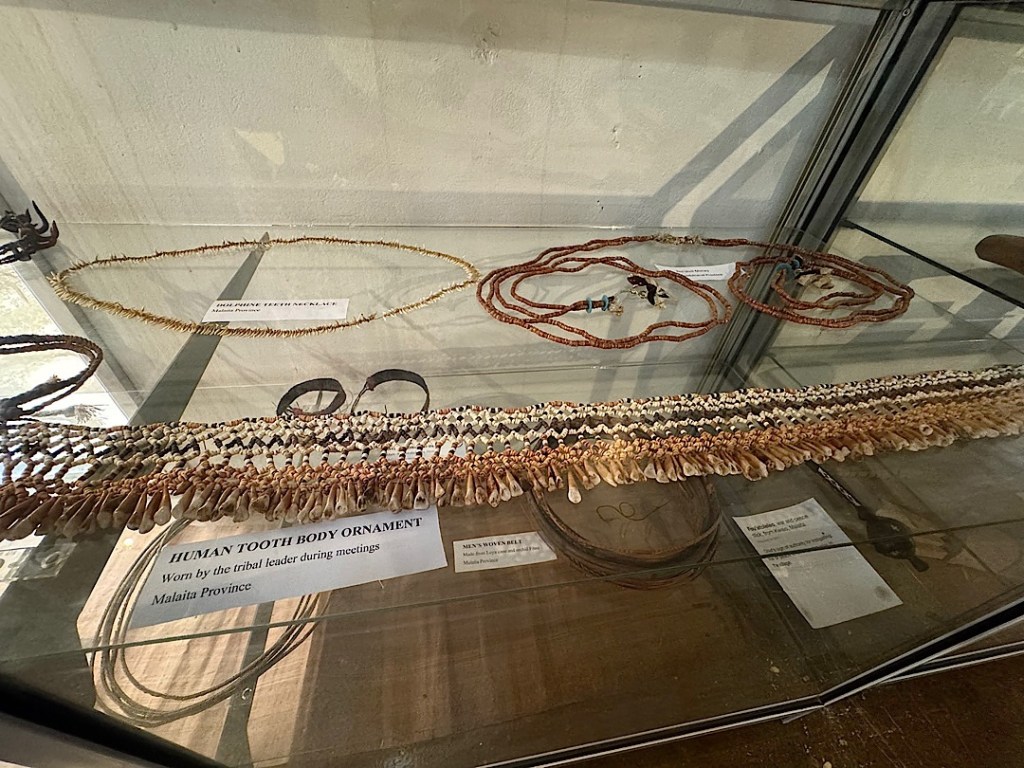
…like this belt made of human teeth. We saw lots of “bead money” and many bizarre weapons.

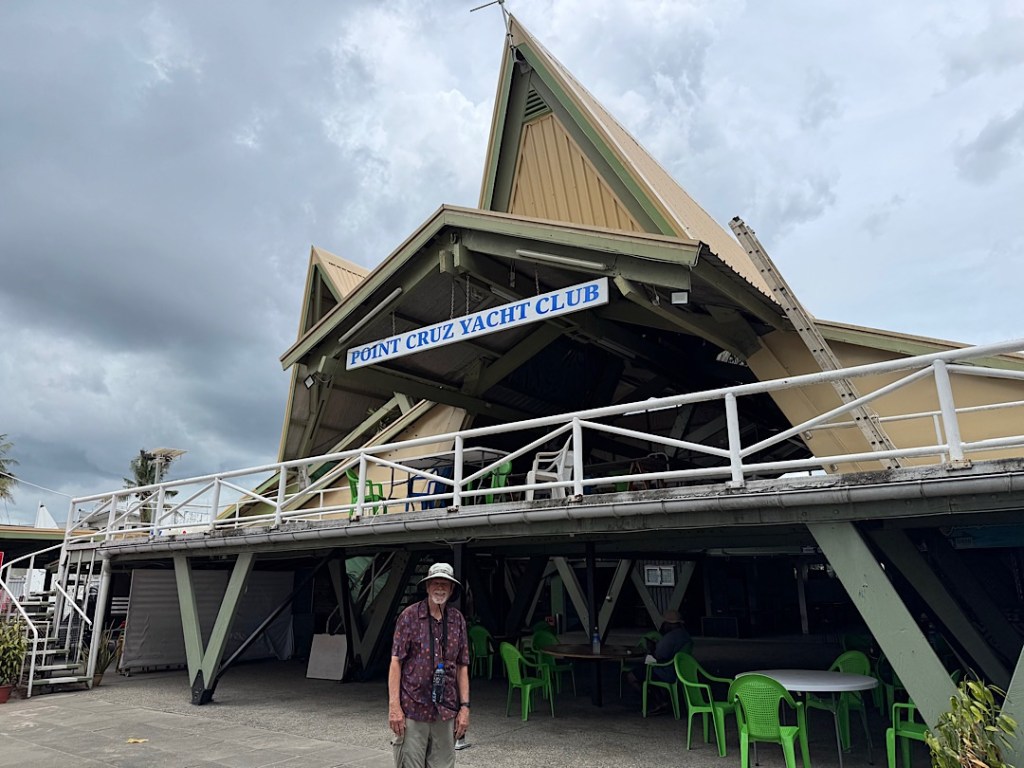
We popped into the nearby Solomon Islands visitor center then walked about a block to the Point Cruz Yacht Club to check out its restaurant; we’d heard it might be a place to eat.

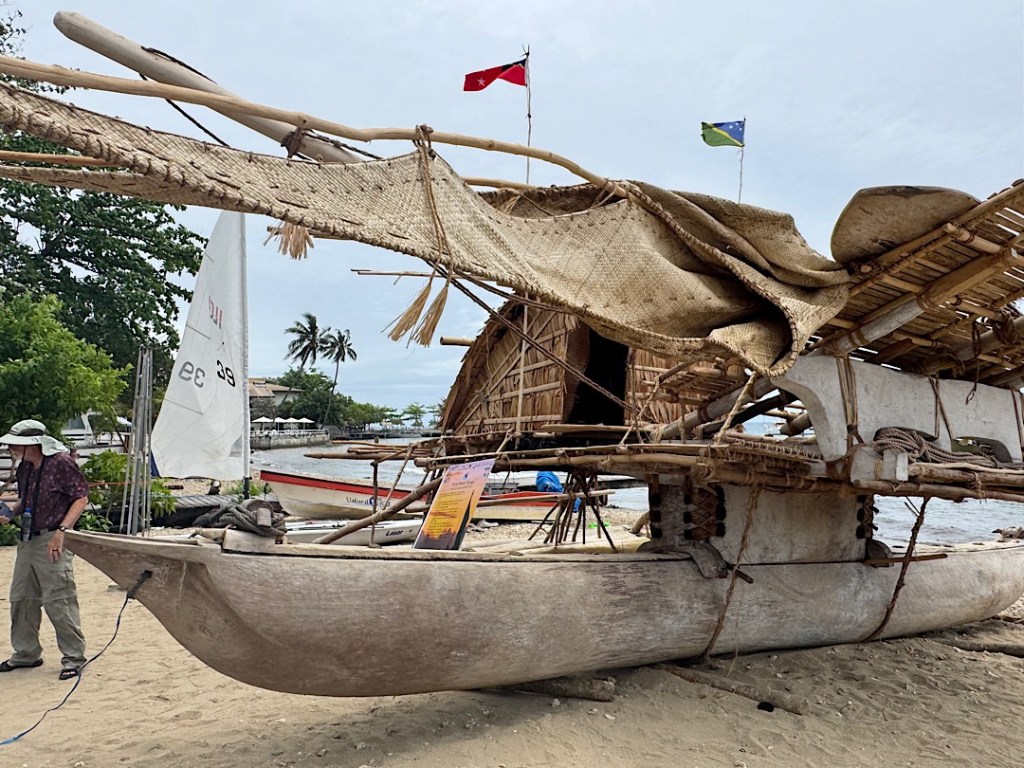
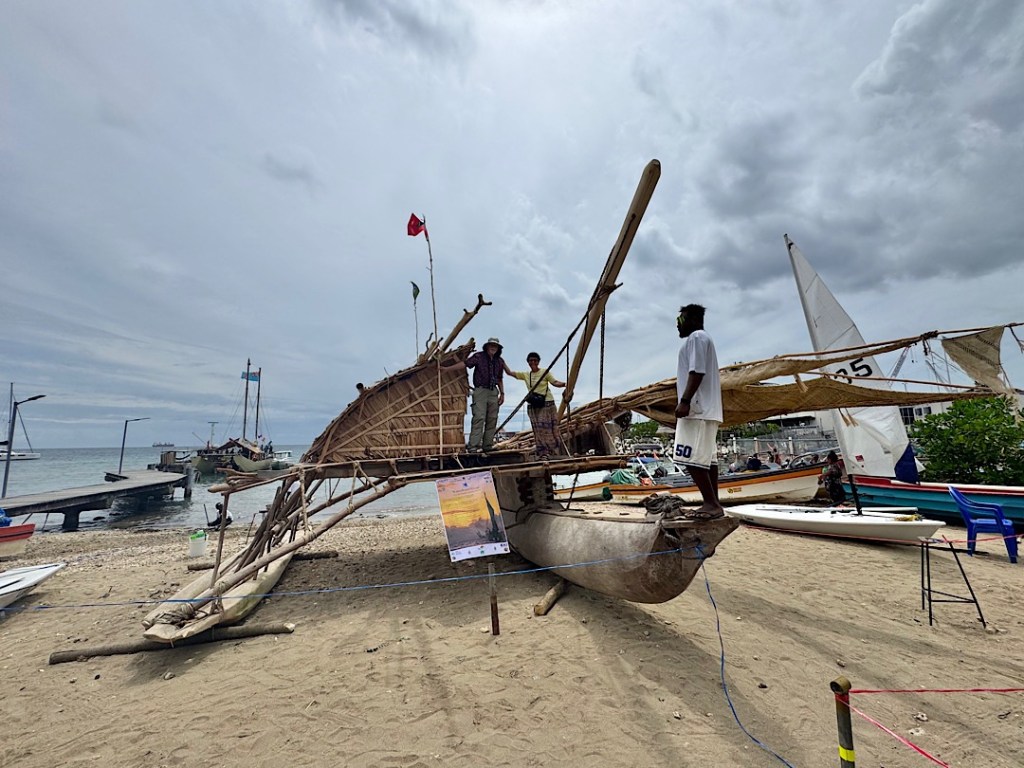
The dimly lighted central building looked like an okay place to shoot pool and drink beer with the guys. But on the beach out back, we found something quite extraordinary: a small “Tepuke”-style outrigger canoe built entirely from traditional materials in the traditional manner developed by ancient Pacific mariners.

This particular vessel had recently been constructed in the far easternmost part of the country; a six-person crew sailed it for 5 days from there, arriving in time to kick off the big political pow-wow. Steve and I had read about such sailing ships in the marvelous recent book, Sea People, and now here was one, steps away from us.

We chatted at length with a friendly, burly man who introduced himself as Bennett. He urged us to climb up so he could take our picture on the little outrigger.

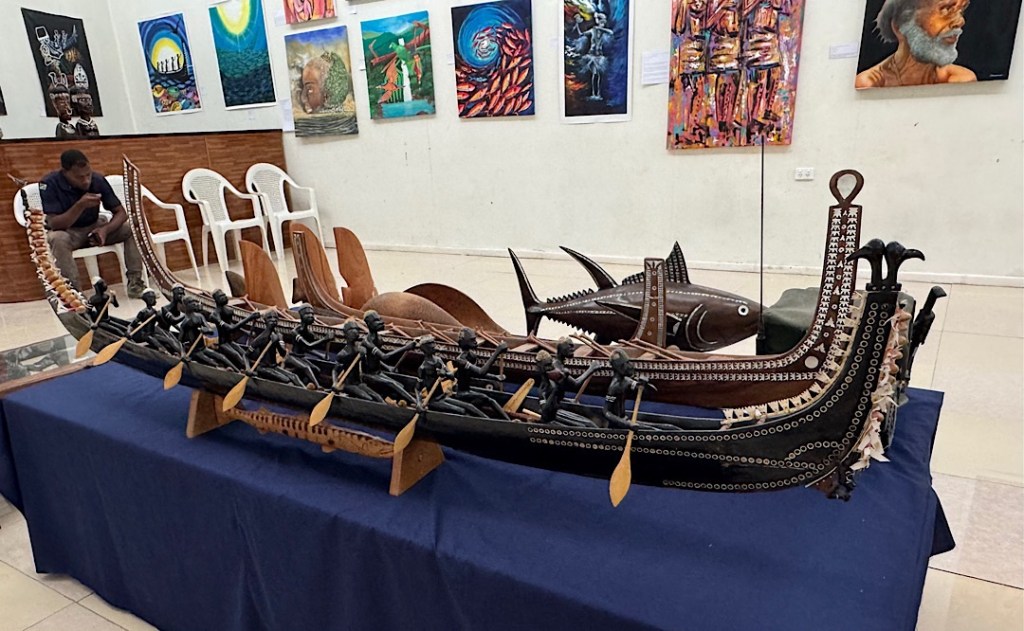
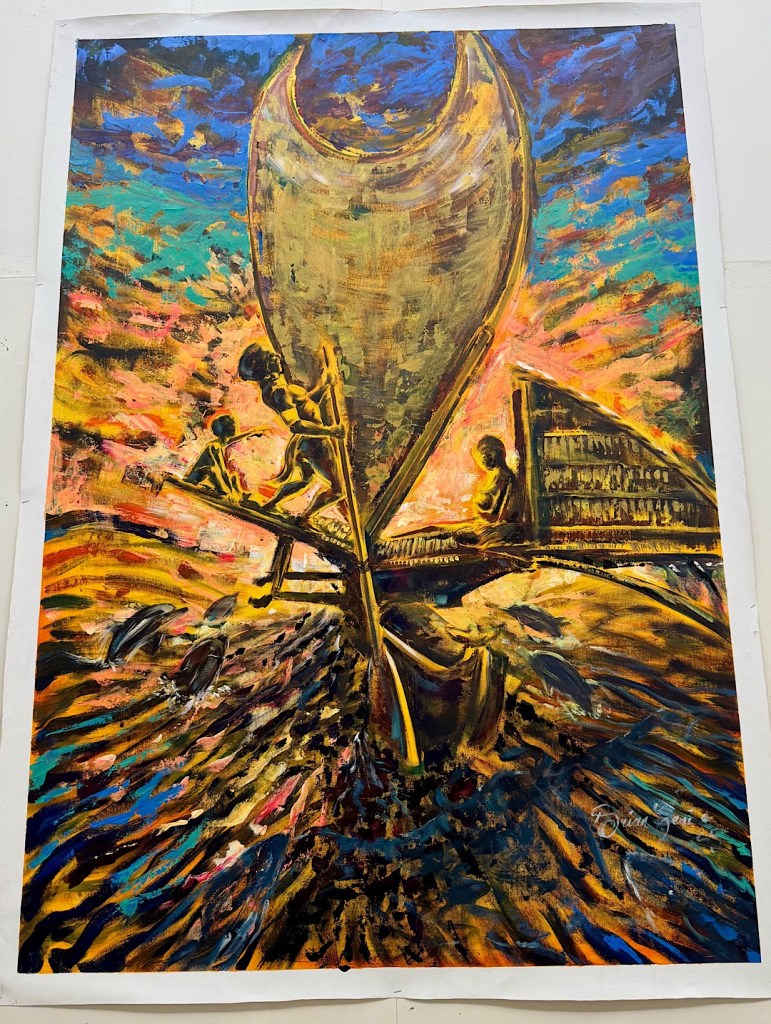
That afternoon we did several other things. We visited an art gallery that was small but filled with some interesting things.

This painting captures what I imagine it must be like to sail an actual tepuke outrigger.
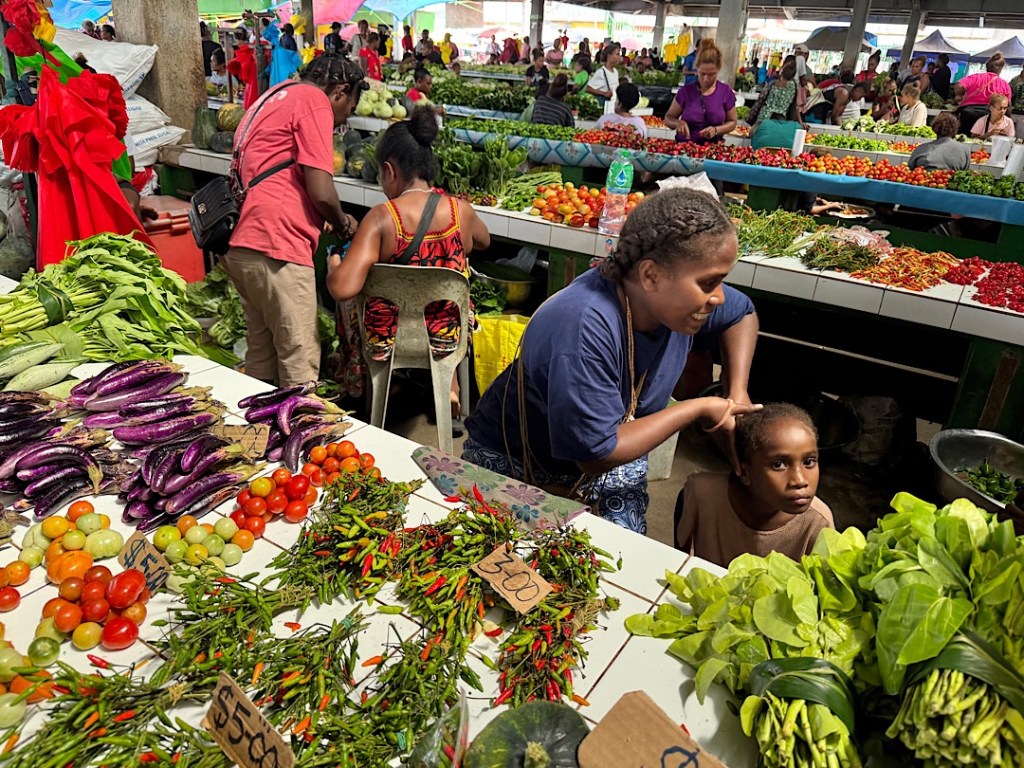
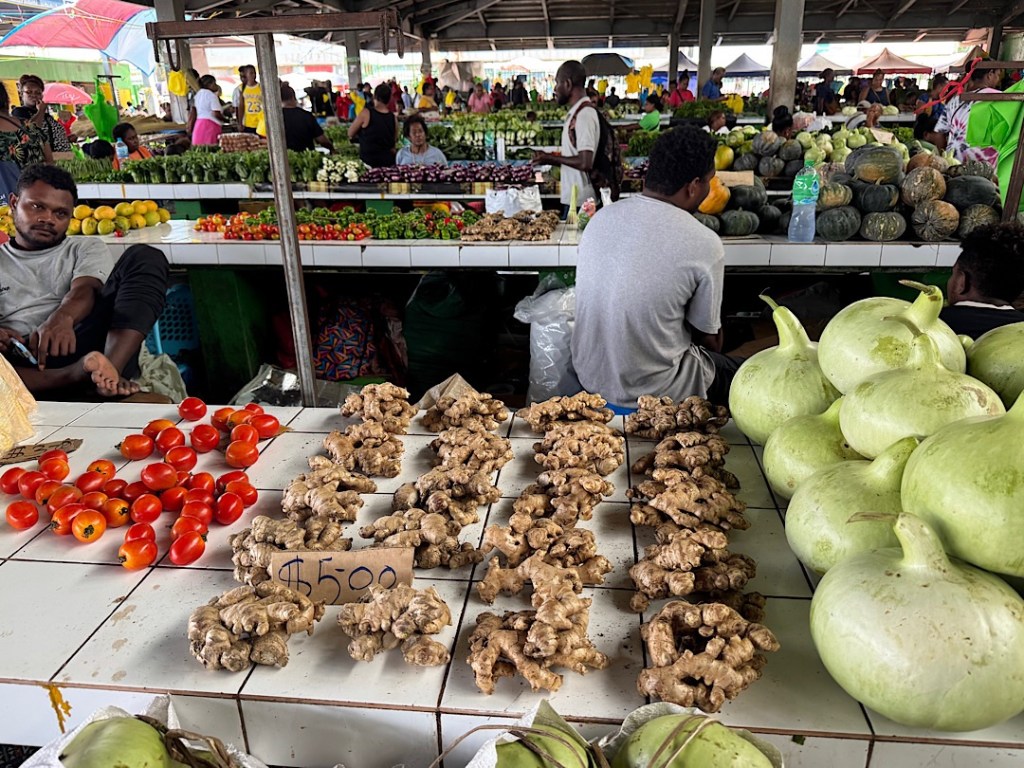
We strolled through the central fish and produce market, which seemed to be extraordinarily clean and tidy.
It’s a good place to buy ginger. These large ones were going for the equivalent of 60 US cents.

By mid-afternoon the heat and humidity had reached daunting levels, so we caught a taxi back to the hotel and, after a swim and a nap, began to fret in earnest about occupying ourselves for the next two days. The front-desk clerk had a suggestion. She knew someone with a little tour company who might be able to help. Lisa punched a number into her cell phone, and minutes later, Keren Fono’ota pulled into the Honiara’s parking lot.

Born on Vanuatu (another island country about 800 miles east of Honiara), Keren had moved to the Solomon Islands about 25 years ago. She went to school and worked for a few years as a journalist, but then she started Iumi Tour Solomons. Warm and charismatic, she didn’t have to work very hard to sign us up for two of her outings: a cultural visit to a village on Friday and a full-day beach excursion for Saturday.

It did not bother us that on Fiji we had just done BOTH a cultural village visit AND an island day trip. I’ve come to realize that in tropical tourist destinations, those are like fish and chips. It’s hard to avoid them. Moreover, we’d greatly enjoyed the Fijian offerings, and as luck would have it, Keren’s versions turned out to feel much less touristy and more authentic than their Fijian counterparts.

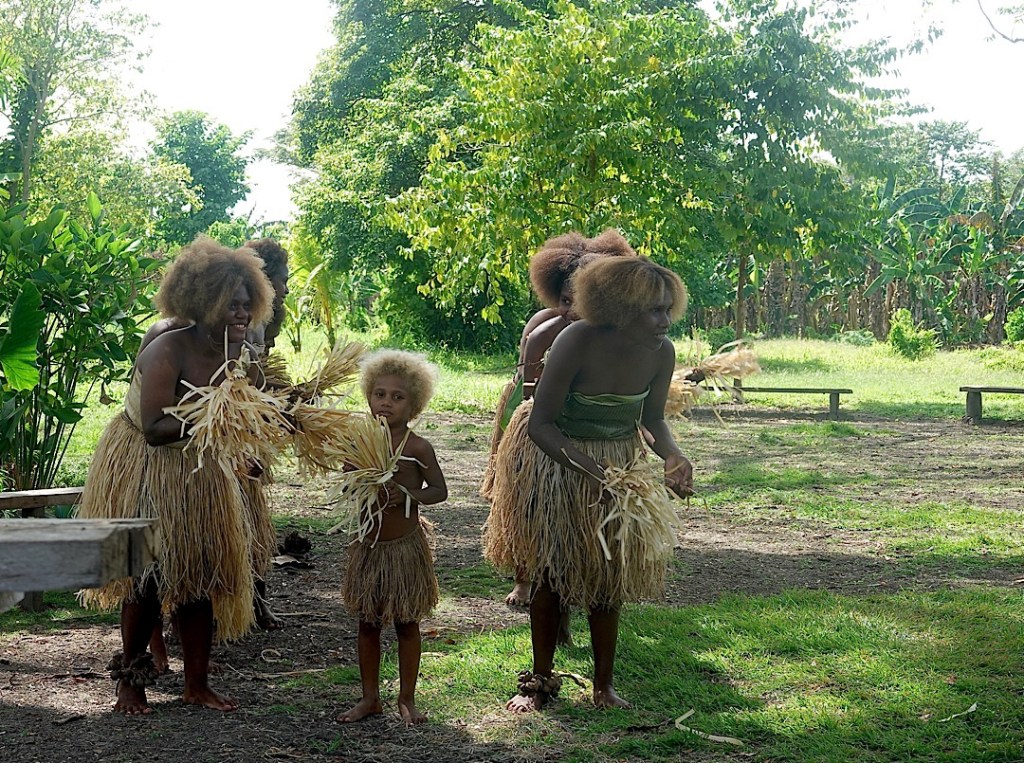
The village to which she drove us, Hotomai, was an offshoot of a larger community on the other side of Guadalcanal. Although the Birau people in the satellite village earned some money from welcoming the occasional visitors, they also grew subsistence crops and sent their kids to local schools. For our visit, some of the ladies gave us a musical greeting.

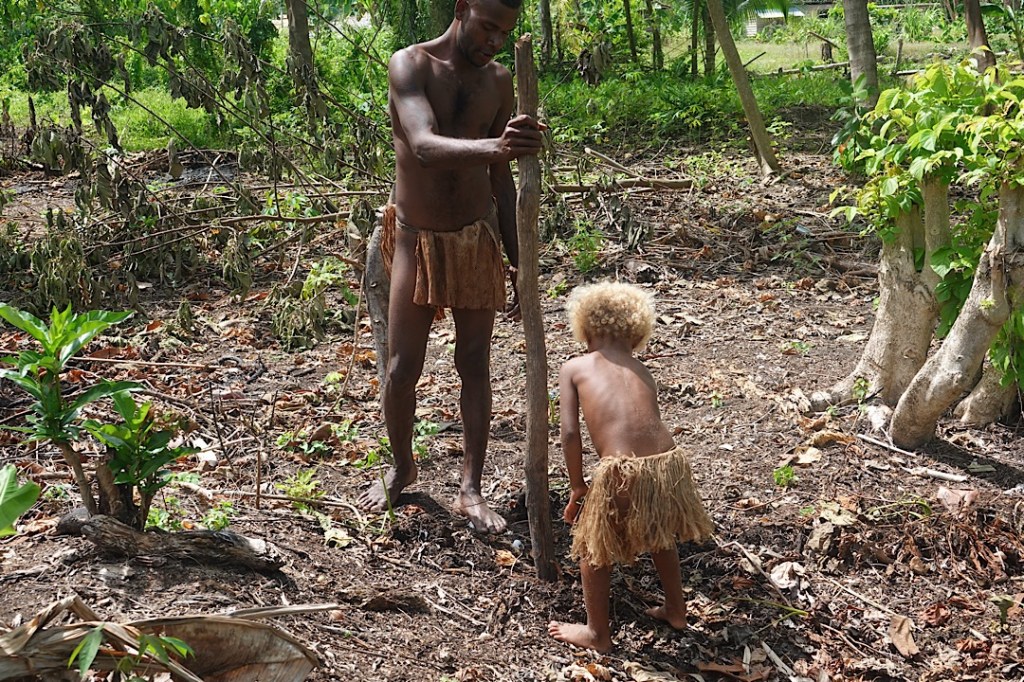
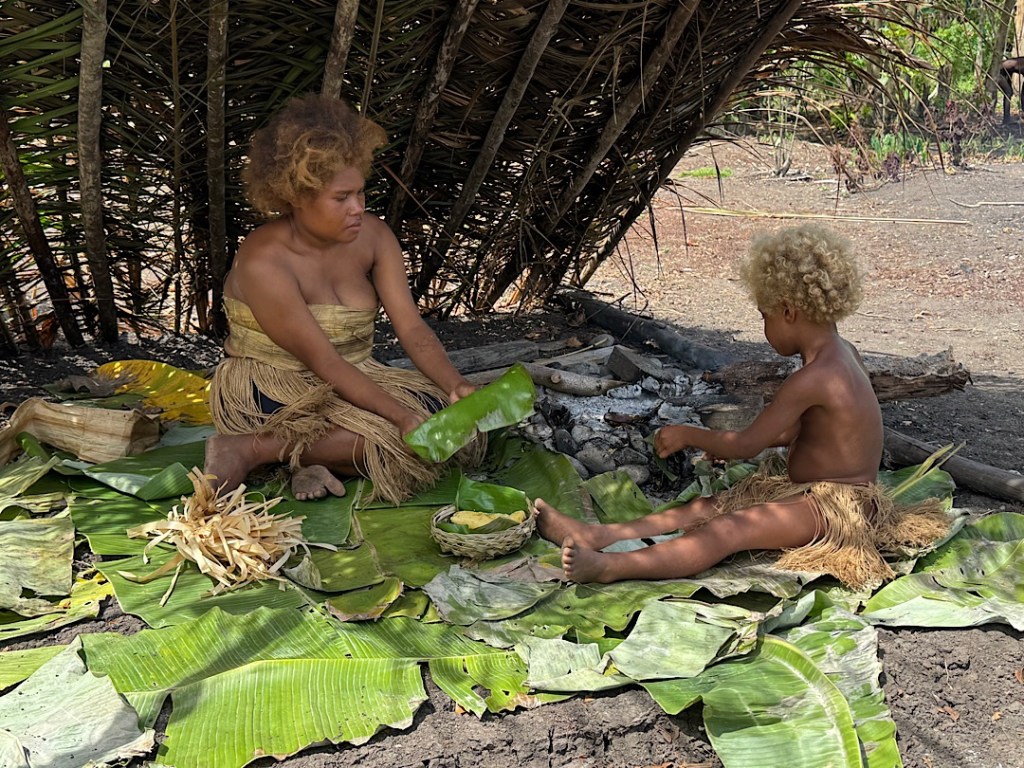
We got lessons in how to plant taro and cook traditional foods…
…such as bananas…
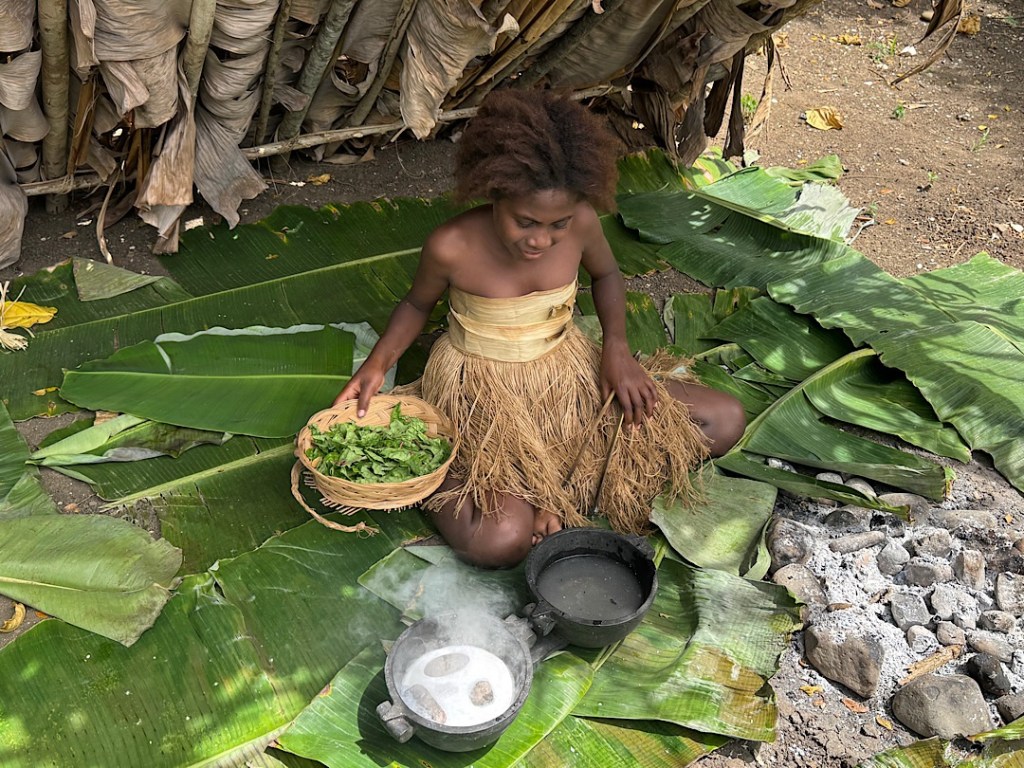
…and greens. The rocks in front of this young woman were red hot. She picked them up with her tongs, rinsed off the ashes, then put the hot rock in coconut milk. Then she simmered the cabbage-like greens in the hot milky stew.
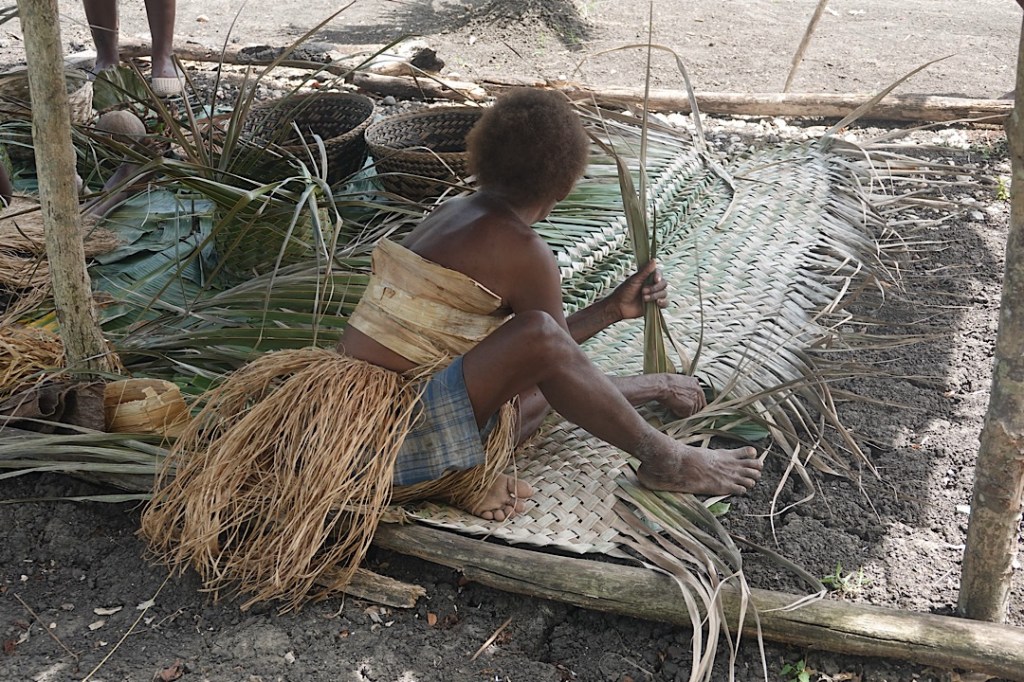
This lady is turning palm fronds into all sorts of useful objects.
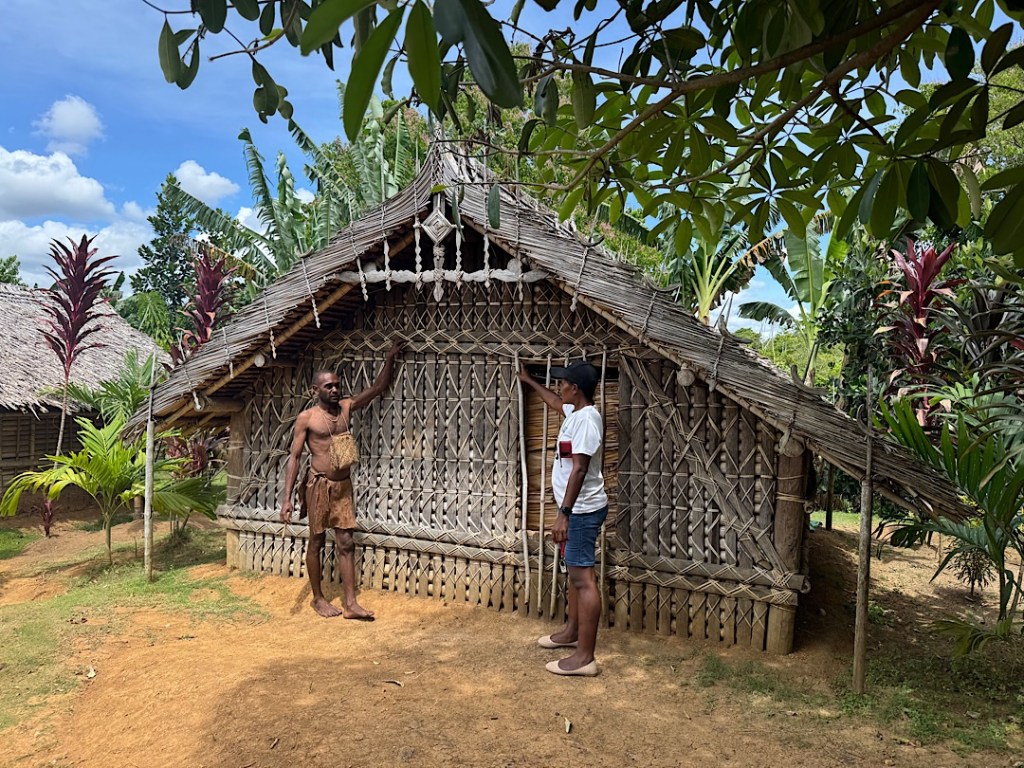
Here are Keren and one of the tribal leaders in from of a community room built without any nails.

We took the village tour along with an Australian couple, but for Keren’s outing to Roderick Bay the next day, Steve and I were the only customers. Keren had told us we would travel in a speedboat for 90 minutes out to one of the Florida Islands.

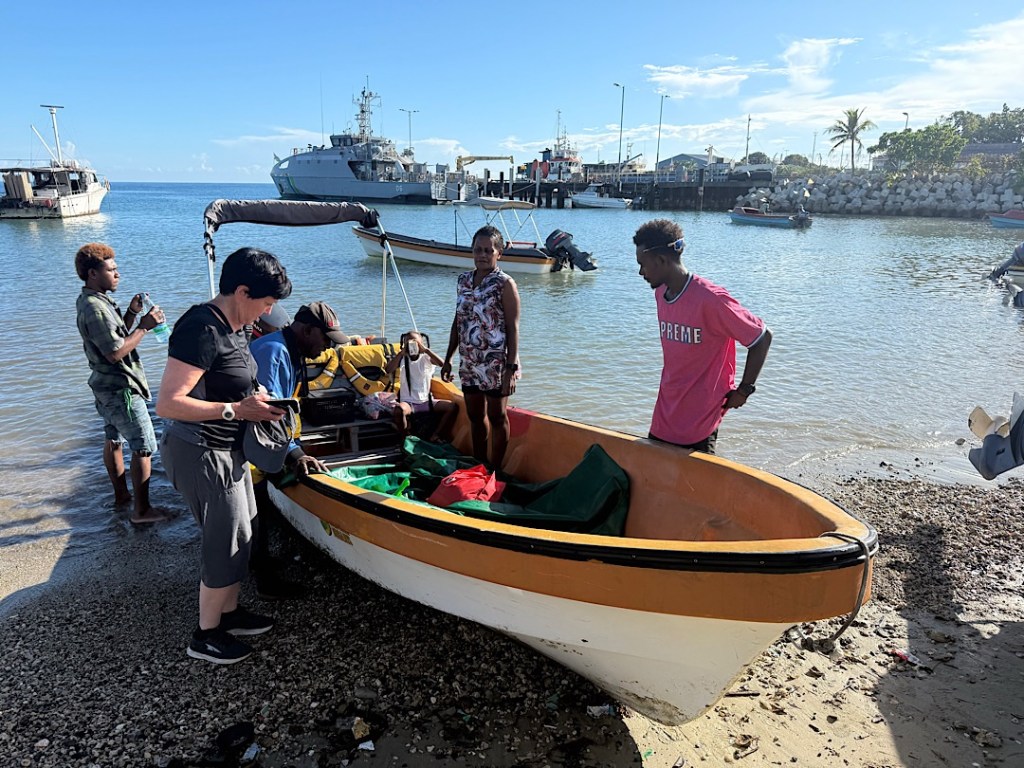
When we arrived at the yacht club Saturday morning, we realized the “speedboat” was what Solomon Islanders call a banana boat. In Baja California, folks know it as a panga: an open fiberglass motorboat about 25 feet long, powered by a Yamaha outboard motor.

Steve and I and Keren and her two kids, 6 and 8, piled in and the captain coaxed the motor into action. “Look at it this way,” Steve murmured to me, “You could be riding in this with 20 Mexicans. In the dark.”

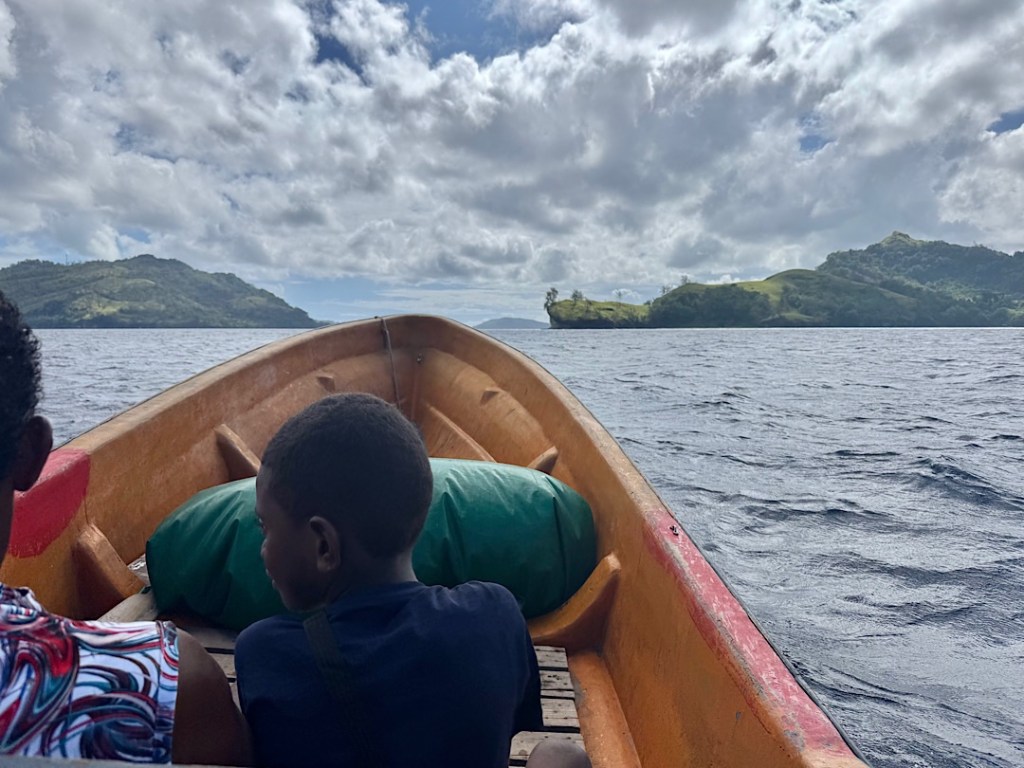
We roared out to sea, and I felt a rush of exuberance that lasted for maybe 10 minutes. Then the miserable part began. The wind stiffened, shattering the relatively flat sea surface into a million geometries that caught our little craft and made it bob this way and that. Frequently we were lifted up then slammed down with a force that made me worry about the impact on my spine. Soon we were out of sight of land. Swells rolled in that made us roll tilt even more, and I felt grateful neither Steve nor I get seasick. I soon was soaking wet, from the salt water that blew in over me.

I tried to distract myself by reflecting on our location: smack in the middle of “Iron Bottom Sound,” a nod to the Japanese and American ships that went to the bottom in the ferocious fighting that exploded here 83 years ago. Not far away, future US president John F. Kennedy’s PT boat was struck by Japanese fire and sank. Surely that must have been more unpleasant than this passage, I told myself.

I would have bet money that the destination wouldn’t justify the journey. But then we approached the entrance to the bay.

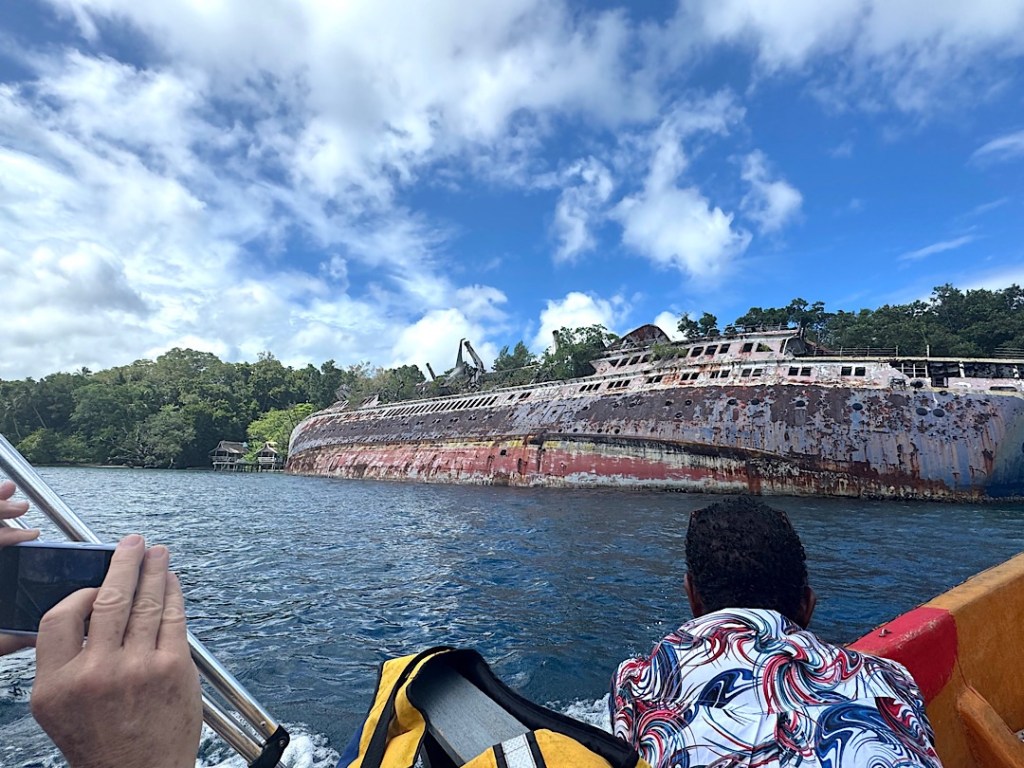
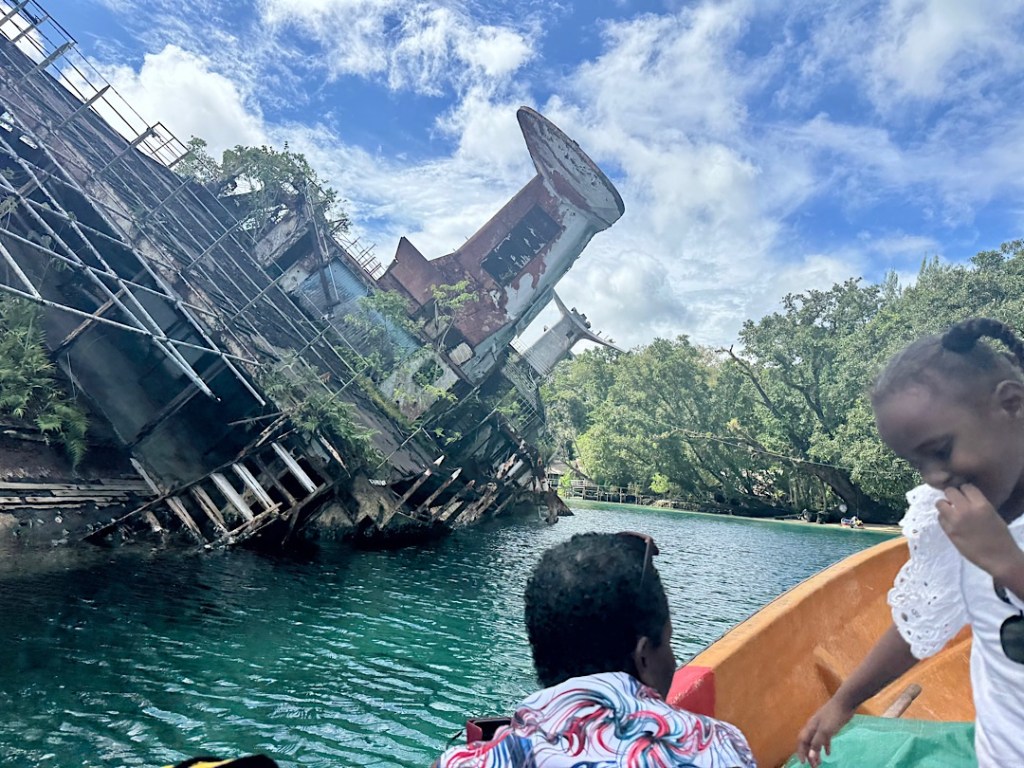
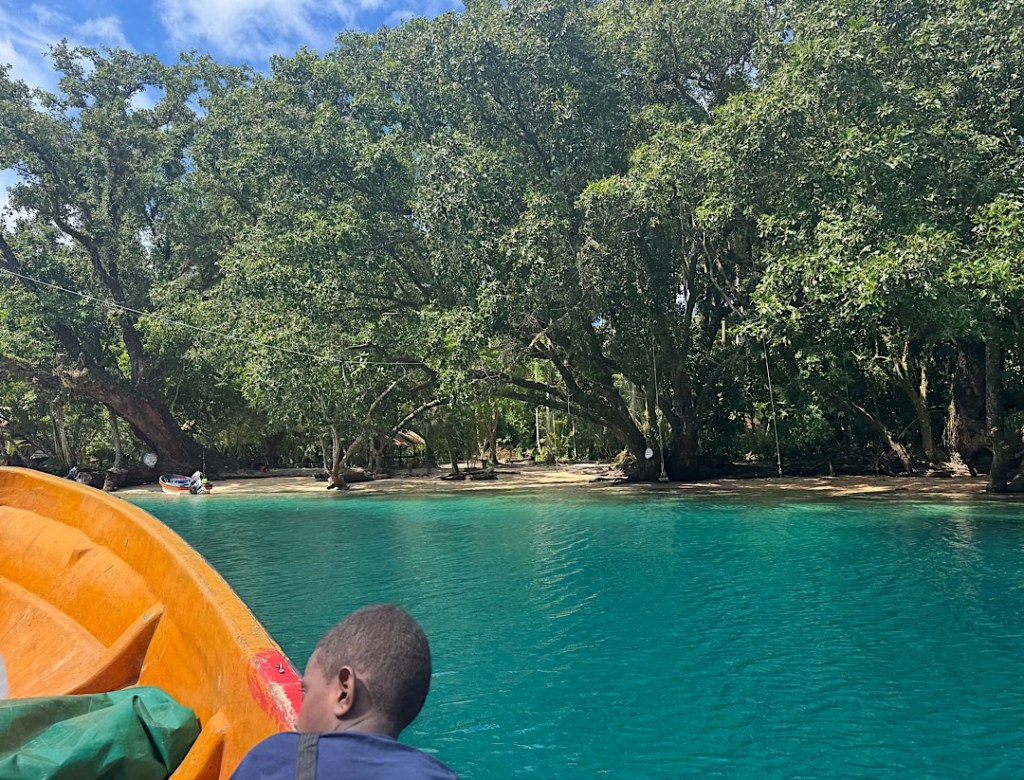
The world became calm again; the sun came out. After some moments we approached a bizarre sight: a German cruise ship that had hit a reef 25 years ago and limped into this inlet before sinking. Behind the wreck, a scene of extraordinary peace and beauty came into view.

A small tropical garden appeared to be growing on the wreck.
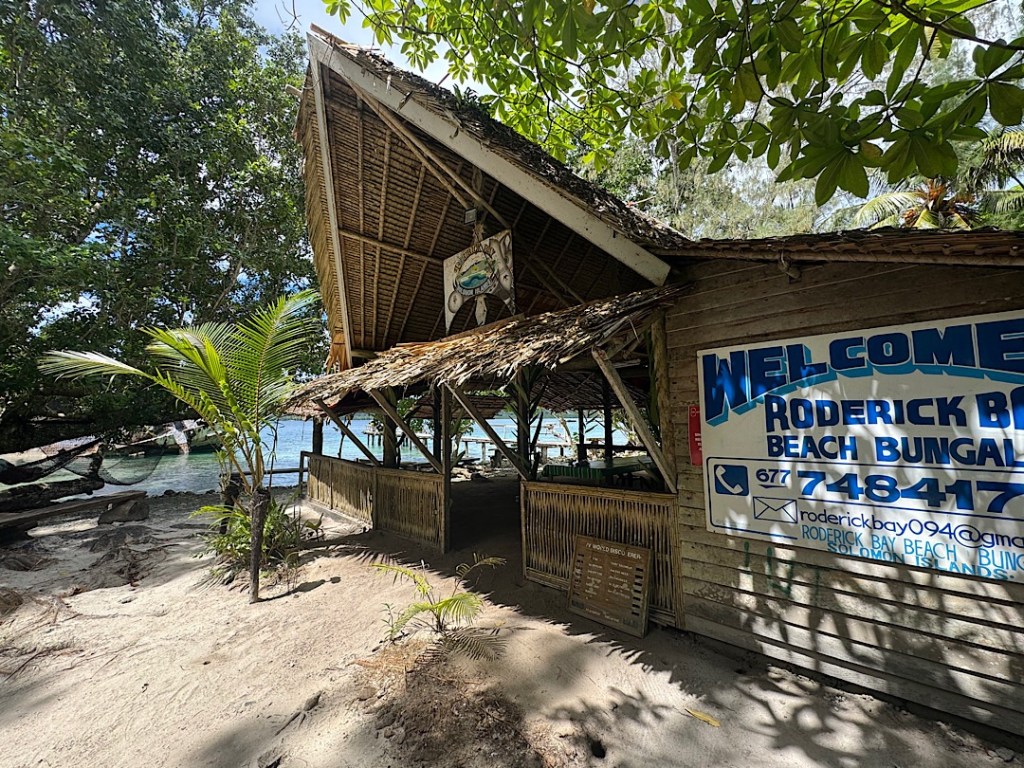
We approached a sandy white beach under magnificent trees.

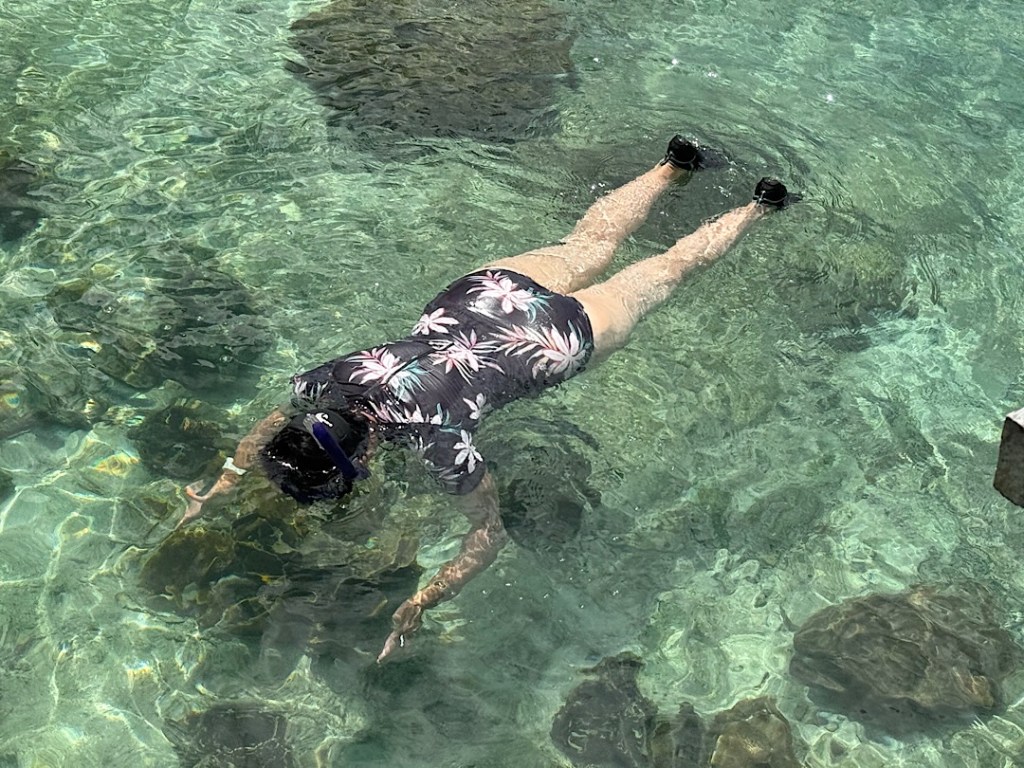
We rented snorkels and marveled at beautiful fish hanging out in the little reef off the beach . I spotted a clam as wide as my hands are apart in the photo below.

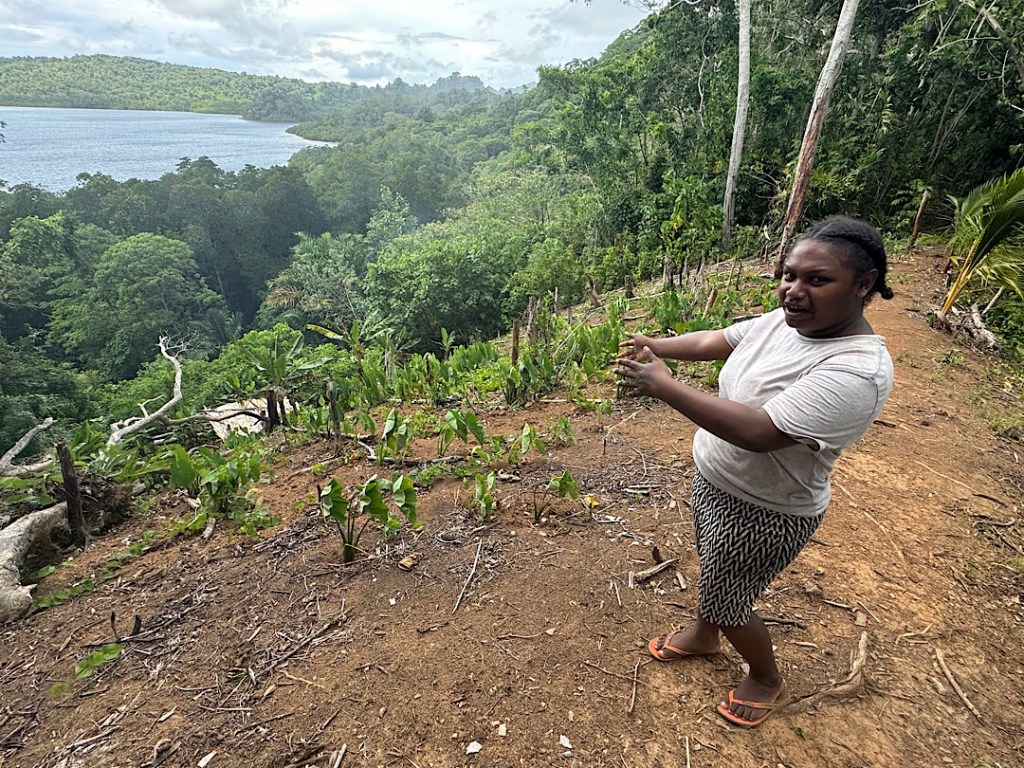
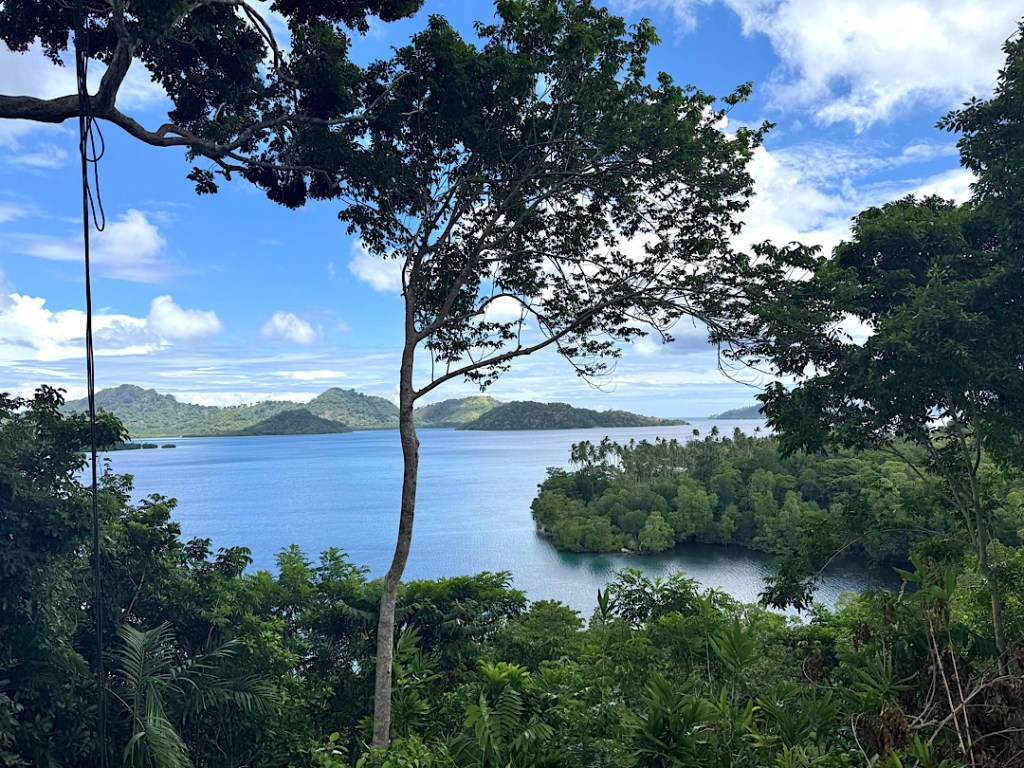
We had a simple lunch then hiked up to a lookout point on top of the ridge. Tracy, the daughter of the property owner was our guide.
We could have stayed overnight in a primitive cabin. But we had a plane to catch the next morning.

So at 2 p.m. we piled back into the banana boat. The ride back wasn’t better but it wasn’t any worse and most importantly nothing catastrophic happened.

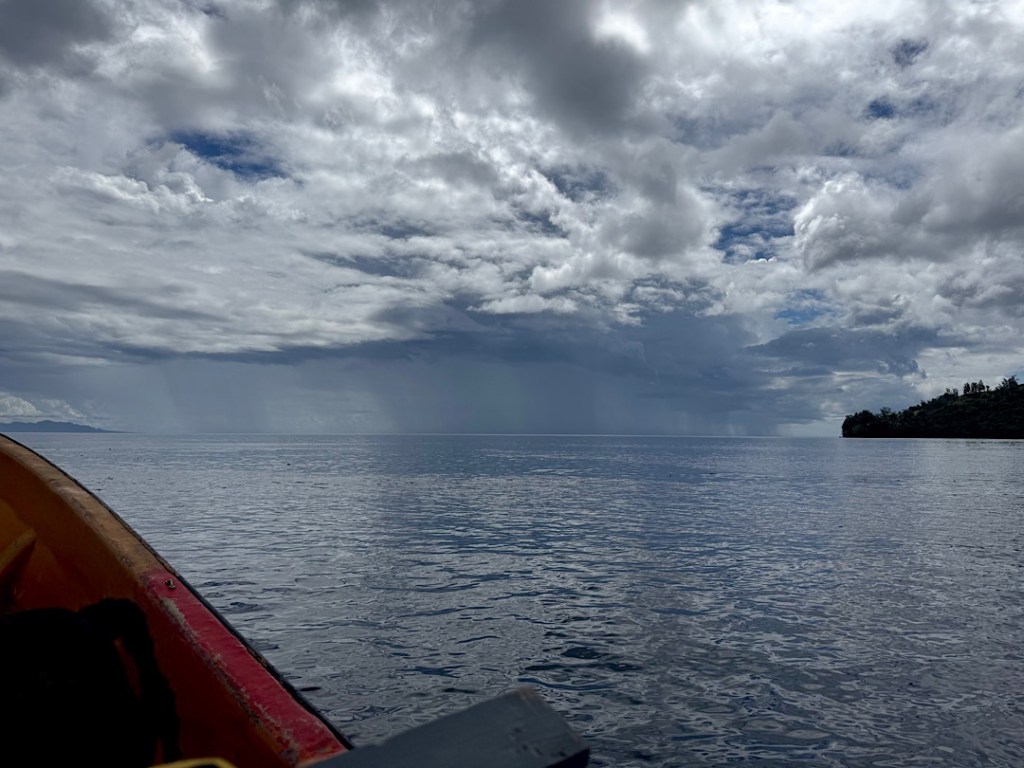
This rain in the distance looked ugly, but the downpour blew away from us.

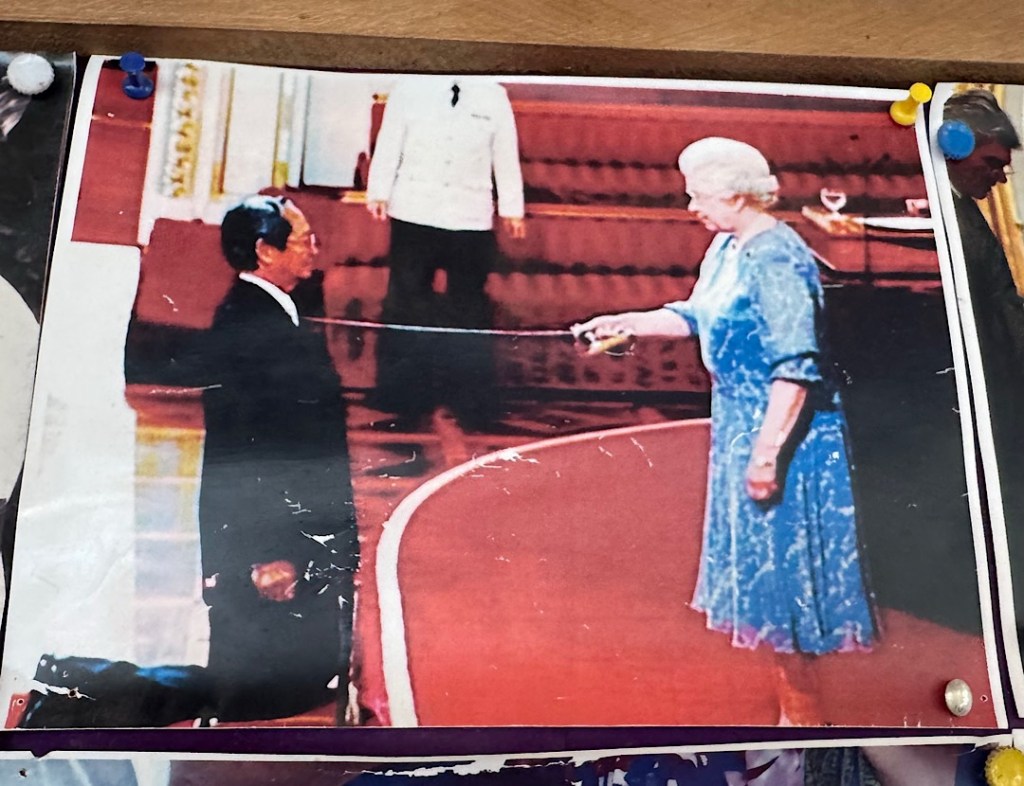
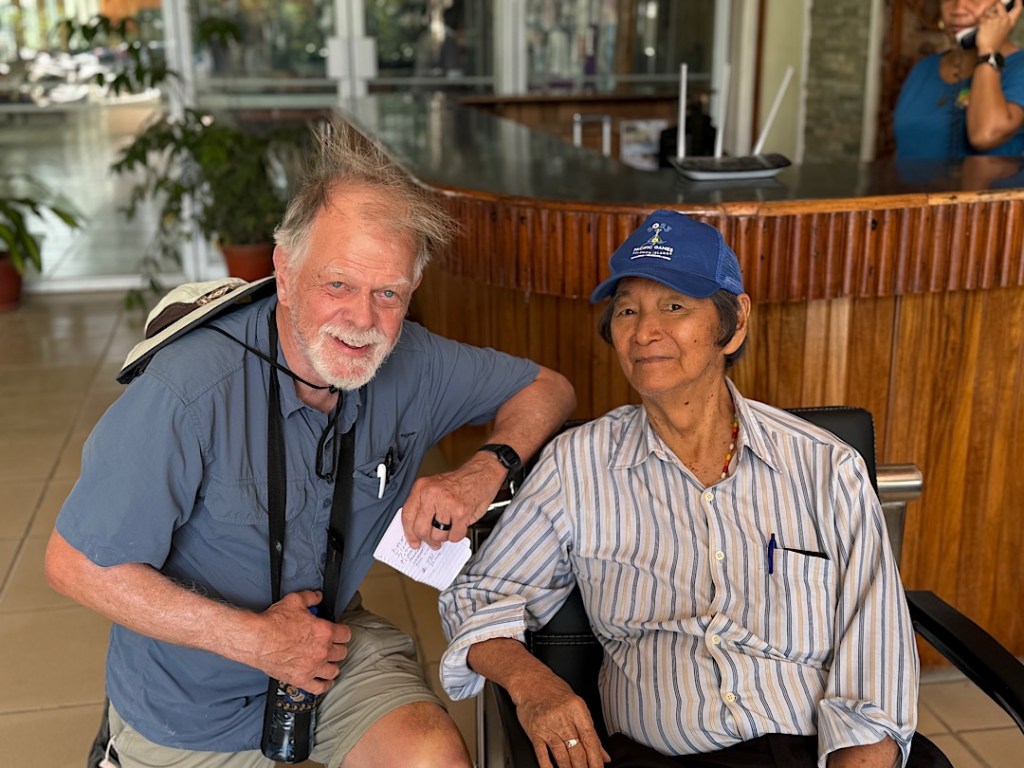
Steve and I had to pack up and check out by 9 yesterday morning, then head to the airport for our flight to Pt. Moresby in PNG. At breakfast, I had spotted Sir Thomas Chan in the dining room. A frail Asian gentleman, Sir Tommy (as folks call him) is the 82-year-old owner/creator of the hotel and the artist responsible for all the hallucinogenic art work. Photos and other memorabilia posted in the lobby provide flashbacks of his life.

There he is waterskiing! Catching huge fish! Greeting dignitaries, including Prince William and Princess Kate back in 2012. In another photo, you see him kneeling before Queen Elizabeth as she touches a ceremonial sword to his shoulders (the title apparently granted in recognition of his charitable work.)

Steve and I had run into him in the lobby a few days earlier while waiting for Keren to pick us up. Sir Tommy told Steve a bit about his business career.

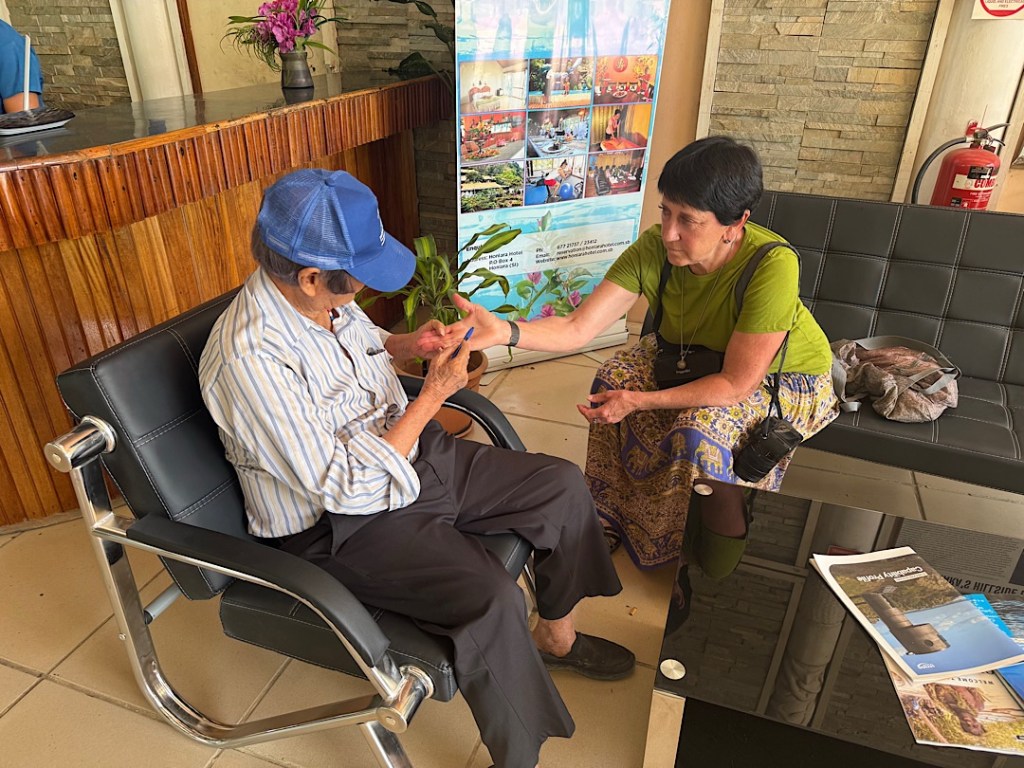
Then with a twinkle in his eye, the octogenarian asked if I would like him to read my fortune. How could I resist? He took my hand in his and studied my palm, noting that I have a long life line. I could keep going strong for another 10, 20, even 30 years, he declared, if I avoided fried foods, didn’t get fat, and engaged in a lot of exercise (the way he does.)

It crossed my mind to ask him about the travels that still lay before us, but I refrained. Sometimes you can have the most fun when you don’t know just what’s coming.

Phase 1: Samoa

As I said, our hop, skip, and jump approach to getting to the other side of the world is an experiment. I have preliminary results from Phase 1: Samoa. 

In premium economy seats on Fiji Airways, the 5 and 1/2 hour flight from Honolulu was unremarkable, except for its 3:15 a.m. arrival. We chose this awful connection only because options were so limited; our schedule so painfully constrained.

Outside the terminal, we clambered into a taxi and were driven for 45 minutes to our hotel, a Sheraton on the waterfront in the capital (Apia). Even in darkness, the tidy highway impressed me. I could see no trash. Instead my eye was drawn to the containers lining the roadside boundary of many homes. Made from stacked tires or metal cans painted and planted with flowers, the blooms would be pretty in the sunshine. 

Our taxi driver conformed to Samoan stereotypes. Everything about him was broad: his shoulders, his gut, the nose set in his wide golden face. It was he who alerted us to what would prove to be the worst thing about our quick pass through his country. We would be there only Saturday and Sunday. But Samoans take their weekends seriously. Toie warned us that the Robert Louis Stevenson museum — a fixture on lists of Top Things to Do in Apia — would close in about 7 hours (i.e. at noon Saturday) and would not reopen until Monday. On Sunday, he warned, everything else would shut down except for the multitude of churches.

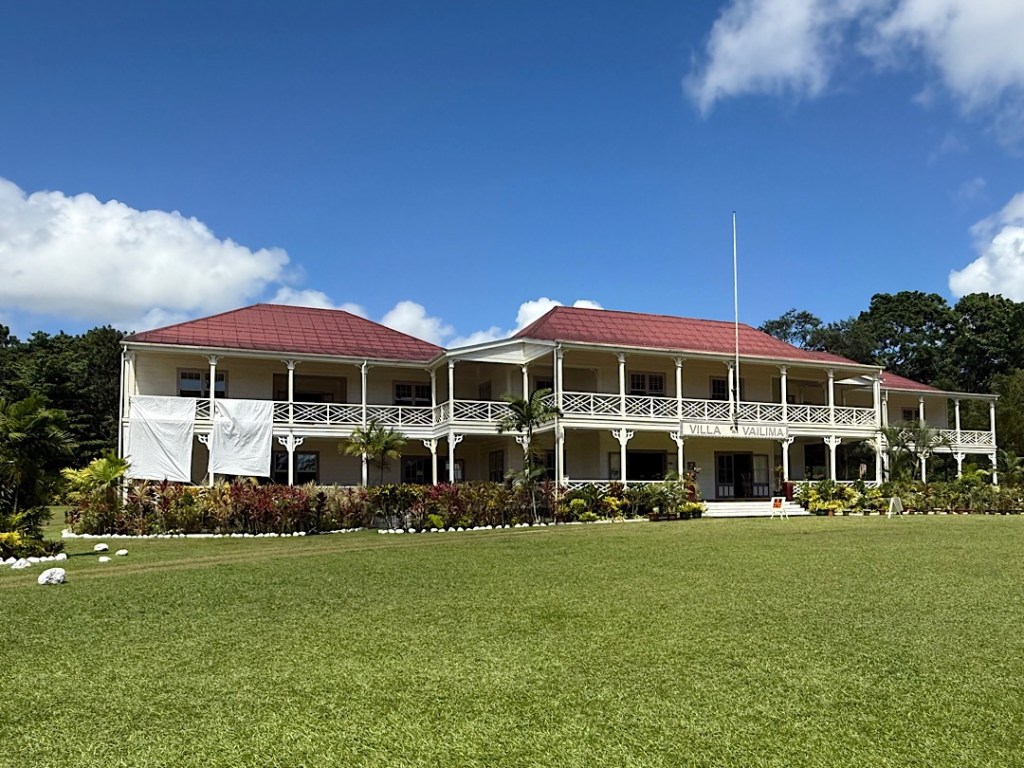
We checked into our room, napped for about 90 minutes, ate a quick breakfast, then took another taxi up a steep hillside to the property developed by the author of Kidnapped, Treasure Island, the Strange Case of Dr. Jekyll and Mr. Hyde, (and more). Robert Louis Stevenson and his wife Fanny came to live in Samoa in 1889. Besotted by the sunshine and tropical beauty, they hoped it would prove a tonic for Stevenson’s longterm lung disease and other ills. It worked but not for long. RLS died of a stroke in 1894, at 44. But in their five years on the island, Louis and Fanny oversaw construction of a beautiful villa and surrounding farms and gardens. Today the complex is a museum open to the public (but only till noon on Saturdays).

That was enough time for us to see why the place enchanted the Stevensons.

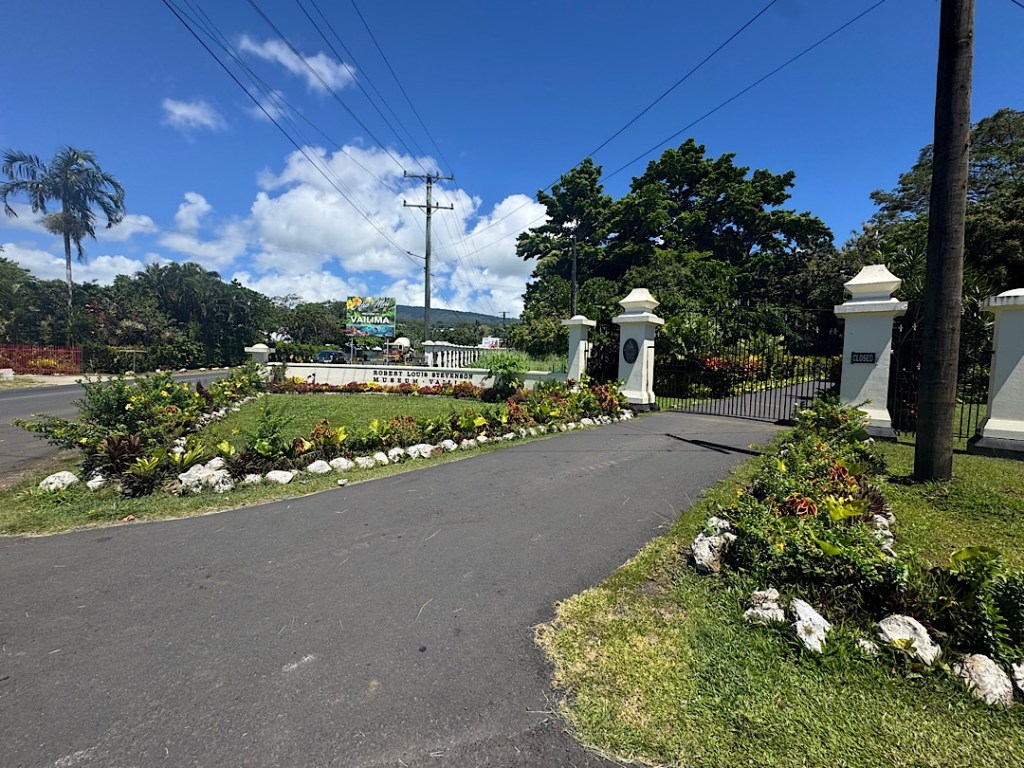
The entrance
A guide took us through the villa, which was as pretty and pleasant inside as out.
The view from the front porch

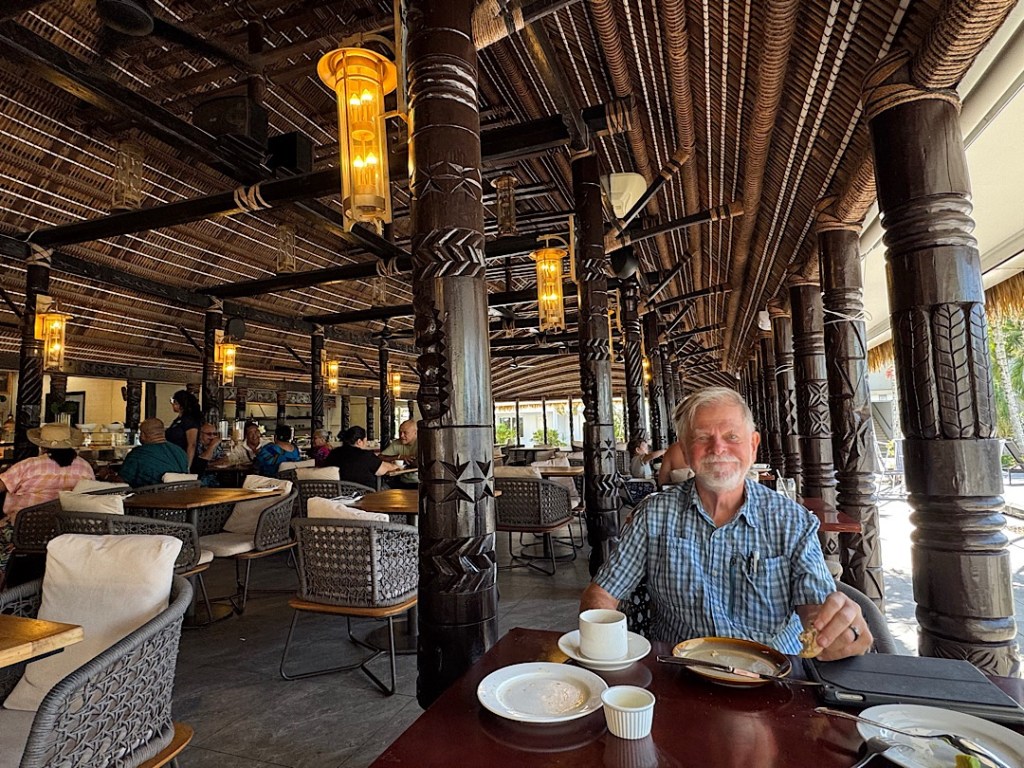
We returned to our hotel, with its beautiful open-air restaurant next to a pretty pool. It wasn’t a hardship to sit there, surf online, and confirm what Toie had said. Almost nothing would be open the next day.

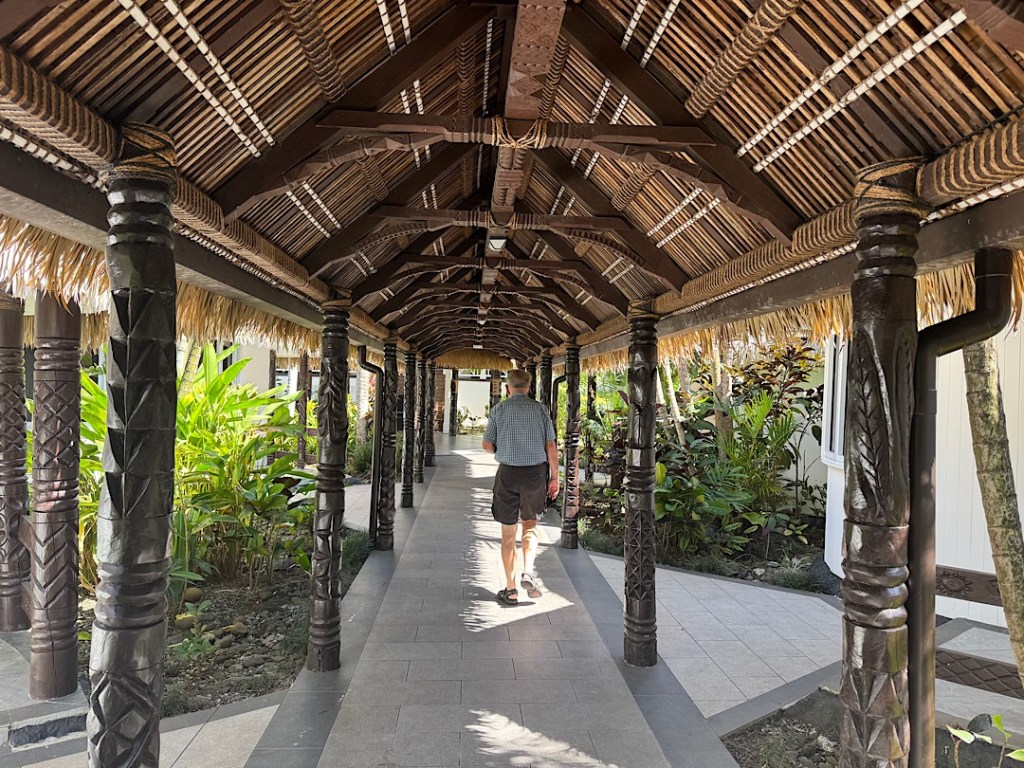
The food was just okay, but the Samoan wood work dazzled me.
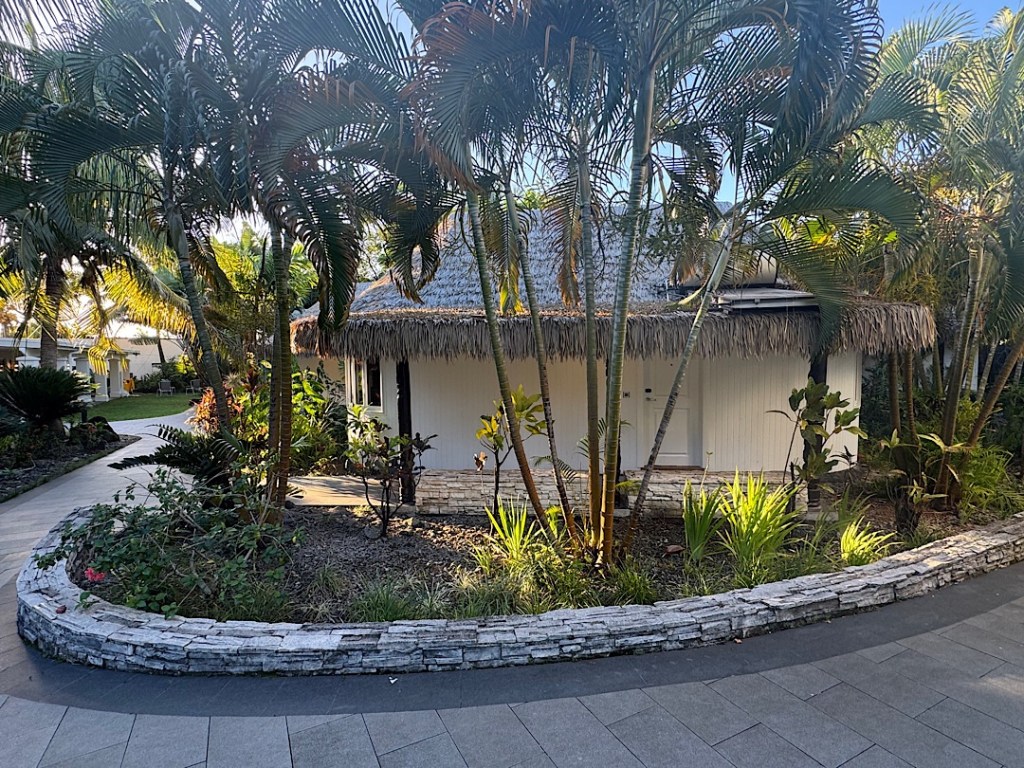
This was our bungalow.

Steve did find a promising restaurant just a few blocks away. We walked to it, arriving at Paddles just minutes after it had opened at 5:00. We got a table and our meal was so delicious and fun we tried to make a reservation for the next night. But oh yeah. Paddles also closed on Sundays.

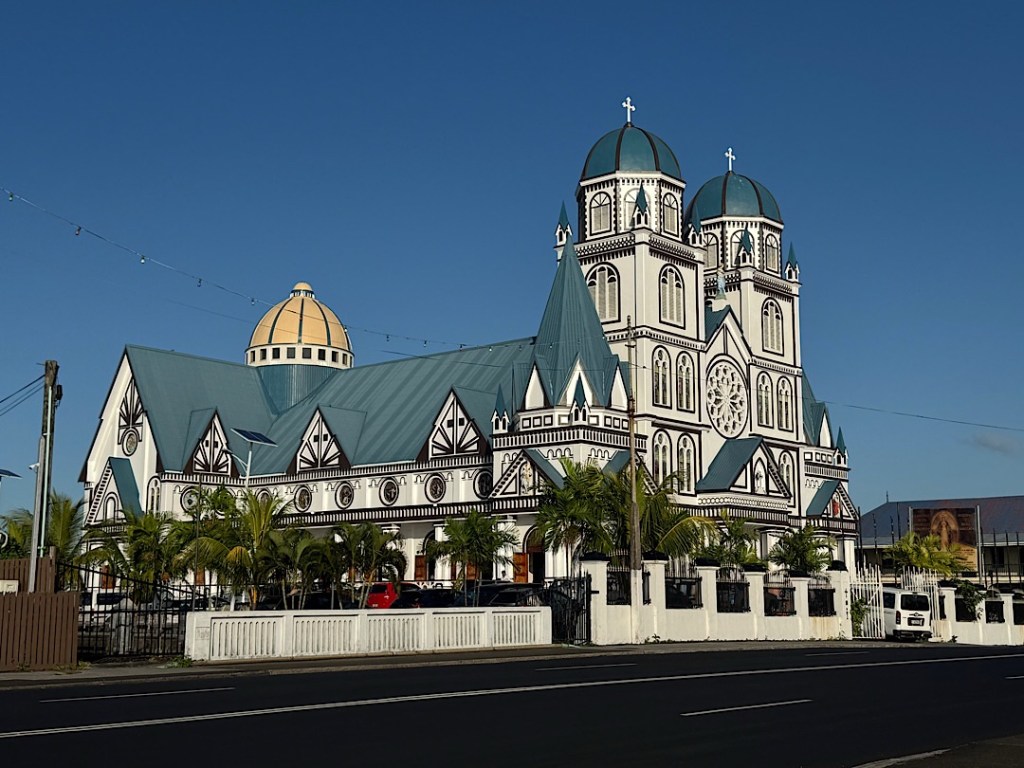
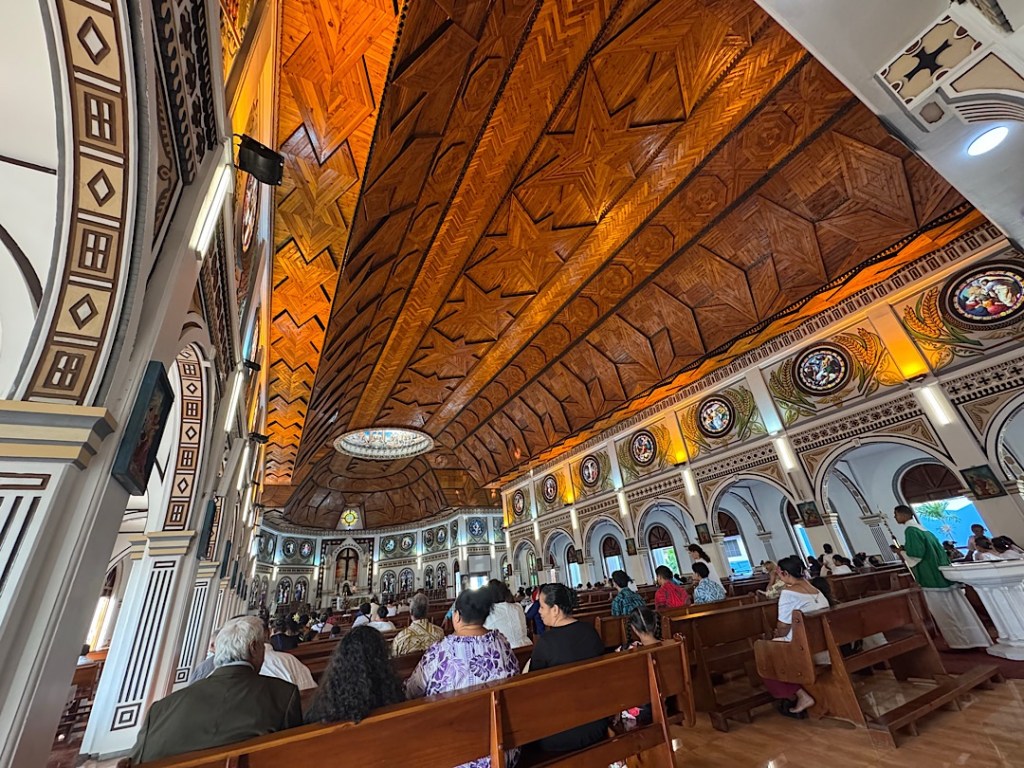
Happily, another Top Sight in Apia is the Catholic cathedral. The next morning Steve and I strolled there, arriving as the 7:45 Mass in Samoan was starting.

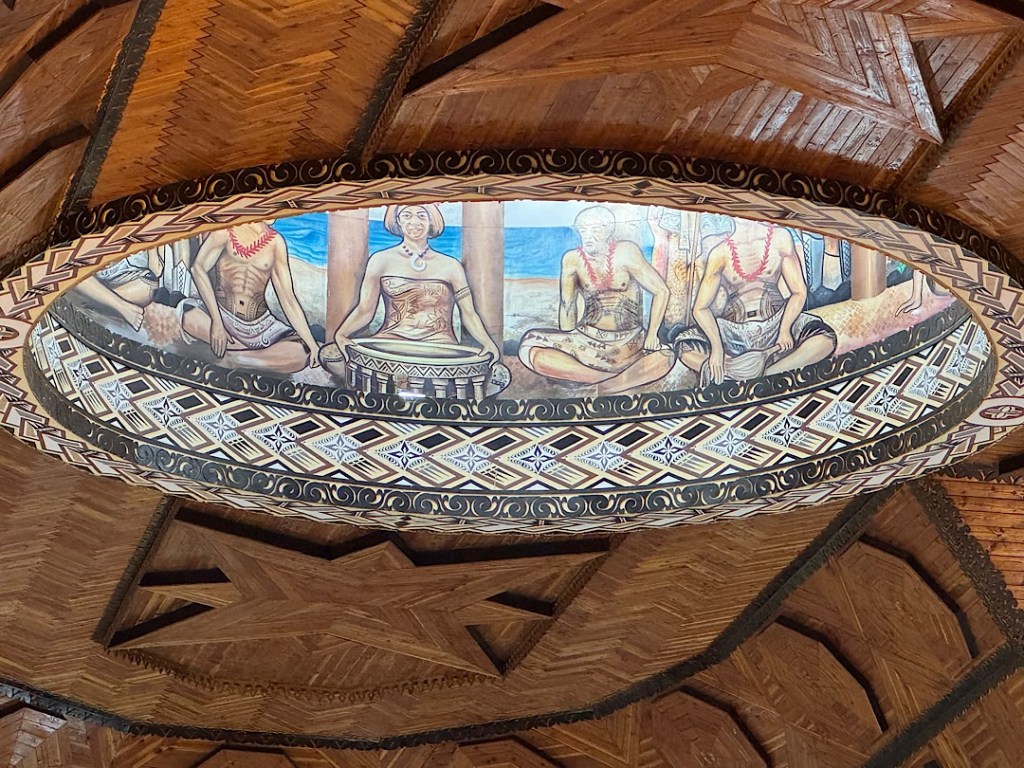
More stunning woodwork covered the ceiling.
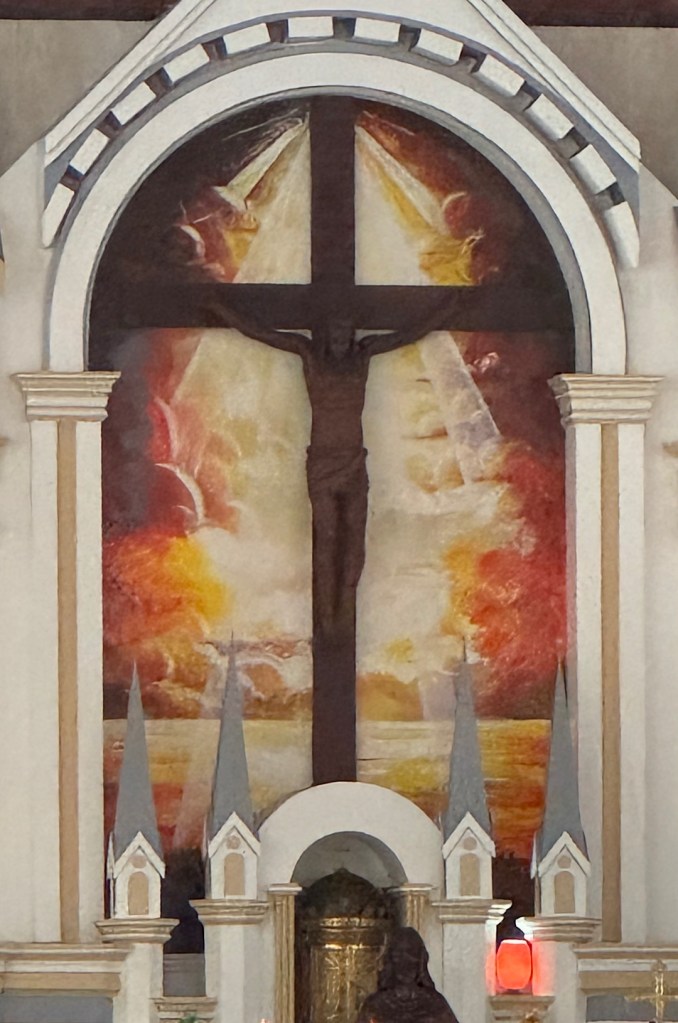
Because of the Mass, we couldn’t see more of the cupola. But what we saw of it was distinctive. So was the painting behind the altar (above).

Later in the morning, I got a hotel massage, Steve and I ate another lunch next to the pool. We swam a bit, napped a bit, consumed our dinners in the hotel restaurant. When we chatted with our waiter, he echoed what other Samoans had already told us: that Samoa is a paradise. Even without much money, you can live well; enjoy life. They wouldn’t want to leave it, they testified.

We had to go, however, at 5 am Monday morning, leaving in our wake a number of things we would have liked to see and do. I wished we’d had more time. But we’d had a good rest and at least gotten a glimpse of this beautiful, unpretentious, laidback idyll. It was worth the hop.

Next up: skipping along to Fiji.

A hop, a skip, and a jump

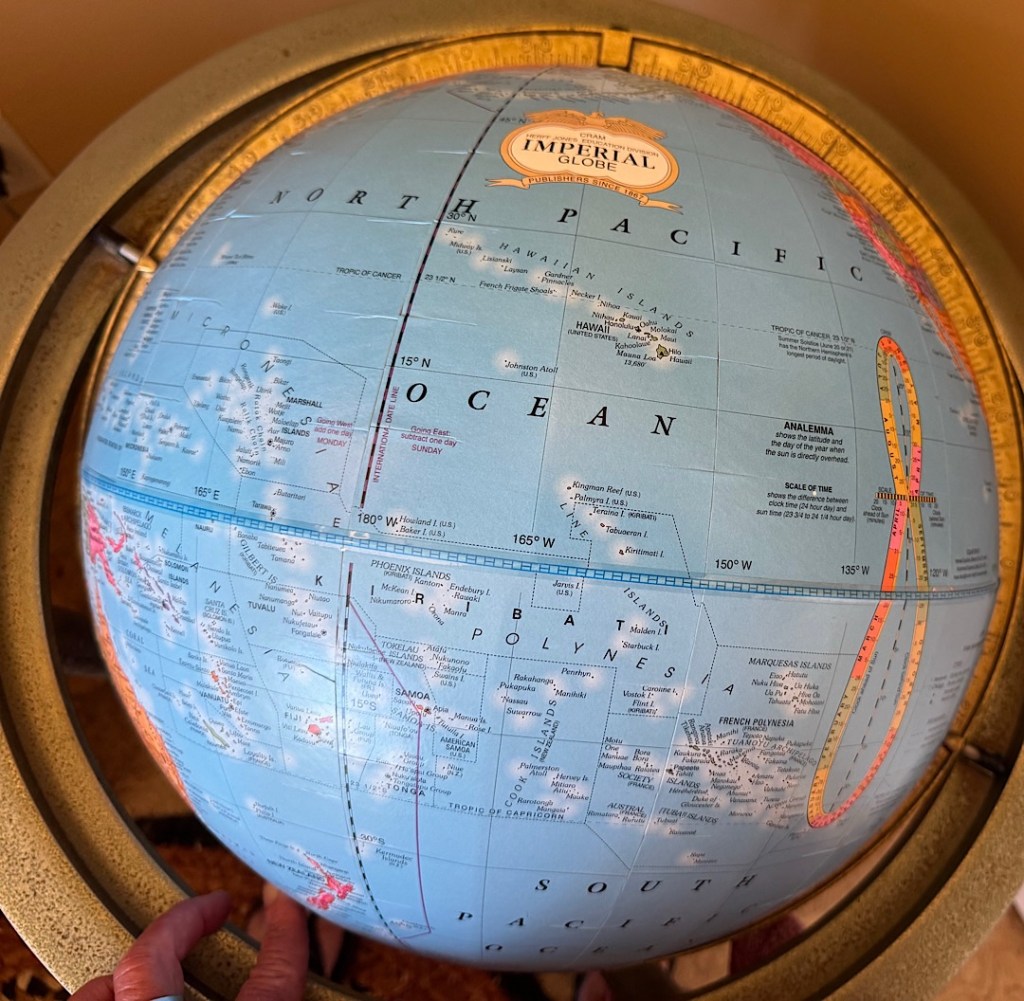
It’s not like I didn’t know the Pacific Ocean is big. I mean, duh. I was paying attention back in fifth grade geography. Since then, I’ve flown across the Pacific more times than I can count. And yet… just how big that ocean is somehow never sank in until I began preparing for this trip. 

As part of the preparations, Steve and I read a marvelous book called Sea People about how the Polynesians managed to spread throughout the vast expanses of water — more than 12,000 miles across and another 10,000 miles from north to south. As author Christina Thompson points out, you could fit all the earth’s land masses into the Pacific and still have room for another continent as big as North and South America. 

It fills up half the globe.

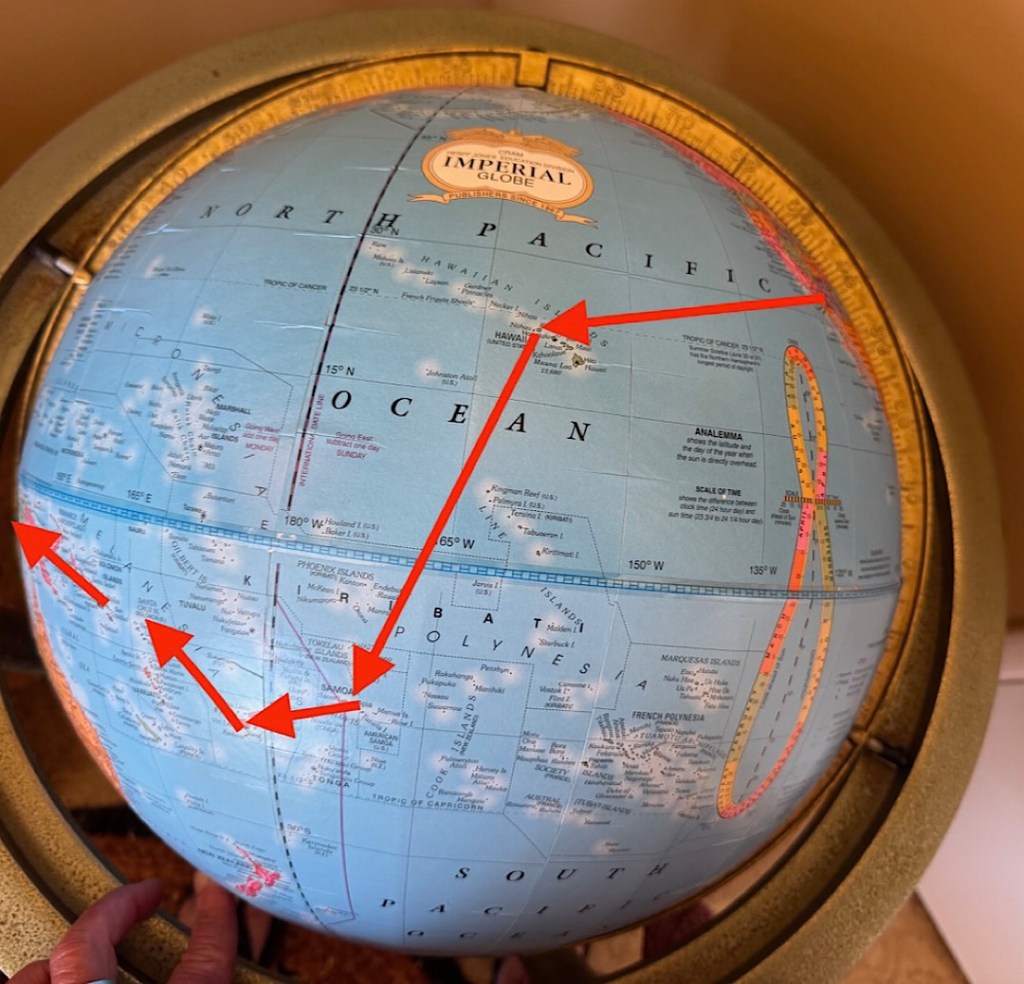
Getting from San Diego to Port Moresby (the capital of Papua New Guinea) takes more than 24 hours via the most direct connections. It’s either grueling (flying in Economy) or hellaciously expensive (in a lie-flat seat routing through somewhere like Singapore.) So we decided to try an offbeat alternative — what I’ve come to call my hop, skip, and jump approach. At the moment, as I’m writing this, we’re flying from San Diego to Honolulu. There we’ll rest in an airport hotel for a couple of hours, then continue southeast to Apia, the capital of Samoa.

We’ll sleep there for two nights, then make the short flight from Samoa to Fiji.  Sleep there for two more nights, then hop again to the Solomon Islands. These flights don’t run every day. Due to the quirky schedules, we have less time in Samoa and Fiji than I would have wanted, and more time (five days) in the Solomons. From there the jump to Port Moresby is another piece of cake — just two hours and 20 minutes. 

It’s an experiment. Maybe we’ll conclude it was nuts. We won’t be returning the same way. I have something else cooked up for that. At the moment, however, our return in five weeks feels almost unimaginably distant.