Before we started this trip, I asked whether it would seem like we were visiting another country. In short order the question felt silly. For Alaska to feel foreign, it would have to be filled with something other than Americans. It is not. We met lots of folks who were either born in Alaska or had lived there for many years. To me they often seemed different, maybe even better, than residents of the other 49 states. But never did I feel like I was outside the US.
Steve commented that the locals made him think of the folks who would sign up to settle one of the exoplanets he invented in his science fictional Handbook for Space Pioneers, people happy to make a new life in a wild place filled with potential. To me it felt like time travel -– as if the locals (or I) had landed in another dimension, rather than just one hour off Pacific Standard Time.
I’ve been trying to untangle this impression because, to my surprise, what both Steve and I loved most about Alaska where the people we met.
Not that other aspects of the state don’t live up to their billing. The landscapes are iconic.
The woods and waters and mountains team with charismatic wildlife.
But over and over, friendly encounters with local humans left us shaking our heads in amazement. One example: strolling around Sitka we ran into a woman I recognized from the previous night’s plane ride from Anchorage. She and I hadn’t spoken to one another on the plane, but she greeted me and told us all about the summer camp to which she was delivering her two youngsters. Somehow her little boy had forgotten to pack any extra pants for the week, so they were heading to the local white elephant store to do some shopping.
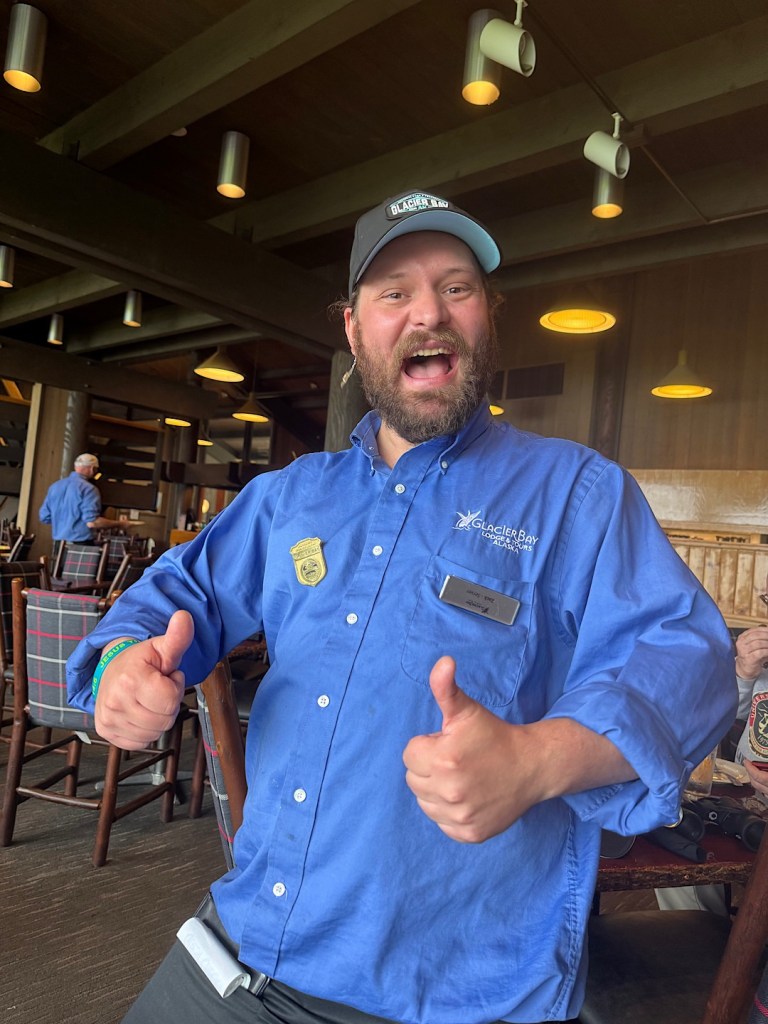
This is Zack, 31, originally from Florida, who’s working for the summer as a food server at the Glacier Bay Lodge. Zach shared so much about his life with us, I could tell you a LOT more. But I’ll refrain.
Of course Zack‘s not an Alaskan. He’s part of the legion of young people who flood in to work every summer, thrilled to be having such a big adventure. Some will return over and over. Some will wind up staying. Our home-exchange host in Juneau, Andy, did that. Now he and his wife have kids who grew up in Alaska and have already graduated from college. Andy’s had multiple careers over the years. The competition for jobs is low, he points out. If you want to find work and you can learn as you go, there are plenty of ways to make a living.
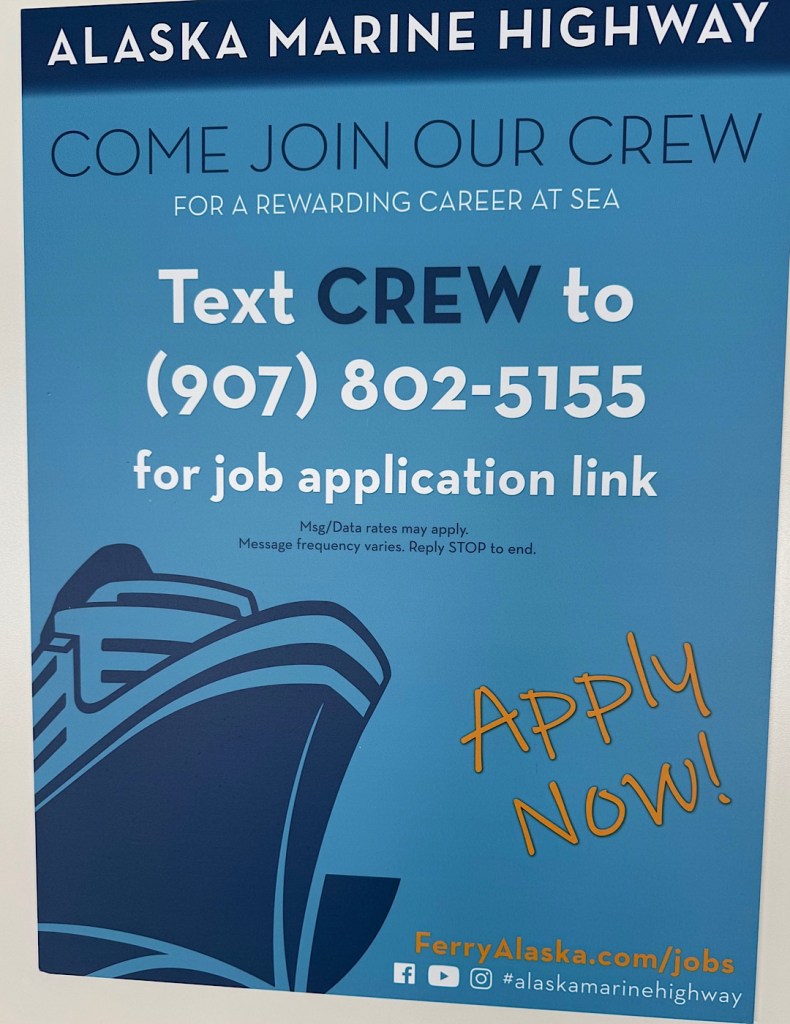
The ferry system is looking for some extra hands!
People seem to appreciate all that economic opportunity. Those who stay also have (or develop) a tolerance for a nasty weather and months of darkness.
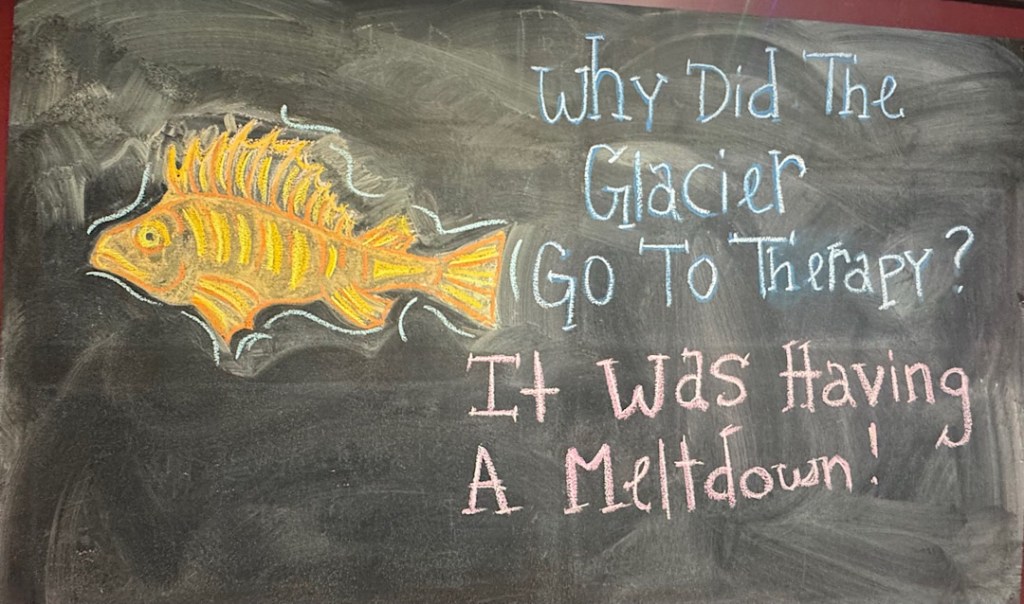
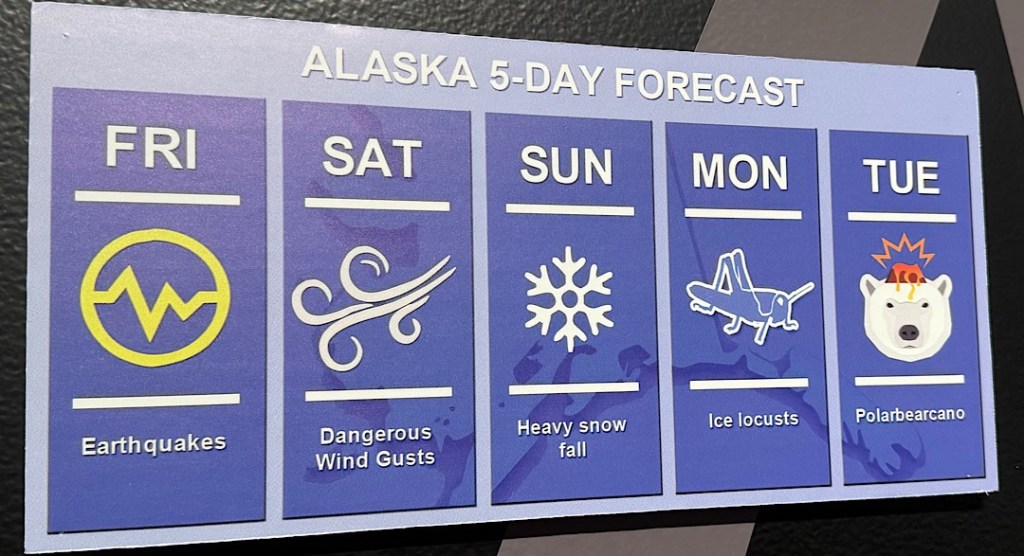
At any moment, an earthquake can wreck monstrous damage. Or it can trigger a dreadful tsunami. Volcanoes explode. Mountainsides or the snow piled up on them collapse and kill whatever’s in their paths. Go out for a run and you might meet up with an irritable mother bear. Because so much can go wrong, locals rely on helping out each other. They leaven that trust with humor.
It’s tempting to think about joining their ranks. If like Steve and me, you love growing baskets of fruits in your backyard year-round, that’s a bridge too far to cross. Still, it’s been fun to stand on the bridge for several happy weeks before returning to the sandals weather and sunny skies.
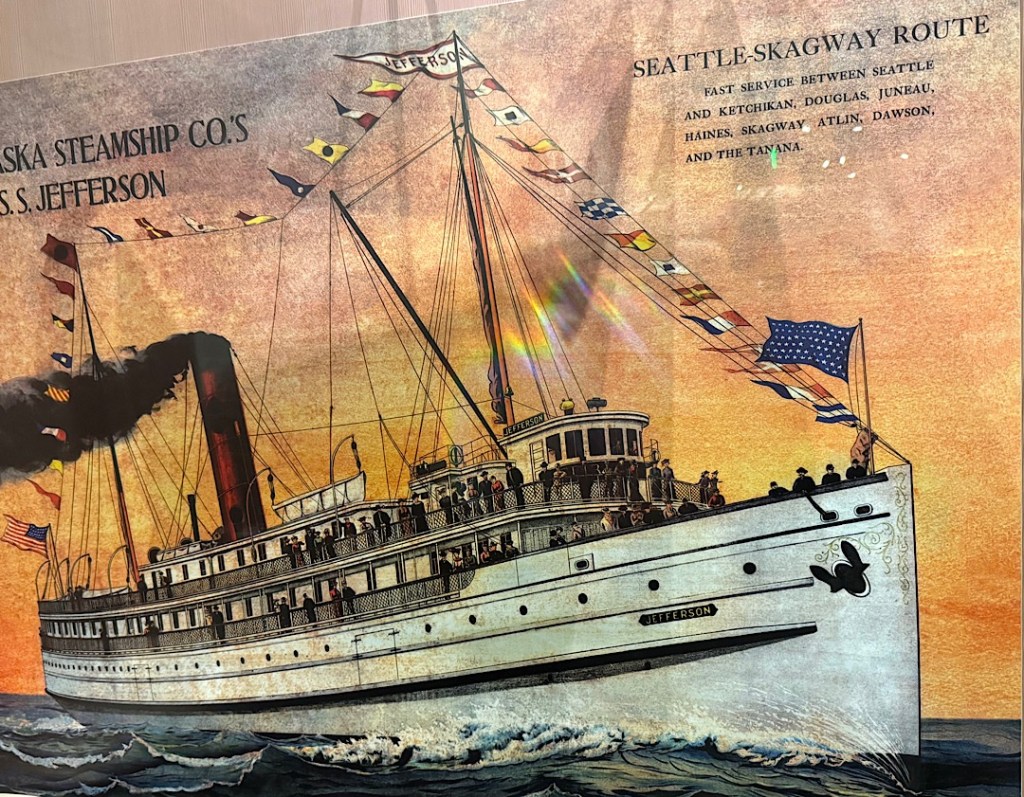
Almost 45 years ago, I rode a train I will never forget. Steve and I boarded it at night in London and settled into a sleeping car that was hauled to somewhere on the British coast. I remember waking up to a lot of clanging and banging as our car was uncoupled from the British engine and loaded on the vessel that would carry it across the English Channel. On the other side, the French hooked it up to another engine that pulled us all the way to Paris, where we disembarked. Although once an emblem of the glory days of rail, the “boat train” was being discontinued; I no longer remember how we managed to get tickets on its final run. But I’ve thought of it as we’ve ridden on an Alaskan ferry these last two and a half days.
No plans have been announced to end the the 62-year-old Alaska Marine Highway System — yet. But I had to wonder how much longer it will survive. Annual ridership reportedly has declined from 400,000 passengers (in the early ‘90s) to 185,000 (last year). The fleet has shrunk from 11 vessels to just 7, and many are rusting their way toward unseaworthiness. The state struggles to staff them and at times has had to cancel scheduled sailings for lack of officers and crew. The routes that do manage to operate are complex, and the boats don’t run often. I first became aware of all this when I was planning our trip six months ago. Trying to figure out a way to use the ferries to get where I wanted to go (and when) was one of the biggest touristic challenges I’ve tackled.
Alaskan politicians have been squabbling over funding for the system for ages. Some folks have argued the ferries should pay for more of their costs, while others retort that roads aren’t expected to do that (mostly). Yet the ferries do fill the role of roads here, sometimes the only connection to the outside world (besides planes or small water craft) for many communities.
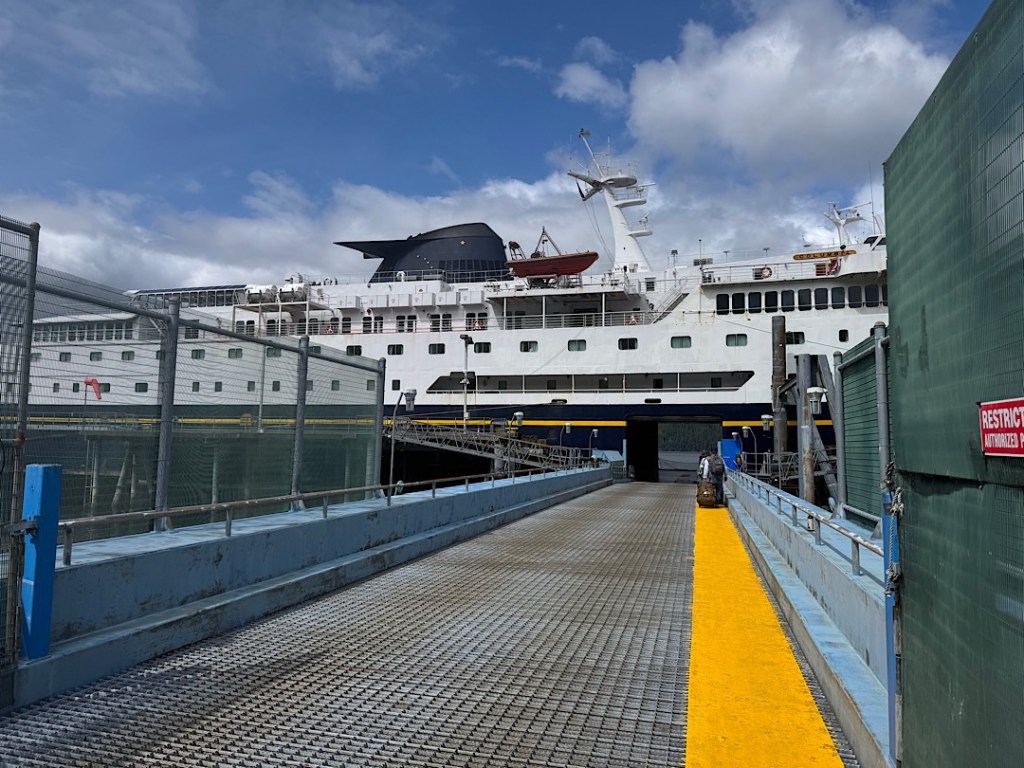
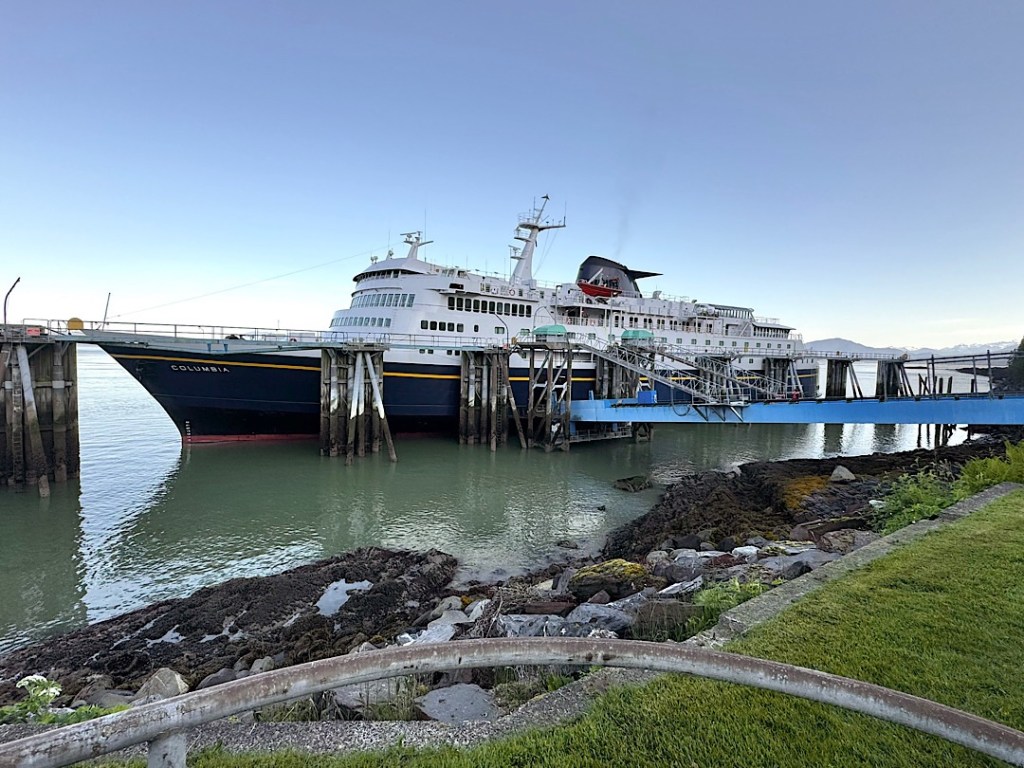
I’m not sure what could or should save the ferries. But I can — now — say IF Alaska’s ferries disappear I’ll be sad. Steve and I rode for 5 hours on the MV Hubbard from Juneau to Gustavus, then we wrapped up our Alaska adventure by spending almost 60 hours on the MV Columbia as it bore us almost 1000 miles from Sitka to Bellingham in Washington. Both rides were extraordinarily soothing.
We boarded shortly after 2 p.m. Tuesday afternoon at the Sitka ferry depot.Around 6 the next morning, we made a brief stop in Wrangell, where Steve and I strolled briefly through town.
We’d booked one of the Columbia’s 75 cabins, a plain, utilitarian space containing two sets of bunk beds and a private bathroom. Roomier than any train compartment, the lighting was decent, augmented by a big window. I slept well in my lower berth.
We used the upper bunks as clothing shelves.
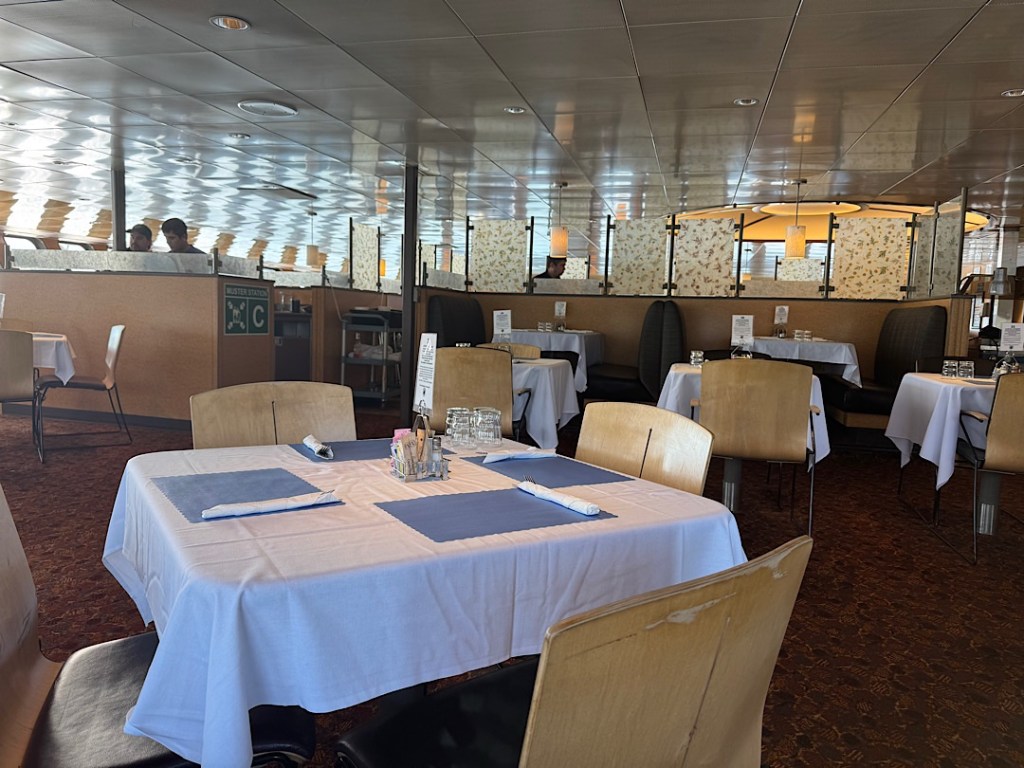
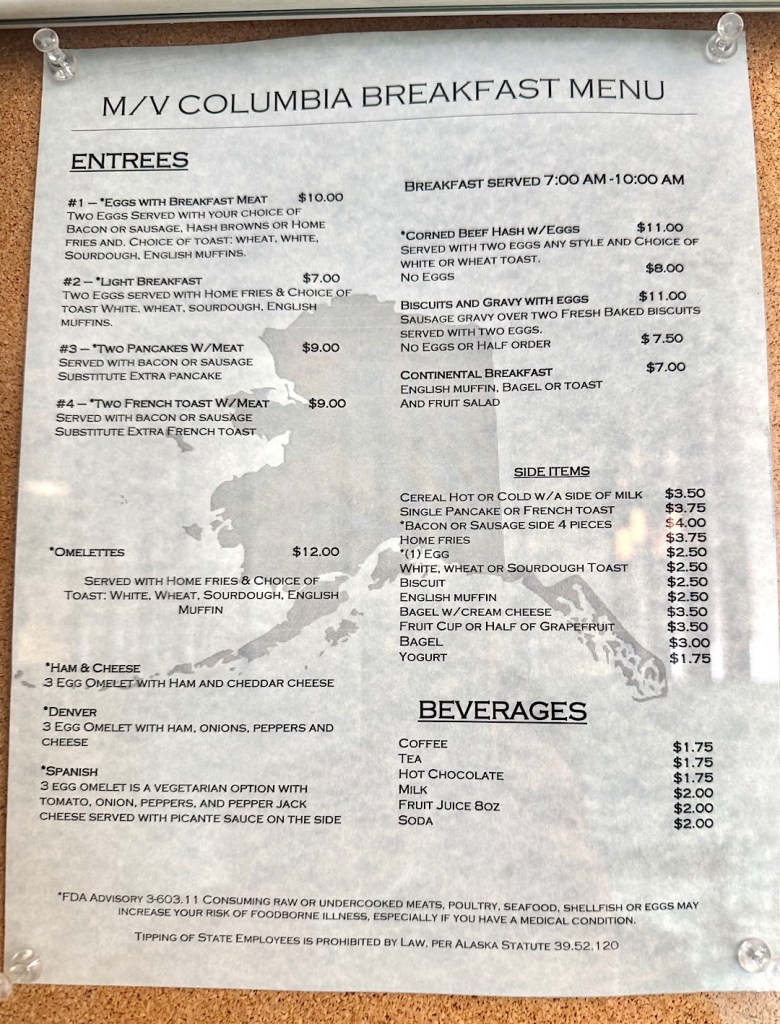
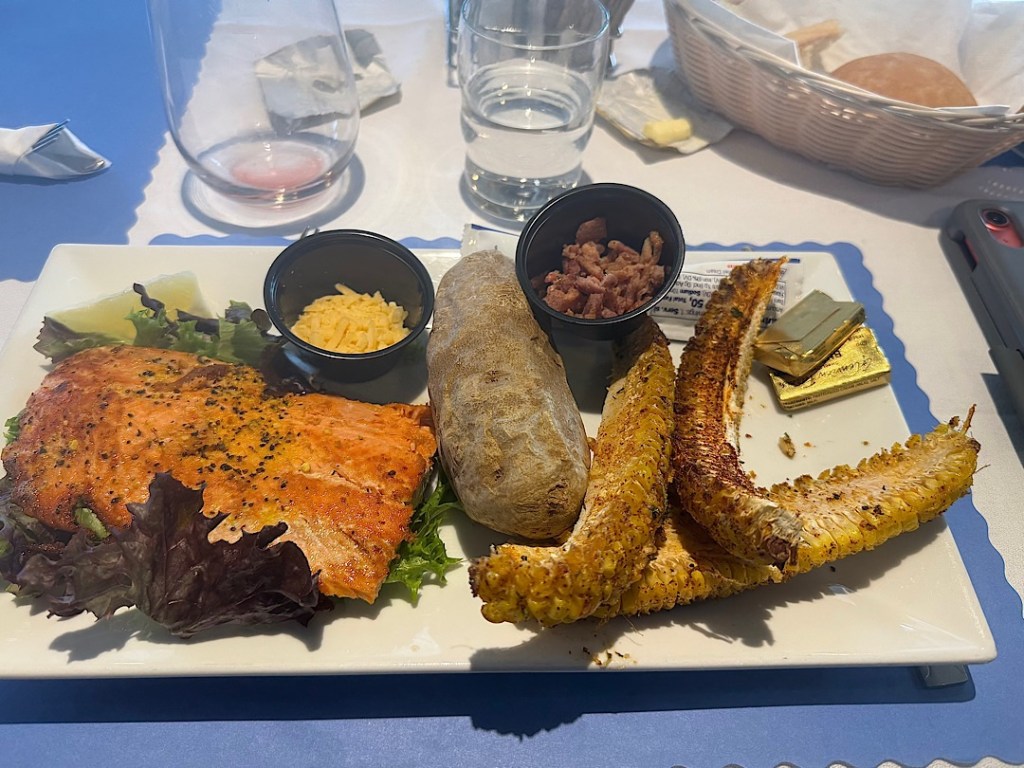
In the ship’s pretty, old-fashioned dining room, uniformed waiters served breakfast and dinner daily, and the prices were startling — roughly half what we’d seen anywhere else in Alaska.
The dining roomThe breakfast menuThe wild salmon dinner ($18)
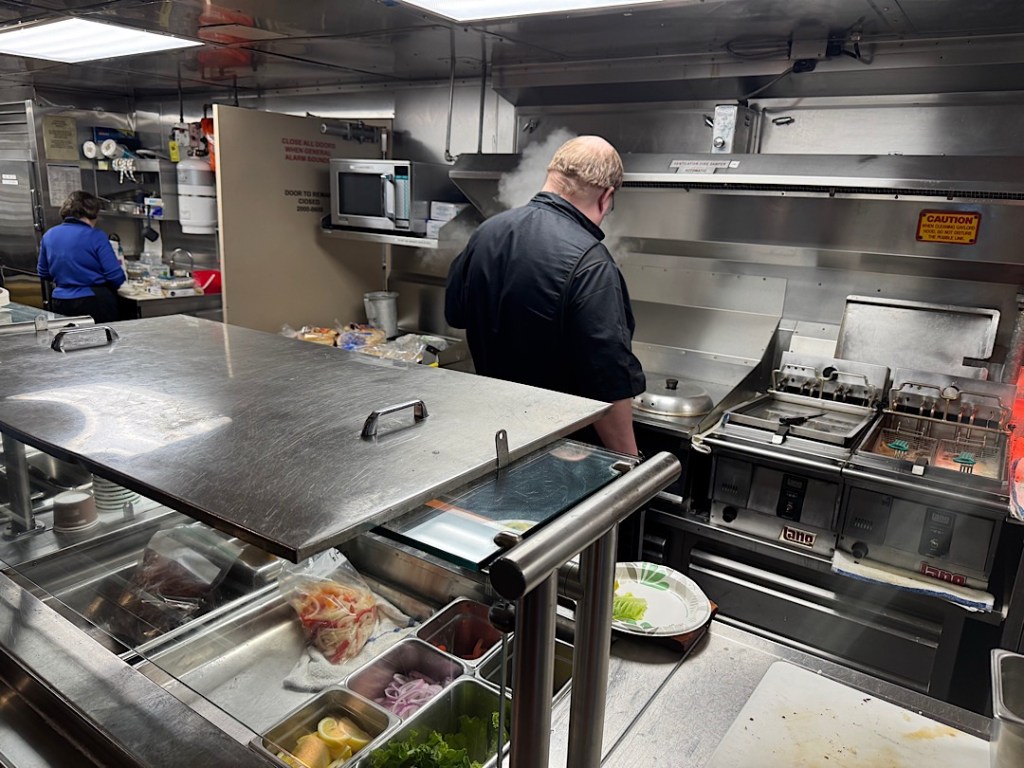
A more informal snack bar provided basic options: grab-and-go sandwiches; fish and chips and burgers served up by a burly old-school fry cook.
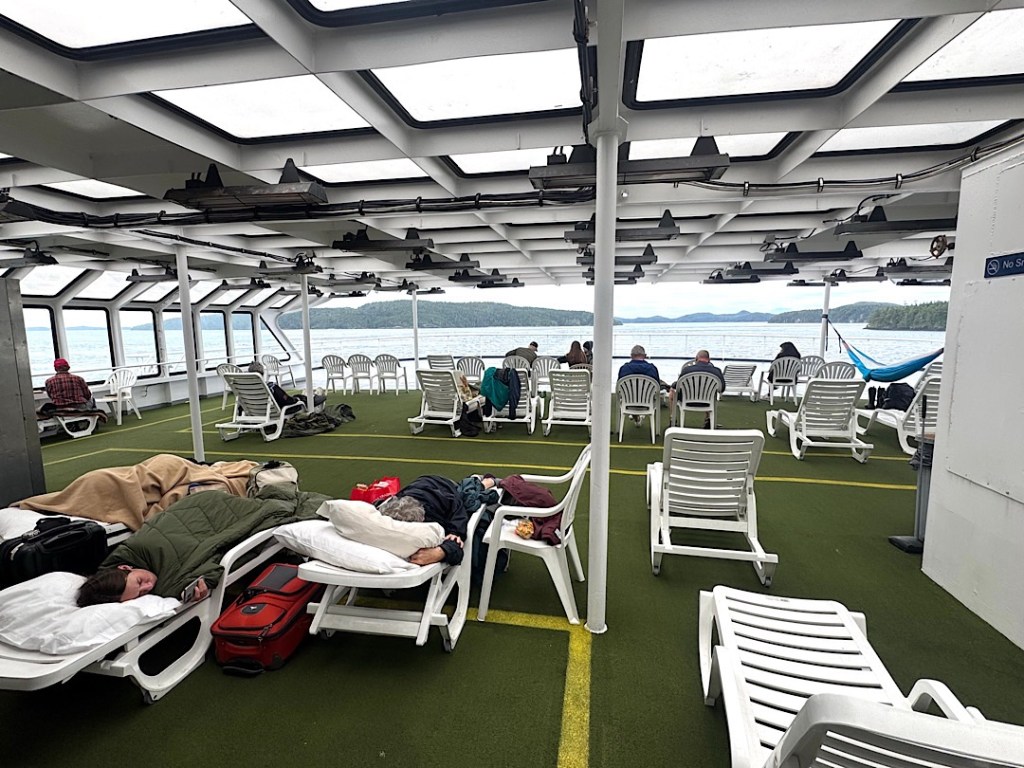
Budget travelers could also save money by forgoing a cabin and sleeping in a tent outside. Or you could put your sleeping bag on one of the Solarium’s lounge chairs where overhead heaters tempered the cold.
The only outdoor lover on our trip. Tents reportedly fill the space on some trips.The SolariumThe Forward Lounge
I learned we were sharing the boat with 170 other passengers, only a third of the Columbia’s capacity. It does fill up occasionally, the purser told me. “But,” she grimaced, “that gets ugly.”
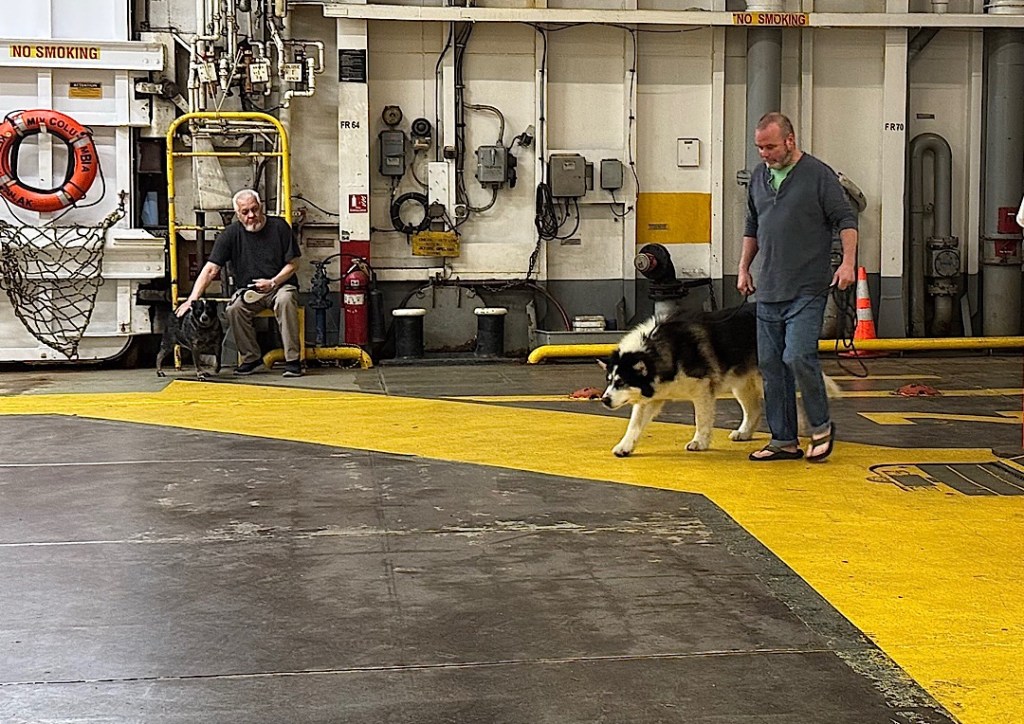
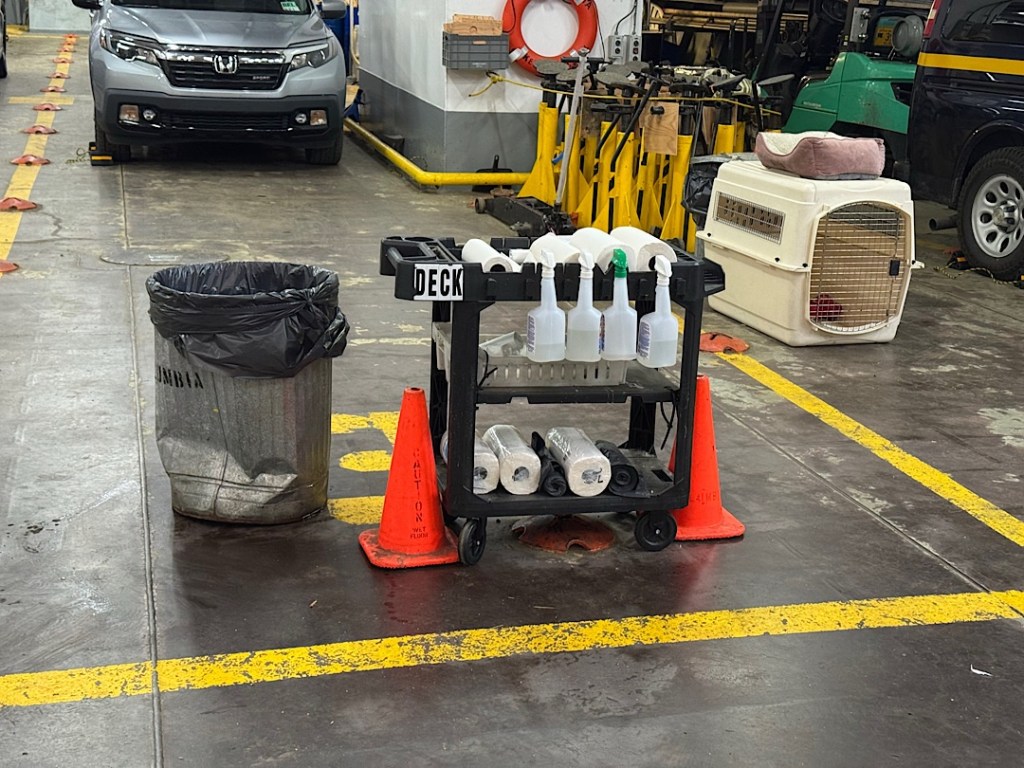
Other quirks enlivened the ride. At regular intervals, announcements informed us the car deck would be opening soon, so if you’d brought your dog and stowed it in your car or kennel, you could descend to walk (and clean up) after it for 20 minutes.
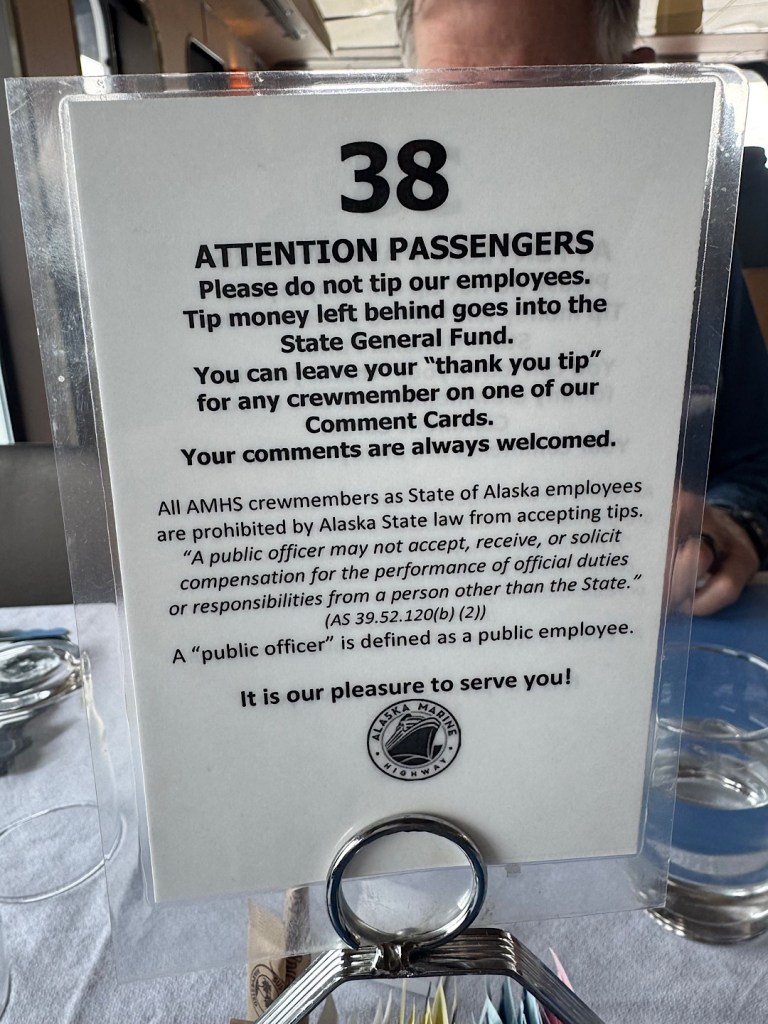
Between Deck 7’s forward lounge and the snack car, we found a bar that at first glance looked grand, filled with lights and mirrors; a real piano; a giant chess set. But the bartender only stocked canned cocktails, five-ounce bottles of bad wine, and beer. Behind her, a sign cautioned she could only sell each patron one drink per hour. Other onboard signs prohibited tipping.
Despite that, the large restaurant staff somehow exuded good spirits.They botched our orders and made mistakes on the checks. But they couldn’t have been more friendly or hospitable.
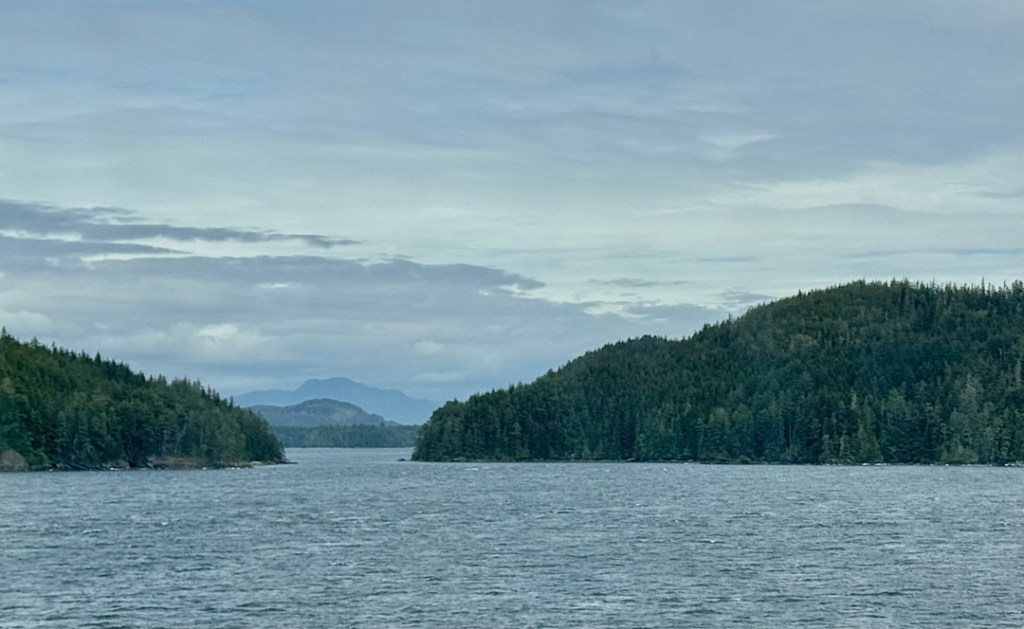
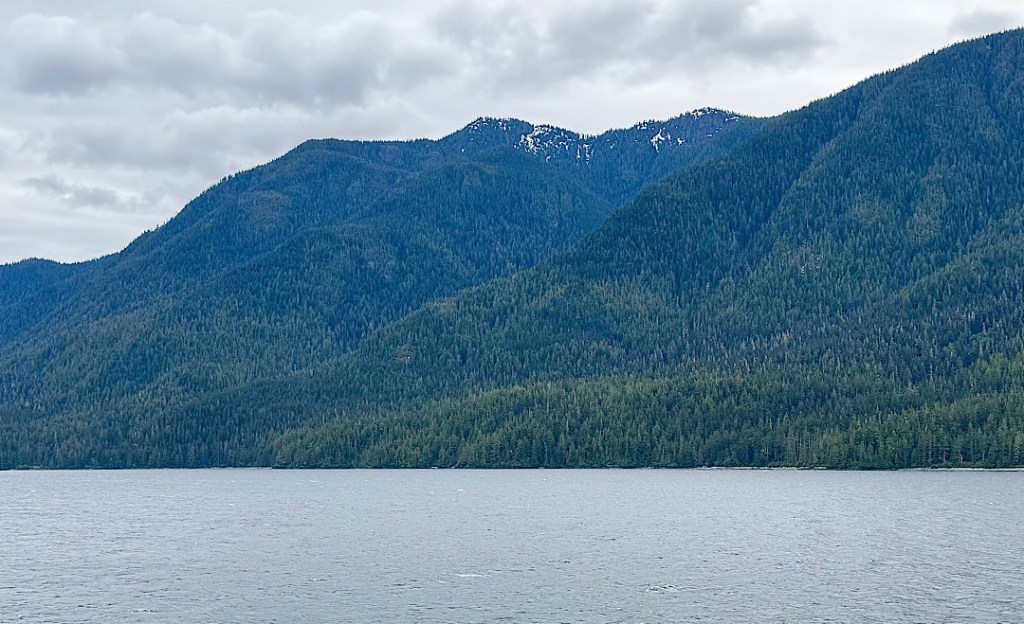
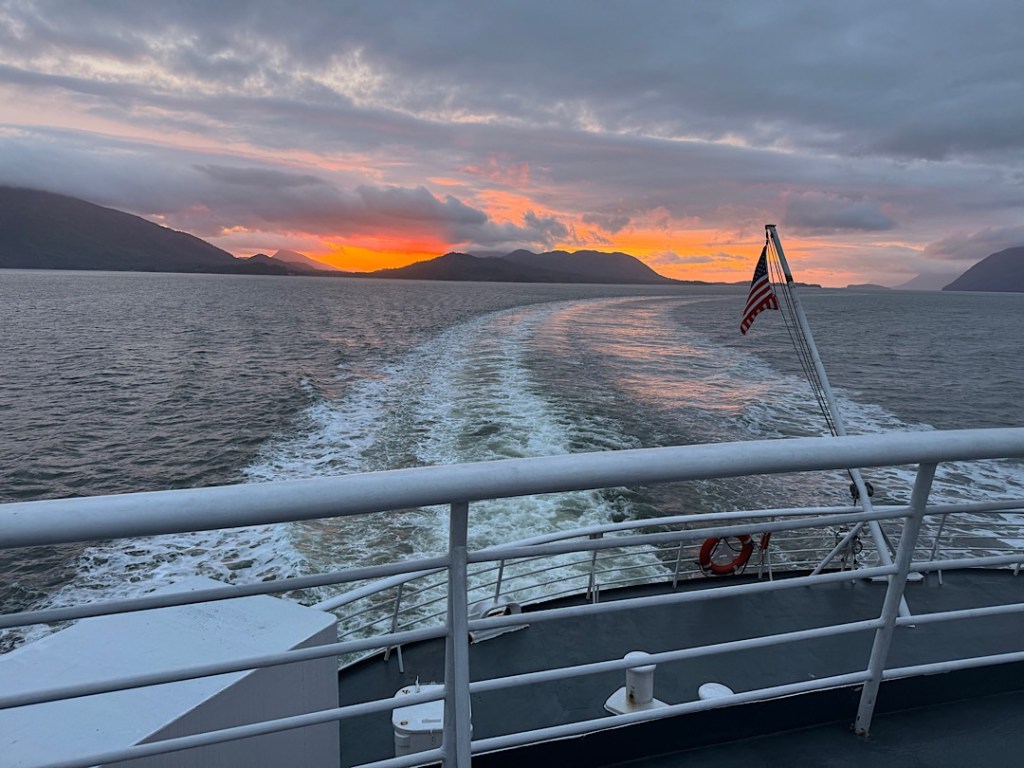
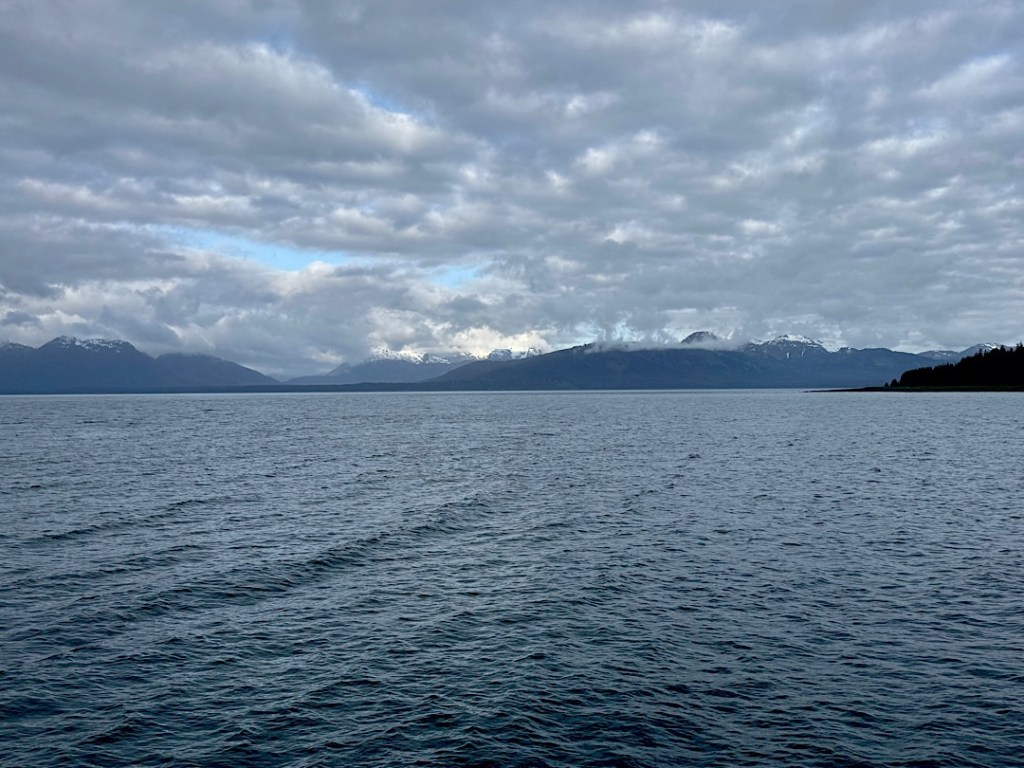
Most important: we tied up in Bellingham minutes before 8 am Friday, just as scheduled. If the occasional swells made anyone seasick, I wasn’t aware of it. I enjoyed hour after hour of views of the Inside Passage, a waterway that had intrigued me as long as I can remember. In my mind, it’s real now, a gift no flyover can bestow. If the Alaska ferries cease to exist, this ride will rank right up there with the boat train.
This trip has reminded me that going out in search of famous natural wonders can resemble playing poker in Vegas. You may be able to shift the odds of hitting travel targets in your favor: study weather patterns. Pick reputable guides. But for all the time and effort and money you put in, bad luck still can strike; you can bust or hit gold.
Our biggest, most challenging target here was Alaska’s great glaciers — those moving rivers of ice that are melting all over the planet. We aimed to see them in two places: Kenai Fjords and Glacier Bay national parks. Because of our train disaster, our arrival in Seward (Gateway to the Fjords!) was a bit frazzled, but our first afternoon there lifted my spirits. The sun broke through as Steve and I strolled around the town’s little core and a browsed an art fair in front of the Alaska SeaLife Center. Giant dandelions glowed in the sunshine along the waterfront.
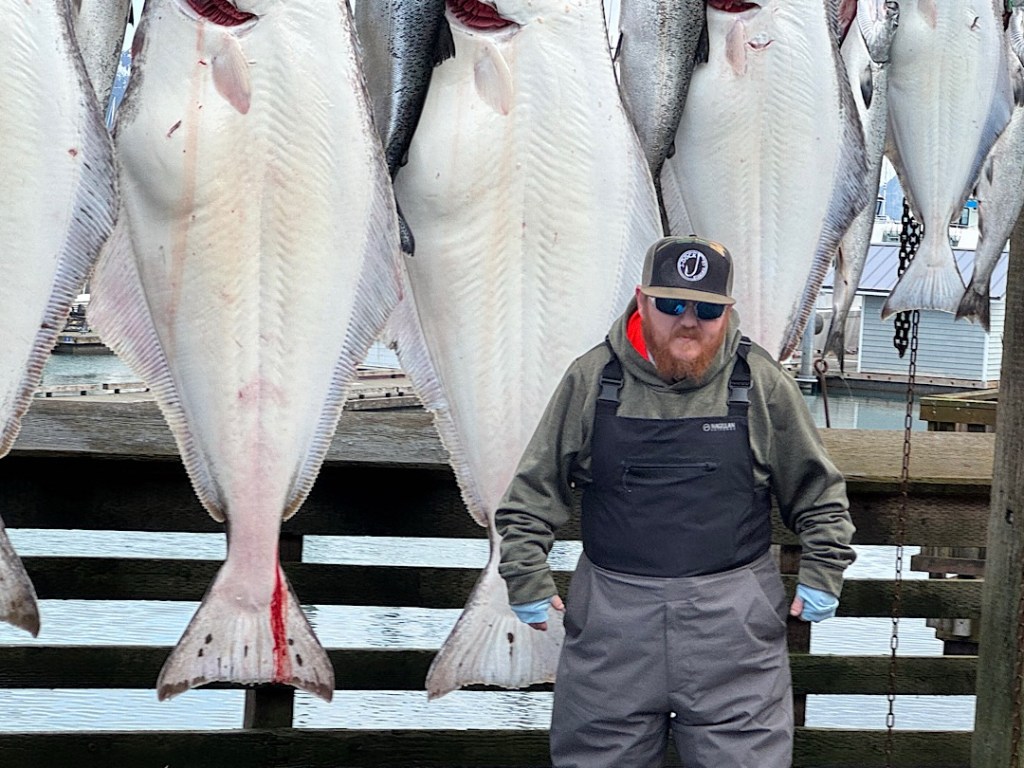
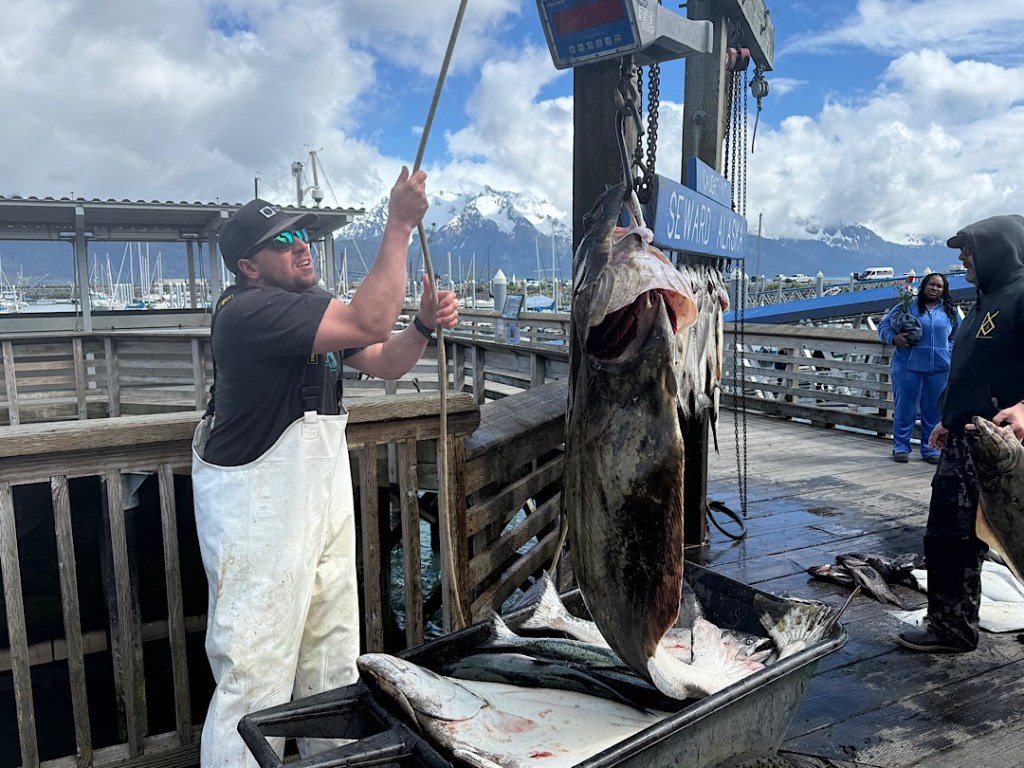
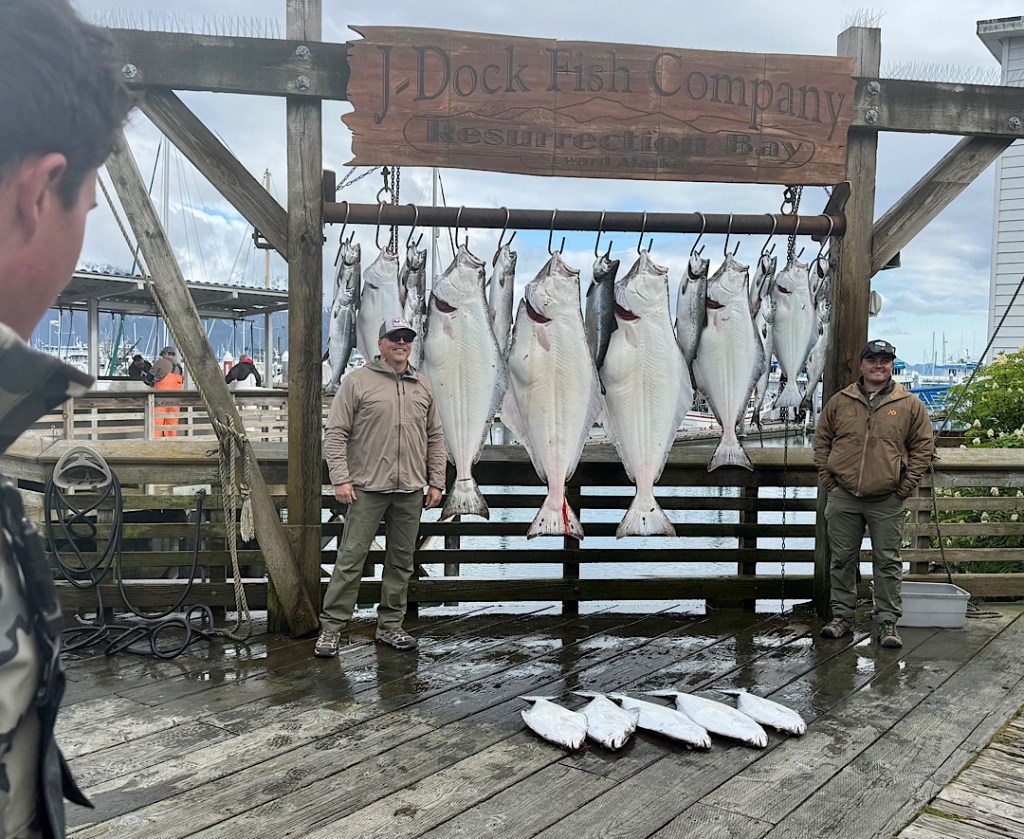
Ebullient fishermen weighed their catches.
This halibut topped 100 pounds
From our table at dinner, we watched a massive Stellars sea lion diving for his dinner among the boat slips.
The world looked darker and colder when we got up the next day (Sunday). I checked in for our 8.5-hour-long cruise to the glaciers, and the girls behind the counter wore pained expressions. They warned that if the sea got much rougher, our captain might have to cut our trip short. Things could possibly improve a bit the next day, they suggested, so we switched Sunday’s glacier tour for the four-hour orca cruise we’d been scheduled to take Monday.
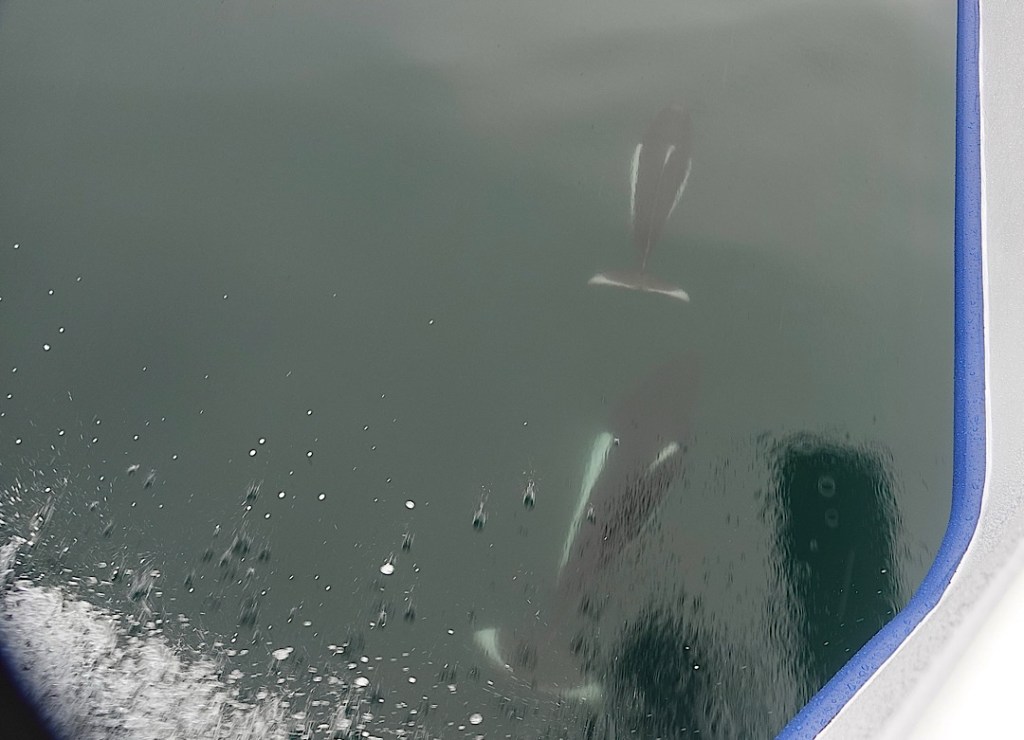
The whale-watching wasn’t a complete disaster. In short order, we found a pod of killer whales, their black and white coloring unmistakable. But the park rules dictated we stay so far away even the longest telephoto lenses couldn’t capture much. For anyone like Steve and me who at one point in our lives spent many hours at SeaWorld with our Shamu-besotted kids, it was underwhelming.
More entertaining were the Dall’s porpoises who surfed our bow wave for at least ten minutes.
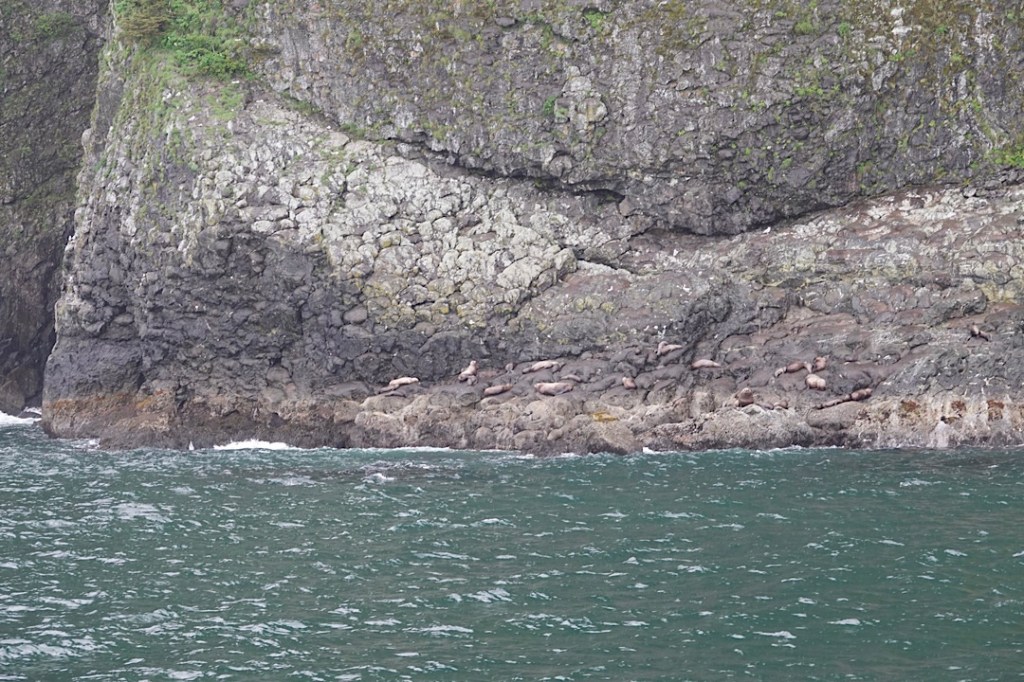
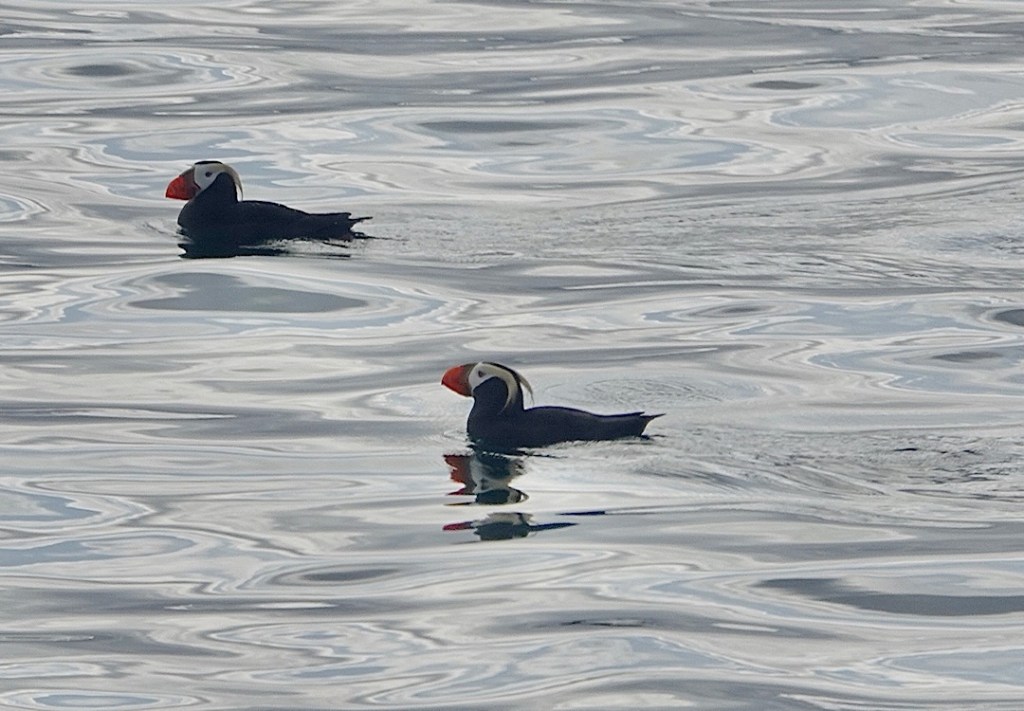
Our cheery captain found a few other things to show us: a sprawling sea lion colony; legions of birds.
But the rain never stopped, and icy winds stabbed us every time someone opened one of the doors leading into the enclosed second deck.
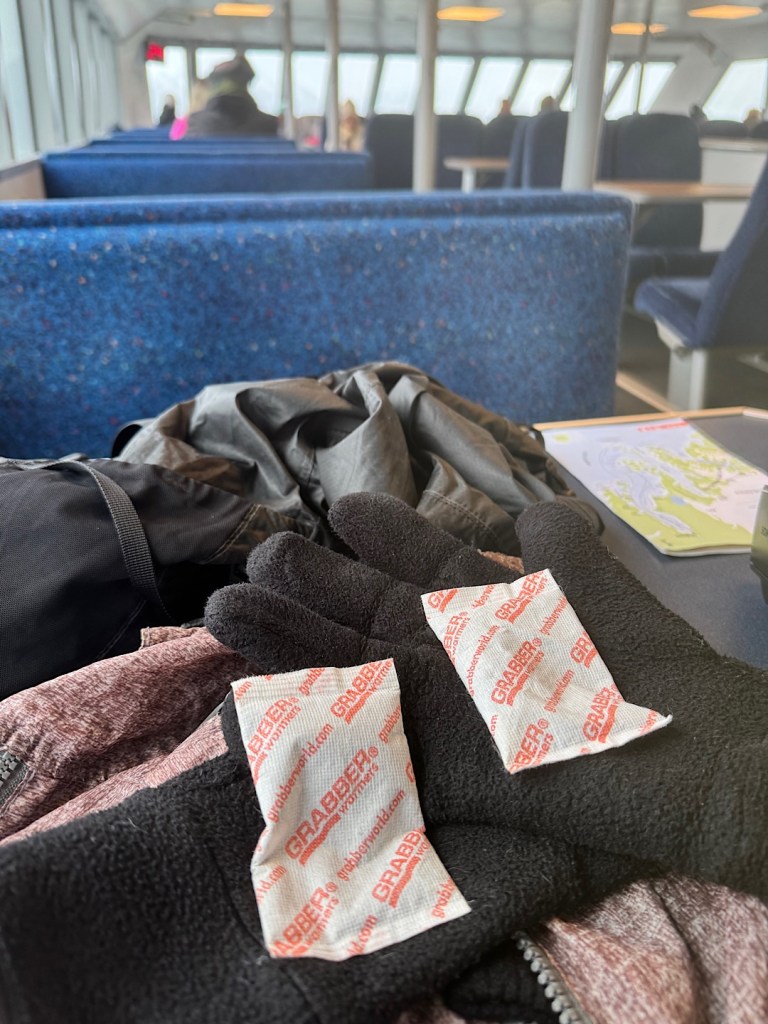
After four hours, I was chilled to the bone, despite all the layers I was wearing. Two pairs of gloves and chemical hand warmers kept me from losing all circulation in my fingers, but they still felt like ice.
The next day the Great Dealer in the Sky dealt us an even worse hand. At first the rain was light; the skies brighter. Our glacier-cruise captain reported that the winds seemed to be dropping. But it would take us a few hours to motor out of Resurrection Bay and through the stretch of the Gulf of Alaska that would take us to the fjord containing some of state’s most famous tidewater glaciers. By the time we reached the decision point at Pilot Rock, the sea was heaving; 15-foot swells made our boat tilt to unnerving angles. The folks who had started feeling queasy an hour before looked awful. (Happily, neither Steve nor I were among them.) But the wind was building, the captain reported, so prudence dictated he turn back.
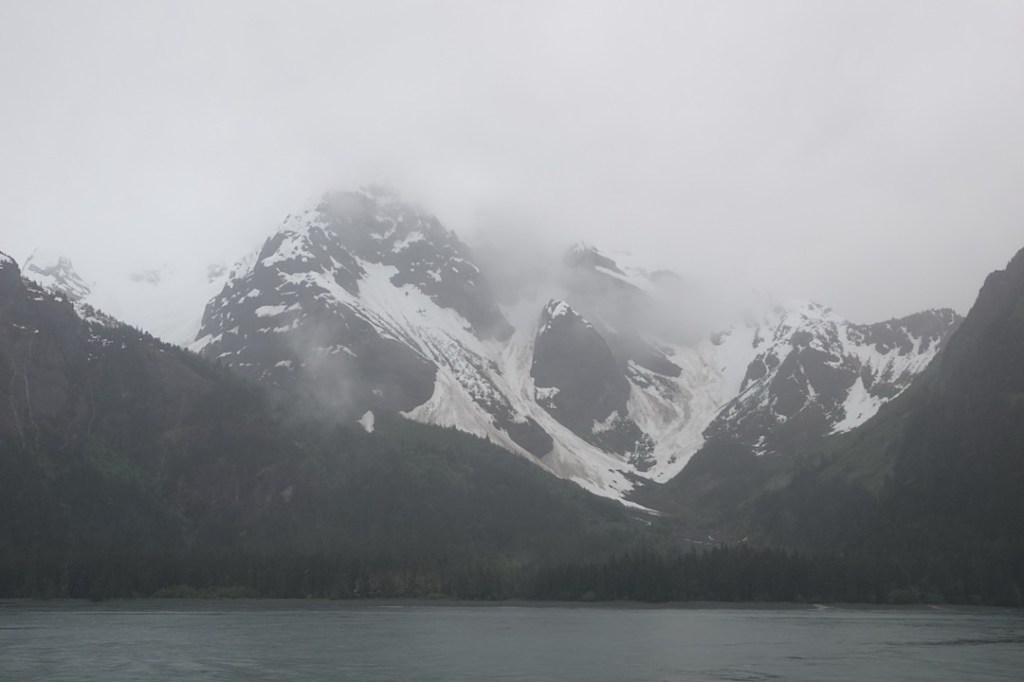
That’s how we missed seeing Discovery Glacier (or anything glacial other than smears of distant white glimpsed through the rain.) I felt philosophical. At least I’d learned what the Gulf of Alaska feels like on a nasty day (without suffering a whiff of seasickness). And we could still hope for better luck in Glacier Bay.
Glacier Bay’s “gateway” is the tiny town of Gustavus, which we reached by taking a mellow, uneventful five-hour ferry from Juneau. We checked into the national park lodge and strolled a bit under sullen gray skies.
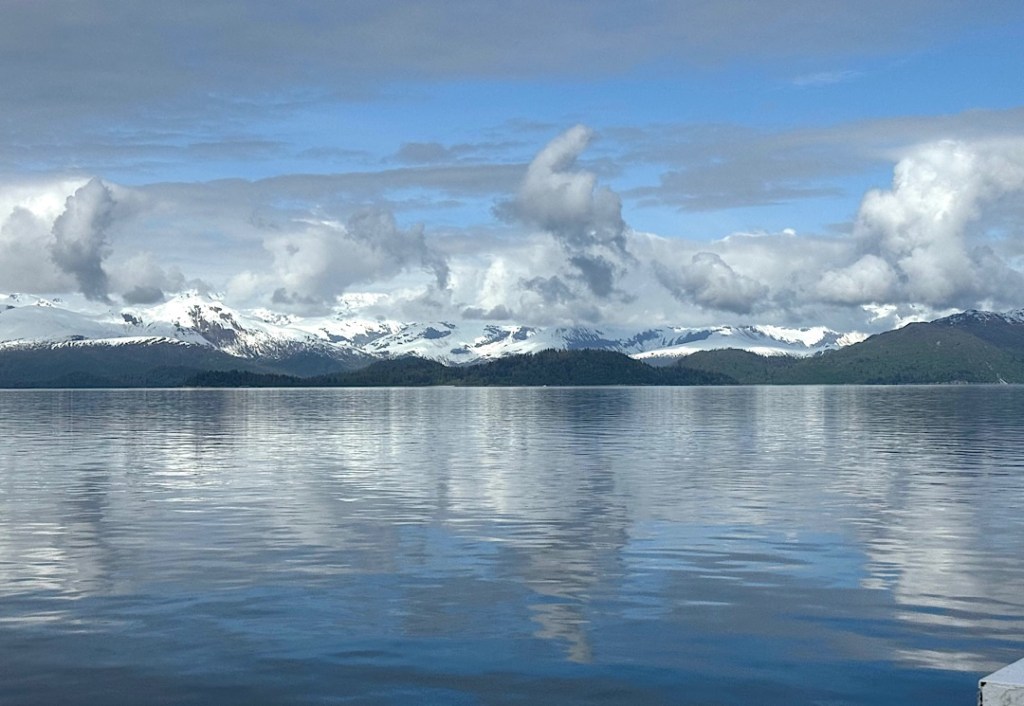
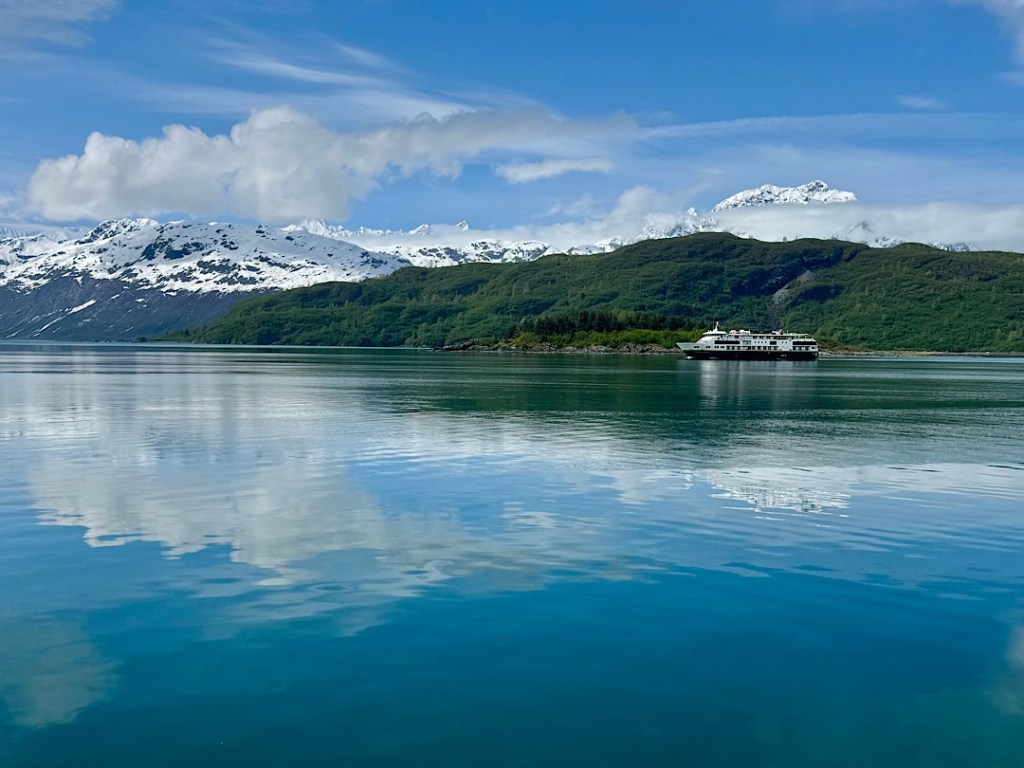
Once again, I had booked an all-day outing on a high-speed catamaran for the next day (last Friday, 6/6). About 30 passengers had boarded it by 7 am. We shoved off. Wavelets covered the water, but overhead the clouds dispersed enough to show us promising patches of blue.
It wasn’t too cold to stand outside on the deck and admire the wildlife…
We glimpsed many humpback whales (who are protected in the national park). All these guys all rank among the world’s most charming animals, but soon I was feeling at least as awestruck by the vistas.
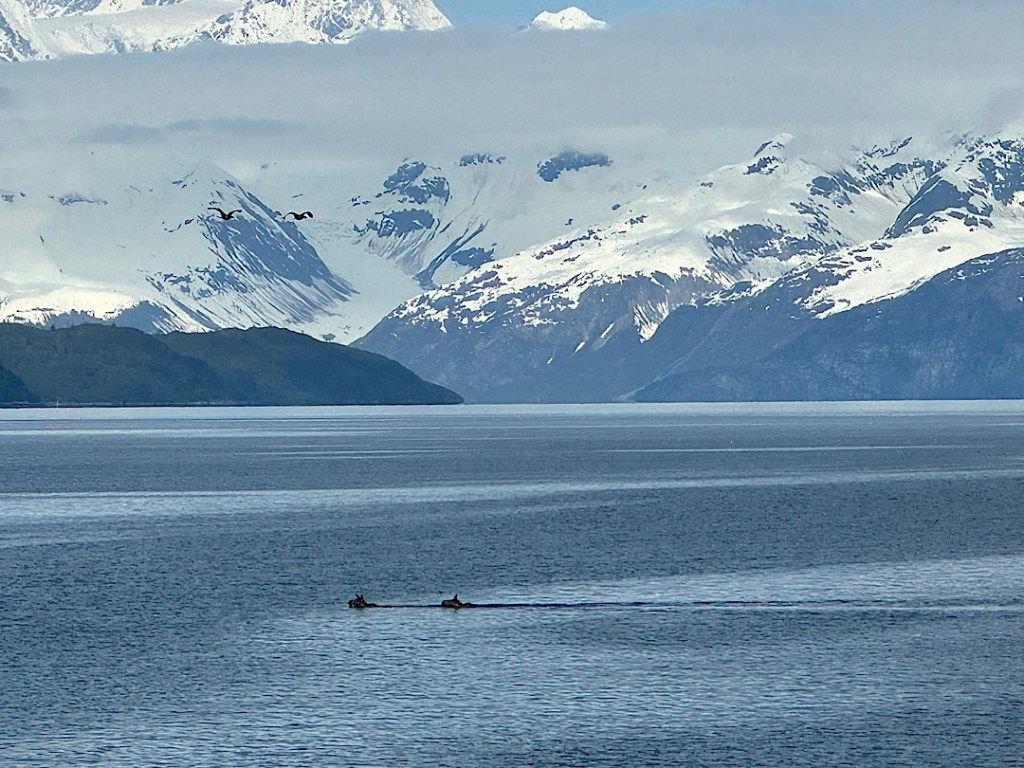
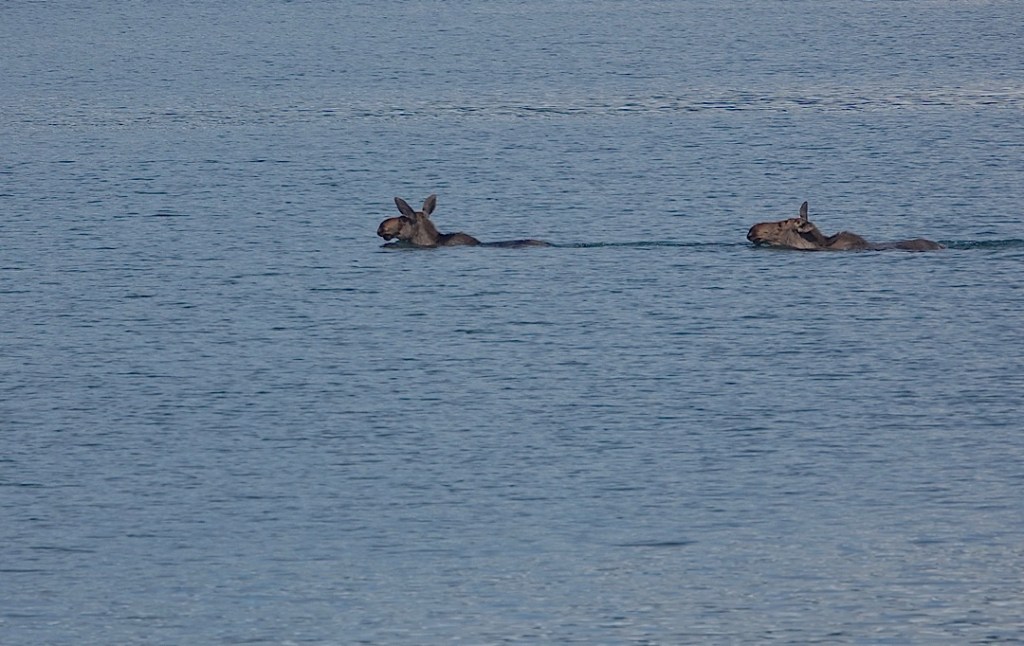
A bit after 9:30, someone shouted and pointed to two dots in the distance: two moose swimming across the fjord!
No mistaking those noses.
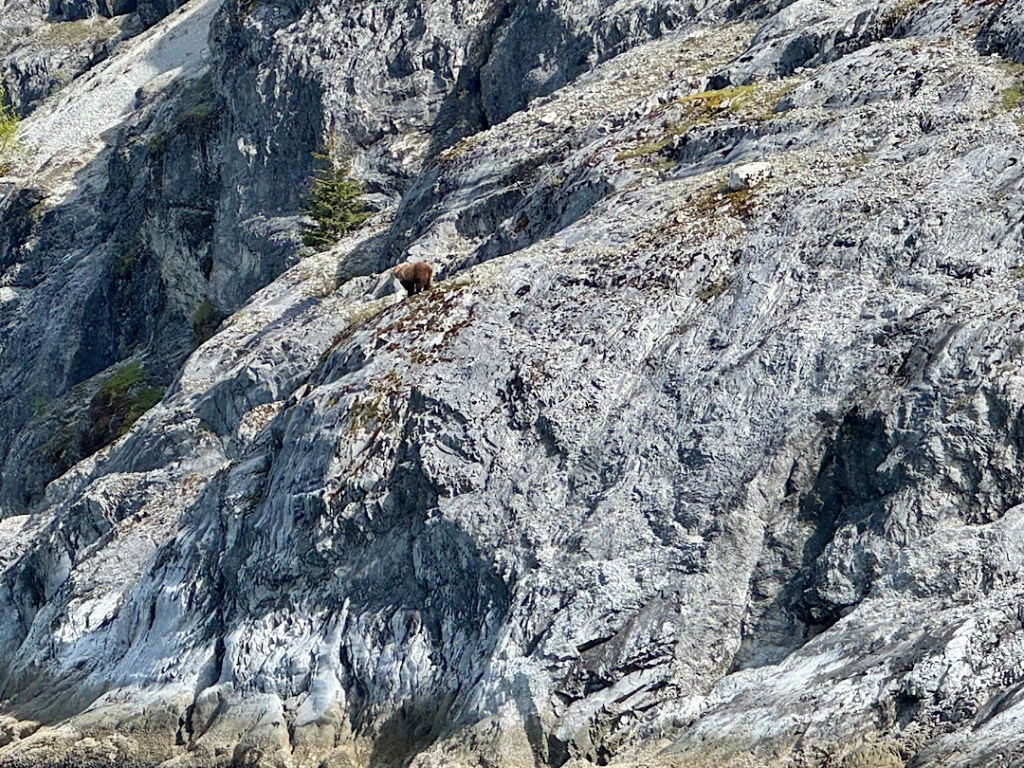
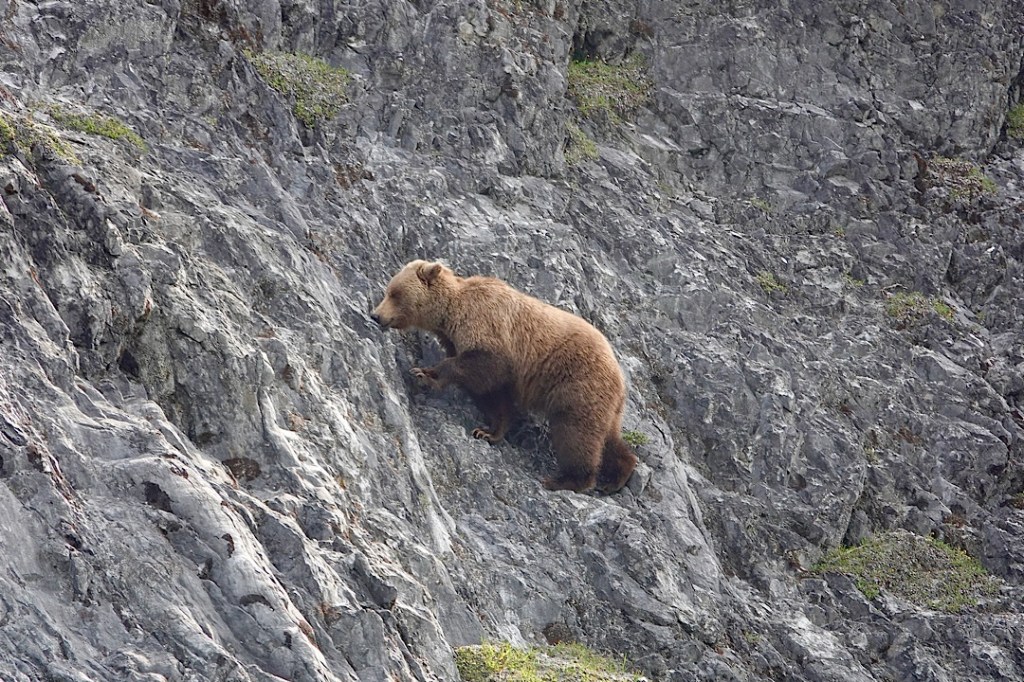
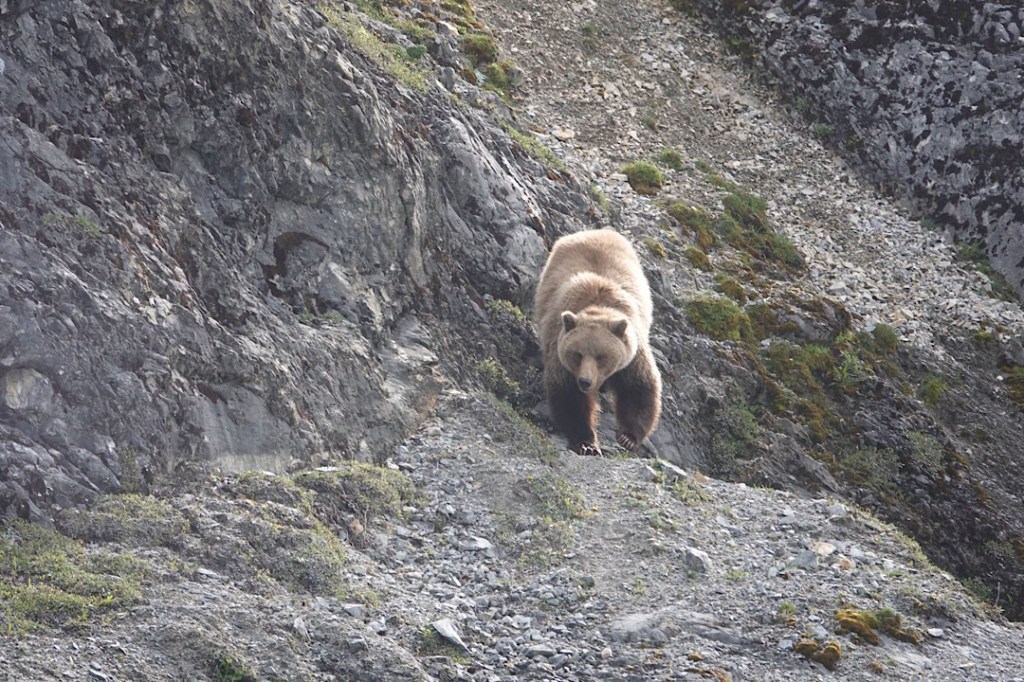
The boat’s crew members told us how rare this sight was. And mysterious! Moose lack heavy insulating coats or significant body fat. What would motivate them to cross the freezing channel? Even our onboard park ranger (Hailey) seemed mystified. The sight would have enthralled most boatloads of tourists for some time. But a new cry shifted our focus to the other side of the catamaran. On the cliffside ahead, the form of a brown (aka grizzly) bear was moving.
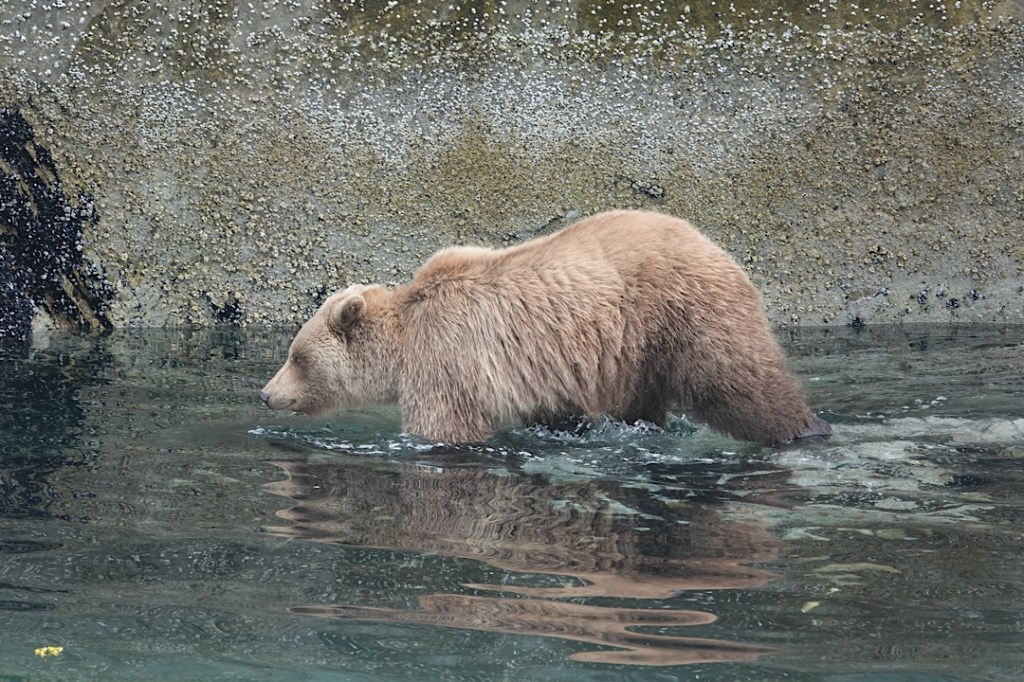
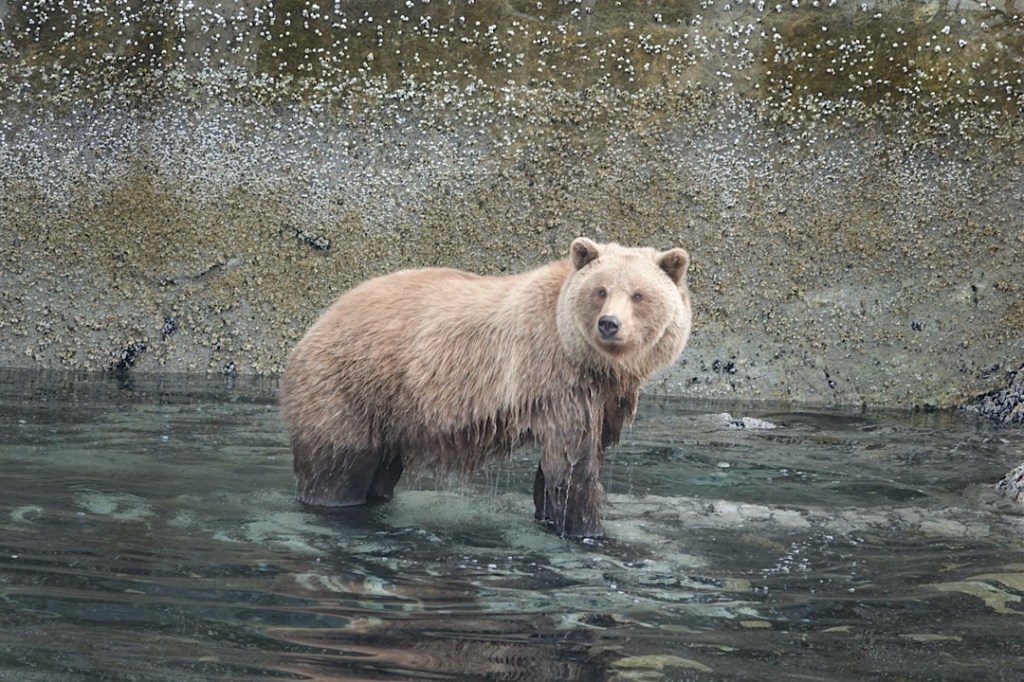
The captain maneuvered us closer and we watched the bear climb a remarkably steep rock face.He seemed to think better of that and descended. He stood just 25-30 yards from the boat. That’s just a quarter of the minimal distance humans are warned to keep between themselves and grizzlies. He seemed to be pondering the situation.Then he moved down and waded in.Again he seemed to change his mind. He stood there dripping.
When we finally moved on after almost 15 minutes, we rounded a bend and got a likely explanation of what the bear had been seeking.
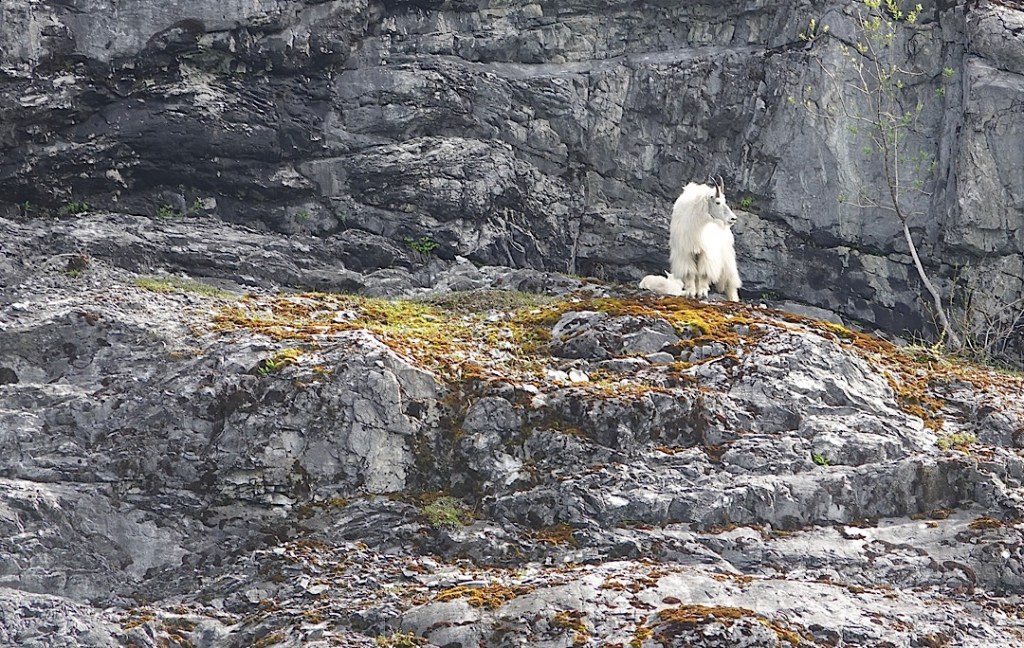
Dall sheep! With tender little newborn kids.
After all that drama, glaciers might have felt anticlimactic. But they weren’t.
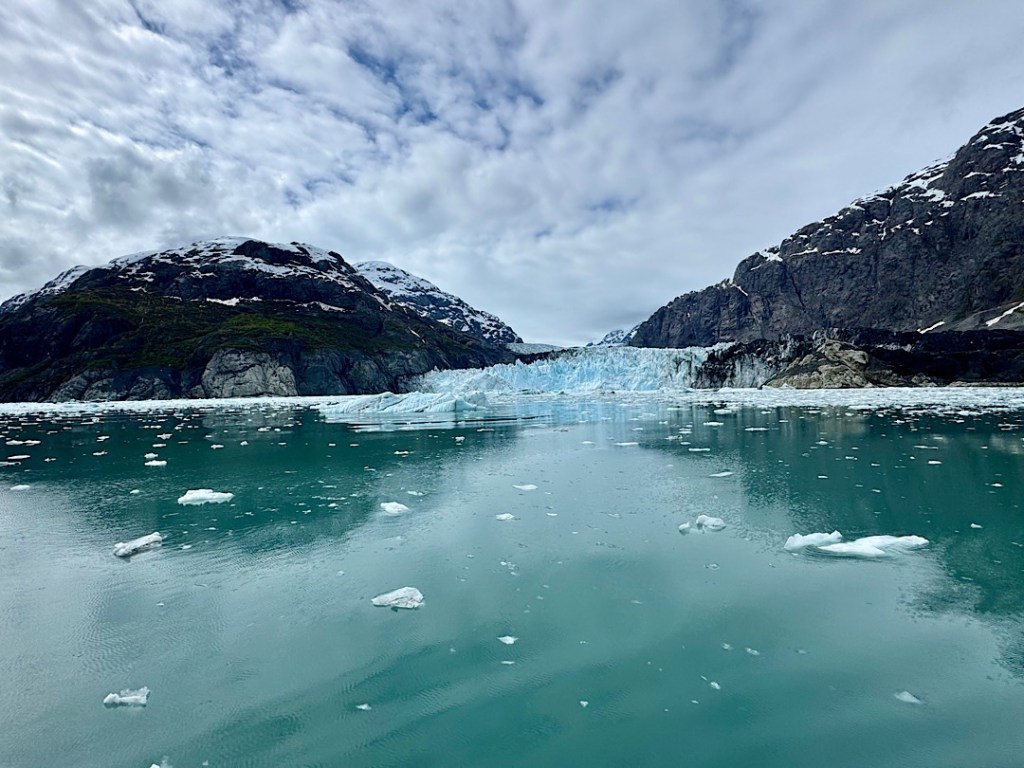
We entered the Tarr Inlet as a National Geographic tourist vessel was steaming out.Moments later we started seeing chunks of ice, floating on the water.
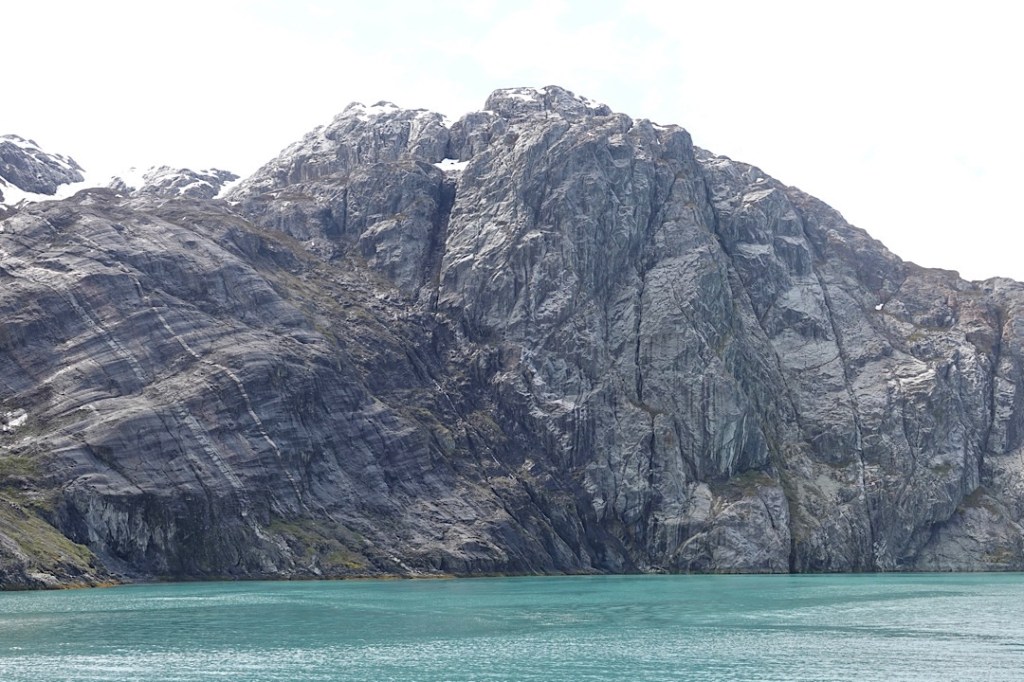
In any other place, the geology would have been riveting. We could literally see where the Pacific tectonic plate butted up against the North American plate.
This collision helps explain why Alaska has so many earthquakes.
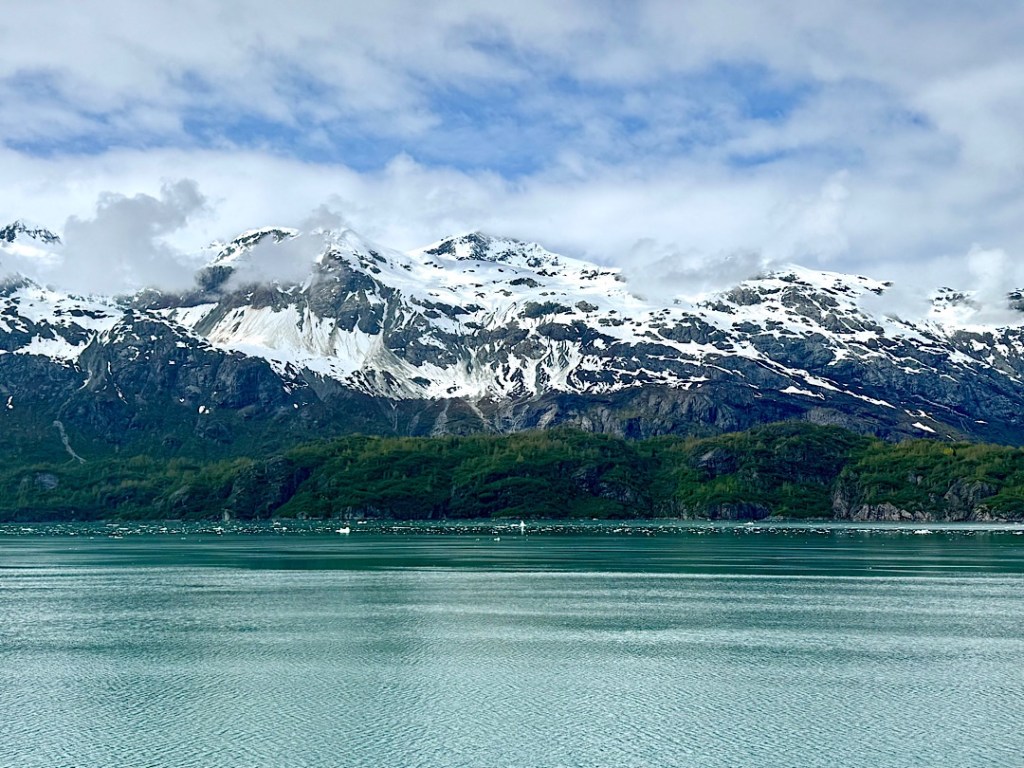
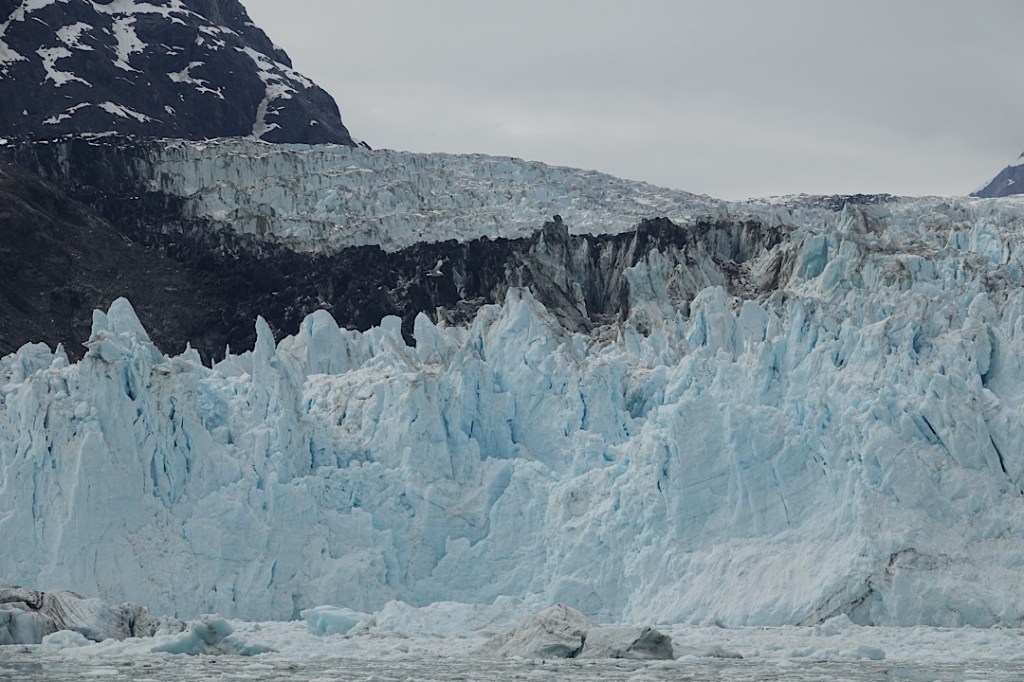
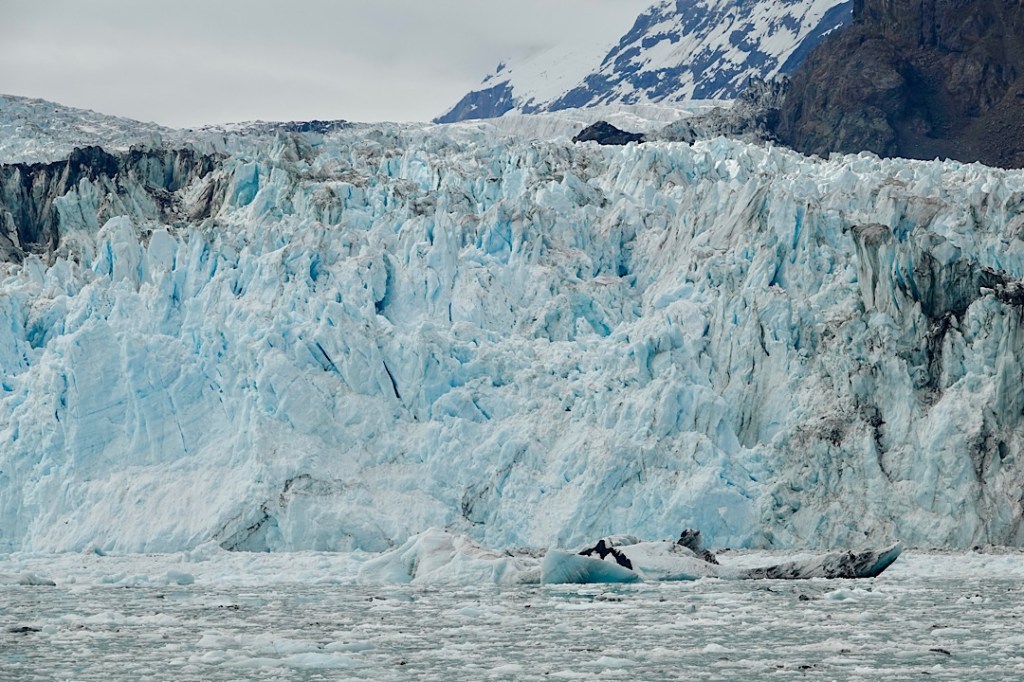
But the icy wonderland grabs most of the attention here. Over the next hour or so, moving slowly through it, I learned a lot about glaciers. The six we saw demonstrated how varied they can look.
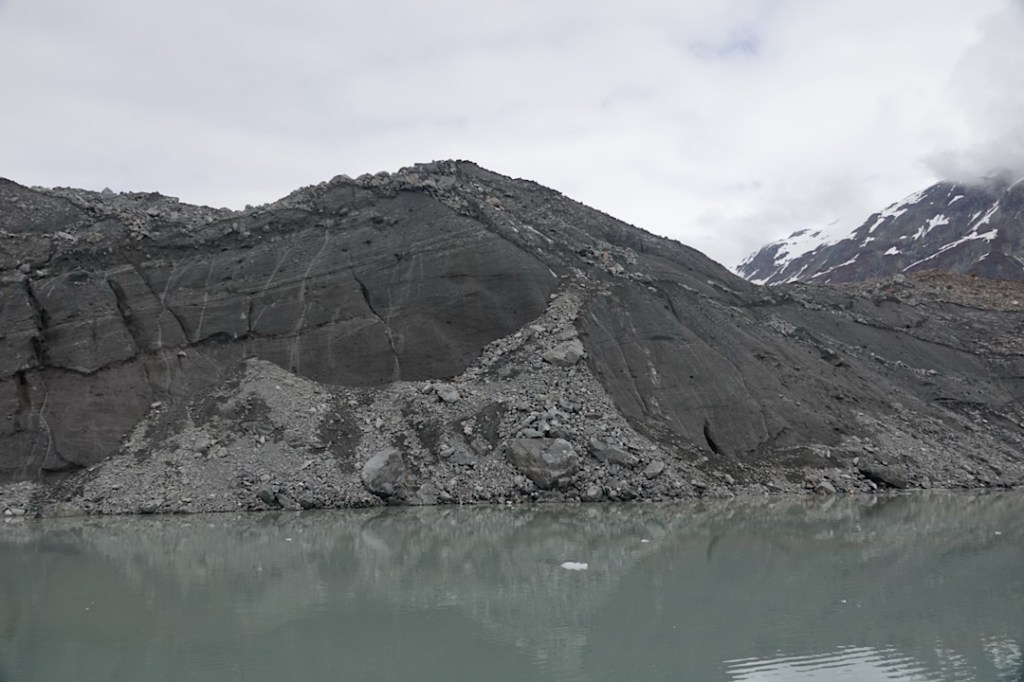
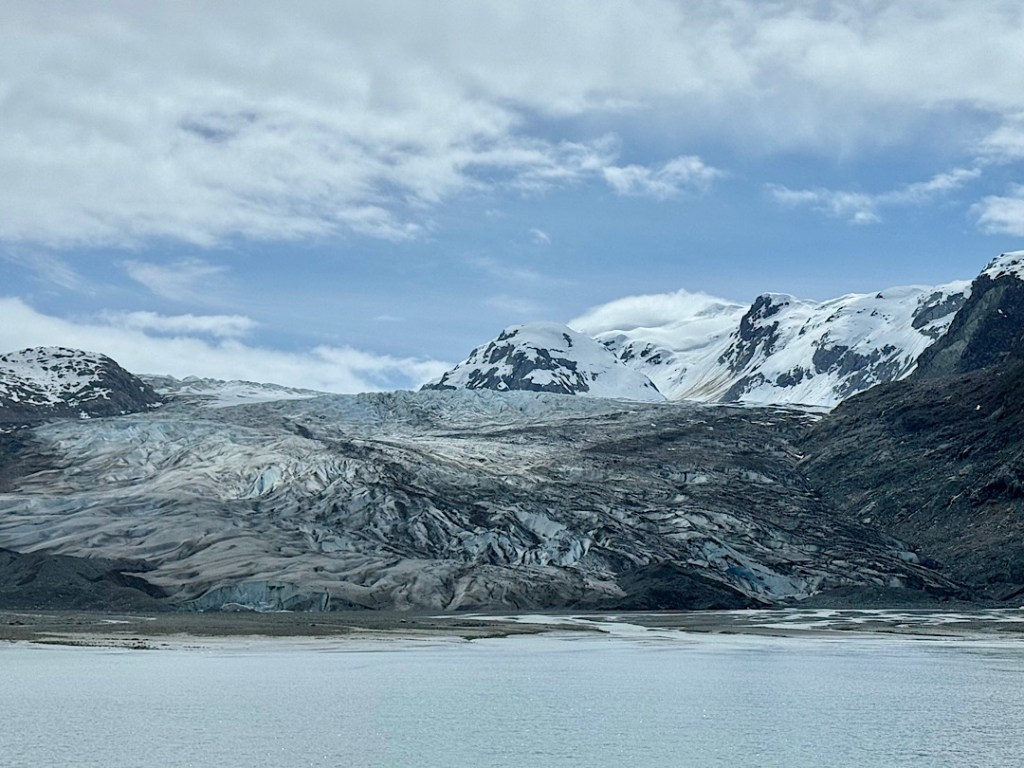
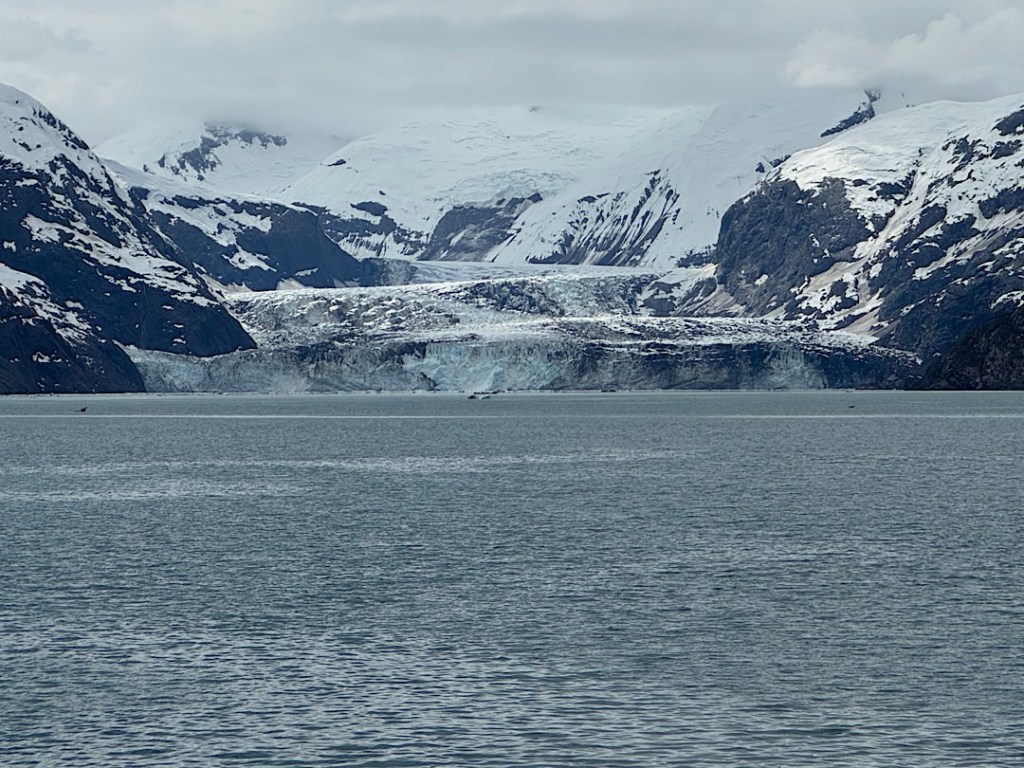
Some, like the Marjorie Glacier, are classically beautiful.The closer we got to it, the bluer it looked. Some, such as the Grand Pacific and Ferris glaciers don’t look like glaciers at all.The Reid Glacier no longer falls into the “tidewater glacier” category, having retreated from the water. The beautiful nearby John’s Hopkins Glacier is currently growing.
We spent the most time hovering in front of the Majorie Glacier. Ranger Hailey said it “calves” almost daily: huge chunks of ice can break off and smash into the water.
For us that didn’t happen. That would have like getting a royal straight flush. You can’t win ‘em all.
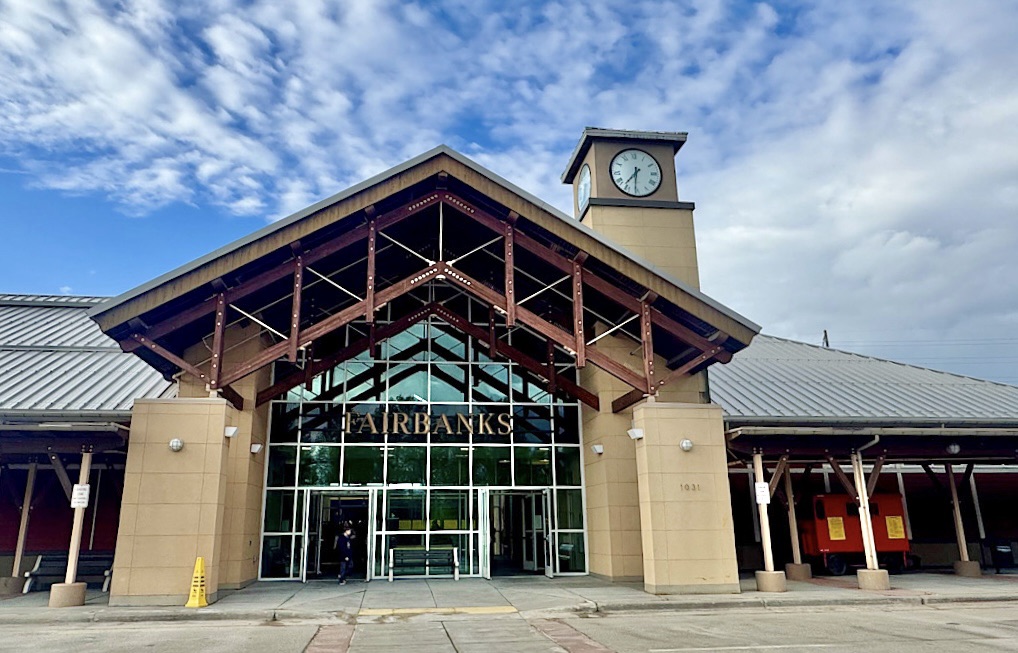
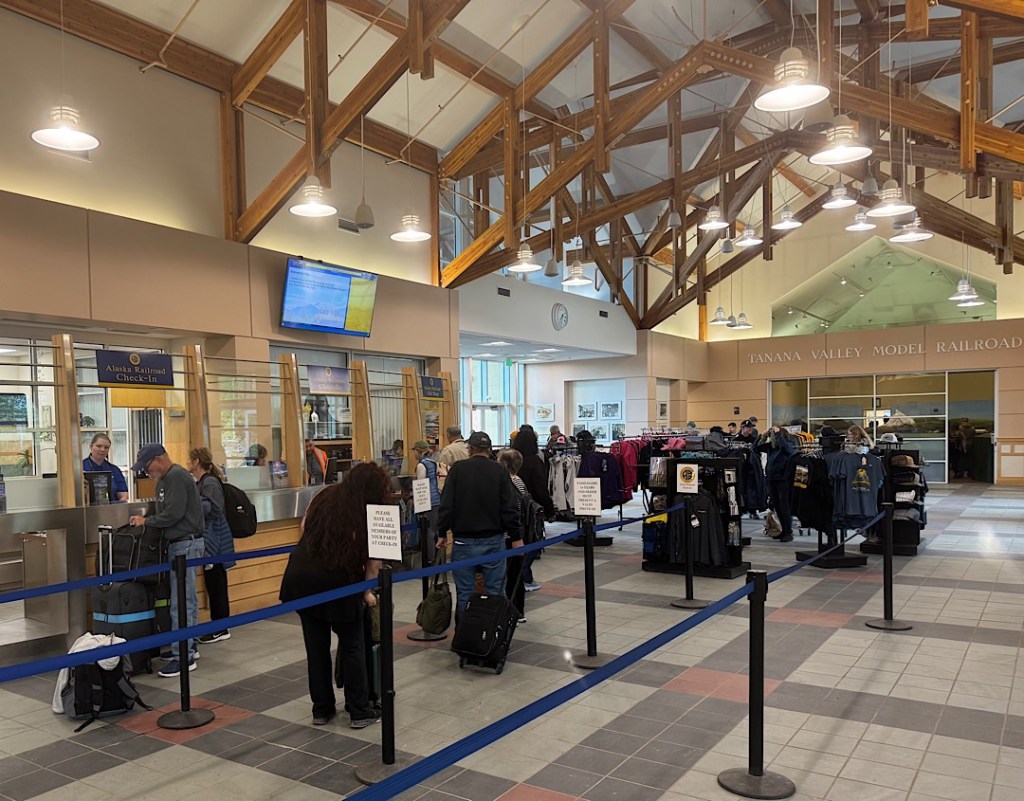
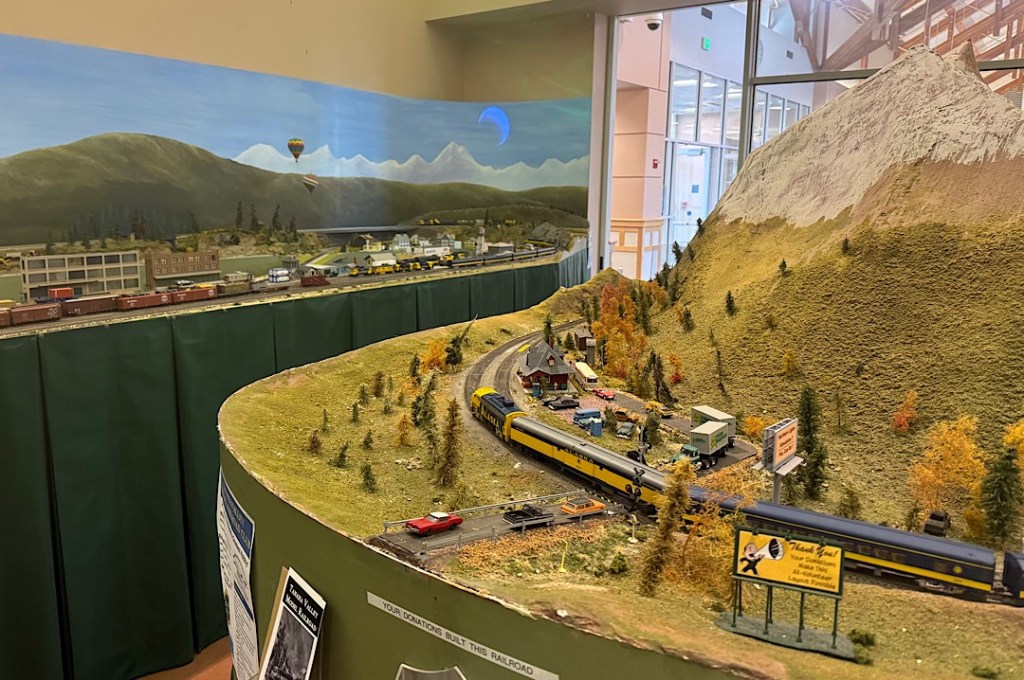
When Steve and I walked into the Fairbanks train depot (11 days ago) for the first leg of our Great Alaskan Railway adventure, we exclaimed almost in the same breath: this can’t be Amtrak. The depot was pretty and clean. The ticket sellers cheerful and efficient. To entertain waiting passengers, an elaborate model-train track had been set up in a side chamber. I wouldn’t say it all exceeded anything we saw in Japan last fall. But it wasn’t disgraceful.
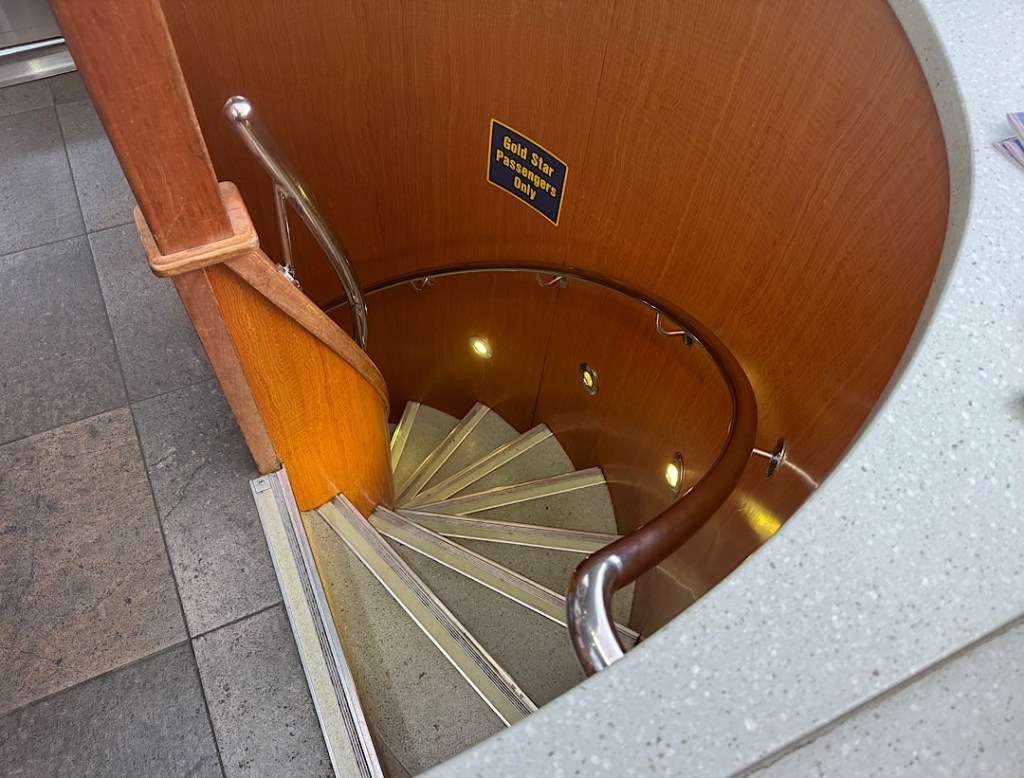
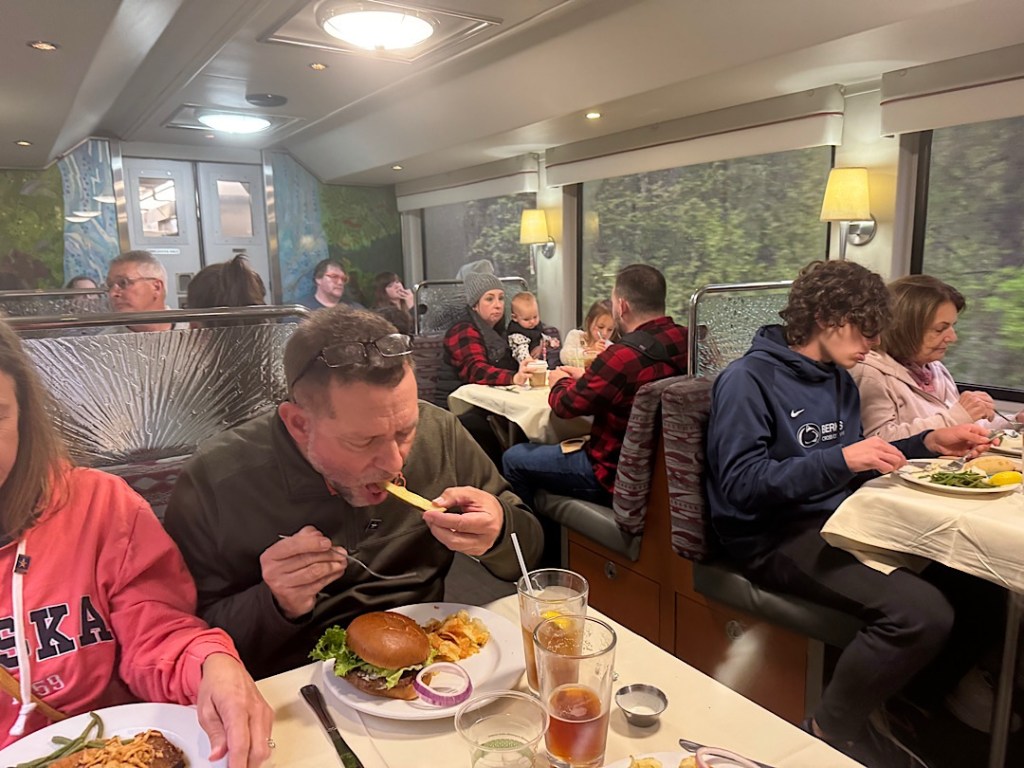
We soon learned that Amtrak does NOT run it; the Alaska state government does. Built 100 years ago to serve early gold miners, it’s now popular with travelers. Planning this trip, I wanted to ride almost all of it, from Fairbanks to Denali, then continuing on to Anchorage, stopping there, then taking the line that runs down to Seward (on the southern coast of the main Alaskan peninsula) and back. Because the scenery promised to be so beautiful, I splurged and got us “Gold Star” seats in double-decker cars with wrap-around views through the glass dome and meals (included) in the dining room below.
On the first two legs there was good news and bad. The good: our seats were not bad, and every time we were led down the winding brass-railed stairway…
… we ate well (breakfast on the four-hour Fairbanks to Denali run; lunch and dinner on the seven and a half hours from Denali to Anchorage.)
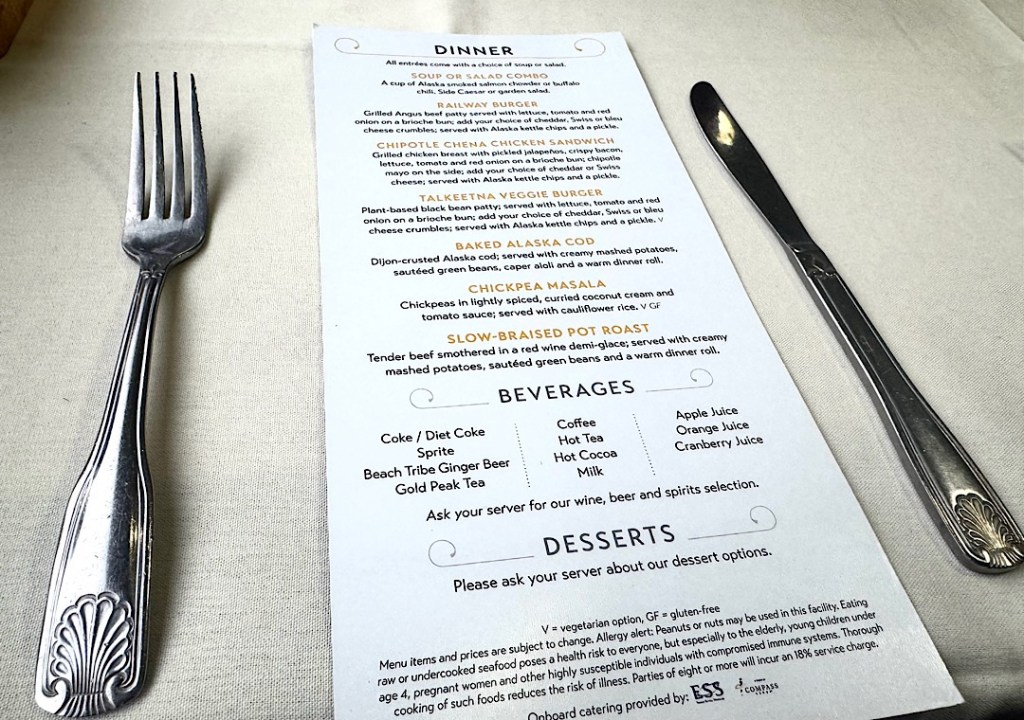
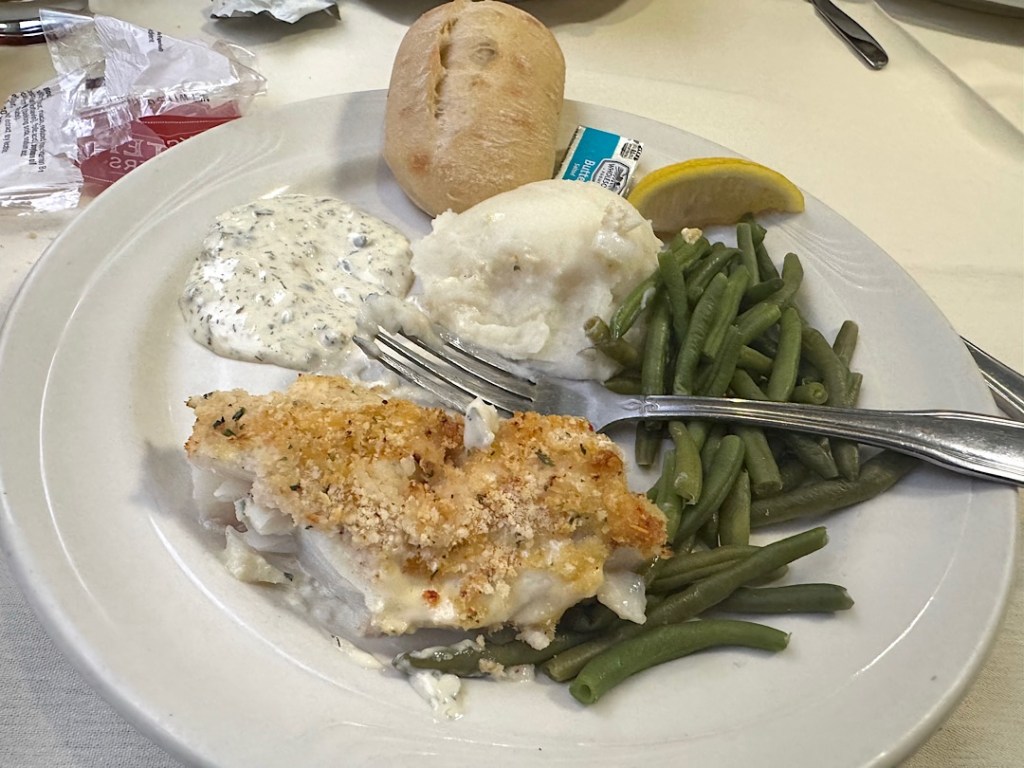
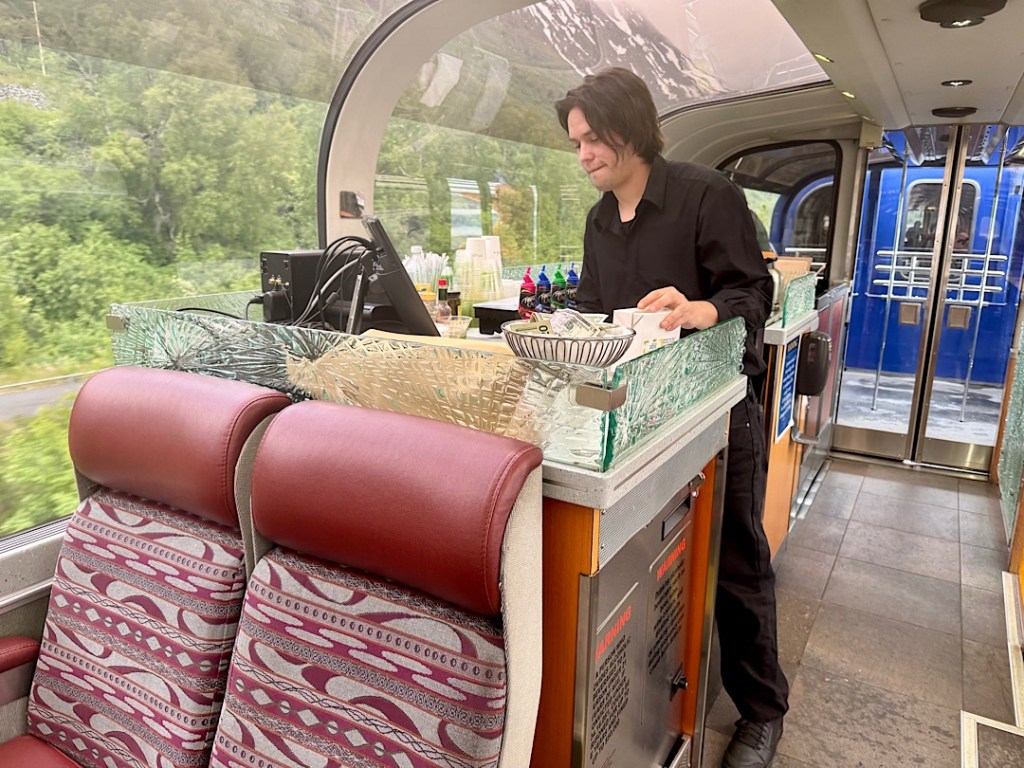
The dinner menuMy baked Alaska codThe bar, located upstairs. Our ticket included two alcohol drinks per meal. (We abstained at breakfast and lunch.)
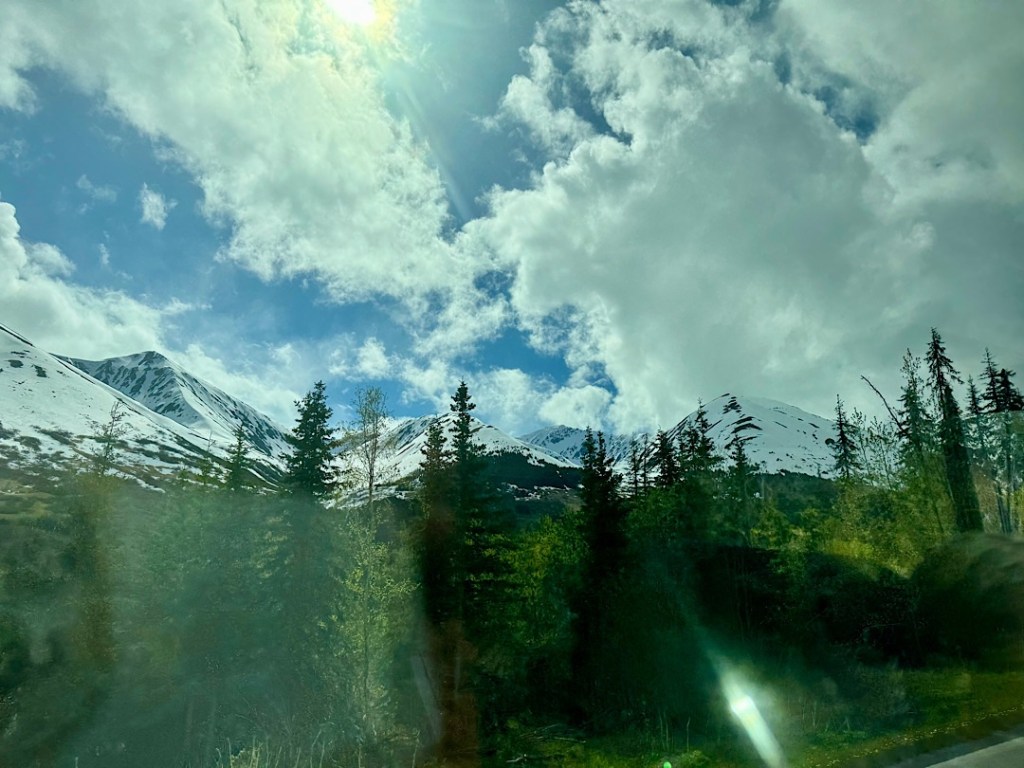
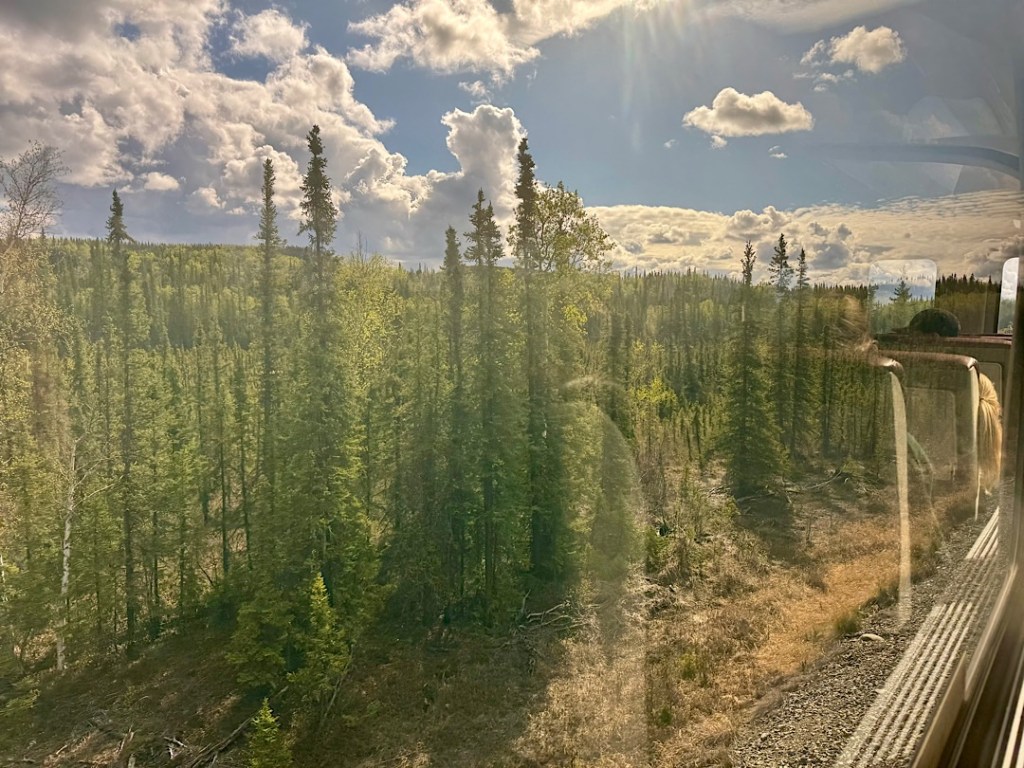
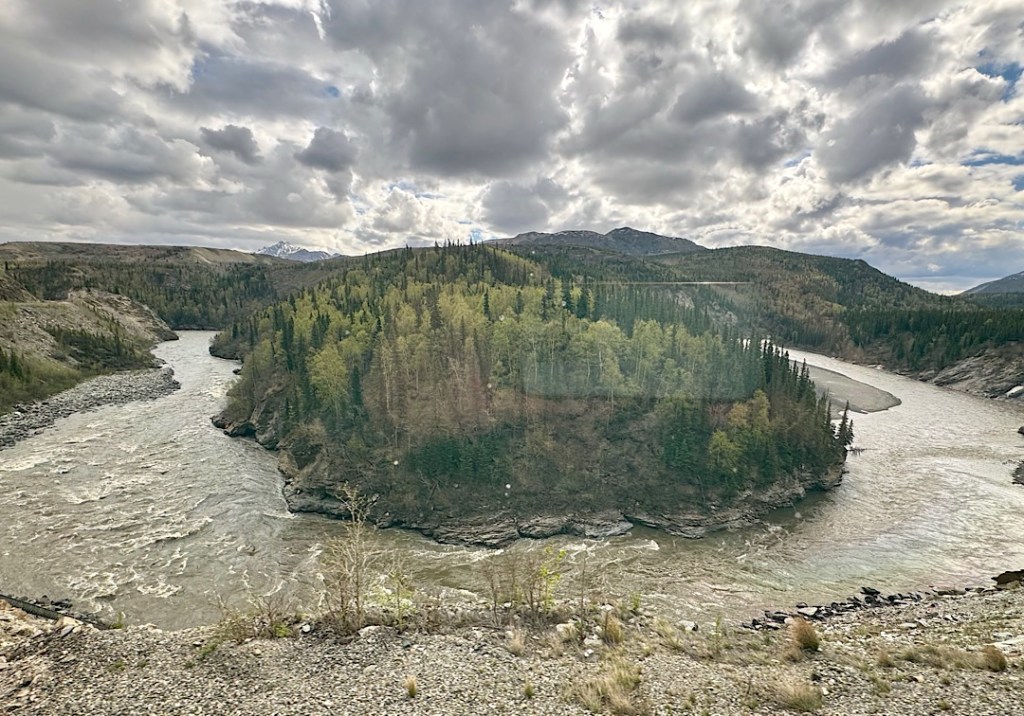
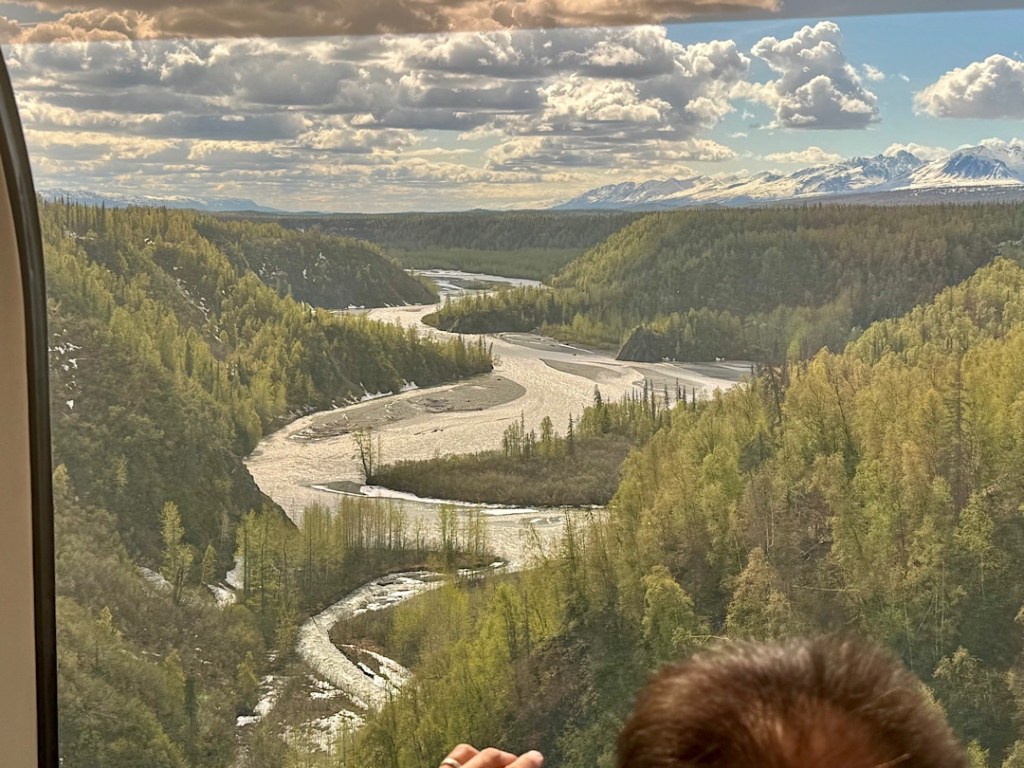
The scenery lived up to its billing.
We spotted some wildlife. Both those first two trains arrived on time. But how could this fill a blog post? Wallowing in middle-class comfort as you pass eye-catching wilderness is fun to experience but boring to read (or write). I wasn’t sure I was up to it.
Our third ride — from Anchorage to Seward — took a different turn, however. We boarded, went to the dining room, and shortly after Steve and I had ordered breakfast the train stopped. For a long while, nothing happened. Then very, very slowly, we began moving backward. Uh-oh.
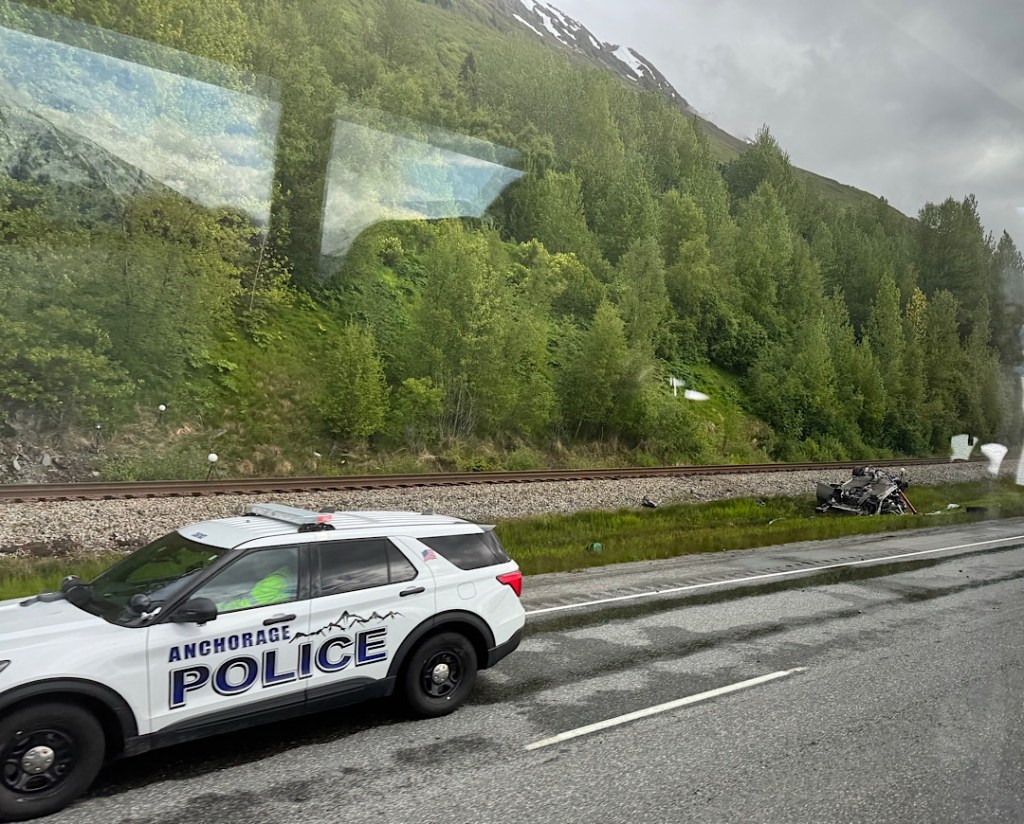
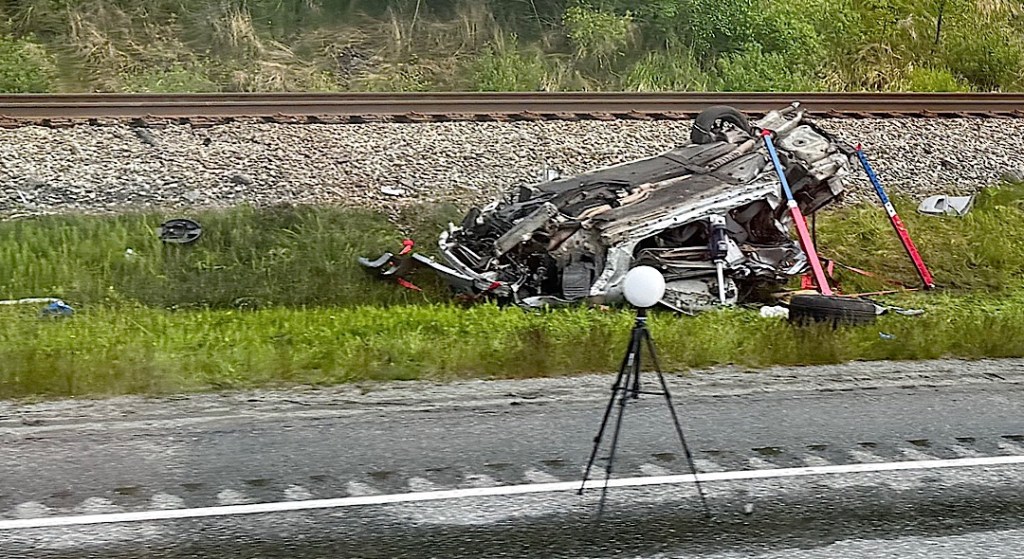
An hour passed and we finished breakfast. Gossip about what had happened began percolating throughout the cars. We learned that 40 miles or so down the track, near Girdwood, a motorist had lost control of his car and flipped (four times, we later heard). In the course of this thrill ride he bounced off the track before smashing to a halt and dying.
We glimpsed the scene when we later passed it.
Authorities were worried the disaster might have damaged the rails. It would take at least six hours for someone to inspect it, they finally announced.
Steve and I weighed our options. We could get off, return to our home-exchange house, and drive the Tundra to Seward and back (hoping to extract refunds from the train company.) Or we could get on a bus that we were told would arrive momentarily. We chose the bus.
As we waited for it to show up, I chatted with our car’s bartender, a thin young blonde who had worked for the railroad for more than a half-dozen years. She said it was the first time she’d known a car crash to block or interrupt a section of the line. But other things had done so: wildfires and avalanches and rock slides among them.
She was perky and earnest. She said every time one of these bad things had happened, something wonderful had compensated for it. Once the train had been scheduled to arrive at 10:15 pm but didn’t get in until two in the morning. In the midst of the delays, a magnificent display of the aurora borealis began lighting up the sky, thrilling everyone on board. Or, on this run, the bartender pointed out, as we’d waited just outside the Anchorage depot, we’d been treated to the sight of a nearby foraging black bear. (I saw him but didn’t manage to capture the sighting with my phone.)
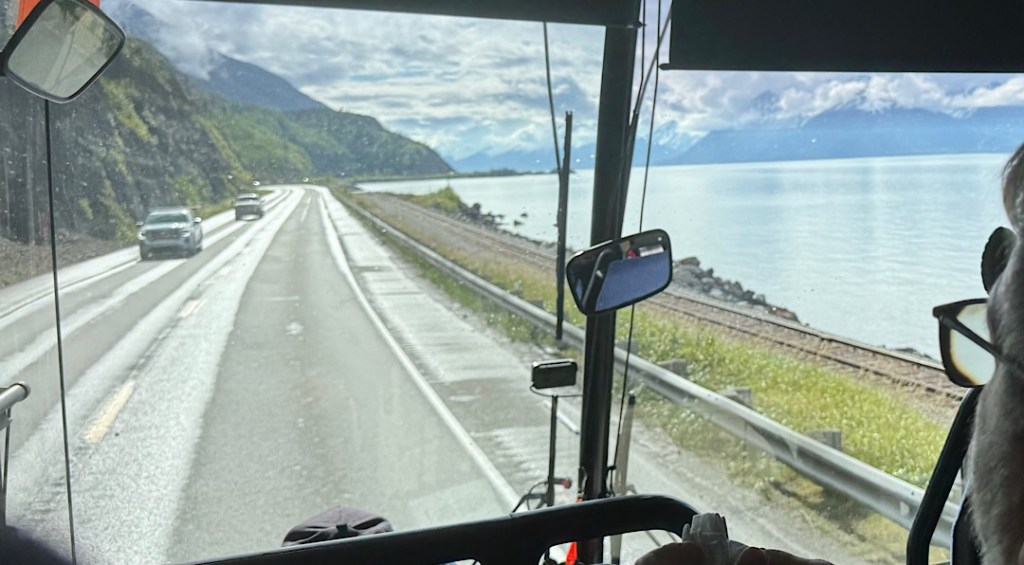
For me another unexpected compensation was the chance to ride to Seward on a bus driven by a guy named Steve who claimed to have logged three million miles on the road. His bus did arrive fairly promptly at the depot, and since the train goes so slowly (roughly 25 miles an hour), we arrived in Seward on the bus less than an hour after we would have via a punctual train.
The views were similar. But the commentary was much more eccentric than we would have gotten on the train.
Bus Driver Steve started talking just a minute after leaving the Anchorage depot and paused for breath only rarely the whole way to Seward. We learned he was born in Miami, studied for the ministry, and visited Alaska almost 40 years ago en route to work in Indonesia. But then he married a local Alaskan girl and lived what sounded like a happy life: raising kids, white-water tubing, fishing for monster trout. He’d been a world-class weight-lifting champion, the co-owner of multiple car dealerships, a masseuse. He’d worked as Sarah Palin’s personal driver. He explained how rescuers extract those foolish enough to get trapped by the quicksand in the Turnagain Sound mud flats at low tide. He shared with us the secret of his happy 38-year marriage. Also his father’s foolproof business philosophy. Also the name of the best Texas barbecue joint in Seward.
My Steve and I decided to try it. Bus Driver Steve showed up as we were mopping up the remains of our brisket. He ordered ribs and a pile of pulled pork and sat down on the picnic-table bench next to us.
We talked about the way Alaska could obliterate plans in the blink of an eye. At 8:30 that morning, he’d been sitting on his couch at home savoring the start of three days off work. The phone had rung and someone from the office had told him they needed him. There’d been an emergency. When that happens here, you don’t hesitate, he said. You do what you can to help out. “That’s just Alaska.”
There came a moment Tuesday afternoon, our first full day in Anchorage, when the Huskies were being readied to tow an ATV and they could not contain themselves. The furry brindle-colored dog in the lead position let out a yip, and then a full-throated scream. His tail was wagging, as were those of his canine teammates. A cream-colored dog with a short coat keep leaping up, straining against his line to move forward. I wouldn’t say they were barking. It was more like yodeling with joy.
Spending some time at the Happy Trails kennels with these sled dogs and their humans was so much fun, I could have joined in the chorus. It was not a pleasure we’d anticipated. Steve and I had missed an opportunity to visit the sled dog kennels at Denali (the only national park in the United. States to maintain a dog team.) But we did watch a short film in the visitor’s center about them, and it inspired me to go online first thing Tuesday morning to see if we could visit a kennel in greater Anchorage. I saw that the Happy Trails staff would be giving a tour that afternoon, and we could still get tickets.
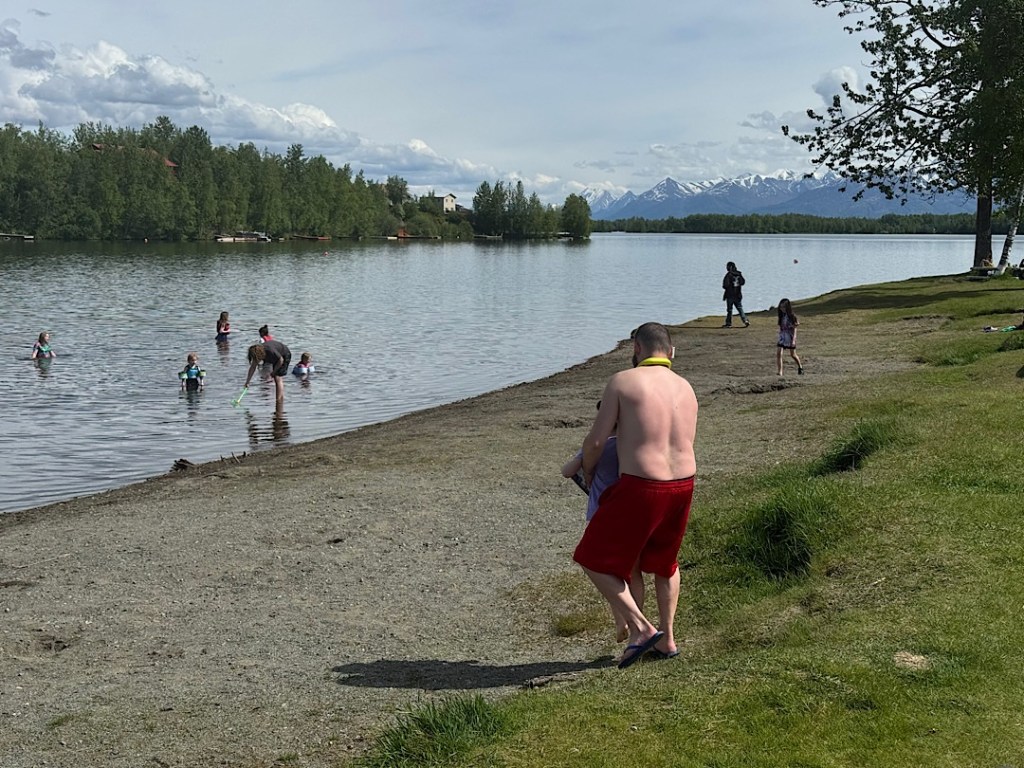
The kennels are located about an hour outside the city. Happily, our Anchorage house-trading partners also let us use their bright red Toyota Tundra. We climbed into it and drove north, stopping at an agricultural office in the Matanuska Valley. The friendly receptionist said it was too early to see any of the giant vegetables for which this region is famous. Nor were any farm tours being given. So we continued on to Wasilla (birthplace of Sarah Palin’s political career) and ate our picnic sandwiches on a pretty lake.
Summer beach season (at one of Wasilla’s lakes) was just beginning. Our Tundra
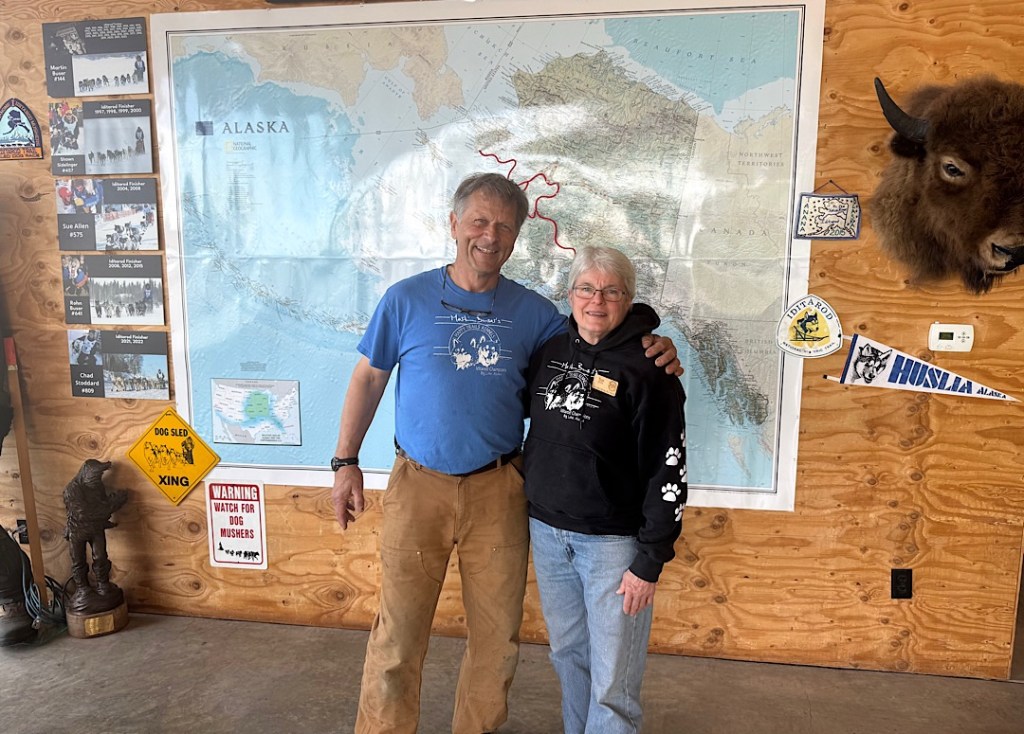
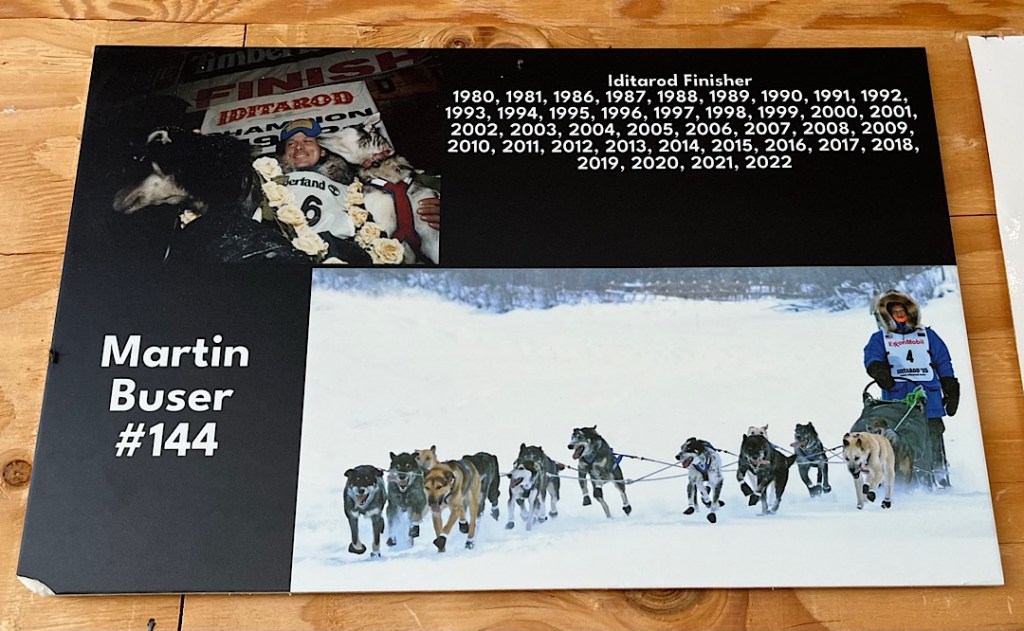
One of the folks who greeted us in the reception hall was a fit older guy with a roguish grin, who introduced himself as Martin Buser. Within minutes it was clear Martin is the charismatic heart of Happy Trails. He’s a 39-time finisher and four-time winner of the legendary Iditarod dogsled competition, that hellish 1,000-mile-long endurance race across some of the most difficult terrain on the planet.
Martin’s staff also includes Sue Allen, who entered and completed the race in 2004 and 2008 (while also holding down her full-time job as a schoolteacher). Another staffer, Chad Stoddard, did the race in 2021 and 2022 and hopes to compete again.
Martin Buser and Sue Allen
Martin, 67, completed his last race three years ago; he told us that after 39 runs he didn’t want to subject his body to more extreme ordeals. But he’s still very much at the center of the sport. He ran his first two races (in 1980 and ‘81) with purebred Siberian huskies — that super-furry dog with upright ears and (often) blue eyes. Then he began crossing them with other breeds known for their speed, e.g. Salukis and short-haired pointers. His cross-breeds proved so much faster that within short order, all the other leading dog-mushers were following suit. These “Alaskan Huskies” are a motley crew but Sue told us no one uses anything else for racing any more.
Martin doesn’t sell the puppies he breeds. Sue said one of Martin’s sons may compete with them again, as may Chad, plus Martin has developed his operation into a major showcase and tourist attraction, offering dog-powered sled rides to visitors in the winter and summer tours to folks like us (and big buses full of cruise ship passengers).
Happily, one of those buses had just departed so it was only Steve and me and two couples with their kids learning about dog-sledding Tuesday afternoon. We watched a film, then Chad connected five dogs to their pulling rig; that’s when they started yodeling with excitement.
Chad raced them around a gravel track…
… and Sue explained that in the summer, when there’s no snow, Martin and his assistants train the dogs on the ATV. Unlike the service dogs Steve and I raise (who learn 35-40 verbal commands from us before they move on to the professional trainers), these canine athletes basically must master just two: Gee (meaning go to the right) and Haw (left). They do most of the serious preparation in the winter, working with bigger teams and connected to sleds. In the summers, they mostly get their exercise by romping with their fellows in nearby meadows.
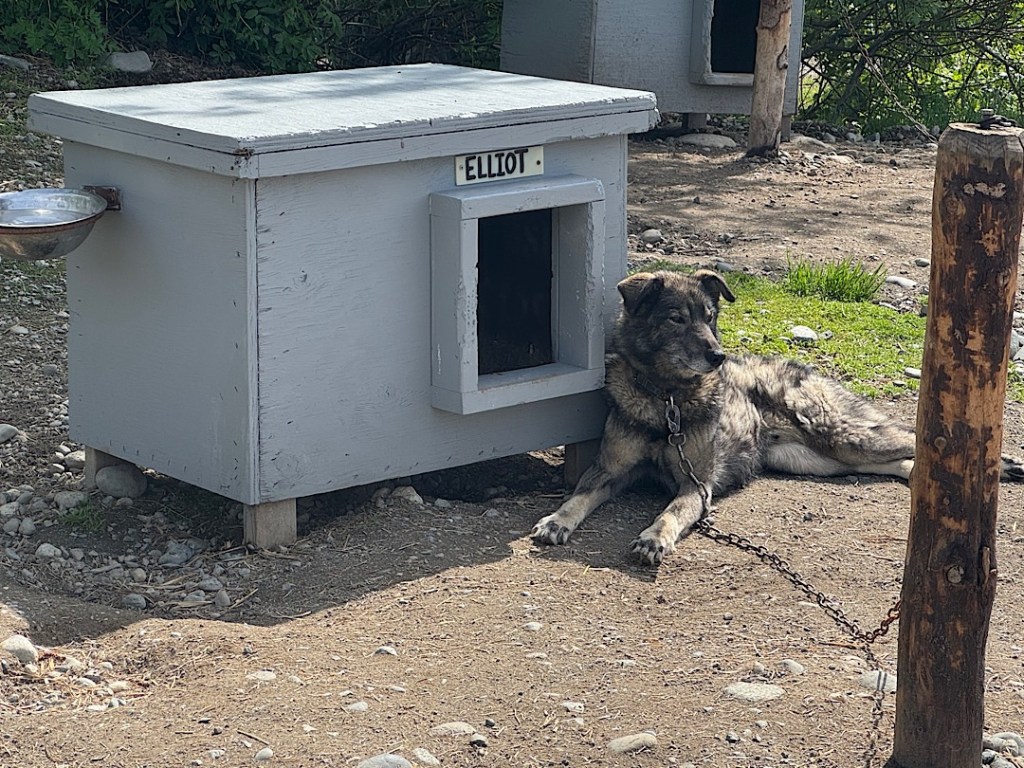
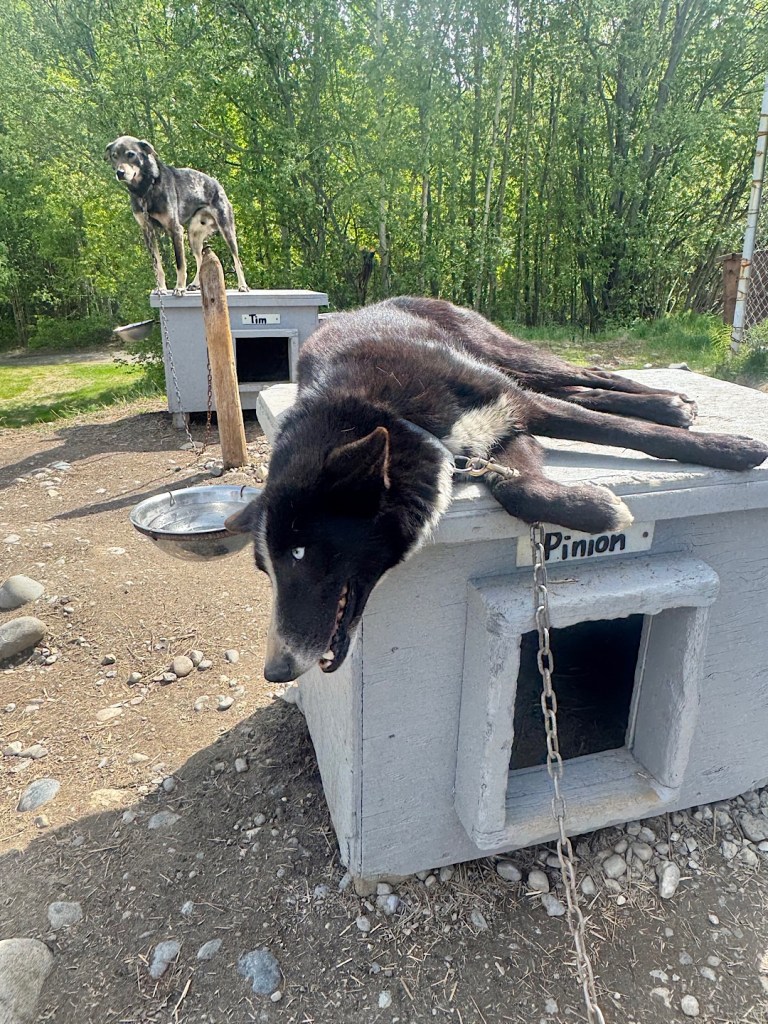
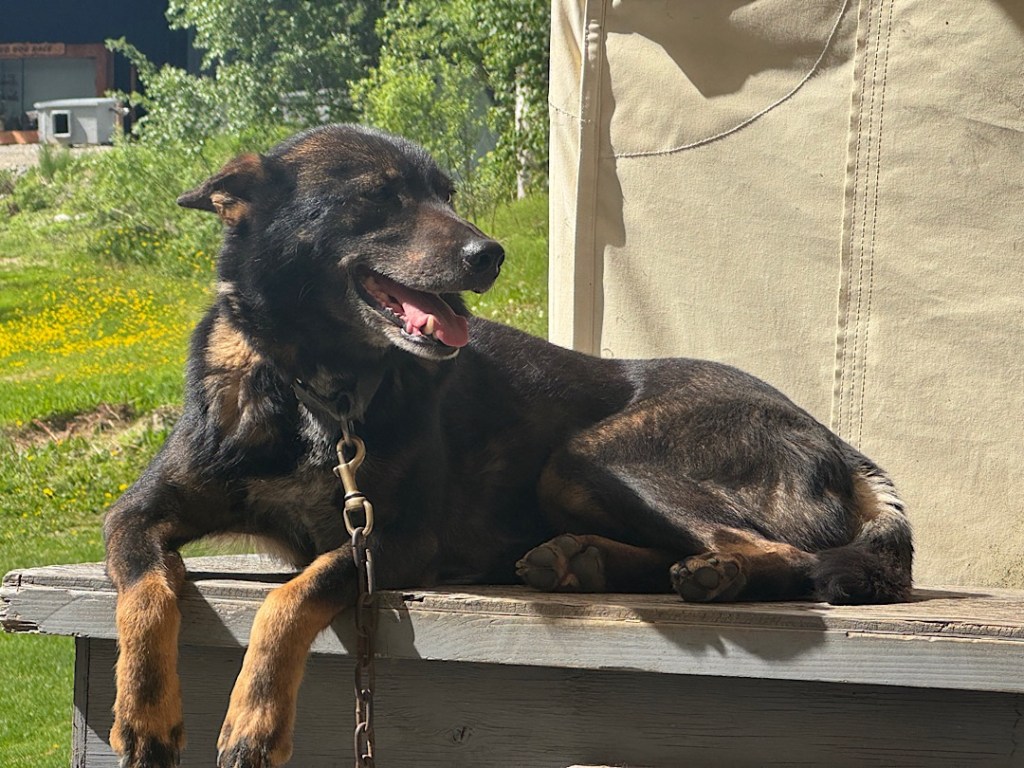
We meandered out to the Happy Trails housing tract, an array of something like 70 dog houses. I admired all the dogs but had mixed success petting them. Some basked in the attention, while others were more aloof.
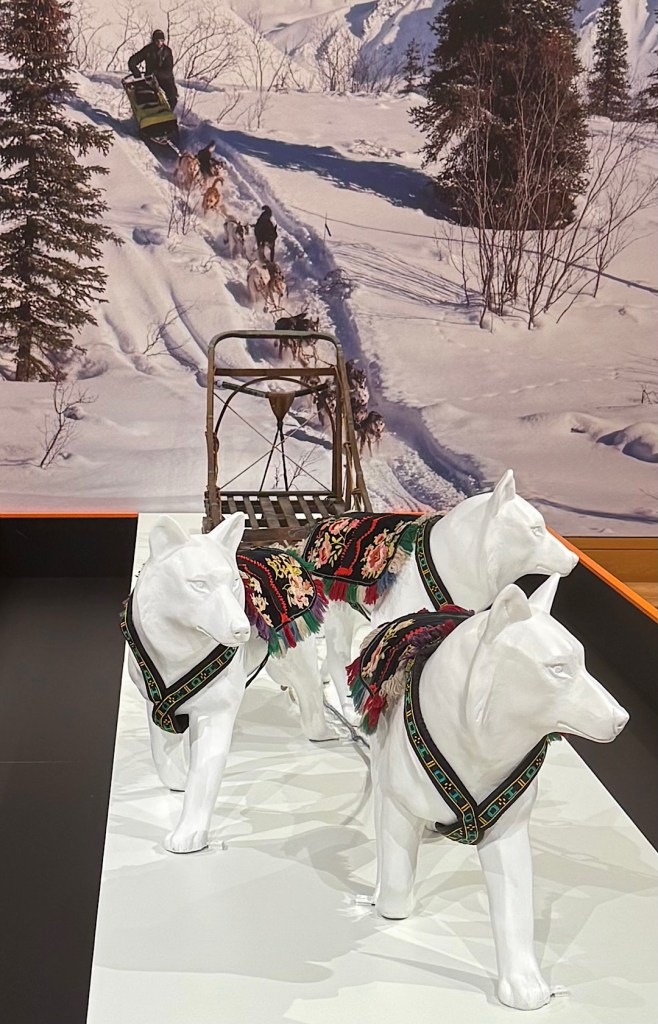
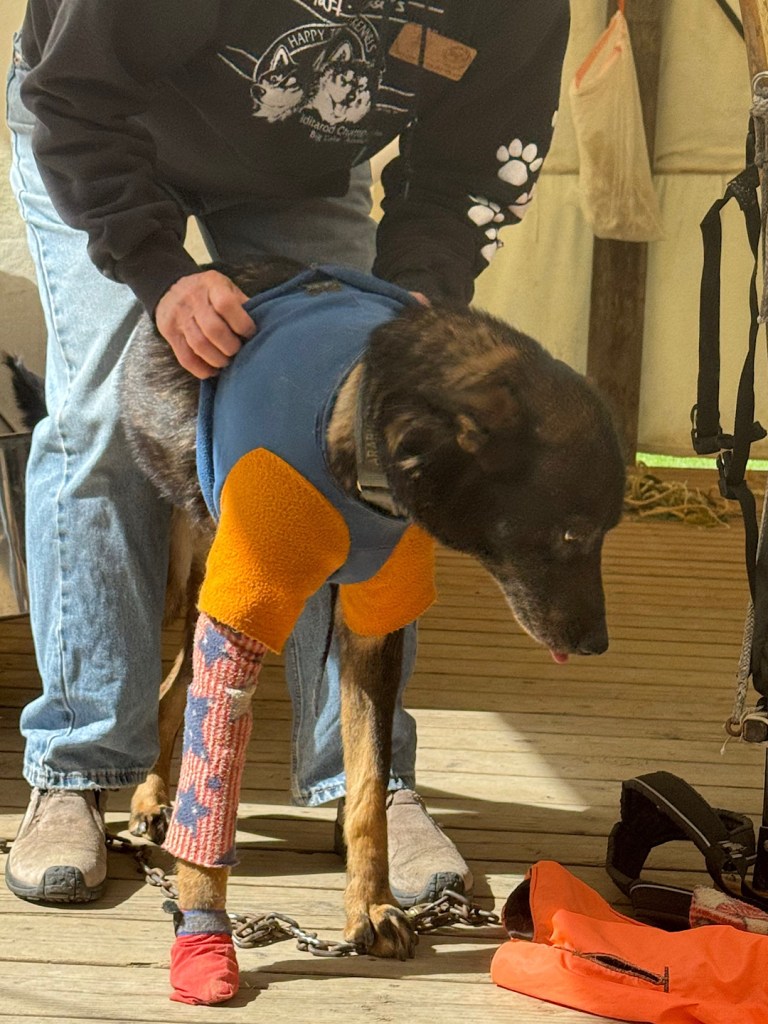
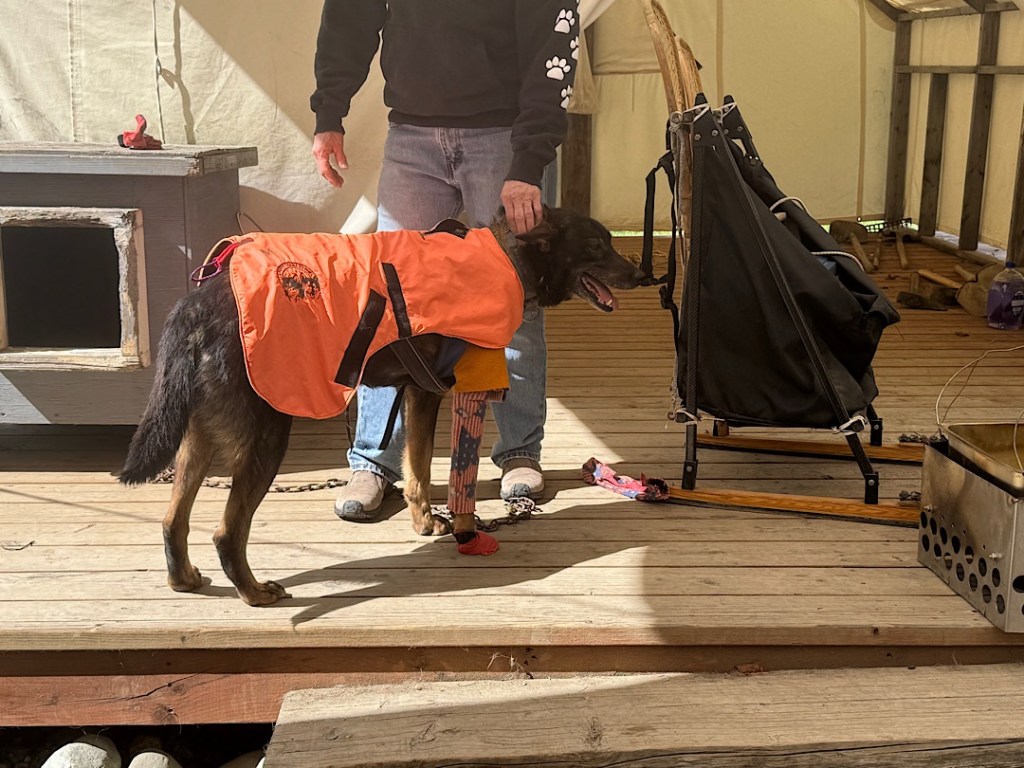
Sue led us to an amphitheater where she used a dark female named Arabica to demonstrate the gear that Iditarod competitors commonly wear.
ArabicaBooties to protect their feetLeggings and a shirt and coat to protect against the cold.Racing with teams of 12-16 dogs, the Iditarod competitors spend a great deal of time dressing and undressing their dogs.
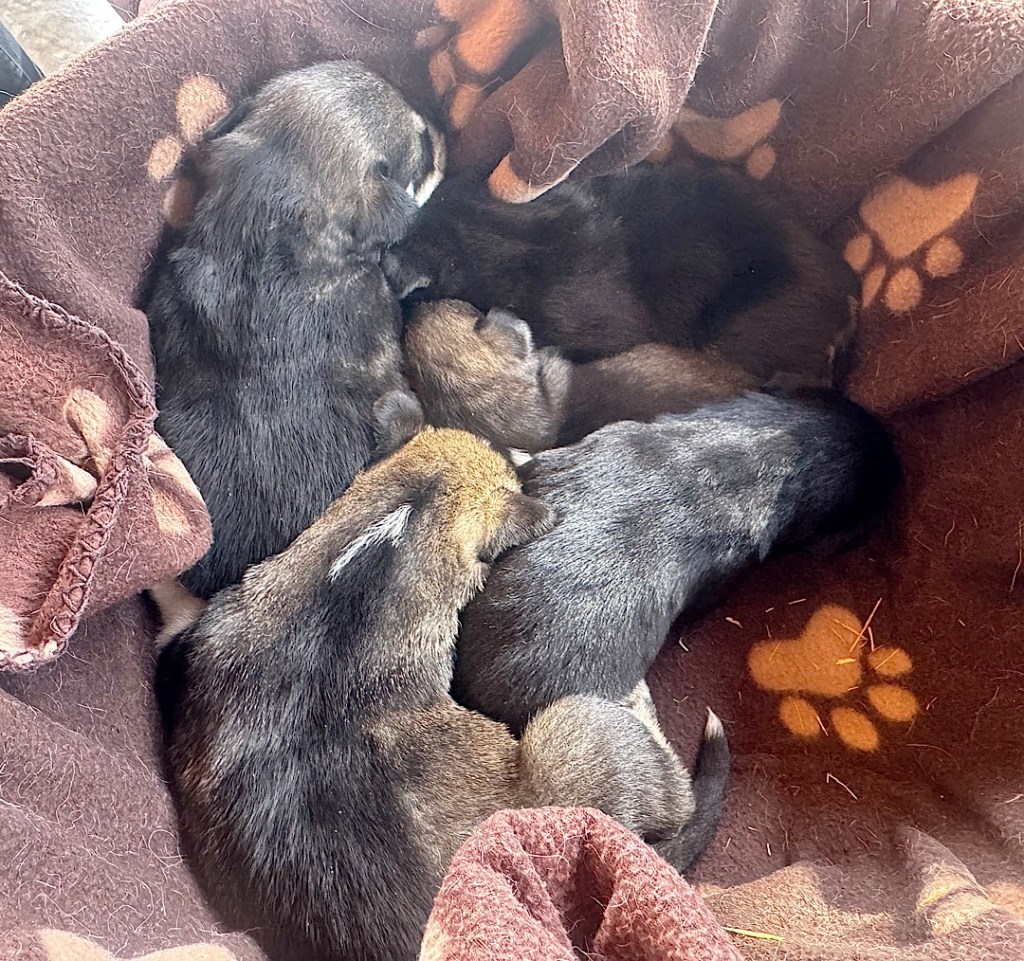
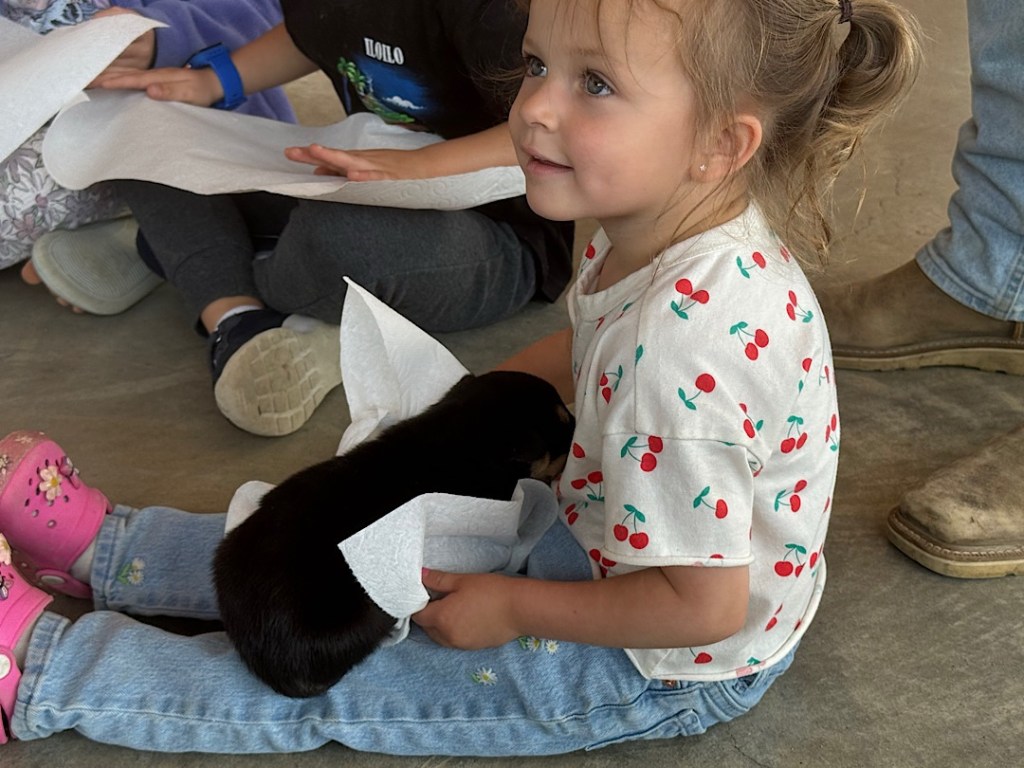
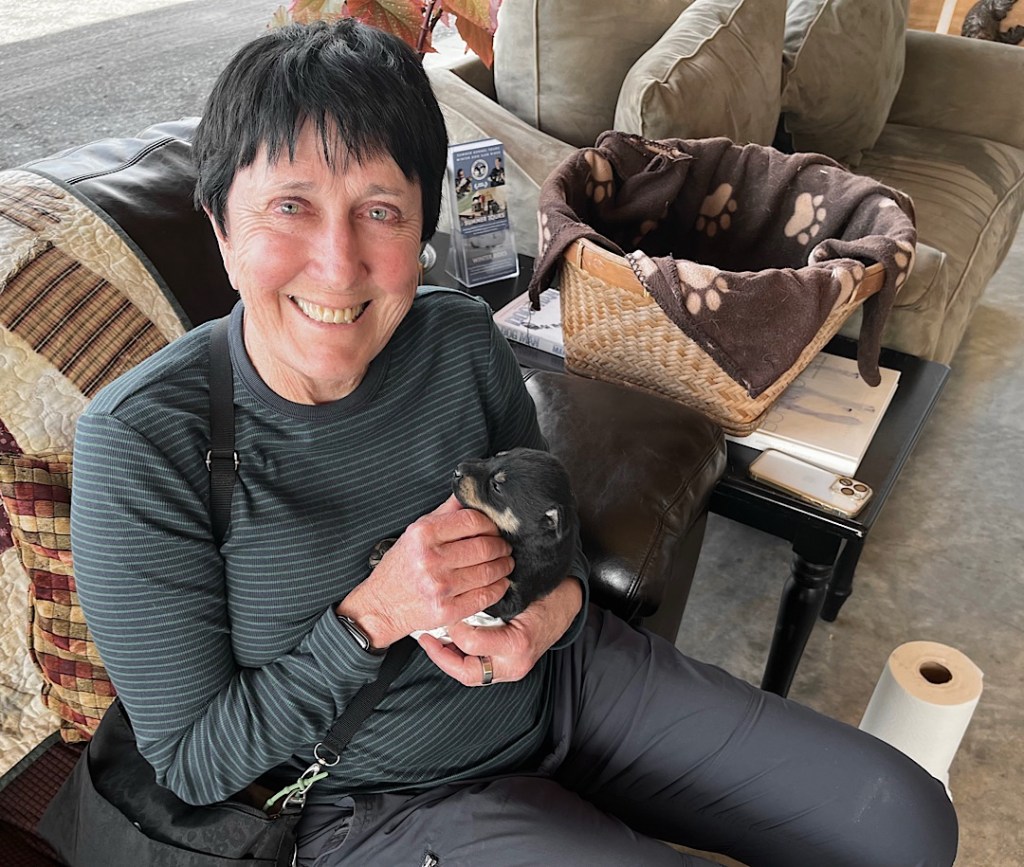
The grand finale, back in the entry hall, came when Sue brought out a basket of two-week-old puppies. We took turns cuddling them.
EVERYONE loves puppies!
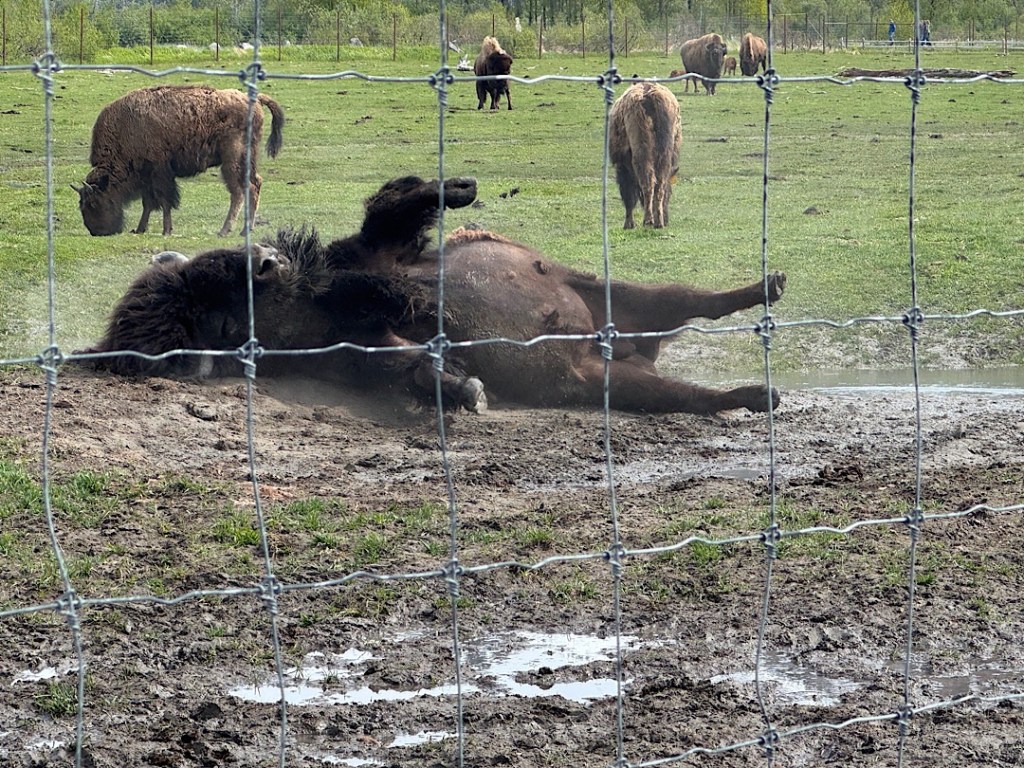
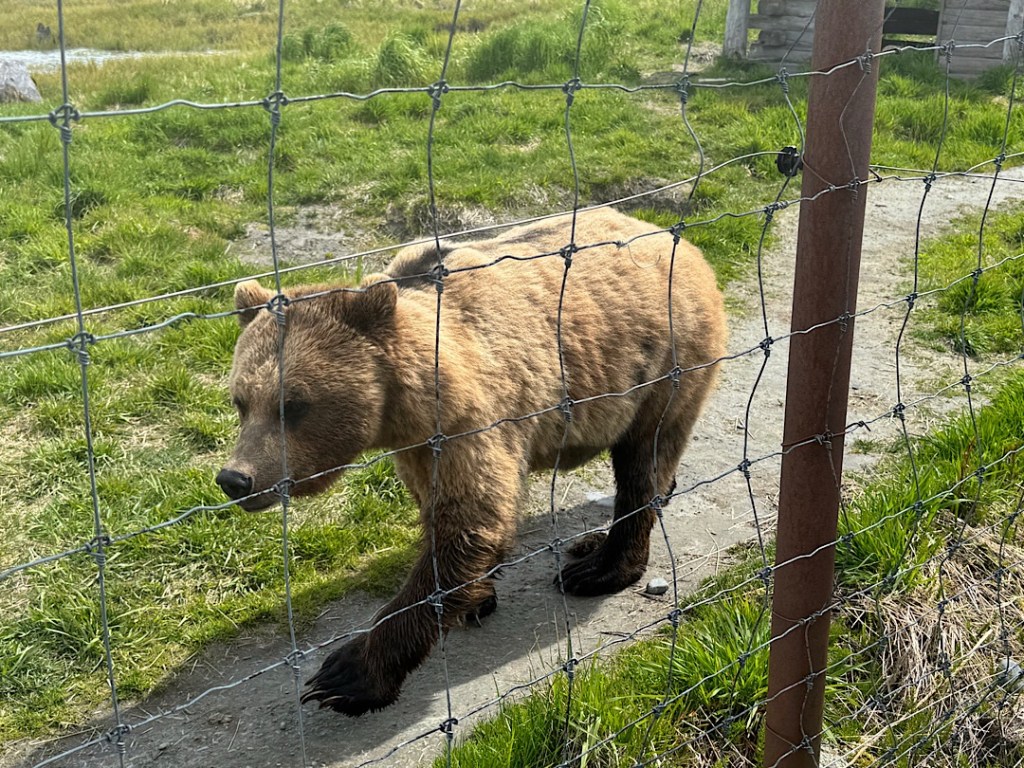
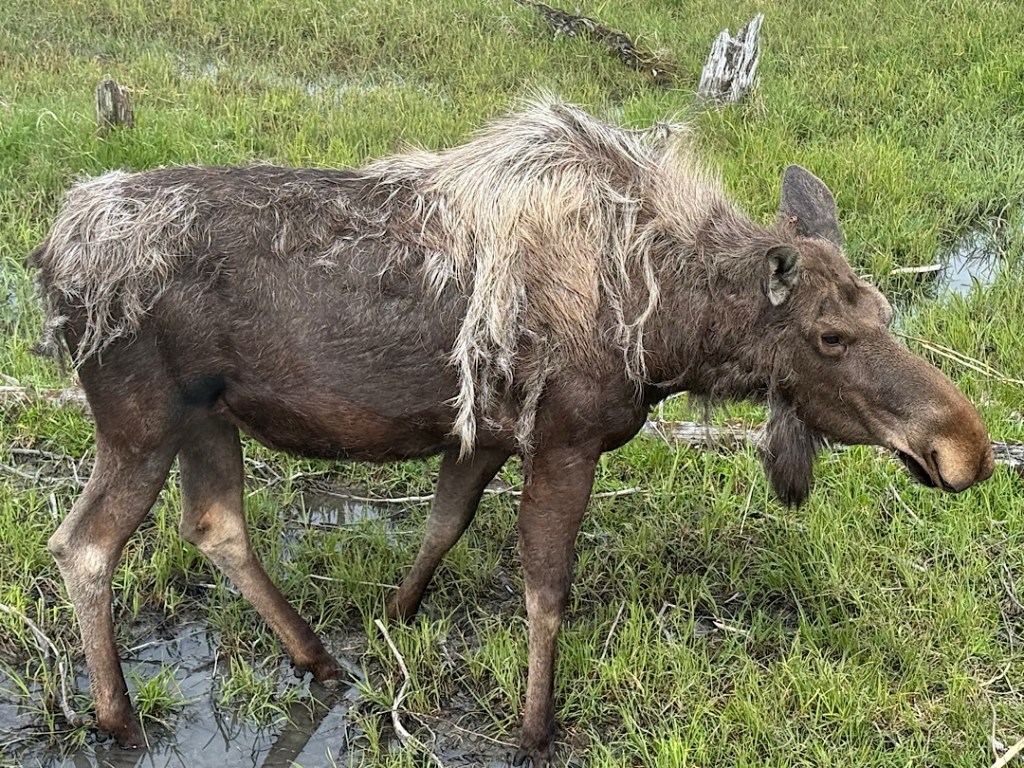
Over the next few days, Steve and I spent a lot of time at the Alaska Native Heritage Cultural Center and the Anchorage Museum. We drove to the an animal preserve where we took many pictures of Alaskan beasts that included…
Wood bison…A grizzly bear…Moose (shedding the last of their winter coats)
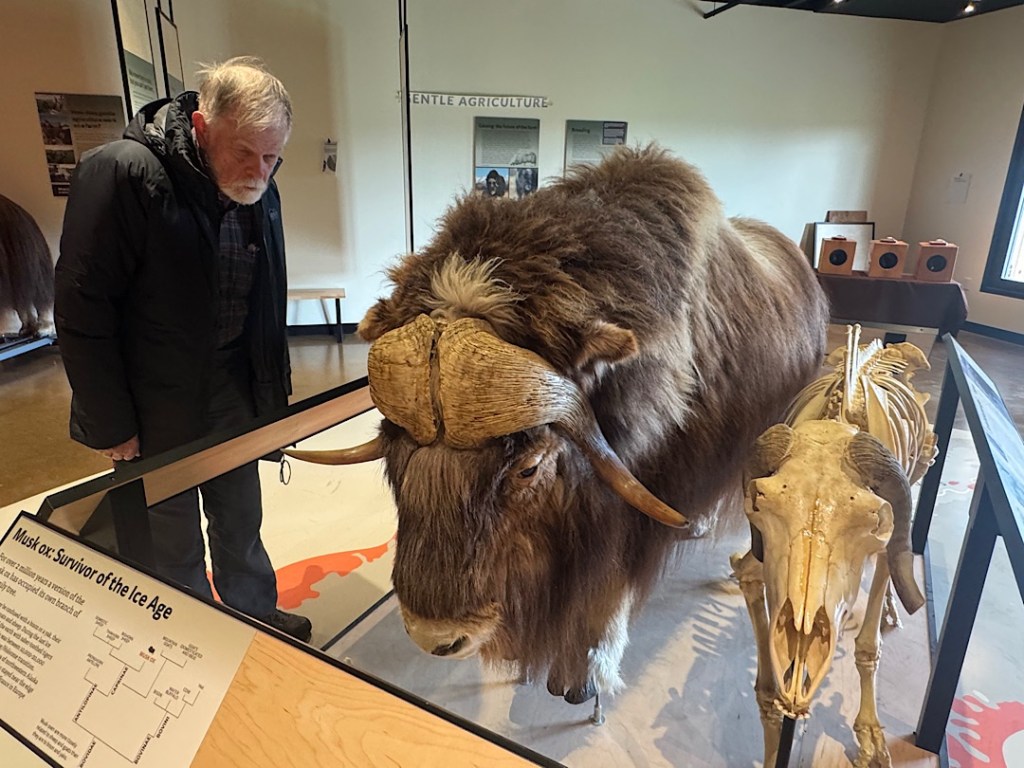
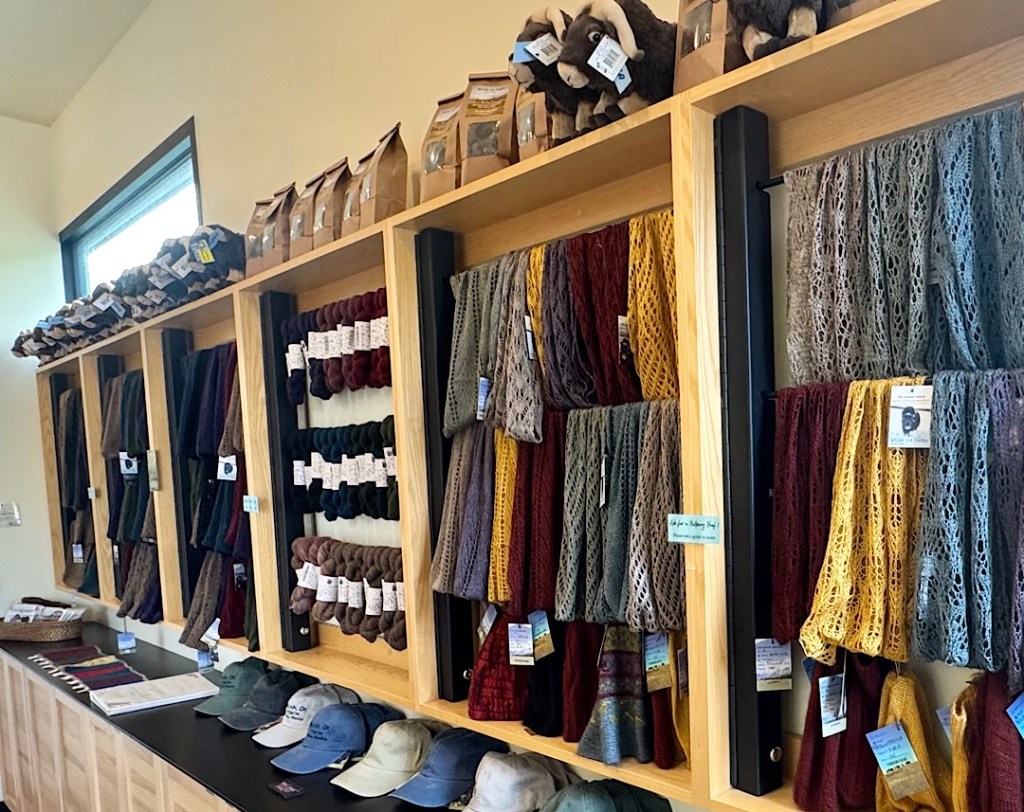
We visited another operation dedicated to bringing back musk oxen (who produce fabulous undercoats that can be turned into beautiful knitted goods.) We ate some terrific seafood.
Scarves and headbands made from the famous musk-ox hair.
For me, however, nothing compared with those sunny hours immersed in a culture of strong and heroic dogs. We’re now in Seward, where we’re about to move on to the next phase of this amazing adventure: glaciers!

















 At home and abroad