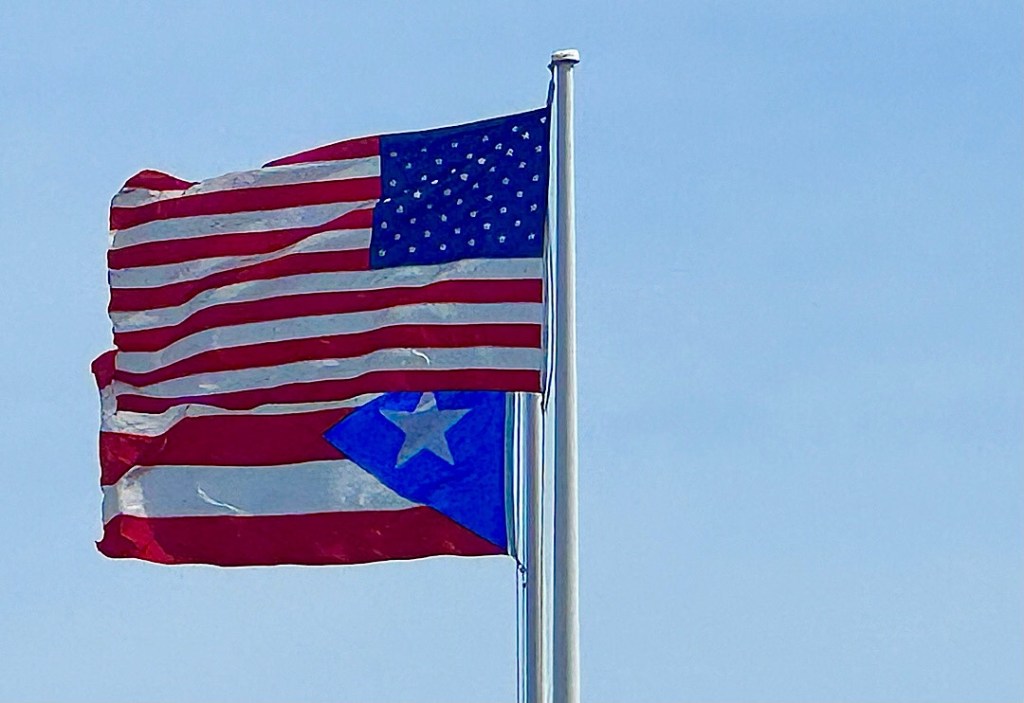
Steve keeps referring to Puerto Rico as “America’s biggest colony” even though I know that’s politically incorrect (both literally and socially). But I’m used to him being provocative. What we agree on is how weird it felt to be in a place where all the residents are entitled to carry US passports, but everyone speaks Spanish, and the capital city looks like Havana would probably look had Cuba not been governed by brutal Communist dictators for the past 65 years.
For our visit, I brought along the article that appeared in the New York Times last month: “36 Hours in San Juan.” Steve and I actually had 52 hours, all of which we spent in the oldest part of this oldest European city in the Western Hemisphere. A vast metropolis surrounds the old town, but I know nothing about it, except that our ride from the airport felt like we were back in the US.
Judgments based on such limited exposure are bound to be pathetic. Still, I’ll share four of my strongest impressions.
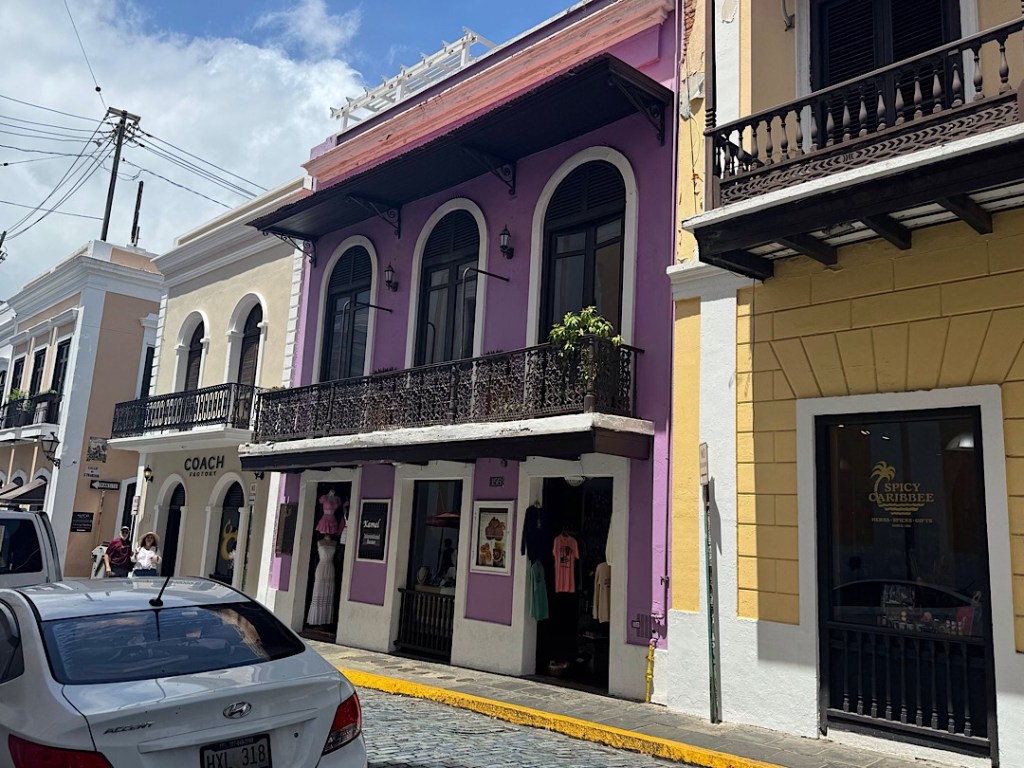
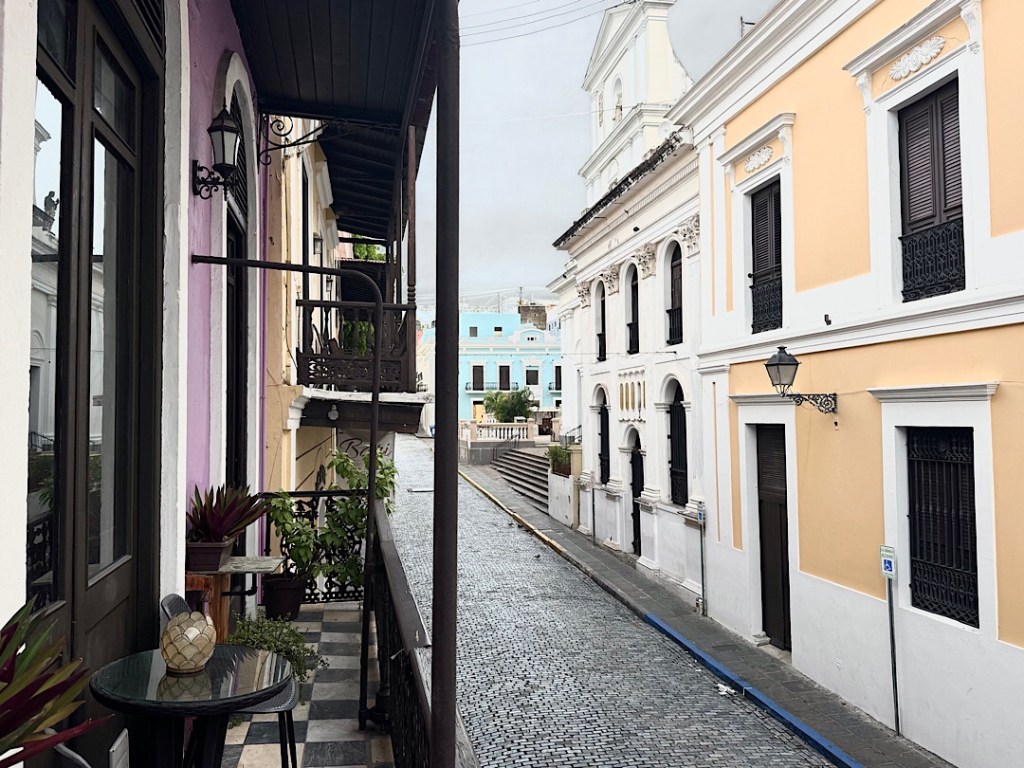
— San Juan’s old town looks great, particularly considering that two monster hurricanes (Maria and Irma) rampaged through 7 years ago, leaving in their wake apocalyptic destruction. The hurricanes knocked out all the power and shut down nearly all the digital and physical highways. However, from our vantage in the old town (an Airbnb just down the street from the 500-plus-year-old cathedral), we saw no remnants of that disaster. The Puerto Ricans cleaned up and have rebuilt their lives, and today throngs of tourists are strolling among the brightly painted buildings, shopping, consuming prodigious amounts of rum, and gobbling down ice cream.
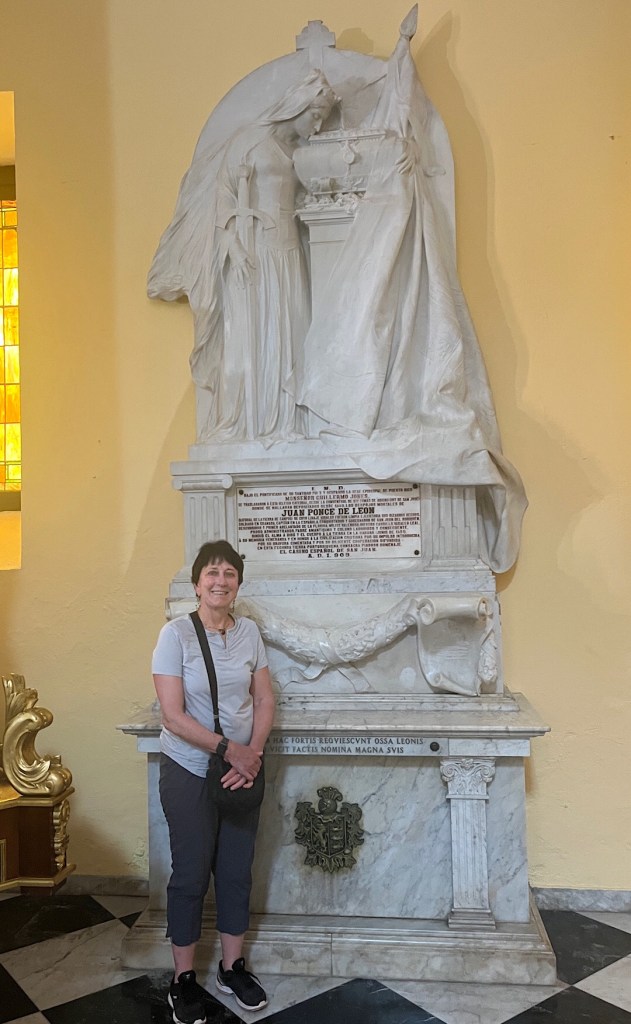
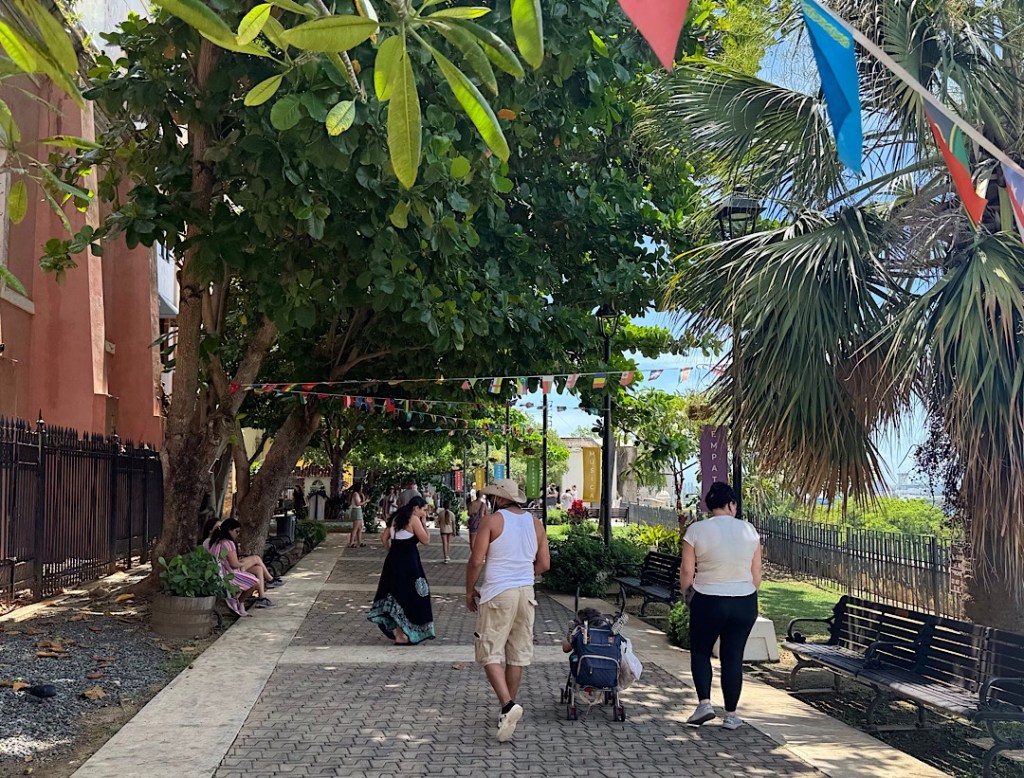
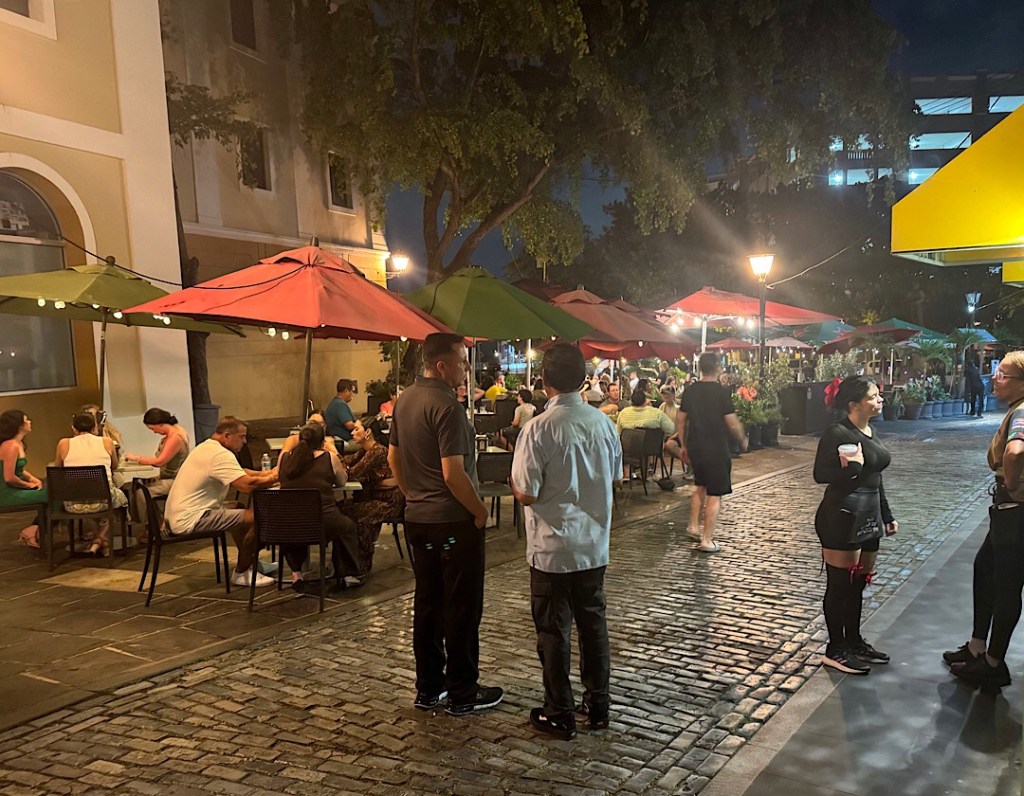
Our Airbnb filled the second story of that purple building.The view from our balcony. Those steps down the block on the right ascend into the Cathedral.Within it, this tomb provides evidence that Juan Ponce de Leon failed to find the fountain of youth.I loved the plethora of tree-shaded benches……and interesting street scenes.Day and night
— The temperature hit 90 both weekend days, with so much humidity sweat dripped from us like drops of rain. This was a good thing. Old San Juan was so pretty and lively, had the weather been excellent, I might have felt tempted to move here. But not with weather like that.
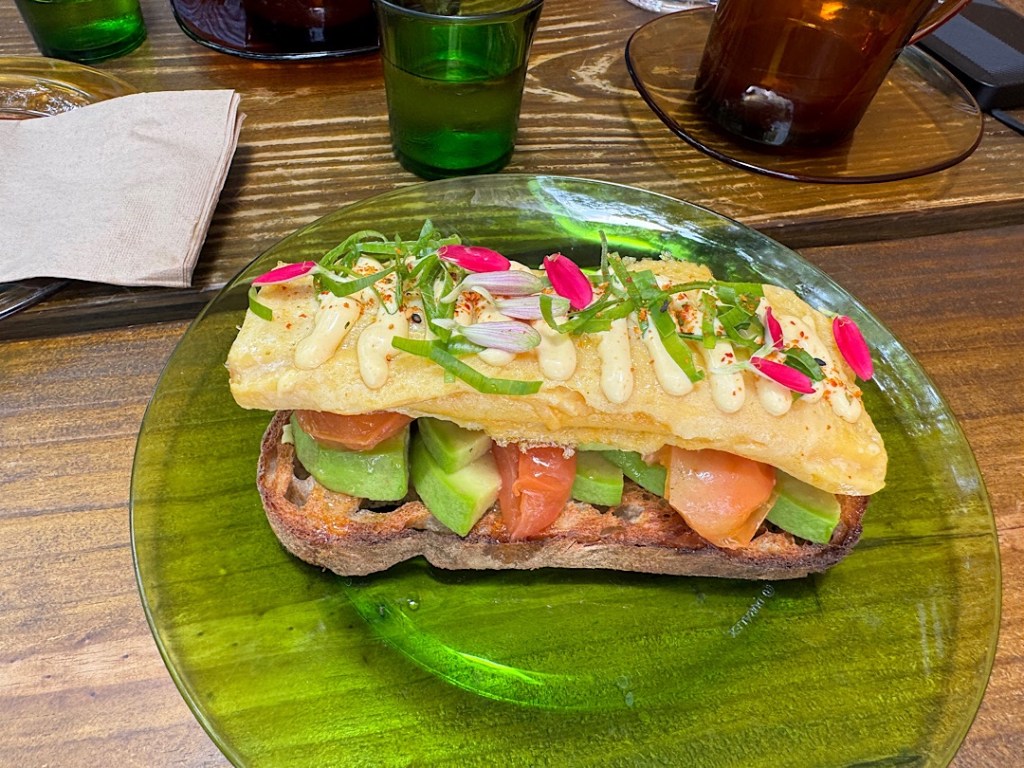
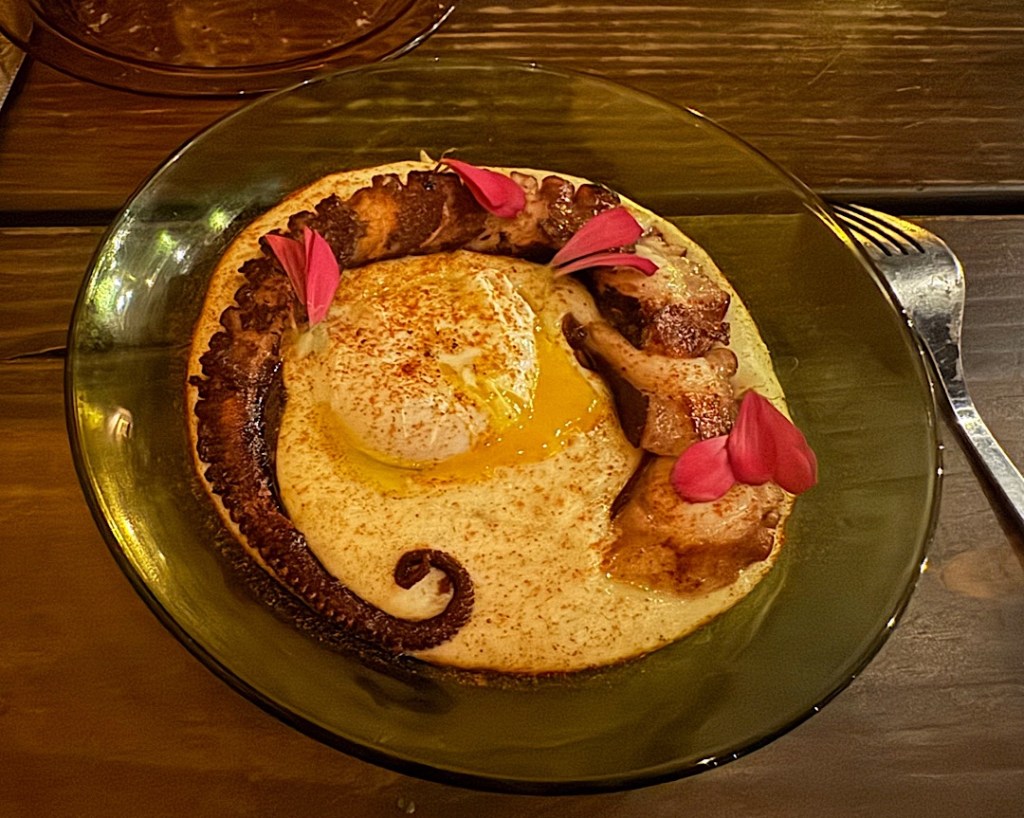
— We ate four meals in restaurants (two lunches and two dinners), and all of them were better than anything we ate in the Lesser Antilles. There the food was solid but unexciting. Not so in San Juan.
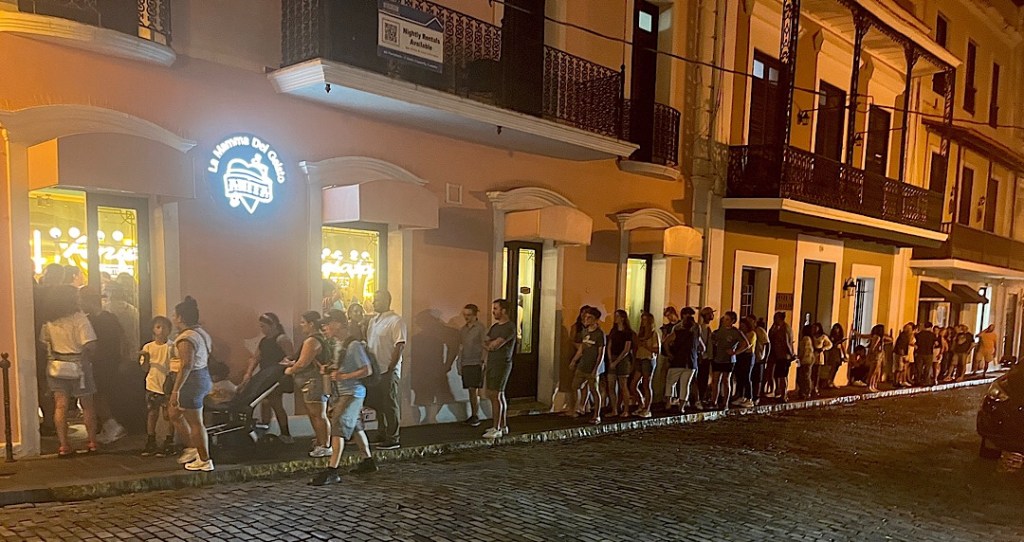
The “Japanese omelet sandwich” I had for lunch the first day.That little street cafe was so good we returned for dinner.The line for ice cream at Anita’s.
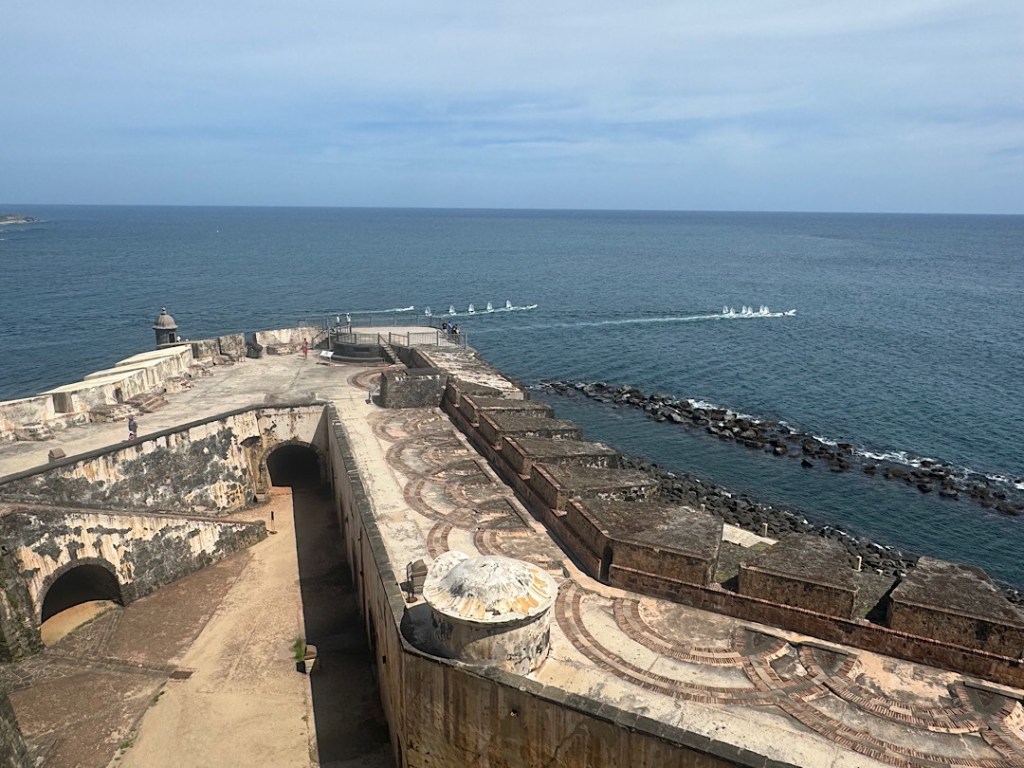
— The town’s biggest attraction — El Morro — belongs on any list of the Most Impressive Forts in the World.
It occupies a strategic point at the entrance to San Juan’s magnificent harbor.
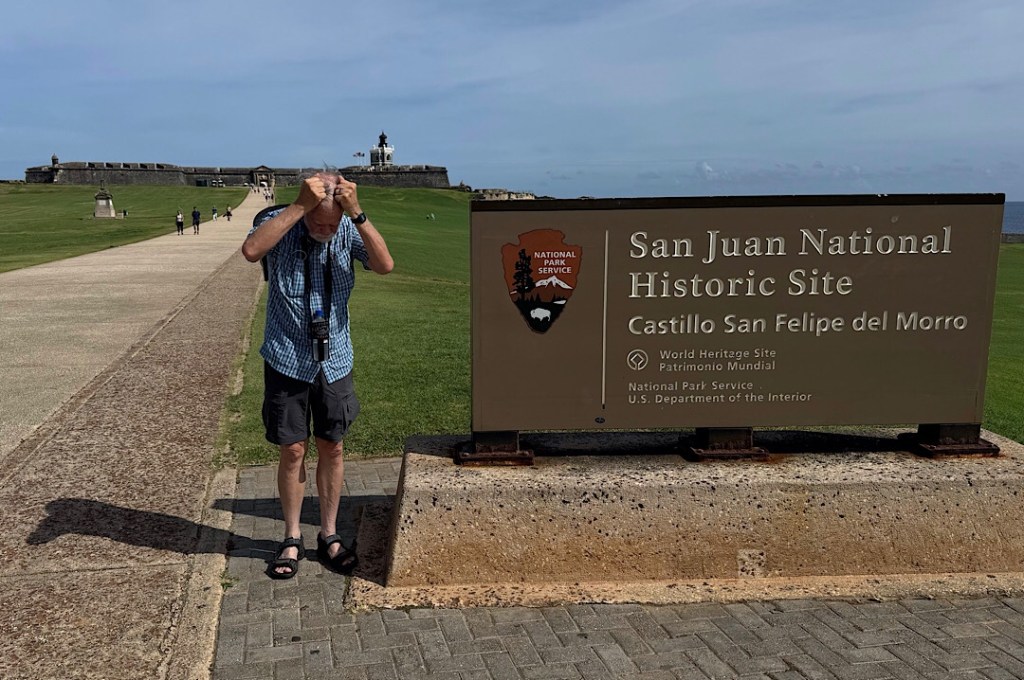
Sir Francis Drake tried (and failed) to overcome it. A second attempt by the British navy at the peak of its imperial power ended with the English slinking away in defeat. Today the United States park service shows a film there that nicely recounts the history of Puerto Rico and the role played in it by El Morro. The only bad thing about our visit was that Steve forgot to bring along his National Park Pass (which we would have allowed us to enter free).
The price of forgetting that Puerto Rico is part of the United States.
Now, once again, we have no need for it. Yesterday afternoon we took the 40-minute flight on JetBlue from San Juan to the Dominican Republic, second largest island in the Greater Antilles.
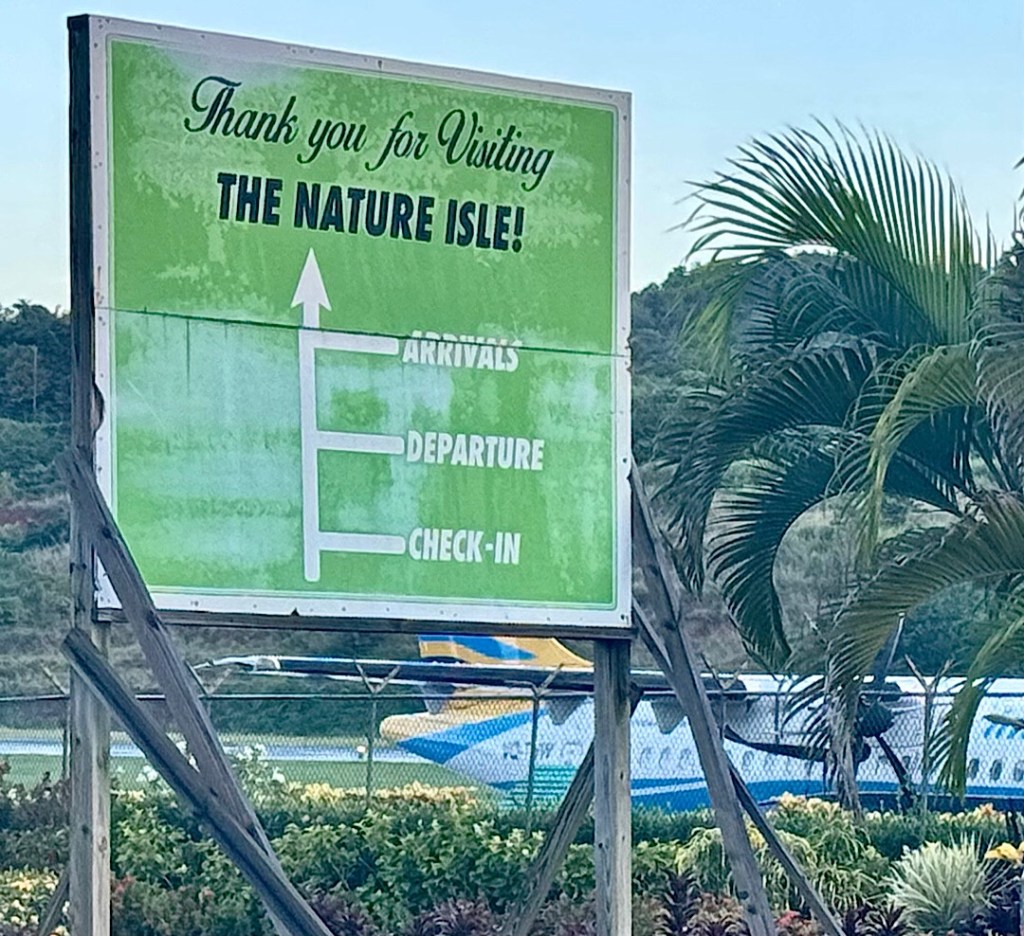
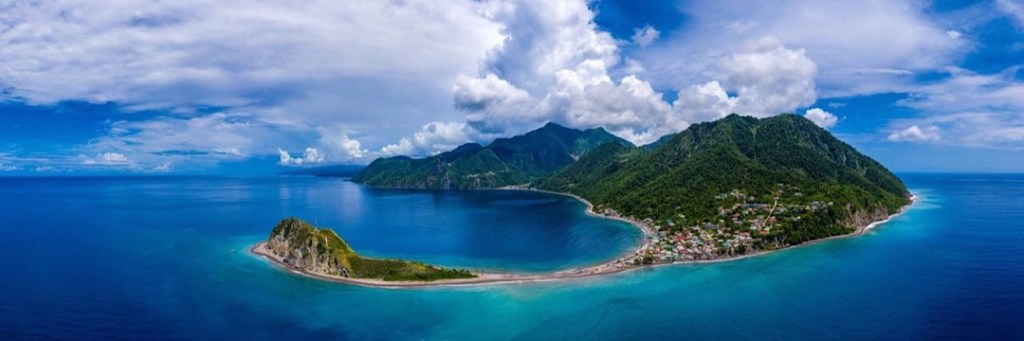
Dominica has been dubbed the Nature Island, just as Grenada is known as the Spice Island. For us, though, it was the Lucky Island.
A couple of things about this place (which folks pronounce “Do-min-EE-ka”) were lucky for its pre-Colombian inhabitants. Unlike most of the Lesser Antilles, Dominica has no good natural harbor. It’s also the youngest land in all the Caribbean. Created by volcanoes about 25 million years ago (compared to its 50-million-year-old-ish neighbors), it still has 9 active volcanoes (supposedly the highest concentration on Earth.) Because it’s so young, the terrain is steeper and more rugged, with few flat places suited for growing sugar cane. At first no Europeans were even sure they wanted it. (Then the English and French squabbled over it for a couple of centuries.)
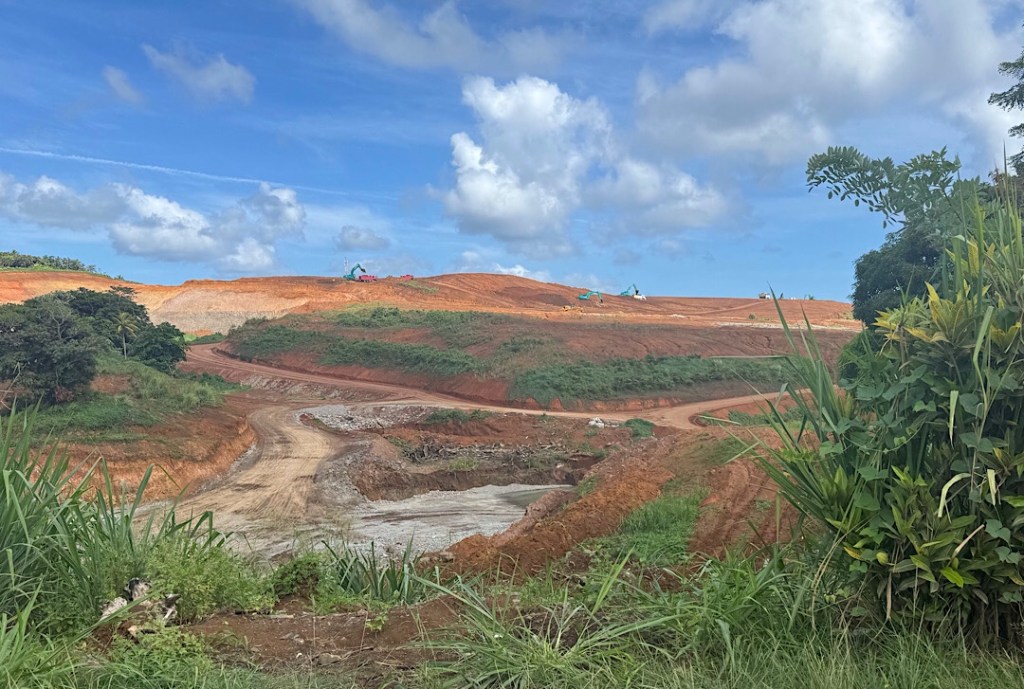
No roads were built anywhere on Dominica until the 1960s. Today big development plans are brewing. Someone’s erecting what supposedly will be the world’s longest aerial tram up to Boiling Lake at the top of the island. Construction on a new international airport has turned a part of the northern coast into a scene of stunning destruction.
This photo does not convey the staggering scale of the earth-moving underway.
Despite all this, much of what we saw of Dominica felt wild, barely influenced by humans.
Our luck started with where we wound up staying. As for all our Caribbean destinations, I searched for offerings on homeexchange.com where I could use my fat store of guest points. There weren’t many choices, but I found a little boutique hotel, Pagua Bay House, whose owner, Rick, messaged me that I could use my points to book one of his six rooms if he still had free ones three months before our arrival. (He did.)
In his written communications, Rick was terse, and I worried about what we might find when we got there. But the place turned out to be lovely, and at breakfast Wednesday morning, Rick and his wife Alicia dazzled me with their warmth and charm.
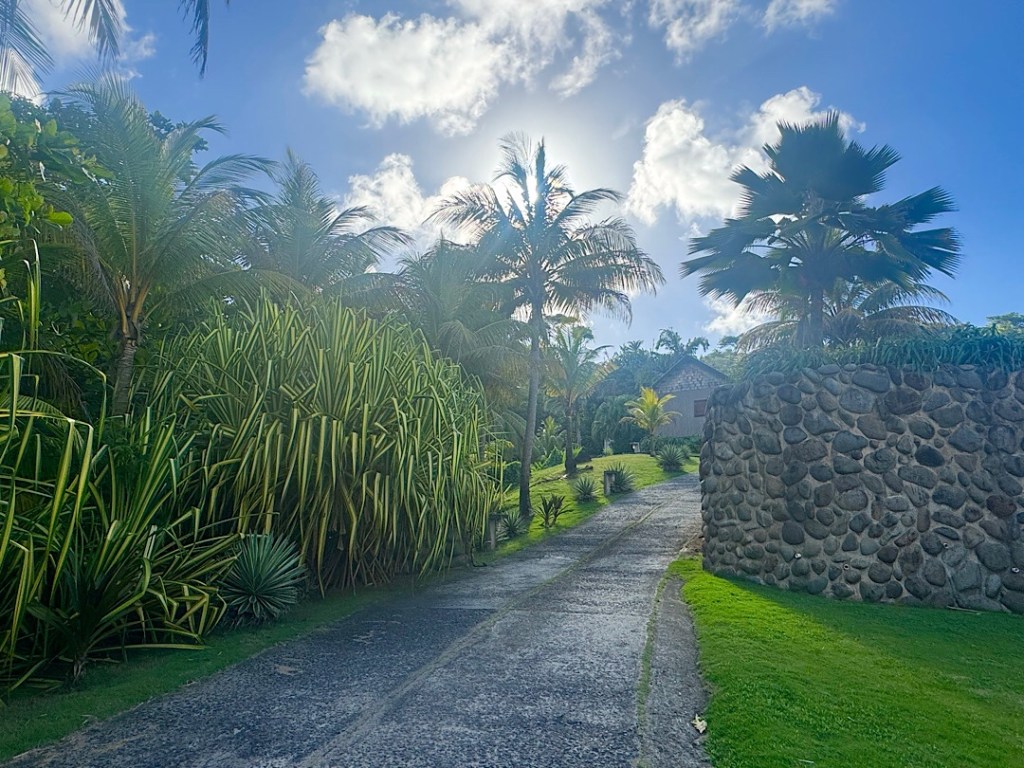
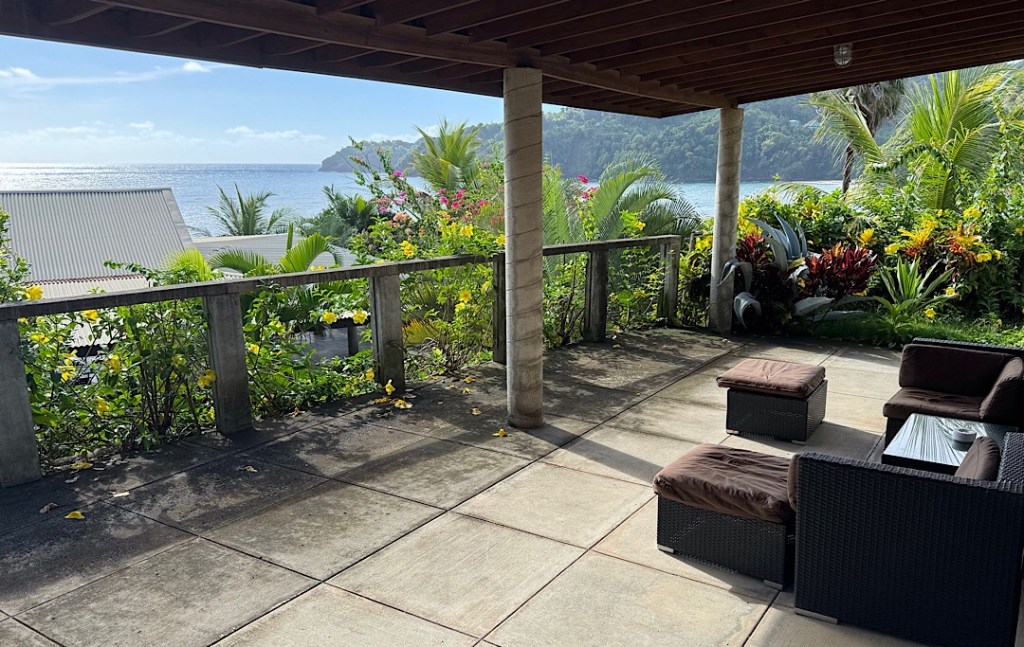
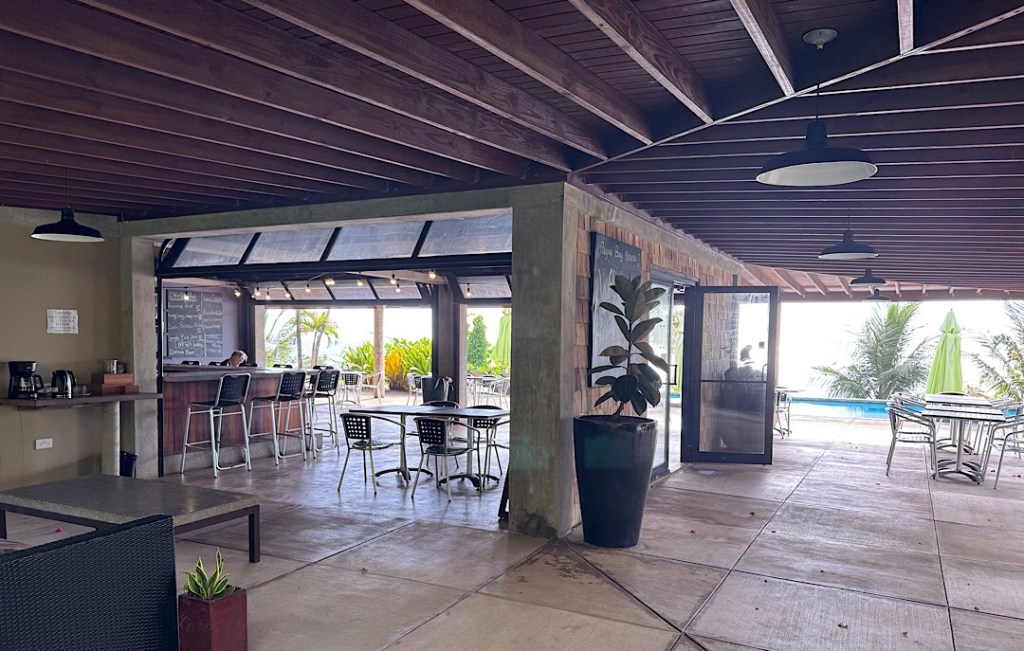
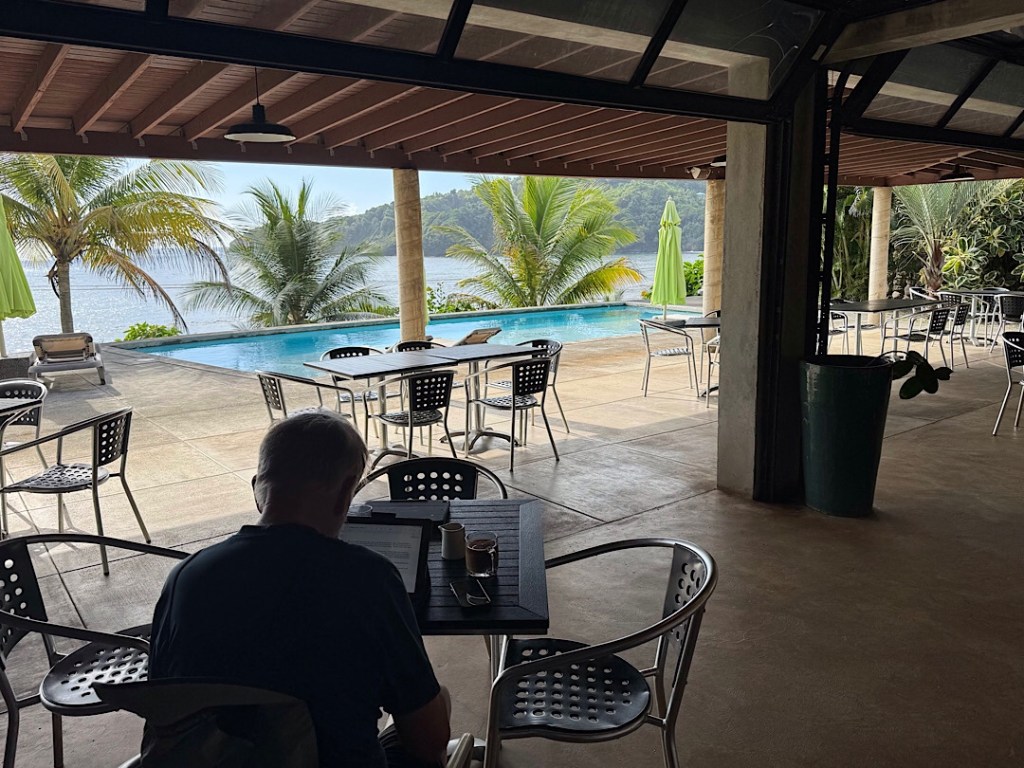
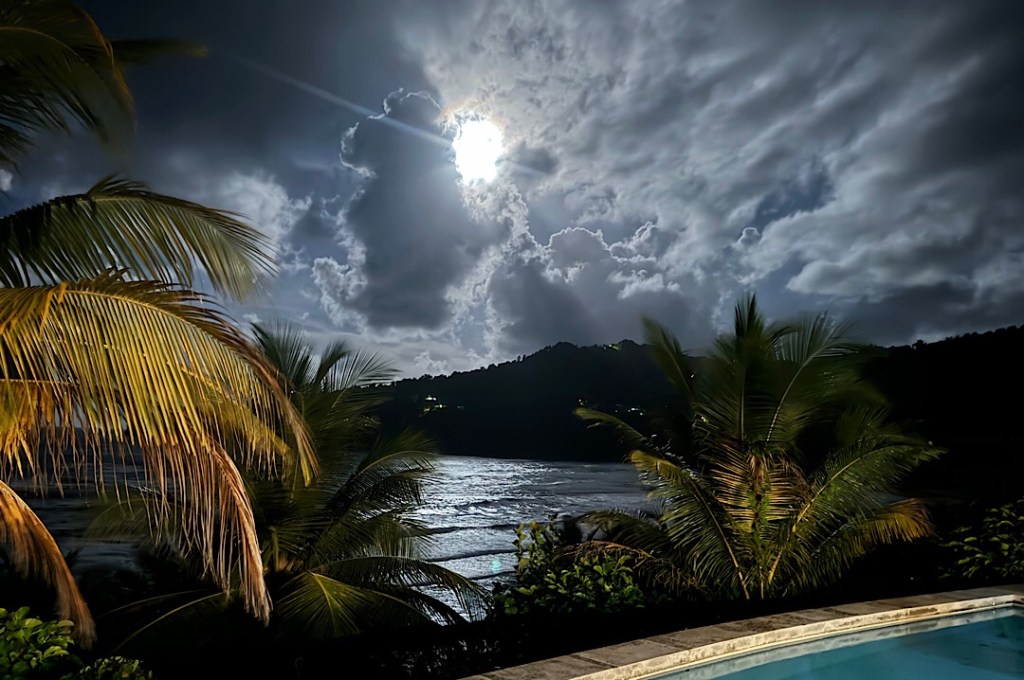
The entrance to the propertyOur room had a private terrace overlooking the Atlantic Coast.The entrance to the restaurantLooking out to the pool deckThe view from our table at night
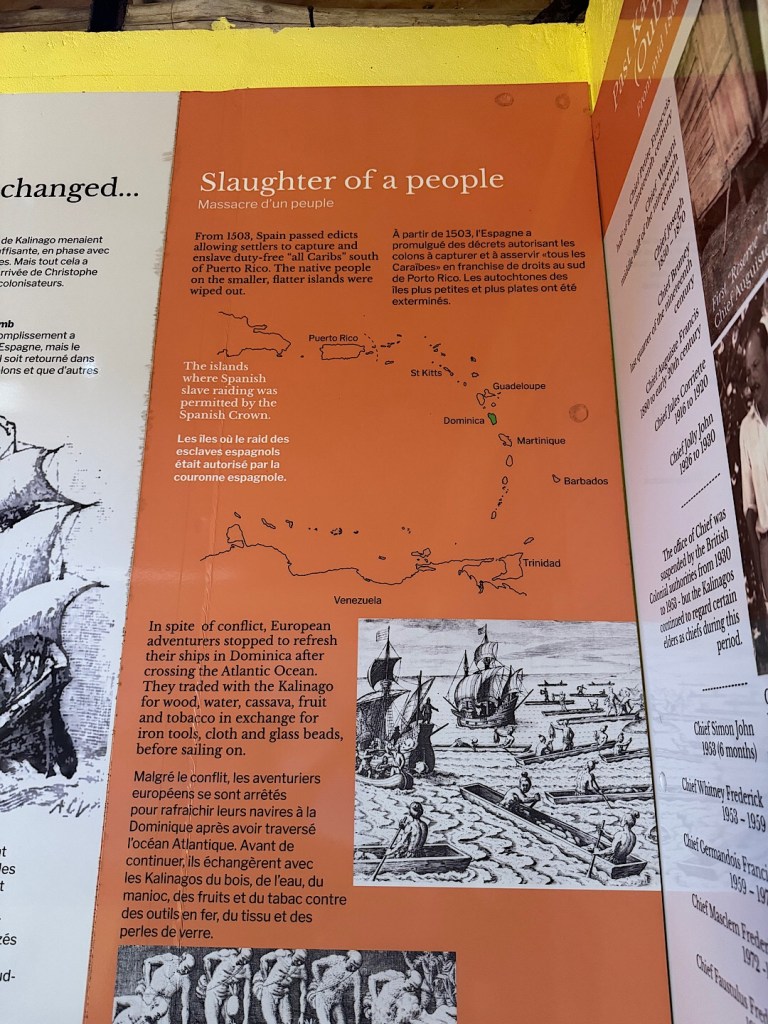
Wednesday morning Alicia was bursting with suggestions for how we could spend our time; she offered to set us up with guides on Thursday and Friday. She also confirmed that Pagua Bay House is situated less than 5 miles from the largest enclave of indigenous people remaining in all the Caribbean. The history of those who lived here before the Europeans arrived and what happened to them interests both Steve and me, so we headed for the Kalinago Territory as soon as we finished our breakfasts.
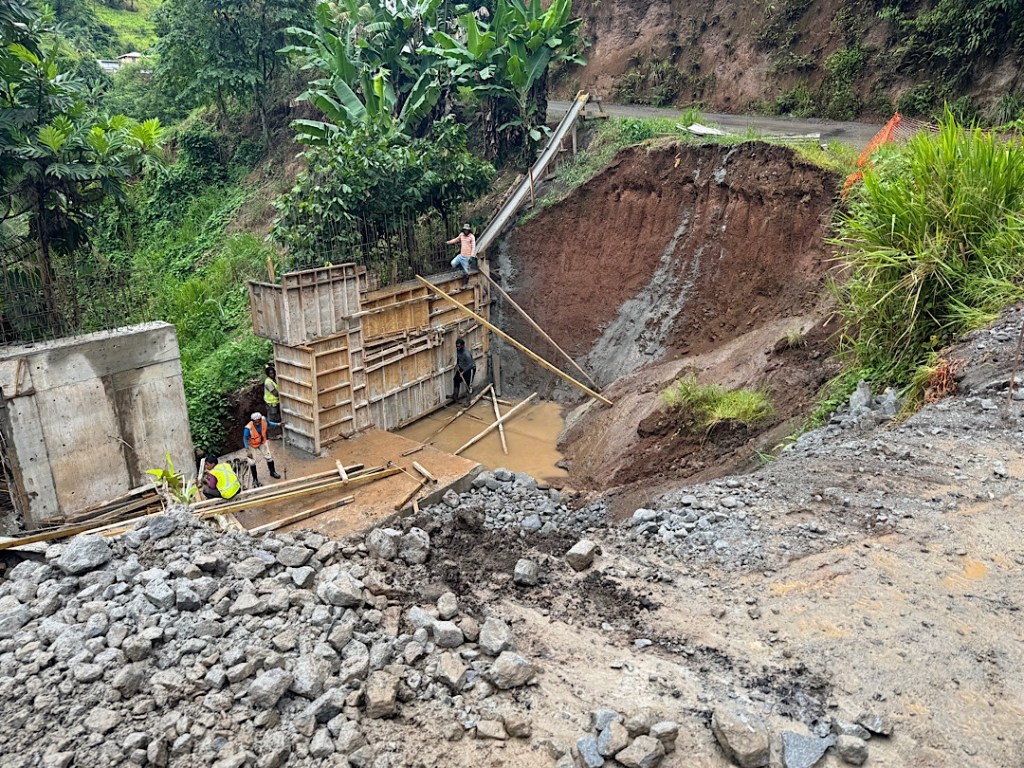
The road to the territory was dreadful, but crews were working to repair it.
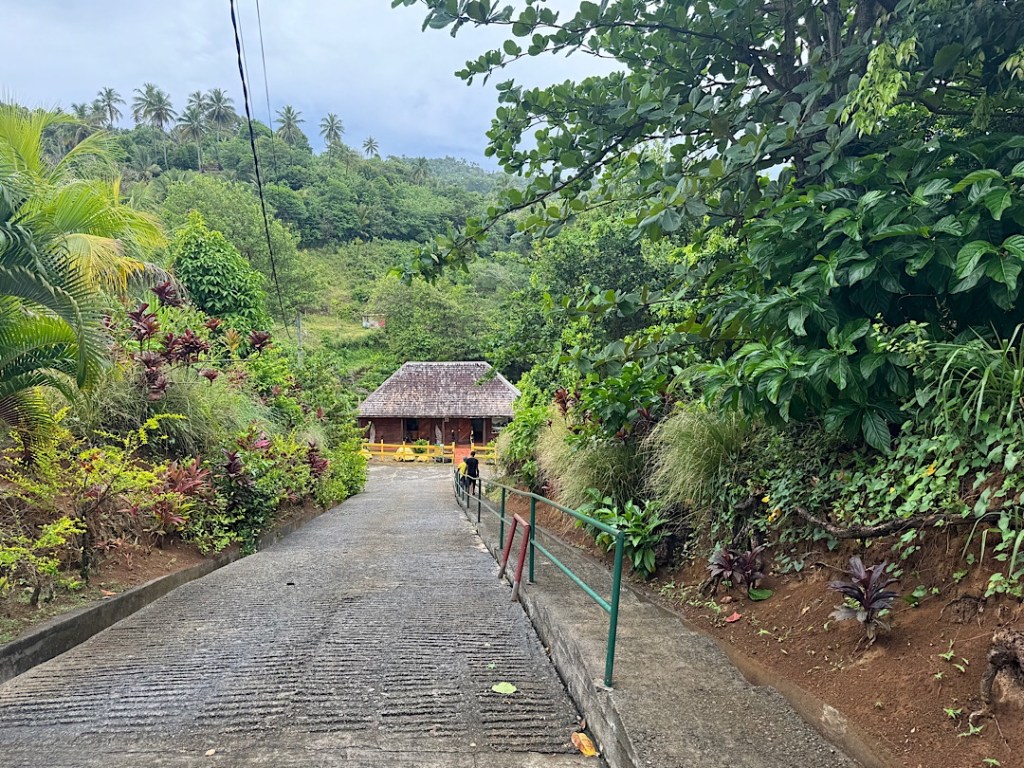
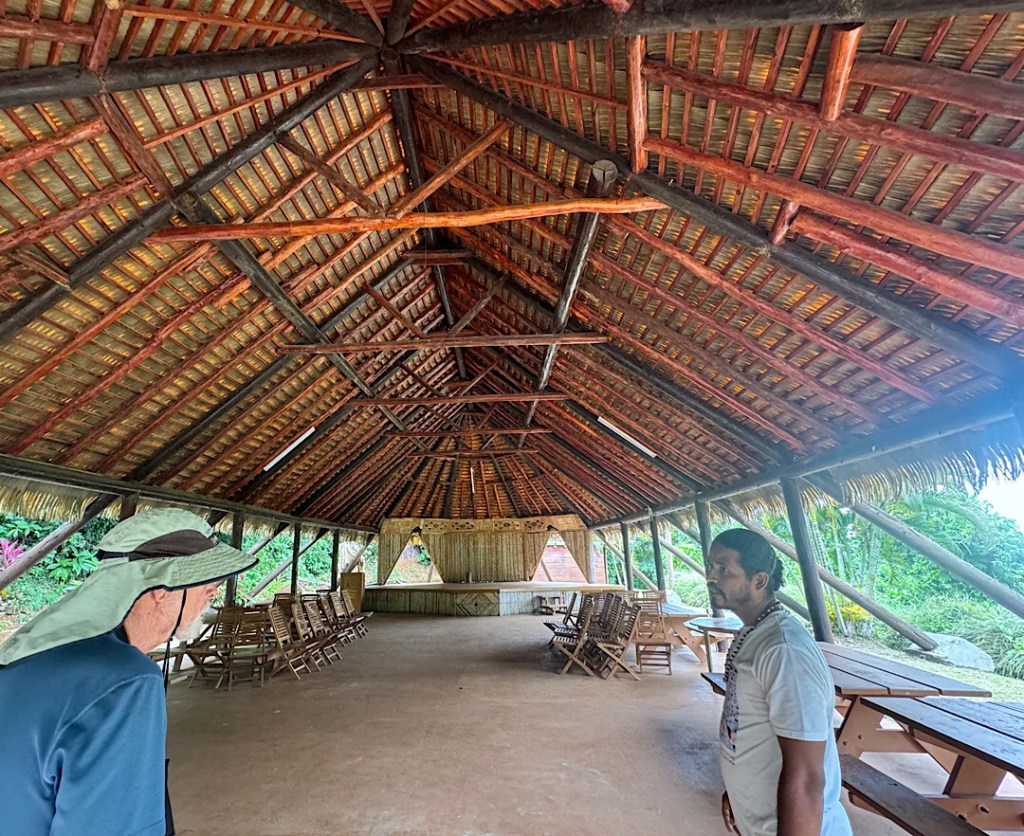
At the end of the road we found a thoughtful visitor center and a bright young man named Kendrick who toured us around the heart of this community of 3500 people.
We learned a lot, but it was nothing compared to what we got the next day from Elvis. Steve and I drove for almost 90 minutes back to Roseau (where our ferry landed), then we spent more than 6 hours exploring the Morne Trois Pitons national park (a World Heritage Site) with this guy. “Like drinking from a fire hose,” Steve summed up the experience.
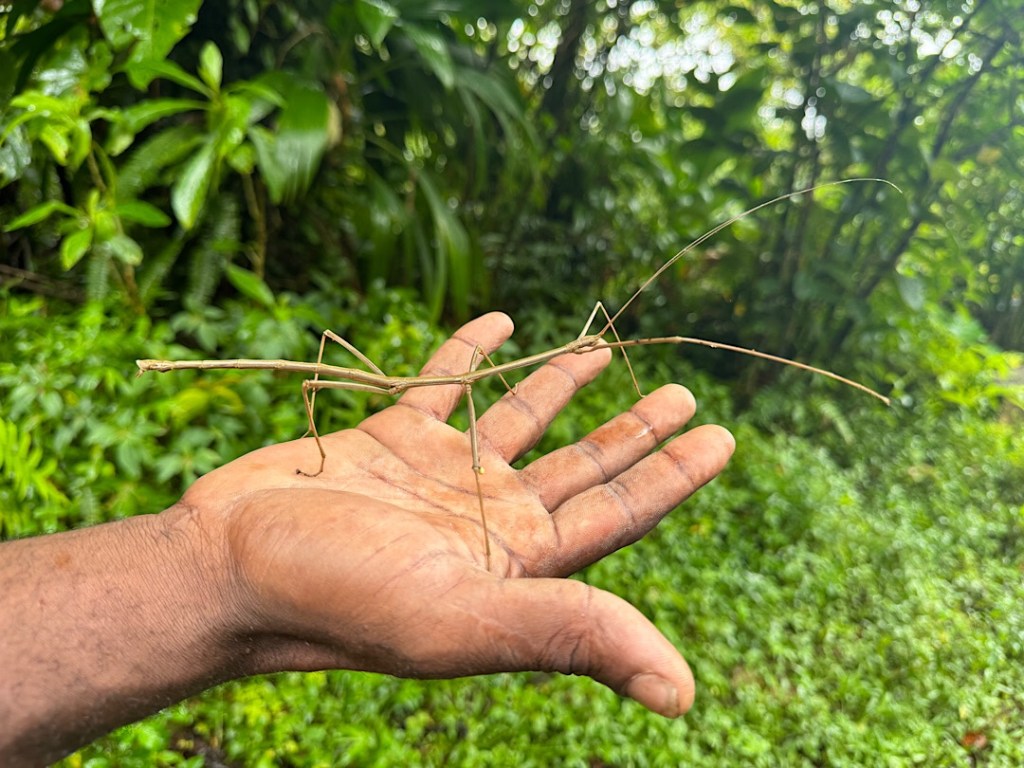
Elvis commandeered the wheel of our rental car and drove us up through transitional forest, then rainforest, then cloud forest. He was the kind of keen-eyed expert who could spot a walking stick on a tree yards away and pluck it off for us to admire…
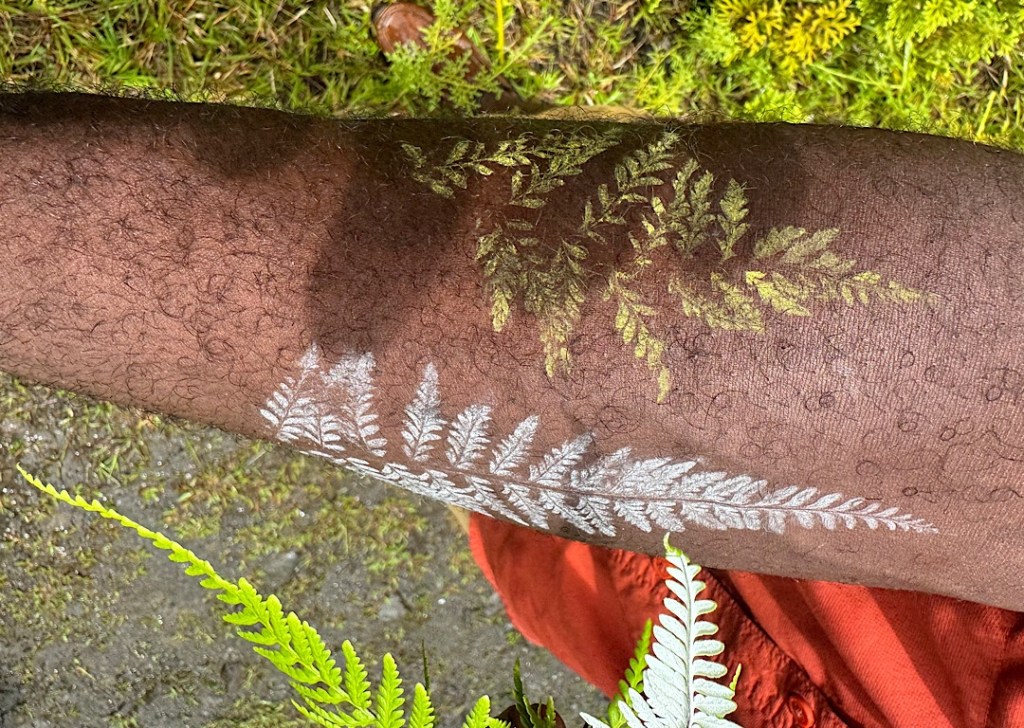
…Who could tattoo his forearm with the spores of fern fronds.
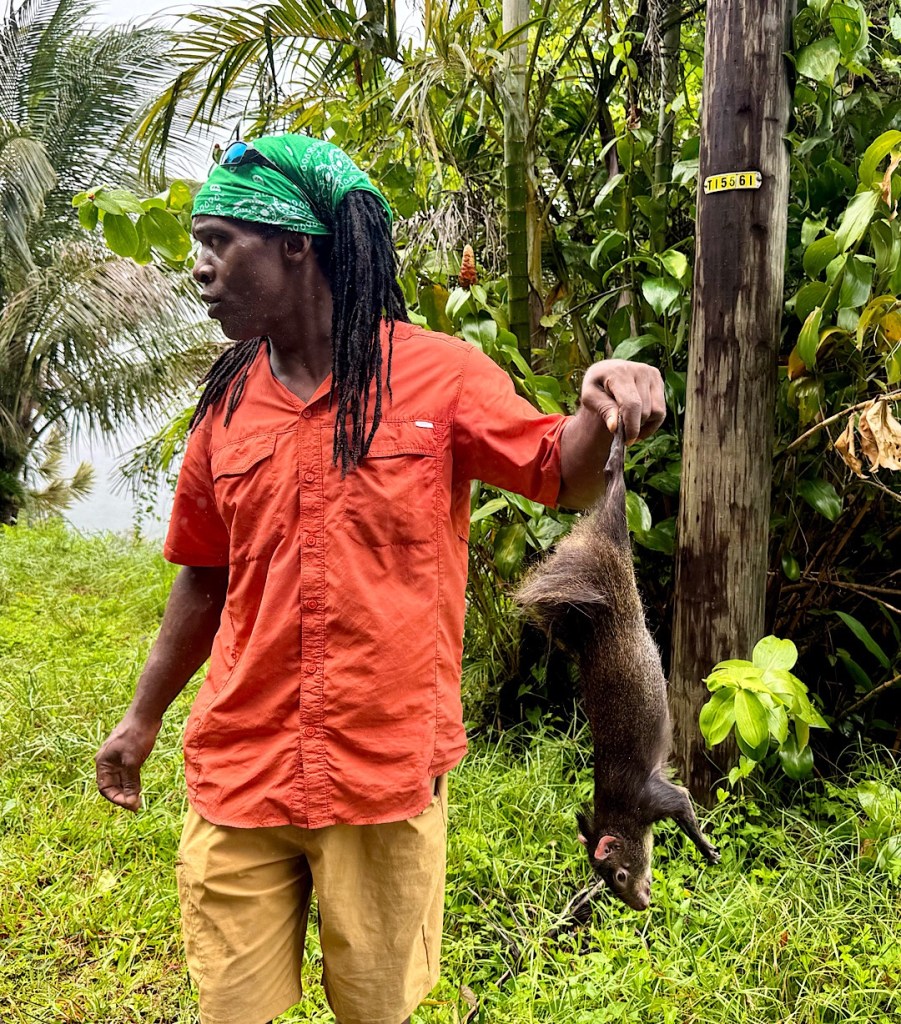
…Who when we came upon a freshly killed agouti in the middle of the road, retrieved and cached the beast for a friend who would cook it for dinner.
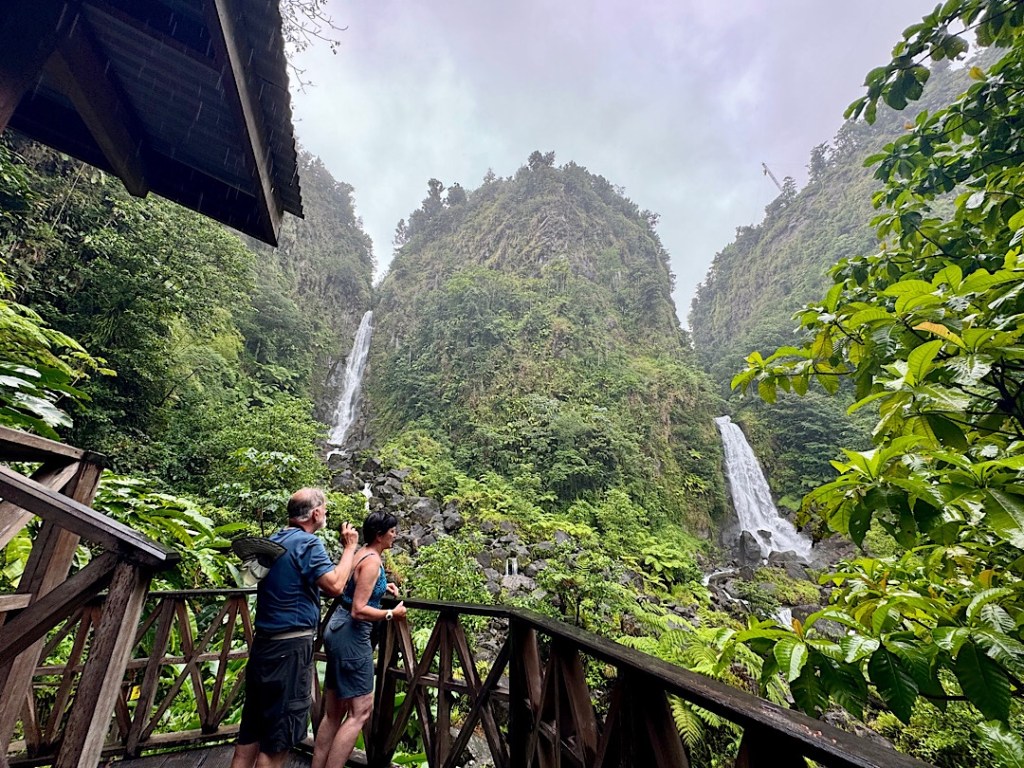
He took us to the impressive Trafalgar Falls…
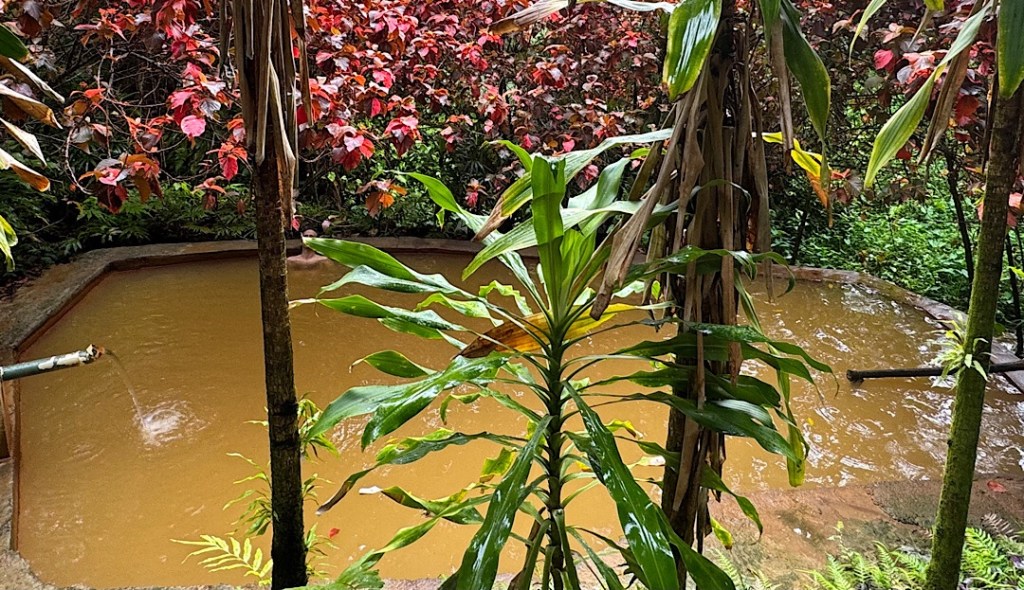
…and to a little hot springs off the beaten path where the three of us literally soaked in beauty.
His knowledge of the profusion of plants was encyclopedic, and Elvis seemed to know almost as much about Dominica’s history, archeology, and geology.
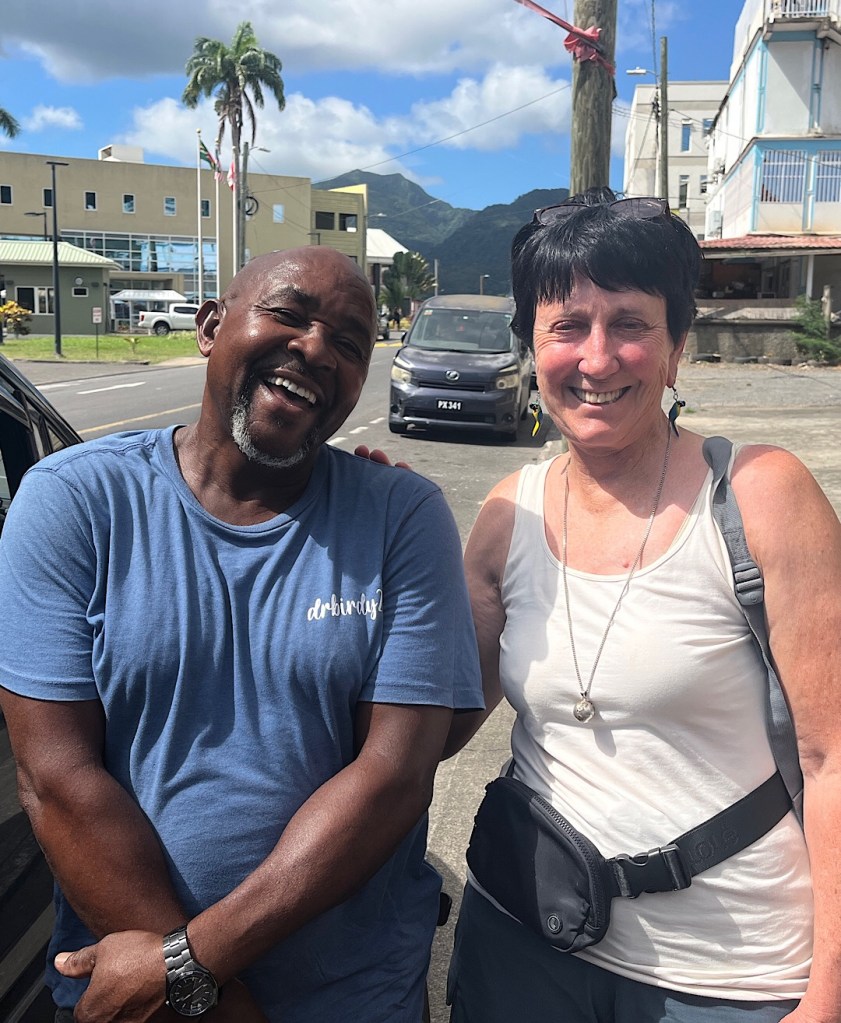
I’ve learned over the years that a good guide can change your view of the world; add layers of insight and meaning to what’s around you. Elvis was a world-class guide, and it was purest luck (and the fact that late May is the beginning of the low season) that we were able to book him at the last minute. The same fortuitous combination enabled us to spend a big chunk of Friday with Bertrand Jno Baptiste, aka “Dr. Birdy.”
Birdy, who’s now 63, fired a slingshot at a beautiful local bird when he was 11, and you can still hear some of the horror in his voice when he recalls watching it die in his hand. He vowed to never again kill any bird. Instead he started learning about them. That became a passion and it led him to a career with Dominica’s national wildlife service. Birdy now knows more about the Dominican avian community than anyone in the world; he wrote the definitive Birds of Dominica (published in 2005). He has a hearty, effusive spirit that made our time together a pleasure.
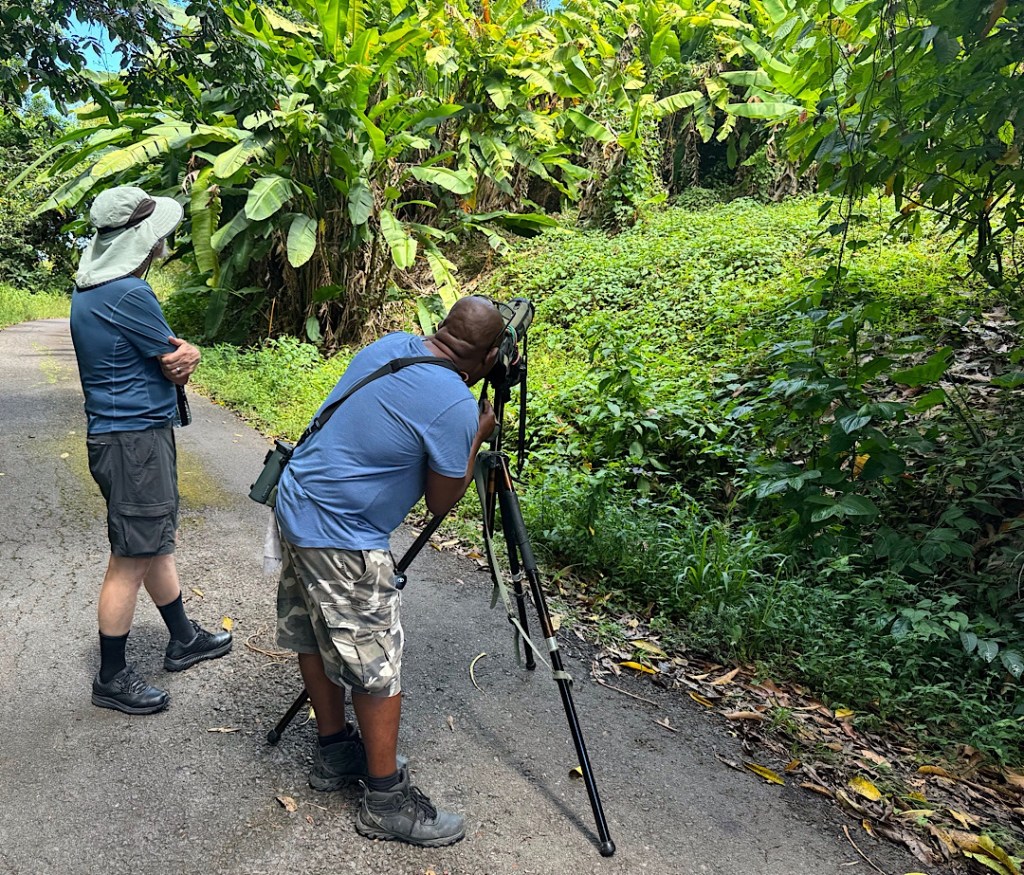
He drove us high up into the Morne Diablotin national park in the northeast section of the country, stopping periodically to check certain trees where he knew certain birds hang out.
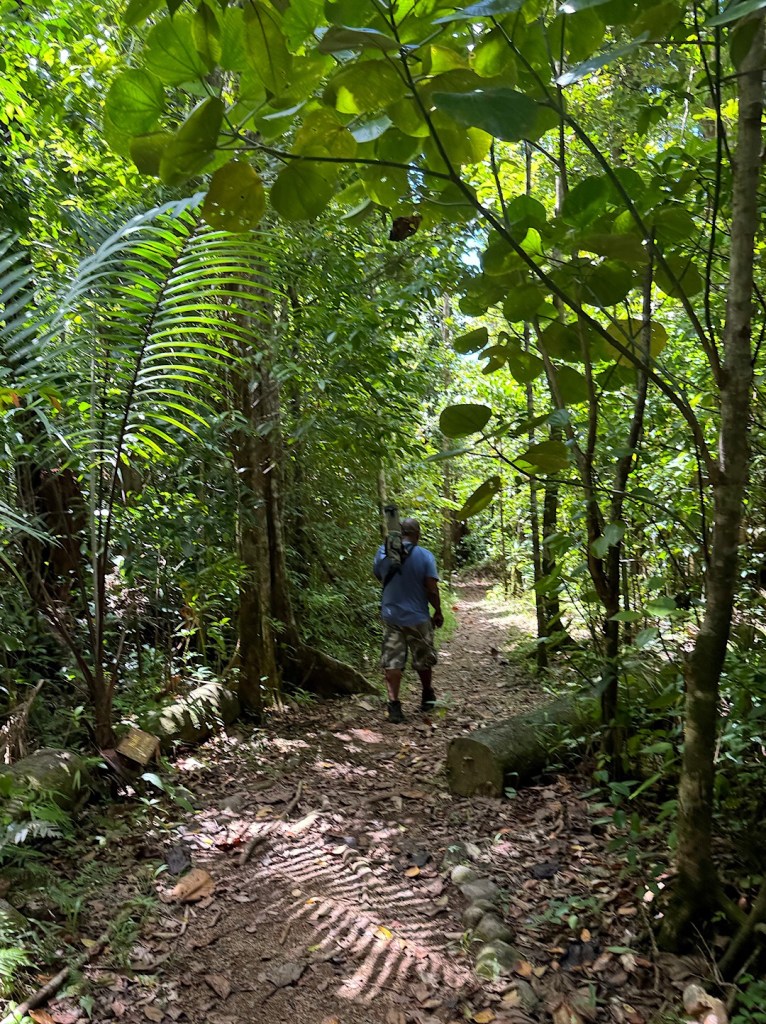
Finally, we parked and hiked into the old-growth forest, a cool, magical realm that’s home to the rarest of all Amazon parrots, the hefty Amazonas imperialis, aka the Imperial Parrot or the Sisserou.
The Imperial Parrot is the national bird. That’s it on Dominica’s flag (on the right).
Under Birdy’s tutelage we spotted more than a dozen types of birds, including a charming, tiny Antillean crested hummingbird (smallest of the four types of Dominican hummers.)
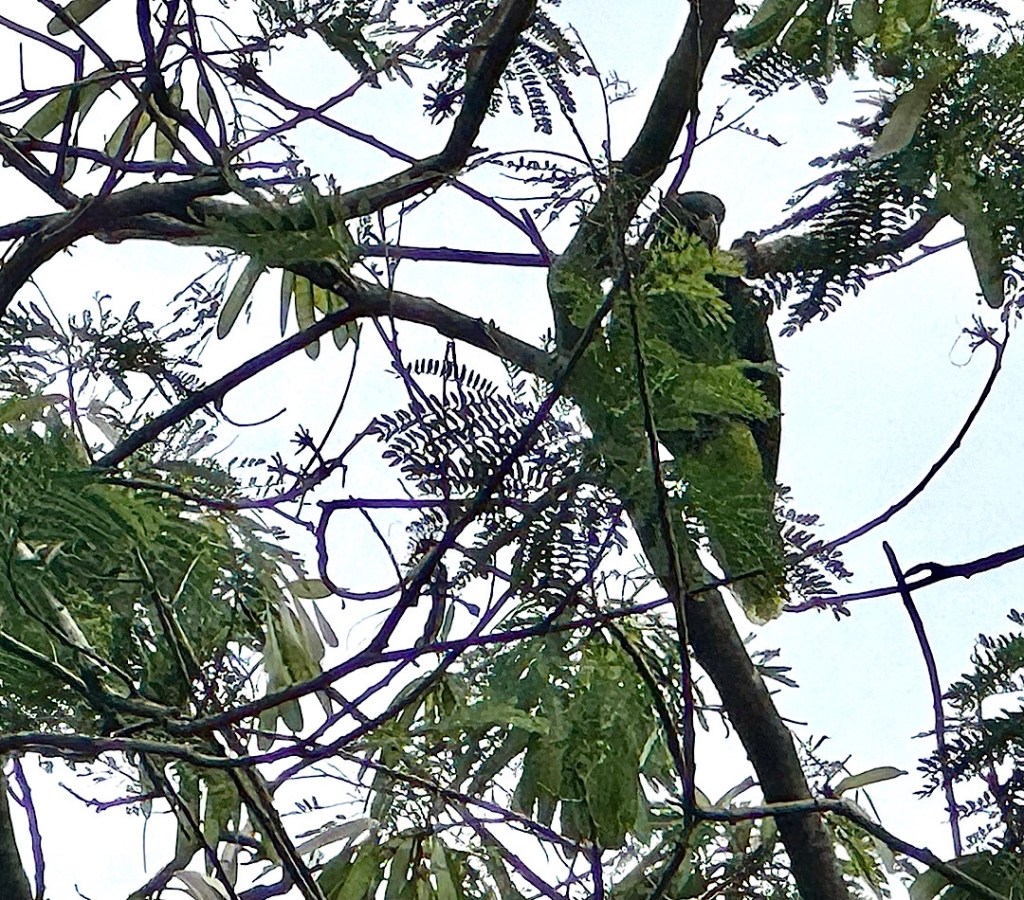
We could also hear parrots. But they seemed to be hiding. For a while I thought our luck had run out. Then driving to the exit, Birdy braked hard and pointed to a presence on a nearby branch: a young male member of the island’s other resident parrot, the smaller red-necked or “Jaco” species.
It wasn’t an Imperial. You can’t win them all, but it felt like we had at least partly filled our quest. And then Steve and made it back to Pagua Bay without getting killed on the road. That felt very lucky.
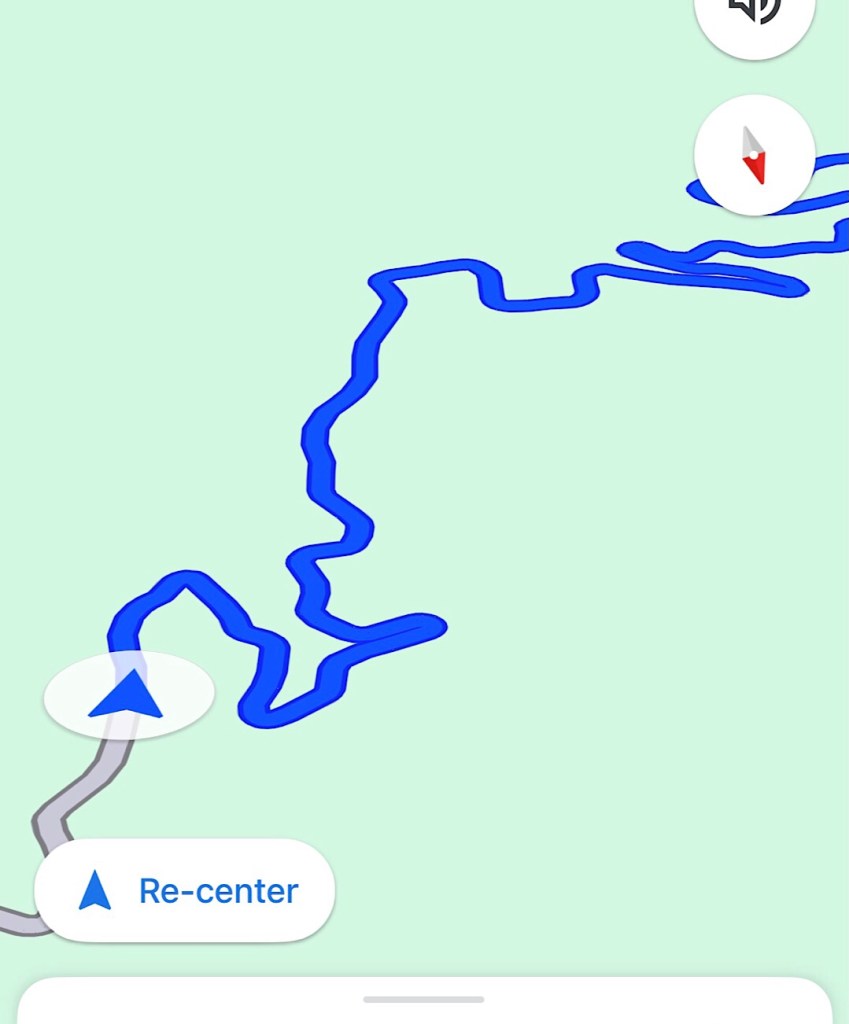
Most of the roads we traveled on Friday looked like this on Google Maps. In reality, they looked worse.
In some sense, our travels in Indonesia last year inspired me to undertake this present adventure. A healthy network of local ferries connects the vast Indonesian archipelago, and although we only took one (from Java to Bali), that experience made me wonder if we might explore the much closer archipelago in the Caribbean using ferries too.
Nope. Digging into it, I learned that you can rent boats to sail yourself around, but that seemed super-expensive and pretty time-consuming. You can take cruise ships, but Steve and I were interested in learning about life on an assortment of islands rather than lounging on cruise-ship decks and making lightning calls at ports packed with gringos. In the end, I was only able to book passage for us on two local aquatic lines. One was on a car ferry that sails overnight from San Juan in Puerto Rico to Santo Domingo in the Dominican Republic. I also got us seats on the much shorter L’Express des Îles line that runs from St. Lucia to Dominica (via Martinique). Then one day last month I got a call informing me the Puerto Rican car ferry wouldn’t be running on May 28 after all; they needed to do some “maintenance” work on it.
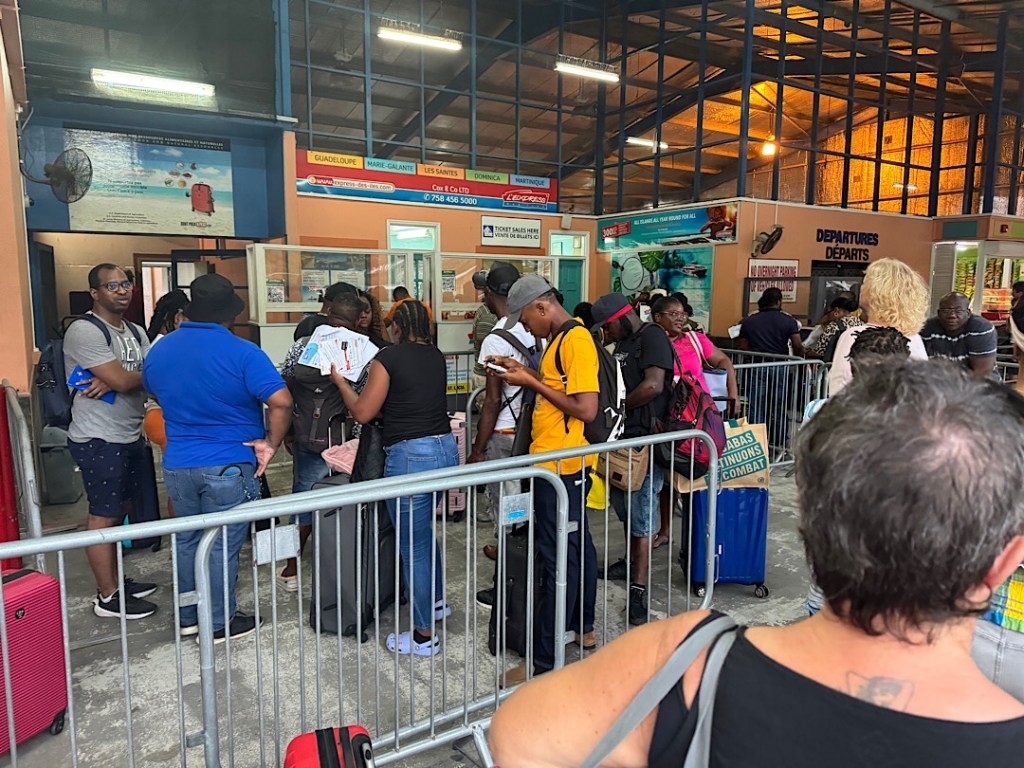
That left only L’Express des Îles, on which we sailed Tuesday morning. My rating: “meh.” We had to get up at 3:45 a.m. to be driven to the ferry dock in Castries (on the opposite side of St. Lucia from where we were staying.) Buying the ticket online had been easy, and check-in at the port wasn’t bad.
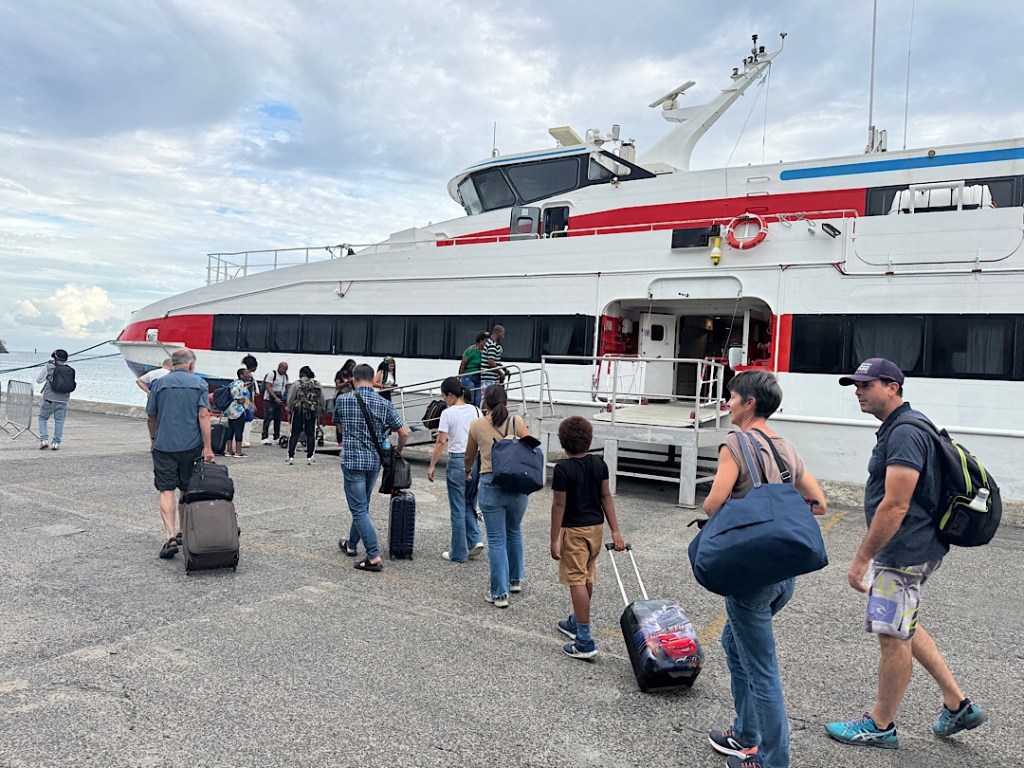
The boarding went smoothly.
But then the big catamaran didn’t pull out of the harbor when it was supposed to leave (at 7 a.m.) Instead we waited about 70 minutes as passengers continued to trickle on board. At one point Steve and I wondered if the captain hadn’t decided he wouldn’t cast off until they rustled up enough customers to fill his vessel.
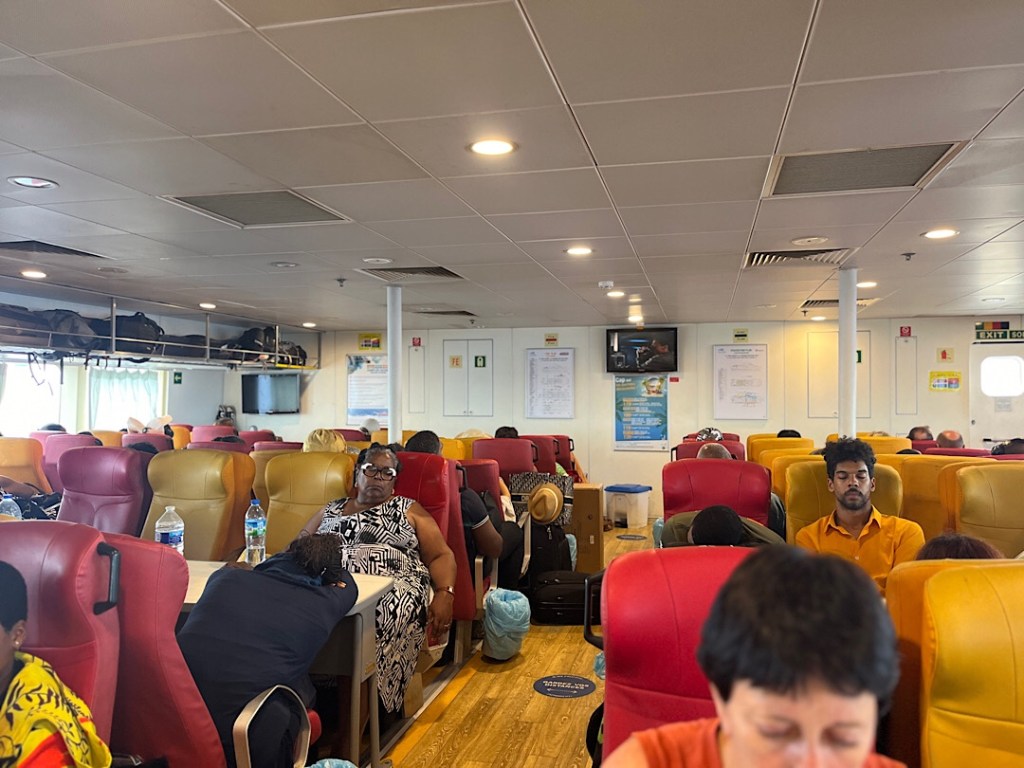
The boat had just two levels: an air-conditioned lower deck where you really couldn’t see anything.
The one above it was hotter and filled with harder, more uncomfortable seats.
A small outdoor section in the rear contained no seats but better views, and Steve spent a fair amount standing at the rail there, but someone had to guard our seats and bags, so I did most of that.
At the end of my last blog post, I posed the question of how well one could experience St. Lucia in just a short stay. Now I can say: more time would have been better, but the two days we had were extraordinarily pleasant.
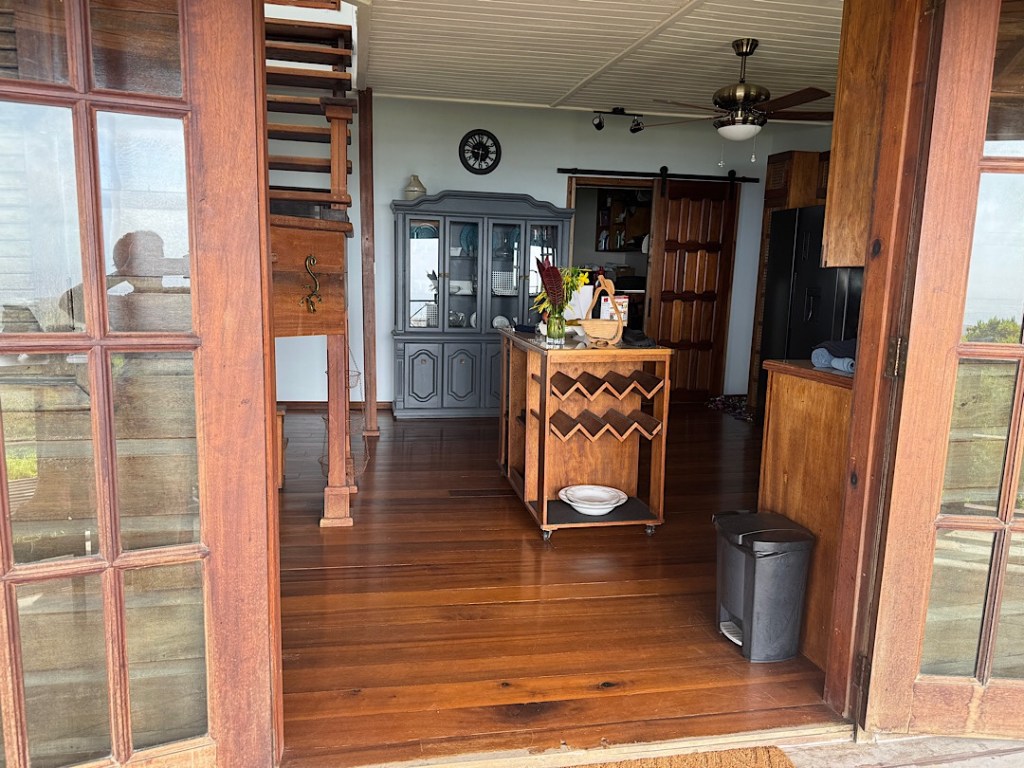
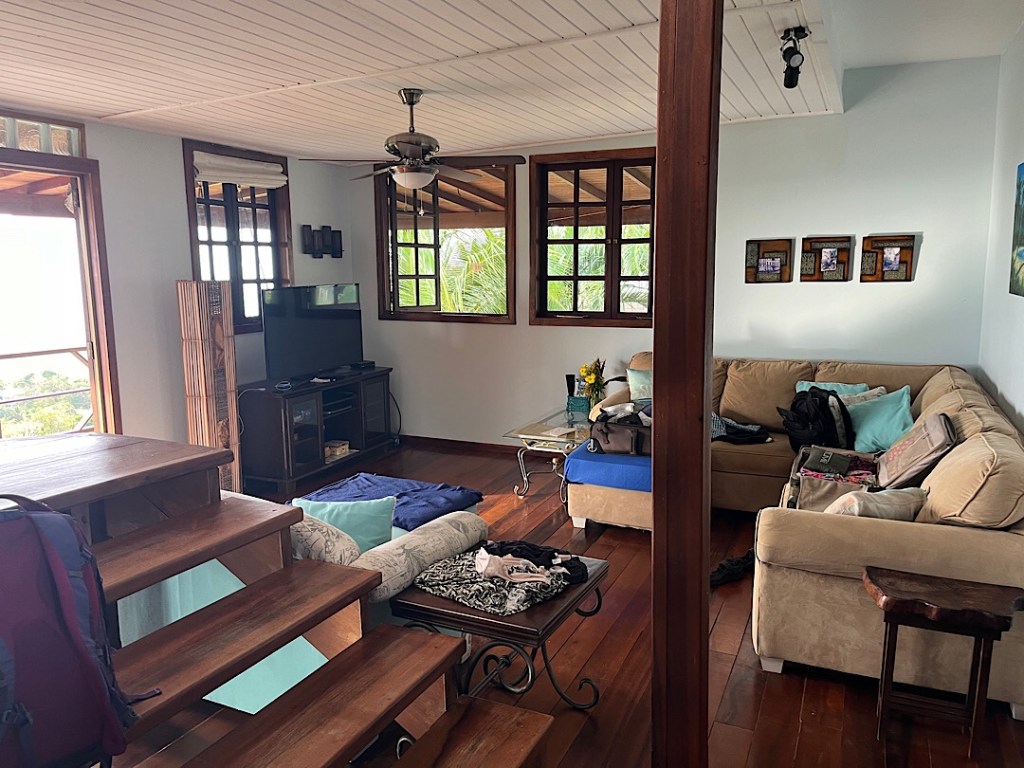
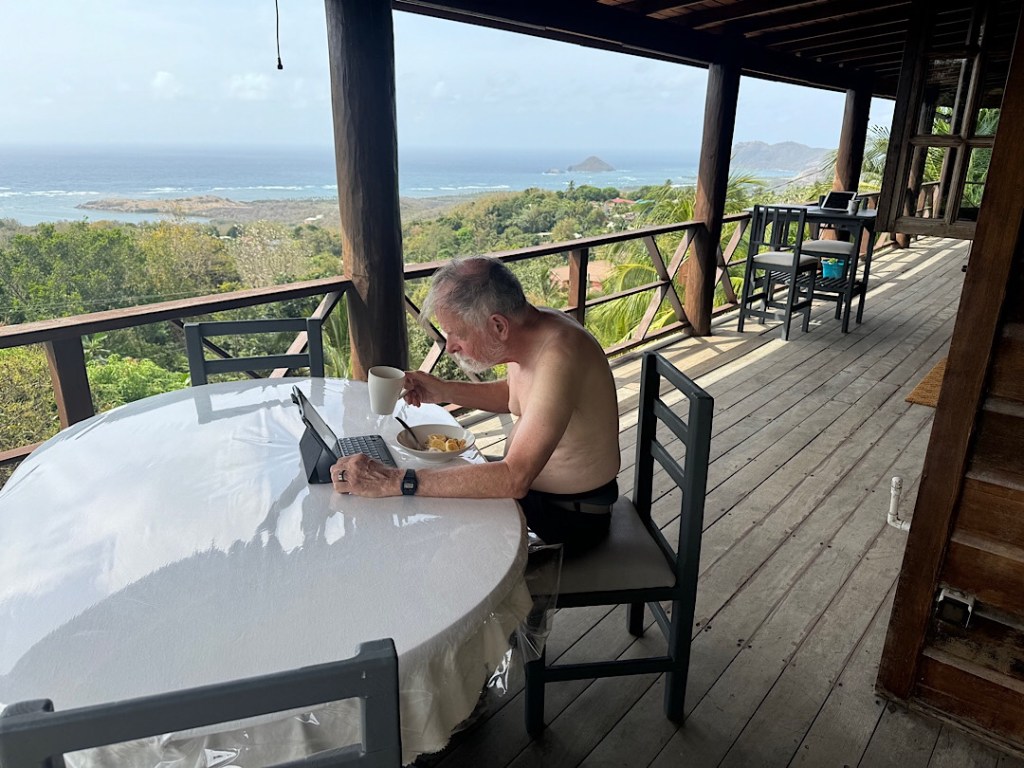
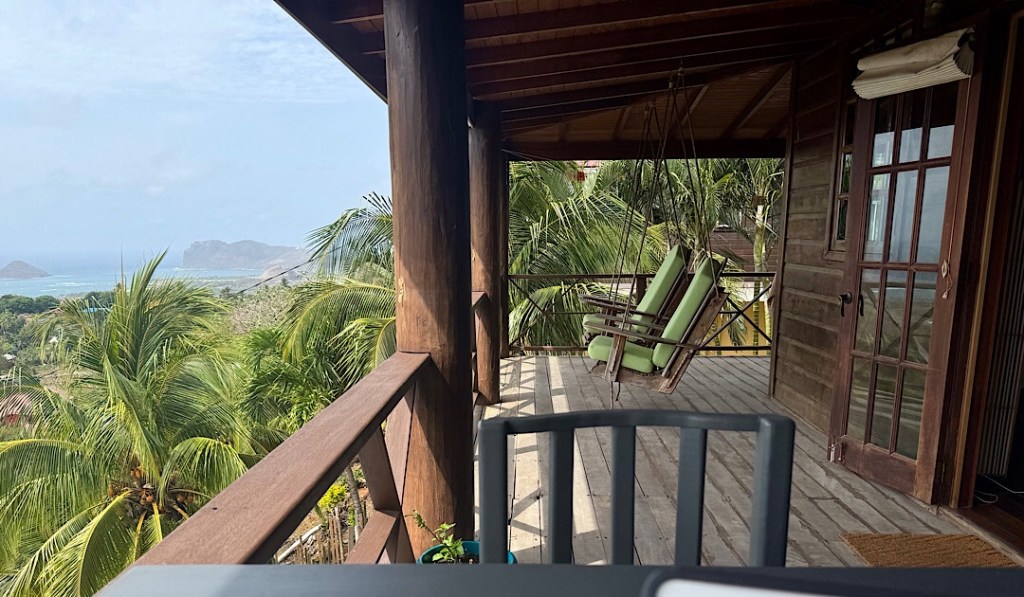
“Coco View Villa,” which I secured with HomeExchange.com guest points, turned out to be a rambling wooden, four-story structure that took in much of the southern sweep of the island, so comfortable and expansive neither of us wanted to do much more on Sunday than hang out in it.
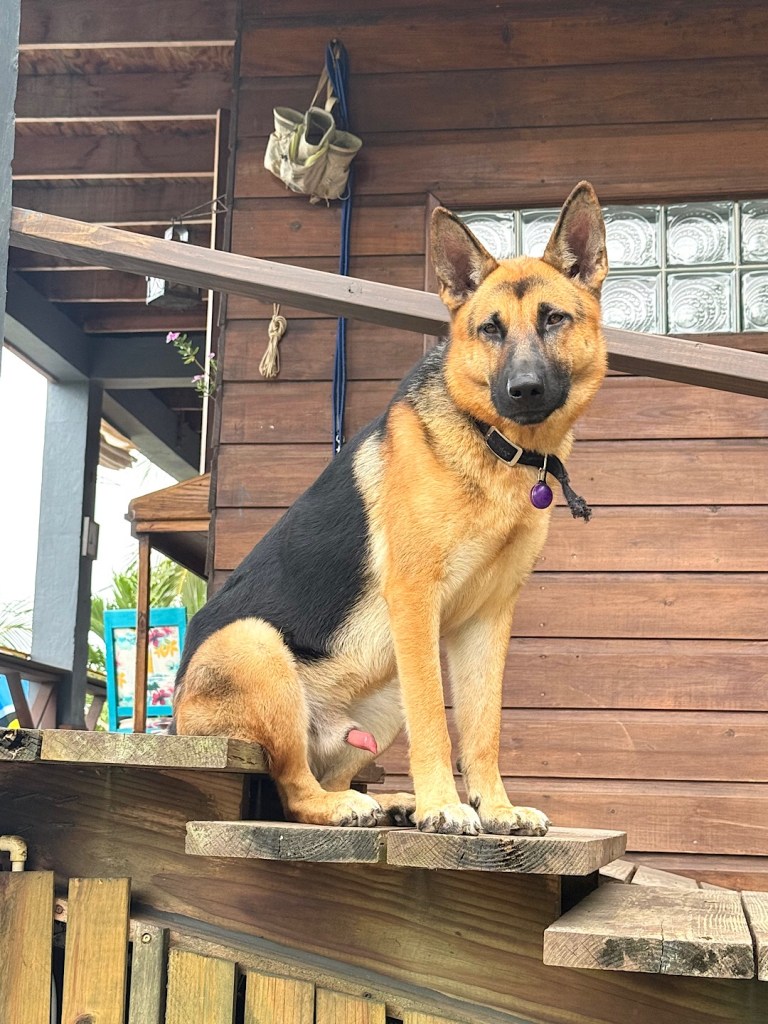
It had a nice big kitchen.And a living room opening onto the wonderful deck.Here’s Steve sitting at one end of it.A pool deck on the first level overlooked the abundant gardens.This cute, if somewhat excitable, guy kept an eye on everything, along with three smaller dogs.The hanging chair swings were a marvelous place to take in the sweeping views.
We made a few small runs that first full day…
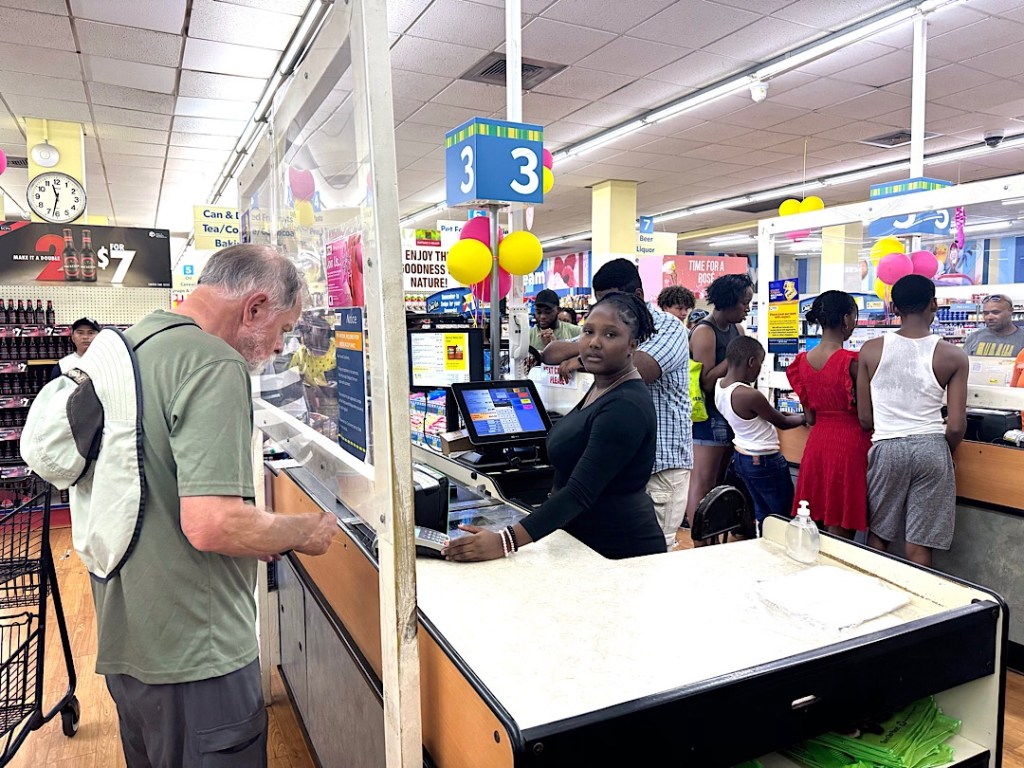
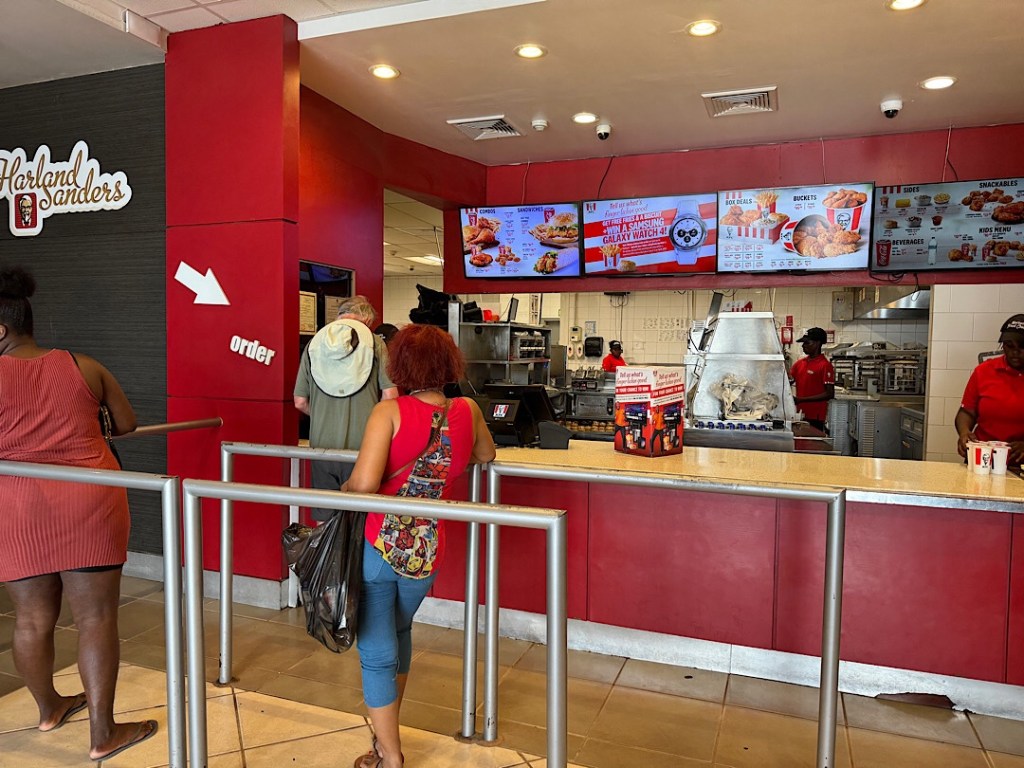
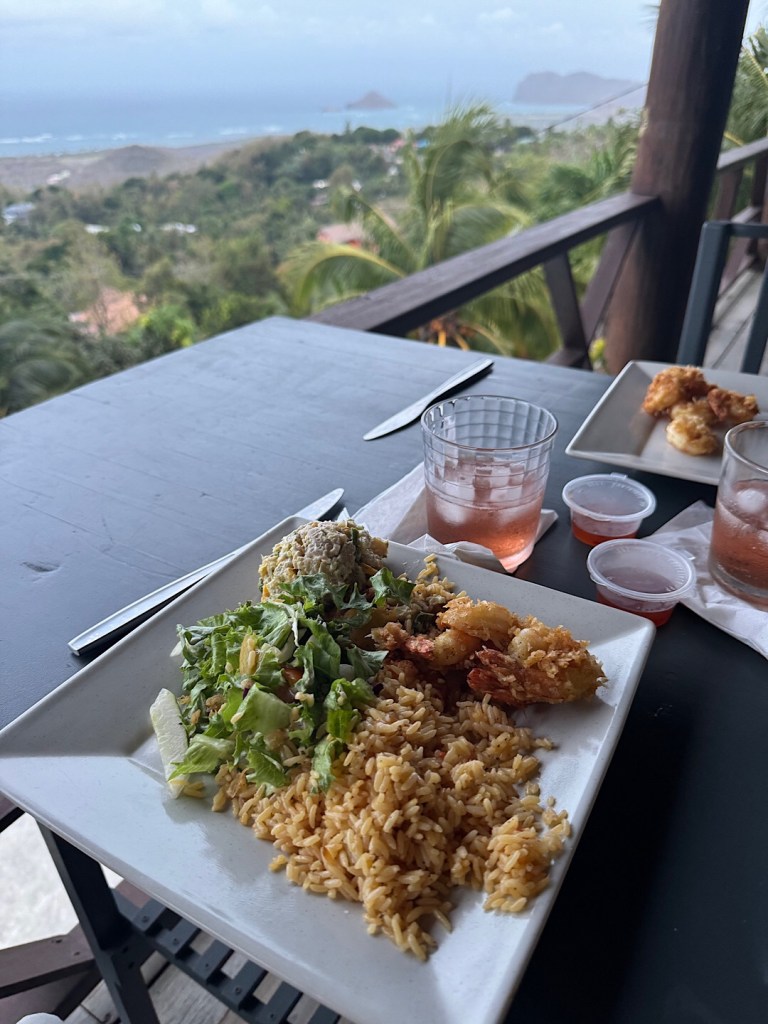
Picked up some groceries at the supermarket in Vieux Fort. Bought a three-piece lunch from the Colonel. The coconut shrimp that we took out from a local joint for dinner was delicious.
We revved up our touristic engines Monday, driving ourselves to the southwestern side of the island, where some of the biggest visitor attractions are situated.
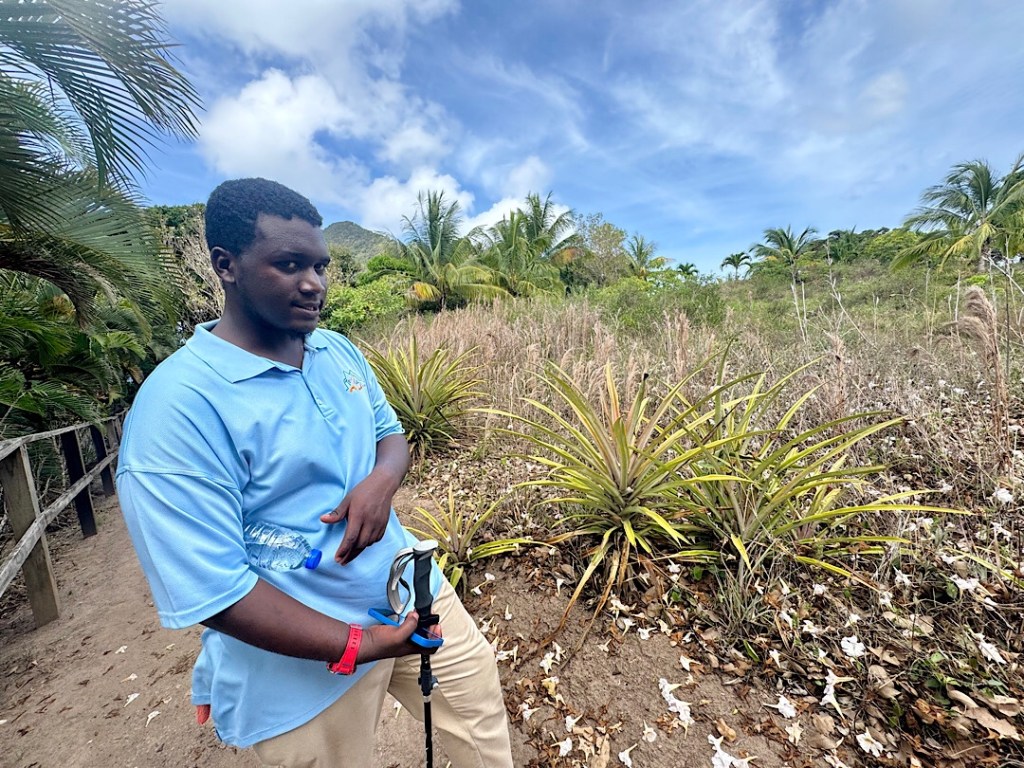
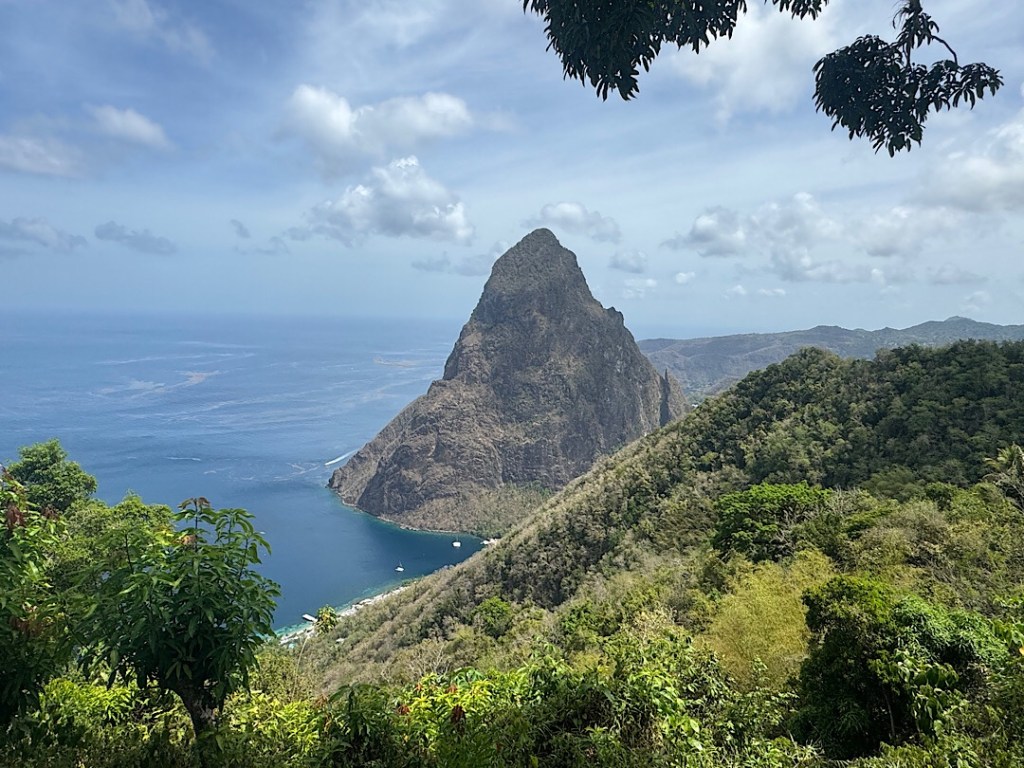
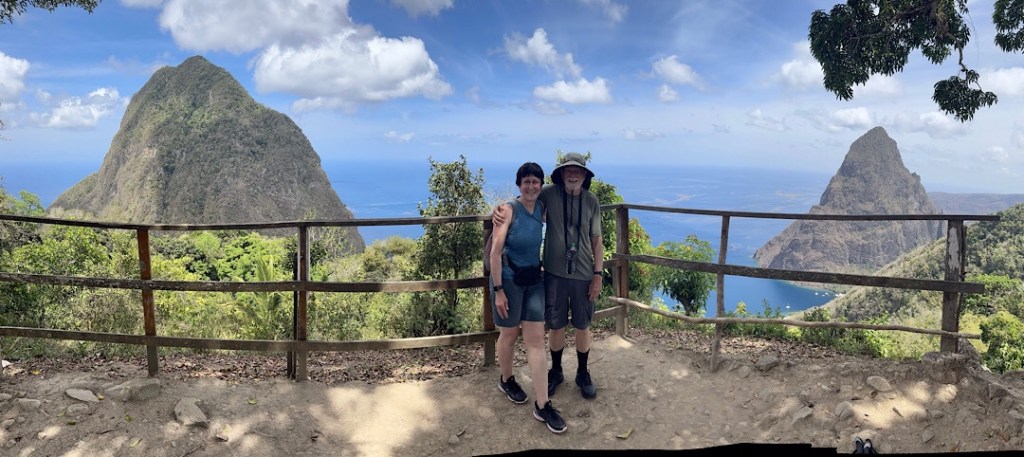
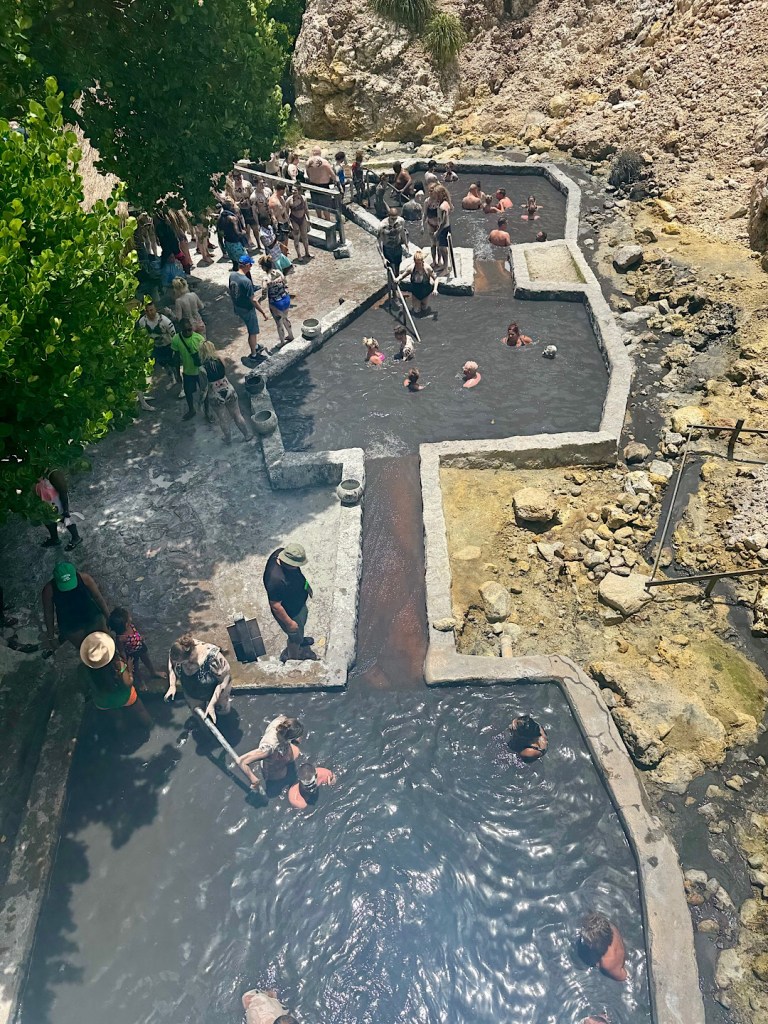
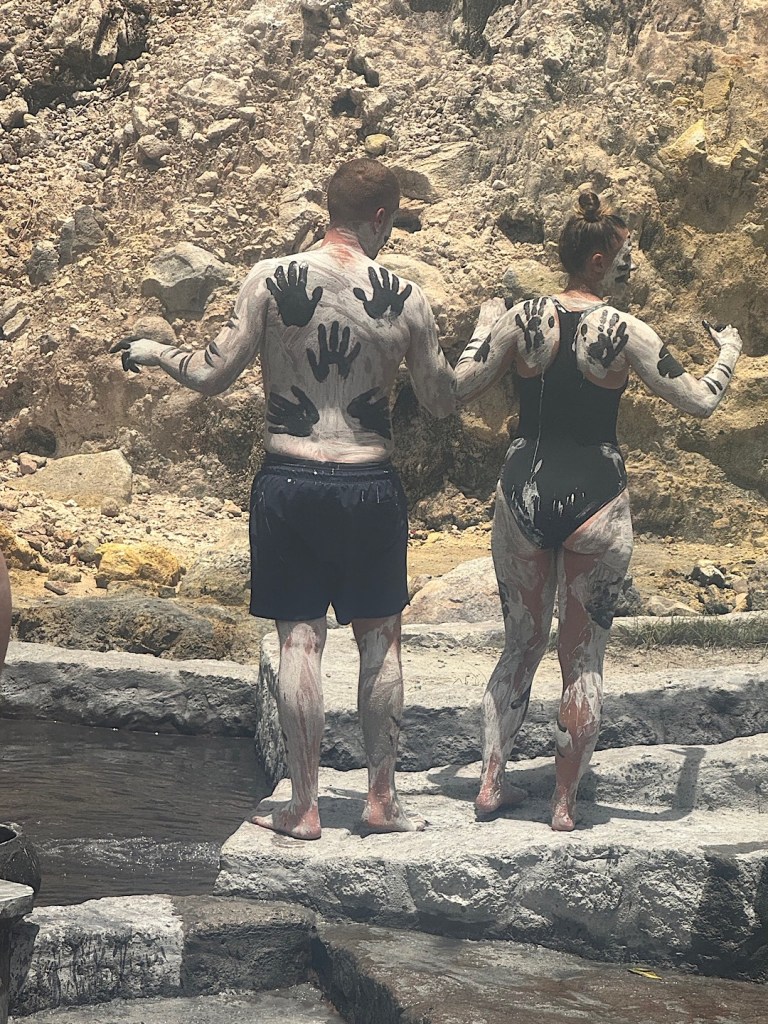
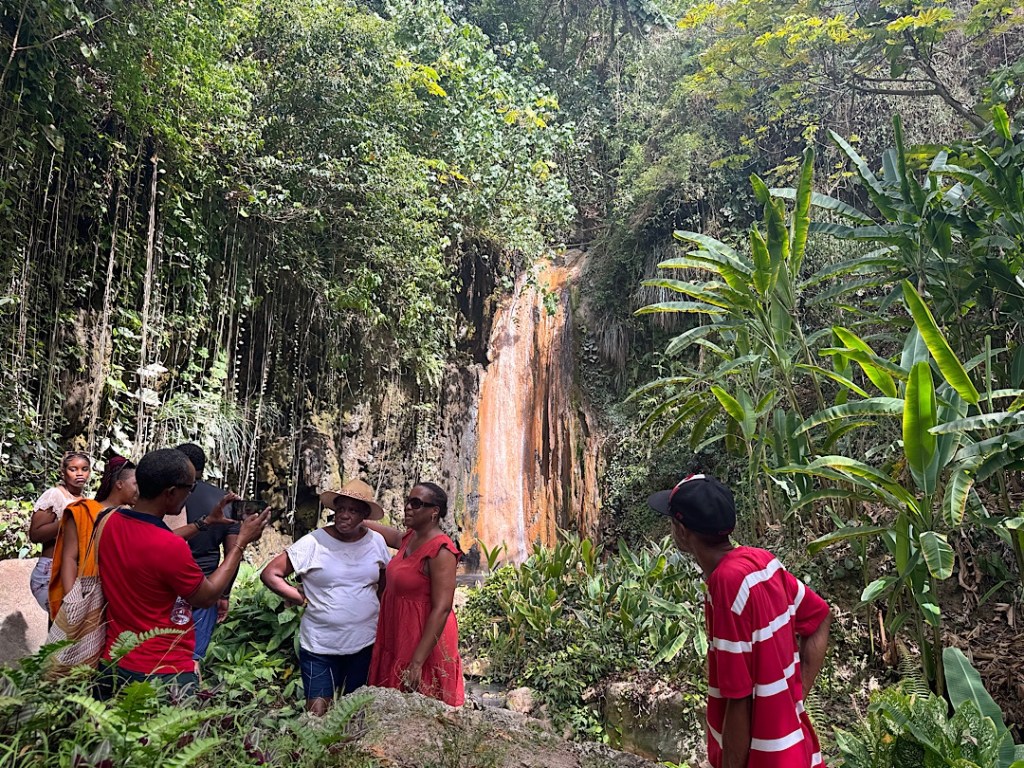
We started with a walk up a hiking trail that led to stunning views of St. Lucia’s two dramatic Pitons (peaks.) This was our charming guide, Shervin.Petit PitonBoth Pitons and us Next we drive to Sulphur Springs, a place to take a “mud bath” brewed by the underlying volcano.You move through five pools that get progressively cooler. They were nowhere near as muddy as the mud volcano in which we immersed ourselves in Colombia.Mud-slathering assistants decorate many patrons, but Steve and I stuck to enjoying the pools. After lunch, we visited Diamond Falls. We strolled through exquisite plants to get to the waterfall.
Yes, had we more time, we could have done more. But now we’ve moved on to Dominica, where I’m grateful to have every minute in our schedule
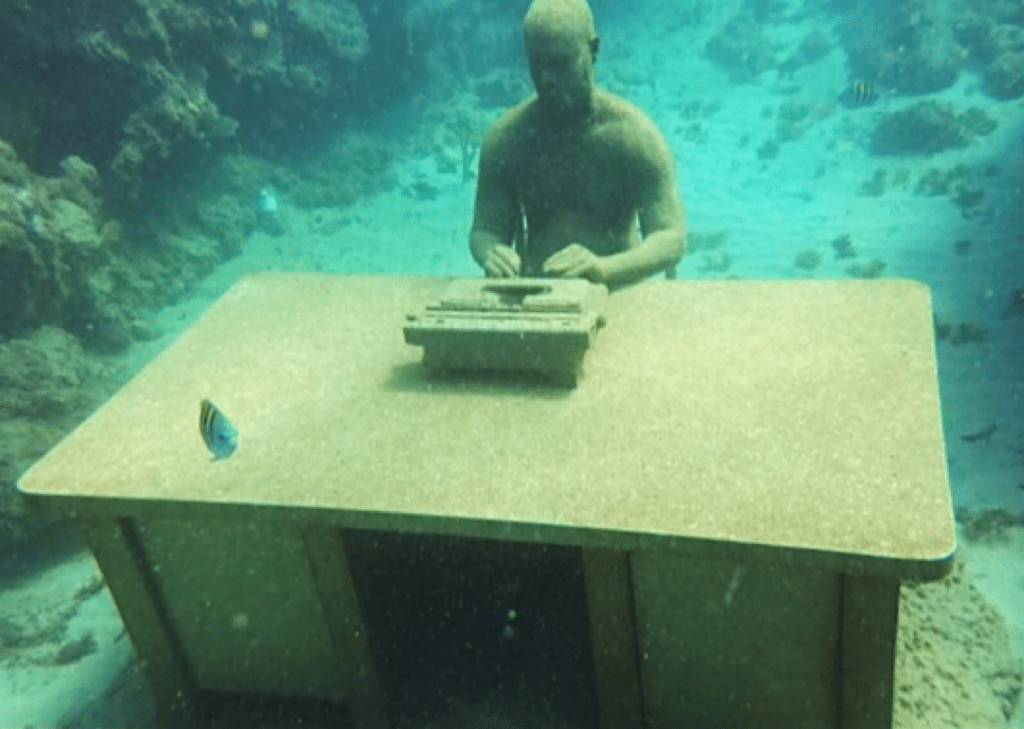
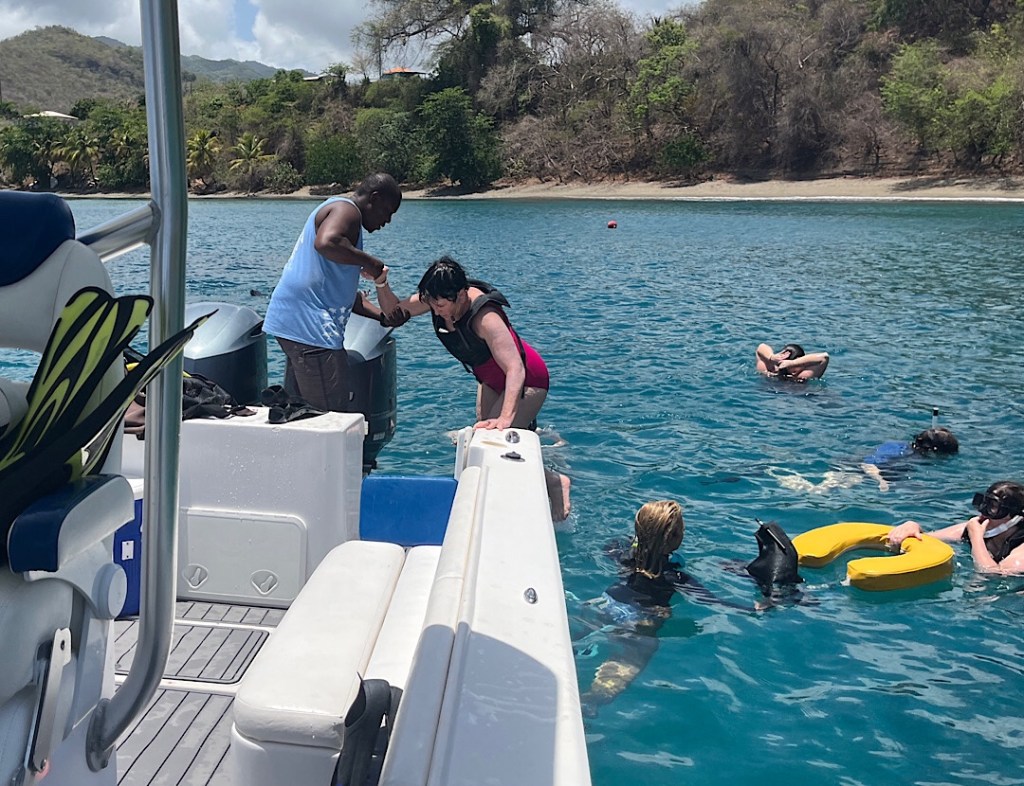
We didn’t spend all our time on Grenada seeking out blood-soaked sites. We indulged in classically touristic pastimes too, the most fun being the snorkeling tour we took Friday morning. Steve and I don’t snorkel often, but whenever we’ve done it in recent years, we’ve loved it. Grenada is surrounded by warm waters and a healthy community of sea life, and it also boasts something unique: the world’s first underwater sculpture park. We couldn’t miss that.
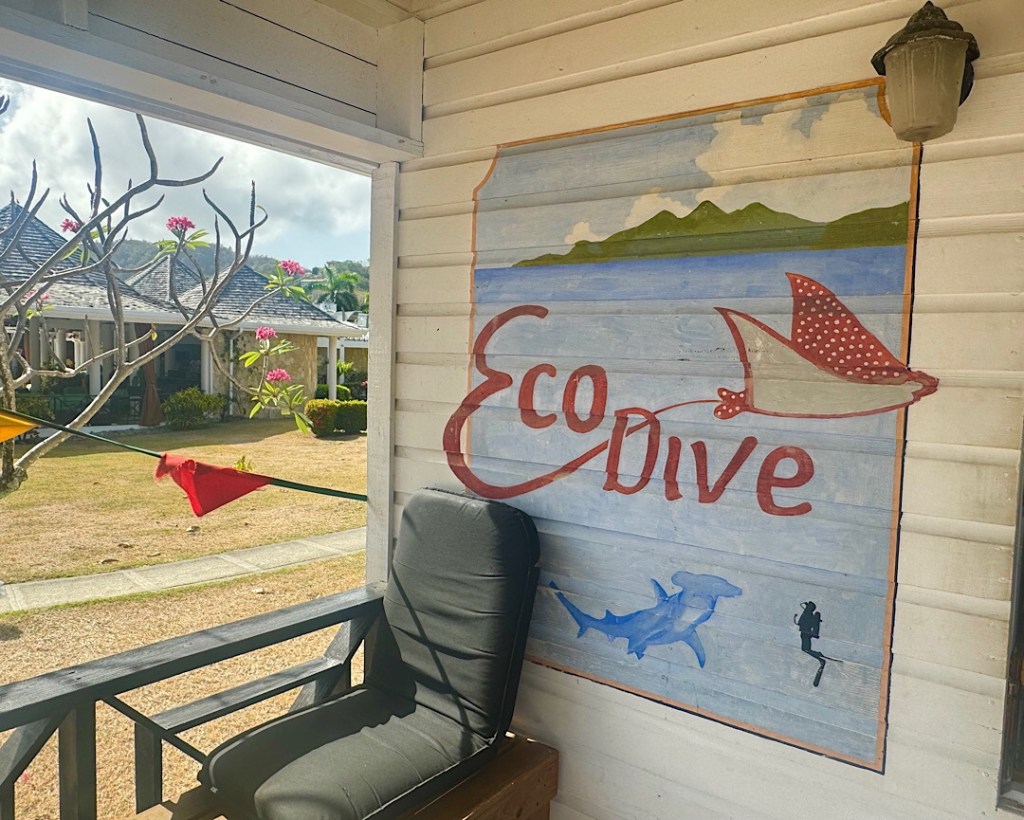
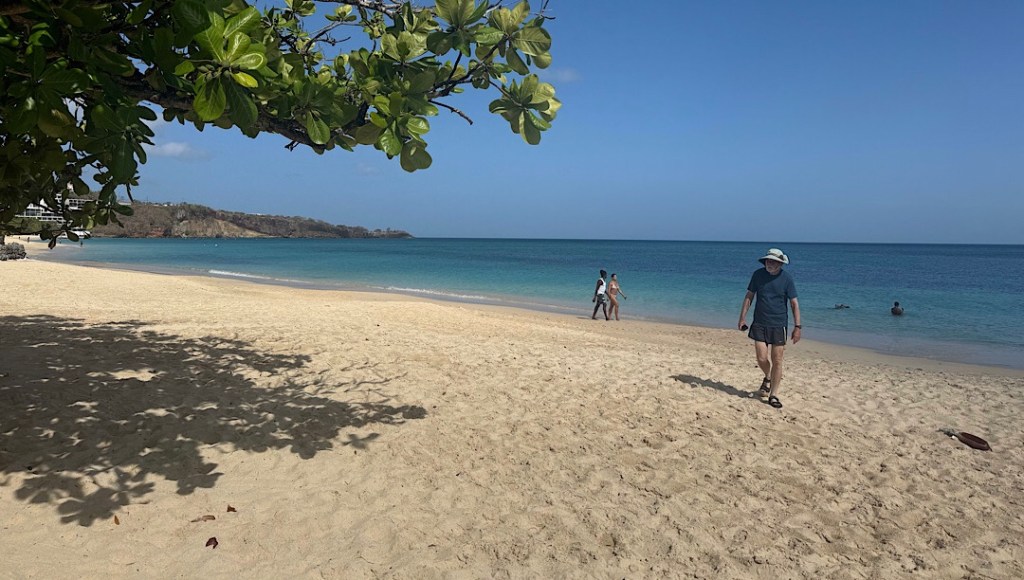
We woke up to hot sun and clear skies, and when we arrived at the Eco Dive outlet on Grand Anse Beach shortly before 9, the mood among the customers gathered there was ebullient. Just seeing Grand Anse is enough to lift one’s spirits. Consistently ranked among the world’s best beaches, its powdery sand arcs for a couple of miles beside placid turquoise water.
The dive shop outfitted us with flippers, then we climbed aboard a powerboat big enough to hold about a dozen snorkelers (almost all Brits, Americans, and Canadians) and a crew of two. Soon we were motoring north toward Molinere Bay.
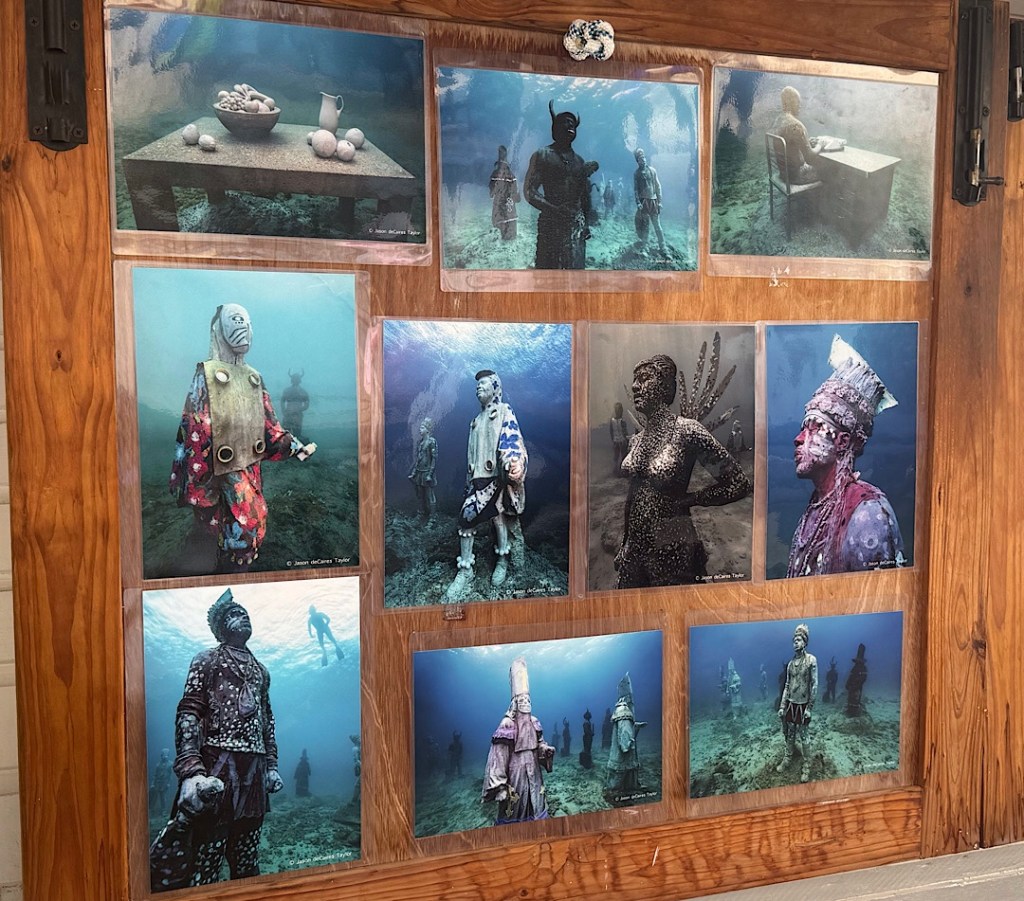
The autumn of 2004 was a very bad time to be anywhere on Grenada, including this bay. In early September, a hurricane named Ivan began smashing its way through through the Caribbean. That megastorm blew down most of the island’s nutmeg and cacao trees. It tore up its coral reefs, killed 39 people, and wrecked some of the most prominent human buildings. In the aftermath of the devastation, a British “eco-artist” named Jason de Caires Taylor got the idea of placing a bunch of concrete and stainless steel art pieces in the ruined coral beds to spur the blooming of new underwater life. The Grenadian governmemt signed off on the plan and today marine biologists say all these efforts have worked. Coral is growing on and around the sculptures, and a host of fish and other creatures has settled into the neighborhood. The park also has become a powerful tourist attraction.
I wasn’t wearing scuba gear and didn’t carry an underwater camera, so I didn’t capture the striking images one can take amidst the submerged art pieces (though you can see some here.) In exchange for traveling light, I got to float over the art pieces, feeling a bit like a human drone, flying without effort in the company of myriad beautiful fish. Over time, the effect of saltwater and sea life has been eerily transforming the sculptures, which are placed at depths ranging from roughly 10 to 25 feet. It might have been cool to get nose-to-nose with them, but I never exerted the effort to dive down. And it also was great to swim alongside a guide who could explain what they all represented. My favorite was one called The Lost Correspondent.
After snorkeling in the sculpture park, we also spent an hour in the more traditional coral reef at Flamingo Bay.
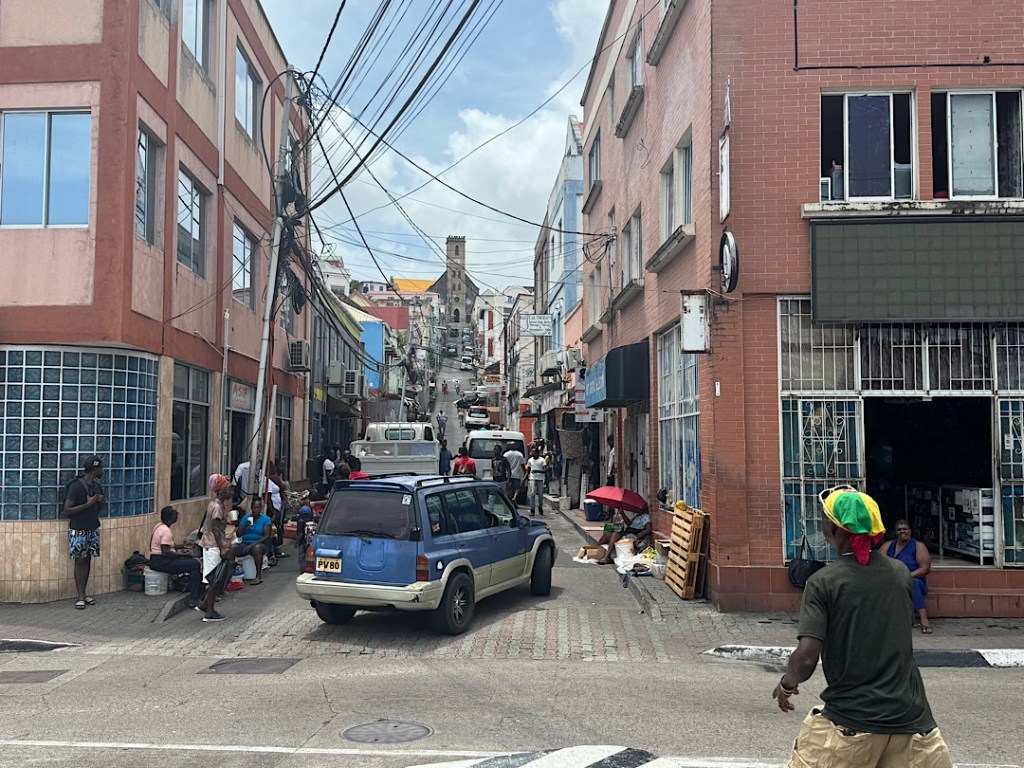
Most of our other touristic endeavors unfolded in the capital of the island, St. George’s, which over the centuries has climbed haphazardly up the steep hillsides surrounding a pretty little bay. Sadly, when we tried to visit some of the town’s most important sites, we found them closed for renovation, including the old fort where Maurice Bishop and his top advisors were gunned down 40 years ago. Only one gallery in the Grenada National Museum was open (but it focused on the indigenous population, which was our strongest interest.)
Just strolling through the town was fun.
When we were driving around the island, Grenada most reminded me of Bali — all those spectacular seascapes and steep green mountains. But when I voiced this observation, Steve scoffed, pointing out that unlike Bali, Grenada has no ancient Hindu or Buddhist temples. Plus it’s filled almost entirely with black people, more than 80% of whom are descendants of African slaves.
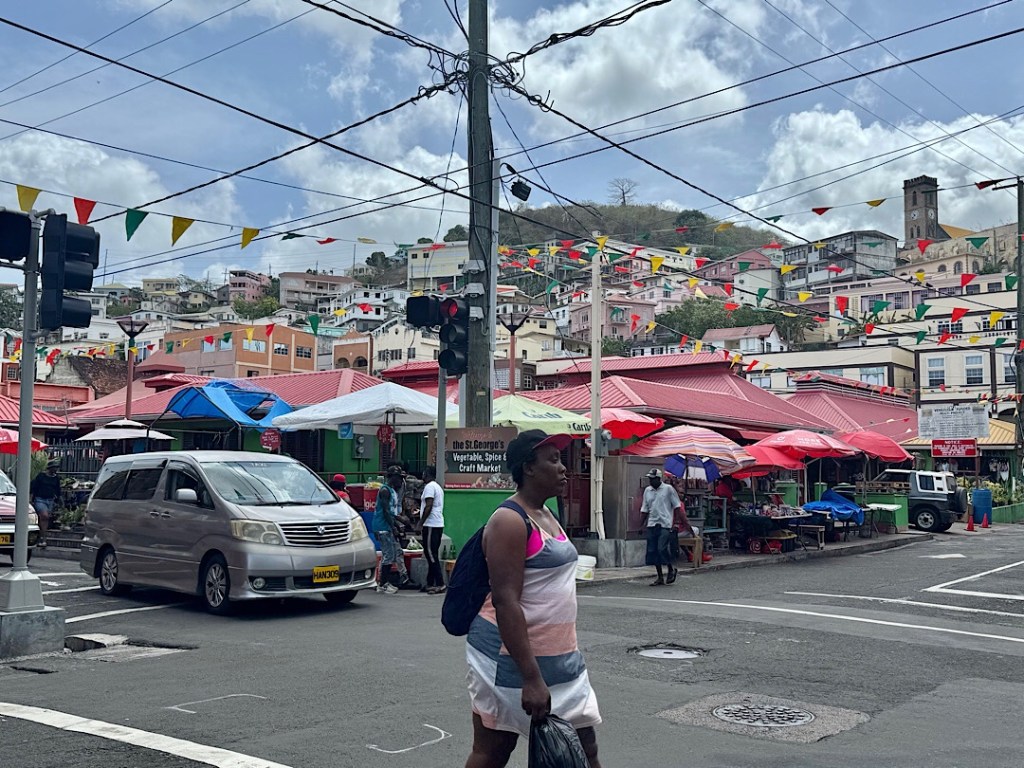
As dreadful as that history was, I have to say virtually everyone we interacted with could not have been more friendly. (Everyone speaks English here.) When we prowled through the spice market in St. George’s Saturday morning, no one pestered us to buy stuff. They did ask if we were enjoying our time on the island, and when we said yes they shone with delight.
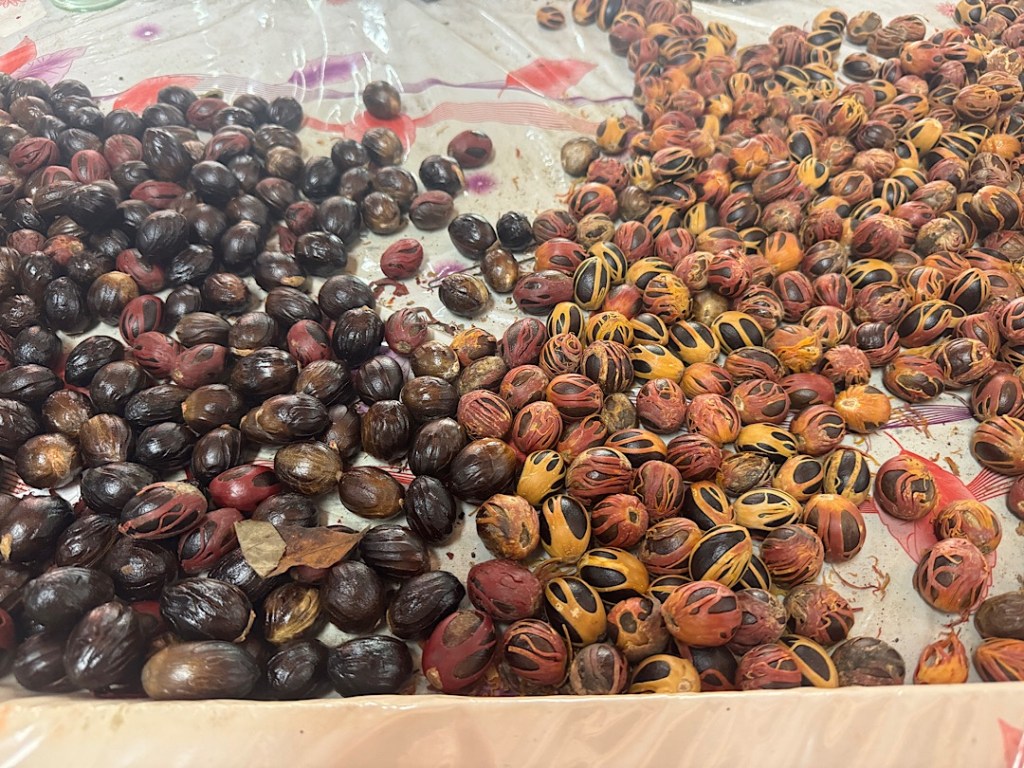
The central marketThis lady sold me a little bag of mace for about two US dollars. Mace is the yellow webbing surrounding the nutmeg shell. It’s considered to be a separate spice.
I never expressed to the Grenadians my nagging worry that if luxury villas continue being built and cruise ships bring more and more visitors, getting around on Grenada’s twisty narrow roads could turn into the nightmare that getting around Bali has become. Bad as it is here, it’s nowhere near that bad yet, and maybe Grenada is far enough off the beaten path to avoid Bali’s fate.
Anyway, it’s behind me now. Last night we made the 25-minute flight from St. George’s to the airport at the southern end of St. Lucia, where we only have two full days to try and experience this little country. Is that possible? Stay tuned.
Steve and I wanted to visit the spot where — almost 400 years ago — some of Grenada’s last indigenous people leaped off a cliff, rather than live as French slaves. This flamboyant act of resistance took place on Grenada’s northern coast. Since our arrival here Tuesday afternoon, we’ve been staying in a villa near the island’s southernmost reaches (a place we obtained using our HomeExchange.com Guest Points.) Google Maps told us we could make the 28-mile drive to “Leaper’s Hill” in about 80 minutes. It was our first lesson in the folly of blindly trusting in Internet-based guidance in the Caribbean.
What Google Maps didn’t (couldn’t?) take into account was how much more slowly Steve drove than all the folks with whom we shared the roads. Some of them beeped their horns at us, but I understood Steve’s caution. The surfaces were not a problem; you can find more potholes in La Jolla than we saw from our bright-red Toyota Passo (smaller than a Tercel). But carved out of the sides of a vertiginous landscape, the Grenadian roads are narrow, and instead of shoulders, deep drainage ditches line the vast majority of them.
I would hate to know how many times I yelped or shrieked at the proximity of our left tires to the trenches below my passenger window as Steve veered away from the concrete mixers and Coke trucks and minivans and other vehicles barreling at us from the right-hand side of the road. Then you get people PARKING on the streets! This often forces everyone to stop and play chicken to get through the remaining single lane. On top of all that, most folks drive fast. If any tourist here gets tired of lazing on the beach and downing rum punch, taking a rental car for a spin can provide an alternative form of entertainment — immediate immersion in a real-life version of some video game like Need for Speed Unbound.
The drive north took us almost two hours. If nerve-wracking, it provided countless interesting sights. We passed humble shelters…
…but also plenty of impressively sturdy ones
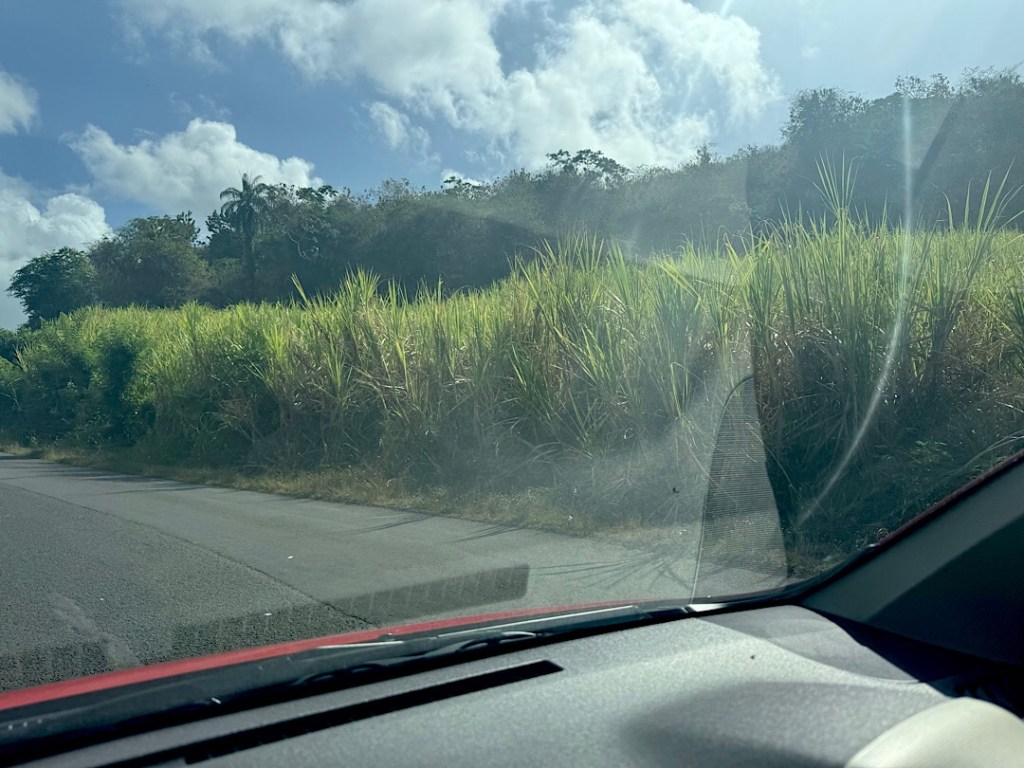
…and I loved how many homeowners choose paint colors that echo the local fruits — mango and plantain green and cocoa-pod yellows — or the azures and turquoise shades of the sea. We passed through stands of sugar cane.
Today it’s used exclusively to make rum.
Around 10:30 am we reached the town of Sauteurs (literally, “jumpers” in French).
We didn’t miss a turn following Google’s directions to “Leaper’s Hill.” But instead of finding the monument whose image I had seen online, the road ended at a cluster of abandoned buildings on the edge of a cliff where there was just enough room to park.
Next to where we left the car, we could make out the beach at the base of the drop off.
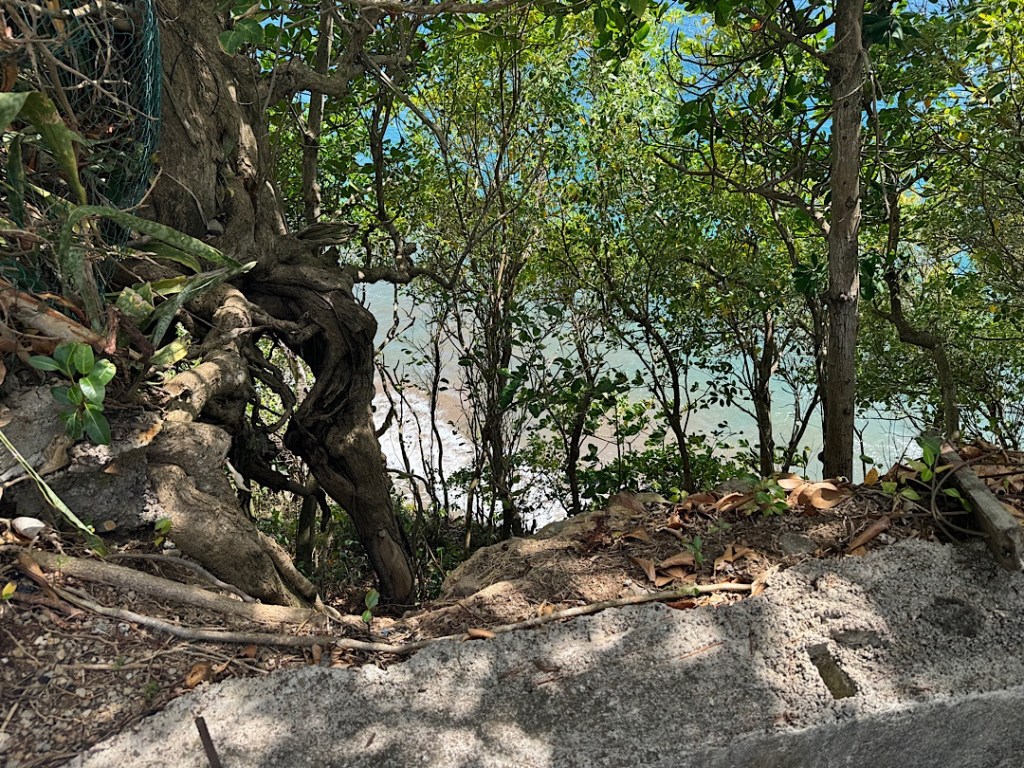
A vague path led along it, past a few creepy abandoned structures but it seemed to end at a ledge below an old cemetery.
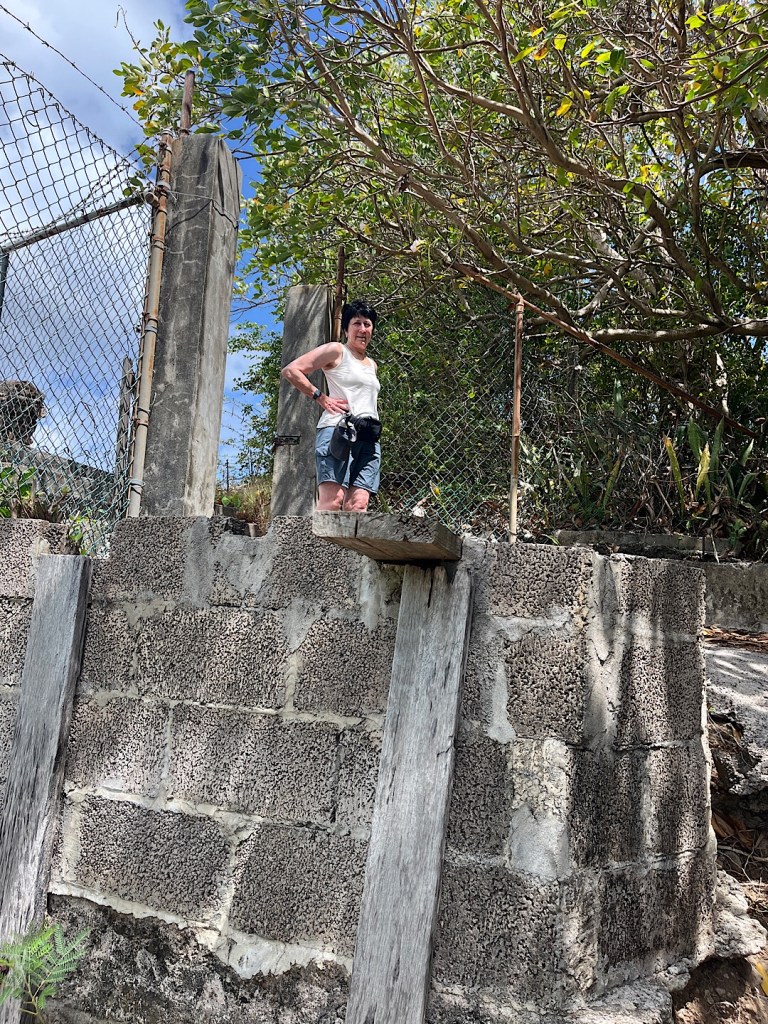
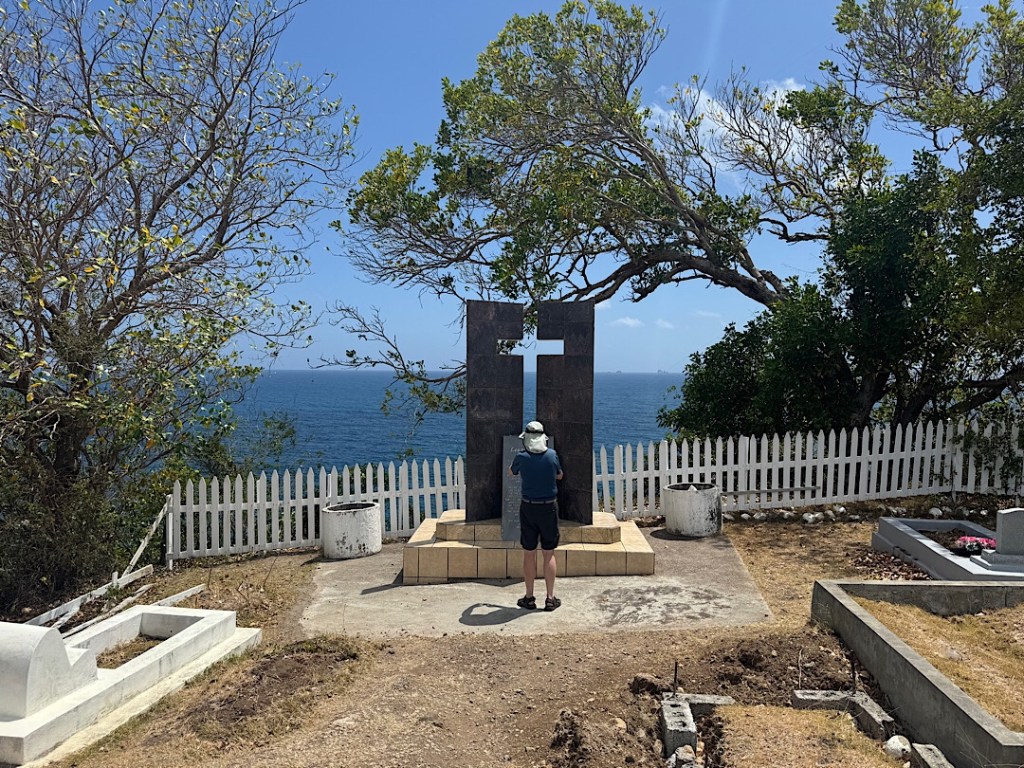
We scrambled up the ledge, squeezed into the graveyard, and there in the distance, I spotted the monument.
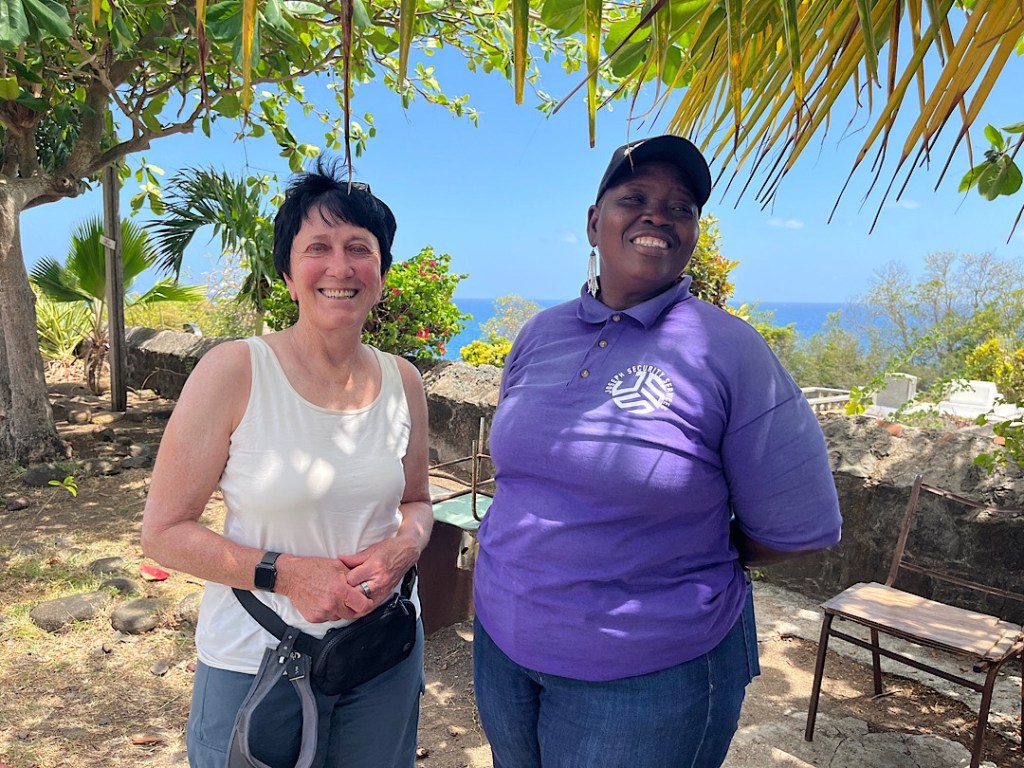
Whether the Caribs committed suicide or were driven off the cliff by their French conquerors (accounts vary), it was a beautiful place to die. Eventually, we realized there was a front entrance to the cemetery. We strolled to it and introduced ourselves to the guard, whose 53rd birthday, we learned, was that very day. Beverly (a Sauteurs native) filled us in on her village, where life is slow and pretty much crime-free. She said most residents survive either by fishing or farming on the nearby little Grenadian islands. Or they take minibuses to work in the capital, St. George’s, about an hour away.
The cemetery also, weirdly, is the final resting place of the first person ever to be diagnosed with sickle-cell anemia. We felt more than satisfied, touristically, as we headed south again.
Along the way, we stopped at the Belmont Estate, a former slave plantation dating back to the 1600s. For $6 each, we got a two-hour tour of the 400-acre operation.
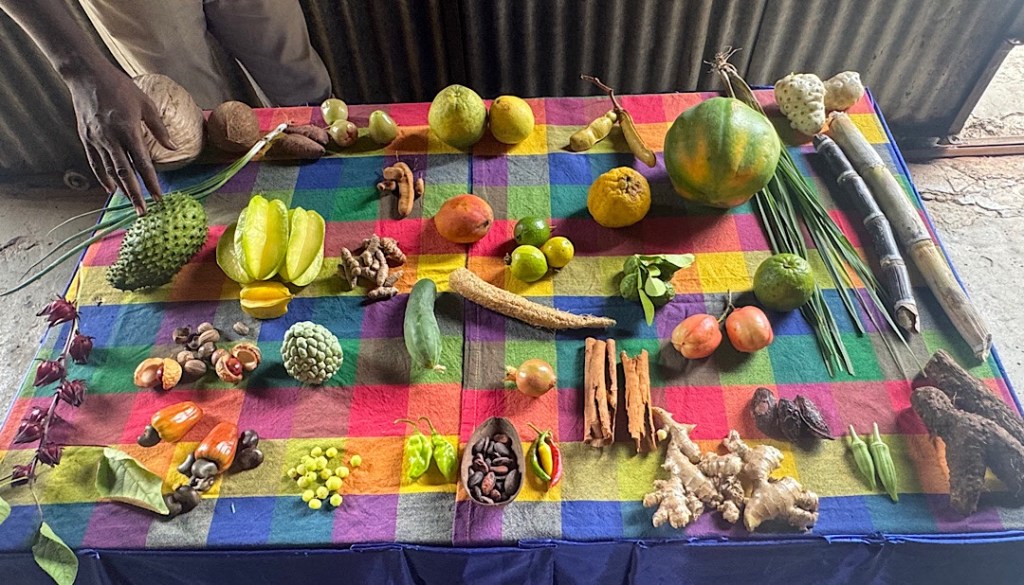
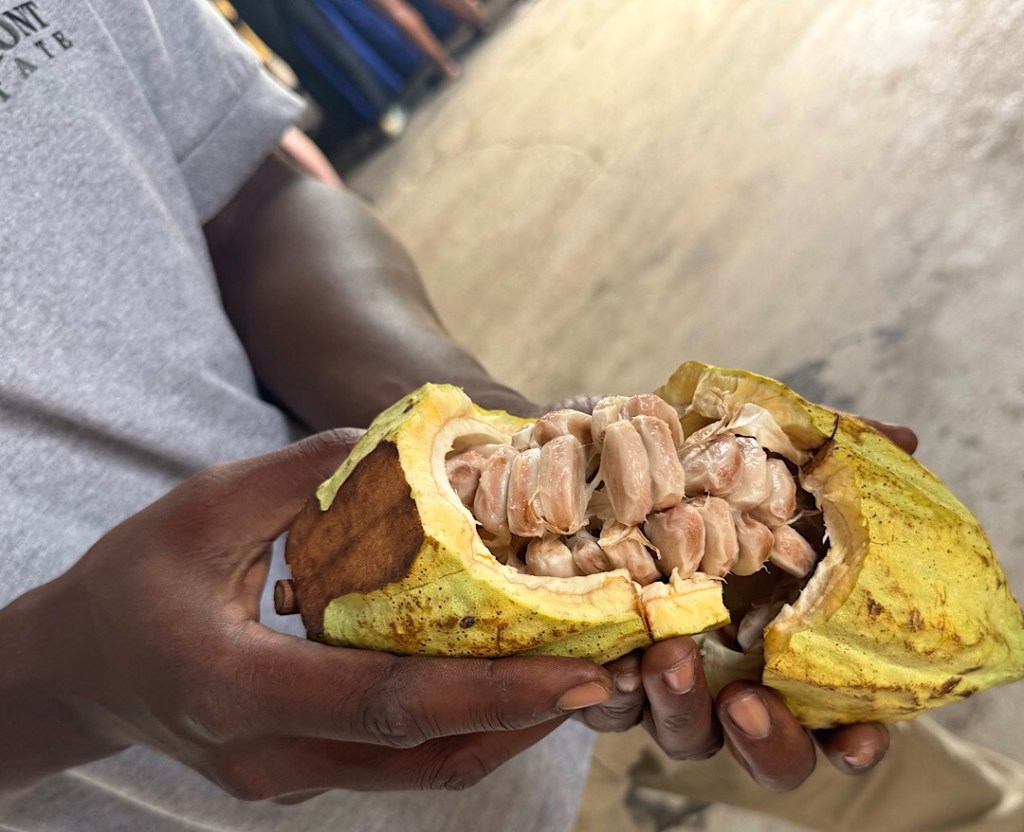
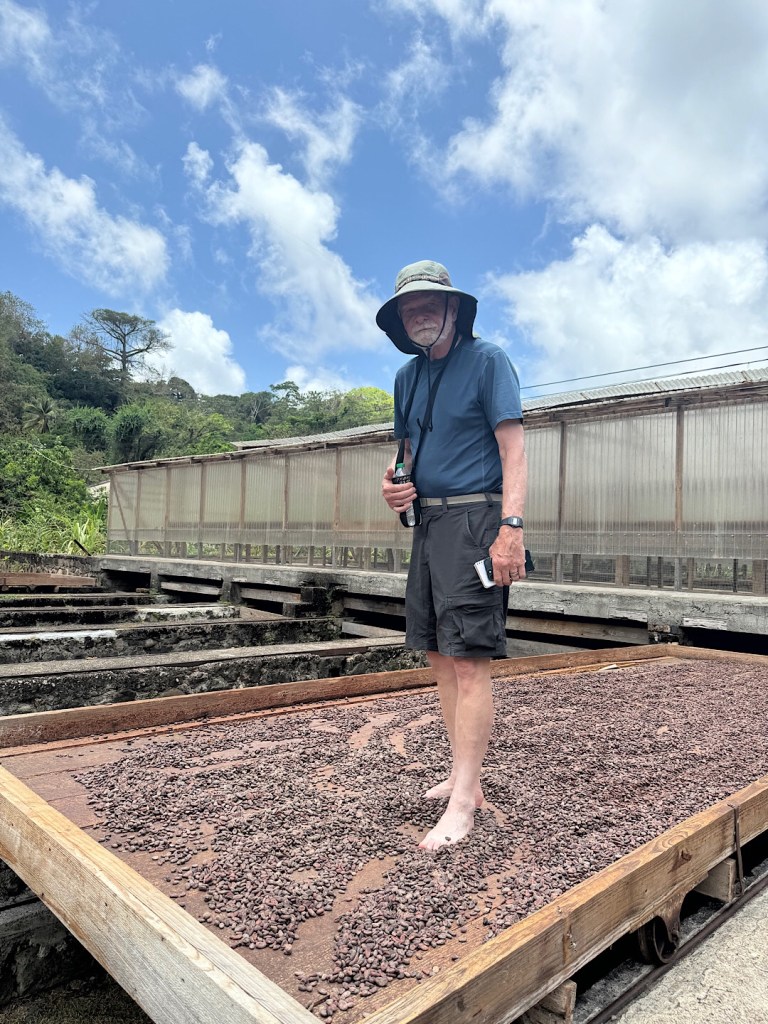
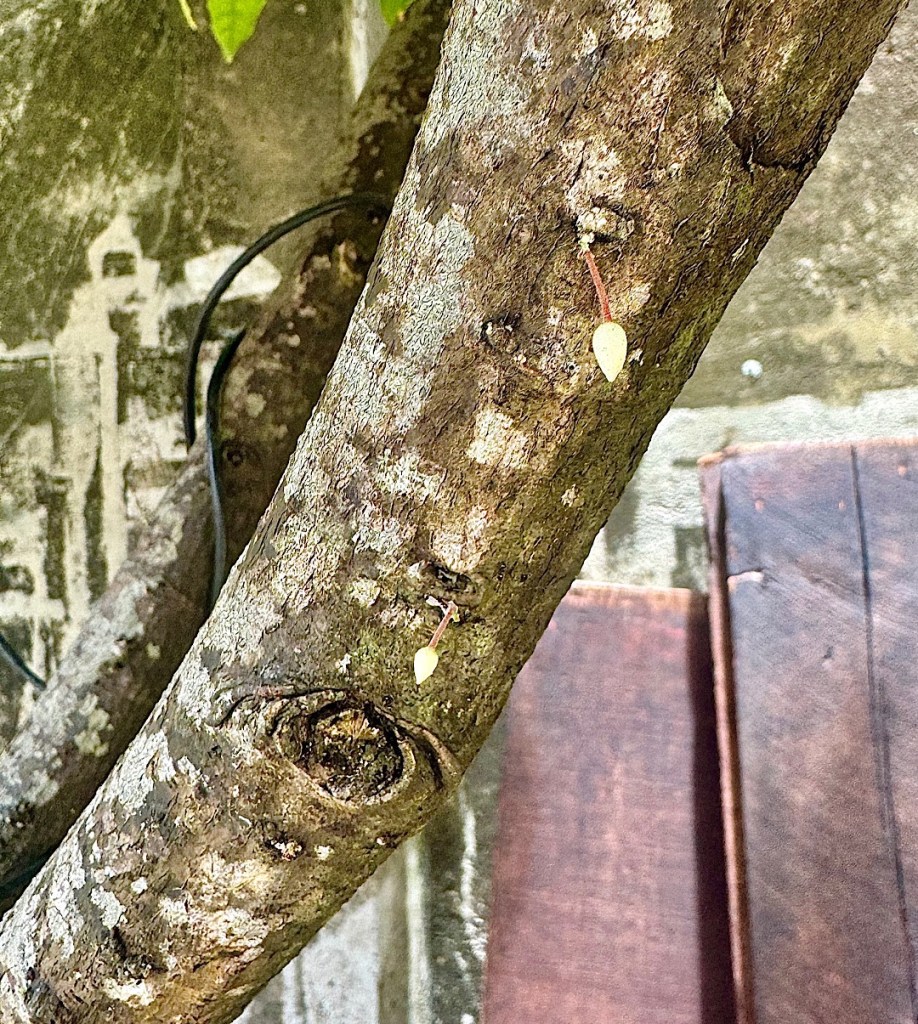
Today they produce an eye-popping assortment of tropical fruit and other agricultural goods.Today cocoa beans and nutmeg are the biggest moneymakers. Our guide showed us the whole process, from the extraction of the beans from the cocoa pods, through their fermentation, drying, sorting, grinding, aging and turning into smooth, shiny bars. Farm workers like this one used to shuffle through the drying beans to mix them up.I was most delighted to learn that chocolate starts its life cycle as a tiny delicate flower that sprouts directly from the plant’s trunk.
After a decent lunch that included the first nutmeg ice cream I’ve ever tasted (an island speciality,) we climbed into the Passo again, thinking our next stop would be in the Grand Etang National Park. There we wanted to hike to the famed Seven Sisters Waterfalls. But Google Maps let us down again. Although the waterfalls were clearly listed as a destination, we saw no turn-off to them as we whizzed through the high dense jungle. It began pouring rain so we gave up and returned to our villa for a pre-dinner nap.
Staying at this villa is a different kind of home-exchanging experience than we’ve had before. The classic model is a direct trade, where you go and stay in the home of folks who simultaneously take over your house. We’ve done dozens of those over the years, including our recent trade in Austin. But another option nowadays is to use “Guest Points.” These give you a lot more options. For example, if you’re like Jennifer and Mark Solomon and you own a little resort off the beaten Grenadian path and it’s the off-season and most of your units are empty, you can list one of them on homeexchange.com, get points for it, and use them to secure lodging when you visit your relatives in London.
Steve and I have amassed bunches of Guest Points over the years, and for this Caribbean trip we’ve used them to secure a variety of accommodations, including the villa within the Solomons’ 473 Grenada Boutique Resort. The complex has an in-house chef whose services we’ve mostly been using for dinners, since in this part of the island there are almost no restaurant services. We did hear about a restaurant at another resort just 10 minutes away, however, and Thursday night we decided to dine there.
On the way, we made another off-beat stop. We wanted to see what was left of the old Army camp where Maurice Bishop’s body was dumped 40 years ago. Bishop was the charismatic young socialist who became prime minister in 1979 — six years after Grenada gained its independence from Britain. On October 18, 1983, he and six of his top lieutenants were executed in a bloody coup led by more-hardcore-Marxist Grenadians, and the assassination triggered Ronald Reagan’s decision to invade the island (remember “Operation Urgent Fury”?)
Here I have to say: last Sunday morning when I published my first post about this trip, neither Steve nor I knew almost anything about this (fairly recent ) history. That afternoon a friend who read my post alerted me we should check out a recent 7-part Washington Post podcast, “The Empty Grave of Comrade Bishop,” that focused on that tempestuous chapter of Grenadian history. I started listening as we flew east Monday, and I finished up the last two episodes between Miami and here, spellbound throughout. If mystery still surrounds exactly what happened to the bodies of Bishop and his team, I came away feeling like at least I had learned what had caused all the bloodshed.
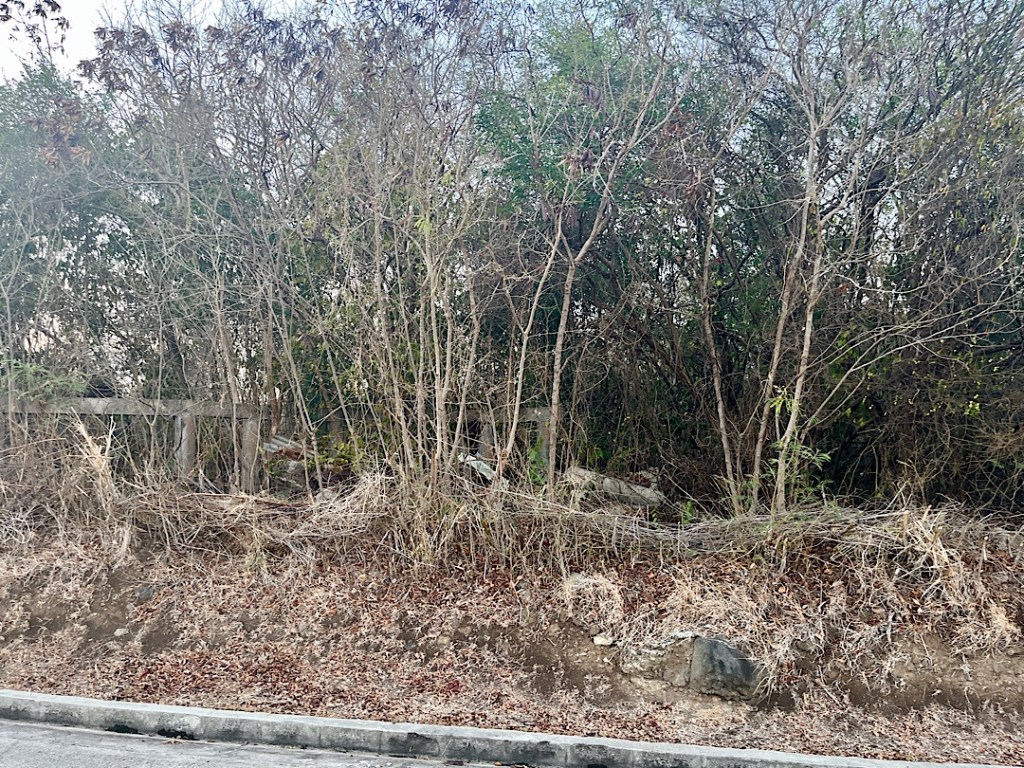
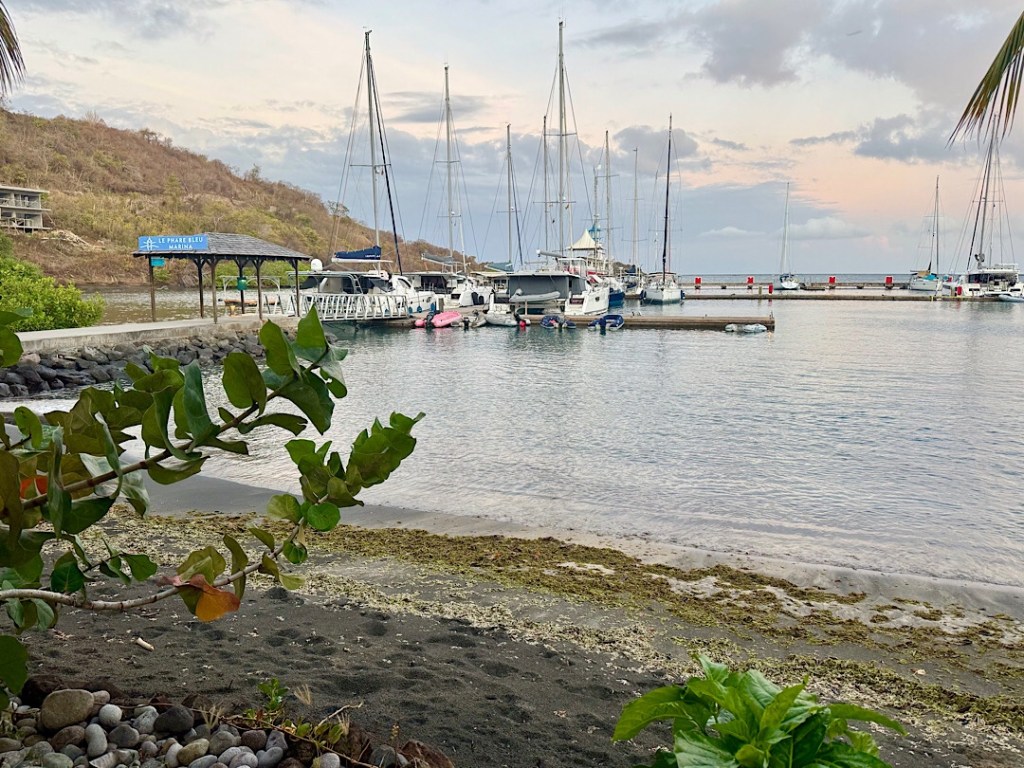
Today there’s still no gravesite or memorial for Bishop, but Steve did some research and realized one of the bloodiest sites of the coup and subsequent invasion was just 5 minutes from La Phare Bleu (where we had decided to dine). We told Google Maps we wanted to make a stop there, and this time the app led us directly to a road that climbed to the top of the Calavigny peninsula. At the coordinates, we found a wildly overgrown lot surrounded on all sides by a very new, obviously upper crust housing development.
The heart of the Grenadian army compound was in that bushy patch on the right.This is the house across the street from it.We think some of the most gruesome scenes from the podcast probably took place in there.
Foreboding and ominous, the former Army property didn’t inspire either of us to tromp around in it (filled as it could be still with unexploded ordinance.) So we just snapped a few photos and went on to the restaurant, where we sat at a dockside table, drank ruby-red rum punch, and shared a whole roasted lionfish.
My chair faced Calavigny’s brown hillside. The scene was postcard-lovely. But I imagined that night 40 years ago, when the US military was bombing it to smithereens, dropping 500-pound bombs and cluster munitions and thousands upon thousands of rounds of other ammunition, aiming for anywhere enemy fighters might be hiding. For me, knowing about the hellish brutality unleashed by the United States didn’t make it any less pretty. I do appreciate prettiness. But it’s also satisfying to get a peek at the backside of the postcard.
Back in 1977, Steve and his friend Roy Wysack wrote the science-fictional Handbook for Space Pioneers. It described 9 planets open for human settlement in the year 2376. Among the choices open to aspiring immigrants, the place that most appealed to me was Poseidous, a watery world with no major land masses – just hundreds of thousands of islands on which wildly diverse human cultures were taking shape.
As Steve and I approached our trip last year to Indonesia, it struck me that the Asian island nation might be more like Poseidous than anywhere I’d been on Earth. But now we’re about to travel to a region where that’s even truer. We leave tomorrow for Miami, then fly the next day to Grenada, the first of six Caribbean islands we’ll be exploring.
Our only prior Caribbean experience was our 2012 trip to Cuba. (Although I had created this blog by then, I didn’t post anything about that adventure because Americans weren’t supposed to be traveling there.) We had a great time, but the Communist stronghold’s neighbors didn’t much interest us. Steve and I both thought of most Caribbean islands only as magnets for beach and resort-lovers. While we live just 5 minutes from a nice beach, neither of us ever go there to lie on it.
Only recently did it dawn on me there could be other reasons to visit the region. Its cultures might not be as manifold as those of Poseidous, but more than a dozen sovereign nations and almost as many dependent territories occupy the balmy water adjoining the Gulf of Mexico. Chris Columbus discovered the New World here, and the anguished cries of African slaves filled the Caribbean breezes before they became commonplace in America. Big Sugar got its start in the islands, and pirates spiced up the scene for decades. Maybe it wouldn’t be boring, after all.
I quickly figured out we couldn’t go everywhere. My early dreams of getting from one Caribbean country to another via ferries also didn’t take long to evaporate. If you’re not cruising or sailing your own boat, it can be weirdly challenging to get around, I learned.
I wound up with an itinerary that will take us from Miami to Grenada, followed by stays in St. Lucia, Dominica, Puerto Rico, the Dominican Republic, and finally Jamaica. If we wind up doing a lot of sunbathing and snorkeling, I may not post much. But if we have any interesting experiences, I’ll do my best to report on them here.













 At home and abroad